


Slide 1/45
SSD & HDD Performance
Testing with TKperf
Georg Schönberger <gschoenberger@thomas-krenn.com>
LinuxTag 2013
The Who
Slide 3/45
Agenda
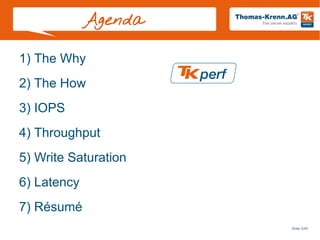
1) The Why
2) The How
3) IOPS
4) Throughput
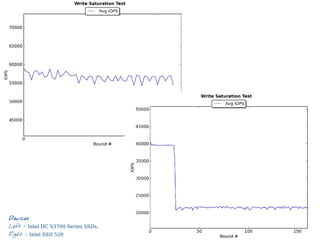
5) Write Saturation
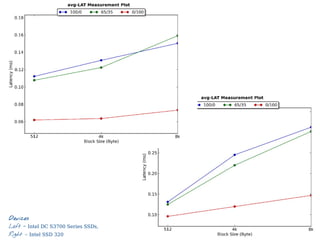
6) Latency
7) Résumé
Slide 4/45
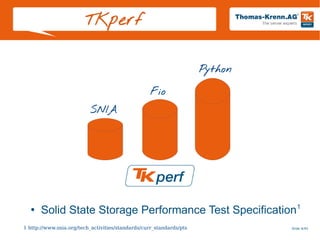
TKperf
1 http://www.snia.org/tech_activities/standards/curr_standards/pts
Fio
SNIA
Python
●
Solid State Storage Performance Test Specification1
The Why
Slide 6/45
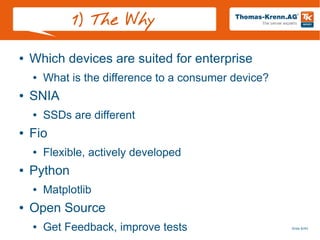
1) The Why
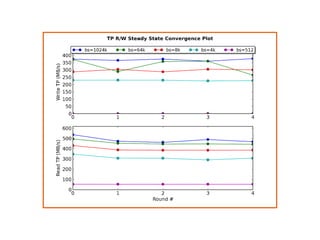
● Which devices are suited for enterprise
● What is the difference to a consumer device?
● SNIA
● SSDs are different
● Fio
● Flexible, actively developed
● Python
● Matplotlib
● Open Source
● Get Feedback, improve tests
Slide 7/45
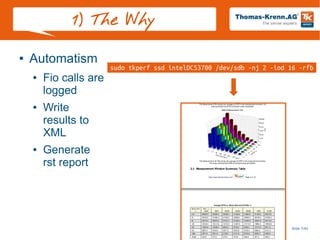
1) The Why
● Automatism
● Fio calls are
logged
● Write
results to
XML
● Generate
rst report
sudo tkperf ssd intelDCS3700 /dev/sdb -nj 2 -iod 16 -rfb
Handy Tools
Slide 9/45
2) The How
● Information
gathering and
Secure Erase
● hdparm, lsblk, lsscsi
● Direct IO
● Number of jobs, IO
depth
● Reach the maximum
of a device
# hdparm -I /dev/sdb|grep -e NCQ -e depth
Queue depth: 32
* Native Command Queueing (NCQ)
# fio --rw=write --name=test --size=20M --direct=1
[...]
Run status group 0 (all jobs):
WRITE: io=20480KB, aggrb=28563KB/s
# fio --rw=write --name=test --size=20M
[...]
Run status group 0 (all jobs):
WRITE: io=20480KB, aggrb=930909KB/s
Slide 10/45
Fio
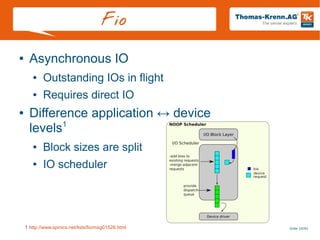
● Asynchronous IO
● Outstanding IOs in flight
● Requires direct IO
● Difference application ↔ device
levels1
● Block sizes are split
● IO scheduler
1 http://www.spinics.net/lists/fio/msg01526.html
Slide 11/45
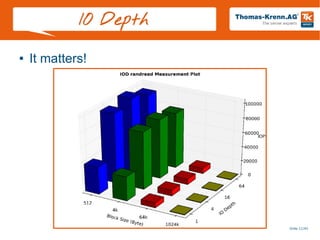
IO Depth
● It matters!
SNIA
Slide 13/45
Tests
● Synthetic
● Test a specific scenario
● Testing an individual component
● Corner case behavior
● Get a first impression, compareable
● Not an application based test
● blkreplay
Slide 14/45
New Words...
● Secure Erase
● Workload Independent Preconditioning
● 2x device 128KB sequential write
● Workloads (IO access)
● Random, sequential
● Mixed (95/5 R/W)
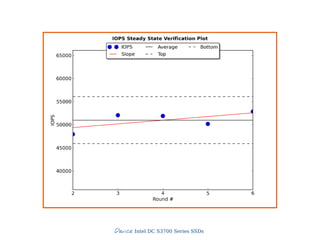
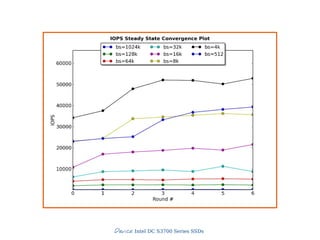
● Steady State
● Dependent Variable
– States when device is stable
● Performance values of last 5 rounds
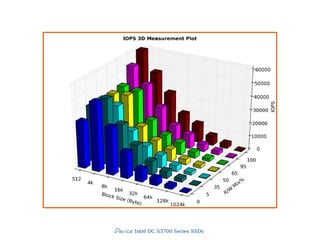
Device: Intel DC S3700 Series SSDs
Slide 16/45
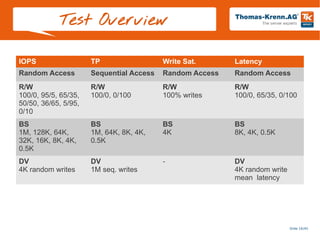
IOPS TP Write Sat. Latency
Random Access Sequential Access Random Access Random Access
R/W
100/0, 95/5, 65/35,
50/50, 36/65, 5/95,
0/10
R/W
100/0, 0/100
R/W
100% writes
R/W
100/0, 65/35, 0/100
BS
1M, 128K, 64K,
32K, 16K, 8K, 4K,
0.5K
BS
1M, 64K, 8K, 4K,
0.5K
BS
4K
BS
8K, 4K, 0.5K
DV
4K random writes
DV
1M seq. writes
- DV
4K random write
mean latency
Test Overview
IOPS
-> A random Workload
Slide 18/45
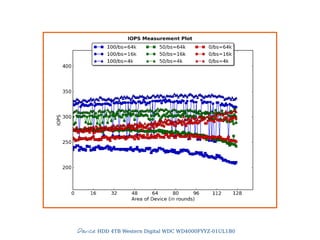
3) IOPS
Make Secure Erase
Workload Ind. Preconditioning
While not Steady State
For workloads [100, 95, 65, 50, 35, 5, 0]
For block sizes ['1024k', '128k', '64k', '32k', '16k', '8k', '4k', '512']
Random Workload for 1 Minute
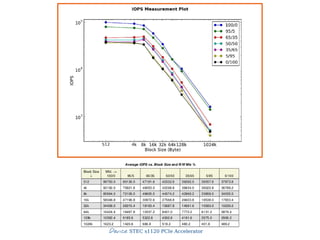
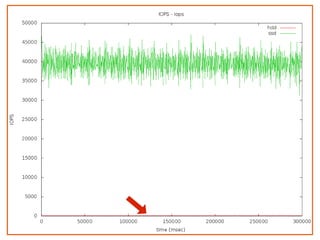
● IO operations per second
● THE number for SSDs
● Dependent variable
● 4KB random writes
Device: STEC s1120 PCIe Accelerator
Slide 20/45
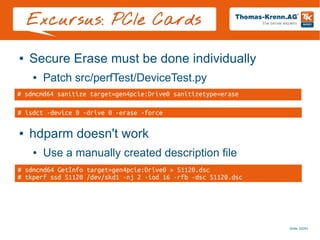
Excursus: PCIe Cards
● Secure Erase must be done individually
● Patch src/perfTest/DeviceTest.py
● hdparm doesn't work
● Use a manually created description file
# sdmcmd64 sanitize target=gen4pcie:Drive0 sanitizetype=erase
# isdct -device 0 -drive 0 -erase -force
# sdmcmd64 GetInfo target=gen4pcie:Drive0 > S1120.dsc
# tkperf ssd S1120 /dev/skd1 -nj 2 -iod 16 -rfb -dsc S1120.dsc
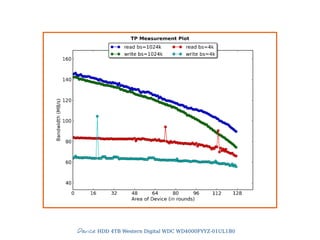
Device: HDD 4TB Western Digital WDC WD4000FYYZ-01UL1B0
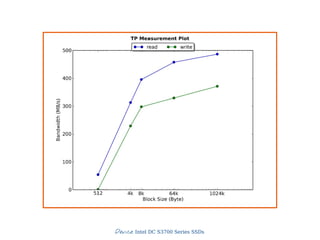
Device: Intel DC S3700 Series SSDs
MB/s
-> A sequential Workload
Slide 26/45
4) Throughput
● MB per second
● Throughput, Streaming IO
● Interesting block sizes
● 1MB, 512KB, 256KB
● Smaller block sizes are more common for IOPS
For block sizes ['1024k', '64k', '8k', '4k', '512']
Make Secure Erase
While not Steady State
Sequential read for 1 Minute
Sequential write for 1 Minute
Device: Intel DC S3700 Series SSDs
Device: HDD 4TB Western Digital WDC WD4000FYYZ-01UL1B0
Saturation
Slide 31/45
5) Write Saturation
● Continuous writes to the device
● Write enough data
● Show how stable the device is
Devices
Left - Intel DC S3700 Series SSDs,
Right – Intel SSD 520
Slide 33/45
6) Latency
● Jobs and threads
● Set to 1!
● DV
● Average Latency 4KB writes
Devices
Left - Intel DC S3700 Series SSDs,
Right – Intel SSD 320
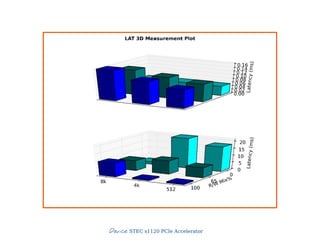
Device: STEC s1120 PCIe Accelerator
… because as we know, there are known
knowns; ....
We also know there are known unknowns; …
But there are also unknown unknowns -- the ones
we don't know we don't know.
(Donald H. Rumsfeld)
http://de.wikipedia.org/wiki/There_are_known_knowns
Slide 37/45
The Where
● http://www.thomas-krenn.com/de/wiki/Kategorie:TK
● http://git.thomas-krenn.com/TKperf_v1.git
● http://www.snia.org/sites/default/files/SSS_PTS_Ent
● http://git.kernel.dk/?p=fio.git;a=summary
Slide 38/45
Pitfalls
● Compression
● Sandforce Controller!
● Fio: refill_buffers
Slide 39/45
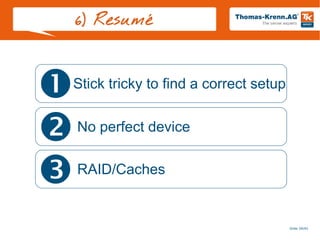
6) Resumé
Stick tricky to find a correct setup

No perfect device

RAID/Caches

Slide 40/45
References
● Presentations
● The Why and How of SSD Performance Benchmarking
● Pictures
● https://commons.wikimedia.org/wiki/File:04KJER0243.jpg?uselang=en-gb
● https://commons.wikimedia.org/wiki/File:Soca.jpg?uselang=en-gb
● Augustinushaus Würfel
● https://commons.wikimedia.org/wiki/File:Cgs_fat.JPG?uselang=en-gb
● https://commons.wikimedia.org/wiki/File:Rusty_tools.JPG
Backup Slides
Slide 42/45
Fio
●
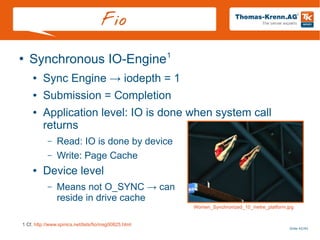
Synchronous IO-Engine1
● Sync Engine → iodepth = 1
● Submission = Completion
● Application level: IO is done when system call
returns
– Read: IO is done by device
– Write: Page Cache
● Device level
– Means not O_SYNC → can
reside in drive cache
1 Cf. http://www.spinics.net/lists/fio/msg00825.html
Women_Synchronized_10_metre_platform.jpg
Slide 43/45
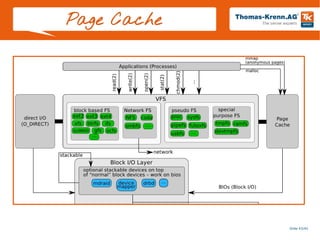
Page Cache
Slide 44/45
stdyState = True
maxY = max(ys)
minY = min(ys)
avg = sum(ys)/len(ys)#calc average of values
#allow max excursion of 20% of average
avgRange = avg * 0.20
if (maxY - minY) > avgRange:
stdyState = False
#do linear regression to calculate slope of linear best fit
y = np.array(ys)
x = np.array(xs)
A = np.vstack([x, np.ones(len(x))]).T
#calculate k*x+d
k, d = np.linalg.lstsq(A, y)[0]
#as we have a measurement window of 4, we calculate
#the slope excursion in the window
slopeExc = k * self.testMesWindow
if slopeExc < 0:
slopeExc *= -1
maxSlopeExc = avg * 0.10 #allowed are 10% of avg
if slopeExc > maxSlopeExc:
stdyState = False
Steady State
<iops>
<fioversion>"fio 2.0.7n"</fioversion>
<numjobs>2</numjobs>
<iodepth>16</iodepth>
<roundmat>[[[126, 1087, 2157, 4235, 8052, 12196, 19534, 34917], [131,
976, 1916, 3717, 7101, 10179, 15669, 28266], [88, 600, 1153, 2230, 3870,
7975, 8766, 17704], [74, 544, 1013, 2137, 4117, 6277, 7410, 10754], [26,
261, 531, 999, 2524, 2999, 5101, 10291], [41, 415, 436, 865, 1390, 2626,
4758, 10799], [70, 635, 560, 666, 2185, 3231, 4625, 14559]],
[...]
[[127, 1094, 2162, 4207, 7325, 10454, 13402, 20640], [130, 1032, 1920,
3130, 4813, 5161, 7352, 16104], [45, 565, 1265, 2485, 4833, 5933, 8703,
18716], [92, 521, 1050, 2017, 3446, 4774, 7641, 16926], [75, 505, 984,
2289, 3992, 6880, 8240, 17015], [94, 776, 1457, 3026, 5400, 9200, 11315,
15993], [102, 936, 1846, 3576, 6533, 10590, 13927, 17903]]]
</roundmat>
<stdyrounds>[7, 8, 9, 10, 11]</stdyrounds>
<stdyvalues>[13705, 14639, 14747, 14678, 13927]</stdyvalues>
<stdyslope>[48.300000000001042,13904.499999999989]</stdyslope>
<stdyavg>14339.2</stdyavg>
<reachstdystate>true</reachstdystate>
<rndnr>11</rndnr>
</iops>

SSD & HDD Performance Testing with TKperf

  • 1.
    Slide 1/45 SSD &HDD Performance Testing with TKperf Georg Schönberger <gschoenberger@thomas-krenn.com> LinuxTag 2013
  • 2.
  • 3.
    Slide 3/45 Agenda 1) TheWhy 2) The How 3) IOPS 4) Throughput 5) Write Saturation 6) Latency 7) Résumé
  • 4.
  • 5.
  • 6.
    Slide 6/45 1) TheWhy ● Which devices are suited for enterprise ● What is the difference to a consumer device? ● SNIA ● SSDs are different ● Fio ● Flexible, actively developed ● Python ● Matplotlib ● Open Source ● Get Feedback, improve tests
  • 7.
    Slide 7/45 1) TheWhy ● Automatism ● Fio calls are logged ● Write results to XML ● Generate rst report sudo tkperf ssd intelDCS3700 /dev/sdb -nj 2 -iod 16 -rfb
  • 8.
  • 9.
    Slide 9/45 2) TheHow ● Information gathering and Secure Erase ● hdparm, lsblk, lsscsi ● Direct IO ● Number of jobs, IO depth ● Reach the maximum of a device # hdparm -I /dev/sdb|grep -e NCQ -e depth Queue depth: 32 * Native Command Queueing (NCQ) # fio --rw=write --name=test --size=20M --direct=1 [...] Run status group 0 (all jobs): WRITE: io=20480KB, aggrb=28563KB/s # fio --rw=write --name=test --size=20M [...] Run status group 0 (all jobs): WRITE: io=20480KB, aggrb=930909KB/s
  • 10.
    Slide 10/45 Fio ● AsynchronousIO ● Outstanding IOs in flight ● Requires direct IO ● Difference application ↔ device levels1 ● Block sizes are split ● IO scheduler 1 http://www.spinics.net/lists/fio/msg01526.html
  • 11.
  • 12.
  • 13.
    Slide 13/45 Tests ● Synthetic ●Test a specific scenario ● Testing an individual component ● Corner case behavior ● Get a first impression, compareable ● Not an application based test ● blkreplay
  • 14.
    Slide 14/45 New Words... ●Secure Erase ● Workload Independent Preconditioning ● 2x device 128KB sequential write ● Workloads (IO access) ● Random, sequential ● Mixed (95/5 R/W) ● Steady State ● Dependent Variable – States when device is stable ● Performance values of last 5 rounds
  • 15.
    Device: Intel DCS3700 Series SSDs
  • 16.
    Slide 16/45 IOPS TPWrite Sat. Latency Random Access Sequential Access Random Access Random Access R/W 100/0, 95/5, 65/35, 50/50, 36/65, 5/95, 0/10 R/W 100/0, 0/100 R/W 100% writes R/W 100/0, 65/35, 0/100 BS 1M, 128K, 64K, 32K, 16K, 8K, 4K, 0.5K BS 1M, 64K, 8K, 4K, 0.5K BS 4K BS 8K, 4K, 0.5K DV 4K random writes DV 1M seq. writes - DV 4K random write mean latency Test Overview
  • 17.
  • 18.
    Slide 18/45 3) IOPS MakeSecure Erase Workload Ind. Preconditioning While not Steady State For workloads [100, 95, 65, 50, 35, 5, 0] For block sizes ['1024k', '128k', '64k', '32k', '16k', '8k', '4k', '512'] Random Workload for 1 Minute ● IO operations per second ● THE number for SSDs ● Dependent variable ● 4KB random writes
  • 19.
    Device: STEC s1120PCIe Accelerator
  • 20.
    Slide 20/45 Excursus: PCIeCards ● Secure Erase must be done individually ● Patch src/perfTest/DeviceTest.py ● hdparm doesn't work ● Use a manually created description file # sdmcmd64 sanitize target=gen4pcie:Drive0 sanitizetype=erase # isdct -device 0 -drive 0 -erase -force # sdmcmd64 GetInfo target=gen4pcie:Drive0 > S1120.dsc # tkperf ssd S1120 /dev/skd1 -nj 2 -iod 16 -rfb -dsc S1120.dsc
  • 22.
    Device: HDD 4TBWestern Digital WDC WD4000FYYZ-01UL1B0
  • 23.
    Device: Intel DCS3700 Series SSDs
  • 24.
    Device: Intel DCS3700 Series SSDs
  • 25.
  • 26.
    Slide 26/45 4) Throughput ●MB per second ● Throughput, Streaming IO ● Interesting block sizes ● 1MB, 512KB, 256KB ● Smaller block sizes are more common for IOPS For block sizes ['1024k', '64k', '8k', '4k', '512'] Make Secure Erase While not Steady State Sequential read for 1 Minute Sequential write for 1 Minute
  • 28.
    Device: Intel DCS3700 Series SSDs
  • 29.
    Device: HDD 4TBWestern Digital WDC WD4000FYYZ-01UL1B0
  • 30.
  • 31.
    Slide 31/45 5) WriteSaturation ● Continuous writes to the device ● Write enough data ● Show how stable the device is
  • 32.
    Devices Left - IntelDC S3700 Series SSDs, Right – Intel SSD 520
  • 33.
    Slide 33/45 6) Latency ●Jobs and threads ● Set to 1! ● DV ● Average Latency 4KB writes
  • 34.
    Devices Left - IntelDC S3700 Series SSDs, Right – Intel SSD 320
  • 35.
    Device: STEC s1120PCIe Accelerator
  • 36.
    … because aswe know, there are known knowns; .... We also know there are known unknowns; … But there are also unknown unknowns -- the ones we don't know we don't know. (Donald H. Rumsfeld) http://de.wikipedia.org/wiki/There_are_known_knowns
  • 37.
    Slide 37/45 The Where ●http://www.thomas-krenn.com/de/wiki/Kategorie:TK ● http://git.thomas-krenn.com/TKperf_v1.git ● http://www.snia.org/sites/default/files/SSS_PTS_Ent ● http://git.kernel.dk/?p=fio.git;a=summary
  • 38.
    Slide 38/45 Pitfalls ● Compression ●Sandforce Controller! ● Fio: refill_buffers
  • 39.
    Slide 39/45 6) Resumé Sticktricky to find a correct setup  No perfect device  RAID/Caches 
  • 40.
    Slide 40/45 References ● Presentations ●The Why and How of SSD Performance Benchmarking ● Pictures ● https://commons.wikimedia.org/wiki/File:04KJER0243.jpg?uselang=en-gb ● https://commons.wikimedia.org/wiki/File:Soca.jpg?uselang=en-gb ● Augustinushaus Würfel ● https://commons.wikimedia.org/wiki/File:Cgs_fat.JPG?uselang=en-gb ● https://commons.wikimedia.org/wiki/File:Rusty_tools.JPG
  • 41.
  • 42.
    Slide 42/45 Fio ● Synchronous IO-Engine1 ●Sync Engine → iodepth = 1 ● Submission = Completion ● Application level: IO is done when system call returns – Read: IO is done by device – Write: Page Cache ● Device level – Means not O_SYNC → can reside in drive cache 1 Cf. http://www.spinics.net/lists/fio/msg00825.html Women_Synchronized_10_metre_platform.jpg
  • 43.
  • 44.
    Slide 44/45 stdyState =True maxY = max(ys) minY = min(ys) avg = sum(ys)/len(ys)#calc average of values #allow max excursion of 20% of average avgRange = avg * 0.20 if (maxY - minY) > avgRange: stdyState = False #do linear regression to calculate slope of linear best fit y = np.array(ys) x = np.array(xs) A = np.vstack([x, np.ones(len(x))]).T #calculate k*x+d k, d = np.linalg.lstsq(A, y)[0] #as we have a measurement window of 4, we calculate #the slope excursion in the window slopeExc = k * self.testMesWindow if slopeExc < 0: slopeExc *= -1 maxSlopeExc = avg * 0.10 #allowed are 10% of avg if slopeExc > maxSlopeExc: stdyState = False Steady State
  • 45.
    <iops> <fioversion>"fio 2.0.7n"</fioversion> <numjobs>2</numjobs> <iodepth>16</iodepth> <roundmat>[[[126, 1087,2157, 4235, 8052, 12196, 19534, 34917], [131, 976, 1916, 3717, 7101, 10179, 15669, 28266], [88, 600, 1153, 2230, 3870, 7975, 8766, 17704], [74, 544, 1013, 2137, 4117, 6277, 7410, 10754], [26, 261, 531, 999, 2524, 2999, 5101, 10291], [41, 415, 436, 865, 1390, 2626, 4758, 10799], [70, 635, 560, 666, 2185, 3231, 4625, 14559]], [...] [[127, 1094, 2162, 4207, 7325, 10454, 13402, 20640], [130, 1032, 1920, 3130, 4813, 5161, 7352, 16104], [45, 565, 1265, 2485, 4833, 5933, 8703, 18716], [92, 521, 1050, 2017, 3446, 4774, 7641, 16926], [75, 505, 984, 2289, 3992, 6880, 8240, 17015], [94, 776, 1457, 3026, 5400, 9200, 11315, 15993], [102, 936, 1846, 3576, 6533, 10590, 13927, 17903]]] </roundmat> <stdyrounds>[7, 8, 9, 10, 11]</stdyrounds> <stdyvalues>[13705, 14639, 14747, 14678, 13927]</stdyvalues> <stdyslope>[48.300000000001042,13904.499999999989]</stdyslope> <stdyavg>14339.2</stdyavg> <reachstdystate>true</reachstdystate> <rndnr>11</rndnr> </iops>