THE IMPACT OF
COGNITIVE STYLES IN
MOBILE-ASSISTED
LANGUAGE LEARNING:
IS TECHNOLOGICALLY
ENHANCED
COURSEWARE
Takeshi SATO
@Tokyo University
of Agriculture &
Technology, Japan
Tyler BURDEN
@Meisei University,
Japan
Presentation for CLaSIC 2016 @ National
University of Singapore, on 1st of December,
2016.
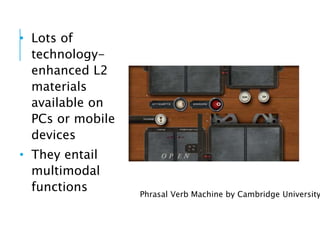
• Lots of
technology-
enhanced L2
materials
available on
PCs or mobile
devices
• They entail
multimodal
functions Phrasal Verb Machine by Cambridge University
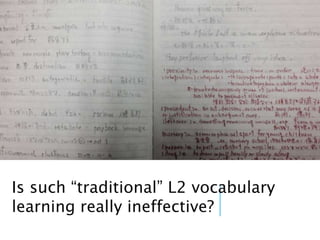
Is such “traditional” L2 vocabulary
learning really ineffective?
OUTLINE
1. Background
2. Research Questions
3. Research Procedure
4. Findings
5. Conclusion
BACKGROUND
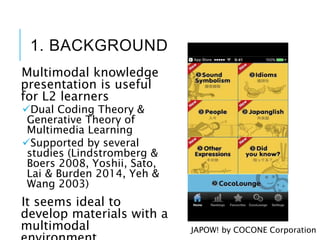
1. BACKGROUND
Multimodal knowledge
presentation is useful
for L2 learners
Dual Coding Theory &
Generative Theory of
Multimedia Learning
Supported by several
studies (Lindstromberg &
Boers 2008, Yoshii, Sato,
Lai & Burden 2014, Yeh &
Wang 2003)
It seems ideal to
develop materials with a
multimodal JAPOW! by COCONE Corporation
INDIVIDUAL
DIFFERENCES
More focus on
individual differences
in C(M)ALL study
Imagers are better at
using visual aids than
verbalizers (Boers &
Lindstromberg 2008)
Confirmed the
advantage of imagers
in the use of visual
aids. (Sato, Lai &
Burden 2014)
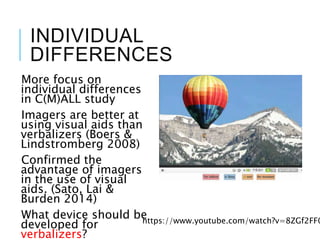
What device should be
developed for
verbalizers?
https://www.youtube.com/watch?v=8ZGf2FF0
PHRASAL VERBS (PVS)
Multiword unit consisting of
a verb and a preposition
(adverb)
“[O]ne of the most
challenging features of the
English language” (Garnier &
Schmitt 2016, p.30)
Cannot acquire PVs by
memorizing as an idiom
(Lindstromberg, 2001)
Not only language teachers
but also cognitive linguists
are interested in PVs (ex.
Dirven, 2001; Rice 2003;
Rudzka-Ostyn, 2003)
Lexical network in
Schema
ExtensionPrototype
Langacker (1987)
Abstract patterns in
experience and
understanding (Johnson
1987)
PROCESS TO
UNDERSTAND PVS WITH
AIDS
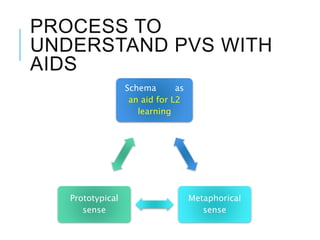
Schema as
an aid for L2
learning
Metaphorical
sense
Prototypical
sense
PROCESS TO
UNDERSTAND PVS WITH
AIDS
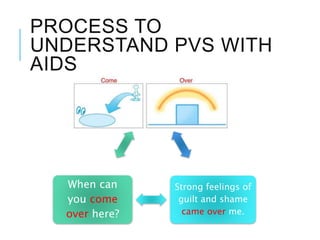
Strong feelings of
guilt and shame
came over me.
When can
you come
over here?
PROCESS TO
UNDERSTAND PVS WITH
AIDS
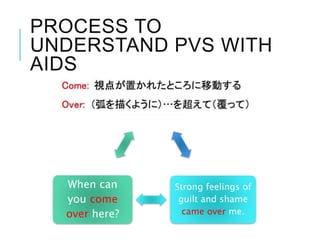
Strong feelings of
guilt and shame
came over me.
When can
you come
over here?
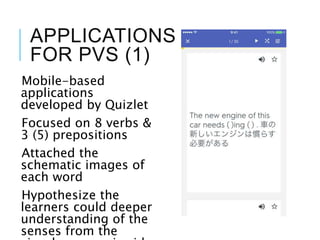
APPLICATIONS
FOR PVS (1)
Mobile-based
applications
developed by Quizlet
Focused on 8 verbs &
3 (5) prepositions
Attached the
schematic images of
each word
Hypothesize the
learners could deeper
understanding of the
senses from the
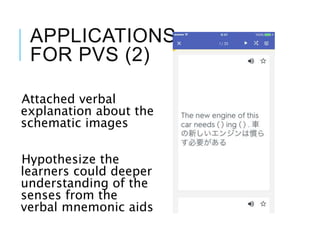
APPLICATIONS
FOR PVS (2)
Attached verbal
explanation about the
schematic images
Hypothesize the
learners could deeper
understanding of the
senses from the
verbal mnemonic aids
RESEARCH
QUESTIONS
RESEARCH QUESTIONS
1.Do imagers who used
visual aids acquire the
target PVs more
successfully than the
others?
2.Do verbalizers who used
verbal aids acquire the
target PVs more
RESEARCH
STUDY 1
PARTICIPANTS OF
STUDY 1
50 Japanese EFL college students
participated
All freshmen from the department of
economics in a Japanese private
university
Divided into four groups (verbalizers
or imagers with verbal or visual aids)
Their English language proficiency
(TOEIC) is not statistically different
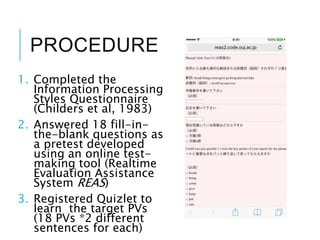
PROCEDURE
1. Completed the
Information Processing
Styles Questionnaire
(Childers et al, 1983)
2. Answered 18 fill-in-
the-blank questions as
a pretest developed
using an online test-
making tool (Realtime
Evaluation Assistance
System REAS)
3. Registered Quizlet to
learn the target PVs
(18 PVs *2 different
sentences for each)
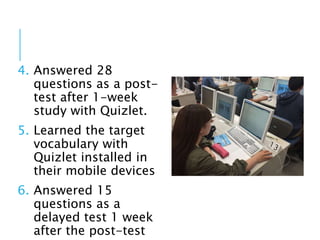
4. Answered 28
questions as a post-
test after 1-week
study with Quizlet.
5. Learned the target
vocabulary with
Quizlet installed in
their mobile devices
6. Answered 15
questions as a
delayed test 1 week
after the post-test
ANALYSIS
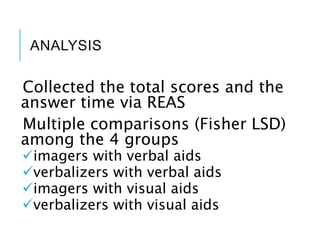
Collected the total scores and the
answer time via REAS
Multiple comparisons (Fisher LSD)
among the 4 groups
imagers with verbal aids
verbalizers with verbal aids
imagers with visual aids
verbalizers with visual aids
FINDINGS OF
STUDY 1
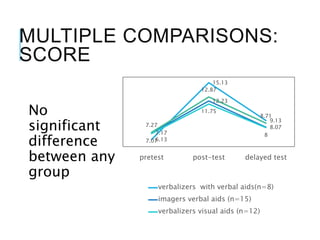
MULTIPLE COMPARISONS:
SCORE
No
significant
difference
between any
group
6.13
15.13
9.13
7.17
12.23
8.07
7.07
11.75
8
7.27
12.87
8.71
pretest post-test delayed test
verbalizers with verbal aids(n=8)
imagers verbal aids (n=15)
verbalizers visual aids (n=12)
MULTIPLE
COMPARISONS:
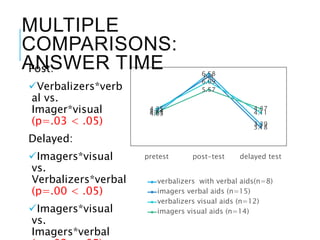
ANSWER TIMEPost:
Verbalizers*verb
al vs.
Imager*visual
(p=.03 < .05)
Delayed:
Imagers*visual
vs.
Verbalizers*verbal
(p=.00 < .05)
Imagers*visual
vs.
Imagers*verbal
4.05
6.58
3.39
4.24
6.4
3.18
4.35
6.09
4.114.13
5.57
4.37
pretest post-test delayed test
verbalizers with verbal aids(n=8)
imagers verbal aids (n=15)
verbalizers visual aids (n=12)
imagers visual aids (n=14)
MULTIPLE
COMPARISONS:
ACCURACY RATE
BETWEEN THE TWO
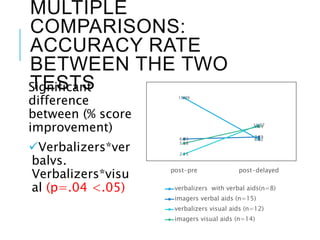
TESTSSignificant
difference
between (% score
improvement)
Verbalizers*ver
balvs.
Verbalizers*visu
al (p=.04 <.05)
19.99
6.826.93
7.59
2.15
11.37
5.58
10.9
post-pre post-delayed
verbalizers with verbal aids(n=8)
imagers verbal aids (n=15)
verbalizers visual aids (n=12)
imagers visual aids (n=14)
STUDY 2
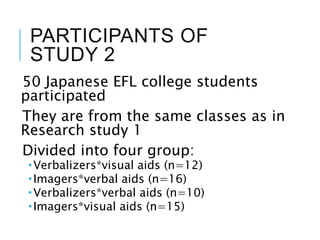
PARTICIPANTS OF
STUDY 2
50 Japanese EFL college students
participated
They are from the same classes as in
Research study 1
Divided into four group:
Verbalizers*visual aids (n=12)
Imagers*verbal aids (n=16)
Verbalizers*verbal aids (n=10)
Imagers*visual aids (n=15)
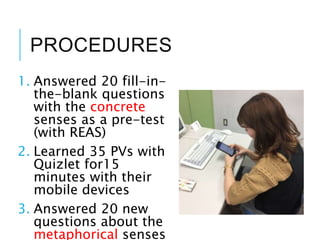
PROCEDURES
1. Answered 20 fill-in-
the-blank questions
with the concrete
senses as a pre-test
(with REAS)
2. Learned 35 PVs with
Quizlet for15
minutes with their
mobile devices
3. Answered 20 new
questions about the
metaphorical senses
ANALYSIS
Collected the total scores and the
answer time via REAS
Multiple comparisons (Fisher LSD)
among the 4 groups
imagers with verbal aids
verbalizers with verbal aids
imagers with visual aids
verbalizers with visual aids
FINDINGS OF
STUDY 2
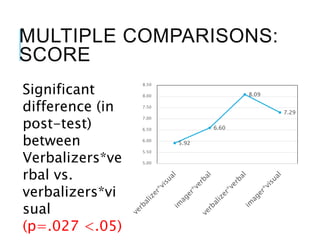
MULTIPLE COMPARISONS:
SCORE
Significant
difference (in
post-test)
between
Verbalizers*ve
rbal vs.
verbalizers*vi
sual
(p=.027 <.05)
5.92
6.60
8.09
7.29
5.00
5.50
6.00
6.50
7.00
7.50
8.00
8.50
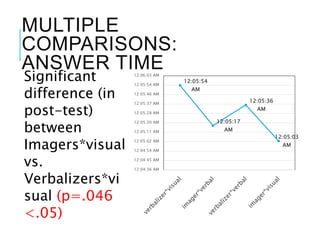
MULTIPLE
COMPARISONS:
ANSWER TIME
Significant
difference (in
post-test)
between
Imagers*visual
vs.
Verbalizers*vi
sual (p=.046
<.05)
12:05:54
AM
12:05:17
AM
12:05:36
AM
12:05:03
AM
12:04:36 AM
12:04:45 AM
12:04:54 AM
12:05:02 AM
12:05:11 AM
12:05:20 AM
12:05:28 AM
12:05:37 AM
12:05:46 AM
12:05:54 AM
12:06:03 AM
CONCLUSION &
DISCUSSION
ANSWERS TO OUR
RESEARCH QUESTIONS
1. Do imagers who used visual aids
acquire the target PVs more
successfully than the others?
Partly Yes: There were significant
differences in the delayed test in terms of
their answer time (study 1)
2. Do verbalizers who used verbal aids
acquire the target PVs more
successfully than the others?
Partly Yes in the post-test in terms of
accuracy rate and in the delayed test in
terms of answer time (study1)
Partly Yes in the post-test in terms of their
DISCUSSION
•Learners’ cognitive styles have an
effect on learning L2 PVs.
•For imagers, visual aids improved their
answering time
•For verbalizers, verbal aids improved
their choice of appropriate PVs.
•Small samples and rather short-term
research, so further examination
needed
•Multimedia is not a panacea
PLEASE
HAVE A
LOOK AT
OUR
BOOK!
THANK YOU FOR
LISTENING
ご清聴有難う御座います
Takeshi SATO tsato@cc.tuat.ac.jp
Tyler BURDEN
tyler.burden@meisei.ac.jp
REFERENCES
Al-Seghayer, K. (2001). The effect of multimedia annotation modes on L2 vocabulary acquisition: a comparative study. Language
Learning and Technology,5 (1), 202-232
Boers, F., & Lindstromberg, S. (2008). How cognitive linguistics can foster effective vocabulary teaching. In F. Boers, & S.
Lindstromberg (Eds.), Cognitive linguistic approaches to teaching vocabulary and phraseology (pp.1-64). Berlin: Mouton de
Gruyter,
Childers, T.L., Houston, M.J, & Heckler, S.E. (1985). Measurement of individual differences in visual versus verbal information
processing, Journal of Consumer Research, 12, 125-134.
Dirven, R. (2001). English phrasal verbs: Theory and didactic application. Applied cognitive linguistics, 2, 3-28.
Garnier, M. & Schmitt, N. (2016). Picking up polysemous phrasal verbs: How many do learners know and what facilitates this
knowledge?, System, 59, 29-44.
Mayer, R. & Moreno, R. (2002). Aids to computer-based multimedia learning. Learning and Instruction, 12, 107-119.
Lakoff, G.(1987) Woman, fire and dangerous thing. Chicago: Chicago University Press.
Langacker, R, W.(1987) Foundations of Cognitive Grammar, Volume I, Theoretical Prerequisites. Stanford, California: Stanford
University Press.
Lindstromberg, S. (2001). (Sometimes) Against the grain, Humanising Language Teaching Magazine, 3(3). Retrieved 12th of
November, 2016 from http://www.hltmag.co.uk/may01/lind.htm
Rice, S. (2003). Growth of a lexical network: Nine English prepositions in acquisition. Cognitive approaches to lexical
semantics, 23, 243.
Rudzka-Ostyn, B. (2003). Word power phrasal verbs and compounds: A cognitive approach. Berlin, Germany: Walter de Gruyter.
Sato, T., Lai, Y., & Burden, T. (2014). Examining the Impact of Individual Differences of Information Processing Styles in
Technology-Enhanced Second Vocabulary Learning. Proceedings of CLaSIC 2014. p. 432-440.
Yoshii,M., & Fraitz, J.(2002). Second Language Incidental Vocabulary Retention: The Effect of Text and Picture Annotation Types.

CLaSIC 2016 presentation

  • 1.
    THE IMPACT OF COGNITIVESTYLES IN MOBILE-ASSISTED LANGUAGE LEARNING: IS TECHNOLOGICALLY ENHANCED COURSEWARE Takeshi SATO @Tokyo University of Agriculture & Technology, Japan Tyler BURDEN @Meisei University, Japan Presentation for CLaSIC 2016 @ National University of Singapore, on 1st of December, 2016.
  • 2.
    • Lots of technology- enhancedL2 materials available on PCs or mobile devices • They entail multimodal functions Phrasal Verb Machine by Cambridge University
  • 3.
    Is such “traditional”L2 vocabulary learning really ineffective?
  • 4.
    OUTLINE 1. Background 2. ResearchQuestions 3. Research Procedure 4. Findings 5. Conclusion
  • 5.
  • 6.
    1. BACKGROUND Multimodal knowledge presentationis useful for L2 learners Dual Coding Theory & Generative Theory of Multimedia Learning Supported by several studies (Lindstromberg & Boers 2008, Yoshii, Sato, Lai & Burden 2014, Yeh & Wang 2003) It seems ideal to develop materials with a multimodal JAPOW! by COCONE Corporation
  • 7.
    INDIVIDUAL DIFFERENCES More focus on individualdifferences in C(M)ALL study Imagers are better at using visual aids than verbalizers (Boers & Lindstromberg 2008) Confirmed the advantage of imagers in the use of visual aids. (Sato, Lai & Burden 2014) What device should be developed for verbalizers? https://www.youtube.com/watch?v=8ZGf2FF0
  • 8.
    PHRASAL VERBS (PVS) Multiwordunit consisting of a verb and a preposition (adverb) “[O]ne of the most challenging features of the English language” (Garnier & Schmitt 2016, p.30) Cannot acquire PVs by memorizing as an idiom (Lindstromberg, 2001) Not only language teachers but also cognitive linguists are interested in PVs (ex. Dirven, 2001; Rice 2003; Rudzka-Ostyn, 2003) Lexical network in Schema ExtensionPrototype Langacker (1987) Abstract patterns in experience and understanding (Johnson 1987)
  • 9.
    PROCESS TO UNDERSTAND PVSWITH AIDS Schema as an aid for L2 learning Metaphorical sense Prototypical sense
  • 10.
    PROCESS TO UNDERSTAND PVSWITH AIDS Strong feelings of guilt and shame came over me. When can you come over here?
  • 11.
    PROCESS TO UNDERSTAND PVSWITH AIDS Strong feelings of guilt and shame came over me. When can you come over here?
  • 12.
    APPLICATIONS FOR PVS (1) Mobile-based applications developedby Quizlet Focused on 8 verbs & 3 (5) prepositions Attached the schematic images of each word Hypothesize the learners could deeper understanding of the senses from the
  • 13.
    APPLICATIONS FOR PVS (2) Attachedverbal explanation about the schematic images Hypothesize the learners could deeper understanding of the senses from the verbal mnemonic aids
  • 14.
  • 15.
    RESEARCH QUESTIONS 1.Do imagerswho used visual aids acquire the target PVs more successfully than the others? 2.Do verbalizers who used verbal aids acquire the target PVs more
  • 16.
  • 17.
  • 18.
    PARTICIPANTS OF STUDY 1 50Japanese EFL college students participated All freshmen from the department of economics in a Japanese private university Divided into four groups (verbalizers or imagers with verbal or visual aids) Their English language proficiency (TOEIC) is not statistically different
  • 19.
    PROCEDURE 1. Completed the InformationProcessing Styles Questionnaire (Childers et al, 1983) 2. Answered 18 fill-in- the-blank questions as a pretest developed using an online test- making tool (Realtime Evaluation Assistance System REAS) 3. Registered Quizlet to learn the target PVs (18 PVs *2 different sentences for each)
  • 20.
    4. Answered 28 questionsas a post- test after 1-week study with Quizlet. 5. Learned the target vocabulary with Quizlet installed in their mobile devices 6. Answered 15 questions as a delayed test 1 week after the post-test
  • 21.
    ANALYSIS Collected the totalscores and the answer time via REAS Multiple comparisons (Fisher LSD) among the 4 groups imagers with verbal aids verbalizers with verbal aids imagers with visual aids verbalizers with visual aids
  • 22.
  • 23.
    MULTIPLE COMPARISONS: SCORE No significant difference between any group 6.13 15.13 9.13 7.17 12.23 8.07 7.07 11.75 8 7.27 12.87 8.71 pretestpost-test delayed test verbalizers with verbal aids(n=8) imagers verbal aids (n=15) verbalizers visual aids (n=12)
  • 24.
    MULTIPLE COMPARISONS: ANSWER TIMEPost: Verbalizers*verb al vs. Imager*visual (p=.03< .05) Delayed: Imagers*visual vs. Verbalizers*verbal (p=.00 < .05) Imagers*visual vs. Imagers*verbal 4.05 6.58 3.39 4.24 6.4 3.18 4.35 6.09 4.114.13 5.57 4.37 pretest post-test delayed test verbalizers with verbal aids(n=8) imagers verbal aids (n=15) verbalizers visual aids (n=12) imagers visual aids (n=14)
  • 25.
    MULTIPLE COMPARISONS: ACCURACY RATE BETWEEN THETWO TESTSSignificant difference between (% score improvement) Verbalizers*ver balvs. Verbalizers*visu al (p=.04 <.05) 19.99 6.826.93 7.59 2.15 11.37 5.58 10.9 post-pre post-delayed verbalizers with verbal aids(n=8) imagers verbal aids (n=15) verbalizers visual aids (n=12) imagers visual aids (n=14)
  • 26.
  • 27.
    PARTICIPANTS OF STUDY 2 50Japanese EFL college students participated They are from the same classes as in Research study 1 Divided into four group: Verbalizers*visual aids (n=12) Imagers*verbal aids (n=16) Verbalizers*verbal aids (n=10) Imagers*visual aids (n=15)
  • 28.
    PROCEDURES 1. Answered 20fill-in- the-blank questions with the concrete senses as a pre-test (with REAS) 2. Learned 35 PVs with Quizlet for15 minutes with their mobile devices 3. Answered 20 new questions about the metaphorical senses
  • 29.
    ANALYSIS Collected the totalscores and the answer time via REAS Multiple comparisons (Fisher LSD) among the 4 groups imagers with verbal aids verbalizers with verbal aids imagers with visual aids verbalizers with visual aids
  • 30.
  • 31.
    MULTIPLE COMPARISONS: SCORE Significant difference (in post-test) between Verbalizers*ve rbalvs. verbalizers*vi sual (p=.027 <.05) 5.92 6.60 8.09 7.29 5.00 5.50 6.00 6.50 7.00 7.50 8.00 8.50
  • 32.
    MULTIPLE COMPARISONS: ANSWER TIME Significant difference (in post-test) between Imagers*visual vs. Verbalizers*vi sual(p=.046 <.05) 12:05:54 AM 12:05:17 AM 12:05:36 AM 12:05:03 AM 12:04:36 AM 12:04:45 AM 12:04:54 AM 12:05:02 AM 12:05:11 AM 12:05:20 AM 12:05:28 AM 12:05:37 AM 12:05:46 AM 12:05:54 AM 12:06:03 AM
  • 33.
  • 34.
    ANSWERS TO OUR RESEARCHQUESTIONS 1. Do imagers who used visual aids acquire the target PVs more successfully than the others? Partly Yes: There were significant differences in the delayed test in terms of their answer time (study 1) 2. Do verbalizers who used verbal aids acquire the target PVs more successfully than the others? Partly Yes in the post-test in terms of accuracy rate and in the delayed test in terms of answer time (study1) Partly Yes in the post-test in terms of their
  • 35.
    DISCUSSION •Learners’ cognitive styleshave an effect on learning L2 PVs. •For imagers, visual aids improved their answering time •For verbalizers, verbal aids improved their choice of appropriate PVs. •Small samples and rather short-term research, so further examination needed •Multimedia is not a panacea
  • 36.
  • 37.
    THANK YOU FOR LISTENING ご清聴有難う御座います TakeshiSATO tsato@cc.tuat.ac.jp Tyler BURDEN tyler.burden@meisei.ac.jp
  • 38.
    REFERENCES Al-Seghayer, K. (2001).The effect of multimedia annotation modes on L2 vocabulary acquisition: a comparative study. Language Learning and Technology,5 (1), 202-232 Boers, F., & Lindstromberg, S. (2008). How cognitive linguistics can foster effective vocabulary teaching. In F. Boers, & S. Lindstromberg (Eds.), Cognitive linguistic approaches to teaching vocabulary and phraseology (pp.1-64). Berlin: Mouton de Gruyter, Childers, T.L., Houston, M.J, & Heckler, S.E. (1985). Measurement of individual differences in visual versus verbal information processing, Journal of Consumer Research, 12, 125-134. Dirven, R. (2001). English phrasal verbs: Theory and didactic application. Applied cognitive linguistics, 2, 3-28. Garnier, M. & Schmitt, N. (2016). Picking up polysemous phrasal verbs: How many do learners know and what facilitates this knowledge?, System, 59, 29-44. Mayer, R. & Moreno, R. (2002). Aids to computer-based multimedia learning. Learning and Instruction, 12, 107-119. Lakoff, G.(1987) Woman, fire and dangerous thing. Chicago: Chicago University Press. Langacker, R, W.(1987) Foundations of Cognitive Grammar, Volume I, Theoretical Prerequisites. Stanford, California: Stanford University Press. Lindstromberg, S. (2001). (Sometimes) Against the grain, Humanising Language Teaching Magazine, 3(3). Retrieved 12th of November, 2016 from http://www.hltmag.co.uk/may01/lind.htm Rice, S. (2003). Growth of a lexical network: Nine English prepositions in acquisition. Cognitive approaches to lexical semantics, 23, 243. Rudzka-Ostyn, B. (2003). Word power phrasal verbs and compounds: A cognitive approach. Berlin, Germany: Walter de Gruyter. Sato, T., Lai, Y., & Burden, T. (2014). Examining the Impact of Individual Differences of Information Processing Styles in Technology-Enhanced Second Vocabulary Learning. Proceedings of CLaSIC 2014. p. 432-440. Yoshii,M., & Fraitz, J.(2002). Second Language Incidental Vocabulary Retention: The Effect of Text and Picture Annotation Types.