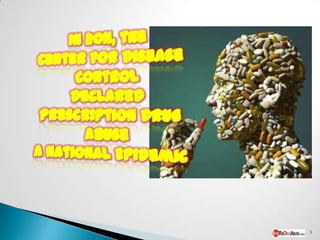
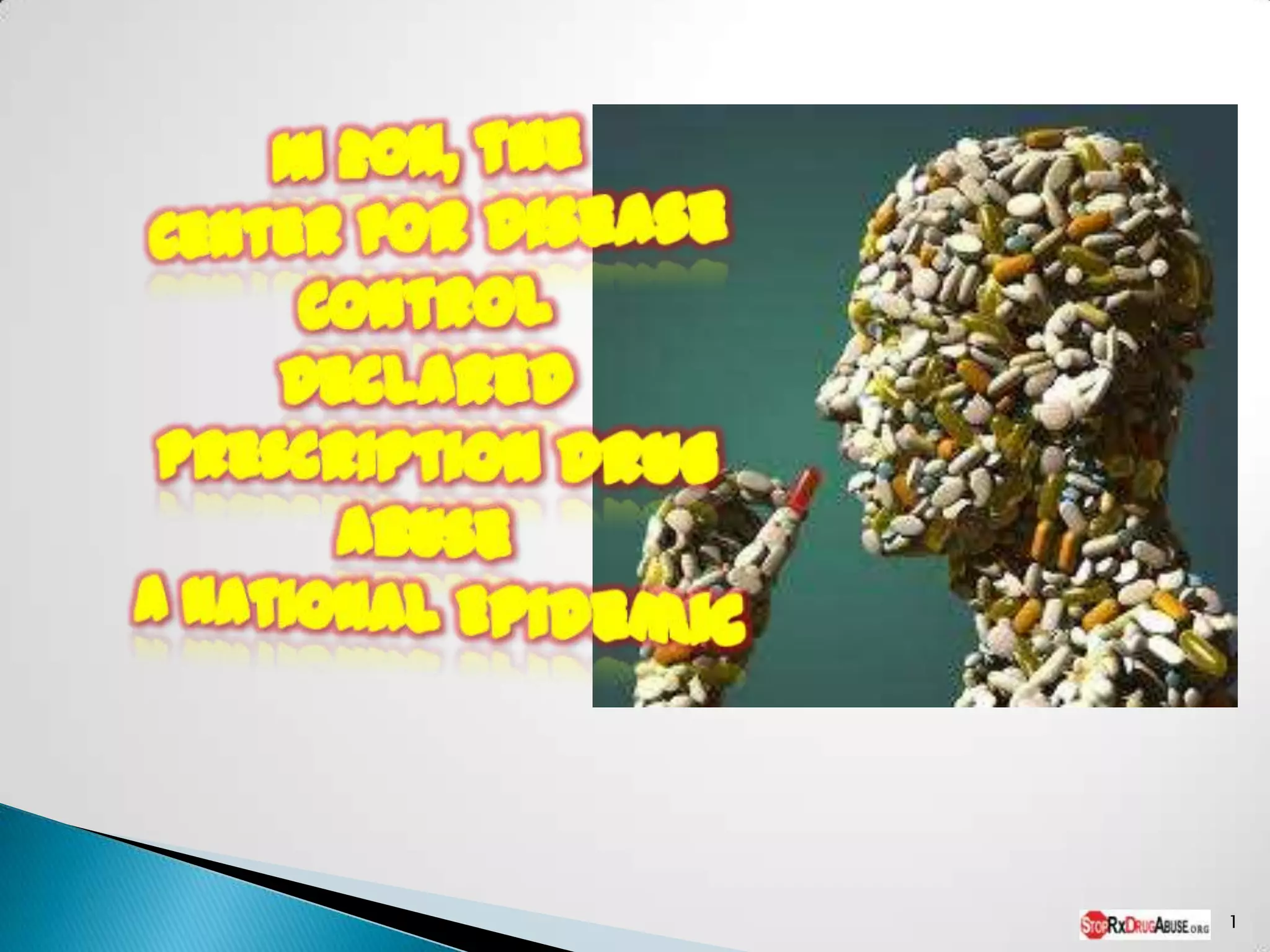
1
An epidemic is the occurrence of
more cases of disease than would
normally be expected in a specific
place or group of people over a
given period of time.


             http://www.cdc.gov/excite/classroom/intro_epi.htm
             http://www.cdc.gov/mmwr/preview/mmwrhtml/su6004a5.htm?s_cid=su6004a5_w   2
3
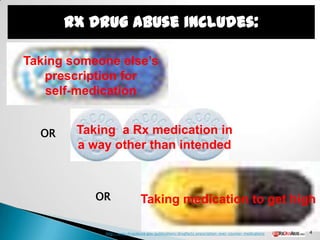
Rx Drug Abuse includes:

Taking someone else’s
   prescription for
   self-medication


  OR    Taking a Rx medication in
        a way other than intended


           OR                 Taking medication to get high

            http://www.drugabuse.gov/publications/drugfacts/prescription-over-counter-medications   4
5
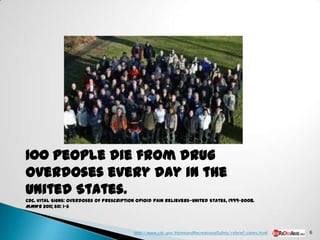
100 people die from drug
overdoses every day in the
United States.
CDC. Vital Signs: Overdoses of Prescription Opioid Pain Relievers—United States, 1999-2008.
MMWR 2011; 60: 1-6


                                           http://www.cdc.gov/HomeandRecreationalSafety/rxbrief/states.html   6
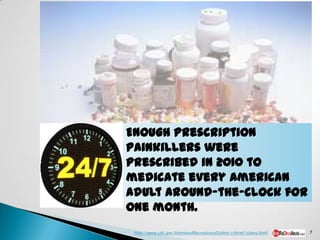
Enough prescription
painkillers were
prescribed in 2010 to
medicate every American
adult around-the-clock for
one month.
 http://www.cdc.gov/HomeandRecreationalSafety/rxbrief/states.html   7
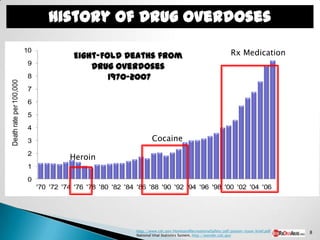
History of Drug Overdoses
                         10
                                         Eight-Fold Deaths from                                               Rx Medication
                          9
                                             Drug Overdoses
                          8                      1970-2007
Death rate per 100,000


                          7
                          6
                          5
                          4
                          3                                          Cocaine
                          2
                                        Heroin
                          1
                          0
                              '70 '72 '74 '76 '78 '80 '82 '84 '86 '88 '90 '92 '94 '96 '98 '00 '02 '04 '06


                                                             http://www.cdc.gov/HomeandRecreationalSafety/pdf/poison-issue-brief.pdF   8
                                                             National Vital Statistics System, http://wonder.cdc.gov
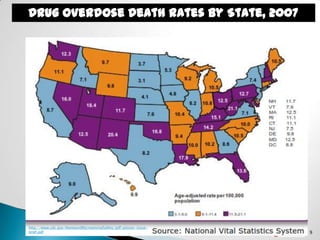
Drug Overdose Death Rates by State, 2007


http://www.cdc.gov/HomeandRecreationalSafety/pdf/poison-issue-
brief.pdf                                                        9
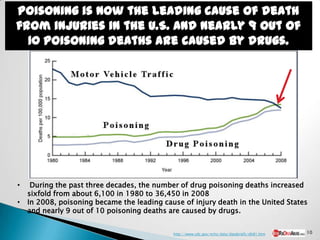
Poisoning is now the leading cause of death
from injuries in the U.S. and nearly 9 out of
  10 poisoning deaths are caused by drugs.


•    During the past three decades, the number of drug poisoning deaths increased
    sixfold from about 6,100 in 1980 to 36,450 in 2008
•   In 2008, poisoning became the leading cause of injury death in the United States
    and nearly 9 out of 10 poisoning deaths are caused by drugs.


                                             http://www.cdc.gov/nchs/data/databriefs/db81.htm   10
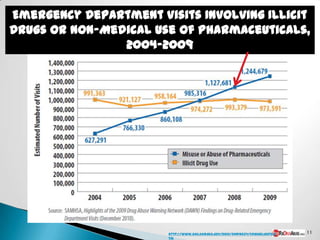
Emergency Department Visits Involving Illicit
Drugs or Non-Medical Use of Pharmaceuticals,
                2004-2009


                       http://www.oas.samhsa.gov/2k10/DAWN034/EDHighlights.h   11
                       tm
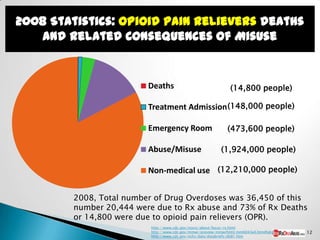
2008 Statistics: Opioid Pain Relievers deaths
   and Related Consequences of Misuse


                          Deaths                                (14,800 people)

                          Treatment Admission (148,000 people)

                          Emergency Room                       (473,600 people)

                          Abuse/Misuse                      (1,924,000 people)

                          Non-medical use (12,210,000 people)


         2008, Total number of Drug Overdoses was 36,450 of this
         number 20,444 were due to Rx abuse and 73% of Rx Deaths
         or 14,800 were due to opioid pain relievers (OPR).
                           http://www.cdc.gov/injury/about/focus-rx.html
                           http://www.cdc.gov/mmwr/preview/mmwrhtml/mm6043a4.htm#tab1   12
                           http://www.cdc.gov/nchs/data/databriefs/db81.htm
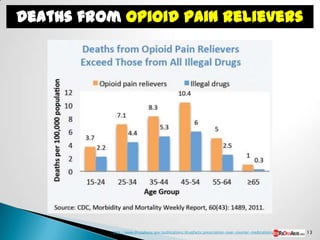
Deaths from Opioid Pain Relievers


           http://www.drugabuse.gov/publications/drugfacts/prescription-over-counter-medications   13
Opioid refers to Narcotic drugs or pain pills
which are DEA controlled substances.


                                                14
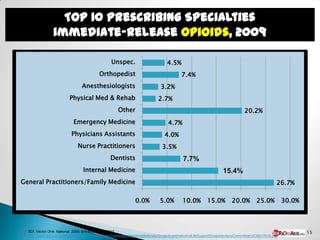
Top 10 Prescribing Specialties
                immediate-release opioids, 2009

                                                 Unspec.                        4.5%
                                          Orthopedist                                   7.4%
                                Anesthesiologists                            3.2%
                         Physical Med & Rehab                              2.7%
                                                     Other                                                                  20.2%
                           Emergency Medicine                                    4.7%
                          Physicians Assistants                                4.0%
                              Nurse Practitioners                            3.5%
                                                Dentists                                 7.7%
                                 Internal Medicine                                                              15.4%
General Practitioners/Family Medicine                                                                                                         26.7%

                                                              0.0%          5.0%         10.0%         15.0%         20.0%         25.0%          30.0%


  SDI, Vector One: National, 2009. Extracted June 2010.                                                                                                   15
  http://www.fda.gov/downloads/AdvisoryCommittees/CommitteesMeetingMaterials/Drugs/AnestheticAndLifeSupportDrugsAdvisoryCommittee/UCM217510.pdf
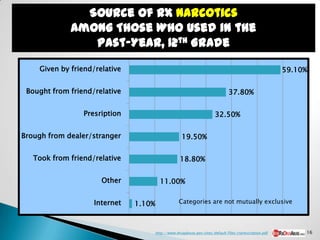
Source of Rx Narcotics
             Among Those Who Used in the
                Past-Year, 12th Grade
    Given by friend/relative                                                                             59.10%


 Bought from friend/relative                                                   37.80%


                 Presription                                            32.50%


Brough from dealer/stranger                          19.50%


   Took from friend/relative                        18.80%


                      Other              11.00%


                    Internet   1.10%                Categories are not mutually exclusive


                                       http://www.drugabuse.gov/sites/default/files/rrprescription.pdf        16
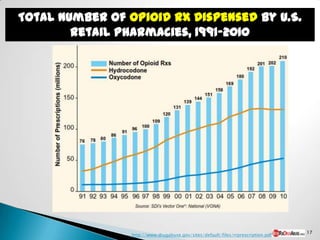
Total Number of Opioid Rx Dispensed by U.S.
        Retail Pharmacies, 1991-2010


                                                                                   17
                 http://www.drugabuse.gov/sites/default/files/rrprescription.pdf
18
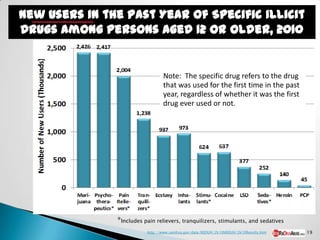
New Users in the Past Year of Specific Illicit
Drugs among Persons Aged 12 or Older, 2010


                                 Note: The specific drug refers to the drug
                                 that was used for the first time in the past
                                 year, regardless of whether it was the first
                                 drug ever used or not.


               *Includes pain relievers, tranquilizers, stimulants, and sedatives
                          http://www.samhsa.gov/data/NSDUH/2k10NSDUH/2k10Results.htm   19
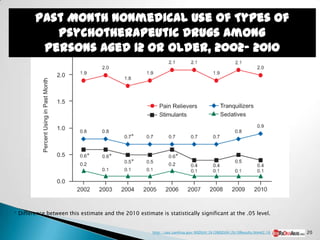
Past Month Nonmedical Use of Types of Psychotherapeutic Drugs
          Past Month Nonmedical Use of Types of
         among Persons Aged 12 or Older: 2002-2010
                Psychotherapeutic Drugs among
              Persons Aged 12 or Older, 2002- 2010


+   Difference between this estimate and the 2010 estimate is statistically significant at the .05 level.


                                                         http://oas.samhsa.gov/NSDUH/2k10NSDUH/2k10Results.htm#2.16   20
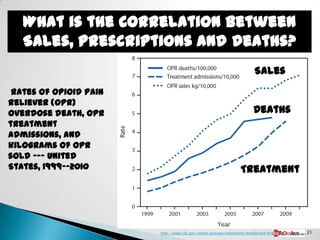
Sales
 Rates of opioid pain
reliever (OPR)
overdose death, OPR                                                Deaths
treatment
admissions, and
kilograms of OPR
sold --- United
States, 1999--2010                                           Treatment


                        http://www.cdc.gov/mmwr/preview/mmwrhtml/mm6043a4.htm   21
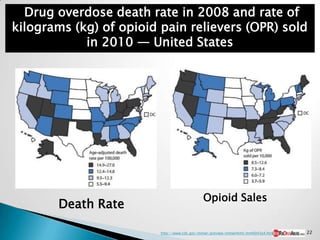
Drug overdose death rate in 2008 and rate of
kilograms (kg) of opioid pain relievers (OPR) sold
            in 2010 — United States


                                             Opioid Sales
       Death Rate

                         http://www.cdc.gov/mmwr/preview/mmwrhtml/mm6043a4.htm   22
Nonmedical use of Rx Drugs are Destroying
     Families in the United States


From the innocent unborn & infants to the
vulnerable elderly our nation has succumb to
the marketing ploy of drug companies
encouraging the public to utilize Rx drugs for
every minor pain and/or slight feeling of
anxiety.

Sadly, this ploy is working all too well….


                                                 23
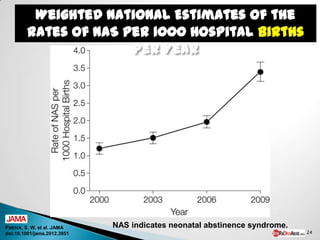
Weighted National Estimates of the
        Rates of NAS per 1000 Hospital Births
                      per Year


Patrick, S. W. et al. JAMA   NAS indicates neonatal abstinence syndrome.
doi:10.1001/jama.2012.3951                                                 24
Number of painkiller-addicted
                                  newborns
                              Triples in 10 years
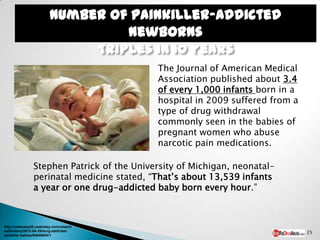
                                            The Journal of American Medical
                                            Association published about 3.4
                                            of every 1,000 infants born in a
                                            hospital in 2009 suffered from a
                                            type of drug withdrawal
                                            commonly seen in the babies of
                                            pregnant women who abuse
                                            narcotic pain medications.

                Stephen Patrick of the University of Michigan, neonatal-
                perinatal medicine stated, “That’s about 13,539 infants
                a year or one drug-addicted baby born every hour.”


http://usatoday30.usatoday.com/news/h
ealth/story/2012-04-29/durg-addicted-                                          25
painkller-babies/54646654/1
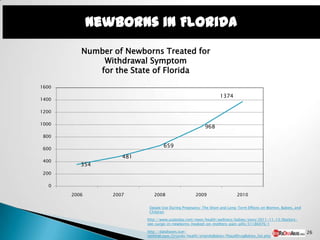
Newborns in Florida
          Number of Newborns Treated for
              Withdrawal Symptom
             for the State of Florida
1600

                                                                 1374
1400

1200

1000
                                                         968
 800

                                  659
 600
                    481
 400
          354
 200

   0

       2006      2007        2008                   2009                  2010

                           Opiate Use During Pregnancy: The Short and Long-Term Effects on Women, Babies, and
                           Children

                          http://www.usatoday.com/news/health/wellness/babies/story/2011-11-13/Doctors-
                          see-surge-in-newborns-hooked-on-mothers-pain-pills/51186076/1

                          http://databases.sun-                                                                 26
                          sentinel.com/Orlando/health/orlandoBabies/ftlaudDrugBabies_list.php
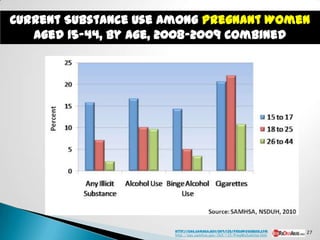
Current Substance Use Among Pregnant Women
   Aged 15-44, by Age, 2008-2009 Combined


                       http://oas.samhsa.gov/2k9/135/PregWoSubUse.cfm   27
                       http://oas.samhsa.gov/2k9/135/PregWoSubUse.htm
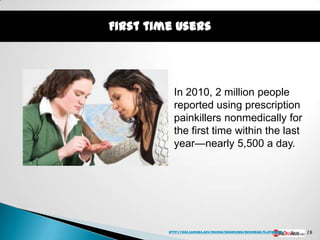
First time Users


           In 2010, 2 million people
           reported using prescription
           painkillers nonmedically for
           the first time within the last
           year—nearly 5,500 a day.


         http://oas.samhsa.gov/NSDUH/2k10NSDUH/2k10Results.htm#2.16   28
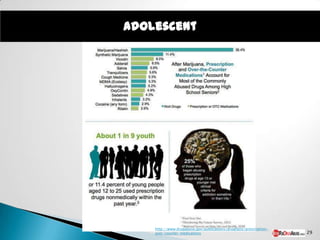
Adolescent


    http://www.drugabuse.gov/publications/drugfacts/prescription-
    over-counter-medications                                        29
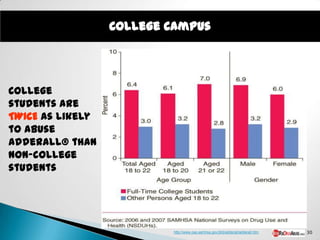
College Campus


College
students are
TWICE as likely
to abuse
Adderall® than
non-college
students


                          http://www.oas.samhsa.gov/2k9/adderall/adderall.htm   30
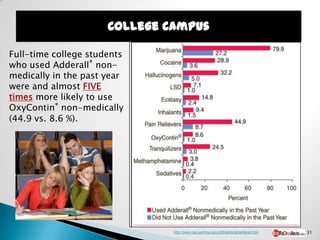
College Campus

Full-time college students
who used Adderall® non-
medically in the past year
were and almost FIVE
times more likely to use
OxyContin® non-medically
(44.9 vs. 8.6 %).


                               http://www.oas.samhsa.gov/2k9/adderall/adderall.htm   31
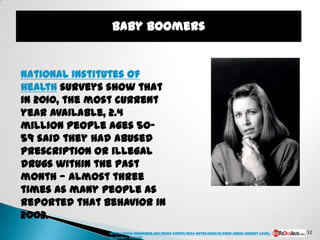
Baby Boomers


National Institutes of
Health surveys show that
in 2010, the most current
year available, 2.4
million people ages 50-
59 said they had abused
prescription or illegal
drugs within the past
month — almost three
times as many people as
reported that behavior in
2002.
               http://www.drugabuse.gov/news-events/nida-notes/2010/12/drug-abuse-highest-level-   32
               in-nearly-decade
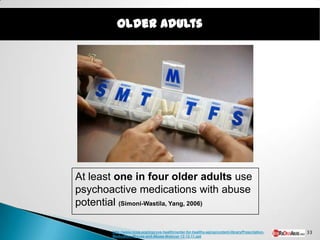
Older Adults


At least one in four older adults use
psychoactive medications with abuse
potential (Simoni-Wastila, Yang, 2006)

        http://www.ncoa.org/improve-health/center-for-healthy-aging/content-library/Prescription-   33
        Medication-Misuse-and-Abuse-Webinar-12-12-11.ppt
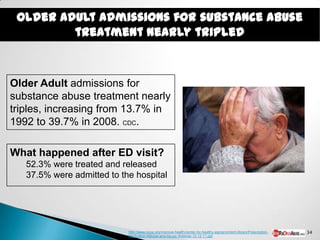
Older Adult admissions for substance abuse
         treatment nearly tripled


Older Adult admissions for
substance abuse treatment nearly
triples, increasing from 13.7% in
1992 to 39.7% in 2008. CDC.

What happened after ED visit?
   52.3% were treated and released
   37.5% were admitted to the hospital


                            http://www.ncoa.org/improve-health/center-for-healthy-aging/content-library/Prescription-   34
                            Medication-Misuse-and-Abuse-Webinar-12-12-11.ppt
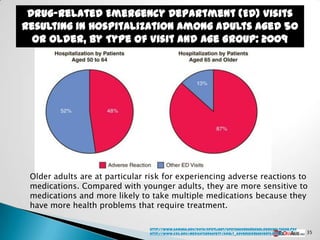
Drug-Related Emergency Department (ED) Visits
Resulting in Hospitalization among Adults Aged 50
  or Older, by Type of Visit and Age Group: 2009


 Older adults are at particular risk for experiencing adverse reactions to
 medications. Compared with younger adults, they are more sensitive to
 medications and more likely to take multiple medications because they
 have more health problems that require treatment.

                                http://www.samhsa.gov/data/spotlight/Spot066DrugReaxOlderAdults2012.pdf
                                http://www.cdc.gov/MedicationSafety/Adult_AdverseDrugEvents.html          35
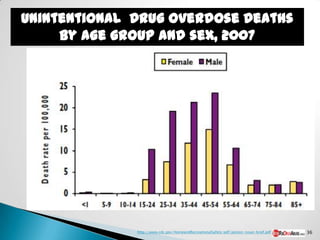
Unintentional Drug Overdose Deaths
     by age group and sex, 2007


              http://www.cdc.gov/HomeandRecreationalSafety/pdf/poison-issue-brief.pdf   36
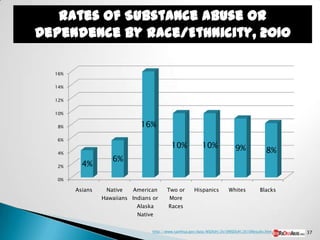
16%

14%

12%

10%

8%                          16%
6%
                                          10%            10%             9%
4%                                                                                      8%
                  6%
2%      4%
0%

      Asians    Native    American      Two or       Hispanics        Whites         Blacks
               Hawaiians Indians or      More
                           Alaska       Races
                           Native


                                 http://www.samhsa.gov/data/NSDUH/2k10NSDUH/2k10Results.htm   37
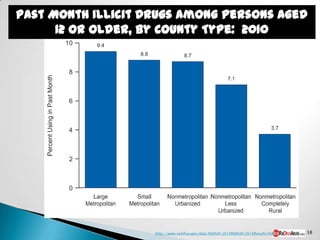
Past Month Illicit Drugs among Persons Aged
      12 or Older, by County Type: 2010


                    http://www.samhsa.gov/data/NSDUH/2k10NSDUH/2k10Results.htm   38
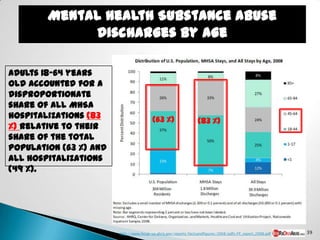
Adults 18-64 years
old accounted for a
disproportionate
share of all MHSA
hospitalizations (83                     (63 %)                  (83 %)
%) relative to their
share of the total
population (63 %) and
all hospitalizations
(49 %).


                        http://www.hcup-us.ahrq.gov/reports/factsandfigures/2008/pdfs/FF_report_2008.pdf   39
40
http://www.justice.gov/ndic/pubs44/44731/44731p.pdf
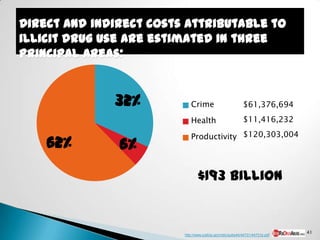
Direct and indirect costs attributable to
illicit drug use are estimated in three
principal areas:


              32%           Crime                           $61,376,694
                            Health                          $11,416,232

                            Productivity $120,303,004
    62%        6%
                                $193 Billion


                                                                               41
                         http://www.justice.gov/ndic/pubs44/44731/44731p.pdf
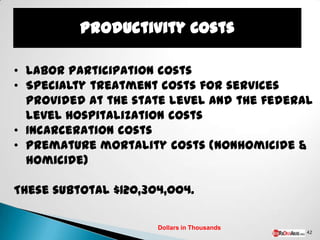
• Labor participation costs
• Specialty treatment costs for services
  provided at the state level and the federal
  level hospitalization costs
• Incarceration costs
• Premature mortality costs (nonhomicide &
  homicide)

These subtotal $120,304,004.

                      Dollars in Thousands
                                             42
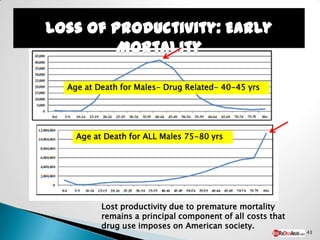
Age at Death for Males- Drug Related- 40-45 yrs


  Age at Death for ALL Males 75-80 yrs


        Lost productivity due to premature mortality
        remains a principal component of all costs that
        drug use imposes on American society.
                                                          43
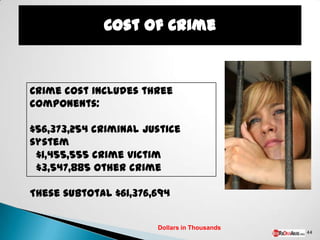
Crime cost includes three
components:

$56,373,254 criminal justice
system
 $1,455,555 crime victim
 $3,547,885 other crime

These subtotal $61,376,694


                       Dollars in Thousands
                                              44
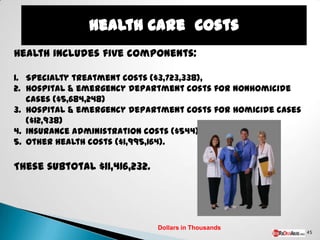
Health includes five components:

1. Specialty treatment costs ($3,723,338),
2. Hospital & emergency department costs for nonhomicide
   cases ($5,684,248)
3. Hospital & emergency department costs for homicide cases
   ($12,938)
4. Insurance administration costs ($544)
5. Other health costs ($1,995,164).

These subtotal $11,416,232.


                              Dollars in Thousands
                                                              45
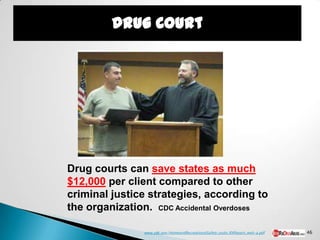
Drug courts can save states as much
$12,000 per client compared to other
criminal justice strategies, according to
the organization. CDC Accidental Overdoses

                www.cdc.gov/HomeandRecreationalSafety/pubs/RXReport_web-a.pdf   46
Legal Consequences:
2010 Legal Consequences of Prescription Drug
Misuse

Rx Drug Facts & Health Consequences of Misuse:
2010 Facts and Consequences of Nonmedical Use
of Prescription Drugs


               Saving Lives through Education &
               Prevention
                                                  47
• The US is the only developed country in the world that
  does not control RX drug prices.
• The US and New Zealand are the only countries that allow
  drug makers to advertise to consumers.
• In medical schools the median # of hours for pain
  education in the United States is 7 at VETINARIAN schools
  the median required hours is 75.
• The pharmaceutical companies spent more on lobbying
  between 1998 and 2004 than any other industry...
  employing a legion of lobbyists.. more than two for each
  member of Congress.


                                                              48
Website Sources
http://www.cdc.gov/excite/classroom/intro_epi.htm

http://www.cdc.gov/mmwr/preview/mmwrhtml/su6004a5.htm?s_cid=su6004a5_w

http://www.drugabuse.gov/publications/drugfacts/prescription-over-counter-medications

http://www.ncoa.org/improve-health/center-for-healthy-aging/content-library/Prescription-Medication-Misuse-and-
Abuse-Webinar-12-12-11.ppt

http://www.drugabuse.gov/sites/default/files/rrprescription.pdf

http://www.fda.gov/downloads/AdvisoryCommittees/CommitteesMeetingMaterials/Drugs/AnestheticAndLifeSupportDrugsAdvis
oryCommittee/UCM217510.pdf

http://www.justice.gov/ndic/pubs44/44731/44731p.pdf

http://www.isp.idaho.gov/pgr/Research/documents/drugsandcrime.pdf

National Vital Statistics System, http://wonder.cdc.gov

http://www.ahrq.gov/news/press/pr2010/hospmedpr.htm

Healthcare Cost and Utilization Project (HCUP) http://www.hcup-
us.ahrq.gov/reports/factsandfigures/2008/TOC_2008.jsp

http://www.hcup-us.ahrq.gov/reports/factsandfigures/2008/pdfs/FF_report_2008.pdf

http://www.samhsa.gov/data/NSDUH/2k10NSDUH/2k10Results.htm

http://www.drugabuse.gov/news-events/nida-notes/2010/12/drug-abuse-highest-level-in-nearly-decade
http://oas.samhsa.gov/2k9/135/PregWoSubUse.htm
http://oas.samhsa.gov/2k9/135/PregWoSubUse.cfm
                                                                                                                  49

2012 Why is Rx abuse and epidemic?

  • 1.
  • 2.
    An epidemic isthe occurrence of more cases of disease than would normally be expected in a specific place or group of people over a given period of time. http://www.cdc.gov/excite/classroom/intro_epi.htm http://www.cdc.gov/mmwr/preview/mmwrhtml/su6004a5.htm?s_cid=su6004a5_w 2
  • 3.
  • 4.
    Rx Drug Abuseincludes: Taking someone else’s prescription for self-medication OR Taking a Rx medication in a way other than intended OR Taking medication to get high http://www.drugabuse.gov/publications/drugfacts/prescription-over-counter-medications 4
  • 5.
  • 6.
    100 people diefrom drug overdoses every day in the United States. CDC. Vital Signs: Overdoses of Prescription Opioid Pain Relievers—United States, 1999-2008. MMWR 2011; 60: 1-6 http://www.cdc.gov/HomeandRecreationalSafety/rxbrief/states.html 6
  • 7.
    Enough prescription painkillers were prescribedin 2010 to medicate every American adult around-the-clock for one month. http://www.cdc.gov/HomeandRecreationalSafety/rxbrief/states.html 7
  • 8.
    History of DrugOverdoses 10 Eight-Fold Deaths from Rx Medication 9 Drug Overdoses 8 1970-2007 Death rate per 100,000 7 6 5 4 3 Cocaine 2 Heroin 1 0 '70 '72 '74 '76 '78 '80 '82 '84 '86 '88 '90 '92 '94 '96 '98 '00 '02 '04 '06 http://www.cdc.gov/HomeandRecreationalSafety/pdf/poison-issue-brief.pdF 8 National Vital Statistics System, http://wonder.cdc.gov
  • 9.
    Drug Overdose DeathRates by State, 2007 http://www.cdc.gov/HomeandRecreationalSafety/pdf/poison-issue- brief.pdf 9
  • 10.
    Poisoning is nowthe leading cause of death from injuries in the U.S. and nearly 9 out of 10 poisoning deaths are caused by drugs. • During the past three decades, the number of drug poisoning deaths increased sixfold from about 6,100 in 1980 to 36,450 in 2008 • In 2008, poisoning became the leading cause of injury death in the United States and nearly 9 out of 10 poisoning deaths are caused by drugs. http://www.cdc.gov/nchs/data/databriefs/db81.htm 10
  • 11.
    Emergency Department VisitsInvolving Illicit Drugs or Non-Medical Use of Pharmaceuticals, 2004-2009 http://www.oas.samhsa.gov/2k10/DAWN034/EDHighlights.h 11 tm
  • 12.
    2008 Statistics: OpioidPain Relievers deaths and Related Consequences of Misuse Deaths (14,800 people) Treatment Admission (148,000 people) Emergency Room (473,600 people) Abuse/Misuse (1,924,000 people) Non-medical use (12,210,000 people) 2008, Total number of Drug Overdoses was 36,450 of this number 20,444 were due to Rx abuse and 73% of Rx Deaths or 14,800 were due to opioid pain relievers (OPR). http://www.cdc.gov/injury/about/focus-rx.html http://www.cdc.gov/mmwr/preview/mmwrhtml/mm6043a4.htm#tab1 12 http://www.cdc.gov/nchs/data/databriefs/db81.htm
  • 13.
    Deaths from OpioidPain Relievers http://www.drugabuse.gov/publications/drugfacts/prescription-over-counter-medications 13
  • 14.
    Opioid refers toNarcotic drugs or pain pills which are DEA controlled substances. 14
  • 15.
    Top 10 PrescribingSpecialties immediate-release opioids, 2009 Unspec. 4.5% Orthopedist 7.4% Anesthesiologists 3.2% Physical Med & Rehab 2.7% Other 20.2% Emergency Medicine 4.7% Physicians Assistants 4.0% Nurse Practitioners 3.5% Dentists 7.7% Internal Medicine 15.4% General Practitioners/Family Medicine 26.7% 0.0% 5.0% 10.0% 15.0% 20.0% 25.0% 30.0% SDI, Vector One: National, 2009. Extracted June 2010. 15 http://www.fda.gov/downloads/AdvisoryCommittees/CommitteesMeetingMaterials/Drugs/AnestheticAndLifeSupportDrugsAdvisoryCommittee/UCM217510.pdf
  • 16.
    Source of RxNarcotics Among Those Who Used in the Past-Year, 12th Grade Given by friend/relative 59.10% Bought from friend/relative 37.80% Presription 32.50% Brough from dealer/stranger 19.50% Took from friend/relative 18.80% Other 11.00% Internet 1.10% Categories are not mutually exclusive http://www.drugabuse.gov/sites/default/files/rrprescription.pdf 16
  • 17.
    Total Number ofOpioid Rx Dispensed by U.S. Retail Pharmacies, 1991-2010 17 http://www.drugabuse.gov/sites/default/files/rrprescription.pdf
  • 18.
  • 19.
    New Users inthe Past Year of Specific Illicit Drugs among Persons Aged 12 or Older, 2010 Note: The specific drug refers to the drug that was used for the first time in the past year, regardless of whether it was the first drug ever used or not. *Includes pain relievers, tranquilizers, stimulants, and sedatives http://www.samhsa.gov/data/NSDUH/2k10NSDUH/2k10Results.htm 19
  • 20.
    Past Month NonmedicalUse of Types of Psychotherapeutic Drugs Past Month Nonmedical Use of Types of among Persons Aged 12 or Older: 2002-2010 Psychotherapeutic Drugs among Persons Aged 12 or Older, 2002- 2010 + Difference between this estimate and the 2010 estimate is statistically significant at the .05 level. http://oas.samhsa.gov/NSDUH/2k10NSDUH/2k10Results.htm#2.16 20
  • 21.
    Sales Rates ofopioid pain reliever (OPR) overdose death, OPR Deaths treatment admissions, and kilograms of OPR sold --- United States, 1999--2010 Treatment http://www.cdc.gov/mmwr/preview/mmwrhtml/mm6043a4.htm 21
  • 22.
    Drug overdose deathrate in 2008 and rate of kilograms (kg) of opioid pain relievers (OPR) sold in 2010 — United States Opioid Sales Death Rate http://www.cdc.gov/mmwr/preview/mmwrhtml/mm6043a4.htm 22
  • 23.
    Nonmedical use ofRx Drugs are Destroying Families in the United States From the innocent unborn & infants to the vulnerable elderly our nation has succumb to the marketing ploy of drug companies encouraging the public to utilize Rx drugs for every minor pain and/or slight feeling of anxiety. Sadly, this ploy is working all too well…. 23
  • 24.
    Weighted National Estimatesof the Rates of NAS per 1000 Hospital Births per Year Patrick, S. W. et al. JAMA NAS indicates neonatal abstinence syndrome. doi:10.1001/jama.2012.3951 24
  • 25.
    Number of painkiller-addicted newborns Triples in 10 years The Journal of American Medical Association published about 3.4 of every 1,000 infants born in a hospital in 2009 suffered from a type of drug withdrawal commonly seen in the babies of pregnant women who abuse narcotic pain medications. Stephen Patrick of the University of Michigan, neonatal- perinatal medicine stated, “That’s about 13,539 infants a year or one drug-addicted baby born every hour.” http://usatoday30.usatoday.com/news/h ealth/story/2012-04-29/durg-addicted- 25 painkller-babies/54646654/1
  • 26.
    Newborns in Florida Number of Newborns Treated for Withdrawal Symptom for the State of Florida 1600 1374 1400 1200 1000 968 800 659 600 481 400 354 200 0 2006 2007 2008 2009 2010 Opiate Use During Pregnancy: The Short and Long-Term Effects on Women, Babies, and Children http://www.usatoday.com/news/health/wellness/babies/story/2011-11-13/Doctors- see-surge-in-newborns-hooked-on-mothers-pain-pills/51186076/1 http://databases.sun- 26 sentinel.com/Orlando/health/orlandoBabies/ftlaudDrugBabies_list.php
  • 27.
    Current Substance UseAmong Pregnant Women Aged 15-44, by Age, 2008-2009 Combined http://oas.samhsa.gov/2k9/135/PregWoSubUse.cfm 27 http://oas.samhsa.gov/2k9/135/PregWoSubUse.htm
  • 28.
    First time Users In 2010, 2 million people reported using prescription painkillers nonmedically for the first time within the last year—nearly 5,500 a day. http://oas.samhsa.gov/NSDUH/2k10NSDUH/2k10Results.htm#2.16 28
  • 29.
    Adolescent http://www.drugabuse.gov/publications/drugfacts/prescription- over-counter-medications 29
  • 30.
    College Campus College students are TWICEas likely to abuse Adderall® than non-college students http://www.oas.samhsa.gov/2k9/adderall/adderall.htm 30
  • 31.
    College Campus Full-time collegestudents who used Adderall® non- medically in the past year were and almost FIVE times more likely to use OxyContin® non-medically (44.9 vs. 8.6 %). http://www.oas.samhsa.gov/2k9/adderall/adderall.htm 31
  • 32.
    Baby Boomers National Institutesof Health surveys show that in 2010, the most current year available, 2.4 million people ages 50- 59 said they had abused prescription or illegal drugs within the past month — almost three times as many people as reported that behavior in 2002. http://www.drugabuse.gov/news-events/nida-notes/2010/12/drug-abuse-highest-level- 32 in-nearly-decade
  • 33.
    Older Adults At leastone in four older adults use psychoactive medications with abuse potential (Simoni-Wastila, Yang, 2006) http://www.ncoa.org/improve-health/center-for-healthy-aging/content-library/Prescription- 33 Medication-Misuse-and-Abuse-Webinar-12-12-11.ppt
  • 34.
    Older Adult admissionsfor substance abuse treatment nearly tripled Older Adult admissions for substance abuse treatment nearly triples, increasing from 13.7% in 1992 to 39.7% in 2008. CDC. What happened after ED visit? 52.3% were treated and released 37.5% were admitted to the hospital http://www.ncoa.org/improve-health/center-for-healthy-aging/content-library/Prescription- 34 Medication-Misuse-and-Abuse-Webinar-12-12-11.ppt
  • 35.
    Drug-Related Emergency Department(ED) Visits Resulting in Hospitalization among Adults Aged 50 or Older, by Type of Visit and Age Group: 2009 Older adults are at particular risk for experiencing adverse reactions to medications. Compared with younger adults, they are more sensitive to medications and more likely to take multiple medications because they have more health problems that require treatment. http://www.samhsa.gov/data/spotlight/Spot066DrugReaxOlderAdults2012.pdf http://www.cdc.gov/MedicationSafety/Adult_AdverseDrugEvents.html 35
  • 36.
    Unintentional Drug OverdoseDeaths by age group and sex, 2007 http://www.cdc.gov/HomeandRecreationalSafety/pdf/poison-issue-brief.pdf 36
  • 37.
    16% 14% 12% 10% 8% 16% 6% 10% 10% 9% 4% 8% 6% 2% 4% 0% Asians Native American Two or Hispanics Whites Blacks Hawaiians Indians or More Alaska Races Native http://www.samhsa.gov/data/NSDUH/2k10NSDUH/2k10Results.htm 37
  • 38.
    Past Month IllicitDrugs among Persons Aged 12 or Older, by County Type: 2010 http://www.samhsa.gov/data/NSDUH/2k10NSDUH/2k10Results.htm 38
  • 39.
    Adults 18-64 years oldaccounted for a disproportionate share of all MHSA hospitalizations (83 (63 %) (83 %) %) relative to their share of the total population (63 %) and all hospitalizations (49 %). http://www.hcup-us.ahrq.gov/reports/factsandfigures/2008/pdfs/FF_report_2008.pdf 39
  • 40.
  • 41.
    Direct and indirectcosts attributable to illicit drug use are estimated in three principal areas: 32% Crime $61,376,694 Health $11,416,232 Productivity $120,303,004 62% 6% $193 Billion 41 http://www.justice.gov/ndic/pubs44/44731/44731p.pdf
  • 42.
    • Labor participationcosts • Specialty treatment costs for services provided at the state level and the federal level hospitalization costs • Incarceration costs • Premature mortality costs (nonhomicide & homicide) These subtotal $120,304,004. Dollars in Thousands 42
  • 43.
    Age at Deathfor Males- Drug Related- 40-45 yrs Age at Death for ALL Males 75-80 yrs Lost productivity due to premature mortality remains a principal component of all costs that drug use imposes on American society. 43
  • 44.
    Crime cost includesthree components: $56,373,254 criminal justice system $1,455,555 crime victim $3,547,885 other crime These subtotal $61,376,694 Dollars in Thousands 44
  • 45.
    Health includes fivecomponents: 1. Specialty treatment costs ($3,723,338), 2. Hospital & emergency department costs for nonhomicide cases ($5,684,248) 3. Hospital & emergency department costs for homicide cases ($12,938) 4. Insurance administration costs ($544) 5. Other health costs ($1,995,164). These subtotal $11,416,232. Dollars in Thousands 45
  • 46.
    Drug courts cansave states as much $12,000 per client compared to other criminal justice strategies, according to the organization. CDC Accidental Overdoses www.cdc.gov/HomeandRecreationalSafety/pubs/RXReport_web-a.pdf 46
  • 47.
    Legal Consequences: 2010 LegalConsequences of Prescription Drug Misuse Rx Drug Facts & Health Consequences of Misuse: 2010 Facts and Consequences of Nonmedical Use of Prescription Drugs Saving Lives through Education & Prevention 47
  • 48.
    • The USis the only developed country in the world that does not control RX drug prices. • The US and New Zealand are the only countries that allow drug makers to advertise to consumers. • In medical schools the median # of hours for pain education in the United States is 7 at VETINARIAN schools the median required hours is 75. • The pharmaceutical companies spent more on lobbying between 1998 and 2004 than any other industry... employing a legion of lobbyists.. more than two for each member of Congress. 48
  • 49.
    Website Sources http://www.cdc.gov/excite/classroom/intro_epi.htm http://www.cdc.gov/mmwr/preview/mmwrhtml/su6004a5.htm?s_cid=su6004a5_w http://www.drugabuse.gov/publications/drugfacts/prescription-over-counter-medications http://www.ncoa.org/improve-health/center-for-healthy-aging/content-library/Prescription-Medication-Misuse-and- Abuse-Webinar-12-12-11.ppt http://www.drugabuse.gov/sites/default/files/rrprescription.pdf http://www.fda.gov/downloads/AdvisoryCommittees/CommitteesMeetingMaterials/Drugs/AnestheticAndLifeSupportDrugsAdvis oryCommittee/UCM217510.pdf http://www.justice.gov/ndic/pubs44/44731/44731p.pdf http://www.isp.idaho.gov/pgr/Research/documents/drugsandcrime.pdf National VitalStatistics System, http://wonder.cdc.gov http://www.ahrq.gov/news/press/pr2010/hospmedpr.htm Healthcare Cost and Utilization Project (HCUP) http://www.hcup- us.ahrq.gov/reports/factsandfigures/2008/TOC_2008.jsp http://www.hcup-us.ahrq.gov/reports/factsandfigures/2008/pdfs/FF_report_2008.pdf http://www.samhsa.gov/data/NSDUH/2k10NSDUH/2k10Results.htm http://www.drugabuse.gov/news-events/nida-notes/2010/12/drug-abuse-highest-level-in-nearly-decade http://oas.samhsa.gov/2k9/135/PregWoSubUse.htm http://oas.samhsa.gov/2k9/135/PregWoSubUse.cfm 49

Editor's Notes

  • #3 Overdoses involving prescription painkillers—a class of drugs that includes hydrocodone, methadone, oxycodone, and oxymorphone—are a public health epidemic. These drugs are widely misused and abused. One in 20 people in the United States, ages 12 and older, used prescription painkillers nonmedically (without a prescription or just for the "high" they cause) in 2010.
  • #10 The highest drug overdose death rate was found in West Virginia, which was nearly 7 times that of the state with the lowest drug overdose death rate, South Dakota.
  • #11 Of the 36,500 drug poisoning deaths in 2008, more than 40% (14,800) involved opioid analgesics
  • #16 An 'immediate release' liquid or tablet that you take every 2 to 4 hours
  • #22 * Age-adjusted rates per 100,000 population for OPR deaths, crude rates per 10,000 population for OPR abuse treatment admissions, and crude rates per 10,000 population for kilograms of OPR sold.Alternate Text: The figure above shows rates of opioid pain reliever (OPR) overdose death, OPR treatment admissions, and kilograms of OPR sold in the United States during 1999-2010. During 1999-2008, overdose death rates, sales, and substance abuse treatment admissions related to OPR all increased substantially.
  • #23 The lag in death rate to opioid sales/state may be due to death rate #’s are 2008 and sales are 2010. TM.
  • #32 more than twice as likely to use Marijuana (79.9 vs. 27.2%)
  • #36 Older adults are at particular risk for experiencing adverse reactions to medications. Compared with younger adults, they are more sensitive to medications and more likely to take multiple medications because they have more health problems that require treatment.(*2) Older adults may also experience cognitive issues or memory problems that affect their ability to understand and follow medication instructions.(*3) To learn more about how to prevent adverse reactions to medications, older adults and their families can visit http://www.cdc.gov/MedicationSafety/Adult_AdverseDrugEvents.html.
  • #40 By age, the distribution of MHSA hospitalizations differed substantially from the distribution of hospitalizations for all reasons and from the distribution of the U.S. population in 2008. Adults 18-64 years old accounted for a disproportionate share of all MHSA hospitalizations (83 percent) relative to their share of the total population (63 percent) and all hospitalizations (49 percent). While those 65 years and older were responsible for 35 percent of all stays and 13 percent of the U.S. population, they accounted for only 9 percent of MHSA stays.  Children 1-17 years old accounted for 4 percent of all hospital stays and 7 percent of MHSA stays, compared to their population share of 23 percent. Children under 1 year accounted for 1 percent of the overall population, 12 percent of all hospital stays (mostly as newborns), and less than 0.1 percent of MHSA discharges (mostly for drug-related disorders).