A&A 546, A105 (2012)                                                                                                        Astronomy
DOI: 10.1051/0004-6361/201117166                                                                                             &
c ESO 2012                                                                                                                  Astrophysics


                The hypergiant HR 8752 evolving through the yellow
                              evolutionary void ,
  H. Nieuwenhuijzen1 , C. De Jager1,2 , I. Kolka3 , G. Israelian4 , A. Lobel5 , E. Zsoldos6 , A. Maeder7 , and G. Meynet7

     1
         SRON Laboratory for Space Research, Sorbonnelaan 2, 3584 CA Utrecht, The Netherlands
         e-mail: h.nieuwenhuijzen@sron.nl; h.nieuwenhuijzen@xs4all.nl
     2
         NIOZ, Royal Netherlands Institute for Sea Research, PO Box 59, Den Burg, The Netherlands
         e-mail: cdej@kpnplanet.nl
     3
         Tartu Observatory, 61602 Tõravere, Estonia
         e-mail: indrek@aai.ee
     4
         Instituto de Astrofisica de Canarias, via Lactea s/n, 38200 La Laguna, Tenerife, Spain
         e-mail: gil@iac.es
     5
         Royal Observatory of Belgium, Ringlaan 3, 1180 Brussels, Belgium
         e-mail: alobel@sdf.lonestar.org; Alex.Lobel@oma.be
     6
         Konkoly Observatory, PO Box 67, 1525 Budapest, Hungary
         e-mail: zsoldos@konkoly.hu
     7
         Observatoire de Genève, 1290 Sauverny, Switzerland
         e-mail: [Andre.Maeder;Georges.Meynet]@unige.ch
     Received 30 April 2011 / Accepted 13 March 2012

                                                                      ABSTRACT

     Context. We study the time history of the yellow hypergiant HR 8752 based on high-resolution spectra (1973–2005), the observed
     MK spectral classification data, B − V- and V-observations (1918–1996) and yet earlier V-observations (1840–1918).
     Aims. Our local thermal equilibrium analysis of the spectra yields accurate values of the effective temperature (T eff ), the accelera-
     tion of gravity (g), and the turbulent velocity (vt ) for 26 spectra. The standard deviations average are 82 K for T eff , 0.23 for log g,
     and 1.1 km s−1 for vt .
     Methods. A comparison of B− V observations, MK spectral types, and T eff -data yields E(B− V), “intrinsic” B− V, T eff , absorption AV ,
     and the bolometric correction BC. With the additional information from simultaneous values of B − V, V, and an estimated value of R,
     the ratio of specific absorption to the interstellar absorption parameter E(B − V), the “unreddened” bolometric magnitude mbol,0 can
     be determined. With Hipparcos distance measurements of HR 8752, the absolute bolometric magnitude Mbol,0 can be determined.
     Results. Over the period of our study, the value of T eff gradually increased during a number of downward excursions that were ob-
     servable over the period of sufficient time coverage. These observations, together with those of the effective acceleration g and the
     turbulent velocity vt , suggest that the star underwent a number of successive gas ejections. During each ejection, a pseudo photosphere
     was produced of increasingly smaller g and higher vt values. After the dispersion into space of the ejected shells and after the restruc-
     turing of the star’s atmosphere, a hotter and more compact photosphere became visible. From the B − V and V observations, the basic
     stellar parameters, T eff , log M/M , log L/L , and log R/R are determined for each of the observational points. The results show the
     variation in these basic stellar parameters over the past near-century.
     Conclusions. We show that the atmospheric instability region in the HR-diagram that we baptize the yellow evolutionary void actually
     consists of two parts. We claim that the present observations show that HR 8752 is presently climbing out of the “first” instability
     region and that it is on its way to stability, but in the course of its future evolution it still has to go through the second potential unstable
     region.
     Key words. stars: atmospheres – stars: evolution – supergiants – stars: mass-loss – stars: fundamental parameters –
     stars: variables: S Doradus


1. Introduction                                                                1.1. The yellow hypergiants; HR 8752 in the literature
We summarize in this section the status of knowledge on                The star HR 8752 is a member of a group of half a dozen massive
HR 8752 and the evolution of hypergiants and succinctly review         stars, with zero age main sequence (ZAMS) masses of 20–40 or
the aims of this research.                                             even more solar masses, the yellow hypergiants. Another well-
                                                                       studied member is ρ Cas (Lobel et al. 1992, 1994, 1998, 2003;
    Appendix A is available in electronic form at
http://www.aanda.org                                                   Israelian et al. 1999; Gorlova et al. 2006). These are sites of
    Tables A.x and B.x are available in electronic form at the CDS via heavy mass-loss, which is sometimes episodic. The individual
anonymous ftp to                                                       stars undergo large variations in temperature. These variations
cdsarc.u-strasbg.fr (130.79.128.5) or via                              are the visible atmospheric manifestations of changes that are
http://cdsarc.u-strasbg.fr/viz-bin/qcat?J/A+A/546/A105, only semi-coupled to the star, underlying its (pseudo-) photo-
and at the external site http://www.aai.ee/HR~8752                     sphere. The evolutionary changes of the underlying star have a
                                            Article published by EDP Sciences                                                        A105, page 1 of 24
A&A 546, A105 (2012)

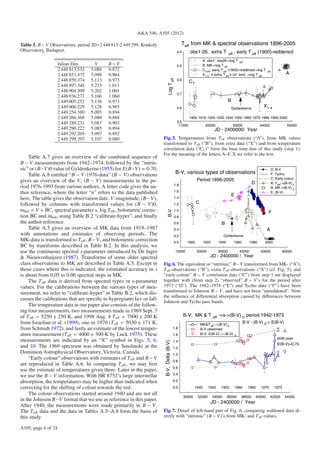
timescale that is much longer than the stability timescale of the               HR 8752 and evolutionary tracks (Meynet et al., 1994)
photosphere. We associate these stars with the luminous blue                         6.6   Some hypergiants near the Yellow Evolutionary Void
variables (LBVs).                                                                                          HD 80077                         galactic hypergiant
                                                                                     6.4
                                                                                                                                            m040e020
     The extended literature on HR 8752 shows a large variabil-                                                                             m025e020
ity in the spectral classification, and colour magnitudes. An early                   6.2
                                                                                              HD Limit                                      Yellow Void
review was written by De Jager (1980, p. 101–102). The histor-                                                                              lower Teff range


                                                                       log L/L sun
                                                                                     6.0
ical light curve from 1840 to about 1980 is shown by Zsoldos                                                    Track 4                       IRC+10420
                                                                                     5.8                                          ρ Cas       HD 119796
(1986a), with a bibliography on what was known about the star                                                                                    HD 212466
at that time. The star HR 8752 is a variable with an amplitude                       5.6            40 M sun          Track 3
                                                                                                                                                   HR 8752
                                                                                                                                                  HD 96918
of about 0.2 mag, and its light variation has a characteristic                       5.4                                Tracks 4,5
                                                                                                                                        CRL 2688

timescale of about one year. It has main-sequence B1 compan-
ion (Stickland & Harmer 1978), and its circumstellar envelope                        5.2            25 M sun    Track 3     HD 223385

emits thermal radio emission (Smolinski et al. 1977; Higgs et al.                    5.0
1978). An excellent spectral analysis of the star at one point in                       4.5   4.4   4.3   4.2   4.1   4.0   3.9   3.8     3.7   3.6    3.5    3.4
                                                                                                                      log T eff
its changing history was published by Luck (1975). He found
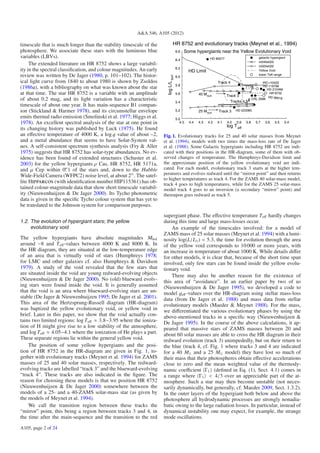
an effective temperature of 4000 K, a log g value of about –2,        Fig. 1. Evolutionary tracks for 25 and 40 solar masses from Meynet
and a metal abundance that seems to have Solar-System val-           et al. (1994), models with two times the mass-loss rate of De Jager
ues. A self-consistent spectrum synthesis analysis (Fry & Aller      et al. (1988). Some Galactic hypergiants including HR 8752 are indi-
1975) suggests that HR 8752 has solar-type abundances. No ev-        cated with their positions in the HR-diagram, some of them with ob-
idence has been found of extended structures (Schuster et al.        served changes of temperature. The Humphreys-Davidson limit and
2003) for the yellow hypergiants ρ Cas, HR 8752, HR 5171a,           the approximate position of the yellow evolutionary void are indi-
and μ Cep within 0. 1 of the stars and, down to the Hubble           cated. For each model, evolutionary track 3 starts at the higher tem-
Wide-Field Camera (WFPC2) noise level, at about 2 . The satel-       peratures and evolves redward until the “mirror point” and then returns
                                                                     to higher temperatures as track 4. For the ZAMS 40 solar-mass model,
lite Hipparcos (with identification number HIP115361) has ob-         track 4 goes to high temperatures, while for the ZAMS 25 solar-mass
tained colour-magnitude data that show short timescale variabil-     model track 4 goes to an inversion (a secondary “mirror” point) and
ity (Nieuwenhuijzen & De Jager 2000). Its Tycho photometric          thereupon goes redward as track 5.
data is given in the specific Tycho colour system that has yet to
be translated to the Johnson system for comparison purposes.
                                                                     supergiant phase. The effective temperature T eff hardly changes
1.2. The evolution of hypergiant stars; the yellow                   during this time and large mass-losses occur.
     evolutionary void                                                   An example of the timescales involved: for a model of
                                                                     ZAMS mass of 25 solar masses (Meynet et al. 1994) with a lumi-
The yellow hypergiants have absolute magnitudes Mbol                 nosity log(L/L ) = 5.3, the time for evolution through the area
around −8 and T eff -values between 4000 K and 8000 K. In             of the yellow void corresponds to 10 000 or more years, with
the HR diagram, they are situated at the low-temperature edge        an increase in temperature of about 1000 K. While details differ
of an area that is virtually void of stars (Humphreys 1978;          for other models, it is clear that, because of the short time span
for LMC and other galaxies cf. also Humphreys & Davidson             involved, only few stars can be found inside the yellow evolu-
1979). A study of the void revealed that the few stars that          tionary void.
are situated inside the void are young redward-evolving objects          There may also be another reason for the existence of
(Nieuwenhuijzen & De Jager 2000). No (old) blueward evolv-           this area of “avoidance”. In an earlier paper by two of us
ing stars were found inside the void. It is generally assumed        (Nieuwenhuijzen & De Jager 1995), we developed a code to
that the void is an area where blueward-evolving stars are un-       model geff -values over the HR-diagram using stellar mass-loss
stable (De Jager & Nieuwenhuijzen 1995; De Jager et al. 2001).       data (from De Jager et al. 1988) and mass data from stellar
This area of the Hertzsprung-Russell diagram (HR-diagram)            evolutionary models (Maeder & Meynet 1988). For the mass,
was baptized the yellow evolutionary void, or yellow void in         we differentiated the various evolutionary phases by using the
brief. Later in this paper, we show that the void actually con-      above-mentioned tracks in a specific way (Nieuwenhuijzen &
tains two limited regions: log T eff ≈ 3.8−3.95 where the ioniza-     De Jager 1995). In the course of the above calculations, it ap-
tion of H might give rise to a low stability of the atmosphere,      peared that massive stars of ZAMS masses between 20 and
and log T eff ≈ 4.05−4.1 where the ionization of He plays a part.     about 60 solar masses are able to cross the HR diagram in their
These separate regions lie within the general yellow void.           redward evolution (track 3) unimpededly, but on their return to
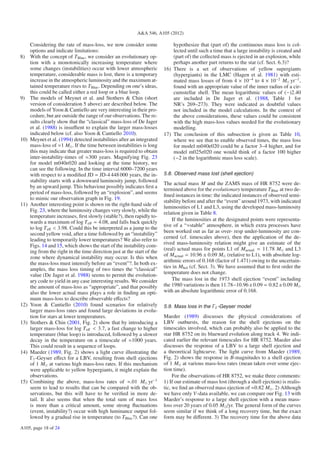
    The position of some yellow hypergiants and the posi-            the blue (track 4, cf. Fig. 1 where tracks 3 and 4 are indicated
tion of HR 8752 in the HR-diagram are given in Fig. 1, to-           for a 40 M and a 25 M model) they have lost so much of
gether with evolutionary tracks (Meynet et al. 1994) for ZAMS        their mass that their photospheres obtain effective accelerations
masses of 25 and 40 solar masses, respectively. The redward-         close to zero and the mean weighted value of the thermody-
evolving tracks are labelled “track 3” and the blueward-evolving     namic coefficient Γ1 (defined in Eq. (1), Sect. 4.1) comes in
“track 4”. These tracks are also indicated in the figure. The         a range where Γ1 < 4/3 over an appreciable part of the at-
reason for choosing these models is that we position HR 8752         mosphere. Such a star may then become unstable (not neces-
(Nieuwenhuijzen & De Jager 2000) somewhere between the               sarily dynamically, but generally, cf. Maeder 2009, Sect. 1.3.2).
models of a 25- and a 40-ZAMS solar-mass star (as given by           In the outer layers of the hypergiant both below and above the
the models of Meynet et al. 1994).                                   photosphere all hydrodynamic processes are strongly nonadia-
    We call the transition region between these tracks the           batic owing to the large radiation losses. In particular, instead of
“mirror” point, this being a region between tracks 3 and 4, in       dynamical instability one may expect, for example, the strange
the time after the main-sequence and the transition to the red       mode oscillations.
A105, page 2 of 24
H. Nieuwenhuijzen et al.: HR 8752 evolving through the void

     For certain areas in the HR-diagram, that coincide with the        Table 1. Observations, dates, and observers.
position of the void, no stable solution could be derived with our
code, indicating the (possible) presence of a density inversion.            Observations         Date          JD-2 400 000   Observer
This explanation seems reasonable owing to the development of               obs1             1973.08.13-17       41 911.3        Luck
the code that was defined for a monotonically decreasing atmo-               obs2               1978.08.–         43 737.3     Smolinski
spheric density, with scaleheights and the concept of geff (loc.             obs3               1984.07.–         45 898.3        Piters
cit. Eqs. (6)–(9)). Although the existence of a density inversion           obs4              1995.04.18         49 824.3       Rutten
does not directly lead to instability (cf. Maeder 2009, Sect. 5.5.2,        obs5              2000.06.06         51 702.5      Israelian
and also Maeder 1989), it might begin to explain the existence              obs6              2000.10.06         51 824.4       Kolka
of (massive) shells as we discuss in Sect. 6. The existence of this         obs7              2000.11.27         51 876.4       Kolka
                                                                            obs8              2001.01.12         51 922.3       Kolka
phenomenon coincides with low values of Γ1 , which is the driv-
                                                                            obs9              2001.02.16         51 957.3       Kolka
ing parameter in this part of our research. The low values of Γ1            obs10             2001.03.30         51 999.4       Kolka
in stars such as HR 8752 result from high radiation pressure and            obs11             2001.09.25          52 178        Kolka
partial ionization effects. In Sect. 4, we discuss this parameter            obs12             2001.10.01          52 184       Israelian
and its values over the HR-diagram for stellar models traversing            obs13             2001.11.16         52 230.4       Kolka
the void.                                                                   obs14             2002.03.25         52 359.6       Kolka
                                                                            obs15             2002.08.21         52 508.5       Kolka
1.3. Aims of the present research                                           obs16             2002.12.14         52 623.4       Kolka
                                                                            obs17             2003.02.19         52 690.3       Kolka
During the past two decades, we have collected a large num-                 obs18             2003.03.03         52 702.3       Kolka
ber of high-resolution spectra of HR 8752 to study the details of           obs19             2003.03.04         52 703.3       Kolka
its evolution. It is gratifying to note that this initiative was suc-       obs20             2003.03.05         52 704.3       Kolka
cessful, because the study of these spectra allowed us, for the             obs21             2003.04.18         52 748.5       Kolka
first time, to investigate the details of the evolution of a hyper-          obs22             2003.07.31         52 852.5       Kolka
                                                                            obs23             2004.02.11         53 047.3       Kolka
giant star during a crucial phase of its evolution. Of particular
                                                                            obs24             2004.10.14         53 293.5       Kolka
interest are the various episodes of mass-loss and the recovery             obs25             2005.07.22          53 574         Lobel
afterwards. That part of the investigation is completed by the in-          obs26             2005.10.11         53 655.5       Kolka
clusion of occasionally obtained spectra at earlier epochs.
     By analysing data on colours and magnitudes obtained in the
past century, the timeline of this research is extended, albeit not     and the turbulent velocity vt , we analysed the data of the differ-
with the accuracy and details of the spectral investigations.           ent observations in an identical manner, to ensure the resulting
     In the following sections of this paper, we first discuss the       values would be consistent and accurate, though in a relative, not
high-resolution spectra. Thereafter we deal with the colours and        absolute sense.
magnitudes. After that we consider the consequences of this in-             The analysis of the spectra was performed on an ensemble
vestigation for our understanding of the evolution of this partic-      of measured lines and their equivalent widths. The observational
ular hypergiant and the possible consequences for the evolution         data were compared to model equivalent widths obtained by in-
in general of very massive stars.                                       terpolating equivalent widths in a grid of model spectra. The
                                                                        model spectra results were based on three premises: (1) the use
2. Spectral line investigations and their results                       of Kurucz LTE models; (2) the use of published atomic data,
We now describe the analysis of our spectra. The reason for             notably log (g f )-values, preferably from NIST data (cf. refer-
starting this systematic series of observations was that an ear-        ences, Sect. 2.2), and in some cases from Kurucz line atomic data
lier study (Nieuwenhuijzen & De Jager 2000) of the time his-            (cf. references, Sect. 2.2); and (3) the use of the model calcula-
tory of this star had shown the occurrence of occasional mass           tion program SCAN, developed in SRON (SRON Laboratory for
ejections associated with lower T eff values, after which T eff in-       Space Research) in Utrecht by L. Achmad, based on an earlier
creased gradually until another episode of mass-loss again led          program Scan from Kiel, Germany, and modified by M. Burger
to another drop of T eff . This zigzag behaviour appeared to oc-         at SRON (Nieuwenhuijzen & De Jager 2000). Results derived
cur for T eff values in the range from approximately 5000 K to           by these three inputs LTE, NIST, and SCAN, have not been cali-
around 7500 K, which was reached in the year 2000. After this           brated as a total package, so that the results can only be taken as
time, T eff increased further to ≈8000 K. It was considered in-          relative in terms of accuracy.
teresting to see whether a new period of mass ejection would                In this paper, we use the value of the metallicity parameter
occur, and which values of the physical parameters would be es-         derived in earlier analyses (cf. Luck 1975; Fry & Aller 1975;
sential for “triggering” the ejection process. Another question         Nieuwenhuijzen & De Jager 2000), where it was found that
was whether the star would asymptotically approach the high             abundances were close to the solar value. We use Kurucz stellar
temperature end of the void at around T eff ≈ 9000−10 000 K.             LTE models with solar abundances, thus limiting the research to
    We therefore worked on a semi-regular basis to obtain new           three unknowns, viz. T eff , log g, and vt .
high-resolution spectra of HR 8752. Observations listed as obs5
to obs26 were made at the La Palma and Tartu Observatories              2.1. Observations
in the period from 2000/7 to 2005/10. Table 1 lists observation
dates and observers. We included four earlier published spec-           Obs5 and obs25 were obtained with the SOFIN echelle spectro-
tra (analysed the same way) from Nieuwenhuijzen & De Jager              graph on the NOT, and obs12 with the UES on the WHT, both
(2000) to extend the baseline and for comparison purposes.              at sites in La Palma. Obs6-obs11, obs13-24, and obs26 were
These are mentioned as obs1-obs4 in the above table.                    obtained at the Tartu Observatory. Four earlier published spec-
    To determine the time variation in the atmospheric parame-          tra (Nieuwenhuijzen & De Jager 2000) are given as obs1-obs4
ters T eff (effective temperature), log geff (effective acceleration),      (cf. Table 1).
                                                                                                                          A105, page 3 of 24
A&A 546, A105 (2012)

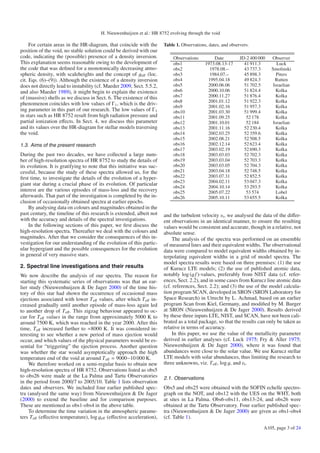
Table 2. Estimated errors in the EWs, with the exception of obs4 and      created to contain the polynomial terms for each observed spec-
obs25.                                                                    tral line. The three-dimensional interpolation procedure is based
                                                                          on our earlier two-dimensional chebychev codes (De Jager et al.
                       Range          EW Error                            1988; cf. also Appendix B.1).
                       10...30 mÅ       20%                                    Thus, the parameters in the library contain information about
                       30...70 mÅ       10%                               EW-values over the complete grid for each spectral line.
                       70..200 mÅ        5%                                    The modelled EW-values for the optimal set of parameters
                       >200 mÅ         2%...5%                            in the fitting procedure are given in Table A.1.3, which has the
                                                                          same structure as that for the observed EWs.
Table 3. Grid of model photospheres used in the spectral line library.
                                                                          2.5. Accuracy of EW data from models
                                          −1
          T eff (K)       log g      vt km s      ...   ...   ...          The estimated errors in the modelled lines take into account
          4250–6000     0.0–2.0         4         6    13    19           the inaccuracy of the g f -values underlying the model EWs. If
          6250–7500     0.5–2.5         4         6    13    19           the accuracy value Δg f is known, the influence of this value
          7750–8250     1.0–3.0         4         6    13    19           on the modelled EW is found by doing calculations for g f ,
          8500–9000     1.5–3.5         4         6    13    19           g f ± Δg f and taking the mean difference of the EWs as an accu-
          9250–9250     2.0–4.0         4         6    13    19
                                                                          racy estimate ΔEW.
                                                                              The accuracies of the modelled equivalent widths are deter-
    The full set of observed equivalent widths (EWs) in units             mined for all the spectral lines and all models in the model grid
of mÅ are available in electronic Tables A.1.1 with columns for           (cf. Table 3). These data are then reduced to N parameters for
observations obs1-obs26, and rows for spectral lines with wave-           a chebychev polynomial evaluation of ΔEW and added to the
length (Å) and element number.                                            spectral line library. There are thus two separate entries in the
                                                                          library for each modelled spectral line.
                                                                              The errors in the modelled EW-data for the optimal set of pa-
2.2. Spectral lines                                                       rameters in the fitting procedure are given in Table A.1.4, which
                                                                          has the same structure as that for the observed EWs.
The spectral lines used in this research are given in Table A.2
in the form of wavelength, ele, ion (atomic number combined
with ionization stage), elo(cm-1), 10log(g f ), and an accuracy           2.6. Comparing observational and model EW data
value based on NIST1 data and Martin et al. (1988) publica-
tions in the form of a letter designation A-E, corresponding to           For each observation, the analysis program compares observed
accuracies of 10–50%. Lines that were unavailable from NIST               and modelled EWs for all relevant spectral lines, together with a
were taken from Kurucz2 . These data were used with an accu-              combined σtotal derived from
racy factor of 50%, as we did not have a critical compendium of           (σtotal )2 = (σobs )2 + A.(σmodel )2 .
the accuracy of these g f -values. We translated these figures into        We always took A = 1.0. The total σtotal is given in Table A.1.4.
logarithmic values and added them as “accuracy” to the list in                Defining the “significance” as the difference EW-value di-
Table A.2.                                                                vided by σtotal , we give the “significance” for each spectral line
                                                                          and the optimal set of parameters in the fitting procedure in
2.3. Errors in observations                                               Table A.1.5, which has the same structure as that for the ob-
                                                                          served EWs.
Errors in the observed EWs were estimated following Table 2,                  When the significance is more than one standard deviation,
except for obs4 and obs25. For these, a different approach was             this may be due to either an outlier or a line misidentification
taken, using one measurement to help determine the optimal                (e.g. caused by varying temperatures when other lines appear
continuum and two measurements with a 1% difference of con-                to be predominant at about the same wavelengths). We discuss
tinuum level. Multiplying this difference value by an estimate of          deviations for some lines in Table A.3.
the continuum accuracy provides a measure of the observational                In one case, we used a correlation technique to find the mean
accuracy in EW. The errors are given in Table A.1.2, which has            wavelength shift between the observed wavelengths and mod-
the same structure as that for the observed EWs.                          elled lines in Table A.4.
                                                                              To achieve “stable” results, we used a method of “robust
2.4. EW data from models                                                  fitting” with a Lorentzian tail distribution to ensure that large
                                                                          deviations in χ2 only marginally influence the fitting process
A range of temperatures and log g’s was encountered in the anal-          (cf. Press et al. 1992, chap. 15.7; Vetterling et al. 1992). In this
ysis of the observations. We decided to use a grid of LTE mod-            paper, we use the merit function of the Lorentzian minimization
els and for each model created a list of lines and modelled EWs.          as a “χ2 ” value.
Table 3 defines the model grid. The data of the models is rep-
resented by a three-dimensional chebychev polynomial with a
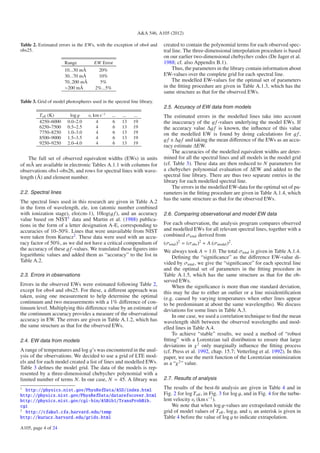
limited number of terms N. In our case, N = 45. A library was             2.7. Results of analysis
1
  http://physics.nist.gov/PhysRefData/ASD/index.html                      The results of the best-fit analysis are given in Table 4 and in
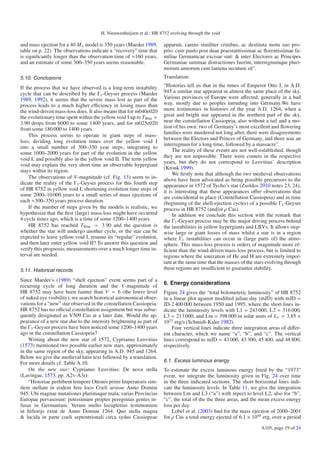
http://physics.nist.gov/PhysRefData/datarefscover.html                    Fig. 2 for log T eff , in Fig. 3 for log g, and in Fig. 4 for the turbu-
http://physics.nist.gov/cgi-bin/ASBib1/TransProbBib.                      lent velocity vt (km s−1 ).
cgi                                                                           We note that when log g-values are extrapolated outside the
2
  http://cfaku5.cfa.harvard.edu/temp                                      grid of model values of T eff , log g, and vt an asterisk is given in
http://kurucz.harvard.edu/grids.html                                      Table 4 before the value of log g to indicate extrapolation.
A105, page 4 of 24
H. Nieuwenhuijzen et al.: HR 8752 evolving through the void

Table 4. Results of LTE effective temperatures T eff , Kurucz-log g-                                                             Log g from obs 1-26
values, and turbulent velocities vt .                                                                                           as a function of time
                                                                                                        2.0
                                                                                                                      1975     1980   1985   1990   1995     2000    2005
 Obs       JD          T eff          log g                                      vt
                                                                                                        1.5
 nr    −2 400 000      (K)        (cm sec-2)                                 (km s−1 )
 obs1   41 911.3  4913.7 ± 72.0 * –0.88 ± 0.07                            11.67 ± 1.39                  1.0
 obs2   43 737.3 5601.7 ± 120.7 * –0.62 ± 0.08                            13.10 ± 0.99


                                                                                            Log g
 obs3   45 898.3 5334.0 ± 239.4 * –0.76 ± 0.12                            14.07 ± 1.54                  0.5
 obs4   49 824.3  7346.2 ± 70.6 * 0.40 ± 0.19                             14.23 ± 1.20
 obs5   51 702.5  7611.6 ± 69.5 * 0.55 ± 0.21                             11.20 ± 1.00              -0.0
 obs6   51 824.4  7777.7 ± 73.3 * 0.63 ± 0.25                             10.46 ± 0.98
 obs7   51 876.4  7623.5 ± 61.7 * 0.56 ± 0.21                             10.96 ± 0.94              -0.5
 obs8   51 922.3  7747.1 ± 60.4 * 0.66 ± 0.21                              9.75 ± 0.87
 obs9   51 957.3  7812.1 ± 65.9 * 0.75 ± 0.20                             10.61 ± 0.98              -1.0
 obs10 51 999.4   8024.9 ± 76.9   1.09 ± 0.27                             11.19 ± 1.16
                                                                                                              41000    43000     45000   47000   49000     51000    53000   55000
 obs11   52 178   7619.0 ± 59.9 * 0.51 ± 0.17                              9.99 ± 0.80
                                                                                                                                JD - 2400000 / Year
 obs12   52 184   7534.4 ± 67.7   0.51 ± 0.19                             11.14 ± 0.97
 obs13 52 230.4   7894.6 ± 80.9   1.02 ± 0.28                              9.91 ± 0.98    Fig. 3. Results of the fitting of log g with Kurucz’s LTE models for the
 obs14 52 359.6   7893.3 ± 83.8   1.20 ± 0.36                             10.30 ± 1.09    observations obs1-obs26 as described in this paper.
 obs15 52 508.5   7868.2 ± 80.4 * 0.88 ± 0.24                             11.90 ± 1.09
 obs16 52 623.4   8019.2 ± 82.6   1.30 ± 0.37                             11.84 ± 1.22                                       vt (km/s) from obs 1-26
 obs17 52 690.3   7639.2 ± 85.3 * 0.77 ± 0.33                              9.88 ± 1.14
 obs18 52 702.3   7576.0 ± 70.9   0.60 ± 0.22                              9.57 ± 0.89                                         as a function of time
 obs19 52 703.3   7525.1 ± 66.4 * 0.48 ± 0.21                              9.49 ± 0.96                  16
 obs20 52 704.3   7550.3 ± 69.0   0.53 ± 0.22                              9.43 ± 0.85                  15
 obs21 52 748.5   7894.7 ± 84.1   0.99 ± 0.26                             11.95 ± 1.27                  14
                                                                                                        13
 obs22 52 852.5   7909.8 ± 82.6   1.05 ± 0.25                             12.46 ± 2.06
                                                                                                        12
                  7942.2 ± 82.7   1.11 ± 0.31                             11.15 ± 1.21
                                                                                            vt (km/s)


 obs23 53 047.3
                                                                                                        11
 obs24 53 293.5   7998.5 ± 70.8   1.03 ± 0.23                             11.22 ± 1.39                  10
 obs25   53 574   7639.0 ± 77.2 * 0.50 ± 0.24                             11.19 ± 0.96                   9
 obs26 53 655.5   7907.2 ± 80.0   1.13 ± 0.26                             10.00 ± 0.88                   8
                                                                                                         7
                                    log Teff from obs 1-26                                               6
                                                                                                         5            1975    1980    1985   1990   1995     2000    2005
                                     as a function of time                                               4
              3.92
              3.90                                                                                            41000    43000     45000   47000   49000     51000    53000   55000
              3.88                                                                                                              JD - 2400000 / Year
              3.86
              3.84                                                                        Fig. 4. Results of the fitting of vt with Kurucz’s LTE models for the
  log T eff


              3.82                                                                        observations obs1-obs26 as described in this paper.
              3.80
              3.78
              3.76
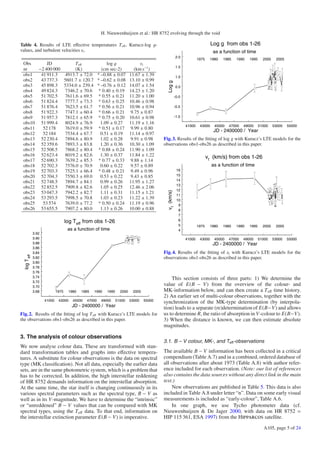
              3.74                                                                            This section consists of three parts: 1) We determine the
              3.72
              3.70
                                                                                          value of E(B − V) from the overview of the colour- and
              3.68           1975    1980   1985   1990   1995     2000    2005           MK-information below, and can then create a T eff time history.
                                                                                          2) An earlier set of multi-colour observations, together with the
                     41000    43000    45000   47000   49000     51000    53000   55000
                                                                                          synchronization of the MK-type determination (by interpola-
                                       JD - 2400000 / Year                                tion) leads to a separate (re)determination of E(B−V) and allows
Fig. 2. Results of the fitting of log T eff with Kurucz’s LTE models for                    us to determine R, the ratio of absorption in V-colour to E(B−V).
the observations obs1-obs26 as described in this paper.                                   3) When the distance is known, we can then estimate absolute
                                                                                          magnitudes.

3. The analysis of colour observations
                                                                                          3.1. B – V colour, MK-, and Teff -observations
We now analyse colour data. These are transformed with stan-
dard transformation tables and graphs into effective tempera-                              The available B − V information has been collected in a critical
tures. A substitute for colour observations is the data on spectral                       compendium (Table A.7) and in a combined, ordered database of
type (MK classification). Not all data, especially the earlier data                        all observations after about 1973 (Table A.8) with author refer-
sets, are in the same photometric system, which is a problem that                         ence included for each observation. (Note: our list of references
has to be corrected. In addition, the high interstellar reddening                         also contains the data sources without any direct link in the main
of HR 8752 demands information on the interstellar absorption.                            text.)
At the same time, the star itself is changing continuously in its                             New observations are published in Table 5. This data is also
various spectral parameters such as the spectral type, B − V as                           included in Table A.8 under letter “n”. Data on some early visual
well as in its V-magnitude. We have to determine the “intrinsic”                          measurements is included as “early-colour”, Table A.6.
or “unreddened” B − V values that can be compared with MK                                     In one graph, we use Tycho photometer data (cf.
spectral types, using the T eff data. To that end, information on                          Nieuwenhuijzen & De Jager 2000, with data on HR 8752 =
the interstellar extinction parameter E(B − V) is imperative.                             HIP 115 361, ESA 1997) from the Hipparcos satellite.
                                                                                                                                                             A105, page 5 of 24
A&A 546, A105 (2012)

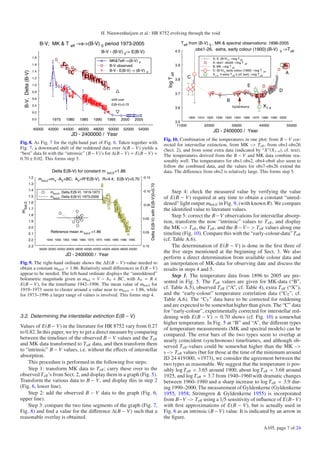
Table 5. B − V Observations, period JD=2 448 813-2 449 299, Konkoly                             Teff from MK & spectral observations 1896-2005
Observatory, Budapest.                                                                      4.0      obs1-26, extra T                       , early T eff (1900)-reddened
                                                                                                                                      eff
                                                                                                                A: obs1- obs26->log T eff
                     Julian Day        V     B−V                                            3.9                 B: MK->log T eff
                     2 448 813.532   5.088   0.872                                                              C Teff : early T eff (1900)-reddened->log T            eff
                     2 448 853.475   5.098   0.964                                                              X1-4 : 4 extra T eff ’s (cf. text) ->log T eff                          A


                                                                               Log T eff
                     2 448 859.374   5.113   0.973                                          3.8
                                                                                                     CT
                     2 448 897.348   5.215   1.011
                     2 448 904.309   5.202   1.001
                                                                                            3.7
                     2 448 936.271   5.166   1.060
                     2 449 005.252   5.136   0.973                                                                                    B
                     2 449 006.229   5.128   0.985                                          3.6                                        Gyldenkerne
                                                                                                                                                                   X 1-4
                     2 449 254.380   5.095   0.894
                     2 449 266.368   5.089   0.888                                                   1900 1910 1920 1930 1940 1950 1960 1970 1980 1990 2000
                     2 449 289.231   5.087   0.903                                          3.5
                                                                                             11000                22000                   33000                  44000                   55000
                     2 449 290.222   5.085   0.894                                                                       JD - 2400000/ Year
                     2 449 292.269   5.097   0.892
                     2 449 299.293   5.107   0.880                    Fig. 5. Temperatures from T eff observations (“A”), from MK values
                                                                      transformed to T eff (“B”), from extra data (“X”) and from temperature
                                                                      correlation data (“CT )” form the base time-line of this study (step 1).
                                                                      For the meaning of the letters A–F, X we refer to the text.
    Table A.7 gives an overview of the combined sequence of
B − V measurements from 1942–1974, followed by the “intrin-
sic” or (B−V)0 value of Gyldenkerne (1955) for E(B−V) = 0.70.                                                                                                                D: B-V
    Table A.8 entitled “B − V-1976-data” (B − V) observations                              B-V, various types of observations                                                F: Tycho

gives an overview of the V, (B − V) measurements in the pe-                                                Period 1896-2005
                                                                                                                                                           D
                                                                                                                                                                             C: Early colour
                                                                                                                                                                             A: T eff ->(B-V) 0
                                                                                          1.8
riod 1976-1993 from various authors. A letter code gives the au-                                                                                                             B: MK->(B-V) 0
thor reference, where the letter “n” refers to the data published                         1.6                                                                                E: (B-V)
                                                                                                                                          E
here. The table gives the observation date, V-magnitude, (B−V),                           1.4
followed by columns with transformed values for (B − V)0,                                 1.2              C
mbol = V + BC, spectral parameter s, log T eff , bolometric correc-                        1.0
                                                                              B-V


                                                                                                                                                                        F
tion BC and mbol , using Table B.2 “calibrate-hyper”, and finally                          0.8
the author reference.                                                                     0.6                                  B
    Table A.5 gives an overview of MK data from 1919–1987                                 0.4                                                                          A
with annotations and estimates of observing periods. The                                  0.2                                   Gyldenkerne
MK-data is transformed to T eff , B − V, and bolometric correction                         0.0       1900         1920         1940          1960          1980     2000
BC by transforms described in Table B.2. In this analysis, we
use the continuous spectral s-parameter introduced by De Jager                             10000           20000              30000               40000          50000               60000
& Nieuwenhuijzen (1987). Transforms of some older spectral                                                           JD - 2400000 / Year
class observations to MK are described in Table A.5. Except in        Fig. 6. The equivalent or “intrinsic” B − V transformed from MK- (“A”),
those cases where this is indicated, the estimated accuracy in s      T eff -observations (“B”), extra T eff -observations (“X”) (cf. Fig. 5), and
is about from 0.05 to 0.06 spectral steps in MK.                      “early-colour” B − V correlation data (“C”) from step 1 are displayed
    The T eff data is derived from spectral types or s-parameter       together with (from step 2) “observed” B − V’s for the period after
values. For the calibrations between the various types of mea-        1973 (“D”). The 1942–1974 (“E”) and Tycho data (“F”) have been
surement, we refer to “calibrate-hyper” in Table B.2, which dis-      transformed to Johnson B − V, and have not been “unreddened”. Note
                                                                      the influence of differential absorption caused by differences between
cusses the calibrations that are specific to hypergiants Ia+ or Ia0.
                                                                      Johnson and Tycho pass bands.
    The temperature data in our paper also consists of the follow-
ing four measurements, two measurements made in 1969 Sept. 7
of T eff = 5250 ± 250 K, and 1998 Aug. 4 T eff = 7900 ± 200 K                                       B-V; MK & T           eff   ->s->(B-V) 0 period 1942-1973
from Israelian et al. (1999), one in 1970 (T eff = 5030 ± 171 K,                                                MK&T eff -->(B-V) 0
                                                                                                                                                   B-V - (B-V) 0-> E(B-V)
from Schmidt 1972), and lastly an estimate of the lowest temper-                          1.8                  B-V observed
ature measurement (T eff = 4000 ± 300 K by Luck 1975). These                               1.6                  B-V- E(B-V) -> (B-V)           0
                                                                                                                                                                                  shift over
measurements are indicated by an “X” symbol in Figs. 5, 6,                                1.4
                                                                       B-V, Delta (B-V)


                                                                                                                                                                                  E(B-V)=0.70
and 10. The 1969 spectrum was obtained by Smolinski at the                                1.2
Dominion Astrophysical Observatory, Victoria, Canada.                                     1.0
    “Early-colour” observations with estimates of T eff and B − V                          0.8
are reproduced in Table A.6. In comparing T eff , we may first
                                                                                          0.6
use the estimate of temperatures given there. Later in the paper,
we use the B − V information. With HR 8752’s large interstellar                           0.4

absorption, the temperatures may be higher than indicated when                            0.2
correcting for the shifting of colour towards the red.                                    0.0             1945     1950        1955           1960    1965       1970          1975
    The colour observations started around 1940 and are not all
                                                                                                  30000    32000        34000        36000        38000        40000       42000       44000
in the Johnson B−V format that we use as reference in this paper.                                                    JD - 2400000 / Year
After 1940, the measurements were made primarily in B − V.
The T eff data and the data in Tables A.5–A.8 form the basis of        Fig. 7. Detail of left-hand part of Fig. 6, comparing reddened data di-
this study.                                                           rectly with “intrinsic” (B − V)’s from MK- and T eff -values.

A105, page 6 of 24
H. Nieuwenhuijzen et al.: HR 8752 evolving through the void

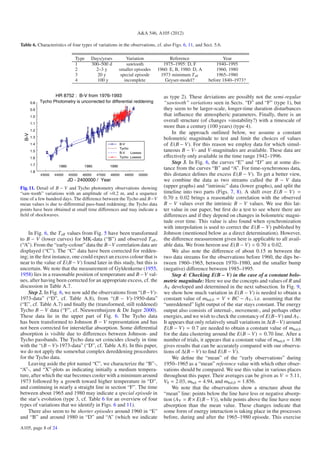
                            B-V; MK & T               ->s->(B-V) 0 period 1973-2005                                                                            T eff from (B-V) 0 , MK & spectral observations: 1896-2005
                                                eff
                                                                                                                                                         4.0          obs1-26, extra, early colour (1900):(B-V)                    0   ->T eff
                                                                      B-V - (B-V) 0-> E(B-V)
                      1.8                                                                                                                                                       D, E: (B-V) 0 ->log T eff
                                                                          MK&Teff-->(B-V) 0                                                                                     A: obs1- obs26 ->log T eff
                      1.6                                                 B-V observed                                                                   3.9                    B: MK ->log T eff
                      1.4                                                 B-V - E(B-V) -> (B-V)                                                                                 C: (B-V) 0 early colour (1900) ->log T eff
   B-V, Delta (B-V)


                                                                                                    0                                                                                                                                   A


                                                                                                                                             log T eff
                                                                                                                                                                                X1-4 : 4 extra T eff ’s (cf. text) ->log T eff
                      1.2                                                                                                                                3.8
                                                                                                                                                                  C
                      1.0                                                                                                                                                                                     E
                      0.8                                                                                                                                                                                                          D
                                                                                                                                                         3.7
                      0.6                                                   shift over                                                                                                      B
                                                                            E(B-V)=0.70
                      0.4
                                                                                                                                                         3.6                                    Gyldenkerne                X1-4
                      0.2
                                                                                                                                                                  1900 1910 1920 1930 1940 1950 1960 1970 1980 1990 2000
                      0.0           1975     1980      1985     1990     1995      2000      2005
                                                                                                                                                         3.5
                                                                                                                                                          11000            22000                33000                   44000            55000
                      40000      42000     44000      46000    48000     50000       52000      54000
                                                                                                                                                                                JD - 2400000 / Year
                                                 JD - 2400000 / Year
                                                                                                                                           Fig. 10. Combination of the temperatures in one plot: from B − V cor-
Fig. 8. As Fig. 7 for the right-hand part of Fig. 6. Taken together with                                                                   rected for interstellar extinction, from MK –> T eff , from obs1-obs26
Fig. 7, a downward shift of the reddened data over Δ(B − V) yields a                                                                       (Sect. 2), and from some extra data (indicated by “X”(X1−4 ), cf. text).
“best” data fit with the “intrinsic” (B − V)’s for Δ(B − V) = E(B − V) =                                                                    The temperatures derived from the B − V and MK data combine rea-
0.70 ± 0.02. This forms step 3.                                                                                                            sonably well. The temperatures for obs1-obs2, obs4-obs6 also seem to
                                                                                                                                           follow the combined data, and the values for obs7-obs26 extend the
                                    Delta E(B-V) for constant m          bol,0 =1.86                                                       data. The difference from obs2 is relatively large. This forms step 5.
               1.2          mbol,0 =mV -AV+BC; AV=R*E(B-V), R=4.4; E(B-V)=0.70                    -0.15
               1.3
                                                                                                          Delta E(B-V) with E(B-V)0=0.70


               1.4
                                   m bol,0 , Delta E(B-V) 1919-1973                               -0.10                                        Step 4: check the measured value by verifying the value
               1.5                 m bol,0 , Delta E(B-V) 1973-2006                                                                        of E(B − V) required at any time to obtain a constant “unred-
               1.6                                                                                                                         dened” light output mbol,0 in Fig. 9, (with known R). We compare
m bol,0


                                                                                                  -0.05
               1.7                                                                                                                         the identified value to literature values.
               1.8
                                                                                                  0.00
                                                                                                                                               Step 5: correct the B − V observations for interstellar absorp-
               1.9                                                                                                                         tion, transform the now “intrinsic” values to T eff , and display
               2.0                                                                                                                         the MK –> T eff , the T eff , and the B − V− > T eff values along one
                                   Reference mean m bol,0 =1.86                                   0.05
               2.1                                                                                                                         timeline (Fig. 10). Compare this with the “early-colour-data” T eff
               2.2              1945 1950 1955 1960 1965 1970 1975 1980 1985 1990 1995                                                     (cf. Table A.6).
               2.3                                                                                0.10                                         The determination of E(B − V) is done in the first three of
                            30000 32000 34000 36000 38000 40000 42000 44000 46000 48000 50000
                                                                                                                                           the five steps mentioned at the beginning of Sect. 3. We also
                                             JD - 2400000 / Year
                                                                                                                                           perform a direct determination from available colour data and
Fig. 9. The right-hand ordinate shows the ΔE(B − V)-value needed to                                                                        an interpolation of MK-data for observing date and discuss the
obtain a constant mbol,0 = 1.86. Relatively small differences in E(B − V)                                                                   results in steps 4 and 5.
appear to be needed. The left-hand ordinate displays the “unreddened”                                                                          Step 1. The temperature data from 1896 to 2005 are pre-
bolometric magnitude given as mbol = V − AV + BC, with AV = R ×
E(B − V), for the timeframe 1942–1996. The mean value of mbol,0 for
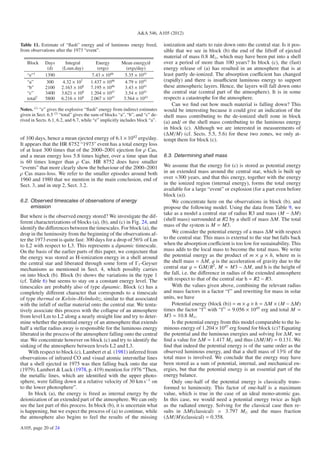
                                                                                                                                           sented in Fig. 5. The T eff values are given for MK-data (“B”,
1919–1973 seem to cluster around a value near to mbol,0 = 1.86, while                                                                      cf. Table A.5), observed T eff (“A”, cf. Table 4), extra T eff (“X”),
for 1973–1996 a larger range of values is involved. This forms step 4.                                                                     and the “early-colour” temperature correlation data (“CT ”, cf.
                                                                                                                                           Table A.6). The “CT ” data have to be corrected for reddening
                                                                                                                                           and are expected to be somewhat higher than given. The “C” data
                                                                                                                                           for “early-colour”, experimentally corrected for interstellar red-
3.2. Determining the interstellar extinction E(B – V)                                                                                      dening with E(B − V) = 0.70 shows (cf. Fig. 10) a somewhat
                                                                                                                                           higher temperature. In Fig. 5 at “B” and “A”, the different types
Values of E(B − V) in the literature for HR 8752 vary from 0.27                                                                            of temperature measurements (MK and spectral models) can be
to 0.82. In this paper, we try to get a direct measure by comparing                                                                        compared. The error bars of the two types seem to overlap at
between the timelines of the observed B − V values and the T eff                                                                            nearly coincident (synchronous) timeframes, and although ob-
and MK data transformed to T eff data, and then transform them                                                                              served T eff -values could be somewhat higher than the MK –>
to “intrinsic” B − V values, i.e. without the effects of interstellar                                                                       s –> T eff values (but for those at the time of the minimum around
absorption.                                                                                                                                JD 24 419 000, ≈1973), we consider the agreement between the
    This procedure is performed in the following five steps:                                                                                two types as reasonable. We suggest that the temperature is pos-
    Step 1: transform MK data to T eff ; carry these over to the                                                                            sibly log T eff = 3.65 around 1900, about log T eff = 3.68 around
observed T eff ’s from Sect. 2, and display them in a graph (Fig. 5).                                                                       1925, and log T eff = 3.7 from 1940–1960 with dramatic changes
Transform the various data to B − V, and display this in step 2                                                                            between 1960–1980 and a sharp increase to log T eff = 3.9 dur-
(Fig. 6, lower line).                                                                                                                      ing 1990–2000. The measurement of Gyldenkerne (Gyldenkerne
    Step 2: add the observed B − V data to the graph (Fig. 6,                                                                              1955, 1958; Strömgren & Gyldenkerne 1955) is incorporated
upper line).                                                                                                                               from B−V –> T eff using a 1/5 sensitivity of influence of E(B−V)
    Step 3: compare the two time segments of the graph (Fig. 7,                                                                            with first approximations of E(B − V), but is actually used in
Fig. 8) and find a value for the difference Δ(B − V) such that a                                                                             Fig. 6 as an intrinsic (B − V) value. It is indicated by an arrow in
reasonable overlay is obtained.                                                                                                            the figure.
                                                                                                                                                                                                                            A105, page 7 of 24
A&A 546, A105 (2012)

Table 6. Characteristics of four types of variations in the observations, cf. also Figs. 6, 11, and Sect. 5.6.

                                  Type     Days/years             Variation            Reference                 Year
                                  1        300–500 d              sawtooth          1975–1995: D, F           1940–1995
                                  2          2–3 y            smaller episodes   1960: E, B, 1980: D, A       1960, 1980
                                  3           20 y             special episode     1973 minimum T eff          1965–1980
                                  4           100 y              incomplete          Geyser-model?        before 1840–1973?


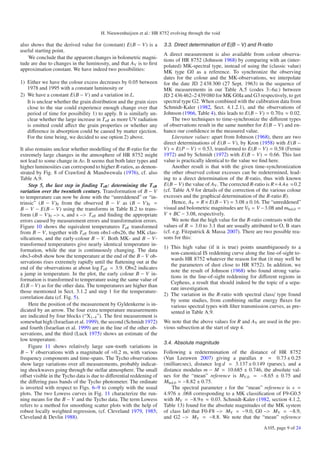
                      HR 8752 : B-V from 1976-1993                                  as type 2). These deviations are possibly not the semi-regular
        0.8   Tycho Photometry is uncorrected for differential reddening            “sawtooth” variations seen in Sects. “D” and “F” (type 1), but
        0.9                                                                         they seem to be larger-scale, longer-time duration disturbances
        1.0                                                                         that influence the atmospheric parameters. Finally, there is an
        1.1
                                                                                    overall structure (of changes ≈instability?) with a timescale of
                                                                                    more than a century (100 years) (type 4).
        1.2
                                                                                        In the approach outlined below, we assume a constant
  B-V


        1.3                                                                         bolometric magnitude to test and limit the choices of values
        1.4                                                   B-V                   of E(B − V). For this reason we employ data for which simul-
        1.5
                                                              Tycho
                                                              B-V   Lowess
                                                                                    taneous B − V- and V-magnitudes are available. These data are
        1.6                                                   Tycho Lowess          effectively only available in the time range 1942–1996.
        1.7
                                                                                        Step 3. In Fig. 6, the curves “E” and “D” are at some dis-
                        1980            1985           1990
                                                                                    tance from the curves “B” and “A”. For time-synchronous data,
        1.8
              43000   44000    45000   46000   47000   48000    49000   50000       this distance defines the excess E(B − V). To get a better view,
                               JD - 2400000 / Year                                  we combine the data as two streams called the B − V data
Fig. 11. Detail of B − V and Tycho photometry observations showing                  (upper graphs) and “intrinsic” data (lower graphs), and split the
“saw-tooth” variations with an amplitude of ≈0.2 m, and a sequence                  timeline into two parts (Figs. 7, 8). A shift over E(B − V) =
time of a few hundred days. The difference between the Tycho and B−V                 0.70 ± 0.02 brings a reasonable correlation with the observed
mean values is due to differential pass-band reddening; the Tycho data               B − V values over the intrinsic B − V values. We use this lat-
points have been obtained at small time differences and may indicate a               ter value in our paper, but first do a test to see where there are
field of shockwaves.                                                                 differences and if they depend on changes in bolometric magni-
                                                                                    tude over time. This value is also found when synchronization
                                                                                    with interpolation is used to correct the E(B − V) published by
    In Fig. 6, the T eff values from Fig. 5 have been transformed                    Johnson (mentioned below as a direct determination). However,
to B − V (lower curves) for MK-data (“B”) and observed T eff ,                       the difference measurement given here is applicable to all avail-
(“A”). From the “early-colour” data the B−V correlation data are                    able data. We from hereon use E(B − V) = 0.70 ± 0.02.
displayed (“C”). The “C” data have been corrected for redden-                           We also note the difference of about 0.15 m between the
ing; in the first instance, one could expect an excess colour that is                two data streams for the observations before 1960, the dips be-
near to the value of E(B − V) found later in this study, but this is                tween 1960–1965, between 1970–1980, and the smaller bump
uncertain. We note that the measurement of Gyldenkerne (1955,                       (negative) difference between 1985–1995.
1958) lies in a reasonable position of temperature and B − V val-                       Step 4: Checking E(B – V) in the case of a constant bolo-
ues, after having been corrected for an appropriate excess, cf. the                 metric magnitude: Here we use the concepts and values of R and
discussion in Table A.7.                                                            AV developed and determined in the next subsection. In Fig. 9,
    Step 2. In Fig. 6, we now add the observations from “(B−V)-                     we show how much variation in E(B − V) is needed to obtain a
1973-data” (“D”, cf. Table A.8), from “(B − V)-1950-data”                           constant value of mbol,0 = V + BC − AV , i.e. assuming that the
(“E”, cf. Table A.7) and finally the (transformed, still reddened)                   “unreddened” light output of the star stays constant. The energy
Tycho B − V data (“F”, cf. Nieuwenhuijzen & De Jager 2000).                         output also consists of internal-, movement-, and perhaps other
These data lie in the upper part of Fig. 6. The Tycho data                          energies, and we wish to check the constancy of E(B−V) and AV .
has been transformed to Johnson B − V representation and has                        It appears that only relatively small variations in Δ(B−V) around
not been corrected for interstellar absorption. Some differential                    E(B − V) = 0.7 are needed to obtain a constant value of mbol,0
absorption is visible due to differences between Johnson- and                        for the data clustering around the E(B − V) = 0.70 line. After a
Tycho passbands. The Tycho data set coincides closely in time                       number of trials, it appears that a constant value of mbol,0 = 1.86
with the “(B − V)-1973-data” (“D”, cf. Table A.8). In this paper,                   gives results that can be accurately compared with our observa-
we do not apply the somewhat complex dereddening procedures                         tions of Δ(B − V) to find E(B − V).
for the Tycho data.                                                                     We define the “mean” of the “early observations” during
    Leaving aside the plot named “C”, we characterize the “B”-,                     1950–1965 as a “mean” reference value with which other obser-
“A”-, and “X”-plots as indicating initially a medium tempera-                       vations should be compared. We use this value in various places
ture, after which the star becomes cooler with a minimum around                     throughout this paper. Their averages can be given as V = 5.11,
1973 followed by a growth toward higher temperature in “D”,                         V0 = 2.03, mbol = 4.94, and mbol,0 = 1.856.
and continuing in nearly a straight line in section “F”. The time                       We note that the observations show a structure about the
between about 1965 and 1980 may indicate a special episode in                       “mean” line: points below the line have less or negative absorp-
the star’s evolution (type 3, cf. Table 6 for an overview of four                   tion (AV = R × E(B − V)), while points above the line have more
types of variations that we identify in Figs. 6 and 11).                            absorption than the mean value. These changes indicate that
    There also seem to be shorter episodes around 1960 in “E”                       some form of energy interaction is taking place in the processes
and “B” and around 1980 in “D” and “A” (which we indicate                           before, during and after the 1965–1980 episode. This exercise
A105, page 8 of 24
H. Nieuwenhuijzen et al.: HR 8752 evolving through the void

also shows that the derived value for (constant) E(B − V) is a        3.3. Direct determination of E(B – V) and R-ratio
useful starting point.
                                                                      A direct measurement is also available from colour observa-
    We conclude that the apparent changes in bolometric magni-        tions of HR 8752 (Johnson 1968) by comparing with an (inter-
tude are due to changes in the luminosity, and that AV is to first     polated) MK-spectral type, instead of using the (classic value)
approximation constant. We have indeed two possibilities:             MK type G0 as a reference. To synchronize the observing
                                                                      dates for the colour and the MK-observations, we interpolate
1) Either we have the colour excess decreases by 0.05 between         for the date JD 2 438 300 (27 Sept. 1963) in the sequence of
   1978 and 1995 with a constant luminosity or                        MK measurements in our Table A.5 (codes 3:-6a:) between
2) We have a constant E(B − V) and a variation in L.                  JD 2 436 462–2 439 080 for MK G0Ia and G3 respectively, to get
   It is unclear whether the grain distribution and the grain sizes   spectral type G2. When combined with the calibration data from
   close to the star could experience enough change over that         Schmidt-Kaler (1982, Sect. 4.1.2.1), and the observations of
   period of time for possibility 1) to apply. It is similarly un-    Johnson (1966, Table 4), this leads to E(B − V) = 0.70± ≈ 0.02.
   clear whether the large increase in T eff as more UV radiation          The two techniques to time-synchronize the different types
   is emitted could affect the grain properties or whether any         of observations result in the same number for E(B − V) and en-
   difference in absorption could be caused by matter ejection.        hance our confidence in the measured value.
   For the time being, we decided to use option 2) above.                 Literature values: apart from Johnson (1968), there are two
                                                                      direct determinations of E(B − V), by Kron (1958) with E(B −
It also remains unclear whether modelling of the R-ratio for the      V) ≈ E(P − V) = 0.53, transformed to E(B − V) = 0.58 (Fernie
extremely large changes in the atmosphere of HR 8752 might            1972) and by Schmidt (1972) with E(B − V) = 0.66. This last
not lead to some change in Av. It seems that both later types and     value is practically identical to the value we find here.
higher luminosities can correspond to higher R-ratios, as demon-          Another result is that with the given time-synchronization
strated by Fig. 8 of Crawford & Mandwewala (1976), cf. also           the other observed colour excesses can be redetermined, lead-
Table A.9.                                                            ing to a direct determination of the R-ratio, thus with known
     Step 5, the last step in finding Teff : determining the T eff       E(B − V) the value of AV . The corrected R-ratio is R = 4.4± ≈ 0.2
variation over the twentieth century. Transformation of B − V         (cf. Table A.9 for details of the correction of the various colour
to temperature can now be done with the “unreddened” or “in-          excesses and the graphical determination of the R-ratio R).
trinsic” (B − V)0 from the observed B − V as (B − V)0 =                   Hence, AV = R × E(B − V) = 3.08 ± 0.16. The “unreddened”
B − V − E(B − V) using the transforms in Table B.2 to trans-          visual and bolometric magnitudes are V0 = V − 3.08 and mbol,0 =
form (B − V)0 –> s, and s –> T eff and finding the appropriate          V + BC − 3.08, respectively.
errors caused by measurement errors and transformation errors.            We note that the high value for the R-ratio contrasts with the
Figure 10 shows the equivalent temperatures T eff transformed          values of R = 3.0 to 3.1 that are usually attributed to O, B stars
from B − V, together with T eff from obs1-obs26, the MK clas-          (cf. e.g. Fitzpatrick & Massa 2007). There are two possible rea-
sifications, and the early-colour B − V. Both MK- and B − V-           sons for this:
transformed temperatures give nearly identical temperature in-
                                                                      1) This high value (if it is true) points unambiguously to a
formation, while the star is continuously changing. The data
                                                                         non-canonical IS reddening curve along the line-of-sight to-
obs3-obs8 show how the temperature at the end of the B − V ob-
                                                                         wards HR 8752 whatever the reason for that (it may well be
servations rises extremely rapidly until the flattening out at the
                                                                         the parameters of dust close to HR 8752). In addition, we
end of the observations at about log T eff = 3.9. Obs2 indicates
                                                                         note the result of Johnson (1968) who found strong varia-
a jump in temperature. In the plot, the early colour B − V in-
                                                                         tions in the line-of-sight reddening for different regions in
formation is transformed to temperature using the same value of
                                                                         Cepheus, a result that should indeed be the topic of a sepa-
E(B − V) as for the other data. The temperatures are higher than
                                                                         rate investigation.
those mentioned in Sect. 3.1.2 and step 1 for the temperature-
                                                                      2) The variation in the R-ratio with spectral class/ type found
correlation data (cf. Fig. 5).
                                                                         by some studies, from combining stellar energy fluxes for
     Here the position of the measurement by Gyldenkerne is in-          various spectral types with filter transmission curves, as pre-
dicated by an arrow. The four extra temperature measurements             sented in Table A.9.
are indicated by four blocks (“X1−4 ”). The first measurement is
somewhat high (Israelian et al. 1999), the second (Schmidt 1972)      We note that the above values for R and AV are used in the pre-
and fourth (Israelian et al. 1999) are in the line of the other ob-   vious subsection at the start of step 4.
servations, and the third (Luck 1975) shows an estimate of the
low temperature.
                                                                      3.4. Absolute magnitude
     Figure 11 shows relatively large saw-tooth variations in
B − V observations with a magnitude of ≈0.2 m, with various           Following a redetermination of the distance of HR 8752
frequency components and time-spans. The Tycho observations           (Van Leeuwen 2007) giving a parallax π = 0.73 ± 0.25
show large variations over all measurements, probably indicat-        (milliarcsec), distance log d = 3.137 ± 0.149 (parsec), and a
ing shockwaves going through the stellar atmosphere. The small        distance modulus m − M = 10.685 ± 0.746, the absolute val-
offset visible in the Tycho data is due to differential reddening of    ues for the “mean” reference is MV,0 = −8.65 ± 0.75 and
the differing pass bands of the Tycho photometer. The ordinate         Mbol,0 = −8.82 ± 0.75.
is inverted with respect to Figs. 6–9 to comply with the usual            The spectral parameter s for the “mean” reference is s =
plots. The two Lowess curves in Fig. 11 characterize the run-         4.976 ± .068 corresponding to a MK classification of F9-G0.5
ning means for the B − V and the Tycho data. The term Lowess          with MV = −8.9± ≈ 0.03. Schmidt-Kaler (1982, section 4.1.2,
refers to a method for smoothing scatter plots with the help of       Table 13) found for the absolute magnitudes of the MK system
robust locally weighted regression, (cf. Cleveland 1979, 1985;        of class Ia0 that F0-F8 –> MV = −9.0, G0 –> MV = −8.9,
Cleveland & Devlin 1988).                                             and G2 –> MV = −8.8. We note that the “mean” reference
                                                                                                                      A105, page 9 of 24
A&A 546, A105 (2012)

                  HR8752: V, M V: 1942-1996; m - M= 10.69                                                         HR8752: V in period ~1840-1996
   4.5           R=4.4, E(B-V)=0.7, parallax =0.73 milli arcsec                    -9.27           4.5
                                                                                                   4.7
   4.6                                                                             -9.17
                                                                                                   4.9
   4.7                                                                             -9.07
                                                                                                   5.1
   4.8                                                                             -8.97


                                                                                       MV
                                                                                                   5.3
                                                                                                                                          Reference mean
  V


             Reference mean


                                                                                               V
   4.9                                                                             -8.87           5.5                                       V = 5.1
             V = 5.11
   5.0                                                                             -8.77           5.7
                                                                                                                                               V in period 1942-1996
                                                                                                   5.9                                         V in period 1860-1930
   5.1                                                                             -8.67
                                                                                                   6.1
   5.2    1950    1955   1960    1965   1970   1975   1980   1985   1990   1995    -8.57
                                                                                                   6.3      1840 1860 1880 1900 1920 1940 1960 1980 2000
   5.3                                                                             -8.47           6.5
      32000 34000 36000 38000 40000 42000 44000 46000 48000 50000
                                                                                                         -10000    0   10000   20000   30000   40000   50000   60000
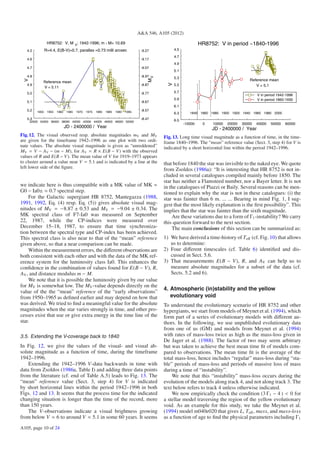
                                JD - 2400000 / Year                                                                    JD - 2400000 / Year
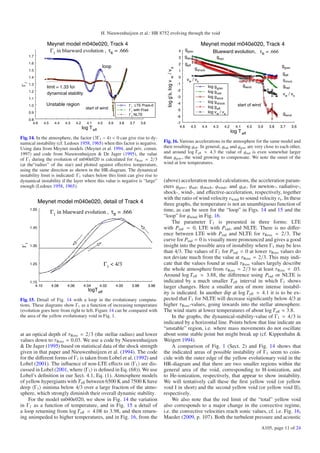
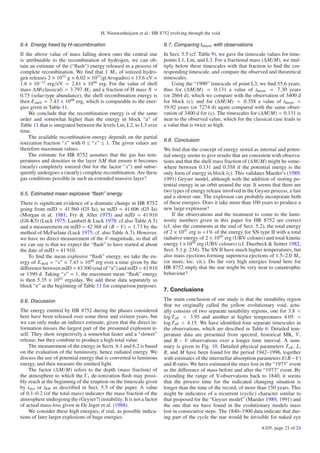
Fig. 12. The visual observed resp. absolute magnitudes mV and MV                             Fig. 13. Long time visual magnitude as a function of time, in the time-
are given for the timeframe 1942–1996 as one plot with two ordi-                             frame 1840–1996. The “mean” reference value (Sect. 3, step 4) for V is
nate values. The absolute visual magnitude is given as “unreddened”                          indicated by a short horizontal line within the period 1942–1996.
MV = V − AV − (m − M), for AV = R × E(B − V) with the observed
values of R and E(B − V). The mean value of V for 1919–1973 appears
to cluster around a value near V = 5.1 and is indicated by a line at the                     that before 1840 the star was invisible to the naked eye. We quote
left lower side of the figure.                                                                from Zsoldos (1986a): “It is interesting that HR 8752 is not in-
                                                                                             cluded in several catalogues compiled mainly before 1850. The
                                                                                             star has neither a Flamsteed number, nor a Bayer letter. It is not
we indicate here is thus compatible with a MK value of MK ≈                                  in the catalogues of Piazzi or Baily. Several reasons can be men-
G0 − Ia0± ≈ 0.7 spectral step.                                                               tioned to explain why the star is not in these catalogues: (i) the
    For the Galactic supergiant HR 8752, Mantegazza (1988,                                   star was fainter than 6 m. ... ... Bearing in mind Fig. 1, I sug-
1991, 1992, Eq. (4) resp. Eq. (5)) gives absolute visual mag-                                gest that the most likely explanation is the first possibility”. This
nitudes of MV = −8.87 ± 0.53 and MV = −9.04 ± 0.34. The                                      implies that the star was fainter than the sixth magnitude.
MK spectral class of F7-Ia0 was measured on September                                            Are these variations due to a form of Γ1 -instability? We carry
22, 1987, while the CP-indices were measured over                                            this question forward to the next section.
December 15–18, 1987, to ensure that time synchroniza-                                           The main conclusions of this section can be summarized as:
tion between the spectral type and CP-index has been achieved.
This spectral class is also near to that of the “mean” reference                             1) We have derived a time-history of T eff (cf. Fig. 10) that allows
given above, so that a near comparison can be made.                                             us to determine:
    Within the measurement errors, the different observations are                             2) Four different timescales (cf. Table 6) identified and dis-
both consistent with each other and with the data of the MK ref-                                cussed in Sect. 5.6.
erence system for the luminosity class Ia0. This enhances the                                3) That measurements E(B − V), R, and AV can help us to
confidence in the combination of values found for E(B − V), R,                                   measure absolute magnitudes for a subset of the data (cf.
AV , and distance modulus m − M.                                                                Sects. 5.2 and 6).
    We note that it is possible the luminosity given by our value
for MV is somewhat low. The MV -value depends directly on the
value of the the “mean” reference of the “early observations”
                                                                                             4. Atmospheric (in)stability and the yellow
from 1950–1965 as defined earlier and may depend on how that                                     evolutionary void
was derived. We tried to find a meaningful value for the absolute                             To understand the evolutionary scenario of HR 8752 and other
magnitudes when the star varies strongly in time, and other pro-                             hypergiants, we start from models of Meynet et al. (1994), which
cesses exist that use or give extra energy in the time line of the                           form part of a series of evolutionary models with different au-
star.                                                                                        thors. In the following, we use unpublished evolutionary data
                                                                                             from one of us (GM) and models from Meynet et al. (1994)
3.5. Extending the V-coverage back to 1840                                                   with rates of mass-loss twice as high as the mass-loss given in
                                                                                             De Jager et al. (1988). The factor of two may seem arbitrary
In Fig. 12, we give the values of the visual- and visual ab-                                 but was taken to achieve the best mean time fit of models com-
solute magnitude as a function of time, during the timeframe                                 pared to observations. The mean time fit is the average of the
1942–1996.                                                                                   total mass-loss, hence includes “regular” mass-loss during “sta-
    Extending the 1942–1996 V-data backwards in time with                                    ble” periods of mass-loss and periods of massive loss of mass
data from Zsoldos (1986a, Table I) and adding three data points                              during a time of “instability”.
from the literature (cf. end of Table A.5) leads to Fig. 13. The                                 We note that this “instability” mass-loss occurs during the
“mean” reference value (Sect. 3, step 4) for V is indicated                                  evolution of the models along track 4, and not along track 3. The
by short horizontal lines within the period 1942–1996 in both                                text below refers to track 4 unless otherwise indicated.
Figs. 12 and 13. It seems that the process time for the indicated                                We now empirically check the condition (3 Γ1 − 4 ) < 0 for
changing situation is longer than the time of the record, more                               a stellar model traversing the region of the yellow evolutionary
than 150 years.                                                                              void. As an example for this study, we take the Meynet et al.
    The V-observations indicate a visual brightness growing                                  (1994) model m040e020 that gives L, T eff , mass, and mass-loss
from below V ≈ 6 to around V ≈ 5.1 in some 60 years. It seems                                as a function of age to find the physical parameters including Γ1
A105, page 10 of 24
H. Nieuwenhuijzen et al.: HR 8752 evolving through the void

                 Meynet model m040e020, Track 4                                                                                                 Meynet model m040e020, Track 4
                  Γ1 in blueward evolution , τR = .666                                                                     4       ggrav                 Blueward evolution, τR = .666
     1.7                                                                                                                   3    gwind                      grad
     1.6                                                                                                                   2       geff
                                                        loop                                                                                                                                          ggrav
                                                                                                                                            gshock


                                                                                                  log g’s, log v w / v s
     1.5                                                                                                                   1
                                                                                                                                                                                                       geff
     1.4                                                                                                                   0
                                                                                                                                    vw / vs                                                            gshock
Γ1


     1.3                                                                                                                   -1                                                    gwind
                limit = 1.33 for                                                                                                                      log g grav                                       grad
     1.2                                                                                                                   -2                         log g rad
                dynamical stability                                                                                                                                                                    vw / vs
     1.1                                                                                                                   -3                         log g wind
                                                                                                                           -4                         log g shock
     1.0        Unstable region                                            Γ1 LTE Prad=0                                                              log g eff             start of wind
                                            start of wind                  Γ1 with Prad                                    -5
     0.9                                                                                                                                              log v w / vs                                     gwind
                                                                           Γ1 NLTE
                                                                                                                           -6
     0.8
        4.6    4.5    4.4   4.3     4.2      4.1      4.0     3.9    3.8   3.7     3.6                                     -7
                                          log T eff                                                                          4.6          4.5   4.4      4.3      4.2      4.1      4.0   3.9   3.8   3.7     3.6
                                                                                                                                                                        log T eff
Fig. 14. In the atmosphere, the factor (3Γ1 − 4) < 0 can give rise to dy-
namical instability (cf. Ledoux 1958, 1965) when this factor is negative.                       Fig. 16. Various accelerations in the atmosphere for the same model and
Using data from Meynet models (Meynet et al. 1994, and priv. comm.                              their resulting geff . In general, grad and ggrav are very close to each other,
1997) and code from Nieuwenhuijzen & De Jager (1995), the value                                 and around log T eff ≈ 4.3 the value of grad is even somewhat larger
of Γ1 during the evolution of m040e020 is calculated for τRoss = 2/3                            than ggrav , the wind growing to compensate. We note the onset of the
(at the“radius” of the star) and plotted against effective temperature,                          wind at low temperatures.
using the same direction as shown in the HR-diagram. The dynamical
instability limit is indicated: Γ1 values below this limit can give rise to
dynamical instability if the layer where this value is negative is “large”                      (above) acceleration model calculations, the acceleration param-
enough (Ledoux 1958, 1965).                                                                     eters ggrav , grad , gshock , gwind , and geff , for newton-, radiative-,
                                                                                                shock-, wind-, and effective-acceleration, respectively, together
                                                                                                with the ratio of wind velocity vwind to sound velocity vs . In these
            Meynet model m040e020, detail of Track 4                                            three graphs, the temperature is not an unambiguous function of
     1.55
                     Γ1 in blueward evolution , τR = .666                                       time, as can be seen for the “loop” in Figs. 14 and 15 and the
                                                                                                “loop” for gwind in Fig. 16.
                                                                                                     The parameter Γ1 is presented in three forms: LTE
     1.45                                                                                       with Prad = 0, LTE with Prad , and NLTE. There is no differ-
                                                                                                ence between LTE with Prad and NLTE for τRoss = 2/3. The
                                                                                                curve for Prad = 0 is visually more pronounced and gives a good
                                                                                                insight into the possible area of instability where Γ1 may be less
Γ1


     1.35
                                                                                                than 4/3. The values of Γ1 for Prad = 0 at lower τRoss values do
                                                                                                not deviate much from the value at τRoss = 2/3. This may indi-
     1.25                                                   Γ1 < 4/3                            cate that the values found at small τRoss values largely describe
                                                                                                the whole atmosphere from τRoss = 2/3 to at least τRoss = .03.
                                                                                                Around log T eff ≈ 3.88, the difference using Prad or NLTE is
     1.15                                                                                       indicated by a much smaller T eff interval in which Γ1 shows
        4.10         4.08    4.06          4.04        4.02         4.00    3.98         3.96   larger changes. Here a smaller area of more intense instabil-
                                             logT eff
                                                                                                ity is indicated. In another dip at log T eff ≈ 4.1 it is to be ex-
Fig. 15. Detail of Fig. 14 with a loop in the evolutionary computa-                             pected that Γ1 for NLTE will decrease significantly below 4/3 at
tions. These diagrams show Γ1 as a function of increasing temperature                           higher τRoss -values, going inwards into the stellar atmosphere.
(evolution goes here from right to left. Figure 14 can be compared with                         The wind starts at lower temperatures of about log T eff ≈ 3.8.
the area of the yellow evolutionary void in Fig. 1.                                                  In the graphs, the dynamical-stability-value of Γ1 = 4/3 is
                                                                                                indicated by a horizontal line. Points below that line indicate an
                                                                                                “unstable” region, i.e. where mass movements do not oscillate
at an optical depth of τRoss = 2/3 (the stellar radius) and lower                               about some stable point but might break up (cf. Kippenhahn &
values down to τRoss = 0.03. We use a code by Nieuwenhuijzen                                    Weigert 1994).
& De Jager (1995) based on statistical data of the shock strength                                    A comparison of Fig. 1 (Sect. 2) and Fig. 14 shows that
given in that paper and Nieuwenhuijzen et al. (1994). The code                                  the indicated areas of possible instability of Γ1 seem to coin-
for the different forms of Γ1 is taken from Lobel et al. (1992) and                              cide with the outer edge of the yellow evolutionary void in the
Lobel (2001). The influence of non-LTE effects on Γ1 are dis-                                     HR-diagram and that there are two smaller regions within the
cussed in Lobel (2001, where Γ1 is defined in Eq. (68)). We use                                  general area of the void, corresponding to H-ionization, and
Lobel’s definition in our Sect. 4.1, Eq. (1). Atmosphere models                                  to He-ionization, respectively, that appear to show instability.
of yellow hypergiants with T eff between 6500 K and 7500 K have                                  We will tentatively call these the first yellow void (or yellow
deep Γ1 minima below 4/3 over a large fraction of the atmo-                                     void I in short) and the second yellow void (or yellow void II),
sphere, which strongly diminish their overall dynamic stability.                                respectively.
    For the model m040e020, we show in Fig. 14 the variation                                         We also note that the red limit of the “total” yellow void
in Γ1 as a function of temperature, and in Fig. 15 a detail of                                  also corresponds to a major change in the convective regime,
a loop returning from log T eff = 4.08 to 3.98, and then return-                                 i.e. the convective velocities reach sonic values, cf. i.e. Fig. 16,
ing unimpeded to higher temperatures, and in Fig. 16, from the                                  Maeder (2009, p. 107). Both the turbulent pressure and acoustic
                                                                                                                                                                                            A105, page 11 of 24
A&A 546, A105 (2012)

flux become high below this limit and give rise to the “De Jager                                         <Γ1> , Track3 , τR = 0.67-0.03
Limit” for which we refer to De Jager (1984) and Maeder (2009,                                        Lower part evolution lines =Track3
Sect. 5.53, and p. 107).                                                             6.4              <Γ 1 > = 1.10
     To summarize the above, evolutionary codes from Meynet                                           <Γ 1 > = 1.20
                                                                                                                                                                                                  0
et al. (1994) indicate that for the modelled stars, the timescales                   6.2
                                                                                                      <Γ 1 > = 1.30
                                                                                                                                                                                    1.0
                                                                                                                                                                                       0 1.1
                                                                                                      <Γ 1 > = 1.40
involved for T eff to evolve from 5000 K to 8000 K, are as short


                                                                           log L/L sun


                                                                                                                                                                                                 0
                                                                                                      m060e020


                                                                                                                                                                                              1.6
as some 10 000 years or slightly more. For dynamical models of


                                                                                                                                           1 .3 0
                                                                                     6.0              m040e020


                                                                                                                                                                            1.40 30


                                                                                                                                                                                                         0
                                                                                                                           60
stellar evolution (i.e. including the acceleration term in the equa-


                                                                                                                                                                              1.20


                                                                                                                                                                                                      1.7
                                                                                                      m025e020


                                                                                                                                                               0


                                                                                                                                                                               1.
                                                                                                                         1.


                                                                                                                                                            1.3
tion of motion), this usually corresponds to shorter timescales                      5.8
(by at least a factor of two) than hydrostatic models, where


                                                                                                                                                                                      1.50
the 10 000 yr value might be an upper bound. It is plausible that                    5.6


                                                                                                                                                    0
the underlying star continues its regular evolutionary processes,


                                                                                                                                                 1.3


                                                                                                                                                                0
but that the atmosphere undergoes episodic mass-loss (for ex-                        5.4


                                                                                                                                                             1.2
                                                                                                                              1.50

                                                                                                                                       40
ample in the earlier history of HR 8752), causing from time to


                                                                                                                                     1.
time the star to produce a pseudo photosphere with a different                        5.2
                                                                                        4.7     4.6   4.5     4.4        4.3          4.2           4.1    4.0       3.9      3.8              3.7       3.6
temperature from that of a stable atmosphere, i.e. a lower tem-                                                                       log T eff
perature, because more mass surrounds the star in a circumstel-
lar envelope than in a stable situation. When the pseudo photo-          Fig. 17. Evolutionary model tracks for ZAMS masses of 25, 40,
sphere disperses, the effective temperature increases again (to a         and 60 solar masses (Meynet et al. 1994) are superimposed on a back-
maximum temperature that is associated with the evolutionary             ground grid with values of Γ1 , as described in the text. Γ1 is given for
scenario), until a combination of the critical atmospheric stabil-       the full calculation, no radiation, and following Lobel et al. (1992) and
                                                                         Lobel (2001). The graph should be considered with the lower parts of
ity parameters again results in a condition of instability in the
                                                                         the evolutionary tracks (track 3).
atmosphere, after which another episode of mass-loss may oc-
cur. These processes are expected to continue until the balance
                                                                                                        <Γ1> , Track4 , τR = 0.67-0.03
of the “atmospheric” accelerations results in a slightly positive
                                                                                                      Upper part evolution lines =Track4
effective gravity geff , allowing the atmosphere to regain stability.
It is expected (Nieuwenhuijzen & De Jager 1995) that in the con-                     6.4              <Γ 1 > = 1.10
tinuation of its evolution the star will become increasingly sta-                                     <Γ 1 > = 1.20
                                                                                                      <Γ 1 > = 1.30


                                                                                                                                          1.50
ble, until it arrives in the second area of instability, where again                 6.2
                                                                                                      <Γ 1 > = 1.40                                                                  1.1
                                                                                                                                                                                           0


                                                                                                                                      1.40
stellar instability and/or severe mass-loss may occur, before con-


                                                                                                                                                                                               1.70
                                                                                                      m060e020
                                                                           log L/L sun


tinuing on its further (possibly complex) evolutionary path (cf.                     6.0              m040e020


                                                                                                                                                             1.3
                                                                                                                               0
                                                                                                                          1.6
                                                                                                      m025e020


                                                                                                                                                                     1.2
Stothers & Chin 1995).


                                                                                                                                                                 0


                                                                                                                                                                                    1.40
                                                                                                                                                                           1.20
                                                                                                                                                                      0


                                                                                                                                                                                  1.30
                                                                                     5.8

4.1. Evolutionary considerations, the case for Γ1                                    5.6
                                                                                                                                             1.30


                                                                                                                                                                                               1.60
                                                                                                                                                                                       1.50
We wish to compare actual evolutionary models of 25–60 M                             5.4
against values of Γ1 varying over the HR-diagram for a luminos-
                                                                                                               0
                                                                                                             1.7


                                                                                                                                                    1.50
ity range in the case of the hypergiants of log (L/L ) = 5.2−5.8.                    5.2                           1.1
                                                                                                                      0                             1.60
     To find the variations in Γ1 , we apply the same procedure                          4.7     4.6   4.5     4.4        4.3          4.2           4.1    4.0     3.9        3.8              3.7       3.6
                                                                                                                                     log T eff
as for the specific stellar model to the whole upper part of the
HR-diagram by making use of statistical data on mass and mass-           Fig. 18. As Fig. 17, but now for track 4. The graph should be considered
loss to obtain a grid over the HR-diagram of possible stellar            with the upper parts of the evolutionary tracks (track 4).
evolution data. The mass-loss data is taken from our compila-
tion of rates of mass-loss (De Jager et al. 1988). The stellar
                                                                         of Sect. 1 is not separately indicated. The models are those of
mass M at any point in the evolutionary tracks is found from
                                                                         Meynet et al. (1994) with mass-loss twice the value of the mass-
the results of evolutionary calculations by Maeder & Meynet
                                                                         loss given by De Jager et al. (1988). There is one point of cau-
(1987, 1988) with the aid of a computer program described by
                                                                         tion: the masses used to determine the background grid for Γ1
us (Nieuwenhuijzen & De Jager 1990). The code for Γ1 is taken
                                                                         are those of Maeder & Meynet (1987, 1988), while the Γ1 for
from Lobel et al. (1992) and Lobel (2001).
                                                                         the evolution traces is based on the masses of the newer Meynet
     In Figs. 17 and 18 we present the contour diagrams for the
                                                                         et al. (1994) models. Although details might differ, the general
weighted mean Γ1 as given by Eq. (1) between τRoss = 2/3
                                                                         overview is expected to reasonably show the influence of Γ1
and τRoss = 0.03 for tracks 3 and 4, respectively. Since the
                                                                         over the specified part of the HR-diagram.
LTE Prad = 0 calculations seem to give the clearest indications
                                                                             With a total pressure Pt = Pgas + Prad , ρR the density of
of the position of the instability regions, we restrict the display to
                                                                         the outermost atmospheric layer, and ρ∗ the density at the base
these values. Contour levels are indicated for Γ1 = 1.10−1.40
                                                                         of the stellar envelope, the weighted mean Γ1 , according to
to bracket the “edge” of the stability with Γ1 = 4/3. Although
                                                                         Lobel (2001, Eq. (68), and using his notation for the integration
we are unable to distinguish a “trigger” point for instability, we
                                                                         limits)
do indicate the general region where instability can be expected.
     It is interesting to see the marked differences between the                            ρ∗                             ρ∗
evolutionary tracks 3 and 4, especially when we project ex-               Γ1 = ∫ ρΓ1 (Pt /ρ)dln ρ/ ∫ ρ(Pt /ρ)dln ρ                                                                                           (1)
                                                                                         ρR                              ρR
amples of the models that have also been used in Fig. 1 for
ZAMS masses of 25, 40, and 60 solar masses onto the back-                is an average value over the stellar mass with a weighting that
ground grid with contour lines for Γ1 . We note that in Fig. 18          depends on the density of internal energy (e.g. Maeder 2009).
for model m025e020 the backward loop described in Fig. 1                 In our case, we use ρR = ρτRoss = 0.03 and ρ∗ = ρτRoss = 2/3 as
A105, page 12 of 24
H. Nieuwenhuijzen et al.: HR 8752 evolving through the void

integration limits. We approximate the integral by the weighted       phenomena do exist. We also refer to the influence of various
mean of Γ1 of the two given values of τRoss . This value indicates    timescales in Sect. 5.
where part of the atmosphere may become instable, but does not            What happens when a star moves through an H-ionization
give us a number that indicates instability. We do not enter here     region where Γ1 gets smaller than 4/3? In Fig. 14, we present
into a discussion of all the stabilizing and destabilizing effects     the evolution of one of the Meynet models to reach a value of Γ1
that occur in the stellar atmospheres, such as those mentioned in     at τRoss = 0.666, which is also representative of most outer lay-
Maeder (2009, Eq. (15.70), and Fig. 15.4), but only note that the     ers, that lies below the critical value of Γ1 = 4/3. Here, the
regions indicated by the Γ1 depressions are uncertain regions in      time increases from right to left. The model shows the blueward
which unstable actions might change atmospheric structures and        evolution after the red/blue “mirror” point, where the star goes to
create regions of excess energy that can be used after a smaller      higher temperatures. The value of Γ1 in the atmosphere reaches
trigger has been created to possibly create large changes in the      the critical limit of instability at around log T eff = 3.78, but per-
atmospheric structure.                                                haps only locally in a small region. It would be interesting to
                                                                      know the fractional mass (ΔM/M) (cf. Sects. 5.5, 6.1, 6.3) when
                                                                      smaller or larger events arise. Perhaps a large part of the whole
4.2. Evolutionary tracks 3 and 4                                      star with (ΔM/M) ≈ 1 may become critical and result in a sig-
While the general contours in Figs. 17 and 18 differ somewhat          nificant event such as the “1973” event. We can discern in the
for tracks 3 and 4, the values for the Γ1 parameter are much the      acceleration graph (Fig. 16) an “instability” (a peak) in the wind
same in the corresponding “instability” regions.                      acceleration occurring around log T eff = 3.80 which may indi-
                                                                      cate some form of “instability” over a large part of the atmo-
     We now consider the indicated models for the given               sphere as given in Fig. 23 as step I or II.
ZAMS masses and initiate the evolutionary track 3 in a red-
ward direction (losing mass without encountering instabilities,
                                                                      4.3. The “Geyser model”
see above) and going through the “mirror” point, changing di-
rection to blueward at track 4 (where extra mass is lost while        From other data, we know that HR 8752 underwent an episode in
encountering instabilities), until some high temperature where        about 1973 during which it ejected a large amount of mass, had a
we stop. We comment only on model m025e020, although for              large diameter, and a low temperature. We may speculate about
the other models analogous comments can be made. In Fig. 17           why massive stars eject substantial amounts of mass when insta-
(for track 3), the 25 M model starts around log T = 4.25,             bility is met. This may be related to the thermal timescale ttherm
glides along its path, crosses log T = 4.0, 3.9, 3.8, arrives at      in supergiants being shorter than the dynamical timescale tdyn ,
the “mirror point” at log T = 3.75, remains there for some time,      while the opposite is true in intermediate and low mass stars.
and thereafter starts on its blueward track 4, for which we now       If ttherm < tdyn , this means that after the dynamical ejection of
move to the appropriate Fig. 18. Here the star evolves in smaller     some of the outer layers (e.g. when Γ1 < 4/3), any thermal in-
(computational) temperature steps log T = 3.8, 3.81, 3.82... In       stability associated with the ionisation peak, or either the supra-
the meantime, Γ1 has fallen from Γ1 = 1.60, to 1.50, 1.40,            Eddington or supra-De Jager layers, will be able to move very
and 1.30, approaching 1.20. There is then a jump in the compu-        rapidly inwards to contribute to the further ejection of matter
tations to higher temperatures.                                       from deeper layers, causing large eruptions. This is the basic
     The 40- and 60-solar-mass models show the same general           idea of the so-called “Geyser model” (Maeder 1989, 1991).
behaviour. Figure 18 (track 4) shows that whole jumps can oc-              Lobel et al. (2003) proposed a mechanism to explain the
cur in the models, thus the star moves through the first yel-          recurrent outbursts in ρ Cas due to an avalanche of hydro-
low evolutionary void (H-ionization), passes onto temporary sta-      gen recombination releasing the ionization energy and driving
bility and then passes through the second yellow evolutionary         a global eruption of its atmosphere observed in 2000–2001.
void (He-ionization). Models with higher ZAMS masses (e.g.            The hydrogen-recombination mechanism predicts an outburst
m080e020) do not extend to such low temperatures but remain           timescale of 221 days over which the radius R of ρ Cas tem-
at temperatures higher than log T ≈ 4.1, 4.2. These models have       porarily increased by a factor of ≈2.5.
not been included in Figs. 17 and 18.                                      For HR 8752, the immediate result of the 1973 event was that
     Although the differences in Γ1 between tracks 3 and 4 do not      the star contracted, the effective temperature rose and the star ul-
seem to be large, the difference in mass is large: the 40 solar-       timately changed into a hotter star with a smaller radius. The
mass (ZAMS) star at the start of track 4 has about 32 solar           amplitude of the T eff increase is directly related to the amount of
masses, while the instabilities take place at about 21–20 solar       mass ejected in the eruption, as suggested by simulations of sud-
masses (cf. Fig. 21). The 25 solar-mass star has a similar be-        den mass ejections (Maeder 1989, 1991). After that, the star re-
haviour with lower masses of 22 and 13–11 solar masses, re-           sumes its secular evolution and recovers the T eff it had just before
spectively (cf. Fig. 22). During the evolution the different masses    the eruption, with a timescale that depends on its mass. However,
may well give rise to different structures of the stellar atmo-        the models indicate (cf. Sect. 5.7, Fig. 23) that the star resumes
sphere for tracks 3 and 4. In the course of this paper, we estimate   its secular evolution with a small step towards higher evolution-
actual- and ZAMS masses for HR 8752 in Sect. 5.                       ary temperatures. It may then again either meet the instability
     We conclude that the determination of low Γ1 values by it-       and experience another eruption or be part of and start a more
self is an insufficient explanation of the “instability” that we dis-   complex cycle. This eruptive cycle may only stop at the time of
cuss here, but that the combination of low Γ1 and appropriate         the supernova explosion, unless the totality of the hydrogen-rich
low values of mass may lead to the start of such an “instability”     layers is ejected before.
process. The conclusion that not only the adiabatic exponent Γ1
is important but also the mass is quite interesting, because the      4.4. Conclusions of this section
layers below the formal photosphere also play a role in the in-
stability. However, apart from the aforementioned data from the       A significant observation arises from Fig. 14, viz. that the in-
evolutionary models, we study no data range within which these        stability region that we originally called the yellow evolutionary
                                                                                                                       A105, page 13 of 24
A&A 546, A105 (2012)

void, actually consists of two separate instability regions, one                                          log L/ L sun for period 1942-1996
for 3.8 < log T eff < 3.95 and another at higher tempera-                            5.7                   log(Lm=5.6, L2=5.5, L3=5.328)
tures 4.05 < log T eff < 4.15, which we call yellow evolution-
ary void I and II, or yellow void I and II, respectively. We also
found that the void is traversed in a cosmologically short time,                    5.6                                                     Lm
which explains why practically no stars are found in that part of


                                                                           log L/ L sun
                                                                                                 Reference ’mean’
the HR-diagram.                                                                                  log L/L sun = 5.385                                  L2
                                                                                    5.5


5. HR 8752: (Hyper-)giant steps in evolution?                                       5.4                                     L1
We plot stellar parameters as a function of time: temperature T ,                                                                               L3
luminosity L, radius R, and mass M, and compare dynamical and                       5.3
thermal timescales with observed variations, and finally compare                                 1950 1955 1960 1965 1970 1975 1980 1985 1990 1995
wind-driven mass-loss from evolution models with observed                           5.2
high mass-loss caused by cycles possibly of the Γ1 -Geyser pro-                           32000 34000 36000 38000 40000 42000 44000 46000 48000 50000

cess. Is this last process more efficient in losing mass than the                                                     JD - 2400000 / Year
classical wind-driven mass-loss?                                       Fig. 19. Log (L/L ) as a function of time, timeframe 1942–1996.
    To help us ascertain where the observed hypergiant may then
be situated on its evolutionary path we introduce the concept of                                          log R/ R sun for period 1942-1996
evolutionary temperature as opposed to that of the atmospheric
temperature.                                                                              3.0             log(Rm=2.96, R2=2.89, R3=2.60)
                                                                                                                                                Rm

                                                                                          2.9                                                         R2
5.1. Atmospheric and evolutionary temperatures
                                                                           log R/ R sun


                                                                                                                             R1
We display T eff in Fig. 10 (cf. Sect. 3) as a function of time. We                        2.8
now define the evolutionary temperature (which we call T Blue )                                        Reference mean
as the highest observed temperature that would exist in blue-                                         log R/ R sun = 2.831
wards evolving hypergiants which is identical to the tempera-                             2.7
ture of the evolution model and unaffected by any changes to
lower temperatures in the atmosphere of the evolving star. A                              2.6                                               R3
well-determined T Blue can help us to determine where the star
                                                                                                 1950 1955 1960 1965 1970 1975 1980 1985 1990 1995
is situated in the model scenario. For hypergiants, the atmo-
spheric and evolutionary temperatures may be quite different,                              2.5
                                                                                          32000 34000 36000 38000 40000 42000 44000 46000 48000 50000
and we should not use the varying atmospheric temperatures to                                                       JD - 2400000 / Year
find masses from selected tracks in evolution models.
    Figure 10 shows that while a long period of nearly constant        Fig. 20. Log (R/R ) as a function of time in the timeframe 1942–1996.
temperature lies around log T eff = 3.7, there is a cluster of points
around log T eff = 3.73 and finally at the end of the record a clus-                              log T eff , log L/ L sun as a function of the actual
ter of points around log T eff = 3.90. We equate this maximum                                    mass, model m040e020 (Meynet et al. 1994)
temperature to the evolutionary temperature of log T Blue = 3.90                4.1                                                                             5.86
for HR 8752 as a best (or minimum) estimate.                                                                log L/ L sun
                                                                                                            log T eff                                           5.81
                                                                                4.0                                                                               log L/ Lsun
5.2. Luminosity L                                                                                                                                               5.76
                                                                        log Teff


The value log L is shown in Fig. 19 as a function of time using                 3.9
log L = 0.4(Mbol, − Mbol,star ) with Mbol, = 4.64 (Schmidt-Kaler                                                                                                5.71

1982, Sect. 4.1.5.1). In the figure, the luminosity increases
from log(L/L ) ≈ 5.4, to log(L/L ) = 5.6, and then reduces                      3.8                                                                             5.66
to log(L/L ) ≈ 5.3. There seems to be an overshoot, after which
the luminosity seems to stabilize at ≈log(L/L ) ≈ 5.33. The                                                                                                     5.61
temporary overluminosity may result from the thermal radia-                     3.7
                                                                                                31   30   29   28    27    26    25   24   23    22   21   20
tion of internal energy that comes free in that part of the pro-                                                           M/ M sun
cess (cf. thermal timescale below). During a more stable part
of the process, when no large thermal timescale variations are         Fig. 21. Log T eff and log L/L as a function of the actual mass for
visible, the luminosity is expected to be equal to the classical lu-   model m040e020 (Meynet et al. 1994), track4, with a horizontal line
minosity value. The “mean” reference value (cf. Sect. 3, step 4)       at log T eff = 3.90.
of log(L/L ) = 5.384 ± .296 is expected to be a classical value
of luminosity and neither over- nor under-luminous, and to be
valid for a short time before the episode of ≈1965–1980. We            with the code L3 for later comparison with point L1. We note
designate this point with the code L1 for later use. If the over-      however the variation around the year 1980, which we desig-
shoot were real, it could mean that the values at the end of the       nate L2. This point might signal the end of the shell ejection.
observational record define a new “stable” point of luminosity          The maximum observed bolometric luminosity Lm is indicated
after the “event” around the year 1973. We designate this point        in Figs. 19 and 24.
A105, page 14 of 24
H. Nieuwenhuijzen et al.: HR 8752 evolving through the void

                     log T eff , log L/ L sun as a function of the actual                                                     Table 7. Actual mass, luminosity, and calculation step for the indicated
        4.1          mass, model m025e020 (Meynet et al. 1994)                                                                model and log T Blue = 3.90.
                                                                                                       5.35

                                                                                                       5.34                      MZAMS     log T Blue   Mactual   log L/L      Model         Step
        4.0
                                                                                                                                 40          3.903      19.60       5.775     m040e020      #2591
                                                                                                       5.33                      25          3.904      10.83       5.319     m025e020      #1291


                                                                                                               log L/ L sun
 log Teff


        3.9                                                                                            5.32
                                         logL/ L sun
                                                                                                       5.31                   5.3. Radius R
                                         log T eff
        3.8
                                                                                                       5.30                   The value of log R is shown in Fig. 20 as a function of time us-
                                                                                                       5.29
                                                                                                                              ing L = 4πR2 σT eff written as log R/R = −0.20Mbol −2log T eff +
                                                                                                                                                4

        3.7
                                                                                                                              8.47 (Schmidt-Kaler 1982, Sect. 4.1.5.2). From a quasi-
                22     21    20     19     18        17   16       15        14    13     12     11                           equilibrium situation, with deviations of ±0.02, the radius ap-
                                                M/ M sun                                                                      pears to increase slowly from log(R/R ) = 2.82 (in 1950–1965)
Fig. 22. As Fig. 21 but now for model m025e020 (Meynet et al. 1994),
                                                                                                                              to log(R/R ) ≈ 2.95 after the episode (1965–1980), and then di-
track4, with again a horizontal line at log T eff = 3.90.                                                                      minish relatively rapidly to log(R/R ) ≈ 2.59. The total visible
                                                                                                                              change in the radius itself is by more than a factor of two. Here
                                                                                                                              a small overshoot (cf. Luminosity above) to a more stable situa-
                     log T eff , log L/ L sun as a function of the actual                                                     tion is also apparent. The numbering of the R-codes indicate the
                                                                                                                              same observing points as the L-codes.
                     mass, model m040e020 (Meynet et al. 1994)
        4.1                                                                                            5.86                       We presume that the time constants in the atmospheric pro-
                                                                                                                              cesses allow the radius R to follow the changes in T eff and L, so
                                                                                                       5.81                   that the overshoot seems to be a real phenomenon.
        4.0
                                                                                                              log L/ L sun
 log T eff


                                                                                                       5.76
                                                                                                                              5.4. Mass M
        3.9
                                                                                                       5.71                   The stellar mass M is the basic stellar parameter. We try to de-
                               I                II           III        IV                                                    termine the actual mass of HR 8752 using the mass-luminosity
        3.8                                                                        log L/ L sun
                                                                                                       5.66                   relation developed below together with a value of the evolution-
                                                                                   log T eff                                  ary temperature T Blue . The relation is valid only when the lumi-
                                                                                                       5.61                   nosity values are stable, so that with the variations in luminosity
        3.7                                                                                                                   observed in HR 8752, we can only get apparent masses, but we
          21.0        20.8   20.6   20.4    20.2      20.0     19.8      19.6      19.4   19.2    19.0
                                                 M/ M sun                                                                     hope to find points where the luminosity can be taken as a mea-
                                                                                                                              sure of a stable situation, leading to an assessment of real actual
Fig. 23. log T eff and log L/L as a function of the actual mass for                                                            mass.
model m040e020 (Meynet et al. 1994), in greater detail than Fig. 21.                                                              We do not present a graph of the apparent mass, but only de-
                                                                                                                              fine two observational points at which the luminosity is ≈stable,
                             Luminous energy for period 1942-1996                                                             and that can help us to estimate the amount of mass lost in the
                             log (Lm=5.6, L2=5.5, L3=5.328)
                                                                                                                              “1973” event of photospheric ejection.
             500000
                                                                                                                                  From the Meynet et al. 1994 evolutionary models m040e020
                                                                                                                              and m025e020 (cf. Sect. 4), we derive the following limited
             400000                                                               Lm                                          mass-luminosity relation. Figures 21 and 22 show the tempera-
                                                                                                                              ture and luminosity as a function of (diminishing) mass for these
                             Reference ’mean’                                                                                 models with ZAMS masses of 40 and 25 M . We limit ourselves
    L / L sun


                                                                                                  L2                          to the red supergiant evolution going bluewards from the “mir-
             300000          log L/L sun = 5.385
                                                                                                                              ror” point (track 4). For our analysis of HR 8752, we limit our-
                                                          L1                                                                  selves to the temperature log T Blue = 3.90.
             200000
                                                                                                         L3                       Where the horizontal line at log T eff = 3.90 in Figs. 21 and 22
                                                                                                                              crosses the temperature plot, the axis indicates the value of the
                        1950 1955 1960 1965 1970 1975 1980 1985 1990 1995                                                     actual mass for both the 40 solar mass and 25 M ZAMS models.
             100000                                                                                                           Where the vertical line through this mass point crosses the lumi-
                  32000 34000 36000 38000 40000 42000 44000 46000 48000 50000
                                                                                                                              nosity graph, we find that the luminosity agrees with the given
                                           JD - 2400000 / Year                                                                temperature and derived mass. The respective values of the 40
Fig. 24. Linear plot of luminosity of HR 8752 in the timeframe                                                                solar mass and 25 M ZAMS models are collected in Table 7, its
1942–1996, with integration lines.                                                                                            third and fourth columns.
                                                                                                                                  With these data, we construct a mass-luminosity relation for
                                                                                                                              a hypergiant in track 4 limited to a given evolution temperature,
    The conclusion that the total luminosity varies so widely, if                                                             the coefficients of which are given in Table 8 for mass as a func-
true, is a major result, that in the future would require a physi-                                                            tion of (observed) luminosity. The relation has been derived for
cal explanation. It remains unclear, however, which changes in                                                                hypergiants evolving along track 4 with ZAMS masses in the
the composition and opacities occur in the outer layers (cf. com-                                                             range 25–40 M . It is this relation that we use to derive actual
ments in Sect. 3, step 4 for two possible interpretation routes).                                                             masses and also the original ZAMS mass of the hypergiant.
                                                                                                                                                                                 A105, page 15 of 24
A&A 546, A105 (2012)

Table 8. Interpolation coefficients for “actual” and ZAMS masses             mass ΔM of thickness ΔR, we multiply the given numbers with
log M/M = a + b × (log L/L ) for log T Blue = 3.90.                        the factor (ΔR/R)1/2 (Maeder 1992). For the Sun, tdyn ≈ 27 min.
                                                                                The thermal timescale ttherm gives an indication of the time
          Coeff     For log Mactual /M     For log MZAMS /M                 needed to radiate internal energy, and has the same order of mag-
          a             –1.9373                 –0.9628                    nitude as the Kelvin-Helmholtz timescale during which a star
          b              0.5587                  0.4437                    can produce a luminosity L from the gravitational energy. For
                                                                           ttherm , we have ttherm ≈ GM 2 /(RL) (Maeder 2009, Eq. (3.50);
Table 9. Basic stellar parameters for special points in time (values and   Kippenhahn & Weigert 1994, Eq. (3.19): ttherm = tKH ). We give
logarithmic values).                                                       values for the aforementioned points of HR 8752 in Table 9.
                                                                           These times indicate that any process acts over the whole star,
                                                                           while when considering smaller mass fractions we multiply the
           Point    log L    log R      log M   tdyn   ttherm
                                                                           given numbers by the mass fraction (ΔM/M). For the Sun,
           units     L         R          M      d       yr                ttherm ≈ 1.6 × 10⁷ years.
           L1       5.385    2.831       1.07    93      27                     In the Geyser model, the equality of the two timescales ap-
           Lm        5.6      2.96        ...   146    15.7
                                                                           plies to the thin superficial layers that are ejected in the out-
           L2        5.5      2.89        ...    ...     ...
           L3       5.328     2.60      1.033    43    55.6                burst, as mentioned in Sect. 4 of the Maeder (1992) paper. In
                                                                           this case, the thermal timescale has to be applied to a mass frac-
                                                                           tion (ΔM/M) of the total stellar mass (see formula on page 141
    Table 8 contains the interpolation coefficients to find the               of Maeder 1992), where the mass fraction is generally very small
mass and original ZAMS mass from the observed luminosity                   and estimates in the above paper ranged from 0.01 to 0.0001.
values for the indicated temperature. We assume that the lumi-             The dynamical timescale applies to ΔR, which is of the same or-
nosity is observed over a period of no obvious over- or under-             der of magnitude in yellow supergiants as R. Thus, if these are
luminosity of the star.                                                    taken into account, things are globally consistent with the com-
    The (observed) reference luminosity (log L/L = 5.384)                  ment about the “Geyser model” at the end of Sect. 4. For more
for HR 8752 is close to that of the 25 M ZAMS model,                       information, we refer to Maeder (1992).
hence the actual mass associated with the indicated temper-                     In Sect. 6, we derive values of the mass fraction (ΔM/M) that
ature is estimated to be almost 10.8 M . Using the derived                 permit us to compare theoretical timescales with observations.
mass-luminosity relation and assuming log T Blue = 3.9, we find
for the aforementioned points L1 and L3 Mactual (L1) = 11.78,              5.6. Comparing tdyn and ttherm with the observed variations
Mactual (L3) = 10.96 ± 0.09 (relative to L1) and MZAMS (L1) =
26.67, MZAMS (L3) = 25.23, in solar units. Owing to the uncer-             It is interesting to compare these times with the observations (cf.
tainties in Mbol (cf. Sect. 3), the absolute logarithmic error in the      Table 6 and the Conclusions in Sect. 3) which display evidence
actual mass is 0.168 (a factor of 1.471) and for the ZAMS mass             of different timescales for the variations. We use the same iden-
0.133 (a factor of 1.36).                                                  tifiers and present the four following types:
    We conclude that the most consistent estimate of the mass
M corresponding to the high temperature of log T Blue = 3.90 for           1) A short timescale ≈200–300 days, as described in ear-
point L3 is Mactual = 10.96 M with given accuracies, and for                  lier papers (Nieuwenhuijzen & De Jager 2000; Percy &
the ZAMS mass is MZAMS = 25.23 M with its given accura-                       Zsoldos 1992). This seems common in very heavy stars (cf.
cies. The other estimate L1 has a known atmospheric- but an as                van Leeuwen et al. 1998). Such short times represent the dy-
yet unknown evolutionary temperature. The 25 M evolutionary                   namical timescales, and are responsible for the variability of
model with log T Blue = 3.90 can effectively be used to approx-                the star by about 0.2 mag.
imately describe the position of HR 8752 during its (proposed)             2) A medium timescale ≈2–5 years, which relates to the move-
evolution.                                                                    ments described earlier in this paper (Sect. 3), cf. Figs. 10
                                                                              and 11. We propose that they are of the same type as the
5.5. Dynamic and thermal timescales tdyn and ttherm                           “events” described for the hypergiant ρ Cas by Lobel et al.
                                                                              (2003) for 1945–1947 (V ≈ 5.6−7.0), 1985–1987 (V ≈
We investigate the timescales that appear in the observations of              4.4−5.2), and 1991–2001 (V ≈ 4.1−5.4). We also note
HR 8752 to determine the kind of processes that might occur and               that Zsoldos & Percy (1991) studied ρ Cas in the period
lead to the indicated instabilities (cf. Sect. 3).                            1963–1989 finding short timescale variations, as in 1) above
    The dynamical timescale gives an indication of the time pe-               with V ≈ 4.175−4.692 and a deep minimum in 1986 con-
riod during which a (dynamically stable) star reacts following                sistent with Lobel et al. (loc. cit.). These medium timescales
a slight perturbation of the hydrostatic equilibrium. These val-              seem to be similar to the thermal timescales for a fraction
ues change with the atmospheric variation in historical time:                 of the star (ΔM/M) with (ΔM/M) ≈ 0.01−0.1 to obtain the
interesting points for HR 8752 are the mean (≈stable) time                    appropriate time found for the values of (ΔM/M) = 1 given
(Sect. 3, step 2) given as point L1, the highest luminosity given             above.
as point Lm, and the end of the observation period, with slightly             We note that the “events” for the hypergiant ρ Cas (Lobel
more than the lowest luminosity given as point L3. In the fol-                et al. 2003), in the periods 1985–1987 and 1991–2001 and
lowing definitions, we consider the mass derived at point L1:                  Zsoldos & Percy (1991) in the period 1963–1989 seem to
log M = 1.07.                                                                 be of type 2. However, the “event” for the hypergiant ρ
    For tdyn , we have tdyn ≈ (R3 /(GM))
                                                 1/2
                                                     (Maeder 2009,            Cas (Lobel et al. 2003) in the period 1945–1947 with V ≈
Eq. (1.28); Kippenhahn & Weigert 1994, Eq. (2.19): thydr = tdyn ).            5.6−7.0 seems to be of type 3 below.
We give values for the aforementioned points of HR 8752 in                 3) A shell ejection “event” around 1973 with a timescale of
Table 9. To find the dynamical timescale corresponding to a shell              ≈20 years, which may make part of timescale type 4 below.
A105, page 16 of 24
H. Nieuwenhuijzen et al.: HR 8752 evolving through the void

4) A long time variation of longer than 100 years. This long           Table 10. Mean mass-loss steps and mean time steps for indicated mod-
   timescale involves a complex interplay of a number of               els for track 4 with log T Blue = 3.76−3.90.
   timescales, cf. the “Geyser effect” in Sect. 4, and comments
   in Maeder (1989, 1992). The longer shell ejection/ recov-               Model         Steps    Change       Mean step     Mean step
   ery times of types 3 and 4 are probably indicative of a ther-                                 Mass (M )     ΔM (M )       time (yr)
   mal timescale for a large fraction of the star (ΔM/M) with              m040e020        4     20.8–19.6       0.30           1470
   (ΔM/M) ≈ 1. While there is a long-term (>100 year) sce-                 m025e020        4     14.3–10.8       0.87          46 000
   nario involving either a large part or the whole star, where
   shorter time disturbances may point to “instabilities” in a
   small part of the atmosphere.                                           Viewing this analysis, we make the following observations:
   We note that for all timescales taking (ΔM/M) = 1 refers
   to the whole star and the dynamical time is always shorter          1) Quite generally, the computation of the phases when the star
   than the thermal timescales. In all stars and low enough               evolves back from the red to the blue is not easy in the sense
   (ΔM/M), the thermal timescale can be shorter than the dy-              that the numerical model has difficulty in finding a good fit
   namical timescale in view of their respective dependence               between the solution for the envelope and the interior.
   on (ΔM/M).                                                          2) This numerical difficulty probably has a physical cause. It
                                                                          could be due to the envelope encountering some instabil-
The main question is whether the fractional mass (ΔM/M) where
                                                                          ities, as found in our observations of HR 8752. These in-
the equality is reached is below the layer where H starts to be
                                                                          stabilities would probably be far more accurately followed
fully ionized. If yes, the Geyser model may clearly work since a
                                                                          with a code that did not impose hydrostatic equilibrium and
large amount of ionization energy may be released when power-
                                                                          incorporate a more accurate treatment of convection.
ing the outburst. In Sect. 6, we discuss the energy considerations
that may allow us to estimate the shell mass (ΔM/M) itself.            3) In this situation, with the present hydrostatic code, we are
    In overview, we conclude that the variations of type 1 point          able to overcome the difficulty by relaxing for a few models
to dynamical instabilities that are well studied and by themselves        the degree of consistency between the envelope and the in-
do not appear to lead to the variations 2–4.                              terior solutions. This may cause short-term variations in the
    In view of the temperature and luminosity areas addressed in          luminosity, effective temperature, and massloss (since this is
Sect. 4 that are responsive to instabilities of the Γ1 type, we now       for very short times, which is not reflected in the variation
consider mass lost in tracks 4 of the aforementioned evolution-           in the total mass of the star as can be inferred in Fig. 23).
ary models and compare those with the results of the complex           4) In this case, we would not consider these variations in lu-
Γ1 -Geyser mechanisms introduced in Sect. 4.                              minosities as a natural outcome of the model, but as an in-
                                                                          dication that something actually happens in that particular
                                                                          region of the HR diagram. To proceed, we should com-
5.7. Mass lost in evolutionary models
                                                                          pute models including the accelerating term in the move-
The evolutionary data in Figs. 21 and 22 for m040e020 and                 ment equation and search for what happens using short time
m025e020, respectively, for track 4 show the relevant temper-             steps. For instance, some results with such a code for red su-
ature and luminosity values as a function of (diminishing) mass           pergiants were published by Yoon & Cantiello (2010). They
from the “mirror” point to a temperature of at least log T eff = 4.0       find pulsation periods deduced from the evolutionary code.
with a gradual decrease in mass until the rising temperatures          5) The large mass-loss steps in the Stothers & Chin (2001)
reach the range of log T eff ≈ 3.8. Both models have then lost ap-         models are imposed only at the beginning of the blue loops.
proximately one third of their mass since the “mirror” point, and         Otherwise, evolution along the blue loops proceeds nor-
then enter into instabilities that rapidly cause the star to lose a       mally in the same way as for the rest of the evolutionary
few more solar masses before reaching log T eff = 3.9. From the            track. The blue loop shown in Fig. 2 of their paper would
models, it seems that the star then leaves the area of the first yel-      probably have a total lifetime of ≈103 yr unless another
low evolutionary void, passes through a more quiet region and             episode of enhanced mass-loss created by dynamical insta-
then enters the second yellow evolutionary void with new insta-           bility occurred before the star returned to the region of red
bilities.                                                                 supergiants. In real stars, the latter possibility may be quite
     The right-hand parts of Figs. 21 and 22 for m040e020 and             high, and so the total loop time may actually be irrelevant.
m025e020, respectively, show some nearly constant steps of                A shorter blue loop would also in any case, have a shorter
temperature as a function of mass. Some process induces steps             lifetime. This can be easily inferred from Fig. 2.
of discrete mass-loss of ≈0.4 and ≈1 M , respectively. There is        6) It is impossible to say from Stothers & Chin’s (2001) lim-
only a small number of discrete steps in mass for both models,            ited set of models how far blueward a sequence of triggered
which we show in more detail for model m040e020 in Fig. 23.               blue loops along an initial blue loop would push the star.
     Figure 23 shows details of Fig. 21 as a function of age for          However, the star would certainly maintain its blueness, as
m040e025. In the figure, we indicate with vertical lines the               their tests have shown.
possible start and end times of the mass-loss-step processes.          7) The observations that we have presented above show much
For the four separate steps, the temperature is in the range              higher mean mass-loss rates than the nearly “continuous
log T Blue ≈ 3.77−3.90. For model m025e020, we also find four              state” mass-loss of De Jager et al. (1988). Additional pro-
separate steps in the temperature range log T Blue ≈ 3.76−3.90.           cesses must be involved to account for these higher rates.
In Table 10, we summarize the mass change over this period, the           When a large amount of mass-loss at the low end of the
mean mass lost per step in the four steps, and the mean evolution         temperature loop has been introduced, evolutionary codes
time per step during the four steps.                                      are then able to trigger and follow the lifetime of the blue
     In both analyses, the fourth step ends at log T Blue = 3.90,         loops (cf. Stothers & Chin 2001). Whether this is also the
which is near to or on the high temperature boundary of yellow            case when introducing large mass-loss at the high end of the
evolutionary void I.                                                      temperature loop is as yet unclear.
                                                                                                                        A105, page 17 of 24
A&A 546, A105 (2012)

      Considering the rate of mass-loss, we now consider some                 hypothesize that (part of) the continuous mass loss is col-
      options and indicate limitations:                                       lected until such a time that a large instability is created and
8)    With the concept of T Blue , we consider an evolutionary op-            (part of) the collected mass is ejected in an explosion, while
      tion with a monotonically increasing temperature where                  perhaps another part returns to the star (cf. Sect. 6.3)?
      some changes (instabilities) occur with lower atmospheric           16) There is a set of observations of yellow supergiants
      temperature, considerable mass is lost, there is a temporary            (hypergiants) in the LMC (Hagen et al. 1981) with esti-
      increase in the atmospheric luminosity and the maximum at-              mated mass losses of from 4 × 10⁻⁴ to 4 × 10⁻² M yr−1 ,
      tained temperature rises to T Blue . Depending on one’s ideas,          found with an appropriate value of the inner radius of a cir-
      this could be called either a red loop or a blue loop.                  cumstellar shell. The mean logarithmic values of (−)2.40
9)    The models of Meynet et al. and Stothers & Chin (short                  are included in De Jager et al. (1988, Table 1 for
      version of consideration 5 above) are described below. The              NR’s 269–273). They were indicated as doubtful values
      models of Yoon & Cantiello are very interesting in their pro-           not included in the model calculations. In the context of
      cedure, but are outside the range of our observations. The re-          the above considerations, these values could be consistent
      sults clearly show that the “classical” mass-loss of De Jager           with the high mass-loss values needed for the evolutionary
      et al. (1988) is insuffient to explain the larger mass-losses             modelling.
      indicated below (cf. also Yoon & Cantiello 2010).                   17) The conclusion of this subsection is given as Table 10,
10)   Meynet et al. (1994) detected instabilities after an integrated         where we see that to enable observed times, the mass loss
      mass-loss of ≈1 M . If the time between instabilities is long           for model m040e020 could be a factor 3–4 higher, and for
      this may indicate that greater mass-loss is required to obtain          model m025e020 one would think of a factor 100 higher
      inter-instability-times of ≈300 years. Magnifying Fig. 23               (−2 in the logarithmic mass loss scale).
      for model m040e020 and looking at the time history, we
      can see the following. In the time interval 6000–7200 years
      with respect to a modified JD = JD-4 448 000 years, the in-          5.8. Observed mass lost (shell ejection)
      stability starts with a downward luminosity jump, followed
                                                                          The actual mass M and the ZAMS mass of HR 8752 were de-
      by an upward jump. This behaviour possibly indicates first a
                                                                          termined above for the evolutionary temperature T Blue at two de-
      period of mass-loss, followed by an “explosion”, and seems
                                                                          fined instances in time: the indicated instances of observed semi-
      to mimic our observation graph in Fig. 19.
                                                                          stability before and after the “event” around 1973, with indicated
11)   Another interesting point is shown on the right-hand side of        luminosities of L1 and L3, using the developed mass-luminosity
      Fig. 23, where the luminosity changes very slowly, while the        relation given in Table 8.
      temperature increases, first slowly (stable?), then rapidly to-
      wards a maximum of log T eff = 4.08, and falls back quickly              If the luminosities at the designated points were representa-
                                                                          tive of a “≈stable” atmosphere, in which extra processes have
      to log T eff < 3.98. Could this be interpreted as a jump to the
      second yellow void, after a time followed by an “instability”       been worked out as far as over- resp under-luminosity are con-
      leading to temporarily lower temperatures? We also refer to         cerned (cf. timescales above), then the application of the de-
                                                                          rived mass-luminosity relation might give an estimate of the
      Figs. 14 and 15, which shows the start of the instability com-
      ing from the right in the time direction just at the start of the   (real) actual mass for points L1 of Mactual = 11.78 M and L3
      zone where dynamical instability may occur. Is this when            of Mactual = 10.96 ± 0.09 M (relative to L1), with absolute log-
                                                                          arithmic errors of 0.168 (factor of 1.471) owing to the uncertain-
      the mass-loss must intensify before an “event”?. In both ex-
      amples, the mass loss timing of two times the “classical”           ties in Mbol (cf. Sect. 3). We have assumed that to first order the
      value (De Jager et al. 1988) seems to permit the evolution-         temperature does not change.
      ary code to yield in any case interesting results. We consider          The mass lost in the 1973 shell ejection “event” including
      the amount of mass-loss as “appropriate”, and that possibly         the 1980 variations is then 11.78−10.96 ± 0.09 = 0.82 ± 0.09 M
      also the lower actual mass plays a role in finding an opti-          with an absolute logarithmic error of 0.168.
      mum mass-loss to describe observable effects?
12)   Yoon & Cantiello (2010) found scenarios for relatively              5.9. Mass loss in the Γ1 -Geyser model
      larger mass-loss rates and found large deviations in evolu-
      tion for stars at lower temperatures.                               Maeder (1989) discusses the physical considerations of
13)   Stothers & Chin (2001, Fig. 2) show that by introducing a           LBV outbursts, the reason for the shell ejections on the
      larger mass-loss for log T eff < 3.7, a fast change to higher        timescales involved, which can probably also be applied to the
      temperature (blue loop) is introduced, followed by a slower         star HR 8752 on its blueward evolution along track 4. We indi-
      decay in the temperature on a timescale of ≈1000 years.             cated earlier the relevant timescales for HR 8752. Maeder also
      This could result in a sequence of loops.                           discusses the response of a LBV to a large shell ejection and
14)   Maeder (1989, Fig. 2) shows a light curve illustrating the          a theoretical lightcurve. The light curve from Maeder (1989,
      Γ1 -Geyser effect for a LBV, resulting from shell ejections          Fig. 2) shows the response in B-magnitudes to a shell ejection
      of 1 M at various high mass-loss rates. If this mechanism           of 1 M at various mass-loss rates (mean taken over some ejec-
      were applicable to yellow hypergiants, it might explain the         tion time).
      observations.                                                            For the observations of HR 8752, we make three comments:
15)   Combining the above, mass-loss rates of ≈.01 M yr−1                 1) If our estimate of mass lost (through a shell ejection) is realis-
      seem to lead to results that can be compared with the ob-           tic, we find an observed mass ejection of ≈0.82 M . 2) Although
      servations, but this will have to be verified in more de-            we have only V-data available, we can compare our Fig. 13 with
      tail. It also seems that when the total sum of mass loss            Maeder’s response to a large shell ejection with a mean mass-
      is more than a critical amount, some strong fluctuations             loss over 20 years of 0.05 M /yr. The general form of the curves
      (event, instability?) occur with high luminance output fol-         seem similar if we think of a long recovery time, but the exact
      lowed by a gradual rise in temperature (to T Blue ?). Can one       form may be different. 3) The recovery time for the above data
A105, page 18 of 24
H. Nieuwenhuijzen et al.: HR 8752 evolving through the void

and mass ejection for a 40 M model is 350 years (Maeder 1989,         apparuit, carens similiter crinibus, ac destituta motu suo pro-
table on p. 22). The observations indicate a “recovery” time that     prio: cum paulo post duae praestantissimae ac florentissimae fa-
is significantly longer than the observation time of ≈160 years,       miliae Germanicae excisae sint: & inter Electores ac Principes
and an estimate of some 300–350 years seems reasonable.               Germaniae summae distractiones fuerint, interregnumque pluri-
                                                                      morum annorum cum laniena secutum sit”.
5.10. Conclusions                                                     Translation:

If the process that we have observed is a long-term instability       “Histories tell us that in the times of Emperor Otto I, in A.D.
cycle that can be described by the Γ1 -Geyser process (Maeder         945 a similar star appeared in almost the same place of the sky.
1989, 1992), it seems that the severe mass lost as part of the        Various provinces of Europe were affected, generally in a bad
process leads to a much higher efficiency in losing mass than           way, mostly due to peoples intruding into Germany.We have
the wind-driven mass-loss does. It also means that for m040e020       more testimonies in histories of the year A.D. 1264, when a
the evolutionary time spent within the yellow void I up to T Blue =   great and bright star appeared in the northern part of the sky,
3.90 drops from 6000 to some 1400 years, and for m025e020             near the constellation Cassiopeia, also without a tail and a mo-
from some 180 000 to 1400 years.                                      tion of his own: two of Germany’s most excellent and flowering
                                                                      families were murdered not long after, there were disagreements
    This process seems to operate in giant steps of mass-
                                                                      between the Electors and Princes of Germany, and there was an
loss, dividing long evolution times over the yellow void I
                                                                      interregnum for a long time, followed by a massacre”.
into a small number of 300–350 year steps, integrating to
                                                                           The reality of these events are not well-established, though
some 1000–2000 years for part of the evolution in the yellow
                                                                      they are not impossible. There were comets in the respective
void I, and possibly also in the yellow void II. The term yellow
                                                                      years, but they do not correspond to Leovitius’ description
void may explain the very short time an observable hypergiant
                                                                      (Kronk 1999).
stays within its region.
                                                                           We firstly note that although the two medieval observations
    The observations of V-magnitude (cf. Fig. 13) seem to in-         above have been advocated as being possible precursors to the
dicate the reality of the Γ1 -Geyser process for this fourth step     appearance in 1572 of Tycho’s star (Zsoldos 2010 notes 23, 24),
of HR 8752 in yellow void I, shortening evolution time steps of       it is interesting that these appearances offer observations that
some 2000–10 000 years to a small series of mass ejections of         are coincidental in place (Constellation Cassiopeia) and in time
each ≈300–350 years process duration.                                 (beginning of the shell-ejection cycles) of a possible Γ1 -Geyser
    If the number of steps given by the models is realistic, we       process in HR 8752 (and/or ρ Cas).
hypothesize that the first (large) mass-loss might have occurred            In addition we conclude this section with the remark that
4 cycle times ago, which is a time of some 1200–1400 years.           the Γ1 -Geyser process may be the major driving process behind
    HR 8752 has reached T Blue = 3.90 and the question is             the instabilities in yellow hypergiants and LBVs. It allows step-
whether the star will undergo another cycle, or the star can be       wise large or giant losses of mass whilst a star is in a region
expected to leave yellow void I, resume its “regular” evolution,      where Γ1 instabilities can occur in (large parts of) the atmo-
and then later enter yellow void II? To answer this question and      sphere. This mass-loss process is orders of magnitude more ef-
verify this prognosis, measurements over a much longer time in-       ficient than the wind-driven mass-loss process, but is limited to
terval are needed.                                                    regions where the ionization of He and H are extremely impor-
                                                                      tant at the same time that the masses of the stars evolving through
5.11. Historical records                                              these regions are insufficient to guarantee stability.

Since Maeder’s (1989) “shell ejection” event seems part of a
                                                                      6. Energy considerations
recurring cycle of long duration and the V-magnitude of
HR 8752 may have been fainter than V = 6 (the lower level             Figure 24 gives the “total bolometeric luminosity” of HR 8752
of naked eye visibility), we search historical astronomical obser-    in a linear plot against modified julian day (mJD) with mJD =
vations for a “new” star observed in the constellation Cassiopeia.    JD-2 400 000 between 1950 and 1995, where the short lines in-
HR 8752 has no official constellation assignment but was subse-         dicate the luminosity levels with L1 = 243 000, L2 = 316 000,
quently designated as V509 Cas at a later date. Would the ap-         L3 = 213 000, and Lm = 398 000 in solar units of L = 3.85 ×
pearance of a new star due to the intensity brightening as part of    1033 erg/s (Schmidt-Kaler 1982).
the Γ1 -Geyser process have been noticed some 1200–1400 years             Four vertical lines indicate three integration areas of differ-
ago in the constellation Cassiopeia?                                  ent character, which we name “a”, “b”, and “c”. The vertical
    Writing about the new star of 1572, Cyprianus Leovitius           lines correspond to mJD = 43 000, 43 300, 45 400, and 48 800,
(1573) mentioned two possible earlier new stars, approximately        respectively.
in the same region of the sky, appearing in A.D. 945 and 1264.
Below we give the medieval latin text followed by a translation.
For more details cf. Table A.10.                                      6.1. Excess luminous energy
    On the new star: Cyprianus Leovitius: De nova stella              To estimate the excess luminous energy freed by the “1973”
(Lavingae, 1573, pp. A2v-A3r):                                        event, we integrate the luminosity given in Fig. 24 over time
    “Historiae perhibent tempore Ottonis primi Imperatoris sim-       in the three indicated sections. The short horizontal lines indi-
ilem stellam in eodem fere loco Coeli arsisse Anno Domini             cate the luminosity levels. In Table 11, we give the integration
945. Ubi magnae mutationes plurimaque mala, varias Provincias         between Lm and L3 (“a”) with repect to level L2, also for “b”,
Europae pervaserunt: potissimum propter peregrinas gentes in-         “c”, the total of the the three areas, and the mean excess energy
fusas in Germaniam. Verum multo locupletius testimonium               loss per day.
in hiftorijs extat de Anno Domini 1264. Quo stella magna                  Lobel et al. (2003) find for the mass ejection of 2000–2001
& lucida in parte coeli septentrionali circa sydus Cassiopeae         for ρ Cas a total energy ejected of 6.1 × 1044 erg, over a period
                                                                                                                     A105, page 19 of 24
A&A 546, A105 (2012)

Table 11. Estimate of “flash” energy and of luminous energy freed,              ionization and starts to rain down onto the central star. Is it pos-
from observations after the 1973 “event”.                                      sible that we see in block (b) the end of the liftoff of ejected
                                                                               material of mass 0.8 M , which may have been put into a shell
   Block     Days       Integral          Energy        Mean energy/d          over a period of more than 100 years? In block (c), the (fast)
              (d)      (Lsun.day)         (ergs)           (ergs/day)          energy release of (a) has resulted in an atmosphere that is at
   “e”1      1390                      7.43 × 1046        5.35 × 1043          least partly de-ionized. The absorption coefficient has changed
   “a”        300      4.32 × 10⁷      1.437 × 1046       4.79 × 1043          (rapidly) and there is insufficient luminous energy to support
   “b”       2100     2.163 × 10⁸      7.195 × 1046       3.43 × 1043          these atmospheric layers. Hence, the layers will fall down onto
   “c”       3400     3.621 × 10⁸      1.204 × 1047       3.54 × 1043          the central star (central part of the atmosphere). It is in some
   total2    5800     6.216 × 10⁸      2.067 × 1047      3.564 × 1043          respects a catastrophe for the atmosphere.
                                                                                   Can we find out how much material is falling down? This
Notes. (1) “e” gives the explosive “flash” energy from indirect estimates       would be interesting because it could give an indication of the
given in Sect. 6.5 (2) “total” gives the sum of blocks “a”, “b”, and “c” de-   shell mass contributing to the de-ionized shell zone in block
rived in Sects. 6.1, 6.2, and 6.7, while “e” implicitly includes block “a”.    (a) and/ or the shell mass contributing to the luminous energy
                                                                               in block (c). Although we are interested in measurements of
                                                                               (ΔM/M) (cf. Sects. 5.5, 5.6) for these two zones, we only at-
of 100 days, hence a mean ejected energy of 6.1 × 1042 ergs/day.               tempt them for block (c).
It appears that the HR 8752 “1973” event has a total energy loss
of at least 300 times that of the 2000–2001 ejection for ρ Cas,
and a mean energy loss 5.8 times higher, over a time span that                 6.3. Determining shell mass
is 60 times longer than ρ Cas. HR 8752 does have smaller
“events” that more clearly show the behaviour of the 2000–2001                 We assume that the energy for (c) is stored as potential energy
ρ Cas mass-loss. We refer to the smaller episodes around both                  in an extended mass around the central star, which is built up
1960 and 1980 that we mention in the main conclusion, end of                   over ≈300 years, and that this energy, together with the energy
Sect. 3, and in step 2, Sect. 3.2.                                             in the ionized region (internal energy), forms the total energy
                                                                               available for a large “event” or explosion (for a part even before
                                                                               block (a)).
6.2. Observed timescales of observations of energy                                 We concentrate here on the observations in block (b), and
     emission                                                                  propose the following model. Using the data from Table 9, we
                                                                               take as a model a central star of radius R3 and mass (M − ΔM)
But where is the observed energy stored? We investigate the dif-
                                                                               (shell mass) surrounded at R2 by a shell of mass ΔM. The total
ferent characterizations of blocks (a), (b), and (c) in Fig. 24, and
                                                                               mass of the system is M = M3.
identify the differences between the timescales. For block (a), the
drop in the luminosity from the beginning of the observations af-                  We consider the potential energy of a mass ΔM with respect
ter the 1973 event is quite fast: 300 days for a drop of 56% of Lm             to the central star. This mass is external to the star but falls back
to L2 with respect to L3. This represents a dynamic timescale.                 when the absorption coefficient is too low for sustainability. This
On the basis of the earlier parts of this paper, we conjecture that            mass adds to the local mass to become the total mass. We write
the energy was stored as H-ionization energy in a shell around                 the potential energy as the product of m × g × h, where m is
the central star and liberated through some form of Γ1 -Geyser                 the shell mass = ΔM, g is the acceleration of gravity due to the
mechanisms as mentioned in Sect. 4, which possibly carries                     central star g = GM/R2 , M = M3 − ΔM, and h is the height of
on into block (b). Block (b) shows the variations in the type 1                the fall, i.e. the difference in radius of the extended atmosphere
(cf. Table 6) but seems to stay on a constant energy level. The                with respect to that of the central star h = R2 − R3.
timescales are probably also of type dynamic. Block (c) has a                      With the values given above, combining the relevant radius
completely different character that corresponds to a timescale                  and mass factors in a factor “f” and rewriting for mass in solar
of type thermal or Kelvin–Helmholtz, similar to that associated                units, we have
with the infall of stellar material onto the central star. We tenta-               Potential energy (block (b)) = m × g × h = ΔM × (M − ΔM)
tively associate this process with the collapse of an atmosphere               times the factor “f” with “f” = 9.056 × 1045 erg and total M =
from level Lm to L2 along a nearly straight line and try to deter-             M3 = 10.8 M .
mine whether the potential energy of an atmosphere that extends                    Is the potential energy from this model comparable to the lu-
half a stellar radius away is responsible for the luminous energy              minous energy of 1.204 × 1047 erg found for block (c)? Equating
liberated in the process of the atmosphere falling onto the central            the potential and the luminous energies and solving for ΔM, we
star. We concentrate however on block (c) and try to identify the              find a value for ΔM = 1.417 M and thus (ΔM/M) = 0.131. We
sinking of the atmosphere between levels L2 and L3.                            find that indeed the potential energy is of the same order as the
     With respect to block (c), Lambert et al. (1981) inferred from            observed luminous energy, and that a shell mass of 13% of the
observations of infrared CO and visual atomic interstellar lines               total mass is involved. We conclude that the energy may have
that a shell ejected in 1975 was then falling back onto the star               been stored as a sum of potential, internal, and mechanical en-
(1979). Lambert & Luck (1978, p. 419) mention for 1976 “Then,                  ergies, but that the potential energy is an essential part of the
the metallic lines, which are identified with the upper photo-                  energy balance.
sphere, were falling down at a relative velocity of 30 km s−1 on                   Only one-half of the potential energy is classically trans-
to the lower photosphere”.                                                     formed to luminosity. This factor of one-half is a maximum
     In block (a), the energy is freed as internal energy by the               value, which is true in the case of an ideal mono-atomic gas.
deionization of an extended part of the atmosphere. We can only                In this case, we would need a potential energy twice as high
see the last part of this process. In block (b), it is uncertain what          as the radiated energy. Solving for the classical case then re-
is happening, but we expect the process of (a) to continue, while              sults in ΔM(classical) = 3.797 M and the mass fraction
the atmosphere also begins to feel the results of the missing                  (ΔM/M)(classical) = 0.358.
A105, page 20 of 24
H. Nieuwenhuijzen et al.: HR 8752 evolving through the void

6.4. Energy freed by H-recombination                                  6.7. Comparing ttherm with observations
If the above value of mass falling down onto the central star         In Sect. 5.5 (cf. Table 9), we gave the timescale values for time-
is attributable to the recombination of hydrogen, we can ob-          points L1, Lm, and L3. For a fractional mass (ΔM/M), we mul-
tain an estimate of the (“flash”) energy released in a process of      tiply below these timescales with that fraction to find the cor-
complete recombination. We find that 1 M of ionized hydro-             responding timescale, and compare the observed and theoretical
gen releases 2 × 1033 g × 6.02 × 1023 /g(Avogadro) × 13.6 eV ×        timescales.
1.6 × 10⁻¹² erg/eV = 2.61 × 1046 erg. For the value of shell              Using the “1990” timescale of point L3, we find 55.6 years,
mass ΔM(classical) = 3.797 M and a fraction of H mass X =             thus for (ΔM/M) = 0.131 a value of ttherm = 7.30 years
0.75 (solar-type abundance), the shell recombination energy is        (or 2664 d), which we compare with the observation of 3400 d
then Eshell = 7.43 × 1046 erg, which is comparable to the ener-       for block (c), and for (ΔM/M) = 0.358 a value of ttherm =
gies given in Table 11.                                               19.92 years (or 7274 d) again compared with the same obser-
    We conclude that the recombination energy is of the same          vation of 3400 d for (c). The timescales for (ΔM/M) = 0.131 is
order and somewhat higher than the energy in block “a” of             near to the observed value, which for the classical case leads to
Table 11 that is integrated between the levels Lm, L2, to L3 over     a value that is twice as high.
time.
    The available recombination energy depends on the partial
                                                                      6.8. Conclusion
ionization fraction “x” with 0 ≤ “x” ≤ 1. The given values are
therefore maximum values.                                             We find that the concept of energy stored as internal and poten-
    The estimate for HR 8752 assumes that the gas has tem-            tial energy seems to give results that are consistent with observa-
peratures and densities in the layer ΔM that ensure it becomes        tions and that the shell mass fraction of (ΔM/M) might be some-
(nearly) completely ionized (but for the factor “x”) and subse-       where between 0.131 and 0.358 if the potential energy is the
quently undergoes a (nearly) complete recombination. Are these        only form of energy in block (c). This validates Maeder’s (1989,
gas conditions possible in such an extended massive layer?            1991) Geyser model, although with the addition of storing po-
                                                                      tential energy in an orbit around the star. It seems that there are
                                                                      two types of energy release involved in the Geyser process, a fast
6.5. Estimated mean explosive “flash” energy
                                                                      and a slower one. The explosion can probably incorporate both
There is significant evidence of a dramatic change in HR 8752          of these energies. Does it take more than 100 years to produce a
going from mJD = 41 560 (G5 Ia), to mJD = 41 606 (G5 Ia)              new large explosion?
(Morgan et al. 1981; Fry & Aller 1975) and mJD = 41 910                    If the observations and the treatment to come to the lumi-
(G8-K5) (Luck 1975; Lambert & Luck 1978; cf also Table A.5)           nosity numbers given in this paper for HR 8752 are correct
and a measurement on mJD = 42 368 of (B − V) = 1.73 by the            (cf. also the comments at the end of Sect. 5.2), the total energy
method of McFarlane (Luck 1975; cf. also Table A.7). However,         of 2 × 1047 erg is ≈1% of the energy for SN type II with a total
we have no direct measurement of the V-magnitude, so that all         radiative energy of 2 × 1049 erg (UBV colours) and total kinetic
we can say is that we expect the “flash” to have started at about      energy 1 ×1050 erg (UBV colours) (cf. Duerbeck & Seitter 1982,
the date of mJD = 41 910.                                             Sect. 5.1 p. 234). The SN II have much higher temperatures, but
    To find the mean explosive “flash” energy, we take the en-          also mass ejections forming supernova ejections of 1.5–2.0 M
ergy of Eshell = “x” × 7.43 × 1046 erg over a time given by the       (or more, loc. cit.). Do the very high energies found here for
difference between mJD = 43 300 (end of “a”) and mJD = 41 910          HR 8752 imply that the star might be very near to catastrophic
or 1390 d. Taking “x” = 1, the maximum mean “flash” energy             behaviour?
is then 5.35 × 1043 ergs/day. We add these data separately as
block “e” at the beginning of Table 11 for comparison purposes.
                                                                      7. Conclusions

6.6. Discussion                                                       The main conclusion of our study is that the instability region
                                                                      that we originally called the yellow evolutionary void, actu-
The energy emitted by HR 8752 during the phases considered            ally consists of two separate instability regions, one for 3.8 <
here have been released over some three and sixteen years, but        log T eff < 3.95 and another at higher temperatures 4.05 <
we can only make an indirect estimate, given that the direct in-      log T eff < 4.15. We have identified four separate timescales in
formation misses the largest part of the presumed explosion it-       the observations, which are descibed in Table 6. Detailed tem-
self. They show respectively a somewhat faster and a “slower”         perature data are presented from spectral, historical MK, V,
release, but they combine to produce a high total value.              and B − V observations over a longer time interval. A sum-
    The measurement of the energy in Sects. 6.1 and 6.2 is based      mary is given in Fig. 10. Detailed physical parameters T eff , L,
on the evaluation of the luminosity, hence radiated energy. We        R, and M have been found for the period 1942–1996, together
discuss the use of potential energy that is converted to luminous     with estimates of the interstellar absorption parameters E(B − V)
energy, and then measure the emitted light.                           and R-ratio. We have estimated the mass lost in the “1973” event
    The factor (ΔM/M) refers to the depth (mass fraction) of          as the difference of mass before and after the “1973” event. By
the atmosphere to which the Γ1 de-ionization flash may possi-          extending the range of V-observations back to 1840, it seems
bly reach at the beginning of the eruption on the timescale given     that the process time for the indicated changing situation is
by tdyn or tKH as described in Sect. 5.5 of the paper. A value        longer than the time of the record, of more than 150 years. This
of 0.1–0.2 (of the total mass) indicates the mass fraction of the     might be indicative of a recurrent (cyclic) character similar to
atmosphere undergoing the (Geyser?) instability. It is not a factor   that proposed for the “Geyser model” (Maeder 1989, 1991) and
of actual mass-loss given in De Jager et al. (1988).                  the one that we have found in the evolutionary models mass
    We consider these high energies, if real, as possible indica-     lost in consecutive steps. The 1840–1900 data indicate that dur-
tions of later larger explosions of huge energies.                    ing part of the cycle the star would be invisible for naked eye
                                                                                                                     A105, page 21 of 24
A&A 546, A105 (2012)

observation and become visible for only a while. Energy con-                        De Jager, C., & Nieuwenhuijzen, H. 1987, A&A, 177, 217
siderations based on the observed (excess) luminous energy data                     De Jager, C., Nieuwenhuijzen, H., & van der Hucht, K. A. 1988, A&ASS, 72,
may help us to identify and place constraints on the mechanism                          244, 131
                                                                                    De Jager, C., Lobel, A., Nieuwenhuijzen, H., & Stothers, R. 2001, MNRAS, 327,
making the outbursts and instabilities.                                                 452
                                                                                    Duerbeck, H. W., & Seitter, W. C. 1982, A&A, 2, 234
                                                                                    ESA 1997, The Hipparcos and Tycho Catalogues, ESA SP-1200 (Noordwijk,
7.1. Additional comments                                                                The Netherlands: SP-1200, ESA Publication Division, c/o ESTEC)
                                                                                    Eggen, O. J. 1968, ROB No. 137
The scenario above is probably not limited to yellow hyper-                         Fehrenbach C. 1958, Hdbuch der Physik LI, ed. S. Flügge (Berlin: Springer
giants. It may also be at least partly applicable to luminous blue                      Verlag), 1
variables. An example given by Maeder (1989, 1992 p. 142)                           Fernie, J. D. 1967, AJ, 72, 442
for a luminous blue variable of 60 M star in the yellow su-                         Fernie, J. D. 1972, AJ, 77, 150
                                                                                    Fitzpatrick, E. L., & Massa, D. 2007, ApJ, 663, 320
pergiant phase, actual mass 46 M , describes an ejection of a                       Flower, P. J. 1977, A&A, 54, 31
shell of mass 1 M , and (in the model) two stable tempera-                          Fry, M. A., & Aller, L. H. 1975, ApJS, 275, 29, 55
tures of log T eff = 3.82 and log T eff = 4.10. The first temper-                      Gorlova, N., Lobel, A., Burgasser, A. J. et al. 2006, ApJ, 651, 1130
ature is consistent with yellow void I. The second temperature                      Gray, D. F. 1992, The observation and analysis of stellar photospheres, 2nd edn.
                                                                                        (Cambridge: Cambridge University Press)
is not consistent with temperatures of yellow void I but of yel-                    Griffin, R. F., & Redman, R. O. 1960, MNRAS, 120, 287
low void II. Here we would expect the Γ1 -mechanism to op-                          Gutiérrez-Moreno, A., & Moreno, H. 1975, PASP, 87, 425
erate with helium-ionization, or recombination in the extended                      Gyldenkerne, K. 1955, ApJ, 121, 38
atmospheres.                                                                        Gyldenkerne, K. 1958, Anap, 21, 26
    We hypothesize that the main distinction between the two                        Hagen, W., Humphreys, R. M., & Stencel, R. E. 1981, PASP, 93, 567
                                                                                    Halbedel, E. M. 1985, IBVS, 2718
temperatures is that the yellow hypergiants operate with their                      Halbedel, E. M. 1986, IBVS, 2876
evolutionary temperatures within the yellow void I, and lumi-                       Halbedel, E. M. 1988, IBVS, 3170
nous blue variables in both yellow voids I and II.                                  Halbedel, E. M. 1991, IBVS, 3600
                                                                                    Halbedel, E. M. 1993, IBVS, 3849
Acknowledgements. We are grateful to Drs. L. Mantegazza and S. Parsons for
                                                                                    Harmer, D. L., Lawson, P. A., & Stickland, D. J., 1978, Obs, 98, 250
providing information about their observations, to Dr. Hans Schrijver for provid-
                                                                                    Hayes, J. G. 1970, 84 (Chapter 7 Fitting data in more than one variable), in
ing the Tycho measurements and accuracies, to Dr. Peter Jonker for indicating
                                                                                        Numerical Approximation to Functions and Data, based on a conference or-
the newly revised Hipparcos distance measurement of HR 8752, to Centre de de
                                                                                        ganized by the Institute of Mathematics and its Applications, Canterbury,
Données de Strasbourg (CDS) for their data service, to Dr. François Ochsenbein
                                                                                        England, 1968, ed. J. G. Hayes (New York: The Athlone Press, University
of CDS for his help with archiving the external data at CDS, and to SAO/NASA
                                                                                        of London, London and Oxford University Press), Book number 485 11109 8
for their Astrophysics Data System for the availabilty of so many research pa-
                                                                                    Henry Draper Catalogue (AnHar, Vols 91–99) (Cannon and Pickering
pers. We thank Dr. Richard Stothers for stimulating and fruitful discussions on
                                                                                        1918–1924)
evolution considerations for finding blue loops for yellow hypergiants on their
                                                                                    Higgs, L. A., Feldman, P. A., & Smolinski, J. 1978, ApJ, 220, L109
redward supergiant evolution. We would like to thank the referee for sharply
                                                                                    Hipparcos: http://cdsweb.u-strasbourg.fr/hipparcos.html and
observing the great importance of studies to understand the nature of unstable
                                                                                        ESA publications
atmospheric hydrodynamic phenomena that are still puzzling. I.K. would like
                                                                                    Hipparcos and Tycho Catalogues, The 1997, ESA SP-1200 (Noordwijk, The
to thank his colleagues at Tartu Observatory for their help in getting the spec-
                                                                                        Netherlands: ESA Publication Division, c/o ESTEC)
troscopic time series on HR 8752 from 2000 onward. A.L. acknowledges partial
                                                                                    Humphreys, R. M. 1978, ApJS, 38, 309
funding from the ESA/Belgian Federal Science Policy in the framework of the
                                                                                    Humphreys, R. M., & Davidson, K. 1979, AJ, 232, 409
PRODEX programme (C90290).
                                                                                    Iriarte, B., Johnson, H. L., Mitchell, R. I., & Wisniewski, W. K. 1965, Sky and
                                                                                        Telescope, 30, 21
References                                                                          Israelian, G., Lobel, A., & Schmidt, M. R. 1999, ApJ, 523, L145
                                                                                    Johnson, H. L. 1955, AnAp, 18, 292
Adams, W. S., & Joy, A. H. 1919, PASP, 31, 184                                      Johnson, H. L. 1965, ApJ, 141, 923
Adams, W. S., & Joy, A. H. 1922, ApJ, 56, 242                                       Johnson, H. L. 1966, ARA&A, 4, 193
Adams, W. S., Joy, A. H., Strömberg, G., & Burwell, C. G. 1921, ApJ, 53, 13         Johnson, H. L. 1968, ch. 5, Interstellar Extinction, in Stars and Stellar Systems,
Adams, W. S., Joy, A. H., Humason, M. L., & Brayton, A. M. 1935, ApJ, 81,               Vol. VII, “Nebulae and Interstellar Matter”, eds. B. M. Middlehurst, & L. H.
   187                                                                                  Aller (Chicago: The University of Chicago Press)
Arellano Ferro, A. 1985, MNRAS, 216, 517                                            Johnson, H. L., & Morgan, W. W. 1953, ApJ, 117, 313
Böhm-Vitense, E. 1981, ARA&A, 19, 295                                               Johnson, H. L., & Morgan, W. W. 1955, ApJ, 122, 429
Buser, R. 1978, A&A, 62, 411                                                        Johnson, H. L., Mitchell, R. L., Iriarte, B., & Wisniewski, W. Z. 1966, Comm.
Cannon, A. J., & Pickering, E. C. 1924, AnHar, 99, C                                    Lunar Planet Lab., 4, 99
Carnahan, B., Luther, H. A., & Wilkes, J. O. 1969, Applied Numerical Methods        Keenan, P. C. 1971, Contrib. Kitt Peak Nat. Obs., 554, 35
   (New York: John Wiley And Sons)                                                  Keenan, P. C., & Pitts, R. E. 1980, ApJS, 42, 541
Clenshaw, C. W. 1970, 16, Chapter 3, The polynomial and rational approxima-         Kippenhahn, R., & Weigert, A. 1990, 1994, Stellar Structure and Evolution,
   tion of a function of one variable in Numerical Approximation to Functions           Astronomy and Astrophysics Library, 2nd edn. (Berlin: Springer-Verlag)
   and Data, based on a conference organized by the Institute of Mathematics        Kraft, R. P., & Hiltner, W. A. 1961, ApJ, 134, 850
   and its Applications, Canterbury, England, 1968, ed. J. G. Hayes (New York:      Kron, E. G. 1958, PASP, 70, 561
   The Athlone Press, University of London, London and Oxford University            Kronk, G. W. 1999, Cometography. A Catalogue of Comets, (Cambridge:
   Press), Book number 485 11109 8                                                      Cambridge Univ. Press), 1, 155
Cleveland, W. S. 1979, J. Am. Statist. Assoc., 68, 361                              Kurucz, R. L. 1979, ApJS, 40, 1
Cleveland, W. S. 1985, The Elements of Graphing Data (Monterey, California,         Kurucz, R. L., & Bell, B. 1995, Atomic Line Data, Kurucz CD-ROM No. 23,
   USA: Wadsworth Advanced Books and Software)                                          Smithsonian Astrophysical Laboratory, Cambridge, Mass., USA
Cleveland, W. S., & Devlin, S. J. 1988, J. Am. Statist. Assoc., 83, 596             Kurucz, R. L., & Peytreman, E. 1975, A table of semi-empirical gf values,
Crawford, D. L., & Mandwewala, N. 1976, PASP, 88, 917                                   Special Report 362, Smithsonian Astrophys. Obs., Cambridge, Mass. USA
De Jager, C. 1980, The Brightest Stars (Dordrecht, Holland: D. Reidel Publishing    Lambert, D. L., & Luck, R. E. 1978, MNRAS, 184, 405
   Co.)                                                                             Lambert, D. L., Hinkle, K. H., & Hall, D. N. B. 1981, ApJ, 248, 648
De Jager, C. 1984, A&A, 138, 246                                                    Lamla, E. 1965, in Landolt-Börnstein, New Series, Volume 6/1, ed. H. H. Voigt
De Jager, C. 1998, A&AR, 8, 145                                                         (Berlin: Springer-Verlag)
De Jager, C., & Nieuwenhuijzen, H. 1995, 459, 32nd Liege Astrophysical Coll.,       Ledoux, P. 1945, ApJ, 102, 143
   eds. A. Noels, D. Fraipont Caro, M. Gabriel, N. Grevesse, & P. Demarque,         Ledoux, P. 1958, Stellar Stability in Handbuch der Physik, ed. S. Flugge (Berlin:
   Université de Liège, Institut d’Astrophysique, 4000 Liege, Belgium                   Springer-Verlag), 51, 605


A105, page 22 of 24
H. Nieuwenhuijzen et al.: HR 8752 evolving through the void

Ledoux, P. 1965, Stars and Stellar Systems, Compendium of Astronomy               Parsons, S. B., & Montemayor, T. J. 1982, ApJS, 49, 175
   (Chicago 60637: The University of Chicago Press), 8, 499                       Percy, J. R., & Zsoldos, E. 1992, A&A, 263, 123
Ledoux, P., & Walraven, Th. 1958, Handbuch der Physik, ed. S. Flügge (Berlin:     Piters, A., De Jager, C., & Nieuwenhuijzen, H. 1988, A&A, 196, 115
   Springer-Verlag), 51, 353                                                      Press, W. H., Teukolsky, S. A., Vetterling, W. T., & Flannery, B. P.
Lee, T. A. 1970, ApJ, 162, 217                                                       1992, Numerical Recipes in FORTRAN, 2nd edn. (Cambridge: Cambridge
Leovitius, Cyprianus 1573, De nova stella, Lavingae, 1573, pp.A2v-A3r                University Press)
Ljunggren, B., & Oja, T. 1965, ARA&A, 4, 137                                      Sandage, A., & Smith, L. L. 1963, ApJ, 137, 1057
Lobel, A. 2001, ApJ, 558, 780                                                     Schmidt, E. G. 1972, ApJ, 174, 605
Lobel, A., Achmad, L., De Jager, C., & Nieuwenhuijzen, H. 1992, A&A, 264,         Schmidt-Kaler, Th. 1961a, AN, 286,113
   147                                                                            Schmidt-Kaler, Th. 1961b, ZA, 53, 1
Lobel, A., Dupree, A. K., Stefanik, R. P. et al. 2003, ApJ, 583, 923              Schmidt-Kaler, Th. 1965, in Landolt-Börnstein, New Series, Volume 6/1, ed.
Luck, R. E. 1975, ApJ, 202, 743                                                      H. H. Voigt (Berlin: Springer-Verlag)
MacFarlane, M. J. 1969, PASP, 81, 46                                              Schmidt-Kaler, Th. 1982, in Landolt-Börnstein, Neue Serie, Group 6,
Maeder, A. 1989, in Physics of Luminous Blue Variables, ed. K. Davidson et al.       Astronomy and Astrophysics, External Supplement to Vol. 1, Subvolume
   (Dordrecht: Kluwer Acad. Press), IAU Coll., 113, 15                               b, eds. K. Schaifers and H. H. Voigt, Springer Verlag, Berlin, also in
Maeder, A. 1992, in Instabilities in evolved super- and hypergiants, Royal           Lang, K. R. 1992, Astrophysical Data, Planets and Stars, section 9.7 Stellar
   Netherlands Academy of Arts and Sciences, Proc. Internat. Coll. Amsterdam,        Temperature, Bolometric Correction and Absolute Luminosity (New York:
   26 Febr. – 1 March, ed. De Jager et al., North Holland, Amsterdam, 137            Springer Verlag), 2, 137
Maeder, A. 2009, Physics, Formation and Evolution of Rotating Stars (Berlin:      Schuster, M. T., Humphreys, R. M., Smith, N., Davidson, K., & Gehrz, R. D.
   Springer Verlag)                                                                  2003, Proc. IAU Symp. 212, ed. K. A. van der Hucht et al., 228
Maeder, A., & Meynet, G. 1987, A&A, 182, 243                                      Seares, F. H., & Joyner, M. C. 1943, ApJ, 98, 244
Maeder, A., & Meynet, G. 1988, A&AS, 76, 411                                      Smolinski, J., Feldman, P. A., & Higgs, L. A. 1977, A&A, 60, 277
Mantegazza, L. 1988, IBVS, 3269                                                   Smolinski, J., Climenhaga, J. L., & Fletcher, J. M. 1989, Physics of Luminous
Mantegazza, L. 1991, A&ASS, 88, 255                                                  Blue Variables, ASSL, ed. K. Davidson, 157, 131
Mantegazza, L. 1992, A&A, 265, 527                                                Stebbins, J., & Whitford, A. E. 1945, ApJ, 102, 318
Mantegazza, L., Poretti, E., & Antonello, E. 1988, IBVS, 3137                     Stickland, D. J., & Harmer, D. L. 1978, A&A, 70, L53
Martin, G. A., Führ, J. R., & Wiese, W. L. 1988, J. Phys. Chem. Ref. Data, 17,    Stothers, R. B. 1972, PASP, 84, 373
   Suppl. nrs. 3 and 4                                                            Stothers, R. B., & Chin, C.-W. 1995, ApJ, 451, L61
Meynet, G., Maeder, A., Schaller, G., Schaerer, D., & Charbonel, C. 1994,         Stothers, R. B., & Chin, C.-W. 2001, ApJ, 560, 934
   A&AS, 103, 97                                                                  Strömgren, B., & Gyldenkerne, K. 1955, ApJ, 121, 43
Moffett, T. J., & Barnes, T. G. 1979, IBVS, 1533                                   Unsold, A. 1955, Physik der Sternatmospharen, Zweite Auflage (Berlin:
Moore, C. E., Minnaert, M. G. J., & Houtgast, J. 1966, The Solar Spectrum            Springer-Verlag)
   2935 A to 8770 A, Second revision of Rowland’s Preliminary Table of Solar      Van Leeuwen, F. 2007, Hipparcos, the New Reduction of the Raw Data (Berlin:
   Wavelengths, National Bureau of Standards Monograph 61                            Springer-Verlag)
Morgan, W. W., & Keenan, P. C. 1973, ARA&A, 11, 29                                Van Leeuwen, F., van Genderen, A. M., & Zegelaar, I. 1998, A&AS, 128, 117
Morgan, W. W., Keenan, P. C., & Kellman, E. 1943, An Atlas of stellar spectra     Vetterling, W. T., Teukolsky, S. A., Press, W. H., & Flannery, B. P. 1992,
   as mentioned by Nassau & van Albada (1947)                                        Numerical Recipes Example Book (FORTRAN), 2nd edn. (Cambridge,
Morgan, W. W., Keenan, P. C., Abt, H. A., & Tapscott, J. W. 1981, ApJ, 243, 894      New York, Oakleigh: Cambridge University Press)
Mueller, G., & Kempf, P. 1903, Potsdam Publ., Band 14                             Vyssotsky, A. N. 1941, ApJ, 93, 425
Mueller, G., & Kempf, P. 1907, Potsdam Publ., Band 17                             Walker, E. N. 1983, MNRAS, 203, 403
Nassau, J. J., & Morgan, W. W. 1951, ApJ, 113, 141                                Wiese, W. L., Smith, M. W., & Miles, B. M. 1969, Atomic Transition probabili-
Nassau, J. J., & Morgan, W. W. 1952, ApJ, 115, 475                                   ties – A critical data compilation, # NSRDS-NBS. 22
Nassau, J. J., & Seyfert, C. K. 1946, ApJ, 103, 117                               Wilsing, J. 1919, Potsdam Publ., Band 24, No. 74
Nassau, J. J., & van Albada, G. B. 1947, ApJ, 106, 20                             Yoon, S.-C., & Cantiello, M. 2010, ApJ, 717, L62
Nieuwenhuijzen, H., & De Jager, C. 1990, A&A, 231, 134                            Zsoldos, E. 1986a, The Observatory, 106, 156
Nieuwenhuijzen, H., & De Jager, C. 1995, A&A, 302, 811                            Zsoldos, E. 1986b, IBVS, 2913
Nieuwenhuijzen, H., & De Jager, C. 2000, A&A, 353, 163                            Zsoldos, E. 1986c, in Luminous Stars and Associations in Galaxies, eds. C. W. H.
Nieuwenhuijzen, H., De Jager, C., & Cuntz, M. 1994, A&A, 285, 595                    de Loore, A. J. Willis, & P. Laskarides, IAU Symp., 116 (Dordrecht: Reidel
Novotny, E. 1973, Introduction to stellar atmospheres and interiors (New York,       Publ. Co.), 87
   London, Toronto: Oxford University Press)                                      Zsoldos, E. 2010, JHA, 41, 105
Oja, T. 1963, ArA, 3, 273                                                         Zsoldos, E., & Oláh, K. 1985, IBVS, 2715
Olson, B. I. 1975, PASP, 87, 349                                                  Zsoldos, E., & Percy, J. R. 1991, A&A, 246, 441
Osthoff, H. 1916, Specola Astronomica Vaticana, Volume VIII                        Zug, R. S. 1931, ApJ, 73, 26


                        Page 24 is available in the electronic edition of the journal at http://www.aanda.org


                                                                                                                                          A105, page 23 of 24
A&A 546, A105 (2012)

Appendix A: Introduction to the figures                                                                                                    Teff as function of s-parameter (De Jager et al., 1989)
                                                                                                                                          Data (De Jager, 1998), 4th-degree chebychev, s=2.6 - 7.0
Associated with the tables referred to as Table Axx, resp. Bxx,                                                                 4.1
that are available at the sites mentioned in Sect. 1 of the main                                                                                  Cyg OB#12
paper, we give the three figures mentioned in Tables A.9 and B.2.                                                                4.0

                                                                                                                                                            HD 33579
                                                                                                                                3.9
                    Color-excess ratios: Mean Cepheus, HR8752 (synchron date)


                                                                                                                    log Teff
                    -6           Observations Johnson (1968) for date: JD 2438300                            -6                 3.8                                    CRL 2688
                                                                                                                                                                                    IRC +10420
                    -5                                                  R mean Cep = 4.8       -->           -5
                                                                                                                                3.7                                        rho Cas             HD 119796

                    -4
                                                                        R HR 8752 = 4.4         -->          -4                                                                 HD 269723
                                      color-excess Mean Cepheus
  Delta Magnitude


                                                                                                                                3.6                                                                               mu Cep
                    -3                color excess HR8752 for G2 I                                           -3
                                      continuation to R = 4.4 ?
                    -2                                                                                       -2                 3.5
                                      color filter inverse wavelength

                    -1                                                       with E(B-V)=0.70                -1                       2            3             4                   5               6                7

                                                                             for sp. type G2 I                                                                                  s
                    0                                                                                        0
                                                                             recalculate Excess
                    1                                                                                        1
                                                                                                                  Fig. A.2. The continuous line gives the calibration of hypergiant tem-
                                                                             (V-λ) / E(B-V)
                                                                                                                  peratures based on observational data (T eff from De Jager 2001), as a
                                                                             for HR 8752
                    2                                                                                        2    function of s-parameter (De Jager & Nieuwenhuijzen 1987).
                             U             B           V         R           I       J     K    L M NO
                    3                                                                                        3
                         3                        2                              1                       0
                                                                        -1                                                                Comparison of Teff(s) calibration, data De Jager (1998), and
                                                        1/λ (um)
                                                                                                                                          Teff(s) calibration of De Jager and Nieuwenhuijzen (1987)
Fig. A.1. The color-excess ratio of HR 8752, recalculated for syn-                                                              4.8
chronicity of MK-type, is given as function of 1/λ, with the plot for
                                                                                                                                4.6
the mean of 6 stars in Cepheus from Johnson (1968) as compari-                                                                                                                           logT(s,Ia+), 1987
                                                                                                                                                       Ia                                logT(s,Ia), 1987
son, leading to an redetermination of the R-ratio R. We estimate for                                                            4.4
                                                                                                                                                                                         logT(s) calibration 1998 data
HR 8752 an R = 4.4 with an accuracy of + − 0.2 in analogy with                                                                  4.2
Johnson’s determination of the the R-value at 1/λ = 0 for the “mean”.
                                                                                                                    Log T eff


                                                                                                                                4.0
With E(B − V) = 0.70 the absorption in the V color is Av = 3.08.
                                                                                                                                3.8                                  LMC                         Galactic Hypergiant
                                                                                                                                                                                                         Ia
                                                                                                                                3.6                                                      LMC
    Figure A.1 gives the colour-excess ratio of HR 8752, re-                                                                    3.4                                                                               Ia
calculated for synchronicity of MK-type as a function of 1/λ,                                                                   3.2                                                                      Ia+
after Johnson (1968), together with the mean for 6 stars in
                                                                                                                                3.0
Cepheus (from Johnson 1968) as comparison. The data is given
in Table A.9, where the above figure is mentioned as Fig. A.9.1.                                                                             0     1         2    3          4            5       6       7        8
    Figure A.2 gives the temperature calibration for hypergiants,                                                                                                           s
using observational data (T eff from De Jager 2001), as a function                                                 Fig. A.3. The calibration as given in Fig. A.2 is compared with earlier
of s-parameter (De Jager & Nieuwenhuijzen 1987).                                                                  calibration of T eff as a function of s-parameter, and shows it’s position
    Figure A.3 compares the calibration with the two spec-                                                        between spectral class Ia and Ia+ (De Jager & Nieuwenhuijzen 1987).
tral class relations for Ia and Ia+. The data is associated with
Table B.2, where the above figures are mentioned as Figs. B.2.1
and B.2.2, respectively. In De Jager & Nieuwenhuijzen (1987),                                                     to the Ia line, between s = 3.5–5, it stays close to Ia+, and then
the spectral class Ia+ is represented by b-parameter b = 0.0,                                                     it stays close to the Ia line around s = 6.8 (with μ Cep). For
class Ia by b-parameter b = 0.6.                                                                                  practical purposes we limit the fit to the observational s-range of
    The calibration line coincides with the Ia and Ia+ lines at                                                   s = 2.6–7.0. The resulting temperature calibration is valid within
high temperature (low value of s), then after s = 2, it stays close                                               the limited spectral range of B8 - M2.


A105, page 24 of 24

2012 hr8752-void-crossing

  • 1.
    A&A 546, A105(2012) Astronomy DOI: 10.1051/0004-6361/201117166 & c ESO 2012 Astrophysics The hypergiant HR 8752 evolving through the yellow evolutionary void , H. Nieuwenhuijzen1 , C. De Jager1,2 , I. Kolka3 , G. Israelian4 , A. Lobel5 , E. Zsoldos6 , A. Maeder7 , and G. Meynet7 1 SRON Laboratory for Space Research, Sorbonnelaan 2, 3584 CA Utrecht, The Netherlands e-mail: h.nieuwenhuijzen@sron.nl; h.nieuwenhuijzen@xs4all.nl 2 NIOZ, Royal Netherlands Institute for Sea Research, PO Box 59, Den Burg, The Netherlands e-mail: cdej@kpnplanet.nl 3 Tartu Observatory, 61602 Tõravere, Estonia e-mail: indrek@aai.ee 4 Instituto de Astrofisica de Canarias, via Lactea s/n, 38200 La Laguna, Tenerife, Spain e-mail: gil@iac.es 5 Royal Observatory of Belgium, Ringlaan 3, 1180 Brussels, Belgium e-mail: alobel@sdf.lonestar.org; Alex.Lobel@oma.be 6 Konkoly Observatory, PO Box 67, 1525 Budapest, Hungary e-mail: zsoldos@konkoly.hu 7 Observatoire de Genève, 1290 Sauverny, Switzerland e-mail: [Andre.Maeder;Georges.Meynet]@unige.ch Received 30 April 2011 / Accepted 13 March 2012 ABSTRACT Context. We study the time history of the yellow hypergiant HR 8752 based on high-resolution spectra (1973–2005), the observed MK spectral classification data, B − V- and V-observations (1918–1996) and yet earlier V-observations (1840–1918). Aims. Our local thermal equilibrium analysis of the spectra yields accurate values of the effective temperature (T eff ), the accelera- tion of gravity (g), and the turbulent velocity (vt ) for 26 spectra. The standard deviations average are 82 K for T eff , 0.23 for log g, and 1.1 km s−1 for vt . Methods. A comparison of B− V observations, MK spectral types, and T eff -data yields E(B− V), “intrinsic” B− V, T eff , absorption AV , and the bolometric correction BC. With the additional information from simultaneous values of B − V, V, and an estimated value of R, the ratio of specific absorption to the interstellar absorption parameter E(B − V), the “unreddened” bolometric magnitude mbol,0 can be determined. With Hipparcos distance measurements of HR 8752, the absolute bolometric magnitude Mbol,0 can be determined. Results. Over the period of our study, the value of T eff gradually increased during a number of downward excursions that were ob- servable over the period of sufficient time coverage. These observations, together with those of the effective acceleration g and the turbulent velocity vt , suggest that the star underwent a number of successive gas ejections. During each ejection, a pseudo photosphere was produced of increasingly smaller g and higher vt values. After the dispersion into space of the ejected shells and after the restruc- turing of the star’s atmosphere, a hotter and more compact photosphere became visible. From the B − V and V observations, the basic stellar parameters, T eff , log M/M , log L/L , and log R/R are determined for each of the observational points. The results show the variation in these basic stellar parameters over the past near-century. Conclusions. We show that the atmospheric instability region in the HR-diagram that we baptize the yellow evolutionary void actually consists of two parts. We claim that the present observations show that HR 8752 is presently climbing out of the “first” instability region and that it is on its way to stability, but in the course of its future evolution it still has to go through the second potential unstable region. Key words. stars: atmospheres – stars: evolution – supergiants – stars: mass-loss – stars: fundamental parameters – stars: variables: S Doradus 1. Introduction 1.1. The yellow hypergiants; HR 8752 in the literature We summarize in this section the status of knowledge on The star HR 8752 is a member of a group of half a dozen massive HR 8752 and the evolution of hypergiants and succinctly review stars, with zero age main sequence (ZAMS) masses of 20–40 or the aims of this research. even more solar masses, the yellow hypergiants. Another well- studied member is ρ Cas (Lobel et al. 1992, 1994, 1998, 2003; Appendix A is available in electronic form at http://www.aanda.org Israelian et al. 1999; Gorlova et al. 2006). These are sites of Tables A.x and B.x are available in electronic form at the CDS via heavy mass-loss, which is sometimes episodic. The individual anonymous ftp to stars undergo large variations in temperature. These variations cdsarc.u-strasbg.fr (130.79.128.5) or via are the visible atmospheric manifestations of changes that are http://cdsarc.u-strasbg.fr/viz-bin/qcat?J/A+A/546/A105, only semi-coupled to the star, underlying its (pseudo-) photo- and at the external site http://www.aai.ee/HR~8752 sphere. The evolutionary changes of the underlying star have a Article published by EDP Sciences A105, page 1 of 24
  • 2.
    A&A 546, A105(2012) timescale that is much longer than the stability timescale of the HR 8752 and evolutionary tracks (Meynet et al., 1994) photosphere. We associate these stars with the luminous blue 6.6 Some hypergiants near the Yellow Evolutionary Void variables (LBVs). HD 80077 galactic hypergiant 6.4 m040e020 The extended literature on HR 8752 shows a large variabil- m025e020 ity in the spectral classification, and colour magnitudes. An early 6.2 HD Limit Yellow Void review was written by De Jager (1980, p. 101–102). The histor- lower Teff range log L/L sun 6.0 ical light curve from 1840 to about 1980 is shown by Zsoldos Track 4 IRC+10420 5.8 ρ Cas HD 119796 (1986a), with a bibliography on what was known about the star HD 212466 at that time. The star HR 8752 is a variable with an amplitude 5.6 40 M sun Track 3 HR 8752 HD 96918 of about 0.2 mag, and its light variation has a characteristic 5.4 Tracks 4,5 CRL 2688 timescale of about one year. It has main-sequence B1 compan- ion (Stickland & Harmer 1978), and its circumstellar envelope 5.2 25 M sun Track 3 HD 223385 emits thermal radio emission (Smolinski et al. 1977; Higgs et al. 5.0 1978). An excellent spectral analysis of the star at one point in 4.5 4.4 4.3 4.2 4.1 4.0 3.9 3.8 3.7 3.6 3.5 3.4 log T eff its changing history was published by Luck (1975). He found an effective temperature of 4000 K, a log g value of about –2, Fig. 1. Evolutionary tracks for 25 and 40 solar masses from Meynet and a metal abundance that seems to have Solar-System val- et al. (1994), models with two times the mass-loss rate of De Jager ues. A self-consistent spectrum synthesis analysis (Fry & Aller et al. (1988). Some Galactic hypergiants including HR 8752 are indi- 1975) suggests that HR 8752 has solar-type abundances. No ev- cated with their positions in the HR-diagram, some of them with ob- idence has been found of extended structures (Schuster et al. served changes of temperature. The Humphreys-Davidson limit and 2003) for the yellow hypergiants ρ Cas, HR 8752, HR 5171a, the approximate position of the yellow evolutionary void are indi- and μ Cep within 0. 1 of the stars and, down to the Hubble cated. For each model, evolutionary track 3 starts at the higher tem- Wide-Field Camera (WFPC2) noise level, at about 2 . The satel- peratures and evolves redward until the “mirror point” and then returns to higher temperatures as track 4. For the ZAMS 40 solar-mass model, lite Hipparcos (with identification number HIP115361) has ob- track 4 goes to high temperatures, while for the ZAMS 25 solar-mass tained colour-magnitude data that show short timescale variabil- model track 4 goes to an inversion (a secondary “mirror” point) and ity (Nieuwenhuijzen & De Jager 2000). Its Tycho photometric thereupon goes redward as track 5. data is given in the specific Tycho colour system that has yet to be translated to the Johnson system for comparison purposes. supergiant phase. The effective temperature T eff hardly changes 1.2. The evolution of hypergiant stars; the yellow during this time and large mass-losses occur. evolutionary void An example of the timescales involved: for a model of ZAMS mass of 25 solar masses (Meynet et al. 1994) with a lumi- The yellow hypergiants have absolute magnitudes Mbol nosity log(L/L ) = 5.3, the time for evolution through the area around −8 and T eff -values between 4000 K and 8000 K. In of the yellow void corresponds to 10 000 or more years, with the HR diagram, they are situated at the low-temperature edge an increase in temperature of about 1000 K. While details differ of an area that is virtually void of stars (Humphreys 1978; for other models, it is clear that, because of the short time span for LMC and other galaxies cf. also Humphreys & Davidson involved, only few stars can be found inside the yellow evolu- 1979). A study of the void revealed that the few stars that tionary void. are situated inside the void are young redward-evolving objects There may also be another reason for the existence of (Nieuwenhuijzen & De Jager 2000). No (old) blueward evolv- this area of “avoidance”. In an earlier paper by two of us ing stars were found inside the void. It is generally assumed (Nieuwenhuijzen & De Jager 1995), we developed a code to that the void is an area where blueward-evolving stars are un- model geff -values over the HR-diagram using stellar mass-loss stable (De Jager & Nieuwenhuijzen 1995; De Jager et al. 2001). data (from De Jager et al. 1988) and mass data from stellar This area of the Hertzsprung-Russell diagram (HR-diagram) evolutionary models (Maeder & Meynet 1988). For the mass, was baptized the yellow evolutionary void, or yellow void in we differentiated the various evolutionary phases by using the brief. Later in this paper, we show that the void actually con- above-mentioned tracks in a specific way (Nieuwenhuijzen & tains two limited regions: log T eff ≈ 3.8−3.95 where the ioniza- De Jager 1995). In the course of the above calculations, it ap- tion of H might give rise to a low stability of the atmosphere, peared that massive stars of ZAMS masses between 20 and and log T eff ≈ 4.05−4.1 where the ionization of He plays a part. about 60 solar masses are able to cross the HR diagram in their These separate regions lie within the general yellow void. redward evolution (track 3) unimpededly, but on their return to The position of some yellow hypergiants and the posi- the blue (track 4, cf. Fig. 1 where tracks 3 and 4 are indicated tion of HR 8752 in the HR-diagram are given in Fig. 1, to- for a 40 M and a 25 M model) they have lost so much of gether with evolutionary tracks (Meynet et al. 1994) for ZAMS their mass that their photospheres obtain effective accelerations masses of 25 and 40 solar masses, respectively. The redward- close to zero and the mean weighted value of the thermody- evolving tracks are labelled “track 3” and the blueward-evolving namic coefficient Γ1 (defined in Eq. (1), Sect. 4.1) comes in “track 4”. These tracks are also indicated in the figure. The a range where Γ1 < 4/3 over an appreciable part of the at- reason for choosing these models is that we position HR 8752 mosphere. Such a star may then become unstable (not neces- (Nieuwenhuijzen & De Jager 2000) somewhere between the sarily dynamically, but generally, cf. Maeder 2009, Sect. 1.3.2). models of a 25- and a 40-ZAMS solar-mass star (as given by In the outer layers of the hypergiant both below and above the the models of Meynet et al. 1994). photosphere all hydrodynamic processes are strongly nonadia- We call the transition region between these tracks the batic owing to the large radiation losses. In particular, instead of “mirror” point, this being a region between tracks 3 and 4, in dynamical instability one may expect, for example, the strange the time after the main-sequence and the transition to the red mode oscillations. A105, page 2 of 24
  • 3.
    H. Nieuwenhuijzen etal.: HR 8752 evolving through the void For certain areas in the HR-diagram, that coincide with the Table 1. Observations, dates, and observers. position of the void, no stable solution could be derived with our code, indicating the (possible) presence of a density inversion. Observations Date JD-2 400 000 Observer This explanation seems reasonable owing to the development of obs1 1973.08.13-17 41 911.3 Luck the code that was defined for a monotonically decreasing atmo- obs2 1978.08.– 43 737.3 Smolinski spheric density, with scaleheights and the concept of geff (loc. obs3 1984.07.– 45 898.3 Piters cit. Eqs. (6)–(9)). Although the existence of a density inversion obs4 1995.04.18 49 824.3 Rutten does not directly lead to instability (cf. Maeder 2009, Sect. 5.5.2, obs5 2000.06.06 51 702.5 Israelian and also Maeder 1989), it might begin to explain the existence obs6 2000.10.06 51 824.4 Kolka of (massive) shells as we discuss in Sect. 6. The existence of this obs7 2000.11.27 51 876.4 Kolka obs8 2001.01.12 51 922.3 Kolka phenomenon coincides with low values of Γ1 , which is the driv- obs9 2001.02.16 51 957.3 Kolka ing parameter in this part of our research. The low values of Γ1 obs10 2001.03.30 51 999.4 Kolka in stars such as HR 8752 result from high radiation pressure and obs11 2001.09.25 52 178 Kolka partial ionization effects. In Sect. 4, we discuss this parameter obs12 2001.10.01 52 184 Israelian and its values over the HR-diagram for stellar models traversing obs13 2001.11.16 52 230.4 Kolka the void. obs14 2002.03.25 52 359.6 Kolka obs15 2002.08.21 52 508.5 Kolka 1.3. Aims of the present research obs16 2002.12.14 52 623.4 Kolka obs17 2003.02.19 52 690.3 Kolka During the past two decades, we have collected a large num- obs18 2003.03.03 52 702.3 Kolka ber of high-resolution spectra of HR 8752 to study the details of obs19 2003.03.04 52 703.3 Kolka its evolution. It is gratifying to note that this initiative was suc- obs20 2003.03.05 52 704.3 Kolka cessful, because the study of these spectra allowed us, for the obs21 2003.04.18 52 748.5 Kolka first time, to investigate the details of the evolution of a hyper- obs22 2003.07.31 52 852.5 Kolka obs23 2004.02.11 53 047.3 Kolka giant star during a crucial phase of its evolution. Of particular obs24 2004.10.14 53 293.5 Kolka interest are the various episodes of mass-loss and the recovery obs25 2005.07.22 53 574 Lobel afterwards. That part of the investigation is completed by the in- obs26 2005.10.11 53 655.5 Kolka clusion of occasionally obtained spectra at earlier epochs. By analysing data on colours and magnitudes obtained in the past century, the timeline of this research is extended, albeit not and the turbulent velocity vt , we analysed the data of the differ- with the accuracy and details of the spectral investigations. ent observations in an identical manner, to ensure the resulting In the following sections of this paper, we first discuss the values would be consistent and accurate, though in a relative, not high-resolution spectra. Thereafter we deal with the colours and absolute sense. magnitudes. After that we consider the consequences of this in- The analysis of the spectra was performed on an ensemble vestigation for our understanding of the evolution of this partic- of measured lines and their equivalent widths. The observational ular hypergiant and the possible consequences for the evolution data were compared to model equivalent widths obtained by in- in general of very massive stars. terpolating equivalent widths in a grid of model spectra. The model spectra results were based on three premises: (1) the use 2. Spectral line investigations and their results of Kurucz LTE models; (2) the use of published atomic data, We now describe the analysis of our spectra. The reason for notably log (g f )-values, preferably from NIST data (cf. refer- starting this systematic series of observations was that an ear- ences, Sect. 2.2), and in some cases from Kurucz line atomic data lier study (Nieuwenhuijzen & De Jager 2000) of the time his- (cf. references, Sect. 2.2); and (3) the use of the model calcula- tory of this star had shown the occurrence of occasional mass tion program SCAN, developed in SRON (SRON Laboratory for ejections associated with lower T eff values, after which T eff in- Space Research) in Utrecht by L. Achmad, based on an earlier creased gradually until another episode of mass-loss again led program Scan from Kiel, Germany, and modified by M. Burger to another drop of T eff . This zigzag behaviour appeared to oc- at SRON (Nieuwenhuijzen & De Jager 2000). Results derived cur for T eff values in the range from approximately 5000 K to by these three inputs LTE, NIST, and SCAN, have not been cali- around 7500 K, which was reached in the year 2000. After this brated as a total package, so that the results can only be taken as time, T eff increased further to ≈8000 K. It was considered in- relative in terms of accuracy. teresting to see whether a new period of mass ejection would In this paper, we use the value of the metallicity parameter occur, and which values of the physical parameters would be es- derived in earlier analyses (cf. Luck 1975; Fry & Aller 1975; sential for “triggering” the ejection process. Another question Nieuwenhuijzen & De Jager 2000), where it was found that was whether the star would asymptotically approach the high abundances were close to the solar value. We use Kurucz stellar temperature end of the void at around T eff ≈ 9000−10 000 K. LTE models with solar abundances, thus limiting the research to We therefore worked on a semi-regular basis to obtain new three unknowns, viz. T eff , log g, and vt . high-resolution spectra of HR 8752. Observations listed as obs5 to obs26 were made at the La Palma and Tartu Observatories 2.1. Observations in the period from 2000/7 to 2005/10. Table 1 lists observation dates and observers. We included four earlier published spec- Obs5 and obs25 were obtained with the SOFIN echelle spectro- tra (analysed the same way) from Nieuwenhuijzen & De Jager graph on the NOT, and obs12 with the UES on the WHT, both (2000) to extend the baseline and for comparison purposes. at sites in La Palma. Obs6-obs11, obs13-24, and obs26 were These are mentioned as obs1-obs4 in the above table. obtained at the Tartu Observatory. Four earlier published spec- To determine the time variation in the atmospheric parame- tra (Nieuwenhuijzen & De Jager 2000) are given as obs1-obs4 ters T eff (effective temperature), log geff (effective acceleration), (cf. Table 1). A105, page 3 of 24
  • 4.
    A&A 546, A105(2012) Table 2. Estimated errors in the EWs, with the exception of obs4 and created to contain the polynomial terms for each observed spec- obs25. tral line. The three-dimensional interpolation procedure is based on our earlier two-dimensional chebychev codes (De Jager et al. Range EW Error 1988; cf. also Appendix B.1). 10...30 mÅ 20% Thus, the parameters in the library contain information about 30...70 mÅ 10% EW-values over the complete grid for each spectral line. 70..200 mÅ 5% The modelled EW-values for the optimal set of parameters >200 mÅ 2%...5% in the fitting procedure are given in Table A.1.3, which has the same structure as that for the observed EWs. Table 3. Grid of model photospheres used in the spectral line library. 2.5. Accuracy of EW data from models −1 T eff (K) log g vt km s ... ... ... The estimated errors in the modelled lines take into account 4250–6000 0.0–2.0 4 6 13 19 the inaccuracy of the g f -values underlying the model EWs. If 6250–7500 0.5–2.5 4 6 13 19 the accuracy value Δg f is known, the influence of this value 7750–8250 1.0–3.0 4 6 13 19 on the modelled EW is found by doing calculations for g f , 8500–9000 1.5–3.5 4 6 13 19 g f ± Δg f and taking the mean difference of the EWs as an accu- 9250–9250 2.0–4.0 4 6 13 19 racy estimate ΔEW. The accuracies of the modelled equivalent widths are deter- The full set of observed equivalent widths (EWs) in units mined for all the spectral lines and all models in the model grid of mÅ are available in electronic Tables A.1.1 with columns for (cf. Table 3). These data are then reduced to N parameters for observations obs1-obs26, and rows for spectral lines with wave- a chebychev polynomial evaluation of ΔEW and added to the length (Å) and element number. spectral line library. There are thus two separate entries in the library for each modelled spectral line. The errors in the modelled EW-data for the optimal set of pa- 2.2. Spectral lines rameters in the fitting procedure are given in Table A.1.4, which has the same structure as that for the observed EWs. The spectral lines used in this research are given in Table A.2 in the form of wavelength, ele, ion (atomic number combined with ionization stage), elo(cm-1), 10log(g f ), and an accuracy 2.6. Comparing observational and model EW data value based on NIST1 data and Martin et al. (1988) publica- tions in the form of a letter designation A-E, corresponding to For each observation, the analysis program compares observed accuracies of 10–50%. Lines that were unavailable from NIST and modelled EWs for all relevant spectral lines, together with a were taken from Kurucz2 . These data were used with an accu- combined σtotal derived from racy factor of 50%, as we did not have a critical compendium of (σtotal )2 = (σobs )2 + A.(σmodel )2 . the accuracy of these g f -values. We translated these figures into We always took A = 1.0. The total σtotal is given in Table A.1.4. logarithmic values and added them as “accuracy” to the list in Defining the “significance” as the difference EW-value di- Table A.2. vided by σtotal , we give the “significance” for each spectral line and the optimal set of parameters in the fitting procedure in 2.3. Errors in observations Table A.1.5, which has the same structure as that for the ob- served EWs. Errors in the observed EWs were estimated following Table 2, When the significance is more than one standard deviation, except for obs4 and obs25. For these, a different approach was this may be due to either an outlier or a line misidentification taken, using one measurement to help determine the optimal (e.g. caused by varying temperatures when other lines appear continuum and two measurements with a 1% difference of con- to be predominant at about the same wavelengths). We discuss tinuum level. Multiplying this difference value by an estimate of deviations for some lines in Table A.3. the continuum accuracy provides a measure of the observational In one case, we used a correlation technique to find the mean accuracy in EW. The errors are given in Table A.1.2, which has wavelength shift between the observed wavelengths and mod- the same structure as that for the observed EWs. elled lines in Table A.4. To achieve “stable” results, we used a method of “robust 2.4. EW data from models fitting” with a Lorentzian tail distribution to ensure that large deviations in χ2 only marginally influence the fitting process A range of temperatures and log g’s was encountered in the anal- (cf. Press et al. 1992, chap. 15.7; Vetterling et al. 1992). In this ysis of the observations. We decided to use a grid of LTE mod- paper, we use the merit function of the Lorentzian minimization els and for each model created a list of lines and modelled EWs. as a “χ2 ” value. Table 3 defines the model grid. The data of the models is rep- resented by a three-dimensional chebychev polynomial with a limited number of terms N. In our case, N = 45. A library was 2.7. Results of analysis 1 http://physics.nist.gov/PhysRefData/ASD/index.html The results of the best-fit analysis are given in Table 4 and in http://physics.nist.gov/PhysRefData/datarefscover.html Fig. 2 for log T eff , in Fig. 3 for log g, and in Fig. 4 for the turbu- http://physics.nist.gov/cgi-bin/ASBib1/TransProbBib. lent velocity vt (km s−1 ). cgi We note that when log g-values are extrapolated outside the 2 http://cfaku5.cfa.harvard.edu/temp grid of model values of T eff , log g, and vt an asterisk is given in http://kurucz.harvard.edu/grids.html Table 4 before the value of log g to indicate extrapolation. A105, page 4 of 24
  • 5.
    H. Nieuwenhuijzen etal.: HR 8752 evolving through the void Table 4. Results of LTE effective temperatures T eff , Kurucz-log g- Log g from obs 1-26 values, and turbulent velocities vt . as a function of time 2.0 1975 1980 1985 1990 1995 2000 2005 Obs JD T eff log g vt 1.5 nr −2 400 000 (K) (cm sec-2) (km s−1 ) obs1 41 911.3 4913.7 ± 72.0 * –0.88 ± 0.07 11.67 ± 1.39 1.0 obs2 43 737.3 5601.7 ± 120.7 * –0.62 ± 0.08 13.10 ± 0.99 Log g obs3 45 898.3 5334.0 ± 239.4 * –0.76 ± 0.12 14.07 ± 1.54 0.5 obs4 49 824.3 7346.2 ± 70.6 * 0.40 ± 0.19 14.23 ± 1.20 obs5 51 702.5 7611.6 ± 69.5 * 0.55 ± 0.21 11.20 ± 1.00 -0.0 obs6 51 824.4 7777.7 ± 73.3 * 0.63 ± 0.25 10.46 ± 0.98 obs7 51 876.4 7623.5 ± 61.7 * 0.56 ± 0.21 10.96 ± 0.94 -0.5 obs8 51 922.3 7747.1 ± 60.4 * 0.66 ± 0.21 9.75 ± 0.87 obs9 51 957.3 7812.1 ± 65.9 * 0.75 ± 0.20 10.61 ± 0.98 -1.0 obs10 51 999.4 8024.9 ± 76.9 1.09 ± 0.27 11.19 ± 1.16 41000 43000 45000 47000 49000 51000 53000 55000 obs11 52 178 7619.0 ± 59.9 * 0.51 ± 0.17 9.99 ± 0.80 JD - 2400000 / Year obs12 52 184 7534.4 ± 67.7 0.51 ± 0.19 11.14 ± 0.97 obs13 52 230.4 7894.6 ± 80.9 1.02 ± 0.28 9.91 ± 0.98 Fig. 3. Results of the fitting of log g with Kurucz’s LTE models for the obs14 52 359.6 7893.3 ± 83.8 1.20 ± 0.36 10.30 ± 1.09 observations obs1-obs26 as described in this paper. obs15 52 508.5 7868.2 ± 80.4 * 0.88 ± 0.24 11.90 ± 1.09 obs16 52 623.4 8019.2 ± 82.6 1.30 ± 0.37 11.84 ± 1.22 vt (km/s) from obs 1-26 obs17 52 690.3 7639.2 ± 85.3 * 0.77 ± 0.33 9.88 ± 1.14 obs18 52 702.3 7576.0 ± 70.9 0.60 ± 0.22 9.57 ± 0.89 as a function of time obs19 52 703.3 7525.1 ± 66.4 * 0.48 ± 0.21 9.49 ± 0.96 16 obs20 52 704.3 7550.3 ± 69.0 0.53 ± 0.22 9.43 ± 0.85 15 obs21 52 748.5 7894.7 ± 84.1 0.99 ± 0.26 11.95 ± 1.27 14 13 obs22 52 852.5 7909.8 ± 82.6 1.05 ± 0.25 12.46 ± 2.06 12 7942.2 ± 82.7 1.11 ± 0.31 11.15 ± 1.21 vt (km/s) obs23 53 047.3 11 obs24 53 293.5 7998.5 ± 70.8 1.03 ± 0.23 11.22 ± 1.39 10 obs25 53 574 7639.0 ± 77.2 * 0.50 ± 0.24 11.19 ± 0.96 9 obs26 53 655.5 7907.2 ± 80.0 1.13 ± 0.26 10.00 ± 0.88 8 7 log Teff from obs 1-26 6 5 1975 1980 1985 1990 1995 2000 2005 as a function of time 4 3.92 3.90 41000 43000 45000 47000 49000 51000 53000 55000 3.88 JD - 2400000 / Year 3.86 3.84 Fig. 4. Results of the fitting of vt with Kurucz’s LTE models for the log T eff 3.82 observations obs1-obs26 as described in this paper. 3.80 3.78 3.76 3.74 This section consists of three parts: 1) We determine the 3.72 3.70 value of E(B − V) from the overview of the colour- and 3.68 1975 1980 1985 1990 1995 2000 2005 MK-information below, and can then create a T eff time history. 2) An earlier set of multi-colour observations, together with the 41000 43000 45000 47000 49000 51000 53000 55000 synchronization of the MK-type determination (by interpola- JD - 2400000 / Year tion) leads to a separate (re)determination of E(B−V) and allows Fig. 2. Results of the fitting of log T eff with Kurucz’s LTE models for us to determine R, the ratio of absorption in V-colour to E(B−V). the observations obs1-obs26 as described in this paper. 3) When the distance is known, we can then estimate absolute magnitudes. 3. The analysis of colour observations 3.1. B – V colour, MK-, and Teff -observations We now analyse colour data. These are transformed with stan- dard transformation tables and graphs into effective tempera- The available B − V information has been collected in a critical tures. A substitute for colour observations is the data on spectral compendium (Table A.7) and in a combined, ordered database of type (MK classification). Not all data, especially the earlier data all observations after about 1973 (Table A.8) with author refer- sets, are in the same photometric system, which is a problem that ence included for each observation. (Note: our list of references has to be corrected. In addition, the high interstellar reddening also contains the data sources without any direct link in the main of HR 8752 demands information on the interstellar absorption. text.) At the same time, the star itself is changing continuously in its New observations are published in Table 5. This data is also various spectral parameters such as the spectral type, B − V as included in Table A.8 under letter “n”. Data on some early visual well as in its V-magnitude. We have to determine the “intrinsic” measurements is included as “early-colour”, Table A.6. or “unreddened” B − V values that can be compared with MK In one graph, we use Tycho photometer data (cf. spectral types, using the T eff data. To that end, information on Nieuwenhuijzen & De Jager 2000, with data on HR 8752 = the interstellar extinction parameter E(B − V) is imperative. HIP 115 361, ESA 1997) from the Hipparcos satellite. A105, page 5 of 24
  • 6.
    A&A 546, A105(2012) Table 5. B − V Observations, period JD=2 448 813-2 449 299, Konkoly Teff from MK & spectral observations 1896-2005 Observatory, Budapest. 4.0 obs1-26, extra T , early T eff (1900)-reddened eff A: obs1- obs26->log T eff Julian Day V B−V 3.9 B: MK->log T eff 2 448 813.532 5.088 0.872 C Teff : early T eff (1900)-reddened->log T eff 2 448 853.475 5.098 0.964 X1-4 : 4 extra T eff ’s (cf. text) ->log T eff A Log T eff 2 448 859.374 5.113 0.973 3.8 CT 2 448 897.348 5.215 1.011 2 448 904.309 5.202 1.001 3.7 2 448 936.271 5.166 1.060 2 449 005.252 5.136 0.973 B 2 449 006.229 5.128 0.985 3.6 Gyldenkerne X 1-4 2 449 254.380 5.095 0.894 2 449 266.368 5.089 0.888 1900 1910 1920 1930 1940 1950 1960 1970 1980 1990 2000 2 449 289.231 5.087 0.903 3.5 11000 22000 33000 44000 55000 2 449 290.222 5.085 0.894 JD - 2400000/ Year 2 449 292.269 5.097 0.892 2 449 299.293 5.107 0.880 Fig. 5. Temperatures from T eff observations (“A”), from MK values transformed to T eff (“B”), from extra data (“X”) and from temperature correlation data (“CT )” form the base time-line of this study (step 1). For the meaning of the letters A–F, X we refer to the text. Table A.7 gives an overview of the combined sequence of B − V measurements from 1942–1974, followed by the “intrin- sic” or (B−V)0 value of Gyldenkerne (1955) for E(B−V) = 0.70. D: B-V Table A.8 entitled “B − V-1976-data” (B − V) observations B-V, various types of observations F: Tycho gives an overview of the V, (B − V) measurements in the pe- Period 1896-2005 D C: Early colour A: T eff ->(B-V) 0 1.8 riod 1976-1993 from various authors. A letter code gives the au- B: MK->(B-V) 0 thor reference, where the letter “n” refers to the data published 1.6 E: (B-V) E here. The table gives the observation date, V-magnitude, (B−V), 1.4 followed by columns with transformed values for (B − V)0, 1.2 C mbol = V + BC, spectral parameter s, log T eff , bolometric correc- 1.0 B-V F tion BC and mbol , using Table B.2 “calibrate-hyper”, and finally 0.8 the author reference. 0.6 B Table A.5 gives an overview of MK data from 1919–1987 0.4 A with annotations and estimates of observing periods. The 0.2 Gyldenkerne MK-data is transformed to T eff , B − V, and bolometric correction 0.0 1900 1920 1940 1960 1980 2000 BC by transforms described in Table B.2. In this analysis, we use the continuous spectral s-parameter introduced by De Jager 10000 20000 30000 40000 50000 60000 & Nieuwenhuijzen (1987). Transforms of some older spectral JD - 2400000 / Year class observations to MK are described in Table A.5. Except in Fig. 6. The equivalent or “intrinsic” B − V transformed from MK- (“A”), those cases where this is indicated, the estimated accuracy in s T eff -observations (“B”), extra T eff -observations (“X”) (cf. Fig. 5), and is about from 0.05 to 0.06 spectral steps in MK. “early-colour” B − V correlation data (“C”) from step 1 are displayed The T eff data is derived from spectral types or s-parameter together with (from step 2) “observed” B − V’s for the period after values. For the calibrations between the various types of mea- 1973 (“D”). The 1942–1974 (“E”) and Tycho data (“F”) have been surement, we refer to “calibrate-hyper” in Table B.2, which dis- transformed to Johnson B − V, and have not been “unreddened”. Note the influence of differential absorption caused by differences between cusses the calibrations that are specific to hypergiants Ia+ or Ia0. Johnson and Tycho pass bands. The temperature data in our paper also consists of the follow- ing four measurements, two measurements made in 1969 Sept. 7 of T eff = 5250 ± 250 K, and 1998 Aug. 4 T eff = 7900 ± 200 K B-V; MK & T eff ->s->(B-V) 0 period 1942-1973 from Israelian et al. (1999), one in 1970 (T eff = 5030 ± 171 K, MK&T eff -->(B-V) 0 B-V - (B-V) 0-> E(B-V) from Schmidt 1972), and lastly an estimate of the lowest temper- 1.8 B-V observed ature measurement (T eff = 4000 ± 300 K by Luck 1975). These 1.6 B-V- E(B-V) -> (B-V) 0 shift over measurements are indicated by an “X” symbol in Figs. 5, 6, 1.4 B-V, Delta (B-V) E(B-V)=0.70 and 10. The 1969 spectrum was obtained by Smolinski at the 1.2 Dominion Astrophysical Observatory, Victoria, Canada. 1.0 “Early-colour” observations with estimates of T eff and B − V 0.8 are reproduced in Table A.6. In comparing T eff , we may first 0.6 use the estimate of temperatures given there. Later in the paper, we use the B − V information. With HR 8752’s large interstellar 0.4 absorption, the temperatures may be higher than indicated when 0.2 correcting for the shifting of colour towards the red. 0.0 1945 1950 1955 1960 1965 1970 1975 The colour observations started around 1940 and are not all 30000 32000 34000 36000 38000 40000 42000 44000 in the Johnson B−V format that we use as reference in this paper. JD - 2400000 / Year After 1940, the measurements were made primarily in B − V. The T eff data and the data in Tables A.5–A.8 form the basis of Fig. 7. Detail of left-hand part of Fig. 6, comparing reddened data di- this study. rectly with “intrinsic” (B − V)’s from MK- and T eff -values. A105, page 6 of 24
  • 7.
    H. Nieuwenhuijzen etal.: HR 8752 evolving through the void B-V; MK & T ->s->(B-V) 0 period 1973-2005 T eff from (B-V) 0 , MK & spectral observations: 1896-2005 eff 4.0 obs1-26, extra, early colour (1900):(B-V) 0 ->T eff B-V - (B-V) 0-> E(B-V) 1.8 D, E: (B-V) 0 ->log T eff MK&Teff-->(B-V) 0 A: obs1- obs26 ->log T eff 1.6 B-V observed 3.9 B: MK ->log T eff 1.4 B-V - E(B-V) -> (B-V) C: (B-V) 0 early colour (1900) ->log T eff B-V, Delta (B-V) 0 A log T eff X1-4 : 4 extra T eff ’s (cf. text) ->log T eff 1.2 3.8 C 1.0 E 0.8 D 3.7 0.6 shift over B E(B-V)=0.70 0.4 3.6 Gyldenkerne X1-4 0.2 1900 1910 1920 1930 1940 1950 1960 1970 1980 1990 2000 0.0 1975 1980 1985 1990 1995 2000 2005 3.5 11000 22000 33000 44000 55000 40000 42000 44000 46000 48000 50000 52000 54000 JD - 2400000 / Year JD - 2400000 / Year Fig. 10. Combination of the temperatures in one plot: from B − V cor- Fig. 8. As Fig. 7 for the right-hand part of Fig. 6. Taken together with rected for interstellar extinction, from MK –> T eff , from obs1-obs26 Fig. 7, a downward shift of the reddened data over Δ(B − V) yields a (Sect. 2), and from some extra data (indicated by “X”(X1−4 ), cf. text). “best” data fit with the “intrinsic” (B − V)’s for Δ(B − V) = E(B − V) = The temperatures derived from the B − V and MK data combine rea- 0.70 ± 0.02. This forms step 3. sonably well. The temperatures for obs1-obs2, obs4-obs6 also seem to follow the combined data, and the values for obs7-obs26 extend the Delta E(B-V) for constant m bol,0 =1.86 data. The difference from obs2 is relatively large. This forms step 5. 1.2 mbol,0 =mV -AV+BC; AV=R*E(B-V), R=4.4; E(B-V)=0.70 -0.15 1.3 Delta E(B-V) with E(B-V)0=0.70 1.4 m bol,0 , Delta E(B-V) 1919-1973 -0.10 Step 4: check the measured value by verifying the value 1.5 m bol,0 , Delta E(B-V) 1973-2006 of E(B − V) required at any time to obtain a constant “unred- 1.6 dened” light output mbol,0 in Fig. 9, (with known R). We compare m bol,0 -0.05 1.7 the identified value to literature values. 1.8 0.00 Step 5: correct the B − V observations for interstellar absorp- 1.9 tion, transform the now “intrinsic” values to T eff , and display 2.0 the MK –> T eff , the T eff , and the B − V− > T eff values along one Reference mean m bol,0 =1.86 0.05 2.1 timeline (Fig. 10). Compare this with the “early-colour-data” T eff 2.2 1945 1950 1955 1960 1965 1970 1975 1980 1985 1990 1995 (cf. Table A.6). 2.3 0.10 The determination of E(B − V) is done in the first three of 30000 32000 34000 36000 38000 40000 42000 44000 46000 48000 50000 the five steps mentioned at the beginning of Sect. 3. We also JD - 2400000 / Year perform a direct determination from available colour data and Fig. 9. The right-hand ordinate shows the ΔE(B − V)-value needed to an interpolation of MK-data for observing date and discuss the obtain a constant mbol,0 = 1.86. Relatively small differences in E(B − V) results in steps 4 and 5. appear to be needed. The left-hand ordinate displays the “unreddened” Step 1. The temperature data from 1896 to 2005 are pre- bolometric magnitude given as mbol = V − AV + BC, with AV = R × E(B − V), for the timeframe 1942–1996. The mean value of mbol,0 for sented in Fig. 5. The T eff values are given for MK-data (“B”, 1919–1973 seem to cluster around a value near to mbol,0 = 1.86, while cf. Table A.5), observed T eff (“A”, cf. Table 4), extra T eff (“X”), for 1973–1996 a larger range of values is involved. This forms step 4. and the “early-colour” temperature correlation data (“CT ”, cf. Table A.6). The “CT ” data have to be corrected for reddening and are expected to be somewhat higher than given. The “C” data for “early-colour”, experimentally corrected for interstellar red- 3.2. Determining the interstellar extinction E(B – V) dening with E(B − V) = 0.70 shows (cf. Fig. 10) a somewhat higher temperature. In Fig. 5 at “B” and “A”, the different types Values of E(B − V) in the literature for HR 8752 vary from 0.27 of temperature measurements (MK and spectral models) can be to 0.82. In this paper, we try to get a direct measure by comparing compared. The error bars of the two types seem to overlap at between the timelines of the observed B − V values and the T eff nearly coincident (synchronous) timeframes, and although ob- and MK data transformed to T eff data, and then transform them served T eff -values could be somewhat higher than the MK –> to “intrinsic” B − V values, i.e. without the effects of interstellar s –> T eff values (but for those at the time of the minimum around absorption. JD 24 419 000, ≈1973), we consider the agreement between the This procedure is performed in the following five steps: two types as reasonable. We suggest that the temperature is pos- Step 1: transform MK data to T eff ; carry these over to the sibly log T eff = 3.65 around 1900, about log T eff = 3.68 around observed T eff ’s from Sect. 2, and display them in a graph (Fig. 5). 1925, and log T eff = 3.7 from 1940–1960 with dramatic changes Transform the various data to B − V, and display this in step 2 between 1960–1980 and a sharp increase to log T eff = 3.9 dur- (Fig. 6, lower line). ing 1990–2000. The measurement of Gyldenkerne (Gyldenkerne Step 2: add the observed B − V data to the graph (Fig. 6, 1955, 1958; Strömgren & Gyldenkerne 1955) is incorporated upper line). from B−V –> T eff using a 1/5 sensitivity of influence of E(B−V) Step 3: compare the two time segments of the graph (Fig. 7, with first approximations of E(B − V), but is actually used in Fig. 8) and find a value for the difference Δ(B − V) such that a Fig. 6 as an intrinsic (B − V) value. It is indicated by an arrow in reasonable overlay is obtained. the figure. A105, page 7 of 24
  • 8.
    A&A 546, A105(2012) Table 6. Characteristics of four types of variations in the observations, cf. also Figs. 6, 11, and Sect. 5.6. Type Days/years Variation Reference Year 1 300–500 d sawtooth 1975–1995: D, F 1940–1995 2 2–3 y smaller episodes 1960: E, B, 1980: D, A 1960, 1980 3 20 y special episode 1973 minimum T eff 1965–1980 4 100 y incomplete Geyser-model? before 1840–1973? HR 8752 : B-V from 1976-1993 as type 2). These deviations are possibly not the semi-regular 0.8 Tycho Photometry is uncorrected for differential reddening “sawtooth” variations seen in Sects. “D” and “F” (type 1), but 0.9 they seem to be larger-scale, longer-time duration disturbances 1.0 that influence the atmospheric parameters. Finally, there is an 1.1 overall structure (of changes ≈instability?) with a timescale of more than a century (100 years) (type 4). 1.2 In the approach outlined below, we assume a constant B-V 1.3 bolometric magnitude to test and limit the choices of values 1.4 B-V of E(B − V). For this reason we employ data for which simul- 1.5 Tycho B-V Lowess taneous B − V- and V-magnitudes are available. These data are 1.6 Tycho Lowess effectively only available in the time range 1942–1996. 1.7 Step 3. In Fig. 6, the curves “E” and “D” are at some dis- 1980 1985 1990 tance from the curves “B” and “A”. For time-synchronous data, 1.8 43000 44000 45000 46000 47000 48000 49000 50000 this distance defines the excess E(B − V). To get a better view, JD - 2400000 / Year we combine the data as two streams called the B − V data Fig. 11. Detail of B − V and Tycho photometry observations showing (upper graphs) and “intrinsic” data (lower graphs), and split the “saw-tooth” variations with an amplitude of ≈0.2 m, and a sequence timeline into two parts (Figs. 7, 8). A shift over E(B − V) = time of a few hundred days. The difference between the Tycho and B−V 0.70 ± 0.02 brings a reasonable correlation with the observed mean values is due to differential pass-band reddening; the Tycho data B − V values over the intrinsic B − V values. We use this lat- points have been obtained at small time differences and may indicate a ter value in our paper, but first do a test to see where there are field of shockwaves. differences and if they depend on changes in bolometric magni- tude over time. This value is also found when synchronization with interpolation is used to correct the E(B − V) published by In Fig. 6, the T eff values from Fig. 5 have been transformed Johnson (mentioned below as a direct determination). However, to B − V (lower curves) for MK-data (“B”) and observed T eff , the difference measurement given here is applicable to all avail- (“A”). From the “early-colour” data the B−V correlation data are able data. We from hereon use E(B − V) = 0.70 ± 0.02. displayed (“C”). The “C” data have been corrected for redden- We also note the difference of about 0.15 m between the ing; in the first instance, one could expect an excess colour that is two data streams for the observations before 1960, the dips be- near to the value of E(B − V) found later in this study, but this is tween 1960–1965, between 1970–1980, and the smaller bump uncertain. We note that the measurement of Gyldenkerne (1955, (negative) difference between 1985–1995. 1958) lies in a reasonable position of temperature and B − V val- Step 4: Checking E(B – V) in the case of a constant bolo- ues, after having been corrected for an appropriate excess, cf. the metric magnitude: Here we use the concepts and values of R and discussion in Table A.7. AV developed and determined in the next subsection. In Fig. 9, Step 2. In Fig. 6, we now add the observations from “(B−V)- we show how much variation in E(B − V) is needed to obtain a 1973-data” (“D”, cf. Table A.8), from “(B − V)-1950-data” constant value of mbol,0 = V + BC − AV , i.e. assuming that the (“E”, cf. Table A.7) and finally the (transformed, still reddened) “unreddened” light output of the star stays constant. The energy Tycho B − V data (“F”, cf. Nieuwenhuijzen & De Jager 2000). output also consists of internal-, movement-, and perhaps other These data lie in the upper part of Fig. 6. The Tycho data energies, and we wish to check the constancy of E(B−V) and AV . has been transformed to Johnson B − V representation and has It appears that only relatively small variations in Δ(B−V) around not been corrected for interstellar absorption. Some differential E(B − V) = 0.7 are needed to obtain a constant value of mbol,0 absorption is visible due to differences between Johnson- and for the data clustering around the E(B − V) = 0.70 line. After a Tycho passbands. The Tycho data set coincides closely in time number of trials, it appears that a constant value of mbol,0 = 1.86 with the “(B − V)-1973-data” (“D”, cf. Table A.8). In this paper, gives results that can be accurately compared with our observa- we do not apply the somewhat complex dereddening procedures tions of Δ(B − V) to find E(B − V). for the Tycho data. We define the “mean” of the “early observations” during Leaving aside the plot named “C”, we characterize the “B”-, 1950–1965 as a “mean” reference value with which other obser- “A”-, and “X”-plots as indicating initially a medium tempera- vations should be compared. We use this value in various places ture, after which the star becomes cooler with a minimum around throughout this paper. Their averages can be given as V = 5.11, 1973 followed by a growth toward higher temperature in “D”, V0 = 2.03, mbol = 4.94, and mbol,0 = 1.856. and continuing in nearly a straight line in section “F”. The time We note that the observations show a structure about the between about 1965 and 1980 may indicate a special episode in “mean” line: points below the line have less or negative absorp- the star’s evolution (type 3, cf. Table 6 for an overview of four tion (AV = R × E(B − V)), while points above the line have more types of variations that we identify in Figs. 6 and 11). absorption than the mean value. These changes indicate that There also seem to be shorter episodes around 1960 in “E” some form of energy interaction is taking place in the processes and “B” and around 1980 in “D” and “A” (which we indicate before, during and after the 1965–1980 episode. This exercise A105, page 8 of 24
  • 9.
    H. Nieuwenhuijzen etal.: HR 8752 evolving through the void also shows that the derived value for (constant) E(B − V) is a 3.3. Direct determination of E(B – V) and R-ratio useful starting point. A direct measurement is also available from colour observa- We conclude that the apparent changes in bolometric magni- tions of HR 8752 (Johnson 1968) by comparing with an (inter- tude are due to changes in the luminosity, and that AV is to first polated) MK-spectral type, instead of using the (classic value) approximation constant. We have indeed two possibilities: MK type G0 as a reference. To synchronize the observing dates for the colour and the MK-observations, we interpolate 1) Either we have the colour excess decreases by 0.05 between for the date JD 2 438 300 (27 Sept. 1963) in the sequence of 1978 and 1995 with a constant luminosity or MK measurements in our Table A.5 (codes 3:-6a:) between 2) We have a constant E(B − V) and a variation in L. JD 2 436 462–2 439 080 for MK G0Ia and G3 respectively, to get It is unclear whether the grain distribution and the grain sizes spectral type G2. When combined with the calibration data from close to the star could experience enough change over that Schmidt-Kaler (1982, Sect. 4.1.2.1), and the observations of period of time for possibility 1) to apply. It is similarly un- Johnson (1966, Table 4), this leads to E(B − V) = 0.70± ≈ 0.02. clear whether the large increase in T eff as more UV radiation The two techniques to time-synchronize the different types is emitted could affect the grain properties or whether any of observations result in the same number for E(B − V) and en- difference in absorption could be caused by matter ejection. hance our confidence in the measured value. For the time being, we decided to use option 2) above. Literature values: apart from Johnson (1968), there are two direct determinations of E(B − V), by Kron (1958) with E(B − It also remains unclear whether modelling of the R-ratio for the V) ≈ E(P − V) = 0.53, transformed to E(B − V) = 0.58 (Fernie extremely large changes in the atmosphere of HR 8752 might 1972) and by Schmidt (1972) with E(B − V) = 0.66. This last not lead to some change in Av. It seems that both later types and value is practically identical to the value we find here. higher luminosities can correspond to higher R-ratios, as demon- Another result is that with the given time-synchronization strated by Fig. 8 of Crawford & Mandwewala (1976), cf. also the other observed colour excesses can be redetermined, lead- Table A.9. ing to a direct determination of the R-ratio, thus with known Step 5, the last step in finding Teff : determining the T eff E(B − V) the value of AV . The corrected R-ratio is R = 4.4± ≈ 0.2 variation over the twentieth century. Transformation of B − V (cf. Table A.9 for details of the correction of the various colour to temperature can now be done with the “unreddened” or “in- excesses and the graphical determination of the R-ratio R). trinsic” (B − V)0 from the observed B − V as (B − V)0 = Hence, AV = R × E(B − V) = 3.08 ± 0.16. The “unreddened” B − V − E(B − V) using the transforms in Table B.2 to trans- visual and bolometric magnitudes are V0 = V − 3.08 and mbol,0 = form (B − V)0 –> s, and s –> T eff and finding the appropriate V + BC − 3.08, respectively. errors caused by measurement errors and transformation errors. We note that the high value for the R-ratio contrasts with the Figure 10 shows the equivalent temperatures T eff transformed values of R = 3.0 to 3.1 that are usually attributed to O, B stars from B − V, together with T eff from obs1-obs26, the MK clas- (cf. e.g. Fitzpatrick & Massa 2007). There are two possible rea- sifications, and the early-colour B − V. Both MK- and B − V- sons for this: transformed temperatures give nearly identical temperature in- 1) This high value (if it is true) points unambiguously to a formation, while the star is continuously changing. The data non-canonical IS reddening curve along the line-of-sight to- obs3-obs8 show how the temperature at the end of the B − V ob- wards HR 8752 whatever the reason for that (it may well be servations rises extremely rapidly until the flattening out at the the parameters of dust close to HR 8752). In addition, we end of the observations at about log T eff = 3.9. Obs2 indicates note the result of Johnson (1968) who found strong varia- a jump in temperature. In the plot, the early colour B − V in- tions in the line-of-sight reddening for different regions in formation is transformed to temperature using the same value of Cepheus, a result that should indeed be the topic of a sepa- E(B − V) as for the other data. The temperatures are higher than rate investigation. those mentioned in Sect. 3.1.2 and step 1 for the temperature- 2) The variation in the R-ratio with spectral class/ type found correlation data (cf. Fig. 5). by some studies, from combining stellar energy fluxes for Here the position of the measurement by Gyldenkerne is in- various spectral types with filter transmission curves, as pre- dicated by an arrow. The four extra temperature measurements sented in Table A.9. are indicated by four blocks (“X1−4 ”). The first measurement is somewhat high (Israelian et al. 1999), the second (Schmidt 1972) We note that the above values for R and AV are used in the pre- and fourth (Israelian et al. 1999) are in the line of the other ob- vious subsection at the start of step 4. servations, and the third (Luck 1975) shows an estimate of the low temperature. 3.4. Absolute magnitude Figure 11 shows relatively large saw-tooth variations in B − V observations with a magnitude of ≈0.2 m, with various Following a redetermination of the distance of HR 8752 frequency components and time-spans. The Tycho observations (Van Leeuwen 2007) giving a parallax π = 0.73 ± 0.25 show large variations over all measurements, probably indicat- (milliarcsec), distance log d = 3.137 ± 0.149 (parsec), and a ing shockwaves going through the stellar atmosphere. The small distance modulus m − M = 10.685 ± 0.746, the absolute val- offset visible in the Tycho data is due to differential reddening of ues for the “mean” reference is MV,0 = −8.65 ± 0.75 and the differing pass bands of the Tycho photometer. The ordinate Mbol,0 = −8.82 ± 0.75. is inverted with respect to Figs. 6–9 to comply with the usual The spectral parameter s for the “mean” reference is s = plots. The two Lowess curves in Fig. 11 characterize the run- 4.976 ± .068 corresponding to a MK classification of F9-G0.5 ning means for the B − V and the Tycho data. The term Lowess with MV = −8.9± ≈ 0.03. Schmidt-Kaler (1982, section 4.1.2, refers to a method for smoothing scatter plots with the help of Table 13) found for the absolute magnitudes of the MK system robust locally weighted regression, (cf. Cleveland 1979, 1985; of class Ia0 that F0-F8 –> MV = −9.0, G0 –> MV = −8.9, Cleveland & Devlin 1988). and G2 –> MV = −8.8. We note that the “mean” reference A105, page 9 of 24
  • 10.
    A&A 546, A105(2012) HR8752: V, M V: 1942-1996; m - M= 10.69 HR8752: V in period ~1840-1996 4.5 R=4.4, E(B-V)=0.7, parallax =0.73 milli arcsec -9.27 4.5 4.7 4.6 -9.17 4.9 4.7 -9.07 5.1 4.8 -8.97 MV 5.3 Reference mean V Reference mean V 4.9 -8.87 5.5 V = 5.1 V = 5.11 5.0 -8.77 5.7 V in period 1942-1996 5.9 V in period 1860-1930 5.1 -8.67 6.1 5.2 1950 1955 1960 1965 1970 1975 1980 1985 1990 1995 -8.57 6.3 1840 1860 1880 1900 1920 1940 1960 1980 2000 5.3 -8.47 6.5 32000 34000 36000 38000 40000 42000 44000 46000 48000 50000 -10000 0 10000 20000 30000 40000 50000 60000 JD - 2400000 / Year JD - 2400000 / Year Fig. 12. The visual observed resp. absolute magnitudes mV and MV Fig. 13. Long time visual magnitude as a function of time, in the time- are given for the timeframe 1942–1996 as one plot with two ordi- frame 1840–1996. The “mean” reference value (Sect. 3, step 4) for V is nate values. The absolute visual magnitude is given as “unreddened” indicated by a short horizontal line within the period 1942–1996. MV = V − AV − (m − M), for AV = R × E(B − V) with the observed values of R and E(B − V). The mean value of V for 1919–1973 appears to cluster around a value near V = 5.1 and is indicated by a line at the that before 1840 the star was invisible to the naked eye. We quote left lower side of the figure. from Zsoldos (1986a): “It is interesting that HR 8752 is not in- cluded in several catalogues compiled mainly before 1850. The star has neither a Flamsteed number, nor a Bayer letter. It is not we indicate here is thus compatible with a MK value of MK ≈ in the catalogues of Piazzi or Baily. Several reasons can be men- G0 − Ia0± ≈ 0.7 spectral step. tioned to explain why the star is not in these catalogues: (i) the For the Galactic supergiant HR 8752, Mantegazza (1988, star was fainter than 6 m. ... ... Bearing in mind Fig. 1, I sug- 1991, 1992, Eq. (4) resp. Eq. (5)) gives absolute visual mag- gest that the most likely explanation is the first possibility”. This nitudes of MV = −8.87 ± 0.53 and MV = −9.04 ± 0.34. The implies that the star was fainter than the sixth magnitude. MK spectral class of F7-Ia0 was measured on September Are these variations due to a form of Γ1 -instability? We carry 22, 1987, while the CP-indices were measured over this question forward to the next section. December 15–18, 1987, to ensure that time synchroniza- The main conclusions of this section can be summarized as: tion between the spectral type and CP-index has been achieved. This spectral class is also near to that of the “mean” reference 1) We have derived a time-history of T eff (cf. Fig. 10) that allows given above, so that a near comparison can be made. us to determine: Within the measurement errors, the different observations are 2) Four different timescales (cf. Table 6) identified and dis- both consistent with each other and with the data of the MK ref- cussed in Sect. 5.6. erence system for the luminosity class Ia0. This enhances the 3) That measurements E(B − V), R, and AV can help us to confidence in the combination of values found for E(B − V), R, measure absolute magnitudes for a subset of the data (cf. AV , and distance modulus m − M. Sects. 5.2 and 6). We note that it is possible the luminosity given by our value for MV is somewhat low. The MV -value depends directly on the value of the the “mean” reference of the “early observations” 4. Atmospheric (in)stability and the yellow from 1950–1965 as defined earlier and may depend on how that evolutionary void was derived. We tried to find a meaningful value for the absolute To understand the evolutionary scenario of HR 8752 and other magnitudes when the star varies strongly in time, and other pro- hypergiants, we start from models of Meynet et al. (1994), which cesses exist that use or give extra energy in the time line of the form part of a series of evolutionary models with different au- star. thors. In the following, we use unpublished evolutionary data from one of us (GM) and models from Meynet et al. (1994) 3.5. Extending the V-coverage back to 1840 with rates of mass-loss twice as high as the mass-loss given in De Jager et al. (1988). The factor of two may seem arbitrary In Fig. 12, we give the values of the visual- and visual ab- but was taken to achieve the best mean time fit of models com- solute magnitude as a function of time, during the timeframe pared to observations. The mean time fit is the average of the 1942–1996. total mass-loss, hence includes “regular” mass-loss during “sta- Extending the 1942–1996 V-data backwards in time with ble” periods of mass-loss and periods of massive loss of mass data from Zsoldos (1986a, Table I) and adding three data points during a time of “instability”. from the literature (cf. end of Table A.5) leads to Fig. 13. The We note that this “instability” mass-loss occurs during the “mean” reference value (Sect. 3, step 4) for V is indicated evolution of the models along track 4, and not along track 3. The by short horizontal lines within the period 1942–1996 in both text below refers to track 4 unless otherwise indicated. Figs. 12 and 13. It seems that the process time for the indicated We now empirically check the condition (3 Γ1 − 4 ) < 0 for changing situation is longer than the time of the record, more a stellar model traversing the region of the yellow evolutionary than 150 years. void. As an example for this study, we take the Meynet et al. The V-observations indicate a visual brightness growing (1994) model m040e020 that gives L, T eff , mass, and mass-loss from below V ≈ 6 to around V ≈ 5.1 in some 60 years. It seems as a function of age to find the physical parameters including Γ1 A105, page 10 of 24
  • 11.
    H. Nieuwenhuijzen etal.: HR 8752 evolving through the void Meynet model m040e020, Track 4 Meynet model m040e020, Track 4 Γ1 in blueward evolution , τR = .666 4 ggrav Blueward evolution, τR = .666 1.7 3 gwind grad 1.6 2 geff loop ggrav gshock log g’s, log v w / v s 1.5 1 geff 1.4 0 vw / vs gshock Γ1 1.3 -1 gwind limit = 1.33 for log g grav grad 1.2 -2 log g rad dynamical stability vw / vs 1.1 -3 log g wind -4 log g shock 1.0 Unstable region Γ1 LTE Prad=0 log g eff start of wind start of wind Γ1 with Prad -5 0.9 log v w / vs gwind Γ1 NLTE -6 0.8 4.6 4.5 4.4 4.3 4.2 4.1 4.0 3.9 3.8 3.7 3.6 -7 log T eff 4.6 4.5 4.4 4.3 4.2 4.1 4.0 3.9 3.8 3.7 3.6 log T eff Fig. 14. In the atmosphere, the factor (3Γ1 − 4) < 0 can give rise to dy- namical instability (cf. Ledoux 1958, 1965) when this factor is negative. Fig. 16. Various accelerations in the atmosphere for the same model and Using data from Meynet models (Meynet et al. 1994, and priv. comm. their resulting geff . In general, grad and ggrav are very close to each other, 1997) and code from Nieuwenhuijzen & De Jager (1995), the value and around log T eff ≈ 4.3 the value of grad is even somewhat larger of Γ1 during the evolution of m040e020 is calculated for τRoss = 2/3 than ggrav , the wind growing to compensate. We note the onset of the (at the“radius” of the star) and plotted against effective temperature, wind at low temperatures. using the same direction as shown in the HR-diagram. The dynamical instability limit is indicated: Γ1 values below this limit can give rise to dynamical instability if the layer where this value is negative is “large” (above) acceleration model calculations, the acceleration param- enough (Ledoux 1958, 1965). eters ggrav , grad , gshock , gwind , and geff , for newton-, radiative-, shock-, wind-, and effective-acceleration, respectively, together with the ratio of wind velocity vwind to sound velocity vs . In these Meynet model m040e020, detail of Track 4 three graphs, the temperature is not an unambiguous function of 1.55 Γ1 in blueward evolution , τR = .666 time, as can be seen for the “loop” in Figs. 14 and 15 and the “loop” for gwind in Fig. 16. The parameter Γ1 is presented in three forms: LTE 1.45 with Prad = 0, LTE with Prad , and NLTE. There is no differ- ence between LTE with Prad and NLTE for τRoss = 2/3. The curve for Prad = 0 is visually more pronounced and gives a good insight into the possible area of instability where Γ1 may be less Γ1 1.35 than 4/3. The values of Γ1 for Prad = 0 at lower τRoss values do not deviate much from the value at τRoss = 2/3. This may indi- 1.25 Γ1 < 4/3 cate that the values found at small τRoss values largely describe the whole atmosphere from τRoss = 2/3 to at least τRoss = .03. Around log T eff ≈ 3.88, the difference using Prad or NLTE is 1.15 indicated by a much smaller T eff interval in which Γ1 shows 4.10 4.08 4.06 4.04 4.02 4.00 3.98 3.96 larger changes. Here a smaller area of more intense instabil- logT eff ity is indicated. In another dip at log T eff ≈ 4.1 it is to be ex- Fig. 15. Detail of Fig. 14 with a loop in the evolutionary computa- pected that Γ1 for NLTE will decrease significantly below 4/3 at tions. These diagrams show Γ1 as a function of increasing temperature higher τRoss -values, going inwards into the stellar atmosphere. (evolution goes here from right to left. Figure 14 can be compared with The wind starts at lower temperatures of about log T eff ≈ 3.8. the area of the yellow evolutionary void in Fig. 1. In the graphs, the dynamical-stability-value of Γ1 = 4/3 is indicated by a horizontal line. Points below that line indicate an “unstable” region, i.e. where mass movements do not oscillate at an optical depth of τRoss = 2/3 (the stellar radius) and lower about some stable point but might break up (cf. Kippenhahn & values down to τRoss = 0.03. We use a code by Nieuwenhuijzen Weigert 1994). & De Jager (1995) based on statistical data of the shock strength A comparison of Fig. 1 (Sect. 2) and Fig. 14 shows that given in that paper and Nieuwenhuijzen et al. (1994). The code the indicated areas of possible instability of Γ1 seem to coin- for the different forms of Γ1 is taken from Lobel et al. (1992) and cide with the outer edge of the yellow evolutionary void in the Lobel (2001). The influence of non-LTE effects on Γ1 are dis- HR-diagram and that there are two smaller regions within the cussed in Lobel (2001, where Γ1 is defined in Eq. (68)). We use general area of the void, corresponding to H-ionization, and Lobel’s definition in our Sect. 4.1, Eq. (1). Atmosphere models to He-ionization, respectively, that appear to show instability. of yellow hypergiants with T eff between 6500 K and 7500 K have We will tentatively call these the first yellow void (or yellow deep Γ1 minima below 4/3 over a large fraction of the atmo- void I in short) and the second yellow void (or yellow void II), sphere, which strongly diminish their overall dynamic stability. respectively. For the model m040e020, we show in Fig. 14 the variation We also note that the red limit of the “total” yellow void in Γ1 as a function of temperature, and in Fig. 15 a detail of also corresponds to a major change in the convective regime, a loop returning from log T eff = 4.08 to 3.98, and then return- i.e. the convective velocities reach sonic values, cf. i.e. Fig. 16, ing unimpeded to higher temperatures, and in Fig. 16, from the Maeder (2009, p. 107). Both the turbulent pressure and acoustic A105, page 11 of 24
  • 12.
    A&A 546, A105(2012) flux become high below this limit and give rise to the “De Jager <Γ1> , Track3 , τR = 0.67-0.03 Limit” for which we refer to De Jager (1984) and Maeder (2009, Lower part evolution lines =Track3 Sect. 5.53, and p. 107). 6.4 <Γ 1 > = 1.10 To summarize the above, evolutionary codes from Meynet <Γ 1 > = 1.20 0 et al. (1994) indicate that for the modelled stars, the timescales 6.2 <Γ 1 > = 1.30 1.0 0 1.1 <Γ 1 > = 1.40 involved for T eff to evolve from 5000 K to 8000 K, are as short log L/L sun 0 m060e020 1.6 as some 10 000 years or slightly more. For dynamical models of 1 .3 0 6.0 m040e020 1.40 30 0 60 stellar evolution (i.e. including the acceleration term in the equa- 1.20 1.7 m025e020 0 1. 1. 1.3 tion of motion), this usually corresponds to shorter timescales 5.8 (by at least a factor of two) than hydrostatic models, where 1.50 the 10 000 yr value might be an upper bound. It is plausible that 5.6 0 the underlying star continues its regular evolutionary processes, 1.3 0 but that the atmosphere undergoes episodic mass-loss (for ex- 5.4 1.2 1.50 40 ample in the earlier history of HR 8752), causing from time to 1. time the star to produce a pseudo photosphere with a different 5.2 4.7 4.6 4.5 4.4 4.3 4.2 4.1 4.0 3.9 3.8 3.7 3.6 temperature from that of a stable atmosphere, i.e. a lower tem- log T eff perature, because more mass surrounds the star in a circumstel- lar envelope than in a stable situation. When the pseudo photo- Fig. 17. Evolutionary model tracks for ZAMS masses of 25, 40, sphere disperses, the effective temperature increases again (to a and 60 solar masses (Meynet et al. 1994) are superimposed on a back- maximum temperature that is associated with the evolutionary ground grid with values of Γ1 , as described in the text. Γ1 is given for scenario), until a combination of the critical atmospheric stabil- the full calculation, no radiation, and following Lobel et al. (1992) and Lobel (2001). The graph should be considered with the lower parts of ity parameters again results in a condition of instability in the the evolutionary tracks (track 3). atmosphere, after which another episode of mass-loss may oc- cur. These processes are expected to continue until the balance <Γ1> , Track4 , τR = 0.67-0.03 of the “atmospheric” accelerations results in a slightly positive Upper part evolution lines =Track4 effective gravity geff , allowing the atmosphere to regain stability. It is expected (Nieuwenhuijzen & De Jager 1995) that in the con- 6.4 <Γ 1 > = 1.10 tinuation of its evolution the star will become increasingly sta- <Γ 1 > = 1.20 <Γ 1 > = 1.30 1.50 ble, until it arrives in the second area of instability, where again 6.2 <Γ 1 > = 1.40 1.1 0 1.40 stellar instability and/or severe mass-loss may occur, before con- 1.70 m060e020 log L/L sun tinuing on its further (possibly complex) evolutionary path (cf. 6.0 m040e020 1.3 0 1.6 m025e020 1.2 Stothers & Chin 1995). 0 1.40 1.20 0 1.30 5.8 4.1. Evolutionary considerations, the case for Γ1 5.6 1.30 1.60 1.50 We wish to compare actual evolutionary models of 25–60 M 5.4 against values of Γ1 varying over the HR-diagram for a luminos- 0 1.7 1.50 ity range in the case of the hypergiants of log (L/L ) = 5.2−5.8. 5.2 1.1 0 1.60 To find the variations in Γ1 , we apply the same procedure 4.7 4.6 4.5 4.4 4.3 4.2 4.1 4.0 3.9 3.8 3.7 3.6 log T eff as for the specific stellar model to the whole upper part of the HR-diagram by making use of statistical data on mass and mass- Fig. 18. As Fig. 17, but now for track 4. The graph should be considered loss to obtain a grid over the HR-diagram of possible stellar with the upper parts of the evolutionary tracks (track 4). evolution data. The mass-loss data is taken from our compila- tion of rates of mass-loss (De Jager et al. 1988). The stellar of Sect. 1 is not separately indicated. The models are those of mass M at any point in the evolutionary tracks is found from Meynet et al. (1994) with mass-loss twice the value of the mass- the results of evolutionary calculations by Maeder & Meynet loss given by De Jager et al. (1988). There is one point of cau- (1987, 1988) with the aid of a computer program described by tion: the masses used to determine the background grid for Γ1 us (Nieuwenhuijzen & De Jager 1990). The code for Γ1 is taken are those of Maeder & Meynet (1987, 1988), while the Γ1 for from Lobel et al. (1992) and Lobel (2001). the evolution traces is based on the masses of the newer Meynet In Figs. 17 and 18 we present the contour diagrams for the et al. (1994) models. Although details might differ, the general weighted mean Γ1 as given by Eq. (1) between τRoss = 2/3 overview is expected to reasonably show the influence of Γ1 and τRoss = 0.03 for tracks 3 and 4, respectively. Since the over the specified part of the HR-diagram. LTE Prad = 0 calculations seem to give the clearest indications With a total pressure Pt = Pgas + Prad , ρR the density of of the position of the instability regions, we restrict the display to the outermost atmospheric layer, and ρ∗ the density at the base these values. Contour levels are indicated for Γ1 = 1.10−1.40 of the stellar envelope, the weighted mean Γ1 , according to to bracket the “edge” of the stability with Γ1 = 4/3. Although Lobel (2001, Eq. (68), and using his notation for the integration we are unable to distinguish a “trigger” point for instability, we limits) do indicate the general region where instability can be expected. It is interesting to see the marked differences between the ρ∗ ρ∗ evolutionary tracks 3 and 4, especially when we project ex- Γ1 = ∫ ρΓ1 (Pt /ρ)dln ρ/ ∫ ρ(Pt /ρ)dln ρ (1) ρR ρR amples of the models that have also been used in Fig. 1 for ZAMS masses of 25, 40, and 60 solar masses onto the back- is an average value over the stellar mass with a weighting that ground grid with contour lines for Γ1 . We note that in Fig. 18 depends on the density of internal energy (e.g. Maeder 2009). for model m025e020 the backward loop described in Fig. 1 In our case, we use ρR = ρτRoss = 0.03 and ρ∗ = ρτRoss = 2/3 as A105, page 12 of 24
  • 13.
    H. Nieuwenhuijzen etal.: HR 8752 evolving through the void integration limits. We approximate the integral by the weighted phenomena do exist. We also refer to the influence of various mean of Γ1 of the two given values of τRoss . This value indicates timescales in Sect. 5. where part of the atmosphere may become instable, but does not What happens when a star moves through an H-ionization give us a number that indicates instability. We do not enter here region where Γ1 gets smaller than 4/3? In Fig. 14, we present into a discussion of all the stabilizing and destabilizing effects the evolution of one of the Meynet models to reach a value of Γ1 that occur in the stellar atmospheres, such as those mentioned in at τRoss = 0.666, which is also representative of most outer lay- Maeder (2009, Eq. (15.70), and Fig. 15.4), but only note that the ers, that lies below the critical value of Γ1 = 4/3. Here, the regions indicated by the Γ1 depressions are uncertain regions in time increases from right to left. The model shows the blueward which unstable actions might change atmospheric structures and evolution after the red/blue “mirror” point, where the star goes to create regions of excess energy that can be used after a smaller higher temperatures. The value of Γ1 in the atmosphere reaches trigger has been created to possibly create large changes in the the critical limit of instability at around log T eff = 3.78, but per- atmospheric structure. haps only locally in a small region. It would be interesting to know the fractional mass (ΔM/M) (cf. Sects. 5.5, 6.1, 6.3) when smaller or larger events arise. Perhaps a large part of the whole 4.2. Evolutionary tracks 3 and 4 star with (ΔM/M) ≈ 1 may become critical and result in a sig- While the general contours in Figs. 17 and 18 differ somewhat nificant event such as the “1973” event. We can discern in the for tracks 3 and 4, the values for the Γ1 parameter are much the acceleration graph (Fig. 16) an “instability” (a peak) in the wind same in the corresponding “instability” regions. acceleration occurring around log T eff = 3.80 which may indi- cate some form of “instability” over a large part of the atmo- We now consider the indicated models for the given sphere as given in Fig. 23 as step I or II. ZAMS masses and initiate the evolutionary track 3 in a red- ward direction (losing mass without encountering instabilities, 4.3. The “Geyser model” see above) and going through the “mirror” point, changing di- rection to blueward at track 4 (where extra mass is lost while From other data, we know that HR 8752 underwent an episode in encountering instabilities), until some high temperature where about 1973 during which it ejected a large amount of mass, had a we stop. We comment only on model m025e020, although for large diameter, and a low temperature. We may speculate about the other models analogous comments can be made. In Fig. 17 why massive stars eject substantial amounts of mass when insta- (for track 3), the 25 M model starts around log T = 4.25, bility is met. This may be related to the thermal timescale ttherm glides along its path, crosses log T = 4.0, 3.9, 3.8, arrives at in supergiants being shorter than the dynamical timescale tdyn , the “mirror point” at log T = 3.75, remains there for some time, while the opposite is true in intermediate and low mass stars. and thereafter starts on its blueward track 4, for which we now If ttherm < tdyn , this means that after the dynamical ejection of move to the appropriate Fig. 18. Here the star evolves in smaller some of the outer layers (e.g. when Γ1 < 4/3), any thermal in- (computational) temperature steps log T = 3.8, 3.81, 3.82... In stability associated with the ionisation peak, or either the supra- the meantime, Γ1 has fallen from Γ1 = 1.60, to 1.50, 1.40, Eddington or supra-De Jager layers, will be able to move very and 1.30, approaching 1.20. There is then a jump in the compu- rapidly inwards to contribute to the further ejection of matter tations to higher temperatures. from deeper layers, causing large eruptions. This is the basic The 40- and 60-solar-mass models show the same general idea of the so-called “Geyser model” (Maeder 1989, 1991). behaviour. Figure 18 (track 4) shows that whole jumps can oc- Lobel et al. (2003) proposed a mechanism to explain the cur in the models, thus the star moves through the first yel- recurrent outbursts in ρ Cas due to an avalanche of hydro- low evolutionary void (H-ionization), passes onto temporary sta- gen recombination releasing the ionization energy and driving bility and then passes through the second yellow evolutionary a global eruption of its atmosphere observed in 2000–2001. void (He-ionization). Models with higher ZAMS masses (e.g. The hydrogen-recombination mechanism predicts an outburst m080e020) do not extend to such low temperatures but remain timescale of 221 days over which the radius R of ρ Cas tem- at temperatures higher than log T ≈ 4.1, 4.2. These models have porarily increased by a factor of ≈2.5. not been included in Figs. 17 and 18. For HR 8752, the immediate result of the 1973 event was that Although the differences in Γ1 between tracks 3 and 4 do not the star contracted, the effective temperature rose and the star ul- seem to be large, the difference in mass is large: the 40 solar- timately changed into a hotter star with a smaller radius. The mass (ZAMS) star at the start of track 4 has about 32 solar amplitude of the T eff increase is directly related to the amount of masses, while the instabilities take place at about 21–20 solar mass ejected in the eruption, as suggested by simulations of sud- masses (cf. Fig. 21). The 25 solar-mass star has a similar be- den mass ejections (Maeder 1989, 1991). After that, the star re- haviour with lower masses of 22 and 13–11 solar masses, re- sumes its secular evolution and recovers the T eff it had just before spectively (cf. Fig. 22). During the evolution the different masses the eruption, with a timescale that depends on its mass. However, may well give rise to different structures of the stellar atmo- the models indicate (cf. Sect. 5.7, Fig. 23) that the star resumes sphere for tracks 3 and 4. In the course of this paper, we estimate its secular evolution with a small step towards higher evolution- actual- and ZAMS masses for HR 8752 in Sect. 5. ary temperatures. It may then again either meet the instability We conclude that the determination of low Γ1 values by it- and experience another eruption or be part of and start a more self is an insufficient explanation of the “instability” that we dis- complex cycle. This eruptive cycle may only stop at the time of cuss here, but that the combination of low Γ1 and appropriate the supernova explosion, unless the totality of the hydrogen-rich low values of mass may lead to the start of such an “instability” layers is ejected before. process. The conclusion that not only the adiabatic exponent Γ1 is important but also the mass is quite interesting, because the 4.4. Conclusions of this section layers below the formal photosphere also play a role in the in- stability. However, apart from the aforementioned data from the A significant observation arises from Fig. 14, viz. that the in- evolutionary models, we study no data range within which these stability region that we originally called the yellow evolutionary A105, page 13 of 24
  • 14.
    A&A 546, A105(2012) void, actually consists of two separate instability regions, one log L/ L sun for period 1942-1996 for 3.8 < log T eff < 3.95 and another at higher tempera- 5.7 log(Lm=5.6, L2=5.5, L3=5.328) tures 4.05 < log T eff < 4.15, which we call yellow evolution- ary void I and II, or yellow void I and II, respectively. We also found that the void is traversed in a cosmologically short time, 5.6 Lm which explains why practically no stars are found in that part of log L/ L sun Reference ’mean’ the HR-diagram. log L/L sun = 5.385 L2 5.5 5. HR 8752: (Hyper-)giant steps in evolution? 5.4 L1 We plot stellar parameters as a function of time: temperature T , L3 luminosity L, radius R, and mass M, and compare dynamical and 5.3 thermal timescales with observed variations, and finally compare 1950 1955 1960 1965 1970 1975 1980 1985 1990 1995 wind-driven mass-loss from evolution models with observed 5.2 high mass-loss caused by cycles possibly of the Γ1 -Geyser pro- 32000 34000 36000 38000 40000 42000 44000 46000 48000 50000 cess. Is this last process more efficient in losing mass than the JD - 2400000 / Year classical wind-driven mass-loss? Fig. 19. Log (L/L ) as a function of time, timeframe 1942–1996. To help us ascertain where the observed hypergiant may then be situated on its evolutionary path we introduce the concept of log R/ R sun for period 1942-1996 evolutionary temperature as opposed to that of the atmospheric temperature. 3.0 log(Rm=2.96, R2=2.89, R3=2.60) Rm 2.9 R2 5.1. Atmospheric and evolutionary temperatures log R/ R sun R1 We display T eff in Fig. 10 (cf. Sect. 3) as a function of time. We 2.8 now define the evolutionary temperature (which we call T Blue ) Reference mean as the highest observed temperature that would exist in blue- log R/ R sun = 2.831 wards evolving hypergiants which is identical to the tempera- 2.7 ture of the evolution model and unaffected by any changes to lower temperatures in the atmosphere of the evolving star. A 2.6 R3 well-determined T Blue can help us to determine where the star 1950 1955 1960 1965 1970 1975 1980 1985 1990 1995 is situated in the model scenario. For hypergiants, the atmo- spheric and evolutionary temperatures may be quite different, 2.5 32000 34000 36000 38000 40000 42000 44000 46000 48000 50000 and we should not use the varying atmospheric temperatures to JD - 2400000 / Year find masses from selected tracks in evolution models. Figure 10 shows that while a long period of nearly constant Fig. 20. Log (R/R ) as a function of time in the timeframe 1942–1996. temperature lies around log T eff = 3.7, there is a cluster of points around log T eff = 3.73 and finally at the end of the record a clus- log T eff , log L/ L sun as a function of the actual ter of points around log T eff = 3.90. We equate this maximum mass, model m040e020 (Meynet et al. 1994) temperature to the evolutionary temperature of log T Blue = 3.90 4.1 5.86 for HR 8752 as a best (or minimum) estimate. log L/ L sun log T eff 5.81 4.0 log L/ Lsun 5.2. Luminosity L 5.76 log Teff The value log L is shown in Fig. 19 as a function of time using 3.9 log L = 0.4(Mbol, − Mbol,star ) with Mbol, = 4.64 (Schmidt-Kaler 5.71 1982, Sect. 4.1.5.1). In the figure, the luminosity increases from log(L/L ) ≈ 5.4, to log(L/L ) = 5.6, and then reduces 3.8 5.66 to log(L/L ) ≈ 5.3. There seems to be an overshoot, after which the luminosity seems to stabilize at ≈log(L/L ) ≈ 5.33. The 5.61 temporary overluminosity may result from the thermal radia- 3.7 31 30 29 28 27 26 25 24 23 22 21 20 tion of internal energy that comes free in that part of the pro- M/ M sun cess (cf. thermal timescale below). During a more stable part of the process, when no large thermal timescale variations are Fig. 21. Log T eff and log L/L as a function of the actual mass for visible, the luminosity is expected to be equal to the classical lu- model m040e020 (Meynet et al. 1994), track4, with a horizontal line minosity value. The “mean” reference value (cf. Sect. 3, step 4) at log T eff = 3.90. of log(L/L ) = 5.384 ± .296 is expected to be a classical value of luminosity and neither over- nor under-luminous, and to be valid for a short time before the episode of ≈1965–1980. We with the code L3 for later comparison with point L1. We note designate this point with the code L1 for later use. If the over- however the variation around the year 1980, which we desig- shoot were real, it could mean that the values at the end of the nate L2. This point might signal the end of the shell ejection. observational record define a new “stable” point of luminosity The maximum observed bolometric luminosity Lm is indicated after the “event” around the year 1973. We designate this point in Figs. 19 and 24. A105, page 14 of 24
  • 15.
    H. Nieuwenhuijzen etal.: HR 8752 evolving through the void log T eff , log L/ L sun as a function of the actual Table 7. Actual mass, luminosity, and calculation step for the indicated 4.1 mass, model m025e020 (Meynet et al. 1994) model and log T Blue = 3.90. 5.35 5.34 MZAMS log T Blue Mactual log L/L Model Step 4.0 40 3.903 19.60 5.775 m040e020 #2591 5.33 25 3.904 10.83 5.319 m025e020 #1291 log L/ L sun log Teff 3.9 5.32 logL/ L sun 5.31 5.3. Radius R log T eff 3.8 5.30 The value of log R is shown in Fig. 20 as a function of time us- 5.29 ing L = 4πR2 σT eff written as log R/R = −0.20Mbol −2log T eff + 4 3.7 8.47 (Schmidt-Kaler 1982, Sect. 4.1.5.2). From a quasi- 22 21 20 19 18 17 16 15 14 13 12 11 equilibrium situation, with deviations of ±0.02, the radius ap- M/ M sun pears to increase slowly from log(R/R ) = 2.82 (in 1950–1965) Fig. 22. As Fig. 21 but now for model m025e020 (Meynet et al. 1994), to log(R/R ) ≈ 2.95 after the episode (1965–1980), and then di- track4, with again a horizontal line at log T eff = 3.90. minish relatively rapidly to log(R/R ) ≈ 2.59. The total visible change in the radius itself is by more than a factor of two. Here a small overshoot (cf. Luminosity above) to a more stable situa- log T eff , log L/ L sun as a function of the actual tion is also apparent. The numbering of the R-codes indicate the same observing points as the L-codes. mass, model m040e020 (Meynet et al. 1994) 4.1 5.86 We presume that the time constants in the atmospheric pro- cesses allow the radius R to follow the changes in T eff and L, so 5.81 that the overshoot seems to be a real phenomenon. 4.0 log L/ L sun log T eff 5.76 5.4. Mass M 3.9 5.71 The stellar mass M is the basic stellar parameter. We try to de- I II III IV termine the actual mass of HR 8752 using the mass-luminosity 3.8 log L/ L sun 5.66 relation developed below together with a value of the evolution- log T eff ary temperature T Blue . The relation is valid only when the lumi- 5.61 nosity values are stable, so that with the variations in luminosity 3.7 observed in HR 8752, we can only get apparent masses, but we 21.0 20.8 20.6 20.4 20.2 20.0 19.8 19.6 19.4 19.2 19.0 M/ M sun hope to find points where the luminosity can be taken as a mea- sure of a stable situation, leading to an assessment of real actual Fig. 23. log T eff and log L/L as a function of the actual mass for mass. model m040e020 (Meynet et al. 1994), in greater detail than Fig. 21. We do not present a graph of the apparent mass, but only de- fine two observational points at which the luminosity is ≈stable, Luminous energy for period 1942-1996 and that can help us to estimate the amount of mass lost in the log (Lm=5.6, L2=5.5, L3=5.328) “1973” event of photospheric ejection. 500000 From the Meynet et al. 1994 evolutionary models m040e020 and m025e020 (cf. Sect. 4), we derive the following limited 400000 Lm mass-luminosity relation. Figures 21 and 22 show the tempera- ture and luminosity as a function of (diminishing) mass for these Reference ’mean’ models with ZAMS masses of 40 and 25 M . We limit ourselves L / L sun L2 to the red supergiant evolution going bluewards from the “mir- 300000 log L/L sun = 5.385 ror” point (track 4). For our analysis of HR 8752, we limit our- L1 selves to the temperature log T Blue = 3.90. 200000 L3 Where the horizontal line at log T eff = 3.90 in Figs. 21 and 22 crosses the temperature plot, the axis indicates the value of the 1950 1955 1960 1965 1970 1975 1980 1985 1990 1995 actual mass for both the 40 solar mass and 25 M ZAMS models. 100000 Where the vertical line through this mass point crosses the lumi- 32000 34000 36000 38000 40000 42000 44000 46000 48000 50000 nosity graph, we find that the luminosity agrees with the given JD - 2400000 / Year temperature and derived mass. The respective values of the 40 Fig. 24. Linear plot of luminosity of HR 8752 in the timeframe solar mass and 25 M ZAMS models are collected in Table 7, its 1942–1996, with integration lines. third and fourth columns. With these data, we construct a mass-luminosity relation for a hypergiant in track 4 limited to a given evolution temperature, The conclusion that the total luminosity varies so widely, if the coefficients of which are given in Table 8 for mass as a func- true, is a major result, that in the future would require a physi- tion of (observed) luminosity. The relation has been derived for cal explanation. It remains unclear, however, which changes in hypergiants evolving along track 4 with ZAMS masses in the the composition and opacities occur in the outer layers (cf. com- range 25–40 M . It is this relation that we use to derive actual ments in Sect. 3, step 4 for two possible interpretation routes). masses and also the original ZAMS mass of the hypergiant. A105, page 15 of 24
  • 16.
    A&A 546, A105(2012) Table 8. Interpolation coefficients for “actual” and ZAMS masses mass ΔM of thickness ΔR, we multiply the given numbers with log M/M = a + b × (log L/L ) for log T Blue = 3.90. the factor (ΔR/R)1/2 (Maeder 1992). For the Sun, tdyn ≈ 27 min. The thermal timescale ttherm gives an indication of the time Coeff For log Mactual /M For log MZAMS /M needed to radiate internal energy, and has the same order of mag- a –1.9373 –0.9628 nitude as the Kelvin-Helmholtz timescale during which a star b 0.5587 0.4437 can produce a luminosity L from the gravitational energy. For ttherm , we have ttherm ≈ GM 2 /(RL) (Maeder 2009, Eq. (3.50); Table 9. Basic stellar parameters for special points in time (values and Kippenhahn & Weigert 1994, Eq. (3.19): ttherm = tKH ). We give logarithmic values). values for the aforementioned points of HR 8752 in Table 9. These times indicate that any process acts over the whole star, while when considering smaller mass fractions we multiply the Point log L log R log M tdyn ttherm given numbers by the mass fraction (ΔM/M). For the Sun, units L R M d yr ttherm ≈ 1.6 × 10⁷ years. L1 5.385 2.831 1.07 93 27 In the Geyser model, the equality of the two timescales ap- Lm 5.6 2.96 ... 146 15.7 plies to the thin superficial layers that are ejected in the out- L2 5.5 2.89 ... ... ... L3 5.328 2.60 1.033 43 55.6 burst, as mentioned in Sect. 4 of the Maeder (1992) paper. In this case, the thermal timescale has to be applied to a mass frac- tion (ΔM/M) of the total stellar mass (see formula on page 141 Table 8 contains the interpolation coefficients to find the of Maeder 1992), where the mass fraction is generally very small mass and original ZAMS mass from the observed luminosity and estimates in the above paper ranged from 0.01 to 0.0001. values for the indicated temperature. We assume that the lumi- The dynamical timescale applies to ΔR, which is of the same or- nosity is observed over a period of no obvious over- or under- der of magnitude in yellow supergiants as R. Thus, if these are luminosity of the star. taken into account, things are globally consistent with the com- The (observed) reference luminosity (log L/L = 5.384) ment about the “Geyser model” at the end of Sect. 4. For more for HR 8752 is close to that of the 25 M ZAMS model, information, we refer to Maeder (1992). hence the actual mass associated with the indicated temper- In Sect. 6, we derive values of the mass fraction (ΔM/M) that ature is estimated to be almost 10.8 M . Using the derived permit us to compare theoretical timescales with observations. mass-luminosity relation and assuming log T Blue = 3.9, we find for the aforementioned points L1 and L3 Mactual (L1) = 11.78, 5.6. Comparing tdyn and ttherm with the observed variations Mactual (L3) = 10.96 ± 0.09 (relative to L1) and MZAMS (L1) = 26.67, MZAMS (L3) = 25.23, in solar units. Owing to the uncer- It is interesting to compare these times with the observations (cf. tainties in Mbol (cf. Sect. 3), the absolute logarithmic error in the Table 6 and the Conclusions in Sect. 3) which display evidence actual mass is 0.168 (a factor of 1.471) and for the ZAMS mass of different timescales for the variations. We use the same iden- 0.133 (a factor of 1.36). tifiers and present the four following types: We conclude that the most consistent estimate of the mass M corresponding to the high temperature of log T Blue = 3.90 for 1) A short timescale ≈200–300 days, as described in ear- point L3 is Mactual = 10.96 M with given accuracies, and for lier papers (Nieuwenhuijzen & De Jager 2000; Percy & the ZAMS mass is MZAMS = 25.23 M with its given accura- Zsoldos 1992). This seems common in very heavy stars (cf. cies. The other estimate L1 has a known atmospheric- but an as van Leeuwen et al. 1998). Such short times represent the dy- yet unknown evolutionary temperature. The 25 M evolutionary namical timescales, and are responsible for the variability of model with log T Blue = 3.90 can effectively be used to approx- the star by about 0.2 mag. imately describe the position of HR 8752 during its (proposed) 2) A medium timescale ≈2–5 years, which relates to the move- evolution. ments described earlier in this paper (Sect. 3), cf. Figs. 10 and 11. We propose that they are of the same type as the 5.5. Dynamic and thermal timescales tdyn and ttherm “events” described for the hypergiant ρ Cas by Lobel et al. (2003) for 1945–1947 (V ≈ 5.6−7.0), 1985–1987 (V ≈ We investigate the timescales that appear in the observations of 4.4−5.2), and 1991–2001 (V ≈ 4.1−5.4). We also note HR 8752 to determine the kind of processes that might occur and that Zsoldos & Percy (1991) studied ρ Cas in the period lead to the indicated instabilities (cf. Sect. 3). 1963–1989 finding short timescale variations, as in 1) above The dynamical timescale gives an indication of the time pe- with V ≈ 4.175−4.692 and a deep minimum in 1986 con- riod during which a (dynamically stable) star reacts following sistent with Lobel et al. (loc. cit.). These medium timescales a slight perturbation of the hydrostatic equilibrium. These val- seem to be similar to the thermal timescales for a fraction ues change with the atmospheric variation in historical time: of the star (ΔM/M) with (ΔM/M) ≈ 0.01−0.1 to obtain the interesting points for HR 8752 are the mean (≈stable) time appropriate time found for the values of (ΔM/M) = 1 given (Sect. 3, step 2) given as point L1, the highest luminosity given above. as point Lm, and the end of the observation period, with slightly We note that the “events” for the hypergiant ρ Cas (Lobel more than the lowest luminosity given as point L3. In the fol- et al. 2003), in the periods 1985–1987 and 1991–2001 and lowing definitions, we consider the mass derived at point L1: Zsoldos & Percy (1991) in the period 1963–1989 seem to log M = 1.07. be of type 2. However, the “event” for the hypergiant ρ For tdyn , we have tdyn ≈ (R3 /(GM)) 1/2 (Maeder 2009, Cas (Lobel et al. 2003) in the period 1945–1947 with V ≈ Eq. (1.28); Kippenhahn & Weigert 1994, Eq. (2.19): thydr = tdyn ). 5.6−7.0 seems to be of type 3 below. We give values for the aforementioned points of HR 8752 in 3) A shell ejection “event” around 1973 with a timescale of Table 9. To find the dynamical timescale corresponding to a shell ≈20 years, which may make part of timescale type 4 below. A105, page 16 of 24
  • 17.
    H. Nieuwenhuijzen etal.: HR 8752 evolving through the void 4) A long time variation of longer than 100 years. This long Table 10. Mean mass-loss steps and mean time steps for indicated mod- timescale involves a complex interplay of a number of els for track 4 with log T Blue = 3.76−3.90. timescales, cf. the “Geyser effect” in Sect. 4, and comments in Maeder (1989, 1992). The longer shell ejection/ recov- Model Steps Change Mean step Mean step ery times of types 3 and 4 are probably indicative of a ther- Mass (M ) ΔM (M ) time (yr) mal timescale for a large fraction of the star (ΔM/M) with m040e020 4 20.8–19.6 0.30 1470 (ΔM/M) ≈ 1. While there is a long-term (>100 year) sce- m025e020 4 14.3–10.8 0.87 46 000 nario involving either a large part or the whole star, where shorter time disturbances may point to “instabilities” in a small part of the atmosphere. Viewing this analysis, we make the following observations: We note that for all timescales taking (ΔM/M) = 1 refers to the whole star and the dynamical time is always shorter 1) Quite generally, the computation of the phases when the star than the thermal timescales. In all stars and low enough evolves back from the red to the blue is not easy in the sense (ΔM/M), the thermal timescale can be shorter than the dy- that the numerical model has difficulty in finding a good fit namical timescale in view of their respective dependence between the solution for the envelope and the interior. on (ΔM/M). 2) This numerical difficulty probably has a physical cause. It could be due to the envelope encountering some instabil- The main question is whether the fractional mass (ΔM/M) where ities, as found in our observations of HR 8752. These in- the equality is reached is below the layer where H starts to be stabilities would probably be far more accurately followed fully ionized. If yes, the Geyser model may clearly work since a with a code that did not impose hydrostatic equilibrium and large amount of ionization energy may be released when power- incorporate a more accurate treatment of convection. ing the outburst. In Sect. 6, we discuss the energy considerations that may allow us to estimate the shell mass (ΔM/M) itself. 3) In this situation, with the present hydrostatic code, we are In overview, we conclude that the variations of type 1 point able to overcome the difficulty by relaxing for a few models to dynamical instabilities that are well studied and by themselves the degree of consistency between the envelope and the in- do not appear to lead to the variations 2–4. terior solutions. This may cause short-term variations in the In view of the temperature and luminosity areas addressed in luminosity, effective temperature, and massloss (since this is Sect. 4 that are responsive to instabilities of the Γ1 type, we now for very short times, which is not reflected in the variation consider mass lost in tracks 4 of the aforementioned evolution- in the total mass of the star as can be inferred in Fig. 23). ary models and compare those with the results of the complex 4) In this case, we would not consider these variations in lu- Γ1 -Geyser mechanisms introduced in Sect. 4. minosities as a natural outcome of the model, but as an in- dication that something actually happens in that particular region of the HR diagram. To proceed, we should com- 5.7. Mass lost in evolutionary models pute models including the accelerating term in the move- The evolutionary data in Figs. 21 and 22 for m040e020 and ment equation and search for what happens using short time m025e020, respectively, for track 4 show the relevant temper- steps. For instance, some results with such a code for red su- ature and luminosity values as a function of (diminishing) mass pergiants were published by Yoon & Cantiello (2010). They from the “mirror” point to a temperature of at least log T eff = 4.0 find pulsation periods deduced from the evolutionary code. with a gradual decrease in mass until the rising temperatures 5) The large mass-loss steps in the Stothers & Chin (2001) reach the range of log T eff ≈ 3.8. Both models have then lost ap- models are imposed only at the beginning of the blue loops. proximately one third of their mass since the “mirror” point, and Otherwise, evolution along the blue loops proceeds nor- then enter into instabilities that rapidly cause the star to lose a mally in the same way as for the rest of the evolutionary few more solar masses before reaching log T eff = 3.9. From the track. The blue loop shown in Fig. 2 of their paper would models, it seems that the star then leaves the area of the first yel- probably have a total lifetime of ≈103 yr unless another low evolutionary void, passes through a more quiet region and episode of enhanced mass-loss created by dynamical insta- then enters the second yellow evolutionary void with new insta- bility occurred before the star returned to the region of red bilities. supergiants. In real stars, the latter possibility may be quite The right-hand parts of Figs. 21 and 22 for m040e020 and high, and so the total loop time may actually be irrelevant. m025e020, respectively, show some nearly constant steps of A shorter blue loop would also in any case, have a shorter temperature as a function of mass. Some process induces steps lifetime. This can be easily inferred from Fig. 2. of discrete mass-loss of ≈0.4 and ≈1 M , respectively. There is 6) It is impossible to say from Stothers & Chin’s (2001) lim- only a small number of discrete steps in mass for both models, ited set of models how far blueward a sequence of triggered which we show in more detail for model m040e020 in Fig. 23. blue loops along an initial blue loop would push the star. Figure 23 shows details of Fig. 21 as a function of age for However, the star would certainly maintain its blueness, as m040e025. In the figure, we indicate with vertical lines the their tests have shown. possible start and end times of the mass-loss-step processes. 7) The observations that we have presented above show much For the four separate steps, the temperature is in the range higher mean mass-loss rates than the nearly “continuous log T Blue ≈ 3.77−3.90. For model m025e020, we also find four state” mass-loss of De Jager et al. (1988). Additional pro- separate steps in the temperature range log T Blue ≈ 3.76−3.90. cesses must be involved to account for these higher rates. In Table 10, we summarize the mass change over this period, the When a large amount of mass-loss at the low end of the mean mass lost per step in the four steps, and the mean evolution temperature loop has been introduced, evolutionary codes time per step during the four steps. are then able to trigger and follow the lifetime of the blue In both analyses, the fourth step ends at log T Blue = 3.90, loops (cf. Stothers & Chin 2001). Whether this is also the which is near to or on the high temperature boundary of yellow case when introducing large mass-loss at the high end of the evolutionary void I. temperature loop is as yet unclear. A105, page 17 of 24
  • 18.
    A&A 546, A105(2012) Considering the rate of mass-loss, we now consider some hypothesize that (part of) the continuous mass loss is col- options and indicate limitations: lected until such a time that a large instability is created and 8) With the concept of T Blue , we consider an evolutionary op- (part of) the collected mass is ejected in an explosion, while tion with a monotonically increasing temperature where perhaps another part returns to the star (cf. Sect. 6.3)? some changes (instabilities) occur with lower atmospheric 16) There is a set of observations of yellow supergiants temperature, considerable mass is lost, there is a temporary (hypergiants) in the LMC (Hagen et al. 1981) with esti- increase in the atmospheric luminosity and the maximum at- mated mass losses of from 4 × 10⁻⁴ to 4 × 10⁻² M yr−1 , tained temperature rises to T Blue . Depending on one’s ideas, found with an appropriate value of the inner radius of a cir- this could be called either a red loop or a blue loop. cumstellar shell. The mean logarithmic values of (−)2.40 9) The models of Meynet et al. and Stothers & Chin (short are included in De Jager et al. (1988, Table 1 for version of consideration 5 above) are described below. The NR’s 269–273). They were indicated as doubtful values models of Yoon & Cantiello are very interesting in their pro- not included in the model calculations. In the context of cedure, but are outside the range of our observations. The re- the above considerations, these values could be consistent sults clearly show that the “classical” mass-loss of De Jager with the high mass-loss values needed for the evolutionary et al. (1988) is insuffient to explain the larger mass-losses modelling. indicated below (cf. also Yoon & Cantiello 2010). 17) The conclusion of this subsection is given as Table 10, 10) Meynet et al. (1994) detected instabilities after an integrated where we see that to enable observed times, the mass loss mass-loss of ≈1 M . If the time between instabilities is long for model m040e020 could be a factor 3–4 higher, and for this may indicate that greater mass-loss is required to obtain model m025e020 one would think of a factor 100 higher inter-instability-times of ≈300 years. Magnifying Fig. 23 (−2 in the logarithmic mass loss scale). for model m040e020 and looking at the time history, we can see the following. In the time interval 6000–7200 years with respect to a modified JD = JD-4 448 000 years, the in- 5.8. Observed mass lost (shell ejection) stability starts with a downward luminosity jump, followed The actual mass M and the ZAMS mass of HR 8752 were de- by an upward jump. This behaviour possibly indicates first a termined above for the evolutionary temperature T Blue at two de- period of mass-loss, followed by an “explosion”, and seems fined instances in time: the indicated instances of observed semi- to mimic our observation graph in Fig. 19. stability before and after the “event” around 1973, with indicated 11) Another interesting point is shown on the right-hand side of luminosities of L1 and L3, using the developed mass-luminosity Fig. 23, where the luminosity changes very slowly, while the relation given in Table 8. temperature increases, first slowly (stable?), then rapidly to- wards a maximum of log T eff = 4.08, and falls back quickly If the luminosities at the designated points were representa- tive of a “≈stable” atmosphere, in which extra processes have to log T eff < 3.98. Could this be interpreted as a jump to the second yellow void, after a time followed by an “instability” been worked out as far as over- resp under-luminosity are con- leading to temporarily lower temperatures? We also refer to cerned (cf. timescales above), then the application of the de- rived mass-luminosity relation might give an estimate of the Figs. 14 and 15, which shows the start of the instability com- ing from the right in the time direction just at the start of the (real) actual mass for points L1 of Mactual = 11.78 M and L3 zone where dynamical instability may occur. Is this when of Mactual = 10.96 ± 0.09 M (relative to L1), with absolute log- arithmic errors of 0.168 (factor of 1.471) owing to the uncertain- the mass-loss must intensify before an “event”?. In both ex- amples, the mass loss timing of two times the “classical” ties in Mbol (cf. Sect. 3). We have assumed that to first order the value (De Jager et al. 1988) seems to permit the evolution- temperature does not change. ary code to yield in any case interesting results. We consider The mass lost in the 1973 shell ejection “event” including the amount of mass-loss as “appropriate”, and that possibly the 1980 variations is then 11.78−10.96 ± 0.09 = 0.82 ± 0.09 M also the lower actual mass plays a role in finding an opti- with an absolute logarithmic error of 0.168. mum mass-loss to describe observable effects? 12) Yoon & Cantiello (2010) found scenarios for relatively 5.9. Mass loss in the Γ1 -Geyser model larger mass-loss rates and found large deviations in evolu- tion for stars at lower temperatures. Maeder (1989) discusses the physical considerations of 13) Stothers & Chin (2001, Fig. 2) show that by introducing a LBV outbursts, the reason for the shell ejections on the larger mass-loss for log T eff < 3.7, a fast change to higher timescales involved, which can probably also be applied to the temperature (blue loop) is introduced, followed by a slower star HR 8752 on its blueward evolution along track 4. We indi- decay in the temperature on a timescale of ≈1000 years. cated earlier the relevant timescales for HR 8752. Maeder also This could result in a sequence of loops. discusses the response of a LBV to a large shell ejection and 14) Maeder (1989, Fig. 2) shows a light curve illustrating the a theoretical lightcurve. The light curve from Maeder (1989, Γ1 -Geyser effect for a LBV, resulting from shell ejections Fig. 2) shows the response in B-magnitudes to a shell ejection of 1 M at various high mass-loss rates. If this mechanism of 1 M at various mass-loss rates (mean taken over some ejec- were applicable to yellow hypergiants, it might explain the tion time). observations. For the observations of HR 8752, we make three comments: 15) Combining the above, mass-loss rates of ≈.01 M yr−1 1) If our estimate of mass lost (through a shell ejection) is realis- seem to lead to results that can be compared with the ob- tic, we find an observed mass ejection of ≈0.82 M . 2) Although servations, but this will have to be verified in more de- we have only V-data available, we can compare our Fig. 13 with tail. It also seems that when the total sum of mass loss Maeder’s response to a large shell ejection with a mean mass- is more than a critical amount, some strong fluctuations loss over 20 years of 0.05 M /yr. The general form of the curves (event, instability?) occur with high luminance output fol- seem similar if we think of a long recovery time, but the exact lowed by a gradual rise in temperature (to T Blue ?). Can one form may be different. 3) The recovery time for the above data A105, page 18 of 24
  • 19.
    H. Nieuwenhuijzen etal.: HR 8752 evolving through the void and mass ejection for a 40 M model is 350 years (Maeder 1989, apparuit, carens similiter crinibus, ac destituta motu suo pro- table on p. 22). The observations indicate a “recovery” time that prio: cum paulo post duae praestantissimae ac florentissimae fa- is significantly longer than the observation time of ≈160 years, miliae Germanicae excisae sint: & inter Electores ac Principes and an estimate of some 300–350 years seems reasonable. Germaniae summae distractiones fuerint, interregnumque pluri- morum annorum cum laniena secutum sit”. 5.10. Conclusions Translation: If the process that we have observed is a long-term instability “Histories tell us that in the times of Emperor Otto I, in A.D. cycle that can be described by the Γ1 -Geyser process (Maeder 945 a similar star appeared in almost the same place of the sky. 1989, 1992), it seems that the severe mass lost as part of the Various provinces of Europe were affected, generally in a bad process leads to a much higher efficiency in losing mass than way, mostly due to peoples intruding into Germany.We have the wind-driven mass-loss does. It also means that for m040e020 more testimonies in histories of the year A.D. 1264, when a the evolutionary time spent within the yellow void I up to T Blue = great and bright star appeared in the northern part of the sky, 3.90 drops from 6000 to some 1400 years, and for m025e020 near the constellation Cassiopeia, also without a tail and a mo- from some 180 000 to 1400 years. tion of his own: two of Germany’s most excellent and flowering families were murdered not long after, there were disagreements This process seems to operate in giant steps of mass- between the Electors and Princes of Germany, and there was an loss, dividing long evolution times over the yellow void I interregnum for a long time, followed by a massacre”. into a small number of 300–350 year steps, integrating to The reality of these events are not well-established, though some 1000–2000 years for part of the evolution in the yellow they are not impossible. There were comets in the respective void I, and possibly also in the yellow void II. The term yellow years, but they do not correspond to Leovitius’ description void may explain the very short time an observable hypergiant (Kronk 1999). stays within its region. We firstly note that although the two medieval observations The observations of V-magnitude (cf. Fig. 13) seem to in- above have been advocated as being possible precursors to the dicate the reality of the Γ1 -Geyser process for this fourth step appearance in 1572 of Tycho’s star (Zsoldos 2010 notes 23, 24), of HR 8752 in yellow void I, shortening evolution time steps of it is interesting that these appearances offer observations that some 2000–10 000 years to a small series of mass ejections of are coincidental in place (Constellation Cassiopeia) and in time each ≈300–350 years process duration. (beginning of the shell-ejection cycles) of a possible Γ1 -Geyser If the number of steps given by the models is realistic, we process in HR 8752 (and/or ρ Cas). hypothesize that the first (large) mass-loss might have occurred In addition we conclude this section with the remark that 4 cycle times ago, which is a time of some 1200–1400 years. the Γ1 -Geyser process may be the major driving process behind HR 8752 has reached T Blue = 3.90 and the question is the instabilities in yellow hypergiants and LBVs. It allows step- whether the star will undergo another cycle, or the star can be wise large or giant losses of mass whilst a star is in a region expected to leave yellow void I, resume its “regular” evolution, where Γ1 instabilities can occur in (large parts of) the atmo- and then later enter yellow void II? To answer this question and sphere. This mass-loss process is orders of magnitude more ef- verify this prognosis, measurements over a much longer time in- ficient than the wind-driven mass-loss process, but is limited to terval are needed. regions where the ionization of He and H are extremely impor- tant at the same time that the masses of the stars evolving through 5.11. Historical records these regions are insufficient to guarantee stability. Since Maeder’s (1989) “shell ejection” event seems part of a 6. Energy considerations recurring cycle of long duration and the V-magnitude of HR 8752 may have been fainter than V = 6 (the lower level Figure 24 gives the “total bolometeric luminosity” of HR 8752 of naked eye visibility), we search historical astronomical obser- in a linear plot against modified julian day (mJD) with mJD = vations for a “new” star observed in the constellation Cassiopeia. JD-2 400 000 between 1950 and 1995, where the short lines in- HR 8752 has no official constellation assignment but was subse- dicate the luminosity levels with L1 = 243 000, L2 = 316 000, quently designated as V509 Cas at a later date. Would the ap- L3 = 213 000, and Lm = 398 000 in solar units of L = 3.85 × pearance of a new star due to the intensity brightening as part of 1033 erg/s (Schmidt-Kaler 1982). the Γ1 -Geyser process have been noticed some 1200–1400 years Four vertical lines indicate three integration areas of differ- ago in the constellation Cassiopeia? ent character, which we name “a”, “b”, and “c”. The vertical Writing about the new star of 1572, Cyprianus Leovitius lines correspond to mJD = 43 000, 43 300, 45 400, and 48 800, (1573) mentioned two possible earlier new stars, approximately respectively. in the same region of the sky, appearing in A.D. 945 and 1264. Below we give the medieval latin text followed by a translation. For more details cf. Table A.10. 6.1. Excess luminous energy On the new star: Cyprianus Leovitius: De nova stella To estimate the excess luminous energy freed by the “1973” (Lavingae, 1573, pp. A2v-A3r): event, we integrate the luminosity given in Fig. 24 over time “Historiae perhibent tempore Ottonis primi Imperatoris sim- in the three indicated sections. The short horizontal lines indi- ilem stellam in eodem fere loco Coeli arsisse Anno Domini cate the luminosity levels. In Table 11, we give the integration 945. Ubi magnae mutationes plurimaque mala, varias Provincias between Lm and L3 (“a”) with repect to level L2, also for “b”, Europae pervaserunt: potissimum propter peregrinas gentes in- “c”, the total of the the three areas, and the mean excess energy fusas in Germaniam. Verum multo locupletius testimonium loss per day. in hiftorijs extat de Anno Domini 1264. Quo stella magna Lobel et al. (2003) find for the mass ejection of 2000–2001 & lucida in parte coeli septentrionali circa sydus Cassiopeae for ρ Cas a total energy ejected of 6.1 × 1044 erg, over a period A105, page 19 of 24
  • 20.
    A&A 546, A105(2012) Table 11. Estimate of “flash” energy and of luminous energy freed, ionization and starts to rain down onto the central star. Is it pos- from observations after the 1973 “event”. sible that we see in block (b) the end of the liftoff of ejected material of mass 0.8 M , which may have been put into a shell Block Days Integral Energy Mean energy/d over a period of more than 100 years? In block (c), the (fast) (d) (Lsun.day) (ergs) (ergs/day) energy release of (a) has resulted in an atmosphere that is at “e”1 1390 7.43 × 1046 5.35 × 1043 least partly de-ionized. The absorption coefficient has changed “a” 300 4.32 × 10⁷ 1.437 × 1046 4.79 × 1043 (rapidly) and there is insufficient luminous energy to support “b” 2100 2.163 × 10⁸ 7.195 × 1046 3.43 × 1043 these atmospheric layers. Hence, the layers will fall down onto “c” 3400 3.621 × 10⁸ 1.204 × 1047 3.54 × 1043 the central star (central part of the atmosphere). It is in some total2 5800 6.216 × 10⁸ 2.067 × 1047 3.564 × 1043 respects a catastrophe for the atmosphere. Can we find out how much material is falling down? This Notes. (1) “e” gives the explosive “flash” energy from indirect estimates would be interesting because it could give an indication of the given in Sect. 6.5 (2) “total” gives the sum of blocks “a”, “b”, and “c” de- shell mass contributing to the de-ionized shell zone in block rived in Sects. 6.1, 6.2, and 6.7, while “e” implicitly includes block “a”. (a) and/ or the shell mass contributing to the luminous energy in block (c). Although we are interested in measurements of (ΔM/M) (cf. Sects. 5.5, 5.6) for these two zones, we only at- of 100 days, hence a mean ejected energy of 6.1 × 1042 ergs/day. tempt them for block (c). It appears that the HR 8752 “1973” event has a total energy loss of at least 300 times that of the 2000–2001 ejection for ρ Cas, and a mean energy loss 5.8 times higher, over a time span that 6.3. Determining shell mass is 60 times longer than ρ Cas. HR 8752 does have smaller “events” that more clearly show the behaviour of the 2000–2001 We assume that the energy for (c) is stored as potential energy ρ Cas mass-loss. We refer to the smaller episodes around both in an extended mass around the central star, which is built up 1960 and 1980 that we mention in the main conclusion, end of over ≈300 years, and that this energy, together with the energy Sect. 3, and in step 2, Sect. 3.2. in the ionized region (internal energy), forms the total energy available for a large “event” or explosion (for a part even before block (a)). 6.2. Observed timescales of observations of energy We concentrate here on the observations in block (b), and emission propose the following model. Using the data from Table 9, we take as a model a central star of radius R3 and mass (M − ΔM) But where is the observed energy stored? We investigate the dif- (shell mass) surrounded at R2 by a shell of mass ΔM. The total ferent characterizations of blocks (a), (b), and (c) in Fig. 24, and mass of the system is M = M3. identify the differences between the timescales. For block (a), the drop in the luminosity from the beginning of the observations af- We consider the potential energy of a mass ΔM with respect ter the 1973 event is quite fast: 300 days for a drop of 56% of Lm to the central star. This mass is external to the star but falls back to L2 with respect to L3. This represents a dynamic timescale. when the absorption coefficient is too low for sustainability. This On the basis of the earlier parts of this paper, we conjecture that mass adds to the local mass to become the total mass. We write the energy was stored as H-ionization energy in a shell around the potential energy as the product of m × g × h, where m is the central star and liberated through some form of Γ1 -Geyser the shell mass = ΔM, g is the acceleration of gravity due to the mechanisms as mentioned in Sect. 4, which possibly carries central star g = GM/R2 , M = M3 − ΔM, and h is the height of on into block (b). Block (b) shows the variations in the type 1 the fall, i.e. the difference in radius of the extended atmosphere (cf. Table 6) but seems to stay on a constant energy level. The with respect to that of the central star h = R2 − R3. timescales are probably also of type dynamic. Block (c) has a With the values given above, combining the relevant radius completely different character that corresponds to a timescale and mass factors in a factor “f” and rewriting for mass in solar of type thermal or Kelvin–Helmholtz, similar to that associated units, we have with the infall of stellar material onto the central star. We tenta- Potential energy (block (b)) = m × g × h = ΔM × (M − ΔM) tively associate this process with the collapse of an atmosphere times the factor “f” with “f” = 9.056 × 1045 erg and total M = from level Lm to L2 along a nearly straight line and try to deter- M3 = 10.8 M . mine whether the potential energy of an atmosphere that extends Is the potential energy from this model comparable to the lu- half a stellar radius away is responsible for the luminous energy minous energy of 1.204 × 1047 erg found for block (c)? Equating liberated in the process of the atmosphere falling onto the central the potential and the luminous energies and solving for ΔM, we star. We concentrate however on block (c) and try to identify the find a value for ΔM = 1.417 M and thus (ΔM/M) = 0.131. We sinking of the atmosphere between levels L2 and L3. find that indeed the potential energy is of the same order as the With respect to block (c), Lambert et al. (1981) inferred from observed luminous energy, and that a shell mass of 13% of the observations of infrared CO and visual atomic interstellar lines total mass is involved. We conclude that the energy may have that a shell ejected in 1975 was then falling back onto the star been stored as a sum of potential, internal, and mechanical en- (1979). Lambert & Luck (1978, p. 419) mention for 1976 “Then, ergies, but that the potential energy is an essential part of the the metallic lines, which are identified with the upper photo- energy balance. sphere, were falling down at a relative velocity of 30 km s−1 on Only one-half of the potential energy is classically trans- to the lower photosphere”. formed to luminosity. This factor of one-half is a maximum In block (a), the energy is freed as internal energy by the value, which is true in the case of an ideal mono-atomic gas. deionization of an extended part of the atmosphere. We can only In this case, we would need a potential energy twice as high see the last part of this process. In block (b), it is uncertain what as the radiated energy. Solving for the classical case then re- is happening, but we expect the process of (a) to continue, while sults in ΔM(classical) = 3.797 M and the mass fraction the atmosphere also begins to feel the results of the missing (ΔM/M)(classical) = 0.358. A105, page 20 of 24
  • 21.
    H. Nieuwenhuijzen etal.: HR 8752 evolving through the void 6.4. Energy freed by H-recombination 6.7. Comparing ttherm with observations If the above value of mass falling down onto the central star In Sect. 5.5 (cf. Table 9), we gave the timescale values for time- is attributable to the recombination of hydrogen, we can ob- points L1, Lm, and L3. For a fractional mass (ΔM/M), we mul- tain an estimate of the (“flash”) energy released in a process of tiply below these timescales with that fraction to find the cor- complete recombination. We find that 1 M of ionized hydro- responding timescale, and compare the observed and theoretical gen releases 2 × 1033 g × 6.02 × 1023 /g(Avogadro) × 13.6 eV × timescales. 1.6 × 10⁻¹² erg/eV = 2.61 × 1046 erg. For the value of shell Using the “1990” timescale of point L3, we find 55.6 years, mass ΔM(classical) = 3.797 M and a fraction of H mass X = thus for (ΔM/M) = 0.131 a value of ttherm = 7.30 years 0.75 (solar-type abundance), the shell recombination energy is (or 2664 d), which we compare with the observation of 3400 d then Eshell = 7.43 × 1046 erg, which is comparable to the ener- for block (c), and for (ΔM/M) = 0.358 a value of ttherm = gies given in Table 11. 19.92 years (or 7274 d) again compared with the same obser- We conclude that the recombination energy is of the same vation of 3400 d for (c). The timescales for (ΔM/M) = 0.131 is order and somewhat higher than the energy in block “a” of near to the observed value, which for the classical case leads to Table 11 that is integrated between the levels Lm, L2, to L3 over a value that is twice as high. time. The available recombination energy depends on the partial 6.8. Conclusion ionization fraction “x” with 0 ≤ “x” ≤ 1. The given values are therefore maximum values. We find that the concept of energy stored as internal and poten- The estimate for HR 8752 assumes that the gas has tem- tial energy seems to give results that are consistent with observa- peratures and densities in the layer ΔM that ensure it becomes tions and that the shell mass fraction of (ΔM/M) might be some- (nearly) completely ionized (but for the factor “x”) and subse- where between 0.131 and 0.358 if the potential energy is the quently undergoes a (nearly) complete recombination. Are these only form of energy in block (c). This validates Maeder’s (1989, gas conditions possible in such an extended massive layer? 1991) Geyser model, although with the addition of storing po- tential energy in an orbit around the star. It seems that there are two types of energy release involved in the Geyser process, a fast 6.5. Estimated mean explosive “flash” energy and a slower one. The explosion can probably incorporate both There is significant evidence of a dramatic change in HR 8752 of these energies. Does it take more than 100 years to produce a going from mJD = 41 560 (G5 Ia), to mJD = 41 606 (G5 Ia) new large explosion? (Morgan et al. 1981; Fry & Aller 1975) and mJD = 41 910 If the observations and the treatment to come to the lumi- (G8-K5) (Luck 1975; Lambert & Luck 1978; cf also Table A.5) nosity numbers given in this paper for HR 8752 are correct and a measurement on mJD = 42 368 of (B − V) = 1.73 by the (cf. also the comments at the end of Sect. 5.2), the total energy method of McFarlane (Luck 1975; cf. also Table A.7). However, of 2 × 1047 erg is ≈1% of the energy for SN type II with a total we have no direct measurement of the V-magnitude, so that all radiative energy of 2 × 1049 erg (UBV colours) and total kinetic we can say is that we expect the “flash” to have started at about energy 1 ×1050 erg (UBV colours) (cf. Duerbeck & Seitter 1982, the date of mJD = 41 910. Sect. 5.1 p. 234). The SN II have much higher temperatures, but To find the mean explosive “flash” energy, we take the en- also mass ejections forming supernova ejections of 1.5–2.0 M ergy of Eshell = “x” × 7.43 × 1046 erg over a time given by the (or more, loc. cit.). Do the very high energies found here for difference between mJD = 43 300 (end of “a”) and mJD = 41 910 HR 8752 imply that the star might be very near to catastrophic or 1390 d. Taking “x” = 1, the maximum mean “flash” energy behaviour? is then 5.35 × 1043 ergs/day. We add these data separately as block “e” at the beginning of Table 11 for comparison purposes. 7. Conclusions 6.6. Discussion The main conclusion of our study is that the instability region that we originally called the yellow evolutionary void, actu- The energy emitted by HR 8752 during the phases considered ally consists of two separate instability regions, one for 3.8 < here have been released over some three and sixteen years, but log T eff < 3.95 and another at higher temperatures 4.05 < we can only make an indirect estimate, given that the direct in- log T eff < 4.15. We have identified four separate timescales in formation misses the largest part of the presumed explosion it- the observations, which are descibed in Table 6. Detailed tem- self. They show respectively a somewhat faster and a “slower” perature data are presented from spectral, historical MK, V, release, but they combine to produce a high total value. and B − V observations over a longer time interval. A sum- The measurement of the energy in Sects. 6.1 and 6.2 is based mary is given in Fig. 10. Detailed physical parameters T eff , L, on the evaluation of the luminosity, hence radiated energy. We R, and M have been found for the period 1942–1996, together discuss the use of potential energy that is converted to luminous with estimates of the interstellar absorption parameters E(B − V) energy, and then measure the emitted light. and R-ratio. We have estimated the mass lost in the “1973” event The factor (ΔM/M) refers to the depth (mass fraction) of as the difference of mass before and after the “1973” event. By the atmosphere to which the Γ1 de-ionization flash may possi- extending the range of V-observations back to 1840, it seems bly reach at the beginning of the eruption on the timescale given that the process time for the indicated changing situation is by tdyn or tKH as described in Sect. 5.5 of the paper. A value longer than the time of the record, of more than 150 years. This of 0.1–0.2 (of the total mass) indicates the mass fraction of the might be indicative of a recurrent (cyclic) character similar to atmosphere undergoing the (Geyser?) instability. It is not a factor that proposed for the “Geyser model” (Maeder 1989, 1991) and of actual mass-loss given in De Jager et al. (1988). the one that we have found in the evolutionary models mass We consider these high energies, if real, as possible indica- lost in consecutive steps. The 1840–1900 data indicate that dur- tions of later larger explosions of huge energies. ing part of the cycle the star would be invisible for naked eye A105, page 21 of 24
  • 22.
    A&A 546, A105(2012) observation and become visible for only a while. Energy con- De Jager, C., & Nieuwenhuijzen, H. 1987, A&A, 177, 217 siderations based on the observed (excess) luminous energy data De Jager, C., Nieuwenhuijzen, H., & van der Hucht, K. A. 1988, A&ASS, 72, may help us to identify and place constraints on the mechanism 244, 131 De Jager, C., Lobel, A., Nieuwenhuijzen, H., & Stothers, R. 2001, MNRAS, 327, making the outbursts and instabilities. 452 Duerbeck, H. W., & Seitter, W. C. 1982, A&A, 2, 234 ESA 1997, The Hipparcos and Tycho Catalogues, ESA SP-1200 (Noordwijk, 7.1. Additional comments The Netherlands: SP-1200, ESA Publication Division, c/o ESTEC) Eggen, O. J. 1968, ROB No. 137 The scenario above is probably not limited to yellow hyper- Fehrenbach C. 1958, Hdbuch der Physik LI, ed. S. Flügge (Berlin: Springer giants. It may also be at least partly applicable to luminous blue Verlag), 1 variables. An example given by Maeder (1989, 1992 p. 142) Fernie, J. D. 1967, AJ, 72, 442 for a luminous blue variable of 60 M star in the yellow su- Fernie, J. D. 1972, AJ, 77, 150 Fitzpatrick, E. L., & Massa, D. 2007, ApJ, 663, 320 pergiant phase, actual mass 46 M , describes an ejection of a Flower, P. J. 1977, A&A, 54, 31 shell of mass 1 M , and (in the model) two stable tempera- Fry, M. A., & Aller, L. H. 1975, ApJS, 275, 29, 55 tures of log T eff = 3.82 and log T eff = 4.10. The first temper- Gorlova, N., Lobel, A., Burgasser, A. J. et al. 2006, ApJ, 651, 1130 ature is consistent with yellow void I. The second temperature Gray, D. F. 1992, The observation and analysis of stellar photospheres, 2nd edn. (Cambridge: Cambridge University Press) is not consistent with temperatures of yellow void I but of yel- Griffin, R. F., & Redman, R. O. 1960, MNRAS, 120, 287 low void II. Here we would expect the Γ1 -mechanism to op- Gutiérrez-Moreno, A., & Moreno, H. 1975, PASP, 87, 425 erate with helium-ionization, or recombination in the extended Gyldenkerne, K. 1955, ApJ, 121, 38 atmospheres. Gyldenkerne, K. 1958, Anap, 21, 26 We hypothesize that the main distinction between the two Hagen, W., Humphreys, R. M., & Stencel, R. E. 1981, PASP, 93, 567 Halbedel, E. M. 1985, IBVS, 2718 temperatures is that the yellow hypergiants operate with their Halbedel, E. M. 1986, IBVS, 2876 evolutionary temperatures within the yellow void I, and lumi- Halbedel, E. M. 1988, IBVS, 3170 nous blue variables in both yellow voids I and II. Halbedel, E. M. 1991, IBVS, 3600 Halbedel, E. M. 1993, IBVS, 3849 Acknowledgements. We are grateful to Drs. L. Mantegazza and S. Parsons for Harmer, D. L., Lawson, P. A., & Stickland, D. J., 1978, Obs, 98, 250 providing information about their observations, to Dr. Hans Schrijver for provid- Hayes, J. G. 1970, 84 (Chapter 7 Fitting data in more than one variable), in ing the Tycho measurements and accuracies, to Dr. Peter Jonker for indicating Numerical Approximation to Functions and Data, based on a conference or- the newly revised Hipparcos distance measurement of HR 8752, to Centre de de ganized by the Institute of Mathematics and its Applications, Canterbury, Données de Strasbourg (CDS) for their data service, to Dr. François Ochsenbein England, 1968, ed. J. G. Hayes (New York: The Athlone Press, University of CDS for his help with archiving the external data at CDS, and to SAO/NASA of London, London and Oxford University Press), Book number 485 11109 8 for their Astrophysics Data System for the availabilty of so many research pa- Henry Draper Catalogue (AnHar, Vols 91–99) (Cannon and Pickering pers. We thank Dr. Richard Stothers for stimulating and fruitful discussions on 1918–1924) evolution considerations for finding blue loops for yellow hypergiants on their Higgs, L. A., Feldman, P. A., & Smolinski, J. 1978, ApJ, 220, L109 redward supergiant evolution. We would like to thank the referee for sharply Hipparcos: http://cdsweb.u-strasbourg.fr/hipparcos.html and observing the great importance of studies to understand the nature of unstable ESA publications atmospheric hydrodynamic phenomena that are still puzzling. I.K. would like Hipparcos and Tycho Catalogues, The 1997, ESA SP-1200 (Noordwijk, The to thank his colleagues at Tartu Observatory for their help in getting the spec- Netherlands: ESA Publication Division, c/o ESTEC) troscopic time series on HR 8752 from 2000 onward. A.L. acknowledges partial Humphreys, R. M. 1978, ApJS, 38, 309 funding from the ESA/Belgian Federal Science Policy in the framework of the Humphreys, R. M., & Davidson, K. 1979, AJ, 232, 409 PRODEX programme (C90290). Iriarte, B., Johnson, H. L., Mitchell, R. I., & Wisniewski, W. K. 1965, Sky and Telescope, 30, 21 References Israelian, G., Lobel, A., & Schmidt, M. R. 1999, ApJ, 523, L145 Johnson, H. L. 1955, AnAp, 18, 292 Adams, W. S., & Joy, A. H. 1919, PASP, 31, 184 Johnson, H. L. 1965, ApJ, 141, 923 Adams, W. S., & Joy, A. H. 1922, ApJ, 56, 242 Johnson, H. L. 1966, ARA&A, 4, 193 Adams, W. S., Joy, A. H., Strömberg, G., & Burwell, C. G. 1921, ApJ, 53, 13 Johnson, H. L. 1968, ch. 5, Interstellar Extinction, in Stars and Stellar Systems, Adams, W. S., Joy, A. H., Humason, M. L., & Brayton, A. M. 1935, ApJ, 81, Vol. VII, “Nebulae and Interstellar Matter”, eds. B. M. Middlehurst, & L. H. 187 Aller (Chicago: The University of Chicago Press) Arellano Ferro, A. 1985, MNRAS, 216, 517 Johnson, H. L., & Morgan, W. W. 1953, ApJ, 117, 313 Böhm-Vitense, E. 1981, ARA&A, 19, 295 Johnson, H. L., & Morgan, W. W. 1955, ApJ, 122, 429 Buser, R. 1978, A&A, 62, 411 Johnson, H. L., Mitchell, R. L., Iriarte, B., & Wisniewski, W. Z. 1966, Comm. Cannon, A. J., & Pickering, E. C. 1924, AnHar, 99, C Lunar Planet Lab., 4, 99 Carnahan, B., Luther, H. A., & Wilkes, J. O. 1969, Applied Numerical Methods Keenan, P. C. 1971, Contrib. Kitt Peak Nat. Obs., 554, 35 (New York: John Wiley And Sons) Keenan, P. C., & Pitts, R. E. 1980, ApJS, 42, 541 Clenshaw, C. W. 1970, 16, Chapter 3, The polynomial and rational approxima- Kippenhahn, R., & Weigert, A. 1990, 1994, Stellar Structure and Evolution, tion of a function of one variable in Numerical Approximation to Functions Astronomy and Astrophysics Library, 2nd edn. (Berlin: Springer-Verlag) and Data, based on a conference organized by the Institute of Mathematics Kraft, R. P., & Hiltner, W. A. 1961, ApJ, 134, 850 and its Applications, Canterbury, England, 1968, ed. J. G. Hayes (New York: Kron, E. G. 1958, PASP, 70, 561 The Athlone Press, University of London, London and Oxford University Kronk, G. W. 1999, Cometography. A Catalogue of Comets, (Cambridge: Press), Book number 485 11109 8 Cambridge Univ. Press), 1, 155 Cleveland, W. S. 1979, J. Am. Statist. Assoc., 68, 361 Kurucz, R. L. 1979, ApJS, 40, 1 Cleveland, W. S. 1985, The Elements of Graphing Data (Monterey, California, Kurucz, R. L., & Bell, B. 1995, Atomic Line Data, Kurucz CD-ROM No. 23, USA: Wadsworth Advanced Books and Software) Smithsonian Astrophysical Laboratory, Cambridge, Mass., USA Cleveland, W. S., & Devlin, S. J. 1988, J. Am. Statist. Assoc., 83, 596 Kurucz, R. L., & Peytreman, E. 1975, A table of semi-empirical gf values, Crawford, D. L., & Mandwewala, N. 1976, PASP, 88, 917 Special Report 362, Smithsonian Astrophys. Obs., Cambridge, Mass. USA De Jager, C. 1980, The Brightest Stars (Dordrecht, Holland: D. Reidel Publishing Lambert, D. L., & Luck, R. E. 1978, MNRAS, 184, 405 Co.) Lambert, D. L., Hinkle, K. H., & Hall, D. N. B. 1981, ApJ, 248, 648 De Jager, C. 1984, A&A, 138, 246 Lamla, E. 1965, in Landolt-Börnstein, New Series, Volume 6/1, ed. H. H. Voigt De Jager, C. 1998, A&AR, 8, 145 (Berlin: Springer-Verlag) De Jager, C., & Nieuwenhuijzen, H. 1995, 459, 32nd Liege Astrophysical Coll., Ledoux, P. 1945, ApJ, 102, 143 eds. A. Noels, D. Fraipont Caro, M. Gabriel, N. Grevesse, & P. Demarque, Ledoux, P. 1958, Stellar Stability in Handbuch der Physik, ed. S. Flugge (Berlin: Université de Liège, Institut d’Astrophysique, 4000 Liege, Belgium Springer-Verlag), 51, 605 A105, page 22 of 24
  • 23.
    H. Nieuwenhuijzen etal.: HR 8752 evolving through the void Ledoux, P. 1965, Stars and Stellar Systems, Compendium of Astronomy Parsons, S. B., & Montemayor, T. J. 1982, ApJS, 49, 175 (Chicago 60637: The University of Chicago Press), 8, 499 Percy, J. R., & Zsoldos, E. 1992, A&A, 263, 123 Ledoux, P., & Walraven, Th. 1958, Handbuch der Physik, ed. S. Flügge (Berlin: Piters, A., De Jager, C., & Nieuwenhuijzen, H. 1988, A&A, 196, 115 Springer-Verlag), 51, 353 Press, W. H., Teukolsky, S. A., Vetterling, W. T., & Flannery, B. P. Lee, T. A. 1970, ApJ, 162, 217 1992, Numerical Recipes in FORTRAN, 2nd edn. (Cambridge: Cambridge Leovitius, Cyprianus 1573, De nova stella, Lavingae, 1573, pp.A2v-A3r University Press) Ljunggren, B., & Oja, T. 1965, ARA&A, 4, 137 Sandage, A., & Smith, L. L. 1963, ApJ, 137, 1057 Lobel, A. 2001, ApJ, 558, 780 Schmidt, E. G. 1972, ApJ, 174, 605 Lobel, A., Achmad, L., De Jager, C., & Nieuwenhuijzen, H. 1992, A&A, 264, Schmidt-Kaler, Th. 1961a, AN, 286,113 147 Schmidt-Kaler, Th. 1961b, ZA, 53, 1 Lobel, A., Dupree, A. K., Stefanik, R. P. et al. 2003, ApJ, 583, 923 Schmidt-Kaler, Th. 1965, in Landolt-Börnstein, New Series, Volume 6/1, ed. Luck, R. E. 1975, ApJ, 202, 743 H. H. Voigt (Berlin: Springer-Verlag) MacFarlane, M. J. 1969, PASP, 81, 46 Schmidt-Kaler, Th. 1982, in Landolt-Börnstein, Neue Serie, Group 6, Maeder, A. 1989, in Physics of Luminous Blue Variables, ed. K. Davidson et al. Astronomy and Astrophysics, External Supplement to Vol. 1, Subvolume (Dordrecht: Kluwer Acad. Press), IAU Coll., 113, 15 b, eds. K. Schaifers and H. H. Voigt, Springer Verlag, Berlin, also in Maeder, A. 1992, in Instabilities in evolved super- and hypergiants, Royal Lang, K. R. 1992, Astrophysical Data, Planets and Stars, section 9.7 Stellar Netherlands Academy of Arts and Sciences, Proc. Internat. Coll. Amsterdam, Temperature, Bolometric Correction and Absolute Luminosity (New York: 26 Febr. – 1 March, ed. De Jager et al., North Holland, Amsterdam, 137 Springer Verlag), 2, 137 Maeder, A. 2009, Physics, Formation and Evolution of Rotating Stars (Berlin: Schuster, M. T., Humphreys, R. M., Smith, N., Davidson, K., & Gehrz, R. D. Springer Verlag) 2003, Proc. IAU Symp. 212, ed. K. A. van der Hucht et al., 228 Maeder, A., & Meynet, G. 1987, A&A, 182, 243 Seares, F. H., & Joyner, M. C. 1943, ApJ, 98, 244 Maeder, A., & Meynet, G. 1988, A&AS, 76, 411 Smolinski, J., Feldman, P. A., & Higgs, L. A. 1977, A&A, 60, 277 Mantegazza, L. 1988, IBVS, 3269 Smolinski, J., Climenhaga, J. L., & Fletcher, J. M. 1989, Physics of Luminous Mantegazza, L. 1991, A&ASS, 88, 255 Blue Variables, ASSL, ed. K. Davidson, 157, 131 Mantegazza, L. 1992, A&A, 265, 527 Stebbins, J., & Whitford, A. E. 1945, ApJ, 102, 318 Mantegazza, L., Poretti, E., & Antonello, E. 1988, IBVS, 3137 Stickland, D. J., & Harmer, D. L. 1978, A&A, 70, L53 Martin, G. A., Führ, J. R., & Wiese, W. L. 1988, J. Phys. Chem. Ref. Data, 17, Stothers, R. B. 1972, PASP, 84, 373 Suppl. nrs. 3 and 4 Stothers, R. B., & Chin, C.-W. 1995, ApJ, 451, L61 Meynet, G., Maeder, A., Schaller, G., Schaerer, D., & Charbonel, C. 1994, Stothers, R. B., & Chin, C.-W. 2001, ApJ, 560, 934 A&AS, 103, 97 Strömgren, B., & Gyldenkerne, K. 1955, ApJ, 121, 43 Moffett, T. J., & Barnes, T. G. 1979, IBVS, 1533 Unsold, A. 1955, Physik der Sternatmospharen, Zweite Auflage (Berlin: Moore, C. E., Minnaert, M. G. J., & Houtgast, J. 1966, The Solar Spectrum Springer-Verlag) 2935 A to 8770 A, Second revision of Rowland’s Preliminary Table of Solar Van Leeuwen, F. 2007, Hipparcos, the New Reduction of the Raw Data (Berlin: Wavelengths, National Bureau of Standards Monograph 61 Springer-Verlag) Morgan, W. W., & Keenan, P. C. 1973, ARA&A, 11, 29 Van Leeuwen, F., van Genderen, A. M., & Zegelaar, I. 1998, A&AS, 128, 117 Morgan, W. W., Keenan, P. C., & Kellman, E. 1943, An Atlas of stellar spectra Vetterling, W. T., Teukolsky, S. A., Press, W. H., & Flannery, B. P. 1992, as mentioned by Nassau & van Albada (1947) Numerical Recipes Example Book (FORTRAN), 2nd edn. (Cambridge, Morgan, W. W., Keenan, P. C., Abt, H. A., & Tapscott, J. W. 1981, ApJ, 243, 894 New York, Oakleigh: Cambridge University Press) Mueller, G., & Kempf, P. 1903, Potsdam Publ., Band 14 Vyssotsky, A. N. 1941, ApJ, 93, 425 Mueller, G., & Kempf, P. 1907, Potsdam Publ., Band 17 Walker, E. N. 1983, MNRAS, 203, 403 Nassau, J. J., & Morgan, W. W. 1951, ApJ, 113, 141 Wiese, W. L., Smith, M. W., & Miles, B. M. 1969, Atomic Transition probabili- Nassau, J. J., & Morgan, W. W. 1952, ApJ, 115, 475 ties – A critical data compilation, # NSRDS-NBS. 22 Nassau, J. J., & Seyfert, C. K. 1946, ApJ, 103, 117 Wilsing, J. 1919, Potsdam Publ., Band 24, No. 74 Nassau, J. J., & van Albada, G. B. 1947, ApJ, 106, 20 Yoon, S.-C., & Cantiello, M. 2010, ApJ, 717, L62 Nieuwenhuijzen, H., & De Jager, C. 1990, A&A, 231, 134 Zsoldos, E. 1986a, The Observatory, 106, 156 Nieuwenhuijzen, H., & De Jager, C. 1995, A&A, 302, 811 Zsoldos, E. 1986b, IBVS, 2913 Nieuwenhuijzen, H., & De Jager, C. 2000, A&A, 353, 163 Zsoldos, E. 1986c, in Luminous Stars and Associations in Galaxies, eds. C. W. H. Nieuwenhuijzen, H., De Jager, C., & Cuntz, M. 1994, A&A, 285, 595 de Loore, A. J. Willis, & P. Laskarides, IAU Symp., 116 (Dordrecht: Reidel Novotny, E. 1973, Introduction to stellar atmospheres and interiors (New York, Publ. Co.), 87 London, Toronto: Oxford University Press) Zsoldos, E. 2010, JHA, 41, 105 Oja, T. 1963, ArA, 3, 273 Zsoldos, E., & Oláh, K. 1985, IBVS, 2715 Olson, B. I. 1975, PASP, 87, 349 Zsoldos, E., & Percy, J. R. 1991, A&A, 246, 441 Osthoff, H. 1916, Specola Astronomica Vaticana, Volume VIII Zug, R. S. 1931, ApJ, 73, 26 Page 24 is available in the electronic edition of the journal at http://www.aanda.org A105, page 23 of 24
  • 24.
    A&A 546, A105(2012) Appendix A: Introduction to the figures Teff as function of s-parameter (De Jager et al., 1989) Data (De Jager, 1998), 4th-degree chebychev, s=2.6 - 7.0 Associated with the tables referred to as Table Axx, resp. Bxx, 4.1 that are available at the sites mentioned in Sect. 1 of the main Cyg OB#12 paper, we give the three figures mentioned in Tables A.9 and B.2. 4.0 HD 33579 3.9 Color-excess ratios: Mean Cepheus, HR8752 (synchron date) log Teff -6 Observations Johnson (1968) for date: JD 2438300 -6 3.8 CRL 2688 IRC +10420 -5 R mean Cep = 4.8 --> -5 3.7 rho Cas HD 119796 -4 R HR 8752 = 4.4 --> -4 HD 269723 color-excess Mean Cepheus Delta Magnitude 3.6 mu Cep -3 color excess HR8752 for G2 I -3 continuation to R = 4.4 ? -2 -2 3.5 color filter inverse wavelength -1 with E(B-V)=0.70 -1 2 3 4 5 6 7 for sp. type G2 I s 0 0 recalculate Excess 1 1 Fig. A.2. The continuous line gives the calibration of hypergiant tem- (V-λ) / E(B-V) peratures based on observational data (T eff from De Jager 2001), as a for HR 8752 2 2 function of s-parameter (De Jager & Nieuwenhuijzen 1987). U B V R I J K L M NO 3 3 3 2 1 0 -1 Comparison of Teff(s) calibration, data De Jager (1998), and 1/λ (um) Teff(s) calibration of De Jager and Nieuwenhuijzen (1987) Fig. A.1. The color-excess ratio of HR 8752, recalculated for syn- 4.8 chronicity of MK-type, is given as function of 1/λ, with the plot for 4.6 the mean of 6 stars in Cepheus from Johnson (1968) as compari- logT(s,Ia+), 1987 Ia logT(s,Ia), 1987 son, leading to an redetermination of the R-ratio R. We estimate for 4.4 logT(s) calibration 1998 data HR 8752 an R = 4.4 with an accuracy of + − 0.2 in analogy with 4.2 Johnson’s determination of the the R-value at 1/λ = 0 for the “mean”. Log T eff 4.0 With E(B − V) = 0.70 the absorption in the V color is Av = 3.08. 3.8 LMC Galactic Hypergiant Ia 3.6 LMC Figure A.1 gives the colour-excess ratio of HR 8752, re- 3.4 Ia calculated for synchronicity of MK-type as a function of 1/λ, 3.2 Ia+ after Johnson (1968), together with the mean for 6 stars in 3.0 Cepheus (from Johnson 1968) as comparison. The data is given in Table A.9, where the above figure is mentioned as Fig. A.9.1. 0 1 2 3 4 5 6 7 8 Figure A.2 gives the temperature calibration for hypergiants, s using observational data (T eff from De Jager 2001), as a function Fig. A.3. The calibration as given in Fig. A.2 is compared with earlier of s-parameter (De Jager & Nieuwenhuijzen 1987). calibration of T eff as a function of s-parameter, and shows it’s position Figure A.3 compares the calibration with the two spec- between spectral class Ia and Ia+ (De Jager & Nieuwenhuijzen 1987). tral class relations for Ia and Ia+. The data is associated with Table B.2, where the above figures are mentioned as Figs. B.2.1 and B.2.2, respectively. In De Jager & Nieuwenhuijzen (1987), to the Ia line, between s = 3.5–5, it stays close to Ia+, and then the spectral class Ia+ is represented by b-parameter b = 0.0, it stays close to the Ia line around s = 6.8 (with μ Cep). For class Ia by b-parameter b = 0.6. practical purposes we limit the fit to the observational s-range of The calibration line coincides with the Ia and Ia+ lines at s = 2.6–7.0. The resulting temperature calibration is valid within high temperature (low value of s), then after s = 2, it stays close the limited spectral range of B8 - M2. A105, page 24 of 24