























Kanban
@chrisvmcd Kanban
Chris McDermott
@chrisvmcd
Coach/Developer/Conference Organiser
www.leanagilescotland.com
@LeanAgileScot
@chrisvmcd Kanban
draw a car
(take a minute)
@chrisvmcd Kanban
@chrisvmcd Kanban
@chrisvmcd Kanban
@chrisvmcd Kanban
@chrisvmcd Kanban
Microsoft XIT
Worst to Best in 9 months
http://www.agilemanagement.net/AMPDFArchive/From_Worst_to_Best_in_9_Months_Final_1_3.pdf
@chrisvmcd Kanban
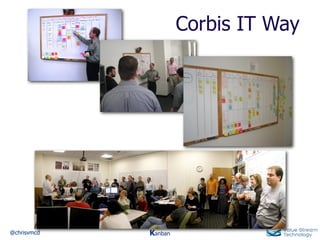
Corbis IT Way
@chrisvmcd Kanban
principles
@chrisvmcd Kanban
start with where you are now
• map of glasgow... start with where you are now
@chrisvmcd Kanban
@chrisvmcd Kanban
@chrisvmcd Kanban
@chrisvmcd Kanban
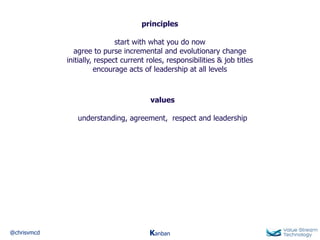
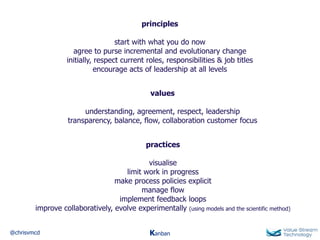
principles
start with what you do now
agree to purse incremental and evolutionary change
initially, respect current roles, responsibilities & job titles
encourage acts of leadership at all levels
values
understanding, agreement, respect and leadership
@chrisvmcd Kanban
practices
@chrisvmcd Kanban
@chrisvmcd Kanban
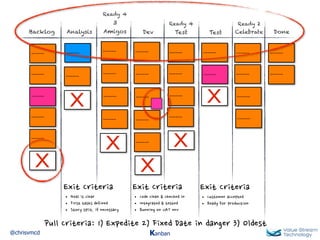
@chrisvmcd Kanban
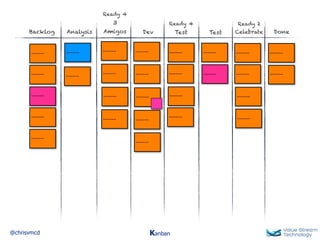
~~~~~~
~~~~~~
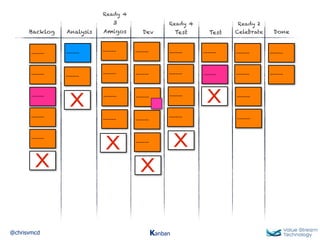
Analysis
~~~~~~~~~~~~
~~~~~~
~~~~~~
~~~~~~
~~~~~~
~~~~~~
~~~~~~
~~~~~~
~~~~~~~~~~~~
~~~~~~
~~~~~~
Ready 4
Test
~~~~~~
~~~~~~
~~~~~~
~~~~~~
Ready 4
3
Amigos TestBacklog
Ready 2
Celebrate DoneDev
~~~~~~
~~~~~~
~~~~~~
~~~~~~
~~~~~~
~~~~~~
~~~~~~
~~~~~~
~~~~~~
@chrisvmcd Kanban
@chrisvmcd Kanban
@chrisvmcd Kanban
@chrisvmcd Kanban
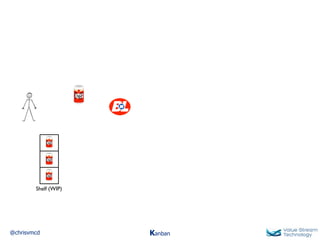
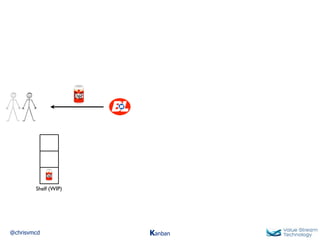
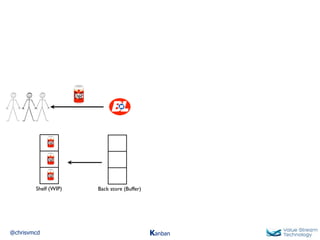
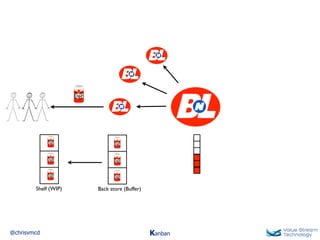
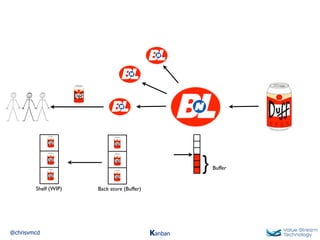
Shelf (WIP)
@chrisvmcd Kanban
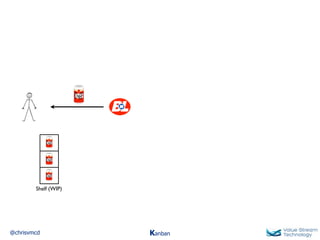
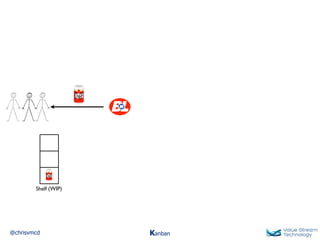
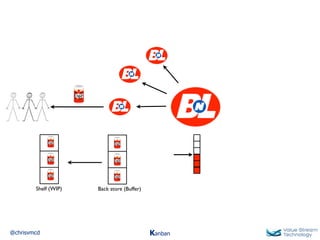
Shelf (WIP)
@chrisvmcd Kanban
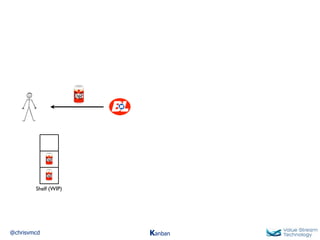
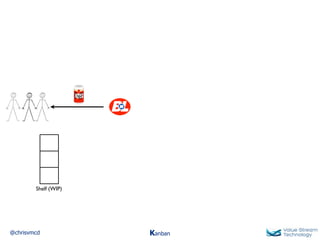
Shelf (WIP)
@chrisvmcd Kanban
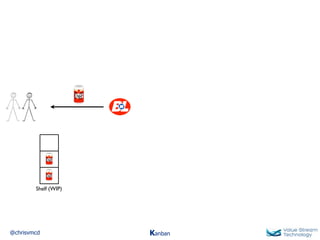
Shelf (WIP)
@chrisvmcd Kanban
Shelf (WIP)
@chrisvmcd Kanban
Shelf (WIP)
@chrisvmcd Kanban
Shelf (WIP)
@chrisvmcd Kanban
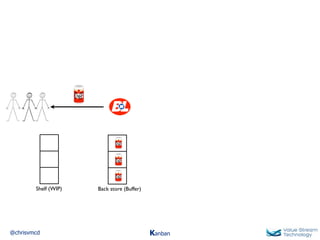
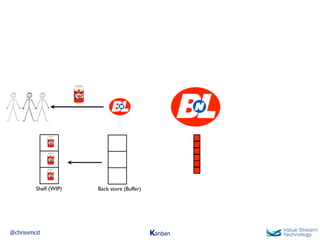
Back store (Buffer)Shelf (WIP)
@chrisvmcd Kanban
Back store (Buffer)Shelf (WIP)
@chrisvmcd Kanban
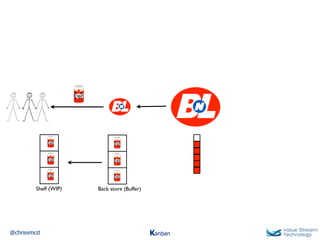
Back store (Buffer)Shelf (WIP)
@chrisvmcd Kanban
Back store (Buffer)Shelf (WIP)
@chrisvmcd Kanban
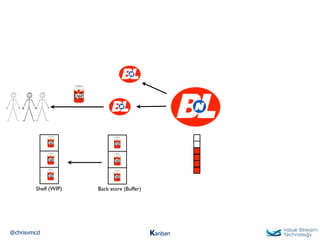
Back store (Buffer)Shelf (WIP)
@chrisvmcd Kanban
Back store (Buffer)Shelf (WIP)
@chrisvmcd Kanban
Back store (Buffer)Shelf (WIP)
@chrisvmcd Kanban
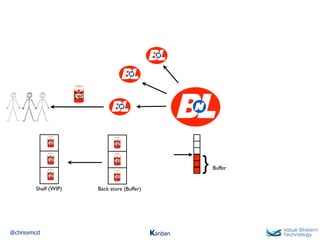
Back store (Buffer)
} Buffer
Shelf (WIP)
@chrisvmcd Kanban
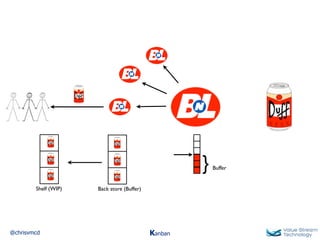
Back store (Buffer)
} Buffer
Shelf (WIP)
@chrisvmcd Kanban
Back store (Buffer)
} Buffer
Shelf (WIP)
@chrisvmcd Kanban
@chrisvmcd Kanban
~~~~~~
Analysis
~~~~~~
~~~~~~
~~~~~~
~~~~~~
~~~~~~
~~~~~~
~~~~~~
~~~~~~~~~~~~
~~~~~~
~~~~~~
Ready 4
Test
~~~~~~
~~~~~~
~~~~~~
~~~~~~
Ready 4
3
Amigos TestBacklog
Ready 2
Celebrate DoneDev
~~~~~~
~~~~~~
~~~~~~
X
X
X
X
~~~~~~
~~~~~~
X ~~~~~~
~~~~~~
~~~~~~
~~~~~~
X
~~~~~~
~~~~~~
~~~~~~
@chrisvmcd Kanban
@chrisvmcd Kanban
~~~~~
~~~~~
~~~~~
~
~~~~~~~~~~
~~~~~
~~~~~
~~~~~
~~~~~
~~~~~
~~~~~
~~~~~
~~~~~
~~~~~~~~~~~~~~~~~~~~
~~~~~
~~~~~
~~~~~~~~~~
~~~~~
~ ~ ~~ ~ ~ ~
~
~
~
~
~ ~
~
@chrisvmcd Kanban
@chrisvmcd Kanban
@chrisvmcd Kanban
@chrisvmcd Kanban
@chrisvmcd Kanban
~~~~~~
Analysis
~~~~~~
~~~~~~
~~~~~~
~~~~~~
~~~~~~
~~~~~~
~~~~~~
~~~~~~~~~~~~
~~~~~~
~~~~~~
Ready 4
Test
~~~~~~
~~~~~~
~~~~~~
~~~~~~
Ready 4
3
Amigos TestBacklog
Ready 2
Celebrate DoneDev
~~~~~~
~~~~~~
~~~~~~
X
X
X
X
~~~~~~
~~~~~~
X ~~~~~~
~~~~~~
~~~~~~
~~~~~~
X
~~~~~~
~~~~~~
~~~~~~
Exit
 Criteria
•
 Goal
 is
 clear
•
 First
 tasks
 defined
•
 Story
 split,
 if
 necessary
Exit
 Criteria
•

Introduction to Kanban

Editor's Notes

  • #2 Outline:\n - Kanban systems\n - Kanban Method\n
  • #3 Karl Scotland\n
  • #4  - Invented by Ohno in the early 50’s after studying supermarkets\n - uses the rate of demand to control the rate of production\n
  • #5 set of techniques and practices used to provoke and help manage change\nno such thing as: \n - the Kanban Software Development Process \n - or the Kanban Project Management Method. \n
  • #6 Background\nReason for Kanban\n
  • #7 \n
  • #8 does not prescribe a specific set of roles or process. \n\n\n\n
  • #9 \n
  • #10 \n
  • #11 Card content\nStand Ups\n\n
  • #12 Card content\nStand Ups\n\n
  • #13 Card content\nStand Ups\n\n
  • #14 Card content\nStand Ups\n\n
  • #15 Card content\nStand Ups\n\n
  • #16 Card content\nStand Ups\n\n
  • #17 Card content\nStand Ups\n\n
  • #18 Card content\nStand Ups\n\n
  • #19 Card content\nStand Ups\n\n
  • #20 Card content\nStand Ups\n\n
  • #21 Card content\nStand Ups\n\n
  • #22 Card content\nStand Ups\n\n
  • #23 Card content\nStand Ups\n\n
  • #24 Card content\nStand Ups\n\n
  • #25 Card content\nStand Ups\n\n
  • #26 Card content\nStand Ups\n\n
  • #27 Card content\nStand Ups\n\n
  • #28 Card content\nStand Ups\n\n
  • #29 Card content\nStand Ups\n\n
  • #30 Card content\nStand Ups\n\n
  • #31 Card content\nStand Ups\n\n
  • #32 Card content\nStand Ups\n\n
  • #33 Card content\nStand Ups\n\n
  • #34 Card content\nStand Ups\n\n
  • #35 Card content\nStand Ups\n\n
  • #36 Card content\nStand Ups\n\n
  • #37 Card content\nStand Ups\n\n
  • #38 Card content\nStand Ups\n\n
  • #39 Card content\nStand Ups\n\n
  • #40 Card content\nStand Ups\n\n
  • #41 Card content\nStand Ups\n\n
  • #42 Card content\nStand Ups\n\n
  • #43 Card content\nStand Ups\n\n
  • #44 Card content\nStand Ups\n\n
  • #45 Card content\nStand Ups\n\n
  • #46 Card content\nStand Ups\n\n
  • #47 Card content\nStand Ups\n\n
  • #48 Card content\nStand Ups\n\n
  • #49 Card content\nStand Ups\n\n
  • #50 Card content\nStand Ups\n\n
  • #51 Card content\nStand Ups\n\n
  • #52 Card content\nStand Ups\n\n
  • #53 Card content\nStand Ups\n\n
  • #54 Card content\nStand Ups\n\n
  • #55 Card content\nStand Ups\n\n
  • #56 \n
  • #57 Limits set on agreed capacity\nWhy \n - Reduce Multitasking\n - Helps reduce lead time - Little’s Law (Lead time = WIP/Throughput)\n\n\n
  • #58 Limits set on agreed capacity\nWhy \n - Reduce Multitasking\n - Helps reduce lead time - Little’s Law (Lead time = WIP/Throughput)\n\n\n
  • #59 Limits set on agreed capacity\nWhy \n - Reduce Multitasking\n - Helps reduce lead time - Little’s Law (Lead time = WIP/Throughput)\n\n\n
  • #60 Limits set on agreed capacity\nWhy \n - Reduce Multitasking\n - Helps reduce lead time - Little’s Law (Lead time = WIP/Throughput)\n\n\n
  • #61 Limits set on agreed capacity\nWhy \n - Reduce Multitasking\n - Helps reduce lead time - Little’s Law (Lead time = WIP/Throughput)\n\n\n
  • #62 Limits set on agreed capacity\nWhy \n - Reduce Multitasking\n - Helps reduce lead time - Little’s Law (Lead time = WIP/Throughput)\n\n\n
  • #63 Limits set on agreed capacity\nWhy \n - Reduce Multitasking\n - Helps reduce lead time - Little’s Law (Lead time = WIP/Throughput)\n\n\n
  • #64 Limits set on agreed capacity\nWhy \n - Reduce Multitasking\n - Helps reduce lead time - Little’s Law (Lead time = WIP/Throughput)\n\n\n
  • #65 Limits set on agreed capacity\nWhy \n - Reduce Multitasking\n - Helps reduce lead time - Little’s Law (Lead time = WIP/Throughput)\n\n\n
  • #66 Limits set on agreed capacity\nWhy \n - Reduce Multitasking\n - Helps reduce lead time - Little’s Law (Lead time = WIP/Throughput)\n\n\n
  • #67 Limits set on agreed capacity\nWhy \n - Reduce Multitasking\n - Helps reduce lead time - Little’s Law (Lead time = WIP/Throughput)\n\n\n
  • #68 Limits set on agreed capacity\nWhy \n - Reduce Multitasking\n - Helps reduce lead time - Little’s Law (Lead time = WIP/Throughput)\n\n\n
  • #69 Limits set on agreed capacity\nWhy \n - Reduce Multitasking\n - Helps reduce lead time - Little’s Law (Lead time = WIP/Throughput)\n\n\n
  • #70 Limits set on agreed capacity\nWhy \n - Reduce Multitasking\n - Helps reduce lead time - Little’s Law (Lead time = WIP/Throughput)\n\n\n
  • #71 Limits set on agreed capacity\nWhy \n - Reduce Multitasking\n - Helps reduce lead time - Little’s Law (Lead time = WIP/Throughput)\n\n\n
  • #72 Limits set on agreed capacity\nWhy \n - Reduce Multitasking\n - Helps reduce lead time - Little’s Law (Lead time = WIP/Throughput)\n\n\n
  • #73 Limits set on agreed capacity\nWhy \n - Reduce Multitasking\n - Helps reduce lead time - Little’s Law (Lead time = WIP/Throughput)\n\n\n
  • #74 Limits set on agreed capacity\nWhy \n - Reduce Multitasking\n - Helps reduce lead time - Little’s Law (Lead time = WIP/Throughput)\n\n\n
  • #75 Limits set on agreed capacity\nWhy \n - Reduce Multitasking\n - Helps reduce lead time - Little’s Law (Lead time = WIP/Throughput)\n\n\n
  • #76 Limits set on agreed capacity\nWhy \n - Reduce Multitasking\n - Helps reduce lead time - Little’s Law (Lead time = WIP/Throughput)\n\n\n
  • #77 Limits set on agreed capacity\nWhy \n - Reduce Multitasking\n - Helps reduce lead time - Little’s Law (Lead time = WIP/Throughput)\n\n\n
  • #78 Limits set on agreed capacity\nWhy \n - Reduce Multitasking\n - Helps reduce lead time - Little’s Law (Lead time = WIP/Throughput)\n\n\n
  • #79 Pull system main stimuli for change & improvement\n- Creates slack for improvement\n\n
  • #80 Pull system main stimuli for change & improvement\n- Creates slack for improvement\n\n
  • #81 Pull system main stimuli for change & improvement\n- Creates slack for improvement\n\n
  • #82 Pull system main stimuli for change & improvement\n- Creates slack for improvement\n\n
  • #83 Pull system main stimuli for change & improvement\n- Creates slack for improvement\n\n
  • #84 Pull system main stimuli for change & improvement\n- Creates slack for improvement\n\n
  • #85 Pull system main stimuli for change & improvement\n- Creates slack for improvement\n\n
  • #86 Pull system main stimuli for change & improvement\n- Creates slack for improvement\n\n
  • #87 Pull system main stimuli for change & improvement\n- Creates slack for improvement\n\n
  • #88 Pull system main stimuli for change & improvement\n- Creates slack for improvement\n\n
  • #89 Pull system main stimuli for change & improvement\n- Creates slack for improvement\n\n
  • #90 Pull system main stimuli for change & improvement\n- Creates slack for improvement\n\n
  • #91 Pull system main stimuli for change & improvement\n- Creates slack for improvement\n\n
  • #92 Pull system main stimuli for change & improvement\n- Creates slack for improvement\n\n
  • #93 Pull system main stimuli for change & improvement\n- Creates slack for improvement\n\n
  • #94 \n
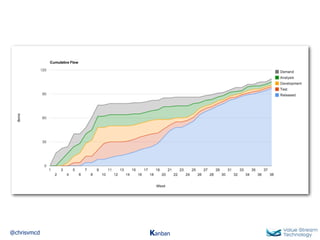
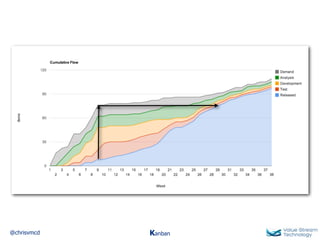
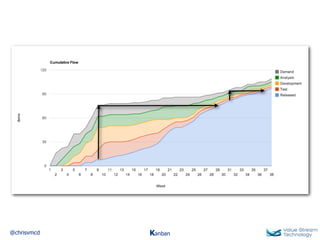
  • #95 flow should be monitored, measured and reported\nchange can be evaluated\n
  • #96 SPC - Variation in lead time\nCFD - Check that the Kanban System is working correctly\n
  • #97 \n
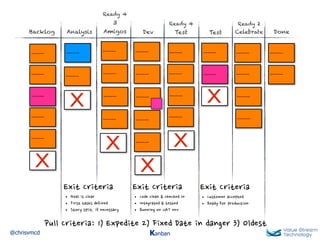
  • #98  - hard to discuss improvement if the system is not understood\n - with explicit policies discussions are emotional and anecdotal \n - facilitate consensus around improvement suggestions\n - can lead to a self organising team\n
  • #99 \n
  • #100 Identify the constraint\nDecide how to exploit the constraint\nSubordinate all other processes to above decision\nElevate the constraint\nIf, as a result of these steps, the constraint has moved, return to Step 1. Don't let inertia become the constraint\n\n
  • #101 \n
  • #102 3 - Wastes\nMary Pop’s 7\nMuda\n Transport waste\n Inventory waste\n Motion waste\n Waiting waste\n Over producing waste\n Over processing waste\n Defects waste\n
  • #103 FD - demand caused by a failure to do something or do something right for the customer\nTC - e.g. expensive and time consuming release process\n\n
  • #104 FD - demand caused by a failure to do something or do something right for the customer\nTC - e.g. expensive and time consuming release process\n\n
  • #105 FD - demand caused by a failure to do something or do something right for the customer\nTC - e.g. expensive and time consuming release process\n\n
  • #106 FD - demand caused by a failure to do something or do something right for the customer\nTC - e.g. expensive and time consuming release process\n\n
  • #107 FD - demand caused by a failure to do something or do something right for the customer\nTC - e.g. expensive and time consuming release process\n\n
  • #108 FD - demand caused by a failure to do something or do something right for the customer\nTC - e.g. expensive and time consuming release process\n\n
  • #109 FD - demand caused by a failure to do something or do something right for the customer\nTC - e.g. expensive and time consuming release process\n\n
  • #110 FD - demand caused by a failure to do something or do something right for the customer\nTC - e.g. expensive and time consuming release process\n\n
  • #111 FD - demand caused by a failure to do something or do something right for the customer\nTC - e.g. expensive and time consuming release process\n\n
  • #112 FD - demand caused by a failure to do something or do something right for the customer\nTC - e.g. expensive and time consuming release process\n\n
  • #113 FD - demand caused by a failure to do something or do something right for the customer\nTC - e.g. expensive and time consuming release process\n\n
  • #114 FD - demand caused by a failure to do something or do something right for the customer\nTC - e.g. expensive and time consuming release process\n\n
  • #115 FD - demand caused by a failure to do something or do something right for the customer\nTC - e.g. expensive and time consuming release process\n\n
  • #116 FD - demand caused by a failure to do something or do something right for the customer\nTC - e.g. expensive and time consuming release process\n\n
  • #117 FD - demand caused by a failure to do something or do something right for the customer\nTC - e.g. expensive and time consuming release process\n\n
  • #118 FD - demand caused by a failure to do something or do something right for the customer\nTC - e.g. expensive and time consuming release process\n\n
  • #119 FD - demand caused by a failure to do something or do something right for the customer\nTC - e.g. expensive and time consuming release process\n\n
  • #120 FD - demand caused by a failure to do something or do something right for the customer\nTC - e.g. expensive and time consuming release process\n\n
  • #121 FD - demand caused by a failure to do something or do something right for the customer\nTC - e.g. expensive and time consuming release process\n\n
  • #122 FD - demand caused by a failure to do something or do something right for the customer\nTC - e.g. expensive and time consuming release process\n\n
  • #123 \n
  • #124 \n
  • #125 \n