To what extent can research influence LIS curricula ?  How much LIS curriculum actually makes sense without research?  A Humboldtian perspective Berlin, 29 September 2011 Prof. Dr. Stefan Gradmann Humboldt-Universität zu Berlin / School of Library and Information Science [email_address]
Overview About a rhetorical question
About teaching
About DL research
About Linked Open Data and Web Science
On Terminology
On Research and Teaching
HU Mission Statement “4.  The Unity of Research and Teaching . Humboldt‘s ideal of the coexistence of research and teaching has become a model for universities all over the world. Central to this model is  the idea of research-oriented teaching and the transfer of knowledge from the spirit of research . Students and teachers are joined together in an endeavour to critically examine traditional bodies of knowledge and to actively advance learning. For this reason, the Humboldt-Universität promotes social and communicative competences among all of its members and supports their initiatives wherever it can.”
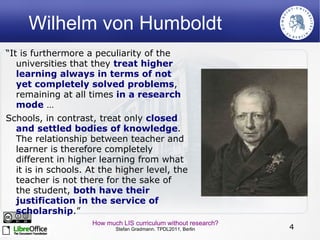
Wilhelm von Humboldt “ It is furthermore a peculiarity of the universities that they  treat higher learning always in terms of not yet completely solved problems , remaining at all times  in a research mode  …  Schools, in contrast, treat only  closed and settled bodies of knowledge . The relationship between teacher and learner is therefore completely different in higher learning from what it is in schools. At the higher level, the teacher is not there for the sake of the student,  both have their justification in the service of scholarship .”
What are we teaching? Canonised Knowledge? Things that can be gathered from textbooks?
Information with definite context?
To be reproduced in exams? Questions! The ability of coming up with them, asking them
Asking questions as a natural state, constituting scholarship
The impossibility of definite 'answers' and 'solutions' Digital Libraries? It's the terminology, stupid!
Back to ECDL 2003
ECDL 2003: Digital? Libraries? The Digital Library metaphor has been useful and necessary during a transitional period – but is it still effective/significant?
appropriate? Or is it starting to be counter-productive or even dangerous?
Similar questions could be asked referring to DL research.
Names are NOT innocent: things change, and names should change accordingly (even though with a specific delay ...)
‚ Meaning‘ is slightly more complex than just ‚referring to‘ and includes such subtleties as ‚connotations‘
The movie analogy: from ‚Film Theatres‘  to ‚Cinemas‘
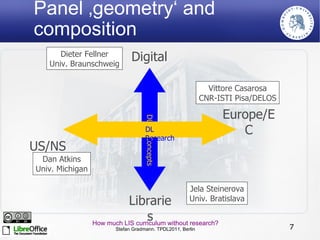
Panel ‚geometry‘ and composition Jela Steinerova Univ. Bratislava Dieter Fellner Univ. Braunschweig Dan Atkins Univ. Michigan Vittore Casarosa CNR-ISTI Pisa/DELOS DL  Concepts Digital Libraries DL  Research Europe/EC US/NSF
What happened since 2003?
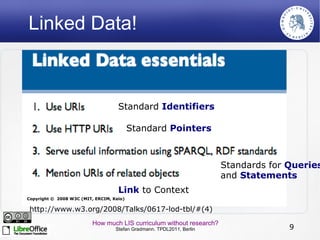
Linked Data! Copyright ©  2008 W3C (MIT, ERCIM, Keio) http://www.w3.org/2008/Talks/0617-lod-tbl/#(4) Standard  Identifiers Standard  Pointers Standards for  Queries   and  Statements Link  to Context
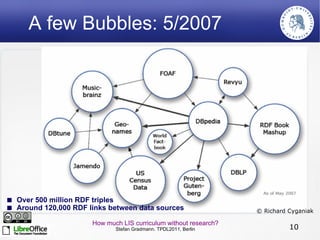
A few Bubbles: 5/2007 < Over 500 million RDF triples  < Around 120,000 RDF links between data sources © Richard Cyganiak
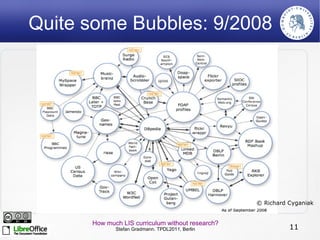
Quite some Bubbles: 9/2008 © Richard Cyganiak
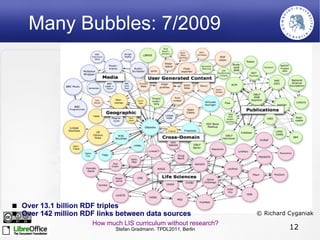
Many Bubbles: 7/2009 © Richard Cyganiak < Over 13.1 billion RDF triples  < Over 142 million RDF links between data sources
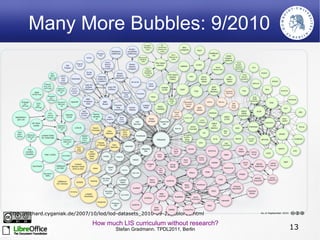
Many More Bubbles: 9/2010 http://richard.cyganiak.de/2007/10/lod/lod-datasets_2010-09-22_colored.html
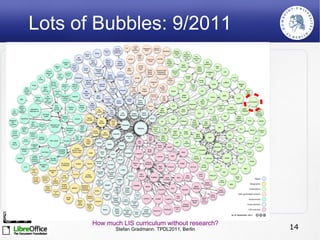
Lots of Bubbles: 9/2011 http://richard.cyganiak.de/2007/10/lod/lod-datasets_2010-09-22_colored.html
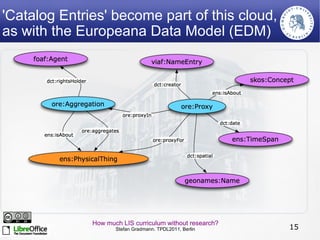
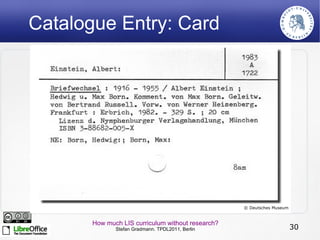
'Catalog Entries' become part of this cloud, as with the Europeana Data Model (EDM)
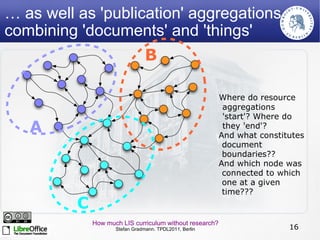
…  as well as 'publication' aggregations combining 'documents' and 'things' Where do resource aggregations 'start'? Where do they 'end'?
And what constitutes document boundaries??
And which node was connected to which one at a given time??? A B C
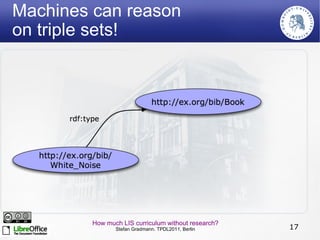
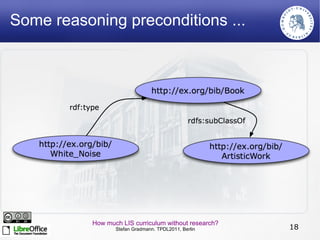
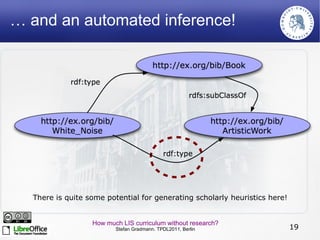
Machines can reason  on triple sets!
Some reasoning preconditions ...
…  and an automated inference! There is quite some potential for generating scholarly heuristics here!
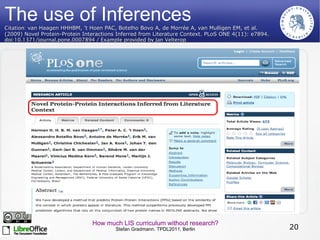
The use of Inferences Citation:  van Haagen HHHBM, 't Hoen PAC, Botelho Bovo A, de Morrée A, van Mulligen EM, et al.  (2009) Novel Protein-Protein Interactions Inferred from Literature Context. PLoS ONE 4(11): e7894.  doi:10.1371/journal.pone.0007894 / Example provided by Jan Velterop
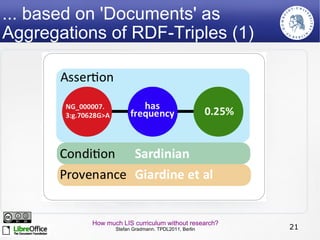
... based on 'Documents' as Aggregations of RDF-Triples (1)
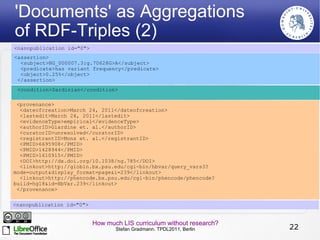
'Documents' as  Aggregations  of RDF-Triples (2) <assertion> <subject>NG_000007.3:g.70628G>A</subject> <predicate>has variant frequency</predicate> <object>0.25%</object> </assertion> <condition>Sardinian</condition> <provenance> <dateofcreation>March 24, 2011</dateofcreation> <lastedit>March 24, 2011</lastedit> <evidenceType>empirical</evidenceType> <authorID>Giardine et. al.</authorID> <curatorID>unresolved</curatorID> <registrantID>Mons et. al.</registrantID> <PMID>6695908</PMID> <PMID>1428944</PMID> <PMID>1610915</PMID> <DOI>http://dx.doi.org/10.1038/ng.785</DOI> <linkout>http://globin.bx.psu.edu/cgi-bin/hbvar/query_vars3?mode=output&display_format=page&i=239</linkout> <linkout>http://phencode.bx.psu.edu/cgi-bin/phencode/phencode?build=hg18&id=HbVar.239</linkout> </provenance> <nanopublication id=&quot;0&quot;> <nanopublication id=&quot;0&quot;>
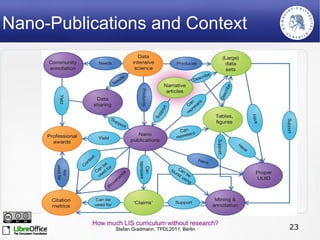
Nano-Publications and Context
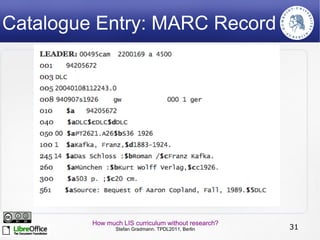
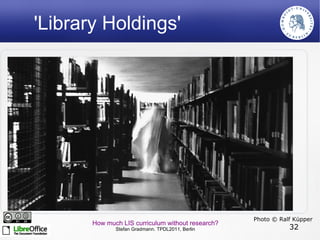
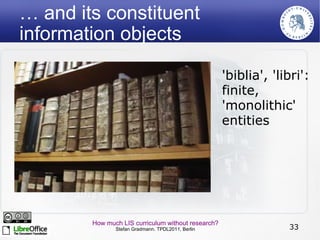
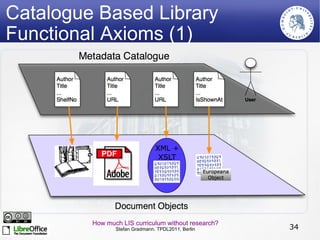
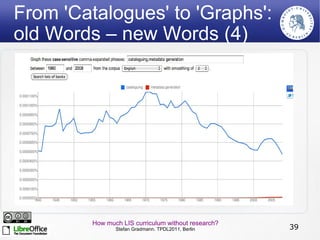
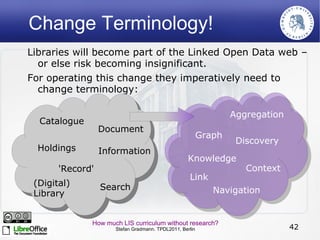
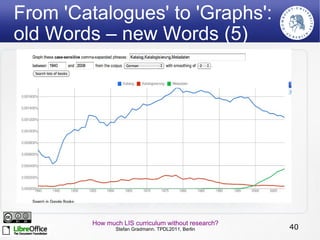
From Catalogs to Graphs Changing Terms for a Changing Profession
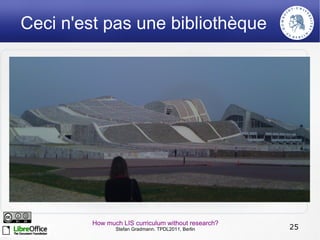
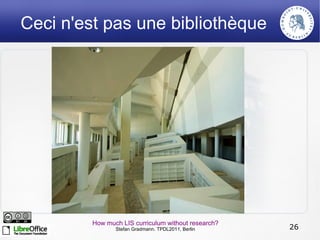
Ceci n'est pas une bibliothèque

20110929 tpdl2011 dl-research-humboldt

  • 1.
    To what extentcan research influence LIS curricula ? How much LIS curriculum actually makes sense without research? A Humboldtian perspective Berlin, 29 September 2011 Prof. Dr. Stefan Gradmann Humboldt-Universität zu Berlin / School of Library and Information Science [email_address]
  • 2.
    Overview About arhetorical question
  • 3.
  • 4.
  • 5.
    About Linked OpenData and Web Science
  • 6.
  • 7.
  • 8.
    HU Mission Statement“4. The Unity of Research and Teaching . Humboldt‘s ideal of the coexistence of research and teaching has become a model for universities all over the world. Central to this model is the idea of research-oriented teaching and the transfer of knowledge from the spirit of research . Students and teachers are joined together in an endeavour to critically examine traditional bodies of knowledge and to actively advance learning. For this reason, the Humboldt-Universität promotes social and communicative competences among all of its members and supports their initiatives wherever it can.”
  • 9.
    Wilhelm von Humboldt“ It is furthermore a peculiarity of the universities that they treat higher learning always in terms of not yet completely solved problems , remaining at all times in a research mode … Schools, in contrast, treat only closed and settled bodies of knowledge . The relationship between teacher and learner is therefore completely different in higher learning from what it is in schools. At the higher level, the teacher is not there for the sake of the student, both have their justification in the service of scholarship .”
  • 10.
    What are weteaching? Canonised Knowledge? Things that can be gathered from textbooks?
  • 11.
  • 12.
    To be reproducedin exams? Questions! The ability of coming up with them, asking them
  • 13.
    Asking questions asa natural state, constituting scholarship
  • 14.
    The impossibility ofdefinite 'answers' and 'solutions' Digital Libraries? It's the terminology, stupid!
  • 15.
  • 16.
    ECDL 2003: Digital?Libraries? The Digital Library metaphor has been useful and necessary during a transitional period – but is it still effective/significant?
  • 17.
    appropriate? Or isit starting to be counter-productive or even dangerous?
  • 18.
    Similar questions couldbe asked referring to DL research.
  • 19.
    Names are NOTinnocent: things change, and names should change accordingly (even though with a specific delay ...)
  • 20.
    ‚ Meaning‘ isslightly more complex than just ‚referring to‘ and includes such subtleties as ‚connotations‘
  • 21.
    The movie analogy:from ‚Film Theatres‘ to ‚Cinemas‘
  • 22.
    Panel ‚geometry‘ andcomposition Jela Steinerova Univ. Bratislava Dieter Fellner Univ. Braunschweig Dan Atkins Univ. Michigan Vittore Casarosa CNR-ISTI Pisa/DELOS DL Concepts Digital Libraries DL Research Europe/EC US/NSF
  • 23.
  • 24.
    Linked Data! Copyright© 2008 W3C (MIT, ERCIM, Keio) http://www.w3.org/2008/Talks/0617-lod-tbl/#(4) Standard Identifiers Standard Pointers Standards for Queries and Statements Link to Context
  • 25.
    A few Bubbles:5/2007 < Over 500 million RDF triples < Around 120,000 RDF links between data sources © Richard Cyganiak
  • 26.
    Quite some Bubbles:9/2008 © Richard Cyganiak
  • 27.
    Many Bubbles: 7/2009© Richard Cyganiak < Over 13.1 billion RDF triples < Over 142 million RDF links between data sources
  • 28.
    Many More Bubbles:9/2010 http://richard.cyganiak.de/2007/10/lod/lod-datasets_2010-09-22_colored.html
  • 29.
    Lots of Bubbles:9/2011 http://richard.cyganiak.de/2007/10/lod/lod-datasets_2010-09-22_colored.html
  • 30.
    'Catalog Entries' becomepart of this cloud, as with the Europeana Data Model (EDM)
  • 31.
    … aswell as 'publication' aggregations combining 'documents' and 'things' Where do resource aggregations 'start'? Where do they 'end'?
  • 32.
    And what constitutesdocument boundaries??
  • 33.
    And which nodewas connected to which one at a given time??? A B C
  • 34.
    Machines can reason on triple sets!
  • 35.
  • 36.
    … andan automated inference! There is quite some potential for generating scholarly heuristics here!
  • 37.
    The use ofInferences Citation: van Haagen HHHBM, 't Hoen PAC, Botelho Bovo A, de Morrée A, van Mulligen EM, et al. (2009) Novel Protein-Protein Interactions Inferred from Literature Context. PLoS ONE 4(11): e7894. doi:10.1371/journal.pone.0007894 / Example provided by Jan Velterop
  • 38.
    ... based on'Documents' as Aggregations of RDF-Triples (1)
  • 39.
    'Documents' as Aggregations of RDF-Triples (2) <assertion> <subject>NG_000007.3:g.70628G>A</subject> <predicate>has variant frequency</predicate> <object>0.25%</object> </assertion> <condition>Sardinian</condition> <provenance> <dateofcreation>March 24, 2011</dateofcreation> <lastedit>March 24, 2011</lastedit> <evidenceType>empirical</evidenceType> <authorID>Giardine et. al.</authorID> <curatorID>unresolved</curatorID> <registrantID>Mons et. al.</registrantID> <PMID>6695908</PMID> <PMID>1428944</PMID> <PMID>1610915</PMID> <DOI>http://dx.doi.org/10.1038/ng.785</DOI> <linkout>http://globin.bx.psu.edu/cgi-bin/hbvar/query_vars3?mode=output&display_format=page&i=239</linkout> <linkout>http://phencode.bx.psu.edu/cgi-bin/phencode/phencode?build=hg18&id=HbVar.239</linkout> </provenance> <nanopublication id=&quot;0&quot;> <nanopublication id=&quot;0&quot;>
  • 40.
  • 41.
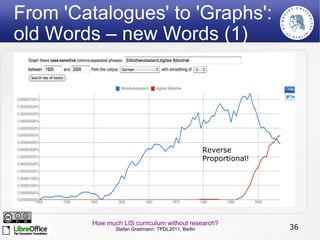
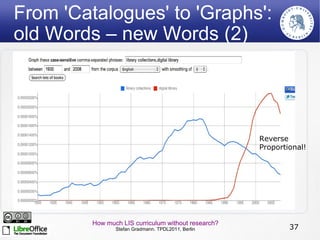
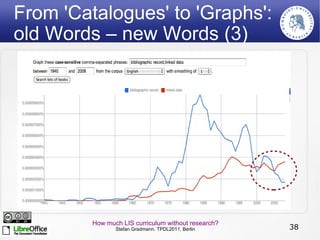
    From Catalogs toGraphs Changing Terms for a Changing Profession
  • 42.
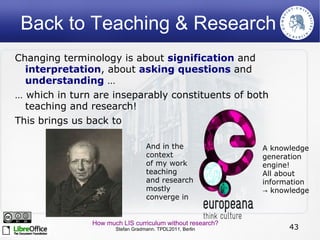
    Ceci n'est pasune bibliothèque
  • 43.
    Ceci n'est pasune bibliothèque

Editor's Notes

  • #18 Hier könnte ein Exkurs zu RTP Doc ansetzen, wenn ich mehr als 20 Minuten Zeit hätte
  • #19 Hier könnte ein Exkurs zu RTP Doc ansetzen, wenn ich mehr als 20 Minuten Zeit hätte
  • #20 Hier könnte ein Exkurs zu RTP Doc ansetzen, wenn ich mehr als 20 Minuten Zeit hätte