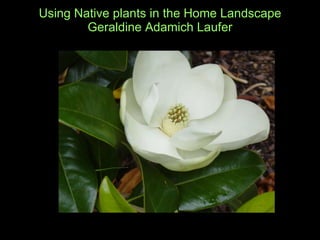
Using Native plants in the Home Landscape Geraldine Adamich Laufer
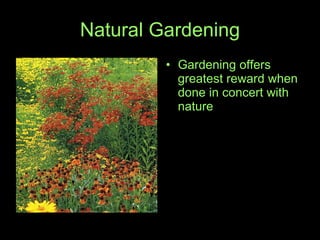
Natural Gardening Gardening offers greatest reward when done in concert with nature
What is a native plant? All plants native somewhere  Many mainstream gardeners don’t know which are native and which aren’t Everyday natives are familiar Pass-along plants Cypredium acaule
A native plant Indigenous to locale Comes from 1 region Native prior to Columbus Adapting for thousands of years Relationship to climate, soil, pests, other plants ID by botanical name Cypredium kentuckiense
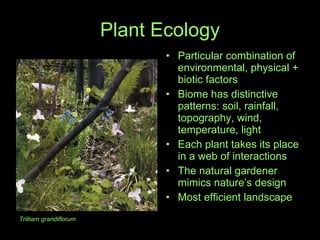
Plant Ecology Particular combination of environmental, physical + biotic factors Biome has distinctive patterns: soil, rainfall, topography, wind,  temperature, light Each plant takes its place in a web of interactions The natural gardener mimics nature’s design Most efficient landscape  Trilliam grandiflorum
Plant Competition Plants are not independent Compete for scarce natural resources In the garden too Podophyllum peltatum
Natural Succession Plant community in state of continual flux Predictable series of changes “seral stages” Gradual replacement of plant communities in a given area Develops dynamic equilibrium, called climax vegetation Where does your garden fall in this succession?
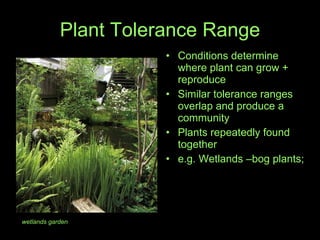
Plant Tolerance Range Conditions determine where plant can grow + reproduce Similar tolerance ranges overlap and produce a community Plants repeatedly found together  e.g. Wetlands –bog plants;  wetlands garden
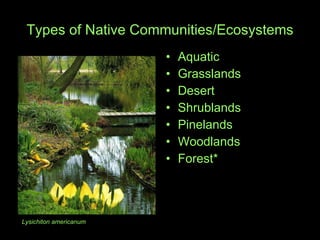
Types of Native Communities/Ecosystems Aquatic Grasslands Desert Shrublands Pinelands  Woodlands Forest* Lysichiton americanum
Great Eastern Forest Mixed forests Atlantic and Gulf coasts 40” annual rainfall, evenly distributed Deep, fertile, slightly acidic soils Mild winters Oak, beech, maple, elm, tulip poplar, ash, dogwood, redbud
Southeastern Mixed Forest Open forest of Loblolly, shortleaf + other pines Understory grasses, palms 40-60” rainfall evenly distributed, fire Nutrient-poor soils due to high precipitation Gum, bald cypress, oak, hickory, blueberry, dogwood Loblolly and palmetto
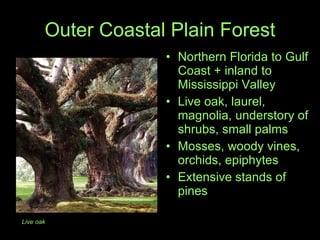
Outer Coastal Plain Forest Northern Florida to Gulf Coast + inland to Mississippi Valley Live oak, laurel, magnolia, understory of shrubs, small palms Mosses, woody vines, orchids, epiphytes Extensive stands of pines  Live oak
Regional Natives Colonized in limited range; just one place e.g. Bartram/ Franklinia Indigenous to a small area Franklinia altamaha
Non-Natives + “Straddlers” Flowering plants developed ~ 100M years ago: Pangea Then plates began shifting ~ 75M years ago So we have “Straddlers” --same genus, far-flung spp. Examples: Magnolia, Cornus,  Rhododendron Asian Magnolia liliflora
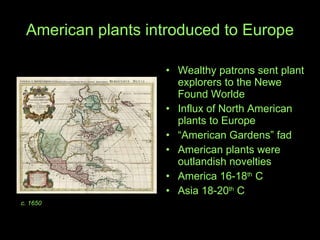
American plants introduced to Europe Wealthy patrons sent plant explorers to the Newe Found Worlde Influx of North American plants to Europe “ American Gardens” fad American plants were outlandish novelties America 16-18 th  C Asia 18-20 th  C c. 1650
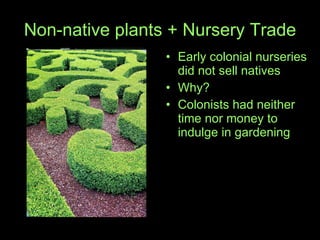
Non-native plants + Nursery Trade Early colonial nurseries did not sell natives Why? Colonists had neither time nor money to indulge in gardening
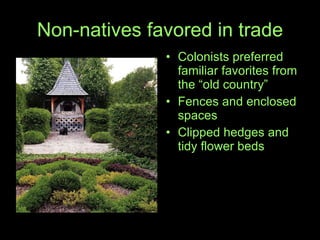
Non-natives favored in trade Colonists preferred familiar favorites from the “old country” Fences and enclosed spaces Clipped hedges and tidy flower beds
Non-natives favored in U.S. nursery trade   Native flora looked wild and unfamiliar If not sold in a nursery, must be a weed Easy to dig up natives from the woods, fields, (not purchase them)  Later, European bedding targeted non-native tropicals  Swamp hibiscus
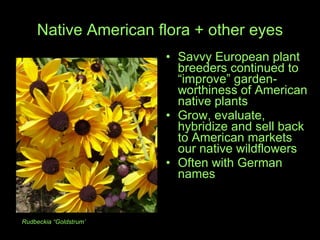
Native American flora + other eyes Savvy European plant breeders continued to “improve” garden-worthiness of American native plants Grow, evaluate, hybridize and sell back to American markets our native wildflowers Often with German names Rudbeckia “Goldstrum’
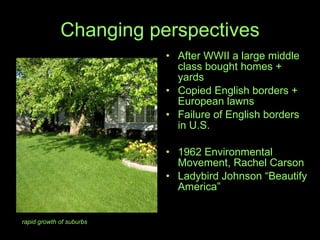
Changing perspectives After WWII a large middle class bought homes + yards Copied English borders + European lawns Failure of English borders  in U.S. 1962 Environmental Movement, Rachel Carson Ladybird Johnson “Beautify America” rapid growth of suburbs
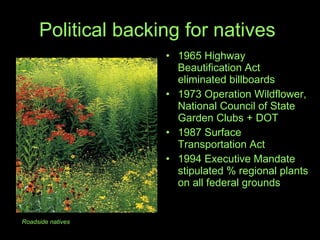
Political backing for natives  1965 Highway Beautification Act eliminated billboards 1973 Operation Wildflower, National Council of State Garden Clubs + DOT 1987 Surface Transportation Act 1994 Executive Mandate  stipulated % regional plants on all federal grounds  Roadside natives
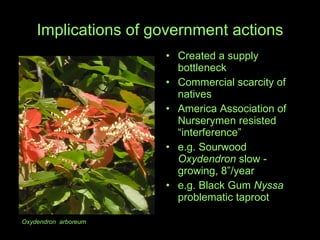
Implications of government actions Created a supply bottleneck  Commercial scarcity of natives  America Association of Nurserymen resisted “interference” e.g. Sourwood  Oxydendron  slow - growing, 8”/year  e.g. Black Gum  Nyssa  problematic taproot Oxydendron  arboreum
Governmental actions controversial Impact of government on Nursery business Over-collection to get starter plants Destruction of habitats  Non-regional seed, question of provenance Torreya taxifolia  seed collection
Tolerance Range and Provenance Nurseries needed propagation material and got it anywhere they could Just because one species is native over a wide range doesn’t mean an individual will do well anywhere in that range Echinaceae purpurea
Interest in regional designs Henry David Thoreau Pioneering work Darrel Morrison University Wisconsin, Madison  Prairie restoration + Jens Jensen + O.C. Simmons natives and grasses
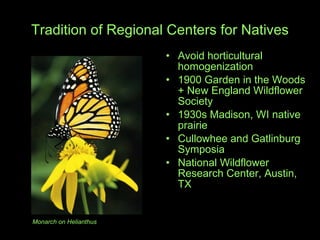
Tradition of Regional Centers for Natives Avoid horticultural homogenization 1900 Garden in the Woods + New England Wildflower Society  1930s Madison, WI native prairie Cullowhee and Gatlinburg Symposia National Wildflower  Research Center, Austin, TX Monarch on Helianthus
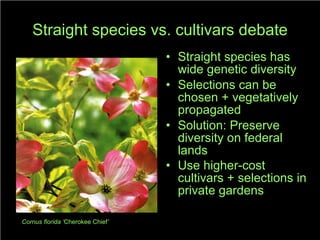
Straight species vs. cultivars debate Straight species has wide genetic diversity Selections can be chosen + vegetatively propagated Solution: Preserve diversity on federal lands  Use higher-cost cultivars + selections in private gardens   Cornus florida ‘ Cherokee Chief ’
Today  (present company excepted) Average home landscape is ecological disaster Angular, geometric shapes Level, unchanging lawn monocultures  40 M lawnmowers 2 B gallons gas used annually for mowing Sprinkling lawns triples water consumption Herbicides, insecticides, fungicides used Dead soils evaporation
Native Plant Lovers Merger of ideas Creativity Use natives to create optimum environment Follow nature’s guide Learn by trowel + error Creative uses of native plants
Benefits of Natural Landscaping Link to tradition Cornus florida
Benefits of Natural Landscaping Link to tradition Sense of place, “genius loci” Fothergilla gardenii
Benefits of Natural Landscaping Link to tradition Sense of place, “genius loci” Relaxing retreat from straight lines + square corners Edge of woodland
Benefits of Natural Landscaping Link to tradition Sense of place, “genius loci” Relaxing retreat from straight lines + square corners Re-discover little-known plants  Bog planting for rain garden
Benefits of Natural Landscaping Link to tradition Sense of place, “genius loci” Relaxing retreat from straight lines + square corners Re-discover little-known plants   Celebrate biodiversity Cleistes bifaria
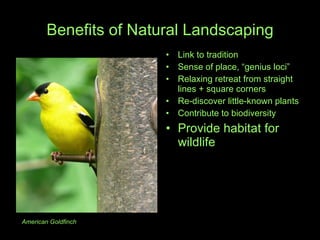
Benefits of Natural Landscaping Link to tradition Sense of place, “genius loci” Relaxing retreat from straight lines + square corners Re-discover little-known plants  Contribute to biodiversity Provide habitat for wildlife American Goldfinch
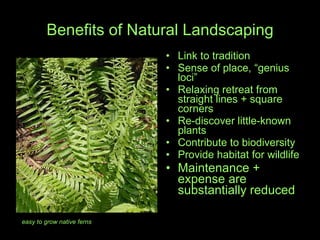
Benefits of Natural Landscaping Link to tradition Sense of place, “genius loci” Relaxing retreat from straight lines + square corners Re-discover little-known plants  Contribute to biodiversity Provide habitat for wildlife Maintenance + expense are substantially reduced easy to grow native ferns
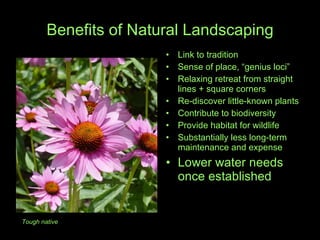
Benefits of Natural Landscaping Link to tradition Sense of place, “genius loci” Relaxing retreat from straight lines + square corners Re-discover little-known plants  Contribute to biodiversity Provide habitat for wildlife Substantially less long-term maintenance and expense Lower water needs once established Tough native
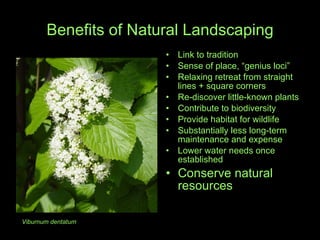
Benefits of Natural Landscaping Link to tradition Sense of place, “genius loci” Relaxing retreat from straight lines + square corners Re-discover little-known plants  Contribute to biodiversity Provide habitat for wildlife Substantially less long-term maintenance and expense Lower water needs once established Conserve natural resources Viburnum dentatum
Benefits of Natural Landscaping Link to tradition Sense of place, “genius loci” Relaxing retreat from straight lines + square corners Re-discover little-known plants  Contribute to biodiversity Provide habitat for wildlife Substantially less long-term maintenance and expense Lower water needs once established Conserve natural resources Better suited to local conditions Trillium luteum
Benefits of Natural Landscaping Link to tradition Sense of place, “genius loci” Relaxing retreat from straight lines + square corners Re-discover little-known plants  Contribute to biodiversity Provide habitat for wildlife Substantially less long-term maintenance and expense Lower water needs once established Conserve natural resources Better suited to local conditions Seasonal change and variation fall color
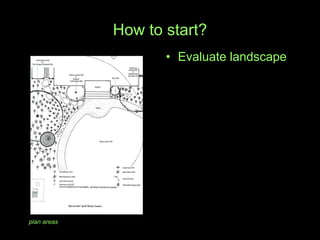
How to start? Evaluate landscape plan areas
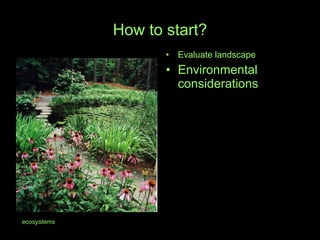
How to start? Evaluate landscape Environmental considerations  ecosystems
How to start? Evaluate landscape Environmental considerations  Personal requirements Eupatorium purpureum
How to start? Evaluate landscape Environmental considerations  Personal requirements Planting preferences  Trillium grandiflorum
How to start? Evaluate landscape Environmental considerations  Personal requirements Planting preferences  Sequence of spaces Native groundcover planting
How to start? Evaluate landscape Environmental considerations  Personal requirements Planting preferences  Sequence of spaces Meandering, non-bordered path is naturalistic riot of color
How to start? Evaluate landscape Environmental considerations  Personal requirements Planting preferences  Sequence of spaces Meandering non-bordered path is naturalistic Eliminate toxic chemicals Aesculus pavia
How to start? Evaluate landscape Environmental considerations  Personal requirements Planting preferences  Sequence of spaces Meandering non-bordered path is naturalistic Eliminate toxic chemicals Encourage beneficial organisms bees
How to start? Evaluate landscape Environmental considerations  Personal requirements Planting preferences  Sequence of spaces Meandering non-bordered path is naturalistic Eliminate toxic chemicals Encourage beneficial organisms Add compost and humus Podophyllum peltatum
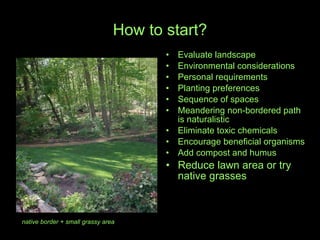
How to start? Evaluate landscape Environmental considerations  Personal requirements Planting preferences  Sequence of spaces Meandering non-bordered path is naturalistic Eliminate toxic chemicals Encourage beneficial organisms Add compost and humus Reduce lawn area or try native grasses native border + small grassy area
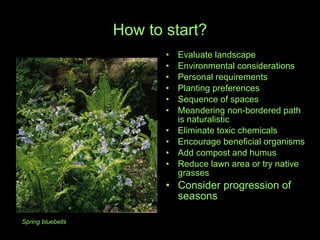
How to start? Evaluate landscape Environmental considerations  Personal requirements Planting preferences  Sequence of spaces Meandering non-bordered path is naturalistic Eliminate toxic chemicals Encourage beneficial organisms Add compost and humus Reduce lawn area or try native grasses Consider progression of seasons Spring bluebells
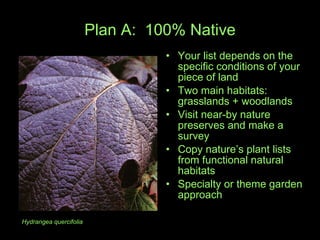
Plan A:  100% Native Your list depends on the specific conditions of your piece of land Two main habitats: grasslands + woodlands Visit near-by nature preserves and make a survey Copy nature’s plant lists from functional natural habitats Specialty or theme garden approach Hydrangea quercifolia
Plan B: Mixed Landscapes Add native plants to traditional landscapes Widest choice of plants Common sense approach Dr. Armitage “Does a chocoholic spurn Ghiradelli or Godiva because they are not made in Hershey, Pa?”  Mainstream natives alongside Japanese Maple Overall, reduce workload  Natives
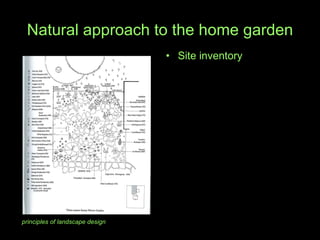
Natural approach to the home garden Site inventory principles of landscape design
Natural approach to the home garden Site inventory Home end and wild end of landscape rock steps
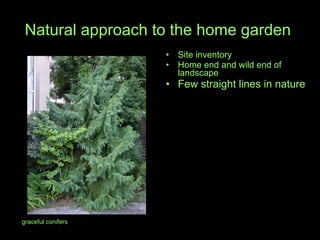
Natural approach to the home garden  Site inventory Home end and wild end of landscape Few straight lines in nature graceful conifers
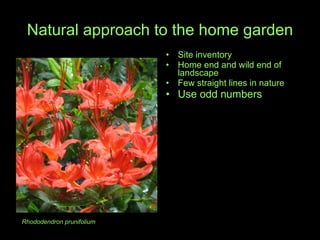
Natural approach to the home garden Site inventory Home end and wild end of landscape Few straight lines in nature Use odd numbers Rhododendron prunifolium
Natural approach to the home garden Site inventory Home end and wild end of landscape Few straight lines in nature Use odd numbers Plants seldom grow at regular intervals Tiarella cordifolia
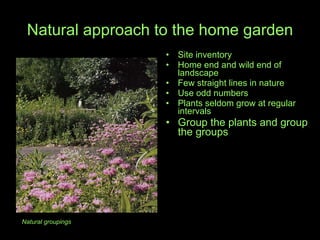
Natural approach to the home garden Site inventory Home end and wild end of landscape Few straight lines in nature Use odd numbers Plants seldom grow at regular intervals Group the plants and group the groups Natural groupings
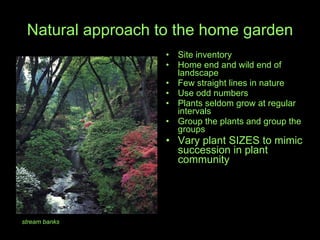
Natural approach to the home garden Site inventory Home end and wild end of landscape Few straight lines in nature Use odd numbers Plants seldom grow at regular intervals Group the plants and group the groups Vary plant SIZES to mimic  succession in plant community stream banks
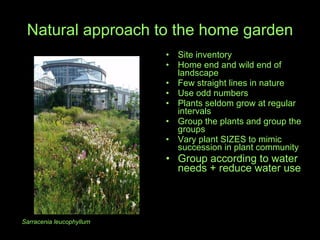
Natural approach to the home garden Site inventory Home end and wild end of landscape Few straight lines in nature Use odd numbers Plants seldom grow at regular intervals Group the plants and group the groups Vary plant SIZES to mimic  succession in plant community Group according to water needs + reduce water use Sarracenia leucophyllum
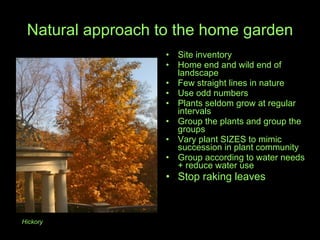
Natural approach to the home garden Site inventory Home end and wild end of landscape Few straight lines in nature Use odd numbers Plants seldom grow at regular intervals Group the plants and group the groups Vary plant SIZES to mimic  succession in plant community Group according to water needs + reduce water use Stop raking leaves Hickory
Maintaining gardens naturally Understand natural processes Tough love  Select plants appropriately Choose plants for their mature size Use Integrated Pest Management Weed control + Mulch Graceful grasses and coneflower
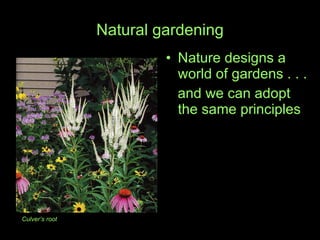
Natural gardening Nature designs a world of gardens . . .  and we can adopt  the same principles Culver’s root
In summary Include natives Match plant requirements to available location Use varying sizes of plants Enjoy your private Eden deck over wetland
Thank You + Go Native!

Natural Gardening

  • 1.
    Using Native plantsin the Home Landscape Geraldine Adamich Laufer
  • 2.
    Natural Gardening Gardeningoffers greatest reward when done in concert with nature
  • 3.
    What is anative plant? All plants native somewhere Many mainstream gardeners don’t know which are native and which aren’t Everyday natives are familiar Pass-along plants Cypredium acaule
  • 4.
    A native plantIndigenous to locale Comes from 1 region Native prior to Columbus Adapting for thousands of years Relationship to climate, soil, pests, other plants ID by botanical name Cypredium kentuckiense
  • 5.
    Plant Ecology Particularcombination of environmental, physical + biotic factors Biome has distinctive patterns: soil, rainfall, topography, wind, temperature, light Each plant takes its place in a web of interactions The natural gardener mimics nature’s design Most efficient landscape Trilliam grandiflorum
  • 6.
    Plant Competition Plantsare not independent Compete for scarce natural resources In the garden too Podophyllum peltatum
  • 7.
    Natural Succession Plantcommunity in state of continual flux Predictable series of changes “seral stages” Gradual replacement of plant communities in a given area Develops dynamic equilibrium, called climax vegetation Where does your garden fall in this succession?
  • 8.
    Plant Tolerance RangeConditions determine where plant can grow + reproduce Similar tolerance ranges overlap and produce a community Plants repeatedly found together e.g. Wetlands –bog plants; wetlands garden
  • 9.
    Types of NativeCommunities/Ecosystems Aquatic Grasslands Desert Shrublands Pinelands Woodlands Forest* Lysichiton americanum
  • 10.
    Great Eastern ForestMixed forests Atlantic and Gulf coasts 40” annual rainfall, evenly distributed Deep, fertile, slightly acidic soils Mild winters Oak, beech, maple, elm, tulip poplar, ash, dogwood, redbud
  • 11.
    Southeastern Mixed ForestOpen forest of Loblolly, shortleaf + other pines Understory grasses, palms 40-60” rainfall evenly distributed, fire Nutrient-poor soils due to high precipitation Gum, bald cypress, oak, hickory, blueberry, dogwood Loblolly and palmetto
  • 12.
    Outer Coastal PlainForest Northern Florida to Gulf Coast + inland to Mississippi Valley Live oak, laurel, magnolia, understory of shrubs, small palms Mosses, woody vines, orchids, epiphytes Extensive stands of pines Live oak
  • 13.
    Regional Natives Colonizedin limited range; just one place e.g. Bartram/ Franklinia Indigenous to a small area Franklinia altamaha
  • 14.
    Non-Natives + “Straddlers”Flowering plants developed ~ 100M years ago: Pangea Then plates began shifting ~ 75M years ago So we have “Straddlers” --same genus, far-flung spp. Examples: Magnolia, Cornus, Rhododendron Asian Magnolia liliflora
  • 15.
    American plants introducedto Europe Wealthy patrons sent plant explorers to the Newe Found Worlde Influx of North American plants to Europe “ American Gardens” fad American plants were outlandish novelties America 16-18 th C Asia 18-20 th C c. 1650
  • 16.
    Non-native plants +Nursery Trade Early colonial nurseries did not sell natives Why? Colonists had neither time nor money to indulge in gardening
  • 17.
    Non-natives favored intrade Colonists preferred familiar favorites from the “old country” Fences and enclosed spaces Clipped hedges and tidy flower beds
  • 18.
    Non-natives favored inU.S. nursery trade Native flora looked wild and unfamiliar If not sold in a nursery, must be a weed Easy to dig up natives from the woods, fields, (not purchase them) Later, European bedding targeted non-native tropicals Swamp hibiscus
  • 19.
    Native American flora+ other eyes Savvy European plant breeders continued to “improve” garden-worthiness of American native plants Grow, evaluate, hybridize and sell back to American markets our native wildflowers Often with German names Rudbeckia “Goldstrum’
  • 20.
    Changing perspectives AfterWWII a large middle class bought homes + yards Copied English borders + European lawns Failure of English borders in U.S. 1962 Environmental Movement, Rachel Carson Ladybird Johnson “Beautify America” rapid growth of suburbs
  • 21.
    Political backing fornatives 1965 Highway Beautification Act eliminated billboards 1973 Operation Wildflower, National Council of State Garden Clubs + DOT 1987 Surface Transportation Act 1994 Executive Mandate stipulated % regional plants on all federal grounds Roadside natives
  • 22.
    Implications of governmentactions Created a supply bottleneck Commercial scarcity of natives America Association of Nurserymen resisted “interference” e.g. Sourwood Oxydendron slow - growing, 8”/year e.g. Black Gum Nyssa problematic taproot Oxydendron arboreum
  • 23.
    Governmental actions controversialImpact of government on Nursery business Over-collection to get starter plants Destruction of habitats Non-regional seed, question of provenance Torreya taxifolia seed collection
  • 24.
    Tolerance Range andProvenance Nurseries needed propagation material and got it anywhere they could Just because one species is native over a wide range doesn’t mean an individual will do well anywhere in that range Echinaceae purpurea
  • 25.
    Interest in regionaldesigns Henry David Thoreau Pioneering work Darrel Morrison University Wisconsin, Madison Prairie restoration + Jens Jensen + O.C. Simmons natives and grasses
  • 26.
    Tradition of RegionalCenters for Natives Avoid horticultural homogenization 1900 Garden in the Woods + New England Wildflower Society 1930s Madison, WI native prairie Cullowhee and Gatlinburg Symposia National Wildflower Research Center, Austin, TX Monarch on Helianthus
  • 27.
    Straight species vs.cultivars debate Straight species has wide genetic diversity Selections can be chosen + vegetatively propagated Solution: Preserve diversity on federal lands Use higher-cost cultivars + selections in private gardens Cornus florida ‘ Cherokee Chief ’
  • 28.
    Today (presentcompany excepted) Average home landscape is ecological disaster Angular, geometric shapes Level, unchanging lawn monocultures 40 M lawnmowers 2 B gallons gas used annually for mowing Sprinkling lawns triples water consumption Herbicides, insecticides, fungicides used Dead soils evaporation
  • 29.
    Native Plant LoversMerger of ideas Creativity Use natives to create optimum environment Follow nature’s guide Learn by trowel + error Creative uses of native plants
  • 30.
    Benefits of NaturalLandscaping Link to tradition Cornus florida
  • 31.
    Benefits of NaturalLandscaping Link to tradition Sense of place, “genius loci” Fothergilla gardenii
  • 32.
    Benefits of NaturalLandscaping Link to tradition Sense of place, “genius loci” Relaxing retreat from straight lines + square corners Edge of woodland
  • 33.
    Benefits of NaturalLandscaping Link to tradition Sense of place, “genius loci” Relaxing retreat from straight lines + square corners Re-discover little-known plants Bog planting for rain garden
  • 34.
    Benefits of NaturalLandscaping Link to tradition Sense of place, “genius loci” Relaxing retreat from straight lines + square corners Re-discover little-known plants Celebrate biodiversity Cleistes bifaria
  • 35.
    Benefits of NaturalLandscaping Link to tradition Sense of place, “genius loci” Relaxing retreat from straight lines + square corners Re-discover little-known plants Contribute to biodiversity Provide habitat for wildlife American Goldfinch
  • 36.
    Benefits of NaturalLandscaping Link to tradition Sense of place, “genius loci” Relaxing retreat from straight lines + square corners Re-discover little-known plants Contribute to biodiversity Provide habitat for wildlife Maintenance + expense are substantially reduced easy to grow native ferns
  • 37.
    Benefits of NaturalLandscaping Link to tradition Sense of place, “genius loci” Relaxing retreat from straight lines + square corners Re-discover little-known plants Contribute to biodiversity Provide habitat for wildlife Substantially less long-term maintenance and expense Lower water needs once established Tough native
  • 38.
    Benefits of NaturalLandscaping Link to tradition Sense of place, “genius loci” Relaxing retreat from straight lines + square corners Re-discover little-known plants Contribute to biodiversity Provide habitat for wildlife Substantially less long-term maintenance and expense Lower water needs once established Conserve natural resources Viburnum dentatum
  • 39.
    Benefits of NaturalLandscaping Link to tradition Sense of place, “genius loci” Relaxing retreat from straight lines + square corners Re-discover little-known plants Contribute to biodiversity Provide habitat for wildlife Substantially less long-term maintenance and expense Lower water needs once established Conserve natural resources Better suited to local conditions Trillium luteum
  • 40.
    Benefits of NaturalLandscaping Link to tradition Sense of place, “genius loci” Relaxing retreat from straight lines + square corners Re-discover little-known plants Contribute to biodiversity Provide habitat for wildlife Substantially less long-term maintenance and expense Lower water needs once established Conserve natural resources Better suited to local conditions Seasonal change and variation fall color
  • 41.
    How to start?Evaluate landscape plan areas
  • 42.
    How to start?Evaluate landscape Environmental considerations ecosystems
  • 43.
    How to start?Evaluate landscape Environmental considerations Personal requirements Eupatorium purpureum
  • 44.
    How to start?Evaluate landscape Environmental considerations Personal requirements Planting preferences Trillium grandiflorum
  • 45.
    How to start?Evaluate landscape Environmental considerations Personal requirements Planting preferences Sequence of spaces Native groundcover planting
  • 46.
    How to start?Evaluate landscape Environmental considerations Personal requirements Planting preferences Sequence of spaces Meandering, non-bordered path is naturalistic riot of color
  • 47.
    How to start?Evaluate landscape Environmental considerations Personal requirements Planting preferences Sequence of spaces Meandering non-bordered path is naturalistic Eliminate toxic chemicals Aesculus pavia
  • 48.
    How to start?Evaluate landscape Environmental considerations Personal requirements Planting preferences Sequence of spaces Meandering non-bordered path is naturalistic Eliminate toxic chemicals Encourage beneficial organisms bees
  • 49.
    How to start?Evaluate landscape Environmental considerations Personal requirements Planting preferences Sequence of spaces Meandering non-bordered path is naturalistic Eliminate toxic chemicals Encourage beneficial organisms Add compost and humus Podophyllum peltatum
  • 50.
    How to start?Evaluate landscape Environmental considerations Personal requirements Planting preferences Sequence of spaces Meandering non-bordered path is naturalistic Eliminate toxic chemicals Encourage beneficial organisms Add compost and humus Reduce lawn area or try native grasses native border + small grassy area
  • 51.
    How to start?Evaluate landscape Environmental considerations Personal requirements Planting preferences Sequence of spaces Meandering non-bordered path is naturalistic Eliminate toxic chemicals Encourage beneficial organisms Add compost and humus Reduce lawn area or try native grasses Consider progression of seasons Spring bluebells
  • 52.
    Plan A: 100% Native Your list depends on the specific conditions of your piece of land Two main habitats: grasslands + woodlands Visit near-by nature preserves and make a survey Copy nature’s plant lists from functional natural habitats Specialty or theme garden approach Hydrangea quercifolia
  • 53.
    Plan B: MixedLandscapes Add native plants to traditional landscapes Widest choice of plants Common sense approach Dr. Armitage “Does a chocoholic spurn Ghiradelli or Godiva because they are not made in Hershey, Pa?” Mainstream natives alongside Japanese Maple Overall, reduce workload Natives
  • 54.
    Natural approach tothe home garden Site inventory principles of landscape design
  • 55.
    Natural approach tothe home garden Site inventory Home end and wild end of landscape rock steps
  • 56.
    Natural approach tothe home garden Site inventory Home end and wild end of landscape Few straight lines in nature graceful conifers
  • 57.
    Natural approach tothe home garden Site inventory Home end and wild end of landscape Few straight lines in nature Use odd numbers Rhododendron prunifolium
  • 58.
    Natural approach tothe home garden Site inventory Home end and wild end of landscape Few straight lines in nature Use odd numbers Plants seldom grow at regular intervals Tiarella cordifolia
  • 59.
    Natural approach tothe home garden Site inventory Home end and wild end of landscape Few straight lines in nature Use odd numbers Plants seldom grow at regular intervals Group the plants and group the groups Natural groupings
  • 60.
    Natural approach tothe home garden Site inventory Home end and wild end of landscape Few straight lines in nature Use odd numbers Plants seldom grow at regular intervals Group the plants and group the groups Vary plant SIZES to mimic succession in plant community stream banks
  • 61.
    Natural approach tothe home garden Site inventory Home end and wild end of landscape Few straight lines in nature Use odd numbers Plants seldom grow at regular intervals Group the plants and group the groups Vary plant SIZES to mimic succession in plant community Group according to water needs + reduce water use Sarracenia leucophyllum
  • 62.
    Natural approach tothe home garden Site inventory Home end and wild end of landscape Few straight lines in nature Use odd numbers Plants seldom grow at regular intervals Group the plants and group the groups Vary plant SIZES to mimic succession in plant community Group according to water needs + reduce water use Stop raking leaves Hickory
  • 63.
    Maintaining gardens naturallyUnderstand natural processes Tough love Select plants appropriately Choose plants for their mature size Use Integrated Pest Management Weed control + Mulch Graceful grasses and coneflower
  • 64.
    Natural gardening Naturedesigns a world of gardens . . . and we can adopt the same principles Culver’s root
  • 65.
    In summary Includenatives Match plant requirements to available location Use varying sizes of plants Enjoy your private Eden deck over wetland
  • 66.
    Thank You +Go Native!

Editor's Notes

  • #8 Gardens get more shady over time, or an act of nature take out trees and let sun pour in
  • #9 Gardener has control
  • #65 Veronicastrum virginicum ‘Album’