High Replication
   Datastore
    Ikai Lan - @ikai
    Esto es Google
    August 9th, 2011
About the speaker

• Developer Relations at Google based out
  of San Francisco, CA
• Google+: http://plus.ikailan.com
• Twitter: @ikai
About the speaker
BIOGRAFÍA: Ikai es ingeniero de Desarrollo de
Programas en el motor de Google App. Antes de
Google, trabajó como ingeniero programador
construyendo aplicaciones para móviles y redes
sociales en LinkedIn. Ikai es un ávido de la
tecnología, consumiendo cantidades de material
acerca de nuevos lenguajes de programación,
estructuras o servicios. En sus ratos libres disfruta
de California, ganando concursos de karaoke
chino y jugando futbol de bandera. Actualmente
vive en el área de la Bahía de San Francisco,
donde agoniza viendo como su equipo favorito
explota temporada tras temporada.


    English original: http://code.google.com/team/
About the speaker
BIOGRAFÍA: Ikai es ingeniero de Desarrollo de
Programas en el motor de Google App. Antes de
Google, trabajó como ingeniero programador
construyendo aplicaciones para móviles y redes
sociales en LinkedIn. Ikai es un ávido de la
tecnología, consumiendo cantidades de material
acerca de nuevos lenguajes de programación,
estructuras o servicios. En sus ratos libres disfruta
de California, ganando concursos de karaoke
chino y jugando futbol de bandera. Actualmente
vive en el área de la Bahía de San Francisco,
donde agoniza viendo como su equipo favorito
explota temporada tras temporada.                       !!!

    English original: http://code.google.com/team/
Agenda

• What is Google App Engine?
• Intro to High Replication Datastore
• How does High Replication work under
  the hood?
If you’re not an App
   Engine developer ..
• First off, shame on you
• The code in these examples might not
  make sense
• The concepts in these slides are always
  good to understand
SaaS

PaaS


IaaS

       Source: Gartner AADI Summit Dec 2009
SaaS

PaaS


IaaS

       Source: Gartner AADI Summit Dec 2009
SaaS

PaaS


IaaS

       Source: Gartner AADI Summit Dec 2009
SaaS

PaaS


IaaS

       Source: Gartner AADI Summit Dec 2009
SDK & “The Cloud”

Hardware

Networking

Operating system

Application runtime

   Java, Python

Static file serving

                      20
Duke, the Java mascot
Go Gopher    Copyright © Sun Microsystems Inc., all rights reserved.
Dynamic Scaling: Low traffic


                            App
                           Server


22
Dynamic Scaling: Low traffic


                            App
                           Server


22
Dynamic Scaling: Grows with
     demand


                          App
                           App
                         Server
                             App
                          Server
                           Server


22
Dynamic Scaling: Grows with
     demand


                          App
                           App
                         Server
                             App
                          Server
                           Server


22
Dynamic Scaling: Grows with
     demand


                          App
                           App
                         Server
                             App
                          Server
                           Server


22
Dynamic Scaling: Grows with
     demand


                          App
                           App
                         Server
                             App
                          Server
                           Server


22
150,000+ Apps
100,000+ Developers
2B Page views / day
Customer: WebFilings


Disruptive multi-tenant App Engine application adopted by
Fortune 500 companies.
Customer: The Royal Wedding


Peak: 32,000 requests a second with no disruption!
Core APIs
Memcache      Datastore   URL Fetch


  Mail         XMPP       Task Queue


 Images       Blobstore   User Service
App Engine
     Datastore
  Schemaless, non-relational
   datastore built on top of
 Google’s Bigtable technology

Enables rapid development
       and scalability
High Replication
• Strongly consistent
• Multi-data center
• Consistent
  performance
• High Reliability
• No data loss
How do I use it?

• Create a new application! Just remember
  the rules
• Fetch by key and ancestor queries exhibit
  strongly consistent behavior

• Queries without an ancestor exhibit
  eventually consistent behavior
Strong vs. Eventual
• Strong consistency means immediately after
  the datastore tells us a write has been
  committed, the effects of that write are
  immediately visible
• Eventual consistency means that after the
  datastore tells us a write has been
  committed, the effects of that write are
  visible after some time
Strong Consistency
Eventual Consistency
This is strongly consistent
DatastoreService datastore = DatastoreServiceFactory
	 	 	 	 .getDatastoreService();
	 	
Entity item = new Entity("Item");
item.setProperty("data", 123);
Key key = datastore.put(item);

// This exhibits strong consistency.
// It should return the item we just saved.
Entity result = datastore.get(key);


                    Get by key
This is strongly consistent
// Save the entity root
Entity root = new Entity("Root");
Key rootKey = datastore.put(root);

// Save the child
Entity childItem = new Entity("Item", rootKey);
                                                  Ancestor
childItem.setProperty("data", 123);
datastore.put(childItem);
                                                   query
Query strongConsistencyQuery = new Query("Item");
strongConsistencyQuery.setAncestor(rootKey);
strongConsistencyQuery.addFilter("data", FilterOperator.EQUAL, 123);
FetchOptions opts = FetchOptions.Builder.withDefaults();

// This query exhibits strong consistency.
// It will return the item we just saved.
List<Entity> results = datastore.prepare(strongConsistencyQuery)
	 	 .asList(opts);
This is eventually consistent
Entity item = new Entity("Item");
item.setProperty("data", 123);
datastore.put(item);

// Not an ancestor query
Query eventuallyConsistentQuery = new Query("Item");
eventuallyConsistentQuery.addFilter("data", FilterOperator.EQUAL, 123);
FetchOptions opts = FetchOptions.Builder.withDefaults();

// This query exhibits eventual consistency.
// It will likely return an empty list.
List<Entity> results = datastore.prepare(eventuallyConsistentQuery)
	 	 	 	 .asList(opts);
Why?

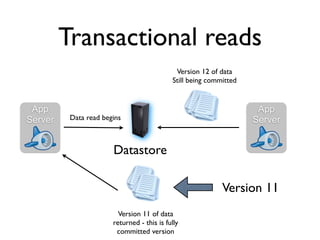
• Reads are transactional
• On a read, we try to determine if we have
  the latest version of data
• If not, we catch up the local node to the
  latest version
To understand this ..

• We need some understanding of our
  implementation of Paxos
• ...which necessitates some understanding of
  transactions
• ... which necessitates some some
  understanding of entity groups
Under the hood
Entity Groups
Entity
                              User
group root


                     Blog            Blog


             Entry          Entry      Entry


      Comment
      Comment                               Comment
Entity group root
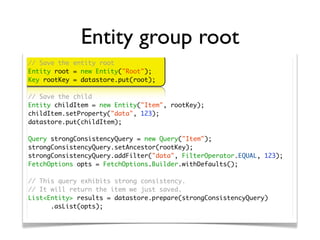
// Save the entity root
Entity root = new Entity("Root");
Key rootKey = datastore.put(root);

// Save the child
Entity childItem = new Entity("Item", rootKey);
childItem.setProperty("data", 123);
datastore.put(childItem);

Query strongConsistencyQuery = new Query("Item");
strongConsistencyQuery.setAncestor(rootKey);
strongConsistencyQuery.addFilter("data", FilterOperator.EQUAL, 123);
FetchOptions opts = FetchOptions.Builder.withDefaults();

// This query exhibits strong consistency.
// It will return the item we just saved.
List<Entity> results = datastore.prepare(strongConsistencyQuery)
	 	 .asList(opts);
Entity group root
Entity
             Root
group root
Adding an entity child
// Save the entity root
Entity root = new Entity("Root");
Key rootKey = datastore.put(root);

// Save the child
Entity childItem = new Entity("Item", rootKey);
childItem.setProperty("data", 123);
datastore.put(childItem);

Query strongConsistencyQuery = new Query("Item");
strongConsistencyQuery.setAncestor(rootKey);
strongConsistencyQuery.addFilter("data", FilterOperator.EQUAL, 123);
FetchOptions opts = FetchOptions.Builder.withDefaults();

// This query exhibits strong consistency.
// It will return the item we just saved.
List<Entity> results = datastore.prepare(strongConsistencyQuery)
	 	 .asList(opts);
Entity Groups
                        Root


We added         Item
a child
Entity Groups
                        Root


We added         Item
a child


                   Transactions “lock”
                      on this entity
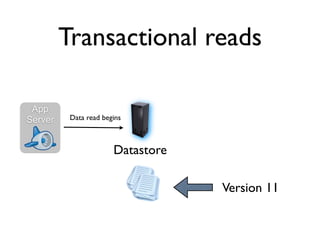
Transactional reads


     Datastore

                 Version 11
Transactional reads

 App
Server    Data read begins


                       Datastore

                                   Version 11
Transactional reads
                                    Version 12 of data
                                   Still being committed


 App                                                        App
Server    Data read begins                                 Server


                       Datastore

                                                   Version 11
Transactional reads
                                             Version 12 of data
                                            Still being committed


 App                                                                 App
Server    Data read begins                                          Server


                       Datastore

                                                            Version 11
                         Version 11 of data
                       returned - this is fully
                        committed version
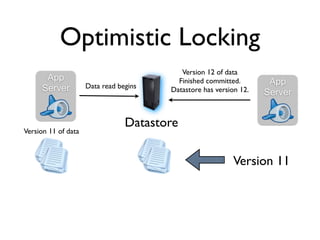
Optimistic locking
 Optimistic because
    you assume
most of the time no
  modifications will
occur while you have
object out - you only
 do work when this
      isn’t true
Optimistic Locking


     Datastore

                 Version 11
Optimistic Locking
 App
Server   Data read begins


                     Datastore

                                 Version 11
Optimistic Locking
      App
     Server          Data read begins


                                 Datastore
Version 11 of data


                                             Version 11
Optimistic Locking
                                           Version 12 of data
      App                                 Finished committed.        App
     Server          Data read begins   Datastore has version 12.   Server


                                 Datastore
Version 11 of data


                                                            Version 11
Optimistic Locking
                                           Version 12 of data
      App                                 Finished committed.        App
     Server          Data read begins   Datastore has version 12.   Server


                                 Datastore
Version 11 of data


                                                            Version 12
Optimistic Locking
                                           Version 12 of data
      App                                 Finished committed.        App
     Server          Data read begins   Datastore has version 12.   Server


                                 Datastore
Version 11 of data
                 Write data back

                                                            Version 12
Optimistic Locking
                                            Version 12 of data
      App                                  Finished committed.        App
     Server          Data read begins    Datastore has version 12.   Server


                                 Datastore
Version 11 of data
                 Write data back

                                                             Version 12
               Trying to write back to
                datastore: exception!

                 Another client has
                   modified data
Life of a distributed write

 1. Writes to the
journal of multiple
    datastores
                       App
                      Server

 2. Returns once
    datastores
  acknowledge
 receiving write
Life of a distributed write
             (part 2)
                    The journal tracks
                    writes that need to
                        be applied
  Write being        Item 1       <data>
   applied           Version 25

                     Item 5       <data>
                     Version 12
  Write to be        Item 1       <data>
applied in future    Version 26
Transactional reads
               Local datastore up to date
 App
Server
                                              Is the item caught up
                                               to the latest journal
           Tries to read from                          write?
             local datastore
                               Journal
    Applied.      Item 1             <data>
                  Version 25


    Applied.      Item 5             <data>
                  Version 12


    Applied.      Item 1             <data>
                  Version 26
Transactional reads
               Local datastore up to date
 App
Server
                                              Is the item caught up
                                               to the latest journal
           Tries to read from                          write?
             local datastore
                                                        Yes!
                               Journal
    Applied.      Item 1             <data>          Return the
                  Version 25
                                                     data in the
                  Item 5             <data>
    Applied.
                  Version 12                         datastore
    Applied.      Item 1             <data>
                  Version 26
Transactional reads
         Local datastore not up to date - Step 1
 App                                          Is the item caught up
Server                                         to the latest journal
                                                       write?
           Tries to read from
             local datastore
                               Journal
    Applied.      Item 1             <data>
                  Version 25


    Applied.      Item 5             <data>
                  Version 12


   Unapplied.     Item 1             <data>
                  Version 26
Transactional reads
         Local datastore not up to date - Step 1
 App                                          Is the item caught up
Server                                         to the latest journal
                                                       write?
           Tries to read from
             local datastore
                                                        No.
                               Journal
    Applied.      Item 1             <data>           Catch the
                  Version 25
                                                      local data
                  Item 5             <data>
    Applied.
                  Version 12                             up
   Unapplied.     Item 1             <data>
                  Version 26
Transactional reads
         Local datastore not up to date - Step 2

                                  All datastores either:
             Waits for local     return up-to-date data
 App       datastore to return      or force catch up
Server
           Request data from
           remote datastore        App uses data from
                                   first datastore that
           Request data from           responds
           remote datastore
More reading

• My example was grossly oversimplified
• More details can be found here:
  http://www.cidrdb.org/cidr2011/Papers/
  CIDR11_Paper32.pdf
Contradictory advice

• Entity groups must be as big as possible to
  cover as much related data as you can
• Entity groups must be small enough such
  that your write rate per entity group never
  goes above one write/second
Summary
• Remember the rules of strong consistency
  vs. eventual consistency
• Group your data into entity groups and use
  ancestor queries when possible
• App Engine’s datastore gives you the best
  of all worlds: high reliability and
  strong data consistency
Questions?


• Google+: http://plus.ikailan.com
• Twitter: @ikai

2011 aug-gdd-mexico-city-high-replication-datastore

  • 2.
    High Replication Datastore Ikai Lan - @ikai Esto es Google August 9th, 2011
  • 3.
    About the speaker •Developer Relations at Google based out of San Francisco, CA • Google+: http://plus.ikailan.com • Twitter: @ikai
  • 4.
    About the speaker BIOGRAFÍA:Ikai es ingeniero de Desarrollo de Programas en el motor de Google App. Antes de Google, trabajó como ingeniero programador construyendo aplicaciones para móviles y redes sociales en LinkedIn. Ikai es un ávido de la tecnología, consumiendo cantidades de material acerca de nuevos lenguajes de programación, estructuras o servicios. En sus ratos libres disfruta de California, ganando concursos de karaoke chino y jugando futbol de bandera. Actualmente vive en el área de la Bahía de San Francisco, donde agoniza viendo como su equipo favorito explota temporada tras temporada. English original: http://code.google.com/team/
  • 5.
    About the speaker BIOGRAFÍA:Ikai es ingeniero de Desarrollo de Programas en el motor de Google App. Antes de Google, trabajó como ingeniero programador construyendo aplicaciones para móviles y redes sociales en LinkedIn. Ikai es un ávido de la tecnología, consumiendo cantidades de material acerca de nuevos lenguajes de programación, estructuras o servicios. En sus ratos libres disfruta de California, ganando concursos de karaoke chino y jugando futbol de bandera. Actualmente vive en el área de la Bahía de San Francisco, donde agoniza viendo como su equipo favorito explota temporada tras temporada. !!! English original: http://code.google.com/team/
  • 6.
    Agenda • What isGoogle App Engine? • Intro to High Replication Datastore • How does High Replication work under the hood?
  • 7.
    If you’re notan App Engine developer .. • First off, shame on you • The code in these examples might not make sense • The concepts in these slides are always good to understand
  • 8.
    SaaS PaaS IaaS Source: Gartner AADI Summit Dec 2009
  • 9.
    SaaS PaaS IaaS Source: Gartner AADI Summit Dec 2009
  • 10.
    SaaS PaaS IaaS Source: Gartner AADI Summit Dec 2009
  • 11.
    SaaS PaaS IaaS Source: Gartner AADI Summit Dec 2009
  • 12.
    SDK & “TheCloud” Hardware Networking Operating system Application runtime Java, Python Static file serving 20
  • 13.
    Duke, the Javamascot Go Gopher Copyright © Sun Microsystems Inc., all rights reserved.
  • 14.
    Dynamic Scaling: Lowtraffic App Server 22
  • 15.
    Dynamic Scaling: Lowtraffic App Server 22
  • 16.
    Dynamic Scaling: Growswith demand App App Server App Server Server 22
  • 17.
    Dynamic Scaling: Growswith demand App App Server App Server Server 22
  • 18.
    Dynamic Scaling: Growswith demand App App Server App Server Server 22
  • 19.
    Dynamic Scaling: Growswith demand App App Server App Server Server 22
  • 20.
  • 21.
    Customer: WebFilings Disruptive multi-tenantApp Engine application adopted by Fortune 500 companies.
  • 22.
    Customer: The RoyalWedding Peak: 32,000 requests a second with no disruption!
  • 23.
    Core APIs Memcache Datastore URL Fetch Mail XMPP Task Queue Images Blobstore User Service
  • 24.
    App Engine Datastore Schemaless, non-relational datastore built on top of Google’s Bigtable technology Enables rapid development and scalability
  • 25.
    High Replication • Stronglyconsistent • Multi-data center • Consistent performance • High Reliability • No data loss
  • 26.
    How do Iuse it? • Create a new application! Just remember the rules • Fetch by key and ancestor queries exhibit strongly consistent behavior • Queries without an ancestor exhibit eventually consistent behavior
  • 27.
    Strong vs. Eventual •Strong consistency means immediately after the datastore tells us a write has been committed, the effects of that write are immediately visible • Eventual consistency means that after the datastore tells us a write has been committed, the effects of that write are visible after some time
  • 28.
  • 29.
  • 30.
    This is stronglyconsistent DatastoreService datastore = DatastoreServiceFactory .getDatastoreService(); Entity item = new Entity("Item"); item.setProperty("data", 123); Key key = datastore.put(item); // This exhibits strong consistency. // It should return the item we just saved. Entity result = datastore.get(key); Get by key
  • 31.
    This is stronglyconsistent // Save the entity root Entity root = new Entity("Root"); Key rootKey = datastore.put(root); // Save the child Entity childItem = new Entity("Item", rootKey); Ancestor childItem.setProperty("data", 123); datastore.put(childItem); query Query strongConsistencyQuery = new Query("Item"); strongConsistencyQuery.setAncestor(rootKey); strongConsistencyQuery.addFilter("data", FilterOperator.EQUAL, 123); FetchOptions opts = FetchOptions.Builder.withDefaults(); // This query exhibits strong consistency. // It will return the item we just saved. List<Entity> results = datastore.prepare(strongConsistencyQuery) .asList(opts);
  • 32.
    This is eventuallyconsistent Entity item = new Entity("Item"); item.setProperty("data", 123); datastore.put(item); // Not an ancestor query Query eventuallyConsistentQuery = new Query("Item"); eventuallyConsistentQuery.addFilter("data", FilterOperator.EQUAL, 123); FetchOptions opts = FetchOptions.Builder.withDefaults(); // This query exhibits eventual consistency. // It will likely return an empty list. List<Entity> results = datastore.prepare(eventuallyConsistentQuery) .asList(opts);
  • 33.
    Why? • Reads aretransactional • On a read, we try to determine if we have the latest version of data • If not, we catch up the local node to the latest version
  • 34.
    To understand this.. • We need some understanding of our implementation of Paxos • ...which necessitates some understanding of transactions • ... which necessitates some some understanding of entity groups
  • 35.
  • 36.
    Entity Groups Entity User group root Blog Blog Entry Entry Entry Comment Comment Comment
  • 37.
    Entity group root //Save the entity root Entity root = new Entity("Root"); Key rootKey = datastore.put(root); // Save the child Entity childItem = new Entity("Item", rootKey); childItem.setProperty("data", 123); datastore.put(childItem); Query strongConsistencyQuery = new Query("Item"); strongConsistencyQuery.setAncestor(rootKey); strongConsistencyQuery.addFilter("data", FilterOperator.EQUAL, 123); FetchOptions opts = FetchOptions.Builder.withDefaults(); // This query exhibits strong consistency. // It will return the item we just saved. List<Entity> results = datastore.prepare(strongConsistencyQuery) .asList(opts);
  • 38.
  • 39.
    Adding an entitychild // Save the entity root Entity root = new Entity("Root"); Key rootKey = datastore.put(root); // Save the child Entity childItem = new Entity("Item", rootKey); childItem.setProperty("data", 123); datastore.put(childItem); Query strongConsistencyQuery = new Query("Item"); strongConsistencyQuery.setAncestor(rootKey); strongConsistencyQuery.addFilter("data", FilterOperator.EQUAL, 123); FetchOptions opts = FetchOptions.Builder.withDefaults(); // This query exhibits strong consistency. // It will return the item we just saved. List<Entity> results = datastore.prepare(strongConsistencyQuery) .asList(opts);
  • 40.
    Entity Groups Root We added Item a child
  • 41.
    Entity Groups Root We added Item a child Transactions “lock” on this entity
  • 42.
    Transactional reads Datastore Version 11
  • 43.
    Transactional reads App Server Data read begins Datastore Version 11
  • 44.
    Transactional reads Version 12 of data Still being committed App App Server Data read begins Server Datastore Version 11
  • 45.
    Transactional reads Version 12 of data Still being committed App App Server Data read begins Server Datastore Version 11 Version 11 of data returned - this is fully committed version
  • 46.
    Optimistic locking Optimisticbecause you assume most of the time no modifications will occur while you have object out - you only do work when this isn’t true
  • 47.
    Optimistic Locking Datastore Version 11
  • 48.
    Optimistic Locking App Server Data read begins Datastore Version 11
  • 49.
    Optimistic Locking App Server Data read begins Datastore Version 11 of data Version 11
  • 50.
    Optimistic Locking Version 12 of data App Finished committed. App Server Data read begins Datastore has version 12. Server Datastore Version 11 of data Version 11
  • 51.
    Optimistic Locking Version 12 of data App Finished committed. App Server Data read begins Datastore has version 12. Server Datastore Version 11 of data Version 12
  • 52.
    Optimistic Locking Version 12 of data App Finished committed. App Server Data read begins Datastore has version 12. Server Datastore Version 11 of data Write data back Version 12
  • 53.
    Optimistic Locking Version 12 of data App Finished committed. App Server Data read begins Datastore has version 12. Server Datastore Version 11 of data Write data back Version 12 Trying to write back to datastore: exception! Another client has modified data
  • 54.
    Life of adistributed write 1. Writes to the journal of multiple datastores App Server 2. Returns once datastores acknowledge receiving write
  • 55.
    Life of adistributed write (part 2) The journal tracks writes that need to be applied Write being Item 1 <data> applied Version 25 Item 5 <data> Version 12 Write to be Item 1 <data> applied in future Version 26
  • 56.
    Transactional reads Local datastore up to date App Server Is the item caught up to the latest journal Tries to read from write? local datastore Journal Applied. Item 1 <data> Version 25 Applied. Item 5 <data> Version 12 Applied. Item 1 <data> Version 26
  • 57.
    Transactional reads Local datastore up to date App Server Is the item caught up to the latest journal Tries to read from write? local datastore Yes! Journal Applied. Item 1 <data> Return the Version 25 data in the Item 5 <data> Applied. Version 12 datastore Applied. Item 1 <data> Version 26
  • 58.
    Transactional reads Local datastore not up to date - Step 1 App Is the item caught up Server to the latest journal write? Tries to read from local datastore Journal Applied. Item 1 <data> Version 25 Applied. Item 5 <data> Version 12 Unapplied. Item 1 <data> Version 26
  • 59.
    Transactional reads Local datastore not up to date - Step 1 App Is the item caught up Server to the latest journal write? Tries to read from local datastore No. Journal Applied. Item 1 <data> Catch the Version 25 local data Item 5 <data> Applied. Version 12 up Unapplied. Item 1 <data> Version 26
  • 60.
    Transactional reads Local datastore not up to date - Step 2 All datastores either: Waits for local return up-to-date data App datastore to return or force catch up Server Request data from remote datastore App uses data from first datastore that Request data from responds remote datastore
  • 61.
    More reading • Myexample was grossly oversimplified • More details can be found here: http://www.cidrdb.org/cidr2011/Papers/ CIDR11_Paper32.pdf
  • 62.
    Contradictory advice • Entitygroups must be as big as possible to cover as much related data as you can • Entity groups must be small enough such that your write rate per entity group never goes above one write/second
  • 63.
    Summary • Remember therules of strong consistency vs. eventual consistency • Group your data into entity groups and use ancestor queries when possible • App Engine’s datastore gives you the best of all worlds: high reliability and strong data consistency
  • 64.

Editor's Notes

  • #2 \n
  • #3 \n
  • #4 \n
  • #5 \n
  • #6 \n
  • #7 \n
  • #8 Does CLOUD COMPUTING just means your servers are SOMEWHERE ELSE? Or is it SOMETHING MORE?\nWHY put your servers in the cloud?\n- Don&amp;#x2019;t want to MANAGE servers?\n- Or is it the ELASTICITY and SCALABILITY of the cloud?\n- If so, you NEED: DISTRIBUTED cloud computing\n * TODAY we&amp;#x2019;ll talk about why\n
  • #9 Does CLOUD COMPUTING just means your servers are SOMEWHERE ELSE? Or is it SOMETHING MORE?\nWHY put your servers in the cloud?\n- Don&amp;#x2019;t want to MANAGE servers?\n- Or is it the ELASTICITY and SCALABILITY of the cloud?\n- If so, you NEED: DISTRIBUTED cloud computing\n * TODAY we&amp;#x2019;ll talk about why\n
  • #10 Does CLOUD COMPUTING just means your servers are SOMEWHERE ELSE? Or is it SOMETHING MORE?\nWHY put your servers in the cloud?\n- Don&amp;#x2019;t want to MANAGE servers?\n- Or is it the ELASTICITY and SCALABILITY of the cloud?\n- If so, you NEED: DISTRIBUTED cloud computing\n * TODAY we&amp;#x2019;ll talk about why\n
  • #11 \n
  • #12 \n
  • #13 SPECIALIZATION =&gt; SCALABILITY\n
  • #14 SPECIALIZATION =&gt; SCALABILITY\n
  • #15 SPECIALIZATION =&gt; SCALABILITY\n
  • #16 SPECIALIZATION =&gt; SCALABILITY\n
  • #17 SPECIALIZATION =&gt; SCALABILITY\n
  • #18 SPECIALIZATION =&gt; SCALABILITY\n
  • #19 \n
  • #20 \n
  • #21 \n
  • #22 SPECIALIZATION =&gt; SCALABILITY\n
  • #23 \n
  • #24 \n
  • #25 \n
  • #26 \n
  • #27 \n
  • #28 \n
  • #29 \n
  • #30 \n
  • #31 \n
  • #32 \n
  • #33 \n
  • #34 \n
  • #35 \n
  • #36 \n
  • #37 \n
  • #38 \n
  • #39 \n
  • #40 \n
  • #41 \n
  • #42 \n
  • #43 \n
  • #44 \n
  • #45 \n
  • #46 \n
  • #47 \n
  • #48 \n
  • #49 \n
  • #50 \n
  • #51 \n
  • #52 \n
  • #53 \n
  • #54 \n
  • #55 \n
  • #56 \n
  • #57 \n
  • #58 \n
  • #59 \n