From:            Tsuji, Michael
To:              ColaJoann@epamail.epa.gov;
cc:              Kurano, Matthew; Seto, Joanna L;
Subject:         Waimanalo Gulch Landfill discharge
Date:            Wednesday, January 12,201110:31:10 AM
Attachments:     Dwg1 Limits of Liner System. pdf
                 Stormwater 12232010.pdf
                 101223 Waimanalo Gulch Landfill Discharge final.pdf


Joann,
Attached are:  1. CWB's inspection report on the landfill, December 23, 2010.
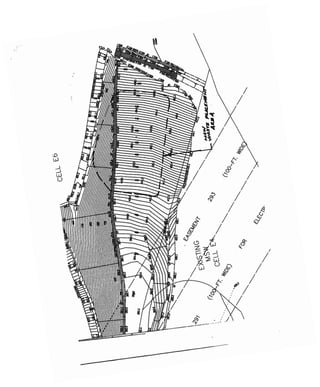
                 2. Waimanalo Gulch Landfill's drawing of the E6 cell where the
stormwater collected and contacted the trash.
                 3. Rainfall data

Below is the link to the news article on the landfill discharge.
http://www.khon2.com!content!news!developingstories/story!Landfill-Runoff-
Concerns-Watchdog!D9Aa jUUxUKfWS3VugDdHA.cspx

When things settle down, we should discuss our enforcement options, one,
because it is Waste Management, EPA may want to join the State in an
enforcement action.

Michael Tsuji
State of Hawaii
Department of Health
Clean Water Branch
Enforcement Section Supervisor
808-586-4309
Yamada, Stuart H
From:                       Okubo, Janice S.
Sent:                       Wednesday, January 12, 2011 10:33 AM
To:                         Gill, Gary L.; Yamada, Stuart H; Chang, Steven Y; Wong, Alec Y; Tsuji, Matthew; Tsuji,
                            Michael; Seto, Joanna L
Subject:                    TV News Clips for landfill and brown water advisory -- FW: Dateline Media, Inc. Search
                            'Department of Health' Found 3 Stories


FYI --

Attached or below are TV news stories on the landfill discharge and brown water advisory for Maui.


From: Ted Sappington, Dateline Media, Inc. (Auto Reports) [mailto:ted@dateline-media.com]
Sent: Wednesday, January 12, 2011 4:38 AM
To: Okubo, Janice S.
Subject: Dateline Media, Inc. Search 'Department of Health' Found 3 Stories

                                    DATEUNE MEDIA, INC.
                                              Media A1onitoring Network.
                        (BOB) 949-7710   •   www.dateline-media.oom   •


                                             State Department of Health

       1. JAN 112011               SUNRISE ON KGMB                        Nielsen Audience: 30,310 Calculated Ad
'.iiV7:00AM HI                                                                                  Equivalency: $1,092
       []ORDER                       KGMB-CBS HONOLULU,                Run Time: 2:36 Calculated Publicity Value:
                                    HI                                                                        $3,276
                                                                                   30-Second Ad Equivalency: $210
        [**07:12:05**] rnPreview Clip Morning news headline: guest live remote: university of Hawaii student
        brissa mamamura. It is a security breach that may have affected thousands of uh alumni. The school will"
        talk about ways to safeguard information. Ramsay wharton live with a little bit more. Good morning.
        Good morning. That's right. Uh getting into session for the spring term. Just yesterday. And we've been
        mentioning traffic and weather, but students are starting to pour on campus. With the new year brings new
        discussions about privacy breaches. Just after 1:00 today, officials here is going to be meeting with some
        tech can is from can ies from the state and city. They're going to be talking about ways and steps they can
        take. This comes as a result of the class action lawsuit med in November against the university on behalf
        of a former uh student who says his social security number made it out online. Here's his attorney.
        Soundbite: victim's attorney Thomas grande. "Our client in it case, felipe gross discovered in February of
        this year that four other individuals had been using his social security number. He discovered that when
        he's plied with a grant with the State Department OF HEALTH. Several month later he was informed
        business his credit card company his credit card was being used to purchase gasoline on the mainland.
        Again, that victim alleging he was expected by two of the four security breaches recently. Now the uh
                                                             1
lawsuit wants the university they want the federal court to order them to stop using social security
numbers on campuses. And to take further steps, including pay for credit monitoring for the victims and
identity theft insurance. We've been able to talk to a couple of students this morning. Good morning. We
talked about you were among the students that received the email last year. How do you feel this morning,
knowing that your privacy is continuing suggests. It defInitely concerns me. I don't want to be a victim,
and I think it's really important that they take all measures to protect our information because we entrust
our information with them. And if something like that happened in the past, it can defInitely happen again.
We understand that back in 2002, uh officials said that they tried to take a step to stop using social security
numbers but they needed it for tax purposes, fmancial aid. Do you think that's going to be a real option
with the university, and would you agree with that?

2. JAN 11 2011             WAKEUP2DAY                               Nielsen Audience: 13,987 Calculated Ad
                                                                                          Equivalency: $1,400
 [ ]ORDER                     KHON-FOX HONOLULU,                 Run Time: 2:20 Calculated Publicity Value:
                             HI                                                                         $4,200
                                                                            30-Second Ad Equivalency: $300
[**05:41:39**] ru!Preview Clip Morning news headline: waimanalo gulch landfill gathers more than 400-
thousand tons of the island's trash every year. And during heavy rains that trash mixes with water. Andrew
pereira has more now on a large discharge during our last big storm. It's the law of gravity, water always
flows downhill. So when waimanalo gulch landfill was pounded by rain December 19th, all that water
flowed into the ocean. Soundbite: envirowatch, Carroll cox, "this brings on a big problem. Environmental
watchdog Carroll cox raises an obvious concern, rain water mixed with trash and ash from h-power is not
a good combination. Soundbite: cox, "the chemicals that people throwaway and household waste and all
of that is being introduced potentially into the water system. Waste management, the company that runs
the landfill for the city, believes 7.5 million gallons of rainwater gathered inside one of the cells where
garbage trucks dump their trash. The STATE HEALTH DEPARTMENT believes some or all of the
water went into the ocean pumped into a concrete channel that snakes down the landfIll, flows underneath
farrington highway and end's up here, at the water's edge behind ko olina resort. Soundbite: cox, "it
presents a problem but it's a problem we can't quantify right now but we know that it has the potential of
having a devastating impact on the environment and the animals and plants there. When STATE
HEALTH inspectors examined the area four days after last month's storm, waste management tested the
storm water, which showed contaminants did not exceed STATE HEALTH guidelines. However, sen.
Josh green, a doctor who also chairs the health committee, says that doesn't mean you should be
swimming in the area after a big rain. Soundbite: sen. Josh green, "avoid it, you know it's still just smart
because these samples are just you know samples, spots in time. Green says storm runoff, especially from
a landfill, can contain staph and e- coli bacteria. And although the storm water last month tested within
acceptable limits, he's disappointed warning signs were not posted. Soundbite: green, "some people are
more sensitive than others so a sign does no harm. Andrew pereira khon-2 news, Hawaii's news leader
waste management says its permit with the STATE HEALTH DEPARTMENT does allow it to
discharge storm water into the ocean.

   JAN 112011              HAWAII AT 5                          Nielsen Audience: 44,660 Calculated Ad
                                                                                       Equivalency: $750
 []ORDER                   KHON-FOX HONOLULU,                Run Time: 0:50 Calculated Publicity Value:
                           HI                                                                      $2,250
                                                                         30-Second Ad Equivalency: $450
[**05:02:27 PM**] [Eh>review Clip News headline: last night's storm front continues to cause problems
for residents on maui. A brown water advisory is in place from maalaea to kihei. STATE HEALTH
OFFICIALS are concerned last night's heavy rains may lead to potentially dangerous brown water. Also
an issue is the drinking water in kula. The rains damaged a waterline near kawehi place in upper kula, and
county officials say that may have compromised the water quality in the system. Residents are being told
                                                    2
to boil water before drinking it. Soundbite: maui county spokesperson, rod antone, "it is just not worth it
     taking a chance to use the water from tap right now because it has been exposed we just don't know what
     is in there and we don't want anyone getting sick. Water testing is taking place and the department of
     water supply will notify customers when it is safe to drink water from the tap.


Report Generated:                           2011/01/1208:37:44.742 (CT)
Total   Story Count:                                                        3
Total   Nielsen Audience:                                           88,957
Total   30-Second Ad Equivalency:                                     $960
Total   Run Time:                                                      5:46
Total   Calculated Ad Equivalency:                                  $3,242
Total   Calculated Publicity Value:                                 $9,726


                            To order clips from this report,
                            check the ORDER box for each story required,
                            then open the Clip Order page by clicking here.
                            [Order Clips]
                            If the Clip Order page does not appear,
                            or the clips you want to order do not have an ORDER box,
                            notify your monitoring service.

           This report contains copyrighted material and may be used for file and reference purposes only. Any
           reproduction, sale or distribution is prohibited.
           Portions © 2009 Nielsen Media Research, Inc. Ratings data contained herein are the
           copyrighted property of Nielsen Media Research, Inc. All Rights Reserved.


                                                               3
<,

     Miyashiro, Thomas
     From:                       Whelan, Joseph [JWhelan1@wm.com]
     Sent:                       Wednesday, January 12, 2011 3:51 PM
     To:                         Miyashiro, Thomas; Ichinotsubo, Lene K
     Cc:                         Lottig, Justin; Frey, Jesse; Von Pein, Rick
     Subject:                    Request for Approval to Resume Cell 6 Waste Receipts
     Attachments:                DOCCELL 6 .pdf; Assessment of Northwestern Portion of Cell E6 for MSW Placement
                                 Waimanalo Gulch Sanitary Landfill.htm


     Greetings Lene & Tom.

          Please find attached the report from AECOM, QC firm for the Cell 6 construction project, which addresses
     the Departments concerns over our resuming operations in Cell 6. I would appreciate your review and
     providing an email approval to resume disposal activities within cell 6 at this time. Please contact me with any
     questions as soon as possible, as we are nearing capacity in other areas of the landfill. Thank you.


          Best regards,

     «DOCCELL 6 .pdf»

         Joe          «Assessment of Northwestern Portion of Cell E6 for MSW Placement Waimanalo Gulch Sanitary
     Landfill.htm»


     General Manager

     Waste Management of Hawaii

     808-668-2985, ext. 15 Office

     808-668-1366 Fax

     808-479-4610 Mobile

      Waste Management's landfills provide over 17,000 acres of
     protected land for wildlife habitats and 15 landfills are certified
     by the Wildlife Habitat Council.


     Waste Management recycles enough paper every year to save 41 million trees. Please recycle
     any printed emails.


                                                                 1
Miyashiro, Thomas
From:                       Miyashiro, Thomas
Sent:                       Thursday, January 13, 2011 11:17 AM
To:                         Whelan, Joseph
Cc:                         Ichinotsubo, Lene K; Fujimoto, Janice K; Ruiz, Jose A; jlottig@wm.com;jfrey@wm.com;
                            rvonpein@wm.com; Chang, Steven Y; Yamada, Stuart H
Subject:                    RE: Request for Approval to Resume Cell 6 Waste Receipts


Hi Joe: We acknowledge receipt and have no adverse comments on your submittal of AECOM's assessment and
acceptance of the containment and leachate collection systems in the area to be used in Cell E6, as depicted in the
attached drawing. However, because of the severe rain event last night, based on a conversation with Jesse this
morning, we understand that virtually the entire area of the lined portion of Cell E6 is under water, and the water level is
near the top of the new berm constructed on the south side of the cell. Unfortunately, in view of this development, this
assessment should be redone or updated. We can only sympathize with you as this worst case scenario continues.

With best regards,
Tom


From: Whelan, Joseph [mailto:JWhelan1@wm.com]
sent: Wednesday, January 12, 2011 3:51 PM
To: Miyashiro, Thomas; Ichinotsubo, Lene K
Cc: Lottig, Justin; Frey, Jesse; Von Pein, Rick
Subject: Request for Approval to Resume cell 6 Waste Receipts


Greetings Lene & Tom.

     Please find attached the report from AECOM, QC firm for the Cell 6 construction project, which addresses
the Departments concerns over our resuming operations in Cell 6. I would appreciate your review and
providing an email approval to resume disposal activities within cell 6 at this time. Please contact me with any
questions as soon as possible, as we are nearing capacity in other areas ofthe landfill. Thank you.


     Best regards,

«DOCCELL 6 .pdf»

     Joe         «Assessment of Northwestern Portion of Cell E6 for MSW Placement Waimanalo Gulch Sanitary
Landfill.htm»


General Manager

Waste Management of Hawaii

808-668-2985, ext. 15 Office


                                                             1
808-668-1366 Fax

808-479-4610 Mobile

 Waste Management's landfills provide over 17,000 acres of
protected land for wildlife habitats and 15 landfills are certified
by the Wildlife Habitat Council.


Waste Management recycles enough paper every year to save 41 million trees. Please recycle
any printed emails.


                                                            2
Page 1 of2
·From:                         Boyle, Ron [Ron.Boyle@aecom.com]
 Sent:                         Wednesday, January 12, 2011 2:31 PM
 To:                           Whelan, Joseph
 Cc:                           Frey, Jesse; Frerich, Dan; Lottig, Justin
 Subject:                     Assessment of Northwestern Portion of Cell E6 for MSW Placement, Waimanalo Gulch sanitary
                             Landfill

Hi Joe,

It is AECOM's understanding that WMH would like to begin filling MSW in the northwestern portion of Cell E6 at the Waimanalo
Gulch sanitary Landfill (WGSL). This area is at a higher elevation which has not been flooded by recent storm events and is
needed for lmmediate use due to lack of alternative filling areas. The purpose of this e-mail is to address concerns recently
expressed by DOH Solid Waste Branch before filling can commence. The primary concerns are discussed below:

    1.     On Monday, 1/10/11, AECOM observed the northwestern sideslope of the Cell E-6 liner for any potential damage due to
          large rocks that were rolled down from the Western Surface Water Drainage excavation last week. The sideslope liner is
          covered by approximately 3 feet of operations layer (sand material) on the bench and 2 feet on the sideslope and was
          previously placed in accordance with the project specifications. Due to recent rains (late December 2010), erosion gullies
          had formed in the sideslope operations layer but these areas were repaired by Goodfellow Brothers, Inc. (GBI) prior to
          excavating and pushing rocks down from above. Based on discussions with GBI personnel and field observations, it
          appears that the operations layer was intact and provided the necessary protection to the liner from the rocks rolled
          down from above. There are large rocks/boulders spread along the E-6liner bench and floor that should be removed
          carefully with an excavator to prevent damage to the underlying liner and leachate collection layer. On Wednesday,
          1/12/11, AECOM's CQA representative (Dan Frerich) observed that the rocks on the floor of the cell were carefully
          removed using a tracked excavator and stockpiled outside of the landfill cell.
    2.     On Wednesday, 1/12/11, AECOM observed the northwestern edge of the Cell E6 floor liner for any potential damage to
          the encapsulated liner system as a result of recent flooding events. Based on AECOM's observations, it appears this area
          did not sustain any significant damage from flooding. The edge of liner in this area was constructed in accordance with
          Detail W shown on sheet no. 10 of the drawings prepared by Geosyntec (dated January 2010). The northern edge of the
          liner system along the cell floor was buried in a l-foot deep trench, then backfilled will soil cushion material and covered
          with pieces of plywood. This edge was then covered with a 4.5-foot high stormwater diversion berm constructed with
          compacted soil cushion material. The edge of E6 floor liner further to the east at the E4 liner tie-in area was damaged by
          the recent storm flows due to it being at a lower elevation. An assessment of the damage in this tie-in area is currently
          underway.
    3.     On Wednesday, 1/12/11, AECOM observed the northwestern edge of the Cell E6 floor for any potential damage to the
          LCRS gravel layer. Based on AECOM's observations, it appears that there were minimal impacts from the recent storm
          flows to this area. Because the overlying operations layer and MSW placed in 2010 are visually intact, it is expected that
          the underlying LCRS gravel layer is intact. Additionally, a layer of 10 oz/sy geotextile filter layer fabric protects the
          underlying gravel from infiltration of silt. The leading edge of the LCRS gravel layer will be exposed later in 2011 for
          completion of the remainder of Cell E6 and CQA monitors will confirm that the gravel is free of contamination.
    4.     On Wednesday, 1/12/11 AECOM met with WMH and GBI personnel to discuss measures being taken to prevent further
          clogging of the temporary drainage inlet no. 1. An approximately 15-foot high temporary berm was constructed across
          the valley floor yesterday to contain runoff and direct it into the drainage inlet. It was agreed that the area surrounding
          the inlet should be dug down to the level of the inlet riser by removing mud and rocks that had accumulated from
          previous storm events. This will increase the storage capacity for debris accumulation in future events. A berm of large
          boulders will be stacked just upstream of the inlet to act as an energy dissipater and hold back debris from clogging the
          inlet grate. AECOM's CQA representative will remain on site to confirm that these improvements are completed today.

In conclusion, based on our recent observations of Cell E6 at WGSL and completion of temporary drainage measures, we believe
that the northwestern section of Cell E6 is in good condition and has adequate protection from future storm events to allow
placement of MSW.

Let me know if you have any questions.


file://C:Documents and SettingstmiyashiroLocal SettingsTemporary Inter... 2/17/2011
Page 2 of2

Ron Boyle, P.E.
Senior Engineer. Environment
D 808.356.5321 Cell 808.497.5941
ron.boyle@aecom.com
AECOM Technical Services
1001 Bishop Street, Suite 1600
Honolulu, HI 96813
T 808.523.8874 F 808.523.8950
www.aecom.com


file://C:Documents and SettingstmiyashiroLocal SettingsTemporary Inter... 2/17/2011
.,
 I


     ..


                                                               /

                                                           /
                                                       /
                                                   /
                                               /
                                   ,::     /
           cv"'
            9)
                    .' ,,-•,,'" '.: "I.,
          ---

                  --------
From:             Steinberger, Timothy E
To:               Gill, Gary L.; Chang, Steven Y;
                  Seto, Joanna L;
Subject:          WGSL Stormwater
Date:             Wednesday, January 12, 2011 9:45:14 PM
Attachments:      WGSL letter to DOH 1-12-11.doc


Please refer to the attached letter stating my concerns on the DOH position
regarding storm water runoff. Hard copy of the letter will follow.

Timothy E. Steinberger, PE
Director
Department of Environmental Services
January 12,2011

Honorable Gary Gill
Deputy Director
Environmental Health Administration
State of Hawaii, Department of Health
1250 Punchbowl Street
Honolulu, HI 96813

Mr. Steven Chang
Branch Chief
Solid and Hazardous Waste Branch
State of Hawaii, Department of Health
919 Ala Moana Boulevard
Room 300
Honolulu, HI 96814-4920

Ms. Joanna L Seto
Acting Branch Chief
Clean Water Branch
State of Hawaii, Department of Health
919 Ala Moana Boulevard
Room 300
Honolulu, HI 96814-4920

       Re:     Waimanalo Gulch Sanitary Landfill (WGSL)
               Storm Water Drainage

Deputy Director Gary Gill and Mr. Chang and Ms. Seto:

I am writing in response to Department of Health (DOH), Clean Water Branch's
(CWB's) recent directive to the Department of Environmental Services (ENV) and Waste
Management Hawaii (WMH) from Mike Tsuji to post signage relating to releases of
allegedly contaminated wastewater. The City contends that such signage is not required
by the law. However, in order to explain this position, I need to review the recent events
and understandings leading to this recent CWB directive.

Storm Event and Resultant Accumulation of Storm Water:
On December 19,2010, there were heavy rains on Oahu that resulted in storm water
runoff at WGSL. On December 20, 2010, WMH contacted the DOH, Solid and
Hazardous Waste Branch (SHWB) as a courtesy to notify them of the established practice
of draining storm flows from as heavy as a 24-hour, 25-year storm into the storm water
drain systems required by the WGSL Solid Waste Management Permit No. LF-0182-09
(SWM Permit).
On Tuesday, December 21,2010, CWB inspectors inspected WGSL, with the assistance
of Justin Lottig of WMH who fully disclosed to the CWB inspectors WMH's actions in
response to the storm. The CWB inspectors left without indicating to WMH that they
had any concerns regarding WMH's actions.

Two days after the CWB inspection, on December 23, 2010, in response to WMH's
courtesy notification fours days earlier, SHWB inspectors conducted an inspection of
WGSL and expressed concern that they observed that the storm water had touched
municipal solid waste. After speaking with Mr. Lottig, the SHWB inspectors appeared to
be less concerned with WMH's treatment of the storm water, commenting that it was
less of a concern given the fact that the entire island was under a brown water advisory.

Later that same afternoon, CWB inspectors returned for a second inspection, during
which they talked again with Mr. Lottig and then requested that WMH take samples of
the storm water and discontinue the discharge of the storm water into the storm water
drain systems. WMH complied with both requests. The test results have since been
obtained and confirm that the storm water met state and federal standards for storm water
run off, except for naturally-occurring background concentrations of iron and zinc, which
are typically found in storm water discharges throughout Oahu.

Also that afternoon on December 23,2010, Joanna Seto from the CWB contacted ENV
and instructed ENV to issue a press release stating that there had been a release of storm
water that is potentially contaminated with leachate into the Ko Olina coastal area. She
said that this reporting requirement was similar to the requirement to issue a press release
when there is a sewer spill. Ms. Seto did not explain the basis for, her conclusion that the
storm water was potentially contaminated with leachate, and also mistakenly equated this
event with a wastewater discharge. ENV therefore declined, explaining that the storm
water was not leachate under the law, that draining the storm water flows was an
established practice with which DOH was familiar, and that there was no basis for
requiring the press release. At approximately 9:41 p.m. that night, DOH issued its own
press release advising that WGSL had "discharged a large quantity of storm water
potentially contaminated with landfill waste to the Pacific Ocean."

On January 12,2011, twenty-four days after the initial discharge of storm water, Mike
Tsuji from CWB contacted ENV, Division of Environmental Quality, and WMH,
directing them to post signage regarding "contaminated water" from WGSL if an event
similar to the December 19,2010 storm occurred during the currently pending flood
advisory issued for Oahu.

ENV's understanding is that the storm water from the December 19, 2010 event had not
"percolated or passed through or emerged from solid waste" as defined in Hawaii
Administrative Rules section 11-58.1 and was therefore not leachate under the law.
Instead, DOH believes that the storm water had some (unquantified) contact with solid
waste and that pursuant to Section G, entitled "Surface Water Management," number 2 of
the SWM Permit "[s]tormwater that comes in contact with solid waste shall be managed
and disposed of as leachate." Therefore, although the storm water itself was not leachate
under the law, DOH asserts that it was to be treated as leachate as provided in the SWM
Permit.

Potential Public Health Emergency Created by Closure ofWGSL Averted - Storm Water
Disposed of into Wastewater Treatment Facilities:
If the subject storm water is not drained from the areas of accumulation, WMH will not
be able to continue to operate WGSL, resulting in a potential public health emergency
due to restricted waste collection and disposal options for the entire island of Oahu.
Therefore, notwithstanding its belief that the storm water is not leachate, at DOH's
insistence, ENV agreed to assist WMH in its disposal of the accumulated storm water, via
the wastewater collection system, into the Waianae and Kailua wastewater treatment
facilities, thus enabling WMH to move forward with the continued operation of WGSL.
This disposal requires ENV to closely coordinate and monitor the discharge to ensure that
the collection system has capacity to accommodate the additional volume, and that the
storm water does not impede the capacity or effective operation of the treatment plants.
Because the storm water was not leachate under the law and cannot generally be disposed
of in the collection system, I exercised my discretion to invoke an exception to Revised
Ordinance of Honolulu (ROH) Sec. 14-1.9, "Use of public sewers--Restrictions-
Violations," to justify the disposal at the treatment facilities.[l]

I conferred with the SHWB and CWB on January 11,2011 and all parties agreed to a
plan of action to ensure continued use of WGSL via the draining of the accumulated
storm water into the treatment plants so as to facilitate incremental re-opening of the
impacted E-6 Cell.

CWB Directive to Post Contaminated Water Signage Not Required by Law:
Today, the CWB contacted ENV and WMH to demand the posting of signs warning of
contaminated water discharges from WGSL, given the predicted rainfall. CWB cited no
authority for this demand. but the directive implies that the storm water be treated as
though it were wastewater The City finds no basis for this conclusion in law. HAR
section 11-62-06(g)(5) provides in relevant part that, "[n]o person or the owner shall
cause or allow any wastewater system to create or contribute to ... [w]astewater spill,
overflow, or discharge into surface waters or the contamination or pollution of state
waters[.]" HAR chapter 11-62, Appendix C, section 2.e requires that when there are
spills from a facility, warning signs are to be posted in the areas likely to be affected by
the spill and where public access is possible. We are assuming that this is the purported
legal basis for CWB's directive to ENV and WMH.

However, this is not applicable to the present circumstances because WGSL is not a
"wastewater system" as defined by HAR section 11-62-03:

       "Wastewater system" means the category of all wastewater and wastewater sludge
       treatment, use, and disposal systems, including all wastewater treatment works,
collection systems, wastewater sludge facilities, recycled water systems, and
       individual wastewater systems.

The drainage system at WGSL is not a wastewater treatment, use or disposal system. In
fact, as indicated above, pursuant to its SWM Permit, WGSL is required to and does have
a surface water management system in place. SHWB recognized that there would be
runoff resulting from storm events at WGSL and therefore required the "design,
construction and maintenance of a surface water run-on and run-off control system." If,
as eWB contends, all runoff from WGSL is automatically "wastewater" then there would
have been no provision for a surface water drainage system, but instead, all surface water
runoff would have been directed to the sewer system. The fact that DOH instead required
the surface water drainage system directly negates the characterization of runoff as
wastewater.

eWB's requirement to post signs is particularly unsettling to ENV because it is the first
time since WGSL began operations that eWB is communicating to ENV and WMH what
appears to be its conclusion that storm water runoff from WGSL is leachate, therefore
wastewater, and therefore requires regulation pursuant to HAR chapter 11-62.

We are concerned by what we perceive as a series of unreasonable demands without any
articulated basis in DOH's legitimate regulatory authority. SHWB asserted first, that
accumulated storm water is leachate that may not be pumped into the storm drain system,
but must be disposed of at the treatment plants. Then, today, eWB asserts even more
broadly that WGSL's storm water runoff requires the posting ofwaming signs as ifit
were wastewater. These conclusions are not supported by the facts or the law, and are
contrary to the measures that ENV and WMH have taken over the years, at DOH's
direction and/or with DOH's approval. (We are in possession ofeWB's latest email,
sent at approximately 4:00 today, which incorrectly purports to reiterate matters
discussed and agreed upon between DOH and ENV, including additional requirements
relating to storm water management at WGSL. We will address the contents of this email
tomorrow.)

ENV and WMH sincerely appreciate SHWB's and eWB's cooperation to the extent that
it is directed at facilitating removal of the accumulated storm water to enable continued
use ofWGSL and to avert the public health disaster of having to shut down solid waste
collection and disposal due to closure ofWGSL. To this end, so that we may most
appropriately dispense with the accumulated storm water and manage future runoff in a
way that ensures continued operation of WGSL, we request that the eWB consult with
SHWB and vice versa and that both DOH branches consult with their respective deputy
attorneys general prior to imposing requirements upon ENV and WMH. We remain
ready, willing, and able to meet with DOH, and look forward to all parties working from
the same set of assumptions and understandings, for maximum protection of public health
and safety.
If you have any questions or concerns, please feel free to contact me at 768-3486.

                                     Very truly yours,


                                     Timothy Steinberger
From:               Seto, Joanna L
To:                 "tsteinberger@honolulu.gov";
cc:                 "whamada@honolulu.gov"; "]Whelanl@wm.com"; Kurano, Matthew;
                    Tsuji, Michael; Wong, Alec Y; Gill, Gary L.; Ichinotsubo, Lene K; Chang, Steven Y;
                    Yamada, Stuart H;
Subject:            Contingency Plan for Discharge from Waimanalo Gulch sanitary Landfill (HIR50A533)
Date:               Wednesday, January 12, 2011 3:59:00 PM
Attachments:        0020109.fnl.pdf

            Subject:   Contingency Plan for Discharge of Contaminated Storm Water
            from Waimanalo Gulch Sanitary Landfill, Kapolei, Island of Oahu, Hawaii
            NGPC File No. HI RSOAS33

Dear Mr. Steinberger,

Thank you for speaking with the Department of Health (DOH), Environmental
Management Division (EMD), Solid and Hazardous Waste Branch (SHWB) and Clean
Water Branch (CWB) on January 10 and 11, 2011. We'd like to take this opportunity to
reiterate the main points of the conversations.

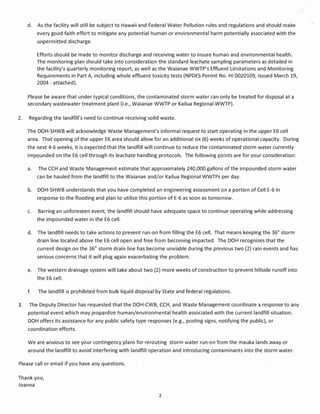
      1. Regarding the potential need to discharge contaminated storm water from the E6
      cell and/or the sedimentation basin in the event of another rain event which
      inundates the cell with contaminated storm water:

      If the CCH and Waste Management makes the decision that contaminated storm
      water MUST be discharged from the E6 cell, the decision will be considered a
      "business decision" by the responsible persons. In preparation for the potential
      discharge of contaminated storm water, please submit a Contingency Plan which, at a
      minimum, includes the following elements:

         a. Notification to Michael (Mike) Tsuji of DOH-CWB at 586-4309 (during work
         hours) or          (after work hours) or via email to michael.tsuji@doh.hawaii.
         gov before any unpermitted discharge so a coordinated effort can be made to
         manage the event by CCH and Waste Management.

         b. Notification to the public of the discharge of potentially contaminated storm
         water via a press release.

         c. Posting of "contaminated water" signs in the vicinity of the discharge to State
         waters.

         d. As the facility will still be subject to Hawaii and Federal Water Pollution rules
         and regulations and should make every good faith effort to mitigate any potential
         human or environmental harm potentially associated with the unpermitted
         discharge.

         Efforts should be made to monitor discharge and receiving water to insure human
and environmental health. The monitoring plan should take into consideration the
     standard leachate sampling parameters as detailed in the facility's quarterly
     monitoring report, as well as the Waianae WWTP's Effluent Limitations and
     Monitoring Requirements in Part A, including whole effluent toxicity tests (NPDES
     Permit No. HI 0020109, issued March 19, 2004 - attached).

Please be aware that under typical conditions, the contaminated storm water can only
be treated for disposal at a secondary wastewater treatment plant (i.e., Waianae
WWTP or Kailua Regional WWTP).

2.    Regarding the landfill's need to continue receiving solid waste.

The DOH-SHWB will acknowledge Waste Management's informal request to start
operating in the upper E6 cell area. That opening of the upper E6 area should allow
for an additional six (6) weeks of operational capacity. During the next 4-6 weeks, it is
expected that the landfill will continue to reduce the contaminated storm water
currently impounded on the E6 cell through its leachate handling protocols. The
following points are for your consideration:

     a. The CCH and Waste Management estimate that approximately 240,000
     gallons of the impounded storm water can be hauled from the landfill to the
     Waianae and/or Kailua Regional WWTPs per day.

     b. DOH-SHWB understands that you have completed an engineering assessment
     on a portion of Cell E-6 in response to the flooding and plan to utilize this portion
     of E-6 as soon as tomorrow.

     c. Barring an unforeseen event, the landfill should have adequate space to
     continue operating while addressing the impounded water in the E6 cell.

     d. The landfill needs to take actions to prevent run-on from filling the E6 cell.
     That means keeping the 36" storm drain line located above the E6 cell open and
     free from becoming impacted. The DOH recognizes that the current design on the
     36/1 storm drain line has become unviable during the previous two (2) rain events
     and has serious concerns that it will plug again exacerbating the problem.

     e. The western drainage system will take about two (2) more weeks of
     construction to prevent hillside runoff into the E6 cell.

     f.  The landfill is prohibited from bulk liquid disposal by State and federal
     regulations.

3. The Deputy Director has requested that the DOH-CWB, CCH, and Waste
Management coordinate a response to any potential event which may jeopardize
human/environmental health associated with the current landfill situation. DOH
offers its assistance for any public safety type responses (e.g., posting signs, notifying
the public), or coordination efforts.
We are anxious to see your contingency plans for rerouting storm water run-on from
      the mauka lands away or around the landfill to avoid interfering with landfill
      operation and introducing contaminants into the storm water.

Please call or email if you have any questions.

Thank you,
Joanna

Joanna l. Seto
Acting Chief and
Engineering Section Supervisor
Clean Water Branch
State of Hawaii Department of Health
Phone: (808) 586 - 4309
Fax: (808) 586-4352

Notice: This information and allachments are intended only for the use of the individual(s) or entity to which it is addressed, and may contain information that is
privileged and/or confidential. If the reader of this message is not the intended recipient, any dissemination, distribution, or copying of thiS communication is strictly
prohibited and may be punishable under state and federal law. If you have received this communication and/or attachments In error. please notify the sender via e·
mail immediately and destroy all electroniC and paper copies.
Yamada, Stuart H
From:                           Seto, Joanna L
Sent:                           Wednesday, January 12, 2011 4:00 PM
To:                             'tsteinberger@honolulu.gov'
Cc:                             'whamada@honolulu.gov'; 'JWhelan1 @wm.com'; Kurano, Matthew; Tsuji, Michael; Wong,
                                Alec Y; Gill, Gary L.; Ichinotsubo, Lene K; Chang, Steven Y; Yamada, Stuart H
Subject:                        Contingency Plan for Discharge from Waimanalo Gulch Sanitary Landfill (HIR50A533)
Attachments:                    0020109.fnl.pdf


Subject:      Contingency Plan for Discharge of Contaminated Storm Water from Waimanalo Gulch Sanitary Landfill,
              Kapolei, Island of Oahu, Hawaii
              NGPC File No. HI R50AS33

Dear Mr. Steinberger,

Thank you for speaking with the Department of Health (DOH), Environmental Management Division (EM D), Solid and
Hazardous Waste Branch (SHWB) and Clean Water Branch (CWB) on January 10 and 11,2011. We'd like to take this
opportunity to reiterate the main points of the conversations.

1.    Regarding the potential need to discharge contaminated storm water from the E6 cell and/or the sedimentation
      basin in the event of another rain event which inundates the cell with contaminated storm water:

      If the CCH and Waste Management makes the decision that contaminated storm water MUST be discharged from
      the E6 cell, the decision will be considered a "business decision" by the responsible persons. In preparation for the
      potential discharge of contaminated storm water, please submit a Contingency Plan which, at a minimum, includes
      the following elements:

      a.   Notification to Michael (Mike) Tsuji of DOH-CWB at 586-4309 (during work hours) or               (after work
           hours) or via email to michael.tsuji@doh.hawaiLgov before any unpermitted discharge so a coordinated effort
           can be made to manage the event by CCH and Waste Management.

      b.   Notification to the public of the discharge of potentially contaminated storm water via a press release.

      c.   Posting of "contaminated water" signs in the vicinity of the discharge to State waters.

      d.   As the facility will still be subject to Hawaii and Federal Water Pollution rules and regulations and should make
           every good faith effort to mitigate any potential human or environmental harm potentially associated with the
           unpermitted discharge.

           Efforts should be made to monitor discharge and receiving water to insure human and environmental health.
           The monitoring plan should take into consideration the standard leachate sampling parameters as detailed in
           the facility's quarterly monitoring report, as well as the Waianae WWTP's Effluent Limitations and Monitoring
           Requirements in Part A, including whole effluent toxicity tests (NPDES Permit No. HI 0020109, issued March 19,
           2004 - attached).

      Please be aware that under typical conditions, the contaminated storm water can only be treated for disposal at a
      secondary wastewater treatment plant (Le., Waianae WWTP or Kailua Regional WWTP).

2.     Regarding the landfill's need to continue receiving solid waste.


                                                                1
The DOH-SHWB will acknowledge Waste Management's informal request to start operating in the upper E6 cell
       area. That opening of the upper E6 area should allow for an additional six (6) weeks of operational capacity. During
       the next 4-6 weeks, it is expected that the landfill will continue to reduce the contaminated storm water currently
       impounded on the E6 cell through its leachate handling protocols. The following points are for your consideration:

       a.      The CCH and Waste Management estimate that approximately 240,000 gallons of the impounded storm water
               can be hauled from the landfill to the Waianae and/or Kailua Regional WWTPs per day.

       b.      DOH-SHWB understands that you have completed an engineering assessment on a portion of Cell E-6 in
               response to the flooding and plan to utilize this portion of E-6 as soon as tomorrow.

       c.      Barring an unforeseen event, the landfill should have adequate space to continue operating while addressing
              the impounded water in the E6 cell.

       d.      The landfill needs to take actions to prevent run-on from filling the E6 cell. That means keeping the 36" storm
               drain line located above the E6 cell open and free from becoming impacted. The DOH recognizes that the
               current design on the 36" storm drain line has become unviable during the previous two (2) rain events and has
              serious concerns that it will plug again exacerbating the problem.

       e.      The western drainage system will take about two (2) more weeks of construction to prevent hillside runoff into
              the E6 cell.

       f.      The landfill is prohibited from bulk liquid disposal by State and federal regulations.

3.      The Deputy Director has requested that the DOH-CWB, CCH, and Waste Management coordinate a response to any
       potential event which may jeopardize human/environmental health associated with the current landfill situation.
       DOH offers its assistance for any public safety type responses (e.g., posting signs, notifying the public), or
       coordination efforts.

       We are anxious to see your contingency plans for rerouting storm water run-on from the mauka lands away or
       around the landfill to avoid interfering with landfill operation and introducing contaminants into the storm water.

Please call or email if you have any questions.

Thank you,
Joanna

Joanna L. Seto
Acting Chief and
Engineering Section Supervisor
Clean Water Branch
State of Hawaii Department of Health
Phone: (808) S86 - 4309
Fax: (808) 586-4352

Notice: This information and attachments are intended only for the use of the individual(s) or entity to which it is addressed, and may contain Information that is privileged and/or confidential. If the reader of this message
is not the intended recipient, any dissemination, distribution, oreopving of this communication is strictly prohibited and may be punishable under state and federal law. If you have received this communication and/or
attachments in error, please notify the sender via e-mail immediately and destroy all electronic and paper copies.


                                                                                                                2
PERMIT NO. HI 0020109


                AUTHORIZATION TO DISCHARGE UNDER THE
           NATIONAL POLLUTANT DISCHARGE ELIMINATION SYSTEM

      In compliance with the provisions of the Clean Water Act, as amended, (33 U.S.C. § 1251
et seq.; the "Act") and Chapter 342D, Hawaii Revised Statutes, and Chapters 11-54 and 11-55,
Administrative Rules, Department of Health, State of Hawaii,

                       CITY AND COUNTY OF HONOLULU
                   DEPARTMENT OF ENVIRONMENTAL SERVICES

(hereinafter "PERMITTEE"),

is authorized to discharge secondary treated wastewater,

to the receiving waters named the Pacific Ocean through Outfall Serial No. 001 at
Latitude 2l o 25'36"N, Longitude l58°l2'01"W,

from its Waianae Wastewater Treatment Plant (hereinafter "FACILITY"),

located at 86-100 Farrington Highway, Waianae, Oahu, Hawaii,

in accordance with the eflluent limitations, monitoring requirements and other conditions set
forth herein, and in the permit attachments, including the Department of Health "Standard
NPDES Permit Conditions," dated December 31,2002.

      All references to Title 40 of the Code of Federal Regulations (40 CFR) are to regulations
that are in effect on July 1,2001, except as otherwise specified. Unless otherwise specified
herein, all terms are defined as provided in the applicable regulations in 40 CFR.

     This permit will become effective 30 days after the date of issuance.

     This permit and the authorization to discharge will expire at midnight, June 30, 2008.

Signed this 19th day of March, 2004


                                        (For) Director of Health


                                       PERMIT ISSUED
                                        March 19,2004
PERMIT NO. HI 0020109
                                                       Page 2

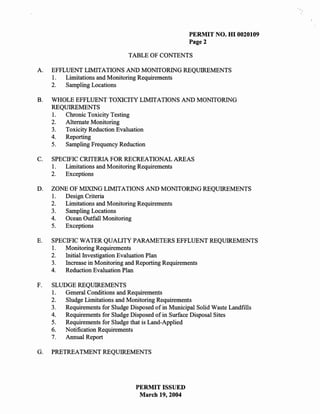
                                 TABLE OF CONTENTS

A.   EFFLUENT LIMITATIONS AND MONITORING REQUIREMENTS
     1.  Limitations and Monitoring Requirements
     2.  Sampling Locations

B.   WHOLE EFFLUENT TOXICITY LIMITATIONS AND MONITORING
     REQUIREMENTS
     1. Chronic Toxicity Testing
     2. Alternate Monitoring
     3. Toxicity Reduction Evaluation
     4. Reporting
     5. Sampling Frequency Reduction

C.   SPECIFIC CRITERIA FOR RECREATIONAL AREAS
     1.  Limitations and Monitoring Requirements
     2.  Exceptions

D.   ZONE OF MIXING LIMITAnONS AND MONITORING REQUIREMENTS
     1. Design Criteria
     2. Limitations and Monitoring Requirements
     3. Sampling Locations
     4. Ocean Outfall Monitoring
     5. Exceptions

E.   SPECIFIC WATER QUALITY PARAMETERS EFFLUENT REQUIREMENTS
     1.  Monitoring Requirements
     2.  Initial Investigation Evaluation Plan
     3.  Increase in Monitoring and Reporting Requirements
     4.  Reduction Evaluation Plan

F.   SLUDGE REQUIREMENTS
     1. General Conditions and Requirements
     2.  Sludge Limitations and Monitoring Requirements
     3.  Requirements for Sludge Disposed of in Municipal Solid Waste Landfills
     4.  Requirements for Sludge Disposed of in Surface Disposal Sites
     5.  Requirements for Sludge that is Land-Applied
     6. Notification Requirements
     7.  Annual Report

G.   PRETREATMENT REQUIREMENTS


                                    PERMIT ISSUED
                                     March 19,2004
PERMIT NO. HI 0020109
                                                      Page 3

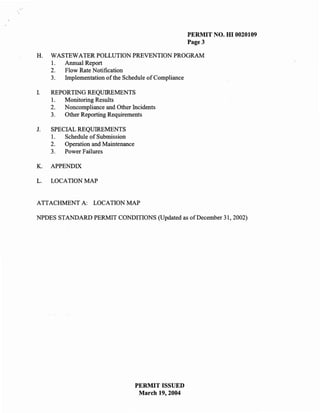
H.   WASTEWATER POLLUTION PREVENTION PROGRAM
     1. Annual Report
     2. Flow Rate Notification
     3. Implementation of the Schedule of Compliance

I.   REPORTING REQUIREMENTS
     1.  Monitoring Results
     2.  Noncompliance and Other Incidents
     3.  Other Reporting Requirements

J.   SPECIAL REQUIREMENTS
     1.  Schedule of Submission
     2.  Operation and Maintenance
     3.  Power Failures

K.   APPENDIX

L.   LOCATION MAP


ATTACHMENT A: LOCATION MAP

NPDES STANDARD PERMIT CONDITIONS (Updated as of December 31,2002)


                                     PERMIT ISSUED
                                      March 19,2004
PART A
                                                                         PERMIT NO. HI 0020109
                                                                         Page 4

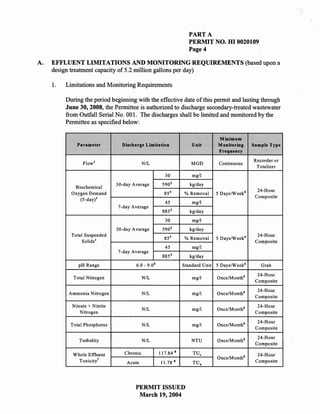
A.   EFFLUENT LIMITATIONS AND MONITORING REQUIREMENTS (based upon a
     design treatment capacity of 5.2 million gallons per day)

     1.   Limitations and ¥onitoring Requirements

          During the period beginning with the effective date of this permit and lasting through
          June 30, 2008, the Permittee is authorized to discharge secondary-treated wastewater
          from Outfall Serial No. 001. The discharges shall be limited and monitored by the
          Permittee as specified below:

                                                                                       Minimum
              Parameter           Discharge Limitation                     Unit        Monitoring      Sample Type
                                                                                       Frequency
                                                                                                       Recorder or
                 Flow l                      NIL                           MGD          Continuous
                                                                                                        Totalizer
                                                          30               mg/I
                                                               2
                                30-day Average           590              kg/day
             Biochemical
                                                                                                         24-Hour
            Oxygen Demand                                 85 3         % Removal       5 Days/Week 4
                                                                                                        Composite
               (5-day)l
                                                          45               mg/I
                                7-day Average
                                                               2
                                                         885              kg/day
                                                          30               mg/I
                                                               2
                                30-day Average           590              kg/day
            Total Suspended                                    3                                         24-Hour
                                                          85           % Removal       5 Days/Week 4
                 Solids l                                                                               Composite
                                                          45               mg/I
                                7-day Average
                                                         885 2            kg/day
                                                    5
               pH Range                 6.0 - 9.0                      Standard Unit   5 Days/Week 4      Grab

                                                                                                         24-Hour
             Total Nitrogen                  N/L                           mgll        Once/Month 6
                                                                                                        Composite

                                                                                                         24-Hour
           Ammonia Nitrogen                  N/L                           mg/I        Once/Month 6
                                                                                                        Composite

            Nitrate + Nitrite                                                                            24-Hour
                                             N/L                           mg/I        Once/Month6
                Nitrogen                                                                                Composite

                                                                                                         24-Hour
            Total Phosphorus                 N/L                           mg/I        Once/Month6
                                                                                                        Composite

                                                                                                         24-Hour
               Turbidity                     N/L                           NTU         Once/Month 6
                                                                                                        Composite
                                                                   8
             Whole Effluent        Chronic              117.84             TU.                           24-Hour
                                                                                       Once/Month 6
               Toxicity'            Acute               II. 78     8       TU.                          Composite


                                        PERMIT ISSUED
                                         March 19,2004
PART A
                                                              PERMIT NO. HI 0020109
                                                              PageS

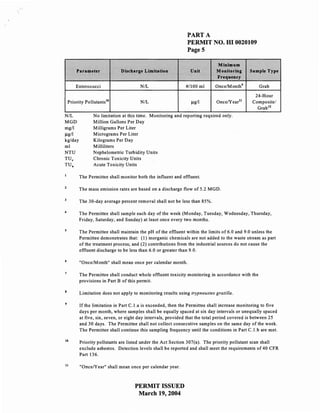
                                                                             Minimum
        Parameter             Discharge Limitation              Unit         Monitoring      Sample Type
                                                                             Frequency
        Enterococci                    NIL                    #/100 ml      OncelMonth'           Grab
                                                                                               24-Hour
    Priority Pollutants lO             N/L                      f.Lg/ 1      OnceNearll       Composite/
                                                                                                Grab lZ
N/L              No limitation at this time. Monitoring and reporting required only.
MGD              Million Gallons Per Day
mg/l             Milligrams Per Liter
f.Lg/1           Micrograms Per Liter
kg/day           Kilograms Per Day
ml               Milliliters
NTU              Nephelometric Turbidity Units
TU c             Chronic Toxicity Units
TU.              Acute Toxicity Units

          The Permittee shall monitor both the influent and effluent.

          The mass emission rates are based on a discharge flow of 5.2 MGD.

          The 30-day average percent removal shall not be less than 85%.

4
          The Permittee shall sample each day of the week (Monday, Tuesday, Wednesday, Thursday,
          Friday, Saturday, and Sunday) at least once every two months.

          The Permittee shall maintain the pH of the effluent within the limits of6.0 and 9.0 unless the
          Permittee demonstrates that: (I) inorganic chemicals are not added to the waste stream as part
          of the treatment process; and (2) contributions from the industrial sources do not cause the
          effluent discharge to be less than 6.0 or greater than 9.0.

          "Once/Month" shall mean once per calendar month.

          The Permittee shall conduct whole effluent toxicity monitoring in accordance with the
          provisions in Part B of this permit.

          Limitation does not apply to monitoring results using trypneustes gratilla.

          If the limitation in Part C.l.a is exceeded, then the Permittee shall increase monitoring to five
          days per month, where samples shall be equally spaced at six day intervals or unequally spaced
          at five, six, seven, or eight day intervals, provided that the total period covered is between 25
          and 30 days. The Permittee shall not collect consecutive samples on the same day of the week.
          The Permittee shall continue this sampling frequency until the conditions in Part C.1.b are met.

10
          Priority pollutants are listed under the Act Section 307(a). The priority pollutant scan shall
          exclude asbestos. Detection levels shall be reported and shall meet the requirements of 40 CFR
          Part 136.

11
          "Once/Year" shall mean once per calendar year.


                                     PERMIT ISSUED
                                      March 19,2004
PART A
                                                              PERMIT NO. HI 0020109
                                                              Page 6

     12
          The Permittee shall analyze for cyanide and the volatile fraction of the toxic organic compounds
          with a grab sample. The Permittee shall analyze all other pollutants with composite sample.

2.   Sampling Locations

     a.   The Permittee shall take all influent samples downstream of any additions to the
          trunk sewer, upstream of any in-plant return flows, and prior to treatment.

     b.   The Permittee shall take all effluent samples downstream from any additions to
          the facility and any in-plant return flows or disinfection units, and prior to
          mixing with the receiving waters.

     c.   The Permittee shall not change sampling locations without the notification to
          and the approval from the Director of Health.


                                    PERMIT ISSUED
                                     March 19,2004
PARTB
                                                           PERMIT NO. HI 0020109
                                                           Page 7

B.   WHOLE EFFLUENT TOXICITY LIMITATIONS AND MONITORING
     REQUIREMENTS

     1.   Chronic Toxicity Testing

          The Permittee shall conduct monthly chronic toxicity tests on flow-weighted 24-hour
          composite effluent samples in accordance with the procedures outlined below.

          a.   Definition Toxicity

               (1)   Chronic Toxicity

                     Chronic toxicity measures a sublethal effect (e.g., reduced growth) to
                     experimental test organisms exposed to an effluent compared to that of the
                     control organisms. The no observed effect concentration (NOEC) is the
                     highest effluent concentration to which organisms are exposed in a chronic
                     test, that causes no observable adverse effect on the test organisms (e.g.,
                     the highest concentration of toxicant to which the values for the observed
                     responses are not statistically significantly different from the controls).
                     Test results shall be reported in TUe , where TUe =100INOEC. For this
                     discharge, chronic toxicity for Ceriodaphnia dubia is defined by an
                     exceedance of the chronic toxicity discharge limitation specified in
                     Part A.l of this permit. This chronic toxicity discharge limitation does not
                     apply to monitoring results for toxicity tests using Trypneustes gratilla.
                     Rather, for the purposes of additional (accelerated) testing, toxicity
                     reduction evaluation/toxicity identification evaluation, and reporting
                     requirements below, chronic toxicity for Trypneustes gratilla is defined by
                     an exceedance of a chronic toxicity threshold value of 117.84 TUe, applied
                     as a daily maximum.

               (2)   Acute Toxicity

                     Acute toxicity is defmed by an exceedance of the acute toxicity discharge
                     limitation specified in Part A.l of this permit.

          b.   Test Species and Methods

               The Permittee shall conduct chronic toxicity testing on the following species
               using the methods specified:

               (1)   Ceriodaphnia dubia using Short-Term Methods for Estimating the
                     Chronic Toxicity of Effluent and Receiving Waters to Freshwater
                     Organisms (EPA-821-R-02-013, Fourth Edition, October 2002).

                                      PERMIT ISSUED
                                       March 19,2004
PARTB
                                                   PERMIT NO. HI 0020109
                                                   PageS


     (2)   Trypneustes gratilla using Hawaiian Collector Urchin, Trypneustes
           Gratilla (Hawa'e) Fertilization Test Method 3/16/98 (Adapted by Amy
           Wagner, EPA Region 9 Laboratory, Richmond, CA from a method
           developed by George Morrison, EPA, ORD Narragansett, RI and Diane
           Nacci, Science Applications International Corporation, ORD Narragansett,
           RI). The Permittee shall use updated versions of this method as they
           become available from the EP A.

c.   Quality Assurance

     (1)   A series of five dilutions and a control shall be tested. The series shall
           include the in-stream waste concentration (IWC), two dilutions below the
           IWC, and two dilutions above the IWC (e.g., 12.5,25,50,75, and 100
           percent effluent, where IWC = 50). The chronic IWC for this discharge is
           0.85 percent effluent.

     (2)   Concurrent testing with reference toxicants shall be conducted for
           Trypneustes gratilla.

     (3)   Reference toxicant tests shall be conducted using the same test conditions
           as effluent toxicity tests (i.e., same test duration, etc.).

     (4)   If either the reference toxicant tests or the effluent tests do not meet all test
           acceptability criteria as specified in the test methods manual, then the
           Permittee must re-sample and re-test within approximately 14 days.

     (5)   Control and dilution water should be receiving water or lab water, as
           described in the test methods manual. If dilution water is different from
           culture water, then a second control using culture water shall also be
           tested. To maintain acceptable salinity when conducting effluent tests
           with Trypneustes gratilla, effluent dilutions shall be adjusted by adding
           hypersaline brine/GP2 salts and a third control using brine shall also be
           tested.

d.   Exceptions

     (I)   If the Permittee experiences difficulty in obtaining gametes or has
           unacceptable control performance while conducting the sea urchin
           sperm/fertilization bioassay during a monitoring period, the Permittee
           shall document its efforts, communicate all attempts to the Director of
           Health, and report all attempts on the discharge monitoring report for that
           monitoring period.

                            PERMIT ISSUED
                             March 19, 2004
PARTB
                                                        PERMIT NO. m 0020109
                                                        Page 9

          (2)   It shall not be a violation of this pennit if it can be proven to the Director
                of Health's satisfaction that the inability to perfonn the tests as described
                above was due to circumstances beyond the Pennittee's control.

          (3)   If the Pennittee demonstrates that the chronic toxicity tests cannot be
                perfonned reliably, the Permittee may petition the Director of Health to
                perfonn acute toxicity tests in lieu of the chronic tests specified above.
                The Pennittee shall perfonn acute toxicity tests in accordance with the
                methods identified in Part B.2 below.

2.   Alternate Monitoring (Acute Toxicity Testing)

     Beginning 30 days after written approval from the Director of Health to perfonn acute
     toxicity tests, the Pennittee shall conduct, or have a contract laboratory conduct,
     monthly static or flow-through acute bioassays on composite effluent samples.

     a.   Limitation

          The acute toxicity discharge limitation is specified in Part A.l of this pennit and
          becomes effective for the most sensitive species one year after the
          commencement of acute toxicity tests.

     b.   Test Procedures

          (1)   The Pennittee shall conduct the acute toxicity testing in accordance with
                Methods for Measuring the Acute Toxicity of Effluents to Freshwater and
                Marine Organisms (EPA-821-R-02-012, Fifth Edition, October 2002).

          (2)   If necessary, the Permittee may adjust the salinity of a discharge using
                salts to allow testing with marine species.

          (3)   The Permittee shall conduct tests in 8.5 percent effluent for a period of 96
                hours unless the methods specify a shorter period for a definitive test for a
                particular species (e.g., 48 hours for daphnia).

          (4)   The Permittee shall test a series of five dilutions and a control. The series
                shall include the instream waste concentration (IWC), two dilutions below
                the IWC, and two dilutions above the IWC. The acute IWC for this
                discharge shall be 8.5 percent effluent.


                                 PERMIT ISSUED
                                  March 19,2004
PARTB
                                                        PERMIT NO. HI 0020109
                                                        Page 10

     c.   Species Selection

          (1)   The Permittee shall select three species for monitoring from the EPA
                manual identified in Part B.2.a(I). The Permittee may use Ceriodaphnia
                dubia (life stage - 24 hours) in freshwater only. The Permittee shall
                submit the selection to the Director of Health for approval within 30 days
                after receiving written approval from the Director of Health to perform
                acute toxicity tests.

          (2)   The Permittee shall obtain written approval from the Director of Health
                before changing any of the three selected species after the initial
                notification.

          (3)   The Permittee shall conduct monitoring, at a minimum, on one of the three
                selected species each month. The Permittee shall rotate the three selected
                species on a monthly basis.

3.   Toxicity Reduction Evaluation (TRE)

     a.   Preparation of Initial Investigation TRE Workplan

          The Permittee shall submit an initial investigation TRE workplan
          (approximately 1-2 pages) within 120 days of the effective date of this permit.
          This workplan shall describe steps which the Permittee intends to follow in the
          event that toxicity (as defined) is detected, and at a minimum, shall include the
          following:

          (1)   Description of the investigation and evaluation techniques that would be
                used to identify potential causes/sources of toxicity, effluent variability,
                and treatment system efficiency.

          (2)   Description of the facility's method of maximizing in-house treatment
                efficiency, good housekeeping practices, and a list of all chemicals used in
                operation of the facility.

          (3)   Identification of the organization (e.g. contract laboratory, etc.) that will
                conduct the evaluation if a toxicity identification evaluation (TIE)
                becomes necessary.


                                 PERMIT ISSUED
                                  March 19,2004
PARTB
                                                    PERMIT NO. m 0020109
                                                    Page 11

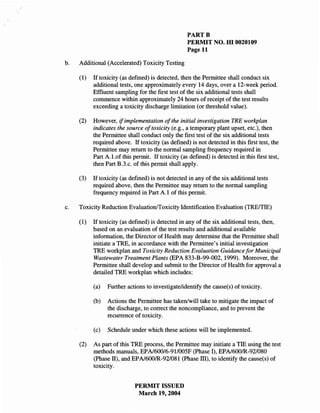
b.   Additional (Accelerated) Toxicity Testing

     (1)   If toxicity (as defined) is detected, then the Permittee shall conduct six
           additional tests, one approximately every 14 days, over a 12-week period.
           Effluent sampling for the first test of the six additional tests shall
           commence within approximately 24 hours of receipt of the test results
           exceeding a toxicity discharge limitation (or threshold value).

     (2)   However, if implementation of the initial investigation TRE workplan
           indicates the source oftoxicity (e.g., a temporary plant upset, etc.), then
           the Permittee shall conduct only the first test of the six additional tests
           required above. If toxicity (as defined) is not detected in this first test, the
           Permittee may return to the normal sampling frequency required in
           Part A.1.of this permit. If toxicity (as defined) is detected in this first test,
           then Part B.3.c. of this permit shall apply.

     (3)   If toxicity (as defined) is not detected in any of the six additional tests
           required above, then the Permittee may return to the normal sampling
           frequency required in Part A.1 of this permit.

c.   Toxicity Reduction Evaluation/Toxicity Identification Evaluation (TRE/TIE)

     (1)   If toxicity (as defined) is detected in any of the six additional tests, then,
           based on an evaluation of the test results and additional available
           information, the Director of Health may determine that the Permittee shall
           initiate a TRE, in accordance with the Permittee's initial investigation
           TRE workplan and Toxicity Reduction Evaluation Guidance for Municipal
           Wastewater Treatment Plants (EPA 833-B-99-002, 1999). Moreover, the
           Permittee shall develop and submit to the Director of Health for approval a
           detailed TRE workplan which includes:

           (a)   Further actions to investigatelidentify the cause(s) of toxicity.

           (b)   Actions the Permittee has taken/will take to mitigate the impact of
                 the discharge, to correct the noncompliance, and to prevent the
                 recurrence of toxicity.

           (c)   Schedule under which these actions will be implemented.

     (2)   As part of this TRE process, the Permittee may initiate a TIE using the test
           methods manuals, EPA/600/6-911005F (Phase I), EPA/6001R-92/080
           (Phase II), and EPA/6001R-92/081 (Phase III), to identify the cause(s) of
           toxicity.


                             PERMIT ISSUED
                              March 19,2004
PARTB
                                                        PERMIT NO. HI 0020109
                                                        Page 12

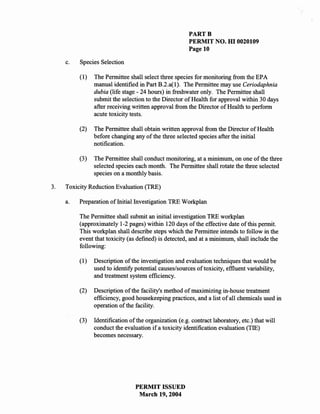
          (3)    If a TREffIE is initiated prior to completion of the accelerated testing
                 schedule required by Part B.3.b of this permit, then the accelerated testing
                 schedule may be terminated, or used as necessary in performing the
                 TREffIE.

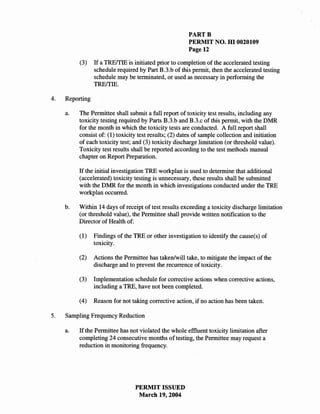
4.   Reporting

     a.   The Permittee shall submit a full report of toxicity test results, including any
          toxicity testing required by Parts B.3.b and B.3.c of this permit, with the DMR
          for the month in which the toxicity tests are conducted. A full report shall
          consist of: (1) toxicity test results; (2) dates of sample collection and initiation
          of each toxicity test; and (3) toxicity discharge limitation (or threshold value).
          Toxicity test results shall be reported according to the test methods manual
          chapter on Report Preparation.

          If the initial investigation TRE workplan is used to determine that additional
          (accelerated) toxicity testing is unnecessary, these results shall be submitted
          with the DMR for the month in which investigations conducted under the TRE
          workplan occurred.

     b.   Within 14 days of receipt of test results exceeding a toxicity discharge limitation
          (or threshold value), the Permittee shall provide written notification to the
          Director of Health of:

          (1)    Findings of the TRE or other investigation to identify the cause(s) of
                 toxicity.

          (2)    Actions the Permittee has taken/will take, to mitigate the impact of the
                 discharge and to prevent the recurrence of toxicity.

          (3)    Implementation schedule for corrective actions when corrective actions,
                 including a TRE, have not been completed.

          (4)    Reason for not taking corrective action, if no action has been taken.

5.   Sampling Frequency Reduction

     a.   If the Permittee has not violated the whole effluent toxicity limitation after
          completing 24 consecutive months of testing, the Permittee may request a
          reduction in monitoring frequency.


                                 PERMIT ISSUED
                                  March 19,2004
PARTB
                                                       PERMIT NO. HI 0020109
                                                       Page 13

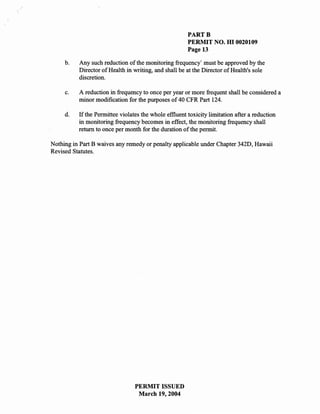
     b.   Any such reduction of the monitoring frequency' must be approved by the
          Director of Health in writing, and shall be at the Director of Health's sole
          discretion.

     c.   A reduction in frequency to once per year or more frequent shall be considered a
          minor modification for the purposes of 40 CFR Part 124.

     d.   If the Permittee violates the whole effluent toxicity limitation after a reduction
          in monitoring frequency becomes in effect, the monitoring frequency shall
          return to once per month for the duration of the permit.

Nothing in Part B waives any remedy or penalty applicable under Chapter 342D, Hawaii
Revised Statutes.


                                 PERMIT ISSUED
                                  March 19,2004
PARTC
                                                           PERMIT NO. HI 0020109
                                                           Page 14


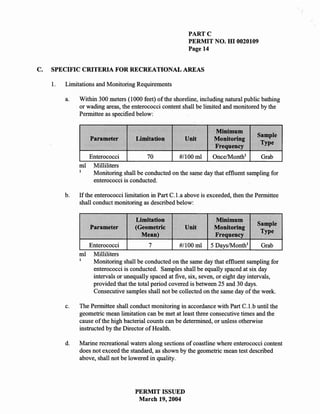
C.   SPECIFIC CRITERIA FOR RECREATIONAL AREAS

     1.   Limitations and Monitoring Requirements

          a.   Within 300 meters (1000 feet) of the shoreline, including natural public bathing
               or wading areas, the enterococci content shall be limited and monitored by the
               Permittee as specified below:

                                                                     Minimum
                                                                                       Sample
                   Parameter         Limitation          Unit        Monitoring
                                                                                        Type
                                                                     Frequency
                 Enterococci           70         #/100 ml     Once/Month1         Grab
               ml Milliliters
               1
                  Monitoring shall be conducted on the same day that effluent sampling for
                  enterococci is conducted.

          b.   If the enterococci limitation in Part C.l.a above is exceeded, then the Permittee
               shall conduct monitoring as described below:

                                     Limitation                      Minimum
                                                                                       Sample
                   Parameter         (Geometric          Unit        Monitoring
                                                                                        Type
                                       Mean)                         Frequency
                 Enterococci             7           #1100 ml 5 Days/Month1             Grab
               ml Milliliters
               1
                  Monitoring shall be conducted on the same day that effluent sampling for
                  enterococci is conducted. Samples shall be equally spaced at six day
                  intervals or unequally spaced at five, six, seven, or eight day intervals,
                  provided that the total period covered is between 25 and 30 days.
                  Consecutive samples shall not be collected on the same day of the week.

          c.   The Permittee shall conduct monitoring in accordance with Part C.l.b until the
               geometric mean limitation can be met at least three consecutive times and the
               cause of the high bacterial counts can be determined, or unless otherwise
               instructed by the Director of Health.

          d.   Marine recreational waters along sections of coastline where enterococci content
               does not exceed the standard, as shown by the geometric mean test described
               above, shall not be lowered in quality.


                                     PERMIT ISSUED
                                      March 19,2004
PARTe
                                                    PERMIT NO. HI 0020109
                                                    Page 15


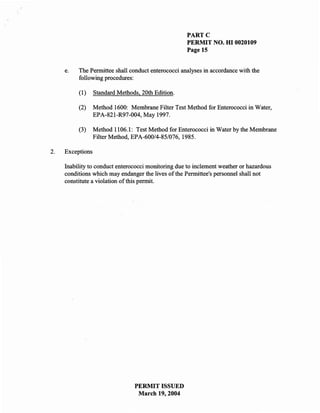
     e.   The Permittee shall conduct enterococci analyses in accordance with the
          following procedures:

          (1)     Standard Methods, 20th Edition.

          (2)     Method 1600: Membrane Filter Test Method for Enterococci in Water,
                  EPA-821-R97-004, May 1997.

          (3)     Method 1106.1: Test Method for Enterococci in Water by the Membrane
                  Filter Method, EPA-600/4-85/076, 1985.

2.   Exceptions

     Inability to conduct enterococci monitoring due to inclement weather or hazardous
     conditions which may endanger the lives of the Permittee's personnel shall not
     constitute a violation of this permit.


                                 PERMIT ISSUED
                                  March 19, 2004
PARTD
                                                                         PERMIT NO. HI 0020109
                                                                         Page 16


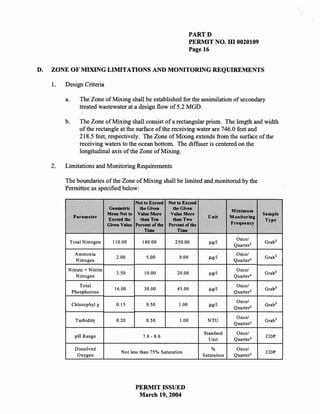
D.   ZONE OF MIXING LIMITATIONS AND MONITORING REQUIREMENTS

     1.   Design Criteria

          a.       The Zone of Mixing shall be established for the assimilation of secondary
                   treated wastewater at a design flow of 5.2 MGD.

          b.       The Zone of Mixing shall consist of a rectangular prism. The length and width
                   of the rectangle at the surface of the receiving water are 746.0 feet and
                   218.5 feet, respectively. The Zone of Mixing extends from the surface of the
                   receiving waters to the ocean bottom. The diffuser is centered on the
                   longitudinal axis of the Zone of Mixing.

     2.   Limitations and Monitoring Requirements

          The boundaries of the Zone of Mixing shall be limited and monitored by the
          Permittee as specified below:

                                             Not to Exceed   Not to Exceed
                                 Geometric    the Given        the Given
                                                                                           Minimum
                                Mean Not to Value More        Value More                                Sample
                Parameter                                                       Unit       Monitoring
                                E:s:ceed the   than Ten        than Two                                  Type
                                Given Value Percent of the   Percent of the                Frequency
                                                 Time            Time
                                                                                             Once/
               Total Nitrogen     110.00        180.00          250.00                                  Grab 2
                                                                                            Quarter l
                 Ammonia                                                                     Once/
                                    2.00          5.00            9.00                                  Grab 2
                 Nitrogen                                                                   Quarter 1

           Nitrate + Nitrite                                                                 Once/
                                    3.50         10.00           20.00                                  Grab 2
               Nitrogen                                                                     Quarter 1

                  Total                                                                      Once/
                                   16.00         30.00           45.00                                  Grab 2
               Phosphorous                                                                  Quarter 1

                                                                                             Once"!
               Chlorophyl           0.15          0.50            1.00                                  Grab 2
                                                                                            Quarter1

                                                                                             Once/
                 Turbidity          0.20          0.50            1.00          NTU                     Grab 2
                                                                                            Quarter 1

                                                                              Standard       Once/
                 pH Range                       7.6-8.6                                                  CDP
                                                                                Unit        Quarter 1

                 Dissolved                                                        %          Once/
                                      Not less than 75% Saturation                                       CDP
                  Oxygen                                                      Saturation    Quarter 1


                                             PERMIT ISSUED
                                              March 19,2004
PARTD
                                                                PERMIT NO. HI 0020109
                                                                Page 17


                                      Not to Exceed Not to Exceed
                           Geometric    the Given      the Given                   Minimum
                          Mean Not to Value More      Value More                                   Sample
          Parameter                                                        Unit    Monitoring
                          Exceed the     than Ten      tbanTwo                                      Type
                          Given Value Percent of the Percent of the                Frequency
                                           Time          Time
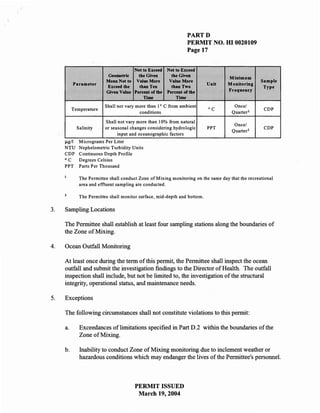
                          Shall not vary more than 10 C from ambient                  Once/
          Temperature                                                      °C                       CDP
                                          conditions                                 Quarter l

                          Shall not vary more than 10% from natural
                                                                                      Once/
             Salinity     or seasonal changes considering hydrologic       PPT                      CDP
                                                                                     Quarter l
                                input and oceanographic factors
     I!g/I    Micrograms Per Liter
     NTU      Nephelometric Turbidity Units
     CDP      Continuous Depth Profile
     °C       Degrees Celsius
     PPT      Parts Per Thousand

              The Permittee shall conduct Zone of Mixing monitoring on the same day that the recreational
              area and effluent sampling are conducted.

              The Permittee shall monitor surface, mid-depth and bottom.

3.   Sampling Locations

     The Permittee shall establish at least four sampling stations along the boundaries of
     the Zone of Mixing.

4.   Ocean Outfall Monitoring

     At least once during the term of this permit, the Permittee shall inspect the ocean
     outfall and submit the investigation findings to the Director of Health. The outfall
     inspection shall include, but not be limited to, the investigation of the structural
     integrity, operational status, and maintenance needs.

5.   Exceptions

     The following circumstances shall not constitute violations to this permit:

     a.       Exceedances of limitations specified in Part D.2 within the boundaries of the
              Zone of Mixing.

     b.       Inability to conduct Zone of Mixing monitoring due to inclement weather or
              hazardous conditions which may endanger the lives of the Permittee's personnel.


                                        PERMIT ISSUED
                                         March 19, 2004
PARTE
                                                                    PERMIT NO. HI 0020109
                                                                    Page 18

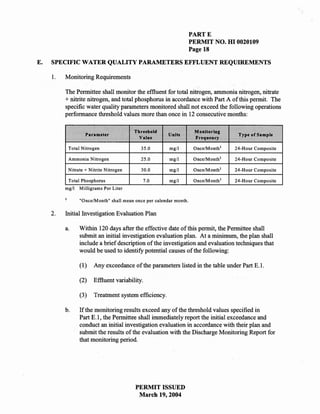
E.   SPECIFIC WATER QUALITY PARAMETERS EFFLUENT REQUIREMENTS

     1.   Monitoring Requirements

          The Permittee shall monitor the effluent for total nitrogen, ammonia nitrogen, nitrate
          + nitrite nitrogen, and total phosphorus in accordance with Part A of this permit. The
          specific water quality parameters monitored shall not exceed the following operations
          performance threshold values more than once in 12 consecutive months:

                                         Threshold                   Monitoring
                   Parameter                            Units                         Type of Sample
                                           Value                     Frequency

           Total Nitrogen                   35.0        mg/l         OncelMonth l    24-Hour Composite

           Ammonia Nitrogen                 25.0        mg/l         Once/Month l    24-Hour Composite

           Nitrate + Nitrite Nitrogen       30.0        mg/l         Once/Month l    24-Hour Composite

           Total Phosphorus                    7.0      mg/l         OncelM onth 1   24-Hour Composite
          mgll   Milligrams Per Liter

                 "Once/Month" shall mean once per calendar month.

     2.   Initial Investigation Evaluation Plan

          a.     Within 120 days after the effective date of this permit, the Permittee shall
                 submit an initial investigation evaluation plan. At a minimum, the plan shall
                 include a brief description of the investigation and evaluation techniques that
                 would be used to identify potential causes of the following:

                 (1)   Any exceedance of the parameters listed in the table under Part E.!.

                 (2)   Effluent variability.

                 (3)   Treatment system efficiency.

          b.     If the monitoring results exceed any of the threshold values specified in
                 Part E.l, the Permittee shall immediately report the initial exceedance and
                 conduct an initial investigation evaluation in             with their plan and
                 submit the results of the evaluation with the Discharge Monitoring Report for
                 that monitoring period.


                                         PERMIT ISSUED
                                          March 19, 2004
PARTE
                                                      PERMIT NO. HI 0020109
                                                      Page 19

3.   Increase in Monitoring and Reporting Requirements

     If the Permittee exceeds or will exceed the criteria for any parameter specified in
     Part E.l more than once in 12 consecutive months, the Permittee shall increase the
     monitoring frequency of those parameters in exceedance to once per week. The
     monitoring frequency shall remain at once per week until the monitoring results are
     below the threshold value for three consecutive weeks. After this is achieved,
     monitoring and reporting for those parameters shall return to once per month. The
     Permittee shall submit the monitoring results with the Discharge Monitoring Report
     for the month in which the exceedances occurred.

4.   Reduction Evaluation Plan

     a.   If the Permittee exceeds or will exceed the criteria for any parameter specified in
          Part E.l more than twice in 12 consecutive months, or if requested by the
          Director of Health, the Permittee shall submit a reduction evaluation plan and
          implementation schedule within 45 calendar days after the third exceedance or
          request by the Director of Health.

     b.   The reduction evaluation shall determine the cause of exceedance, outline
          measures that will be or have been implemented to ensure compliance with the
          criteria, and include an implementation schedule.

     c.   Upon completion of the reduction evaluation, this permit may be modified, or
          alternatively revoked and reissued, in order to incorporate appropriate permit
          conditions and implementation schedules.


                                 PERMIT ISSUED
                                  March 19, 2004
PARTF
                                                            PERMIT NO. HI 0020109
                                                            Page 20

F.   SLUDGE REQUIREMENTS

     1.   General Conditions and Requirements

          a.   Acceptable Sludge Use/Disposal Practices

               (1)   The Permittee shall dispose of all sludge generated at the facility at a
                     municipal solid waste landfill, at a sludge surface disposal site, by land
                     application, or by transferring the sludge to another party for further
                     treatment, use, or disposal in accordance with all applicable portions of
                     40 CFR Parts 257, 258, 503 and HAR, Chapters 11-58.1 and 11-62.

               (2)   Storage of sludge for over two years from the time it is generated shall be
                     considered to be surface disposal. The storage site shall meet all the
                     requirements of a surface disposal site under 40 CFR Part 503 Subpart C
                     and HAR, Chapters 11-58.1 and 11-62. If the Permittee desires to store
                     sludge for longer periods of time prior to final disposal, the Permittee shall
                     submit a written request to the EPA Regional Sludge Coordinator and
                     Director of Health containing the information required under
                     40 CFR Section 503.20(b).

               (3)   The Permittee shall dispose of sludge containing more than 50 mg/kg of
                     PCBs in accordance with 40 CFR Part 761.

               (4)   If the Permittee desires to dispose of sludge using a method not listed
                     above, the Permittee shall submit a request for permit modification to EPA
                     Regional Sludge Coordinator and Director of Health 180 days prior to the
                     commencement of the alternate disposal practice.

          b.   Duty to Mitigate

               (l)   The Permittee shall be responsible for ensuring the following:

                     (a)   All sludge produced at its facility is used/disposed of in accordance
                           with 40 CFR Parts 257, 258, 503, and HAR, Chapters 11-58.1 and
                           11-62, whether the Permittee uses/disposes of the sludge itself or
                           transfers it to another party for further treatment, use, or disposal.

                     (b)   Subsequent preparers, appliers, or disposers of the sludge are
                           informed of the requirements under 40 CFR Parts 257, 258,503, and
                           HAR, Chapters 11-58.1 and 11-62.


                                      PERMIT ISSUED
                                       March 19,2004
PARTF
                                                         PERMIT NO. m 0020109
                                                         Page 21

                (c)   Sludge is not allowed to enter waters of the United States, or to
                      contaminate an underground drinking water source.

                (d)   Sludge treatment, storage, use, and disposal does not create a public
                      nUIsance.

                (e)   Haulers who ship non-Class A sludge off-site for additional
                      treatment, use, or disposal take all necessary measures to keep sludge
                      contained.

          (2)   The Permittee shall take all reasonable steps to prevent or minimize any
                sludge use or disposal which has a likelihood of adversely affecting human
                health or the environment.

     c.   Other Conditions

          (1)   The Director of Health may promptly modify or revoke and reissue this
                permit to incorporate any applicable standard for sewage sludge use or
                disposal promulgated under the Act Section 405(d), or adopted under
                HRS, Chapter 342D or HAR, Chapter 11-62, if the standard is more
                stringent than the standard in this permit or covers a pollutant or practice
                not covered in this permit.

          (2)   The sludge requirements in this part are supplemental to the other
                conditions of this permit. In the event of a conflict, those requirements
                more protective of the environment shall apply.

          (3)   The requirements in 40 CFR Part 503 are enforceable by the EPA
                independently of being included in this permit.

2.   Sludge Limitations and Monitoring Requirements

     a.   Sludge shall be limited and monitored by the Permittee as specified below:

          (1)   Sludge Disposed of in Municipal Solid Waste Landfills

                                                                                Monitoring
                  Monitoring Parameter/ Test Proeedures       Limitation
                                                                                Frequeuey

                        Paint Filter Test (SW -486,
                                                           No "Free Liquids"]    Once/Year
                            EP A Method 9095)

                      Toxicity Characteristic Leaching             2
                                                                                 Once/Year
                          Procedure(TCLP) Test 2


                                  PERMIT ISSUED
                                   March 19,2004
PARTF
                                                          PERMIT NO. HI 0020109
                                                          Page 22


                                                                                    Monitoring
          Monitoring Parameter/ Test Procedures                 Limitation
                                                                                    Frequency

                      Priority Pollutants3                            N/A           Once/Year4
      N/A     Not Applicable

              "Free liquids" as defined in EPA Method 9095

              The parameters to be tested by the TCLP test and their limitations are specified in
              40 CFR Section 261.24, Table I - Maximum Concentration of Contaminants for
              the Toxicity Characteristic.

              Priority pollutants are listed under the Act Section 307(a).

      4
              The Permittee shall test for priority pollutants more frequently if required under the
              pretreatment program.


(2)   Sludge Disposed of in Surface Disposal Sites (Sludge-only Landfill or
      Disposal on Land Not for the Purpose ofhnproving Plant Growth)

                                                   Limitation (Mg/kg)
              Monitoring
                                                                                    Monitoring
            Parameter/ Test
                                                                                    Frequency
              Procedures
                                      0 25n!! 1<50f1li 1<75M <10M '<11$11:1:6. tim
                Arsenic!
                                                                                         z
                                    30       34      39   46    53      62    73

               Chromium!                                                                 z
                                   200       220    260   300   360     450   600

                 Nickel!                                                                 z
                                   210       240    270   320   390     420   420
                                                           3
              TCLP Test 3                                                           OnceNear

           Priority Pollutants 4                          N/A                       Once/Years
      m       Meter
      N/A     Not Applicable

              The Permittee shall monitor for this parameter only if sludge is disposed of in a
              unit with no liner and leachate system. Limitations are based on the distance
              (meters) from the active sludge unit boundary to the nearest property line.

              Monitoring frequency shall be determined by the following table:


                             PERMIT ISSUED
                              March 19,2004
PARTF
                                                  PERMIT NO. ill 0020109
                                                  Page 23


                    Annual Production, Dry Weight
                                                                          Frequency
                       (Metric Tons/365 Days)

                                   0-290                                  OncelYear

                                290 - 1,500                           Once/Quarter

                              1,500 - 15,000                          Once/60 days

                               Over 15,000                                Once/month

           The parameters to be tested by the TCLP test and their limitations are specified in
           40 CFR Section 261.24, Table I - Maximum Concentration of Contaminants for
           the Toxicity Characteristic.

           Priority pollutants are listed under the Act Section 307(a).

           The Permittee shal1 test for priority pol1utants more frequently if required under the
           pretreatment program.


(3)   Sludge that is Land-Applied (Added to Soil for the Purpose of Improving
      Plant Growth)

       Monitoring Parameterl Test                                                Monitoring
                                               Limitation (Mglkg)
              Procedures                                                         Frequency
                                                                                       1
                  Arsenic                                41
                                                                                       1
                 Cadmium                                 39
                                                                                       1
                  Copper                               1,500
                                                                                       1
                   Lead                                 300
                                                                                       1
                 Mercury                                 17
                                                                                       1
               Molybdenum                               100
                                                                                       1
                  Nickel                                420
                                                                                       1
                 Selenium                               100
                                                                                       1
                   Zinc                                2,800
                                                          2
                TCLP test2                                                        OncelYear

            Priority Pollutants]                        N/A                      OnceIYear4
      mg/kg    Milligrams per kilogram
      N/A Not Applicable


                          PERMIT ISSUED
                           March 19,2004
PARTF
                                                            PERMIT NO. HI 0020109
                                                            Page 24


                      Monitoring frequency shall be determined by the following table:


                              Annual Production, Dry Weight
                                                                                    Frequency
                                 (Metric Tons/365 Days)

                                            0-290                                   Once/Year

                                          290 - 1,500                           Once/Quarter

                                        1,500 - 15,000                          Once/60 days

                                         Over 15,000                                Once/month

                     The parameters to be tested by the TCLP test and their limitations are specified in
                     40 CFR Section 261.24, Table 1 - Maximum Concentration of Contaminants for
                     the Toxicity Characteristic.

                3
                     Priority pollutants are listed under the Act Section 307(a).

                4    The Permittee shall test for priority pollutants more frequently if required under the
                     pretreatment program.

     b.   The Permittee shall develop a representative sampling plan for monitoring
          toxics reduction, including the number and location of sampling points.

          (1)   If sludge generated at the facility is land applied or disposed at a surface
                disposal site, the sampling plan shall also include pathogens and vector
                attraction reduction monitoring.

          (2)   If pathogen reduction is determined by time and temperature, the plan shall
                be designed to determine temperatures throughout the batch being treated.

          (3)   If windrow composting is used, temperature shall be measured at least
                once for each 150 feet of windrow, and include measurements at depths of
                12 to 24 inches below the surface.

3.   Requirements for Sludge Disposed of in Municipal Solid Waste Landfills

     a.   The Permittee shall dispose sludge in municipal solid waste landfills that meet
          the requirements of 40 CFR Part 258 and HAR, Chapter 11-58.1.

     b.   Sludge shall not contain "free liquids" as defined by EPA Method 9095 (Paint
          Filter Liquids Test).


                                  PERMIT ISSUED
                                   March 19, 2004
PARTF
                                                      PERMIT NO. m 0020109
                                                      Page 25

4.   Requirements for Sludge Disposed of in Surface Disposal Sites (Sludge-only Landfill
     or Disposal on Land Not for the Purpose of Improving Plant Growth)

     a.   Sludge that is disposed of in a sludge-only landfill shall meet the general
          requirements, pollutant limits (for surface disposal sites without liners and
          leachate systems), management practices, and operational standards in 40 CFR
          Part 503 Subpart C and additional pollutant limits requested by the Director of
          Health.

     b.   The Permittee shall have a qualified groundwater scientist develop a
          groundwater monitoring program for the surface disposal site or certify that the
          placement of sludge on the site will not cause aquifer contamination.

5.   Requirements for Sludge that is Land-Applied (Added to Soil for the Purpose of
     Improving Plant Growth)

     a.   Exceptional quality sludge shall not be subject to the general requirements under
          40 CFR Section 503.12 and management practices under 40 CFR
          Section 503.14 unless the Director of Health determines that these requirements
          are necessary to protect public health and the environment.

     b.   Preparers and appliers of non-exceptional quality sludge shall meet the general
          requirements and management practices specified in 40 CFR Part 503
          Subpart B; Class A or B pathogen reduction levels with the associated access
          restrictions specified in 40 CFR Section 503.32; and one of the ten vector
          attraction reduction requirements specified in 40 CFR Sections 503.33(b)(l)
          through 503.33(b)(l0).

     c.   Preparers of non-exceptional quality sludge shall provide a written notification
          of the nitrogen content of the sludge to all appliers.

     d.   Appliers of non-exceptional quality sludge shall determine the agronomic rate
          for the crops to be grown and certify that the sludge is applied at a rate not
          exceeding the agronomic rate determined for each crop.

6.   Notification Requirements

     a.   If sludge other than exceptional quality sludge is shipped to another state or to
          Indian lands, the Permittee shall send 60 days prior notice of the shipment to the
          permitting authorities in the receiving state or Indian land (the EPA Regional
          Office for that area and the State or Indian authorities).


                                 PERMIT ISSUED
                                  March 19,2004
PARTF
                                                      PERMIT NO. HI 0020109
                                                      Page 26

     b.   The Permittee shall notify the EPA Regional Sludge Coordinator and the
          Director of Health of any non-compliance that may seriously endanger public
          health or the environment within 24 hours after becoming aware of the
          noncompliance. A written noncompliance report shall be submitted,
          postmarked, or faxed within five working days after the Permittee becomes
          aware of the noncompliance.

     c.   The Permittee shall report all other instances of noncompliance not reported
          under Part F.6.b at the time discharge monitoring reports are submitted as
          required by Part 1.1 of this permit.

7.   Annual Report

     By February 19th of each year, the Permittee shall submit an annual report on sludge
     management activities during the previous calendar year to the EPA Regional Sludge
     Coordinator and the Director of Health. The report shall provide the following
     information:

     a.   Total amount of sludge generated that year and a breakdown of the
          usage/disposal methods employed (in dry weight, metric tons).

     b.   Results of all monitoring required by Part F.2.

     c.   If sludge was disposed in a municipal solid waste landfill, then the Permittee
          shall include the following certification statement:

          "I certify under the penalty of law, that the paint filter test and toxicity
          characteristic leaching procedure test requirements have been met, and that
          vector attraction reduction requirements have been met by the municipal solid
          waste landfill. This determination has been made under my direction and
          supervision in accordance with the system designed to assure that qualified
          personnel properly gather and evaluate the information used to determine that
          the necessary requirements have been met. I am aware that there are significant
          penalties for false certification including fine and imprisonment."

     d.   If sludge was disposed in a surface disposal site, the following information shall
          be included:

          (1)   Requirements specified in 40 CFR Section 503.27.

          (2)   Name and mailing address of surface disposal operator if different from
                Permittee.


                                PERMIT ISSUED
                                 March 19, 2004
PARTF
                                                   PERMIT NO. HI 0020109
                                                   Page 27


     (3)   Location (street address and latitude and longitude) of surface disposal
           site.

     (4)   Results of groundwater monitoring, or a copy of a certification by a
           groundwater scientist (including the scientist's name, title, and phone
           number) that the placement of sludge at the surface disposal site will not
           cause aquifer contamination.

e.   If sludge was land-applied, the following information shall be included:

     (1)   Requirements specified in 40 CFR Section 503.17(a) for all facilities
           preparing sludge for land application or reference to that facility's report, if
           submitted to EPA separately.

     (2)   Names and addresses of all facilities receiving the non-exceptional quality
           sludge, including land appliers and those facilities providing further
           treatment/blending prior to land application.

     (3)   Location of land application sites of non-exceptional quality sludge (street
           address, latitude and longitude) and sizes of parcels.

     (4)   Crops grown, agronomic rate for the crops grown, and certification by the
           land appliers of non-exceptional quality sludge that the sludge was applied
           at a rate not exceeding the agronomic rate determined for each crop.

     (5)   Copies of other certification statements by land appliers of non-
           exceptional quality sludge.

f.   If sludge was stored, the following information shall also be included:

     (1)   Age of stored sludge.

     (2)   Name and mailing address of operator of storage site if different from
           Permittee.

     (3)   Location of stored sludge (street address, latitude and longitude).

g.   If sludge was disposed using other methods, descriptions of the methods
     employed and the locations (street address, latitude and longitude) of the
     usage/disposal sites shall be included.


                            PERMIT ISSUED
                             March 19, 2004
PARTF
                                                PERMIT NO. HI 0020109
                                                Page 28

h.   Annual reports shall be submitted to the following agencies:

     (1)   State of Hawaii
           Department of Health
           Environmental Management Division
           Clean Water Branch
           919 Ala Moana Boulevard, Room 301
           Honolulu, HI 96814-4920

     (2)   Regional Sludge Coordinator (WTR-7)
           Environmental Protection Agency , Region 9
           75 Hawthorne Street
           San Francisco, CA 94105


                           PERMIT ISSUED
                            March 19, 2004
PARTG
                                                            PERMIT NO. m 0020109
                                                            Page 29

G.   PRETREATMENT REQIDREMENTS

     1.   The Permittee shall be responsible and liable for the performance of all Control
          Authority (as defined in 40 CFR Section 403.l2(a)) pretreatment requirements
          contained in 40 CFR Part 403, including any subsequent regulatory revisions. Where
          40 CFR Part 403 or subsequent revisions place mandatory actions upon the Permittee
          as Control Authority but do not specify a timetable for completion of the actions, the
          Permittee shall complete the required actions within six months from the issuance
          date of this permit or the effective date of the 40 CFR Part 403 revisions, whichever
          comes later. For violations of pretreatment requirements, the Permittee shall be
          subject to enforcement actions, penalties, fines and other remedies by the EPA or
          other appropriate parties, as provided in the Act. The DOH and EPA may initiate
          enforcement action against a nondomestic user for noncompliance with applicable
          standards and requirements, as provided in the Act.

     2.   The Permittee shall enforce the requirements promulgated under Sections 307(b),
          307(c), 307(d) and 402(b) of the Act with timely, appropriate and effective
          enforcement actions. The Permittee shall cause all nondomestic users subject to
          federal categorical standards to achieve compliance no later than the date specified in
          those requirements or, in the case of a new nondomestic user, upon commencement of
          the discharge.

     3.   The Permittee shall perform the pretreatment functions as required in 40 CFR
          Part 403, including, but not limited to the following:

          a.   Implementation of the necessary legal authorities as provided in 40 CFR
               Section 403.8(f)(1).

          b.   Enforcement of the pretreatment requirements in Sections 40 CFR 403.5 and
               403.6.

          c.   Implementation of the programmatic functions as provided in 40 CFR
               Section 403.8(f)(2).

          d.   Providing the requisite funding and personnel to implement the pretreatment
               program as provided in 40 CFR Section 403.8(f)(3).

     4.   The Permittee shall submit annually to the DOH and EPA a report describing its
          pretreatment activities over the previous year. In the event that the Permittee is not in
          compliance with any conditions or requirements of this permit, then the Permittee
          shall also include the reasons for noncompliance and state how and when the
          Permittee shall comply with such conditions and requirements. This annual report


                                      PERMIT ISSUED
                                       March 19, 2004
PARTG
                                                  PERMIT NO. HI 0020109
                                                  Page 30

shall cover operations from January 1 through December 31, and is due on March
31 st of the following year. The report shall contain, but not be limited to, the
following information:

a.   Summary of analytical results from representative, flow proportioned, 24-hour
     composite sampling of the facility's influent and effluent for those pollutants the
     EPA has identified under section 307(a) of the Act which are known or
     suspected to be discharged by nondomestic users. This will consist of
     wastewater sampling and analysis in accordance with the minimum frequency of
     analysis stated in Part A of this permit. The Permittee shall not be required to
     sample and analyze for asbestos. Sludge monitoring is covered in Part F of this
     permit. The Permittee shall also provide any influent or effluent monitoring
     data for non-priority pollutants which the Permittee believes may be causing or
     contributing to Interference or Pass Through. Sampling and analysis shall be
     performed with the techniques prescribed in 40 CFR Part 136.

b.   Discussion of Upset, Interference, or Pass Through incidents, if any, at the
     facility which the Permittee knows or suspects were caused by nondomestic
     users of the collection system. The discussion shall include the reasons why the
     incidents occurred, the corrective actions taken and, if known, the name and
     address of the nondomestic user(s) responsible. The discussion shall also
     include a review of the applicable pollutant limitations to determine whether any
     additional limitations, or changes to existing requirements, may be necessary to
     prevent Interference or Pass Through.

c.   Updated list of the Permittee's significant industrial users (Sills) including their
     names and addresses, and a list of deletions, additions and Sill name changes
     keyed to the previously submitted list. The Permittee shall provide a brief
     explanation for each change. The list shall identify the Sills subject to federal
     categorical standards by specifying which set(s) of standards are applicable to
     each Sill. The list shall also indicate which Sills are subject to local
     limitations.

d.   Characterizations of the compliance status of each Sill by providing a list or
     table which includes the following information:

     (1)   Name of the Sill.

     (2)   Category, if subject to federal categorical standards.

     (3)   Type of wastewater treatment or control processes in place.


                            PERMIT ISSUED
                             March 19,2004
PARTG
                                                      PERMIT NO. HI 0020109
                                                      Page 31

          (4)   Number of samples taken by the Permittee during the year.

          (5)   Number of samples taken by the SID during the year.

          (6)   For an SID subject to discharge requirements for total toxic organics,
                whether all required certifications were provided.

          (7)   List of the standards violated during the year. Identify whether the
                violations were for categorical standards or local limits.

          (8)   Whether the facility is in significant noncompliance as defined at 40 CFR
                Section 403.8(f)(2)(vii) at any time during the year.

          (9)   Summary of enforcement or other actions taken during the year to return
                the SID to compliance. Describe the type of action, final compliance date,
                and the amount of fines and penalties collected, if any. Describe any
                proposed actions for bringing the SID into compliance.

     e.   Brief description of any programs the Permittee implements to reduce pollutants
          from nondomestic users that are not classified as SIDs.

     f.   Brief description of any significant changes in operating the pretreatment
          program which differ from the previous year including, but not limited to,
          changes concerning the program's administrative structure, local limits,
          monitoring program or monitoring frequencies, legal authority, enforcement
          policy, funding levels, or staffing levels.

     g.   Summary of the annual pretreatment budget, including the cost of pretreatment
          program functions and equipment purchases.

     h.   Summary of activities to involve and inform the public of the program including
          a copy of the newspaper notice, if any, required in 40 CFR
          Section 403.8(f)(2)(vii).

5.   The Permittee shall submit semi-annual SID compliance status reports to the Director
     of Health and the EPA. The report shall cover the first six months of the calendar
     year and shall be due on July 31 st of the same year. The report shall contain the
     following:

     a.   Name and address of all SIDs which violated any discharge or reporting
          requirements during the report period.


                                 PERMIT ISSUED
                                  March 19,2004
PARTG
                                                PERMIT NO. HI 0020109
                                                Page 32

b.   Description of the violations including whether any discharge violations were
     for categorical standards or local limits.

c.   Description of the enforcement or other actions that were taken to remedy the
     noncompliance.

d.   Status of active enforcement and other actions taken in response to Sill
     noncompliance identified in previous reports.

e.   Implementation and compliance status of the BMP-based animal and vegetable
     oil and grease control program.


                           PERMIT ISSUED
                            March 19,2004
PARTH
                                                            PERMIT NO. HI 0020109
                                                            Page 33

H.   WASTEWATER POLLUTION PREVENTION PROGRAM

     1.   Annual Report

          By May 31 st of each year, the Permittee shall submit an annual report summarizing
          the critical parameters which impact the operations of the facility to the Director of
          Health. The report shall include, at a minimum, the evaluation of the following
          critical parameters:

          a.   Flow.

          b.   Biochemical oxygen demand loading.

          c.   Suspended solids loading.

          d.   Toxic pollutants or impacts of septic wastes.

          e.   Growth potential of the service area.

          f.   hnpact of new regulations.

          g.   Bypasses and overflows.

          h.   Effectiveness and condition of the facility's collection system.

          1.   Reported design capacity in permit.

          J.   Treatment capacity based on additional information.

     2.   Flow Rate Notification

          The Permittee shall notify the Director of Health and the Regional Administrator in
          writing not later than 90 days after the 30-day average dry weather discharge flow rate
          first equals or exceeds 75% of the actual treatment capacity of the facility as reported
          above in Part H.1.j. The report shall include:

          a.   Date on which the 30-day average discharge flow rate first equals or exceeds
               75% of the actual treatment capacity of the facility.

          b.   Estimate of when the 30-day average discharge flow rate will equal or exceed
               the actual treatment capacity of the facility.


                                      PERMIT ISSUED
                                       March 19, 2004
PARTH
                                                     PERMIT NO. HI 0020109
                                                     Page 34

     c.   Schedule of compliance to provide additional treatment capacity before the
          30-day average discharge flow rate equals the actual treatment capacity of the
          facility.

3.   Implementation of the Schedule of Compliance

     a.   The Permittee shall comply with the provisions of the schedule of compliance
          after approval by the Director of Health.

     b.   The Permittee shall initiate contingency plans to provide additional treatment
          capacity not later than 90 days following the date on which the 30-day average
          discharge flow rate fIrst equals or exceeds 85% of the actual treatment capacity
          of the facility as reported in Part H.l.j.

     c.   The Director of Health may grant a special exemption to eliminate the
          requirement for a contingency plan. The Permittee shall request such exemption
          in writing and may include the request in the annual report. The Director of
          Health shall notify the Permittee in writing of his decision.


                                PERMIT ISSUED
                                 March 19,2004
PART I
                                                           PERMIT NO. m 0020109
                                                           Page 35

I.   REPORTING REQUIREMENTS

     1.   Monitoring Results

          a.   The Permittee shall summarize and report monitoring results obtained during
               the previous monitoring period on a Discharge Monitoring Report (DMR) Form
               (EPA No. 3320-1).

          b.   The Permittee shall submit the results of all monitoring required by this permit
               in such a format as to allow direct comparison with the limitations and
               requirements of this permit.

          c.   The Permittee shall have monitoring reports postmarked no later than the 28th
               day of the month following the completed monitoring period.

          d.   The Permittee shall submit duplicate signed copies of these, and all other reports
               required herein, to the Regional Administrator and the Director of Health at the
               following addresses:

               (1)   Regional Administrator
                     Environmental Protection Agency, Region 9
                     Water Division
                     CWA Compliance Office (WTR-7)
                     75 Hawthorne Street
                     San Francisco, CA 94105

               (2)   Director of Health
                     State of Hawaii
                     Department of Health
                     Environmental Management Division
                     Clean Water Branch
                     919 Ala Moana Boulevard, Room 301
                     Honolulu, Hawaii 96814-4920

     2.   Noncompliance and Other Incidents

          The following requirements replace the 24-hour notice requirements for bypasses
          (Standard NPDES Conditions Section 17(d)(2)(B) and 40 CFR
          Section 122.41(l)(6)(ii)(A)) and upsets (Standard NPDES Conditions Section
          18(c)(3) and 40 CFR Section 122.41(l)(6)(ii)(B)).


                                     PERMIT ISSUED
                                      March 19,2004
PART I
                                                   PERMIT NO. HI 0020109
                                                   Page 36

a.   Immediate Reporting

     (1)   In the event of a bypass, upset, or sewage spill resulting in or contributing
           to a discharge to State waters, the Permittee shall orally notify the
           Department of Health at the time the Permittee's authorized personnel
           become aware of the circumstances, but no later than 24 hours after the
           event.

     (2)   In the event of a bypass, upset, or sewage spill resulting in or contributing
           to a discharge of 1,000 gallons or more to State waters, the Permittee shall
           orally notify the Department of Health and the AP news wire services at
           the time the Permittee's authorized personnel become aware of the
           circumstances, but no later than 24 hours after the event.

     (3)   In the event of an exceedance of a daily maximum discharge limitation, if
           any exist, the Permittee shall orally notify the Department of Health at the
           time the Permittee's authorized personnel becomes aware of the
           circumstances, but no later than 24 hours after the event.

b.   Contact for Oral Reports

     (1)   The Permittee shall make oral reports during regular office hours
           (7:45 a.m. to 4:30 p.m.) to the Department of Health, Clean Water Branch
           at 586-4309.

     (2)   The Permittee shall make oral reports outside of regular office hours to the
           State-On-Scene Coordinator (SOSC) from the Office of Hazard Evaluation
           and Emergency Response (HEER) at 226-3799, or to the State Hospital
           Operator at 247-2191.

c.   Written Submission

     (1)   For those noncompliances requiring immediate reporting, the Permittee
           shall submit a written noncompliance report. The Permittee shall submit
           the report to the Department of Health, Clean Water Branch at the address
           listed in Part I.l.d within five working days after the Permittee's authorized
           personnel becomes aware of the noncompliance.

     (2)   The report shall contain a description of the noncompliance and its cause;
           the period of noncompliance, including exact dates and times; if the
           noncompliance has not been corrected, the anticipated time it is expected
           to continue; public notice efforts, if any; clean-up efforts, if any; and steps

                            PERMIT ISSUED
                             March 19, 2004
PART I
                                                      PERMIT NO. HI 0020109
                                                      Page 37

                taken or planned to reduce, eliminate and prevent reoccurrence of the
                noncompliance.

          (3)   The Director of Health may waive the written report or the five day
                deadline on a case-by-case basis for spills, bypasses, upsets, and violations
                of daily maximum discharge limitations if the oral report has been
                received within 24 hours of the noncompliance or when the Permittee's
                authorized personnel becomes aware of the noncompliance.

     d.   Other Noncompliance

          The Permittee shall report all ,other instances of noncompliance not reported
          under Part 1.2.a at the time DMRs are submitted as required by Part 1.1 of this
          permit. The noncompliance reports shall contain the information requested in
          Part 12.c(2) of this permit.

3.   Other Reporting Requirements

     The Permittee shall comply with the reporting requirements of 40 CFR Sections
     122.41(1)(1) through 122.41(1)(5), and 122.41(1)(8) as incorporated by Standard
     NPDES Permit Conditions, Section 16. Parts 11 and 1.2 of this permit supersede the
     requirements of 40 CFR Sections 122.41(1)(6) and 122.41(1)(7).


                                 PERMIT ISSUED
                                  March 19,2004
PARTJ
                                                           PERMIT NO. HI 0020109
                                                           Page 38
J.   SPECIAL REQUIREMENTS

     1.   Schedule of Submission

          a.   Monitoring Programs

               The Permittee shall submit updated versions of the following to the Director of
               Health within 90 days from the effective date of this permit:

               (1)   Effluent monitoring program detailing the sampling requirements
                     specified in Part A of this permit.

               (2)   Whole effluent toxicity monitoring program detailing the requirements
                     specified in Part B of this permit.

               (3)   Recreational area monitoring program detailing the sampling requirements
                     specified in Part C of this permit.

               (4)   Zone of Mixing monitoring program detailing the sampling requirements
                     specified in Part D of this permit.

               (5)   Sludge monitoring program detailing the requirements specified in
                     Part F.2.b of this permit.

               (6)   Process control program detailing the treatment facility monitoring and
                     sampling procedures.

               The Permittee shall continue to implement the current plans until the revised
               programs are submitted to the Director of Health. The revised programs should
               be implemented beginning the month they are submitted. The Permittee shall
               address all comments regarding the plans to the Director of Health's satisfaction.

          b.   Annual Reports

               (1)   By February 19th of each year, the Permittee shall submit an annual report
                     on sludge management activities during the previous calendar year to the
                     EPA Regional Sludge Coordinator and the Director of Health as specified
                     in Part G of this permit.

               (2)   By March 31 st of each year, the Permittee shall submit an annual report on
                     the Permittee's pretreatment activities over the previous calendar year to
                     the Regional Administrator and the Director of Health as specified in
                     Part H of this permit.

                                     PERMIT ISSUED
                                      March 19,2004
PARTJ
                                                      PERMIT NO. HI 0020109
                                                      Page 39

          (3)   By May 31 st of each year, the Pennittee shall submit an annual report
                summarizing the critical parameters which impact the operations of the
                facility to the Director of Health as specified in Part I of this pennit.

     c.   Semi-Annual Reporting

          By July 31st (covering the period beginning on January 1st and ending on
          June 30th) of each year, the Pennittee shall submit a semi-annual SID
          compliance status report to the Department of Health and the EPA as outlined in
          Part H.5 of this pennit.

     d.   Other Submittals

          (1)   Within 120 days after the effective date of this pennit, the Pennittee shall
                submit an initial investigation toxicity reduction evaluation workplan to
                the Director of Health as specified in Part B.3.a of this pennit.

          (2)   The Pennittee shall submit ocean outfall investigation findings to the
                Director of Health as specified in Part D.4 of this pennit with the annual
                assessment report for the year the outfall inspection is conducted.

          (3)   Within 120 days after the effective date of this pennit, the Pennittee shall
                submit an initial investigation evaluation plan to the Director of Health as
                specified in Part E.2 of this pennit.

2.   Operation and Maintenance

     The Pennittee shall submit a schedule for approval by the Director of Health at least
     ten working days prior to any maintenance of facilities which the Pennittee
     detennines may result in effluent limitations being exceeded. The schedule shall
     contain a description of the maintenance and its purpose; the period of maintenance,
     including exact dates and times; and steps taken or planned to reduce, eliminate, and
     prevent occurrence of noncompliance.

3.   Power Failures

     In order to maintain compliance with the effluent limitations and prohibitions of this
     pennit, the Pennittee shall either:

          provide an alternate power source sufficient to operate the wastewater treatment
          facilities;


                                 PERMIT ISSUED
                                  March 19,2004
PARTJ
                                                     PERMIT NO. HI 0020109
                                                     Page 40
or, if an alternate power source is not available,

     halt, reduce or otherwise control production and/or all discharges upon the
     reduction, loss, or failure of the primary source of power to the wastewater
     control facilities.


                             PERMIT ISSUED
                              March 19,2004
"


                                                                PARTK
                                                                PERMIT NO. HI 0020109
                                                                Page 41
    K.   APPENDIX

         Definitions

         I.   Bypass

              Bypass means the intentional diversion of waste streams from any portion of a
              treatment facility.

         2.   Composite Sample (24-Hour) for Effluent Monitoring

              Composite sample means a combination of at least eight sample aliquots, collected at
              periodic intervals during a 24-hour period. The composite must be flow proportional;
              either the time interval between each aliquot or the volume of each stream flow at the
              time of sampling or the total stream flow since the collection of the previous aliquot.
              Aliquots may be collected manually or automatically.

         3.   Daily Maximum

              The "Daily Maximum" is the "Maximum Daily Concentration" as defined in the
              Standard NPDES Permit Conditions.

         4.   Design Capacity

              Design capacity is the theoretical capacity of a facility developed without the benefit
              of operating records.

         5.   Exceptional Quality Sludge

              Sludge that meets the pollutant concentration limits in Tables I and ill of 40 CFR
              Section 503.13; Class A pathogen limits; and one of the vector attraction reduction
              requirements in 40 CFR Sections 503.33(b)(I) through 503.33(b)(8).

         6.   Grab Sample

              Grab sample means an individual sample collected at a randomly-selected time over a
              period not exceeding 15 minutes.

         7.   Geometric Mean

              Geometric mean shall be calculated using the results from the current monitoring
              period and those from the previous monitoring periods such that the total time span of
              the monitoring periods used for the calculation encompasses one (l) year. The

                                           PERMIT ISSUED
                                            March 19,2004
PARTK
                                                     PERMIT NO. HI 0020109
                                                     Page 42
      defmition of a geometric mean can be found in Standard NPDES Permit Conditions,
      Section 3.k.

8.    7-day Average

      The "7-day Average" is the "Average Weekly Concentration" as defined in the
      Standard NPDES Permit Conditions.

9.    3D-day Average

      The "3D-day Average" is the "Average Monthly Concentration" as defined in the
      Standard NPDES Permit Conditions.

10.   Treatment Capacity

      Treatment capacity is the actual capacity of a facility developed based on the actual
      operating records.

11.   Treatment Facility

      Treatment facility is all processes designed to improve the quality of the wastewater
      which is intended to be discharged as plant effluent.

12.   Trunk Sewer

      Trunk sewers are large sewers that are used to convey wastewater from main sewers
      to the treatment facility.

13.   Upset

      Upset means an exceptional incident in which there is unintentional and temporary
      noncompliance with technology based permit effluent limitations because of factors
      beyond the reasonable control of the Permittee. An upset does not include
      noncompliance to the extent caused by operational error, improperly designed
      treatment facilities, inadequate treatment facilities, lack of preventive maintenance, or
      careless or improper operation.

14.   Waste Stream

      Waste stream is wastewater which enters the plant and is intended to be discharged as
      plant effluent.


                                  PERMIT ISSUED
                                   March 19,2004
'.

                                              PARTL
                                              PERMIT NO. HI 0020109
                                              Page 43
     L.   Location Map

          See Attachment A


                                                               0020109.FNL


                             PERMIT ISSUED
                              March 19,2004
Yamada, Stuart H
From:                           Steinberger, Timothy E [tsteinberger@honolulu.gov]
Sent:                           Wednesday, January 12, 2011 5:08 PM
To:                             Seto, Joanna L
Cc:                             Hamada, Wayne; Whelan, Joseph; Kurano, Matthew; Tsuji, Michael; Wong, Alec Y; Gill, Gary
                                L.; Ichinotsubo, Lene K; Chang, Steven Y; Yamada, Stuart H; Viola, Dana M  a
Subject:                        Re: Contingency Plan for Discharge from Waimanalo Gulch Sanitary Landfill (HIR50A533)


Joanna,

Based on my notes of our conversation, your e-mail goes far beyond as to what was discussed and agreed upon

Tim Steinberger


From: seto, Joanna L <joanna.seto@doh.hawaii.gov>
To: Steinberger, Timothy E
Cc: Hamada, Wayne; Whelan, Joseph; Kurano, Matthew <matthew.kurano@doh.hawaii.gov>; Tsuji, Michael
<Michael.Tsuji@doh.hawaii.gov>; Wong, Alec Y <alec.wong@doh.hawaii.gov>; Gill, Gary L.
<Gary.Gill@doh.hawaii.gov>; Ichinotsubo, Lene K <Iene.ichinotsubo@doh.hawaii.gov>; Chang, Steven Y
<steven.chang@doh.hawaii.gov>; Yamada, Stuart H <stuart.yamada@doh.hawaii.gov>
Sent: Wed Jan 12 15:59:40 2011
Subject: Contingency Plan for Discharge from Waimanalo Gulch Sanitary Landfill (HIR50A533)

Subject:      Contingency Plan for Discharge of Contaminated Storm Water from Waimanalo Gulch Sanitary..t.andfill,
              Kapolei, Island of Oahu, Hawaii
              NGPC File No. HI RSOAS33

Dear Mr. Steinberger,

Thank you for speaking with the Department of Health (DOH), Environmental Management Division (EM D), Solid and
Hazardous Waste Branch (SHWB) and Clean Water Branch (CWB) on January 10 and 11,2011. We'd like to take this
opportunity to reiterate the main points of the conversations.

1.    Regarding the potential need to discharge contaminated storm water from the E6 cell and/or the sedimentation
      basin in the event of another rain event which inundates the cell with contaminated storm water:

      If the CCH and Waste Management makes the decision that contaminated storm water MUST be discharged from
      the E6 cell, the decision will be considered a {(business decision" by the responsible persons. In preparation for the
      potential discharge of contaminated storm water, please submit a Contingency Plan which, at a minimum, includes
      the following elements:

      a.   Notification to Michael (Mike) Tsuji of DOH-CWB at 586-4309 (during work hours) or               (after work
           hours) or via email to michael.tsuji@doh.hawaiLgov before any unpermitted discharge so a coordinated effort
           can be made to manage the event by CCH and Waste Management.

      b.   Notification to the public of the discharge of potentially contaminated storm water via a press release.

      c.   Posting of "contaminated water" signs in the vicinity of the discharge to State waters.


                                                               1
d.   As the facility will still be subject to Hawaii and Federal Water Pollution rules and regulations and should make
          every good faith effort to mitigate any potential human or environmental harm potentially associated with the
          unpermitted discharge.

          Efforts should be made to monitor discharge and receiving water to insure human and environmental health.
          The monitoring plan should take into consideration the standard leachate sampling parameters as detailed in
          the facility's quarterly monitoring report, as well as the Waianae WWTP's Effluent Limitations and Monitoring
          Requirements in Part A, including whole effluent toxicity tests (NPDES Permit No. HI 0020109, issued March 19,
          2004 - attached).

     Please be aware that under typical conditions, the contaminated storm water can only be treated for disposal at a
     secondary wastewater treatment plant (Le., Waianae WWTP or Kailua Regional WWTP).

2.    Regarding the landfill's need to continue receiving solid waste.

     The DOH-SHWB will acknowledge Waste Management's informal request to start operating in the upper E6 cell
     area. That opening of the upper E6 area should allow for an additional six (6) weeks of operational capacity. During
     the next 4-6 weeks, it is expected that the landfill will continue to reduce the contaminated storm water currently
     impounded on the E6 cell through its leachate handling protocols. The following points are for your consideration:

     a.   The CCH and Waste Management estimate that approximately 240,000 gallons of the impounded storm water
          can be hauled from the landfill to the Waianae and/or Kailua Regional WWTPs per day.

     b.   DOH-SHWB understands that you have completed an engineering assessment on a portion of Cell E-6 in
          response to the flooding and plan to utilize this portion of E-6 as soon as tomorrow.

     c.   Barring an unforeseen event, the landfill should have adequate space to continue operating while addressing
          the impounded water in the E6 cell.

     d.   The landfill needs to take actions to prevent run-on from filling the E6 cell. That means keeping the 36" storm
          drain line located above the E6 cell open and free from becoming impacted. The DOH recognizes that the
          current design on the 36" storm drain line has become unviable during the previous two (2) rain events and has
          serious concerns that it will plug again exacerbating the problem.

     e.   The western drainage system will take about two (2) more weeks of construction to prevent hillside runoff into
          the E6 cell.

     f.   The landfill is prohibited from bulk liquid disposal by State and federal regulations.

3.    The Deputy Director has requested that the DOH-CWB, CCH, and Waste Management coordinate a response to any
     potential event which may jeopardize human/environmental health associated with the current landfill situation.
     DOH offers its assistance for any public safety type responses (e.g., posting signs, notifying the public), or
     coordination efforts.

     We are anxious to see your contingency plans for rerouting storm water run-on from the mauka lands away or
     around the landfill to avoid interfering with landfill operation and introducing contaminants into the storm water.

Please call or email if you have any questions.

Thank you,
Joanna

                                                               2
Joanna L. Seto
Acting Chief and
Engineering Section Supervisor
Clean Water Branch
State of Hawaii Department of Health
Phone: (808) 586 - 4309
Fax: (808) 586-4352

Notice: This information ilnd attachments are intended only for the use of the indfvidual(s) or entity to which it is addressed, and may contain information that is privileged and/or confidential. If the reader of this message
is not the intended recipient, any dissemination, distribution, or copying of this communication is strictly prohibited and may be punishable under state and federal law. If you have received this communication and/or
attachments in error, please notify the sender via e-mail immediate'" and destro,/ all electronic and paper copies.


                                                                                                                3

2011 01-12

  • 1.
    From: Tsuji, Michael To: ColaJoann@epamail.epa.gov; cc: Kurano, Matthew; Seto, Joanna L; Subject: Waimanalo Gulch Landfill discharge Date: Wednesday, January 12,201110:31:10 AM Attachments: Dwg1 Limits of Liner System. pdf Stormwater 12232010.pdf 101223 Waimanalo Gulch Landfill Discharge final.pdf Joann, Attached are: 1. CWB's inspection report on the landfill, December 23, 2010. 2. Waimanalo Gulch Landfill's drawing of the E6 cell where the stormwater collected and contacted the trash. 3. Rainfall data Below is the link to the news article on the landfill discharge. http://www.khon2.com!content!news!developingstories/story!Landfill-Runoff- Concerns-Watchdog!D9Aa jUUxUKfWS3VugDdHA.cspx When things settle down, we should discuss our enforcement options, one, because it is Waste Management, EPA may want to join the State in an enforcement action. Michael Tsuji State of Hawaii Department of Health Clean Water Branch Enforcement Section Supervisor 808-586-4309
  • 2.
    Yamada, Stuart H From: Okubo, Janice S. Sent: Wednesday, January 12, 2011 10:33 AM To: Gill, Gary L.; Yamada, Stuart H; Chang, Steven Y; Wong, Alec Y; Tsuji, Matthew; Tsuji, Michael; Seto, Joanna L Subject: TV News Clips for landfill and brown water advisory -- FW: Dateline Media, Inc. Search 'Department of Health' Found 3 Stories FYI -- Attached or below are TV news stories on the landfill discharge and brown water advisory for Maui. From: Ted Sappington, Dateline Media, Inc. (Auto Reports) [mailto:ted@dateline-media.com] Sent: Wednesday, January 12, 2011 4:38 AM To: Okubo, Janice S. Subject: Dateline Media, Inc. Search 'Department of Health' Found 3 Stories DATEUNE MEDIA, INC. Media A1onitoring Network. (BOB) 949-7710 • www.dateline-media.oom • State Department of Health 1. JAN 112011 SUNRISE ON KGMB Nielsen Audience: 30,310 Calculated Ad '.iiV7:00AM HI Equivalency: $1,092 []ORDER KGMB-CBS HONOLULU, Run Time: 2:36 Calculated Publicity Value: HI $3,276 30-Second Ad Equivalency: $210 [**07:12:05**] rnPreview Clip Morning news headline: guest live remote: university of Hawaii student brissa mamamura. It is a security breach that may have affected thousands of uh alumni. The school will" talk about ways to safeguard information. Ramsay wharton live with a little bit more. Good morning. Good morning. That's right. Uh getting into session for the spring term. Just yesterday. And we've been mentioning traffic and weather, but students are starting to pour on campus. With the new year brings new discussions about privacy breaches. Just after 1:00 today, officials here is going to be meeting with some tech can is from can ies from the state and city. They're going to be talking about ways and steps they can take. This comes as a result of the class action lawsuit med in November against the university on behalf of a former uh student who says his social security number made it out online. Here's his attorney. Soundbite: victim's attorney Thomas grande. "Our client in it case, felipe gross discovered in February of this year that four other individuals had been using his social security number. He discovered that when he's plied with a grant with the State Department OF HEALTH. Several month later he was informed business his credit card company his credit card was being used to purchase gasoline on the mainland. Again, that victim alleging he was expected by two of the four security breaches recently. Now the uh 1
  • 3.
    lawsuit wants theuniversity they want the federal court to order them to stop using social security numbers on campuses. And to take further steps, including pay for credit monitoring for the victims and identity theft insurance. We've been able to talk to a couple of students this morning. Good morning. We talked about you were among the students that received the email last year. How do you feel this morning, knowing that your privacy is continuing suggests. It defInitely concerns me. I don't want to be a victim, and I think it's really important that they take all measures to protect our information because we entrust our information with them. And if something like that happened in the past, it can defInitely happen again. We understand that back in 2002, uh officials said that they tried to take a step to stop using social security numbers but they needed it for tax purposes, fmancial aid. Do you think that's going to be a real option with the university, and would you agree with that? 2. JAN 11 2011 WAKEUP2DAY Nielsen Audience: 13,987 Calculated Ad Equivalency: $1,400 [ ]ORDER KHON-FOX HONOLULU, Run Time: 2:20 Calculated Publicity Value: HI $4,200 30-Second Ad Equivalency: $300 [**05:41:39**] ru!Preview Clip Morning news headline: waimanalo gulch landfill gathers more than 400- thousand tons of the island's trash every year. And during heavy rains that trash mixes with water. Andrew pereira has more now on a large discharge during our last big storm. It's the law of gravity, water always flows downhill. So when waimanalo gulch landfill was pounded by rain December 19th, all that water flowed into the ocean. Soundbite: envirowatch, Carroll cox, "this brings on a big problem. Environmental watchdog Carroll cox raises an obvious concern, rain water mixed with trash and ash from h-power is not a good combination. Soundbite: cox, "the chemicals that people throwaway and household waste and all of that is being introduced potentially into the water system. Waste management, the company that runs the landfill for the city, believes 7.5 million gallons of rainwater gathered inside one of the cells where garbage trucks dump their trash. The STATE HEALTH DEPARTMENT believes some or all of the water went into the ocean pumped into a concrete channel that snakes down the landfIll, flows underneath farrington highway and end's up here, at the water's edge behind ko olina resort. Soundbite: cox, "it presents a problem but it's a problem we can't quantify right now but we know that it has the potential of having a devastating impact on the environment and the animals and plants there. When STATE HEALTH inspectors examined the area four days after last month's storm, waste management tested the storm water, which showed contaminants did not exceed STATE HEALTH guidelines. However, sen. Josh green, a doctor who also chairs the health committee, says that doesn't mean you should be swimming in the area after a big rain. Soundbite: sen. Josh green, "avoid it, you know it's still just smart because these samples are just you know samples, spots in time. Green says storm runoff, especially from a landfill, can contain staph and e- coli bacteria. And although the storm water last month tested within acceptable limits, he's disappointed warning signs were not posted. Soundbite: green, "some people are more sensitive than others so a sign does no harm. Andrew pereira khon-2 news, Hawaii's news leader waste management says its permit with the STATE HEALTH DEPARTMENT does allow it to discharge storm water into the ocean. JAN 112011 HAWAII AT 5 Nielsen Audience: 44,660 Calculated Ad Equivalency: $750 []ORDER KHON-FOX HONOLULU, Run Time: 0:50 Calculated Publicity Value: HI $2,250 30-Second Ad Equivalency: $450 [**05:02:27 PM**] [Eh>review Clip News headline: last night's storm front continues to cause problems for residents on maui. A brown water advisory is in place from maalaea to kihei. STATE HEALTH OFFICIALS are concerned last night's heavy rains may lead to potentially dangerous brown water. Also an issue is the drinking water in kula. The rains damaged a waterline near kawehi place in upper kula, and county officials say that may have compromised the water quality in the system. Residents are being told 2
  • 4.
    to boil waterbefore drinking it. Soundbite: maui county spokesperson, rod antone, "it is just not worth it taking a chance to use the water from tap right now because it has been exposed we just don't know what is in there and we don't want anyone getting sick. Water testing is taking place and the department of water supply will notify customers when it is safe to drink water from the tap. Report Generated: 2011/01/1208:37:44.742 (CT) Total Story Count: 3 Total Nielsen Audience: 88,957 Total 30-Second Ad Equivalency: $960 Total Run Time: 5:46 Total Calculated Ad Equivalency: $3,242 Total Calculated Publicity Value: $9,726 To order clips from this report, check the ORDER box for each story required, then open the Clip Order page by clicking here. [Order Clips] If the Clip Order page does not appear, or the clips you want to order do not have an ORDER box, notify your monitoring service. This report contains copyrighted material and may be used for file and reference purposes only. Any reproduction, sale or distribution is prohibited. Portions © 2009 Nielsen Media Research, Inc. Ratings data contained herein are the copyrighted property of Nielsen Media Research, Inc. All Rights Reserved. 3
  • 5.
    <, Miyashiro, Thomas From: Whelan, Joseph [JWhelan1@wm.com] Sent: Wednesday, January 12, 2011 3:51 PM To: Miyashiro, Thomas; Ichinotsubo, Lene K Cc: Lottig, Justin; Frey, Jesse; Von Pein, Rick Subject: Request for Approval to Resume Cell 6 Waste Receipts Attachments: DOCCELL 6 .pdf; Assessment of Northwestern Portion of Cell E6 for MSW Placement Waimanalo Gulch Sanitary Landfill.htm Greetings Lene & Tom. Please find attached the report from AECOM, QC firm for the Cell 6 construction project, which addresses the Departments concerns over our resuming operations in Cell 6. I would appreciate your review and providing an email approval to resume disposal activities within cell 6 at this time. Please contact me with any questions as soon as possible, as we are nearing capacity in other areas of the landfill. Thank you. Best regards, «DOCCELL 6 .pdf» Joe «Assessment of Northwestern Portion of Cell E6 for MSW Placement Waimanalo Gulch Sanitary Landfill.htm» General Manager Waste Management of Hawaii 808-668-2985, ext. 15 Office 808-668-1366 Fax 808-479-4610 Mobile Waste Management's landfills provide over 17,000 acres of protected land for wildlife habitats and 15 landfills are certified by the Wildlife Habitat Council. Waste Management recycles enough paper every year to save 41 million trees. Please recycle any printed emails. 1
  • 6.
    Miyashiro, Thomas From: Miyashiro, Thomas Sent: Thursday, January 13, 2011 11:17 AM To: Whelan, Joseph Cc: Ichinotsubo, Lene K; Fujimoto, Janice K; Ruiz, Jose A; jlottig@wm.com;jfrey@wm.com; rvonpein@wm.com; Chang, Steven Y; Yamada, Stuart H Subject: RE: Request for Approval to Resume Cell 6 Waste Receipts Hi Joe: We acknowledge receipt and have no adverse comments on your submittal of AECOM's assessment and acceptance of the containment and leachate collection systems in the area to be used in Cell E6, as depicted in the attached drawing. However, because of the severe rain event last night, based on a conversation with Jesse this morning, we understand that virtually the entire area of the lined portion of Cell E6 is under water, and the water level is near the top of the new berm constructed on the south side of the cell. Unfortunately, in view of this development, this assessment should be redone or updated. We can only sympathize with you as this worst case scenario continues. With best regards, Tom From: Whelan, Joseph [mailto:JWhelan1@wm.com] sent: Wednesday, January 12, 2011 3:51 PM To: Miyashiro, Thomas; Ichinotsubo, Lene K Cc: Lottig, Justin; Frey, Jesse; Von Pein, Rick Subject: Request for Approval to Resume cell 6 Waste Receipts Greetings Lene & Tom. Please find attached the report from AECOM, QC firm for the Cell 6 construction project, which addresses the Departments concerns over our resuming operations in Cell 6. I would appreciate your review and providing an email approval to resume disposal activities within cell 6 at this time. Please contact me with any questions as soon as possible, as we are nearing capacity in other areas ofthe landfill. Thank you. Best regards, «DOCCELL 6 .pdf» Joe «Assessment of Northwestern Portion of Cell E6 for MSW Placement Waimanalo Gulch Sanitary Landfill.htm» General Manager Waste Management of Hawaii 808-668-2985, ext. 15 Office 1
  • 7.
    808-668-1366 Fax 808-479-4610 Mobile Waste Management's landfills provide over 17,000 acres of protected land for wildlife habitats and 15 landfills are certified by the Wildlife Habitat Council. Waste Management recycles enough paper every year to save 41 million trees. Please recycle any printed emails. 2
  • 8.
    Page 1 of2 ·From: Boyle, Ron [Ron.Boyle@aecom.com] Sent: Wednesday, January 12, 2011 2:31 PM To: Whelan, Joseph Cc: Frey, Jesse; Frerich, Dan; Lottig, Justin Subject: Assessment of Northwestern Portion of Cell E6 for MSW Placement, Waimanalo Gulch sanitary Landfill Hi Joe, It is AECOM's understanding that WMH would like to begin filling MSW in the northwestern portion of Cell E6 at the Waimanalo Gulch sanitary Landfill (WGSL). This area is at a higher elevation which has not been flooded by recent storm events and is needed for lmmediate use due to lack of alternative filling areas. The purpose of this e-mail is to address concerns recently expressed by DOH Solid Waste Branch before filling can commence. The primary concerns are discussed below: 1. On Monday, 1/10/11, AECOM observed the northwestern sideslope of the Cell E-6 liner for any potential damage due to large rocks that were rolled down from the Western Surface Water Drainage excavation last week. The sideslope liner is covered by approximately 3 feet of operations layer (sand material) on the bench and 2 feet on the sideslope and was previously placed in accordance with the project specifications. Due to recent rains (late December 2010), erosion gullies had formed in the sideslope operations layer but these areas were repaired by Goodfellow Brothers, Inc. (GBI) prior to excavating and pushing rocks down from above. Based on discussions with GBI personnel and field observations, it appears that the operations layer was intact and provided the necessary protection to the liner from the rocks rolled down from above. There are large rocks/boulders spread along the E-6liner bench and floor that should be removed carefully with an excavator to prevent damage to the underlying liner and leachate collection layer. On Wednesday, 1/12/11, AECOM's CQA representative (Dan Frerich) observed that the rocks on the floor of the cell were carefully removed using a tracked excavator and stockpiled outside of the landfill cell. 2. On Wednesday, 1/12/11, AECOM observed the northwestern edge of the Cell E6 floor liner for any potential damage to the encapsulated liner system as a result of recent flooding events. Based on AECOM's observations, it appears this area did not sustain any significant damage from flooding. The edge of liner in this area was constructed in accordance with Detail W shown on sheet no. 10 of the drawings prepared by Geosyntec (dated January 2010). The northern edge of the liner system along the cell floor was buried in a l-foot deep trench, then backfilled will soil cushion material and covered with pieces of plywood. This edge was then covered with a 4.5-foot high stormwater diversion berm constructed with compacted soil cushion material. The edge of E6 floor liner further to the east at the E4 liner tie-in area was damaged by the recent storm flows due to it being at a lower elevation. An assessment of the damage in this tie-in area is currently underway. 3. On Wednesday, 1/12/11, AECOM observed the northwestern edge of the Cell E6 floor for any potential damage to the LCRS gravel layer. Based on AECOM's observations, it appears that there were minimal impacts from the recent storm flows to this area. Because the overlying operations layer and MSW placed in 2010 are visually intact, it is expected that the underlying LCRS gravel layer is intact. Additionally, a layer of 10 oz/sy geotextile filter layer fabric protects the underlying gravel from infiltration of silt. The leading edge of the LCRS gravel layer will be exposed later in 2011 for completion of the remainder of Cell E6 and CQA monitors will confirm that the gravel is free of contamination. 4. On Wednesday, 1/12/11 AECOM met with WMH and GBI personnel to discuss measures being taken to prevent further clogging of the temporary drainage inlet no. 1. An approximately 15-foot high temporary berm was constructed across the valley floor yesterday to contain runoff and direct it into the drainage inlet. It was agreed that the area surrounding the inlet should be dug down to the level of the inlet riser by removing mud and rocks that had accumulated from previous storm events. This will increase the storage capacity for debris accumulation in future events. A berm of large boulders will be stacked just upstream of the inlet to act as an energy dissipater and hold back debris from clogging the inlet grate. AECOM's CQA representative will remain on site to confirm that these improvements are completed today. In conclusion, based on our recent observations of Cell E6 at WGSL and completion of temporary drainage measures, we believe that the northwestern section of Cell E6 is in good condition and has adequate protection from future storm events to allow placement of MSW. Let me know if you have any questions. file://C:Documents and SettingstmiyashiroLocal SettingsTemporary Inter... 2/17/2011
  • 9.
    Page 2 of2 RonBoyle, P.E. Senior Engineer. Environment D 808.356.5321 Cell 808.497.5941 ron.boyle@aecom.com AECOM Technical Services 1001 Bishop Street, Suite 1600 Honolulu, HI 96813 T 808.523.8874 F 808.523.8950 www.aecom.com file://C:Documents and SettingstmiyashiroLocal SettingsTemporary Inter... 2/17/2011
  • 10.
    ., I .. / / / / / ,:: / cv"' 9) .' ,,-•,,'" '.: "I., --- --------
  • 11.
    From: Steinberger, Timothy E To: Gill, Gary L.; Chang, Steven Y; Seto, Joanna L; Subject: WGSL Stormwater Date: Wednesday, January 12, 2011 9:45:14 PM Attachments: WGSL letter to DOH 1-12-11.doc Please refer to the attached letter stating my concerns on the DOH position regarding storm water runoff. Hard copy of the letter will follow. Timothy E. Steinberger, PE Director Department of Environmental Services
  • 12.
    January 12,2011 Honorable GaryGill Deputy Director Environmental Health Administration State of Hawaii, Department of Health 1250 Punchbowl Street Honolulu, HI 96813 Mr. Steven Chang Branch Chief Solid and Hazardous Waste Branch State of Hawaii, Department of Health 919 Ala Moana Boulevard Room 300 Honolulu, HI 96814-4920 Ms. Joanna L Seto Acting Branch Chief Clean Water Branch State of Hawaii, Department of Health 919 Ala Moana Boulevard Room 300 Honolulu, HI 96814-4920 Re: Waimanalo Gulch Sanitary Landfill (WGSL) Storm Water Drainage Deputy Director Gary Gill and Mr. Chang and Ms. Seto: I am writing in response to Department of Health (DOH), Clean Water Branch's (CWB's) recent directive to the Department of Environmental Services (ENV) and Waste Management Hawaii (WMH) from Mike Tsuji to post signage relating to releases of allegedly contaminated wastewater. The City contends that such signage is not required by the law. However, in order to explain this position, I need to review the recent events and understandings leading to this recent CWB directive. Storm Event and Resultant Accumulation of Storm Water: On December 19,2010, there were heavy rains on Oahu that resulted in storm water runoff at WGSL. On December 20, 2010, WMH contacted the DOH, Solid and Hazardous Waste Branch (SHWB) as a courtesy to notify them of the established practice of draining storm flows from as heavy as a 24-hour, 25-year storm into the storm water drain systems required by the WGSL Solid Waste Management Permit No. LF-0182-09 (SWM Permit).
  • 13.
    On Tuesday, December21,2010, CWB inspectors inspected WGSL, with the assistance of Justin Lottig of WMH who fully disclosed to the CWB inspectors WMH's actions in response to the storm. The CWB inspectors left without indicating to WMH that they had any concerns regarding WMH's actions. Two days after the CWB inspection, on December 23, 2010, in response to WMH's courtesy notification fours days earlier, SHWB inspectors conducted an inspection of WGSL and expressed concern that they observed that the storm water had touched municipal solid waste. After speaking with Mr. Lottig, the SHWB inspectors appeared to be less concerned with WMH's treatment of the storm water, commenting that it was less of a concern given the fact that the entire island was under a brown water advisory. Later that same afternoon, CWB inspectors returned for a second inspection, during which they talked again with Mr. Lottig and then requested that WMH take samples of the storm water and discontinue the discharge of the storm water into the storm water drain systems. WMH complied with both requests. The test results have since been obtained and confirm that the storm water met state and federal standards for storm water run off, except for naturally-occurring background concentrations of iron and zinc, which are typically found in storm water discharges throughout Oahu. Also that afternoon on December 23,2010, Joanna Seto from the CWB contacted ENV and instructed ENV to issue a press release stating that there had been a release of storm water that is potentially contaminated with leachate into the Ko Olina coastal area. She said that this reporting requirement was similar to the requirement to issue a press release when there is a sewer spill. Ms. Seto did not explain the basis for, her conclusion that the storm water was potentially contaminated with leachate, and also mistakenly equated this event with a wastewater discharge. ENV therefore declined, explaining that the storm water was not leachate under the law, that draining the storm water flows was an established practice with which DOH was familiar, and that there was no basis for requiring the press release. At approximately 9:41 p.m. that night, DOH issued its own press release advising that WGSL had "discharged a large quantity of storm water potentially contaminated with landfill waste to the Pacific Ocean." On January 12,2011, twenty-four days after the initial discharge of storm water, Mike Tsuji from CWB contacted ENV, Division of Environmental Quality, and WMH, directing them to post signage regarding "contaminated water" from WGSL if an event similar to the December 19,2010 storm occurred during the currently pending flood advisory issued for Oahu. ENV's understanding is that the storm water from the December 19, 2010 event had not "percolated or passed through or emerged from solid waste" as defined in Hawaii Administrative Rules section 11-58.1 and was therefore not leachate under the law. Instead, DOH believes that the storm water had some (unquantified) contact with solid waste and that pursuant to Section G, entitled "Surface Water Management," number 2 of the SWM Permit "[s]tormwater that comes in contact with solid waste shall be managed and disposed of as leachate." Therefore, although the storm water itself was not leachate
  • 14.
    under the law,DOH asserts that it was to be treated as leachate as provided in the SWM Permit. Potential Public Health Emergency Created by Closure ofWGSL Averted - Storm Water Disposed of into Wastewater Treatment Facilities: If the subject storm water is not drained from the areas of accumulation, WMH will not be able to continue to operate WGSL, resulting in a potential public health emergency due to restricted waste collection and disposal options for the entire island of Oahu. Therefore, notwithstanding its belief that the storm water is not leachate, at DOH's insistence, ENV agreed to assist WMH in its disposal of the accumulated storm water, via the wastewater collection system, into the Waianae and Kailua wastewater treatment facilities, thus enabling WMH to move forward with the continued operation of WGSL. This disposal requires ENV to closely coordinate and monitor the discharge to ensure that the collection system has capacity to accommodate the additional volume, and that the storm water does not impede the capacity or effective operation of the treatment plants. Because the storm water was not leachate under the law and cannot generally be disposed of in the collection system, I exercised my discretion to invoke an exception to Revised Ordinance of Honolulu (ROH) Sec. 14-1.9, "Use of public sewers--Restrictions- Violations," to justify the disposal at the treatment facilities.[l] I conferred with the SHWB and CWB on January 11,2011 and all parties agreed to a plan of action to ensure continued use of WGSL via the draining of the accumulated storm water into the treatment plants so as to facilitate incremental re-opening of the impacted E-6 Cell. CWB Directive to Post Contaminated Water Signage Not Required by Law: Today, the CWB contacted ENV and WMH to demand the posting of signs warning of contaminated water discharges from WGSL, given the predicted rainfall. CWB cited no authority for this demand. but the directive implies that the storm water be treated as though it were wastewater The City finds no basis for this conclusion in law. HAR section 11-62-06(g)(5) provides in relevant part that, "[n]o person or the owner shall cause or allow any wastewater system to create or contribute to ... [w]astewater spill, overflow, or discharge into surface waters or the contamination or pollution of state waters[.]" HAR chapter 11-62, Appendix C, section 2.e requires that when there are spills from a facility, warning signs are to be posted in the areas likely to be affected by the spill and where public access is possible. We are assuming that this is the purported legal basis for CWB's directive to ENV and WMH. However, this is not applicable to the present circumstances because WGSL is not a "wastewater system" as defined by HAR section 11-62-03: "Wastewater system" means the category of all wastewater and wastewater sludge treatment, use, and disposal systems, including all wastewater treatment works,
  • 15.
    collection systems, wastewatersludge facilities, recycled water systems, and individual wastewater systems. The drainage system at WGSL is not a wastewater treatment, use or disposal system. In fact, as indicated above, pursuant to its SWM Permit, WGSL is required to and does have a surface water management system in place. SHWB recognized that there would be runoff resulting from storm events at WGSL and therefore required the "design, construction and maintenance of a surface water run-on and run-off control system." If, as eWB contends, all runoff from WGSL is automatically "wastewater" then there would have been no provision for a surface water drainage system, but instead, all surface water runoff would have been directed to the sewer system. The fact that DOH instead required the surface water drainage system directly negates the characterization of runoff as wastewater. eWB's requirement to post signs is particularly unsettling to ENV because it is the first time since WGSL began operations that eWB is communicating to ENV and WMH what appears to be its conclusion that storm water runoff from WGSL is leachate, therefore wastewater, and therefore requires regulation pursuant to HAR chapter 11-62. We are concerned by what we perceive as a series of unreasonable demands without any articulated basis in DOH's legitimate regulatory authority. SHWB asserted first, that accumulated storm water is leachate that may not be pumped into the storm drain system, but must be disposed of at the treatment plants. Then, today, eWB asserts even more broadly that WGSL's storm water runoff requires the posting ofwaming signs as ifit were wastewater. These conclusions are not supported by the facts or the law, and are contrary to the measures that ENV and WMH have taken over the years, at DOH's direction and/or with DOH's approval. (We are in possession ofeWB's latest email, sent at approximately 4:00 today, which incorrectly purports to reiterate matters discussed and agreed upon between DOH and ENV, including additional requirements relating to storm water management at WGSL. We will address the contents of this email tomorrow.) ENV and WMH sincerely appreciate SHWB's and eWB's cooperation to the extent that it is directed at facilitating removal of the accumulated storm water to enable continued use ofWGSL and to avert the public health disaster of having to shut down solid waste collection and disposal due to closure ofWGSL. To this end, so that we may most appropriately dispense with the accumulated storm water and manage future runoff in a way that ensures continued operation of WGSL, we request that the eWB consult with SHWB and vice versa and that both DOH branches consult with their respective deputy attorneys general prior to imposing requirements upon ENV and WMH. We remain ready, willing, and able to meet with DOH, and look forward to all parties working from the same set of assumptions and understandings, for maximum protection of public health and safety.
  • 16.
    If you haveany questions or concerns, please feel free to contact me at 768-3486. Very truly yours, Timothy Steinberger
  • 17.
    From: Seto, Joanna L To: "tsteinberger@honolulu.gov"; cc: "whamada@honolulu.gov"; "]Whelanl@wm.com"; Kurano, Matthew; Tsuji, Michael; Wong, Alec Y; Gill, Gary L.; Ichinotsubo, Lene K; Chang, Steven Y; Yamada, Stuart H; Subject: Contingency Plan for Discharge from Waimanalo Gulch sanitary Landfill (HIR50A533) Date: Wednesday, January 12, 2011 3:59:00 PM Attachments: 0020109.fnl.pdf Subject: Contingency Plan for Discharge of Contaminated Storm Water from Waimanalo Gulch Sanitary Landfill, Kapolei, Island of Oahu, Hawaii NGPC File No. HI RSOAS33 Dear Mr. Steinberger, Thank you for speaking with the Department of Health (DOH), Environmental Management Division (EMD), Solid and Hazardous Waste Branch (SHWB) and Clean Water Branch (CWB) on January 10 and 11, 2011. We'd like to take this opportunity to reiterate the main points of the conversations. 1. Regarding the potential need to discharge contaminated storm water from the E6 cell and/or the sedimentation basin in the event of another rain event which inundates the cell with contaminated storm water: If the CCH and Waste Management makes the decision that contaminated storm water MUST be discharged from the E6 cell, the decision will be considered a "business decision" by the responsible persons. In preparation for the potential discharge of contaminated storm water, please submit a Contingency Plan which, at a minimum, includes the following elements: a. Notification to Michael (Mike) Tsuji of DOH-CWB at 586-4309 (during work hours) or (after work hours) or via email to michael.tsuji@doh.hawaii. gov before any unpermitted discharge so a coordinated effort can be made to manage the event by CCH and Waste Management. b. Notification to the public of the discharge of potentially contaminated storm water via a press release. c. Posting of "contaminated water" signs in the vicinity of the discharge to State waters. d. As the facility will still be subject to Hawaii and Federal Water Pollution rules and regulations and should make every good faith effort to mitigate any potential human or environmental harm potentially associated with the unpermitted discharge. Efforts should be made to monitor discharge and receiving water to insure human
  • 18.
    and environmental health.The monitoring plan should take into consideration the standard leachate sampling parameters as detailed in the facility's quarterly monitoring report, as well as the Waianae WWTP's Effluent Limitations and Monitoring Requirements in Part A, including whole effluent toxicity tests (NPDES Permit No. HI 0020109, issued March 19, 2004 - attached). Please be aware that under typical conditions, the contaminated storm water can only be treated for disposal at a secondary wastewater treatment plant (i.e., Waianae WWTP or Kailua Regional WWTP). 2. Regarding the landfill's need to continue receiving solid waste. The DOH-SHWB will acknowledge Waste Management's informal request to start operating in the upper E6 cell area. That opening of the upper E6 area should allow for an additional six (6) weeks of operational capacity. During the next 4-6 weeks, it is expected that the landfill will continue to reduce the contaminated storm water currently impounded on the E6 cell through its leachate handling protocols. The following points are for your consideration: a. The CCH and Waste Management estimate that approximately 240,000 gallons of the impounded storm water can be hauled from the landfill to the Waianae and/or Kailua Regional WWTPs per day. b. DOH-SHWB understands that you have completed an engineering assessment on a portion of Cell E-6 in response to the flooding and plan to utilize this portion of E-6 as soon as tomorrow. c. Barring an unforeseen event, the landfill should have adequate space to continue operating while addressing the impounded water in the E6 cell. d. The landfill needs to take actions to prevent run-on from filling the E6 cell. That means keeping the 36" storm drain line located above the E6 cell open and free from becoming impacted. The DOH recognizes that the current design on the 36/1 storm drain line has become unviable during the previous two (2) rain events and has serious concerns that it will plug again exacerbating the problem. e. The western drainage system will take about two (2) more weeks of construction to prevent hillside runoff into the E6 cell. f. The landfill is prohibited from bulk liquid disposal by State and federal regulations. 3. The Deputy Director has requested that the DOH-CWB, CCH, and Waste Management coordinate a response to any potential event which may jeopardize human/environmental health associated with the current landfill situation. DOH offers its assistance for any public safety type responses (e.g., posting signs, notifying the public), or coordination efforts.
  • 19.
    We are anxiousto see your contingency plans for rerouting storm water run-on from the mauka lands away or around the landfill to avoid interfering with landfill operation and introducing contaminants into the storm water. Please call or email if you have any questions. Thank you, Joanna Joanna l. Seto Acting Chief and Engineering Section Supervisor Clean Water Branch State of Hawaii Department of Health Phone: (808) 586 - 4309 Fax: (808) 586-4352 Notice: This information and allachments are intended only for the use of the individual(s) or entity to which it is addressed, and may contain information that is privileged and/or confidential. If the reader of this message is not the intended recipient, any dissemination, distribution, or copying of thiS communication is strictly prohibited and may be punishable under state and federal law. If you have received this communication and/or attachments In error. please notify the sender via e· mail immediately and destroy all electroniC and paper copies.
  • 20.
    Yamada, Stuart H From: Seto, Joanna L Sent: Wednesday, January 12, 2011 4:00 PM To: 'tsteinberger@honolulu.gov' Cc: 'whamada@honolulu.gov'; 'JWhelan1 @wm.com'; Kurano, Matthew; Tsuji, Michael; Wong, Alec Y; Gill, Gary L.; Ichinotsubo, Lene K; Chang, Steven Y; Yamada, Stuart H Subject: Contingency Plan for Discharge from Waimanalo Gulch Sanitary Landfill (HIR50A533) Attachments: 0020109.fnl.pdf Subject: Contingency Plan for Discharge of Contaminated Storm Water from Waimanalo Gulch Sanitary Landfill, Kapolei, Island of Oahu, Hawaii NGPC File No. HI R50AS33 Dear Mr. Steinberger, Thank you for speaking with the Department of Health (DOH), Environmental Management Division (EM D), Solid and Hazardous Waste Branch (SHWB) and Clean Water Branch (CWB) on January 10 and 11,2011. We'd like to take this opportunity to reiterate the main points of the conversations. 1. Regarding the potential need to discharge contaminated storm water from the E6 cell and/or the sedimentation basin in the event of another rain event which inundates the cell with contaminated storm water: If the CCH and Waste Management makes the decision that contaminated storm water MUST be discharged from the E6 cell, the decision will be considered a "business decision" by the responsible persons. In preparation for the potential discharge of contaminated storm water, please submit a Contingency Plan which, at a minimum, includes the following elements: a. Notification to Michael (Mike) Tsuji of DOH-CWB at 586-4309 (during work hours) or (after work hours) or via email to michael.tsuji@doh.hawaiLgov before any unpermitted discharge so a coordinated effort can be made to manage the event by CCH and Waste Management. b. Notification to the public of the discharge of potentially contaminated storm water via a press release. c. Posting of "contaminated water" signs in the vicinity of the discharge to State waters. d. As the facility will still be subject to Hawaii and Federal Water Pollution rules and regulations and should make every good faith effort to mitigate any potential human or environmental harm potentially associated with the unpermitted discharge. Efforts should be made to monitor discharge and receiving water to insure human and environmental health. The monitoring plan should take into consideration the standard leachate sampling parameters as detailed in the facility's quarterly monitoring report, as well as the Waianae WWTP's Effluent Limitations and Monitoring Requirements in Part A, including whole effluent toxicity tests (NPDES Permit No. HI 0020109, issued March 19, 2004 - attached). Please be aware that under typical conditions, the contaminated storm water can only be treated for disposal at a secondary wastewater treatment plant (Le., Waianae WWTP or Kailua Regional WWTP). 2. Regarding the landfill's need to continue receiving solid waste. 1
  • 21.
    The DOH-SHWB willacknowledge Waste Management's informal request to start operating in the upper E6 cell area. That opening of the upper E6 area should allow for an additional six (6) weeks of operational capacity. During the next 4-6 weeks, it is expected that the landfill will continue to reduce the contaminated storm water currently impounded on the E6 cell through its leachate handling protocols. The following points are for your consideration: a. The CCH and Waste Management estimate that approximately 240,000 gallons of the impounded storm water can be hauled from the landfill to the Waianae and/or Kailua Regional WWTPs per day. b. DOH-SHWB understands that you have completed an engineering assessment on a portion of Cell E-6 in response to the flooding and plan to utilize this portion of E-6 as soon as tomorrow. c. Barring an unforeseen event, the landfill should have adequate space to continue operating while addressing the impounded water in the E6 cell. d. The landfill needs to take actions to prevent run-on from filling the E6 cell. That means keeping the 36" storm drain line located above the E6 cell open and free from becoming impacted. The DOH recognizes that the current design on the 36" storm drain line has become unviable during the previous two (2) rain events and has serious concerns that it will plug again exacerbating the problem. e. The western drainage system will take about two (2) more weeks of construction to prevent hillside runoff into the E6 cell. f. The landfill is prohibited from bulk liquid disposal by State and federal regulations. 3. The Deputy Director has requested that the DOH-CWB, CCH, and Waste Management coordinate a response to any potential event which may jeopardize human/environmental health associated with the current landfill situation. DOH offers its assistance for any public safety type responses (e.g., posting signs, notifying the public), or coordination efforts. We are anxious to see your contingency plans for rerouting storm water run-on from the mauka lands away or around the landfill to avoid interfering with landfill operation and introducing contaminants into the storm water. Please call or email if you have any questions. Thank you, Joanna Joanna L. Seto Acting Chief and Engineering Section Supervisor Clean Water Branch State of Hawaii Department of Health Phone: (808) S86 - 4309 Fax: (808) 586-4352 Notice: This information and attachments are intended only for the use of the individual(s) or entity to which it is addressed, and may contain Information that is privileged and/or confidential. If the reader of this message is not the intended recipient, any dissemination, distribution, oreopving of this communication is strictly prohibited and may be punishable under state and federal law. If you have received this communication and/or attachments in error, please notify the sender via e-mail immediately and destroy all electronic and paper copies. 2
  • 22.
    PERMIT NO. HI0020109 AUTHORIZATION TO DISCHARGE UNDER THE NATIONAL POLLUTANT DISCHARGE ELIMINATION SYSTEM In compliance with the provisions of the Clean Water Act, as amended, (33 U.S.C. § 1251 et seq.; the "Act") and Chapter 342D, Hawaii Revised Statutes, and Chapters 11-54 and 11-55, Administrative Rules, Department of Health, State of Hawaii, CITY AND COUNTY OF HONOLULU DEPARTMENT OF ENVIRONMENTAL SERVICES (hereinafter "PERMITTEE"), is authorized to discharge secondary treated wastewater, to the receiving waters named the Pacific Ocean through Outfall Serial No. 001 at Latitude 2l o 25'36"N, Longitude l58°l2'01"W, from its Waianae Wastewater Treatment Plant (hereinafter "FACILITY"), located at 86-100 Farrington Highway, Waianae, Oahu, Hawaii, in accordance with the eflluent limitations, monitoring requirements and other conditions set forth herein, and in the permit attachments, including the Department of Health "Standard NPDES Permit Conditions," dated December 31,2002. All references to Title 40 of the Code of Federal Regulations (40 CFR) are to regulations that are in effect on July 1,2001, except as otherwise specified. Unless otherwise specified herein, all terms are defined as provided in the applicable regulations in 40 CFR. This permit will become effective 30 days after the date of issuance. This permit and the authorization to discharge will expire at midnight, June 30, 2008. Signed this 19th day of March, 2004 (For) Director of Health PERMIT ISSUED March 19,2004
  • 23.
    PERMIT NO. HI0020109 Page 2 TABLE OF CONTENTS A. EFFLUENT LIMITATIONS AND MONITORING REQUIREMENTS 1. Limitations and Monitoring Requirements 2. Sampling Locations B. WHOLE EFFLUENT TOXICITY LIMITATIONS AND MONITORING REQUIREMENTS 1. Chronic Toxicity Testing 2. Alternate Monitoring 3. Toxicity Reduction Evaluation 4. Reporting 5. Sampling Frequency Reduction C. SPECIFIC CRITERIA FOR RECREATIONAL AREAS 1. Limitations and Monitoring Requirements 2. Exceptions D. ZONE OF MIXING LIMITAnONS AND MONITORING REQUIREMENTS 1. Design Criteria 2. Limitations and Monitoring Requirements 3. Sampling Locations 4. Ocean Outfall Monitoring 5. Exceptions E. SPECIFIC WATER QUALITY PARAMETERS EFFLUENT REQUIREMENTS 1. Monitoring Requirements 2. Initial Investigation Evaluation Plan 3. Increase in Monitoring and Reporting Requirements 4. Reduction Evaluation Plan F. SLUDGE REQUIREMENTS 1. General Conditions and Requirements 2. Sludge Limitations and Monitoring Requirements 3. Requirements for Sludge Disposed of in Municipal Solid Waste Landfills 4. Requirements for Sludge Disposed of in Surface Disposal Sites 5. Requirements for Sludge that is Land-Applied 6. Notification Requirements 7. Annual Report G. PRETREATMENT REQUIREMENTS PERMIT ISSUED March 19,2004
  • 24.
    PERMIT NO. HI0020109 Page 3 H. WASTEWATER POLLUTION PREVENTION PROGRAM 1. Annual Report 2. Flow Rate Notification 3. Implementation of the Schedule of Compliance I. REPORTING REQUIREMENTS 1. Monitoring Results 2. Noncompliance and Other Incidents 3. Other Reporting Requirements J. SPECIAL REQUIREMENTS 1. Schedule of Submission 2. Operation and Maintenance 3. Power Failures K. APPENDIX L. LOCATION MAP ATTACHMENT A: LOCATION MAP NPDES STANDARD PERMIT CONDITIONS (Updated as of December 31,2002) PERMIT ISSUED March 19,2004
  • 25.
    PART A PERMIT NO. HI 0020109 Page 4 A. EFFLUENT LIMITATIONS AND MONITORING REQUIREMENTS (based upon a design treatment capacity of 5.2 million gallons per day) 1. Limitations and ¥onitoring Requirements During the period beginning with the effective date of this permit and lasting through June 30, 2008, the Permittee is authorized to discharge secondary-treated wastewater from Outfall Serial No. 001. The discharges shall be limited and monitored by the Permittee as specified below: Minimum Parameter Discharge Limitation Unit Monitoring Sample Type Frequency Recorder or Flow l NIL MGD Continuous Totalizer 30 mg/I 2 30-day Average 590 kg/day Biochemical 24-Hour Oxygen Demand 85 3 % Removal 5 Days/Week 4 Composite (5-day)l 45 mg/I 7-day Average 2 885 kg/day 30 mg/I 2 30-day Average 590 kg/day Total Suspended 3 24-Hour 85 % Removal 5 Days/Week 4 Solids l Composite 45 mg/I 7-day Average 885 2 kg/day 5 pH Range 6.0 - 9.0 Standard Unit 5 Days/Week 4 Grab 24-Hour Total Nitrogen N/L mgll Once/Month 6 Composite 24-Hour Ammonia Nitrogen N/L mg/I Once/Month 6 Composite Nitrate + Nitrite 24-Hour N/L mg/I Once/Month6 Nitrogen Composite 24-Hour Total Phosphorus N/L mg/I Once/Month6 Composite 24-Hour Turbidity N/L NTU Once/Month 6 Composite 8 Whole Effluent Chronic 117.84 TU. 24-Hour Once/Month 6 Toxicity' Acute II. 78 8 TU. Composite PERMIT ISSUED March 19,2004
  • 26.
    PART A PERMIT NO. HI 0020109 PageS Minimum Parameter Discharge Limitation Unit Monitoring Sample Type Frequency Enterococci NIL #/100 ml OncelMonth' Grab 24-Hour Priority Pollutants lO N/L f.Lg/ 1 OnceNearll Composite/ Grab lZ N/L No limitation at this time. Monitoring and reporting required only. MGD Million Gallons Per Day mg/l Milligrams Per Liter f.Lg/1 Micrograms Per Liter kg/day Kilograms Per Day ml Milliliters NTU Nephelometric Turbidity Units TU c Chronic Toxicity Units TU. Acute Toxicity Units The Permittee shall monitor both the influent and effluent. The mass emission rates are based on a discharge flow of 5.2 MGD. The 30-day average percent removal shall not be less than 85%. 4 The Permittee shall sample each day of the week (Monday, Tuesday, Wednesday, Thursday, Friday, Saturday, and Sunday) at least once every two months. The Permittee shall maintain the pH of the effluent within the limits of6.0 and 9.0 unless the Permittee demonstrates that: (I) inorganic chemicals are not added to the waste stream as part of the treatment process; and (2) contributions from the industrial sources do not cause the effluent discharge to be less than 6.0 or greater than 9.0. "Once/Month" shall mean once per calendar month. The Permittee shall conduct whole effluent toxicity monitoring in accordance with the provisions in Part B of this permit. Limitation does not apply to monitoring results using trypneustes gratilla. If the limitation in Part C.l.a is exceeded, then the Permittee shall increase monitoring to five days per month, where samples shall be equally spaced at six day intervals or unequally spaced at five, six, seven, or eight day intervals, provided that the total period covered is between 25 and 30 days. The Permittee shall not collect consecutive samples on the same day of the week. The Permittee shall continue this sampling frequency until the conditions in Part C.1.b are met. 10 Priority pollutants are listed under the Act Section 307(a). The priority pollutant scan shall exclude asbestos. Detection levels shall be reported and shall meet the requirements of 40 CFR Part 136. 11 "Once/Year" shall mean once per calendar year. PERMIT ISSUED March 19,2004
  • 27.
    PART A PERMIT NO. HI 0020109 Page 6 12 The Permittee shall analyze for cyanide and the volatile fraction of the toxic organic compounds with a grab sample. The Permittee shall analyze all other pollutants with composite sample. 2. Sampling Locations a. The Permittee shall take all influent samples downstream of any additions to the trunk sewer, upstream of any in-plant return flows, and prior to treatment. b. The Permittee shall take all effluent samples downstream from any additions to the facility and any in-plant return flows or disinfection units, and prior to mixing with the receiving waters. c. The Permittee shall not change sampling locations without the notification to and the approval from the Director of Health. PERMIT ISSUED March 19,2004
  • 28.
    PARTB PERMIT NO. HI 0020109 Page 7 B. WHOLE EFFLUENT TOXICITY LIMITATIONS AND MONITORING REQUIREMENTS 1. Chronic Toxicity Testing The Permittee shall conduct monthly chronic toxicity tests on flow-weighted 24-hour composite effluent samples in accordance with the procedures outlined below. a. Definition Toxicity (1) Chronic Toxicity Chronic toxicity measures a sublethal effect (e.g., reduced growth) to experimental test organisms exposed to an effluent compared to that of the control organisms. The no observed effect concentration (NOEC) is the highest effluent concentration to which organisms are exposed in a chronic test, that causes no observable adverse effect on the test organisms (e.g., the highest concentration of toxicant to which the values for the observed responses are not statistically significantly different from the controls). Test results shall be reported in TUe , where TUe =100INOEC. For this discharge, chronic toxicity for Ceriodaphnia dubia is defined by an exceedance of the chronic toxicity discharge limitation specified in Part A.l of this permit. This chronic toxicity discharge limitation does not apply to monitoring results for toxicity tests using Trypneustes gratilla. Rather, for the purposes of additional (accelerated) testing, toxicity reduction evaluation/toxicity identification evaluation, and reporting requirements below, chronic toxicity for Trypneustes gratilla is defined by an exceedance of a chronic toxicity threshold value of 117.84 TUe, applied as a daily maximum. (2) Acute Toxicity Acute toxicity is defmed by an exceedance of the acute toxicity discharge limitation specified in Part A.l of this permit. b. Test Species and Methods The Permittee shall conduct chronic toxicity testing on the following species using the methods specified: (1) Ceriodaphnia dubia using Short-Term Methods for Estimating the Chronic Toxicity of Effluent and Receiving Waters to Freshwater Organisms (EPA-821-R-02-013, Fourth Edition, October 2002). PERMIT ISSUED March 19,2004
  • 29.
    PARTB PERMIT NO. HI 0020109 PageS (2) Trypneustes gratilla using Hawaiian Collector Urchin, Trypneustes Gratilla (Hawa'e) Fertilization Test Method 3/16/98 (Adapted by Amy Wagner, EPA Region 9 Laboratory, Richmond, CA from a method developed by George Morrison, EPA, ORD Narragansett, RI and Diane Nacci, Science Applications International Corporation, ORD Narragansett, RI). The Permittee shall use updated versions of this method as they become available from the EP A. c. Quality Assurance (1) A series of five dilutions and a control shall be tested. The series shall include the in-stream waste concentration (IWC), two dilutions below the IWC, and two dilutions above the IWC (e.g., 12.5,25,50,75, and 100 percent effluent, where IWC = 50). The chronic IWC for this discharge is 0.85 percent effluent. (2) Concurrent testing with reference toxicants shall be conducted for Trypneustes gratilla. (3) Reference toxicant tests shall be conducted using the same test conditions as effluent toxicity tests (i.e., same test duration, etc.). (4) If either the reference toxicant tests or the effluent tests do not meet all test acceptability criteria as specified in the test methods manual, then the Permittee must re-sample and re-test within approximately 14 days. (5) Control and dilution water should be receiving water or lab water, as described in the test methods manual. If dilution water is different from culture water, then a second control using culture water shall also be tested. To maintain acceptable salinity when conducting effluent tests with Trypneustes gratilla, effluent dilutions shall be adjusted by adding hypersaline brine/GP2 salts and a third control using brine shall also be tested. d. Exceptions (I) If the Permittee experiences difficulty in obtaining gametes or has unacceptable control performance while conducting the sea urchin sperm/fertilization bioassay during a monitoring period, the Permittee shall document its efforts, communicate all attempts to the Director of Health, and report all attempts on the discharge monitoring report for that monitoring period. PERMIT ISSUED March 19, 2004
  • 30.
    PARTB PERMIT NO. m 0020109 Page 9 (2) It shall not be a violation of this pennit if it can be proven to the Director of Health's satisfaction that the inability to perfonn the tests as described above was due to circumstances beyond the Pennittee's control. (3) If the Pennittee demonstrates that the chronic toxicity tests cannot be perfonned reliably, the Permittee may petition the Director of Health to perfonn acute toxicity tests in lieu of the chronic tests specified above. The Pennittee shall perfonn acute toxicity tests in accordance with the methods identified in Part B.2 below. 2. Alternate Monitoring (Acute Toxicity Testing) Beginning 30 days after written approval from the Director of Health to perfonn acute toxicity tests, the Pennittee shall conduct, or have a contract laboratory conduct, monthly static or flow-through acute bioassays on composite effluent samples. a. Limitation The acute toxicity discharge limitation is specified in Part A.l of this pennit and becomes effective for the most sensitive species one year after the commencement of acute toxicity tests. b. Test Procedures (1) The Pennittee shall conduct the acute toxicity testing in accordance with Methods for Measuring the Acute Toxicity of Effluents to Freshwater and Marine Organisms (EPA-821-R-02-012, Fifth Edition, October 2002). (2) If necessary, the Permittee may adjust the salinity of a discharge using salts to allow testing with marine species. (3) The Permittee shall conduct tests in 8.5 percent effluent for a period of 96 hours unless the methods specify a shorter period for a definitive test for a particular species (e.g., 48 hours for daphnia). (4) The Permittee shall test a series of five dilutions and a control. The series shall include the instream waste concentration (IWC), two dilutions below the IWC, and two dilutions above the IWC. The acute IWC for this discharge shall be 8.5 percent effluent. PERMIT ISSUED March 19,2004
  • 31.
    PARTB PERMIT NO. HI 0020109 Page 10 c. Species Selection (1) The Permittee shall select three species for monitoring from the EPA manual identified in Part B.2.a(I). The Permittee may use Ceriodaphnia dubia (life stage - 24 hours) in freshwater only. The Permittee shall submit the selection to the Director of Health for approval within 30 days after receiving written approval from the Director of Health to perform acute toxicity tests. (2) The Permittee shall obtain written approval from the Director of Health before changing any of the three selected species after the initial notification. (3) The Permittee shall conduct monitoring, at a minimum, on one of the three selected species each month. The Permittee shall rotate the three selected species on a monthly basis. 3. Toxicity Reduction Evaluation (TRE) a. Preparation of Initial Investigation TRE Workplan The Permittee shall submit an initial investigation TRE workplan (approximately 1-2 pages) within 120 days of the effective date of this permit. This workplan shall describe steps which the Permittee intends to follow in the event that toxicity (as defined) is detected, and at a minimum, shall include the following: (1) Description of the investigation and evaluation techniques that would be used to identify potential causes/sources of toxicity, effluent variability, and treatment system efficiency. (2) Description of the facility's method of maximizing in-house treatment efficiency, good housekeeping practices, and a list of all chemicals used in operation of the facility. (3) Identification of the organization (e.g. contract laboratory, etc.) that will conduct the evaluation if a toxicity identification evaluation (TIE) becomes necessary. PERMIT ISSUED March 19,2004
  • 32.
    PARTB PERMIT NO. m 0020109 Page 11 b. Additional (Accelerated) Toxicity Testing (1) If toxicity (as defined) is detected, then the Permittee shall conduct six additional tests, one approximately every 14 days, over a 12-week period. Effluent sampling for the first test of the six additional tests shall commence within approximately 24 hours of receipt of the test results exceeding a toxicity discharge limitation (or threshold value). (2) However, if implementation of the initial investigation TRE workplan indicates the source oftoxicity (e.g., a temporary plant upset, etc.), then the Permittee shall conduct only the first test of the six additional tests required above. If toxicity (as defined) is not detected in this first test, the Permittee may return to the normal sampling frequency required in Part A.1.of this permit. If toxicity (as defined) is detected in this first test, then Part B.3.c. of this permit shall apply. (3) If toxicity (as defined) is not detected in any of the six additional tests required above, then the Permittee may return to the normal sampling frequency required in Part A.1 of this permit. c. Toxicity Reduction Evaluation/Toxicity Identification Evaluation (TRE/TIE) (1) If toxicity (as defined) is detected in any of the six additional tests, then, based on an evaluation of the test results and additional available information, the Director of Health may determine that the Permittee shall initiate a TRE, in accordance with the Permittee's initial investigation TRE workplan and Toxicity Reduction Evaluation Guidance for Municipal Wastewater Treatment Plants (EPA 833-B-99-002, 1999). Moreover, the Permittee shall develop and submit to the Director of Health for approval a detailed TRE workplan which includes: (a) Further actions to investigatelidentify the cause(s) of toxicity. (b) Actions the Permittee has taken/will take to mitigate the impact of the discharge, to correct the noncompliance, and to prevent the recurrence of toxicity. (c) Schedule under which these actions will be implemented. (2) As part of this TRE process, the Permittee may initiate a TIE using the test methods manuals, EPA/600/6-911005F (Phase I), EPA/6001R-92/080 (Phase II), and EPA/6001R-92/081 (Phase III), to identify the cause(s) of toxicity. PERMIT ISSUED March 19,2004
  • 33.
    PARTB PERMIT NO. HI 0020109 Page 12 (3) If a TREffIE is initiated prior to completion of the accelerated testing schedule required by Part B.3.b of this permit, then the accelerated testing schedule may be terminated, or used as necessary in performing the TREffIE. 4. Reporting a. The Permittee shall submit a full report of toxicity test results, including any toxicity testing required by Parts B.3.b and B.3.c of this permit, with the DMR for the month in which the toxicity tests are conducted. A full report shall consist of: (1) toxicity test results; (2) dates of sample collection and initiation of each toxicity test; and (3) toxicity discharge limitation (or threshold value). Toxicity test results shall be reported according to the test methods manual chapter on Report Preparation. If the initial investigation TRE workplan is used to determine that additional (accelerated) toxicity testing is unnecessary, these results shall be submitted with the DMR for the month in which investigations conducted under the TRE workplan occurred. b. Within 14 days of receipt of test results exceeding a toxicity discharge limitation (or threshold value), the Permittee shall provide written notification to the Director of Health of: (1) Findings of the TRE or other investigation to identify the cause(s) of toxicity. (2) Actions the Permittee has taken/will take, to mitigate the impact of the discharge and to prevent the recurrence of toxicity. (3) Implementation schedule for corrective actions when corrective actions, including a TRE, have not been completed. (4) Reason for not taking corrective action, if no action has been taken. 5. Sampling Frequency Reduction a. If the Permittee has not violated the whole effluent toxicity limitation after completing 24 consecutive months of testing, the Permittee may request a reduction in monitoring frequency. PERMIT ISSUED March 19,2004
  • 34.
    PARTB PERMIT NO. HI 0020109 Page 13 b. Any such reduction of the monitoring frequency' must be approved by the Director of Health in writing, and shall be at the Director of Health's sole discretion. c. A reduction in frequency to once per year or more frequent shall be considered a minor modification for the purposes of 40 CFR Part 124. d. If the Permittee violates the whole effluent toxicity limitation after a reduction in monitoring frequency becomes in effect, the monitoring frequency shall return to once per month for the duration of the permit. Nothing in Part B waives any remedy or penalty applicable under Chapter 342D, Hawaii Revised Statutes. PERMIT ISSUED March 19,2004
  • 35.
    PARTC PERMIT NO. HI 0020109 Page 14 C. SPECIFIC CRITERIA FOR RECREATIONAL AREAS 1. Limitations and Monitoring Requirements a. Within 300 meters (1000 feet) of the shoreline, including natural public bathing or wading areas, the enterococci content shall be limited and monitored by the Permittee as specified below: Minimum Sample Parameter Limitation Unit Monitoring Type Frequency Enterococci 70 #/100 ml Once/Month1 Grab ml Milliliters 1 Monitoring shall be conducted on the same day that effluent sampling for enterococci is conducted. b. If the enterococci limitation in Part C.l.a above is exceeded, then the Permittee shall conduct monitoring as described below: Limitation Minimum Sample Parameter (Geometric Unit Monitoring Type Mean) Frequency Enterococci 7 #1100 ml 5 Days/Month1 Grab ml Milliliters 1 Monitoring shall be conducted on the same day that effluent sampling for enterococci is conducted. Samples shall be equally spaced at six day intervals or unequally spaced at five, six, seven, or eight day intervals, provided that the total period covered is between 25 and 30 days. Consecutive samples shall not be collected on the same day of the week. c. The Permittee shall conduct monitoring in accordance with Part C.l.b until the geometric mean limitation can be met at least three consecutive times and the cause of the high bacterial counts can be determined, or unless otherwise instructed by the Director of Health. d. Marine recreational waters along sections of coastline where enterococci content does not exceed the standard, as shown by the geometric mean test described above, shall not be lowered in quality. PERMIT ISSUED March 19,2004
  • 36.
    PARTe PERMIT NO. HI 0020109 Page 15 e. The Permittee shall conduct enterococci analyses in accordance with the following procedures: (1) Standard Methods, 20th Edition. (2) Method 1600: Membrane Filter Test Method for Enterococci in Water, EPA-821-R97-004, May 1997. (3) Method 1106.1: Test Method for Enterococci in Water by the Membrane Filter Method, EPA-600/4-85/076, 1985. 2. Exceptions Inability to conduct enterococci monitoring due to inclement weather or hazardous conditions which may endanger the lives of the Permittee's personnel shall not constitute a violation of this permit. PERMIT ISSUED March 19, 2004
  • 37.
    PARTD PERMIT NO. HI 0020109 Page 16 D. ZONE OF MIXING LIMITATIONS AND MONITORING REQUIREMENTS 1. Design Criteria a. The Zone of Mixing shall be established for the assimilation of secondary treated wastewater at a design flow of 5.2 MGD. b. The Zone of Mixing shall consist of a rectangular prism. The length and width of the rectangle at the surface of the receiving water are 746.0 feet and 218.5 feet, respectively. The Zone of Mixing extends from the surface of the receiving waters to the ocean bottom. The diffuser is centered on the longitudinal axis of the Zone of Mixing. 2. Limitations and Monitoring Requirements The boundaries of the Zone of Mixing shall be limited and monitored by the Permittee as specified below: Not to Exceed Not to Exceed Geometric the Given the Given Minimum Mean Not to Value More Value More Sample Parameter Unit Monitoring E:s:ceed the than Ten than Two Type Given Value Percent of the Percent of the Frequency Time Time Once/ Total Nitrogen 110.00 180.00 250.00 Grab 2 Quarter l Ammonia Once/ 2.00 5.00 9.00 Grab 2 Nitrogen Quarter 1 Nitrate + Nitrite Once/ 3.50 10.00 20.00 Grab 2 Nitrogen Quarter 1 Total Once/ 16.00 30.00 45.00 Grab 2 Phosphorous Quarter 1 Once"! Chlorophyl 0.15 0.50 1.00 Grab 2 Quarter1 Once/ Turbidity 0.20 0.50 1.00 NTU Grab 2 Quarter 1 Standard Once/ pH Range 7.6-8.6 CDP Unit Quarter 1 Dissolved % Once/ Not less than 75% Saturation CDP Oxygen Saturation Quarter 1 PERMIT ISSUED March 19,2004
  • 38.
    PARTD PERMIT NO. HI 0020109 Page 17 Not to Exceed Not to Exceed Geometric the Given the Given Minimum Mean Not to Value More Value More Sample Parameter Unit Monitoring Exceed the than Ten tbanTwo Type Given Value Percent of the Percent of the Frequency Time Time Shall not vary more than 10 C from ambient Once/ Temperature °C CDP conditions Quarter l Shall not vary more than 10% from natural Once/ Salinity or seasonal changes considering hydrologic PPT CDP Quarter l input and oceanographic factors I!g/I Micrograms Per Liter NTU Nephelometric Turbidity Units CDP Continuous Depth Profile °C Degrees Celsius PPT Parts Per Thousand The Permittee shall conduct Zone of Mixing monitoring on the same day that the recreational area and effluent sampling are conducted. The Permittee shall monitor surface, mid-depth and bottom. 3. Sampling Locations The Permittee shall establish at least four sampling stations along the boundaries of the Zone of Mixing. 4. Ocean Outfall Monitoring At least once during the term of this permit, the Permittee shall inspect the ocean outfall and submit the investigation findings to the Director of Health. The outfall inspection shall include, but not be limited to, the investigation of the structural integrity, operational status, and maintenance needs. 5. Exceptions The following circumstances shall not constitute violations to this permit: a. Exceedances of limitations specified in Part D.2 within the boundaries of the Zone of Mixing. b. Inability to conduct Zone of Mixing monitoring due to inclement weather or hazardous conditions which may endanger the lives of the Permittee's personnel. PERMIT ISSUED March 19, 2004
  • 39.
    PARTE PERMIT NO. HI 0020109 Page 18 E. SPECIFIC WATER QUALITY PARAMETERS EFFLUENT REQUIREMENTS 1. Monitoring Requirements The Permittee shall monitor the effluent for total nitrogen, ammonia nitrogen, nitrate + nitrite nitrogen, and total phosphorus in accordance with Part A of this permit. The specific water quality parameters monitored shall not exceed the following operations performance threshold values more than once in 12 consecutive months: Threshold Monitoring Parameter Units Type of Sample Value Frequency Total Nitrogen 35.0 mg/l OncelMonth l 24-Hour Composite Ammonia Nitrogen 25.0 mg/l Once/Month l 24-Hour Composite Nitrate + Nitrite Nitrogen 30.0 mg/l Once/Month l 24-Hour Composite Total Phosphorus 7.0 mg/l OncelM onth 1 24-Hour Composite mgll Milligrams Per Liter "Once/Month" shall mean once per calendar month. 2. Initial Investigation Evaluation Plan a. Within 120 days after the effective date of this permit, the Permittee shall submit an initial investigation evaluation plan. At a minimum, the plan shall include a brief description of the investigation and evaluation techniques that would be used to identify potential causes of the following: (1) Any exceedance of the parameters listed in the table under Part E.!. (2) Effluent variability. (3) Treatment system efficiency. b. If the monitoring results exceed any of the threshold values specified in Part E.l, the Permittee shall immediately report the initial exceedance and conduct an initial investigation evaluation in with their plan and submit the results of the evaluation with the Discharge Monitoring Report for that monitoring period. PERMIT ISSUED March 19, 2004
  • 40.
    PARTE PERMIT NO. HI 0020109 Page 19 3. Increase in Monitoring and Reporting Requirements If the Permittee exceeds or will exceed the criteria for any parameter specified in Part E.l more than once in 12 consecutive months, the Permittee shall increase the monitoring frequency of those parameters in exceedance to once per week. The monitoring frequency shall remain at once per week until the monitoring results are below the threshold value for three consecutive weeks. After this is achieved, monitoring and reporting for those parameters shall return to once per month. The Permittee shall submit the monitoring results with the Discharge Monitoring Report for the month in which the exceedances occurred. 4. Reduction Evaluation Plan a. If the Permittee exceeds or will exceed the criteria for any parameter specified in Part E.l more than twice in 12 consecutive months, or if requested by the Director of Health, the Permittee shall submit a reduction evaluation plan and implementation schedule within 45 calendar days after the third exceedance or request by the Director of Health. b. The reduction evaluation shall determine the cause of exceedance, outline measures that will be or have been implemented to ensure compliance with the criteria, and include an implementation schedule. c. Upon completion of the reduction evaluation, this permit may be modified, or alternatively revoked and reissued, in order to incorporate appropriate permit conditions and implementation schedules. PERMIT ISSUED March 19, 2004
  • 41.
    PARTF PERMIT NO. HI 0020109 Page 20 F. SLUDGE REQUIREMENTS 1. General Conditions and Requirements a. Acceptable Sludge Use/Disposal Practices (1) The Permittee shall dispose of all sludge generated at the facility at a municipal solid waste landfill, at a sludge surface disposal site, by land application, or by transferring the sludge to another party for further treatment, use, or disposal in accordance with all applicable portions of 40 CFR Parts 257, 258, 503 and HAR, Chapters 11-58.1 and 11-62. (2) Storage of sludge for over two years from the time it is generated shall be considered to be surface disposal. The storage site shall meet all the requirements of a surface disposal site under 40 CFR Part 503 Subpart C and HAR, Chapters 11-58.1 and 11-62. If the Permittee desires to store sludge for longer periods of time prior to final disposal, the Permittee shall submit a written request to the EPA Regional Sludge Coordinator and Director of Health containing the information required under 40 CFR Section 503.20(b). (3) The Permittee shall dispose of sludge containing more than 50 mg/kg of PCBs in accordance with 40 CFR Part 761. (4) If the Permittee desires to dispose of sludge using a method not listed above, the Permittee shall submit a request for permit modification to EPA Regional Sludge Coordinator and Director of Health 180 days prior to the commencement of the alternate disposal practice. b. Duty to Mitigate (l) The Permittee shall be responsible for ensuring the following: (a) All sludge produced at its facility is used/disposed of in accordance with 40 CFR Parts 257, 258, 503, and HAR, Chapters 11-58.1 and 11-62, whether the Permittee uses/disposes of the sludge itself or transfers it to another party for further treatment, use, or disposal. (b) Subsequent preparers, appliers, or disposers of the sludge are informed of the requirements under 40 CFR Parts 257, 258,503, and HAR, Chapters 11-58.1 and 11-62. PERMIT ISSUED March 19,2004
  • 42.
    PARTF PERMIT NO. m 0020109 Page 21 (c) Sludge is not allowed to enter waters of the United States, or to contaminate an underground drinking water source. (d) Sludge treatment, storage, use, and disposal does not create a public nUIsance. (e) Haulers who ship non-Class A sludge off-site for additional treatment, use, or disposal take all necessary measures to keep sludge contained. (2) The Permittee shall take all reasonable steps to prevent or minimize any sludge use or disposal which has a likelihood of adversely affecting human health or the environment. c. Other Conditions (1) The Director of Health may promptly modify or revoke and reissue this permit to incorporate any applicable standard for sewage sludge use or disposal promulgated under the Act Section 405(d), or adopted under HRS, Chapter 342D or HAR, Chapter 11-62, if the standard is more stringent than the standard in this permit or covers a pollutant or practice not covered in this permit. (2) The sludge requirements in this part are supplemental to the other conditions of this permit. In the event of a conflict, those requirements more protective of the environment shall apply. (3) The requirements in 40 CFR Part 503 are enforceable by the EPA independently of being included in this permit. 2. Sludge Limitations and Monitoring Requirements a. Sludge shall be limited and monitored by the Permittee as specified below: (1) Sludge Disposed of in Municipal Solid Waste Landfills Monitoring Monitoring Parameter/ Test Proeedures Limitation Frequeuey Paint Filter Test (SW -486, No "Free Liquids"] Once/Year EP A Method 9095) Toxicity Characteristic Leaching 2 Once/Year Procedure(TCLP) Test 2 PERMIT ISSUED March 19,2004
  • 43.
    PARTF PERMIT NO. HI 0020109 Page 22 Monitoring Monitoring Parameter/ Test Procedures Limitation Frequency Priority Pollutants3 N/A Once/Year4 N/A Not Applicable "Free liquids" as defined in EPA Method 9095 The parameters to be tested by the TCLP test and their limitations are specified in 40 CFR Section 261.24, Table I - Maximum Concentration of Contaminants for the Toxicity Characteristic. Priority pollutants are listed under the Act Section 307(a). 4 The Permittee shall test for priority pollutants more frequently if required under the pretreatment program. (2) Sludge Disposed of in Surface Disposal Sites (Sludge-only Landfill or Disposal on Land Not for the Purpose ofhnproving Plant Growth) Limitation (Mg/kg) Monitoring Monitoring Parameter/ Test Frequency Procedures 0 25n!! 1<50f1li 1<75M <10M '<11$11:1:6. tim Arsenic! z 30 34 39 46 53 62 73 Chromium! z 200 220 260 300 360 450 600 Nickel! z 210 240 270 320 390 420 420 3 TCLP Test 3 OnceNear Priority Pollutants 4 N/A Once/Years m Meter N/A Not Applicable The Permittee shall monitor for this parameter only if sludge is disposed of in a unit with no liner and leachate system. Limitations are based on the distance (meters) from the active sludge unit boundary to the nearest property line. Monitoring frequency shall be determined by the following table: PERMIT ISSUED March 19,2004
  • 44.
    PARTF PERMIT NO. ill 0020109 Page 23 Annual Production, Dry Weight Frequency (Metric Tons/365 Days) 0-290 OncelYear 290 - 1,500 Once/Quarter 1,500 - 15,000 Once/60 days Over 15,000 Once/month The parameters to be tested by the TCLP test and their limitations are specified in 40 CFR Section 261.24, Table I - Maximum Concentration of Contaminants for the Toxicity Characteristic. Priority pollutants are listed under the Act Section 307(a). The Permittee shal1 test for priority pol1utants more frequently if required under the pretreatment program. (3) Sludge that is Land-Applied (Added to Soil for the Purpose of Improving Plant Growth) Monitoring Parameterl Test Monitoring Limitation (Mglkg) Procedures Frequency 1 Arsenic 41 1 Cadmium 39 1 Copper 1,500 1 Lead 300 1 Mercury 17 1 Molybdenum 100 1 Nickel 420 1 Selenium 100 1 Zinc 2,800 2 TCLP test2 OncelYear Priority Pollutants] N/A OnceIYear4 mg/kg Milligrams per kilogram N/A Not Applicable PERMIT ISSUED March 19,2004
  • 45.
    PARTF PERMIT NO. HI 0020109 Page 24 Monitoring frequency shall be determined by the following table: Annual Production, Dry Weight Frequency (Metric Tons/365 Days) 0-290 Once/Year 290 - 1,500 Once/Quarter 1,500 - 15,000 Once/60 days Over 15,000 Once/month The parameters to be tested by the TCLP test and their limitations are specified in 40 CFR Section 261.24, Table 1 - Maximum Concentration of Contaminants for the Toxicity Characteristic. 3 Priority pollutants are listed under the Act Section 307(a). 4 The Permittee shall test for priority pollutants more frequently if required under the pretreatment program. b. The Permittee shall develop a representative sampling plan for monitoring toxics reduction, including the number and location of sampling points. (1) If sludge generated at the facility is land applied or disposed at a surface disposal site, the sampling plan shall also include pathogens and vector attraction reduction monitoring. (2) If pathogen reduction is determined by time and temperature, the plan shall be designed to determine temperatures throughout the batch being treated. (3) If windrow composting is used, temperature shall be measured at least once for each 150 feet of windrow, and include measurements at depths of 12 to 24 inches below the surface. 3. Requirements for Sludge Disposed of in Municipal Solid Waste Landfills a. The Permittee shall dispose sludge in municipal solid waste landfills that meet the requirements of 40 CFR Part 258 and HAR, Chapter 11-58.1. b. Sludge shall not contain "free liquids" as defined by EPA Method 9095 (Paint Filter Liquids Test). PERMIT ISSUED March 19, 2004
  • 46.
    PARTF PERMIT NO. m 0020109 Page 25 4. Requirements for Sludge Disposed of in Surface Disposal Sites (Sludge-only Landfill or Disposal on Land Not for the Purpose of Improving Plant Growth) a. Sludge that is disposed of in a sludge-only landfill shall meet the general requirements, pollutant limits (for surface disposal sites without liners and leachate systems), management practices, and operational standards in 40 CFR Part 503 Subpart C and additional pollutant limits requested by the Director of Health. b. The Permittee shall have a qualified groundwater scientist develop a groundwater monitoring program for the surface disposal site or certify that the placement of sludge on the site will not cause aquifer contamination. 5. Requirements for Sludge that is Land-Applied (Added to Soil for the Purpose of Improving Plant Growth) a. Exceptional quality sludge shall not be subject to the general requirements under 40 CFR Section 503.12 and management practices under 40 CFR Section 503.14 unless the Director of Health determines that these requirements are necessary to protect public health and the environment. b. Preparers and appliers of non-exceptional quality sludge shall meet the general requirements and management practices specified in 40 CFR Part 503 Subpart B; Class A or B pathogen reduction levels with the associated access restrictions specified in 40 CFR Section 503.32; and one of the ten vector attraction reduction requirements specified in 40 CFR Sections 503.33(b)(l) through 503.33(b)(l0). c. Preparers of non-exceptional quality sludge shall provide a written notification of the nitrogen content of the sludge to all appliers. d. Appliers of non-exceptional quality sludge shall determine the agronomic rate for the crops to be grown and certify that the sludge is applied at a rate not exceeding the agronomic rate determined for each crop. 6. Notification Requirements a. If sludge other than exceptional quality sludge is shipped to another state or to Indian lands, the Permittee shall send 60 days prior notice of the shipment to the permitting authorities in the receiving state or Indian land (the EPA Regional Office for that area and the State or Indian authorities). PERMIT ISSUED March 19,2004
  • 47.
    PARTF PERMIT NO. HI 0020109 Page 26 b. The Permittee shall notify the EPA Regional Sludge Coordinator and the Director of Health of any non-compliance that may seriously endanger public health or the environment within 24 hours after becoming aware of the noncompliance. A written noncompliance report shall be submitted, postmarked, or faxed within five working days after the Permittee becomes aware of the noncompliance. c. The Permittee shall report all other instances of noncompliance not reported under Part F.6.b at the time discharge monitoring reports are submitted as required by Part 1.1 of this permit. 7. Annual Report By February 19th of each year, the Permittee shall submit an annual report on sludge management activities during the previous calendar year to the EPA Regional Sludge Coordinator and the Director of Health. The report shall provide the following information: a. Total amount of sludge generated that year and a breakdown of the usage/disposal methods employed (in dry weight, metric tons). b. Results of all monitoring required by Part F.2. c. If sludge was disposed in a municipal solid waste landfill, then the Permittee shall include the following certification statement: "I certify under the penalty of law, that the paint filter test and toxicity characteristic leaching procedure test requirements have been met, and that vector attraction reduction requirements have been met by the municipal solid waste landfill. This determination has been made under my direction and supervision in accordance with the system designed to assure that qualified personnel properly gather and evaluate the information used to determine that the necessary requirements have been met. I am aware that there are significant penalties for false certification including fine and imprisonment." d. If sludge was disposed in a surface disposal site, the following information shall be included: (1) Requirements specified in 40 CFR Section 503.27. (2) Name and mailing address of surface disposal operator if different from Permittee. PERMIT ISSUED March 19, 2004
  • 48.
    PARTF PERMIT NO. HI 0020109 Page 27 (3) Location (street address and latitude and longitude) of surface disposal site. (4) Results of groundwater monitoring, or a copy of a certification by a groundwater scientist (including the scientist's name, title, and phone number) that the placement of sludge at the surface disposal site will not cause aquifer contamination. e. If sludge was land-applied, the following information shall be included: (1) Requirements specified in 40 CFR Section 503.17(a) for all facilities preparing sludge for land application or reference to that facility's report, if submitted to EPA separately. (2) Names and addresses of all facilities receiving the non-exceptional quality sludge, including land appliers and those facilities providing further treatment/blending prior to land application. (3) Location of land application sites of non-exceptional quality sludge (street address, latitude and longitude) and sizes of parcels. (4) Crops grown, agronomic rate for the crops grown, and certification by the land appliers of non-exceptional quality sludge that the sludge was applied at a rate not exceeding the agronomic rate determined for each crop. (5) Copies of other certification statements by land appliers of non- exceptional quality sludge. f. If sludge was stored, the following information shall also be included: (1) Age of stored sludge. (2) Name and mailing address of operator of storage site if different from Permittee. (3) Location of stored sludge (street address, latitude and longitude). g. If sludge was disposed using other methods, descriptions of the methods employed and the locations (street address, latitude and longitude) of the usage/disposal sites shall be included. PERMIT ISSUED March 19, 2004
  • 49.
    PARTF PERMIT NO. HI 0020109 Page 28 h. Annual reports shall be submitted to the following agencies: (1) State of Hawaii Department of Health Environmental Management Division Clean Water Branch 919 Ala Moana Boulevard, Room 301 Honolulu, HI 96814-4920 (2) Regional Sludge Coordinator (WTR-7) Environmental Protection Agency , Region 9 75 Hawthorne Street San Francisco, CA 94105 PERMIT ISSUED March 19, 2004
  • 50.
    PARTG PERMIT NO. m 0020109 Page 29 G. PRETREATMENT REQIDREMENTS 1. The Permittee shall be responsible and liable for the performance of all Control Authority (as defined in 40 CFR Section 403.l2(a)) pretreatment requirements contained in 40 CFR Part 403, including any subsequent regulatory revisions. Where 40 CFR Part 403 or subsequent revisions place mandatory actions upon the Permittee as Control Authority but do not specify a timetable for completion of the actions, the Permittee shall complete the required actions within six months from the issuance date of this permit or the effective date of the 40 CFR Part 403 revisions, whichever comes later. For violations of pretreatment requirements, the Permittee shall be subject to enforcement actions, penalties, fines and other remedies by the EPA or other appropriate parties, as provided in the Act. The DOH and EPA may initiate enforcement action against a nondomestic user for noncompliance with applicable standards and requirements, as provided in the Act. 2. The Permittee shall enforce the requirements promulgated under Sections 307(b), 307(c), 307(d) and 402(b) of the Act with timely, appropriate and effective enforcement actions. The Permittee shall cause all nondomestic users subject to federal categorical standards to achieve compliance no later than the date specified in those requirements or, in the case of a new nondomestic user, upon commencement of the discharge. 3. The Permittee shall perform the pretreatment functions as required in 40 CFR Part 403, including, but not limited to the following: a. Implementation of the necessary legal authorities as provided in 40 CFR Section 403.8(f)(1). b. Enforcement of the pretreatment requirements in Sections 40 CFR 403.5 and 403.6. c. Implementation of the programmatic functions as provided in 40 CFR Section 403.8(f)(2). d. Providing the requisite funding and personnel to implement the pretreatment program as provided in 40 CFR Section 403.8(f)(3). 4. The Permittee shall submit annually to the DOH and EPA a report describing its pretreatment activities over the previous year. In the event that the Permittee is not in compliance with any conditions or requirements of this permit, then the Permittee shall also include the reasons for noncompliance and state how and when the Permittee shall comply with such conditions and requirements. This annual report PERMIT ISSUED March 19, 2004
  • 51.
    PARTG PERMIT NO. HI 0020109 Page 30 shall cover operations from January 1 through December 31, and is due on March 31 st of the following year. The report shall contain, but not be limited to, the following information: a. Summary of analytical results from representative, flow proportioned, 24-hour composite sampling of the facility's influent and effluent for those pollutants the EPA has identified under section 307(a) of the Act which are known or suspected to be discharged by nondomestic users. This will consist of wastewater sampling and analysis in accordance with the minimum frequency of analysis stated in Part A of this permit. The Permittee shall not be required to sample and analyze for asbestos. Sludge monitoring is covered in Part F of this permit. The Permittee shall also provide any influent or effluent monitoring data for non-priority pollutants which the Permittee believes may be causing or contributing to Interference or Pass Through. Sampling and analysis shall be performed with the techniques prescribed in 40 CFR Part 136. b. Discussion of Upset, Interference, or Pass Through incidents, if any, at the facility which the Permittee knows or suspects were caused by nondomestic users of the collection system. The discussion shall include the reasons why the incidents occurred, the corrective actions taken and, if known, the name and address of the nondomestic user(s) responsible. The discussion shall also include a review of the applicable pollutant limitations to determine whether any additional limitations, or changes to existing requirements, may be necessary to prevent Interference or Pass Through. c. Updated list of the Permittee's significant industrial users (Sills) including their names and addresses, and a list of deletions, additions and Sill name changes keyed to the previously submitted list. The Permittee shall provide a brief explanation for each change. The list shall identify the Sills subject to federal categorical standards by specifying which set(s) of standards are applicable to each Sill. The list shall also indicate which Sills are subject to local limitations. d. Characterizations of the compliance status of each Sill by providing a list or table which includes the following information: (1) Name of the Sill. (2) Category, if subject to federal categorical standards. (3) Type of wastewater treatment or control processes in place. PERMIT ISSUED March 19,2004
  • 52.
    PARTG PERMIT NO. HI 0020109 Page 31 (4) Number of samples taken by the Permittee during the year. (5) Number of samples taken by the SID during the year. (6) For an SID subject to discharge requirements for total toxic organics, whether all required certifications were provided. (7) List of the standards violated during the year. Identify whether the violations were for categorical standards or local limits. (8) Whether the facility is in significant noncompliance as defined at 40 CFR Section 403.8(f)(2)(vii) at any time during the year. (9) Summary of enforcement or other actions taken during the year to return the SID to compliance. Describe the type of action, final compliance date, and the amount of fines and penalties collected, if any. Describe any proposed actions for bringing the SID into compliance. e. Brief description of any programs the Permittee implements to reduce pollutants from nondomestic users that are not classified as SIDs. f. Brief description of any significant changes in operating the pretreatment program which differ from the previous year including, but not limited to, changes concerning the program's administrative structure, local limits, monitoring program or monitoring frequencies, legal authority, enforcement policy, funding levels, or staffing levels. g. Summary of the annual pretreatment budget, including the cost of pretreatment program functions and equipment purchases. h. Summary of activities to involve and inform the public of the program including a copy of the newspaper notice, if any, required in 40 CFR Section 403.8(f)(2)(vii). 5. The Permittee shall submit semi-annual SID compliance status reports to the Director of Health and the EPA. The report shall cover the first six months of the calendar year and shall be due on July 31 st of the same year. The report shall contain the following: a. Name and address of all SIDs which violated any discharge or reporting requirements during the report period. PERMIT ISSUED March 19,2004
  • 53.
    PARTG PERMIT NO. HI 0020109 Page 32 b. Description of the violations including whether any discharge violations were for categorical standards or local limits. c. Description of the enforcement or other actions that were taken to remedy the noncompliance. d. Status of active enforcement and other actions taken in response to Sill noncompliance identified in previous reports. e. Implementation and compliance status of the BMP-based animal and vegetable oil and grease control program. PERMIT ISSUED March 19,2004
  • 54.
    PARTH PERMIT NO. HI 0020109 Page 33 H. WASTEWATER POLLUTION PREVENTION PROGRAM 1. Annual Report By May 31 st of each year, the Permittee shall submit an annual report summarizing the critical parameters which impact the operations of the facility to the Director of Health. The report shall include, at a minimum, the evaluation of the following critical parameters: a. Flow. b. Biochemical oxygen demand loading. c. Suspended solids loading. d. Toxic pollutants or impacts of septic wastes. e. Growth potential of the service area. f. hnpact of new regulations. g. Bypasses and overflows. h. Effectiveness and condition of the facility's collection system. 1. Reported design capacity in permit. J. Treatment capacity based on additional information. 2. Flow Rate Notification The Permittee shall notify the Director of Health and the Regional Administrator in writing not later than 90 days after the 30-day average dry weather discharge flow rate first equals or exceeds 75% of the actual treatment capacity of the facility as reported above in Part H.1.j. The report shall include: a. Date on which the 30-day average discharge flow rate first equals or exceeds 75% of the actual treatment capacity of the facility. b. Estimate of when the 30-day average discharge flow rate will equal or exceed the actual treatment capacity of the facility. PERMIT ISSUED March 19, 2004
  • 55.
    PARTH PERMIT NO. HI 0020109 Page 34 c. Schedule of compliance to provide additional treatment capacity before the 30-day average discharge flow rate equals the actual treatment capacity of the facility. 3. Implementation of the Schedule of Compliance a. The Permittee shall comply with the provisions of the schedule of compliance after approval by the Director of Health. b. The Permittee shall initiate contingency plans to provide additional treatment capacity not later than 90 days following the date on which the 30-day average discharge flow rate fIrst equals or exceeds 85% of the actual treatment capacity of the facility as reported in Part H.l.j. c. The Director of Health may grant a special exemption to eliminate the requirement for a contingency plan. The Permittee shall request such exemption in writing and may include the request in the annual report. The Director of Health shall notify the Permittee in writing of his decision. PERMIT ISSUED March 19,2004
  • 56.
    PART I PERMIT NO. m 0020109 Page 35 I. REPORTING REQUIREMENTS 1. Monitoring Results a. The Permittee shall summarize and report monitoring results obtained during the previous monitoring period on a Discharge Monitoring Report (DMR) Form (EPA No. 3320-1). b. The Permittee shall submit the results of all monitoring required by this permit in such a format as to allow direct comparison with the limitations and requirements of this permit. c. The Permittee shall have monitoring reports postmarked no later than the 28th day of the month following the completed monitoring period. d. The Permittee shall submit duplicate signed copies of these, and all other reports required herein, to the Regional Administrator and the Director of Health at the following addresses: (1) Regional Administrator Environmental Protection Agency, Region 9 Water Division CWA Compliance Office (WTR-7) 75 Hawthorne Street San Francisco, CA 94105 (2) Director of Health State of Hawaii Department of Health Environmental Management Division Clean Water Branch 919 Ala Moana Boulevard, Room 301 Honolulu, Hawaii 96814-4920 2. Noncompliance and Other Incidents The following requirements replace the 24-hour notice requirements for bypasses (Standard NPDES Conditions Section 17(d)(2)(B) and 40 CFR Section 122.41(l)(6)(ii)(A)) and upsets (Standard NPDES Conditions Section 18(c)(3) and 40 CFR Section 122.41(l)(6)(ii)(B)). PERMIT ISSUED March 19,2004
  • 57.
    PART I PERMIT NO. HI 0020109 Page 36 a. Immediate Reporting (1) In the event of a bypass, upset, or sewage spill resulting in or contributing to a discharge to State waters, the Permittee shall orally notify the Department of Health at the time the Permittee's authorized personnel become aware of the circumstances, but no later than 24 hours after the event. (2) In the event of a bypass, upset, or sewage spill resulting in or contributing to a discharge of 1,000 gallons or more to State waters, the Permittee shall orally notify the Department of Health and the AP news wire services at the time the Permittee's authorized personnel become aware of the circumstances, but no later than 24 hours after the event. (3) In the event of an exceedance of a daily maximum discharge limitation, if any exist, the Permittee shall orally notify the Department of Health at the time the Permittee's authorized personnel becomes aware of the circumstances, but no later than 24 hours after the event. b. Contact for Oral Reports (1) The Permittee shall make oral reports during regular office hours (7:45 a.m. to 4:30 p.m.) to the Department of Health, Clean Water Branch at 586-4309. (2) The Permittee shall make oral reports outside of regular office hours to the State-On-Scene Coordinator (SOSC) from the Office of Hazard Evaluation and Emergency Response (HEER) at 226-3799, or to the State Hospital Operator at 247-2191. c. Written Submission (1) For those noncompliances requiring immediate reporting, the Permittee shall submit a written noncompliance report. The Permittee shall submit the report to the Department of Health, Clean Water Branch at the address listed in Part I.l.d within five working days after the Permittee's authorized personnel becomes aware of the noncompliance. (2) The report shall contain a description of the noncompliance and its cause; the period of noncompliance, including exact dates and times; if the noncompliance has not been corrected, the anticipated time it is expected to continue; public notice efforts, if any; clean-up efforts, if any; and steps PERMIT ISSUED March 19, 2004
  • 58.
    PART I PERMIT NO. HI 0020109 Page 37 taken or planned to reduce, eliminate and prevent reoccurrence of the noncompliance. (3) The Director of Health may waive the written report or the five day deadline on a case-by-case basis for spills, bypasses, upsets, and violations of daily maximum discharge limitations if the oral report has been received within 24 hours of the noncompliance or when the Permittee's authorized personnel becomes aware of the noncompliance. d. Other Noncompliance The Permittee shall report all ,other instances of noncompliance not reported under Part 1.2.a at the time DMRs are submitted as required by Part 1.1 of this permit. The noncompliance reports shall contain the information requested in Part 12.c(2) of this permit. 3. Other Reporting Requirements The Permittee shall comply with the reporting requirements of 40 CFR Sections 122.41(1)(1) through 122.41(1)(5), and 122.41(1)(8) as incorporated by Standard NPDES Permit Conditions, Section 16. Parts 11 and 1.2 of this permit supersede the requirements of 40 CFR Sections 122.41(1)(6) and 122.41(1)(7). PERMIT ISSUED March 19,2004
  • 59.
    PARTJ PERMIT NO. HI 0020109 Page 38 J. SPECIAL REQUIREMENTS 1. Schedule of Submission a. Monitoring Programs The Permittee shall submit updated versions of the following to the Director of Health within 90 days from the effective date of this permit: (1) Effluent monitoring program detailing the sampling requirements specified in Part A of this permit. (2) Whole effluent toxicity monitoring program detailing the requirements specified in Part B of this permit. (3) Recreational area monitoring program detailing the sampling requirements specified in Part C of this permit. (4) Zone of Mixing monitoring program detailing the sampling requirements specified in Part D of this permit. (5) Sludge monitoring program detailing the requirements specified in Part F.2.b of this permit. (6) Process control program detailing the treatment facility monitoring and sampling procedures. The Permittee shall continue to implement the current plans until the revised programs are submitted to the Director of Health. The revised programs should be implemented beginning the month they are submitted. The Permittee shall address all comments regarding the plans to the Director of Health's satisfaction. b. Annual Reports (1) By February 19th of each year, the Permittee shall submit an annual report on sludge management activities during the previous calendar year to the EPA Regional Sludge Coordinator and the Director of Health as specified in Part G of this permit. (2) By March 31 st of each year, the Permittee shall submit an annual report on the Permittee's pretreatment activities over the previous calendar year to the Regional Administrator and the Director of Health as specified in Part H of this permit. PERMIT ISSUED March 19,2004
  • 60.
    PARTJ PERMIT NO. HI 0020109 Page 39 (3) By May 31 st of each year, the Pennittee shall submit an annual report summarizing the critical parameters which impact the operations of the facility to the Director of Health as specified in Part I of this pennit. c. Semi-Annual Reporting By July 31st (covering the period beginning on January 1st and ending on June 30th) of each year, the Pennittee shall submit a semi-annual SID compliance status report to the Department of Health and the EPA as outlined in Part H.5 of this pennit. d. Other Submittals (1) Within 120 days after the effective date of this pennit, the Pennittee shall submit an initial investigation toxicity reduction evaluation workplan to the Director of Health as specified in Part B.3.a of this pennit. (2) The Pennittee shall submit ocean outfall investigation findings to the Director of Health as specified in Part D.4 of this pennit with the annual assessment report for the year the outfall inspection is conducted. (3) Within 120 days after the effective date of this pennit, the Pennittee shall submit an initial investigation evaluation plan to the Director of Health as specified in Part E.2 of this pennit. 2. Operation and Maintenance The Pennittee shall submit a schedule for approval by the Director of Health at least ten working days prior to any maintenance of facilities which the Pennittee detennines may result in effluent limitations being exceeded. The schedule shall contain a description of the maintenance and its purpose; the period of maintenance, including exact dates and times; and steps taken or planned to reduce, eliminate, and prevent occurrence of noncompliance. 3. Power Failures In order to maintain compliance with the effluent limitations and prohibitions of this pennit, the Pennittee shall either: provide an alternate power source sufficient to operate the wastewater treatment facilities; PERMIT ISSUED March 19,2004
  • 61.
    PARTJ PERMIT NO. HI 0020109 Page 40 or, if an alternate power source is not available, halt, reduce or otherwise control production and/or all discharges upon the reduction, loss, or failure of the primary source of power to the wastewater control facilities. PERMIT ISSUED March 19,2004
  • 62.
    " PARTK PERMIT NO. HI 0020109 Page 41 K. APPENDIX Definitions I. Bypass Bypass means the intentional diversion of waste streams from any portion of a treatment facility. 2. Composite Sample (24-Hour) for Effluent Monitoring Composite sample means a combination of at least eight sample aliquots, collected at periodic intervals during a 24-hour period. The composite must be flow proportional; either the time interval between each aliquot or the volume of each stream flow at the time of sampling or the total stream flow since the collection of the previous aliquot. Aliquots may be collected manually or automatically. 3. Daily Maximum The "Daily Maximum" is the "Maximum Daily Concentration" as defined in the Standard NPDES Permit Conditions. 4. Design Capacity Design capacity is the theoretical capacity of a facility developed without the benefit of operating records. 5. Exceptional Quality Sludge Sludge that meets the pollutant concentration limits in Tables I and ill of 40 CFR Section 503.13; Class A pathogen limits; and one of the vector attraction reduction requirements in 40 CFR Sections 503.33(b)(I) through 503.33(b)(8). 6. Grab Sample Grab sample means an individual sample collected at a randomly-selected time over a period not exceeding 15 minutes. 7. Geometric Mean Geometric mean shall be calculated using the results from the current monitoring period and those from the previous monitoring periods such that the total time span of the monitoring periods used for the calculation encompasses one (l) year. The PERMIT ISSUED March 19,2004
  • 63.
    PARTK PERMIT NO. HI 0020109 Page 42 defmition of a geometric mean can be found in Standard NPDES Permit Conditions, Section 3.k. 8. 7-day Average The "7-day Average" is the "Average Weekly Concentration" as defined in the Standard NPDES Permit Conditions. 9. 3D-day Average The "3D-day Average" is the "Average Monthly Concentration" as defined in the Standard NPDES Permit Conditions. 10. Treatment Capacity Treatment capacity is the actual capacity of a facility developed based on the actual operating records. 11. Treatment Facility Treatment facility is all processes designed to improve the quality of the wastewater which is intended to be discharged as plant effluent. 12. Trunk Sewer Trunk sewers are large sewers that are used to convey wastewater from main sewers to the treatment facility. 13. Upset Upset means an exceptional incident in which there is unintentional and temporary noncompliance with technology based permit effluent limitations because of factors beyond the reasonable control of the Permittee. An upset does not include noncompliance to the extent caused by operational error, improperly designed treatment facilities, inadequate treatment facilities, lack of preventive maintenance, or careless or improper operation. 14. Waste Stream Waste stream is wastewater which enters the plant and is intended to be discharged as plant effluent. PERMIT ISSUED March 19,2004
  • 64.
    '. PARTL PERMIT NO. HI 0020109 Page 43 L. Location Map See Attachment A 0020109.FNL PERMIT ISSUED March 19,2004
  • 65.
    Yamada, Stuart H From: Steinberger, Timothy E [tsteinberger@honolulu.gov] Sent: Wednesday, January 12, 2011 5:08 PM To: Seto, Joanna L Cc: Hamada, Wayne; Whelan, Joseph; Kurano, Matthew; Tsuji, Michael; Wong, Alec Y; Gill, Gary L.; Ichinotsubo, Lene K; Chang, Steven Y; Yamada, Stuart H; Viola, Dana M a Subject: Re: Contingency Plan for Discharge from Waimanalo Gulch Sanitary Landfill (HIR50A533) Joanna, Based on my notes of our conversation, your e-mail goes far beyond as to what was discussed and agreed upon Tim Steinberger From: seto, Joanna L <joanna.seto@doh.hawaii.gov> To: Steinberger, Timothy E Cc: Hamada, Wayne; Whelan, Joseph; Kurano, Matthew <matthew.kurano@doh.hawaii.gov>; Tsuji, Michael <Michael.Tsuji@doh.hawaii.gov>; Wong, Alec Y <alec.wong@doh.hawaii.gov>; Gill, Gary L. <Gary.Gill@doh.hawaii.gov>; Ichinotsubo, Lene K <Iene.ichinotsubo@doh.hawaii.gov>; Chang, Steven Y <steven.chang@doh.hawaii.gov>; Yamada, Stuart H <stuart.yamada@doh.hawaii.gov> Sent: Wed Jan 12 15:59:40 2011 Subject: Contingency Plan for Discharge from Waimanalo Gulch Sanitary Landfill (HIR50A533) Subject: Contingency Plan for Discharge of Contaminated Storm Water from Waimanalo Gulch Sanitary..t.andfill, Kapolei, Island of Oahu, Hawaii NGPC File No. HI RSOAS33 Dear Mr. Steinberger, Thank you for speaking with the Department of Health (DOH), Environmental Management Division (EM D), Solid and Hazardous Waste Branch (SHWB) and Clean Water Branch (CWB) on January 10 and 11,2011. We'd like to take this opportunity to reiterate the main points of the conversations. 1. Regarding the potential need to discharge contaminated storm water from the E6 cell and/or the sedimentation basin in the event of another rain event which inundates the cell with contaminated storm water: If the CCH and Waste Management makes the decision that contaminated storm water MUST be discharged from the E6 cell, the decision will be considered a {(business decision" by the responsible persons. In preparation for the potential discharge of contaminated storm water, please submit a Contingency Plan which, at a minimum, includes the following elements: a. Notification to Michael (Mike) Tsuji of DOH-CWB at 586-4309 (during work hours) or (after work hours) or via email to michael.tsuji@doh.hawaiLgov before any unpermitted discharge so a coordinated effort can be made to manage the event by CCH and Waste Management. b. Notification to the public of the discharge of potentially contaminated storm water via a press release. c. Posting of "contaminated water" signs in the vicinity of the discharge to State waters. 1
  • 66.
    d. As the facility will still be subject to Hawaii and Federal Water Pollution rules and regulations and should make every good faith effort to mitigate any potential human or environmental harm potentially associated with the unpermitted discharge. Efforts should be made to monitor discharge and receiving water to insure human and environmental health. The monitoring plan should take into consideration the standard leachate sampling parameters as detailed in the facility's quarterly monitoring report, as well as the Waianae WWTP's Effluent Limitations and Monitoring Requirements in Part A, including whole effluent toxicity tests (NPDES Permit No. HI 0020109, issued March 19, 2004 - attached). Please be aware that under typical conditions, the contaminated storm water can only be treated for disposal at a secondary wastewater treatment plant (Le., Waianae WWTP or Kailua Regional WWTP). 2. Regarding the landfill's need to continue receiving solid waste. The DOH-SHWB will acknowledge Waste Management's informal request to start operating in the upper E6 cell area. That opening of the upper E6 area should allow for an additional six (6) weeks of operational capacity. During the next 4-6 weeks, it is expected that the landfill will continue to reduce the contaminated storm water currently impounded on the E6 cell through its leachate handling protocols. The following points are for your consideration: a. The CCH and Waste Management estimate that approximately 240,000 gallons of the impounded storm water can be hauled from the landfill to the Waianae and/or Kailua Regional WWTPs per day. b. DOH-SHWB understands that you have completed an engineering assessment on a portion of Cell E-6 in response to the flooding and plan to utilize this portion of E-6 as soon as tomorrow. c. Barring an unforeseen event, the landfill should have adequate space to continue operating while addressing the impounded water in the E6 cell. d. The landfill needs to take actions to prevent run-on from filling the E6 cell. That means keeping the 36" storm drain line located above the E6 cell open and free from becoming impacted. The DOH recognizes that the current design on the 36" storm drain line has become unviable during the previous two (2) rain events and has serious concerns that it will plug again exacerbating the problem. e. The western drainage system will take about two (2) more weeks of construction to prevent hillside runoff into the E6 cell. f. The landfill is prohibited from bulk liquid disposal by State and federal regulations. 3. The Deputy Director has requested that the DOH-CWB, CCH, and Waste Management coordinate a response to any potential event which may jeopardize human/environmental health associated with the current landfill situation. DOH offers its assistance for any public safety type responses (e.g., posting signs, notifying the public), or coordination efforts. We are anxious to see your contingency plans for rerouting storm water run-on from the mauka lands away or around the landfill to avoid interfering with landfill operation and introducing contaminants into the storm water. Please call or email if you have any questions. Thank you, Joanna 2
  • 67.
    Joanna L. Seto ActingChief and Engineering Section Supervisor Clean Water Branch State of Hawaii Department of Health Phone: (808) 586 - 4309 Fax: (808) 586-4352 Notice: This information ilnd attachments are intended only for the use of the indfvidual(s) or entity to which it is addressed, and may contain information that is privileged and/or confidential. If the reader of this message is not the intended recipient, any dissemination, distribution, or copying of this communication is strictly prohibited and may be punishable under state and federal law. If you have received this communication and/or attachments in error, please notify the sender via e-mail immediate'" and destro,/ all electronic and paper copies. 3