POPULATION REFERENCE BUREAU | www.prb.org
2009
World Population Data Sheet
“As World Population Approaches 7 Billion,
the Youth Population Is More and More
Concentrated in Africa and Asia.”
PRESENTATIONS BY CARL HAUB, LINDA JACOBSEN, AND JAMES GRIBBLE
AUGUST 2009
© 2009 Population Reference Bureau. All rights reserved. www.prb.org
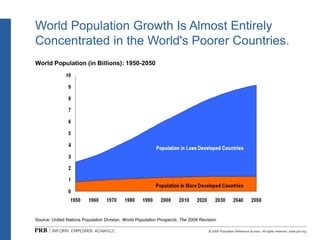
Source: United Nations Population Division, World Population Prospects, The 2008 Revision.
World Population Growth Is Almost Entirely
Concentrated in the World's Poorer Countries.
World Population (in Billions): 1950-2050
© 2009 Population Reference Bureau. All rights reserved. www.prb.org
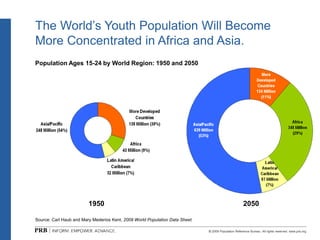
Source: Carl Haub and Mary Mederios Kent, 2009 World Population Data Sheet.
The World’s Youth Population Will Become
More Concentrated in Africa and Asia.
Population Ages 15-24 by World Region: 1950 and 2050
1950 2050
© 2009 Population Reference Bureau. All rights reserved. www.prb.org
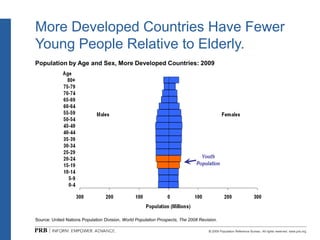
Source: United Nations Population Division, World Population Prospects, The 2008 Revision.
More Developed Countries Have Fewer
Young People Relative to Elderly.
Population by Age and Sex, More Developed Countries: 2009
© 2009 Population Reference Bureau. All rights reserved. www.prb.org
Source: United Nations Population Division, World Population Prospects, The 2008 Revision.
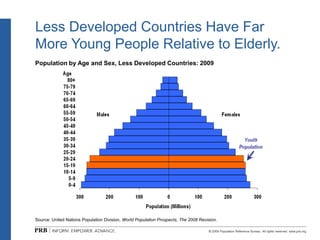
Less Developed Countries Have Far
More Young People Relative to Elderly.
Population by Age and Sex, Less Developed Countries: 2009
© 2009 Population Reference Bureau. All rights reserved. www.prb.org
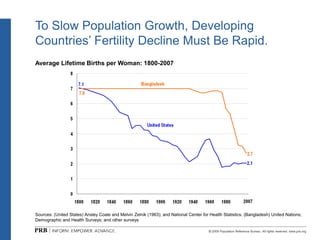
Sources: (United States) Ansley Coale and Melvin Zelnik (1963); and National Center for Health Statistics. (Bangladesh) United Nations;
Demographic and Health Surveys; and other surveys
To Slow Population Growth, Developing
Countries’ Fertility Decline Must Be Rapid.
Average Lifetime Births per Woman: 1800-2007
© 2009 Population Reference Bureau. All rights reserved. www.prb.org
Sources: Carl Haub and Douglas W. Heisler, 1980 World Population Data Sheet; and Carl Haub and Mary Mederios Kent, 2009 World
Population Data Sheet.
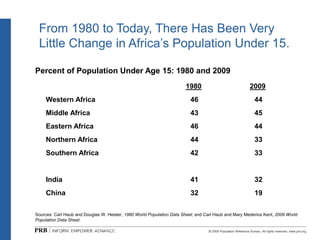
From 1980 to Today, There Has Been Very
Little Change in Africa’s Population Under 15.
Percent of Population Under Age 15: 1980 and 2009
1980 2009
Western Africa 46 44
Middle Africa 43 45
Eastern Africa 46 44
Northern Africa 44 33
Southern Africa 42 33
India 41 32
China 32 19
© 2009 Population Reference Bureau. All rights reserved. www.prb.org
Source: Carl Haub and Mary Mederios Kent, 2009 World Population Data Sheet.
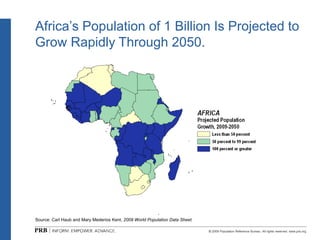
Africa’s Population of 1 Billion Is Projected to
Grow Rapidly Through 2050.
© 2009 Population Reference Bureau. All rights reserved. www.prb.org
Source: Carl Haub and Mary Mederios Kent, 2009 World Population Data Sheet.
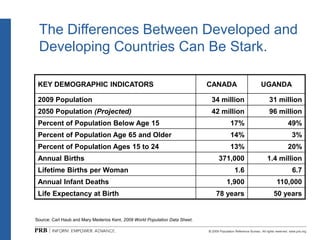
The Differences Between Developed and
Developing Countries Can Be Stark.
KEY DEMOGRAPHIC INDICATORS CANADA UGANDA
2009 Population 34 million 31 million
2050 Population (Projected) 42 million 96 million
Percent of Population Below Age 15 17% 49%
Percent of Population Age 65 and Older 14% 3%
Percent of Population Ages 15 to 24 13% 20%
Annual Births 371,000 1.4 million
Lifetime Births per Woman 1.6 6.7
Annual Infant Deaths 1,900 110,000
Life Expectancy at Birth 78 years 50 years
© 2009 Population Reference Bureau. All rights reserved. www.prb.org
Population by Age and Sex, United States: 2008
Source: PRB analysis of data from U.S. Census Bureau.
The U.S. Has a Younger Age Structure
Than Other Developed Countries.
© 2009 Population Reference Bureau. All rights reserved. www.prb.org
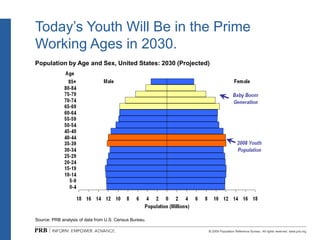
Population by Age and Sex, United States: 2030 (Projected)
Today’s Youth Will Be in the Prime
Working Ages in 2030.
Source: PRB analysis of data from U.S. Census Bureau.
© 2009 Population Reference Bureau. All rights reserved. www.prb.org
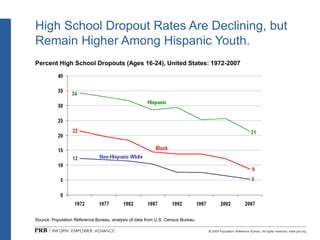
Source: Population Reference Bureau, analysis of data from U.S. Census Bureau.
High School Dropout Rates Are Declining, but
Remain Higher Among Hispanic Youth.
Percent High School Dropouts (Ages 16-24), United States: 1972-2007
© 2009 Population Reference Bureau. All rights reserved. www.prb.org
Source: PRB analysis of data from U.S. Census Bureau, 2007 American Community Survey.
College Enrollment Is Lower Among
Black and Hispanic Youth.
Enrollment and Employment Status of Persons Ages 18-24, United States: 2007
© 2009 Population Reference Bureau. All rights reserved. www.prb.org
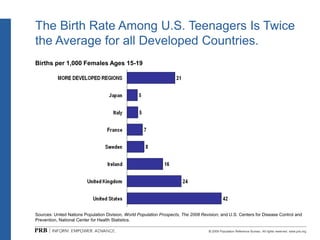
Sources: United Nations Population Division, World Population Prospects, The 2008 Revision; and U.S. Centers for Disease Control and
Prevention, National Center for Health Statistics.
The Birth Rate Among U.S. Teenagers Is Twice
the Average for all Developed Countries.
Births per 1,000 Females Ages 15-19
© 2009 Population Reference Bureau. All rights reserved. www.prb.org
Source: PRB analysis of data from U.S. Centers for Disease Control and Prevention, National Center for Health Statistics.
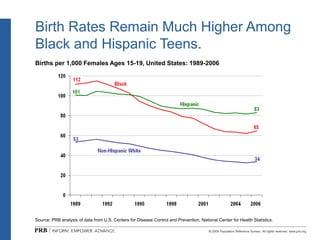
Birth Rates Remain Much Higher Among
Black and Hispanic Teens.
Births per 1,000 Females Ages 15-19, United States: 1989-2006
© 2009 Population Reference Bureau. All rights reserved. www.prb.org
*Non-Hispanic. Source: PRB analysis of data from U.S. Census Bureau.
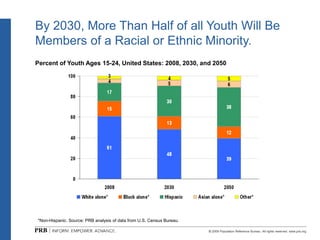
By 2030, More Than Half of all Youth Will Be
Members of a Racial or Ethnic Minority.
Percent of Youth Ages 15-24, United States: 2008, 2030, and 2050
© 2009 Population Reference Bureau. All rights reserved. www.prb.org
Source: Population Reference Bureau, analysis of data from U.S. Census Bureau.
In One-Third of U.S. Counties, at Least 25
Percent of Children Live in Poverty.
© 2009 Population Reference Bureau. All rights reserved. www.prb.org
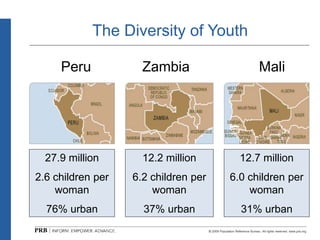
The Diversity of Youth
Mali
Zambia
Peru
12.7 million
6.0 children per
woman
31% urban
12.2 million
6.2 children per
woman
37% urban
27.9 million
2.6 children per
woman
76% urban
© 2009 Population Reference Bureau. All rights reserved. www.prb.org
Source: United Nations Population Division, World Population Prospects: The 2006 Revision.
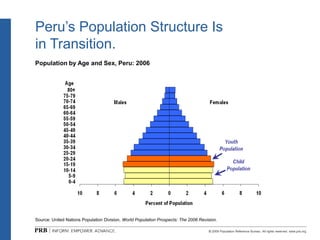
Peru’s Population Structure Is
in Transition.
Population by Age and Sex, Peru: 2006
© 2009 Population Reference Bureau. All rights reserved. www.prb.org
 Well educated.
 Young marriage is
infrequent.
 Few have children
as teens.
 Desired family
size—2 children.
Young Women in Peru Have Options.
© 2009 Population Reference Bureau. All rights reserved. www.prb.org
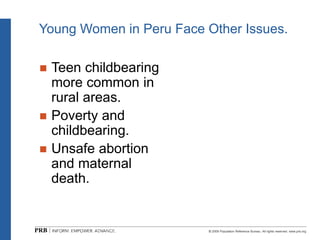
Young Women in Peru Face Other Issues.
 Teen childbearing
more common in
rural areas.
 Poverty and
childbearing.
 Unsafe abortion
and maternal
death.
© 2009 Population Reference Bureau. All rights reserved. www.prb.org
Source: United Nations Population Division, World Population Prospects: The 2006 Revision.
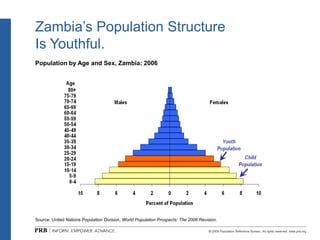
Zambia’s Population Structure
Is Youthful.
Population by Age and Sex, Zambia: 2006
© 2009 Population Reference Bureau. All rights reserved. www.prb.org
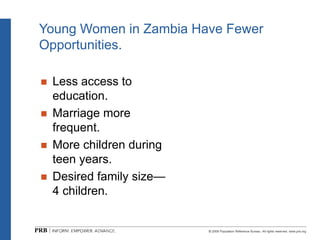
Young Women in Zambia Have Fewer
Opportunities.
 Less access to
education.
 Marriage more
frequent.
 More children during
teen years.
 Desired family size—
4 children.
© 2009 Population Reference Bureau. All rights reserved. www.prb.org
Young Women in Zambia Face Other
Challenges.
 Physical and sexual
violence common.
 Spousal abuse
accepted.
 High HIV prevalence.
© 2009 Population Reference Bureau. All rights reserved. www.prb.org
Source: United Nations Population Division, World Population Prospects: The 2006 Revision.
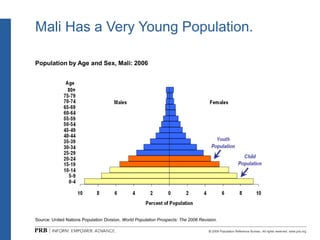
Mali Has a Very Young Population.
Population by Age and Sex, Mali: 2006
© 2009 Population Reference Bureau. All rights reserved. www.prb.org
Being a Young Woman in Mali Is Difficult.
 Marriage common
by age 15.
 Early childbearing.
 Desired family
size—6 children.
© 2009 Population Reference Bureau. All rights reserved. www.prb.org
Young Women in Mali Face Many
Challenges.
 Low school
attendance.
 Spousal abuse
accepted.
 Female genital
cutting common.
POPULATION REFERENCE BUREAU | www.prb.org
2009
World Population Data Sheet
“As World Population Approaches 7 Billion,
the Youth Population Is More and More
Concentrated in Africa and Asia.”
PRESENTATIONS BY CARL HAUB, LINDA JACOBSEN, AND JAMES GRIBBLE
AUGUST 2009

"2009 World Population Data Sheet" POPULATION REFERENCE BUREAU

  • 1.
    POPULATION REFERENCE BUREAU| www.prb.org 2009 World Population Data Sheet “As World Population Approaches 7 Billion, the Youth Population Is More and More Concentrated in Africa and Asia.” PRESENTATIONS BY CARL HAUB, LINDA JACOBSEN, AND JAMES GRIBBLE AUGUST 2009
  • 2.
    © 2009 PopulationReference Bureau. All rights reserved. www.prb.org Source: United Nations Population Division, World Population Prospects, The 2008 Revision. World Population Growth Is Almost Entirely Concentrated in the World's Poorer Countries. World Population (in Billions): 1950-2050
  • 3.
    © 2009 PopulationReference Bureau. All rights reserved. www.prb.org Source: Carl Haub and Mary Mederios Kent, 2009 World Population Data Sheet. The World’s Youth Population Will Become More Concentrated in Africa and Asia. Population Ages 15-24 by World Region: 1950 and 2050 1950 2050
  • 4.
    © 2009 PopulationReference Bureau. All rights reserved. www.prb.org Source: United Nations Population Division, World Population Prospects, The 2008 Revision. More Developed Countries Have Fewer Young People Relative to Elderly. Population by Age and Sex, More Developed Countries: 2009
  • 5.
    © 2009 PopulationReference Bureau. All rights reserved. www.prb.org Source: United Nations Population Division, World Population Prospects, The 2008 Revision. Less Developed Countries Have Far More Young People Relative to Elderly. Population by Age and Sex, Less Developed Countries: 2009
  • 6.
    © 2009 PopulationReference Bureau. All rights reserved. www.prb.org Sources: (United States) Ansley Coale and Melvin Zelnik (1963); and National Center for Health Statistics. (Bangladesh) United Nations; Demographic and Health Surveys; and other surveys To Slow Population Growth, Developing Countries’ Fertility Decline Must Be Rapid. Average Lifetime Births per Woman: 1800-2007
  • 7.
    © 2009 PopulationReference Bureau. All rights reserved. www.prb.org Sources: Carl Haub and Douglas W. Heisler, 1980 World Population Data Sheet; and Carl Haub and Mary Mederios Kent, 2009 World Population Data Sheet. From 1980 to Today, There Has Been Very Little Change in Africa’s Population Under 15. Percent of Population Under Age 15: 1980 and 2009 1980 2009 Western Africa 46 44 Middle Africa 43 45 Eastern Africa 46 44 Northern Africa 44 33 Southern Africa 42 33 India 41 32 China 32 19
  • 8.
    © 2009 PopulationReference Bureau. All rights reserved. www.prb.org Source: Carl Haub and Mary Mederios Kent, 2009 World Population Data Sheet. Africa’s Population of 1 Billion Is Projected to Grow Rapidly Through 2050.
  • 9.
    © 2009 PopulationReference Bureau. All rights reserved. www.prb.org Source: Carl Haub and Mary Mederios Kent, 2009 World Population Data Sheet. The Differences Between Developed and Developing Countries Can Be Stark. KEY DEMOGRAPHIC INDICATORS CANADA UGANDA 2009 Population 34 million 31 million 2050 Population (Projected) 42 million 96 million Percent of Population Below Age 15 17% 49% Percent of Population Age 65 and Older 14% 3% Percent of Population Ages 15 to 24 13% 20% Annual Births 371,000 1.4 million Lifetime Births per Woman 1.6 6.7 Annual Infant Deaths 1,900 110,000 Life Expectancy at Birth 78 years 50 years
  • 10.
    © 2009 PopulationReference Bureau. All rights reserved. www.prb.org Population by Age and Sex, United States: 2008 Source: PRB analysis of data from U.S. Census Bureau. The U.S. Has a Younger Age Structure Than Other Developed Countries.
  • 11.
    © 2009 PopulationReference Bureau. All rights reserved. www.prb.org Population by Age and Sex, United States: 2030 (Projected) Today’s Youth Will Be in the Prime Working Ages in 2030. Source: PRB analysis of data from U.S. Census Bureau.
  • 12.
    © 2009 PopulationReference Bureau. All rights reserved. www.prb.org Source: Population Reference Bureau, analysis of data from U.S. Census Bureau. High School Dropout Rates Are Declining, but Remain Higher Among Hispanic Youth. Percent High School Dropouts (Ages 16-24), United States: 1972-2007
  • 13.
    © 2009 PopulationReference Bureau. All rights reserved. www.prb.org Source: PRB analysis of data from U.S. Census Bureau, 2007 American Community Survey. College Enrollment Is Lower Among Black and Hispanic Youth. Enrollment and Employment Status of Persons Ages 18-24, United States: 2007
  • 14.
    © 2009 PopulationReference Bureau. All rights reserved. www.prb.org Sources: United Nations Population Division, World Population Prospects, The 2008 Revision; and U.S. Centers for Disease Control and Prevention, National Center for Health Statistics. The Birth Rate Among U.S. Teenagers Is Twice the Average for all Developed Countries. Births per 1,000 Females Ages 15-19
  • 15.
    © 2009 PopulationReference Bureau. All rights reserved. www.prb.org Source: PRB analysis of data from U.S. Centers for Disease Control and Prevention, National Center for Health Statistics. Birth Rates Remain Much Higher Among Black and Hispanic Teens. Births per 1,000 Females Ages 15-19, United States: 1989-2006
  • 16.
    © 2009 PopulationReference Bureau. All rights reserved. www.prb.org *Non-Hispanic. Source: PRB analysis of data from U.S. Census Bureau. By 2030, More Than Half of all Youth Will Be Members of a Racial or Ethnic Minority. Percent of Youth Ages 15-24, United States: 2008, 2030, and 2050
  • 17.
    © 2009 PopulationReference Bureau. All rights reserved. www.prb.org Source: Population Reference Bureau, analysis of data from U.S. Census Bureau. In One-Third of U.S. Counties, at Least 25 Percent of Children Live in Poverty.
  • 18.
    © 2009 PopulationReference Bureau. All rights reserved. www.prb.org The Diversity of Youth Mali Zambia Peru 12.7 million 6.0 children per woman 31% urban 12.2 million 6.2 children per woman 37% urban 27.9 million 2.6 children per woman 76% urban
  • 19.
    © 2009 PopulationReference Bureau. All rights reserved. www.prb.org Source: United Nations Population Division, World Population Prospects: The 2006 Revision. Peru’s Population Structure Is in Transition. Population by Age and Sex, Peru: 2006
  • 20.
    © 2009 PopulationReference Bureau. All rights reserved. www.prb.org  Well educated.  Young marriage is infrequent.  Few have children as teens.  Desired family size—2 children. Young Women in Peru Have Options.
  • 21.
    © 2009 PopulationReference Bureau. All rights reserved. www.prb.org Young Women in Peru Face Other Issues.  Teen childbearing more common in rural areas.  Poverty and childbearing.  Unsafe abortion and maternal death.
  • 22.
    © 2009 PopulationReference Bureau. All rights reserved. www.prb.org Source: United Nations Population Division, World Population Prospects: The 2006 Revision. Zambia’s Population Structure Is Youthful. Population by Age and Sex, Zambia: 2006
  • 23.
    © 2009 PopulationReference Bureau. All rights reserved. www.prb.org Young Women in Zambia Have Fewer Opportunities.  Less access to education.  Marriage more frequent.  More children during teen years.  Desired family size— 4 children.
  • 24.
    © 2009 PopulationReference Bureau. All rights reserved. www.prb.org Young Women in Zambia Face Other Challenges.  Physical and sexual violence common.  Spousal abuse accepted.  High HIV prevalence.
  • 25.
    © 2009 PopulationReference Bureau. All rights reserved. www.prb.org Source: United Nations Population Division, World Population Prospects: The 2006 Revision. Mali Has a Very Young Population. Population by Age and Sex, Mali: 2006
  • 26.
    © 2009 PopulationReference Bureau. All rights reserved. www.prb.org Being a Young Woman in Mali Is Difficult.  Marriage common by age 15.  Early childbearing.  Desired family size—6 children.
  • 27.
    © 2009 PopulationReference Bureau. All rights reserved. www.prb.org Young Women in Mali Face Many Challenges.  Low school attendance.  Spousal abuse accepted.  Female genital cutting common.
  • 28.
    POPULATION REFERENCE BUREAU| www.prb.org 2009 World Population Data Sheet “As World Population Approaches 7 Billion, the Youth Population Is More and More Concentrated in Africa and Asia.” PRESENTATIONS BY CARL HAUB, LINDA JACOBSEN, AND JAMES GRIBBLE AUGUST 2009