“ Panic Is Not An Investment Strategy” Straight answers for high net worth investors facing a volatile market Welcome
1.  Independent Registered Investment Advisor 2.  Fee-Only Advisor 3.  Use Pure No-Load Mutual Funds, ETFs, Stocks & Bonds 4.  Design Portfolios to Reduce Risk 5.  Motivated by Making YOU Successful 6.  Service is the Bottom Line! Who is All Star Financial?
Who is All Star Financial? Robert Klefsaas Maren Aipperspach Bruce Bonner Kris Collins Paul Sommerstad Nick Hohn Jeff Elavsky Evan Klefsaas Valerie Moorhead Teri Neff CFP ® , AIF ® , President CFP ® , Vice President CFA ® , Portfolio Manager CPA ® , Tax adviser Account Executive Account Executive Account Executive Paraplanner Executive Assistant Office Manager
Who is All Star Financial? As independent, fee only advisors, we achieve your goals through  “SAFER GROWTH.” In order to accomplish this, we believe that  “It’s not what you make – it’s how much you KEEP!” Our Unique Value Proposition: We customize a clear and efficient game plan, through a disciplined value-driven money management approach, to retain and build wealth for individuals and corporations.  We are passionate about our commitment to reduce risk while still achieving your goals.
What Does All Star Financial Do? Personal and Corporate  Investment Planning Cash Flow Management Financial Planning College Retirement Estate Preservation Estate Liquidation
What Does All Star Financial Do? Personal and Corporate  Asset Management Non Qualified Assets ($300 Million) Cash Flow Money Taxable Accounts Trusts Deferred Compensation Plans Qualified Assets ($2.2 Billion) IRA SEP IRA 401k Pension/ Profit Sharing Plans
What Happened? Nothing that has not happened before!
What Happened? Panic prompted by failure of Ohio Life & Trust Company 5,000 businesses failed within a year 1857
What Happened? Panic prompted by failure of largest bank in the United States The government decided to no longer back its currency with silver (starting the “gold standard”) Post Civil War bubble 1873
What Happened? Panic prompted by failure of Unites States Reading Railroad The “railroad bubble” was very similar to the “tech bubble” that popped in 2000. A Run on gold contributed to the panic 1893
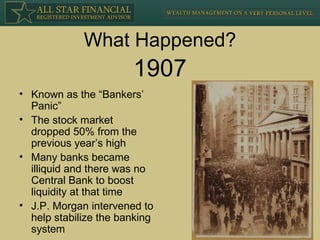
What Happened? Known as the “Bankers’ Panic” The stock market dropped 50% from the previous year’s high Many banks became illiquid and there was no Central Bank to boost liquidity at that time J.P. Morgan intervened to help stabilize the banking system 1907
What Happened? Post World War I Recession Influx of labor from returning troops caused high unemployment Factories eventually recovered by producing radios and cars 1918
What Happened? Great Depression started with Black Thursday on Wall Street Stock markets crash worldwide and the United States Banking System failed Economic slowdown lasted for 10 years 1929
What Happened? Post Korean War Recession Poor monetary policy – restricted due to inflationary fears 1953
What Happened? Auto sales fell 31% in the United States and unemployment reached 20% in Detroit Monetary policy was restricted for two years prior to 1957 1957
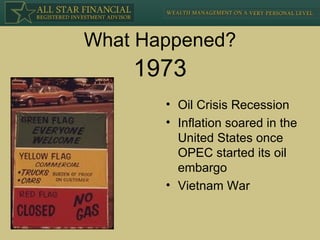
What Happened? Oil Crisis Recession Inflation soared in the United States once OPEC started its oil embargo Vietnam War 1973
What Happened? Recession – Monetary Policy Iranian Crisis (New Leadership) – Energy supply down Tight monetary policy to control inflation High unemployment levels through 1981 The prime rate reached 21.5% in June 1982 1980
What Happened? Panic based on Savings & Loan Crisis Cost tax payers $124 billion and the Savings & Loan companies $29 billion to fix Money paid back through restructuring the bad debt by our government 1987
What Happened? Recession was short lived Industrial production and manufacturing sales slid The United States felt more Worldwide competition Japanese Real Estate Bubble 1990
What Happened? Recession – collapse of the dot.com bubble September 11 th  attack and accounting scandals also contributed to the slowdown 2000
What Happened? Housing Bubble – Financed with excessive and poorly regulated mortgage debt (subprime) Housing prices tumble Delinquencies and foreclosures lead to downward spiral of debt liquidation Leads to even lower housing prices Lead to Investment Banking Collapse – GREED! 2008
What Happened? Banking Act of 1933 (Glass-Steagall Act) Separated bank types according to commercial and investment banking Passed by Congress to prohibit banks from owning full service brokerage firms and vice versa. Investment Banking activities, underwriting, corporate, municipal, and mortgage securities, couldn’t be called into question and also to insulate bank depositors from risks of the stock and bond market collapse which precipitated the Great Depression.
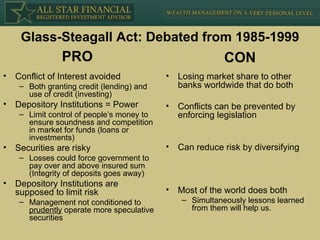
Glass-Steagall Act: Debated from 1985-1999 Conflict of Interest avoided  Both granting credit (lending) and use of credit (investing) Depository Institutions = Power Limit control of people’s money to ensure soundness and competition in market for funds (loans or investments) Securities are risky Losses could force government to pay over and above insured sum (Integrity of deposits goes away) Depository Institutions are supposed to limit risk Management not conditioned to  prudently  operate more speculative securities Losing market share to other banks worldwide that do both Conflicts can be prevented by enforcing legislation Can reduce risk by diversifying Most of the world does both Simultaneously lessons learned from them will help us. PRO CON
What Happened? The Glass-Steagall Act was repealed in 1999. Deregulation allowing commercial banks and investment banks the freedom to act as one. One of President Clinton’s last bills he signed Encourages/Requires lending practices to be more liberal Mortgage “products” go from 3 basic options to hundreds of options. Unregulated – Mortgage Broker business expands rapidly during a decreasing interest rate environment. Consumers were sold inappropriate loans. Consumers got greedy – bought too much house!
How Long Will This Last? 1907 Banking Crisis was solved quickly because of transparency (locked in a room). Transparency comes from legislation Need for more disclosure This makes the most efficient markets (fewer surprises) Allows for opportunity to not be as “surprised” as we are today. Creates a more settled, although complex, credit market
How Long Will This Last? Western democratic capitalism is like a three legged stool, resting on political freedom, economic freedom, and moral restraint (lack of greed).  Take away moral restraint (add greed) and the stool collapses.” Theologian – Michael Novak Quote
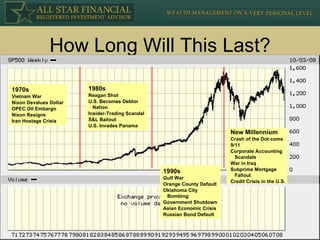
How Long Will This Last? Last 10 recessions - starting in June 1946 Average length = 11 months S&P peak to start of recession = 8 months Start of recession to trough = 7 months Total Peak to Trough = 15 months Total S&P Decline from peak to trough = -32.6% Next 12 months average rebound = 30.8% Average months for an expansion = 68 months Average bull market return = 176%
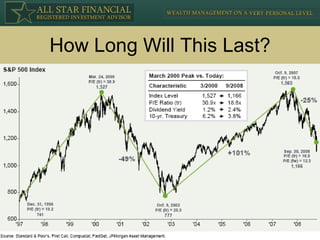
How Long Will This Last?
How Long Will This Last? 1970s Vietnam War Nixon Devalues Dollar OPEC Oil Embargo Nixon Resigns Iran Hostage Crisis 1980s Reagan Shot U.S. Becomes Debtor Nation Insider-Trading Scandal S&L Bailout U.S. Invades Panama 1990s Gulf War Orange County Default Oklahoma City Bombing Government Shutdown Asian Economic Crisis Russian Bond Default New Millennium Crash of the Dot-coms 9/11 Corporate Accounting Scandals War in Iraq Subprime Mortgage Fallout Credit Crisis in the U.S.
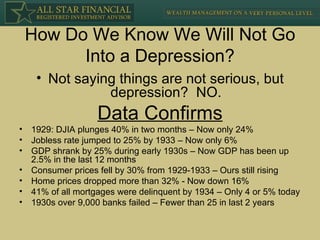
How Do We Know We Will Not Go Into a Depression? Not saying things are not serious, but depression?  NO. Data Confirms 1929: DJIA plunges 40% in two months – Now only 24% Jobless rate jumped to 25% by 1933 – Now only 6% GDP shrank by 25% during early 1930s – Now GDP has been up 2.5% in the last 12 months Consumer prices fell by 30% from 1929-1933 – Ours still rising Home prices dropped more than 32% - Now down 16% 41% of all mortgages were delinquent by 1934 – Only 4 or 5% today 1930s over 9,000 banks failed – Fewer than 25 in last 2 years
How Do We Know We Will Not Go Into a Depression? Remember Federal Reserve made a mistake – Decreased money supply by one third Instead of lowering taxes – Herbert Hoover raised them New Tariff Act kept foreign products out – provoked our trading partners to do the same Add to this today’s automatic stabilizers Unemployment Insurance and Social Security FDIC to insure deposits (will increase to $250K) Circuit breakers to keep stocks from falling too quickly Depression Ahead?  No!
Is This a Bailout of “Fat Cats” on Wall Street?  No! Infusion of capital to unclog the financial markets. Benefits everyone, business and consumers. $700 billion will be used as Treasury Secretary needs the money – line of credit $700 billion total assumed cost could be significantly less –no cost?
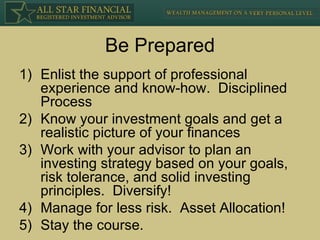
Be Prepared Enlist the support of professional experience and know-how.  Disciplined Process Know your investment goals and get a realistic picture of your finances Work with your advisor to plan an investing strategy based on your goals, risk tolerance, and solid investing principles.  Diversify! Manage for less risk.  Asset Allocation! Stay the course.
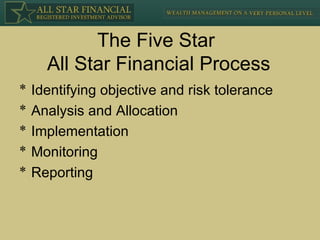
The Five Star  All Star Financial Process Identifying objective and risk tolerance Analysis and Allocation Implementation Monitoring Reporting
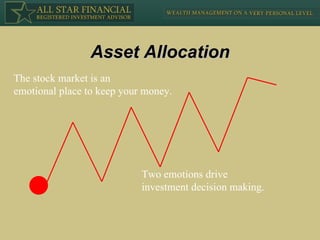
Two emotions drive investment decision making. The stock market is an  emotional place to keep your money. Asset Allocation
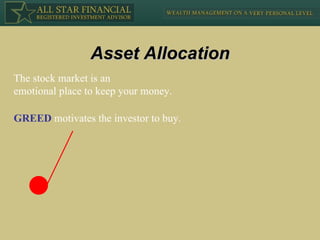
GREED  motivates the investor to buy. The stock market is an  emotional place to keep your money. Asset Allocation
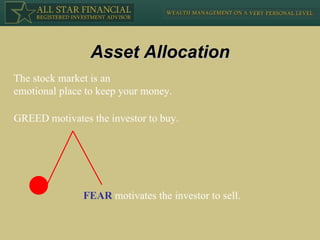
GREED motivates the investor to buy. The stock market is an  emotional place to keep your money. Asset Allocation FEAR  motivates the investor to sell.
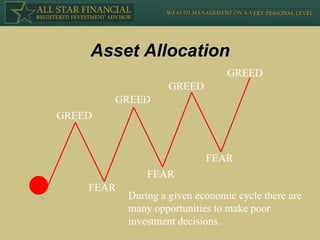
Asset Allocation During a given economic cycle there are  many opportunities to make poor investment decisions. GREED GREED GREED FEAR FEAR FEAR GREED
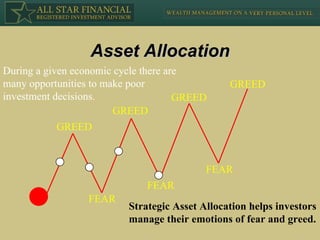
Asset Allocation During a given economic cycle there are  many opportunities to make poor investment decisions. Strategic Asset Allocation helps investors manage their emotions of fear and greed. GREED GREED GREED FEAR FEAR FEAR GREED
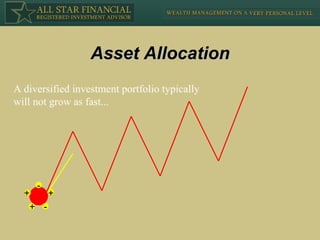
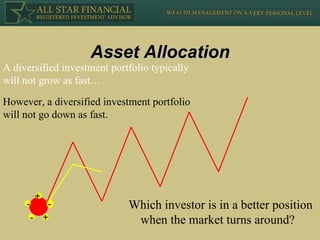
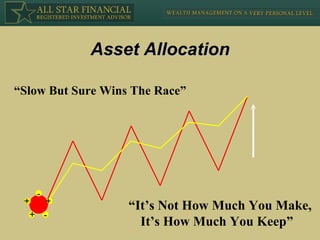
Asset Allocation A diversified investment portfolio typically will not grow as fast... + - + - +
Asset Allocation - - + - + Which investor is in a better position when the market turns around? A diversified investment portfolio typically will not grow as fast… However, a diversified investment portfolio will not go down as fast.
Asset Allocation + + - + - “ It’s Not How Much You Make, It’s How Much You Keep” “ Slow But Sure Wins The Race”
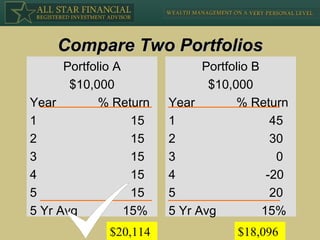
Compare Two Portfolios Portfolio A $10,000 Year  % Return 1  15 2  15 3  15 4  15 5  15 5 Yr Avg  15% Portfolio B $10,000 Year  % Return 1  45 2  30 3  0 4  -20 5  20 5 Yr Avg  15% $20,114 $18,096
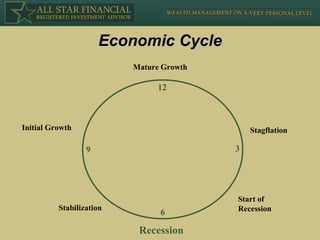
Economic Cycle Recession Start of  Recession Stagflation Mature   Growth Initial Growth Stabilization 6 12 9 3
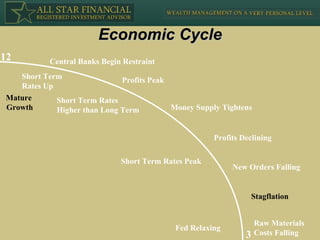
Economic Cycle Central Banks Begin Restraint 12 Short Term Rates Up Short Term Rates Higher than Long Term Profits Peak Fed Relaxing 3 Raw Materials  Costs Falling Short Term Rates Peak New Orders Falling Money Supply Tightens Profits Declining Mature   Growth Stagflation
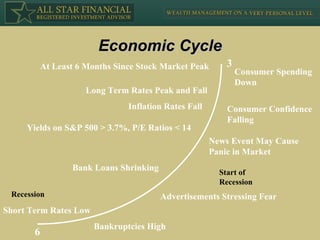
Economic Cycle At Least 6 Months Since Stock Market Peak Long Term Rates Peak and Fall Inflation Rates Fall Yields on S&P 500 > 3.7%, P/E Ratios < 14 Bank Loans Shrinking Short Term Rates Low Consumer Spending  Down Consumer Confidence  Falling News Event May Cause  Panic in Market Advertisements Stressing Fear Bankruptcies High 3 6 Start of  Recession Recession
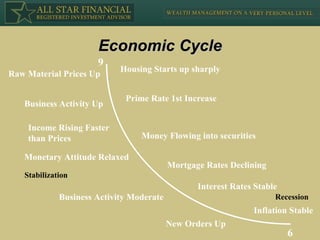
Economic Cycle Raw Material Prices Up Business Activity Up Income Rising Faster  than Prices Monetary Attitude Relaxed Business Activity Moderate Housing Starts up sharply Prime Rate 1st Increase Money Flowing into securities Mortgage Rates Declining New Orders Up Interest Rates Stable Inflation Stable 6 9 Recession Stabilization
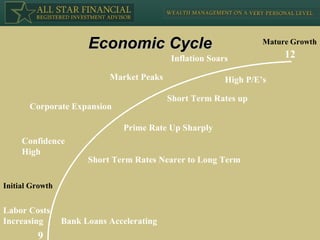
Economic Cycle Inflation Soars Market Peaks Corporate Expansion Confidence  High Labor Costs Increasing High P/E’s Short Term Rates up Prime Rate Up Sharply Short Term Rates Nearer to Long Term Bank Loans Accelerating 12 9 Initial Growth Mature   Growth
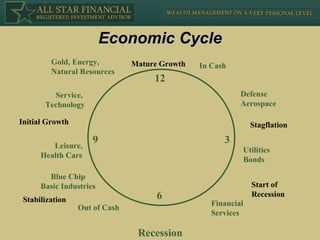
Economic Cycle Recession In Cash Defense  Aerospace Utilities Bonds Financial  Services Gold, Energy,  Natural Resources Service,  Technology Leisure, Health Care Blue Chip Basic Industries Out of Cash 6 9 12 3 Mature   Growth Initial Growth Stabilization Start of  Recession Stagflation
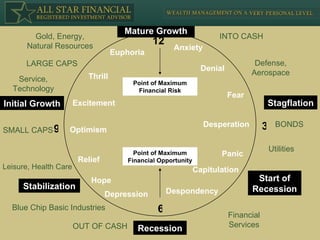
Thrill Anxiety Depression Hope Panic Desperation Euphoria Denial Capitulation Relief Optimism Fear Despondency Excitement 3 6 9 12 Recession Start of Recession Stagflation Stabilization Initial Growth Mature Growth Point of Maximum Financial Opportunity Point of Maximum Financial Risk Blue Chip Basic Industries OUT OF CASH Leisure, Health Care SMALL CAPS Service, Technology Gold, Energy, Natural Resources LARGE CAPS INTO CASH Defense, Aerospace BONDS Utilities Financial Services
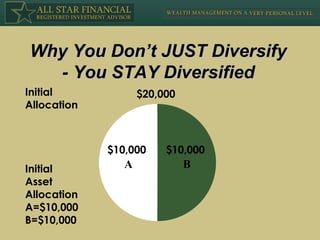
Why You Don’t JUST Diversify - You STAY Diversified B A Initial Allocation Initial Asset  Allocation A=$10,000 B=$10,000 $20,000 $10,000 $10,000
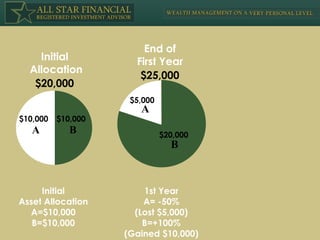
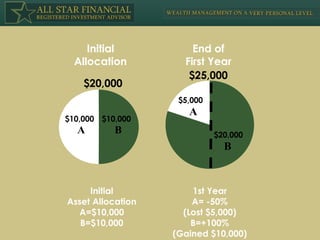
B A Initial Asset Allocation A=$10,000 B=$10,000 $20,000 $10,000 $10,000 Initial Allocation B A End of First Year $25,000 $5,000 $20,000 1st Year A= -50% (Lost $5,000) B=+100% (Gained $10,000)
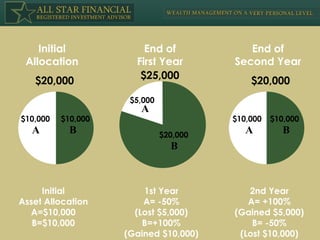
B A Initial Asset Allocation A=$10,000 B=$10,000 $20,000 $10,000 $10,000 Initial Allocation B A End of First Year $25,000 $5,000 $20,000 1st Year A= -50% (Lost $5,000) B=+100% (Gained $10,000) B A 2nd Year A= +100% (Gained $5,000) B= -50% (Lost $10,000) $20,000 $10,000 $10,000 End of Second Year
B A Initial Asset Allocation A=$10,000 B=$10,000 $20,000 $10,000 $10,000 Initial Allocation B A End of First Year $25,000 $5,000 $20,000 1st Year A= -50% (Lost $5,000) B=+100% (Gained $10,000)
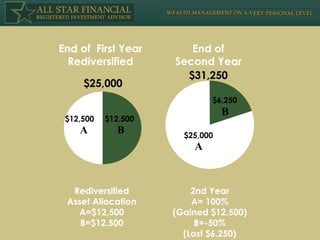
B A Rediversified Asset Allocation A=$12,500 B=$12,500 $25,000 $12,500 $12,500 End of  First Year Rediversified B A End of Second Year $31,250 $25,000 $6,250 2nd Year A= 100% (Gained $12,500) B=-50% (Lost $6,250)
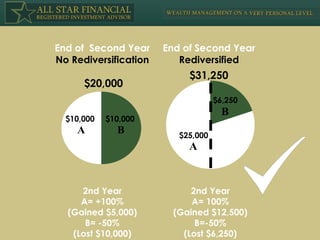
B A 2nd Year A= +100% (Gained $5,000) B= -50% (Lost $10,000) $20,000 $10,000 $10,000 End of  Second Year No Rediversification B A End of Second Year Rediversified $31,250 $25,000 $6,250 2nd Year A= 100% (Gained $12,500) B=-50% (Lost $6,250)
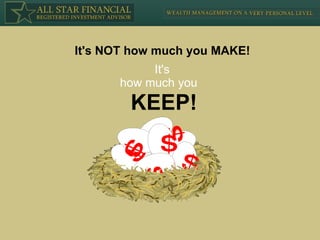
It's NOT how much you MAKE! It's how much you KEEP! $ $ $ $ $ $ $ $ $
Questions?
Free Portfolio Analysis Where are you today? Is there a more efficient path to take? Call  952-896-3820   to make an appointment or visit our website at  www.allstarfinancial.com
Thank You!

2008 Seminar Ppt 2

  • 1.
    “ Panic IsNot An Investment Strategy” Straight answers for high net worth investors facing a volatile market Welcome
  • 2.
    1. IndependentRegistered Investment Advisor 2. Fee-Only Advisor 3. Use Pure No-Load Mutual Funds, ETFs, Stocks & Bonds 4. Design Portfolios to Reduce Risk 5. Motivated by Making YOU Successful 6. Service is the Bottom Line! Who is All Star Financial?
  • 3.
    Who is AllStar Financial? Robert Klefsaas Maren Aipperspach Bruce Bonner Kris Collins Paul Sommerstad Nick Hohn Jeff Elavsky Evan Klefsaas Valerie Moorhead Teri Neff CFP ® , AIF ® , President CFP ® , Vice President CFA ® , Portfolio Manager CPA ® , Tax adviser Account Executive Account Executive Account Executive Paraplanner Executive Assistant Office Manager
  • 4.
    Who is AllStar Financial? As independent, fee only advisors, we achieve your goals through “SAFER GROWTH.” In order to accomplish this, we believe that “It’s not what you make – it’s how much you KEEP!” Our Unique Value Proposition: We customize a clear and efficient game plan, through a disciplined value-driven money management approach, to retain and build wealth for individuals and corporations. We are passionate about our commitment to reduce risk while still achieving your goals.
  • 5.
    What Does AllStar Financial Do? Personal and Corporate Investment Planning Cash Flow Management Financial Planning College Retirement Estate Preservation Estate Liquidation
  • 6.
    What Does AllStar Financial Do? Personal and Corporate Asset Management Non Qualified Assets ($300 Million) Cash Flow Money Taxable Accounts Trusts Deferred Compensation Plans Qualified Assets ($2.2 Billion) IRA SEP IRA 401k Pension/ Profit Sharing Plans
  • 7.
    What Happened? Nothingthat has not happened before!
  • 8.
    What Happened? Panicprompted by failure of Ohio Life & Trust Company 5,000 businesses failed within a year 1857
  • 9.
    What Happened? Panicprompted by failure of largest bank in the United States The government decided to no longer back its currency with silver (starting the “gold standard”) Post Civil War bubble 1873
  • 10.
    What Happened? Panicprompted by failure of Unites States Reading Railroad The “railroad bubble” was very similar to the “tech bubble” that popped in 2000. A Run on gold contributed to the panic 1893
  • 11.
    What Happened? Knownas the “Bankers’ Panic” The stock market dropped 50% from the previous year’s high Many banks became illiquid and there was no Central Bank to boost liquidity at that time J.P. Morgan intervened to help stabilize the banking system 1907
  • 12.
    What Happened? PostWorld War I Recession Influx of labor from returning troops caused high unemployment Factories eventually recovered by producing radios and cars 1918
  • 13.
    What Happened? GreatDepression started with Black Thursday on Wall Street Stock markets crash worldwide and the United States Banking System failed Economic slowdown lasted for 10 years 1929
  • 14.
    What Happened? PostKorean War Recession Poor monetary policy – restricted due to inflationary fears 1953
  • 15.
    What Happened? Autosales fell 31% in the United States and unemployment reached 20% in Detroit Monetary policy was restricted for two years prior to 1957 1957
  • 16.
    What Happened? OilCrisis Recession Inflation soared in the United States once OPEC started its oil embargo Vietnam War 1973
  • 17.
    What Happened? Recession– Monetary Policy Iranian Crisis (New Leadership) – Energy supply down Tight monetary policy to control inflation High unemployment levels through 1981 The prime rate reached 21.5% in June 1982 1980
  • 18.
    What Happened? Panicbased on Savings & Loan Crisis Cost tax payers $124 billion and the Savings & Loan companies $29 billion to fix Money paid back through restructuring the bad debt by our government 1987
  • 19.
    What Happened? Recessionwas short lived Industrial production and manufacturing sales slid The United States felt more Worldwide competition Japanese Real Estate Bubble 1990
  • 20.
    What Happened? Recession– collapse of the dot.com bubble September 11 th attack and accounting scandals also contributed to the slowdown 2000
  • 21.
    What Happened? HousingBubble – Financed with excessive and poorly regulated mortgage debt (subprime) Housing prices tumble Delinquencies and foreclosures lead to downward spiral of debt liquidation Leads to even lower housing prices Lead to Investment Banking Collapse – GREED! 2008
  • 22.
    What Happened? BankingAct of 1933 (Glass-Steagall Act) Separated bank types according to commercial and investment banking Passed by Congress to prohibit banks from owning full service brokerage firms and vice versa. Investment Banking activities, underwriting, corporate, municipal, and mortgage securities, couldn’t be called into question and also to insulate bank depositors from risks of the stock and bond market collapse which precipitated the Great Depression.
  • 23.
    Glass-Steagall Act: Debatedfrom 1985-1999 Conflict of Interest avoided Both granting credit (lending) and use of credit (investing) Depository Institutions = Power Limit control of people’s money to ensure soundness and competition in market for funds (loans or investments) Securities are risky Losses could force government to pay over and above insured sum (Integrity of deposits goes away) Depository Institutions are supposed to limit risk Management not conditioned to prudently operate more speculative securities Losing market share to other banks worldwide that do both Conflicts can be prevented by enforcing legislation Can reduce risk by diversifying Most of the world does both Simultaneously lessons learned from them will help us. PRO CON
  • 24.
    What Happened? TheGlass-Steagall Act was repealed in 1999. Deregulation allowing commercial banks and investment banks the freedom to act as one. One of President Clinton’s last bills he signed Encourages/Requires lending practices to be more liberal Mortgage “products” go from 3 basic options to hundreds of options. Unregulated – Mortgage Broker business expands rapidly during a decreasing interest rate environment. Consumers were sold inappropriate loans. Consumers got greedy – bought too much house!
  • 25.
    How Long WillThis Last? 1907 Banking Crisis was solved quickly because of transparency (locked in a room). Transparency comes from legislation Need for more disclosure This makes the most efficient markets (fewer surprises) Allows for opportunity to not be as “surprised” as we are today. Creates a more settled, although complex, credit market
  • 26.
    How Long WillThis Last? Western democratic capitalism is like a three legged stool, resting on political freedom, economic freedom, and moral restraint (lack of greed). Take away moral restraint (add greed) and the stool collapses.” Theologian – Michael Novak Quote
  • 27.
    How Long WillThis Last? Last 10 recessions - starting in June 1946 Average length = 11 months S&P peak to start of recession = 8 months Start of recession to trough = 7 months Total Peak to Trough = 15 months Total S&P Decline from peak to trough = -32.6% Next 12 months average rebound = 30.8% Average months for an expansion = 68 months Average bull market return = 176%
  • 28.
    How Long WillThis Last?
  • 29.
    How Long WillThis Last? 1970s Vietnam War Nixon Devalues Dollar OPEC Oil Embargo Nixon Resigns Iran Hostage Crisis 1980s Reagan Shot U.S. Becomes Debtor Nation Insider-Trading Scandal S&L Bailout U.S. Invades Panama 1990s Gulf War Orange County Default Oklahoma City Bombing Government Shutdown Asian Economic Crisis Russian Bond Default New Millennium Crash of the Dot-coms 9/11 Corporate Accounting Scandals War in Iraq Subprime Mortgage Fallout Credit Crisis in the U.S.
  • 30.
    How Do WeKnow We Will Not Go Into a Depression? Not saying things are not serious, but depression? NO. Data Confirms 1929: DJIA plunges 40% in two months – Now only 24% Jobless rate jumped to 25% by 1933 – Now only 6% GDP shrank by 25% during early 1930s – Now GDP has been up 2.5% in the last 12 months Consumer prices fell by 30% from 1929-1933 – Ours still rising Home prices dropped more than 32% - Now down 16% 41% of all mortgages were delinquent by 1934 – Only 4 or 5% today 1930s over 9,000 banks failed – Fewer than 25 in last 2 years
  • 31.
    How Do WeKnow We Will Not Go Into a Depression? Remember Federal Reserve made a mistake – Decreased money supply by one third Instead of lowering taxes – Herbert Hoover raised them New Tariff Act kept foreign products out – provoked our trading partners to do the same Add to this today’s automatic stabilizers Unemployment Insurance and Social Security FDIC to insure deposits (will increase to $250K) Circuit breakers to keep stocks from falling too quickly Depression Ahead? No!
  • 32.
    Is This aBailout of “Fat Cats” on Wall Street? No! Infusion of capital to unclog the financial markets. Benefits everyone, business and consumers. $700 billion will be used as Treasury Secretary needs the money – line of credit $700 billion total assumed cost could be significantly less –no cost?
  • 33.
    Be Prepared Enlistthe support of professional experience and know-how. Disciplined Process Know your investment goals and get a realistic picture of your finances Work with your advisor to plan an investing strategy based on your goals, risk tolerance, and solid investing principles. Diversify! Manage for less risk. Asset Allocation! Stay the course.
  • 34.
    The Five Star All Star Financial Process Identifying objective and risk tolerance Analysis and Allocation Implementation Monitoring Reporting
  • 35.
    Two emotions driveinvestment decision making. The stock market is an emotional place to keep your money. Asset Allocation
  • 36.
    GREED motivatesthe investor to buy. The stock market is an emotional place to keep your money. Asset Allocation
  • 37.
    GREED motivates theinvestor to buy. The stock market is an emotional place to keep your money. Asset Allocation FEAR motivates the investor to sell.
  • 38.
    Asset Allocation Duringa given economic cycle there are many opportunities to make poor investment decisions. GREED GREED GREED FEAR FEAR FEAR GREED
  • 39.
    Asset Allocation Duringa given economic cycle there are many opportunities to make poor investment decisions. Strategic Asset Allocation helps investors manage their emotions of fear and greed. GREED GREED GREED FEAR FEAR FEAR GREED
  • 40.
    Asset Allocation Adiversified investment portfolio typically will not grow as fast... + - + - +
  • 41.
    Asset Allocation -- + - + Which investor is in a better position when the market turns around? A diversified investment portfolio typically will not grow as fast… However, a diversified investment portfolio will not go down as fast.
  • 42.
    Asset Allocation ++ - + - “ It’s Not How Much You Make, It’s How Much You Keep” “ Slow But Sure Wins The Race”
  • 43.
    Compare Two PortfoliosPortfolio A $10,000 Year % Return 1 15 2 15 3 15 4 15 5 15 5 Yr Avg 15% Portfolio B $10,000 Year % Return 1 45 2 30 3 0 4 -20 5 20 5 Yr Avg 15% $20,114 $18,096
  • 44.
    Economic Cycle RecessionStart of Recession Stagflation Mature Growth Initial Growth Stabilization 6 12 9 3
  • 45.
    Economic Cycle CentralBanks Begin Restraint 12 Short Term Rates Up Short Term Rates Higher than Long Term Profits Peak Fed Relaxing 3 Raw Materials Costs Falling Short Term Rates Peak New Orders Falling Money Supply Tightens Profits Declining Mature Growth Stagflation
  • 46.
    Economic Cycle AtLeast 6 Months Since Stock Market Peak Long Term Rates Peak and Fall Inflation Rates Fall Yields on S&P 500 > 3.7%, P/E Ratios < 14 Bank Loans Shrinking Short Term Rates Low Consumer Spending Down Consumer Confidence Falling News Event May Cause Panic in Market Advertisements Stressing Fear Bankruptcies High 3 6 Start of Recession Recession
  • 47.
    Economic Cycle RawMaterial Prices Up Business Activity Up Income Rising Faster than Prices Monetary Attitude Relaxed Business Activity Moderate Housing Starts up sharply Prime Rate 1st Increase Money Flowing into securities Mortgage Rates Declining New Orders Up Interest Rates Stable Inflation Stable 6 9 Recession Stabilization
  • 48.
    Economic Cycle InflationSoars Market Peaks Corporate Expansion Confidence High Labor Costs Increasing High P/E’s Short Term Rates up Prime Rate Up Sharply Short Term Rates Nearer to Long Term Bank Loans Accelerating 12 9 Initial Growth Mature Growth
  • 49.
    Economic Cycle RecessionIn Cash Defense Aerospace Utilities Bonds Financial Services Gold, Energy, Natural Resources Service, Technology Leisure, Health Care Blue Chip Basic Industries Out of Cash 6 9 12 3 Mature Growth Initial Growth Stabilization Start of Recession Stagflation
  • 50.
    Thrill Anxiety DepressionHope Panic Desperation Euphoria Denial Capitulation Relief Optimism Fear Despondency Excitement 3 6 9 12 Recession Start of Recession Stagflation Stabilization Initial Growth Mature Growth Point of Maximum Financial Opportunity Point of Maximum Financial Risk Blue Chip Basic Industries OUT OF CASH Leisure, Health Care SMALL CAPS Service, Technology Gold, Energy, Natural Resources LARGE CAPS INTO CASH Defense, Aerospace BONDS Utilities Financial Services
  • 51.
    Why You Don’tJUST Diversify - You STAY Diversified B A Initial Allocation Initial Asset Allocation A=$10,000 B=$10,000 $20,000 $10,000 $10,000
  • 52.
    B A InitialAsset Allocation A=$10,000 B=$10,000 $20,000 $10,000 $10,000 Initial Allocation B A End of First Year $25,000 $5,000 $20,000 1st Year A= -50% (Lost $5,000) B=+100% (Gained $10,000)
  • 53.
    B A InitialAsset Allocation A=$10,000 B=$10,000 $20,000 $10,000 $10,000 Initial Allocation B A End of First Year $25,000 $5,000 $20,000 1st Year A= -50% (Lost $5,000) B=+100% (Gained $10,000) B A 2nd Year A= +100% (Gained $5,000) B= -50% (Lost $10,000) $20,000 $10,000 $10,000 End of Second Year
  • 54.
    B A InitialAsset Allocation A=$10,000 B=$10,000 $20,000 $10,000 $10,000 Initial Allocation B A End of First Year $25,000 $5,000 $20,000 1st Year A= -50% (Lost $5,000) B=+100% (Gained $10,000)
  • 55.
    B A RediversifiedAsset Allocation A=$12,500 B=$12,500 $25,000 $12,500 $12,500 End of First Year Rediversified B A End of Second Year $31,250 $25,000 $6,250 2nd Year A= 100% (Gained $12,500) B=-50% (Lost $6,250)
  • 56.
    B A 2ndYear A= +100% (Gained $5,000) B= -50% (Lost $10,000) $20,000 $10,000 $10,000 End of Second Year No Rediversification B A End of Second Year Rediversified $31,250 $25,000 $6,250 2nd Year A= 100% (Gained $12,500) B=-50% (Lost $6,250)
  • 57.
    It's NOT howmuch you MAKE! It's how much you KEEP! $ $ $ $ $ $ $ $ $
  • 58.
  • 59.
    Free Portfolio AnalysisWhere are you today? Is there a more efficient path to take? Call 952-896-3820 to make an appointment or visit our website at www.allstarfinancial.com
  • 60.