a j o u r n a l o f c o r r e c t i o n a l
p h i l o s o p h y a n d p r a c t i c e
Drug Treatment in the Community
By Faye S. Taxman, Jeffrey A. Bouffard
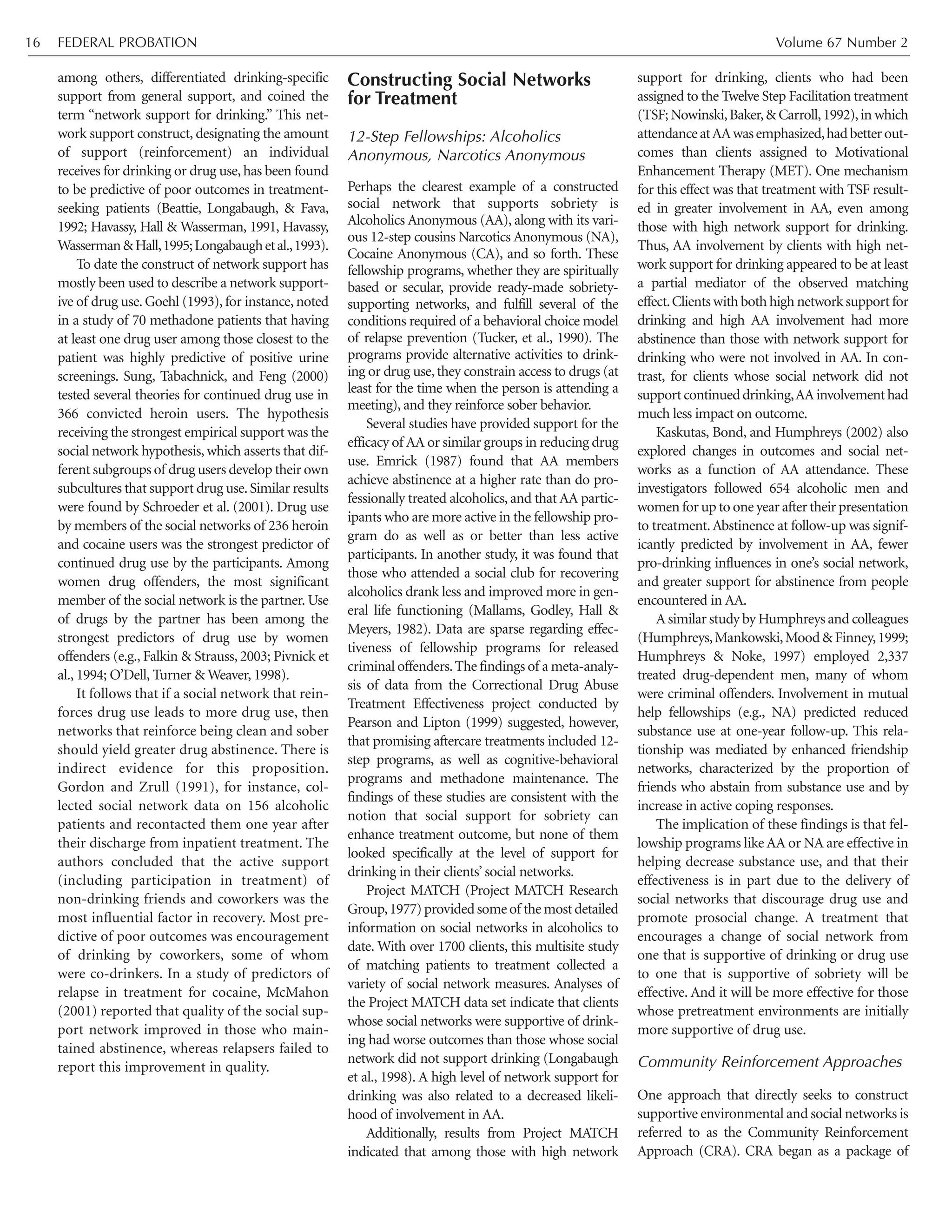
Social Support Networks in Outpatient Drug Treatment
By Mark D. Litt, Sharon D. Mallon
Hepatitis C Among Offenders
By Scott A. Allen, Josiah D. Rich, Beth Schwartzapfel,
Peter D. Friedmann
An Employment Intervention for Drug-Abusing Offenders
By Carl Leukefeld, Hope Smiley McDonald, Michele Staton,
Allison Mateyoke-Scrivner, Matthew Webster, TK Logan, Tom Garrity
Co-Occurring Substance Use and Mental Disorders in Offenders
By Stanley Sacks, Frank S. Pearson
Amenability to Treatment of Drug Offenders
By Douglas B. Marlowe, Nicholas S. Patapis, David S. DeMatteo
Sanctions and Rewards in Prison-Based Therapeutic Community Treatment
By William M. Burdon, Michael L. Prendergast, Vitka Eisen,
Nena P. Messina
Treatment Research in Oz—Is Randomization the Ideal or Just Somewhere
Over the Rainbow?
By Steven S. Martin, James A. Inciardi, Daniel J. O’Connell
Moving Towards a Federal Criminal Justice “System”
By Timothy P. Cadigan, Bernadette Pelissier
Reorganizing Care for the Substance Using Offender
By Peter J. Delany, Bennett W. Fletcher, Joseph J. Shields
S E P T E M B E R 2 0 0 3
SPECIAL ISSUE:
SUBSTANCE ABUSE
TREATMENT
P U B L I S H E D B Y
The Administrative Office of the United States Court
Leonidas Ralph Mecham, Director
John M.Hughes, Assistant Director
Office of Probation and Pretrial Services
Federal Probation ISSBN 0014-9128 is dedicated to informing its readers about current
thought, research, and practice in corrections and criminal justice. The journal welcomes
the contributions of persons who work with or study juvenile and adult offenders and
invites authors to submit articles describing experience or significant findings regarding the
prevention and control of delinquency and crime. A style sheet is available from the editor.
Federal Probation is published three times a year, in June, September (on a special topic), and
December. Permission to quote is granted on the condition that appropriate credit is given the
author and Federal Probation. For information about reprinting articles, please contact the editor.
Subscriptions to Federal Probation are available from the Superintendent of Documents at an
annual rate of $16.00 ($22.40 foreign). Please see the subscription order form on the last page
of this issue for more information.
A DV I S O RY C O M M I T T E E
s p e c i a l a d v i s o r
Merrill A. Smith
m e m b e r s
Dan Richard Beto
Correctional Management Institute of Texas
Huntsville, Texas
John W. Byrd
United States Pretrial Office
San Antonio, Texas
Honorable James G. Carr
United States District Court
Toledo, Ohio
Alvin W. Cohn
Administration of Justice Services, Inc.
Rockville, Maryland
Ronald P. Corbett, Jr.
Executive Director, Supreme Judicial Court
Boston, Massachusetts
Thomas Henry
United States Pretrial Office
Newark, New Jersey
Magdeline Jensen
United States Probation Office
Tucson, Arizona
Jolanta Juszkiewicz
Pretrial Services Resource Center
Washington, DC
Honorable David D. Noce
United States District Court
St. Louis, Missouri
Joan Petersilia
University of California, Irvine
Irvine, California
Faye Taxman
University of Maryland
College Park, Maryland
a j o u r n a l o f c o r r e c t i o n a l
p h i l o s o p h y a n d p r a c t i c e
E D I TO R I A L S TA F F
Timothy P. Cadigan, Executive Editor
Ellen Wilson Fielding, Editor
Federal Probation
Administrative Office of the U.S. Courts
Washington, DC 20544
telephone: 202-502-1600
fax: 202-502-1677
Postmaster: Please send address changes to
the editor at the address above.
September 2003 1
THIS ISSUE IN BRIEF
This September’s issue of Federal Probation explores the state of knowledge about substance abuse treatment in the criminal corrections field. Our guest
editor, Faye S. Taxman, is Director of Governmental Research and Associate Research professor of Criminology and Criminal Justice at the University of
Maryland, College Park, and the author of many incisive articles on criminal justice and supervision issues for this and many other publications. In the
pages that follow, she gathers together leading researchers in the field of treatment and criminal justice. We hope our readers will be heartened and chal-
lenged by recent strides in ascertaining just what constitutes productive treatment methods for this population.
Introduction
The empirical evidence for the efficacy of drug treatment for offenders is well-established. Clinical interventions, particularly those founded
on therapeutic communities or cognitive-behavioral processes, have repeatedly been shown to reduce the substance use and offending behav-
iors of offenders. The contemporary questions that loom in the criminal justice field are: 1) how best to provide the drug treatment services;
and 2) what supportive interventions are needed to sustain the gains the offender made while in drug treatment.
This special edition of Federal Probation is designed to explore some of the more critical issues surrounding delivery to offender populations of
drug treatment services that will ensure long-time reductions in relapse into both substance abuse and illegal conduct. Researchers invested in
advancing the field of drug treatment by exploring some of the difficult issues have contributed to this edition. We thank them for their contribu-
tions and the work that their research sites are involved in to improve the quality of treatment services provided to offenders.
Four articles examine the need for services that will increase the likelihood that offenders have improved outcomes. Mark Litt and Sharon
Mallon describe the role of social support networks in achieving success treating drug-involved offenders. The scholars describe the need to
assist offenders in developing social milieux that support abstinence in their daily lives. Twelve-step (12), Community Reinforcement
Approaches (CRA), and Network Therapy efforts are described, along with the available research on each.
Carl Leukefeld, Hope McDonald, Michele Staton, Allison Mateyoke-Scrivner, Matthew Webster, TK Logan, and Tom Garrity describe a
NIDA-funded study on an employment program for drug court offenders. The study is designed to integrate employment services as part of
the drug treatment programming. The three-pronged strategy—obtain, maintain, and upgrade employment—is integrated into the drug
court. The employment needs of these offenders are discussed in this paper, as well as an innovative strategy to address these needs.
William Burdon, Michael Prendergast, Vitka Eisen, and Nena Messina examine the need to improve client motivation for participation in
drug treatment programs. The scholars use prison-based therapeutic communities to describe strategies to address client motivation, including
a structured approach to sanctions and rewards. In this article, the importance of the compliance-gaining strategies as a motivational enhance-
ment are described, as well as some approaches that are being examined in some of their ongoing work. The difference between correctional
and therapeutic responses is both discussed and operationalized in the context of a treatment program.
Faye Taxman and Jeff Bouffard continue their work on the nature and context of drug treatment services for offenders.Their article reports results
from a qualitative study of drug treatment services offered to offenders in four jurisdictions as part of their drug court programming. Observations
and survey data highlight some of the issues in providing drug treatment services to the offenders. The tendency of the clinical staff, across four dis-
parate jurisdictions, to employ a wide range of treatment strategies appears to affect the retention rate in these programs. The researchers highlight
the need for more research to understand how offenders respond to more eclectic programming, and emphasize that drug court systems must use
quality assurance techniques to ensure integrated programming.
Two other articles discuss issues relating to providing services to offenders. Scott Allen, Josiah Rich, Beth Schwartzapfel, and Peter Friedmann discuss
the Hepatitis C virus epidemic among offenders and its impact on drug and health services treatment programming. Since Hepatitis C infection can be
found in up to 40 percent of the correctional population and a high proportion of those with substance abuse disorders, effective programming must
address the medical needs of the infected offender. Additionally, before infected offenders can undergo the ordeal of Hepatitis C treatment, substance
abuse and mental health conditions must be effectively stabilized through the delivery of appropriate drug treatment and mental health programming
for appropriate candidates.
Doug Marlowe, Nicholas Patapis, and David DeMatteo discuss the legal and clinical factors that are relevant to making determinations about
offenders’ amenability to treatment. Many drug treatment programs for offenders have a condition that the offender must be“amenable.”Yet, little
is known about this concept. The scholars explore how the“past predicts the future”in the concept of amenability, and lay out an agenda for future
research into the concept.
Much of the research in the past few years has concentrated on how to provide drug treatment services within the context of the criminal
justice system. The focus on systems is an attempt to address not only the access to services but also retention in said services. Three articles are
devoted to this concept. First, Peter Delany, Bennett Fletcher, and Joseph Shields provide a conceptual framework for integrated systems. The
other two articles explore the continuum of collaborative structures to organize drug treatment and criminal justice services. They discuss some
of the horizontal and vertical systems that are involved in implementing these approaches.
Tim Cadigan and Bernadette Pelissier discuss the efforts of the federal partners within the Bureau of Prisons and the Administrative Office of
the U.S. Courts to integrate drug treatment services for offenders. The authors present a systems model, and then describe the system-building
efforts that the federal agencies are engaged in as part of an attempt to ensure a continuum of care as offenders move through different compo-
nents of the federal correctional system.
Stan Sacks and Frank Pearson explore co-occurring disorders (mental health and substance abuse) among offender populations and discuss
the treatment needs of such offenders. Based on their review of the literature, they discuss principles of effective treatment, especially how inte-
grated services are needed within different correctional settings—jail,prison,probation,parole,etc.Examples of programming are presented and
some promising evaluation research studies are discussed. They conclude with recommendations for the criminal justice field relating to this dif-
ficult-to-treat problem.
Steven Martin,James Inciardi,and Daniel O’Connell make the argument for more quasi-experimental design to ensure that the research find-
ings that guide policy and practice are grounded in reality. The scholars identify the limitations of randomized studies, and illustrate how multi-
variate models can be used to estimate treatment effectiveness and compensate for real-world differences. The issues that are raised are critical as
steps in moving from research to practice, because the field needs studies that help us understand the conditions under which the research find-
ings can be replicated in the real world. Well-designed studies, even those that do not include randomization, can provide some of the answers
if accepted by the research and practitioner community.
Advancing the field of drug treatment in the criminal justice system will require attending to many of these programmatic, organizational,
and system issues. The field has moved past the discussion of “does treatment work”to“how to optimize the benefits from drug treatment”serv-
ices. This set of articles provides some of the most current efforts to advance the dialogue about critical factors that affect the sustainability of the
benefits from participating in drug treatment services.
Faye S. Taxman
Guest Editor
FEDERAL PROBATION Volume 67 Number 22
September 2003 3
TABLE OF CONTENTS
Drug Treatment in the Community—A Case Study of System Integration Issues 4
By Faye S. Taxman, Jeffrey A. Bouffard
The Design of Social Support Networks for Offenders in Outpatient Drug Treatment 15
By Mark D. Litt, Sharon D. Mallon
Hepatitis C Among Offenders—Correctional Challenge and Public Health Opportunity 22
By Scott A. Allen, Josiah D. Rich, Beth Schwartzapfel, Peter D. Friedmann
An Employment Intervention for Drug Abusing Offenders 27
By Carl Leukefeld, Hope Smiley McDonald, Michele Staton, Allison Mateyoke-Scrivner, Matthew Webster,
TK Logan, Tom Garrity
Co-Occurring Substance Use and Mental Disorders in Offenders— 32
Approaches, Findings and Recommendations
By Stanley Sacks, Frank S. Pearson
Amenability to Treatment of Drug Offenders 40
By Douglas B. Marlowe, Nicholas S. Patapis, David S. DeMatteo
Sanctions and Rewards in Prison-Based Therapeutic Community Treatment 47
By William M. Burdon, Michael L. Prendergast, Vitka Eisen, Nena P. Messina
Treatment Research in Oz—Is Randomization the Ideal or Just Somewhere Over the Rainbow? 53
By Steven S. Martin, James A. Inciardi, Daniel J. O’Connell
Moving Towards a Federal Criminal Justice “System” 61
By Timothy P. Cadigan, Bernadette Pelissier
Reorganizing Care for the Substance Using Offender— 64
The Case for Collaboration
By Peter J. Delany, Bennett W. Fletcher, Joseph J. Shields
Contributors to This Issue 69
The articles and reviews that appear in Federal Probation express the points of view of the persons who wrote them and not necessarily the
points of view of the agencies and organizations with which these persons are affiliated. Moreover, Federal Probation’s publication of the articles
and reviews is not to be taken as an endorsement of the material by the editors, the Administrative Office of the U.S. Courts, or the Federal
Probation and Pretrial Services System.
WITH SLIGHTLY over 6.5 million Americans
now under formal criminal justice control (in jail,
prison or on probation or parole)—one-third to
half of whom have substance abuse disorders—
the demand for treatment far outweighs availabil-
ity. In 1996, only 13 percent of state inmates were
receiving treatment. More important, the type of
treatment provided in justice settings is insuffi-
cient for chronic users. Nearly 70 percent of pris-
oners who receive treatment report attending
only self-help groups or psycho-educational
meetings,which are often inadequate for address-
ing the needs of persons with more severe sub-
stance-abuse disorders (Mumola, 1999; Belenko,
2002b).Similarneeds-servicemismatchesareevi-
dent among offenders under probation supervi-
sion. Over 50 percent of the 4.5 million offenders
under probation supervision have conditions of
release that require substance abuse treatment;
only 17 percent of these received drug treatment
while on probation (Mumola, 1998; Bonczar,
1997).2
Moreover,most of these services are inap-
propriate for the individuals’ level of need, with
many of the services being nonclinical (e.g., drug
testing, drug education, self-help).And, nearly 40
percent of new prison intakes are due to technical
violations from probation or parole supervision,
largely due to substance abuse-related prob-
lems—a trend that exacerbates problems of
prison crowding (Taxman, 2002; Bureau of
Justice Statistics, 2000).
Addressing inadequacies in the offender treat-
ment system will involve in part absorbing lessons
learned from the extensive knowledge base on the
general drug treatment delivery system developed
over the past 30 years. NIDA-sponsored national
studies such as the Drug Abuse Reporting
Program (DARP), the Treatment Outcome
Prospective Study (TOPS), and the Drug Abuse
Treatment Outcome Studies (DATOS), and
research programs funded by SAMSHA and
CSAT such as PETS (Persistent Effects of
Treatment Studies) have substantially increased
our understanding of effective interventions and
systems of services during this period.
Policymakers, practitioners, and researchers have
been able to turn their attention in recent years to
encouraging wider acquisition of this knowledge
and adoption of these evidence-based practices
among general treatment practitioners (Backer,
David, & Soucy, 1995; Chao, Sullivan, Harwood,
Schildhaus, Zhand, & Imhof, 2000; Lamb,
Greenlick,& McCarty,1998; National Institute on
Drug Abuse, 1999). Almost none of these efforts
however, have focused specifically on the criminal
justice field, including the thorny issues associated
with the varying philosophies of a service-orient-
ed treatment system and the justice system.Of the
nearly 70 published articles from DATOS
(Simpson, 2002), five were specific to the criminal
justice offender (Farabee, Joshi, & Anglin, 2001;
Farabee, Shen, Hser, Grella, & Anglin, 2001;
Knight, Hiller, Broome, & Simpson, 2000; Hiller,
Knight, Broome, & Simpson, 1998; Craddock,
Rounds-Bryant, Flynn, & Hubbard, 1997). The
picture painted by existing empirical data on the
offender treatment systems is a captivating but
incompletecollagethatposesmorequestionsthan
it answers.
With the majority of offenders participating in
drug treatment outpatient programs in the com-
munity setting, a study of how these services are
provided to the offender population is warranted.
The drug court concept,as implemented in a vari-
etyof settings,providestheopportunitytoexplore
how treatment is integrated into the drug court
setting,andhowthecommunitytreatmentsystem
provides services to drug court offenders. A study
funded by he National Institute on Justice was
intended to rigorously explore the organizational
and structural issues regarding the use of treat-
ment services and the subsequent impact of treat-
ment delivery on client outcomes.In other words,
how are drug treatment services provided within
the framework of the drug court? What practices
drive the drug court in recognition of the impor-
tance of treatment? This article will use the study
findings to describe and discuss some of the issues
surrounding drug treatment services provided to
offenders in the community setting.
Drug Treatment in Drug
Courts–The State of Knowledge
Recent studies of drug treatment courts have
started to explore the issues about the provision
Drug Treatment in the Community–
A Case Study of System Integration Issues1
Faye S. Taxman, Ph.D.
University of Maryland, College Park
Jeffrey A. Bouffard, Ph.D.
Department of Sociology and Anthropology
North Dakota State University
DRUG TREATMENT IN THE COMMUNITY Volume 67 Number 24
1
ThisprojectissponsoredbyTheNationalInstituteof Justice
under Grant No. DC VX 0008.All opinions are those of the
authors and do not reflect the opinion of the sponsoring
agency.AllquestionsshouldbedirectedtoFayeS.Taxmanat
301-403-4403 or at ftaxman@bgr.umd.edu. The authors
would like to acknowledge that Dr. Don Anspach and
Andrew Ferguson from the University of Southern Maine
contributed to this project.
2
Data pertaining to drug conditions and treatment for the
probation population is readily available through the Bureau
of Justice Statistics’Survey of Adults on Probation. No com-
parable national survey of the parole population is available.
September 2003 DRUG TREATMENT IN THE COMMUNITY 5
of treatment services. Several major studies
have been conducted that employ sound
research methods to explore the efficacy of
drug courts, and to measure the services deliv-
ered to offenders (Harrell, Cavanaugh &
Roman, 1998; Goldkamp, et al., 2001; Peters &
Murrin, 1998; Gottfredson, Najaka, & Kearley,
2002). In each of these studies, the percentage
of drug court clients participating in treatment
services varied considerably from 35 to 80 per-
cent. The length of time in treatment also var-
ied, from under 30 days to over two years. The
general finding appears to be that the longer
the period of time in treatment, the greater the
likelihood that the offender will graduate from
drug court. And, more importantly, participa-
tion in drug treatment services, not necessarily
just the drug court, reduces the likelihood of
rearrest. Banks and Gottfredson (2003) found
that 40 percent of the drug court offenders that
participated in treatment were rearrested with-
in a two-year window as compared to slightly
over 80 percent of the drug treatment court
offenders that did not participate in treatment.
Goldkamp, White and Robinson (2001) found
that the more treatment sessions participated
in or the greater the percentage of time in
treatment during the drug court program, the
greater the reduction in rearrests.
Two studies have examined the interaction
between the justice and treatment agencies.
Turner and her colleagues (2002) at RAND in a
process study of 14 drug treatment courts con-
firm that drug court offenders have difficulties
accessing treatment services in the community.
In this study, the researchers found that the
linkages between the drug treatment court and
drug treatment system tend to be characterized
by informality, where the court accesses avail-
able services but the drug treatment court and
services are not well-integrated beyond these
small-scale, often informal ties. Taxman and
Bouffard (2002a), in their review of the data
from a survey of 212 drug courts, assess the dis-
juncture between the delivery of treatment
services and drug court operations. In key areas,
the drug court respondents highlighted the lack
of policy and procedures that support the drug
court’s mission of providing treatment services
for offenders. For example, drug courts tended
to target eligibility for drug court based on the
offense and criminal history, rather than the
type or severity of their substance abusing
behavior. Half of the drug courts reported that
they have non-clinical staff screen clients for
drug treatment court eligibility, and nearly 60
percent of the drug treatment courts excluded
offenders from participation who were “not
motivated for treatment.”While drug courts are
designed to integrate services across systems,
the survey results found that few courts have
developed such an approach. This raises many
questions about the treatment services provided
to offenders in the drug court setting and the
impact of such services on outcomes.
Methodology
Thisstudyof drugtreatmentdeliveryindrugcourts
uses a combination of qualitative and quantitative
methodstoexaminedrugtreatmentanddrugcourt
operations in four relatively long-standing drug
courts. Fieldwork was conducted from February
2001toMay2002.On-siteinterviewswereconduct-
ed with all dimensions of the drug court (e.g.,
judges, probation officers, defense attorneys, pro-
secutors, treatment administrators, and providers).
Surveys were undertaken with 52 counseling staff
employed by the treatment agencies and a total of
124 treatment sessions were also observed, using a
structured tool designed to measure the nature and
quantity of various clinical components of sub-
stance abuse treatment. A retrospective analysis of
2,357drugcourtparticipantsalsowasconductedto
explore the impact of treatment participation on
graduation rates and program rearrest and post-
program rearrest.3
Sites
The sample of drug courts examined in this eval-
uationincludestwolocatedinrelativelyruralareas
and two located in more urban settings. All four
drug-court sites were chosen because their pro-
grams had been in operation long enough for
their procedures to be institutionalized. In fact
each of the courts was designated as a “Mentor
Court”by the NationalAssociation of Drug Court
Professionals. Site 1 is a small court operating in
rural Louisiana, with a dedicated treatment
provider that is part of the local county govern-
ment.Site2isalsoasmall,ruralcourtoperatingin
Oklahoma, which at the time of the evaluation
was using two small private treatment providers
within the community. Site 3 is a relatively large,
long-running court in a medium-sized California
city, which utilized existing drug treatment
providers within the local community. Site 4 is a
large court operating in a medium-sized Midwest
city and used a dedicated public health treatment
provider that was part of the court itself.
Retrospective Analysis of Drug Court
Participants
Thestudyincludedaretrospectiveanalysisof 2,357
offenders enrolled in drug courts between January
1997 and December 2000. The sampling frame
consists of all enrollees in drug courts,regardless of
theirlevelof participation,aslongastheytookpart
in a drug court for more than a day. Information
about offender behavior and program participa-
tion was collected during their program participa-
tion (i.e., drug testing, treatment, sanctions, and
graduation) and rearrest data was gathered for the
12-month post-program period.Rearrest data was
gathered from the National Crime Information
Center (NCIC) for all of the sites. For the most
part, the most complete information was main-
tained by the treatment providers (as compared to
the courts) and therefore the retrospective analy-
sis tends to over-represent those drug court par-
ticipants who actually attend their mandated
drug treatment services.
Procedures for the Qualitative
Components of the Study
As part of this study, the researchers examined the
treatmentcomponentsofthedrugcourtprogramto
learn more about the actual nature of services pro-
vided.Survey data as well as structured observations
werethemaintechniquestogatherinformation.
Observation of Treatment Services. Using
weekly schedules provided by the treatment pro-
gram administrators, the evaluation staff devel-
oped an observational schedule that maximized
the number of meetings that could be observed
during a four-day on-site visit. A total of 124 ses-
sionswereobserved,whichwasapproximatelyhalf
of the scheduled sessions during the on-site visits.
During each site visit, trained observers were
assigned to unobtrusively observe treatment meet-
ings at the various programs in the jurisdiction.
Observers recorded the amounts of time (in min-
utes) spent on treatment topics and activities.
Counselor Surveys. Treatment program
administrators also provided a list of staff who
were directly involved in the delivery of services
to drug court offenders. During the site visit, the
researchers provided each of these counselors
with a survey packet that was to be returned by
mail. A total of 54 of the 92 counselors (58 per-
cent) completed the survey. The items compris-
ing these two questionnaires largely mirror those
developed by Taxman, Simpson and Piquero
(2002), including items representing conflict,
labeling, social control, social learning, social dis-
3
The methodology used the retrospective study to examine
program compliance,completion,and recidivism for
offenders participating in the drug court.A prospective
study occurred with the treatment system to explore some
of the issues related to the delivery of treatment system.
Refer to Taxman,et al.for a discussion of the methodology
(2002).
organization and other theories,including cogni-
tive-behavioral (CBT) approaches.
Summary of Main Findings
Characteristics of the Drug
Treatment Courts
The four drug courts included in this study adapt-
ed the general features of the drug court model to
fit their particular needs. The courts for the most
part were post-plea, except for site 4 (pre-plea).
The courts used the existing judicial infrastructure
to deliver services, holding status hearings weekly,
except in site 2,where the hearings occurred twice
a month.None of the four courts had a structured
set of sanction protocols (i.e.,graduated sanctions
menus).Except for site 3,drug testing was admin-
istered by the treatment service agencies, with the
treatment system sharing information on the test-
ing results with court personnel. Drug testing
tended to be more frequent in the early phases of
the drug court program and was generally less
intense as clients progressed in the program.
Treatment services were delivered either by an
array of local providers (sites 2 and 3) or by a spe-
cial treatment provider that had been contracted
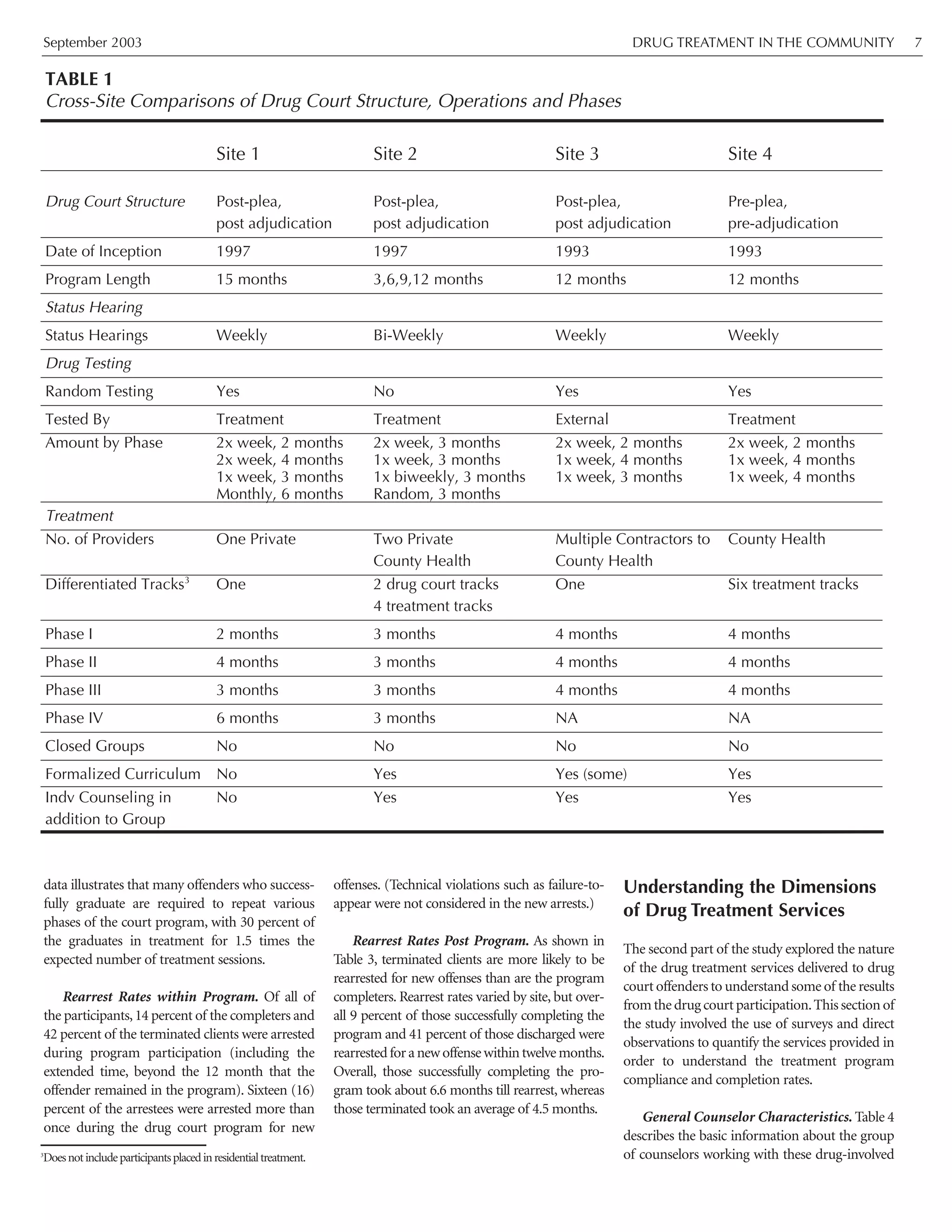
by the court (sites 1 and 4),as specified in Table 1.
Both models of service acquisition included some
access to residential drug treatment services if
needed. Treatment services were offered during
the full duration of the drug court period,ranging
from12to15months,atreatmentdurationthatis
consistent with the recommendations of the
National Association of Drug Court Professionals
(1997). The drug treatment providers tend to be
community-based organizations that are part of
either the public health system or private agencies.
Many offer a variety of services, including group
counseling, relapse prevention (later phases),
social and coping skills, and case management
services. Support services are often offered
through the local self-help community (AA, 12-
step programs) in each jurisdiction.In one site the
treatment providers have a formalized treatment
curriculum to guide the treatment services. The
use of a formalized curriculum has been suggest-
ed to be an important component of effective
treatment services (Lamb, Greenlick & McCarty,
1998).None of the courts used a closed group for-
mat for treatment services (see Table 1).
Each court has a different process for deter-
mining who is eligible for participation in the
drug court program. In two sites, the initial legal
review of a case (of current offense and criminal
history) is performed by prosecutors (sites 2 and
4), while probation performs this review in the
other two sites (sites 1 and 3). None of the sites
used a standard risk tool to guide the legal decision.
The legal screening generally precedes the clinical
screening/assessment; the decision-making process
means that the severity of the substance abuse need
isusuallysecondarytotheparticipant’slegal(offense
and history) eligibility.
Characteristics of the Participants in
Drug Treatment Courts
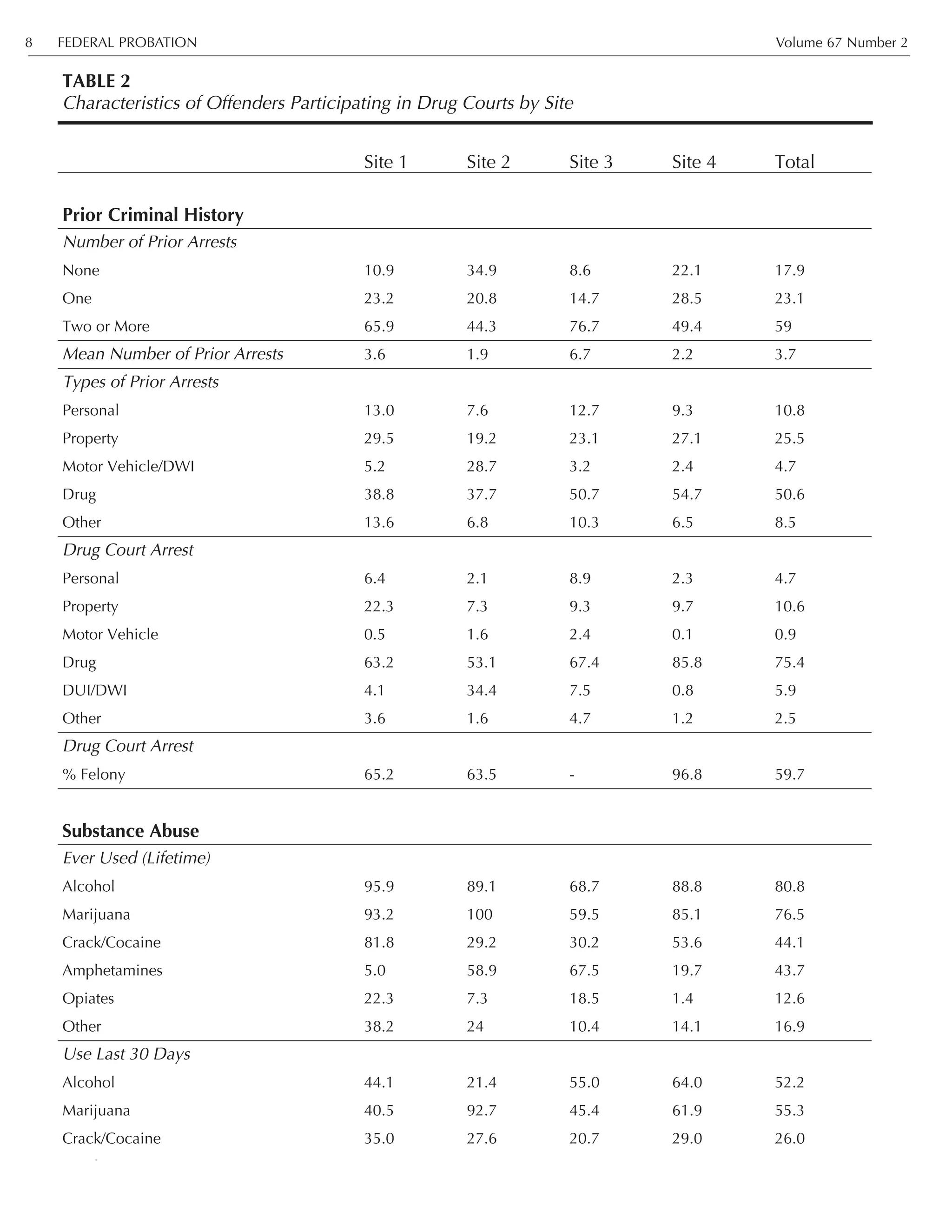
Table 2 presents the characteristics of the offenders
participating in the four drug courts. Drug court
participants tended to be male, with an average age
range of 29 to 33 years old,and less than a third are
employed at the time of placement in drug court.
Forthemostpart,offendersinthesecourtshavehad
a significant criminal justice history, with over 59
percent having two or more prior arrests. Many of
the offenders have also had arrests for personal and
property offenses. The instant offense tends to be a
drug crime, with a majority of the offenses being
felonies.Priorsubstanceabusetreatmentexperience
varied by site,from 18 to 48 percent of participants.
Compliance with Drug Treatment Court
Requirements
In the four drug courts under study, the typical
offender participated in the following weekly
activities during the initial stages of the drug
court program,generally for the first two months:
two drug tests, two or three treatment sessions
(for 90 to 120 minutes each),and one status hear-
ing (except at site 2, where the status hearing was
bi-weekly). Some drug courts also required the
offender to have contact with the case manager or
supervision staff. While the logic behind the
structured intervention is compatible with the
goals of assisting the addict-offender to become
committed to recovery and to be held account-
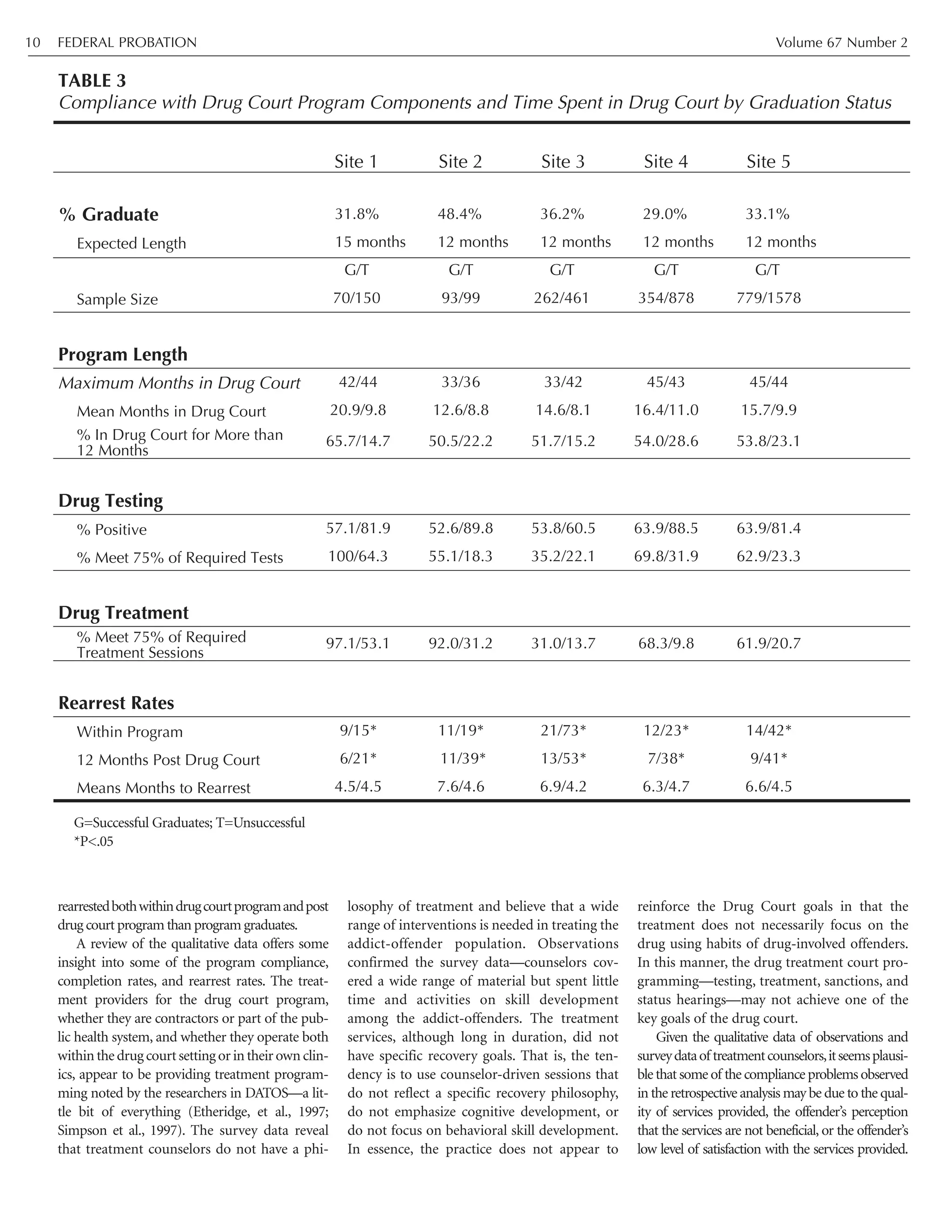
able for his/her behavior, Table 3 illustrates the
actual amount of participation in all phases of
the program. (No information was available on
status hearings in the case or automated files.)
Graduation Rates and Length of Time in
Drug Court. The percentage of offenders suc-
cessfully completing the drug court program
ranges from 29 percent (site 4) to 47 percent (site
3). Most surprising is the actual length of time
that the offenders participate in the drug court
program. In each drug court, the expected dura-
tion of the program is 12 months. In this four-
drug-court sample, it was common practice for
both successful (average duration of 15 months)
and unsuccessful graduates (average duration of
10 months) to participate in the program up to
four times the expected program length (with a
maximum duration of 44 months).
The four courts frequently allow offenders to
extend their time in the drug court program;
and, for those with more significant compliance
problems, offenders can still be unsuccessfully
terminated from the drug court program even
though they have exhausted their time obligation
in drug court.Across the four drug courts,slight-
ly over 22 percent of the cases of unsuccessful
graduates spent more than 12 months in drug
court programming. Similarly, 53 percent of the
successful graduates of these drug courts partici-
pated in the program well past the expected pro-
gram length, suggesting that the 12-month time
frame is generally too short to address the relaps-
ing behavior and addictive nature of the addic-
tion,or that the structured nature of the program
is too demanding for many offenders to comply
with all components. Alternatively, the compo-
nents of the program are insufficient to address
the recovery needs of the offender.
An analysis of the individual profiles of
offenders finds significant differences between the
types of offenders that are likely to successfully
complete the drug court. In all sites except site 2,
Caucasians are more likely to complete than
African Americans or Hispanics—a common
finding of other drug court programs. Graduates
are also more likely to have higher educational
backgrounds (high school diploma or above)
than unsuccessfully terminated clients. Users of
cocaine/crack, amphetamines, and opiates are
also less likely to graduate than users of marijua-
na. In two sites (sites 2 and 3), it was found that
participants with a history of prior substance
abuse treatment are less likely to graduate than
participants who are receiving treatment for the
first time. At the two urban locations (sites 3 and
4), it was found that participants with more seri-
ous criminal histories are also less likely to suc-
ceed in drug court. This pattern suggests that
some drug court programs have difficulty in deal-
ing with participants presenting more severe drug
using and criminal behaviors.
Drug Testing Compliance. On average, 64
percent of the successful graduates and 81 per-
cent of the terminated offenders test positive at
least once during their drug court program
experience. Program compliance with drug test-
ing requirements varies significantly but overall
those that do not graduate tend to be less likely
to meet the drug testing requirements.
Drug Treatment Compliance. Offenders
that are unsuccessful graduates are more likely to
miss treatment sessions. Overall, 62 percent of
the graduates meet at least 75 percent of their
treatment sessions, as compared to 21 percent of
the offenders that were terminated from drug
court.A review of the compliance with treatment
DRUG TREATMENT IN THE COMMUNITY Volume 67 Number 26
September 2003 DRUG TREATMENT IN THE COMMUNITY 7
data illustrates that many offenders who success-
fully graduate are required to repeat various
phases of the court program, with 30 percent of
the graduates in treatment for 1.5 times the
expected number of treatment sessions.
Rearrest Rates within Program. Of all of
the participants,14 percent of the completers and
42 percent of the terminated clients were arrested
during program participation (including the
extended time, beyond the 12 month that the
offender remained in the program). Sixteen (16)
percent of the arrestees were arrested more than
once during the drug court program for new
offenses. (Technical violations such as failure-to-
appear were not considered in the new arrests.)
Rearrest Rates Post Program. As shown in
Table 3, terminated clients are more likely to be
rearrested for new offenses than are the program
completers. Rearrest rates varied by site, but over-
all 9 percent of those successfully completing the
program and 41 percent of those discharged were
rearrestedforanewoffensewithintwelvemonths.
Overall, those successfully completing the pro-
gram took about 6.6 months till rearrest, whereas
those terminated took an average of 4.5 months.
Understanding the Dimensions
of Drug Treatment Services
The second part of the study explored the nature
of the drug treatment services delivered to drug
court offenders to understand some of the results
from the drug court participation.This section of
the study involved the use of surveys and direct
observations to quantify the services provided in
order to understand the treatment program
compliance and completion rates.
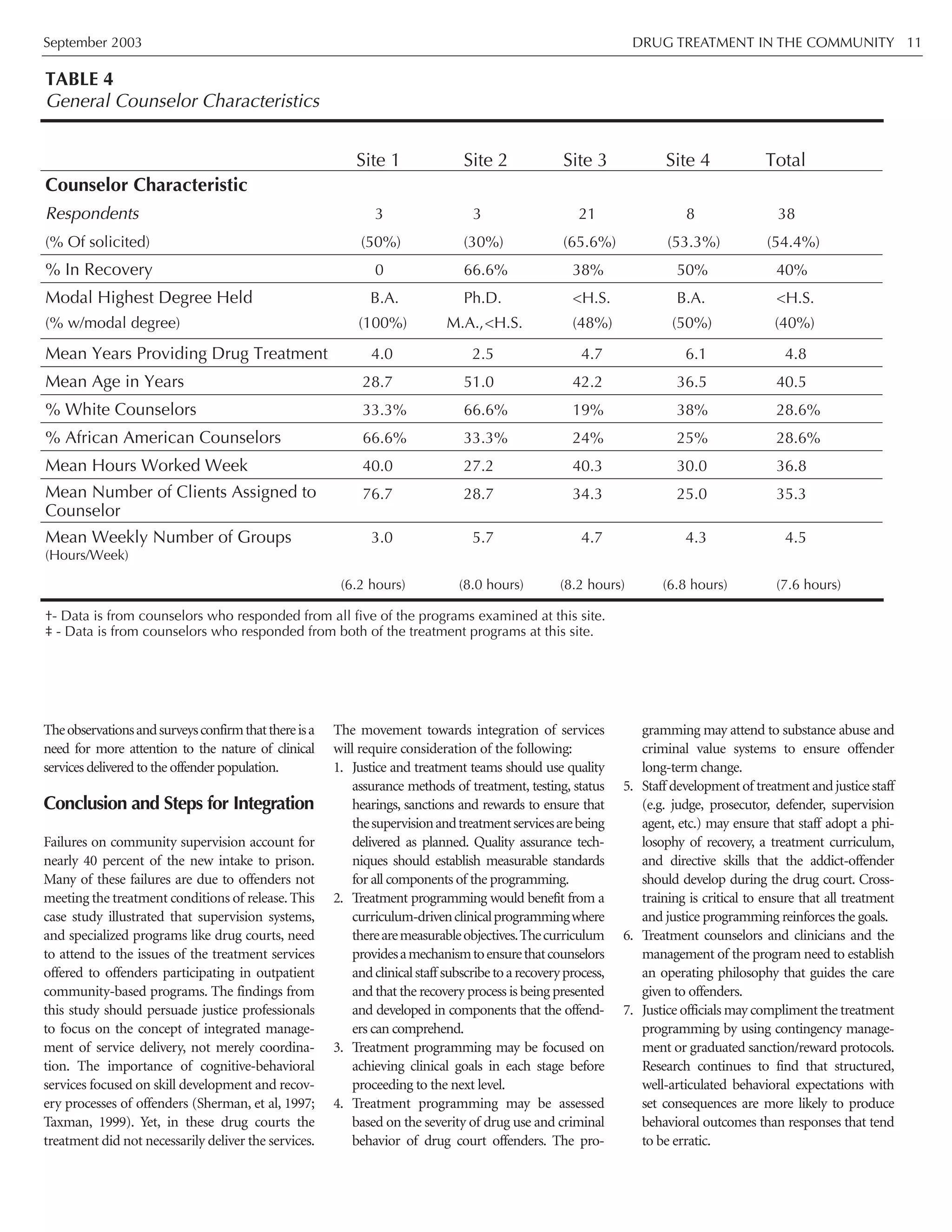
General Counselor Characteristics. Table 4
describes the basic information about the group
of counselors working with these drug-involved
Site 1 Site 2 Site 3 Site 4
Drug Court Structure Post-plea, Post-plea, Post-plea, Pre-plea,
post adjudication post adjudication post adjudication pre-adjudication
Date of Inception 1997 1997 1993 1993
Program Length 15 months 3,6,9,12 months 12 months 12 months
Status Hearing
Status Hearings Weekly Bi-Weekly Weekly Weekly
Drug Testing
Random Testing Yes No Yes Yes
Tested By Treatment Treatment External Treatment
Amount by Phase 2x week, 2 months 2x week, 3 months 2x week, 2 months 2x week, 2 months
2x week, 4 months 1x week, 3 months 1x week, 4 months 1x week, 4 months
1x week, 3 months 1x biweekly, 3 months 1x week, 3 months 1x week, 4 months
Monthly, 6 months Random, 3 months
Treatment
No. of Providers One Private Two Private Multiple Contractors to County Health
County Health County Health
Differentiated Tracks3
One 2 drug court tracks One Six treatment tracks
4 treatment tracks
Phase I 2 months 3 months 4 months 4 months
Phase II 4 months 3 months 4 months 4 months
Phase III 3 months 3 months 4 months 4 months
Phase IV 6 months 3 months NA NA
Closed Groups No No No No
Formalized Curriculum No Yes Yes (some) Yes
Indv Counseling in No Yes Yes Yes
addition to Group
TABLE 1
Cross-Site Comparisons of Drug Court Structure, Operations and Phases
3
Doesnotincludeparticipantsplacedinresidentialtreatment.
FEDERAL PROBATION Volume 67 Number 28
Site 1 Site 2 Site 3 Site 4 Total
Prior Criminal History
Number of Prior Arrests
None 10.9 34.9 8.6 22.1 17.9
One 23.2 20.8 14.7 28.5 23.1
Two or More 65.9 44.3 76.7 49.4 59
Mean Number of Prior Arrests 3.6 1.9 6.7 2.2 3.7
Types of Prior Arrests
Personal 13.0 7.6 12.7 9.3 10.8
Property 29.5 19.2 23.1 27.1 25.5
Motor Vehicle/DWI 5.2 28.7 3.2 2.4 4.7
Drug 38.8 37.7 50.7 54.7 50.6
Other 13.6 6.8 10.3 6.5 8.5
Drug Court Arrest
Personal 6.4 2.1 8.9 2.3 4.7
Property 22.3 7.3 9.3 9.7 10.6
Motor Vehicle 0.5 1.6 2.4 0.1 0.9
Drug 63.2 53.1 67.4 85.8 75.4
DUI/DWI 4.1 34.4 7.5 0.8 5.9
Other 3.6 1.6 4.7 1.2 2.5
Drug Court Arrest
% Felony 65.2 63.5 - 96.8 59.7
Substance Abuse
Ever Used (Lifetime)
Alcohol 95.9 89.1 68.7 88.8 80.8
Marijuana 93.2 100 59.5 85.1 76.5
Crack/Cocaine 81.8 29.2 30.2 53.6 44.1
Amphetamines 5.0 58.9 67.5 19.7 43.7
Opiates 22.3 7.3 18.5 1.4 12.6
Other 38.2 24 10.4 14.1 16.9
Use Last 30 Days
Alcohol 44.1 21.4 55.0 64.0 52.2
Marijuana 40.5 92.7 45.4 61.9 55.3
Crack/Cocaine 35.0 27.6 20.7 29.0 26.0
h
TABLE 2
Characteristics of Offenders Participating in Drug Courts by Site
September 2003 DRUG TREATMENT IN THE COMMUNITY 9
offenders. Counselors at these programs appear
to have an average of four years of experience
providing substance abuse treatment. The extent
to which they had obtained advanced academic
degrees varied by site, but it was generally low.
Counselors generally work 30 to 40 hours per
week, conducting between 3 and 6 group meet-
ings (lasting from 6 to 8 hours total) per week.
Overall, across all sites counselors reported that 41
percentof theirtimewasspentinclinicaltaskssuch
asgrouporindividualcounselingwiththeremain-
derof theirworktimedevotedtovariousadminis-
trative tasks (e.g.,intakes,assessments,etc.).Group
sizewasgenerallyconsistentacrosssitesatabout10
to 13 clients per group, with caseloads ranging
from 25 to nearly 77 offenders per counselor.
Counselors’ Philosophies of Effective
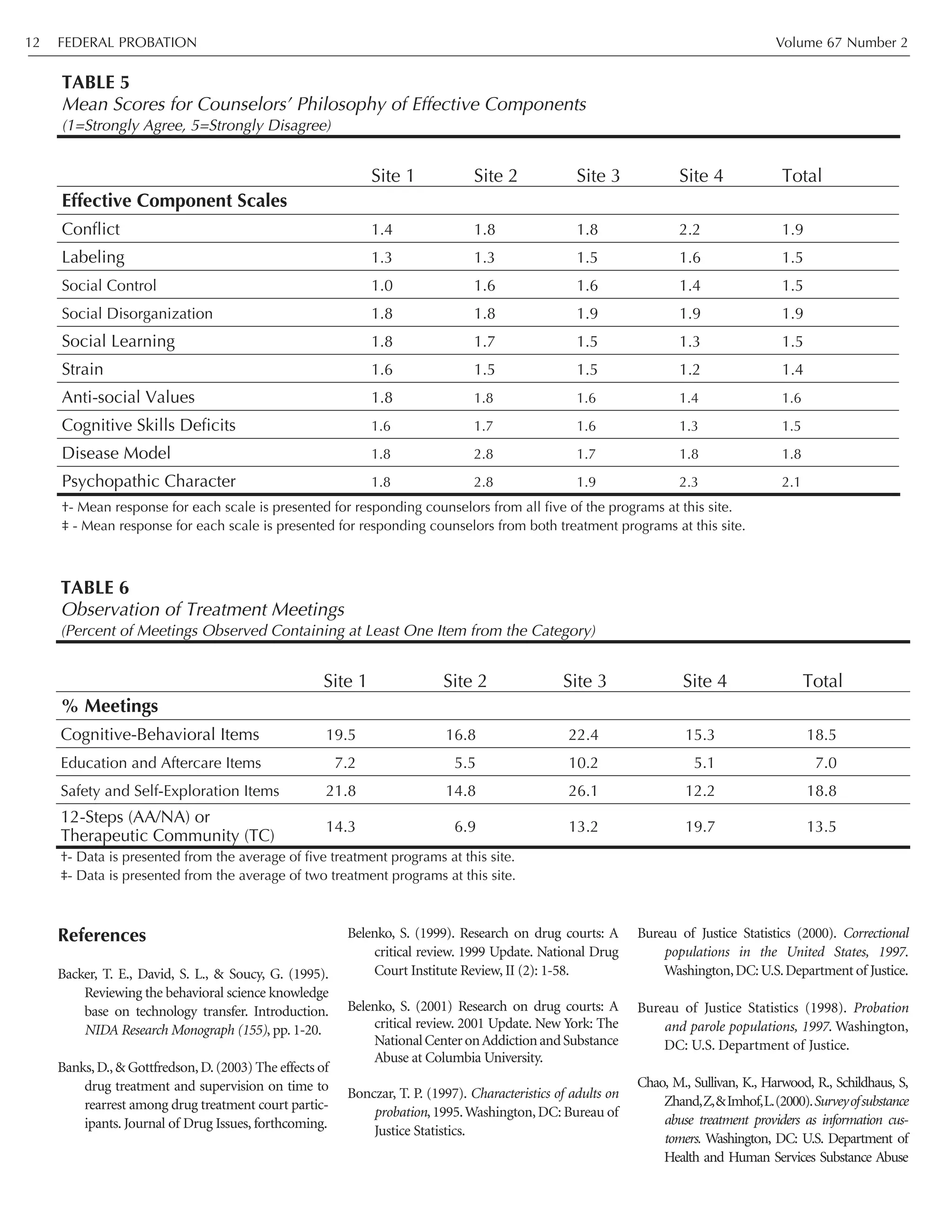
Treatment. Table 5 presents the important com-
ponents of effective drug treatment as rated by
the counselors working with drug court clients.
Counselors rated their agreement with each of
these statements using a five-point Likert scale
(“1”=“strongly agreed with the statement,”“5”=
“strongly disagreed with the statement”). (Refer
to Taxman, Simpson, and Piquero (2002) for a
discussion about the instrument.) Overall, the
findings show that counselors find most compo-
nents to be relevant and agree that they need to
part of a drug court program. This pattern of
results suggests that the sample of drug court-
involved counselors appear to rely upon a wide
range of approaches to treatment, apparently
being willing to apply almost any technique. It
may also suggest that counselors do not general-
ly have a strong affiliation or understanding of
any particular approach to treatment, or that
they do not implement a coherent treatment
strategy in their programs.
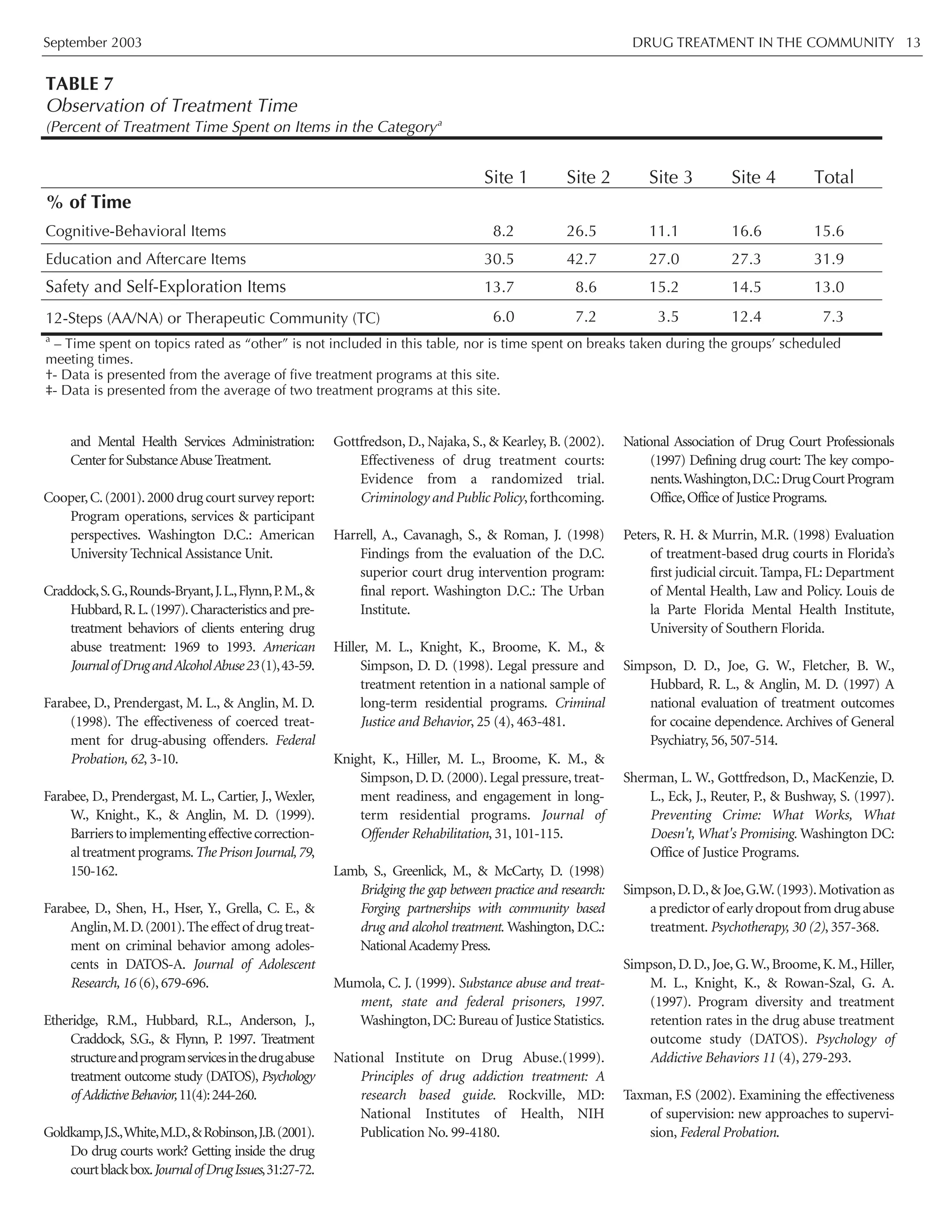
Observation of Treatment Services. Table 6
presents information representing the proportion
of all observed meetings in which any item from
each category of treatment intervention occurred.
For example, in site 1 (with five separate treatment
programs observed) on average,only about 22 per-
cent of the observed meetings contained any dis-
cussion of cognitive-behavioral components.
Despite the vast literature demonstrating the effec-
tiveness of cognitive-behavioral treatment compo-
nentsfordealingwithsubstanceabusers,nositehad
more than 22 percent of the observed meetings
include these treatment components. Items in the
education/aftercarecategory(mostlyinformational
components,such as teaching clients the basic con-
cepts and vocabulary associated with treatment or
the impacts of various drug classes) were also rela-
tively rarely employed in these programs.Similarly,
items drawn from the Alcoholics Anonymous (i.e.,
Disease Model) and Therapeutic Community
Models (e.g.,confrontation,the reliance on peers
as the agent of change) were also relatively rarely
employed (in less than 20 percent of meetings).
Finally, treatment components aimed at
creating a safe (physically and psychological-
ly) environment for clients, as well as those
fostering self-exploration, were somewhat
more commonly employed, particularly in the
programs operating in two sites where these
items occurred in only about 25 percent of
observed meetings. The observations revealed
that the counselors in this sample of drug
courts were employing a relatively wide range
of treatment activities in group sessions. On
the other hand, the cost of this diversity in
treatment components appears to be that
most topic areas are dealt with sparingly.
Stated simply, treatment sessions tend to pres-
ent a wide range of information in a largely
superficial and brief manner.
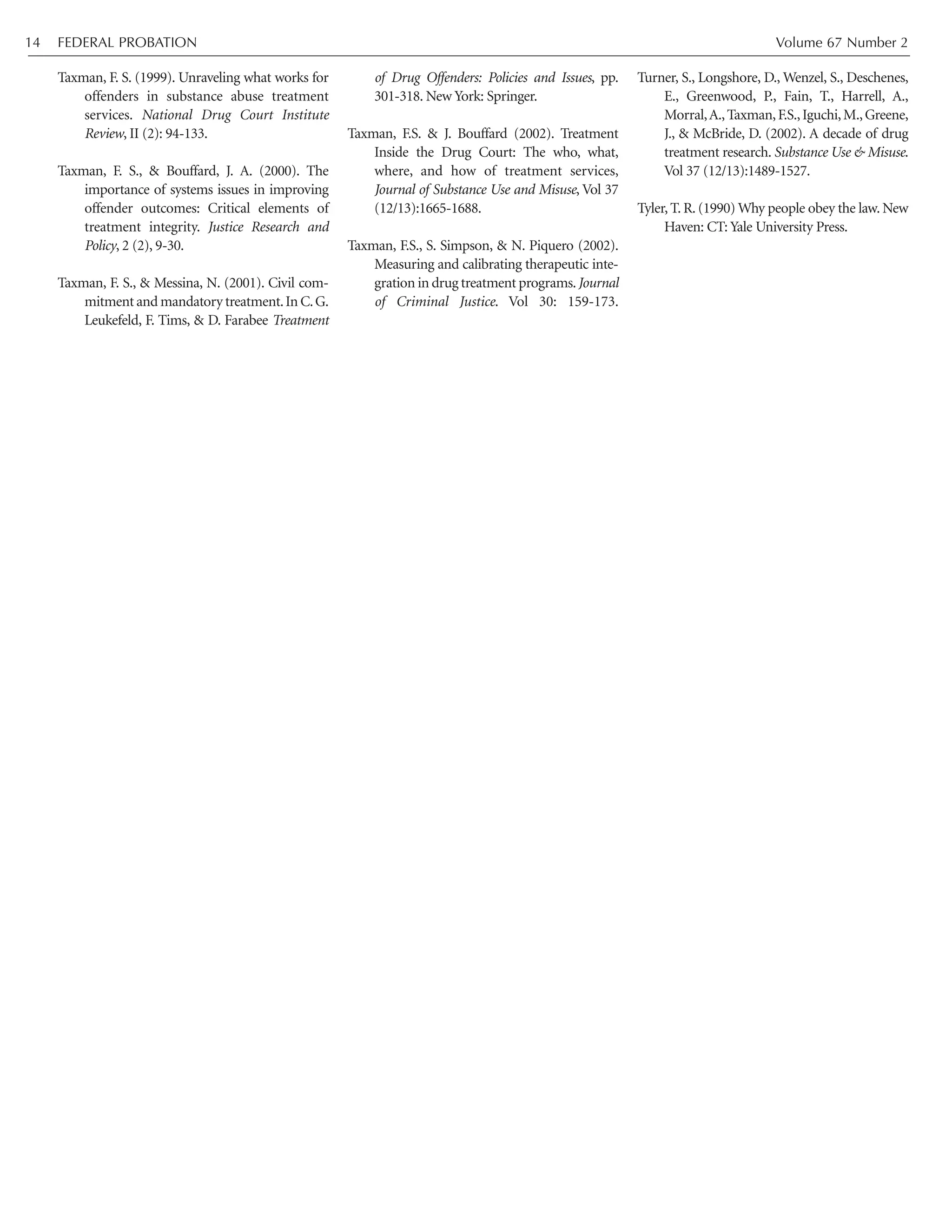
Results presented in Table 7 are consistent
with the survey findings that counselors use a
variety of treatment components in a generally
superficial approach to treatment. The coun-
selors are dealing with a wide range of treatment
issues in a “broad-based” manner, which is evi-
dent in the amount of time in a given meeting
that is spent on any particular topic.For instance,
in site 3, the average amount of meeting time
spent on cognitive-behavioral components was
11 percent. Thus if the average group session was
one and a half (1.5) hours, clients in these meet-
ings would have spent approximately 10 minutes
discussing cognitive-behavioral treatment com-
ponents. Site 2 spent the most time addressing
cognitive-behavioral components (26 percent of
the meeting time in meetings where CBT
occurred).The treatment topic area that received
the most intense discussion (when it was pre-
sented) was the education/aftercare area.
Discussion and Implications of
the Findings
This study was designed to examine how treatment
services were provided to offenders who participat-
edinadrugcourtinoneof foursettings.Theretro-
spective analysis found that drug court program
completionratesarelow,rangingfrom29to48per-
cent. This is on par with or slightly better than the
typicaloutpatientdrugtreatmentprogram,asdeter-
mined by a nationwide study of outcomes from
drug treatment programs (Simpson, et al., 1997),
althoughdrugcourttreatmentservicesareprovided
for nearly four times the length of the traditional
outpatient programming. It is apparent that pro-
gram compliance varies considerably but few
offenders are in total compliance. In each of these
fourdrugcourts,53percentof thegraduatesand23
percent of the terminators were in drug court for
morethantheexpected12-monthprogram—some
foruptotwiceaslong—presumablyduetocompli-
ance problems. [The data available for this study
only allow us to postulate this as a possible explana-
tion.] The program failures are more likely to be
Amphetamines 0.0 13.5 51.3 6.2 26.4
Opiates 13.2 0.5 11.5 0.4 7.1
Other 6.4 6.8 9.0 2.7 6.5
% Prior Treatment Experience 48.2 27.1 17.8 37.5 28.2
Demographics
% Male 80 79 46 72 65
% Caucasian 54 79 69 32 49
Mean Age 29 33 33 29 31
% High School Graduate/GED 37 63 25 52 40
% Employed at Admission 33 63 28 43 37
rearrestedbothwithindrugcourtprogramandpost
drug court program than program graduates.
A review of the qualitative data offers some
insight into some of the program compliance,
completion rates, and rearrest rates. The treat-
ment providers for the drug court program,
whether they are contractors or part of the pub-
lic health system, and whether they operate both
within the drug court setting or in their own clin-
ics, appear to be providing treatment program-
ming noted by the researchers in DATOS—a lit-
tle bit of everything (Etheridge, et al., 1997;
Simpson et al., 1997). The survey data reveal
that treatment counselors do not have a phi-
losophy of treatment and believe that a wide
range of interventions is needed in treating the
addict-offender population. Observations
confirmed the survey data—counselors cov-
ered a wide range of material but spent little
time and activities on skill development
among the addict-offenders. The treatment
services, although long in duration, did not
have specific recovery goals. That is, the ten-
dency is to use counselor-driven sessions that
do not reflect a specific recovery philosophy,
do not emphasize cognitive development, or
do not focus on behavioral skill development.
In essence, the practice does not appear to
reinforce the Drug Court goals in that the
treatment does not necessarily focus on the
drug using habits of drug-involved offenders.
In this manner, the drug treatment court pro-
gramming—testing, treatment, sanctions, and
status hearings—may not achieve one of the
key goals of the drug court.
Given the qualitative data of observations and
surveydataof treatmentcounselors,itseemsplausi-
ble that some of the compliance problems observed
in the retrospective analysis may be due to the qual-
ity of services provided, the offender’s perception
that the services are not beneficial, or the offender’s
low level of satisfaction with the services provided.
FEDERAL PROBATION Volume 67 Number 210
Site 1 Site 2 Site 3 Site 4 Site 5
% Graduate 31.8% 48.4% 36.2% 29.0% 33.1%
Expected Length 15 months 12 months 12 months 12 months 12 months
G/T G/T G/T G/T G/T
Sample Size 70/150 93/99 262/461 354/878 779/1578
Program Length
Maximum Months in Drug Court 42/44 33/36 33/42 45/43 45/44
Mean Months in Drug Court 20.9/9.8 12.6/8.8 14.6/8.1 16.4/11.0 15.7/9.9
% In Drug Court for More than
12 Months
65.7/14.7 50.5/22.2 51.7/15.2 54.0/28.6 53.8/23.1
Drug Testing
% Positive 57.1/81.9 52.6/89.8 53.8/60.5 63.9/88.5 63.9/81.4
% Meet 75% of Required Tests 100/64.3 55.1/18.3 35.2/22.1 69.8/31.9 62.9/23.3
Drug Treatment
% Meet 75% of Required
Treatment Sessions
97.1/53.1 92.0/31.2 31.0/13.7 68.3/9.8 61.9/20.7
Rearrest Rates
Within Program 9/15* 11/19* 21/73* 12/23* 14/42*
12 Months Post Drug Court 6/21* 11/39* 13/53* 7/38* 9/41*
Means Months to Rearrest 4.5/4.5 7.6/4.6 6.9/4.2 6.3/4.7 6.6/4.5
TABLE 3
Compliance with Drug Court Program Components and Time Spent in Drug Court by Graduation Status
G=Successful Graduates; T=Unsuccessful
*P<.05
September 2003 DRUG TREATMENT IN THE COMMUNITY 11
Theobservationsandsurveysconfirmthatthereisa
need for more attention to the nature of clinical
services delivered to the offender population.
Conclusion and Steps for Integration
Failures on community supervision account for
nearly 40 percent of the new intake to prison.
Many of these failures are due to offenders not
meeting the treatment conditions of release.This
case study illustrated that supervision systems,
and specialized programs like drug courts, need
to attend to the issues of the treatment services
offered to offenders participating in outpatient
community-based programs. The findings from
this study should persuade justice professionals
to focus on the concept of integrated manage-
ment of service delivery, not merely coordina-
tion. The importance of cognitive-behavioral
services focused on skill development and recov-
ery processes of offenders (Sherman, et al, 1997;
Taxman, 1999). Yet, in these drug courts the
treatment did not necessarily deliver the services.
The movement towards integration of services
will require consideration of the following:
1. Justice and treatment teams should use quality
assurance methods of treatment, testing, status
hearings, sanctions and rewards to ensure that
thesupervisionandtreatmentservicesarebeing
delivered as planned. Quality assurance tech-
niques should establish measurable standards
for all components of the programming.
2. Treatment programming would benefit from a
curriculum-drivenclinicalprogrammingwhere
therearemeasurableobjectives.Thecurriculum
providesamechanismtoensurethatcounselors
andclinicalstaff subscribetoarecoveryprocess,
and that the recovery process is being presented
and developed in components that the offend-
ers can comprehend.
3. Treatment programming may be focused on
achieving clinical goals in each stage before
proceeding to the next level.
4. Treatment programming may be assessed
based on the severity of drug use and criminal
behavior of drug court offenders. The pro-
gramming may attend to substance abuse and
criminal value systems to ensure offender
long-term change.
5. Staff developmentof treatmentandjusticestaff
(e.g. judge, prosecutor, defender, supervision
agent, etc.) may ensure that staff adopt a phi-
losophy of recovery, a treatment curriculum,
and directive skills that the addict-offender
should develop during the drug court. Cross-
training is critical to ensure that all treatment
and justice programming reinforces the goals.
6. Treatment counselors and clinicians and the
management of the program need to establish
an operating philosophy that guides the care
given to offenders.
7. Justice officials may compliment the treatment
programming by using contingency manage-
ment or graduated sanction/reward protocols.
Research continues to find that structured,
well-articulated behavioral expectations with
set consequences are more likely to produce
behavioral outcomes than responses that tend
to be erratic.
Site 1 Site 2 Site 3 Site 4 Total
Counselor Characteristic
Respondents 3 3 21 8 38
(% Of solicited) (50%) (30%) (65.6%) (53.3%) (54.4%)
% In Recovery 0 66.6% 38% 50% 40%
Modal Highest Degree Held B.A. Ph.D. <H.S. B.A. <H.S.
(% w/modal degree) (100%) M.A.,<H.S. (48%) (50%) (40%)
Mean Years Providing Drug Treatment 04.0 02.5 04.7 06.1 04.8
Mean Age in Years 28.7 51.0 42.2 36.5 40.5
% White Counselors 33.3% 66.6% 19% 38% 28.6%
% African American Counselors 66.6% 33.3% 24% 25% 28.6%
Mean Hours Worked Week 40.0 27.2 40.3 30.0 36.8
Mean Number of Clients Assigned to
Counselor
76.7 28.7 34.3 25.0 35.3
Mean Weekly Number of Groups
(Hours/Week)
03.0 05.7 04.7 04.3 04.5
(6.2 hours) (8.0 hours) (8.2 hours) (6.8 hours) (7.6 hours)
TABLE 4
General Counselor Characteristics
†- Data is from counselors who responded from all five of the programs examined at this site.
‡ - Data is from counselors who responded from both of the treatment programs at this site.
FEDERAL PROBATION Volume 67 Number 212
References
Backer, T. E., David, S. L., & Soucy, G. (1995).
Reviewing the behavioral science knowledge
base on technology transfer. Introduction.
NIDA Research Monograph (155), pp. 1-20.
Banks,D.,& Gottfredson,D.(2003) The effects of
drug treatment and supervision on time to
rearrest among drug treatment court partic-
ipants. Journal of Drug Issues, forthcoming.
Belenko, S. (1999). Research on drug courts: A
critical review. 1999 Update. National Drug
Court Institute Review, II (2): 1-58.
Belenko, S. (2001) Research on drug courts: A
critical review. 2001 Update. New York: The
NationalCenteronAddictionandSubstance
Abuse at Columbia University.
Bonczar, T. P. (1997). Characteristics of adults on
probation,1995.Washington,DC: Bureau of
Justice Statistics.
Bureau of Justice Statistics (2000). Correctional
populations in the United States, 1997.
Washington,DC:U.S.Department of Justice.
Bureau of Justice Statistics (1998). Probation
and parole populations, 1997. Washington,
DC: U.S. Department of Justice.
Chao, M., Sullivan, K., Harwood, R., Schildhaus, S,
Zhand,Z,&Imhof,L.(2000).Surveyofsubstance
abuse treatment providers as information cus-
tomers. Washington, DC: U.S. Department of
Health and Human Services Substance Abuse
Site 1 Site 2 Site 3 Site 4 Total
Effective Component Scales
Conflict 1.4 1.8 1.8 2.2 1.9
Labeling 1.3 1.3 1.5 1.6 1.5
Social Control 1.0 1.6 1.6 1.4 1.5
Social Disorganization 1.8 1.8 1.9 1.9 1.9
Social Learning 1.8 1.7 1.5 1.3 1.5
Strain 1.6 1.5 1.5 1.2 1.4
Anti-social Values 1.8 1.8 1.6 1.4 1.6
Cognitive Skills Deficits 1.6 1.7 1.6 1.3 1.5
Disease Model 1.8 2.8 1.7 1.8 1.8
Psychopathic Character 1.8 2.8 1.9 2.3 2.1
TABLE 5
Mean Scores for Counselors’ Philosophy of Effective Components
(1=Strongly Agree, 5=Strongly Disagree)
†- Mean response for each scale is presented for responding counselors from all five of the programs at this site.
‡ - Mean response for each scale is presented for responding counselors from both treatment programs at this site.
Site 1 Site 2 Site 3 Site 4 Total
% Meetings
Cognitive-Behavioral Items 19.5 16.8 22.4 15.3 18.5
Education and Aftercare Items 7.2 5.5 10.2 5.1 7.0
Safety and Self-Exploration Items 21.8 14.8 26.1 12.2 18.8
12-Steps (AA/NA) or
Therapeutic Community (TC)
14.3 6.9 13.2 19.7 13.5
TABLE 6
Observation of Treatment Meetings
(Percent of Meetings Observed Containing at Least One Item from the Category)
†- Data is presented from the average of five treatment programs at this site.
‡- Data is presented from the average of two treatment programs at this site.
September 2003 DRUG TREATMENT IN THE COMMUNITY 13
and Mental Health Services Administration:
CenterforSubstanceAbuseTreatment.
Cooper,C.(2001).2000 drug court survey report:
Program operations, services & participant
perspectives. Washington D.C.: American
University Technical Assistance Unit.
Craddock,S.G.,Rounds-Bryant,J.L.,Flynn,P.M.,&
Hubbard,R.L.(1997).Characteristics and pre-
treatment behaviors of clients entering drug
abuse treatment: 1969 to 1993. American
JournalofDrugandAlcoholAbuse23(1),43-59.
Farabee, D., Prendergast, M. L., & Anglin, M. D.
(1998). The effectiveness of coerced treat-
ment for drug-abusing offenders. Federal
Probation, 62, 3-10.
Farabee, D., Prendergast, M. L., Cartier, J., Wexler,
W., Knight., K., & Anglin, M. D. (1999).
Barrierstoimplementingeffectivecorrection-
altreatmentprograms.ThePrisonJournal,79,
150-162.
Farabee, D., Shen, H., Hser, Y., Grella, C. E., &
Anglin,M.D.(2001).Theeffectof drugtreat-
ment on criminal behavior among adoles-
cents in DATOS-A. Journal of Adolescent
Research, 16 (6), 679-696.
Etheridge, R.M., Hubbard, R.L., Anderson, J.,
Craddock, S.G., & Flynn, P. 1997. Treatment
structureandprogramservicesinthedrugabuse
treatment outcome study (DATOS), Psychology
ofAddictiveBehavior,11(4):244-260.
Goldkamp,J.S.,White,M.D.,&Robinson,J.B.(2001).
Do drug courts work? Getting inside the drug
courtblackbox.JournalofDrugIssues,31:27-72.
Gottfredson, D., Najaka, S., & Kearley, B. (2002).
Effectiveness of drug treatment courts:
Evidence from a randomized trial.
Criminology and Public Policy,forthcoming.
Harrell, A., Cavanagh, S., & Roman, J. (1998)
Findings from the evaluation of the D.C.
superior court drug intervention program:
final report. Washington D.C.: The Urban
Institute.
Hiller, M. L., Knight, K., Broome, K. M., &
Simpson, D. D. (1998). Legal pressure and
treatment retention in a national sample of
long-term residential programs. Criminal
Justice and Behavior, 25 (4), 463-481.
Knight, K., Hiller, M. L., Broome, K. M., &
Simpson, D. D. (2000). Legal pressure, treat-
ment readiness, and engagement in long-
term residential programs. Journal of
Offender Rehabilitation, 31, 101-115.
Lamb, S., Greenlick, M., & McCarty, D. (1998)
Bridging the gap between practice and research:
Forging partnerships with community based
drug and alcohol treatment. Washington, D.C.:
NationalAcademy Press.
Mumola, C. J. (1999). Substance abuse and treat-
ment, state and federal prisoners, 1997.
Washington,DC: Bureau of Justice Statistics.
National Institute on Drug Abuse.(1999).
Principles of drug addiction treatment: A
research based guide. Rockville, MD:
National Institutes of Health, NIH
Publication No. 99-4180.
National Association of Drug Court Professionals
(1997) Defining drug court: The key compo-
nents.Washington,D.C.:DrugCourtProgram
Office,Office of Justice Programs.
Peters, R. H. & Murrin, M.R. (1998) Evaluation
of treatment-based drug courts in Florida’s
first judicial circuit. Tampa, FL: Department
of Mental Health, Law and Policy. Louis de
la Parte Florida Mental Health Institute,
University of Southern Florida.
Simpson, D. D., Joe, G. W., Fletcher, B. W.,
Hubbard, R. L., & Anglin, M. D. (1997) A
national evaluation of treatment outcomes
for cocaine dependence. Archives of General
Psychiatry, 56, 507-514.
Sherman, L. W., Gottfredson, D., MacKenzie, D.
L., Eck, J., Reuter, P., & Bushway, S. (1997).
Preventing Crime: What Works, What
Doesn't, What's Promising. Washington DC:
Office of Justice Programs.
Simpson,D.D.,& Joe,G.W.(1993).Motivation as
apredictorof earlydropoutfromdrugabuse
treatment. Psychotherapy, 30 (2), 357-368.
Simpson,D.D.,Joe,G.W.,Broome,K.M.,Hiller,
M. L., Knight, K., & Rowan-Szal, G. A.
(1997). Program diversity and treatment
retention rates in the drug abuse treatment
outcome study (DATOS). Psychology of
Addictive Behaviors 11 (4), 279-293.
Taxman, F.S (2002). Examining the effectiveness
of supervision: new approaches to supervi-
sion, Federal Probation.
Site 1 Site 2 Site 3 Site 4 Total
% of Time
Cognitive-Behavioral Items 08.2 26.5 11.1 16.6 15.6
Education and Aftercare Items 30.5 42.7 27.0 27.3 31.9
Safety and Self-Exploration Items 13.7 08.6 15.2 14.5 13.0
12-Steps (AA/NA) or Therapeutic Community (TC) 06.0 07.2 03.5 12.4 07.3
TABLE 7
Observation of Treatment Time
(Percent of Treatment Time Spent on Items in the Categorya
a
– Time spent on topics rated as “other” is not included in this table, nor is time spent on breaks taken during the groups’ scheduled
meeting times.
†- Data is presented from the average of five treatment programs at this site.
‡- Data is presented from the average of two treatment programs at this site.
Taxman, F. S. (1999). Unraveling what works for
offenders in substance abuse treatment
services. National Drug Court Institute
Review, II (2): 94-133.
Taxman, F. S., & Bouffard, J. A. (2000). The
importance of systems issues in improving
offender outcomes: Critical elements of
treatment integrity. Justice Research and
Policy, 2 (2), 9-30.
Taxman, F. S., & Messina, N. (2001). Civil com-
mitment and mandatory treatment.In C.G.
Leukefeld, F. Tims, & D. Farabee Treatment
of Drug Offenders: Policies and Issues, pp.
301-318. New York: Springer.
Taxman, F.S. & J. Bouffard (2002). Treatment
Inside the Drug Court: The who, what,
where, and how of treatment services,
Journal of Substance Use and Misuse, Vol 37
(12/13):1665-1688.
Taxman, F.S., S. Simpson, & N. Piquero (2002).
Measuring and calibrating therapeutic inte-
gration in drug treatment programs.Journal
of Criminal Justice. Vol 30: 159-173.
Turner, S., Longshore, D., Wenzel, S., Deschenes,
E., Greenwood, P., Fain, T., Harrell, A.,
Morral,A.,Taxman,F.S.,Iguchi,M.,Greene,
J., & McBride, D. (2002). A decade of drug
treatment research. Substance Use & Misuse.
Vol 37 (12/13):1489-1527.
Tyler, T. R. (1990) Why people obey the law. New
Haven: CT: Yale University Press.
FEDERAL PROBATION Volume 67 Number 214
The Design of Social Support Networks
for Offenders in Outpatient Drug
Treatment
Mark D. Litt,
University of Connecticut Health Center
Sharon D. Mallon,
University of Connecticut
September 2003 15
IT HAS OFTEN BEEN noted that the
most significant challenge in treating drug
dependence is not the attainment of initial absti-
nence, but avoiding relapse after treatment has
started. Marlatt (1985) estimated that fully one-
third of individuals treated for alcoholism relapse
in the first 90 days after completion of treatment.
In a review of treatment effectiveness, Nathan
(1986) noted that one to two years after treat-
ment, fewer than half of patients maintain sobri-
ety. Figures for relapse from drug treatment are
comparable, especially among criminal offender
populations (Hoffman & Miller, 1993). Despite
increased attention to the problem of relapse in
the last decade, few interventions have been able
to effectively counter the relapse phenomenon.
In order to address the relapse issue,treatment
programs have long sought to bolster clients’
social support networks (Strauss & Falkin, 2001).
There is empirical support for this approach with
released offenders. Broome et al. (1997), for
instance, examined predictors of drug-related
problems and rearrest in probationers. Results
indicated that social network, in the form of
drug-using peers,was a direct contributor to both
recidivism and problems related to drug use.
In practice, efforts to increase social support
are informal or non-systematic, are not the main
focus of the intervention, and occur in the con-
text of overall case management (e.g., Buckley &
Bigelow, 1992). Additionally, the rationale for
social and family support is usually not dis-
cussed: the provision of social support, particu-
larly family support, is usually taken for granted
as beneficial. This article will review the existing
literature on the design and implementation of
social support networks as treatments or
adjuncts to treatment for drug-dependent indi-
viduals, especially those who have been involved
in the criminal justice system. The authors will
argue that social support networks are more than
just sources of emotional support; they can apply
behavioral contingencies that can change the
client’s drug using and prosocial behavior after
conventional treatment is finished.
Social Support–A Behavioral
Analysis
A behavioral formulation of the treatment and
relapse processes suggests that individuals
derive reinforcement for abstinence behavior
during treatment, but that after leaving the
treatment milieu, they once again encounter
stimuli for drug use, and drug use is reinforced
(e.g., Bigelow, Brooner & Silverman, 1998).
Data indicate that alcohol and drug abusers
derive less reinforcement from non-drug activ-
ities in their home environments than do non-
drug users. Surveys of activities in these groups
show that drug users spend much less time
than do non-drug users engaged in non-drug-
involved leisure or social activities.Van Etten et
al. (1998), for example, compared cocaine users
with age-, sex-, and SES-matched controls.
Cocaine users reported significantly lower fre-
quency of engagement in positive-mood-relat-
ed activities than did the controls. Carroll
(1996) therefore concluded that the availability
of non-drug reinforcement could reduce the
acquisition and use of illicit drugs.
The same appears to be true of alcohol
abusers. In their examination of the Behavioral
Choice Model of substance misuse, Vuchinich
and Tucker (Tucker et al., 1985; Vuchinich &
Tucker, 1988) reviewed the literature on alcohol
consumption and the availability of alternative
reinforcers in alcohol dependent and abusing
individuals. They concluded that drinking is
increased when access to reinforcers alternative to
alcohol is constrained.Conversely,when access to
alcohol is constrained, consumption is decreased.
The treatment setting, especially in prison-
based treatment, effectively constrains access to
drugs, thus reducing consumption and (theoret-
ically) making engagement in treatment-relevant
activities more likely. In addition, some of the
treatment activities will be inherently reinforc-
ing, increasing the likelihood that clients will
engage in non-drug activities.When people leave
treatment, however, access to drugs is typically
less constrained, and they often experience few
reinforcers for sobriety to compete with rein-
forcement from drug taking.
One potent source of reinforcement for drug
use is the client’s social network.It has often been
noted that the social milieu of a drug abuser
serves to support the drug use of those in the net-
work (e.g., Schroeder, et al., 2001; Steinglass &
Wolin,1974).General social support per se,how-
ever, has at best proven to be only a modest pre-
dictor of long-term substance abuse treatment
outcomes (e.g., Dobkin et al., 2002; Goehl,
Nunes, Quitkin & Hilton, 1993; Moos, Finney, &
Cronkite, 1990; Wasserman, Stewart & Delucchi,
2001). It would appear that the target of support
is critical. Longabaugh and Beattie (1985, 1986),
among others, differentiated drinking-specific
support from general support, and coined the
term “network support for drinking.” This net-
work support construct, designating the amount
of support (reinforcement) an individual
receives for drinking or drug use, has been found
to be predictive of poor outcomes in treatment-
seeking patients (Beattie, Longabaugh, & Fava,
1992; Havassy, Hall & Wasserman, 1991, Havassy,
Wasserman&Hall,1995;Longabaughetal.,1993).
To date the construct of network support has
mostly been used to describe a network support-
ive of drug use. Goehl (1993), for instance, noted
in a study of 70 methadone patients that having
at least one drug user among those closest to the
patient was highly predictive of positive urine
screenings. Sung, Tabachnick, and Feng (2000)
tested several theories for continued drug use in
366 convicted heroin users. The hypothesis
receiving the strongest empirical support was the
social network hypothesis, which asserts that dif-
ferent subgroups of drug users develop their own
subcultures that support drug use.Similar results
were found by Schroeder et al. (2001). Drug use
by members of the social networks of 236 heroin
and cocaine users was the strongest predictor of
continued drug use by the participants. Among
women drug offenders, the most significant
member of the social network is the partner. Use
of drugs by the partner has been among the
strongest predictors of drug use by women
offenders (e.g., Falkin & Strauss, 2003; Pivnick et
al., 1994; O’Dell, Turner & Weaver, 1998).
It follows that if a social network that rein-
forces drug use leads to more drug use, then
networks that reinforce being clean and sober
should yield greater drug abstinence. There is
indirect evidence for this proposition.
Gordon and Zrull (1991), for instance, col-
lected social network data on 156 alcoholic
patients and recontacted them one year after
their discharge from inpatient treatment. The
authors concluded that the active support
(including participation in treatment) of
non-drinking friends and coworkers was the
most influential factor in recovery. Most pre-
dictive of poor outcomes was encouragement
of drinking by coworkers, some of whom
were co-drinkers. In a study of predictors of
relapse in treatment for cocaine, McMahon
(2001) reported that quality of the social sup-
port network improved in those who main-
tained abstinence, whereas relapsers failed to
report this improvement in quality.
Constructing Social Networks
for Treatment
12-Step Fellowships: Alcoholics
Anonymous, Narcotics Anonymous
Perhaps the clearest example of a constructed
social network that supports sobriety is
Alcoholics Anonymous (AA), along with its vari-
ous 12-step cousins Narcotics Anonymous (NA),
Cocaine Anonymous (CA), and so forth. These
fellowship programs, whether they are spiritually
based or secular, provide ready-made sobriety-
supporting networks, and fulfill several of the
conditions required of a behavioral choice model
of relapse prevention (Tucker, et al., 1990). The
programs provide alternative activities to drink-
ing or drug use, they constrain access to drugs (at
least for the time when the person is attending a
meeting), and they reinforce sober behavior.
Several studies have provided support for the
efficacy of AA or similar groups in reducing drug
use. Emrick (1987) found that AA members
achieve abstinence at a higher rate than do pro-
fessionally treated alcoholics, and that AA partic-
ipants who are more active in the fellowship pro-
gram do as well as or better than less active
participants. In another study, it was found that
those who attended a social club for recovering
alcoholics drank less and improved more in gen-
eral life functioning (Mallams, Godley, Hall &
Meyers, 1982). Data are sparse regarding effec-
tiveness of fellowship programs for released
criminal offenders.The findings of a meta-analy-
sis of data from the Correctional Drug Abuse
Treatment Effectiveness project conducted by
Pearson and Lipton (1999) suggested, however,
that promising aftercare treatments included 12-
step programs, as well as cognitive-behavioral
programs and methadone maintenance. The
findings of these studies are consistent with the
notion that social support for sobriety can
enhance treatment outcome, but none of them
looked specifically at the level of support for
drinking in their clients’ social networks.
Project MATCH (Project MATCH Research
Group,1977)providedsomeof themostdetailed
information on social networks in alcoholics to
date. With over 1700 clients, this multisite study
of matching patients to treatment collected a
variety of social network measures. Analyses of
the Project MATCH data set indicate that clients
whose social networks were supportive of drink-
ing had worse outcomes than those whose social
network did not support drinking (Longabaugh
et al., 1998). A high level of network support for
drinking was also related to a decreased likeli-
hood of involvement in AA.
Additionally, results from Project MATCH
indicated that among those with high network
support for drinking, clients who had been
assigned to the Twelve Step Facilitation treatment
(TSF; Nowinski,Baker,& Carroll,1992),in which
attendanceatAAwasemphasized,hadbetterout-
comes than clients assigned to Motivational
Enhancement Therapy (MET). One mechanism
for this effect was that treatment with TSF result-
ed in greater involvement in AA, even among
those with high network support for drinking.
Thus, AA involvement by clients with high net-
work support for drinking appeared to be at least
a partial mediator of the observed matching
effect.Clients with both high network support for
drinking and high AA involvement had more
abstinence than those with network support for
drinking who were not involved in AA. In con-
trast, for clients whose social network did not
supportcontinueddrinking,AAinvolvementhad
much less impact on outcome.
Kaskutas, Bond, and Humphreys (2002) also
explored changes in outcomes and social net-
works as a function of AA attendance. These
investigators followed 654 alcoholic men and
women for up to one year after their presentation
to treatment.Abstinence at follow-up was signif-
icantly predicted by involvement in AA, fewer
pro-drinking influences in one’s social network,
and greater support for abstinence from people
encountered in AA.
A similar study by Humphreys and colleagues
(Humphreys,Mankowski,Mood & Finney,1999;
Humphreys & Noke, 1997) employed 2,337
treated drug-dependent men, many of whom
were criminal offenders. Involvement in mutual
help fellowships (e.g., NA) predicted reduced
substance use at one-year follow-up. This rela-
tionship was mediated by enhanced friendship
networks, characterized by the proportion of
friends who abstain from substance use and by
increase in active coping responses.
The implication of these findings is that fel-
lowship programs like AA or NA are effective in
helping decrease substance use, and that their
effectiveness is in part due to the delivery of
social networks that discourage drug use and
promote prosocial change. A treatment that
encourages a change of social network from
one that is supportive of drinking or drug use
to one that is supportive of sobriety will be
effective. And it will be more effective for those
whose pretreatment environments are initially
more supportive of drug use.
Community Reinforcement Approaches
One approach that directly seeks to construct
supportive environmental and social networks is
referred to as the Community Reinforcement
Approach (CRA). CRA began as a package of
FEDERAL PROBATION Volume 67 Number 216
September 2003 SOCIAL SUPPORT NETWORKS FOR OFFENDERS 17
treatment components intended to provide the
patient with support for abstinence from sub-
stance use in all aspects of his life (Hunt &Azrin,
1973), including the vocational, recreational,
and family environments, as well as the social
network. Components of the original program
included job finding, marital therapy, leisure
counseling, reinforcer access counseling, a social
club, and home visits. Over time Azrin and his
colleagues added other components, including a
buddy system, motivational counseling and
drink refusal instruction (Azrin, 1976; Azrin et
al., 1982). The central behavioral rationale for
CRA is to reinforce the drug user’s sobriety and
encourage the development of activities incom-
patible with drug use, such as participation in
recreational and social activities and employ-
ment. Possibly because of its all-encompassing
nature,CRA has garnered large treatment effects
in clinical trials conducted by the Azrin group,
and is considered to be among those substance
abuse treatment modalities that have the best
empirical evidence for effectiveness (Miller et al.,
1995; Miller & Wilbourne, 2002).
The most recent large-scale study of CRA in
alcoholics was reported by Miller et al. (2001). In
this study four basic treatments were compared:
“Traditional treatment,” an eclectic, alcohol
counseling-based approach; traditional treat-
ment plus disulfiram; CRA plus disulfiram; and
CRA without disulfiram. The CRA treatment
included functional analysis of antecedents and
consequences of drinking, problem-solving
training, social skills training, social counseling,
vocational counseling, behavioral marital thera-
py for those with spouses or partners, relaxation
training, and drink refusal rehearsal. Overall,
results indicated that the CRA groups reported
lower drinking levels than did the traditional
treatment groups in the first six months of fol-
low-up, but that the traditional groups achieved
more continuous abstinence.Both types of treat-
ments yielded similar good results in months 16
to 24 of the follow-up period. Interestingly, the
authors attribute the advantage of the traditional
treatments in achieving abstinence to its reliance
on referral of clients to AA.
Treatment of drug abuse with CRA has pro-
duced some success. Higgins, et al. (1995) report-
ed on the effectiveness at one year of two trials in
which community reinforcement approaches
were compared to traditional drug counseling
(Higgins et al., 1993; Higgins, Budney, Bickel,
Foerg, et al., 1994). The CRA treatments con-
tained five basic elements:1) minimizing contacts
with antecedents to drug use; 2) development of
new recreational activities to take the place of
druguse;3)vocationalcounseling;4)relationship
counseling for those with spouses or partners;
and 5) disulfiram treatment for those with con-
current alcohol problems. All treatment groups
improved through treatment and into the follow-
up in terms of cocaine use and indicators on the
Addiction Severity Index (ASI; McLellan, et al.,
1985). Some efficacy differences did emerge, and
these supported CRA conditions, particularly
during treatment,when CRA was combined with
vouchers that were dispensed contingent upon
production of clean urines.
Bickel et al. (1997) compared a CRA-plus-
vouchers approach to traditional drug counseling
with opiate-dependent subjects in buprenor-
phine detoxification.Subjects in this study earned
vouchers contingent upon both production of
clean urines and completion of CRA-related
activities.SubjectsintheCRA-plus-voucherscon-
dition were more likely to complete the detoxifi-
cation protocol, and produced more weeks of
continuous abstinence than did subjects in the
drug counseling condition. It is not clear from
this study to what degree completion of CRA
activities specifically accounted for the results, as
opposed to reinforcement for clean urines.
Abbott et al. (1998) studied 181 opiate-
dependent patients on methadone maintenance.
Patients were randomized to 20 weeks of drug
counseling, CRA, or CRA with relapse preven-
tion. The combined CRA groups did significant-
ly better than the standard group in terms of pro-
ducing consecutive opiate-negative urinalysis at
three weeks, and greater improvements in ASI
drug composite scores at six months. These
results support the benefit of CRA strategies with
opiate-dependent subjects on methadone main-
tenance, even without voucher incentives.
Higgins and Abbott (2001) concluded that
CRA has made contributions to the treatment
of drug users apart from that of vouchers. Still,
they note that most of the success of CRA with
cocaine and opiate abusers has come from
conditions that combined CRA with voucher
incentives, and they suggest that voucher
incentives be considered as an additional com-
ponent to CRA treatment of drug users.
No formal studies of CRA with criminal
offenders have been published, although ele-
ments of CRA (e.g., vocational counseling, rela-
tionship counseling) have been added to tradi-
tional outpatient counseling programs for
parolees, and the outcomes of these additions
will be discussed later. Indeed, relatively few clin-
ical trials of any sort have employed CRA outside
of those reported by Azrin and his colleagues,
and by Higgins and his colleagues in Vermont.
This is possibly due to the relatively complicated
logistics and high costs of implementing multi-
ple behavioral components (Kadden, 2001).
Given the many components that comprise
CRAinterventions,itisnotclearwhatelementsare
responsible for any treatment gains seen.Although
CRA is intended to change the drug user’s envi-
ronment, especially the social network, no investi-
gators of CRA have yet provided evidence that
these changes occur. This is particularly a concern
for the cocaine and opiate samples, in which
vouchers were used.The trend indicated that CRA
yielded no better results than traditional drug
counseling for these samples, unless voucher
incentives were added to the protocol.Until specif-
ic data regarding environmental change are pro-
vided,itwillnotbepossibletoknowwhetherCRA
is actually accomplishing its purpose.
Network Therapy and Network
Support Treatment
Like CRA, Network Therapy and Network
Support Treatment are specifically designed to
construct new social networks for the substance
user.Unlike CRA,these interventions focus more
on the social network of friends,family,and asso-
ciates than on the vocational, recreational, or
other aspects of the abuser’s environment.
Network Therapy was developed by Galanter
(1986; 1993) in response to what he perceived as a
gap in medical treatment for substance abuse.The
treatment comprises three elements.The first,and
most innovative, is engagement of the patient’s
natural social network in the treatment setting.
This entails bringing the spouse, parents, best
friends,and so on into the office or treatment unit
and having them all participate in discussions of
the patient’s treatment along with the patient and
therapist. The second element is cognitive-behav-
ioral relapse prevention training. This element
focuses on identifying triggers for substance use
and behavioral techniques for avoiding them.The
third element is the orchestration of resources to
provide community reinforcement. This treat-
ment differs from CRA in that it is the therapist
who provides all of these services to patients,
whereas CRA typically employs several people to
fulfill the multiple roles.
Possibly the most important aspect of
Network Therapy is the inclusion of the patient’s
entire social network (or at least the most impor-
tant supportive people in that network) in the
therapy sessions.These supportive network mem-
bers may not be substance abusers themselves.
According to Galanter, Keller, and Dermatis
(1997), the average number of participating sup-
portive members is 2.3, and if possible, they all
meet together with the patient and therapist to
establish common goals and strategies to meet
thosegoals.Atypicaltreatmentwouldincludetwo
sessionsperweekfor24weeks,withoneof theses-
sions per week involving the network, and the
other involving just the therapist and patient.
No controlled outcome studies have been
conducted using Network Therapy. In clinical
trials without control groups, Galanter has
reported that Network Therapy has resulted in
significant retention in treatment and decreases
in substance use measured by self-report and by
biological assays (e.g., Galanter, 1994; Galanter et
al., 1997). One published study employed a con-
trol group. Keller and Galanter (1999) trained
community counselors to implement Network
Therapy with cocaine abusing clients. Chart
reviews were used to compare 10 clients engaged
in Network Therapy with 20 clients who had
been treated in the community with traditional
counseling. The Network Therapy patients had
fewer positive urine toxicology results over the
course of 24 weeks of treatment than did the
treatment-as-usual controls (88 percent negative
v. 66 percent negative), but rates of treatment
retention did not differ between the groups.
No systematic research has been conducted
on possible mechanisms of action of Network
Therapy. A study by Galanter, Dermatis, Keller,
and Trujillo (2002), however, does implicate net-
work change, or at least network involvement, in
treatment gains. Forty-seven cocaine dependent
clients were treated with Network Therapy by
psychiatric resident physicians. Through the 24
weeks of treatment, 73 percent of all observed
urine samples were negative for cocaine, and 45
percent of the patients had negative urines in the
last three weeks of the treatment period. Positive
outcomes were most closely associated with the
number of network treatment sessions conduct-
ed, and not the number of individual sessions.
This finding, while rather weak given the lack of
controls, implies that good outcomes were not
simply a function of therapist attention, but that
supportive network members were also applying
contingencies on patient behavior.
Network Support Treatment (NST; Litt &
Kabela, 2002) is currently the subject of a large
clinical trial. NST is similar to both CRA and
Network Therapy in that it aims to change the
patient’s social environment to make it more
supportive of abstinence.It differs from the other
treatments in that it does not attempt to alter all
aspects of the patient’s environment directly.
Instead, it relies on teaching the patient to make
changes in his or her social network of friends,
family, and associates, particularly by using AA,
and thereby places fewer demands on therapists
and resources than do CRA or Network Therapy.
The treatment actually draws heavily on the
Twelve-Step Facilitation (TSF) treatment of
Nowinski et al. (1992), used in Project MATCH.
Treatment consists of 12 one-hour sessions,
and is intended to help the client change his or
her social support network so that it is more sup-
portive of abstinence and less supportive of
drinking and drug use. Because AA is a ubiqui-
tous source of social support, and one that is
tapped by most treatment services already,
encouraging attendance at AA is used as an effi-
cient way to quickly engage clients in a support-
ive network, much like TSF (Nowinski et al.,
1992). The program consists of six core sessions,
plus six elective sessions that are chosen by the
therapist and the patient together. Core topics
include a Program Introduction, Acceptance,
Surrender, Getting Active, People-Places-Things,
and Termination. Additional material includes
assertiveness training and particularly conjoint
sessions with a spouse or partner.
Recovery tasks take the form of going to AA
meetings, exploring ways to change one’s net-
work of support (e.g., by joining a club, taking a
second job, etc.), or other assignments discussed
jointly by the therapist and the participant.These
other assignments may include activities that are
not necessarily AA-related but that may improve
social networks. Such activities include altering
social networks in terms of Education (e.g.,
obtaining information about a course at a com-
munity college, whereby the subject may meet
new friends), Employment (e.g., searching for
and applying for a job in a non-drinking envi-
ronment); Family (e.g., family outing); Housing;
Social/Recreational (e.g., re-establishing contact
with non-drinking friends and relatives), etc.
The clinical trial in which Network Support
Treatment is currently being tested will evaluate
both treatment outcomes and mechanisms of
treatment. The mechanism of treatment is
expected to be observable change in the patient’s
social network, including the number of non-
substance using persons in the network versus
the number of substance using persons.
Although both Network Therapy and NST
are conceptually appealing,neither has been used
with offender populations.The addition of social
network support elements to existing treatments
has been used with released offenders, however.
Social Network Elements in Outpatient
Treatment for Released Offenders
As with drug users in general, clinicians and
researchers have frequently sought to introduce
elements of social network change into treatment
with substance-using offenders. Most frequently
these attempts include couples or marital therapy.
Fals-Stewart, Birchler, and O’Farrell (1996), for
example, randomized 80 substance abusing
patients (85 percent of whom were released
offenders) to traditional drug counseling or to
counseling plus adjunctive behavioral couples
therapy (BCT). Patients in the counseling + BCT
condition reported better relationship outcomes
(betterdyadicadjustment),fewerdaysof druguse,
fewer hospitalizations, and fewer drug-related
arrests through the 12 months of follow-up than
did the control patients. These differences disap-
peared toward the end of the 12 months,however.
Kidorf, Brooner, and King (1997) devised a
program to enlist not only spouses or partners,
but any drug-free significant other into treatment
for opiate dependent subjects, many of whom
were referred by the correctional system.Access to
methadone maintenance was made dependent
on the patient’s identifying at least one drug-free
significant other, and then on bringing that per-
sontotreatment.Althoughnooutcomedatawere
provided, the authors report that virtually all of
their methadone-maintained opiate addicts were
able to identify and engage at least one drug-free
significant other. A similar program was
described by McGrath (1986), wherein rebates
were offered to DWI offenders who brought fam-
ily and friends to educational programs.McGrath
reported that the family and friends were often
positive influences on the offenders.
In a review of the corrections treatment liter-
ature, Haddock (1990) concluded that relatively
few treatment modalities meet adequate stan-
dards of empirical support and practical finan-
cial considerations. Treatments or adjuncts that
have met these tests include social skills training,
stress management,behavioral self-control train-
ing, and family therapy.
Conclusion
By conservative estimates, at least half of the jail
detainees in the U.S. are drug-addicted or abuse
drugs (U.S. Department of Justice, 1992).
Successful efforts have been made to incorporate
family and community support into in-prison
treatment efforts, resulting in significant drops in
recidivism and drug use (e.g., Lemieux, 2002).
However,aside from attempts to establish spousal
or family support, there are few published
accountsof effortstochangethesocialnetworkof
released offenders in outpatient treatment. The
existing evidence suggests that outpatient inter-
ventions that encourage offender-patients to
involve family members or significant others are
likelytoyieldlessdruguseandlowerratesof rear-
rest.Theseresultsprovideapowerfulrationalefor
further efforts to change the social networks of
released offenders in outpatient treatment, and
thereby create environments that will reinforce
abstinence and decrease rates of recidivism.
FEDERAL PROBATION Volume 67 Number 218
September 2003 SOCIAL SUPPORT NETWORKS FOR OFFENDERS 19
References
Abbott,P.J.,Weller,S.B.,Delaney,H.D.,& Moore,
B.A. (1998). Community reinforcement
approach in the treatment of opiate addicts.
American Journal of Drug & Alcohol Abuse,
24, 17-30.
Azrin,N.(1976).Improvements in the communi-
ty reinforcement approach to alcoholism.
Behaviour Research andTherapy,14,339-348.
Azrin, N., Sisson, R.W., Meyers, R.J. & Godley, M.
(1982). Alcoholism treatment by disulfiram
and community reinforcement therapy.
Journal of BehaviorTherapy and Experimental
Psychiatry,13,1-5-112.
Beattie, M.C., Longabaugh, R. & Fava, J. (1992).
Assessment of alcohol-related workplace
activities: development and testing of
“Your Workplace.” Journal of Studies on
Alcohol, 53, 469-475.
Broome, K.M., Knight, D.K., Knight, K., Hiller,
M.L., & Simpson, D.D. (1997). Peer, family,
and motivational influences on drug treat-
mentprocessandrecidivismforprobationers.
Journal of Clinical Psychology, 53,387-397.
Brownell, K.D., Marlatt, G.A., Lichtenstein, E, &
Wilson, G.T. (1986). Understanding and
preventing relapse. American Psychologist,
41, 756–782.
Bigelow, G.E., Brooner, R.K. & Silverman, K.
(1986). Competing motivations: drug rein-
forcement vs. non-drug reinforcement.
Journal of Psychopharmacology, 12, 8-14.
Buckley, R. & Bigelow, D.A. (1992). The multi-
service network: reaching the unserved
multi-problem individual. Community
Mental Health Journal, 28, 43-50.
Carroll, M.E. (1996). Reducing drug abuse by
enriching the environment with alternative
non-drug reinforcers. In L. Green & J. Kagel
(Eds.), Advances in behavioral economics
(Vol 3, pp. 37-68). Norwoood, NJ: Ablex.
Carroll, M.E., Lac, S.T., & Nygaard, S.L. (1989).
A concurrently available nondrug rein-
forcer prevents the acquisition or decreases
the maintenance of cocaine-reinforced
behavior. Psychopharmacology, 97, 23–29.
Dobkin, P.L., De Civita, M., Paraherakis, A.&
Gill,K.(2002).The role of functional social
support in treatment retention and out-
comes among outpatient adult substance
abusers. Addiction, 97, 347-356.
Emrick,C.D.(1987).AlcoholicsAnonymous:affil-
iation processes and effectiveness as treat-
ment. Alcoholism: Clinical & Experimental
Research, 11, 416-23.
Epstein,L.H.(1992).Role of Behavior Theory in
Behavioral Medicine. Journal of Consulting
& Clinical Psychology, 60, 493-498.
Falkin, G. P. & Strauss, S.M. (2003). Social sup-
porters and drug use enablers. A dilemma
for women in recovery. Addictive Behaviors,
28, 141-155.
Galanter, M. (1986). Social network therapy for
cocaine dependence. Advances in Alcoholism
and Substance Abuse, 6 (2), 159-175.
Galanter,M.(1993).Networktherapyforaddiction:
A new approach. New York: Basic Books.
Galanter, M., Keller, D.S., & Dermatis, H.
(1997). Network therapy for addiction:
assessment of the clinical outcome of train-
ing. American Journal of Drug and Alcohol
Abuse, 23, 355-367.
Goehl, L., Nunes, E., Quitkin, F., & Hilton, I.
(1993). Social networks and methadone
treatment outcome. The costs and benefits
of social ties. American Journal of Drug and
Alcohol Abuse, 19, 251-262.
Haddock, B.D. (1990). Substance abuse coun-
seling in community corrections:A primer.
Journal of Addictions & Offender
Counseling, 11, 2-12.
Havassy, B.E., Hall, S.M., & Wasserman, D.A.
(1991). Social support and relapse: com-
monalties among alcoholics, opiate users
and cigarette smokers. Addictive Behaviors,
16, 235-246.
Havassy, B.E., Wasserman, D.A., & Hall, S.M.
(1995). Social relationships and abstinence
from cocaine in an American treatment
sample. Addiction, 90, 699-710.
Higgins, S.T., Budney, A.J., Bickel, W.K., Foerg,
F.E., Donham, R., & Badger, G.J. (1994).
Incentives improve outcome in outpa-
tient behavioral treatment of cocaine
dependence. Archives of General
Psychiatry, 51, 568-576.
Higgins,S.T.,Budney,A.J.,Bickel,W.K.,Badger,G.J.,
Foerg, F.E., & Ogden, D. (1995). Outpatient
behavioral treatment for cocaine dependence:
one-year outcome. Experimental and Clinical
Psychopharmacology, 3,205-212.
Higgins, S.T., Budney, A.J., Bickel, W.K.,
Hughes, J.R., Foerg, F., & Badger, G. (1993).
Achieving cocaine abstinence with a
behavioral approach. American Journal of
Psychiatry, 150, 763-769.
Higgins, S.T. & Abbott, P.J. (2001) CRA and
treatment of cocaine and opioid depend-
ence. In R.J. Meyers & W.R. Miller (Eds.),
Addictions: A community reinforcement
approach to addiction treatment. (pp. 123-
146). Cambridge England: Cambridge
University Press.
Hoffman,N.G.,& Miller,N.S.(1993).Perspectives
on effective treatment for alcohol and drug
disorders. Recent Advances in Addictive
Disorders, 16, 127-140.
Humphreys, K., Mankowski, E.S., Moos, R.H. &
Finney, J.W. (1999). Do enhanced friendship
networksandactivecopingmediatetheeffect
of self-help groups on substance abuse?
Annals of Behavioral Medicine, 21, 54-60.
Humphreys, K. & Noke, J.M. (1997). The influ-
ence of posttreatment mutual help groups
participation on the friendship networks of
substance abuse patients. American Journal
of Community Psychology, 25, 1-16.
Hunt, G.M. & Azrin, N.H. (1973). A community
reinforcement approach to alcoholism.
Behaviour Research and Therapy, 11, 91-104.
Kadden, R.M. (2001). Behavioral and cognitive-
behavioral treatments for alcoholism:
research opportunities. Addictive Behaviors,
26,489-507.
Kaskutas,L.A.,Bond,J.& Humphreys,K.(2002).
Social networks as mediators of the effects
of Alcoholics Anonymous. Addiction, 97,
891-900.
Keller, D. S. & Galanter, M. (1999). Technology
transfer of network therapy to communi-
ty-based addictions counselors. Journal of
Substance Abuse Treatment, 16, 183-189.
Kidorf, M., Brooner, R.K., & King, V.L. (1997).
Motivating methadone patients to include
drug-free significant others in treatment: a
behavioral intervention. Journal of
Substance Abuse Treatment, 14, 23-28.
Lemieux, C.M. (2002). Social support among
offenders with substance abuse problems:
Overlooked and underused? Journal of
Addictions and Offender Counseling,23,41-57.
Litt, M.D. & Kabela, E. (2002). Network Support
Treatment. Therapist’s manual. Unpublished
manuscript. Farmington, CT: University of
Connecticut Health Center.
Longabaugh,R.& Beattie,M.C.(1985).Optimizing
the cost-effectiveness of treatment for alcohol
abusers. In B.S. McCrady, N.E. Noel & T.
Nirenberg (eds.), Future directions in alcohol
abuse treatment research (pp. 104-136).
NIAAA Research Monograph, No. 15, DHHS
Publication No. Adm. 5-1322. Washington,
DC:US Government Printing Office.
Longabaugh, R. & Beattie, M.C. (1986). Social
investment, environmental support and
treatment outcomes of alcoholics. Alcohol
Health and Research World, Summer, 64-66.
Longabaugh, R., Beattie, M.C., Noel, N.E., Stout,
R.L. & Malloy, P. (1993). The effect of social
investment on treatment outcome. Journal
of Studies on Alcohol, 54, 465-478.
Longabaugh,R.,Wirtz,P.W.,Zweben,A.,& Stout,
R.L. (1998). Network support for drinking,
Alcoholics Anonymous and long-term
matching effects. Addiction, 93, 1313-1333.
Mallams,J.H.,Godley,M.D.,Hall,G.M.&Meyers,
R.J. (1982). A social-systems approach to
resocializing alcoholics in the community.
Journal of Studies on Alcohol, 43, 1115-23.
McGrath, R.J. (1986). An education program for
collaterals of DWI offenders. Alcoholism
Treatment Quarterly, 3(2), 139-151.
McLellan, A.T., Luborsky, L., Cacciola, J.,
Griffith, J., Evans, F., Barr, H.L., & O’Brien,
C.P. (1985). New data from the Addiction
Severity Index: Reliability and validity in
three centers. The Journal of Nervous and
Mental Disease, 173, 412-423.
Miller, W.R., Brown, J.M., Simpson, T.L.,
Handmaker, N.S., Bien, T.H., Luckie, L.F.,
Montgomery, H.A., Hester, R.K., &
Tonigan, J.S. (1995). What works? A
methodological analysis of the alcohol
treatment outcome literature. In R.K.
Hester & W.R. Miler (Eds.), Handbook of
alcoholism treatment approaches: effective
alternatives. (2nd ed.) (pp. 12-44). Boston:
Allyn and Bacon.
Miller, W.R., Meyers, R.J., Tonigan, J.S. & Grant,
K.A. (2001). Community reinforcement
and traditional approaches: Findings of a
controlled trial. In R.J. Meyers & W.R.
Miller (Eds.), Addictions: A community
reinforcement approach to addiction treat-
ment. (pp. 79-103). Cambridge, England:
Cambridge University Press.
Miller, W.R. & Rollnick, S. (2002). Motivational
Interviewing: Preparing People for Change.
New York: Guilford.
Miller, W.R. & Wilbourne, P.L. (2002). Mesa
Grande: a methodological analysis of clini-
cal trials of treatments for alcohol use dis-
orders. Addiction, 97, 265-277.
Moos, R,H., Finney, J.W., & Cronkite, R.C.
(1990). Evaluating and improving alco-
holism treatment programs. In R.H. Moos,
J.W. Finney & R.C. Cronkite (Eds.),
Alcoholism treatment: Context, process and
outcome. (pp. 3-13).
Nowinski, J., Baker, S., & Carroll, K. (1992).
Twelve Step Facilitation Therapy Manual: A
Clinical research Guide for Therapists
Treating Individuals with Alcohol Abuse and
Dependence. NIAAA Project MATCH
Monograph,Vol. 1, DHHS Publication No.
(ADM) 92-1893, Washington, D.C.: U.S.
Government Printing Office.
O’Dell, K.J., Turner, N.H. & Weaver, G.D.
(1998).Women in recovery from drug mis-
use: An exploratory study of their social
networks and social support. Substance Use
and Misuse, 33, 1721-1734.
Pearson, F.S., Lipton, D.S. (1999). A meta-ana-
lytic review of the effectiveness of correc-
tions-based treatments for drug abuse.
Prison Journal, 79, 384-410.
Pivnick, A., Jacobson, A., Eric, K., Doll, L. &
Drucker, E. (1994). AIDS, HIV infections
and illicit drug use within inner-city fami-
lies and social networks. American Journal
of Public Health, 84, 271-274.
Project MATCH Research Group. (1997).
Matching alcoholism treatments to client
heterogeneity: Project MATCH posttreat-
ment drinking outcomes. Journal of Studies
on Alcohol, 58, 7-29.
Schroeder, J.R., Latkin, C.A., Hoover, D.R.,
Curry, A.D., Knowlton, A.R., & Celentano,
D.D. (2001). Illicit drug use in one’s social
network and in one’s neighborhood pre-
dicts individual heroin and cocaine use.
Annals of Epidemiology, 11, 389-394.
Steinglass, P. & Wolin, S. (1974). Explorations of
a systems approach to alcoholism. Archives
of General Psychiatry, 31, 527-532.
Strauss, S.M.& Falkin, G.P. (2001). Social sup-
port systems of women offenders who use
drugs: a focus on the mother-daughter
relationship. American Journal of Drug and
Alcohol Abuse, 27, 65-89.
Sung, H., Tabachnick, C., Feng, L. (2000). Heroin
injection among addicted felons: Testing
extanttheories.Deviant Behavior,21,381-406.
Tucker, J.A., Vuchinich, R.E., & Harris, C.V.
(1985). Determinants of substance abuse
relapse. In M. Galizio & S.A. Maisto (Eds.),
Determinants of substance abuse: Biological,
psychological, and environmental factors
(pp. 383-421). New York: Plenum.
Tucker,J.A.,Vuchinich,R.E.,&Gladsjo,J.A.(1990).
Environmental influences on relapse in sub-
stance use disorders. International Journal of
the Addictions, 25(7A-8A),1017-1050.
VanEtten,M.L.,Higgins,S.T.,Budney,A.J.&Badger,
G.J. (1998). Comparison of the frequency and
enjoyability of pleasant events in cocaine
abusers vs. non-abusers using a standardized
behavioralinventory.Addiction,93,1669-1680.
U.S. Department of Justice, Bureau of Justice
Statistics (1992). Sourcebook of criminal
justice statistics – 1992. Washington, DC:
U.S. Government Printing Office.
Vuchinich,R.E.&Tucker,J.A.(1988).Contributions
frombehavioraltheoriesof choicetoananaly-
sis of alcohol abuse. Journal of Abnormal
Psychology,97,181-195.
Wasserman,D.A.,Stewart,A.L.&Delucchi,K.L.(2001).
Social support and abstinence from opiates and
cocaine during opioid maintenance treatment.
DrugandAlcoholDependence,65,65-75.
FEDERAL PROBATION Volume 67 Number 220
September 2003 SOCIAL SUPPORT NETWORKS FOR OFFENDERS 21
Author Note
Support for this project was provided by grant
number 1 U01 DA16194-01 from the Substance
Abuse and Mental Health Services
Administration, and by grant number 1 R01-
AA12827 from the National Institute on Alcohol
Abuse and Alcoholism. Correspondence con-
cerning this article may be addressed to: Mark D.
Litt, Ph.D., Department of Behavioral Sciences
and Community Health, MC3910, University of
Connecticut Health Center, Farmington, CT
06030. Electronic mail may be sent to
Litt@nso.uchc.edu.
CHRONIC INFECTION WITH hepatitis
C virus (HCV) is the most common blood-borne
illness in the United States, affecting nearly 2 per-
cent of all Americans, or an estimated 4-5 million
individuals (Alter et al.,1999).While most individ-
uals with chronic infection are not expected to
progress to end-stage liver disease or death,hepati-
tisCisthemostcommonindicationforlivertrans-
plantation in the U.S., and it is responsible for
10,000deathsannually(NIHConsensusStatement
on Management of Hepatitis C, 2002). Although
HCV can be transmitted through blood and blood
product transfusions, hemodialysis and high-risk
sexual practices, the leading risk factor for HCV
infection is injection drug use (IDU) (Alter,1997).
While the hepatitis C epidemic is substantial
in the country as a whole, it has become a major
concern in correctional settings. Prevalence of
HCV infection in prisons is 8- to 20-fold higher
than in the community, with infection rates
between 16-41 percent and evidence of chronic
infection in 12-35 percent (Centers for Disease
Control and Prevention,2003).An estimated one
out of three Americans with chronic hepatitis C
infection rotate through correctional facilities
annually (Hammett, et al., 1997). Despite slow
progression of most infections, illness and death
within correctional systems is already substantial,
likely explained by a large number of infections
acquired decades ago. Hepatitis C infection is a
leading cause of illness and death among in-cus-
tody inmates in some correctional facilities
(Allen,2003;D.Reiger,personal communication,
2002) and an emerging cause in others (J. Paris,
personal communication, 2003).
Natural History of the Disease
and Treatment Options
Hepatitis C virus primarily affects the liver. Over
time, the virus can cause inflammation, which
can lead to scarring (fibrosis or cirrhosis), and in
some cases, liver cancer or end-stage liver failure.
The hepatitis C virus was only identified a little
over a decade ago. Consequently, accurate informa-
tion regarding the natural progression of untreated
disease is limited to a number of epidemiologic ret-
rospective analyses.The most widely accepted mod-
els state that between 15-20 percent of individuals
initially infected will spontaneously clear the virus
withoutanytreatment.Themajorityof thoseinfect-
ed,80-85percent,willgoontohavechronicinfection
(Alter,2000).
Fortunately for those with chronic infection,
progression occurs slowly over years—typically
decades.Inawellrespectedmodel,ina25-yearperi-
od following initial infection,20 percent of individ-
uals exposed to hepatitis C will develop late-stage
scarring of the liver (or cirrhosis) and only 3-5 per-
centwilldevelopfatalcomplicationssuchasdecom-
pensated liver disease of liver cancer (hepatocellular
carcinoma) (Alter, 2000). Co-infection with HIV
can cause acceleration of this process,as can regular
heavy alcohol use.
While the disease can be staged (determining
how advanced the disease is) by means of blood
workandaliverbiopsy,currentexperiencewiththe
disease does not allow clinicians to accurately pre-
dict who will progress to end-stage complications.
For that reason, most patients with established dis-
ease and evidence of scarring on liver biopsy are
potential candidates for anti-viral therapy.
Over the past decade, anti-viral treatments
have become available, and have steadily
improved. Initially, standard interferon regi-
mens resulted in successful eradication of virus
in roughly 20 percent of those treated. With the
addition of ribavarin, treatment response
increased to roughly 40 percent. With the cur-
rent therapy, pegylated interferon plus ribavarin
has been associated with a response rate in
excess of 60 percent,with a response rate as high
as 80 percent for some strains of the virus. No
effective vaccine is currently available.
Unfortunately, despite improvements in
response to therapy, significant side effects limit
the utility of treatment. Unlike HIV, where treat-
ment may continue for an indefinite period, cur-
rent hepatitis C treatments are either 24 or 48
weeks, depending on the strain of the virus and
initial response to treatment. Side effects of rib-
avirin may include significant drops in blood
counts,resulting in anemia,fatigue and shortness
of breath. In addition, pegylated interferon can
cause flu-like symptoms including fever, muscle
aches, headache and malaise, plus a host of pos-
sible reactions including eye problems, thyroid
dysfunction and lung abnormalities. Significant
psychiatric adverse effects of the treatment
include irritability, depression and suicidality.
Therapy for hepatitis C is contraindicated in a
number of conditions, including pregnancy,
advanced liver disease, autoimmune disease
(such as Lupus) and uncontrolled psychiatric ill-
ness, among others.
In combination with the slow smoldering
course of disease, the side effect profile of avail-
able medications, and the expectation of novel
treatment with higher efficacy and improved side
Hepatitis C Among Offenders–
Correctional Challenge and Public
Health Opportunity
Scott A. Allen, M.D.
Josiah D. Rich, M.D., M.P.H.
Beth Schwartzapfel
Peter D. Friedmann, M.D., M.P.H.
FEDERAL PROBATION Volume 67 Number 222
September 2003 HEPATITIS C AMONG OFFENDERS 23
effect profiles in the next 3 to 5 years, patient
selection for treatment is highly individualized
within treatment guidelines. Treatment recom-
mendations take into consideration a number of
factors, including stage of disease (as established
by clinical factors such as blood tests and liver
biopsy) and co-existing chronic disease such as
HIV, diabetes, heart disease and psychiatric ill-
ness. Finally, treatment requires fully informed
consent of the patient regarding the risks and
benefits of treatment.
In the correctional setting, duration of incar-
ceration is often used to determine eligibility for
anti-viral therapy (Proceedings of Management
of Hepatitis C in Prisons Conference, 2003). As
interruption in therapy can adversely affect effec-
tiveness, treatment while incarcerated is typically
reserved for those patients who will remain insti-
tutionalized for the complete period of anti-viral
therapy (24 or 48 weeks depending on genotype).
Treatment for patients with shorter sentences is
generally safely deferred to the community.
Unfortunately for the large number of inmates
beingreleasedfromcorrectionalfacilitieswithhep-
atitis C, resources for evaluation and management
of this disease are scarce in the community. Public
health agencies have generally not been funded to
address the high burden of disease in the largely
uninsured,post-correctional population.
Response to Hepatitis C in
Corrections
Despite the high prevalence of hepatitis C in cor-
rections, response by correctional institutions has
been measured. Most facilities have great difficul-
ty in accessing sub-specialty evaluation for the
large number of patients who are infected. While
some states have developed protocols for evalua-
tion and treatment by general internists (Allen et
al., 2003), others have to date failed to offer any
treatment at all.States with limited or no access to
treatment have been subjected to class action law-
suitsseekingaccesstocareforinfectedinmates.At
this time, most states and the Federal Bureau of
Prisons are in the process of devising guidelines
and protocols for evaluation and management of
hepatitis C in the correctional setting
(Proceedings of Management of Hepatitis C in
Prisons Conference, 2003). In January 2003, the
Centers for Disease Control and the National
Commission of Correctional Healthcare spon-
sored a meeting of state and federal correctional
healthcare professionals to encourage the sharing
of data,treatmentexperienceandstrategyforcor-
rectional settings (Allen, 2003).
In rare cases, clinically advanced disease can
lead to major and potentially fatal complications,
with implications for sentencing, classification,
probation and parole. In the majority of cases,
however, chronic hepatitis C can be safely man-
aged within the prison setting,provided hepatitis
C evaluation and treatment are accessible. For
inmates undergoing active treatment—typically
for 24 or 48 weeks—the significant side effects of
therapy can impact on the patient's ability to par-
ticipate in work and recreational activities.
Consequently, timing of therapy and work
assignment needs coordination.
Costs of Treatment
In addition to the human cost of treatment-relat-
ed side effects, the potential financial impact on
stressed correctional budgets is a major public
policy concern. Funding for medical care of
inmates is covered almost entirely by public
funds under a constitutional obligation to pro-
vide care (Estelle v. Gamble, 1976). Cost for a
course of treatment ranges between a low esti-
mate of $7,000 and a high estimate of $20,000
per patient.
Legitimate logistic constraints resulting from
short periods of incarceration result in deferral of
treatment until after release for the majority of
individuals incarcerated with HCV infection (J.
Paris,personal communication,2003;Allen et al.,
2003). Other clinical criteria and informed con-
sent resulting in patient decision to defer therapy
further reduce the pool of candidates for treat-
ment during the period of incarceration. While
correctional facilities have been able to take
advantage of reduced cost drugs in some settings,
the potential cost impacts are considerable
(Spaulding et al., 1999). For the foreseeable
future, correctional systems will struggle to pro-
vide cost-effective care while not unreasonably
limiting access to care. Anticipation of newer
therapies with greater effectiveness and improved
side-effect profiles can be expected to be more
costly than currently available therapies.
Associated Issues: Substance
Abuse and Mental Health
The strong association between remote and /or
current injection drug use (IDU) and hepatitis C
infection has already been described. In prisons,
the vast majority of HCV infected patients
acquired their infection from drug-related risk
behaviors. In addition, alcoholism can have an
accelerating effect on the clinical course of the
infection(Schiff,1999)andmayhelpexplainsome
of the more advanced clinical stages of fibrosis and
cirrhosis found in some incarcerated patients.
A history of substance abuse had long been
considered a relative contraindication to treat-
ment for HCV infection. However, a careful
review of published experience has demonstrat-
ed little clinical justification for withholding
treatment to HCV patients with a history of sub-
stance abuse (Edlin, 2001). In 2002, the NIH
Consensus Statement on Hepatitis C removed
substance abuse from the list of contraindica-
tions for anti-viral therapy.The forced sobriety of
prison also provides for a window of opportuni-
ty for safe and successful treatment (Allen et al.,
2003) that, when coupled with substance abuse
treatment—including methadone (Tomasino et
al.), education, risk reduction counseling and
intervention—has the potential to reduce the
risk of re-infection. Furthermore, fears about re-
infection may be largely theoretical; there are
only two confirmed cases of patients re-infecting
themselves by drug injection after successful
treatment with interferon and ribavirin (Kao et
al., 2001; Dalgard et al., 2002).
Still, efforts aimed at addressing HCV in cor-
rections need to be closely coupled with treat-
ment and referral for the health problem of drug
dependence. While no longer considered a pre-
requisiteforaccesstotreatment,responsibletreat-
ment protocols include counseling, referral and
treatment for substance-abuse-related issues as
part of their HCV program.Given the persistent-
ly high cost of medical anti-viral therapy for HCV
for the minority of incarcerated infected patients
who will be eligible,broader efforts aimed at deal-
ing with the activity most closely associated with
transmission of infection are critical.
Because the side effects of interferon-based
anti-viral therapies include significant psychi-
atric side effects including major depression
(Zdilar et al., 2000), caution must be exercised
when considering using interferon in patients
with a history of psychiatric illness. Evaluation
for possible treatment should include screening
for history of depression, suicidality and other
significant psychiatric illness. Mental illness,
including depression,anxiety,and post-traumatic
stress disorder, is encountered more commonly
in correctional populations than in the general
public (Ditton, 1999; Beck and Maruschak,
2000). However, interferon-related depression
does respond to anti-depressant medication
(Hauser, 2002). Concerns about adverse psychi-
atric effects in individuals with histories of psy-
chiatric disorders are extrapolated from studies
reporting psychiatric side effects in patients with-
out psychiatric diagnoses who were treated for
hepatitis C (Schaefer et al., 2003). In fact, a grow-
ing body of literature supports the safety of treat-
ing hepatitis C in individuals with a history of
psychiatric diagnoses (Relault et al., 1987).
Hepatitis C treatment can be safely initiated in
patients with a history of mental illness provided
the illness is stable,a psychiatrist has evaluated and
FEDERAL PROBATION Volume 67 Number 224
clearedthepatient,andthemedicalandpsychiatric
teams collaborate closely during the treatment
period. In correctional settings where there are
comprehensive mental health services, the con-
trolled and monitored environment of a correc-
tional facility may provide one of the safest settings
in which interferon therapies can be undertaken in
those with mental illness (Allen et al.,2003).
Have We Been Here Before?
The HIV Experience
Corrections has faced the challenge of an epi-
demic of a chronic blood-borne infectious dis-
ease prior to the recognition of the hepatitis C
epidemic with HIV, the virus that causes AIDS.
There are similarities that may be useful to con-
sider,and factors that make these epidemics quite
distinct. The risk factors for HIV and HCV are
similar, and in corrections, injection drug use
accounts for the majority of both infections
(Centers for Disease Control and Prevention,
2003). However, HCV is more effectively trans-
mitted, and is consequently much more com-
mon. HIV prevalence among releasees from cor-
rectional facilities is estimated to be 2-3 percent,
compared to 17-18.6 percent for HCV (National
Commission on Correctional Health Care,
2002).While the majority of individuals infected
with HCV will not progress to end-stage compli-
cations of liver failure, cancer and death even if
untreated, the majority of HIV-infected individ-
uals would face fatal outcome from untreated
infection.
Still, there is much to learn about the current
HCV epidemic from the HIV experience in cor-
rections. First, HIV treatment programs have
shown that inmates who are engaged in well-
designed longitudinal treatment programs have
lowerrecidivismratesandaremorelikelytoprac-
tice health-conscious behaviors (Conklin et al.,
1998). Second, in the early days of antiretroviral
therapy for HIV,providers were often reluctant to
prescribe these life-saving medications to drug
users and persons with mental illness because of
fears of non-adherence and potential drug inter-
actions (Clarke and Mulcahy, 2000). However, in
the context of programs that specifically address
the unique needs of these populations (Mitty et
al., 2002), including adherence programs for
incarcerated persons (Kirkland et al., 2002), drug
users and persons with psychiatric illness are con-
sistently safely and successfully treated for HIV.
A Public Health Opportunity
Many observers understandably look at the large
concentration of chronic hepatitis C within pris-
ons as a daunting medical and fiscal challenge to
state and federal correctional systems, which
indeed it is. At the same time, it is also a signifi-
cant public health opportunity. One-third of
Americans with a clinically silent and often undi-
agnosed transmissible infectious disease are con-
gregating in jails and prisons. The majority of
these individuals will return to the community.
The Centers for Disease Control and Prevention
estimate that 1.3 million individuals with hepati-
tis C,or 39 percent of allAmericans with this dis-
ease, are released from correctional facilities each
year. Once back in the community, infected indi-
viduals may continue to transmit the infection,
particularly if they remain undiagnosed and
untreated. This situation presents a rare oppor-
tunity for targeted interventions aimed at reduc-
ing spread of the virus. Including the incarcerat-
ed population in efforts to impact the burden of
infectious disease is a valid and effective
approach,and is now recognized as an important
strategy by those in corrections and public health
agencies (Glaser and Greifinger, 1993;
Association of State and Territorial Health
Officials, 2002).
While medical treatment of HCV has the the-
oretical effect of reducing the size of the infec-
tious pool for those returning to the community,
other preventive interventions, such as diagnosis
of the disease, education and counseling about
transmission, education about harm reduction
through clean needle access, and referral and
treatment for substance abuse make sense from a
publichealthandsafetyperspective.Relatedcost-
effective interventions, such as vaccination of
HCV-infected inmates against hepatitis B (whose
co-infection could accelerate liver failure) would
also save money and lives for states and localities
(Rich et al., 2003).
Conclusions
Hepatitis C is a significant problem for individuals
involvedwiththecorrectionaljusticesystemnation-
ally. This epidemic has significant policy and fiscal
implications,and correctional institutions are in the
earlystagesofdevelopingsystematicresponsestothe
epidemic. A significant minority (39 percent) of
Americans infected with the virus congregates in
correctional institutions. This situation provides a
unique opportunity to diagnose, educate and treat
appropriate individuals,and to reduce transmission
in the community upon the inmate’s release.
While diagnosis,evaluation and treatment has
significant medical implications for individual
patients,accesstopropermedicalcareafterprison
also has the potential to influence future criminal
behavior. Linkage of incarcerated HIV-seroposi-
tive patients to medical care upon prison release
has been associated with improved access to
health services and reduced recidivism (Flanigan
et al., 1996; Kim et al., 1997). Addressing the fac-
tors that influence the ability to tolerate HCV
treatment (substance abuse, stable mental health,
social support) will likely also reduce recidivism.
In substance abuse treatment settings, linkage to
medical care is associated with improved addic-
tion-related outcomes (Friedmann et al., 2003).
The same positive effect on recidivism and addic-
tion outcomes will likely accrue to drug-involved
prisonreleaseeswhobecomemotivatedtoaddress
their HCV infection. Continuity of care will help
the drug-involved offender develop “trust in the
system,” work toward rehabilitative goals and
community readjustment (Mitty et al.,1998),and
address mental health and substance abuse issues
as part of community management of HCV.
Systematic approaches to the hepatitis C epi-
demic in corrections are needed. Unlike the early
days of the HIV epidemic,which spawned a high-
ly organized, politically influential constituency,
incarcerated individuals with substance abuse
histories have few advocates. As a result, the pub-
lic and legislative response to hepatitis C in cor-
rections has been muted. The public health and
fiscal implication of this epidemic, however, war-
rant a more proactive response. Cost-effective
interventions, such as targeted screening, health
education and individual counseling, clean nee-
dle access, immunization against hepatitis B and
substance abuse treatment, should form the
foundation of that response.
September 2003 HEPATITIS C AMONG OFFENDERS 25
References
Allen, S.A., Spaulding, A.C., Osei, A.M., et al. 2003.
Treatmentof chronichepatitisCinastatecor-
rectional facility. Annals of Internal Medicine,
138:187-190.
Allen, S.A. Developing a Systematic Approach to
Hepatitis C for Correctional Systems:
Controversies and Emerging Consensus.
HEPP Report: Infectious Diseases in
Prison. Available at: http://www.hivincor-
rections.org/mainarticle/mainarticle.html.
Last accessed 4-21-03.
Alter, H.J., Seeff, L.B. 2000. Recovery, persistence,
and sequelae in hepatitis C virus infection: A
perspective on long-term outcome. Seminars
in Liver Disease, 20:17-35.
Alter, M.J., Kruszon-Moran, D., Nainan, O.V.,
McQuillan, G.M., Gao, F., Mayer, L.A., et
al. 1999. The prevalence of hepatitis C
virus infection in the United States, 1988
through 1994. The New England
Journal of Medicine, 341:4556-562.
Alter, M.J. 1997. Epidemiology of hepatitis C.
Hepatology, 26 (suppl 1):62S-65S.
Associationof StateandTerritorialHealthOfficials.
HepatitisCandIncarceratedPopulations:The
NextWave for Correctional Health Initiatives.
Washington DC: Association of State and
Territorial Health Officials,2002.
Beck,A.J., Maruschak, L.M. 2001. Mental health
treatment in state prisons, 2000. Bureau of
Justice Statistics, NCJ 188215.
Centers for Disease Control and Prevention
2003. Prevention and control of infections
with hepatitis viruses in correctional set-
tings. MMWR. Morbidity and Mortality
Weekly Report, 52 (no RR-1): 1-38).
Clarke, S.M., Mulcahy, F.M. 2000. Antiretroviral
therapy for drug users.International Journal
of STD & AIDS, 11:627-631.
Conklin, T.J., Lincoln, T., Flanigan, T.P. 1998.
Public health model to connect correction-
al health care with communities. American
Journal of Public Health, 88:1249-1250.
Dalgard, O., Bjoro, K., Hellum, K., et al. 2002.
Treatment of chronic hepatitis C in inject-
ing drug users: 5 years’ follow-up. European
Addiction Research, 8:45-9.
Ditton, P.M. 1999. Mental health and treatment
of inmates and probationers. Bureau of
Justice Statistics, NCJ 174463.
Edlin,B.M.,etal.2001.Isitjustifiabletowithhold
treatment for hepatitis C from illicit-drug
users? New England Journal of Medicine,
345:211-214.
Flanigan, T.P., Kim, J.Y., Zierler, S., Rich, J.D.,
Vigilante, K.C., Bury-Maynard, D. 1996. A
prison release program for HIV positive
women: Linking them to health services
and community follow-up. American
Journal of Public Health, 86(6):886-887.
Friedmann, P.D., Zhang, Z., Hendrickson, J., Stein,
M.D., Gerstein, D.R. 2003. Effect of primary
medical care on addiction and medical severi-
ty in substance abuse treatment programs.
JournalofGeneralInternalMedicine,18(1):1-8.
Glaser, J.B., Greifinger, R.B. 1993. Correctional
health care: A public health opportunity.
Annals of Internal Medicine, 118:139-145.
Hammett, T.M., Harmon, M.P. Rhodes W. 2002.
The burden of infectious disease among
inmates of and releasees from US correc-
tional facilities, 1997. American Journal of
Public Health, 92(11):1789-94.
Hauser, P.A. 2002. A prospective study of the
incidence and open-label treatment of
interferon-induced major depressive disor-
der in patients with hepatitis C. Molecular
Psychiatry, 7:942-947.
Kao, J.H., Lai, M.Y., Chen, P.J., Chen, D.S. 2001.
Probable reinfection with hepatitis C
virus in a chronic hepatitis C patient with
a sustained response to combination ther-
apy. Journal of the Formosan Medical
Association = Taiwan yi zhi, 100:824-8.
Kim, J.Y., Rich, J.D., Zierler, S., Lourie, K.,
Vigilante, K.C., Normandie, L., et al. 1997.
Successful Community Follow-up and
Reduced Recidivism in HIV Positive
Women Prisoners. Journal of Correctional
Health Care, 4(1):5-17.
Kirkland, L.R., Fischl, M.A., Tashima, K.T., et al.
2002. Response to lamivudine-zidovudine
plus abacavir twice daily in antiretroviral-
naive, incarcerated patients with HIV
infection taking directly observed treat-
ment. Clinical Infectious Diseases, 34:511-8.
Mitty, J.A., Stone, V., Sands, M., et al. 2002.
Directly observed therapy for the treat-
ment of people with human immunodefi-
ciency virus infection: A work in progress.
Clinical Infectious Diseases, 34; 984-990.
Mitty, J.A., Holmes, L., Spaulding,A., Flanigan,
T., Page, J. 1998. Transitioning HIV-
infected women after release from incar-
ceration: Two models for bridging the
gap. Journal of Correctional Health Care,
5(2):239-254.
National Commission on Correctional Health
Care. Health status of soon-to-be-released
inmates: a report to Congress. Vol 1.
Washington, DC: National Commission
on Correctional Health Care, 2002.
National Institutes of Health. 2002. National
Institutes of Health Consensus Development
Conference Statement: Management of hep-
atitis C:2002—June 10-12,2002.Hepatology,
36(5 Suppl 1):S3-20.
Proceedings of Management of Hepatitis C in
Prisons Conference; 2003 Jan 25-26; San
Antonio, Texas.
Relault, P.F., Hoofnagle, J.H., Park, Y., Mullen,
K.D., et al. 1987. Psychiatric complica-
tions of long-term interferon alpha thera-
py. Archives of Internal Medicine,
147:1577-1580.
Rich, J.D., Ching, C.G., Lally, M.A., Gaitanis,
M.M., Schwartzapfel, B., Charuvastra, A.,
Beckwith, C.G., Flanigan T.P. 2003. A
review of the case for hepatitis B vaccina-
tion of high-risk adults. American Journal
of Medicine, 114(4):316-8.
Schaefer, M. 2003. Adherence and mental side
effects during hepatitis C treatment with
interferon alfa and ribavirin in psychiatric
risk groups. Hepatology, 37(2): 449.
Schiff, E.R. 1999. The alcoholic patient with
hepatitis C virus infection. American
Journal of Medicine, 107:95S-99S.
Spaulding, A., Greene, C., Davidson, K.,
Schneiderman, M., Rich, J. 1999. Hepatitis
C in state correctional facilities. Prevention
Medicine, 28: 92-100.
Tomasino, V, Swanson, A.J., Nolan, J., Shuman,
H.I. 2001. The Key Extended Entry
Program (KEEP): A Methadone
Treatment Program for Opiate-
Dependent Inmates. The Mount Sinai
Journal of Medicine, 68: 14-20.
Williams, I.T., Fleener, M., Judson, F., et al.
2000. Risk factors for hepatitis C virus
(HCV) transmission in the USA: 1991-
1998 [Abstract 114]. Presented at the 10th
International Symposium on Viral
Hepatitis and Liver Disease. Atlanta, GA.
Zdilar, D., Franco-Bronson, K., Buchler, N.,
Locala, J.A. & Younossi, Z.M. 2000.
Hepatitis C, interferon alfa, and depres-
sion. Hepatology, 31(6), 1207-1211.
Acknowledgements
The work described was supported, in part, by
grant number P30-AI-42853 from the National
Institutes of Health, Center for AIDS Research
(NIH CFAR); and by grant number H79-TI-
014562 from The Center for Substance Abuse
Treatment of the Substance Abuse and Mental
Health Services Administration (SAMHSA
CSAT)and U01-DA016191-01 from the
National Institute on Drug Abuse. Its contents
are solely the responsibility of the authors and
do not necessarily represent the official views of
the awarding Agencies.
FEDERAL PROBATION Volume 67 Number 226
September 2003 27
EMPLOYMENT IS an important part of
drug and alcohol treatment as well as a measure
of treatment outcome (Institute of Medicine,
1990). Studies have consistently reported that
employment contributes to drug and alcohol
treatment success (Platt, 1995; Wolkstein and
Spiller, 1998). These studies also suggest that
daily structure, including employment and cog-
nitive approaches like relapse prevention models
(Gorski, 1990; Marlatt and Gordon, 1985), are
important for treatment success. Not only does
employment establish a source of steady income,
but it has also been found to minimize relapse
and reduce involvement in criminal activity for
the recovering drug addict (Inciardi, et al., 2002;
Platt, 1995; Vaillant, 1988).
Other studies focused on pre- and post-treat-
ment employment have consistently shown that
employment predicts improved and successful
treatment.For example,stable employment has a
protective role in drug and alcohol treatment
retention (see Platt, 1995 and McLellan, 1983 for
literature reviews). Employment also is associat-
ed with reduced drug and alcohol use (Hammer
et al.,1985;Vaillant,1988;Zanis et al.,1994);with
decreased severity of relapse (Vaillant, 1988);
with increased post-treatment outcomes
(Comerford, 1999); and with community reinte-
gration (Comerford, 1999; Platt, 1995; Room,
1998).In a longitudinal study of heroin and alco-
hol patients, Vaillant (1988) concluded that
unstable employment was a better predictor of
relapse than addiction severity.
Stable employment conditions are related to
other variables that contribute to treatment out-
comes.Employed clients are more likely to report
healthier social and professional networks,which
are related to improved self-esteem, self-worth,
and a sense of independence that contribute to
reduced drug and alcohol use (Brewington et al.,
1987; Comerford, 1999; Room, 1998). In addi-
tion, stable employment is associated with low-
ered depression scores (Zanis et al., 1994).
Overall, the more stable employment, the more
likely it is that clients in recovery will have posi-
tive treatment outcomes.
Since many drug abusers are unemployed
when they seek treatment, employment-focused
services should complement drug and alcohol
treatment (Comerford, 1999; French et al., 1992;
Hubbard et al., 1984; Walker and Leukefeld,
2002). Employment services include vocational
rehabilitation, which can incorporate case man-
agement, job placement, job skills training, edu-
cation, and vocational training. Each of these
approaches focuses on helping clients obtain,
maintain,and upgrade employment (Walker and
Leukefeld,2002).Employmentservices,whichare
frequently not emphasized, are often reported by
clients as desirable since employment is a person-
al goal (Staton, et al., 2002; Zanis et al., 1994).
For criminally-involved drug and alcohol
abusers, getting a job and keeping a job can be
challenging, especially when there are few com-
munity-level employment and vocational reha-
bilitation services available (Walker and
Leukefeld, 2002; Platt, 1995). Nevertheless, in a
recent study, probation officers reported that
helping probationers maintain employment was
a key contribution to successful community re-
entry (Seiter, 2002).With the emergence of Drug
Courts, the criminal justice system is targeting
employment as an important part of successful
drug abuse treatment.
The cornerstones of Drug Court programs
include the use of treatment services with justice
system processing, the use of frequent drug test-
ing to monitor abstinence, mandatory employ-
ment, and ongoing judicial interaction with
Drug Court participants.The Drug Court model
was designed to decrease drug use and to divert
nonviolent drug abusers from incarceration. In
Kentucky, Drug Court judges were interested in
providing employment services to Drug Court
clients, since full-time employment is a Drug
Court requirement. Judges indicated that stable
employment would not only provide a founda-
tion for enhancing job skills, but also would con-
tribute to getting a better job.
In this article, the authors will: 1) describe an
employmentprojectandtheproject’sintervention,
used in Kentucky Drug Courts,which is grounded
in established job readiness and social skills train-
ing approaches; and 2) profile project participants
byemploymenthistory,druguse,criminalinvolve-
ment,and health service utilization.
Purpose and Design
The overall purpose of the Drug Court employ-
ment trial, which is supported by the National
Institute on Drug Abuse (Grant DA#RO1
13076), is to enhance existing services in two
Kentucky Drug Courts by implementing and
examining an enhanced intervention focused on
obtaining, maintaining, and upgrading employ-
ment. The overall project goals are:
1) To implement and test the effectiveness of an
enhanced employment intervention that
focuses on obtaining, maintaining, and
upgrading employment among Drug Court
participants by randomly assigning study
participants to an enhanced intervention or a
An Employment Intervention for Drug-
Abusing Offenders
Carl Leukefeld, Hope Smiley McDonald,
Michele Staton, Allison Mateyoke-Scrivner,
Matthew Webster, TK Logan, & Tom Garrity
control condition — Drug Court as usual —
and to follow-up study participants who gradu-
ateandterminateinordertoexamineoutcomes;
2) To examine a causal model in which the
enhanced employment intervention increases
problem recognition and motivation to
change problem behaviors, and decreases
employment barriers, consequently decreas-
ing drug use and criminal behavior; and,
3) To evaluate the cost of the interventions and
the cost-effectiveness of the enhanced inter-
vention relative to Drug Court as usual.
The overall design includes the recruit-
ment, intervention, and follow-up of 500 Drug
Court participants using a pre-test/post-test
experimental design with random assignment
to Drug Court as usual and to an enhanced
employment intervention. Follow-ups are
included to examine the Drug Court employ-
ment intervention. The two Drug Court sites
selected for the project are Fayette County
Drug Court (Lexington, KY) and Warren
County Drug Court (Bowling Green, KY).
Drug Court clients are recruited into the study
within 30 days after entering Drug Court.After
a client consents, a face-to-face baseline inter-
view is administered. The baseline interview
includes measures of employment, drug and
alcohol use, criminal justice involvement,
health and mental health, and HIV risk behav-
ior. During the informed consent process, par-
ticipants are told that study participation
includes random assignment to the enhanced
employment intervention or to “treatment as
usual.” Participants are paid for completing
baseline interviews and follow-up interviews.
After completing a baseline interview, partici-
pants are randomized. Participants random-
ized into the enhanced intervention receive the
enhanced employment intervention in addi-
tion to standard Drug Court treatment. Data
are collected from participants in the interven-
tion group and the comparison group again at
12-, 18-, and 24-month follow-ups.
The Intervention
The employment intervention, which is grounded
in established job readiness and life skill training
approaches, was developed by the project team.
Threeestablishedinterventionsweremodifiedand
are incorporated into the employment interven-
tion and manual: the Ex-Inmates Guide to
SuccessfulEmployment(Sull,1998),JobReadiness
Activity (State of Kentucky, 1995), and Offender
Employment Specialist Manual (NIC, 1997). In
addition,established clinical approaches used with
substance abuse clients are incorporated. These
approaches include job skill training, social skills
training (Leukefeld, et al., 2000), strengths-based
case management (Siegal et al., 1996), thought
mapping (Leukefeld et al.,2000),structured stories
(Leukefeld et al., 2000), and motivational inter-
viewing (Miller and Rollnick,1991).
The employment intervention was devel-
oped through the use of focus groups. These
focus groups were composed of Drug Court
participants who were asked to identify critical
factors related to obtaining, maintaining, and
upgrading employment skills (see Staton et al.,
2002). A salient focus group finding was that
participants indicated that Drug Court clients
had difficulty balancing stable employment
with the rigorous and strict Drug Court treat-
ment regimen, especially clients with familial
responsibilities. References were made to the
need for Drug Court client requirements to
make regular court appearances, participate in
weekly group sessions and Alcoholics
Anonymous/Narcotics Anonymous meetings,
and be available to give random urine screens
while maintaining steady, fulltime employ-
ment. Since these requirements often conflict
with 9:00 to 5:00 jobs, focus group participants
noted that it was critical to find a job that had
flexible hours, an understanding supervisor,
and/or a night shift.
Focus group participants also expressed their
desire for job readiness training, job placement,
and job networking opportunities. Participants
were concerned with preparing effective resumes
and wanted tips on how to conduct themselves in
job interviews, particularly when “tough” ques-
tions were asked about their “past.” Participants
noted that oftentimes, when a potential employ-
er found out about their criminal record, they
were no longer considered a viable job applicant.
Thus, overcoming a criminal record was cited as
a major barrier to employment.
In total, three focus groups were conducted
before the employment intervention was imple-
mented in the urban (Lexington, KY) and the
rural (Bowling Green, KY) Drug Courts. Focus
group participants provided key insights and
feedback regarding service needs that strength-
ened the overall content as well as the delivery of
the employment intervention.
Groundedinthefocusgroupfindings,employ-
mentmanuals,andestablishedclinicalapproaches,
the enhanced Drug Court employment interven-
tion was implemented by trained clinicians who
had prior experience in employment and sub-
stance abuse counseling. The employment inter-
vention services were provided in the afternoons
and evenings at Drug Court facilities and at the
project site, with the approval of Drug Court staff.
The intervention includes three phases designed to
coincide with Drug Court—obtaining employ-
ment, maintaining employment, and upgrading
employment (See Table 1).
Motivational interviewing, structured sto-
ries, and thought-mapping are used in weekly
group sessions (see Leukefeld, et al., 2000).
Individual sessions incorporate motivational
Phase Length of
time
No. of individual
sessions
No. of group
sessions
Content
I. Obtaining Employment 4-5 weeks 5 5
Obtaining immediate employment,
employment behavioral contracting,
and job readiness assessment
II. Maintaining Employment 13-15 weeks 5 13
Resolving conflicts at work, setting
goals and problem solving, and life
skills development
III. Upgrading Employment 6 weeks 1 6
Identifying possible employers, job
development, and job placement
Employment Intervention Phases
TABLE 1
FEDERAL PROBATION Volume 67 Number 228
September 2003 EMPLOYMENT INTERVENTION 29
interviewing, behavioral contracting, and
strengths-based case management to focus on
problem-solving, job searches, filling out job
applications, resume writing, and job interview-
ing. Individual sessions also help direct partici-
pants who are struggling with particular issues
that impede their employment success (e.g.,con-
tinued use of drugs and alcohol, co-workers who
use drugs on the job, conflict with co-workers,
and criminal thinking).
Findings
This analysis includes 500 drug court clients at
baseline interview who consented to participate
in the project, of which 65 percent are male and
35 percent are female. The majority of partici-
pants are white (62 percent), the average age is 31
years,the average number of years of education is
11.8, and about 18 percent are married.
Table 2 presents baseline characteristics which
werereportedatDrugCourtentryforemployment
history, drug /alcohol use, criminal involvement,
and health/health service utilization.When Table 2
is examined, we find less than half (44 percent) of
the participants were working full-time before
enteringDrugCourt.Participantsaveraged3.7jobs
in the five years before entering Drug Court; the
longest period of time participants held a full-time
job in their lifetime averaged 4.3 years. Participants
reported they were paid for 80.4 days at a legal job
in the six months before entering Drug Court and
48.1 days at an illegal job. Most of the participants
reportedtheirlastorusualoccupationwasaservice
worker or non-farm laborer.Forty-one percent (41
percent) reported employment problems in the six
months before Drug Court and about one-fourth
(28 percent) indicated that these employment
problems “bothered them.” Transportation, job
placement, and job training were cited as the pri-
mary types of help needed to get and keep a job.
Alcohol, marijuana, and crack/cocaine were the
majordrugsusedamongthispopulation.Infact,par-
ticipantsaveragedanestimatedsevenyearsof regular
lifetimeuseofalcoholandmarijuana,sixyearsofreg-
ularuseofmultiplesubstances,andaboutfiveyearsof
regularcrack/cocaineuse.Inthe30daysbeforeenter-
ing Drug Court, participants used marijuana for an
average of almost nine days, alcohol for about eight
days, and crack/cocaine for about eight days.
Participants also averaged ten days of multiple drug
use during this same period. Despite the majority
who reported regular use of alcohol, marijuana, and
crack/cocaine, only one-third (33 percent) reported
receiving any treatment for their drug use and 4 per-
centreportedreceivinganyalcoholtreatment.
Although the average age of first adult incar-
ceration was almost 23, almost one-third (32
percent) of participants reported being incarcer-
ated before the age of 18. In addition, partici-
pants reported they had been incarcerated an
average of 4 times after a conviction.
Participants indicated that they experienced
health problems.Specifically,participants report-
ed an average of over three weeks (24 days) of
medical problems in the six months before enter-
ing Drug Court. However, only a little more than
one-fourth (28 percent) indicated they were cov-
ered by health insurance. Participants also
reported a number of hospital visits (12 visits on
average) and a number of visits to the emergency
room (27 visits on average).
Participants identified a number of mental
health problems. Specific mental health prob-
lems included lifetime depression at 44 percent,
anxiety at 38 percent, cognitive problems at 27
percent, and problems with violent behavior at
26 percent. In addition, 26 percent indicated that
they had been prescribed a medication for a
mental health problem, while only 11 percent
reported being treated as an outpatient for a psy-
chological or emotional problem.
Discussion
Being employed is an important part of treat-
ment, which includes Drug Court treatment.
Drug Court clients as well as Drug Court judges
identified employment as a critical part of treat-
ment.In fact,stable employment is a requirement
for Drug Court clients. Specific interventions
have been developed to help drug abusers and
others get a job and keep a job (Sull, 1998 and
NIC, 1997). However, few employment interven-
tions incorporate skills sessions that target getting
a better job or upgrading employment, which is
the focus of this employment project.
An examination of 500 participants at Drug
Court entry who consented to participate in the
Kentucky project revealed that less than one-half
worked full-time before entering Drug Court;
participants averaged 3.7 jobs in the five years
before entering Drug Court; and the longest full-
time job held averaged 4.3 years with 80.4 days of
employment at a legal job in the six months
before entering Drug Court. As expected, a
majority of participants reported their last or
usual occupation as a service worker or as a
laborer. Transportation, job placement and job
training were identified as the types of employ-
ment help most needed, which reinforced the
finding that almost half (41 percent) reported
employment problems in the six months before
entering Drug Court.
Employment sessions targeted transportation
needs, which included interventionists schedul-
ing individual and group sessions around bus
schedules, as well as around work hours. Since
many of the participants wanted more job train-
ing and job placement help, particular attention
was given throughout the intervention to resume
development, vocational assessment, job inter-
view training, and assisting clients in conducting
job searches. Additional job placement help and
vocational assessment were provided to partici-
pants with mental health and/or physical health
limitations, since these limitations had prohibit-
ed employment and/or contributed to employ-
ment problems. In addition, interventionists
provided appropriate referrals to health and
mental health care professionals.
At baseline, many participants (41 percent)
indicated that they had experienced employment
problems in the past six months, some of whom
noted that these problems “bothered” them sig-
nificantly (28 percent). The intervention was
designed to target particular employment prob-
lems. Specific sessions incorporated life skills
training, such as anger management, on-the-job
problem-solving, and assertiveness, which were
incorporated into the intervention to target
employment problems. Similar to the focus
group findings, many participants had difficulty
balancing their Drug Court requirements, their
employment, and their family responsibilities.
The intervention included sessions that focused
on time management, budgeting, and stress
management so that participants could learn
how to cope with these realities.
Participants anecdotally reported an increase
in self-confidence after preparing their resume
and practicing identifying their personal
employment strengths and talents. Participants
also described a change in how they viewed work
and employers in general. Some participants,
who initially described work as a waste of time
with low entry-level wages, viewed themselves as
“investments for employers” and someone an
employer can trust. Other participants realized
that they could “overcome” problems associated
with their criminal record and job history and
were capable of finding successful employment
and academic pursuits.
There are several limitations to the project,
including the fact that Drug Court program eligi-
bilitydeterminedstudyeligibility.Inaddition,par-
ticipants are not a representative sample of drug
abusers; the study only includes two drug courts;
and self-reported behaviors are used, whose relia-
bility can be limited by recall and truthfulness. In
spite of these limitations, the expected project
findings should increase the understanding of
employment and help to better understand
employment interventions which target drug
FEDERAL PROBATION Volume 67 Number 230
Percent working full-time prior to DC 44%
Mean number of different jobs in past 5 years 3.7
Mean length of longest full-time job (years) 4.3 years
No. of days paid for legal job in 6 months before DC Mean: 80.4 days
0 days: 32%
1-90 days: 26%
91-180 days: 41%
No. of days paid for illegal job in 6 months before DC Mean: 48.1 days
0 days: 62%
1-90 days: 14%
91-180 days: 24%
Percent reported employment problems in 6 mos. before DC 41%
Percent bothered by employment problems 6 mos. before DC 28%
Usual or last occupation 19% Service Worker
15% Nonfarm labor
Major type of help needed to find or keep a job 34% Transportation
21% Job placement help
17% Job training
Mean years of
lifetime use
30 day use before DC
Alcohol 7.2 8.4
Marijuana 7.0 8.9
Crack/Cocaine 4.7 8.3
Multiple Substances 6.1 10
Percent incarcerated before age 18 32%
Mean age of first adult incarceration 23.4
Mean number of times incarcerated after a conviction 4.3
Percent reported ever receiving alcohol abuse treatment only 4%
Percent reported ever receiving drug abuse treatment only 33%
Mean number of days experienced medical problems in 6 mos. before DC 23.5
Percent currently covered by public or private health insurance 28%
Mean number of times seen in an emergency room in lifetime 27.1
Mean number of times admitted to a hospital in lifetime 12.1
Percent treated as outpatient for psychological/ emotional problems 11%
Percent reporting lifetime:
Depression 44%
Anxiety 38%
Hallucinations 7%
Cognitive Problems 27%
Problems with violent behavior 26%
Thoughts of suicide 17%
Attempted suicide 13%
Prescribed psychological medications 26%
Participant Characteristics Before Drug Court (N=500)
TABLE 2
Health and health service utilization patterns before Drug Court (DC)
Drug use before Drug Court (DC)
Criminal involvement prior to Drug Court (DC)
Employment history before Drug Court (DC)
September 2003 EMPLOYMENT INTERVENTION 31
abusers involved in the criminal justice system.
The preliminary evidence suggests that Drug
Court clients should participate in employment-
related activities to enhance their employment.
The employment intervention is innovative
because of its emphasis on upgrading employ-
ment. Future project studies will examine differ-
ences in participants who are randomized into
the enhanced employment intervention when
compared with those who are randomized into
Drug Court as usual. Participants involved in the
enhanced intervention are expected, for example,
to remain in Drug Court longer, to be more
employed, and to upgrade their employment
more often. In addition, the enhanced interven-
tion manual could be useful for practitioners who
are interested in increasing employment for drug
abusers involved in the criminal justice system.
References
Brewington, V.; Arella, L.; Deren, S.; Randell, J.
Obstacles to the Utilization of Vocational
Services: An Analysis of the Literature. The
International Journal of the Addictions
1987, 22(11), 1091-1118.
Comerford, A. W. Work Dysfunction and
Addiction: Common Roots. Journal of
SubstanceAbuseTreatment1999,16,247-253.
French, M.T.; Dennis, M.L.; McDougal, G.L.;
Karuntzos,G.T.; Hubbard,R.L.Training and
Employment Programs in Methadone
Treatment: Clients Needs and Desires.
Journal of Substance Abuse Treatment 1992,
9, 293-303.
Gorski, T. The CENAPS model of relapse pre-
vention: Principles and procedures. Journal
of Psychoactive Drugs 1990, 22, 125-133.
Hammer,T.; Ravndal,E.;Vaglum,P.Work is Not
Enough: A Quasi-Experimental Study of a
Vocational Training Program for Young
Drug and Alcohol Abusers. The Journal of
Drug Issues 1985, 15(3), 393-403.
Hubbard, R.L.; Rachal, J.V.; Craddock, S.G.;
Cavanaugh, E.R. Treatment Outcome
Prospective Study (TOPS):Client characteris-
tics and behaviors before, during and after
treatment, Drug Abuse Treatment
Evaluation: Strategies, Progress, and
Prospects. Monograph Series 51 (DHHS
ADM 84-1329).Rockville,MD: NIDA,1984.
Inciardi, Surratt, Martin, and Hooper, in
Leukefeld, C., Tims, F. Farabee, D.
Treatment of Drug Offenders, Springer, New
York, 2002.
Institute of Medicine. Treating drug problems (Vol.
1). Washington, DC: National Academy
Press, 1990.
Leukefeld,C.G.,Godlaski,T.,Clark,J.,Brown,C.,
Hays, L. (2000). Behavioral Treatment for
Rural Substance Abusers. Lexington, KY:
University Press of Kentucky.
Marlatt, G. A.; Gordon, J. R. Relapse Prevention.
Guilford Press: New York, 1985.
McLellan, A.T. (1983). Patient characteristics asso-
ciated with outcome. In J.R. Cooper, F.
Altman, B.S. Brown, D. Czechowicz (Eds.),
Researchonthetreatmentofnarcoticaddiction:
State of the art (DHHS Publication No.ADM
87-1281, p. 500-529). Washington, DC:
United States Government Printing Office.
Miller, W.R. Rollnick, S.(1991). Motivational
interviewing. New York: Gilford Press.
National Institute of Corrections, 1997.
Employing Offenders. Longmont, CO: NIC.
Platt, J. J. Vocational Rehabilitation of Drug
Abusers. Psychological Bulletin 1995,
117(3), 416-433.
Room, J. A. Work and Identity in Substance
Abuse Recovery. Journal of Substance
Abuse Treatment 1998, 15(1).
Seiter, R. P. Prisoner Reentry and the Role of Parole
Officers.FederalProbation2002,66(3),50-55.
Siegal, H. A.; Fisher, J H.; Rapp, R. C.; Kelliher,
C.W.; Wagner, J. H.; O’Brien, W. F.; Cole,
Phyllis A. Enhancing Substance Abuse
Treatment with Case Management.
Journal of Substance Abuse Treatment
1996, Vol. 13, 2, 93-98.
State of Kentucky, 1995. Job readiness activity
manual. Frankfort, KY: Department for
Employment Services.
Staton, M.; Mateyoke, A.; Cole, J.; Hopper, H.;
Logan, T.K.; Leukefeld, C. Employment
issues among drug court participants,
Journal of Offender Rehabilitation 2002,
33(4), 73-85.
Sull, E.C. 1998. The ex-inmate’s complete guide to
successful employment. Buffalo, NY: The
Correctional Education Company.
Walker, R. Leukefeld, C “Employment
Rehabilitation” in Leukefeld, Tims, F.;
Farabee, D Treatment of Drug Offenders.
Springer: New York, 2002, 69-79.
Vaillant, G. E. What Can Long-Term Follow-up
Teach us about Relapse and Prevention of
Relapse in Addiction. British Journal of
Addiction 1988, 83, 1147-1157.
Wolkstein, E.; Spiller, H. Providing Vocational
Services to Clients in Substance Abuse
Rehabilitation. Directions in Rehabilitation
Counseling 1998, 9, 65-77.
Zanis, D.A.; Metzger, D. S.; McLellan, T. Factors
Associated with Employment among
Methadone Patients. Journal of Substance
Abuse Treatment 1994.
What Are Co-Occurring
Disorders?
According to the Center for Substance Abuse
Treatment (CSAT) Treatment Improvement
Protocol (TIP), Substance Abuse Treatment for
Persons With Co-Occurring Disorders,
… Clients said to have co-occurring dis-
orders have one or more mental disorders
as well as one or more disorders relating
to the use of alcohol and/or other drugs. A
diagnosis of co-occurring disorders
(COD) occurs when at least one disorder
of each type can be established independ-
ently of the other and is not simply a clus-
ter of symptoms resulting from the one
disorder. (CSAT, 2003, Chapter 1).
Replacing older terms such as “dual diagno-
sis,”“mentally ill chemical abusers,” and “comor-
bidity,” “co-occurring disorders” can encompass
the full range of mental disorders, including
depression, mood disorders, schizophrenia and
personality disorders. This article summarizes
the research on the prevalence of COD in offend-
er populations, and the implications for treat-
ment. Some principles and approaches guiding
the treatment of offenders with COD are
reviewed, the emerging evaluation research
reports are reviewed, and recommendations for
treatment and future research are provided.
Prevalence and Seriousness of
the Problem
Prevalence denotes, within a specific population,
the percentage of persons who have a particular
disorder, while incidence denotes the percentage
of a population with new cases (e.g., in a six-
month period) (Merriam-Webster, 2003;
Hendrie et al., 2001). In the 1980s and 1990s,
substance abuse treatment programs reported
that 50 to 75 percent of their clients had co-
occurring mental disorders, while mental health
clinics reported that between 20 and 50 percent
of their clients had a co-occurring substance use
disorder (see Sacks et al. 1997 for a summary of
studies.). The prevalence of mental illness and
substance abuse among incarcerated offenders
was examined by Powell, Holt, and Fondacaro
(1997) in a review of 13 studies published
between 1982 and 1995. The percentages of
offenderswhowerereportedtohavediagnosesof
common types of mental illness and substance
use (not necessarily COD) compiled from the
eight most recent of these studies (published
from 1990 through 1997) are shown in Table 1.
Recent surveys by the Bureau of Justice found
that“16 percent of State prison inmates,7 percent
of Federal inmates, and 16 percent of those in
localjailsreportedeitheramentalconditionoran
overnight stay in a mental hospital” (Ditton
Co-Occurring Substance Use and
Mental Disorders in Offenders:
Approaches, Findings and
Recommendations
Stanley Sacks, Ph.D. and Frank S. Pearson, Ph.D.
Center for the Integration of Research and Practice
National Development and Research Institutes, Inc.
FEDERAL PROBATION Volume 67 Number 232
Disorder N of Studies Median %
Alcohol dependence 8 73%
Drug dependence 6 59%
Antisocial 7 51%
Depression 7 10%
Dysthymia 7 7%
Schizophrenia 6 4% 2% to 5%
Source: These statistics were computed from the data presented in Tables 1, 2, and 4
in Powell, Holt, and Fondacaro (1997). Some used 6-month criteria, others lifetime
criteria; see the source for details.
47% to 82%
32% to 64%
41% to 64%
5% to 17%
TABLE 1
Prevalence of some typical disorders as reported in studies of
jails and prisons published 1990 to 1997.
Range
2% to 11%
September 2003 CO-OCCURRING SUBSTANCE USE AND MENTAL DISORDERS 33
1999).Direct evidence on the prevalence of COD
among offenders has been reported, some of
which indicates that the incidence of COD is
increasing. The Survey of Inmates of Local Jails—
1983, which compiled interview responses from
5,785inmatesin407institutions,categorized15.4
percent as both mentally ill and substance abus-
ing (Canales-Portalatin, 1995). A randomized,
stratified sample of 1,829 delinquent youth ages
10-18 admitted to the Cook County (Chicago)
Juvenile Temporary Detention Center found that
nearly 50 percent of detainees were diagnosed
with alcohol or drug dependence,and that almost
66 percent of boys and 73 percent of girls were
diagnosed with one or more psychiatric disor-
ders. These statistics provide the context for the
incidence of COD, with 28 percent of the sample
exhibiting both a conduct/behavior disorder and
a substance abuse/dependence disorder (National
Institute of Justice, 2000: 31; National Institute of
Mental Health, 2002).
A clinical assessment of offenders in the
Colorado Department of Corrections shows
trends of COD over the last decade. Kleinsasser
and Michaud (2002), counting current diagnoses,
not lifetime, report that mental disorders within
thisoffenderpopulationincreasedfrom3.9to14.0
percent between 1991 and 2001, and about three
quarters of these had substance use disorders.
The challenges of treating clients with serious
mental illness (SMI) and substance use disorders
are apparent.A study of 121 clients with psychoses
included36percentwhowerediagnosedwithaco-
occurring substance use disorder; this latter group
spent twice as many days in hospital over the two
years prior to treatment as did their non-substance
abusing counterparts (Crome 1999, p. 156;
Menezes et al. 1996). Other studies (Drake et al.
1998; U. S. Department of Health & Human
Services,1999)havedocumentedpooreroutcomes
for clients who have SMI co-occurring with sub-
stance use disorders, in terms of higher rates of
HIV infection, relapse, rehospitalization, depres-
sion, and risk of suicide. Involvement with the
criminal justice system further complicates treat-
mentforthosewithCOD,andinitiativesspecificto
the needs and functioning of COD offenders have
been developed.The next section begins with a list
of principlesrecommendedbyexpertstoguidethe
treatment of offenders with COD and is followed
by a summary of some emerging programs.
Approaches to Treatment for
Offenders with COD
In 1999, a meeting of major treatment policy
makers introduced a model for COD levels of
care, endorsed by the Substance Abuse and
Mental Health Services Administration (SAMH-
SA), which is defined by four “quadrants”
(National Association of State Mental Health
Program Directors and National Association of
State Alcohol and Drug Abuse Directors, 1999).
The quadrant model can be used both to design
systems/programs and to determine whether or
not a client’s treatment is at the appropriate level
of care.The disorders and needs of clients in each
quadrant are: 1) Less severe mental disorder and
less severe substance use disorder—treatment in
outpatient settings of either mental health or
chemical dependency programs, with consulta-
tion or collaboration between settings as needed;
2) More severe mental disorder and less severe
substance disorder—treatment in intermediate
level mental health programs using integrated
case management; 3) Less severe mental disorder
and more severe substance disorder—treatment
in intermediate level substance use disorder treat-
ment programs,with mental health program col-
laboration as needed; 4) More severe mental
disorder and more severe substance disorder—
treatment with intensive, comprehensive and
integrated services for both substance use and
mental disorders, available in a variety of settings
(e.g., correctional institutions, state hospitals, or
residential substance abuse treatment programs).
Of course,COD is not just a health care problem;
concerns of justice and legal rights are involved as
well. Treatment should be delivered within the
bounds of law and justice, not ignoring these
principles (see, for example, Davis, 2003; Denckla
& Berman, 2001; The Judge David L. Bazelon
Center for Mental Health Law. 2003).
Diversion
In this context, diversion is a strategy of first
identifying those COD offenders who are less of
a threat to the community,then redirecting them
away from the standard flow of criminal justice
cases. For example, selected types of arrestees
awaiting trial may be diverted to treatment prior
to trial or to sentencing. Diversion saves criminal
justice resources for more serious crimes and
higher-risk offenders, and provides treatment to
these individuals much sooner than is possible
under normal criminal justice processing.
Effective diversion emphasizes “…learning how
to collaborate with law enforcement person-
nel…and ensuring that clients who are intensive-
ly monitored are also provided with adequate
treatment to avoid jail recidivism” (Draine and
Solomon, 1999: 56).
Screening and Assessment
A program is responsible to conduct screening
that identifies those who might harm themselves
or others, as well as those who show evidence of
an incapacitating mental disorder. Preliminary
evidence of COD is uncovered through a basic
assessment, which also examines diagnoses,
criminal history, and readiness for change, prob-
lems and strengths,to provide the counselor with
sufficient data for treatment planning.Of course,
standardized screening and assessment instru-
ments should be used (CSAT, 2003); Peters and
Hills (1997: 10-11) provide an extended listing of
some recommended instruments for substance
dependence and for mental health. Those
researchers we have used and found valuable
include, for substance dependence, the ASI
(McLellan,Kushner,Metzger,Peters,etal.,1992);
for mental health,the Beck Depression Inventory
[BDI] (Beck, Steer, and Brown, 1996); the Brief
Symptom Inventory [BSI] (Derogatis, 1993);
and/or the Symptom Checklist 90 B Revised
[SCL-90-R] (Derogatis, 1983).
For in-depth diagnoses, the Diagnostic
Interview Schedule [DIS] (Robins, Cottler,
Bucholz, and Compton. 1995) and the
Structured Clinical Interview for DSM-IV B
Patient Version [SCID] (First, Gibbon, Spitzer,
and Williams, 1996), but both of these intensive
diagnostic instruments require lengthy training
even for staff with graduate degrees to learn
exactly how to administer and how to score the
interviews; also, an interview typically takes one
to two hours to administer, and longer to score.
Osher, Steadman and Barr (2002) point out
that, in addition to using appropriate instru-
ments, it is important to gather information
from other relevant sources (law enforcement,
the court, family members) and to engage the
offender in assessing his or her own needs. Any
special circumstances (gender, age, language
skills and comprehension, etc.) must be taken
into account in the assessment.
Because symptoms typically change over
time, often improving due to treatment, some-
times worsening due to stressors or other factors,
assessment should be repeated several times dur-
ing the course of treatment (Peters and Hills,
1997: 25).A full description of the screening and
assessment process and the available instruments
(not specifically for offenders with COD, but
which could be adapted) are found in the recent
TIP for COD (CSAT, 2003).
Individualized Treatment Plan
“One size fits all” approaches to treatment of
COD offenders simply will not work. Rather,
“orientations and treatment activities should be
flexibly designed for different diagnostic groups,
individuals with different cognitive abilities; and
different level of motivation for treatment”
(Peters and Hills, 1997: 25). Again, the offender
must be encouraged to participate in assessing
his or her own needs and in developing his or her
own treatment plan. It is especially valuable to
consider the offender’s input regarding past
experiences with mental health or substance
abuse treatment in terms of what worked and
what didn’t (Osher, Steadman, and Barr, 2002).
Pharmacological Treatment
Research has shown that treatment with particu-
lar medications is helpful for specific diagnoses
of mental illness in particular individual circum-
stances (U.S. Department of Health and Human
Services, 1999; see also National Institute on
Drug Abuse, 1999). For example, pharmacologi-
cal advances over the past decade have produced
antipsychotic and other medications with greater
effectiveness and fewer side effects (CSAT, 2003).
It is generally helpful for mental health clinicians
to obtain information about COD clients from
the clients’substance abuse treatment counselors
as well, in order to design effective treatment for
both types of disorders. When desirable medica-
tion regimens are prescribed, careful monitoring
should be used to ensure that medication com-
pliance is maintained (Osher, Steadman, and
Barr, 2002).
Integration of Treatment
Integrated treatment refers broadly to any
mechanism by which treatment interven-
tions for COD are combined within the
context of a primary treatment relation-
ship or service setting…As such, integrat-
ed treatment reflects the longstanding
concern within drug abuse programs for
treating the whole person and recognizes
the importance of ensuring that entry
into any one system can provide access to
all needed systems: in short, that clients
face “no wrong door” in accessing treat-
ment and services. (CSAT, 2003; Executive
Summary)
Within offender populations the concept of
integrated treatment should also include inter-
ventions that address criminal thinking, such as
the cognitive-behavioral approaches designed
for this purpose.
Experience within the mental health system
has led to treatment models that integrate sub-
stance use services (CSAT 1994; Drake and
Mueser 1996; Lehman and Dixon 1995; Minkoff
and Drake 1991; Zimberg 1993). In 1998, Drake
and colleagues reviewed research emanating from
studies conducted within mental health centers,
concluding that comprehensive, integrated treat-
ment,“especiallywhendeliveredfor18monthsor
longer, resulted in significant reductions of sub-
stance abuse and, in some cases, in substantial
rates of remission, as well as reductions in hospi-
tal use and/or improvements in other outcomes”
(Drake et al.1998,p.601).Similarly,studies with-
in substance abuse treatment centers found that
the integration of mental health services onsite
improved both retention and outcome (Charney
et al.2001;McLellan et al.1993;Saxon and Calsyn
1995; Weisner et al. 2001). The modified TC has
demonstrated effectiveness among homeless
clients with COD (De Leon, Sacks, Staines, and
McKendrick, 2000). It is now recognized that
treatment services for COD must be comprehen-
sive (capable of responding to multiple issues),
integrated (combining substance abuse and men-
tal health treatment), and continuous (graduat-
ing through levels of care) (CSAT, 2003). These
integrative models can be adapted for use within
the criminal justice system.
Phases of Treatment
Manycliniciansviewclientsasprogressingthrough
phases (Drake and Mueser 1996; McHugo et al.
1995; Osher and Kofoed 1989; Sacks et al. 1998).
Generally, three to four phases are identified,
including engagement, stabilization, treatment,
andcontinuingcare(aftercare).Psychoeducational
approaches are common and clinically useful in
the early stages of treatment to help individuals
understand both their mental health disorder and
substance abuse (Peters and Hills, 1997: 25). The
middle phases should focus on mental health and
substance abuse treatment, and on changes in
criminal thinking and behavior and other prob-
lematic behavior patterns. Later phases emphasize
community re-entry; the transition from treat-
ment in prison to treatment in the community is
especially important. Two crucial tasks are (1) to
“identify required community and correctional
programsresponsibleforpost-releaseservices”and
(2) to “coordinate the transition plan to ensure
implementation and avoid gaps in care” (Osher,
Steadman,and Barr,2002: 13-15).
Continuity of Care
Because both mental and substance use disorders
tend to be chronic, and because recidivism like-
wise tends to recur, rehabilitation and recovery
for offenders with COD is expected to take
months, if not years. As clients move across dif-
ferent service systems, coordination (e.g.,
Morrissey et al.1997) is needed to provide coher-
ent care over time. This continuity is essential for
the COD offender population, which is particu-
larly susceptible to symptom recurrence, sub-
stance abuse relapse, and criminal recidivism.
Studies of criminal justice populations pro-
vide evidence of the benefits of continuity of
care for those offenders not specifically identi-
fied as having COD. For example, at 3 years
post-treatment, only 27 percent of those
prison program completers who also complet-
ed an aftercare program were returned to cus-
tody, while three-fourths of the subjects in all
other study groups were returned (Wexler et
al., 1999); similar findings were reported by
Knight and colleagues (1999) and by Inciardi
et al. (1997). Although these studies are subject
to selection bias for entry into aftercare, the
long-term outcomes suggest support for the
use of aftercare as an essential element in sus-
taining positive treatment effects over time.
Examples of Programming
Over the past decade, interventions have been
implemented to improve COD services deliv-
ered to offenders, and several programs for
offenders with COD have been developed, most
having some features in accord with the princi-
ples of effective treatment discussed above. This
section provides examples of programming cur-
rently in place; however, research is needed to
evaluate both the principles and the programs.
Diversion Approaches
Diversion programs can play a role before an
offender is sent to jail to await trial (pre-booking
diversion), while in jail awaiting trial, or while in
jail awaiting sentencing.
Pre-Booking Programs
Pre-booking programs typically involved
partnerships between the police and mental
health professionals to deal with individuals
who appear to have committed less serious
offenses (e.g., misdemeanors) as a result of
psychiatric problems (and who do not pose a
risk of violence) by diverting them to mental
health treatment instead of charging these
offenders and having them await trial (Lamb,
Shaner, Elliot et al., 1995). The other diver-
sion programs summarized here are post-
booking programs.
Mental Health Courts
In Mental Health Courts, the judge (as well as
making the standard “judicial” decisions) typi-
cally takes a more active role than usual in the
FEDERAL PROBATION Volume 67 Number 234
September 2003 CO-OCCURRING SUBSTANCE USE AND MENTAL DISORDERS 35
early stages of case processing. Although some
mental health courts have a general caseload,
most participants in the San Bernadino Mental
Health Court have COD. This program admits
defendants charged with nonviolent lower- level
felonies, punishable by up to 6 years in prison,
and defendants charged with misdemeanors for
whom a jail term is otherwise likely. Clinical staff
conduct interviews and screening, using a two-
to three-week period to collect background
information and to stabilize the client on med-
ication. Upon admission, the offender is placed
on probation, contingent upon compliance with
an individualized treatment contract. Most par-
ticipants are released into a board-and-care resi-
dential treatment facility. Case managers visit
each client several times a week to ensure adher-
ence to the treatment contract and delivery of
appropriate treatment. Clients participate in a
wide array of residential services, including
group therapy, anger management, socialization
skills, psychotherapy, medication therapy, chem-
ical dependency treatment, budgeting skill train-
ing, and drug testing (Bureau of Justice
Assistance, 2000: Chapter 5).
Jail Diversion Programs
In these programs the judge retains his or her
standard role while another party plays a more
active role in the screening and processing of
potentially eligible psychiatric cases. For example,
the District Attorney’s office may take on the
screening work. The Kings County (Brooklyn,
New York) Treatment Alternatives for Dually
Diagnosed Defendants (TADD) identifies poten-
tial eligible offenders (by the nature of the
charges,referrals from mental health or substance
abusetreatmentproviders,etc.)forclinicalassess-
ment to determine whether the criteria of COD
(diagnosis of both a DSM IV Axis I mental disor-
der and a substance abuse disorder) are met. The
District Attorney’s Office determines the plea
offer for those who are eligible: if accepted in
court, this leads to admission into TADD. Felons
(62 percent of the participants) are placed in
treatment for 16-24 months, while those with
misdemeanor charges enter treatment for shorter
terms. As reported this year, 47 percent of those
entering TADD go directly into residential treat-
ment, 22 percent are referred to outpatient facili-
ties, 6 percent are placed in crisis beds pending
residential treatment, and the remainder are
referred to other forms of treatment. Successful
TADD completion results in withdrawal of the
guilty plea and the charges are dismissed; if the
offender is unsuccessful, he or she is sentenced in
accordance with the plea offer (DistrictAttorney’s
Office Kings County NY, 2003).
Jail or Prison Approaches
After reviewing seven dual diagnosis treatment
programs in state and federal prisons for inmates
with COD, Edens, Peters, and Hills (1997: 439)
state in summary that
Key program components include an extend-
ed assessment period, orientation/motivation-
al activities, psychoeducational groups, and
cognitive behavioral interventions, such as
restructuring of “criminal thinking errors,”
self-help groups, medication monitoring,
relapse prevention, and transition into institu-
tion or community-based aftercare facilities.
Many programs use therapeutic community
approaches that are modified to provide (a)
greater individual counseling and support, (b)
less confrontation, (c) smaller staff caseloads,
and (d) cross training of staff. Research is
underway in 3 of the 7 sites to examine the
effectiveness of these new programs.
The Clackamas County Program
(Oregon City, OR)
This program begins with pretreatment services
for inmates with COD that explore psychoeduca-
tional and preliminary treatment issues, and that
areprovidedbyasubstanceabusetreatmentcoun-
selorandacorrectionscounselorwhoiscertifiedto
provide substance abuse treatment services. On
release, many of these inmates transfer to the
Corrections Substance Abuse Program, a residential
treatment program in a work release setting. On
successfulcompletionoftheprogram,clientsmove
to outpatient care in the community with contin-
ued monitoring by probation or parole.
The highest incidence of personality disor-
ders among Clackamas County substance abuse
treatment programs is found among offenders
under electronic surveillance. A program for this
difficult group relies on building skills to address
such mental health issues as criminal thinking
errors, anger management, and conflict resolu-
tion. Bridges is a specific subset within this pro-
gram explicitly for clients who have COD, which
provides both case management and treatment
services. Since treatment for most of these clients
is complicated by their severe and persistent
mental illness and their history of failure in
school and work, Bridges is intensive, step-wise,
and structured, providing support and opportu-
nity for clients to develop social and work skills
(CSAT, 2003).
The Colorado Modified TC
Personal Reflections is a program for inmates
with mental illness housed in a separate unit at
the San Carlos Correctional Facility in
Colorado. Therapeutic community (TC) prin-
ciples and methods provide the foundation for
recovery and the structure for the program of
substance abuse and mental health treatment,
and for a cognitive-behavioral curriculum
focused on criminal thinking and activity. A
positive peer culture facilitates behavior
change, while psychoeducational classes
increase the inmate’s understanding of mental
illness, addiction, the nature of COD, drugs of
use and abuse, and the connection between
thoughts and behavior. These classes also teach
emotional and behavioral coping skills. Those
who complete the prison program are eligible
for a TC program in community corrections
on release (see Sacks and Sacks, 2003 for a full
description of the program).
Programming for Women Offenders
The WINGS Program at Riker’s Island jail (New
York City) provides voluntary substance abuse,
mental health, and medical treatment services to
women. The program includes group counsel-
ing, parenting skills classes, case management,
and discharge planning (Barnhill, 2002).
TAMAR’s Children (Maryland) is designed for
pregnant and post-partum women (with their
infants) who are in state and local detention facil-
ities. The program objective is to foster mother-
infant attachments and to integrate the delivery
of mental health services, substance abuse treat-
ment, and trauma treatment (Barnhill, 2002).
Research on Outcomes
This section reviews the emerging findings on
outcomes of treatment for offenders with COD.
Since relatively few studies have been published
as yet, the outline of approaches from the pre-
ceding section is followed only roughly, and
other outcome studies (e.g., Jail Case
Management) have been included.
Jail diversion programs
In 1999, Steadman et al. found only three pub-
lished reports on the effectiveness of jail diver-
sion programs for those with COD. The first
(Lamb, Shaner, Elliot et al., 1995) assessed a pre-
booking diversion program that teamed police
officers and mental health professionals; the for-
mer provided transportation and skills in han-
dling violence, while the latter contributed
expertise in mental illness diagnoses and in dealing
with psychiatric patients. The team made decisions
for disposition of psychiatric crisis cases in the com-
munity, including those with a threat of violence or
actual violence.In a six-month follow-up of the 224
cases under study, most of the troubled individuals
weresenttohospitalsforexamination;onlytwowere
senttojail.Similarly,asecondstudy(Borum,Deane,
Steadman et al., 1998) examined pre-booking pro-
grams that showed promise in diverting those with
mental disorders from jail while facilitating access to
treatment.Onaverage,only6.7percentof the“men-
tal disturbance” calls resulted in arrest. The third
study (Lamb, Weinberger, and Reston-Parham,
1995)reportedonapost-bookingprogramthatpro-
vided mental health consultation to a municipal
court.One-year follow-up data suggested that those
who participated in the program had, on average,
better outcomes than those who did not participate.
Steadman,etal.(1999)pointoutthat,althoughthese
threeresearchstudiesdoprovideusefulinformation,
the research methods employed were not rigorous
enough to determine that the interventions were
responsiblefortheobservedoutcomes.
A Multnomah County (Oregon) diversion pro-
gram provides intervention treatment for offenders
whoareinpsychiatriccrisis,manyof whomhavesig-
nificantalcoholanddrugproblems.Astudy(Gratton,
2001) comparing 73 offenders who were diverted to
treatment to 133 who were sentenced to jail found
thatthejailgrouphadlowerre-arrestratesandbetter
living situations at follow-up. The diversion group
wasusingdrugsmoreoftenthanthejailgroupatthe
3-monthbutnotatthe12-monthfollow-up,possibly
becauseofcontinuedsubstanceabusetreatment.The
diversion group did report significantly higher men-
tal health functioning after a year, suggesting the
advantage of mental health services.
Prison programs
Edens, Peters, and Hills (1997) describe the Estelle
Unit in the Substance Abuse Felony Punishment
Facility that contains mainly COD inmates in a
modified TC operated by the Gateway Foundation
for the Texas Department of Criminal Justice. Over
a period of 9-12 months,at least 20 hours per week
of treatment and education services are provided,
including counseling for chemical dependency and
relapseprevention.TheauthorsciteVonSternberg’s
(1997) unpublished report indicating high rates of
retentionintreatment,andlowerratesof crimeand
drug use for graduates of the program, relative to a
comparison group.
Van Stelle and Moberg (2000) conducted an
outcome evaluation of the Mental Illness-
Chemical Abuse (MICA) Program at Oshkosh
Correctional Institution (Wisconsin), which
included a comparison group of offenders who
metMICAeligibilitycriteria,butwhodidnothave
enough time remaining on their sentences to par-
ticipate in the experimental program. Logistic
regression analyses revealed that MICA partici-
pants (both completers and dropouts) were more
likely than those in the comparison group to be
medication compliant, abstinent from substance
use, and more stable at three months after release.
These results suggest that medication compliance
and resulting mental health stability may be asso-
ciated with abstinence from substance use and
perhaps to a decreased likelihood of recidivism.
The authors note that only a small sample was
available at the time of the evaluation,which qual-
ifies the longer-term outcomes as preliminary.
In a study of the Colorado modified TC
described above,Sacks and colleagues (2003) ran-
domly assigned inmates with COD to either
Modified TC or Mental Health treatment. Upon
completion of prison treatment and release to the
community,the Modified TC subjects could elect
to enter an aftercare TC,while those in the Mental
Health group were eligible to receive a variety of
services in the community. The findings show an
advantage for Modified TC treatment on meas-
ures of criminal behavior, particularly when
prison and aftercare TC treatment are combined,
as reincarceration at 12 months post-prison
release for this group (5%) was significantly lower
(p<.02) than for the Mental Health group (33%).
These results support the principles of integrated
treatment and continuity of care.
Jail Case Management
Godley et al. (2000) assessed a demonstration case
management program for jailed individuals with
COD. Program admissions were sentenced to pro-
bation, avoiding further time in jail, provided that
they maintained compliance with the program.
Case management services included screening,sub-
stance abuse treatment placement, progress moni-
toring for the court,graduated sanctions to increase
treatment engagement, facilitated involvement of
significantothers,andreferralstovariousothersup-
port services. Of the 54 clients enrolled, six-month
follow-up data were obtained for 41 participants,
and showed statistically significant reductions in
legal problems and improvements in symptoms.
Future Directions and
Recommendations
Treatment
1. Follow the five principles of treatment of clients
discussed earlier (screening and assessment,
individual treatment plans, integrated treat-
ment,aphasedapproach,continuityof care),as
well as the essential components of treatment
for COD offenders (e.g., psychiatrically
enhanced staffing, psychoeducational classes,
criminal thinking and behavior interventions)
described in the COD TIP (CSAT,2003).
2. Extend the range of treatment available to
offenders with COD. The modified TC is a
promising approach (Sacks and Sacks, 2003;
Sacks et al., 2003), while several other sub-
stance abuse methods translate effectively to
the treatment of COD, e.g., motivational
interviewing (Carey et al., 2001), cognitive
behavioral approaches (Peters and Hills,
1997), contingency management, (Petry,
2000;Petryetal.,2001)andrelapseprevention
strategies (Roberts et al., 1999).
3 Develop recommendations that will improve
continuity of care; potential methods include
the Modified TC, Assertive Community
Treatment, and Intensive Case Management.
Research
1. Conduct a prevalence study of COD in adult
offender populations that will examine the
combined mental and substance abuse disor-
ders, and delineate subgroups and age ranges,
using sound procedures (clinical interview,
record review, or standardized assessment
instrument). This research will clarify the type
and severity of COD in the offender popula-
tion to inform policy and planning.
2. Survey services, staffing, resources, organiza-
tional characteristics, and integration of sub-
stance abuse and mental health treatment of
existing COD prison programs. This informa-
tion will inform program design by describing
the environment and available resources.
3. Develop, refine, and test treatment approaches
and strategies for offenders with COD (a) for
in-prison treatment, (b) for successful transi-
tion to aftercare to promote continuity of care,
and (c) for use of community resources to
address the multiple needs of criminal justice
clients with COD.
4. Conduct systems and economic analysis to
examine (a) to examine barriers both to treat-
ment and to the integration of mental health
and substance abuse services, and to elicit spe-
cificissuesthatgeneratepublicopposition,and
(b)tostudythecostsof treatmentandtheben-
efits relative to costs.
FEDERAL PROBATION Volume 67 Number 236
September 2003 CO-OCCURRING SUBSTANCE USE AND MENTAL DISORDERS 37
Conclusion
Prevalence of COD in offender populations is
high, and shows indications of being on the rise.
Treatment principles that guide COD program-
ming are now available, along with a variety of
emerging program models and strategies, some
of which show promising research results in
terms of effectiveness.Additional program devel-
opment, accompanied by rigorous evaluation
research,is needed.The recently formed Criminal
Justice Drug Abuse Treatment Network (National
Institute on Drug Abuse, 2002) calls for an
alliance among research, practice, and criminal
justice to advance programs and research for sub-
stance abusing offenders. This initiative is partic-
ularly important to the COD offender popula-
tion, which experiences unique difficulties and
barriers to treatment, especially upon discharge
from prison. A coordinated effort of practition-
ers,treatment providers,and criminal justice pro-
fessionals is necessary to advance COD treatment
for offenders while assuring that both public
health and public safety concerns are met.
References
Barnhill, S. (2002). Residential and institutional
services: Visitation and cohabitation strate-
gies. Delmar, NY: National GAINS Center.
Beck,A.T.,Steer,R.A.,&Brown,G.K.(1996).BDI-
II Manual: Beck Depression Inventory. San
Antonio,TX: The Psychological Corporation.
Borum, R., Deane, M. W., Steadman, H., & et al.
(1998). Police perspectives on responding
to mentally ill people in crisis. Behavioral
Sciences and the Law, 16, 393-405.
Bureau of Justice Assistance. (2000). Emerging
Judicial Strategies for the Mentally Ill in the
Criminal Caseload. Washington, DC:
Bureau of Justice Assistance.
Canales-Portalatin, D. (1995). Comorbidity of
mental illness and substance use in jail pop-
ulations. Journal of Offender Rehabilitation,
22(1/2), 59-76.
Carey, K. B., Purnine, D. M., Maisto, S. A., &
Carey, M. P. (2001). Enhancing readiness-
to-change substance abuse in persons with
schizophrenia: A four-session motivation-
based intervention. Behavior Modification,
25(3), 331-384.
Center for Substance Abuse Treatment. (1994).
Assessment and treatment of patients with
co-existing mental illness and alcohol and
other drug abuse. Treatment Improvement
Protocol (TIP) Series, Number 9. DHHS
Pub. No. (SMA) 95-3061. Rockville, MD:
Center for Substance Abuse Treatment.
Center for Substance Abuse Treatment. (2003).
Substance Abuse Treatment for Persons
with Co-Occurring Disorders. Treatment
Improvement Protocol (TIP) Series,
Number __ . S. Sacks, Chair & R. Reis, Co-
Chair, Consensus Panel. DHHS Pub. No.
(SMA) __-____. Rockville, MD: Substance
Abuse and Mental Health Services
Administration (in press).
Charney, D. A., Paraherakis, A. M., & Gill, K. J.
(2001). Integrated treatment of comorbid
depression and substance use disorders.
Journal of Clinical Psychiatry,62(9),672-677.
Crome, I. B. (1999). Substance misuse and psy-
chiatric comorbidity: Towards improved
service provision. Drugs: Education,
Prevention & Policy, 6(2), 151-174.
Davis, W. N. (2003). Special Problems for
Specialty Courts. American Bar Association
Journal, 89, 32-37.
De Leon,G.,Sacks,S.,Staines,G.,& McKendrick,
K. (2000). Modified therapeutic community
for homeless MICAs: Treatment Outcomes.
Journal of Substance Abuse, 26(3), 461-480.
Denckla, D., & Berman, G. (2001). Rethinking
the Revolving Door: A Look at Mental Illness
in the Courts. Center for Court Innovation,
United States.
Derogatis LR. (1983). SCL-90-R: Administration,
Scoring & Procedures Manual—II for the
R(evised)Version and Other Instruments of the
Psychopathology Rating Scale Series. Towson,
MD: Clinical Psychometric Research.
Derogatis, L. R. (1993). BSI Brief Symptom
Inventory Administration, Scoring, and
Procedures Manual. Minneapolis, MN:
National Computer Systems, Inc.
District Attorney’s Office Kings County NY.
(2003) Treatment Alternatives for Dually
Diagnosed Defendants (TADD) [Web
Page]. URL http://www.brooklynda.org/
DTAP/TADD.htm [2003, May 27].
Ditton, P. M. (1999) Mental health and
treatment of inmates and probationers.
Washington, DC: Bureau of Justice
Statistics [Web Page]. URL
http://www.ojp.usdoj.gov/bjs/pub/asci
i/mhtip.txt.
Draine, J., & Solomon, P. (1999). Describing
and evaluating jail diversion services for
persons with serious mental illness.
Psychiatric Services, 50(1), 56-61.
Drake, R. E., & Mueser, K. T. (1996). Dual
Diagnosis of Major Mental Illness and
Substance Abuse Disorder II: Recent
Research and Clinical Implications. New
Directions for Mental Health Services. San
Francisco, CA: Jossey-Bass, Inc.
Drake, R. E., Mercer-McFadden, C., Mueser, K.
T., McHugo, G. J., & Bond, G. R. (1998).
Review of integrated mental health and
substance abuse treatment for patients
with dual disorders. Schizophrenia
Bulletin, 24(4), 589-608.
Edens, J. F., Peters, R. H., & Hills, H. A. (1997).
Treating prison inmates with co-occur-
ring disorders: An integrative review of
existing programs. Behavioral Sciences and
the Law, 15(4), 439-457.
First, M. B., Gibbon, M., Spitzer, R. L., &
Williams, J. B. W. (1996). User’s Guide for
the Structured Clinical Interview for DSM-
IV Axis I Disorders - Research Version
(SCID-I, Version 2.0). New York:
Biometrics Research Department, New
York State Psychiatric Institute, 722 W
168th Street, New York 10032.
Godley, S. H., Finch, M., Dougan, L.,
McDonnell, M., McDermeit, M., & Carey,
A. (2000). Case management for dually
diagnosed individuals involved in the
criminal justice system. Journal of
Substance Abuse Treatment, 18(2), 137-148.
Gratton, J. (2001). Jail diversion for persons
with co-occurring disorders. Criminal
Justice Abstracts.
Hendrie, H. C., Ogunniyi, A., Hall, K. S.,
Baiyewu, O., Unverzagt, F. W., Gureje, O.,
Gao, S., Evans, R. M., Ogunseyinde, A. O.,
Adeyinka, A. O., Musick, B., & Hui, S. L.
(2001). Incidence of dementia and
Alzheimer disease in 2 Communities:
Yoruba residing in Ibadan, Nigeria, and
African Americans residing in Indianapolis,
Indiana. Journal of the American Medical
Association, 285(6), 739-747.
Inciardi, J. A., Martin, S. S., Butzin, C. A.,
Hooper, R. M., & Harrison, L. D. (1997).
An effective model of prison-based treat-
ment for drug-involved. Journal of Drug
Issues, 27(2), 261-278.
Kleinsasser L. D., & Michaud, J. T. (2002).
Identifying and tracking seriously mentally
ill offenders in the Colorado Department of
Corrections. Presentation to the Mental
Health in Corrections Consortium.
Knight, K., Simpson, D. D., & Hiller, M. L. (1999).
Three-year reincarceration outcomes for in-
prison therapeutic community treatment in
Texas. The Prison Journal, 79(3), 337-351.
Lamb, R. H., Shaner, R., Elliot, D. M., & et al.
(1995). Outcome for psychiatric emer-
gency patients seen by an outreach police-
mental health team. Psychiatric Services,
46, 1267-1271.
Lamb,R.H.,Weinberger,L.E.,& Reston-Parham,
C. (1995). Court intervention to address the
mentalhealthneedsof mentallyilloffenders.
Psychiatric Services, 47, 275-281.
Lehman, A. F., & Dixon, L. B. (1995). Double
Jeopardy: Chronic Mental Illness and
Substance Use Disorders. Chur, Switzerland:
Harwood Academic Publishers.
McHugo, G. J., Drake, R. E., Burton, H. L., &
Ackerson, T. H. (1995).A scale for assessing
the stage of substance abuse treatment in
persons with severe mental illness. Journal
of Nervous & Mental Disease, 183, 762-767.
McLellan, A. T., Arndt, I. O., Metzger, D. S.,
Woody, G. E., & O=Brien, C. P. (1993).
The effects of psychosocial services in
substance abuse treatment. Journal of the
American Medical Association, 269(15),
1953-1959.
McLellan, A. T., Kushner, H., Metzger, D., Peters
F., & et al. (1992). The fifth edition of the
Addiction Severity Index. Journal of
Substance Abuse Treatment, 9, 199-213.
Menezes, P. R., Johnson, S., Thornicroft, G.,
Marshall, J., Prosser, D., Bebbington, P., &
Kuipers, E. (1996). Drug and alcohol
problems among individuals with severe
mental illness in south London. British
Journal of Psychiatry, 168(5), 612-619.
Merriam-Webster. (2003) Medical Dictionary
[Web Page]. URL http://www2.merriam-
webster.com/cgi-bin/mwmednlm [2003,
June 6].
Minkoff, K., & Drake, R. (1991). Dual Diagnosis
of Major Mental Illness and Substance
Disorder. San Francisco: Jossey-Bass.
Morrissey, J., Calloway, M., Johnsen, M., &
Ullman, M. (1997). Service system per-
formance and integration: A baseline pro-
file of the ACCESS demonstration sites.
Access to community care and effective
services and supports. Psychiatric Services,
48(3), 374-380.
National Association of State Mental Health
Program Directors and National Association
of State Alcohol and Drug Abuse Directors.
(1999). National Dialogue on Co-Occurring
Mental Health and Substance Abuse Disorders.
Washington, DC: National Association of
State Alcohol and Drug Abuse Directors,
http://www.nasadad.org/Departments/Resea
rch/ConsensusFramework/national_dia-
logue_on.htm [Accessed December 27,
2000].
National Institute of Mental Health.(2002) NEWS
RELEASE: Psychiatric disorders common
among detained youth [Web Page]. URL
http://www.nimh.nih.gov/events/prjuve-
niles.cfm [ 2003,March 18].
National Institute on DrugAbuse.(1999) Principles
ofDrugAddictionTreatment[WebPage].URL
http://165.112.78.61/PODAT1.html [2002,
June 20].
NationalInstituteonDrugAbuse.(2002).National
Criminal Justice Drug Abuse Treatment
Services Research System. RFA-DA-02-011.
National Institutes on Health, Bethesda,
MD. http://grants.nih.gov/grants/guide/
rfa-files/RFA-DA-02-011,html [Accessed
02/04/02].
National Institute on Justice.(2000).At-A-Glance:
Recent Research Findings. Rockville, MD:
Osher,F.C.,& Kofoed,L.L.(1989).Treatment of
patients with psychiatric and psychoactive
substance abuse disorders. Hospital and
Community Psychiatry, 40(10), 1025-1030.
Osher, F., Steadman, H. J., & Barr, H. (2002). A
Best Practice Approach to Community Re-
entry from Jails for Inmates with Co-occur-
ring Disorders: The APIC Model. Delmar,
NY: The National GAINS Center.
Peters, R. H., & Hills, H. A. (1997). Intervention
Strategies for Offenders with Co-Occurring
Disorders: What Works? Delmar, NY:
National GAINS Center.
Petry, N. M. (2000). A comprehensive guide to
the application of contingency manage-
ment procedures in clinical settings. Drug
and Alcohol Dependence, 58, 21-22.
Petry, N. M., Petrakis, I., Trevisan, L., Wiredu,
G., Boutros, N. N., Martin, B., & Kosten, T.
R. (2001). Contingency management inter-
ventions: From research to practice.
American Journal of Psychiatry, 158(5), 1-9.
Powell, T. A., Holt, J. C., & Fondacaro, K. M.
(1997). The prevalence of mental illness
among inmates in a rural state. Law and
Human Behavior, 21(4), 427-438.
Roberts, L. J., Shaner, A., & Eckman, T. A.
(1999). Overcoming addictions: Skills
training for people with schizophrenia. New
York: W.W. Norton & Co.
Robins, L., Cottler, L., Bucholz, K., & Compton,
W. (1995). Diagnostic Interview Schedule for
DSM-IV (DIS-IV). Rockville, MD: National
Institute on Mental Health (NIMH).
Sacks, S., & Sacks, J. Y. (2003). Modified TC for
MICA Inmates in Correctional Settings: A
Program Description. Corrections Today
(in press).
Sacks, S., De Leon, G., Bernhardt, A. I., &
Sacks. J. Y. (1998). Modified Therapeutic
Community for Homeless Mentally Ill
Chemical Abusers: Treatment Manual.
New York: National Development &
Research Institutes, Inc.
Sacks, S., Sacks, J. Y., McKendrick K., & Banks,
S. (2003). Modified TC for MICA
Offenders: Crime Outcomes. Manuscript
Submitted for Publication.
Sacks, S., Sacks, J., De Leon, G., Bernhardt, A.
I., & Staines, G. L. (1997). Modified thera-
peutic community for mentally ill chemi-
cal “abusers”: Background; influences;
program description; preliminary find-
FEDERAL PROBATION Volume 67 Number 238
September 2003 CO-OCCURRING SUBSTANCE USE AND MENTAL DISORDERS 39
ings. Substance Use and Misuse, 32(9),
1217-1259.
Saxon, A. J., & Calsyn, D. A. (1995). Effects of
psychiatric care for dual diagnosis
patients treated in a drug dependence
clinic. American Journal of Drug and
Alcohol Abuse, 21(3), 303-313.
Steadman, H. J., Deane, M. W., Morissey, J. P.,
Westcott, M. L., Salasin, & Shapiro, S.
(1999). A SAMHSA research initiative
assessing the effectiveness of jail diversion
programs for mentally ill persons.
Psychiatric Services, 50(12), 1620-1623.
U. S. Department of Health & Human
Services. (1999). Mental Health: A Report
of the Surgeon General. U. S. Department
of Health and Human Services (p.
Chapter 2). Rockville, MD: U. S.
Department of Health and Human
Services, Substance Abuse and Mental
Health Services Administration, Center
for Mental Health Services, National
Institute of Mental Health.
Van Stelle, K. R., & Moberg, D. P. (2000).
Outcome evaluation of the Wisconsin
Residential Substance Abuse Treatment
Program: The Mental Illness - Chemical
Abuse (MICA) Program at Oshkosh
Correctional Institution 1998 - 2000.
Criminal Justice Abstracts.
Von Sternberg, K. (1997). Project Check-in
Summary Report. Houston, TX: Change
Assessment Research Project: University
of Houston .
Weisner, C., Mertens, J., Parthasarathy, S.,
Moore, C., & Lu, Y. (2001). Integrating
primary medical care with addiction
treatment. Journal of the American
Medical Association, 286(14), 1715-1721.
Wexler, H. K., Lowe, L., Melnick, G., & Peters,
J. (1999). Three-year reincarceration
Outcomes for Amity In-Prison and after-
care therapeutic community and aftercare
in California. The Prison Journal, 79(3),
321-336.
Zimberg, S. (1993). Introduction and general
concepts of dual diagnosis. In J. Solomon,
S. Zomberg, & E. Shollar (eds), Dual
Diagnosis: Evaluation, treatment, training,
and program development (pp. 3-21). New
York: Plenum Medical Book Co.
THE “WAR ON DRUGS”thatbeganinthe
1980s contributed to an unprecedented expansion
in the U.S. inmate population. Prison and jail
admissions more than tripled in the ensuing years
(Harrison & Karberg, 2003), with drug violations
accounting for approximately 60 percent of the
increase in the federal inmate population and one-
third of the increase in the state inmate population
(Belenko & Peugh, 1998; Harrison & Beck, 2002).
As of 2001, drug offenders comprised more than
half (57 percent) of federal prison inmates and
over 20 percent of state prison inmates in this
country (Harrison & Beck,2002).
Reliance on imprisonment has done little to
stem the tide of crime and illicit drug use. Over
two-thirds (68 percent) of offenders, including
drugoffenders,arearrestedforanewcrimewith-
in three years of their release from prison, nearly
one-half (47 percent) are convicted of a new
crime, and over one-half (52 percent) are re-
incarcerated either for a new crime or for a tech-
nical violation (Langan & Levin, 2002).
Moreover, in some studies, approximately 85
percent of drug-abusing offenders returned to
drug use within one year of release from prison
and 95 percent returned to drug use within three
years (e.g.,Marlowe,2002; Martin,Butzin,Saum,
& Inciardi, 1999).
Prison over-crowding has led to court-
imposed caps on inmate populations in several
states and is producing spiraling costs related to
the expansion of correctional facilities.Partly as a
result of this, various initiatives have been
devised to provide community-based supervi-
sion and treatment to drug offenders in lieu of
criminal prosecution or incarceration. These
range in intensity from true diversion programs,
to standard and intensive probation programs,to
judicially supervised programs such as drug
courts. True diversion programs – sometimes
called “probation without verdict” – have tradi-
tionally permitted low-level misdemeanor or
summary offenders to have their charges
dropped and their arrest record expunged con-
tingent upon completion of a prescribed regi-
men of supervised probation and drug treat-
ment. Record expungement permits the
individual to respond, truthfully, on an employ-
ment application or similar document that he or
she has not been arrested for a drug-related
offense. Pre-plea drug courts commonly include
a diversionary component as well,in which grad-
uates can have their charges dropped upon com-
pletion of the program and can have their arrest
record expunged after remaining arrest-free for
an additional legally-prescribed waiting period.
A few states, including Arizona, California,
the District of Columbia, and Hawaii, recently
enacted laws expanding eligibility for a proba-
tion-without-verdict model of diversion to all
nonviolent drug-possession offenders who are
not currently charged with another felony or
serious misdemeanor offense and who have not
previously been convicted of or incarcerated for
such an offense within a specified time period.
These statutes generally provide drug-possession
offenders with multiple chances to succeed at
diversion. Pursuant to California’s Proposition
36 (California Substance Abuse and Crime
Prevention Act of 2000), for example, if an
offender violates a drug-related condition of pro-
bation or commits a new drug-possession
offense, the State can only revoke probation if it
can prove by a preponderance of the evidence
that the offender is a“danger to the safety of oth-
ers.” For a second drug-related violation of pro-
bation, the State must prove that the offender is
either a danger to the safety of others or is “un-
amenable to drug treatment” to accomplish a
revocation (e.g., In re Mehdizadeh, 2003).
Implicit in any initiative that provides drug
treatment in lieu of incarceration is that eligible
offenders are reasonably likely to benefit from
available drug treatment interventions. In the
case of California’s Proposition 36, this construct
of “amenability to treatment” is explicitly refer-
enced in the criminal statute.In other contexts,it
is simply a logical prerequisite for the initiative.
There can be no rational justification for placing
drugoffendersintreatmentif theydonotrequire
treatment, do not want treatment, or are unable
to make use of existing interventions.
On its face, amenability to treatment would
seem to be a clinical issue to be determined by
drug treatment providers in the course of their
professional work with clients. Who better to
decide whether a particular offender is
amenable to treatment than a trained practi-
tioner with expertise in assessing motivation
Amenability to Treatment of Drug
Offenders
Douglas B. Marlowe, J.D., Ph.D.
Treatment Research Institute and University of Pennsylvania
Nicholas S. Patapis, Psy.D., M.A.C.J.
Treatment Research Institute and University of Pennsylvania
David S. DeMatteo, J.D., Ph.D.
Treatment Research Institute
FEDERAL PROBATION Volume 67 Number 240
September 2003 TREATMENT AMENABILITY 41
and prognosis for change? Many terms, how-
ever, do not retain their common-language
definition when they are incorporated into a
statute or interpreted by the courts.Words may
lose their colloquial meaning and take on a
technical legal definition that reflects a sum
total of public-policy considerations. Policy
concerns set the maximum limits on what
types of drug offenders can be considered
potentially amenable to treatment and what
types of drug treatment services should rea-
sonably be available to these individuals.
Within those policy-imposed constraints,
however, there is room for clinical judgment in
rendering amenability-to-treatment decisions.
The drug abuse treatment literature provides
some guidance in making these assessments;
however, further research is needed to improve
upon their accuracy and reliability. This article
reviews the legal and clinical factors that
should be considered in making amenability-
to-treatment determinations.
Criminal History
Amenability to treatment is inextricably linked in
the minds of policymakers with offenders’ crim-
inal history. Virtually any program that provides
drug treatment in lieu of incarceration excludes
offenders with violent,serious,or recidivist crim-
inal records. Proposition 36, for instance,
excludes drug-possession offenders charged with
a concurrent felony or serious misdemeanor
offense, as well as those previously convicted of
or incarcerated for such an offense within the
previous five years. Similarly, as a condition of
receiving federal funding, drug courts cannot
treat violent offenders,defined as those who have
been charged with or convicted of an offense
involving the use of a weapon, death or serious
injury to a victim, or force against another per-
son (Violent Crime Control and Law
Enforcement Act of 1994).
Courts invariably uphold these exclusionary
criteria on the ground that the legislature could
reasonably have concluded that serious or recidi-
vist offenders are un-amenable to treatment as a
matter of law. For instance, California appellate
courts have routinely upheld Proposition 36’s
stringent requirement that eligible offenders be
freeof felonyorseriousmisdemeanorchargesfor
the immediately preceding consecutive five years
on the ground that excluded offenders could rea-
sonably be considered, as a matter of public pol-
icy, to be un-amenable to treatment (People v.
Lee, 2002; People v. Superior Court of San
Bernardino County,2002;People v.Superior Court
of Santa Clara County, 2002). California courts
have upheld on similar grounds the exclusion of
offenders with concurrent misdemeanor
charges, even if the disqualifying charges were
closely related to the principal charge of drug
possession or drug intoxication—for example,
driving under the influence (People v. Campbell,
2003) or cultivating marijuana for personal use
(People v. Phelps, 2003). Because criminal offend-
ers have no implicit right to be diverted from
incarceration, the public and policymakers are
freetodrawbright-linerulesbaseduponanintu-
itive sense of what they perceive as fair and in the
best interests of public safety (e.g., People v.
Superior Court of Napa County, 2002).
The Supreme Court of the United States
weighed in several decades ago in favor of such
hard-line exclusions. The Narcotic Addict
Rehabilitation Act (NARA, 1966)—which has
since been repealed—once provided for civil
commitment to drug treatment in lieu of incar-
ceration for nonviolent drug-addicted individu-
als convicted of certain federal offenses,provided
they were “likely to be rehabilitated through
treatment” and had fewer than two prior felony
convictions. The Supreme Court upheld the
exclusion of offenders with two or more prior
convictions on the ground that Congress could
rationally have concluded that such persons
would be less amenable to rehabilitation
(Marshall v. United States, 1974). According to
the Supreme Court, excluding recidivist offend-
ers was justified because such individuals might
expose the program to exploitation, might pres-
ent unacceptable risks to society,or might hinder
the successful treatment of others.
A number of commentators have criticized
treatment-amenability determinations as being
mere pretexts for withholding treatment from
more culpable offenders (Frase, 1991; Melton,
Petrila, Poythress, & Slobogin, 1997; Slobogin,
1999).According to this argument, the real ques-
tion is not which offenders are amenable to treat-
ment, but rather which offenders the public and
policymakers are amenable to giving a second
chance at redemption.As the previous cases illus-
trate, policy issues do set outer bounds on which
offenders may be considered amenable to treat-
ment. And it is true that such across-the-board
exclusionary criteria run the risk of being both
over-inclusive and under-inclusive. Individuals
whose criminal histories were fueled largely by
drug use, and who are motivated for treatment,
may be denied access to programs because they
committed exclusionary offenses. On the other
hand, unmotivated offenders may be diverted to
treatment based upon the nature of their
charges, regardless of their actual prognosis for
change. Given that prosecutors’ charging prac-
tices are often influenced by factors having little
to do with a defendant’s actual degree of culpa-
bility (e.g., the strength of the evidence, or the
effectiveness of defense counsel), offenders may
be excluded from diversion programs based
upon factors that are wholly unrelated to
clinical outcomes.
It is overstated, however, to characterize
amenability-to-treatment determinations as pre-
textual. The fact is that past behavior is the best
predictor of future conduct (e.g., Melton et al.,
1997; Monahan et al., 2001). Past criminal histo-
ry is among the best and most robust predictors
of future prognosis in correctional programs
generally (e.g., Cottle, Lee, & Heilbrun, 2001;
Gendreau, Little, & Goggin, 1996; Morgan, 1993;
Roundtree,Edwards,& Parker,1984) and among
drug-involved offenders in particular (e.g.,
Hepburn & Albonetti, 1994). For the most part,
psychometric risk-assessment instruments
perform little better in predicting criminal
recidivism than actuarial projections based
predominantly on offenders’ past antisocial
behavior (e.g., Bonta, 2002). It is defensible,
therefore, to consider past criminal conduct in
determining whether an offender is likely to be
amenable to future rehabilitative efforts.
The problem is that criminal history is an
inexact variable. Studies have typically relied on
global or summative indexes of criminal history
in rendering predictions of recidivism, such as
offenders’ number of prior arrests, age at first
arrest, or age of onset of criminal activity regard-
lessof detection.Thisdoesnotpermitpredictions
of which specific types of offenses bode the best
for drug treatment outcomes.Although it is clear
that violent offenders have the poorest prognosis
in rehabilitation (Monahan et al., 2001), the evi-
dence is scant in terms of comparing outcomes
for drug-abusing individuals charged with drug-
possession offenses to,for example,those charged
with property offenses, drug-dealing offenses, or
vehicular offenses. Data do suggest that the prog-
nosis for future recidivism and for involvement in
predatory offenses may be worse if drug abuse
and crime emerged together in the offender’s his-
tory, as opposed to instances in which criminal
activity ensued from the need to obtain money
for drugs or from the resulting dysfunction of
chronic drug use (Farabee,Joshi,&Anglin,2001).
These data do not, however, address offenders’
amenability to drug treatment, and they do not
focus on specific types of offense categories.Until
research uncovers specific criminal-history risk
factors for failure in rehabilitation programs,
policymakers will continue to rely on their
intuitions and on the preferences of their con-
stituencies in selecting exclusionary offenses for
criminal-diversion programs.
Previous Failures in Treatment
It is popular among drug-treatment providers
and drug abuse researchers to characterize addic-
tion as being a “chronic relapsing condition.” In
fact, drug dependence does share many similar
characteristics with chronic medical illnesses such
asdiabetesandhypertensionintermsof itsgenet-
ic heritability, treatment non-compliance rates,
and relapse rates (McLellan, Lewis, O’Brien, &
Kleber, 2000). A corollary of this position is that
multiple treatment episodes are not only accept-
able for drug abusers, but expected. Following a
chronic-care model, each successive treatment
episode is believed to build upon previous efforts
in contributing to and maintaining longer-term
successful outcomes. This argument has the con-
venient advantage of making drug treatment
impenetrabletocriticism.Treatmentcanneverbe
said to fail; rather, it simply lays the groundwork
for future gains that will ultimately be detected.
Correctional authorities and policymakers
are, not surprisingly, impatient with this point of
view. They are charged with diverting offenders
from a criminal career path immediately, and
cannot await hypothetical gains that might or
might not emerge at some contingent future
date. Courts, in particular, have generally not
bought the chronic-care argument with regard to
drug offenders. If the past is, indeed, prologue to
the future, then several courts have reasoned that
past negative reactions to treatment are apt to
foreshadow future treatment failures (e.g.,
Gronquist v. Walter, 2001). As one court asserted:
“It is difficult to conceive of more reliable objec-
tive evidence of lack of amenability to treatment
and future dangerousness than the fact that,
despite being in treatment,the defendant contin-
ues to engage in the very criminal behavior for
which he or she is being treated” (State v.
McNallie, 1994, p. 298).
The research evidence is contradictory about
whether multiple treatment episodes do, in fact,
contribute to longer-term improvements, or
whether the lion’s share of improvement should
be expected to occur early in a client’s contact
with treatment. Some data indicate that multiple
past treatment episodes are associated with better
outcomes during an index treatment episode in
terms of longer lengths of stay in treatment and
less post-treatment drug use (Hser,Grella,Chou,
& Anglin, 1998; Maddux, Prihoda, & Desmond,
1994; Simpson & Joe, 1993). However, other
studies—some conducted by the same investiga-
tors—have reported better outcomes for treat-
ment-naïve clients and poorer outcomes for
those with extensive treatment histories (Brewer,
Catalano, Haggerty, Gainey, & Fleming, 1998;
Hser,Grella,Hsieh,Anglin,& Brown,1999; Hser,
Joshi, Anglin, & Fletcher, 1999; Simpson, Savage,
& Joe,1980).Notably,two studies examining vir-
tually the same data-set came to contradictory
conclusions about whether multiple methadone
maintenance treatment episodes were associated
with reduced criminal recidivism (Merrill,
Alterman, Cacciola, & Rutherford, 1999) or with
no change in recidivism (Rothbard et al., 1999).
These inconsistencies are not unexpected
because virtually all of the studies used single-
group, pre/post research designs that analyzed
correlates of symptom improvement among
subjects.Because many of the studies involved no
experimental control and had no suitable com-
parison conditions, they do not permit scientifi-
cally defensible causative inferences to be drawn
about the effects of drug treatment services
(National Academy of Sciences, 2001). Another
problem with the aforementioned research is
that it cannot effectively control for the “graying
out phenomenon” that commonly occurs
among drug abusers and offenders (Blumstein &
Cohen, 1987; Moffitt, 1993). Drug use and crime
tend to wane naturally as offenders get older.
Without an appropriate control condition,
improvements resulting from age-effects may be
falsely attributed to treatment, because older
individuals are more likely to have had multiple
treatment episodes by virtue of having had more
opportunities for treatment over time.
A recent program of experimentally con-
trolled research lent scientific support to the
hypothesis that past treatment failures may be a
negative risk factor for future outcomes among
drug offenders. More importantly, the results of
that research provide guidance about how to
potentially manage such offenders more effec-
tively and counteract the negative influences of
prior treatment failures. In the first study, misde-
meanor drug court clients were randomly
assigned either to an intensive level of judicial
supervision involving bi-weekly status hearings
in drug court, or to a low level of supervision in
which they were monitored by treatment per-
sonnel and only had status hearings as needed in
response to serious infractions. The results
revealed that participants who had prior failed
experiences in drug abuse treatment provided
significantly more drug-positive urine samples
and were significantly more likely to be terminat-
ed from the drug court program when they were
assigned to as-needed hearings; however, such
clients performed equivalently or better than
most other clients when they were required to
attend bi-weekly court hearings (Festinger et al.,
2002).This same interaction effect was replicated
in two new jurisdictions in rural and urban com-
munities (Marlowe, Festinger, & Lee, 2003;
Marlowe,Festinger,& Lee,in press).These results
do suggest that prior treatment failures may be a
negative risk factor for the treatment of drug
offenders, but more importantly, they point to
promising approaches for managing or negating
this risk. Rather than excluding offenders with a
prior treatment history from diversionary pro-
grams, it might be preferable to assign them to a
more intensive and closely supervised program
such as drug court.
Performance During Treatment
As discussed previously, Proposition 36 provides
drug-possessionoffenderswithmultipleopportuni-
ties to succeed on probation. It essentially erects an
irrebuttable presumption that eligible drug offend-
ers are amenable to treatment until they fail three
times,atwhichpointtheyareirrebuttablypresumed
tobeun-amenabletotreatment.Ascharacterizedby
oneCaliforniaappellatecourt,underProposition36
“[a] first time offender is conclusively presumed to
be amenable to treatment. A second time offender
also is presumed to be amenable to treatment, but
that presumption may be rebutted. A third time
offenderisconclusivelypresumedtobeunamenable
to treatment and ineligible for probation”(People v.
Williams,2003,p.702).
It is a simple case to conclude that an
offender is un-amenable to treatment if he or
she repetitively engages in serious rule viola-
tions during treatment, inhibits the participa-
tion of other clients, or continually fails to
show up for sessions (e.g., In re Dasinger,
2002). It is a more difficult matter to interpret
a compliant offender’s non-responsiveness to
the interventions. As reviewed in the previous
section on past treatment failures, the research
evidence is ambiguous, at best, about whether
non-responsiveness to treatment portends
future non-responsiveness. The data suggest
that changing an offender’s treatment plan—
by, for example, increasing the schedule of
court hearings—could counteract the effects
of past treatment failures. Proposition 36 and
other programs for drug offenders do provide
substantial discretion to judges and other
criminal justice professionals to increase or
alter an offender’s treatment requirements in
response to poor performance in treatment. In
principle, then, offenders under Proposition
36 should only be determined to be un-
amenable to drug treatment after failing to
respond to three different treatment regimens.
In reality, however, there is insufficient vari-
ability in the types of drug treatment services
that are available in this country to permit a
meaningful adjustment of many offenders’
treatment plans. Approximately 75 percent to
FEDERAL PROBATION Volume 67 Number 242
September 2003 TREATMENT AMENABILITY 43
80 percent of drug treatment programs are
outpatient, abstinence-oriented, 12-Step-
based programs that deliver services in a group
as opposed to individual format (Mulvey, in
press; SAMHSA, 2001). In practice, therefore,
offenders are typically sent back repeatedly for
the same—or more of the same—services that
did not work for them before. Waiting for the
same treatment regimen to fail three times and
then declaring the offender un-amenable to
treatment does not comport with logic. If 12-
Step groups do not work for an opiate-addict-
ed individual, for example, it is quite conceiv-
able that the same individual could be
amenable to methadone maintenance.
Treatment-amenability determinations do
not ordinarily consider what services should be
available to offenders in an ideal world. The issue
is not what services are hypothetically available,
butratherwhatservicesareimmediatelyandreal-
istically available to this offender at a reasonable
cost (e.g., United States v. Atkins, 1997). Again,
policy considerations set the outer limits on
amenability assessments. Clinical issues are rele-
vant, but not dispositive, and are trumped by
practical and economic exigencies.As a result,the
majority of drug offenders may not be amenable
to drug treatment as it is currently conceptualized
and delivered. In essence, programs such as drug
courts and Proposition 36 give eligible offenders a
few chances to respond to a narrow class of read-
ily available services. If they do not respond to
those services, they are processed through other
criminal justice channels.
Characteristics of the Offender
Certain demographic characteristics have been
associated with poorer outcomes in offender
rehabilitation programs. These include being
younger, male, poor, less intelligent, less educat-
ed, having first-degree relatives with drug abuse
problems or criminal histories, and being a
member of certain racial sub-groups (although
the direction of race-effects has been inconsistent
across studies) (e.g., Andrews & Bonta, 1998;
Gendreau et al., 1996). Not surprisingly, statutes
and court opinions steer clear of these demo-
graphic variables when considering the relevant
risk factors for determining amenability to treat-
ment. It would almost certainly run afoul of due
process and equal protection requirements to
exclude individuals from correctional rehabilita-
tion programs based upon their immutable
demographic characteristics.
Oddly enough,it is unclear in many instances
whether offenders must have a serious or diag-
nosable substance use disorder in order to be eli-
gible for various diversionary initiatives. For
example, the introduction to Proposition 36
declares California’s intent to provide treatment
in lieu of incarceration to “drug-dependent”
criminal offenders; however, the substantive pro-
visions of the statute apply to individuals charged
with drug-possession offenses, and do not indi-
cate whether those individuals must also have a
demonstrable drug-use problem. Similarly, drug
courts are intended to treat offenders “with sub-
stance abuse problems” (Violent Crime Control
and Law Enforcement Act of 1994, § 2201(1));
however,noguidanceisprovidedtoindicatehow
severe the“problem”must be.
Notably, in some studies, nearly one-half of
misdemeanor drug court clients (Marlowe,
Festinger, Lee, et al., 2003; Marlowe, Festinger, &
Lee, 2003), one-third of felony drug court clients
(Marloweetal.,inpress),andtwo-thirdsof drug-
involved felony pre-trial defendants (Lee et al.,
2001) produced “sub-threshold” drug abuse
compositescoresontheAddictionSeverityIndex
(ASI), similar to a community sample of non-
substance abusers. This raises the question
whether some individuals who are just beginning
to experiment with drugs, or who may be non-
drug-using dealers, are perhaps being diverted
into these programs unnecessarily.
From a prevention perspective, one could
argue that it is appropriate to place drug-experi-
menters into these types of programs as a means
of staving off a serious drug problem before it
develops. The programs typically involve regular
urinalysis monitoring of drug use, consistent
sanctions for positive test results, and psycho-
education on the negative effects of drugs. This
could have the beneficial effect of stopping a
developing drug-use habit in its tracks.
A more serious concern is that non-addicted
drugdealerscouldbeplacedintheseprogramsby
virtue of the fact that they were only charged with
or convicted of a drug-possession offense, and
they may feign a drug-use problem in order to
avoid a more serious criminal disposition. It is
difficult to detect such instances of faking on self-
report instruments like the ASI because the items
are self-evident in their focus. The questions ask
directly about instances of drug use and can be
manipulated convincingly. Some assessment
instruments have been developed to detect subtle
signs of addiction using questions that are not
obvious in their intent. However, those instru-
ments were designed to detect drug-use problems
among individuals who are in “denial” or are
under-reporting their drug use. They were not
designed to detect over-reporting of drug use.
For these reasons, some programs rely on
admission urine drug-screens to ensure that
subjects have a drug-use problem. Individuals
who test negative for drugs over the first few
weeks of the program may subsequently be
deemed ineligible. This could have the unin-
tended consequence of inducing subjects to use
drugs when they first enter the program in
order to avoid being excluded and assigned to a
more severe criminal disposition. Anecdotally,
some drug court participants in the authors’
studies have reported in confidential research
interviews that they took drugs prior to intake
to ensure they would be accepted into the pro-
gram. Unfortunately, there are no easy solu-
tions to these problems and practitioners must
rely on their clinical judgment and experience
to detect individuals who were possibly divert-
ed into treatment inappropriately.
A related concern is whether offenders need
be desirous of treatment or motivated to stop
using drugs in order to benefit from drug treat-
ment. Evidence does suggest that intrinsic moti-
vation for change predicts post-treatment
improvements (e.g., Prochaska, DiClemente, &
Norcross, 1992). However, evidence also suggests
that subjects who are legally coerced into treat-
ment perform as well or better than those who
ostensibly enter treatment voluntarily (e.g.,
Farabee,Prendergast,&Anglin,1998;Marlowe et
al.,2001).Itappearsthatlengthof tenureintreat-
ment is most predictive of outcomes, regardless
of whether that tenure is influenced by internal
motivation, external legal pressures, or some
combination of the two.
This suggests that motivation for change may
be a welcome positive prognostic indicator at
baseline, but perhaps need not be a prerequisite
for entry into a diversionary program.This is for-
tunate, because it is difficult to reliably and validly
measure intrinsic motivation for change. Similar
to measures of drug-use severity, instruments
that measure motivation for change can be easily
faked because the items are transparent in con-
tent. The most commonly used instruments, for
example, inquire whether the subject believes he
or she has a problem worth changing,and call for
a yes/no or true/false response. Offenders who
wish to enter a diversionary program can easily
gather which is the“correct”answer.Thus,rather
than focusing on internal motivational states that
cannot be observed or validated, it appears more
justifiable to improve the programmatic ele-
ments of various initiatives to ensure that sub-
jects’ behaviors are reliably monitored and
responded to.
On a final note, many research studies have
reported that certain personality disorders are
associated with poorer drug treatment response.
Inparticular,adiagnosisof AntisocialPersonality
Disorder (APD)—characterized by chronic and
persistent antisocial behavior, irresponsibility,
and selfishness (American Psychiatric
Association, 1994)—is associated with lower
retention rates in substance abuse treatment
(Goldstein et al., 1999; Leal, Ziedonis, & Kosten,
1994;Marlowe,Kirby,Festinger,Husband,&Platt,
1997), higher rates of program non-completion
(Alterman, Rutherford, Cacciola, McKay, &
Boardman,1998),and shorter time to first relapse
following graduation from treatment (Goldstein
et al.,2001).A few studies,however,have reported
that substance abusers with APD generally per-
formed equivalently to other clients (e.g.,Brooner,
Kidorf, King, & Steller, 1998; Cacciola, Alterman,
Rutherford, & Snider, 1995; Longabaugh et al.,
1994; McKay, Alterman, Cacciola, Mulvaney, &
O,Brien, 2000; Messina, Wish, & Nemes, 1999).
The discrepancies across studies may be attributa-
ble to at least two factors. First, subjects with APD
may respond poorly to typical drug treatment
programs, but may respond well to highly struc-
tured and closely monitored interventions.
Second, there may be excessive heterogeneity
within the diagnosis of APD, such that only the
moreseriouslyantisocialindividualsmayperform
poorly in drug treatment.
As was described previously, studies in drug
courts found an interaction effect between the
schedule of court hearings and subjects’ prior his-
toryof drugtreatmentfailures.Inthosesamestud-
ies, a comparable interaction effect was also found
for APD. Specifically, misdemeanor and felony
drug court clients withAPD provided significantly
more drug-positive urine samples,reported signif-
icantlymoredaysof alcoholintoxication,andwere
significantly more likely to be terminated from the
drug court program when they were assigned to
as-needed court hearings; however, subjects with
APD generally performed equivalently to other
clients when they were scheduled to attend bi-
weekly court hearings (Festinger et al., 2002;
Marlowe et al., in press). This lends support to the
hypothesis that outcomes for APD clients may be
improved by providing them with more intensive
structure and monitoring.
It is possible that drug offenders with a more
severe subtype of APD may be at greatest risk for
failure in rehabilitation programs.Psychopathy is
a subtype of APD that is characterized by severe
narcissism and emotional detachment in addi-
tion to chronic antisocial behavior. Psychopathy
has consistently emerged in research studies as
one of the strongest predictors of violence and
other criminal activity in offender and forensic-
psychiatric populations (Harris,Rice,& Cormier,
1991; Hart, Kropp, & Hare, 1988; Hemphill,
Hare, & Wong, 1998; Serin, 1996; Serin & Amos,
1995). Among prison inmates, psychopaths are
approximately three times more likely to recidi-
vate than non-psychopaths (Hemphill et al.,
1998).In one study of over 1000 recently released
civilly committed psychiatric patients, psychopa-
thy emerged as the strongest predictor of vio-
lence out of 134 risk factors that were studied
(Monahan et al., 2001). Few studies have specifi-
cally addressed outcomes for psychopaths in
drug treatment and further research is needed to
determine whether these individuals may be least
amenable to drug treatment services.
Unfortunately, research on APD and psy-
chopathymaybeof greatertheoreticalvalue than
practical value because of the high assessment
burden. The most commonly used and better-
validated instruments for APD and psychopa-
thy require professional interviewing skills, clini-
cal judgment, and access to fairly extensive
background records and historical data to ren-
der an accurate diagnosis. It is questionable
whether typical offender rehabilitation programs
have sufficient resources and expertise to com-
plete these assessments. Without such resources,
it may be necessary to rely on more easily collect-
eddataelementssuch as offenders’past treatment
history, past criminal history, and current
response to treatment in making treatment-
amenability determinations.
Conclusion
In many respects, the construct of amenability to
treatment reflects a tentative conclusion rather
than a prediction. The fact is that relatively little
is known about what types of drug offenders are
apt to succeed in rehabilitative programs. In the
absence of such evidence,reasonable approxima-
tions or extrapolations must be made from exist-
ing data and from commonsensical notions
about the harbingers of success. Consistent with
the belief that the past is prologue to the future,it
is generally presumed that prior criminal history,
prior treatment history, and current perform-
ance in treatment are among the most robust
predictors of future treatment response.As such,
offenders are conclusively deemed to be un-
amenable to treatment if they committed serious
or violent prior offenses, failed in previous reha-
bilitative programs, or recidivated during the
current treatment episode. At this stage in our
knowledge, these are not unreasonable assump-
tions and there are some data to support them;
however, in the future, it is hoped that social sci-
ence research will contribute more sensitive and
robust predictors of treatment response.
References
Alterman,A.I.,Rutherford,M.J.,Cacciola,J.S.,McKay,
J.R.,& Boardman,C.R.(1998).Prediction of 7
months methadone maintenance treatment
response by four measures of antisociality.Drug
andAlcoholDependence,49,217-223.
American Psychiatric Association. (1994).
Diagnostic and statistical manual of mental
disorders (4th ed.). Washington, DC:
American Psychiatric Press.
Andrews, D. A., & Bonta, J. (1998). The psycholo-
gy of criminal conduct (2nd ed.). Cincinnati,
OH: Anderson.
Belenko, S., & Peugh, J. (1998). Behind bars:
Substance abuse and America’s prison popu-
lation. New York: National Center on
Addiction and Substance Abuse at
Columbia University.
Blumstein,A.,& Cohen,J.(1987).Characterizing
criminal careers. Science, 237, 985-991.
Bonta, J. (2002). Offender risk assessment:
Guidelines for selection and use. Criminal
Justice and Behavior, 29, 355-379.
Brewer, D. D., Catalano, R. F., Haggerty, K.,
Gainey, R. R., & Fleming, C. B. (1998). A
meta-analysis of predictors of continued
drug use during and after treatment for opi-
ate addiction. Addiction, 93, 73-92.
Brooner, R. K., Kidorf, M., King, V., & Steller, K.
(1998). Preliminary evidence of good treat-
ment response in antisocial drug abusers.
Drug and Alcohol Dependence, 49, 249-260.
Cacciola, J. S.,Alterman,A. I., Rutherford, M. J.,
& Snider, E. C. (1995). Treatment response
and problem severity of antisocial person-
ality substance abusers. Journal of Nervous
and Mental Disease, 183, 166-171.
California Substance Abuse and Crime Prevention
Act of 2000, Cal. Penal Code §§ 1210 et seq.
(Deering 2003).
Cottle, C. C., Lee, R. J., & Heilbrun, K. (2001).
The prediction of criminal recidivism in
juveniles: A meta-analysis. Criminal Justice
and Behavior, 28, 367-394.
Farabee, D., Joshi, V., & Anglin, M. D. (2001).
Addiction careers and criminal specializa-
tion. Crime and Delinquency, 47, 196-220.
FEDERAL PROBATION Volume 67 Number 244
September 2003 TREATMENT AMENABILITY 45
Farabee, D., Prendergast, M., & Anglin, M. D.
(1998). The effectiveness of coerced treat-
ment for drug-abusing offenders. Federal
Probation, 62, 3-10.
Festinger, D. S., Marlowe, D. B., Lee, P. A., Kirby,
K. C., Bovasso, G., & McLellan,A. T. (2002).
Status hearings in drug court:When more is
less and less is more. Drug and Alcohol
Dependence, 68, 151-157.
Frase, R. S. (1991). Defendant amenability to
treatment or probation as a basis for depar-
ture under the Minnesota and Federal sen-
tencing guidelines. Federal Sentencing
Reporter, (May/June), 328-333.
Gendreau, P., Little, T., & Goggin, C. (1996).A meta-
analysisofthepredictorsofadultoffenderrecidi-
vism:Whatworks!Criminology,34,575-596.
Goldstein, R. B., Bigelow, C., McCusker, J., Lewis,
B. F., Mundt, K. A., & Powers, S. I. (2001).
Antisocial behavioral syndromes and return
to drug use following residential relapse pre-
vention/health education treatment.
American Journal of Drug and Alcohol Abuse,
27, 453-482.
Goldstein,R.B.,Powers,S.I.,McCusker,J.,Lewis,
B. F., Bigelow, C., & Mundt, K. A. (1999).
Antisocial behavioral syndromes among
residential drug abuse treatment clients.
Drug and Alcohol Dependence, 53, 171-187.
Gronquist v.Walter,2001 U.S.App.LEXIS 18667
(9th Cir. 2001).
Harris,G.T.,Rice,M.E.,& Cormier,C.A.(1991).
Psychopathy and violent recidivism. Law
and Human Behavior, 15, 625-637.
Harrison, P. M., & Beck, A. J. (2002). Prisoners in
2001 [No. NCJ-195189]. Washington, DC:
BureauofJusticeStatistics,U.S.Dept.ofJustice.
Harrison, P. M., & Karberg, J. C. (2003). Prison
and jail inmates at midyear 2002 [No. NCJ-
198877].Washington,DC: Bureau of Justice
Statistics, U.S. Dept. of Justice.
Hart, S. D., Kropp, P. R., & Hare, R. D. (1988).
Performance of male psychopaths following
conditional release from prison. Journal of
ConsultingandClinicalPsychology,56,227-232.
Hemphill, J. R., Hare, R. D., & Wong, S. (1998).
Psychopathy and recidivism: A review. Legal
and Criminological Psychology, 3, 139-170.
Hepburn, J. R., & Albonetti, C. A. (1994).
Recidivism among drug offenders: A sur-
vival analysis of the effects of offender char-
acteristics, type of offense, and two types of
intervention. Journal of Quantitative
Criminology, 10, 159-179.
Hser,Y.I.,Grella,C.E.,Chou,C.P.,&Anglin,M.D.
(1998).Relationships between drug treatment
careers and outcomes: Findings from the
National Drug Abuse Treatment Outcome
Study.Evaluation Review, 22,496-519.
Hser, Y. I., Grella, C. E., Hsieh, S. C., Anglin, M.
D., & Brown, B. S. (1999). Prior treatment
experience related to process and outcomes
in DATOS. Drug and Alcohol Dependence, 5,
137-150.
Hser, Y. I., Joshi, V., Anglin, M. D., & Fletcher, B.
(1999). Predicting post-treatment cocaine
abstinence for first-time admissions and
treatment repeaters. American Journal of
Public Health, 89, 666-671.
In re Dasinger,2002 Cal.App.LEXIS 6713 (2002).
In re Mehdizadeh, 105 Cal.App. 4th 995 (2003).
Langan, P. A., & Levin, D. J. (2002). Recidivism of
prisoners released in 1994 [No. NCJ-
193427].Washington,DC: Bureau of Justice
Statistics, U.S. Dept. of Justice.
Leal, J., Ziedonis, D., & Kosten, T. (1994).
Antisocial personality disorder as a prog-
nostic factor for pharmacotherapy of
cocaine dependence. Drug and Alcohol
Dependence, 35, 31-35.
Lee,P.A.,Marlowe,D.B.,Festinger,D.S.,Cacciola,
J. S., McNellis, J., Schepise, M. M., Merrill, J.
C., Harrell, A. V., & McLellan, A. T. (2001).
Did “Breaking the Cycle” (BTC) clients
receive appropriate services? [abstract]. Drug
and Alcohol Dependence, 63 (Supp. 1), S89.
Presentation at the 63rd Annual Scientific
Meeting, College on Problems of Drug
Dependence, Scottsdale,AZ.
Longabaugh, R., Rubin, A., Malloy, P., Beattie,
M., Clifford, P. R., & Noel, N. (1994).
Drinking outcomes of alcohol abusers
diagnosed as antisocial personality disor-
der. Alcoholism: Clinical and Experimental
Research, 18, 778-785.
Maddux,J.F.,Prihoda,T.J.,&Desmond,D.P.(1994).
Treatment fees and retention on methadone
maintenance.JournalofDrugIssues,24,429-443.
Marlowe, D. B. (2002). Effective strategies for
intervening with drug abusing offenders.
Villanova Law Review, 47, 989-1025.
Marlowe, D. B., Festinger, D. S., & Lee, P. A.
(2003). The role of judicial status hearings
in drug court. Offender Substance Abuse
Report, 3, 33-46.
Marlowe, D. B., Festinger, D. S., & Lee, P. A. (in
press).The judge is a key component of drug
court. National Drug Court Institute Review.
Marlowe, D. B., Festinger, D. S., Lee, P. A.,
Schepise, M. M., Hazzard, J. E. R., Merrill,
J. C., Mulvaney, F. D., & McLellan, A. T.
(2003). Are judicial status hearings a “key
component” of drug court? During-treat-
ment data from a randomized trial.
Criminal Justice and Behavior, 30, 141-162.
Marlowe, D. B., Glass, D. J., Merikle, E. P.,
Festinger,D.S.,DeMatteo,D.S.,Marczyk,G.
R., & Platt, J. J. (2001). Efficacy of coercion
in substance abuse treatment.In F.M.Tims,
C. G. Leukefeld, & J. J. Platt (Eds.), Relapse
and recovery in addictions (pp. 208-227).
New Haven, CT: Yale University Press.
Marlowe, D. B., Kirby, K. C., Festinger, D. S.,
Husband, S. D., & Platt, J. J. (1997). Impact
of comorbid personality disorders and per-
sonality disorder symptoms on outcomes of
behavioral treatment for cocaine depend-
ence.Journal of Nervous and Mental Disease,
185, 483-490.
Marshall v. United States, 414 U.S. 417 (1974).
Martin, S. S., Butzin, C. A., Saum, S. A., &
Inciardi, J. A. (1999). Three-year outcomes
of therapeutic community treatment for
drug-involved offenders in Delaware. Prison
Journal, 79, 294-320.
McKay, J. R., Alterman, A. I., Cacciola, J. S.,
Mulvaney, F. D., & O’Brien, C. P. (2000).
Prognostic significance of antisocial per-
sonality disorder in cocaine-dependent
patients entering continuing care.Journal of
Nervous and Mental Disease, 188, 287-296.
McLellan, A. T., Lewis, D. C., O’Brien, C. P., &
Kleber, H. D. (2000). Drug dependence, a
chronic medical illness: Implications for
treatment, insurance, and outcomes evalua-
tion. JAMA, 284, 1689-1695.
Melton, G., Petrila, J., Poythress, N., & Slobogin,
C. (1997). Psychological evaluations for the
courts: A handbook for mental health profes-
sionals and lawyers (2nd ed.). New York:
Guilford.
Merrill, J., Alterman, A., Cacciola, J., &
Rutherford, M. (1999). Prior treatment his-
tory and its impact on criminal recidivism.
Journal of Substance Abuse Treatment, 17,
313-319.
Messina, N. P., Wish, E. D., & Nemes, A. (1999).
Therapeutic community treatment for sub-
stance abusers with antisocial personality
disorder. Journal of Substance Abuse
Treatment, 17, 121-128.
Moffitt, T. E. (1993). Adolescence-limited and
life-course-persistent antisocial behavior: A
developmental taxonomy. Psychological
Review, 100, 674-701.
Monahan, J., Steadman, H. J., Silver, E.,
Appelbaum, P. S., Robbins, P. C., Mulvey, E.
P.,Roth,L.H.,Grisso,T.,& Banks,S.(2001).
Rethinking risk assessment: The MacArthur
study of mental disorder and violence. New
York: Oxford University Press.
Morgan,K.D.(1993).Factors influencing proba-
tion outcome: A review of the literature.
Federal Probation, 57, 23-29.
Mulvey, K. (in press). Substance abuse counselor
characteristics. Journal of Substance Abuse
Treatment.
Narcotic Addict Rehabilitation Act of 1966, Pub.
L. No. 89-793, 80 Stat. 1438, 18 USC §§
4251-4255 (repealed 1984).
National Academy of Sciences. (2001). Informing
America’s policy on illegal drugs: What we
don’t know keeps hurting us. Washington,
DC: National Academy Press.
People v. Campbell, 106 Cal.App. 4th 808 (2003).
People v. Lee, 2002 Cal. App. Unpub. LEXIS 6828
(2002).
People v. Phelps, 2003 Cal. App. Unpub. LEXIS
2480 (2003).
People v. Superior Court of Napa County, 98 Cal.
App. 4th 78 (2002).
People v. Superior Court of San Bernardino
County, 97 Cal. App. 4th 530 (2002).
People v. Superior Court of Santa Clara County,
104 Cal. App. 4th 692 (2002).
People v. Williams, 106 Cal. App. 4th 694 (2003)
Prochaska, J. O., DiClemente, C. C., & Norcross,
J.C.(1992).In search of how people change:
Applications to addictive behaviors.
American Psychologist, 47, 1102-1114.
Roundtree,G.,Edwards,D.,& Parker,J.(1984).A
study of personal characteristics related to
recidivism. Journal of Offender Counseling
Services and Rehabilitation, 8, 53-61.
Rothbard, A., Alterman, A., Rutherford, M., Liu,
F.,Zelinski,S.,& McKay,J.(1999).Revisiting
the effectiveness of methadone treatment
on crime reductions in the 1990s. Journal of
Substance Abuse Treatment, 16, 329-335.
Serin,R.C.(1996).Violent recidivism in criminal
psychopaths. Law and Human Behavior, 20,
207-217.
Serin, R., & Amos, N. (1995). The role of psy-
chopathy in the assessment of dangerous-
ness. International Journal of Law and
Psychiatry, 18, 231-238.
Simpson, D. D., & Joe, G. W. (1993). Motivation
as a predictor of early dropout from drug
abuse treatment. Psychotherapy: Theory,
Research, Practice, Training, 30, 357-368.
Simpson, D. D., Savage, L. J., & Joe, G.W. (1980).
Treatment histories of clients treated for
drug abuse. American Journal of Drug and
Alcohol Abuse, 7, 127-140.
Slobogin, C. (1999). Treating kids right:
Deconstructing and reconstructing the
amenability to treatment concept. Journal of
Contemporary Legal Issues, 10, 299-333.
State v. McNallie, 870 P.2d 295 (Wash. 1994).
Substance Abuse and Mental Health Services
Administration (SAMHSA). (2001).
National Survey of Substance Abuse
Treatment Services (N-SSATS). Rockville,
MD: Author.
United States v. Atkins, 116 F.3d 1566 (D.C.
Cir. 1997).
Violent Crime Control and Law Enforcement
Act of 1994, Pub. L. No. 103-322, 108 Stat.
1796, 42 USC §§ 13701 et seq. (2003).
FEDERAL PROBATION Volume 67 Number 246
IN RESPONSE TO the increasing numbers
of offenders incarcerated for drug-related offens-
es, the last two decades have witnessed a signifi-
cant expansion in prison-based substance abuse
treatment. Although a variety of approaches to
treating substance-abusing inmates have been
developed, the most common treatment modal-
ity used in prisons is the therapeutic community
(TC). It is also the modality that has received the
most attention from researchers in recent years.
Evaluations of prison-based TC programs
conducted in several states and within the federal
prison system have provided empirical support
forthecontinueddevelopmentof theseprograms
throughout the nation.Findings from these stud-
ies indicate that prison-based TC treatment is
effective at reducing recidivism and relapse to
drug use, especially when combined with contin-
ued treatment in the community following
release from prison (e.g., Knight, Simpson, &
Hiller, 1999; Martin, Butzin, Saum, & Inciardi,
1999; Wexler, De Leon, Kressel, & Peters, 1999;
Wexler, Melnick, Lowe, & Peters, 1999). Overall,
when the findings of TC treatment studies are
standardized and combined using meta-analytic
techniques, the weighted mean effect size for
recidivism (using the r index) is .13,which can be
interpreted as a 13 percent difference in recidi-
vism between those who received TC treatment
and those who received no or minimal treatment
(Pearson & Lipton, 1999).
Although the research on TC treatment
programs indicates that this approach can be
effective at reducing recidivism and relapse,given
the relatively small effect size associated with the
TC treatment approach, it is clear that there is
room for improvement. One possible target for
improving the outcomes of prison-based treat-
ment programs is client motivation and partici-
pation in treatment.
As is the case with substance abuse treatment
with criminal justice populations in general,
participation in prison-based substance abuse
treatment programs often involves some level of
coercion. In some cases, it is mandated.1
In addi-
tion, especially in prison-based programs where
treatment participants are not fully segregated
from the general population, the prison subcul-
ture often actively and openly discourages
inmate participation or engagement in treatment
programs. As a result, treatment providers must
deal with clients who have low levels of motiva-
tion for treatment and who remain unengaged in
the treatment program. Many inmate partici-
pants, especially those who are mandated into
treatment or who remain exposed to the negative
influences of the prison subculture, often exhibit
high degrees of resentment and resistance to
efforts to engage them in program activities.
Some may even deliberately disrupt program-
ming activities, thus negatively impacting the
ability of the treatment provider to deliver effec-
tive treatment services to those who are motivat-
ed and engaged in the treatment program.
The challenge for treatment providers, there-
fore, is to develop innovative ways to overcome
this resentment and resistance; to effectively
discourage behaviors that are disruptive to the
treatment program, while at the same time
encouraging behaviors that promote client par-
ticipation and engagement in the treatment
process. This paper will explore the roles that
sanctions and rewards play in promoting client
motivation and involvement in prison-based TC
substance abuse treatment programs.
Sanctions for inappropriate behavior take the
form of TC sanctions (e.g., behavior contracts,
learning experiences, pull-ups) or correctional
sanctions (e.g., documented disciplinary actions,
loss of credited time,administrative segregation);
inmates are often subjected to both types of sanc-
tions for the same behavioral transgression. This
practice of “double sanctioning” can have a neg-
ative impact on client morale and motivation
and treatment effectiveness, especially when TC
and correctional staff apply sanctions inconsis-
tently. This paper presents a proposed model for
Sanctions and Rewards in Prison-Based
Therapeutic Community Treatment
William M. Burdon, Ph.D.
UCLA Integrated Substance Abuse Programs
Michael L. Prendergast, Ph.D.
UCLA Integrated Substance Abuse Programs
Vitka Eisen, Ed.D.
Walden House, Inc.
Nena P. Messina, Ph.D.
UCLA Integrated Substance Abuse Programs
FEDERAL PROBATION 47
1
The distinction is that coerced treatment allows for some
degree of choice on the part of the inmate,whereas mandat-
ed treatment does not.
assessing behavioral transgressions and eliminat-
ing inconsistencies in the administering of TC
and correctional sanctions.
Systems that reward appropriate behaviors
among inmate-clients are largely non-existent or
are under-utilized in prison-based substance
abuse treatment environments, but can serve to
promote motivation and involvement in treat-
ment program activities when properly struc-
tured and administered. The use of behavioral
reinforcement approaches for promoting client
participation and engagement in treatment will
be discussed.
Sanctioning Inappropriate
Behavior
By their nature, correctional environments
enforce compliance with institutional rules and
codes of conduct through negative sanctions—
the punishment to individuals who engage in
behaviors that violate institutional rules and
codes of conduct. Within the context of prison-
based treatment programs, behavioral transgres-
sions must usually be reported to correctional
staff, regardless of their severity. Standard operat-
ingproceduresof prisonsdemandthatbehavioral
transgressions coming to the attention of any staff
member must be reported and sanctioned in
accordance with the existing institutional sanc-
tions protocol.This process is deemed essential to
maintaining order, safety, and security among
inmates and staff in the correctional setting.
Similarly, TC method prescribes a system of
graduatedsanctions,rangingfrom“verbalcorrec-
tives”to“disciplinary actions,”that are to be used
to respond to behavioral transgressions within
the community environment. The TC method
teaches that sanctions (along with privileges) are
an integral part of an interrelated system that TCs
use to express the extent to which the communi-
ty approves or disapproves of individual mem-
bers’ “behaviors and attitudes concerning the
norms of daily living, recovery, and right living
teachings of the TC” (De Leon, 2000, p. 211). As
such, treatment staff in prison-based TCs often
place a priority on imposing TC sanctions as
opposed to standard correctional sanctions when
responding to behavioral transgressions.
Institutional policies that require the report-
ing of behavioral transgressions and prescribe the
typesof sanctionsthataretobeadministeredthus
exist alongside the desire of treatment staff to use
thesystemof graduatedTCsanctionstopromote,
sustain, and reinforce the TC culture. As a result,
inmate-clients may be subjected to two sanctions
forasinglebehavioraltransgression,oneimposed
by corrections officials in accordance with institu-
tional policy, and the other imposed by TC staff
(or members) in accordance with TC philosophy
and method. Given the underlying rationales for
both types of sanctions, the practice of “double
sanctioning” may not be avoidable and, indeed,
administering both correctional and TC sanc-
tions may serve complementary purposes, espe-
cially in prison-based TCs where clients are not
fully segregated from the general prison popula-
tion. Correctional sanctions serve the purpose of
ensuring order, safety, and security within the
larger prison community. TC sanctions serve the
purpose of promoting, sustaining, and reinforc-
ing the existence of a therapeutic culture in the
treatment environment.
From the inmate-client’s perspective, howev-
er, this distinction may not be obvious or clearly
delineated. As a result, the inmate-client may
view double sanctioning as unfair and indicative
of a lack of coordination and communication
between treatment and institutional staff. These
feelings are reinforced, and to some extent justi-
fied, when correctional and TC sanctions are
applied inconsistently for the same behavioral
transgression. This is likely to happen if treat-
ment and correctional staff hold different views
regarding the severity of a particular behavioral
transgression. Given that the type of sanction
administered is generally dependent on the
severity of the transgression, the inmate-client
may be subjected to sanctions that differ in terms
of their severity for the same transgression (e.g.,
a verbal warning from a correctional officer ver-
sus a loss of phase status by the TC, or loss of
good time credit as a correctional sanction versus
a behavioral contract as a TC sanction).
To counter this perceived unfairness, the dis-
tinction between correctional and TC sanctions
and the rationale behind administering both
types of sanctions should be clearly communi-
cated to inmate-clients at the time they enter
treatment. Just as important, treatment and cor-
rectional staff should communicate with each
other when behavioral transgressions occur,
agree on the severity of the transgression, and
agree on their respective responses to ensure that
the two types of sanctions (if any are to be
applied) are applied consistently. Without some
level of ongoing communication and coordina-
tion between treatment and custody staff, inde-
pendently assessing behavioral transgressions
and deciding which sanctions to administer is
certain to result in inconsistencies in the applica-
tion of TC sanctions by treatment staff and
correctional sanctions by custody staff, further
compounding clients’ resentment and resistance
to the treatment program, treatment staff, and
institutional authority.
Establishing guidelines or a protocol that can
be agreed to and followed by both treatment and
custody staff for assessing behavioral transgres-
sions and deciding upon appropriate sanctions
can significantly reduce or eliminate disparities
in the application of sanctions and (as a result)
have a positive effect on offenders’ participation
in treatment (Tonry, 1998). The following deci-
sion-making model represents only one example
of how treatment and custody staff can come to
a consensus on sanctioning inappropriate behav-
iors, thus eliminating inconsistencies in the
severity of TC and correctional sanctions that are
applied in response to behavioral transgressions.
Once treatment and custody staff have agreed on
a model to be used, it is important that they
maintain some level of consistent ongoing com-
munication to assess its usefulness,identify prob-
lems or shortcomings with it, and develop and
implement changes where desired or needed.
Periodic training sessions should be held with
both treatment and custody staff to train new
staff on the use of the model, and train existing
staff on any modifications that have been mutu-
ally agreed to and implemented.
A Sanctions Decision-Making
Model
Within both correctional environments and
TCs, sanctions for inappropriate behavior can
be viewed as lying along a 5-point continuum
ranging from mild to severe (Level 1 to Level 5;
see Table 1). Mild sanctions (Level 1) are most
often undocumented verbal admonishments
(correctional sanction) or pull-ups (TC sanc-
tion). Intermediate sanctions (Level 3) consist
of documentation of an institutional rules vio-
lation that becomes part of an inmate’s perma-
nent file (correctional sanction) or a learning
experience or behavior contract (TC sanc-
tion). Finally, severe sanctions (Level 5) consist
of loss of good-time credit and/or transfer to
an administrative segregation unit (correc-
tional sanction) or banishment from the com-
munity (TC sanction).
Whether the sanction is being initiated by a
member of the treatment staff or a member
of the custody staff, any decision to initiate a
sanction against an inmate for inappropriate
behavior involves a certain amount of struc-
tured discretion to determine the level of
sanction imposed (Taylor & Mason, 2002).
This structured discretion is independently
exercised by treatment staff and custody staff in
different environments (i.e., prison versus
treatment) that have different and often con-
flicting philosophies and policies to guide and
influence staff decisions about applying sanc-
FEDERAL PROBATION Volume 67 Number 248
September 2003 INCENTIVES AND SANCTIONS IN PRISON TCs 49
tions (e.g., institutional rules and regulations
governing inmate behavior within the institu-
tion and TC house and cardinal rules govern-
ing behavior within the treatment environ-
ment).
When exercising discretion, however, both
treatment staff and custody staff will often take
into account similar factors that are related to the
behavior exhibited. Primary among these are 1)
the seriousness of the behavioral transgression; 2)
the frequency/pattern with which a particular
behavioral transgression occurs; and 3) the unex-
pectedness of the transgression; the degree to
which the behavioral transgression was expected,
given existing events or circumstances.
When assessing the seriousness of the behav-
ioral transgression, the individual initiating the
sanction looks at factors such as: Was the behav-
ior threatening or injurious to others? Was it legal
or illegal behavior? Did the behavioral transgres-
sion produce a victim,or was it a victimless trans-
gression? Did the individual committing the
transgressionvoluntarilydiscloseorconfesstothe
behavior,or did it come to the attention of others
(i.e., treatment or correctional staff) by some
other means?
When assessing the frequency/pattern of a
behavioral transgression,the individual initiating
the sanction considers factors that help him/her
decide if the behavior is exhibited frequently or if
it represents a pattern of behavioral transgres-
sions. To determine this, the individual will con-
sider such questions as: Has the person engaged
in the same or similar behaviors in the past? How
much time has elapsed since the last occurrence
of the same or a similar behavioral transgression?
Does the behavior represent an overall pattern
that needs to be addressed?
Finally, when assessing the unexpectedness of
the behavioral transgression, the individual
administering the sanction looks at such factors
as: Was the behavior considered normal for the
individual? (Individuals who are dually diag-
nosed may be more prone to exhibiting certain
behaviors that would otherwise be considered
inappropriate.) Are personal issues or events
involved that may explain the behavior? For
example, the recent death of a friend or family
member or receiving bad news from home may
trigger feelings of depression or anger that man-
ifest themselves in inappropriate behavior that is
otherwise uncharacteristic of the individual.
The weight given to each of these three factors
may vary depending on the particular behavioral
transgression and who is assessing it (treatment
or custody staff). However, it is likely that the
seriousness of the behavioral transgression will
receive the most consideration, since it more
directly reflects the actual behavior exhibited.
Thus, it is likely to carry more weight than the
other two factors.
Consistent with this, more weight is given in
this model to the seriousness of the behavioral
transgression than to its frequency/pattern and
unexpectedness. This is accomplished by allowing
staff to assign higher values to the seriousness fac-
tor.Seriousness lies on a 10-point continuum (not
serious at all=1 to very serious=10), whereas the
frequency/pattern and the unexpectedness of the
behavioral transgression lie along 5-point contin-
uums, ranging from not at all frequent or unex-
pected (1) to very frequent and unexpected (5).
Whenabehavioraltransgressionoccurs,treat-
mentandcustodystaff shouldcommunicatewith
each other and reach a consensus on where the
behavioral transgression lies along each continu-
um by agreeing on a point value to assign for each
of the 3 factors (i.e., 1-10 for seriousness and 1-5
each for frequency/pattern and unexpectedness).
Once this has been completed, the average of the
three point values is calculated and rounded to
the nearest whole number. Given the total popu-
lation of point-value combinations (N=250),
possibleaveragescoresrangefrom1.0(i.e.,avalue
of 1 assigned to each factor) to 6.7 (i.e., a value of
10 assigned to seriousness, 5 assigned to frequen-
cy/pattern, and 5 assigned to unexpectedness).
The distribution of possible average scores
rounded to the nearest whole number and the
level of sanction to be applied based on the mean
rounded scores are shown in Table 2.
As stated above, this model is only an exam-
ple. Variations are possible. For example, treat-
ment and custody staff may decide on fewer lev-
els of sanctions (e.g., 3 rather than 5). In
addition, other factors not considered in this
model can be included and assigned a range of
possible point values. Also, treatment and cus-
tody staff may agree that certain behaviors
(e.g.,physicalviolenceagainstanotherperson)or
any behavioral transgression that is assigned a
seriousness point value greater than 7 should
automatically receive a Level 4 or 5 sanction,
regardless of how infrequently the behavior has
been exhibited in the past, how unexpected it
was,or any other extenuating circumstances.The
most important point is that treatment and cus-
tody staff agree on the model to be used, com-
municate with each other whenever a behavioral
transgression calls for sanctioning, and apply
consistent levels of sanctions for the same behav-
ioral transgression.
Reinforcing Appropriate
Behavior
As discussed above, correctional environments
favor the use of negative sanctions (punishment)
to enforce compliance with institutional rules
and codes of behavioral conduct. Seldom, if ever,
do inmates receive positive reinforcement for
engaging in pro-social behaviors (i.e., complying
with institutional rules and codes of behavioral
conduct). This was confirmed in a series of focus
groups conducted with treatment participants
and treatment staff at five prison-based sub-
Level Correctional TC*
1 Verbal (not documented) Verbal pull-ups
2 Verbal (documented) Bookings
3 Administrative rules violation Learning experiences
4 Serious rules violation Loss of phase status
5 Administrative Segregation Banishment
TABLE 1
Sanction Types
*Source: De Leon (2000)
Mean Score Possible Sanction
(rounded) Occurrences* Level
1 4 1
2 31 1
3 65 2
4 74 3
5 56 4
6 19 5
7 1 5
TABLE 2
Sanction Types
*N=250
stance abuse treatment programs in California,
where treatment participation was mandated for
eligible inmates. Both the participants (inmates)
and treatment staff stated that there was too
much reliance on punishment, and that the use
of incentives or rewards in the treatment process
would help to alleviate the resentment and resist-
ance among the participants that resulted from
being mandated into the treatment programs
(Burdon, Prendergast, & Frankos, 2001).
Withinprisons,mosttreatmentprogramsdis-
pense disciplinary actions against inmates who
violate institutional or program rules, but often
place little emphasis on rewarding specific acts of
positive behavior (e.g., punctuality, participation,
completion of treatment plan tasks).This appears
to be primarily an artifact of the organizational
reality that finds treatment programs operating
within larger bureaucratic systems (corrections
departments) that possess and promote a funda-
mentally different philosophy and policies
regarding management of inmate behavior.
Rewards, when they occur, most often take the
form of verbal praise from a counselor or positive
verbal peer comments (e.g.,“push-ups”in the TC
model of treatment; De Leon, 2000). More tangi-
ble reinforcement for positive behavior may take
the form of moving a client to the next phase of
the treatment program or conferring on him/her
additional privileges. However, these types of
reinforcement “tend to be intermittent and, in
contrasttosanctions,lessspecific,notimmediate-
ly experienced, and based on a subjective evalua-
tion of a client’s progress in treatment” (Burdon,
Roll, Prendergast, & Rawson, 2001, p. 78).
Behavioral Reinforcement
Approaches
The fundamental principle of behavioral rein-
forcement is the systematic application of positive
reinforcement following demonstration of the
desired behavior. Specifically, the delivery of a
positivelyreinforcing“event”contingentuponthe
performance of a specific behavior results in the
increasedfrequencyof thespecifiedbehavior.The
use of reinforcement for increasing desired
behaviors has a long tradition of application in
the behavioral literature (Bandura, 1969; Ullman
&Krasner,1965)and,morespecifically,inalcohol
and drug treatment (Higgins, Alessi, & Datona,
2002; Leibson, Tommasello, & Bigelow, 1978;
Meyers & Smith, 1995; Miller, 1975), where this
practice has been termed contingency manage-
ment (CM). Its use with criminal justice popula-
tions,however,hasreceivedvirtuallynoattention.
More than any other single approach for pro-
moting behavior change in substance users, the
efficacy of CM-based approaches has a solid
empirical foundation in the experimental litera-
ture. For the most part, CM reinforces abstinence
from illicit drug use by delivering to study partici-
pants cash vouchers, tangible goods, or services
contingentuponthedeliveryof urinesamplesthat
test negative for a target drug or set of drugs (e.g.,
cocaine, opiates). Most of the empirical research
on the use of CM techniques among substance-
abusing populations has found the approach to be
effective at reducing the use of illicit drugs among
opiate-addicted individuals (Downey, Helmus, &
Schuster, 2000; Higgins, Roll, Wong, Tidey, &
Dantona, 1999; Kidorf & Stitzer, 1999; Silverman,
Preston, Stitzer, & Schuster, 1999).
An alternative to reinforcing abstinence from
drug use is to reinforce pro-social behaviors that
are incompatible with illicit drug use.This proce-
dure involves articulating a set of “competing”
behaviors that are incompatible with illicit drug
use and reinforcing those behaviors. Doing so
introduces the new behavior to the individual
and increases the frequency of his/her engage-
ment in that behavior. Subsequently, the naturally
occurring reinforcing consequences (e.g.,
improved mental and physical health) are
expected to sustain the new behavior after the
CM procedure is discontinued.Research that has
employed this approach has shown it to be effec-
tive (Elk, Mangus, Rhoades, Andres, &
Grabowski,1998; Iguchi et al.,1997; Jones,Haug,
Silverman, Stitzer, & Svikis, 2001).
Closelyrelatedtoreinforcingpro-socialbehav-
iors that are incompatible with illicit drug use is
the practice of reinforcing treatment attendance
and participation. Behavioral reinforcement of
treatment attendance was the focus of some early
studies using CM in alcohol treatment programs.
In general, these studies found that reinforcing
attendance increased treatment retention (Gallant
et al., 1968), reduced unexplained absences
(Ersner-Hershfield, Connors, & Maisto, 1981),
and improved employment and social adjustment
while decreasing criminal behavior among violent
offenders (Funderburk et al., 1993).
Despite their success at reducing illicit drug use
within the context of clinically- or community-
based drug treatment programs, behavioral rein-
forcement procedures have been little used with
substance-abusing incarcerated populations. A
number of studies conducted in the 1970s used
behavioralreinforcementtechniquesinanattempt
to improve the management of inmate popula-
tions. For example, Bassett et al. (1974) awarded
increased telephone privileges to inmates contin-
gentontheirattendanceataprisoneducationcen-
ter and reported subsequent improvement in their
academic skills. Ellis (1993) found evidence of the
effectiveness of behavioral reinforcement tech-
niques in reducing violent behavior among
inmates. However, none of these studies used CM
techniqueswithinthecontextof prison-basedpro-
grams for substance-abusing inmates.
Most studies testing the effectiveness of CM
have been performed in experimental clinical set-
tings and, as mentioned above, reinforce targeted
behaviors by delivering to study participants cash
vouchers, tangible goods, or services contingent
upon their exhibiting the targeted behavior.
While proven effective in these experimental set-
tings, the practical application of behavioral rein-
forcement procedures to real-world treatment
settings is less certain. For example, in prison-
based treatment environments, care must be
taken in selecting the appropriate types of behav-
iors that are to be targeted for reinforcement.
Also, the types of rewards that are used to rein-
force targeted behaviors are likely to be different
from those normally used in CM studies.
The findings of previous research suggest that
an appropriate role for behavioral reinforcement
within prison-based substance abuse treatment
programs would be to facilitate change in clients’
cognitive processes (the goal of most treatment
programs) by promoting clients’ involvement in
the full range of program activities that are
designedtoeffectthischange.Tothatend,behav-
iors targeted for reinforcement should be those
that promote participation and engagement in
the treatment process. These might include
on-time attendance at required meetings, active
participation in group meetings, satisfactory
completion of assigned tasks (e.g., writing and
essay, making contact with family members), or
maintaining proper grooming habits. Such
behaviors are likely to require close monitoring
as well as objective means of assessing compli-
ance and/or satisfactory completion.
Within the context of a prison-based treat-
ment environment, use of cash vouchers or
tangible goods and services to reinforce desired
behaviors is likely to be prohibited due to the cost
and institutional rules and regulations prohibit-
ing these types of rewards. Transferring this
technology to a prison-based treatment setting,
therefore, will require treatment staff to develop
innovative and less costly ways to reinforce
desired behaviors. Examples of rewards that may
be used to reinforce targeted behaviors include
increased privileges within the TC, additional
recreation (yard) time for the inmate, or low cost
canteen items or vouchers. Group rewards may
include celebratory meals or a movie night in the
inmates’ housing unit. In addition to being low
cost, yet tangible, rewards used to reinforce tar-
geted behaviors should have minimal impact on
custody staff time and institutional resources.
FEDERAL PROBATION Volume 67 Number 250
September 2003 INCENTIVES AND SANCTIONS IN PRISON TCs 51
Conclusion
A key characteristic of prison-based substance
abuse treatment programs is that they operate
within rather than with larger correctional sys-
tems. As such, the organizational culture and cli-
mate of the treatment organization often finds
itself subordinated to the organizational culture
and climate of the correctional system. Criminal
justice and treatment agencies possess funda-
mentally different philosophies regarding drug
use and abuse, which form the foundation of
their organizational cultures and climates
(Prendergast & Burdon, 2001).
Within this organizational reality, efforts to
integrate new procedures or treatment protocols
into the prison-based treatment environment,
such as those discussed above, may be limited by
these conflicting philosophies and the dominat-
ing influence that the organizational culture and
climate of corrections maintains over those of the
treatment provider. This is especially true for
integrating behavioral reinforcement procedures
into a prison-based treatment setting. Rewarding
positive behavior conflicts with the underlying
notion of prisons as punitive institutions. Many
correctional staff may view this practice as
rewarding inmates for “doing what they are sup-
posed to do.” In addition, institutional policies
and the inmate subculture may present addition-
al obstacles. For example, inmates who are not
part of the treatment program and thus not eligi-
ble for behavioral reinforcement may file griev-
ances based on unequal treatment. Also, certain
types of rewards given for engaging in pro-social
behaviors (e.g., increased phone privileges, addi-
tional trips to the canteen, increased recreation
time) may pose logistical and security concerns
for custody staff, who must make special accom-
modations in an otherwise rigid and structured
schedule to allow inmates to obtain such rewards.
These and other issues are certain to impact
the ability of treatment providers to integrate
these new procedures or treatment strategies by
presenting a different and more complex set of
issues and obstacles than would be the case with
community-based treatment programs (i.e.,
treatment programs that are not subject to the
influences of the culture and climate of a larger
organization). The contradictory (and often
competing) philosophies and goals of the treat-
ment and the criminal justice systems, combined
withtherelationshipthatexistsbetweenthem(as
a result of the treatment system having to work
within the criminal justice system), shapes the
manner in which negative behaviors in the treat-
ment process are sanctioned and the manner in
which positive behaviors can be and are reward-
ed. The ability of both treatment and correction-
al staff to recognize this reality and to mutually
commit to engage in collaborative efforts is a
necessary first step to overcoming the resulting
obstacles to implementing innovative strategies
that hold the promise of improving treatment
effectiveness while accommodating institutional
concerns relating to safety and security.
References
Bandura, A. (1969). Principles of behavior mod-
ification. New York: Holt, Rinehart and
Winston, Inc.
Bassett, J., Blanchard, E., Harrison, H., & Wood,
R. (1974). Applied behavior analysis on a
county penal farm: A method of increas-
ing attendance at a remedial education
center. Corrective and Social Psychiatry and
Journal of Behavior Technology Methods
and Therapy, 20(1), 21-23.
Burdon, W. M., Prendergast, M. L., & Frankos,
C. (2001). Prison-based therapeutic com-
munity treatment from the perspective of the
participants. Unpublished manuscript.
Burdon, W., Roll, J. M., Prendergast, M., &
Rawson, R. (2001). Drug courts and con-
tingency management. Journal of Drug
Issues, 31(1), 73-90.
De Leon, G. (2000). The therapeutic communi-
ty: Theory, model, and method. New York:
Springer Publishing Company.
Downey, K. K., Helmus, T. C., & Schuster, C. R.
(2000). Treatment of heroin-dependent
poly-drug abusers with contingency man-
agement and buprenorphine mainte-
nance. Experimental and Clinical
Psychopharmacology, 8(2), 176-84.
Elk, R., Mangus, L., Rhoades, H., Andres, R., &
Grabowski, J. (1998). Cessation of cocaine
use during pregnancy: Effects of contin-
gency management intervention on main-
taining abstinence and complying with pre-
natal care. Addictive Behaviors, 23(1), 57-64.
Ellis, J. (1993). Security officer’s role in reducing
inmate problem behaviors: A program
based on contingency management. Journal
of Offender Rehabilitation, 20(2), 61-72.
Ersner-Hershfield,S.M.,Connors,G.J.,& Maisto,
S.A.(1981).Clinical and experimental utility
of refundable deposits. Behavioral Research
and Therapy, 19(5) 455-457.
Funderburk, F. R., MacKenzie, A., DeHaven, G.
P., & Stefan, R. (1993). Evaluation of the
multiple offender alcoholism project:
Quasi-experimental evaluation strategy
with a focus on individual change and
quality of life. Evaluation & Program
Planning, 16(3), 181-191.
Gallant, D. M., Bishop, M. P., Faulkner, M. A.,
Simpson, L., Cooper, A., Lathrop, D., et al.
(1968). A comparative evaluation of com-
pulsory (group therapy and/or Antabuse)
and voluntary treatment of the chronic
alcoholic municipal court offender.
Psychosomatics, 9(3), 303-310.
Higgins, S. T., Alessi, S., & Datona, R. (2002).
Voucher-based incentives: A substance
abuse treatment innovation. Addictive
Behaviors, 27, 887-910.
Higgins, S. T., Roll, J. M., Wong, C. J., Tidey, J.
W., & Dantona, R. (1999). Clinic and lab-
oratory studies on the use of incentives to
decrease cocaine and other substance use.
In S. T. Higgins, & K. Silverman (Eds.),
Motivating behavior change among illicit-
drug abusers (pp. 35-56). Washington, DC:
American Psychological Association.
Iguchi, M. Y., Belding, M. A., Morral, A. R.,
Lamb, R. J., & Husband, S. D. (1997).
Reinforcing operants other than absti-
nence in drug abuse treatment: An effec-
tive alternative for reducing drug use.
Journal of Consulting and Clinical
Psychology, 65(3), 421-428.
Jones,H.,Haug,N.,Silverman,K.,Stitzer,M.,&
Svikis, D. (2001). The effectiveness of
incentives in enhancing treatment atten-
dance and drug abstinence in methadone-
maintained pregnant women. Drug and
Alcohol Dependence, 61(3), 297-306.
Kidorf, M., & Stitzer, M. L. (1999). Contingent
access to clinic privileges reduces drug
abuse in methadone maintenance
patients. In S.T. Higgins, & K. Silverman
(Eds.), Motivating behavior change among
illicit-drug abusers (pp. 221-241).
Washington, DC: American Psychological
Association.
Knight, K., Simpson, D. D., Hiller, & M. L.
(1999). Three-year reincarceration out-
comes for in-prison therapeutic commu-
nity treatment in Texas. Prison Journal,
79(3), 337-351.
Leibson, I. A., Tommasello, A. & Bigelow, G. E.
(1978). A behavioral treatment of alco-
holic methadone patients. Annals of
Internal Medicine, 89, 342-344.
Martin, S. S., Butzin, C. A., Saum, C. A., &
Inciardi, J. A. (1999). Three-year outcomes
of therapeutic community treatment for
drug-involved offenders in Delaware:
From prison to work release to aftercare.
Prison Journal, 79(3), 294-320.
Meyers, R., & Smith, J. (1995). Clinical guide to
alcohol treatment: The community reinforce-
ment approach. New York: Guilford Press.
Miller, P. M. (1975). A behavioral intervention
program for chronic public drunkenness
offenders. Archives of General Psychiatry,
32, 915-918.
Pearson, F. S., & Lipton, D. S. (1999). A meta-
analytic review of the effectiveness of cor-
rections-based treatments for drug abuse.
The Prison Journal, 79(4), 384-410.
Prendergast, M. L., & Burdon, W. M. (2001).
Integrated systems of care for substance
abusing offenders.In C.Leukefeld,F.Tims,
& D. Farabee (Eds.), Treatment of drug
offenders: Policies and issues. New York:
Springer.
Silverman, K., Preston, K. L., Stitzer, M. L., &
Schuster, C. R. (1999). Efficacy and versa-
tility of voucher-based reinforcement in
drug abuse treatment. In S. T. Higgins, &
K. Silverman (Eds.), Motivating behavior
change among illicit-drug abusers (pp. 163-
181). Washington, DC: American
Psychological Association.
Taylor, R. B., & Mason, R. J. (2002). Responses
to prison for environmental criminals –
Impacts of incident, perpetrator, and
respondent characteristics. Environment
and Behavior, 34(2), 194-215.
Tonry, M. (1998). Intermediate sanctions in
sentencing guidelines. Crime and Justice: A
Review of Research, 23, 199-253.
Ullman, L. P. & Krasner, L., (1965). Case studies
in behavior modification. New York: Holt,
Rinehart and Winston, Inc.
Wexler, H. K., De Leon, G., Kressel, D., & Peters,
J. (1999). The amity prison TC evaluation:
Reincarceration outcomes. Criminal
Justice and Behavior, 26(2), 147-167.
Wexler, H. K., Melnick, G., Lowe, L., & Peters, J.
(1999). Three-year reincarceration out-
comes for Amity in-prison therapeutic
community and aftercare in California.
Prison Journal, 79(3), 312-336.
FEDERAL PROBATION Volume 67 Number 252
MEETING THE TREATMENT needs of
offenders within the correctional system promis-
es an important societal investment in reducing
the number of incarcerated drug-involved
offenders and the concomitant burgeoning costs
of incarceration and health care. Researchers
have documented the high costs of drug-abusing
offenders whose criminal activity, criminal jus-
tice costs, often poor health status, and use of
expensive public health services all put heavy
burdens on the taxpayer and society (Harwood,
Fountain & Livermore 1998; Harwood et al.
1984;Riceetal.1990;French,SaloméandCarney
2002). Analyses of 26,000 drug users in the
National Aids Demonstration Research (NADR)
studies found that those who had been incarcer-
ated had significantly higher rates of drug use,
multiple drug use, daily drug injections, and
unsafeneedleuse(Inciardietal.1993).Theseand
other data (e.g., Chaiken 1989; Leukefeld & Tims
1988; Simpson, Wexler & Inciardi 1999) suggest
that chronic drug users are found in the greatest
concentrations among prisoners. Thus, correc-
tional institutions should be excellent field set-
tings for identifying concentrations of drug
users, implementing treatment programs to a
“captive” population, and rigorously assessing
drug treatment outcomes among those chronic
drug users who are most“expensive”for society.
Emphasizing effective treatment outcomes is
necessary because addiction treatment is a serv-
ice that is largely funded by the public sector.
Recent studies show that 70 percent of treatment
funding comes from public coffers (Office of
Applied Studies 1998). In the current climate of
shrinking budgets, especially in state govern-
ments that fund most treatment, legislatures are
increasingly seeking evidence that money spent
on treatment is producing the desired effect.
Treatment outcome studies must show that they
reduce drug use. Also, directly or by implication,
research needs to demonstrate that success
in reducing drug use leads to reductions in crim-
inal behavior, improvements in health status,
and a decrease in the use of more costly health
services—all of which, in turn, generate cost
savings to other sectors of society.
Background on Research on
Drug Treatment in Corrections
The need for drug treatment within a criminal
justice framework is well documented (e.g.,
Inciardi 1993; Simpson et al. 1999). More con-
tentious is how effective various modalities are,
and whether the money spent is recouped later.
Research focusing on the effectiveness of residen-
tial in-prison treatment has tended to show
moderate but significant effects on recidivism
and drug usage after release from prison (Gaes et
al. 1999; Martin, Butzin & Inciardi 1995; Pelissier
et al. 2001; Wexler et al. 1999). Persons receiving
treatment in prison followed by continuing
treatment in a halfway house show even more
promising results than those who only receive
in-prison treatment (Martin, Butzin & Inciardi
1995). A recent meta-analysis of 78 treatment
outcome studies found that the treated groups
reported significantly better outcomes than non-
treated groups (Prendergast et al. 2002).
Studies examining the cost effectiveness of
various treatment modalities have found sub-
stantial returns on money invested. A recent
study by French and his colleagues found a cost-
benefit ratio of 4:34 for programs studied in
Washington State (French, Salomé & Carney
2002). One study (CALDATA) reported the cost-
effectiveness of publicly supported treatment
programs in California (California Department
of Drug and Alcohol Programs 1994). The CAL-
DATA Study reported 18-month savings from
treatment of $1.5 billion, with the largest savings
coming from reduction in crime,followed by sig-
nificant reductions in health care costs (ER
admissions declined by a third).Studies conduct-
ed to date thus indicate that treatment is both
effective and cost effective.
Criminal justice research faces daunting hur-
dles in design and implementation,however,and
much of the research cited above suffers from
longstanding problems (Apsler, 1991): not hav-
ing proper control or comparison groups in the
design, relying solely on self-reports of drug use
and crime, and not having enough individual
level impact data. More recently, Gaes has sug-
gested that in-prison treatment designs are
plagued by a combination of selection and attri-
tion bias that makes randomization difficult
(Gaes 1998). The process of selection, even in a
Treatment Research in OZ—Is
Randomization the Ideal or Just
Somewhere Over the Rainbow?*
Steven S. Martin, Senior Scientist
James A. Inciardi, Professor and Director
Daniel J. O’Connell, Research Associate
Center for Drug and Alcohol Studies
* This research was supported by Grant DAO6124 from the National Institute on DrugAbuse.
FEDERAL PROBATION 53
FEDERAL PROBATION Volume 67 Number 254
supposed randomized design, often results in
groups that difer from one another in important
ways. Gaes suggests that researchers should be
cautious in designing comparison groups and
recognize potential bias as well as explicitly
spelling out the selection and mechanisms
involved in the treatment regimen. Apsler
(1991) listed additional factors that singly or
together would improve treatment outcome
research: measures on the variability among
treatment programs,long project periods,objec-
tive validation of self-report measures,the coop-
eration of the treatment programs, large sam-
ples, multiple measures of treatment experience,
and multiple measures of outcomes.
While these criticisms have been taken into
account by prison treatment researchers, the
dilemmas of conducting field studies that can be
rigorously evaluated have proven difficult to solve.
Consequently,mostassessmentsof programeffec-
tiveness have been solely -rather than outcome ori-
ented or have not incorporated multiple outcome
criteria. Many times when outcome studies have
been attempted, they have involved short follow-
up time frames, lack of randomization, and have
included only limited use of comparison groups,
standardized measurement instruments, multi-
variate models, and appropriate control variables
(Forcier 1991;Prendergast et al.2002;Rouse 1991;
Wexler 1995; De Leon, Inciardi & Martin 1995).
To cite just one example, in Prendergast et al.’s
(2002) meta analysis, only 7.7 percent of studies
had a comparison group that actually received no
treatment. Most received a routine or alternative
treatment. Additionally, Prendergast et al. note
that 59 percent of the studies in their sample used
a random or quasi-randomized design. That
means that 41 percent of studies were not able to
even attempt to randomize the selection of treat-
ment and comparison groups, and it is unclear
what is included in the quasi-randomized design
in many of the remaining studies.
Whiletheproblemswithprisontreatmentstud-
ies are well known, what is less often discussed is
why correctional research has proven to be so diffi-
cult. This paper is an attempt to shed light on why
some textbook examples of research methods are
largelyunworkableandinsomecasesmaybecoun-
terproductiveinthecriminaljusticefield.Thetreat-
ment outcome for offenders in the Delaware study
described in this paper highlights both problems
and practical solutions to some of the above diffi-
cultiesthatarebeingappliedtoevaluateatreatment
program in an often“uncontrolled”real world set-
ting. The case study demonstrates the need for an
effective process evaluation to understand what
cannot be a priori“controlled”in the“experiment.”
We go on to posit a “mixed mode” outcome
analysis strategy that includes comparing five
client groups, two of which are randomly select-
ed and three of which are not. Then, using the
existing data, we posit some research hypotheses
and give examples of an outcome that has been
modeled in a multivariate analysis designed to
control for known group differences. Although
non-random group selection makes statistical
judgment of significant effects open to question,
such analyses may sometimes be necessary to
make comparisons in field experiments.
Methods and Results of the
Random Experiment
The study focuses on evaluating aspects of a multi-
stage therapeutic community (TC) treatment pro-
gram that was started as a research demonstration
project in 1990 and which is now a continuing pro-
gram in the Delaware correctional system. The use
of TCs has expanded rapidly in prisons and com-
munity corrections settings. By the year 2000 over
300 TCs were operating in 47 states, and TCs cur-
rently operate in 54 countries (Rockholz 2000). In
Delaware, there is an integrated continuum of cor-
rections-based TC treatment that works in three
stages tied to an inmate’s changing correctional sta-
tus: prison { work release { parole (Inciardi,
Lockwood & Martin 1991, 1994). The effectiveness
of such a continuum of correctional TC treatment
with a focus on the work release stage has been
showntobemoreeffectivethanin-prisontreatment
without the treatment continuum (Martin et al.
1999;Butzin et al.2002;Wexler et al.1999).
The original goal of the Delaware research was
to examine the feasibility and clinical efficacy of a
therapeutic community “work release” center for
drug-involved felony offenders who had spent a
number of years in prison.The issues of feasibility
and efficacy were especially important, since the
work release TC (CREST) represented the first
attempt anywhere at developing a correctional
work release program built on a therapeutic com-
munity model. The research design to evaluate
CREST was primarily experimental, involving a
randomized trial of the drug–involved inmates
assigned to CREST with a group of drug-involved
inmates assigned to regular work release.
Specifically, the design included a randomly
selected sample of conventional work release resi-
dents with a past history of heavy drug use (the
COMPARISON group).These releasees have rela-
tive freedom during working hours, but are held
in secure dormitories after 10 p.m. Most attend
AA/NA meetings at the work release center and
have access to an on-site counselor but have little
other treatment. The true “experimental” contrast
in the study was between this COMPARISON
group and the RANDOM-CREST group, a ran-
dom sample of work release clients with a history
of past heavy drug use who were assigned to the
CREST TC on a random basis. So, subjects com-
ing to work release with a history of past drug use
but no prison TC experience were randomly
assigned to one of these two groups.
These two groups are compared in terms of
relapse and recidivism measures 12 months after
completing work release. The basic hypotheses
can be stated as: Drug-involved offenders receiv-
ing treatment in a TC are more likely to remain
arrest-free and be less drug-involved than those
who do not have treatment. Other baseline char-
acteristics thought to be related to relapse and
recidivism are controlled in the model. The base-
line measures are self-report items. Dichotomous
baseline measures include gender, previous drug
treatment, and ethnic group (White/NonWhite).
Frequencyof drugusewasderivedfromquestions
asking frequency of use of each of the following:
injecting or noninjecting cocaine, heroin, speed,
crack, PCP, hallucinogens, and non-prescribed
sedatives, stimulants, tranquilizers, analgesics or
other opiates in the six months prior to prison.
The maximum reported use of any drug was
recorded on a scale of 0 (no use) to 6 (use more
than once a day). Continuous baseline measures
were number of prior arrests,number of previous
incarcerations, and age. An examination of base-
line characteristics in Table 1 suggests that the ran-
domization was effective in producing reasonably
equivalent groups. The only difference that
approaches significance is percentage“White.”
Toexaminetheeffectof treatmentgroupinthe
standard randomized design (treatment verses
comparison group), we report the results of
regression analyses predicting to: 1) recidivism
(logistic regression predicting the likelihood of
remaining arrest-free) and 2) degree of relapse
(OLS regression predicting the frequency of drug
use) one year after leaving work release.
Figure 1 shows the predicted probabilities
(shown as percentages) of arrest-free within
each group one year after leaving work release,
controlling for the mean effects of the other
covariates. The other covariates that are sig-
nificant in the model are age (older more like-
ly to be arrest-free) and number of previous
times arrested and number of previous times
imprisoned (the more previous arrests and
more times in prison, the less the probability
of being arrest-free). It is apparent that the
RANDOM-CREST group is significantly
more likely to be arrest-free at follow-up (58
percent) compared to the COMPARISON
group (43 percent).
Figure 2 presents the results of an OLS regres-
sion predicting scores on the dependent variable
Frequency of Drug Use one year after work release
for each experimental group,again adjusted for the
other independent variables.The covariates signifi-
cant in this model are age (older clients have less
drug use), previous times in prison (fewer times in
prisonthelessdruguse),andpreviousdrughistory
(the more baseline drug use, the more follow-up
drug use).
Again it is apparent that the treatment group is
doing much better than the comparison group
one year after work release. The COMPARISON
cases are averaging illegal drug use once a week or
more often while the RANDOM-CREST group is
averaging once a month use. In logistic regression
analyses not reported here, the treatment group is
significantly more likely to have used no drugs; in
an OLS regression analysis among those who have
used any illegal drugs, the treatment group uses
less often.
Issues of Client Selection
A paper reporting these research results would be
a useful contribution and likely accepted in peer
review journals. The experimental contrast with
the randomly selected groups produces signifi-
cant and meaningful effects in the predicted
direction and strongly supports the efficacy of a
transitional TC for drug-involved work release
clients.However,clients entering correctional TC
treatment rarely get there by a random selection
process (chaotic, yes; but random, no).
There were three other relevant offender treat-
ment groups existing during and after the random
sample selection that were not part of the experi-
mental manipulation, but from whom baseline
and follow-up data were collected. The first group
is NON-RANDOM CREST—those assigned to
CREST by various criminal justice practitioners.
Persons in this group were not randomly assigned,
butwereplacedinCRESTbyajudge,prisoncoun-
selor, or prison review board. Most NON-RAN-
DOM CREST clients were recruited after the ran-
dom selection process stopped and treatment was
taken over by the State. In addition, two groups
who had been in the in-prison therapeutic com-
munityinDelaware,theKEY,arebeingfollowedas
part of this study: 1) the KEY group releasees from
the in-prison TC who did not go to CREST
because they were released before CREST was
operationalorwho“maxedout”theirsentenceand
did not have to go to work release;and 2) the KEY-
CREST group—all of those clients who graduated
fromtheKEYandthenwentontoCRESTforwork
release treatment.Although not randomly selected,
each of these groups did include all clients coming
from the KEY who were being classified for release.
More important, each of these groups provides an
importantcontrastwiththe“experimental”groups.
Table 2 lays out some of the salient distinctions
among the five groups.
Real world clients in TCs come from several
sources. There are “walk-ins” seeking help who
are screened and evaluated by staff to determine
TC suitability. Prison-based TCs typically
“recruit”candidates from the general prison pop-
ulation, followed by screening and evaluation
by staff. Finally, many TCs accept or, more likely,
are required to take court referrals. Judges will
sentence an individual to a prison term, with a
portion of the sentence suspended if the person
completes the program. Additionally, some
clients are referred to KEY or CREST as a result of
a parole violation. In none of these scenarios are
clients recruited through random assignment.
In fact, the RANDOM-CREST clients, those
randomly assigned from a pool of work release
eligibles with a history of drug abuse, could be
more problematic than the non-random treat-
Comparison Group Random-Crest*
0%
10%
20%
30%
40%
50%
60%
70%
FIGURE 1
Percent Arrest Free 12 Months After Leaving Work Release,
Randomized Model
43%
58%
*Significantly different from COMPARISON group, p<.05
Note: Predicted probabilities (shown as percents) of arrest-free by group controlling for
mean scores on age, number of prior arrests, times in prison, number of illegal drugs used
frequency of drug use prior to prison, gender, race, and prior treatment.
September 2003 TREATMENT RESEARCH IN OZ 55
Comparison
Group
Random Crest
N 248 182
Age 29.8 29.2
Number of Arrests 9.6 9.7
Times in Prison 3.2 2.9
Illegal Drugs Used 5.7 5.8
Drug use before prison 3.9 4.7
Male percent 81 77
White percent 30 25
Prior Treatment percent 75 79
Arrest-free at 12 Months percent 43 56
TABLE 1
Baseline Sample Characteristics by Group:
Delaware Therapeutic Community Continuum
ment groups. Random assignment had a num-
ber of consequences. Some clients were not par-
ticularly excited about the prospect of entering
CREST, but voluntarily accepted the assignment
because they felt that turning it down might
delay their move from prison to work release.
Most adapted but some did not, and a few tried
to poison the treatment environment. Many of
these clients would not have gone to CREST
without the random selection process.
There were also problems with staff attitude
because they were constantly faced with a vocal
minority of recalcitrant clients not “clinically”
selected into treatment. A statement indicative
of the treatment staff’s mistrust/confusion
about the research was, “Oh, so you don’t
intentionally send us the most difficult peo-
ple!” This came after the random assignment
process was explained to CREST staff. In reali-
ty, all clients had met criteria of past drug abuse
and had volunteered for CREST, though per-
haps not with a “motivation for treatment.”
However, TC staff had not assessed and select-
ed the clients, so they found it easy to blame the
research process for the “recalcitrant” clients.
Theimportantpointhereisthat,becauseof the
random assignment,the project ended up evaluat-
ing a TC treatment arrangement that would not
likely exist in reality. The purpose of random
assignment is to develop equivalent groups so that
valid and reliable comparisons of outcome can be
made. But, random assignment made the client
mix of the RANDOM-CREST group different
from that in“real world”TCs. As noted by Stahler
et al. (1993:672) in a random assignment study of
homelesscrackuserstodifferenttreatmentmodal-
ities,“...the randomization process may have inter-
fered with the integrity and internal validity of the
design by increasing attrition.”
In fact, many studies comparing treatment
conditions suggest that client samples based on
random designs are different from those selected
through traditional recruitment strategies, and
randomization may actually change a program.
In fact, the research is likely examining an artifi-
cial treatment initiative (De Leon 1979; Dennis
1994; Scarpitti, Inciardi & Martin 1994; De Leon
et al. 1995). This change is evident from the time
of client selection and assignment, and these
changes may amplify and reify during the course
of the research process.
This points to a conceptual problem with the
random model in practice. The model assumes
that the error of mismatch in random assign-
ment is also randomly distributed—an error
which should not bias any of the assigned condi-
tions (modality, program or intervention)
toward higher participation or attrition. For
example, the initial attrition rate among those
mismatched to a treatment program (e.g.,
CREST) should be proportional or equivalent to
those mismatched by assignment to a no-treat-
ment control group. The evidence from the
CREST study suggests that this is not the case.
Evenif randomselectionproducesreasonable
equivalency of individual differences at the start
of the study, participation or attrition in the
assigned categories or programs may not be
equivalent in their engagement of the assignee,to
say nothing about their subsequent influence
upon the client. Stahler and colleagues (1993)
noted that treatment dropouts often came from
the category of clients who felt their assigned
program did not meet their treatment or person-
al needs. In the Delaware study the possible mis-
match effect of unmotivated TC clients who are
FEDERAL PROBATION Volume 67 Number 256
Work Release
Classified
Past Heavy
Drug Use
Random
Selection
In-prison TC
Graduate
Assigned to work
release TC
COMPARISON yes yes yes no no
KEY yes yes no yes no
RANDOM-CREST yes yes yes no yes
NON-RANDOM CREST yes yes no no yes
KEY-CREST yes yes no yes yes
Planned Characteristics of Research Groups in the Delaware TC Continuum for Subjects About to
be Released From Prison
TABLE 2
Comparison Group Random-Crest*
0
0.5
1
1.5
2
2.5
3
3.5
FIGURE 2
Frequency of Drug Use 12 Months After Leaving Work Release,
Randomized Model
3.23
2.03
*Significantly different from COMPARISON group, p<.05
Note: Predicted scores on frequency of drug use scale controlling for mean scores on age,
number of prior arrests, times in prison, number of illegal drugs used frequency of drug use
prior to prison, gender, race, and prior treatment.
Several times
a week
About once
a month
1-3 times a
month
Less than
once a month
None
September 2003 TREATMENT RESEARCH IN OZ 57
assigned to CREST (or even select CREST
because they think it will help get them out of
prison) may lead to no better or worse an out-
come than will be found among the “no treat-
ment” group. Thus, the assignment process may
be random, but the influence upon the assignee
may not be. Since fewer than 60 percent of
assignees complete CREST, there is potential for
an attrition effect.
To demonstrate the differences in findings
and additional information to be gained from a
quasi-experimental design (multiple groups
resulting from the day-to-day running of the
TCs), we repeat the above analyses including not
only the random assignment groups but also
including naturally occurring treatment groups.
An Example of a “Mixed Mode”
Outcome Analysis
As noted earlier, there are five research groups
used in these analyses: 1) COMPARISON—
those who were placed in the conventional work
release setting and received neither prison-
based nor community-based TC treatment; 2)
KEY, those who received their primary treat-
ment at The KEY but no secondary/tertiary
treatment; 3) RANDOM-CREST, those who
received their primary and secondary treatment
at CREST after being randomly assigned to the
program from a pool of work release eligibles;
4) NON-RANDOM-CREST, those who
received their primary and secondary treatment
at CREST after being sent to the program by
normal criminal justice procedures, and 5)
KEY-CREST—those who received their pri-
mary treatment at The KEY and their second-
ary/tertiary treatment at CREST.
There are differences in the composition of
the research groups: assignment to the COM-
PARISON or RANDOM-CREST groups was
determined by lot; the COMPARISON and both
CREST groups include men and women, while
the KEY group does not; the KEY and KEY-
CREST groups were KEY“graduates”(suggesting
some treatment motivation); both CREST
groups included all those who started the pro-
gram, regardless of how much of the program
they completed; and finally, the KEY-only group
included clients who graduated before CREST
was established. Table 3 shows baseline variables
for all five groups included in the quasi-experi-
mental analyses.
The RANDOM-CREST and COMPARISON
groups remain very similar. There are, however,
significant differences with the other groups. The
twoKEYgroupscontainmoreAfrican-Americans.
All of KEY and many of KEY-CREST respondents
aremale.EveryonefromtheKEYhashadprevious
treatment.The major differences of interest for the
present study are between the RANDOM-CREST
and NON-RANDOM-CREST groups. The RAN-
DOM-CREST group scored worse on prior drug
use. The NON-RANDOM-CREST group scored
worse on criminal history, but the difference was
not significant. The NON-RANDOM group was
also significantly older,by an average of 2.3 years at
baseline. Perhaps the most significant difference is
in prior treatment. Seventy-nine percent of the
RANDOM group reported prior drug treatment,
while only 56 percent of the NON-RANDOM
groupdidso.Thismayreflectdecisionsonthepart
of criminaljusticepractitionerstoroutethosewith
no past treatment into the TCs.
The basic hypothesis is still that drug-
involved offenders receiving treatment in a TC
will be more likely to remain arrest free and be
less drug-involved 12 months after work release
than those who have not had treatment. And,
again, logistic regression is used for the arrest-
free analysis, while OLS regression is utilized for
the drug use analysis. For each dependent vari-
able, we present full models for all 5 groups that
were followed. In all analyses the data are exam-
ined in the full regression model using a dummy
classification for group,with COMPARISON the
excluded category.
Figure 3 shows the predicted probabilities of
arrest-free within each group one year after work
release. The black bar again represents the results
of the COMPARISON group and the white bar
the RANDOM CREST GROUP. The results are
similar to those shown in Figure 1 for these 2
groups,butitisalsoclearthatmoreishappening.
By utilizing all available data, the gray bars show
the stair-step result of each additional phase of
treatment.Again,the other significant independ-
ent variables in the model are age and previous
arrest and prison history.
The analyses reveal that transitional treatment
inworkreleaseseemsmoreeffectivethanin-prison
treatment alone in preventing new arrests. Those
who get both prison and transitional treatment
(KEY-CREST) are the group that does the best.
The difference between the RANDOM and
NON-RANDOM CREST groups is of note.
While the randomly assigned group did signif-
icantly better than the comparison group, the
group assigned to CREST by criminal justice
practitioners using their own eligibility criteria
did even better than the RANDOM-CREST
group. Keeping in mind that the NON-RAN-
DOM group scored worse than the RANDOM
group on prior criminal history measures; this
finding may indicate that the system does an
even better job of selecting clients for treat-
ment than random assignment.
A final regression model analogous to that in
Figure 2 above but including the five comparison
groups is shown in Figure 4. The same 3 covari-
ates (age, times in prison, and previous drug his-
tory) are significant here as well.Also, here again,
the effects of treatment are seen in the reduced
Total Comparison Key Random
Crest
Non-Random
Crest
Key/ Crest
N 997 248 40 182 320 207
Age 30.4 29.8 31.7 29.2 31.5 30.6
Number of Arrests 10.5 9.6 11.3 9.7 10.8 11.6
Times in Prison 3.1 3.2 3.2 2.9 3.2 3.1
Illegal Drugs Used 5.2 5.7 5.9 5.8 4.7 4.7
Drug use before prison 4.1 3.9 5.1 4.7 3.7 4.3
Male percent 79 81 100 77 79 76
White percent 24 30 15 25 28 20
Prior Treatment percent 74 75 100 79 56 89
Arrest-free at 12 Months percent 59 43 48 56 65 72
Baseline Sample Characteristics by Group: Delaware Therapeutic Community Continuum
TABLE 3
frequency of drug use. Those getting transitional
treatment do better than those with in-prison
treatment alone, while those with both prison
and transitional treatment do the best. Both
RANDOM CREST and NON-RANDOM
CREST groups show a significant reduction in
drug use from the COMPARISON group, and
the magnitude of the effect is quite similar. This
should be noted in the context that the RAN-
DOM CREST group was significantly more
drug-involved than NON-RANDOM CREST.
The fact that the more drug-involved and less
criminally involved RANDOM CREST group
did marginally better in reducing drug use and
marginally worse in preventing recidivism than
the NON-RANDOM CREST group is worth
noting. If there was any implicit difference in
selection criteria, it would involve an emphasis
on drug use in the randomly selected group and
an emphasis on criminal history in the system
selected group in determining entry into CREST.
Discussion
Numerous outcome analyses from the Delaware
project completed thus far have shown significant
treatment effects for the TC continuum for peri-
odsrangingfrom6monthsupto5years(Mathias
1995; Inciardi et al. 1997, Martin et al. 1999,
Inciardi et al. 2003). These analyses have also
indirectly revealed something of the limits of ran-
domization and the necessity for other kinds of
controlsintheanalyses.Inthispaper,wemadethe
comparisons explicit, looking first at the “experi-
mental” groups and subsequently at the naturally
occurring groups. Of particular interest is com-
paring results between the random and non-ran-
dom treatment groups (RANDOM CREST and
NON-RANDOM CREST). The results suggest
that randomization alone may not show the best
picture of a treatment program’s success, and that
clients selected by criminal justice practitioners
based on addiction and criminal history criteria
beyond work release eligibility perform better
than those randomly assigned to CREST.
Client selection for the major “experimental
contrast”of the RANDOM-CREST group in this
study was based on a random draw from the
pool of work release eligible inmates. Yet clinical
assessments of readiness and suitability for TC
treatment were not used for this group, as is the
case in “real world” TCs. In many instances, the
RANDOM-CREST admitted clients who, under
more typical circumstances,would not have been
considered appropriate for a TC.
In the real world of drug abuse treatment,
program staff or criminal justice practitioners
usually choose the clients they feel are ready for
treatment and are appropriate for the particular
modality. Random assignment in field settings
does not allow for client selection. As a result,
clients unready for treatment are assigned to a
program, sometimes undermining the effects of
treatment and contaminating the treatment
environment. Clients who are ready for particu-
lar treatments may also be assigned to conditions
that are not suitable for them, resulting in attri-
tion or lack of benefits. Consequently, conclu-
sions made about treatment conducted within
the context of controlled research may not neces-
sarily apply to treatment conducted with clinical-
ly selected and appropriate clients.
De Leon et al. (1995) explicitly examine the
dilemmas of conducting research on treatment
effectiveness. Federal regulations, real world lim-
itations on accomplishing random case selection,
and even the simple knowledge that the program
is under study combine to make the circum-
stances for judging treatment effectiveness elu-
sive and difficult to isolate,describe and quantify.
In 2002, new federal guidelines promulgated by
the Office of Human Research Protection
(OHRB) and interpreted by increasingly vigilant
(and even paranoid) local Institutional Review
Boards make true“no treatment”control groups
unacceptable if there is even the slightest hint
that the treatment will be effective (a Catch-22
for the true experiment). Less manipulated
research designs may alleviate these problems,
but raise new issues about not controlling for the
effects of non-manipulated intervening vari-
ables. In this paper we used covariate controls.
Other more complex controls allowing for more
covariates and interactive effects can be accom-
plished with “propensity score” techniques
(D’Agostino 1998). Possible solutions are less
intrusive designs with larger samples, replication
in different samples, greater emphasis on meas-
uring non-treatment covariates, and assessing a
variety of outcome measures—outcome meas-
ures that vary in topic (e.g., relapse, other health
behaviors, recidivism, employment) and in
degree of behavior (e.g., how many ER visits,
how often use drugs).An example of using base-
line covariates to statistically control for group
differences was shown above. Such effectiveness
studies, however, require a sufficient number of
subjects, the ability to follow subjects over time,
and the ability to measure the same variables in
different programs and samples.
Overall, our research experience does not call
for an abandonment of randomization in treat-
ment research, but a recognition of its limita-
tions. Randomization will not begin to com-
pletely “control” for the real differences that will
FEDERAL PROBATION Volume 67 Number 258
Comparison Key Random-Crest* Non-Random
Crest*
Key-Crest*
0%
10%
20%
30%
40%
50%
60%
70%
80%
FIGURE 3
Percent Arrest Free 12 Months After Leaving Work Release,
Full Group Model
45%
*Significantly different from COMPARISON group, p<.05
Note: Predicted probabilities (shown as percents) of arrest-free by group controlling for
mean scores on age, number of prior arrests, times in prison, number of illegal drugs used
frequency of drug use prior to prison, gender, race, and prior treatment.
48%
58%
65%
74%
September 2003 TREATMENT RESEARCH IN OZ 59
remain among the comparison groups, both at
initial assignment and during the course of the
“quasi-experiment.” It may create circumstances
not directly applicable to the real world of treat-
ment. And sometimes, it may be important to
compare effects among groups that have not or
cannot be randomly assigned. As demonstrated
earlier, reliance on randomization may obscure
theneedtomeasuremanyotherfactorsrelatedto
individual differences and to differences in treat-
ment program contact.
References
Apsler, R. (1991). Evaluating the cost-effective-
ness of drug abuse treatment services. In
W.S. Cartwright & J.M. Kaple (Eds.),
Economic costs, cost-effectiveness, financ-
ing, and community-based drug treatment
(NIDA Research Monograph 113, pp. 57-
66). Rockville, MD: National Institute on
Drug Abuse.
Butzin, C.A., Martin, S.S., Inciardi, J.A. (2002).
Evaluating component effects of a prison-
based treatment continuum. Journal of
Substance Abuse Treatment 22, 63-69.
California Department of Drug and Alcohol
Programs (1994). Evaluating recovery
services: The California Drug and Alcohol
Treatment Assessment (CALDATA).
Sacremento, CA: California Department
of Alcohol and Drug Problems.
Chaiken,M.R.(1989).In prison programs for drug
involved offenders. Washington, D.C.: Office
of Justice Programs, National Institute of
Justice.
D’Agostino, Ralph B. (1998). Propensity score
methods for bias reduction in the compari-
son of a treatment to a non-randomized
control group. Statistics in Medicine 17,
2265-2281.
De Leon,G.(1979).The illusion of control groups
in therapeutic community research. Paper
presented at the Twelfth Annual Eagleville
Conference, Eagleville, PA.
De Leon, G., Inciardi, J.A., & Martin, S.S.
(1995). Residential drug treatment
research: Are conventional control designs
appropriate for assessing treatment effec-
tiveness? Journal of Psychoactive Drugs, 27,
85-91.
Dennis, M. L. (1994). Design, management, and
analysis of randomly controlled trials in
community-based settings. In J.S. Wholey,
H. Hatry, and K. Newcomer (Eds.),
Handbook of practical program evaluation
(San Francisco: Jossey-Bass).
Fourcier, M.W. (1991). Substance abuse, crime
and prison-based treatment: Problems and
prospects. Sociological Practice Review 2(2),
123-131.
Comparison Key Random-Crest* Non-Random
Crest*
Key-Crest*
0.00
0.50
1.00
1.50
2.00
2.50
3.00
3.50
4.00
FIGURE 4
Frequency of Drug Use 12 Months After Leaving Work Release, Full Group Model
3.42
*Significantly different from COMPARISON group, p<.05
Note: Predicted scores on frequency of drug use scale controlling for mean scores on age, number of prior arrests, times in prison,
number of illegal drugs used frequency of drug use prior to prison, gender, race, and prior treatment.
2.49
2.27 2.32
2.02
Several times
a week
About once
a month
1-3 times a
month
Less than
once a month
None
French M.T., Salome H.J., & Carney M. (2002).
Using the DATCAP and ASI to estimate the
costs and benefits of residential addiction
treatment in the State of Washington. Social
Science and Medicine 55:2267-2282.
Gaes, G.G. (1998) Correctional Treatment. In
Tonry, M. (Ed.) The Handbook of Crime
and Punishment. (New York, Oxford
University Press.)
Geas, G.G., Flanagan, T.J., Motiuk, L.L., &
Stewart, L. (1999). Adult Correctional
Treatment. In Tonry, M., and Petersilia
(Eds.), Crime and Justice: A Review of
Research Volume 26. Chicago, University of
Chicago Press.
Harwood, H.J., Napolitano, D.M., Kristianses, P.,
& Collins, J.J. (1984) . Economic costs to soci-
ety of alcohol and drug abuse and mental ill-
ness. Research Triangle Park, NC: Research
Triangle Institute.
Harwood, H.J., Fountain, D., & Livermore, G.
(1998). The economic costs of alcohol and
drug abuse in the United States, 1992 (98-
4327). Rockville: National Institute on Drug
Abuse and National Institute on Alcohol
Abuse and Alcoholism.
Holland,S.(1978).Gatewayhouses:Effectivenessof
treatment on criminal behavior. International
Journal of the Addictions 13,369-381.
Hubbard, R.L, Marsden, M.E., Rachal, J.C.,
Harwood, H.J., Cavanaugh, E.R., &
Ginzburg, H.M. (1989). Drug abuse treat-
ment: A national study of effectiveness.Chapel
Hill, NC: University of North Carolina Press.
Inciardi, J.A. (1993). Criminal justice. Fort
Worth: Harcourt Brace.
Inciardi, J.A. (Ed) (1993b) SAGE Criminal justice
annuals, Volume 27: Drug treatment and
criminal justice. Newbury Park-SAGE.
Inciardi, J.A., Lockwood, D. & Martin, S.S.
(1991).Therapeutic communities in correc-
tions and work release: Some clinical and
policy considerations. Paper presented at
National Institute on Drug Abuse Technical
Review Meeting on Therapeutic
Community Treatment Research, May 16-
17, Bethesda, MD.
Inciardi, J.A., Lockwood, D., & Martin, S.S.
(1994).Therapeutic communities in correc-
tions and work release: Some clinical and
policy implications. In F.M. Tims, G. De
Leon, and N. Jainchill (Eds.), Therapeutic
community: Advances in research and appli-
cation (NIDA Research Monograph 144,pp.
259-267). Rockville, MD: National Institute
on Drug Abuse.
Inciardi, J.A., Martin, S.S., Butzin, C.A., Hooper,
R.M., & Harrison, L.D. (1997). An effective
model of prison-based treatment for drug-
involved offenders. Journal of Drug Issues 2,
261-278.
Inciardi, J.A., Martin, S.S., Butzin, C.A. (2003)
Five-year outcomes of therapeutic commu-
nity treatment of drug involved offenders
after release from prison. Crime and
Delinquency, in press.
Leukefeld, C.G., & Tims, F.M. (Eds.) (1988a).
Compulsory treatment of drug abuse:
Research and clinical practice (NIDA
Research Monograph 86). Rockville, MD:
National Institute on Drug Abuse.
Martin, S.S., Butzin, C.A., & Inciardi, J.A. (1995).
Assessment of a multistage therapeutic
community for drug involved offenders.
Journal of Psychoactive Drugs 27, 109-116.
Martin,S.S.,Butzin,C.A.,Saum,C.A.,& Inciardi,
J.A. (1999) Three year outcomes of thera-
peutic community treatment for drug-
involved offenders in Delaware: from prison
to work release to aftercare. The Prison
Journal. 79, 294-320.
Mathias, R. (1995). Community treatment helps
offenders stay drug and alcohol free. NIDA
Notes (May/June). Rockville, MD: National
Institute on Drug Abuse.
Office of Applied Studies (1998). Substance
abuse and mental health services adminis-
tration, Uniform Facility Data Set (UFDS)
survey, October 1. URL: http://dasis3.samh-
sa.gov/99ufds/resource-559/t38.htm.
Prendergast, M. L., Podus, D., Chang, E., Urada,
D. (2002). The effectiveness of drug abuse
treatment: a meta-analysis of comparison
group studies.Drug and Alcohol Dependence
67, 53-72 Rice, D.P., Kelman, S., Miller, L.S.
& Dunmeyer, S. (1990). The economic costs
of alcohol and drug abuse and mental ill-
ness:1985.Report submitted to the Office of
Financing and Coverage Policy of the
Alcohol, Drug Abuse, and Mental Health
Administration. U.S. Department of Health
and Human Services. San Francisco:
Institute for Health and Aging.
Rockholz, P.B. (2000). Findings of a national
survey on therapeutic communities for
substance abusing offenders in state
prison. Association of State Correctional
Administrators Newsletter, Middletown CT.
Rouse, J.J. (1991). Evaluation research on prison
based drug treatment programs and some
policy implications. The International
Journal of the Addictions 26, 29-44.
Scarpitti, F.R., Inciardi, J.A., & Martin, S.S.
(1994). Assertive community treatment:
Obstacles to implementation. In B.W.
Fletcher, J.A. Inciardi and A.M. Horton, Jr.
(Eds.), Drug abuse treatment: The imple-
mentation of innovative approaches (pp. 63-
78). Westport, CT: Greenwood Press.
Simpson, D.D., Wexler, H.K., & Inciardi, J.A.
(1999) Drug treatment outcomes for cor-
rectional settings, Part 1; Introduction.
The Prison Journal 79.
Smith, R. (1977). Drug programs in correction-
al institutions. Washington, DC: Law
Enforcement Assistance Administration.
Stahler, G.J., Cohen, E., Shipley, T.E., & Bartelt
D. (1993). Why clients drop out of treat-
ment: Ethnographic perspectives on treat-
ment attrition among homeless male
‘crack’ cocaine users. Contemporary Drug
Problems 20, 651-680.
Wexler, H.K. (1995). The success of therapeu-
tic communities for substance abusers in
American prisons. Journal of Psychoactive
Drugs 27, 57-66.
Wexler, H.K., De Leon, G., Thomas, G.,
Kressel, D., & Peters, J. (1999). The Amity
prison TC evaluation—reincarceration
outcomes. Criminal Justice and Behavior
26, 147-167.
FEDERAL PROBATION Volume 67 Number 260
Moving Towards a Federal Criminal
Justice “System”
Timothy P. Cadigan, Office of Probation
and Pretrial Services
Administrative Office of the U.S. Courts
Bernadette Pelissier, Office of Research and Evaluation
Federal Bureau of Prisons
September 2003 61
THE RECENT LITERATURE has been
replete with discussions of the need to move the
disparate agencies of the criminal justice system
into a “systems” model. Taxman and Bouffard
2000 specifically argue that if criminal justice
organizations want to improve the successful
outcome of treatment services, they need to
focus on the shortcomings of current method-
ologies of providing those services rather than
focusing on the “lack of motivation” of the
offenders they treat. They propose that criminal
justice organizations should become“boundary-
less organizations”:
Boundaryless organizations are character-
ized by shared interagency goals and oper-
ational practices at key decision points
that are common to both criminal justice
and treatment agencies. This approach
emphasizes the creation of policies and
operational practices that transcend
agency boundaries, overcome bureaucrat-
ic turf issues, and develop processes that
benefit individual agencies.1
To achieve such worthwhile ideals, organiza-
tions must undergo a paradigm shift in which
policies are designed to impact the end product
or outcome of the case rather than a particular
organization’s performance in handling that
case or that organization’s outcomes as a whole.
Toward this goal, the focus is then on the
new criteria of responsiveness to the system
and community needs, flexibility (e.g., pulling
tasks together to achieve greater gains), and
innovations (e.g, new, different, and creative
approaches to traditional processes). The
boundary-spanning concept involves simulta-
neous processing of tasks and multi-agency
efforts instead of on separate decision points
for each agency. The convergence increases
flexibility and innovation by focusing on the
decisionmaking process instead of on special-
ized tasks. In the criminal justice system,
boundaryless organization allows for multi-
agency decisionmaking before the next deci-
sion point occurs. The emphasis is on the
process to allow the organizational structure
to mirror the way work/cases actually flow. 2
These goals and approaches are lofty ideals for
any organization, which could only be achieved
with years of continued management commit-
ment and support.For the federal criminal justice
system to achieve them would likely take years, if
not decades, of modification and refinement
within a framework of cooperation,management
commitment and trust. However, the federal sys-
tem has several ongoing initiatives that are likely
to lead it in this direction. Those initiatives
include the BOP’s inmate skills development
workgroup, AOUSC’s reentry initiative, and the
new AOUSC community supervision mono-
graph. In preparation or anticipation of such a
potential future, a small low-level approach has
been ongoing between the organizations.
The authors of this article approach the “sys-
tems” model from their respective positions in
the Office of Research and Evaluation of the
Federal Bureau of Prisons (BOP) and the Office
of Probation and Pretrial Services of the
Administrative Office of the U.S. Courts.
Working in conjunction with their superiors and
support staff, we have developed data analysis
vehicles to document the potential benefit of
such an approach in the federal system.
Beginning with the development and signing of
a joint Memorandum of Understanding (MOU)
in December 2000 to share data for research pur-
poses, staff members began the process of
achieving those goals. This article explores the
process undertaken, considers the many issues
which arose, describes the solutions to those
issues that were implemented, and describes the
future of this collaboration. Ultimately, it also
considers the many hurdles to be overcome
should the agencies hope to achieve the broader
range goals identified.
Brief Introduction to the Federal
Criminal Justice System
An individual’s experience with the federal crim-
inal justice system begins with cases investigated
by a variety of law enforcement agencies, includ-
ing the Federal Bureau of Investigation and Drug
Enforcement Administration. Those agencies
bring charges in federal court and the federal
probation and pretrial services system begins its
role with a pretrial services investigation to assist
the judicial officer in determining pretrial release
and providing pretrial services supervision, if
ordered. Should the defendant be detained,
1
Taxman, Faye S. and Bouffard, Jeffery A., “The
Importance of Systems in Improving Offender
Outcomes: New Frontiers in Treatment Integrity,” 2
Justice Research and Policy 37 (Fall 2000) at 39.
2
Ibid at 41.
FEDERAL PROBATION Volume 67 Number 262
pending the resolution of the charges, the defen-
dant might have his/her first contact with the
BOP by serving that detention period in a BOP
facility. If the defendant is ultimately convicted, a
presentence investigation is prepared by a proba-
tion officer who also provides any post-convic-
tion supervision that may be ordered as part of
the sentence. Finally, should the offender be sen-
tenced to a term of incarceration, that term
would be served in a BOP facility. Given that the
defendant/offendermustmove betweentheBOP
and AOUSC subsystems at various points in the
process, the potential benefits of a “systems”
approach appear to be obvious.
The BOP and AOUSC provide substance
abuse treatment to defendants and offenders in
need of such services. The basic goals of the
AOUSC Federal Substance Abuse Treatment
Program are the identification of substance abus-
ing offenders and the provision of treatment for
those identified. Through close supervision of
offenders and quick intervention in response to
drug and alcohol abuse, the Substance Abuse
Treatment Program is designed as a tool for the
probation officer to use to protect the community.
The program is considered an effective and eco-
nomical community corrections alternative for
the courts, although there is little hard evidence
beyond the anecdotal to support that contention.
Withtheavailabilityof specializedservicesand the
additional supervision and urine surveillance
provided by the program, courts can consider
restricted release in the community in place of a
more costly incarceration alternative.
Drug treatment, as defined at 18 U.S.C. §
4251,“... includes but is not limited to medical,
educational, social, psychological and voca-
tional services, corrective and preventive guid-
ance and training, and other rehabilitative
services designed to protect the public and
benefit the addict by eliminating his depend-
ency on addicting drugs or by controlling his
dependence and susceptibility to addiction.”
Authorized services for substance abusing fed-
eral offenders include—but are not limited
to—urinalysis, counseling, vocational testing,
training, and placement, physical examina-
tions, psychological and psychiatric evalua-
tions and treatment, outpatient and inpatient
detoxification, short- and long-term residen-
tial treatment, temporary housing, emergency
transportation and financial assistance, and
travel by contract staff to visit clients.
Treatment services are provided by probation
staff through available community programs
at no additional cost to the government, and
by over 2,800 treatment programs under con-
tract to the United States Courts. Contracts are
awarded through a competitive process.
The Federal Bureau of Prisons has provided
drug abuse treatment in various forms for decades.
Since the passage of the Anti-Drug Abuse Acts of
1986 and 1988, both of which included an
increasedemphasisonandresourcesfordrugabuse
treatment, the Bureau has redesigned its treatment
programs. With the help of the National Institute
on Drug Abuse (NIDA) and after careful review of
drug abuse treatment programs around the
country, the Bureau has developed a drug abuse
treatment strategy that incorporates those “proven
effective” elements found through this review. The
Bureau’s strategy addresses inmate drug disorders
by attempting to identify, confront, and alter the
attitudes, values, and thinking patterns that lead to
criminal and drug-using behavior.
The primary BOP treatment programs are
residential drug abuse treatment and transitional
drug abuse treatment. There are 50 residential
programs which provide intensive treatment five
days a week and last typically about nine months.
During that time the inmate receives a minimum
of 500 hours of treatment. Transitional drug
abuse treatment is provided in a halfway house
and includes an essential transitional component
that keeps inmates engaged in treatment as they
return to their home communities.
The Process
Staff from both organizations began with the
simple idea that research on the effectiveness of
our substance abuse programs would be more
complete and effective if we each considered the
impact of the other organization’s treatment on
our various populations. Toward that goal, a
memorandum of understanding was drafted,
reviewed by both organizations and ultimately
approved. With the MOU in place, staff met to
work out the details and begin the process of
making the combined assessment a reality. One
of the first goals was to link complete databases,
not just specific populations or subsets of data-
bases. While this proved to be a somewhat ardu-
ous process, once implemented we felt that the
benefits could be reaped for years to come. To do
so required linking the operational data systems
used by both organizations, National Treatment
Database (NTD) at the Administrative Office
and SENTRY at the Bureau of Prisons.
The National Treatment Database (NTD) at
the Administrative Office is compiled through
quarterly data extractions from the Probation and
Pretrial ServicesAutomated Case Tracking System
(PACTS) in the 93 probation and pretrial services
offices nationwide. The system has all the basic
information on defendants and offenders in the
federal probation and pretrial services system,
includingdemographics,investigations,sentences,
supervision activities and violation information.
SENTRY is the on-line information system
used by the Bureau of Prisons (BOP) to pro-
vide most of its operational and management
information requirements. (SENTRY is not an
acronym, but is the generic name of the sys-
tem.) The SENTRY system is under the direct
management control of the BOP, and its pri-
mary function is to track inmates. SENTRY
contains a wealth of data on defendants who
have been in the custody of BOP, including
demographics, treatment provided, infractions,
sentence, and related offender information.
For a variety of reasons, the team decided to
select a cohort of persons released from the BOP to
the federal probation system during calendar year
1999. The initial concept was relatively straightfor-
ward: Each organization would extract either
persons released or persons received from their
respective databases, and those datasets would be
matched to form the 1999 cohort. That relatively
simple concept proved somewhat difficult to
accomplish, because both organizations relied on
different variables as key fields.The BOP utilizes an
internally assigned number, known as Register
Number,astheprimarytrackingnumberinSentry,
while the AOUSC utilizes an internally assigned
number, known as case number, as the primary
tracking number in NTD. Given that the data sys-
tems rely on different key identifiers, a mutually
effective system of matching had to be developed.
Ultimately a combination of key identifiers
was utilized. That combination began with the
FBI number, which matched 91 percent of the
records and incorporated date of birth, social
security number, sex, and race to ultimately
match 98 percent of the offenders released by
BOP who were received by AOUSC. That rate
was deemed acceptable by the team for purposes
of this initiative, but would need to be enhanced
for any subsequent operational methodology
that might ultimately be used for all cases.
Outcomes
Whiletheteamplanstodoformalresearchonthis
datasetinthecomingyear,anumberof initialout-
comes have already resulted from the effort. The
team successfully matched the records of 27,386
offendersreleasedfromtheBOPduring1999,cre-
ating the largest and most complete picture of
offenders who have passed through both subsys-
tems that has ever been assembled. Specifically,
this dataset contains detailed substance abuse
treatment information not previously assembled
across agencies.Given the interaction and interde-
pendence of the two subsystems, to look at out-
comes or performance measures for only one of
them without considering or controlling for the
September 2003 A FEDERAL CRIMINAL JUSTICE SYSTEM 63
impact of the other subsystem seems myopic at
best. It is hoped that any future research per-
formed by either organization will now routinely
consider and account for these issues.
The importance of data quality cannot be
overstated. Both SENTRY and NTD have data
quality issues that have to be addressed. Those
issues vary, but by matching the two datasets, we
were able to identify data quality issues which
had not been previously identified. Therefore,
the initiative itself enhanced the quality of the
data in both organizations.
The relationships spawned by this small ini-
tiative have grown and are facilitating meetings
and data exchanges that will lead to operational
changes benefiting both organizations. There are
ongoing meetings between these organizations
and the U.S. Sentencing Commission that will
lead to electronic data exchange at an operational
level. While those meetings were developed in
response to a wide range of factors, the underly-
ing relationship has provided both agencies with
staff members who understand the systems of
the sister agency and—more important—how
those systems can be utilized to achieve opera-
tional efficiency and a more effective federal
criminal justice“system.”
Future Research Questions
The primary research questions that drove this
initiative will be addressed in the coming year.
Initially they were primarily based on deter-
mining the impact or lack of impact that the
various substance abuse treatment programs
each agency provides had on each other. Those
questions have significant policy implications.
For example, given the financial commitment
the federal government makes by putting
someone into the BOP’s 500-hour treatment
program, should those offenders, as a matter of
policy, be provided additional substance abuse
treatment upon their release? Initial results
show a clear lack of policy in this area in the
federal probation system. Of the 3,039 offend-
ers matched who received the BOP program
prior to their release, fully 1,349 received no
government-paid treatment while on supervi-
sion, while 1,690 received such treatment.
Breaking it out by district, 17 districts provided
no paid treatment to 65 percent or more of the
offenders, while 30 provided paid treatment to
65 percent or more and 46 districts were split
relatively evenly. The research should enable us
to provide clearer policy guidance to districts
on how to handle these cases in the future.
Two populations that emerge from the initial
results as warranting further study are the BOP-
identified“failures”from the 500-hour treatment
program and the transitional services treatment
program.For the 500-hour program,473 offend-
ers emerged as “failures”; of these, the AOUSC
subsequently provided paid treatment to 329
whileprovidingnopaidtreatmentto144.Forthe
transitional services program,231 were labeled as
“failures” and the courts paid to treat 143 while
88 received no paid treatment. Obviously, the
outcomes of these cases are important, but
understanding the process that led to significant-
ly disparate handling of these cases could offer
important policy guidance for the future.
Oncetheseandotherimportantquestionshave
beenansweredintheareaof substanceabusetreat-
ment,equally important and similar questions can
be addressed concerning mental health and sex
offendertreatment.Guidanceinformulatingeffec-
tive reentry programs and developing more effec-
tive solutions to reduce the number of revocations
can be developed from the data. Offenders who
subsequently violate the terms of their supervision
and ultimately return to the BOP, especially those
who do so for only a short time,are very costly.By
combining our knowledge base,we should be able
to develop more effective methodologies for han-
dling those cases. In fact, almost any problem we
face in the future should become easier to manage
by having a clear picture of our joint experience
with similar problems in the past.
FEDERAL PROBATION Volume 67 Number 264
THE INTERSECTION between drug abuse
and crime has been well documented. Drug and
alcohol abuse are associated with large numbers
of criminal acts. The response to drug-related
crime has incorporated both public health (drug
abuse treatment) and public safety (criminaliza-
tion of illicit drug possession and sales, zero tol-
erance laws, stiff penalties for drug-involved
offenses, and close monitoring of illicit drug use
by those released to continuing criminal justice
supervision in the community). As a conse-
quence of the major emphasis on criminalization
of drug use over the past three decades, it is esti-
mated that about three-fourths of the offenders
in correctional institutions have substance use
disorders (SUD). Since most offenders are
released to return to their communities, the
numbers of individuals with SUD who have past
or current criminal justice involvement has also
grown (BJS, 1998; Belenko and Peugh, 1999;
Mumola, 1999). This growth, together with
experience showing that the substance-abusing
offender is likely to relapse without drug treat-
ment, has kindled interest in improving access to
drug treatment programming for incarcerated
offenders,thosereturningtothecommunity,and
offenders under community supervision.
Research on drug abuse treatment indicates
that structured behavioral and multi-modal
treatment approaches can reduce drug use and
recidivism and improve post-incarceration out-
comes, especially when paired with post-incar-
ceration treatment and support services
(Andrews, Zinger, Hoge, Bonta, Gendreau, &
Cullen, 1990; Falkin, Wexler, and Lipton, 1992;
Hiller,Knight,and Simpson,1999;Hiller,Knight,
Broome, and Simpson, 1996; Inciardi, Martin,
Butzin, Hooper, and Harrison, 1997; Gendreau,
1996; Lipton, 1995; Pelissier & McCarthy, 1992;
Peters & Steinberg, 2000; Sherman, Gottfredson,
MacKenzie, Eck, Reuter, and Bushway, 1997).
Less well understood is how public safety and
public health systems should be organized to
work together to provide critical continuity of
care across systems for these individuals who
have multiple problems that require access to
multiple health, social service, and criminal jus-
tice systems to successfully re-integrate into the
community. The dearth of research-based
knowledge has not stopped many criminal jus-
tice and community treatment agencies from
developing their own models of service integra-
tion to address the problems that offenders
present to the community,either within the insti-
tution or at large. Though the assumptions as to
the nature of the problem may differ, there
appears to be basic agreement that the current
response is inadequate, as we expect to release
approximately 600,000 offenders back into the
community each year for the foreseeable future
(Travis, 2002), many of whom have significant
untreated substance abuse problems.
Theaimof thispaperistwo-fold.Firstwepro-
pose to build on the emerging research suggesting
that drug dependence is a long-lasting disorder
with many aspects of a chronic condition.
Second, we propose to highlight a continuum of
collaborative structures that policy-makers and
practitioners may want to consider as they begin
to develop strategies aimed at integrating both
across (horizontally) and within (vertically) the
multiple systems involved with managing the
criminal justice-involved substance user.
Addiction as a Chronic
Condition
The persistence of drug addiction has been
observed for many years; however, the basic neu-
roscience needed to understand the nature of the
disorder has only been carried out in the past
decade. A substantial and growing body of
research identifies drug dependence as a com-
plex, multi-layered disorder that affects the brain
and behavior in long-lasting ways. Research con-
ducted in both animals and humans shows that
drugs produce neurological changes that persist
long after the individual has stopped drug use
(NIDA, 1999). These changes may help to
explain why an individual addicted to drugs is
likely to relapse even after long periods of absti-
nence.Studies comparing chronic disorders such
as diabetes, asthma, and hypertension find that
these medical conditions reoccur at rates similar
to drug addiction relapse (McLellan, Lewis,
O’Brien and Kleber, 2000).
An implication of this emerging concept of
the addictive disorder is that the effectiveness of
drug abuse treatment should not be based on the
Reorganizing Care for the Substance
Using Offender—The Case for
Collaboration
Peter J. Delany, D.S.W.
National Institute on Drug Abuse, Bethesda, MD.
Bennett W. Fletcher, Ph.D.
The National Institute on Drug Abuse
Joseph J. Shields, Ph.D.
Catholic University of America, Washington, D.C.
September 2003 REORGANIZING CARE 65
outcome of a single episode of care,but rather on
whether the treatment continues to be provided
as needed over the course of the disorder. Long-
term treatment may be required before the indi-
vidual can alter behavior and thinking patterns
associated with drug use, and the social and
behavioral consequences of drug use may take
even longer to resolve. We must place more
emphasis on developing treatment models that
more closely match the drug disorder and that
meet the needs of the individual patient.
A drug abuse treatment model designed to
address the chronic nature of the drug depend-
ence disorder would not be limited to primary
intervention but would include ongoing moni-
toring and support to enhance treatment adher-
ence over the long term (McLellan et al., 2000).
Such a treatment approach also has important
implications for criminal justice supervision.
Greater effort should be given to developing sus-
tainable linkages across systems to meet the com-
plex social, behavioral, and physical health needs
of offenders with SUDs, and to creating better
models for integrating monitoring and service
delivery components that are necessary to
achieve long-term changes.
The Need for Collaboration
It has been estimated that nearly 70 percent of
state prisoners and over half of federal prisoners
have drug or alcohol problems (Mumola, 1999).
Further, data from the National Household
Survey on Drug Abuse (SAMHSA,2002) sugges-
tions that an estimated 21 percent of the 1.4
million adults who reported that they were on
parole or some other form of community super-
vision were using illicit drugs. Many of these
offenders have histories of physical or sexual
trauma, or a current lifestyle that increases expo-
sure to violence. Drug addiction also increases
the offender’s vulnerability to infectious diseases
such as HIV/AIDS, tuberculosis, and hepatitis as
well as physical and sexual trauma. In addition,
many offenders have dysfunctional social rela-
tionships, deficits in education, social supports,
and employment skills,physical or mental health
problems, and criminal thinking habits that
jeopardize successful community re-entry.
Because the number and complexity of these
problems can be overwhelming, many offenders
with SUD will need substantial support to access
necessary social and health services in the com-
munity over an extended period of time (Anno,
1991; Belenko and Peugh, 1999; McDonald,
1995; Wexler, Lipton & Johnson, 1988). These
multiple-disordered individuals are often unpre-
pared to take responsibility for managing their
behavioral and health conditions for significant
periods of time.Without some level of collabora-
tion among agencies, the odds of relapse and
recidivism, which often leads to repeated institu-
tionalization, are high (Delany, Shields, and
Fletcher, 2003).
Even with the expansion of treatment across
the criminal justice system during the 1990s
(Prendergast and Burdon, 2002), only a minori-
ty who need treatment receive care while under
supervision. This is especially true of incarcerat-
ed populations. In a study by Belenko and Peugh
(1999), only 13 percent of inmates with a need
for treatment were receiving some form of help,
which ranged from drug education programs,
group or individual counseling, and self-help
groups,to intensive therapeutic community pro-
gramming. As a result, most prisoners will be
released back to the community without having
received treatment for their substance use
(Travis, 2000), and without linkage to treatment
in the community. These numbers threaten to
overwhelm already stressed community correc-
tional and treatment systems.
Since offenders with substance use disorders
present such complex clinical and management
issues both for correctional and drug abuse
treatment staff, it is reasonable to propose that
the best outcomes would result from a collabo-
ration between public safety and public health
professionals. The reality is that often there is lit-
tle coordination between criminal justice and
drug abuse treatment personnel. The correc-
tional officer may recommend that the
re-entering offender should get drug treatment,
but have no direct communication with the
treatment provider. This places the burden of
reconciling competing system demands (e.g.,
criminal justice appointments, drug treatment,
employment, medical/ psychiatric care, and
other services) on the offender, who may be
overwhelmed by the multiple requirements and
choose to address the most pressing need (such
as housing or employment) and neglect others.
Eventually these other problems can re-emerge
and result in re-entry failure.
How can drug abuse treatment and criminal
justice agencies work together more effectively to
improvetheoutcomesof offenderswithsubstance
use disorders? There are several strategies that
might be implemented. The easiest is for the cor-
rectional officer and the drug abuse treatment
provider to establish an informal network to com-
municate, share information in their respective
areas of expertise, and support their common
objectives. A somewhat higher level of coordina-
tion might add regularly scheduled as well as
informal communication and coordination of
treatment services with supervision activities and
requirements.Afurtherlevelof cooperationcould
employ formalized agreements, some sharing of
resources and activities (e.g., cross-training of
staff), and joint goal setting. Higher levels of inte-
gration are possible with the merger or oversight
of missions, goals, and administrative functions
(Konrad, 1996).
Developing a Strategy for
Integrating Systems
Prendergast and Burdon (2002) imply that the
last decade of efforts to introduce and sustain
rehabilitative programs across the criminal justice
system has led de facto to new systems of care that
have more or less effectively worked to provide a
better system of care for the SUD offender. To
some extent this is correct,but,as they note,there
are numerous factors that mitigate against stake-
holder organizations developing collaborative
linkages that help ensure continuity of care across
programs and systems. To be sure, the growth in
the population of offenders with SUD provides
tremendous challenges for these fragmented sys-
tems as they seek to unify aspects of their systems
to create a more coherent strategy. Charles
McClintock’s (1998) recent summary report on
cross-agency collaboration provides a useful out-
line for thinking about how we can learn from
current research and practice experience.
Drawing from the work of Schor (1997), Konrad
(1996) and Himmelman (1997), he conceptual-
izes a theory of collaboration in terms of struc-
tures, implementation requirements, underlying
mechanisms, services linkages, and success
requirements.For the purposes of our discussion,
we will focus on the continuum of structures for
building collaborative linkages, both vertically
and horizontally,and key components of collabo-
rative efforts (Konrad, 1996; Prendergast and
Burdon, 2002). Finally, we will consider the need
for evaluation in the collaborative process.
Collaborative Structures
Collaborative structures vary in both form and
level of commitment and may be more or less
useful in achieving the goal of a systems integra-
tion depending on the level of formality. Konrad
(1996) identified five strategies along a continu-
um, including networking, coordinating, coop-
erating, consolidating, and integrating.
Networking
Networking stresses information sharing and
support for common goals. This often occurs
informally within and across systems but may be
more problematic in organizations where one
organization, usually criminal justice, appears to
hold a superordinate position (Prendergast and
FEDERAL PROBATION Volume 67 Number 266
Burdon, 2002). Practitioners may feel
constrained to protect information in order to
maintain the integrity of the process. Creating
the necessary trust may occur only after manage-
ment in both organizations take steps to develop
a common understanding of each other’s goals
and contributions to working with the SUD
offender/patient and openly share expectations
with staff below them. A formal framework for
information sharing and opportunities for con-
tact may also assist in this process.
Coordination
Coordination between organizations usually
requires a little more effort in terms of synchro-
nizing parts of each system to minimize barriers
that hinder access to care. For example, proba-
tionandtreatmentsupervisorsmayworktogeth-
er to coordinate the assignment of offenders to
agency staff who maintain similar work sched-
ules. This may make it easier for all stakeholders
(offender, probation officer, and treatment prac-
titioner)tomeetregularlytodiscussprogressand
minimize extra travel requirements on the
offender who often has a fairly chaotic adjust-
ment period during early recovery. This still
requires little, if any, loss of autonomy, but will
probably require a greater level of horizontal
integration for mid-level managers.
Cooperation
Cooperative strategies assume most of the activ-
ities of networking and coordination but also
require some sharing of resources and integra-
tion of activities. One such model is the
co-location of drug treatment counselors in a
community pre-release center. This would
require formalized agreements between correc-
tions and the community treatment program in
terms of obtaining space and time to provide
services, protection of records, as well as limits of
confidentiality. It would also require the pre-
release center to provide training to the
counselors in the policies and procedures of the
pre-release center and to identify how the coun-
selor fits within the organization. An important
consideration here is for each organization to
give consideration to clearly delineating how
counseling staff will participate in pre-release
center activities such as treatment planning,
staffing and supervisory meetings, and profes-
sional development.
Consolidation
McClintock (1998) notes that this level of collab-
oration requires substantial structural change.
Often administrative and management struc-
tures may be merged while the functional units
maintain line authority to provide services. DWI
programs that were established during the 1980s
incorporating probation and treatment under
one roof are one example of consolidation.There
was a program director with overall responsibili-
ty for management of the agency and separate
managers for the probation and treatment units.
There were common goals, a high degree of
information sharing, and agency-wide job
descriptions and staff training.
Integration
An integrated system of care is the complete
merger of organizational components. Not only
are administrative and management tasks shared,
but staff also share a common process for achiev-
ing outreach, intake, and treatment and manage-
ment. Such an approach may work best in rural
settings where the resources are not great enough
to provide for separation between probation and
treatment, so a decision is made to hire clinicians
and train them as probation officers. Though a
possibility for role conflict exists, good training
andsupervisioncanhelpstaff developverystrong
integrated discharge plans that lay positive and
negative sanctions for the SUD offender.
For the most part,community corrections and
drug treatment will not achieve full integration,or
even consolidation. However, careful attention to
resources and setting mutual goals can help create
opportunities for building new alliances.
Achieving these new alliances requires not only a
realignment of resources, but also thoughtful
planning that can build trust over time so that the
inevitable turf battles are minimized.
Key Components
A number of key components that have been
cited above must be considered as collaborative
enterprises are entered into. Probably one of
the most important elements is the setting of
goals for the collaborative effort. McClintock
(1998) notes that attention must be paid to
short-term, intermediate, and long-term goals.
These should take into account the nature of
addiction, other diagnoses, and behavioral
issues including criminal lifestyles. Goals
should be clearly specified in terms of stake-
holder interest and how they will be measured
over time. This leads to the next element that
must be taken into consideration, the stake-
holders. These include the SUD offender, the
practitioner, program administrative staff, local
and state policy makers, and community lead-
ers. How they are to be included in the plan-
ning, delivery and evaluation of the collabora-
tive effort (Konrad, 1996) is critical. Otherwise,
the effort can easily be undermined.
Another important element is the need for for-
malization of procedures and sharing of
resources—financial, personnel, and other. Does
thiscollaborativeenterpriserequirechangesinpro-
gram level policies and regulations or is legislation
necessarytoallowforsharingofstaffandresources?
Can “circuit breakers” (McClintock, 1998) be built
in to allow stakeholders to maintain autonomy?
In terms of the service delivery system, which
elements will be shared and which will remain
separate?Willtherebecommoninformationsys-
tems, use of instrumentation, staff? How will the
offender’s family be involved? The community?
Will there be joint staffing and training? Where
will the services be housed?
Finally, how will information be shared with-
in and across systems? This becomes especially
importantastheoffendermovesfromonelevelof
care or supervision to another. Without a com-
prehensive plan for information management, it
is likely that valuable time and effort will be lost as
each transition becomes just one more discon-
nected episode. Further, the ability to monitor
progress can be hampered when systems require
duplication of effort of data collection, losing
valuable historical data that can guide services.
Evaluation
Evaluation of collaborative enterprises is key to
understanding both their operation and impact
and in the end, it is necessary if it is to maintain
the support of stakeholders (McClintock, 1998;
Prendergast and Burdon, 2002). Both process
and performance outcome evaluations are help-
ful. Process evaluations can help assess the struc-
tural strategies, inclusion of key elements, and
impact of linkages across and within systems.
Performance-based evaluations are necessary to
demonstrate to stakeholders that progress is
being made and thus, that the collaboration is
worthy of continued financial support.However,
before any evaluation is implemented, it is essen-
tial to clearly define what is meant by success and
whether it is a short-term, intermediate, or long-
term goal. Defining success only as abstinence,
stable employment and housing may have little
practical value for an offender who has been
using illicit substances for 12 years and is com-
pleting his or her first formal treatment effort. If
the offender achieves abstinence but dies of
AIDS-related illnesses because his AIDS was not
addressed by the service system, is this success?
These difficulties highlight the need for stake-
holders to work closely together to identify
achievable,measurable outcomes that respond to
the needs of the different stakeholder constituen-
cies. It also highlights the need to develop a rich
September 2003 REORGANIZING CARE 67
dataset that includes both quantitative and qual-
itative information that can provide context to
any measures of outcome.
Conclusion
Substance abuse among populations involved
with the criminal justice system is a serious prob-
lem that requires both a public health and public
safety response. Over the last decade, both sys-
tems have worked to expand sustainable pro-
gramming to meet the multiple and complex
needs of this population.However,the policies of
criminalization over the past three decades have
led to a crisis for the public health, public safety
and allied health and social services systems. It is
apparent that although treatment paired with
continued supervision in the community can
reduce drug use, and criminal behavior and
improve social functioning, there remains a
dearth of research to guide these systems in the
development of collaborative efforts. Despite the
trend towards increased systems collaboration,
we will need to draw on the small but growing
knowledgebaseinrelatedhumanservicedelivery
fields in order to develop strong conceptual and
research models that can help define more clear-
ly how these systems can more effectively work
together to deliver care to these individuals with
long-term needs.
References
Andrews, D.A., Zinger, I, Hoge, R.D., Bonta, J.,
Gendreau, P., & Cullen, F.T. (1990). Does
treatment work? A clinically relevant and psy-
chologically informed meta-analysis.
Criminology, 28, 369-404.
Anno, J. Prison Health Care: Guidelines for the
Management of an Adequate Delivery
System. Washington, D.C.: U.S. Department
of Justice, National Institute of Corrections,
National Commission on Correctional
Health Care.
Belenko, S., Peugh, J. (1999). Behind bars:
substance abuse and America’s prison
population, Technical report, New York,
NY: National Center on Addiction and
Substance Abuse.
Bureau of Justice Statistics (1998). Sourcebook of
criminal justice statistics. Washington, D.C.:
U.S. Department of Justice.
Delany,P.,Shields,J.& Fletcher,B.(2003).Special
Issues in Treatment: Incarcerated Populat-
ions, in A.W. Graham, T.K. Schultz, M.F.
Mayo-Smith, R.K. Ries, & B.B. Wilford,
(eds.),Principles of Addiction Medicine,3rd
Edition. Chevy Chase, MD., American
Society of Addiction Medicine, 553-565.
Falkin, G.P., Wexler, H.K. & Lipton, D.S. (1992).
Drug treatment in state prisons, in Extent
and adequacy of insurance coverage for sub-
stance abuse services (Institute of Medicine
Report: Treating drug problems Vol. II),
NIDA Services Research Series No. 3,
Washington, D.C.: Supt of Docs., U.S. Govt.
Print. Off.
Fletcher, B.W. (in press). The NIDA Criminal
Justice Drug Abuse Treatment Studies (CJ-
DATS), Offender Substance Abuse.
Gendreau, P. (1996) The principles of effective
intervention with offenders. In A. Harland
(Ed.), Choosing Correctional Options that
Work. Newbury Park, CA: Sage
Publications.
Hiller, M.L., Knight, K., Broome, K.M., &
Simpson, D.D. (1996). Compulsory com-
munity-based substance abuse treatment
and the mentally ill criminal offender. The
Prison Journal, 76, 180-191.
Hiller,M.L.,Knight,K.,& Simpson,D.D.(1999),
Prison-based substance abuse treatment,
residential aftercare and recidivism.
Addiction, 94, 833-842.
Himmelman, A.T. (1997). Collaboration for a
change: Definitions, models, roles and a guide
to collaborative processes. Paper presented at
the New York State Department of Health
Conference—Focusing the Message.
Albany, New York.
Inciardi, J.A., Martin, S.S., Butzin, C.A. Hooper,
R.M., & Harrison, L.D. (1997). An effective
model of prison-based treatment for drug-
involved offenders. Journal of Drug Issues,
27(2), 261-278.
Konrad, E. (1996). A multidimensional frame-
work for conceptualizing human services
integrated initiatives. In J. M. Marquart & E.
L. Konrad (Eds.), Evaluating initiatives to
integrate human services. San Francisco:
Jossey-Bass.
Lipton, D.S. (1995). The effectiveness of treatment
for drug abusers under criminal justice super-
vision. Research Report. Washington D.C.:
U.S. Department of Justice, National
Institute of Justice.
McClintock, C. (1998). Healthy Communities:
Concepts and Collaboration Tools, Summary
Report, Cross-Agency Collaboration: Research
Findings and Practitioner Experience, New
York State College of Human Ecology,
Policy Perspectives.
McDonald, D.C. (1995). Managing Prison Health
Care and Costs, Research Report:
Washington D.C.: U.S. Department of
Justice, National Institute of Justice.
McLellan AT, Lewis DC, O’Brien CP, Kleber HD
(2000). Drug dependence, a chronic med-
ical illness: implications for treatment,
insurance, and outcomes evaluation. JAMA.
2000; 284:1689-1695.
Mumola, C.J. (1999). Substance Abuse and
Treatment, State and Federal Prisoners in
1997. Bureau of Justice Statistics Special
Report. Washington, D.C.: U.S. Department
of Justice, Office of Justice Programs,
Bureau of Justice Statistics.
FEDERAL PROBATION Volume 67 Number 268
NIDA (1999). Principles of Drug Addiction
Treatment: A Research-Based Guide,
Washington,DC:U.S.Government Printing
Office.
Pelissier, B., & McCarthy, D. Evaluation of the
Federal Bureau of Prisons Drug Treatment
Programs.In: Leukefeld,C.G.,& Tims,F.M.,
eds. Drug Abuse Treatment in Prisons and
Jails. NIDA Research Monograph 118.
Washington, DC: Supt. of Docs., U.S. Govt.
Print Off., 1992. pp. 261-278.
Peters, R.H. & Steinberg, M.L. (2000). Substance
abuse treatment services in U.S. Prisons. In
D. Shewan &J. Deavies (Eds.), Drugs and
Prisons. 89-116. London, U.K.: Harwood
Academic Publishers.
Prendergast, M.L. and Burdon, W.M. (2002).
Integrated systems of care for substance-
abusing offenders, in Leukefeld, C.G., Tims,
F. and Farabee, D. (eds.). Treatment of Drug
Offenders: Policies and Issues (pp. 11-126),
New York, NY: Springer Publishing Co.
Schorr, L.B. (1997). Common Purpose:
Strengthening families and neighborhoods
to rebuild America. New York: Doubleday.
Sherman, L.W., Gottfredson, D. MacKenzie, D.,
Eck, J, Reuter, P. & Bushway, S. (1997).
Preventing Crime: What Works, What
Doesn’t, What’s promising: Report to
Congress. Washington D.C.: Office of Justice
Programs.
Substance Abuse and Mental Health Services
Administration Office of Applied Studies
(2002). Results from the 2001 National
Household Survey on Drug Abuse: Volume I.
Summary of National Findings. Rockville,
MD. Office of Applied Studies.
Travis, J. (2000). But they all come back:
Rethinking prisoner reentry. U.S.
Department of Justice: Office of Justice
Programs, National Institute of Justice.
Wexler, H.K., Lipton, D.S., and Johnson, B.D.
(1988). A Criminal Justice System Strategy
for Treating Cocaine-Heroin Abusing
Offenders in Custody.Washington,D.C.:U.S.
Department of State.
September 2003 69
Scott A. Allen
Medical Program Director, Rhode Island
Department of Corrections. M.D., Brown
University. Author of “Treatment of Chronic
Hepatitis C in State Correctional Facility,”
Annals of Internal Medicine (Feb. 2003).
Jeffrey A. Bouffard
Assistant Professor, North Dakota State
University, Fargo. Ph.D., University of
Maryland, College Park. Author of
“Methodological and Theoretical Implications
of Using Subject-Generated Consequences in
Tests of Rational Choice Theory” (Dec. 2002).
William M. Burdon
Assistant Research Psychologist, UCLA
Integrated Substance Abuse Programs. Ph.D.,
Claremont Graduate University. Author of
“Prison-based Therapeutic Community
Substance Abuse Programs: Implementation
and Operational Issues,” Federal Probation
(Dec. 2002).
Timothy P. Cadigan
Senior Policy Analyst, Administrative Office of
the United States Courts, Office of Probation
and Pretrial Services. Previously, Technology
and Analysis Branch Chief, Administrative
Office of the U.S. Courts, Office of Probation
and Pretrial Services. M.A., Criminal Justice,
Rutgers University, New Jersey. Currently can-
didate for Ph.D. (ABD), Rutgers University.
Author of “PACTSECM” in Federal Probation
(Sept. 2001).
Peter J. Delany
Deputy Director, Division of Epidemiology,
National Institute on Drug Abuse, National
Institutes of Health.D.S.W.,Catholic University of
America,Washington, D.C. Co-author of “Special
Issues in Treatment: Incarcerated Populations,” in
Principles of Addiction Medicine, 3rd Ed. (2003).
David S. DeMatteo
Behavioral Scientist,Treatment Research Institute,
University of Pennsylvania. J.D., Villanova
University School of Law; Ph.D., Hahnemann
University. Co-author of Forensic Mental Health
Assessment: A Casebook (2002).
Vitka Eisen
Associate Director of Criminal Justice
Programs, Walden House, Inc. treatment
center for substance abuse. Ed. D., Harvard
University.
Bennett W. Fletcher
Senior Scientist, Division of Epidemiology,
Services and Prevention Research, National
Institute on Drug Abuse, National Institutes
of Health. Ph.D., Texas Christian University.
Co-author of “Special Issues on Treatment:
Incarcerated Populations,” in Principles of
Addiction Medicine, 3rd Edition (2003).
Peter D. Friedmann
Associate Professor of Medicine and
Community Health,Brown Medical School and
Rhode Island Hospital. Previously, Assistant
Professor of Medicine, University of Chicago.
M.D., Boston University School of Medicine.
Co-author of “Accessibility of Addiction
Treatment: Results From a National Survey of
Outpatient Substance Abuse Treatment
Organizations,” Health Service Resources 2003.
Tom F. Garrity
Professor, University of Kentucky. Ph.D., Duke
University. Co-author of “Effects of Pet
Contact on Human Wellbeing: Review of
Recent Research,” in Companion Animals in
Human Health (1998).
James A. Inciardi
Professor and Director, Center for Drug and
Alcohol Studies, University of Delaware. Ph.D.,
New York University. Author of The War on
Drugs III (2002).
Carl G. Leukefeld
Center Director, University of Kentucky. Ph.D.,
CatholicUniversityofAmerica.Co-editorofRelapse
and Recovery Processes in theAddictions (2001).
Mark D. Litt
Professor, University of Connecticut Health
Center. Ph.D. in Psychology, Yale University.
Co-author of “Coping Skills and Treatment
Outcomes in Cognitive-Behavioral and
Interactional Group Therapy for Alcoholism,”
Journal of Consulting and Clinical Psychology
71, 118-128 (2003).
T.K. Logan
Professor, University of Kentucky. Ph.D.,
Southern Illinois University. Co-author of
“Substance Use and Intimate Violence Among
Incarcerated Males,”Journal of Family Violence,
16, 2, 93-114 (2001).
Sharon Mallon
Research Associate, Connecticut Department
of Mental Health & Addiction Services,
University of Connecticut. Ph.D., University of
Connecticut. Co-author of “Methodological
Trends in JP: 1970-1995,”Journal of Personality,
66, 671-685 (1998).
Douglas B. Marlowe
Director, Section on Law & Ethics Research,
Treatment Research Institute at the University
of Pennsylvania. Ph.D. in clinical psychology,
Hahnemann University; J.D., Villanova
University School of Law. Author of “Effective
Strategies for Intervening with Drug Abusing
Offenders,” Villanova Law Review, 47, 989-
1025 (2002).
Steven S. Martin
Senior Scientist, Center for Drug and Alcohol
Studies,University of Delaware.M.A.,University
of Michigan. Co-author of “HIV/AIDS Among
Probationers:AnAssessment of Risk and Results
from a Brief Intervention,” Journal of
Psychoactive Drugs (in press).
Contributors
To This Issue
FEDERAL PROBATION Volume 67 Number 270
Allison Mateyoke-Scrivner
Research Analyst, University of Kentucky.
M.A., Eastern Kentucky University. Co-author
of “Employment Issues Among Drug Court
Participants,” Journal of Offender Rehabilitation
(in Press).
Hope Smiley McDonald
Research Assistant, University of Kentucky.
Previously, Research Analyst, Research Triangle
Institute. B.A., Duke University. Co-author of
“Employment, Employment-Related Problems,
and Drug Use at Drug Court Entry,” submitted
to Substance Use and Misuse (In Press).
Nena P. Messina
Project Director, UCLA Integrated Substance
Abuse Programs. Previously, Project Director,
Bureau of Government Research. Ph.D.,
University of Maryland at College Park. Author
of The Antisocial Personality (2002).
Daniel J. O’Connell
Research Associate, Center for Drug and
Alcohol Studies, University of Delaware. M.A.,
University of Delaware.Author of“Investigating
Latent Trait and Life Course Theories as
Predictors of Recidivism Among an Offender
Sample,” Journal of Criminal Justice (2003).
Nicholas S. Patapis
National Institute Drug Abuse Clinical
Research Fellow, University of Pennsylvania.
Psy.D. in clinical psychology,Widener University.
M.A. in criminal justice, Widener University.
Frank S. Pearson
Senior Project Director, National Development &
Research Institutes, Inc. Ph.D., Rutgers University.
Co-author of“The Effects of Behavioral/Cognitive-
Behavioral Programs on Recidivism,” Crime and
Delinquency 48(3):476-96 (2002).
Bernadette Pelissier
TRIAD Project Director, Federal Bureau of
Prisons. Ph.D., University of North Carolina,
Chapel Hill. Co-author of “Gender Differences
in Outcomes from Prison-Based Residential
Treatment.” Journal of Substance Abuse
Treatment 24:1-12 (2003).
Michael L. Prendergast
Research historian, UCLA. Ph.D., University of
California, Los Angeles. Author of “Involuntary
Treatment Within a Prison Setting,” Criminal
Justice and Behavior (Vol. 29, no. 1, 2002).
Josiah D. Rich
AssociateProfessorof MedicineandCommunity
Health, Brown University School of Medicine.
M.P.H., Johns Hopkins University.
Stanley Sacks
Director,Center for the Integration of Research &
Practice at the National Development & Research
Institutes, Inc. Ph.D., University of Houston. Co-
author of Substance Abuse Treatment for Persons
with Co-Occurring Disorders. Treatment
Improvement Protocol (TIP) (in press).
Joseph J. Shields
Associate Professor, The National Catholic
School of Social Service, The Catholic
University of America, Washington, D.C.
Ph.D., The Catholic University of America.
Co-author of “Special Issues in Treatment:
Incarcerated Populations,” in Principles of
Addiction Medicine, 3rd Ed. (2003).
Beth Schwartzapfel
Senior Research Assistant, The Miriam
Hospital. B.A., Brown University. Author of “A
Review of the Case for Hepatitis B Vaccination
of High-Risk Adults,” American Journal of
Medicine (March 2003).
Michele Staton
Project Director, University of Kentucky.
M.S.W., C.S.W., University of Kentucky. Co-
author of “Clinical Issues in Treating
Substance Abusing Women,” in Clinical and
Policy Responses to Drug Offenders (in Press).
Faye S. Taxman
Director of the Bureau of Government
Research, University of Maryland, College
Park. Ph.D., Rutgers University, Newark, NJ.
Author of Reentry Partnership Initiative (NIJ).
J. Matthew Webster
Assistant Professor, University of Kentucky.
Ph.D., University of Kentucky. Co-author of
“An Exploratory Examination of Spirituality,
Religiosity, and Drug Use Among Incarcerated
Men,” Journal of Social Work Practice in the
Addictions (in Press).
a j o u r n a l o f c o r r e c t i o n a l
p h i l o s o p h y a n d p r a c t i c eFAX YOUY ORDER TO
202-512-2250
PHONE YOUR ORDER TO
202-512-1800
MAIL YOUR ORDER TO
Superintendent of Documents
P.O. Box 371954
Pittsburgh, PA 15250-7954
IMPORTANT!
Please include your completed
order form with your remittance
thank you for
your order!
*5876
Order Processing Code
United States Government
I N F O R M AT I O N
Please send me _____ subscription(s) to Federal Probation at $16.50 each
($22.40 foreign) per year. The total cost of my order is $_______________.
Price includes shipping and handling and is subject to change.
(PLEASE TYPE OR PRINT) NAME OR TITLE
COMPANY NAME ROOM, FLOOR, OR SUITE
STREET ADDRESS
CITY STATE ZIP CODE + 4
DAYTIME PHONE INCLUDING AREA CODE
PURCHASE ORDER NUMBER (OPTIONAL)
Method of Payment
q Check payable to: Superintendent of Documents
q GPO Deposit Account
q Credit Card q Visa q Master Card q Discover
CARD NUMBER EXPIRATION DATE
AUTHORIZED SIGNATURE
F E D E R A L P R O B A T I O N
Administrative Office
of the United States Courts
Washington, DC 20544

2003augfp

  • 1.
    a j ou r n a l o f c o r r e c t i o n a l p h i l o s o p h y a n d p r a c t i c e Drug Treatment in the Community By Faye S. Taxman, Jeffrey A. Bouffard Social Support Networks in Outpatient Drug Treatment By Mark D. Litt, Sharon D. Mallon Hepatitis C Among Offenders By Scott A. Allen, Josiah D. Rich, Beth Schwartzapfel, Peter D. Friedmann An Employment Intervention for Drug-Abusing Offenders By Carl Leukefeld, Hope Smiley McDonald, Michele Staton, Allison Mateyoke-Scrivner, Matthew Webster, TK Logan, Tom Garrity Co-Occurring Substance Use and Mental Disorders in Offenders By Stanley Sacks, Frank S. Pearson Amenability to Treatment of Drug Offenders By Douglas B. Marlowe, Nicholas S. Patapis, David S. DeMatteo Sanctions and Rewards in Prison-Based Therapeutic Community Treatment By William M. Burdon, Michael L. Prendergast, Vitka Eisen, Nena P. Messina Treatment Research in Oz—Is Randomization the Ideal or Just Somewhere Over the Rainbow? By Steven S. Martin, James A. Inciardi, Daniel J. O’Connell Moving Towards a Federal Criminal Justice “System” By Timothy P. Cadigan, Bernadette Pelissier Reorganizing Care for the Substance Using Offender By Peter J. Delany, Bennett W. Fletcher, Joseph J. Shields S E P T E M B E R 2 0 0 3 SPECIAL ISSUE: SUBSTANCE ABUSE TREATMENT
  • 2.
    P U BL I S H E D B Y The Administrative Office of the United States Court Leonidas Ralph Mecham, Director John M.Hughes, Assistant Director Office of Probation and Pretrial Services Federal Probation ISSBN 0014-9128 is dedicated to informing its readers about current thought, research, and practice in corrections and criminal justice. The journal welcomes the contributions of persons who work with or study juvenile and adult offenders and invites authors to submit articles describing experience or significant findings regarding the prevention and control of delinquency and crime. A style sheet is available from the editor. Federal Probation is published three times a year, in June, September (on a special topic), and December. Permission to quote is granted on the condition that appropriate credit is given the author and Federal Probation. For information about reprinting articles, please contact the editor. Subscriptions to Federal Probation are available from the Superintendent of Documents at an annual rate of $16.00 ($22.40 foreign). Please see the subscription order form on the last page of this issue for more information. A DV I S O RY C O M M I T T E E s p e c i a l a d v i s o r Merrill A. Smith m e m b e r s Dan Richard Beto Correctional Management Institute of Texas Huntsville, Texas John W. Byrd United States Pretrial Office San Antonio, Texas Honorable James G. Carr United States District Court Toledo, Ohio Alvin W. Cohn Administration of Justice Services, Inc. Rockville, Maryland Ronald P. Corbett, Jr. Executive Director, Supreme Judicial Court Boston, Massachusetts Thomas Henry United States Pretrial Office Newark, New Jersey Magdeline Jensen United States Probation Office Tucson, Arizona Jolanta Juszkiewicz Pretrial Services Resource Center Washington, DC Honorable David D. Noce United States District Court St. Louis, Missouri Joan Petersilia University of California, Irvine Irvine, California Faye Taxman University of Maryland College Park, Maryland a j o u r n a l o f c o r r e c t i o n a l p h i l o s o p h y a n d p r a c t i c e E D I TO R I A L S TA F F Timothy P. Cadigan, Executive Editor Ellen Wilson Fielding, Editor Federal Probation Administrative Office of the U.S. Courts Washington, DC 20544 telephone: 202-502-1600 fax: 202-502-1677 Postmaster: Please send address changes to the editor at the address above.
  • 3.
    September 2003 1 THISISSUE IN BRIEF This September’s issue of Federal Probation explores the state of knowledge about substance abuse treatment in the criminal corrections field. Our guest editor, Faye S. Taxman, is Director of Governmental Research and Associate Research professor of Criminology and Criminal Justice at the University of Maryland, College Park, and the author of many incisive articles on criminal justice and supervision issues for this and many other publications. In the pages that follow, she gathers together leading researchers in the field of treatment and criminal justice. We hope our readers will be heartened and chal- lenged by recent strides in ascertaining just what constitutes productive treatment methods for this population. Introduction The empirical evidence for the efficacy of drug treatment for offenders is well-established. Clinical interventions, particularly those founded on therapeutic communities or cognitive-behavioral processes, have repeatedly been shown to reduce the substance use and offending behav- iors of offenders. The contemporary questions that loom in the criminal justice field are: 1) how best to provide the drug treatment services; and 2) what supportive interventions are needed to sustain the gains the offender made while in drug treatment. This special edition of Federal Probation is designed to explore some of the more critical issues surrounding delivery to offender populations of drug treatment services that will ensure long-time reductions in relapse into both substance abuse and illegal conduct. Researchers invested in advancing the field of drug treatment by exploring some of the difficult issues have contributed to this edition. We thank them for their contribu- tions and the work that their research sites are involved in to improve the quality of treatment services provided to offenders. Four articles examine the need for services that will increase the likelihood that offenders have improved outcomes. Mark Litt and Sharon Mallon describe the role of social support networks in achieving success treating drug-involved offenders. The scholars describe the need to assist offenders in developing social milieux that support abstinence in their daily lives. Twelve-step (12), Community Reinforcement Approaches (CRA), and Network Therapy efforts are described, along with the available research on each. Carl Leukefeld, Hope McDonald, Michele Staton, Allison Mateyoke-Scrivner, Matthew Webster, TK Logan, and Tom Garrity describe a NIDA-funded study on an employment program for drug court offenders. The study is designed to integrate employment services as part of the drug treatment programming. The three-pronged strategy—obtain, maintain, and upgrade employment—is integrated into the drug court. The employment needs of these offenders are discussed in this paper, as well as an innovative strategy to address these needs. William Burdon, Michael Prendergast, Vitka Eisen, and Nena Messina examine the need to improve client motivation for participation in drug treatment programs. The scholars use prison-based therapeutic communities to describe strategies to address client motivation, including a structured approach to sanctions and rewards. In this article, the importance of the compliance-gaining strategies as a motivational enhance- ment are described, as well as some approaches that are being examined in some of their ongoing work. The difference between correctional and therapeutic responses is both discussed and operationalized in the context of a treatment program. Faye Taxman and Jeff Bouffard continue their work on the nature and context of drug treatment services for offenders.Their article reports results from a qualitative study of drug treatment services offered to offenders in four jurisdictions as part of their drug court programming. Observations and survey data highlight some of the issues in providing drug treatment services to the offenders. The tendency of the clinical staff, across four dis- parate jurisdictions, to employ a wide range of treatment strategies appears to affect the retention rate in these programs. The researchers highlight the need for more research to understand how offenders respond to more eclectic programming, and emphasize that drug court systems must use quality assurance techniques to ensure integrated programming. Two other articles discuss issues relating to providing services to offenders. Scott Allen, Josiah Rich, Beth Schwartzapfel, and Peter Friedmann discuss the Hepatitis C virus epidemic among offenders and its impact on drug and health services treatment programming. Since Hepatitis C infection can be found in up to 40 percent of the correctional population and a high proportion of those with substance abuse disorders, effective programming must address the medical needs of the infected offender. Additionally, before infected offenders can undergo the ordeal of Hepatitis C treatment, substance abuse and mental health conditions must be effectively stabilized through the delivery of appropriate drug treatment and mental health programming for appropriate candidates. Doug Marlowe, Nicholas Patapis, and David DeMatteo discuss the legal and clinical factors that are relevant to making determinations about offenders’ amenability to treatment. Many drug treatment programs for offenders have a condition that the offender must be“amenable.”Yet, little is known about this concept. The scholars explore how the“past predicts the future”in the concept of amenability, and lay out an agenda for future research into the concept. Much of the research in the past few years has concentrated on how to provide drug treatment services within the context of the criminal justice system. The focus on systems is an attempt to address not only the access to services but also retention in said services. Three articles are devoted to this concept. First, Peter Delany, Bennett Fletcher, and Joseph Shields provide a conceptual framework for integrated systems. The other two articles explore the continuum of collaborative structures to organize drug treatment and criminal justice services. They discuss some of the horizontal and vertical systems that are involved in implementing these approaches. Tim Cadigan and Bernadette Pelissier discuss the efforts of the federal partners within the Bureau of Prisons and the Administrative Office of the U.S. Courts to integrate drug treatment services for offenders. The authors present a systems model, and then describe the system-building efforts that the federal agencies are engaged in as part of an attempt to ensure a continuum of care as offenders move through different compo- nents of the federal correctional system.
  • 4.
    Stan Sacks andFrank Pearson explore co-occurring disorders (mental health and substance abuse) among offender populations and discuss the treatment needs of such offenders. Based on their review of the literature, they discuss principles of effective treatment, especially how inte- grated services are needed within different correctional settings—jail,prison,probation,parole,etc.Examples of programming are presented and some promising evaluation research studies are discussed. They conclude with recommendations for the criminal justice field relating to this dif- ficult-to-treat problem. Steven Martin,James Inciardi,and Daniel O’Connell make the argument for more quasi-experimental design to ensure that the research find- ings that guide policy and practice are grounded in reality. The scholars identify the limitations of randomized studies, and illustrate how multi- variate models can be used to estimate treatment effectiveness and compensate for real-world differences. The issues that are raised are critical as steps in moving from research to practice, because the field needs studies that help us understand the conditions under which the research find- ings can be replicated in the real world. Well-designed studies, even those that do not include randomization, can provide some of the answers if accepted by the research and practitioner community. Advancing the field of drug treatment in the criminal justice system will require attending to many of these programmatic, organizational, and system issues. The field has moved past the discussion of “does treatment work”to“how to optimize the benefits from drug treatment”serv- ices. This set of articles provides some of the most current efforts to advance the dialogue about critical factors that affect the sustainability of the benefits from participating in drug treatment services. Faye S. Taxman Guest Editor FEDERAL PROBATION Volume 67 Number 22
  • 5.
    September 2003 3 TABLEOF CONTENTS Drug Treatment in the Community—A Case Study of System Integration Issues 4 By Faye S. Taxman, Jeffrey A. Bouffard The Design of Social Support Networks for Offenders in Outpatient Drug Treatment 15 By Mark D. Litt, Sharon D. Mallon Hepatitis C Among Offenders—Correctional Challenge and Public Health Opportunity 22 By Scott A. Allen, Josiah D. Rich, Beth Schwartzapfel, Peter D. Friedmann An Employment Intervention for Drug Abusing Offenders 27 By Carl Leukefeld, Hope Smiley McDonald, Michele Staton, Allison Mateyoke-Scrivner, Matthew Webster, TK Logan, Tom Garrity Co-Occurring Substance Use and Mental Disorders in Offenders— 32 Approaches, Findings and Recommendations By Stanley Sacks, Frank S. Pearson Amenability to Treatment of Drug Offenders 40 By Douglas B. Marlowe, Nicholas S. Patapis, David S. DeMatteo Sanctions and Rewards in Prison-Based Therapeutic Community Treatment 47 By William M. Burdon, Michael L. Prendergast, Vitka Eisen, Nena P. Messina Treatment Research in Oz—Is Randomization the Ideal or Just Somewhere Over the Rainbow? 53 By Steven S. Martin, James A. Inciardi, Daniel J. O’Connell Moving Towards a Federal Criminal Justice “System” 61 By Timothy P. Cadigan, Bernadette Pelissier Reorganizing Care for the Substance Using Offender— 64 The Case for Collaboration By Peter J. Delany, Bennett W. Fletcher, Joseph J. Shields Contributors to This Issue 69 The articles and reviews that appear in Federal Probation express the points of view of the persons who wrote them and not necessarily the points of view of the agencies and organizations with which these persons are affiliated. Moreover, Federal Probation’s publication of the articles and reviews is not to be taken as an endorsement of the material by the editors, the Administrative Office of the U.S. Courts, or the Federal Probation and Pretrial Services System.
  • 6.
    WITH SLIGHTLY over6.5 million Americans now under formal criminal justice control (in jail, prison or on probation or parole)—one-third to half of whom have substance abuse disorders— the demand for treatment far outweighs availabil- ity. In 1996, only 13 percent of state inmates were receiving treatment. More important, the type of treatment provided in justice settings is insuffi- cient for chronic users. Nearly 70 percent of pris- oners who receive treatment report attending only self-help groups or psycho-educational meetings,which are often inadequate for address- ing the needs of persons with more severe sub- stance-abuse disorders (Mumola, 1999; Belenko, 2002b).Similarneeds-servicemismatchesareevi- dent among offenders under probation supervi- sion. Over 50 percent of the 4.5 million offenders under probation supervision have conditions of release that require substance abuse treatment; only 17 percent of these received drug treatment while on probation (Mumola, 1998; Bonczar, 1997).2 Moreover,most of these services are inap- propriate for the individuals’ level of need, with many of the services being nonclinical (e.g., drug testing, drug education, self-help).And, nearly 40 percent of new prison intakes are due to technical violations from probation or parole supervision, largely due to substance abuse-related prob- lems—a trend that exacerbates problems of prison crowding (Taxman, 2002; Bureau of Justice Statistics, 2000). Addressing inadequacies in the offender treat- ment system will involve in part absorbing lessons learned from the extensive knowledge base on the general drug treatment delivery system developed over the past 30 years. NIDA-sponsored national studies such as the Drug Abuse Reporting Program (DARP), the Treatment Outcome Prospective Study (TOPS), and the Drug Abuse Treatment Outcome Studies (DATOS), and research programs funded by SAMSHA and CSAT such as PETS (Persistent Effects of Treatment Studies) have substantially increased our understanding of effective interventions and systems of services during this period. Policymakers, practitioners, and researchers have been able to turn their attention in recent years to encouraging wider acquisition of this knowledge and adoption of these evidence-based practices among general treatment practitioners (Backer, David, & Soucy, 1995; Chao, Sullivan, Harwood, Schildhaus, Zhand, & Imhof, 2000; Lamb, Greenlick,& McCarty,1998; National Institute on Drug Abuse, 1999). Almost none of these efforts however, have focused specifically on the criminal justice field, including the thorny issues associated with the varying philosophies of a service-orient- ed treatment system and the justice system.Of the nearly 70 published articles from DATOS (Simpson, 2002), five were specific to the criminal justice offender (Farabee, Joshi, & Anglin, 2001; Farabee, Shen, Hser, Grella, & Anglin, 2001; Knight, Hiller, Broome, & Simpson, 2000; Hiller, Knight, Broome, & Simpson, 1998; Craddock, Rounds-Bryant, Flynn, & Hubbard, 1997). The picture painted by existing empirical data on the offender treatment systems is a captivating but incompletecollagethatposesmorequestionsthan it answers. With the majority of offenders participating in drug treatment outpatient programs in the com- munity setting, a study of how these services are provided to the offender population is warranted. The drug court concept,as implemented in a vari- etyof settings,providestheopportunitytoexplore how treatment is integrated into the drug court setting,andhowthecommunitytreatmentsystem provides services to drug court offenders. A study funded by he National Institute on Justice was intended to rigorously explore the organizational and structural issues regarding the use of treat- ment services and the subsequent impact of treat- ment delivery on client outcomes.In other words, how are drug treatment services provided within the framework of the drug court? What practices drive the drug court in recognition of the impor- tance of treatment? This article will use the study findings to describe and discuss some of the issues surrounding drug treatment services provided to offenders in the community setting. Drug Treatment in Drug Courts–The State of Knowledge Recent studies of drug treatment courts have started to explore the issues about the provision Drug Treatment in the Community– A Case Study of System Integration Issues1 Faye S. Taxman, Ph.D. University of Maryland, College Park Jeffrey A. Bouffard, Ph.D. Department of Sociology and Anthropology North Dakota State University DRUG TREATMENT IN THE COMMUNITY Volume 67 Number 24 1 ThisprojectissponsoredbyTheNationalInstituteof Justice under Grant No. DC VX 0008.All opinions are those of the authors and do not reflect the opinion of the sponsoring agency.AllquestionsshouldbedirectedtoFayeS.Taxmanat 301-403-4403 or at ftaxman@bgr.umd.edu. The authors would like to acknowledge that Dr. Don Anspach and Andrew Ferguson from the University of Southern Maine contributed to this project. 2 Data pertaining to drug conditions and treatment for the probation population is readily available through the Bureau of Justice Statistics’Survey of Adults on Probation. No com- parable national survey of the parole population is available.
  • 7.
    September 2003 DRUGTREATMENT IN THE COMMUNITY 5 of treatment services. Several major studies have been conducted that employ sound research methods to explore the efficacy of drug courts, and to measure the services deliv- ered to offenders (Harrell, Cavanaugh & Roman, 1998; Goldkamp, et al., 2001; Peters & Murrin, 1998; Gottfredson, Najaka, & Kearley, 2002). In each of these studies, the percentage of drug court clients participating in treatment services varied considerably from 35 to 80 per- cent. The length of time in treatment also var- ied, from under 30 days to over two years. The general finding appears to be that the longer the period of time in treatment, the greater the likelihood that the offender will graduate from drug court. And, more importantly, participa- tion in drug treatment services, not necessarily just the drug court, reduces the likelihood of rearrest. Banks and Gottfredson (2003) found that 40 percent of the drug court offenders that participated in treatment were rearrested with- in a two-year window as compared to slightly over 80 percent of the drug treatment court offenders that did not participate in treatment. Goldkamp, White and Robinson (2001) found that the more treatment sessions participated in or the greater the percentage of time in treatment during the drug court program, the greater the reduction in rearrests. Two studies have examined the interaction between the justice and treatment agencies. Turner and her colleagues (2002) at RAND in a process study of 14 drug treatment courts con- firm that drug court offenders have difficulties accessing treatment services in the community. In this study, the researchers found that the linkages between the drug treatment court and drug treatment system tend to be characterized by informality, where the court accesses avail- able services but the drug treatment court and services are not well-integrated beyond these small-scale, often informal ties. Taxman and Bouffard (2002a), in their review of the data from a survey of 212 drug courts, assess the dis- juncture between the delivery of treatment services and drug court operations. In key areas, the drug court respondents highlighted the lack of policy and procedures that support the drug court’s mission of providing treatment services for offenders. For example, drug courts tended to target eligibility for drug court based on the offense and criminal history, rather than the type or severity of their substance abusing behavior. Half of the drug courts reported that they have non-clinical staff screen clients for drug treatment court eligibility, and nearly 60 percent of the drug treatment courts excluded offenders from participation who were “not motivated for treatment.”While drug courts are designed to integrate services across systems, the survey results found that few courts have developed such an approach. This raises many questions about the treatment services provided to offenders in the drug court setting and the impact of such services on outcomes. Methodology Thisstudyof drugtreatmentdeliveryindrugcourts uses a combination of qualitative and quantitative methodstoexaminedrugtreatmentanddrugcourt operations in four relatively long-standing drug courts. Fieldwork was conducted from February 2001toMay2002.On-siteinterviewswereconduct- ed with all dimensions of the drug court (e.g., judges, probation officers, defense attorneys, pro- secutors, treatment administrators, and providers). Surveys were undertaken with 52 counseling staff employed by the treatment agencies and a total of 124 treatment sessions were also observed, using a structured tool designed to measure the nature and quantity of various clinical components of sub- stance abuse treatment. A retrospective analysis of 2,357drugcourtparticipantsalsowasconductedto explore the impact of treatment participation on graduation rates and program rearrest and post- program rearrest.3 Sites The sample of drug courts examined in this eval- uationincludestwolocatedinrelativelyruralareas and two located in more urban settings. All four drug-court sites were chosen because their pro- grams had been in operation long enough for their procedures to be institutionalized. In fact each of the courts was designated as a “Mentor Court”by the NationalAssociation of Drug Court Professionals. Site 1 is a small court operating in rural Louisiana, with a dedicated treatment provider that is part of the local county govern- ment.Site2isalsoasmall,ruralcourtoperatingin Oklahoma, which at the time of the evaluation was using two small private treatment providers within the community. Site 3 is a relatively large, long-running court in a medium-sized California city, which utilized existing drug treatment providers within the local community. Site 4 is a large court operating in a medium-sized Midwest city and used a dedicated public health treatment provider that was part of the court itself. Retrospective Analysis of Drug Court Participants Thestudyincludedaretrospectiveanalysisof 2,357 offenders enrolled in drug courts between January 1997 and December 2000. The sampling frame consists of all enrollees in drug courts,regardless of theirlevelof participation,aslongastheytookpart in a drug court for more than a day. Information about offender behavior and program participa- tion was collected during their program participa- tion (i.e., drug testing, treatment, sanctions, and graduation) and rearrest data was gathered for the 12-month post-program period.Rearrest data was gathered from the National Crime Information Center (NCIC) for all of the sites. For the most part, the most complete information was main- tained by the treatment providers (as compared to the courts) and therefore the retrospective analy- sis tends to over-represent those drug court par- ticipants who actually attend their mandated drug treatment services. Procedures for the Qualitative Components of the Study As part of this study, the researchers examined the treatmentcomponentsofthedrugcourtprogramto learn more about the actual nature of services pro- vided.Survey data as well as structured observations werethemaintechniquestogatherinformation. Observation of Treatment Services. Using weekly schedules provided by the treatment pro- gram administrators, the evaluation staff devel- oped an observational schedule that maximized the number of meetings that could be observed during a four-day on-site visit. A total of 124 ses- sionswereobserved,whichwasapproximatelyhalf of the scheduled sessions during the on-site visits. During each site visit, trained observers were assigned to unobtrusively observe treatment meet- ings at the various programs in the jurisdiction. Observers recorded the amounts of time (in min- utes) spent on treatment topics and activities. Counselor Surveys. Treatment program administrators also provided a list of staff who were directly involved in the delivery of services to drug court offenders. During the site visit, the researchers provided each of these counselors with a survey packet that was to be returned by mail. A total of 54 of the 92 counselors (58 per- cent) completed the survey. The items compris- ing these two questionnaires largely mirror those developed by Taxman, Simpson and Piquero (2002), including items representing conflict, labeling, social control, social learning, social dis- 3 The methodology used the retrospective study to examine program compliance,completion,and recidivism for offenders participating in the drug court.A prospective study occurred with the treatment system to explore some of the issues related to the delivery of treatment system. Refer to Taxman,et al.for a discussion of the methodology (2002).
  • 8.
    organization and othertheories,including cogni- tive-behavioral (CBT) approaches. Summary of Main Findings Characteristics of the Drug Treatment Courts The four drug courts included in this study adapt- ed the general features of the drug court model to fit their particular needs. The courts for the most part were post-plea, except for site 4 (pre-plea). The courts used the existing judicial infrastructure to deliver services, holding status hearings weekly, except in site 2,where the hearings occurred twice a month.None of the four courts had a structured set of sanction protocols (i.e.,graduated sanctions menus).Except for site 3,drug testing was admin- istered by the treatment service agencies, with the treatment system sharing information on the test- ing results with court personnel. Drug testing tended to be more frequent in the early phases of the drug court program and was generally less intense as clients progressed in the program. Treatment services were delivered either by an array of local providers (sites 2 and 3) or by a spe- cial treatment provider that had been contracted by the court (sites 1 and 4),as specified in Table 1. Both models of service acquisition included some access to residential drug treatment services if needed. Treatment services were offered during the full duration of the drug court period,ranging from12to15months,atreatmentdurationthatis consistent with the recommendations of the National Association of Drug Court Professionals (1997). The drug treatment providers tend to be community-based organizations that are part of either the public health system or private agencies. Many offer a variety of services, including group counseling, relapse prevention (later phases), social and coping skills, and case management services. Support services are often offered through the local self-help community (AA, 12- step programs) in each jurisdiction.In one site the treatment providers have a formalized treatment curriculum to guide the treatment services. The use of a formalized curriculum has been suggest- ed to be an important component of effective treatment services (Lamb, Greenlick & McCarty, 1998).None of the courts used a closed group for- mat for treatment services (see Table 1). Each court has a different process for deter- mining who is eligible for participation in the drug court program. In two sites, the initial legal review of a case (of current offense and criminal history) is performed by prosecutors (sites 2 and 4), while probation performs this review in the other two sites (sites 1 and 3). None of the sites used a standard risk tool to guide the legal decision. The legal screening generally precedes the clinical screening/assessment; the decision-making process means that the severity of the substance abuse need isusuallysecondarytotheparticipant’slegal(offense and history) eligibility. Characteristics of the Participants in Drug Treatment Courts Table 2 presents the characteristics of the offenders participating in the four drug courts. Drug court participants tended to be male, with an average age range of 29 to 33 years old,and less than a third are employed at the time of placement in drug court. Forthemostpart,offendersinthesecourtshavehad a significant criminal justice history, with over 59 percent having two or more prior arrests. Many of the offenders have also had arrests for personal and property offenses. The instant offense tends to be a drug crime, with a majority of the offenses being felonies.Priorsubstanceabusetreatmentexperience varied by site,from 18 to 48 percent of participants. Compliance with Drug Treatment Court Requirements In the four drug courts under study, the typical offender participated in the following weekly activities during the initial stages of the drug court program,generally for the first two months: two drug tests, two or three treatment sessions (for 90 to 120 minutes each),and one status hear- ing (except at site 2, where the status hearing was bi-weekly). Some drug courts also required the offender to have contact with the case manager or supervision staff. While the logic behind the structured intervention is compatible with the goals of assisting the addict-offender to become committed to recovery and to be held account- able for his/her behavior, Table 3 illustrates the actual amount of participation in all phases of the program. (No information was available on status hearings in the case or automated files.) Graduation Rates and Length of Time in Drug Court. The percentage of offenders suc- cessfully completing the drug court program ranges from 29 percent (site 4) to 47 percent (site 3). Most surprising is the actual length of time that the offenders participate in the drug court program. In each drug court, the expected dura- tion of the program is 12 months. In this four- drug-court sample, it was common practice for both successful (average duration of 15 months) and unsuccessful graduates (average duration of 10 months) to participate in the program up to four times the expected program length (with a maximum duration of 44 months). The four courts frequently allow offenders to extend their time in the drug court program; and, for those with more significant compliance problems, offenders can still be unsuccessfully terminated from the drug court program even though they have exhausted their time obligation in drug court.Across the four drug courts,slight- ly over 22 percent of the cases of unsuccessful graduates spent more than 12 months in drug court programming. Similarly, 53 percent of the successful graduates of these drug courts partici- pated in the program well past the expected pro- gram length, suggesting that the 12-month time frame is generally too short to address the relaps- ing behavior and addictive nature of the addic- tion,or that the structured nature of the program is too demanding for many offenders to comply with all components. Alternatively, the compo- nents of the program are insufficient to address the recovery needs of the offender. An analysis of the individual profiles of offenders finds significant differences between the types of offenders that are likely to successfully complete the drug court. In all sites except site 2, Caucasians are more likely to complete than African Americans or Hispanics—a common finding of other drug court programs. Graduates are also more likely to have higher educational backgrounds (high school diploma or above) than unsuccessfully terminated clients. Users of cocaine/crack, amphetamines, and opiates are also less likely to graduate than users of marijua- na. In two sites (sites 2 and 3), it was found that participants with a history of prior substance abuse treatment are less likely to graduate than participants who are receiving treatment for the first time. At the two urban locations (sites 3 and 4), it was found that participants with more seri- ous criminal histories are also less likely to suc- ceed in drug court. This pattern suggests that some drug court programs have difficulty in deal- ing with participants presenting more severe drug using and criminal behaviors. Drug Testing Compliance. On average, 64 percent of the successful graduates and 81 per- cent of the terminated offenders test positive at least once during their drug court program experience. Program compliance with drug test- ing requirements varies significantly but overall those that do not graduate tend to be less likely to meet the drug testing requirements. Drug Treatment Compliance. Offenders that are unsuccessful graduates are more likely to miss treatment sessions. Overall, 62 percent of the graduates meet at least 75 percent of their treatment sessions, as compared to 21 percent of the offenders that were terminated from drug court.A review of the compliance with treatment DRUG TREATMENT IN THE COMMUNITY Volume 67 Number 26
  • 9.
    September 2003 DRUGTREATMENT IN THE COMMUNITY 7 data illustrates that many offenders who success- fully graduate are required to repeat various phases of the court program, with 30 percent of the graduates in treatment for 1.5 times the expected number of treatment sessions. Rearrest Rates within Program. Of all of the participants,14 percent of the completers and 42 percent of the terminated clients were arrested during program participation (including the extended time, beyond the 12 month that the offender remained in the program). Sixteen (16) percent of the arrestees were arrested more than once during the drug court program for new offenses. (Technical violations such as failure-to- appear were not considered in the new arrests.) Rearrest Rates Post Program. As shown in Table 3, terminated clients are more likely to be rearrested for new offenses than are the program completers. Rearrest rates varied by site, but over- all 9 percent of those successfully completing the program and 41 percent of those discharged were rearrestedforanewoffensewithintwelvemonths. Overall, those successfully completing the pro- gram took about 6.6 months till rearrest, whereas those terminated took an average of 4.5 months. Understanding the Dimensions of Drug Treatment Services The second part of the study explored the nature of the drug treatment services delivered to drug court offenders to understand some of the results from the drug court participation.This section of the study involved the use of surveys and direct observations to quantify the services provided in order to understand the treatment program compliance and completion rates. General Counselor Characteristics. Table 4 describes the basic information about the group of counselors working with these drug-involved Site 1 Site 2 Site 3 Site 4 Drug Court Structure Post-plea, Post-plea, Post-plea, Pre-plea, post adjudication post adjudication post adjudication pre-adjudication Date of Inception 1997 1997 1993 1993 Program Length 15 months 3,6,9,12 months 12 months 12 months Status Hearing Status Hearings Weekly Bi-Weekly Weekly Weekly Drug Testing Random Testing Yes No Yes Yes Tested By Treatment Treatment External Treatment Amount by Phase 2x week, 2 months 2x week, 3 months 2x week, 2 months 2x week, 2 months 2x week, 4 months 1x week, 3 months 1x week, 4 months 1x week, 4 months 1x week, 3 months 1x biweekly, 3 months 1x week, 3 months 1x week, 4 months Monthly, 6 months Random, 3 months Treatment No. of Providers One Private Two Private Multiple Contractors to County Health County Health County Health Differentiated Tracks3 One 2 drug court tracks One Six treatment tracks 4 treatment tracks Phase I 2 months 3 months 4 months 4 months Phase II 4 months 3 months 4 months 4 months Phase III 3 months 3 months 4 months 4 months Phase IV 6 months 3 months NA NA Closed Groups No No No No Formalized Curriculum No Yes Yes (some) Yes Indv Counseling in No Yes Yes Yes addition to Group TABLE 1 Cross-Site Comparisons of Drug Court Structure, Operations and Phases 3 Doesnotincludeparticipantsplacedinresidentialtreatment.
  • 10.
    FEDERAL PROBATION Volume67 Number 28 Site 1 Site 2 Site 3 Site 4 Total Prior Criminal History Number of Prior Arrests None 10.9 34.9 8.6 22.1 17.9 One 23.2 20.8 14.7 28.5 23.1 Two or More 65.9 44.3 76.7 49.4 59 Mean Number of Prior Arrests 3.6 1.9 6.7 2.2 3.7 Types of Prior Arrests Personal 13.0 7.6 12.7 9.3 10.8 Property 29.5 19.2 23.1 27.1 25.5 Motor Vehicle/DWI 5.2 28.7 3.2 2.4 4.7 Drug 38.8 37.7 50.7 54.7 50.6 Other 13.6 6.8 10.3 6.5 8.5 Drug Court Arrest Personal 6.4 2.1 8.9 2.3 4.7 Property 22.3 7.3 9.3 9.7 10.6 Motor Vehicle 0.5 1.6 2.4 0.1 0.9 Drug 63.2 53.1 67.4 85.8 75.4 DUI/DWI 4.1 34.4 7.5 0.8 5.9 Other 3.6 1.6 4.7 1.2 2.5 Drug Court Arrest % Felony 65.2 63.5 - 96.8 59.7 Substance Abuse Ever Used (Lifetime) Alcohol 95.9 89.1 68.7 88.8 80.8 Marijuana 93.2 100 59.5 85.1 76.5 Crack/Cocaine 81.8 29.2 30.2 53.6 44.1 Amphetamines 5.0 58.9 67.5 19.7 43.7 Opiates 22.3 7.3 18.5 1.4 12.6 Other 38.2 24 10.4 14.1 16.9 Use Last 30 Days Alcohol 44.1 21.4 55.0 64.0 52.2 Marijuana 40.5 92.7 45.4 61.9 55.3 Crack/Cocaine 35.0 27.6 20.7 29.0 26.0 h TABLE 2 Characteristics of Offenders Participating in Drug Courts by Site
  • 11.
    September 2003 DRUGTREATMENT IN THE COMMUNITY 9 offenders. Counselors at these programs appear to have an average of four years of experience providing substance abuse treatment. The extent to which they had obtained advanced academic degrees varied by site, but it was generally low. Counselors generally work 30 to 40 hours per week, conducting between 3 and 6 group meet- ings (lasting from 6 to 8 hours total) per week. Overall, across all sites counselors reported that 41 percentof theirtimewasspentinclinicaltaskssuch asgrouporindividualcounselingwiththeremain- derof theirworktimedevotedtovariousadminis- trative tasks (e.g.,intakes,assessments,etc.).Group sizewasgenerallyconsistentacrosssitesatabout10 to 13 clients per group, with caseloads ranging from 25 to nearly 77 offenders per counselor. Counselors’ Philosophies of Effective Treatment. Table 5 presents the important com- ponents of effective drug treatment as rated by the counselors working with drug court clients. Counselors rated their agreement with each of these statements using a five-point Likert scale (“1”=“strongly agreed with the statement,”“5”= “strongly disagreed with the statement”). (Refer to Taxman, Simpson, and Piquero (2002) for a discussion about the instrument.) Overall, the findings show that counselors find most compo- nents to be relevant and agree that they need to part of a drug court program. This pattern of results suggests that the sample of drug court- involved counselors appear to rely upon a wide range of approaches to treatment, apparently being willing to apply almost any technique. It may also suggest that counselors do not general- ly have a strong affiliation or understanding of any particular approach to treatment, or that they do not implement a coherent treatment strategy in their programs. Observation of Treatment Services. Table 6 presents information representing the proportion of all observed meetings in which any item from each category of treatment intervention occurred. For example, in site 1 (with five separate treatment programs observed) on average,only about 22 per- cent of the observed meetings contained any dis- cussion of cognitive-behavioral components. Despite the vast literature demonstrating the effec- tiveness of cognitive-behavioral treatment compo- nentsfordealingwithsubstanceabusers,nositehad more than 22 percent of the observed meetings include these treatment components. Items in the education/aftercarecategory(mostlyinformational components,such as teaching clients the basic con- cepts and vocabulary associated with treatment or the impacts of various drug classes) were also rela- tively rarely employed in these programs.Similarly, items drawn from the Alcoholics Anonymous (i.e., Disease Model) and Therapeutic Community Models (e.g.,confrontation,the reliance on peers as the agent of change) were also relatively rarely employed (in less than 20 percent of meetings). Finally, treatment components aimed at creating a safe (physically and psychological- ly) environment for clients, as well as those fostering self-exploration, were somewhat more commonly employed, particularly in the programs operating in two sites where these items occurred in only about 25 percent of observed meetings. The observations revealed that the counselors in this sample of drug courts were employing a relatively wide range of treatment activities in group sessions. On the other hand, the cost of this diversity in treatment components appears to be that most topic areas are dealt with sparingly. Stated simply, treatment sessions tend to pres- ent a wide range of information in a largely superficial and brief manner. Results presented in Table 7 are consistent with the survey findings that counselors use a variety of treatment components in a generally superficial approach to treatment. The coun- selors are dealing with a wide range of treatment issues in a “broad-based” manner, which is evi- dent in the amount of time in a given meeting that is spent on any particular topic.For instance, in site 3, the average amount of meeting time spent on cognitive-behavioral components was 11 percent. Thus if the average group session was one and a half (1.5) hours, clients in these meet- ings would have spent approximately 10 minutes discussing cognitive-behavioral treatment com- ponents. Site 2 spent the most time addressing cognitive-behavioral components (26 percent of the meeting time in meetings where CBT occurred).The treatment topic area that received the most intense discussion (when it was pre- sented) was the education/aftercare area. Discussion and Implications of the Findings This study was designed to examine how treatment services were provided to offenders who participat- edinadrugcourtinoneof foursettings.Theretro- spective analysis found that drug court program completionratesarelow,rangingfrom29to48per- cent. This is on par with or slightly better than the typicaloutpatientdrugtreatmentprogram,asdeter- mined by a nationwide study of outcomes from drug treatment programs (Simpson, et al., 1997), althoughdrugcourttreatmentservicesareprovided for nearly four times the length of the traditional outpatient programming. It is apparent that pro- gram compliance varies considerably but few offenders are in total compliance. In each of these fourdrugcourts,53percentof thegraduatesand23 percent of the terminators were in drug court for morethantheexpected12-monthprogram—some foruptotwiceaslong—presumablyduetocompli- ance problems. [The data available for this study only allow us to postulate this as a possible explana- tion.] The program failures are more likely to be Amphetamines 0.0 13.5 51.3 6.2 26.4 Opiates 13.2 0.5 11.5 0.4 7.1 Other 6.4 6.8 9.0 2.7 6.5 % Prior Treatment Experience 48.2 27.1 17.8 37.5 28.2 Demographics % Male 80 79 46 72 65 % Caucasian 54 79 69 32 49 Mean Age 29 33 33 29 31 % High School Graduate/GED 37 63 25 52 40 % Employed at Admission 33 63 28 43 37
  • 12.
    rearrestedbothwithindrugcourtprogramandpost drug court programthan program graduates. A review of the qualitative data offers some insight into some of the program compliance, completion rates, and rearrest rates. The treat- ment providers for the drug court program, whether they are contractors or part of the pub- lic health system, and whether they operate both within the drug court setting or in their own clin- ics, appear to be providing treatment program- ming noted by the researchers in DATOS—a lit- tle bit of everything (Etheridge, et al., 1997; Simpson et al., 1997). The survey data reveal that treatment counselors do not have a phi- losophy of treatment and believe that a wide range of interventions is needed in treating the addict-offender population. Observations confirmed the survey data—counselors cov- ered a wide range of material but spent little time and activities on skill development among the addict-offenders. The treatment services, although long in duration, did not have specific recovery goals. That is, the ten- dency is to use counselor-driven sessions that do not reflect a specific recovery philosophy, do not emphasize cognitive development, or do not focus on behavioral skill development. In essence, the practice does not appear to reinforce the Drug Court goals in that the treatment does not necessarily focus on the drug using habits of drug-involved offenders. In this manner, the drug treatment court pro- gramming—testing, treatment, sanctions, and status hearings—may not achieve one of the key goals of the drug court. Given the qualitative data of observations and surveydataof treatmentcounselors,itseemsplausi- ble that some of the compliance problems observed in the retrospective analysis may be due to the qual- ity of services provided, the offender’s perception that the services are not beneficial, or the offender’s low level of satisfaction with the services provided. FEDERAL PROBATION Volume 67 Number 210 Site 1 Site 2 Site 3 Site 4 Site 5 % Graduate 31.8% 48.4% 36.2% 29.0% 33.1% Expected Length 15 months 12 months 12 months 12 months 12 months G/T G/T G/T G/T G/T Sample Size 70/150 93/99 262/461 354/878 779/1578 Program Length Maximum Months in Drug Court 42/44 33/36 33/42 45/43 45/44 Mean Months in Drug Court 20.9/9.8 12.6/8.8 14.6/8.1 16.4/11.0 15.7/9.9 % In Drug Court for More than 12 Months 65.7/14.7 50.5/22.2 51.7/15.2 54.0/28.6 53.8/23.1 Drug Testing % Positive 57.1/81.9 52.6/89.8 53.8/60.5 63.9/88.5 63.9/81.4 % Meet 75% of Required Tests 100/64.3 55.1/18.3 35.2/22.1 69.8/31.9 62.9/23.3 Drug Treatment % Meet 75% of Required Treatment Sessions 97.1/53.1 92.0/31.2 31.0/13.7 68.3/9.8 61.9/20.7 Rearrest Rates Within Program 9/15* 11/19* 21/73* 12/23* 14/42* 12 Months Post Drug Court 6/21* 11/39* 13/53* 7/38* 9/41* Means Months to Rearrest 4.5/4.5 7.6/4.6 6.9/4.2 6.3/4.7 6.6/4.5 TABLE 3 Compliance with Drug Court Program Components and Time Spent in Drug Court by Graduation Status G=Successful Graduates; T=Unsuccessful *P<.05
  • 13.
    September 2003 DRUGTREATMENT IN THE COMMUNITY 11 Theobservationsandsurveysconfirmthatthereisa need for more attention to the nature of clinical services delivered to the offender population. Conclusion and Steps for Integration Failures on community supervision account for nearly 40 percent of the new intake to prison. Many of these failures are due to offenders not meeting the treatment conditions of release.This case study illustrated that supervision systems, and specialized programs like drug courts, need to attend to the issues of the treatment services offered to offenders participating in outpatient community-based programs. The findings from this study should persuade justice professionals to focus on the concept of integrated manage- ment of service delivery, not merely coordina- tion. The importance of cognitive-behavioral services focused on skill development and recov- ery processes of offenders (Sherman, et al, 1997; Taxman, 1999). Yet, in these drug courts the treatment did not necessarily deliver the services. The movement towards integration of services will require consideration of the following: 1. Justice and treatment teams should use quality assurance methods of treatment, testing, status hearings, sanctions and rewards to ensure that thesupervisionandtreatmentservicesarebeing delivered as planned. Quality assurance tech- niques should establish measurable standards for all components of the programming. 2. Treatment programming would benefit from a curriculum-drivenclinicalprogrammingwhere therearemeasurableobjectives.Thecurriculum providesamechanismtoensurethatcounselors andclinicalstaff subscribetoarecoveryprocess, and that the recovery process is being presented and developed in components that the offend- ers can comprehend. 3. Treatment programming may be focused on achieving clinical goals in each stage before proceeding to the next level. 4. Treatment programming may be assessed based on the severity of drug use and criminal behavior of drug court offenders. The pro- gramming may attend to substance abuse and criminal value systems to ensure offender long-term change. 5. Staff developmentof treatmentandjusticestaff (e.g. judge, prosecutor, defender, supervision agent, etc.) may ensure that staff adopt a phi- losophy of recovery, a treatment curriculum, and directive skills that the addict-offender should develop during the drug court. Cross- training is critical to ensure that all treatment and justice programming reinforces the goals. 6. Treatment counselors and clinicians and the management of the program need to establish an operating philosophy that guides the care given to offenders. 7. Justice officials may compliment the treatment programming by using contingency manage- ment or graduated sanction/reward protocols. Research continues to find that structured, well-articulated behavioral expectations with set consequences are more likely to produce behavioral outcomes than responses that tend to be erratic. Site 1 Site 2 Site 3 Site 4 Total Counselor Characteristic Respondents 3 3 21 8 38 (% Of solicited) (50%) (30%) (65.6%) (53.3%) (54.4%) % In Recovery 0 66.6% 38% 50% 40% Modal Highest Degree Held B.A. Ph.D. <H.S. B.A. <H.S. (% w/modal degree) (100%) M.A.,<H.S. (48%) (50%) (40%) Mean Years Providing Drug Treatment 04.0 02.5 04.7 06.1 04.8 Mean Age in Years 28.7 51.0 42.2 36.5 40.5 % White Counselors 33.3% 66.6% 19% 38% 28.6% % African American Counselors 66.6% 33.3% 24% 25% 28.6% Mean Hours Worked Week 40.0 27.2 40.3 30.0 36.8 Mean Number of Clients Assigned to Counselor 76.7 28.7 34.3 25.0 35.3 Mean Weekly Number of Groups (Hours/Week) 03.0 05.7 04.7 04.3 04.5 (6.2 hours) (8.0 hours) (8.2 hours) (6.8 hours) (7.6 hours) TABLE 4 General Counselor Characteristics †- Data is from counselors who responded from all five of the programs examined at this site. ‡ - Data is from counselors who responded from both of the treatment programs at this site.
  • 14.
    FEDERAL PROBATION Volume67 Number 212 References Backer, T. E., David, S. L., & Soucy, G. (1995). Reviewing the behavioral science knowledge base on technology transfer. Introduction. NIDA Research Monograph (155), pp. 1-20. Banks,D.,& Gottfredson,D.(2003) The effects of drug treatment and supervision on time to rearrest among drug treatment court partic- ipants. Journal of Drug Issues, forthcoming. Belenko, S. (1999). Research on drug courts: A critical review. 1999 Update. National Drug Court Institute Review, II (2): 1-58. Belenko, S. (2001) Research on drug courts: A critical review. 2001 Update. New York: The NationalCenteronAddictionandSubstance Abuse at Columbia University. Bonczar, T. P. (1997). Characteristics of adults on probation,1995.Washington,DC: Bureau of Justice Statistics. Bureau of Justice Statistics (2000). Correctional populations in the United States, 1997. Washington,DC:U.S.Department of Justice. Bureau of Justice Statistics (1998). Probation and parole populations, 1997. Washington, DC: U.S. Department of Justice. Chao, M., Sullivan, K., Harwood, R., Schildhaus, S, Zhand,Z,&Imhof,L.(2000).Surveyofsubstance abuse treatment providers as information cus- tomers. Washington, DC: U.S. Department of Health and Human Services Substance Abuse Site 1 Site 2 Site 3 Site 4 Total Effective Component Scales Conflict 1.4 1.8 1.8 2.2 1.9 Labeling 1.3 1.3 1.5 1.6 1.5 Social Control 1.0 1.6 1.6 1.4 1.5 Social Disorganization 1.8 1.8 1.9 1.9 1.9 Social Learning 1.8 1.7 1.5 1.3 1.5 Strain 1.6 1.5 1.5 1.2 1.4 Anti-social Values 1.8 1.8 1.6 1.4 1.6 Cognitive Skills Deficits 1.6 1.7 1.6 1.3 1.5 Disease Model 1.8 2.8 1.7 1.8 1.8 Psychopathic Character 1.8 2.8 1.9 2.3 2.1 TABLE 5 Mean Scores for Counselors’ Philosophy of Effective Components (1=Strongly Agree, 5=Strongly Disagree) †- Mean response for each scale is presented for responding counselors from all five of the programs at this site. ‡ - Mean response for each scale is presented for responding counselors from both treatment programs at this site. Site 1 Site 2 Site 3 Site 4 Total % Meetings Cognitive-Behavioral Items 19.5 16.8 22.4 15.3 18.5 Education and Aftercare Items 7.2 5.5 10.2 5.1 7.0 Safety and Self-Exploration Items 21.8 14.8 26.1 12.2 18.8 12-Steps (AA/NA) or Therapeutic Community (TC) 14.3 6.9 13.2 19.7 13.5 TABLE 6 Observation of Treatment Meetings (Percent of Meetings Observed Containing at Least One Item from the Category) †- Data is presented from the average of five treatment programs at this site. ‡- Data is presented from the average of two treatment programs at this site.
  • 15.
    September 2003 DRUGTREATMENT IN THE COMMUNITY 13 and Mental Health Services Administration: CenterforSubstanceAbuseTreatment. Cooper,C.(2001).2000 drug court survey report: Program operations, services & participant perspectives. Washington D.C.: American University Technical Assistance Unit. Craddock,S.G.,Rounds-Bryant,J.L.,Flynn,P.M.,& Hubbard,R.L.(1997).Characteristics and pre- treatment behaviors of clients entering drug abuse treatment: 1969 to 1993. American JournalofDrugandAlcoholAbuse23(1),43-59. Farabee, D., Prendergast, M. L., & Anglin, M. D. (1998). The effectiveness of coerced treat- ment for drug-abusing offenders. Federal Probation, 62, 3-10. Farabee, D., Prendergast, M. L., Cartier, J., Wexler, W., Knight., K., & Anglin, M. D. (1999). Barrierstoimplementingeffectivecorrection- altreatmentprograms.ThePrisonJournal,79, 150-162. Farabee, D., Shen, H., Hser, Y., Grella, C. E., & Anglin,M.D.(2001).Theeffectof drugtreat- ment on criminal behavior among adoles- cents in DATOS-A. Journal of Adolescent Research, 16 (6), 679-696. Etheridge, R.M., Hubbard, R.L., Anderson, J., Craddock, S.G., & Flynn, P. 1997. Treatment structureandprogramservicesinthedrugabuse treatment outcome study (DATOS), Psychology ofAddictiveBehavior,11(4):244-260. Goldkamp,J.S.,White,M.D.,&Robinson,J.B.(2001). Do drug courts work? Getting inside the drug courtblackbox.JournalofDrugIssues,31:27-72. Gottfredson, D., Najaka, S., & Kearley, B. (2002). Effectiveness of drug treatment courts: Evidence from a randomized trial. Criminology and Public Policy,forthcoming. Harrell, A., Cavanagh, S., & Roman, J. (1998) Findings from the evaluation of the D.C. superior court drug intervention program: final report. Washington D.C.: The Urban Institute. Hiller, M. L., Knight, K., Broome, K. M., & Simpson, D. D. (1998). Legal pressure and treatment retention in a national sample of long-term residential programs. Criminal Justice and Behavior, 25 (4), 463-481. Knight, K., Hiller, M. L., Broome, K. M., & Simpson, D. D. (2000). Legal pressure, treat- ment readiness, and engagement in long- term residential programs. Journal of Offender Rehabilitation, 31, 101-115. Lamb, S., Greenlick, M., & McCarty, D. (1998) Bridging the gap between practice and research: Forging partnerships with community based drug and alcohol treatment. Washington, D.C.: NationalAcademy Press. Mumola, C. J. (1999). Substance abuse and treat- ment, state and federal prisoners, 1997. Washington,DC: Bureau of Justice Statistics. National Institute on Drug Abuse.(1999). Principles of drug addiction treatment: A research based guide. Rockville, MD: National Institutes of Health, NIH Publication No. 99-4180. National Association of Drug Court Professionals (1997) Defining drug court: The key compo- nents.Washington,D.C.:DrugCourtProgram Office,Office of Justice Programs. Peters, R. H. & Murrin, M.R. (1998) Evaluation of treatment-based drug courts in Florida’s first judicial circuit. Tampa, FL: Department of Mental Health, Law and Policy. Louis de la Parte Florida Mental Health Institute, University of Southern Florida. Simpson, D. D., Joe, G. W., Fletcher, B. W., Hubbard, R. L., & Anglin, M. D. (1997) A national evaluation of treatment outcomes for cocaine dependence. Archives of General Psychiatry, 56, 507-514. Sherman, L. W., Gottfredson, D., MacKenzie, D. L., Eck, J., Reuter, P., & Bushway, S. (1997). Preventing Crime: What Works, What Doesn't, What's Promising. Washington DC: Office of Justice Programs. Simpson,D.D.,& Joe,G.W.(1993).Motivation as apredictorof earlydropoutfromdrugabuse treatment. Psychotherapy, 30 (2), 357-368. Simpson,D.D.,Joe,G.W.,Broome,K.M.,Hiller, M. L., Knight, K., & Rowan-Szal, G. A. (1997). Program diversity and treatment retention rates in the drug abuse treatment outcome study (DATOS). Psychology of Addictive Behaviors 11 (4), 279-293. Taxman, F.S (2002). Examining the effectiveness of supervision: new approaches to supervi- sion, Federal Probation. Site 1 Site 2 Site 3 Site 4 Total % of Time Cognitive-Behavioral Items 08.2 26.5 11.1 16.6 15.6 Education and Aftercare Items 30.5 42.7 27.0 27.3 31.9 Safety and Self-Exploration Items 13.7 08.6 15.2 14.5 13.0 12-Steps (AA/NA) or Therapeutic Community (TC) 06.0 07.2 03.5 12.4 07.3 TABLE 7 Observation of Treatment Time (Percent of Treatment Time Spent on Items in the Categorya a – Time spent on topics rated as “other” is not included in this table, nor is time spent on breaks taken during the groups’ scheduled meeting times. †- Data is presented from the average of five treatment programs at this site. ‡- Data is presented from the average of two treatment programs at this site.
  • 16.
    Taxman, F. S.(1999). Unraveling what works for offenders in substance abuse treatment services. National Drug Court Institute Review, II (2): 94-133. Taxman, F. S., & Bouffard, J. A. (2000). The importance of systems issues in improving offender outcomes: Critical elements of treatment integrity. Justice Research and Policy, 2 (2), 9-30. Taxman, F. S., & Messina, N. (2001). Civil com- mitment and mandatory treatment.In C.G. Leukefeld, F. Tims, & D. Farabee Treatment of Drug Offenders: Policies and Issues, pp. 301-318. New York: Springer. Taxman, F.S. & J. Bouffard (2002). Treatment Inside the Drug Court: The who, what, where, and how of treatment services, Journal of Substance Use and Misuse, Vol 37 (12/13):1665-1688. Taxman, F.S., S. Simpson, & N. Piquero (2002). Measuring and calibrating therapeutic inte- gration in drug treatment programs.Journal of Criminal Justice. Vol 30: 159-173. Turner, S., Longshore, D., Wenzel, S., Deschenes, E., Greenwood, P., Fain, T., Harrell, A., Morral,A.,Taxman,F.S.,Iguchi,M.,Greene, J., & McBride, D. (2002). A decade of drug treatment research. Substance Use & Misuse. Vol 37 (12/13):1489-1527. Tyler, T. R. (1990) Why people obey the law. New Haven: CT: Yale University Press. FEDERAL PROBATION Volume 67 Number 214
  • 17.
    The Design ofSocial Support Networks for Offenders in Outpatient Drug Treatment Mark D. Litt, University of Connecticut Health Center Sharon D. Mallon, University of Connecticut September 2003 15 IT HAS OFTEN BEEN noted that the most significant challenge in treating drug dependence is not the attainment of initial absti- nence, but avoiding relapse after treatment has started. Marlatt (1985) estimated that fully one- third of individuals treated for alcoholism relapse in the first 90 days after completion of treatment. In a review of treatment effectiveness, Nathan (1986) noted that one to two years after treat- ment, fewer than half of patients maintain sobri- ety. Figures for relapse from drug treatment are comparable, especially among criminal offender populations (Hoffman & Miller, 1993). Despite increased attention to the problem of relapse in the last decade, few interventions have been able to effectively counter the relapse phenomenon. In order to address the relapse issue,treatment programs have long sought to bolster clients’ social support networks (Strauss & Falkin, 2001). There is empirical support for this approach with released offenders. Broome et al. (1997), for instance, examined predictors of drug-related problems and rearrest in probationers. Results indicated that social network, in the form of drug-using peers,was a direct contributor to both recidivism and problems related to drug use. In practice, efforts to increase social support are informal or non-systematic, are not the main focus of the intervention, and occur in the con- text of overall case management (e.g., Buckley & Bigelow, 1992). Additionally, the rationale for social and family support is usually not dis- cussed: the provision of social support, particu- larly family support, is usually taken for granted as beneficial. This article will review the existing literature on the design and implementation of social support networks as treatments or adjuncts to treatment for drug-dependent indi- viduals, especially those who have been involved in the criminal justice system. The authors will argue that social support networks are more than just sources of emotional support; they can apply behavioral contingencies that can change the client’s drug using and prosocial behavior after conventional treatment is finished. Social Support–A Behavioral Analysis A behavioral formulation of the treatment and relapse processes suggests that individuals derive reinforcement for abstinence behavior during treatment, but that after leaving the treatment milieu, they once again encounter stimuli for drug use, and drug use is reinforced (e.g., Bigelow, Brooner & Silverman, 1998). Data indicate that alcohol and drug abusers derive less reinforcement from non-drug activ- ities in their home environments than do non- drug users. Surveys of activities in these groups show that drug users spend much less time than do non-drug users engaged in non-drug- involved leisure or social activities.Van Etten et al. (1998), for example, compared cocaine users with age-, sex-, and SES-matched controls. Cocaine users reported significantly lower fre- quency of engagement in positive-mood-relat- ed activities than did the controls. Carroll (1996) therefore concluded that the availability of non-drug reinforcement could reduce the acquisition and use of illicit drugs. The same appears to be true of alcohol abusers. In their examination of the Behavioral Choice Model of substance misuse, Vuchinich and Tucker (Tucker et al., 1985; Vuchinich & Tucker, 1988) reviewed the literature on alcohol consumption and the availability of alternative reinforcers in alcohol dependent and abusing individuals. They concluded that drinking is increased when access to reinforcers alternative to alcohol is constrained.Conversely,when access to alcohol is constrained, consumption is decreased. The treatment setting, especially in prison- based treatment, effectively constrains access to drugs, thus reducing consumption and (theoret- ically) making engagement in treatment-relevant activities more likely. In addition, some of the treatment activities will be inherently reinforc- ing, increasing the likelihood that clients will engage in non-drug activities.When people leave treatment, however, access to drugs is typically less constrained, and they often experience few reinforcers for sobriety to compete with rein- forcement from drug taking. One potent source of reinforcement for drug use is the client’s social network.It has often been noted that the social milieu of a drug abuser serves to support the drug use of those in the net- work (e.g., Schroeder, et al., 2001; Steinglass & Wolin,1974).General social support per se,how- ever, has at best proven to be only a modest pre- dictor of long-term substance abuse treatment outcomes (e.g., Dobkin et al., 2002; Goehl, Nunes, Quitkin & Hilton, 1993; Moos, Finney, & Cronkite, 1990; Wasserman, Stewart & Delucchi, 2001). It would appear that the target of support is critical. Longabaugh and Beattie (1985, 1986),
  • 18.
    among others, differentiateddrinking-specific support from general support, and coined the term “network support for drinking.” This net- work support construct, designating the amount of support (reinforcement) an individual receives for drinking or drug use, has been found to be predictive of poor outcomes in treatment- seeking patients (Beattie, Longabaugh, & Fava, 1992; Havassy, Hall & Wasserman, 1991, Havassy, Wasserman&Hall,1995;Longabaughetal.,1993). To date the construct of network support has mostly been used to describe a network support- ive of drug use. Goehl (1993), for instance, noted in a study of 70 methadone patients that having at least one drug user among those closest to the patient was highly predictive of positive urine screenings. Sung, Tabachnick, and Feng (2000) tested several theories for continued drug use in 366 convicted heroin users. The hypothesis receiving the strongest empirical support was the social network hypothesis, which asserts that dif- ferent subgroups of drug users develop their own subcultures that support drug use.Similar results were found by Schroeder et al. (2001). Drug use by members of the social networks of 236 heroin and cocaine users was the strongest predictor of continued drug use by the participants. Among women drug offenders, the most significant member of the social network is the partner. Use of drugs by the partner has been among the strongest predictors of drug use by women offenders (e.g., Falkin & Strauss, 2003; Pivnick et al., 1994; O’Dell, Turner & Weaver, 1998). It follows that if a social network that rein- forces drug use leads to more drug use, then networks that reinforce being clean and sober should yield greater drug abstinence. There is indirect evidence for this proposition. Gordon and Zrull (1991), for instance, col- lected social network data on 156 alcoholic patients and recontacted them one year after their discharge from inpatient treatment. The authors concluded that the active support (including participation in treatment) of non-drinking friends and coworkers was the most influential factor in recovery. Most pre- dictive of poor outcomes was encouragement of drinking by coworkers, some of whom were co-drinkers. In a study of predictors of relapse in treatment for cocaine, McMahon (2001) reported that quality of the social sup- port network improved in those who main- tained abstinence, whereas relapsers failed to report this improvement in quality. Constructing Social Networks for Treatment 12-Step Fellowships: Alcoholics Anonymous, Narcotics Anonymous Perhaps the clearest example of a constructed social network that supports sobriety is Alcoholics Anonymous (AA), along with its vari- ous 12-step cousins Narcotics Anonymous (NA), Cocaine Anonymous (CA), and so forth. These fellowship programs, whether they are spiritually based or secular, provide ready-made sobriety- supporting networks, and fulfill several of the conditions required of a behavioral choice model of relapse prevention (Tucker, et al., 1990). The programs provide alternative activities to drink- ing or drug use, they constrain access to drugs (at least for the time when the person is attending a meeting), and they reinforce sober behavior. Several studies have provided support for the efficacy of AA or similar groups in reducing drug use. Emrick (1987) found that AA members achieve abstinence at a higher rate than do pro- fessionally treated alcoholics, and that AA partic- ipants who are more active in the fellowship pro- gram do as well as or better than less active participants. In another study, it was found that those who attended a social club for recovering alcoholics drank less and improved more in gen- eral life functioning (Mallams, Godley, Hall & Meyers, 1982). Data are sparse regarding effec- tiveness of fellowship programs for released criminal offenders.The findings of a meta-analy- sis of data from the Correctional Drug Abuse Treatment Effectiveness project conducted by Pearson and Lipton (1999) suggested, however, that promising aftercare treatments included 12- step programs, as well as cognitive-behavioral programs and methadone maintenance. The findings of these studies are consistent with the notion that social support for sobriety can enhance treatment outcome, but none of them looked specifically at the level of support for drinking in their clients’ social networks. Project MATCH (Project MATCH Research Group,1977)providedsomeof themostdetailed information on social networks in alcoholics to date. With over 1700 clients, this multisite study of matching patients to treatment collected a variety of social network measures. Analyses of the Project MATCH data set indicate that clients whose social networks were supportive of drink- ing had worse outcomes than those whose social network did not support drinking (Longabaugh et al., 1998). A high level of network support for drinking was also related to a decreased likeli- hood of involvement in AA. Additionally, results from Project MATCH indicated that among those with high network support for drinking, clients who had been assigned to the Twelve Step Facilitation treatment (TSF; Nowinski,Baker,& Carroll,1992),in which attendanceatAAwasemphasized,hadbetterout- comes than clients assigned to Motivational Enhancement Therapy (MET). One mechanism for this effect was that treatment with TSF result- ed in greater involvement in AA, even among those with high network support for drinking. Thus, AA involvement by clients with high net- work support for drinking appeared to be at least a partial mediator of the observed matching effect.Clients with both high network support for drinking and high AA involvement had more abstinence than those with network support for drinking who were not involved in AA. In con- trast, for clients whose social network did not supportcontinueddrinking,AAinvolvementhad much less impact on outcome. Kaskutas, Bond, and Humphreys (2002) also explored changes in outcomes and social net- works as a function of AA attendance. These investigators followed 654 alcoholic men and women for up to one year after their presentation to treatment.Abstinence at follow-up was signif- icantly predicted by involvement in AA, fewer pro-drinking influences in one’s social network, and greater support for abstinence from people encountered in AA. A similar study by Humphreys and colleagues (Humphreys,Mankowski,Mood & Finney,1999; Humphreys & Noke, 1997) employed 2,337 treated drug-dependent men, many of whom were criminal offenders. Involvement in mutual help fellowships (e.g., NA) predicted reduced substance use at one-year follow-up. This rela- tionship was mediated by enhanced friendship networks, characterized by the proportion of friends who abstain from substance use and by increase in active coping responses. The implication of these findings is that fel- lowship programs like AA or NA are effective in helping decrease substance use, and that their effectiveness is in part due to the delivery of social networks that discourage drug use and promote prosocial change. A treatment that encourages a change of social network from one that is supportive of drinking or drug use to one that is supportive of sobriety will be effective. And it will be more effective for those whose pretreatment environments are initially more supportive of drug use. Community Reinforcement Approaches One approach that directly seeks to construct supportive environmental and social networks is referred to as the Community Reinforcement Approach (CRA). CRA began as a package of FEDERAL PROBATION Volume 67 Number 216
  • 19.
    September 2003 SOCIALSUPPORT NETWORKS FOR OFFENDERS 17 treatment components intended to provide the patient with support for abstinence from sub- stance use in all aspects of his life (Hunt &Azrin, 1973), including the vocational, recreational, and family environments, as well as the social network. Components of the original program included job finding, marital therapy, leisure counseling, reinforcer access counseling, a social club, and home visits. Over time Azrin and his colleagues added other components, including a buddy system, motivational counseling and drink refusal instruction (Azrin, 1976; Azrin et al., 1982). The central behavioral rationale for CRA is to reinforce the drug user’s sobriety and encourage the development of activities incom- patible with drug use, such as participation in recreational and social activities and employ- ment. Possibly because of its all-encompassing nature,CRA has garnered large treatment effects in clinical trials conducted by the Azrin group, and is considered to be among those substance abuse treatment modalities that have the best empirical evidence for effectiveness (Miller et al., 1995; Miller & Wilbourne, 2002). The most recent large-scale study of CRA in alcoholics was reported by Miller et al. (2001). In this study four basic treatments were compared: “Traditional treatment,” an eclectic, alcohol counseling-based approach; traditional treat- ment plus disulfiram; CRA plus disulfiram; and CRA without disulfiram. The CRA treatment included functional analysis of antecedents and consequences of drinking, problem-solving training, social skills training, social counseling, vocational counseling, behavioral marital thera- py for those with spouses or partners, relaxation training, and drink refusal rehearsal. Overall, results indicated that the CRA groups reported lower drinking levels than did the traditional treatment groups in the first six months of fol- low-up, but that the traditional groups achieved more continuous abstinence.Both types of treat- ments yielded similar good results in months 16 to 24 of the follow-up period. Interestingly, the authors attribute the advantage of the traditional treatments in achieving abstinence to its reliance on referral of clients to AA. Treatment of drug abuse with CRA has pro- duced some success. Higgins, et al. (1995) report- ed on the effectiveness at one year of two trials in which community reinforcement approaches were compared to traditional drug counseling (Higgins et al., 1993; Higgins, Budney, Bickel, Foerg, et al., 1994). The CRA treatments con- tained five basic elements:1) minimizing contacts with antecedents to drug use; 2) development of new recreational activities to take the place of druguse;3)vocationalcounseling;4)relationship counseling for those with spouses or partners; and 5) disulfiram treatment for those with con- current alcohol problems. All treatment groups improved through treatment and into the follow- up in terms of cocaine use and indicators on the Addiction Severity Index (ASI; McLellan, et al., 1985). Some efficacy differences did emerge, and these supported CRA conditions, particularly during treatment,when CRA was combined with vouchers that were dispensed contingent upon production of clean urines. Bickel et al. (1997) compared a CRA-plus- vouchers approach to traditional drug counseling with opiate-dependent subjects in buprenor- phine detoxification.Subjects in this study earned vouchers contingent upon both production of clean urines and completion of CRA-related activities.SubjectsintheCRA-plus-voucherscon- dition were more likely to complete the detoxifi- cation protocol, and produced more weeks of continuous abstinence than did subjects in the drug counseling condition. It is not clear from this study to what degree completion of CRA activities specifically accounted for the results, as opposed to reinforcement for clean urines. Abbott et al. (1998) studied 181 opiate- dependent patients on methadone maintenance. Patients were randomized to 20 weeks of drug counseling, CRA, or CRA with relapse preven- tion. The combined CRA groups did significant- ly better than the standard group in terms of pro- ducing consecutive opiate-negative urinalysis at three weeks, and greater improvements in ASI drug composite scores at six months. These results support the benefit of CRA strategies with opiate-dependent subjects on methadone main- tenance, even without voucher incentives. Higgins and Abbott (2001) concluded that CRA has made contributions to the treatment of drug users apart from that of vouchers. Still, they note that most of the success of CRA with cocaine and opiate abusers has come from conditions that combined CRA with voucher incentives, and they suggest that voucher incentives be considered as an additional com- ponent to CRA treatment of drug users. No formal studies of CRA with criminal offenders have been published, although ele- ments of CRA (e.g., vocational counseling, rela- tionship counseling) have been added to tradi- tional outpatient counseling programs for parolees, and the outcomes of these additions will be discussed later. Indeed, relatively few clin- ical trials of any sort have employed CRA outside of those reported by Azrin and his colleagues, and by Higgins and his colleagues in Vermont. This is possibly due to the relatively complicated logistics and high costs of implementing multi- ple behavioral components (Kadden, 2001). Given the many components that comprise CRAinterventions,itisnotclearwhatelementsare responsible for any treatment gains seen.Although CRA is intended to change the drug user’s envi- ronment, especially the social network, no investi- gators of CRA have yet provided evidence that these changes occur. This is particularly a concern for the cocaine and opiate samples, in which vouchers were used.The trend indicated that CRA yielded no better results than traditional drug counseling for these samples, unless voucher incentives were added to the protocol.Until specif- ic data regarding environmental change are pro- vided,itwillnotbepossibletoknowwhetherCRA is actually accomplishing its purpose. Network Therapy and Network Support Treatment Like CRA, Network Therapy and Network Support Treatment are specifically designed to construct new social networks for the substance user.Unlike CRA,these interventions focus more on the social network of friends,family,and asso- ciates than on the vocational, recreational, or other aspects of the abuser’s environment. Network Therapy was developed by Galanter (1986; 1993) in response to what he perceived as a gap in medical treatment for substance abuse.The treatment comprises three elements.The first,and most innovative, is engagement of the patient’s natural social network in the treatment setting. This entails bringing the spouse, parents, best friends,and so on into the office or treatment unit and having them all participate in discussions of the patient’s treatment along with the patient and therapist. The second element is cognitive-behav- ioral relapse prevention training. This element focuses on identifying triggers for substance use and behavioral techniques for avoiding them.The third element is the orchestration of resources to provide community reinforcement. This treat- ment differs from CRA in that it is the therapist who provides all of these services to patients, whereas CRA typically employs several people to fulfill the multiple roles. Possibly the most important aspect of Network Therapy is the inclusion of the patient’s entire social network (or at least the most impor- tant supportive people in that network) in the therapy sessions.These supportive network mem- bers may not be substance abusers themselves. According to Galanter, Keller, and Dermatis (1997), the average number of participating sup- portive members is 2.3, and if possible, they all meet together with the patient and therapist to establish common goals and strategies to meet thosegoals.Atypicaltreatmentwouldincludetwo sessionsperweekfor24weeks,withoneof theses- sions per week involving the network, and the
  • 20.
    other involving justthe therapist and patient. No controlled outcome studies have been conducted using Network Therapy. In clinical trials without control groups, Galanter has reported that Network Therapy has resulted in significant retention in treatment and decreases in substance use measured by self-report and by biological assays (e.g., Galanter, 1994; Galanter et al., 1997). One published study employed a con- trol group. Keller and Galanter (1999) trained community counselors to implement Network Therapy with cocaine abusing clients. Chart reviews were used to compare 10 clients engaged in Network Therapy with 20 clients who had been treated in the community with traditional counseling. The Network Therapy patients had fewer positive urine toxicology results over the course of 24 weeks of treatment than did the treatment-as-usual controls (88 percent negative v. 66 percent negative), but rates of treatment retention did not differ between the groups. No systematic research has been conducted on possible mechanisms of action of Network Therapy. A study by Galanter, Dermatis, Keller, and Trujillo (2002), however, does implicate net- work change, or at least network involvement, in treatment gains. Forty-seven cocaine dependent clients were treated with Network Therapy by psychiatric resident physicians. Through the 24 weeks of treatment, 73 percent of all observed urine samples were negative for cocaine, and 45 percent of the patients had negative urines in the last three weeks of the treatment period. Positive outcomes were most closely associated with the number of network treatment sessions conduct- ed, and not the number of individual sessions. This finding, while rather weak given the lack of controls, implies that good outcomes were not simply a function of therapist attention, but that supportive network members were also applying contingencies on patient behavior. Network Support Treatment (NST; Litt & Kabela, 2002) is currently the subject of a large clinical trial. NST is similar to both CRA and Network Therapy in that it aims to change the patient’s social environment to make it more supportive of abstinence.It differs from the other treatments in that it does not attempt to alter all aspects of the patient’s environment directly. Instead, it relies on teaching the patient to make changes in his or her social network of friends, family, and associates, particularly by using AA, and thereby places fewer demands on therapists and resources than do CRA or Network Therapy. The treatment actually draws heavily on the Twelve-Step Facilitation (TSF) treatment of Nowinski et al. (1992), used in Project MATCH. Treatment consists of 12 one-hour sessions, and is intended to help the client change his or her social support network so that it is more sup- portive of abstinence and less supportive of drinking and drug use. Because AA is a ubiqui- tous source of social support, and one that is tapped by most treatment services already, encouraging attendance at AA is used as an effi- cient way to quickly engage clients in a support- ive network, much like TSF (Nowinski et al., 1992). The program consists of six core sessions, plus six elective sessions that are chosen by the therapist and the patient together. Core topics include a Program Introduction, Acceptance, Surrender, Getting Active, People-Places-Things, and Termination. Additional material includes assertiveness training and particularly conjoint sessions with a spouse or partner. Recovery tasks take the form of going to AA meetings, exploring ways to change one’s net- work of support (e.g., by joining a club, taking a second job, etc.), or other assignments discussed jointly by the therapist and the participant.These other assignments may include activities that are not necessarily AA-related but that may improve social networks. Such activities include altering social networks in terms of Education (e.g., obtaining information about a course at a com- munity college, whereby the subject may meet new friends), Employment (e.g., searching for and applying for a job in a non-drinking envi- ronment); Family (e.g., family outing); Housing; Social/Recreational (e.g., re-establishing contact with non-drinking friends and relatives), etc. The clinical trial in which Network Support Treatment is currently being tested will evaluate both treatment outcomes and mechanisms of treatment. The mechanism of treatment is expected to be observable change in the patient’s social network, including the number of non- substance using persons in the network versus the number of substance using persons. Although both Network Therapy and NST are conceptually appealing,neither has been used with offender populations.The addition of social network support elements to existing treatments has been used with released offenders, however. Social Network Elements in Outpatient Treatment for Released Offenders As with drug users in general, clinicians and researchers have frequently sought to introduce elements of social network change into treatment with substance-using offenders. Most frequently these attempts include couples or marital therapy. Fals-Stewart, Birchler, and O’Farrell (1996), for example, randomized 80 substance abusing patients (85 percent of whom were released offenders) to traditional drug counseling or to counseling plus adjunctive behavioral couples therapy (BCT). Patients in the counseling + BCT condition reported better relationship outcomes (betterdyadicadjustment),fewerdaysof druguse, fewer hospitalizations, and fewer drug-related arrests through the 12 months of follow-up than did the control patients. These differences disap- peared toward the end of the 12 months,however. Kidorf, Brooner, and King (1997) devised a program to enlist not only spouses or partners, but any drug-free significant other into treatment for opiate dependent subjects, many of whom were referred by the correctional system.Access to methadone maintenance was made dependent on the patient’s identifying at least one drug-free significant other, and then on bringing that per- sontotreatment.Althoughnooutcomedatawere provided, the authors report that virtually all of their methadone-maintained opiate addicts were able to identify and engage at least one drug-free significant other. A similar program was described by McGrath (1986), wherein rebates were offered to DWI offenders who brought fam- ily and friends to educational programs.McGrath reported that the family and friends were often positive influences on the offenders. In a review of the corrections treatment liter- ature, Haddock (1990) concluded that relatively few treatment modalities meet adequate stan- dards of empirical support and practical finan- cial considerations. Treatments or adjuncts that have met these tests include social skills training, stress management,behavioral self-control train- ing, and family therapy. Conclusion By conservative estimates, at least half of the jail detainees in the U.S. are drug-addicted or abuse drugs (U.S. Department of Justice, 1992). Successful efforts have been made to incorporate family and community support into in-prison treatment efforts, resulting in significant drops in recidivism and drug use (e.g., Lemieux, 2002). However,aside from attempts to establish spousal or family support, there are few published accountsof effortstochangethesocialnetworkof released offenders in outpatient treatment. The existing evidence suggests that outpatient inter- ventions that encourage offender-patients to involve family members or significant others are likelytoyieldlessdruguseandlowerratesof rear- rest.Theseresultsprovideapowerfulrationalefor further efforts to change the social networks of released offenders in outpatient treatment, and thereby create environments that will reinforce abstinence and decrease rates of recidivism. FEDERAL PROBATION Volume 67 Number 218
  • 21.
    September 2003 SOCIALSUPPORT NETWORKS FOR OFFENDERS 19 References Abbott,P.J.,Weller,S.B.,Delaney,H.D.,& Moore, B.A. (1998). Community reinforcement approach in the treatment of opiate addicts. American Journal of Drug & Alcohol Abuse, 24, 17-30. Azrin,N.(1976).Improvements in the communi- ty reinforcement approach to alcoholism. Behaviour Research andTherapy,14,339-348. Azrin, N., Sisson, R.W., Meyers, R.J. & Godley, M. (1982). Alcoholism treatment by disulfiram and community reinforcement therapy. Journal of BehaviorTherapy and Experimental Psychiatry,13,1-5-112. Beattie, M.C., Longabaugh, R. & Fava, J. (1992). Assessment of alcohol-related workplace activities: development and testing of “Your Workplace.” Journal of Studies on Alcohol, 53, 469-475. Broome, K.M., Knight, D.K., Knight, K., Hiller, M.L., & Simpson, D.D. (1997). Peer, family, and motivational influences on drug treat- mentprocessandrecidivismforprobationers. Journal of Clinical Psychology, 53,387-397. Brownell, K.D., Marlatt, G.A., Lichtenstein, E, & Wilson, G.T. (1986). Understanding and preventing relapse. American Psychologist, 41, 756–782. Bigelow, G.E., Brooner, R.K. & Silverman, K. (1986). Competing motivations: drug rein- forcement vs. non-drug reinforcement. Journal of Psychopharmacology, 12, 8-14. Buckley, R. & Bigelow, D.A. (1992). The multi- service network: reaching the unserved multi-problem individual. Community Mental Health Journal, 28, 43-50. Carroll, M.E. (1996). Reducing drug abuse by enriching the environment with alternative non-drug reinforcers. In L. Green & J. Kagel (Eds.), Advances in behavioral economics (Vol 3, pp. 37-68). Norwoood, NJ: Ablex. Carroll, M.E., Lac, S.T., & Nygaard, S.L. (1989). A concurrently available nondrug rein- forcer prevents the acquisition or decreases the maintenance of cocaine-reinforced behavior. Psychopharmacology, 97, 23–29. Dobkin, P.L., De Civita, M., Paraherakis, A.& Gill,K.(2002).The role of functional social support in treatment retention and out- comes among outpatient adult substance abusers. Addiction, 97, 347-356. Emrick,C.D.(1987).AlcoholicsAnonymous:affil- iation processes and effectiveness as treat- ment. Alcoholism: Clinical & Experimental Research, 11, 416-23. Epstein,L.H.(1992).Role of Behavior Theory in Behavioral Medicine. Journal of Consulting & Clinical Psychology, 60, 493-498. Falkin, G. P. & Strauss, S.M. (2003). Social sup- porters and drug use enablers. A dilemma for women in recovery. Addictive Behaviors, 28, 141-155. Galanter, M. (1986). Social network therapy for cocaine dependence. Advances in Alcoholism and Substance Abuse, 6 (2), 159-175. Galanter,M.(1993).Networktherapyforaddiction: A new approach. New York: Basic Books. Galanter, M., Keller, D.S., & Dermatis, H. (1997). Network therapy for addiction: assessment of the clinical outcome of train- ing. American Journal of Drug and Alcohol Abuse, 23, 355-367. Goehl, L., Nunes, E., Quitkin, F., & Hilton, I. (1993). Social networks and methadone treatment outcome. The costs and benefits of social ties. American Journal of Drug and Alcohol Abuse, 19, 251-262. Haddock, B.D. (1990). Substance abuse coun- seling in community corrections:A primer. Journal of Addictions & Offender Counseling, 11, 2-12. Havassy, B.E., Hall, S.M., & Wasserman, D.A. (1991). Social support and relapse: com- monalties among alcoholics, opiate users and cigarette smokers. Addictive Behaviors, 16, 235-246. Havassy, B.E., Wasserman, D.A., & Hall, S.M. (1995). Social relationships and abstinence from cocaine in an American treatment sample. Addiction, 90, 699-710. Higgins, S.T., Budney, A.J., Bickel, W.K., Foerg, F.E., Donham, R., & Badger, G.J. (1994). Incentives improve outcome in outpa- tient behavioral treatment of cocaine dependence. Archives of General Psychiatry, 51, 568-576. Higgins,S.T.,Budney,A.J.,Bickel,W.K.,Badger,G.J., Foerg, F.E., & Ogden, D. (1995). Outpatient behavioral treatment for cocaine dependence: one-year outcome. Experimental and Clinical Psychopharmacology, 3,205-212. Higgins, S.T., Budney, A.J., Bickel, W.K., Hughes, J.R., Foerg, F., & Badger, G. (1993). Achieving cocaine abstinence with a behavioral approach. American Journal of Psychiatry, 150, 763-769. Higgins, S.T. & Abbott, P.J. (2001) CRA and treatment of cocaine and opioid depend- ence. In R.J. Meyers & W.R. Miller (Eds.), Addictions: A community reinforcement approach to addiction treatment. (pp. 123- 146). Cambridge England: Cambridge University Press. Hoffman,N.G.,& Miller,N.S.(1993).Perspectives on effective treatment for alcohol and drug disorders. Recent Advances in Addictive Disorders, 16, 127-140. Humphreys, K., Mankowski, E.S., Moos, R.H. & Finney, J.W. (1999). Do enhanced friendship networksandactivecopingmediatetheeffect of self-help groups on substance abuse? Annals of Behavioral Medicine, 21, 54-60. Humphreys, K. & Noke, J.M. (1997). The influ- ence of posttreatment mutual help groups participation on the friendship networks of substance abuse patients. American Journal of Community Psychology, 25, 1-16. Hunt, G.M. & Azrin, N.H. (1973). A community reinforcement approach to alcoholism. Behaviour Research and Therapy, 11, 91-104. Kadden, R.M. (2001). Behavioral and cognitive- behavioral treatments for alcoholism: research opportunities. Addictive Behaviors, 26,489-507. Kaskutas,L.A.,Bond,J.& Humphreys,K.(2002). Social networks as mediators of the effects of Alcoholics Anonymous. Addiction, 97, 891-900. Keller, D. S. & Galanter, M. (1999). Technology transfer of network therapy to communi- ty-based addictions counselors. Journal of Substance Abuse Treatment, 16, 183-189.
  • 22.
    Kidorf, M., Brooner,R.K., & King, V.L. (1997). Motivating methadone patients to include drug-free significant others in treatment: a behavioral intervention. Journal of Substance Abuse Treatment, 14, 23-28. Lemieux, C.M. (2002). Social support among offenders with substance abuse problems: Overlooked and underused? Journal of Addictions and Offender Counseling,23,41-57. Litt, M.D. & Kabela, E. (2002). Network Support Treatment. Therapist’s manual. Unpublished manuscript. Farmington, CT: University of Connecticut Health Center. Longabaugh,R.& Beattie,M.C.(1985).Optimizing the cost-effectiveness of treatment for alcohol abusers. In B.S. McCrady, N.E. Noel & T. Nirenberg (eds.), Future directions in alcohol abuse treatment research (pp. 104-136). NIAAA Research Monograph, No. 15, DHHS Publication No. Adm. 5-1322. Washington, DC:US Government Printing Office. Longabaugh, R. & Beattie, M.C. (1986). Social investment, environmental support and treatment outcomes of alcoholics. Alcohol Health and Research World, Summer, 64-66. Longabaugh, R., Beattie, M.C., Noel, N.E., Stout, R.L. & Malloy, P. (1993). The effect of social investment on treatment outcome. Journal of Studies on Alcohol, 54, 465-478. Longabaugh,R.,Wirtz,P.W.,Zweben,A.,& Stout, R.L. (1998). Network support for drinking, Alcoholics Anonymous and long-term matching effects. Addiction, 93, 1313-1333. Mallams,J.H.,Godley,M.D.,Hall,G.M.&Meyers, R.J. (1982). A social-systems approach to resocializing alcoholics in the community. Journal of Studies on Alcohol, 43, 1115-23. McGrath, R.J. (1986). An education program for collaterals of DWI offenders. Alcoholism Treatment Quarterly, 3(2), 139-151. McLellan, A.T., Luborsky, L., Cacciola, J., Griffith, J., Evans, F., Barr, H.L., & O’Brien, C.P. (1985). New data from the Addiction Severity Index: Reliability and validity in three centers. The Journal of Nervous and Mental Disease, 173, 412-423. Miller, W.R., Brown, J.M., Simpson, T.L., Handmaker, N.S., Bien, T.H., Luckie, L.F., Montgomery, H.A., Hester, R.K., & Tonigan, J.S. (1995). What works? A methodological analysis of the alcohol treatment outcome literature. In R.K. Hester & W.R. Miler (Eds.), Handbook of alcoholism treatment approaches: effective alternatives. (2nd ed.) (pp. 12-44). Boston: Allyn and Bacon. Miller, W.R., Meyers, R.J., Tonigan, J.S. & Grant, K.A. (2001). Community reinforcement and traditional approaches: Findings of a controlled trial. In R.J. Meyers & W.R. Miller (Eds.), Addictions: A community reinforcement approach to addiction treat- ment. (pp. 79-103). Cambridge, England: Cambridge University Press. Miller, W.R. & Rollnick, S. (2002). Motivational Interviewing: Preparing People for Change. New York: Guilford. Miller, W.R. & Wilbourne, P.L. (2002). Mesa Grande: a methodological analysis of clini- cal trials of treatments for alcohol use dis- orders. Addiction, 97, 265-277. Moos, R,H., Finney, J.W., & Cronkite, R.C. (1990). Evaluating and improving alco- holism treatment programs. In R.H. Moos, J.W. Finney & R.C. Cronkite (Eds.), Alcoholism treatment: Context, process and outcome. (pp. 3-13). Nowinski, J., Baker, S., & Carroll, K. (1992). Twelve Step Facilitation Therapy Manual: A Clinical research Guide for Therapists Treating Individuals with Alcohol Abuse and Dependence. NIAAA Project MATCH Monograph,Vol. 1, DHHS Publication No. (ADM) 92-1893, Washington, D.C.: U.S. Government Printing Office. O’Dell, K.J., Turner, N.H. & Weaver, G.D. (1998).Women in recovery from drug mis- use: An exploratory study of their social networks and social support. Substance Use and Misuse, 33, 1721-1734. Pearson, F.S., Lipton, D.S. (1999). A meta-ana- lytic review of the effectiveness of correc- tions-based treatments for drug abuse. Prison Journal, 79, 384-410. Pivnick, A., Jacobson, A., Eric, K., Doll, L. & Drucker, E. (1994). AIDS, HIV infections and illicit drug use within inner-city fami- lies and social networks. American Journal of Public Health, 84, 271-274. Project MATCH Research Group. (1997). Matching alcoholism treatments to client heterogeneity: Project MATCH posttreat- ment drinking outcomes. Journal of Studies on Alcohol, 58, 7-29. Schroeder, J.R., Latkin, C.A., Hoover, D.R., Curry, A.D., Knowlton, A.R., & Celentano, D.D. (2001). Illicit drug use in one’s social network and in one’s neighborhood pre- dicts individual heroin and cocaine use. Annals of Epidemiology, 11, 389-394. Steinglass, P. & Wolin, S. (1974). Explorations of a systems approach to alcoholism. Archives of General Psychiatry, 31, 527-532. Strauss, S.M.& Falkin, G.P. (2001). Social sup- port systems of women offenders who use drugs: a focus on the mother-daughter relationship. American Journal of Drug and Alcohol Abuse, 27, 65-89. Sung, H., Tabachnick, C., Feng, L. (2000). Heroin injection among addicted felons: Testing extanttheories.Deviant Behavior,21,381-406. Tucker, J.A., Vuchinich, R.E., & Harris, C.V. (1985). Determinants of substance abuse relapse. In M. Galizio & S.A. Maisto (Eds.), Determinants of substance abuse: Biological, psychological, and environmental factors (pp. 383-421). New York: Plenum. Tucker,J.A.,Vuchinich,R.E.,&Gladsjo,J.A.(1990). Environmental influences on relapse in sub- stance use disorders. International Journal of the Addictions, 25(7A-8A),1017-1050. VanEtten,M.L.,Higgins,S.T.,Budney,A.J.&Badger, G.J. (1998). Comparison of the frequency and enjoyability of pleasant events in cocaine abusers vs. non-abusers using a standardized behavioralinventory.Addiction,93,1669-1680. U.S. Department of Justice, Bureau of Justice Statistics (1992). Sourcebook of criminal justice statistics – 1992. Washington, DC: U.S. Government Printing Office. Vuchinich,R.E.&Tucker,J.A.(1988).Contributions frombehavioraltheoriesof choicetoananaly- sis of alcohol abuse. Journal of Abnormal Psychology,97,181-195. Wasserman,D.A.,Stewart,A.L.&Delucchi,K.L.(2001). Social support and abstinence from opiates and cocaine during opioid maintenance treatment. DrugandAlcoholDependence,65,65-75. FEDERAL PROBATION Volume 67 Number 220
  • 23.
    September 2003 SOCIALSUPPORT NETWORKS FOR OFFENDERS 21 Author Note Support for this project was provided by grant number 1 U01 DA16194-01 from the Substance Abuse and Mental Health Services Administration, and by grant number 1 R01- AA12827 from the National Institute on Alcohol Abuse and Alcoholism. Correspondence con- cerning this article may be addressed to: Mark D. Litt, Ph.D., Department of Behavioral Sciences and Community Health, MC3910, University of Connecticut Health Center, Farmington, CT 06030. Electronic mail may be sent to Litt@nso.uchc.edu.
  • 24.
    CHRONIC INFECTION WITHhepatitis C virus (HCV) is the most common blood-borne illness in the United States, affecting nearly 2 per- cent of all Americans, or an estimated 4-5 million individuals (Alter et al.,1999).While most individ- uals with chronic infection are not expected to progress to end-stage liver disease or death,hepati- tisCisthemostcommonindicationforlivertrans- plantation in the U.S., and it is responsible for 10,000deathsannually(NIHConsensusStatement on Management of Hepatitis C, 2002). Although HCV can be transmitted through blood and blood product transfusions, hemodialysis and high-risk sexual practices, the leading risk factor for HCV infection is injection drug use (IDU) (Alter,1997). While the hepatitis C epidemic is substantial in the country as a whole, it has become a major concern in correctional settings. Prevalence of HCV infection in prisons is 8- to 20-fold higher than in the community, with infection rates between 16-41 percent and evidence of chronic infection in 12-35 percent (Centers for Disease Control and Prevention,2003).An estimated one out of three Americans with chronic hepatitis C infection rotate through correctional facilities annually (Hammett, et al., 1997). Despite slow progression of most infections, illness and death within correctional systems is already substantial, likely explained by a large number of infections acquired decades ago. Hepatitis C infection is a leading cause of illness and death among in-cus- tody inmates in some correctional facilities (Allen,2003;D.Reiger,personal communication, 2002) and an emerging cause in others (J. Paris, personal communication, 2003). Natural History of the Disease and Treatment Options Hepatitis C virus primarily affects the liver. Over time, the virus can cause inflammation, which can lead to scarring (fibrosis or cirrhosis), and in some cases, liver cancer or end-stage liver failure. The hepatitis C virus was only identified a little over a decade ago. Consequently, accurate informa- tion regarding the natural progression of untreated disease is limited to a number of epidemiologic ret- rospective analyses.The most widely accepted mod- els state that between 15-20 percent of individuals initially infected will spontaneously clear the virus withoutanytreatment.Themajorityof thoseinfect- ed,80-85percent,willgoontohavechronicinfection (Alter,2000). Fortunately for those with chronic infection, progression occurs slowly over years—typically decades.Inawellrespectedmodel,ina25-yearperi- od following initial infection,20 percent of individ- uals exposed to hepatitis C will develop late-stage scarring of the liver (or cirrhosis) and only 3-5 per- centwilldevelopfatalcomplicationssuchasdecom- pensated liver disease of liver cancer (hepatocellular carcinoma) (Alter, 2000). Co-infection with HIV can cause acceleration of this process,as can regular heavy alcohol use. While the disease can be staged (determining how advanced the disease is) by means of blood workandaliverbiopsy,currentexperiencewiththe disease does not allow clinicians to accurately pre- dict who will progress to end-stage complications. For that reason, most patients with established dis- ease and evidence of scarring on liver biopsy are potential candidates for anti-viral therapy. Over the past decade, anti-viral treatments have become available, and have steadily improved. Initially, standard interferon regi- mens resulted in successful eradication of virus in roughly 20 percent of those treated. With the addition of ribavarin, treatment response increased to roughly 40 percent. With the cur- rent therapy, pegylated interferon plus ribavarin has been associated with a response rate in excess of 60 percent,with a response rate as high as 80 percent for some strains of the virus. No effective vaccine is currently available. Unfortunately, despite improvements in response to therapy, significant side effects limit the utility of treatment. Unlike HIV, where treat- ment may continue for an indefinite period, cur- rent hepatitis C treatments are either 24 or 48 weeks, depending on the strain of the virus and initial response to treatment. Side effects of rib- avirin may include significant drops in blood counts,resulting in anemia,fatigue and shortness of breath. In addition, pegylated interferon can cause flu-like symptoms including fever, muscle aches, headache and malaise, plus a host of pos- sible reactions including eye problems, thyroid dysfunction and lung abnormalities. Significant psychiatric adverse effects of the treatment include irritability, depression and suicidality. Therapy for hepatitis C is contraindicated in a number of conditions, including pregnancy, advanced liver disease, autoimmune disease (such as Lupus) and uncontrolled psychiatric ill- ness, among others. In combination with the slow smoldering course of disease, the side effect profile of avail- able medications, and the expectation of novel treatment with higher efficacy and improved side Hepatitis C Among Offenders– Correctional Challenge and Public Health Opportunity Scott A. Allen, M.D. Josiah D. Rich, M.D., M.P.H. Beth Schwartzapfel Peter D. Friedmann, M.D., M.P.H. FEDERAL PROBATION Volume 67 Number 222
  • 25.
    September 2003 HEPATITISC AMONG OFFENDERS 23 effect profiles in the next 3 to 5 years, patient selection for treatment is highly individualized within treatment guidelines. Treatment recom- mendations take into consideration a number of factors, including stage of disease (as established by clinical factors such as blood tests and liver biopsy) and co-existing chronic disease such as HIV, diabetes, heart disease and psychiatric ill- ness. Finally, treatment requires fully informed consent of the patient regarding the risks and benefits of treatment. In the correctional setting, duration of incar- ceration is often used to determine eligibility for anti-viral therapy (Proceedings of Management of Hepatitis C in Prisons Conference, 2003). As interruption in therapy can adversely affect effec- tiveness, treatment while incarcerated is typically reserved for those patients who will remain insti- tutionalized for the complete period of anti-viral therapy (24 or 48 weeks depending on genotype). Treatment for patients with shorter sentences is generally safely deferred to the community. Unfortunately for the large number of inmates beingreleasedfromcorrectionalfacilitieswithhep- atitis C, resources for evaluation and management of this disease are scarce in the community. Public health agencies have generally not been funded to address the high burden of disease in the largely uninsured,post-correctional population. Response to Hepatitis C in Corrections Despite the high prevalence of hepatitis C in cor- rections, response by correctional institutions has been measured. Most facilities have great difficul- ty in accessing sub-specialty evaluation for the large number of patients who are infected. While some states have developed protocols for evalua- tion and treatment by general internists (Allen et al., 2003), others have to date failed to offer any treatment at all.States with limited or no access to treatment have been subjected to class action law- suitsseekingaccesstocareforinfectedinmates.At this time, most states and the Federal Bureau of Prisons are in the process of devising guidelines and protocols for evaluation and management of hepatitis C in the correctional setting (Proceedings of Management of Hepatitis C in Prisons Conference, 2003). In January 2003, the Centers for Disease Control and the National Commission of Correctional Healthcare spon- sored a meeting of state and federal correctional healthcare professionals to encourage the sharing of data,treatmentexperienceandstrategyforcor- rectional settings (Allen, 2003). In rare cases, clinically advanced disease can lead to major and potentially fatal complications, with implications for sentencing, classification, probation and parole. In the majority of cases, however, chronic hepatitis C can be safely man- aged within the prison setting,provided hepatitis C evaluation and treatment are accessible. For inmates undergoing active treatment—typically for 24 or 48 weeks—the significant side effects of therapy can impact on the patient's ability to par- ticipate in work and recreational activities. Consequently, timing of therapy and work assignment needs coordination. Costs of Treatment In addition to the human cost of treatment-relat- ed side effects, the potential financial impact on stressed correctional budgets is a major public policy concern. Funding for medical care of inmates is covered almost entirely by public funds under a constitutional obligation to pro- vide care (Estelle v. Gamble, 1976). Cost for a course of treatment ranges between a low esti- mate of $7,000 and a high estimate of $20,000 per patient. Legitimate logistic constraints resulting from short periods of incarceration result in deferral of treatment until after release for the majority of individuals incarcerated with HCV infection (J. Paris,personal communication,2003;Allen et al., 2003). Other clinical criteria and informed con- sent resulting in patient decision to defer therapy further reduce the pool of candidates for treat- ment during the period of incarceration. While correctional facilities have been able to take advantage of reduced cost drugs in some settings, the potential cost impacts are considerable (Spaulding et al., 1999). For the foreseeable future, correctional systems will struggle to pro- vide cost-effective care while not unreasonably limiting access to care. Anticipation of newer therapies with greater effectiveness and improved side-effect profiles can be expected to be more costly than currently available therapies. Associated Issues: Substance Abuse and Mental Health The strong association between remote and /or current injection drug use (IDU) and hepatitis C infection has already been described. In prisons, the vast majority of HCV infected patients acquired their infection from drug-related risk behaviors. In addition, alcoholism can have an accelerating effect on the clinical course of the infection(Schiff,1999)andmayhelpexplainsome of the more advanced clinical stages of fibrosis and cirrhosis found in some incarcerated patients. A history of substance abuse had long been considered a relative contraindication to treat- ment for HCV infection. However, a careful review of published experience has demonstrat- ed little clinical justification for withholding treatment to HCV patients with a history of sub- stance abuse (Edlin, 2001). In 2002, the NIH Consensus Statement on Hepatitis C removed substance abuse from the list of contraindica- tions for anti-viral therapy.The forced sobriety of prison also provides for a window of opportuni- ty for safe and successful treatment (Allen et al., 2003) that, when coupled with substance abuse treatment—including methadone (Tomasino et al.), education, risk reduction counseling and intervention—has the potential to reduce the risk of re-infection. Furthermore, fears about re- infection may be largely theoretical; there are only two confirmed cases of patients re-infecting themselves by drug injection after successful treatment with interferon and ribavirin (Kao et al., 2001; Dalgard et al., 2002). Still, efforts aimed at addressing HCV in cor- rections need to be closely coupled with treat- ment and referral for the health problem of drug dependence. While no longer considered a pre- requisiteforaccesstotreatment,responsibletreat- ment protocols include counseling, referral and treatment for substance-abuse-related issues as part of their HCV program.Given the persistent- ly high cost of medical anti-viral therapy for HCV for the minority of incarcerated infected patients who will be eligible,broader efforts aimed at deal- ing with the activity most closely associated with transmission of infection are critical. Because the side effects of interferon-based anti-viral therapies include significant psychi- atric side effects including major depression (Zdilar et al., 2000), caution must be exercised when considering using interferon in patients with a history of psychiatric illness. Evaluation for possible treatment should include screening for history of depression, suicidality and other significant psychiatric illness. Mental illness, including depression,anxiety,and post-traumatic stress disorder, is encountered more commonly in correctional populations than in the general public (Ditton, 1999; Beck and Maruschak, 2000). However, interferon-related depression does respond to anti-depressant medication (Hauser, 2002). Concerns about adverse psychi- atric effects in individuals with histories of psy- chiatric disorders are extrapolated from studies reporting psychiatric side effects in patients with- out psychiatric diagnoses who were treated for hepatitis C (Schaefer et al., 2003). In fact, a grow- ing body of literature supports the safety of treat- ing hepatitis C in individuals with a history of psychiatric diagnoses (Relault et al., 1987). Hepatitis C treatment can be safely initiated in patients with a history of mental illness provided the illness is stable,a psychiatrist has evaluated and
  • 26.
    FEDERAL PROBATION Volume67 Number 224 clearedthepatient,andthemedicalandpsychiatric teams collaborate closely during the treatment period. In correctional settings where there are comprehensive mental health services, the con- trolled and monitored environment of a correc- tional facility may provide one of the safest settings in which interferon therapies can be undertaken in those with mental illness (Allen et al.,2003). Have We Been Here Before? The HIV Experience Corrections has faced the challenge of an epi- demic of a chronic blood-borne infectious dis- ease prior to the recognition of the hepatitis C epidemic with HIV, the virus that causes AIDS. There are similarities that may be useful to con- sider,and factors that make these epidemics quite distinct. The risk factors for HIV and HCV are similar, and in corrections, injection drug use accounts for the majority of both infections (Centers for Disease Control and Prevention, 2003). However, HCV is more effectively trans- mitted, and is consequently much more com- mon. HIV prevalence among releasees from cor- rectional facilities is estimated to be 2-3 percent, compared to 17-18.6 percent for HCV (National Commission on Correctional Health Care, 2002).While the majority of individuals infected with HCV will not progress to end-stage compli- cations of liver failure, cancer and death even if untreated, the majority of HIV-infected individ- uals would face fatal outcome from untreated infection. Still, there is much to learn about the current HCV epidemic from the HIV experience in cor- rections. First, HIV treatment programs have shown that inmates who are engaged in well- designed longitudinal treatment programs have lowerrecidivismratesandaremorelikelytoprac- tice health-conscious behaviors (Conklin et al., 1998). Second, in the early days of antiretroviral therapy for HIV,providers were often reluctant to prescribe these life-saving medications to drug users and persons with mental illness because of fears of non-adherence and potential drug inter- actions (Clarke and Mulcahy, 2000). However, in the context of programs that specifically address the unique needs of these populations (Mitty et al., 2002), including adherence programs for incarcerated persons (Kirkland et al., 2002), drug users and persons with psychiatric illness are con- sistently safely and successfully treated for HIV. A Public Health Opportunity Many observers understandably look at the large concentration of chronic hepatitis C within pris- ons as a daunting medical and fiscal challenge to state and federal correctional systems, which indeed it is. At the same time, it is also a signifi- cant public health opportunity. One-third of Americans with a clinically silent and often undi- agnosed transmissible infectious disease are con- gregating in jails and prisons. The majority of these individuals will return to the community. The Centers for Disease Control and Prevention estimate that 1.3 million individuals with hepati- tis C,or 39 percent of allAmericans with this dis- ease, are released from correctional facilities each year. Once back in the community, infected indi- viduals may continue to transmit the infection, particularly if they remain undiagnosed and untreated. This situation presents a rare oppor- tunity for targeted interventions aimed at reduc- ing spread of the virus. Including the incarcerat- ed population in efforts to impact the burden of infectious disease is a valid and effective approach,and is now recognized as an important strategy by those in corrections and public health agencies (Glaser and Greifinger, 1993; Association of State and Territorial Health Officials, 2002). While medical treatment of HCV has the the- oretical effect of reducing the size of the infec- tious pool for those returning to the community, other preventive interventions, such as diagnosis of the disease, education and counseling about transmission, education about harm reduction through clean needle access, and referral and treatment for substance abuse make sense from a publichealthandsafetyperspective.Relatedcost- effective interventions, such as vaccination of HCV-infected inmates against hepatitis B (whose co-infection could accelerate liver failure) would also save money and lives for states and localities (Rich et al., 2003). Conclusions Hepatitis C is a significant problem for individuals involvedwiththecorrectionaljusticesystemnation- ally. This epidemic has significant policy and fiscal implications,and correctional institutions are in the earlystagesofdevelopingsystematicresponsestothe epidemic. A significant minority (39 percent) of Americans infected with the virus congregates in correctional institutions. This situation provides a unique opportunity to diagnose, educate and treat appropriate individuals,and to reduce transmission in the community upon the inmate’s release. While diagnosis,evaluation and treatment has significant medical implications for individual patients,accesstopropermedicalcareafterprison also has the potential to influence future criminal behavior. Linkage of incarcerated HIV-seroposi- tive patients to medical care upon prison release has been associated with improved access to health services and reduced recidivism (Flanigan et al., 1996; Kim et al., 1997). Addressing the fac- tors that influence the ability to tolerate HCV treatment (substance abuse, stable mental health, social support) will likely also reduce recidivism. In substance abuse treatment settings, linkage to medical care is associated with improved addic- tion-related outcomes (Friedmann et al., 2003). The same positive effect on recidivism and addic- tion outcomes will likely accrue to drug-involved prisonreleaseeswhobecomemotivatedtoaddress their HCV infection. Continuity of care will help the drug-involved offender develop “trust in the system,” work toward rehabilitative goals and community readjustment (Mitty et al.,1998),and address mental health and substance abuse issues as part of community management of HCV. Systematic approaches to the hepatitis C epi- demic in corrections are needed. Unlike the early days of the HIV epidemic,which spawned a high- ly organized, politically influential constituency, incarcerated individuals with substance abuse histories have few advocates. As a result, the pub- lic and legislative response to hepatitis C in cor- rections has been muted. The public health and fiscal implication of this epidemic, however, war- rant a more proactive response. Cost-effective interventions, such as targeted screening, health education and individual counseling, clean nee- dle access, immunization against hepatitis B and substance abuse treatment, should form the foundation of that response.
  • 27.
    September 2003 HEPATITISC AMONG OFFENDERS 25 References Allen, S.A., Spaulding, A.C., Osei, A.M., et al. 2003. Treatmentof chronichepatitisCinastatecor- rectional facility. Annals of Internal Medicine, 138:187-190. Allen, S.A. Developing a Systematic Approach to Hepatitis C for Correctional Systems: Controversies and Emerging Consensus. HEPP Report: Infectious Diseases in Prison. Available at: http://www.hivincor- rections.org/mainarticle/mainarticle.html. Last accessed 4-21-03. Alter, H.J., Seeff, L.B. 2000. Recovery, persistence, and sequelae in hepatitis C virus infection: A perspective on long-term outcome. Seminars in Liver Disease, 20:17-35. Alter, M.J., Kruszon-Moran, D., Nainan, O.V., McQuillan, G.M., Gao, F., Mayer, L.A., et al. 1999. The prevalence of hepatitis C virus infection in the United States, 1988 through 1994. The New England Journal of Medicine, 341:4556-562. Alter, M.J. 1997. Epidemiology of hepatitis C. Hepatology, 26 (suppl 1):62S-65S. Associationof StateandTerritorialHealthOfficials. HepatitisCandIncarceratedPopulations:The NextWave for Correctional Health Initiatives. Washington DC: Association of State and Territorial Health Officials,2002. Beck,A.J., Maruschak, L.M. 2001. Mental health treatment in state prisons, 2000. Bureau of Justice Statistics, NCJ 188215. Centers for Disease Control and Prevention 2003. Prevention and control of infections with hepatitis viruses in correctional set- tings. MMWR. Morbidity and Mortality Weekly Report, 52 (no RR-1): 1-38). Clarke, S.M., Mulcahy, F.M. 2000. Antiretroviral therapy for drug users.International Journal of STD & AIDS, 11:627-631. Conklin, T.J., Lincoln, T., Flanigan, T.P. 1998. Public health model to connect correction- al health care with communities. American Journal of Public Health, 88:1249-1250. Dalgard, O., Bjoro, K., Hellum, K., et al. 2002. Treatment of chronic hepatitis C in inject- ing drug users: 5 years’ follow-up. European Addiction Research, 8:45-9. Ditton, P.M. 1999. Mental health and treatment of inmates and probationers. Bureau of Justice Statistics, NCJ 174463. Edlin,B.M.,etal.2001.Isitjustifiabletowithhold treatment for hepatitis C from illicit-drug users? New England Journal of Medicine, 345:211-214. Flanigan, T.P., Kim, J.Y., Zierler, S., Rich, J.D., Vigilante, K.C., Bury-Maynard, D. 1996. A prison release program for HIV positive women: Linking them to health services and community follow-up. American Journal of Public Health, 86(6):886-887. Friedmann, P.D., Zhang, Z., Hendrickson, J., Stein, M.D., Gerstein, D.R. 2003. Effect of primary medical care on addiction and medical severi- ty in substance abuse treatment programs. JournalofGeneralInternalMedicine,18(1):1-8. Glaser, J.B., Greifinger, R.B. 1993. Correctional health care: A public health opportunity. Annals of Internal Medicine, 118:139-145. Hammett, T.M., Harmon, M.P. Rhodes W. 2002. The burden of infectious disease among inmates of and releasees from US correc- tional facilities, 1997. American Journal of Public Health, 92(11):1789-94. Hauser, P.A. 2002. A prospective study of the incidence and open-label treatment of interferon-induced major depressive disor- der in patients with hepatitis C. Molecular Psychiatry, 7:942-947. Kao, J.H., Lai, M.Y., Chen, P.J., Chen, D.S. 2001. Probable reinfection with hepatitis C virus in a chronic hepatitis C patient with a sustained response to combination ther- apy. Journal of the Formosan Medical Association = Taiwan yi zhi, 100:824-8. Kim, J.Y., Rich, J.D., Zierler, S., Lourie, K., Vigilante, K.C., Normandie, L., et al. 1997. Successful Community Follow-up and Reduced Recidivism in HIV Positive Women Prisoners. Journal of Correctional Health Care, 4(1):5-17. Kirkland, L.R., Fischl, M.A., Tashima, K.T., et al. 2002. Response to lamivudine-zidovudine plus abacavir twice daily in antiretroviral- naive, incarcerated patients with HIV infection taking directly observed treat- ment. Clinical Infectious Diseases, 34:511-8. Mitty, J.A., Stone, V., Sands, M., et al. 2002. Directly observed therapy for the treat- ment of people with human immunodefi- ciency virus infection: A work in progress. Clinical Infectious Diseases, 34; 984-990. Mitty, J.A., Holmes, L., Spaulding,A., Flanigan, T., Page, J. 1998. Transitioning HIV- infected women after release from incar- ceration: Two models for bridging the gap. Journal of Correctional Health Care, 5(2):239-254. National Commission on Correctional Health Care. Health status of soon-to-be-released inmates: a report to Congress. Vol 1. Washington, DC: National Commission on Correctional Health Care, 2002. National Institutes of Health. 2002. National Institutes of Health Consensus Development Conference Statement: Management of hep- atitis C:2002—June 10-12,2002.Hepatology, 36(5 Suppl 1):S3-20. Proceedings of Management of Hepatitis C in Prisons Conference; 2003 Jan 25-26; San Antonio, Texas. Relault, P.F., Hoofnagle, J.H., Park, Y., Mullen, K.D., et al. 1987. Psychiatric complica- tions of long-term interferon alpha thera- py. Archives of Internal Medicine, 147:1577-1580. Rich, J.D., Ching, C.G., Lally, M.A., Gaitanis, M.M., Schwartzapfel, B., Charuvastra, A., Beckwith, C.G., Flanigan T.P. 2003. A review of the case for hepatitis B vaccina- tion of high-risk adults. American Journal of Medicine, 114(4):316-8. Schaefer, M. 2003. Adherence and mental side effects during hepatitis C treatment with interferon alfa and ribavirin in psychiatric risk groups. Hepatology, 37(2): 449. Schiff, E.R. 1999. The alcoholic patient with hepatitis C virus infection. American Journal of Medicine, 107:95S-99S. Spaulding, A., Greene, C., Davidson, K., Schneiderman, M., Rich, J. 1999. Hepatitis C in state correctional facilities. Prevention Medicine, 28: 92-100.
  • 28.
    Tomasino, V, Swanson,A.J., Nolan, J., Shuman, H.I. 2001. The Key Extended Entry Program (KEEP): A Methadone Treatment Program for Opiate- Dependent Inmates. The Mount Sinai Journal of Medicine, 68: 14-20. Williams, I.T., Fleener, M., Judson, F., et al. 2000. Risk factors for hepatitis C virus (HCV) transmission in the USA: 1991- 1998 [Abstract 114]. Presented at the 10th International Symposium on Viral Hepatitis and Liver Disease. Atlanta, GA. Zdilar, D., Franco-Bronson, K., Buchler, N., Locala, J.A. & Younossi, Z.M. 2000. Hepatitis C, interferon alfa, and depres- sion. Hepatology, 31(6), 1207-1211. Acknowledgements The work described was supported, in part, by grant number P30-AI-42853 from the National Institutes of Health, Center for AIDS Research (NIH CFAR); and by grant number H79-TI- 014562 from The Center for Substance Abuse Treatment of the Substance Abuse and Mental Health Services Administration (SAMHSA CSAT)and U01-DA016191-01 from the National Institute on Drug Abuse. Its contents are solely the responsibility of the authors and do not necessarily represent the official views of the awarding Agencies. FEDERAL PROBATION Volume 67 Number 226
  • 29.
    September 2003 27 EMPLOYMENTIS an important part of drug and alcohol treatment as well as a measure of treatment outcome (Institute of Medicine, 1990). Studies have consistently reported that employment contributes to drug and alcohol treatment success (Platt, 1995; Wolkstein and Spiller, 1998). These studies also suggest that daily structure, including employment and cog- nitive approaches like relapse prevention models (Gorski, 1990; Marlatt and Gordon, 1985), are important for treatment success. Not only does employment establish a source of steady income, but it has also been found to minimize relapse and reduce involvement in criminal activity for the recovering drug addict (Inciardi, et al., 2002; Platt, 1995; Vaillant, 1988). Other studies focused on pre- and post-treat- ment employment have consistently shown that employment predicts improved and successful treatment.For example,stable employment has a protective role in drug and alcohol treatment retention (see Platt, 1995 and McLellan, 1983 for literature reviews). Employment also is associat- ed with reduced drug and alcohol use (Hammer et al.,1985;Vaillant,1988;Zanis et al.,1994);with decreased severity of relapse (Vaillant, 1988); with increased post-treatment outcomes (Comerford, 1999); and with community reinte- gration (Comerford, 1999; Platt, 1995; Room, 1998).In a longitudinal study of heroin and alco- hol patients, Vaillant (1988) concluded that unstable employment was a better predictor of relapse than addiction severity. Stable employment conditions are related to other variables that contribute to treatment out- comes.Employed clients are more likely to report healthier social and professional networks,which are related to improved self-esteem, self-worth, and a sense of independence that contribute to reduced drug and alcohol use (Brewington et al., 1987; Comerford, 1999; Room, 1998). In addi- tion, stable employment is associated with low- ered depression scores (Zanis et al., 1994). Overall, the more stable employment, the more likely it is that clients in recovery will have posi- tive treatment outcomes. Since many drug abusers are unemployed when they seek treatment, employment-focused services should complement drug and alcohol treatment (Comerford, 1999; French et al., 1992; Hubbard et al., 1984; Walker and Leukefeld, 2002). Employment services include vocational rehabilitation, which can incorporate case man- agement, job placement, job skills training, edu- cation, and vocational training. Each of these approaches focuses on helping clients obtain, maintain,and upgrade employment (Walker and Leukefeld,2002).Employmentservices,whichare frequently not emphasized, are often reported by clients as desirable since employment is a person- al goal (Staton, et al., 2002; Zanis et al., 1994). For criminally-involved drug and alcohol abusers, getting a job and keeping a job can be challenging, especially when there are few com- munity-level employment and vocational reha- bilitation services available (Walker and Leukefeld, 2002; Platt, 1995). Nevertheless, in a recent study, probation officers reported that helping probationers maintain employment was a key contribution to successful community re- entry (Seiter, 2002).With the emergence of Drug Courts, the criminal justice system is targeting employment as an important part of successful drug abuse treatment. The cornerstones of Drug Court programs include the use of treatment services with justice system processing, the use of frequent drug test- ing to monitor abstinence, mandatory employ- ment, and ongoing judicial interaction with Drug Court participants.The Drug Court model was designed to decrease drug use and to divert nonviolent drug abusers from incarceration. In Kentucky, Drug Court judges were interested in providing employment services to Drug Court clients, since full-time employment is a Drug Court requirement. Judges indicated that stable employment would not only provide a founda- tion for enhancing job skills, but also would con- tribute to getting a better job. In this article, the authors will: 1) describe an employmentprojectandtheproject’sintervention, used in Kentucky Drug Courts,which is grounded in established job readiness and social skills train- ing approaches; and 2) profile project participants byemploymenthistory,druguse,criminalinvolve- ment,and health service utilization. Purpose and Design The overall purpose of the Drug Court employ- ment trial, which is supported by the National Institute on Drug Abuse (Grant DA#RO1 13076), is to enhance existing services in two Kentucky Drug Courts by implementing and examining an enhanced intervention focused on obtaining, maintaining, and upgrading employ- ment. The overall project goals are: 1) To implement and test the effectiveness of an enhanced employment intervention that focuses on obtaining, maintaining, and upgrading employment among Drug Court participants by randomly assigning study participants to an enhanced intervention or a An Employment Intervention for Drug- Abusing Offenders Carl Leukefeld, Hope Smiley McDonald, Michele Staton, Allison Mateyoke-Scrivner, Matthew Webster, TK Logan, & Tom Garrity
  • 30.
    control condition —Drug Court as usual — and to follow-up study participants who gradu- ateandterminateinordertoexamineoutcomes; 2) To examine a causal model in which the enhanced employment intervention increases problem recognition and motivation to change problem behaviors, and decreases employment barriers, consequently decreas- ing drug use and criminal behavior; and, 3) To evaluate the cost of the interventions and the cost-effectiveness of the enhanced inter- vention relative to Drug Court as usual. The overall design includes the recruit- ment, intervention, and follow-up of 500 Drug Court participants using a pre-test/post-test experimental design with random assignment to Drug Court as usual and to an enhanced employment intervention. Follow-ups are included to examine the Drug Court employ- ment intervention. The two Drug Court sites selected for the project are Fayette County Drug Court (Lexington, KY) and Warren County Drug Court (Bowling Green, KY). Drug Court clients are recruited into the study within 30 days after entering Drug Court.After a client consents, a face-to-face baseline inter- view is administered. The baseline interview includes measures of employment, drug and alcohol use, criminal justice involvement, health and mental health, and HIV risk behav- ior. During the informed consent process, par- ticipants are told that study participation includes random assignment to the enhanced employment intervention or to “treatment as usual.” Participants are paid for completing baseline interviews and follow-up interviews. After completing a baseline interview, partici- pants are randomized. Participants random- ized into the enhanced intervention receive the enhanced employment intervention in addi- tion to standard Drug Court treatment. Data are collected from participants in the interven- tion group and the comparison group again at 12-, 18-, and 24-month follow-ups. The Intervention The employment intervention, which is grounded in established job readiness and life skill training approaches, was developed by the project team. Threeestablishedinterventionsweremodifiedand are incorporated into the employment interven- tion and manual: the Ex-Inmates Guide to SuccessfulEmployment(Sull,1998),JobReadiness Activity (State of Kentucky, 1995), and Offender Employment Specialist Manual (NIC, 1997). In addition,established clinical approaches used with substance abuse clients are incorporated. These approaches include job skill training, social skills training (Leukefeld, et al., 2000), strengths-based case management (Siegal et al., 1996), thought mapping (Leukefeld et al.,2000),structured stories (Leukefeld et al., 2000), and motivational inter- viewing (Miller and Rollnick,1991). The employment intervention was devel- oped through the use of focus groups. These focus groups were composed of Drug Court participants who were asked to identify critical factors related to obtaining, maintaining, and upgrading employment skills (see Staton et al., 2002). A salient focus group finding was that participants indicated that Drug Court clients had difficulty balancing stable employment with the rigorous and strict Drug Court treat- ment regimen, especially clients with familial responsibilities. References were made to the need for Drug Court client requirements to make regular court appearances, participate in weekly group sessions and Alcoholics Anonymous/Narcotics Anonymous meetings, and be available to give random urine screens while maintaining steady, fulltime employ- ment. Since these requirements often conflict with 9:00 to 5:00 jobs, focus group participants noted that it was critical to find a job that had flexible hours, an understanding supervisor, and/or a night shift. Focus group participants also expressed their desire for job readiness training, job placement, and job networking opportunities. Participants were concerned with preparing effective resumes and wanted tips on how to conduct themselves in job interviews, particularly when “tough” ques- tions were asked about their “past.” Participants noted that oftentimes, when a potential employ- er found out about their criminal record, they were no longer considered a viable job applicant. Thus, overcoming a criminal record was cited as a major barrier to employment. In total, three focus groups were conducted before the employment intervention was imple- mented in the urban (Lexington, KY) and the rural (Bowling Green, KY) Drug Courts. Focus group participants provided key insights and feedback regarding service needs that strength- ened the overall content as well as the delivery of the employment intervention. Groundedinthefocusgroupfindings,employ- mentmanuals,andestablishedclinicalapproaches, the enhanced Drug Court employment interven- tion was implemented by trained clinicians who had prior experience in employment and sub- stance abuse counseling. The employment inter- vention services were provided in the afternoons and evenings at Drug Court facilities and at the project site, with the approval of Drug Court staff. The intervention includes three phases designed to coincide with Drug Court—obtaining employ- ment, maintaining employment, and upgrading employment (See Table 1). Motivational interviewing, structured sto- ries, and thought-mapping are used in weekly group sessions (see Leukefeld, et al., 2000). Individual sessions incorporate motivational Phase Length of time No. of individual sessions No. of group sessions Content I. Obtaining Employment 4-5 weeks 5 5 Obtaining immediate employment, employment behavioral contracting, and job readiness assessment II. Maintaining Employment 13-15 weeks 5 13 Resolving conflicts at work, setting goals and problem solving, and life skills development III. Upgrading Employment 6 weeks 1 6 Identifying possible employers, job development, and job placement Employment Intervention Phases TABLE 1 FEDERAL PROBATION Volume 67 Number 228
  • 31.
    September 2003 EMPLOYMENTINTERVENTION 29 interviewing, behavioral contracting, and strengths-based case management to focus on problem-solving, job searches, filling out job applications, resume writing, and job interview- ing. Individual sessions also help direct partici- pants who are struggling with particular issues that impede their employment success (e.g.,con- tinued use of drugs and alcohol, co-workers who use drugs on the job, conflict with co-workers, and criminal thinking). Findings This analysis includes 500 drug court clients at baseline interview who consented to participate in the project, of which 65 percent are male and 35 percent are female. The majority of partici- pants are white (62 percent), the average age is 31 years,the average number of years of education is 11.8, and about 18 percent are married. Table 2 presents baseline characteristics which werereportedatDrugCourtentryforemployment history, drug /alcohol use, criminal involvement, and health/health service utilization.When Table 2 is examined, we find less than half (44 percent) of the participants were working full-time before enteringDrugCourt.Participantsaveraged3.7jobs in the five years before entering Drug Court; the longest period of time participants held a full-time job in their lifetime averaged 4.3 years. Participants reported they were paid for 80.4 days at a legal job in the six months before entering Drug Court and 48.1 days at an illegal job. Most of the participants reportedtheirlastorusualoccupationwasaservice worker or non-farm laborer.Forty-one percent (41 percent) reported employment problems in the six months before Drug Court and about one-fourth (28 percent) indicated that these employment problems “bothered them.” Transportation, job placement, and job training were cited as the pri- mary types of help needed to get and keep a job. Alcohol, marijuana, and crack/cocaine were the majordrugsusedamongthispopulation.Infact,par- ticipantsaveragedanestimatedsevenyearsof regular lifetimeuseofalcoholandmarijuana,sixyearsofreg- ularuseofmultiplesubstances,andaboutfiveyearsof regularcrack/cocaineuse.Inthe30daysbeforeenter- ing Drug Court, participants used marijuana for an average of almost nine days, alcohol for about eight days, and crack/cocaine for about eight days. Participants also averaged ten days of multiple drug use during this same period. Despite the majority who reported regular use of alcohol, marijuana, and crack/cocaine, only one-third (33 percent) reported receiving any treatment for their drug use and 4 per- centreportedreceivinganyalcoholtreatment. Although the average age of first adult incar- ceration was almost 23, almost one-third (32 percent) of participants reported being incarcer- ated before the age of 18. In addition, partici- pants reported they had been incarcerated an average of 4 times after a conviction. Participants indicated that they experienced health problems.Specifically,participants report- ed an average of over three weeks (24 days) of medical problems in the six months before enter- ing Drug Court. However, only a little more than one-fourth (28 percent) indicated they were cov- ered by health insurance. Participants also reported a number of hospital visits (12 visits on average) and a number of visits to the emergency room (27 visits on average). Participants identified a number of mental health problems. Specific mental health prob- lems included lifetime depression at 44 percent, anxiety at 38 percent, cognitive problems at 27 percent, and problems with violent behavior at 26 percent. In addition, 26 percent indicated that they had been prescribed a medication for a mental health problem, while only 11 percent reported being treated as an outpatient for a psy- chological or emotional problem. Discussion Being employed is an important part of treat- ment, which includes Drug Court treatment. Drug Court clients as well as Drug Court judges identified employment as a critical part of treat- ment.In fact,stable employment is a requirement for Drug Court clients. Specific interventions have been developed to help drug abusers and others get a job and keep a job (Sull, 1998 and NIC, 1997). However, few employment interven- tions incorporate skills sessions that target getting a better job or upgrading employment, which is the focus of this employment project. An examination of 500 participants at Drug Court entry who consented to participate in the Kentucky project revealed that less than one-half worked full-time before entering Drug Court; participants averaged 3.7 jobs in the five years before entering Drug Court; and the longest full- time job held averaged 4.3 years with 80.4 days of employment at a legal job in the six months before entering Drug Court. As expected, a majority of participants reported their last or usual occupation as a service worker or as a laborer. Transportation, job placement and job training were identified as the types of employ- ment help most needed, which reinforced the finding that almost half (41 percent) reported employment problems in the six months before entering Drug Court. Employment sessions targeted transportation needs, which included interventionists schedul- ing individual and group sessions around bus schedules, as well as around work hours. Since many of the participants wanted more job train- ing and job placement help, particular attention was given throughout the intervention to resume development, vocational assessment, job inter- view training, and assisting clients in conducting job searches. Additional job placement help and vocational assessment were provided to partici- pants with mental health and/or physical health limitations, since these limitations had prohibit- ed employment and/or contributed to employ- ment problems. In addition, interventionists provided appropriate referrals to health and mental health care professionals. At baseline, many participants (41 percent) indicated that they had experienced employment problems in the past six months, some of whom noted that these problems “bothered” them sig- nificantly (28 percent). The intervention was designed to target particular employment prob- lems. Specific sessions incorporated life skills training, such as anger management, on-the-job problem-solving, and assertiveness, which were incorporated into the intervention to target employment problems. Similar to the focus group findings, many participants had difficulty balancing their Drug Court requirements, their employment, and their family responsibilities. The intervention included sessions that focused on time management, budgeting, and stress management so that participants could learn how to cope with these realities. Participants anecdotally reported an increase in self-confidence after preparing their resume and practicing identifying their personal employment strengths and talents. Participants also described a change in how they viewed work and employers in general. Some participants, who initially described work as a waste of time with low entry-level wages, viewed themselves as “investments for employers” and someone an employer can trust. Other participants realized that they could “overcome” problems associated with their criminal record and job history and were capable of finding successful employment and academic pursuits. There are several limitations to the project, including the fact that Drug Court program eligi- bilitydeterminedstudyeligibility.Inaddition,par- ticipants are not a representative sample of drug abusers; the study only includes two drug courts; and self-reported behaviors are used, whose relia- bility can be limited by recall and truthfulness. In spite of these limitations, the expected project findings should increase the understanding of employment and help to better understand employment interventions which target drug
  • 32.
    FEDERAL PROBATION Volume67 Number 230 Percent working full-time prior to DC 44% Mean number of different jobs in past 5 years 3.7 Mean length of longest full-time job (years) 4.3 years No. of days paid for legal job in 6 months before DC Mean: 80.4 days 0 days: 32% 1-90 days: 26% 91-180 days: 41% No. of days paid for illegal job in 6 months before DC Mean: 48.1 days 0 days: 62% 1-90 days: 14% 91-180 days: 24% Percent reported employment problems in 6 mos. before DC 41% Percent bothered by employment problems 6 mos. before DC 28% Usual or last occupation 19% Service Worker 15% Nonfarm labor Major type of help needed to find or keep a job 34% Transportation 21% Job placement help 17% Job training Mean years of lifetime use 30 day use before DC Alcohol 7.2 8.4 Marijuana 7.0 8.9 Crack/Cocaine 4.7 8.3 Multiple Substances 6.1 10 Percent incarcerated before age 18 32% Mean age of first adult incarceration 23.4 Mean number of times incarcerated after a conviction 4.3 Percent reported ever receiving alcohol abuse treatment only 4% Percent reported ever receiving drug abuse treatment only 33% Mean number of days experienced medical problems in 6 mos. before DC 23.5 Percent currently covered by public or private health insurance 28% Mean number of times seen in an emergency room in lifetime 27.1 Mean number of times admitted to a hospital in lifetime 12.1 Percent treated as outpatient for psychological/ emotional problems 11% Percent reporting lifetime: Depression 44% Anxiety 38% Hallucinations 7% Cognitive Problems 27% Problems with violent behavior 26% Thoughts of suicide 17% Attempted suicide 13% Prescribed psychological medications 26% Participant Characteristics Before Drug Court (N=500) TABLE 2 Health and health service utilization patterns before Drug Court (DC) Drug use before Drug Court (DC) Criminal involvement prior to Drug Court (DC) Employment history before Drug Court (DC)
  • 33.
    September 2003 EMPLOYMENTINTERVENTION 31 abusers involved in the criminal justice system. The preliminary evidence suggests that Drug Court clients should participate in employment- related activities to enhance their employment. The employment intervention is innovative because of its emphasis on upgrading employ- ment. Future project studies will examine differ- ences in participants who are randomized into the enhanced employment intervention when compared with those who are randomized into Drug Court as usual. Participants involved in the enhanced intervention are expected, for example, to remain in Drug Court longer, to be more employed, and to upgrade their employment more often. In addition, the enhanced interven- tion manual could be useful for practitioners who are interested in increasing employment for drug abusers involved in the criminal justice system. References Brewington, V.; Arella, L.; Deren, S.; Randell, J. Obstacles to the Utilization of Vocational Services: An Analysis of the Literature. The International Journal of the Addictions 1987, 22(11), 1091-1118. Comerford, A. W. Work Dysfunction and Addiction: Common Roots. Journal of SubstanceAbuseTreatment1999,16,247-253. French, M.T.; Dennis, M.L.; McDougal, G.L.; Karuntzos,G.T.; Hubbard,R.L.Training and Employment Programs in Methadone Treatment: Clients Needs and Desires. Journal of Substance Abuse Treatment 1992, 9, 293-303. Gorski, T. The CENAPS model of relapse pre- vention: Principles and procedures. Journal of Psychoactive Drugs 1990, 22, 125-133. Hammer,T.; Ravndal,E.;Vaglum,P.Work is Not Enough: A Quasi-Experimental Study of a Vocational Training Program for Young Drug and Alcohol Abusers. The Journal of Drug Issues 1985, 15(3), 393-403. Hubbard, R.L.; Rachal, J.V.; Craddock, S.G.; Cavanaugh, E.R. Treatment Outcome Prospective Study (TOPS):Client characteris- tics and behaviors before, during and after treatment, Drug Abuse Treatment Evaluation: Strategies, Progress, and Prospects. Monograph Series 51 (DHHS ADM 84-1329).Rockville,MD: NIDA,1984. Inciardi, Surratt, Martin, and Hooper, in Leukefeld, C., Tims, F. Farabee, D. Treatment of Drug Offenders, Springer, New York, 2002. Institute of Medicine. Treating drug problems (Vol. 1). Washington, DC: National Academy Press, 1990. Leukefeld,C.G.,Godlaski,T.,Clark,J.,Brown,C., Hays, L. (2000). Behavioral Treatment for Rural Substance Abusers. Lexington, KY: University Press of Kentucky. Marlatt, G. A.; Gordon, J. R. Relapse Prevention. Guilford Press: New York, 1985. McLellan, A.T. (1983). Patient characteristics asso- ciated with outcome. In J.R. Cooper, F. Altman, B.S. Brown, D. Czechowicz (Eds.), Researchonthetreatmentofnarcoticaddiction: State of the art (DHHS Publication No.ADM 87-1281, p. 500-529). Washington, DC: United States Government Printing Office. Miller, W.R. Rollnick, S.(1991). Motivational interviewing. New York: Gilford Press. National Institute of Corrections, 1997. Employing Offenders. Longmont, CO: NIC. Platt, J. J. Vocational Rehabilitation of Drug Abusers. Psychological Bulletin 1995, 117(3), 416-433. Room, J. A. Work and Identity in Substance Abuse Recovery. Journal of Substance Abuse Treatment 1998, 15(1). Seiter, R. P. Prisoner Reentry and the Role of Parole Officers.FederalProbation2002,66(3),50-55. Siegal, H. A.; Fisher, J H.; Rapp, R. C.; Kelliher, C.W.; Wagner, J. H.; O’Brien, W. F.; Cole, Phyllis A. Enhancing Substance Abuse Treatment with Case Management. Journal of Substance Abuse Treatment 1996, Vol. 13, 2, 93-98. State of Kentucky, 1995. Job readiness activity manual. Frankfort, KY: Department for Employment Services. Staton, M.; Mateyoke, A.; Cole, J.; Hopper, H.; Logan, T.K.; Leukefeld, C. Employment issues among drug court participants, Journal of Offender Rehabilitation 2002, 33(4), 73-85. Sull, E.C. 1998. The ex-inmate’s complete guide to successful employment. Buffalo, NY: The Correctional Education Company. Walker, R. Leukefeld, C “Employment Rehabilitation” in Leukefeld, Tims, F.; Farabee, D Treatment of Drug Offenders. Springer: New York, 2002, 69-79. Vaillant, G. E. What Can Long-Term Follow-up Teach us about Relapse and Prevention of Relapse in Addiction. British Journal of Addiction 1988, 83, 1147-1157. Wolkstein, E.; Spiller, H. Providing Vocational Services to Clients in Substance Abuse Rehabilitation. Directions in Rehabilitation Counseling 1998, 9, 65-77. Zanis, D.A.; Metzger, D. S.; McLellan, T. Factors Associated with Employment among Methadone Patients. Journal of Substance Abuse Treatment 1994.
  • 34.
    What Are Co-Occurring Disorders? Accordingto the Center for Substance Abuse Treatment (CSAT) Treatment Improvement Protocol (TIP), Substance Abuse Treatment for Persons With Co-Occurring Disorders, … Clients said to have co-occurring dis- orders have one or more mental disorders as well as one or more disorders relating to the use of alcohol and/or other drugs. A diagnosis of co-occurring disorders (COD) occurs when at least one disorder of each type can be established independ- ently of the other and is not simply a clus- ter of symptoms resulting from the one disorder. (CSAT, 2003, Chapter 1). Replacing older terms such as “dual diagno- sis,”“mentally ill chemical abusers,” and “comor- bidity,” “co-occurring disorders” can encompass the full range of mental disorders, including depression, mood disorders, schizophrenia and personality disorders. This article summarizes the research on the prevalence of COD in offend- er populations, and the implications for treat- ment. Some principles and approaches guiding the treatment of offenders with COD are reviewed, the emerging evaluation research reports are reviewed, and recommendations for treatment and future research are provided. Prevalence and Seriousness of the Problem Prevalence denotes, within a specific population, the percentage of persons who have a particular disorder, while incidence denotes the percentage of a population with new cases (e.g., in a six- month period) (Merriam-Webster, 2003; Hendrie et al., 2001). In the 1980s and 1990s, substance abuse treatment programs reported that 50 to 75 percent of their clients had co- occurring mental disorders, while mental health clinics reported that between 20 and 50 percent of their clients had a co-occurring substance use disorder (see Sacks et al. 1997 for a summary of studies.). The prevalence of mental illness and substance abuse among incarcerated offenders was examined by Powell, Holt, and Fondacaro (1997) in a review of 13 studies published between 1982 and 1995. The percentages of offenderswhowerereportedtohavediagnosesof common types of mental illness and substance use (not necessarily COD) compiled from the eight most recent of these studies (published from 1990 through 1997) are shown in Table 1. Recent surveys by the Bureau of Justice found that“16 percent of State prison inmates,7 percent of Federal inmates, and 16 percent of those in localjailsreportedeitheramentalconditionoran overnight stay in a mental hospital” (Ditton Co-Occurring Substance Use and Mental Disorders in Offenders: Approaches, Findings and Recommendations Stanley Sacks, Ph.D. and Frank S. Pearson, Ph.D. Center for the Integration of Research and Practice National Development and Research Institutes, Inc. FEDERAL PROBATION Volume 67 Number 232 Disorder N of Studies Median % Alcohol dependence 8 73% Drug dependence 6 59% Antisocial 7 51% Depression 7 10% Dysthymia 7 7% Schizophrenia 6 4% 2% to 5% Source: These statistics were computed from the data presented in Tables 1, 2, and 4 in Powell, Holt, and Fondacaro (1997). Some used 6-month criteria, others lifetime criteria; see the source for details. 47% to 82% 32% to 64% 41% to 64% 5% to 17% TABLE 1 Prevalence of some typical disorders as reported in studies of jails and prisons published 1990 to 1997. Range 2% to 11%
  • 35.
    September 2003 CO-OCCURRINGSUBSTANCE USE AND MENTAL DISORDERS 33 1999).Direct evidence on the prevalence of COD among offenders has been reported, some of which indicates that the incidence of COD is increasing. The Survey of Inmates of Local Jails— 1983, which compiled interview responses from 5,785inmatesin407institutions,categorized15.4 percent as both mentally ill and substance abus- ing (Canales-Portalatin, 1995). A randomized, stratified sample of 1,829 delinquent youth ages 10-18 admitted to the Cook County (Chicago) Juvenile Temporary Detention Center found that nearly 50 percent of detainees were diagnosed with alcohol or drug dependence,and that almost 66 percent of boys and 73 percent of girls were diagnosed with one or more psychiatric disor- ders. These statistics provide the context for the incidence of COD, with 28 percent of the sample exhibiting both a conduct/behavior disorder and a substance abuse/dependence disorder (National Institute of Justice, 2000: 31; National Institute of Mental Health, 2002). A clinical assessment of offenders in the Colorado Department of Corrections shows trends of COD over the last decade. Kleinsasser and Michaud (2002), counting current diagnoses, not lifetime, report that mental disorders within thisoffenderpopulationincreasedfrom3.9to14.0 percent between 1991 and 2001, and about three quarters of these had substance use disorders. The challenges of treating clients with serious mental illness (SMI) and substance use disorders are apparent.A study of 121 clients with psychoses included36percentwhowerediagnosedwithaco- occurring substance use disorder; this latter group spent twice as many days in hospital over the two years prior to treatment as did their non-substance abusing counterparts (Crome 1999, p. 156; Menezes et al. 1996). Other studies (Drake et al. 1998; U. S. Department of Health & Human Services,1999)havedocumentedpooreroutcomes for clients who have SMI co-occurring with sub- stance use disorders, in terms of higher rates of HIV infection, relapse, rehospitalization, depres- sion, and risk of suicide. Involvement with the criminal justice system further complicates treat- mentforthosewithCOD,andinitiativesspecificto the needs and functioning of COD offenders have been developed.The next section begins with a list of principlesrecommendedbyexpertstoguidethe treatment of offenders with COD and is followed by a summary of some emerging programs. Approaches to Treatment for Offenders with COD In 1999, a meeting of major treatment policy makers introduced a model for COD levels of care, endorsed by the Substance Abuse and Mental Health Services Administration (SAMH- SA), which is defined by four “quadrants” (National Association of State Mental Health Program Directors and National Association of State Alcohol and Drug Abuse Directors, 1999). The quadrant model can be used both to design systems/programs and to determine whether or not a client’s treatment is at the appropriate level of care.The disorders and needs of clients in each quadrant are: 1) Less severe mental disorder and less severe substance use disorder—treatment in outpatient settings of either mental health or chemical dependency programs, with consulta- tion or collaboration between settings as needed; 2) More severe mental disorder and less severe substance disorder—treatment in intermediate level mental health programs using integrated case management; 3) Less severe mental disorder and more severe substance disorder—treatment in intermediate level substance use disorder treat- ment programs,with mental health program col- laboration as needed; 4) More severe mental disorder and more severe substance disorder— treatment with intensive, comprehensive and integrated services for both substance use and mental disorders, available in a variety of settings (e.g., correctional institutions, state hospitals, or residential substance abuse treatment programs). Of course,COD is not just a health care problem; concerns of justice and legal rights are involved as well. Treatment should be delivered within the bounds of law and justice, not ignoring these principles (see, for example, Davis, 2003; Denckla & Berman, 2001; The Judge David L. Bazelon Center for Mental Health Law. 2003). Diversion In this context, diversion is a strategy of first identifying those COD offenders who are less of a threat to the community,then redirecting them away from the standard flow of criminal justice cases. For example, selected types of arrestees awaiting trial may be diverted to treatment prior to trial or to sentencing. Diversion saves criminal justice resources for more serious crimes and higher-risk offenders, and provides treatment to these individuals much sooner than is possible under normal criminal justice processing. Effective diversion emphasizes “…learning how to collaborate with law enforcement person- nel…and ensuring that clients who are intensive- ly monitored are also provided with adequate treatment to avoid jail recidivism” (Draine and Solomon, 1999: 56). Screening and Assessment A program is responsible to conduct screening that identifies those who might harm themselves or others, as well as those who show evidence of an incapacitating mental disorder. Preliminary evidence of COD is uncovered through a basic assessment, which also examines diagnoses, criminal history, and readiness for change, prob- lems and strengths,to provide the counselor with sufficient data for treatment planning.Of course, standardized screening and assessment instru- ments should be used (CSAT, 2003); Peters and Hills (1997: 10-11) provide an extended listing of some recommended instruments for substance dependence and for mental health. Those researchers we have used and found valuable include, for substance dependence, the ASI (McLellan,Kushner,Metzger,Peters,etal.,1992); for mental health,the Beck Depression Inventory [BDI] (Beck, Steer, and Brown, 1996); the Brief Symptom Inventory [BSI] (Derogatis, 1993); and/or the Symptom Checklist 90 B Revised [SCL-90-R] (Derogatis, 1983). For in-depth diagnoses, the Diagnostic Interview Schedule [DIS] (Robins, Cottler, Bucholz, and Compton. 1995) and the Structured Clinical Interview for DSM-IV B Patient Version [SCID] (First, Gibbon, Spitzer, and Williams, 1996), but both of these intensive diagnostic instruments require lengthy training even for staff with graduate degrees to learn exactly how to administer and how to score the interviews; also, an interview typically takes one to two hours to administer, and longer to score. Osher, Steadman and Barr (2002) point out that, in addition to using appropriate instru- ments, it is important to gather information from other relevant sources (law enforcement, the court, family members) and to engage the offender in assessing his or her own needs. Any special circumstances (gender, age, language skills and comprehension, etc.) must be taken into account in the assessment. Because symptoms typically change over time, often improving due to treatment, some- times worsening due to stressors or other factors, assessment should be repeated several times dur- ing the course of treatment (Peters and Hills, 1997: 25).A full description of the screening and assessment process and the available instruments (not specifically for offenders with COD, but which could be adapted) are found in the recent TIP for COD (CSAT, 2003). Individualized Treatment Plan “One size fits all” approaches to treatment of COD offenders simply will not work. Rather, “orientations and treatment activities should be flexibly designed for different diagnostic groups, individuals with different cognitive abilities; and different level of motivation for treatment” (Peters and Hills, 1997: 25). Again, the offender
  • 36.
    must be encouragedto participate in assessing his or her own needs and in developing his or her own treatment plan. It is especially valuable to consider the offender’s input regarding past experiences with mental health or substance abuse treatment in terms of what worked and what didn’t (Osher, Steadman, and Barr, 2002). Pharmacological Treatment Research has shown that treatment with particu- lar medications is helpful for specific diagnoses of mental illness in particular individual circum- stances (U.S. Department of Health and Human Services, 1999; see also National Institute on Drug Abuse, 1999). For example, pharmacologi- cal advances over the past decade have produced antipsychotic and other medications with greater effectiveness and fewer side effects (CSAT, 2003). It is generally helpful for mental health clinicians to obtain information about COD clients from the clients’substance abuse treatment counselors as well, in order to design effective treatment for both types of disorders. When desirable medica- tion regimens are prescribed, careful monitoring should be used to ensure that medication com- pliance is maintained (Osher, Steadman, and Barr, 2002). Integration of Treatment Integrated treatment refers broadly to any mechanism by which treatment interven- tions for COD are combined within the context of a primary treatment relation- ship or service setting…As such, integrat- ed treatment reflects the longstanding concern within drug abuse programs for treating the whole person and recognizes the importance of ensuring that entry into any one system can provide access to all needed systems: in short, that clients face “no wrong door” in accessing treat- ment and services. (CSAT, 2003; Executive Summary) Within offender populations the concept of integrated treatment should also include inter- ventions that address criminal thinking, such as the cognitive-behavioral approaches designed for this purpose. Experience within the mental health system has led to treatment models that integrate sub- stance use services (CSAT 1994; Drake and Mueser 1996; Lehman and Dixon 1995; Minkoff and Drake 1991; Zimberg 1993). In 1998, Drake and colleagues reviewed research emanating from studies conducted within mental health centers, concluding that comprehensive, integrated treat- ment,“especiallywhendeliveredfor18monthsor longer, resulted in significant reductions of sub- stance abuse and, in some cases, in substantial rates of remission, as well as reductions in hospi- tal use and/or improvements in other outcomes” (Drake et al.1998,p.601).Similarly,studies with- in substance abuse treatment centers found that the integration of mental health services onsite improved both retention and outcome (Charney et al.2001;McLellan et al.1993;Saxon and Calsyn 1995; Weisner et al. 2001). The modified TC has demonstrated effectiveness among homeless clients with COD (De Leon, Sacks, Staines, and McKendrick, 2000). It is now recognized that treatment services for COD must be comprehen- sive (capable of responding to multiple issues), integrated (combining substance abuse and men- tal health treatment), and continuous (graduat- ing through levels of care) (CSAT, 2003). These integrative models can be adapted for use within the criminal justice system. Phases of Treatment Manycliniciansviewclientsasprogressingthrough phases (Drake and Mueser 1996; McHugo et al. 1995; Osher and Kofoed 1989; Sacks et al. 1998). Generally, three to four phases are identified, including engagement, stabilization, treatment, andcontinuingcare(aftercare).Psychoeducational approaches are common and clinically useful in the early stages of treatment to help individuals understand both their mental health disorder and substance abuse (Peters and Hills, 1997: 25). The middle phases should focus on mental health and substance abuse treatment, and on changes in criminal thinking and behavior and other prob- lematic behavior patterns. Later phases emphasize community re-entry; the transition from treat- ment in prison to treatment in the community is especially important. Two crucial tasks are (1) to “identify required community and correctional programsresponsibleforpost-releaseservices”and (2) to “coordinate the transition plan to ensure implementation and avoid gaps in care” (Osher, Steadman,and Barr,2002: 13-15). Continuity of Care Because both mental and substance use disorders tend to be chronic, and because recidivism like- wise tends to recur, rehabilitation and recovery for offenders with COD is expected to take months, if not years. As clients move across dif- ferent service systems, coordination (e.g., Morrissey et al.1997) is needed to provide coher- ent care over time. This continuity is essential for the COD offender population, which is particu- larly susceptible to symptom recurrence, sub- stance abuse relapse, and criminal recidivism. Studies of criminal justice populations pro- vide evidence of the benefits of continuity of care for those offenders not specifically identi- fied as having COD. For example, at 3 years post-treatment, only 27 percent of those prison program completers who also complet- ed an aftercare program were returned to cus- tody, while three-fourths of the subjects in all other study groups were returned (Wexler et al., 1999); similar findings were reported by Knight and colleagues (1999) and by Inciardi et al. (1997). Although these studies are subject to selection bias for entry into aftercare, the long-term outcomes suggest support for the use of aftercare as an essential element in sus- taining positive treatment effects over time. Examples of Programming Over the past decade, interventions have been implemented to improve COD services deliv- ered to offenders, and several programs for offenders with COD have been developed, most having some features in accord with the princi- ples of effective treatment discussed above. This section provides examples of programming cur- rently in place; however, research is needed to evaluate both the principles and the programs. Diversion Approaches Diversion programs can play a role before an offender is sent to jail to await trial (pre-booking diversion), while in jail awaiting trial, or while in jail awaiting sentencing. Pre-Booking Programs Pre-booking programs typically involved partnerships between the police and mental health professionals to deal with individuals who appear to have committed less serious offenses (e.g., misdemeanors) as a result of psychiatric problems (and who do not pose a risk of violence) by diverting them to mental health treatment instead of charging these offenders and having them await trial (Lamb, Shaner, Elliot et al., 1995). The other diver- sion programs summarized here are post- booking programs. Mental Health Courts In Mental Health Courts, the judge (as well as making the standard “judicial” decisions) typi- cally takes a more active role than usual in the FEDERAL PROBATION Volume 67 Number 234
  • 37.
    September 2003 CO-OCCURRINGSUBSTANCE USE AND MENTAL DISORDERS 35 early stages of case processing. Although some mental health courts have a general caseload, most participants in the San Bernadino Mental Health Court have COD. This program admits defendants charged with nonviolent lower- level felonies, punishable by up to 6 years in prison, and defendants charged with misdemeanors for whom a jail term is otherwise likely. Clinical staff conduct interviews and screening, using a two- to three-week period to collect background information and to stabilize the client on med- ication. Upon admission, the offender is placed on probation, contingent upon compliance with an individualized treatment contract. Most par- ticipants are released into a board-and-care resi- dential treatment facility. Case managers visit each client several times a week to ensure adher- ence to the treatment contract and delivery of appropriate treatment. Clients participate in a wide array of residential services, including group therapy, anger management, socialization skills, psychotherapy, medication therapy, chem- ical dependency treatment, budgeting skill train- ing, and drug testing (Bureau of Justice Assistance, 2000: Chapter 5). Jail Diversion Programs In these programs the judge retains his or her standard role while another party plays a more active role in the screening and processing of potentially eligible psychiatric cases. For example, the District Attorney’s office may take on the screening work. The Kings County (Brooklyn, New York) Treatment Alternatives for Dually Diagnosed Defendants (TADD) identifies poten- tial eligible offenders (by the nature of the charges,referrals from mental health or substance abusetreatmentproviders,etc.)forclinicalassess- ment to determine whether the criteria of COD (diagnosis of both a DSM IV Axis I mental disor- der and a substance abuse disorder) are met. The District Attorney’s Office determines the plea offer for those who are eligible: if accepted in court, this leads to admission into TADD. Felons (62 percent of the participants) are placed in treatment for 16-24 months, while those with misdemeanor charges enter treatment for shorter terms. As reported this year, 47 percent of those entering TADD go directly into residential treat- ment, 22 percent are referred to outpatient facili- ties, 6 percent are placed in crisis beds pending residential treatment, and the remainder are referred to other forms of treatment. Successful TADD completion results in withdrawal of the guilty plea and the charges are dismissed; if the offender is unsuccessful, he or she is sentenced in accordance with the plea offer (DistrictAttorney’s Office Kings County NY, 2003). Jail or Prison Approaches After reviewing seven dual diagnosis treatment programs in state and federal prisons for inmates with COD, Edens, Peters, and Hills (1997: 439) state in summary that Key program components include an extend- ed assessment period, orientation/motivation- al activities, psychoeducational groups, and cognitive behavioral interventions, such as restructuring of “criminal thinking errors,” self-help groups, medication monitoring, relapse prevention, and transition into institu- tion or community-based aftercare facilities. Many programs use therapeutic community approaches that are modified to provide (a) greater individual counseling and support, (b) less confrontation, (c) smaller staff caseloads, and (d) cross training of staff. Research is underway in 3 of the 7 sites to examine the effectiveness of these new programs. The Clackamas County Program (Oregon City, OR) This program begins with pretreatment services for inmates with COD that explore psychoeduca- tional and preliminary treatment issues, and that areprovidedbyasubstanceabusetreatmentcoun- selorandacorrectionscounselorwhoiscertifiedto provide substance abuse treatment services. On release, many of these inmates transfer to the Corrections Substance Abuse Program, a residential treatment program in a work release setting. On successfulcompletionoftheprogram,clientsmove to outpatient care in the community with contin- ued monitoring by probation or parole. The highest incidence of personality disor- ders among Clackamas County substance abuse treatment programs is found among offenders under electronic surveillance. A program for this difficult group relies on building skills to address such mental health issues as criminal thinking errors, anger management, and conflict resolu- tion. Bridges is a specific subset within this pro- gram explicitly for clients who have COD, which provides both case management and treatment services. Since treatment for most of these clients is complicated by their severe and persistent mental illness and their history of failure in school and work, Bridges is intensive, step-wise, and structured, providing support and opportu- nity for clients to develop social and work skills (CSAT, 2003). The Colorado Modified TC Personal Reflections is a program for inmates with mental illness housed in a separate unit at the San Carlos Correctional Facility in Colorado. Therapeutic community (TC) prin- ciples and methods provide the foundation for recovery and the structure for the program of substance abuse and mental health treatment, and for a cognitive-behavioral curriculum focused on criminal thinking and activity. A positive peer culture facilitates behavior change, while psychoeducational classes increase the inmate’s understanding of mental illness, addiction, the nature of COD, drugs of use and abuse, and the connection between thoughts and behavior. These classes also teach emotional and behavioral coping skills. Those who complete the prison program are eligible for a TC program in community corrections on release (see Sacks and Sacks, 2003 for a full description of the program). Programming for Women Offenders The WINGS Program at Riker’s Island jail (New York City) provides voluntary substance abuse, mental health, and medical treatment services to women. The program includes group counsel- ing, parenting skills classes, case management, and discharge planning (Barnhill, 2002). TAMAR’s Children (Maryland) is designed for pregnant and post-partum women (with their infants) who are in state and local detention facil- ities. The program objective is to foster mother- infant attachments and to integrate the delivery of mental health services, substance abuse treat- ment, and trauma treatment (Barnhill, 2002). Research on Outcomes This section reviews the emerging findings on outcomes of treatment for offenders with COD. Since relatively few studies have been published as yet, the outline of approaches from the pre- ceding section is followed only roughly, and other outcome studies (e.g., Jail Case Management) have been included. Jail diversion programs In 1999, Steadman et al. found only three pub- lished reports on the effectiveness of jail diver- sion programs for those with COD. The first (Lamb, Shaner, Elliot et al., 1995) assessed a pre- booking diversion program that teamed police officers and mental health professionals; the for- mer provided transportation and skills in han- dling violence, while the latter contributed expertise in mental illness diagnoses and in dealing with psychiatric patients. The team made decisions for disposition of psychiatric crisis cases in the com- munity, including those with a threat of violence or
  • 38.
    actual violence.In asix-month follow-up of the 224 cases under study, most of the troubled individuals weresenttohospitalsforexamination;onlytwowere senttojail.Similarly,asecondstudy(Borum,Deane, Steadman et al., 1998) examined pre-booking pro- grams that showed promise in diverting those with mental disorders from jail while facilitating access to treatment.Onaverage,only6.7percentof the“men- tal disturbance” calls resulted in arrest. The third study (Lamb, Weinberger, and Reston-Parham, 1995)reportedonapost-bookingprogramthatpro- vided mental health consultation to a municipal court.One-year follow-up data suggested that those who participated in the program had, on average, better outcomes than those who did not participate. Steadman,etal.(1999)pointoutthat,althoughthese threeresearchstudiesdoprovideusefulinformation, the research methods employed were not rigorous enough to determine that the interventions were responsiblefortheobservedoutcomes. A Multnomah County (Oregon) diversion pro- gram provides intervention treatment for offenders whoareinpsychiatriccrisis,manyof whomhavesig- nificantalcoholanddrugproblems.Astudy(Gratton, 2001) comparing 73 offenders who were diverted to treatment to 133 who were sentenced to jail found thatthejailgrouphadlowerre-arrestratesandbetter living situations at follow-up. The diversion group wasusingdrugsmoreoftenthanthejailgroupatthe 3-monthbutnotatthe12-monthfollow-up,possibly becauseofcontinuedsubstanceabusetreatment.The diversion group did report significantly higher men- tal health functioning after a year, suggesting the advantage of mental health services. Prison programs Edens, Peters, and Hills (1997) describe the Estelle Unit in the Substance Abuse Felony Punishment Facility that contains mainly COD inmates in a modified TC operated by the Gateway Foundation for the Texas Department of Criminal Justice. Over a period of 9-12 months,at least 20 hours per week of treatment and education services are provided, including counseling for chemical dependency and relapseprevention.TheauthorsciteVonSternberg’s (1997) unpublished report indicating high rates of retentionintreatment,andlowerratesof crimeand drug use for graduates of the program, relative to a comparison group. Van Stelle and Moberg (2000) conducted an outcome evaluation of the Mental Illness- Chemical Abuse (MICA) Program at Oshkosh Correctional Institution (Wisconsin), which included a comparison group of offenders who metMICAeligibilitycriteria,butwhodidnothave enough time remaining on their sentences to par- ticipate in the experimental program. Logistic regression analyses revealed that MICA partici- pants (both completers and dropouts) were more likely than those in the comparison group to be medication compliant, abstinent from substance use, and more stable at three months after release. These results suggest that medication compliance and resulting mental health stability may be asso- ciated with abstinence from substance use and perhaps to a decreased likelihood of recidivism. The authors note that only a small sample was available at the time of the evaluation,which qual- ifies the longer-term outcomes as preliminary. In a study of the Colorado modified TC described above,Sacks and colleagues (2003) ran- domly assigned inmates with COD to either Modified TC or Mental Health treatment. Upon completion of prison treatment and release to the community,the Modified TC subjects could elect to enter an aftercare TC,while those in the Mental Health group were eligible to receive a variety of services in the community. The findings show an advantage for Modified TC treatment on meas- ures of criminal behavior, particularly when prison and aftercare TC treatment are combined, as reincarceration at 12 months post-prison release for this group (5%) was significantly lower (p<.02) than for the Mental Health group (33%). These results support the principles of integrated treatment and continuity of care. Jail Case Management Godley et al. (2000) assessed a demonstration case management program for jailed individuals with COD. Program admissions were sentenced to pro- bation, avoiding further time in jail, provided that they maintained compliance with the program. Case management services included screening,sub- stance abuse treatment placement, progress moni- toring for the court,graduated sanctions to increase treatment engagement, facilitated involvement of significantothers,andreferralstovariousothersup- port services. Of the 54 clients enrolled, six-month follow-up data were obtained for 41 participants, and showed statistically significant reductions in legal problems and improvements in symptoms. Future Directions and Recommendations Treatment 1. Follow the five principles of treatment of clients discussed earlier (screening and assessment, individual treatment plans, integrated treat- ment,aphasedapproach,continuityof care),as well as the essential components of treatment for COD offenders (e.g., psychiatrically enhanced staffing, psychoeducational classes, criminal thinking and behavior interventions) described in the COD TIP (CSAT,2003). 2. Extend the range of treatment available to offenders with COD. The modified TC is a promising approach (Sacks and Sacks, 2003; Sacks et al., 2003), while several other sub- stance abuse methods translate effectively to the treatment of COD, e.g., motivational interviewing (Carey et al., 2001), cognitive behavioral approaches (Peters and Hills, 1997), contingency management, (Petry, 2000;Petryetal.,2001)andrelapseprevention strategies (Roberts et al., 1999). 3 Develop recommendations that will improve continuity of care; potential methods include the Modified TC, Assertive Community Treatment, and Intensive Case Management. Research 1. Conduct a prevalence study of COD in adult offender populations that will examine the combined mental and substance abuse disor- ders, and delineate subgroups and age ranges, using sound procedures (clinical interview, record review, or standardized assessment instrument). This research will clarify the type and severity of COD in the offender popula- tion to inform policy and planning. 2. Survey services, staffing, resources, organiza- tional characteristics, and integration of sub- stance abuse and mental health treatment of existing COD prison programs. This informa- tion will inform program design by describing the environment and available resources. 3. Develop, refine, and test treatment approaches and strategies for offenders with COD (a) for in-prison treatment, (b) for successful transi- tion to aftercare to promote continuity of care, and (c) for use of community resources to address the multiple needs of criminal justice clients with COD. 4. Conduct systems and economic analysis to examine (a) to examine barriers both to treat- ment and to the integration of mental health and substance abuse services, and to elicit spe- cificissuesthatgeneratepublicopposition,and (b)tostudythecostsof treatmentandtheben- efits relative to costs. FEDERAL PROBATION Volume 67 Number 236
  • 39.
    September 2003 CO-OCCURRINGSUBSTANCE USE AND MENTAL DISORDERS 37 Conclusion Prevalence of COD in offender populations is high, and shows indications of being on the rise. Treatment principles that guide COD program- ming are now available, along with a variety of emerging program models and strategies, some of which show promising research results in terms of effectiveness.Additional program devel- opment, accompanied by rigorous evaluation research,is needed.The recently formed Criminal Justice Drug Abuse Treatment Network (National Institute on Drug Abuse, 2002) calls for an alliance among research, practice, and criminal justice to advance programs and research for sub- stance abusing offenders. This initiative is partic- ularly important to the COD offender popula- tion, which experiences unique difficulties and barriers to treatment, especially upon discharge from prison. A coordinated effort of practition- ers,treatment providers,and criminal justice pro- fessionals is necessary to advance COD treatment for offenders while assuring that both public health and public safety concerns are met. References Barnhill, S. (2002). Residential and institutional services: Visitation and cohabitation strate- gies. Delmar, NY: National GAINS Center. Beck,A.T.,Steer,R.A.,&Brown,G.K.(1996).BDI- II Manual: Beck Depression Inventory. San Antonio,TX: The Psychological Corporation. Borum, R., Deane, M. W., Steadman, H., & et al. (1998). Police perspectives on responding to mentally ill people in crisis. Behavioral Sciences and the Law, 16, 393-405. Bureau of Justice Assistance. (2000). Emerging Judicial Strategies for the Mentally Ill in the Criminal Caseload. Washington, DC: Bureau of Justice Assistance. Canales-Portalatin, D. (1995). Comorbidity of mental illness and substance use in jail pop- ulations. Journal of Offender Rehabilitation, 22(1/2), 59-76. Carey, K. B., Purnine, D. M., Maisto, S. A., & Carey, M. P. (2001). Enhancing readiness- to-change substance abuse in persons with schizophrenia: A four-session motivation- based intervention. Behavior Modification, 25(3), 331-384. Center for Substance Abuse Treatment. (1994). Assessment and treatment of patients with co-existing mental illness and alcohol and other drug abuse. Treatment Improvement Protocol (TIP) Series, Number 9. DHHS Pub. No. (SMA) 95-3061. Rockville, MD: Center for Substance Abuse Treatment. Center for Substance Abuse Treatment. (2003). Substance Abuse Treatment for Persons with Co-Occurring Disorders. Treatment Improvement Protocol (TIP) Series, Number __ . S. Sacks, Chair & R. Reis, Co- Chair, Consensus Panel. DHHS Pub. No. (SMA) __-____. Rockville, MD: Substance Abuse and Mental Health Services Administration (in press). Charney, D. A., Paraherakis, A. M., & Gill, K. J. (2001). Integrated treatment of comorbid depression and substance use disorders. Journal of Clinical Psychiatry,62(9),672-677. Crome, I. B. (1999). Substance misuse and psy- chiatric comorbidity: Towards improved service provision. Drugs: Education, Prevention & Policy, 6(2), 151-174. Davis, W. N. (2003). Special Problems for Specialty Courts. American Bar Association Journal, 89, 32-37. De Leon,G.,Sacks,S.,Staines,G.,& McKendrick, K. (2000). Modified therapeutic community for homeless MICAs: Treatment Outcomes. Journal of Substance Abuse, 26(3), 461-480. Denckla, D., & Berman, G. (2001). Rethinking the Revolving Door: A Look at Mental Illness in the Courts. Center for Court Innovation, United States. Derogatis LR. (1983). SCL-90-R: Administration, Scoring & Procedures Manual—II for the R(evised)Version and Other Instruments of the Psychopathology Rating Scale Series. Towson, MD: Clinical Psychometric Research. Derogatis, L. R. (1993). BSI Brief Symptom Inventory Administration, Scoring, and Procedures Manual. Minneapolis, MN: National Computer Systems, Inc. District Attorney’s Office Kings County NY. (2003) Treatment Alternatives for Dually Diagnosed Defendants (TADD) [Web Page]. URL http://www.brooklynda.org/ DTAP/TADD.htm [2003, May 27]. Ditton, P. M. (1999) Mental health and treatment of inmates and probationers. Washington, DC: Bureau of Justice Statistics [Web Page]. URL http://www.ojp.usdoj.gov/bjs/pub/asci i/mhtip.txt. Draine, J., & Solomon, P. (1999). Describing and evaluating jail diversion services for persons with serious mental illness. Psychiatric Services, 50(1), 56-61. Drake, R. E., & Mueser, K. T. (1996). Dual Diagnosis of Major Mental Illness and Substance Abuse Disorder II: Recent Research and Clinical Implications. New Directions for Mental Health Services. San Francisco, CA: Jossey-Bass, Inc. Drake, R. E., Mercer-McFadden, C., Mueser, K. T., McHugo, G. J., & Bond, G. R. (1998). Review of integrated mental health and substance abuse treatment for patients with dual disorders. Schizophrenia Bulletin, 24(4), 589-608. Edens, J. F., Peters, R. H., & Hills, H. A. (1997). Treating prison inmates with co-occur- ring disorders: An integrative review of existing programs. Behavioral Sciences and the Law, 15(4), 439-457. First, M. B., Gibbon, M., Spitzer, R. L., & Williams, J. B. W. (1996). User’s Guide for the Structured Clinical Interview for DSM- IV Axis I Disorders - Research Version (SCID-I, Version 2.0). New York: Biometrics Research Department, New York State Psychiatric Institute, 722 W 168th Street, New York 10032. Godley, S. H., Finch, M., Dougan, L., McDonnell, M., McDermeit, M., & Carey, A. (2000). Case management for dually diagnosed individuals involved in the criminal justice system. Journal of Substance Abuse Treatment, 18(2), 137-148. Gratton, J. (2001). Jail diversion for persons with co-occurring disorders. Criminal Justice Abstracts. Hendrie, H. C., Ogunniyi, A., Hall, K. S., Baiyewu, O., Unverzagt, F. W., Gureje, O., Gao, S., Evans, R. M., Ogunseyinde, A. O., Adeyinka, A. O., Musick, B., & Hui, S. L. (2001). Incidence of dementia and Alzheimer disease in 2 Communities: Yoruba residing in Ibadan, Nigeria, and
  • 40.
    African Americans residingin Indianapolis, Indiana. Journal of the American Medical Association, 285(6), 739-747. Inciardi, J. A., Martin, S. S., Butzin, C. A., Hooper, R. M., & Harrison, L. D. (1997). An effective model of prison-based treat- ment for drug-involved. Journal of Drug Issues, 27(2), 261-278. Kleinsasser L. D., & Michaud, J. T. (2002). Identifying and tracking seriously mentally ill offenders in the Colorado Department of Corrections. Presentation to the Mental Health in Corrections Consortium. Knight, K., Simpson, D. D., & Hiller, M. L. (1999). Three-year reincarceration outcomes for in- prison therapeutic community treatment in Texas. The Prison Journal, 79(3), 337-351. Lamb, R. H., Shaner, R., Elliot, D. M., & et al. (1995). Outcome for psychiatric emer- gency patients seen by an outreach police- mental health team. Psychiatric Services, 46, 1267-1271. Lamb,R.H.,Weinberger,L.E.,& Reston-Parham, C. (1995). Court intervention to address the mentalhealthneedsof mentallyilloffenders. Psychiatric Services, 47, 275-281. Lehman, A. F., & Dixon, L. B. (1995). Double Jeopardy: Chronic Mental Illness and Substance Use Disorders. Chur, Switzerland: Harwood Academic Publishers. McHugo, G. J., Drake, R. E., Burton, H. L., & Ackerson, T. H. (1995).A scale for assessing the stage of substance abuse treatment in persons with severe mental illness. Journal of Nervous & Mental Disease, 183, 762-767. McLellan, A. T., Arndt, I. O., Metzger, D. S., Woody, G. E., & O=Brien, C. P. (1993). The effects of psychosocial services in substance abuse treatment. Journal of the American Medical Association, 269(15), 1953-1959. McLellan, A. T., Kushner, H., Metzger, D., Peters F., & et al. (1992). The fifth edition of the Addiction Severity Index. Journal of Substance Abuse Treatment, 9, 199-213. Menezes, P. R., Johnson, S., Thornicroft, G., Marshall, J., Prosser, D., Bebbington, P., & Kuipers, E. (1996). Drug and alcohol problems among individuals with severe mental illness in south London. British Journal of Psychiatry, 168(5), 612-619. Merriam-Webster. (2003) Medical Dictionary [Web Page]. URL http://www2.merriam- webster.com/cgi-bin/mwmednlm [2003, June 6]. Minkoff, K., & Drake, R. (1991). Dual Diagnosis of Major Mental Illness and Substance Disorder. San Francisco: Jossey-Bass. Morrissey, J., Calloway, M., Johnsen, M., & Ullman, M. (1997). Service system per- formance and integration: A baseline pro- file of the ACCESS demonstration sites. Access to community care and effective services and supports. Psychiatric Services, 48(3), 374-380. National Association of State Mental Health Program Directors and National Association of State Alcohol and Drug Abuse Directors. (1999). National Dialogue on Co-Occurring Mental Health and Substance Abuse Disorders. Washington, DC: National Association of State Alcohol and Drug Abuse Directors, http://www.nasadad.org/Departments/Resea rch/ConsensusFramework/national_dia- logue_on.htm [Accessed December 27, 2000]. National Institute of Mental Health.(2002) NEWS RELEASE: Psychiatric disorders common among detained youth [Web Page]. URL http://www.nimh.nih.gov/events/prjuve- niles.cfm [ 2003,March 18]. National Institute on DrugAbuse.(1999) Principles ofDrugAddictionTreatment[WebPage].URL http://165.112.78.61/PODAT1.html [2002, June 20]. NationalInstituteonDrugAbuse.(2002).National Criminal Justice Drug Abuse Treatment Services Research System. RFA-DA-02-011. National Institutes on Health, Bethesda, MD. http://grants.nih.gov/grants/guide/ rfa-files/RFA-DA-02-011,html [Accessed 02/04/02]. National Institute on Justice.(2000).At-A-Glance: Recent Research Findings. Rockville, MD: Osher,F.C.,& Kofoed,L.L.(1989).Treatment of patients with psychiatric and psychoactive substance abuse disorders. Hospital and Community Psychiatry, 40(10), 1025-1030. Osher, F., Steadman, H. J., & Barr, H. (2002). A Best Practice Approach to Community Re- entry from Jails for Inmates with Co-occur- ring Disorders: The APIC Model. Delmar, NY: The National GAINS Center. Peters, R. H., & Hills, H. A. (1997). Intervention Strategies for Offenders with Co-Occurring Disorders: What Works? Delmar, NY: National GAINS Center. Petry, N. M. (2000). A comprehensive guide to the application of contingency manage- ment procedures in clinical settings. Drug and Alcohol Dependence, 58, 21-22. Petry, N. M., Petrakis, I., Trevisan, L., Wiredu, G., Boutros, N. N., Martin, B., & Kosten, T. R. (2001). Contingency management inter- ventions: From research to practice. American Journal of Psychiatry, 158(5), 1-9. Powell, T. A., Holt, J. C., & Fondacaro, K. M. (1997). The prevalence of mental illness among inmates in a rural state. Law and Human Behavior, 21(4), 427-438. Roberts, L. J., Shaner, A., & Eckman, T. A. (1999). Overcoming addictions: Skills training for people with schizophrenia. New York: W.W. Norton & Co. Robins, L., Cottler, L., Bucholz, K., & Compton, W. (1995). Diagnostic Interview Schedule for DSM-IV (DIS-IV). Rockville, MD: National Institute on Mental Health (NIMH). Sacks, S., & Sacks, J. Y. (2003). Modified TC for MICA Inmates in Correctional Settings: A Program Description. Corrections Today (in press). Sacks, S., De Leon, G., Bernhardt, A. I., & Sacks. J. Y. (1998). Modified Therapeutic Community for Homeless Mentally Ill Chemical Abusers: Treatment Manual. New York: National Development & Research Institutes, Inc. Sacks, S., Sacks, J. Y., McKendrick K., & Banks, S. (2003). Modified TC for MICA Offenders: Crime Outcomes. Manuscript Submitted for Publication. Sacks, S., Sacks, J., De Leon, G., Bernhardt, A. I., & Staines, G. L. (1997). Modified thera- peutic community for mentally ill chemi- cal “abusers”: Background; influences; program description; preliminary find- FEDERAL PROBATION Volume 67 Number 238
  • 41.
    September 2003 CO-OCCURRINGSUBSTANCE USE AND MENTAL DISORDERS 39 ings. Substance Use and Misuse, 32(9), 1217-1259. Saxon, A. J., & Calsyn, D. A. (1995). Effects of psychiatric care for dual diagnosis patients treated in a drug dependence clinic. American Journal of Drug and Alcohol Abuse, 21(3), 303-313. Steadman, H. J., Deane, M. W., Morissey, J. P., Westcott, M. L., Salasin, & Shapiro, S. (1999). A SAMHSA research initiative assessing the effectiveness of jail diversion programs for mentally ill persons. Psychiatric Services, 50(12), 1620-1623. U. S. Department of Health & Human Services. (1999). Mental Health: A Report of the Surgeon General. U. S. Department of Health and Human Services (p. Chapter 2). Rockville, MD: U. S. Department of Health and Human Services, Substance Abuse and Mental Health Services Administration, Center for Mental Health Services, National Institute of Mental Health. Van Stelle, K. R., & Moberg, D. P. (2000). Outcome evaluation of the Wisconsin Residential Substance Abuse Treatment Program: The Mental Illness - Chemical Abuse (MICA) Program at Oshkosh Correctional Institution 1998 - 2000. Criminal Justice Abstracts. Von Sternberg, K. (1997). Project Check-in Summary Report. Houston, TX: Change Assessment Research Project: University of Houston . Weisner, C., Mertens, J., Parthasarathy, S., Moore, C., & Lu, Y. (2001). Integrating primary medical care with addiction treatment. Journal of the American Medical Association, 286(14), 1715-1721. Wexler, H. K., Lowe, L., Melnick, G., & Peters, J. (1999). Three-year reincarceration Outcomes for Amity In-Prison and after- care therapeutic community and aftercare in California. The Prison Journal, 79(3), 321-336. Zimberg, S. (1993). Introduction and general concepts of dual diagnosis. In J. Solomon, S. Zomberg, & E. Shollar (eds), Dual Diagnosis: Evaluation, treatment, training, and program development (pp. 3-21). New York: Plenum Medical Book Co.
  • 42.
    THE “WAR ONDRUGS”thatbeganinthe 1980s contributed to an unprecedented expansion in the U.S. inmate population. Prison and jail admissions more than tripled in the ensuing years (Harrison & Karberg, 2003), with drug violations accounting for approximately 60 percent of the increase in the federal inmate population and one- third of the increase in the state inmate population (Belenko & Peugh, 1998; Harrison & Beck, 2002). As of 2001, drug offenders comprised more than half (57 percent) of federal prison inmates and over 20 percent of state prison inmates in this country (Harrison & Beck,2002). Reliance on imprisonment has done little to stem the tide of crime and illicit drug use. Over two-thirds (68 percent) of offenders, including drugoffenders,arearrestedforanewcrimewith- in three years of their release from prison, nearly one-half (47 percent) are convicted of a new crime, and over one-half (52 percent) are re- incarcerated either for a new crime or for a tech- nical violation (Langan & Levin, 2002). Moreover, in some studies, approximately 85 percent of drug-abusing offenders returned to drug use within one year of release from prison and 95 percent returned to drug use within three years (e.g.,Marlowe,2002; Martin,Butzin,Saum, & Inciardi, 1999). Prison over-crowding has led to court- imposed caps on inmate populations in several states and is producing spiraling costs related to the expansion of correctional facilities.Partly as a result of this, various initiatives have been devised to provide community-based supervi- sion and treatment to drug offenders in lieu of criminal prosecution or incarceration. These range in intensity from true diversion programs, to standard and intensive probation programs,to judicially supervised programs such as drug courts. True diversion programs – sometimes called “probation without verdict” – have tradi- tionally permitted low-level misdemeanor or summary offenders to have their charges dropped and their arrest record expunged con- tingent upon completion of a prescribed regi- men of supervised probation and drug treat- ment. Record expungement permits the individual to respond, truthfully, on an employ- ment application or similar document that he or she has not been arrested for a drug-related offense. Pre-plea drug courts commonly include a diversionary component as well,in which grad- uates can have their charges dropped upon com- pletion of the program and can have their arrest record expunged after remaining arrest-free for an additional legally-prescribed waiting period. A few states, including Arizona, California, the District of Columbia, and Hawaii, recently enacted laws expanding eligibility for a proba- tion-without-verdict model of diversion to all nonviolent drug-possession offenders who are not currently charged with another felony or serious misdemeanor offense and who have not previously been convicted of or incarcerated for such an offense within a specified time period. These statutes generally provide drug-possession offenders with multiple chances to succeed at diversion. Pursuant to California’s Proposition 36 (California Substance Abuse and Crime Prevention Act of 2000), for example, if an offender violates a drug-related condition of pro- bation or commits a new drug-possession offense, the State can only revoke probation if it can prove by a preponderance of the evidence that the offender is a“danger to the safety of oth- ers.” For a second drug-related violation of pro- bation, the State must prove that the offender is either a danger to the safety of others or is “un- amenable to drug treatment” to accomplish a revocation (e.g., In re Mehdizadeh, 2003). Implicit in any initiative that provides drug treatment in lieu of incarceration is that eligible offenders are reasonably likely to benefit from available drug treatment interventions. In the case of California’s Proposition 36, this construct of “amenability to treatment” is explicitly refer- enced in the criminal statute.In other contexts,it is simply a logical prerequisite for the initiative. There can be no rational justification for placing drugoffendersintreatmentif theydonotrequire treatment, do not want treatment, or are unable to make use of existing interventions. On its face, amenability to treatment would seem to be a clinical issue to be determined by drug treatment providers in the course of their professional work with clients. Who better to decide whether a particular offender is amenable to treatment than a trained practi- tioner with expertise in assessing motivation Amenability to Treatment of Drug Offenders Douglas B. Marlowe, J.D., Ph.D. Treatment Research Institute and University of Pennsylvania Nicholas S. Patapis, Psy.D., M.A.C.J. Treatment Research Institute and University of Pennsylvania David S. DeMatteo, J.D., Ph.D. Treatment Research Institute FEDERAL PROBATION Volume 67 Number 240
  • 43.
    September 2003 TREATMENTAMENABILITY 41 and prognosis for change? Many terms, how- ever, do not retain their common-language definition when they are incorporated into a statute or interpreted by the courts.Words may lose their colloquial meaning and take on a technical legal definition that reflects a sum total of public-policy considerations. Policy concerns set the maximum limits on what types of drug offenders can be considered potentially amenable to treatment and what types of drug treatment services should rea- sonably be available to these individuals. Within those policy-imposed constraints, however, there is room for clinical judgment in rendering amenability-to-treatment decisions. The drug abuse treatment literature provides some guidance in making these assessments; however, further research is needed to improve upon their accuracy and reliability. This article reviews the legal and clinical factors that should be considered in making amenability- to-treatment determinations. Criminal History Amenability to treatment is inextricably linked in the minds of policymakers with offenders’ crim- inal history. Virtually any program that provides drug treatment in lieu of incarceration excludes offenders with violent,serious,or recidivist crim- inal records. Proposition 36, for instance, excludes drug-possession offenders charged with a concurrent felony or serious misdemeanor offense, as well as those previously convicted of or incarcerated for such an offense within the previous five years. Similarly, as a condition of receiving federal funding, drug courts cannot treat violent offenders,defined as those who have been charged with or convicted of an offense involving the use of a weapon, death or serious injury to a victim, or force against another per- son (Violent Crime Control and Law Enforcement Act of 1994). Courts invariably uphold these exclusionary criteria on the ground that the legislature could reasonably have concluded that serious or recidi- vist offenders are un-amenable to treatment as a matter of law. For instance, California appellate courts have routinely upheld Proposition 36’s stringent requirement that eligible offenders be freeof felonyorseriousmisdemeanorchargesfor the immediately preceding consecutive five years on the ground that excluded offenders could rea- sonably be considered, as a matter of public pol- icy, to be un-amenable to treatment (People v. Lee, 2002; People v. Superior Court of San Bernardino County,2002;People v.Superior Court of Santa Clara County, 2002). California courts have upheld on similar grounds the exclusion of offenders with concurrent misdemeanor charges, even if the disqualifying charges were closely related to the principal charge of drug possession or drug intoxication—for example, driving under the influence (People v. Campbell, 2003) or cultivating marijuana for personal use (People v. Phelps, 2003). Because criminal offend- ers have no implicit right to be diverted from incarceration, the public and policymakers are freetodrawbright-linerulesbaseduponanintu- itive sense of what they perceive as fair and in the best interests of public safety (e.g., People v. Superior Court of Napa County, 2002). The Supreme Court of the United States weighed in several decades ago in favor of such hard-line exclusions. The Narcotic Addict Rehabilitation Act (NARA, 1966)—which has since been repealed—once provided for civil commitment to drug treatment in lieu of incar- ceration for nonviolent drug-addicted individu- als convicted of certain federal offenses,provided they were “likely to be rehabilitated through treatment” and had fewer than two prior felony convictions. The Supreme Court upheld the exclusion of offenders with two or more prior convictions on the ground that Congress could rationally have concluded that such persons would be less amenable to rehabilitation (Marshall v. United States, 1974). According to the Supreme Court, excluding recidivist offend- ers was justified because such individuals might expose the program to exploitation, might pres- ent unacceptable risks to society,or might hinder the successful treatment of others. A number of commentators have criticized treatment-amenability determinations as being mere pretexts for withholding treatment from more culpable offenders (Frase, 1991; Melton, Petrila, Poythress, & Slobogin, 1997; Slobogin, 1999).According to this argument, the real ques- tion is not which offenders are amenable to treat- ment, but rather which offenders the public and policymakers are amenable to giving a second chance at redemption.As the previous cases illus- trate, policy issues do set outer bounds on which offenders may be considered amenable to treat- ment. And it is true that such across-the-board exclusionary criteria run the risk of being both over-inclusive and under-inclusive. Individuals whose criminal histories were fueled largely by drug use, and who are motivated for treatment, may be denied access to programs because they committed exclusionary offenses. On the other hand, unmotivated offenders may be diverted to treatment based upon the nature of their charges, regardless of their actual prognosis for change. Given that prosecutors’ charging prac- tices are often influenced by factors having little to do with a defendant’s actual degree of culpa- bility (e.g., the strength of the evidence, or the effectiveness of defense counsel), offenders may be excluded from diversion programs based upon factors that are wholly unrelated to clinical outcomes. It is overstated, however, to characterize amenability-to-treatment determinations as pre- textual. The fact is that past behavior is the best predictor of future conduct (e.g., Melton et al., 1997; Monahan et al., 2001). Past criminal histo- ry is among the best and most robust predictors of future prognosis in correctional programs generally (e.g., Cottle, Lee, & Heilbrun, 2001; Gendreau, Little, & Goggin, 1996; Morgan, 1993; Roundtree,Edwards,& Parker,1984) and among drug-involved offenders in particular (e.g., Hepburn & Albonetti, 1994). For the most part, psychometric risk-assessment instruments perform little better in predicting criminal recidivism than actuarial projections based predominantly on offenders’ past antisocial behavior (e.g., Bonta, 2002). It is defensible, therefore, to consider past criminal conduct in determining whether an offender is likely to be amenable to future rehabilitative efforts. The problem is that criminal history is an inexact variable. Studies have typically relied on global or summative indexes of criminal history in rendering predictions of recidivism, such as offenders’ number of prior arrests, age at first arrest, or age of onset of criminal activity regard- lessof detection.Thisdoesnotpermitpredictions of which specific types of offenses bode the best for drug treatment outcomes.Although it is clear that violent offenders have the poorest prognosis in rehabilitation (Monahan et al., 2001), the evi- dence is scant in terms of comparing outcomes for drug-abusing individuals charged with drug- possession offenses to,for example,those charged with property offenses, drug-dealing offenses, or vehicular offenses. Data do suggest that the prog- nosis for future recidivism and for involvement in predatory offenses may be worse if drug abuse and crime emerged together in the offender’s his- tory, as opposed to instances in which criminal activity ensued from the need to obtain money for drugs or from the resulting dysfunction of chronic drug use (Farabee,Joshi,&Anglin,2001). These data do not, however, address offenders’ amenability to drug treatment, and they do not focus on specific types of offense categories.Until research uncovers specific criminal-history risk factors for failure in rehabilitation programs, policymakers will continue to rely on their intuitions and on the preferences of their con- stituencies in selecting exclusionary offenses for criminal-diversion programs.
  • 44.
    Previous Failures inTreatment It is popular among drug-treatment providers and drug abuse researchers to characterize addic- tion as being a “chronic relapsing condition.” In fact, drug dependence does share many similar characteristics with chronic medical illnesses such asdiabetesandhypertensionintermsof itsgenet- ic heritability, treatment non-compliance rates, and relapse rates (McLellan, Lewis, O’Brien, & Kleber, 2000). A corollary of this position is that multiple treatment episodes are not only accept- able for drug abusers, but expected. Following a chronic-care model, each successive treatment episode is believed to build upon previous efforts in contributing to and maintaining longer-term successful outcomes. This argument has the con- venient advantage of making drug treatment impenetrabletocriticism.Treatmentcanneverbe said to fail; rather, it simply lays the groundwork for future gains that will ultimately be detected. Correctional authorities and policymakers are, not surprisingly, impatient with this point of view. They are charged with diverting offenders from a criminal career path immediately, and cannot await hypothetical gains that might or might not emerge at some contingent future date. Courts, in particular, have generally not bought the chronic-care argument with regard to drug offenders. If the past is, indeed, prologue to the future, then several courts have reasoned that past negative reactions to treatment are apt to foreshadow future treatment failures (e.g., Gronquist v. Walter, 2001). As one court asserted: “It is difficult to conceive of more reliable objec- tive evidence of lack of amenability to treatment and future dangerousness than the fact that, despite being in treatment,the defendant contin- ues to engage in the very criminal behavior for which he or she is being treated” (State v. McNallie, 1994, p. 298). The research evidence is contradictory about whether multiple treatment episodes do, in fact, contribute to longer-term improvements, or whether the lion’s share of improvement should be expected to occur early in a client’s contact with treatment. Some data indicate that multiple past treatment episodes are associated with better outcomes during an index treatment episode in terms of longer lengths of stay in treatment and less post-treatment drug use (Hser,Grella,Chou, & Anglin, 1998; Maddux, Prihoda, & Desmond, 1994; Simpson & Joe, 1993). However, other studies—some conducted by the same investiga- tors—have reported better outcomes for treat- ment-naïve clients and poorer outcomes for those with extensive treatment histories (Brewer, Catalano, Haggerty, Gainey, & Fleming, 1998; Hser,Grella,Hsieh,Anglin,& Brown,1999; Hser, Joshi, Anglin, & Fletcher, 1999; Simpson, Savage, & Joe,1980).Notably,two studies examining vir- tually the same data-set came to contradictory conclusions about whether multiple methadone maintenance treatment episodes were associated with reduced criminal recidivism (Merrill, Alterman, Cacciola, & Rutherford, 1999) or with no change in recidivism (Rothbard et al., 1999). These inconsistencies are not unexpected because virtually all of the studies used single- group, pre/post research designs that analyzed correlates of symptom improvement among subjects.Because many of the studies involved no experimental control and had no suitable com- parison conditions, they do not permit scientifi- cally defensible causative inferences to be drawn about the effects of drug treatment services (National Academy of Sciences, 2001). Another problem with the aforementioned research is that it cannot effectively control for the “graying out phenomenon” that commonly occurs among drug abusers and offenders (Blumstein & Cohen, 1987; Moffitt, 1993). Drug use and crime tend to wane naturally as offenders get older. Without an appropriate control condition, improvements resulting from age-effects may be falsely attributed to treatment, because older individuals are more likely to have had multiple treatment episodes by virtue of having had more opportunities for treatment over time. A recent program of experimentally con- trolled research lent scientific support to the hypothesis that past treatment failures may be a negative risk factor for future outcomes among drug offenders. More importantly, the results of that research provide guidance about how to potentially manage such offenders more effec- tively and counteract the negative influences of prior treatment failures. In the first study, misde- meanor drug court clients were randomly assigned either to an intensive level of judicial supervision involving bi-weekly status hearings in drug court, or to a low level of supervision in which they were monitored by treatment per- sonnel and only had status hearings as needed in response to serious infractions. The results revealed that participants who had prior failed experiences in drug abuse treatment provided significantly more drug-positive urine samples and were significantly more likely to be terminat- ed from the drug court program when they were assigned to as-needed hearings; however, such clients performed equivalently or better than most other clients when they were required to attend bi-weekly court hearings (Festinger et al., 2002).This same interaction effect was replicated in two new jurisdictions in rural and urban com- munities (Marlowe, Festinger, & Lee, 2003; Marlowe,Festinger,& Lee,in press).These results do suggest that prior treatment failures may be a negative risk factor for the treatment of drug offenders, but more importantly, they point to promising approaches for managing or negating this risk. Rather than excluding offenders with a prior treatment history from diversionary pro- grams, it might be preferable to assign them to a more intensive and closely supervised program such as drug court. Performance During Treatment As discussed previously, Proposition 36 provides drug-possessionoffenderswithmultipleopportuni- ties to succeed on probation. It essentially erects an irrebuttable presumption that eligible drug offend- ers are amenable to treatment until they fail three times,atwhichpointtheyareirrebuttablypresumed tobeun-amenabletotreatment.Ascharacterizedby oneCaliforniaappellatecourt,underProposition36 “[a] first time offender is conclusively presumed to be amenable to treatment. A second time offender also is presumed to be amenable to treatment, but that presumption may be rebutted. A third time offenderisconclusivelypresumedtobeunamenable to treatment and ineligible for probation”(People v. Williams,2003,p.702). It is a simple case to conclude that an offender is un-amenable to treatment if he or she repetitively engages in serious rule viola- tions during treatment, inhibits the participa- tion of other clients, or continually fails to show up for sessions (e.g., In re Dasinger, 2002). It is a more difficult matter to interpret a compliant offender’s non-responsiveness to the interventions. As reviewed in the previous section on past treatment failures, the research evidence is ambiguous, at best, about whether non-responsiveness to treatment portends future non-responsiveness. The data suggest that changing an offender’s treatment plan— by, for example, increasing the schedule of court hearings—could counteract the effects of past treatment failures. Proposition 36 and other programs for drug offenders do provide substantial discretion to judges and other criminal justice professionals to increase or alter an offender’s treatment requirements in response to poor performance in treatment. In principle, then, offenders under Proposition 36 should only be determined to be un- amenable to drug treatment after failing to respond to three different treatment regimens. In reality, however, there is insufficient vari- ability in the types of drug treatment services that are available in this country to permit a meaningful adjustment of many offenders’ treatment plans. Approximately 75 percent to FEDERAL PROBATION Volume 67 Number 242
  • 45.
    September 2003 TREATMENTAMENABILITY 43 80 percent of drug treatment programs are outpatient, abstinence-oriented, 12-Step- based programs that deliver services in a group as opposed to individual format (Mulvey, in press; SAMHSA, 2001). In practice, therefore, offenders are typically sent back repeatedly for the same—or more of the same—services that did not work for them before. Waiting for the same treatment regimen to fail three times and then declaring the offender un-amenable to treatment does not comport with logic. If 12- Step groups do not work for an opiate-addict- ed individual, for example, it is quite conceiv- able that the same individual could be amenable to methadone maintenance. Treatment-amenability determinations do not ordinarily consider what services should be available to offenders in an ideal world. The issue is not what services are hypothetically available, butratherwhatservicesareimmediatelyandreal- istically available to this offender at a reasonable cost (e.g., United States v. Atkins, 1997). Again, policy considerations set the outer limits on amenability assessments. Clinical issues are rele- vant, but not dispositive, and are trumped by practical and economic exigencies.As a result,the majority of drug offenders may not be amenable to drug treatment as it is currently conceptualized and delivered. In essence, programs such as drug courts and Proposition 36 give eligible offenders a few chances to respond to a narrow class of read- ily available services. If they do not respond to those services, they are processed through other criminal justice channels. Characteristics of the Offender Certain demographic characteristics have been associated with poorer outcomes in offender rehabilitation programs. These include being younger, male, poor, less intelligent, less educat- ed, having first-degree relatives with drug abuse problems or criminal histories, and being a member of certain racial sub-groups (although the direction of race-effects has been inconsistent across studies) (e.g., Andrews & Bonta, 1998; Gendreau et al., 1996). Not surprisingly, statutes and court opinions steer clear of these demo- graphic variables when considering the relevant risk factors for determining amenability to treat- ment. It would almost certainly run afoul of due process and equal protection requirements to exclude individuals from correctional rehabilita- tion programs based upon their immutable demographic characteristics. Oddly enough,it is unclear in many instances whether offenders must have a serious or diag- nosable substance use disorder in order to be eli- gible for various diversionary initiatives. For example, the introduction to Proposition 36 declares California’s intent to provide treatment in lieu of incarceration to “drug-dependent” criminal offenders; however, the substantive pro- visions of the statute apply to individuals charged with drug-possession offenses, and do not indi- cate whether those individuals must also have a demonstrable drug-use problem. Similarly, drug courts are intended to treat offenders “with sub- stance abuse problems” (Violent Crime Control and Law Enforcement Act of 1994, § 2201(1)); however,noguidanceisprovidedtoindicatehow severe the“problem”must be. Notably, in some studies, nearly one-half of misdemeanor drug court clients (Marlowe, Festinger, Lee, et al., 2003; Marlowe, Festinger, & Lee, 2003), one-third of felony drug court clients (Marloweetal.,inpress),andtwo-thirdsof drug- involved felony pre-trial defendants (Lee et al., 2001) produced “sub-threshold” drug abuse compositescoresontheAddictionSeverityIndex (ASI), similar to a community sample of non- substance abusers. This raises the question whether some individuals who are just beginning to experiment with drugs, or who may be non- drug-using dealers, are perhaps being diverted into these programs unnecessarily. From a prevention perspective, one could argue that it is appropriate to place drug-experi- menters into these types of programs as a means of staving off a serious drug problem before it develops. The programs typically involve regular urinalysis monitoring of drug use, consistent sanctions for positive test results, and psycho- education on the negative effects of drugs. This could have the beneficial effect of stopping a developing drug-use habit in its tracks. A more serious concern is that non-addicted drugdealerscouldbeplacedintheseprogramsby virtue of the fact that they were only charged with or convicted of a drug-possession offense, and they may feign a drug-use problem in order to avoid a more serious criminal disposition. It is difficult to detect such instances of faking on self- report instruments like the ASI because the items are self-evident in their focus. The questions ask directly about instances of drug use and can be manipulated convincingly. Some assessment instruments have been developed to detect subtle signs of addiction using questions that are not obvious in their intent. However, those instru- ments were designed to detect drug-use problems among individuals who are in “denial” or are under-reporting their drug use. They were not designed to detect over-reporting of drug use. For these reasons, some programs rely on admission urine drug-screens to ensure that subjects have a drug-use problem. Individuals who test negative for drugs over the first few weeks of the program may subsequently be deemed ineligible. This could have the unin- tended consequence of inducing subjects to use drugs when they first enter the program in order to avoid being excluded and assigned to a more severe criminal disposition. Anecdotally, some drug court participants in the authors’ studies have reported in confidential research interviews that they took drugs prior to intake to ensure they would be accepted into the pro- gram. Unfortunately, there are no easy solu- tions to these problems and practitioners must rely on their clinical judgment and experience to detect individuals who were possibly divert- ed into treatment inappropriately. A related concern is whether offenders need be desirous of treatment or motivated to stop using drugs in order to benefit from drug treat- ment. Evidence does suggest that intrinsic moti- vation for change predicts post-treatment improvements (e.g., Prochaska, DiClemente, & Norcross, 1992). However, evidence also suggests that subjects who are legally coerced into treat- ment perform as well or better than those who ostensibly enter treatment voluntarily (e.g., Farabee,Prendergast,&Anglin,1998;Marlowe et al.,2001).Itappearsthatlengthof tenureintreat- ment is most predictive of outcomes, regardless of whether that tenure is influenced by internal motivation, external legal pressures, or some combination of the two. This suggests that motivation for change may be a welcome positive prognostic indicator at baseline, but perhaps need not be a prerequisite for entry into a diversionary program.This is for- tunate, because it is difficult to reliably and validly measure intrinsic motivation for change. Similar to measures of drug-use severity, instruments that measure motivation for change can be easily faked because the items are transparent in con- tent. The most commonly used instruments, for example, inquire whether the subject believes he or she has a problem worth changing,and call for a yes/no or true/false response. Offenders who wish to enter a diversionary program can easily gather which is the“correct”answer.Thus,rather than focusing on internal motivational states that cannot be observed or validated, it appears more justifiable to improve the programmatic ele- ments of various initiatives to ensure that sub- jects’ behaviors are reliably monitored and responded to. On a final note, many research studies have reported that certain personality disorders are associated with poorer drug treatment response. Inparticular,adiagnosisof AntisocialPersonality Disorder (APD)—characterized by chronic and persistent antisocial behavior, irresponsibility,
  • 46.
    and selfishness (AmericanPsychiatric Association, 1994)—is associated with lower retention rates in substance abuse treatment (Goldstein et al., 1999; Leal, Ziedonis, & Kosten, 1994;Marlowe,Kirby,Festinger,Husband,&Platt, 1997), higher rates of program non-completion (Alterman, Rutherford, Cacciola, McKay, & Boardman,1998),and shorter time to first relapse following graduation from treatment (Goldstein et al.,2001).A few studies,however,have reported that substance abusers with APD generally per- formed equivalently to other clients (e.g.,Brooner, Kidorf, King, & Steller, 1998; Cacciola, Alterman, Rutherford, & Snider, 1995; Longabaugh et al., 1994; McKay, Alterman, Cacciola, Mulvaney, & O,Brien, 2000; Messina, Wish, & Nemes, 1999). The discrepancies across studies may be attributa- ble to at least two factors. First, subjects with APD may respond poorly to typical drug treatment programs, but may respond well to highly struc- tured and closely monitored interventions. Second, there may be excessive heterogeneity within the diagnosis of APD, such that only the moreseriouslyantisocialindividualsmayperform poorly in drug treatment. As was described previously, studies in drug courts found an interaction effect between the schedule of court hearings and subjects’ prior his- toryof drugtreatmentfailures.Inthosesamestud- ies, a comparable interaction effect was also found for APD. Specifically, misdemeanor and felony drug court clients withAPD provided significantly more drug-positive urine samples,reported signif- icantlymoredaysof alcoholintoxication,andwere significantly more likely to be terminated from the drug court program when they were assigned to as-needed court hearings; however, subjects with APD generally performed equivalently to other clients when they were scheduled to attend bi- weekly court hearings (Festinger et al., 2002; Marlowe et al., in press). This lends support to the hypothesis that outcomes for APD clients may be improved by providing them with more intensive structure and monitoring. It is possible that drug offenders with a more severe subtype of APD may be at greatest risk for failure in rehabilitation programs.Psychopathy is a subtype of APD that is characterized by severe narcissism and emotional detachment in addi- tion to chronic antisocial behavior. Psychopathy has consistently emerged in research studies as one of the strongest predictors of violence and other criminal activity in offender and forensic- psychiatric populations (Harris,Rice,& Cormier, 1991; Hart, Kropp, & Hare, 1988; Hemphill, Hare, & Wong, 1998; Serin, 1996; Serin & Amos, 1995). Among prison inmates, psychopaths are approximately three times more likely to recidi- vate than non-psychopaths (Hemphill et al., 1998).In one study of over 1000 recently released civilly committed psychiatric patients, psychopa- thy emerged as the strongest predictor of vio- lence out of 134 risk factors that were studied (Monahan et al., 2001). Few studies have specifi- cally addressed outcomes for psychopaths in drug treatment and further research is needed to determine whether these individuals may be least amenable to drug treatment services. Unfortunately, research on APD and psy- chopathymaybeof greatertheoreticalvalue than practical value because of the high assessment burden. The most commonly used and better- validated instruments for APD and psychopa- thy require professional interviewing skills, clini- cal judgment, and access to fairly extensive background records and historical data to ren- der an accurate diagnosis. It is questionable whether typical offender rehabilitation programs have sufficient resources and expertise to com- plete these assessments. Without such resources, it may be necessary to rely on more easily collect- eddataelementssuch as offenders’past treatment history, past criminal history, and current response to treatment in making treatment- amenability determinations. Conclusion In many respects, the construct of amenability to treatment reflects a tentative conclusion rather than a prediction. The fact is that relatively little is known about what types of drug offenders are apt to succeed in rehabilitative programs. In the absence of such evidence,reasonable approxima- tions or extrapolations must be made from exist- ing data and from commonsensical notions about the harbingers of success. Consistent with the belief that the past is prologue to the future,it is generally presumed that prior criminal history, prior treatment history, and current perform- ance in treatment are among the most robust predictors of future treatment response.As such, offenders are conclusively deemed to be un- amenable to treatment if they committed serious or violent prior offenses, failed in previous reha- bilitative programs, or recidivated during the current treatment episode. At this stage in our knowledge, these are not unreasonable assump- tions and there are some data to support them; however, in the future, it is hoped that social sci- ence research will contribute more sensitive and robust predictors of treatment response. References Alterman,A.I.,Rutherford,M.J.,Cacciola,J.S.,McKay, J.R.,& Boardman,C.R.(1998).Prediction of 7 months methadone maintenance treatment response by four measures of antisociality.Drug andAlcoholDependence,49,217-223. American Psychiatric Association. (1994). Diagnostic and statistical manual of mental disorders (4th ed.). Washington, DC: American Psychiatric Press. Andrews, D. A., & Bonta, J. (1998). The psycholo- gy of criminal conduct (2nd ed.). Cincinnati, OH: Anderson. Belenko, S., & Peugh, J. (1998). Behind bars: Substance abuse and America’s prison popu- lation. New York: National Center on Addiction and Substance Abuse at Columbia University. Blumstein,A.,& Cohen,J.(1987).Characterizing criminal careers. Science, 237, 985-991. Bonta, J. (2002). Offender risk assessment: Guidelines for selection and use. Criminal Justice and Behavior, 29, 355-379. Brewer, D. D., Catalano, R. F., Haggerty, K., Gainey, R. R., & Fleming, C. B. (1998). A meta-analysis of predictors of continued drug use during and after treatment for opi- ate addiction. Addiction, 93, 73-92. Brooner, R. K., Kidorf, M., King, V., & Steller, K. (1998). Preliminary evidence of good treat- ment response in antisocial drug abusers. Drug and Alcohol Dependence, 49, 249-260. Cacciola, J. S.,Alterman,A. I., Rutherford, M. J., & Snider, E. C. (1995). Treatment response and problem severity of antisocial person- ality substance abusers. Journal of Nervous and Mental Disease, 183, 166-171. California Substance Abuse and Crime Prevention Act of 2000, Cal. Penal Code §§ 1210 et seq. (Deering 2003). Cottle, C. C., Lee, R. J., & Heilbrun, K. (2001). The prediction of criminal recidivism in juveniles: A meta-analysis. Criminal Justice and Behavior, 28, 367-394. Farabee, D., Joshi, V., & Anglin, M. D. (2001). Addiction careers and criminal specializa- tion. Crime and Delinquency, 47, 196-220. FEDERAL PROBATION Volume 67 Number 244
  • 47.
    September 2003 TREATMENTAMENABILITY 45 Farabee, D., Prendergast, M., & Anglin, M. D. (1998). The effectiveness of coerced treat- ment for drug-abusing offenders. Federal Probation, 62, 3-10. Festinger, D. S., Marlowe, D. B., Lee, P. A., Kirby, K. C., Bovasso, G., & McLellan,A. T. (2002). Status hearings in drug court:When more is less and less is more. Drug and Alcohol Dependence, 68, 151-157. Frase, R. S. (1991). Defendant amenability to treatment or probation as a basis for depar- ture under the Minnesota and Federal sen- tencing guidelines. Federal Sentencing Reporter, (May/June), 328-333. Gendreau, P., Little, T., & Goggin, C. (1996).A meta- analysisofthepredictorsofadultoffenderrecidi- vism:Whatworks!Criminology,34,575-596. Goldstein, R. B., Bigelow, C., McCusker, J., Lewis, B. F., Mundt, K. A., & Powers, S. I. (2001). Antisocial behavioral syndromes and return to drug use following residential relapse pre- vention/health education treatment. American Journal of Drug and Alcohol Abuse, 27, 453-482. Goldstein,R.B.,Powers,S.I.,McCusker,J.,Lewis, B. F., Bigelow, C., & Mundt, K. A. (1999). Antisocial behavioral syndromes among residential drug abuse treatment clients. Drug and Alcohol Dependence, 53, 171-187. Gronquist v.Walter,2001 U.S.App.LEXIS 18667 (9th Cir. 2001). Harris,G.T.,Rice,M.E.,& Cormier,C.A.(1991). Psychopathy and violent recidivism. Law and Human Behavior, 15, 625-637. Harrison, P. M., & Beck, A. J. (2002). Prisoners in 2001 [No. NCJ-195189]. Washington, DC: BureauofJusticeStatistics,U.S.Dept.ofJustice. Harrison, P. M., & Karberg, J. C. (2003). Prison and jail inmates at midyear 2002 [No. NCJ- 198877].Washington,DC: Bureau of Justice Statistics, U.S. Dept. of Justice. Hart, S. D., Kropp, P. R., & Hare, R. D. (1988). Performance of male psychopaths following conditional release from prison. Journal of ConsultingandClinicalPsychology,56,227-232. Hemphill, J. R., Hare, R. D., & Wong, S. (1998). Psychopathy and recidivism: A review. Legal and Criminological Psychology, 3, 139-170. Hepburn, J. R., & Albonetti, C. A. (1994). Recidivism among drug offenders: A sur- vival analysis of the effects of offender char- acteristics, type of offense, and two types of intervention. Journal of Quantitative Criminology, 10, 159-179. Hser,Y.I.,Grella,C.E.,Chou,C.P.,&Anglin,M.D. (1998).Relationships between drug treatment careers and outcomes: Findings from the National Drug Abuse Treatment Outcome Study.Evaluation Review, 22,496-519. Hser, Y. I., Grella, C. E., Hsieh, S. C., Anglin, M. D., & Brown, B. S. (1999). Prior treatment experience related to process and outcomes in DATOS. Drug and Alcohol Dependence, 5, 137-150. Hser, Y. I., Joshi, V., Anglin, M. D., & Fletcher, B. (1999). Predicting post-treatment cocaine abstinence for first-time admissions and treatment repeaters. American Journal of Public Health, 89, 666-671. In re Dasinger,2002 Cal.App.LEXIS 6713 (2002). In re Mehdizadeh, 105 Cal.App. 4th 995 (2003). Langan, P. A., & Levin, D. J. (2002). Recidivism of prisoners released in 1994 [No. NCJ- 193427].Washington,DC: Bureau of Justice Statistics, U.S. Dept. of Justice. Leal, J., Ziedonis, D., & Kosten, T. (1994). Antisocial personality disorder as a prog- nostic factor for pharmacotherapy of cocaine dependence. Drug and Alcohol Dependence, 35, 31-35. Lee,P.A.,Marlowe,D.B.,Festinger,D.S.,Cacciola, J. S., McNellis, J., Schepise, M. M., Merrill, J. C., Harrell, A. V., & McLellan, A. T. (2001). Did “Breaking the Cycle” (BTC) clients receive appropriate services? [abstract]. Drug and Alcohol Dependence, 63 (Supp. 1), S89. Presentation at the 63rd Annual Scientific Meeting, College on Problems of Drug Dependence, Scottsdale,AZ. Longabaugh, R., Rubin, A., Malloy, P., Beattie, M., Clifford, P. R., & Noel, N. (1994). Drinking outcomes of alcohol abusers diagnosed as antisocial personality disor- der. Alcoholism: Clinical and Experimental Research, 18, 778-785. Maddux,J.F.,Prihoda,T.J.,&Desmond,D.P.(1994). Treatment fees and retention on methadone maintenance.JournalofDrugIssues,24,429-443. Marlowe, D. B. (2002). Effective strategies for intervening with drug abusing offenders. Villanova Law Review, 47, 989-1025. Marlowe, D. B., Festinger, D. S., & Lee, P. A. (2003). The role of judicial status hearings in drug court. Offender Substance Abuse Report, 3, 33-46. Marlowe, D. B., Festinger, D. S., & Lee, P. A. (in press).The judge is a key component of drug court. National Drug Court Institute Review. Marlowe, D. B., Festinger, D. S., Lee, P. A., Schepise, M. M., Hazzard, J. E. R., Merrill, J. C., Mulvaney, F. D., & McLellan, A. T. (2003). Are judicial status hearings a “key component” of drug court? During-treat- ment data from a randomized trial. Criminal Justice and Behavior, 30, 141-162. Marlowe, D. B., Glass, D. J., Merikle, E. P., Festinger,D.S.,DeMatteo,D.S.,Marczyk,G. R., & Platt, J. J. (2001). Efficacy of coercion in substance abuse treatment.In F.M.Tims, C. G. Leukefeld, & J. J. Platt (Eds.), Relapse and recovery in addictions (pp. 208-227). New Haven, CT: Yale University Press. Marlowe, D. B., Kirby, K. C., Festinger, D. S., Husband, S. D., & Platt, J. J. (1997). Impact of comorbid personality disorders and per- sonality disorder symptoms on outcomes of behavioral treatment for cocaine depend- ence.Journal of Nervous and Mental Disease, 185, 483-490. Marshall v. United States, 414 U.S. 417 (1974). Martin, S. S., Butzin, C. A., Saum, S. A., & Inciardi, J. A. (1999). Three-year outcomes of therapeutic community treatment for drug-involved offenders in Delaware. Prison Journal, 79, 294-320. McKay, J. R., Alterman, A. I., Cacciola, J. S., Mulvaney, F. D., & O’Brien, C. P. (2000). Prognostic significance of antisocial per- sonality disorder in cocaine-dependent patients entering continuing care.Journal of Nervous and Mental Disease, 188, 287-296. McLellan, A. T., Lewis, D. C., O’Brien, C. P., & Kleber, H. D. (2000). Drug dependence, a chronic medical illness: Implications for treatment, insurance, and outcomes evalua- tion. JAMA, 284, 1689-1695.
  • 48.
    Melton, G., Petrila,J., Poythress, N., & Slobogin, C. (1997). Psychological evaluations for the courts: A handbook for mental health profes- sionals and lawyers (2nd ed.). New York: Guilford. Merrill, J., Alterman, A., Cacciola, J., & Rutherford, M. (1999). Prior treatment his- tory and its impact on criminal recidivism. Journal of Substance Abuse Treatment, 17, 313-319. Messina, N. P., Wish, E. D., & Nemes, A. (1999). Therapeutic community treatment for sub- stance abusers with antisocial personality disorder. Journal of Substance Abuse Treatment, 17, 121-128. Moffitt, T. E. (1993). Adolescence-limited and life-course-persistent antisocial behavior: A developmental taxonomy. Psychological Review, 100, 674-701. Monahan, J., Steadman, H. J., Silver, E., Appelbaum, P. S., Robbins, P. C., Mulvey, E. P.,Roth,L.H.,Grisso,T.,& Banks,S.(2001). Rethinking risk assessment: The MacArthur study of mental disorder and violence. New York: Oxford University Press. Morgan,K.D.(1993).Factors influencing proba- tion outcome: A review of the literature. Federal Probation, 57, 23-29. Mulvey, K. (in press). Substance abuse counselor characteristics. Journal of Substance Abuse Treatment. Narcotic Addict Rehabilitation Act of 1966, Pub. L. No. 89-793, 80 Stat. 1438, 18 USC §§ 4251-4255 (repealed 1984). National Academy of Sciences. (2001). Informing America’s policy on illegal drugs: What we don’t know keeps hurting us. Washington, DC: National Academy Press. People v. Campbell, 106 Cal.App. 4th 808 (2003). People v. Lee, 2002 Cal. App. Unpub. LEXIS 6828 (2002). People v. Phelps, 2003 Cal. App. Unpub. LEXIS 2480 (2003). People v. Superior Court of Napa County, 98 Cal. App. 4th 78 (2002). People v. Superior Court of San Bernardino County, 97 Cal. App. 4th 530 (2002). People v. Superior Court of Santa Clara County, 104 Cal. App. 4th 692 (2002). People v. Williams, 106 Cal. App. 4th 694 (2003) Prochaska, J. O., DiClemente, C. C., & Norcross, J.C.(1992).In search of how people change: Applications to addictive behaviors. American Psychologist, 47, 1102-1114. Roundtree,G.,Edwards,D.,& Parker,J.(1984).A study of personal characteristics related to recidivism. Journal of Offender Counseling Services and Rehabilitation, 8, 53-61. Rothbard, A., Alterman, A., Rutherford, M., Liu, F.,Zelinski,S.,& McKay,J.(1999).Revisiting the effectiveness of methadone treatment on crime reductions in the 1990s. Journal of Substance Abuse Treatment, 16, 329-335. Serin,R.C.(1996).Violent recidivism in criminal psychopaths. Law and Human Behavior, 20, 207-217. Serin, R., & Amos, N. (1995). The role of psy- chopathy in the assessment of dangerous- ness. International Journal of Law and Psychiatry, 18, 231-238. Simpson, D. D., & Joe, G. W. (1993). Motivation as a predictor of early dropout from drug abuse treatment. Psychotherapy: Theory, Research, Practice, Training, 30, 357-368. Simpson, D. D., Savage, L. J., & Joe, G.W. (1980). Treatment histories of clients treated for drug abuse. American Journal of Drug and Alcohol Abuse, 7, 127-140. Slobogin, C. (1999). Treating kids right: Deconstructing and reconstructing the amenability to treatment concept. Journal of Contemporary Legal Issues, 10, 299-333. State v. McNallie, 870 P.2d 295 (Wash. 1994). Substance Abuse and Mental Health Services Administration (SAMHSA). (2001). National Survey of Substance Abuse Treatment Services (N-SSATS). Rockville, MD: Author. United States v. Atkins, 116 F.3d 1566 (D.C. Cir. 1997). Violent Crime Control and Law Enforcement Act of 1994, Pub. L. No. 103-322, 108 Stat. 1796, 42 USC §§ 13701 et seq. (2003). FEDERAL PROBATION Volume 67 Number 246
  • 49.
    IN RESPONSE TOthe increasing numbers of offenders incarcerated for drug-related offens- es, the last two decades have witnessed a signifi- cant expansion in prison-based substance abuse treatment. Although a variety of approaches to treating substance-abusing inmates have been developed, the most common treatment modal- ity used in prisons is the therapeutic community (TC). It is also the modality that has received the most attention from researchers in recent years. Evaluations of prison-based TC programs conducted in several states and within the federal prison system have provided empirical support forthecontinueddevelopmentof theseprograms throughout the nation.Findings from these stud- ies indicate that prison-based TC treatment is effective at reducing recidivism and relapse to drug use, especially when combined with contin- ued treatment in the community following release from prison (e.g., Knight, Simpson, & Hiller, 1999; Martin, Butzin, Saum, & Inciardi, 1999; Wexler, De Leon, Kressel, & Peters, 1999; Wexler, Melnick, Lowe, & Peters, 1999). Overall, when the findings of TC treatment studies are standardized and combined using meta-analytic techniques, the weighted mean effect size for recidivism (using the r index) is .13,which can be interpreted as a 13 percent difference in recidi- vism between those who received TC treatment and those who received no or minimal treatment (Pearson & Lipton, 1999). Although the research on TC treatment programs indicates that this approach can be effective at reducing recidivism and relapse,given the relatively small effect size associated with the TC treatment approach, it is clear that there is room for improvement. One possible target for improving the outcomes of prison-based treat- ment programs is client motivation and partici- pation in treatment. As is the case with substance abuse treatment with criminal justice populations in general, participation in prison-based substance abuse treatment programs often involves some level of coercion. In some cases, it is mandated.1 In addi- tion, especially in prison-based programs where treatment participants are not fully segregated from the general population, the prison subcul- ture often actively and openly discourages inmate participation or engagement in treatment programs. As a result, treatment providers must deal with clients who have low levels of motiva- tion for treatment and who remain unengaged in the treatment program. Many inmate partici- pants, especially those who are mandated into treatment or who remain exposed to the negative influences of the prison subculture, often exhibit high degrees of resentment and resistance to efforts to engage them in program activities. Some may even deliberately disrupt program- ming activities, thus negatively impacting the ability of the treatment provider to deliver effec- tive treatment services to those who are motivat- ed and engaged in the treatment program. The challenge for treatment providers, there- fore, is to develop innovative ways to overcome this resentment and resistance; to effectively discourage behaviors that are disruptive to the treatment program, while at the same time encouraging behaviors that promote client par- ticipation and engagement in the treatment process. This paper will explore the roles that sanctions and rewards play in promoting client motivation and involvement in prison-based TC substance abuse treatment programs. Sanctions for inappropriate behavior take the form of TC sanctions (e.g., behavior contracts, learning experiences, pull-ups) or correctional sanctions (e.g., documented disciplinary actions, loss of credited time,administrative segregation); inmates are often subjected to both types of sanc- tions for the same behavioral transgression. This practice of “double sanctioning” can have a neg- ative impact on client morale and motivation and treatment effectiveness, especially when TC and correctional staff apply sanctions inconsis- tently. This paper presents a proposed model for Sanctions and Rewards in Prison-Based Therapeutic Community Treatment William M. Burdon, Ph.D. UCLA Integrated Substance Abuse Programs Michael L. Prendergast, Ph.D. UCLA Integrated Substance Abuse Programs Vitka Eisen, Ed.D. Walden House, Inc. Nena P. Messina, Ph.D. UCLA Integrated Substance Abuse Programs FEDERAL PROBATION 47 1 The distinction is that coerced treatment allows for some degree of choice on the part of the inmate,whereas mandat- ed treatment does not.
  • 50.
    assessing behavioral transgressionsand eliminat- ing inconsistencies in the administering of TC and correctional sanctions. Systems that reward appropriate behaviors among inmate-clients are largely non-existent or are under-utilized in prison-based substance abuse treatment environments, but can serve to promote motivation and involvement in treat- ment program activities when properly struc- tured and administered. The use of behavioral reinforcement approaches for promoting client participation and engagement in treatment will be discussed. Sanctioning Inappropriate Behavior By their nature, correctional environments enforce compliance with institutional rules and codes of conduct through negative sanctions— the punishment to individuals who engage in behaviors that violate institutional rules and codes of conduct. Within the context of prison- based treatment programs, behavioral transgres- sions must usually be reported to correctional staff, regardless of their severity. Standard operat- ingproceduresof prisonsdemandthatbehavioral transgressions coming to the attention of any staff member must be reported and sanctioned in accordance with the existing institutional sanc- tions protocol.This process is deemed essential to maintaining order, safety, and security among inmates and staff in the correctional setting. Similarly, TC method prescribes a system of graduatedsanctions,rangingfrom“verbalcorrec- tives”to“disciplinary actions,”that are to be used to respond to behavioral transgressions within the community environment. The TC method teaches that sanctions (along with privileges) are an integral part of an interrelated system that TCs use to express the extent to which the communi- ty approves or disapproves of individual mem- bers’ “behaviors and attitudes concerning the norms of daily living, recovery, and right living teachings of the TC” (De Leon, 2000, p. 211). As such, treatment staff in prison-based TCs often place a priority on imposing TC sanctions as opposed to standard correctional sanctions when responding to behavioral transgressions. Institutional policies that require the report- ing of behavioral transgressions and prescribe the typesof sanctionsthataretobeadministeredthus exist alongside the desire of treatment staff to use thesystemof graduatedTCsanctionstopromote, sustain, and reinforce the TC culture. As a result, inmate-clients may be subjected to two sanctions forasinglebehavioraltransgression,oneimposed by corrections officials in accordance with institu- tional policy, and the other imposed by TC staff (or members) in accordance with TC philosophy and method. Given the underlying rationales for both types of sanctions, the practice of “double sanctioning” may not be avoidable and, indeed, administering both correctional and TC sanc- tions may serve complementary purposes, espe- cially in prison-based TCs where clients are not fully segregated from the general prison popula- tion. Correctional sanctions serve the purpose of ensuring order, safety, and security within the larger prison community. TC sanctions serve the purpose of promoting, sustaining, and reinforc- ing the existence of a therapeutic culture in the treatment environment. From the inmate-client’s perspective, howev- er, this distinction may not be obvious or clearly delineated. As a result, the inmate-client may view double sanctioning as unfair and indicative of a lack of coordination and communication between treatment and institutional staff. These feelings are reinforced, and to some extent justi- fied, when correctional and TC sanctions are applied inconsistently for the same behavioral transgression. This is likely to happen if treat- ment and correctional staff hold different views regarding the severity of a particular behavioral transgression. Given that the type of sanction administered is generally dependent on the severity of the transgression, the inmate-client may be subjected to sanctions that differ in terms of their severity for the same transgression (e.g., a verbal warning from a correctional officer ver- sus a loss of phase status by the TC, or loss of good time credit as a correctional sanction versus a behavioral contract as a TC sanction). To counter this perceived unfairness, the dis- tinction between correctional and TC sanctions and the rationale behind administering both types of sanctions should be clearly communi- cated to inmate-clients at the time they enter treatment. Just as important, treatment and cor- rectional staff should communicate with each other when behavioral transgressions occur, agree on the severity of the transgression, and agree on their respective responses to ensure that the two types of sanctions (if any are to be applied) are applied consistently. Without some level of ongoing communication and coordina- tion between treatment and custody staff, inde- pendently assessing behavioral transgressions and deciding which sanctions to administer is certain to result in inconsistencies in the applica- tion of TC sanctions by treatment staff and correctional sanctions by custody staff, further compounding clients’ resentment and resistance to the treatment program, treatment staff, and institutional authority. Establishing guidelines or a protocol that can be agreed to and followed by both treatment and custody staff for assessing behavioral transgres- sions and deciding upon appropriate sanctions can significantly reduce or eliminate disparities in the application of sanctions and (as a result) have a positive effect on offenders’ participation in treatment (Tonry, 1998). The following deci- sion-making model represents only one example of how treatment and custody staff can come to a consensus on sanctioning inappropriate behav- iors, thus eliminating inconsistencies in the severity of TC and correctional sanctions that are applied in response to behavioral transgressions. Once treatment and custody staff have agreed on a model to be used, it is important that they maintain some level of consistent ongoing com- munication to assess its usefulness,identify prob- lems or shortcomings with it, and develop and implement changes where desired or needed. Periodic training sessions should be held with both treatment and custody staff to train new staff on the use of the model, and train existing staff on any modifications that have been mutu- ally agreed to and implemented. A Sanctions Decision-Making Model Within both correctional environments and TCs, sanctions for inappropriate behavior can be viewed as lying along a 5-point continuum ranging from mild to severe (Level 1 to Level 5; see Table 1). Mild sanctions (Level 1) are most often undocumented verbal admonishments (correctional sanction) or pull-ups (TC sanc- tion). Intermediate sanctions (Level 3) consist of documentation of an institutional rules vio- lation that becomes part of an inmate’s perma- nent file (correctional sanction) or a learning experience or behavior contract (TC sanc- tion). Finally, severe sanctions (Level 5) consist of loss of good-time credit and/or transfer to an administrative segregation unit (correc- tional sanction) or banishment from the com- munity (TC sanction). Whether the sanction is being initiated by a member of the treatment staff or a member of the custody staff, any decision to initiate a sanction against an inmate for inappropriate behavior involves a certain amount of struc- tured discretion to determine the level of sanction imposed (Taylor & Mason, 2002). This structured discretion is independently exercised by treatment staff and custody staff in different environments (i.e., prison versus treatment) that have different and often con- flicting philosophies and policies to guide and influence staff decisions about applying sanc- FEDERAL PROBATION Volume 67 Number 248
  • 51.
    September 2003 INCENTIVESAND SANCTIONS IN PRISON TCs 49 tions (e.g., institutional rules and regulations governing inmate behavior within the institu- tion and TC house and cardinal rules govern- ing behavior within the treatment environ- ment). When exercising discretion, however, both treatment staff and custody staff will often take into account similar factors that are related to the behavior exhibited. Primary among these are 1) the seriousness of the behavioral transgression; 2) the frequency/pattern with which a particular behavioral transgression occurs; and 3) the unex- pectedness of the transgression; the degree to which the behavioral transgression was expected, given existing events or circumstances. When assessing the seriousness of the behav- ioral transgression, the individual initiating the sanction looks at factors such as: Was the behav- ior threatening or injurious to others? Was it legal or illegal behavior? Did the behavioral transgres- sion produce a victim,or was it a victimless trans- gression? Did the individual committing the transgressionvoluntarilydiscloseorconfesstothe behavior,or did it come to the attention of others (i.e., treatment or correctional staff) by some other means? When assessing the frequency/pattern of a behavioral transgression,the individual initiating the sanction considers factors that help him/her decide if the behavior is exhibited frequently or if it represents a pattern of behavioral transgres- sions. To determine this, the individual will con- sider such questions as: Has the person engaged in the same or similar behaviors in the past? How much time has elapsed since the last occurrence of the same or a similar behavioral transgression? Does the behavior represent an overall pattern that needs to be addressed? Finally, when assessing the unexpectedness of the behavioral transgression, the individual administering the sanction looks at such factors as: Was the behavior considered normal for the individual? (Individuals who are dually diag- nosed may be more prone to exhibiting certain behaviors that would otherwise be considered inappropriate.) Are personal issues or events involved that may explain the behavior? For example, the recent death of a friend or family member or receiving bad news from home may trigger feelings of depression or anger that man- ifest themselves in inappropriate behavior that is otherwise uncharacteristic of the individual. The weight given to each of these three factors may vary depending on the particular behavioral transgression and who is assessing it (treatment or custody staff). However, it is likely that the seriousness of the behavioral transgression will receive the most consideration, since it more directly reflects the actual behavior exhibited. Thus, it is likely to carry more weight than the other two factors. Consistent with this, more weight is given in this model to the seriousness of the behavioral transgression than to its frequency/pattern and unexpectedness. This is accomplished by allowing staff to assign higher values to the seriousness fac- tor.Seriousness lies on a 10-point continuum (not serious at all=1 to very serious=10), whereas the frequency/pattern and the unexpectedness of the behavioral transgression lie along 5-point contin- uums, ranging from not at all frequent or unex- pected (1) to very frequent and unexpected (5). Whenabehavioraltransgressionoccurs,treat- mentandcustodystaff shouldcommunicatewith each other and reach a consensus on where the behavioral transgression lies along each continu- um by agreeing on a point value to assign for each of the 3 factors (i.e., 1-10 for seriousness and 1-5 each for frequency/pattern and unexpectedness). Once this has been completed, the average of the three point values is calculated and rounded to the nearest whole number. Given the total popu- lation of point-value combinations (N=250), possibleaveragescoresrangefrom1.0(i.e.,avalue of 1 assigned to each factor) to 6.7 (i.e., a value of 10 assigned to seriousness, 5 assigned to frequen- cy/pattern, and 5 assigned to unexpectedness). The distribution of possible average scores rounded to the nearest whole number and the level of sanction to be applied based on the mean rounded scores are shown in Table 2. As stated above, this model is only an exam- ple. Variations are possible. For example, treat- ment and custody staff may decide on fewer lev- els of sanctions (e.g., 3 rather than 5). In addition, other factors not considered in this model can be included and assigned a range of possible point values. Also, treatment and cus- tody staff may agree that certain behaviors (e.g.,physicalviolenceagainstanotherperson)or any behavioral transgression that is assigned a seriousness point value greater than 7 should automatically receive a Level 4 or 5 sanction, regardless of how infrequently the behavior has been exhibited in the past, how unexpected it was,or any other extenuating circumstances.The most important point is that treatment and cus- tody staff agree on the model to be used, com- municate with each other whenever a behavioral transgression calls for sanctioning, and apply consistent levels of sanctions for the same behav- ioral transgression. Reinforcing Appropriate Behavior As discussed above, correctional environments favor the use of negative sanctions (punishment) to enforce compliance with institutional rules and codes of behavioral conduct. Seldom, if ever, do inmates receive positive reinforcement for engaging in pro-social behaviors (i.e., complying with institutional rules and codes of behavioral conduct). This was confirmed in a series of focus groups conducted with treatment participants and treatment staff at five prison-based sub- Level Correctional TC* 1 Verbal (not documented) Verbal pull-ups 2 Verbal (documented) Bookings 3 Administrative rules violation Learning experiences 4 Serious rules violation Loss of phase status 5 Administrative Segregation Banishment TABLE 1 Sanction Types *Source: De Leon (2000) Mean Score Possible Sanction (rounded) Occurrences* Level 1 4 1 2 31 1 3 65 2 4 74 3 5 56 4 6 19 5 7 1 5 TABLE 2 Sanction Types *N=250
  • 52.
    stance abuse treatmentprograms in California, where treatment participation was mandated for eligible inmates. Both the participants (inmates) and treatment staff stated that there was too much reliance on punishment, and that the use of incentives or rewards in the treatment process would help to alleviate the resentment and resist- ance among the participants that resulted from being mandated into the treatment programs (Burdon, Prendergast, & Frankos, 2001). Withinprisons,mosttreatmentprogramsdis- pense disciplinary actions against inmates who violate institutional or program rules, but often place little emphasis on rewarding specific acts of positive behavior (e.g., punctuality, participation, completion of treatment plan tasks).This appears to be primarily an artifact of the organizational reality that finds treatment programs operating within larger bureaucratic systems (corrections departments) that possess and promote a funda- mentally different philosophy and policies regarding management of inmate behavior. Rewards, when they occur, most often take the form of verbal praise from a counselor or positive verbal peer comments (e.g.,“push-ups”in the TC model of treatment; De Leon, 2000). More tangi- ble reinforcement for positive behavior may take the form of moving a client to the next phase of the treatment program or conferring on him/her additional privileges. However, these types of reinforcement “tend to be intermittent and, in contrasttosanctions,lessspecific,notimmediate- ly experienced, and based on a subjective evalua- tion of a client’s progress in treatment” (Burdon, Roll, Prendergast, & Rawson, 2001, p. 78). Behavioral Reinforcement Approaches The fundamental principle of behavioral rein- forcement is the systematic application of positive reinforcement following demonstration of the desired behavior. Specifically, the delivery of a positivelyreinforcing“event”contingentuponthe performance of a specific behavior results in the increasedfrequencyof thespecifiedbehavior.The use of reinforcement for increasing desired behaviors has a long tradition of application in the behavioral literature (Bandura, 1969; Ullman &Krasner,1965)and,morespecifically,inalcohol and drug treatment (Higgins, Alessi, & Datona, 2002; Leibson, Tommasello, & Bigelow, 1978; Meyers & Smith, 1995; Miller, 1975), where this practice has been termed contingency manage- ment (CM). Its use with criminal justice popula- tions,however,hasreceivedvirtuallynoattention. More than any other single approach for pro- moting behavior change in substance users, the efficacy of CM-based approaches has a solid empirical foundation in the experimental litera- ture. For the most part, CM reinforces abstinence from illicit drug use by delivering to study partici- pants cash vouchers, tangible goods, or services contingentuponthedeliveryof urinesamplesthat test negative for a target drug or set of drugs (e.g., cocaine, opiates). Most of the empirical research on the use of CM techniques among substance- abusing populations has found the approach to be effective at reducing the use of illicit drugs among opiate-addicted individuals (Downey, Helmus, & Schuster, 2000; Higgins, Roll, Wong, Tidey, & Dantona, 1999; Kidorf & Stitzer, 1999; Silverman, Preston, Stitzer, & Schuster, 1999). An alternative to reinforcing abstinence from drug use is to reinforce pro-social behaviors that are incompatible with illicit drug use.This proce- dure involves articulating a set of “competing” behaviors that are incompatible with illicit drug use and reinforcing those behaviors. Doing so introduces the new behavior to the individual and increases the frequency of his/her engage- ment in that behavior. Subsequently, the naturally occurring reinforcing consequences (e.g., improved mental and physical health) are expected to sustain the new behavior after the CM procedure is discontinued.Research that has employed this approach has shown it to be effec- tive (Elk, Mangus, Rhoades, Andres, & Grabowski,1998; Iguchi et al.,1997; Jones,Haug, Silverman, Stitzer, & Svikis, 2001). Closelyrelatedtoreinforcingpro-socialbehav- iors that are incompatible with illicit drug use is the practice of reinforcing treatment attendance and participation. Behavioral reinforcement of treatment attendance was the focus of some early studies using CM in alcohol treatment programs. In general, these studies found that reinforcing attendance increased treatment retention (Gallant et al., 1968), reduced unexplained absences (Ersner-Hershfield, Connors, & Maisto, 1981), and improved employment and social adjustment while decreasing criminal behavior among violent offenders (Funderburk et al., 1993). Despite their success at reducing illicit drug use within the context of clinically- or community- based drug treatment programs, behavioral rein- forcement procedures have been little used with substance-abusing incarcerated populations. A number of studies conducted in the 1970s used behavioralreinforcementtechniquesinanattempt to improve the management of inmate popula- tions. For example, Bassett et al. (1974) awarded increased telephone privileges to inmates contin- gentontheirattendanceataprisoneducationcen- ter and reported subsequent improvement in their academic skills. Ellis (1993) found evidence of the effectiveness of behavioral reinforcement tech- niques in reducing violent behavior among inmates. However, none of these studies used CM techniqueswithinthecontextof prison-basedpro- grams for substance-abusing inmates. Most studies testing the effectiveness of CM have been performed in experimental clinical set- tings and, as mentioned above, reinforce targeted behaviors by delivering to study participants cash vouchers, tangible goods, or services contingent upon their exhibiting the targeted behavior. While proven effective in these experimental set- tings, the practical application of behavioral rein- forcement procedures to real-world treatment settings is less certain. For example, in prison- based treatment environments, care must be taken in selecting the appropriate types of behav- iors that are to be targeted for reinforcement. Also, the types of rewards that are used to rein- force targeted behaviors are likely to be different from those normally used in CM studies. The findings of previous research suggest that an appropriate role for behavioral reinforcement within prison-based substance abuse treatment programs would be to facilitate change in clients’ cognitive processes (the goal of most treatment programs) by promoting clients’ involvement in the full range of program activities that are designedtoeffectthischange.Tothatend,behav- iors targeted for reinforcement should be those that promote participation and engagement in the treatment process. These might include on-time attendance at required meetings, active participation in group meetings, satisfactory completion of assigned tasks (e.g., writing and essay, making contact with family members), or maintaining proper grooming habits. Such behaviors are likely to require close monitoring as well as objective means of assessing compli- ance and/or satisfactory completion. Within the context of a prison-based treat- ment environment, use of cash vouchers or tangible goods and services to reinforce desired behaviors is likely to be prohibited due to the cost and institutional rules and regulations prohibit- ing these types of rewards. Transferring this technology to a prison-based treatment setting, therefore, will require treatment staff to develop innovative and less costly ways to reinforce desired behaviors. Examples of rewards that may be used to reinforce targeted behaviors include increased privileges within the TC, additional recreation (yard) time for the inmate, or low cost canteen items or vouchers. Group rewards may include celebratory meals or a movie night in the inmates’ housing unit. In addition to being low cost, yet tangible, rewards used to reinforce tar- geted behaviors should have minimal impact on custody staff time and institutional resources. FEDERAL PROBATION Volume 67 Number 250
  • 53.
    September 2003 INCENTIVESAND SANCTIONS IN PRISON TCs 51 Conclusion A key characteristic of prison-based substance abuse treatment programs is that they operate within rather than with larger correctional sys- tems. As such, the organizational culture and cli- mate of the treatment organization often finds itself subordinated to the organizational culture and climate of the correctional system. Criminal justice and treatment agencies possess funda- mentally different philosophies regarding drug use and abuse, which form the foundation of their organizational cultures and climates (Prendergast & Burdon, 2001). Within this organizational reality, efforts to integrate new procedures or treatment protocols into the prison-based treatment environment, such as those discussed above, may be limited by these conflicting philosophies and the dominat- ing influence that the organizational culture and climate of corrections maintains over those of the treatment provider. This is especially true for integrating behavioral reinforcement procedures into a prison-based treatment setting. Rewarding positive behavior conflicts with the underlying notion of prisons as punitive institutions. Many correctional staff may view this practice as rewarding inmates for “doing what they are sup- posed to do.” In addition, institutional policies and the inmate subculture may present addition- al obstacles. For example, inmates who are not part of the treatment program and thus not eligi- ble for behavioral reinforcement may file griev- ances based on unequal treatment. Also, certain types of rewards given for engaging in pro-social behaviors (e.g., increased phone privileges, addi- tional trips to the canteen, increased recreation time) may pose logistical and security concerns for custody staff, who must make special accom- modations in an otherwise rigid and structured schedule to allow inmates to obtain such rewards. These and other issues are certain to impact the ability of treatment providers to integrate these new procedures or treatment strategies by presenting a different and more complex set of issues and obstacles than would be the case with community-based treatment programs (i.e., treatment programs that are not subject to the influences of the culture and climate of a larger organization). The contradictory (and often competing) philosophies and goals of the treat- ment and the criminal justice systems, combined withtherelationshipthatexistsbetweenthem(as a result of the treatment system having to work within the criminal justice system), shapes the manner in which negative behaviors in the treat- ment process are sanctioned and the manner in which positive behaviors can be and are reward- ed. The ability of both treatment and correction- al staff to recognize this reality and to mutually commit to engage in collaborative efforts is a necessary first step to overcoming the resulting obstacles to implementing innovative strategies that hold the promise of improving treatment effectiveness while accommodating institutional concerns relating to safety and security. References Bandura, A. (1969). Principles of behavior mod- ification. New York: Holt, Rinehart and Winston, Inc. Bassett, J., Blanchard, E., Harrison, H., & Wood, R. (1974). Applied behavior analysis on a county penal farm: A method of increas- ing attendance at a remedial education center. Corrective and Social Psychiatry and Journal of Behavior Technology Methods and Therapy, 20(1), 21-23. Burdon, W. M., Prendergast, M. L., & Frankos, C. (2001). Prison-based therapeutic com- munity treatment from the perspective of the participants. Unpublished manuscript. Burdon, W., Roll, J. M., Prendergast, M., & Rawson, R. (2001). Drug courts and con- tingency management. Journal of Drug Issues, 31(1), 73-90. De Leon, G. (2000). The therapeutic communi- ty: Theory, model, and method. New York: Springer Publishing Company. Downey, K. K., Helmus, T. C., & Schuster, C. R. (2000). Treatment of heroin-dependent poly-drug abusers with contingency man- agement and buprenorphine mainte- nance. Experimental and Clinical Psychopharmacology, 8(2), 176-84. Elk, R., Mangus, L., Rhoades, H., Andres, R., & Grabowski, J. (1998). Cessation of cocaine use during pregnancy: Effects of contin- gency management intervention on main- taining abstinence and complying with pre- natal care. Addictive Behaviors, 23(1), 57-64. Ellis, J. (1993). Security officer’s role in reducing inmate problem behaviors: A program based on contingency management. Journal of Offender Rehabilitation, 20(2), 61-72. Ersner-Hershfield,S.M.,Connors,G.J.,& Maisto, S.A.(1981).Clinical and experimental utility of refundable deposits. Behavioral Research and Therapy, 19(5) 455-457. Funderburk, F. R., MacKenzie, A., DeHaven, G. P., & Stefan, R. (1993). Evaluation of the multiple offender alcoholism project: Quasi-experimental evaluation strategy with a focus on individual change and quality of life. Evaluation & Program Planning, 16(3), 181-191. Gallant, D. M., Bishop, M. P., Faulkner, M. A., Simpson, L., Cooper, A., Lathrop, D., et al. (1968). A comparative evaluation of com- pulsory (group therapy and/or Antabuse) and voluntary treatment of the chronic alcoholic municipal court offender. Psychosomatics, 9(3), 303-310. Higgins, S. T., Alessi, S., & Datona, R. (2002). Voucher-based incentives: A substance abuse treatment innovation. Addictive Behaviors, 27, 887-910. Higgins, S. T., Roll, J. M., Wong, C. J., Tidey, J. W., & Dantona, R. (1999). Clinic and lab- oratory studies on the use of incentives to decrease cocaine and other substance use. In S. T. Higgins, & K. Silverman (Eds.), Motivating behavior change among illicit- drug abusers (pp. 35-56). Washington, DC: American Psychological Association. Iguchi, M. Y., Belding, M. A., Morral, A. R., Lamb, R. J., & Husband, S. D. (1997). Reinforcing operants other than absti- nence in drug abuse treatment: An effec- tive alternative for reducing drug use. Journal of Consulting and Clinical Psychology, 65(3), 421-428. Jones,H.,Haug,N.,Silverman,K.,Stitzer,M.,& Svikis, D. (2001). The effectiveness of incentives in enhancing treatment atten- dance and drug abstinence in methadone- maintained pregnant women. Drug and Alcohol Dependence, 61(3), 297-306. Kidorf, M., & Stitzer, M. L. (1999). Contingent access to clinic privileges reduces drug abuse in methadone maintenance patients. In S.T. Higgins, & K. Silverman (Eds.), Motivating behavior change among illicit-drug abusers (pp. 221-241). Washington, DC: American Psychological Association. Knight, K., Simpson, D. D., Hiller, & M. L. (1999). Three-year reincarceration out- comes for in-prison therapeutic commu- nity treatment in Texas. Prison Journal, 79(3), 337-351.
  • 54.
    Leibson, I. A.,Tommasello, A. & Bigelow, G. E. (1978). A behavioral treatment of alco- holic methadone patients. Annals of Internal Medicine, 89, 342-344. Martin, S. S., Butzin, C. A., Saum, C. A., & Inciardi, J. A. (1999). Three-year outcomes of therapeutic community treatment for drug-involved offenders in Delaware: From prison to work release to aftercare. Prison Journal, 79(3), 294-320. Meyers, R., & Smith, J. (1995). Clinical guide to alcohol treatment: The community reinforce- ment approach. New York: Guilford Press. Miller, P. M. (1975). A behavioral intervention program for chronic public drunkenness offenders. Archives of General Psychiatry, 32, 915-918. Pearson, F. S., & Lipton, D. S. (1999). A meta- analytic review of the effectiveness of cor- rections-based treatments for drug abuse. The Prison Journal, 79(4), 384-410. Prendergast, M. L., & Burdon, W. M. (2001). Integrated systems of care for substance abusing offenders.In C.Leukefeld,F.Tims, & D. Farabee (Eds.), Treatment of drug offenders: Policies and issues. New York: Springer. Silverman, K., Preston, K. L., Stitzer, M. L., & Schuster, C. R. (1999). Efficacy and versa- tility of voucher-based reinforcement in drug abuse treatment. In S. T. Higgins, & K. Silverman (Eds.), Motivating behavior change among illicit-drug abusers (pp. 163- 181). Washington, DC: American Psychological Association. Taylor, R. B., & Mason, R. J. (2002). Responses to prison for environmental criminals – Impacts of incident, perpetrator, and respondent characteristics. Environment and Behavior, 34(2), 194-215. Tonry, M. (1998). Intermediate sanctions in sentencing guidelines. Crime and Justice: A Review of Research, 23, 199-253. Ullman, L. P. & Krasner, L., (1965). Case studies in behavior modification. New York: Holt, Rinehart and Winston, Inc. Wexler, H. K., De Leon, G., Kressel, D., & Peters, J. (1999). The amity prison TC evaluation: Reincarceration outcomes. Criminal Justice and Behavior, 26(2), 147-167. Wexler, H. K., Melnick, G., Lowe, L., & Peters, J. (1999). Three-year reincarceration out- comes for Amity in-prison therapeutic community and aftercare in California. Prison Journal, 79(3), 312-336. FEDERAL PROBATION Volume 67 Number 252
  • 55.
    MEETING THE TREATMENTneeds of offenders within the correctional system promis- es an important societal investment in reducing the number of incarcerated drug-involved offenders and the concomitant burgeoning costs of incarceration and health care. Researchers have documented the high costs of drug-abusing offenders whose criminal activity, criminal jus- tice costs, often poor health status, and use of expensive public health services all put heavy burdens on the taxpayer and society (Harwood, Fountain & Livermore 1998; Harwood et al. 1984;Riceetal.1990;French,SaloméandCarney 2002). Analyses of 26,000 drug users in the National Aids Demonstration Research (NADR) studies found that those who had been incarcer- ated had significantly higher rates of drug use, multiple drug use, daily drug injections, and unsafeneedleuse(Inciardietal.1993).Theseand other data (e.g., Chaiken 1989; Leukefeld & Tims 1988; Simpson, Wexler & Inciardi 1999) suggest that chronic drug users are found in the greatest concentrations among prisoners. Thus, correc- tional institutions should be excellent field set- tings for identifying concentrations of drug users, implementing treatment programs to a “captive” population, and rigorously assessing drug treatment outcomes among those chronic drug users who are most“expensive”for society. Emphasizing effective treatment outcomes is necessary because addiction treatment is a serv- ice that is largely funded by the public sector. Recent studies show that 70 percent of treatment funding comes from public coffers (Office of Applied Studies 1998). In the current climate of shrinking budgets, especially in state govern- ments that fund most treatment, legislatures are increasingly seeking evidence that money spent on treatment is producing the desired effect. Treatment outcome studies must show that they reduce drug use. Also, directly or by implication, research needs to demonstrate that success in reducing drug use leads to reductions in crim- inal behavior, improvements in health status, and a decrease in the use of more costly health services—all of which, in turn, generate cost savings to other sectors of society. Background on Research on Drug Treatment in Corrections The need for drug treatment within a criminal justice framework is well documented (e.g., Inciardi 1993; Simpson et al. 1999). More con- tentious is how effective various modalities are, and whether the money spent is recouped later. Research focusing on the effectiveness of residen- tial in-prison treatment has tended to show moderate but significant effects on recidivism and drug usage after release from prison (Gaes et al. 1999; Martin, Butzin & Inciardi 1995; Pelissier et al. 2001; Wexler et al. 1999). Persons receiving treatment in prison followed by continuing treatment in a halfway house show even more promising results than those who only receive in-prison treatment (Martin, Butzin & Inciardi 1995). A recent meta-analysis of 78 treatment outcome studies found that the treated groups reported significantly better outcomes than non- treated groups (Prendergast et al. 2002). Studies examining the cost effectiveness of various treatment modalities have found sub- stantial returns on money invested. A recent study by French and his colleagues found a cost- benefit ratio of 4:34 for programs studied in Washington State (French, Salomé & Carney 2002). One study (CALDATA) reported the cost- effectiveness of publicly supported treatment programs in California (California Department of Drug and Alcohol Programs 1994). The CAL- DATA Study reported 18-month savings from treatment of $1.5 billion, with the largest savings coming from reduction in crime,followed by sig- nificant reductions in health care costs (ER admissions declined by a third).Studies conduct- ed to date thus indicate that treatment is both effective and cost effective. Criminal justice research faces daunting hur- dles in design and implementation,however,and much of the research cited above suffers from longstanding problems (Apsler, 1991): not hav- ing proper control or comparison groups in the design, relying solely on self-reports of drug use and crime, and not having enough individual level impact data. More recently, Gaes has sug- gested that in-prison treatment designs are plagued by a combination of selection and attri- tion bias that makes randomization difficult (Gaes 1998). The process of selection, even in a Treatment Research in OZ—Is Randomization the Ideal or Just Somewhere Over the Rainbow?* Steven S. Martin, Senior Scientist James A. Inciardi, Professor and Director Daniel J. O’Connell, Research Associate Center for Drug and Alcohol Studies * This research was supported by Grant DAO6124 from the National Institute on DrugAbuse. FEDERAL PROBATION 53
  • 56.
    FEDERAL PROBATION Volume67 Number 254 supposed randomized design, often results in groups that difer from one another in important ways. Gaes suggests that researchers should be cautious in designing comparison groups and recognize potential bias as well as explicitly spelling out the selection and mechanisms involved in the treatment regimen. Apsler (1991) listed additional factors that singly or together would improve treatment outcome research: measures on the variability among treatment programs,long project periods,objec- tive validation of self-report measures,the coop- eration of the treatment programs, large sam- ples, multiple measures of treatment experience, and multiple measures of outcomes. While these criticisms have been taken into account by prison treatment researchers, the dilemmas of conducting field studies that can be rigorously evaluated have proven difficult to solve. Consequently,mostassessmentsof programeffec- tiveness have been solely -rather than outcome ori- ented or have not incorporated multiple outcome criteria. Many times when outcome studies have been attempted, they have involved short follow- up time frames, lack of randomization, and have included only limited use of comparison groups, standardized measurement instruments, multi- variate models, and appropriate control variables (Forcier 1991;Prendergast et al.2002;Rouse 1991; Wexler 1995; De Leon, Inciardi & Martin 1995). To cite just one example, in Prendergast et al.’s (2002) meta analysis, only 7.7 percent of studies had a comparison group that actually received no treatment. Most received a routine or alternative treatment. Additionally, Prendergast et al. note that 59 percent of the studies in their sample used a random or quasi-randomized design. That means that 41 percent of studies were not able to even attempt to randomize the selection of treat- ment and comparison groups, and it is unclear what is included in the quasi-randomized design in many of the remaining studies. Whiletheproblemswithprisontreatmentstud- ies are well known, what is less often discussed is why correctional research has proven to be so diffi- cult. This paper is an attempt to shed light on why some textbook examples of research methods are largelyunworkableandinsomecasesmaybecoun- terproductiveinthecriminaljusticefield.Thetreat- ment outcome for offenders in the Delaware study described in this paper highlights both problems and practical solutions to some of the above diffi- cultiesthatarebeingappliedtoevaluateatreatment program in an often“uncontrolled”real world set- ting. The case study demonstrates the need for an effective process evaluation to understand what cannot be a priori“controlled”in the“experiment.” We go on to posit a “mixed mode” outcome analysis strategy that includes comparing five client groups, two of which are randomly select- ed and three of which are not. Then, using the existing data, we posit some research hypotheses and give examples of an outcome that has been modeled in a multivariate analysis designed to control for known group differences. Although non-random group selection makes statistical judgment of significant effects open to question, such analyses may sometimes be necessary to make comparisons in field experiments. Methods and Results of the Random Experiment The study focuses on evaluating aspects of a multi- stage therapeutic community (TC) treatment pro- gram that was started as a research demonstration project in 1990 and which is now a continuing pro- gram in the Delaware correctional system. The use of TCs has expanded rapidly in prisons and com- munity corrections settings. By the year 2000 over 300 TCs were operating in 47 states, and TCs cur- rently operate in 54 countries (Rockholz 2000). In Delaware, there is an integrated continuum of cor- rections-based TC treatment that works in three stages tied to an inmate’s changing correctional sta- tus: prison { work release { parole (Inciardi, Lockwood & Martin 1991, 1994). The effectiveness of such a continuum of correctional TC treatment with a focus on the work release stage has been showntobemoreeffectivethanin-prisontreatment without the treatment continuum (Martin et al. 1999;Butzin et al.2002;Wexler et al.1999). The original goal of the Delaware research was to examine the feasibility and clinical efficacy of a therapeutic community “work release” center for drug-involved felony offenders who had spent a number of years in prison.The issues of feasibility and efficacy were especially important, since the work release TC (CREST) represented the first attempt anywhere at developing a correctional work release program built on a therapeutic com- munity model. The research design to evaluate CREST was primarily experimental, involving a randomized trial of the drug–involved inmates assigned to CREST with a group of drug-involved inmates assigned to regular work release. Specifically, the design included a randomly selected sample of conventional work release resi- dents with a past history of heavy drug use (the COMPARISON group).These releasees have rela- tive freedom during working hours, but are held in secure dormitories after 10 p.m. Most attend AA/NA meetings at the work release center and have access to an on-site counselor but have little other treatment. The true “experimental” contrast in the study was between this COMPARISON group and the RANDOM-CREST group, a ran- dom sample of work release clients with a history of past heavy drug use who were assigned to the CREST TC on a random basis. So, subjects com- ing to work release with a history of past drug use but no prison TC experience were randomly assigned to one of these two groups. These two groups are compared in terms of relapse and recidivism measures 12 months after completing work release. The basic hypotheses can be stated as: Drug-involved offenders receiv- ing treatment in a TC are more likely to remain arrest-free and be less drug-involved than those who do not have treatment. Other baseline char- acteristics thought to be related to relapse and recidivism are controlled in the model. The base- line measures are self-report items. Dichotomous baseline measures include gender, previous drug treatment, and ethnic group (White/NonWhite). Frequencyof drugusewasderivedfromquestions asking frequency of use of each of the following: injecting or noninjecting cocaine, heroin, speed, crack, PCP, hallucinogens, and non-prescribed sedatives, stimulants, tranquilizers, analgesics or other opiates in the six months prior to prison. The maximum reported use of any drug was recorded on a scale of 0 (no use) to 6 (use more than once a day). Continuous baseline measures were number of prior arrests,number of previous incarcerations, and age. An examination of base- line characteristics in Table 1 suggests that the ran- domization was effective in producing reasonably equivalent groups. The only difference that approaches significance is percentage“White.” Toexaminetheeffectof treatmentgroupinthe standard randomized design (treatment verses comparison group), we report the results of regression analyses predicting to: 1) recidivism (logistic regression predicting the likelihood of remaining arrest-free) and 2) degree of relapse (OLS regression predicting the frequency of drug use) one year after leaving work release. Figure 1 shows the predicted probabilities (shown as percentages) of arrest-free within each group one year after leaving work release, controlling for the mean effects of the other covariates. The other covariates that are sig- nificant in the model are age (older more like- ly to be arrest-free) and number of previous times arrested and number of previous times imprisoned (the more previous arrests and more times in prison, the less the probability of being arrest-free). It is apparent that the RANDOM-CREST group is significantly more likely to be arrest-free at follow-up (58 percent) compared to the COMPARISON group (43 percent). Figure 2 presents the results of an OLS regres- sion predicting scores on the dependent variable Frequency of Drug Use one year after work release
  • 57.
    for each experimentalgroup,again adjusted for the other independent variables.The covariates signifi- cant in this model are age (older clients have less drug use), previous times in prison (fewer times in prisonthelessdruguse),andpreviousdrughistory (the more baseline drug use, the more follow-up drug use). Again it is apparent that the treatment group is doing much better than the comparison group one year after work release. The COMPARISON cases are averaging illegal drug use once a week or more often while the RANDOM-CREST group is averaging once a month use. In logistic regression analyses not reported here, the treatment group is significantly more likely to have used no drugs; in an OLS regression analysis among those who have used any illegal drugs, the treatment group uses less often. Issues of Client Selection A paper reporting these research results would be a useful contribution and likely accepted in peer review journals. The experimental contrast with the randomly selected groups produces signifi- cant and meaningful effects in the predicted direction and strongly supports the efficacy of a transitional TC for drug-involved work release clients.However,clients entering correctional TC treatment rarely get there by a random selection process (chaotic, yes; but random, no). There were three other relevant offender treat- ment groups existing during and after the random sample selection that were not part of the experi- mental manipulation, but from whom baseline and follow-up data were collected. The first group is NON-RANDOM CREST—those assigned to CREST by various criminal justice practitioners. Persons in this group were not randomly assigned, butwereplacedinCRESTbyajudge,prisoncoun- selor, or prison review board. Most NON-RAN- DOM CREST clients were recruited after the ran- dom selection process stopped and treatment was taken over by the State. In addition, two groups who had been in the in-prison therapeutic com- munityinDelaware,theKEY,arebeingfollowedas part of this study: 1) the KEY group releasees from the in-prison TC who did not go to CREST because they were released before CREST was operationalorwho“maxedout”theirsentenceand did not have to go to work release;and 2) the KEY- CREST group—all of those clients who graduated fromtheKEYandthenwentontoCRESTforwork release treatment.Although not randomly selected, each of these groups did include all clients coming from the KEY who were being classified for release. More important, each of these groups provides an importantcontrastwiththe“experimental”groups. Table 2 lays out some of the salient distinctions among the five groups. Real world clients in TCs come from several sources. There are “walk-ins” seeking help who are screened and evaluated by staff to determine TC suitability. Prison-based TCs typically “recruit”candidates from the general prison pop- ulation, followed by screening and evaluation by staff. Finally, many TCs accept or, more likely, are required to take court referrals. Judges will sentence an individual to a prison term, with a portion of the sentence suspended if the person completes the program. Additionally, some clients are referred to KEY or CREST as a result of a parole violation. In none of these scenarios are clients recruited through random assignment. In fact, the RANDOM-CREST clients, those randomly assigned from a pool of work release eligibles with a history of drug abuse, could be more problematic than the non-random treat- Comparison Group Random-Crest* 0% 10% 20% 30% 40% 50% 60% 70% FIGURE 1 Percent Arrest Free 12 Months After Leaving Work Release, Randomized Model 43% 58% *Significantly different from COMPARISON group, p<.05 Note: Predicted probabilities (shown as percents) of arrest-free by group controlling for mean scores on age, number of prior arrests, times in prison, number of illegal drugs used frequency of drug use prior to prison, gender, race, and prior treatment. September 2003 TREATMENT RESEARCH IN OZ 55 Comparison Group Random Crest N 248 182 Age 29.8 29.2 Number of Arrests 9.6 9.7 Times in Prison 3.2 2.9 Illegal Drugs Used 5.7 5.8 Drug use before prison 3.9 4.7 Male percent 81 77 White percent 30 25 Prior Treatment percent 75 79 Arrest-free at 12 Months percent 43 56 TABLE 1 Baseline Sample Characteristics by Group: Delaware Therapeutic Community Continuum
  • 58.
    ment groups. Randomassignment had a num- ber of consequences. Some clients were not par- ticularly excited about the prospect of entering CREST, but voluntarily accepted the assignment because they felt that turning it down might delay their move from prison to work release. Most adapted but some did not, and a few tried to poison the treatment environment. Many of these clients would not have gone to CREST without the random selection process. There were also problems with staff attitude because they were constantly faced with a vocal minority of recalcitrant clients not “clinically” selected into treatment. A statement indicative of the treatment staff’s mistrust/confusion about the research was, “Oh, so you don’t intentionally send us the most difficult peo- ple!” This came after the random assignment process was explained to CREST staff. In reali- ty, all clients had met criteria of past drug abuse and had volunteered for CREST, though per- haps not with a “motivation for treatment.” However, TC staff had not assessed and select- ed the clients, so they found it easy to blame the research process for the “recalcitrant” clients. Theimportantpointhereisthat,becauseof the random assignment,the project ended up evaluat- ing a TC treatment arrangement that would not likely exist in reality. The purpose of random assignment is to develop equivalent groups so that valid and reliable comparisons of outcome can be made. But, random assignment made the client mix of the RANDOM-CREST group different from that in“real world”TCs. As noted by Stahler et al. (1993:672) in a random assignment study of homelesscrackuserstodifferenttreatmentmodal- ities,“...the randomization process may have inter- fered with the integrity and internal validity of the design by increasing attrition.” In fact, many studies comparing treatment conditions suggest that client samples based on random designs are different from those selected through traditional recruitment strategies, and randomization may actually change a program. In fact, the research is likely examining an artifi- cial treatment initiative (De Leon 1979; Dennis 1994; Scarpitti, Inciardi & Martin 1994; De Leon et al. 1995). This change is evident from the time of client selection and assignment, and these changes may amplify and reify during the course of the research process. This points to a conceptual problem with the random model in practice. The model assumes that the error of mismatch in random assign- ment is also randomly distributed—an error which should not bias any of the assigned condi- tions (modality, program or intervention) toward higher participation or attrition. For example, the initial attrition rate among those mismatched to a treatment program (e.g., CREST) should be proportional or equivalent to those mismatched by assignment to a no-treat- ment control group. The evidence from the CREST study suggests that this is not the case. Evenif randomselectionproducesreasonable equivalency of individual differences at the start of the study, participation or attrition in the assigned categories or programs may not be equivalent in their engagement of the assignee,to say nothing about their subsequent influence upon the client. Stahler and colleagues (1993) noted that treatment dropouts often came from the category of clients who felt their assigned program did not meet their treatment or person- al needs. In the Delaware study the possible mis- match effect of unmotivated TC clients who are FEDERAL PROBATION Volume 67 Number 256 Work Release Classified Past Heavy Drug Use Random Selection In-prison TC Graduate Assigned to work release TC COMPARISON yes yes yes no no KEY yes yes no yes no RANDOM-CREST yes yes yes no yes NON-RANDOM CREST yes yes no no yes KEY-CREST yes yes no yes yes Planned Characteristics of Research Groups in the Delaware TC Continuum for Subjects About to be Released From Prison TABLE 2 Comparison Group Random-Crest* 0 0.5 1 1.5 2 2.5 3 3.5 FIGURE 2 Frequency of Drug Use 12 Months After Leaving Work Release, Randomized Model 3.23 2.03 *Significantly different from COMPARISON group, p<.05 Note: Predicted scores on frequency of drug use scale controlling for mean scores on age, number of prior arrests, times in prison, number of illegal drugs used frequency of drug use prior to prison, gender, race, and prior treatment. Several times a week About once a month 1-3 times a month Less than once a month None
  • 59.
    September 2003 TREATMENTRESEARCH IN OZ 57 assigned to CREST (or even select CREST because they think it will help get them out of prison) may lead to no better or worse an out- come than will be found among the “no treat- ment” group. Thus, the assignment process may be random, but the influence upon the assignee may not be. Since fewer than 60 percent of assignees complete CREST, there is potential for an attrition effect. To demonstrate the differences in findings and additional information to be gained from a quasi-experimental design (multiple groups resulting from the day-to-day running of the TCs), we repeat the above analyses including not only the random assignment groups but also including naturally occurring treatment groups. An Example of a “Mixed Mode” Outcome Analysis As noted earlier, there are five research groups used in these analyses: 1) COMPARISON— those who were placed in the conventional work release setting and received neither prison- based nor community-based TC treatment; 2) KEY, those who received their primary treat- ment at The KEY but no secondary/tertiary treatment; 3) RANDOM-CREST, those who received their primary and secondary treatment at CREST after being randomly assigned to the program from a pool of work release eligibles; 4) NON-RANDOM-CREST, those who received their primary and secondary treatment at CREST after being sent to the program by normal criminal justice procedures, and 5) KEY-CREST—those who received their pri- mary treatment at The KEY and their second- ary/tertiary treatment at CREST. There are differences in the composition of the research groups: assignment to the COM- PARISON or RANDOM-CREST groups was determined by lot; the COMPARISON and both CREST groups include men and women, while the KEY group does not; the KEY and KEY- CREST groups were KEY“graduates”(suggesting some treatment motivation); both CREST groups included all those who started the pro- gram, regardless of how much of the program they completed; and finally, the KEY-only group included clients who graduated before CREST was established. Table 3 shows baseline variables for all five groups included in the quasi-experi- mental analyses. The RANDOM-CREST and COMPARISON groups remain very similar. There are, however, significant differences with the other groups. The twoKEYgroupscontainmoreAfrican-Americans. All of KEY and many of KEY-CREST respondents aremale.EveryonefromtheKEYhashadprevious treatment.The major differences of interest for the present study are between the RANDOM-CREST and NON-RANDOM-CREST groups. The RAN- DOM-CREST group scored worse on prior drug use. The NON-RANDOM-CREST group scored worse on criminal history, but the difference was not significant. The NON-RANDOM group was also significantly older,by an average of 2.3 years at baseline. Perhaps the most significant difference is in prior treatment. Seventy-nine percent of the RANDOM group reported prior drug treatment, while only 56 percent of the NON-RANDOM groupdidso.Thismayreflectdecisionsonthepart of criminaljusticepractitionerstoroutethosewith no past treatment into the TCs. The basic hypothesis is still that drug- involved offenders receiving treatment in a TC will be more likely to remain arrest free and be less drug-involved 12 months after work release than those who have not had treatment. And, again, logistic regression is used for the arrest- free analysis, while OLS regression is utilized for the drug use analysis. For each dependent vari- able, we present full models for all 5 groups that were followed. In all analyses the data are exam- ined in the full regression model using a dummy classification for group,with COMPARISON the excluded category. Figure 3 shows the predicted probabilities of arrest-free within each group one year after work release. The black bar again represents the results of the COMPARISON group and the white bar the RANDOM CREST GROUP. The results are similar to those shown in Figure 1 for these 2 groups,butitisalsoclearthatmoreishappening. By utilizing all available data, the gray bars show the stair-step result of each additional phase of treatment.Again,the other significant independ- ent variables in the model are age and previous arrest and prison history. The analyses reveal that transitional treatment inworkreleaseseemsmoreeffectivethanin-prison treatment alone in preventing new arrests. Those who get both prison and transitional treatment (KEY-CREST) are the group that does the best. The difference between the RANDOM and NON-RANDOM CREST groups is of note. While the randomly assigned group did signif- icantly better than the comparison group, the group assigned to CREST by criminal justice practitioners using their own eligibility criteria did even better than the RANDOM-CREST group. Keeping in mind that the NON-RAN- DOM group scored worse than the RANDOM group on prior criminal history measures; this finding may indicate that the system does an even better job of selecting clients for treat- ment than random assignment. A final regression model analogous to that in Figure 2 above but including the five comparison groups is shown in Figure 4. The same 3 covari- ates (age, times in prison, and previous drug his- tory) are significant here as well.Also, here again, the effects of treatment are seen in the reduced Total Comparison Key Random Crest Non-Random Crest Key/ Crest N 997 248 40 182 320 207 Age 30.4 29.8 31.7 29.2 31.5 30.6 Number of Arrests 10.5 9.6 11.3 9.7 10.8 11.6 Times in Prison 3.1 3.2 3.2 2.9 3.2 3.1 Illegal Drugs Used 5.2 5.7 5.9 5.8 4.7 4.7 Drug use before prison 4.1 3.9 5.1 4.7 3.7 4.3 Male percent 79 81 100 77 79 76 White percent 24 30 15 25 28 20 Prior Treatment percent 74 75 100 79 56 89 Arrest-free at 12 Months percent 59 43 48 56 65 72 Baseline Sample Characteristics by Group: Delaware Therapeutic Community Continuum TABLE 3
  • 60.
    frequency of druguse. Those getting transitional treatment do better than those with in-prison treatment alone, while those with both prison and transitional treatment do the best. Both RANDOM CREST and NON-RANDOM CREST groups show a significant reduction in drug use from the COMPARISON group, and the magnitude of the effect is quite similar. This should be noted in the context that the RAN- DOM CREST group was significantly more drug-involved than NON-RANDOM CREST. The fact that the more drug-involved and less criminally involved RANDOM CREST group did marginally better in reducing drug use and marginally worse in preventing recidivism than the NON-RANDOM CREST group is worth noting. If there was any implicit difference in selection criteria, it would involve an emphasis on drug use in the randomly selected group and an emphasis on criminal history in the system selected group in determining entry into CREST. Discussion Numerous outcome analyses from the Delaware project completed thus far have shown significant treatment effects for the TC continuum for peri- odsrangingfrom6monthsupto5years(Mathias 1995; Inciardi et al. 1997, Martin et al. 1999, Inciardi et al. 2003). These analyses have also indirectly revealed something of the limits of ran- domization and the necessity for other kinds of controlsintheanalyses.Inthispaper,wemadethe comparisons explicit, looking first at the “experi- mental” groups and subsequently at the naturally occurring groups. Of particular interest is com- paring results between the random and non-ran- dom treatment groups (RANDOM CREST and NON-RANDOM CREST). The results suggest that randomization alone may not show the best picture of a treatment program’s success, and that clients selected by criminal justice practitioners based on addiction and criminal history criteria beyond work release eligibility perform better than those randomly assigned to CREST. Client selection for the major “experimental contrast”of the RANDOM-CREST group in this study was based on a random draw from the pool of work release eligible inmates. Yet clinical assessments of readiness and suitability for TC treatment were not used for this group, as is the case in “real world” TCs. In many instances, the RANDOM-CREST admitted clients who, under more typical circumstances,would not have been considered appropriate for a TC. In the real world of drug abuse treatment, program staff or criminal justice practitioners usually choose the clients they feel are ready for treatment and are appropriate for the particular modality. Random assignment in field settings does not allow for client selection. As a result, clients unready for treatment are assigned to a program, sometimes undermining the effects of treatment and contaminating the treatment environment. Clients who are ready for particu- lar treatments may also be assigned to conditions that are not suitable for them, resulting in attri- tion or lack of benefits. Consequently, conclu- sions made about treatment conducted within the context of controlled research may not neces- sarily apply to treatment conducted with clinical- ly selected and appropriate clients. De Leon et al. (1995) explicitly examine the dilemmas of conducting research on treatment effectiveness. Federal regulations, real world lim- itations on accomplishing random case selection, and even the simple knowledge that the program is under study combine to make the circum- stances for judging treatment effectiveness elu- sive and difficult to isolate,describe and quantify. In 2002, new federal guidelines promulgated by the Office of Human Research Protection (OHRB) and interpreted by increasingly vigilant (and even paranoid) local Institutional Review Boards make true“no treatment”control groups unacceptable if there is even the slightest hint that the treatment will be effective (a Catch-22 for the true experiment). Less manipulated research designs may alleviate these problems, but raise new issues about not controlling for the effects of non-manipulated intervening vari- ables. In this paper we used covariate controls. Other more complex controls allowing for more covariates and interactive effects can be accom- plished with “propensity score” techniques (D’Agostino 1998). Possible solutions are less intrusive designs with larger samples, replication in different samples, greater emphasis on meas- uring non-treatment covariates, and assessing a variety of outcome measures—outcome meas- ures that vary in topic (e.g., relapse, other health behaviors, recidivism, employment) and in degree of behavior (e.g., how many ER visits, how often use drugs).An example of using base- line covariates to statistically control for group differences was shown above. Such effectiveness studies, however, require a sufficient number of subjects, the ability to follow subjects over time, and the ability to measure the same variables in different programs and samples. Overall, our research experience does not call for an abandonment of randomization in treat- ment research, but a recognition of its limita- tions. Randomization will not begin to com- pletely “control” for the real differences that will FEDERAL PROBATION Volume 67 Number 258 Comparison Key Random-Crest* Non-Random Crest* Key-Crest* 0% 10% 20% 30% 40% 50% 60% 70% 80% FIGURE 3 Percent Arrest Free 12 Months After Leaving Work Release, Full Group Model 45% *Significantly different from COMPARISON group, p<.05 Note: Predicted probabilities (shown as percents) of arrest-free by group controlling for mean scores on age, number of prior arrests, times in prison, number of illegal drugs used frequency of drug use prior to prison, gender, race, and prior treatment. 48% 58% 65% 74%
  • 61.
    September 2003 TREATMENTRESEARCH IN OZ 59 remain among the comparison groups, both at initial assignment and during the course of the “quasi-experiment.” It may create circumstances not directly applicable to the real world of treat- ment. And sometimes, it may be important to compare effects among groups that have not or cannot be randomly assigned. As demonstrated earlier, reliance on randomization may obscure theneedtomeasuremanyotherfactorsrelatedto individual differences and to differences in treat- ment program contact. References Apsler, R. (1991). Evaluating the cost-effective- ness of drug abuse treatment services. In W.S. Cartwright & J.M. Kaple (Eds.), Economic costs, cost-effectiveness, financ- ing, and community-based drug treatment (NIDA Research Monograph 113, pp. 57- 66). Rockville, MD: National Institute on Drug Abuse. Butzin, C.A., Martin, S.S., Inciardi, J.A. (2002). Evaluating component effects of a prison- based treatment continuum. Journal of Substance Abuse Treatment 22, 63-69. California Department of Drug and Alcohol Programs (1994). Evaluating recovery services: The California Drug and Alcohol Treatment Assessment (CALDATA). Sacremento, CA: California Department of Alcohol and Drug Problems. Chaiken,M.R.(1989).In prison programs for drug involved offenders. Washington, D.C.: Office of Justice Programs, National Institute of Justice. D’Agostino, Ralph B. (1998). Propensity score methods for bias reduction in the compari- son of a treatment to a non-randomized control group. Statistics in Medicine 17, 2265-2281. De Leon,G.(1979).The illusion of control groups in therapeutic community research. Paper presented at the Twelfth Annual Eagleville Conference, Eagleville, PA. De Leon, G., Inciardi, J.A., & Martin, S.S. (1995). Residential drug treatment research: Are conventional control designs appropriate for assessing treatment effec- tiveness? Journal of Psychoactive Drugs, 27, 85-91. Dennis, M. L. (1994). Design, management, and analysis of randomly controlled trials in community-based settings. In J.S. Wholey, H. Hatry, and K. Newcomer (Eds.), Handbook of practical program evaluation (San Francisco: Jossey-Bass). Fourcier, M.W. (1991). Substance abuse, crime and prison-based treatment: Problems and prospects. Sociological Practice Review 2(2), 123-131. Comparison Key Random-Crest* Non-Random Crest* Key-Crest* 0.00 0.50 1.00 1.50 2.00 2.50 3.00 3.50 4.00 FIGURE 4 Frequency of Drug Use 12 Months After Leaving Work Release, Full Group Model 3.42 *Significantly different from COMPARISON group, p<.05 Note: Predicted scores on frequency of drug use scale controlling for mean scores on age, number of prior arrests, times in prison, number of illegal drugs used frequency of drug use prior to prison, gender, race, and prior treatment. 2.49 2.27 2.32 2.02 Several times a week About once a month 1-3 times a month Less than once a month None
  • 62.
    French M.T., SalomeH.J., & Carney M. (2002). Using the DATCAP and ASI to estimate the costs and benefits of residential addiction treatment in the State of Washington. Social Science and Medicine 55:2267-2282. Gaes, G.G. (1998) Correctional Treatment. In Tonry, M. (Ed.) The Handbook of Crime and Punishment. (New York, Oxford University Press.) Geas, G.G., Flanagan, T.J., Motiuk, L.L., & Stewart, L. (1999). Adult Correctional Treatment. In Tonry, M., and Petersilia (Eds.), Crime and Justice: A Review of Research Volume 26. Chicago, University of Chicago Press. Harwood, H.J., Napolitano, D.M., Kristianses, P., & Collins, J.J. (1984) . Economic costs to soci- ety of alcohol and drug abuse and mental ill- ness. Research Triangle Park, NC: Research Triangle Institute. Harwood, H.J., Fountain, D., & Livermore, G. (1998). The economic costs of alcohol and drug abuse in the United States, 1992 (98- 4327). Rockville: National Institute on Drug Abuse and National Institute on Alcohol Abuse and Alcoholism. Holland,S.(1978).Gatewayhouses:Effectivenessof treatment on criminal behavior. International Journal of the Addictions 13,369-381. Hubbard, R.L, Marsden, M.E., Rachal, J.C., Harwood, H.J., Cavanaugh, E.R., & Ginzburg, H.M. (1989). Drug abuse treat- ment: A national study of effectiveness.Chapel Hill, NC: University of North Carolina Press. Inciardi, J.A. (1993). Criminal justice. Fort Worth: Harcourt Brace. Inciardi, J.A. (Ed) (1993b) SAGE Criminal justice annuals, Volume 27: Drug treatment and criminal justice. Newbury Park-SAGE. Inciardi, J.A., Lockwood, D. & Martin, S.S. (1991).Therapeutic communities in correc- tions and work release: Some clinical and policy considerations. Paper presented at National Institute on Drug Abuse Technical Review Meeting on Therapeutic Community Treatment Research, May 16- 17, Bethesda, MD. Inciardi, J.A., Lockwood, D., & Martin, S.S. (1994).Therapeutic communities in correc- tions and work release: Some clinical and policy implications. In F.M. Tims, G. De Leon, and N. Jainchill (Eds.), Therapeutic community: Advances in research and appli- cation (NIDA Research Monograph 144,pp. 259-267). Rockville, MD: National Institute on Drug Abuse. Inciardi, J.A., Martin, S.S., Butzin, C.A., Hooper, R.M., & Harrison, L.D. (1997). An effective model of prison-based treatment for drug- involved offenders. Journal of Drug Issues 2, 261-278. Inciardi, J.A., Martin, S.S., Butzin, C.A. (2003) Five-year outcomes of therapeutic commu- nity treatment of drug involved offenders after release from prison. Crime and Delinquency, in press. Leukefeld, C.G., & Tims, F.M. (Eds.) (1988a). Compulsory treatment of drug abuse: Research and clinical practice (NIDA Research Monograph 86). Rockville, MD: National Institute on Drug Abuse. Martin, S.S., Butzin, C.A., & Inciardi, J.A. (1995). Assessment of a multistage therapeutic community for drug involved offenders. Journal of Psychoactive Drugs 27, 109-116. Martin,S.S.,Butzin,C.A.,Saum,C.A.,& Inciardi, J.A. (1999) Three year outcomes of thera- peutic community treatment for drug- involved offenders in Delaware: from prison to work release to aftercare. The Prison Journal. 79, 294-320. Mathias, R. (1995). Community treatment helps offenders stay drug and alcohol free. NIDA Notes (May/June). Rockville, MD: National Institute on Drug Abuse. Office of Applied Studies (1998). Substance abuse and mental health services adminis- tration, Uniform Facility Data Set (UFDS) survey, October 1. URL: http://dasis3.samh- sa.gov/99ufds/resource-559/t38.htm. Prendergast, M. L., Podus, D., Chang, E., Urada, D. (2002). The effectiveness of drug abuse treatment: a meta-analysis of comparison group studies.Drug and Alcohol Dependence 67, 53-72 Rice, D.P., Kelman, S., Miller, L.S. & Dunmeyer, S. (1990). The economic costs of alcohol and drug abuse and mental ill- ness:1985.Report submitted to the Office of Financing and Coverage Policy of the Alcohol, Drug Abuse, and Mental Health Administration. U.S. Department of Health and Human Services. San Francisco: Institute for Health and Aging. Rockholz, P.B. (2000). Findings of a national survey on therapeutic communities for substance abusing offenders in state prison. Association of State Correctional Administrators Newsletter, Middletown CT. Rouse, J.J. (1991). Evaluation research on prison based drug treatment programs and some policy implications. The International Journal of the Addictions 26, 29-44. Scarpitti, F.R., Inciardi, J.A., & Martin, S.S. (1994). Assertive community treatment: Obstacles to implementation. In B.W. Fletcher, J.A. Inciardi and A.M. Horton, Jr. (Eds.), Drug abuse treatment: The imple- mentation of innovative approaches (pp. 63- 78). Westport, CT: Greenwood Press. Simpson, D.D., Wexler, H.K., & Inciardi, J.A. (1999) Drug treatment outcomes for cor- rectional settings, Part 1; Introduction. The Prison Journal 79. Smith, R. (1977). Drug programs in correction- al institutions. Washington, DC: Law Enforcement Assistance Administration. Stahler, G.J., Cohen, E., Shipley, T.E., & Bartelt D. (1993). Why clients drop out of treat- ment: Ethnographic perspectives on treat- ment attrition among homeless male ‘crack’ cocaine users. Contemporary Drug Problems 20, 651-680. Wexler, H.K. (1995). The success of therapeu- tic communities for substance abusers in American prisons. Journal of Psychoactive Drugs 27, 57-66. Wexler, H.K., De Leon, G., Thomas, G., Kressel, D., & Peters, J. (1999). The Amity prison TC evaluation—reincarceration outcomes. Criminal Justice and Behavior 26, 147-167. FEDERAL PROBATION Volume 67 Number 260
  • 63.
    Moving Towards aFederal Criminal Justice “System” Timothy P. Cadigan, Office of Probation and Pretrial Services Administrative Office of the U.S. Courts Bernadette Pelissier, Office of Research and Evaluation Federal Bureau of Prisons September 2003 61 THE RECENT LITERATURE has been replete with discussions of the need to move the disparate agencies of the criminal justice system into a “systems” model. Taxman and Bouffard 2000 specifically argue that if criminal justice organizations want to improve the successful outcome of treatment services, they need to focus on the shortcomings of current method- ologies of providing those services rather than focusing on the “lack of motivation” of the offenders they treat. They propose that criminal justice organizations should become“boundary- less organizations”: Boundaryless organizations are character- ized by shared interagency goals and oper- ational practices at key decision points that are common to both criminal justice and treatment agencies. This approach emphasizes the creation of policies and operational practices that transcend agency boundaries, overcome bureaucrat- ic turf issues, and develop processes that benefit individual agencies.1 To achieve such worthwhile ideals, organiza- tions must undergo a paradigm shift in which policies are designed to impact the end product or outcome of the case rather than a particular organization’s performance in handling that case or that organization’s outcomes as a whole. Toward this goal, the focus is then on the new criteria of responsiveness to the system and community needs, flexibility (e.g., pulling tasks together to achieve greater gains), and innovations (e.g, new, different, and creative approaches to traditional processes). The boundary-spanning concept involves simulta- neous processing of tasks and multi-agency efforts instead of on separate decision points for each agency. The convergence increases flexibility and innovation by focusing on the decisionmaking process instead of on special- ized tasks. In the criminal justice system, boundaryless organization allows for multi- agency decisionmaking before the next deci- sion point occurs. The emphasis is on the process to allow the organizational structure to mirror the way work/cases actually flow. 2 These goals and approaches are lofty ideals for any organization, which could only be achieved with years of continued management commit- ment and support.For the federal criminal justice system to achieve them would likely take years, if not decades, of modification and refinement within a framework of cooperation,management commitment and trust. However, the federal sys- tem has several ongoing initiatives that are likely to lead it in this direction. Those initiatives include the BOP’s inmate skills development workgroup, AOUSC’s reentry initiative, and the new AOUSC community supervision mono- graph. In preparation or anticipation of such a potential future, a small low-level approach has been ongoing between the organizations. The authors of this article approach the “sys- tems” model from their respective positions in the Office of Research and Evaluation of the Federal Bureau of Prisons (BOP) and the Office of Probation and Pretrial Services of the Administrative Office of the U.S. Courts. Working in conjunction with their superiors and support staff, we have developed data analysis vehicles to document the potential benefit of such an approach in the federal system. Beginning with the development and signing of a joint Memorandum of Understanding (MOU) in December 2000 to share data for research pur- poses, staff members began the process of achieving those goals. This article explores the process undertaken, considers the many issues which arose, describes the solutions to those issues that were implemented, and describes the future of this collaboration. Ultimately, it also considers the many hurdles to be overcome should the agencies hope to achieve the broader range goals identified. Brief Introduction to the Federal Criminal Justice System An individual’s experience with the federal crim- inal justice system begins with cases investigated by a variety of law enforcement agencies, includ- ing the Federal Bureau of Investigation and Drug Enforcement Administration. Those agencies bring charges in federal court and the federal probation and pretrial services system begins its role with a pretrial services investigation to assist the judicial officer in determining pretrial release and providing pretrial services supervision, if ordered. Should the defendant be detained, 1 Taxman, Faye S. and Bouffard, Jeffery A., “The Importance of Systems in Improving Offender Outcomes: New Frontiers in Treatment Integrity,” 2 Justice Research and Policy 37 (Fall 2000) at 39. 2 Ibid at 41.
  • 64.
    FEDERAL PROBATION Volume67 Number 262 pending the resolution of the charges, the defen- dant might have his/her first contact with the BOP by serving that detention period in a BOP facility. If the defendant is ultimately convicted, a presentence investigation is prepared by a proba- tion officer who also provides any post-convic- tion supervision that may be ordered as part of the sentence. Finally, should the offender be sen- tenced to a term of incarceration, that term would be served in a BOP facility. Given that the defendant/offendermustmove betweentheBOP and AOUSC subsystems at various points in the process, the potential benefits of a “systems” approach appear to be obvious. The BOP and AOUSC provide substance abuse treatment to defendants and offenders in need of such services. The basic goals of the AOUSC Federal Substance Abuse Treatment Program are the identification of substance abus- ing offenders and the provision of treatment for those identified. Through close supervision of offenders and quick intervention in response to drug and alcohol abuse, the Substance Abuse Treatment Program is designed as a tool for the probation officer to use to protect the community. The program is considered an effective and eco- nomical community corrections alternative for the courts, although there is little hard evidence beyond the anecdotal to support that contention. Withtheavailabilityof specializedservicesand the additional supervision and urine surveillance provided by the program, courts can consider restricted release in the community in place of a more costly incarceration alternative. Drug treatment, as defined at 18 U.S.C. § 4251,“... includes but is not limited to medical, educational, social, psychological and voca- tional services, corrective and preventive guid- ance and training, and other rehabilitative services designed to protect the public and benefit the addict by eliminating his depend- ency on addicting drugs or by controlling his dependence and susceptibility to addiction.” Authorized services for substance abusing fed- eral offenders include—but are not limited to—urinalysis, counseling, vocational testing, training, and placement, physical examina- tions, psychological and psychiatric evalua- tions and treatment, outpatient and inpatient detoxification, short- and long-term residen- tial treatment, temporary housing, emergency transportation and financial assistance, and travel by contract staff to visit clients. Treatment services are provided by probation staff through available community programs at no additional cost to the government, and by over 2,800 treatment programs under con- tract to the United States Courts. Contracts are awarded through a competitive process. The Federal Bureau of Prisons has provided drug abuse treatment in various forms for decades. Since the passage of the Anti-Drug Abuse Acts of 1986 and 1988, both of which included an increasedemphasisonandresourcesfordrugabuse treatment, the Bureau has redesigned its treatment programs. With the help of the National Institute on Drug Abuse (NIDA) and after careful review of drug abuse treatment programs around the country, the Bureau has developed a drug abuse treatment strategy that incorporates those “proven effective” elements found through this review. The Bureau’s strategy addresses inmate drug disorders by attempting to identify, confront, and alter the attitudes, values, and thinking patterns that lead to criminal and drug-using behavior. The primary BOP treatment programs are residential drug abuse treatment and transitional drug abuse treatment. There are 50 residential programs which provide intensive treatment five days a week and last typically about nine months. During that time the inmate receives a minimum of 500 hours of treatment. Transitional drug abuse treatment is provided in a halfway house and includes an essential transitional component that keeps inmates engaged in treatment as they return to their home communities. The Process Staff from both organizations began with the simple idea that research on the effectiveness of our substance abuse programs would be more complete and effective if we each considered the impact of the other organization’s treatment on our various populations. Toward that goal, a memorandum of understanding was drafted, reviewed by both organizations and ultimately approved. With the MOU in place, staff met to work out the details and begin the process of making the combined assessment a reality. One of the first goals was to link complete databases, not just specific populations or subsets of data- bases. While this proved to be a somewhat ardu- ous process, once implemented we felt that the benefits could be reaped for years to come. To do so required linking the operational data systems used by both organizations, National Treatment Database (NTD) at the Administrative Office and SENTRY at the Bureau of Prisons. The National Treatment Database (NTD) at the Administrative Office is compiled through quarterly data extractions from the Probation and Pretrial ServicesAutomated Case Tracking System (PACTS) in the 93 probation and pretrial services offices nationwide. The system has all the basic information on defendants and offenders in the federal probation and pretrial services system, includingdemographics,investigations,sentences, supervision activities and violation information. SENTRY is the on-line information system used by the Bureau of Prisons (BOP) to pro- vide most of its operational and management information requirements. (SENTRY is not an acronym, but is the generic name of the sys- tem.) The SENTRY system is under the direct management control of the BOP, and its pri- mary function is to track inmates. SENTRY contains a wealth of data on defendants who have been in the custody of BOP, including demographics, treatment provided, infractions, sentence, and related offender information. For a variety of reasons, the team decided to select a cohort of persons released from the BOP to the federal probation system during calendar year 1999. The initial concept was relatively straightfor- ward: Each organization would extract either persons released or persons received from their respective databases, and those datasets would be matched to form the 1999 cohort. That relatively simple concept proved somewhat difficult to accomplish, because both organizations relied on different variables as key fields.The BOP utilizes an internally assigned number, known as Register Number,astheprimarytrackingnumberinSentry, while the AOUSC utilizes an internally assigned number, known as case number, as the primary tracking number in NTD. Given that the data sys- tems rely on different key identifiers, a mutually effective system of matching had to be developed. Ultimately a combination of key identifiers was utilized. That combination began with the FBI number, which matched 91 percent of the records and incorporated date of birth, social security number, sex, and race to ultimately match 98 percent of the offenders released by BOP who were received by AOUSC. That rate was deemed acceptable by the team for purposes of this initiative, but would need to be enhanced for any subsequent operational methodology that might ultimately be used for all cases. Outcomes Whiletheteamplanstodoformalresearchonthis datasetinthecomingyear,anumberof initialout- comes have already resulted from the effort. The team successfully matched the records of 27,386 offendersreleasedfromtheBOPduring1999,cre- ating the largest and most complete picture of offenders who have passed through both subsys- tems that has ever been assembled. Specifically, this dataset contains detailed substance abuse treatment information not previously assembled across agencies.Given the interaction and interde- pendence of the two subsystems, to look at out- comes or performance measures for only one of them without considering or controlling for the
  • 65.
    September 2003 AFEDERAL CRIMINAL JUSTICE SYSTEM 63 impact of the other subsystem seems myopic at best. It is hoped that any future research per- formed by either organization will now routinely consider and account for these issues. The importance of data quality cannot be overstated. Both SENTRY and NTD have data quality issues that have to be addressed. Those issues vary, but by matching the two datasets, we were able to identify data quality issues which had not been previously identified. Therefore, the initiative itself enhanced the quality of the data in both organizations. The relationships spawned by this small ini- tiative have grown and are facilitating meetings and data exchanges that will lead to operational changes benefiting both organizations. There are ongoing meetings between these organizations and the U.S. Sentencing Commission that will lead to electronic data exchange at an operational level. While those meetings were developed in response to a wide range of factors, the underly- ing relationship has provided both agencies with staff members who understand the systems of the sister agency and—more important—how those systems can be utilized to achieve opera- tional efficiency and a more effective federal criminal justice“system.” Future Research Questions The primary research questions that drove this initiative will be addressed in the coming year. Initially they were primarily based on deter- mining the impact or lack of impact that the various substance abuse treatment programs each agency provides had on each other. Those questions have significant policy implications. For example, given the financial commitment the federal government makes by putting someone into the BOP’s 500-hour treatment program, should those offenders, as a matter of policy, be provided additional substance abuse treatment upon their release? Initial results show a clear lack of policy in this area in the federal probation system. Of the 3,039 offend- ers matched who received the BOP program prior to their release, fully 1,349 received no government-paid treatment while on supervi- sion, while 1,690 received such treatment. Breaking it out by district, 17 districts provided no paid treatment to 65 percent or more of the offenders, while 30 provided paid treatment to 65 percent or more and 46 districts were split relatively evenly. The research should enable us to provide clearer policy guidance to districts on how to handle these cases in the future. Two populations that emerge from the initial results as warranting further study are the BOP- identified“failures”from the 500-hour treatment program and the transitional services treatment program.For the 500-hour program,473 offend- ers emerged as “failures”; of these, the AOUSC subsequently provided paid treatment to 329 whileprovidingnopaidtreatmentto144.Forthe transitional services program,231 were labeled as “failures” and the courts paid to treat 143 while 88 received no paid treatment. Obviously, the outcomes of these cases are important, but understanding the process that led to significant- ly disparate handling of these cases could offer important policy guidance for the future. Oncetheseandotherimportantquestionshave beenansweredintheareaof substanceabusetreat- ment,equally important and similar questions can be addressed concerning mental health and sex offendertreatment.Guidanceinformulatingeffec- tive reentry programs and developing more effec- tive solutions to reduce the number of revocations can be developed from the data. Offenders who subsequently violate the terms of their supervision and ultimately return to the BOP, especially those who do so for only a short time,are very costly.By combining our knowledge base,we should be able to develop more effective methodologies for han- dling those cases. In fact, almost any problem we face in the future should become easier to manage by having a clear picture of our joint experience with similar problems in the past.
  • 66.
    FEDERAL PROBATION Volume67 Number 264 THE INTERSECTION between drug abuse and crime has been well documented. Drug and alcohol abuse are associated with large numbers of criminal acts. The response to drug-related crime has incorporated both public health (drug abuse treatment) and public safety (criminaliza- tion of illicit drug possession and sales, zero tol- erance laws, stiff penalties for drug-involved offenses, and close monitoring of illicit drug use by those released to continuing criminal justice supervision in the community). As a conse- quence of the major emphasis on criminalization of drug use over the past three decades, it is esti- mated that about three-fourths of the offenders in correctional institutions have substance use disorders (SUD). Since most offenders are released to return to their communities, the numbers of individuals with SUD who have past or current criminal justice involvement has also grown (BJS, 1998; Belenko and Peugh, 1999; Mumola, 1999). This growth, together with experience showing that the substance-abusing offender is likely to relapse without drug treat- ment, has kindled interest in improving access to drug treatment programming for incarcerated offenders,thosereturningtothecommunity,and offenders under community supervision. Research on drug abuse treatment indicates that structured behavioral and multi-modal treatment approaches can reduce drug use and recidivism and improve post-incarceration out- comes, especially when paired with post-incar- ceration treatment and support services (Andrews, Zinger, Hoge, Bonta, Gendreau, & Cullen, 1990; Falkin, Wexler, and Lipton, 1992; Hiller,Knight,and Simpson,1999;Hiller,Knight, Broome, and Simpson, 1996; Inciardi, Martin, Butzin, Hooper, and Harrison, 1997; Gendreau, 1996; Lipton, 1995; Pelissier & McCarthy, 1992; Peters & Steinberg, 2000; Sherman, Gottfredson, MacKenzie, Eck, Reuter, and Bushway, 1997). Less well understood is how public safety and public health systems should be organized to work together to provide critical continuity of care across systems for these individuals who have multiple problems that require access to multiple health, social service, and criminal jus- tice systems to successfully re-integrate into the community. The dearth of research-based knowledge has not stopped many criminal jus- tice and community treatment agencies from developing their own models of service integra- tion to address the problems that offenders present to the community,either within the insti- tution or at large. Though the assumptions as to the nature of the problem may differ, there appears to be basic agreement that the current response is inadequate, as we expect to release approximately 600,000 offenders back into the community each year for the foreseeable future (Travis, 2002), many of whom have significant untreated substance abuse problems. Theaimof thispaperistwo-fold.Firstwepro- pose to build on the emerging research suggesting that drug dependence is a long-lasting disorder with many aspects of a chronic condition. Second, we propose to highlight a continuum of collaborative structures that policy-makers and practitioners may want to consider as they begin to develop strategies aimed at integrating both across (horizontally) and within (vertically) the multiple systems involved with managing the criminal justice-involved substance user. Addiction as a Chronic Condition The persistence of drug addiction has been observed for many years; however, the basic neu- roscience needed to understand the nature of the disorder has only been carried out in the past decade. A substantial and growing body of research identifies drug dependence as a com- plex, multi-layered disorder that affects the brain and behavior in long-lasting ways. Research con- ducted in both animals and humans shows that drugs produce neurological changes that persist long after the individual has stopped drug use (NIDA, 1999). These changes may help to explain why an individual addicted to drugs is likely to relapse even after long periods of absti- nence.Studies comparing chronic disorders such as diabetes, asthma, and hypertension find that these medical conditions reoccur at rates similar to drug addiction relapse (McLellan, Lewis, O’Brien and Kleber, 2000). An implication of this emerging concept of the addictive disorder is that the effectiveness of drug abuse treatment should not be based on the Reorganizing Care for the Substance Using Offender—The Case for Collaboration Peter J. Delany, D.S.W. National Institute on Drug Abuse, Bethesda, MD. Bennett W. Fletcher, Ph.D. The National Institute on Drug Abuse Joseph J. Shields, Ph.D. Catholic University of America, Washington, D.C.
  • 67.
    September 2003 REORGANIZINGCARE 65 outcome of a single episode of care,but rather on whether the treatment continues to be provided as needed over the course of the disorder. Long- term treatment may be required before the indi- vidual can alter behavior and thinking patterns associated with drug use, and the social and behavioral consequences of drug use may take even longer to resolve. We must place more emphasis on developing treatment models that more closely match the drug disorder and that meet the needs of the individual patient. A drug abuse treatment model designed to address the chronic nature of the drug depend- ence disorder would not be limited to primary intervention but would include ongoing moni- toring and support to enhance treatment adher- ence over the long term (McLellan et al., 2000). Such a treatment approach also has important implications for criminal justice supervision. Greater effort should be given to developing sus- tainable linkages across systems to meet the com- plex social, behavioral, and physical health needs of offenders with SUDs, and to creating better models for integrating monitoring and service delivery components that are necessary to achieve long-term changes. The Need for Collaboration It has been estimated that nearly 70 percent of state prisoners and over half of federal prisoners have drug or alcohol problems (Mumola, 1999). Further, data from the National Household Survey on Drug Abuse (SAMHSA,2002) sugges- tions that an estimated 21 percent of the 1.4 million adults who reported that they were on parole or some other form of community super- vision were using illicit drugs. Many of these offenders have histories of physical or sexual trauma, or a current lifestyle that increases expo- sure to violence. Drug addiction also increases the offender’s vulnerability to infectious diseases such as HIV/AIDS, tuberculosis, and hepatitis as well as physical and sexual trauma. In addition, many offenders have dysfunctional social rela- tionships, deficits in education, social supports, and employment skills,physical or mental health problems, and criminal thinking habits that jeopardize successful community re-entry. Because the number and complexity of these problems can be overwhelming, many offenders with SUD will need substantial support to access necessary social and health services in the com- munity over an extended period of time (Anno, 1991; Belenko and Peugh, 1999; McDonald, 1995; Wexler, Lipton & Johnson, 1988). These multiple-disordered individuals are often unpre- pared to take responsibility for managing their behavioral and health conditions for significant periods of time.Without some level of collabora- tion among agencies, the odds of relapse and recidivism, which often leads to repeated institu- tionalization, are high (Delany, Shields, and Fletcher, 2003). Even with the expansion of treatment across the criminal justice system during the 1990s (Prendergast and Burdon, 2002), only a minori- ty who need treatment receive care while under supervision. This is especially true of incarcerat- ed populations. In a study by Belenko and Peugh (1999), only 13 percent of inmates with a need for treatment were receiving some form of help, which ranged from drug education programs, group or individual counseling, and self-help groups,to intensive therapeutic community pro- gramming. As a result, most prisoners will be released back to the community without having received treatment for their substance use (Travis, 2000), and without linkage to treatment in the community. These numbers threaten to overwhelm already stressed community correc- tional and treatment systems. Since offenders with substance use disorders present such complex clinical and management issues both for correctional and drug abuse treatment staff, it is reasonable to propose that the best outcomes would result from a collabo- ration between public safety and public health professionals. The reality is that often there is lit- tle coordination between criminal justice and drug abuse treatment personnel. The correc- tional officer may recommend that the re-entering offender should get drug treatment, but have no direct communication with the treatment provider. This places the burden of reconciling competing system demands (e.g., criminal justice appointments, drug treatment, employment, medical/ psychiatric care, and other services) on the offender, who may be overwhelmed by the multiple requirements and choose to address the most pressing need (such as housing or employment) and neglect others. Eventually these other problems can re-emerge and result in re-entry failure. How can drug abuse treatment and criminal justice agencies work together more effectively to improvetheoutcomesof offenderswithsubstance use disorders? There are several strategies that might be implemented. The easiest is for the cor- rectional officer and the drug abuse treatment provider to establish an informal network to com- municate, share information in their respective areas of expertise, and support their common objectives. A somewhat higher level of coordina- tion might add regularly scheduled as well as informal communication and coordination of treatment services with supervision activities and requirements.Afurtherlevelof cooperationcould employ formalized agreements, some sharing of resources and activities (e.g., cross-training of staff), and joint goal setting. Higher levels of inte- gration are possible with the merger or oversight of missions, goals, and administrative functions (Konrad, 1996). Developing a Strategy for Integrating Systems Prendergast and Burdon (2002) imply that the last decade of efforts to introduce and sustain rehabilitative programs across the criminal justice system has led de facto to new systems of care that have more or less effectively worked to provide a better system of care for the SUD offender. To some extent this is correct,but,as they note,there are numerous factors that mitigate against stake- holder organizations developing collaborative linkages that help ensure continuity of care across programs and systems. To be sure, the growth in the population of offenders with SUD provides tremendous challenges for these fragmented sys- tems as they seek to unify aspects of their systems to create a more coherent strategy. Charles McClintock’s (1998) recent summary report on cross-agency collaboration provides a useful out- line for thinking about how we can learn from current research and practice experience. Drawing from the work of Schor (1997), Konrad (1996) and Himmelman (1997), he conceptual- izes a theory of collaboration in terms of struc- tures, implementation requirements, underlying mechanisms, services linkages, and success requirements.For the purposes of our discussion, we will focus on the continuum of structures for building collaborative linkages, both vertically and horizontally,and key components of collabo- rative efforts (Konrad, 1996; Prendergast and Burdon, 2002). Finally, we will consider the need for evaluation in the collaborative process. Collaborative Structures Collaborative structures vary in both form and level of commitment and may be more or less useful in achieving the goal of a systems integra- tion depending on the level of formality. Konrad (1996) identified five strategies along a continu- um, including networking, coordinating, coop- erating, consolidating, and integrating. Networking Networking stresses information sharing and support for common goals. This often occurs informally within and across systems but may be more problematic in organizations where one organization, usually criminal justice, appears to hold a superordinate position (Prendergast and
  • 68.
    FEDERAL PROBATION Volume67 Number 266 Burdon, 2002). Practitioners may feel constrained to protect information in order to maintain the integrity of the process. Creating the necessary trust may occur only after manage- ment in both organizations take steps to develop a common understanding of each other’s goals and contributions to working with the SUD offender/patient and openly share expectations with staff below them. A formal framework for information sharing and opportunities for con- tact may also assist in this process. Coordination Coordination between organizations usually requires a little more effort in terms of synchro- nizing parts of each system to minimize barriers that hinder access to care. For example, proba- tionandtreatmentsupervisorsmayworktogeth- er to coordinate the assignment of offenders to agency staff who maintain similar work sched- ules. This may make it easier for all stakeholders (offender, probation officer, and treatment prac- titioner)tomeetregularlytodiscussprogressand minimize extra travel requirements on the offender who often has a fairly chaotic adjust- ment period during early recovery. This still requires little, if any, loss of autonomy, but will probably require a greater level of horizontal integration for mid-level managers. Cooperation Cooperative strategies assume most of the activ- ities of networking and coordination but also require some sharing of resources and integra- tion of activities. One such model is the co-location of drug treatment counselors in a community pre-release center. This would require formalized agreements between correc- tions and the community treatment program in terms of obtaining space and time to provide services, protection of records, as well as limits of confidentiality. It would also require the pre- release center to provide training to the counselors in the policies and procedures of the pre-release center and to identify how the coun- selor fits within the organization. An important consideration here is for each organization to give consideration to clearly delineating how counseling staff will participate in pre-release center activities such as treatment planning, staffing and supervisory meetings, and profes- sional development. Consolidation McClintock (1998) notes that this level of collab- oration requires substantial structural change. Often administrative and management struc- tures may be merged while the functional units maintain line authority to provide services. DWI programs that were established during the 1980s incorporating probation and treatment under one roof are one example of consolidation.There was a program director with overall responsibili- ty for management of the agency and separate managers for the probation and treatment units. There were common goals, a high degree of information sharing, and agency-wide job descriptions and staff training. Integration An integrated system of care is the complete merger of organizational components. Not only are administrative and management tasks shared, but staff also share a common process for achiev- ing outreach, intake, and treatment and manage- ment. Such an approach may work best in rural settings where the resources are not great enough to provide for separation between probation and treatment, so a decision is made to hire clinicians and train them as probation officers. Though a possibility for role conflict exists, good training andsupervisioncanhelpstaff developverystrong integrated discharge plans that lay positive and negative sanctions for the SUD offender. For the most part,community corrections and drug treatment will not achieve full integration,or even consolidation. However, careful attention to resources and setting mutual goals can help create opportunities for building new alliances. Achieving these new alliances requires not only a realignment of resources, but also thoughtful planning that can build trust over time so that the inevitable turf battles are minimized. Key Components A number of key components that have been cited above must be considered as collaborative enterprises are entered into. Probably one of the most important elements is the setting of goals for the collaborative effort. McClintock (1998) notes that attention must be paid to short-term, intermediate, and long-term goals. These should take into account the nature of addiction, other diagnoses, and behavioral issues including criminal lifestyles. Goals should be clearly specified in terms of stake- holder interest and how they will be measured over time. This leads to the next element that must be taken into consideration, the stake- holders. These include the SUD offender, the practitioner, program administrative staff, local and state policy makers, and community lead- ers. How they are to be included in the plan- ning, delivery and evaluation of the collabora- tive effort (Konrad, 1996) is critical. Otherwise, the effort can easily be undermined. Another important element is the need for for- malization of procedures and sharing of resources—financial, personnel, and other. Does thiscollaborativeenterpriserequirechangesinpro- gram level policies and regulations or is legislation necessarytoallowforsharingofstaffandresources? Can “circuit breakers” (McClintock, 1998) be built in to allow stakeholders to maintain autonomy? In terms of the service delivery system, which elements will be shared and which will remain separate?Willtherebecommoninformationsys- tems, use of instrumentation, staff? How will the offender’s family be involved? The community? Will there be joint staffing and training? Where will the services be housed? Finally, how will information be shared with- in and across systems? This becomes especially importantastheoffendermovesfromonelevelof care or supervision to another. Without a com- prehensive plan for information management, it is likely that valuable time and effort will be lost as each transition becomes just one more discon- nected episode. Further, the ability to monitor progress can be hampered when systems require duplication of effort of data collection, losing valuable historical data that can guide services. Evaluation Evaluation of collaborative enterprises is key to understanding both their operation and impact and in the end, it is necessary if it is to maintain the support of stakeholders (McClintock, 1998; Prendergast and Burdon, 2002). Both process and performance outcome evaluations are help- ful. Process evaluations can help assess the struc- tural strategies, inclusion of key elements, and impact of linkages across and within systems. Performance-based evaluations are necessary to demonstrate to stakeholders that progress is being made and thus, that the collaboration is worthy of continued financial support.However, before any evaluation is implemented, it is essen- tial to clearly define what is meant by success and whether it is a short-term, intermediate, or long- term goal. Defining success only as abstinence, stable employment and housing may have little practical value for an offender who has been using illicit substances for 12 years and is com- pleting his or her first formal treatment effort. If the offender achieves abstinence but dies of AIDS-related illnesses because his AIDS was not addressed by the service system, is this success? These difficulties highlight the need for stake- holders to work closely together to identify achievable,measurable outcomes that respond to the needs of the different stakeholder constituen- cies. It also highlights the need to develop a rich
  • 69.
    September 2003 REORGANIZINGCARE 67 dataset that includes both quantitative and qual- itative information that can provide context to any measures of outcome. Conclusion Substance abuse among populations involved with the criminal justice system is a serious prob- lem that requires both a public health and public safety response. Over the last decade, both sys- tems have worked to expand sustainable pro- gramming to meet the multiple and complex needs of this population.However,the policies of criminalization over the past three decades have led to a crisis for the public health, public safety and allied health and social services systems. It is apparent that although treatment paired with continued supervision in the community can reduce drug use, and criminal behavior and improve social functioning, there remains a dearth of research to guide these systems in the development of collaborative efforts. Despite the trend towards increased systems collaboration, we will need to draw on the small but growing knowledgebaseinrelatedhumanservicedelivery fields in order to develop strong conceptual and research models that can help define more clear- ly how these systems can more effectively work together to deliver care to these individuals with long-term needs. References Andrews, D.A., Zinger, I, Hoge, R.D., Bonta, J., Gendreau, P., & Cullen, F.T. (1990). Does treatment work? A clinically relevant and psy- chologically informed meta-analysis. Criminology, 28, 369-404. Anno, J. Prison Health Care: Guidelines for the Management of an Adequate Delivery System. Washington, D.C.: U.S. Department of Justice, National Institute of Corrections, National Commission on Correctional Health Care. Belenko, S., Peugh, J. (1999). Behind bars: substance abuse and America’s prison population, Technical report, New York, NY: National Center on Addiction and Substance Abuse. Bureau of Justice Statistics (1998). Sourcebook of criminal justice statistics. Washington, D.C.: U.S. Department of Justice. Delany,P.,Shields,J.& Fletcher,B.(2003).Special Issues in Treatment: Incarcerated Populat- ions, in A.W. Graham, T.K. Schultz, M.F. Mayo-Smith, R.K. Ries, & B.B. Wilford, (eds.),Principles of Addiction Medicine,3rd Edition. Chevy Chase, MD., American Society of Addiction Medicine, 553-565. Falkin, G.P., Wexler, H.K. & Lipton, D.S. (1992). Drug treatment in state prisons, in Extent and adequacy of insurance coverage for sub- stance abuse services (Institute of Medicine Report: Treating drug problems Vol. II), NIDA Services Research Series No. 3, Washington, D.C.: Supt of Docs., U.S. Govt. Print. Off. Fletcher, B.W. (in press). The NIDA Criminal Justice Drug Abuse Treatment Studies (CJ- DATS), Offender Substance Abuse. Gendreau, P. (1996) The principles of effective intervention with offenders. In A. Harland (Ed.), Choosing Correctional Options that Work. Newbury Park, CA: Sage Publications. Hiller, M.L., Knight, K., Broome, K.M., & Simpson, D.D. (1996). Compulsory com- munity-based substance abuse treatment and the mentally ill criminal offender. The Prison Journal, 76, 180-191. Hiller,M.L.,Knight,K.,& Simpson,D.D.(1999), Prison-based substance abuse treatment, residential aftercare and recidivism. Addiction, 94, 833-842. Himmelman, A.T. (1997). Collaboration for a change: Definitions, models, roles and a guide to collaborative processes. Paper presented at the New York State Department of Health Conference—Focusing the Message. Albany, New York. Inciardi, J.A., Martin, S.S., Butzin, C.A. Hooper, R.M., & Harrison, L.D. (1997). An effective model of prison-based treatment for drug- involved offenders. Journal of Drug Issues, 27(2), 261-278. Konrad, E. (1996). A multidimensional frame- work for conceptualizing human services integrated initiatives. In J. M. Marquart & E. L. Konrad (Eds.), Evaluating initiatives to integrate human services. San Francisco: Jossey-Bass. Lipton, D.S. (1995). The effectiveness of treatment for drug abusers under criminal justice super- vision. Research Report. Washington D.C.: U.S. Department of Justice, National Institute of Justice. McClintock, C. (1998). Healthy Communities: Concepts and Collaboration Tools, Summary Report, Cross-Agency Collaboration: Research Findings and Practitioner Experience, New York State College of Human Ecology, Policy Perspectives. McDonald, D.C. (1995). Managing Prison Health Care and Costs, Research Report: Washington D.C.: U.S. Department of Justice, National Institute of Justice. McLellan AT, Lewis DC, O’Brien CP, Kleber HD (2000). Drug dependence, a chronic med- ical illness: implications for treatment, insurance, and outcomes evaluation. JAMA. 2000; 284:1689-1695. Mumola, C.J. (1999). Substance Abuse and Treatment, State and Federal Prisoners in 1997. Bureau of Justice Statistics Special Report. Washington, D.C.: U.S. Department of Justice, Office of Justice Programs, Bureau of Justice Statistics.
  • 70.
    FEDERAL PROBATION Volume67 Number 268 NIDA (1999). Principles of Drug Addiction Treatment: A Research-Based Guide, Washington,DC:U.S.Government Printing Office. Pelissier, B., & McCarthy, D. Evaluation of the Federal Bureau of Prisons Drug Treatment Programs.In: Leukefeld,C.G.,& Tims,F.M., eds. Drug Abuse Treatment in Prisons and Jails. NIDA Research Monograph 118. Washington, DC: Supt. of Docs., U.S. Govt. Print Off., 1992. pp. 261-278. Peters, R.H. & Steinberg, M.L. (2000). Substance abuse treatment services in U.S. Prisons. In D. Shewan &J. Deavies (Eds.), Drugs and Prisons. 89-116. London, U.K.: Harwood Academic Publishers. Prendergast, M.L. and Burdon, W.M. (2002). Integrated systems of care for substance- abusing offenders, in Leukefeld, C.G., Tims, F. and Farabee, D. (eds.). Treatment of Drug Offenders: Policies and Issues (pp. 11-126), New York, NY: Springer Publishing Co. Schorr, L.B. (1997). Common Purpose: Strengthening families and neighborhoods to rebuild America. New York: Doubleday. Sherman, L.W., Gottfredson, D. MacKenzie, D., Eck, J, Reuter, P. & Bushway, S. (1997). Preventing Crime: What Works, What Doesn’t, What’s promising: Report to Congress. Washington D.C.: Office of Justice Programs. Substance Abuse and Mental Health Services Administration Office of Applied Studies (2002). Results from the 2001 National Household Survey on Drug Abuse: Volume I. Summary of National Findings. Rockville, MD. Office of Applied Studies. Travis, J. (2000). But they all come back: Rethinking prisoner reentry. U.S. Department of Justice: Office of Justice Programs, National Institute of Justice. Wexler, H.K., Lipton, D.S., and Johnson, B.D. (1988). A Criminal Justice System Strategy for Treating Cocaine-Heroin Abusing Offenders in Custody.Washington,D.C.:U.S. Department of State.
  • 71.
    September 2003 69 ScottA. Allen Medical Program Director, Rhode Island Department of Corrections. M.D., Brown University. Author of “Treatment of Chronic Hepatitis C in State Correctional Facility,” Annals of Internal Medicine (Feb. 2003). Jeffrey A. Bouffard Assistant Professor, North Dakota State University, Fargo. Ph.D., University of Maryland, College Park. Author of “Methodological and Theoretical Implications of Using Subject-Generated Consequences in Tests of Rational Choice Theory” (Dec. 2002). William M. Burdon Assistant Research Psychologist, UCLA Integrated Substance Abuse Programs. Ph.D., Claremont Graduate University. Author of “Prison-based Therapeutic Community Substance Abuse Programs: Implementation and Operational Issues,” Federal Probation (Dec. 2002). Timothy P. Cadigan Senior Policy Analyst, Administrative Office of the United States Courts, Office of Probation and Pretrial Services. Previously, Technology and Analysis Branch Chief, Administrative Office of the U.S. Courts, Office of Probation and Pretrial Services. M.A., Criminal Justice, Rutgers University, New Jersey. Currently can- didate for Ph.D. (ABD), Rutgers University. Author of “PACTSECM” in Federal Probation (Sept. 2001). Peter J. Delany Deputy Director, Division of Epidemiology, National Institute on Drug Abuse, National Institutes of Health.D.S.W.,Catholic University of America,Washington, D.C. Co-author of “Special Issues in Treatment: Incarcerated Populations,” in Principles of Addiction Medicine, 3rd Ed. (2003). David S. DeMatteo Behavioral Scientist,Treatment Research Institute, University of Pennsylvania. J.D., Villanova University School of Law; Ph.D., Hahnemann University. Co-author of Forensic Mental Health Assessment: A Casebook (2002). Vitka Eisen Associate Director of Criminal Justice Programs, Walden House, Inc. treatment center for substance abuse. Ed. D., Harvard University. Bennett W. Fletcher Senior Scientist, Division of Epidemiology, Services and Prevention Research, National Institute on Drug Abuse, National Institutes of Health. Ph.D., Texas Christian University. Co-author of “Special Issues on Treatment: Incarcerated Populations,” in Principles of Addiction Medicine, 3rd Edition (2003). Peter D. Friedmann Associate Professor of Medicine and Community Health,Brown Medical School and Rhode Island Hospital. Previously, Assistant Professor of Medicine, University of Chicago. M.D., Boston University School of Medicine. Co-author of “Accessibility of Addiction Treatment: Results From a National Survey of Outpatient Substance Abuse Treatment Organizations,” Health Service Resources 2003. Tom F. Garrity Professor, University of Kentucky. Ph.D., Duke University. Co-author of “Effects of Pet Contact on Human Wellbeing: Review of Recent Research,” in Companion Animals in Human Health (1998). James A. Inciardi Professor and Director, Center for Drug and Alcohol Studies, University of Delaware. Ph.D., New York University. Author of The War on Drugs III (2002). Carl G. Leukefeld Center Director, University of Kentucky. Ph.D., CatholicUniversityofAmerica.Co-editorofRelapse and Recovery Processes in theAddictions (2001). Mark D. Litt Professor, University of Connecticut Health Center. Ph.D. in Psychology, Yale University. Co-author of “Coping Skills and Treatment Outcomes in Cognitive-Behavioral and Interactional Group Therapy for Alcoholism,” Journal of Consulting and Clinical Psychology 71, 118-128 (2003). T.K. Logan Professor, University of Kentucky. Ph.D., Southern Illinois University. Co-author of “Substance Use and Intimate Violence Among Incarcerated Males,”Journal of Family Violence, 16, 2, 93-114 (2001). Sharon Mallon Research Associate, Connecticut Department of Mental Health & Addiction Services, University of Connecticut. Ph.D., University of Connecticut. Co-author of “Methodological Trends in JP: 1970-1995,”Journal of Personality, 66, 671-685 (1998). Douglas B. Marlowe Director, Section on Law & Ethics Research, Treatment Research Institute at the University of Pennsylvania. Ph.D. in clinical psychology, Hahnemann University; J.D., Villanova University School of Law. Author of “Effective Strategies for Intervening with Drug Abusing Offenders,” Villanova Law Review, 47, 989- 1025 (2002). Steven S. Martin Senior Scientist, Center for Drug and Alcohol Studies,University of Delaware.M.A.,University of Michigan. Co-author of “HIV/AIDS Among Probationers:AnAssessment of Risk and Results from a Brief Intervention,” Journal of Psychoactive Drugs (in press). Contributors To This Issue
  • 72.
    FEDERAL PROBATION Volume67 Number 270 Allison Mateyoke-Scrivner Research Analyst, University of Kentucky. M.A., Eastern Kentucky University. Co-author of “Employment Issues Among Drug Court Participants,” Journal of Offender Rehabilitation (in Press). Hope Smiley McDonald Research Assistant, University of Kentucky. Previously, Research Analyst, Research Triangle Institute. B.A., Duke University. Co-author of “Employment, Employment-Related Problems, and Drug Use at Drug Court Entry,” submitted to Substance Use and Misuse (In Press). Nena P. Messina Project Director, UCLA Integrated Substance Abuse Programs. Previously, Project Director, Bureau of Government Research. Ph.D., University of Maryland at College Park. Author of The Antisocial Personality (2002). Daniel J. O’Connell Research Associate, Center for Drug and Alcohol Studies, University of Delaware. M.A., University of Delaware.Author of“Investigating Latent Trait and Life Course Theories as Predictors of Recidivism Among an Offender Sample,” Journal of Criminal Justice (2003). Nicholas S. Patapis National Institute Drug Abuse Clinical Research Fellow, University of Pennsylvania. Psy.D. in clinical psychology,Widener University. M.A. in criminal justice, Widener University. Frank S. Pearson Senior Project Director, National Development & Research Institutes, Inc. Ph.D., Rutgers University. Co-author of“The Effects of Behavioral/Cognitive- Behavioral Programs on Recidivism,” Crime and Delinquency 48(3):476-96 (2002). Bernadette Pelissier TRIAD Project Director, Federal Bureau of Prisons. Ph.D., University of North Carolina, Chapel Hill. Co-author of “Gender Differences in Outcomes from Prison-Based Residential Treatment.” Journal of Substance Abuse Treatment 24:1-12 (2003). Michael L. Prendergast Research historian, UCLA. Ph.D., University of California, Los Angeles. Author of “Involuntary Treatment Within a Prison Setting,” Criminal Justice and Behavior (Vol. 29, no. 1, 2002). Josiah D. Rich AssociateProfessorof MedicineandCommunity Health, Brown University School of Medicine. M.P.H., Johns Hopkins University. Stanley Sacks Director,Center for the Integration of Research & Practice at the National Development & Research Institutes, Inc. Ph.D., University of Houston. Co- author of Substance Abuse Treatment for Persons with Co-Occurring Disorders. Treatment Improvement Protocol (TIP) (in press). Joseph J. Shields Associate Professor, The National Catholic School of Social Service, The Catholic University of America, Washington, D.C. Ph.D., The Catholic University of America. Co-author of “Special Issues in Treatment: Incarcerated Populations,” in Principles of Addiction Medicine, 3rd Ed. (2003). Beth Schwartzapfel Senior Research Assistant, The Miriam Hospital. B.A., Brown University. Author of “A Review of the Case for Hepatitis B Vaccination of High-Risk Adults,” American Journal of Medicine (March 2003). Michele Staton Project Director, University of Kentucky. M.S.W., C.S.W., University of Kentucky. Co- author of “Clinical Issues in Treating Substance Abusing Women,” in Clinical and Policy Responses to Drug Offenders (in Press). Faye S. Taxman Director of the Bureau of Government Research, University of Maryland, College Park. Ph.D., Rutgers University, Newark, NJ. Author of Reentry Partnership Initiative (NIJ). J. Matthew Webster Assistant Professor, University of Kentucky. Ph.D., University of Kentucky. Co-author of “An Exploratory Examination of Spirituality, Religiosity, and Drug Use Among Incarcerated Men,” Journal of Social Work Practice in the Addictions (in Press).
  • 73.
    a j ou r n a l o f c o r r e c t i o n a l p h i l o s o p h y a n d p r a c t i c eFAX YOUY ORDER TO 202-512-2250 PHONE YOUR ORDER TO 202-512-1800 MAIL YOUR ORDER TO Superintendent of Documents P.O. Box 371954 Pittsburgh, PA 15250-7954 IMPORTANT! Please include your completed order form with your remittance thank you for your order! *5876 Order Processing Code United States Government I N F O R M AT I O N Please send me _____ subscription(s) to Federal Probation at $16.50 each ($22.40 foreign) per year. The total cost of my order is $_______________. Price includes shipping and handling and is subject to change. (PLEASE TYPE OR PRINT) NAME OR TITLE COMPANY NAME ROOM, FLOOR, OR SUITE STREET ADDRESS CITY STATE ZIP CODE + 4 DAYTIME PHONE INCLUDING AREA CODE PURCHASE ORDER NUMBER (OPTIONAL) Method of Payment q Check payable to: Superintendent of Documents q GPO Deposit Account q Credit Card q Visa q Master Card q Discover CARD NUMBER EXPIRATION DATE AUTHORIZED SIGNATURE
  • 74.
    F E DE R A L P R O B A T I O N Administrative Office of the United States Courts Washington, DC 20544