STERILISATION AND
DISINFECTION
DR. AISHWARYA MARBATE
 Sterilisation: a process by which article, surface or
medium is made free of all microorganisms either
in the vegetative or spore form.
 Disinfection: means the destruction of all
pathogens or organisms capable of producing
infections but not necessarily spores.
 Antiseptics: chemical disinfectants which can
safely be applied to living tissues and are used to
prevent infection by inhibiting the growth of
microorganisms.
 Asepsis: The technique by which , the occurrence
of infection into an uninfected tissue is prevented.
Uses of Sterilisation/Disinfection
1. Sterilisation of materials, instruments
used in surgical and diagnostic
procedures. 2. For media and reagents
used in the microbiology laboratory.
3. In food and drug manufacturing to
ensure safety from contaminating
organisms.
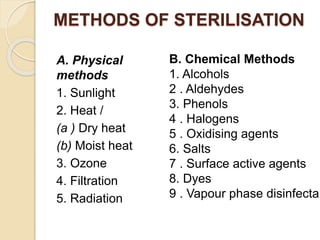
METHODS OF STERILISATION
A. Physical
methods
1. Sunlight
2. Heat /
(a ) Dry heat
(b) Moist heat
3. Ozone
4. Filtration
5. Radiation
B. Chemical Methods
1. Alcohols
2 . Aldehydes
3. Phenols
4 . Halogens
5 . Oxidising agents
6. Salts
7 . Surface active agents
8. Dyes
9 . Vapour phase disinfectan
HEAT
Principle:
(i) Dry heat kills the organisms by
denaturation of bacterial protein,
oxidative damage and by the toxic
effect of elevated levels of
electrolytes.
(ii) Moist heat kills the microorganisms
by denaturation and coagulation of
proteins.
Factors influencing :
(i) Nature of heat: Dry heat or moist
heat
(ii) Temperature and duration
(iii) Characteristic of microorganisms
and spores present
(iv) Type of material
DRY HEAT STERILISATION
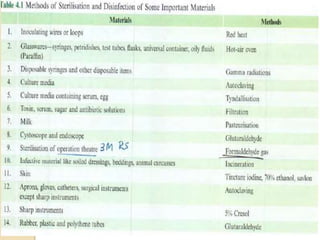
(i) Red heat- inoculating wire loops, tips
of forceps and needles
(ii) Flaming- Glass slides, scalpels and
mouths of culture
(iii) Incineration-By this method,
infective material is reduced to ashes by
burning. Soiled dressing, bedding and
pathological material.
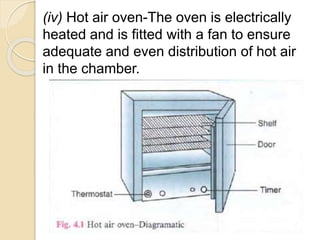
(iv) Hot air oven-The oven is electrically
heated and is fitted with a fan to ensure
adequate and even distribution of hot air
in the chamber.
 Most widely used method.
 160 degreeC for 2 hrs
 USES- 1) Glasswares like glass syringes,
petridishes, flasks, pipettes and test tubes
(ii) Surgical instruments like scalpels
(iii) Chemicals such as liquid paraffin, fats,
sulphonamides powders.
 Precautions
(i) not be overloaded .
(ii) free circulation of air.
(iii) Material to be sterilised should be perfectly dry .
( vi) Rubber or any inflammable material should not
be kept inside the
( vii) The oven must be allowed for two hours
before opening the doors, since the glasswares
may crack by sudden cooling
MOIST HEAT STERILISATION
(i) At a temperature below 100°C
(ii) At a temperature of 100°C
(iii) At a temperature above 100°C
Below 100°C
1. Pasteurisation of milk: Two types of method,
holder method (63°C for 30 minutes) and
flash method (72°C for 20 seconds followed
by cooling quickly to l3°C or lower).
2. Inspissation: by heating at 80-85°C
temperature for half an hour daily on three
consecutive days
3. Vaccine bath: Bacterial vaccines are
sterilised in special vaccine baths at 60°C
for one hour.
At 100°C
1. Boiling: Boiling for 10 to 30 minutes may
kill most of the vegetative forms but not
spores.
2. Tyndallisation- Steam at 100°C for 2o
mins on three successive days
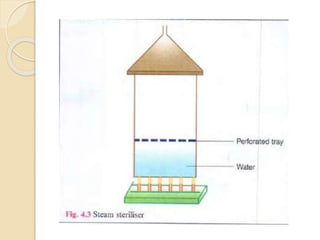
3. Steam steriliser: 100°C for 90 mins
Above 100°C (under pressure)
 At normal pressure water boils at
100°C but when pressure inside a
closed vessel increases, the
temperature at which water boils also
increases. This principle has been
applied in autoclave and pressure
cooker .
AUTOCLAVE
 Principle:
Steam above 100°C or saturated steam
has better killing power than dry heat.
Bacteria are more susceptible to moist
heat as bacterial protein coagulates
rapidly. Saturated steam can penetrate
porous material easily.
Components:
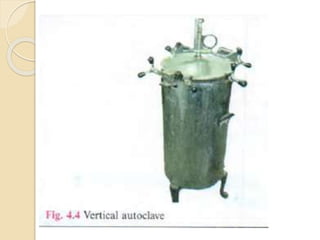
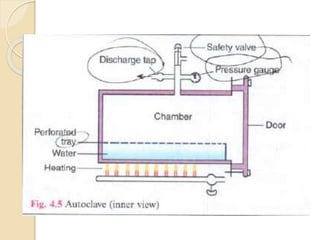
 Autoclave is a modified pressure cooker or
boiler.
 A vertical or horizontal cylinder of gunmetal
or stainless steel in 'a supporting iron case.
 The lid is fastened by screw clamps and
rendered air tight by an asbestos washer.
 The lid bears a discharge tap for air and
steam, a pressure gauge and a safety valve.
 Heating is done by electricity.
 Sterilisation conditions
 Temperature - 121 °C
 Chamber pressure - 15 lb per square
inch
 Holding time - 15 minutes
 Uses
(i) To sterilise culture media rubber
material, gowns, dressing, gloves etc.
(ii) It is particularly useful for materials
which cannot withstand the higher
temperature of hot air oven .
(iii) For all glass syringes, hot air oven is
a better sterilising method.
 Sterilisation control :
(i) Thermocouple
(ii) Bacterial spores: Spores of bacillus stearo-
thermophilus are used as the test organism .
This organism has an optimum growth
temperature of 55- 60 °C and its spores are
killed in 12 minutes at 121 °C.
(iii) Chemical indicators
(iv) Autoclave tapes
FILTRATION
 This method of sterilisation is useful for
substances which get damaged by heat
process.
 Uses:
(i) sterilise sera, sugars and antibiotic
solutions.
(ii) Separation of toxins and bacteriophages
from bacteria.
(iii) To obtain bacteria free filtrates
(iv) Sterilisation of hydatid fluid.
(v) Purification of water.
 Limitation: retains bacteria but allows
viruses and mycoplasms to pass
 Types:
(i) Candle filters
(ii) Asbestos disc fliters e.g. Seitz filter
(iii) Sintered glass filte
(iv) Membrane filters
(v) Air filters
(vi) Syringe filters
B. Chemical Methods
 An ideal antiseptic or disinfectant should
(i) have wide spectrum of activity and be effective
against all microorganisms including bacteria (both
vegetative and spore forms), viruses, protozoa and
fungi,
(ii) act in the presence of organic matters,
(iii) have high Penetration power and quick action,
(iv) be stable and effective in acidic as well as in
alkaline
conditions,
(v) not corrode metals,
(vi) be compatible with other disinfectants,
( vii) not cause local irritation,
( viii) not be toxic if absorbed into circulation,
(ix) be safe and easy to use, and
(x) be easily available and cheap .
 The following factors influence the potency of
a disinfectant :
(i) concentration
(ii) time of action
(iii) pH
(iv) temperature
(v) nature of organism and
( vi) presence of organic matter
 Disinfectants can be divided into three
groups:
1) High level disinfectants.
 e.g glutaraldehyde, hydrogen peroxide
paracetic acid and chlorine compounds.
2) Intermediate level disinfectants.
E.g alcohols, iodophores and phenolic
compounds
3) Low level disinfectants.
THANK YOU

2. sterilisation and disinfection.pptxml

  • 1.
  • 2.
     Sterilisation: aprocess by which article, surface or medium is made free of all microorganisms either in the vegetative or spore form.  Disinfection: means the destruction of all pathogens or organisms capable of producing infections but not necessarily spores.
  • 3.
     Antiseptics: chemicaldisinfectants which can safely be applied to living tissues and are used to prevent infection by inhibiting the growth of microorganisms.  Asepsis: The technique by which , the occurrence of infection into an uninfected tissue is prevented.
  • 4.
    Uses of Sterilisation/Disinfection 1.Sterilisation of materials, instruments used in surgical and diagnostic procedures. 2. For media and reagents used in the microbiology laboratory. 3. In food and drug manufacturing to ensure safety from contaminating organisms.
  • 5.
    METHODS OF STERILISATION A.Physical methods 1. Sunlight 2. Heat / (a ) Dry heat (b) Moist heat 3. Ozone 4. Filtration 5. Radiation B. Chemical Methods 1. Alcohols 2 . Aldehydes 3. Phenols 4 . Halogens 5 . Oxidising agents 6. Salts 7 . Surface active agents 8. Dyes 9 . Vapour phase disinfectan
  • 6.
    HEAT Principle: (i) Dry heatkills the organisms by denaturation of bacterial protein, oxidative damage and by the toxic effect of elevated levels of electrolytes. (ii) Moist heat kills the microorganisms by denaturation and coagulation of proteins.
  • 7.
    Factors influencing : (i)Nature of heat: Dry heat or moist heat (ii) Temperature and duration (iii) Characteristic of microorganisms and spores present (iv) Type of material
  • 8.
    DRY HEAT STERILISATION (i)Red heat- inoculating wire loops, tips of forceps and needles (ii) Flaming- Glass slides, scalpels and mouths of culture (iii) Incineration-By this method, infective material is reduced to ashes by burning. Soiled dressing, bedding and pathological material.
  • 9.
    (iv) Hot airoven-The oven is electrically heated and is fitted with a fan to ensure adequate and even distribution of hot air in the chamber.
  • 10.
     Most widelyused method.  160 degreeC for 2 hrs  USES- 1) Glasswares like glass syringes, petridishes, flasks, pipettes and test tubes (ii) Surgical instruments like scalpels (iii) Chemicals such as liquid paraffin, fats, sulphonamides powders.
  • 11.
     Precautions (i) notbe overloaded . (ii) free circulation of air. (iii) Material to be sterilised should be perfectly dry . ( vi) Rubber or any inflammable material should not be kept inside the ( vii) The oven must be allowed for two hours before opening the doors, since the glasswares may crack by sudden cooling
  • 12.
    MOIST HEAT STERILISATION (i)At a temperature below 100°C (ii) At a temperature of 100°C (iii) At a temperature above 100°C
  • 13.
    Below 100°C 1. Pasteurisationof milk: Two types of method, holder method (63°C for 30 minutes) and flash method (72°C for 20 seconds followed by cooling quickly to l3°C or lower). 2. Inspissation: by heating at 80-85°C temperature for half an hour daily on three consecutive days 3. Vaccine bath: Bacterial vaccines are sterilised in special vaccine baths at 60°C for one hour.
  • 14.
    At 100°C 1. Boiling:Boiling for 10 to 30 minutes may kill most of the vegetative forms but not spores. 2. Tyndallisation- Steam at 100°C for 2o mins on three successive days 3. Steam steriliser: 100°C for 90 mins
  • 16.
    Above 100°C (underpressure)  At normal pressure water boils at 100°C but when pressure inside a closed vessel increases, the temperature at which water boils also increases. This principle has been applied in autoclave and pressure cooker .
  • 17.
    AUTOCLAVE  Principle: Steam above100°C or saturated steam has better killing power than dry heat. Bacteria are more susceptible to moist heat as bacterial protein coagulates rapidly. Saturated steam can penetrate porous material easily.
  • 19.
    Components:  Autoclave isa modified pressure cooker or boiler.  A vertical or horizontal cylinder of gunmetal or stainless steel in 'a supporting iron case.  The lid is fastened by screw clamps and rendered air tight by an asbestos washer.  The lid bears a discharge tap for air and steam, a pressure gauge and a safety valve.  Heating is done by electricity.
  • 21.
     Sterilisation conditions Temperature - 121 °C  Chamber pressure - 15 lb per square inch  Holding time - 15 minutes
  • 22.
     Uses (i) Tosterilise culture media rubber material, gowns, dressing, gloves etc. (ii) It is particularly useful for materials which cannot withstand the higher temperature of hot air oven . (iii) For all glass syringes, hot air oven is a better sterilising method.
  • 23.
     Sterilisation control: (i) Thermocouple (ii) Bacterial spores: Spores of bacillus stearo- thermophilus are used as the test organism . This organism has an optimum growth temperature of 55- 60 °C and its spores are killed in 12 minutes at 121 °C. (iii) Chemical indicators (iv) Autoclave tapes
  • 24.
    FILTRATION  This methodof sterilisation is useful for substances which get damaged by heat process.  Uses: (i) sterilise sera, sugars and antibiotic solutions. (ii) Separation of toxins and bacteriophages from bacteria. (iii) To obtain bacteria free filtrates (iv) Sterilisation of hydatid fluid. (v) Purification of water.
  • 25.
     Limitation: retainsbacteria but allows viruses and mycoplasms to pass  Types: (i) Candle filters (ii) Asbestos disc fliters e.g. Seitz filter (iii) Sintered glass filte (iv) Membrane filters (v) Air filters (vi) Syringe filters
  • 26.
    B. Chemical Methods An ideal antiseptic or disinfectant should (i) have wide spectrum of activity and be effective against all microorganisms including bacteria (both vegetative and spore forms), viruses, protozoa and fungi, (ii) act in the presence of organic matters, (iii) have high Penetration power and quick action, (iv) be stable and effective in acidic as well as in alkaline conditions, (v) not corrode metals, (vi) be compatible with other disinfectants, ( vii) not cause local irritation, ( viii) not be toxic if absorbed into circulation, (ix) be safe and easy to use, and (x) be easily available and cheap .
  • 27.
     The followingfactors influence the potency of a disinfectant : (i) concentration (ii) time of action (iii) pH (iv) temperature (v) nature of organism and ( vi) presence of organic matter
  • 28.
     Disinfectants canbe divided into three groups: 1) High level disinfectants.  e.g glutaraldehyde, hydrogen peroxide paracetic acid and chlorine compounds. 2) Intermediate level disinfectants. E.g alcohols, iodophores and phenolic compounds 3) Low level disinfectants.
  • 30.