Introduction
Steps in ChemicalAnalysis
PreliminaryTreatment of Sample
Preparation of Samples for Analysis
Introduction:
4 June 2024
2
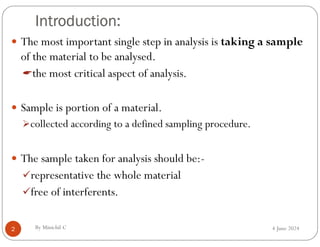
 The most important single step in analysis is taking a sample
of the material to be analysed.
the most critical aspect of analysis.
 Sample is portion of a material.
collected according to a defined sampling procedure.
 The sample taken for analysis should be:-
representative the whole material
free of interferents.
By Minichil C
4 June 2024
3
Requirements:
I. Sample must be taken that is sufficient for all the analysis to
be carried out comfortably.
II. Sample must be representative of the material being
sampled.
By Minichil C
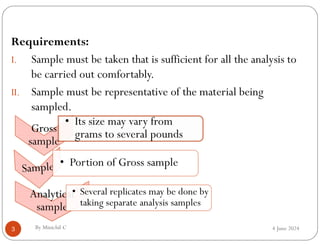
Gross
sample
Gross
sample
• Its size may vary from
grams to several pounds
• Portion of Gross sample
Analytical
sample
Analytical
sample
• Several replicates may be done by
taking separate analysis samples
Steps:
4 June 2024
4
 There are different steps in drug analysis.
 The pharmaceutical analyst should be involved in every step.
 The following unit operations are common to most types of
drug analysis.
By Minichil C
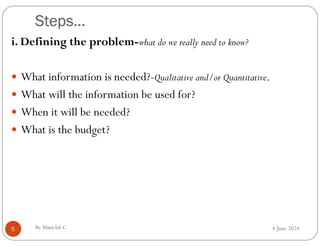
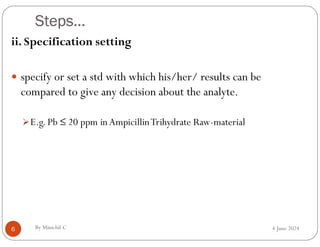
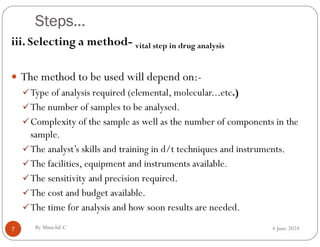
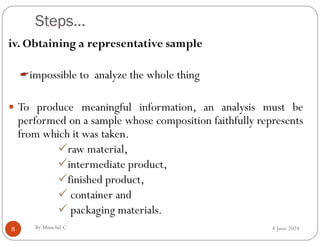
Steps…
4 June 2024
5
i. Defining the problem-what do we really need to know?
 What information is needed?-Qualitative and/or Quantitative.
 What will the information be used for?
 When it will be needed?
 What is the budget?
By Minichil C
Steps…
4 June 2024
6
ii. Specification setting
 specify or set a std with which his/her/ results can be
compared to give any decision about the analyte.
E.g. Pb ≤ 20 ppm in AmpicillinTrihydrate Raw-material
By Minichil C
Steps…
4 June 2024
7
iii. Selecting a method- vital step in drug analysis
 The method to be used will depend on:-
Type of analysis required (elemental, molecular...etc.)
The number of samples to be analysed.
Complexity of the sample as well as the number of components in the
sample.
The analyst’s skills and training in d/t techniques and instruments.
The facilities, equipment and instruments available.
The sensitivity and precision required.
The cost and budget available.
The time for analysis and how soon results are needed.
By Minichil C
Steps…
4 June 2024
8
iv. Obtaining a representative sample
impossible to analyze the whole thing
 To produce meaningful information, an analysis must be
performed on a sample whose composition faithfully represents
from which it was taken.
raw material,
intermediate product,
finished product,
 container and
 packaging materials.
By Minichil C
Steps…
4 June 2024
9
v. Preparing the sample for analysis.
 Whatever drug’s state is, there might be a need for pre-treat
before the main analysis is performed.
vi. Performing the measurement
 qualitative or
 Quantitative
 Most chemical analyses are performed on replicate samples.
By Minichil C
Steps…
4 June 2024
10
vii. Interpretation of the data obtained
 The analyst should critically evaluate whether the results are
reasonable and relate to the analytical problem originally
stated.
 Example.Assay ofAmpicillinTrihydrate RM
Specification : (96-100.5)%
Result: 90.3%
Interpretation-fail
viii. Conclusion and reporting
 Example.TheAmpicillinTrihydrate Sample does not comply
with a requirement of the given specification, and hence should
be rejected.
By Minichil C
Preliminary Treatment of Sample
4 June 2024
11
Sample Preparation
 In analysis, sample preparation refers to the ways in which a
sample is treated prior to its analysis.
 Sample preparation may involve
dissolution,
reaction with some chemical species,
pulverizing,
treatment with a chelating agent,
masking, filtering,
dilution, sub-sampling….
By Minichil C
4 June 2024
By Minichil C
12
 There are three key issues that often arise that necessitate
pre-treatment of a sample prior to analysis:
The sample is in the wrong physical state for the analysis method
(e.g., the method requires a liquid but you have a solid sample),
The sample has interfering matrix components that may give
either a false positive or negative reading in the measurement, and
The sample has too low an analyte concentration to be detected by
the instrument.
4 June 2024
13
Sample pre-treatment
Steps in sample pretreatment
A.Homogenization
– Is done in order to have a representative sample
– Is done by grinding,shaking,mixing etc.
B.Dissolving
Criteria in solvent selection
 Must allow complete solubility of the analyte.
 Must not interfere in a particular analytical methods.
By Minichil C
4 June 2024
14
C.Performing necessary chemical separations
 Precipitation, extraction into an immiscible solvent,
chromatography and distillation
By Minichil C
4 June 2024
By Minichil C
15
Reading Assignment
I. Sampling of different sample
II. Sample storage
4 June 2024
16
Thank YOU a lot!!!
By Minichil C

2 Sample Preparation for Analysis.pdf anaalysis one

  • 1.
    Introduction Steps in ChemicalAnalysis PreliminaryTreatmentof Sample Preparation of Samples for Analysis
  • 2.
    Introduction: 4 June 2024 2 The most important single step in analysis is taking a sample of the material to be analysed. the most critical aspect of analysis.  Sample is portion of a material. collected according to a defined sampling procedure.  The sample taken for analysis should be:- representative the whole material free of interferents. By Minichil C
  • 3.
    4 June 2024 3 Requirements: I.Sample must be taken that is sufficient for all the analysis to be carried out comfortably. II. Sample must be representative of the material being sampled. By Minichil C Gross sample Gross sample • Its size may vary from grams to several pounds • Portion of Gross sample Analytical sample Analytical sample • Several replicates may be done by taking separate analysis samples
  • 4.
    Steps: 4 June 2024 4 There are different steps in drug analysis.  The pharmaceutical analyst should be involved in every step.  The following unit operations are common to most types of drug analysis. By Minichil C
  • 5.
    Steps… 4 June 2024 5 i.Defining the problem-what do we really need to know?  What information is needed?-Qualitative and/or Quantitative.  What will the information be used for?  When it will be needed?  What is the budget? By Minichil C
  • 6.
    Steps… 4 June 2024 6 ii.Specification setting  specify or set a std with which his/her/ results can be compared to give any decision about the analyte. E.g. Pb ≤ 20 ppm in AmpicillinTrihydrate Raw-material By Minichil C
  • 7.
    Steps… 4 June 2024 7 iii.Selecting a method- vital step in drug analysis  The method to be used will depend on:- Type of analysis required (elemental, molecular...etc.) The number of samples to be analysed. Complexity of the sample as well as the number of components in the sample. The analyst’s skills and training in d/t techniques and instruments. The facilities, equipment and instruments available. The sensitivity and precision required. The cost and budget available. The time for analysis and how soon results are needed. By Minichil C
  • 8.
    Steps… 4 June 2024 8 iv.Obtaining a representative sample impossible to analyze the whole thing  To produce meaningful information, an analysis must be performed on a sample whose composition faithfully represents from which it was taken. raw material, intermediate product, finished product,  container and  packaging materials. By Minichil C
  • 9.
    Steps… 4 June 2024 9 v.Preparing the sample for analysis.  Whatever drug’s state is, there might be a need for pre-treat before the main analysis is performed. vi. Performing the measurement  qualitative or  Quantitative  Most chemical analyses are performed on replicate samples. By Minichil C
  • 10.
    Steps… 4 June 2024 10 vii.Interpretation of the data obtained  The analyst should critically evaluate whether the results are reasonable and relate to the analytical problem originally stated.  Example.Assay ofAmpicillinTrihydrate RM Specification : (96-100.5)% Result: 90.3% Interpretation-fail viii. Conclusion and reporting  Example.TheAmpicillinTrihydrate Sample does not comply with a requirement of the given specification, and hence should be rejected. By Minichil C
  • 11.
    Preliminary Treatment ofSample 4 June 2024 11 Sample Preparation  In analysis, sample preparation refers to the ways in which a sample is treated prior to its analysis.  Sample preparation may involve dissolution, reaction with some chemical species, pulverizing, treatment with a chelating agent, masking, filtering, dilution, sub-sampling…. By Minichil C
  • 12.
    4 June 2024 ByMinichil C 12  There are three key issues that often arise that necessitate pre-treatment of a sample prior to analysis: The sample is in the wrong physical state for the analysis method (e.g., the method requires a liquid but you have a solid sample), The sample has interfering matrix components that may give either a false positive or negative reading in the measurement, and The sample has too low an analyte concentration to be detected by the instrument.
  • 13.
    4 June 2024 13 Samplepre-treatment Steps in sample pretreatment A.Homogenization – Is done in order to have a representative sample – Is done by grinding,shaking,mixing etc. B.Dissolving Criteria in solvent selection  Must allow complete solubility of the analyte.  Must not interfere in a particular analytical methods. By Minichil C
  • 14.
    4 June 2024 14 C.Performingnecessary chemical separations  Precipitation, extraction into an immiscible solvent, chromatography and distillation By Minichil C
  • 15.
    4 June 2024 ByMinichil C 15 Reading Assignment I. Sampling of different sample II. Sample storage
  • 16.
    4 June 2024 16 ThankYOU a lot!!! By Minichil C