1
RESEARCH DESIGN
2
– What--What was studied?
– What about--What aspects of
the subject were studied?
– What for--What is/was the
significance of the study?
– What did prior lit./research say?
– What was done--How was the
study conducted?
– What was found?
– So what?
– What now?
1. Introduction,
Research Problems/
Objectives, &
Justification
2. Literature Review
3. Methodology
(Research sample, data
collection, measurement,
data analysis)
4. Results & Discussion
5. Implications
6. Conclusions and
Recommendations for
Future Research
PROCESS OF DESIGNING AND CONDUCTING A
RESEARCH PROJECT:
3
RESEARCH DESIGN
 RESEARCH DESIGN refers to the plan, structure, and
strategy of research--the blueprint that will guide the
research process.
Developing Research
Hypotheses
Intriguing Observation,
Intellectual Curiosity
Defining Research
Problem & Objectives
Testing Hypo.:
Data Analysis &
Interpretation
Sampling Design
Refinement of theory
(Inductive Reasoning)
Data Coding,
And
Editing
Developing Operational
Definitions for
Research Variables
Building the Theoretical
Framework and the
Research Model
Data Collection
More Careful Studying
of the Phenomenon
THE PROCESS OF
EMPIRICAL RESEARCH
4
RESEARCH DESIGN
 CONCLUSION VALIDITY refers to the extent of
researcher’s ability to draw accurate conclusions from the
research. That is, the degree of a study’s:
a) Internal Validity—correctness of conclusions regarding the
relationships among variables examined
 Whether the research findings accurately reflect how the research
variables are really connected to each other.
b) External Validity –Generalizability of the findings to the
intended/appropriate population/setting
 Whether appropriate subjects were selected for conducting the study
RESEARCH DESIGN: The blueprint/roadmap that will guide the
research.
The test for the quality of a study’s research design is the
study’s conclusion validity.
5
RESEARCH DESIGN
• Variance of the INDEPENDENT & DEPENDENT
variables (Systematic Variance)
• Variability of potential NUISANCE/EXTRANEOUS/
CONFOUNDING variables (Confounding Variance)
• Variance attributable to ERROR IN MEASUREMENT
(Error Variance).
How?
How do you achieve internal and external validity (i.e.,
conclusion validity)?
 By effectively controlling 3 types of variances:
6
Effective Research Design
– MAXimize Systematic Variance
– MINimize Error Variance
– CONtrol Variance of Nuisance/Extraneous/
Exogenous/Confounding variables
 Guiding principle for effective control of
variances (and, thus, effective research
design) is:
The MAXMINCON Principle
7
Effective Research Design
 IN EXPERIMENTS?
(where the researcher actually manipulates the independent
variable and measures its impact on the dependent variable):
– Proper manipulation of experimental conditions
to ensure high variability in indep. var.
 IN NON-EXPERIMENTAL STUDIES?
(where independent and dependent variables are measured
simultaneously and the relationship between them are
examined):
– Appropriate subject selection (selecting subjects
that are sufficiently different with respect to the
study’s main var.)--avoid Range Restriction
MAXimizing Systematic Variance:
Widening the range of values of research variables.
8
Effective Research Design
 Sources of error variance:
– Poorly designed measurement instruments
(instrumentation error)
– Error emanating from study subjects (e.g.,
response error)
– Contextual factors that reduce a sound/accurate
measurement instrument’s capacity to measure
accurately.
 How to Minimize Error Variance?
– Increase validity and reliability of
measurement instruments.
– Measure variables under as ideal
conditions as possible.
MINimizing Error Variance (measurement error):
Minimizing the part of variability in scores that is
caused by error in measurement.
1. Historical data on pollution and longevity
2. Relationship between likelihood of
hearing problems and high blood pressure
3. Recent stat. show in-vitro kids are 5 times more likely to develop eye tumors
(Culprit: in-vitro fathers’ older age)
4. Significantly more armed store robberies during the cold winter days. 9
Effective Research Design
 May or may not be of primary interest to the researcher,
 But, can produce undesirable variation in the study's
dependent variable, and cause misleading or weird results
 Thus, if not controlled, can contaminate/distort the true
relationship(s) between the independent and dependent
variable(s) of interest
• i.e., confounding var. can result in a spurious-- as opposed to
substantive--correlation between IV and DV. Example?
Hearing Blood
Problem Pressure
CONtrolling Variance of Confounding/Nuisance Variables:
FIRST, what are Nuisance/Confounding Variables?
Age
10
Effective Research Design
– Conducting the experiment in a controlled environment (e.g.,
laboratory), where we can hold values of potential confounding
variables constant.
– Subject selection (e.g., matching subjects in experiments)
– Random assignment of subjects (variations of confounding variables
are evenly distributed between the experimental and control groups)
 In Survey Research:
– Sample selection (e.g., including only subjects with appropriate
characteristics—using male college graduates as subjects will control
for potential confounding effects of gender and education)
– Statistical Control--anticipating, measuring, and statistically
controlling for confounding variables’ effects (i.e., hold them
statistically constant, or statistically removing their effects).
HOW TO CONTROL FOR CONFOUNDING/
NUISANCE VARIABLES?
 In Experimental Settings (e.g., Fertilizer Amount Rate of Plant Growth) :
Some Potential Confounding Variables?
11
Effective Research Design
 Adequate (full range of) variability in values of
research variables,
 Precise and accurate measurement,
 Identifying and controlling the effects of
confounding variables, and
 Appropriate subject selection
RECAP:
Effective research design is a function of ?
12
BASIC DESIGNS
 Experimental Designs:
– True Experimental Studies
– Pre-experimental Studies
– Quasi-Experimental Studies
 Non-Experimental Designs:
– Expost Facto/Correlational Studies
SPECIFIC TYPES OF RESEARCH DESIGN
BASIC RESEARCH DESIGNS:
13
EXPERIMENTAL DESIGNS
 RESULT: Significant Improvement from O1 to O2
(i.e., sig. O2 - O1 difference)
 QUESTION: Did X (the drug) cause the
improvement?
One of the simplest experimental designs is the ONE GROUP PRETEST-
POSTTEST DESIGN--EXAMPLE?
One way to examine Efficacy of a Drug:
O1 X O2
Measure DRUG Measure
Patients’ Condition Experimental Patients’ Condition
(Pretest) Condition/ (Posttest)
intervention
14
EXPERIMENTAL DESIGNS
– Have only shown “X” is a SUFFICIENT condition
for the change “Y” (i.e., presence of X is
associated with a change in Y).
 But, is “X” also a NECESSARY condition for
Y?
– How do you verify the latter?
 By showing that the change would not have
happened in the absence of X—using a
CONTROL GROUP.
David Hume would have been tempted to say “YES.”
He was a positivist and wanted to infer causality based
on high correlations between events.
But such an inference could be seriously flawed.
Why?
David Hume, 18th
Century Scottish
Philosopher
15
EXPERIMENTAL DESIGNS
 CONTROL GROUP simulates absence of X
– Origin of using Control Groups (A tale from ancient Egypt)
Pretest Post-Test Control Group Design--Suppose random
assignment (R) was used to control confounding variables:
R Exp. Group O1E X O2E
R Ctrl Group O1C O2C
 RESULT: O2E > O1E & O2C Not> O1C
QUESTION: Did X cause the improvement in Exp.
Group?
16
EXPERIMENTAL DESIGNS
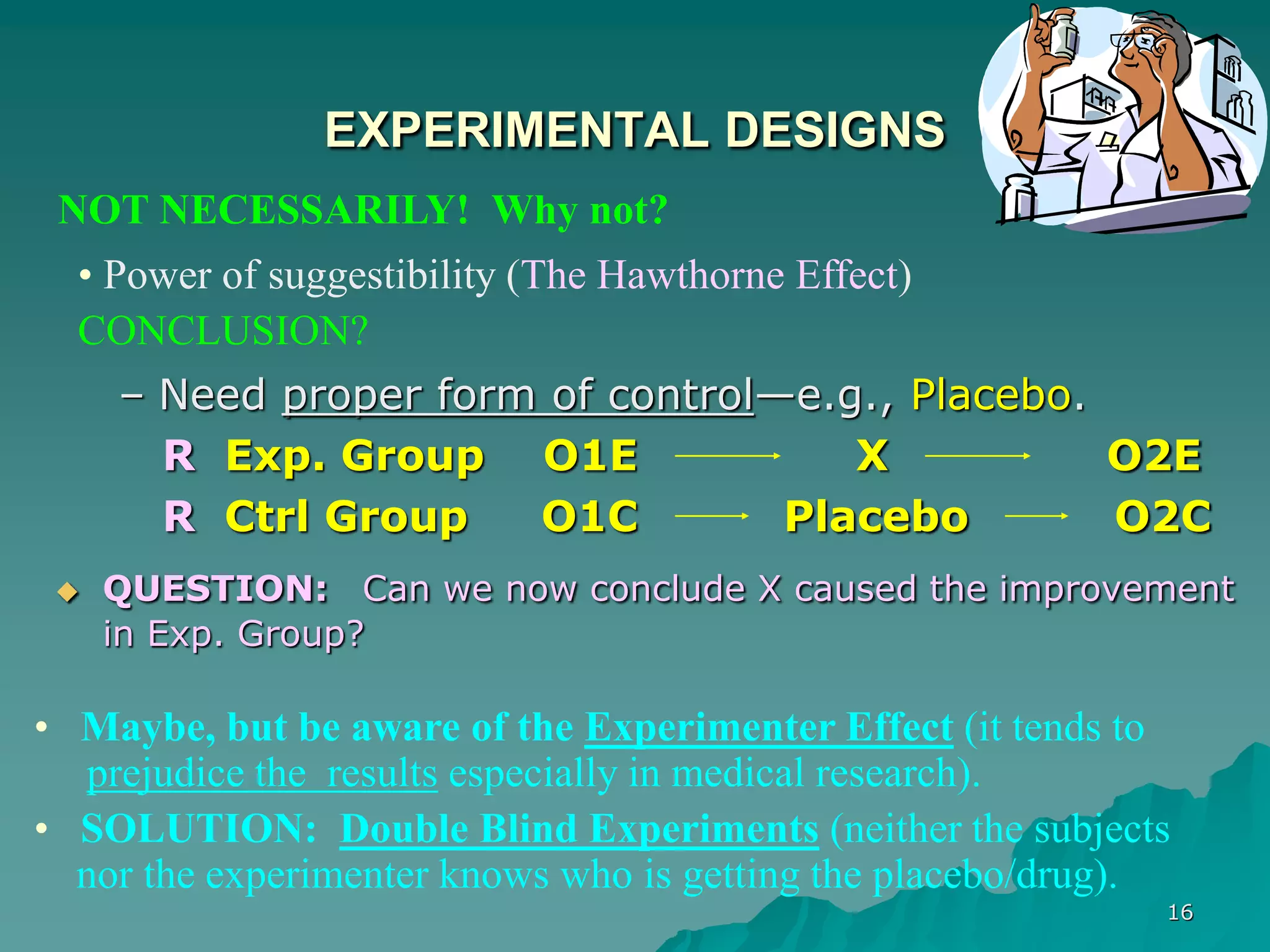
– Need proper form of control—e.g., Placebo.
R Exp. Group O1E X O2E
R Ctrl Group O1C Placebo O2C
 QUESTION: Can we now conclude X caused the improvement
in Exp. Group?
NOT NECESSARILY! Why not?
• Power of suggestibility (The Hawthorne Effect)
CONCLUSION?
• Maybe, but be aware of the Experimenter Effect (it tends to
prejudice the results especially in medical research).
• SOLUTION: Double Blind Experiments (neither the subjects
nor the experimenter knows who is getting the placebo/drug).
17
EXPERIMENTAL DESIGNS
Experimental studies need to control for potential
confounding factors that may threaten internal validity
of the experiment:
–Hawthorne Effect is only one potential confounding factor
in experimental studies.
Other such factors are:
–History?
 Biasing events that occur between pretest and post-test
–Maturation?
 Physical/biological/psychological changes in the subjects
–Testing?
 Exposure to pretest influences scores on post-test
–Instrumentation?
 Flaws in measurement instrument/procedure
18
EXPERIMENTAL DESIGNS
Experimental studies need to control for potential
confounding factors that may threaten internal validity
of the experiment (Continued):
–Selection?
 Subjects in experimental & control groups different from the start
–Statistical Regression (regression toward the mean)?
 Subjects selected based on extreme pretest values
 Discovered by Francis Galton in 1877
–Experimental Mortality?
 Differential drop-out of subjects from experimental and control
groups during the study
–Etc.
 Experimental designs mostly used in natural and physical
sciences.
 Generally, higher internal validity, lower external
validity
19
20
21
CORRELATIONAL DESIGNS
 The design of choice in social sciences since the phenomenon
under study is usually not reproducible in a laboratory setting
 Researcher has little or no control over study’s indep., dep.
and the numerous potential confounding variables,
 Often the researcher concomitantly measures all the study
variables (e.g., independent, dependant, etc.),
 Then examines the following types of relationships:
– correlations among variables or
– differences among groups,
 Inability to control for effects of confounding variables makes
causal inferences regarding relationships among variables
more difficult and, thus:
 Generally, higher external validity, lower internal validity
NON-EXPERIMENTAL/CORRELATIONAL DESIGNS
22
CORRELATIONAL DESIGNS
 NOT NECESSARILY! EXAMPLES:
– Water Fluoridation and AIDS
(San Francisco Chronicle, Sep. 6, 1984)
– Armed store robberies and cold weather
– Longevity and Pollution
– In-vitro birth and likelihood of developing eye
tumors
– Hearing problem and blood pressure
 What can a significant correlation mean then?
Non-experimental designs rely on correlational evidence.
QUESTION: Does a significant correlation between two
variables in a non-experimental study necessarily represent a
causal relationship between those variables?
23
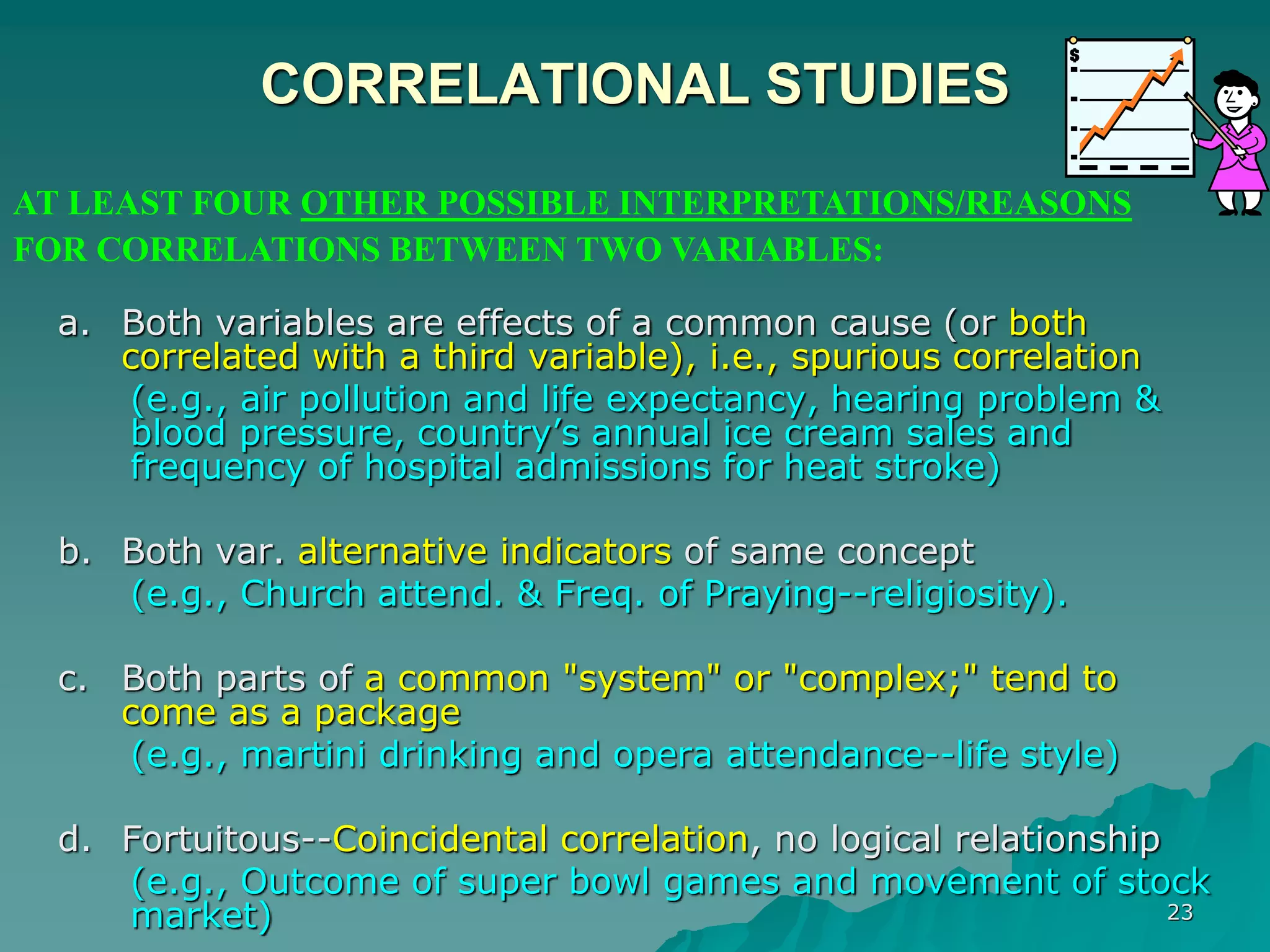
CORRELATIONAL STUDIES
a. Both variables are effects of a common cause (or both
correlated with a third variable), i.e., spurious correlation
(e.g., air pollution and life expectancy, hearing problem &
blood pressure, country’s annual ice cream sales and
frequency of hospital admissions for heat stroke)
b. Both var. alternative indicators of same concept
(e.g., Church attend. & Freq. of Praying--religiosity).
c. Both parts of a common "system" or "complex;" tend to
come as a package
(e.g., martini drinking and opera attendance--life style)
d. Fortuitous--Coincidental correlation, no logical relationship
(e.g., Outcome of super bowl games and movement of stock
market)
AT LEAST FOUR OTHER POSSIBLE INTERPRETATIONS/REASONS
FOR CORRELATIONS BETWEEN TWO VARIABLES:
24
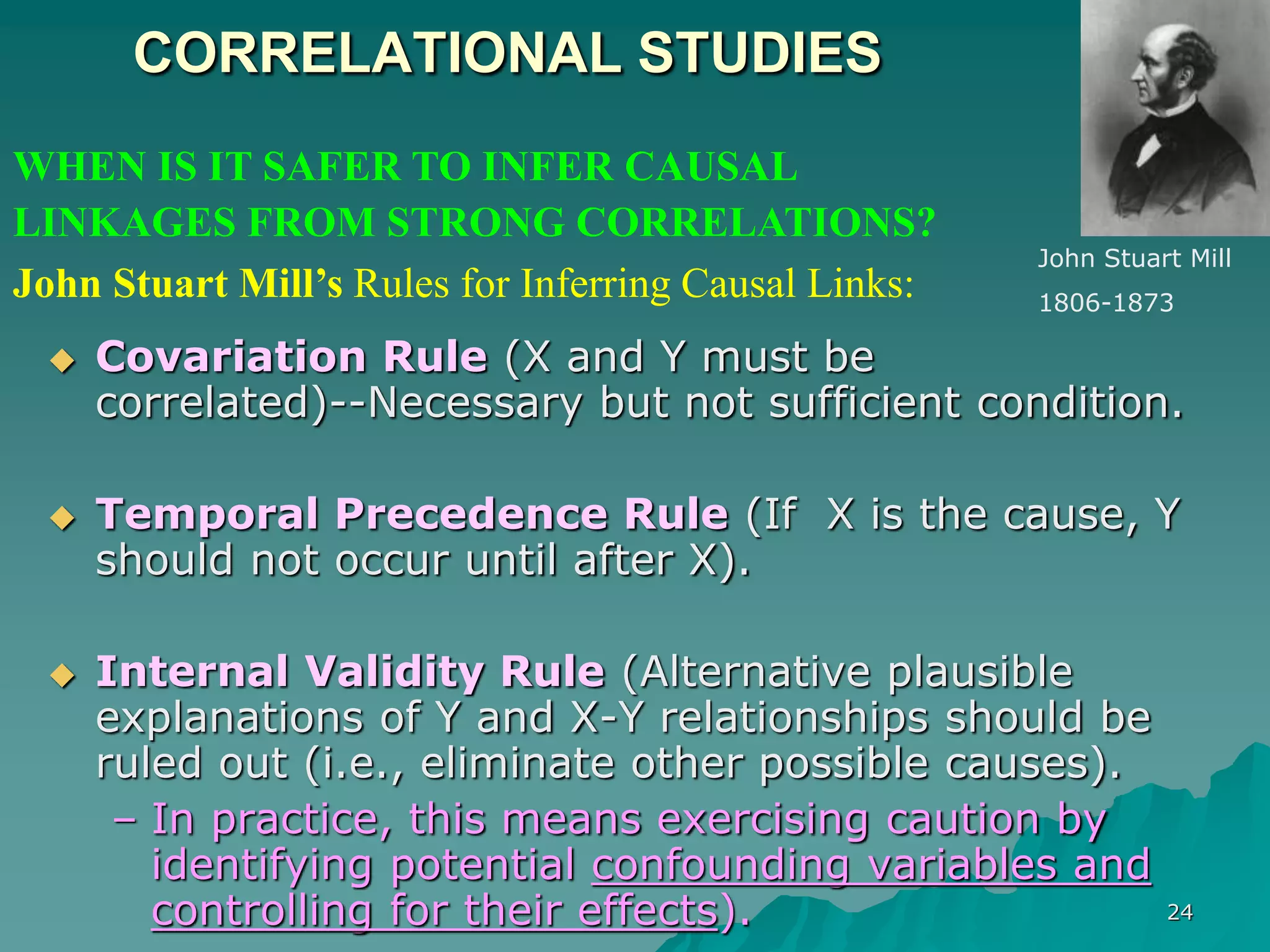
CORRELATIONAL STUDIES
 Covariation Rule (X and Y must be
correlated)--Necessary but not sufficient condition.
 Temporal Precedence Rule (If X is the cause, Y
should not occur until after X).
 Internal Validity Rule (Alternative plausible
explanations of Y and X-Y relationships should be
ruled out (i.e., eliminate other possible causes).
– In practice, this means exercising caution by
identifying potential confounding variables and
controlling for their effects).
WHEN IS IT SAFER TO INFER CAUSAL
LINKAGES FROM STRONG CORRELATIONS?
John Stuart Mill’s Rules for Inferring Causal Links:
John Stuart Mill
1806-1873
25
Questions or Comments
?

2. research design ldr 280-2

  • 1.
  • 2.
    2 – What--What wasstudied? – What about--What aspects of the subject were studied? – What for--What is/was the significance of the study? – What did prior lit./research say? – What was done--How was the study conducted? – What was found? – So what? – What now? 1. Introduction, Research Problems/ Objectives, & Justification 2. Literature Review 3. Methodology (Research sample, data collection, measurement, data analysis) 4. Results & Discussion 5. Implications 6. Conclusions and Recommendations for Future Research PROCESS OF DESIGNING AND CONDUCTING A RESEARCH PROJECT:
  • 3.
    3 RESEARCH DESIGN  RESEARCHDESIGN refers to the plan, structure, and strategy of research--the blueprint that will guide the research process. Developing Research Hypotheses Intriguing Observation, Intellectual Curiosity Defining Research Problem & Objectives Testing Hypo.: Data Analysis & Interpretation Sampling Design Refinement of theory (Inductive Reasoning) Data Coding, And Editing Developing Operational Definitions for Research Variables Building the Theoretical Framework and the Research Model Data Collection More Careful Studying of the Phenomenon THE PROCESS OF EMPIRICAL RESEARCH
  • 4.
    4 RESEARCH DESIGN  CONCLUSIONVALIDITY refers to the extent of researcher’s ability to draw accurate conclusions from the research. That is, the degree of a study’s: a) Internal Validity—correctness of conclusions regarding the relationships among variables examined  Whether the research findings accurately reflect how the research variables are really connected to each other. b) External Validity –Generalizability of the findings to the intended/appropriate population/setting  Whether appropriate subjects were selected for conducting the study RESEARCH DESIGN: The blueprint/roadmap that will guide the research. The test for the quality of a study’s research design is the study’s conclusion validity.
  • 5.
    5 RESEARCH DESIGN • Varianceof the INDEPENDENT & DEPENDENT variables (Systematic Variance) • Variability of potential NUISANCE/EXTRANEOUS/ CONFOUNDING variables (Confounding Variance) • Variance attributable to ERROR IN MEASUREMENT (Error Variance). How? How do you achieve internal and external validity (i.e., conclusion validity)?  By effectively controlling 3 types of variances:
  • 6.
    6 Effective Research Design –MAXimize Systematic Variance – MINimize Error Variance – CONtrol Variance of Nuisance/Extraneous/ Exogenous/Confounding variables  Guiding principle for effective control of variances (and, thus, effective research design) is: The MAXMINCON Principle
  • 7.
    7 Effective Research Design IN EXPERIMENTS? (where the researcher actually manipulates the independent variable and measures its impact on the dependent variable): – Proper manipulation of experimental conditions to ensure high variability in indep. var.  IN NON-EXPERIMENTAL STUDIES? (where independent and dependent variables are measured simultaneously and the relationship between them are examined): – Appropriate subject selection (selecting subjects that are sufficiently different with respect to the study’s main var.)--avoid Range Restriction MAXimizing Systematic Variance: Widening the range of values of research variables.
  • 8.
    8 Effective Research Design Sources of error variance: – Poorly designed measurement instruments (instrumentation error) – Error emanating from study subjects (e.g., response error) – Contextual factors that reduce a sound/accurate measurement instrument’s capacity to measure accurately.  How to Minimize Error Variance? – Increase validity and reliability of measurement instruments. – Measure variables under as ideal conditions as possible. MINimizing Error Variance (measurement error): Minimizing the part of variability in scores that is caused by error in measurement.
  • 9.
    1. Historical dataon pollution and longevity 2. Relationship between likelihood of hearing problems and high blood pressure 3. Recent stat. show in-vitro kids are 5 times more likely to develop eye tumors (Culprit: in-vitro fathers’ older age) 4. Significantly more armed store robberies during the cold winter days. 9 Effective Research Design  May or may not be of primary interest to the researcher,  But, can produce undesirable variation in the study's dependent variable, and cause misleading or weird results  Thus, if not controlled, can contaminate/distort the true relationship(s) between the independent and dependent variable(s) of interest • i.e., confounding var. can result in a spurious-- as opposed to substantive--correlation between IV and DV. Example? Hearing Blood Problem Pressure CONtrolling Variance of Confounding/Nuisance Variables: FIRST, what are Nuisance/Confounding Variables? Age
  • 10.
    10 Effective Research Design –Conducting the experiment in a controlled environment (e.g., laboratory), where we can hold values of potential confounding variables constant. – Subject selection (e.g., matching subjects in experiments) – Random assignment of subjects (variations of confounding variables are evenly distributed between the experimental and control groups)  In Survey Research: – Sample selection (e.g., including only subjects with appropriate characteristics—using male college graduates as subjects will control for potential confounding effects of gender and education) – Statistical Control--anticipating, measuring, and statistically controlling for confounding variables’ effects (i.e., hold them statistically constant, or statistically removing their effects). HOW TO CONTROL FOR CONFOUNDING/ NUISANCE VARIABLES?  In Experimental Settings (e.g., Fertilizer Amount Rate of Plant Growth) : Some Potential Confounding Variables?
  • 11.
    11 Effective Research Design Adequate (full range of) variability in values of research variables,  Precise and accurate measurement,  Identifying and controlling the effects of confounding variables, and  Appropriate subject selection RECAP: Effective research design is a function of ?
  • 12.
    12 BASIC DESIGNS  ExperimentalDesigns: – True Experimental Studies – Pre-experimental Studies – Quasi-Experimental Studies  Non-Experimental Designs: – Expost Facto/Correlational Studies SPECIFIC TYPES OF RESEARCH DESIGN BASIC RESEARCH DESIGNS:
  • 13.
    13 EXPERIMENTAL DESIGNS  RESULT:Significant Improvement from O1 to O2 (i.e., sig. O2 - O1 difference)  QUESTION: Did X (the drug) cause the improvement? One of the simplest experimental designs is the ONE GROUP PRETEST- POSTTEST DESIGN--EXAMPLE? One way to examine Efficacy of a Drug: O1 X O2 Measure DRUG Measure Patients’ Condition Experimental Patients’ Condition (Pretest) Condition/ (Posttest) intervention
  • 14.
    14 EXPERIMENTAL DESIGNS – Haveonly shown “X” is a SUFFICIENT condition for the change “Y” (i.e., presence of X is associated with a change in Y).  But, is “X” also a NECESSARY condition for Y? – How do you verify the latter?  By showing that the change would not have happened in the absence of X—using a CONTROL GROUP. David Hume would have been tempted to say “YES.” He was a positivist and wanted to infer causality based on high correlations between events. But such an inference could be seriously flawed. Why? David Hume, 18th Century Scottish Philosopher
  • 15.
    15 EXPERIMENTAL DESIGNS  CONTROLGROUP simulates absence of X – Origin of using Control Groups (A tale from ancient Egypt) Pretest Post-Test Control Group Design--Suppose random assignment (R) was used to control confounding variables: R Exp. Group O1E X O2E R Ctrl Group O1C O2C  RESULT: O2E > O1E & O2C Not> O1C QUESTION: Did X cause the improvement in Exp. Group?
  • 16.
    16 EXPERIMENTAL DESIGNS – Needproper form of control—e.g., Placebo. R Exp. Group O1E X O2E R Ctrl Group O1C Placebo O2C  QUESTION: Can we now conclude X caused the improvement in Exp. Group? NOT NECESSARILY! Why not? • Power of suggestibility (The Hawthorne Effect) CONCLUSION? • Maybe, but be aware of the Experimenter Effect (it tends to prejudice the results especially in medical research). • SOLUTION: Double Blind Experiments (neither the subjects nor the experimenter knows who is getting the placebo/drug).
  • 17.
    17 EXPERIMENTAL DESIGNS Experimental studiesneed to control for potential confounding factors that may threaten internal validity of the experiment: –Hawthorne Effect is only one potential confounding factor in experimental studies. Other such factors are: –History?  Biasing events that occur between pretest and post-test –Maturation?  Physical/biological/psychological changes in the subjects –Testing?  Exposure to pretest influences scores on post-test –Instrumentation?  Flaws in measurement instrument/procedure
  • 18.
    18 EXPERIMENTAL DESIGNS Experimental studiesneed to control for potential confounding factors that may threaten internal validity of the experiment (Continued): –Selection?  Subjects in experimental & control groups different from the start –Statistical Regression (regression toward the mean)?  Subjects selected based on extreme pretest values  Discovered by Francis Galton in 1877 –Experimental Mortality?  Differential drop-out of subjects from experimental and control groups during the study –Etc.  Experimental designs mostly used in natural and physical sciences.  Generally, higher internal validity, lower external validity
  • 19.
  • 20.
  • 21.
    21 CORRELATIONAL DESIGNS  Thedesign of choice in social sciences since the phenomenon under study is usually not reproducible in a laboratory setting  Researcher has little or no control over study’s indep., dep. and the numerous potential confounding variables,  Often the researcher concomitantly measures all the study variables (e.g., independent, dependant, etc.),  Then examines the following types of relationships: – correlations among variables or – differences among groups,  Inability to control for effects of confounding variables makes causal inferences regarding relationships among variables more difficult and, thus:  Generally, higher external validity, lower internal validity NON-EXPERIMENTAL/CORRELATIONAL DESIGNS
  • 22.
    22 CORRELATIONAL DESIGNS  NOTNECESSARILY! EXAMPLES: – Water Fluoridation and AIDS (San Francisco Chronicle, Sep. 6, 1984) – Armed store robberies and cold weather – Longevity and Pollution – In-vitro birth and likelihood of developing eye tumors – Hearing problem and blood pressure  What can a significant correlation mean then? Non-experimental designs rely on correlational evidence. QUESTION: Does a significant correlation between two variables in a non-experimental study necessarily represent a causal relationship between those variables?
  • 23.
    23 CORRELATIONAL STUDIES a. Bothvariables are effects of a common cause (or both correlated with a third variable), i.e., spurious correlation (e.g., air pollution and life expectancy, hearing problem & blood pressure, country’s annual ice cream sales and frequency of hospital admissions for heat stroke) b. Both var. alternative indicators of same concept (e.g., Church attend. & Freq. of Praying--religiosity). c. Both parts of a common "system" or "complex;" tend to come as a package (e.g., martini drinking and opera attendance--life style) d. Fortuitous--Coincidental correlation, no logical relationship (e.g., Outcome of super bowl games and movement of stock market) AT LEAST FOUR OTHER POSSIBLE INTERPRETATIONS/REASONS FOR CORRELATIONS BETWEEN TWO VARIABLES:
  • 24.
    24 CORRELATIONAL STUDIES  CovariationRule (X and Y must be correlated)--Necessary but not sufficient condition.  Temporal Precedence Rule (If X is the cause, Y should not occur until after X).  Internal Validity Rule (Alternative plausible explanations of Y and X-Y relationships should be ruled out (i.e., eliminate other possible causes). – In practice, this means exercising caution by identifying potential confounding variables and controlling for their effects). WHEN IS IT SAFER TO INFER CAUSAL LINKAGES FROM STRONG CORRELATIONS? John Stuart Mill’s Rules for Inferring Causal Links: John Stuart Mill 1806-1873
  • 25.

Editor's Notes

  • #2 Internal validity as opposed to external validity: Researcher ability to draw, correct/accurate conclusions from the research.
  • #4 Internal validity as opposed to external validity: Researcher ability to draw, correct/accurate conclusions from the research.
  • #5 Internal validity as opposed to external validity: Researcher ability to draw, correct/accurate conclusions from the research.
  • #7 You have experimental studies (designs) and non-experimental designs. -e.g. increase pay to see impact on performance or increase temp. to see impact on volume of an object. Creating conditions that result in high variability of study: indep. Var. Include subject in the study/sample that are sufficiently different from each other with respect to the study; indep. Variables. Otherwise- Range restriction Example: Socioeconomic conditions/class drug abuse or violation crimes
  • #8 You have experimental studies (designs) and non-experimental designs. -e.g. increase pay to see impact on performance or increase temp. to see impact on volume of an object. Creating conditions that result in high variability of study: indep. Var. Include subject in the study/sample that are sufficiently different from each other with respect to the study; indep. Variables. Otherwise- Range restriction Example: Socioeconomic conditions/class drug abuse or violation crimes
  • #9 So effective design is a function of: Precise and accurate measurement Controlling, confounding variables Adequate variability in values of indep. Variables to avoid range restriction Full range of appropriate subject selection
  • #10 But these two are related and their effects can not be examined separately Age Yrs Exp + Edu Perf =Income Historical Data since turn of Century on pollution & longevity/life exp. Will show positive sig. Corr. -What will that suggest? -Medical advances are the confounding variables. -Spurious vs. substantial corr. To examine the effect of one, need to control (hold constant) the other
  • #11 Fertilizer-plant growth Temp, humidity, lighting Similar plant variety, age. Very effective variation on extraneous variables are evenly distributed among the groups being compared through laws of probability. E.g.cancer causing effect of a hair color on Mice from same litter randomly assigned e.g. to control for --- job ad education
  • #12 Fertilizer-plant growth Temp, humidity, lighting Similar plant variety, age. Very effective variation on extraneous variables are evenly distributed among the groups being compared through laws of probability. E.g.cancer causing effect of a hair color on Mice from same litter randomly assigned e.g. to control for --- job ad education
  • #17 Answer is no! Psychological effect of mere act of giving them what they believed, perceived to be beneficial. Experimenter Effect: Tendency to prejudice results especially in medical research Double Blind Experiments: Neither the subjects nor the experimenter knows which is the control group and which is the experimental group.
  • #22 Experimental studies (designs) for the most part used in natural/physical services. In social sciences on the other hand, non-exp. Designs are the designs of choice. Example: AIDS fluoridation connection Longevity- Air pollution connection ***For experimental designs, the opposite is true
  • #23 We just saind that sig. Corr. Between two var. obtained in a non-sect. study does not necessarily indicate that is a causal linkage between them. Example of AIDS-floridation connection. If an NFL team wins, much greater likelihood of stock market rising (a ball market) in the up coming year. When an AFL team wins, the stock market tends to decline (hear mkt).
  • #24 We just said that sig. Corr. Between two var. obtained in a non-sect. study does not necessarily indicate that is a causal linkage between them. Example of AIDS-floridation connection. If an NFL team wins, much greater likelihood of stock market rising (a ball market) in the up coming year. When an AFL team wins, the stock market tends to decline (hear mkt).
  • #25 As we saw from the Aids-Floridation example, the above two are not enough. We try to do it primarily through (statistical control and sample selection) to a lesser degree.
  • #26 As we saw from the Aids-Floridation example, the above two are not enough. We try to do it primarily through (statistical control and sample selection) to a lesser degree.