Opportunity
Recognition
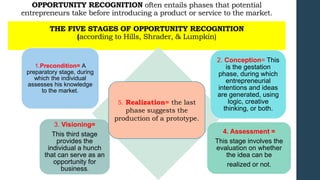
OPPORTUNITY RECOGNITION often entails phases that potential
entrepreneurs take before introducing a product or service to the market.
THE FIVE STAGES OF OPPORTUNITY RECOGNITION
(according to Hills, Shrader, & Lumpkin)
1.Precondition= A
preparatory stage, during
which the individual
assesses his knowledge
to the market.
2. Conception= This
is the gestation
phase, during which
entrepreneurial
intentions and ideas
are generated, using
logic, creative
thinking, or both.
3. Visioning=
This third stage
provides the
individual a hunch
that can serve as an
opportunity for
business.
4. Assessment =
This stage involves the
evaluation on whether
the idea can be
realized or not.
5. Realization= the last
phase suggests the
production of a prototype.
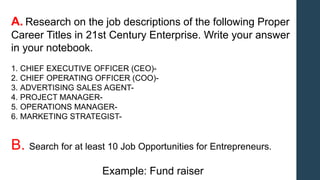
A. Research on the job descriptions of the following Proper
Career Titles in 21st Century Enterprise. Write your answer
in your notebook.
1. CHIEF EXECUTIVE OFFICER (CEO)-
2. CHIEF OPERATING OFFICER (COO)-
3. ADVERTISING SALES AGENT-
4. PROJECT MANAGER-
5. OPERATIONS MANAGER-
6. MARKETING STRATEGIST-
B. Search for at least 10 Job Opportunities for Entrepreneurs.
Example: Fund raiser
Proper Career Titles in
21st Century
Enterprise
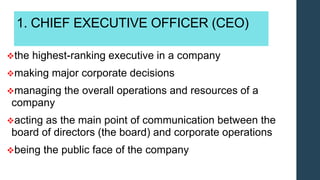
1. CHIEF EXECUTIVE OFFICER (CEO)
the highest-ranking executive in a company
making major corporate decisions
managing the overall operations and resources of a
company
acting as the main point of communication between the
board of directors (the board) and corporate operations
being the public face of the company
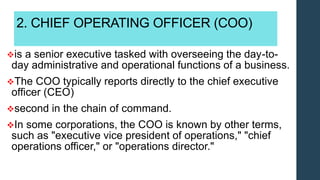
2. CHIEF OPERATING OFFICER (COO)
is a senior executive tasked with overseeing the day-to-
day administrative and operational functions of a business.
The COO typically reports directly to the chief executive
officer (CEO)
second in the chain of command.
In some corporations, the COO is known by other terms,
such as "executive vice president of operations," "chief
operations officer," or "operations director."
3. ADVERTISING SALES AGENT
sells advertising space to businesses and
individuals.
They will contact potential clients, make
sales presentations, maintain client
accounts, and often work under pressure
to meet sales quotas.
4. PROJECT MANAGER
The person responsible for leading a
project from its inception to execution.
This includes planning, execution
and managing the people, resources,
and scope of the project.
5. OPERATIONS MANAGER
is key part of a management team and
oversees high-level HR duties, such as
attracting talent and setting training
standards and hiring procedures.
They also analyze and improve
organizational processes, and work to
improve quality, productivity, and efficiency.
6. MARKETING STRATEGIST
analyzes data to determine the best
way to allocate resources to grow
revenue and profit
someone who is responsible for the
implementation of marketing
strategies.
JOB
OPPORTUNITIES
FOR
ENTREPRENUERS
A. Business Consultant, or Business Adviser
•=provides expert advice, analysis, and
solutions.
•=they enable new and existing businesses to
develop and expand
•=their duties include developing business
plans, advising on financial matters and
identifying areas for growth within a company.
•=people who can go to a client site, identify the
problems, and fix them.
B. Sales Manager
• =someone who manage accounts and follow-up on
lack of a company.
• = the one leading the team.
• =the person that conducts the company's revenue
engine.
• =hire and motivate high-performing sales teams, and
lead them to generate leads, hit or exceed revenue
forecasts, and ultimately meet customer needs.
C. Research and Development Director
•=someone who understands business
concepts, systems, procedures, and
practices.
•= is responsible for directing and overseeing
all discovery and development projects.
•=S/he also plays a role in mentoring and
developing R&D staff, in resource allocation
and R&D decision making.
D. Fundraiser
• =someone who raises money for a specific purpose
• =motivate and facilitate supporters to maximize the
funds they raise.
• =inspire new supporters to raise money, while
maintaining and developing relationships with
existing supporters
• =organize traditional activities, such as sponsored
outdoor events and house-to-house collections of
donated goods and money.
E. Teacher
•= is a person who provides education for
pupils and students. The role of teacher is
often formal and ongoing, carried out at a
school or other place of formal education.
=Teachers may use a lesson plan to facilitate
student learning, providing a course of study
which is called the curriculum.
•= someone who inspire students how to
increase their entrepreneurial intention.
F. Talent Recruiter
• =someone whose job is on recruiting people to an organization.
• = are one of the most important positions in every Talent
Acquisition team.
• = are responsible for finding, attracting, and hiring new
employees to fill open positions and meet company's workforce
needs and goals.
• = They are generally responsible for the full life cycle of the
recruiting process.
• =This entails sourcing and screening candidates, coordinating
the interview process, and facilitating offers and employment
negotiations, all while ensuring candidates have a pleasant
experience.
G. Business Reporter
• =someone who can write articles about business
matters.
• = gather and analyze facts with regards to events
that are newsworthy.
• =They collect information through investigation,
research, observation, or interview. Generally, they
write and report stories for news magazines,
television, newspaper, or radio.
H. Business Creators
=are entrepreneurial people
whose primary role is in creating
new business via creating new
startups or scaling growing
companies, having significant and
direct stake in the actual business
success.
Activity 1
Answer the following questions: Write your answer on a
separate sheet of paper.
1. Individual with high IQ’s would make better
entrepreneurs than those with lower IQ’s. Do you
agree with this statement? Explain your answer.
2. Given that prior knowledge is an important factor in
opportunity recognition, does this mean that younger
people are less likely to recognize business
opportunities compared to the older people?

2. Opportunity Recognition.pptx

  • 1.
  • 2.
    OPPORTUNITY RECOGNITION oftenentails phases that potential entrepreneurs take before introducing a product or service to the market. THE FIVE STAGES OF OPPORTUNITY RECOGNITION (according to Hills, Shrader, & Lumpkin) 1.Precondition= A preparatory stage, during which the individual assesses his knowledge to the market. 2. Conception= This is the gestation phase, during which entrepreneurial intentions and ideas are generated, using logic, creative thinking, or both. 3. Visioning= This third stage provides the individual a hunch that can serve as an opportunity for business. 4. Assessment = This stage involves the evaluation on whether the idea can be realized or not. 5. Realization= the last phase suggests the production of a prototype.
  • 3.
    A. Research onthe job descriptions of the following Proper Career Titles in 21st Century Enterprise. Write your answer in your notebook. 1. CHIEF EXECUTIVE OFFICER (CEO)- 2. CHIEF OPERATING OFFICER (COO)- 3. ADVERTISING SALES AGENT- 4. PROJECT MANAGER- 5. OPERATIONS MANAGER- 6. MARKETING STRATEGIST- B. Search for at least 10 Job Opportunities for Entrepreneurs. Example: Fund raiser
  • 4.
    Proper Career Titlesin 21st Century Enterprise
  • 5.
    1. CHIEF EXECUTIVEOFFICER (CEO) the highest-ranking executive in a company making major corporate decisions managing the overall operations and resources of a company acting as the main point of communication between the board of directors (the board) and corporate operations being the public face of the company
  • 6.
    2. CHIEF OPERATINGOFFICER (COO) is a senior executive tasked with overseeing the day-to- day administrative and operational functions of a business. The COO typically reports directly to the chief executive officer (CEO) second in the chain of command. In some corporations, the COO is known by other terms, such as "executive vice president of operations," "chief operations officer," or "operations director."
  • 7.
    3. ADVERTISING SALESAGENT sells advertising space to businesses and individuals. They will contact potential clients, make sales presentations, maintain client accounts, and often work under pressure to meet sales quotas.
  • 8.
    4. PROJECT MANAGER Theperson responsible for leading a project from its inception to execution. This includes planning, execution and managing the people, resources, and scope of the project.
  • 9.
    5. OPERATIONS MANAGER iskey part of a management team and oversees high-level HR duties, such as attracting talent and setting training standards and hiring procedures. They also analyze and improve organizational processes, and work to improve quality, productivity, and efficiency.
  • 10.
    6. MARKETING STRATEGIST analyzesdata to determine the best way to allocate resources to grow revenue and profit someone who is responsible for the implementation of marketing strategies.
  • 11.
  • 12.
    A. Business Consultant,or Business Adviser •=provides expert advice, analysis, and solutions. •=they enable new and existing businesses to develop and expand •=their duties include developing business plans, advising on financial matters and identifying areas for growth within a company. •=people who can go to a client site, identify the problems, and fix them.
  • 13.
    B. Sales Manager •=someone who manage accounts and follow-up on lack of a company. • = the one leading the team. • =the person that conducts the company's revenue engine. • =hire and motivate high-performing sales teams, and lead them to generate leads, hit or exceed revenue forecasts, and ultimately meet customer needs.
  • 14.
    C. Research andDevelopment Director •=someone who understands business concepts, systems, procedures, and practices. •= is responsible for directing and overseeing all discovery and development projects. •=S/he also plays a role in mentoring and developing R&D staff, in resource allocation and R&D decision making.
  • 15.
    D. Fundraiser • =someonewho raises money for a specific purpose • =motivate and facilitate supporters to maximize the funds they raise. • =inspire new supporters to raise money, while maintaining and developing relationships with existing supporters • =organize traditional activities, such as sponsored outdoor events and house-to-house collections of donated goods and money.
  • 16.
    E. Teacher •= isa person who provides education for pupils and students. The role of teacher is often formal and ongoing, carried out at a school or other place of formal education. =Teachers may use a lesson plan to facilitate student learning, providing a course of study which is called the curriculum. •= someone who inspire students how to increase their entrepreneurial intention.
  • 17.
    F. Talent Recruiter •=someone whose job is on recruiting people to an organization. • = are one of the most important positions in every Talent Acquisition team. • = are responsible for finding, attracting, and hiring new employees to fill open positions and meet company's workforce needs and goals. • = They are generally responsible for the full life cycle of the recruiting process. • =This entails sourcing and screening candidates, coordinating the interview process, and facilitating offers and employment negotiations, all while ensuring candidates have a pleasant experience.
  • 18.
    G. Business Reporter •=someone who can write articles about business matters. • = gather and analyze facts with regards to events that are newsworthy. • =They collect information through investigation, research, observation, or interview. Generally, they write and report stories for news magazines, television, newspaper, or radio.
  • 19.
    H. Business Creators =areentrepreneurial people whose primary role is in creating new business via creating new startups or scaling growing companies, having significant and direct stake in the actual business success.
  • 20.
    Activity 1 Answer thefollowing questions: Write your answer on a separate sheet of paper. 1. Individual with high IQ’s would make better entrepreneurs than those with lower IQ’s. Do you agree with this statement? Explain your answer. 2. Given that prior knowledge is an important factor in opportunity recognition, does this mean that younger people are less likely to recognize business opportunities compared to the older people?