Neuron & Neuroglia
Gowtham Padmanaban
Faculty of Medicine - Neuroscience
Texila American University
Learning Objectives
• Describe the composition and function of different
components of the neuron.
• Discuss the mechanism of axonal transport and its
application to the study of neuroanatomy.
• List the different types of neurons found within the
nervous system.
Explain the different types of neuroglia and their
functions.
• Discuss the nature of myelin formation.
• Explain the composition of peripheral nerve.
• Discuss the type of neuronal injury and the process of
regeneration.
2
NEUROSCIENCE
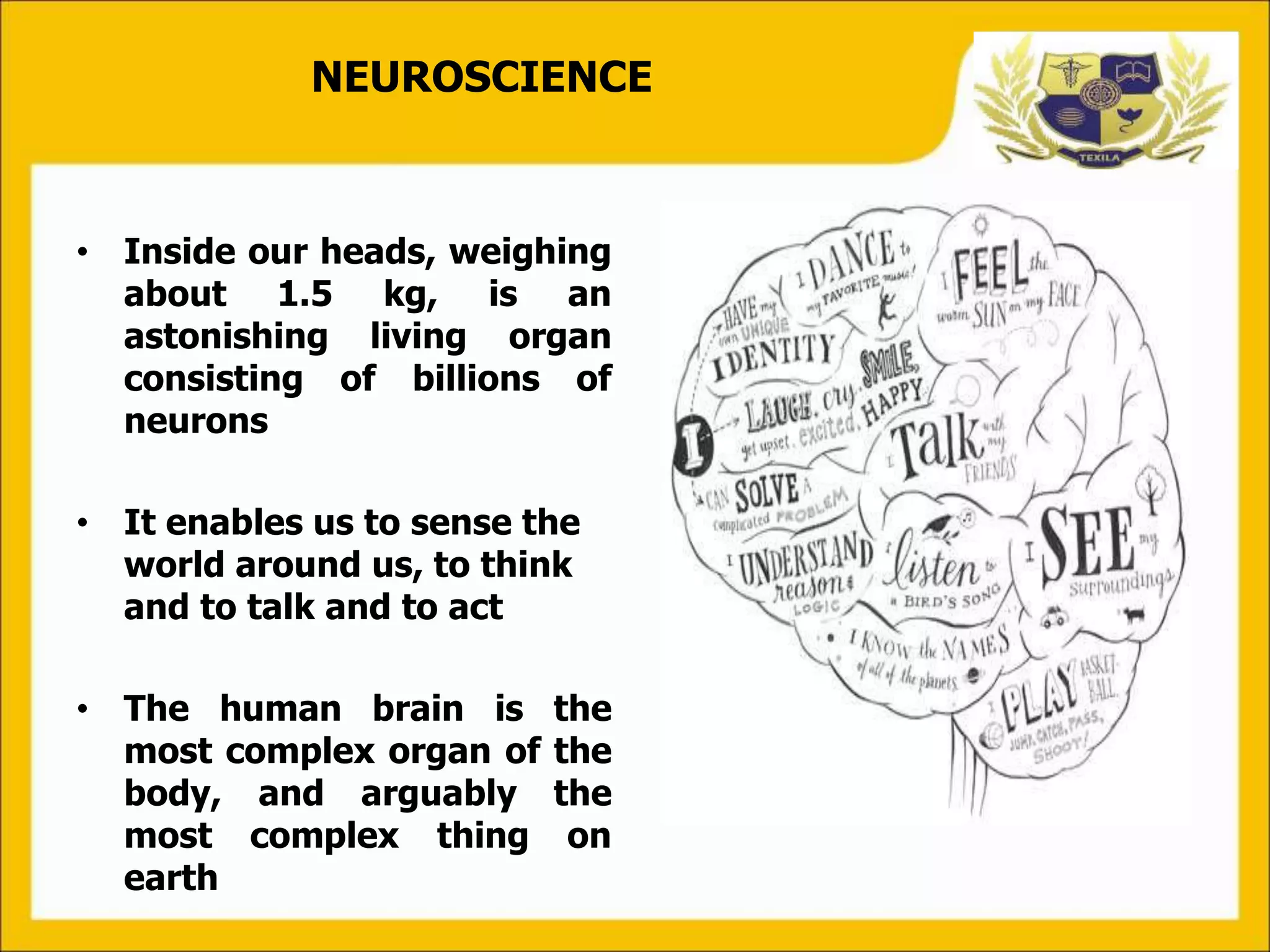
• Inside our heads, weighing
about 1.5 kg, is an
astonishing living organ
consisting of billions of
neurons
• It enables us to sense the
world around us, to think
and to talk and to act
• The human brain is the
most complex organ of the
body, and arguably the
most complex thing on
earth
Copyright
2013-2014
What is Neuron
• Human Body is coordinated by Nervous System
and endocrine system.
• Neurons – Structural & Function Unit of Nervous
System.
• Excitable cells specialized for reception of stimuli
and conduction of impulses.
• Neurons do not divide.
Types of Neurons
• Classified based on
1) Morphology
2) Size
3) Function
Morphology Classification
• Unipolar
• Multipolar
• Bipolars
Unipolar Neurons
• cell body - single
neurite that divides into
two branches,
– Peripheral structure.
– central nervous system.
• Examples -found in the
posterior root ganglion.
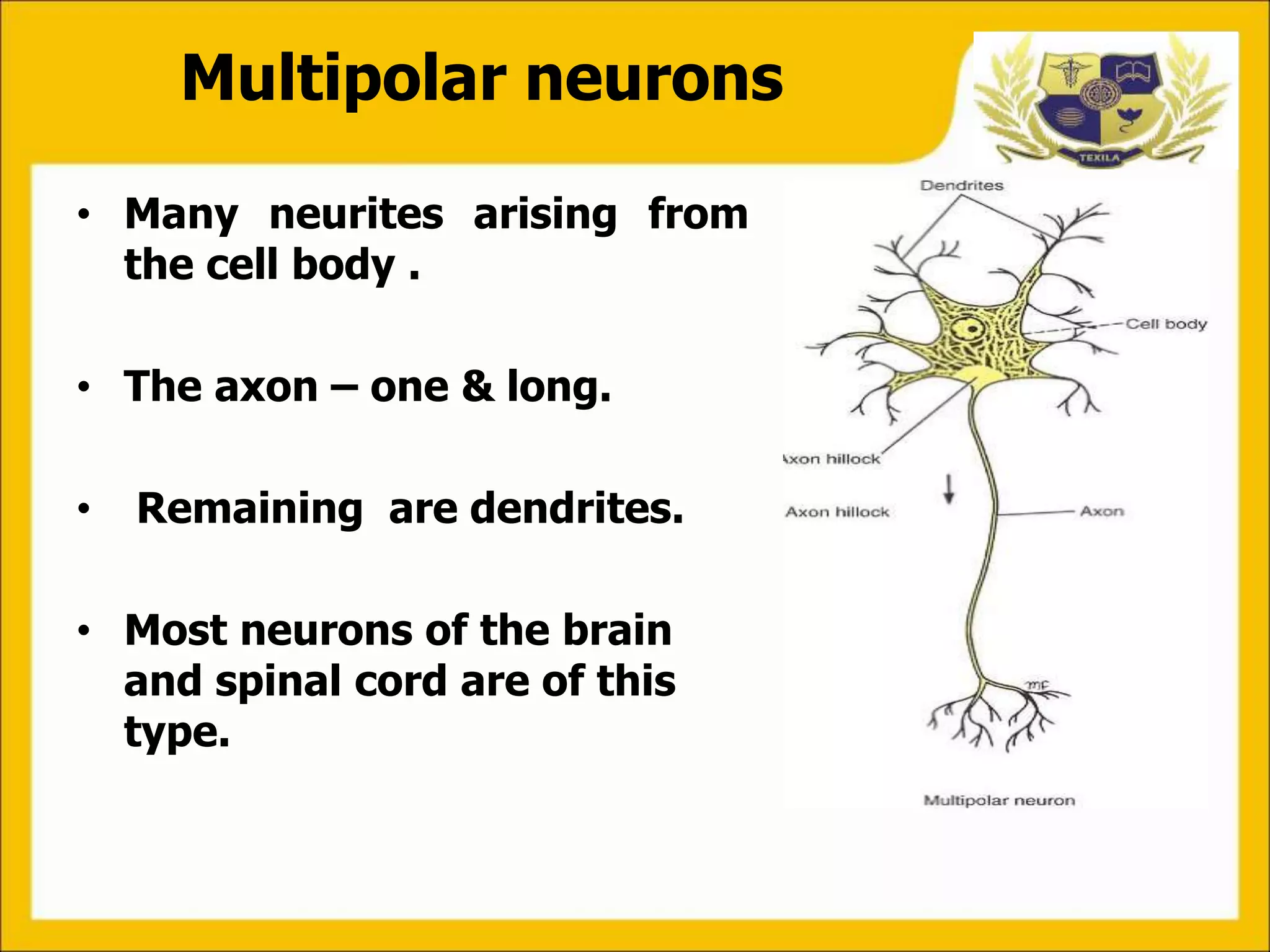
Multipolar neurons
• Many neurites arising from
the cell body .
• The axon – one & long.
• Remaining are dendrites.
• Most neurons of the brain
and spinal cord are of this
type.
Bipolar neurons
• Elongated cell body, from each
end of which a single neurite
emerges .
• Examples retinal bipolar cells
and the cells of the sensory
cochlear and vestibular ganglia.
Functional classification
• Sensory or afferent neuron.
• Motor or efferent neuron.
• Interneuron or association neuron.
Sensory neurons or Afferent neurons
Motor neurons or Efferent neurons
Interneurons or Association neurons
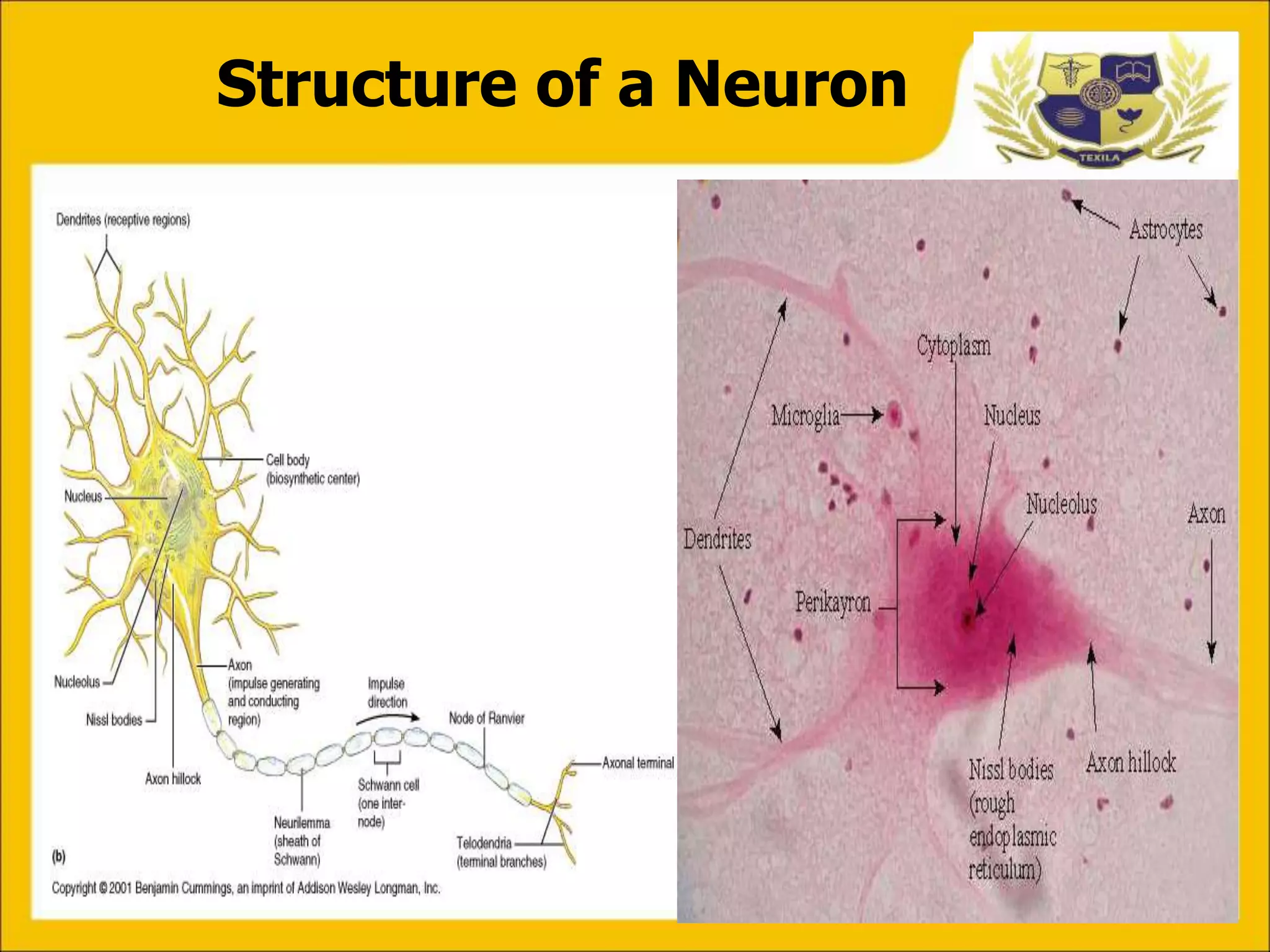
Structure of a Neuron
• Cell body (soma)
- Nucleus.
- Perikaryon (Cytoplasm).
- Neurolema (Plasma Membrane).
• Nerve Cell Processes
– Dendrites.
– Axon.
• Synapse.
Structure of a Neuron
Structures in a Nerve Cell
Structures Location Function
Nucleus Centrally placed, displaced to
periphery in cell injury
Controls cell activity
Cytoplasmic
organelles
Nissl substance
Throughout cytoplasm and
proximal part of dendrites, absent
in axon hillock and axon,
Synthesizes protein
Golgi complex Close to the nucleus products for transport to
nerve terminals; forms
cell membranes
Mitochondria Scattered Form chemical energy
Neurofibrils Run from dendrites through cell
body to axon
Determines the shape of
the neuron
Microfilaments &
Microfilaments
Beneath plasma membrane & all
over the cell
Cell transport
Lysosomes Throughout the cell Cell Scavangers
Lipofuction All over cytoplasm Metabolic by -product
Melanin Mid brain – substania nigra Dopa formation
Nerve Cell Processes
AXON Only one axon mostly.
Straighter .
Smoother than the dendritic.
Axon hillock is cone-shaped.
Myelinated & node of Ranvier present.
DENDRITIES Many branches.
Conducts nerve impulses from adjacent cells
inward toward the cell body.
Dendritic projections - dendritic spines.
Types of nerve fibers
Axon Transport
Anterograde
Transport -
towards axon
terminal
• 100 to 400 mm
/day
• Transport of
proteins &
transmitter
substances
Retrograde
Transport –
towards cell body
• 0.1 to 3.0 mm /day
• Transport of
axoplasm and
includes the
microfilaments and
microtubules.
• WALLERIAN DEGENERATION
• Anterograde degeneration.
• Damage at distal site of neuron.
• Disappearance of axons and myelin
sheaths .
• CNS and PNS.
• CHROMATOLYSIS
• Retrograde degeneration
• Damage closer to Soma.
• CNS & PNS.
• Soma swells & nucleus pushed to
corner.
• There is a loss of Nissl substance.
Transneuronal Degeneration
Anterograde
transneuronal
degeneration :
CNS – degeneration of
post synaptic neuron
related to same function.
EX; lateral geniculate
body of thalamus – optic
nerve
Retrograde transneuronal
degeneration:
Neuron sending inputs to
an injured neuron.
Processes withdrawn.
Neuronal Injury - Overview
Recovery of neuronal injury
• CNS :
• Damage is not severe,
sprouting of axons.
• Astrocytes proliferate
and forms scar.
• PNS:
• Regeneration of axons
occur if endothelial cells
are intact.
PNS: Regeneration
Synapse
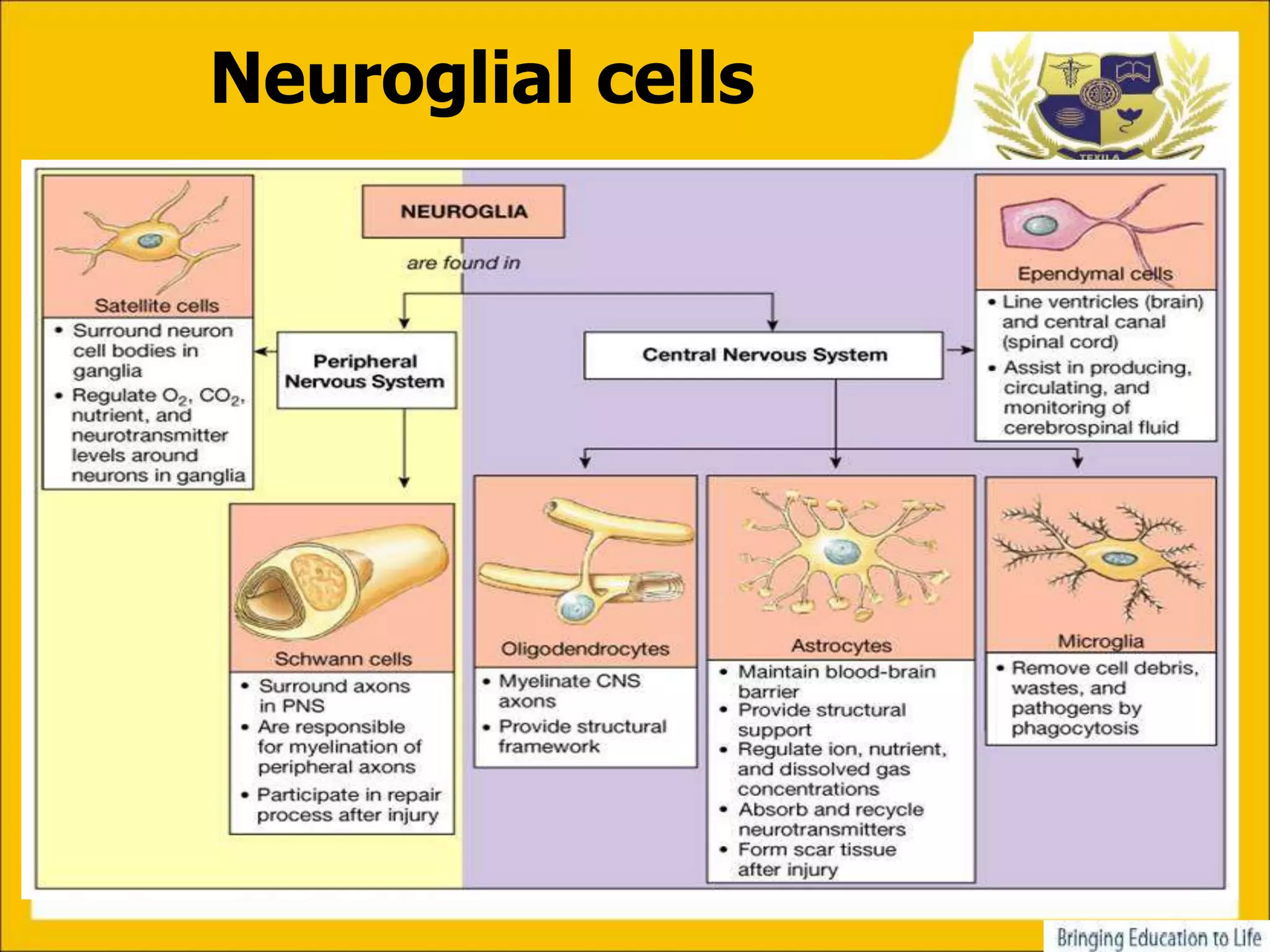
Neuroglial cells
Neuroglial cells
• Astrocytes
– Fibrous – white matter ,Provide supporting framework,
are electrical insulators.
– Protoplasmic - Gray matter Store glycogen, have a
phagocytic function.
• Ependymal cells
– Ependymocytes – lines central canal ,ventricles,
circulates & absorbs CSF.
– Tanycytes – line floor of third ventricle , transports
subs. from CSF to hypophyseal – portal system.
– Choroid epithelial cells – surface of choroid plexus
secretes CSF.
Functions of Astrocytes
• Regulation of Extracellular potassium in CNS.
• Regulation of Glutamate concentration in CNS.
• Brain microcirculation.
• Help - metabolism of neurons.
• Involves in brain pathology : AIDS,
Alzheimer’s, Amyotrophic lateral sclerosis
,brain tumors
Regulation of Extracellular
potassium in CNS
Glucose & Glutamate
Metabolism
Alzheimer’s Disease
Astrocytes & Alzheimer’s
• Apolipoprotein E
• ( ApoE) is produced in
astrocytes
• ApoE is decreased in
alzhiemer’s.
ALS & Astrocytes
• Amyotrophic Lateral sclerosis - degeneration
of upper & lower motor neuron.
• Astrocytes expressing superoxide dismutase
exhibit of a loss of glutamate transporter
(EAAT 2).
• Increased excitotoxicity of glutamate –
neuronal damage.
Clinical Considerations
Disorders –Defective
Myelination
Disorder Defect Symptoms Treatment
Guillian – Barre
Syndrome
PNS , demyelination of
axons ,immunological
reaction
Progressive motor
weakness, motor &
sensory deficits
,respiratory weakness
Gamma globulin
/plasma exchange
Multiple
Sclerosis
CNS, demyelination of
axons, autoimmune
disorder
Sensory loss, loss of
vision ,speech
disturbances
Natalizumab,
interferon beta –
Ia,Ib
Charcot –
Marie – Tooth
Syndrome
Demyelination - PNS
by mutation in
connexin gene in
schwann cells, fails to
form gap junction
Motor and sensory
deficits and abnormal
gait
No cure
Traumatic lesions of peripheral
nerves
Axonal transport – Disease transmission
• Rabies – by both sensory & motor nerves
to CNS.
• Herpes simplex & herpes zoster.
• Poliomyelitis virus – from GIT to motor
neuron in spinal cord & brain stem.
Tumors of Neuron
• In CNS are rare,
• In PNS ,it is common,
• Neuroblastoma – starts from adrenal gland,
develop in neck, abdomen , spine.
• Ganglioneuroma – sympathetic ganglion.
• Pheochromocytoma –neuroendocrine tumor.
Tumors of Neuroglia
• Intracranial tumors – 40 -50 %.
• Gliomas – types,
• Astrocytomas.
• Glioblastomas.
• Ependymomas.
Neuromuscular blocking
agents
• D- tubocurarine – chondrodendron
tomentosum – arrow poisioning.
• Skeletal muscle relaxants- decamethonium,
benzoquinonium, doxacurium.
• Bacterial toxins – botulinum.
Reference
• Essential Neuroscience - Allan Seigel ,third
edition.
• Clinical Neuroanatomy – Richard.S.Snell.
Seventh edition
1. A 30 year old man complained to neurologist of a
sudden onset of tremor, lack of coordination -motor,
blurred vision. The MRI results shows consistent changes
in white matter of brain and The associated diseases is ?
A. Guillian - Bare syndrome
B. ALS
C. Myasthenia gravis
D. Multiple sclerosis
E. Parkinson’s Disease
2. What are the supporting cells in the central
nervous system called?
A. Schwann cells
B. Basket cells
C. Ganglion
D. Neuroglia
E. Satellite cells
3. A 46 year old female admitted to emergency due
to 10 days of progressive numbness and weakness.
She developed increasing shortness of breath. The
neurological examination reveals hyporeflexia.
Choose the associated disease.
A. Guillian - Bare syndrome
B. ALS
C. Myasthenia gravis
D. Multiple sclerosis
E. Parkinson’s Disease
4. In a case of rabies, a 23 year old male shows
changes in behavior. The rabies virus may have
reached the boy’s brain by which of the
following?
A. Phagocytosis
B. Pinocytosis
C. Transneuronal transport
D. Neuronal degeneration
E. Necrosis
2. Neuron  Neuroglia (1).ppt

2. Neuron Neuroglia (1).ppt

  • 1.
    Neuron & Neuroglia GowthamPadmanaban Faculty of Medicine - Neuroscience Texila American University
  • 2.
    Learning Objectives • Describethe composition and function of different components of the neuron. • Discuss the mechanism of axonal transport and its application to the study of neuroanatomy. • List the different types of neurons found within the nervous system. Explain the different types of neuroglia and their functions. • Discuss the nature of myelin formation. • Explain the composition of peripheral nerve. • Discuss the type of neuronal injury and the process of regeneration. 2
  • 3.
    NEUROSCIENCE • Inside ourheads, weighing about 1.5 kg, is an astonishing living organ consisting of billions of neurons • It enables us to sense the world around us, to think and to talk and to act • The human brain is the most complex organ of the body, and arguably the most complex thing on earth
  • 4.
    Copyright 2013-2014 What is Neuron •Human Body is coordinated by Nervous System and endocrine system. • Neurons – Structural & Function Unit of Nervous System. • Excitable cells specialized for reception of stimuli and conduction of impulses. • Neurons do not divide.
  • 5.
    Types of Neurons •Classified based on 1) Morphology 2) Size 3) Function
  • 6.
  • 7.
    Unipolar Neurons • cellbody - single neurite that divides into two branches, – Peripheral structure. – central nervous system. • Examples -found in the posterior root ganglion.
  • 8.
    Multipolar neurons • Manyneurites arising from the cell body . • The axon – one & long. • Remaining are dendrites. • Most neurons of the brain and spinal cord are of this type.
  • 9.
    Bipolar neurons • Elongatedcell body, from each end of which a single neurite emerges . • Examples retinal bipolar cells and the cells of the sensory cochlear and vestibular ganglia.
  • 11.
    Functional classification • Sensoryor afferent neuron. • Motor or efferent neuron. • Interneuron or association neuron.
  • 12.
    Sensory neurons orAfferent neurons
  • 13.
    Motor neurons orEfferent neurons
  • 14.
  • 15.
    Structure of aNeuron • Cell body (soma) - Nucleus. - Perikaryon (Cytoplasm). - Neurolema (Plasma Membrane). • Nerve Cell Processes – Dendrites. – Axon. • Synapse.
  • 16.
  • 17.
  • 18.
    Structures in aNerve Cell Structures Location Function Nucleus Centrally placed, displaced to periphery in cell injury Controls cell activity Cytoplasmic organelles Nissl substance Throughout cytoplasm and proximal part of dendrites, absent in axon hillock and axon, Synthesizes protein Golgi complex Close to the nucleus products for transport to nerve terminals; forms cell membranes Mitochondria Scattered Form chemical energy Neurofibrils Run from dendrites through cell body to axon Determines the shape of the neuron Microfilaments & Microfilaments Beneath plasma membrane & all over the cell Cell transport Lysosomes Throughout the cell Cell Scavangers Lipofuction All over cytoplasm Metabolic by -product Melanin Mid brain – substania nigra Dopa formation
  • 19.
    Nerve Cell Processes AXONOnly one axon mostly. Straighter . Smoother than the dendritic. Axon hillock is cone-shaped. Myelinated & node of Ranvier present. DENDRITIES Many branches. Conducts nerve impulses from adjacent cells inward toward the cell body. Dendritic projections - dendritic spines.
  • 20.
  • 21.
    Axon Transport Anterograde Transport - towardsaxon terminal • 100 to 400 mm /day • Transport of proteins & transmitter substances Retrograde Transport – towards cell body • 0.1 to 3.0 mm /day • Transport of axoplasm and includes the microfilaments and microtubules. • WALLERIAN DEGENERATION • Anterograde degeneration. • Damage at distal site of neuron. • Disappearance of axons and myelin sheaths . • CNS and PNS. • CHROMATOLYSIS • Retrograde degeneration • Damage closer to Soma. • CNS & PNS. • Soma swells & nucleus pushed to corner. • There is a loss of Nissl substance.
  • 22.
    Transneuronal Degeneration Anterograde transneuronal degeneration : CNS– degeneration of post synaptic neuron related to same function. EX; lateral geniculate body of thalamus – optic nerve Retrograde transneuronal degeneration: Neuron sending inputs to an injured neuron. Processes withdrawn.
  • 23.
  • 24.
    Recovery of neuronalinjury • CNS : • Damage is not severe, sprouting of axons. • Astrocytes proliferate and forms scar. • PNS: • Regeneration of axons occur if endothelial cells are intact.
  • 25.
  • 26.
  • 27.
  • 28.
    Neuroglial cells • Astrocytes –Fibrous – white matter ,Provide supporting framework, are electrical insulators. – Protoplasmic - Gray matter Store glycogen, have a phagocytic function. • Ependymal cells – Ependymocytes – lines central canal ,ventricles, circulates & absorbs CSF. – Tanycytes – line floor of third ventricle , transports subs. from CSF to hypophyseal – portal system. – Choroid epithelial cells – surface of choroid plexus secretes CSF.
  • 29.
    Functions of Astrocytes •Regulation of Extracellular potassium in CNS. • Regulation of Glutamate concentration in CNS. • Brain microcirculation. • Help - metabolism of neurons. • Involves in brain pathology : AIDS, Alzheimer’s, Amyotrophic lateral sclerosis ,brain tumors
  • 30.
  • 31.
  • 32.
  • 34.
    Astrocytes & Alzheimer’s •Apolipoprotein E • ( ApoE) is produced in astrocytes • ApoE is decreased in alzhiemer’s.
  • 35.
    ALS & Astrocytes •Amyotrophic Lateral sclerosis - degeneration of upper & lower motor neuron. • Astrocytes expressing superoxide dismutase exhibit of a loss of glutamate transporter (EAAT 2). • Increased excitotoxicity of glutamate – neuronal damage.
  • 36.
  • 37.
    Disorders –Defective Myelination Disorder DefectSymptoms Treatment Guillian – Barre Syndrome PNS , demyelination of axons ,immunological reaction Progressive motor weakness, motor & sensory deficits ,respiratory weakness Gamma globulin /plasma exchange Multiple Sclerosis CNS, demyelination of axons, autoimmune disorder Sensory loss, loss of vision ,speech disturbances Natalizumab, interferon beta – Ia,Ib Charcot – Marie – Tooth Syndrome Demyelination - PNS by mutation in connexin gene in schwann cells, fails to form gap junction Motor and sensory deficits and abnormal gait No cure
  • 38.
    Traumatic lesions ofperipheral nerves
  • 39.
    Axonal transport –Disease transmission • Rabies – by both sensory & motor nerves to CNS. • Herpes simplex & herpes zoster. • Poliomyelitis virus – from GIT to motor neuron in spinal cord & brain stem.
  • 40.
    Tumors of Neuron •In CNS are rare, • In PNS ,it is common, • Neuroblastoma – starts from adrenal gland, develop in neck, abdomen , spine. • Ganglioneuroma – sympathetic ganglion. • Pheochromocytoma –neuroendocrine tumor.
  • 41.
    Tumors of Neuroglia •Intracranial tumors – 40 -50 %. • Gliomas – types, • Astrocytomas. • Glioblastomas. • Ependymomas.
  • 42.
    Neuromuscular blocking agents • D-tubocurarine – chondrodendron tomentosum – arrow poisioning. • Skeletal muscle relaxants- decamethonium, benzoquinonium, doxacurium. • Bacterial toxins – botulinum.
  • 43.
    Reference • Essential Neuroscience- Allan Seigel ,third edition. • Clinical Neuroanatomy – Richard.S.Snell. Seventh edition
  • 44.
    1. A 30year old man complained to neurologist of a sudden onset of tremor, lack of coordination -motor, blurred vision. The MRI results shows consistent changes in white matter of brain and The associated diseases is ? A. Guillian - Bare syndrome B. ALS C. Myasthenia gravis D. Multiple sclerosis E. Parkinson’s Disease
  • 45.
    2. What arethe supporting cells in the central nervous system called? A. Schwann cells B. Basket cells C. Ganglion D. Neuroglia E. Satellite cells
  • 46.
    3. A 46year old female admitted to emergency due to 10 days of progressive numbness and weakness. She developed increasing shortness of breath. The neurological examination reveals hyporeflexia. Choose the associated disease. A. Guillian - Bare syndrome B. ALS C. Myasthenia gravis D. Multiple sclerosis E. Parkinson’s Disease
  • 47.
    4. In acase of rabies, a 23 year old male shows changes in behavior. The rabies virus may have reached the boy’s brain by which of the following? A. Phagocytosis B. Pinocytosis C. Transneuronal transport D. Neuronal degeneration E. Necrosis