KINETIC ANALYSIS
By:H.a.maaz
OPT
Forces acting on the body During gait.
- - External forces: gravitational force,
ground reaction force and inertia.
- - Internal forces: active muscle
force, passive (ligaments, tendons,
capsules, bony components).
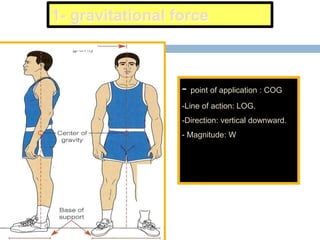
1- gravitational force
- point of application : COG
-Line of action: LOG.
-Direction: vertical downward.
- Magnitude: W
LOG: imaginary vertical line
passes perpendicularly in the
body through the COG.
Pathway from lateral view:
Vertex
-mastoid process
-anterior to atlantooccipital joint
-behind cervical spine
-anterior to the body of dorsal
vertebrae
-posterior to the body of lumbar
vertebrae
-anterior to the second sacral
vertebrae
-behind or through the hip joint
Effect of gravitational force on body segments
- Depends on location of the LOG relative to axis
of motion.
- Through the axis: no torque
- At a distance: gravitational torque produced that
causes motion of the body segment around the
axis of rotation.
- Gravitational torque tends to cause anterior
motion of the proximal segment.
- magnitude of torque depends on the distance
between LOG and the joint axis.
- The gravitational torque is opposed by a
counterbalancing torque by active muscle
tension and passive tension in ligaments and
joint capsules.
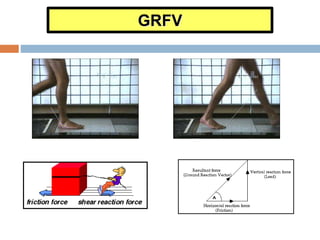
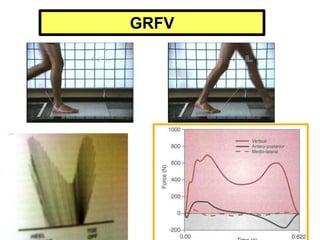
2- ground reaction force
- point of application :
COP
-Line of action: GRFV.
-Direction: upward.
-Magnitude: ma
COP
GRFV
GRFV
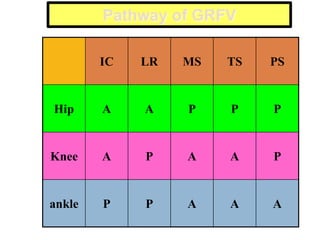
Pathway of GRFV
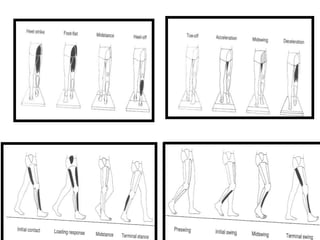
IC LR MS TS PS
Hip A A P P P
Knee A P A A P
ankle P P A A A
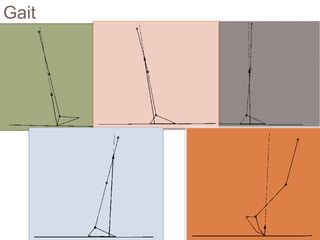
Gait
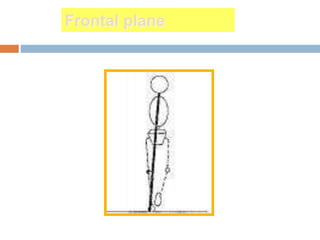
Frontal plane
 Prime movers
 Stabilisers
 Muscle contraction
mode:
• concentric
• eccentric
• isometric
Internal forces: primarily by the muscles. Assisted
by ligaments, tendons, capsules, bones.
To counterbalance the moment created by the GRFV.
Analysis of muscle activity during
Gait
General principles:
- Identify the acting muscle and the type of muscle
contraction.
1- identify the pathway of the GRFV and the moment
resulting from this passage. The muscle in the opposite
direction is acting to counterbalance.
2-determine the normal joint motion during this subphase of
gait.
3- * joint motion occurs in the same direction with the
muscles…………Concentric.
*joint motion occurs in one direction and the acting
muscle works in opposite
direction…………………….Eccentric.
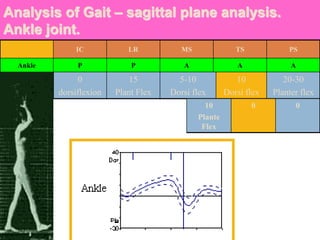
Analysis of Gait – sagittal plane analysis.
Ankle joint.
IC LR MS TS PS
Ankle P P A A A
0
dorsiflexion
15
Plant Flex
5-10
Dorsi flex
10
Dorsi flex
20-30
Planter flex
10
Plante
Flex
0 0
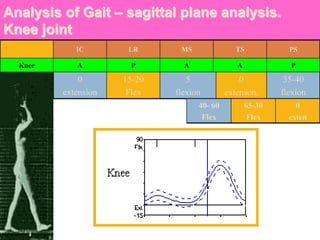
Analysis of Gait – sagittal plane analysis.
Knee joint
IC LR MS TS PS
Knee A P A A P
0
extension
15-20
Flex
5
flexion
0
extenson.
35-40
flexion
40- 60
Flex
65-30
Flex
0
exten
Analysis of Gait – sagittal plane analysis. Hip
joint
IC LR MS TS PS
Hip A A P P P
30
Flex
25
Flex
0 20
Hyper ext.
0
20
Flex
30
Flex
30
Flex
Pathway of GRFV: Frontal plane
IC LR MS TS PS
Hip L M M M L
Knee L M M M N
ankle N L L M N
2. Kinetic Analysis And Basic Kinesiology pptx

2. Kinetic Analysis And Basic Kinesiology pptx

  • 1.
  • 2.
    Forces acting onthe body During gait. - - External forces: gravitational force, ground reaction force and inertia. - - Internal forces: active muscle force, passive (ligaments, tendons, capsules, bony components).
  • 3.
    1- gravitational force -point of application : COG -Line of action: LOG. -Direction: vertical downward. - Magnitude: W
  • 4.
    LOG: imaginary verticalline passes perpendicularly in the body through the COG. Pathway from lateral view: Vertex -mastoid process -anterior to atlantooccipital joint -behind cervical spine -anterior to the body of dorsal vertebrae -posterior to the body of lumbar vertebrae -anterior to the second sacral vertebrae -behind or through the hip joint
  • 5.
    Effect of gravitationalforce on body segments - Depends on location of the LOG relative to axis of motion. - Through the axis: no torque - At a distance: gravitational torque produced that causes motion of the body segment around the axis of rotation. - Gravitational torque tends to cause anterior motion of the proximal segment. - magnitude of torque depends on the distance between LOG and the joint axis. - The gravitational torque is opposed by a counterbalancing torque by active muscle tension and passive tension in ligaments and joint capsules.
  • 6.
    2- ground reactionforce - point of application : COP -Line of action: GRFV. -Direction: upward. -Magnitude: ma
  • 7.
  • 8.
  • 9.
  • 10.
    Pathway of GRFV ICLR MS TS PS Hip A A P P P Knee A P A A P ankle P P A A A
  • 11.
  • 12.
  • 13.
     Prime movers Stabilisers  Muscle contraction mode: • concentric • eccentric • isometric Internal forces: primarily by the muscles. Assisted by ligaments, tendons, capsules, bones. To counterbalance the moment created by the GRFV.
  • 15.
    Analysis of muscleactivity during Gait General principles: - Identify the acting muscle and the type of muscle contraction. 1- identify the pathway of the GRFV and the moment resulting from this passage. The muscle in the opposite direction is acting to counterbalance. 2-determine the normal joint motion during this subphase of gait. 3- * joint motion occurs in the same direction with the muscles…………Concentric. *joint motion occurs in one direction and the acting muscle works in opposite direction…………………….Eccentric.
  • 16.
    Analysis of Gait– sagittal plane analysis. Ankle joint. IC LR MS TS PS Ankle P P A A A 0 dorsiflexion 15 Plant Flex 5-10 Dorsi flex 10 Dorsi flex 20-30 Planter flex 10 Plante Flex 0 0
  • 17.
    Analysis of Gait– sagittal plane analysis. Knee joint IC LR MS TS PS Knee A P A A P 0 extension 15-20 Flex 5 flexion 0 extenson. 35-40 flexion 40- 60 Flex 65-30 Flex 0 exten
  • 18.
    Analysis of Gait– sagittal plane analysis. Hip joint IC LR MS TS PS Hip A A P P P 30 Flex 25 Flex 0 20 Hyper ext. 0 20 Flex 30 Flex 30 Flex
  • 19.
    Pathway of GRFV:Frontal plane IC LR MS TS PS Hip L M M M L Knee L M M M N ankle N L L M N