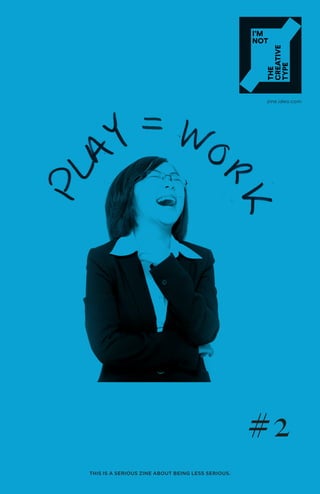
THIS IS A SERIOUS ZINE ABOUT BEING LESS SERIOUS.
zine.ideo.com
#2
A letter from the zine team
At IDEO, we have to be both
naive and aware, uninhibited and
responsible. To come up with new
ideas and solutions, we need to
balance a six-year-old’s openness
with the mind and discipline of
someone twice our age.
One of the crucial processes we
use to keep our spirits optimistic
and ideas generative is play.
Play at its best creates a mental
space where we shed judgment
of ourselves and others. It helps
us reframe tricky and serious
problems so we can find a new
entry point into tackling them.
In this zine, we’ll explore why
play is so important and how
different people incorporate it
into their work. Our hope is that
after reading, you’ll find yourself
playing more and experiencing its
value firsthand.
Play on players.
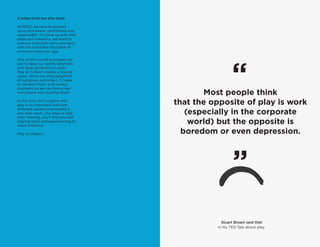
Stuart Brown said that
in his TED Talk about play.
Most people think
that the opposite of play is work
(especially in the corporate
world) but the opposite is
boredom or even depression.
“
“
1
P L AY = WO R K
ISSUENo.2
I’MNOTTHECREATIVETYPE I N T R O D U C T I O N	 We think playfulness is important. But why is it
important? Playfulness helps us get to better creative
solutions. It helps us do our jobs better and helps us feel
better when we do them.
	 When an adult encounters a new situation we have
a tendency to want to categorize it as quickly as we can.
There’s a reason for that: we want to settle on an answer.
Life’s complicated, and we want to figure out what’s going
on around us very quickly.
	 Kids are more engaged with open possibilities. When
they come across something new, they’ll certainly ask,
“What is it?” But they’ll also ask, “What can I do with it?”
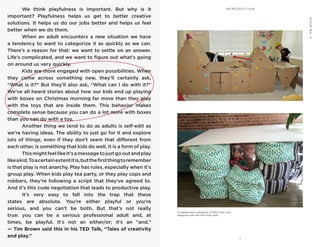
We’ve all heard stories about how our kids end up playing
with boxes on Christmas morning far more than they play
with the toys that are inside them. This behavior makes
complete sense because you can do a lot more with boxes
than you can do with a toy.
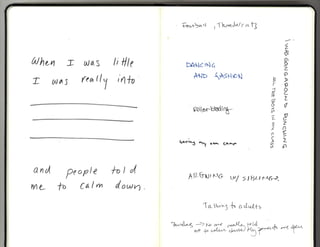
	 Another thing we tend to do as adults is self-edit as
we’re having ideas. The ability to just go for it and explore
lots of things, even if they don’t seem that different from
each other, is something that kids do well. It is a form of play.
	 Thismightfeellikeit’samessagetojustgooutandplay
likeakid.Toacertainextentitis,butthefirstthingtoremember
is that play is not anarchy. Play has rules, especially when it’s
group play. When kids play tea party, or they play cops and
robbers, they’re following a script that they’ve agreed to.
And it’s this code negotiation that leads to productive play.
	 It’s very easy to fall into the trap that these
states are absolute. You’re either playful or you’re
serious, and you can’t be both. But that’s not really
true: you can be a serious professional adult and, at
times, be playful. It’s not an either/or; it’s an “and.”
— Tim Brown said this in his TED Talk, “Tales of creativity
and play.”
A nephew and a daughter of IDEO New York
designers with the forts they built.
2 3
P L AY = WO R KI’MNOTTHECREATIVETYPE T YG E R S H A R K
ISSUENo.2
4 5
T YG E R S H A R K
ISSUENo.2
FROM LEGOS TO MODULAR SPACES -
AN INTERVIEW WITH ASMBLD. ROBOTICS
Were your parents mechanical?
	 In Russia when I was young, a lot of country
houses were self-built. My grandfather built our
country house himself.
	 Whenever we had to fix anything around
that house, we just had to do it or build it. My
father worked a lot around the house, but he is
not mechanical by trade. He’s a geographer and
our mother is as well. With them, we got our
inspiration for traveling, for cities and for the
planning that goes into spaces.
What did you build with when you were younger?
	 We spent every summer at that country house.
Most of the time, Petr and I were just building
stuff, like forts or small models of houses or chairs.
There was wood all around, so we would just saw
some and use that.1
	 We built this structure once that was like a
treehouse or a shack. We thought it was a castle at
the time, and now I look back on it and it was just
utterly ugly, just crazy ugly, but we did it without
help from adults.3
	 We also had Legos at some point, of course. In
Russia, when Legos arrived it was like, “Wow!”—it
was a big deal.
	 We didn’t have Lego sets though, we just
had mass amounts of the standard pieces.1
I think
it was actually much better that way. A lot of
children now just do designs exactly like what’s
on the box and they get bored. There are all these
custom pieces for, say, an astronaut or spacecraft.
It’s almost like an IKEA job. We didn’t have that.
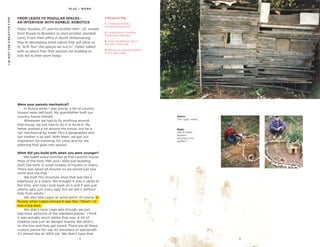
Above
The “ugly” shack.
Right
Petr & Fedor
Novikov
playing in the
garden.
2
Fedor Novikov, 27, and his brother Petr2
, 25, moved
from Russia to Brooklyn to start asmbld. (asmbld.
com). From their office in South Williamsburg,
they’re developing small robots that will allow us
to “A/B Test” the spaces we live in4
. Fedor talked
with us about how their passion for building as
kids led to their work today.
P L AY = W O R KI’MNOTTHECREATIVETYPE
A Recipe for Play
1. Constraint: Healthy
limitations give focus.
2. Collaboration: Combine
minds and manpower.
3. Open-Mindedness: Don’t
self-edit. Dream big.
4. Reframing: Attack problems
from a new angle.
6 7
P L AY = WO R K
ISSUENo.2
I’MNOTTHECREATIVETYPE FROM LEGOS TO MODULAR SPACES
With asmbld, you’re working to fundamentally
alter how we relate to the spaces we live in. Can
you tell us more about what you’re tackling?
	 The average building’s lifespan is 40 years.
After that it gets demolished and only a small
portion of the materials get recycled and
repurposed. It turns out that up to 40% of landfills
in the United States are materials from
demolition waste.
	 Through research, we found 40% of that waste
comes from renovations. So, we asked ourselves if
we can make buildings that qualify for two things1
:
	 1. Reusable. Nearly every element you put into
the building can be reused after it’s disassembled
or recycled.
	 2. Adaptable. Throughout the building’s
lifetime, they adapt based on your needs so you
don’t have to renovate and create waste.
	 We believe robots are the tool that will allow
us to sustainably shape-shift our spaces. We’re
focusing on indoor spaces, starting with floors. We
can’t share too much about the technical details
for IP reasons, but to describe it broadly, you’ll be
able to say where you want something to be built,
and it will come out of the floor and disappear
back into it when you’re done.3
Robots do the
assembly and disassembly layer by layer, and also
handle the movement of building elements under
your feet.
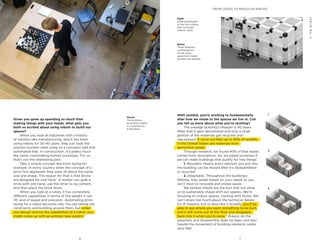
Robot prototypes built by Petr and Fedor test their core hypothesis.
Below
Three different
configurations
of the same
apartment made
possible by asmbld.
1
2
3
Right
Initial prototypes
of the mini robots
that can build
interior walls.
Above
The brothers
build their robots
in a warehouse
in Brooklyn.
Given you grew up spending so much time
making things with your hands, what gets you
both so excited about using robots to build our
spaces?
	 When you look at industries with a history
of robotics like manufacturing, which has been
using robots for 30-40 years, they just took the
process humans were using on a conveyor belt and
automated that. In construction, it’s pretty much
the same—automating human processes. For us,
that’s not the interesting part.
	 Take a simple concept like brick laying for
example. In every country when the concept of a
brick first appeared, they were all about the same
size and shape. The reason for that is that bricks
are designed for one hand.1
A worker can grab a
brick with one hand, use the other to lay cement,
and then place the brick down.
	 When you look at a robot, it has completely
different capabilities in terms of the weight it can
lift, and of speed and precision. Automating brick
laying for a robot becomes silly. You are taking old
constraints and building around them, but when
you design around the capabilities of a robot, you
might come up with an entirely new system.4
8 9
T YG E R S H A R KP L AY = WO R K
ISSUENo.2
I’MNOTTHECREATIVETYPE
Ilikenonsense,itwakesup
thebraincells.Fantasyisa
necessaryingredientinliving,it's
awayoflookingatlifethrough
thewrongendofatelescope.
DrSeuss
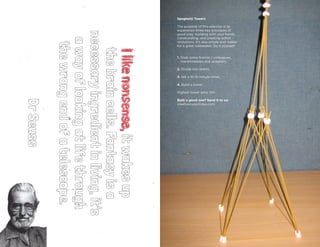
Spaghetti Towers
The purpose of this exercise is to
experience three key principles of
good play: building with your hands,
collaborating, and creating within
limitations. It’s also simple and makes
for a great icebreaker. Do it yourself:
1. Grab some friends / colleagues,
marshmallows and spaghetti.
2. Divide into teams.
3. Set a 10-15 minute timer.
4. Build a tower.
Highest tower wins. Go!
Built a good one? Send it to us:
creativetype@ideo.com
10 11
P L AY = WO R K
ISSUENo.2
I’MNOTTHECREATIVETYPE A N I N T E R V I E W
Brendan: We were recently working
on an iPhone app for Sesame Street
and were trying to think of how
Elmo should dance. So, we cut out
a giant iPhone from foam core and
filmed different people dancing
inside the window. It was a very
playful way to prototype and, more
importantly, we learned quickly
which dance moves wouldn’t work.
Our goal with prototyping is to
build something quickly and learn
and then make it better on the next
round.
How do you handle skeptics
of play?
Brendan: In Tom Kelley’s book The
10 Faces of Innovation, he talks
about the one guy in the meeting
that anoints himself the role of
playing devil’s advocate. For some
reason, he then gets to shoot-down
everyone’s ideas. Tom makes a great
point around, “What if this person
had to play a different role? What if
they had to play the ‘experimenter’
role?”
Joe: Those skeptics are in every
walk of life. You can certainly
combat it with the experimenter
role. Show people it’s possible,
don’t just tell them. It’s always
been the seemingly improbable,
boundary-pushing ideas that have
created this world around us, and
none of that would have been
possible if they’d listened to all the
people who said it never would have
worked. We’d still be living in caves
if we relied on the skeptics.
First off, when I say the word “play”
what does it mean to you?
Brendan Boyle: To me, play is what
you’re passionate about doing. You
want to do it because it’s enjoyable
and you want to keep doing it
because it brings you joy. But play is
a ton of effort.
Joe Wilcox: Play is a state of mind.
I’ve heard it described as a visceral
form of learning. It really doesn’t
matter what the activity is, it’s the
way you approach the activity that
makes it play.
What common misperceptions do
organizations have around play?
Brendan: People tend to think a
couple things. That work is work and
play is frivolous and it’s only for kids.
Or when they do try and incorporate
it, they treat it separate from the
work and schedule it in almost like it
was recess. The core difference we’re
trying to incorporate at IDEO is that
play is part of the innovation process
not just something you do when you
roll out the ping pong tables at a
specific time.
What mindset should a creative
have when approaching play?
Joe: Try to encourage open-ended
behavior. It’s not about goals, it’s
about pushing the boundaries and
discovering something.
For those that work with digital
tools, how do you replicate playing
and prototyping?
Source: An interview given to 99U
A VISCE AL FORM OF
LEARNING.
12 13
P L AY = WO R K
ISSUENo.2
I’MNOTTHECREATIVETYPE
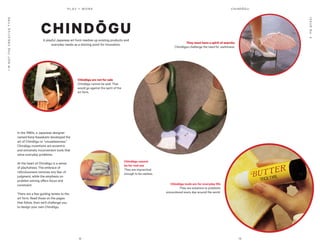
In the 1980s, a Japanese designer
named Kenji Kawakami developed the
art of Chindōgu or “unuselessness.”
Chindōgu inventions are eccentric
and extremely inconvenient tools that
solve everyday problems.
At the heart of Chindōgu is a sense
of playfulness. The embrace of
ridiculousness removes any fear of
judgment, while the emphasis on
problem solving offers focus and
constraint.
There are a few guiding tenets to the
art form. Read those on the pages
that follow, then we’ll challenge you
to design your own Chindōgu.
A playful Japanese art form mashes up existing products and
everyday needs as a starting point for innovation.
CHINDŌGU
Chindōgu tools are for everyday life
They are solutions to problems
encountered every day around the world.
Chindōgu are not for sale
Chindōgu cannot be sold. That
would go against the spirit of the
art form.
They must have a spirit of anarchy
Chindōgus challenge the need for usefulness.
Chindōgu cannot
be for real use
They are impractical
enough to be useless.
CHINDŌGU
14 15
P L AY = WO R K
ISSUENo.2
I’MNOTTHECREATIVETYPE
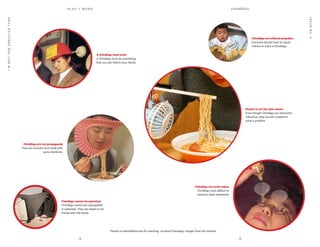
Chindōgu are not propaganda
They are innocent and made with
pure intentions.
Chindōgu are without prejudice
Everyone should have an equal
chance to enjoy a Chindōgu.
A Chindōgu must exist
A Chindōgu must be something
that you can hold in your hands.
Chindōgu cannot be patented
Chindōgu cannot be copyrighted
or patented. They are meant to be
shared with the world.
Chindōgu are never taboo
Chindōgu must adhere to
society’s basic standards.
Humor is not the sole reason
Even though Chindōgu are inherently
ridiculous, they are still created to
solve a problem.
Thanks to mentalfloss.com for teaching us about Chindōgu. Images from the internet.
CHINDŌGU
16
P L AY = WO R K
This second edition of I’m not the
creative type by IDEO is limited
to five hundred copies, all of which
have been assembled by an IDEO
New York designer.
This is copy _________________
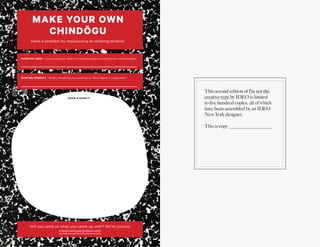
EVERYDAY NEED - Look around you. What’s frustrating people or making them uncomfortable?
MAKE YOUR OWN
CHINDŌGU
Solve a problem by repurposing an existing product.
EXISTING PRODUCT - What’s something you could buy at Home Depot or a gag shop?
Will you send us what you came up with? We’re curious:
creativetype@ideo.com
DRAW & NAME IT
IDEO (pronounced “eye-dee-oh”) is a
global design firm that takes a human-
centered, design-based approach to
helping organizations in the public and
private sectors innovate and grow.
We were founded in 1991 with the faith
that everyone is creative.
www.ideo.com
THANKS TO
Fedor Novikov
Petr Novikov
Brendan Boyle
Joe Wilcox
Tim Brown
Stuart Brown
Ashlea Powell
Ben Swire
Chris Milne
T&B
COLOPHON
I’m not the creative type – “Play=Work”. Zine #2
Printed & assembled at IDEO New York
Limited edition of about 500
Published on 10.14.2015
Curated by Bailey Richardson & Thom Huxtable
Design by IDEO NY
Typeset in Gotham, Calibre
Cover: French Paper. 100lb cover weight. Pop-tone
Blue Raspberry
Fly Sheet: Mohawk VIA Smooth Bright White,
Fibre. 24lb.
Interior: Mohawk Paper. 24lb & 28lb writing weight.
Superfine in Ultrawhite Eggshell
zine.ideo.com
I’m not the creative
type is a zine to spark
imagination. Everyone
is born with an innate
creative ability, it’s just
a matter of shedding
fear of judgment
through inspiration,
process and craft.
Play is one of those
processes.

#2 Juego = Trabajo

  • 1.
    THIS IS ASERIOUS ZINE ABOUT BEING LESS SERIOUS. zine.ideo.com #2
  • 2.
    A letter fromthe zine team At IDEO, we have to be both naive and aware, uninhibited and responsible. To come up with new ideas and solutions, we need to balance a six-year-old’s openness with the mind and discipline of someone twice our age. One of the crucial processes we use to keep our spirits optimistic and ideas generative is play. Play at its best creates a mental space where we shed judgment of ourselves and others. It helps us reframe tricky and serious problems so we can find a new entry point into tackling them. In this zine, we’ll explore why play is so important and how different people incorporate it into their work. Our hope is that after reading, you’ll find yourself playing more and experiencing its value firsthand. Play on players. Stuart Brown said that in his TED Talk about play. Most people think that the opposite of play is work (especially in the corporate world) but the opposite is boredom or even depression. “ “
  • 3.
    1 P L AY= WO R K ISSUENo.2 I’MNOTTHECREATIVETYPE I N T R O D U C T I O N We think playfulness is important. But why is it important? Playfulness helps us get to better creative solutions. It helps us do our jobs better and helps us feel better when we do them. When an adult encounters a new situation we have a tendency to want to categorize it as quickly as we can. There’s a reason for that: we want to settle on an answer. Life’s complicated, and we want to figure out what’s going on around us very quickly. Kids are more engaged with open possibilities. When they come across something new, they’ll certainly ask, “What is it?” But they’ll also ask, “What can I do with it?” We’ve all heard stories about how our kids end up playing with boxes on Christmas morning far more than they play with the toys that are inside them. This behavior makes complete sense because you can do a lot more with boxes than you can do with a toy. Another thing we tend to do as adults is self-edit as we’re having ideas. The ability to just go for it and explore lots of things, even if they don’t seem that different from each other, is something that kids do well. It is a form of play. Thismightfeellikeit’samessagetojustgooutandplay likeakid.Toacertainextentitis,butthefirstthingtoremember is that play is not anarchy. Play has rules, especially when it’s group play. When kids play tea party, or they play cops and robbers, they’re following a script that they’ve agreed to. And it’s this code negotiation that leads to productive play. It’s very easy to fall into the trap that these states are absolute. You’re either playful or you’re serious, and you can’t be both. But that’s not really true: you can be a serious professional adult and, at times, be playful. It’s not an either/or; it’s an “and.” — Tim Brown said this in his TED Talk, “Tales of creativity and play.” A nephew and a daughter of IDEO New York designers with the forts they built.
  • 4.
    2 3 P LAY = WO R KI’MNOTTHECREATIVETYPE T YG E R S H A R K ISSUENo.2
  • 5.
    4 5 T YGE R S H A R K ISSUENo.2 FROM LEGOS TO MODULAR SPACES - AN INTERVIEW WITH ASMBLD. ROBOTICS Were your parents mechanical? In Russia when I was young, a lot of country houses were self-built. My grandfather built our country house himself. Whenever we had to fix anything around that house, we just had to do it or build it. My father worked a lot around the house, but he is not mechanical by trade. He’s a geographer and our mother is as well. With them, we got our inspiration for traveling, for cities and for the planning that goes into spaces. What did you build with when you were younger? We spent every summer at that country house. Most of the time, Petr and I were just building stuff, like forts or small models of houses or chairs. There was wood all around, so we would just saw some and use that.1 We built this structure once that was like a treehouse or a shack. We thought it was a castle at the time, and now I look back on it and it was just utterly ugly, just crazy ugly, but we did it without help from adults.3 We also had Legos at some point, of course. In Russia, when Legos arrived it was like, “Wow!”—it was a big deal. We didn’t have Lego sets though, we just had mass amounts of the standard pieces.1 I think it was actually much better that way. A lot of children now just do designs exactly like what’s on the box and they get bored. There are all these custom pieces for, say, an astronaut or spacecraft. It’s almost like an IKEA job. We didn’t have that. Above The “ugly” shack. Right Petr & Fedor Novikov playing in the garden. 2 Fedor Novikov, 27, and his brother Petr2 , 25, moved from Russia to Brooklyn to start asmbld. (asmbld. com). From their office in South Williamsburg, they’re developing small robots that will allow us to “A/B Test” the spaces we live in4 . Fedor talked with us about how their passion for building as kids led to their work today. P L AY = W O R KI’MNOTTHECREATIVETYPE A Recipe for Play 1. Constraint: Healthy limitations give focus. 2. Collaboration: Combine minds and manpower. 3. Open-Mindedness: Don’t self-edit. Dream big. 4. Reframing: Attack problems from a new angle.
  • 6.
    6 7 P LAY = WO R K ISSUENo.2 I’MNOTTHECREATIVETYPE FROM LEGOS TO MODULAR SPACES With asmbld, you’re working to fundamentally alter how we relate to the spaces we live in. Can you tell us more about what you’re tackling? The average building’s lifespan is 40 years. After that it gets demolished and only a small portion of the materials get recycled and repurposed. It turns out that up to 40% of landfills in the United States are materials from demolition waste. Through research, we found 40% of that waste comes from renovations. So, we asked ourselves if we can make buildings that qualify for two things1 : 1. Reusable. Nearly every element you put into the building can be reused after it’s disassembled or recycled. 2. Adaptable. Throughout the building’s lifetime, they adapt based on your needs so you don’t have to renovate and create waste. We believe robots are the tool that will allow us to sustainably shape-shift our spaces. We’re focusing on indoor spaces, starting with floors. We can’t share too much about the technical details for IP reasons, but to describe it broadly, you’ll be able to say where you want something to be built, and it will come out of the floor and disappear back into it when you’re done.3 Robots do the assembly and disassembly layer by layer, and also handle the movement of building elements under your feet. Robot prototypes built by Petr and Fedor test their core hypothesis. Below Three different configurations of the same apartment made possible by asmbld. 1 2 3 Right Initial prototypes of the mini robots that can build interior walls. Above The brothers build their robots in a warehouse in Brooklyn. Given you grew up spending so much time making things with your hands, what gets you both so excited about using robots to build our spaces? When you look at industries with a history of robotics like manufacturing, which has been using robots for 30-40 years, they just took the process humans were using on a conveyor belt and automated that. In construction, it’s pretty much the same—automating human processes. For us, that’s not the interesting part. Take a simple concept like brick laying for example. In every country when the concept of a brick first appeared, they were all about the same size and shape. The reason for that is that bricks are designed for one hand.1 A worker can grab a brick with one hand, use the other to lay cement, and then place the brick down. When you look at a robot, it has completely different capabilities in terms of the weight it can lift, and of speed and precision. Automating brick laying for a robot becomes silly. You are taking old constraints and building around them, but when you design around the capabilities of a robot, you might come up with an entirely new system.4
  • 7.
    8 9 T YGE R S H A R KP L AY = WO R K ISSUENo.2 I’MNOTTHECREATIVETYPE Ilikenonsense,itwakesup thebraincells.Fantasyisa necessaryingredientinliving,it's awayoflookingatlifethrough thewrongendofatelescope. DrSeuss Spaghetti Towers The purpose of this exercise is to experience three key principles of good play: building with your hands, collaborating, and creating within limitations. It’s also simple and makes for a great icebreaker. Do it yourself: 1. Grab some friends / colleagues, marshmallows and spaghetti. 2. Divide into teams. 3. Set a 10-15 minute timer. 4. Build a tower. Highest tower wins. Go! Built a good one? Send it to us: creativetype@ideo.com
  • 8.
    10 11 P LAY = WO R K ISSUENo.2 I’MNOTTHECREATIVETYPE A N I N T E R V I E W Brendan: We were recently working on an iPhone app for Sesame Street and were trying to think of how Elmo should dance. So, we cut out a giant iPhone from foam core and filmed different people dancing inside the window. It was a very playful way to prototype and, more importantly, we learned quickly which dance moves wouldn’t work. Our goal with prototyping is to build something quickly and learn and then make it better on the next round. How do you handle skeptics of play? Brendan: In Tom Kelley’s book The 10 Faces of Innovation, he talks about the one guy in the meeting that anoints himself the role of playing devil’s advocate. For some reason, he then gets to shoot-down everyone’s ideas. Tom makes a great point around, “What if this person had to play a different role? What if they had to play the ‘experimenter’ role?” Joe: Those skeptics are in every walk of life. You can certainly combat it with the experimenter role. Show people it’s possible, don’t just tell them. It’s always been the seemingly improbable, boundary-pushing ideas that have created this world around us, and none of that would have been possible if they’d listened to all the people who said it never would have worked. We’d still be living in caves if we relied on the skeptics. First off, when I say the word “play” what does it mean to you? Brendan Boyle: To me, play is what you’re passionate about doing. You want to do it because it’s enjoyable and you want to keep doing it because it brings you joy. But play is a ton of effort. Joe Wilcox: Play is a state of mind. I’ve heard it described as a visceral form of learning. It really doesn’t matter what the activity is, it’s the way you approach the activity that makes it play. What common misperceptions do organizations have around play? Brendan: People tend to think a couple things. That work is work and play is frivolous and it’s only for kids. Or when they do try and incorporate it, they treat it separate from the work and schedule it in almost like it was recess. The core difference we’re trying to incorporate at IDEO is that play is part of the innovation process not just something you do when you roll out the ping pong tables at a specific time. What mindset should a creative have when approaching play? Joe: Try to encourage open-ended behavior. It’s not about goals, it’s about pushing the boundaries and discovering something. For those that work with digital tools, how do you replicate playing and prototyping? Source: An interview given to 99U A VISCE AL FORM OF LEARNING.
  • 9.
    12 13 P LAY = WO R K ISSUENo.2 I’MNOTTHECREATIVETYPE In the 1980s, a Japanese designer named Kenji Kawakami developed the art of Chindōgu or “unuselessness.” Chindōgu inventions are eccentric and extremely inconvenient tools that solve everyday problems. At the heart of Chindōgu is a sense of playfulness. The embrace of ridiculousness removes any fear of judgment, while the emphasis on problem solving offers focus and constraint. There are a few guiding tenets to the art form. Read those on the pages that follow, then we’ll challenge you to design your own Chindōgu. A playful Japanese art form mashes up existing products and everyday needs as a starting point for innovation. CHINDŌGU Chindōgu tools are for everyday life They are solutions to problems encountered every day around the world. Chindōgu are not for sale Chindōgu cannot be sold. That would go against the spirit of the art form. They must have a spirit of anarchy Chindōgus challenge the need for usefulness. Chindōgu cannot be for real use They are impractical enough to be useless. CHINDŌGU
  • 10.
    14 15 P LAY = WO R K ISSUENo.2 I’MNOTTHECREATIVETYPE Chindōgu are not propaganda They are innocent and made with pure intentions. Chindōgu are without prejudice Everyone should have an equal chance to enjoy a Chindōgu. A Chindōgu must exist A Chindōgu must be something that you can hold in your hands. Chindōgu cannot be patented Chindōgu cannot be copyrighted or patented. They are meant to be shared with the world. Chindōgu are never taboo Chindōgu must adhere to society’s basic standards. Humor is not the sole reason Even though Chindōgu are inherently ridiculous, they are still created to solve a problem. Thanks to mentalfloss.com for teaching us about Chindōgu. Images from the internet. CHINDŌGU
  • 11.
    16 P L AY= WO R K This second edition of I’m not the creative type by IDEO is limited to five hundred copies, all of which have been assembled by an IDEO New York designer. This is copy _________________ EVERYDAY NEED - Look around you. What’s frustrating people or making them uncomfortable? MAKE YOUR OWN CHINDŌGU Solve a problem by repurposing an existing product. EXISTING PRODUCT - What’s something you could buy at Home Depot or a gag shop? Will you send us what you came up with? We’re curious: creativetype@ideo.com DRAW & NAME IT
  • 12.
    IDEO (pronounced “eye-dee-oh”)is a global design firm that takes a human- centered, design-based approach to helping organizations in the public and private sectors innovate and grow. We were founded in 1991 with the faith that everyone is creative. www.ideo.com THANKS TO Fedor Novikov Petr Novikov Brendan Boyle Joe Wilcox Tim Brown Stuart Brown Ashlea Powell Ben Swire Chris Milne T&B COLOPHON I’m not the creative type – “Play=Work”. Zine #2 Printed & assembled at IDEO New York Limited edition of about 500 Published on 10.14.2015 Curated by Bailey Richardson & Thom Huxtable Design by IDEO NY Typeset in Gotham, Calibre Cover: French Paper. 100lb cover weight. Pop-tone Blue Raspberry Fly Sheet: Mohawk VIA Smooth Bright White, Fibre. 24lb. Interior: Mohawk Paper. 24lb & 28lb writing weight. Superfine in Ultrawhite Eggshell zine.ideo.com
  • 13.
    I’m not thecreative type is a zine to spark imagination. Everyone is born with an innate creative ability, it’s just a matter of shedding fear of judgment through inspiration, process and craft. Play is one of those processes.