Consumer’s
Behaviour
Consumer’s
Behaviour
Individual tries to satisfy his wants
Human wants are unlimited
Utility analysis – want satisfying efforts
Economics
“utility means want satisfying power of a commodity”
“utility is the capacity of a commodity to satisfy human
want”. ……….. Prof. Stanley Jevons
Introduction
Relative concept
Subjective concept
Ethically neutral
Utility and usefulness are not same
Not same as pleasure
Utility differs from satisfaction
Not easily measurable
Depends upon intensity of want
It is the basis of demand
Features of Utility
Types of Utility
Form utilityForm utility
Place utilityPlace utility
Time utilityTime utility
Ownership utilityOwnership utility
Service utilityService utility
Knowledge utilityKnowledge utility
Nature utilityNature utility
Kashmir
Kokan
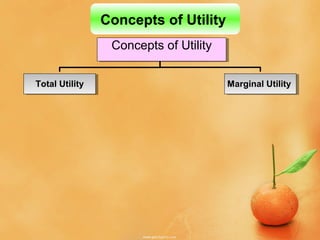
Concepts of Utility
Concepts of Utility
Total Utility Marginal Utility
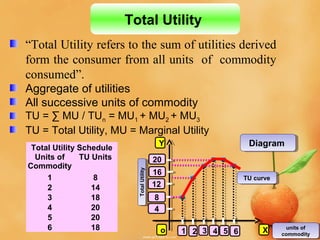
“Total Utility refers to the sum of utilities derived
form the consumer from all units of commodity
consumed”.
Aggregate of utilities
All successive units of commodity
TU = ∑ MU / TUn = MU1 + MU2 + MU3
TU = Total Utility, MU = Marginal Utility
Total Utility
Total Utility Schedule
Units of
Commodity
TU Units
1 8
2 14
3 18
4 20
5 20
6 18 o X
Y
1 2 3 4 5 6
4
8
12
16
20
units of
commodity
units of
commodity
TotalUtilityTotalUtility
DiagramDiagram
TU curveTU curve
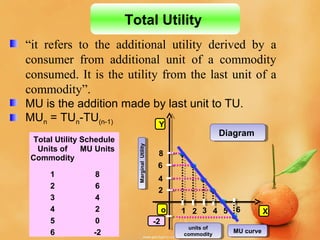
“it refers to the additional utility derived by a
consumer from additional unit of a commodity
consumed. It is the utility from the last unit of a
commodity”.
MU is the addition made by last unit to TU.
MUn = TUn-TU(n-1)
Total Utility
Total Utility Schedule
Units of
Commodity
MU Units
1 8
2 6
3 4
4 2
5 0
6 -2
o X
Y
1 2 3 4 5 6
2
4
6
8
units of
commodity
units of
commodity
MarginalUtilityMarginalUtility
DiagramDiagram
MU curveMU curve
-2
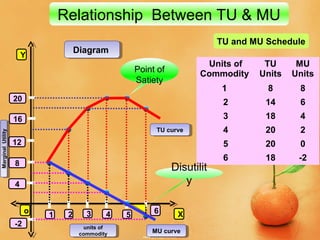
Relationship Between TU & MU
Units of
Commodity
TU
Units
MU
Units
1 8 8
2 14 6
3 18 4
4 20 2
5 20 0
6 18 -2
TU and MU Schedule
o X
Y
units of
commodity
units of
commodity
1 2 3 4 5 6
4
8
12
16
20
MarginalUtilityMarginalUtility
DiagramDiagram
-2
MU curveMU curve
TU curveTU curve
Point of
Satiety
Disutilit
y
Introduction
Behavior of the consumer
Relation to consumption
First Proposed : Mr. Gossen – Gossen’s first Law
Further explained : Prof. Alfred Marshall
Name of book : Principles of Economics – 1890
Basis of Law : satiability characteristics of human
wants
The law of Diminishing Marginal Utility
Dr. Alfred MarshallDr. Alfred Marshall
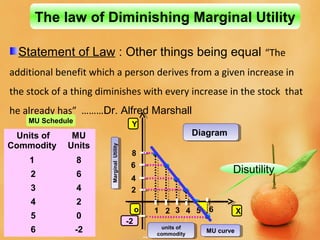
Statement of Law : Other things being equal “The
additional benefit which a person derives from a given increase in
the stock of a thing diminishes with every increase in the stock that
he already has” ………Dr. Alfred Marshall
The law of Diminishing Marginal Utility
Units of
Commodity
MU
Units
1 8
2 6
3 4
4 2
5 0
6 -2
MU Schedule
o X
Y
1 2 3 4 5 6
2
4
6
8
units of
commodity
units of
commodity
MarginalUtilityMarginalUtility
DiagramDiagram
MU curveMU curve
-2
Disutility
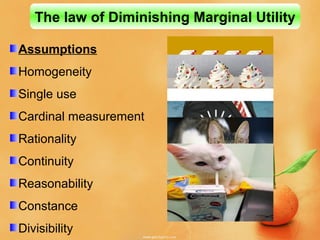
Assumptions
Homogeneity
Single use
Cardinal measurement
Rationality
Continuity
Reasonability
Constance
Divisibility
The law of Diminishing Marginal Utility
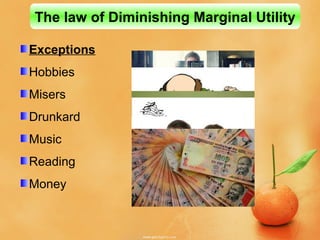
Exceptions
Hobbies
Misers
Drunkard
Music
Reading
Money
Limitations / Criticism
Unrealistic assumptions
Cardinal measurement
Indivisible goods
Constant marginal utility of money
A single want
The law of Diminishing Marginal Utility
Assumptions
Homogeneity
Single use
Cardinal measurement
Rationality
Continuity
Reasonability
Constance
Divisibility
Assumptions
Homogeneity
Single use
Cardinal measurement
Rationality
Continuity
Reasonability
Constance
Divisibility
Very
Testy
The law of Diminishing Marginal Utility
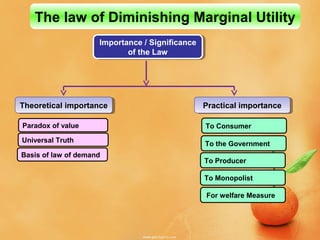
Theoretical importanceTheoretical importance Practical importancePractical importance
Paradox of value
Universal Truth
Basis of law of demand
To Consumer
To the Government
To Producer
To Monopolist
For welfare Measure
Importance / Significance
of the Law
Importance / Significance
of the Law
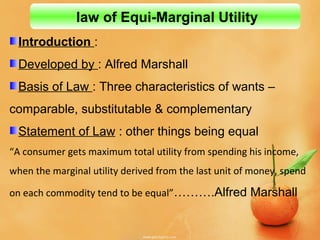
Introduction :
Developed by : Alfred Marshall
Basis of Law : Three characteristics of wants –
comparable, substitutable & complementary
Statement of Law : other things being equal
“A consumer gets maximum total utility from spending his income,
when the marginal utility derived from the last unit of money, spend
on each commodity tend to be equal”……….Alfred Marshall
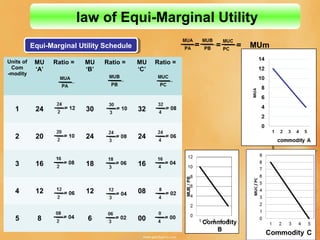
law of Equi-Marginal Utility
Equi-Marginal Utility ScheduleEqui-Marginal Utility Schedule
Units of
Com
-modity
MU
‘A’
Ratio = MU
‘B’
Ratio = MU
‘C’
Ratio =
1 24 30 32
2 20 24 24
3 16 18 16
4 12 12 08
5 8 6 00
= = = MUm
law of Equi-Marginal Utility
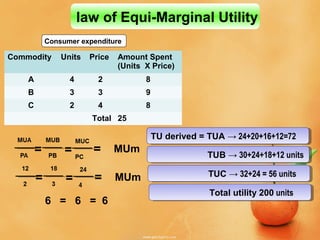
Consumer expenditure
Commodity Units Price Amount Spent
(Units X Price)
A 4 2 8
B 3 3 9
C 2 4 8
Total 25
= = = MUm
= = = MUm
6 = 6 = 6
TU derived = TUA → 24+20+16+12=72TU derived = TUA → 24+20+16+12=72
TUB → 30+24+18+12 unitsTUB → 30+24+18+12 units
TUC → 32+24 = 56 unitsTUC → 32+24 = 56 units
Total utility 200 unitsTotal utility 200 units
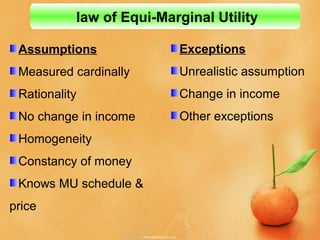
Assumptions
Measured cardinally
Rationality
No change in income
Homogeneity
Constancy of money
Knows MU schedule &
price
Exceptions
Unrealistic assumption
Change in income
Other exceptions
law of Equi-Marginal Utility
nanarav@gmail.com

2 consumer behaviour (Utility )

  • 1.
  • 2.
    Individual tries tosatisfy his wants Human wants are unlimited Utility analysis – want satisfying efforts Economics “utility means want satisfying power of a commodity” “utility is the capacity of a commodity to satisfy human want”. ……….. Prof. Stanley Jevons Introduction
  • 3.
    Relative concept Subjective concept Ethicallyneutral Utility and usefulness are not same Not same as pleasure Utility differs from satisfaction Not easily measurable Depends upon intensity of want It is the basis of demand Features of Utility
  • 4.
    Types of Utility FormutilityForm utility Place utilityPlace utility Time utilityTime utility Ownership utilityOwnership utility Service utilityService utility Knowledge utilityKnowledge utility Nature utilityNature utility Kashmir Kokan
  • 5.
    Concepts of Utility Conceptsof Utility Total Utility Marginal Utility
  • 6.
    “Total Utility refersto the sum of utilities derived form the consumer from all units of commodity consumed”. Aggregate of utilities All successive units of commodity TU = ∑ MU / TUn = MU1 + MU2 + MU3 TU = Total Utility, MU = Marginal Utility Total Utility Total Utility Schedule Units of Commodity TU Units 1 8 2 14 3 18 4 20 5 20 6 18 o X Y 1 2 3 4 5 6 4 8 12 16 20 units of commodity units of commodity TotalUtilityTotalUtility DiagramDiagram TU curveTU curve
  • 7.
    “it refers tothe additional utility derived by a consumer from additional unit of a commodity consumed. It is the utility from the last unit of a commodity”. MU is the addition made by last unit to TU. MUn = TUn-TU(n-1) Total Utility Total Utility Schedule Units of Commodity MU Units 1 8 2 6 3 4 4 2 5 0 6 -2 o X Y 1 2 3 4 5 6 2 4 6 8 units of commodity units of commodity MarginalUtilityMarginalUtility DiagramDiagram MU curveMU curve -2
  • 8.
    Relationship Between TU& MU Units of Commodity TU Units MU Units 1 8 8 2 14 6 3 18 4 4 20 2 5 20 0 6 18 -2 TU and MU Schedule o X Y units of commodity units of commodity 1 2 3 4 5 6 4 8 12 16 20 MarginalUtilityMarginalUtility DiagramDiagram -2 MU curveMU curve TU curveTU curve Point of Satiety Disutilit y
  • 9.
    Introduction Behavior of theconsumer Relation to consumption First Proposed : Mr. Gossen – Gossen’s first Law Further explained : Prof. Alfred Marshall Name of book : Principles of Economics – 1890 Basis of Law : satiability characteristics of human wants The law of Diminishing Marginal Utility Dr. Alfred MarshallDr. Alfred Marshall
  • 10.
    Statement of Law: Other things being equal “The additional benefit which a person derives from a given increase in the stock of a thing diminishes with every increase in the stock that he already has” ………Dr. Alfred Marshall The law of Diminishing Marginal Utility Units of Commodity MU Units 1 8 2 6 3 4 4 2 5 0 6 -2 MU Schedule o X Y 1 2 3 4 5 6 2 4 6 8 units of commodity units of commodity MarginalUtilityMarginalUtility DiagramDiagram MU curveMU curve -2 Disutility
  • 11.
  • 12.
    The law ofDiminishing Marginal Utility Exceptions Hobbies Misers Drunkard Music Reading Money
  • 13.
    Limitations / Criticism Unrealisticassumptions Cardinal measurement Indivisible goods Constant marginal utility of money A single want The law of Diminishing Marginal Utility Assumptions Homogeneity Single use Cardinal measurement Rationality Continuity Reasonability Constance Divisibility Assumptions Homogeneity Single use Cardinal measurement Rationality Continuity Reasonability Constance Divisibility Very Testy
  • 14.
    The law ofDiminishing Marginal Utility Theoretical importanceTheoretical importance Practical importancePractical importance Paradox of value Universal Truth Basis of law of demand To Consumer To the Government To Producer To Monopolist For welfare Measure Importance / Significance of the Law Importance / Significance of the Law
  • 15.
    Introduction : Developed by: Alfred Marshall Basis of Law : Three characteristics of wants – comparable, substitutable & complementary Statement of Law : other things being equal “A consumer gets maximum total utility from spending his income, when the marginal utility derived from the last unit of money, spend on each commodity tend to be equal”……….Alfred Marshall law of Equi-Marginal Utility
  • 16.
    law of Equi-MarginalUtility Equi-Marginal Utility ScheduleEqui-Marginal Utility Schedule Units of Com -modity MU ‘A’ Ratio = MU ‘B’ Ratio = MU ‘C’ Ratio = 1 24 30 32 2 20 24 24 3 16 18 16 4 12 12 08 5 8 6 00 = = = MUm
  • 17.
    law of Equi-MarginalUtility Consumer expenditure Commodity Units Price Amount Spent (Units X Price) A 4 2 8 B 3 3 9 C 2 4 8 Total 25 = = = MUm = = = MUm 6 = 6 = 6 TU derived = TUA → 24+20+16+12=72TU derived = TUA → 24+20+16+12=72 TUB → 30+24+18+12 unitsTUB → 30+24+18+12 units TUC → 32+24 = 56 unitsTUC → 32+24 = 56 units Total utility 200 unitsTotal utility 200 units
  • 18.
    Assumptions Measured cardinally Rationality No changein income Homogeneity Constancy of money Knows MU schedule & price Exceptions Unrealistic assumption Change in income Other exceptions law of Equi-Marginal Utility
  • 20.