By
Mr. D. T. Mane,
Assistant. Professor,
Department of IT
Rajarambapu Institute of Technology
Sakharale, Sangli, MH- INDIA
CLOUD COMPUTING
Chapter 2:
Cloud Computing Models and
architecture
INDEX
1. NIST architecture
2. SOA architecture
3. Service models
4. Deployment models
5. Economics of the cloud
6. Open challenges
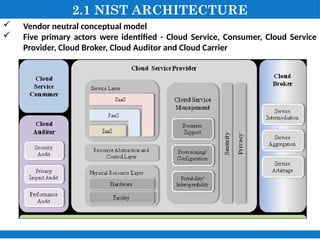
2.1 NIST ARCHITECTURE
 Vendor neutral conceptual model
 Five primary actors were identified - Cloud Service, Consumer, Cloud Service
Provider, Cloud Broker, Cloud Auditor and Cloud Carrier
2.1 NIST ARCHITECTURE
 primary goal
 Helps to establish cloud deployment
models
 NCCRAT-WG identified 5 major actors
 Cloud Service Consumer
 Cloud Service Provider
 Cloud Broker
 Cloud Auditor
 Cloud Carrier
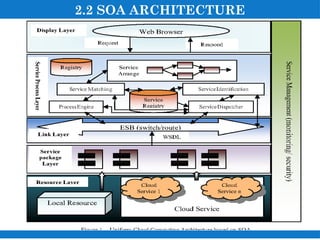
2.2 SOA ARCHITECTURE
 SOA that will allow people to move from one
cloud provider to another with ease
 SOA can provide the backbone to allow both
user front-end applications and enterprise
back-end servers to easily access cloud
services.
 Architectures based on different levels of
cloud computing
 Market-oriented architectures
 SOA – oriented architectures
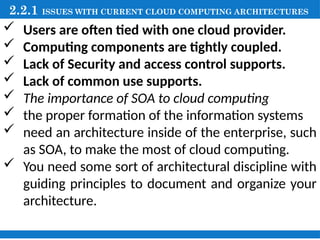
2.2.1 ISSUES WITH CURRENT CLOUD COMPUTING ARCHITECTURES
 Users are often tied with one cloud provider.
 Computing components are tightly coupled.
 Lack of Security and access control supports.
 Lack of common use supports.
 The importance of SOA to cloud computing
 the proper formation of the information systems
 need an architecture inside of the enterprise, such
as SOA, to make the most of cloud computing.
 You need some sort of architectural discipline with
guiding principles to document and organize your
architecture.
2.2 SOA ARCHITECTURE
2.5 ECONOMICS OF THE CLOUD
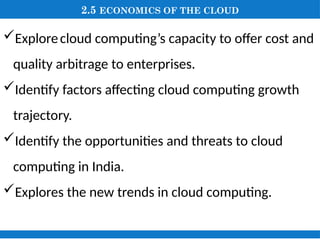
Explorecloud computing’s capacity to offer cost and
quality arbitrage to enterprises.
Identify factors affecting cloud computing growth
trajectory.
Identify the opportunities and threats to cloud
computing in India.
Explores the new trends in cloud computing.
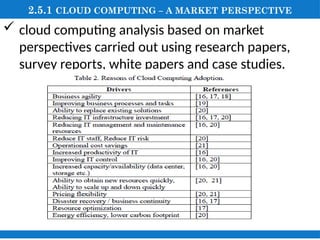
2.5.1 CLOUD COMPUTING – A MARKET PERSPECTIVE
 cloud computing analysis based on market
perspectives carried out using research papers,
survey reports, white papers and case studies.
2.5.1 CLOUD COMPUTING – A MARKET PERSPECTIVE
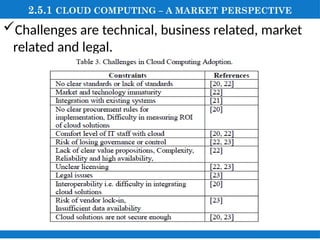
Challenges are technical, business related, market
related and legal.
2.5.1 CLOUD COMPUTING – A MARKET PERSPECTIVE
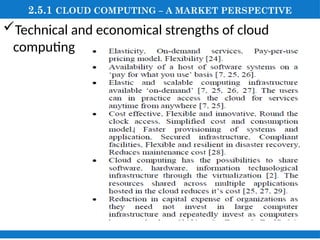
Technical and economical strengths of cloud
computing
2.5.1 CLOUD COMPUTING – A MARKET PERSPECTIVE
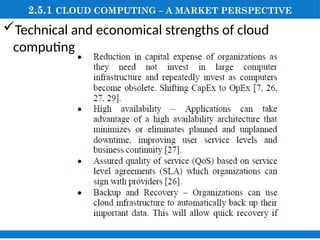
Technical and economical strengths of cloud
computing
2.5.1 CLOUD COMPUTING – A MARKET PERSPECTIVE
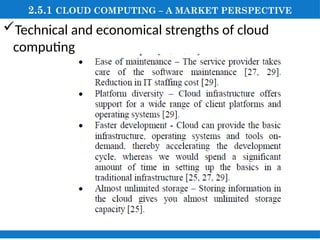
Technical and economical strengths of cloud
computing
2.5.1 CLOUD COMPUTING – A MARKET PERSPECTIVE
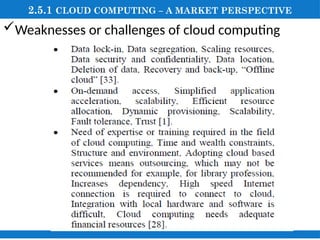
Weaknesses or challenges of cloud computing
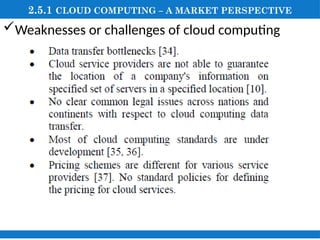
2.5.1 CLOUD COMPUTING – A MARKET PERSPECTIVE
Weaknesses or challenges of cloud computing
2.5 ECONOMICS OF THE CLOUD
The pay-as-you-go model offered by cloud providers. In
particular, cloud computing allows:
Reducing the capital costs associated to the IT
infrastructure .
Eliminating the depreciation or lifetime costs associated
with IT capital assets .
Replacing software licensing with subscriptions .
Cutting the maintenance and administrative costs of IT
resources
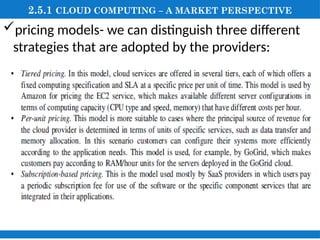
2.5.1 CLOUD COMPUTING – A MARKET PERSPECTIVE
pricing models- we can distinguish three different
strategies that are adopted by the providers:
2.6 CLOUD OPEN CHALLENGES
The most important ones:
Cloud definition
Cloud interoperability and standards
Scalability and fault tolerance
Security, trust, and privacy
Organizational aspects
REFERENCES
Books:
1. Rajkumar Buyya, “Mastering Cloud computing”, Mc Graw Hill Publication, ISBN-
978-1-25-902995-0, (Chapter 1 to 5).
2. Tim Mather, S. Kumaraswammy, S. Latif, “Cloud Security & Privacy”, SPD,O’REILLY,
ISBN- 978-0-596-80276-9 (Chapter 6).
WWW:
1. http://www.buyya.com/MasteringClouds/
…...THANK YOU…….

2 Cloud Computing Models and architecture.pptx

  • 1.
    By Mr. D. T.Mane, Assistant. Professor, Department of IT Rajarambapu Institute of Technology Sakharale, Sangli, MH- INDIA CLOUD COMPUTING Chapter 2: Cloud Computing Models and architecture
  • 2.
    INDEX 1. NIST architecture 2.SOA architecture 3. Service models 4. Deployment models 5. Economics of the cloud 6. Open challenges
  • 3.
    2.1 NIST ARCHITECTURE Vendor neutral conceptual model  Five primary actors were identified - Cloud Service, Consumer, Cloud Service Provider, Cloud Broker, Cloud Auditor and Cloud Carrier
  • 4.
    2.1 NIST ARCHITECTURE primary goal  Helps to establish cloud deployment models  NCCRAT-WG identified 5 major actors  Cloud Service Consumer  Cloud Service Provider  Cloud Broker  Cloud Auditor  Cloud Carrier
  • 5.
    2.2 SOA ARCHITECTURE SOA that will allow people to move from one cloud provider to another with ease  SOA can provide the backbone to allow both user front-end applications and enterprise back-end servers to easily access cloud services.  Architectures based on different levels of cloud computing  Market-oriented architectures  SOA – oriented architectures
  • 6.
    2.2.1 ISSUES WITHCURRENT CLOUD COMPUTING ARCHITECTURES  Users are often tied with one cloud provider.  Computing components are tightly coupled.  Lack of Security and access control supports.  Lack of common use supports.  The importance of SOA to cloud computing  the proper formation of the information systems  need an architecture inside of the enterprise, such as SOA, to make the most of cloud computing.  You need some sort of architectural discipline with guiding principles to document and organize your architecture.
  • 7.
  • 8.
    2.5 ECONOMICS OFTHE CLOUD Explorecloud computing’s capacity to offer cost and quality arbitrage to enterprises. Identify factors affecting cloud computing growth trajectory. Identify the opportunities and threats to cloud computing in India. Explores the new trends in cloud computing.
  • 9.
    2.5.1 CLOUD COMPUTING– A MARKET PERSPECTIVE  cloud computing analysis based on market perspectives carried out using research papers, survey reports, white papers and case studies.
  • 10.
    2.5.1 CLOUD COMPUTING– A MARKET PERSPECTIVE Challenges are technical, business related, market related and legal.
  • 11.
    2.5.1 CLOUD COMPUTING– A MARKET PERSPECTIVE Technical and economical strengths of cloud computing
  • 12.
    2.5.1 CLOUD COMPUTING– A MARKET PERSPECTIVE Technical and economical strengths of cloud computing
  • 13.
    2.5.1 CLOUD COMPUTING– A MARKET PERSPECTIVE Technical and economical strengths of cloud computing
  • 14.
    2.5.1 CLOUD COMPUTING– A MARKET PERSPECTIVE Weaknesses or challenges of cloud computing
  • 15.
    2.5.1 CLOUD COMPUTING– A MARKET PERSPECTIVE Weaknesses or challenges of cloud computing
  • 16.
    2.5 ECONOMICS OFTHE CLOUD The pay-as-you-go model offered by cloud providers. In particular, cloud computing allows: Reducing the capital costs associated to the IT infrastructure . Eliminating the depreciation or lifetime costs associated with IT capital assets . Replacing software licensing with subscriptions . Cutting the maintenance and administrative costs of IT resources
  • 17.
    2.5.1 CLOUD COMPUTING– A MARKET PERSPECTIVE pricing models- we can distinguish three different strategies that are adopted by the providers:
  • 18.
    2.6 CLOUD OPENCHALLENGES The most important ones: Cloud definition Cloud interoperability and standards Scalability and fault tolerance Security, trust, and privacy Organizational aspects
  • 19.
    REFERENCES Books: 1. Rajkumar Buyya,“Mastering Cloud computing”, Mc Graw Hill Publication, ISBN- 978-1-25-902995-0, (Chapter 1 to 5). 2. Tim Mather, S. Kumaraswammy, S. Latif, “Cloud Security & Privacy”, SPD,O’REILLY, ISBN- 978-0-596-80276-9 (Chapter 6). WWW: 1. http://www.buyya.com/MasteringClouds/
  • 20.