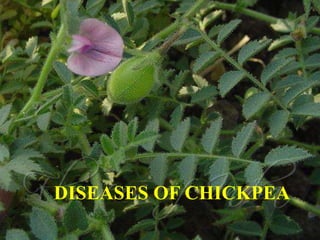
DISEASES OF CHICKPEA
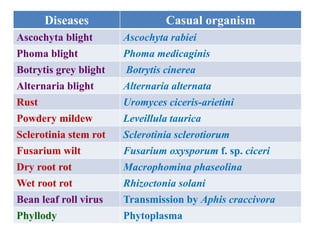
Diseases Casual organism
Ascochyta blight Ascochyta rabiei
Phoma blight Phoma medicaginis
Botrytis grey blight Botrytis cinerea
Alternaria blight Alternaria alternata
Rust Uromyces ciceris-arietini
Powdery mildew Leveillula taurica
Sclerotinia stem rot Sclerotinia sclerotiorum
Fusarium wilt Fusarium oxysporum f. sp. ciceri
Dry root rot Macrophomina phaseolina
Wet root rot Rhizoctonia solani
Bean leaf roll virus Transmission by Aphis craccivora
Phyllody Phytoplasma
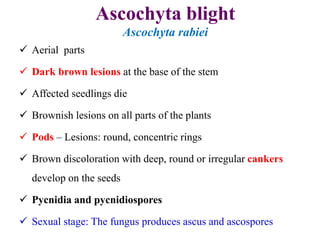
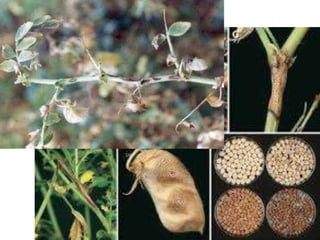
Ascochyta blight
Ascochyta rabiei
 Aerial parts
 Dark brown lesions at the base of the stem
 Affected seedlings die
 Brownish lesions on all parts of the plants
 Pods – Lesions: round, concentric rings
 Brown discoloration with deep, round or irregular cankers
develop on the seeds
 Pycnidia and pycnidiospores
 Sexual stage: The fungus produces ascus and ascospores
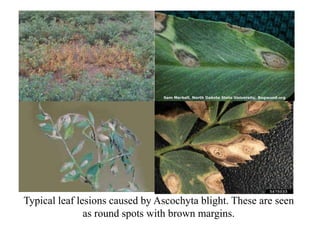
Typical leaf lesions caused by Ascochyta blight. These are seen
as round spots with brown margins.
• Seed borne - Left over debris (source)
• Wet and warm weather and dense crop
canopy are conducive for the disease
• All the above ground plant parts are affected
Ascochyta blight – Ascochyta rabiei
(Perfect stage: Mycosphaerella rabiei)
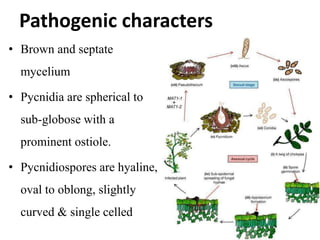
Pathogenic characters
• Brown and septate
mycelium
• Pycnidia are spherical to
sub-globose with a
prominent ostiole.
• Pycnidiospores are hyaline,
oval to oblong, slightly
curved & single celled
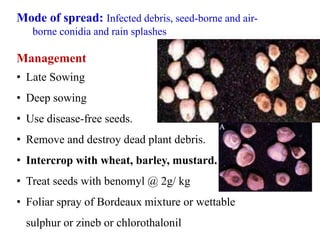
Mode of spread: Infected debris, seed-borne and air-
borne conidia and rain splashes
Management
• Late Sowing
• Deep sowing
• Use disease-free seeds.
• Remove and destroy dead plant debris.
• Intercrop with wheat, barley, mustard.
• Treat seeds with benomyl @ 2g/ kg
• Foliar spray of Bordeaux mixture or wettable
sulphur or zineb or chlorothalonil
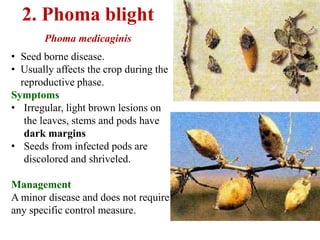
2. Phoma blight
Phoma medicaginis
Lesions on stem, leaves and pods
Pycnidial bodies on pods
• Seed borne disease.
• Usually affects the crop during the
reproductive phase.
Symptoms
• Irregular, light brown lesions on
the leaves, stems and pods have
dark margins
• Seeds from infected pods are
discolored and shriveled.
Management
A minor disease and does not require
any specific control measure.
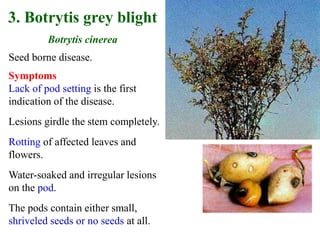
Seed borne disease.
Symptoms
Lack of pod setting is the first
indication of the disease.
Lesions girdle the stem completely.
Rotting of affected leaves and
flowers.
Water-soaked and irregular lesions
on the pod.
The pods contain either small,
shriveled seeds or no seeds at all.
3. Botrytis grey blight
Botrytis cinerea
Lesions on leaves, stem and pods
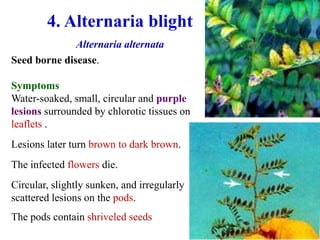
Seed borne disease.
Symptoms
Water-soaked, small, circular and purple
lesions surrounded by chlorotic tissues on
leaflets .
Lesions later turn brown to dark brown.
The infected flowers die.
Circular, slightly sunken, and irregularly
scattered lesions on the pods.
The pods contain shriveled seeds.
4. Alternaria blight
Alternaria alternata
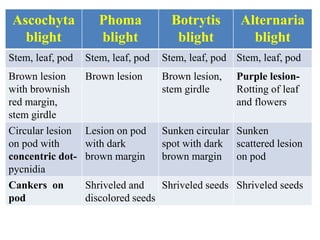
Ascochyta
blight
Phoma
blight
Botrytis
blight
Alternaria
blight
Stem, leaf, pod Stem, leaf, pod Stem, leaf, pod Stem, leaf, pod
Brown lesion
with brownish
red margin,
stem girdle
Brown lesion Brown lesion,
stem girdle
Purple lesion-
Rotting of leaf
and flowers
Circular lesion
on pod with
concentric dot-
pycnidia
Lesion on pod
with dark
brown margin
Sunken circular
spot with dark
brown margin
Sunken
scattered lesion
on pod
Cankers on
pod
Shriveled and
discolored seeds
Shriveled seeds Shriveled seeds
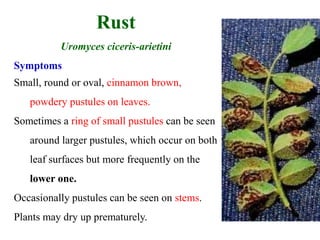
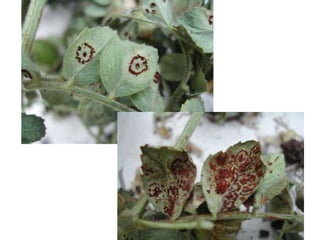
Rust
Uromyces ciceris-arietini
Symptoms
Small, round or oval, cinnamon brown,
powdery pustules on leaves.
Sometimes a ring of small pustules can be seen
around larger pustules, which occur on both
leaf surfaces but more frequently on the
lower one.
Occasionally pustules can be seen on stems.
Plants may dry up prematurely.
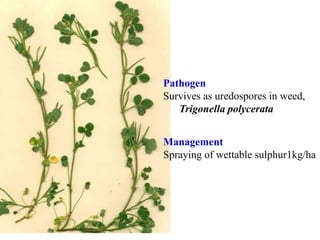
Pathogen
Survives as uredospores in weed,
Trigonella polycerata
Management
Spraying of wettable sulphur1kg/ha
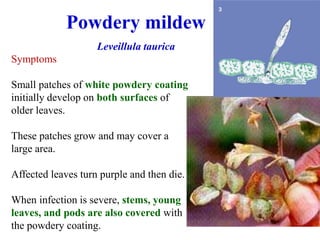
Symptoms
Small patches of white powdery coating
initially develop on both surfaces of
older leaves.
These patches grow and may cover a
large area.
Affected leaves turn purple and then die.
When infection is severe, stems, young
leaves, and pods are also covered with
the powdery coating.
Powdery mildew
Leveillula taurica
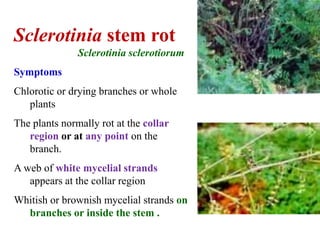
Rotting of branches
Lesions on the stem and
drying branches
Sclerotinia stem rot
Sclerotinia sclerotiorum
Symptoms
Chlorotic or drying branches or whole
plants
The plants normally rot at the collar
region or at any point on the
branch.
A web of white mycelial strands
appears at the collar region
Whitish or brownish mycelial strands on
branches or inside the stem .
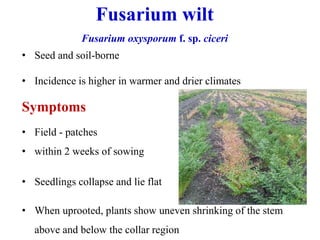
Fusarium wilt
Fusarium oxysporum f. sp. ciceri
• Seed and soil-borne
• Incidence is higher in warmer and drier climates
Symptoms
• Field - patches
• within 2 weeks of sowing
• Seedlings collapse and lie flat
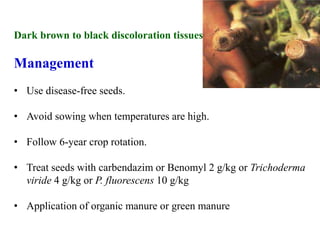
• When uprooted, plants show uneven shrinking of the stem
above and below the collar region
Dark brown to black discoloration tissues
Management
• Use disease-free seeds.
• Avoid sowing when temperatures are high.
• Follow 6-year crop rotation.
• Treat seeds with carbendazim or Benomyl 2 g/kg or Trichoderma
viride 4 g/kg or P. fluorescens 10 g/kg
• Application of organic manure or green manure
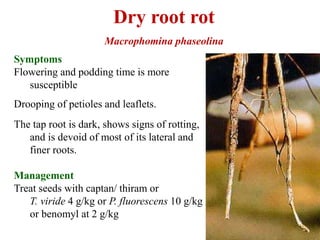
Symptoms
Flowering and podding time is more
susceptible
Drooping of petioles and leaflets.
The tap root is dark, shows signs of rotting,
and is devoid of most of its lateral and
finer roots.
Management
Treat seeds with captan/ thiram or
T. viride 4 g/kg or P. fluorescens 10 g/kg
or benomyl at 2 g/kg
Dry root rot
Macrophomina phaseolina
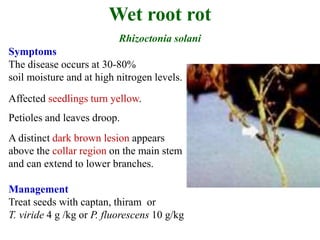
Wet root rot
Rhizoctonia solani
Symptoms
The disease occurs at 30-80%
soil moisture and at high nitrogen levels.
Affected seedlings turn yellow.
Petioles and leaves droop.
A distinct dark brown lesion appears
above the collar region on the main stem
and can extend to lower branches.
Management
Treat seeds with captan, thiram or
T. viride 4 g /kg or P. fluorescens 10 g/kg
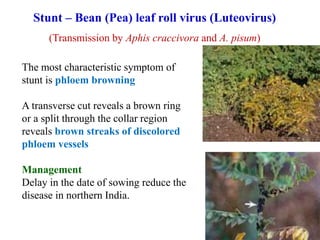
Stunt – Bean (Pea) leaf roll virus (Luteovirus)
(Transmission by Aphis craccivora and A. pisum)
The most characteristic symptom of
stunt is phloem browning
A transverse cut reveals a brown ring
or a split through the collar region
reveals brown streaks of discolored
phloem vessels
Management
Delay in the date of sowing reduce the
disease in northern India.
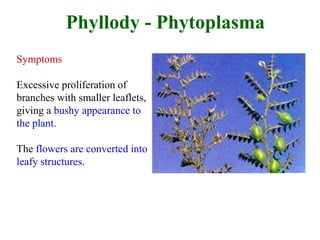
Symptoms
Excessive proliferation of
branches with smaller leaflets,
giving a bushy appearance to
the plant.
The flowers are converted into
leafy structures.
Phyllody - Phytoplasma
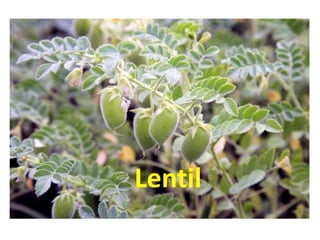
Lentil
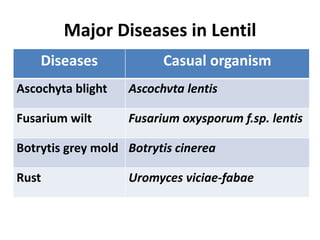
Major Diseases in Lentil
Diseases Casual organism
Ascochyta blight Ascochvta lentis
Fusarium wilt Fusarium oxysporum f.sp. lentis
Botrytis grey mold Botrytis cinerea
Rust Uromyces viciae-fabae
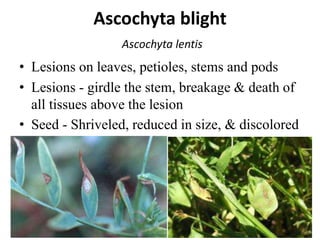
Ascochyta blight
Ascochyta lentis
• Lesions on leaves, petioles, stems and pods
• Lesions - girdle the stem, breakage & death of
all tissues above the lesion
• Seed - Shriveled, reduced in size, & discolored
Ascochyta blight
• Seed-borne
• Cool, moist weather, leaf wetness
Management
• Crop rotation
• Disease-free seed
• Early sowing
• Fungicides: benomyl, carbendazim, and
thiobendazole @ 0.1%
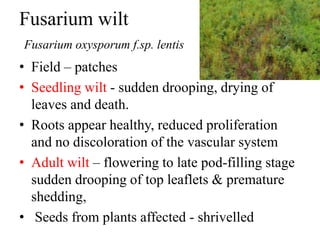
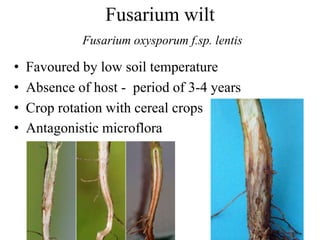
Fusarium wilt
Fusarium oxysporum f.sp. lentis
• Field – patches
• Seedling wilt - sudden drooping, drying of
leaves and death.
• Roots appear healthy, reduced proliferation
and no discoloration of the vascular system
• Adult wilt – flowering to late pod-filling stage
sudden drooping of top leaflets & premature
shedding,
• Seeds from plants affected - shrivelled
Fusarium wilt
Fusarium oxysporum f.sp. lentis
• Favoured by low soil temperature
• Absence of host - period of 3-4 years
• Crop rotation with cereal crops
• Antagonistic microflora
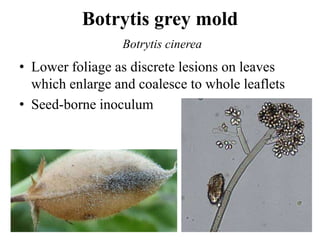
Botrytis grey mold
Botrytis cinerea
• Lower foliage as discrete lesions on leaves
which enlarge and coalesce to whole leaflets
• Seed-borne inoculum
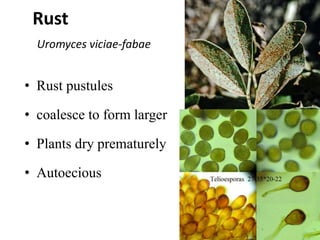
Rust
Uromyces viciae-fabae
• Rust pustules
• coalesce to form larger
• Plants dry prematurely
• Autoecious
Questions?

2. Chickpea & Lentil diseases.ppt

  • 1.
  • 2.
    Diseases Casual organism Ascochytablight Ascochyta rabiei Phoma blight Phoma medicaginis Botrytis grey blight Botrytis cinerea Alternaria blight Alternaria alternata Rust Uromyces ciceris-arietini Powdery mildew Leveillula taurica Sclerotinia stem rot Sclerotinia sclerotiorum Fusarium wilt Fusarium oxysporum f. sp. ciceri Dry root rot Macrophomina phaseolina Wet root rot Rhizoctonia solani Bean leaf roll virus Transmission by Aphis craccivora Phyllody Phytoplasma
  • 3.
    Ascochyta blight Ascochyta rabiei Aerial parts  Dark brown lesions at the base of the stem  Affected seedlings die  Brownish lesions on all parts of the plants  Pods – Lesions: round, concentric rings  Brown discoloration with deep, round or irregular cankers develop on the seeds  Pycnidia and pycnidiospores  Sexual stage: The fungus produces ascus and ascospores
  • 4.
    Typical leaf lesionscaused by Ascochyta blight. These are seen as round spots with brown margins.
  • 6.
    • Seed borne- Left over debris (source) • Wet and warm weather and dense crop canopy are conducive for the disease • All the above ground plant parts are affected Ascochyta blight – Ascochyta rabiei (Perfect stage: Mycosphaerella rabiei)
  • 7.
    Pathogenic characters • Brownand septate mycelium • Pycnidia are spherical to sub-globose with a prominent ostiole. • Pycnidiospores are hyaline, oval to oblong, slightly curved & single celled
  • 8.
    Mode of spread:Infected debris, seed-borne and air- borne conidia and rain splashes Management • Late Sowing • Deep sowing • Use disease-free seeds. • Remove and destroy dead plant debris. • Intercrop with wheat, barley, mustard. • Treat seeds with benomyl @ 2g/ kg • Foliar spray of Bordeaux mixture or wettable sulphur or zineb or chlorothalonil
  • 9.
    2. Phoma blight Phomamedicaginis Lesions on stem, leaves and pods Pycnidial bodies on pods • Seed borne disease. • Usually affects the crop during the reproductive phase. Symptoms • Irregular, light brown lesions on the leaves, stems and pods have dark margins • Seeds from infected pods are discolored and shriveled. Management A minor disease and does not require any specific control measure.
  • 10.
    Seed borne disease. Symptoms Lackof pod setting is the first indication of the disease. Lesions girdle the stem completely. Rotting of affected leaves and flowers. Water-soaked and irregular lesions on the pod. The pods contain either small, shriveled seeds or no seeds at all. 3. Botrytis grey blight Botrytis cinerea Lesions on leaves, stem and pods
  • 11.
    Seed borne disease. Symptoms Water-soaked,small, circular and purple lesions surrounded by chlorotic tissues on leaflets . Lesions later turn brown to dark brown. The infected flowers die. Circular, slightly sunken, and irregularly scattered lesions on the pods. The pods contain shriveled seeds. 4. Alternaria blight Alternaria alternata
  • 12.
    Ascochyta blight Phoma blight Botrytis blight Alternaria blight Stem, leaf, podStem, leaf, pod Stem, leaf, pod Stem, leaf, pod Brown lesion with brownish red margin, stem girdle Brown lesion Brown lesion, stem girdle Purple lesion- Rotting of leaf and flowers Circular lesion on pod with concentric dot- pycnidia Lesion on pod with dark brown margin Sunken circular spot with dark brown margin Sunken scattered lesion on pod Cankers on pod Shriveled and discolored seeds Shriveled seeds Shriveled seeds
  • 13.
    Rust Uromyces ciceris-arietini Symptoms Small, roundor oval, cinnamon brown, powdery pustules on leaves. Sometimes a ring of small pustules can be seen around larger pustules, which occur on both leaf surfaces but more frequently on the lower one. Occasionally pustules can be seen on stems. Plants may dry up prematurely.
  • 15.
    Pathogen Survives as uredosporesin weed, Trigonella polycerata Management Spraying of wettable sulphur1kg/ha
  • 16.
    Symptoms Small patches ofwhite powdery coating initially develop on both surfaces of older leaves. These patches grow and may cover a large area. Affected leaves turn purple and then die. When infection is severe, stems, young leaves, and pods are also covered with the powdery coating. Powdery mildew Leveillula taurica
  • 17.
    Rotting of branches Lesionson the stem and drying branches Sclerotinia stem rot Sclerotinia sclerotiorum Symptoms Chlorotic or drying branches or whole plants The plants normally rot at the collar region or at any point on the branch. A web of white mycelial strands appears at the collar region Whitish or brownish mycelial strands on branches or inside the stem .
  • 18.
    Fusarium wilt Fusarium oxysporumf. sp. ciceri • Seed and soil-borne • Incidence is higher in warmer and drier climates Symptoms • Field - patches • within 2 weeks of sowing • Seedlings collapse and lie flat • When uprooted, plants show uneven shrinking of the stem above and below the collar region
  • 19.
    Dark brown toblack discoloration tissues Management • Use disease-free seeds. • Avoid sowing when temperatures are high. • Follow 6-year crop rotation. • Treat seeds with carbendazim or Benomyl 2 g/kg or Trichoderma viride 4 g/kg or P. fluorescens 10 g/kg • Application of organic manure or green manure
  • 20.
    Symptoms Flowering and poddingtime is more susceptible Drooping of petioles and leaflets. The tap root is dark, shows signs of rotting, and is devoid of most of its lateral and finer roots. Management Treat seeds with captan/ thiram or T. viride 4 g/kg or P. fluorescens 10 g/kg or benomyl at 2 g/kg Dry root rot Macrophomina phaseolina
  • 21.
    Wet root rot Rhizoctoniasolani Symptoms The disease occurs at 30-80% soil moisture and at high nitrogen levels. Affected seedlings turn yellow. Petioles and leaves droop. A distinct dark brown lesion appears above the collar region on the main stem and can extend to lower branches. Management Treat seeds with captan, thiram or T. viride 4 g /kg or P. fluorescens 10 g/kg
  • 22.
    Stunt – Bean(Pea) leaf roll virus (Luteovirus) (Transmission by Aphis craccivora and A. pisum) The most characteristic symptom of stunt is phloem browning A transverse cut reveals a brown ring or a split through the collar region reveals brown streaks of discolored phloem vessels Management Delay in the date of sowing reduce the disease in northern India.
  • 23.
    Symptoms Excessive proliferation of brancheswith smaller leaflets, giving a bushy appearance to the plant. The flowers are converted into leafy structures. Phyllody - Phytoplasma
  • 24.
  • 25.
    Major Diseases inLentil Diseases Casual organism Ascochyta blight Ascochvta lentis Fusarium wilt Fusarium oxysporum f.sp. lentis Botrytis grey mold Botrytis cinerea Rust Uromyces viciae-fabae
  • 26.
    Ascochyta blight Ascochyta lentis •Lesions on leaves, petioles, stems and pods • Lesions - girdle the stem, breakage & death of all tissues above the lesion • Seed - Shriveled, reduced in size, & discolored
  • 27.
    Ascochyta blight • Seed-borne •Cool, moist weather, leaf wetness Management • Crop rotation • Disease-free seed • Early sowing • Fungicides: benomyl, carbendazim, and thiobendazole @ 0.1%
  • 28.
    Fusarium wilt Fusarium oxysporumf.sp. lentis • Field – patches • Seedling wilt - sudden drooping, drying of leaves and death. • Roots appear healthy, reduced proliferation and no discoloration of the vascular system • Adult wilt – flowering to late pod-filling stage sudden drooping of top leaflets & premature shedding, • Seeds from plants affected - shrivelled
  • 29.
    Fusarium wilt Fusarium oxysporumf.sp. lentis • Favoured by low soil temperature • Absence of host - period of 3-4 years • Crop rotation with cereal crops • Antagonistic microflora
  • 30.
    Botrytis grey mold Botrytiscinerea • Lower foliage as discrete lesions on leaves which enlarge and coalesce to whole leaflets • Seed-borne inoculum
  • 31.
    Rust Uromyces viciae-fabae • Rustpustules • coalesce to form larger • Plants dry prematurely • Autoecious
  • 32.