Training Program to Prevent Workplace Violence in the Healthcare
OSHA Disclaimer
This material was produced under grant number
SH-000021-SH3 from the Occupational Safety
and Health Administration, U.S. Department of
Labor. It does not necessarily reflect the views
or policies of the U.S. Department of Labor, nor
does mention of trade names, commercial
products, or organizations imply endorsement
by the U.S. Government.
23
Developed by
K. Grogan Ullah
Unit 2:
Before Violence Happens
23
Unit 2 Learning Objectives
In this unit, we will improve our
understanding of - The Four Types of Workplace
Violence
What Bullying is
The risk factors for workplace
violence
25
Unit 2 Objectives (cont’d)
In this unit, we will improve our
understanding of -
How we can help prevent
workplace violence
How to promote a culture of
violence prevention
26
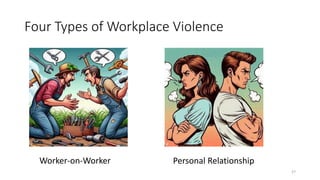
Four Types of Workplace Violence
Worker-on-Worker Personal Relationship
27
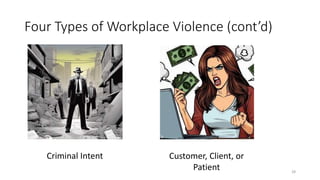
Four Types of Workplace Violence (cont’d)
Criminal Intent Customer, Client, or
Patient 28
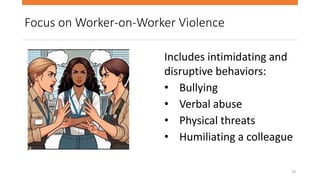
Focus on Worker-on-Worker Violence
Includes intimidating and
disruptive behaviors:
• Bullying
• Verbal abuse
• Physical threats
• Humiliating a colleague
29
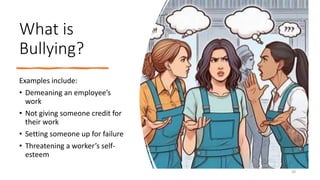
What is
Bullying?
Examples include:
• Demeaning an employee’s
work
• Not giving someone credit for
their work
• Setting someone up for failure
• Threatening a worker’s self-
esteem
30
What is Bullying
(cont’d)?
• Giving constant and
unfair criticism
• Blaming without
factual justification
• Glaring at someone
in a hostile manner
• Making intimidating
gestures
31
What is Bullying
(cont’d)?
• Humiliating someone
• Insulting co-workers
• Yelling, screaming, or
cursing at a co-worker
• Putting a co-worker down
behind their back
32
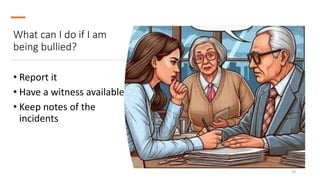
What can I do if I am
being bullied?
• Report it
• Have a witness available
• Keep notes of the
incidents
33
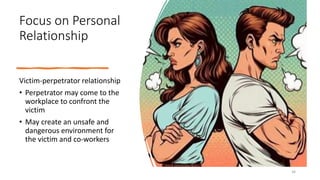
Focus on Personal
Relationship
Victim-perpetrator relationship
• Perpetrator may come to the
workplace to confront the
victim
• May create an unsafe and
dangerous environment for
the victim and co-workers
34
Help is
available!
• Call: 1.800.7233
• Text: 88788
• Call 911 immediately if you are
in danger.
• Visit:
https://espanol.thehotline.org
or
https://www.thehotline.org
35
Recognizing and Addressing Triggers and Escalating Factors
What are the signs
of workplace
violence?
How do we know it is
getting worse and
more dangerous?
36
What behaviors are warning signs of potential
workplace violence?
•What do you think are the
warning signs for potential
workplace violence?
37
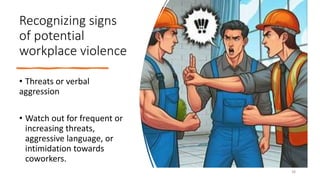
Recognizing signs
of potential
workplace violence
• Threats or verbal
aggression
• Watch out for frequent or
increasing threats,
aggressive language, or
intimidation towards
coworkers.
38
Recognizing signs of
potential workplace
violence (cont’d)
Substance Abuse
• Excessive alcohol intake
can –
• Affect judgment
• Increase impulsivity
• Contribute to aggressive
or violent behavior
39
Recognizing signs of
potential workplace
violence (cont’d)
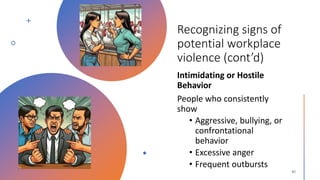
Intimidating or Hostile
Behavior
People who consistently
show
• Aggressive, bullying, or
confrontational
behavior
• Excessive anger
• Frequent outbursts
Recognizing signs of
potential workplace
violence (cont’d)
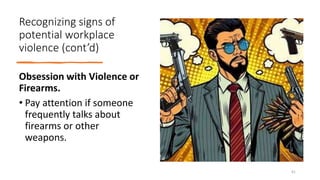
Obsession with Violence or
Firearms.
• Pay attention if someone
frequently talks about
firearms or other
weapons.
41
Recognizing signs of
potential workplace
violence (cont’d)
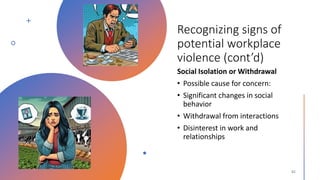
Social Isolation or Withdrawal
• Possible cause for concern:
• Significant changes in social
behavior
• Withdrawal from interactions
• Disinterest in work and
relationships
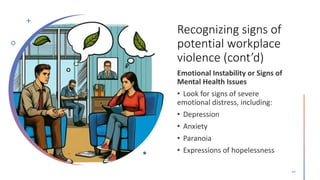
Recognizing signs of
potential workplace
violence (cont’d)
43
Recognizing signs of
potential workplace
violence (cont’d)
44
Recognizing signs of potential
workplace violence (cont’d)
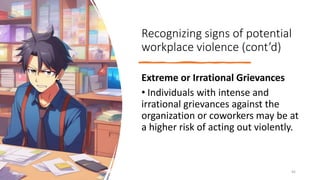
Extreme or Irrational Grievances
• Individuals with intense and
irrational grievances against the
organization or coworkers may be at
a higher risk of acting out violently.
45
Preventing
workplace violence
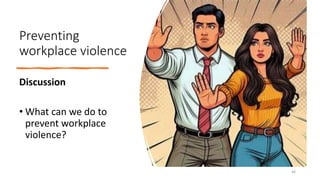
Discussion
• What can we do to
prevent workplace
violence?
46
Communication
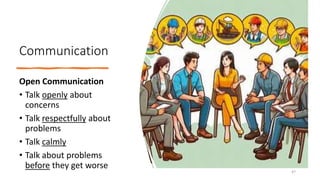
Open Communication
• Talk openly about
concerns
• Talk respectfully about
problems
• Talk calmly
• Talk about problems
before they get worse
47
Report signs of potential
violence or aggression
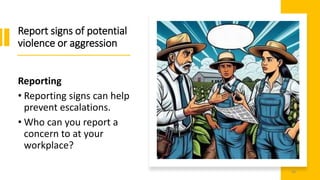
Reporting
• Reporting signs can help
prevent escalations.
• Who can you report a
concern to at your
workplace?
48
Be Vigilant
• Stay observant of your
surroundings and
coworkers' behaviors
• Report any suspicious or
concerning activities that
may indicate potential
violence
49
What can I do to
Protect myself?
Buddy System and or Lone
Worker App
When working in -
• In isolated areas
• Late at night
• Going to parking lots late
at night
50
Hmm? What if it’s me?
Before Tempers Fly
Discussion
• What should individuals
who are at risk of
aggression or violence do
to prevent it?
51
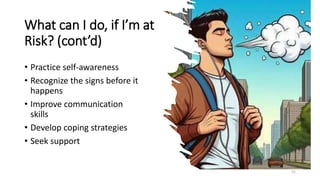
What can I do, if I’m at
Risk? (cont’d)
• Practice self-awareness
• Recognize the signs before it
happens
• Improve communication
skills
• Develop coping strategies
• Seek support
52
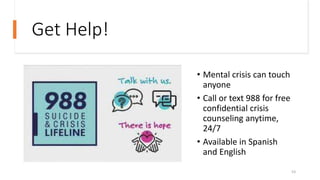
Get Help!
• Mental crisis can touch
anyone
• Call or text 988 for free
confidential crisis
counseling anytime,
24/7
• Available in Spanish
and English
53
True or False
1. Robbery is not a type of
workplace violence.
2. Bullying includes glaring at
someone in a hostile manner.
3. Working alone, or in isolated
settings, decreases the risk of
workplace violence.
4. Frequent use of threats is a
warning sign of increased risk
of workplace violence.
5. To prevent workplace violence,
make sure you yell first and
louder before the situation
gets worse.
6. It’s important to recognize our
emotions as they arise in us.
54

2. A4A_Unit 2_Prevention Workplace Violence Ag.pptx

  • 1.
    Training Program toPrevent Workplace Violence in the Healthcare OSHA Disclaimer This material was produced under grant number SH-000021-SH3 from the Occupational Safety and Health Administration, U.S. Department of Labor. It does not necessarily reflect the views or policies of the U.S. Department of Labor, nor does mention of trade names, commercial products, or organizations imply endorsement by the U.S. Government. 23 Developed by K. Grogan Ullah
  • 2.
  • 3.
    Unit 2 LearningObjectives In this unit, we will improve our understanding of - The Four Types of Workplace Violence What Bullying is The risk factors for workplace violence 25
  • 4.
    Unit 2 Objectives(cont’d) In this unit, we will improve our understanding of - How we can help prevent workplace violence How to promote a culture of violence prevention 26
  • 5.
    Four Types ofWorkplace Violence Worker-on-Worker Personal Relationship 27
  • 6.
    Four Types ofWorkplace Violence (cont’d) Criminal Intent Customer, Client, or Patient 28
  • 7.
    Focus on Worker-on-WorkerViolence Includes intimidating and disruptive behaviors: • Bullying • Verbal abuse • Physical threats • Humiliating a colleague 29
  • 8.
    What is Bullying? Examples include: •Demeaning an employee’s work • Not giving someone credit for their work • Setting someone up for failure • Threatening a worker’s self- esteem 30
  • 9.
    What is Bullying (cont’d)? •Giving constant and unfair criticism • Blaming without factual justification • Glaring at someone in a hostile manner • Making intimidating gestures 31
  • 10.
    What is Bullying (cont’d)? •Humiliating someone • Insulting co-workers • Yelling, screaming, or cursing at a co-worker • Putting a co-worker down behind their back 32
  • 11.
    What can Ido if I am being bullied? • Report it • Have a witness available • Keep notes of the incidents 33
  • 12.
    Focus on Personal Relationship Victim-perpetratorrelationship • Perpetrator may come to the workplace to confront the victim • May create an unsafe and dangerous environment for the victim and co-workers 34
  • 13.
    Help is available! • Call:1.800.7233 • Text: 88788 • Call 911 immediately if you are in danger. • Visit: https://espanol.thehotline.org or https://www.thehotline.org 35
  • 14.
    Recognizing and AddressingTriggers and Escalating Factors What are the signs of workplace violence? How do we know it is getting worse and more dangerous? 36
  • 15.
    What behaviors arewarning signs of potential workplace violence? •What do you think are the warning signs for potential workplace violence? 37
  • 16.
    Recognizing signs of potential workplaceviolence • Threats or verbal aggression • Watch out for frequent or increasing threats, aggressive language, or intimidation towards coworkers. 38
  • 17.
    Recognizing signs of potentialworkplace violence (cont’d) Substance Abuse • Excessive alcohol intake can – • Affect judgment • Increase impulsivity • Contribute to aggressive or violent behavior 39
  • 18.
    Recognizing signs of potentialworkplace violence (cont’d) Intimidating or Hostile Behavior People who consistently show • Aggressive, bullying, or confrontational behavior • Excessive anger • Frequent outbursts
  • 19.
    Recognizing signs of potentialworkplace violence (cont’d) Obsession with Violence or Firearms. • Pay attention if someone frequently talks about firearms or other weapons. 41
  • 20.
    Recognizing signs of potentialworkplace violence (cont’d) Social Isolation or Withdrawal • Possible cause for concern: • Significant changes in social behavior • Withdrawal from interactions • Disinterest in work and relationships
  • 21.
    Recognizing signs of potentialworkplace violence (cont’d) 43
  • 22.
    Recognizing signs of potentialworkplace violence (cont’d) 44
  • 23.
    Recognizing signs ofpotential workplace violence (cont’d) Extreme or Irrational Grievances • Individuals with intense and irrational grievances against the organization or coworkers may be at a higher risk of acting out violently. 45
  • 24.
    Preventing workplace violence Discussion • Whatcan we do to prevent workplace violence? 46
  • 25.
    Communication Open Communication • Talkopenly about concerns • Talk respectfully about problems • Talk calmly • Talk about problems before they get worse 47
  • 26.
    Report signs ofpotential violence or aggression Reporting • Reporting signs can help prevent escalations. • Who can you report a concern to at your workplace? 48
  • 27.
    Be Vigilant • Stayobservant of your surroundings and coworkers' behaviors • Report any suspicious or concerning activities that may indicate potential violence 49
  • 28.
    What can Ido to Protect myself? Buddy System and or Lone Worker App When working in - • In isolated areas • Late at night • Going to parking lots late at night 50
  • 29.
    Hmm? What ifit’s me? Before Tempers Fly Discussion • What should individuals who are at risk of aggression or violence do to prevent it? 51
  • 30.
    What can Ido, if I’m at Risk? (cont’d) • Practice self-awareness • Recognize the signs before it happens • Improve communication skills • Develop coping strategies • Seek support 52
  • 31.
    Get Help! • Mentalcrisis can touch anyone • Call or text 988 for free confidential crisis counseling anytime, 24/7 • Available in Spanish and English 53
  • 32.
    True or False 1.Robbery is not a type of workplace violence. 2. Bullying includes glaring at someone in a hostile manner. 3. Working alone, or in isolated settings, decreases the risk of workplace violence. 4. Frequent use of threats is a warning sign of increased risk of workplace violence. 5. To prevent workplace violence, make sure you yell first and louder before the situation gets worse. 6. It’s important to recognize our emotions as they arise in us. 54