Shaik Shafeeq Ahmed 1HK19CS138
Shivaraj 1HK19CS147
Suneet Lionel Dsouza 1HK19CS157
Guided By :- Asst prof Simran Pal, Dept
Of CSE
Rainfall prediction could be very vital in several elements of
our economic system and may assist us stopping serious
herbal disasters. Some regions in India are economically
depending on rainfall as agriculture is number one career
of many states. This enables to discover plants styles and
correct control of water assets for the plants. For this, linear
and non-linear fashions are usually used for seasonal
rainfall prediction
• To predict rainfall to prevent flooding that saves people's
lives and propert
• To predict the quantity of rain in a specific division in
advance by using various regression
• Reduce the time and effort involved in the process.
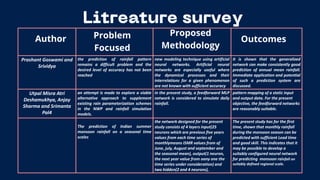
Prashant Goswami and
Srividya
the prediction of rainfall pattern
remains a difficult problem and the
desired level of accuracy has not been
reached
new modeling technique using artificial
neural networks. Artificial neural
networks are especially useful where
the dynamical processes and their
interrelations for a given phenomenon
are not known with sufficient accuracy
It is shown that the generalized
network can make consistently good
prediction of annual mean rainfall.
Immediate application and potential
of such a prediction system are
discussed.
Utpal Misra Atri
Deshamukhya, Anjay
Sharma and Srimanta
Pal4
an attempt is made to explore a viable
alternative approach to supplement
existing rain parameterization schemes
in the NWP and rainfall simulation
models.
in the present study, a feedforward MLP
network is considered to simulate daily
rainfall.
pattern mapping of a static input
and output data. For the present
objective, the feedforward networks
are reasonably suitable.
The prediction of Indian summer
monsoon rainfall on a seasonal time
scales
the network designed for the present
study consists of 4 layers input(25
neurons which are previous five years
values from each time series of
monthlymeans ISMR values from of
June, july, August and september and
the seasonal mean), output(1 neuron,
the next year value from oany one the
time series under consideration) and
two hidden(2 and 4 neurons),
The present study has for the first
time, shown that monthly rainfall
during the monsoon season can be
predicted with sufficient Lead time
and good skill. This indicates that it
may be possible to develop a
suitably configured neural network
for predicting monsoon rainfall on
suitably defined regional scale.
Author Problem
Focused
Proposed
Methodology
Outcomes
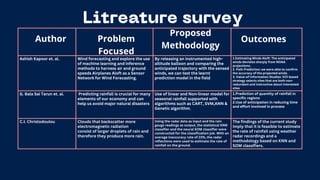
Ashish Kapoor et. al. Wind forecasting and explore the use
of machine learning and inference
methods to harness air and ground
speeds Airplanes Aloft as a Sensor
Network for Wind Forecasting.
By releasing an instrumented high-
altitude balloon and comparing the
anticipated trajectory with the sensed
winds, we can test the learnt
prediction model in the field.
1.Estimating Winds Aloft: The anticipated
winds deviates sharply from NOAA
projections.
2. Path Prediction: we were able to confirm
the accuracy of the projected winds.
3. Value-of-Information Studies: VOI-based
strategy selects sites that are both non-
redundant and instructive about interested
sites.
G. Bala Sai Tarun et. al. Predicting rainfall is crucial for many
elements of our economy and can
help us avoid major natural disasters
Use of linear and Non-linear model for
seasonal rainfall supported with
algorithms such as CART, SVM,ANN &
Genetic algorithm.
1.Prediction of quantity of rainfall in
specific regions
2.Use of anticipation in reducing time
and effort involved in process
C.I. Christodoulou Clouds that backscatter more
electromagnetic radiation
consist of larger droplets of rain and
therefore they produce more rain.
Using the radar data as input and the rain
gauge readings as output, the statistical KNN
classifier and the neural SOM classifier were
constructed for the classification job. With an
average inaccuracy rate of 23%, the radar
reflections were used to estimate the rate of
rainfall on the ground.
The findings of the current study
imply that it is feasible to estimate
the rate of rainfall using weather
radar recordings and a
methodology based on KNN and
SOM classifiers.
Author Problem
Focused
Proposed
Methodology
Outcomes
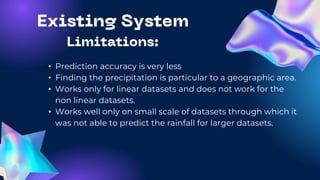
• Prediction accuracy is very less
• Finding the precipitation is particular to a geographic area.
• Works only for linear datasets and does not work for the
non linear datasets.
• Works well only on small scale of datasets through which it
was not able to predict the rainfall for larger datasets.
• High prediction accuracy.
• Hold perfectly good for large scale datasets with large number of
variables.
• Deals efficiently with data having missing values.
• Can be used for unsupervised learning and outlier detection.
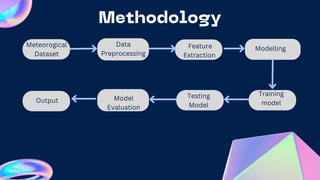
Meteorogical
Dataset
Data
Preprocessing
Feature
Extraction
Modelling
Testing
Model
Training
model
Model
Evaluation
Output
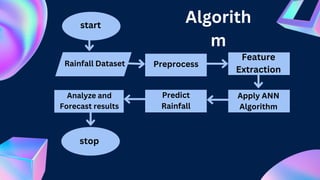
Algorith
m
start
Rainfall Dataset Preprocess
Feature
Extraction
Analyze and
Forecast results
Predict
Rainfall
Apply ANN
Algorithm
stop
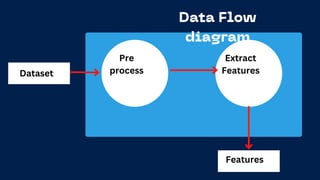
Dataset
Features
Pre
process
Extract
Features
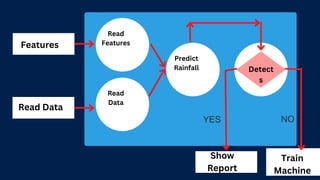
Features
Show
Report
Read
Features
Read
Data
Predict
Rainfall
Read Data
Detect
s
Train
Machine
YES NO
1st_Review_PPT[1].pptx

1st_Review_PPT[1].pptx

  • 1.
    Shaik Shafeeq Ahmed1HK19CS138 Shivaraj 1HK19CS147 Suneet Lionel Dsouza 1HK19CS157 Guided By :- Asst prof Simran Pal, Dept Of CSE
  • 2.
    Rainfall prediction couldbe very vital in several elements of our economic system and may assist us stopping serious herbal disasters. Some regions in India are economically depending on rainfall as agriculture is number one career of many states. This enables to discover plants styles and correct control of water assets for the plants. For this, linear and non-linear fashions are usually used for seasonal rainfall prediction
  • 3.
    • To predictrainfall to prevent flooding that saves people's lives and propert • To predict the quantity of rain in a specific division in advance by using various regression • Reduce the time and effort involved in the process.
  • 4.
    Prashant Goswami and Srividya theprediction of rainfall pattern remains a difficult problem and the desired level of accuracy has not been reached new modeling technique using artificial neural networks. Artificial neural networks are especially useful where the dynamical processes and their interrelations for a given phenomenon are not known with sufficient accuracy It is shown that the generalized network can make consistently good prediction of annual mean rainfall. Immediate application and potential of such a prediction system are discussed. Utpal Misra Atri Deshamukhya, Anjay Sharma and Srimanta Pal4 an attempt is made to explore a viable alternative approach to supplement existing rain parameterization schemes in the NWP and rainfall simulation models. in the present study, a feedforward MLP network is considered to simulate daily rainfall. pattern mapping of a static input and output data. For the present objective, the feedforward networks are reasonably suitable. The prediction of Indian summer monsoon rainfall on a seasonal time scales the network designed for the present study consists of 4 layers input(25 neurons which are previous five years values from each time series of monthlymeans ISMR values from of June, july, August and september and the seasonal mean), output(1 neuron, the next year value from oany one the time series under consideration) and two hidden(2 and 4 neurons), The present study has for the first time, shown that monthly rainfall during the monsoon season can be predicted with sufficient Lead time and good skill. This indicates that it may be possible to develop a suitably configured neural network for predicting monsoon rainfall on suitably defined regional scale. Author Problem Focused Proposed Methodology Outcomes
  • 5.
    Ashish Kapoor et.al. Wind forecasting and explore the use of machine learning and inference methods to harness air and ground speeds Airplanes Aloft as a Sensor Network for Wind Forecasting. By releasing an instrumented high- altitude balloon and comparing the anticipated trajectory with the sensed winds, we can test the learnt prediction model in the field. 1.Estimating Winds Aloft: The anticipated winds deviates sharply from NOAA projections. 2. Path Prediction: we were able to confirm the accuracy of the projected winds. 3. Value-of-Information Studies: VOI-based strategy selects sites that are both non- redundant and instructive about interested sites. G. Bala Sai Tarun et. al. Predicting rainfall is crucial for many elements of our economy and can help us avoid major natural disasters Use of linear and Non-linear model for seasonal rainfall supported with algorithms such as CART, SVM,ANN & Genetic algorithm. 1.Prediction of quantity of rainfall in specific regions 2.Use of anticipation in reducing time and effort involved in process C.I. Christodoulou Clouds that backscatter more electromagnetic radiation consist of larger droplets of rain and therefore they produce more rain. Using the radar data as input and the rain gauge readings as output, the statistical KNN classifier and the neural SOM classifier were constructed for the classification job. With an average inaccuracy rate of 23%, the radar reflections were used to estimate the rate of rainfall on the ground. The findings of the current study imply that it is feasible to estimate the rate of rainfall using weather radar recordings and a methodology based on KNN and SOM classifiers. Author Problem Focused Proposed Methodology Outcomes
  • 6.
    • Prediction accuracyis very less • Finding the precipitation is particular to a geographic area. • Works only for linear datasets and does not work for the non linear datasets. • Works well only on small scale of datasets through which it was not able to predict the rainfall for larger datasets.
  • 7.
    • High predictionaccuracy. • Hold perfectly good for large scale datasets with large number of variables. • Deals efficiently with data having missing values. • Can be used for unsupervised learning and outlier detection.
  • 8.
  • 9.
    Algorith m start Rainfall Dataset Preprocess Feature Extraction Analyzeand Forecast results Predict Rainfall Apply ANN Algorithm stop
  • 10.
  • 11.