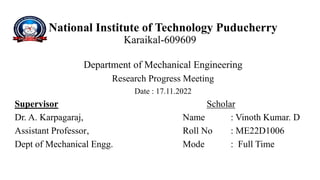
National Institute of Technology Puducherry
Karaikal-609609
Department of Mechanical Engineering
Research Progress Meeting
Date : 17.11.2022
Supervisor Scholar
Dr. A. Karpagaraj, Name : Vinoth Kumar. D
Assistant Professor, Roll No : ME22D1006
Dept of Mechanical Engg. Mode : Full Time
Data Sheet
Name : Vinoth Kumar.D
Roll No : ME22D1006
Broad Area of Research : Welding
Category : Full Time ( Institute Fellowship)
Date of Registration : 25.07.2022
Date of last DC meeting : 05.09.2022
DOCTORAL COMMITTEE
Name of The Doctoral Committee Chairperson
Dr. JACK J KENNNED Assistant Professor
Department of Mechanical Engineering
National Institute of Technology Puducherry
Name of The Supervisor (Guide)
Dr. A. KARPAGARAJ, Assistant Professor,
Department of Mechanical Engineering
National Institute of Technology, Puducherry
Doctoral Committee Member(Internal)
Dr. N.M . SIVARAM, Assistant Professor,
Department of Mechanical Engineering
National Institute of Technology, Puducherry
Doctoral Committee Member(Internal)
Dr. JOHNNEY MERTENS, Assistant Professor,
Department of Mechanical Engineering
National Institute of Technology, Puducherry
Doctoral Committee Member(Allied Department)
Dr. RAJAN SINGARAVEL M.M, Assistant Professor,
Department of Electrical and Electronics Engineering
National Institute of Technology, Puducherry-609609
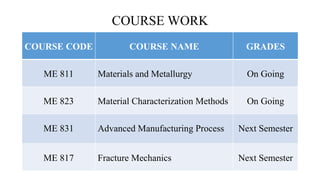
COURSE WORK
COURSE CODE COURSE NAME GRADES
ME 811 Materials and Metallurgy On Going
ME 823 Material Characterization Methods On Going
ME 831 Advanced Manufacturing Process Next Semester
ME 817 Fracture Mechanics Next Semester
Introduction
Dissimilar materials welding refers to the joining of:
 Two different alloy systems (e.g., steel, stainless steel)
Materials of different fundamental types
Metals, ceramics, polymers, composite
 Ferrous to non-ferrous
 Materials with different compositions within a particular type (e.g., austenitic
stainless steel, ferritic stainless steel, duplex stainless steel, etc.).
Importance to industry:
 Dissimilar lightweight material welding is used to connect different metals
together for automotive industries
 Used where an object is subjected to multiple environments in one application
such as in chemical and petrochemical industries, power generation, and oil
and gas industries
Challenges of Welding Dissimilar Metals
 The existence of a transition zone between the metals and the
intermetallic compounds formed in the heat affected zone:
If there is mutual solubility of the two metals, the dissimilar joints
can be made successfully
If there is little or no solubility between the two metals to be joined,
the weld joint will not be successful.
 The formation of intermetallic compounds and their effects on:
Increasing the crack sensitivity
Reducing the ductility
Increasing the susceptibility to corrosion
Challenges of Welding Dissimilar Metals
 Differences in the coefficient of thermal expansion:
The residual stresses in welds are generated by the thermal contraction of the
weld metal and the adjacent base metal. As a result, the residual stress
distribution and magnitude are not similar across the dissimilar weld joint
If these are widely different, there will be internal stresses set up in the inter-
critical HAZ leading to service failure.
 The difference in melting temperatures, since one metal will be
molten and overheated before the other when subjected to the same
heat source.
 The difference of the electrochemical potential could increase the
susceptibility to corrosion at HAZ. If they are far apart on the scale,
corrosion can be a serious problem.
Difficulties
Joining
Techniques
of dissimilar
welding
Formation of
Brittle
Intermetallic
Phases
Formation of
Oxide Layer
Difference in
M.P, T.C,σand
E
Poor Solubility
in each other
Hybrid
Structure
Properwelding
procedure
Relative Properties of Different Materials
• [Ref - Edison welding institute webpage]
Material
Melting
Point
(°F)
Density,
(gm/cm3)
Thermal
Conductivity
(BTU.In/ft2.h.°F)
Yield
Strength
(MPa)
Ultimate
Tensile
Strength
(MPa)
Elastic
Modulus
(GPa)
Mild Steel
2750
7.86
230-360
200 300 200
HSS 7.87 345 485 205
AHSS 7.78 800 1400 208
Stainless
Steel (304)
2600
7.85
110 290 620 203
Aluminum
Alloys
1220
2.71
1644 275 300 70
Magnesium
Alloys
900-
1150
1.77
360-504 120-160 220-230 45
Nickel Base
Alloys
2300 -
2440
8.19
104-135 150 185 203
Specific strength for various materials
[Ref- https://www.protolabs.com/resources]
Weldability of Metals and Alloys
• Weldability of carbon steel alloys is inversely proportional to its
hardenability due to martensite formation.
• Austenitic stainless steels tend to be the most weldable, but suffer from
distortion due to high thermal expansion leading to cracking and reduced
corrosion resistance.
• Ferritic and martensitic stainless steels are not easily welded, often to be
preheated and use special electrodes.
• Aluminum alloys are susceptible to hot cracking, oxide inclusions, dross,
and porosity (hydrogen).
• Titanium alloys with low amounts of alloying elements are more readily
welded, while highly stabilized β titanium alloys are difficult to weld due to
segregation.
References
• Tauheed Shehbaz, Fahd Nawaz Khan, Massab Junaid, Julfikar Haider
Investigating the bonding mechanism of P-TIG welded CpTi/Inconel
718 dissimilar joint with Nb interlayer Materials Letters 313 (2022)
131748
• Sanjeev Kumar, Chandan Pandey, Amit Goyal Microstructure and
mechanical behavior of P91 steel dissimilar welded joints made with
IN718 filler International Journal of Pressure Vessels and Piping 190
(2021) 104290
• Yanan Gao, Lujun Huang, Yang Bao, Qi An, Yuan Sun, Rui Zhang,
Lin Geng, Jie Zhang Joints of TiBw/Ti6Al4V composites- Inconel 718
alloys dissimilar joining using Nb and Cu interlayers Journal of Alloys
and Compounds 822 (2020) 153559
• Sidharth Deva, K. Devendranath Ramkumar, N. Arivazhagan, R.
Rajendran Investigations on the microstructure and mechanical
properties of dissimilar welds of inconel 718 and sulphur rich
martensitic stainless steel, AISI 416 Journal of Manufacturing
Processes 32 (2018) 685–698
• Fatemeh Hejripour, Daryush K. Aidun Consumable selection for arc
welding between Stainless Steel 410 and Inconel 718 Journal of
Materials Processing Technology 245 (2017) 287–299
• Sanjeev Kumar, Chandan Pandey, Amit Goyal Microstructure and
mechanical behavior of P91 steel dissimilar welded joints made with
IN718 filler International Journal of Pressure Vessels and Piping 190
(2021) 104290

1st progress review.pptx

  • 1.
    National Institute ofTechnology Puducherry Karaikal-609609 Department of Mechanical Engineering Research Progress Meeting Date : 17.11.2022 Supervisor Scholar Dr. A. Karpagaraj, Name : Vinoth Kumar. D Assistant Professor, Roll No : ME22D1006 Dept of Mechanical Engg. Mode : Full Time
  • 2.
    Data Sheet Name :Vinoth Kumar.D Roll No : ME22D1006 Broad Area of Research : Welding Category : Full Time ( Institute Fellowship) Date of Registration : 25.07.2022 Date of last DC meeting : 05.09.2022 DOCTORAL COMMITTEE Name of The Doctoral Committee Chairperson Dr. JACK J KENNNED Assistant Professor Department of Mechanical Engineering National Institute of Technology Puducherry Name of The Supervisor (Guide) Dr. A. KARPAGARAJ, Assistant Professor, Department of Mechanical Engineering National Institute of Technology, Puducherry Doctoral Committee Member(Internal) Dr. N.M . SIVARAM, Assistant Professor, Department of Mechanical Engineering National Institute of Technology, Puducherry Doctoral Committee Member(Internal) Dr. JOHNNEY MERTENS, Assistant Professor, Department of Mechanical Engineering National Institute of Technology, Puducherry Doctoral Committee Member(Allied Department) Dr. RAJAN SINGARAVEL M.M, Assistant Professor, Department of Electrical and Electronics Engineering National Institute of Technology, Puducherry-609609
  • 3.
    COURSE WORK COURSE CODECOURSE NAME GRADES ME 811 Materials and Metallurgy On Going ME 823 Material Characterization Methods On Going ME 831 Advanced Manufacturing Process Next Semester ME 817 Fracture Mechanics Next Semester
  • 4.
    Introduction Dissimilar materials weldingrefers to the joining of:  Two different alloy systems (e.g., steel, stainless steel) Materials of different fundamental types Metals, ceramics, polymers, composite  Ferrous to non-ferrous  Materials with different compositions within a particular type (e.g., austenitic stainless steel, ferritic stainless steel, duplex stainless steel, etc.). Importance to industry:  Dissimilar lightweight material welding is used to connect different metals together for automotive industries  Used where an object is subjected to multiple environments in one application such as in chemical and petrochemical industries, power generation, and oil and gas industries
  • 5.
    Challenges of WeldingDissimilar Metals  The existence of a transition zone between the metals and the intermetallic compounds formed in the heat affected zone: If there is mutual solubility of the two metals, the dissimilar joints can be made successfully If there is little or no solubility between the two metals to be joined, the weld joint will not be successful.  The formation of intermetallic compounds and their effects on: Increasing the crack sensitivity Reducing the ductility Increasing the susceptibility to corrosion
  • 6.
    Challenges of WeldingDissimilar Metals  Differences in the coefficient of thermal expansion: The residual stresses in welds are generated by the thermal contraction of the weld metal and the adjacent base metal. As a result, the residual stress distribution and magnitude are not similar across the dissimilar weld joint If these are widely different, there will be internal stresses set up in the inter- critical HAZ leading to service failure.  The difference in melting temperatures, since one metal will be molten and overheated before the other when subjected to the same heat source.  The difference of the electrochemical potential could increase the susceptibility to corrosion at HAZ. If they are far apart on the scale, corrosion can be a serious problem.
  • 7.
    Difficulties Joining Techniques of dissimilar welding Formation of Brittle Intermetallic Phases Formationof Oxide Layer Difference in M.P, T.C,σand E Poor Solubility in each other Hybrid Structure Properwelding procedure
  • 8.
    Relative Properties ofDifferent Materials • [Ref - Edison welding institute webpage] Material Melting Point (°F) Density, (gm/cm3) Thermal Conductivity (BTU.In/ft2.h.°F) Yield Strength (MPa) Ultimate Tensile Strength (MPa) Elastic Modulus (GPa) Mild Steel 2750 7.86 230-360 200 300 200 HSS 7.87 345 485 205 AHSS 7.78 800 1400 208 Stainless Steel (304) 2600 7.85 110 290 620 203 Aluminum Alloys 1220 2.71 1644 275 300 70 Magnesium Alloys 900- 1150 1.77 360-504 120-160 220-230 45 Nickel Base Alloys 2300 - 2440 8.19 104-135 150 185 203
  • 9.
    Specific strength forvarious materials [Ref- https://www.protolabs.com/resources]
  • 10.
    Weldability of Metalsand Alloys • Weldability of carbon steel alloys is inversely proportional to its hardenability due to martensite formation. • Austenitic stainless steels tend to be the most weldable, but suffer from distortion due to high thermal expansion leading to cracking and reduced corrosion resistance. • Ferritic and martensitic stainless steels are not easily welded, often to be preheated and use special electrodes. • Aluminum alloys are susceptible to hot cracking, oxide inclusions, dross, and porosity (hydrogen). • Titanium alloys with low amounts of alloying elements are more readily welded, while highly stabilized β titanium alloys are difficult to weld due to segregation.
  • 11.
    References • Tauheed Shehbaz,Fahd Nawaz Khan, Massab Junaid, Julfikar Haider Investigating the bonding mechanism of P-TIG welded CpTi/Inconel 718 dissimilar joint with Nb interlayer Materials Letters 313 (2022) 131748 • Sanjeev Kumar, Chandan Pandey, Amit Goyal Microstructure and mechanical behavior of P91 steel dissimilar welded joints made with IN718 filler International Journal of Pressure Vessels and Piping 190 (2021) 104290 • Yanan Gao, Lujun Huang, Yang Bao, Qi An, Yuan Sun, Rui Zhang, Lin Geng, Jie Zhang Joints of TiBw/Ti6Al4V composites- Inconel 718 alloys dissimilar joining using Nb and Cu interlayers Journal of Alloys and Compounds 822 (2020) 153559
  • 12.
    • Sidharth Deva,K. Devendranath Ramkumar, N. Arivazhagan, R. Rajendran Investigations on the microstructure and mechanical properties of dissimilar welds of inconel 718 and sulphur rich martensitic stainless steel, AISI 416 Journal of Manufacturing Processes 32 (2018) 685–698 • Fatemeh Hejripour, Daryush K. Aidun Consumable selection for arc welding between Stainless Steel 410 and Inconel 718 Journal of Materials Processing Technology 245 (2017) 287–299 • Sanjeev Kumar, Chandan Pandey, Amit Goyal Microstructure and mechanical behavior of P91 steel dissimilar welded joints made with IN718 filler International Journal of Pressure Vessels and Piping 190 (2021) 104290