Nature’s Fabrication Technique: Self-
assembly
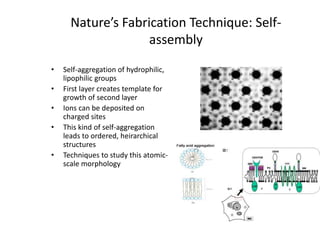
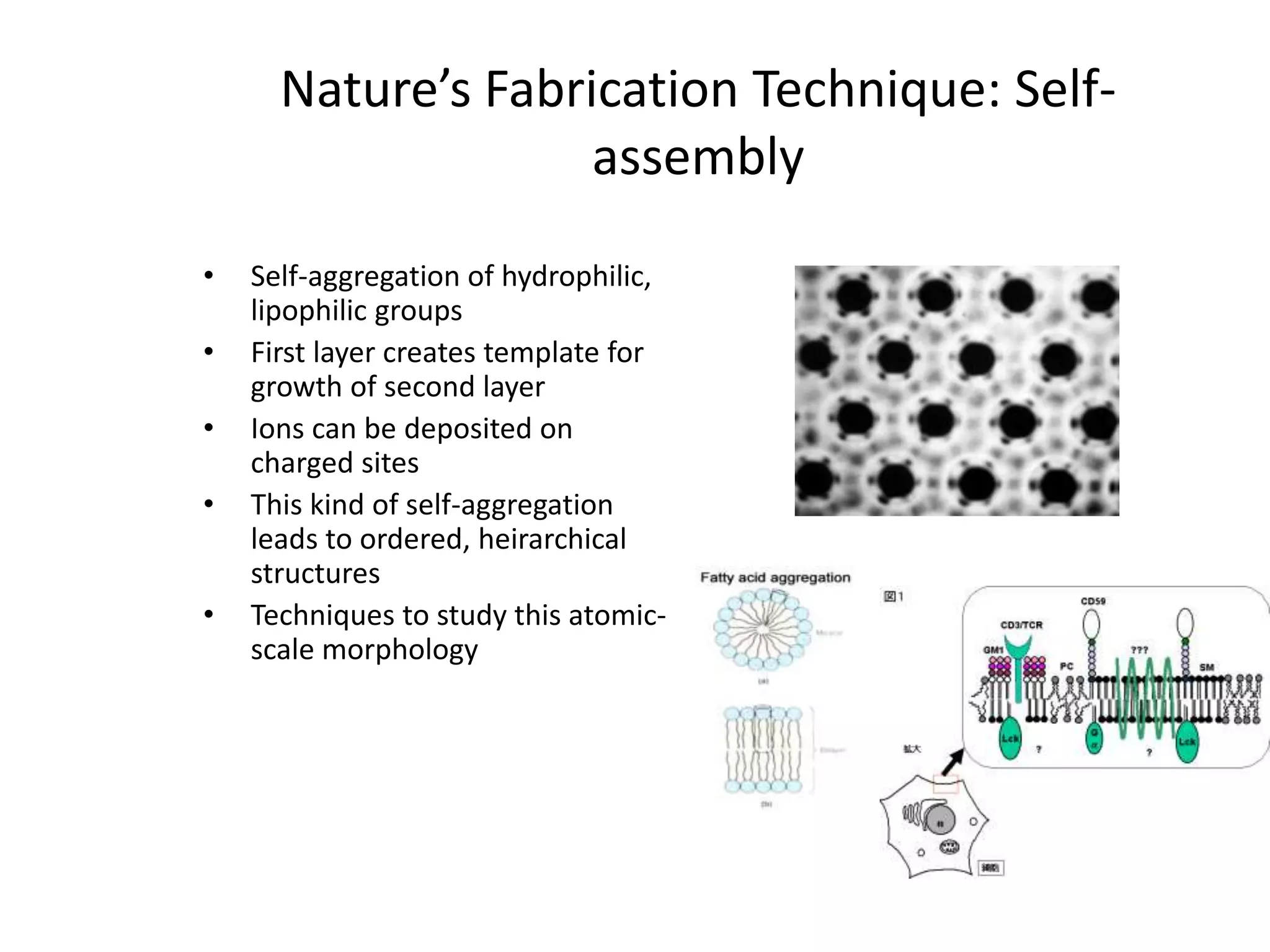
• Self-aggregation of hydrophilic,
lipophilic groups
• First layer creates template for
growth of second layer
• Ions can be deposited on
charged sites
• This kind of self-aggregation
leads to ordered, heirarchical
structures
• Techniques to study this atomic-
scale morphology
Nanotechnology
aaaaaaaaaaa
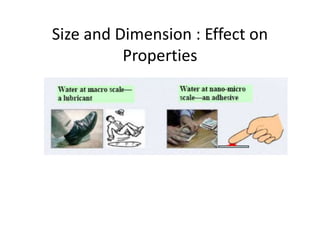
Size and Dimension : Effect on
Properties
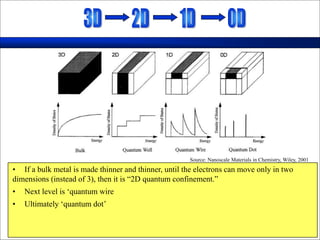
• If a bulk metal is made thinner and thinner, until the electrons can move only in two
dimensions (instead of 3), then it is “2D quantum confinement.”
• Next level is ‘quantum wire
• Ultimately ‘quantum dot’
Source: Nanoscale Materials in Chemistry, Wiley, 2001
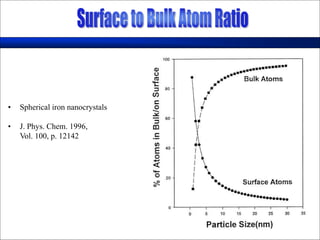
• Spherical iron nanocrystals
• J. Phys. Chem. 1996,
Vol. 100, p. 12142
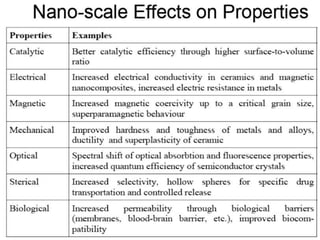
Nanoscale materials can
have different properties
Enhanced electrical or
heat conductivity ,
 Increased strength,
tensile properties ,
 Different magnetic
properties,
 Altered light reflection
– color changes w/ size
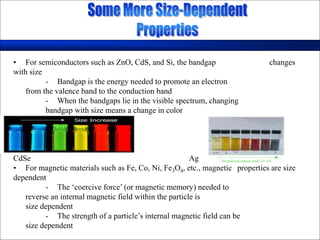
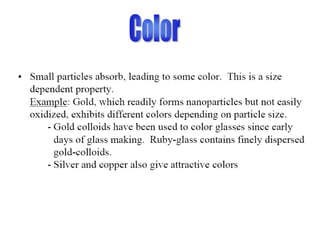
• For semiconductors such as ZnO, CdS, and Si, the bandgap changes
with size
- Bandgap is the energy needed to promote an electron
from the valence band to the conduction band
- When the bandgaps lie in the visible spectrum, changing
bandgap with size means a change in color
CdSe Ag
• For magnetic materials such as Fe, Co, Ni, Fe3O4, etc., magnetic properties are size
dependent
- The ‘coercive force’ (or magnetic memory) needed to
reverse an internal magnetic field within the particle is
size dependent
- The strength of a particle’s internal magnetic field can be
size dependent
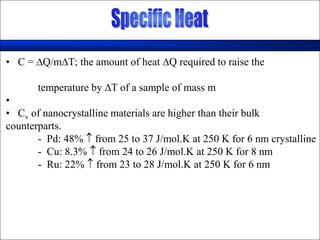
• C = ∆Q/m∆T; the amount of heat ∆Q required to raise the
temperature by ∆T of a sample of mass m
•
• Cv of nanocrystalline materials are higher than their bulk
counterparts.
- Pd: 48%  from 25 to 37 J/mol.K at 250 K for 6 nm crystalline
- Cu: 8.3%  from 24 to 26 J/mol.K at 250 K for 8 nm
- Ru: 22%  from 23 to 28 J/mol.K at 250 K for 6 nm
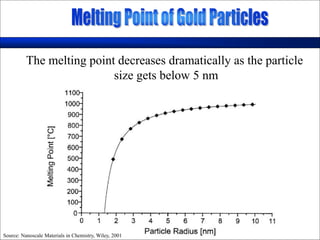
The melting point decreases dramatically as the particle
size gets below 5 nm
Source: Nanoscale Materials in Chemistry, Wiley, 2001
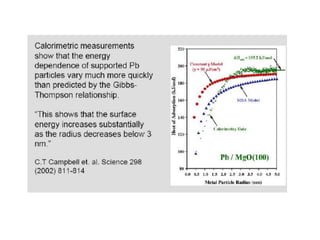
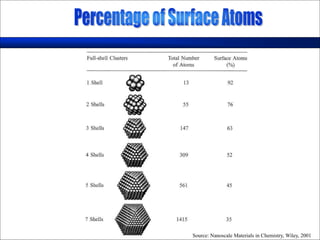
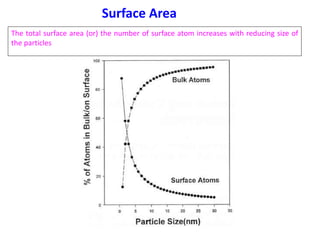
Surface Area
The total surface area (or) the number of surface atom increases with reducing size of
the particles
• For semiconductors such as ZnO, CdS, and Si, the bandgap changes with size
- Bandgap is the energy needed to promote an electron
from the valence band to the conduction band
- When the bandgaps lie in the visible spectrum, changing
bandgap with size means a change in color
• For magnetic materials such as Fe, Co, Ni, Fe3O4, etc., magnetic properties are size dependent
- The ‘coercive force’ (or magnetic memory) needed to reverse an
internal magnetic field within the particle is size dependent
- The strength of a particle’s internal magnetic field can be
size dependent
1.pptx

1.pptx

  • 1.
    Nature’s Fabrication Technique:Self- assembly • Self-aggregation of hydrophilic, lipophilic groups • First layer creates template for growth of second layer • Ions can be deposited on charged sites • This kind of self-aggregation leads to ordered, heirarchical structures • Techniques to study this atomic- scale morphology
  • 3.
  • 4.
  • 7.
    Size and Dimension: Effect on Properties
  • 8.
    • If abulk metal is made thinner and thinner, until the electrons can move only in two dimensions (instead of 3), then it is “2D quantum confinement.” • Next level is ‘quantum wire • Ultimately ‘quantum dot’ Source: Nanoscale Materials in Chemistry, Wiley, 2001
  • 10.
    Source: Nanoscale Materialsin Chemistry, Wiley, 2001
  • 11.
    • Spherical ironnanocrystals • J. Phys. Chem. 1996, Vol. 100, p. 12142
  • 12.
    Nanoscale materials can havedifferent properties Enhanced electrical or heat conductivity ,  Increased strength, tensile properties ,  Different magnetic properties,  Altered light reflection – color changes w/ size
  • 13.
    • For semiconductorssuch as ZnO, CdS, and Si, the bandgap changes with size - Bandgap is the energy needed to promote an electron from the valence band to the conduction band - When the bandgaps lie in the visible spectrum, changing bandgap with size means a change in color CdSe Ag • For magnetic materials such as Fe, Co, Ni, Fe3O4, etc., magnetic properties are size dependent - The ‘coercive force’ (or magnetic memory) needed to reverse an internal magnetic field within the particle is size dependent - The strength of a particle’s internal magnetic field can be size dependent
  • 14.
    • C =∆Q/m∆T; the amount of heat ∆Q required to raise the temperature by ∆T of a sample of mass m • • Cv of nanocrystalline materials are higher than their bulk counterparts. - Pd: 48%  from 25 to 37 J/mol.K at 250 K for 6 nm crystalline - Cu: 8.3%  from 24 to 26 J/mol.K at 250 K for 8 nm - Ru: 22%  from 23 to 28 J/mol.K at 250 K for 6 nm
  • 15.
    The melting pointdecreases dramatically as the particle size gets below 5 nm Source: Nanoscale Materials in Chemistry, Wiley, 2001
  • 17.
    Surface Area The totalsurface area (or) the number of surface atom increases with reducing size of the particles
  • 18.
    • For semiconductorssuch as ZnO, CdS, and Si, the bandgap changes with size - Bandgap is the energy needed to promote an electron from the valence band to the conduction band - When the bandgaps lie in the visible spectrum, changing bandgap with size means a change in color • For magnetic materials such as Fe, Co, Ni, Fe3O4, etc., magnetic properties are size dependent - The ‘coercive force’ (or magnetic memory) needed to reverse an internal magnetic field within the particle is size dependent - The strength of a particle’s internal magnetic field can be size dependent