See discussions, stats, and author profiles for this publication at: https://www.researchgate.net/publication/320704338
Systematic Literature Review in Computer Science - A Practical Guide
Technical Report · November 2016
DOI: 10.13140/RG.2.2.35453.87524
CITATIONS
53
READS
26,210
2 authors:
Rodrigo L. S. Silva
Federal University of Juiz de Fora
92 PUBLICATIONS 382 CITATIONS
SEE PROFILE
Fran Weidt Neiva
Federal University of Rio de Janeiro
20 PUBLICATIONS 407 CITATIONS
SEE PROFILE
All content following this page was uploaded by Rodrigo L. S. Silva on 29 October 2017.
The user has requested enhancement of the downloaded file.
Federal​ ​University​ ​of​ ​Juiz​ ​de​ ​Fora
Technical​ ​Report​ ​of​ ​Computer​ ​Science​ ​Department
RelaTeDCC​ ​002/2016
Systematic​ ​Literature​ ​Review​ ​in
Computer​ ​Science​ ​-​ ​A​ ​Practical​ ​Guide
Frâncila​ ​Weidt​ ​Neiva​ ​and​ ​Rodrigo​ ​Luis​ ​de​ ​Souza​ ​da​ ​Silva
This work aims to provide a practical guide to assist students of Computer Science
courses and related fields to conduct a systematic literature review. The steps proposed
in this paper to conduct a systematic review were extracted from a technical report
published by the researcher Bárbara Kitchenham [1] and arranged in a more objective
format, in order to make information more accessible and practical, especially for those
who are having their first contact with this technique. The target audience for this work
are undergraduate, master's and doctoral students that are in the initial phase of their
bibliographic​ ​research.
November​ ​2016
Introduction
This document aims to provide a practical guide to assist students in conducting a systematic
literature (SLR). It is interesting to use this guide with examples of systematic reviews already
published, so that the researcher can view the steps outlined in this guide (for example, [​2​][​3​]). This
guide​ ​is​ ​based​ ​on​ ​the​ ​technical​ ​report​ ​proposed​ ​by​ ​Barbara​ ​Kitchenham​ ​in​ ​2007​ ​[​1​].
Before starting a systematic review, it is interesting to see if there is already a review covering the
defined scope. Considering there is no systematic review published covering the defined scope, the
following​ ​steps​ ​should​ ​be​ ​considered:
1. Defining​ ​the​ ​main​ ​research​ ​questions​ ​of​ ​the​ ​literature​ ​review
Here come the questions that guide what the author wants to figure out with the research. (For
example: What technique is being used to solve a particular problem on Software Engineering or
Computer​ ​Graphics?).
2. Defining​ ​keywords.
There are several techniques that can be used to find these keywords (the idea is to use one or more
of​ ​the​ ​items​ ​below):
a. Analyze​ ​the​ ​research​ ​questions​ ​and​ ​extract​ ​the​ ​first​ ​keywords;
b. Use papers from the area of interest to find new words and synonyms of the words already
found;
c. Define​ ​the​ ​PICOC​ ​[​4​]​ ​to​ ​better​ ​delineate​ ​the​ ​scope/​ ​aims​ ​of​ ​the​ ​systematic​ ​review​ ​(optional).
3. Defining​ ​search​ ​string
The basic rule is to separate the keywords. For each separated word, find its synonyms and
concatenate them with the OR connector. After the definition of the groups of words with their
synonyms, concatenate them with AND to end the string. See below an example of a search string
extracted​ ​from​ ​[​5​]:
(pragmatic OR pragmatics OR pragmatism) AND (interoperability OR interoperate OR interoperable OR interoperation
OR similarity OR integrate OR integration) AND (solution OR method OR technique OR model OR tool OR framework OR
architecture​ ​OR​ ​infrastructure​ ​OR​ ​approach)​ ​AND​ ​(computational​ ​OR​ ​system​ ​OR​ ​application​ ​OR​ ​software)
2
4. Defining​ ​search​ ​engines
This definition depends on the area of systematic review. In general, considering the main electronic
search engines that include the researches produced in the area of Computer Science, the revision
should​ ​cover​ ​part​ ​(if​ ​not​ ​all)​ ​of​ ​the​ ​following​ ​bases:
a. IEEE​ ​Xplore​​ ​(​www.ieeexplore.com.br​)
b. Scopus​​ ​(​www.scopus.com​)
c. ScienceDirect​​ ​(​www.sciencedirect.com​)
d. Springer​ ​(​www.springerlink.com​)
e. ACM​ ​(​www.portal.acm.org​)
f. Compendex​ ​(​www.engineeringvillage.com​)
5. String​ ​refinement
The idea is to test the string defined in the previous item in one of the search engines (for example,
Scopus). Once the string is performed, verify if the returned papers appear to be relevant. Known
papers that are potential candidates for primary studies of this review (which exist on these engines)
should appear in the search. If no relevant results appear, the search string must be parsed again to
be​ ​calibrated.
The refinement of the search criteria in each database (search by title, abstract and keywords or
complete, limitation or not per year, limitation or not by area, etc.) should be analyzed on a
case-by-case​ ​basis.
Figure​ ​1​ ​shows​ ​the​ ​example​ ​of​ ​a​ ​search​ ​string​ ​being​ ​created​ ​on​ ​the​ ​Scopus​ ​database.
Fig.​ ​1:​ ​Advanced​ ​search​ ​example​ ​in​ ​the​ ​SCOPUS​ ​database​ ​(Extracted​ ​from​ ​[6]).
See​ ​more​ ​about​ ​how​ ​to​ ​search​ ​SCOPUS​ ​in​ ​[6].
3
6. Search​ ​string​ ​execution
Once the search string is defined, it must be adapted to each of the search engines, since the syntax
used by each one is different. It is always interesting to keep in a document what string was used,
how many articles each base returned, and the date of execution. If it is necessary to run the search
again (either by the author or by a researcher who intends to continue the work), you can execute the
complete string or restrict to the period that the initial execution succeeds, just complementing the
results.
7. Download​ ​and​ ​store​ ​search​ ​results
All major search engines allow you to explore the set of selected results in various formats. The main
formats are BIB (preferably) and CSV. These formats will be used as input for reference
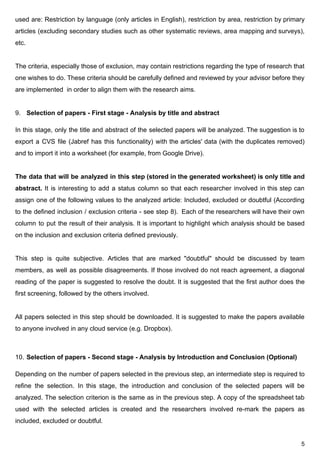
management tools. When choosing the option to download, ​it is important to select citation and
abstract​ ​​ ​information​ ​(Figure​ ​2)​.
​ ​​ ​​ ​​ ​​ ​​ ​​ ​
​ ​​ ​​ ​​ ​​ ​​ ​​ ​​ ​​ ​​ ​​ ​​ ​​ ​​ ​​ ​​ ​​ ​​ ​​ ​​ ​​ ​​ ​​ ​​ ​​ ​​ ​​ ​​ ​​ ​​ ​​ ​​ ​​​ ​​​ ​Fig.​ ​2:​ ​Example​ ​of​ ​export​ ​option​ ​in​ ​SCOPUS​ ​database.
There are several reference management tools that can be used such as ​JabRef and ​Mendeley​. For
a systematic review, we use these tools primarily to manage downloaded references and remove
duplicate​ ​papers​ ​returned​ ​from​ ​different​ ​search​ ​engines.
8. Define​​ ​​inclusion​ ​and​ ​exclusion​ ​criteria
In this step the criteria to decide which papers will go to the next stage of the review will be defined.
The criteria should be defined from the research questions (see step 1). Other criteria that may be
4
used are: Restriction by language (only articles in English), restriction by area, restriction by primary
articles (excluding secondary studies such as other systematic reviews, area mapping and surveys),
etc.
The criteria, especially those of exclusion, may contain restrictions regarding the type of research that
one wishes to do. These criteria should be carefully defined and reviewed by your advisor before they
are​ ​implemented​ ​​ ​in​ ​order​ ​to​ ​align​ ​them​ ​with​ ​the​ ​research​ ​aims.
9. Selection​ ​of​ ​papers​ ​-​ ​First​ ​stage​ ​-​ ​Analysis​ ​by​ ​title​ ​and​ ​abstract
In this stage, only the title and abstract of the selected papers will be analyzed. The suggestion is to
export a CVS file (Jabref has this functionality) with the articles' data (with the duplicates removed)
and​ ​to​ ​import​ ​it​ ​into​ ​a​ ​worksheet​ ​(for​ ​example,​ ​from​ ​Google​ ​Drive).
The data that will be analyzed in this step (stored in the generated worksheet) is only title and
abstract. ​It is interesting to add a status column so that each researcher involved in this step can
assign one of the following values to the analyzed article: Included, excluded or doubtful (According
to the defined inclusion / exclusion criteria - see step 8). Each of the researchers will have their own
column to put the result of their analysis. It is important to highlight which analysis should be based
on​ ​the​ ​inclusion​ ​and​ ​exclusion​ ​criteria​ ​defined​ ​previously.
This step is quite subjective. Articles that are marked "doubtful" should be discussed by team
members, as well as possible disagreements. If those involved do not reach agreement, a diagonal
reading of the paper is suggested to resolve the doubt. It is suggested that the first author does the
first​ ​screening,​ ​followed​ ​by​ ​the​ ​others​ ​involved.
All papers selected in this step should be downloaded. It is suggested to make the papers available
to​ ​anyone​ ​involved​ ​in​ ​any​ ​cloud​ ​service​ ​(e.g.​ ​Dropbox).
10. Selection​ ​of​ ​papers​ ​-​ ​Second​ ​stage​ ​-​ ​Analysis​ ​by​ ​Introduction​ ​and​ ​Conclusion​ ​(Optional)
Depending on the number of papers selected in the previous step, an intermediate step is required to
refine the selection. In this stage, the introduction and conclusion of the selected papers will be
analyzed. The selection criterion is the same as in the previous step. A copy of the spreadsheet tab
used with the selected articles is created and the researchers involved re-mark the papers as
included,​ ​excluded​ ​or​ ​doubtful.
5
11. Selection​ ​of​ ​papers​ ​-​ ​Third​ ​stage​ ​-​ ​Complete​ ​reading​ ​and​ ​quality​ ​checklist
In this last stage, quality criteria (checklist) should be defined to verify the suitability of the papers
analyzed. Besides the checklist, it is interesting to set a cut-off point so that less-qualified papers
(according to the defined checklist) can be deleted. The lead author should do all the initial work
(reading all articles, applying the checklist, deleting the articles below the cutoff point). This stage
should​ ​be​ ​guided​ ​by​ ​the​ ​advisors.
12. Extraction​ ​of​ ​answers​ ​related​ ​to​ ​research​ ​questions
At this stage, the research questions should be answered by analyzing the papers selected in the
previous step. You can create a spreadsheet with the papers (title or ID) in the rows and the query
questions in the columns. Then, when proceeding with the reading of the articles, the possible
answers​ ​extracted​ ​may​ ​be​ ​posted​ ​directly​ ​to​ ​the​ ​spreadsheet.
The synthesis of the extracted data can be presented in different forms. Usually, tables, graphs and
other artifacts are used to facilitate the visualization of this information. ​This step can be performed in
conjunction​ ​with​ ​the​ ​previous​ ​step.
Conclusion
Systematic literature reviews have been extensively used to identify, evaluate and interpret the
studies published in the literature. A systematic review allows the researcher to collect evidence in
order to identify research opportunities in a given field of study. ​Thus, systematic literature reviews
are highly recommended for students who are starting their research and wish to evaluate effectively
a particular area and clearly understand how their proposal may contribute considering what has
already​ ​been​ ​published.
The main contribution of this work is to assist in the construction of systematic literature review
focused on the Computer Science. To achieve this goal, we developed a practical and concise guide
that assists in simple and didactic steps the conduction of a systematic review in accordance with the
technique​ ​discussed​ ​by​ ​Barbara​ ​in​ ​Kitchenham​ ​[1].
We hope that with the use of this guide, the implementation of this valuable technique becomes
easier, more accessible and be encouraged as an important step towards the production of quality
research.
6
References
[1] Kitchenham, B., Charters, S. ​Guidelines for performing systematic literature reviews in software
engineering​​ ​(version​ ​2.3).​ ​Technical​ ​report,​ ​Keele​ ​University​ ​and​ ​University​ ​of​ ​Durham,​ ​2007.
[2] Usman, M., Mendes, E., Weidt, F., Britto, R., ​Effort estimation in agile software development: A
systematic literature review​, in Proceedings of the 10th International Conference on Predictive
Models​ ​in​ ​Software​ ​Engineering,​ ​New​ ​York,​ ​2014,​ ​pp.​ ​82–91.
[3] Santos, A., Delamaro, M., Nunes, F. ​The Relationship between Requirements Engineering and
Virtual Reality Systems: A Systematic Literature Review​. In Symposium on Virtual and
Augmented​ ​Reality​ ​(SVR),​ ​2013,​ ​pp.​ ​53–62.
[4] Petticrew, M., Roberts, H. ​Systematic Reviews in the Social Sciences: A Practical Guide​, John
Wiley​ ​&​ ​Sons,​ ​2008.
[5] ​Neiva, F.W., David, J.M.N., Braga, R. and Campos, F. ​Towards pragmatic interoperability to
support collaboration: A systematic review and mapping of the literature​. Information and
Software​ ​Technology,​ ​2016,​ ​pp.137-150.
[6]​ ​​ ​Elsevier.​ ​​Scopus​ ​-​ ​Acrescente​ ​valor​ ​a​ ​sua​ ​pesquisa​.​ ​​http://goo.gl/wIsQj2​.​ ​Accessed​ ​in
June/2016.
@techreport{relateufjf022016,
​ ​​ ​​ ​author​ ​​ ​​ ​​ ​​ ​​ ​​ ​=​ ​{Neiva,​ ​F.​ ​and​ ​Silva,​ ​R.L.S.},
​ ​​ ​​ ​title​ ​​ ​​ ​​ ​​ ​​ ​​ ​​ ​=​ ​{Systematic​ ​Literature​ ​Review​ ​in​ ​Computer​ ​Science​ ​-​ ​A​ ​Practical​ ​Guide},
​ ​​ ​​ ​institution​ ​​ ​=​ ​{Federal​ ​University​ ​of​ ​Juiz​ ​de​ ​Fora},
​ ​​ ​​ ​year​ ​​ ​​ ​​ ​​ ​​ ​​ ​​ ​​ ​=​ ​{2016},
​ ​​ ​​ ​number​ ​​ ​​ ​​ ​​ ​​ ​​ ​=​ ​{1},
​ ​​ ​​ ​month​ ​​ ​​ ​​ ​​ ​​ ​​ ​​ ​=​ ​{November},
​ ​​ ​​ ​abstract​ ​​ ​​ ​​ ​​ ​=​ ​{This​ ​work​ ​aims​ ​to​ ​provide​ ​a​ ​practical​ ​guide​ ​to​ ​assist​ ​students​ ​of​ ​Computer
Science​ ​courses​ ​and​ ​related​ ​fields​ ​to​ ​conduct​ ​a​ ​systematic​ ​literature​ ​review.​ ​The​ ​steps
proposed​ ​in​ ​this​ ​paper​ ​to​ ​conduct​ ​a​ ​systematic​ ​review​ ​were​ ​extracted​ ​from​ ​a​ ​technical​ ​report
published​ ​by​ ​the​ ​researcher​ ​Bárbara​ ​Kitchenham​ ​[1]​ ​and​ ​arranged​ ​in​ ​a​ ​more​ ​objective​ ​format,​ ​in
order​ ​to​ ​make​ ​information​ ​more​ ​accessible​ ​and​ ​practical,​ ​especially​ ​for​ ​those​ ​who​ ​are​ ​having
their​ ​first​ ​contact​ ​with​ ​this​ ​technique.​ ​The​ ​target​ ​audience​ ​for​ ​this​ ​work​ ​are​ ​undergraduate,
master's​ ​and​ ​doctoral​ ​students​ ​that​ ​are​ ​in​ ​the​ ​initial​ ​phase​ ​of​ ​their​ ​bibliographic​ ​research.}
}
7
View publication stats

1.pdf

  • 1.
    See discussions, stats,and author profiles for this publication at: https://www.researchgate.net/publication/320704338 Systematic Literature Review in Computer Science - A Practical Guide Technical Report · November 2016 DOI: 10.13140/RG.2.2.35453.87524 CITATIONS 53 READS 26,210 2 authors: Rodrigo L. S. Silva Federal University of Juiz de Fora 92 PUBLICATIONS 382 CITATIONS SEE PROFILE Fran Weidt Neiva Federal University of Rio de Janeiro 20 PUBLICATIONS 407 CITATIONS SEE PROFILE All content following this page was uploaded by Rodrigo L. S. Silva on 29 October 2017. The user has requested enhancement of the downloaded file.
  • 2.
    Federal​ ​University​ ​of​​Juiz​ ​de​ ​Fora Technical​ ​Report​ ​of​ ​Computer​ ​Science​ ​Department RelaTeDCC​ ​002/2016 Systematic​ ​Literature​ ​Review​ ​in Computer​ ​Science​ ​-​ ​A​ ​Practical​ ​Guide Frâncila​ ​Weidt​ ​Neiva​ ​and​ ​Rodrigo​ ​Luis​ ​de​ ​Souza​ ​da​ ​Silva This work aims to provide a practical guide to assist students of Computer Science courses and related fields to conduct a systematic literature review. The steps proposed in this paper to conduct a systematic review were extracted from a technical report published by the researcher Bárbara Kitchenham [1] and arranged in a more objective format, in order to make information more accessible and practical, especially for those who are having their first contact with this technique. The target audience for this work are undergraduate, master's and doctoral students that are in the initial phase of their bibliographic​ ​research. November​ ​2016
  • 3.
    Introduction This document aimsto provide a practical guide to assist students in conducting a systematic literature (SLR). It is interesting to use this guide with examples of systematic reviews already published, so that the researcher can view the steps outlined in this guide (for example, [​2​][​3​]). This guide​ ​is​ ​based​ ​on​ ​the​ ​technical​ ​report​ ​proposed​ ​by​ ​Barbara​ ​Kitchenham​ ​in​ ​2007​ ​[​1​]. Before starting a systematic review, it is interesting to see if there is already a review covering the defined scope. Considering there is no systematic review published covering the defined scope, the following​ ​steps​ ​should​ ​be​ ​considered: 1. Defining​ ​the​ ​main​ ​research​ ​questions​ ​of​ ​the​ ​literature​ ​review Here come the questions that guide what the author wants to figure out with the research. (For example: What technique is being used to solve a particular problem on Software Engineering or Computer​ ​Graphics?). 2. Defining​ ​keywords. There are several techniques that can be used to find these keywords (the idea is to use one or more of​ ​the​ ​items​ ​below): a. Analyze​ ​the​ ​research​ ​questions​ ​and​ ​extract​ ​the​ ​first​ ​keywords; b. Use papers from the area of interest to find new words and synonyms of the words already found; c. Define​ ​the​ ​PICOC​ ​[​4​]​ ​to​ ​better​ ​delineate​ ​the​ ​scope/​ ​aims​ ​of​ ​the​ ​systematic​ ​review​ ​(optional). 3. Defining​ ​search​ ​string The basic rule is to separate the keywords. For each separated word, find its synonyms and concatenate them with the OR connector. After the definition of the groups of words with their synonyms, concatenate them with AND to end the string. See below an example of a search string extracted​ ​from​ ​[​5​]: (pragmatic OR pragmatics OR pragmatism) AND (interoperability OR interoperate OR interoperable OR interoperation OR similarity OR integrate OR integration) AND (solution OR method OR technique OR model OR tool OR framework OR architecture​ ​OR​ ​infrastructure​ ​OR​ ​approach)​ ​AND​ ​(computational​ ​OR​ ​system​ ​OR​ ​application​ ​OR​ ​software) 2
  • 4.
    4. Defining​ ​search​​engines This definition depends on the area of systematic review. In general, considering the main electronic search engines that include the researches produced in the area of Computer Science, the revision should​ ​cover​ ​part​ ​(if​ ​not​ ​all)​ ​of​ ​the​ ​following​ ​bases: a. IEEE​ ​Xplore​​ ​(​www.ieeexplore.com.br​) b. Scopus​​ ​(​www.scopus.com​) c. ScienceDirect​​ ​(​www.sciencedirect.com​) d. Springer​ ​(​www.springerlink.com​) e. ACM​ ​(​www.portal.acm.org​) f. Compendex​ ​(​www.engineeringvillage.com​) 5. String​ ​refinement The idea is to test the string defined in the previous item in one of the search engines (for example, Scopus). Once the string is performed, verify if the returned papers appear to be relevant. Known papers that are potential candidates for primary studies of this review (which exist on these engines) should appear in the search. If no relevant results appear, the search string must be parsed again to be​ ​calibrated. The refinement of the search criteria in each database (search by title, abstract and keywords or complete, limitation or not per year, limitation or not by area, etc.) should be analyzed on a case-by-case​ ​basis. Figure​ ​1​ ​shows​ ​the​ ​example​ ​of​ ​a​ ​search​ ​string​ ​being​ ​created​ ​on​ ​the​ ​Scopus​ ​database. Fig.​ ​1:​ ​Advanced​ ​search​ ​example​ ​in​ ​the​ ​SCOPUS​ ​database​ ​(Extracted​ ​from​ ​[6]). See​ ​more​ ​about​ ​how​ ​to​ ​search​ ​SCOPUS​ ​in​ ​[6]. 3
  • 5.
    6. Search​ ​string​​execution Once the search string is defined, it must be adapted to each of the search engines, since the syntax used by each one is different. It is always interesting to keep in a document what string was used, how many articles each base returned, and the date of execution. If it is necessary to run the search again (either by the author or by a researcher who intends to continue the work), you can execute the complete string or restrict to the period that the initial execution succeeds, just complementing the results. 7. Download​ ​and​ ​store​ ​search​ ​results All major search engines allow you to explore the set of selected results in various formats. The main formats are BIB (preferably) and CSV. These formats will be used as input for reference management tools. When choosing the option to download, ​it is important to select citation and abstract​ ​​ ​information​ ​(Figure​ ​2)​. ​ ​​ ​​ ​​ ​​ ​​ ​​ ​ ​ ​​ ​​ ​​ ​​ ​​ ​​ ​​ ​​ ​​ ​​ ​​ ​​ ​​ ​​ ​​ ​​ ​​ ​​ ​​ ​​ ​​ ​​ ​​ ​​ ​​ ​​ ​​ ​​ ​​ ​​ ​​ ​​​ ​​​ ​Fig.​ ​2:​ ​Example​ ​of​ ​export​ ​option​ ​in​ ​SCOPUS​ ​database. There are several reference management tools that can be used such as ​JabRef and ​Mendeley​. For a systematic review, we use these tools primarily to manage downloaded references and remove duplicate​ ​papers​ ​returned​ ​from​ ​different​ ​search​ ​engines. 8. Define​​ ​​inclusion​ ​and​ ​exclusion​ ​criteria In this step the criteria to decide which papers will go to the next stage of the review will be defined. The criteria should be defined from the research questions (see step 1). Other criteria that may be 4
  • 6.
    used are: Restrictionby language (only articles in English), restriction by area, restriction by primary articles (excluding secondary studies such as other systematic reviews, area mapping and surveys), etc. The criteria, especially those of exclusion, may contain restrictions regarding the type of research that one wishes to do. These criteria should be carefully defined and reviewed by your advisor before they are​ ​implemented​ ​​ ​in​ ​order​ ​to​ ​align​ ​them​ ​with​ ​the​ ​research​ ​aims. 9. Selection​ ​of​ ​papers​ ​-​ ​First​ ​stage​ ​-​ ​Analysis​ ​by​ ​title​ ​and​ ​abstract In this stage, only the title and abstract of the selected papers will be analyzed. The suggestion is to export a CVS file (Jabref has this functionality) with the articles' data (with the duplicates removed) and​ ​to​ ​import​ ​it​ ​into​ ​a​ ​worksheet​ ​(for​ ​example,​ ​from​ ​Google​ ​Drive). The data that will be analyzed in this step (stored in the generated worksheet) is only title and abstract. ​It is interesting to add a status column so that each researcher involved in this step can assign one of the following values to the analyzed article: Included, excluded or doubtful (According to the defined inclusion / exclusion criteria - see step 8). Each of the researchers will have their own column to put the result of their analysis. It is important to highlight which analysis should be based on​ ​the​ ​inclusion​ ​and​ ​exclusion​ ​criteria​ ​defined​ ​previously. This step is quite subjective. Articles that are marked "doubtful" should be discussed by team members, as well as possible disagreements. If those involved do not reach agreement, a diagonal reading of the paper is suggested to resolve the doubt. It is suggested that the first author does the first​ ​screening,​ ​followed​ ​by​ ​the​ ​others​ ​involved. All papers selected in this step should be downloaded. It is suggested to make the papers available to​ ​anyone​ ​involved​ ​in​ ​any​ ​cloud​ ​service​ ​(e.g.​ ​Dropbox). 10. Selection​ ​of​ ​papers​ ​-​ ​Second​ ​stage​ ​-​ ​Analysis​ ​by​ ​Introduction​ ​and​ ​Conclusion​ ​(Optional) Depending on the number of papers selected in the previous step, an intermediate step is required to refine the selection. In this stage, the introduction and conclusion of the selected papers will be analyzed. The selection criterion is the same as in the previous step. A copy of the spreadsheet tab used with the selected articles is created and the researchers involved re-mark the papers as included,​ ​excluded​ ​or​ ​doubtful. 5
  • 7.
    11. Selection​ ​of​​papers​ ​-​ ​Third​ ​stage​ ​-​ ​Complete​ ​reading​ ​and​ ​quality​ ​checklist In this last stage, quality criteria (checklist) should be defined to verify the suitability of the papers analyzed. Besides the checklist, it is interesting to set a cut-off point so that less-qualified papers (according to the defined checklist) can be deleted. The lead author should do all the initial work (reading all articles, applying the checklist, deleting the articles below the cutoff point). This stage should​ ​be​ ​guided​ ​by​ ​the​ ​advisors. 12. Extraction​ ​of​ ​answers​ ​related​ ​to​ ​research​ ​questions At this stage, the research questions should be answered by analyzing the papers selected in the previous step. You can create a spreadsheet with the papers (title or ID) in the rows and the query questions in the columns. Then, when proceeding with the reading of the articles, the possible answers​ ​extracted​ ​may​ ​be​ ​posted​ ​directly​ ​to​ ​the​ ​spreadsheet. The synthesis of the extracted data can be presented in different forms. Usually, tables, graphs and other artifacts are used to facilitate the visualization of this information. ​This step can be performed in conjunction​ ​with​ ​the​ ​previous​ ​step. Conclusion Systematic literature reviews have been extensively used to identify, evaluate and interpret the studies published in the literature. A systematic review allows the researcher to collect evidence in order to identify research opportunities in a given field of study. ​Thus, systematic literature reviews are highly recommended for students who are starting their research and wish to evaluate effectively a particular area and clearly understand how their proposal may contribute considering what has already​ ​been​ ​published. The main contribution of this work is to assist in the construction of systematic literature review focused on the Computer Science. To achieve this goal, we developed a practical and concise guide that assists in simple and didactic steps the conduction of a systematic review in accordance with the technique​ ​discussed​ ​by​ ​Barbara​ ​in​ ​Kitchenham​ ​[1]. We hope that with the use of this guide, the implementation of this valuable technique becomes easier, more accessible and be encouraged as an important step towards the production of quality research. 6
  • 8.
    References [1] Kitchenham, B.,Charters, S. ​Guidelines for performing systematic literature reviews in software engineering​​ ​(version​ ​2.3).​ ​Technical​ ​report,​ ​Keele​ ​University​ ​and​ ​University​ ​of​ ​Durham,​ ​2007. [2] Usman, M., Mendes, E., Weidt, F., Britto, R., ​Effort estimation in agile software development: A systematic literature review​, in Proceedings of the 10th International Conference on Predictive Models​ ​in​ ​Software​ ​Engineering,​ ​New​ ​York,​ ​2014,​ ​pp.​ ​82–91. [3] Santos, A., Delamaro, M., Nunes, F. ​The Relationship between Requirements Engineering and Virtual Reality Systems: A Systematic Literature Review​. In Symposium on Virtual and Augmented​ ​Reality​ ​(SVR),​ ​2013,​ ​pp.​ ​53–62. [4] Petticrew, M., Roberts, H. ​Systematic Reviews in the Social Sciences: A Practical Guide​, John Wiley​ ​&​ ​Sons,​ ​2008. [5] ​Neiva, F.W., David, J.M.N., Braga, R. and Campos, F. ​Towards pragmatic interoperability to support collaboration: A systematic review and mapping of the literature​. Information and Software​ ​Technology,​ ​2016,​ ​pp.137-150. [6]​ ​​ ​Elsevier.​ ​​Scopus​ ​-​ ​Acrescente​ ​valor​ ​a​ ​sua​ ​pesquisa​.​ ​​http://goo.gl/wIsQj2​.​ ​Accessed​ ​in June/2016. @techreport{relateufjf022016, ​ ​​ ​​ ​author​ ​​ ​​ ​​ ​​ ​​ ​​ ​=​ ​{Neiva,​ ​F.​ ​and​ ​Silva,​ ​R.L.S.}, ​ ​​ ​​ ​title​ ​​ ​​ ​​ ​​ ​​ ​​ ​​ ​=​ ​{Systematic​ ​Literature​ ​Review​ ​in​ ​Computer​ ​Science​ ​-​ ​A​ ​Practical​ ​Guide}, ​ ​​ ​​ ​institution​ ​​ ​=​ ​{Federal​ ​University​ ​of​ ​Juiz​ ​de​ ​Fora}, ​ ​​ ​​ ​year​ ​​ ​​ ​​ ​​ ​​ ​​ ​​ ​​ ​=​ ​{2016}, ​ ​​ ​​ ​number​ ​​ ​​ ​​ ​​ ​​ ​​ ​=​ ​{1}, ​ ​​ ​​ ​month​ ​​ ​​ ​​ ​​ ​​ ​​ ​​ ​=​ ​{November}, ​ ​​ ​​ ​abstract​ ​​ ​​ ​​ ​​ ​=​ ​{This​ ​work​ ​aims​ ​to​ ​provide​ ​a​ ​practical​ ​guide​ ​to​ ​assist​ ​students​ ​of​ ​Computer Science​ ​courses​ ​and​ ​related​ ​fields​ ​to​ ​conduct​ ​a​ ​systematic​ ​literature​ ​review.​ ​The​ ​steps proposed​ ​in​ ​this​ ​paper​ ​to​ ​conduct​ ​a​ ​systematic​ ​review​ ​were​ ​extracted​ ​from​ ​a​ ​technical​ ​report published​ ​by​ ​the​ ​researcher​ ​Bárbara​ ​Kitchenham​ ​[1]​ ​and​ ​arranged​ ​in​ ​a​ ​more​ ​objective​ ​format,​ ​in order​ ​to​ ​make​ ​information​ ​more​ ​accessible​ ​and​ ​practical,​ ​especially​ ​for​ ​those​ ​who​ ​are​ ​having their​ ​first​ ​contact​ ​with​ ​this​ ​technique.​ ​The​ ​target​ ​audience​ ​for​ ​this​ ​work​ ​are​ ​undergraduate, master's​ ​and​ ​doctoral​ ​students​ ​that​ ​are​ ​in​ ​the​ ​initial​ ​phase​ ​of​ ​their​ ​bibliographic​ ​research.} } 7 View publication stats