Meaning and Definition of Finance
• Financial management provides a conceptual framework and
analytical tool for financial decision making
• Finance is the art and science of managing wealth
• It is about making decisions regarding what assets to buy/sell and
when to buy/ sell these assets
• Its main objective is to make individuals and their business grow
financially
• Financial management is concerned with the acquisition, financing, and management of assets
with some overall goal in mind.
• Thus, the decision function of financial management can be broken down into three major areas:
the investment, financing, and asset management decisions.
Definition
“Financial management is that area of business
management devoted to a judicious use of capital and a
careful selection of the source of capital in order to
enable a spending unit to move in the direction of
reaching the goals.” – J.F. Brandley
Forms of Business organizations
Sole proprietorship–
• A type of business organization, in which only one person is the owner as well
as operator of the business, is known as Sole Proprietorship
• Proprietor is solely responsible for the profits & losses
• Scope for raising capital is limited
• Unlimited personal liability for the debts of the business
• All income is taxed as personal income
Partnership-
• A business form in which two or more persons agree to carry on business and
share profits & losses is known as Partnership
• Indian Partnership Act, 1932 is the governing act
• Minimum partner is 2 and maximum is 100 partners
• Profit & Loss is shared in agreed ratio
• Property cannot be held in the name of firm
• The partnership firm is constituted under a contract between the partners.
• The contract between the partners is known as a partnership deed which
regulates the relationship among the partners and also between the partners and
the partnership firm.
• General partners and limited partners
Limited Liability Partnership (LLP)
• Limited Liability Partnership is a form of business operation which combines the
features of a partnership and a body corporate.
• The LLP can continue its existence irrespective of changes in partners.
• It is capable of entering into contracts and holding property in its own name.
• The LLP is a separate legal entity, is liable to the full extent of its assets but
liability of the partners is limited to their agreed contribution in the LLP.
• Limited Liability Partnership Act, 2008
• Registration is mandatory
• Charter document is LLP Document
• Audit of accounts is mandatory, only if turnover and capital contribution
overreaches 40 lakhs and 25 lakhs respectively.
Corporations-Joint stock company –
• Company is a distinct legal person formed under the Companies Act,2013
• A joint stock company is an organisation which is owned jointly by all its shareholders.
• All the stakeholders have a specific portion of stock owned, usually displayed as a
share.
• A joint stock company is an individual legal entity
• Perpetual in nature
• Shareholders Liability is limited
• Private limited or public limited company
• Minimum number of persons
• The growth potential is high due to access to funds
• Transferability of ownership
Private Limited Company & Public Limited Company
• Minimum number of persons- two in case of private company and Seven in case of
public company
• Maximum persons- 200 for a private co. and unlimited for a public co.
• Subscription of shares – Public co. allowed
• Transferability of shares-restricted in Private co.
• Disclosure of Financial Report- Only a public company needs to disclose its
financial reports quarterly and annual.
Government Company
• Government company means any company in which not less than fifty-one per
cent of the [paid-up share capital] is held by the Central Government, or by any
State Government or Governments, or partly by the Central Government and
partly by one or more State Governments
One Person Company (OPC)
• One Person Company (OPC) is a company incorporated by a single person.
Sec 8 Company
• A non-profit organization can be registered under the Registrar of
societies or as a Non-profit company under the Section 8 Company of
the Company Act,2013.
• The profits of this company, if there are any, are applied towards
promoting the objectives of the company and not distributed as dividends
to its shareholders
Real And Financial Assets
 Real Assets: Can be Tangible or Intangible
Tangible real assets are physical assets that include plant, machinery,
office, factory, furniture and building.
Intangible real assets include technical know-how, technological
collaborations, patents and copyrights.
 Financial Assets are also called securities, are financial papers or
instruments such as shares and bonds or debentures.
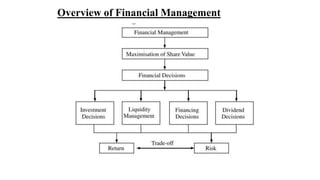
Overview of Financial Management
Investment decision/Capital budgeting
• Capital Budgeting is the process of evaluating and selecting long-term
investment projects that involve significant financial investment.
• It aims to maximize shareholder wealth by allocating resources to
projects with the highest potential returns.
• Key Steps:
• Identification of alternatives
• Evaluation
• Selection: Prioritize projects based on criteria such as Net Present Value
(NPV), Internal Rate of Return (IRR), Payback Period, and Profitability Index.
• Funding:
Financing decision/capital structure decision
• The financing decision involves determining the ideal mix of debt and
equity to fund a company's operations, projects, and growth
initiatives while maintaining financial stability.
• Trade-offs:
• a. Debt Advantages:
• Lower cost of capital (interest is tax-deductible)
• Financial leverage magnifies returns to shareholders
• b. Debt Disadvantages:
• Interest payments increase financial risk
• Default risk affects credibility of the company
Financing decision/capital structure decision
• c. Equity Advantages:
• No fixed interest payments
• Enhances financial flexibility
• d. Equity Disadvantages:
• Dilution of ownership
• Higher cost of equity
• Decision Making:
• Strive for an optimal capital structure that balances risk, cost, and growth
objectives. Factors such as industry norms, growth prospects, and company
life cycle stage influence the decision.
Dividend decision
• Definition: The dividend decision involves determining the amount of dividend
payments to shareholders from a company's profits.
• Objective: Striking a balance between distributing profits to shareholders and
retaining funds for reinvestment to support growth and operations.
• Trade-offs:
• a. Dividend Advantages:
• Rewards shareholders with consistent income
• Attracts the investors so share value increases in short term
• b. Dividend Disadvantages:
• Limits funds available from internal sources, company need to depend on external sources
for funds
• Decision Making:
• Balance the company's financial health, growth opportunities, and shareholder preferences
to determine appropriate dividend policies.
Working capital/Liquidity decision
• The working capital decision involves managing the company's short-
term assets and liabilities to ensure smooth operations and meet
daily financial obligations.
• Components:
• Working capital = current assets
• Net working capital= Current assets-current liabilities
• Current Assets: Include cash, accounts receivable, inventory, and short-term
investments.
• Current Liabilities: Encompass accounts payable, short-term loans, and
accrued expenses.
Working capital/Liquidity decision
• Trade-off
• Short term liquidity
• Long-term profitability
• Decision:
• Effective working capital management ensures the company has enough
liquidity to cover operational expenses and seize growth opportunities.
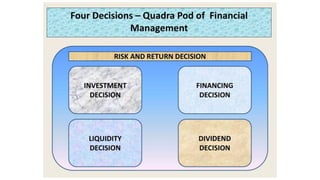
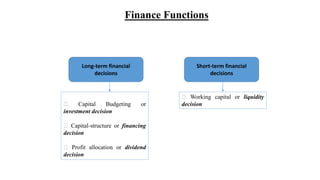
Finance Functions
Capital Budgeting or
investment decision
Capital-structure or financing
decision
Profit allocation or dividend
decision
Long-term financial
decisions
Short-term financial
decisions
Working capital or liquidity
decision
Capital Budgeting or Investment decision
• Evaluation of projects
• Cut-off rate
Capital-structure or Financing decision
• Proportion of debt-equity
• Optimal Capital Structure
Profit allocation or Dividend decision
• Deciding on dividend-payout ratio (Dividend paid/EPS)
• Future Investment opportunities
Working capital or Liquidity decision
• Trade-off between profitability and liquidity
Finance Manager’s Role
 Raising of Funds
 Allocation of Funds
 Profit Planning
 Understanding Capital Markets
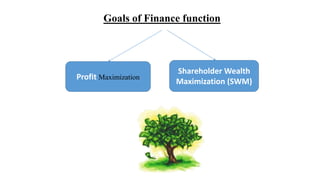
Goals of Finance function
Profit Maximization
Shareholder Wealth
Maximization (SWM)
Profit Maximization:
• Objective: Aims to maximize short-term profits, often measured in
terms of accounting profits.
• Considerations: Ignores time value of money and risks, potentially
leading to unsustainable practices.
• Approach: Focuses on revenue generation and cost reduction without
necessarily considering long-term consequences.
• Drawbacks: May lead to unethical practices, neglect of investment
opportunities, and damage to stakeholder relationships.
Wealth Maximization:
• Objective: Focuses on increasing the long-term value of the firm and
maximizing the wealth of shareholders.
• Considerations: Takes into account the time value of money and risk
factors, aiming to generate sustainable returns.
• Approach: Emphasizes quality of earnings, efficient resource
allocation, and strategic decision-making.
• Benefits: Aligns with shareholders' interests, promotes growth, and
supports overall financial health.
Profit maximization Vs wealth maximisation
• Time Horizon: Wealth maximization has a long-term focus, while profit
maximization is short-term oriented.
• Risk: Wealth maximization considers risk and return trade-offs, whereas profit
maximization may ignore risk factors.
• Sustainability: Wealth maximization aims for sustainable growth and value
creation, while profit maximization can lead to short-sighted decisions.
• Stakeholders: Wealth maximization considers the interests of all stakeholders,
while profit maximization may prioritize shareholders over other stakeholders.
• Decision Making:
• Wealth Maximization: Involves strategic planning, investment decisions, and risk
management to enhance overall company value.
• Profit Maximization: Focuses on maximizing current profits through pricing, cost control, and
short-term operational decisions.
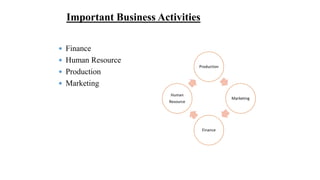
Important Business Activities
 Finance
 Human Resource
 Production
 Marketing
Production
Marketing
Finance
Human
Resource
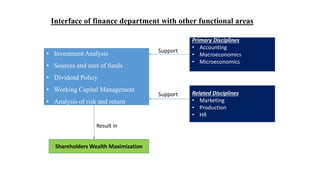
Interface of finance department with other functional areas
• Investment Analysis
• Sources and cost of funds
• Dividend Policy
• Working Capital Management
• Analysis of risk and return
Related Disciplines
• Marketing
• Production
• HR
Primary Disciplines
• Accounting
• Macroeconomics
• Microeconomics
Support
Support
Shareholders Wealth Maximization
Result in
• Operations Department:
• Collaboration: Finance works closely with operations to manage costs,
optimize production, and allocate resources efficiently.
• Objective: Ensure that operations are financially viable and aligned with the
company's overall financial goals.
• Marketing Department:
• Collaboration: Finance supports marketing by allocating budgets, evaluating
the financial impact of campaigns, and assessing ROI.
• Objective: Ensure marketing efforts contribute to revenue growth while
maintaining financial sustainability.
• Human Resources Department:
• Collaboration: Finance collaborates with HR to manage payroll, benefits, and
budgeting for employee-related expenses.
• Objective: Ensure a balance between employee compensation and the
company's financial capabilities.
• Supply Chain and Procurement Department:
• Collaboration: Finance collaborates to manage inventory levels, negotiate vendor
terms, and control supply chain costs.
• Objective: Optimize supply chain efficiency while controlling expenses to maintain
profitability.
• Sales Department:
• Collaboration: Finance supports sales by providing pricing strategies, evaluating
credit policies, and analyzing sales data.
• Objective: Ensure sales activities are financially sound and contribute positively to
the bottom line.
• Cross-Departmental Goals:
• Teamwork: Collaboration ensures that all departments work together
towards the company's financial success.
• Decision Alignment: Financial considerations guide decisions across
departments, promoting a unified business strategy.

1-Introduction.pptx

  • 2.
    Meaning and Definitionof Finance • Financial management provides a conceptual framework and analytical tool for financial decision making • Finance is the art and science of managing wealth • It is about making decisions regarding what assets to buy/sell and when to buy/ sell these assets • Its main objective is to make individuals and their business grow financially
  • 3.
    • Financial managementis concerned with the acquisition, financing, and management of assets with some overall goal in mind. • Thus, the decision function of financial management can be broken down into three major areas: the investment, financing, and asset management decisions.
  • 4.
    Definition “Financial management isthat area of business management devoted to a judicious use of capital and a careful selection of the source of capital in order to enable a spending unit to move in the direction of reaching the goals.” – J.F. Brandley
  • 5.
    Forms of Businessorganizations Sole proprietorship– • A type of business organization, in which only one person is the owner as well as operator of the business, is known as Sole Proprietorship • Proprietor is solely responsible for the profits & losses • Scope for raising capital is limited • Unlimited personal liability for the debts of the business • All income is taxed as personal income
  • 6.
    Partnership- • A businessform in which two or more persons agree to carry on business and share profits & losses is known as Partnership • Indian Partnership Act, 1932 is the governing act • Minimum partner is 2 and maximum is 100 partners • Profit & Loss is shared in agreed ratio • Property cannot be held in the name of firm • The partnership firm is constituted under a contract between the partners. • The contract between the partners is known as a partnership deed which regulates the relationship among the partners and also between the partners and the partnership firm. • General partners and limited partners
  • 7.
    Limited Liability Partnership(LLP) • Limited Liability Partnership is a form of business operation which combines the features of a partnership and a body corporate. • The LLP can continue its existence irrespective of changes in partners. • It is capable of entering into contracts and holding property in its own name. • The LLP is a separate legal entity, is liable to the full extent of its assets but liability of the partners is limited to their agreed contribution in the LLP. • Limited Liability Partnership Act, 2008 • Registration is mandatory • Charter document is LLP Document • Audit of accounts is mandatory, only if turnover and capital contribution overreaches 40 lakhs and 25 lakhs respectively.
  • 8.
    Corporations-Joint stock company– • Company is a distinct legal person formed under the Companies Act,2013 • A joint stock company is an organisation which is owned jointly by all its shareholders. • All the stakeholders have a specific portion of stock owned, usually displayed as a share. • A joint stock company is an individual legal entity • Perpetual in nature • Shareholders Liability is limited • Private limited or public limited company • Minimum number of persons • The growth potential is high due to access to funds • Transferability of ownership
  • 9.
    Private Limited Company& Public Limited Company • Minimum number of persons- two in case of private company and Seven in case of public company • Maximum persons- 200 for a private co. and unlimited for a public co. • Subscription of shares – Public co. allowed • Transferability of shares-restricted in Private co. • Disclosure of Financial Report- Only a public company needs to disclose its financial reports quarterly and annual.
  • 10.
    Government Company • Governmentcompany means any company in which not less than fifty-one per cent of the [paid-up share capital] is held by the Central Government, or by any State Government or Governments, or partly by the Central Government and partly by one or more State Governments One Person Company (OPC) • One Person Company (OPC) is a company incorporated by a single person.
  • 11.
    Sec 8 Company •A non-profit organization can be registered under the Registrar of societies or as a Non-profit company under the Section 8 Company of the Company Act,2013. • The profits of this company, if there are any, are applied towards promoting the objectives of the company and not distributed as dividends to its shareholders
  • 12.
    Real And FinancialAssets  Real Assets: Can be Tangible or Intangible Tangible real assets are physical assets that include plant, machinery, office, factory, furniture and building. Intangible real assets include technical know-how, technological collaborations, patents and copyrights.  Financial Assets are also called securities, are financial papers or instruments such as shares and bonds or debentures.
  • 13.
  • 15.
    Investment decision/Capital budgeting •Capital Budgeting is the process of evaluating and selecting long-term investment projects that involve significant financial investment. • It aims to maximize shareholder wealth by allocating resources to projects with the highest potential returns. • Key Steps: • Identification of alternatives • Evaluation • Selection: Prioritize projects based on criteria such as Net Present Value (NPV), Internal Rate of Return (IRR), Payback Period, and Profitability Index. • Funding:
  • 16.
    Financing decision/capital structuredecision • The financing decision involves determining the ideal mix of debt and equity to fund a company's operations, projects, and growth initiatives while maintaining financial stability. • Trade-offs: • a. Debt Advantages: • Lower cost of capital (interest is tax-deductible) • Financial leverage magnifies returns to shareholders • b. Debt Disadvantages: • Interest payments increase financial risk • Default risk affects credibility of the company
  • 17.
    Financing decision/capital structuredecision • c. Equity Advantages: • No fixed interest payments • Enhances financial flexibility • d. Equity Disadvantages: • Dilution of ownership • Higher cost of equity • Decision Making: • Strive for an optimal capital structure that balances risk, cost, and growth objectives. Factors such as industry norms, growth prospects, and company life cycle stage influence the decision.
  • 18.
    Dividend decision • Definition:The dividend decision involves determining the amount of dividend payments to shareholders from a company's profits. • Objective: Striking a balance between distributing profits to shareholders and retaining funds for reinvestment to support growth and operations. • Trade-offs: • a. Dividend Advantages: • Rewards shareholders with consistent income • Attracts the investors so share value increases in short term • b. Dividend Disadvantages: • Limits funds available from internal sources, company need to depend on external sources for funds • Decision Making: • Balance the company's financial health, growth opportunities, and shareholder preferences to determine appropriate dividend policies.
  • 19.
    Working capital/Liquidity decision •The working capital decision involves managing the company's short- term assets and liabilities to ensure smooth operations and meet daily financial obligations. • Components: • Working capital = current assets • Net working capital= Current assets-current liabilities • Current Assets: Include cash, accounts receivable, inventory, and short-term investments. • Current Liabilities: Encompass accounts payable, short-term loans, and accrued expenses.
  • 20.
    Working capital/Liquidity decision •Trade-off • Short term liquidity • Long-term profitability • Decision: • Effective working capital management ensures the company has enough liquidity to cover operational expenses and seize growth opportunities.
  • 21.
    Finance Functions Capital Budgetingor investment decision Capital-structure or financing decision Profit allocation or dividend decision Long-term financial decisions Short-term financial decisions Working capital or liquidity decision
  • 22.
    Capital Budgeting orInvestment decision • Evaluation of projects • Cut-off rate Capital-structure or Financing decision • Proportion of debt-equity • Optimal Capital Structure
  • 23.
    Profit allocation orDividend decision • Deciding on dividend-payout ratio (Dividend paid/EPS) • Future Investment opportunities Working capital or Liquidity decision • Trade-off between profitability and liquidity
  • 24.
    Finance Manager’s Role Raising of Funds  Allocation of Funds  Profit Planning  Understanding Capital Markets
  • 25.
    Goals of Financefunction Profit Maximization Shareholder Wealth Maximization (SWM)
  • 26.
    Profit Maximization: • Objective:Aims to maximize short-term profits, often measured in terms of accounting profits. • Considerations: Ignores time value of money and risks, potentially leading to unsustainable practices. • Approach: Focuses on revenue generation and cost reduction without necessarily considering long-term consequences. • Drawbacks: May lead to unethical practices, neglect of investment opportunities, and damage to stakeholder relationships.
  • 27.
    Wealth Maximization: • Objective:Focuses on increasing the long-term value of the firm and maximizing the wealth of shareholders. • Considerations: Takes into account the time value of money and risk factors, aiming to generate sustainable returns. • Approach: Emphasizes quality of earnings, efficient resource allocation, and strategic decision-making. • Benefits: Aligns with shareholders' interests, promotes growth, and supports overall financial health.
  • 28.
    Profit maximization Vswealth maximisation • Time Horizon: Wealth maximization has a long-term focus, while profit maximization is short-term oriented. • Risk: Wealth maximization considers risk and return trade-offs, whereas profit maximization may ignore risk factors. • Sustainability: Wealth maximization aims for sustainable growth and value creation, while profit maximization can lead to short-sighted decisions. • Stakeholders: Wealth maximization considers the interests of all stakeholders, while profit maximization may prioritize shareholders over other stakeholders. • Decision Making: • Wealth Maximization: Involves strategic planning, investment decisions, and risk management to enhance overall company value. • Profit Maximization: Focuses on maximizing current profits through pricing, cost control, and short-term operational decisions.
  • 29.
    Important Business Activities Finance  Human Resource  Production  Marketing Production Marketing Finance Human Resource
  • 30.
    Interface of financedepartment with other functional areas • Investment Analysis • Sources and cost of funds • Dividend Policy • Working Capital Management • Analysis of risk and return Related Disciplines • Marketing • Production • HR Primary Disciplines • Accounting • Macroeconomics • Microeconomics Support Support Shareholders Wealth Maximization Result in
  • 31.
    • Operations Department: •Collaboration: Finance works closely with operations to manage costs, optimize production, and allocate resources efficiently. • Objective: Ensure that operations are financially viable and aligned with the company's overall financial goals. • Marketing Department: • Collaboration: Finance supports marketing by allocating budgets, evaluating the financial impact of campaigns, and assessing ROI. • Objective: Ensure marketing efforts contribute to revenue growth while maintaining financial sustainability. • Human Resources Department: • Collaboration: Finance collaborates with HR to manage payroll, benefits, and budgeting for employee-related expenses. • Objective: Ensure a balance between employee compensation and the company's financial capabilities.
  • 32.
    • Supply Chainand Procurement Department: • Collaboration: Finance collaborates to manage inventory levels, negotiate vendor terms, and control supply chain costs. • Objective: Optimize supply chain efficiency while controlling expenses to maintain profitability. • Sales Department: • Collaboration: Finance supports sales by providing pricing strategies, evaluating credit policies, and analyzing sales data. • Objective: Ensure sales activities are financially sound and contribute positively to the bottom line. • Cross-Departmental Goals: • Teamwork: Collaboration ensures that all departments work together towards the company's financial success. • Decision Alignment: Financial considerations guide decisions across departments, promoting a unified business strategy.