BUSINESS MATHEMATICS
ADDITION, SUBTRACTION, MULTIPLICATION,
DIVISION OF FRACTIONS
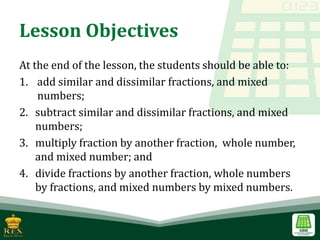
Lesson Objectives
At the end of the lesson, the students should be able to:
1. add similar and dissimilar fractions, and mixed
numbers;
2. subtract similar and dissimilar fractions, and mixed
numbers;
3. multiply fraction by another fraction, whole number,
and mixed number; and
4. divide fractions by another fraction, whole numbers
by fractions, and mixed numbers by mixed numbers.
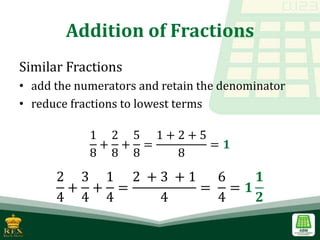
Addition of Fractions
Similar Fractions
• add the numerators and retain the denominator
• reduce fractions to lowest terms
1
8
+
2
8
+
5
8
=
1 + 2 + 5
8
= 𝟏
2
4
+
3
4
+
1
4
=
2 + 3 + 1
4
=
6
4
= 𝟏
𝟏
𝟐
Addition of Fractions
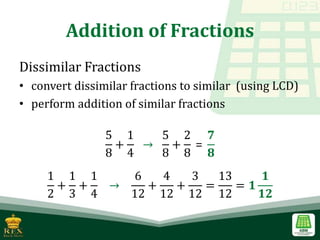
Dissimilar Fractions
• convert dissimilar fractions to similar (using LCD)
• perform addition of similar fractions
5
8
+
1
4
→
5
8
+
2
8
=
𝟕
𝟖
1
2
+
1
3
+
1
4
→
6
12
+
4
12
+
3
12
=
13
12
= 𝟏
𝟏
𝟏𝟐
Addition of Fractions
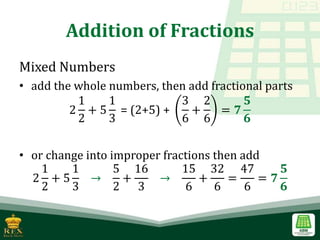
Mixed Numbers
• add the whole numbers, then add fractional parts
2
1
2
+ 5
1
3
= (2+5) +
3
6
+
2
6
= 𝟕
𝟓
𝟔
• or change into improper fractions then add
2
1
2
+ 5
1
3
→
5
2
+
16
3
→
15
6
+
32
6
=
47
6
= 𝟕
𝟓
𝟔
Subtraction of Fractions
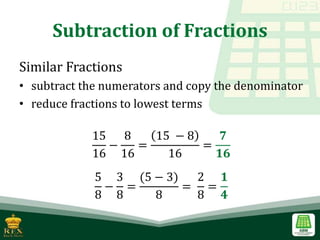
Similar Fractions
• subtract the numerators and copy the denominator
• reduce fractions to lowest terms
15
16
−
8
16
=
15 − 8
16
=
𝟕
𝟏𝟔
5
8
−
3
8
=
(5 − 3)
8
=
2
8
=
𝟏
𝟒
Subtraction of Fractions
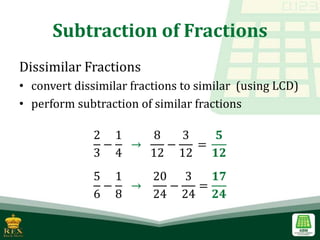
Dissimilar Fractions
• convert dissimilar fractions to similar (using LCD)
• perform subtraction of similar fractions
2
3
−
1
4
→
8
12
−
3
12
=
𝟓
𝟏𝟐
5
6
−
1
8
→
20
24
−
3
24
=
𝟏𝟕
𝟐𝟒
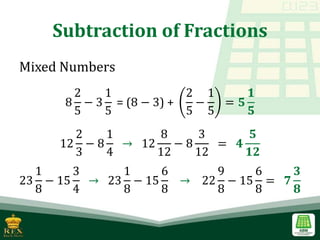
Subtraction of Fractions
Mixed Numbers
8
2
5
− 3
1
5
= (8 − 3) +
2
5
−
1
5
= 𝟓
𝟏
𝟓
12
2
3
− 8
1
4
→ 12
8
12
− 8
3
12
= 𝟒
𝟓
𝟏𝟐
23
1
8
− 15
3
4
→ 23
1
8
− 15
6
8
→ 22
9
8
− 15
6
8
= 𝟕
𝟑
𝟖
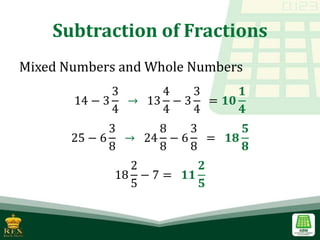
Subtraction of Fractions
Mixed Numbers and Whole Numbers
14 − 3
3
4
→ 13
4
4
− 3
3
4
= 𝟏𝟎
𝟏
𝟒
25 − 6
3
8
→ 24
8
8
− 6
3
8
= 𝟏𝟖
𝟓
𝟖
18
2
5
− 7 = 𝟏𝟏
𝟐
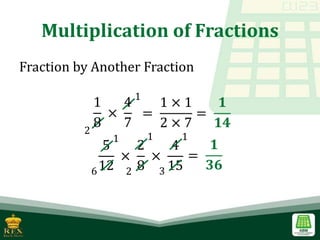
𝟓
Fraction by Another Fraction
=
1 × 1
2 × 7
=
𝟏
𝟏𝟒
=
𝟏
𝟑𝟔
2
1
1
8
×
4
7
Multiplication of Fractions
5
12
×
2
8
×
4
15
6
1
2
1
3
1
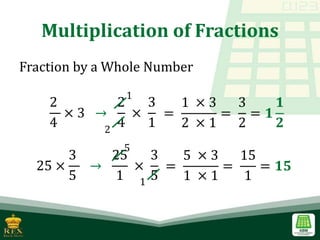
Multiplication of Fractions
Fraction by a Whole Number
=
1 × 3
2 × 1
=
3
2
= 𝟏
𝟏
𝟐
=
5 × 3
1 × 1
=
15
1
= 𝟏𝟓
2
4
× 3 →
2
4
×
3
1
2
1
25 ×
3
5
→
25
1
×
3
5
1
5
Multiplication of Fractions
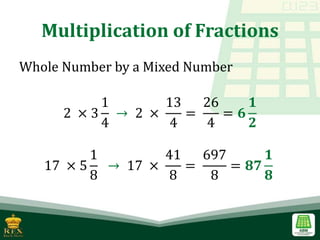
Whole Number by a Mixed Number
2 × 3
1
4
→ 2 ×
13
4
=
26
4
= 𝟔
𝟏
𝟐
17 × 5
1
8
→ 17 ×
41
8
=
697
8
= 𝟖𝟕
𝟏
𝟖
Multiplication of Fractions
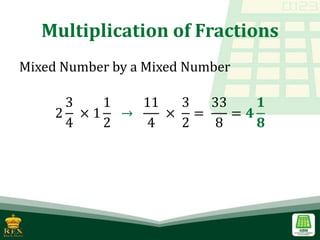
Mixed Number by a Mixed Number
2
3
4
× 1
1
2
→
11
4
×
3
2
=
33
8
= 𝟒
𝟏
𝟖
Division of Fractions
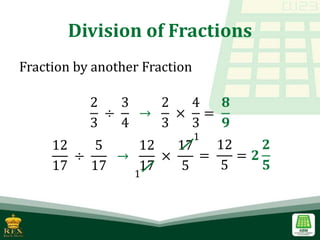
Fraction by another Fraction
2
3
÷
3
4
→
2
3
×
4
3
=
𝟖
𝟗
=
12
5
= 𝟐
𝟐
𝟓
12
17
÷
5
17
→
12
17
×
17
5
1
1
Division of Fractions
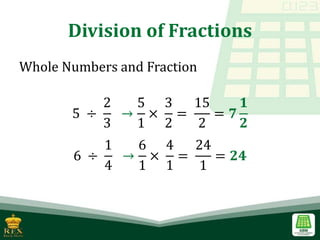
Whole Numbers and Fraction
5 ÷
2
3
→
5
1
×
3
2
=
15
2
= 𝟕
𝟏
𝟐
6 ÷
1
4
→
6
1
×
4
1
=
24
1
= 𝟐𝟒
Division of Fractions
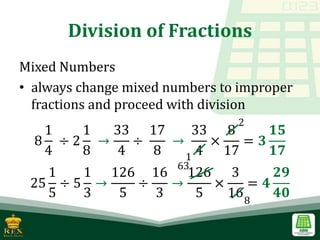
Mixed Numbers
• always change mixed numbers to improper
fractions and proceed with division
8
1
4
÷ 2
1
8
→
33
4
÷
17
8
→
33
4
×
8
17
= 𝟑
𝟏𝟓
𝟏𝟕
25
1
5
÷ 5
1
3
→
126
5
÷
16
3
→
126
5
×
3
16
= 𝟒
𝟐𝟗
𝟒𝟎
8
63
1
2
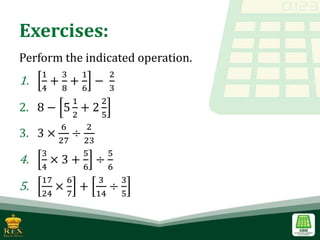
Exercises:
Perform the indicated operation.
1.
1
4
+
3
8
+
1
6
−
2
3
2. 8 − 5
1
2
+ 2
2
5
3. 3 ×
6
27
÷
2
23
4.
3
4
× 3 +
5
6
÷
5
6
5.
17
24
×
6
7
+
3
14
÷
3
5

(1)_Addition_Subtraction_Multiplication_Division_of_Fractions.pptx

  • 1.
  • 2.
  • 3.
    Lesson Objectives At theend of the lesson, the students should be able to: 1. add similar and dissimilar fractions, and mixed numbers; 2. subtract similar and dissimilar fractions, and mixed numbers; 3. multiply fraction by another fraction, whole number, and mixed number; and 4. divide fractions by another fraction, whole numbers by fractions, and mixed numbers by mixed numbers.
  • 4.
    Addition of Fractions SimilarFractions • add the numerators and retain the denominator • reduce fractions to lowest terms 1 8 + 2 8 + 5 8 = 1 + 2 + 5 8 = 𝟏 2 4 + 3 4 + 1 4 = 2 + 3 + 1 4 = 6 4 = 𝟏 𝟏 𝟐
  • 5.
    Addition of Fractions DissimilarFractions • convert dissimilar fractions to similar (using LCD) • perform addition of similar fractions 5 8 + 1 4 → 5 8 + 2 8 = 𝟕 𝟖 1 2 + 1 3 + 1 4 → 6 12 + 4 12 + 3 12 = 13 12 = 𝟏 𝟏 𝟏𝟐
  • 6.
    Addition of Fractions MixedNumbers • add the whole numbers, then add fractional parts 2 1 2 + 5 1 3 = (2+5) + 3 6 + 2 6 = 𝟕 𝟓 𝟔 • or change into improper fractions then add 2 1 2 + 5 1 3 → 5 2 + 16 3 → 15 6 + 32 6 = 47 6 = 𝟕 𝟓 𝟔
  • 7.
    Subtraction of Fractions SimilarFractions • subtract the numerators and copy the denominator • reduce fractions to lowest terms 15 16 − 8 16 = 15 − 8 16 = 𝟕 𝟏𝟔 5 8 − 3 8 = (5 − 3) 8 = 2 8 = 𝟏 𝟒
  • 8.
    Subtraction of Fractions DissimilarFractions • convert dissimilar fractions to similar (using LCD) • perform subtraction of similar fractions 2 3 − 1 4 → 8 12 − 3 12 = 𝟓 𝟏𝟐 5 6 − 1 8 → 20 24 − 3 24 = 𝟏𝟕 𝟐𝟒
  • 9.
    Subtraction of Fractions MixedNumbers 8 2 5 − 3 1 5 = (8 − 3) + 2 5 − 1 5 = 𝟓 𝟏 𝟓 12 2 3 − 8 1 4 → 12 8 12 − 8 3 12 = 𝟒 𝟓 𝟏𝟐 23 1 8 − 15 3 4 → 23 1 8 − 15 6 8 → 22 9 8 − 15 6 8 = 𝟕 𝟑 𝟖
  • 10.
    Subtraction of Fractions MixedNumbers and Whole Numbers 14 − 3 3 4 → 13 4 4 − 3 3 4 = 𝟏𝟎 𝟏 𝟒 25 − 6 3 8 → 24 8 8 − 6 3 8 = 𝟏𝟖 𝟓 𝟖 18 2 5 − 7 = 𝟏𝟏 𝟐 𝟓
  • 11.
    Fraction by AnotherFraction = 1 × 1 2 × 7 = 𝟏 𝟏𝟒 = 𝟏 𝟑𝟔 2 1 1 8 × 4 7 Multiplication of Fractions 5 12 × 2 8 × 4 15 6 1 2 1 3 1
  • 12.
    Multiplication of Fractions Fractionby a Whole Number = 1 × 3 2 × 1 = 3 2 = 𝟏 𝟏 𝟐 = 5 × 3 1 × 1 = 15 1 = 𝟏𝟓 2 4 × 3 → 2 4 × 3 1 2 1 25 × 3 5 → 25 1 × 3 5 1 5
  • 13.
    Multiplication of Fractions WholeNumber by a Mixed Number 2 × 3 1 4 → 2 × 13 4 = 26 4 = 𝟔 𝟏 𝟐 17 × 5 1 8 → 17 × 41 8 = 697 8 = 𝟖𝟕 𝟏 𝟖
  • 14.
    Multiplication of Fractions MixedNumber by a Mixed Number 2 3 4 × 1 1 2 → 11 4 × 3 2 = 33 8 = 𝟒 𝟏 𝟖
  • 15.
    Division of Fractions Fractionby another Fraction 2 3 ÷ 3 4 → 2 3 × 4 3 = 𝟖 𝟗 = 12 5 = 𝟐 𝟐 𝟓 12 17 ÷ 5 17 → 12 17 × 17 5 1 1
  • 16.
    Division of Fractions WholeNumbers and Fraction 5 ÷ 2 3 → 5 1 × 3 2 = 15 2 = 𝟕 𝟏 𝟐 6 ÷ 1 4 → 6 1 × 4 1 = 24 1 = 𝟐𝟒
  • 17.
    Division of Fractions MixedNumbers • always change mixed numbers to improper fractions and proceed with division 8 1 4 ÷ 2 1 8 → 33 4 ÷ 17 8 → 33 4 × 8 17 = 𝟑 𝟏𝟓 𝟏𝟕 25 1 5 ÷ 5 1 3 → 126 5 ÷ 16 3 → 126 5 × 3 16 = 𝟒 𝟐𝟗 𝟒𝟎 8 63 1 2
  • 18.
    Exercises: Perform the indicatedoperation. 1. 1 4 + 3 8 + 1 6 − 2 3 2. 8 − 5 1 2 + 2 2 5 3. 3 × 6 27 ÷ 2 23 4. 3 4 × 3 + 5 6 ÷ 5 6 5. 17 24 × 6 7 + 3 14 ÷ 3 5

Editor's Notes

  • #10 (1) If the mixed numbers have similar fractional parts, we subtract the whole numbers and then subtract the fractional parts following our rule for subtraction of similar fractions (2) If the mixed numbers have fractional parts which are not similar, then we change the fractional parts into similar fractions and then proceed as in 1 above (3) If the fraction in the subtrahend is greater than the fraction in the minuend, convert one unit of the minuend into an improper fraction with the correct denominator and add this unit to the existing fraction in the minuend. Then, the whole number in the minuend is reduced by one. After that, we can proceed with the subtraction
  • #11 To subtract a mixed number from a whole number, we convert one unit of the minuend into an improper fraction with the same denominator as the fraction in the subtrahend. Then we subtract.
  • #19 Answer Key: 1/8 1/10 7 2/3 3 7/10 27/28