Basic Graph Concepts
07/11/2024 1
Basic Network(Graph) Concepts
Alfonso Meléndez
Basic Graph Concepts
07/11/2024 2
¿What is a Network? (Graph)
Basic Graph Concepts
07/11/2024 3
3
Nodes
Basic Graph Concepts
07/11/2024 4
And Links
4
Basic Graph Concepts
07/11/2024 5
Common Language
Basic Graph Concepts
07/11/2024 6
Difefrence between Networks and
Graphs
A network is a Graph with Semantics:
Graph Network
Basic Graph Concepts
07/11/2024 7
Terminology
•Mathematics: graph/vertex/edge
•Physics: network/node/edge
•Comp Science: network/node/link
•Social Science : network/actor/tie
Basic Graph Concepts
07/11/2024 8
Types of Graphs
Basic Graph Concepts
07/11/2024 9
3
UnDirected Directed
1
4
2
3
2
1
4
Actor network, Internet
WWW, citation networks
Basic Graph Concepts
07/11/2024 10
Network Science: Graph Theory
Unweighted
(undirected)
Weighted
(undirected)
3
1
4
2
3
2
1
4
Phone Calls, Transport networks
Basic Graph Concepts
07/11/2024 11
GRAPHOLOGY
With loops MultiGraph
3
1
4
2
3
2
1
4
Predator prey Social networks
Basic Graph Concepts
07/11/2024 12
Degree: number of links connected to the node
Undirected
In-Degree and out-degree. Total Degree sum of in and out
degrees.
Source: node with kin
= 0; Sink: node with kout
= 0.
2
kin
C  1
kout
C  3

C
k
Directed
A
G
F
B
C
D
E
A
B
Degree of a Node
Basic Graph Concepts
07/11/2024 13
N – number of nodes of the graph



N
i
i
k
N
k
1
1
out
in
N
1
i
out
i
out
N
1
i
in
i
in
k
k
,
k
N
1
k
,
k
N
1
k 

 
 

UnDirected
Directed
A
F
B
C
D
E
j
i
Average Degree
Basic Graph Concepts
07/11/2024 14
Real Networks Average Degree
Basic Graph Concepts
07/11/2024 15
P(k): probability that a node has
degree k
Nk = # nodes with degree k
P(k) = Nk / N
Degree Distribution
Basic Graph Concepts
07/11/2024 16
Aij=1 if there is a link between nodes i and j
Aij=0 if nodes i,j are disconnected.
Nota: In a Directed Graph the matrix is Symetric
4
2
3
1
2
3
1
4
If there is a link pointing from node i to node j
no link pointing from node i to node j
Adjacency Matrix
Basic Graph Concepts
07/11/2024 17
UnDirected
2
3
1
4
Directed
4
2
3
1
Adajcency Matrices and Degrees
Basic Graph Concepts
07/11/2024 18
a b c d e f g h
a 0 1 0 0 1 0 1 0
b 1 0 1 0 0 0 0 1
c 0 1 0 1 0 1 1 0
d 0 0 1 0 1 0 0 0
e 1 0 0 1 0 0 0 0
f 0 0 1 0 0 0 1 0
g 1 0 1 0 0 0 0 0
h 0 1 0 0 0 0 0 0
b
e
g
a
c
f
h d
Another Example
Basic Graph Concepts
07/11/2024 19
Adjacency Matrices are Sparse
Basic Graph Concepts
07/11/2024 20
10 Real Networks
Basic Graph Concepts
07/11/2024 21
Real networks are Sparse
L << Lmax
or
<k> <<N-1.
WWW (ND Sample): N=325,729; L=1.4 106
Lmax=1012
<k>=4.51
Protein (S. Cerevisiae): N= 1,870; L=4,470 Lmax=107
<k>=2.39
Coauthorship (Math): N= 70,975; L=2 105
Lmax=3 1010
<k>=3.9
Movie Actors: N=212,250; L=6 106
Lmax=1.8 1013
<k>=28.78
(Source: Albert, Barabasi, RMP2002)
Basic Graph Concepts
07/11/2024 22
Adjacency Lists
Basic Graph Concepts
07/11/2024 23
Summary
•Adjacency Lists:
•Compact Representation
•Useful in sparse networks.
•Adjacency Matrices
•Important for Mathematical Operations (for
example eigenVectors)
Basic Graph Concepts
07/11/2024 24
Special Graphs
Basic Graph Concepts
07/11/2024 25
Maximum Number of Links of a
graph with N nodes:
A graph with L=Lmax is called a
Complete graph. Average Degree of
the graph is: <k>=N-1
Complete Graphs
Basic Graph Concepts
07/11/2024 26
Bipartite Graphs
Basic Graph Concepts
07/11/2024 27
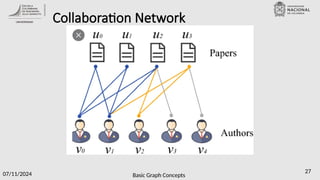
Collaboration Network
Basic Graph Concepts
07/11/2024 28
Films And Actors (IMDB)
Basic Graph Concepts
07/11/2024 29
bipartite graph (or bigraph) is a graph whose nodes can be
divided into two disjoint sets U and V such that every link connects
a node in U to one in V; that is, U and V are independent sets.
Examples:
Hollywood actor network
Collaboration networks
Network Science: Graph Theory
Bipartite graphs
Projection U Projection V
Basic Graph Concepts
07/11/2024 30
Pathology
Basic Graph Concepts
07/11/2024 31
A path is a sequence of nodes in which each node is adjacent to the next one
• In a directed network, the path can follow only the direction of the arrows.
Network Science: Graph Theory
PATHS
Basic Graph Concepts
07/11/2024 32
The distance (shortest path, geodesic path) between two nodes is
defined as the number of edges along the shortest path connecting
them.
*If the two nodes are disconnected, the distance is infinity.
In directed graphs each path needs to follow the direction of the
arrows.
Thus in a digraph the distance from node A to B (on an AB path) is
generally different from the distance from node B to A (on a BCA
path).
Network Science: Graph Theory
DISTANCE IN A GRAPH Shortest Path, Geodesic Path
D
C
A
B
D
C
A
B
Link to Model
Basic Graph Concepts
07/11/2024 33
Connectedness
Basic Graph Concepts
07/11/2024 34
Connected (undirected) graph: any two vertices can be joined by a path.
A disconnected graph is made up by two or more connected components.
Bridge: if we erase it, the graph becomes disconnected.
Largest Component:
Giant Component
The rest: Isolates
Network Science: Graph Theory
CONNECTIVITY OF UNDIRECTED GRAPHS
D
C
A
B
F
F
G
D
C
A
B
F
F
G
Basic Graph Concepts
07/11/2024 35
The adjacency matrix of a network with several components can be written in a block-
diagonal form, so that nonzero elements are confined to squares, with all other elements
being zero:
Network Science: Graph Theory
CONNECTIVITY OF UNDIRECTED GRAPHS Adjacency Matrix
Basic Graph Concepts
07/11/2024 36
Clustering coefficient
Basic Graph Concepts
07/11/2024 37
Clustering coefficient:
what fraction of your neighbors are connected?
Node i with degree ki
Ci in [0,1]
Network Science: Graph Theory
CLUSTERING COEFFICIENT
Watts & Strogatz, Nature 1998.
Link to Model
Basic Graph Concepts
07/11/2024 38
Summary
Basic Graph Concepts
07/11/2024 39
Degree distribution: P(k)
Average Path length: <d> (APL)
Clustering coefficient:
Network Science: Graph Theory
THREE CENTRAL QUANTITIES IN NETWORK SCIENCE
Link to Model
Basic Graph Concepts
07/11/2024 40
Seven Bridges of Konigsberg
¿How it all began?
Link to video: https://www.youtube.com/watch?v=nZwSo4vfw6c
Basic Graph Concepts
07/11/2024 41
Can one walk across
the seven bridges and
never cross the same
bridge twice?
Network Science: Graph Theory
THE BRIDGES OF KONIGSBERG
Basic Graph Concepts
07/11/2024 42
Can one walk across
the seven bridges and
never cross the same
bridge twice?
Network Science: Graph Theory
THE BRIDGES OF KONIGSBERG
1735: Euler’s theorem:
(a) If a graph has more than two nodes of odd degree, there is no path.
(b) If a graph is connected and has no odd degree nodes, it has at least one path.
Basic Graph Concepts
07/11/2024 43
Thank you for
your attention!!!
Important: After presentation
show examples in Gephi and Networkx
Back-Up
Estructuras de Redes
Estructura vs
Comportamiento

Basic Graph gRAPH CONCEPTS ANDConcepts.pptx

Editor's Notes

  • #12 A key property of each node is its degree, representing the number of links it has to other nodes. The degree can represent the number of mobile phone contacts an individual has in the call graph (i.e. the number of different indivi uals the person has talked to), or the number of citations a research paper gets in the citation network. We denote with ki the degree of the ith node in the network.
  • #18 The adjacency matrix can take far more complicated forms for a larger network….
  • #19 The adjacency matrix of the yeast protein-protein interaction network, consisting of 2,018 nodes, each representing a yeast protein (Table 2.1). A dot is placed on each spot of the adjacent matrix for which Aij = 1, indicating the presence of an interaction. There are no dots for Aij = 0. The small fraction of dots underlines the sparse nature of the protein-protein interaction network.
  • #34 The phone is useless as a communication device if con not call any user with a valid number. Similarly, the Internet is useless as a communication system if you cannot send a message to any other user that has access to it. From a network perspective this means that that the technology behind the phone must be able to establish a path between your device and the device you are calling and that there needs to exist a path on the internet between any two computers with Internet access. This is infact the key utility of most networks: they connect the system's components. This does not require a direct link between any two nodes, but only the existence of a path between them. These paths play an essential role in most network effects and the essence of a network is to guarantee connectedness. In this section we discuss the graph theoretic formulation of the connectedness problem.
  • #41 Few research fields can trace their roots to a single moment and place in history. Graph theory, the mathematical scaffold behind network science, can. Its roots go back to 1736 to Konigsberg, a thriving merchant city in Eastern Prussia. Its busy fleet of ships and the trade they brought allowed city officials to build seven bridges across the river Pregel that surrounded the town. Five of these connected the elegant island Kneiphof, caught between the two branches of the Pregel, to the mainland; two crossed the two branches of the river. This peculiar arrangement gave birth to a contemporary puzzle: Can one walk across all seven bridges and never cross the same one twice? Despite many attempts, no one could find such path. The problem remained unsolved until 1736, when Leonard Euler, a Swiss born mathematician, offered a rigorous mathematical proof that such path does not exist.
  • #42 Euler's insight was to represent each of the four land areas separated by the river as nodes, distinguishing them with letters A, B, C, and D. Next he connected with lines each piece of land that had a bridge between them. He thus built a {graph}, whose {nodes} were the pieces of land and {links} were the bridges. Then Euler made a simple observation: if there is a path crossing all bridges, but never the same bridge twice, then nodes with odd number of links must be either the starting or the end point of this path. Indeed, with an odd number of links you can arrive to a node and have no unused link for you to leave it. Yet, a continuous path that goes through all bridges can have only one starting and one end point. Thus such a path cannot exist on a graph that has more than two nodes with an odd number of links. As the K\"{o}nigsberg graph had three such nodes, B, C, D, each with three links, no path could satisfy the problem. Today we remember Euler's proof because it was the first time someone solved a mathematical problem by turning it into a graph. In hindsight the proof has two important messages: 1. Some problems become simpler and more treatable if they are represented as a graph. 2. The existence of the path does not depend on our ingenuity to find it. Rather, it is a property of the graph. Indeed, given the layout of the K\"{o}nigsberg bridges, no matter how smart we are, we will never find the desired path. in 1875 built a new bridge between B and C, increasing the number of links of these two nodes to four In other words, networks have properties, hidden in their structure, that affect the function of the system they describe, limiting or enhancing our ability to do things with or on them. To fully understand how networks affect the properties of a system, we need to become familiar with some basic concepts in graph theory, encountering the language and mathematical formalism that will be of direct use throughout this book.