An Economic Revolution After today you should know: How the economy changed in the 1920’s How industry changed society in the 1920’s? Who struggled economically in the 1920’s?
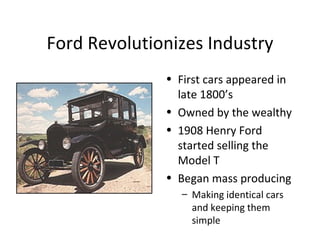
Ford Revolutionizes Industry First cars appeared in late 1800’s Owned by the wealthy 1908 Henry Ford started selling the Model T Began mass producing Making identical cars and keeping them simple
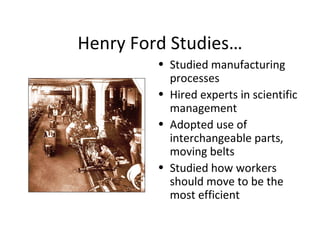
Henry Ford Studies… Studied manufacturing processes Hired experts in scientific management Adopted use of interchangeable parts, moving belts Studied how workers should move to be the most efficient
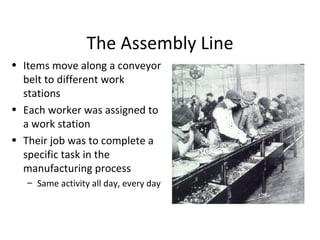
The Assembly Line Items move along a conveyor belt to different work stations Each worker was assigned to a work station  Their job was to complete a specific task in the manufacturing process Same activity all day, every day
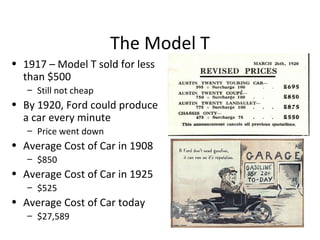
The Model T 1917 – Model T sold for less than $500 Still not cheap By 1920, Ford could produce a car every minute Price went down Average Cost of Car in 1908 $850  Average Cost of Car in 1925 $525 Average Cost of Car today $27,589
Competition and Productivity In 1920’s over half the cars on the road were Fords General Motors, Chrysler tried to improve Ford’s model Developed new designs Colors Competition caused industry to grow Ford didn’t change model until 1927 Productivity rose by 60% Measure of output per unit of input (labor) Auto industry boom led to WELFARE CAPITALISM
Welfare Capitalism Ever heard of a job with BENEFITS? Idea started in the 1920’s A system in which a company provides benefits to employees in an effort to promote worker satisfaction and loyalty Paid pensions (retirement) Recreation programs for workers Purpose was to encourage workers to shun unions and accept lower pay
What would life be like if cars were never invented?
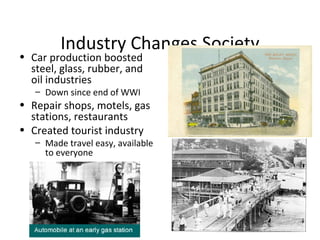
Industry Changes Society Car production boosted steel, glass, rubber, and oil industries Down since end of WWI Repair shops, motels, gas stations, restaurants Created tourist industry Made travel easy, available to everyone
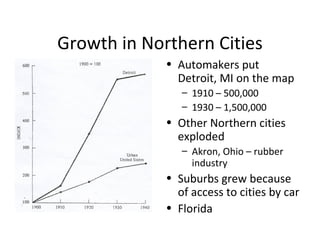
Growth in Northern Cities Automakers put Detroit, MI on the map 1910 – 500,000 1930 – 1,500,000 Other Northern cities exploded Akron, Ohio – rubber industry  Suburbs grew because of access to cities by car Florida
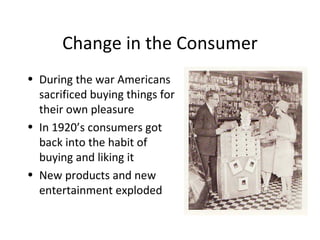
Change in the Consumer During the war Americans sacrificed buying things for their own pleasure In 1920’s consumers got back into the habit of buying and liking it New products and new entertainment exploded
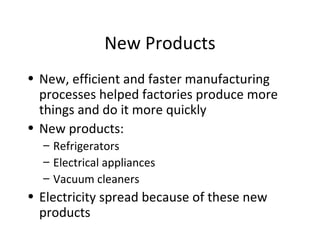
New Products New, efficient and faster manufacturing processes helped factories produce more things and do it more quickly New products: Refrigerators Electrical appliances Vacuum cleaners Electricity spread because of these new products
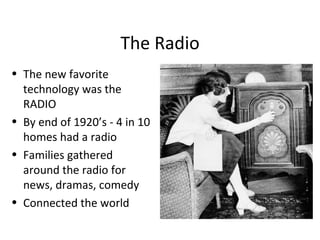
The Radio The new favorite technology was the RADIO By end of 1920’s - 4 in 10 homes had a radio Families gathered around the radio for news, dramas, comedy Connected the world
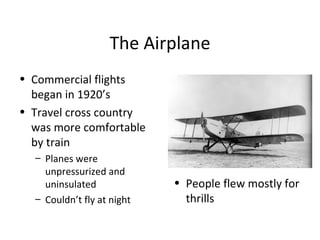
The Airplane Commercial flights began in 1920’s Travel cross country was more comfortable by train Planes were unpressurized and uninsulated Couldn’t fly at night People flew mostly for thrills
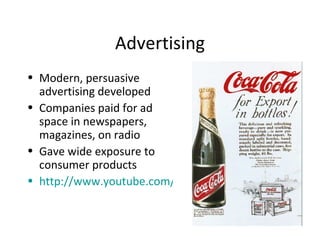
Advertising Modern, persuasive advertising developed Companies paid for ad space in newspapers, magazines, on radio Gave wide exposure to consumer products http://www.youtube.com/watch?v=cofP4NwNCQg&feature=related
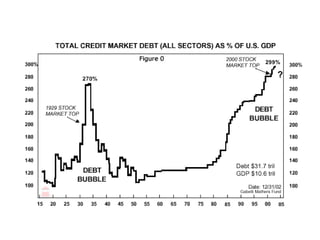
Paying on Credit In early 1900’s people paid for items in full Borrowing money was not respected Installment buying introduced in 1920’s Making for an item over time in small payments People started buying on credit and loved it! By end of the 1920’s, 90% of long-lasting were bought on credit “ Get what you want now!”
 
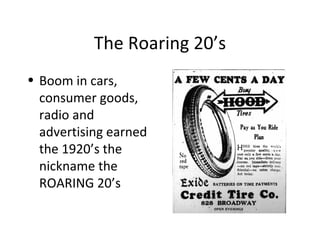
The Roaring 20’s Boom in cars, consumer goods, radio and advertising earned the 1920’s the nickname the ROARING 20’s
Trouble for Farmers European farmers returned to their fields Tons of products entered U.S. markets U.S. farm prices plunged 19221 Fordney-McCumber Tariff only helped a little Bugs destroyed cotton crops all over the South 1927 Mississippi River flood 1,000 people died Destroyed homes, farmland Hurricane struck Florida Ended boom in Florida Florida sunk into depression
Lasting Effects of WWI War Debt European nations borrowed $10 billion from the U.S. Struggled to pay it back Couldn’t earn money to pay off debts to U.S. Germans couldn’t pay the reparations  U.S. started loaning money to Germany Assumed the role of banker to all of Europe
Lasting Effects of WWI Arms Race Arms Race - nations competing to build more and more weapons in an effort to avoid one nation gaining a power advantage Peacetime brought pressure to reduce U.S. armed forces to save money and reduce the threat of war People feared that Britain and Japan were on the verge of naval arms race
Lasting Effects of WWI Arms Race U.S. organized the Washington Naval Conference in 1921 Major naval powers of the world attended Agreed to cut back on the size of navies Led to an agreement on issues that threatened world peace Considered a great success at the time
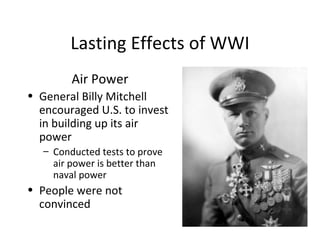
Lasting Effects of WWI Air Power General Billy Mitchell encouraged U.S. to invest in building up its air power Conducted tests to prove air power is better than naval power People were not convinced
Lasting Effects of WWI Treaties With Others U.S. did not join League of Nations but wanted to prevent another war France proposed a treaty between U.S. and France, but U.S. suggested a bigger plan KELLOGG-BRIAN PACT - said countries would condemn war as solution for international problems 60 nations involved But a countries word was the only enforcement

1920s Lecture 3

  • 1.
    An Economic RevolutionAfter today you should know: How the economy changed in the 1920’s How industry changed society in the 1920’s? Who struggled economically in the 1920’s?
  • 2.
    Ford Revolutionizes IndustryFirst cars appeared in late 1800’s Owned by the wealthy 1908 Henry Ford started selling the Model T Began mass producing Making identical cars and keeping them simple
  • 3.
    Henry Ford Studies…Studied manufacturing processes Hired experts in scientific management Adopted use of interchangeable parts, moving belts Studied how workers should move to be the most efficient
  • 4.
    The Assembly LineItems move along a conveyor belt to different work stations Each worker was assigned to a work station Their job was to complete a specific task in the manufacturing process Same activity all day, every day
  • 5.
    The Model T1917 – Model T sold for less than $500 Still not cheap By 1920, Ford could produce a car every minute Price went down Average Cost of Car in 1908 $850 Average Cost of Car in 1925 $525 Average Cost of Car today $27,589
  • 6.
    Competition and ProductivityIn 1920’s over half the cars on the road were Fords General Motors, Chrysler tried to improve Ford’s model Developed new designs Colors Competition caused industry to grow Ford didn’t change model until 1927 Productivity rose by 60% Measure of output per unit of input (labor) Auto industry boom led to WELFARE CAPITALISM
  • 7.
    Welfare Capitalism Everheard of a job with BENEFITS? Idea started in the 1920’s A system in which a company provides benefits to employees in an effort to promote worker satisfaction and loyalty Paid pensions (retirement) Recreation programs for workers Purpose was to encourage workers to shun unions and accept lower pay
  • 8.
    What would lifebe like if cars were never invented?
  • 9.
    Industry Changes SocietyCar production boosted steel, glass, rubber, and oil industries Down since end of WWI Repair shops, motels, gas stations, restaurants Created tourist industry Made travel easy, available to everyone
  • 10.
    Growth in NorthernCities Automakers put Detroit, MI on the map 1910 – 500,000 1930 – 1,500,000 Other Northern cities exploded Akron, Ohio – rubber industry Suburbs grew because of access to cities by car Florida
  • 11.
    Change in theConsumer During the war Americans sacrificed buying things for their own pleasure In 1920’s consumers got back into the habit of buying and liking it New products and new entertainment exploded
  • 12.
    New Products New,efficient and faster manufacturing processes helped factories produce more things and do it more quickly New products: Refrigerators Electrical appliances Vacuum cleaners Electricity spread because of these new products
  • 13.
    The Radio Thenew favorite technology was the RADIO By end of 1920’s - 4 in 10 homes had a radio Families gathered around the radio for news, dramas, comedy Connected the world
  • 14.
    The Airplane Commercialflights began in 1920’s Travel cross country was more comfortable by train Planes were unpressurized and uninsulated Couldn’t fly at night People flew mostly for thrills
  • 15.
    Advertising Modern, persuasiveadvertising developed Companies paid for ad space in newspapers, magazines, on radio Gave wide exposure to consumer products http://www.youtube.com/watch?v=cofP4NwNCQg&feature=related
  • 16.
    Paying on CreditIn early 1900’s people paid for items in full Borrowing money was not respected Installment buying introduced in 1920’s Making for an item over time in small payments People started buying on credit and loved it! By end of the 1920’s, 90% of long-lasting were bought on credit “ Get what you want now!”
  • 17.
  • 18.
    The Roaring 20’sBoom in cars, consumer goods, radio and advertising earned the 1920’s the nickname the ROARING 20’s
  • 19.
    Trouble for FarmersEuropean farmers returned to their fields Tons of products entered U.S. markets U.S. farm prices plunged 19221 Fordney-McCumber Tariff only helped a little Bugs destroyed cotton crops all over the South 1927 Mississippi River flood 1,000 people died Destroyed homes, farmland Hurricane struck Florida Ended boom in Florida Florida sunk into depression
  • 20.
    Lasting Effects ofWWI War Debt European nations borrowed $10 billion from the U.S. Struggled to pay it back Couldn’t earn money to pay off debts to U.S. Germans couldn’t pay the reparations U.S. started loaning money to Germany Assumed the role of banker to all of Europe
  • 21.
    Lasting Effects ofWWI Arms Race Arms Race - nations competing to build more and more weapons in an effort to avoid one nation gaining a power advantage Peacetime brought pressure to reduce U.S. armed forces to save money and reduce the threat of war People feared that Britain and Japan were on the verge of naval arms race
  • 22.
    Lasting Effects ofWWI Arms Race U.S. organized the Washington Naval Conference in 1921 Major naval powers of the world attended Agreed to cut back on the size of navies Led to an agreement on issues that threatened world peace Considered a great success at the time
  • 23.
    Lasting Effects ofWWI Air Power General Billy Mitchell encouraged U.S. to invest in building up its air power Conducted tests to prove air power is better than naval power People were not convinced
  • 24.
    Lasting Effects ofWWI Treaties With Others U.S. did not join League of Nations but wanted to prevent another war France proposed a treaty between U.S. and France, but U.S. suggested a bigger plan KELLOGG-BRIAN PACT - said countries would condemn war as solution for international problems 60 nations involved But a countries word was the only enforcement