191CSEA AD HOC AND SENSOR NETWORKS
L T P C
3 0 0 3
Programme: B.E. Computer Science and Engineering Sem: - Category: PE
Prerequisites: 191CS54 – Computer Networks
Aim: To learn about the protocols and architecture that support for configuration and functioning of
Ad Hoc and Wireless Sensor Networks.
Course Outcomes: The Students will be able to
CO1: Recall the concepts of Generations of cellular and Ad Hoc Wireless Networks.
CO2: Identify the Issues in designing a MAC Protocol and its Classification.
CO3: Analyze the protocol design issues of ad hoc and sensor networks.
CO4: Outline the architecture of sensor networks and the various MAC protocols of sensor networks
CO5:
Summarize the routing protocols for ad hoc and wireless sensor networks with respect to some
protocol design issues
CO6: Compare the QoS related performance measurements of ad hoc and sensor networks
INTRODUCTION 9
Wireless LANs and PANs – Fundamentals of WLANs - Wireless WANs and MANs – First-Generation
Cellular Systems – Second-Generation Cellular Systems – Third-Generation Cellular Systems - Ad hoc
wireless networks: Cellular and Ad Hoc Wireless Networks - Applications of Ad Hoc Wireless Networks
- Issues in Ad Hoc Wireless Networks – Ad Hoc Wireless Internet.
MAC PROTOCOLS FOR AD HOC WIRELESS NETWORKS 9
Issues in designing a MAC Protocol - Classification of MAC Protocols - Contention based protocols-
Contention based protocols with Reservation Mechanisms - Contention based protocols with Scheduling
Mechanisms - Multi channel MAC.
ROUTING PROTOCOLS AND TRANSPORT LAYER IN AD HOC WIRELESS
NETWORKS
9
Issues in designing a routing and Transport Layer protocol for Ad hoc networks - proactive routing,
reactive routing (on-demand), hybrid routing - Classification of Transport Layer solutions - TCP over
Ad hoc wireless Networks.
WIRELESS SENSOR NETWORKS (WSNS) AND MAC PROTOCOLS 9
Introduction - Sensor Network architecture - Layered Architecture - Clustered Architecture. Sensor
node architecture - hardware and software components of a sensor node - Data dissemination - Data
gathering - MAC layer protocols: self-organizing, Hybrid TDMA/FDMA and CSMA based MAC -
IEEE 802.15.4.
WSN ROUTING, LOCALIZATION & QUALITY OF SERVICE (QoS) 9
Issues in WSN routing - Localization - Indoor and Sensor Network Localization - absolute and relative
localization, triangulation - QoS in WSN - Energy Efficient Design -Synchronization - Transport Layer
issues - Security – Real time communication.
Total Periods: 45
Text Book:
1. C. Siva Ram Murthy, and B. S. Manoj, "Ad Hoc Wireless Networks: Architectures and
Protocols", Prentice Hall Professional Technical Reference, 2008.
References:
1. Carlos De Morais Cordeiro, Dharma Prakash Agrawal “Ad Hoc & Sensor Networks: Theory and
Applications”, World Scientific Publishing Company, 2/e, 2011.
2. Feng Zhao and Leonides Guibas, "Wireless Sensor Networks", Elsevier Publication - 2002.
3. Holger Karl and Andreas Willig “Protocols and Architectures for Wireless Sensor Networks”,
Wiley, 2005.
4. Kazem Sohraby, Daniel Minoli, &TaiebZnati, “Wireless Sensor Networks-Technology,
Protocols, and Applications”, John Wiley, 2007.
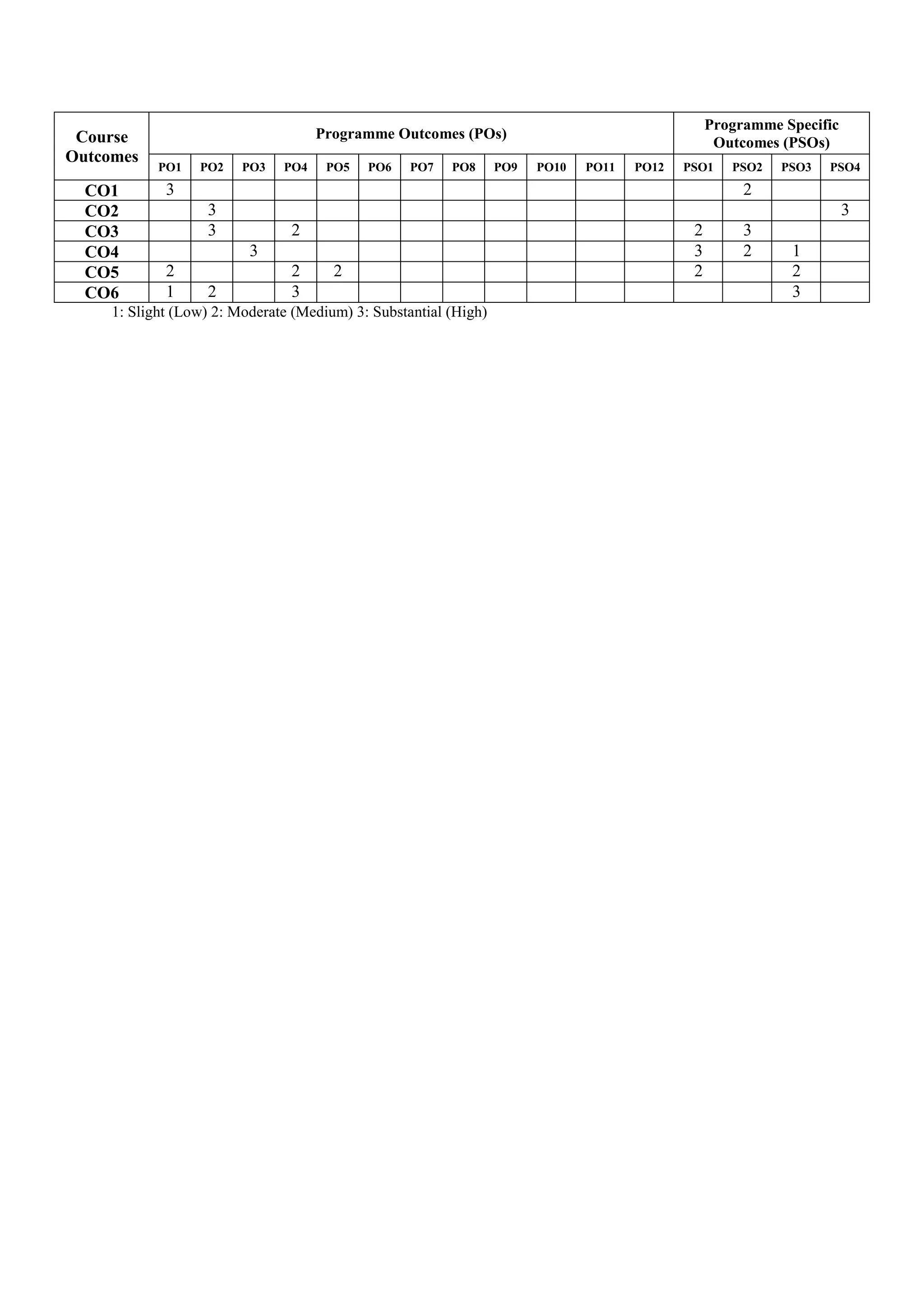
Course
Outcomes
Programme Outcomes (POs)
Programme Specific
Outcomes (PSOs)
PO1 PO2 PO3 PO4 PO5 PO6 PO7 PO8 PO9 PO10 PO11 PO12 PSO1 PSO2 PSO3 PSO4
CO1 3 2
CO2 3 3
CO3 3 2 2 3
CO4 3 3 2 1
CO5 2 2 2 2 2
CO6 1 2 3 3
1: Slight (Low) 2: Moderate (Medium) 3: Substantial (High)

191CSEA Ad Hoc and Sensor Networks - Syllabus

  • 1.
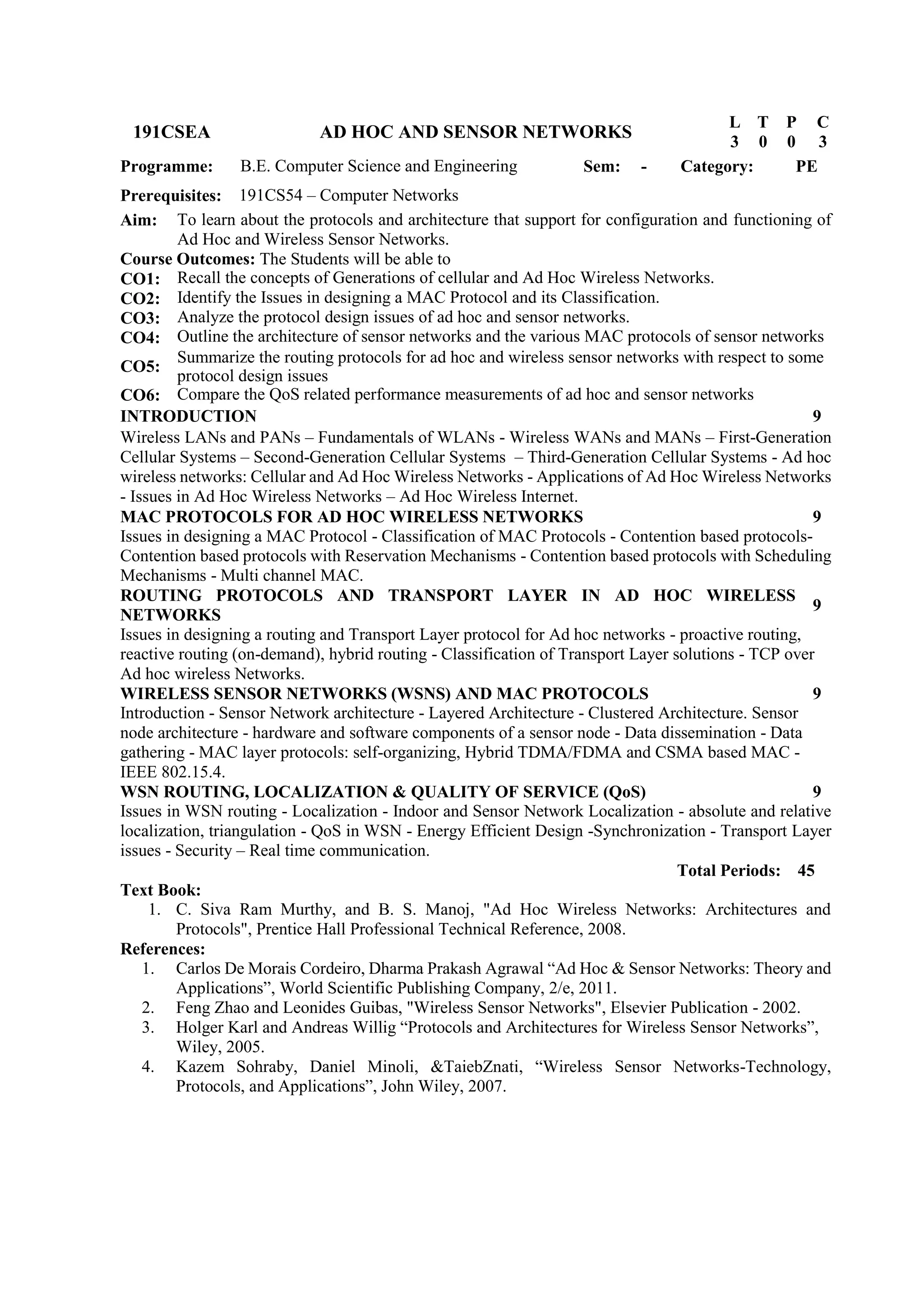
    191CSEA AD HOCAND SENSOR NETWORKS L T P C 3 0 0 3 Programme: B.E. Computer Science and Engineering Sem: - Category: PE Prerequisites: 191CS54 – Computer Networks Aim: To learn about the protocols and architecture that support for configuration and functioning of Ad Hoc and Wireless Sensor Networks. Course Outcomes: The Students will be able to CO1: Recall the concepts of Generations of cellular and Ad Hoc Wireless Networks. CO2: Identify the Issues in designing a MAC Protocol and its Classification. CO3: Analyze the protocol design issues of ad hoc and sensor networks. CO4: Outline the architecture of sensor networks and the various MAC protocols of sensor networks CO5: Summarize the routing protocols for ad hoc and wireless sensor networks with respect to some protocol design issues CO6: Compare the QoS related performance measurements of ad hoc and sensor networks INTRODUCTION 9 Wireless LANs and PANs – Fundamentals of WLANs - Wireless WANs and MANs – First-Generation Cellular Systems – Second-Generation Cellular Systems – Third-Generation Cellular Systems - Ad hoc wireless networks: Cellular and Ad Hoc Wireless Networks - Applications of Ad Hoc Wireless Networks - Issues in Ad Hoc Wireless Networks – Ad Hoc Wireless Internet. MAC PROTOCOLS FOR AD HOC WIRELESS NETWORKS 9 Issues in designing a MAC Protocol - Classification of MAC Protocols - Contention based protocols- Contention based protocols with Reservation Mechanisms - Contention based protocols with Scheduling Mechanisms - Multi channel MAC. ROUTING PROTOCOLS AND TRANSPORT LAYER IN AD HOC WIRELESS NETWORKS 9 Issues in designing a routing and Transport Layer protocol for Ad hoc networks - proactive routing, reactive routing (on-demand), hybrid routing - Classification of Transport Layer solutions - TCP over Ad hoc wireless Networks. WIRELESS SENSOR NETWORKS (WSNS) AND MAC PROTOCOLS 9 Introduction - Sensor Network architecture - Layered Architecture - Clustered Architecture. Sensor node architecture - hardware and software components of a sensor node - Data dissemination - Data gathering - MAC layer protocols: self-organizing, Hybrid TDMA/FDMA and CSMA based MAC - IEEE 802.15.4. WSN ROUTING, LOCALIZATION & QUALITY OF SERVICE (QoS) 9 Issues in WSN routing - Localization - Indoor and Sensor Network Localization - absolute and relative localization, triangulation - QoS in WSN - Energy Efficient Design -Synchronization - Transport Layer issues - Security – Real time communication. Total Periods: 45 Text Book: 1. C. Siva Ram Murthy, and B. S. Manoj, "Ad Hoc Wireless Networks: Architectures and Protocols", Prentice Hall Professional Technical Reference, 2008. References: 1. Carlos De Morais Cordeiro, Dharma Prakash Agrawal “Ad Hoc & Sensor Networks: Theory and Applications”, World Scientific Publishing Company, 2/e, 2011. 2. Feng Zhao and Leonides Guibas, "Wireless Sensor Networks", Elsevier Publication - 2002. 3. Holger Karl and Andreas Willig “Protocols and Architectures for Wireless Sensor Networks”, Wiley, 2005. 4. Kazem Sohraby, Daniel Minoli, &TaiebZnati, “Wireless Sensor Networks-Technology, Protocols, and Applications”, John Wiley, 2007.
  • 2.
    Course Outcomes Programme Outcomes (POs) ProgrammeSpecific Outcomes (PSOs) PO1 PO2 PO3 PO4 PO5 PO6 PO7 PO8 PO9 PO10 PO11 PO12 PSO1 PSO2 PSO3 PSO4 CO1 3 2 CO2 3 3 CO3 3 2 2 3 CO4 3 3 2 1 CO5 2 2 2 2 2 CO6 1 2 3 3 1: Slight (Low) 2: Moderate (Medium) 3: Substantial (High)