A WELL-WRITTEN
TEXT IS . . .
TO DO LIST:
 Identify the different properties of a well-
written text;
 Cite the importance of a well-written text; and
 Create a short well-written paragraph
employing the properties of a well-written text.
PROPERTIES
OF A WELL-
WRITTEN
TEXT
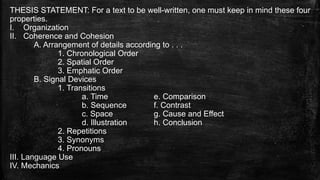
THESIS STATEMENT: For a text to be well-written, one must keep in mind these four
properties.
I. Organization
II. Coherence and Cohesion
A. Arrangement of details according to . . .
1. Chronological Order
2. Spatial Order
3. Emphatic Order
B. Signal Devices
1. Transitions
a. Time e. Comparison
b. Sequence f. Contrast
c. Space g. Cause and Effect
d. Illustration h. Conclusion
2. Repetitions
3. Synonyms
4. Pronouns
III. Language Use
IV. Mechanics
I.ORGANIZATION
• It is said that ideas are well-developed when
there is a clear statement of purpose, position,
facts, examples, specific details, definitions,
explanation, justifications, or opposing
viewpoints.
• Organization is achieved when these ideas are
logically and accurately arranged.
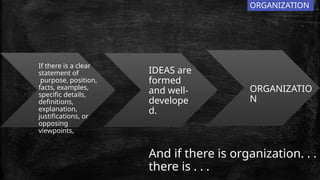
ORGANIZATION
If there is a clear
statement of
purpose, position,
facts, examples,
specific details,
definitions,
explanation,
justifications, or
opposing
viewpoints,
IDEAS are
formed
and well-
develope
d.
ORGANIZATIO
N
And if there is organization. . .
there is . . .
COHERENCE
II. COHERENCE AND
COHESION
COHERENCE: This means that
sentences are arranged in a logical
manner, making them easily understood
by the reader.
COHESION: connection of ideas at
sentence level
COHESION
- the property of unity in a written text or a
segment of spoken discourse that stems from
links among its surface elements, as when words
in one sentence are repeated in another, and
especially from the fact that some words or
phrases depend for their interpretation upon
material in preceding or following text
Example:
Be assured of this. Most people do
not want to fight. However, they will
do so when provoked.
How can we organize the
details of a paragraph?
II. Coherence and Cohesion
A. Arrangement of details according
to . . .
1. Chronological Order
2. Spatial Order
3. Emphatic Order
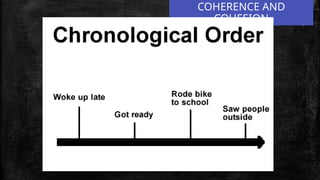
1. CHRONOLOGICAL. The
details are arranged in the
order in which they
happened.
COHERENCE AND
COHESION
COHERENCE AND
COHESION
This morning was crazy. My alarm clock was set for PM
instead of AM, so I woke up really late. I just threw on some
clothes and ran out the door. I rode my bike as fast as I could
and thought that I was going to be late for sure, but when I got
there everyone was outside and there were firetrucks all lined
up in front of school. I guess somebody pulled the fire alarm
before class started. It worked out though, because nobody
really noticed or minded that I was tardy.
COHERENCE AND
COHESION
COHERENCE AND
COHESION
2. SPATIAL – The sentences of a
paragraph are arranged
according to geographical
location, such as left-to-right, up-
to-down, etc.
COHERENCE AND
COHESION
The inside of Bill's refrigerator was horrible. On the
top shelf was a three week old carton of milk. Next to it
sat a slice of melon that had started to get moldy. To the
right of the melon sat the remains of a macaroni and
cheese dinner that had been served a week earlier. On
the shelf below was a slice of cake from his sister's
birthday party. Though there was food, none of it was
edible.
COHERENCE AND
COHESION
3. EMPHATIC – is when information
found in a paragraph is arranged to
emphasize certain points depending on
the writer’s purpose.
The coherence of the paragraph is
established in one of two ways: (a) from
least to most important, or (b) from most
to least important.
After looking at all the brochures and talking to
several salesmen, I decided to purchase an SLR
camera. For several years I had been dissatisfied with
the results I was getting from my point-and-shoot
camera. The framing was imprecise and the focus was
not always accurate. I had planned a vacation to an
area that promised many fabulous photo opportunities,
and I wanted to capture each one with accuracy. But
the most important reason I decided on the SLR
camera was the great versatility it offered.
COHERENCE AND
COHESION
COHERENCE AND
COHESION
In the above paragraph, the organization
moves from the least important
idea (dissatisfaction with the results of the
point-and-shoot camera) to the most
important idea (the versatility offered with the
SLR camera).
COHERENCE AND
COHESION
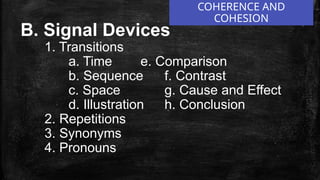
B. Signal Devices
1. Transitions
a. Time e. Comparison
b. Sequence f. Contrast
c. Space g. Cause and Effect
d. Illustration h. Conclusion
2. Repetitions
3. Synonyms
4. Pronouns
B. Signal Devices
- words that give readers an
idea of how the points in your
paragraph are progressing
COHERENCE AND
COHESION
COHERENCE AND
COHESION
Examples:
1. Transitions (words that
connect one idea to another, in
order for our ideas to flow
smoothly)
COHERENCE AND
COHESION
a. Time (first, immediately,
afterward, before, at the same
time, after, earlier,
simultaneously, finally, next, in
the meantime, later, eventually,
then, meanwhile, now,
subsequent, etc.)
COHERENCE AND
COHESION
b. Sequence (moreover,
furthermore, next, also,
finally, last, another, first,
second, third, besides,
additionally, etc.)
COHERENCE AND
COHESION
c. Space (above,
next to, below,
behind, beside, etc.)
COHERENCE AND
COHESION
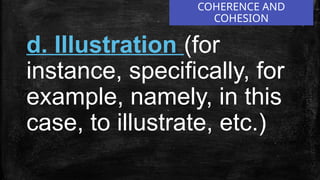
d. Illustration (for
instance, specifically, for
example, namely, in this
case, to illustrate, etc.)
COHERENCE AND
COHESION
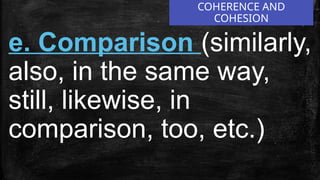
e. Comparison (similarly,
also, in the same way,
still, likewise, in
comparison, too, etc.)
COHERENCE AND
COHESION
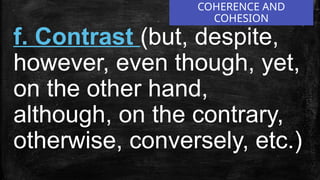
f. Contrast (but, despite,
however, even though, yet,
on the other hand,
although, on the contrary,
otherwise, conversely, etc.)
COHERENCE AND
COHESION
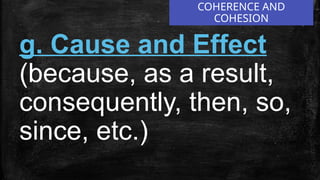
g. Cause and Effect
(because, as a result,
consequently, then, so,
since, etc.)
COHERENCE AND
COHESION
h. Conclusion (thus,
therefore, in
conclusion, in short,
etc.)
COHERENCE AND
COHESION
2. Repetitions (repetitions of
main ideas keep continuity and
highlight important ideas)
-it could be a word, a phrase, or a full
sentence, or a poetical line repeated
to emphasize its significance in the
entire text
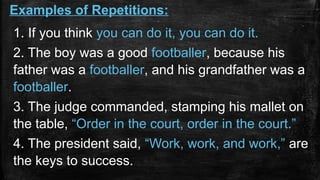
1. If you think you can do it, you can do it.
2. The boy was a good footballer, because his
father was a footballer, and his grandfather was a
footballer.
3. The judge commanded, stamping his mallet on
the table, “Order in the court, order in the court.”
4. The president said, “Work, work, and work,” are
the keys to success.
Examples of Repetitions:
COHERENCE AND
COHESION
3. Synonyms (these are
words similar in meaning to
important words or phrases
that prevent tedious
repetitions)
COHERENCE AND
COHESION
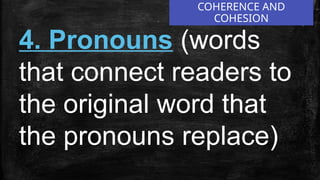
4. Pronouns (words
that connect readers to
the original word that
the pronouns replace)
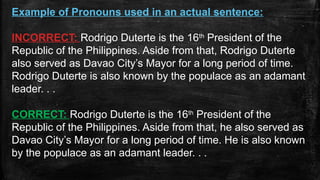
Example of Pronouns used in an actual sentence:
INCORRECT: Rodrigo Duterte is the 16th
President of the
Republic of the Philippines. Aside from that, Rodrigo Duterte
also served as Davao City’s Mayor for a long period of time.
Rodrigo Duterte is also known by the populace as an adamant
leader. . .
CORRECT: Rodrigo Duterte is the 16th
President of the
Republic of the Philippines. Aside from that, he also served as
Davao City’s Mayor for a long period of time. He is also known
by the populace as an adamant leader. . .
LANGUAGE
USE
III. Language Use
LANGUAGE
USE
III. LANGUAGE USE
- appropriateness of
word / vocabulary
usage
LANGUAGE
USE
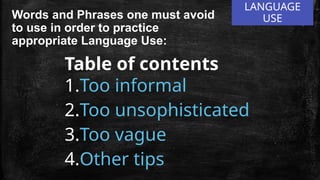
Words and Phrases one must
avoid to use in order to practice
appropriate Language Use:
LANGUAGE
USE
Words and Phrases one must avoid
to use in order to practice
appropriate Language Use:
Table of contents
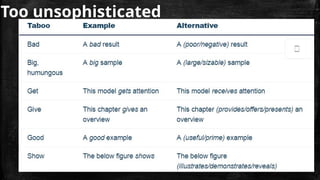
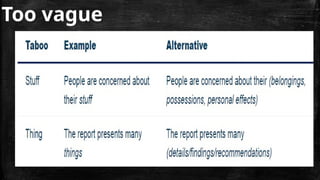
1.Too informal
2.Too unsophisticated
3.Too vague
4.Other tips
LANGUAGE
USE
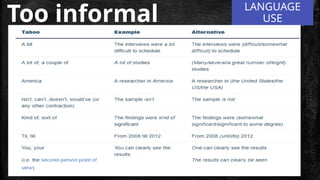
Too informal
Too unsophisticated
Too vague
LANGUAGE
USE
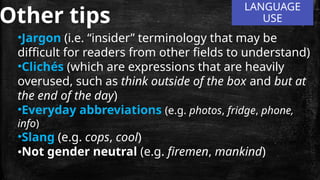
Other tips
•Jargon (i.e. “insider” terminology that may be
difficult for readers from other fields to understand)
•Clichés (which are expressions that are heavily
overused, such as think outside of the box and but at
the end of the day)
•Everyday abbreviations (e.g. photos, fridge, phone,
info)
•Slang (e.g. cops, cool)
•Not gender neutral (e.g. firemen, mankind)
And lastly. . .
IV. MECHANICS
FP
MM
M
Y
Y Y
Y
W W
W
W
N
MECHANICS
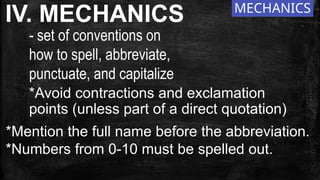
IV. MECHANICS
- set of conventions on
how to spell, abbreviate,
punctuate, and capitalize
*Avoid contractions and exclamation
points (unless part of a direct quotation)
*Mention the full name before the abbreviation.
*Numbers from 0-10 must be spelled out.
MECHANICS
Other examples. . .
LET’S PLAY A
GAME
In this activity, I will be
presenting you excerpts or
examples from a text. You will try
to determine what property of a
well-written text is present/used
in it. For example. . .
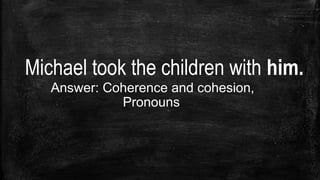
Michael took the children with him.
Answer: Coherence and cohesion,
Pronouns
I will be grouping you into four groups.
Please count one to four.
The goal of each group is to get the
highest score. Aim to get more correct answers
for a high score. Exercise team work. Group
secretary give me a ¼ sheet of paper with the
list of group members.
When I begin reading each question, listen
carefully. It will only be read TWICE. Write your
answer on the sheet that will be provided. Only
ten seconds will be allocated for you to answer.
Question no. 1:
Central Idea: The Eiffel Tower is divided into three
sections.
Main Points: I. The lowest section of the tower
contains the entrance, a gift shop, and a restaurant.
II. The middle section of the tower consists of stairs
and elevators that lead to the top.
III. The top section of the tower includes an
observation deck with a spectacular view of Paris.
Answer: Coherence and Cohesion, Spatial Order
Question no. 2
During the early twentieth century, in addition to
industrialization, urban growth and technological
development, Australian society was experiencing a
transformation of the domestic ideal. Consequently,
people were subject to an increasing array of
government and professional programs aiming to
manage and regulate life, particularly family life.
Some of these programs were. . .
Answer: Coherence and Cohesion,
Signal Devices/Transitions
Question no. 3
ALTERNATIVE: A poor or negative
result
Instead of: A bad result
Answer: Language Use
Question no. 4
(Aside from transitions)
During the early twentieth century, in addition to
industrialization, urban growth and technological
development, Australian society was experiencing a
transformation of the domestic ideal.
Answer: Mechanics
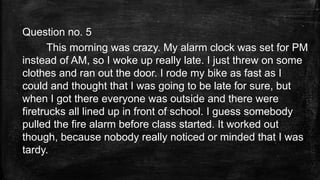
Question no. 5
This morning was crazy. My alarm clock was set for PM
instead of AM, so I woke up really late. I just threw on some
clothes and ran out the door. I rode my bike as fast as I
could and thought that I was going to be late for sure, but
when I got there everyone was outside and there were
firetrucks all lined up in front of school. I guess somebody
pulled the fire alarm before class started. It worked out
though, because nobody really noticed or minded that I was
tardy.
Answer: Coherence and cohesion,
Chronological order
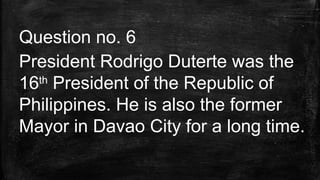
Question no. 6
President Rodrigo Duterte was the
16th
President of the Republic of
Philippines. He is also the former
Mayor in Davao City for a long time.
Answer: Coherence and Cohesion, Pronouns
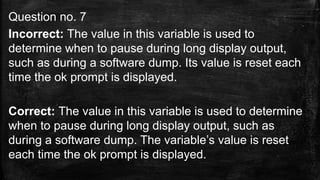
Question no. 7
Incorrect: The value in this variable is used to
determine when to pause during long display output,
such as during a software dump. Its value is reset each
time the ok prompt is displayed.
Correct: The value in this variable is used to determine
when to pause during long display output, such as
during a software dump. The variable’s value is reset
each time the ok prompt is displayed.
Answer: Mechanics
CONGRATULATIONS TO
THE WINNERS! 
CONGRATULATIONS ALSO
TO EVERYONE! 
Let’s test your skills!
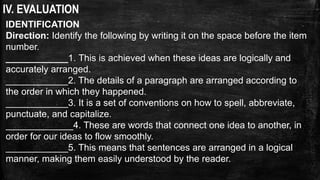
IV. EVALUATION
IDENTIFICATION
Direction: Identify the following by writing it on the space before the item
number.
____________1. This is achieved when these ideas are logically and
accurately arranged.
____________2. The details of a paragraph are arranged according to
the order in which they happened.
____________3. It is a set of conventions on how to spell, abbreviate,
punctuate, and capitalize.
_____________4. These are words that connect one idea to another, in
order for our ideas to flow smoothly.
____________5. This means that sentences are arranged in a logical
manner, making them easily understood by the reader.
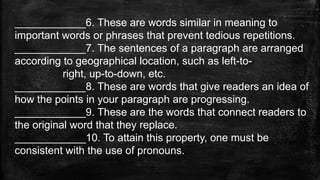
____________6. These are words similar in meaning to
important words or phrases that prevent tedious repetitions.
____________7. The sentences of a paragraph are arranged
according to geographical location, such as left-to-
right, up-to-down, etc.
____________8. These are words that give readers an idea of
how the points in your paragraph are progressing.
____________9. These are the words that connect readers to
the original word that they replace.
____________10. To attain this property, one must be
consistent with the use of pronouns.
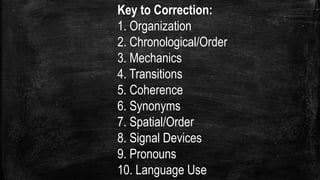
Key to Correction:
1. Organization
2. Chronological/Order
3. Mechanics
4. Transitions
5. Coherence
6. Synonyms
7. Spatial/Order
8. Signal Devices
9. Pronouns
10. Language Use
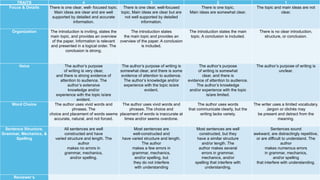
V. ASSIGNMENT (2 minutes)
Create a short well-written paragraph (about
anything) employing the properties of a well-written
text. Your essay will be rated according to this analytic
rubric. Consequently, use this rubric as a guide when
writing your essay and check it again before you
submit your essay.
TRAITS 4 3 2 1
Focus & Details There is one clear, well- focused topic.
Main ideas are clear and are well
supported by detailed and accurate
information.
There is one clear, well-focused
topic. Main ideas are clear but are
not well supported by detailed
information.
There is one topic.
Main ideas are somewhat clear.
The topic and main ideas are not
clear.
Organization The introduction is inviting, states the
main topic, and provides an overview
of the paper. Information is relevant
and presented in a logical order. The
conclusion is strong.
The introduction states
the main topic and provides an
overview of the paper. A conclusion
is included.
The introduction states the main
topic. A conclusion is included.
There is no clear introduction,
structure, or conclusion.
Voice The author’s purpose
of writing is very clear,
and there is strong evidence of
attention to audience. The
author’s extensive
knowledge and/or
experience with the topic is/are
evident.
The author’s purpose of writing is
somewhat clear, and there is some
evidence of attention to audience.
The author’s knowledge and/or
experience with the topic is/are
evident.
The author’s purpose
of writing is somewhat
clear, and there is
evidence of attention to audience.
The author’s knowledge
and/or experience with the topic
is/are limited.
The author’s purpose of writing is
unclear.
Word Choice The author uses vivid words and
phrases. The
choice and placement of words seems
accurate, natural, and not forced.
The author uses vivid words and
phrases. The choice and
placement of words is inaccurate at
times and/or seems overdone.
The author uses words
that communicate clearly, but the
writing lacks variety.
The writer uses a limited vocabulary.
Jargon or clichés may
be present and detract from the
meaning.
Sentence Structure,
Grammar, Mechanics, &
Spelling
All sentences are well
constructed and have
varied structure and length. The
author
makes no errors in
grammar, mechanics,
and/or spelling.
Most sentences are
well-constructed and
have varied structure and length.
The author
makes a few errors in
grammar, mechanics,
and/or spelling, but
they do not interfere
with understanding
Most sentences are well
constructed, but they
have a similar structure
and/or length. The
author makes several
errors in grammar,
mechanics, and/or
spelling that interfere with
understanding.
Sentences sound
awkward, are distractingly repetitive,
or are difficult to understand. The
author
makes numerous errors
in grammar, mechanics,
and/or spelling
that interfere with understanding.
Reviewer’s
THANK YOU
FOR LISTENING!
(If ever you listened)

Multiple Choice Quiz: Properties of
a Well-Written Text
▪ Test your understanding of the properties of a well-written
text with these questions.
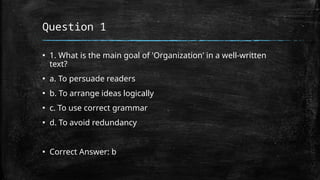
Question 1
▪ 1. What is the main goal of 'Organization' in a well-written
text?
▪ a. To persuade readers
▪ b. To arrange ideas logically
▪ c. To use correct grammar
▪ d. To avoid redundancy
▪ Correct Answer: b
Question 2
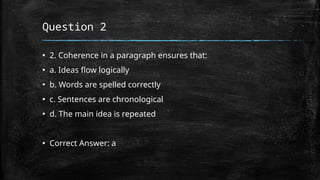
▪ 2. Coherence in a paragraph ensures that:
▪ a. Ideas flow logically
▪ b. Words are spelled correctly
▪ c. Sentences are chronological
▪ d. The main idea is repeated
▪ Correct Answer: a
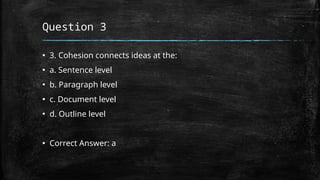
Question 3
▪ 3. Cohesion connects ideas at the:
▪ a. Sentence level
▪ b. Paragraph level
▪ c. Document level
▪ d. Outline level
▪ Correct Answer: a
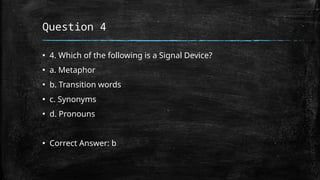
Question 4
▪ 4. Which of the following is a Signal Device?
▪ a. Metaphor
▪ b. Transition words
▪ c. Synonyms
▪ d. Pronouns
▪ Correct Answer: b
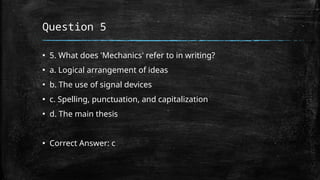
Question 5
▪ 5. What does 'Mechanics' refer to in writing?
▪ a. Logical arrangement of ideas
▪ b. The use of signal devices
▪ c. Spelling, punctuation, and capitalization
▪ d. The main thesis
▪ Correct Answer: c
Question 6
▪ 6. Spatial order arranges details based on:
▪ a. Chronology
▪ b. Importance
▪ c. Location
▪ d. Cause and effect
▪ Correct Answer: c
Question 7
▪ 7. Which example demonstrates Coherence and Cohesion?
▪ a. Random facts about a topic
▪ b. Smooth transitions between sentences
▪ c. A list of unrelated sentences
▪ d. A repetitive idea
▪ Correct Answer: b
Question 8
▪ 8. Which property ensures appropriate word usage?
▪ a. Language Use
▪ b. Organization
▪ c. Mechanics
▪ d. Coherence
▪ Correct Answer: a
Question 9
▪ 9. Chronological order is used to arrange ideas by:
▪ a. Their importance
▪ b. The time they occurred
▪ c. Their location
▪ d. Cause and effect relationships
▪ Correct Answer: b
Question 10
▪ 10. Pronouns contribute to:
▪ a. Repetition
▪ b. Coherence
▪ c. Signal Devices
▪ d. Spatial order
▪ Correct Answer: b
Question 11
▪ 11. Which transition word indicates Cause and Effect?
▪ a. Similarly
▪ b. Because
▪ c. Meanwhile
▪ d. Moreover
▪ Correct Answer: b
Question 12
▪ 12. The phrase 'on the other hand' signals:
▪ a. Comparison
▪ b. Contrast
▪ c. Sequence
▪ d. Chronology
▪ Correct Answer: b
Question 13
▪ 13. An example of inappropriate Language Use is:
▪ a. Formal vocabulary
▪ b. Gender-neutral terms
▪ c. Slang words
▪ d. Proper nouns
▪ Correct Answer: c
Question 14
▪ 14. Mechanics require numbers 0-10 to be:
▪ a. Spelled out
▪ b. Written numerically
▪ c. Abbreviated
▪ d. Repeated
▪ Correct Answer: a
Question 15
▪ 15. Which is an example of Emphatic Order?
▪ a. Arranging points by importance
▪ b. Listing events chronologically
▪ c. Describing objects spatially
▪ d. Explaining steps in a process
▪ Correct Answer: a

15_question_quiz_properties_of_text.pptx

  • 1.
  • 2.
    TO DO LIST: Identify the different properties of a well- written text;  Cite the importance of a well-written text; and  Create a short well-written paragraph employing the properties of a well-written text.
  • 3.
  • 4.
    THESIS STATEMENT: Fora text to be well-written, one must keep in mind these four properties. I. Organization II. Coherence and Cohesion A. Arrangement of details according to . . . 1. Chronological Order 2. Spatial Order 3. Emphatic Order B. Signal Devices 1. Transitions a. Time e. Comparison b. Sequence f. Contrast c. Space g. Cause and Effect d. Illustration h. Conclusion 2. Repetitions 3. Synonyms 4. Pronouns III. Language Use IV. Mechanics
  • 5.
    I.ORGANIZATION • It issaid that ideas are well-developed when there is a clear statement of purpose, position, facts, examples, specific details, definitions, explanation, justifications, or opposing viewpoints. • Organization is achieved when these ideas are logically and accurately arranged.
  • 6.
    ORGANIZATION If there isa clear statement of purpose, position, facts, examples, specific details, definitions, explanation, justifications, or opposing viewpoints, IDEAS are formed and well- develope d. ORGANIZATIO N And if there is organization. . . there is . . .
  • 7.
  • 8.
    II. COHERENCE AND COHESION COHERENCE:This means that sentences are arranged in a logical manner, making them easily understood by the reader. COHESION: connection of ideas at sentence level
  • 9.
    COHESION - the propertyof unity in a written text or a segment of spoken discourse that stems from links among its surface elements, as when words in one sentence are repeated in another, and especially from the fact that some words or phrases depend for their interpretation upon material in preceding or following text
  • 10.
    Example: Be assured ofthis. Most people do not want to fight. However, they will do so when provoked.
  • 11.
    How can weorganize the details of a paragraph?
  • 12.
    II. Coherence andCohesion A. Arrangement of details according to . . . 1. Chronological Order 2. Spatial Order 3. Emphatic Order
  • 13.
    1. CHRONOLOGICAL. The detailsare arranged in the order in which they happened. COHERENCE AND COHESION
  • 14.
    COHERENCE AND COHESION This morningwas crazy. My alarm clock was set for PM instead of AM, so I woke up really late. I just threw on some clothes and ran out the door. I rode my bike as fast as I could and thought that I was going to be late for sure, but when I got there everyone was outside and there were firetrucks all lined up in front of school. I guess somebody pulled the fire alarm before class started. It worked out though, because nobody really noticed or minded that I was tardy.
  • 15.
  • 16.
    COHERENCE AND COHESION 2. SPATIAL– The sentences of a paragraph are arranged according to geographical location, such as left-to-right, up- to-down, etc.
  • 17.
    COHERENCE AND COHESION The insideof Bill's refrigerator was horrible. On the top shelf was a three week old carton of milk. Next to it sat a slice of melon that had started to get moldy. To the right of the melon sat the remains of a macaroni and cheese dinner that had been served a week earlier. On the shelf below was a slice of cake from his sister's birthday party. Though there was food, none of it was edible.
  • 18.
    COHERENCE AND COHESION 3. EMPHATIC– is when information found in a paragraph is arranged to emphasize certain points depending on the writer’s purpose. The coherence of the paragraph is established in one of two ways: (a) from least to most important, or (b) from most to least important.
  • 19.
    After looking atall the brochures and talking to several salesmen, I decided to purchase an SLR camera. For several years I had been dissatisfied with the results I was getting from my point-and-shoot camera. The framing was imprecise and the focus was not always accurate. I had planned a vacation to an area that promised many fabulous photo opportunities, and I wanted to capture each one with accuracy. But the most important reason I decided on the SLR camera was the great versatility it offered. COHERENCE AND COHESION
  • 20.
    COHERENCE AND COHESION In theabove paragraph, the organization moves from the least important idea (dissatisfaction with the results of the point-and-shoot camera) to the most important idea (the versatility offered with the SLR camera).
  • 21.
    COHERENCE AND COHESION B. SignalDevices 1. Transitions a. Time e. Comparison b. Sequence f. Contrast c. Space g. Cause and Effect d. Illustration h. Conclusion 2. Repetitions 3. Synonyms 4. Pronouns
  • 22.
    B. Signal Devices -words that give readers an idea of how the points in your paragraph are progressing COHERENCE AND COHESION
  • 23.
    COHERENCE AND COHESION Examples: 1. Transitions(words that connect one idea to another, in order for our ideas to flow smoothly)
  • 24.
    COHERENCE AND COHESION a. Time(first, immediately, afterward, before, at the same time, after, earlier, simultaneously, finally, next, in the meantime, later, eventually, then, meanwhile, now, subsequent, etc.)
  • 25.
    COHERENCE AND COHESION b. Sequence(moreover, furthermore, next, also, finally, last, another, first, second, third, besides, additionally, etc.)
  • 26.
    COHERENCE AND COHESION c. Space(above, next to, below, behind, beside, etc.)
  • 27.
    COHERENCE AND COHESION d. Illustration(for instance, specifically, for example, namely, in this case, to illustrate, etc.)
  • 28.
    COHERENCE AND COHESION e. Comparison(similarly, also, in the same way, still, likewise, in comparison, too, etc.)
  • 29.
    COHERENCE AND COHESION f. Contrast(but, despite, however, even though, yet, on the other hand, although, on the contrary, otherwise, conversely, etc.)
  • 30.
    COHERENCE AND COHESION g. Causeand Effect (because, as a result, consequently, then, so, since, etc.)
  • 31.
    COHERENCE AND COHESION h. Conclusion(thus, therefore, in conclusion, in short, etc.)
  • 32.
    COHERENCE AND COHESION 2. Repetitions(repetitions of main ideas keep continuity and highlight important ideas) -it could be a word, a phrase, or a full sentence, or a poetical line repeated to emphasize its significance in the entire text
  • 33.
    1. If youthink you can do it, you can do it. 2. The boy was a good footballer, because his father was a footballer, and his grandfather was a footballer. 3. The judge commanded, stamping his mallet on the table, “Order in the court, order in the court.” 4. The president said, “Work, work, and work,” are the keys to success. Examples of Repetitions:
  • 34.
    COHERENCE AND COHESION 3. Synonyms(these are words similar in meaning to important words or phrases that prevent tedious repetitions)
  • 35.
    COHERENCE AND COHESION 4. Pronouns(words that connect readers to the original word that the pronouns replace)
  • 36.
    Example of Pronounsused in an actual sentence: INCORRECT: Rodrigo Duterte is the 16th President of the Republic of the Philippines. Aside from that, Rodrigo Duterte also served as Davao City’s Mayor for a long period of time. Rodrigo Duterte is also known by the populace as an adamant leader. . . CORRECT: Rodrigo Duterte is the 16th President of the Republic of the Philippines. Aside from that, he also served as Davao City’s Mayor for a long period of time. He is also known by the populace as an adamant leader. . .
  • 37.
  • 38.
    LANGUAGE USE III. LANGUAGE USE -appropriateness of word / vocabulary usage
  • 39.
    LANGUAGE USE Words and Phrasesone must avoid to use in order to practice appropriate Language Use:
  • 40.
    LANGUAGE USE Words and Phrasesone must avoid to use in order to practice appropriate Language Use: Table of contents 1.Too informal 2.Too unsophisticated 3.Too vague 4.Other tips
  • 41.
  • 42.
  • 43.
  • 44.
    LANGUAGE USE Other tips •Jargon (i.e.“insider” terminology that may be difficult for readers from other fields to understand) •Clichés (which are expressions that are heavily overused, such as think outside of the box and but at the end of the day) •Everyday abbreviations (e.g. photos, fridge, phone, info) •Slang (e.g. cops, cool) •Not gender neutral (e.g. firemen, mankind)
  • 45.
  • 46.
  • 47.
    MECHANICS IV. MECHANICS - setof conventions on how to spell, abbreviate, punctuate, and capitalize *Avoid contractions and exclamation points (unless part of a direct quotation) *Mention the full name before the abbreviation. *Numbers from 0-10 must be spelled out.
  • 48.
  • 49.
  • 50.
    In this activity,I will be presenting you excerpts or examples from a text. You will try to determine what property of a well-written text is present/used in it. For example. . .
  • 51.
    Michael took thechildren with him. Answer: Coherence and cohesion, Pronouns
  • 52.
    I will begrouping you into four groups. Please count one to four. The goal of each group is to get the highest score. Aim to get more correct answers for a high score. Exercise team work. Group secretary give me a ¼ sheet of paper with the list of group members.
  • 53.
    When I beginreading each question, listen carefully. It will only be read TWICE. Write your answer on the sheet that will be provided. Only ten seconds will be allocated for you to answer.
  • 54.
    Question no. 1: CentralIdea: The Eiffel Tower is divided into three sections. Main Points: I. The lowest section of the tower contains the entrance, a gift shop, and a restaurant. II. The middle section of the tower consists of stairs and elevators that lead to the top. III. The top section of the tower includes an observation deck with a spectacular view of Paris.
  • 55.
    Answer: Coherence andCohesion, Spatial Order
  • 56.
    Question no. 2 Duringthe early twentieth century, in addition to industrialization, urban growth and technological development, Australian society was experiencing a transformation of the domestic ideal. Consequently, people were subject to an increasing array of government and professional programs aiming to manage and regulate life, particularly family life. Some of these programs were. . .
  • 57.
    Answer: Coherence andCohesion, Signal Devices/Transitions
  • 58.
    Question no. 3 ALTERNATIVE:A poor or negative result Instead of: A bad result
  • 59.
  • 60.
    Question no. 4 (Asidefrom transitions) During the early twentieth century, in addition to industrialization, urban growth and technological development, Australian society was experiencing a transformation of the domestic ideal.
  • 61.
  • 62.
    Question no. 5 Thismorning was crazy. My alarm clock was set for PM instead of AM, so I woke up really late. I just threw on some clothes and ran out the door. I rode my bike as fast as I could and thought that I was going to be late for sure, but when I got there everyone was outside and there were firetrucks all lined up in front of school. I guess somebody pulled the fire alarm before class started. It worked out though, because nobody really noticed or minded that I was tardy.
  • 63.
    Answer: Coherence andcohesion, Chronological order
  • 64.
    Question no. 6 PresidentRodrigo Duterte was the 16th President of the Republic of Philippines. He is also the former Mayor in Davao City for a long time.
  • 65.
    Answer: Coherence andCohesion, Pronouns
  • 66.
    Question no. 7 Incorrect:The value in this variable is used to determine when to pause during long display output, such as during a software dump. Its value is reset each time the ok prompt is displayed. Correct: The value in this variable is used to determine when to pause during long display output, such as during a software dump. The variable’s value is reset each time the ok prompt is displayed.
  • 67.
  • 68.
    CONGRATULATIONS TO THE WINNERS! CONGRATULATIONS ALSO TO EVERYONE! 
  • 69.
  • 70.
    IV. EVALUATION IDENTIFICATION Direction: Identifythe following by writing it on the space before the item number. ____________1. This is achieved when these ideas are logically and accurately arranged. ____________2. The details of a paragraph are arranged according to the order in which they happened. ____________3. It is a set of conventions on how to spell, abbreviate, punctuate, and capitalize. _____________4. These are words that connect one idea to another, in order for our ideas to flow smoothly. ____________5. This means that sentences are arranged in a logical manner, making them easily understood by the reader.
  • 71.
    ____________6. These arewords similar in meaning to important words or phrases that prevent tedious repetitions. ____________7. The sentences of a paragraph are arranged according to geographical location, such as left-to- right, up-to-down, etc. ____________8. These are words that give readers an idea of how the points in your paragraph are progressing. ____________9. These are the words that connect readers to the original word that they replace. ____________10. To attain this property, one must be consistent with the use of pronouns.
  • 72.
    Key to Correction: 1.Organization 2. Chronological/Order 3. Mechanics 4. Transitions 5. Coherence 6. Synonyms 7. Spatial/Order 8. Signal Devices 9. Pronouns 10. Language Use
  • 73.
    V. ASSIGNMENT (2minutes) Create a short well-written paragraph (about anything) employing the properties of a well-written text. Your essay will be rated according to this analytic rubric. Consequently, use this rubric as a guide when writing your essay and check it again before you submit your essay.
  • 74.
    TRAITS 4 32 1 Focus & Details There is one clear, well- focused topic. Main ideas are clear and are well supported by detailed and accurate information. There is one clear, well-focused topic. Main ideas are clear but are not well supported by detailed information. There is one topic. Main ideas are somewhat clear. The topic and main ideas are not clear. Organization The introduction is inviting, states the main topic, and provides an overview of the paper. Information is relevant and presented in a logical order. The conclusion is strong. The introduction states the main topic and provides an overview of the paper. A conclusion is included. The introduction states the main topic. A conclusion is included. There is no clear introduction, structure, or conclusion. Voice The author’s purpose of writing is very clear, and there is strong evidence of attention to audience. The author’s extensive knowledge and/or experience with the topic is/are evident. The author’s purpose of writing is somewhat clear, and there is some evidence of attention to audience. The author’s knowledge and/or experience with the topic is/are evident. The author’s purpose of writing is somewhat clear, and there is evidence of attention to audience. The author’s knowledge and/or experience with the topic is/are limited. The author’s purpose of writing is unclear. Word Choice The author uses vivid words and phrases. The choice and placement of words seems accurate, natural, and not forced. The author uses vivid words and phrases. The choice and placement of words is inaccurate at times and/or seems overdone. The author uses words that communicate clearly, but the writing lacks variety. The writer uses a limited vocabulary. Jargon or clichés may be present and detract from the meaning. Sentence Structure, Grammar, Mechanics, & Spelling All sentences are well constructed and have varied structure and length. The author makes no errors in grammar, mechanics, and/or spelling. Most sentences are well-constructed and have varied structure and length. The author makes a few errors in grammar, mechanics, and/or spelling, but they do not interfere with understanding Most sentences are well constructed, but they have a similar structure and/or length. The author makes several errors in grammar, mechanics, and/or spelling that interfere with understanding. Sentences sound awkward, are distractingly repetitive, or are difficult to understand. The author makes numerous errors in grammar, mechanics, and/or spelling that interfere with understanding. Reviewer’s
  • 75.
    THANK YOU FOR LISTENING! (Ifever you listened) 
  • 76.
    Multiple Choice Quiz:Properties of a Well-Written Text ▪ Test your understanding of the properties of a well-written text with these questions.
  • 77.
    Question 1 ▪ 1.What is the main goal of 'Organization' in a well-written text? ▪ a. To persuade readers ▪ b. To arrange ideas logically ▪ c. To use correct grammar ▪ d. To avoid redundancy ▪ Correct Answer: b
  • 78.
    Question 2 ▪ 2.Coherence in a paragraph ensures that: ▪ a. Ideas flow logically ▪ b. Words are spelled correctly ▪ c. Sentences are chronological ▪ d. The main idea is repeated ▪ Correct Answer: a
  • 79.
    Question 3 ▪ 3.Cohesion connects ideas at the: ▪ a. Sentence level ▪ b. Paragraph level ▪ c. Document level ▪ d. Outline level ▪ Correct Answer: a
  • 80.
    Question 4 ▪ 4.Which of the following is a Signal Device? ▪ a. Metaphor ▪ b. Transition words ▪ c. Synonyms ▪ d. Pronouns ▪ Correct Answer: b
  • 81.
    Question 5 ▪ 5.What does 'Mechanics' refer to in writing? ▪ a. Logical arrangement of ideas ▪ b. The use of signal devices ▪ c. Spelling, punctuation, and capitalization ▪ d. The main thesis ▪ Correct Answer: c
  • 82.
    Question 6 ▪ 6.Spatial order arranges details based on: ▪ a. Chronology ▪ b. Importance ▪ c. Location ▪ d. Cause and effect ▪ Correct Answer: c
  • 83.
    Question 7 ▪ 7.Which example demonstrates Coherence and Cohesion? ▪ a. Random facts about a topic ▪ b. Smooth transitions between sentences ▪ c. A list of unrelated sentences ▪ d. A repetitive idea ▪ Correct Answer: b
  • 84.
    Question 8 ▪ 8.Which property ensures appropriate word usage? ▪ a. Language Use ▪ b. Organization ▪ c. Mechanics ▪ d. Coherence ▪ Correct Answer: a
  • 85.
    Question 9 ▪ 9.Chronological order is used to arrange ideas by: ▪ a. Their importance ▪ b. The time they occurred ▪ c. Their location ▪ d. Cause and effect relationships ▪ Correct Answer: b
  • 86.
    Question 10 ▪ 10.Pronouns contribute to: ▪ a. Repetition ▪ b. Coherence ▪ c. Signal Devices ▪ d. Spatial order ▪ Correct Answer: b
  • 87.
    Question 11 ▪ 11.Which transition word indicates Cause and Effect? ▪ a. Similarly ▪ b. Because ▪ c. Meanwhile ▪ d. Moreover ▪ Correct Answer: b
  • 88.
    Question 12 ▪ 12.The phrase 'on the other hand' signals: ▪ a. Comparison ▪ b. Contrast ▪ c. Sequence ▪ d. Chronology ▪ Correct Answer: b
  • 89.
    Question 13 ▪ 13.An example of inappropriate Language Use is: ▪ a. Formal vocabulary ▪ b. Gender-neutral terms ▪ c. Slang words ▪ d. Proper nouns ▪ Correct Answer: c
  • 90.
    Question 14 ▪ 14.Mechanics require numbers 0-10 to be: ▪ a. Spelled out ▪ b. Written numerically ▪ c. Abbreviated ▪ d. Repeated ▪ Correct Answer: a
  • 91.
    Question 15 ▪ 15.Which is an example of Emphatic Order? ▪ a. Arranging points by importance ▪ b. Listing events chronologically ▪ c. Describing objects spatially ▪ d. Explaining steps in a process ▪ Correct Answer: a

Editor's Notes

  • #32 - repeats the same words or phrases a few times to make an idea clearer and more memorable
  • #34 For example, it’s a bore, and sometimes also irritating to see a word so often in reading a paragraph. Don’t always use the word “clean,” also use other words that mean the same as the word “clean,” such as “neat,” “immaculate,” “pristine,” like that.
  • #35 Pronouns are used in place of a noun that has already been mentioned or that is already known, often to avoid repeating the noun. 
  • #42 (use euphemism)
  • #43 *Use clear and concise sentences.  Use precise vocabulary.(Avoid being vague)
  • #44 Avoid sexist language
  • #46 Avoid sexist language
  • #47 Avoid sexist language
  • #48 Avoid sexist language
  • #49 Avoid sexist language
  • #50 Avoid sexist language