Frank
Bott
Professional
Issues
in
Information
Technology
Professional Issues in Information Technology
Frank Bott
To function effectively, professional IT practitioners need not
only the appropriate technical knowledge, but a broad
understanding of the context in which they operate.
Professional Issues in Information Technology addresses
social, legal, financial, organizational and ethical issues in
the IT industry. Topics covered include:
professionalism and professional bodies, their codes of
conduct and continuing professional development (CPD);
intellectual property law, particularly as it relates
to software;
legal and ethical issues relating to the misuse of
computers and the internet;
data protection, freedom of information, and privacy;
anti-discrimination law and employment law in the
context of the IT industry;
basic financial and management accounting;
types of organizational structure and their legal status.
About the author
Frank Bott was for many years head of the Computer Science
Department at the University of Wales, Aberystwyth, where
he now lectures part-time. Before that he was a visiting
professor at the University of Missouri and worked in the
software industry. He is an active member of BCS.
Professional Issues in
Information
Technology is the only
textbook tailored
specifically to match
the syllabus of the
BCS Professional
Examination Diploma,
compulsory module,
Professional Issues in
Information Systems
Practice, in its entirety,
and has been written
by a member of the
BCS Professional
Examinations Board.
This book is brought to you by the
British Computer Society – the leading
professional and learned society in the field
of computers and information systems.
BCS FIRST FLOOR, BLOCK D,
NORTH STAR HOUSE, NORTH STAR AVENUE,
SWINDON, SN2 1FA, UK
professional-issues-USA:Layout 1 25/02/2009 16:03 Page 1
Professional Issues in
Information Technology
The British Computer Society
The British Computer Society is the leading professional body for the IT
industry. With members in over 100 countries, the BCS is the professional
and learned Society in the field of computers and information systems.
The BCS is responsible for setting standards for the IT profession. It is also
leading the change in public perception and appreciation of the economic
and social importance of professionally managed IT projects and pro-
grammes. In this capacity, the Society advises, informs and persuades
industry and government on successful IT implementation.
IT is affecting every part of our lives and that is why the BCS is determined
to promote IT as the profession of the 21st century.
Joining the BCS
BCS qualifications, products and services are designed with your career
plans in mind. We not only provide essential recognition through pro-
fessional qualifications but also offer many other useful benefits to our
members at every level.
Membership of the BCS demonstrates your commitment to professional
development. It helps to set you apart from other IT practitioners and pro-
vides industry recognition of your skills and experience. Employers and
customersincreasinglyrequireproofofprofessionalqualificationsandcom-
petence. Professional membership confirms your competence and integrity
and sets an independent standard that people can trust.
www.bcs.org/membership
Further Information
Further information about the British Computer Society can be obtained
from: The British Computer Society, 1 Sanford Street, Swindon, Wiltshire,
SN1 1HJ, UK.
Telephone: + 44 (0)1793 417 424
Email: bcs@hq.bcs.org.uk
Web: www.bcs.org
Professional
Issues in
Information
Technology
Frank Bott
© Frank Bott 2005 (Main text).
© The British Computer Society, various dates (Examination questions, code of conduct, and
other material from the Society’s publications).
The right of Frank Bott to be identified as author of this work has been asserted in accordance
with s77 and s78 Copyright, Designs and Patents Act, 1988.
Cover photo - Jupiterimages.
All rights reserved. Apart from any fair dealing for the purposes of research or private study, or
criticism or review, as permitted by the Copyright Designs and Patents Act 1988, no part of this
publication may be reproduced, stored or transmitted in any form or by any means, except with
the prior permission in writing of the Publisher, or in the case of reprographic reproduction, in
accordance with the terms of the licences issued by the Copyright Licensing Agency. Enquiries
for permission to reproduce material outside those terms should be directed to the Publisher.
The British Computer Society,
1 Sanford Street,
Swindon,
Wiltshire SN1 1HJ,
UK
www.bcs.org
ISBN 1-902505-65-4
British Cataloguing in Publication Data.
A CIP catalogue record for this book is available at the British Library.
All trademarks, registered names etc. acknowledged in this publication to be the property of
their respective owners.
Disclaimer:
Although every care has been taken by the authors and The British Computer Society in the
preparation of the publication, no warranty is given by the authors or The British Computer
Society as Publisher as to the accuracy or completeness of the information contained within it
and neither the authors nor The British Computer Society shall be responsible or liable for any
loss or damage whatsoever arising by virtue of such information or any instructions or advice
contained within this publication or by any of the aforementioned.
Typeset and printed by Arrowsmith, Bristol
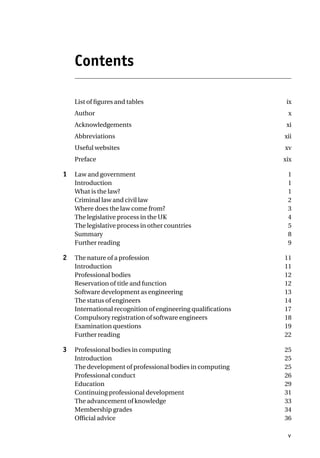
Contents
List of figures and tables ix
Author x
Acknowledgements xi
Abbreviations xii
Useful websites xv
Preface xix
1 Law and government 1
Introduction 1
What is the law? 1
Criminal law and civil law 2
Where does the law come from? 3
The legislative process in the UK 4
The legislative process in other countries 5
Summary 8
Further reading 9
2 The nature of a profession 11
Introduction 11
Professional bodies 12
Reservation of title and function 12
Software development as engineering 13
The status of engineers 14
International recognition of engineering qualifications 17
Compulsory registration of software engineers 18
Examination questions 19
Further reading 22
3 Professional bodies in computing 25
Introduction 25
The development of professional bodies in computing 25
Professional conduct 26
Education 29
Continuing professional development 31
The advancement of knowledge 33
Membership grades 34
Official advice 36
v
Examination questions 37
Further reading 39
4 What is an organization? 41
Introduction 41
Commercial organizations 41
Limited companies 43
The constitution of a limited company 44
Directors 45
Setting up a company 47
Non-commercial bodies 47
Examination questions 48
Further reading 50
5 Financing a start-up company 51
Introduction 51
Why capital is needed 51
The business plan 52
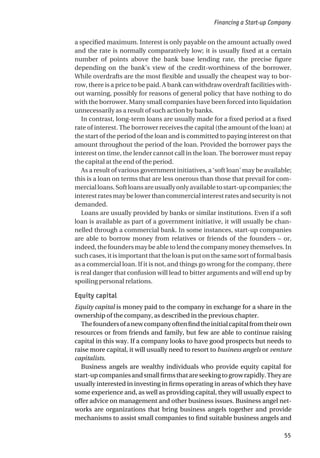
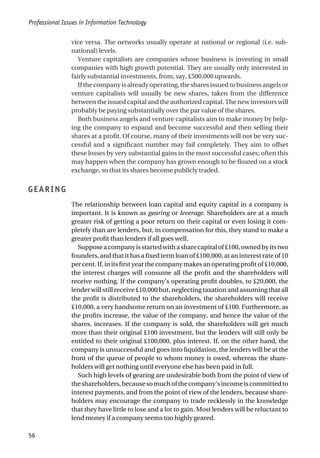
Sources of finance 53
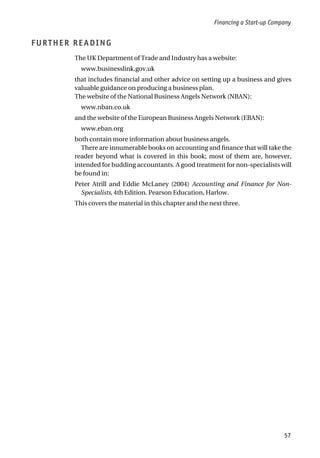
Gearing 56
Further reading 57
6 Financial accounting 59
Introduction 59
The balance sheet 59
The profit and loss account 65
The cash flow statement 70
The overall picture 71
Examination questions 72
Further reading 74
7 Management accounting 75
Introduction 75
Cost of labour 75
Overheads 77
Budgeting 79
Cash flow forecast 80
Examination questions 82
Further reading 84
8 Investment appraisal 85
Introduction 85
The time value of money 86
Applying DCF to a simple investment project 87
Assessment of a software product proposal 90
Pitfalls of DCF 91
Professional Issues in Information Technology
vi
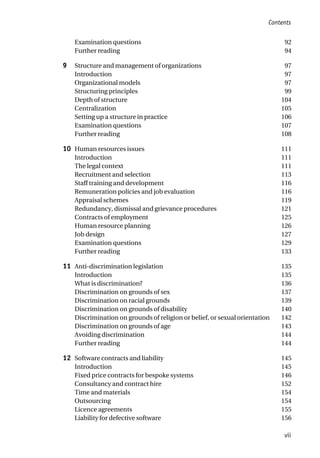
Examination questions 92
Further reading 94
9 Structure and management of organizations 97
Introduction 97
Organizational models 97
Structuring principles 99
Depth of structure 104
Centralization 105
Setting up a structure in practice 106
Examination questions 107
Further reading 108
10 Human resources issues 111
Introduction 111
The legal context 111
Recruitment and selection 113
Staff training and development 116
Remuneration policies and job evaluation 116
Appraisal schemes 119
Redundancy, dismissal and grievance procedures 121
Contracts of employment 125
Human resource planning 126
Job design 127
Examination questions 129
Further reading 133
11 Anti-discrimination legislation 135
Introduction 135
What is discrimination? 136
Discrimination on grounds of sex 137
Discrimination on racial grounds 139
Discrimination on grounds of disability 140
Discrimination on grounds of religion or belief, or sexual orientation 142
Discrimination on grounds of age 143
Avoiding discrimination 144
Further reading 144
12 Software contracts and liability 145
Introduction 145
Fixed price contracts for bespoke systems 146
Consultancy and contract hire 152
Time and materials 154
Outsourcing 154
Licence agreements 155
Liability for defective software 156
Contents
vii
Health and safety 158
Further reading 159
13 Intellectual property rights 161
Introduction 161
Different types of intellectual property rights 162
Copyright 163
Patents 167
Confidential information 171
Trade marks and passing off 173
Domain names 174
Examination questions 175
Further reading 178
14 Data protection, privacy and freedom of information 181
Background 181
Data protection 182
Privacy 188
Freedom of information 189
Examination questions 190
Further reading 192
15 Internet issues 193
Introduction 193
Internet service providers 194
Law across national boundaries 195
Defamation 197
Pornography 199
Spam 205
Further reading 207
16 Computer misuse 209
Introduction 209
The Computer Misuse Act 1990 209
The 2004 Review of the Computer Misuse Act 211
Computer fraud 212
Examination questions 213
Further reading 215
Appendix A: The BCS Code of Conduct 217
Appendix B: A sample agreement 221
Appendix C: Sample terms and conditions for a fixed price contract 223
Appendix D: Sample contract of employment 231
Further reading 235
Index 237
Professional Issues in Information Technology
viii
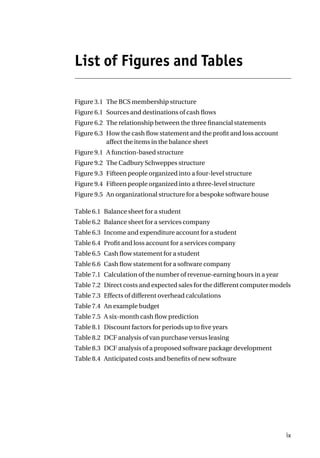
List of Figures and Tables
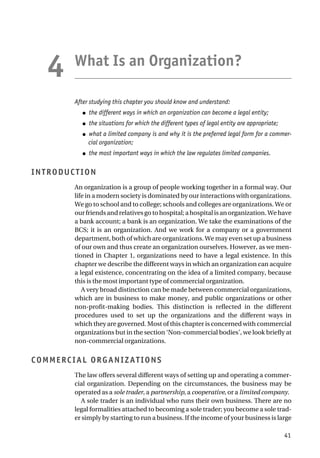
Figure 3.1 The BCS membership structure
Figure 6.1 Sources and destinations of cash flows
Figure 6.2 The relationship between the three financial statements
Figure 6.3 How the cash flow statement and the profit and loss account
affect the items in the balance sheet
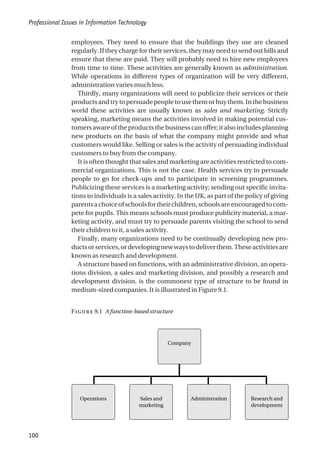
Figure 9.1 A function-based structure
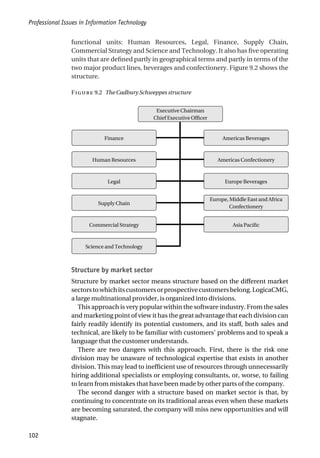
Figure 9.2 The Cadbury Schweppes structure
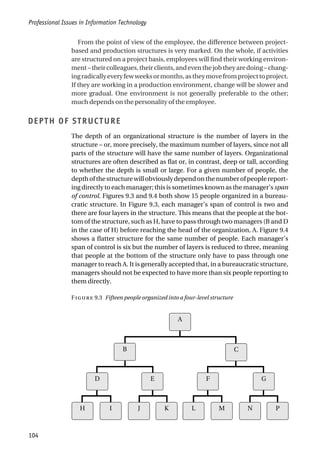
Figure 9.3 Fifteen people organized into a four-level structure
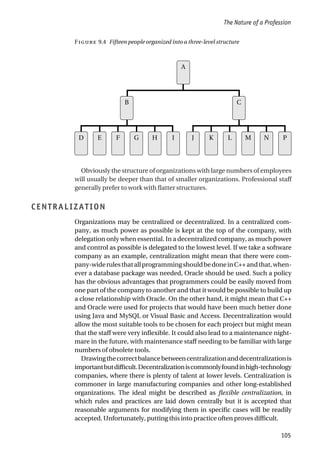
Figure 9.4 Fifteen people organized into a three-level structure
Figure 9.5 An organizational structure for a bespoke software house
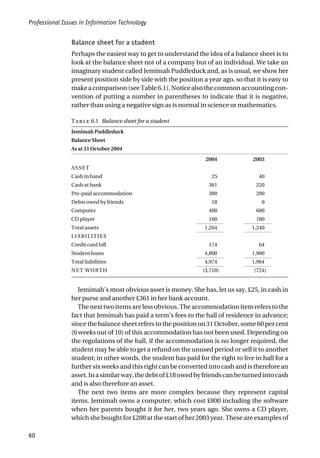
Table 6.1 Balance sheet for a student
Table 6.2 Balance sheet for a services company
Table 6.3 Income and expenditure account for a student
Table 6.4 Profit and loss account for a services company
Table 6.5 Cash flow statement for a student
Table 6.6 Cash flow statement for a software company
Table 7.1 Calculation of the number of revenue-earning hours in a year
Table 7.2 Direct costs and expected sales for the different computer models
Table 7.3 Effects of different overhead calculations
Table 7.4 An example budget
Table 7.5 A six-month cash flow prediction
Table 8.1 Discount factors for periods up to five years
Table 8.2 DCF analysis of van purchase versus leasing
Table 8.3 DCF analysis of a proposed software package development
Table 8.4 Anticipated costs and benefits of new software
ix
Author
Frank Bott studied Mathematics at Trinity College Cambridge, where he was
awarded the Yates Prize. He worked in the University’s Computing
Laboratory before joining SPL International, where he managed large pro-
jects in the ship-building industry and Health Service. Frank has previously
lectured at the University of Missouri and been head of the University of
Wales Computer Science Department. He now lectures part time, and is an
active member of the British Computer Society, sitting on their Board of
Examiners.
x
Acknowledgments
I would like to record my grateful thanks to my Aberystwyth colleagues,
Allison Coleman, Jack Eaton and Professor Diane Rowland, who collabo-
rated with me in teaching a course on professional issues over many years
and in writing an earlier, and very successful, book on the subject. I learned a
very great deal from working with them. I must also acknowledge my col-
leagues involved in BCS examination work over the years, from whom I have
also learned much. Special thanks are due to Professor Mike Tedd, my friend
and colleague for more years than either he or I would wish to admit to. He it
waswho,in1986,firstencouragedmetoputtogetheralecturecourseonpro-
fessional issues in software engineering; he has read the complete draft of
this book and it is much the better for his wise advice and suggestions. The
faults that remain are, of course, entirely my responsibility.
FinallyIwouldliketothankmywifeforherpatience,forbearance,loveand
support, not only during the period that this book was being written, but
throughout our years together.
xi
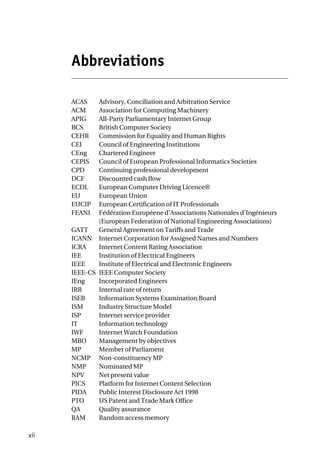
Abbreviations
ACAS Advisory, Conciliation and Arbitration Service
ACM Association for Computing Machinery
APIG All-Party Parliamentary Internet Group
BCS British Computer Society
CEHR Commission for Equality and Human Rights
CEI Council of Engineering Institutions
CEng Chartered Engineer
CEPIS Council of European Professional Informatics Societies
CPD Continuing professional development
DCF Discounted cash flow
ECDL European Computer Driving Licence®
EU European Union
EUCIP European Certification of IT Professionals
FEANI Fédération Européene d’Associations Nationales d’Ingénieurs
(European Federation of National Engineering Associations)
GATT General Agreement on Tariffs and Trade
ICANN Internet Corporation for Assigned Names and Numbers
ICRA Internet Content Rating Association
IEE Institution of Electrical Engineers
IEEE Institute of Electrical and Electronic Engineers
IEEE-CS IEEE Computer Society
IEng Incorporated Engineers
IRR Internal rate of return
ISEB Information Systems Examination Board
ISM Industry Structure Model
ISP Internet service provider
IT Information technology
IWF Internet Watch Foundation
MBO Management by objectives
MP Member of Parliament
NCMP Non-constituency MP
NMP Nominated MP
NPV Net present value
PICS Platform for Internet Content Selection
PIDA Public Interest Disclosure Act 1998
PTO US Patent and Trade Mark Office
QA Quality assurance
RAM Random access memory
xii
RCVS Royal College of Veterinary Surgeons
RIBA Royal Institute of British Architects
SFIA Skills Framework for the Information Age
TUPE Transfer of Undertakings (Protection of Employment)
UML Unified Modeling Language
W3C World Wide Web Consortium
WIPO World Intellectual Property Organization
Abbreviations
xiii
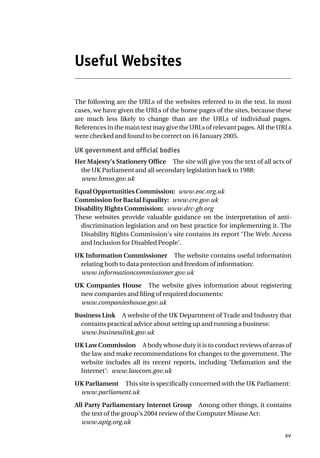
Useful Websites
The following are the URLs of the websites referred to in the text. In most
cases, we have given the URLs of the home pages of the sites, because these
are much less likely to change than are the URLs of individual pages.
References in the main text may give the URLs of relevant pages. All the URLs
were checked and found to be correct on 16 January 2005.
UK government and official bodies
Her Majesty’s Stationery Office The site will give you the text of all acts of
the UK Parliament and all secondary legislation back to 1988:
www.hmso.gov.uk
Equal Opportunities Commission: www.eoc.org.uk
Commission for Racial Equality: www.cre.gov.uk
Disability Rights Commission: www.drc-gb.org
These websites provide valuable guidance on the interpretation of anti-
discrimination legislation and on best practice for implementing it. The
Disability Rights Commission’s site contains its report ‘The Web: Access
and Inclusion for Disabled People’.
UK Information Commissioner The website contains useful information
relating both to data protection and freedom of information:
www.informationcommissioner.gov.uk
UK Companies House The website gives information about registering
new companies and filing of required documents:
www.companieshouse.gov.uk
Business Link A website of the UK Department of Trade and Industry that
contains practical advice about setting up and running a business:
www.businesslink.gov.uk
UK Law Commission A body whose duty it is to conduct reviews of areas of
the law and make recommendations for changes to the government. The
website includes all its recent reports, including ‘Defamation and the
Internet’: www.lawcom.gov.uk
UK Parliament This site is specifically concerned with the UK Parliament:
www.parliament.uk
All Party Parliamentary Internet Group Among other things, it contains
the text of the group’s 2004 review of the Computer Misuse Act:
www.apig.org.uk
xv
Advisory Conciliation and Arbitration Service Website where you can
accesscopiesofACASadvisorymaterialsuchas‘Disciplineandgrievances
at work’ and ‘Redundancy handling’: www.acas.org.uk
UK Patent Office The website contains the report produced by the Patent
Office in March 2001 giving the UK government’s position on the patent-
ing of software and business methods: www.patent.gov.uk
Government sites in other countries
The US Government’s Official Web Portal This site gives access to every-
thing to do with the federal government (but not the government of indi-
vidual states) of the USA, from the federal constitution to how to apply for
government grants. It includes the texts of all recent acts of Congress, as
well as the more important older ones: www.firstgov.gov
Missouri General Assembly Website of the State of Missouri, USA, where
you can find the Revised Statutes of the State of Missouri. Chapter 327
(Architects, Professional Engineers, Land Surveyors and Landscape
Architects) of these statutes is a good example of American legislation con-
cerning engineers: www.moga.state.mo.us
Government of Hong Kong: www.info.gov.hk
Directory of Indian Government Websites: goidirectory.nic.in
Government of Mauritius: ncb.intnet.mu/govt
Government of Sri Lanka: www.gov.lk
Government of Singapore: www.gov.sg
Professional bodies and international organizations
The British Computer Society: www.bcs.org.uk
The Institution of Electrical Engineers: www.iee.org
UK Engineering Council: www.engc.org.uk
UK Standard for Professional Engineering Competence:
www.uk-spec.org.uk
The first site contains a link to the second site, which is where the standards
for Chartered Engineer, Incorporated Engineer and Engineering
Technician are to be found.
The Association for Computing Machinery: www.acm.org
The IEEE Computer Society: www.computer.org
Australian Computer Society: www.acs.org.au
Hong Kong Computer Society: www.hkcs.org.hk
Indian Computer Society: www.csitvm.org
Professional Issues in Information Technology
xvi
Mauritius Computer Society: ncb.intnet.mu/mcs.htm
Singapore Computer Society: www.scs.org.sg
Fédération Européenne d’Associations Nationales d’Ingénieurs (European
Federation of National Engineering Associations): www.feani.org
Council of European Professional Informatics Societies: www.cepis.org
International Federation for Information Processing: www.ifip.or.at
Codes of conduct
It is not always as easy as it should be to find codes of conduct of profession-
al bodies by starting from their home pages. Accordingly, we list here the
URLs giving direct access to the pages concerned. It should be borne in mind
that such URLs are much more likely to change than are the URLs of organi-
zations’ home pages.
The BCS Code of Conduct: www.bcs.org/BCS/Join/WhyJoin/Conduct.htm
SoftwareEngineeringCodeofEthicsandProfessionalPractices TheCode
of Conduct jointly produced by the IEEE-CS and the ACM for software
engineers: www.computer.org/tab/seprof/code.htm
Australia Computer Society:
www.acs.org.au/national/pospaper/acs131.htm
Hong Kong Computer Society: www.hkcs.org.hk/ethics.htm
Indian Computer Society: www.csitvm.org/ethics.html
Singapore Computer Society:
www.scs.org.sg/cgi-bin/cgiwrap/scsorg/scs/scs.cgi?aboutus&codeofconduct
Codes of conduct of other professional bodies:
Royal Institute of British Architects:
www.architecture.com/go/Architecture/Using/Conduct_346.html
Royal College of Veterinary Surgeons:
www.rcvs.org.uk (click on Veterinary Surgeons and then Guide to
Professional Conduct)
Institute of Physics: about.iop.org/Iop/member/conduct.html
Institution of Mechanical Engineers:
www.imeche.org.uk/membership/pdf/Code%20of%20Conduct.pdf
Other sites
The London Ambulance Service Case Study Website providing informa-
tion about the London Ambulance System disaster, including a copy of
the official report: www.cs.ucl.ac.uk/staff/A.Finkelstein/las.html
Therac-25 report An updated version of the paper, ‘An investigation of the
Useful Websites
xvii
Therac-25 accidents’, by Nancy Leveson and Clark S. Turner:
sunnyday.mit.edu/therac-25.html
National Business Angels Network: www.nban.co.uk
European Business Angels Network: www.eban.org
Institutional Voting Information Service A code of best practice concern-
ing the duties of directors: www.ivis.co.uk/pages/gdsc6_1.html
W3C ‘Web Content Accessibility Guidelines’ version 1.0:
www.w3.org/TR/WAI-WEBCONTENT
Bitlaw A statement of the position on the patenting of software and busi-
ness methods in the USA: www.bitlaw.com/software-patent/index.html
The World Intellectual Property Association A website from where you
can download ‘The management of internet names and addresses:
Intellectual property issues’ (1999) and ‘The recognition of rights and the
use of names in the internet domain system’ (2001): www.wipo2.wipo.int
Communication, Cultural and Media Studies Database Information
about the laws governing pornography on the Internet:
www.cultsock.ndirect.co.uk/MUHome/cshtml/index.html
The Internet Watch Foundation: www.iwf.org.uk
The Internet Content Rating Association: www.icra.org
Skills Framework for the Information Age Foundation: www.sfia.org.uk
Professional Issues in Information Technology
xviii
Preface
When employers of newly qualified information systems professionals are
asked what it is they would most like them to know, the answer is very rarely
technical. Much more commonly, the answer is an understanding of the
business environment. For this reason, the Engineering Council and the
British Computer Society (BCS) both insist that accredited courses contain a
significant element of ‘professional issues’ and, in its own examinations, the
BCS requires candidates to take a compulsory paper entitled ‘Professional
Issues in Information Technology’. This book has been written as a guide for
students taking that paper and it covers the whole syllabus. It is hoped, how-
ever, that the book will also prove useful to others, both students on other
courses and those who are already embarked on a career in the information
systems industry.
It is important for candidates to realize that mere knowledge of the syl-
labusisnotenough,byitself,topassthepaper.Candidatesareexpectedtobe
able to apply that knowledge to simple scenarios. Failure to do this is one of
the commonest reasons for failing the paper. We have included many such
scenarios in this book, some of them taken from past examination papers.
Many of the candidates for the Society’s examinations are from overseas.
The BCS is the British Computer Society and it has to give priority to the situ-
ation of the information systems professional in the UK. For this reason, the
syllabus refers to British Acts of Parliament and to the laws of England and
Wales. However, it is expected that overseas candidates will be concerned
with the position in their own countries and, where relevant, this book tries
to illustrate how this varies from country to country. (Nowhere is this more
evident than when discussing the legal status of professional engineers.) I
would also hope that UK candidates might find it beneficial to learn about
the position in other countries.
Despite the existence of some very large and well-known multinational
companies, much of the information systems industry consists of small
enterprises with less than six employees. Very many young entrants to the
profession aim to set up such a business of their own. One of the purposes of
the Professional Issues module in the Society’s Diploma examination is
therefore to give practical guidance in a range of legal, financial and organi-
zational areas relevant to small information systems businesses. This is
reflected in many aspects of the book.
A word of warning is needed here. This book tries to explain the central
principles and issues in the areas covered, so that you will be aware of areas
you need to think about and areas where you will need professional advice.
xix
The book should give you enough knowledge to talk intelligently to profes-
sionals in the fields that it covers. But what the book covers is inevitably
introductory and much is omitted. Just as you would not regard an account-
ant who had read a book on computing and learned to use a spreadsheet and
a word processor as competent to design the software for a space shuttle, so
you must not regard yourself as a competent lawyer, accountant or other
professional on the strength of having studied this book.
Structure of the book
The book can be regarded as falling into four main parts. The first part
(Chapters1to4)isconcernedwiththegeneralcontextinwhichprofessionals
work – the law and how it is created, the professions, and the nature of com-
mercial organizations.
The second part (Chapters 5 to 8) is concerned very specifically with finan-
cial matters – the financing of start-up companies, the nature of financial
statements, costing, budgeting and cash flow, and the evaluation of invest-
ment proposals.
In the third part (Chapters 9, 10 and 11), we cover the human aspects of
running a company, including organizational structures and human
resource management.
Morespecificlegalissuesarecoveredinthefourthpart,includingsoftware
contracts and liability, intellectual property rights, and legislation that
affects the way in which computers are used or misused. Many of these top-
ics are matters of day-to-day concern for most computer users.
Finally, the appendices include the BCS Code of Conduct and examples of
standard agreements, standard terms and conditions, and a contract of
employment.
There are ‘Further reading’ sections at the end of each chapter (and con-
solidated at the end of the book). They are intended to:
● enable those who are teaching courses for the examination to deepen
and broaden their knowledge so that they can respond to questions and
initiate discussion in their classes;
● help students who feel they need to read more in order to get a better
understanding of the material;
● provide guidance to readers who need or want to go more deeply into
particular topics to satisfy their own professional needs.
The further reading suggested is not necessary for students who simply want
to pass the examination.
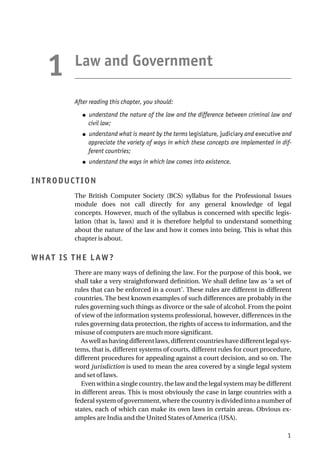
The following table shows the correspondence between chapters of the
book and the sections of the BCS syllabus:
Professional Issues in Information Technology
xx
BCS syllabus section Corresponding chapters
1 2, 3
2 4, 9
3 5, 6
4 7, 8
5 11, 12, 14, 15, 16
6 13
7 16
8 3
9 10, 11
Complete sets of examination papers for the BCS Professional Examinations
can be found on the Society’s website, along with examiners’ reports that
give guidance on the answers expected. We have included some of these
questionshere,attheendsoftherelevantchapters,insomecaseswithspeci-
men answers. Because of the recent updates to the syllabus, there are some
topics on which no questions are available.
Frank Bott
Aberystwyth
October 2004
Preface
xxi
Law and Government
After reading this chapter, you should:
● understand the nature of the law and the difference between criminal law and
civil law;
● understand what is meant by the terms legislature, judiciary and executive and
appreciate the variety of ways in which these concepts are implemented in dif-
ferent countries;
● understand the ways in which law comes into existence.
INTRODUCTION
The British Computer Society (BCS) syllabus for the Professional Issues
module does not call directly for any general knowledge of legal
concepts. However, much of the syllabus is concerned with specific legis-
lation (that is, laws) and it is therefore helpful to understand something
about the nature of the law and how it comes into being. This is what this
chapter is about.
WHAT IS THE LAW?
There are many ways of defining the law. For the purpose of this book, we
shall take a very straightforward definition. We shall define law as ‘a set of
rules that can be enforced in a court’. These rules are different in different
countries. The best known examples of such differences are probably in the
rules governing such things as divorce or the sale of alcohol. From the point
of view of the information systems professional, however, differences in the
rules governing data protection, the rights of access to information, and the
misuse of computers are much more significant.
Aswellashavingdifferentlaws,differentcountrieshavedifferentlegalsys-
tems, that is, different systems of courts, different rules for court procedure,
different procedures for appealing against a court decision, and so on. The
word jurisdiction is used to mean the area covered by a single legal system
and set of laws.
Even within a single country, the law and the legal system may be different
in different areas. This is most obviously the case in large countries with a
federal system of government, where the country is divided into a number of
states, each of which can make its own laws in certain areas. Obvious ex-
amples are India and the United States of America (USA).
1
1
In the United Kingdom (UK), for historical reasons, Scotland, Northern
Ireland and the Isle of Man each have different legal systems and different
laws. However, as far as the topics covered in this book are concerned, their
laws are, in almost all cases, the same as those of England and Wales. When
we refer to British law or UK law, we shall be referring to laws that apply
across the UK. Sometimes we shall refer to the law of England and Wales,
indicating that there are differences elsewhere in the UK.
CRIMINAL LAW AND CIVIL LAW
The popular image of the law sees it as the set of mechanisms that tries to
punish wrongdoers, by fines or imprisonment. This aspect of the law is
known as the criminal law. It can be considered to represent society’s view of
the minimum standard of acceptable behaviour. It defines what constitutes
acrime,laysdownthemechanismsfordecidingwhetherapersonaccusedof
a crime is guilty or innocent, and specifies the range of punishments applica-
ble to different categories of crime.
In general, the police are responsible for discovering who has carried out a
specific criminal offence and for collecting evidence that will convince a
court that the person in question really did commit the offence. The state, in
the form of the Crown Prosecution Service in England and Wales, will then
start proceedings by prosecuting the person concerned (who is known as the
accused or the defendant) in a criminal court. The court will decide whether
or not the case against the person has been proved and, if it finds the case
proved, will sentence the offender to a suitable punishment.
We shall not be very concerned with the criminal law in this book. We shall
be much more occupied with the civil law. The purpose of the civil law is to
provide rules for settling disputes between people.
Notice that we have referred to disputes between people. Does this mean
that the civil law doesn’t apply if one or both sides in a dispute are companies
or organizations of some other kind? It doesn’t mean this, of course, but, in
order to overcome the difficulty, we need the idea of a legal person. A legal
person is an organization that has gone through a process, called incor-
poration, that gives it the same legal status, so far as the civil law is
concerned, as a natural person, that is a human being. There are several dif-
ferent ways in which an organization can be incorporated. In Britain, an
organization can be incorporated by an Act of Parliament, by registering as a
company, or by the grant of a Royal Charter. We shall discuss this process in
Chapters 2 and 4.
Court action under the civil law is known as litigation. It must be initiated
by one of the parties to the dispute, that is, by the person, legal or natural, who
feels they have been wronged. The person who initiates the court action is
known as the plaintiff.
Two important differences between British civil law and criminal law
relate to the standard of proof and the burden of proof.
Professional Issues in Information Technology
2
For a person to be found guilty of a criminal offence, the prosecution
must demonstrate that they are guilty beyond all reasonable doubt. For a
plaintiff to win their case under civil law, they only have to show that their
claim is correct on the balance of probabilities. In other words, the standard
of proof required in criminal cases is higher than that required in civil
cases.
In a criminal case, the burden of proof lies on the prosecution. This means
that it is up to the prosecution to prove its case. The defendant does not need
to prove their innocence. They are assumed to be innocent until proved
guilty. In a civil case, on the other hand, both parties present their arguments
and must convince the court of their correctness.
WHERE DOES THE LAW COME FROM?
The two main sources of law in England and Wales are the common law and
statute law. The common law is essentially traditional law that is not written
down, but which depends on the judgement of judges over the centuries.
When deciding the rights and wrongs of a case, a court will look at the way in
which similar cases have been decided in the past; such cases are known as
precedents.
The common law tradition is shared by many other countries. Almost all
the countries of the Commonwealth share the tradition; so, most impor-
tantly, does the USA. This means that a judgement made by a judge in the
USA can be used as a precedent in, for example, a court in Singapore.
The tradition of common law is not found in the countries of continental
Europe, such as France and Germany. Their law is based entirely on written
codes, one for the criminal law and one for the civil law. Those parts of the
world that were once colonized by such countries have generally kept such a
system of written codes. Confusingly, this system of written codes is often
also referred to as civil law. However, in this book, we shall always use the
term civil law in the sense described in the previous section, that is, the law
used for settling disputes between people.
Statute law is law laid down by Acts of Parliament. It is often referred to as
legislation. Two hundred years ago, most cases that came to trial would have
beentriedunderthecommonlaw.Therewascomparativelylittlestatutelaw.
Over the past two hundred years the position has changed a lot. On the one
hand, technical developments and social changes make new laws urgently
necessary. Laws to regulate child labour and laws to prevent the misuse of
computers are just two examples of Parliament creating new laws for such
reasons.Ontheotherhand,insomeareasthemillionsofcommonlawjudge-
mentsfromthepastmakeitincreasinglydifficultforcourtstoapplythecom-
mon law and Parliament has passed legislation to bring together the
common law in these areas into a single statute. A good example of this is the
Theft Act 1968, which consolidated the common law provisions regarding
crimes involving stealing.
Law and Government
3
THE LEGISLATIVE PROCESS IN THE UK
Like many other democratic countries, the UK has what is known as a two-
chamber or bicameral legislature. This means that the law-making body (the
legislature) is made up of two chambers or groups of people.
The British legislature is known as Parliament. One of the chambers is
called the House of Commons; its members are elected and everyone over
the age of 18 has a vote. The country is currently divided into 659 constituen-
cies, each of which elects one Member of Parliament (MP), who is the person
who gets the most votes in the election. This is known as the ‘first past the
post’ system.
The other chamber in the UK Parliament is known as the House of Lords;
most of its members are appointed, but a significant number are chosen
from among the hereditary peers, although this situation may not last very
much longer. (Reform of the House of Lords has been an active political issue
in Britain for at least 100 years but, while most people agree that reform is
needed, it has proved impossible to get general agreement on what form it
should take.)
The British government is made up of members from both the House of
Commons and the House of Lords. Members of the House of Lords are never
more than a small proportion and the Prime Minister, the Chancellor of the
Exchequer, the Foreign Secretary and the Home Secretary are now always
members of the House of Commons.
Most new legislation is initiated by the government, although it is possible
for individual Members of Parliament to initiate legislation in certain cir-
cumstances. It is introduced in the form of a bill; this is a set of proposals that
parliamentisinvitedtodiscuss,possiblymodifyandthenapprove.Thebillis
usually introduced first in the House of Commons. It will be discussed and
possibly amended there, a process that includes a number of stages. If it is
approved by the House of Commons, it is passed to the House of Lords. If the
House of Lords approves the bill, it becomes an Act of Parliament. It is then
passed to the Queen for her formal approval (the royal assent), after which it
becomes law. (The Queen cannot refuse to give her approval when parlia-
ment has approved a bill.)
If the House of Lords rejects a bill or modifies it, the bill is returned to the
House of Commons for further consideration. The House of Commons has
the power to override any changes that may have been made by the House of
LordsoreventoinsistthatabillrejectedbytheHouseofLordsshould,never-
theless, be passed and proceed to receive the royal assent. The justification
for this is that the House of Commons is democratically elected and so repre-
sents the will of the people in a way that the members of the House of Lords,
not being elected, cannot do.
Inmanycases,thegovernmentmaywanttocanvassopinionbeforeasking
Parliament to approve legislation. It may publish a green paper, which typi-
cally explains why the government wants to create new laws in a certain area,
Professional Issues in Information Technology
4
and discusses a number of possible approaches. The green paper will be
discussed by Parliament and comments on it will be invited from the public
and from bodies that have an interest in the area. Thus, the BCS, along with
many other bodies, was specifically asked for its views when the question of
legislation to address the problem of computer misuse was raised.
Once the government has decided on its general approach, it may publish
a white paper, which describes the proposed legislation and will be used as
the basis for discussing and possibly modifying the details of what is pro-
posed. At the end of this process, the government will take into account these
discussions and produce a bill.
Acts of Parliament constitute what is known as primary legislation. The
complexityofmodernsocietymakesitimpossibleforalllawstobeexamined
in detail by parliament. To overcome this difficulty, an Act of Parliament will
often make provision for secondary legislation to be introduced. This means
that detailed regulations can be introduced without full discussion in parlia-
ment. Instead, the proposed regulations are placed in the library of the
House of Commons so that members of either house can look at them. If no
objections are raised within a fixed time period, the regulations become law.
An example of secondary legislation in the computer field are the regulations
that were produced to apply the Copyright, Designs and Patents Act 1988 to
protect the design of semi-conductor chips.
The UK is a member of the European Union (EU). This is a grouping of 25
European countries (15 until May 2004) that are working towards a high level
of economic and social integration involving the harmonization of many of
their laws. The EU has its own Parliament, elected by individual voters in all
the member countries. The EU is run by a commission that has the power to
issue directives that require member countries to modify their own legisla-
tion, if necessary, to meet a common standard. These directives must be
discussed by the European Parliament and approved by the member states
before they come into effect. Several of these directives relate to topics, such
asdataprotectionandtheprotectionofsoftware,thatareparticularlyimpor-
tant for information systems engineers and we shall be referring to many of
them later in the book.
In addition to the British national Parliament, there are separate elected
assemblies in Wales and Northern Ireland, and a Scottish Parliament. These
have certain limited powers, but they do not affect the topics covered in this
book.
THE LEGISLATIVE PROCESS IN OTHER COUNTRIES
The BCS examination is concerned with the situation in Britain but the
Society expects that candidates in other countries will want, as part of their
professional development, to understand something about the law in their
own countries and the way it is made. This section tries to describe very
briefly the position in a few representative countries.
Law and Government
5
The USA
IntheUSA,thelegislatureisknownasCongress.Itconsistsoftwohouses,the
Senate and the House of Representatives. Both houses are elected but on
very different terms. Members of the House of Representatives (congress-
men) are elected for a period of two years. Each congressman represents a
district and each district contains (roughly) the same number of people. The
Senate contains two members (senators) for each state; senators are elected
for seven years.
Legislation must be approved by both the Senate and the House of
Representatives before it can become law; neither chamber can override the
other. Furthermore, the President must also give his assent before an Act of
Congressbecomeslaw.UnliketheQueen,whocannotwithholdherassentto
legislation passed by Parliament, the President is allowed to veto legislation
passed by Congress and this regularly happens. As in other countries with
a written constitution, there is also a Supreme Court, which can strike out
legislation approved by Congress and the President, on the grounds that it
is unconstitutional. As we shall see in Chapter 16, this has happened with
legislation concerned with pornography on the internet.
The members of the government of the USA are not members of Congress.
The President is, in practice though not in theory, directly elected by the
people. The members of the government are individuals chosen by the
President and their appointment must be approved by Congress. The
founders of the USA believed that it was very important to separate the three
following functions:
● the legislature, that is, Congress, which makes laws;
● the judiciary, that is, the judges and other legal officials, which applies
and enforces these laws in particular cases; and
● the executive, that is, the President and the other members of the gov-
ernment, which carries on the actual business of government.
The separation of these functions is recognized in many other countries.
Historically, they have not been separated in the UK, but reforms are cur-
rently being discussed which will move further in this direction.
The legislative situation in the USA is made more complicated by the
fact that the country is a federation of 50 states. Each state has its own
legislature, most of them modelled on the federal legislature, and its own
government. On some topics each state can make its own laws, but in
other areas the law is made at federal level. For example, as we shall see in
Chapter 2, each state has its own laws regarding who can call themselves an
engineer. The issue of ‘states’ rights’, that is, the extent to which federal law
can override laws made by individual states, has been a live political issue
throughout the existence of the USA and remains so today. A similar pattern
applies in other countries with a federal constitution, such as India or
Australia.
Professional Issues in Information Technology
6
Singapore
In contrast to the UK and the USA, Singapore has a unicameral legislature,
that is, its parliament consists of only one chamber. In many other respects,
however, it follows the British model. Most members of the government are
MPs. The head of the government is the Prime Minister. The Head of State is
a separate non-executive President; since 1993 Heads of State have been
directly elected by the citizens. Their role is largely ceremonial, but they have
more powers than the Queen. Their signature is required before a bill
becomes law; they can veto government budgets and public appointments
but they can only withhold their signature if they consider that a bill is un-
constitutional.
Singapore is a multiracial society and the electoral system includes special
features to ensure that minority races will always be represented in
Parliament. As well as traditional constituencies that elect as MP the can-
didate who gets the most votes, there are 14 group representation constitu-
encies. In these, each political party puts forward a small team of candidates,
one of whom must belong to a minority race. This means that the parties
must fight the election as multiracial parties and ensures that there will
always be at least 14 MPs from the minority races.
The Singapore electorate has consistently voted for the People’s Action
Party, to such an extent that the government has felt it necessary to modify
the constitution in order to ensure that there is adequate representation of
opposition representatives in Parliament. It provides for the appointment of
up to three Non-Constituency MPs (NCMPs) from the opposition political
parties. A further constitutional provision for the appointment of up to nine
Nominated MPs (NMPs) was made in 1990 to ensure a wider representation
ofviewsinParliament.NMPsareappointedbythePresidentofSingaporefor
a term of two years on the recommendation of a Special Select Committee of
Parliament chaired by the Speaker
Singapore not only shares the common law with England and Wales but it
also shares much of British statute law. The courts in Singapore had always
been ready to apply British statutes in situations where there were no appli-
cable Singaporean statutes. In 1993, the position was formalized when par-
liament passed the Application of English Law Act. This specified precisely
which existing Acts of the British Parliament were to be applicable to
Singapore and what procedure had to be followed to incorporate new Acts.
This practice of adopting British statute law avoids the need to generate very
large quantities of legislation, something that would be very onerous (and
very expensive) for a small country like Singapore. Some legislation that is
very important for the information systems professional has been incor-
porated into Singapore law in this way.
Sri Lanka
When Sri Lanka became independent in 1948, it did so under a bicameral
constitution closely modelled on that of the UK. A revised constitution in
Law and Government
7
1970 introduced a unicameral legislature, but continued to follow the British
model in which power lies with the Prime Minister rather than with the Head
ofState.In1978,thiswasreplacedbyaconstitutionmorelikethoseofFrance
or the USA. The Head of State is directly elected and serves for six years,
appointing the Prime Minister and presiding over cabinet meetings. The leg-
islature consists of a single body with 225 members. Of these, 196 are elected
to represent individual multimember districts, using proportional represen-
tation, and the remaining 29 are apportioned to the parties in proportion to
their share of the national vote. Proportional representation is a system in
which political parties are allocated seats in proportion to the number of
votes that they get. The Parliament is elected for a six-year period, although
the President can dissolve it and call fresh elections before the end of the
period.
Intercommunal strife between the Tamil and Sinhalese communities has,
unfortunately, been a feature of Sri Lankan life for many years and has led to
a lengthy and damaging civil war. At the time of writing, a ceasefire has been
in place for two years. There has been little progress in peace negotiations,
but any successful conclusion to the talks will almost certainly involve sub-
stantial changes to the existing constitution.
Sri Lankan law is derived from a number of sources, but the Civil Law
Ordinance No. 5 of 1852 provides that English law shall be used in commer-
cial matters except where there is a Sri Lankan statute with contrary effect.
Other aspects of English law have been taken over both explicitly by statute
and implicitly through decisions of the courts.
Mauritius
In Mauritius, the legislature consists of a single body, known as the National
Assembly. It consists of 62 members directly elected by constituencies, plus
a further eight of the ‘best losers’ from that election. The head of state is the
President, who is elected by the National Assembly. The President appoints
the Prime Minister, on the basis of the make-up of the Assembly, and other
ministers on the recommendation of the Prime Minister.
The law in Mauritius is based on an unusual mixture of English common
law and French civil law, although there is much modern statute law that
resembles UK law.
SUMMARY
The law is generally divided into criminal law, which tries to ensure that indi-
viduals do not act in ways that are unacceptable to society as a whole, and
civil law, which provides rules for settling disputes between people.
Different countries have different laws and different procedures for apply-
ing their laws. In England and Wales, the USA, and many other countries that
were formerly ruled by Britain, a form of law known as common law exists;
this is based on precedent, that is, on decisions made by judges in the past.
Professional Issues in Information Technology
8
Increasingly, common law is being replaced by statute law, that is, law made
by legislative bodies.
Some countries have bicameral legislatures and some have unicameral
ones. There are a variety of ways in which the members of the legislature may
be elected. In countries with a bicameral legislature, one chamber may be
appointed rather than elected. In some countries, the government is made
up of members of the legislature; in others it may be separate from the legis-
lature. In countries with a federal constitution, there are legislatures at the
level of the individual state.
In countries with a written constitution, there is usually a court with the
power to strike out legislation that breaches the constitution.
FURTHER READING
Ten years ago, it was difficult to get information about the legislative process
in countries other than the one in which you were living. It meant going to
specialistlibrariesortotheembassiesofthecountriesconcerned.Thedevel-
opment of the web has changed all this and it is now very easy to obtain this
material from websites.
The following is a list of home pages for the government websites of the
countries mentioned in this chapter.
UK: www.parliament.uk
USA: www.firstgov.gov
Sri Lanka: www.gov.lk
Mauritius: ncb.intnet.mu/govt
Singapore: www.gov.sg
Most of these websites contain pages explaining in more detail how the leg-
islative process in the country works and, in most cases, copies of recent Acts
of Parliament are available on the web. In the USA, most of the individual
states have similar sites describing the legislative process in the state and, in
many cases, most of the statutes of the state are available on the web.
Law and Government
9
The Nature of a Profession
After studying this chapter, you should understand:
● the legal status of professional bodies;
● the ideas of reservation of title and reservation of function;
● the current status of the engineering profession in the UK, the USA and interna-
tionally;
● the arguments for and against the licensing of information systems engineers or
software engineers.
INTRODUCTION
Words like profession and professional are used in many different ways. A
professional footballer is one who makes his living from the game.
Professional employees are employees of a certain status, who are expected,
withinlimits,toputtheinterestsoftheorganizationtheyworkforabovetheir
own convenience. To describe someone as a ‘real professional’ implies that
theycanbereliedontocarryouttheirworkcompetentlyandconscientiously
regardless of the circumstances. A professional piece of work means a piece
of work that meets established standards of quality. However, the terms can
also have negative overtones – a professional foul is one committed by deli-
berately by a professional footballer who calculates that, on the balance of
probabilities,itwillworkoutinhisfavour.Thetermproisusedasacolloquial
shorthand for a professional and for a prostitute.
There is no single definition of a profession. The meaning of the word
depends on who is using it and what the context is. However, if we look at a
range of occupations that would commonly be described as professions –
lawyers, doctors, dentists, accountants, veterinary surgeons, architects, and
so on – we see that there are a number of characteristics that most of them
have in common:
● substantial education and training are required in order to practise the
profession;
● the members of the profession themselves decide the nature of this
training and, more generally, control entry to the profession;
● the profession is organized into one or more professional bodies;
● the profession lays down standards of conduct with which its members
must comply and, where necessary, enforces these through disciplinary
procedures.
11
2
InChapter3,weshallbedealingwithwhatprofessionalbodiesincomputingdo,
butinthischapterwearemoreconcernedwiththelegalstatusofprofessions.
PROFESSIONAL BODIES
As we have already stated, a profession is typically organized into one or
more professional bodies. What is a professional body?
A professional body usually starts by a group of people coming together
because of a shared interest in a particular type of activity. The BCS was set up
in 1957 by a group of people working in the new and expanding field of com-
puters, who wanted the opportunity to exchange ideas. The Institution of
Electrical Engineers, the other main body in the UK that includes information
systemsengineersamongitsmembers,isolder.Itwassetupin1871bypeople
withaninterestinthedevelopingfieldofelectricalengineeringthatcouldnot
be met by the existing engineering institutions. A professional body may also
be started by people engaged in the same type of activity, who want to protect
their business against others who may be trying to enter it without having the
proper knowledge or who may be practising it dishonestly.
As the professional body matures, it is likely to develop a range of func-
tions, of which the following are the most important:
● establishing a code of conduct to regulate the way members of the body
behave in their professional lives and a disciplinary procedure to disci-
pline members who breach this code;
● establishing mechanisms for disseminating knowledge of good practice
and new developments to its members, typically through publications
and conferences but increasingly also through the use of the worldwide
web;
● setting standards of education and experience that must be met by peo-
ple wishing to become members of the body;
● advising government and regulatory bodies about matters within its
area of expertise.
In the UK, any organization that believes its main objectives are in the public
interestcanenterintodiscussionswiththePrivyCouncilwithaviewtobeing
awarded a royal charter. A royal charter is a formal document, written in
rather quaint language and signed by the Queen, which establishes the
organization and lays down its purpose and rules of operation. As they grow
into mature organizations, most professional bodies seek and obtain a royal
charter. The BCS was awarded its Royal Charter in 1984.
RESERVATION OF TITLE AND FUNCTION
Incertaincases,whereitisconsideredtobeinthepublicinterest,Parliament
may agree to grant the members of a professional body some sort of legal
Professional Issues in Information Technology
12
monopoly. There are two different ways in which this can be done. First, the
use of the name of the profession may be restricted to those people who are
appropriately qualified. A restriction of this sort is called reservation of title.
In the UK, for example, the Architects Act 1997 makes it a criminal offence to
call yourself an architect unless you are registered with the Architects
Registration Board.
Secondly, the law may state that certain activities are restricted to people
with appropriate qualifications. This is called reservation of function. For
example, in England and Wales, only members of the Institute of Chartered
Accountants and the Association of Certified Accountants are allowed to
audit the accounts of public companies. Auditing accounts is an example of
reservation of function where there is no corresponding reservation of title.
Anyone can call themselves an accountant, provided this is not done for
fraudulent purposes.
An example where both reservation of title and reservation of function
apply is veterinary surgery. Under the Veterinary Surgeons Act 1966, you are
not allowed to call yourself a veterinary surgeon unless you are registered
with the Royal College of Veterinary Surgeons (RCVS); in order to be regis-
tered, you must have the proper qualifications. And, subject to certain limi-
tations, it is a criminal offence to carry out surgical procedures on animals
unless you are registered with the RCVS.
In the USA, title and function are usually reserved not to members of pro-
fessionalbodies,buttopeoplewhosenamesareonaregistermaintainedbya
stategovernment.RecentdevelopmentshaveshownatendencyfortheUKto
move in the same direction. For example, until the passage of the Architects
Act 1997, it was an offence to ‘practise or carry on business under any name,
styleortitlecontainingtheword“architect”’,unlessyouwereamemberofthe
Royal Institute of British Architects (RIBA). The 1997 Act established the
ArchitectsRegistrationBoard,registrationwithwhichnowreplacesmember-
ship of the RIBA as the requirement for calling yourself an architect.
The reason for this change is that professional bodies are often seen as
white collar trade unions, which use their monopoly power to limit competi-
tion and maintain high charges for their services, while doing little to enforce
the codes of conduct that they publish.
SOFTWARE DEVELOPMENT AS ENGINEERING
Thedevelopmentofsoftwareandinformationsystemsingeneralisnowusu-
ally regarded as a branch of engineering and the people who practise it are
considered to be engineers.
Traditional engineers design and build a wide variety of objects – dams,
bridges, aeroplanes, cars, radio and television transmitters and receivers,
computers, plants to make fertiliser or plastics, and so on. There are two
constraints that apply to all such activities and which can be regarded as
characteristic of engineering:
The Nature of a Profession
13
● engineering involves designing and building things that must work
properly, that is, must meet a set of predetermined requirements con-
cerning their functionality, their performance, and their reliability;
● the process of designing and building the object must be completed
within specified constraints of time and budget.
These characteristics are not shared by activities such as accounting, consul-
tancy, marketing, or medicine; this is not to criticize such activities, simply to
pointoutthattheyareofadifferentnature.Ontheotherhand,mostsoftware
development does share these characteristics. This is why the terms software
engineering and information systems engineering have come into use and
why the rest of this chapter will be concerned specifically with the status of
engineering as a profession.
THE STATUS OF ENGINEERS
The legal status of the engineering profession varies a lot from one country to
another. In the USA, the profession is very strictly controlled. Both the title of
engineer and the function of engineering are reserved. Because the relevant
legislation is state legislation rather than federal legislation, the details vary a
little from state to state. Essentially, however, the position is that:
● it is illegal to call yourself an engineer in a given state unless you are reg-
istered with the State Engineers Registration Board;
● itisillegalforacompanytousetheword‘engineering’initsnameunless
it employs at least one registered engineer;
● academic programmes including the term engineering in their title
must be taught mostly by registered engineers;
● it is illegal to carry out engineering work except under the supervision of
a registered engineer.
In most states, this legislation was introduced in the first half of the 20th
century, following a number of disasters in which members of the public
were killed and much damage was done by the failure of engineering works,
typically large civil engineering works.
In order to become a registered engineer in the USA, you must have an
approved bachelor’s degree in engineering, have four years’ experience of
working under a registered engineer, and have passed two eight-hour public
examinations, one in the fundamentals of engineering and the other in the
principles and practice of engineering. The public examination in the prin-
ciples and practice of engineering is taken in the specific branch of engineer-
inginwhichthecandidatehasworked.Fifteensuchbranchesarerecognized
and some allow candidates to specialize in a sub-branch, giving a total of 27
areas, ranging from agricultural engineering to structural engineering.
The only one of the 27 areas that approaches information systems engi-
neering or software engineering is the computer sub-branch of the electrical
Professional Issues in Information Technology
14
and computer engineering branch. Although a part of this is concerned with
software, it is primarily aimed at hardware engineers. The formal position is
therefore that the terms ‘information systems engineer’ and ‘software engi-
neer’ should not be used in the USA.
In practice, this rule is enforced rather patchily. Companies like Sun
Microsystems and Microsoft award titles such as ‘certified systems engineer’
and ‘network engineer’ to those who can demonstrate skills and knowledge
in these area using the companies’ products, with no action being taken. On
theotherhand,Tennesseeprohibitstheuseofthetermsoftwareengineering
in business literature and advertising and the University of Texas has been
prevented from offering degrees in software engineering.
There have been recent attempts to introduce a software engineering
branch into the principles and practice examination. Unfortunately, these
attempts have been unsuccessful because of the difficulty of agreeing on the
material to be covered.
The situation in the USA represents an extreme form of regulation. While
some professions (the law, veterinary medicine, for example) in the UK are
regulatedinverysimilarways,engineeringisnot.Neitherthetitleofengineer
nor the function of engineering are in any way reserved. Anyone is free to call
themselves an engineer and to carry out engineering work. Indeed the word
‘engineer’ is often used to mean no more than a maintenance technician.
Nevertheless, the engineering profession in the UK has a formal structure
and meets the criteria for a profession identified at the beginning of this
chapter. There are 35 engineering institutions covering the different
branches of engineering. Most of these were established in the 19th century
as the different branches of engineering developed. They were, and still are,
independentbodies.Itwasnotuntiltheearly1960sthattheybegantoseethe
value of co-operation and established the Council of Engineering
Institutions. The low status of engineering in the UK was one of the major
concerns that led to the setting up of the Council. However, despite much
good work by the Council, the status of engineers continued to be a problem
and, in 1977, the government set up a committee of enquiry into the engi-
neeringprofession,chairedbySirMontyFinniston,adistinguishedengineer
and industrialist.
One of the key recommendations of the committee was the setting up of a
statutory body to maintain registers of qualified engineers. In the event, the
government did not accept the recommendation in that form but, instead,
agreedtosetupacharteredbodytobecalledtheEngineeringCouncil,which
would deal with issues affecting the engineering profession as a whole. The
Engineering Council has undergone several changes since then and its latest
charter was approved in 2002.
TheobjectivesoftheEngineeringCouncilaretoadvanceeducationin,and
topromotethescienceandpracticeof,engineering(includingrelevanttech-
nology)forthepublicbenefitandthustopromoteindustryandcommercein
the UK and elsewhere. In order to do this, it does the following:
The Nature of a Profession
15
Professional Issues in Information Technology
16
● sets standards of education, experience and competence for initial reg-
istration as a qualified engineer and for continuing professional devel-
opment (see Chapter 3);
● maintains registers of Chartered Engineers, Incorporated Engineers,
and Engineering Technicians;
● licenses appropriate professional bodies (‘licensed members’) to admit
their members to these registers;
● maintains registers of accredited or approved programmes of educa-
tion;
● acts as the UK representative to relevant international bodies;
● receives and responds to requests for assistance and advice from the
government.
Inparticular,ithasadutyunderitschartertomaintainaregisterofengineers
in three sections, one section for chartered engineers, one for incorporated
engineers, and one for professional engineering technicians. Each of the 35
engineering institutions is licensed to nominate suitably qualified members
to the appropriate section of the register.
The Engineering Council UK gives the following definition of the three
sections of the register:
Chartered Engineers are characterized by their ability to develop appropriate
solutions to engineering problems, using new or existing technologies,
through innovation, creativity and change. They might develop and apply
new technologies, promote advanced designs and design methods, introduce
new and more efficient production techniques, marketing and construction
concepts, pioneer new engineering services and management methods.
Incorporated Engineers (IEng) are characterized by their ability to act as
exponents of today’s technology through creativity and innovation. To this
end, they maintain and manage applications of current and developing tech-
nology, and may undertake engineering design, development, manufacture
and operation.
Professional Engineering Technicians are involved in applying proven tech-
niques and procedures to the solution of practical engineering problems.
Theycarrysupervisoryortechnicalresponsibility,andarecompetenttoexer-
cise creative aptitudes and skills within defined fields of technology.
ProfessionalEngineeringTechnicianscontributetothedesign,development,
manufacture, commissioning, operation or maintenance of products, equip-
ment, processes or services. Professional Engineering Technicians are
required to apply safe systems of work.
Registration as a Chartered Engineer requires a four-year programme of
higher education at the level of a UK bachelor’s degree with honours in
Engineering or Technology followed by a master’s degree, or equivalent. In
addition, candidates must be able to demonstrate appropriate professional
experience. The educational requirement for registration as an Incorporated
Engineer is a UK bachelor’s degree in Engineering or Technology or a Higher
NationalDiplomawithayear’sfurtherstudy,orequivalent.Thereisasimilar
requirement to demonstrate appropriate professional experience. For regis-
tration as a Professional Engineering Technician, a wider range of qualifica-
tionsisavailablebutessentiallytheseamount to two years of relevant further
education plus appropriate professional experience.
Throughitslicensedmembers,theEngineeringCouncilUKoperatesasys-
tem of accreditation for educational qualifications. This means that specific
qualifications from specific institutions are recognized as meeting the edu-
cational requirements for specific levels of registration. The qualifications of
candidates for registration who do not have accredited qualifications have to
be assessed individually; a time-consuming process. More details of the
accreditation process are given in the next chapter.
INTERNATIONAL RECOGNITION OF ENGINEERING
QUALIFICATIONS
Recognition within Europe
The EU has issued several mobility directives. They are intended to encour-
age the movement of qualified professionals between countries of the EU.
Thegeneralprincipleisthat,ifyouarequalifiedtopractiseyourprofessionin
one country of the EU, you will be treated as qualified to practise it in any
country of the EU.
Registration as a Chartered Engineer in the UK generally allows an engi-
neer to be recognized as qualified to practise elsewhere in Europe. This is
done through FEANI (Fédération Européene d’Associations Nationales
d’Ingénieurs (European Federation of National Engineering Associations)).
FEANI was founded in 1951. One of its objectives is specifically ‘to facilitate
the freedom of engineers to move and practice within and outside Europe’. It
maintains a register of European Engineers, that is, engineers who are quali-
fied and registered at the level of Chartered Engineer in their own country
and who have registered with FEANI. They are entitled to use the title EurIng.
Twenty-sixcountriesbelongto FEANIand theEurIng titleindicates recog-
nition of professional status by the professional bodies in all of them; legal
recognition, however, applies only in the countries of the EU. In many of
these countries, there is statutory protection of the title of engineer and in
some it confers a licence to practise.
Washington Accord
In 1989, the engineering professions in Australia, Canada, Ireland, New
Zealand, the UK and the USA agreed that the standards and procedures that
they each used to accredit the academic component of an engineer’s educa-
tion and training were similar enough for each of them to recognize and
accept such qualifications (essentially accredited degrees) gained in any of
The Nature of a Profession
17
the other countries. The agreement is fairly limited: it commits the signato-
ries only to the mutual recognition of undergraduate degrees accredited at
the level of professional engineer. It does not imply any mutual recognition
ofprofessionalqualificationssuchasregisteredorcharteredengineerstatus.
This agreement is known as the Washington Accord. Since it was originally
signed, Hong Kong and South Africa have also signed up to the agreement,
and Germany, Malaysia, Japan and Singapore are currently signed up
provisionally.
More recently, the Washington Accord has been supplemented by the
Sydney Accord (2001) and the Dublin Accord (2002), which provide for
similar mutual recognition for accredited academic qualifications leading to
professional qualifications at the level of IEng and at the level of engineering
technician,respectively.NotallthesignatoriestotheWashingtonAccordare
signatories to these later agreements.
International Register of Professional Engineers
The countries that are signatories to the Washington Accord have also estab-
lished a body called the Engineers’ Mobility Forum, which maintains the
International Register of Engineers. The Register began operation in 2002
and is open to engineers qualified at the level of Chartered Engineer. The
intention is to work towards mutual recognition of professional engineering
qualifications(i.e.notjusttheacademiccomponent)butthisissomewayoff.
COMPULSORY REGISTRATION OF SOFTWARE ENGINEERS
A number of disasters can be traced directly to lack of professional compe-
tence on the part of the software engineers who developed the systems.
Therac-25 in the USA and the London Ambulance System in the UK are only
two of many examples that show how the professional incompetence of soft-
ware developers can lead to avoidable deaths. In both these examples, the
developers lacked any professional qualifications in software engineering
andwereignorantofsuchelementarytopicsastherisksofconcurrentaccess
to shared memory and the dangers of dynamic memory allocation, as well as
many more advanced topics. While the immediate cause of the failure of
these systems was programming error arising from ignorance of elementary
topics, these errors occurred in a context that showed a much broader lack of
professionalism.
Danger to the public arising from professional incompetence was one of
the driving forces that led to American legislation reserving the engineering
function to those who were properly registered and hence appropriately
qualified. It is not surprising, therefore, that there have been calls for the
compulsory registration of software engineers and for legislation to ensure
that software engineering activities are carried out under the supervision of
registered software engineers.
Despite the efforts to introduce such a regime in the state of Texas (see the
Professional Issues in Information Technology
18
article by Bagert (2002) listed in the ‘Further reading’ section below), there
has been very little progress in this direction. Furthermore, the profession is
very divided on the issue.
Some members of the profession have advocated a legal requirement that
all software must be written by registered software engineers, or at least
under their supervision. Such a regulation would be impossible to enforce.
The number of people qualified to be registered as software engineers is
vastly fewer than the number of people developing software. If such a regula-
tion were introduced, the amount of new software that could be developed
would be enormously reduced or, more likely, software development would
gounderground.Furthermore,therewouldbeconsiderableoppositiontothe
regulation.Manysoftwaredeveloperswouldseeitasanattempttoestablisha
monopoly by a small number of people with specific qualifications, with the
intention of pushing up their own earnings. The public would share this view
and see the move as unnecessary, because most software is not critical.
It would be more realistic and more defensible to require that the design
and implementation of all ‘critical’ systems should be under the control of a
registered software engineer (i.e. in the UK, a Chartered Engineer whose
experience and qualifications are in software engineering). By a critical sys-
tem, we mean a system whose failure to operate correctly could result in
physical injury or loss of life, or catastrophic economic damage. Society is
justified in demanding that such systems are designed and implemented by
properly qualified and experienced engineers.
One difficulty is that the boundary between critical and non-critical
systems is not always well defined. While it is clear that an air traffic control
system should be considered critical, because a failure can result directly in
loss of life, should we consider a medical records system to be critical,
because the loss of information concerning, say, a patient’s allergy to peni-
cillin could in some circumstances lead to the death of the patient? A second
difficulty is that many Chartered Engineers who are qualified in software
engineering have not studied the rather specialized techniques needed for
working on critical systems. Nor, for the jobs they are doing, is it necessary
that they should.
In the UK context, compulsory reservation of function for software engi-
neers, even for critical systems work, is unlikely to be realistic except as part
of a move towards reservation of function for engineers more generally.
There is little sign of this happening. If anything, it is indirect pressures from
the Health and Safety Executive or from insurers providing professional
indemnity insurance that is likely to increase the emphasis on registration as
a Chartered Engineer.
EXAMINATION QUESTIONS
The examination questions below relate to the material covered in this
chapter.
The Nature of a Profession
19
Professional Issues in Information Technology
20
 2000  5(b)
Write short notes on FIVE of the following:
. . .
b) the structure of the engineering profession in the UK;
. . .
[5 marks]
The engineering profession in the UK has a two-tier structure. At the upper
levelistheEngineeringCouncil.Itsmembersaretheprofessionalengineering
institutions. Individuals can only be members of the latter. The Engineering
Council itself has responsibility for matters affecting the engineering profes-
sion as a whole. In particular, it lays down general criteria for entry to the
profession and is responsible for maintaining registers of qualified engineers.
It also has responsibility for promoting the public image of engineering.
The second level consists of the professional engineering institutions
themselves. There are some 40 of these and they are specific to particular
engineering disciplines. They interpret the Engineering Council regulations
regarding registration in the context of their own discipline and nominate
suitably qualified members for registration. They also promote education
and continuing professional development in the discipline, and function as
learned societies in encouraging and facilitating research.
 2001  2(a)
Describe the changes that have taken place in the structure of the
UK engineering profession over the last 40 years and discuss
briefly the factors that caused these changes.
[15 marks]
Fifty years ago, there was a large number of independent professional engi-
neering institutions, who talked to each other very little. The technological
revolution that began in the 1950s showed the need for interdisciplinary
engineering and the status of engineering in the UK was felt to be low. These
two factors led to the setting up of the Engineering Institutions Joint Council
in 1962, which acquired a Royal Charter and became the Council of
Engineering Institutions (CEI) in 1963.
The CEI set up the present three tiers of engineering qualifications and the
registration system that supports it. It did not, however, succeed in making
employers or the general public respect the qualifications.
In 1977, the Labour government set up a commission of enquiry into the
engineering profession under Sir Monty Finniston. This recommended
statutory registration of engineers, but not statutory licensing of engineers.
It also recommended the introduction of BEng and MEng degrees. While
the report was accepted, its recommendations were not acted upon in the
original form. It led to the formation of the Engineering Council, but as a
chartered body rather than a statutory body.
The Nature of a Profession
21
Although the Engineering Council introduced such things as the uniform
system of accreditation of engineering courses, the profession has remained
fragmented. This has led to further attempts to unify the profession, includ-
ing grouping the individual professional bodies into ‘colleges’.
 2003  1(a)  (c)
a) Describe the origin of UK engineering bodies, the development
of the current structure and how the BCS fits into the current
structure.
[9 marks]
In the 1950s, there were many independent engineering institutions, but the
status of engineering was low. This led to the setting up of the Engineering
Institutions Joint Council in 1962, which changed its name to the Council of
Engineering Institutions (CEI) in 1965 when it received the Royal Charter.
Despite these changes the status remained low and so the government set up
the Finniston enquiry in 1977. The enquiry recommended the statutory regis-
tration of engineers. Following the report of that enquiry, a chartered body,
the Engineering Council, was formed to implement a uniform system of qual-
ifications (CEng, IEng, EngTech) based on the accreditation of academic
awards (BEng, MEng degrees and HNDs) and recognition of approved experi-
ence, and to maintain a register of qualified engineers. This was to be done
throughthememberbodies,thatis,theprofessionalengineeringinstitutions.
The BCS was formed in 1957. It received its Royal Charter in 1984 and
shortly afterwards was recognized as a professional engineering institution,
responsiblefortheregistrationofinformationsystems/softwareengineers.It
works within the Engineering Council’s structures and guidelines.
c) Beynon-Davies is quoted in the September 1999 issue of The
Computer Bulletin as saying that ‘information systems is currently
at best a semi-profession’.
Discuss this statement by comparing the information systems
development profession with other professions such as medicine
and law.
[10 marks]
To answer this question, you need to say what the characteristics of a profes-
sion are and then discuss how far information systems development shows
these characteristics.
The introduction to this chapter lists four characteristics:
● substantial education and training are required in order to practise the
profession;
● the members of the profession themselves decide the nature of this
training and, more generally, control entry to the profession;
Professional Issues in Information Technology
22
● the profession is organized into one or more professional bodies;
● the profession lays down standards of conduct with which its members
must comply, and where necessary, enforces these through disciplinary
procedures.
All of these characteristics apply to law and medicine. In both cases, to be
registered as a member of the profession, you must pass a lengthy sequence
of exams, either set by the professional bodies or set by institutions accredi-
ted by them. The professional bodies (the Law Society, the Bar Council, the
General Medical Council, and the Royal Colleges) also lay down the level of
practical experience required for registration and set and enforce codes of
conduct.
Noneofthesecharacteristicsapplytoinformationsystemsdevelopmentin
general. There are very large numbers of people who develop information
systems who have no formal education or training in the field; they do not
belong to any professional body and are subject to no code of conduct. It can-
not therefore be said that information systems development is a profession.
However, those information systems developers who belong to professional
bodies such as the BCS or the IEE (Institution of Electrical Engineers) can
be regarded as constituting a profession, in that membership of those
bodies does demonstrate the characteristics identified above, although the
‘experience only’ route would be regarded by many as jeopardizing the claim
to professional status.
 2003  1(a)
Briefly identify five roles that the Engineering Council plays
within the engineering profession.
[5 marks]
See the list of six points in ‘The status of engineers’ (page 16).
FURTHER READING
The primary sources for the material in this chapter are the statutes gov-
erning the various professions in different countries or different states with
federal countries, the charters, bye-laws and other documents produced by
the professional institutions. Most of these are readily available on the web.
The following list gives the addresses of the websites of the most relevant
bodies referred to in this chapter:
BCS: www.bcs.org.uk
FEANI: www.feani.org
Engineering Council: www.engc.org.uk
Institution of Electrical Engineers: www.iee.org
The websites of the BCS and the IEE include the full text of their royal char-
ters, as well as much information about the organizations and the way they
function.
A fairly typical example of the legislation governing the engineering pro-
fession in the USA can be found in Chapter 327 (Architects, Professional
Engineers,LandSurveyorsandLandscapeArchitects)oftheRevisedStatutes
of the State of Missouri, available on the website www.moga.state.mo.us.
The definitions of Chartered Engineer and Incorporated Engineer quoted
above are taken from the Engineering Council UK documents, ‘Chartered
EngineerandIncorporatedEngineerStandard’and‘EngineeringTechnician
standard’, which can be found on the web as follows:
www.ukspec.org.uk/files/CE_IE.pdf
www.ukspec.org.uk/files/EngTech.pdf
The situation regarding the registration of software engineers in the USA is
documented in various journal articles. The following article, by the first per-
son to be registered as a software engineer in Texas and in the USA, gives a
good picture of the current position in that country.
Bagert, Donald J. (2002) Texas licensing of software engineers: All’s quiet, for
now. Communications of the ACM, 45(11), 92–94.
The Washington Accord has an informative website at
www.washingtonaccord.org
All candidates for the Professional Issues module in the BCS Diploma exami-
nation should be familiar with a few examples of disasters caused by soft-
ware. Two of the best documented and most instructive examples are those
referredtoabove,namelytheLondonAmbulanceSystemandTherac-25.The
authoritative description of the London Ambulance disaster will be found in:
Thames Regional Health Authority (1993) Report of the Inquiry Into The
London Ambulance Service. Communications Directorate, South West
Thames Regional Health Authority.
This report and some related material are available on the web through:
www.cs.ucl.ac.uk/staff/A.Finkelstein/las.html
The Therac-25 disaster is described in a number of books and articles. A
readily available source is:
Leveson, Nancy, and Turner, Clark S. (1993) An investigation of the
Therac-25 accidents. IEEE Computer, 25(7), 18–41.
An updated version of the paper is available from
sunnyday.mit.edu/therac-25.html
The Nature of a Profession
23
Professional Bodies in
Computing
After reading this chapter, you should:
● be aware of the most important professional bodies in computing across the
world;
● understand the membership structure of the BCS;
● be familiar with the range of activities carried out by professional bodies in com-
puting;
● understand the obligations that professional bodies in computing impose on
their members and, specifically, be familiar with the BCS’s Code of Conduct;
● be familiar with the services that professional bodies offer to their members in
order to help them meet those obligations.
INTRODUCTION
In the previous chapter we studied the role of professional bodies in estab-
lishingandmaintainingthestatusoftheprofessions.Inthischapter,weshall
look at some of the ways in which they serve their members and the public.
The emphasis will be on the activities of the BCS, but we shall refer to the
activities of other professional bodies where this is appropriate.
THE DEVELOPMENT OF PROFESSIONAL BODIES IN COMPUTING
The Institute of Electrical and Electronic Engineers (IEEE) is a professional
engineeringsocietybasedintheUSAbutwithmembersandactivitiesspread
worldwide. It was under the aegis of the IEEE that the first professional soci-
ety in the field of computing was founded in 1946. This was the IEEE
Computer Society (IEEE-CS); today it has over 100,000 members. It was
closely followed by the Association for Computing Machinery, universally
known as the ACM. This was founded in 1947 and now has over 75,000 mem-
bers. Like the IEEE-CS it is primarily an American organization, but it has
members and activities in many countries.
The BCS was founded in 1957. Initially it saw itself as primarily a learned
society and a British equivalent of the ACM. However, the way that the pro-
fessions are organized and regulated in the UK led it to see itself increasingly
as a professional, qualification-awarding body. This position was formalized
25
3
in the mid-1960s. Also in the UK, the IEE has many members active in the
field of computing. It was founded in 1871 and today has over 130,000 mem-
bers worldwide. For many years, it restricted its activities in computing to
hardware and to scientific and engineering software; in particular, it held
itselfalooffromworkininformationsystems.Nowadays,however,itisactive
across the whole range of software and hardware.
The 1960s saw a great expansion in national computer societies. The
Italian Association for Informatics and Automatic Computing was formed in
1961, societies in the individual states of Australia were formed in the next
few years and joined together to form the Australian Computer Society in
1966. The Computer Society of India was founded in 1965, the Singapore
Computer Society and the Irish Computer Society in 1967 and the German
Informatics Society in 1969. The Computer Society of Sri Lanka followed in
1976 and that of Mauritius in 1998.
PROFESSIONAL CONDUCT
All professional bodies lay down a code of conduct that their members are
requiredtoobey.This,indeed,isoneofthemostimportantcharacteristicsof
a professional body. Sometimes the code is called a code of ethics. There is
some confusion about terminology in this area. In this book, we shall regard
codes of ethics and codes of conduct as meaning the same thing. A code of
practice is different, however. A code of conduct sets out the standards of
behaviour that members of the body are expected to follow in their profes-
sional life. It looks outwards, in the sense that it is concerned with the rela-
tionship between members and society as a whole. A code of practice lays
down the best way to practise your profession. For example, it might contain
a clause such as: ‘Every statement in the code must be executed at least once
during testing and testing must be carried out in such a way that it can be
demonstrated that this requirement has been met.’ The BCS produced a
completely new Code of Practice just as this book was going to press.
The BCS’s Code of Conduct is included in this book as Appendix A. It has
been revised many times since it was first formulated. The result is a code
that is easy for the ordinary member to understand.
The Code is divided into the following sections:
1. The Public Interest
2. Duty to the Relevant Authority
3. Duty to the Profession
4. Professional Competence and Integrity
The Public Interest
This section starts by saying that members should carry out their profession-
al duties with ‘due care and diligence’, that is, with the proper care and
attention. This is what society has the right to demand of any professional. It
Professional Issues in Information Technology
26
is also stated that if members find that their professional advice is being
ignored, they must point out the likely consequences.
Thesectiongoesontosaythatmembersarerequiredtobeawareof,andto
comply with, relevant aspects of the law and other forms of regulation. More
generally, they are required to safeguard public health, protect the environ-
ment, avoid discrimination and have regard for human rights. They are very
specifically forbidden to accept bribes. Oddly, perhaps, there is no similar
explicit statement forbidding members from offering bribes, although this
would certainly contravene some of the more general clauses in the Code.
Duty to the Relevant Authority
The term relevant authority means the person or organization that has
authority over what you are doing. If you are employed by an organization,
this is likely to be your employer; if you are an independent consultant, it will
be your client; and if you are a student, it will be your school, college or uni-
versity. In some cases, there may be several relevant authorities; for example,
if you are a part-time student who is also employed part time, then the rele-
vant authority as far as your work as a student is concerned will be your
school or college, but the relevant authority in your employment will be your
employer.
Members of the BCS are expected to behave professionally towards the
relevant authority and this means, in particular, the following:
● Avoid conflicts of interest. Suppose, for example, that your client has
asked you to select the supplier for a new and expensive computer sys-
tem and your husband or wife is the sales manager of one of the poten-
tialsuppliers.Inthissituation,itmaywellbethatyourjudgementwould
be compromised. You should tell your client about the conflict of inter-
est and explain that it would be better if they found someone else to
make the selection.
● Avoid misrepresentation, for example, claiming that a piece of software
can do something that it can’t, or that your company is competent in an
area where it is not. In particular, don’t take advantage of the fact that
other people know less than you. This clause addresses a failing which
is, sadly, only too common in the software industry.
● Don’t pass on confidential information without permission.
Confidential information may include technical information about a
company’s products, management information relating, say, to its
financialposition,salesleads,andsoon.Thelawrelatingtoconfidential
information is covered in Chapter 13.
Duty to the Profession
Like other professions, information systems professionals have not always
had a good press. System development has been plagued by delays, budget
overruns and complete failures, and these have been well publicized. Too
Professional Bodies in Computing
27
Professional Issues in Information Technology
28
often, the systems themselves do not meet the needs of their users. And infor-
mationsystemsprofessionalshave,onoccasions,beenperceivedasbehaving
in an unprofessional manner. The purpose of this section of the Code is to
impress on members what is expected of them in order to uphold the reputa-
tion and good standing of the BCS in particular, and the profession in general.
Professional Competence and Integrity
In many ways this is the section of the code that is most immediately relevant
to the day-to-day activities of information systems professionals in the first
few years of their career. It requires members of the Society to keep their pro-
fessionalskillsuptodateandtoencouragethosewhoworkforthemtodothe
same; to follow appropriate codes of practice and other standards; and not to
claim to be competent in areas where they are not. Much of this section
implies a commitment to continuing professional development, a topic that
is developed further later in this chapter.
Status of professional codes of conduct
Most professional bodies have codes of conduct to which members are
expected to adhere and most have procedures that allow them to take disci-
plinary action against members who break their code, with expulsion as the
ultimate sanction. Where membership of the professional body confers a
licence to practice, as in the case of the Law Society, this is a very serious
punishment, since expulsion deprives expelled members of the right to earn
their living in their chosen profession.
Most codes of conduct contain some very precise rules and some rather
vague or aspirational ones. Clause 13 of the BCS Code of Conduct is an ex-
ample of a very precise rule. It states:
You shall notify the Society if convicted of a criminal offence or upon becom-
ing bankrupt or disqualified as Company Director.
Thisisquiteclear.Thereislittledoubtaboutwhatitmeansand,inanyspecific
case, it should be clear whether or not a member has complied with this rule.
Clause 2, on the other hand, is much more vague:
In your professional role you shall have regard for the public health, safety
and environment.
While no one can quarrel with this precept, it will not always be clear whether
a particular development is or is not consistent with improvement in public
health, safety and the environment. Some people would regard any work car-
ried out for the nuclear industry as being detrimental to public health, safety
and the environment. On the other hand, it is argued by others that the use of
nuclear power stations to generate electricity is beneficial to the environment
becauseitavoidscarbondioxideemissions.Itwouldthusbeunreasonablefor
the Society to take disciplinary action against members working in the
nuclear industry, even though many other members might feel passionately
that such work was dangerous to health, safety and the environment.
In practice, it is only possible to take disciplinary action in cases where the
rule that has been broken is a precisely specified and objective one. This is
because, if the sanctions imposed affect the member’s right to practise, they
can take the matter to the civil courts, which will expect the disciplinary
proceedings to have been conducted in accordance with the rules of natural
justice.
EDUCATION
The BCS promotes education in a number of ways:
● It runs its own system of professional examinations and grants approval
to suitable organizations that provide courses to prepare students for
them.
● It accredits degree programmes offered by institutions of higher
education.
● It sets the syllabus for a range of vocational qualifications and accredits
training organizations to provide the associated short courses.
The professional examinations
The Society’s professional examinations were introduced in 1973. At that
time there were only a few degree programmes in computing. The primary
purpose of the BCS exams at that time was to provide a route by which those
who had acquired professional skills in computing as a result of their experi-
ence could have these skills recognized and thus qualify for professional
membership of the Society. In recent years, the increased availability of
higher education in the UK and, in particular, the large number of courses in
the various branches of computing have resulted in a substantial reduction
in the number of UK candidates for the examination. However, this has been
balanced by a substantial increase in the number of overseas candidates, a
result of the success of the examinations and the international esteem in
which they are held.
The BCS professional examinations consist of three stages, the Certificate,
the Diploma, and the Professional Graduate Diploma. As well as the normal
written examinations, projects are assessed at Diploma and Professional
Graduate Diploma levels. The Professional Graduate Diploma and project is
considered to be the equivalent of an honours degree.
A new development that is just starting is the European Certification of IT
Professionals (EUCIP). This is an initiative of the Council of European
Professional Informatics Societies (CEPIS); the BCS is licensed to operate the
scheme in the UK.
Professional Bodies in Computing
29
EUCIPisintendedspecificallyforthosewhowishtogainaprofessionalqual-
ificationacceptedthroughoutEurope.ItisaimedatpeoplewithprofessionalIT
experience but no qualifications, those who have completed a non-IT educa-
tion(atanylevel),andyoungerstudentsinterestedinenteringtheITindustry.
A few other computer societies operate examination schemes. The
Australian Computer Society has, for a number of years, operated its own
system of examinations, somewhat comparable with the BCS Certificate and
Diploma examinations but without the project. The IEEE-CS has recently
introduced a scheme that allows someone with 9,000 hours of appropriate
professional experience to take an examination set by the Society and, if suc-
cessful, to be registered with the IEEE as a Certified Software Development
Professional.
Accreditation and exemption
The term accreditation is used with a confusing variety of related meanings.
In the context of engineering in the UK, it refers to a process carried out by
professional engineering institutions on behalf of the Engineering Council.
Under this process, specific academic awards made by specific institutions
of higher education are recognized as satisfying the academic requirements,
or part of the academic requirements, for registration as Chartered Engineer,
Incorporated Engineer or Engineering Technician.
Therequirementsforaccreditationarelaiddowninadocumentpublished
by the Engineering Council entitled The UK Standard for Professional
Engineering Competence, usually known as UKSPEC.
The typical situation for the BCS is that a university wishes to have several
of its degrees accredited. It prepares a substantial submission to the Society.
Detailed descriptions of the courses are required, as well as copies of recent
examination papers and final-year student projects. Information is also
required about the staff and laboratory resources available and the quality
assurance procedures. A panel from the Society then visits the university
to talk to the staff and students and inspect the facilities. Assuming that
the requirements for accreditation are satisfied, accreditation is normally
granted for a five year period. Accreditation may be granted at CEng or IEng
level and it may be full accreditation or it may be partial accreditation. In the
case of partial accreditation, holders of the qualification will be expected to
gain some further academic qualifications before they can satisfy the educa-
tional requirements for registration as CEng or IEng.
In some instances, qualifications may not meet the Engineering Council’s
requirements for full or partial accreditation, but may be judged sufficient to
allowgraduatestobeexemptedfromsomeoralloftheSociety’sexaminations.
Short courses
Through its Information Systems Examination Board (ISEB), the Society
offers a substantial range of qualifications achievable through short courses.
Thecoursesareintendedastrainingcoursesforstaffworkingintheindustry.
Professional Issues in Information Technology
30
Professional Bodies in Computing
31
Typically, they last around 40 hours. The Society does not itself provide the
training courses; they are provided by outside training organizations. ISEB
determines the syllabus for each course, accredits training organizations
that wish to run courses, and sets and marks the examinations.
Courses are available in a wide range of topics including, for example,
Business and Management Skills, Data Protection, Information Security
Management, Project Management, and Software Testing. ISEB also offers a
series of diplomas in Business Systems Development.
At the level of the computer user rather than the systems developer, the
BCS manages and promotes the European Computer Driving Licence®
(ECDL)intheUKonbehalfoftheECDLFoundation.ThisisaEuropean-wide
qualification that enables people to demonstrate their competence in com-
puter skills. It is designed specifically for those who wish to gain a basic qual-
ification in computing to help them with their current job, develop their IT
skills,andenhancetheircareerprospects.Nocomputerskillsorpriorknowl-
edge of IT are needed to study the ECDL. An advanced ECDL is also available.
CONTINUING PROFESSIONAL DEVELOPMENT
For many years, little attention was given to how professionals kept their
knowledge up to date after qualifying. Thus it was possible for a doctor, a
dentist or a solicitor to practise for 40 years without any formal requirement
to update their knowledge. Of course, most professionals were aware of the
need to do this and would take whatever opportunities were available.
Nevertheless, these opportunities might not be readily available and the
pressures of day-to-day work might make it difficult for busy professionals to
take advantage of them.
The increasing rate at which new knowledge was becoming available and
existing knowledge was being used in new ways led, in the 1970s, to increas-
ing concern that professionals should keep their qualifications up to date
and this process became known as continuing professional development. In
October 1994, the Engineering Council defined continuing professional
development (CPD) as:
The systematic maintenance, improvement and broadening of knowledge
and skill and the development of personal qualities necessary for the execu-
tion of professional and technical duties throughout the individual’s working
life.
In common with other professional engineering institutions, the BCS sup-
ports CPD both by providing a formal structure through which it can be
recorded and assessed and by providing some of the means by which it can
be achieved. This has been based on record cards and a log book, but from
the end of 2004 it has become computer based.
CPD services to individual members
All members of the Society receive a copy of the Society’s monthly publi-
cation, The Computer Bulletin. This is the basic mechanism the Society
provides to keep its members aware of new developments and current topics
of interest to the profession. Recent issues have included articles on such
diverse topics as new applications of artificial intelligence, career develop-
ment schemes for IT staff, common mistakes that endanger security, and
project reviews as a way of improving the management of projects. Most
professional bodies produce similar monthly publications for the same pur-
pose. Through its branches, the Society provides its members with many
opportunities for continuing professional development. There are some 40
branches spread across the UK, as well as a number of overseas sections in
suchcountriesasHongKong,MauritiusandSriLanka.Thebranchesprovide
an opportunity for members to meet together to share experiences, talk
about common problems and listen to talks about new developments, both
technical and professional. They provide a valuable opportunity to keep up
to date for members in areas away from the main metropolitan areas and for
those who may be the sole information systems professional in a company.
Career development and CPD services to the industry
For many years, managing IT staff presented many problems to their
employers. The chronic shortage of qualified and experienced staff together
with the rapid pace of change made the problems particularly acute for large
user organizations. Such organizations were faced with the problem of
where to place IT specialists in their staffing structures. Because of their
scarcity, such staff could command high salaries but, elsewhere in organiza-
tion, such salaries would be associated with substantial managerial respon-
sibility. IT staff were anomalies who provoked both envy and disdain among
their colleagues.
The BCS started to tackle this problem in the mid-1980s with the develop-
ment of the Industry Structure Model (ISM). The model took the form of a
matrix of roles, with one dimension indexed by speciality (computer opera-
tions,networkdesign,databasedesign,programming,projectmanagement,
and so on) and the other indexed by level, from 1 to 8. For each cell of the
matrix, a description was provided that defined the criteria that a person
should meet on entry to the role, the tasks an employee in that role is ex-
pectedtoperformandthelevelofcompetenceexpected,andadescriptionof
appropriate training and development activities. Such a model means that a
large employer has a systematic way of structuring IT roles and is therefore in
a much better position to address the problems referred to in the previous
paragraph.
The ISM has recently been replaced with SFIAplus, an enhanced model
based on the Skills Framework for the Information Age (SFIA). The SFIA is a
common reference model for the identification of IT skills, which has been
Professional Issues in Information Technology
32
developed by the SFIA Foundation. The SFIA Foundation is a not-for-profit
organization set up and owned by the BCS, the IEE, the Institute for the
Management of Information Systems and e-skills UK, an industry body.
SFIAplus is embedded in a range of BCS tools designed to support both the
individual practitioner and employer organizations in developing skills and
careers.ThisincludestheBCSSkillsManager,asoftwareproducttoallowthe
IT skills within an organization to be identified and managed effectively. The
Skills Manager itself is used as part of the BCS Career Development
Framework. This is a software-based management system for applying
structured and objective quality control to the training and development of
individuals.
The BCS also provides a Career Development Accreditation service, which
provides external, independent assurance that an organization’s training
programmenotonlymeetstheneedsofthebusinessandthetrainee,butalso
complies with the best practice of the industry as a whole.
THE ADVANCEMENT OF KNOWLEDGE
The Royal Charter of the BCS states very specifically that one of its objectives
is to advance knowledge of computing. Indeed, when the Society was
founded in 1957, this was its main concern. Many professional bodies began
in the same way and most include the advancement of knowledge among
their objectives. In practice, however, much of the research that contributes
to the advancement of knowledge takes place in universities and in research
establishments both public and private. As a result, professional bodies tend
to be more concerned with the dissemination of knowledge, through their
publications, conferences that they organize or sponsor, and various other
activities. The BCS and the IEE are both very active in this area, but they are
inevitably small players in comparison with the ACM and the IEEE-CS.
One of the first actions of the BCS when it was formed was to establish The
Computer Journal. The first issue was published in 1958 and it has been pub-
lished regularly ever since. Currently, six issues a year are published. The
Journal carries articles that present the results of research carried out in
industry, in research establishments and in universities all over the world.
The IEE publishes a journal entitled IEE Proceedings: Software (previously
known as the Software Engineering Journal), which concentrates on new
developments in information systems engineering.
Most of the articles in The Computer Journal and the IEE Proceedings are tar-
geted at specialists. For the information systems professional who is not
engaged in research and development, the three most useful publications
are probably Computer (the flagship publication of the IEEE-CS), IEEE
Software, and the Communications of the ACM. These contain authoritative
articles on new developments and current issues written at a level that prac-
tising professionals can understand.
As well as the branches, the Society also supports a considerable number
Professional Bodies in Computing
33
of specialist groups. These groups bring together people with interests in
specific areas. They cover a wide range of specialist areas, from artificial
intelligence to software testing, from human-computer interaction to law.
They are particularly effective in spreading knowledge of good practice
because they bring together practitioners from different organizations, all
working in the same field, who learn from each other. Many specialist groups
have gone on to develop an extensive range of resources, from books and
reports to specialized software, to disseminate knowledge about their
specialized topic.
Many of the specialist groups of the BCS organize or sponsor conferences.
Conferences form a second important mechanism for disseminating
advances in knowledge. Again, the ACM and the IEEE-CS are leaders in the
field and sponsor or organize a large number of specialized conferences
every year. However, the majority, though by no means all, of them are held
in the USA. There is thus an important role for national societies in organ-
izing national conferences. The BCS and its specialist groups regularly
organize or sponsor conferences in the UK in such diverse areas as
human–computerinteraction,configurationmanagement,healthcarecom-
puting, and IT security. The BCS and the IEE also collaborate to organize
international conferences in the UK, such as the 2004 International
Conference on Software Engineering, held in Edinburgh.
MEMBERSHIP GRADES
The BCS has three major membership categories: standard grades, profes-
sional grades and chartered professional status. Membership in the profes-
sional grades requires degree level qualifications in IT or substantial
experience. For chartered professional status, both degree level qualifica-
tions and substantial experience are required.
The criteria for membership in the professional and chartered profession-
al grades are flexible but, for that very reason, they are complicated. The
descriptions given below are very much simplified and the BCS web pages
should be consulted for precise and up-to-date information. Membership at
any level requires a commitment to compliance with the Society’s Code of
Conduct.
Figure 3.1 shows an outline of the membership structure, which is
described in more detail in the following subsections.
The standard grades
The standard grades are Affiliate, Companion, Student and Associate.
Affiliate status is open to anyone with an interest in IT who is prepared to
commit themselves to complying with the BCS Code of Conduct and Code of
Practice.
Companion status is open to members of other professional bodies with at
least five years’ work experience related to information systems and who are
Professional Issues in Information Technology
34
not eligible for BCS professional membership. Those with companion status
are entitled to use the letters CompBCS after their name and to describe
themselves as a Companion of the BCS.
Student membership is open to those following an approved course of
study leading to a qualification recognized for admission to Associate or
Professional membership of the Society.
Associate membership is open to anyone who has any of the following:
● more than one but less than five years of IT work experience;
● a Higher National Certificate in an IT-related field;
● a non-accredited degree with a significant IT content.
Associate members are entitled to use the letters AMBCS after their name.
The professional grades
There are two professional grades: Member and Fellow.
In order to qualify for membership in the professional grades, you must
have one of the following:
● the BCS Professional Graduate Diploma including the project;
● an honours degree that gives you full exemption from the BCS examina-
tions;
● five years of relevant professional IT work experience;
● some combination of academic qualifications and professional IT work
experience that is judged to be equivalent to one of the above.
Members are entitled to use the letters MBCS after their name.
Fellow is the most senior professional grade. It is open to applicants who
can demonstrate a minimum of five years IT practitioner experience and
Professional Bodies in Computing
35
F 3.1 The BCS membership structure
Chartered Information
Technology Professional
Chartered
professional
grades
Affiliate
Companion
Student
Associate
Member Fellow
Chartered Engineer
Chartered Scientist
Professional
grades
Standard
grades
BCS
membership
hold a senior IT position or who have an established reputation of eminence
or authority in the field of IT. Fellows may use the letters FBCS after their
names.
The chartered professional grades
InordertoqualifyforCharteredProfessionalstatuswithintheBCS,youmust
be a Member or Fellow holding the BCS Professional Graduate Diploma
including the project or an honours degree that gives you full exemption
from the BCS examinations and you must have five years of relevant profes-
sional IT work experience.
Chartered Professionals are entitled to use the letters CITP (for Chartered
IT Professional) after their names, along with MBCS or FBCS, in the form
MBCS CITP or FBCS CITP.
In addition, the Society is licensed to nominate Chartered Professionals
who hold degrees accredited for CEng or IEng by one of the professional
engineering institutions for registration as Chartered Engineer or
Incorporated Engineer, as appropriate. It is also licensed by the Science
Council to nominate suitably qualified members as Chartered Scientists.
The Professional Advice Register
As a service to the public and to its members the BCS maintains a register of
those of its members who have the necessary knowledge and expertise to
provide advice as consultants or security specialists, or to act as expert wit-
nesses in court.
All applicants for inclusion in the register are assessed by one of the
Society’s assessors. The register currently contains some 100 names, most of
whom have many years’ experience in senior professional roles. In a few
cases, non-members are included on the register but they must commit to
accepting the Society’s Code of Conduct and Code of Practice.
OFFICIAL ADVICE
Professional bodies are widely regarded as the source of the most authori-
tative advice on their disciplines. It is normal therefore for them to be con-
sulted by the government about changes in the law as it affects the discipline
orisaffectedbyit.Thisconsultationmayextendoveraperiodofseveralyears,
as happened, for example, when the BCS was consulted over the EU Directive
on Data Protection and the 1998 Data Protection Act. As well as such official
consultation, professional bodies are also regularly invited to talk to groups of
members of parliament who are interested in their disciplines.
Professional engineering bodies are also routinely asked by standardiza-
tion bodies, such as the American National Standards Institute or the British
Standards Institute, to nominate members of committees developing stan-
dards in the field. Indeed, the IEEE itself runs the standards-making process
in the area of local area networks through its Project 802.
Professional Issues in Information Technology
36
Professional Bodies in Computing
37
EXAMINATION QUESTIONS
The examination questions below relate to the material covered in this
chapter.
A 2001  1
a) The Code of Conduct of the BCS is divided into four main sec-
tions. Explain what these sections are and describe briefly the
issues addressed by each section.
[16 marks]
This is precisely the material included in ‘Professional conduct’ (page 26).
b) You have recently taken over responsibility for the main-
tenance of your company’s accounting suite. While familiarizing
yourself with it, you realize that the modules that handle sales
contain a systematic error that will lead to the company paying
less taxes than it should. When you point this out to your manager,
he tells you to leave it as it is because that is the way the company
wants it.
Which clauses in the Code of Conduct are relevant to this situation
and how might the Code affect what you do?
[9 marks]
The most obviously relevant clause is Clause 4, which requires members to
have knowledge of relevant legislation, regulations and standards, and to
comply with them. You have now been instructed to break the provisions of
the clause. Clause 1 states that if your professional judgement is overruled,
youshouldpointoutthelikelyconsequences.Whileyouhavealreadypointed
out the problem to your manager, you should make sure he is aware of the
possibleconsequencesofthis;inyourowninterestsitwouldbebesttodothis
in writing.
Whether you should take the matter any further depends on the serious-
ness of the situation. If the sum of money involved is only a tiny fraction of the
company’s tax bill, it would be difficult to justify taking further action. If it is
more substantial, then the Clause 4 requirement to comply with the law
requiresyoutodosomethingmore.Clause8requiresyounottodisclosecon-
fidential information relating to your employer without permission, unless
ordered to do so by a court. Your next step should therefore be to raise the
matter with higher management, perhaps the Financial Director, since this
will not violate Clause 8. If this proves ineffective, it may be necessary to vio-
late Clause 8 and disclose the information to the Inland Revenue. In the case
of a serious violation of the law, the public interest and the requirement to
comply with the law may override the requirement not to disclose confiden-
tial information.
(Note that the Public Interest Disclosure Act 1998 (see ‘Redundancy,
Professional Issues in Information Technology
38
dismissal and grievance procedures’ in Chapter 10) is also relevant to this
question. Note also that candidates are not expected to be able to quote
clause numbers.)
A 2001  2(b)
Explain the roles and characteristics of the BCS as a professional
body.
[10 marks]
The following list covers what was expected:
● sets standards of professional competence;
● promotes educational provision to assist in achieving these standards;
● defines standards of professional conduct and enforces these standards
within its membership;
● promotes and supports the continuing professional development of its
members;
● actively supports the advancement of knowledge in the field of informa-
tion systems engineering, through its publications and sponsorship of
conferences;
● advises the UK Government on relevant legislation.
A 2003  6
Describe the membership structure of the BCS as a ‘professional
engineering body’.
[6 marks]
See ‘Membership grades’ (page 34). At the time that the question was set, the
membership structure was simpler than it now is.
A 2003  1(b)
a) The Code of Conduct of the BCS is divided into four main sec-
tions. Explain what these sections are and describe briefly the
issues addressed by each section.
[12 marks]
See ‘Professional conduct’ (page 26).
b) Your company is due to deliver a new water processing facility
to a national water company. The facility includes real-time
Professional Bodies in Computing
39
monitoring of chemicals and pollutants. This is a major contract
for your company, but it is behind schedule and late delivery will
result in heavy penalty costs. You have just been told that the
company has assigned you to the project to work on the real-time
monitoring subsystem. Assuming that you are an experienced pro-
grammer but have little experience of real-time systems, discuss
which clauses in the Code of Conduct are relevant to this situation
and how the Code might affect what you do.
[13 marks]
The most relevant clauses are:
In your professional role you shall have regard for the public health, safety
and environment (Clause 2). The system you are going to work on clearly has
the potential to affect all these. You must therefore take your responsibilities
very seriously.
You shall seek to upgrade your professional knowledge and skill, and shall
maintainawarenessoftechnologicaldevelopments,proceduresandstandards
whicharerelevanttoyourfield,andencourageyoursubordinatestodolikewise
(Clause14).Sinceyouhavelittleexperienceofthisfield,youhaveadutytotryto
learn as much as you can about it. You can certainly expect your company to
send you on relevant courses or provide training in other ways but you should
expecttospendsomeofyoursparetimeonprivatestudyinthearea.
You shall not claim any level of competence that you do not possess (part of
Clause 15). You must make sure that your company understands that you
have little experience in the area of real time programming.
A 2003  1(b)  (c)
b) Identify four key roles and/or responsibilities of the BCS and,
using examples, explain how these are fulfilled.
[12 marks]
c) One of the responsibilities of being a member of the BCS is to
maintain your own knowledge and professional competence.
Identify two examples of how being a member of the society would
help to achieve this goal. Discuss each example in detail.
[8 marks]
FURTHER READING
The IEEE-CS and the ACM have jointly produced a Code of Conduct for soft-
ware engineers. This is a comprehensive and largely aspirational code, but it
is well worth studying and comparing with the BCS Code of Conduct. It is
available at the website:
www.computer.org/tab/seprof/code.htm
The codes of some other professional computing bodies are available on the
web as follows:
● Australia: www.acs.org.au/national/pospaper/acs131.htm
● Hong Kong: www.hkcs.org.hk/ethics.htm
● India: www.csitvm.org/ethics.html
● Singapore: www.scs.org.sg/cgi-bin/cgiwrap/scsorg/scs/scs.cgi?
aboutus&codeofconduct
The codes of conduct of professional bodies in other fields are readily avail-
able on the web and are worth studying. Here are a few examples:
● Royal Institute of British Architects:
www.architecture.com/go/Architecture/Using/Conduct_346.html
● Royal College of Veterinary Surgeons: www.rcvs.org.uk (Click on
Veterinary surgeons and then Guide to Professional Conduct)
● Institute of Physics: www.about.iop.org/Iop/member/conduct.html
● Institution of Mechanical Engineers: www.imeche.org.uk/
membership/pdf/Code%20of%20Conduct.pdf
The BCS’s website:
www.bcs.org.uk/
contains much information about the Society, including the text of its royal
charter. It also contains the text of the new Code of Conduct.
The website of the SFIA Foundation can be accessed at:
www.sfia.org.uk
Professional Issues in Information Technology
40
What Is an Organization?
After studying this chapter you should know and understand:
● the different ways in which an organization can become a legal entity;
● the situations for which the different types of legal entity are appropriate;
● what a limited company is and why it is the preferred legal form for a commer-
cial organization;
● the most important ways in which the law regulates limited companies.
INTRODUCTION
An organization is a group of people working together in a formal way. Our
life in a modern society is dominated by our interactions with organizations.
We go to school and to college; schools and colleges are organizations. We or
our friends and relatives go to hospital; a hospital is an organization. We have
a bank account; a bank is an organization. We take the examinations of the
BCS; it is an organization. And we work for a company or a government
department, both of which are organizations. We may even set up a business
of our own and thus create an organization ourselves. However, as we men-
tioned in Chapter 1, organizations need to have a legal existence. In this
chapter we describe the different ways in which an organization can acquire
a legal existence, concentrating on the idea of a limited company, because
this is the most important type of commercial organization.
A very broad distinction can be made between commercial organizations,
which are in business to make money, and public organizations or other
non-profit-making bodies. This distinction is reflected in the different
procedures used to set up the organizations and the different ways in
which they are governed. Most of this chapter is concerned with commercial
organizations but in the section ‘Non-commercial bodies’, we look briefly at
non-commercial organizations.
COMMERCIAL ORGANIZATIONS
The law offers several different ways of setting up and operating a commer-
cial organization. Depending on the circumstances, the business may be
operated as a sole trader, a partnership, a cooperative, or a limited company.
A sole trader is an individual who runs their own business. There are no
legal formalities attached to becoming a sole trader; you become a sole trad-
er simply by starting to run a business. If the income of your business is large
41
4
enough, you will need to register with Customs and Excise for VAT (value-
addedtax)purposes,andyoumayneedtonegotiatewiththeInlandRevenue
about your income tax status, but neither of these is necessary simply in
order to become a sole trader.
A sole trader is personally liable for all the debts of the business so that all
the trader’s assets, including the family home, are at risk if the business fails.
Forthisreason,anyonewhoisinbusinessinanythingotherthanaverysmall
way should not operate as a sole trader. It is usually better to form a limited
company, as discussed later in this chapter.
If a group of people carry on a business with a view to making profits, and
the business is not a limited company, then the law will treat them as being in
a partnership. This will happen whether the people in question intend it to or
not. The legal framework governing partnerships was established in the
Partnership Act 1890 and has since been changed only in minor ways. The
Act has important consequences for people going into business together.
The most important consequences are that the liability of the partners is
unlimited and that the partners are jointly and severally responsible for the
partnership’s liabilities.
What does this mean in practice? Suppose that you and a friend are work-
ing together to write software for local company. Your friend is doing most of
the work and you have agreed that he will get most of the money.
Unfortunately, his software doesn’t work and the company decides to claim
damages for the harm it has suffered because of the defective software. You
own a house and a car and have money in the bank; your friend doesn’t. The
company can sue you for the entire amount of the damages, despite the fact
that it was your friend’s software that didn’t work.
A second problem with partnerships is the difficulty of making changes in
theownership.Ifoneofthepartnerswishestoleavethepartnership,perhaps
to retire, how much money are they entitled to receive in return for relin-
quishing their share of the partnership? And how do the remaining partners
raisethismoney?Intheextremecasethatoneofthepartnersdies,howmuch
is due to their estate?
Partnerships are mainly used in professions such as the law, medicine or
architecture. The bodies that govern these professions have often insisted
that their members practise in partnerships because the draconian rules
regarding liability are seen to be a way of discouraging recklessness and
ensuring the probity of the professionals concerned.
Cooperatives are another way in which an organization can acquire a legal
existence.Theyareimportantinfieldssuchasagricultureandenjoyaspecial
legal status. They are, however, unusual in the information systems industry
and we shall say no more about them.
Byfarthecommonestformofcommercialorganizationisthelimitedcom-
pany. It is also the most suitable form of organization for most businesses.
Most of the remainder of this chapter is dedicated to describing this type of
organization.
Professional Issues in Information Technology
42
LIMITED COMPANIES
There are three principles that are fundamental to the concept of a limited
liability company:
● Thecompanyhascorporatelegalidentity,thatis,itisalegalperson,com-
pletely separate from the people who work in it or the people who own it.
● The ownership of the company is divided into a (usually large) number
of shares. These shares can be bought and sold individually. The people
who own these shares are known as the members of the company or
shareholders.
● In the event that the company incurs debts or other legal liabilities, the
owners of the company have no obligation to pay these. The most that
shareholders stand to lose is the money they paid for their shares.
The UK recognizes two main types of limited company, the public limited
company (plc) and the private limited company. The essential difference is
that a plc can, if it so wishes, offer its shares for sale to the public, but a private
limited company cannot. The name of a private limited company will end
with the word Limited or Ltd, e.g. Augusta Technology Ltd, while the name of
a plc will end with plc, e.g. Lloyds TSB Bank plc.
In return for the privileges, particularly limited liability, that the status of
being a limited company confers, a limited liability company has certain
obligations. It must provide details about itself to Companies House, where
they are available to the general public, and these details must be kept up to
date. It must produce annual accounts (see Chapter 6) and an annual report;
again these must be submitted to Companies House and will be publicly
available. Some of the reporting requirements are eased for small com-
panies, while there are more stringent requirements for companies whose
shares are quoted on a stock exchange.
Until the middle of the 19th century, the only way to create a limited com-
pany was through an Act of Parliament or the issue of a Royal Charter, both
veryslowandexpensiveroutes.Themodernideaofthelimitedcompanywas
developed through a number of Acts of the UK Parliament in the middle of
the 19th century and was rapidly taken up in other countries. It has played a
very important part in subsequent economic development, which would
probably have taken place much more slowly if the convenient mechanism
offered by the limited company had not been available.
It can be safely said that the three principles stated at the start of this sec-
tion hold in any country that recognizes the concept of a limited company.
Within this framework, however, the details vary very widely from country
to country. Several countries (e.g. New Zealand, Canada, Australia) have
enacted legislation in recent years that simplifies the law relating to com-
panies. While the UK government is currently reviewing this body of law and
has announced that it intends to produce proposals for simplifying it, this
has not yet happened. Note also that terminology differs from country to
What Is an Organization?
43
Professional Issues in Information Technology
44
country; in particular, the term corporation is commonly used in the USA to
denote a (large) limited company.
THE CONSTITUTION OF A LIMITED COMPANY
Inorderforacompanytoberegistered,itmusthaveaconstitution.Thiscon-
sists of two documents: the memorandum of association and the articles of
association.
The memorandum of association is a fairly short and straightforward doc-
ument. It states:
● The name of the company: The choice of name for a company is subject
to a number of rules. The most obvious one is that the name must not
already be in use by another company. There are many words that can-
not be used in company names without special permission. The list
includes words that might give the impression that the company has
some sort of official status, such as ‘Parliament’ or ‘England’, and words
implying a representative role, such as ‘Association’.
● The country in which its registered office will be located – England and
Wales, Wales (to the exclusion of England) or Scotland.
● Theobjectsofthecompany:Thisisastatementofthetypeofbusinessin
which the company will engage. This may simply state that its object is
to carry on business as a general commercial company, without being
any more specific.
● A liability clause: In the case of a company limited by shares, this clause
merely states that the liability of the members is limited.
● The company’s authorized share capital and the number and nominal
value of its shares: The authorized share capital is the maximum
amount up to which the company can issue shares. The company need
not, and usually will not, issue all its shares. New companies are often
started with an authorized share capital of £100 divided into 100 shares
with a nominal value (or par) value of £1 each. The nominal value is the
value written on the share, which is normally the money paid to the
company when the share is first purchased; it bears no necessary rela-
tion to any subsequent market value of the share. In order to be regis-
tered as a plc, a company must have an issued share capital (that is, the
nominal value of the issued shares) of at least £50,000.
Inaddition,thememorandumwillconcludewithadeclarationofassociation
along the following lines:
We, the several persons whose names, addresses and descriptions are written
below, are desirous of being formed into a company in pursuance of this
MemorandumofAssociation,andwerespectivelyagreetotakethenumberof
shares in the capital of the company set out opposite our respective names.
The articles of association are much more complicated and technical.
They relate to such matters as the number of directors, how directors are ap-
pointed and removed, what their powers are, what happens when new
shares are to be issued, what process is required in order to modify the
articles, and so on. In order to simplify the setting up of companies, the
Companies Act 1948 included a specimen set of articles of association, which
have been regularly updated; these are known as Table A. Most companies
now adopt Table A as the basis of their articles of association and specify only
the way in which their articles differ from Table A.
Once a company has been registered, the memorandum of agreement and
the articles of association are deposited at Companies House and are public
documents, in the sense that anyone may visit Companies House and
inspect them. It often happens in private companies that the shareholders
wish to conclude a further agreement among themselves. Such an agree-
ment is called a shareholders’ agreement. Unlike the memorandum and the
articles, this is not a public document.
DIRECTORS
In small companies, it may well be that the shareholders run the company
directly but this is not feasible if there are more than a handful of share-
holders; in any case, some shareholders may not wish to be involved directly
in the day-to-day operations of the business. The law requires that the share-
holders appoint directors to take responsibility for running the company on
their behalf.
In small companies, the shareholders may actually be directors or at least
be in regular contact with them. In large public companies, however, the
shareholders have very little opportunity to influence the directors. To com-
pensate for this, the law makes directors subject to certain obligations.
Directors must have regard to the interests of both the company’s em-
ployees and its shareholders. Until the Companies Act 1985, directors were
onlyrequiredtoactinthebestinterestsoftheshareholders,andtheoretically
at least, could have been sued if they took into account the interests of the
employees to the detriment of the shareholders.
Directors must act in good faith and for the benefit of the company.
Suppose, for example, that you are a director of a small company that writes
software and that someone approaches you to have some software written. If
you decided that you could do this yourself in your spare time rather than
having it written by the company, you would not be considered to have acted
in good faith for the benefit of the company and you could be required to pay
the company compensation for the loss of the contract.
Directors must exercise the skill and care in carrying out their duties that
mightbeexpectedfromsomeoneoftheirqualificationsandexperience.This
means, for example, that a director with long experience of purchasing com-
puters who signed a contract to buy a computer system that was not suitable
What Is an Organization?
45
for the use the company intended to make of it might be ordered by a court to
pay back to the company the cost of the computer. Furthermore, directors
must take the same care as an ordinary person might be expected to take on
their own behalf.
A director who has an interest in a contract made with the company (e.g.
owning an office cleaning company that the company is thinking of employ-
ing) must disclose this interest to the board of directors. Table A stipulates
that the director must not be allowed to vote or be counted in the quorum
when the matter is discussed but, in the case of a small company, this may
well be varied by the articles.
Theobligationsdescribedabovecanbedescribedasdomestic;thatis,they
are obligations owed to the company. In addition, there are certain external
or legal obligations that the directors must fulfil.
First, directors are required to keep themselves aware of the company’s
financial position and not allow it to continue to incur debts when they know
or should have known that the company will be unable to repay them. If they
fail to do this, a court can make them personally liable for the company’s
debts.
Secondly, the directors are responsible for drawing up the company’s
annual report, including its accounts, and for filing this report with
Companies House. In particular, they are responsible for selecting suitable
accounting policies.
Thirdly, the directors are responsible for ensuring that the company com-
plies with all relevant provisions of the law. While the company itself, having
a legal existence, can be prosecuted for criminal breaches of the law, in some
cases directors can be made personally responsible. Thus the Health and
Safety at Work Act 1974 provides that in appropriate circumstances a direc-
tor or other senior manager can be criminally liable if a company is found to
be in serious breach of the Act.
Many companies have both executive directors and non-executive direc-
tors. Executive directors are normally also employees of the company, with
specific responsibility for certain areas of its activities. Non-executive direc-
tors are directors who act in an advisory capacity only. Typically, they attend
monthly board meetings to offer the benefit of their advice and are paid
a fee for their services and serve on committees concerned with sensitive
issues such as the pay of the executive directors and other senior managers.
It is important to realize that, legally, the duties and responsibilities of non-
executive directors are precisely the same as those of the executive directors.
Every company must have a company secretary. The company secretary is
legally responsible for keeping the various records that the company has to
maintainandforsubmittingvariousstatutoryreturnstoCompaniesHousein
Cardiff.Theywillnormallyalsotakeresponsibilityforavarietyofrelatedmat-
ters. The company secretary is often also a director. Small companies often
appointanoutsider,typicallyasolicitororaccountant,ascompanysecretary,
because such people are likely to have the necessary professional expertise.
Professional Issues in Information Technology
46
SETTING UP A COMPANY
A limited company is created by a group of people each agreeing to subscribe
a certain amount of money to set up an organization to pursue some stated
goal and to register the organization as a limited company in accordance
with the law.
In the UK, the process of setting up a limited company is straightforward
and it can be done quite quickly and cheaply. It is not necessary to employ a
lawyer or an accountant, although this may be advisable if you have little
experienceofdealingwithformaldocuments.Thecommonestwayofsetting
up a company is to buy an ‘off-the-shelf’ company. There are a number of
company formation agents that set up companies with a standard constitu-
tion; they hold a stock of such companies, which never actually trade, and
they sell them to customers wanting a company through which to run their
business. Once the customers have bought the company, they can make
changes to its constitution, including its name, at their leisure.
The alternative is to create a company specifically to meet the require-
ments of the business. The process of registering the business is quick and
cheap; the Registrar of Companies offers a same-day service for less than
£100. In practice, however, there are decisions to be made and forms to be
completed, with the result that the process is likely to be slower and more
expensive than buying an off-the-shelf company.
Thereareonlyafewcountriesinwhichcompaniescanbesetupascheaply
and as conveniently as in the UK or the USA. At the other extreme, in some
countries it can take up to six months to register a new company and the cost
can run into several thousands of pounds.
NON-COMMERCIAL BODIES
Many of the organizations with which we are most familiar come into exis-
tence by statute, that is, by Act of Parliament. Such organizations are often
known as statutory bodies. Frequently the organizations themselves are cre-
ated by secondary legislation. In the terminology of object-oriented pro-
gramming,theActofParliamentdefinesaclassof ‘organizations’,specifying
their structure, their duties and their powers. Secondary legislation is then
used to create objects belonging to that class, that is, specific instances of
it. Thus, in the field of local government, the Local Government Act 1992
created the class of unitary authorities together with a body, the Local
Government Commission, which would make recommendations for the
creation of specific unitary authorities; these authorities would then be
created by secondary legislation.
In the UK, the government has, on the whole, preferred to entrust the pro-
vision and delivery of state services to free-standing statutory bodies rather
than having these services provided directly by government ministries. This
preference is shared by most English-speaking countries. British universities,
What Is an Organization?
47
Professional Issues in Information Technology
48
for example, (and those in most Commonwealth countries and in the USA)
areindependentorganizations.TheyarecreatedbyRoyalCharterandarefree
toplantheirownprogrammes.Inmanycases,thestateprovidessomeorallof
the money required to run the university and is therefore able significantly to
influence the university’s behaviour, but this control is indirect.
Most of mainland Europe prefers a centralized system in which govern-
ment ministries directly control and operate state services. Nowhere is this
clearer than in the case of universities. In contrast to British universities, uni-
versities in continental Europe are typically regarded as a part of the govern-
ment. Their employees are civil servants, albeit of a rather special kind, and
the titles and content of the programmes they are allowed to offer are cen-
trally regulated.
As well as statutory bodies, there are very many organizations whose activ-
itiesaregenerallyseentobeinthepublicinterestandwhicharenotintended
to be profit-making. Such organizations include professional bodies, such as
the BCS or the Institute of Physics, charities such as Oxfam or Christian Aid,
political parties, and so on. Such organizations usually take the legal form of
a company limited by guarantee. In this case, rather than subscribing for
shares, the members agree to pay a small fixed amount (typically £1) to cover
liabilities in the event that the body has to be wound up. A company limited
by guarantee is not allowed to distribute its profits to its members. It can
apply for charitable status and for the grant of a Royal Charter.
EXAMINATION QUESTIONS
The examination questions below relate to the material covered in this
chapter.
A 2000  5(a)
Write short notes on FIVE of the following:
a) the advantages and disadvantages of limited company status;
[5 marks]
The main advantages of limited company status (as opposed to trading as a
partnership or a sole trader) are:
● part-ownership of the company can be transferred comparatively easily
through the sale of shares;
● the principals’ personal assets are not at risk;
● in most fields, a limited company is perceived, rightly or wrongly, as a
more serious undertaking.
The disadvantages are:
● the disclosure requirements and the cost of meeting them;
● the responsibilities and liabilities that the law lays on the directors;
● more generally, the burden of company law.
What Is an Organization?
49
A 2001  4(a)
You and a few friends are thinking of going into business togeth-
er to offer software development and system integration services
to small businesses.
Explain why it would be wise (or, alternatively, why you think it
would not be wise) to form yourselves into a limited company.
[15 marks]
A 2002  2(a)
Boards of directors are answerable to the shareholders and to the
law. Their responsibilities fall into two main categories, namely
legal and domestic. Explain the legal responsibilities and the
domestic responsibilities of the directors.
[13 marks]
This is covered explicitly in ‘Directors’ (page 45).
A 2002  5
a) Explain the following terms:
● sole trader
● partnership
● company
[12 marks]
A sole trader is a business owned by a single individual who is fully entitled to
therevenueofthebusinessandisfullyresponsibleforanylossesthebusiness
suffers.
A partnership is a business arrangement in which two or more people
jointly own a business, share the profits and are jointly and severally respon-
sible for any losses.
A company is an organization legally allowed to produce and trade. It has a
legal existence distinct from that of its owners. Ownership is divided among
shareholders.
b) Shareholders of a company have limited liability. Explain this
term and contrast it with the liability of sole traders and partners.
[7 marks]
Limited liability means that the most shareholders can lose is the money they
have invested in shares. Unlike sole traders and partners, shareholders
Professional Issues in Information Technology
50
cannot be forced to sell their personal possessions if the business cannot pay
its debts.
c) Two existing firms can join together in two different ways. One
firm may make a takeover bid for the other, or a merger may occur.
Contrast a takeover bid with a merger.
[6 marks]
Whenafirmmakesa‘takeoverbid’,itofferstobuyouttheshareholdersofthe
second firm. Managers of the second firm will usually put up resistance, as
they are likely to lose their jobs. Shareholders of the second firm are likely to
accept the offer if it is sufficiently attractive. In contrast, a merger is the
voluntary union of two companies where they think they will do better by
amalgamating.
O 2003  5(b)
Describe the liability and responsibility of the board of directors
of a company.
[7 marks]
See ‘Directors’ (page 45).
FURTHER READING
Companies House has a very informative website that gives more detail
about many of the topics covered in this chapter. Its address is:
www.companieshouse.gov.uk
A code of best practice concerning the duties of directors can be found at:
www.ivis.co.uk/pages/gdsc6_1.html
There are a large number of websites that offer services for setting up com-
paniesandthesesitescanbeveryhelpfulandinformativebutrememberthat
they are commercial sites whose primary objective is to sell their services.
Financing a Start-up Company
After reading this chapter you should:
● understand why start-up companies need capital;
● know what is required in a business plan;
● understand the different ways in which capital can be raised and the advantages
and disadvantages of each.
INTRODUCTION
New graduates in computing are often tempted by the idea of setting up their
own company. They might, for example, decide to try to use their skills in
website design and programming to offer services to small organizations
wanting to establish a web presence. Or they may have ideas for a software
package or perhaps a computer game, which they hope to develop into a
commercial product. However modest the group’s initial ambitions, it is
likely that they will need some money to start the venture. This chapter is
concerned to explain why that money is needed and how it might be raised.
WHY CAPITAL IS NEEDED
It is very difficult to start any commercial venture without having some
money in hand, because your customers will not be willing to pay you until
you have provided them with the service or the product they are buying. You,
however, have to buy the things you need to make the product or to provide
the service, and you have to live while you are making or doing it.
To take a very simple example, suppose that you are setting up in business
painting houses. You need to buy paintbrushes, paint, ladders, and so on. It
maytakeyoutwoweekstopaintahouseandduringthistimeyouhavetolive.
Youwillonlygetpaidwhenyou’vefinishedpaintingyourfirsthouse.Indeed,
youmaywellfindthatyourcustomersdon’talwayspayimmediatelybuttake
another two or three weeks to pay. The amount of money you need may not
be very large but you will find yourself in difficulties if you haven’t got it.
If you are setting up a company to build websites, you are likely to need
much more money. First, because your customers are likely to be other com-
panies, it will take you longer to get paid. In normal commercial practice,
invoicesforservicesareissuedattheendofamonthtocovertheworkthathas
been done during the month. A client is unlikely to pay an invoice within less
than one month of receiving it. Two months is more likely with commercial
51
5
Professional Issues in Information Technology
52
clients and three months is not uncommon; some large companies are
notorious for not paying invoices for as much as 6 or even 12 months. The
result is that you need enough cash in hand to be able to live for at least three
months. Additional money will be needed for the expenses of starting the
company.
If you intend to develop a package, the sum of money needed is likely to be
even larger. While the package is being developed, there will be no revenue
coming into the company. For this period cash will be needed for:
● salaries,howeversmall,forthefoundersandforanyotherstafftheymay
need to employ;
● rent, rates, heating and lighting of the premises used;
● equipment and consumables;
● costs of advertising and marketing the products;
● miscellaneous expenses, ranging from company stationery to travelling
expenses for any trips that may be necessary;
● interest on any money borrowed.
While it is often possible to carry out the early stages of development in the
founders’ spare time, working from their homes, this is not usually satisfac-
tory once commercial sales have started. However successful the develop-
ment of the packages, it will take some months before sales reach a level
sufficient to cover the company’s ongoing costs, so, even after development
is complete, more cash will be needed.
THE BUSINESS PLAN
The first step in raising the money is to produce a business plan. This is a doc-
ument that explains your plans to potential funders and tries to convince
them that these plans are well thought out and realistic and that the venture
is likely to be successful. It should contain:
● a description of what the company will be doing, together with informa-
tion to show that it is technically feasible and that the founders of the
company have the necessary expertise;
● a description of the market the company is aiming at, an estimate of its
size, and an assessment of the competition. It might contain statements
like the following:
The company’s target market will be small firms providing repair and main-
tenance services to householders, within a radius of 15 miles of the centre of
Llanafan. So far as can be estimated from the data provided by the Llanafan
Chamber of Commerce, there are around 1,200 such firms in the area, only 16
of which have websites. There are two other companies offering website
design and hosting services in the area but neither appears interested in this
market.
● a prediction of the financial performance of the company. This will
include budgets, cash flow predictions, and projected balance sheets
and profit and loss accounts. These are dealt with in the chapters that
follow.
Armed with the business plan, you are in a position to approach people who
might be willing to lend you money, invest money in your company, or even
give you money.
Itisamistaketothinkofabusinessplanasapredictionofwhatwillhappen
when and if you succeed in starting your company. It should be seen much
more as a scenario that demonstrates that your company has a reasonable
chance of success. The attempt to produce a business plan will often show
that what a new company is trying to do has very little chance of succeeding.
This should have been true of many of dot.com companies that failed in the
crash of 2001. Their predictions of the size of their market were quite unreal-
istic and any shrewd investor might have seen this.
SOURCES OF FINANCE
Government policy in the UK has, over recent years, strongly encouraged the
growth of small companies and, as a result, there are many possible sources
of funding. However, they can all be grouped under three headings: grants,
loans, and sale of equity. Many other countries have similar policies, but
there are big differences between countries in the way that the policies are
implemented and policy within a single country can swing violently over
time.
Grants
A grant is a sum of money given to the company; while the company is
obliged to demonstrate that it has been used for the purposes for which it
was given, it is not intended that the grant should ever be paid back to the
organization which gave it. Not surprisingly, grants are only available from
government (local or national) and EU sources or, very occasionally, from
charities. Very often, grants are limited to a certain proportion of the money
spent on a particular development and are conditional upon the remainder
being raised from other sources.
The availability of grants and other help for new companies depends very
much on where the company is located, how many people it expects to
employ, and on government policy at the time. Typically, in the UK, a new
company, setting up in an area where maximum assistance is available,
might expect to be provided with premises rent free or at half rent for the first
12 months; it might also expect a grant of £15,000 to £20,000, once it is
employing five or six people, and a second similar grant when the number of
employees reaches 10 or a dozen. (Very much larger grants are available to
established companies intending to make substantial investments that will
lead to the creation of many jobs.)
Financing a Start-up Company
53
These grants are usually:
● intended to assist with capital investment, typically investment in
premises and equipment;
● subject to a number of conditions, in particular the raising of capital
from other sources;
● limited to a certain proportion of the capital investment that the com-
pany can prove it has made.
This means that they are often of limited usefulness to small software
companies, whose investment more usually takes the form of employees’
time.
Avarietyofprogrammes,bothnationalandEuropean,offergrantstoassist
in the development of high-technology products. These are likely to be par-
ticularly helpful to start-up companies aiming to develop new packages.
Examples are the European Community Framework VI programme and the
research and development grants available to small and medium-sized
businesses from the UK Department of Trade and Industry. Depending
on the programme, it may be a requirement that the proposed development
is collaborative, that is, involves more than one company, and, in the case
of European programmes, that the collaboration involves companies from
at least two member states of the European Union. The assistance is
almost invariably limited to 50 per cent of the cost of the development and
often to less.
Loans
Whilegrantsareundoubtedlyveryhelpful,theireffectoncompanyfinanceis
short term. The major sources of finance are loans and the sale of equity.
A loan is a sum of money lent to the company; interest is payable on it, at
a rate that may be fixed or variable, and the loan is usually for a fixed
period. The company has to pay back the loan eventually and, if it goes into
liquidation, the lender is entitled to recover the loan from the sale of the
assets of the company. In most cases, security is required for the loan. In
other words, the company agrees that if it fails to make repayments, the
lender is entitled to sell some of the company’s assets in order to make up for
the shortfall, rather in the same way that, if you borrow money to buy a house
and then fail to keep up the repayments, the lender can sell the house to
recover the loan.
It often happens that small companies do not have sufficient assets to
cover the loan they are looking for. In this case, the lender may ask for per-
sonal guarantees from the directors of the company; this may mean that the
directors have to use their own homes or other property as security for the
loan.
It is usual to divide loans into overdrafts and long-term loans. An overdraft
is the most flexible form of loan. Overdrafts are offered by banks; they allow a
company(oranindividual)tospendmoremoneythanisinitsaccount,upto
Professional Issues in Information Technology
54
a specified maximum. Interest is only payable on the amount actually owed
and the rate is normally comparatively low; it is usually fixed at a certain
number of points above the bank base lending rate, the precise figure
depending on the bank’s view of the credit-worthiness of the borrower.
While overdrafts are the most flexible and usually the cheapest way to bor-
row, there is a price to be paid. A bank can withdraw overdraft facilities with-
out warning, possibly for reasons of general policy that have nothing to do
with the borrower. Many small companies have been forced into liquidation
unnecessarily as a result of such action by banks.
In contrast, long-term loans are usually made for a fixed period at a fixed
rate of interest. The borrower receives the capital (the amount of the loan) at
the start of the period of the loan and is committed to paying interest on that
amount throughout the period of the loan. Provided the borrower pays the
interest on time, the lender cannot call in the loan. The borrower must repay
the capital at the end of the period.
As a result of various government initiatives, a ‘soft loan’ may be available;
this is a loan on terms that are less onerous than those that prevail for com-
mercialloans.Softloansareusuallyonlyavailabletostart-upcompanies;the
interest rates may be lower than commercial interest rates and security is not
demanded.
Loans are usually provided by banks or similar institutions. Even if a soft
loan is available as part of a government initiative, it will usually be chan-
nelled through a commercial bank. In some instances, start-up companies
are able to borrow money from relatives or friends of the founders – or,
indeed, the founders may be able to lend the company money themselves. In
such cases, it is important that the loan is put on the same sort of formal basis
as a commercial loan. If it is not, and things go wrong for the company, there
is real danger that confusion will lead to bitter arguments and will end up by
spoiling personal relations.
Equity capital
Equity capital is money paid to the company in exchange for a share in the
ownership of the company, as described in the previous chapter.
Thefoundersofanewcompanyoftenfindtheinitialcapitalfromtheirown
resources or from friends and family, but few are able to continue raising
capital in this way. If a company looks to have good prospects but needs to
raise more capital, it will usually need to resort to business angels or venture
capitalists.
Business angels are wealthy individuals who provide equity capital for
start-upcompaniesandsmallfirmsthatareseekingtogrowrapidly.Theyare
usually interested in investing in firms operating in areas of which they have
some experience and, as well as providing capital, they will usually expect to
offer advice on management and other business issues. Business angel net-
works are organizations that bring business angels together and provide
mechanisms to assist small companies to find suitable business angels and
Financing a Start-up Company
55
vice versa. The networks usually operate at national or regional (i.e. sub-
national) levels.
Venture capitalists are companies whose business is investing in small
companies with high growth potential. They are usually only interested in
fairly substantial investments, from, say, £500,000 upwards.
Ifthecompanyisalreadyoperating,thesharesissuedtobusinessangelsor
venture capitalists will usually be new shares, taken from the difference
between the issued capital and the authorized capital. The new investors will
probably be paying substantially over the par value of the shares.
Both business angels and venture capitalists aim to make money by help-
ing the company to expand and become successful and then selling their
shares at a profit. Of course, many of their investments will not be very suc-
cessful and a significant number may fail completely. They aim to offset
these losses by very substantial gains in the most successful cases; often this
may happen when the company has grown enough to be floated on a stock
exchange, so that its shares become publicly traded.
GEARING
The relationship between loan capital and equity capital in a company is
important. It is known as gearing or leverage. Shareholders are at a much
greater risk of getting a poor return on their capital or even losing it com-
pletely than are lenders, but, in compensation for this, they stand to make a
greater profit than lenders if all goes well.
Supposeacompanyisstartedwithasharecapitalof£100,ownedbyitstwo
founders, and that it has a fixed term loan of £100,000, at an interest rate of 10
per cent. If, in its first year the company makes an operating profit of £10,000,
the interest charges will consume all the profit and the shareholders will
receive nothing. If the company’s operating profit doubles, to £20,000, the
lender will still receive £10,000 but, neglecting taxation and assuming that all
the profit is distributed to the shareholders, the shareholders will receive
£10,000, a very handsome return on an investment of £100. Furthermore, as
the profits increase, the value of the company, and hence the value of the
shares, increases. If the company is sold, the shareholders will get much
more than their original £100 investment, but the lenders will still only be
entitled to their original £100,000, plus interest. If, on the other hand, the
company is unsuccessful and goes into liquidation, the lenders will be at the
front of the queue of people to whom money is owed, whereas the share-
holders will get nothing until everyone else has been paid in full.
Such high levels of gearing are undesirable both from the point of view of
theshareholders,becausesomuchofthecompany’sincomeiscommittedto
interest payments, and from the point of view of the lenders, because share-
holders may encourage the company to trade recklessly in the knowledge
that they have little to lose and a lot to gain. Most lenders will be reluctant to
lend money if a company seems too highly geared.
Professional Issues in Information Technology
56
FURTHER READING
The UK Department of Trade and Industry has a website:
www.businesslink.gov.uk
that includes financial and other advice on setting up a business and gives
valuable guidance on producing a business plan.
The website of the National Business Angels Network (NBAN):
www.nban.co.uk
and the website of the European Business Angels Network (EBAN):
www.eban.org
both contain more information about business angels.
There are innumerable books on accounting and finance that will take the
reader beyond what is covered in this book; most of them are, however,
intended for budding accountants. A good treatment for non-specialists will
be found in:
Peter Atrill and Eddie McLaney (2004) Accounting and Finance for Non-
Specialists, 4th Edition. Pearson Education, Harlow.
This covers the material in this chapter and the next three.
Financing a Start-up Company
57
Financial Accounting
After studying this chapter, you should understand the purpose of the three most
important items in the annual report:
● the balance sheet;
● the profit and loss account; and
● the cash flow statement.
These are known as the financial statements and together they provide a picture of
the overall financial health of the business. You should be able to interpret them in
simple cases.
INTRODUCTION
The proprietors of limited liability companies are privileged, precisely
because their liability is limited – they can lose no more than the money
they invested in the company. In return for this privilege, the law requires
that, every year, the company produces an annual report, which must be
filed at Companies House. The annual report contains information about
the company and its activities during the preceding year. In particular, it
contains information about its financial health so that those who are con-
sidering dealing with the company can judge whether it is likely to meet
its obligations. If the company is a public one, that is, if its shares are
available for purchase by the public, through trading on a stock exchange,
the stock exchange will impose additional disclosure requirements. In
other words, it will require the company to make more information public.
In recent years, a series of scandals has led to calls for greater openness
and more extensive disclosure of companies’ activities, which has, in
turn, led to the inclusion of further statements and more extensive notes
in companies’ annual reports. Some are required by stock markets and
some have simply become regarded as good practice. On the whole, but
by no means universally, software companies set good examples in this
regard.
THE BALANCE SHEET
The purpose of the balance sheet is to show what the company owns – its
assets – and what it owes – its liabilities. It is a snapshot of the state of the
company at a particular point in time, normally at the end of the last day of
the company’s financial year.
59
6
Balance sheet for a student
Perhaps the easiest way to get to understand the idea of a balance sheet is to
look at the balance sheet not of a company but of an individual. We take an
imaginary student called Jemimah Puddleduck and, as is usual, we show her
present position side by side with the position a year ago, so that it is easy to
makeacomparison(seeTable6.1).Noticealsothecommonaccountingcon-
vention of putting a number in parentheses to indicate that it is negative,
rather than using a negative sign as is normal in science or mathematics.
T 6.1 Balance sheet for a student
Jemimah Puddleduck
Balance Sheet
As at 31 October 2004
2004 2003
ASSET
Cash in hand 25 40
Cash at bank 361 220
Pre-paid accommodation 300 200
Debts owed by friends 18 0
Computer 400 600
CD player 160 180
Total assets 1,264 1,240
LIABILITIES
Credit card bill 174 64
Student loans 4,800 1,900
Total liabilities 4,974 1,964
NET WORTH (3,710) (724)
Jemimah’s most obvious asset is money. She has, let us say, £25, in cash in
her purse and another £361 in her bank account.
Thenexttwoitemsarelessobvious.Theaccommodationitemreferstothe
fact that Jemimah has paid a term’s fees to the hall of residence in advance;
since the balance sheet refers to the position on 31 October, some 60 per cent
(6 weeks out of 10) of this accommodation has not been used. Depending on
the regulations of the hall, if the accommodation is no longer required, the
student may be able to get a refund on the unused period or sell it to another
student; in other words, the student has paid for the right to live in hall for a
further six weeks and this right can be converted into cash and is therefore an
asset.Inasimilarway,thedebtof£18owedbyfriendscanbeturnedintocash
and is also therefore an asset.
The next two items are more complex because they represent capital
items. Jemimah owns a computer, which cost £800 including the software
when her parents bought it for her, two years ago. She owns a CD player,
which she bought for £200 at the start of her 2003 year. These are examples of
Professional Issues in Information Technology
60
fixed assets, that is, assets that she will continue to own and to use for a fairly
long period.
Standard accounting practice is to reduce the value of fixed assets each
year to reflect the likely lifetime of each asset; the fall in the value of the asset
from one year to the next is called the depreciation. Thus, Jemimah will prob-
ably keep her computer for four years before it becomes obsolete and she has
to replace it with a new one. The simplest and commonest way of calculating
the depreciation is to assume that it falls in value uniformly, that is, that it
loses value at a rate of £200 per year. Hence after one year, it is worth £600,
after two years £400, after three years £200, and at the end of the fourth year it
no longer has any value. CD players typically have a longer life than com-
puters.WehaveassumedthattheCDplayerwillhavealifeof10years,sothat
its value drops by £20 each year.
The figure given for ‘other assets’ covers the many personal items that
everyone owns, including clothes, books, and CDs. We simply take an
approximate figure for these, because the calculations involved in dealing
with them precisely would be far more extensive than the value of the items
justifies.
The valuation of assets can be a contentious issue. For the moment we
shall simply accept the figures given in the balance sheet but we shall have
much more to say on this topic when we come to look at a commercial
balance sheet.
Jemimah’s liabilities are more straightforward. She owes money on her
credit card and she has a student loan. The credit card debt is an example of a
short-term debt; she is expected to repay it fairly quickly, although she may
incur other debts against it. The student loan is a long-term debt, which does
not need to be repaid until she graduates and is earning a reasonable salary.
As its name suggests, a balance sheet must balance: the total assets and
total liabilities should be equal. To achieve this we need to include a balanc-
ing item on one side or the other; it is often labelled ‘excess of assets over
liabilities’ but in this case we have chosen to call it ‘net worth’ because it rep-
resents the amount of cash which Jemimah would have if all her assets were
sold and all her debts paid off – in other words, how much, in financial terms,
sheis‘worth’.Thenetworthplustheliabilitiestogetherequalhertotalassets.
In her case, as with many students, her net worth is negative.
Commercial balance sheets: Assets
Commercial balance sheets are prepared on precisely the same basis as we
have just described but the assets and liabilities are grouped into various
categories and a single figure is given for each category. There will be several
‘notes’ to the balance sheet describing the basis of the accounts and giving
more detail about certain items; such items will cross-reference the notes.
Table 6.2 is an example of such a balance sheet for an imaginary software
services company.
Assets are classified as current assets and fixed assets. The essential diffeence
Financial Accounting
61
between the two is that fixed assets contribute to the company’s productive
capacity and are held primarily for the purpose of creating wealth, while cur-
rent assets are items which are bought and sold in the course of its day to day
trading activities. The fixed assets are further subdivided into investments
(e.g. shares in other companies), tangible assets (assets that have some
physical existence) and intangible assets (assets such as copyright in soft-
ware or ownership of brand names that have no physical existence).
Inmostcases,thedifferencebetweenfixedassetsandcurrentassetsiseas-
ily perceived. A new file server bought to support program development
facilities in a software house or a machine tool used to produce satellite dish-
es are clearly examples of fixed assets; a stock of paper for the laser printer is
equally clearly a current asset. It should be borne in mind, however, that the
treatment of the same item may vary from organization to organization or
even within the same organization. Thus, if a company buys a car to enable
one of its salesmen to operate more effectively, this is a fixed asset but, if a car
dealer buys a car in order to resell it as part of his business, this is a current
asset. If the software house buys a computer on which it will implement spe-
cial software before delivering the whole system to a client, the computer is a
current asset, not a fixed one.
The rules of accounting state that current assets are shown on the balance
sheet with a value that is the lower of what they cost and what it is expected
they could be sold for. Suppose a company has a stock of 1,000 user manuals
for a piece of software that it sells. The manuals sell at £10 each but cost £2
each to produce. Then they will appear on the balance sheet as worth £2,000,
thecostprice,ratherthan£10,000,theresaleprice.Ontheotherhand,astock
of printer paper that cost £5,000 would only be saleable for a lower figure, say
£2,000. It would therefore appear on the balance sheet at the resale price,
because this is lower.
In contrast to current assets, fixed assets are not expected to be sold in nor-
mal trading operations and their resale value is irrelevant; what is needed is a
measure of their value to the company. In practice, this is done by reducing
their value each year in accordance with the company’s depreciation policy.
Much the commonest way of doing this is the so-called straight line method
we described in connection with Jemimah’s computer. We first decide how
many years the asset will continue to be useful for. We then divide its initial
cost by that number to get the annual depreciation. Each year, we reduce (or
write down) the value of the asset by the amount of the annual depreciation
until the value of the asset reaches zero. Suppose a company buys a large
database server costing £100,000 and expects to use it for five years. Then the
annualdepreciationwillbe£20,000(£100,000/5)andthevaluesshowninthe
balance sheet will be £80,000 at the end of year 1, £60,000 at the end of year 2,
£40,000 at the end of year 3, £20,000 at the end of year 4, and zero at the end of
year 5. It is customary to depreciate all items of the same type over the same
period and this will be stated in the notes to the accounts, which might
include statements such as: ‘It is the company’s policy to write off all
Professional Issues in Information Technology
62
computer equipment over a period of three years and office furniture over a
period of 10 years.’
Assets are generally valued on the basis of historic cost, that is, their origi-
nalmonetarycost.Intimesofhighinflation,thiscanbeseriouslymisleading.
The value of certain types of fixed assets, in particular land and buildings,
may increase rather than decrease. Some companies therefore arrange to
have their property revalued from time to time and include this valuation in
the balance sheet.
T 6.2 Balance sheet for a services company
XYZ Software Ltd
Balance Sheet
As at 31 October 2004 2004 2003
£’000 £’000
Fixed Assets
Intangible assets 475 –
Tangible assets 960 770
Investments 50 82
Total fixed assets 1,485 852
Current assets
Work in progress 550 621
Debtors 3,400 2,580
Cash in hand and at bank 2,491 1,770
Total current assets 6,441 4,971
Creditors: Amounts falling due within one year (3,210) (2,601)
Net current assets 3,231 2,370
Total assets less current liabilities 4,716 3,222
Creditors: Amounts falling due after one year
Borrowings (154) (61)
Provisions for liabilities and charges (7) (16)
Net assets 4,555 3,145
Capital and reserves
Called-up share capital 318 308
Share premium reserve 350 145
Profit and loss account 3,887 2,692
Shareholders’ funds – equity 4,555 3,145
Tangible fixed assets have to be recorded in the company’s fixed asset reg-
ister and, from time to time, their presence will be physically checked. Each
year, depreciation must be calculated and, if a fixed asset is sold for a sum
higher than its depreciated value, the company must show the difference as
income. Because of these complicated procedures, it is usual to treat all
Financial Accounting
63
purchases of less than, say, £1,000 as expenses in the year in which they are
incurred.
There are some items that are difficult to classify. Software is one example.
Consider a payroll package. A company buys such a package because it will
help it to carry out part of its day-to-day operations more efficiently. The
package will be bought with the intention of using it for some time, at least 5
years and probably 10 or 15. Logically, the package should be treated in the
same way as a piece of machinery. It should be treated as a fixed asset and the
initial cost depreciated over its useful lifetime. The rules of accounting allow
thistobedone.But,becausesoftwareisintangible,mostcompaniestreatthe
cost of buying it as current expenditure.
The treatment of research and development is a particular problem.
Logically, resources spent on developing new products should be regarded
as an investment that will produce a fixed asset, that is, something that will
allow the company to operate more effectively. However, the results of
research and development are always uncertain and often prove to be worth
very little; to treat all the costs as investment would be misleading. In prac-
tice, most software companies in the UK treat expenditure on research and
developmentascurrentexpenditureratherthanasinvestment,althoughthe
accounting rules allow for more flexible treatment. In the USA, there are
strict rules regarding the capitalization of software that is developed for sale;
these rules are based on a rather unrealistic model of the product life cycle.
Intangiblefixedassetsarethesourceofmuchdiscussionintheaccounting
profession. Software is generally regarded as an intangible asset, but it is
more tangible than many items, brand names, for example, which are often
shown as intangible assets. An item that frequently appears under intangible
assets on the balance sheets of software product companies is goodwill. This
might arise, for example, if XYZ Ltd purchased another company, PQR Ltd,
that owned the rights in a profitable package. If, as is likely, the package was
notshownasanassetonPQR’sbalancesheet,XYZwouldprobablyhavepaid
much more to buy PQR than the value of its net assets. The difference
between the price paid for PQR and the value of its net assets represents
XYZ’s estimate of the value of the rights in that package (and, possibly, other
thingssuchasthevalueofPQR’sname).ThisneedstobeshownonXYZ’sbal-
ance sheet. While it would be preferable for the value of the package to be
shown explicitly, this is not normal practice and the whole of the difference
between the purchase price and the value of PQR’s net assets is normally
shown under the heading of goodwill. It will then, of course, need to be
depreciated over a fixed period. The notes to a company’s accounts will nor-
mally itemize any acquisitions and give details of the goodwill arising from
eachone.Wheninternetcompanieschangehands,asimilarsituationoccurs
but, in this case, the intangible assets may be much more difficult to identify;
they are certainly less tangible than the rights to a package.
Readerswhoarefootballfansmaybeinterestedtoknowthatfootballclubs
that are organized as public companies – Manchester United, for example –
Professional Issues in Information Technology
64
include among their intangible assets the rights to the services of players
whom they have bought.
Commercial balance sheets: Liabilities and owners’ equity
The entry under ‘Current liabilities: Amounts falling due within one year’
referstodebtsthatthecompanyhasandiscommittedtorepayingwithinone
year. These will include trade creditors, that is, outstanding invoices that the
company has received but has not yet paid, in just the same way that the
‘debtors’ item refers to invoices that the company has issued but which have
not yet been paid. They will also include any bank overdraft, as opposed to a
long-term loan.
The figure obtained by subtracting the current liabilities from the current
assets, referred to as ‘Net current assets’ in Table 6.2, is also known as the
working capital. It represents the amount of money invested in the day-to-
day operations of the company, as opposed to its infrastructure.
‘Creditors: Amounts falling due after one year’ refers to long-term debts.
These may be long-term borrowings or they may be liabilities, that is, sums
that the company expects to have to pay at some time in the future.
When the total liabilities are subtracted from the total assets, we arrive at a
figure called the ‘Net assets’. These are balanced by items under the heading
‘Capital and reserves’. There are a number of ways in which these may be
shown. First, there is the item labelled ‘Called-up share capital’. This is the
amount raised from the par value of the shares that the company has issued.
When a successful company decides to issue more shares, these are often
sold at more than their par value. The extra is known as the share premium
and the money raised from this is shown under the next heading, as the
‘Share premium reserve’. In our example, the remainder is labelled as ‘Profit
and loss account’, indicating that it results from the accumulated surplus on
the profit and loss account over the life of the company.
The total under the heading of ‘Capital and reserves’ is often known by
names such as shareholders’ equity, owners’ equity, or owners’ claim. It
notionally represents the value of the company to its shareholders.
THE PROFIT AND LOSS ACCOUNT
The profit and loss account shows how much money has been received and
how much has been spent in a given period – usually the organization’s
financial year. In the case of non-profit-making organizations it is usually
called an income and expenditure account. Table 6.3 shows such an account
for our imaginary student. It does not include money borrowed or received
from the sale of equity nor does it include expenditure on acquiring fixed
assets.
It is important to observe that the excess of expenditure over income, that
is, the amount that the student has overspent, is the same as the difference in
her net worth between 2003 and 2004. This will usually be the case in simple
Financial Accounting
65
situations where there has been no capital investment. In more complicated
cases, particularly with commercial organizations, other items enter into the
relationship.
Just as in the balance sheet, there is a certain arbitrariness about the way in
which items have been aggregated. We could, for example, have lumped
together ‘Food’ and ‘Entertainment’ under the heading ‘Living expenses’ or
split ‘Transport’ into ‘Road’ and ‘Rail’. We have chosen to show the income
from the summer job net (i.e. the take-home pay) rather than show it gross
(i.e. before deductions) with tax and national insurance on the expenditure
side.
T 6.3 Income and expenditure account for a student
Jemimah Puddleduck
Income and Expenditure Account
Year ended 31 October 2004 2004 2003
INCOME
Contribution from parents 1,500 1,300
Income from summer job (net) 1,840 1,682
Total income 3,340 2,982
EXPENDITURE
Course fees 1,050 1,025
Hall fees 2,100 1,980
Books 30 25
Clothes and personal items 179 120
Transport 134 112
Food 1,400 1,247
Entertainment 1,303 840
Depreciation 220 220
Total expenditure 6,416 5,569
EXCESS OF INCOME OVER EXPENDITURE (3,076) (2,587)
Someexplanationofthedepreciationitemisrequired.Thenetfigureatthe
bottom of the profit and loss account should reflect the extent to which the
organization – or, in this case, the individual – is better or worse off at the end
of the year than at the beginning. Clearly, a fall in the value of the assets tends
to make it worse off. Depreciation, although it is not an expenditure in the
sense that cash is paid out, reflects this decline and is therefore shown as an
expenditure.Thefigureof£220arisesfromthedepreciationonthecomputer
and the CD player.
Commercial profit and loss accounts
Theexampleofaprofitandloss(orincomeandexpenditure)accountthatwe
saw in the last section is typical of the account that might be produced by a
small club. A commercial profit and loss account looks very different, even
Professional Issues in Information Technology
66
though precisely the same ideas underlie it. Table 6.4 shows an example for a
fictitious computer services company. Just as with the balance sheet, we see
that items have been aggregated into very broad categories; the notes to the
accounts will usually provide more detail. A package company, for example,
might show in the notes how much of its income came from sales of pack-
ages, how much from training and consultancy, and how much from main-
tenance contracts.
T 6.4 Profit and loss account for a services company
XYZ Software Ltd
Profit and Loss Account 2004 2003
Year ending 31 October 2004 £’000 £’000
T
Continuing operations 14,311 11,001
Acquisitions 407
Total turnover 14,718 11,001
Cost of sales (11,604) (8,699)
Gross profit 3,114 2,302
Other operating expenses (1,177) (805)
O P 1,937 1,497
Interest payable (23) (27)
Profit on ordinary activities before taxation 1,914 1,470
Tax on profit on ordinary activities 719 480
Retained profit for the year 1,195 990
A number of points about this statement need to be explained. First, the
turnover for a company acquired during the year is shown separately from
the turnover from continuing operations, that is, operations that were car-
ried on in 2003 and 2004. This is to facilitate the comparison between the two
years. In the same way, if part of XYZ Ltd had been disposed of in 2003, its
turnover would have been shown under the heading ‘discontinued opera-
tions’.
A second point is the distinction between ‘cost of sales’ and ‘other operat-
ing expenses’. This distinction is an uncertain one and some companies do
not show the items separately. However, for a package software company,
there is a real difference between, on the one hand, expenditure on selling,
printing documentation, installing software, and so on, all of which are the
costs of sales, and expenditure on the development of new versions of exist-
ing packages or on new products, which would come under the heading of
other operational expenses.
The bottom line shows the retained profit, that is, the profit not paid out in
tax or dividends to shareholders; this is added to the retained profit in the
previous year’s balance sheet to give the value of the retained profit that is
shown in the new balance sheet.
Financial Accounting
67
The profit and loss account itself gives very little information about where
the company’s revenue during the year has come from or how it has spent its
money. Such information is normally given in the notes to the accounts. The
Notes to the Accounts in the 2003 Annual Report and Accounts of
LogicaCMG plc, for example, gives a breakdown of turnover by geographic
area – UK, Benelux (Belgium, Holland, Luxemburg), Germany, France, the
rest of Europe, and the rest of the world. It shows numbers of staff and expen-
diture on wages and salaries, on social security costs, and pension costs and
other costs are also broken down into a number of categories. Package
companies will often also show a breakdown of revenue into licence fees,
maintenance charges, and consultancy fees – see, for example, the 1998
Accounts of London Bridge Software Holdings plc. On the whole, software
companies are fairly open in revealing information in the notes to their
accounts, but the level of detail provided in other sectors varies enormously
from company to company.
THE CASH FLOW STATEMENT
As we have already pointed out, the income and expenditure account does
not show expenditure on capital items, only their depreciation; capital
expenditureaffectsthebalancesheetbutthebalancesheetdoesnotgivesuf-
ficient information to deduce how much this expenditure amounts to and
how it was funded. The link that ties the balance sheet and the profit and loss
account to the capital expenditure is the cash flow statement. A moment’s
examination of our student’s financial statements will reveal that, because
there is no cash flow statement, there is no explanation of where the money
to purchase her CD player came from.
Cash is defined as ‘cash at bank and in hand and cash equivalents less
bank overdrafts and other borrowings repayable within one year of the
accounting date’. In Jemimah’s case, this means £361 (the money in her
bank account) plus £25 (the notes and coins in her possession) less £174 (her
credit card debt), that is, £212. The previous year, the figure was £(220 + 40 –
64) = £196. One function of the cash flow statement is to explain this dif-
ference of £16.
The most obvious source of a change in the amount of cash Jemimah holds
is her profit and loss account. She appears to have spent £3,076 more than
she received. This is her major cash outflow. In fact, not all of this sum is a
cashoutflow.Theitemof£220fordepreciationcorrespondstoareductionin
the value of her capital assets, but not to any outflow of cash. To take this into
account, we add the depreciation back in as a cash inflow. The only other
cash outflow is the £18 that she has lent to a friend. This is not expenditure,
because it is repayable. Nevertheless, it represents cash that has been paid
out. If she had bought her CD player during the year, its cost would also
appear as a cash outflow.
We see from her balance sheet that Jemimah’s student loan increased by
Professional Issues in Information Technology
68
£2,900 from 2003 to 2004. This means that she received £2,900 in cash from
that source. While it is an inflow of cash, it is not income, because it will have
to be repaid; hence it does not appear as income on the income and expendi-
ture account.
These changes are summarized in Table 6.5, which shows Jemimah’s cash
flow statement.
T 6.5 Cash flow statement for a student
Jemimah Puddleduck
Cash flow statement
Year ended 31 October 2004 2004 2003
Cash inflow
Addition to student loan 2,900 1,900
Add back depreciation 220 220
Total cash inflow 3,120 2,120
Cash outflow
From income and expenditure account 3,076 2,587
Loans made to friends 18 0
Total cash outflow 3,104 2,587
Increase/(Decrease) in cash over the year 16 (467)
Jemimah Puddleduck’s cash flow statement tells us very little more than
we could deduce from her other financial statements. In the case of a com-
pany, however, the cash flow statement has much more to tell us, because
there are many more sources of cash flows.
Financial Accounting
69
F 6.1 Sources and destinations of cash flows
Profit & loss
statement
Add back
depreciation
Return on
investments
New equity
(issue of new
shares)
Changes in
long-term
loans
Cash
holding
Payment of
dividends and
interest on
loans
Acquisitions/
Disposals
Taxation
Capital
investment
Figure 6.1 shows the cash flows that are captured in the cash flow state-
ment of a typical company. The arrows show the normal direction of the flow
in a profitable company, but it is always possible for the flows to be in the
opposite direction. Table 6.6 shows the cash flow statement for our example
company.
T 6.6 Cash flow statement for a software company
XYZ Software Ltd
Cash Flow Statement 2004 2003
Year ending 31 October 2004 £’000 £’000
Net cash inflow from operating activities 2,105 1,620
Returns on investments and servicing of finance (23) (27)
Capital expenditure and financial investment (320) (265)
Taxation (719) (480)
Acquisitions and disposals (380)
Equity dividends paid
Cash outflow before financing (1,342) (772)
Net cash inflow before financing 763 848
Financing
Issue of share capital 215 100
Repayment of long termlong-term loan (50)
Net cash inflow from financing 165 100
Increase in cash in the year 928 948
The first source of cash is the operating profit before tax generated during
the year. This needs to be adjusted for certain items which may appear in
the profit and loss account but do not involve the movement of money in or
out of the company. The most obvious of these is depreciation. This was
entered in the profit and loss account to reflect the extent to which the life
of the fixed assets was consumed during the year; in no way did it reflect
the movement of money out of the company and so it must be added to the
profit.
Following the adjusted figure for the operating profit, there are a number
of items that may lead to cash flowing out of the company for reasons that
are nothing directly to do with its operations. Taxation, interest payable and
dividends paid are obvious examples. Capital investment in equipment
or premises is another reason for which cash may flow out of the com-
pany, as is the purchase of another company. In some circumstances, for
example, the disposal of a subsidiary company, these items can give rise
to an inflow of cash. When all these items are added together and subtracted
from the operating profit, we arrive at a total figure for the inflow or outflow
of cash into or out of the company before taking into account any changes in
Professional Issues in Information Technology
70
the financing of the company. The final section of the cash flow statement
shows the effect on the cash position of changes in the financing of the
company. The company has issued new shares and raised £215,000 through
this; it has also paid off £50,000 of long-term debt. Both of these, of course,
affect its cash position and the bottom line of the cash flow statement
reflects this; it gives the overall change in the company’s cash position over
the year.
The alert reader will recall that XYZ’s balance sheet shows that, despite the
fact that a loan of £50,000 has been paid off, the long-term debt has increased
from £61,000 to £154,000 and that there is nothing in the cash flow statement
to account for this. It almost certainly arises from the acquisition of another
company. The statement shows that £380,000 was spent on acquisitions; the
likelihood is that the company bought substantial debts, which were taken
over by XYZ as part of the deal. This would be explained in the notes to the
accounts.
At this point we should make clear that the financial statements for XYZ
Software Ltd show a vigorous company growing very rapidly in an expanding
market; they are typical of many IT services companies in the 1990s, but not
typical of many other industries.
THE OVERALL PICTURE
The balance sheet, the profit and loss account, and the cash flow statement
can none of them be understood or interpreted in isolation. Their relation-
ship to each other needs to be understood and they need to be looked at
together when assessing the financial state of a company.
The balance sheet shows a snapshot of the financial position of a com-
pany at the end of an accounting period (usually the company’s financial
year), while the profit and loss account and the cash flow statement describe
what has happened during the accounting period and thus explain the
Financial Accounting
71
F 6.2 The relationship between the three financial statements
Balance sheet Balance sheet Balance sheet
Profit & loss
account
Profit & loss
account
Cash flow
statement
Cash flow
statement
year 1 year 2
Professional Issues in Information Technology
72
relationship between successive balance sheets. This is illustrated in Figure
6.2. The profit and loss account explains the relationship between the own-
ers’ equity in the two balance sheets, while the cash flow statement explains
therelationshipbetweenthecashitemshowninthetwobalancesheets.This
is illustrated in Figure 6.3.
EXAMINATION QUESTIONS
The examination questions below relate to the material covered in this
chapter.
A 2000  4
Explain the meaning of the terms fixed assets and current assets,
illustrating your explanation with suitable examples.
[10 marks]
Fixed assets are items owned by a company that contribute to its productive
capacity and are expected to be retained over a long period. Examples
include:
● equipment such as computers or machine tools used in the company’s
operations;
● premises used by the company or let on a long-term basis;
● rights to computer software or brand names.
Current assets are items that are bought or sold in the course of the com-
pany’s normal day to day trading operations. Examples include:
● consumables, such as printer paper,
● items bought from suppliers with a view to resale;
● items manufactured for sale.
F 6.3 How the cash flow statement and the profit and loss account affect the
items in the balance sheet
Balance sheet 1
Net increase/decrease
in cash (from cash flow
statement)
Retained profit (from
profit and loss account)
Cash
Owners’
equity
Owners’
equity
Cash
Balance sheet 2
Financial Accounting
73
Describe how the two types of asset are valued for balance sheet
purposes, using as an example the following assets owned by a
company that writes and sells software packages:
● a stock of 500 user manuals for version 1 of a package, version
2 of which is to appear shortly. The company paid £5,000 to
have 1,000 manuals printed and has been selling them at £25
per copy;
● a file server costing £15,000 that is used by the software
development teams.
[15 marks]
Current assets are valued at the lower of cost and resale value. The user
manuals have been produced specifically to be sold to customers – they come
under the heading of items bought from suppliers with a view to resale – and
should therefore be treated as current assets. The cost price of the stock is £5 ×
500 = £2,500, while its resale value would appear to be £25 × 500 = £12,500. At
firstsight,therefore,thestockshouldbevaluedatthelowerofthesetwofigures,
that is, £2500. However, given that a new version of the package is about to
appear and will, presumably, require a new edition of the user manual, it may
be that most of the stock will be unsaleable. If we assume that only 50 of the
remaining manuals can be sold, their resale value is £25 × 50 = £1,250. This is
lowerthanthecostpriceandshouldthereforebetakenasthevalueofthestock.
Fixed assets are valued by assuming that their value declines from the ini-
tial purchase price to zero over their useful life. The file server that is to be
used by the software development team clearly contributes to the productive
capacity of the company and is therefore to be considered as a fixed asset. If
we assume that its useful life will be three years, its value will fall by £15,000/3
= £5,000 per year. The value will therefore be £10,000 at the end of the first
year,£5,000attheendofthesecondyear,andzeroattheendofthethirdyear.
A 2001  4(b)
Your company is about to spend £25,000 on a powerful database
server that is expected to be in use for the next five years. Explain
the different ways in which it will affect the company accounts
over that period.
[10 marks]
Thepurchasewillaffectthebalancesheet,theprofitandlossaccountandthe
cash flow statement.
The effect on the balance sheet will be to increase the value of the fixed
assets by £20,000 at the end of the first year, £15,000 at the end of the second,
£10,000 at the end of the third, and £5,000 at the end of the fourth.
Theeffectontheprofitandlossaccountwillbetoincreasethedepreciation
item under expenditure by £5,000 at the end of each year from the first to the
fifth.
Professional Issues in Information Technology
74
The effect on the cash flow account will be to increase the figure reported
under the capital investment heading by £25,000 in the first year and to
increasethefigureaddedbackundertheheadingofdepreciationby£5,000in
years 1 to 5.
A 2002  4
a) Explain the meaning of the terms fixed assets and current
assets, illustrating your explanation with suitable examples.
[8 marks]
b) Describe how the two types of asset are valued for balance
sheet purposes, using as an example the following assets owned
by a company that writes and sells software packages:
i) a stock of 1000 CD-ROMs containing version 1 of a package,
version 2 of which is to appear shortly. The company paid
£1,000 to have the CD-ROMs prepared and has been selling
them at £100 per copy;
ii) an uninterruptible power supply costing £15,000 for the
computer room housing the main servers.
[17 marks]
O 2003  2(b)
XYZ plc is a large import/export organization. It owns computer
and communications equipment that cost some £45,000 in total
when it was bought. The equipment was bought from ABC plc;
some of it was held in stock at ABC and some of it was specially
ordered by ABC.
Compare and contrast the way that the equipment would be
treated in the accounts of the two companies.
[15 marks]
FURTHER READING
To get a feeling for company accounts and for the way the software industry
works, it is worth reading the annual reports and accounts of software com-
panies. Many of them are available directly from the companies’ websites. As
a starting point we suggest looking at LogicaCMG, the Sage Group, Admiral
and IPL, all of which are readily available on the Web.
The book by Atrill and McLaney recommended at the end of Chapter 5 also
covers the material in this chapter.
Management Accounting
After reading this chapter, you should, in simple cases:
● be able to calculate the cost of labour;
● understand the concept of overheads and the different ways in which they may
be distributed;
● be able to determine how much it costs to produce a particular product or pro-
vide a specific service;
● understand how to produce a budget and a cash flow forecast, and how to mon-
itor them.
INTRODUCTION
In the last chapter, we were concerned about the financial state of the com-
pany as a whole and about the way in which this has to be presented to satisfy
the requirements of the law and of stock exchanges. Such information is
intended primarily for potential investors and trading partners. It is not very
useful in the day-to-day running of the company. Furthermore, it is con-
cerned with the past, with what has already happened. Managers need to
know what is likely to happen in the future, while recognizing, of course, that
knowledge about the past is likely to be much more accurate than predic-
tions of the future.
COST OF LABOUR
Suppose you decide to set up a company that makes computers. The com-
pany buys items like processor boards, memory chips, hard disks, and so on.
It then assembles the machines, installs and configures the software, and
delivers the computer to the customer. There is, in principle, no problem in
working out the cost of the components that go into the computers –
although it is only too easy to forget to add in the cost of the odd small com-
ponent. What is more difficult is working out the cost of labour.
The cost of employing someone is more than just the cost of their salary. In
most countries, employers are required to pay a tax for every employee. This
tax usually goes by a name such as employers’ national insurance contribu-
tion (in the UK) or social security contribution; it is proportional to the
employee’s salary. In some countries, this contribution may be as large as 60
per cent of salary, while in others it is very much smaller. In the UK the rules
for calculating the national insurance contribution are complicated and
75
7
change frequently, but for the purposes of this chapter we shall take it as
simply 10 per cent of salary.
There may be other costs associated with an employee, depending on the
law and the practices of the individual country. In the UK, it is common for
larger companies to operate a pension scheme of their own, to which the
company makes a contribution on behalf of each employee. The company
may pay for medical insurance for its employees. Senior employees may be
provided with a car or other benefits. The total cost of employing a person,
thatis,thesalaryplusemployers’socialsecuritycontributionsplusanyother
costs associated directly with the employee, is sometimes known as the
employee’s payroll cost or direct cost. Consider a technician who is employed
to assemble the computers and suppose that he is paid an annual salary of
£20,000. His payroll costs are £22,000.
To calculate the cost of the time the technician spends assembling a com-
puter,theannualpayrollcostisnotveryhelpful.Whatweneedtoknowisthecost
perhour.Thisisnotsosimpletocalculateasmightbeexpected.First,weneedto
calculate how many days we can expect the technician to work. There are 52
weeks in the year. Assuming the company works a five-day week, there will be
260weekdays.However,thecompanywillbeclosedforpublicholidaysandthe
technicianwillnotbeworking.Thenumberofpublicholidaysvariesfromcoun-
try to country and even within a country. In England and Wales there are eight
public holidays a year; there are also eight in Scotland but they are different; in
Northern Ireland there are 10. There are 10 public holidays in the USA and in
Pakistan,11publicholidaysinSingapore,and16inSriLankaandMauritius.
Inadditiontopublicholidays,employeesaregenerallyentitledtoacertain
amount of paid leave. Within the EU, most employees are, by law, entitled to
20 days of paid annual leave in addition to public holidays. (This is generous
by international standards. Indeed, in many countries there is no require-
ment to grant paid annual leave.)
In addition to their annual leave, employees may miss some working days
because of sickness. While we cannot predict accurately how much time will
be lost in this way, it is usual to guess at a reasonable average of, say, five days
per employee. Finally, it may well be that there are some days in the year
when, because of scheduling difficulties, there will be no revenue-earning
Professional Issues in Information Technology
76
T 7.1 Calculation of the number of revenue-earning hours in a year
Total number of weekdays (1) 260
Public holidays (2) 10
Annual leave (3) 20
Sick leave (4) 5
Unproductive time (5) 10
Total non-revenue-earning time (2) + (3) + (4) + (5) = (6) 45
Total number of revenue earning days (1) – (5) = (7) 215
Total number of hours available (7) × 7 1505
work available for the employee. Table 7.1 shows how all these factors can be
taken into account to obtain a figure for the number of revenue-earning
working hours can be expected from an employee over the period of one
year.
Thedirectcostofthetechnicianis£22,000peryearsothatthedirectcostof
an hour of their time is £22000/1505 = £14.62.
OVERHEADS
Onthebasisofthecalculationsabove,wemightreasonasfollows.Ifthecom-
ponents of a computer cost £200 and it takes 10 hours of a technician’s time
to assemble the computer, install the software and configure it, then the cost
of constructing the finished product is £200 + 10 × £14.62 = £346.20.
Unfortunately,therearemanycoststhatwehaveignored.Evenifourtech-
nician works as a sole trader, with no assistance, there will be other costs he
has to pay.
Costs that cannot be directly associated with a particular product are
known as overheads. Because they are costs that ultimately the business has
to pay, they have to be added to the direct costs of the products in one way or
another. In a large business, there are many ways in which overheads can be
spread over the different activities the business performs; there is no single
‘right’ way of doing this.
Consider a company that is in the business of assembling computers and
selling them on to customers. The owner runs the company and it employs
three technicians and a part-time secretary. It makes three models of com-
puter,theBasic,theAdvanced,andtheProfessional.Itownsavanthatituses
for delivering computers to customers. Table 7.2 shows the cost of the com-
ponentsforeachmodel,thenumberofhoursoftechniciantimetobuildone,
and the expected sales of that model over the next year.
T 7.2 Direct costs and expected sales for the different computer models
Model Cost of Technician Expected
components time sales
(£) (hours
Basic £200 10 hours 200
Advanced £300 12 hours 100
Professional £400 15 hours 50
In the next section we show how this scenario might lead to annual over-
heads of £63,500, which the company has to recover from its sales. There are
at least three commonly used ways that we might spread these overheads
over the computers sold.
The simplest way is to allocate the same overhead to each computer sold,
regardless of the cost of the components or the amount of labour involved.
Management Accounting
77
Since we expect to sell 350 units, this means £181.43 per computer. This
means that the Basic model would cost
£181.43 + £200 + 10 × £14.62 = £527.63
The Advanced model would cost
£181.43 + £300 + 12 × £14.62 = £651.83
and the Professional model would cost
£181.43 + £400 + 15 × £14.62 = £802.23
The second way of allocating the overhead is to make it proportional to the
number of hours of labour involved. This means adding an overhead compo-
nent to the cost of an hour of a technician’s time. Since we have three techni-
cians,eachsupplying1,505hoursofproductivelabourperyear,weneedtoadd
£63500/(3 × 1505) = £14.06
to the cost of an hour’s labour, making it up to £14.62 + £14.06 = £28.68. Now
the cost of the three models comes out at:
£200 + 10 × £28.68 = £486.80 (Basic)
£300 + 12 × £28.68 = £644.16 (Advanced)
£400 + 15 × £28.68 = £830.20 (Professional)
Finally, we can distribute the overhead in proportion to the total cost, that is,
taking into account the cost of components as well as the cost of labour. This
means that we take the direct cost (components and labour) and add on a
fixed percentage. To calculate this percentage we divide the total overhead
by the total direct cost of all the units we expect to sell, that is, 63500/(200 ×
346.20 + 100 × 475.44 + 50 × 619.30) = 0.43. This means the cost of the Basic
model is £346.20 × 1.43 = £495.06, of the Advanced model, £679.88 and of the
Professional model, £885.60.
Table 7.3 summarizes the cost (to the nearest pound) of the three different
models according to the three different ways of distributing the overheads.
T 7.3 Effects of different overhead calculations
Fixed overhead Overhead Overhead
proportional to proportional to
labour content total direct cost
Basic 528 487 495
Advanced 652 644 680
Professional 802 830 886
The costs calculated in this way can form the basis for pricing the com-
puters. Certainly, computers should not normally be sold at prices that are
lower than the costs. More commonly, the prices will be set on the basis of
‘what the market will bear’, that is, how much customers will be willing to
pay, and this depends very much on the competition. The cost calculations
Professional Issues in Information Technology
78
will, however, show us where our costs lie and how to go about reducing
them so that we can sell our products more cheaply. It is essential that we
ensure that the overheads are covered.
BUDGETING
A budget is a financial plan showing the expected income and expenditure
for an organization over a specific period, typically one year.
As a simple example, we consider the company that assembles and sells
computers. Table 7.4 shows an estimate of the company’s costs and its
income over a year of operations.
T 7.4 An example budget
Overhead Expenditure
Owner’s payroll costs 42,000
Secretary’s payroll costs (part time) 8,000
Costs of van (including depreciation) 3,500
Internet connection, telephone, postage, etc. 1,000
Advertising 2,000
Premises (heating and lighting, rent, rates, etc.) 4,500
Professional fees 1,000
Insurance 500
Total overheads 63,500
Operating costs
Technicians’ payroll costs 66,000
Bought-in components 90,000
Total manufacturing costs 156,000
Total costs 219,500
Sales income
Basic model (200 @ £595) 119,000
Advanced model (100 @ £795) 79,500
Professional model (50 @ £895) 44,750
Total sales 243,250
Profit 24,750
Most of the entries for overhead expenditure are obvious enough, but two
items may require some explanation. We have said that the company is run
by its owner. For many reasons, to do particularly with taxation and social
security, owners should treat themselves as employees and pay themselves a
salary,ratherthanattempttoliveonthecompany’sprofits.Thisaccountsfor
the item labelled ‘Owner’s payroll costs’. Unless the owner is an experienced
accountant, the services of an accountant will be necessary to help prepare
Management Accounting
79
theannualaccountsandpossiblytogiveadvicefromtimetotime.Theadvice
of a lawyer may also be necessary from time to time. These items are covered
under the heading ‘Professional fees’. Finally, employers are legally required
to carry insurance to cover any claim against them for injuries suffered by
employees during the course of their employment; other insurance, against
theft from the company’s premises for example, may also be necessary. This
explains the heading ‘Insurance’.
The total figure of £63,500 for overheads is the figure that we used in the
previous section when calculating the costs of the different models of com-
puters. This figure corresponds to what are sometimes called ‘fixed costs’,
that is, costs that the company incurs even if it doesn’t sell a single computer.
The cost of components, in contrast, is a variable cost and will increase if we
sell more computers than we expect, or decrease if we sell fewer. The cost of
the technicians can also be adjusted to match the sales volumes, though less
easily, by recruiting another technician or making a technician redundant.
The sales income is based on the company’s best estimate of how many
computers it can sell and at what price. We note that the prices are not
directly related to the costs (by whatever method of calculation).
Once a budget has been agreed, it should be used to monitor the com-
pany’s financial progress. The first step is to break it down to show monthly
income and expenditure – a budget broken down in this way is sometimes
called a profiled budget. At the end of each month, the management then
compares what has actually happened during the month with what was
planned in the budget. Where there are exceptions, that is cases where
income or expenditure differ significantly from what was planned, the man-
agement will investigate the reasons for the exceptions and decide what
action, if any, to take. If, for example, sales income is 30 per cent lower than
predicted, managers might decide to mount a further advertising campaign
or they might decide to cut costs by reducing staff. The point is that they will
be made aware of the problem as soon as it appears and can take appropriate
action quickly.
CASH FLOW FORECAST
A company may be very profitable but unable to pay its bills. For that reason,
it may be forced into receivership. This apparent paradox typically arises
because bills have to be met, in particular staff have to be paid, before the
income they generate is received. In order to avoid this difficulty businesses
need to prepare cash flow forecasts, that is, estimates of the amount of
money that will flow into and out of the company each month.
Table 7.5 shows a cash flow forecast for our example company’s opera-
tions. In order to keep the overall picture clear, we have only shown a six-
month forecast. In practice, companies normally try to forecast twelve
months ahead. We have also made the rather unrealistic assumption that the
company is launching into its operations at full stretch from day 1. Finally,
Professional Issues in Information Technology
80
because sales and energy costs are both seasonal, we have assumed that the
company is starting operations on 1 January.
The figures in each cell show the amount of cash entering or leaving the
company during that month, under the heading given at the left-hand end of
each row. Thus the figure of £500 given in the ‘January’ column and the
‘Insurance’rowmeansthataninsurancepremiumof£500willbepaidsome-
time in January. The figure of £7,000 in the ‘March’ column and the ‘Income
from trade sales’ row means that £7,000 will enter the company’s bank
account in March as a result of trade customers paying invoices.
The timing of the payments is important and it depends on commercial
practice. Thus rents are normally paid quarterly, in advance. Hence the rent
payment will be made at the beginning of January and the beginning of April.
Components will probably be bought against credit accounts with one or
more suppliers. Under such arrangements, invoices for components deliv-
ered in one month will be issued at the end of that month and customers will
be expected to pay the invoice within 28 days of its being issued. Similar
arrangements will probably apply to energy costs but these will reduce as we
move from the cold winter months into the warmer season.
T 7.5 A six-month cash flow prediction
Month Jan Feb March April May June
Cash outflow
Rent and property taxes 500 500
Energy costs 400 400 300 200 200
Payroll costs 9,666 9,666 9,666 9,666 9,666 9,666
Communications 83 83 83 83 83
Insurance 500
Components 4,000 7,000 10,000 10,000 10,000
Advertising 500 250 500
Road tax and insurance on van 700
Professional fees 300
Van operating costs 100 100 100 100 100 100
Monthly cash outflow 11,466 15,349 17,549 20,899 20,049 20,549
Cash inflow
Income from retail sales 5,000 5,000 5,000 5,000 5,000 5,000
Income from trade sales 5,000 7,000 10,000 15,000 18,000
Monthly cash inflow 5,000 10,000 12,000 15,000 20,000 23,000
Net monthly cash flow (6,466) (5,349) (5,549) (5,899) (49) 2,451
Cumulative cash flow (6,466) (11,815) (17,364) (23,263) (23,312) (22,861)
We have assumed that retail sales, that is sales to individuals, are paid for
immediately and that these run at a steady level of £5,000 per month
throughout the period. Trade sales, that is sales to businesses, are typically
Management Accounting
81
paid for in the month following delivery. We expect these sales to increase
steadily during the period. The total cash received for the six-month period is
estimated to be £85,000. Since trade sales made in month 6 will not appear in
this figure, it looks as though the sales for the period are estimated to be
around £105,000. The budget (Table 7.4) is based on total sales of £243,250,
leaving £138,250 to be earned in the second six months. This is not unrea-
sonable; demand both from consumers and from businesses is traditionally
at its highest in September, October and November.
Assuming that the estimates are realistic, this forecast shows that, at no
time during the period, will the cash received come close to balancing the
cash paid out. At the worst point, at the end of month 5, the cash paid out will
be £23,312 more than the cash received. This has nothing to do with the com-
pany’s profitability; it could well be that the company is on track to meet the
budget in Table 7.4 and make a respectable profit. Nevertheless, the com-
pany will need to have at least £23,312 available in cash if it is to keep operat-
ing through this period. Prudence suggests that it should plan on requiring
£30,000 to allow for things going wrong.
The amount of cash required to allow the company to continue to operate
over a period is known as its cash requirement. It is also often referred to as
working capital, although, as we saw in ‘The Balance Sheet’ in Chapter 6, this
term is more correctly used to refer to the difference between current assets
and current liabilities. The two concepts are related but they are not identi-
cal. The traditional way of funding a company’s cash requirement is through
a bank overdraft, but banks are not always eager to lend to small companies
and loans from other sources may be necessary.
An initial cash flow forecast is an essential part of a business plan but a
well-run company will maintain a rolling 12-month cash flow forecast. That
is,eachmonthitwillproduceanewcashflowforecastforthenext12months,
the first 11 months of which will be an updated version of the figures in the
previous month’s forecast. Such forecasts will provide early warning of any
prospective cash shortage and banks will generally respond well to a request
for an increase in overdraft facilities that is made well in advance and based
on detailed cash flow predictions.
At first sight, cash flow forecasts and budgets seem very much the same
thing. It is important to understand the difference. Cash flow forecasts deal
with the flow of cash or its equivalents in and out of the company. Budgets
dealwithincomeandexpenditure.Ifourcompanydeliverscomputersworth
£100,000 to a large customer today and sends it an invoice, this will immedi-
ately appear as income when we are monitoring the budget. However, it may
be three or for months before the invoice is paid and the corresponding sum
appears as cash. The difference can be crucial.
EXAMINATION QUESTIONS
Theexaminationquestionsbelowrelatetothematerialcoveredinthischapter.
Professional Issues in Information Technology
82
Management Accounting
83
A 2003  3
a) Explain what is meant by the terms working capital and cash
flow.
[5 marks]
Strictly speaking, working capital is the difference between current assets
and current liabilities. It is often used loosely, particularly by those who are
not trained accountants, to mean the amount of cash required to finance the
operations of a business.
Cash flow is commonly used to refer to a period and it means the difference
between the cash (or cash equivalents) received during the period and the
cash expended during the period.
b) Three people who recently completed the BCS Diploma success-
fully have established a small company to set up websites for third
parties and, if required, to host the website on a computer in their
office.
They have already won one significant contract that will provide
them with about three months‘ work and they have a number of
other promising sales leads.
i) Making reasonable assumptions, which should be stated,
about the costs and revenues involved, produce a cash flow
forecast for the first six months of operation.
[15 marks]
ii) Explain how you would use this forecast to estimate the
amount of working capital required.
[5 marks]
This question is asking candidates to reproduce the example in ‘Budgeting’
above, with the assumptions about costs and sales modified to fit the new
scenario.
O 2003  2(a)
a) Employees of Syniad Software plc work a five day week. They
are entitled to 20 days holiday a year in addition to public holi-
days. On average, each employee loses 10 working days per year
through sickness. Syniad aims to allow each employee 15 days per
year for training. Experience shows that employees spend an aver-
age of five days a year unproductively, as a result of scheduling
problems. In accordance with government regulations, employers
must pay social security contributions equal to 6 per cent of
salary.
Professional Issues in Information Technology
84
Calculate the average direct cost of one day’s work from an
employee earning £20,000 per year. State explicitly any assump-
tions you make.
[10 marks]
The payroll costs of an employee earning £20,000 per year will be £20,000 +
0.06 × £20,000 = £21,200. The number of revenue earning days per year is 260
less10days(publicholidays)less10days(sickness)less15days(training)less
five days (unproductive), giving 220. Hence the cost of one day’s work is
£21200/220 = £96.36.
FURTHER READING
The book by Atrill and McLaney recommended at the end of Chapter 5 also
covers the material in this chapter.
Investment Appraisal
After reading the chapter, you should:
● understand what is meant by the time value of money;
● be able to carry out a discounted cash flow analysis to assess the viability of a
proposed investment proposal;
● be able to interpret a discounted cash flow analysis in commercial terms.
INTRODUCTION
Successful companies are always looking at ways in which they can change
and develop. The senior management will be faced with a number of
different proposals, ranging perhaps from the development of a new pro-
ducttoestablishingacompanypresenceinanewpartoftheworld.Thecom-
pany will only have a limited amount of money of its own available and
lenders and investors will only be prepared to offer limited amounts. The
management is therefore faced with the need to decide which of the propo-
sals to support.
There is no single way of assessing and comparing the different proposals;
factors that must be taken into consideration include, for example:
● the extent to which the proposals are consistent with the company’s
long-term plans;
● the risk attached to the proposals;
● the availability of the necessary resources even if the money is available.
One important criterion, however, is the financial one: which of the propo-
salswillgivethebestreturnontheinvestment?Theusualwayofdetermining
this is to use the method known as discounted cash flow (DCF) and this is
what we describe in this chapter.
It is important to realize that DCF is a tool that is used for many different
purposes, for example:
● by investors on the stock market to assess whether the share price of a
company reflects accurately its financial prospects;
● to assess whether it is better to purchase capital equipment or to lease it;
● to decide which of several possible projects is the most financially
appealing;
● to decide whether a proposed capital project will be worthwhile.
In this chapter we concentrate on the third and fourth bullets in this list.
85
8
THE TIME VALUE OF MONEY
Advertisements for cars often make offers like the following:
Suppose that you have £8,995 available so that you could pay cash if you
decidedto.Wouldyoubebetteroffattheendofthreeyearspayingcashatthe
beginning or taking the easy payment terms? We show how to answer this
question a little later. For the moment, we consider a simpler situation.
Suppose that you have £100. You can choose to deposit it with a bank or
some other savings organization. If the rate of interest is 3 per cent, then in a
year’s time you will have £103. In other words, the promise of £103 in a year’s
time is worth the same as £100 now. This simple example illustrates what is
known as the time value of money. It forms the basis of discounted cash flow
analysis.
In general, if the interest rate is r (expressed as a fraction such as 0.03, not a
percentage),thenthepresentvalueofasumofmoneyXdueintyearstimeis:
X
(1 + r)t
The quantity 1 ÷ (1 + r)t
is known as the discount factor. Table 8.1 shows the
discount factors for periods up to five years for a range of interest rates.
T 8.1 Discount factors for periods up to five years
Interest Rate
(%) 1 2 3 4 5
3 0.9709 0.9426 0.9151 0.8885 0.8626
4 0.9615 0.9246 0.8890 0.8548 0.8219
5 0.9524 0.9070 0.8638 0.8227 0.7835
6 0.9434 0.8900 0.8396 0.7921 0.7473
7 0.9346 0.8734 0.8163 0.7629 0.7130
8 0.9259 0.8573 0.7938 0.7350 0.6806
9 0.9174 0.8417 0.7722 0.7084 0.6499
10 0.9091 0.8264 0.7513 0.6830 0.6209
15 0.8696 0.7561 0.6575 0.5718 0.4972
20 0.8333 0.6944 0.5787 0.4823 0.4019
To use Table 8.1, we look for the cell in the row corresponding to the discount
(interest) rate and the column corresponding to the time period. The value in
this cell gives the discount factor. Thus the discount factor for a discount rate
Professional Issues in Information Technology
86
New Wolsey Hornet
£8995 or
only £500 down and £400 per month for 24 months
of 8 per cent over a period of four years is 0.7350. This means that, if the dis-
count rate is 8 per cent, the present value of a sum of £1,000 payable in four
years time is £1000 × 0.7350 = £735.
We are now in a position to tackle the question of buying the car. The easy
terms on offer mean we pay £500 now, £400 at the end of the first month,
another £400 at the end of the second month, and so on until the end of the
24th month. Using the idea of discount factors, we can calculate the present
value of each of those monthly payments. If we add the present value of all
those payments to the £500 that we have to pay immediately, we shall obtain
the present value of the total of the payments we have to make. If this is more
than £8,995, we shall be better off buying the car outright immediately.
The discount rate that we need to use in doing our calculations is the rate
of interest that we would receive on our £8,995 if we left it in our savings
account. At the time of writing, this is around 3 per cent per year in the UK.
We,however,needtheequivalentmonthlyrateandthisis0.2466percentper
month.1
Withthisdiscountrate,thediscountfactorsattheendofthemonths
1 to 3 are 0.9975, 0.9951, and 0.9926. The present values of the first three £400
payments are thus £400 × 0.9975 = £399.02, £400 × 0.9951 = £398.03, and £400
× 0.9926 = £397.05. The necessary calculations are tedious but, fortunately,
spreadsheets such as Excel have a built in function for calculating the net
present value of a series of payments at a given discount rate. The result of
applying this function (NPV) to a sequence of 24 payments of £400 with a dis-
count rate of 0.2466 per cent is a net present value of £9,310.30. To this we
must add the £500 down payment. This shows that the NPV of the payments
on easy terms is £9,810.30. Clearly we shall be much better off by buying the
car outright for £8,995 if we have the money available.
APPLYING DCF TO A SIMPLE INVESTMENT PROJECT
The essence of investment is that money is spent now so as to produce bene-
fits in the future; assuming those benefits can be quantified in monetary
terms, we need to ask what is their present value. To do this, we calculate the
net cash flows that the project will generate over each year of its life and con-
vert these to a present day value. Then we add these up to get the NPV of the
project as a whole.
As an example of simple DCF analysis, consider a small computer main-
tenance company. The company has one van that it uses for transporting
computers that cannot be repaired on site to and from its workshop. When
things are busy, the one van is not enough and the company often has to rent
a second van. It is considering whether it is worthwhile to buy a second van.
A new van will cost £10,000. There will be annual costs of £500 for insur-
ance and £150 for road tax. The cost of maintenance is estimated to be £200
in each of the first two years, £300 in year 3, £400 in year 4 and £500 in year 5.
At the end of the fifth year, it is expected that the van will be sold for around
£2,000. The interest rate that the company pays on its borrowings is 10 per
Investment Appraisal
87
cent. Van hire costs £30 per day and it hires a van for about 100 days a year. All
the costs are subject to inflation, which is judged to be around 5 per cent over
the period, but the resale value of the van is the cash figure expected at the
time.
Table 8.2 shows the cash flows in the two cases. Most of the figures are in
brackets, indicating negative cash flows, because the flows of cash are out of
the company.
T 8.2 DCF analysis of van purchase versus leasing
Year 0 Year 1 Year 2 Year 3 Year 4
Buying a van
Van purchase/sale (10000) 2000
Tax and insurance (650) (683) (717) (752) (790)
Maintenance (200) (210) (331) (463) (608)
Annual cash flow (10850) (893) (1048) (1215) 602
NPV of annual flow (10850) (812) (866) (914) 412
Total NPV (13030)
Continuing to rent
Annual costs (3500) (3675) (3859) (4052) (4254)
NPV of annual costs (3500) (3341) (3189) (3044) (2906)
Total NPV (15980)
The NPV of the cost of continuing to rent is £15,980, while the NPV of the cost
of buying a van is £13,030. We conclude that the company will be better off by
buying a van. This conclusion depends, of course, on the validity of the
assumptions. The main uncertainty is in the number of days for which a van
would have to be rented. If the company’s business expands, so that it would
have to rent a van more often, the cost of the rental option would increase so
thatbuyingwouldhavemoreofanadvantage.If,however,businessdeclined
or the company were able to use the existing van more efficiently, the cost of
the rental option would decrease and the advantage of buying would be
reduced or even disappear.
Timing of the cash flows
Theanalysisassumesthatthecashflowstakeplaceatthestartofeachperiod,
so that the discount factor for year 0 is 1. In other words, the first payments
are at the start of project so that their NPV is their actual monetary value. This
is realistic for the costs involved in buying the van; the cost of the van itself is
due when it is bought, which is effectively the start of the project, while the
insurance and the road tax are both due at that point and on the same date in
succeeding years. Only the comparatively small maintenance costs occur at
different points during the year.
This assumption about the timing of the cash flows is not, however, valid
for the rental option. The maintenance company is likely to have an account
Professional Issues in Information Technology
88
with the rental company so that it receives monthly invoices for the rentals
in the previous month and the cash flows are distributed throughout the
year. If we assume that ‘on average’ the rental costs are paid half way
through the year, we can correct for the result of assuming that the cash flows
take place at the beginning of the period by applying a further six-month dis-
count factor to the NPV. This factor is the square root of the annual discount
factor, 0.9091, that is, 0.9535. The resulting NPV is £15,237. The advantage of
buying the van is thus slightly less than in the original calculation but is still
significant.
Cost of capital
We said that the company pays 10 per cent interest on its borrowings and we
assumed that it would have to borrow the money to buy the van. This is an
over-simplification.
Even if the company has the cash available to buy the van outright, there is
still a cost because the company will lose the income it could have received
by investing the money somewhere else, in a suitable interest bearing
account for example. Such a cost is known as an opportunity cost. If the com-
pany is able to pay cash for the van, this is the interest rate it would be appro-
priate to use in the DCF analysis.
As we have seen in Chapters 4, 5 and 6, large companies raise money by
taking loans, the rate of interest on which may be fixed or variable, by the
issue of shares, on which dividends may be paid, or by retaining profits.
Whenalargecompanyinvestsinnewprojects,themoneyrequiredislikelyto
come from a combination of these. The company’s financial director is
expected to carry out arcane calculations to balance the cost of money from
these different sources and come out with a single figure for the cost of capi-
tal, which the company will use in appraising all investment proposals.
Handling inflation
Inflation in a financial context means the fall in the value of money over time.
It is usually expressed as an annual percentage. Thus, for example, an infla-
tion rate of 5 per cent means that in a year’s time goods that today cost £100
will cost £105. In two years’ time, they will cost £100 × 1.05 × 1.05 = £110.25.
The inflation rate can vary very much from time to time and from country to
country. Typically, in countries with a stable economy, it will be under 5 per
cent, while in countries where the economy is disintegrating and out of con-
trol, it can rise to several thousand per cent.
The presence of inflation means that the ‘monetary’ rate of interest, that is,
the rate that is normally quoted is something of a delusion. £100 invested at a
quoted interest rate of 10 per cent will be worth £110 in money in a years’
time. However, if the rate of inflation is 5 per cent this £110 will only buy as
much as £110/1.05 = £104.76 would buy today. Thus the real rate of interest is
only 4.76 per cent.
In the example, we initially estimated all costs in today’s pounds. We then
Investment Appraisal
89
assumed an inflation rate of 5 per cent and adjusted the cash flows for future
years to take this into account. We used the ‘monetary’ rate of interest rather
than the ‘real’ rate. In normal economic conditions this is the simplest way to
carry out a DCF analysis. It is perfectly possible, however, to carry out a DCF
analysis ignoring inflation and using the ‘real’ rate of interest as the discount
factor.
Financial cash flows
It is not necessary to include the cash flows associated with borrowing the
money to buy the van, that is, the cash inflow when the bank loan is received
andtheinterestpaymentsmadetothebank.TheDCFanalysisautomatically
takes these into account so that the same result is obtained whether or not
they are included.
ASSESSMENT OF A SOFTWARE PRODUCT PROPOSAL
As a more sophisticated example, we consider a company that is assessing a
proposal for the development of a software product. It is estimated that three
people will be required for development in the first year and a further person
and a half in the second year; suitable staff cost £35,000 per year, including
the employer’s pension and national insurance costs. The product will be
released in the second year. After the second year, maintenance is expected
to require one person, full-time. Sales and marketing costs are estimated to
be £20,000 in the first year, rising to £30,000 for each of the next four years.
The product itself is a fairly high-value but specialized product. It is expected
that about 100 copies will be sold over this period, at around £5,000 a copy.
Table 8.3 shows the DCF analysis of the project over a five-year period, using
10 per cent as the (monetary) cost of capital.
T 8.3 DCF analysis of a proposed software package development
Year 0 Year 1 Year 2 Year 3 Year 4
Development cost 105000 55125
Maintenance 38588 40517 42543
Sales and marketing 10000 21000 22050 23153 24310
Number of sales 10 20 40 30
Revenue 50000 100000 200000 150000
Net cash flow (115000) (26125) 39363 136331 83147
Discount factor 1 0.9091 0.8264 0.7513 0.6830
Present value (115000) (23750) 32529 102425 56789
Cumulative present value (115000) (138750) (106221) (3796) 52993
In this table, we have shown additional entries for the cumulative present
value. This is the NPV at the end of the first year, the NPV at the end of the
second year (that is, the present value of the cash flows for the first two years),
Professional Issues in Information Technology
90
and so on. The NPV of the project over its five-year life is the cumulative pres-
ent value at the end of year 4, shown in the bottom right-hand entry, £52,993,
but there are other measures of a project’s attractiveness that can be deduced
fromthistable.Oneisthepay-backperiod;thisisthetimerequiredforthepro-
jecttoachieveapositivenetcashflow.Fortheprojectinthetable,thisisalittle
over four years, since the cumulative cash flow at the end of year 3 (£3796) is
close to zero, and the cumulative cash flow is firmly positive by the end of the
year 4. (The term simple pay-back period is sometimes used to refer to the pay-
back period calculated without taking into account the time value of money.)
The pay-back period is important in a project like this one because pre-
dicting the sales of a software product three or four years ahead is a very
uncertain activity. A project that promises a pay-back within two years will
therefore usually be preferred to one whose pay-back period is four or five
years. The same thing would not necessarily be true of a project in a more
stable industry such as electricity generation, where it is quite normal to look
20 years ahead and to accept projects whose pay-back periods are 10 years.
Itisalsopossibletocalculatetheinternalrateofreturn(IRR)ontheproject.
This is the cost of capital which would lead to the NPV being precisely zero.
The calculation involves some difficult mathematics but, fortunately, most
spreadsheets provide a function to calculate it. The IRR is the maximum cost
of capital at which the project would be viable. For the figures in the table it is
23percent.Thetermaccountingrateofreturnorsimplereturnoninvestment
is used to denote the average annual benefit as a percentage of the average
investment.
There are times when interest rates can fluctuate quite violently, even in
basically stable economies. This happened, for example, in the UK in the
mid-1970s and again in the late 1980s. The IRR is a useful guide to the viabi-
lity of a project in such an environment. An IRR of 23 per cent at a time when
the company’s cost of capital is 10 per cent means that the viability of the
project will not be affected by any likely increase in interest rates.
A proposal will normally be rejected out of hand if its NPV is not positive, if
its pay-back period is greater than some pre-set threshold or if its IRR is less
than the current cost of capital. If there still remain projects between which a
choice must be made, the organization should probably choose those that
have the highest positive NPV. This, however, usually reflects a long-term
view and other pressures may cause companies to accept the projects with
the highest IRRs or the shortest pay-back periods.
PITFALLS OF DCF
Because of its apparently precise nature, there is a tendency to put too much
trust in DCF analysis; however precise the calculations, the cash flow pre-
dictions are inherently uncertain. An example of the case where uncertainty
is comparatively low is the replacement of plant or equipment in the
manufacturing or process industries. If the new plant is installed and
Investment Appraisal
91
Professional Issues in Information Technology
92
functioning correctly by the scheduled date and if market conditions do not
change dramatically, the cash flow predictions should be reasonably accu-
rate and the major source of uncertainty is the cost of capital; there are, of
course, plenty of occasions when the assumptions about installation of the
plant and market conditions will prove false but this is likely to be the excep-
tion rather than the rule.
If we use DCF analysis to assess a proposal for developing a software pro-
duct, as we have done above, then the sources of uncertainty are very much
greater. Although an NPV of £52,993 and an IRR of 23 per cent look attractive,
we must take into account that:
● most software projects take more effort than expected;
● most software doesn’t work very well when it’s first released;
● we may not manage to sell as many copies as we expected;
● there is a considerable risk that a competitor will launch a similar pro-
duct before ours is ready.
We need to assess how sensitive the project is to such risks. The way to do this
is to carry out a series of DCF analyses with different estimates of the cash
flows and the discount rate and see how the results change. If the project
remains attractive under the different sets of assumptions, it is compara-
tively low risk; if it becomes unattractive under small changes, then it is high
risk and should probably be re-thought. In the given example, if the sales in
year 3 drop from 40 to 20, the cash flow never becomes positive. Predicting
sales this far ahead is very uncertain, so the project should be regarded as
high risk. On the other hand, if the price is increased to £6,000, the NPV rises
to £117,420 and the pay-back period falls to two years. This sensitivity to
changes in sales volumes and selling price is characteristic of software prod-
uct developments.
EXAMINATION QUESTIONS
The examination questions below relate to the material covered in this
chapter.
A 2001  6
Bell and Sons are a specialist food wholesaler. They purchase
products in bulk from producers around the world and sell to local
shops across the country. Their stock control is currently done
manually, but they have found as the company has grown that
more problems have occurred with stock-outs and food items
going beyond their sell-by date.
To solve this problem the company management is investigating
two software options: a general stock control package (StockIT)
Investment Appraisal
93
and a specialist food stock control package (FoodStore). StockIT
could be installed on the organization’s existing file server and
does not require specialist customization, so it is cheaper than
FoodStore to install. However, FoodStore provides a better match
to the organization’s requirements and therefore is expected to
deliver greater benefit. The anticipated costs and benefits are
shown in Table 8.4 below. The company is borrowing the money to
finance the purchase of the software. The cost of capital is 20%.
You should assume annual costs and benefits commence the year
after the installation.
Perform the following types of cost-benefit analysis to show which
package Bell and Sons should buy.
a) simple payback analysis to show the length of the payback period;
[8 marks]
b) simple return-on-investment to show the average rate of
return;
[8 marks]
c) net present value from the discounted cash flow over the four
years after implementation.
[9 marks]
a) Simple payback analysis to show the length of the payback period.
Ignoring the time value of money, the payback period is the installation
cost divided by the annual benefit.
a) For StockIT, the net annual benefit is £1000 and the installation cost is
£4000. Hence the simple payback period is 4000/1000, that is, four years.
StockIT FoodStock
Installation Costs
Purchase price £2,000 £3,000
Consultancy costs – £2,000
Additional hardware – £2,000
Company time £2,000 £3,000
Annual costs
Licence/maintenance fee £250 £500
Additional manual processing costs £750 –
Annual Benefits
Additional profit from sales from avoiding stock-outs £2000 £2,500
Reduced cost of food wasted due to out of date – £2,000
TABLE 8.4 Anticipated costs and benefits of new software
Professional Issues in Information Technology
94
For FoodStore, the net annual benefit is £4000 and the installation cost
is £10000. Hence the simple payback period is 10000/4000, that is, 2.5
years.
b) Simple return-on-investment to show the average rate of return.
b) Ignoring the time value of money, the simple return on investment is the
net annual benefit divided by the investment that is 1000/4000 = 25 per
cent for StockIT and 4000/10000 = 40 per cent for Foodstore.
c) NPV from the discounted cash flow over the four years after implementa-
tion.
On all counts Food Store comes out best although StockIT would have a
higher NPV if a shorter period were considered.
(Note that a calculator is unnecessary; only simple mental arithmetic is
involved in the calculations. In each case, the net cash flows in years 1 to 5 are
the same. The NPV of the year 1 cash flow is then obtained by dividing by 1.2,
and the NPV of the year n + 1 cash flow is obtained by dividing the NPV of the
year n cash flow by 1.2)
FURTHER READING
The following book is highly recommended. It contains a lot of more detailed
material specifically concerned with the assessment of IT investment pro-
posals, as well as some material covering other aspects of finance and
accounting:
Blackstaff, M. (1998) Finance for IT Decision Makers. Springer Verlag,
London.
Year 0 1 2 3 4
Cash inflow 0 2000 2000 2000 2000
Outflow 4000 1000 1000 1000 1000
Net cash flow (4000) 1000 1000 1000 1000
Discounted cash flow (4000) 835 696 580 483
NPV (1406)
StockIT
FoodStore
Year 0 1 2 3 4
Cash inflow 0 4500 4500 4500 4500
Outflow 10000 500 500 500 500
Net cash flow (10000) 4000 4000 4000 4000
Discounted cash flow (10000) 3333 2778 2315 1929
NPV (355)
The book by Atrill and McLaney recommended at the end of Chapter 5
also covers the material in this chapter.
Muchoftheotherliteratureondiscountedcashflowisaimedatinvestorson
the stock market or in other financial markets. It is not therefore directly rele-
vant to the appraisal of alternative investment proposals within a company.
NOTES
1. The equivalent monthly rate is not simply 1/12th of the annual rate
because the interest is compounded. The monthly equivalent of a rate of r (as
a fraction) is (1 + r)1/12
– 1.
Investment Appraisal
95
Structure and Management of
Organizations
After studying this chapter, you should be able, in the context of organizations with
which you are familiar, to:
● recognize how they are structured;
● suggest alternative possible structures and identify their advantages and
disadvantages.
INTRODUCTION
As we said at the start of the Chapter 4, an organization is a group of
people working together in a formal way. What this means is that the work
that has to be done is shared between these people and that there are
rules about who does what. How the work is shared and how tasks and
people are grouped together – the structure of the organization – will vary
very much from organization to organization. It is surprising, however, that
organizational structures have much more in common than might be
expected. In this chapter, we describe the most common ways of structuring
organizations.
ORGANIZATIONAL MODELS
The bureaucratic model
Organizational theory, the study of how organizations are structured and
how they work, goes back to end of the 19th century. The founders of the
theory were sociologists like Max Weber1
and Mary Parker Follett,2
and prac-
tical business people like Henri Fayol3
and Lyndall Urwick.4
They developed
what is known as the bureaucratic model. In a modified form, this model still
describes the organizational structures to be found in most large, and many
smaller, organizations. (Note that bureaucratic here is simply descriptive;
the pejorative sense developed later.)
The ideal bureaucratic organization was thought to have the following
characteristics:
1. All tasks are split up into specialized jobs, in which jobholders become
expert; management can thereby hold the jobholders responsible for
the effective performance of their duties.
2. The performance of each task is governed by precise rules. This means
97
9
Professional Issues in Information Technology
98
that there should be no variation in the way tasks are carried out and
therefore no problems with the co-ordination of different tasks.
3. Each individual (and hence each unit) in the organization is account-
able to one and only one manager.
4. In order to ensure that personalities and personal relationships do not
interfere with the organization’s performance, employees are required
to relate both to other employees and to clients in an impersonal and
formal manner.
5. Recruitment is based on qualifications and employees are protected
against arbitrary dismissal. Promotion is based on seniority and
achievement. Life-time employment is envisaged.
These ideas have proved surprisingly long lasting. Remnants even of item 4
above were certainly still to be found in banks and local authorities in the
1980s. In the 1970s, it was still the case in some companies that if two
employees became engaged to be married then one of them would be
required to resign.
It is an inevitable consequence of these rules that the organization will be
hierarchical and that its structure can be represented as a tree.
Despite the obvious weaknesses of the approach (at least in this form), it
bringsmanybenefitsandmanycompanieswererunsuccessfullyalongthese
linesformanyyears.Modernizedandliberalizedversionsarestilltobefound
working successfully, particularly in production line industries. Much grief
has ensued when companies whose main business is appropriately organ-
ized in this way have applied these ideas to software production, for instance
by separating the tasks of writing code, compiling it and correcting compila-
tion errors, and testing it and assigning them to three different groups of
specialists.
The organic model
The best known alternative model is the organic model, particularly associ-
ated with Rensis Lickert.5
He expresses the basic assumption of the model in
the following (rather verbose) terms:
An organization will be effective to the extent that its structure is such as to
ensure a maximum probability that in all interactions and in relationships
within the organization, each member, in the light of his background, values,
desires, and expectations, will view the experience as supportive and one
which builds a sense of personal worth and importance.
This view underlies the organizational structure of most small professional
companies – software houses, advertising agencies, even solicitors’ and GPs’
practices; it is also common in academic institutions, both schools and
universities. The view is not necessarily consciously articulated – nor is
this view and the adoption of the structures it suggests sufficient to achieve
effectiveness!
Proponents of the bureaucratic model claim that it is universally appli-
cable. Proponents of the organic model make similar claims. It says little for
common sense that those who hold the obvious view that each has its appro-
priate place should be christened adherents of the contingency school of
organizational design.6
Matrix management
It is an essential feature of the bureaucratic model that every individual and
every unit in the organization is responsible to only one manager. This is not
realistic in the context of project-based, high-technology companies. A
specialist in high-speed communications working for a systems integrator
may well find themselves working on two or three projects simultaneously,
as well as having a more general responsibility for maintaining the com-
pany’s expertise in the area. In the past 30 years or so the idea of matrix man-
agement has become fashionable as a way of addressing such situations. It
accepts that individuals may be responsible to more than one manager and
requires rules that will enable possible conflicts to be resolved.
Some organizations and some management consultants have tried to for-
mulate the matrix management model much more formally. The results are
not encouraging.
STRUCTURING PRINCIPLES
The bureaucratic model tells us something about the way individuals and
groups in an organization relate to each other. It tells us nothing, however,
about how to group together the tasks and activities that have to be carried
out. In practice, there are many different ways of doing this and we shall
describe some of them in the sections that follow. It should not be thought
that these models are mutually exclusive. In all but the smallest companies,
different parts of the organization are likely to reflect different ways of pro-
ducing a structure. Furthermore, the structures produced by the different
criteria may be combined in a matrix structure.
Structure by function
In almost every organization, we can identify certain groups of activities that
have to be carried out and that fit naturally together.
First of all, there are the activities that are the primary purpose of the
organization. These activities are known as operations. The primary purpose
of a school is to teach students. The primary purpose of a hospital is to cure
sick people. The primary purpose of a software company is to provide soft-
wareforitscustomers.Ineachcase,theseactivitiesconstitutetheoperations
of the organization concerned.
Secondly, almost all organizations have to pay their bills and pay their
The Nature of a Profession
99
employees. They need to ensure that the buildings they use are cleaned
regularly. If they charge for their services, they may need to send out bills and
ensure that these are paid. They will probably need to hire new employees
from time to time. These activities are generally known as administration.
While operations in different types of organization will be very different,
administration varies much less.
Thirdly, many organizations will need to publicize their services or their
productsandtrytopersuadepeopletousethemorbuythem.Inthebusiness
world these activities are usually known as sales and marketing. Strictly
speaking, marketing means the activities involved in making potential cus-
tomersawareoftheproductsthebusinesscanoffer;italsoincludesplanning
new products on the basis of what the company might provide and what
customers would like. Selling or sales is the activity of persuading individual
customers to buy from the company.
It is often thought that sales and marketing are activities restricted to com-
mercial organizations. This is not the case. Health services try to persuade
people to go for check-ups and to participate in screening programmes.
Publicizing these services is a marketing activity; sending out specific invita-
tions to individuals is a sales activity. In the UK, as part of the policy of giving
parentsachoiceofschoolsfortheirchildren,schoolsareencouragedtocom-
pete for pupils. This means schools must produce publicity material, a mar-
keting activity, and must try to persuade parents visiting the school to send
their children to it, a sales activity.
Finally, many organizations need to be continually developing new pro-
ductsorservices,ordevelopingnewwaystodeliverthem.Theseactivitiesare
known as research and development.
A structure based on functions, with an administrative division, an opera-
tions division, a sales and marketing division, and possibly a research and
development division, is the commonest type of structure to be found in
medium-sized companies. It is illustrated in Figure 9.1.
Professional Issues in Information Technology
100
F 9.1 A function-based structure
Company
Operations Research and
development
Sales and
marketing
Administration
Structure by geography
In many cases it makes sense to group activities together on a geographical
basis. Multinational companies, that is, companies that operate in a number
ofdifferentcountries,areusuallyforcedtohavesomegeographicalelements
in their structure. In most cases, in order to operate effectively in a country,
they will need a permanent presence there, and this requires that they have a
legal personality, usually in the form of a subsidiary company registered in
the country but owned by the parent. The subsidiaries are subject to the laws
of the countries in which they are registered, in particular, the laws regarding
employment, accounting and taxation. These laws differ markedly from
country to country so each subsidiary will need its own administrative capa-
bility. Linguistic and cultural factors will usually mean that sales and market-
ing have to be locally based; certainly this is the case if the company’s
customers are consumers.
Within a single country, geographical factors have become less important
as a result of the development of modern communications and, as a result,
geographical structures have been replaced by structures based on other
factors. British banks, for example, operated through local branches that
provided all but the very largest customers with all the banking services they
required. The local branches themselves were under the control of regional
management, based on geographical regions. Now that customers can do
much of their banking online over the internet, the role of the local branch
and the extent of its manager’s authority are steadily declining. Instead, the
banks have moved towards a product line organization, in which different
banking services (current accounts, loans, investment advice, and so on) are
provided by different divisions of the bank, independent of the local
branches.
Product line structure
A product line structure is a structure that is based around the different types
of product that an organization produces. This type of structure is very
common in the engineering industry, for example, where a motor vehicle
manufacturer organizes around types of vehicle.
Companiesthatproduceandmarketasubstantialpieceofsoftwareforcor-
porate customers – a multi-user accounting package, for example – often
organize themselves into three main operational divisions: development and
maintenance of the software, consultancy, and training. This should be
regardedasaproductlinestructuresincethethreetypesofactivity,providing
software, giving advice to companies in how to use it, and providing training
forcustomerstaff,canbeconsideredtobedifferentservicesthatthecompany
provides and they are typically provided by different teams of people.
Large multinational companies often show a mixture of functional, geo-
graphical and product line structures. A good example is Cadbury
Schweppes, which produces beverages and confectionery. It has six global
The Nature of a Profession
101
functional units: Human Resources, Legal, Finance, Supply Chain,
Commercial Strategy and Science and Technology. It also has five operating
units that are defined partly in geographical terms and partly in terms of the
two major product lines, beverages and confectionery. Figure 9.2 shows the
structure.
Structure by market sector
Structure by market sector means structure based on the different market
sectorstowhichitscustomersorprospectivecustomersbelong.LogicaCMG,
a large multinational provider, is organized into divisions.
This approach is very popular within the software industry. From the sales
and marketing point of view it has the great advantage that each division can
fairly readily identify its potential customers, and its staff, both sales and
technical, are likely to be familiar with customers’ problems and to speak a
language that the customer understands.
There are two dangers with this approach. First, there is the risk one
division may be unaware of technological expertise that exists in another
division. This may lead to inefficient use of resources through unnecessarily
hiring additional specialists or employing consultants, or, worse, to failing
to learn from mistakes that have been made by other parts of the company.
The second danger with a structure based on market sector is that, by
continuing to concentrate on its traditional areas even when these markets
are becoming saturated, the company will miss new opportunities and will
stagnate.
Professional Issues in Information Technology
102
F 9.2 The Cadbury Schweppes structure
Executive Chairman
Chief Executive Officer
Finance
Human Resources
Legal
Supply Chain
Commercial Strategy
Science and Technology
Europe, Middle East and Africa
Confectionery
Americas Beverages
Americas Confectionery
Europe Beverages
Asia Pacific
Structure by technology
A technology-based structure was once a favourite model for software com-
panies. Thus, a company might have divisions specializing in artificial intel-
ligence, communications, web-based systems, databases, and real-time
systems. There are several problems with type of structure:
● it usually requires several different technologies to meet a customer’s
needs;
● there are many applications that cannot be said to require specific
technologies;
● there are many competent software engineers whose expertise runs
across a number of technologies;
● it is difficult, if not impossible, for sales and marketing staff to predict
which potential clients will need which technology.
The last of these is particularly serious and companies that are primarily
structuredbytechnologyhaveseriousproblemsfindingtheirclients.Inmar-
ketingjargon,theyarenotsufficiently‘customer-focused’–theyconcentrate
on selling the technologies that they have rather than finding out what the
customer needs.
Operational structure
The actual operations of a company may be organized on a project basis or
on a production basis, although the line separating the two may be vague.
A project is an activity that has specific objectives that have to be achieved
within a fixed time period and with the expenditure of no more than some
fixed quantity of resources. Every project is different from every other pro-
ject. In some companies, nearly all the revenue-earning activities are project
based. This is particularly true of companies that produce bespoke software
or companies that carry out system integration work.
Project-based activity is not restricted to operations. Most research and
development is organized on a project basis and such administrative activi-
ties as introducing a new accounting system or transferring a company’s
head office are also to be regarded as projects, in that they last for a fixed
length of time, after which they should be complete.
Projects last a comparatively long time but the team carrying out the
work only stays together for the length of the project. Production activi-
ties are comparatively short, but the team carrying them out stays in
existence indefinitely. The central data processing operations of a com-
pany are organized on a production basis. There is a schedule of programs –
payroll, accounts payable, accounts receivable, and so on – that have to be
run regularly on specific dates. It is the job of the operations team to
ensurethattheseactivitiesarecompletedonschedule.Althoughtheindivid-
uals in the team will change from time to time, the team itself will continue to
exist.
The Nature of a Profession
103
From the point of view of the employee, the difference between project-
based and production structures is very marked. On the whole, if activities
are structured on a project basis, employees will find their working environ-
ment–theircolleagues,theirclients,andeventhejobtheyaredoing–chang-
ingradicallyeveryfewweeksormonths,astheymovefromprojecttoproject.
If they are working in a production environment, change will be slower and
more gradual. One environment is not generally preferable to the other;
much depends on the personality of the employee.
DEPTH OF STRUCTURE
The depth of an organizational structure is the number of layers in the
structure – or, more precisely, the maximum number of layers, since not all
parts of the structure will have the same number of layers. Organizational
structures are often described as flat or, in contrast, deep or tall, according
to whether the depth is small or large. For a given number of people, the
depthofthestructurewillobviouslydependonthenumberofpeoplereport-
ing directly to each manager; this is sometimes known as the manager’s span
of control. Figures 9.3 and 9.4 both show 15 people organized in a bureau-
cratic structure. In Figure 9.3, each manager’s span of control is two and
there are four layers in the structure. This means that the people at the bot-
tom of the structure, such as H, have to pass through two managers (B and D
in the case of H) before reaching the head of the organization, A. Figure 9.4
shows a flatter structure for the same number of people. Each manager’s
span of control is six but the number of layers is reduced to three, meaning
that people at the bottom of the structure only have to pass through one
manager to reach A. It is generally accepted that, in a bureaucratic structure,
managers should not be expected to have more than six people reporting to
them directly.
Professional Issues in Information Technology
104
F 9.3 Fifteen people organized into a four-level structure
H I J K L M N P
D
B
A
C
G
E F
Obviously the structure of organizations with large numbers of employees
will usually be deeper than that of smaller organizations. Professional staff
generally prefer to work with flatter structures.
CENTRALIZATION
Organizations may be centralized or decentralized. In a centralized com-
pany, as much power as possible is kept at the top of the company, with
delegation only when essential. In a decentralized company, as much power
and control as possible is delegated to the lowest level. If we take a software
company as an example, centralization might mean that there were com-
pany-widerulesthatallprogrammingshouldbedoneinC++andthat,when-
ever a database package was needed, Oracle should be used. Such a policy
has the obvious advantages that programmers could be easily moved from
one part of the company to another and that it would be possible to build up
a close relationship with Oracle. On the other hand, it might mean that C++
and Oracle were used for projects that would have been much better done
using Java and MySQL or Visual Basic and Access. Decentralization would
allow the most suitable tools to be chosen for each project but might mean
that the staff were very inflexible. It could also lead to a maintenance night-
mare in the future, with maintenance staff needing to be familiar with large
numbers of obsolete tools.
Drawingthecorrectbalancebetweencentralizationanddecentralizationis
importantbutdifficult.Decentralizationiscommonlyfoundinhigh-technology
companies, where there is plenty of talent at lower levels. Centralization is
commoner in large manufacturing companies and other long-established
organizations. The ideal might be described as flexible centralization, in
which rules and practices are laid down centrally but it is accepted that
reasonable arguments for modifying them in specific cases will be readily
accepted. Unfortunately, putting this into practice often proves difficult.
The Nature of a Profession
105
F 9.4 Fifteen people organized into a three-level structure
D E F G H I J K L M N P
B C
A
SETTING UP A STRUCTURE IN PRACTICE
In most cases, an organization of any size will have a structure that includes
elements of several of the different types of structure described above.
Consider the case of a medium-sized UK-based company providing
bespoke software development and consultancy in the UK and operating in
several other western European countries through subsidiary companies
there.
Atthetoplevel,thecompanyisfacedwithachoice.Itcouldadoptamarket
sector structure, with divisions corresponding to each market sector in
which it operates. Each division would be responsible both for sales and
marketing in that sector and operations, that is, carrying out projects for that
sector. Alternatively, it could adopt a functional structure with a sales and
marketingdepartmentandanoperationsdepartment.Ineithercaseitseems
sensible to have a finance and administration department, probably under
the management of the Finance Director.
The functional structure would have the advantage of bringing together all
the programmers, analysts, designers and project managers in one group
and all the sales and marketing staff in another. This offers great flexibility
and should enable the head of each group to deploy its staff efficiently. If this
isdone,however,itwillprobablybenecessarytostructurethesalesandmar-
keting division according to market sector, because sales and marketing
activity is usually only effective if aimed at specific sectors.
In order to sell in a country, it is almost essential to speak the language and
to be familiar with the culture. Furthermore, despite the gradual harmoniza-
tion of business regulations in the EU, each country has its own laws, its own
bureaucratic procedures and its own way of producing accounts. All these
factors suggest a need for a country-based organization. The best way of
doing this may be to set up a subsidiary company in each country, with a
small office responsible for sales and marketing, and administration in that
that country. The subsidiary will be able to call on the sales and marketing
division in the UK for specialist help.
The organizational structure within the operations division presents
otherdifficulties.Whileaprojectstructurewillobviouslybeusedforcarrying
out individual contracts for customers, some higher level structure is
required. Do we group projects by market sector or by technical characteris-
tics? It may be that both are appropriate; that is, projects where the risks and
problemsaretechnicalaregroupedintooneormoreunits,dependingonthe
technology required, while projects where application considerations are
more important are grouped into units depending on market sector.
Figure 9.5 shows an example of the sort of structure that such a company
might adopt.
Professional Issues in Information Technology
106
The Nature of a Profession
107
EXAMINATION QUESTIONS
The examination questions below relate to the material covered in this
chapter.
A 2000  6
Pontevedro Software produces a range of packages for project
management, accounting, and cost estimation in the construction
industry. It is currently developing a new package for computer-
aided drafting that will interface with the cost estimation pack-
age. It currently employs some 200 professional staff. The
packages are sold in the UK, North America and Australia but the
company is keen to expand into Asia and into mainland Europe.
The organizational structure of the company is more or less the
same as when it was a company with 20 staff, operating only in the
UK, and the directors have decided that a fundamental reorganiza-
tion is necessary.
Discuss the main decisions that have to be taken before the new
organization can be set up.
[25 marks]
The fundamental decision is whether to structure the organization on the
basis of function, product, or geography – or, rather, how to incorporate
these aspects into a suitable structure.
There is a strong argument for a functional structure at the top level, with a
salesandmarketingdivision,adevelopmentandproductiondivision,andan
F 9.5 An organizational structure for a bespoke software house
UK sales and
marketing
Germany Italy Technical projects Application projects Group Finance Human Resources Overseas Finance and
Administration
Chief Executive
Operations Division
Sales and Marketing
Division
Finance and
Administration
People using digital
signal processing and
related technologies
Banking and finance
projects
Banking and finance
Retailing
Other market sectors
Computer-aided
design projects
Retailing projects
Professional Issues in Information Technology
108
administrative division. The sales and marketing division would then be
organizedgeographically,withsectionsresponsibleforeachofthemaingeo-
graphical areas.
The development and production division might be divided into three:
customer support; maintenance and development of existing products; and
development of new products.
The advantage of this structure is that, while sales and marketing probably
requires a physical presence in each of the main geographical areas, produc-
tionanddevelopmentdoesnot.Nevertheless,customersupportmayrequire
a knowledge of local languages and local practices in the construction in-
dustry, and product development may involve producing versions of the
product in other languages or reflecting local practices. If it is felt that this is
the case, it may be necessary to attach a customer support unit to each sales
unit and to have several product development centres in different regions.
A 2002  2(b)
Syniad Software plc is a large and successful producer of profes-
sional level desk-top publishing packages. It operates globally
and produces versions of its packages for eight different alpha-
bets. Discuss the different ways in which the organization might
be structured, paying particular reference to the relationship
between the research and development function on the one hand,
and sales, marketing and customer support on the other.
[12 marks]
FURTHER READING
There is an enormous literature on organizations and management. At
one end of the spectrum are the popular but superficial books to be found
on airport bookstalls. The biggest weakness of such books is not that they
are wrong nor that that their prescriptions are often imprecise. It is that
their authors’ experience is usually restricted to one type of company,
typically in the retail sector, and that this limitation is reflected in their text.
At the other extreme, there are jargon-filled books of great length, usually
written by those who have little experience of business or management,
which present elaborate theories that are applicable, if at all, only to very
large organizations.
Nevertheless, there is a great deal to be learned about the subject from
books and this chapter has barely scratched the surface. One writer who
avoids these two extremes and writes in a thought provoking way about the
topics discussed in this chapter is Charles Handy. Two of his books that can
be strongly recommended are as follows:
Handy, C. (1993) Understanding Organizations. Penguin, London.
Handy, C. (1995) Gods of Management. Penguin, London.
NOTES
1. German sociologist and historian, 1864–1920.
2. American academic, social worker and management consultant, 1868–1933.
3. French industrialist, 1841–1925. Trained as a mining engineer. Spent all his work-
ing life with the Commentry-Fourchambault company. Became managing director
in 1888 when the group was on the edge of bankruptcy. When he retired in 1918, it
was financially impregnable and was regarded as the best run company in France
4. British industrialist, management theorist and management consultant, 1891–
1983.
5. His ideas are put forward in two books: New Patterns of Management (1961) and
The Human Organization (1967).
6. But see Charles Handy, Gods of Management (1995) for a much more reasonable
and eclectic approach. This book is also good in that it looks at a much wider range of
organizations than most management texts, including schools, universities and
professional practices.
The Nature of a Profession
109
Human Resources Issues
The purpose of this chapter is to explain some of the most important human resources
issues that affect companies in the IT sector. After studying it, you should:
● appreciate the complexity of the law in this area;
● understand the constraints under which management and human resources staff
act;
● understand why and to what extent managers need to be aware of general
human resources issues.
INTRODUCTION
The term ‘human resources’ emphasizes the fact that the people who work
for an organization are an indispensable part of the organization’s resources
and, very often, the most important part. For this reason, the organization
will try to ensure that it always has available the appropriately skilled, quali-
fiedandexperiencedstaffthatitneedsinordertoexploititsotherassets.This
must be done without wasteful over-staffing and within the constraints of
what is lawful. The cost of recruiting new staff is high and the loss of conti-
nuity when staff leave can also be very expensive. Accordingly the organiza-
tion will want to keep staff turnover low. Many organizations (though by no
means all) want to behave as a ‘good’ employer and will therefore try to
follow the best of current employment practice.
Any organization that employs staff will be faced with the need to handle
administrative issues relating to their employment. When the number of
employeesgrowsto,say,adozen,onepersonwillhavetodevoteasignificant
proportion of their time to this. And by the time the number of employees
reaches around 30, a full-time personnel officer or human resources
manager will be required. However, managers cannot hand over all respon-
sibility for personnel matters to specialists. This is especially the case in the
information systems industry, where staff have high expectations and staff
turnover is particularly high.
THE LEGAL CONTEXT
Human resources management is practised in an environment beset by
legislation. Furthermore, since it is an area in which it is often difficult to
legislate clearly, the practical effect of much of the legislation can only
be assessed in the context of subsequent decisions by the courts and by
111
10
tribunals. To make the situation worse, it is a political battleground so that
changes in the legislation occur frequently – four Employment Acts and three
TradeUnionActsintheUKbetween1980and1993–sothatanythingonereads
isindangerofbeingoutofdate.Thismakesitverymuchafieldforexperts.
Throughout the 20th century, up to the end of the 1970s, industrial rela-
tions in the UK were based on collective bargaining and were conceived very
much in terms of relations between trade unions and employers. In particu-
lar, the rights of trade unions received much more prominence than the
rights of individual employees. The situation could be characterized by the
following features:
● Industrial disputes leading to damaging strikes were common.
● Such strikes were often instigated by politically motivated left-wing
membersofthetradeunions,againstthewishesofthemajorityofmem-
bers.
● Strikes were supported by aggressive picketing, that is, by large num-
bers of strikers gathering outside workplaces to ‘persuade’ other
employees to join the strike.
● Secondary action was common, so that companies that had nothing to
do with a dispute could find themselves subject to strike action or
intimidatory picketing.
● The closed-shop (the system by which, through agreement between the
employer and a trade union, all employees had to be members of that
tradeunion)meantthatexpulsionfromthetradeunionwouldcausethe
employee to lose his job. This meant that trade unions could discipline
their members very effectively and made workers very reluctant to
disobey their union’s instructions, whatever their feelings.
● Nearly all trade unions imposed a ‘political levy’ on all their members,
which was passed on to the Labour party, whatever the political views of
the individual member.
● Elections for trade union officials were often rigged.
● Over-manning was preventing British industry from taking advantage
of modern equipment, because trade unions insisted that the same
number of people continue to be employed to carry out a task, whether
or not they were required.
● Trade unions were effectively immune from legal action.
There had been attempts at reform through the 1960s and 1970s, most
notablytheplansputforwardinthewhitepaper‘InPlaceofStrife’byBarbara
Castle1
under the Labour government elected in 1966, but they had all failed
because of the strength of the opposition from the trade unions.
The trade unions were to pay dearly for their opposition to the moderate
reforms proposed by Mrs Castle. In 1979, a Conservative government under
Margaret Thatcher was elected with a mandate for root and branch reform of
Professional Issues in Information Technology
112
the law relating to industrial relations and trade unions. The popularity of this
policy was an important factor in the victory of the Conservative party at the
nextthreegeneralelections.Thelegislationpassedunderthesefoursuccessive
Conservative governments completely broke the power of the trade unions,
aided, it must be said, by economic conditions that led to the decline of the
heavyindustries,whichwerethestrongholdoftradeunionpower.Noneofthe
nine bulleted statements above would be regarded as true any longer.
The erosion of the collective power of employees through the limitations
on the rights of trade unions has been balanced by a significant increase in
the rights of individual employees. This started in the 1960s with legislation
toensureequalpayforwomen.Thisisanexampleofanti-discriminationleg-
islation; this topic is so important that it is dealt with in a chapter of its own
(Chapter 11). The concept of unfair dismissal was introduced in the
IndustrialRelationsAct1971.Industrialoremploymenttribunalswereintro-
duced in 1964. These are special courts designed to handle cases concerning
employment rights and related matters. They provide a cheap and compara-
tively speedy way for employees to take action if they consider that their
rights have been breached.
The greater attention paid to the rights of individual employees and the
need to comply with anti-discrimination legislation have very considerably
increased the workload of human resources departments in the UK. The fol-
lowing list is a summary of the tasks they are expected to undertake within the
overall aim of ensuring that the organization has the workforce that it needs:
● ensuring that recruitment, selection and promotion procedures com-
ply with anti-discrimination legislation;
● staff training and development;
● setting up and monitoring remuneration policy;
● setting up and monitoring appraisal procedures;
● administering dismissal and redundancy procedures;
● dealing with contracts of employment;
● workforce planning;
● administering grievance procedures;
● being aware of new legislation affecting employment rights and advis-
ing management of what the organization must do to comply with it;
● dealing with health and safety;
● administering consultative committees.
RECRUITMENT AND SELECTION
Human resources managers often make a distinction between the two terms
recruitment and selection, using recruitment to mean soliciting applications
and selection to mean selecting the applicants to whom offers will be made.
Human Resources Issues
113
Increasingly, the two are seen as separate activities and recruitment, partic-
ularly at professional level, is being outsourced to specialized agencies. Such
agencies handle the advertising and, often, carry out initial screening of
applicants, before presenting their clients with a shortlist of suitable appli-
cants. They charge a fee that is normally based on the salary of the person
appointed, typically something like 25 per cent of the first year’s salary.
The best of these agencies are thoroughly professional and offer an excel-
lent service, but the world of recruitment agencies is murky and some of
them indulge in very questionable practices.
Before you employ a recruitment agency, you need a description of the job
to be filled and the type of qualifications or experience you expect in the suc-
cessful applicant; a good agency can help draw this up. Note that there are
two clearly different situations: it may be that you need to fill a specific post,
such as Manager of Feline Rodent Elimination Agents, or it may be that you
are looking for as many good staff with experience of real-time system design
as you can find. In the latter case, the job description is likely to be much less
precise, specifying simply a range of activities that people appointed may be
expected to carry out.
Selection is kept in the hands of the employer, although a member of the
recruitment agency staff may sometimes be invited to advise. A wide range of
selection techniques is available and is used in making professional appoint-
ments:
● A series of one-to-one interviews with senior management and senior
technical staff: This can be a very reliable method of selection, particu-
larly if records are kept so that you can look back and see how effective
each individual’s judgement has been. Unfortunately, this approach
does not make it easy to demonstrate that equal opportunities legisla-
tion has been complied with.
● Interview by a panel: Despite extensive research evidence demonstrat-
ing its unreliability, this technique is widely used, particularly in the
public sector. It tends to favour applicants who are smooth talkers. The
panel may well contain a majority of people who are neither profession-
ally competent nor operationally involved in the appointment. Such
‘independent’ members are commonly used, for example, in appoint-
ingschoolteachersanduniversitystaff;theyarethoughttohelpprevent
nepotism and other forms of corruption, but the evidence suggests that
they are often responsible for bad appointments.
● Assessmentofreferences:Greatimportanceisusuallyattachedtorefer-
ences for academic posts and some other posts in public bodies. In con-
trast, commercial employers usually pay little heed to them and use
them only as a final check that candidates are who they say they are.
Legislation in many countries is making it possible for job applicants to
demand to see references written about them and even to sue for
damages if they consider the reference unfair. Employers, or others,
Professional Issues in Information Technology
114
who feel that they have been misled by a reference could also sue if they
can show that the reference was written without proper care. Because of
these legal dangers, references are being used less and less.
● Psychometric tests: These are of three types. Ability tests measure an
individual’s ability in a general area, such as verbal or numerical skills.
Aptitude tests measure a person’s potential to learn the skills needed for
a job. Such tests can be fairly effective, provided that the ability they are
assessing is well correlated with the ability you are looking for. In the
past, these were widely used for recruiting trainee programmers.
However, results can be spoiled if the candidates have had the opportu-
nity to practise, and this is usually the case nowadays. It is difficult to
design satisfactory tests for higher-level skills. Personality tests attempt
toassessthecharacteristicsofapersonthatsignificantlyaffecthowthey
behave in their relationships with other people. Unfortunately, there
are several competing theories of personality and, although the tests are
widely used, their value is far from clear.
● Situational assessment: This is much used in selecting military officers
and by prestigious multinational companies when recruiting new grad-
uates. The shortlisted applicants are brought together and put into a
variety of situations where their performance is observed and assessed
by the other participants in the situations. It is expensive and is only
suitable for use when a number of candidates for jobs can be brought
together. However, the use of situational questions in interviews is valu-
able. The interviewer describes a scenario to the candidate and asks
them what they would do in such circumstances.
● Task assessment: Candidates are asked to carry out some of the tasks
that they will be required to do in the job, e.g. ask them to write a pro-
gram. This works very well, provided that the tasks the successful candi-
date will be expected to undertake lend themselves to being assessed in
this way. The trouble is that, where a job involves some skills that can be
assessed in this way and some that can’t, the former will tend to be over-
emphasized. Thus the ability to write a short program can be easily
assessed in this way, but the ability to write a 2,000 statement program
cannot – it would take too long. Unfortunately, there are many people
who can write short programs but not long ones.
The comments above apply to professional appointments; selection of, say,
bar staff or cleaners is likely to be done just using a single interview, backed
up by references.
To these formally recognized methods of staff selection we should add
nepotism (choosing cousins, children or other family members) and crony-
ism (choosing friends or former colleagues). The latter, in particular, should
not be rejected as unfair or ineffective. If one has worked with a person in the
past and seen that they are effective in the role that one is now looking to fill,
then to offer them the job is a low risk way of filling it.
Human Resources Issues
115
As described in the Chapter 11, the need to comply with anti-discrimina-
tion legislation, and with codes of good practice associated with it, is of great
importance and, in a large organization, the human resources department is
likely to spend a good deal of effort in ensuring this compliance.
STAFF TRAINING AND DEVELOPMENT
UK management is frequently criticized for its lack of interest in staff training.
By and large, these criticisms seem fair and they reflect also the comparative
lackofconcernforqualifications.IntheUSA,employerscommonlyencourage
stafftoundertakepart-timemastersdegreesbypayingthefeesandbuyingthe
booksneededforthecourse–and,mostimportantly,bynotpromotingpeople
who don’t have masters degrees. Such behaviour is rare in the UK.
SuccessiveBritishgovernmentsandindustryorganizationshavebeenwell
aware of this problem and there are a number of initiatives that provide pos-
itive encouragement and support to firms to invest in staff training. Some of
these, such as the Modern Apprenticeships programme, are intended to give
young employees the opportunity to acquire skills and obtain qualifications;
others, such as Investors in People, are aimed at ensuring that employees are
able to keep their skills up to date throughout their working lives. It usually
falls to the human resources department to establish and administer a policy
for staff training and development, particularly if government support is to
be received through one of the programmes mentioned.
Ingeneral,theseprogrammesarenotaimedprimarilyatprofessionalstaff,
although there is no reason in principle why continuing professional devel-
opment should not be supported. Furthermore, unless the company is a
specialist IT company, it is unlikely that internally organized courses will
contribute very much to the CPD of the information systems engineer. For
this reason, it may be up to individuals themselves, and their managers, to
identify specific needs and seek out conferences or external courses through
which these needs can be addressed. In this context, it is worth noting that
Clause 14 of the BCS Code of Conduct not only requires members to main-
tain their own professional knowledge but also to encourage their subordi-
nates to do so. This means that managers are expected to take some
responsibility for the CPD of their staff.
Staff training and development are of particular importance in high-
technology companies, where failure in this respect can threaten the com-
pany’s raison d’être. It is unfortunate that, when money is tight, it is often the
first thing to be cut.
REMUNERATION POLICIES AND JOB EVALUATION
One of the major sources of discord and staff dissatisfaction in organizations
both large and small is perceived disparities in remuneration. (We use the
term ‘remuneration’ rather than salary to indicate that other things, such as
Professional Issues in Information Technology
116
privatehealthinsuranceoracompanycar,maybeincluded.)Itisthedifficult
task of human resources management to provide a framework for fixing
remuneration that will avoid giving rise to such disparities.
In the public services, this is achieved by using fixed scales that employees
move up by annual increments. The financial effect of a promotion is that
you are moved to another, higher scale. Regular negotiation with trade
unions leads to the scales as a whole being increased from time to time, pos-
sibly to reflect inflation and possibly to reflect increases in the aspirations of
the employees involved or changes in the esteem in which the public or the
government hold them. Some systems also include provision for allowances
for specific responsibilities, e.g., being Dean or being in charge of keeping
school premises tidy. By and large, as might be expected, any discord that
arises under such systems arises from the allocation of jobs to grades. This is
now often done by bureaucratic job evaluation schemes; these require the
preparation of elaborate job descriptions that are then painfully compared
against sets of criteria for each grade.
The trouble with such systems is that they have difficulty in coping with
marketconditions.Thus,theCivilServicehasalwayshaddifficultyinrecruit-
ing and retaining good software staff because the grading system always
landed up by paying them much less than they could get in private industry.
Formal bureaucratic systems of this type are also employed in some of the
larger companies, albeit with, in most cases, much more flexibility to cope
with market conditions. However, automatic annual progression up a fixed
scale is uncommon. In professional environments it is more usual to fix
salaries individually, within broad guidelines. Ensuring that these guidelines
are adhered to is always difficult. I know of a recent case where someone
threatened to leave, whereupon his annual salary was increased from
£25,000 to £40,000. Either he was underpaid before or he is overpaid now; in
any case it is very likely that this increase breached whatever guidelines the
human resources department was trying to maintain.
Job evaluation is a technique that is often used for comparing the relative
worth of jobs and allocating jobs to specific grades. Job evaluation must
always involve an element of individual judgement, but the aim is to be as
objective as possible.
Anti-discrimination legislation has led to the need for organizations to be
abletodemonstratethattheycomplywiththedoctrineof‘equalpayforwork
of equal value’. Job evaluation has a valuable role to play here. In the private
sector, mergers and acquisitions of one company by another lead to a need
to harmonize remuneration policy and job evaluation is a valuable tool in
these circumstances.
It also has a place in younger, rapidly growing companies, where it is used
tounderpintherewardsystemtoprovideclarityandconsistency,whileflexi-
bility is maintained.
Many organizations are now using job evaluation as the basis for flatter,
broad-banded pay structures. Having extended pay ranges means that the
Human Resources Issues
117
emphasis moves away from promotion as the only way of progressing, with
an expectation that lateral movement between functions may be more com-
mon. It has often been the case in the IT industry that the only way in which
highly competent designers could be rewarded adequately was by promot-
ing them to managerial positions for which they were unsuitable – turning
good designers into bad managers. Broad-banded pay structures allow the
salaries of such staff to be increased without changing their roles.
Tofurtherfacilitatecareermanagement,somecompaniesareestablishing
generic role profiles, which follow the factors measured during the job evalu-
ation exercise. This allows roles to be compared across the organization.
Some companies seek to strengthen the links between job evaluation and
otherhumanresourceactivitiesbyusingcompetencyframeworksasaunify-
ing factor.
Job evaluation schemes may be analytical or non-analytical. Non-
analytical schemes involve comparing whole jobs without considering the
individual elements and skills that go to make up the job. There are a number
of fairly simple non-analytical techniques in use. One technique that has
been widely used in the public sector is known as job classification. Using
this technique, the number of grades is decided first and descriptions of the
characteristics of jobs in each grade are then produced.
Analytical job evaluation schemes assess each job on the basis of the dif-
ferent elements that are involved. Such elements might include financial
responsibility, supervisory responsibility, degree of autonomy, decision-
making powers, IT skills, linguistic skills, and so on. Each of these elements is
given a weight to reflect its importance relative to the others. Each job is then
assessed for each of the elements on a scale, typically of 0 to 4, with the
criteria for each level specified as objectively as possible. Thus, for linguistic
skills, one might ask which of the following statements most accurately
describes the job, and award the score shown.
There is no requirement or opportunity to speak a language other
than English.
0
Situations occasionally occur when it is helpful that the holder
can speak a second language.
1
The holder of the post regularly has to use a second language in
informal situations and the ability to do this is a requirement of
the job.
2
The holder of the post is required to speak and read a second
language fluently.
3
The holder of the post is required to be completely fluent in a
second language, including being able to write it correctly and to
act as an interpreter when required.
4
A score for the job is then calculated by adding the scores for each element,
multiplied by the weight assigned to that element.
Professional Issues in Information Technology
118
Analytical job evaluation is usually preferred because its (spurious) objec-
tivity is considered to make it more likely to be successful against a claim for
‘equal pay for work of equal value’.
It is always stated that job evaluation schemes are intended to evaluate the
job and not the person currently doing the job. This is reasonable when there
are a large number of people doing a more or less identical job. It does not
make sense in an organization where every individual is doing a different job
and where individuals are valued for their own contribution.
APPRAISAL SCHEMES
Itisastonishingandcontrarytoallcommonsensethatpeopleshouldbeable
tospend30yearsinaprofessionaljobwithoutanyone,colleagueorsuperior,
giving them any indication of how well they are doing the job or how they
might improve. Yet, until recently, this was commonly the case for school
teachers, university lecturers, many civil servants, and not a few managers in
commercial and industrial organizations. It is still true of many doctors,
solicitors, architects, and others. To be more precise, there are or were no
procedures or regulations that ensured that there was any such feedback. In
practice,manyseniorpractitionersinthesefieldswouldtrytokeepaneyeon
new entrants to the profession and help and advise them; equally, the new-
comers would commonly seek such help from their more senior colleagues.
Nevertheless, there was no requirement that this should happen and very
often it did not. Even when it did happen, it would probably cease to happen
by the time the practitioners reached the age of, say, 35, and they would con-
tinue to practise for the next 30 years with no feedback, unless they were
disastrously incompetent.
Itfallstohumanresourcesmanagementtodesignprocedurestoavoidthis
undesirable situation. Appraisal schemes are the usual formal way of doing
this. They derive from the idea of Management by Objectives (MBO). This
idea was developed by Peter Drucker, one of the most distinguished of man-
agement theorists, in the 1970s, and it rapidly became popular in industry. It
was seized on by government in the 1980s as a way of dealing with what they
saw as poor performance and indolence in many state-funded jobs.
The essence of MBO is that managers and their subordinates agree on a set
of objectives for the subordinate to achieve over the next period, typically six
months. These objectives should be precise, objectively verifiable and,
ideally, quantifiable. In other words, objectives like ‘increase the turnover of
your division by 10 per cent while maintaining its present level of profita-
bility’ are preferable to objectives like ‘improve the public image of your
products’. At the end of the period, the manager and subordinate meet and
discuss the extent to which these objectives have been achieved. If the objec-
tives have not been achieved, they will discuss the obstacles that have
prevented them from being achieved and how these obstacle might be over-
come. They then agree a revised set of objectives for the next period. The
Human Resources Issues
119
process filters down from the highest level of management, where the overall
objectives of the organization are set. At each level, managers take their
objectives and break these down into more specific goals. From these goals,
they delegate tasks by negotiating goals for their subordinates.
The strength of MBO is that it makes managers and others aware of what
the organization’s objectives are and how they are expected to contribute
towards achieving them. Its main weaknesses are:
● Not all legitimate objectives can be easily specified in precise and quan-
tifiable terms. Such objectives are often therefore ignored when using
MBO. This is particularly a problem in the public sector.
● The insistence on quantifiable objectives can distort behaviour. For
example, setting specific targets for cutting the length of waiting lists in
the British National Health Service can lead to doctors choosing
patients for treatment on the basis of the effect on the waiting list rather
than on their clinical needs.
● MBO tends to emphasize short-term objectives at the expense of long-
term strategic objectives.
Modernmanagementpracticehasmovedawayfromtheideaofsettingrigid,
formal objectives, while maintaining the general principles of MBO. The
emphasisisnowonempowerment;thatis,tellingemployeesatalllevelswhat
is expected of them but then leaving it to them to decide how to achieve this.
Appraisal schemes usually involve an appraiser and an appraisee meeting
regularly (every six months, every year, even every two years) to discuss the
employee’s performance and career development under a number of head-
ings. The result is a report signed by both parties; if they cannot agree on cer-
tainpointsthiswillberecordedinthereport.Thereisanobvioussimilarityto
MBO, all the more so because many schemes seek to identify objectives to be
achieved by the time of the next appraisal interview.
There is no doubt that such schemes are useful. Professional staff (in the
widest sense) are usually willing to listen to ways in which they can improve
their performance and will usually accept that someone else can throw new
light on the way they do their job; they also provide a good opportunity to
review career plans and ambitions and to assess training needs. A good
appraiser will do all these things. (From an employee’s point of view, it is
worth noting that appraisal reports, assuming they are favourable, can pro-
vide valuable ammunition in unfair dismissal cases.)
However, the process has many weaknesses. It often seems artificial and
appraisal interviews can be rather uncomfortable affairs. Appraisals are sup-
posed to be non-judgemental but this may be difficult to achieve when the
appraisee is not felt to be pulling their weight. The training typically given to
appraisers is derisory and many of them prove unable to perform satisfacto-
rily in the role. There is the difficult question about whether appraisals
should have any link with promotion or salary increase. Too close a link may
mean that they are not conducted with the openness and frankness that is
Professional Issues in Information Technology
120
essential if the participants are to get the best out of them; if there is no link –
and perhaps the appraiser has no influence on the promotion procedure –
then appraisees may regard the process as a farce: if your appraisals for the
last five years have said that you are ready to become a project manager but
you have never been given that opportunity, you can be forgiven for doubt-
ing the usefulness of the appraisal system.
A good appraisal process provides an effective framework for fulfilling the
requirements of the BCS or other professional body as regards CPD, both
from the point of view of the senior member, who has a duty to ensure the
continuing development of less senior members, and from the point of view
of the less senior members who need advice on how their professional devel-
opment should proceed.
REDUNDANCY, DISMISSAL AND GRIEVANCE PROCEDURES
It normally falls to the human resources department to ensure that, when
staff are made redundant or are dismissed, the proper procedures are fol-
lowed. Failure to follow the proper procedures can lead to the organization
facing the embarrassment of actions for unfair dismissal in an industrial tri-
bunal. This is expensive in terms of staff time as well as money and is bad for
an organization’s image. Unless the dismissal or redundancies are seen to be
fair as well as lawful, the effect on the morale of the remaining staff will be
bad.
Unfair dismissal
In order for a dismissal to be fair, the reason for the dismissal must be a fair
one and the dismissal procedure itself must have been carried out fairly. If
either of these conditions is not satisfied, an employee can take action in an
industrial tribunal alleging unfair dismissal. If the tribunal finds in favour of
the employee, it will usually order the employer to pay compensation to the
employee who has been unfairly dismissed. The amount of compensation
awarded depends very much on the circumstances of the particular case; in a
few cases it can reach £63,100. A tribunal can also order reinstatement of the
employee, that is, order the employer to take the employee back. In practice,
tribunals are reluctant to do this.
The law accepts a wide variety of reasons as justifying dismissal.
Specifically, it accepts:
● lack of capability;
● misconduct;
● breach of the law – not by the employee (that would be covered by mis-
conduct) but that the employer would be in breach of the law if he con-
tinued to employ the employee, for example, because the employee is a
foreign worker whose work permit has expired;
● redundancy (see below).
Human Resources Issues
121
Furthermore, it allows for ‘any other reason’! However, there are many rea-
sons that cannot be used to justify a dismissal. These include anything
excluded by anti-discrimination legislation (see Chapter 11), taking legal
actionagainstanemployertoenforceyouremploymentrights,takingpartin
trade union activities, and so on.
In the UK, new regulations came into effect in October 2004 regarding
dismissalandthehandlingofgrievances.Themost important effect oftheseis
that dismissals will be automatically considered to be unfair unless the statu-
tory dismissal procedure has been followed. In other words, no matter what
the employee has done or has not done, if the employer has not followed the
statutory procedure in dismissing them, an industrial tribunal will judge the
employeetohavebeenunfairlydismissedandwillawardthemcompensation.
The statutory dismissal procedure is not, on the face of it, unreasonable. It
requires the employer to give the employee a written statement of why dis-
missal is being considered; the employer must then arrange a meeting at
which both sides can state their case. Following that meeting, the employer
mustinformtheemployeeofthedecision.Ifitisdecidedtogoaheadanddis-
miss the employee, then the employee must be given the opportunity to
appeal, with the appeal being considered by a more senior manager where
this is practicable.
Until the regulations have been in operation for some time, it is difficult to
know how tribunals will react to claims from employees such as:
● the statement of why dismissal was being considered did not provide
enough detail or was not provided far enough in advance of the meeting
for the employee properly to consider their response;
● the employer was too slow in following the procedures;
● thatthemeetingwasconductedinsuchawaythattheemployeedidnot
have a reasonable opportunity to state their case.
For this reason, it is very important for human resources departments to lay
down detailed procedures to ensure that such claims are not successful.
Of course, the fact that the statutory procedures have been followed does
not automatically mean that a tribunal will consider a dismissal to be fair.
Most of the reasons for which an employer might reasonably consider dis-
missing an employee – inability to do the job, misconduct, persistent absen-
teeism, and so on – are, in principle, acceptable, but the employer has to
show that appropriate training was offered or warnings given, and so on.
Redundancy
Essentially, dismissal because of redundancy (‘retrenchment’ in the USA)
occurs when employees are dismissed because the employer no longer
needs people to do their jobs. In these circumstances, most employees will
be entitled to compensation based on their age, salary and years of service.
The law lays down a minimum level of compensation that must be paid. In
practice, many employers pay more than this.
Professional Issues in Information Technology
122
Iftheemployerisintendingtomake20ormoreemployeesredundantover
a period of 90 days or less, the employees or their representatives have a right
to be consulted.
Ratherconfusingly,however,therearetwodefinitionsofredundancyused
in British law and they are not equivalent. For the purposes of entitlement to
compensation, redundancy occurs when an employee is dismissed because
theemployernolongerneedsemployeestodothatjobinthatplace.Indeter-
mining the right to consultation, however, redundancy is defined as occur-
ring when the dismissal is for a reason or reasons not related to the individual
concerned.
In most cases of redundancy, the employer will be seeking to reduce
the number of workers in a particular job category rather than dismiss
all such workers. The question of how to select the employees to be made
redundant therefore arises. It is common practice to use the ‘last in, first
out’ principle, that is, the most recently recruited employees are the first
to be made redundant. While there are many reasons for feeling that this
is not a desirable policy, it is acceptable to the trade unions and to the
courts. Dismissal for redundancy can easily become unfair dismissal if indi-
viduals are selected for redundancy in some other way. There is a very long
list of criteria that are not acceptable in this context, ranging from participa-
tion in trade union activities to sex, racial or ethnic origin, sexual orientation,
religion, and so on.
Constructive dismissal
It sometimes happens that an employer behaves towards an employee in
such a way that the employee feels that they have no option but to resign. If
the employer’s behaviour amounts to a substantial breach of the contract of
employment,thelawmayregardtheemployer’sbehaviourastantamountto
dismissal. This situation is known as constructive dismissal and can be the
subject of unfair dismissal proceedings, although the fact that it is construc-
tive dismissal does not automatically make it unfair dismissal.
The following are a few examples of circumstances that might lead to
employees resigning in circumstances that would probably amount to con-
structive dismissal:
● the employer moves an employee’s place of work to somewhere 400 km
away, at short notice and without consultation;
● the employer requires someone who was employed as an accountant to
spend their time acting as a receptionist;
● a senior manager repeatedly countermands instructions issued by a
more junior manager.
The 2004 regulations regarding dismissal procedures also lay down statutory
grievance procedures to be used if an employee has a grievance against the
employer. Furthermore, employees are required to make use of these pro-
cedures before they can claim constructive dismissal.
Human Resources Issues
123
Professional Issues in Information Technology
124
Takeovers and outsourcing
It frequently happens in modern commerce and industry that one company
takes over another; this is particularly frequent in the IT industry. It also
happenswhenanorganizationoutsourcesitsITactivities(oranyotheractiv-
ities). In these circumstances, staff involved are usually transferred to the
new employer. This could mean a major change in their employment condi-
tions. In particular, if IT activities are being outsourced from a government
department to a private company, there are likely to be major changes affect-
ing security of employment and pension rights.
There are specific regulations in the UK and other countries of the EU gov-
erningwhathappenstoemployeeswhenanundertakingorpartofanunder-
taking is transferred from one employer to another. These are known as the
Transfer of Undertakings (Protection of Employment) (TUPE) regulations.
The purpose of the regulations is to maintain the employees’ conditions of
employment in these circumstances. They provide that:
Employeesemployedbythepreviousemployerwhentheundertakingchanges
hands automatically become employees of the new employer on the same
terms and conditions. It is as if their contracts of employment had originally
beenmadewiththenewemployer.Thusemployees’continuityofemployment
is preserved, as are their terms and conditions of employment under their con-
tractsofemployment(exceptforcertainoccupationalpensionrights).
Representatives of employees affected have a right to be informed about the
transfer. They must also be consulted about any measures which the old or
new employer envisages taking concerning affected employees.
     (2003)
Transfer of Undertakings: A Guide to the Regulations
Public interest disclosures
Until comparatively recently, an employer could dismiss an employee for
revealing publicly that, for example, the employer was consistently and wil-
fully breaking the law. There were a number of well-known cases in which
senior employees revealed that their employers were breaking the law in
areas such as price fixing or the disposal of toxic wastes. The employees (so-
called whistle blowers) were dismissed and, furthermore, because of the high
profilesofthecases,theyfounditimpossibletogetotherjobsintheindustry.
Theenquiriesaftertwoseriousaccidents–thesinkingofTheHeraldofFree
Enterprise and the Clapham Junction rail crash – revealed that employees
had been aware of the risk of such accidents occurring, but had not disclosed
them for fear of the consequences such disclosures might have for their jobs.
This, rather than the more publicized cases of whistle blowing, was the
immediate reason for bringing legislation before Parliament.
The Public Interest Disclosure Act 1998 (PIDA) applies to people at work
who raise concerns about criminal behaviour, certain types of civil offences,
miscarriages of justice, activities that endanger health and safety or the envi-
ronment, and attempts to cover up such malpractice.
The Act protects employees who make disclosures about such malprac-
tices to their managers or to certain prescribed regulatory bodies such as the
HealthandSafetyExecutiveortheFinancialServicesAuthority,providedthe
disclosure is made in good faith and that the employee has reasonable
grounds for making the allegation.
If an employee makes the disclosure more widely – to the media, to the
police or to an MP, for example – the disclosure will be protected provided it
was not made for personal gain, and the whistle blower:
● reasonably believed he would be victimized if he raised the matter
internally or with a prescribed regulator;
● reasonably believed a cover-up was likely and there was no prescribed
regulator; or
● had already raised the matter internally or with a prescribed regulator.
Employeeswhoaredismissedformakingaprotecteddisclosure,cantakethe
matter to an Employment Tribunal, which can award unlimited damages
and order their reinstatement. The tribunal will consider all the circum-
stances of the disclosure and it is by no means certain that judgement will be
given in favour of the whistle blower. Tribunals have taken a very strict view
of the conditions. Any employee thinking of relying on the Act will be well
advised to consult a solicitor at the earliest opportunity.
Wrongful dismissal
For the sake of completeness, we should mention wrongful dismissal. This is
significantlydifferentfromunfairdismissal.Anactionforwrongfuldismissal
is an action for damages brought by an employee against an employer for
breach of the contract of employment. It is an action under the common law
and for this reason is not subject to the maxima laid down by statute for
unfair dismissal. It is typically brought by very senior or highly paid employ-
ees who can make a reasonable case for very substantial compensation
resulting from their employer’s breaking of the contract.
CONTRACTS OF EMPLOYMENT
Under British Law, every employee has a contract of employment, whether
or not it is written down. What this means is that the agreement between an
employee and their employer can be enforced in a court of law. The law
requires that, if the contract is not written down, the employer must provide
the employee with a statement of the major conditions of the employment,
including grievance procedures.
A good contract of employment should be written in terms that are easily
understood and should avoid legal jargon. Prospective employees should
Human Resources Issues
125
not need to consult a lawyer in order to understand it. They should, however,
read it carefully before signing it.
An example of a contract of employment, with some explanatory com-
ments, is included as Appendix D.
HUMAN RESOURCE PLANNING
If the human resources department is to ensure that the organization always
hasavailablethestaffitneeds,itmustbeabletoforecasttheneedssometime
ahead. This is extremely difficult, particularly in software companies. As we
move through the spectrum of organizations, from software houses through
banking, manufacturing and retailing to policing, health care and the opera-
tion of lighthouses, the uncertainty, although always present, is reduced and
it becomes possible to predict staff needs much more precisely.
Inasoftwarehouse,therearethreeinputstothehumanresourceplanning
process:
● Human resource plans from existing projects, showing how many staff
of each grade and with which specialized skills will be required in each
of the following months.
● Sales forecasts: These are subject both to the whims of potential clients
and the judgement, good or otherwise, of the sales staff. Sales staff are
asked to identify all active sales situations, that is, situations in which
they are talking to potential clients about their actual needs, not just try-
ing to establish the company’s credentials. They then estimate the staff
needs for doing this work in terms of numbers of staff in the various
grades and any special skills required, and assign a probability to win-
ning a contract to carry out the work. The probabilities are carefully
defined in something like the following manner:
0.9 negotiations concluded successfully but no signed contract yet
received;
0.7 the company has been offered the business, subject to negotiation
on price, contractual conditions, etc;
0.5 the company has submitted a proposal for the business and has
been short-listed, or for other reasons, are in competition with no
more than two other companies;
0.3 the company has been asked to submit a formal proposal;
0.1 the client has an identified requirement that is expected to be met
by commissioning a software house.
● Forecasts of the likely staff losses in the coming months: In the software
businessthisdependsverymuchonthebuoyancyofthemarketforsoft-
ware developers. This, in turn, seems to depend on the economic cycle,
being, like other capital goods industries, sensitive to growth rates
rather than to the overall production of the economy. However, it is also
very strongly affected by events such as decimalization in 1972 and the
Professional Issues in Information Technology
126
problems associated with the year 2000. Such events generate an
enormous demand for staff in the year or two leading up to them, and
are followed by an equally large fall, leading to much temporary
unemployment, particularly among contractors.
From these inputs, we can try to predict how many staff will be required each
month, with their grades, qualifications and experience, and how many will
be available. We can then proceed to produce a plan for recruiting staff if
necessary.
In practice, human resource prediction in project-based companies never
works very well and there are good statistical reasons why it never will. If we
are summing 1,000 weighted predictions, the uncertainty in the sum will be
quite small, even though the uncertainty in each prediction may be quite
large; this follows from what is called the Law of Large Numbers. But if we are
summingoveronly20predictions,theuncertaintywillstillbeverylarge.This
suggests that human resource planning should be easier in larger companies
and to some extent this is so. However, few project-based companies, even
largeones,everhaveasmanyas100livesales situations referring to thesame
pool of staff at any one time. Furthermore, most such companies depend for
their success on specialized skills; this means that you cannot treat every
employeeinagivengradeasthesame–thefactthatyouhaveagrade5expert
on communications available does not help the project that needs a grade 5
expert on data modelling. And you cannot turn one into the other by sending
them on a two-week training course. As a result of all these difficulties, most
project-based organizations find themselves see-sawing between being des-
perate to get new staff for the projects they’ve won and being desperate to get
new projects for the staff they’ve got.
JOB DESIGN
Setting up an organizational structure implies designing jobs. As soon as a
one-person organization becomes a two-person organization, it has to
decide who does what; in other words it has to design jobs. In project-based
organizations, jobs get designed when the project team is set up and when
the project plan is produced. The jobs are ephemeral – they last only as long
as the project – and the technical nature of the project determines exactly
what tasks the jobs have to cover. Nevertheless, this job design is done with-
in an established framework: a project-based organization will (or should!)
have procedures that lay down the way in which project teams are to be
structured; such procedures may mandate the use of chief programmer
teams in certain circumstances or specify the maximum span of control and
the responsibilities of team leaders and project quality assurance (QA) staff
inahierarchicallyorganizedproject.Thetaskstobecarriedoutwillprobably
be defined by the development methodology that the company uses.
In many large organizations structured along bureaucratic lines, job
Human Resources Issues
127
specialization leads to very narrow and tightly defined jobs. As a result, the
people carrying out those jobs find them dull and unsatisfying. This in turn
leads to poor performance and high turnover. In an effort to alleviate this
problem, companies have tried three different ways to provide more interest-
ing and satisfying jobs: job rotation, job enlargement, and job enrichment.
Few jobs in the software industry suffer from the extremes of job special-
ization that are found in production line jobs for example. Nevertheless, the
manager should bear in mind that a software engineer who is expected to
spend a full year on testing a system may well be moved to apply for other
jobs and that efforts to reduce staff turnover are unlikely to be successful if
staff are expected to spend most of their time in activities that they find dull
or unpalatable.
The basic ideas of job design become of major importance when we are
designing information systems. The introduction of the system can have a
considerable impact on the jobs of its users. Very often this may involve an
element of deskilling; that is, the jobs under the new system demand fewer
skills or less knowledge from the people doing them, which tends to reduce
job satisfaction. The way in which the system is designed can ameliorate
this situation or exacerbate it. Clause 1 of the BCS Code of Conduct states:
‘You shall carry out work or study with due care and diligence in accordance
with the relevant authority’s requirements, and the interests of system
users.’ This implies clearly that the information systems engineers should
be concerned with the effect the system they are building will have on the
work of its users.
Job rotation, that is, rotating staff through a series of jobs, is the most obvi-
ous way of preventing employees from becoming bored with a very narrow
and specialized task.
Consider the handling of creditors’ invoices in a large accounts depart-
ment with a very specialized regime, An analysis of the process might
identify the following tasks, which then might be allocated to the individuals
named:
1. Receive incoming invoice and match to purchase order (Freda).
2. Confirm price calculations and despatch to receiving department for
confirmation that goods or services have been received (Gareth).
3. Receive confirmation from department and pass for payment (John).
4. Produce payment (Peter).
5. Handle queries arising at any of the above stages (Julie).
Job rotation could be introduced very simply by arranging that in week 1,
Freda does task 1, Gareth, task 2, and John, task 3; in week 2, Freda moves to
task 2, Gareth to task 3 and John to task 1; and in week 3, Freda moves to task
3, Gareth to task 1, and John to task 2; and in week 4 they return to the tasks
they carried out in week 1. Some extra training would be required, but any
cost would be more than balanced by the added resilience of the department,
Professional Issues in Information Technology
128
Human Resources Issues
129
that is, by its increased ability to handle absence through sickness or holiday.
Including tasks 4 and 5 in the cycle is not so easy. The principle of separation
of responsibility as a means of reducing fraud means that the payment func-
tion should not be given to anyone who is involved at any point in authoriz-
ing payment. Task 5 is inherently a more sophisticated task requiring both
greater intelligence and more experience.
Job enlargement means redesigning a job so that it includes more tasks at
essentially the same level of skill and responsibility. Thus, in the case of the
example cited in the previous paragraph, Freda, Gareth and John might each
be asked to handle all three of tasks 1, 2, and 3. This might be done by allocat-
ingeachofthemresponsibilityforinvoicesfromcertainsuppliersorperhaps
for orders from certain departments. In this way, they would see more of the
whole process and would be more likely to build up relationships with the
departments or suppliers with which they deal; this, in turn, is likely to
encourage them to take a pride in their work.
Job enrichment means redesigning jobs so that the amount of responsi-
bility, discretion and control required of the employee is increased. In the
accounts office example, this might mean encouraging Freda, Gareth, and
John to try to handle simple queries themselves, rather than refer them all to
Julie. Care is necessary here. Some staff may be reluctant to take on extra
responsibility, either because they fear that they may not be competent to
handle it or because they like a simple and quiet life.
In the context of professional jobs in the software industry, job enlarge-
ment and job enrichment usually turn out to be synonymous. Since almost
all tasks involve an element of discretion, judgement and decision making,
adding an extra task will always increase the extent of the job holder’s discre-
tion. However, whichever term we use, the idea can be an important and
valuable one. Software maintenance is a notoriously unpopular task; it is
common for an analyst to analyse and specify users’ requests for changes,
while a programmer implements them. The job can be made much more
attractive, and also valuable from the point of view of staff development, if
the job is enlarged so that one individual analyses user requests for changes,
specifies the changes and obtains change control board approval, as well as
implementing the changes and re-testing the system.
EXAMINATION QUESTIONS
The examination questions below relate to the material covered in this
chapter.
A 2000  1
Many organizations undertake regular job performance appraisals.
Appraisal systems can vary in purpose and style.
Professional Issues in Information Technology
130
Explain the different purposes of an appraisal system.
[4 marks]
Appraisal systems have three main purposes: monitoring performance,
career planning and assessing training needs.
Describe a suitable generic appraisal process, showing how this
might affect the style of the appraisal.
[15 marks]
The generic appraisal process consists of three phases: preparation, the
appraisal process itself, and documenting the appraisal.
Preparation should be, in part, a continuing process involving considera-
tion of agreed objectives and keeping an account of relevant actions and
events since the last appraisal. Preparation for the appraisal meeting itself will
involve writing up this material and thinking ahead to the following period.
In the appraisal meeting there will be a discussion of past performance,
review of how it might have been improved, and a discussion of training
needs, both to improve performance and to fit the appraisee for other tasks.
The appraisee’s career progression should be reviewed and new or revised
objectives agreed.
The appraisal should be documented by one or other of the parties. It is
then reviewed before being signed off by both.
The style of the appraisal is likely to be affected by what management sees
as the primary purpose of the appraisal process. If it is staff development and
career planning, then it should be possible to have a very open exchange. If it
is more concerned with monitoring progress or with pay and promotions,
then there is likely to be less openness and more scope for disagreement or
conflict.
What influence would your membership of the BCS have on the
preparation for your own appraisal?
[6 marks]
The code of conduct makes professionals responsible for their own develop-
ment and for keeping themselves informed of new technologies, practices,
and so on. They need to be competent to do the job, looking to improve,
awareofownlimitationsandaccountablefortheirresponsibilities.Theseare
issues that professionals should make sure are covered in their appraisals.
CPD provides some structure for this and encourages documentation, of
which the appraisal documentation might form part.
A 2001  3(a)
Explain the ideas of job rotation, job enlargement and job enrich-
ment, illustrating your explanation by showing how they might be
applied to the following scenario.
Human Resources Issues
131
Peter, Paul and Mary work in the suppliers’ invoices section of the
accounting department of a university. Peter’s job is to receive
incoming invoices from suppliers, enter them into the invoice
register, match them to purchase orders, and send them to the rel-
evant department for confirmation that the goods had been
received. Paul’s job is to receive the invoices back from depart-
ments, mark them in the invoice register as approved by the
department and code them according to the nature of the expense.
The invoices are then passed to Mary who checks that everything is
in order, marks them in the invoice register as passed for payment,
and passes them to the payments section.
[15 marks]
This scenario is essentially the one discussed in ‘Job design’ (page 127).
A 2002  5
a) Birchall (1975)2
states that ‘job enrichment is aimed at
increasing the worker’s involvement in the organization and/or
the job’. In the case of a computer programmer having their job
enriched by including team leader responsibilities, list five issues
that management needs to consider.
[5 marks]
The following is one possible list:
● training needs;
● acceptability to other team members;
● motivation;
● needtoreflectgreaterresponsibilitiesbyanincreaseinpayand/orother
benefits;
● succession planning.
b) The project team structure lends itself to job rotation, insofar
as project team members move between different projects and
hence different tasks. What are the advantages of such a structure
to project team members and management?
[10 marks]
From the point of view of the team member, the movement from project to
project brings the following advantages:
● variety,whichbothbroadensexperienceandmakesworkmoreenjoyable;
● skills and knowledge are likely to be extended and updated by the range
of demands of a variety of projects;
Professional Issues in Information Technology
132
● the team member is exposed to wider aspects of the business, and is thus
better qualified for assuming management positions;
● the broader view that results is likely to increase the team member’s
motivation.
From the management point of view, the movement from project to project
results in:
● a more flexible workforce;
● greater resilience, that is, the organization becomes less dependent on
key individuals because of the wider experience of the workforce as a
whole;
● the need for expensive formal training is reduced because individuals
have more opportunity to learn from each and to learn by experience;
● the need for restructuring is reduced.
c) MegaBuys is a large retailing company with a small IT depart-
ment. It is proposing to carry out a job evaluation programme and
is concerned about the way that salaries in the IT department
should be determined following completion of this programme.
Discuss the possible approaches to this issue and indicate the one
you consider is most appropriate.
[10 marks]
First, the issue may be approached from the point of view of internal or exter-
nal comparisons. Internal comparison involves looking at other jobs within
the organization that require comparable levels of skill, qualifications, moti-
vation and responsibilities. The need to ensure that the ‘equal pay for equal
work’ criteria are satisfied means that there must be an element of internal
comparison in the scheme. Secondly, in most cases, it will be necessary to
ensure that salary levels are comparable to those for similar staff in other
companies in the same geographical area. They should not be significantly
lower, because that would lead to loss of staff. There may be cases where it is
better to pay more than the going rate in the area but this may mean unnec-
essary expenditure. It is difficult to use job evaluation for external compari-
son because it is difficult to know precisely what the responsibilities of staff in
other organizations are. For this reason, it usually necessary to identify com-
parable jobs on the basis of job title and an outline description.
The most appropriate way of determining salaries will be to use external
identification, moderated by internal comparisons to ensure equal pay for
equal work.
O 2003  5(a)  (c)
a) Describe the system of Management by Objectives.
[8 marks]
Human Resources Issues
133
c) Describe some of the strategies used by organizations to
improve job satisfaction and employee motivation.
[10 marks]
FURTHER READING
TheACASadvisoryhandbookDisciplineandGrievancesatWorkanditsadvi-
sory booklet Redundancy Handling are the best sources of information on
the material covered in ‘Redundancy, dismissal and grievance procedures’
(page 121). They are available on the ACAS website at www.acas.org.uk.
Information about contracts of employment is also available on the ACAS
website.
NOTES
1.Departmentof EmploymentandProductivity(1969)Inplaceofstrife(Cmnd.3888).
HMSO, London.
2. Birchall, David (1975) Job design: A planning and implementation guide for man-
agers. Gower, Epping. Note, however, that this book is now out of print.
Anti-Discrimination Legislation
After reading this chapter you should understand:
● in general terms what anti-discrimination laws are trying to do and how they will
affect you as an information systems engineer;
● why your employer has codes of practice that you are expected to follow in order
to avoid breaching the legislation;
● that if you become involved with discrimination issues at any deeper level, you
should seek advice from a professional in the field, sooner rather than later.
INTRODUCTION
Three hundred years ago, the laws of England contained many specific
statutesembodyingdiscriminationongroundsofsex,religionandwealth.In
order to vote, you had to be male and own property. In order to be admitted
to either of the two universities, you had to be male and a member of the
Church of England. If you were a woman, when you married all your person-
al property became the property of your husband.
From 1700 to the 1950s, almost all these explicit examples of discrimina-
tion enshrined in the law were slowly but surely abolished. With a very few
exceptions, men and women, whatever their religion and however rich or
poor they might be, were treated by the law in the same way. This did not,
how-ever, eliminate discrimination. There were, for example, golf clubs that
would not admit Jews, medical schools that were very reluctant to admit
female students, and professions into which it was difficult for anyone not
from a wealthy background to enter.
The past 50 years have seen a steady stream of legislation aimed at making
such discrimination unlawful. It is one thing to make a law giving women the
vote, but it is quite another to legislate effectively to ensure they are treated
onanequalfootingwithmeninallmattersconcernedwithemployment,not
to mention other matters such as getting a mortgage. Furthermore, even if
effective legislation can be framed – itself a difficult task – legislation, of itself,
is not enough; time is required to bring about the changes of attitude that are
necessary if discrimination is to be eliminated.
Information systems engineers need to have an appreciation of anti-
discrimination legislation for two reasons. First, as professionals, they will
inevitably find themselves in managerial and supervisory positions and the
law requires people in such positions to prevent the people they supervise
from behaving in a discriminatory manner and to avoid such behaviour
135
11
themselves. Secondly, the obligation to avoid certain sorts of discrimination,
in particular discrimination on grounds of disability, should influence the
way in which information systems are designed and constructed.
It should be emphasized that what is presented here is a very simplified
picture of the law in an area that is complicated and subtle.
WHAT IS DISCRIMINATION?
Discrimination means treating one person or one group of people less
favourably than another on the grounds of personal characteristics. The law
in Europe, the USA and many other countries prohibits discrimination on
grounds such as:
● sex;
● race, colour, ethnic origin or nationality;
● disability;
● sexual orientation;
● religion;
● age.
Much of the law and much of the debate on discrimination issues relates to
employment and related matters. However, the legislation relates to dis-
crimination in other contexts as well.
Discrimination can be direct or indirect. Direct discrimination occurs
when one person is treated less favourably than another specifically because
of their sex or race, and so on. Here are some examples that, on the face of it,
would constitute direct discrimination:
● A woman does exactly the same job as a man but is paid less than he is.
● A doctor refuses to treat a Chinese patient on the grounds that he has no
room for any more patients but then accepts an English patient.
● A company advertises for a secretary and automatically rejects all the
male applicants.
● A company advertises for ‘a mature woman to act as the Chief
Executive’s personal assistant’ or ‘a strong young man to work as a
trainee zoo-keeper’.
Industrial tribunals have increasingly taken the view that racial or sexual
harassment constitutes direct discrimination. Harassment is defined as
‘engaging in unwanted conduct which has the purpose or effect of violating
another person’s dignity or is creating an intimidating, hostile, degrading,
humiliating or offensive environment’. However, harassment is, anyway,
unlawful under the Harassment Act 1996.
Indirect discrimination occurs when an employer imposes conditions that
applytoallemployeesorallapplicantsbuthaveadisproportionateeffectonone
group.Hereareafewexamplesthatmightconstituteindirectdiscrimination:
Professional Issues in Information Technology
136
● Advertising a job with the requirement that applicants must be at least
180 cm tall. In the UK, there are many men over 180 cm tall but very few
women. The result is that few women can apply for the job.
● When allocating public housing, a local authority has a policy of giving
priority to the children of existing tenants.
● An employer insisting that all employees work on Saturdays. This might
be held to be indirect discrimination against those who practice Judaism,
sinceSaturdayistheirSabbath.Thiswouldbediscriminationongrounds
of religion but, since the practitioners of Judaism are overwhelmingly of
the Jewish race, it might also be regarded as racial discrimination.
Where it is associated with employment, indirect discrimination can be
justified if the employer demonstrates that there is a genuine occupational
requirement that the offending condition be satisfied.
DISCRIMINATION ON GROUNDS OF SEX
Most people under 50 are surprised when they are told about the position
of women workers in the 1960s. Where formal salary scales were in opera-
tion, there would either be separate, lower scales for women or there
would be additional allowances for men, especially for married men. A
female employee who got married might lose her job or might be trans-
ferred to the ‘temporary’ staff, making her ineligible for bonuses or addition-
al holiday entitlement for long service. Women who had babies were not
normally expected to return to work and had no legal right to do so. Outside
a few professions such as nursing and teaching, promotion prospects for
women were very poor and there were few women in senior positions.
Indeed, it was very difficult for women to gain entry to academic and pro-
fessional courses in fields such as medicine or the law that would have
qualified them for senior positions. Discrimination also existed outside
the field of employment. Some hotels would refuse to let rooms to unaccom-
panied women. Building societies applied much stricter criteria when
considering whether to offer a mortgage to a single woman than to a single
man.
In the UK, this situation was dramatically changed by two Acts of
Parliament: the Equal Pay Act of 1970 and the Sex Discrimination Act of
1975. Although these acts have been repeatedly amended to extend their
scope and to clarify what constitutes sex discrimination, they form the cor-
nerstone of the present position. The most recent amendment at the time
that this was written was the Sex Discrimination (Indirect Discrimination
and Burden of Proof) Regulations 2001. The 1975 Act has been used as a
model for much subsequent legislation to make other types of discrimina-
tion unlawful.
The most important features of the law as it stands can be summarized as
follows:
Anti-Discrimination Legislation
137
Employment
● It is unlawful for an employer to discriminate against a person on
grounds of their sex or marital status in terms of the arrangements made
for recruitment and selection and the terms on which employment is
offered (not just pay but also holiday entitlement, sick pay, notice
period, and so on). The Act specifically makes unlawful advertisements
that explicitly or implicitly suggest that only persons of one sex will be
considered.
The courts have interpreted the principal of equal pay for equal work
as applying not just to men and women doing the same jobs but also to
men and women doing jobs ‘of equal value’.
● It is unlawful for an employer to discriminate against an employee on
grounds of their sex or marital status in regard to opportunities for pro-
motion, transfer or training or to any other benefits.
● It is unlawful for an employer to discriminate against an employee
on grounds of their sex or marital status in regard to dismissal or
redundancy.
● It is unlawful for an employer to victimize an employee for bringing a
complaint of sex discrimination or for giving evidence in support of
another employee’s complaint.
● Itisunlawfulforanyofthefollowingtodiscriminateagainstapersonon
grounds of sex or marital status: a trade union, a professional body, a
registration authority (e.g. the Architects Registration Board, see
‘Reservation of title and function’ in Chapter 2), an employment agency
or a provider of vocational training.
Contract workers are covered by the legislation.
There are a few exceptions to these provisions. The most important is
where there is a genuine occupational requirement for a person of a specific
sex, as, for example, in the case of recruiting actors to play roles of a specific
sex.
Education
It is unlawful for a provider of education (public or private, school, college or
university) to discriminate against a person on the basis of their sex, in offer-
ing admission to the establishment or to specific courses, and in providing
access to the other benefits and facilities it offers.
The main exceptions to this are that allowance is made for single-sex
establishments and that provision for physical education may be different
for the two sexes.
Provision of services
● Itisunlawfultodiscriminateongroundsofsexintheprovisionofgoods,
facilities or services. The Act gives a number of examples including
Professional Issues in Information Technology
138
accommodation in a hotel, facilities for entertainment, recreation or
refreshment, banking and insurance services, and so on.
● It is unlawful to discriminate on grounds of sex in selling or letting
property.
The main exception to these provisions are for charities that have been
founded with the purpose of helping a specific group of people who are all of
the same sex, for example, single mothers.
Remedies
A person who believes that they have been discriminated against in their
employment because of their sex – whether by being refused a job, refused
promotion, paid less, not given training opportunities or anything else – can
bring the matter to an employment tribunal. If the tribunal finds in favour of
the complainant, it can award damages and make recommendations to the
respondent. If the respondent fails to act on the recommendations, the
amount of the damages may be increased.
An individual who feels that they have been the victim of sexual discrimi-
nation in the other areas covered by the legislation can take action in the civil
courts for damages.
The Equal Opportunities Commission is a government body set up to pro-
mote the cause of equality between the sexes. It provides advice and assis-
tance to complainants who feel that they have been subjected to
discrimination on grounds of their sex, whether in their employment or else-
where. Anyone considering a formal complaint of sex discrimination is well
advised to start by consulting the Commission.
DISCRIMINATION ON RACIAL GROUNDS
The first race relations legislation in the UK was the Race Relations Act 1965,
whichmadeitunlawfultodiscriminateongroundsofraceorcolourbybanning
people from using public services or entering places such as bars, cinemas or
theatres. It also created a new criminal offence of incitement to racial hatred by
inflammatorypublicationsorspeeches.In1968,afurtheractwaspassedmaking
it unlawful to refuse housing, employment or public services to people because
of their ethnic background. This act also established two new bodies, the Race
Relations Board, to deal with complaints of discrimination and the Community
RelationsCommissiontopromote‘harmoniouscommunityrelations’.
The present law is based on the Race Relations Act 1976 and subsequent
amendments to it. It makes it unlawful to discriminate on grounds of race,
colour,ethnicoriginornationality.Itintroducedtheideaofindirectdiscrim-
ination based on race. And it established the Commission for Racial Equality
by the merger of the Race Relations Board and the Community Relations
Commission.
The specific provisions of the law relating to discrimination on racial
groundsareverysimilartothosealreadydescribedrelatingtodiscrimination
Anti-Discrimination Legislation
139
on grounds of sex, and the Commission for Racial Equality has, in the field
of racial discrimination, a mission very similar to that of the Equal
Opportunities Commission in sex discrimination.
There is one major difference, however, that makes the implementation of
racial discrimination legislation much more problematic than that of sex
discrimination legislation. With a very few exceptions, the human race is
divided into two sexes; a person can only belong to one sex at one time; and it
is clear to which sex any given person belongs. (The Sex Discrimination Act
does, in fact, make specific provision for persons who change their sex.) The
same is very much not true of race, colour, ethnic origin or nationality. The
Act attempts to define these terms but the definitions are imprecise and
ambiguous. Are the English, the Irish, the Scots and the Welsh to be regarded
as different racial groups? Is a person whose parents were Afro-Caribbean,
but who was born and brought up in Cardiff to be regarded as belonging to
the Welsh, British, or Afro-Caribbean racial groups, or perhaps to all three?
These considerations go far beyond what it is relevant to consider here, but
they illustrate the difficulty of legislation in this area.
DISCRIMINATION ON GROUNDS OF DISABILITY
From the 1970s onwards, government had been encouraging the recruit-
ment of disabled employees into the Civil Service and encouraging employ-
ers to take on disabled workers by withholding government contracts from
companies that could not demonstrate a commitment to offering opportu-
nities to the disabled. It was not, however, until almost 20 years after the 1976
RaceRelationsActthatanti-discriminationlegislationwasextendedtocover
discrimination on grounds of disability, in the Disability Discrimination Act
1995. This was followed in 2001 by the Special Educational Needs and
Disability Act, which extends the provisions of the earlier act to cover educa-
tion. To support the legislation, the Disability Rights Commission has been
established, analogous to the Equal Opportunities Commission and the
Commission for Racial Equality.
The Act makes it unlawful to treat a disabled employee or applicant less
favourably because of their disability without justification. The justification
must be serious and substantial. Thus it would be justified to reject a blind
applicant for a job as a bus driver or a paraplegic for a job as a lifeguard, and it
would probably be justified to reject a dyslexic applicant for a job as a copy-
editor. However, the Act requires the employer to make reasonable adjust-
ments to meet the needs of disabled applicants or employees. This might
include adapting a bus so that a disabled applicant could drive it safely or
providing a work station with special hardware and software to make it suit-
able for use by a partially sighted employee.
The Act also makes it unlawful for businesses and organizations providing
goods and services to treat disabled people less favourably than other people
for a reason related to their disability, and service providers are required to
Professional Issues in Information Technology
140
make reasonable changes to make it possible for disabled people to use their
services.
The requirement to make reasonable adjustments could certainly include
adapting information systems so that they can be used by a blind or partially
sightedemployee,providedthiscanbedoneatreasonablecost.Therequire-
ment for service providers to make reasonable adjustments certainly
requires that reasonable adjustments should be made to the way that
services are provided over the web. The Disability Discrimination Act thus
has a direct effect on information systems professionals in a way that other
anti-discrimination legislation does not: it directly influences – or should
influence – the way in which information systems are designed. In practice,
for the ordinary information systems developer (as opposed to specialists
working in areas such as text-to-speech conversion) this translates into the
need to make systems usable by the blind, those whose vision is impaired,
those whose hearing is impaired, those suffering from lack of manual dex-
terity (and so unable to use a mouse, for example), and those suffering from
dyslexia.Thisneedismostapparent,andmostlikelytobeenforceable,when
the system includes publicly accessible web pages.
In 1999, the World Wide Web Consortium (W3C) published a set of
guidelines (the ‘Web Content Accessibility Guidelines’, version 1.0) to assist
developers; these are available on the web at www.w3.org/TR/WAI-
WEBCONTENT. A working draft of the second version of the guidelines
was made available for public review in June 2003; at the time of writing
no approved version is available. The draft can be found at www.w3.org/
TR/2003/WD-WCAG20-20030624. Several pieces of software are available to
test whether a web page complies with the W3C guidelines.
W3C also produces accessibility guidelines for authoring tools. As stated in
version 1.0 of these guidelines, they are intended to ensure ‘that the author-
ing tool be accessible to authors regardless of disability, that it produce
accessible content by default, and that it support and encourage the author
in creating accessible content’. Because most of the content on the web is
created using authoring tools, they play a critical role in ensuring the accessi-
bility of the web. Since the web is both a means of receiving information and
communicating information, it is important that both the web content pro-
duced and the authoring tool itself be accessible.
The Disability Rights Commission commissioned a study of web accessi-
bility for the disabled, which resulted in a report entitled The Web: Access
and Inclusion for Disabled People. This report is available at www.drc-
gb.org/publicationsandreports/2.pdf. The study included a survey of 1,000
home pages and found that 81 per cent, including many government sites,
failed to comply with even the lowest level of the W3C guidelines. Among the
commonest reasons why disabled users experienced difficulty were:
● page layout was unclear and confusing;
● the navigation mechanisms were confusing and disorienting;
Anti-Discrimination Legislation
141
● there was poor contrast between the text and the background and
colours were used inappropriately;
● graphics and text were too small;
● links and images were poorly labelled;
● the web pages were incompatible with the software designed to assist
disabled users (screen readers, magnification software).
It is striking that the first four of these, and possibly the fifth, are a source of
difficulty for all web users. Eliminating these faults would not only improve
the accessibility of the web to disabled users, but would also enhance its
usability for everyone.
It is clear from the report that a great deal needs to be done before there is
widespread compliance with the requirements of the Disability
Discrimination Act as it applies to access to the web. The most urgent
requirement is one of education.
DISCRIMINATION ON GROUNDS OF RELIGION OR BELIEF, OR
SEXUAL ORIENTATION
In 2000, the EU’s Equal Treatment Framework Directive (No.2000/78) was
issued. It required member states to legislate to make discrimination in
employment matters on grounds of disability, religion, sexual orientation or
age unlawful.
As regards discrimination on grounds of sexual orientation and religious
belief, the EU directive is implemented in the UK by the Employment
Equality (Sexual Orientation) Regulations 2003 and the Employment
Equality (Religion or Belief) Regulations 2003, both of which came into effect
in December 2003. These regulations follow the pattern established by the
Sexual Discrimination Act 1975 and the Race Relations Act 1976. They differ
in certain important respects, however:
● They are limited to discrimination in employment, education, and
related matters, and do not refer to discrimination in the provision of
services or accommodation, for example.
● They explicitly make harassment unlawful, defining it as ‘unwanted
conduct which has the purpose or effect of violating a person’s dignity
or creating an intimidating, hostile, degrading, humiliating or offensive
environment.Althoughthecourtsandindustrialtribunalshadaccepted
that racial or sexual harassment constituted discrimination, this was not
explicitly covered by previous anti-discrimination legislation.
● They do not make any body, such as the Commission for Racial
Equality, responsible for promoting the implementation of the legisla-
tion nor do they create any new body for this purpose. However, in
October 2003, the government announced its plans for a single equality
body for the UK to take over the responsibilities of the Equal
Professional Issues in Information Technology
142
Opportunities Commission, the Commission for Racial Equality, and
the Disability Rights Commission. This proposed body was given the
working title of the Commission for Equality and Human Rights
(CEHR). Under the proposals, the CEHR will also take responsibility for
the new regulations on religion and belief, and sexual orientation (and
age, when these come into effect). Support for human rights will also be
included within the CEHR’s remit. It is not yet clear when the CEHR will
come into operation, but it is likely that the current equality bodies will
continue their work until at least the latter part of 2006.
Thislegislationraisesmanydifficultquestionsthatarewellbeyondthescope
of this book and it will be some years before a sufficient body of case law has
been accumulated to provide reliable answers.
DISCRIMINATION ON GROUNDS OF AGE
Regulations making it unlawful to discriminate on grounds of age, the Equal
Treatment Directive, will not become law in the UK until 2006. However,
their effect will be very widespread, more so than that of any other anti-
discrimination legislation except for sex discrimination. They could, for ex-
ample,meantheendofcompulsoryretirementages.Theycouldmeanthatit
is unlawful for employers to seek specifically to recruit new graduates. (This
would be indirect age discrimination because a much smaller proportion of
over-50s fall into the category of ‘new graduates’ than of the under-25s.)
The Equal Treatment Directive is, however, careful to be quite explicit in
allowing for discrimination on the grounds of age in a number of important
cases. It allows, for example:
● special treatment of different age groups in order to protect them (e.g.
not allowing children under a certain age to be employed);
● different premiums for life insurance policies, depending on the age of
thepersonatthetimethepolicyistakenout,anddifferentpensionrates
depending on the age of retirement (but these must not amount to sex
discrimination);
● fixing a maximum age for recruitment based on the need for a reason-
able period of employment after training and before retirement;
● fixing a minimum age, a minimum amount of professional experience
or a minimum number of years with the company before a person will
be regarded as eligible for a given post or eligible for certain employ-
ment benefits (e.g. additional annual leave).
The regulations to implement the directive as it applies to age discrimination
in the UK have not yet been published, but it is a reasonable assumption that
the exceptions allowed by the directive will be reflected in the UK regulations.
Thesoftwareindustryhastraditionallybeenayouthfuloneandmanycom-
panies have discriminated against older job applicants, albeit unconsciously
Anti-Discrimination Legislation
143
or unintentionally, As the industry itself has grown older, the average age of
its employees has been increasing, so this phenomenon has become less
marked. Legislation against age discrimination will probably have little
direct effect on the industry beyond accelerating this tendency.
AVOIDING DISCRIMINATION
It is not enough for an employer to support anti-discrimination legislation
and resolve to comply with it. In an organization of any size, it is necessary to
ensure that all members of the organization share the employer’s resolve.
Even if this is achieved, the organization may have to deal with such prob-
lems as unlawful harassment from its customers or unjustified accusations
of discrimination.
Effectivecompliancewithanti-discriminationlegislationintheworkplace
requires three things:
● a suitable written policy, well publicized, and freely and easily available;
● a training programme for new and existing staff, to ensure that they are
all aware of the policy and its importance;
● effective procedures for implementing the policy.
It is a sad fact that an employer’s ability to rebut an accusation of unlawful
discrimination will often depend as much on their ability to demonstrate
that proper procedures have been followed as on whether any discrimina-
tion took place.
The three bodies charged with responsibility for tackling discrimination (the
CommissionforRacialEquality,theEqualOpportunitiesCommission,andthe
Disability Rights Commission) all provide extensive guidance to employers.
The Commission for Racial Equality, for example, publishes a sample equal
opportunitiespolicyandacodeofpracticeoneliminatingdiscrimination.
FURTHER READING
The URLs of the websites of the three bodies responsible for tackling dis-
crimination are:
● Equal Opportunities Commission: www.eoc.org.uk
● Commission for Racial Equality: www.cre.gov.uk
● Disability Rights Commission: www.drc-gb.org
These sites are extremely helpful in providing summaries of the law, links to
the legislation itself, guidance to employers and employees, and sample
documents such as equal opportunities policies.
The BCS has published its own guide to the Disability Discrimination Act:
British Computer Society (2000) Disability Discrimination Act – Access for All:
A Practical Guide for Professionals & Business Managers. BCS, Swindon.
Professional Issues in Information Technology
144
Software Contracts and
Liability
After studying this chapter, you should:
● understand the purpose of contracts in the computer industry and the different
types of contractual arrangement that are commonly used;
● be familiar with the main issues that such contracts address;
● understand the different types of liability for defective software that can arise
and the factors that affect these.
INTRODUCTION
A contract is simply an agreement between two or more persons (the parties
to the contract) that can be enforced in a court of law. The parties involved
may be legal persons or natural persons. There is no specific form for a con-
tract; in particular, in England and Wales a contract need not be written
down. What is essential is:
● all the parties must intend to make a contract;
● all the parties must be competent to make a contract, that is, they must
be old enough and of sufficiently sound mind to understand what they
are doing;
● there must be a ‘consideration’, that is, each party must be receiving
something and providing something.
Contract law is largely based on common law. It has a long history and is
well adapted to handling the disputes that arise in fulfilling commercial
agreements.
The existing contract law showed itself perfectly adequate to handle con-
tracts for the supply of computers, software and associated services.
However, the coming of the internet and e-commerce has created a need for
new provisions to deal with such matters as electronic signatures and which
country’s laws should govern transactions made over the internet when the
parties to the transaction are in different countries.
In this chapter we are not very much concerned with the law relating to
contracts. We are much more concerned with what should go into contracts
for providing software and services in different circumstances and with
issues of liability when software fails.
145
12
FIXED PRICE CONTRACTS FOR BESPOKE SYSTEMS
The first type of contract we shall consider is the type that is used when an
organization is buying a system configured specifically to meet its needs.
Such systems are known as tailor-made or bespoke systems. A bespoke sys-
tem may consist of a single PC equipped with a word processor, a spread-
sheet, and a set of macros adapted to the customer’s needs or it may consist
of several thousand PCs spread across 50 offices in different parts of the
world, connected by a wide-area network, with large database servers and a
million lines of specially written software.
Typically, the contract for the supply of a bespoke system consists of three
parts:
● A short agreement, which is signed by the parties to the contract: This
states who the parties are and, very importantly, says that anything that
may have been said or written before does not form part of the contract.
An example of such an agreement is given in Appendix B.
● The standard terms and conditions, which are normally those under
which the supplier does business; and
● A set of schedules or annexes, which specify the particular requirements
of this contract, including what is to be supplied, when it is to be sup-
plied, what payments are to be made and when, and so on.
AnexampleofthestandardtermsandconditionswillbefoundinAppendixC.
You should realize that these are the sort of terms and conditions that are
used on fairly large contracts. Many small-scale development projects are
carried out perfectly satisfactorily using much simpler contracts, often no
more than an exchange of letters.
We shall look at the standard terms and conditions for the provision of
large bespoke systems for a fixed price in some detail, not because such con-
tracts occur very frequently but because they illustrate many of the issues
that can arise in IT contracts.
What is to be produced
It is clearly necessary that the contract states what is to be produced. There
are usually two levels of reference here: the standard terms and conditions
refer to an annex and the annex then refers to a separate document that con-
stitutes the requirements specification. It is important that the reference to
the requirements specification identifies that document uniquely; normally
this will mean quoting a date and issue number.
Information systems engineers will be familiar with the problems of pro-
ducing requirements specifications. A specification sets out the detailed
requirements of the client. Ideally, the specification should be complete,
consistent and accurate and set out all that the client wants to be done in the
performance of the contract. Unfortunately, we know that it is very difficult
to achieve this ideal standard and, even if we succeed, the requirements of
Professional Issues in Information Technology
146
the client may evolve as the contract proceeds, and sometimes the changes
may be substantial. How are these changes to be accommodated by a con-
tract which, in a sense, freezes the requirements of the parties to those at one
particular time by incorporating the original specification into the contract?
The answer is that the contract should provide a procedure for making varia-
tions to the specification or job description, then follow this through by
providing a method of calculating payment for work done to facilitate the
changes, and also perhaps provide for a variation of the level of anticipated
performance, and maybe also vary the method of acceptance testing. In
other words, the contract should anticipate events and provide an agreed
formula for modification.
What is to be delivered
Producing software for a client is not, usually, a matter of simply handing
over the text of a program which does what is required. It is important, there-
fore, that the contract states (usually in an annex) what precisely is to be
provided. The following is a non-exhaustive list of possibilities:
● source code;
● command files for building the executable code from the source and for
installing it;
● documentation of the design and of the code;
● reference manuals, training manuals and operations manuals;
● software tools to help maintain the code;
● user training;
● training for the client’s maintenance staff;
● test data and test results.
Ownership of rights
It is important that the contract should also state just what legal rights are
being passed by the software house to the client under the contract.
Ownership in physical items such as books, documents or disks will usually
pass from the software house to the client, but other intangible rights, known
as intellectual property rights, present more problems. Intellectual property
law forms the subject matter of Chapter 13. As we shall see there, software is
potentially protectable by a number of intellectual property rights, such as
copyright, design rights, confidentiality and trademarks. It is important for
the contract to state precisely who is to own these rights but we shall leave
discussion of this to Chapter 13.
Confidentiality
It is almost inevitable that, when a major bespoke software system is being
developed, the two parties will acquire confidential information about
each other. The commissioning client may well have to pass confidential
Software Contracts and Liability
147
Professional Issues in Information Technology
148
informationaboutitsbusinessoperationstothesoftwarehouse.Ontheother
side of the coin, the software house may not want the client to divulge to
others details of the program content or other information gleaned about its
operations by the client. It is usual in these circumstances for each party to
promise to maintain the confidentiality of the other’s secrets, and for express
terms to that effect to be included in the contract. The law relating to con-
fidential information is part of intellectual property law and is discussed
in Chapter 13.
Payment terms
The standard terms and conditions will specify the payment conditions, that
is something along the lines of:
Payment shall become due within thirty days of the date of issue of an invoice.
Ifpaymentisdelayedbymorethanthirtydaysfromtheduedate,theCompany
shallhavetheright,atitsdiscretion,toterminatethecontract,ortoapplyasur-
charge at an interest rate of 2 per cent above the bank base lending rate.
In practice, such clauses are only brought into effect in extreme cases,
since using them is likely to destroy the goodwill between supplier and client
on which the success of the project depends.
It would be unusual, in a project of any significant length, for all payment
to be delayed until the work is complete and accepted. An annex will usually
specify a pattern of payments such as the following:
● an initial payment of, say, 15 per cent of the contract value becomes due
on signature of the contract;
● further stage payments become due at various points during the devel-
opment, bringing the total up to, say, 65 per cent;
● a further 25 per cent becomes due on acceptance of the software;
● the final 10 per cent becomes due at the end of the warranty period.
Such a pattern has advantages for the supplier in that it reduces the financial
risk arising from possible insolvency of the client or from default for other
reasons and it reduces possible cash flow difficulties. If the client is not pre-
pared to accept a payment pattern of this type, the supplier is likely to
demand a premium to cover the increased risk and the costs of financing the
development. In negotiating the payment pattern, the supplier will usually
seektohavethestagepaymentsbecomingdueonfixedcalendardates,while
the client will try to have them tied to the achievement of specific project
milestones, for example, approval of the design specification.
Calculating payments for delays and changes
It happens not infrequently that progress on the development of a piece of
software is delayed by the failure of the client to meet obligations on time.
While the supplier will be expected to use its best endeavours to rearrange
activities so as to avoid wasting effort, this is not always possible. The con-
tract should therefore make provision for payments to compensate for the
wasted effort, incurred, for example, when the client fails to provide infor-
mation on a due date or when changes are requested that result in extra
work.
The contract must specify the process by which these extra payments are
to be calculated. Typically, an annex will include daily charging rates for each
grade of staff employed on the contract and the amount of extra effort to be
paid for will be agreed at progress meetings.
Delay payments and payments for variations to the original requirements
are, perhaps, the commonest cause of contractual disputes, not only in soft-
ware engineering but in most other contracting industries – the construction
industry is a notorious example. One reason for this is that competitive
bidding for fixed price contracts often means that the profit margin on the
original contract is very low so that companies seek to make their profit on
these additional payments.
Penalty clauses
The previous subsection dealt with compensation for delays caused by the
client; delays caused by the supplier are handled differently.
The normal mechanism used is to include a penalty clause that provides
that the sum payable to the supplier is reduced by a specified amount for
each week that acceptance of the product is delayed, up to a certain maxi-
mum. Thus, on a contract of value £1 million, the penalty might be specified
as £5,000 per week up to a maximum of £100,000.
Delays in delivering working software are notoriously common; it might
therefore be expected that contracts for the supply of software would
normally include such a penalty clause. Paradoxically, such provision is
comparatively rare. There are three reasons for this:
● Suppliers are very reluctant to accept penalty clauses and anything
stronger than the example quoted above is likely to lead to reputable
suppliers refusing to bid.
● If the contract is to include penalty clauses, the bid price is likely to be
increased by at least half the maximum value of the penalty.
● If the software is seriously late and penalties approach their maximum,
there is little incentive for the supplier to complete the work since they
will already have received in stage payments as much as they are going
to get.
It should be realized that the cost of delays on fixed price contracts is very
high, regardless of penalty payments. Every delay eats into the supplier’s
profit margin. As a result, suppliers are strongly motivated to produce the
software on time and delay is usually the result of genuine technical difficul-
ties (or incompetence!) rather than lack of motivation.
Software Contracts and Liability
149
Obligations of the client
In almost all cases where work is being carried out for a specific client, the
client will have to fulfil certain obligations if the contract is to be completed
successfully. The following is a (non-exhaustive) list of possibilities:
● provide documentation on aspects of the client’s activities or the
environment in which the system will run;
● provide access to appropriate members of staff;
● provide machine facilities for development and testing;
● provide accommodation, telephone and secretarial facilities for the
company’s staff when working on the client’s premises;
● provide data communications facilities to the site.
The general terms and conditions will normally state that a list of specific
obligations and the dates at which they will be required is given in an annex.
It will also state that failure to meet these obligations may render the client
liable for delay payments.
Standards and methods of working
The supplier is likely to have company standards, methods of working,
quality assurance procedures, and so on, and will normally prefer to use
these. More sophisticated clients will have their own procedures and may
require that these be adhered to. In some cases, the supplier may be required
to allow the client to apply quality control procedures to the project. The
contract must specify which is to apply.
Progress meetings
Regular progress meetings are essential to the successful completion of a
fixed price contract and it is advisable that standard terms and conditions
require them to be held. The minutes of progress meetings, duly approved
and signed, should have contractual significance in that they constitute evi-
dence that milestones have been reached (so that stage payments become
due) and that delay payments have been agreed.
Project managers
Each party needs to know who, of the other party’s staff, has day-to-day
responsibility for the work and what the limits of that person’s authority are.
The standard terms and conditions should therefore require each party to
nominate, in writing, a project manager. The project managers must have at
least the authority necessary to fulfil the obligations that the contract places
onthem.Itisparticularlyimportantthatthelimitsoftheirfinancialauthority
areexplicitlystated,thatis,theextenttowhichtheycanauthorizechangesto
the cost of the contract.
Professional Issues in Information Technology
150
Acceptance procedure
Acceptance procedures are a critical part of any fixed price contract for they
provide the criteria by which successful completion of the contract is judged.
The essence of the acceptance procedure is that the client should provide a
fixed set of acceptance tests and expected results and that successful per-
formance of these tests shall constitute acceptance of the system. The tests
must be provided at or before the start of the acceptance procedure; within
reason, there may be as many tests as the client wishes, but extra tests cannot
be added once the test set has been handed over. The purpose of this restric-
tion is to ensure that the acceptance procedure can be completed in reason-
able time.
Other points to be addressed under this heading include who shall be
present when the tests are carried out and what happens if the tests are not
completed successfully.
Warranty and maintenance
Once the product has been accepted, it is common practice to offer a warranty
period of, typically, 90 days. Any errors found in the software and reported
withinthisperiodwillbecorrectedfreeofcharge.Thisclauseis,ofcourse,sub-
jecttonegotiation;reducingoreliminatingthewarrantyperiodwillreducethe
overall cost of the contract and prolonging the period will increase it.
Once the warranty period is over, the supplier may offer, or the client
demand, that maintenance will continue to be available on request. Since
such maintenance is likely to involve enhancement of the software rather
than simply correction of faults, the resources required are unpredictable –
the client almost certainly does not know what enhancements will be
required in two years’ time. For this reason, a fixed price for the maintenance
will not be appropriate. Maintenance will therefore usually be charged on a
time and materials basis; the client may possibly be required to commit to
taking a fixed number of days of effort each year in order to compensate the
supplier for the need to retain knowledge of the system.
Inflation
Inlengthyprojectsorprojectswherethereisacommitmenttolong-termmain-
tenance,thesupplierwillwishtoensureprotectionagainsttheeffectsofunpre-
dictable inflation. To handle this problem, it is customary to include a clause
whichallowschargestobeincreasedinaccordancewiththeriseincosts.
Theclauseshouldstatehowoften(onceayear,twiceayear)chargescanbe
increased and how the effect on the overall price is to be calculated.
Indemnity
It could happen that, as a result of the client’s instructions, the supplier is led
unwittingly to infringe the intellectual property rights of a third party or that,
through carelessness or dishonesty, the supplier provides a system which
Software Contracts and Liability
151
infringes such rights – perhaps through using proprietary software as a com-
ponent of the system delivered. For this reason, it is advisable to include a
clause under which each party indemnifies the other (that is, guarantees to
cover any costs the other party becomes subject to) for liability arising from
its own faults in this respect.
Termination of the contract
There are many reasons why it may become necessary to terminate a
contract before it has been completed. It is not uncommon, for example,
for the client to be taken over by another company that already has a
systemofthetypebeingdeveloped,orforachangeinpolicyonthepartofthe
client to mean that the system is no longer relevant to its needs. It is essential,
therefore, that the contract make provision for terminating the work in an
amicablemanner.Thisusuallymeansthatthesupplieristobepaidforallthe
work carried out up to the point where the contract is terminated, together
with some compensation for the time needed to redeploy staff on other
revenue earning work. The question of ownership of the work so far carried
out must also be addressed.
Arbitration
Litigation (court action) is always expensive and the people who benefit most
from it are usually lawyers. Contracts often therefore contain a clause saying
that, in the event of a dispute that they cannot solve themselves, the parties
agree to accept the decision of an independent arbitrator. In the case of
computer-related contracts, it is usually stated that the arbitrator is to be
appointed either by the President of the BCS or by the President of the IEE.
Both bodies maintain lists of qualified arbitrators who have the necessary
technical understanding.
An arbitration clause will usually state that, if arbitration is required, it will
takeplaceinaccordancewiththeArbitrationAct1996.ThisActofParliament
lays down a set of rules for arbitration that cover many eventualities, and ref-
erence to it avoids the need to spell these out in detail; most of the provisions
of the Act are optional, in the sense that they come into effect only if the con-
tract contains no alternative provision.
Applicable law
Wherethesupplierandtheclienthavetheirregisteredofficesindifferentlegal
jurisdictions or performance of the contract involves more than one jurisdic-
tion, it is necessary to state under which laws the contract is to be interpreted.
CONSULTANCY AND CONTRACT HIRE
Contract hire is an arrangement in which the supplier agrees to supply the
customer with the services of a certain number of staff at agreed daily or
hourly charge rates. The customer takes responsibility for managing the staff
Professional Issues in Information Technology
152
concerned. Either party can terminate the arrangement at fairly short notice,
typically one week, either in respect of a particular person or as a whole. The
supplier’s responsibility is limited to providing suitably competent people
and replacing them if they become unavailable or are adjudged unsuitable
by the client.
The contract for such an arrangement is usually fairly simple. Payment
is on the basis of a fixed rate for each day worked; the rate depends on the
experience and qualifications of the staff.
Contract hire agreements are very much simpler than fixed price contracts
because the supplier’s involvement and responsibility are so much less.
Issues such as delay payments, acceptance tests and many others simply do
not arise; however, as mentioned earlier, ownership of intellectual property
rights generated in the course of the work must be addressed.
Contract hire is sometimes referred to disparagingly as ‘body shopping’.
Closely related are the freelance agreements under which individuals sell
their own services to clients on a basis similar to contract hire.
Consultancy is essentially an up-market version of contract hire. Con-
sultants are experts who are called in by an organization to assess some
aspect of its operations or its strategy and to make proposals for improve-
ments. This means that the end product of a consultancy project is usually a
report or other document.
Consultancy projects are usually undertaken for a fixed price but the form
of contract is very much simpler than the fixed price contracts so far
described. There are two reasons for this. First, the sums of money are com-
paratively small and neither side stands to lose a great deal. Secondly, while
it is possible to demonstrate beyond doubt that a piece of software does not
work correctly and thus that the supplier has failed to fulfil the contract, it is
not usually possible to demonstrate unequivocally that a report fails to fulfil
a contract. The client has to rely on the desire of the supplier to maintain a
professional reputation and in practice this usually proves sufficient to
ensure that the work is of an acceptable standard.
There are four important aspects of a consultancy contract:
● Confidentiality: Consultants are often in a position to learn a lot about
the companies for which they carry out assignments and may well be in
a position to misuse this information for their own profit.
● Terms of reference: It is important that the contract refers explicitly to
the terms of reference of the consultancy team and, in practice, these
are perhaps the commonest source of disagreements in consultancy
projects. As a result of their initial investigations, the consultants may
discoverthattheyneedtoconsidermattersthatwereoutsidetheirorigi-
nal terms of reference but the client may be unwilling to let this happen,
for any one of a number of possible reasons;
● Liability: Most consultants will wish to limit their liability for any loss
that the customer suffers as a result of following their advice. Customers
Software Contracts and Liability
153
may not be happy to accept this and, in some cases, may insist on verify-
ing that the consultant has adequate professional liability insurance.
● Who has control over the final version of the report: It is common prac-
tice for the contract to require that a draft version of the final report be
presented to the client. The client is given a fixed period to review the
report and, possibly, ask for changes. The revised version that is then
submitted by the consultant should be the final version.
TIME AND MATERIALS
A time and materials contract (often referred to as a ‘cost plus’ contract) is
somewhere between a contract hire agreement and a fixed price contract.
The supplier agrees to undertake the development of the software in much
the same way as in a fixed price contract, but payment is made on the basis of
the costs incurred, with labour charged in the same way as for contract hire.
The supplier is not committed to completing the work for a fixed price,
although a maximum payment may be fixed beyond which the project may
be reviewed. Many of the complications of fixed price contracts still occur
with time and materials contracts – ownership of rights, facilities to be pro-
vided by the client, progress monitoring arrangements, for instance – but
others, such as delay payments and acceptance testing, do not; this is not to
say that no acceptance testing is done, only that it has no contractual signifi-
cance since nothing contractual depends on its outcome.
It may be wondered why any client should prefer a time and materials con-
tract to a fixed price contract – surely it is better to have a contract which
guaranteesperformanceforafixedpriceratherthanoneinwhichthepriceis
indeterminate and there is no guarantee of completion? In the first place, it
often happens that the work to be carried out is not sufficiently well specified
foranysuppliertobepreparedtoofferafixedprice;partofthesupplier’stask
will be to discover what is required and to specify it in detail. Secondly, a sup-
plier always loads a fixed price contract with a contingency allowance, to
allow for the risk that unexpected factors will cause the project to require
more resources than originally estimated. If all goes well, the supplier makes
an extra profit; this is the reward for risk taken. By accepting a time and mate-
rialscontract,thisriskandthepossibilityofextraprofit(intheformofalower
cost) are effectively transferred to the client, who also avoids the dangers of
having to pay excessive sums to have minor changes incorporated into the
specification. All this having been said, it remains the case that there has
been a strong movement away from time and materials towards fixed price,
noticeably in the defence field.
OUTSOURCING
Outsourcing, sometimes known as facilities management, is the commercial
arrangement under which a company or organization (the customer) hands
Professional Issues in Information Technology
154
over the planning, management and operation of certain functions to
another organization (the supplier). This definition covers many common
situations – most of us, for example, choose to give the responsibility for
supplying our home with electricity to a company that specializes in this,
rather than buying our own generator and doing it ourselves; in other words,
we outsource the supply of electricity.
The past 25 years have seen a rapid increase in outsourcing in the UK. This
was led by the Civil Service. Civil Service salaries were low in comparison
with salaries in the IT industry so that the Civil Service had great difficulty in
retaining competent IT staff. This difficulty was reflected in the poor quality
of government information systems. Outsourcing IT provision to specialist
companies provided a means of overcoming this problem while, at the same
time,allowingthegovernmenttoreducethenumberofcivilservants,apolit-
ical objective to which it was committed.
The logic behind outsourcing is that a company that specializes in a parti-
cular area, be it IT or office cleaning, is likely to be able to make a better job
of running services than an organization whose main area of expertise is
elsewhere. Twenty-five years ago, companies would employ their own staff
to develop software, run the staff canteen, clean the offices, carry out mar-
ket research, and so on. Nowadays, they are likely to outsource all these
operations to specialist companies so that they can concentrate on their core
business, that is, the business that is the main source of their revenue.
IT outsourcing contracts are inherently complex and depend very much
on individual circumstances. It is not appropriate to go into detail here about
such contracts but the following is a list of just some of the points that need to
be addressed:
● how is performance to be monitored and managed;
● what happens if performance is unsatisfactory;
● which assets are being transferred;
● staff transfers;
● audit rights;
● contingency planning and disaster recovery;
● intellectual property rights in software developed during the contract;
● duration of the agreement and termination provisions.
The first two items above are key element in IT outsourcing and are often
treated as a separate agreement known as a service level agreement.
LICENCE AGREEMENTS
When customers buy some software, they are buying a copy of the software
together with the right to use it in certain ways. There are many different
types of restrictions that a licence agreement may place on the extent to
which a customer can use the software. Here are some examples:
Software Contracts and Liability
155
● A licence may allow the licensee to use one copy of the software on his
computer. This is the type of licence commonly granted when software
such as a computer game is purchased from a retail outlet.
● A licence may allow the licensee to run the software on a server on his
local area network and for it to be used by any number of users simulta-
neously, up to some agreed maximum number. This type of licence is
used, for example, for large multi-user database management systems
and for applications such as accounting packages intended for the
corporate market.
● Alicencemayallowthelicenseetorunasmanycopiesofthesoftwareas
hewishesoncomputersatspecifiedpremises.Thisoftenknownasasite
licence.
There are several things that a software vendor may be concerned about
when providing a customer with a licence to use one of its products:
● making sure that it is not giving away any of its own rights in the soft-
ware;
● limiting the extent to which the customer can use the software, so that if
the customer wants to use it more extensively he must pay an additional
licence fee;
● ensuring a regular income from support activities, possibly an annual
maintenance charge, possibly fees for consultancy services;
● ensuring that, as far as is possible, it will not be liable for any defects in
the software.
We shall return to licensing in Chapter 13.
LIABILITY FOR DEFECTIVE SOFTWARE
Suppliers of software and hardware are very reluctant to give a contractual
commitment that it is fit for any purpose whatsoever. Standard terms and
conditions will invariably contain a clause that tries to limit the supplier’s
liability if it turns out that the software or hardware is defective. The law,
however, limits how far such clauses can be effective.
Most contracts will limit the extent of any liability either to the purchase
price of the product or to some fixed maximum figure. This means that, if the
product completely fails to work, the supplier agrees to refund the purchase
price or possibly a bit more if some other maximum is specified.
The Unfair Contract Terms Act 1977 restricts the extent to which clauses in
standard terms and conditions limiting liability can be effective. In particu-
lar, it is not possible to limit the damages payable if a defect in the product
causes death or personal injury. This applies as much to software as it does to
motor vehicles, say. Thus if a company supplies software to control a light
railway link and a defect in the software leads to an accident in which people
are killed or injured, then any clause in the contract for the supply of that
Professional Issues in Information Technology
156
software that claims to restrict liability will not be enforceable in respect of
the claims for damages for the deaths and injuries.
This restriction is an important one for companies that produce safety-
critical software and it also led at least one hardware supplier to refuse to sell
its products to the nuclear industry. However, although this is very relevant
when buying, say, a motor car, it is not very relevant to most individuals or
companieswhendealingwithsoftware,becausethesoftwarethattheyuseor
develop is very unlikely to cause death or personal industry. They are much
more likely to be concerned about software that doesn’t do what it was
claimed to do or that has too many bugs to be usable.
At this point we need to distinguish between consumer sales and non-
consumersales.Forasaletobetreatedasaconsumersale:thebuyermustbe
a private person; the buyer must buy from a seller who is acting in the course
of a business; and the goods must be of a type ordinarily supplied for private
use or consumption. In a consumer sale, the requirements of the Sale of
Goods Act 1979 and the Supply of Goods and Services Act 1982 cannot be
excluded. The most important requirement of the Sale of Goods Act in the
context of software is that goods sold must be fit for the purpose for which
such goods are commonly supplied. This means, for example, that if you buy
a printer for use on your computer at home, it must be capable of printing
reliably and clearly, at a usable speed.
There is, unfortunately, a problem about software. Because software is
intangible, it has never been satisfactorily decided whether or not it comes
under the definition of ‘goods’ and hence it is not clear whether the Sale of
Goods Act 1979 applies to the sale of software. It is generally thought that it
does apply to the sale of retail software or software sold under a shrink-
wrapped licences, but that it would not apply to bespoke software, which
would therefore come under the Supply of Goods and Services Act 1982. This
only requires that ‘reasonable skill and care’ has been used. This is a very dif-
ficult test to apply and, in practice, would provide little protection.
The Unfair Contract Terms Act 1977 again comes to the rescue. Whether or
notthesaleisaconsumersale,itallowsliabilitytobelimitedorexcludedonly
to the extent that it is reasonable to do so.
The view that a court will take depends very much on the circumstances of
a particular case but a particularly illuminating example is the 1996 case of St
Albans City and District Council v International Computers Ltd. The facts
were that the council had ordered a computer system from ICL to enable it to
compute the Community Charge (a system of local taxation that is no longer
in use) for the forthcoming year. ICL insisted on using its standard terms and
conditions which stated that its liability ‘will not exceed the price or charge
payable for the item of Equipment, Program or Service in respect of which
liability arises or £100,000 (whichever is the lesser) …’. Errors in the software
and incorrect advice from ICL’s project manager meant that the population
of the area was overestimated, so the residents were undercharged and the
council lost £1.3 million.
Software Contracts and Liability
157
The judge at the initial hearing found that the software was not fit for the
purpose for which it was provided and that ICL’s project manager had been
negligent. ICL was therefore in breach of contract. The clause limiting liabi-
lity had to be measured against the requirement of reasonableness. The
judge noted that ICL was a substantial organization with worldwide product
liability insurance of £50 million; that all potential suppliers of the system
dealtonsimilarstandardterms;thatthecouncilwasunderpressuretoinstall
the system before the Community Charge was introduced; that, although the
council was a business and not a consumer, it did not usually operate in the
same commercial field as a normal business and that it would be impractical
for it to insure against commercial risks. On balance, the judge found that the
clause limiting liability to £100,000 was not reasonable and was therefore
ineffective. ICL appealed, but the Court of Appeal confirmed the judgement.
However, the value of this case as a precedent will be limited, for each case
turns on its facts.
HEALTH AND SAFETY
The Health and Safety at Work Act (1974) completely changed the approach
to safety in Britain. European thinking was also affected by the Act and there
has been fruitful exchange of ideas.
It is not appropriate to go into detail about the provisions of the Act here,
but it is important to understand the implications that the Act has for infor-
mation systems engineers. The Act states: ‘It shall be the duty of every
employer to ensure, so far as is reasonably practicable, the health, safety and
welfare at work of all his employees.’ It breaks this duty up into a number
of more specific duties. The ones that are of particular concern to software
engineers are:
● provision and maintenance of safe plant;
● provision and maintenance of safe systems of work;
● provision of such information, instruction, training, and supervision as
necessary;
● ensuring the workplace is maintained in a safe condition;
● provision and maintenance of a safe working environment and ade-
quate welfare arrangements.
The Act also requires employers to ensure that their activities do not expose
the general public to risks to their health and safety. Manufacturers of equip-
ment to be used at work also have a responsibility to ensure that it is safe.
Failure to comply with the Health and Safety at Work Act is a criminal
offence and, in serious cases, can lead to criminal proceedings being taken
against individuals.
Trains, ships and aeroplanes are all places where people work and where
the general public are present. The safety obligations listed above therefore
Professional Issues in Information Technology
158
apply to them. Furthermore, they all involve equipment that is controlled by
software and accidents may occur as a result of defects in that software.
Modern manufacturing plants are usually software controlled and can be
dangerous; robots in particular can be dangerous for people working with
them. Modern chemical plants, oil refineries, and power stations, especially
nuclear ones, are all software controlled and software failures can result in
accidents that affect not only the workforce but also the general public.
This book is not the appropriate place to discuss how software is or should
be written in order to meet the high levels of reliability required for safety-
related applications. You should understand clearly, however, that there is
an extensive literature on the subject and that there are national and interna-
tional standards relating to it. An organization that undertakes to develop
safety-related software without employing staff who are familiar with the
appropriate development techniques is likely to be in breach of the Health
and Safety at Work Act. The clause in the BCS Code of Conduct (and similar
clauses in other codes) regarding claims of competence are also relevant.
FURTHER READING
The following book, from the BCS/Springer Practitioner series, covers IT
outsourcing in depth and is written specifically for information systems
professionals. It contains one chapter dedicated to contractual matters:
Sparrow, E. (2003) Successful IT Outsourcing. Springer Verlag, London.
Fuller coverage of the material in this chapter, including health and safety
issues, will be found in Chapters 5, 9 and 10 of:
Bott, M.F., Coleman, J.A., Eaton, J., and Rowland, D. (2001) Professional
Issues in Software Engineering, 3rd Edition. Taylor and Francis, London.
Software Contracts and Liability
159
Intellectual Property Rights
After studying this chapter, you should:
● be familiar with the main types of intellectual property right;
● understand how these rights can be used to protect software;
● be aware of the limitations of this protection;
● understand the main issues in the continuing debate about software patents.
INTRODUCTION
If someone steals your bicycle, you no longer have it. If someone takes away
a computer belonging to a company, the company no longer has it.
This seems very obvious. In fact, it hides an important and subtle point. If
you invent a drug that will cure all known illnesses and leave the formula on
your desk, someone can come along, read the formula, remember it, and go
away and make a fortune out of manufacturing the drug. But you still have
the formula even though the other person now has it as well. This shows that
theformula–moregenerally,anypieceofinformation–isnotpropertyinthe
same way that a bicycle is.
The legal definition of theft involves taking away a piece of someone’s
property with the intention permanently to deprive them of it. As we have
just seen, this cannot apply to a piece of information.
Property such as bicycles or computers is called tangible property, that is,
property that can be touched. It is protected by laws relating to theft and
damage. Property that is intangible is known as intellectual property. It is
governed by a different set of laws, concerned with intellectual property
rights, that is, rights to use, copy, or reveal information about intellectual
property.
Intellectual property crosses national borders much more readily than
tangible property and the international nature of intellectual property rights
has long been recognized. The international law relating to trade marks and
patents is based on the Paris Convention, which was signed in 1883. The
Berne Convention, which lies at the basis of international copyright law, was
signed in 1886.
Rapid changes in technology and the commercial developments that
follow them present the law with new problems. The law relating to intellec-
tual property rights is evolving very rapidly and most of this evolution is
taking place in a global or regional context. For the UK, European Union
law regarding intellectual property rights is critically important, but this
161
13
law is itself much influenced by developments elsewhere, particularly in
the USA.
Software can be very valuable, as the balance sheets of companies such as
Oracle, IBM or Microsoft show. But software is intangible property. The
industry can only therefore protect its assets by using intellectual property
rights. Hence the importance of the topic for information systems engineers
and hence the length of this chapter.
DIFFERENT TYPES OF INTELLECTUAL PROPERTY RIGHTS
There are several different rights that relate to intellectual property. In this
book, we shall only be concerned with those that are relevant to software and
the information systems industry. These rights should be looked on as a
package; different rights may be used to protect different aspects of a piece of
software.
Copyright is, as the name suggests, concerned with the right to copy some-
thing. It may be a written document, a picture or photograph, a piece of
music, a recording, or many other things, including a computer program.
Patents are primarily intended to protect inventions, by giving inventors a
monopoly on exploiting their inventions for a certain period.
Confidential information is information that a person receives in circum-
stances that make it clear they must not pass it on.
Trade marks identify the product of a particular manufacturer or supplier.
Any or all of these rights can be used to protect a piece of software.
Suppose, for example, that a company has developed an innovative com-
puter game called ‘Spookcatcher’. The game is marketed in packaging
that features the name superimposed on the image of a ghost. It comes with
an add-on device that the company has invented called a wailer. This
attaches to the computer and emits very convincing ghostly wails at suitable
points in the action. The software uses some very clever data structures
developed within the company that make it possible to achieve very high
performance.
The law of copyright automatically protects the source code and all docu-
mentation of the package from copying. The company might be able to
patent the wailer, in which case no one else would be able to produce a simi-
lar product. The law relating to confidential information could be used to
preventanyemployeewholefttojoinacompetitorfrompassingondetailsof
the clever data structure. And the name and the logo could be registered as a
trade mark to prevent other companies from using it on their products.
In the next four sections we shall discuss each of these rights separately
and explain the conditions under which they come into existence and what
their effects are. The use of internet domain names can conflict with trade
marks and, arguably, domain names are themselves a special type of intel-
lectual property right. We therefore devote a separate section to domain
names below.
Professional Issues in Information Technology
162
COPYRIGHT
As the name suggests, copyright is associated primarily with the right to copy
something. The ‘something’ is known as the work. Only certain types of work
are protected by copyright law. The types that concern us here are ‘original
literary, dramatic, musical or artistic’ works. The 1988 Copyright Design and
Patents Act states that the term ‘literary work’ includes a table or compil-
ation, a computer program, preparatory design material for a computer
program and certain databases.
Copyright comes into existence when the work is written down or record-
ed in some other way. It is not necessary to register it in any way.
The rights of the copyright owner
Copyright law gives the owner of the copyright certain exclusive rights. The
rights that are relevant to software and, more generally, to written docu-
ments, are the following:
● The right to make copies of the work: Making a copy of a work includes
copying code from a disc into RAM (random access memory) in order to
execute the code. It also includes downloading a page from the web to
view on your computer, whether or not you then store the page on your
local disk.
● The right to issue copies of the work to the public, whether or not they
are charged for it.
● The right to adapt the work: This includes translating it – whether from
English to Chinese or from C to Java.
In other words, no one can do any of these things without the copy-
right owner’s permission. In some cases, the permission may be implied
rather than explicit. The act of making a document available on the web
implies that people are allowed to view it over the internet, which involves
copying it into the memory of their own computer; however, it does not
necessarily extend to allowing people to store copies on their local disc or to
print it.
In general, these rights last for 70 years after the death of the author; there
are, however, many exceptions and special cases. This is far longer than is
likely to be commercially relevant for software, although there is software
still in use that was written well over 30 years ago.
It is very important to realize that copyright law does not give the owner
of the copyright any power to prevent someone else using or publishing
identical material, provided they can show that they did not produce it by
copying the copyright work. (This is in marked contrast to patent law.) This
means that programmers do not need to worry that they will be breaching
copyright if they inadvertently produce code that is identical to that pro-
duced by another programmer somewhere else – something that can easily
happen.
Intellectual Property Rights
163
What you can do to a copyright work
The law specifically permits certain actions in relation to a copyright work
and some of these are of particular relevance to software.
First, it is explicitly stated that it is not an infringement of copyright to make
a backup of a program that you are authorized to use. However, only one such
copy is allowed. If the program is stored in a filing system with a sophisticated
backup system, multiple backup copies are likely to come into existence.
Secondly, you can ‘decompile’ a program in order to correct errors in it.
You can also decompile a program in order to obtain the information you
need to write a program that will ‘interoperate’ with it, provided this infor-
mation is not available to you in any other way.
Thirdly, you can sell your right to use a program in much the same way that
you can sell a book you own. However, when you do this, you sell all your
rights. In particular, you must not retain a copy of the program.
Databases
Copyright subsists in a database if ‘its contents constitute the author’s own
intellectual creation’. There are many databases that do not satisfy this
criterion but which, nonetheless, require a lot of effort and a lot of money
to prepare. Examples might include databases of hotels, pop songs, or
geographic data. In order to encourage the production of such modest but
useful databases, regulations were introduced in 1997 to create a special
intellectual property right called the database right. The database right
subsists in a database ‘if there has been substantial investment in obtaining,
verifying or presenting the contents of the database’. It lasts for 15 years and
prevents anyone from extracting or reusing all, or a substantial part of, the
database without the owner’s permission. Fifteen years is much less than the
protection given by copyright but is, in practice, likely to be longer than
the commercially valuable life of the database, unless it is updated. If it is
updated, however, a new 15-year period will start.
Copyright infringement
Anyone who, without permission, does one of the things that are the exclu-
sive right of the copyright owner is said to infringe the copyright. There are
two sorts of infringement. Primary infringement takes place whenever any of
the exclusive rights of the copyright owner is breached. It is a matter for the
civil courts and the usual remedies are available: a claim for damages or an
injunction to refrain from the infringement are the most likely. Secondary
infringement occurs when primary infringement occurs in a business or
commercial context. In the case of software, this could involve trading in
pirated software or it could involve using pirated software within a business.
This is a much more serious matter and may result in criminal proceedings
leading to a substantial fine or imprisonment and the confiscation of the
copying equipment, as well as civil damages.
Professional Issues in Information Technology
164
Software and other material distributed in digital form is now often
protected against copying by some sort of technical device. Inevitably, infor-
mation about how to circumvent this protection has appeared on the web
and ready-made devices to do it are available from certain sources. The 1988
Act provides that anyone who publishes such information or makes, imports
or sells such devices will be treated in the same way as if they were infringing
the copyright in a protected work.
Therearesomecasesinwhichitmaybedifficulttodemonstratethatcopy-
ing has taken place. Books of mathematical tables fall into this category,
becausethenumbersinthemhaveanobjectiveexistence–thesquarerootof
2 correct to four decimal places is 1.4142, regardless of who calculated it. In
order to protect their copyright, the compilers of mathematical tables com-
monlyinsertafewsmall,randomerrors(oneunitinthelastdecimalplace)in
theirtables.Anyonewhocopiesthetablesratherthanrecalculatingthemwill
reproduce the errors and this can be adduced as evidence to show that copy-
ing has taken place. A similar technique could be used to help demonstrate
that copying of source code had taken place. In this case, the writer could
inserttheoccasionalstatementthathadnofunctionaleffect.Ifthecodewere
copied, the presence of such statements would be convincing evidence of
the fact.
Ownership and licensing
As a general rule, the copyright in a work belongs initially to its author. If the
work is jointly written by several authors, they jointly own the copyright.
Thereisoneimportantexceptiontothis.Iftheauthorisanemployeeandhas
written the work as part of his or her job, then the copyright belongs to the
employer, unless there is an explicit, written agreement to the contrary. Note
that the copyright nevertheless extends to 70 years after the author (or the
last of the joint authors) dies, even though it is very improbable that it will be
possible to trace their names!
The employer owns the copyright only if the author is legally an employee.
If the author is an independent contractor, he or she will own the copyright
unless there is an agreement to the contrary. For this reason, if a company
commissions an independent contractor (freelance programmer) to write
software, it is important to have a formal agreement regarding ownership of
the copyright in the resulting software.
It is very common for the owner of the copyright in a piece of software to
license other people or organizations to carry out some of the activities that
are otherwise the exclusive right of the copyright owner. The copyright
remains the property of the owner, but the licensees (the people to whom the
software is licensed) acquire certain rights. There are many different types of
licence in use. We have already seen examples of licences for different types
of usage but there are other types of licences, for example, the licensee may
itselfbeamarketingcompanythatisgrantedtherighttolicenseotherpeople
to use the software. Companies that produce software packages frequently
Intellectual Property Rights
165
do not have the expertise to market the software outside their own countries
and they therefore license agents to sell it for them in other countries.
Computer games are usually produced by fairly small companies that have
no capacity to market their games. Instead, they license large international
companies to market them.
Licences themselves may be granted in perpetuity (that is, for ever), or for
some fixed period. Licences for retail software are usually granted in per-
petuity. Licences for corporate software are typically granted on an annual
basis; the initial fee may be larger than the fee for the annual renewal.
Marketing licences are normally for a fixed period.
Theownerofthecopyrightcantransferownershiptosomeoneelse.Thisis
known as assignment of the copyright and must be done in writing. In this
case, the new owner of the copyright has all the rights that the previous
owner had.
When an organization commissions bespoke (that is, tailor-made)
software from another company, it is important that both sides think care-
fully about the licensing and ownership of the copyright in the software
produced. There was a time when the customer would expect to take owner-
ship of the copyright in all the software supplied. This is no longer realistic.
Parts of the software supplied are likely to be proprietary products that the
supplierhasdevelopedtoenablethemtoconstructsuchsystemsquicklyand
efficiently; they are part of the supplier’s fixed assets and it would be absurd
to transfer ownership of them to a customer. Other parts of the software may
be products acquired from other sources (possibly open source software)
and the supplier will not have the right to assign copyright in them. The
customer’s needs can almost certainly be satisfied by a suitable licence.
However, the customer must take into account the long-term need for
maintenance and ensure that they have the right, for example, to give
another contractor access to the source code and documentation for
maintenance purposes.
Where does copyright law come from?
The primary source of law relating to copyright in the UK is the Copyright,
Design and Patents Act 1988; important amendments to the Act were
made by the Copyright (Computer Programs) Regulations 1992, the
Copyright and Rights in Databases Regulations 1997, and the Copyright
and Related Rights Regulations 2003. Many of these amendments were
made in order to comply with EU legislation and the description of copy-
right given here is broadly valid throughout the EU. A much larger number
of countries (121) have signed the Berne Convention, last revised in 1979.
Countries that sign the Berne Convention agree to establish national laws
protecting copyright along the lines described above. In practice, details
such as the length of time for which protection is provided may vary, as
may the enthusiasm with which countries pursue cases of copyright
infringement.
Professional Issues in Information Technology
166
PATENTS
What is a Patent?
A patent is a temporary right, granted by the state, enabling an inventor to
prevent other people from exploiting his invention without his permission.
Unlike copyright, it does not come into existence automatically; the inventor
must apply for the patent to be granted. However, the protection it gives is
much stronger than copyright, because the grant of a patent allows the per-
son owning it (the patentee) to prevent anyone else from exploiting the
invention, even if they have discovered it for themselves.
Patents were originally intended to encourage new inventions, and in par-
ticular to encourage the disclosure of those new inventions. Inventors are
often hesitant to reveal the details of their invention, for fear that someone
else might copy it. A government-granted temporary monopoly on the com-
mercial use of their invention provides a remedy for this fear, and so acts as
an incentive to disclose the details of the invention. After the monopoly
period expires, everyone else is free to practice the invention. And because of
the disclosure made by the inventor, it is very easy to do so.
The temporary monopoly also gives the inventor a chance to recoup
investments made during the development of his invention. They could, for
instance, use the patent to monopolize the market, excluding possible com-
petitors by enforcing their patent. They could then set a high price and make
a nice profit. They could also request money from others in return for a
license to practice the invention. The licensing income then provides extra
income. Licensing a patent can be a very lucrative business.
What can be patented?
In Europe, the law relating to patents is based on the European Patent
Convention.Thiswassignedin1973by27Europeancountries,andcameinto
force in 1978. The UK’s obligations under the Convention were implemented
inthePatentsAct1977,althoughtherehavebeensomesubsequentmodifica-
tions. The 1977 Act states that an invention can only be patented if it:
● is new;
● involves an inventive step;
● is capable of industrial application;
● is not in an area specifically excluded.
Similar criteria apply in all the countries that are signatories to the
Convention.
The requirement that the invention must be new means that it must not
have been disclosed or used publicly before the date on which the patent
application was made. This applies as much to publication or use by the
inventor as by anyone else. Thus if Alexander Graham Bell had demon-
strated the telephone or written an article about it before he applied for his
patent, the patent would not have been granted.
Intellectual Property Rights
167
When a patent application is filed, officials at the Patent Office will search
existing patents as well as the literature in the area to see whether the in-
vention has been described before. The searches will not be limited to the lit-
eraturepublishedinthecountrywheretheapplicationismadeandtheymay
go back many years. Provided it is publicly available (even if only with great
difficulty) any publication describing the invention, no matter how obscure
the source, will lead to the rejection of the application.
The requirement for an ‘inventive step’ means essentially that the inven-
tion should not be obvious. In other words, it must not be something that
anyone reasonably competent in the field would have produced if faced with
the same requirements. Thus, leaving aside any other considerations, a pro-
gram to print invoices for a company is unlikely to satisfy the requirement for
an inventive step, even if no one has ever written precisely the same program
before, because any competent programmer would have written very much
the same program.
The requirement that the invention is capable of industrial application is
simply a requirement that the invention must have a practical application
(sometimes referred to as a ‘technical effect’).
Following the European Patent Convention, the Patents Act 1977 excludes
the following:
● Scientific theories: The theory of gravity cannot be patented although a
machine that uses it in a novel way could be.
● Mathematical methods: This means, for example, that the methods
used for carrying out floating point arithmetic cannot be patented. A
machine that uses the ideas can however be patented.
● A literary, dramatic, musical or artistic work or any other aesthetic
creation: As we have already seen, these are protected by copyright.
● The presentation of information: Again this is covered by the law of
copyright.
● Ascheme,ruleormethodforperformingamentalact,playingagameor
doing business, or a program for a computer.
The last of these exclusions is the one that is by far the most important for the
readers of this book and we shall discuss it at length later in this section.
Obtaining a patent
Unlike copyright, which comes into existence automatically when the pro-
tected work is recorded, whether in writing or otherwise, a patent must be
explicitly applied for. Applying for a patent can be an expensive and time-
consuming business.
Patents are granted by national patent offices. Inventors who want protec-
tion in several different countries must, in principle, apply separately to the
patent offices of each country. In practice, there are schemes run by the
European Patent Office and the World Intellectual Property Organization
Professional Issues in Information Technology
168
(WIPO) that provide some assistance by simplifying the process of applying
for patents in several countries simultaneously and by reducing its cost.
The requirement that an invention must be new if a patent is to be granted
means that the date at which the patent application is first filed is critical,
because it is at this date that the invention must be new. If someone else filed
asimilarapplicationthedaybefore,thenthatonewillhavepriority.Aninitial
application to one national patent office is enough to establish priority,
provided it is followed within 12 months by the submission of a full patent
specification to the national patent offices of all the countries in which a
patent is sought, possibly through the European Patent Office or through
WIPO.
The full patent specification needs to be prepared by a specialist patent
attorney and it can take up to four years for the process of obtaining patents
to be completed.
Because computing is a global industry, any patents relating to computing
need to be taken out in enough countries to make sure that the market in
which the invention is not protected is too small to attract a competitor.
Enforcing a patent
The grant of a patent is not a guarantee that it can be effectively enforced. If
youownapatentandyoufindthatsomeoneisinfringingthepatent,youmay
have to go to the courts to enforce your rights. In the court hearing, the
offender can challenge your patent on the grounds that it does not satisfy the
criteria listed above. The commonest challenge is on grounds of ‘prior art’,
that is, that the invention is not new. The other likely challenge is that it does
notinvolveaninventivestep,inotherwords,thatanyoneofreasonablecom-
petence in the field could have produced the invention simply by following
established practice.
The problem is that enforcing a patent that you own or challenging a
patent held by someone else is a time-consuming and expensive process.
Thismeansthatifalargecompanyfindsthatasmallcompetitorisproducing
something that can be claimed to infringe the large company’s patent, even
though that patent might be impossible to defend, the small company may
have to give in because it cannot afford the legal costs involved. It also means
that if an individual or a small company owns a patent, a large company can
challenge that patent or even blatantly infringe it, knowing that the holder of
the patent cannot afford to contest the challenge effectively.
Software patents
For many years, the US Patent and Trade Mark Office (PTO) refused to grant
patents for any invention that involved a computer program. In 1981, how-
ever, it was ordered by the Supreme Court to grant a patent on a method for
‘curing rubber’, the novel element of which was a computer program to
calculate the optimal way of heating the rubber.
Veryroughly,thepositionintheUSAisnowthatsoftwarecanbepatentedif:
Intellectual Property Rights
169
● it is part of a product that is itself eligible to be patented;
● it controls a process that has some physical effect (e.g. curing rubber);
● it processes data that arises from the physical world.
As we have seen, the European Patent Convention and the Copyright,
Designs and Patents Act 1988 both state unequivocally that a patent cannot
be granted for a computer program. Despite these provisions, the European
Patent Office has been granting patents for software since 1998, as has the
UK Patent Office. Patent offices in the different European countries have
adopted different policies towards the patenting of software, with the result
that there is much confusion about what is and what is not patentable. The
result is that there is a conflict between the law and practice, a very undesir-
able situation.
In order to clarify the situation, the European Commission produced a
draft directive. When this was submitted to the European Parliament, it was
extensively modified. The resulting version has been heavily criticized and is
unlikely to be accepted. The confusion therefore looks set to continue.
The question of software patents has proved to be extremely controversial.
There are very many websites and many organizations dedicated to oppos-
ing the idea of software patents. The arguments for and against the patenting
of software can be summed up as below.
On the one hand, it is illogical and unfair that something that would be
clearly patentable if implemented completely in hardware should not be
patentable if implemented in software. Furthermore, patents encourage
investment because:
● a patent is a well-defined asset that allows shareholders and, in parti-
cular, venture capitalists to be confident that their investment is
producing something of value;
● patents ensure that the benefit of research and development accrues to
the people who financed it.
On the other hand, the software industry has been immensely productive
and successful. Much of its success is due to the efforts of small companies.
Patents are not helpful to small companies. Even if they can afford to file
for patents, they cannot afford to defend their patents or defend them-
selves against invalid claims for patent infringement coming from large
companies. Anyway, the industry has done well enough without patent
protection.
Many of the patents granted are ‘bad’ patents because they are not new or
because there is no inventive step. A very great deal of software was written
before software patents were thought possible. This means the records of
prior art are very patchy. Although such patents could not be successfully
defended in court, the threat of patent litigation, which is always likely to be
both expensive and protracted, could restrict the activities of many smaller
companies or even force them out of business.
Professional Issues in Information Technology
170
CONFIDENTIAL INFORMATION
As we have already explained, information cannot be ‘stolen’. Neverthe-
less, it is possible to take action in a civil court to prevent someone from
using or revealing information that they have received in confidence. The
critical point is that the information must have been given to that per-
son in circumstances that give rise to what is known as an obligation of
confidence.
It is common for an obligation of confidence to come into existence as a
result of a specific clause in a contract. Contracts for consultancy services or
the provision of bespoke software will invariably include specific clauses
binding each party to keep confidential any information it obtains about the
operations or products of the other. Non-disclosure agreements are agree-
ments that are specifically intended to set up obligations of confidence. It is
common, for example, when two companies are discussing possible col-
laboration, for each side to sign such a non-disclosure agreement to protect
the information that they exchange.
Where there is no specific contractual term that creates an obligation of
confidence, such an obligation may still exist under equity, that part of the
lawthatreflectsgeneralnotionsoffairdealing.Underequity,anobligationof
confidence exists whenever a reasonable person, placed in the position of
the recipient of the information, would reasonably understand that the
information was being given to them in confidence.
One important aspect of confidential information relates to ideas that are
likely to be the subject of a patent application. Because the application may
be rejected if it can be shown that the ideas had already been made public, it
is important that the inventor only discusses them in conditions where an
obligation of confidence exists, whether this is through the signing of a non-
disclosure agreement or otherwise.
Another important example of confidential information is information
about current sales prospects. In practice, not many software companies
have the type of trade secrets the disclosure of which would cause them seri-
ous damage. However, at any time, nearly all of them will be engaged in sales
negotiations with a range of prospective customers and a knowledge of the
content of these negotiations could certainly enable a competitor to gain a
considerable advantage. If a member of the sales staff of company X gives
notice of the intention to leave and join a competitor Y, it would be unwise to
relypurelyontheobligationofconfidence,howeverclearlythisisspeltoutin
the contract of employment. The difficulty is that it might be very difficult to
prove that they had revealed crucial information that subsequently enabled
Y to win a contract that X was expecting to win. For this reason, it is common
for sales staff, and other staff who are likely to have sensitive knowledge
about sales negotiations, to be employed on contracts of employment that
specify comparatively long periods of notice – typically three or six months.
When such employees give notice, they are immediately removed from the
Intellectual Property Rights
171
sensitive work and assigned to such important and worthy tasks as reorgan-
izing the company’s technical library.
Confidential information is not at all the same thing as professional skill
and expertise. If, as part of your employment, you learn to programme in Perl
or to design using UML (Unified Modeling Language) you take these skills
with you and you are entitled to use them in your new employment.
An obligation of confidentiality is not absolute. A court may rule that it is in
the public interest that certain confidential information is disclosed. While
this rules out an action for breach of confidence, it does not prevent an
employee who discloses such information from being dismissed. Over the
years, there have been a number of well-publicized instances in which
employees have disclosed confidential information about malpractice on
the part of their employer; they have done this because they felt strongly that
the malpractice – be it illegal price fixing or serious environmental damage –
should be stopped. For a long time there was nothing to protect such
employees, who are often known as ‘whistle blowers’ (see Chapter 10), from
being fired by their employers, often in such circumstances that it was diffi-
cult or impossible for them to get another job. There are, however, many
more instances in which employees have been victimized for drawing their
employer’s attention to matters that the employer would rather not be told
about. The author knows of one instance in which an employee was effec-
tively dismissed for drawing his employer’s attention to a systematic fraud
going on in the organization.
In 1998, Parliament passed the Public Interest Disclosure Act, which pro-
vides some protection for employees in these circumstances. First, the Act
defines what sort of disclosure of information is covered. A ‘qualifying dis-
closure’, that is a disclosure to which the Act applies, means any disclosure of
information which the person making the disclosure reasonably believes
shows that one or more of the following has occurred or is about to occur:
● a criminal offence;
● failure to comply with a legal obligation;
● a miscarriage of justice;
● danger to health and safety;
● environmental damage;
● information showing that any of these has been concealed.
A worker making a qualifying disclosure will only be protected against vic-
timization if the disclosure is made in the right circumstances. In this case,
the disclosure is known as a protected disclosure. The rules defining the cir-
cumstances in which a disclosure become protected are complicated but
they encourage the worker first of all to raise the matter internally – many
employers have produced codes of practice on Public Interest Disclosure,
which specify who the worker should make the disclosure to and the proce-
duresforhandlingit.Inmoreseriouscases,oriftheinternalroutehasproved
Professional Issues in Information Technology
172
Intellectual Property Rights
173
ineffective, it may be appropriate to disclose the information to a profes-
sional body or to a public official. Only in the most serious of cases will
disclosure to the media be protected.
TRADE MARKS AND PASSING OFF
The law regarding trade marks in the UK is based on the Trade Marks Act
1994, which consolidated and updated existing legislation. The Act defines a
trade mark as:
. . . any sign capable of being represented graphically which is capable of dis-
tinguishing goods or services of one undertaking from those of other under-
takings. A trade mark may, in particular, consist of words (including personal
names), designs, letters, numerals or the shape of goods or their packaging.
Some of the best known examples of trade marks include the name Coca
Cola, the characteristic shape of the Coca Cola bottle, and the large M that
serves to advertise McDonalds hamburger outlets. Microsoft is a trade mark,
as are the names of many Microsoft products such as Outlook.
Provision is made for registering trade marks and most trade marks are
now registered. In the UK this is done through the UK Patent Office. The
Patent Office maintains a database of registered trade marks and their
owners that can be searched over the internet. Trade marks are associated
with particular classes of products so that it is quite possible for the same
trade mark to belong to several different owners because each has registered
it for a different class of product. There are comprehensive rules limiting
whatcanberegisteredasatrademark.Placenamesandthenamesofpeople,
for example, will not generally be accepted for registration.
The1994 Act makes it an offence to:
● apply a unauthorized registered trade mark (that is, a registered trade
mark that you do not own or do not have the owner’s permission to use)
to goods;
● sell or offer for sale (or hire), goods or packaging that bear an unauth-
orized trade mark;
● import or export goods that bear an unauthorized trade mark;
● have in the course of business, goods for sale or hire goods (or packag-
ing) that bear an unauthorized trade mark.
In most circumstances, the offence will be criminal and punishable by a fine
or up to two years’ imprisonment. However, the trade mark owner can
also bring civil proceedings to claim for the financial damage he may have
suffered.
Under the General Agreement on Tariffs and Trade (GATT), to which most
countries are signatories, countries that do not have suitable laws to protect
trade marks (or intellectual property rights more generally) or where such
laws are not effectively enforced will face trade sanctions. It is hoped that this
will stamp out the flagrant piracy that exists at present.
Even where a trade mark is not registered, action can be taken in the civil
courts against products that imitate the appearance or ‘get up’ of an existing
product. This is known as the tort of ‘passing off’. It is, however, usually
better to register the trade mark than to rely on protection under civil law,
because the legal action involved in defending it will be much more straight-
forward.
Trademarksareaneffectivewayofprotectingretailpackagesoftwarefrom
piracy. Given that pirated software can be distributed over the internet with
no physical packaging, it is desirable to display the trade mark prominently
when the software is loaded, as well as displaying it on the packaging.
DOMAIN NAMES
Internet domain names are ultimately managed by the Internet Corporation
for Assigned Names and Numbers (ICANN). ICANN is an internationally
organized, non-profit making corporation. Its main responsibility is ensur-
ing the ‘universal resolvability’ of internet addresses; that is, ensuring that
the same domain name will always lead to the same internet location
whereveritisusedfromandwhateverthecircumstances.Inpractice,ICANN
delegates the responsibility for assigning individual domain names to other
bodies, subject to strict rules.
Domain names were originally meant to be used just as a means of simpli-
fying the process of connecting one computer to another over the internet.
However, because they are easy to remember, they have come to be used as a
way of identifying businesses. Indeed, they are frequently used in advertis-
ing. Conversely, it is not surprising that companies should want to use their
trade marks or their company names as their internet domain names.
The potential for conflict between trade marks and domain names is
inherent in the two systems. Trade marks are registered with public authori-
ties on a national or regional basis. The owner of the trade mark acquires
rights over the use of the trade mark in a specific country or region. Identical
trade marks may be owned by different persons in respect of different
categories of product. Domain names are usually allocated by a non-
governmental organization and are globally unique; they are normally
allocated on a first come, first served basis. This means that if different
companies own identical trade marks for different categories of product or
for different geographical areas, only one of them can have the trade mark as
domain name, and that will be the first to apply.
The inconsistencies between the two different systems of registration has
made it possible for people to register, as their own domain names, trade
marks belonging to other companies. This is sometimes known as cyber
squatting.Theythenoffertosellthesedomainnamestotheownerofthetrade
Professional Issues in Information Technology
174
Intellectual Property Rights
175
mark at an inflated price. It is usually cheaper and quicker for the trade mark
ownertopayupthantopursuelegalremedies,evenwhentheseareavailable.
In 1999, the WIPO published a report entitled ‘The management of
internet names and addresses: Intellectual property issues’. WIPO is an
international organization with 177 states as members. The report recom-
mended that ICANN adopt a policy called the Uniform Domain Name
Dispute Resolution Policy (UDRP), which includes specific provisions
against cyber squatting. This policy has proved reasonably effective. Within
twoyears,over3,000complaintshadbeendealtwithbyoneofthearbitration
centres alone, with 80 per cent being resolved.
In 2001, WIPO published a second report, ‘The recognition of rights and
the use of names in the internet domain system’. This addresses conflicts
between domain names and identifiers other than trade marks. Examples of
such conflicts are the use of personal names in domain names or the use of
the names of particular peoples or geographic areas by organizations that
have no connection with them. These conflicts are more difficult to deal with
than conflicts between trade marks and domain names because the interna-
tional framework that underlies trade marks is missing in these other cases.
EXAMINATION QUESTIONS
The following examination question is taken from a special paper set in 2003.
Itillustrateswellhowcandidatesareexpectedtobeabletoapplytheirknowl-
edge to specific scenarios.
Discuss the issues that the following scenarios raise:
a) Parsley is a company that produces accounting software. It is
successful and its software is widely used. Nevertheless, it has a
major weakness in that it doesn’t detect file overflow; if file over-
flow occurs, transactions are lost without warning. Customers are
told that they must check the size of certain files weekly. Peter
was, until recently, head of quality control at Parsley and repeat-
edly drew attention to this problem. Nevertheless, management
refused to allocate the fairly substantial resources necessary to
rectify it.
Peter has now moved to Juniper, one of Parsley’s competitors.
Since then, Parsley’s sales staff have noticed that, in sales situa-
tions where they are competing directly with Juniper, potential
customers have been asking them how their software handles file
overflow conditions. Under determined questioning, the sales
staff have had to admit to the problem. As a result, they have lost
a large number of sales to Juniper. Parsley now wishes to take
action against Peter for breach of confidentiality.
[10 marks]
Professional Issues in Information Technology
176
b) Talybont Games Ltd is a small games developer, employing
about 20 staff. It has developed a very successful game that is
marketed by the games publisher MegaPastimes under the trade
mark Boglehunter. (Bogle is a Scots word for a ghost.)
A few months ago, Alice and Brian, two of the senior games design-
ers at Talybont Games left the company to join Borth Simulators
Ltd, a company specializing in the development of simulation
games. Borth recently produced a game very similar to
Boglehunter, which is marketed by another large games publisher
Goldengames. It is sold under the name Boglecatcher at a price
some 30 per cent less than Boglehunter. Its packaging resembles
that of Boglehunter to the extent that the colour schemes and type
styles are similar.
Both Talybont Games and MegaPastimes wish to take legal action
against what they regard as piracy.
[15 marks]
Part (a) is clearly about confidential information (see ‘Confidential informa-
tion’ on page 163). In order for the action to succeed, Parsley will need to
demonstrate that:
● potential customers are being led to ask about the handling of file over-
flow conditions as a result of prompting by Juniper’s sales staff; and
● that Juniper’s sales staff are doing this as a result of information they
have received from Peter; and
● that this information was the subject of an obligation of confidence.
The first two of these are likely to prove difficult because information about
the deficiency in the software might easily have come from other users
of Parsley’s products – it is common practice when purchasing software to
consult colleagues in other companies about their experiences with the
packages under consideration – or from articles in the trade press. Peter
is certainly under an obligation of confidence deriving from his position
as a senior employee in Parsley, whether or not there is an express term
in his contract of employment. However, Juniper might be able to argue
that the problem was common knowledge in the industry and not therefore
the subject of an obligation of confidence. All in all, it seems that Parsley
will have difficulty in taking effective legal action. Peter would not be able to
avail himself of the protection offered by the Public Interest Disclosure Act,
even if he needed it, because the information would not constitute a qualify-
ing disclosure.
Inpart(b),actioncouldbetakenunderthelawofconfidentialinformation,
copyright law, or trade mark law.
Talybont could take action against Alice and Brian for breach of confiden-
tiality. They are clearly under an obligation of confidence so far as specific
pieces of information acquired during their employment by Talybont are
Intellectual Property Rights
177
concerned. However, it is not at all clear that they have used any information
during their employment by Borth that could not have been acquired simply
by purchasing a copy of Boglehunter. Their knowledge of how to develop
gamesprogramsispartoftheirprofessionalexpertiseandisnotsubjecttothe
law regarding confidential information. Finally, they are probably not rich
enough to be worth suing.
A second course of action might be to take action against either or both of
Borth or Goldengames for breach of copyright. This action would only suc-
ceed if it could be shown that a substantial part of the software for
Boglecatcher had been copied from Boglehunter. If this is the case, fine, but it
is unlikely.
The most promising line is for MegaPastimes to take action against
Goldengames for infringement of its trade mark. This could be done under
the tort of passing off or under the Trade Marks Act 1994. The latter is likely to
be simpler. In either case it will be necessary to persuade the court that the
name Boglecatcher is sufficiently similar to Boglehunter to cause confusion
on the part of the public.
A 2000  3
NewSoft develop bespoke software for other organizations. Each
project involves the production of a new computerized informa-
tion system to the requirements of the client. Judith is a self-
employed contractor and has recently been asked to produce a
web-based electronic commerce system for a client of NewSoft, a
furniture retailer called Sofas & Co. The e-commerce system allows
the client organization to take orders and manage its customers
electronically. Given the potential demand for similar systems,
NewSoft has decided to reuse the software developed for the client
and create a packaged solution.
Discuss the intellectual property rights involved in this situation.
[17 marks]
What action could have been taken either by Sofas & Co or by
Judith?
[8 marks]
A 2002  1
a) The following are established ways of protecting intellectual
property rights in software. Describe the purpose of each of these
approaches and explain how each of them can be used to protect
property rights in software.
Professional Issues in Information Technology
178
iii) Copyright [6 marks]
iii) Patent [6 marks]
iii) Trade mark [6 marks]
b) In a court case of North Software plc versus South Systems
Ltd, it was established that North produced a market leading
global positioning system. The systems director of North left the
company and established a new company, South, to develop a com-
petitive product. The new product was produced quickly and bore
a strong resemblance to the North product. North is considering
taking South to court.
Discuss the case between North and South, showing what North
has to show to prove that its intellectual property rights have been
infringed.
[7 marks]
A 2003  6(a)
AMOS Ltd, a computer game developer, accessed ZULU Ltd’s
intranet to discover the design for a prototype game being devel-
oped by this competitor. Discuss how each of the following
statutes relates to this situation:
ii) the UK Computer Misuse Act 1990
ii) the UK Copyright, Designs and Patents Act 1988.
[10 marks]
FURTHER READING
The material in this chapter is covered in a great deal more detail in Chapter
6 of:
Bott,M.F.,Coleman,J.A.,Eaton,J.andRowland,D.(2001)ProfessionalIssues
in Software Engineering (3rd edition). Taylor and Francis, London.
Software patents and the patenting of business methods are highly contro-
versialtopicsthatgenerateagreatdealofmaterialonthewebandelsewhere.
In particular, much space is devoted to trying to prevent the EU from follow-
inginthestepsoftheUSAandallowingawiderangeofsoftwareandbusiness
methods to be patented.
The UK government’s position on the patenting of software and of busi-
ness methods can be found in a report produced by the UK Patent Office in
March 2001. This is available on the web at:
www.patent.gov.uk/about/consultations/conclusions.htm
A clear statement of the position in the USA can be found at:
www.bitlaw.com/software-patent/index.html
The two reports relating to domain names produced by the WIPO, ‘The man-
agement of internet names and addresses: Intellectual property issues’
(1999) and ‘The recognition of rights and the use of names in the internet
domain system’ (2001), can be found in the WIPO website at:
wipo.int
Intellectual Property Rights
179
Data Protection, Privacy and
Freedom of Information
After studying this chapter, you should:
● understand the concerns that led to the passing of legislation regarding data
protection, freedom of information and privacy of communications;
● be familiar with the data protection principles enshrined in UK law;
● understand the main obligations that legislation in these areas imposes on the
information systems professional.
BACKGROUND
Public concern about data protection was first aroused when it was realized
that a very large amount of data about individuals was being collected and
stored in computers and then used for purposes that were not only different
from those intended when the data was collected, but also unacceptable.
There were also concerns that unauthorized people could access such data
and that the data might be out of date, incomplete or just plain wrong. These
concerns surfaced in the 1970s. They were particularly strong in the UK and
the rest of Europe and led to a Council of Europe Convention on the subject.
The first UK Data Protection Act, passed in 1984, was designed to implement
the provisions of the Convention. It was designed to protect individuals
from:
● the use of inaccurate personal information or information that is
incomplete or irrelevant;
● the use of personal information by unauthorized persons;
● theuseofpersonalinformationforpurposesotherthanthatforwhichit
was collected.
It was meant primarily to protect individuals against the misuse of personal
data by large organizations, public or private. Such misuse might occur, for
example, if data-matching techniques are used on credit card records to
build up a picture of a person’s movements over an extended period.
Further, errors can often creep into data that has been collected or data
may be interpreted in a misleading way, and it was difficult to persuade the
holdersofthedatatocorrectthese.Forexample,creditratingagenciesmight
advise against giving a person a loan because someone who previously lived
at the same address defaulted on a loan.
181
14
By the mid-1990s, a different danger had become apparent. As individuals
began to use the internet for an ever wider range of purposes, it became pos-
sible to capture information about the way individuals use the internet and
to build profiles of their habits that can be used for marketing purposes and
also, perhaps, for more sinister purposes such as blackmail. What is more,
this can be done by much smaller and much shadowier organizations than
those that were the object of the 1984 Act. These and other concerns led in
1995 to the European Directive on Data Protection which, in turn, led to the
1998 Data Protection Act.
A related but more general concern is that of individual privacy. Most
people feel that they are entitled to keep personal information, such as their
bank balance, their medical history or how they vote in elections, private.
This extends to other things that don’t obviously fall under the heading of
information – personal correspondence, phone calls, or photographs taken
on private occasions, for example. UK law does not recognize any general
right to privacy but the European Convention on Human Rights, which
forms part of UK law, states, in section 8(1): ‘Everyone has the right to respect
for his private and family life, his home and his correspondence.’ Concern
over telephone tapping and e-mail monitoring, by employers as much as by
thesecurityservices,ledtotheRegulationofInvestigatoryPowersAct(2000).
While most people will accept that individuals have a right to privacy, they
do not feel that this should extend to governments. Governments are tradi-
tionallyreluctanttoreleaseinformationtotheircitizens,evenwhennoques-
tion of security arises. There have been many cases where governments
appear to have kept information secret in order to avoid acknowledging their
responsibilities or compensating individuals for government mistakes. As a
result, there has been pressure for more open government and for legislation
that will guarantee freedom of information. Australia, Canada, the USA, and
afewothercountriesenactedsuchlegislationinthe1979sand1980s.TheUK
had to wait for the passing of the Freedom of Information Act 2000. Many
countries still have no legislation in this area.
(You should notice that the terms data and information are used in a very
confused way in UK legislation and you should not read any significance into
the use of one rather than the other!)
DATA PROTECTION
As we have seen, the first UK legislation on data protection was the 1984 Data
Protection Act. However, this was superseded by the 1998 Act and it is on this
that we shall base our discussion.
Terminology
The Act defines a number of terms that are widely used in discussions of data
protection issues. In some cases these are different from the terms used in
the 1984 Act.
Professional Issues in Information Technology
182
Data Protection, Privacy and Freedom of Information
183
Data means information that is being processed automatically or is col-
lected with that intention or is recorded as part of a relevant filing system
(seebelow).
Data controller means a person who determines why or how personal data
is processed. This may be a legal person or a natural person.
Data processor, in this context, means anyone who processes personal
data on behalf of the data controller and who is not an employee of the data
controller.Thismightincludeanapplicationserviceprovider,suchasacom-
pany that provides online hotel booking services.
Personal data means data which relates to a living person who can be
identified from data, possibly taken together with other information the data
controller is likely to have (but see ‘Scope of the Act’ on page 187). It includes
expressions of opinion about the person and indications of the intentions of
the data controller or any other person towards the individual (for example,
whether their manager is planning to promote them).
Data subject means the individual who is the subject of personal data.
Sensitive personal data means personal data relating to the racial or ethnic
origin of data subjects, their political opinions, their religious beliefs,
whether they are members of trade unions, their physical or mental health,
their sexual life, or whether they have committed or are alleged to have com-
mitted any criminal offence. The rules regarding the processing of sensitive
personal data are stricter than for other personal data.
Processing means obtaining, recording or holding the information or data
or carrying out any operations on it,
including:
(a) organization, adaptation or alteration of the information or data,
(b) retrieval, consultation or use of the information or data,
(c) disclosure of the information or data by transmission, dissemination or
otherwise making available, or
(d) alignment, combination, blocking, erasure or destruction of the informa-
tion or data.
This is an extremely comprehensive list and it is difficult to imagine anything
that one might do to personal data that is not included within it.
The Act provides for the appointment of a Data Protection Commissioner
and the establishment of a Data Protection Tribunal.
Data protection principles
The 1998 Act lays down eight data protection principles, which apply to the
collection and processing of personal data of any sort. Data controllers are
responsible for ensuring that these principles are complied with in respect of
all the personal data for which they are responsible.
Professional Issues in Information Technology
184
First data protection principle
Personal data shall be processed fairly and lawfully and in particular shall not
be processed unless (a) at least one of the conditions in Schedule 2 is met and
(b) in the case of sensitive personal data, at least one of the conditions in
Schedule 3 is also met.
ThemostsignificantconditioninSchedule2oftheActisthatthedatasubject
has given their consent. If this is not the case, then the data can only be
processed if the data controller is under a legal or statutory obligation for
which the processing is necessary.
For processing sensitive personal information, Schedule 3 requires
thatthedatasubjecthasgivenexplicitconsent.Thedifferencebetween‘con-
sent’ and ‘explicit consent’ is not spelt out in the Act. In either case, existing
case law suggests that something more positive than, for example, failing
to tick an opt-out box when ordering a product is required. ‘Explicit con-
sent’ almost certainly requires the nature of the likely processing and
any likely disclosure to be made explicit to the data subject before they give
consent.
Therequirementforconsentwasfirstintroducedinthe1998Act;itwasnot
required by the earlier Act. One consequence of the change is that, because
cookies may be used to gather personal data, it is now necessary to inform
usersofawebsiteexplicitlyifitusescookiesandtogivethemtheopportunity
of refusing to accept them.
This principle requires that the processing of personal data is fair. The
courts have ruled that establishing a person’s credit rating only on the basis
of their address constitutes unfair processing.
Second data protection principle
Personal data shall be obtained only for one or more specified and lawful
purposes, and shall not be further processed in any manner incompatible
with that purpose or those purposes.
Data controllers must notify the Information Commissioner of the personal
data they are collecting and the purposes for which it is being collected.
Third data protection principle
Personal data shall be adequate, relevant and not excessive in relation to the
purpose or purposes for which they are processed.
Many violations of this principle are due to ignorance rather than to intent to
behave in a way contrary to the Act. Local government has a bad record of
Data Protection, Privacy and Freedom of Information
185
compliance with this principle, for example requiring people wanting to join
a public library to state their marital status. Shops that demand to know
customers’ addresses when goods are not being delivered are also likely to be
in breach of this principle.
Fourth data protection principle
Personal data shall be accurate and, where necessary, kept up to date.
Whilethisprincipleisadmirable,itcanbeextremelydifficultcomplywith.In
the UK, doctors have great difficulty in maintaining up-to-date data about
their patients’ addresses, particularly patients who are students, because
students change their addresses frequently and rarely remember to tell their
doctor. Universities have similar difficulties.
Fifth data protection principle
Personal data processed for any purpose or purposes shall not be kept for
longer than is necessary for that purpose or those purposes.
This principle raises more difficulties than might be expected:
● It is necessary to establish how long each item of personal data needs to be
kept. Auditors will require that financial data is kept for seven years. Action
inthecivilcourtscanbeinitiateduptosixyearsaftertheeventscomplained
oftookplacesothatitmaybeprudenttoholddataforthislengthoftime.It
is appropriate to keep some personal data indefinitely (e.g. university
recordsofgraduatingstudents).Inallcases,thepurposeforwhichthedata
is kept must be included in the purposes for which it was collected.
● Procedures to ensure that all data is erased at the appropriate time are
needed, and this must include erasure from backup copies.
Sixth data protection principle
Personaldatashallbeprocessedinaccordancewiththerightsofdatasubjects
under this Act.
The rights of data subjects are discussed in the next subsection.
Seventh data protection principle
Appropriate technical and organizational measures shall be taken against
unauthorized or unlawful processing of personal data and against accidental
loss or destruction of, or damage to, personal data.
Professional Issues in Information Technology
186
Of the eight principles this is the one that has the most substantial opera-
tional impact. It implies the need for access control (through passwords or
other means), backup procedures, integrity checks on the data, vetting of
personnel who have access to the data, and so on.
Eighth data protection principle
Personal data shall not be transferred to a country or territory outside
the European Economic Area unless that country or territory ensures an
adequate level of protection for the rights and freedoms of data subjects in
relation to the processing of personal data.
This principle can be viewed in two ways. It can be seen as protecting data
subjectsfromhavingtheirpersonaldatatransferredtocountrieswherethere
are no limitations on how it might be used. It can also be seen as specifically
allowing businesses to transmit personal data across national borders pro-
vided there is adequate legislation in the destination country. In practice, of
course, if a website is physically located in a country that does not have
adequate data protection legislation, a visitor to that website from a country
that does have such legislation has no protection.
Rights of Data Subjects
The 1984 Act gave data subjects the right to know whether a data controller
held data relating to them, the right to see the data, and the right to have the
data erased or corrected if it is inaccurate.
The1998Actextendsthisrightofaccesssothatdatasubjectshavetheright
to receive:
● a description of the personal data being held;
● an explanation of the purpose for which it is being held and processed;
● adescriptionofthepeopleororganizationstowhichitmaybedisclosed;
● an intelligible statement of the specific data held about them;
● a description of the source of the data.
All these rights apply to data that is held electronically and, in some cases, to
data that is held in manual filing systems. If, however, the data is processed
automatically and is likely to be used as the sole basis for taking a decision
relating to data subjects – for example, deciding whether to grant them a
loan – they have the right to be informed by the data controller of the logic
involved in taking that decision. They can also demand that a decision
relating to them that has been taken on a purely automatically basis be
reconsidered on some other basis.
The 1998 Act also gives data subjects the right:
● to prevent processing likely to cause damage and distress;
● to prevent processing for the purposes of direct marketing;
● to compensation in the case of damage caused by processing of per-
sonal data in violation of the principles of the Act.
Scope of the Act
The directive applies not only to data processed automatically, but also to
manual data provided it is contained in a ‘relevant filing system’ or ‘acces-
sible record’. A relevant filing system means any information relating to indi-
viduals which, although not processed automatically, is structured either by
reference to individuals or by reference to criteria relating to individuals, in
such a way that specific information relating to a particular individual is
readily accessible. This includes, for example, a set of paper files relating to
individuals and organized in any sort of systematic way. This is in contrast to
the earlier, 1984, Act, which referred only to data held on a computer.
Following a recent judgement by the Court of Appeal, however, very few
manual filing systems are likely to fall into the category of ‘relevant filing
systems’ (see the ‘Further reading’ section).
The same case also clarified the question of what constitutes personal
data. It ruled that, in order to constitute personal data, the information must,
among other things, have the individual ‘as its focus rather than some other
person with whom he may have been involved or some transaction or event
in which he may have figured or have had an interest’. This means, for ex-
ample, that a list, in the minutes of a meeting, of the names of those attend-
ing does not constitute personal data about them.
The Act provided for the appointment of a Data Protection Commissioner
and the establishment of Data Protection Tribunals. Their powers were sub-
sequently extended to cover freedom of information and they were renamed
Information Commissioner and Information Tribunals respectively. (See
‘Freedom of information’ on page 189.) Data controllers are required to noti-
fy the Information Commissioner of any processing of personal data that
they carry out, including the purposes for which it is held and processed.
However, the Act applies to the processing of personal data, whether or not
there has been a notification. (This closes a loophole in the 1984 Act under
which if a data controller had not registered the processing of personal data,
the remainder of the Act was not applicable.)
There are two classes of personal data that are exempt from all the provi-
sions of the Act. These are data related to national security and data used for
domestic or household purposes (including recreation).
There are a number of important exceptions or limitations to the right of
subject access, for example:
● where disclosing the information may result in infringing someone
else’s rights;
● where the data consists of a reference given by the data controller;
● examination candidates do not have the right of access to their marks
until after the results of the examinations have been published;
Data Protection, Privacy and Freedom of Information
187
● personal data consisting of information recorded by candidates during
an academic, professional or other examination are exempt from the
right of access.
In addition to these (and many other) specific cases included in the Act, the
SecretaryofStateisgiventhepowertomakefurtherexemptionsinotherareas.
PRIVACY
The general issue of privacy and the law is far too large and complex to be
considered here. We shall therefore consider only those specific issues that
relatetotheuseofinformationsystemsandtheinternet.Thestartingpointis
the Regulation of Investigatory Powers Act 2000, which sets up a framework
for controlling the lawful interception of computer, telephone and postal
communications. The Act allows government security services and law
enforcement authorities to intercept, monitor and investigate electronic
data only in certain specified situations such as when preventing and detect-
ing crime. Powers include being able to demand the disclosure of data
encryption keys.
Under the Act and the associated regulations, organizations that pro-
vide computer and telephone services (this includes not only ISPs (internet
service providers) and other telecommunications service providers but also
most employers) can monitor and record communications without the
consent of the users of the service, provided this is done for one of the follow-
ing purposes:
● to establish facts, for example, on what date a specific order was placed;
● to ensure that the organization’s regulations and procedures are being
complied with;
● to ascertain or demonstrate standards which are or ought be to be
achieved;
● to prevent or detect crime (whether computer-related or not);
● to investigate or detect unauthorized use of telecommunication sys-
tems;
● to ensure the effective operation of the system, for example, by detect-
ing viruses or denial of service attacks;
● to find out whether a communication is a business communication or a
private one (e.g. monitoring the emails of employees who are on holi-
day, in order to deal with any that relate to the business);
● to monitor (but not record) calls to confidential, counselling helplines
runfreeofchargebythebusiness,providedthatusersareabletoremain
anonymous if they so choose.
Organizationsinterceptingcommunications inthis way areunderanobliga-
tiontomakeallreasonableeffortstoinformusersthatsuchinterceptionmay
take place.
Professional Issues in Information Technology
188
The Act itself granted certain government agencies – police and intelli-
genceservices,theInlandRevenue,andCustomsandExcise–therighttoask
for interception warrants to allow them to monitor communications traffic
to or from specific persons or organizations. Subsequent regulations have,
however,extendedtherighttoaragbagofbodies(including,forexample,fire
authorities and local councils) that have little obvious reason for needing
such information and no track record of being able to handle it. This exten-
sion has caused particular concern to civil liberties groups.
The Act and the regulations issued under it have also been heavily criti-
cized by security experts and by some sectors of the telecommunications
industry. Security experts argue that:
● there are many ways in which the Act can be rendered ineffective;
● the provisions that allow for the seizure of keys will undermine the
security of public key systems.
FREEDOM OF INFORMATION
The primary purpose of the Freedom of Information Act is to provide clear
rights of access to information held by bodies in the public sector. Under the
terms of the Act, any member of the public can apply for access to such infor-
mation. The Act also provides an enforcement mechanism if the information
is not made available.
The legislation applies to Parliament, government departments, local
authorities, health trusts, doctors’ surgeries, universities, schools and many
other organizations.
The main features of the Act are:
● There is a general right of access to information held by public auth-
orities in the course of carrying out their public functions, subject to
certain conditions and exemptions.
● In most cases where information is exempted from disclosure, there is a
duty on public authorities to disclose where, in the view of the public
authority, the public interest in disclosure outweighs the public interest
in maintaining the exemption in question.
● There is a new office of the Information Commissioner (see the ‘Further
reading’ section for the website) and a new Information Tribunal, with
wide powers to enforce the rights, was created.
● A duty was imposed on public authorities to adopt a scheme for the pub-
lication of information. The schemes, which must be approved by the
Information Commissioner, specify the classes of information the
authority intends to publish, the manner of publication and whether the
informationisavailabletothepublicfreeofchargeoronpaymentofafee.
‘Information’ in this context has a rather wider meaning than in normal
usage so that it includes the text of documents such as minutes of meetings.
Data Protection, Privacy and Freedom of Information
189
Professional Issues in Information Technology
190
The Act does not apply to personal information: the Data Protection Act
already gives individuals access to information held about themselves and
prevents a member of the public having access to personal information held
about anyone else. There is, however, a possible conflict with the Data
Protection Act in cases where documents include personal information,
because the information that has to be released under the Freedom of
Information Act may include personal data that must be kept confidential
under the Data Protection Act.
The USA also has a Freedom of Information Act. It was passed in 1967 and
is thus much older than the UK Act. It is fundamentally different from the UK
Act. In particular, since 1975, the US Act has applied to personal data, includ-
ing that held by the law enforcement agencies and has, notoriously, been
used by criminals to force them to reveal the information they hold about the
applicant’s criminal activities. It has created a very substantial administra-
tive burden for US government agencies; the FBI, for example, claims to have
handled over 300,000 requests under the Act.
Unlike the other legislation discussed in this chapter, the Freedom of
Information Act creates a requirement for new information systems and
for packages that can be used to develop them. Such systems are commonly
knownasrecordmanagementsystemsanddocumentmanagementsystems.
EXAMINATION QUESTIONS
The Regulation of Investigatory Powers Act and the Freedom of Information
Act are pieces of recent legislation and have thus only recently been included
in the BCS syllabus. There are therefore no past questions on the topics. The
following examination questions relate to the data protection issues.
A 2000  2
Explain the main purposes of the Data Protection Act 1984.
[15 marks]
Describe the main differences between this original Act and the
new Data Protection Act 1998.
[6 marks]
Discuss why these changes were considered necessary.
[4 marks]
A 2002  3(b)
Explain whom the Data Protection Act 1998 is meant to protect,
and what it is meant to protect against.
[7 marks]
Data Protection, Privacy and Freedom of Information
191
A 2003  2(c)
A medical centre has six PCs for use by doctors, and one PC for use
by administrative staff for producing repeat prescriptions. Due to
an error in the software used, the medication for two different
patients attending the medical centre is mixed up, and the
patients are given the wrong prescriptions. One evening the medi-
cal centre is broken into and one of the PCs containing patient
details is stolen.
Explain how the Data Protection Act 1998 relates to this scenario.
[8 marks]
O 2003  4(a), 4(b)  4(c)
a) You have set up your own small e-commerce business and hold
the personal details of all the customers who have used your web-
site on a database. You use this data to e-mail your customers
regarding forthcoming special offers. Someone manages to gain
access to your website and alters the prices displayed and some of
the customers’ details.
Discuss how the UK Data Protection Act 1998 and the UK Computer
Misuse Act 1990 relate to this scenario.
[13 marks]
TheDataProtectionAct1998requiresthatthedataiscollectedfairlyandlaw-
fully and that data subjects have given their consent to the processing. You
should therefore tell all your customers that you are going to collect their per-
sonal details in order to email them about special offers and you must give
them the chance to withdraw if they do not want it. In any case, data subjects
have the right to prevent the data being used for direct marketing. It is advis-
able to provide a special box for them to tick to give their consent to it being
used in this way.
The 1998 Act also requires you to take appropriate security precautions to
protect the data held. If reasonable precautions were in place but were
breached by a very sophisticated attack there is probably no problem. If, how-
ever, as is likely, the precautions were inadequate and could not prevent a rel-
atively simple attack from succeeding, then a breach of the Act has occurred.
Under the Computer Misuse Act (see Chapter 16), the intruder is almost
certainly guilty of the basic offence of unauthorized access to a computer sys-
temandoftheSection3offenceofunauthorizedmodificationofthecontents
of a computer. Depending on the purpose of the intrusion, they may also be
guilty of the Section 2 offence of unauthorized access with the intent to com-
mit a serious crime.
Professional Issues in Information Technology
192
b) Explain why it is necessary to display terms and conditions of
purchase on an e-commerce website.
[4 marks]
Unless the terms and conditions of purchase are made explicit, the purchas-
er cannot be bound by them. The vendor can then only rely on common law
or statute, neither of which will necessarily give the vendor the protection
needed.
c)Explain why it is necessary to have a disclaimer on a website to
inform users of the website when cookies are being used.
[4 marks]
Cookies can gather personal information about the user without users being
aware of it and therefore without their agreement. This is inherently unfair
and in breach of the first data protection principle. Announcing that a site
uses cookies allows users to decline to access the site. If they continue, they
can be assumed to have given their consent.
FURTHER READING
The website of the Information Commissioner:
www.informationcommissioner.gov.uk/
contains much useful information relating both to data protection and free-
dom of information. In particular, it contains guidance, based on the case of
DurantvFSA(referredtoin‘ScopeoftheAct’,page187),regardingwhatcon-
stitutes personal data and what is meant by a relevant filing system.
The following book contains a good, practically-oriented discussion of
data protection:
Holt, J. and Newton, J. (eds) (2004) A Manager’s Guide to IT Law. BCS,
Swindon.
In contrast, the following book describes the development of data protection
legislation and the thinking behind it, starting from the Younger
Committee’s report of 1972:
Bott, M.F., Coleman, J.A., Eaton, J. and Rowland, D. (2001) Professional Issues
in Software Engineering (3rd edition). Taylor and Francis, 2001.
Internet Issues
After reading this chapter, you should understand:
● the reasons why misuse of the internet gives cause for concern;
● the scope and limitations of the legislation that governs the use of the internet
at present;
● why it is difficult to enact legislation that will effectively regulate the use of the
internet.
INTRODUCTION
The benefits that the internet has brought are almost universally recognized.
It has made access to all sorts of information much easier. It has made it
much easier for people to communicate with each other, on both an individ-
ual and a group basis. It has simplified and speeded up many types of com-
mercial transaction. And, most importantly, these benefits have been made
available to very many people, not just to a small and privileged group –
although, of course, the internet is still far from being universally available,
even in developed countries.
Inevitably, a development on this scale creates its own problems. In this
chapter we shall be looking at three topics – pornography, defamation and
spam–thatareamatterofconcerntoeveryoneprofessionallyinvolvedinthe
internet, as well as to many other people. These are topics that cannot sen-
sibly be discussed in technical terms alone. There are social, cultural and
legal issues that must all be considered. Different countries approach these
issues in very different ways but the internet itself knows no boundaries.
Every country has laws governing what can be published or publicly dis-
played. Typically, such laws address defamation, that is, material that makes
unwelcome allegations about people or organizations, and pornography,
that is, material with sexual content. They may also cover other areas such as
politicalandreligiouscomment,incitementtoracialhatred,orthedepiction
of violence.
Although every country has such laws, they are very different from each
other. Some countries, for example, consider that pictures of scantily clad
womenareindecentandhavelawsthatpreventthemfromappearinginpub-
lications and advertisements. In other countries, such pictures are perfectly
acceptable. In some countries, publication of material criticizing the govern-
ment or the established religion is effectively forbidden, while in others it is a
right guaranteed by the constitution and vigorously defended by the courts.
193
15
Professional Issues in Information Technology
194
The coming of the internet (and satellite television) has made these differ-
ences much more apparent and much more important than they used to be.
Since material flows across borders so easily, it is both much likelier that
material that violates publication laws will come into a country and more
difficult for the country to enforce its own laws.
The roles and responsibilities of ISPs are a central element in the way these
issuesareaddressedandwethereforestartbydiscussingthelegalframework
under which ISPs operate. Then we shall look at the problems of different
legal systems. Only then can we address the specific issues of defamation,
pornography and spam.
INTERNET SERVICE PROVIDERS
The central issue we need to consider is how far an ISP can be held respon-
sible for material generated by its customers.
InEurope,thepositionisgovernedbytheEuropeanDirective2000/31/EC.In
the UK this directive is implemented through the Electronic Commerce (EC
Directive)Regulations2002.TheseregulationsfollowtheECDirectiveindistin-
guishingthreerolesthatanISPmayplay:mereconduit,caching,andhosting.
The role of mere conduit is that in which the ISP does no more than trans-
mitdata;inparticular,theISPdoesnotinitiatetransmissions,doesnotselect
the receivers of the transmissions, and does not select or modify the data
transmitted. It is compatible with the role of mere conduit for an ISP to store
information temporarily, provided this is only done as part of the transmis-
sion process. Provided it is acting as a mere conduit, the regulations provide
that an ISP is not liable for damages or for any criminal sanction as a result of
a transmission.
The caching role arises when the information is the subject of automatic,
intermediateandtemporarystorage,forthesolepurposeofincreasingtheeffi-
ciency of the transmission of the information to other recipients of the service
upontheirrequest.AnISPactinginthecachingroleisnotliablefordamagesor
for any criminal sanction as a result of a transmission, provided that it:
1. does not modify the information;
2. complies with conditions on access to the information;
3. complies with any rules regarding the updating of the information, speci-
fied in a manner widely recognized and used by industry;
4. doesnotinterferewiththelawfuluseoftechnology,widelyrecognizedand
used by industry, to obtain data on the use of the information; and
5. acts expeditiously to remove or to disable access to the information he has
stored upon obtaining actual knowledge of the fact that the information at
the initial source of the transmission has been removed from the network,
or access to it has been disabled, or that a court or an administrative
authority has ordered such removal or disablement.
These apparently complicated conditions are simply designed to ensure that
an ISP that claims to be playing a caching role is behaving in accordance with
industry practice.

Where an ISP stores information provided by its customers, it is acting in a
hosting role. In this case, it is not liable for damage or criminal sanctions
provided that:
● it did not know that anything unlawful was going on;
● whereaclaimfordamagesismade,itdidnotknowanythingthatshould
have led it to think that something unlawful might be going on; or
● when it found out that that something unlawful was going on, it acted
expeditiously to remove the information or to prevent access to it, and
● the customer was not acting under the authority or the control of the
service provider.
In the USA, ISPs enjoy much broader immunity than in Europe. In effect,
even when they are hosting, they enjoy the immunity that in Europe is only
granted to ISPs acting as mere conduits.
A further issue regarding ISPs is the question of anonymous and pseudo-
nymouspostings.Itiscommonforcontributorstobulletinboardsandnews-
groups to use pseudonyms for their postings. Their ISP will be aware of their
true identity. Is the ISP allowed to release, and can it be compelled to release,
this information to someone wishing to take legal action against the contrib-
utor? In the UK, the ISP is allowed to release the information and can be com-
pelled to do so by a court. In the USA, ISPs cannot in general be required to
release the information, although they may be required to do so in the case of
serious crimes.
LAW ACROSS NATIONAL BOUNDARIES
How law operates across national boundaries is a difficult and intensely
technical topic. We can only give the most superficial description here.
Criminal law
Suppose a person, X, commits a criminal offence in country A and then
moves to country B. Can country A ask that X be arrested in country B and
sentbacktoAsothathecanbeputontrial?OrcanXbeprosecutedincountry
B for the offence commited in country A?
The answer to the first of these questions is that, provided there exists an
agreement (usually called an extradition treaty) between the two countries,
then in principle X can be extradited, that is, arrested and sent back to face
trial in A. However, this can only be done under the very important proviso
that the offence that X is alleged to have committed in A would also be an
offence in B. What is more, extradition procedures are usually extremely
complex, so that attempts at extradition often fail because of procedural
Internet Issues
195
weaknesses. Within the EU, the recent proposals for a European arrest war-
rant are intended to obviate the need for extradition procedures.
In general, the answer to the second question is that X cannot be pro-
secuted in B for an offence committed in A. However, in certain cases some
countries, including the UK and the USA, claim extraterritorial jurisdiction,
that is the right to try citizens and other residents for crimes committed in
other countries; in particular, this right is used to allow the prosecution of
people who commit sexual offences involving children while they are abroad.
However, the issue of extraterritoriality is much wider than this and attempts
to claim extraterritorial jurisdiction make countries very unpopular.
Whatdoesthismeaninthecontextoftheinternet?Supposethatyoulivein
country A and on your website there you publish material that is perfectly
legalandacceptableincountryA,butwhichitisacriminaloffencetopublish
in country B. Then you can’t be prosecuted in country A and it is very unlikely
that you would be extradited to country B. You might, however, be unwise to
visit country B voluntarily.
The International Convention on Cybercrime
In 2001, the Council of Europe approved a draft convention on ‘cybercrime’.
It deals with child pornography on the internet, criminal copyright infringe-
ment, computer-related fraud and hacking. There is an additional protocol
relating to incitement to religious or racial hatred, to which signatories to the
protocol may also sign up.
The Council of Europe is quite separate from the EU. It has 43 members;
four countries outside Europe (the USA, Canada, Japan and South Africa) are
associatedwithit.Ofthese47countries,37havesignedthetreatybutonlyfive
have ratified it. The USA has explicitly indicated that it will not sign up to the
protocol relating to hate material because this would be contrary to the First
Amendment (see ‘The regulation of pornography in the USA’ on page 202).
International conventions inevitably are slow to take effect. Governments
sign the treaty showing that they approve of it. However, in many cases
they will have to persuade their legislature to approve it and the laws neces-
sary to implement it. This process, known as ratification, can take a long
time and is often not at the top of a government’s priorities. Governments
may be replaced and the incoming government may not feel committed to
ratification.
Allthismeansthattheconventionisunlikelytohavemucheffectuntil,say,
2015 at the earliest.
Civil law
There are some parts of the civil law where the position is reasonably clear
cut. Any contract that involves parties from more than one country should,
and usually will, state explicitly under which jurisdiction (that is, which
country’s laws) it is to be interpreted. Where intellectual property law is
concerned, there are international agreements to which most countries are
Professional Issues in Information Technology
196
signatories so that there is a common framework, even if it can be very dif-
ficult to enforce the rights in certain countries.
In many cases, the plaintiff will have some choice about where to take
action.Veryoftenthedecisionwillbetakenonpracticalgrounds–thereislit-
tle point in taking action in a country in which defendant has no legal pres-
ence or few assets and it is probably unwise to take action in a country where
the legal process is well known to be lengthy and expensive.
Consider the case of an ISP based in the USA, with a European office in
London. One of its customers is an Italian, resident in Italy, who posts on his
website, which is hosted by the ISP, an allegation about a French politician.
The French politician complains but the ISP does nothing to remove the alle-
gation. If the French politician wishes to take action, he can, in theory, take
action in any of the four countries involved – England, France, Italy or the
USA. His best hope of winning a court action may well be in France but there
is little point in bringing an action in France unless the ISP has some sort of
legal presence there. The same applies to Italy, a country where, in any case,
the law is not renowned for bringing cases to a rapid conclusion. The politi-
cian will probably opt for action in England, on the grounds that, in such
cases, English law is much more sympathetic to the person claiming to be
wronged than is American law. It may still be necessary to persuade the
English court that this is a matter that it can properly consider.
One concrete example is that a court in New Zealand recently ruled that an
organization based in New Zealand could take action in a New Zealand court
against an Australian newspaper that, it was claimed, had published defam-
atory statements about it on its website in Australia.
DEFAMATION
Consider the following scenario. A university provides internet services for
itsstudentsandallowsthemtomountpersonalwebpages.Onestudent,who
is a passionate fan of Llanbadarn United football club, believes the referee in
their last game made a bad decision that caused them to lose the match. He
believes that the decision was so obviously wrong that the referee must have
been bribed. He puts a statement on his web page saying that the referee
is corrupt. Someone draws the referee’s attention to this allegation. The
referee believes that his reputation has been badly damaged by this and he
wants compensation.
This situation is covered by the law of defamation. Defamation means
making statements that will damage someone’s reputation, bring them into
contempt, make them disliked, and so on. In England and Wales, a distinc-
tion is made between slander, which is spoken, and libel, which is written or
recorded in some other way (including email).
There can be little doubt that, on the face of it, the statement in question
constitutes libel. The first issue to consider, however, is who should the
referee take action against. He could sue the student, but the student
Internet Issues
197
Professional Issues in Information Technology
198
probably doesn’t have enough money to pay any damages that might be
awarded. Can the referee also sue the university, which presumably could
pay damages?
The Defamation Act 1996 states that a person has a defence if they can
prove that:
(a) he was not the author, editor or publisher of the statement complained of,
(b) he took reasonable care in relation to its publication, and
(c) he did not know, and had no reason to believe, that what he did caused or
contributed to the publication of a defamatory statement.
(Presumably, this is intended to read a∨(b∧c).)
The author, the editor and the publisher of the libel can all be held respon-
sible. If the allegation had been published in a traditional student news-
paper, printed on paper and sold to students and others through newsagents
or the Students’ Union, the referee would have been able to sue the publisher
of the newspaper – probably the Students’ Union if it had a separate legal
existence, if not, the university – and the editor. This is reasonable because
everything published in the newspaper is directly under the control of the
editor, who is the agent of the publisher.
When the libel is published on a web page, on the university site, the uni-
versity can reasonably argue that it cannot possibly vet everything that every
one of its 10,000 students puts on their personal web page. It is not, in fact,
publishing the pages, it is only providing an infrastructure that allows stu-
dents to publish their own web pages. In the terminology used in the 2002
Regulations it is acting in a hosting role. Provided, therefore, that it removed
the offending material as soon as it had reason to suspect its presence and
that the student was not acting under its authority or control, the university
cannot be subject to an action for damages.
ISPs receive a significant number of complaints, many apparently from
companies. Given the cost and management time involved in defending a
libel action, it is not surprising that in these circumstances ISPs make no
attempt to assess whether a complaint is justified. Instead, they immediately
removeorblockaccesstotheoffendingmaterial,withtheresultthattheycan
avail themselves of the defence that the 2002 Regulations provide. This may
not always be in the public interest. There may well be occasions when alle-
gations of corruption, for example, are justified and that it is in the public
interest for this to be publicized. In such circumstances, in suppressing the
allegations, the ISP is carrying out a function that more properly belongs to
the courts.
Despite the provisions of the 2002 Regulations, there are many areas of
uncertainty regarding the position of ISPs and also many practical problems
with complying with the law. We have given a very simplified picture here.
The reader who wishes to pursue the matter further is referred to the Law
Commission report referenced in the ‘Further reading’ section at the end of
this chapter.
Because so much material on the internet originates in the USA, it is
appropriate here to say a little about the position there. US law relating to
defamation is much more favourable towards authors and publishers than is
the law in the UK. The First Amendment to the United States Constitution
guaranteesarighttofreespeechthattheUScourtshavealwaysbeeneagerto
defend. The result is that many statements that might be considered defam-
atoryintheUKwouldbeprotectedasanexerciseoftherightoffreespeechin
the USA. This is particularly the case where the defamatory statement refers
to a public figure. In this case, to succeed in a libel action, the public figure
needs to show not only that the statement was factually incorrect but also
that it was made maliciously or recklessly.
Suppose that an internet site in the USA, hosted by an American ISP, con-
tains a statement about someone living in the UK that would be considered
defamatory in the UK but not in the USA (a statement accusing a British
politician of corruption, for example). The person who is the subject of the
statement can reasonably say: ‘I am British. I live in the UK. This statement
can be read by anyone in the UK. Surely, I am entitled to the protection
offered by British law.’ The author of the statement and the ISP can both say:
‘We live in the United States and we are governed by its laws. We understand
thoselawsandwecomplywiththem.Wecannotbeexpectedtoknowthelaw
asitexistsinalltheothercountriesoftheworldandwecannotbeexpectedto
comply with those laws.’ The complainant may be able to take action in the
UK against the ISP, provided the ISP has a legal presence in the UK, but only
in respect of the circulation of the defamatory statement in the UK. A court
in the USA will not enforce British law over such matters.
This is a case in which the global nature of the internet magnifies an issue.
American newspapers and magazines do not contain much material about
British politics nor do they have a very wide circulation in the UK. If the state-
ment had appeared in an American newspaper or magazine, it would not
have achieved a wide circulation in the UK. But it is more likely that such a
statement will be made on the internet and it is more likely that it will then be
read in the UK.
PORNOGRAPHY
More or less every country has laws concerned with pornography. Beyond
this simple statement it is almost impossible to generalize. What is con-
sidered pornographic varies widely from country to country. What is
accepted as normal by everyone in one country may be considered porno-
graphic in another country. In some countries the possession of porno-
graphy may be a criminal offence, in others possession is not an offence but
distribution and/or publication are. We are not concerned here with what
should or should not be considered pornographic or what should or should
Internet Issues
199
Professional Issues in Information Technology
200
not be prohibited. We are concerned simply with a country’s ability to
enforce the laws that it has chosen to enact.
Until the late 1980s, a country could expect to enforce its laws regarding
pornographyreasonablyeffectively.Itwasacomparativelysimplematterfor
the police to stop the sale of material that was regarded as pornographic. It
was easy to prevent cinemas showing films considered pornographic; again
this could be done by the police. And, apart from a few areas near its borders,
the only television broadcasts that could be received in the country would be
ones that were broadcast from within the country and could therefore be
controlled.
Two developments changed this. It became possible to broadcast televi-
sion programmes via satellite, which meant that programmes could be
broadcast from one country to be received in another. And the advent of the
worldwide web meant that individuals could receive pornographic material,
in the form of images or text, in a way that was extremely difficult for the
authorities to detect. In other words, pornography became available in an
intangible form.
There is a second aspect to the problem of pornography. This is the prob-
lem of unsolicited pornography sent to people who find it offensive. This,
however, is part of the wider problem of spam, which we deal with in the next
section. In this section, we are concerned with the problems that a country
faces in enforcing its laws against pornography, in the face of internet users
who are willing receivers of it.
There is one important difference between laws regarding defamation and
laws regarding pornography. In most instances of defamation, any legal
action will be under the civil law and will be initiated by the person or organ-
ization who is the target of the defamation. In most cases concerning the
publication of pornography, action will be under the criminal law and will be
initiated by state prosecution services on the basis of information provided
by the police.
The law in the UK
In England and Wales, the law relating to pornography is based on the
Obscene Publications Act 1959. This Act states that:
an article shall be deemed to be obscene if its effect or the effect of any one of
its items is, if taken as a whole, such as to tend to deprave and corrupt persons
whoarelikely,havingregardtoallrelevantcircumstances,toread,seeorhear
the matter contained or embodied in it.
Two important features of this definition are that the effect is to be ‘taken as
a whole’ and that it is the effect on ‘persons who are likely . . . to read, see or
hear’ the material that matters. Although the Act has been modified by sub-
sequent legislation, some intended to bring its provisions into line with the
worldofcomputersandtheinternet,thedefinitionofobscenityhasnotbeen
changed.However,itsinterpretationhaschangedconsiderably;muchmate-
rial that would almost certainly have been found by a court to be obscene at
the time that the Act was passed would now be regarded as quite acceptable.
The 1959 Act does not make it an offence simply to possess obscene material.
It is, however, an offence to publish obscene material or to possess it with a
view to publication for profit; publication in this case includes distribution
electronically. Possible defences are that the material has artistic merit or
that its publication is for the public good.
The position regarding child pornography is very different. The Protection
of Children Act 1978 and subsequent legislation make the simple possession
of indecent, that is, sexually explicit, material involving children a serious
criminal offence. Since there is also wide international agreement that child
pornography should be banned, it has proved possible to take effective
action. Publishers of child pornography on the internet rely on credit card
payments. If such a site is raided, credit card numbers of its customers can be
collected and passed on to the police in the countries where they live. The
result has been a number of widely reported cases in which large numbers of
customers of sites publishing pornography have been successfully prosecut-
ed. While it is too soon to claim that the problem of child pornography has
been overcome, the necessary mechanisms are available.
The effectiveness of the campaign against child pornography is the result
of several factors:
● Mere possession is an offence. It is not necessary to prove that the pos-
sessor is publishing, or intends to publish, the material for commercial
gain.
● The material does not have to be obscene. It is not necessary to prove
that it will ‘tend to deprave and corrupt’, only that it is indecent.
● There is general international agreement that this sort of material
should be suppressed.
● Sites that supply the material want to make a profit from it, so that cus-
tomers have to provide credit card numbers, making it possible to trace
them.
These conditions do not apply in relation to other types of pornographic
material and there is little likelihood of effective action being taken against
them in the same way. The wide differences in attitudes from country to
country towards sexually explicit material and different sexual practices
make it unlikely that wider international agreement can be reached. In some
countries, for example, representation of the naked body is regarded as
pornographic and is forbidden by law; in other countries, paintings and
sculptures by great artists, depicting the naked body, are considered to be
among the countries’ greatest artistic treasures. Novels that are enjoyed as
great literature in some countries are banned as pornographic in others. In
some countries, homosexuality is illegal and so is the depiction in text or
Internet Issues
201
Professional Issues in Information Technology
202
images of homosexual relationships; in other countries, the rights of homo-
sexualsareguaranteedbylawandanydiscriminationisillegal.Furthermore,
constitutional provisions guaranteeing freedom of speech and expression
will often lead to a country tolerating pornographic material that most of its
populationwouldfindextremelyoffensive,andmoregeneralconsiderations
of individual freedom make it unlikely that many countries would want to
make simple possession of pornography illegal.
The regulation of pornography in the USA
The First Amendment to the US Constitution famously states that:
Congress shall make no law respecting an establishment of religion, or pro-
hibiting the free exercise thereof; or abridging the freedom of speech, or of the
press; or the right of the people peaceably to assemble, and to petition the
government for a redress of grievances.
The clauses about freedom of speech and of the press have been enthusiasti-
cally defended by the courts since the 1950s. In particular, attempts by indi-
vidualstatestoenactprovisionsagainstpornographyhavebeenstruckdown
as unconstitutional by the Supreme Courts of the states themselves and an
act of Congress that would have made the internet subject to much stricter
control than other media was struck down by the Federal Supreme Court.
There is a slight difference of emphasis between the USA and Europe in the
concerns felt about pornography on the internet. The main (or, at least, the
most vociferously expressed) concern in the USA is the concern that parents
have regarding the material that their children may look at on the internet. It
is not the presence of such material that worries the parents so much as its
accessibility.
In the UK (and to a considerable extent elsewhere in Europe) the main
concerns are, first, that the availability of certain types of illegal porno-
graphy encourages violent sexual crime, and, secondly, that the very pres-
ence of child pornography implies that children have been abused to
produceit.Theemphasisisthereforemuchmoreoneliminatingthematerial
at source.
These differences are reflected in two different organizations, one based
in the UK and one based in the USA that were both set up to combat porno-
graphy on the internet. The two bodies co-operate closely but they have
fundamentally different approaches.
The Internet Watch Foundation
In the UK, the Internet Watch Foundation (IWF) was set up in 1996 to
monitor and, where desirable and possible, take action against illegal and
offensive content on the UK internet. It has the support of the UK govern-
ment, the police and the ISPs. It can act against
Internet Issues
203
websites, newsgroups and online groups that:
● contain images of child abuse, originating anywhere in the world.
● contain adult material that potentially breaches the Obscene Publications
Act in the UK.
● contain criminally racist material in the UK.
The IWF operates a ‘hot-line’, through which members of the public can
report any internet content that they believe may be illegal. The IWF will
locate and assess the material. If the material is considered illegal and falls
within the IWF remit, the IWF will pass the information to the police and
inform the ISP that is hosting it. If images of children originating in other
countries are involved, it will also inform Interpol and the police in the coun-
tries concerned.
The IWF receives around 20,000 complaints per year, of which about a
third relate to material that is assessed as being potentially illegal. In the first
full year of IWF operation, 18 per cent of the illegal material was traced to
sources within the UK. By 2003, this had been reduced to 1 per cent.
In the UK, the provisions of the Electronic Commerce (EC Directive)
Regulations 2002, discussed in ‘Internet service providers’ (page 194), apply
to pornography as well as to defamatory material. This means that ISPs will
not be subject to criminal action in respect of pornographic material on sites
that they host provided that they did not know of its presence; they removed
it when they became aware of its presence; and those responsible for pub-
lishing it were not under the ISP’s authority or control. If ISPs are left to deal
directly with complaints from the public, they will inevitably feel they have
to remove all the material complained about, regardless of whether it is
potentially illegal, in order to keep their immunity from prosecution. If the
complaints are routed through the IWF, an ISP only receives those that the
specialized staff at the IWF believe relate to potentially illegal material.
Complaints about material that is offensive to the complainant but not
potentially illegal never reach the ISP.
The Internet Content Rating Association
The Internet Content Rating Association (ICRA) is an international, inde-
pendent organization whose mission, it claims, is: ‘to help parents to
protect their children from potentially harmful material on the internet,
whilst respecting the content providers’ freedom of expression.’ Its board
includes representatives from the major players in the internet and commu-
nications markets, including AOL, BT, Cable and Wireless, IBM, Microsoft
and Novell.
The ICRA provides a framework that enables content providers to label
their sites or individual pages systematically with labels that describe the
nature of the content under such categories as nudity and sexual content,
bad language, violence, use of drugs and alcohol, and so on. The content
provider fills in a questionnaire. This is submitted to the ICRA site, which
generatesthelabelandsendsitbacksothattheprovidercanpasteitontohis
site. The technology used is the Platform for Internet Content Selection
(PICS) developed by W3C. This is a specification for a standard way of
labelling the content of web pages.
The ICRA provides filter software, which can be used to control which sites
andpagescanbeaccessed.Ausercandownloadandinstallthissoftwareand
then configure it to allow access only to web pages and sites that satisfy
particular labelling criteria. This allows parents discretion about how they
control their children’s use of the internet. Some parents may be quite
unconcernedabouttheirchildrenviewingmaterialinvolvingnuditybutmay
feel that they want to protect them from violent images, a common view in
Sweden, for example. Others may take the opposite approach.
In addition to developing its own filter software, the ICRA is in discussion
with suppliers of browsers in an effort to persuade them to make their
browsers read and act on the ICRA labels.
TheICRAapproachwillonlybesuccessfulifenoughcontentproviderscan
be persuaded to label their sites or pages and to label them accurately. It is
argued that it is very much in the interests of content providers to label their
sites, since many users will set the filter so that unlabelled content is inacces-
sible. Furthermore, there is little point in labelling the content misleadingly
because the content providers have no interest in attracting to their sites
people who are not going to be interested in the material available. In any
case, users who feel that a site is misleadingly labelled can complain to ICRA
who will investigate.
Future developments
There is a fundamental difference between the approach of the IWF, which
seems likely to be adopted elsewhere in Europe, and that of the ICRA, which
is largely American driven. The IWF concentrates on attacking the sources of
illegal material by enforcing existing laws; its approach to child protection
concentrates on trying to eliminate pornography involving children. It sup-
ports content labelling but sees this as very much a secondary issue.
The ICRA is concerned with the provision of mechanisms to allow people
to identify and avoid pornographic material and, in particular, to make it
possible for parents to prevent their children from gaining access to por-
nographic sites, whether deliberately or accidentally. This reflects the
American concern with freedom of speech, as guaranteed by the First
Amendment.
It seems likely that the IWF and similar organizations in other countries of
the EU will be successful in eradicating child pornography from websites
within the EU. Because of the differences in standards between countries,
even within the EU, it is very unlikely that it will be possible to go beyond
this.
Professional Issues in Information Technology
204
SPAM
Spam is best defined as ‘unsolicited email sent without the consent of the
addressee and without any attempt at targeting recipients who are likely to
be interested in its contents’. Any regular user of email will be familiar with
spam. We find our mailboxes filled with emails offering Viagra, penis
enlargement treatments, incitements to visit pornographic sites, advertise-
ments for dubious financial investments, and so on. It is estimated that
around half of the traffic on the internet is spam. Internet users find it irritat-
ing and often offensive. If they respond to any of these invitations, they may
also find themselves defrauded and their bank accounts raided. It is easy
to miss important emails in the welter of spam. Some spam carries viruses.
The effectiveness of the internet is much reduced by the load of spam that
it carries. Not surprisingly, there is considerable pressure on governments
to legislate to eliminate or at least alleviate the problem and a number of
organizations have been set up specifically to fight spam.
There are some technical means of fighting spam, for example:
● closing loopholes that enable spammers to use other people’s com-
puters to relay bulk messages;
● the use of machine learning and other techniques to identify suspicious
features of message headers;
● the use of virus detection software to reject emails carrying viruses;
● keeping ‘stop lists’ of sites that are known to send spam.
Most of these methods require constant vigilance, however, and are more
suitable for use by organizations than by individual users. Furthermore, they
carry a real risk that genuine email will be mistaken for spam and rejected.
The problem of spam is perceived as being of the utmost importance by
the industry and substantial efforts are being made to develop technical
solutions but these need to be backed up by effective legislation.
European legislation
The European Community Directive on Privacy and Electronic
Communications (2002/58/EC) was issued in 2002 and required member
nations to introduce regulations to implement it by December 2003. In the
UK, the directive was implemented by the Privacy and Electronic
Communications (EC Directive) Regulations 2003.
The directive addresses many issues that are not relevant here, but its
essential features relating to unsolicited email are:
● Unsolicited email can only be sent to individuals (as opposed to com-
panies) if they have previously given their consent.
● Sending unsolicited email that conceals the address of the sender or
does not provide a valid address to which the recipient can send a
request for such mailings to cease is unlawful.
Internet Issues
205
● If an email address has been obtained in the course of the sale of goods
or services, the seller may use the address for direct mailings, provided
thattherecipientisgiventheopportunity,easilyandfreeofcharge,with
every message, to request that such mailings cease.
In the UK, the enforcement of the regulations is in the hands of the
Information Commissioner. The maximum penalty is a fine of £5,000 in a
magistrate’s court but the matter can be taken to a higher court, where an
unlimited fine can be imposed.
The directive is widely seen as a step in the right direction. Its main weak-
ness, however, is that it can only be effective in relation to spam sent from
within the EU; it is estimated that some 90 per cent of the spam received in
the UK originates in the USA. It has also been criticized because it does not
prohibit the sending of spam to companies and because the penalties are felt
to be too light.
Legislation in the USA
A superficially similar Act came into force in the USA at the start of 2004. This
is the Controlling the Assault of Non-Solicited Pornography and Marketing
Act 2003, otherwise known as the CAN SPAM Act. Unfortunately, the Act has
fundamental weaknesses, of which the main one is that it is legal to send
spam provided that:
● the person sending the spam has not been informed by the receiver that
they do not wish to receive spam from that source; and
● the spam contains an address that the receiver can use to ask that no
more spam be sent.
These provisions mean that email users will have to respond to every piece
of spam they receive, asking for no more to be sent. Dishonest spammers
will be able to use these messages to confirm the validity of the email
addresses. In Europe, it is the responsibility of the spammer to get the recipi-
ent’s permission before sending the spam; in the USA it is the responsibility
of the recipient to inform the spammer that he doesn’t want to receive the
spam.
The law actually has some very good provisions, mostly the technical ones
that require valid return addresses and make it illegal to forge other routing
informationthataccompanieseachmessage.Coupledwithsomechangesin
the architecture of internet mail handling and increased anti-spam vigilance
by ISPs and network operators, these could, over time, have real impact on
spam’s volume.
At the time of writing, there is little sign that the CAN SPAM Act is having
any effect. There has been no detectable reduction in the amount of spam
and very little of it complies with the provisions of the Act. However, it would
be unrealistic to expect enforcement to be immediately effective. The Act
allows ISPs to sue for damages in certain cases and several ISPs have initiated
court action against spammers.
Professional Issues in Information Technology
206
Registration
Both the USA and the UK operate successful schemes that allow individuals
to register their telephone numbers as ones to which unsolicited direct mar-
keting calls must not be made. On the face of it this should act as a model for
preventingspam;indeed,theCANSPAMActspecificallyrequirestheFederal
Trade Commission to produce plans for such a register within six months.
Unfortunately, the technical differences between the internet and the tele-
phone network mean that this model is unlikely to work with spam. In order
to enforce the law, it is necessary to be able to identify reliably the source of
the communication. Telephone operators keep records of calls showing the
originator and the destination of the call; such records are needed for billing
purposes. It is therefore easy, in most cases, to identify the source of any
direct marketing call about which a consumer complains and then take the
action necessary to enforce the law.
In most cases, use of the internet is not charged on the basis of individual
communications but on the basis of connect time, so there is no recording of
individual emails and it costs no more to send an email from Australia to the
UK than it does to send an email to one’s colleague in the next office.
Furthermore,‘spoofing’(forgingthesender’saddressonanemail)andrelay-
ing (using other people’s mail servers to send your spam) are easily achieved.
This means there are no reliable records that can be used to identify where
the spam really came from and the use of relaying may mean that it is impos-
sible even to determine in which country it originated. In these circum-
stances, there is little possibility that a prohibition on sending unsolicited
email to addresses on a register could be enforced effectively.
FURTHER READING
The issues discussed in this chapter change rapidly. The best sources of
information are therefore usually to be found on the web, but it is important
to make sure that you know the date of any article you look at. An article on
spamming dated 1997, for example, cannot reflect the current situation. You
should also realize that many websites are maintained by small groups of
people who have very strong views. You should not assume that what you
read is necessarily balanced or even factually correct.
In December 2002, the Law Commission (an official UK body responsible
for reviewing UK law) produced a report entitled ‘Defamation and the
Internet’. The report is clearly written and (comparatively) easy for a non-
lawyer to understand. If you want to know more about this topic it is strongly
recommended. It can be found on the internet at
www.lawcom.gov.uk/files/defamation2.pdf
Although it dates from 1997, the following reference is a valuable and com-
prehensive source of information:
Akdeniz,Y.(1997)Governanceofpornographyandchildpornographyonthe
Internet Issues
207
global internet: A multi-layered approach. In Edwards, L. and Waelde, C.
(eds), Law and the Internet: Regulating Cyberspace, Hart Publishing.
It is available on the internet at
www.cyber-rights.org/reports/governan.htm
More up to date but much less comprehensive is the following page:
www.cultsock.ndirect.co.uk/MUHome/cshtml/index.html
The Internet Watch Foundation can be found at:
www.iwf.org.uk
And the Internet Content Rating Association can be found at:
www.icra.org
Professional Issues in Information Technology
208
Computer Misuse
After reading this short chapter, you should:
● understand the Computer Misuse Act and how it applies to common offences;
● appreciate the way in which computer fraud is handled at present and the pro-
posals for changes in the law.
INTRODUCTION
In recent years, the public (or, at least, the media) has been much more con-
cerned about the misuse of the internet than about the more general misuse
of computers. Nevertheless, crimes committed using computers form a
significant proportion of so-called white collar crime and it has been neces-
sary to introduce legislation specifically aimed at such activities. Until 1990,
when the UK’s Computer Misuse Act was passed, hacking, that is, gaining
unauthorized access or attempting to gain unauthorized access to a com-
puter, was not in itself an offence. Attempts were made to convict hackers of
stealing electricity but the quantity of electricity involved was minute and
impossible to measure. Courts were reluctant to convict and, even if a con-
viction was obtained, the penalty was trivial.
As a result of the UK Court of Appeal decision in 1988 to uphold the appeal
of two people who had hacked into private mailboxes, legislation to tackle
computer crime was brought forward remarkably quickly, resulting in the
Computer Misuse Act 1990.
It is a good general principle that legislation should not be introduced to
deal with special situations that already fall within the purview of more gen-
eral laws. For this reason, the Computer Misuse Act does not address some
topics, in particular computer fraud, which are better dealt with by more
general legislation.
THE COMPUTER MISUSE ACT 1990
The Computer Misuse Act creates three new offences that can briefly be
described as:
● unauthorized access to a computer;
● unauthorized access to a computer with intention to commit a serious
crime; and
● unauthorized modification of the contents of a computer.
209
16
Professional Issues in Information Technology
210
We shall look at each of these in more detail below. It is important to note
that the offences are committed if either the computer in question or the
offender (or both) are in the UK at the time of the offence. This means that
someone who hacks into a computer in the UK or infects it with a virus from
anywhere in the world is guilty of a criminal offence and can, in principle, be
prosecuted in the UK.
Section 1 of the Computer Misuse Act 1990 states that
a person is guilty of an offence if
1. he causes a computer to perform any function with intent to secure access
to any program or data held in any computer;
2. the access he intends to secure is unauthorized; and
3. he knowsatthe time whenhe causesthecomputer toperformthefunction
that that is the case.
This is called the unauthorized access offence. It is punishable by a fine of up
to £5,000 or up to six months’ imprisonment.
There are several points that need to be emphasized. First, a person can
only be guilty of the offence if they intend to gain unauthorized access and
know, or should know, that the access is unauthorized. In other words, you
cannot be guilty of the offence by accident.
Secondly,thewordingoftheActmakesitclearthatapersonwhoisauthor-
ized to access some programs or data on a computer is guilty of the offence if
they attempt to gain access to other programs or data to which they are not
authorized to have access.
Finally, it is no defence to claim that no harm was done. The attempt to
gain unauthorized access itself constitutes the offence.
Section 2 of the Act is concerned with gaining unauthorized access to a
computer with the intention of committing a more serious offence. A black-
mailer might attempt to gain unauthorized access to medical records, for
example, in order to identify people in prominent positions who had been
treated for sexually transmitted diseases, with a view to blackmailing them. A
terrorist might try to get access to a computer system for air traffic control
withaviewtoissuingfalseinstructionstopilotsinordertocauseaccidentsto
happen.
The need for this offence arises because, if a criminal is apprehended
as a result of unauthorized access, before committing the more serious
offence, they cannot be prosecuted for the serious offence, even though
there may be ample evidence to show what they intended to do. This
offence carries a penalty of up to five years’ imprisonment or an unlimited
fine.
Section 3 of the Act states that:
Computer Misuse
211
a person is guilty of an offence if
1. he does any act which causes an unauthorized modification of the contents
of any computer; and
2. atthetimewhenhedoestheacthehastherequisiteintentandtherequisite
knowledge.
The Act then goes on to explain that:
the requisite intent is an intent to cause a modification of the contents of any
computer and by so doing
1. to impair the operation of any computer;
2. to prevent or hinder access to any program or data held in any computer; or
3. to impair the operation of any such program or the reliability of any such
data.
Furthermore,theActgoesontomakeclearthatitisnotnecessarytohaveany
particular computer or any particular program or data in mind. Like the
offenceunderSection2,thisoffencecarriesamaximumpenaltyoffiveyears’
imprisonment or an unlimited fine.
It is the offence created by Section 3 that gives the Act its power. For ex-
ample, it makes each of the following a criminal offence:
● intentionally spreading a virus, worm, or other pest;
● encrypting a company’s data files and demanding a ransom for reveal-
ing the key required to decrypt it;
● concealed redirection of browser home pages;
● implanting premium rate diallers (that is, programs that replace the
normal dial-up code for the computer with the code for a premium rate
service).
THE 2004 REVIEW OF THE COMPUTER MISUSE ACT
In 2004, the All-Party Parliamentary Internet Group (APIG), a group of British
MPsandMembersoftheHouseofLords,carriedoutareviewoftheworkings
oftheComputerMisuseAct.Theytookevidencefromalargenumberofindi-
viduals and organizations, including the BCS and the IEE, many of whom
urged the need to extend the Act to include many more specific offences.
APIG concluded that the Act needed comparatively little modification. It
recommended an additional offence of ‘impairing access to data’, which
could be used to prosecute the perpetrators of denial of service attacks,
which cannot always be prosecuted under Section 3 of the Act. (A denial of
service attack is an attack on a website in which it is flooded with so many
requests for service that either the links to the site or the site itself are no
longer able to respond to legitimate requests. Such attacks have become
extremely common.)
APIG also recommended an increase from six months to two years in the
maximum prison sentence for the unauthorized access offence. The main
purpose of the change is to make it apparent that Parliament regards the
offence as a serious one. The change would also have the side-effect of mak-
ing the offence an extraditable one; that is, a British court could order that a
person in Britain who was accused of committing the offence in another
country could be sent to that country to stand trial.
The number of cases brought under the Computer Misuse Act is compara-
tively small. In 1999 and 2000 together, proceedings under the Act were
brought against a total of 32 persons, of whom 26 were found guilty. Seven of
these received immediate custodial sentences and seven were fined. Five
received community sentences, one received a suspended sentence, and six
were absolutely or conditionally discharged (i.e. found guilty but given no
further punishment; in the case of a conditional discharge, if the offender
offends again within a specified time limit, they can then be punished for
both offences).
Given the extent of hacking and the number of viruses and other pests in
circulation, these figures are extraordinarily low. APIG felt that this was not
due to any weakness in the Act. Rather, it was due partly to the fact that many
people did not understand how wide the scope of the Act was and partly
because of lack of police resources available for following up reports of
offences. They made recommendations for alleviating these difficulties.
COMPUTER FRAUD
Computer fraud involves manipulating a computer dishonestly in order to
obtain money, property, or services, or to cause loss. Most of the techniques
that are used are much older than computers. Such tricks as placing fictitious
employees on the payroll or setting up false supplier accounts and creating
spurious invoices are still the commonest type of fraud as they were before
computers appeared. The introduction of computers has made it possible to
carry out more spectacular frauds and, because of the reluctance that many
people have to question computer output, has perhaps made it less likely that
these will be uncovered. Nevertheless, the offences are the same as before.
The UK law regarding fraud is very untidy and there is no criminal offence
of fraud as such. There is a common law criminal offence of conspiracy to
defraud, which has the unexpected and undesirable result that, by agreeing
to do something, two people may be guilty of a criminal offence even though
it would not be an offence if either of them did it in the absence of the agree-
ment. There are eight statutory offences of ‘deception’, including, for ex-
ample, obtaining services dishonestly and by deception. One problem with
this approach is that new technology may generate new opportunities for
Professional Issues in Information Technology
212
Computer Misuse
213
criminal activity that are not covered by the legislation. There is also the
rather legalistic objection that only a person can be the subject of deception,
not a machine.
There are also statutory offences relating to so-called specialist fraud, such
as forgery, false accounting and benefit fraud (that is, dishonestly obtaining
state benefits) but these are, on the whole, satisfactorily addressed by the
existing legislation.
Apart from the issue of deceiving a machine, none of the problems of the
lawrelatingtofraudisspecifictocomputerfraudanditwouldnotbesensible
to make provisions to tackle computer fraud specifically.
In 2002, the Law Commission published a report on the law relating to
fraud. This report recommended that a criminal offence of fraud should be
introduced covering
● false representation (i.e. lying);
● wrongfully failing to disclose information;
● abuse of office that is, using the authority of one’s position dishonestly.
In each case, the behaviour must be dishonest and must aim at securing a
gain for the defendant or a loss for someone else. There would be a second
offence of obtaining services dishonestly. The term ‘deception’ has been
avoided.
In May 2004, the UK Home Office issued a consultation document based
on the Law Commission’s report and it seems probable that the recommen-
dation will adopted but it is unlikely that any legislation will become opera-
tive before 2006.
EXAMINATION QUESTIONS
The examination questions below relate to the material covered in this
chapter.
A 2000  5(d)
Write short notes on FIVE of the following:
. . .
d) the Computer Misuse Act 1990;
. . .
[5 marks]
A 2000  3(b)
What are the main provisions of the Computer Misuse Act 1990
and why was the Act thought to be necessary?
[10 marks]
Professional Issues in Information Technology
214
The Computer Misuse Act 1990 created three new criminal offences. The
basic offence was deliberately gaining unauthorized access, or attempting to
gain unauthorized access, to a computer system, or to parts of a system. This
offencecarriesapenaltyofamaximumofsixmonths’imprisonmentorafine
of up to £5,000.
Thesecondoffenceiscommittedwhenthebasicoffenceiscommittedwith
the intent to commit a serious crime. It carries a penalty of up to five years’
imprisonment or an unlimited fine.
The third offence is committed if a person deliberately does anything that
causestheunauthorizedmodificationofthecontentsofanycomputerandcould
impair the operation of any computer, prevent or hinder access to any program
ordataheldinanycomputer,orimpairtheoperationofanysuchprogramorthe
reliabilityofanysuchdata.Thepenaltiesarethesameasforthesecondoffence.
The Act was necessary because, before its passage, it was almost impos-
sible to take effective criminal action against hackers, and civil action was
usually ineffective or inappropriate.
A 2002  3(a)
Briefly describe the three criminal offences created by the
Computer Misuse Act 1990, giving an example of each.
[8 marks]
A 2003  2(a)  (b)
a) Many organizations have IT security packages installed that
control the security profiles of IT users within the organization.
This typically includes access limitations on data and computer
programs in terms of read, update and execute capabilities. In
addition many organizations have procedures for checking that
software originating outside the organization is not contaminated
by viruses. Explain how these practices relate to the UK Computer
Misuse Act 1990.
[9 marks]
b) Compare and contrast the protection offered to citizens and
organizations respectively by the UK Data Protection Act 1998 and
the UK Computer Misuse Act 1990.
[8 marks]
A 2003  4(a)
You have set up your own small e-commerce business and hold the
personal details of all the customers who have used your website
Computer Misuse
215
on a database. You use this data to e-mail your customers regard-
ing forthcoming special offers. Someone manages to gain access
to your website and alters the prices displayed and some of the
customers’ details.
Discuss how the UK Data Protection Act 1998 and the UK Computer
Misuse Act 1990 relate to this scenario.
[13 marks]
FURTHER READING
The Computer Misuse Act is available from the website
www.hmso.gov.uk/acts.htm#acts
The first three sections are fairly easy to read but the succeeding sections,
while necessary, are highly technical (in the legal sense) and relate to ques-
tions of jurisdiction and mechanisms for enforcing the Act.
The APIG report is comparatively easy to read. It is well worth reading
for its explanation of the background to the recommendations. It can be
found at
www.apig.org.uk/CMAReportFinalVersion1.pdf
Appendix A: The BCS Code of
Conduct
What follows is a verbatim copy of the BCS Code of Conduct taken from the
Society’s website on 7 April 2004. Some typographical changes have been
made in order to fit in with the design of this book.
INTRODUCTION
This Code sets out the professional standards required by the Society as a
condition of membership. It applies to members of all grades, including
students, and affiliates, and also non-members who offer their expertise as
part of the Society’s Professional Advice Register.
Within this document, the term ‘relevant authority’ is used to identify the
person or organisation which has authority over your activity as an indi-
vidual. If you are a practising professional, this is normally an employer or
client. If you are a student, this is normally an academic institution.
The Code governs your personal conduct as an individual member of the
BCS and not the nature of business or ethics of the relevant authority. It will,
therefore,beamatterofyourexercisingyourpersonaljudgementinmeeting
the Code’s requirements.
Any breach of the Code of Conduct brought to the attention of the Society
will be considered under the Society’s disciplinary procedures. You should
alsoensurethatyounotifytheSocietyofanysignificantviolationofthisCode
by another BCS member.
THE PUBLIC INTEREST
1. You shall carry out work or study with due care and diligence in accor-
dance with the relevant authority’s requirements, and the interests of
system users. If your professional judgement is overruled, you shall
indicate the likely risks and consequences.
The crux of the issue here, familiar to all professionals in whatever field,
is the potential conflict between full and committed compliance with the
relevant authority’s wishes, and the independent and considered exercise
of your judgement. If your judgement is overruled, you are encouraged to
seek advice and guidance from a peer or colleague on how best to
respond.
217
2. In your professional role you shall have regard for the public health, safety
and environment.
This is a general responsibility, which may be governed by legislation, con-
vention or protocol. If in doubt over the appropriate course of action to take
in particular circumstances you should seek the counsel of a peer or col-
league.
3. You shall have regard to the legitimate rights of third parties.
The term ‘third party’ includes professional colleagues, or possibly com-
petitors,ormembersof‘thepublic’whomightbeaffectedbyaninformation
systems project without their being directly aware of its existence.
4. You shall ensure that within your professional field/s you have knowledge
and understanding of relevant legislation, regulations and standards, and
that you comply with such requirements.
As examples, relevant legislation could, in the UK, include The UK Public
Disclosure Act, Data Protection or Privacy legislation, Computer Misuse
law, legislation concerned with the export or import of technology, possibly
for national security reasons, or law relating to intellectual property. This
list is not exhaustive, and you should ensure that you are aware of any legis-
lation relevant to your professional responsibilities.
In the international context, you should be aware of, and understand, the
requirements of law specific to the jurisdiction within which you are work-
ing, and, where relevant, to supranational legislation such as EU law and
regulation. You should seek specialist advice when necessary.
5. You shall conduct your professional activities without discrimination
against clients or colleagues
Grounds of discrimination include race, colour, ethnic origin, sexual orien-
tation. All colleagues have a right to be treated with dignity and respect.
You should adhere to relevant law within the jurisdiction where you are
working and, if appropriate, the European Convention on Human Rights.
Youareencouragedtopromoteequalaccesstothebenefitsofinformation
systems by all groups in society, and to avoid and reduce ‘social exclusion’
from information systems wherever opportunities arise.
6. You shall reject any offer of bribery or inducement.
DUTY TO RELEVANT AUTHORITY
7. You shall avoid any situation that may give rise to a conflict of interest
between you and your relevant authority. You shall make full and immedi-
ate disclosure to them if any conflict is likely to occur or be seen by a third
party as likely to occur.
8. You shall not disclose or authorise to be disclosed, or use for personal gain
Professional Issues in Information Technology
218
or to benefit a third party, confidential information except with the per-
mission of your relevant authority, or at the direction of a court of law.
9. Youshallnotmisrepresentorwithholdinformationontheperformanceof
products, systems or services, or take advantage of the lack of relevant
knowledge or inexperience of others.
DUTY TO THE PROFESSION
10. You shall uphold the reputation and good standing of the BCS in par-
ticular, and the profession in general, and shall seek to improve pro-
fessional standards through participation in their development, use and
enforcement.
As a Member of the BCS you also have a wider responsibility to promote
public understanding of information systems – its benefits and pitfalls –
and, whenever practical, to counter misinformation that brings or could
bring the profession into disrepute.
You should encourage and support fellow members in their professional
development and, where possible, provide opportunities for the profes-
sional development of new members, particularly student members.
Enlightenedmutualassistancebetweeninformationsystemsprofessionals
furthers the reputation of the profession, and assists individual members.
11. You shall act with integrity in your relationships with all members of the
BCS and with members of other professions with whom you work in a
professional capacity.
12. You shall have due regard for the possible consequences of your state-
ments on others. You shall not make any public statement in your profes-
sional capacity unless you are properly qualified and, where appropriate,
authorised to do so. You shall not purport to represent the BCS unless
authorised to do so.
The offering of an opinion in public, holding oneself out to be an expert in
the subject in question, is a major personal responsibility and should not
be undertaken lightly.
To give an opinion that subsequently proves ill founded is a disservice to
the profession, and to the BCS.
13. You shall notify the Society if convicted of a criminal offence or upon
becoming bankrupt or disqualified as Company Director.
PROFESSIONAL COMPETENCE AND INTEGRITY
14. You shall seek to upgrade your professional knowledge and skill, and
shall maintain awareness of technological developments, procedures
and standards which are relevant to your field, and encourage your sub-
ordinates to do likewise.
Appendix A: The BCS Code of Conduct
219
15. You shall not claim any level of competence that you do not possess. You
shall only offer to do work or provide a service that is within your profes-
sional competence.
You can self-assess your professional competence for undertaking a partic-
ular job or role by asking, for example:
a. am I familiar with the technology involved, or have I worked with
similar technology before?
b. have I successfully completed similar assignments or roles in the past?
c. can I demonstrate adequate knowledge of the specific business applica-
tion and requirements successfully to undertake the work?
16. You shall observe the relevant BCS Codes of Practice and all other stan-
dards which, in your judgement, are relevant, and you shall encourage
your colleagues to do likewise.
17. You shall accept professional responsibility for your work and for the
work of colleagues who are defined in a given context as working under
your supervision.
Professional Issues in Information Technology
220
Appendix B: Sample Agreement
CAMBRIAN CONSULTANTS LIMITED
AGREEMENT
This agreement is made between Cambrian Consultants Limited (‘the
Company’), whose registered office is at . . . . . . . . . . . . . . . . . . . . . . . . . . . . . . . . . . . .
. . . . . . . . . . . . . . . ., and
. . . . . . . . . . . . . . . . . . . . . . . . . . . . . . . . . . . . . . . . . . . (‘the Client’), whose registered
office is at . . . . . . . . . . . . . . . . . . . . . . . . . . . . . . . . . . . . . . . . . . . . . . . . . . . . . . . . . . . .
Unless otherwise agreed by the Company in writing, this agreement,
together with the terms and conditions attached as schedule A and schedule
B, constitute the entire agreement between the Company and the Client
and shall apply in place of, and prevail over,
a) any other terms or conditions contained, or referred to, in
correspondence or other documents, or
b) any terms or conditions implied by trade custom and practice, or
c) any other purported provisions or oral representations.
This agreement is made on the . . . . . day of . . . . . . . . . . . . . , 200 . .
Signed, for and on behalf of Signed, for and on behalf of,
Cambrian Consultants Limited, . . . . . . . . . . . . . . . . . . . . . . . . . . . . ,
Name:. . . . . . . . . . . . . . . . . . . Name: . . . . . . . . . . . . . . . . . . . . . . . .
Director Position: . . . . . . . . . . . . . . . . . . . . . .
221
Appendix C: Sample Terms and
Conditions for a Fixed Price
Contract
CAMBRIAN CONSULTANTS LIMITED
TERMS AND CONDITIONS FOR FIXED PRICE CONTRACTS
1 Scope
These terms and conditions shall apply to the supply of a system meet-
ing the requirements specified in the Requirements Specification
identifiedinScheduleB(the‘System’),tobeprovidedbytheCompany
to the Client.
Contract management
2.1 The Company and the Client shall each appoint a project manager for
the contract and shall inform the other of his identity immediately the
contract is signed.
2.2 If it becomes necessary for either party to change the identity of
its project manager, this shall be done in writing immediately it is
known.
2.3 Progress meetings shall be held at least every four weeks and shall be
attended by both parties’ project managers and such other employees
or subcontractors of either party as may be appropriate.
2.4 TheCompany’sprojectmanagershallchairtheprogressmeetingsand
the Company shall minute the meetings. Minutes shall be signed by
both project managers before they become effective.
2.5 The Company’s project manager shall have the authority to negotiate
changes to the System and to the contract price, up to a maximum
value of 10% of the original contract value. Any such change shall
become operative only after it has been recorded in the minutes of a
progress meeting and the minutes have been signed by both parties.
The Client acknowledges that the Company’s project manager shall
not have the authority to agree to any other change or waiver of the
terms and conditions of this Agreement.
223
3 Price
3.1 The Company shall supply the System for the fixed sum stated in
Schedule B. This price does not include Value Added Tax or any other
tax that may from time to time be levied. To the extent that the supply
of the System is subject to such taxes, the price will be increased by the
amount of such taxes and the Company reserves the right to issue
invoices in respect of such taxes at any time as they fall due.
3.2 The fixed sum may be increased only as expressly provided in this
Agreement or as otherwise agreed between the parties.
4 Payment conditions
4.1 Invoices shall become issuable as specified in Schedule B. Payment is
due within 30 days of the date of the issue of an invoice. Unless other-
wise agreed by the Company in writing, all payments shall be made in
poundssterlingeitherbychequeorbydirecttransfertothecompany’s
bank account. No deductions from any payment due may be made by
the Client without the prior written consent of the Company.
4.2 If payment is delayed beyond 30 days from the date of issue of the
invoice,theCompanyshallhavetherighttochargeinterestonthesum
due in respect of the period from the due to date to the date of the
actual payment, at a rate no more than 3% above the Lloyds Bank plc
base rate from time to time in force.
4.3 If the Client shall fail to pay any sum due, the Company may, after giv-
ing the Client 14 days’ notice of its intention and without prejudice to
any other remedy, cease all work in progress in respect of the Sys-
tem, or any part thereof, until the payment be made. In such a case,
the Client shall grant to the Company an appropriate extension of the
period of supply and the Company shall be entitled to invoice the
Client for all work in progress then remaining to be charged and for its
reasonable expenses occasioned by such cessation and any sub-
sequent resumption of work.
5 Delivery and acceptance
5.1 The Company shall deliver the System to the Client in the form and
with the documentation described in Schedule B.
5.2 The Company and the Client shall agree the nature of the acceptance
tests; the nature of the acceptance tests may be modified by mutual
agreement and the Client shall not unreasonably withhold agreement
to such modifications.
5.3 The Client shall prepare test data and results within the framework
agreed under 5.2 and shall provide the Company with this data by the
date shown in Schedule B.
Professional Issues in Information Technology
224
5.4 The Client shall conduct the acceptance tests within the period shown
in Schedule B, subject to pro-rata extension should any faults occur
that render further testing impossible. The Company’s employees
shall be entitled to attend any or all stages of testing.
5.5 The Client shall advise the Company promptly of any fault occurring
during acceptance testing and supply detailed supporting documen-
tation and evidence. The Company shall correct any such faults with
urgency or supply a workaround to avoid delaying the acceptance
testing.
5.6 The Company reserves the right to charge at its standard daily fee rates
foralltimespentbyitsemployeesoninvestigatingresultsthataresub-
mitted as faults but are established to be the result of correct function-
ing according to the System Requirement as defined in Schedule B.
5.7 The System shall be deemed to be accepted by the Client when:
a. the System passes the agreed acceptance tests; or
b. the System is used by the Client otherwise than for acceptance
testing purposes; or
c. faults notified during the acceptance testing period specified in
Schedule B have been corrected,
whichever of these occurs first.
6 Intellectual Property Rights
6.1 The copyright, patent and other intellectual property rights (the ‘IPR’)
in the System shall be the property of the Company.
6.2 Immediately all payments due under this agreement have been made,
the Company shall grant to the Client a non-exclusive licence to copy,
modify and use the System for such time as the IPR in the System sub-
sists, except that
a. if the Client breaches the terms of use granted under this
Agreement, either before or after completion of the System, the
licence to use shall terminate forthwith; or
b. if the Company terminates the Agreement in accordance with
clause 14, the licence to use shall end upon such termination and
not be deemed to continue after the termination unless otherwise
agreed in writing by the Company.
6.3 The System and any copies shall be used for the Client’s own internal
purposes only, unless otherwise agreed in writing by the Company.
7 Information, facilities and materials to be provided by the client
7.1 The Client recognises that the Company is dependent on the Client for
certain information and materials in order to meet its obligations
Appendix C: Sample Terms and Conditions for a Fixed Price Contract
225
under this agreement. Schedule B shows this list of information and
materialsandthedatebywhichsuchinformationmustbedeliveredto
the Company in order that it may meet its obligations.
7.2 The Client agrees to provide the Company with certain facilities in
order that the Company may fulfil its obligations under this agree-
ment. These facilities and the periods for which they are required are
shown in Schedule B.
7.3 IntheeventthatextracostsareincurredasaresulteitheroftheClient’s
failure to meet his obligations under clauses 7.1 and 7.2 or of faults,
errorsoromissionsinwhatissupplied,theCompanyreservestheright
to charge on a time and materials basis, at its standard fee rates and on
its standard conditions for time and materials work, for the extra work
and other costs.
7.4 The Company shall not be liable for any delay or fault in the supply of
the System arising directly or indirectly from any failure by the Client
to meet his obligations under clauses 7.1 and 7.2 or from any faults,
errors or omissions in what is supplied.
7.5 If at any time during the supply of the System either party shall notice
or suspect that any wrong assumptions have been made or wrong
directions taken by either party they shall forthwith inform the other
party in writing.
8 Conditions relating to staff
8.1 EachpartyundertakesthatitsstaffengagedinthesupplyoftheSystem
or in related work shall possess the skills and experience appropriate
for the tasks assigned to them and shall be available at such times as
may be agreed between the parties. Such staff shall, so far as prac-
ticable, be fully acquainted with the contents of this agreement.
8.2 Both parties have the right to replace any of their staff engaged in the
supply of the System or in related work at any time.
8.3 The staff of the Company engaged in the supply of the System shall at
all times remain under the direction and control of the Company.
8.4 Each party undertakes that, when its staff are working on the premises
of the other party, they shall comply with such rules and regulations as
are notified to them for the conduct of staff on those premises.
8.5 Each party undertakes not to make any claim whatsoever against the
staff of the other party (whether in respect of the supply of the System
or otherwise) without the prior written consent of the other party.
8.6 Each party shall have the right to employ sub-contractors in order to
meet its obligations under this agreement and agrees that the
Professional Issues in Information Technology
226
provisions of this agreement with regard to its staff or employees shall
apply to its sub-contractors.
9 Change Control
9.1 Either party may request at any time before the start of the acceptance
test period, as specified in Schedule B, that some change be made to
the system.
9.2 The Company will advise the Client of the likely impact of any recom-
mended or requested change, including any effect on the Company’s
charges to the Client and/or on the timescales for the Supply of the
System, subject to clause 9.5 below.
9.3 Any requested or recommended change shall become operative only
after it has been formally approved in writing by authorised represen-
tatives of both parties, until which time the Company shall continue
with the Supply of the System as if such change had not been request-
ed.
9.4 All changes requested, recommended or approved shall be reported to
the next Progress Meeting following the request, recommendation or
approval. All outstanding change requests or recommendations that
have neither been approved nor rejected shall be reviewed at each
Progress Meeting.
9.5 Neitherpartyshallbeobligedtoagreetoanychangerequestorrecom-
mendation, provided that the System in the unchanged form remains
feasible.
9.6 Both parties recognise that the process of responding to change
requests, whether ultimately accepted or not, may lengthen the
timescale of the supply due to the necessary use of staff on the critical
path of the supply of the System.
9.7 The Company reserves the right to charge on a time and materials
basis, at its standard fee rates and on its standard conditions for time
and materials work for all work on change requests.
10 Warranty
The Company shall, at its own expense, correct any defect in a deliver-
ablereportedtoitbytheClientwithin90daysofthedateofacceptance
of the deliverable.
11 Liability for Loss or Damage
11.1 The company shall use all reasonable care in the provision of the
System.
11.2 The Company’s liability to the Client for death or personal injury
Appendix C: Sample Terms and Conditions for a Fixed Price Contract
227
resulting from its own negligence or that of its employees shall not be
limited.
11.3 TheCompanyshallnotbeliabletotheClientforlossofprofitsorgood-
will or for any type of special, indirect, incidental or consequential loss
(including, but not limited to, loss or damage suffered by the Client as
a result of an action brought by a third party) even if such loss were
reasonably foreseeable or the Company had been advised of the possi-
bility of the Client incurring such loss.
11.4 The Company shall have no liability in respect of any product or ser-
vices to be supplied by the Client or any third party.
11.5 Save as expressly provided herein, all other terms and conditions, war-
ranties or representations, whether expressed or implied (by statute or
otherwise), relating to the System and its supply or imposing liability
on the Company, are hereby excluded.
11.6 Subject to the limit set out in 11.7 below, the Company shall accept
liability in respect of damage to the tangible property of the Client
resultingdirectlyfromthenegligenceoftheCompanyoritsemployees
or subcontractors.
11.7 Except in relation to liability that is by law incapable of exclusion, the
Company’s liability hereunder or otherwise arising from the provision
of the System shall not exceed in aggregate £50,000 or the full value of
thechargesduefromtheClientunderthisAgreement,whicheveristhe
lesser.
12 Confidentiality
12.1 Each party agrees not to publish or reveal to any third party any confi-
dential information relating to the other party and its operations,
except with prior consent in writing of the other party.
12.2 The provisions of 12.1 shall not apply to information that is, or
becomes, public knowledge otherwise than through the default of the
party concerned, or is already in the receiving party’s possession, or is
legallyacquiredfromathirdparty,orisrequiredbylawtobedisclosed.
12.3 Either party may seek the consent of the other to publicise the supply
of the System, which consent shall not be unreasonably withheld.
12.4 Both parties shall take reasonable steps to ensure that their staff and
sub-contractors are bound by the provisions of this clause.
12.5 The provisions of this clause shall continue in force for five years after
the termination of the other provisions of this Agreement.
13 Indemnity
13.1 The Client shall indemnify the Company against any action by a third
Professional Issues in Information Technology
228
party for breach of copyright, patent rights, or other intellectual pro-
perty right arising from the Company’s following instructions given by
the Client.
13.2 The Company shall indemnify the Client against any action by a third
party for breach of copyright, patent rights, or other intellectual pro-
perty right arising from the use of the deliverables of the contract,
provided such use does not violate any provisions of the contract.
14 Termination
14.1 Either party may terminate the Agreement forthwith by written notice
to the other party if:
a. the other party shall be in in substantial breach (including, but not
limited to, late payment) of any of its obligations under this
Agreement and shall not have remedied the breach within four
weeks of receiving written notice of the breach; or
b. theotherpartyshallbecomebankruptorhaveareceiverappointed
otherwise than for the purpose of an amalgamation or reconstruc-
tion in which the emergent company assumes all the obligations of
the party in liquidation or receivership.
14.2 The Client may terminate the Agreement by giving 28 days notice of
termination. The Client thereby becomes liable to pay for all work car-
ried out up to that date, to be charged at the Company’s standard rates
as shown in Schedule B.
15 Force Majeure
15.1 Neitherpartyshallbeliableforanydelayinmeeting,orfailuretomeet,
any of its obligations due to any cause outside its reasonable control,
including (without limitation) Acts of God, war, riot, malicious dam-
age, fire, acts of any government or public body, failure of the public
electricity supply, failure or delay on the part of any sub-contractors
beyond its reasonable control, or the unavailability of materials.
15.2 The Company shall not be liable for any delay or failure resulting from
a request by the Client for any change to be made to the System.
15.3 If the Company is prevented from meeting its obligations by any of the
causes listed in sections 15.1 and 15.2, it shall notify the Client of the
circumstancesandtheClientshallgrantareasonableextensionforthe
performance of the Agreement.
16 Notices
Any formal notice, consent or communication required to be given or
served under this Agreement shall be given or served by sending it by
first class mail to the registered office of the party concerned or to such
other address as the party may advise in writing from time to time.
Appendix C: Sample Terms and Conditions for a Fixed Price Contract
229
17 Arbitration
In the event of a dispute concerning the interpretation of this contract,
which cannot be resolved by the parties themselves, both parties agree
to refer the matter to an arbitrator nominated by the President of the
British Computer Society, under the terms of the Arbitration Act 1996.
18 Applicable law
Thisconstruction,validityandperformanceofthisAgreementshallbe
governedbythelawsofEnglandandWalesandthepartiesherebysub-
mit to the jurisdiction of the courts of England and Wales.
Professional Issues in Information Technology
230
Appendix D: Sample Contract of
Employment
CAMBRIAN CONSULTANTS LIMITED
Contract of Employment for Permanent Professional Employees
below the Rank of Director
This contract of employment is made between <employee name> (‘the
employee’) and Cambrian Consultants Limited (‘the company’).
1. This contract shall become effective on <start date of the employment>
and shall subsist until either it is terminated by either side in accordance
with section 8 or until the employee reaches the retiring age as specified
in section 9.
2. This contract supersedes all other contracts or agreements between the
parties, whether oral or written.
[As usual, the contract needs to make sure that things that may have been
said during negotiations have no legal weight.]
3. The employee shall be employed as a <job title> (grade <A to F>) at an
initial salary of <starting salary> pounds per annum, which shall be paid
monthly in arrears, no later than the last day of the month. This grade
and salary will be reviewed after the first six months of employment and
annually thereafter.
4. The employee’s normal place of work shall be the company’s premises
located at <full address of place of work>. The employee may be required
fromtimetotimetoworkelsewhere;insuchcasestravelandsubsistence
expenses shall be payable in accordance with the company’s usual rates
and procedures.
5. Normal office hours shall be from 9.00 am to 5.30 pm, Mondays to
Fridays, with an hour’s break for lunch. The employee shall normally
work these hours, or such other hours as may be agreed with the
company, and may from time to time be required to work longer
hours.
6. The employee shall be entitled to 24 days’ annual holiday per calendar
year, in addition to statutory holidays. Holiday entitlement can only
be carried over from one calendar year to the next with the written
231
permission of a director or authorised manager. For employees starting
or terminating their employment during the year, holiday entitlement is
accrued at the rate of two days per complete calendar month; employees
who have holiday entitlement outstanding when their employment
terminates shall be entitled to a payment in lieu of one 1/240th of their
annual salary for each complete day of holiday outstanding.
7. The duties of the employee shall be such as are from time to time
assigned to him or her by the Board of Directors or by authorised man-
agement.
8. After the employee’s first month of completed service, the contract of
employment may be terminated by either party giving one week’s notice
in writing to the other for each year of the employee’s completed years of
service, subject to a minimum of four weeks and a maximum of twelve
weeks.
[There are lots of other ways that notice conditions may be specified. It is
quite common for all employees above a certain grade or with more than
one year’s service to be on three months’ notice.]
9. An employee shall retire at the age of 65 or on the date at which he or she
becomes eligible to receive the state retirement pension, whichever is
earlier, unless otherwise agreed in writing by the company. The com-
pany does not operate any pension scheme and a contracting out certifi-
cate issued by the Occupational Pensions Board is not in force for this
employment. After the employee has completed one year of service with
the company, the company will contribute to an approved private pen-
sion scheme held by the employee; the amount of this contribution shall
bethesameasthatcontributedbytheemployee,uptoamaximumof6%
of the employee’s salary.
[Clauses such as this one could well become unenforceable when legisla-
tion outlawing discrimination on grounds of age comes into effect in
2006.]
10. In the event of the employee being unable to work due to sickness
or injury, the company will pay the employee’s full basic salary for a
period of eight weeks. Thereafter the employee will be entitled to statu-
tory sick pay up to the expiry of 28 weeks from the first notification of the
incapacity.
[Statutory sick pay is payable at the rate of £66.15 (2004 rate), for up to 28
weeks, to employees who are unable to work because of sickness or ill
health. It is paid by the employer. In practice, professional staff are usually
treated much more generously than this, as this clause shows.]
11. All intellectual property developed by the employee as part of his or her
employment shall be the property of the company and the employee
shall, at the request of the company and at its expense, undertake any
Professional Issues in Information Technology
232
actions necessary to confirm such ownership, including but not limited
to the filing of patent applications.
[This clause and the next are included to emphasize and confirm condi-
tions arising from other legislation and from common law.]
12. Unless otherwise agreed by the company, the employee shall treat as
confidential all information he or she acquires as a result of the employ-
ment, unless and until that information enters the public domain. In
particular, the employee shall obtain the permission of the company
before publishing any material arising from the employment, such per-
mission not to be unreasonably withheld. The obligation of confiden-
tiality shall continue for a period of five years following the termination
of the employment.
13. The employee shall at all times act in good faith and in such a way as to
promote the best interests of the company.
14. The employee shall abide by all the rules and procedures promulgated
within the company.
15. The employee shall not make any financial commitment on behalf of the
company except as duly authorised.
16. The employee shall not, for a period of twelve months following the ter-
mination of the employment, solicit business from, or otherwise
approach, any client of the company, except with the prior agreement in
writing of the company.
[This clause and the next attempt to limit the way in which an employee
wholeavesthecompanycancompetewithitordamageitbyenticingaway
its staff. Such clauses are not always enforceable, because they can be con-
sidered a ‘restraint of trade’, but limiting the period covered to 12 months
makes it more likely that a court would be prepared to enforce the clauses.]
17. The employee shall not, for a period of twelve months following the ter-
mination of the employment, entice or seek to entice any employee of
the company to leave its employment, except with the prior agreement
in writing of the company.
18. The employee shall abide by any additional conditions that may from
time to time be imposed as a result of the company’s contracts with its
clients.
19. At the request of the company, the employee shall apply for, and main-
tain, professional registration and corporate membership of an appro-
priate professional body.
[Consultancy companies in particular often require their senior staff to
hold and maintain chartered status or other appropriate professional
qualifications.]
Appendix D: Sample Contract of Employment
233
20. Theemployeeshallensurethathisorherdressandpersonalappearance
are appropriate to the environment in which he or she is working.
[Consultancy companies have a very wide range of clients. It makes no
sense to impose a single dress code. What is required is that employees fit
into the environment in which they are working.]
21. The employee accepts that he or she has a responsibility for the health
and safety of all employees and shall abide by all health and safety regu-
lations promulgated by the company and its clients.
[Again, as for clauses 11 and 12. this is simply to emphasize a statutory
obligation.]
22. An employee who believes that he or she has a grievance against the
company shall, in the first instance, raise the matter in writing with the
Managing Director, who will endeavour to settle the matter to the
employee’s and the company’s satisfaction. If the matter cannot be
satisfactorily resolved in this way, the employee and the Managing
Director shall each submit to the Chairman of the Board of Directors a
written statement of the grievance and the efforts made to resolve it. The
decision of the Chairman shall be final.
[This is an example of a grievance procedure. See the section ‘Constructive
dismissal’ within ‘Contracts of employment’, Chapter 10.]
Signed . . . . . . . . . . . . . . . . . . . . . . . . . . .(Director)
for and on behalf of Cambrian Consultants Limited
Date . . . . . . . . . . . . . . . .
Signed . . . . . . . . . . . . . . . . . . . . . . . . . . . .(the employee)
Date . . . . . . . . . . . . . . . .
Professional Issues in Information Technology
234
Further Reading
Akdeniz,Y.(1997)Governanceofpornographyandchildpornographyonthe
global internet: A multi-layered approach. In Edwards, L. and Waelde, C.
(eds), Law and the Internet: Regulating Cyberspace, Hart Publishing,
Oxford. Available from www.cyber-rights.org/reports/governan.htm.
Atrill, Peter and McLaney, Eddie (2004) Accounting and Finance for Non-
Specialists, 4th Edition. Pearson Education, Harlow.
Bagert, Donald J. (2002) Texas licensing of software engineers: All’s quiet, for
now. Communications of the ACM 45(11), 92–94.
Blackstaff, M. (1998) Finance for IT Decision Makers. Springer Verlag,
London.
Bott, M.F., Coleman, J.A., Eaton, J., and Rowland, D. (2001) Professional
Issues in Software Engineering, 3rd Edition. Taylor and Francis, London.
British Computer Society (2000) Disability Discrimination Act – Access for All:
A Practical Guide for Professionals & Business Managers. BCS, Swindon.
Department of Trade and Industry (2003) Transfer of Undertakings: A Guide
to the Regulations (PL699 rev 6). Department of Trade and Industry,
London.
Handy, C. (1993) Understanding Organizations. Penguin, London.
Handy, C. (1995) Gods of Management. Penguin, London.
Holt, J. and Newton, J. (eds) (2004) A Manager’s Guide to IT Law. BCS,
Swindon.
Leveson, Nancy, and Turner, Clark S. (1993) An investigation of the Therac-
25accidents.IEEEComputer,25(7),18-41.Anupdatedversionofthepaper
is available from http://sunnyday.mit.edu/therac-25.html.
Lickert, R. (1961) New Patterns of Management. McGraw Hill, New York.
Lickert, R. (1967) The Human Organization. McGraw Hill, New York.
Sparrow, E. (2003) Successful IT Outsourcing. Springer Verlag, London.
Thames Regional Health Authority (1993) Report of the Inquiry Into The
London Ambulance Service. Communications Directorate, South West
Thames Regional Health Authority. Available from
www.cs.ucl.ac.uk/staff/A.Finkelstein/las.html.
235
acceptance procedure
generally 151
sample contract term on 224–225
accreditation 30
advancement of knowledge, BCS’s
function of 33–34
advice, official 36
age, discrimination on grounds of
143–144
agreement, sample 221
All-Party Parliamentary Internet
Group (APIG) 211–212
APIG see All-Party Parliamentary
Internet Group
applicable law of contract
generally 152
sample contract term on 230
appraisal schemes 119–121
arbitration clause in contract
generally 152
sample contract term on 230
articles of association 44–45
assets, on balance sheet 61–65
balance sheet
assets and 61–65
commercial 61–65
generally 59
liabilities and 65
owners’ equity and 65
services company, for a 63, Table
6.2
student, for a 60–61, Table 6.1
BCS see British Computer Society
BCS Code of Conduct
duties under 218–219
introduction 217
profession, duty to 219
professional competence and
integrity 219–220
public interest 217–218
relevant authority, duty to 218–219
Berne Convention on copyright 166
bespoke software house,
organizational structure for
106–107, Figure 9.5
bespoke systems, contracts for
acceptance procedure 151
applicable law 152
arbitration 152
clients’ obligations in 150
confidentiality 147–148
delays, payments for 148–149
delivery requirements 147
generally 146
indemnity 151–152
inflation 151
maintenance 151
methods of working 150
ownership of rights 147
payment terms 148
penalty clauses 149
progress meetings 150
project managers 150
requirements specifications
146–147
standards of working 150
termination of 152
variations, payments for 149
warranty periods 151
British Computer Society (BCS)
accreditation 30
advancement of knowledge by
33–34
Code of Conduct see BCS Code of
Conduct
continuing professional
development 31–33
education, promotion of 29
examinations 29
membership grades 34–36
membership structure 34–36, Figure
3.1
short courses 30–31
budgeting 79–80, Table 7.4
bureaucratic model 97–98
business plan 52–53
CAN SPAM Act 206–207
capital
cost of, in DCF analysis 89
equity capital 55–56
need for, in business start-up 51–52
career development 32–33
cash flow forecast 80–82, Table 7.5
cash flow statement
generally 68
for a software company 70, Table
6.6
for a student 69, Table 6.5
cash flows
discounted see discounted cash flow
sources and destinations of 69,
Figure 6.1
timing of, in DCF analysis 88–89
CEHR see Commission for Equality
and Human Rights
centralization 105
change control, sample contract term
on 227
chartered engineer, definition of 16
chartered professional grades of
membership 36
civil law
generally 2–3
the internet and 196–197
clients’ obligations, in bespoke
software contracts 150
codes of conduct
BCS Code 219–220
status of 28–29
commercial accounts
balance sheet 61–65
profit and loss account 66–68
commercial organizations 41–42
Commission for Equality and Human
Rights (CEHR) 143
Commission for Racial Equality (CRE)
140
competence, professional 28
computer fraud 212–213
computer misuse
introduction 209
legislation on 209–211
offences of 209–211
Computer Misuse Act 1990
offences under 209–211
provisions of 209–211
review of 211–212
confidential information 171–173
confidentiality in contracts
generally 147–148
sample contract term on 228
constitution of limited companies
44–45
constructive dismissal 123
consultancy 152–154
continuing professional development
(CPD)
career development 32–33
generally 31
services to industry 32–33
services to members 32
contract of employment
contents of 125–126
sample 231–234
contract, fixed-price 223–230
notices under 229
sample terms and conditions
223–230
termination of 229
contract hire 152–154
contract management, sample
contract term on 223
copyright
in databases 164
generally 163
infringement of 164–165
licensing 165–166
ownership of 165–166
permitted acts 164
237
Index
rights of owner 163
sources of law on 166
cost of capital, in DCF analysis 89
cost of labour 75–77, Table 7.1
CPD see continuing professional
development
CRE see Commission for Racial
Equality
criminal law
computer misuse offences 209–211
generally 2–3
the internet and 195–196
data, meaning of, in data protection
183
data controller, meaning of, in data
protection 183
data processor, meaning of, in data
protection 183
data protection
background 181–182
principles in 183–186
rights of data subjects 186–187
scope of legislation 187–188
terminology 182–183
data protection principles 183–186
data subject
meaning of, in data protection 183
rights of 186–187
databases, copyright in 164
DCF see discounted cash flow
defamation
and the internet 197–199
ISPs’ liability for 199
defective software, liability for
156–158
delays, payments for 148–149
delivery
requirements for 147
sample contract term on 224–225
depth of structure 104–105, Figure 9.3,
Figure 9.4
destinations of cash flows 69, Figure
6.1
directors of limited companies 45–46
disability, discrimination on grounds
of 140–142
Disability Rights Commission (DRC)
140–141
discount factors 86, Table 8.1
discounted cash flow (DCF)
pitfalls of 91–92
software product proposal, analysis
of 90–91, Table 8.3
simple investment project, analysis
of 87–90, Table 8.2
discrimination
age, on grounds of 143–144
avoiding 144
definition of 136–137
disability, on grounds of 140–142
introduction 135–136
race, on grounds of 139–140
religion or belief, on grounds of
142–143
sex, on grounds of 137–139
sexual orientation, on grounds of
142–143
domain names 174–175
DRC see Disability Rights Commission
duties, professional
to profession 27–28
to relevant authority 27
education
accreditation 30
exemption 30
professional examinations 29–30
sex discrimination in 138
short courses 30–31
employment
contract of, sample 231–234
sex discrimination in 138
engineering
qualifications in, international
recognition of 17–18
software development as 13–14
engineers
chartered, definition of 16
incorporated, definition of 16
professional engineering technician,
definition of 16
software, compulsory registration of
18–19
status of 14–17
EOC see Equal Opportunities
Commission
Equal Opportunities Commission
(EOC) 139
equity capital 55–56
EUCIP see European Certification of IT
Professionals
Europe, recognition of engineering
qualifications within 17
European Certification of IT
Professionals (EUCIP) 29
European Patent Convention 167–168
European Patent Office 168–169
examinations, professional 29–30
exemption from professional
examinations 30
facilities management see outsourcing
financial accounting
balance sheet 59–65
cash flow statement 68–71
introduction 59
profit and loss account 65–68
relationship between three financial
statements 71–72, Figure 6.2,
Figure 6.3
financial statements, relationship
between 71–72, Figure 6.2,
Figure 6.3
financing a start-up company
business plan 52–53
capital, need for 51–52
equity capital 55–56
gearing 56
grants 53–54
introduction 51
loans 54–55
sources of finance 53–56
fixed price contract, sample terms and
conditions for 223–230
force majeure, sample contract term
on 229
freedom of information
background 182
generally 189–190
legislation on 189–190
function, structure by 99–100, Figure
9.1
gearing 56
geography, structure by 101
government
law and 1–9
legislative process and 4–5
grades of membership
chartered professional grades 36
generally 34
professional grades 35–36
standard grades 34–35
grants, for business start-up 53–54
health and safety 158–159
human resources
appraisal schemes 119–121
constructive dismissal 123
contracts of employment 125–126
introduction 111
job design 127–129
job evaluation 116–119
legal context 111–113
planning 126–127
public interest disclosures 124–125
recruitment 113–116
redundancy 122–123
remuneration policies 116–119
selection 113–116
staff development 116
takeovers 124
training 116
unfair dismissal 121–122
wrongful dismissal 125
ICANN see Internet Corporation for
Assigned Names and Numbers
ICRA see Internet Content Rating
Association
IEEE see Institute of Electrical and
Electronic Engineers
income and expenditure account, for a
student 66, Table 6.3
incorporated engineer, definition of
16
incorporation, legal process of 2
indemnity
generally 151–152
sample contract term on 228–229
industry, CPD services to 32–33
inflation, effect of
contract clause on 151
in DCF analysis 89–90
information, facilities and materials
provided by client, sample
contract term on 225–226
infringement of copyright 164–165
Institute of Electrical and Electronic
Engineers (IEEE) 25
integrity, professional 28
intellectual property rights
confidential information 171–173
Index
238
copyright 163–166
domain names 174–175
introduction 161–162
passing off 174
patents 167–170
sample contract term on 225
trade marks 173–174
types of 162
International Register of Professional
Engineers 18
internet, the
civil law and 196–197
criminal law and 195–196
defamation and 197–199
generally 193–194
pornography on 199–204
service providers, liability of
194–195
spam 205–207
Internet Content Rating Association
(ICRA) 203–204
Internet Corporation for Assigned
Names and Numbers (ICANN)
174–175
internet service providers (ISPs)
defamation liability of 199
legal liability of 194–195
Internet Watch Foundation (IWF)
202–203, 204
International Convention on
Cybercrime 196
investment appraisal
introduction 85
pitfalls of DCF 91–92
simple investment project,
assessment of 87–90
software product proposal,
assessment of 90–91
time value of money 86–87
ISPs see internet service providers
IWF see Internet Watch Foundation
job design 127–129
job evaluation 116–119, 119–121
knowledge, advancement of 33–34
law
applicable, sample contract term on
230
civil 2–3
on copyright, sources of 166
criminal 2–3
definition of 1
and government 1–9
sources of 3
legislation
anti-discrimination 135–144
on computer misuse 209–211
on freedom of information 189–190
on internet pornography 200–202
primary 5
secondary 5
on spam 205–206
legislative process
foreign 5–8
and government 4–5
in Mauritius 8
in Singapore 7
in Sri Lanka 7–8
in UK 3, 4–5
in USA 6
liabilities, on balance sheet 65
liability
for defective software 156–158
for loss or damage, sample contract
term on 227–228
licence agreements 155–156
licensing of copyright 165–166
limited companies
constitution of 44–45
directors of 45–46
generally 43–44
setting up 47
loans, for business start-up 54–55
loss or damage, liability for, sample
contract term on 227–228
maintenance obligations 151
management accounting
budgeting 79–80, Table 7.4
cash flow forecast 80–82, Table 7.5
cost of labour 75–77, Table 7.1
introduction 75
overheads 77–79, Table 7.2, Table
7.3
management of organizations 97–109
market sector, structure by 102
matrix management 99
Mauritius, legislative process in 8
members (BCS), CPD services to 32
membership grades (BCS)
chartered professional grades 36
generally 34
professional grades 35–36
standard grades 34–35
membership structure 34–36, Figure
3.1
memorandum of association
44
methods of working 150
models, organizational
bureaucratic model 97–98
matrix management 99
organic model 98–99
money, time value of 86–87
non-commercial organizations 47–48
notices under contract, sample
contract term on 229
official advice 36
operational structure 103–104
organic model 98–99
organizational models
bureaucratic model 97–98
matrix management 99
organic model 98–99
organizations
commercial 41–42
definition of 41
management of 97–109
non-commercial 47–48
structure of 97–109
outsourcing 154–155
overheads 77–79, Table 7.2, Table 7.3
owners’ equity, on balance sheet 65
ownership
of copyright 163, 165–166
of rights 147
passing off 174
patents
applicable inventions 167–168
definition of 167
enforcing 169
European Patent Convention
167–168
European Patent Office 168–169
obtaining 168–169
on software 169–170
payment conditions, sample contract
term on 224
payment terms 148
penalty clauses 149
personal data, meaning of, in data
protection 183
planning, in human resources
126–127
pornography, on the internet
future developments 204
generally 199–200
Internet Content Rating Association
203–204
Internet Watch Foundation 202–203
UK law on 200–202
USA, regulation in 202
price, sample contract term on 224
primary legislation 5
principles in data protection 183–186
privacy
background 182
generally 188–189
processing, meaning of, in data
protection 183
product line structure 101–102, Figure
9.2
profession
definition of 11
duty to 27–28, 219
professional, definition of 11
Professional Advice Register 36
professional bodies, in computing
definition of 12
development of 25–26
functions of 12–13
professional conduct 26–29
reservation of function 13
reservation of title 12–13
professional competence and
integrity, BCS Code of Conduct
on 219–220
professional conduct
codes of conduct, status of 28–29
competence 28
duty to profession 27–28
duty to relevant authority 27
generally 26
integrity 28
public interest 26–27
professional engineering technician,
definition of 16
professional examinations
exemption from 30
Index
239
Index
240
generally 29–30
professional grades of membership
35–36
profit and loss account
commercial 66–68
generally 65
for services company 67, Table 6.4
progress meetings 150
project managers 150
proof, standard and burden of 2–3
provision of services, sex
discrimination in 138–139
public interest
BCS Code of Conduct on 217–218
professional conduct and 26–27
public interest disclosures
generally 124–125
legislation on 172
qualifications in engineering,
international recognition of
17–18
race, discrimination on grounds of
139–140
recognition of engineering
qualifications
in Europe 17
International Register of
Professional Engineers 18
Washington Accord 17–18
recruitment 113–116
redundancy 122–123
registration of software engineers,
compulsory 18–19
relevant authority, duty to
BCS Code of Conduct on 218–219
generally 27
religion or belief, discrimination on
grounds of 142–143
remuneration policies 116–119
requirements specifications 146–147
reservation
of function 13
of title 12–13
review of Computer Misuse Act 1990
211–212
sample agreement 221
secondary legislation 5
selection process, in recruitment
113–116
sensitive personal data, meaning of, in
data protection 183
services company
balance sheet for 63, Table 6.2
profit and loss account for 67, Table
6.4
setting up
limited companies 47
structures 106
sex, discrimination on grounds of
education 138
employment 138
generally 137
provision of services 138–139
remedies for 139
sexual orientation, discrimination on
grounds of 142–143
short courses 30–31
Singapore, legislative process in 7
software
copying, protection against 165
defective, liability for 156–158
patents on 169–170
software company, cash flow
statement for 70, Table 6.6
software contracts
bespoke systems, for 146–152
consultancy 152–154
contract hire 152–154
health and safety 158–159
introduction 145
licence agreements 155–156
liability for defective product
156–158
outsourcing 154–155
time and materials 154
software development, as engineering
13–14
software engineers, compulsory
registration of 18–19
software product proposal, DCF
analysis of 90–91, Table 8.3
sources
of cash flows 69, Figure 6.1
of finance, for business start-up
53–56
of law 3
spam
background 205
CAN SPAM Act 206–207
definition of 205
European legislation on 205–206
prevention measures 207
US legislation on 206–207
Sri Lanka, legislative process in 7–8
staff
conditions relating to 226–227
development 116
training 116
standard grades of membership 34–35
standards of working 150
start-up company, financing a
business plan 52–53
capital, need for 51–52
equity capital 55–56
gearing 56
grants 53–54
introduction 51
loans 54–55
sources of finance 53–56
status of engineers 14–17
structure of organizations
bespoke software house 106–107,
Figure 9.5
depth of 104–105, Figure 9.3, Figure
9.4
by function 99–100, Figure 9.1
generally 97–109
by geography 101
by market sector 102
operational structure 103–104
product line structure 101–102,
Figure 9.2
setting up 106
by technology 103
structuring principles
operational structure 103–104
product line structure 101–102
structure by function 99–101
structure by geography 101
structure by market sector 102
structure by technology 103
student
balance sheet for 60–61, Table 6.1
cash flow statement for 69, Table
6.5
income and expenditure account for
66, Table 6.3
takeovers 124
technology, structure by 103
termination of contract, sample
contract term on 229
termination of contracts 152
time and materials contracts 154
time value of money 86–87
trade marks 173–174
training of staff 116
UDRP see Uniform Domain Name
Dispute Resolution Policy
unfair dismissal 121–122
Uniform Domain Name Dispute
Resolution Policy (UDRP) 175
USA
CAN SPAM Act 206–207
internet pornography, regulation of
202
legislative process in 6
spam, legislation on 206–207
variations to contracts, payments for
149
warranty periods
generally 151
sample contract term on 227
Washington Accord 17–18
Web Content Accessibility Guidelines
141
WIPO see World Intellectual Property
Organization
World Intellectual Property
Organization (WIPO) 168–169,
175
wrongful dismissal 125
241
BCS Products and Services
Other products and services from the British Computer Society, which might
be of interest to you include:
Publishing
BCSpublications,includingbooks,magazineandpeer-reviewjournals, pro-
vide readers with informed content on business, management, legal, and
emerging technological issues, supporting the professional, academic and
practical needs of the IT community. Subjects covered include Business
Process Management, IT law for managers and transition management.
www.bcs.org/publications
BCS Professional Products and Services
The BCS promotes the use of the SFIAplus IT skills framework which forms
the basis of a range of professional development products and services for
both individual practitioners and employers. This includes BCS Skills
Manager and BCS Career Developer. www.bcs.org/products
Qualifications
Information Systems Examination Board (ISEB) qualifications are the
industry standard both here and abroad, and with over 100,000 practitioners
now qualified, it is proof of their popularity. They ensure that IT profession-
als develop the skills, knowledge and confidence to perform to their full
potential. There is a huge range on offer covering all major areas of IT. In
essence, ISEB qualifications are for forward looking individuals and com-
panies who want to stay ahead – who are serious about driving business
forward. www.iseb.org.uk
The BCS Professional Examination is examined to the academic level of a
UK honours degree and is the essential qualification for a career in com-
puting and IT. Whether you seek greater job recognition, promotion or a new
careerdirection,youwillfindthattheBCSProfessionalExamination isinter-
nationally recognised, flexible and suited to the needs of the IT industry.
www.bcs.org/exam
European Certification of IT Professionals (EUCIP) is aimed at IT
ProfessionalsandPractitionerswishingtogainprofessionalcertificationand
competency development. www.bcs.org/eucip
EuropeanComputerDrivingLicence™(ECDL)istheinternationallyrecog-
nised computer skills qualification which enables people to demonstrate
theircompetenceoncomputerskills.ECDLismanagedintheUKbytheBCS.
ECDL Advanced has been introduced to take computer skills certification to
the next level and teaches extensive knowledge of particular computing
tools. www.ecdl.co.uk
242
Networking and Events
The BCS’s national network of branches and specialist groups enables mem-
bers to exchange ideas and keep abreast of latest developments.
www.bcs.org/sg
The Society’s programme of social events, lectures, awards schemes, and
competitions provides more opportunities to network. www.bcs.org/events
Further Information
Thisinformationwascorrectatthetimeofpublication,butcouldchangein
the future. For the latest information, please contact:
The British Computer Society,
1 Sanford Street,
Swindon, Wiltshire,
SN1 1HJ.
Telephone: +44 (0) 1793 417 424
E-mail: bcs@hq.bcs.org.uk
Web: www.bcs.org
Frank
Bott
Professional
Issues
in
Information
Technology
Professional Issues in Information Technology
Frank Bott
To function effectively, professional IT practitioners need not
only the appropriate technical knowledge, but a broad
understanding of the context in which they operate.
Professional Issues in Information Technology addresses
social, legal, financial, organizational and ethical issues in
the IT industry. Topics covered include:
professionalism and professional bodies, their codes of
conduct and continuing professional development (CPD);
intellectual property law, particularly as it relates
to software;
legal and ethical issues relating to the misuse of
computers and the internet;
data protection, freedom of information, and privacy;
anti-discrimination law and employment law in the
context of the IT industry;
basic financial and management accounting;
types of organizational structure and their legal status.
About the author
Frank Bott was for many years head of the Computer Science
Department at the University of Wales, Aberystwyth, where
he now lectures part-time. Before that he was a visiting
professor at the University of Missouri and worked in the
software industry. He is an active member of BCS.
Professional Issues in
Information
Technology is the only
textbook tailored
specifically to match
the syllabus of the
BCS Professional
Examination Diploma,
compulsory module,
Professional Issues in
Information Systems
Practice, in its entirety,
and has been written
by a member of the
BCS Professional
Examinations Board.
This book is brought to you by the
British Computer Society – the leading
professional and learned society in the field
of computers and information systems.
BCS FIRST FLOOR, BLOCK D,
NORTH STAR HOUSE, NORTH STAR AVENUE,
SWINDON, SN2 1FA, UK
professional-issues-USA:Layout 1 25/02/2009 16:03 Page 1

1588245852 epdf

  • 1.
    Frank Bott Professional Issues in Information Technology Professional Issues inInformation Technology Frank Bott To function effectively, professional IT practitioners need not only the appropriate technical knowledge, but a broad understanding of the context in which they operate. Professional Issues in Information Technology addresses social, legal, financial, organizational and ethical issues in the IT industry. Topics covered include: professionalism and professional bodies, their codes of conduct and continuing professional development (CPD); intellectual property law, particularly as it relates to software; legal and ethical issues relating to the misuse of computers and the internet; data protection, freedom of information, and privacy; anti-discrimination law and employment law in the context of the IT industry; basic financial and management accounting; types of organizational structure and their legal status. About the author Frank Bott was for many years head of the Computer Science Department at the University of Wales, Aberystwyth, where he now lectures part-time. Before that he was a visiting professor at the University of Missouri and worked in the software industry. He is an active member of BCS. Professional Issues in Information Technology is the only textbook tailored specifically to match the syllabus of the BCS Professional Examination Diploma, compulsory module, Professional Issues in Information Systems Practice, in its entirety, and has been written by a member of the BCS Professional Examinations Board. This book is brought to you by the British Computer Society – the leading professional and learned society in the field of computers and information systems. BCS FIRST FLOOR, BLOCK D, NORTH STAR HOUSE, NORTH STAR AVENUE, SWINDON, SN2 1FA, UK professional-issues-USA:Layout 1 25/02/2009 16:03 Page 1
  • 3.
  • 4.
    The British ComputerSociety The British Computer Society is the leading professional body for the IT industry. With members in over 100 countries, the BCS is the professional and learned Society in the field of computers and information systems. The BCS is responsible for setting standards for the IT profession. It is also leading the change in public perception and appreciation of the economic and social importance of professionally managed IT projects and pro- grammes. In this capacity, the Society advises, informs and persuades industry and government on successful IT implementation. IT is affecting every part of our lives and that is why the BCS is determined to promote IT as the profession of the 21st century. Joining the BCS BCS qualifications, products and services are designed with your career plans in mind. We not only provide essential recognition through pro- fessional qualifications but also offer many other useful benefits to our members at every level. Membership of the BCS demonstrates your commitment to professional development. It helps to set you apart from other IT practitioners and pro- vides industry recognition of your skills and experience. Employers and customersincreasinglyrequireproofofprofessionalqualificationsandcom- petence. Professional membership confirms your competence and integrity and sets an independent standard that people can trust. www.bcs.org/membership Further Information Further information about the British Computer Society can be obtained from: The British Computer Society, 1 Sanford Street, Swindon, Wiltshire, SN1 1HJ, UK. Telephone: + 44 (0)1793 417 424 Email: bcs@hq.bcs.org.uk Web: www.bcs.org
  • 5.
  • 6.
    © Frank Bott2005 (Main text). © The British Computer Society, various dates (Examination questions, code of conduct, and other material from the Society’s publications). The right of Frank Bott to be identified as author of this work has been asserted in accordance with s77 and s78 Copyright, Designs and Patents Act, 1988. Cover photo - Jupiterimages. All rights reserved. Apart from any fair dealing for the purposes of research or private study, or criticism or review, as permitted by the Copyright Designs and Patents Act 1988, no part of this publication may be reproduced, stored or transmitted in any form or by any means, except with the prior permission in writing of the Publisher, or in the case of reprographic reproduction, in accordance with the terms of the licences issued by the Copyright Licensing Agency. Enquiries for permission to reproduce material outside those terms should be directed to the Publisher. The British Computer Society, 1 Sanford Street, Swindon, Wiltshire SN1 1HJ, UK www.bcs.org ISBN 1-902505-65-4 British Cataloguing in Publication Data. A CIP catalogue record for this book is available at the British Library. All trademarks, registered names etc. acknowledged in this publication to be the property of their respective owners. Disclaimer: Although every care has been taken by the authors and The British Computer Society in the preparation of the publication, no warranty is given by the authors or The British Computer Society as Publisher as to the accuracy or completeness of the information contained within it and neither the authors nor The British Computer Society shall be responsible or liable for any loss or damage whatsoever arising by virtue of such information or any instructions or advice contained within this publication or by any of the aforementioned. Typeset and printed by Arrowsmith, Bristol
  • 7.
    Contents List of figuresand tables ix Author x Acknowledgements xi Abbreviations xii Useful websites xv Preface xix 1 Law and government 1 Introduction 1 What is the law? 1 Criminal law and civil law 2 Where does the law come from? 3 The legislative process in the UK 4 The legislative process in other countries 5 Summary 8 Further reading 9 2 The nature of a profession 11 Introduction 11 Professional bodies 12 Reservation of title and function 12 Software development as engineering 13 The status of engineers 14 International recognition of engineering qualifications 17 Compulsory registration of software engineers 18 Examination questions 19 Further reading 22 3 Professional bodies in computing 25 Introduction 25 The development of professional bodies in computing 25 Professional conduct 26 Education 29 Continuing professional development 31 The advancement of knowledge 33 Membership grades 34 Official advice 36 v
  • 8.
    Examination questions 37 Furtherreading 39 4 What is an organization? 41 Introduction 41 Commercial organizations 41 Limited companies 43 The constitution of a limited company 44 Directors 45 Setting up a company 47 Non-commercial bodies 47 Examination questions 48 Further reading 50 5 Financing a start-up company 51 Introduction 51 Why capital is needed 51 The business plan 52 Sources of finance 53 Gearing 56 Further reading 57 6 Financial accounting 59 Introduction 59 The balance sheet 59 The profit and loss account 65 The cash flow statement 70 The overall picture 71 Examination questions 72 Further reading 74 7 Management accounting 75 Introduction 75 Cost of labour 75 Overheads 77 Budgeting 79 Cash flow forecast 80 Examination questions 82 Further reading 84 8 Investment appraisal 85 Introduction 85 The time value of money 86 Applying DCF to a simple investment project 87 Assessment of a software product proposal 90 Pitfalls of DCF 91 Professional Issues in Information Technology vi
  • 9.
    Examination questions 92 Furtherreading 94 9 Structure and management of organizations 97 Introduction 97 Organizational models 97 Structuring principles 99 Depth of structure 104 Centralization 105 Setting up a structure in practice 106 Examination questions 107 Further reading 108 10 Human resources issues 111 Introduction 111 The legal context 111 Recruitment and selection 113 Staff training and development 116 Remuneration policies and job evaluation 116 Appraisal schemes 119 Redundancy, dismissal and grievance procedures 121 Contracts of employment 125 Human resource planning 126 Job design 127 Examination questions 129 Further reading 133 11 Anti-discrimination legislation 135 Introduction 135 What is discrimination? 136 Discrimination on grounds of sex 137 Discrimination on racial grounds 139 Discrimination on grounds of disability 140 Discrimination on grounds of religion or belief, or sexual orientation 142 Discrimination on grounds of age 143 Avoiding discrimination 144 Further reading 144 12 Software contracts and liability 145 Introduction 145 Fixed price contracts for bespoke systems 146 Consultancy and contract hire 152 Time and materials 154 Outsourcing 154 Licence agreements 155 Liability for defective software 156 Contents vii
  • 10.
    Health and safety158 Further reading 159 13 Intellectual property rights 161 Introduction 161 Different types of intellectual property rights 162 Copyright 163 Patents 167 Confidential information 171 Trade marks and passing off 173 Domain names 174 Examination questions 175 Further reading 178 14 Data protection, privacy and freedom of information 181 Background 181 Data protection 182 Privacy 188 Freedom of information 189 Examination questions 190 Further reading 192 15 Internet issues 193 Introduction 193 Internet service providers 194 Law across national boundaries 195 Defamation 197 Pornography 199 Spam 205 Further reading 207 16 Computer misuse 209 Introduction 209 The Computer Misuse Act 1990 209 The 2004 Review of the Computer Misuse Act 211 Computer fraud 212 Examination questions 213 Further reading 215 Appendix A: The BCS Code of Conduct 217 Appendix B: A sample agreement 221 Appendix C: Sample terms and conditions for a fixed price contract 223 Appendix D: Sample contract of employment 231 Further reading 235 Index 237 Professional Issues in Information Technology viii
  • 11.
    List of Figuresand Tables Figure 3.1 The BCS membership structure Figure 6.1 Sources and destinations of cash flows Figure 6.2 The relationship between the three financial statements Figure 6.3 How the cash flow statement and the profit and loss account affect the items in the balance sheet Figure 9.1 A function-based structure Figure 9.2 The Cadbury Schweppes structure Figure 9.3 Fifteen people organized into a four-level structure Figure 9.4 Fifteen people organized into a three-level structure Figure 9.5 An organizational structure for a bespoke software house Table 6.1 Balance sheet for a student Table 6.2 Balance sheet for a services company Table 6.3 Income and expenditure account for a student Table 6.4 Profit and loss account for a services company Table 6.5 Cash flow statement for a student Table 6.6 Cash flow statement for a software company Table 7.1 Calculation of the number of revenue-earning hours in a year Table 7.2 Direct costs and expected sales for the different computer models Table 7.3 Effects of different overhead calculations Table 7.4 An example budget Table 7.5 A six-month cash flow prediction Table 8.1 Discount factors for periods up to five years Table 8.2 DCF analysis of van purchase versus leasing Table 8.3 DCF analysis of a proposed software package development Table 8.4 Anticipated costs and benefits of new software ix
  • 12.
    Author Frank Bott studiedMathematics at Trinity College Cambridge, where he was awarded the Yates Prize. He worked in the University’s Computing Laboratory before joining SPL International, where he managed large pro- jects in the ship-building industry and Health Service. Frank has previously lectured at the University of Missouri and been head of the University of Wales Computer Science Department. He now lectures part time, and is an active member of the British Computer Society, sitting on their Board of Examiners. x
  • 13.
    Acknowledgments I would liketo record my grateful thanks to my Aberystwyth colleagues, Allison Coleman, Jack Eaton and Professor Diane Rowland, who collabo- rated with me in teaching a course on professional issues over many years and in writing an earlier, and very successful, book on the subject. I learned a very great deal from working with them. I must also acknowledge my col- leagues involved in BCS examination work over the years, from whom I have also learned much. Special thanks are due to Professor Mike Tedd, my friend and colleague for more years than either he or I would wish to admit to. He it waswho,in1986,firstencouragedmetoputtogetheralecturecourseonpro- fessional issues in software engineering; he has read the complete draft of this book and it is much the better for his wise advice and suggestions. The faults that remain are, of course, entirely my responsibility. FinallyIwouldliketothankmywifeforherpatience,forbearance,loveand support, not only during the period that this book was being written, but throughout our years together. xi
  • 14.
    Abbreviations ACAS Advisory, Conciliationand Arbitration Service ACM Association for Computing Machinery APIG All-Party Parliamentary Internet Group BCS British Computer Society CEHR Commission for Equality and Human Rights CEI Council of Engineering Institutions CEng Chartered Engineer CEPIS Council of European Professional Informatics Societies CPD Continuing professional development DCF Discounted cash flow ECDL European Computer Driving Licence® EU European Union EUCIP European Certification of IT Professionals FEANI Fédération Européene d’Associations Nationales d’Ingénieurs (European Federation of National Engineering Associations) GATT General Agreement on Tariffs and Trade ICANN Internet Corporation for Assigned Names and Numbers ICRA Internet Content Rating Association IEE Institution of Electrical Engineers IEEE Institute of Electrical and Electronic Engineers IEEE-CS IEEE Computer Society IEng Incorporated Engineers IRR Internal rate of return ISEB Information Systems Examination Board ISM Industry Structure Model ISP Internet service provider IT Information technology IWF Internet Watch Foundation MBO Management by objectives MP Member of Parliament NCMP Non-constituency MP NMP Nominated MP NPV Net present value PICS Platform for Internet Content Selection PIDA Public Interest Disclosure Act 1998 PTO US Patent and Trade Mark Office QA Quality assurance RAM Random access memory xii
  • 15.
    RCVS Royal Collegeof Veterinary Surgeons RIBA Royal Institute of British Architects SFIA Skills Framework for the Information Age TUPE Transfer of Undertakings (Protection of Employment) UML Unified Modeling Language W3C World Wide Web Consortium WIPO World Intellectual Property Organization Abbreviations xiii
  • 17.
    Useful Websites The followingare the URLs of the websites referred to in the text. In most cases, we have given the URLs of the home pages of the sites, because these are much less likely to change than are the URLs of individual pages. References in the main text may give the URLs of relevant pages. All the URLs were checked and found to be correct on 16 January 2005. UK government and official bodies Her Majesty’s Stationery Office The site will give you the text of all acts of the UK Parliament and all secondary legislation back to 1988: www.hmso.gov.uk Equal Opportunities Commission: www.eoc.org.uk Commission for Racial Equality: www.cre.gov.uk Disability Rights Commission: www.drc-gb.org These websites provide valuable guidance on the interpretation of anti- discrimination legislation and on best practice for implementing it. The Disability Rights Commission’s site contains its report ‘The Web: Access and Inclusion for Disabled People’. UK Information Commissioner The website contains useful information relating both to data protection and freedom of information: www.informationcommissioner.gov.uk UK Companies House The website gives information about registering new companies and filing of required documents: www.companieshouse.gov.uk Business Link A website of the UK Department of Trade and Industry that contains practical advice about setting up and running a business: www.businesslink.gov.uk UK Law Commission A body whose duty it is to conduct reviews of areas of the law and make recommendations for changes to the government. The website includes all its recent reports, including ‘Defamation and the Internet’: www.lawcom.gov.uk UK Parliament This site is specifically concerned with the UK Parliament: www.parliament.uk All Party Parliamentary Internet Group Among other things, it contains the text of the group’s 2004 review of the Computer Misuse Act: www.apig.org.uk xv
  • 18.
    Advisory Conciliation andArbitration Service Website where you can accesscopiesofACASadvisorymaterialsuchas‘Disciplineandgrievances at work’ and ‘Redundancy handling’: www.acas.org.uk UK Patent Office The website contains the report produced by the Patent Office in March 2001 giving the UK government’s position on the patent- ing of software and business methods: www.patent.gov.uk Government sites in other countries The US Government’s Official Web Portal This site gives access to every- thing to do with the federal government (but not the government of indi- vidual states) of the USA, from the federal constitution to how to apply for government grants. It includes the texts of all recent acts of Congress, as well as the more important older ones: www.firstgov.gov Missouri General Assembly Website of the State of Missouri, USA, where you can find the Revised Statutes of the State of Missouri. Chapter 327 (Architects, Professional Engineers, Land Surveyors and Landscape Architects) of these statutes is a good example of American legislation con- cerning engineers: www.moga.state.mo.us Government of Hong Kong: www.info.gov.hk Directory of Indian Government Websites: goidirectory.nic.in Government of Mauritius: ncb.intnet.mu/govt Government of Sri Lanka: www.gov.lk Government of Singapore: www.gov.sg Professional bodies and international organizations The British Computer Society: www.bcs.org.uk The Institution of Electrical Engineers: www.iee.org UK Engineering Council: www.engc.org.uk UK Standard for Professional Engineering Competence: www.uk-spec.org.uk The first site contains a link to the second site, which is where the standards for Chartered Engineer, Incorporated Engineer and Engineering Technician are to be found. The Association for Computing Machinery: www.acm.org The IEEE Computer Society: www.computer.org Australian Computer Society: www.acs.org.au Hong Kong Computer Society: www.hkcs.org.hk Indian Computer Society: www.csitvm.org Professional Issues in Information Technology xvi
  • 19.
    Mauritius Computer Society:ncb.intnet.mu/mcs.htm Singapore Computer Society: www.scs.org.sg Fédération Européenne d’Associations Nationales d’Ingénieurs (European Federation of National Engineering Associations): www.feani.org Council of European Professional Informatics Societies: www.cepis.org International Federation for Information Processing: www.ifip.or.at Codes of conduct It is not always as easy as it should be to find codes of conduct of profession- al bodies by starting from their home pages. Accordingly, we list here the URLs giving direct access to the pages concerned. It should be borne in mind that such URLs are much more likely to change than are the URLs of organi- zations’ home pages. The BCS Code of Conduct: www.bcs.org/BCS/Join/WhyJoin/Conduct.htm SoftwareEngineeringCodeofEthicsandProfessionalPractices TheCode of Conduct jointly produced by the IEEE-CS and the ACM for software engineers: www.computer.org/tab/seprof/code.htm Australia Computer Society: www.acs.org.au/national/pospaper/acs131.htm Hong Kong Computer Society: www.hkcs.org.hk/ethics.htm Indian Computer Society: www.csitvm.org/ethics.html Singapore Computer Society: www.scs.org.sg/cgi-bin/cgiwrap/scsorg/scs/scs.cgi?aboutus&codeofconduct Codes of conduct of other professional bodies: Royal Institute of British Architects: www.architecture.com/go/Architecture/Using/Conduct_346.html Royal College of Veterinary Surgeons: www.rcvs.org.uk (click on Veterinary Surgeons and then Guide to Professional Conduct) Institute of Physics: about.iop.org/Iop/member/conduct.html Institution of Mechanical Engineers: www.imeche.org.uk/membership/pdf/Code%20of%20Conduct.pdf Other sites The London Ambulance Service Case Study Website providing informa- tion about the London Ambulance System disaster, including a copy of the official report: www.cs.ucl.ac.uk/staff/A.Finkelstein/las.html Therac-25 report An updated version of the paper, ‘An investigation of the Useful Websites xvii
  • 20.
    Therac-25 accidents’, byNancy Leveson and Clark S. Turner: sunnyday.mit.edu/therac-25.html National Business Angels Network: www.nban.co.uk European Business Angels Network: www.eban.org Institutional Voting Information Service A code of best practice concern- ing the duties of directors: www.ivis.co.uk/pages/gdsc6_1.html W3C ‘Web Content Accessibility Guidelines’ version 1.0: www.w3.org/TR/WAI-WEBCONTENT Bitlaw A statement of the position on the patenting of software and busi- ness methods in the USA: www.bitlaw.com/software-patent/index.html The World Intellectual Property Association A website from where you can download ‘The management of internet names and addresses: Intellectual property issues’ (1999) and ‘The recognition of rights and the use of names in the internet domain system’ (2001): www.wipo2.wipo.int Communication, Cultural and Media Studies Database Information about the laws governing pornography on the Internet: www.cultsock.ndirect.co.uk/MUHome/cshtml/index.html The Internet Watch Foundation: www.iwf.org.uk The Internet Content Rating Association: www.icra.org Skills Framework for the Information Age Foundation: www.sfia.org.uk Professional Issues in Information Technology xviii
  • 21.
    Preface When employers ofnewly qualified information systems professionals are asked what it is they would most like them to know, the answer is very rarely technical. Much more commonly, the answer is an understanding of the business environment. For this reason, the Engineering Council and the British Computer Society (BCS) both insist that accredited courses contain a significant element of ‘professional issues’ and, in its own examinations, the BCS requires candidates to take a compulsory paper entitled ‘Professional Issues in Information Technology’. This book has been written as a guide for students taking that paper and it covers the whole syllabus. It is hoped, how- ever, that the book will also prove useful to others, both students on other courses and those who are already embarked on a career in the information systems industry. It is important for candidates to realize that mere knowledge of the syl- labusisnotenough,byitself,topassthepaper.Candidatesareexpectedtobe able to apply that knowledge to simple scenarios. Failure to do this is one of the commonest reasons for failing the paper. We have included many such scenarios in this book, some of them taken from past examination papers. Many of the candidates for the Society’s examinations are from overseas. The BCS is the British Computer Society and it has to give priority to the situ- ation of the information systems professional in the UK. For this reason, the syllabus refers to British Acts of Parliament and to the laws of England and Wales. However, it is expected that overseas candidates will be concerned with the position in their own countries and, where relevant, this book tries to illustrate how this varies from country to country. (Nowhere is this more evident than when discussing the legal status of professional engineers.) I would also hope that UK candidates might find it beneficial to learn about the position in other countries. Despite the existence of some very large and well-known multinational companies, much of the information systems industry consists of small enterprises with less than six employees. Very many young entrants to the profession aim to set up such a business of their own. One of the purposes of the Professional Issues module in the Society’s Diploma examination is therefore to give practical guidance in a range of legal, financial and organi- zational areas relevant to small information systems businesses. This is reflected in many aspects of the book. A word of warning is needed here. This book tries to explain the central principles and issues in the areas covered, so that you will be aware of areas you need to think about and areas where you will need professional advice. xix
  • 22.
    The book shouldgive you enough knowledge to talk intelligently to profes- sionals in the fields that it covers. But what the book covers is inevitably introductory and much is omitted. Just as you would not regard an account- ant who had read a book on computing and learned to use a spreadsheet and a word processor as competent to design the software for a space shuttle, so you must not regard yourself as a competent lawyer, accountant or other professional on the strength of having studied this book. Structure of the book The book can be regarded as falling into four main parts. The first part (Chapters1to4)isconcernedwiththegeneralcontextinwhichprofessionals work – the law and how it is created, the professions, and the nature of com- mercial organizations. The second part (Chapters 5 to 8) is concerned very specifically with finan- cial matters – the financing of start-up companies, the nature of financial statements, costing, budgeting and cash flow, and the evaluation of invest- ment proposals. In the third part (Chapters 9, 10 and 11), we cover the human aspects of running a company, including organizational structures and human resource management. Morespecificlegalissuesarecoveredinthefourthpart,includingsoftware contracts and liability, intellectual property rights, and legislation that affects the way in which computers are used or misused. Many of these top- ics are matters of day-to-day concern for most computer users. Finally, the appendices include the BCS Code of Conduct and examples of standard agreements, standard terms and conditions, and a contract of employment. There are ‘Further reading’ sections at the end of each chapter (and con- solidated at the end of the book). They are intended to: ● enable those who are teaching courses for the examination to deepen and broaden their knowledge so that they can respond to questions and initiate discussion in their classes; ● help students who feel they need to read more in order to get a better understanding of the material; ● provide guidance to readers who need or want to go more deeply into particular topics to satisfy their own professional needs. The further reading suggested is not necessary for students who simply want to pass the examination. The following table shows the correspondence between chapters of the book and the sections of the BCS syllabus: Professional Issues in Information Technology xx
  • 23.
    BCS syllabus sectionCorresponding chapters 1 2, 3 2 4, 9 3 5, 6 4 7, 8 5 11, 12, 14, 15, 16 6 13 7 16 8 3 9 10, 11 Complete sets of examination papers for the BCS Professional Examinations can be found on the Society’s website, along with examiners’ reports that give guidance on the answers expected. We have included some of these questionshere,attheendsoftherelevantchapters,insomecaseswithspeci- men answers. Because of the recent updates to the syllabus, there are some topics on which no questions are available. Frank Bott Aberystwyth October 2004 Preface xxi
  • 25.
    Law and Government Afterreading this chapter, you should: ● understand the nature of the law and the difference between criminal law and civil law; ● understand what is meant by the terms legislature, judiciary and executive and appreciate the variety of ways in which these concepts are implemented in dif- ferent countries; ● understand the ways in which law comes into existence. INTRODUCTION The British Computer Society (BCS) syllabus for the Professional Issues module does not call directly for any general knowledge of legal concepts. However, much of the syllabus is concerned with specific legis- lation (that is, laws) and it is therefore helpful to understand something about the nature of the law and how it comes into being. This is what this chapter is about. WHAT IS THE LAW? There are many ways of defining the law. For the purpose of this book, we shall take a very straightforward definition. We shall define law as ‘a set of rules that can be enforced in a court’. These rules are different in different countries. The best known examples of such differences are probably in the rules governing such things as divorce or the sale of alcohol. From the point of view of the information systems professional, however, differences in the rules governing data protection, the rights of access to information, and the misuse of computers are much more significant. Aswellashavingdifferentlaws,differentcountrieshavedifferentlegalsys- tems, that is, different systems of courts, different rules for court procedure, different procedures for appealing against a court decision, and so on. The word jurisdiction is used to mean the area covered by a single legal system and set of laws. Even within a single country, the law and the legal system may be different in different areas. This is most obviously the case in large countries with a federal system of government, where the country is divided into a number of states, each of which can make its own laws in certain areas. Obvious ex- amples are India and the United States of America (USA). 1 1
  • 26.
    In the UnitedKingdom (UK), for historical reasons, Scotland, Northern Ireland and the Isle of Man each have different legal systems and different laws. However, as far as the topics covered in this book are concerned, their laws are, in almost all cases, the same as those of England and Wales. When we refer to British law or UK law, we shall be referring to laws that apply across the UK. Sometimes we shall refer to the law of England and Wales, indicating that there are differences elsewhere in the UK. CRIMINAL LAW AND CIVIL LAW The popular image of the law sees it as the set of mechanisms that tries to punish wrongdoers, by fines or imprisonment. This aspect of the law is known as the criminal law. It can be considered to represent society’s view of the minimum standard of acceptable behaviour. It defines what constitutes acrime,laysdownthemechanismsfordecidingwhetherapersonaccusedof a crime is guilty or innocent, and specifies the range of punishments applica- ble to different categories of crime. In general, the police are responsible for discovering who has carried out a specific criminal offence and for collecting evidence that will convince a court that the person in question really did commit the offence. The state, in the form of the Crown Prosecution Service in England and Wales, will then start proceedings by prosecuting the person concerned (who is known as the accused or the defendant) in a criminal court. The court will decide whether or not the case against the person has been proved and, if it finds the case proved, will sentence the offender to a suitable punishment. We shall not be very concerned with the criminal law in this book. We shall be much more occupied with the civil law. The purpose of the civil law is to provide rules for settling disputes between people. Notice that we have referred to disputes between people. Does this mean that the civil law doesn’t apply if one or both sides in a dispute are companies or organizations of some other kind? It doesn’t mean this, of course, but, in order to overcome the difficulty, we need the idea of a legal person. A legal person is an organization that has gone through a process, called incor- poration, that gives it the same legal status, so far as the civil law is concerned, as a natural person, that is a human being. There are several dif- ferent ways in which an organization can be incorporated. In Britain, an organization can be incorporated by an Act of Parliament, by registering as a company, or by the grant of a Royal Charter. We shall discuss this process in Chapters 2 and 4. Court action under the civil law is known as litigation. It must be initiated by one of the parties to the dispute, that is, by the person, legal or natural, who feels they have been wronged. The person who initiates the court action is known as the plaintiff. Two important differences between British civil law and criminal law relate to the standard of proof and the burden of proof. Professional Issues in Information Technology 2
  • 27.
    For a personto be found guilty of a criminal offence, the prosecution must demonstrate that they are guilty beyond all reasonable doubt. For a plaintiff to win their case under civil law, they only have to show that their claim is correct on the balance of probabilities. In other words, the standard of proof required in criminal cases is higher than that required in civil cases. In a criminal case, the burden of proof lies on the prosecution. This means that it is up to the prosecution to prove its case. The defendant does not need to prove their innocence. They are assumed to be innocent until proved guilty. In a civil case, on the other hand, both parties present their arguments and must convince the court of their correctness. WHERE DOES THE LAW COME FROM? The two main sources of law in England and Wales are the common law and statute law. The common law is essentially traditional law that is not written down, but which depends on the judgement of judges over the centuries. When deciding the rights and wrongs of a case, a court will look at the way in which similar cases have been decided in the past; such cases are known as precedents. The common law tradition is shared by many other countries. Almost all the countries of the Commonwealth share the tradition; so, most impor- tantly, does the USA. This means that a judgement made by a judge in the USA can be used as a precedent in, for example, a court in Singapore. The tradition of common law is not found in the countries of continental Europe, such as France and Germany. Their law is based entirely on written codes, one for the criminal law and one for the civil law. Those parts of the world that were once colonized by such countries have generally kept such a system of written codes. Confusingly, this system of written codes is often also referred to as civil law. However, in this book, we shall always use the term civil law in the sense described in the previous section, that is, the law used for settling disputes between people. Statute law is law laid down by Acts of Parliament. It is often referred to as legislation. Two hundred years ago, most cases that came to trial would have beentriedunderthecommonlaw.Therewascomparativelylittlestatutelaw. Over the past two hundred years the position has changed a lot. On the one hand, technical developments and social changes make new laws urgently necessary. Laws to regulate child labour and laws to prevent the misuse of computers are just two examples of Parliament creating new laws for such reasons.Ontheotherhand,insomeareasthemillionsofcommonlawjudge- mentsfromthepastmakeitincreasinglydifficultforcourtstoapplythecom- mon law and Parliament has passed legislation to bring together the common law in these areas into a single statute. A good example of this is the Theft Act 1968, which consolidated the common law provisions regarding crimes involving stealing. Law and Government 3
  • 28.
    THE LEGISLATIVE PROCESSIN THE UK Like many other democratic countries, the UK has what is known as a two- chamber or bicameral legislature. This means that the law-making body (the legislature) is made up of two chambers or groups of people. The British legislature is known as Parliament. One of the chambers is called the House of Commons; its members are elected and everyone over the age of 18 has a vote. The country is currently divided into 659 constituen- cies, each of which elects one Member of Parliament (MP), who is the person who gets the most votes in the election. This is known as the ‘first past the post’ system. The other chamber in the UK Parliament is known as the House of Lords; most of its members are appointed, but a significant number are chosen from among the hereditary peers, although this situation may not last very much longer. (Reform of the House of Lords has been an active political issue in Britain for at least 100 years but, while most people agree that reform is needed, it has proved impossible to get general agreement on what form it should take.) The British government is made up of members from both the House of Commons and the House of Lords. Members of the House of Lords are never more than a small proportion and the Prime Minister, the Chancellor of the Exchequer, the Foreign Secretary and the Home Secretary are now always members of the House of Commons. Most new legislation is initiated by the government, although it is possible for individual Members of Parliament to initiate legislation in certain cir- cumstances. It is introduced in the form of a bill; this is a set of proposals that parliamentisinvitedtodiscuss,possiblymodifyandthenapprove.Thebillis usually introduced first in the House of Commons. It will be discussed and possibly amended there, a process that includes a number of stages. If it is approved by the House of Commons, it is passed to the House of Lords. If the House of Lords approves the bill, it becomes an Act of Parliament. It is then passed to the Queen for her formal approval (the royal assent), after which it becomes law. (The Queen cannot refuse to give her approval when parlia- ment has approved a bill.) If the House of Lords rejects a bill or modifies it, the bill is returned to the House of Commons for further consideration. The House of Commons has the power to override any changes that may have been made by the House of LordsoreventoinsistthatabillrejectedbytheHouseofLordsshould,never- theless, be passed and proceed to receive the royal assent. The justification for this is that the House of Commons is democratically elected and so repre- sents the will of the people in a way that the members of the House of Lords, not being elected, cannot do. Inmanycases,thegovernmentmaywanttocanvassopinionbeforeasking Parliament to approve legislation. It may publish a green paper, which typi- cally explains why the government wants to create new laws in a certain area, Professional Issues in Information Technology 4
  • 29.
    and discusses anumber of possible approaches. The green paper will be discussed by Parliament and comments on it will be invited from the public and from bodies that have an interest in the area. Thus, the BCS, along with many other bodies, was specifically asked for its views when the question of legislation to address the problem of computer misuse was raised. Once the government has decided on its general approach, it may publish a white paper, which describes the proposed legislation and will be used as the basis for discussing and possibly modifying the details of what is pro- posed. At the end of this process, the government will take into account these discussions and produce a bill. Acts of Parliament constitute what is known as primary legislation. The complexityofmodernsocietymakesitimpossibleforalllawstobeexamined in detail by parliament. To overcome this difficulty, an Act of Parliament will often make provision for secondary legislation to be introduced. This means that detailed regulations can be introduced without full discussion in parlia- ment. Instead, the proposed regulations are placed in the library of the House of Commons so that members of either house can look at them. If no objections are raised within a fixed time period, the regulations become law. An example of secondary legislation in the computer field are the regulations that were produced to apply the Copyright, Designs and Patents Act 1988 to protect the design of semi-conductor chips. The UK is a member of the European Union (EU). This is a grouping of 25 European countries (15 until May 2004) that are working towards a high level of economic and social integration involving the harmonization of many of their laws. The EU has its own Parliament, elected by individual voters in all the member countries. The EU is run by a commission that has the power to issue directives that require member countries to modify their own legisla- tion, if necessary, to meet a common standard. These directives must be discussed by the European Parliament and approved by the member states before they come into effect. Several of these directives relate to topics, such asdataprotectionandtheprotectionofsoftware,thatareparticularlyimpor- tant for information systems engineers and we shall be referring to many of them later in the book. In addition to the British national Parliament, there are separate elected assemblies in Wales and Northern Ireland, and a Scottish Parliament. These have certain limited powers, but they do not affect the topics covered in this book. THE LEGISLATIVE PROCESS IN OTHER COUNTRIES The BCS examination is concerned with the situation in Britain but the Society expects that candidates in other countries will want, as part of their professional development, to understand something about the law in their own countries and the way it is made. This section tries to describe very briefly the position in a few representative countries. Law and Government 5
  • 30.
    The USA IntheUSA,thelegislatureisknownasCongress.Itconsistsoftwohouses,the Senate andthe House of Representatives. Both houses are elected but on very different terms. Members of the House of Representatives (congress- men) are elected for a period of two years. Each congressman represents a district and each district contains (roughly) the same number of people. The Senate contains two members (senators) for each state; senators are elected for seven years. Legislation must be approved by both the Senate and the House of Representatives before it can become law; neither chamber can override the other. Furthermore, the President must also give his assent before an Act of Congressbecomeslaw.UnliketheQueen,whocannotwithholdherassentto legislation passed by Parliament, the President is allowed to veto legislation passed by Congress and this regularly happens. As in other countries with a written constitution, there is also a Supreme Court, which can strike out legislation approved by Congress and the President, on the grounds that it is unconstitutional. As we shall see in Chapter 16, this has happened with legislation concerned with pornography on the internet. The members of the government of the USA are not members of Congress. The President is, in practice though not in theory, directly elected by the people. The members of the government are individuals chosen by the President and their appointment must be approved by Congress. The founders of the USA believed that it was very important to separate the three following functions: ● the legislature, that is, Congress, which makes laws; ● the judiciary, that is, the judges and other legal officials, which applies and enforces these laws in particular cases; and ● the executive, that is, the President and the other members of the gov- ernment, which carries on the actual business of government. The separation of these functions is recognized in many other countries. Historically, they have not been separated in the UK, but reforms are cur- rently being discussed which will move further in this direction. The legislative situation in the USA is made more complicated by the fact that the country is a federation of 50 states. Each state has its own legislature, most of them modelled on the federal legislature, and its own government. On some topics each state can make its own laws, but in other areas the law is made at federal level. For example, as we shall see in Chapter 2, each state has its own laws regarding who can call themselves an engineer. The issue of ‘states’ rights’, that is, the extent to which federal law can override laws made by individual states, has been a live political issue throughout the existence of the USA and remains so today. A similar pattern applies in other countries with a federal constitution, such as India or Australia. Professional Issues in Information Technology 6
  • 31.
    Singapore In contrast tothe UK and the USA, Singapore has a unicameral legislature, that is, its parliament consists of only one chamber. In many other respects, however, it follows the British model. Most members of the government are MPs. The head of the government is the Prime Minister. The Head of State is a separate non-executive President; since 1993 Heads of State have been directly elected by the citizens. Their role is largely ceremonial, but they have more powers than the Queen. Their signature is required before a bill becomes law; they can veto government budgets and public appointments but they can only withhold their signature if they consider that a bill is un- constitutional. Singapore is a multiracial society and the electoral system includes special features to ensure that minority races will always be represented in Parliament. As well as traditional constituencies that elect as MP the can- didate who gets the most votes, there are 14 group representation constitu- encies. In these, each political party puts forward a small team of candidates, one of whom must belong to a minority race. This means that the parties must fight the election as multiracial parties and ensures that there will always be at least 14 MPs from the minority races. The Singapore electorate has consistently voted for the People’s Action Party, to such an extent that the government has felt it necessary to modify the constitution in order to ensure that there is adequate representation of opposition representatives in Parliament. It provides for the appointment of up to three Non-Constituency MPs (NCMPs) from the opposition political parties. A further constitutional provision for the appointment of up to nine Nominated MPs (NMPs) was made in 1990 to ensure a wider representation ofviewsinParliament.NMPsareappointedbythePresidentofSingaporefor a term of two years on the recommendation of a Special Select Committee of Parliament chaired by the Speaker Singapore not only shares the common law with England and Wales but it also shares much of British statute law. The courts in Singapore had always been ready to apply British statutes in situations where there were no appli- cable Singaporean statutes. In 1993, the position was formalized when par- liament passed the Application of English Law Act. This specified precisely which existing Acts of the British Parliament were to be applicable to Singapore and what procedure had to be followed to incorporate new Acts. This practice of adopting British statute law avoids the need to generate very large quantities of legislation, something that would be very onerous (and very expensive) for a small country like Singapore. Some legislation that is very important for the information systems professional has been incor- porated into Singapore law in this way. Sri Lanka When Sri Lanka became independent in 1948, it did so under a bicameral constitution closely modelled on that of the UK. A revised constitution in Law and Government 7
  • 32.
    1970 introduced aunicameral legislature, but continued to follow the British model in which power lies with the Prime Minister rather than with the Head ofState.In1978,thiswasreplacedbyaconstitutionmorelikethoseofFrance or the USA. The Head of State is directly elected and serves for six years, appointing the Prime Minister and presiding over cabinet meetings. The leg- islature consists of a single body with 225 members. Of these, 196 are elected to represent individual multimember districts, using proportional represen- tation, and the remaining 29 are apportioned to the parties in proportion to their share of the national vote. Proportional representation is a system in which political parties are allocated seats in proportion to the number of votes that they get. The Parliament is elected for a six-year period, although the President can dissolve it and call fresh elections before the end of the period. Intercommunal strife between the Tamil and Sinhalese communities has, unfortunately, been a feature of Sri Lankan life for many years and has led to a lengthy and damaging civil war. At the time of writing, a ceasefire has been in place for two years. There has been little progress in peace negotiations, but any successful conclusion to the talks will almost certainly involve sub- stantial changes to the existing constitution. Sri Lankan law is derived from a number of sources, but the Civil Law Ordinance No. 5 of 1852 provides that English law shall be used in commer- cial matters except where there is a Sri Lankan statute with contrary effect. Other aspects of English law have been taken over both explicitly by statute and implicitly through decisions of the courts. Mauritius In Mauritius, the legislature consists of a single body, known as the National Assembly. It consists of 62 members directly elected by constituencies, plus a further eight of the ‘best losers’ from that election. The head of state is the President, who is elected by the National Assembly. The President appoints the Prime Minister, on the basis of the make-up of the Assembly, and other ministers on the recommendation of the Prime Minister. The law in Mauritius is based on an unusual mixture of English common law and French civil law, although there is much modern statute law that resembles UK law. SUMMARY The law is generally divided into criminal law, which tries to ensure that indi- viduals do not act in ways that are unacceptable to society as a whole, and civil law, which provides rules for settling disputes between people. Different countries have different laws and different procedures for apply- ing their laws. In England and Wales, the USA, and many other countries that were formerly ruled by Britain, a form of law known as common law exists; this is based on precedent, that is, on decisions made by judges in the past. Professional Issues in Information Technology 8
  • 33.
    Increasingly, common lawis being replaced by statute law, that is, law made by legislative bodies. Some countries have bicameral legislatures and some have unicameral ones. There are a variety of ways in which the members of the legislature may be elected. In countries with a bicameral legislature, one chamber may be appointed rather than elected. In some countries, the government is made up of members of the legislature; in others it may be separate from the legis- lature. In countries with a federal constitution, there are legislatures at the level of the individual state. In countries with a written constitution, there is usually a court with the power to strike out legislation that breaches the constitution. FURTHER READING Ten years ago, it was difficult to get information about the legislative process in countries other than the one in which you were living. It meant going to specialistlibrariesortotheembassiesofthecountriesconcerned.Thedevel- opment of the web has changed all this and it is now very easy to obtain this material from websites. The following is a list of home pages for the government websites of the countries mentioned in this chapter. UK: www.parliament.uk USA: www.firstgov.gov Sri Lanka: www.gov.lk Mauritius: ncb.intnet.mu/govt Singapore: www.gov.sg Most of these websites contain pages explaining in more detail how the leg- islative process in the country works and, in most cases, copies of recent Acts of Parliament are available on the web. In the USA, most of the individual states have similar sites describing the legislative process in the state and, in many cases, most of the statutes of the state are available on the web. Law and Government 9
  • 35.
    The Nature ofa Profession After studying this chapter, you should understand: ● the legal status of professional bodies; ● the ideas of reservation of title and reservation of function; ● the current status of the engineering profession in the UK, the USA and interna- tionally; ● the arguments for and against the licensing of information systems engineers or software engineers. INTRODUCTION Words like profession and professional are used in many different ways. A professional footballer is one who makes his living from the game. Professional employees are employees of a certain status, who are expected, withinlimits,toputtheinterestsoftheorganizationtheyworkforabovetheir own convenience. To describe someone as a ‘real professional’ implies that theycanbereliedontocarryouttheirworkcompetentlyandconscientiously regardless of the circumstances. A professional piece of work means a piece of work that meets established standards of quality. However, the terms can also have negative overtones – a professional foul is one committed by deli- berately by a professional footballer who calculates that, on the balance of probabilities,itwillworkoutinhisfavour.Thetermproisusedasacolloquial shorthand for a professional and for a prostitute. There is no single definition of a profession. The meaning of the word depends on who is using it and what the context is. However, if we look at a range of occupations that would commonly be described as professions – lawyers, doctors, dentists, accountants, veterinary surgeons, architects, and so on – we see that there are a number of characteristics that most of them have in common: ● substantial education and training are required in order to practise the profession; ● the members of the profession themselves decide the nature of this training and, more generally, control entry to the profession; ● the profession is organized into one or more professional bodies; ● the profession lays down standards of conduct with which its members must comply and, where necessary, enforces these through disciplinary procedures. 11 2
  • 36.
    InChapter3,weshallbedealingwithwhatprofessionalbodiesincomputingdo, butinthischapterwearemoreconcernedwiththelegalstatusofprofessions. PROFESSIONAL BODIES As wehave already stated, a profession is typically organized into one or more professional bodies. What is a professional body? A professional body usually starts by a group of people coming together because of a shared interest in a particular type of activity. The BCS was set up in 1957 by a group of people working in the new and expanding field of com- puters, who wanted the opportunity to exchange ideas. The Institution of Electrical Engineers, the other main body in the UK that includes information systemsengineersamongitsmembers,isolder.Itwassetupin1871bypeople withaninterestinthedevelopingfieldofelectricalengineeringthatcouldnot be met by the existing engineering institutions. A professional body may also be started by people engaged in the same type of activity, who want to protect their business against others who may be trying to enter it without having the proper knowledge or who may be practising it dishonestly. As the professional body matures, it is likely to develop a range of func- tions, of which the following are the most important: ● establishing a code of conduct to regulate the way members of the body behave in their professional lives and a disciplinary procedure to disci- pline members who breach this code; ● establishing mechanisms for disseminating knowledge of good practice and new developments to its members, typically through publications and conferences but increasingly also through the use of the worldwide web; ● setting standards of education and experience that must be met by peo- ple wishing to become members of the body; ● advising government and regulatory bodies about matters within its area of expertise. In the UK, any organization that believes its main objectives are in the public interestcanenterintodiscussionswiththePrivyCouncilwithaviewtobeing awarded a royal charter. A royal charter is a formal document, written in rather quaint language and signed by the Queen, which establishes the organization and lays down its purpose and rules of operation. As they grow into mature organizations, most professional bodies seek and obtain a royal charter. The BCS was awarded its Royal Charter in 1984. RESERVATION OF TITLE AND FUNCTION Incertaincases,whereitisconsideredtobeinthepublicinterest,Parliament may agree to grant the members of a professional body some sort of legal Professional Issues in Information Technology 12
  • 37.
    monopoly. There aretwo different ways in which this can be done. First, the use of the name of the profession may be restricted to those people who are appropriately qualified. A restriction of this sort is called reservation of title. In the UK, for example, the Architects Act 1997 makes it a criminal offence to call yourself an architect unless you are registered with the Architects Registration Board. Secondly, the law may state that certain activities are restricted to people with appropriate qualifications. This is called reservation of function. For example, in England and Wales, only members of the Institute of Chartered Accountants and the Association of Certified Accountants are allowed to audit the accounts of public companies. Auditing accounts is an example of reservation of function where there is no corresponding reservation of title. Anyone can call themselves an accountant, provided this is not done for fraudulent purposes. An example where both reservation of title and reservation of function apply is veterinary surgery. Under the Veterinary Surgeons Act 1966, you are not allowed to call yourself a veterinary surgeon unless you are registered with the Royal College of Veterinary Surgeons (RCVS); in order to be regis- tered, you must have the proper qualifications. And, subject to certain limi- tations, it is a criminal offence to carry out surgical procedures on animals unless you are registered with the RCVS. In the USA, title and function are usually reserved not to members of pro- fessionalbodies,buttopeoplewhosenamesareonaregistermaintainedbya stategovernment.RecentdevelopmentshaveshownatendencyfortheUKto move in the same direction. For example, until the passage of the Architects Act 1997, it was an offence to ‘practise or carry on business under any name, styleortitlecontainingtheword“architect”’,unlessyouwereamemberofthe Royal Institute of British Architects (RIBA). The 1997 Act established the ArchitectsRegistrationBoard,registrationwithwhichnowreplacesmember- ship of the RIBA as the requirement for calling yourself an architect. The reason for this change is that professional bodies are often seen as white collar trade unions, which use their monopoly power to limit competi- tion and maintain high charges for their services, while doing little to enforce the codes of conduct that they publish. SOFTWARE DEVELOPMENT AS ENGINEERING Thedevelopmentofsoftwareandinformationsystemsingeneralisnowusu- ally regarded as a branch of engineering and the people who practise it are considered to be engineers. Traditional engineers design and build a wide variety of objects – dams, bridges, aeroplanes, cars, radio and television transmitters and receivers, computers, plants to make fertiliser or plastics, and so on. There are two constraints that apply to all such activities and which can be regarded as characteristic of engineering: The Nature of a Profession 13
  • 38.
    ● engineering involvesdesigning and building things that must work properly, that is, must meet a set of predetermined requirements con- cerning their functionality, their performance, and their reliability; ● the process of designing and building the object must be completed within specified constraints of time and budget. These characteristics are not shared by activities such as accounting, consul- tancy, marketing, or medicine; this is not to criticize such activities, simply to pointoutthattheyareofadifferentnature.Ontheotherhand,mostsoftware development does share these characteristics. This is why the terms software engineering and information systems engineering have come into use and why the rest of this chapter will be concerned specifically with the status of engineering as a profession. THE STATUS OF ENGINEERS The legal status of the engineering profession varies a lot from one country to another. In the USA, the profession is very strictly controlled. Both the title of engineer and the function of engineering are reserved. Because the relevant legislation is state legislation rather than federal legislation, the details vary a little from state to state. Essentially, however, the position is that: ● it is illegal to call yourself an engineer in a given state unless you are reg- istered with the State Engineers Registration Board; ● itisillegalforacompanytousetheword‘engineering’initsnameunless it employs at least one registered engineer; ● academic programmes including the term engineering in their title must be taught mostly by registered engineers; ● it is illegal to carry out engineering work except under the supervision of a registered engineer. In most states, this legislation was introduced in the first half of the 20th century, following a number of disasters in which members of the public were killed and much damage was done by the failure of engineering works, typically large civil engineering works. In order to become a registered engineer in the USA, you must have an approved bachelor’s degree in engineering, have four years’ experience of working under a registered engineer, and have passed two eight-hour public examinations, one in the fundamentals of engineering and the other in the principles and practice of engineering. The public examination in the prin- ciples and practice of engineering is taken in the specific branch of engineer- inginwhichthecandidatehasworked.Fifteensuchbranchesarerecognized and some allow candidates to specialize in a sub-branch, giving a total of 27 areas, ranging from agricultural engineering to structural engineering. The only one of the 27 areas that approaches information systems engi- neering or software engineering is the computer sub-branch of the electrical Professional Issues in Information Technology 14
  • 39.
    and computer engineeringbranch. Although a part of this is concerned with software, it is primarily aimed at hardware engineers. The formal position is therefore that the terms ‘information systems engineer’ and ‘software engi- neer’ should not be used in the USA. In practice, this rule is enforced rather patchily. Companies like Sun Microsystems and Microsoft award titles such as ‘certified systems engineer’ and ‘network engineer’ to those who can demonstrate skills and knowledge in these area using the companies’ products, with no action being taken. On theotherhand,Tennesseeprohibitstheuseofthetermsoftwareengineering in business literature and advertising and the University of Texas has been prevented from offering degrees in software engineering. There have been recent attempts to introduce a software engineering branch into the principles and practice examination. Unfortunately, these attempts have been unsuccessful because of the difficulty of agreeing on the material to be covered. The situation in the USA represents an extreme form of regulation. While some professions (the law, veterinary medicine, for example) in the UK are regulatedinverysimilarways,engineeringisnot.Neitherthetitleofengineer nor the function of engineering are in any way reserved. Anyone is free to call themselves an engineer and to carry out engineering work. Indeed the word ‘engineer’ is often used to mean no more than a maintenance technician. Nevertheless, the engineering profession in the UK has a formal structure and meets the criteria for a profession identified at the beginning of this chapter. There are 35 engineering institutions covering the different branches of engineering. Most of these were established in the 19th century as the different branches of engineering developed. They were, and still are, independentbodies.Itwasnotuntiltheearly1960sthattheybegantoseethe value of co-operation and established the Council of Engineering Institutions. The low status of engineering in the UK was one of the major concerns that led to the setting up of the Council. However, despite much good work by the Council, the status of engineers continued to be a problem and, in 1977, the government set up a committee of enquiry into the engi- neeringprofession,chairedbySirMontyFinniston,adistinguishedengineer and industrialist. One of the key recommendations of the committee was the setting up of a statutory body to maintain registers of qualified engineers. In the event, the government did not accept the recommendation in that form but, instead, agreedtosetupacharteredbodytobecalledtheEngineeringCouncil,which would deal with issues affecting the engineering profession as a whole. The Engineering Council has undergone several changes since then and its latest charter was approved in 2002. TheobjectivesoftheEngineeringCouncilaretoadvanceeducationin,and topromotethescienceandpracticeof,engineering(includingrelevanttech- nology)forthepublicbenefitandthustopromoteindustryandcommercein the UK and elsewhere. In order to do this, it does the following: The Nature of a Profession 15
  • 40.
    Professional Issues inInformation Technology 16 ● sets standards of education, experience and competence for initial reg- istration as a qualified engineer and for continuing professional devel- opment (see Chapter 3); ● maintains registers of Chartered Engineers, Incorporated Engineers, and Engineering Technicians; ● licenses appropriate professional bodies (‘licensed members’) to admit their members to these registers; ● maintains registers of accredited or approved programmes of educa- tion; ● acts as the UK representative to relevant international bodies; ● receives and responds to requests for assistance and advice from the government. Inparticular,ithasadutyunderitschartertomaintainaregisterofengineers in three sections, one section for chartered engineers, one for incorporated engineers, and one for professional engineering technicians. Each of the 35 engineering institutions is licensed to nominate suitably qualified members to the appropriate section of the register. The Engineering Council UK gives the following definition of the three sections of the register: Chartered Engineers are characterized by their ability to develop appropriate solutions to engineering problems, using new or existing technologies, through innovation, creativity and change. They might develop and apply new technologies, promote advanced designs and design methods, introduce new and more efficient production techniques, marketing and construction concepts, pioneer new engineering services and management methods. Incorporated Engineers (IEng) are characterized by their ability to act as exponents of today’s technology through creativity and innovation. To this end, they maintain and manage applications of current and developing tech- nology, and may undertake engineering design, development, manufacture and operation. Professional Engineering Technicians are involved in applying proven tech- niques and procedures to the solution of practical engineering problems. Theycarrysupervisoryortechnicalresponsibility,andarecompetenttoexer- cise creative aptitudes and skills within defined fields of technology. ProfessionalEngineeringTechnicianscontributetothedesign,development, manufacture, commissioning, operation or maintenance of products, equip- ment, processes or services. Professional Engineering Technicians are required to apply safe systems of work. Registration as a Chartered Engineer requires a four-year programme of higher education at the level of a UK bachelor’s degree with honours in Engineering or Technology followed by a master’s degree, or equivalent. In addition, candidates must be able to demonstrate appropriate professional
  • 41.
    experience. The educationalrequirement for registration as an Incorporated Engineer is a UK bachelor’s degree in Engineering or Technology or a Higher NationalDiplomawithayear’sfurtherstudy,orequivalent.Thereisasimilar requirement to demonstrate appropriate professional experience. For regis- tration as a Professional Engineering Technician, a wider range of qualifica- tionsisavailablebutessentiallytheseamount to two years of relevant further education plus appropriate professional experience. Throughitslicensedmembers,theEngineeringCouncilUKoperatesasys- tem of accreditation for educational qualifications. This means that specific qualifications from specific institutions are recognized as meeting the edu- cational requirements for specific levels of registration. The qualifications of candidates for registration who do not have accredited qualifications have to be assessed individually; a time-consuming process. More details of the accreditation process are given in the next chapter. INTERNATIONAL RECOGNITION OF ENGINEERING QUALIFICATIONS Recognition within Europe The EU has issued several mobility directives. They are intended to encour- age the movement of qualified professionals between countries of the EU. Thegeneralprincipleisthat,ifyouarequalifiedtopractiseyourprofessionin one country of the EU, you will be treated as qualified to practise it in any country of the EU. Registration as a Chartered Engineer in the UK generally allows an engi- neer to be recognized as qualified to practise elsewhere in Europe. This is done through FEANI (Fédération Européene d’Associations Nationales d’Ingénieurs (European Federation of National Engineering Associations)). FEANI was founded in 1951. One of its objectives is specifically ‘to facilitate the freedom of engineers to move and practice within and outside Europe’. It maintains a register of European Engineers, that is, engineers who are quali- fied and registered at the level of Chartered Engineer in their own country and who have registered with FEANI. They are entitled to use the title EurIng. Twenty-sixcountriesbelongto FEANIand theEurIng titleindicates recog- nition of professional status by the professional bodies in all of them; legal recognition, however, applies only in the countries of the EU. In many of these countries, there is statutory protection of the title of engineer and in some it confers a licence to practise. Washington Accord In 1989, the engineering professions in Australia, Canada, Ireland, New Zealand, the UK and the USA agreed that the standards and procedures that they each used to accredit the academic component of an engineer’s educa- tion and training were similar enough for each of them to recognize and accept such qualifications (essentially accredited degrees) gained in any of The Nature of a Profession 17
  • 42.
    the other countries.The agreement is fairly limited: it commits the signato- ries only to the mutual recognition of undergraduate degrees accredited at the level of professional engineer. It does not imply any mutual recognition ofprofessionalqualificationssuchasregisteredorcharteredengineerstatus. This agreement is known as the Washington Accord. Since it was originally signed, Hong Kong and South Africa have also signed up to the agreement, and Germany, Malaysia, Japan and Singapore are currently signed up provisionally. More recently, the Washington Accord has been supplemented by the Sydney Accord (2001) and the Dublin Accord (2002), which provide for similar mutual recognition for accredited academic qualifications leading to professional qualifications at the level of IEng and at the level of engineering technician,respectively.NotallthesignatoriestotheWashingtonAccordare signatories to these later agreements. International Register of Professional Engineers The countries that are signatories to the Washington Accord have also estab- lished a body called the Engineers’ Mobility Forum, which maintains the International Register of Engineers. The Register began operation in 2002 and is open to engineers qualified at the level of Chartered Engineer. The intention is to work towards mutual recognition of professional engineering qualifications(i.e.notjusttheacademiccomponent)butthisissomewayoff. COMPULSORY REGISTRATION OF SOFTWARE ENGINEERS A number of disasters can be traced directly to lack of professional compe- tence on the part of the software engineers who developed the systems. Therac-25 in the USA and the London Ambulance System in the UK are only two of many examples that show how the professional incompetence of soft- ware developers can lead to avoidable deaths. In both these examples, the developers lacked any professional qualifications in software engineering andwereignorantofsuchelementarytopicsastherisksofconcurrentaccess to shared memory and the dangers of dynamic memory allocation, as well as many more advanced topics. While the immediate cause of the failure of these systems was programming error arising from ignorance of elementary topics, these errors occurred in a context that showed a much broader lack of professionalism. Danger to the public arising from professional incompetence was one of the driving forces that led to American legislation reserving the engineering function to those who were properly registered and hence appropriately qualified. It is not surprising, therefore, that there have been calls for the compulsory registration of software engineers and for legislation to ensure that software engineering activities are carried out under the supervision of registered software engineers. Despite the efforts to introduce such a regime in the state of Texas (see the Professional Issues in Information Technology 18
  • 43.
    article by Bagert(2002) listed in the ‘Further reading’ section below), there has been very little progress in this direction. Furthermore, the profession is very divided on the issue. Some members of the profession have advocated a legal requirement that all software must be written by registered software engineers, or at least under their supervision. Such a regulation would be impossible to enforce. The number of people qualified to be registered as software engineers is vastly fewer than the number of people developing software. If such a regula- tion were introduced, the amount of new software that could be developed would be enormously reduced or, more likely, software development would gounderground.Furthermore,therewouldbeconsiderableoppositiontothe regulation.Manysoftwaredeveloperswouldseeitasanattempttoestablisha monopoly by a small number of people with specific qualifications, with the intention of pushing up their own earnings. The public would share this view and see the move as unnecessary, because most software is not critical. It would be more realistic and more defensible to require that the design and implementation of all ‘critical’ systems should be under the control of a registered software engineer (i.e. in the UK, a Chartered Engineer whose experience and qualifications are in software engineering). By a critical sys- tem, we mean a system whose failure to operate correctly could result in physical injury or loss of life, or catastrophic economic damage. Society is justified in demanding that such systems are designed and implemented by properly qualified and experienced engineers. One difficulty is that the boundary between critical and non-critical systems is not always well defined. While it is clear that an air traffic control system should be considered critical, because a failure can result directly in loss of life, should we consider a medical records system to be critical, because the loss of information concerning, say, a patient’s allergy to peni- cillin could in some circumstances lead to the death of the patient? A second difficulty is that many Chartered Engineers who are qualified in software engineering have not studied the rather specialized techniques needed for working on critical systems. Nor, for the jobs they are doing, is it necessary that they should. In the UK context, compulsory reservation of function for software engi- neers, even for critical systems work, is unlikely to be realistic except as part of a move towards reservation of function for engineers more generally. There is little sign of this happening. If anything, it is indirect pressures from the Health and Safety Executive or from insurers providing professional indemnity insurance that is likely to increase the emphasis on registration as a Chartered Engineer. EXAMINATION QUESTIONS The examination questions below relate to the material covered in this chapter. The Nature of a Profession 19
  • 44.
    Professional Issues inInformation Technology 20  2000  5(b) Write short notes on FIVE of the following: . . . b) the structure of the engineering profession in the UK; . . . [5 marks] The engineering profession in the UK has a two-tier structure. At the upper levelistheEngineeringCouncil.Itsmembersaretheprofessionalengineering institutions. Individuals can only be members of the latter. The Engineering Council itself has responsibility for matters affecting the engineering profes- sion as a whole. In particular, it lays down general criteria for entry to the profession and is responsible for maintaining registers of qualified engineers. It also has responsibility for promoting the public image of engineering. The second level consists of the professional engineering institutions themselves. There are some 40 of these and they are specific to particular engineering disciplines. They interpret the Engineering Council regulations regarding registration in the context of their own discipline and nominate suitably qualified members for registration. They also promote education and continuing professional development in the discipline, and function as learned societies in encouraging and facilitating research.  2001  2(a) Describe the changes that have taken place in the structure of the UK engineering profession over the last 40 years and discuss briefly the factors that caused these changes. [15 marks] Fifty years ago, there was a large number of independent professional engi- neering institutions, who talked to each other very little. The technological revolution that began in the 1950s showed the need for interdisciplinary engineering and the status of engineering in the UK was felt to be low. These two factors led to the setting up of the Engineering Institutions Joint Council in 1962, which acquired a Royal Charter and became the Council of Engineering Institutions (CEI) in 1963. The CEI set up the present three tiers of engineering qualifications and the registration system that supports it. It did not, however, succeed in making employers or the general public respect the qualifications. In 1977, the Labour government set up a commission of enquiry into the engineering profession under Sir Monty Finniston. This recommended statutory registration of engineers, but not statutory licensing of engineers. It also recommended the introduction of BEng and MEng degrees. While the report was accepted, its recommendations were not acted upon in the original form. It led to the formation of the Engineering Council, but as a chartered body rather than a statutory body.
  • 45.
    The Nature ofa Profession 21 Although the Engineering Council introduced such things as the uniform system of accreditation of engineering courses, the profession has remained fragmented. This has led to further attempts to unify the profession, includ- ing grouping the individual professional bodies into ‘colleges’.  2003  1(a)  (c) a) Describe the origin of UK engineering bodies, the development of the current structure and how the BCS fits into the current structure. [9 marks] In the 1950s, there were many independent engineering institutions, but the status of engineering was low. This led to the setting up of the Engineering Institutions Joint Council in 1962, which changed its name to the Council of Engineering Institutions (CEI) in 1965 when it received the Royal Charter. Despite these changes the status remained low and so the government set up the Finniston enquiry in 1977. The enquiry recommended the statutory regis- tration of engineers. Following the report of that enquiry, a chartered body, the Engineering Council, was formed to implement a uniform system of qual- ifications (CEng, IEng, EngTech) based on the accreditation of academic awards (BEng, MEng degrees and HNDs) and recognition of approved experi- ence, and to maintain a register of qualified engineers. This was to be done throughthememberbodies,thatis,theprofessionalengineeringinstitutions. The BCS was formed in 1957. It received its Royal Charter in 1984 and shortly afterwards was recognized as a professional engineering institution, responsiblefortheregistrationofinformationsystems/softwareengineers.It works within the Engineering Council’s structures and guidelines. c) Beynon-Davies is quoted in the September 1999 issue of The Computer Bulletin as saying that ‘information systems is currently at best a semi-profession’. Discuss this statement by comparing the information systems development profession with other professions such as medicine and law. [10 marks] To answer this question, you need to say what the characteristics of a profes- sion are and then discuss how far information systems development shows these characteristics. The introduction to this chapter lists four characteristics: ● substantial education and training are required in order to practise the profession; ● the members of the profession themselves decide the nature of this training and, more generally, control entry to the profession;
  • 46.
    Professional Issues inInformation Technology 22 ● the profession is organized into one or more professional bodies; ● the profession lays down standards of conduct with which its members must comply, and where necessary, enforces these through disciplinary procedures. All of these characteristics apply to law and medicine. In both cases, to be registered as a member of the profession, you must pass a lengthy sequence of exams, either set by the professional bodies or set by institutions accredi- ted by them. The professional bodies (the Law Society, the Bar Council, the General Medical Council, and the Royal Colleges) also lay down the level of practical experience required for registration and set and enforce codes of conduct. Noneofthesecharacteristicsapplytoinformationsystemsdevelopmentin general. There are very large numbers of people who develop information systems who have no formal education or training in the field; they do not belong to any professional body and are subject to no code of conduct. It can- not therefore be said that information systems development is a profession. However, those information systems developers who belong to professional bodies such as the BCS or the IEE (Institution of Electrical Engineers) can be regarded as constituting a profession, in that membership of those bodies does demonstrate the characteristics identified above, although the ‘experience only’ route would be regarded by many as jeopardizing the claim to professional status.  2003  1(a) Briefly identify five roles that the Engineering Council plays within the engineering profession. [5 marks] See the list of six points in ‘The status of engineers’ (page 16). FURTHER READING The primary sources for the material in this chapter are the statutes gov- erning the various professions in different countries or different states with federal countries, the charters, bye-laws and other documents produced by the professional institutions. Most of these are readily available on the web. The following list gives the addresses of the websites of the most relevant bodies referred to in this chapter: BCS: www.bcs.org.uk FEANI: www.feani.org Engineering Council: www.engc.org.uk Institution of Electrical Engineers: www.iee.org
  • 47.
    The websites ofthe BCS and the IEE include the full text of their royal char- ters, as well as much information about the organizations and the way they function. A fairly typical example of the legislation governing the engineering pro- fession in the USA can be found in Chapter 327 (Architects, Professional Engineers,LandSurveyorsandLandscapeArchitects)oftheRevisedStatutes of the State of Missouri, available on the website www.moga.state.mo.us. The definitions of Chartered Engineer and Incorporated Engineer quoted above are taken from the Engineering Council UK documents, ‘Chartered EngineerandIncorporatedEngineerStandard’and‘EngineeringTechnician standard’, which can be found on the web as follows: www.ukspec.org.uk/files/CE_IE.pdf www.ukspec.org.uk/files/EngTech.pdf The situation regarding the registration of software engineers in the USA is documented in various journal articles. The following article, by the first per- son to be registered as a software engineer in Texas and in the USA, gives a good picture of the current position in that country. Bagert, Donald J. (2002) Texas licensing of software engineers: All’s quiet, for now. Communications of the ACM, 45(11), 92–94. The Washington Accord has an informative website at www.washingtonaccord.org All candidates for the Professional Issues module in the BCS Diploma exami- nation should be familiar with a few examples of disasters caused by soft- ware. Two of the best documented and most instructive examples are those referredtoabove,namelytheLondonAmbulanceSystemandTherac-25.The authoritative description of the London Ambulance disaster will be found in: Thames Regional Health Authority (1993) Report of the Inquiry Into The London Ambulance Service. Communications Directorate, South West Thames Regional Health Authority. This report and some related material are available on the web through: www.cs.ucl.ac.uk/staff/A.Finkelstein/las.html The Therac-25 disaster is described in a number of books and articles. A readily available source is: Leveson, Nancy, and Turner, Clark S. (1993) An investigation of the Therac-25 accidents. IEEE Computer, 25(7), 18–41. An updated version of the paper is available from sunnyday.mit.edu/therac-25.html The Nature of a Profession 23
  • 49.
    Professional Bodies in Computing Afterreading this chapter, you should: ● be aware of the most important professional bodies in computing across the world; ● understand the membership structure of the BCS; ● be familiar with the range of activities carried out by professional bodies in com- puting; ● understand the obligations that professional bodies in computing impose on their members and, specifically, be familiar with the BCS’s Code of Conduct; ● be familiar with the services that professional bodies offer to their members in order to help them meet those obligations. INTRODUCTION In the previous chapter we studied the role of professional bodies in estab- lishingandmaintainingthestatusoftheprofessions.Inthischapter,weshall look at some of the ways in which they serve their members and the public. The emphasis will be on the activities of the BCS, but we shall refer to the activities of other professional bodies where this is appropriate. THE DEVELOPMENT OF PROFESSIONAL BODIES IN COMPUTING The Institute of Electrical and Electronic Engineers (IEEE) is a professional engineeringsocietybasedintheUSAbutwithmembersandactivitiesspread worldwide. It was under the aegis of the IEEE that the first professional soci- ety in the field of computing was founded in 1946. This was the IEEE Computer Society (IEEE-CS); today it has over 100,000 members. It was closely followed by the Association for Computing Machinery, universally known as the ACM. This was founded in 1947 and now has over 75,000 mem- bers. Like the IEEE-CS it is primarily an American organization, but it has members and activities in many countries. The BCS was founded in 1957. Initially it saw itself as primarily a learned society and a British equivalent of the ACM. However, the way that the pro- fessions are organized and regulated in the UK led it to see itself increasingly as a professional, qualification-awarding body. This position was formalized 25 3
  • 50.
    in the mid-1960s.Also in the UK, the IEE has many members active in the field of computing. It was founded in 1871 and today has over 130,000 mem- bers worldwide. For many years, it restricted its activities in computing to hardware and to scientific and engineering software; in particular, it held itselfalooffromworkininformationsystems.Nowadays,however,itisactive across the whole range of software and hardware. The 1960s saw a great expansion in national computer societies. The Italian Association for Informatics and Automatic Computing was formed in 1961, societies in the individual states of Australia were formed in the next few years and joined together to form the Australian Computer Society in 1966. The Computer Society of India was founded in 1965, the Singapore Computer Society and the Irish Computer Society in 1967 and the German Informatics Society in 1969. The Computer Society of Sri Lanka followed in 1976 and that of Mauritius in 1998. PROFESSIONAL CONDUCT All professional bodies lay down a code of conduct that their members are requiredtoobey.This,indeed,isoneofthemostimportantcharacteristicsof a professional body. Sometimes the code is called a code of ethics. There is some confusion about terminology in this area. In this book, we shall regard codes of ethics and codes of conduct as meaning the same thing. A code of practice is different, however. A code of conduct sets out the standards of behaviour that members of the body are expected to follow in their profes- sional life. It looks outwards, in the sense that it is concerned with the rela- tionship between members and society as a whole. A code of practice lays down the best way to practise your profession. For example, it might contain a clause such as: ‘Every statement in the code must be executed at least once during testing and testing must be carried out in such a way that it can be demonstrated that this requirement has been met.’ The BCS produced a completely new Code of Practice just as this book was going to press. The BCS’s Code of Conduct is included in this book as Appendix A. It has been revised many times since it was first formulated. The result is a code that is easy for the ordinary member to understand. The Code is divided into the following sections: 1. The Public Interest 2. Duty to the Relevant Authority 3. Duty to the Profession 4. Professional Competence and Integrity The Public Interest This section starts by saying that members should carry out their profession- al duties with ‘due care and diligence’, that is, with the proper care and attention. This is what society has the right to demand of any professional. It Professional Issues in Information Technology 26
  • 51.
    is also statedthat if members find that their professional advice is being ignored, they must point out the likely consequences. Thesectiongoesontosaythatmembersarerequiredtobeawareof,andto comply with, relevant aspects of the law and other forms of regulation. More generally, they are required to safeguard public health, protect the environ- ment, avoid discrimination and have regard for human rights. They are very specifically forbidden to accept bribes. Oddly, perhaps, there is no similar explicit statement forbidding members from offering bribes, although this would certainly contravene some of the more general clauses in the Code. Duty to the Relevant Authority The term relevant authority means the person or organization that has authority over what you are doing. If you are employed by an organization, this is likely to be your employer; if you are an independent consultant, it will be your client; and if you are a student, it will be your school, college or uni- versity. In some cases, there may be several relevant authorities; for example, if you are a part-time student who is also employed part time, then the rele- vant authority as far as your work as a student is concerned will be your school or college, but the relevant authority in your employment will be your employer. Members of the BCS are expected to behave professionally towards the relevant authority and this means, in particular, the following: ● Avoid conflicts of interest. Suppose, for example, that your client has asked you to select the supplier for a new and expensive computer sys- tem and your husband or wife is the sales manager of one of the poten- tialsuppliers.Inthissituation,itmaywellbethatyourjudgementwould be compromised. You should tell your client about the conflict of inter- est and explain that it would be better if they found someone else to make the selection. ● Avoid misrepresentation, for example, claiming that a piece of software can do something that it can’t, or that your company is competent in an area where it is not. In particular, don’t take advantage of the fact that other people know less than you. This clause addresses a failing which is, sadly, only too common in the software industry. ● Don’t pass on confidential information without permission. Confidential information may include technical information about a company’s products, management information relating, say, to its financialposition,salesleads,andsoon.Thelawrelatingtoconfidential information is covered in Chapter 13. Duty to the Profession Like other professions, information systems professionals have not always had a good press. System development has been plagued by delays, budget overruns and complete failures, and these have been well publicized. Too Professional Bodies in Computing 27
  • 52.
    Professional Issues inInformation Technology 28 often, the systems themselves do not meet the needs of their users. And infor- mationsystemsprofessionalshave,onoccasions,beenperceivedasbehaving in an unprofessional manner. The purpose of this section of the Code is to impress on members what is expected of them in order to uphold the reputa- tion and good standing of the BCS in particular, and the profession in general. Professional Competence and Integrity In many ways this is the section of the code that is most immediately relevant to the day-to-day activities of information systems professionals in the first few years of their career. It requires members of the Society to keep their pro- fessionalskillsuptodateandtoencouragethosewhoworkforthemtodothe same; to follow appropriate codes of practice and other standards; and not to claim to be competent in areas where they are not. Much of this section implies a commitment to continuing professional development, a topic that is developed further later in this chapter. Status of professional codes of conduct Most professional bodies have codes of conduct to which members are expected to adhere and most have procedures that allow them to take disci- plinary action against members who break their code, with expulsion as the ultimate sanction. Where membership of the professional body confers a licence to practice, as in the case of the Law Society, this is a very serious punishment, since expulsion deprives expelled members of the right to earn their living in their chosen profession. Most codes of conduct contain some very precise rules and some rather vague or aspirational ones. Clause 13 of the BCS Code of Conduct is an ex- ample of a very precise rule. It states: You shall notify the Society if convicted of a criminal offence or upon becom- ing bankrupt or disqualified as Company Director. Thisisquiteclear.Thereislittledoubtaboutwhatitmeansand,inanyspecific case, it should be clear whether or not a member has complied with this rule. Clause 2, on the other hand, is much more vague: In your professional role you shall have regard for the public health, safety and environment. While no one can quarrel with this precept, it will not always be clear whether a particular development is or is not consistent with improvement in public health, safety and the environment. Some people would regard any work car- ried out for the nuclear industry as being detrimental to public health, safety and the environment. On the other hand, it is argued by others that the use of nuclear power stations to generate electricity is beneficial to the environment
  • 53.
    becauseitavoidscarbondioxideemissions.Itwouldthusbeunreasonablefor the Society totake disciplinary action against members working in the nuclear industry, even though many other members might feel passionately that such work was dangerous to health, safety and the environment. In practice, it is only possible to take disciplinary action in cases where the rule that has been broken is a precisely specified and objective one. This is because, if the sanctions imposed affect the member’s right to practise, they can take the matter to the civil courts, which will expect the disciplinary proceedings to have been conducted in accordance with the rules of natural justice. EDUCATION The BCS promotes education in a number of ways: ● It runs its own system of professional examinations and grants approval to suitable organizations that provide courses to prepare students for them. ● It accredits degree programmes offered by institutions of higher education. ● It sets the syllabus for a range of vocational qualifications and accredits training organizations to provide the associated short courses. The professional examinations The Society’s professional examinations were introduced in 1973. At that time there were only a few degree programmes in computing. The primary purpose of the BCS exams at that time was to provide a route by which those who had acquired professional skills in computing as a result of their experi- ence could have these skills recognized and thus qualify for professional membership of the Society. In recent years, the increased availability of higher education in the UK and, in particular, the large number of courses in the various branches of computing have resulted in a substantial reduction in the number of UK candidates for the examination. However, this has been balanced by a substantial increase in the number of overseas candidates, a result of the success of the examinations and the international esteem in which they are held. The BCS professional examinations consist of three stages, the Certificate, the Diploma, and the Professional Graduate Diploma. As well as the normal written examinations, projects are assessed at Diploma and Professional Graduate Diploma levels. The Professional Graduate Diploma and project is considered to be the equivalent of an honours degree. A new development that is just starting is the European Certification of IT Professionals (EUCIP). This is an initiative of the Council of European Professional Informatics Societies (CEPIS); the BCS is licensed to operate the scheme in the UK. Professional Bodies in Computing 29
  • 54.
    EUCIPisintendedspecificallyforthosewhowishtogainaprofessionalqual- ificationacceptedthroughoutEurope.ItisaimedatpeoplewithprofessionalIT experience but noqualifications, those who have completed a non-IT educa- tion(atanylevel),andyoungerstudentsinterestedinenteringtheITindustry. A few other computer societies operate examination schemes. The Australian Computer Society has, for a number of years, operated its own system of examinations, somewhat comparable with the BCS Certificate and Diploma examinations but without the project. The IEEE-CS has recently introduced a scheme that allows someone with 9,000 hours of appropriate professional experience to take an examination set by the Society and, if suc- cessful, to be registered with the IEEE as a Certified Software Development Professional. Accreditation and exemption The term accreditation is used with a confusing variety of related meanings. In the context of engineering in the UK, it refers to a process carried out by professional engineering institutions on behalf of the Engineering Council. Under this process, specific academic awards made by specific institutions of higher education are recognized as satisfying the academic requirements, or part of the academic requirements, for registration as Chartered Engineer, Incorporated Engineer or Engineering Technician. Therequirementsforaccreditationarelaiddowninadocumentpublished by the Engineering Council entitled The UK Standard for Professional Engineering Competence, usually known as UKSPEC. The typical situation for the BCS is that a university wishes to have several of its degrees accredited. It prepares a substantial submission to the Society. Detailed descriptions of the courses are required, as well as copies of recent examination papers and final-year student projects. Information is also required about the staff and laboratory resources available and the quality assurance procedures. A panel from the Society then visits the university to talk to the staff and students and inspect the facilities. Assuming that the requirements for accreditation are satisfied, accreditation is normally granted for a five year period. Accreditation may be granted at CEng or IEng level and it may be full accreditation or it may be partial accreditation. In the case of partial accreditation, holders of the qualification will be expected to gain some further academic qualifications before they can satisfy the educa- tional requirements for registration as CEng or IEng. In some instances, qualifications may not meet the Engineering Council’s requirements for full or partial accreditation, but may be judged sufficient to allowgraduatestobeexemptedfromsomeoralloftheSociety’sexaminations. Short courses Through its Information Systems Examination Board (ISEB), the Society offers a substantial range of qualifications achievable through short courses. Thecoursesareintendedastrainingcoursesforstaffworkingintheindustry. Professional Issues in Information Technology 30
  • 55.
    Professional Bodies inComputing 31 Typically, they last around 40 hours. The Society does not itself provide the training courses; they are provided by outside training organizations. ISEB determines the syllabus for each course, accredits training organizations that wish to run courses, and sets and marks the examinations. Courses are available in a wide range of topics including, for example, Business and Management Skills, Data Protection, Information Security Management, Project Management, and Software Testing. ISEB also offers a series of diplomas in Business Systems Development. At the level of the computer user rather than the systems developer, the BCS manages and promotes the European Computer Driving Licence® (ECDL)intheUKonbehalfoftheECDLFoundation.ThisisaEuropean-wide qualification that enables people to demonstrate their competence in com- puter skills. It is designed specifically for those who wish to gain a basic qual- ification in computing to help them with their current job, develop their IT skills,andenhancetheircareerprospects.Nocomputerskillsorpriorknowl- edge of IT are needed to study the ECDL. An advanced ECDL is also available. CONTINUING PROFESSIONAL DEVELOPMENT For many years, little attention was given to how professionals kept their knowledge up to date after qualifying. Thus it was possible for a doctor, a dentist or a solicitor to practise for 40 years without any formal requirement to update their knowledge. Of course, most professionals were aware of the need to do this and would take whatever opportunities were available. Nevertheless, these opportunities might not be readily available and the pressures of day-to-day work might make it difficult for busy professionals to take advantage of them. The increasing rate at which new knowledge was becoming available and existing knowledge was being used in new ways led, in the 1970s, to increas- ing concern that professionals should keep their qualifications up to date and this process became known as continuing professional development. In October 1994, the Engineering Council defined continuing professional development (CPD) as: The systematic maintenance, improvement and broadening of knowledge and skill and the development of personal qualities necessary for the execu- tion of professional and technical duties throughout the individual’s working life. In common with other professional engineering institutions, the BCS sup- ports CPD both by providing a formal structure through which it can be recorded and assessed and by providing some of the means by which it can be achieved. This has been based on record cards and a log book, but from the end of 2004 it has become computer based.
  • 56.
    CPD services toindividual members All members of the Society receive a copy of the Society’s monthly publi- cation, The Computer Bulletin. This is the basic mechanism the Society provides to keep its members aware of new developments and current topics of interest to the profession. Recent issues have included articles on such diverse topics as new applications of artificial intelligence, career develop- ment schemes for IT staff, common mistakes that endanger security, and project reviews as a way of improving the management of projects. Most professional bodies produce similar monthly publications for the same pur- pose. Through its branches, the Society provides its members with many opportunities for continuing professional development. There are some 40 branches spread across the UK, as well as a number of overseas sections in suchcountriesasHongKong,MauritiusandSriLanka.Thebranchesprovide an opportunity for members to meet together to share experiences, talk about common problems and listen to talks about new developments, both technical and professional. They provide a valuable opportunity to keep up to date for members in areas away from the main metropolitan areas and for those who may be the sole information systems professional in a company. Career development and CPD services to the industry For many years, managing IT staff presented many problems to their employers. The chronic shortage of qualified and experienced staff together with the rapid pace of change made the problems particularly acute for large user organizations. Such organizations were faced with the problem of where to place IT specialists in their staffing structures. Because of their scarcity, such staff could command high salaries but, elsewhere in organiza- tion, such salaries would be associated with substantial managerial respon- sibility. IT staff were anomalies who provoked both envy and disdain among their colleagues. The BCS started to tackle this problem in the mid-1980s with the develop- ment of the Industry Structure Model (ISM). The model took the form of a matrix of roles, with one dimension indexed by speciality (computer opera- tions,networkdesign,databasedesign,programming,projectmanagement, and so on) and the other indexed by level, from 1 to 8. For each cell of the matrix, a description was provided that defined the criteria that a person should meet on entry to the role, the tasks an employee in that role is ex- pectedtoperformandthelevelofcompetenceexpected,andadescriptionof appropriate training and development activities. Such a model means that a large employer has a systematic way of structuring IT roles and is therefore in a much better position to address the problems referred to in the previous paragraph. The ISM has recently been replaced with SFIAplus, an enhanced model based on the Skills Framework for the Information Age (SFIA). The SFIA is a common reference model for the identification of IT skills, which has been Professional Issues in Information Technology 32
  • 57.
    developed by theSFIA Foundation. The SFIA Foundation is a not-for-profit organization set up and owned by the BCS, the IEE, the Institute for the Management of Information Systems and e-skills UK, an industry body. SFIAplus is embedded in a range of BCS tools designed to support both the individual practitioner and employer organizations in developing skills and careers.ThisincludestheBCSSkillsManager,asoftwareproducttoallowthe IT skills within an organization to be identified and managed effectively. The Skills Manager itself is used as part of the BCS Career Development Framework. This is a software-based management system for applying structured and objective quality control to the training and development of individuals. The BCS also provides a Career Development Accreditation service, which provides external, independent assurance that an organization’s training programmenotonlymeetstheneedsofthebusinessandthetrainee,butalso complies with the best practice of the industry as a whole. THE ADVANCEMENT OF KNOWLEDGE The Royal Charter of the BCS states very specifically that one of its objectives is to advance knowledge of computing. Indeed, when the Society was founded in 1957, this was its main concern. Many professional bodies began in the same way and most include the advancement of knowledge among their objectives. In practice, however, much of the research that contributes to the advancement of knowledge takes place in universities and in research establishments both public and private. As a result, professional bodies tend to be more concerned with the dissemination of knowledge, through their publications, conferences that they organize or sponsor, and various other activities. The BCS and the IEE are both very active in this area, but they are inevitably small players in comparison with the ACM and the IEEE-CS. One of the first actions of the BCS when it was formed was to establish The Computer Journal. The first issue was published in 1958 and it has been pub- lished regularly ever since. Currently, six issues a year are published. The Journal carries articles that present the results of research carried out in industry, in research establishments and in universities all over the world. The IEE publishes a journal entitled IEE Proceedings: Software (previously known as the Software Engineering Journal), which concentrates on new developments in information systems engineering. Most of the articles in The Computer Journal and the IEE Proceedings are tar- geted at specialists. For the information systems professional who is not engaged in research and development, the three most useful publications are probably Computer (the flagship publication of the IEEE-CS), IEEE Software, and the Communications of the ACM. These contain authoritative articles on new developments and current issues written at a level that prac- tising professionals can understand. As well as the branches, the Society also supports a considerable number Professional Bodies in Computing 33
  • 58.
    of specialist groups.These groups bring together people with interests in specific areas. They cover a wide range of specialist areas, from artificial intelligence to software testing, from human-computer interaction to law. They are particularly effective in spreading knowledge of good practice because they bring together practitioners from different organizations, all working in the same field, who learn from each other. Many specialist groups have gone on to develop an extensive range of resources, from books and reports to specialized software, to disseminate knowledge about their specialized topic. Many of the specialist groups of the BCS organize or sponsor conferences. Conferences form a second important mechanism for disseminating advances in knowledge. Again, the ACM and the IEEE-CS are leaders in the field and sponsor or organize a large number of specialized conferences every year. However, the majority, though by no means all, of them are held in the USA. There is thus an important role for national societies in organ- izing national conferences. The BCS and its specialist groups regularly organize or sponsor conferences in the UK in such diverse areas as human–computerinteraction,configurationmanagement,healthcarecom- puting, and IT security. The BCS and the IEE also collaborate to organize international conferences in the UK, such as the 2004 International Conference on Software Engineering, held in Edinburgh. MEMBERSHIP GRADES The BCS has three major membership categories: standard grades, profes- sional grades and chartered professional status. Membership in the profes- sional grades requires degree level qualifications in IT or substantial experience. For chartered professional status, both degree level qualifica- tions and substantial experience are required. The criteria for membership in the professional and chartered profession- al grades are flexible but, for that very reason, they are complicated. The descriptions given below are very much simplified and the BCS web pages should be consulted for precise and up-to-date information. Membership at any level requires a commitment to compliance with the Society’s Code of Conduct. Figure 3.1 shows an outline of the membership structure, which is described in more detail in the following subsections. The standard grades The standard grades are Affiliate, Companion, Student and Associate. Affiliate status is open to anyone with an interest in IT who is prepared to commit themselves to complying with the BCS Code of Conduct and Code of Practice. Companion status is open to members of other professional bodies with at least five years’ work experience related to information systems and who are Professional Issues in Information Technology 34
  • 59.
    not eligible forBCS professional membership. Those with companion status are entitled to use the letters CompBCS after their name and to describe themselves as a Companion of the BCS. Student membership is open to those following an approved course of study leading to a qualification recognized for admission to Associate or Professional membership of the Society. Associate membership is open to anyone who has any of the following: ● more than one but less than five years of IT work experience; ● a Higher National Certificate in an IT-related field; ● a non-accredited degree with a significant IT content. Associate members are entitled to use the letters AMBCS after their name. The professional grades There are two professional grades: Member and Fellow. In order to qualify for membership in the professional grades, you must have one of the following: ● the BCS Professional Graduate Diploma including the project; ● an honours degree that gives you full exemption from the BCS examina- tions; ● five years of relevant professional IT work experience; ● some combination of academic qualifications and professional IT work experience that is judged to be equivalent to one of the above. Members are entitled to use the letters MBCS after their name. Fellow is the most senior professional grade. It is open to applicants who can demonstrate a minimum of five years IT practitioner experience and Professional Bodies in Computing 35 F 3.1 The BCS membership structure Chartered Information Technology Professional Chartered professional grades Affiliate Companion Student Associate Member Fellow Chartered Engineer Chartered Scientist Professional grades Standard grades BCS membership
  • 60.
    hold a seniorIT position or who have an established reputation of eminence or authority in the field of IT. Fellows may use the letters FBCS after their names. The chartered professional grades InordertoqualifyforCharteredProfessionalstatuswithintheBCS,youmust be a Member or Fellow holding the BCS Professional Graduate Diploma including the project or an honours degree that gives you full exemption from the BCS examinations and you must have five years of relevant profes- sional IT work experience. Chartered Professionals are entitled to use the letters CITP (for Chartered IT Professional) after their names, along with MBCS or FBCS, in the form MBCS CITP or FBCS CITP. In addition, the Society is licensed to nominate Chartered Professionals who hold degrees accredited for CEng or IEng by one of the professional engineering institutions for registration as Chartered Engineer or Incorporated Engineer, as appropriate. It is also licensed by the Science Council to nominate suitably qualified members as Chartered Scientists. The Professional Advice Register As a service to the public and to its members the BCS maintains a register of those of its members who have the necessary knowledge and expertise to provide advice as consultants or security specialists, or to act as expert wit- nesses in court. All applicants for inclusion in the register are assessed by one of the Society’s assessors. The register currently contains some 100 names, most of whom have many years’ experience in senior professional roles. In a few cases, non-members are included on the register but they must commit to accepting the Society’s Code of Conduct and Code of Practice. OFFICIAL ADVICE Professional bodies are widely regarded as the source of the most authori- tative advice on their disciplines. It is normal therefore for them to be con- sulted by the government about changes in the law as it affects the discipline orisaffectedbyit.Thisconsultationmayextendoveraperiodofseveralyears, as happened, for example, when the BCS was consulted over the EU Directive on Data Protection and the 1998 Data Protection Act. As well as such official consultation, professional bodies are also regularly invited to talk to groups of members of parliament who are interested in their disciplines. Professional engineering bodies are also routinely asked by standardiza- tion bodies, such as the American National Standards Institute or the British Standards Institute, to nominate members of committees developing stan- dards in the field. Indeed, the IEEE itself runs the standards-making process in the area of local area networks through its Project 802. Professional Issues in Information Technology 36
  • 61.
    Professional Bodies inComputing 37 EXAMINATION QUESTIONS The examination questions below relate to the material covered in this chapter. A 2001  1 a) The Code of Conduct of the BCS is divided into four main sec- tions. Explain what these sections are and describe briefly the issues addressed by each section. [16 marks] This is precisely the material included in ‘Professional conduct’ (page 26). b) You have recently taken over responsibility for the main- tenance of your company’s accounting suite. While familiarizing yourself with it, you realize that the modules that handle sales contain a systematic error that will lead to the company paying less taxes than it should. When you point this out to your manager, he tells you to leave it as it is because that is the way the company wants it. Which clauses in the Code of Conduct are relevant to this situation and how might the Code affect what you do? [9 marks] The most obviously relevant clause is Clause 4, which requires members to have knowledge of relevant legislation, regulations and standards, and to comply with them. You have now been instructed to break the provisions of the clause. Clause 1 states that if your professional judgement is overruled, youshouldpointoutthelikelyconsequences.Whileyouhavealreadypointed out the problem to your manager, you should make sure he is aware of the possibleconsequencesofthis;inyourowninterestsitwouldbebesttodothis in writing. Whether you should take the matter any further depends on the serious- ness of the situation. If the sum of money involved is only a tiny fraction of the company’s tax bill, it would be difficult to justify taking further action. If it is more substantial, then the Clause 4 requirement to comply with the law requiresyoutodosomethingmore.Clause8requiresyounottodisclosecon- fidential information relating to your employer without permission, unless ordered to do so by a court. Your next step should therefore be to raise the matter with higher management, perhaps the Financial Director, since this will not violate Clause 8. If this proves ineffective, it may be necessary to vio- late Clause 8 and disclose the information to the Inland Revenue. In the case of a serious violation of the law, the public interest and the requirement to comply with the law may override the requirement not to disclose confiden- tial information. (Note that the Public Interest Disclosure Act 1998 (see ‘Redundancy,
  • 62.
    Professional Issues inInformation Technology 38 dismissal and grievance procedures’ in Chapter 10) is also relevant to this question. Note also that candidates are not expected to be able to quote clause numbers.) A 2001  2(b) Explain the roles and characteristics of the BCS as a professional body. [10 marks] The following list covers what was expected: ● sets standards of professional competence; ● promotes educational provision to assist in achieving these standards; ● defines standards of professional conduct and enforces these standards within its membership; ● promotes and supports the continuing professional development of its members; ● actively supports the advancement of knowledge in the field of informa- tion systems engineering, through its publications and sponsorship of conferences; ● advises the UK Government on relevant legislation. A 2003  6 Describe the membership structure of the BCS as a ‘professional engineering body’. [6 marks] See ‘Membership grades’ (page 34). At the time that the question was set, the membership structure was simpler than it now is. A 2003  1(b) a) The Code of Conduct of the BCS is divided into four main sec- tions. Explain what these sections are and describe briefly the issues addressed by each section. [12 marks] See ‘Professional conduct’ (page 26). b) Your company is due to deliver a new water processing facility to a national water company. The facility includes real-time
  • 63.
    Professional Bodies inComputing 39 monitoring of chemicals and pollutants. This is a major contract for your company, but it is behind schedule and late delivery will result in heavy penalty costs. You have just been told that the company has assigned you to the project to work on the real-time monitoring subsystem. Assuming that you are an experienced pro- grammer but have little experience of real-time systems, discuss which clauses in the Code of Conduct are relevant to this situation and how the Code might affect what you do. [13 marks] The most relevant clauses are: In your professional role you shall have regard for the public health, safety and environment (Clause 2). The system you are going to work on clearly has the potential to affect all these. You must therefore take your responsibilities very seriously. You shall seek to upgrade your professional knowledge and skill, and shall maintainawarenessoftechnologicaldevelopments,proceduresandstandards whicharerelevanttoyourfield,andencourageyoursubordinatestodolikewise (Clause14).Sinceyouhavelittleexperienceofthisfield,youhaveadutytotryto learn as much as you can about it. You can certainly expect your company to send you on relevant courses or provide training in other ways but you should expecttospendsomeofyoursparetimeonprivatestudyinthearea. You shall not claim any level of competence that you do not possess (part of Clause 15). You must make sure that your company understands that you have little experience in the area of real time programming. A 2003  1(b)  (c) b) Identify four key roles and/or responsibilities of the BCS and, using examples, explain how these are fulfilled. [12 marks] c) One of the responsibilities of being a member of the BCS is to maintain your own knowledge and professional competence. Identify two examples of how being a member of the society would help to achieve this goal. Discuss each example in detail. [8 marks] FURTHER READING The IEEE-CS and the ACM have jointly produced a Code of Conduct for soft- ware engineers. This is a comprehensive and largely aspirational code, but it
  • 64.
    is well worthstudying and comparing with the BCS Code of Conduct. It is available at the website: www.computer.org/tab/seprof/code.htm The codes of some other professional computing bodies are available on the web as follows: ● Australia: www.acs.org.au/national/pospaper/acs131.htm ● Hong Kong: www.hkcs.org.hk/ethics.htm ● India: www.csitvm.org/ethics.html ● Singapore: www.scs.org.sg/cgi-bin/cgiwrap/scsorg/scs/scs.cgi? aboutus&codeofconduct The codes of conduct of professional bodies in other fields are readily avail- able on the web and are worth studying. Here are a few examples: ● Royal Institute of British Architects: www.architecture.com/go/Architecture/Using/Conduct_346.html ● Royal College of Veterinary Surgeons: www.rcvs.org.uk (Click on Veterinary surgeons and then Guide to Professional Conduct) ● Institute of Physics: www.about.iop.org/Iop/member/conduct.html ● Institution of Mechanical Engineers: www.imeche.org.uk/ membership/pdf/Code%20of%20Conduct.pdf The BCS’s website: www.bcs.org.uk/ contains much information about the Society, including the text of its royal charter. It also contains the text of the new Code of Conduct. The website of the SFIA Foundation can be accessed at: www.sfia.org.uk Professional Issues in Information Technology 40
  • 65.
    What Is anOrganization? After studying this chapter you should know and understand: ● the different ways in which an organization can become a legal entity; ● the situations for which the different types of legal entity are appropriate; ● what a limited company is and why it is the preferred legal form for a commer- cial organization; ● the most important ways in which the law regulates limited companies. INTRODUCTION An organization is a group of people working together in a formal way. Our life in a modern society is dominated by our interactions with organizations. We go to school and to college; schools and colleges are organizations. We or our friends and relatives go to hospital; a hospital is an organization. We have a bank account; a bank is an organization. We take the examinations of the BCS; it is an organization. And we work for a company or a government department, both of which are organizations. We may even set up a business of our own and thus create an organization ourselves. However, as we men- tioned in Chapter 1, organizations need to have a legal existence. In this chapter we describe the different ways in which an organization can acquire a legal existence, concentrating on the idea of a limited company, because this is the most important type of commercial organization. A very broad distinction can be made between commercial organizations, which are in business to make money, and public organizations or other non-profit-making bodies. This distinction is reflected in the different procedures used to set up the organizations and the different ways in which they are governed. Most of this chapter is concerned with commercial organizations but in the section ‘Non-commercial bodies’, we look briefly at non-commercial organizations. COMMERCIAL ORGANIZATIONS The law offers several different ways of setting up and operating a commer- cial organization. Depending on the circumstances, the business may be operated as a sole trader, a partnership, a cooperative, or a limited company. A sole trader is an individual who runs their own business. There are no legal formalities attached to becoming a sole trader; you become a sole trad- er simply by starting to run a business. If the income of your business is large 41 4
  • 66.
    enough, you willneed to register with Customs and Excise for VAT (value- addedtax)purposes,andyoumayneedtonegotiatewiththeInlandRevenue about your income tax status, but neither of these is necessary simply in order to become a sole trader. A sole trader is personally liable for all the debts of the business so that all the trader’s assets, including the family home, are at risk if the business fails. Forthisreason,anyonewhoisinbusinessinanythingotherthanaverysmall way should not operate as a sole trader. It is usually better to form a limited company, as discussed later in this chapter. If a group of people carry on a business with a view to making profits, and the business is not a limited company, then the law will treat them as being in a partnership. This will happen whether the people in question intend it to or not. The legal framework governing partnerships was established in the Partnership Act 1890 and has since been changed only in minor ways. The Act has important consequences for people going into business together. The most important consequences are that the liability of the partners is unlimited and that the partners are jointly and severally responsible for the partnership’s liabilities. What does this mean in practice? Suppose that you and a friend are work- ing together to write software for local company. Your friend is doing most of the work and you have agreed that he will get most of the money. Unfortunately, his software doesn’t work and the company decides to claim damages for the harm it has suffered because of the defective software. You own a house and a car and have money in the bank; your friend doesn’t. The company can sue you for the entire amount of the damages, despite the fact that it was your friend’s software that didn’t work. A second problem with partnerships is the difficulty of making changes in theownership.Ifoneofthepartnerswishestoleavethepartnership,perhaps to retire, how much money are they entitled to receive in return for relin- quishing their share of the partnership? And how do the remaining partners raisethismoney?Intheextremecasethatoneofthepartnersdies,howmuch is due to their estate? Partnerships are mainly used in professions such as the law, medicine or architecture. The bodies that govern these professions have often insisted that their members practise in partnerships because the draconian rules regarding liability are seen to be a way of discouraging recklessness and ensuring the probity of the professionals concerned. Cooperatives are another way in which an organization can acquire a legal existence.Theyareimportantinfieldssuchasagricultureandenjoyaspecial legal status. They are, however, unusual in the information systems industry and we shall say no more about them. Byfarthecommonestformofcommercialorganizationisthelimitedcom- pany. It is also the most suitable form of organization for most businesses. Most of the remainder of this chapter is dedicated to describing this type of organization. Professional Issues in Information Technology 42
  • 67.
    LIMITED COMPANIES There arethree principles that are fundamental to the concept of a limited liability company: ● Thecompanyhascorporatelegalidentity,thatis,itisalegalperson,com- pletely separate from the people who work in it or the people who own it. ● The ownership of the company is divided into a (usually large) number of shares. These shares can be bought and sold individually. The people who own these shares are known as the members of the company or shareholders. ● In the event that the company incurs debts or other legal liabilities, the owners of the company have no obligation to pay these. The most that shareholders stand to lose is the money they paid for their shares. The UK recognizes two main types of limited company, the public limited company (plc) and the private limited company. The essential difference is that a plc can, if it so wishes, offer its shares for sale to the public, but a private limited company cannot. The name of a private limited company will end with the word Limited or Ltd, e.g. Augusta Technology Ltd, while the name of a plc will end with plc, e.g. Lloyds TSB Bank plc. In return for the privileges, particularly limited liability, that the status of being a limited company confers, a limited liability company has certain obligations. It must provide details about itself to Companies House, where they are available to the general public, and these details must be kept up to date. It must produce annual accounts (see Chapter 6) and an annual report; again these must be submitted to Companies House and will be publicly available. Some of the reporting requirements are eased for small com- panies, while there are more stringent requirements for companies whose shares are quoted on a stock exchange. Until the middle of the 19th century, the only way to create a limited com- pany was through an Act of Parliament or the issue of a Royal Charter, both veryslowandexpensiveroutes.Themodernideaofthelimitedcompanywas developed through a number of Acts of the UK Parliament in the middle of the 19th century and was rapidly taken up in other countries. It has played a very important part in subsequent economic development, which would probably have taken place much more slowly if the convenient mechanism offered by the limited company had not been available. It can be safely said that the three principles stated at the start of this sec- tion hold in any country that recognizes the concept of a limited company. Within this framework, however, the details vary very widely from country to country. Several countries (e.g. New Zealand, Canada, Australia) have enacted legislation in recent years that simplifies the law relating to com- panies. While the UK government is currently reviewing this body of law and has announced that it intends to produce proposals for simplifying it, this has not yet happened. Note also that terminology differs from country to What Is an Organization? 43
  • 68.
    Professional Issues inInformation Technology 44 country; in particular, the term corporation is commonly used in the USA to denote a (large) limited company. THE CONSTITUTION OF A LIMITED COMPANY Inorderforacompanytoberegistered,itmusthaveaconstitution.Thiscon- sists of two documents: the memorandum of association and the articles of association. The memorandum of association is a fairly short and straightforward doc- ument. It states: ● The name of the company: The choice of name for a company is subject to a number of rules. The most obvious one is that the name must not already be in use by another company. There are many words that can- not be used in company names without special permission. The list includes words that might give the impression that the company has some sort of official status, such as ‘Parliament’ or ‘England’, and words implying a representative role, such as ‘Association’. ● The country in which its registered office will be located – England and Wales, Wales (to the exclusion of England) or Scotland. ● Theobjectsofthecompany:Thisisastatementofthetypeofbusinessin which the company will engage. This may simply state that its object is to carry on business as a general commercial company, without being any more specific. ● A liability clause: In the case of a company limited by shares, this clause merely states that the liability of the members is limited. ● The company’s authorized share capital and the number and nominal value of its shares: The authorized share capital is the maximum amount up to which the company can issue shares. The company need not, and usually will not, issue all its shares. New companies are often started with an authorized share capital of £100 divided into 100 shares with a nominal value (or par) value of £1 each. The nominal value is the value written on the share, which is normally the money paid to the company when the share is first purchased; it bears no necessary rela- tion to any subsequent market value of the share. In order to be regis- tered as a plc, a company must have an issued share capital (that is, the nominal value of the issued shares) of at least £50,000. Inaddition,thememorandumwillconcludewithadeclarationofassociation along the following lines: We, the several persons whose names, addresses and descriptions are written below, are desirous of being formed into a company in pursuance of this MemorandumofAssociation,andwerespectivelyagreetotakethenumberof shares in the capital of the company set out opposite our respective names.
  • 69.
    The articles ofassociation are much more complicated and technical. They relate to such matters as the number of directors, how directors are ap- pointed and removed, what their powers are, what happens when new shares are to be issued, what process is required in order to modify the articles, and so on. In order to simplify the setting up of companies, the Companies Act 1948 included a specimen set of articles of association, which have been regularly updated; these are known as Table A. Most companies now adopt Table A as the basis of their articles of association and specify only the way in which their articles differ from Table A. Once a company has been registered, the memorandum of agreement and the articles of association are deposited at Companies House and are public documents, in the sense that anyone may visit Companies House and inspect them. It often happens in private companies that the shareholders wish to conclude a further agreement among themselves. Such an agree- ment is called a shareholders’ agreement. Unlike the memorandum and the articles, this is not a public document. DIRECTORS In small companies, it may well be that the shareholders run the company directly but this is not feasible if there are more than a handful of share- holders; in any case, some shareholders may not wish to be involved directly in the day-to-day operations of the business. The law requires that the share- holders appoint directors to take responsibility for running the company on their behalf. In small companies, the shareholders may actually be directors or at least be in regular contact with them. In large public companies, however, the shareholders have very little opportunity to influence the directors. To com- pensate for this, the law makes directors subject to certain obligations. Directors must have regard to the interests of both the company’s em- ployees and its shareholders. Until the Companies Act 1985, directors were onlyrequiredtoactinthebestinterestsoftheshareholders,andtheoretically at least, could have been sued if they took into account the interests of the employees to the detriment of the shareholders. Directors must act in good faith and for the benefit of the company. Suppose, for example, that you are a director of a small company that writes software and that someone approaches you to have some software written. If you decided that you could do this yourself in your spare time rather than having it written by the company, you would not be considered to have acted in good faith for the benefit of the company and you could be required to pay the company compensation for the loss of the contract. Directors must exercise the skill and care in carrying out their duties that mightbeexpectedfromsomeoneoftheirqualificationsandexperience.This means, for example, that a director with long experience of purchasing com- puters who signed a contract to buy a computer system that was not suitable What Is an Organization? 45
  • 70.
    for the usethe company intended to make of it might be ordered by a court to pay back to the company the cost of the computer. Furthermore, directors must take the same care as an ordinary person might be expected to take on their own behalf. A director who has an interest in a contract made with the company (e.g. owning an office cleaning company that the company is thinking of employ- ing) must disclose this interest to the board of directors. Table A stipulates that the director must not be allowed to vote or be counted in the quorum when the matter is discussed but, in the case of a small company, this may well be varied by the articles. Theobligationsdescribedabovecanbedescribedasdomestic;thatis,they are obligations owed to the company. In addition, there are certain external or legal obligations that the directors must fulfil. First, directors are required to keep themselves aware of the company’s financial position and not allow it to continue to incur debts when they know or should have known that the company will be unable to repay them. If they fail to do this, a court can make them personally liable for the company’s debts. Secondly, the directors are responsible for drawing up the company’s annual report, including its accounts, and for filing this report with Companies House. In particular, they are responsible for selecting suitable accounting policies. Thirdly, the directors are responsible for ensuring that the company com- plies with all relevant provisions of the law. While the company itself, having a legal existence, can be prosecuted for criminal breaches of the law, in some cases directors can be made personally responsible. Thus the Health and Safety at Work Act 1974 provides that in appropriate circumstances a direc- tor or other senior manager can be criminally liable if a company is found to be in serious breach of the Act. Many companies have both executive directors and non-executive direc- tors. Executive directors are normally also employees of the company, with specific responsibility for certain areas of its activities. Non-executive direc- tors are directors who act in an advisory capacity only. Typically, they attend monthly board meetings to offer the benefit of their advice and are paid a fee for their services and serve on committees concerned with sensitive issues such as the pay of the executive directors and other senior managers. It is important to realize that, legally, the duties and responsibilities of non- executive directors are precisely the same as those of the executive directors. Every company must have a company secretary. The company secretary is legally responsible for keeping the various records that the company has to maintainandforsubmittingvariousstatutoryreturnstoCompaniesHousein Cardiff.Theywillnormallyalsotakeresponsibilityforavarietyofrelatedmat- ters. The company secretary is often also a director. Small companies often appointanoutsider,typicallyasolicitororaccountant,ascompanysecretary, because such people are likely to have the necessary professional expertise. Professional Issues in Information Technology 46
  • 71.
    SETTING UP ACOMPANY A limited company is created by a group of people each agreeing to subscribe a certain amount of money to set up an organization to pursue some stated goal and to register the organization as a limited company in accordance with the law. In the UK, the process of setting up a limited company is straightforward and it can be done quite quickly and cheaply. It is not necessary to employ a lawyer or an accountant, although this may be advisable if you have little experienceofdealingwithformaldocuments.Thecommonestwayofsetting up a company is to buy an ‘off-the-shelf’ company. There are a number of company formation agents that set up companies with a standard constitu- tion; they hold a stock of such companies, which never actually trade, and they sell them to customers wanting a company through which to run their business. Once the customers have bought the company, they can make changes to its constitution, including its name, at their leisure. The alternative is to create a company specifically to meet the require- ments of the business. The process of registering the business is quick and cheap; the Registrar of Companies offers a same-day service for less than £100. In practice, however, there are decisions to be made and forms to be completed, with the result that the process is likely to be slower and more expensive than buying an off-the-shelf company. Thereareonlyafewcountriesinwhichcompaniescanbesetupascheaply and as conveniently as in the UK or the USA. At the other extreme, in some countries it can take up to six months to register a new company and the cost can run into several thousands of pounds. NON-COMMERCIAL BODIES Many of the organizations with which we are most familiar come into exis- tence by statute, that is, by Act of Parliament. Such organizations are often known as statutory bodies. Frequently the organizations themselves are cre- ated by secondary legislation. In the terminology of object-oriented pro- gramming,theActofParliamentdefinesaclassof ‘organizations’,specifying their structure, their duties and their powers. Secondary legislation is then used to create objects belonging to that class, that is, specific instances of it. Thus, in the field of local government, the Local Government Act 1992 created the class of unitary authorities together with a body, the Local Government Commission, which would make recommendations for the creation of specific unitary authorities; these authorities would then be created by secondary legislation. In the UK, the government has, on the whole, preferred to entrust the pro- vision and delivery of state services to free-standing statutory bodies rather than having these services provided directly by government ministries. This preference is shared by most English-speaking countries. British universities, What Is an Organization? 47
  • 72.
    Professional Issues inInformation Technology 48 for example, (and those in most Commonwealth countries and in the USA) areindependentorganizations.TheyarecreatedbyRoyalCharterandarefree toplantheirownprogrammes.Inmanycases,thestateprovidessomeorallof the money required to run the university and is therefore able significantly to influence the university’s behaviour, but this control is indirect. Most of mainland Europe prefers a centralized system in which govern- ment ministries directly control and operate state services. Nowhere is this clearer than in the case of universities. In contrast to British universities, uni- versities in continental Europe are typically regarded as a part of the govern- ment. Their employees are civil servants, albeit of a rather special kind, and the titles and content of the programmes they are allowed to offer are cen- trally regulated. As well as statutory bodies, there are very many organizations whose activ- itiesaregenerallyseentobeinthepublicinterestandwhicharenotintended to be profit-making. Such organizations include professional bodies, such as the BCS or the Institute of Physics, charities such as Oxfam or Christian Aid, political parties, and so on. Such organizations usually take the legal form of a company limited by guarantee. In this case, rather than subscribing for shares, the members agree to pay a small fixed amount (typically £1) to cover liabilities in the event that the body has to be wound up. A company limited by guarantee is not allowed to distribute its profits to its members. It can apply for charitable status and for the grant of a Royal Charter. EXAMINATION QUESTIONS The examination questions below relate to the material covered in this chapter. A 2000  5(a) Write short notes on FIVE of the following: a) the advantages and disadvantages of limited company status; [5 marks] The main advantages of limited company status (as opposed to trading as a partnership or a sole trader) are: ● part-ownership of the company can be transferred comparatively easily through the sale of shares; ● the principals’ personal assets are not at risk; ● in most fields, a limited company is perceived, rightly or wrongly, as a more serious undertaking. The disadvantages are: ● the disclosure requirements and the cost of meeting them; ● the responsibilities and liabilities that the law lays on the directors; ● more generally, the burden of company law.
  • 73.
    What Is anOrganization? 49 A 2001  4(a) You and a few friends are thinking of going into business togeth- er to offer software development and system integration services to small businesses. Explain why it would be wise (or, alternatively, why you think it would not be wise) to form yourselves into a limited company. [15 marks] A 2002  2(a) Boards of directors are answerable to the shareholders and to the law. Their responsibilities fall into two main categories, namely legal and domestic. Explain the legal responsibilities and the domestic responsibilities of the directors. [13 marks] This is covered explicitly in ‘Directors’ (page 45). A 2002  5 a) Explain the following terms: ● sole trader ● partnership ● company [12 marks] A sole trader is a business owned by a single individual who is fully entitled to therevenueofthebusinessandisfullyresponsibleforanylossesthebusiness suffers. A partnership is a business arrangement in which two or more people jointly own a business, share the profits and are jointly and severally respon- sible for any losses. A company is an organization legally allowed to produce and trade. It has a legal existence distinct from that of its owners. Ownership is divided among shareholders. b) Shareholders of a company have limited liability. Explain this term and contrast it with the liability of sole traders and partners. [7 marks] Limited liability means that the most shareholders can lose is the money they have invested in shares. Unlike sole traders and partners, shareholders
  • 74.
    Professional Issues inInformation Technology 50 cannot be forced to sell their personal possessions if the business cannot pay its debts. c) Two existing firms can join together in two different ways. One firm may make a takeover bid for the other, or a merger may occur. Contrast a takeover bid with a merger. [6 marks] Whenafirmmakesa‘takeoverbid’,itofferstobuyouttheshareholdersofthe second firm. Managers of the second firm will usually put up resistance, as they are likely to lose their jobs. Shareholders of the second firm are likely to accept the offer if it is sufficiently attractive. In contrast, a merger is the voluntary union of two companies where they think they will do better by amalgamating. O 2003  5(b) Describe the liability and responsibility of the board of directors of a company. [7 marks] See ‘Directors’ (page 45). FURTHER READING Companies House has a very informative website that gives more detail about many of the topics covered in this chapter. Its address is: www.companieshouse.gov.uk A code of best practice concerning the duties of directors can be found at: www.ivis.co.uk/pages/gdsc6_1.html There are a large number of websites that offer services for setting up com- paniesandthesesitescanbeveryhelpfulandinformativebutrememberthat they are commercial sites whose primary objective is to sell their services.
  • 75.
    Financing a Start-upCompany After reading this chapter you should: ● understand why start-up companies need capital; ● know what is required in a business plan; ● understand the different ways in which capital can be raised and the advantages and disadvantages of each. INTRODUCTION New graduates in computing are often tempted by the idea of setting up their own company. They might, for example, decide to try to use their skills in website design and programming to offer services to small organizations wanting to establish a web presence. Or they may have ideas for a software package or perhaps a computer game, which they hope to develop into a commercial product. However modest the group’s initial ambitions, it is likely that they will need some money to start the venture. This chapter is concerned to explain why that money is needed and how it might be raised. WHY CAPITAL IS NEEDED It is very difficult to start any commercial venture without having some money in hand, because your customers will not be willing to pay you until you have provided them with the service or the product they are buying. You, however, have to buy the things you need to make the product or to provide the service, and you have to live while you are making or doing it. To take a very simple example, suppose that you are setting up in business painting houses. You need to buy paintbrushes, paint, ladders, and so on. It maytakeyoutwoweekstopaintahouseandduringthistimeyouhavetolive. Youwillonlygetpaidwhenyou’vefinishedpaintingyourfirsthouse.Indeed, youmaywellfindthatyourcustomersdon’talwayspayimmediatelybuttake another two or three weeks to pay. The amount of money you need may not be very large but you will find yourself in difficulties if you haven’t got it. If you are setting up a company to build websites, you are likely to need much more money. First, because your customers are likely to be other com- panies, it will take you longer to get paid. In normal commercial practice, invoicesforservicesareissuedattheendofamonthtocovertheworkthathas been done during the month. A client is unlikely to pay an invoice within less than one month of receiving it. Two months is more likely with commercial 51 5
  • 76.
    Professional Issues inInformation Technology 52 clients and three months is not uncommon; some large companies are notorious for not paying invoices for as much as 6 or even 12 months. The result is that you need enough cash in hand to be able to live for at least three months. Additional money will be needed for the expenses of starting the company. If you intend to develop a package, the sum of money needed is likely to be even larger. While the package is being developed, there will be no revenue coming into the company. For this period cash will be needed for: ● salaries,howeversmall,forthefoundersandforanyotherstafftheymay need to employ; ● rent, rates, heating and lighting of the premises used; ● equipment and consumables; ● costs of advertising and marketing the products; ● miscellaneous expenses, ranging from company stationery to travelling expenses for any trips that may be necessary; ● interest on any money borrowed. While it is often possible to carry out the early stages of development in the founders’ spare time, working from their homes, this is not usually satisfac- tory once commercial sales have started. However successful the develop- ment of the packages, it will take some months before sales reach a level sufficient to cover the company’s ongoing costs, so, even after development is complete, more cash will be needed. THE BUSINESS PLAN The first step in raising the money is to produce a business plan. This is a doc- ument that explains your plans to potential funders and tries to convince them that these plans are well thought out and realistic and that the venture is likely to be successful. It should contain: ● a description of what the company will be doing, together with informa- tion to show that it is technically feasible and that the founders of the company have the necessary expertise; ● a description of the market the company is aiming at, an estimate of its size, and an assessment of the competition. It might contain statements like the following: The company’s target market will be small firms providing repair and main- tenance services to householders, within a radius of 15 miles of the centre of Llanafan. So far as can be estimated from the data provided by the Llanafan Chamber of Commerce, there are around 1,200 such firms in the area, only 16 of which have websites. There are two other companies offering website design and hosting services in the area but neither appears interested in this market.
  • 77.
    ● a predictionof the financial performance of the company. This will include budgets, cash flow predictions, and projected balance sheets and profit and loss accounts. These are dealt with in the chapters that follow. Armed with the business plan, you are in a position to approach people who might be willing to lend you money, invest money in your company, or even give you money. Itisamistaketothinkofabusinessplanasapredictionofwhatwillhappen when and if you succeed in starting your company. It should be seen much more as a scenario that demonstrates that your company has a reasonable chance of success. The attempt to produce a business plan will often show that what a new company is trying to do has very little chance of succeeding. This should have been true of many of dot.com companies that failed in the crash of 2001. Their predictions of the size of their market were quite unreal- istic and any shrewd investor might have seen this. SOURCES OF FINANCE Government policy in the UK has, over recent years, strongly encouraged the growth of small companies and, as a result, there are many possible sources of funding. However, they can all be grouped under three headings: grants, loans, and sale of equity. Many other countries have similar policies, but there are big differences between countries in the way that the policies are implemented and policy within a single country can swing violently over time. Grants A grant is a sum of money given to the company; while the company is obliged to demonstrate that it has been used for the purposes for which it was given, it is not intended that the grant should ever be paid back to the organization which gave it. Not surprisingly, grants are only available from government (local or national) and EU sources or, very occasionally, from charities. Very often, grants are limited to a certain proportion of the money spent on a particular development and are conditional upon the remainder being raised from other sources. The availability of grants and other help for new companies depends very much on where the company is located, how many people it expects to employ, and on government policy at the time. Typically, in the UK, a new company, setting up in an area where maximum assistance is available, might expect to be provided with premises rent free or at half rent for the first 12 months; it might also expect a grant of £15,000 to £20,000, once it is employing five or six people, and a second similar grant when the number of employees reaches 10 or a dozen. (Very much larger grants are available to established companies intending to make substantial investments that will lead to the creation of many jobs.) Financing a Start-up Company 53
  • 78.
    These grants areusually: ● intended to assist with capital investment, typically investment in premises and equipment; ● subject to a number of conditions, in particular the raising of capital from other sources; ● limited to a certain proportion of the capital investment that the com- pany can prove it has made. This means that they are often of limited usefulness to small software companies, whose investment more usually takes the form of employees’ time. Avarietyofprogrammes,bothnationalandEuropean,offergrantstoassist in the development of high-technology products. These are likely to be par- ticularly helpful to start-up companies aiming to develop new packages. Examples are the European Community Framework VI programme and the research and development grants available to small and medium-sized businesses from the UK Department of Trade and Industry. Depending on the programme, it may be a requirement that the proposed development is collaborative, that is, involves more than one company, and, in the case of European programmes, that the collaboration involves companies from at least two member states of the European Union. The assistance is almost invariably limited to 50 per cent of the cost of the development and often to less. Loans Whilegrantsareundoubtedlyveryhelpful,theireffectoncompanyfinanceis short term. The major sources of finance are loans and the sale of equity. A loan is a sum of money lent to the company; interest is payable on it, at a rate that may be fixed or variable, and the loan is usually for a fixed period. The company has to pay back the loan eventually and, if it goes into liquidation, the lender is entitled to recover the loan from the sale of the assets of the company. In most cases, security is required for the loan. In other words, the company agrees that if it fails to make repayments, the lender is entitled to sell some of the company’s assets in order to make up for the shortfall, rather in the same way that, if you borrow money to buy a house and then fail to keep up the repayments, the lender can sell the house to recover the loan. It often happens that small companies do not have sufficient assets to cover the loan they are looking for. In this case, the lender may ask for per- sonal guarantees from the directors of the company; this may mean that the directors have to use their own homes or other property as security for the loan. It is usual to divide loans into overdrafts and long-term loans. An overdraft is the most flexible form of loan. Overdrafts are offered by banks; they allow a company(oranindividual)tospendmoremoneythanisinitsaccount,upto Professional Issues in Information Technology 54
  • 79.
    a specified maximum.Interest is only payable on the amount actually owed and the rate is normally comparatively low; it is usually fixed at a certain number of points above the bank base lending rate, the precise figure depending on the bank’s view of the credit-worthiness of the borrower. While overdrafts are the most flexible and usually the cheapest way to bor- row, there is a price to be paid. A bank can withdraw overdraft facilities with- out warning, possibly for reasons of general policy that have nothing to do with the borrower. Many small companies have been forced into liquidation unnecessarily as a result of such action by banks. In contrast, long-term loans are usually made for a fixed period at a fixed rate of interest. The borrower receives the capital (the amount of the loan) at the start of the period of the loan and is committed to paying interest on that amount throughout the period of the loan. Provided the borrower pays the interest on time, the lender cannot call in the loan. The borrower must repay the capital at the end of the period. As a result of various government initiatives, a ‘soft loan’ may be available; this is a loan on terms that are less onerous than those that prevail for com- mercialloans.Softloansareusuallyonlyavailabletostart-upcompanies;the interest rates may be lower than commercial interest rates and security is not demanded. Loans are usually provided by banks or similar institutions. Even if a soft loan is available as part of a government initiative, it will usually be chan- nelled through a commercial bank. In some instances, start-up companies are able to borrow money from relatives or friends of the founders – or, indeed, the founders may be able to lend the company money themselves. In such cases, it is important that the loan is put on the same sort of formal basis as a commercial loan. If it is not, and things go wrong for the company, there is real danger that confusion will lead to bitter arguments and will end up by spoiling personal relations. Equity capital Equity capital is money paid to the company in exchange for a share in the ownership of the company, as described in the previous chapter. Thefoundersofanewcompanyoftenfindtheinitialcapitalfromtheirown resources or from friends and family, but few are able to continue raising capital in this way. If a company looks to have good prospects but needs to raise more capital, it will usually need to resort to business angels or venture capitalists. Business angels are wealthy individuals who provide equity capital for start-upcompaniesandsmallfirmsthatareseekingtogrowrapidly.Theyare usually interested in investing in firms operating in areas of which they have some experience and, as well as providing capital, they will usually expect to offer advice on management and other business issues. Business angel net- works are organizations that bring business angels together and provide mechanisms to assist small companies to find suitable business angels and Financing a Start-up Company 55
  • 80.
    vice versa. Thenetworks usually operate at national or regional (i.e. sub- national) levels. Venture capitalists are companies whose business is investing in small companies with high growth potential. They are usually only interested in fairly substantial investments, from, say, £500,000 upwards. Ifthecompanyisalreadyoperating,thesharesissuedtobusinessangelsor venture capitalists will usually be new shares, taken from the difference between the issued capital and the authorized capital. The new investors will probably be paying substantially over the par value of the shares. Both business angels and venture capitalists aim to make money by help- ing the company to expand and become successful and then selling their shares at a profit. Of course, many of their investments will not be very suc- cessful and a significant number may fail completely. They aim to offset these losses by very substantial gains in the most successful cases; often this may happen when the company has grown enough to be floated on a stock exchange, so that its shares become publicly traded. GEARING The relationship between loan capital and equity capital in a company is important. It is known as gearing or leverage. Shareholders are at a much greater risk of getting a poor return on their capital or even losing it com- pletely than are lenders, but, in compensation for this, they stand to make a greater profit than lenders if all goes well. Supposeacompanyisstartedwithasharecapitalof£100,ownedbyitstwo founders, and that it has a fixed term loan of £100,000, at an interest rate of 10 per cent. If, in its first year the company makes an operating profit of £10,000, the interest charges will consume all the profit and the shareholders will receive nothing. If the company’s operating profit doubles, to £20,000, the lender will still receive £10,000 but, neglecting taxation and assuming that all the profit is distributed to the shareholders, the shareholders will receive £10,000, a very handsome return on an investment of £100. Furthermore, as the profits increase, the value of the company, and hence the value of the shares, increases. If the company is sold, the shareholders will get much more than their original £100 investment, but the lenders will still only be entitled to their original £100,000, plus interest. If, on the other hand, the company is unsuccessful and goes into liquidation, the lenders will be at the front of the queue of people to whom money is owed, whereas the share- holders will get nothing until everyone else has been paid in full. Such high levels of gearing are undesirable both from the point of view of theshareholders,becausesomuchofthecompany’sincomeiscommittedto interest payments, and from the point of view of the lenders, because share- holders may encourage the company to trade recklessly in the knowledge that they have little to lose and a lot to gain. Most lenders will be reluctant to lend money if a company seems too highly geared. Professional Issues in Information Technology 56
  • 81.
    FURTHER READING The UKDepartment of Trade and Industry has a website: www.businesslink.gov.uk that includes financial and other advice on setting up a business and gives valuable guidance on producing a business plan. The website of the National Business Angels Network (NBAN): www.nban.co.uk and the website of the European Business Angels Network (EBAN): www.eban.org both contain more information about business angels. There are innumerable books on accounting and finance that will take the reader beyond what is covered in this book; most of them are, however, intended for budding accountants. A good treatment for non-specialists will be found in: Peter Atrill and Eddie McLaney (2004) Accounting and Finance for Non- Specialists, 4th Edition. Pearson Education, Harlow. This covers the material in this chapter and the next three. Financing a Start-up Company 57
  • 83.
    Financial Accounting After studyingthis chapter, you should understand the purpose of the three most important items in the annual report: ● the balance sheet; ● the profit and loss account; and ● the cash flow statement. These are known as the financial statements and together they provide a picture of the overall financial health of the business. You should be able to interpret them in simple cases. INTRODUCTION The proprietors of limited liability companies are privileged, precisely because their liability is limited – they can lose no more than the money they invested in the company. In return for this privilege, the law requires that, every year, the company produces an annual report, which must be filed at Companies House. The annual report contains information about the company and its activities during the preceding year. In particular, it contains information about its financial health so that those who are con- sidering dealing with the company can judge whether it is likely to meet its obligations. If the company is a public one, that is, if its shares are available for purchase by the public, through trading on a stock exchange, the stock exchange will impose additional disclosure requirements. In other words, it will require the company to make more information public. In recent years, a series of scandals has led to calls for greater openness and more extensive disclosure of companies’ activities, which has, in turn, led to the inclusion of further statements and more extensive notes in companies’ annual reports. Some are required by stock markets and some have simply become regarded as good practice. On the whole, but by no means universally, software companies set good examples in this regard. THE BALANCE SHEET The purpose of the balance sheet is to show what the company owns – its assets – and what it owes – its liabilities. It is a snapshot of the state of the company at a particular point in time, normally at the end of the last day of the company’s financial year. 59 6
  • 84.
    Balance sheet fora student Perhaps the easiest way to get to understand the idea of a balance sheet is to look at the balance sheet not of a company but of an individual. We take an imaginary student called Jemimah Puddleduck and, as is usual, we show her present position side by side with the position a year ago, so that it is easy to makeacomparison(seeTable6.1).Noticealsothecommonaccountingcon- vention of putting a number in parentheses to indicate that it is negative, rather than using a negative sign as is normal in science or mathematics. T 6.1 Balance sheet for a student Jemimah Puddleduck Balance Sheet As at 31 October 2004 2004 2003 ASSET Cash in hand 25 40 Cash at bank 361 220 Pre-paid accommodation 300 200 Debts owed by friends 18 0 Computer 400 600 CD player 160 180 Total assets 1,264 1,240 LIABILITIES Credit card bill 174 64 Student loans 4,800 1,900 Total liabilities 4,974 1,964 NET WORTH (3,710) (724) Jemimah’s most obvious asset is money. She has, let us say, £25, in cash in her purse and another £361 in her bank account. Thenexttwoitemsarelessobvious.Theaccommodationitemreferstothe fact that Jemimah has paid a term’s fees to the hall of residence in advance; since the balance sheet refers to the position on 31 October, some 60 per cent (6 weeks out of 10) of this accommodation has not been used. Depending on the regulations of the hall, if the accommodation is no longer required, the student may be able to get a refund on the unused period or sell it to another student; in other words, the student has paid for the right to live in hall for a further six weeks and this right can be converted into cash and is therefore an asset.Inasimilarway,thedebtof£18owedbyfriendscanbeturnedintocash and is also therefore an asset. The next two items are more complex because they represent capital items. Jemimah owns a computer, which cost £800 including the software when her parents bought it for her, two years ago. She owns a CD player, which she bought for £200 at the start of her 2003 year. These are examples of Professional Issues in Information Technology 60
  • 85.
    fixed assets, thatis, assets that she will continue to own and to use for a fairly long period. Standard accounting practice is to reduce the value of fixed assets each year to reflect the likely lifetime of each asset; the fall in the value of the asset from one year to the next is called the depreciation. Thus, Jemimah will prob- ably keep her computer for four years before it becomes obsolete and she has to replace it with a new one. The simplest and commonest way of calculating the depreciation is to assume that it falls in value uniformly, that is, that it loses value at a rate of £200 per year. Hence after one year, it is worth £600, after two years £400, after three years £200, and at the end of the fourth year it no longer has any value. CD players typically have a longer life than com- puters.WehaveassumedthattheCDplayerwillhavealifeof10years,sothat its value drops by £20 each year. The figure given for ‘other assets’ covers the many personal items that everyone owns, including clothes, books, and CDs. We simply take an approximate figure for these, because the calculations involved in dealing with them precisely would be far more extensive than the value of the items justifies. The valuation of assets can be a contentious issue. For the moment we shall simply accept the figures given in the balance sheet but we shall have much more to say on this topic when we come to look at a commercial balance sheet. Jemimah’s liabilities are more straightforward. She owes money on her credit card and she has a student loan. The credit card debt is an example of a short-term debt; she is expected to repay it fairly quickly, although she may incur other debts against it. The student loan is a long-term debt, which does not need to be repaid until she graduates and is earning a reasonable salary. As its name suggests, a balance sheet must balance: the total assets and total liabilities should be equal. To achieve this we need to include a balanc- ing item on one side or the other; it is often labelled ‘excess of assets over liabilities’ but in this case we have chosen to call it ‘net worth’ because it rep- resents the amount of cash which Jemimah would have if all her assets were sold and all her debts paid off – in other words, how much, in financial terms, sheis‘worth’.Thenetworthplustheliabilitiestogetherequalhertotalassets. In her case, as with many students, her net worth is negative. Commercial balance sheets: Assets Commercial balance sheets are prepared on precisely the same basis as we have just described but the assets and liabilities are grouped into various categories and a single figure is given for each category. There will be several ‘notes’ to the balance sheet describing the basis of the accounts and giving more detail about certain items; such items will cross-reference the notes. Table 6.2 is an example of such a balance sheet for an imaginary software services company. Assets are classified as current assets and fixed assets. The essential diffeence Financial Accounting 61
  • 86.
    between the twois that fixed assets contribute to the company’s productive capacity and are held primarily for the purpose of creating wealth, while cur- rent assets are items which are bought and sold in the course of its day to day trading activities. The fixed assets are further subdivided into investments (e.g. shares in other companies), tangible assets (assets that have some physical existence) and intangible assets (assets such as copyright in soft- ware or ownership of brand names that have no physical existence). Inmostcases,thedifferencebetweenfixedassetsandcurrentassetsiseas- ily perceived. A new file server bought to support program development facilities in a software house or a machine tool used to produce satellite dish- es are clearly examples of fixed assets; a stock of paper for the laser printer is equally clearly a current asset. It should be borne in mind, however, that the treatment of the same item may vary from organization to organization or even within the same organization. Thus, if a company buys a car to enable one of its salesmen to operate more effectively, this is a fixed asset but, if a car dealer buys a car in order to resell it as part of his business, this is a current asset. If the software house buys a computer on which it will implement spe- cial software before delivering the whole system to a client, the computer is a current asset, not a fixed one. The rules of accounting state that current assets are shown on the balance sheet with a value that is the lower of what they cost and what it is expected they could be sold for. Suppose a company has a stock of 1,000 user manuals for a piece of software that it sells. The manuals sell at £10 each but cost £2 each to produce. Then they will appear on the balance sheet as worth £2,000, thecostprice,ratherthan£10,000,theresaleprice.Ontheotherhand,astock of printer paper that cost £5,000 would only be saleable for a lower figure, say £2,000. It would therefore appear on the balance sheet at the resale price, because this is lower. In contrast to current assets, fixed assets are not expected to be sold in nor- mal trading operations and their resale value is irrelevant; what is needed is a measure of their value to the company. In practice, this is done by reducing their value each year in accordance with the company’s depreciation policy. Much the commonest way of doing this is the so-called straight line method we described in connection with Jemimah’s computer. We first decide how many years the asset will continue to be useful for. We then divide its initial cost by that number to get the annual depreciation. Each year, we reduce (or write down) the value of the asset by the amount of the annual depreciation until the value of the asset reaches zero. Suppose a company buys a large database server costing £100,000 and expects to use it for five years. Then the annualdepreciationwillbe£20,000(£100,000/5)andthevaluesshowninthe balance sheet will be £80,000 at the end of year 1, £60,000 at the end of year 2, £40,000 at the end of year 3, £20,000 at the end of year 4, and zero at the end of year 5. It is customary to depreciate all items of the same type over the same period and this will be stated in the notes to the accounts, which might include statements such as: ‘It is the company’s policy to write off all Professional Issues in Information Technology 62
  • 87.
    computer equipment overa period of three years and office furniture over a period of 10 years.’ Assets are generally valued on the basis of historic cost, that is, their origi- nalmonetarycost.Intimesofhighinflation,thiscanbeseriouslymisleading. The value of certain types of fixed assets, in particular land and buildings, may increase rather than decrease. Some companies therefore arrange to have their property revalued from time to time and include this valuation in the balance sheet. T 6.2 Balance sheet for a services company XYZ Software Ltd Balance Sheet As at 31 October 2004 2004 2003 £’000 £’000 Fixed Assets Intangible assets 475 – Tangible assets 960 770 Investments 50 82 Total fixed assets 1,485 852 Current assets Work in progress 550 621 Debtors 3,400 2,580 Cash in hand and at bank 2,491 1,770 Total current assets 6,441 4,971 Creditors: Amounts falling due within one year (3,210) (2,601) Net current assets 3,231 2,370 Total assets less current liabilities 4,716 3,222 Creditors: Amounts falling due after one year Borrowings (154) (61) Provisions for liabilities and charges (7) (16) Net assets 4,555 3,145 Capital and reserves Called-up share capital 318 308 Share premium reserve 350 145 Profit and loss account 3,887 2,692 Shareholders’ funds – equity 4,555 3,145 Tangible fixed assets have to be recorded in the company’s fixed asset reg- ister and, from time to time, their presence will be physically checked. Each year, depreciation must be calculated and, if a fixed asset is sold for a sum higher than its depreciated value, the company must show the difference as income. Because of these complicated procedures, it is usual to treat all Financial Accounting 63
  • 88.
    purchases of lessthan, say, £1,000 as expenses in the year in which they are incurred. There are some items that are difficult to classify. Software is one example. Consider a payroll package. A company buys such a package because it will help it to carry out part of its day-to-day operations more efficiently. The package will be bought with the intention of using it for some time, at least 5 years and probably 10 or 15. Logically, the package should be treated in the same way as a piece of machinery. It should be treated as a fixed asset and the initial cost depreciated over its useful lifetime. The rules of accounting allow thistobedone.But,becausesoftwareisintangible,mostcompaniestreatthe cost of buying it as current expenditure. The treatment of research and development is a particular problem. Logically, resources spent on developing new products should be regarded as an investment that will produce a fixed asset, that is, something that will allow the company to operate more effectively. However, the results of research and development are always uncertain and often prove to be worth very little; to treat all the costs as investment would be misleading. In prac- tice, most software companies in the UK treat expenditure on research and developmentascurrentexpenditureratherthanasinvestment,althoughthe accounting rules allow for more flexible treatment. In the USA, there are strict rules regarding the capitalization of software that is developed for sale; these rules are based on a rather unrealistic model of the product life cycle. Intangiblefixedassetsarethesourceofmuchdiscussionintheaccounting profession. Software is generally regarded as an intangible asset, but it is more tangible than many items, brand names, for example, which are often shown as intangible assets. An item that frequently appears under intangible assets on the balance sheets of software product companies is goodwill. This might arise, for example, if XYZ Ltd purchased another company, PQR Ltd, that owned the rights in a profitable package. If, as is likely, the package was notshownasanassetonPQR’sbalancesheet,XYZwouldprobablyhavepaid much more to buy PQR than the value of its net assets. The difference between the price paid for PQR and the value of its net assets represents XYZ’s estimate of the value of the rights in that package (and, possibly, other thingssuchasthevalueofPQR’sname).ThisneedstobeshownonXYZ’sbal- ance sheet. While it would be preferable for the value of the package to be shown explicitly, this is not normal practice and the whole of the difference between the purchase price and the value of PQR’s net assets is normally shown under the heading of goodwill. It will then, of course, need to be depreciated over a fixed period. The notes to a company’s accounts will nor- mally itemize any acquisitions and give details of the goodwill arising from eachone.Wheninternetcompanieschangehands,asimilarsituationoccurs but, in this case, the intangible assets may be much more difficult to identify; they are certainly less tangible than the rights to a package. Readerswhoarefootballfansmaybeinterestedtoknowthatfootballclubs that are organized as public companies – Manchester United, for example – Professional Issues in Information Technology 64
  • 89.
    include among theirintangible assets the rights to the services of players whom they have bought. Commercial balance sheets: Liabilities and owners’ equity The entry under ‘Current liabilities: Amounts falling due within one year’ referstodebtsthatthecompanyhasandiscommittedtorepayingwithinone year. These will include trade creditors, that is, outstanding invoices that the company has received but has not yet paid, in just the same way that the ‘debtors’ item refers to invoices that the company has issued but which have not yet been paid. They will also include any bank overdraft, as opposed to a long-term loan. The figure obtained by subtracting the current liabilities from the current assets, referred to as ‘Net current assets’ in Table 6.2, is also known as the working capital. It represents the amount of money invested in the day-to- day operations of the company, as opposed to its infrastructure. ‘Creditors: Amounts falling due after one year’ refers to long-term debts. These may be long-term borrowings or they may be liabilities, that is, sums that the company expects to have to pay at some time in the future. When the total liabilities are subtracted from the total assets, we arrive at a figure called the ‘Net assets’. These are balanced by items under the heading ‘Capital and reserves’. There are a number of ways in which these may be shown. First, there is the item labelled ‘Called-up share capital’. This is the amount raised from the par value of the shares that the company has issued. When a successful company decides to issue more shares, these are often sold at more than their par value. The extra is known as the share premium and the money raised from this is shown under the next heading, as the ‘Share premium reserve’. In our example, the remainder is labelled as ‘Profit and loss account’, indicating that it results from the accumulated surplus on the profit and loss account over the life of the company. The total under the heading of ‘Capital and reserves’ is often known by names such as shareholders’ equity, owners’ equity, or owners’ claim. It notionally represents the value of the company to its shareholders. THE PROFIT AND LOSS ACCOUNT The profit and loss account shows how much money has been received and how much has been spent in a given period – usually the organization’s financial year. In the case of non-profit-making organizations it is usually called an income and expenditure account. Table 6.3 shows such an account for our imaginary student. It does not include money borrowed or received from the sale of equity nor does it include expenditure on acquiring fixed assets. It is important to observe that the excess of expenditure over income, that is, the amount that the student has overspent, is the same as the difference in her net worth between 2003 and 2004. This will usually be the case in simple Financial Accounting 65
  • 90.
    situations where therehas been no capital investment. In more complicated cases, particularly with commercial organizations, other items enter into the relationship. Just as in the balance sheet, there is a certain arbitrariness about the way in which items have been aggregated. We could, for example, have lumped together ‘Food’ and ‘Entertainment’ under the heading ‘Living expenses’ or split ‘Transport’ into ‘Road’ and ‘Rail’. We have chosen to show the income from the summer job net (i.e. the take-home pay) rather than show it gross (i.e. before deductions) with tax and national insurance on the expenditure side. T 6.3 Income and expenditure account for a student Jemimah Puddleduck Income and Expenditure Account Year ended 31 October 2004 2004 2003 INCOME Contribution from parents 1,500 1,300 Income from summer job (net) 1,840 1,682 Total income 3,340 2,982 EXPENDITURE Course fees 1,050 1,025 Hall fees 2,100 1,980 Books 30 25 Clothes and personal items 179 120 Transport 134 112 Food 1,400 1,247 Entertainment 1,303 840 Depreciation 220 220 Total expenditure 6,416 5,569 EXCESS OF INCOME OVER EXPENDITURE (3,076) (2,587) Someexplanationofthedepreciationitemisrequired.Thenetfigureatthe bottom of the profit and loss account should reflect the extent to which the organization – or, in this case, the individual – is better or worse off at the end of the year than at the beginning. Clearly, a fall in the value of the assets tends to make it worse off. Depreciation, although it is not an expenditure in the sense that cash is paid out, reflects this decline and is therefore shown as an expenditure.Thefigureof£220arisesfromthedepreciationonthecomputer and the CD player. Commercial profit and loss accounts Theexampleofaprofitandloss(orincomeandexpenditure)accountthatwe saw in the last section is typical of the account that might be produced by a small club. A commercial profit and loss account looks very different, even Professional Issues in Information Technology 66
  • 91.
    though precisely thesame ideas underlie it. Table 6.4 shows an example for a fictitious computer services company. Just as with the balance sheet, we see that items have been aggregated into very broad categories; the notes to the accounts will usually provide more detail. A package company, for example, might show in the notes how much of its income came from sales of pack- ages, how much from training and consultancy, and how much from main- tenance contracts. T 6.4 Profit and loss account for a services company XYZ Software Ltd Profit and Loss Account 2004 2003 Year ending 31 October 2004 £’000 £’000 T Continuing operations 14,311 11,001 Acquisitions 407 Total turnover 14,718 11,001 Cost of sales (11,604) (8,699) Gross profit 3,114 2,302 Other operating expenses (1,177) (805) O P 1,937 1,497 Interest payable (23) (27) Profit on ordinary activities before taxation 1,914 1,470 Tax on profit on ordinary activities 719 480 Retained profit for the year 1,195 990 A number of points about this statement need to be explained. First, the turnover for a company acquired during the year is shown separately from the turnover from continuing operations, that is, operations that were car- ried on in 2003 and 2004. This is to facilitate the comparison between the two years. In the same way, if part of XYZ Ltd had been disposed of in 2003, its turnover would have been shown under the heading ‘discontinued opera- tions’. A second point is the distinction between ‘cost of sales’ and ‘other operat- ing expenses’. This distinction is an uncertain one and some companies do not show the items separately. However, for a package software company, there is a real difference between, on the one hand, expenditure on selling, printing documentation, installing software, and so on, all of which are the costs of sales, and expenditure on the development of new versions of exist- ing packages or on new products, which would come under the heading of other operational expenses. The bottom line shows the retained profit, that is, the profit not paid out in tax or dividends to shareholders; this is added to the retained profit in the previous year’s balance sheet to give the value of the retained profit that is shown in the new balance sheet. Financial Accounting 67
  • 92.
    The profit andloss account itself gives very little information about where the company’s revenue during the year has come from or how it has spent its money. Such information is normally given in the notes to the accounts. The Notes to the Accounts in the 2003 Annual Report and Accounts of LogicaCMG plc, for example, gives a breakdown of turnover by geographic area – UK, Benelux (Belgium, Holland, Luxemburg), Germany, France, the rest of Europe, and the rest of the world. It shows numbers of staff and expen- diture on wages and salaries, on social security costs, and pension costs and other costs are also broken down into a number of categories. Package companies will often also show a breakdown of revenue into licence fees, maintenance charges, and consultancy fees – see, for example, the 1998 Accounts of London Bridge Software Holdings plc. On the whole, software companies are fairly open in revealing information in the notes to their accounts, but the level of detail provided in other sectors varies enormously from company to company. THE CASH FLOW STATEMENT As we have already pointed out, the income and expenditure account does not show expenditure on capital items, only their depreciation; capital expenditureaffectsthebalancesheetbutthebalancesheetdoesnotgivesuf- ficient information to deduce how much this expenditure amounts to and how it was funded. The link that ties the balance sheet and the profit and loss account to the capital expenditure is the cash flow statement. A moment’s examination of our student’s financial statements will reveal that, because there is no cash flow statement, there is no explanation of where the money to purchase her CD player came from. Cash is defined as ‘cash at bank and in hand and cash equivalents less bank overdrafts and other borrowings repayable within one year of the accounting date’. In Jemimah’s case, this means £361 (the money in her bank account) plus £25 (the notes and coins in her possession) less £174 (her credit card debt), that is, £212. The previous year, the figure was £(220 + 40 – 64) = £196. One function of the cash flow statement is to explain this dif- ference of £16. The most obvious source of a change in the amount of cash Jemimah holds is her profit and loss account. She appears to have spent £3,076 more than she received. This is her major cash outflow. In fact, not all of this sum is a cashoutflow.Theitemof£220fordepreciationcorrespondstoareductionin the value of her capital assets, but not to any outflow of cash. To take this into account, we add the depreciation back in as a cash inflow. The only other cash outflow is the £18 that she has lent to a friend. This is not expenditure, because it is repayable. Nevertheless, it represents cash that has been paid out. If she had bought her CD player during the year, its cost would also appear as a cash outflow. We see from her balance sheet that Jemimah’s student loan increased by Professional Issues in Information Technology 68
  • 93.
    £2,900 from 2003to 2004. This means that she received £2,900 in cash from that source. While it is an inflow of cash, it is not income, because it will have to be repaid; hence it does not appear as income on the income and expendi- ture account. These changes are summarized in Table 6.5, which shows Jemimah’s cash flow statement. T 6.5 Cash flow statement for a student Jemimah Puddleduck Cash flow statement Year ended 31 October 2004 2004 2003 Cash inflow Addition to student loan 2,900 1,900 Add back depreciation 220 220 Total cash inflow 3,120 2,120 Cash outflow From income and expenditure account 3,076 2,587 Loans made to friends 18 0 Total cash outflow 3,104 2,587 Increase/(Decrease) in cash over the year 16 (467) Jemimah Puddleduck’s cash flow statement tells us very little more than we could deduce from her other financial statements. In the case of a com- pany, however, the cash flow statement has much more to tell us, because there are many more sources of cash flows. Financial Accounting 69 F 6.1 Sources and destinations of cash flows Profit & loss statement Add back depreciation Return on investments New equity (issue of new shares) Changes in long-term loans Cash holding Payment of dividends and interest on loans Acquisitions/ Disposals Taxation Capital investment
  • 94.
    Figure 6.1 showsthe cash flows that are captured in the cash flow state- ment of a typical company. The arrows show the normal direction of the flow in a profitable company, but it is always possible for the flows to be in the opposite direction. Table 6.6 shows the cash flow statement for our example company. T 6.6 Cash flow statement for a software company XYZ Software Ltd Cash Flow Statement 2004 2003 Year ending 31 October 2004 £’000 £’000 Net cash inflow from operating activities 2,105 1,620 Returns on investments and servicing of finance (23) (27) Capital expenditure and financial investment (320) (265) Taxation (719) (480) Acquisitions and disposals (380) Equity dividends paid Cash outflow before financing (1,342) (772) Net cash inflow before financing 763 848 Financing Issue of share capital 215 100 Repayment of long termlong-term loan (50) Net cash inflow from financing 165 100 Increase in cash in the year 928 948 The first source of cash is the operating profit before tax generated during the year. This needs to be adjusted for certain items which may appear in the profit and loss account but do not involve the movement of money in or out of the company. The most obvious of these is depreciation. This was entered in the profit and loss account to reflect the extent to which the life of the fixed assets was consumed during the year; in no way did it reflect the movement of money out of the company and so it must be added to the profit. Following the adjusted figure for the operating profit, there are a number of items that may lead to cash flowing out of the company for reasons that are nothing directly to do with its operations. Taxation, interest payable and dividends paid are obvious examples. Capital investment in equipment or premises is another reason for which cash may flow out of the com- pany, as is the purchase of another company. In some circumstances, for example, the disposal of a subsidiary company, these items can give rise to an inflow of cash. When all these items are added together and subtracted from the operating profit, we arrive at a total figure for the inflow or outflow of cash into or out of the company before taking into account any changes in Professional Issues in Information Technology 70
  • 95.
    the financing ofthe company. The final section of the cash flow statement shows the effect on the cash position of changes in the financing of the company. The company has issued new shares and raised £215,000 through this; it has also paid off £50,000 of long-term debt. Both of these, of course, affect its cash position and the bottom line of the cash flow statement reflects this; it gives the overall change in the company’s cash position over the year. The alert reader will recall that XYZ’s balance sheet shows that, despite the fact that a loan of £50,000 has been paid off, the long-term debt has increased from £61,000 to £154,000 and that there is nothing in the cash flow statement to account for this. It almost certainly arises from the acquisition of another company. The statement shows that £380,000 was spent on acquisitions; the likelihood is that the company bought substantial debts, which were taken over by XYZ as part of the deal. This would be explained in the notes to the accounts. At this point we should make clear that the financial statements for XYZ Software Ltd show a vigorous company growing very rapidly in an expanding market; they are typical of many IT services companies in the 1990s, but not typical of many other industries. THE OVERALL PICTURE The balance sheet, the profit and loss account, and the cash flow statement can none of them be understood or interpreted in isolation. Their relation- ship to each other needs to be understood and they need to be looked at together when assessing the financial state of a company. The balance sheet shows a snapshot of the financial position of a com- pany at the end of an accounting period (usually the company’s financial year), while the profit and loss account and the cash flow statement describe what has happened during the accounting period and thus explain the Financial Accounting 71 F 6.2 The relationship between the three financial statements Balance sheet Balance sheet Balance sheet Profit & loss account Profit & loss account Cash flow statement Cash flow statement year 1 year 2
  • 96.
    Professional Issues inInformation Technology 72 relationship between successive balance sheets. This is illustrated in Figure 6.2. The profit and loss account explains the relationship between the own- ers’ equity in the two balance sheets, while the cash flow statement explains therelationshipbetweenthecashitemshowninthetwobalancesheets.This is illustrated in Figure 6.3. EXAMINATION QUESTIONS The examination questions below relate to the material covered in this chapter. A 2000  4 Explain the meaning of the terms fixed assets and current assets, illustrating your explanation with suitable examples. [10 marks] Fixed assets are items owned by a company that contribute to its productive capacity and are expected to be retained over a long period. Examples include: ● equipment such as computers or machine tools used in the company’s operations; ● premises used by the company or let on a long-term basis; ● rights to computer software or brand names. Current assets are items that are bought or sold in the course of the com- pany’s normal day to day trading operations. Examples include: ● consumables, such as printer paper, ● items bought from suppliers with a view to resale; ● items manufactured for sale. F 6.3 How the cash flow statement and the profit and loss account affect the items in the balance sheet Balance sheet 1 Net increase/decrease in cash (from cash flow statement) Retained profit (from profit and loss account) Cash Owners’ equity Owners’ equity Cash Balance sheet 2
  • 97.
    Financial Accounting 73 Describe howthe two types of asset are valued for balance sheet purposes, using as an example the following assets owned by a company that writes and sells software packages: ● a stock of 500 user manuals for version 1 of a package, version 2 of which is to appear shortly. The company paid £5,000 to have 1,000 manuals printed and has been selling them at £25 per copy; ● a file server costing £15,000 that is used by the software development teams. [15 marks] Current assets are valued at the lower of cost and resale value. The user manuals have been produced specifically to be sold to customers – they come under the heading of items bought from suppliers with a view to resale – and should therefore be treated as current assets. The cost price of the stock is £5 × 500 = £2,500, while its resale value would appear to be £25 × 500 = £12,500. At firstsight,therefore,thestockshouldbevaluedatthelowerofthesetwofigures, that is, £2500. However, given that a new version of the package is about to appear and will, presumably, require a new edition of the user manual, it may be that most of the stock will be unsaleable. If we assume that only 50 of the remaining manuals can be sold, their resale value is £25 × 50 = £1,250. This is lowerthanthecostpriceandshouldthereforebetakenasthevalueofthestock. Fixed assets are valued by assuming that their value declines from the ini- tial purchase price to zero over their useful life. The file server that is to be used by the software development team clearly contributes to the productive capacity of the company and is therefore to be considered as a fixed asset. If we assume that its useful life will be three years, its value will fall by £15,000/3 = £5,000 per year. The value will therefore be £10,000 at the end of the first year,£5,000attheendofthesecondyear,andzeroattheendofthethirdyear. A 2001  4(b) Your company is about to spend £25,000 on a powerful database server that is expected to be in use for the next five years. Explain the different ways in which it will affect the company accounts over that period. [10 marks] Thepurchasewillaffectthebalancesheet,theprofitandlossaccountandthe cash flow statement. The effect on the balance sheet will be to increase the value of the fixed assets by £20,000 at the end of the first year, £15,000 at the end of the second, £10,000 at the end of the third, and £5,000 at the end of the fourth. Theeffectontheprofitandlossaccountwillbetoincreasethedepreciation item under expenditure by £5,000 at the end of each year from the first to the fifth.
  • 98.
    Professional Issues inInformation Technology 74 The effect on the cash flow account will be to increase the figure reported under the capital investment heading by £25,000 in the first year and to increasethefigureaddedbackundertheheadingofdepreciationby£5,000in years 1 to 5. A 2002  4 a) Explain the meaning of the terms fixed assets and current assets, illustrating your explanation with suitable examples. [8 marks] b) Describe how the two types of asset are valued for balance sheet purposes, using as an example the following assets owned by a company that writes and sells software packages: i) a stock of 1000 CD-ROMs containing version 1 of a package, version 2 of which is to appear shortly. The company paid £1,000 to have the CD-ROMs prepared and has been selling them at £100 per copy; ii) an uninterruptible power supply costing £15,000 for the computer room housing the main servers. [17 marks] O 2003  2(b) XYZ plc is a large import/export organization. It owns computer and communications equipment that cost some £45,000 in total when it was bought. The equipment was bought from ABC plc; some of it was held in stock at ABC and some of it was specially ordered by ABC. Compare and contrast the way that the equipment would be treated in the accounts of the two companies. [15 marks] FURTHER READING To get a feeling for company accounts and for the way the software industry works, it is worth reading the annual reports and accounts of software com- panies. Many of them are available directly from the companies’ websites. As a starting point we suggest looking at LogicaCMG, the Sage Group, Admiral and IPL, all of which are readily available on the Web. The book by Atrill and McLaney recommended at the end of Chapter 5 also covers the material in this chapter.
  • 99.
    Management Accounting After readingthis chapter, you should, in simple cases: ● be able to calculate the cost of labour; ● understand the concept of overheads and the different ways in which they may be distributed; ● be able to determine how much it costs to produce a particular product or pro- vide a specific service; ● understand how to produce a budget and a cash flow forecast, and how to mon- itor them. INTRODUCTION In the last chapter, we were concerned about the financial state of the com- pany as a whole and about the way in which this has to be presented to satisfy the requirements of the law and of stock exchanges. Such information is intended primarily for potential investors and trading partners. It is not very useful in the day-to-day running of the company. Furthermore, it is con- cerned with the past, with what has already happened. Managers need to know what is likely to happen in the future, while recognizing, of course, that knowledge about the past is likely to be much more accurate than predic- tions of the future. COST OF LABOUR Suppose you decide to set up a company that makes computers. The com- pany buys items like processor boards, memory chips, hard disks, and so on. It then assembles the machines, installs and configures the software, and delivers the computer to the customer. There is, in principle, no problem in working out the cost of the components that go into the computers – although it is only too easy to forget to add in the cost of the odd small com- ponent. What is more difficult is working out the cost of labour. The cost of employing someone is more than just the cost of their salary. In most countries, employers are required to pay a tax for every employee. This tax usually goes by a name such as employers’ national insurance contribu- tion (in the UK) or social security contribution; it is proportional to the employee’s salary. In some countries, this contribution may be as large as 60 per cent of salary, while in others it is very much smaller. In the UK the rules for calculating the national insurance contribution are complicated and 75 7
  • 100.
    change frequently, butfor the purposes of this chapter we shall take it as simply 10 per cent of salary. There may be other costs associated with an employee, depending on the law and the practices of the individual country. In the UK, it is common for larger companies to operate a pension scheme of their own, to which the company makes a contribution on behalf of each employee. The company may pay for medical insurance for its employees. Senior employees may be provided with a car or other benefits. The total cost of employing a person, thatis,thesalaryplusemployers’socialsecuritycontributionsplusanyother costs associated directly with the employee, is sometimes known as the employee’s payroll cost or direct cost. Consider a technician who is employed to assemble the computers and suppose that he is paid an annual salary of £20,000. His payroll costs are £22,000. To calculate the cost of the time the technician spends assembling a com- puter,theannualpayrollcostisnotveryhelpful.Whatweneedtoknowisthecost perhour.Thisisnotsosimpletocalculateasmightbeexpected.First,weneedto calculate how many days we can expect the technician to work. There are 52 weeks in the year. Assuming the company works a five-day week, there will be 260weekdays.However,thecompanywillbeclosedforpublicholidaysandthe technicianwillnotbeworking.Thenumberofpublicholidaysvariesfromcoun- try to country and even within a country. In England and Wales there are eight public holidays a year; there are also eight in Scotland but they are different; in Northern Ireland there are 10. There are 10 public holidays in the USA and in Pakistan,11publicholidaysinSingapore,and16inSriLankaandMauritius. Inadditiontopublicholidays,employeesaregenerallyentitledtoacertain amount of paid leave. Within the EU, most employees are, by law, entitled to 20 days of paid annual leave in addition to public holidays. (This is generous by international standards. Indeed, in many countries there is no require- ment to grant paid annual leave.) In addition to their annual leave, employees may miss some working days because of sickness. While we cannot predict accurately how much time will be lost in this way, it is usual to guess at a reasonable average of, say, five days per employee. Finally, it may well be that there are some days in the year when, because of scheduling difficulties, there will be no revenue-earning Professional Issues in Information Technology 76 T 7.1 Calculation of the number of revenue-earning hours in a year Total number of weekdays (1) 260 Public holidays (2) 10 Annual leave (3) 20 Sick leave (4) 5 Unproductive time (5) 10 Total non-revenue-earning time (2) + (3) + (4) + (5) = (6) 45 Total number of revenue earning days (1) – (5) = (7) 215 Total number of hours available (7) × 7 1505
  • 101.
    work available forthe employee. Table 7.1 shows how all these factors can be taken into account to obtain a figure for the number of revenue-earning working hours can be expected from an employee over the period of one year. Thedirectcostofthetechnicianis£22,000peryearsothatthedirectcostof an hour of their time is £22000/1505 = £14.62. OVERHEADS Onthebasisofthecalculationsabove,wemightreasonasfollows.Ifthecom- ponents of a computer cost £200 and it takes 10 hours of a technician’s time to assemble the computer, install the software and configure it, then the cost of constructing the finished product is £200 + 10 × £14.62 = £346.20. Unfortunately,therearemanycoststhatwehaveignored.Evenifourtech- nician works as a sole trader, with no assistance, there will be other costs he has to pay. Costs that cannot be directly associated with a particular product are known as overheads. Because they are costs that ultimately the business has to pay, they have to be added to the direct costs of the products in one way or another. In a large business, there are many ways in which overheads can be spread over the different activities the business performs; there is no single ‘right’ way of doing this. Consider a company that is in the business of assembling computers and selling them on to customers. The owner runs the company and it employs three technicians and a part-time secretary. It makes three models of com- puter,theBasic,theAdvanced,andtheProfessional.Itownsavanthatituses for delivering computers to customers. Table 7.2 shows the cost of the com- ponentsforeachmodel,thenumberofhoursoftechniciantimetobuildone, and the expected sales of that model over the next year. T 7.2 Direct costs and expected sales for the different computer models Model Cost of Technician Expected components time sales (£) (hours Basic £200 10 hours 200 Advanced £300 12 hours 100 Professional £400 15 hours 50 In the next section we show how this scenario might lead to annual over- heads of £63,500, which the company has to recover from its sales. There are at least three commonly used ways that we might spread these overheads over the computers sold. The simplest way is to allocate the same overhead to each computer sold, regardless of the cost of the components or the amount of labour involved. Management Accounting 77
  • 102.
    Since we expectto sell 350 units, this means £181.43 per computer. This means that the Basic model would cost £181.43 + £200 + 10 × £14.62 = £527.63 The Advanced model would cost £181.43 + £300 + 12 × £14.62 = £651.83 and the Professional model would cost £181.43 + £400 + 15 × £14.62 = £802.23 The second way of allocating the overhead is to make it proportional to the number of hours of labour involved. This means adding an overhead compo- nent to the cost of an hour of a technician’s time. Since we have three techni- cians,eachsupplying1,505hoursofproductivelabourperyear,weneedtoadd £63500/(3 × 1505) = £14.06 to the cost of an hour’s labour, making it up to £14.62 + £14.06 = £28.68. Now the cost of the three models comes out at: £200 + 10 × £28.68 = £486.80 (Basic) £300 + 12 × £28.68 = £644.16 (Advanced) £400 + 15 × £28.68 = £830.20 (Professional) Finally, we can distribute the overhead in proportion to the total cost, that is, taking into account the cost of components as well as the cost of labour. This means that we take the direct cost (components and labour) and add on a fixed percentage. To calculate this percentage we divide the total overhead by the total direct cost of all the units we expect to sell, that is, 63500/(200 × 346.20 + 100 × 475.44 + 50 × 619.30) = 0.43. This means the cost of the Basic model is £346.20 × 1.43 = £495.06, of the Advanced model, £679.88 and of the Professional model, £885.60. Table 7.3 summarizes the cost (to the nearest pound) of the three different models according to the three different ways of distributing the overheads. T 7.3 Effects of different overhead calculations Fixed overhead Overhead Overhead proportional to proportional to labour content total direct cost Basic 528 487 495 Advanced 652 644 680 Professional 802 830 886 The costs calculated in this way can form the basis for pricing the com- puters. Certainly, computers should not normally be sold at prices that are lower than the costs. More commonly, the prices will be set on the basis of ‘what the market will bear’, that is, how much customers will be willing to pay, and this depends very much on the competition. The cost calculations Professional Issues in Information Technology 78
  • 103.
    will, however, showus where our costs lie and how to go about reducing them so that we can sell our products more cheaply. It is essential that we ensure that the overheads are covered. BUDGETING A budget is a financial plan showing the expected income and expenditure for an organization over a specific period, typically one year. As a simple example, we consider the company that assembles and sells computers. Table 7.4 shows an estimate of the company’s costs and its income over a year of operations. T 7.4 An example budget Overhead Expenditure Owner’s payroll costs 42,000 Secretary’s payroll costs (part time) 8,000 Costs of van (including depreciation) 3,500 Internet connection, telephone, postage, etc. 1,000 Advertising 2,000 Premises (heating and lighting, rent, rates, etc.) 4,500 Professional fees 1,000 Insurance 500 Total overheads 63,500 Operating costs Technicians’ payroll costs 66,000 Bought-in components 90,000 Total manufacturing costs 156,000 Total costs 219,500 Sales income Basic model (200 @ £595) 119,000 Advanced model (100 @ £795) 79,500 Professional model (50 @ £895) 44,750 Total sales 243,250 Profit 24,750 Most of the entries for overhead expenditure are obvious enough, but two items may require some explanation. We have said that the company is run by its owner. For many reasons, to do particularly with taxation and social security, owners should treat themselves as employees and pay themselves a salary,ratherthanattempttoliveonthecompany’sprofits.Thisaccountsfor the item labelled ‘Owner’s payroll costs’. Unless the owner is an experienced accountant, the services of an accountant will be necessary to help prepare Management Accounting 79
  • 104.
    theannualaccountsandpossiblytogiveadvicefromtimetotime.Theadvice of a lawyermay also be necessary from time to time. These items are covered under the heading ‘Professional fees’. Finally, employers are legally required to carry insurance to cover any claim against them for injuries suffered by employees during the course of their employment; other insurance, against theft from the company’s premises for example, may also be necessary. This explains the heading ‘Insurance’. The total figure of £63,500 for overheads is the figure that we used in the previous section when calculating the costs of the different models of com- puters. This figure corresponds to what are sometimes called ‘fixed costs’, that is, costs that the company incurs even if it doesn’t sell a single computer. The cost of components, in contrast, is a variable cost and will increase if we sell more computers than we expect, or decrease if we sell fewer. The cost of the technicians can also be adjusted to match the sales volumes, though less easily, by recruiting another technician or making a technician redundant. The sales income is based on the company’s best estimate of how many computers it can sell and at what price. We note that the prices are not directly related to the costs (by whatever method of calculation). Once a budget has been agreed, it should be used to monitor the com- pany’s financial progress. The first step is to break it down to show monthly income and expenditure – a budget broken down in this way is sometimes called a profiled budget. At the end of each month, the management then compares what has actually happened during the month with what was planned in the budget. Where there are exceptions, that is cases where income or expenditure differ significantly from what was planned, the man- agement will investigate the reasons for the exceptions and decide what action, if any, to take. If, for example, sales income is 30 per cent lower than predicted, managers might decide to mount a further advertising campaign or they might decide to cut costs by reducing staff. The point is that they will be made aware of the problem as soon as it appears and can take appropriate action quickly. CASH FLOW FORECAST A company may be very profitable but unable to pay its bills. For that reason, it may be forced into receivership. This apparent paradox typically arises because bills have to be met, in particular staff have to be paid, before the income they generate is received. In order to avoid this difficulty businesses need to prepare cash flow forecasts, that is, estimates of the amount of money that will flow into and out of the company each month. Table 7.5 shows a cash flow forecast for our example company’s opera- tions. In order to keep the overall picture clear, we have only shown a six- month forecast. In practice, companies normally try to forecast twelve months ahead. We have also made the rather unrealistic assumption that the company is launching into its operations at full stretch from day 1. Finally, Professional Issues in Information Technology 80
  • 105.
    because sales andenergy costs are both seasonal, we have assumed that the company is starting operations on 1 January. The figures in each cell show the amount of cash entering or leaving the company during that month, under the heading given at the left-hand end of each row. Thus the figure of £500 given in the ‘January’ column and the ‘Insurance’rowmeansthataninsurancepremiumof£500willbepaidsome- time in January. The figure of £7,000 in the ‘March’ column and the ‘Income from trade sales’ row means that £7,000 will enter the company’s bank account in March as a result of trade customers paying invoices. The timing of the payments is important and it depends on commercial practice. Thus rents are normally paid quarterly, in advance. Hence the rent payment will be made at the beginning of January and the beginning of April. Components will probably be bought against credit accounts with one or more suppliers. Under such arrangements, invoices for components deliv- ered in one month will be issued at the end of that month and customers will be expected to pay the invoice within 28 days of its being issued. Similar arrangements will probably apply to energy costs but these will reduce as we move from the cold winter months into the warmer season. T 7.5 A six-month cash flow prediction Month Jan Feb March April May June Cash outflow Rent and property taxes 500 500 Energy costs 400 400 300 200 200 Payroll costs 9,666 9,666 9,666 9,666 9,666 9,666 Communications 83 83 83 83 83 Insurance 500 Components 4,000 7,000 10,000 10,000 10,000 Advertising 500 250 500 Road tax and insurance on van 700 Professional fees 300 Van operating costs 100 100 100 100 100 100 Monthly cash outflow 11,466 15,349 17,549 20,899 20,049 20,549 Cash inflow Income from retail sales 5,000 5,000 5,000 5,000 5,000 5,000 Income from trade sales 5,000 7,000 10,000 15,000 18,000 Monthly cash inflow 5,000 10,000 12,000 15,000 20,000 23,000 Net monthly cash flow (6,466) (5,349) (5,549) (5,899) (49) 2,451 Cumulative cash flow (6,466) (11,815) (17,364) (23,263) (23,312) (22,861) We have assumed that retail sales, that is sales to individuals, are paid for immediately and that these run at a steady level of £5,000 per month throughout the period. Trade sales, that is sales to businesses, are typically Management Accounting 81
  • 106.
    paid for inthe month following delivery. We expect these sales to increase steadily during the period. The total cash received for the six-month period is estimated to be £85,000. Since trade sales made in month 6 will not appear in this figure, it looks as though the sales for the period are estimated to be around £105,000. The budget (Table 7.4) is based on total sales of £243,250, leaving £138,250 to be earned in the second six months. This is not unrea- sonable; demand both from consumers and from businesses is traditionally at its highest in September, October and November. Assuming that the estimates are realistic, this forecast shows that, at no time during the period, will the cash received come close to balancing the cash paid out. At the worst point, at the end of month 5, the cash paid out will be £23,312 more than the cash received. This has nothing to do with the com- pany’s profitability; it could well be that the company is on track to meet the budget in Table 7.4 and make a respectable profit. Nevertheless, the com- pany will need to have at least £23,312 available in cash if it is to keep operat- ing through this period. Prudence suggests that it should plan on requiring £30,000 to allow for things going wrong. The amount of cash required to allow the company to continue to operate over a period is known as its cash requirement. It is also often referred to as working capital, although, as we saw in ‘The Balance Sheet’ in Chapter 6, this term is more correctly used to refer to the difference between current assets and current liabilities. The two concepts are related but they are not identi- cal. The traditional way of funding a company’s cash requirement is through a bank overdraft, but banks are not always eager to lend to small companies and loans from other sources may be necessary. An initial cash flow forecast is an essential part of a business plan but a well-run company will maintain a rolling 12-month cash flow forecast. That is,eachmonthitwillproduceanewcashflowforecastforthenext12months, the first 11 months of which will be an updated version of the figures in the previous month’s forecast. Such forecasts will provide early warning of any prospective cash shortage and banks will generally respond well to a request for an increase in overdraft facilities that is made well in advance and based on detailed cash flow predictions. At first sight, cash flow forecasts and budgets seem very much the same thing. It is important to understand the difference. Cash flow forecasts deal with the flow of cash or its equivalents in and out of the company. Budgets dealwithincomeandexpenditure.Ifourcompanydeliverscomputersworth £100,000 to a large customer today and sends it an invoice, this will immedi- ately appear as income when we are monitoring the budget. However, it may be three or for months before the invoice is paid and the corresponding sum appears as cash. The difference can be crucial. EXAMINATION QUESTIONS Theexaminationquestionsbelowrelatetothematerialcoveredinthischapter. Professional Issues in Information Technology 82
  • 107.
    Management Accounting 83 A 2003 3 a) Explain what is meant by the terms working capital and cash flow. [5 marks] Strictly speaking, working capital is the difference between current assets and current liabilities. It is often used loosely, particularly by those who are not trained accountants, to mean the amount of cash required to finance the operations of a business. Cash flow is commonly used to refer to a period and it means the difference between the cash (or cash equivalents) received during the period and the cash expended during the period. b) Three people who recently completed the BCS Diploma success- fully have established a small company to set up websites for third parties and, if required, to host the website on a computer in their office. They have already won one significant contract that will provide them with about three months‘ work and they have a number of other promising sales leads. i) Making reasonable assumptions, which should be stated, about the costs and revenues involved, produce a cash flow forecast for the first six months of operation. [15 marks] ii) Explain how you would use this forecast to estimate the amount of working capital required. [5 marks] This question is asking candidates to reproduce the example in ‘Budgeting’ above, with the assumptions about costs and sales modified to fit the new scenario. O 2003  2(a) a) Employees of Syniad Software plc work a five day week. They are entitled to 20 days holiday a year in addition to public holi- days. On average, each employee loses 10 working days per year through sickness. Syniad aims to allow each employee 15 days per year for training. Experience shows that employees spend an aver- age of five days a year unproductively, as a result of scheduling problems. In accordance with government regulations, employers must pay social security contributions equal to 6 per cent of salary.
  • 108.
    Professional Issues inInformation Technology 84 Calculate the average direct cost of one day’s work from an employee earning £20,000 per year. State explicitly any assump- tions you make. [10 marks] The payroll costs of an employee earning £20,000 per year will be £20,000 + 0.06 × £20,000 = £21,200. The number of revenue earning days per year is 260 less10days(publicholidays)less10days(sickness)less15days(training)less five days (unproductive), giving 220. Hence the cost of one day’s work is £21200/220 = £96.36. FURTHER READING The book by Atrill and McLaney recommended at the end of Chapter 5 also covers the material in this chapter.
  • 109.
    Investment Appraisal After readingthe chapter, you should: ● understand what is meant by the time value of money; ● be able to carry out a discounted cash flow analysis to assess the viability of a proposed investment proposal; ● be able to interpret a discounted cash flow analysis in commercial terms. INTRODUCTION Successful companies are always looking at ways in which they can change and develop. The senior management will be faced with a number of different proposals, ranging perhaps from the development of a new pro- ducttoestablishingacompanypresenceinanewpartoftheworld.Thecom- pany will only have a limited amount of money of its own available and lenders and investors will only be prepared to offer limited amounts. The management is therefore faced with the need to decide which of the propo- sals to support. There is no single way of assessing and comparing the different proposals; factors that must be taken into consideration include, for example: ● the extent to which the proposals are consistent with the company’s long-term plans; ● the risk attached to the proposals; ● the availability of the necessary resources even if the money is available. One important criterion, however, is the financial one: which of the propo- salswillgivethebestreturnontheinvestment?Theusualwayofdetermining this is to use the method known as discounted cash flow (DCF) and this is what we describe in this chapter. It is important to realize that DCF is a tool that is used for many different purposes, for example: ● by investors on the stock market to assess whether the share price of a company reflects accurately its financial prospects; ● to assess whether it is better to purchase capital equipment or to lease it; ● to decide which of several possible projects is the most financially appealing; ● to decide whether a proposed capital project will be worthwhile. In this chapter we concentrate on the third and fourth bullets in this list. 85 8
  • 110.
    THE TIME VALUEOF MONEY Advertisements for cars often make offers like the following: Suppose that you have £8,995 available so that you could pay cash if you decidedto.Wouldyoubebetteroffattheendofthreeyearspayingcashatthe beginning or taking the easy payment terms? We show how to answer this question a little later. For the moment, we consider a simpler situation. Suppose that you have £100. You can choose to deposit it with a bank or some other savings organization. If the rate of interest is 3 per cent, then in a year’s time you will have £103. In other words, the promise of £103 in a year’s time is worth the same as £100 now. This simple example illustrates what is known as the time value of money. It forms the basis of discounted cash flow analysis. In general, if the interest rate is r (expressed as a fraction such as 0.03, not a percentage),thenthepresentvalueofasumofmoneyXdueintyearstimeis: X (1 + r)t The quantity 1 ÷ (1 + r)t is known as the discount factor. Table 8.1 shows the discount factors for periods up to five years for a range of interest rates. T 8.1 Discount factors for periods up to five years Interest Rate (%) 1 2 3 4 5 3 0.9709 0.9426 0.9151 0.8885 0.8626 4 0.9615 0.9246 0.8890 0.8548 0.8219 5 0.9524 0.9070 0.8638 0.8227 0.7835 6 0.9434 0.8900 0.8396 0.7921 0.7473 7 0.9346 0.8734 0.8163 0.7629 0.7130 8 0.9259 0.8573 0.7938 0.7350 0.6806 9 0.9174 0.8417 0.7722 0.7084 0.6499 10 0.9091 0.8264 0.7513 0.6830 0.6209 15 0.8696 0.7561 0.6575 0.5718 0.4972 20 0.8333 0.6944 0.5787 0.4823 0.4019 To use Table 8.1, we look for the cell in the row corresponding to the discount (interest) rate and the column corresponding to the time period. The value in this cell gives the discount factor. Thus the discount factor for a discount rate Professional Issues in Information Technology 86 New Wolsey Hornet £8995 or only £500 down and £400 per month for 24 months
  • 111.
    of 8 percent over a period of four years is 0.7350. This means that, if the dis- count rate is 8 per cent, the present value of a sum of £1,000 payable in four years time is £1000 × 0.7350 = £735. We are now in a position to tackle the question of buying the car. The easy terms on offer mean we pay £500 now, £400 at the end of the first month, another £400 at the end of the second month, and so on until the end of the 24th month. Using the idea of discount factors, we can calculate the present value of each of those monthly payments. If we add the present value of all those payments to the £500 that we have to pay immediately, we shall obtain the present value of the total of the payments we have to make. If this is more than £8,995, we shall be better off buying the car outright immediately. The discount rate that we need to use in doing our calculations is the rate of interest that we would receive on our £8,995 if we left it in our savings account. At the time of writing, this is around 3 per cent per year in the UK. We,however,needtheequivalentmonthlyrateandthisis0.2466percentper month.1 Withthisdiscountrate,thediscountfactorsattheendofthemonths 1 to 3 are 0.9975, 0.9951, and 0.9926. The present values of the first three £400 payments are thus £400 × 0.9975 = £399.02, £400 × 0.9951 = £398.03, and £400 × 0.9926 = £397.05. The necessary calculations are tedious but, fortunately, spreadsheets such as Excel have a built in function for calculating the net present value of a series of payments at a given discount rate. The result of applying this function (NPV) to a sequence of 24 payments of £400 with a dis- count rate of 0.2466 per cent is a net present value of £9,310.30. To this we must add the £500 down payment. This shows that the NPV of the payments on easy terms is £9,810.30. Clearly we shall be much better off by buying the car outright for £8,995 if we have the money available. APPLYING DCF TO A SIMPLE INVESTMENT PROJECT The essence of investment is that money is spent now so as to produce bene- fits in the future; assuming those benefits can be quantified in monetary terms, we need to ask what is their present value. To do this, we calculate the net cash flows that the project will generate over each year of its life and con- vert these to a present day value. Then we add these up to get the NPV of the project as a whole. As an example of simple DCF analysis, consider a small computer main- tenance company. The company has one van that it uses for transporting computers that cannot be repaired on site to and from its workshop. When things are busy, the one van is not enough and the company often has to rent a second van. It is considering whether it is worthwhile to buy a second van. A new van will cost £10,000. There will be annual costs of £500 for insur- ance and £150 for road tax. The cost of maintenance is estimated to be £200 in each of the first two years, £300 in year 3, £400 in year 4 and £500 in year 5. At the end of the fifth year, it is expected that the van will be sold for around £2,000. The interest rate that the company pays on its borrowings is 10 per Investment Appraisal 87
  • 112.
    cent. Van hirecosts £30 per day and it hires a van for about 100 days a year. All the costs are subject to inflation, which is judged to be around 5 per cent over the period, but the resale value of the van is the cash figure expected at the time. Table 8.2 shows the cash flows in the two cases. Most of the figures are in brackets, indicating negative cash flows, because the flows of cash are out of the company. T 8.2 DCF analysis of van purchase versus leasing Year 0 Year 1 Year 2 Year 3 Year 4 Buying a van Van purchase/sale (10000) 2000 Tax and insurance (650) (683) (717) (752) (790) Maintenance (200) (210) (331) (463) (608) Annual cash flow (10850) (893) (1048) (1215) 602 NPV of annual flow (10850) (812) (866) (914) 412 Total NPV (13030) Continuing to rent Annual costs (3500) (3675) (3859) (4052) (4254) NPV of annual costs (3500) (3341) (3189) (3044) (2906) Total NPV (15980) The NPV of the cost of continuing to rent is £15,980, while the NPV of the cost of buying a van is £13,030. We conclude that the company will be better off by buying a van. This conclusion depends, of course, on the validity of the assumptions. The main uncertainty is in the number of days for which a van would have to be rented. If the company’s business expands, so that it would have to rent a van more often, the cost of the rental option would increase so thatbuyingwouldhavemoreofanadvantage.If,however,businessdeclined or the company were able to use the existing van more efficiently, the cost of the rental option would decrease and the advantage of buying would be reduced or even disappear. Timing of the cash flows Theanalysisassumesthatthecashflowstakeplaceatthestartofeachperiod, so that the discount factor for year 0 is 1. In other words, the first payments are at the start of project so that their NPV is their actual monetary value. This is realistic for the costs involved in buying the van; the cost of the van itself is due when it is bought, which is effectively the start of the project, while the insurance and the road tax are both due at that point and on the same date in succeeding years. Only the comparatively small maintenance costs occur at different points during the year. This assumption about the timing of the cash flows is not, however, valid for the rental option. The maintenance company is likely to have an account Professional Issues in Information Technology 88
  • 113.
    with the rentalcompany so that it receives monthly invoices for the rentals in the previous month and the cash flows are distributed throughout the year. If we assume that ‘on average’ the rental costs are paid half way through the year, we can correct for the result of assuming that the cash flows take place at the beginning of the period by applying a further six-month dis- count factor to the NPV. This factor is the square root of the annual discount factor, 0.9091, that is, 0.9535. The resulting NPV is £15,237. The advantage of buying the van is thus slightly less than in the original calculation but is still significant. Cost of capital We said that the company pays 10 per cent interest on its borrowings and we assumed that it would have to borrow the money to buy the van. This is an over-simplification. Even if the company has the cash available to buy the van outright, there is still a cost because the company will lose the income it could have received by investing the money somewhere else, in a suitable interest bearing account for example. Such a cost is known as an opportunity cost. If the com- pany is able to pay cash for the van, this is the interest rate it would be appro- priate to use in the DCF analysis. As we have seen in Chapters 4, 5 and 6, large companies raise money by taking loans, the rate of interest on which may be fixed or variable, by the issue of shares, on which dividends may be paid, or by retaining profits. Whenalargecompanyinvestsinnewprojects,themoneyrequiredislikelyto come from a combination of these. The company’s financial director is expected to carry out arcane calculations to balance the cost of money from these different sources and come out with a single figure for the cost of capi- tal, which the company will use in appraising all investment proposals. Handling inflation Inflation in a financial context means the fall in the value of money over time. It is usually expressed as an annual percentage. Thus, for example, an infla- tion rate of 5 per cent means that in a year’s time goods that today cost £100 will cost £105. In two years’ time, they will cost £100 × 1.05 × 1.05 = £110.25. The inflation rate can vary very much from time to time and from country to country. Typically, in countries with a stable economy, it will be under 5 per cent, while in countries where the economy is disintegrating and out of con- trol, it can rise to several thousand per cent. The presence of inflation means that the ‘monetary’ rate of interest, that is, the rate that is normally quoted is something of a delusion. £100 invested at a quoted interest rate of 10 per cent will be worth £110 in money in a years’ time. However, if the rate of inflation is 5 per cent this £110 will only buy as much as £110/1.05 = £104.76 would buy today. Thus the real rate of interest is only 4.76 per cent. In the example, we initially estimated all costs in today’s pounds. We then Investment Appraisal 89
  • 114.
    assumed an inflationrate of 5 per cent and adjusted the cash flows for future years to take this into account. We used the ‘monetary’ rate of interest rather than the ‘real’ rate. In normal economic conditions this is the simplest way to carry out a DCF analysis. It is perfectly possible, however, to carry out a DCF analysis ignoring inflation and using the ‘real’ rate of interest as the discount factor. Financial cash flows It is not necessary to include the cash flows associated with borrowing the money to buy the van, that is, the cash inflow when the bank loan is received andtheinterestpaymentsmadetothebank.TheDCFanalysisautomatically takes these into account so that the same result is obtained whether or not they are included. ASSESSMENT OF A SOFTWARE PRODUCT PROPOSAL As a more sophisticated example, we consider a company that is assessing a proposal for the development of a software product. It is estimated that three people will be required for development in the first year and a further person and a half in the second year; suitable staff cost £35,000 per year, including the employer’s pension and national insurance costs. The product will be released in the second year. After the second year, maintenance is expected to require one person, full-time. Sales and marketing costs are estimated to be £20,000 in the first year, rising to £30,000 for each of the next four years. The product itself is a fairly high-value but specialized product. It is expected that about 100 copies will be sold over this period, at around £5,000 a copy. Table 8.3 shows the DCF analysis of the project over a five-year period, using 10 per cent as the (monetary) cost of capital. T 8.3 DCF analysis of a proposed software package development Year 0 Year 1 Year 2 Year 3 Year 4 Development cost 105000 55125 Maintenance 38588 40517 42543 Sales and marketing 10000 21000 22050 23153 24310 Number of sales 10 20 40 30 Revenue 50000 100000 200000 150000 Net cash flow (115000) (26125) 39363 136331 83147 Discount factor 1 0.9091 0.8264 0.7513 0.6830 Present value (115000) (23750) 32529 102425 56789 Cumulative present value (115000) (138750) (106221) (3796) 52993 In this table, we have shown additional entries for the cumulative present value. This is the NPV at the end of the first year, the NPV at the end of the second year (that is, the present value of the cash flows for the first two years), Professional Issues in Information Technology 90
  • 115.
    and so on.The NPV of the project over its five-year life is the cumulative pres- ent value at the end of year 4, shown in the bottom right-hand entry, £52,993, but there are other measures of a project’s attractiveness that can be deduced fromthistable.Oneisthepay-backperiod;thisisthetimerequiredforthepro- jecttoachieveapositivenetcashflow.Fortheprojectinthetable,thisisalittle over four years, since the cumulative cash flow at the end of year 3 (£3796) is close to zero, and the cumulative cash flow is firmly positive by the end of the year 4. (The term simple pay-back period is sometimes used to refer to the pay- back period calculated without taking into account the time value of money.) The pay-back period is important in a project like this one because pre- dicting the sales of a software product three or four years ahead is a very uncertain activity. A project that promises a pay-back within two years will therefore usually be preferred to one whose pay-back period is four or five years. The same thing would not necessarily be true of a project in a more stable industry such as electricity generation, where it is quite normal to look 20 years ahead and to accept projects whose pay-back periods are 10 years. Itisalsopossibletocalculatetheinternalrateofreturn(IRR)ontheproject. This is the cost of capital which would lead to the NPV being precisely zero. The calculation involves some difficult mathematics but, fortunately, most spreadsheets provide a function to calculate it. The IRR is the maximum cost of capital at which the project would be viable. For the figures in the table it is 23percent.Thetermaccountingrateofreturnorsimplereturnoninvestment is used to denote the average annual benefit as a percentage of the average investment. There are times when interest rates can fluctuate quite violently, even in basically stable economies. This happened, for example, in the UK in the mid-1970s and again in the late 1980s. The IRR is a useful guide to the viabi- lity of a project in such an environment. An IRR of 23 per cent at a time when the company’s cost of capital is 10 per cent means that the viability of the project will not be affected by any likely increase in interest rates. A proposal will normally be rejected out of hand if its NPV is not positive, if its pay-back period is greater than some pre-set threshold or if its IRR is less than the current cost of capital. If there still remain projects between which a choice must be made, the organization should probably choose those that have the highest positive NPV. This, however, usually reflects a long-term view and other pressures may cause companies to accept the projects with the highest IRRs or the shortest pay-back periods. PITFALLS OF DCF Because of its apparently precise nature, there is a tendency to put too much trust in DCF analysis; however precise the calculations, the cash flow pre- dictions are inherently uncertain. An example of the case where uncertainty is comparatively low is the replacement of plant or equipment in the manufacturing or process industries. If the new plant is installed and Investment Appraisal 91
  • 116.
    Professional Issues inInformation Technology 92 functioning correctly by the scheduled date and if market conditions do not change dramatically, the cash flow predictions should be reasonably accu- rate and the major source of uncertainty is the cost of capital; there are, of course, plenty of occasions when the assumptions about installation of the plant and market conditions will prove false but this is likely to be the excep- tion rather than the rule. If we use DCF analysis to assess a proposal for developing a software pro- duct, as we have done above, then the sources of uncertainty are very much greater. Although an NPV of £52,993 and an IRR of 23 per cent look attractive, we must take into account that: ● most software projects take more effort than expected; ● most software doesn’t work very well when it’s first released; ● we may not manage to sell as many copies as we expected; ● there is a considerable risk that a competitor will launch a similar pro- duct before ours is ready. We need to assess how sensitive the project is to such risks. The way to do this is to carry out a series of DCF analyses with different estimates of the cash flows and the discount rate and see how the results change. If the project remains attractive under the different sets of assumptions, it is compara- tively low risk; if it becomes unattractive under small changes, then it is high risk and should probably be re-thought. In the given example, if the sales in year 3 drop from 40 to 20, the cash flow never becomes positive. Predicting sales this far ahead is very uncertain, so the project should be regarded as high risk. On the other hand, if the price is increased to £6,000, the NPV rises to £117,420 and the pay-back period falls to two years. This sensitivity to changes in sales volumes and selling price is characteristic of software prod- uct developments. EXAMINATION QUESTIONS The examination questions below relate to the material covered in this chapter. A 2001  6 Bell and Sons are a specialist food wholesaler. They purchase products in bulk from producers around the world and sell to local shops across the country. Their stock control is currently done manually, but they have found as the company has grown that more problems have occurred with stock-outs and food items going beyond their sell-by date. To solve this problem the company management is investigating two software options: a general stock control package (StockIT)
  • 117.
    Investment Appraisal 93 and aspecialist food stock control package (FoodStore). StockIT could be installed on the organization’s existing file server and does not require specialist customization, so it is cheaper than FoodStore to install. However, FoodStore provides a better match to the organization’s requirements and therefore is expected to deliver greater benefit. The anticipated costs and benefits are shown in Table 8.4 below. The company is borrowing the money to finance the purchase of the software. The cost of capital is 20%. You should assume annual costs and benefits commence the year after the installation. Perform the following types of cost-benefit analysis to show which package Bell and Sons should buy. a) simple payback analysis to show the length of the payback period; [8 marks] b) simple return-on-investment to show the average rate of return; [8 marks] c) net present value from the discounted cash flow over the four years after implementation. [9 marks] a) Simple payback analysis to show the length of the payback period. Ignoring the time value of money, the payback period is the installation cost divided by the annual benefit. a) For StockIT, the net annual benefit is £1000 and the installation cost is £4000. Hence the simple payback period is 4000/1000, that is, four years. StockIT FoodStock Installation Costs Purchase price £2,000 £3,000 Consultancy costs – £2,000 Additional hardware – £2,000 Company time £2,000 £3,000 Annual costs Licence/maintenance fee £250 £500 Additional manual processing costs £750 – Annual Benefits Additional profit from sales from avoiding stock-outs £2000 £2,500 Reduced cost of food wasted due to out of date – £2,000 TABLE 8.4 Anticipated costs and benefits of new software
  • 118.
    Professional Issues inInformation Technology 94 For FoodStore, the net annual benefit is £4000 and the installation cost is £10000. Hence the simple payback period is 10000/4000, that is, 2.5 years. b) Simple return-on-investment to show the average rate of return. b) Ignoring the time value of money, the simple return on investment is the net annual benefit divided by the investment that is 1000/4000 = 25 per cent for StockIT and 4000/10000 = 40 per cent for Foodstore. c) NPV from the discounted cash flow over the four years after implementa- tion. On all counts Food Store comes out best although StockIT would have a higher NPV if a shorter period were considered. (Note that a calculator is unnecessary; only simple mental arithmetic is involved in the calculations. In each case, the net cash flows in years 1 to 5 are the same. The NPV of the year 1 cash flow is then obtained by dividing by 1.2, and the NPV of the year n + 1 cash flow is obtained by dividing the NPV of the year n cash flow by 1.2) FURTHER READING The following book is highly recommended. It contains a lot of more detailed material specifically concerned with the assessment of IT investment pro- posals, as well as some material covering other aspects of finance and accounting: Blackstaff, M. (1998) Finance for IT Decision Makers. Springer Verlag, London. Year 0 1 2 3 4 Cash inflow 0 2000 2000 2000 2000 Outflow 4000 1000 1000 1000 1000 Net cash flow (4000) 1000 1000 1000 1000 Discounted cash flow (4000) 835 696 580 483 NPV (1406) StockIT FoodStore Year 0 1 2 3 4 Cash inflow 0 4500 4500 4500 4500 Outflow 10000 500 500 500 500 Net cash flow (10000) 4000 4000 4000 4000 Discounted cash flow (10000) 3333 2778 2315 1929 NPV (355)
  • 119.
    The book byAtrill and McLaney recommended at the end of Chapter 5 also covers the material in this chapter. Muchoftheotherliteratureondiscountedcashflowisaimedatinvestorson the stock market or in other financial markets. It is not therefore directly rele- vant to the appraisal of alternative investment proposals within a company. NOTES 1. The equivalent monthly rate is not simply 1/12th of the annual rate because the interest is compounded. The monthly equivalent of a rate of r (as a fraction) is (1 + r)1/12 – 1. Investment Appraisal 95
  • 121.
    Structure and Managementof Organizations After studying this chapter, you should be able, in the context of organizations with which you are familiar, to: ● recognize how they are structured; ● suggest alternative possible structures and identify their advantages and disadvantages. INTRODUCTION As we said at the start of the Chapter 4, an organization is a group of people working together in a formal way. What this means is that the work that has to be done is shared between these people and that there are rules about who does what. How the work is shared and how tasks and people are grouped together – the structure of the organization – will vary very much from organization to organization. It is surprising, however, that organizational structures have much more in common than might be expected. In this chapter, we describe the most common ways of structuring organizations. ORGANIZATIONAL MODELS The bureaucratic model Organizational theory, the study of how organizations are structured and how they work, goes back to end of the 19th century. The founders of the theory were sociologists like Max Weber1 and Mary Parker Follett,2 and prac- tical business people like Henri Fayol3 and Lyndall Urwick.4 They developed what is known as the bureaucratic model. In a modified form, this model still describes the organizational structures to be found in most large, and many smaller, organizations. (Note that bureaucratic here is simply descriptive; the pejorative sense developed later.) The ideal bureaucratic organization was thought to have the following characteristics: 1. All tasks are split up into specialized jobs, in which jobholders become expert; management can thereby hold the jobholders responsible for the effective performance of their duties. 2. The performance of each task is governed by precise rules. This means 97 9
  • 122.
    Professional Issues inInformation Technology 98 that there should be no variation in the way tasks are carried out and therefore no problems with the co-ordination of different tasks. 3. Each individual (and hence each unit) in the organization is account- able to one and only one manager. 4. In order to ensure that personalities and personal relationships do not interfere with the organization’s performance, employees are required to relate both to other employees and to clients in an impersonal and formal manner. 5. Recruitment is based on qualifications and employees are protected against arbitrary dismissal. Promotion is based on seniority and achievement. Life-time employment is envisaged. These ideas have proved surprisingly long lasting. Remnants even of item 4 above were certainly still to be found in banks and local authorities in the 1980s. In the 1970s, it was still the case in some companies that if two employees became engaged to be married then one of them would be required to resign. It is an inevitable consequence of these rules that the organization will be hierarchical and that its structure can be represented as a tree. Despite the obvious weaknesses of the approach (at least in this form), it bringsmanybenefitsandmanycompanieswererunsuccessfullyalongthese linesformanyyears.Modernizedandliberalizedversionsarestilltobefound working successfully, particularly in production line industries. Much grief has ensued when companies whose main business is appropriately organ- ized in this way have applied these ideas to software production, for instance by separating the tasks of writing code, compiling it and correcting compila- tion errors, and testing it and assigning them to three different groups of specialists. The organic model The best known alternative model is the organic model, particularly associ- ated with Rensis Lickert.5 He expresses the basic assumption of the model in the following (rather verbose) terms: An organization will be effective to the extent that its structure is such as to ensure a maximum probability that in all interactions and in relationships within the organization, each member, in the light of his background, values, desires, and expectations, will view the experience as supportive and one which builds a sense of personal worth and importance. This view underlies the organizational structure of most small professional companies – software houses, advertising agencies, even solicitors’ and GPs’ practices; it is also common in academic institutions, both schools and universities. The view is not necessarily consciously articulated – nor is
  • 123.
    this view andthe adoption of the structures it suggests sufficient to achieve effectiveness! Proponents of the bureaucratic model claim that it is universally appli- cable. Proponents of the organic model make similar claims. It says little for common sense that those who hold the obvious view that each has its appro- priate place should be christened adherents of the contingency school of organizational design.6 Matrix management It is an essential feature of the bureaucratic model that every individual and every unit in the organization is responsible to only one manager. This is not realistic in the context of project-based, high-technology companies. A specialist in high-speed communications working for a systems integrator may well find themselves working on two or three projects simultaneously, as well as having a more general responsibility for maintaining the com- pany’s expertise in the area. In the past 30 years or so the idea of matrix man- agement has become fashionable as a way of addressing such situations. It accepts that individuals may be responsible to more than one manager and requires rules that will enable possible conflicts to be resolved. Some organizations and some management consultants have tried to for- mulate the matrix management model much more formally. The results are not encouraging. STRUCTURING PRINCIPLES The bureaucratic model tells us something about the way individuals and groups in an organization relate to each other. It tells us nothing, however, about how to group together the tasks and activities that have to be carried out. In practice, there are many different ways of doing this and we shall describe some of them in the sections that follow. It should not be thought that these models are mutually exclusive. In all but the smallest companies, different parts of the organization are likely to reflect different ways of pro- ducing a structure. Furthermore, the structures produced by the different criteria may be combined in a matrix structure. Structure by function In almost every organization, we can identify certain groups of activities that have to be carried out and that fit naturally together. First of all, there are the activities that are the primary purpose of the organization. These activities are known as operations. The primary purpose of a school is to teach students. The primary purpose of a hospital is to cure sick people. The primary purpose of a software company is to provide soft- wareforitscustomers.Ineachcase,theseactivitiesconstitutetheoperations of the organization concerned. Secondly, almost all organizations have to pay their bills and pay their The Nature of a Profession 99
  • 124.
    employees. They needto ensure that the buildings they use are cleaned regularly. If they charge for their services, they may need to send out bills and ensure that these are paid. They will probably need to hire new employees from time to time. These activities are generally known as administration. While operations in different types of organization will be very different, administration varies much less. Thirdly, many organizations will need to publicize their services or their productsandtrytopersuadepeopletousethemorbuythem.Inthebusiness world these activities are usually known as sales and marketing. Strictly speaking, marketing means the activities involved in making potential cus- tomersawareoftheproductsthebusinesscanoffer;italsoincludesplanning new products on the basis of what the company might provide and what customers would like. Selling or sales is the activity of persuading individual customers to buy from the company. It is often thought that sales and marketing are activities restricted to com- mercial organizations. This is not the case. Health services try to persuade people to go for check-ups and to participate in screening programmes. Publicizing these services is a marketing activity; sending out specific invita- tions to individuals is a sales activity. In the UK, as part of the policy of giving parentsachoiceofschoolsfortheirchildren,schoolsareencouragedtocom- pete for pupils. This means schools must produce publicity material, a mar- keting activity, and must try to persuade parents visiting the school to send their children to it, a sales activity. Finally, many organizations need to be continually developing new pro- ductsorservices,ordevelopingnewwaystodeliverthem.Theseactivitiesare known as research and development. A structure based on functions, with an administrative division, an opera- tions division, a sales and marketing division, and possibly a research and development division, is the commonest type of structure to be found in medium-sized companies. It is illustrated in Figure 9.1. Professional Issues in Information Technology 100 F 9.1 A function-based structure Company Operations Research and development Sales and marketing Administration
  • 125.
    Structure by geography Inmany cases it makes sense to group activities together on a geographical basis. Multinational companies, that is, companies that operate in a number ofdifferentcountries,areusuallyforcedtohavesomegeographicalelements in their structure. In most cases, in order to operate effectively in a country, they will need a permanent presence there, and this requires that they have a legal personality, usually in the form of a subsidiary company registered in the country but owned by the parent. The subsidiaries are subject to the laws of the countries in which they are registered, in particular, the laws regarding employment, accounting and taxation. These laws differ markedly from country to country so each subsidiary will need its own administrative capa- bility. Linguistic and cultural factors will usually mean that sales and market- ing have to be locally based; certainly this is the case if the company’s customers are consumers. Within a single country, geographical factors have become less important as a result of the development of modern communications and, as a result, geographical structures have been replaced by structures based on other factors. British banks, for example, operated through local branches that provided all but the very largest customers with all the banking services they required. The local branches themselves were under the control of regional management, based on geographical regions. Now that customers can do much of their banking online over the internet, the role of the local branch and the extent of its manager’s authority are steadily declining. Instead, the banks have moved towards a product line organization, in which different banking services (current accounts, loans, investment advice, and so on) are provided by different divisions of the bank, independent of the local branches. Product line structure A product line structure is a structure that is based around the different types of product that an organization produces. This type of structure is very common in the engineering industry, for example, where a motor vehicle manufacturer organizes around types of vehicle. Companiesthatproduceandmarketasubstantialpieceofsoftwareforcor- porate customers – a multi-user accounting package, for example – often organize themselves into three main operational divisions: development and maintenance of the software, consultancy, and training. This should be regardedasaproductlinestructuresincethethreetypesofactivity,providing software, giving advice to companies in how to use it, and providing training forcustomerstaff,canbeconsideredtobedifferentservicesthatthecompany provides and they are typically provided by different teams of people. Large multinational companies often show a mixture of functional, geo- graphical and product line structures. A good example is Cadbury Schweppes, which produces beverages and confectionery. It has six global The Nature of a Profession 101
  • 126.
    functional units: HumanResources, Legal, Finance, Supply Chain, Commercial Strategy and Science and Technology. It also has five operating units that are defined partly in geographical terms and partly in terms of the two major product lines, beverages and confectionery. Figure 9.2 shows the structure. Structure by market sector Structure by market sector means structure based on the different market sectorstowhichitscustomersorprospectivecustomersbelong.LogicaCMG, a large multinational provider, is organized into divisions. This approach is very popular within the software industry. From the sales and marketing point of view it has the great advantage that each division can fairly readily identify its potential customers, and its staff, both sales and technical, are likely to be familiar with customers’ problems and to speak a language that the customer understands. There are two dangers with this approach. First, there is the risk one division may be unaware of technological expertise that exists in another division. This may lead to inefficient use of resources through unnecessarily hiring additional specialists or employing consultants, or, worse, to failing to learn from mistakes that have been made by other parts of the company. The second danger with a structure based on market sector is that, by continuing to concentrate on its traditional areas even when these markets are becoming saturated, the company will miss new opportunities and will stagnate. Professional Issues in Information Technology 102 F 9.2 The Cadbury Schweppes structure Executive Chairman Chief Executive Officer Finance Human Resources Legal Supply Chain Commercial Strategy Science and Technology Europe, Middle East and Africa Confectionery Americas Beverages Americas Confectionery Europe Beverages Asia Pacific
  • 127.
    Structure by technology Atechnology-based structure was once a favourite model for software com- panies. Thus, a company might have divisions specializing in artificial intel- ligence, communications, web-based systems, databases, and real-time systems. There are several problems with type of structure: ● it usually requires several different technologies to meet a customer’s needs; ● there are many applications that cannot be said to require specific technologies; ● there are many competent software engineers whose expertise runs across a number of technologies; ● it is difficult, if not impossible, for sales and marketing staff to predict which potential clients will need which technology. The last of these is particularly serious and companies that are primarily structuredbytechnologyhaveseriousproblemsfindingtheirclients.Inmar- ketingjargon,theyarenotsufficiently‘customer-focused’–theyconcentrate on selling the technologies that they have rather than finding out what the customer needs. Operational structure The actual operations of a company may be organized on a project basis or on a production basis, although the line separating the two may be vague. A project is an activity that has specific objectives that have to be achieved within a fixed time period and with the expenditure of no more than some fixed quantity of resources. Every project is different from every other pro- ject. In some companies, nearly all the revenue-earning activities are project based. This is particularly true of companies that produce bespoke software or companies that carry out system integration work. Project-based activity is not restricted to operations. Most research and development is organized on a project basis and such administrative activi- ties as introducing a new accounting system or transferring a company’s head office are also to be regarded as projects, in that they last for a fixed length of time, after which they should be complete. Projects last a comparatively long time but the team carrying out the work only stays together for the length of the project. Production activi- ties are comparatively short, but the team carrying them out stays in existence indefinitely. The central data processing operations of a com- pany are organized on a production basis. There is a schedule of programs – payroll, accounts payable, accounts receivable, and so on – that have to be run regularly on specific dates. It is the job of the operations team to ensurethattheseactivitiesarecompletedonschedule.Althoughtheindivid- uals in the team will change from time to time, the team itself will continue to exist. The Nature of a Profession 103
  • 128.
    From the pointof view of the employee, the difference between project- based and production structures is very marked. On the whole, if activities are structured on a project basis, employees will find their working environ- ment–theircolleagues,theirclients,andeventhejobtheyaredoing–chang- ingradicallyeveryfewweeksormonths,astheymovefromprojecttoproject. If they are working in a production environment, change will be slower and more gradual. One environment is not generally preferable to the other; much depends on the personality of the employee. DEPTH OF STRUCTURE The depth of an organizational structure is the number of layers in the structure – or, more precisely, the maximum number of layers, since not all parts of the structure will have the same number of layers. Organizational structures are often described as flat or, in contrast, deep or tall, according to whether the depth is small or large. For a given number of people, the depthofthestructurewillobviouslydependonthenumberofpeoplereport- ing directly to each manager; this is sometimes known as the manager’s span of control. Figures 9.3 and 9.4 both show 15 people organized in a bureau- cratic structure. In Figure 9.3, each manager’s span of control is two and there are four layers in the structure. This means that the people at the bot- tom of the structure, such as H, have to pass through two managers (B and D in the case of H) before reaching the head of the organization, A. Figure 9.4 shows a flatter structure for the same number of people. Each manager’s span of control is six but the number of layers is reduced to three, meaning that people at the bottom of the structure only have to pass through one manager to reach A. It is generally accepted that, in a bureaucratic structure, managers should not be expected to have more than six people reporting to them directly. Professional Issues in Information Technology 104 F 9.3 Fifteen people organized into a four-level structure H I J K L M N P D B A C G E F
  • 129.
    Obviously the structureof organizations with large numbers of employees will usually be deeper than that of smaller organizations. Professional staff generally prefer to work with flatter structures. CENTRALIZATION Organizations may be centralized or decentralized. In a centralized com- pany, as much power as possible is kept at the top of the company, with delegation only when essential. In a decentralized company, as much power and control as possible is delegated to the lowest level. If we take a software company as an example, centralization might mean that there were com- pany-widerulesthatallprogrammingshouldbedoneinC++andthat,when- ever a database package was needed, Oracle should be used. Such a policy has the obvious advantages that programmers could be easily moved from one part of the company to another and that it would be possible to build up a close relationship with Oracle. On the other hand, it might mean that C++ and Oracle were used for projects that would have been much better done using Java and MySQL or Visual Basic and Access. Decentralization would allow the most suitable tools to be chosen for each project but might mean that the staff were very inflexible. It could also lead to a maintenance night- mare in the future, with maintenance staff needing to be familiar with large numbers of obsolete tools. Drawingthecorrectbalancebetweencentralizationanddecentralizationis importantbutdifficult.Decentralizationiscommonlyfoundinhigh-technology companies, where there is plenty of talent at lower levels. Centralization is commoner in large manufacturing companies and other long-established organizations. The ideal might be described as flexible centralization, in which rules and practices are laid down centrally but it is accepted that reasonable arguments for modifying them in specific cases will be readily accepted. Unfortunately, putting this into practice often proves difficult. The Nature of a Profession 105 F 9.4 Fifteen people organized into a three-level structure D E F G H I J K L M N P B C A
  • 130.
    SETTING UP ASTRUCTURE IN PRACTICE In most cases, an organization of any size will have a structure that includes elements of several of the different types of structure described above. Consider the case of a medium-sized UK-based company providing bespoke software development and consultancy in the UK and operating in several other western European countries through subsidiary companies there. Atthetoplevel,thecompanyisfacedwithachoice.Itcouldadoptamarket sector structure, with divisions corresponding to each market sector in which it operates. Each division would be responsible both for sales and marketing in that sector and operations, that is, carrying out projects for that sector. Alternatively, it could adopt a functional structure with a sales and marketingdepartmentandanoperationsdepartment.Ineithercaseitseems sensible to have a finance and administration department, probably under the management of the Finance Director. The functional structure would have the advantage of bringing together all the programmers, analysts, designers and project managers in one group and all the sales and marketing staff in another. This offers great flexibility and should enable the head of each group to deploy its staff efficiently. If this isdone,however,itwillprobablybenecessarytostructurethesalesandmar- keting division according to market sector, because sales and marketing activity is usually only effective if aimed at specific sectors. In order to sell in a country, it is almost essential to speak the language and to be familiar with the culture. Furthermore, despite the gradual harmoniza- tion of business regulations in the EU, each country has its own laws, its own bureaucratic procedures and its own way of producing accounts. All these factors suggest a need for a country-based organization. The best way of doing this may be to set up a subsidiary company in each country, with a small office responsible for sales and marketing, and administration in that that country. The subsidiary will be able to call on the sales and marketing division in the UK for specialist help. The organizational structure within the operations division presents otherdifficulties.Whileaprojectstructurewillobviouslybeusedforcarrying out individual contracts for customers, some higher level structure is required. Do we group projects by market sector or by technical characteris- tics? It may be that both are appropriate; that is, projects where the risks and problemsaretechnicalaregroupedintooneormoreunits,dependingonthe technology required, while projects where application considerations are more important are grouped into units depending on market sector. Figure 9.5 shows an example of the sort of structure that such a company might adopt. Professional Issues in Information Technology 106
  • 131.
    The Nature ofa Profession 107 EXAMINATION QUESTIONS The examination questions below relate to the material covered in this chapter. A 2000  6 Pontevedro Software produces a range of packages for project management, accounting, and cost estimation in the construction industry. It is currently developing a new package for computer- aided drafting that will interface with the cost estimation pack- age. It currently employs some 200 professional staff. The packages are sold in the UK, North America and Australia but the company is keen to expand into Asia and into mainland Europe. The organizational structure of the company is more or less the same as when it was a company with 20 staff, operating only in the UK, and the directors have decided that a fundamental reorganiza- tion is necessary. Discuss the main decisions that have to be taken before the new organization can be set up. [25 marks] The fundamental decision is whether to structure the organization on the basis of function, product, or geography – or, rather, how to incorporate these aspects into a suitable structure. There is a strong argument for a functional structure at the top level, with a salesandmarketingdivision,adevelopmentandproductiondivision,andan F 9.5 An organizational structure for a bespoke software house UK sales and marketing Germany Italy Technical projects Application projects Group Finance Human Resources Overseas Finance and Administration Chief Executive Operations Division Sales and Marketing Division Finance and Administration People using digital signal processing and related technologies Banking and finance projects Banking and finance Retailing Other market sectors Computer-aided design projects Retailing projects
  • 132.
    Professional Issues inInformation Technology 108 administrative division. The sales and marketing division would then be organizedgeographically,withsectionsresponsibleforeachofthemaingeo- graphical areas. The development and production division might be divided into three: customer support; maintenance and development of existing products; and development of new products. The advantage of this structure is that, while sales and marketing probably requires a physical presence in each of the main geographical areas, produc- tionanddevelopmentdoesnot.Nevertheless,customersupportmayrequire a knowledge of local languages and local practices in the construction in- dustry, and product development may involve producing versions of the product in other languages or reflecting local practices. If it is felt that this is the case, it may be necessary to attach a customer support unit to each sales unit and to have several product development centres in different regions. A 2002  2(b) Syniad Software plc is a large and successful producer of profes- sional level desk-top publishing packages. It operates globally and produces versions of its packages for eight different alpha- bets. Discuss the different ways in which the organization might be structured, paying particular reference to the relationship between the research and development function on the one hand, and sales, marketing and customer support on the other. [12 marks] FURTHER READING There is an enormous literature on organizations and management. At one end of the spectrum are the popular but superficial books to be found on airport bookstalls. The biggest weakness of such books is not that they are wrong nor that that their prescriptions are often imprecise. It is that their authors’ experience is usually restricted to one type of company, typically in the retail sector, and that this limitation is reflected in their text. At the other extreme, there are jargon-filled books of great length, usually written by those who have little experience of business or management, which present elaborate theories that are applicable, if at all, only to very large organizations. Nevertheless, there is a great deal to be learned about the subject from books and this chapter has barely scratched the surface. One writer who avoids these two extremes and writes in a thought provoking way about the topics discussed in this chapter is Charles Handy. Two of his books that can be strongly recommended are as follows:
  • 133.
    Handy, C. (1993)Understanding Organizations. Penguin, London. Handy, C. (1995) Gods of Management. Penguin, London. NOTES 1. German sociologist and historian, 1864–1920. 2. American academic, social worker and management consultant, 1868–1933. 3. French industrialist, 1841–1925. Trained as a mining engineer. Spent all his work- ing life with the Commentry-Fourchambault company. Became managing director in 1888 when the group was on the edge of bankruptcy. When he retired in 1918, it was financially impregnable and was regarded as the best run company in France 4. British industrialist, management theorist and management consultant, 1891– 1983. 5. His ideas are put forward in two books: New Patterns of Management (1961) and The Human Organization (1967). 6. But see Charles Handy, Gods of Management (1995) for a much more reasonable and eclectic approach. This book is also good in that it looks at a much wider range of organizations than most management texts, including schools, universities and professional practices. The Nature of a Profession 109
  • 135.
    Human Resources Issues Thepurpose of this chapter is to explain some of the most important human resources issues that affect companies in the IT sector. After studying it, you should: ● appreciate the complexity of the law in this area; ● understand the constraints under which management and human resources staff act; ● understand why and to what extent managers need to be aware of general human resources issues. INTRODUCTION The term ‘human resources’ emphasizes the fact that the people who work for an organization are an indispensable part of the organization’s resources and, very often, the most important part. For this reason, the organization will try to ensure that it always has available the appropriately skilled, quali- fiedandexperiencedstaffthatitneedsinordertoexploititsotherassets.This must be done without wasteful over-staffing and within the constraints of what is lawful. The cost of recruiting new staff is high and the loss of conti- nuity when staff leave can also be very expensive. Accordingly the organiza- tion will want to keep staff turnover low. Many organizations (though by no means all) want to behave as a ‘good’ employer and will therefore try to follow the best of current employment practice. Any organization that employs staff will be faced with the need to handle administrative issues relating to their employment. When the number of employeesgrowsto,say,adozen,onepersonwillhavetodevoteasignificant proportion of their time to this. And by the time the number of employees reaches around 30, a full-time personnel officer or human resources manager will be required. However, managers cannot hand over all respon- sibility for personnel matters to specialists. This is especially the case in the information systems industry, where staff have high expectations and staff turnover is particularly high. THE LEGAL CONTEXT Human resources management is practised in an environment beset by legislation. Furthermore, since it is an area in which it is often difficult to legislate clearly, the practical effect of much of the legislation can only be assessed in the context of subsequent decisions by the courts and by 111 10
  • 136.
    tribunals. To makethe situation worse, it is a political battleground so that changes in the legislation occur frequently – four Employment Acts and three TradeUnionActsintheUKbetween1980and1993–sothatanythingonereads isindangerofbeingoutofdate.Thismakesitverymuchafieldforexperts. Throughout the 20th century, up to the end of the 1970s, industrial rela- tions in the UK were based on collective bargaining and were conceived very much in terms of relations between trade unions and employers. In particu- lar, the rights of trade unions received much more prominence than the rights of individual employees. The situation could be characterized by the following features: ● Industrial disputes leading to damaging strikes were common. ● Such strikes were often instigated by politically motivated left-wing membersofthetradeunions,againstthewishesofthemajorityofmem- bers. ● Strikes were supported by aggressive picketing, that is, by large num- bers of strikers gathering outside workplaces to ‘persuade’ other employees to join the strike. ● Secondary action was common, so that companies that had nothing to do with a dispute could find themselves subject to strike action or intimidatory picketing. ● The closed-shop (the system by which, through agreement between the employer and a trade union, all employees had to be members of that tradeunion)meantthatexpulsionfromthetradeunionwouldcausethe employee to lose his job. This meant that trade unions could discipline their members very effectively and made workers very reluctant to disobey their union’s instructions, whatever their feelings. ● Nearly all trade unions imposed a ‘political levy’ on all their members, which was passed on to the Labour party, whatever the political views of the individual member. ● Elections for trade union officials were often rigged. ● Over-manning was preventing British industry from taking advantage of modern equipment, because trade unions insisted that the same number of people continue to be employed to carry out a task, whether or not they were required. ● Trade unions were effectively immune from legal action. There had been attempts at reform through the 1960s and 1970s, most notablytheplansputforwardinthewhitepaper‘InPlaceofStrife’byBarbara Castle1 under the Labour government elected in 1966, but they had all failed because of the strength of the opposition from the trade unions. The trade unions were to pay dearly for their opposition to the moderate reforms proposed by Mrs Castle. In 1979, a Conservative government under Margaret Thatcher was elected with a mandate for root and branch reform of Professional Issues in Information Technology 112
  • 137.
    the law relatingto industrial relations and trade unions. The popularity of this policy was an important factor in the victory of the Conservative party at the nextthreegeneralelections.Thelegislationpassedunderthesefoursuccessive Conservative governments completely broke the power of the trade unions, aided, it must be said, by economic conditions that led to the decline of the heavyindustries,whichwerethestrongholdoftradeunionpower.Noneofthe nine bulleted statements above would be regarded as true any longer. The erosion of the collective power of employees through the limitations on the rights of trade unions has been balanced by a significant increase in the rights of individual employees. This started in the 1960s with legislation toensureequalpayforwomen.Thisisanexampleofanti-discriminationleg- islation; this topic is so important that it is dealt with in a chapter of its own (Chapter 11). The concept of unfair dismissal was introduced in the IndustrialRelationsAct1971.Industrialoremploymenttribunalswereintro- duced in 1964. These are special courts designed to handle cases concerning employment rights and related matters. They provide a cheap and compara- tively speedy way for employees to take action if they consider that their rights have been breached. The greater attention paid to the rights of individual employees and the need to comply with anti-discrimination legislation have very considerably increased the workload of human resources departments in the UK. The fol- lowing list is a summary of the tasks they are expected to undertake within the overall aim of ensuring that the organization has the workforce that it needs: ● ensuring that recruitment, selection and promotion procedures com- ply with anti-discrimination legislation; ● staff training and development; ● setting up and monitoring remuneration policy; ● setting up and monitoring appraisal procedures; ● administering dismissal and redundancy procedures; ● dealing with contracts of employment; ● workforce planning; ● administering grievance procedures; ● being aware of new legislation affecting employment rights and advis- ing management of what the organization must do to comply with it; ● dealing with health and safety; ● administering consultative committees. RECRUITMENT AND SELECTION Human resources managers often make a distinction between the two terms recruitment and selection, using recruitment to mean soliciting applications and selection to mean selecting the applicants to whom offers will be made. Human Resources Issues 113
  • 138.
    Increasingly, the twoare seen as separate activities and recruitment, partic- ularly at professional level, is being outsourced to specialized agencies. Such agencies handle the advertising and, often, carry out initial screening of applicants, before presenting their clients with a shortlist of suitable appli- cants. They charge a fee that is normally based on the salary of the person appointed, typically something like 25 per cent of the first year’s salary. The best of these agencies are thoroughly professional and offer an excel- lent service, but the world of recruitment agencies is murky and some of them indulge in very questionable practices. Before you employ a recruitment agency, you need a description of the job to be filled and the type of qualifications or experience you expect in the suc- cessful applicant; a good agency can help draw this up. Note that there are two clearly different situations: it may be that you need to fill a specific post, such as Manager of Feline Rodent Elimination Agents, or it may be that you are looking for as many good staff with experience of real-time system design as you can find. In the latter case, the job description is likely to be much less precise, specifying simply a range of activities that people appointed may be expected to carry out. Selection is kept in the hands of the employer, although a member of the recruitment agency staff may sometimes be invited to advise. A wide range of selection techniques is available and is used in making professional appoint- ments: ● A series of one-to-one interviews with senior management and senior technical staff: This can be a very reliable method of selection, particu- larly if records are kept so that you can look back and see how effective each individual’s judgement has been. Unfortunately, this approach does not make it easy to demonstrate that equal opportunities legisla- tion has been complied with. ● Interview by a panel: Despite extensive research evidence demonstrat- ing its unreliability, this technique is widely used, particularly in the public sector. It tends to favour applicants who are smooth talkers. The panel may well contain a majority of people who are neither profession- ally competent nor operationally involved in the appointment. Such ‘independent’ members are commonly used, for example, in appoint- ingschoolteachersanduniversitystaff;theyarethoughttohelpprevent nepotism and other forms of corruption, but the evidence suggests that they are often responsible for bad appointments. ● Assessmentofreferences:Greatimportanceisusuallyattachedtorefer- ences for academic posts and some other posts in public bodies. In con- trast, commercial employers usually pay little heed to them and use them only as a final check that candidates are who they say they are. Legislation in many countries is making it possible for job applicants to demand to see references written about them and even to sue for damages if they consider the reference unfair. Employers, or others, Professional Issues in Information Technology 114
  • 139.
    who feel thatthey have been misled by a reference could also sue if they can show that the reference was written without proper care. Because of these legal dangers, references are being used less and less. ● Psychometric tests: These are of three types. Ability tests measure an individual’s ability in a general area, such as verbal or numerical skills. Aptitude tests measure a person’s potential to learn the skills needed for a job. Such tests can be fairly effective, provided that the ability they are assessing is well correlated with the ability you are looking for. In the past, these were widely used for recruiting trainee programmers. However, results can be spoiled if the candidates have had the opportu- nity to practise, and this is usually the case nowadays. It is difficult to design satisfactory tests for higher-level skills. Personality tests attempt toassessthecharacteristicsofapersonthatsignificantlyaffecthowthey behave in their relationships with other people. Unfortunately, there are several competing theories of personality and, although the tests are widely used, their value is far from clear. ● Situational assessment: This is much used in selecting military officers and by prestigious multinational companies when recruiting new grad- uates. The shortlisted applicants are brought together and put into a variety of situations where their performance is observed and assessed by the other participants in the situations. It is expensive and is only suitable for use when a number of candidates for jobs can be brought together. However, the use of situational questions in interviews is valu- able. The interviewer describes a scenario to the candidate and asks them what they would do in such circumstances. ● Task assessment: Candidates are asked to carry out some of the tasks that they will be required to do in the job, e.g. ask them to write a pro- gram. This works very well, provided that the tasks the successful candi- date will be expected to undertake lend themselves to being assessed in this way. The trouble is that, where a job involves some skills that can be assessed in this way and some that can’t, the former will tend to be over- emphasized. Thus the ability to write a short program can be easily assessed in this way, but the ability to write a 2,000 statement program cannot – it would take too long. Unfortunately, there are many people who can write short programs but not long ones. The comments above apply to professional appointments; selection of, say, bar staff or cleaners is likely to be done just using a single interview, backed up by references. To these formally recognized methods of staff selection we should add nepotism (choosing cousins, children or other family members) and crony- ism (choosing friends or former colleagues). The latter, in particular, should not be rejected as unfair or ineffective. If one has worked with a person in the past and seen that they are effective in the role that one is now looking to fill, then to offer them the job is a low risk way of filling it. Human Resources Issues 115
  • 140.
    As described inthe Chapter 11, the need to comply with anti-discrimina- tion legislation, and with codes of good practice associated with it, is of great importance and, in a large organization, the human resources department is likely to spend a good deal of effort in ensuring this compliance. STAFF TRAINING AND DEVELOPMENT UK management is frequently criticized for its lack of interest in staff training. By and large, these criticisms seem fair and they reflect also the comparative lackofconcernforqualifications.IntheUSA,employerscommonlyencourage stafftoundertakepart-timemastersdegreesbypayingthefeesandbuyingthe booksneededforthecourse–and,mostimportantly,bynotpromotingpeople who don’t have masters degrees. Such behaviour is rare in the UK. SuccessiveBritishgovernmentsandindustryorganizationshavebeenwell aware of this problem and there are a number of initiatives that provide pos- itive encouragement and support to firms to invest in staff training. Some of these, such as the Modern Apprenticeships programme, are intended to give young employees the opportunity to acquire skills and obtain qualifications; others, such as Investors in People, are aimed at ensuring that employees are able to keep their skills up to date throughout their working lives. It usually falls to the human resources department to establish and administer a policy for staff training and development, particularly if government support is to be received through one of the programmes mentioned. Ingeneral,theseprogrammesarenotaimedprimarilyatprofessionalstaff, although there is no reason in principle why continuing professional devel- opment should not be supported. Furthermore, unless the company is a specialist IT company, it is unlikely that internally organized courses will contribute very much to the CPD of the information systems engineer. For this reason, it may be up to individuals themselves, and their managers, to identify specific needs and seek out conferences or external courses through which these needs can be addressed. In this context, it is worth noting that Clause 14 of the BCS Code of Conduct not only requires members to main- tain their own professional knowledge but also to encourage their subordi- nates to do so. This means that managers are expected to take some responsibility for the CPD of their staff. Staff training and development are of particular importance in high- technology companies, where failure in this respect can threaten the com- pany’s raison d’être. It is unfortunate that, when money is tight, it is often the first thing to be cut. REMUNERATION POLICIES AND JOB EVALUATION One of the major sources of discord and staff dissatisfaction in organizations both large and small is perceived disparities in remuneration. (We use the term ‘remuneration’ rather than salary to indicate that other things, such as Professional Issues in Information Technology 116
  • 141.
    privatehealthinsuranceoracompanycar,maybeincluded.)Itisthedifficult task of humanresources management to provide a framework for fixing remuneration that will avoid giving rise to such disparities. In the public services, this is achieved by using fixed scales that employees move up by annual increments. The financial effect of a promotion is that you are moved to another, higher scale. Regular negotiation with trade unions leads to the scales as a whole being increased from time to time, pos- sibly to reflect inflation and possibly to reflect increases in the aspirations of the employees involved or changes in the esteem in which the public or the government hold them. Some systems also include provision for allowances for specific responsibilities, e.g., being Dean or being in charge of keeping school premises tidy. By and large, as might be expected, any discord that arises under such systems arises from the allocation of jobs to grades. This is now often done by bureaucratic job evaluation schemes; these require the preparation of elaborate job descriptions that are then painfully compared against sets of criteria for each grade. The trouble with such systems is that they have difficulty in coping with marketconditions.Thus,theCivilServicehasalwayshaddifficultyinrecruit- ing and retaining good software staff because the grading system always landed up by paying them much less than they could get in private industry. Formal bureaucratic systems of this type are also employed in some of the larger companies, albeit with, in most cases, much more flexibility to cope with market conditions. However, automatic annual progression up a fixed scale is uncommon. In professional environments it is more usual to fix salaries individually, within broad guidelines. Ensuring that these guidelines are adhered to is always difficult. I know of a recent case where someone threatened to leave, whereupon his annual salary was increased from £25,000 to £40,000. Either he was underpaid before or he is overpaid now; in any case it is very likely that this increase breached whatever guidelines the human resources department was trying to maintain. Job evaluation is a technique that is often used for comparing the relative worth of jobs and allocating jobs to specific grades. Job evaluation must always involve an element of individual judgement, but the aim is to be as objective as possible. Anti-discrimination legislation has led to the need for organizations to be abletodemonstratethattheycomplywiththedoctrineof‘equalpayforwork of equal value’. Job evaluation has a valuable role to play here. In the private sector, mergers and acquisitions of one company by another lead to a need to harmonize remuneration policy and job evaluation is a valuable tool in these circumstances. It also has a place in younger, rapidly growing companies, where it is used tounderpintherewardsystemtoprovideclarityandconsistency,whileflexi- bility is maintained. Many organizations are now using job evaluation as the basis for flatter, broad-banded pay structures. Having extended pay ranges means that the Human Resources Issues 117
  • 142.
    emphasis moves awayfrom promotion as the only way of progressing, with an expectation that lateral movement between functions may be more com- mon. It has often been the case in the IT industry that the only way in which highly competent designers could be rewarded adequately was by promot- ing them to managerial positions for which they were unsuitable – turning good designers into bad managers. Broad-banded pay structures allow the salaries of such staff to be increased without changing their roles. Tofurtherfacilitatecareermanagement,somecompaniesareestablishing generic role profiles, which follow the factors measured during the job evalu- ation exercise. This allows roles to be compared across the organization. Some companies seek to strengthen the links between job evaluation and otherhumanresourceactivitiesbyusingcompetencyframeworksasaunify- ing factor. Job evaluation schemes may be analytical or non-analytical. Non- analytical schemes involve comparing whole jobs without considering the individual elements and skills that go to make up the job. There are a number of fairly simple non-analytical techniques in use. One technique that has been widely used in the public sector is known as job classification. Using this technique, the number of grades is decided first and descriptions of the characteristics of jobs in each grade are then produced. Analytical job evaluation schemes assess each job on the basis of the dif- ferent elements that are involved. Such elements might include financial responsibility, supervisory responsibility, degree of autonomy, decision- making powers, IT skills, linguistic skills, and so on. Each of these elements is given a weight to reflect its importance relative to the others. Each job is then assessed for each of the elements on a scale, typically of 0 to 4, with the criteria for each level specified as objectively as possible. Thus, for linguistic skills, one might ask which of the following statements most accurately describes the job, and award the score shown. There is no requirement or opportunity to speak a language other than English. 0 Situations occasionally occur when it is helpful that the holder can speak a second language. 1 The holder of the post regularly has to use a second language in informal situations and the ability to do this is a requirement of the job. 2 The holder of the post is required to speak and read a second language fluently. 3 The holder of the post is required to be completely fluent in a second language, including being able to write it correctly and to act as an interpreter when required. 4 A score for the job is then calculated by adding the scores for each element, multiplied by the weight assigned to that element. Professional Issues in Information Technology 118
  • 143.
    Analytical job evaluationis usually preferred because its (spurious) objec- tivity is considered to make it more likely to be successful against a claim for ‘equal pay for work of equal value’. It is always stated that job evaluation schemes are intended to evaluate the job and not the person currently doing the job. This is reasonable when there are a large number of people doing a more or less identical job. It does not make sense in an organization where every individual is doing a different job and where individuals are valued for their own contribution. APPRAISAL SCHEMES Itisastonishingandcontrarytoallcommonsensethatpeopleshouldbeable tospend30yearsinaprofessionaljobwithoutanyone,colleagueorsuperior, giving them any indication of how well they are doing the job or how they might improve. Yet, until recently, this was commonly the case for school teachers, university lecturers, many civil servants, and not a few managers in commercial and industrial organizations. It is still true of many doctors, solicitors, architects, and others. To be more precise, there are or were no procedures or regulations that ensured that there was any such feedback. In practice,manyseniorpractitionersinthesefieldswouldtrytokeepaneyeon new entrants to the profession and help and advise them; equally, the new- comers would commonly seek such help from their more senior colleagues. Nevertheless, there was no requirement that this should happen and very often it did not. Even when it did happen, it would probably cease to happen by the time the practitioners reached the age of, say, 35, and they would con- tinue to practise for the next 30 years with no feedback, unless they were disastrously incompetent. Itfallstohumanresourcesmanagementtodesignprocedurestoavoidthis undesirable situation. Appraisal schemes are the usual formal way of doing this. They derive from the idea of Management by Objectives (MBO). This idea was developed by Peter Drucker, one of the most distinguished of man- agement theorists, in the 1970s, and it rapidly became popular in industry. It was seized on by government in the 1980s as a way of dealing with what they saw as poor performance and indolence in many state-funded jobs. The essence of MBO is that managers and their subordinates agree on a set of objectives for the subordinate to achieve over the next period, typically six months. These objectives should be precise, objectively verifiable and, ideally, quantifiable. In other words, objectives like ‘increase the turnover of your division by 10 per cent while maintaining its present level of profita- bility’ are preferable to objectives like ‘improve the public image of your products’. At the end of the period, the manager and subordinate meet and discuss the extent to which these objectives have been achieved. If the objec- tives have not been achieved, they will discuss the obstacles that have prevented them from being achieved and how these obstacle might be over- come. They then agree a revised set of objectives for the next period. The Human Resources Issues 119
  • 144.
    process filters downfrom the highest level of management, where the overall objectives of the organization are set. At each level, managers take their objectives and break these down into more specific goals. From these goals, they delegate tasks by negotiating goals for their subordinates. The strength of MBO is that it makes managers and others aware of what the organization’s objectives are and how they are expected to contribute towards achieving them. Its main weaknesses are: ● Not all legitimate objectives can be easily specified in precise and quan- tifiable terms. Such objectives are often therefore ignored when using MBO. This is particularly a problem in the public sector. ● The insistence on quantifiable objectives can distort behaviour. For example, setting specific targets for cutting the length of waiting lists in the British National Health Service can lead to doctors choosing patients for treatment on the basis of the effect on the waiting list rather than on their clinical needs. ● MBO tends to emphasize short-term objectives at the expense of long- term strategic objectives. Modernmanagementpracticehasmovedawayfromtheideaofsettingrigid, formal objectives, while maintaining the general principles of MBO. The emphasisisnowonempowerment;thatis,tellingemployeesatalllevelswhat is expected of them but then leaving it to them to decide how to achieve this. Appraisal schemes usually involve an appraiser and an appraisee meeting regularly (every six months, every year, even every two years) to discuss the employee’s performance and career development under a number of head- ings. The result is a report signed by both parties; if they cannot agree on cer- tainpointsthiswillberecordedinthereport.Thereisanobvioussimilarityto MBO, all the more so because many schemes seek to identify objectives to be achieved by the time of the next appraisal interview. There is no doubt that such schemes are useful. Professional staff (in the widest sense) are usually willing to listen to ways in which they can improve their performance and will usually accept that someone else can throw new light on the way they do their job; they also provide a good opportunity to review career plans and ambitions and to assess training needs. A good appraiser will do all these things. (From an employee’s point of view, it is worth noting that appraisal reports, assuming they are favourable, can pro- vide valuable ammunition in unfair dismissal cases.) However, the process has many weaknesses. It often seems artificial and appraisal interviews can be rather uncomfortable affairs. Appraisals are sup- posed to be non-judgemental but this may be difficult to achieve when the appraisee is not felt to be pulling their weight. The training typically given to appraisers is derisory and many of them prove unable to perform satisfacto- rily in the role. There is the difficult question about whether appraisals should have any link with promotion or salary increase. Too close a link may mean that they are not conducted with the openness and frankness that is Professional Issues in Information Technology 120
  • 145.
    essential if theparticipants are to get the best out of them; if there is no link – and perhaps the appraiser has no influence on the promotion procedure – then appraisees may regard the process as a farce: if your appraisals for the last five years have said that you are ready to become a project manager but you have never been given that opportunity, you can be forgiven for doubt- ing the usefulness of the appraisal system. A good appraisal process provides an effective framework for fulfilling the requirements of the BCS or other professional body as regards CPD, both from the point of view of the senior member, who has a duty to ensure the continuing development of less senior members, and from the point of view of the less senior members who need advice on how their professional devel- opment should proceed. REDUNDANCY, DISMISSAL AND GRIEVANCE PROCEDURES It normally falls to the human resources department to ensure that, when staff are made redundant or are dismissed, the proper procedures are fol- lowed. Failure to follow the proper procedures can lead to the organization facing the embarrassment of actions for unfair dismissal in an industrial tri- bunal. This is expensive in terms of staff time as well as money and is bad for an organization’s image. Unless the dismissal or redundancies are seen to be fair as well as lawful, the effect on the morale of the remaining staff will be bad. Unfair dismissal In order for a dismissal to be fair, the reason for the dismissal must be a fair one and the dismissal procedure itself must have been carried out fairly. If either of these conditions is not satisfied, an employee can take action in an industrial tribunal alleging unfair dismissal. If the tribunal finds in favour of the employee, it will usually order the employer to pay compensation to the employee who has been unfairly dismissed. The amount of compensation awarded depends very much on the circumstances of the particular case; in a few cases it can reach £63,100. A tribunal can also order reinstatement of the employee, that is, order the employer to take the employee back. In practice, tribunals are reluctant to do this. The law accepts a wide variety of reasons as justifying dismissal. Specifically, it accepts: ● lack of capability; ● misconduct; ● breach of the law – not by the employee (that would be covered by mis- conduct) but that the employer would be in breach of the law if he con- tinued to employ the employee, for example, because the employee is a foreign worker whose work permit has expired; ● redundancy (see below). Human Resources Issues 121
  • 146.
    Furthermore, it allowsfor ‘any other reason’! However, there are many rea- sons that cannot be used to justify a dismissal. These include anything excluded by anti-discrimination legislation (see Chapter 11), taking legal actionagainstanemployertoenforceyouremploymentrights,takingpartin trade union activities, and so on. In the UK, new regulations came into effect in October 2004 regarding dismissalandthehandlingofgrievances.Themost important effect oftheseis that dismissals will be automatically considered to be unfair unless the statu- tory dismissal procedure has been followed. In other words, no matter what the employee has done or has not done, if the employer has not followed the statutory procedure in dismissing them, an industrial tribunal will judge the employeetohavebeenunfairlydismissedandwillawardthemcompensation. The statutory dismissal procedure is not, on the face of it, unreasonable. It requires the employer to give the employee a written statement of why dis- missal is being considered; the employer must then arrange a meeting at which both sides can state their case. Following that meeting, the employer mustinformtheemployeeofthedecision.Ifitisdecidedtogoaheadanddis- miss the employee, then the employee must be given the opportunity to appeal, with the appeal being considered by a more senior manager where this is practicable. Until the regulations have been in operation for some time, it is difficult to know how tribunals will react to claims from employees such as: ● the statement of why dismissal was being considered did not provide enough detail or was not provided far enough in advance of the meeting for the employee properly to consider their response; ● the employer was too slow in following the procedures; ● thatthemeetingwasconductedinsuchawaythattheemployeedidnot have a reasonable opportunity to state their case. For this reason, it is very important for human resources departments to lay down detailed procedures to ensure that such claims are not successful. Of course, the fact that the statutory procedures have been followed does not automatically mean that a tribunal will consider a dismissal to be fair. Most of the reasons for which an employer might reasonably consider dis- missing an employee – inability to do the job, misconduct, persistent absen- teeism, and so on – are, in principle, acceptable, but the employer has to show that appropriate training was offered or warnings given, and so on. Redundancy Essentially, dismissal because of redundancy (‘retrenchment’ in the USA) occurs when employees are dismissed because the employer no longer needs people to do their jobs. In these circumstances, most employees will be entitled to compensation based on their age, salary and years of service. The law lays down a minimum level of compensation that must be paid. In practice, many employers pay more than this. Professional Issues in Information Technology 122
  • 147.
    Iftheemployerisintendingtomake20ormoreemployeesredundantover a period of90 days or less, the employees or their representatives have a right to be consulted. Ratherconfusingly,however,therearetwodefinitionsofredundancyused in British law and they are not equivalent. For the purposes of entitlement to compensation, redundancy occurs when an employee is dismissed because theemployernolongerneedsemployeestodothatjobinthatplace.Indeter- mining the right to consultation, however, redundancy is defined as occur- ring when the dismissal is for a reason or reasons not related to the individual concerned. In most cases of redundancy, the employer will be seeking to reduce the number of workers in a particular job category rather than dismiss all such workers. The question of how to select the employees to be made redundant therefore arises. It is common practice to use the ‘last in, first out’ principle, that is, the most recently recruited employees are the first to be made redundant. While there are many reasons for feeling that this is not a desirable policy, it is acceptable to the trade unions and to the courts. Dismissal for redundancy can easily become unfair dismissal if indi- viduals are selected for redundancy in some other way. There is a very long list of criteria that are not acceptable in this context, ranging from participa- tion in trade union activities to sex, racial or ethnic origin, sexual orientation, religion, and so on. Constructive dismissal It sometimes happens that an employer behaves towards an employee in such a way that the employee feels that they have no option but to resign. If the employer’s behaviour amounts to a substantial breach of the contract of employment,thelawmayregardtheemployer’sbehaviourastantamountto dismissal. This situation is known as constructive dismissal and can be the subject of unfair dismissal proceedings, although the fact that it is construc- tive dismissal does not automatically make it unfair dismissal. The following are a few examples of circumstances that might lead to employees resigning in circumstances that would probably amount to con- structive dismissal: ● the employer moves an employee’s place of work to somewhere 400 km away, at short notice and without consultation; ● the employer requires someone who was employed as an accountant to spend their time acting as a receptionist; ● a senior manager repeatedly countermands instructions issued by a more junior manager. The 2004 regulations regarding dismissal procedures also lay down statutory grievance procedures to be used if an employee has a grievance against the employer. Furthermore, employees are required to make use of these pro- cedures before they can claim constructive dismissal. Human Resources Issues 123
  • 148.
    Professional Issues inInformation Technology 124 Takeovers and outsourcing It frequently happens in modern commerce and industry that one company takes over another; this is particularly frequent in the IT industry. It also happenswhenanorganizationoutsourcesitsITactivities(oranyotheractiv- ities). In these circumstances, staff involved are usually transferred to the new employer. This could mean a major change in their employment condi- tions. In particular, if IT activities are being outsourced from a government department to a private company, there are likely to be major changes affect- ing security of employment and pension rights. There are specific regulations in the UK and other countries of the EU gov- erningwhathappenstoemployeeswhenanundertakingorpartofanunder- taking is transferred from one employer to another. These are known as the Transfer of Undertakings (Protection of Employment) (TUPE) regulations. The purpose of the regulations is to maintain the employees’ conditions of employment in these circumstances. They provide that: Employeesemployedbythepreviousemployerwhentheundertakingchanges hands automatically become employees of the new employer on the same terms and conditions. It is as if their contracts of employment had originally beenmadewiththenewemployer.Thusemployees’continuityofemployment is preserved, as are their terms and conditions of employment under their con- tractsofemployment(exceptforcertainoccupationalpensionrights). Representatives of employees affected have a right to be informed about the transfer. They must also be consulted about any measures which the old or new employer envisages taking concerning affected employees.      (2003) Transfer of Undertakings: A Guide to the Regulations Public interest disclosures Until comparatively recently, an employer could dismiss an employee for revealing publicly that, for example, the employer was consistently and wil- fully breaking the law. There were a number of well-known cases in which senior employees revealed that their employers were breaking the law in areas such as price fixing or the disposal of toxic wastes. The employees (so- called whistle blowers) were dismissed and, furthermore, because of the high profilesofthecases,theyfounditimpossibletogetotherjobsintheindustry. Theenquiriesaftertwoseriousaccidents–thesinkingofTheHeraldofFree Enterprise and the Clapham Junction rail crash – revealed that employees had been aware of the risk of such accidents occurring, but had not disclosed them for fear of the consequences such disclosures might have for their jobs. This, rather than the more publicized cases of whistle blowing, was the immediate reason for bringing legislation before Parliament. The Public Interest Disclosure Act 1998 (PIDA) applies to people at work
  • 149.
    who raise concernsabout criminal behaviour, certain types of civil offences, miscarriages of justice, activities that endanger health and safety or the envi- ronment, and attempts to cover up such malpractice. The Act protects employees who make disclosures about such malprac- tices to their managers or to certain prescribed regulatory bodies such as the HealthandSafetyExecutiveortheFinancialServicesAuthority,providedthe disclosure is made in good faith and that the employee has reasonable grounds for making the allegation. If an employee makes the disclosure more widely – to the media, to the police or to an MP, for example – the disclosure will be protected provided it was not made for personal gain, and the whistle blower: ● reasonably believed he would be victimized if he raised the matter internally or with a prescribed regulator; ● reasonably believed a cover-up was likely and there was no prescribed regulator; or ● had already raised the matter internally or with a prescribed regulator. Employeeswhoaredismissedformakingaprotecteddisclosure,cantakethe matter to an Employment Tribunal, which can award unlimited damages and order their reinstatement. The tribunal will consider all the circum- stances of the disclosure and it is by no means certain that judgement will be given in favour of the whistle blower. Tribunals have taken a very strict view of the conditions. Any employee thinking of relying on the Act will be well advised to consult a solicitor at the earliest opportunity. Wrongful dismissal For the sake of completeness, we should mention wrongful dismissal. This is significantlydifferentfromunfairdismissal.Anactionforwrongfuldismissal is an action for damages brought by an employee against an employer for breach of the contract of employment. It is an action under the common law and for this reason is not subject to the maxima laid down by statute for unfair dismissal. It is typically brought by very senior or highly paid employ- ees who can make a reasonable case for very substantial compensation resulting from their employer’s breaking of the contract. CONTRACTS OF EMPLOYMENT Under British Law, every employee has a contract of employment, whether or not it is written down. What this means is that the agreement between an employee and their employer can be enforced in a court of law. The law requires that, if the contract is not written down, the employer must provide the employee with a statement of the major conditions of the employment, including grievance procedures. A good contract of employment should be written in terms that are easily understood and should avoid legal jargon. Prospective employees should Human Resources Issues 125
  • 150.
    not need toconsult a lawyer in order to understand it. They should, however, read it carefully before signing it. An example of a contract of employment, with some explanatory com- ments, is included as Appendix D. HUMAN RESOURCE PLANNING If the human resources department is to ensure that the organization always hasavailablethestaffitneeds,itmustbeabletoforecasttheneedssometime ahead. This is extremely difficult, particularly in software companies. As we move through the spectrum of organizations, from software houses through banking, manufacturing and retailing to policing, health care and the opera- tion of lighthouses, the uncertainty, although always present, is reduced and it becomes possible to predict staff needs much more precisely. Inasoftwarehouse,therearethreeinputstothehumanresourceplanning process: ● Human resource plans from existing projects, showing how many staff of each grade and with which specialized skills will be required in each of the following months. ● Sales forecasts: These are subject both to the whims of potential clients and the judgement, good or otherwise, of the sales staff. Sales staff are asked to identify all active sales situations, that is, situations in which they are talking to potential clients about their actual needs, not just try- ing to establish the company’s credentials. They then estimate the staff needs for doing this work in terms of numbers of staff in the various grades and any special skills required, and assign a probability to win- ning a contract to carry out the work. The probabilities are carefully defined in something like the following manner: 0.9 negotiations concluded successfully but no signed contract yet received; 0.7 the company has been offered the business, subject to negotiation on price, contractual conditions, etc; 0.5 the company has submitted a proposal for the business and has been short-listed, or for other reasons, are in competition with no more than two other companies; 0.3 the company has been asked to submit a formal proposal; 0.1 the client has an identified requirement that is expected to be met by commissioning a software house. ● Forecasts of the likely staff losses in the coming months: In the software businessthisdependsverymuchonthebuoyancyofthemarketforsoft- ware developers. This, in turn, seems to depend on the economic cycle, being, like other capital goods industries, sensitive to growth rates rather than to the overall production of the economy. However, it is also very strongly affected by events such as decimalization in 1972 and the Professional Issues in Information Technology 126
  • 151.
    problems associated withthe year 2000. Such events generate an enormous demand for staff in the year or two leading up to them, and are followed by an equally large fall, leading to much temporary unemployment, particularly among contractors. From these inputs, we can try to predict how many staff will be required each month, with their grades, qualifications and experience, and how many will be available. We can then proceed to produce a plan for recruiting staff if necessary. In practice, human resource prediction in project-based companies never works very well and there are good statistical reasons why it never will. If we are summing 1,000 weighted predictions, the uncertainty in the sum will be quite small, even though the uncertainty in each prediction may be quite large; this follows from what is called the Law of Large Numbers. But if we are summingoveronly20predictions,theuncertaintywillstillbeverylarge.This suggests that human resource planning should be easier in larger companies and to some extent this is so. However, few project-based companies, even largeones,everhaveasmanyas100livesales situations referring to thesame pool of staff at any one time. Furthermore, most such companies depend for their success on specialized skills; this means that you cannot treat every employeeinagivengradeasthesame–thefactthatyouhaveagrade5expert on communications available does not help the project that needs a grade 5 expert on data modelling. And you cannot turn one into the other by sending them on a two-week training course. As a result of all these difficulties, most project-based organizations find themselves see-sawing between being des- perate to get new staff for the projects they’ve won and being desperate to get new projects for the staff they’ve got. JOB DESIGN Setting up an organizational structure implies designing jobs. As soon as a one-person organization becomes a two-person organization, it has to decide who does what; in other words it has to design jobs. In project-based organizations, jobs get designed when the project team is set up and when the project plan is produced. The jobs are ephemeral – they last only as long as the project – and the technical nature of the project determines exactly what tasks the jobs have to cover. Nevertheless, this job design is done with- in an established framework: a project-based organization will (or should!) have procedures that lay down the way in which project teams are to be structured; such procedures may mandate the use of chief programmer teams in certain circumstances or specify the maximum span of control and the responsibilities of team leaders and project quality assurance (QA) staff inahierarchicallyorganizedproject.Thetaskstobecarriedoutwillprobably be defined by the development methodology that the company uses. In many large organizations structured along bureaucratic lines, job Human Resources Issues 127
  • 152.
    specialization leads tovery narrow and tightly defined jobs. As a result, the people carrying out those jobs find them dull and unsatisfying. This in turn leads to poor performance and high turnover. In an effort to alleviate this problem, companies have tried three different ways to provide more interest- ing and satisfying jobs: job rotation, job enlargement, and job enrichment. Few jobs in the software industry suffer from the extremes of job special- ization that are found in production line jobs for example. Nevertheless, the manager should bear in mind that a software engineer who is expected to spend a full year on testing a system may well be moved to apply for other jobs and that efforts to reduce staff turnover are unlikely to be successful if staff are expected to spend most of their time in activities that they find dull or unpalatable. The basic ideas of job design become of major importance when we are designing information systems. The introduction of the system can have a considerable impact on the jobs of its users. Very often this may involve an element of deskilling; that is, the jobs under the new system demand fewer skills or less knowledge from the people doing them, which tends to reduce job satisfaction. The way in which the system is designed can ameliorate this situation or exacerbate it. Clause 1 of the BCS Code of Conduct states: ‘You shall carry out work or study with due care and diligence in accordance with the relevant authority’s requirements, and the interests of system users.’ This implies clearly that the information systems engineers should be concerned with the effect the system they are building will have on the work of its users. Job rotation, that is, rotating staff through a series of jobs, is the most obvi- ous way of preventing employees from becoming bored with a very narrow and specialized task. Consider the handling of creditors’ invoices in a large accounts depart- ment with a very specialized regime, An analysis of the process might identify the following tasks, which then might be allocated to the individuals named: 1. Receive incoming invoice and match to purchase order (Freda). 2. Confirm price calculations and despatch to receiving department for confirmation that goods or services have been received (Gareth). 3. Receive confirmation from department and pass for payment (John). 4. Produce payment (Peter). 5. Handle queries arising at any of the above stages (Julie). Job rotation could be introduced very simply by arranging that in week 1, Freda does task 1, Gareth, task 2, and John, task 3; in week 2, Freda moves to task 2, Gareth to task 3 and John to task 1; and in week 3, Freda moves to task 3, Gareth to task 1, and John to task 2; and in week 4 they return to the tasks they carried out in week 1. Some extra training would be required, but any cost would be more than balanced by the added resilience of the department, Professional Issues in Information Technology 128
  • 153.
    Human Resources Issues 129 thatis, by its increased ability to handle absence through sickness or holiday. Including tasks 4 and 5 in the cycle is not so easy. The principle of separation of responsibility as a means of reducing fraud means that the payment func- tion should not be given to anyone who is involved at any point in authoriz- ing payment. Task 5 is inherently a more sophisticated task requiring both greater intelligence and more experience. Job enlargement means redesigning a job so that it includes more tasks at essentially the same level of skill and responsibility. Thus, in the case of the example cited in the previous paragraph, Freda, Gareth and John might each be asked to handle all three of tasks 1, 2, and 3. This might be done by allocat- ingeachofthemresponsibilityforinvoicesfromcertainsuppliersorperhaps for orders from certain departments. In this way, they would see more of the whole process and would be more likely to build up relationships with the departments or suppliers with which they deal; this, in turn, is likely to encourage them to take a pride in their work. Job enrichment means redesigning jobs so that the amount of responsi- bility, discretion and control required of the employee is increased. In the accounts office example, this might mean encouraging Freda, Gareth, and John to try to handle simple queries themselves, rather than refer them all to Julie. Care is necessary here. Some staff may be reluctant to take on extra responsibility, either because they fear that they may not be competent to handle it or because they like a simple and quiet life. In the context of professional jobs in the software industry, job enlarge- ment and job enrichment usually turn out to be synonymous. Since almost all tasks involve an element of discretion, judgement and decision making, adding an extra task will always increase the extent of the job holder’s discre- tion. However, whichever term we use, the idea can be an important and valuable one. Software maintenance is a notoriously unpopular task; it is common for an analyst to analyse and specify users’ requests for changes, while a programmer implements them. The job can be made much more attractive, and also valuable from the point of view of staff development, if the job is enlarged so that one individual analyses user requests for changes, specifies the changes and obtains change control board approval, as well as implementing the changes and re-testing the system. EXAMINATION QUESTIONS The examination questions below relate to the material covered in this chapter. A 2000  1 Many organizations undertake regular job performance appraisals. Appraisal systems can vary in purpose and style.
  • 154.
    Professional Issues inInformation Technology 130 Explain the different purposes of an appraisal system. [4 marks] Appraisal systems have three main purposes: monitoring performance, career planning and assessing training needs. Describe a suitable generic appraisal process, showing how this might affect the style of the appraisal. [15 marks] The generic appraisal process consists of three phases: preparation, the appraisal process itself, and documenting the appraisal. Preparation should be, in part, a continuing process involving considera- tion of agreed objectives and keeping an account of relevant actions and events since the last appraisal. Preparation for the appraisal meeting itself will involve writing up this material and thinking ahead to the following period. In the appraisal meeting there will be a discussion of past performance, review of how it might have been improved, and a discussion of training needs, both to improve performance and to fit the appraisee for other tasks. The appraisee’s career progression should be reviewed and new or revised objectives agreed. The appraisal should be documented by one or other of the parties. It is then reviewed before being signed off by both. The style of the appraisal is likely to be affected by what management sees as the primary purpose of the appraisal process. If it is staff development and career planning, then it should be possible to have a very open exchange. If it is more concerned with monitoring progress or with pay and promotions, then there is likely to be less openness and more scope for disagreement or conflict. What influence would your membership of the BCS have on the preparation for your own appraisal? [6 marks] The code of conduct makes professionals responsible for their own develop- ment and for keeping themselves informed of new technologies, practices, and so on. They need to be competent to do the job, looking to improve, awareofownlimitationsandaccountablefortheirresponsibilities.Theseare issues that professionals should make sure are covered in their appraisals. CPD provides some structure for this and encourages documentation, of which the appraisal documentation might form part. A 2001  3(a) Explain the ideas of job rotation, job enlargement and job enrich- ment, illustrating your explanation by showing how they might be applied to the following scenario.
  • 155.
    Human Resources Issues 131 Peter,Paul and Mary work in the suppliers’ invoices section of the accounting department of a university. Peter’s job is to receive incoming invoices from suppliers, enter them into the invoice register, match them to purchase orders, and send them to the rel- evant department for confirmation that the goods had been received. Paul’s job is to receive the invoices back from depart- ments, mark them in the invoice register as approved by the department and code them according to the nature of the expense. The invoices are then passed to Mary who checks that everything is in order, marks them in the invoice register as passed for payment, and passes them to the payments section. [15 marks] This scenario is essentially the one discussed in ‘Job design’ (page 127). A 2002  5 a) Birchall (1975)2 states that ‘job enrichment is aimed at increasing the worker’s involvement in the organization and/or the job’. In the case of a computer programmer having their job enriched by including team leader responsibilities, list five issues that management needs to consider. [5 marks] The following is one possible list: ● training needs; ● acceptability to other team members; ● motivation; ● needtoreflectgreaterresponsibilitiesbyanincreaseinpayand/orother benefits; ● succession planning. b) The project team structure lends itself to job rotation, insofar as project team members move between different projects and hence different tasks. What are the advantages of such a structure to project team members and management? [10 marks] From the point of view of the team member, the movement from project to project brings the following advantages: ● variety,whichbothbroadensexperienceandmakesworkmoreenjoyable; ● skills and knowledge are likely to be extended and updated by the range of demands of a variety of projects;
  • 156.
    Professional Issues inInformation Technology 132 ● the team member is exposed to wider aspects of the business, and is thus better qualified for assuming management positions; ● the broader view that results is likely to increase the team member’s motivation. From the management point of view, the movement from project to project results in: ● a more flexible workforce; ● greater resilience, that is, the organization becomes less dependent on key individuals because of the wider experience of the workforce as a whole; ● the need for expensive formal training is reduced because individuals have more opportunity to learn from each and to learn by experience; ● the need for restructuring is reduced. c) MegaBuys is a large retailing company with a small IT depart- ment. It is proposing to carry out a job evaluation programme and is concerned about the way that salaries in the IT department should be determined following completion of this programme. Discuss the possible approaches to this issue and indicate the one you consider is most appropriate. [10 marks] First, the issue may be approached from the point of view of internal or exter- nal comparisons. Internal comparison involves looking at other jobs within the organization that require comparable levels of skill, qualifications, moti- vation and responsibilities. The need to ensure that the ‘equal pay for equal work’ criteria are satisfied means that there must be an element of internal comparison in the scheme. Secondly, in most cases, it will be necessary to ensure that salary levels are comparable to those for similar staff in other companies in the same geographical area. They should not be significantly lower, because that would lead to loss of staff. There may be cases where it is better to pay more than the going rate in the area but this may mean unnec- essary expenditure. It is difficult to use job evaluation for external compari- son because it is difficult to know precisely what the responsibilities of staff in other organizations are. For this reason, it usually necessary to identify com- parable jobs on the basis of job title and an outline description. The most appropriate way of determining salaries will be to use external identification, moderated by internal comparisons to ensure equal pay for equal work. O 2003  5(a)  (c) a) Describe the system of Management by Objectives. [8 marks]
  • 157.
    Human Resources Issues 133 c)Describe some of the strategies used by organizations to improve job satisfaction and employee motivation. [10 marks] FURTHER READING TheACASadvisoryhandbookDisciplineandGrievancesatWorkanditsadvi- sory booklet Redundancy Handling are the best sources of information on the material covered in ‘Redundancy, dismissal and grievance procedures’ (page 121). They are available on the ACAS website at www.acas.org.uk. Information about contracts of employment is also available on the ACAS website. NOTES 1.Departmentof EmploymentandProductivity(1969)Inplaceofstrife(Cmnd.3888). HMSO, London. 2. Birchall, David (1975) Job design: A planning and implementation guide for man- agers. Gower, Epping. Note, however, that this book is now out of print.
  • 159.
    Anti-Discrimination Legislation After readingthis chapter you should understand: ● in general terms what anti-discrimination laws are trying to do and how they will affect you as an information systems engineer; ● why your employer has codes of practice that you are expected to follow in order to avoid breaching the legislation; ● that if you become involved with discrimination issues at any deeper level, you should seek advice from a professional in the field, sooner rather than later. INTRODUCTION Three hundred years ago, the laws of England contained many specific statutesembodyingdiscriminationongroundsofsex,religionandwealth.In order to vote, you had to be male and own property. In order to be admitted to either of the two universities, you had to be male and a member of the Church of England. If you were a woman, when you married all your person- al property became the property of your husband. From 1700 to the 1950s, almost all these explicit examples of discrimina- tion enshrined in the law were slowly but surely abolished. With a very few exceptions, men and women, whatever their religion and however rich or poor they might be, were treated by the law in the same way. This did not, how-ever, eliminate discrimination. There were, for example, golf clubs that would not admit Jews, medical schools that were very reluctant to admit female students, and professions into which it was difficult for anyone not from a wealthy background to enter. The past 50 years have seen a steady stream of legislation aimed at making such discrimination unlawful. It is one thing to make a law giving women the vote, but it is quite another to legislate effectively to ensure they are treated onanequalfootingwithmeninallmattersconcernedwithemployment,not to mention other matters such as getting a mortgage. Furthermore, even if effective legislation can be framed – itself a difficult task – legislation, of itself, is not enough; time is required to bring about the changes of attitude that are necessary if discrimination is to be eliminated. Information systems engineers need to have an appreciation of anti- discrimination legislation for two reasons. First, as professionals, they will inevitably find themselves in managerial and supervisory positions and the law requires people in such positions to prevent the people they supervise from behaving in a discriminatory manner and to avoid such behaviour 135 11
  • 160.
    themselves. Secondly, theobligation to avoid certain sorts of discrimination, in particular discrimination on grounds of disability, should influence the way in which information systems are designed and constructed. It should be emphasized that what is presented here is a very simplified picture of the law in an area that is complicated and subtle. WHAT IS DISCRIMINATION? Discrimination means treating one person or one group of people less favourably than another on the grounds of personal characteristics. The law in Europe, the USA and many other countries prohibits discrimination on grounds such as: ● sex; ● race, colour, ethnic origin or nationality; ● disability; ● sexual orientation; ● religion; ● age. Much of the law and much of the debate on discrimination issues relates to employment and related matters. However, the legislation relates to dis- crimination in other contexts as well. Discrimination can be direct or indirect. Direct discrimination occurs when one person is treated less favourably than another specifically because of their sex or race, and so on. Here are some examples that, on the face of it, would constitute direct discrimination: ● A woman does exactly the same job as a man but is paid less than he is. ● A doctor refuses to treat a Chinese patient on the grounds that he has no room for any more patients but then accepts an English patient. ● A company advertises for a secretary and automatically rejects all the male applicants. ● A company advertises for ‘a mature woman to act as the Chief Executive’s personal assistant’ or ‘a strong young man to work as a trainee zoo-keeper’. Industrial tribunals have increasingly taken the view that racial or sexual harassment constitutes direct discrimination. Harassment is defined as ‘engaging in unwanted conduct which has the purpose or effect of violating another person’s dignity or is creating an intimidating, hostile, degrading, humiliating or offensive environment’. However, harassment is, anyway, unlawful under the Harassment Act 1996. Indirect discrimination occurs when an employer imposes conditions that applytoallemployeesorallapplicantsbuthaveadisproportionateeffectonone group.Hereareafewexamplesthatmightconstituteindirectdiscrimination: Professional Issues in Information Technology 136
  • 161.
    ● Advertising ajob with the requirement that applicants must be at least 180 cm tall. In the UK, there are many men over 180 cm tall but very few women. The result is that few women can apply for the job. ● When allocating public housing, a local authority has a policy of giving priority to the children of existing tenants. ● An employer insisting that all employees work on Saturdays. This might be held to be indirect discrimination against those who practice Judaism, sinceSaturdayistheirSabbath.Thiswouldbediscriminationongrounds of religion but, since the practitioners of Judaism are overwhelmingly of the Jewish race, it might also be regarded as racial discrimination. Where it is associated with employment, indirect discrimination can be justified if the employer demonstrates that there is a genuine occupational requirement that the offending condition be satisfied. DISCRIMINATION ON GROUNDS OF SEX Most people under 50 are surprised when they are told about the position of women workers in the 1960s. Where formal salary scales were in opera- tion, there would either be separate, lower scales for women or there would be additional allowances for men, especially for married men. A female employee who got married might lose her job or might be trans- ferred to the ‘temporary’ staff, making her ineligible for bonuses or addition- al holiday entitlement for long service. Women who had babies were not normally expected to return to work and had no legal right to do so. Outside a few professions such as nursing and teaching, promotion prospects for women were very poor and there were few women in senior positions. Indeed, it was very difficult for women to gain entry to academic and pro- fessional courses in fields such as medicine or the law that would have qualified them for senior positions. Discrimination also existed outside the field of employment. Some hotels would refuse to let rooms to unaccom- panied women. Building societies applied much stricter criteria when considering whether to offer a mortgage to a single woman than to a single man. In the UK, this situation was dramatically changed by two Acts of Parliament: the Equal Pay Act of 1970 and the Sex Discrimination Act of 1975. Although these acts have been repeatedly amended to extend their scope and to clarify what constitutes sex discrimination, they form the cor- nerstone of the present position. The most recent amendment at the time that this was written was the Sex Discrimination (Indirect Discrimination and Burden of Proof) Regulations 2001. The 1975 Act has been used as a model for much subsequent legislation to make other types of discrimina- tion unlawful. The most important features of the law as it stands can be summarized as follows: Anti-Discrimination Legislation 137
  • 162.
    Employment ● It isunlawful for an employer to discriminate against a person on grounds of their sex or marital status in terms of the arrangements made for recruitment and selection and the terms on which employment is offered (not just pay but also holiday entitlement, sick pay, notice period, and so on). The Act specifically makes unlawful advertisements that explicitly or implicitly suggest that only persons of one sex will be considered. The courts have interpreted the principal of equal pay for equal work as applying not just to men and women doing the same jobs but also to men and women doing jobs ‘of equal value’. ● It is unlawful for an employer to discriminate against an employee on grounds of their sex or marital status in regard to opportunities for pro- motion, transfer or training or to any other benefits. ● It is unlawful for an employer to discriminate against an employee on grounds of their sex or marital status in regard to dismissal or redundancy. ● It is unlawful for an employer to victimize an employee for bringing a complaint of sex discrimination or for giving evidence in support of another employee’s complaint. ● Itisunlawfulforanyofthefollowingtodiscriminateagainstapersonon grounds of sex or marital status: a trade union, a professional body, a registration authority (e.g. the Architects Registration Board, see ‘Reservation of title and function’ in Chapter 2), an employment agency or a provider of vocational training. Contract workers are covered by the legislation. There are a few exceptions to these provisions. The most important is where there is a genuine occupational requirement for a person of a specific sex, as, for example, in the case of recruiting actors to play roles of a specific sex. Education It is unlawful for a provider of education (public or private, school, college or university) to discriminate against a person on the basis of their sex, in offer- ing admission to the establishment or to specific courses, and in providing access to the other benefits and facilities it offers. The main exceptions to this are that allowance is made for single-sex establishments and that provision for physical education may be different for the two sexes. Provision of services ● Itisunlawfultodiscriminateongroundsofsexintheprovisionofgoods, facilities or services. The Act gives a number of examples including Professional Issues in Information Technology 138
  • 163.
    accommodation in ahotel, facilities for entertainment, recreation or refreshment, banking and insurance services, and so on. ● It is unlawful to discriminate on grounds of sex in selling or letting property. The main exception to these provisions are for charities that have been founded with the purpose of helping a specific group of people who are all of the same sex, for example, single mothers. Remedies A person who believes that they have been discriminated against in their employment because of their sex – whether by being refused a job, refused promotion, paid less, not given training opportunities or anything else – can bring the matter to an employment tribunal. If the tribunal finds in favour of the complainant, it can award damages and make recommendations to the respondent. If the respondent fails to act on the recommendations, the amount of the damages may be increased. An individual who feels that they have been the victim of sexual discrimi- nation in the other areas covered by the legislation can take action in the civil courts for damages. The Equal Opportunities Commission is a government body set up to pro- mote the cause of equality between the sexes. It provides advice and assis- tance to complainants who feel that they have been subjected to discrimination on grounds of their sex, whether in their employment or else- where. Anyone considering a formal complaint of sex discrimination is well advised to start by consulting the Commission. DISCRIMINATION ON RACIAL GROUNDS The first race relations legislation in the UK was the Race Relations Act 1965, whichmadeitunlawfultodiscriminateongroundsofraceorcolourbybanning people from using public services or entering places such as bars, cinemas or theatres. It also created a new criminal offence of incitement to racial hatred by inflammatorypublicationsorspeeches.In1968,afurtheractwaspassedmaking it unlawful to refuse housing, employment or public services to people because of their ethnic background. This act also established two new bodies, the Race Relations Board, to deal with complaints of discrimination and the Community RelationsCommissiontopromote‘harmoniouscommunityrelations’. The present law is based on the Race Relations Act 1976 and subsequent amendments to it. It makes it unlawful to discriminate on grounds of race, colour,ethnicoriginornationality.Itintroducedtheideaofindirectdiscrim- ination based on race. And it established the Commission for Racial Equality by the merger of the Race Relations Board and the Community Relations Commission. The specific provisions of the law relating to discrimination on racial groundsareverysimilartothosealreadydescribedrelatingtodiscrimination Anti-Discrimination Legislation 139
  • 164.
    on grounds ofsex, and the Commission for Racial Equality has, in the field of racial discrimination, a mission very similar to that of the Equal Opportunities Commission in sex discrimination. There is one major difference, however, that makes the implementation of racial discrimination legislation much more problematic than that of sex discrimination legislation. With a very few exceptions, the human race is divided into two sexes; a person can only belong to one sex at one time; and it is clear to which sex any given person belongs. (The Sex Discrimination Act does, in fact, make specific provision for persons who change their sex.) The same is very much not true of race, colour, ethnic origin or nationality. The Act attempts to define these terms but the definitions are imprecise and ambiguous. Are the English, the Irish, the Scots and the Welsh to be regarded as different racial groups? Is a person whose parents were Afro-Caribbean, but who was born and brought up in Cardiff to be regarded as belonging to the Welsh, British, or Afro-Caribbean racial groups, or perhaps to all three? These considerations go far beyond what it is relevant to consider here, but they illustrate the difficulty of legislation in this area. DISCRIMINATION ON GROUNDS OF DISABILITY From the 1970s onwards, government had been encouraging the recruit- ment of disabled employees into the Civil Service and encouraging employ- ers to take on disabled workers by withholding government contracts from companies that could not demonstrate a commitment to offering opportu- nities to the disabled. It was not, however, until almost 20 years after the 1976 RaceRelationsActthatanti-discriminationlegislationwasextendedtocover discrimination on grounds of disability, in the Disability Discrimination Act 1995. This was followed in 2001 by the Special Educational Needs and Disability Act, which extends the provisions of the earlier act to cover educa- tion. To support the legislation, the Disability Rights Commission has been established, analogous to the Equal Opportunities Commission and the Commission for Racial Equality. The Act makes it unlawful to treat a disabled employee or applicant less favourably because of their disability without justification. The justification must be serious and substantial. Thus it would be justified to reject a blind applicant for a job as a bus driver or a paraplegic for a job as a lifeguard, and it would probably be justified to reject a dyslexic applicant for a job as a copy- editor. However, the Act requires the employer to make reasonable adjust- ments to meet the needs of disabled applicants or employees. This might include adapting a bus so that a disabled applicant could drive it safely or providing a work station with special hardware and software to make it suit- able for use by a partially sighted employee. The Act also makes it unlawful for businesses and organizations providing goods and services to treat disabled people less favourably than other people for a reason related to their disability, and service providers are required to Professional Issues in Information Technology 140
  • 165.
    make reasonable changesto make it possible for disabled people to use their services. The requirement to make reasonable adjustments could certainly include adapting information systems so that they can be used by a blind or partially sightedemployee,providedthiscanbedoneatreasonablecost.Therequire- ment for service providers to make reasonable adjustments certainly requires that reasonable adjustments should be made to the way that services are provided over the web. The Disability Discrimination Act thus has a direct effect on information systems professionals in a way that other anti-discrimination legislation does not: it directly influences – or should influence – the way in which information systems are designed. In practice, for the ordinary information systems developer (as opposed to specialists working in areas such as text-to-speech conversion) this translates into the need to make systems usable by the blind, those whose vision is impaired, those whose hearing is impaired, those suffering from lack of manual dex- terity (and so unable to use a mouse, for example), and those suffering from dyslexia.Thisneedismostapparent,andmostlikelytobeenforceable,when the system includes publicly accessible web pages. In 1999, the World Wide Web Consortium (W3C) published a set of guidelines (the ‘Web Content Accessibility Guidelines’, version 1.0) to assist developers; these are available on the web at www.w3.org/TR/WAI- WEBCONTENT. A working draft of the second version of the guidelines was made available for public review in June 2003; at the time of writing no approved version is available. The draft can be found at www.w3.org/ TR/2003/WD-WCAG20-20030624. Several pieces of software are available to test whether a web page complies with the W3C guidelines. W3C also produces accessibility guidelines for authoring tools. As stated in version 1.0 of these guidelines, they are intended to ensure ‘that the author- ing tool be accessible to authors regardless of disability, that it produce accessible content by default, and that it support and encourage the author in creating accessible content’. Because most of the content on the web is created using authoring tools, they play a critical role in ensuring the accessi- bility of the web. Since the web is both a means of receiving information and communicating information, it is important that both the web content pro- duced and the authoring tool itself be accessible. The Disability Rights Commission commissioned a study of web accessi- bility for the disabled, which resulted in a report entitled The Web: Access and Inclusion for Disabled People. This report is available at www.drc- gb.org/publicationsandreports/2.pdf. The study included a survey of 1,000 home pages and found that 81 per cent, including many government sites, failed to comply with even the lowest level of the W3C guidelines. Among the commonest reasons why disabled users experienced difficulty were: ● page layout was unclear and confusing; ● the navigation mechanisms were confusing and disorienting; Anti-Discrimination Legislation 141
  • 166.
    ● there waspoor contrast between the text and the background and colours were used inappropriately; ● graphics and text were too small; ● links and images were poorly labelled; ● the web pages were incompatible with the software designed to assist disabled users (screen readers, magnification software). It is striking that the first four of these, and possibly the fifth, are a source of difficulty for all web users. Eliminating these faults would not only improve the accessibility of the web to disabled users, but would also enhance its usability for everyone. It is clear from the report that a great deal needs to be done before there is widespread compliance with the requirements of the Disability Discrimination Act as it applies to access to the web. The most urgent requirement is one of education. DISCRIMINATION ON GROUNDS OF RELIGION OR BELIEF, OR SEXUAL ORIENTATION In 2000, the EU’s Equal Treatment Framework Directive (No.2000/78) was issued. It required member states to legislate to make discrimination in employment matters on grounds of disability, religion, sexual orientation or age unlawful. As regards discrimination on grounds of sexual orientation and religious belief, the EU directive is implemented in the UK by the Employment Equality (Sexual Orientation) Regulations 2003 and the Employment Equality (Religion or Belief) Regulations 2003, both of which came into effect in December 2003. These regulations follow the pattern established by the Sexual Discrimination Act 1975 and the Race Relations Act 1976. They differ in certain important respects, however: ● They are limited to discrimination in employment, education, and related matters, and do not refer to discrimination in the provision of services or accommodation, for example. ● They explicitly make harassment unlawful, defining it as ‘unwanted conduct which has the purpose or effect of violating a person’s dignity or creating an intimidating, hostile, degrading, humiliating or offensive environment.Althoughthecourtsandindustrialtribunalshadaccepted that racial or sexual harassment constituted discrimination, this was not explicitly covered by previous anti-discrimination legislation. ● They do not make any body, such as the Commission for Racial Equality, responsible for promoting the implementation of the legisla- tion nor do they create any new body for this purpose. However, in October 2003, the government announced its plans for a single equality body for the UK to take over the responsibilities of the Equal Professional Issues in Information Technology 142
  • 167.
    Opportunities Commission, theCommission for Racial Equality, and the Disability Rights Commission. This proposed body was given the working title of the Commission for Equality and Human Rights (CEHR). Under the proposals, the CEHR will also take responsibility for the new regulations on religion and belief, and sexual orientation (and age, when these come into effect). Support for human rights will also be included within the CEHR’s remit. It is not yet clear when the CEHR will come into operation, but it is likely that the current equality bodies will continue their work until at least the latter part of 2006. Thislegislationraisesmanydifficultquestionsthatarewellbeyondthescope of this book and it will be some years before a sufficient body of case law has been accumulated to provide reliable answers. DISCRIMINATION ON GROUNDS OF AGE Regulations making it unlawful to discriminate on grounds of age, the Equal Treatment Directive, will not become law in the UK until 2006. However, their effect will be very widespread, more so than that of any other anti- discrimination legislation except for sex discrimination. They could, for ex- ample,meantheendofcompulsoryretirementages.Theycouldmeanthatit is unlawful for employers to seek specifically to recruit new graduates. (This would be indirect age discrimination because a much smaller proportion of over-50s fall into the category of ‘new graduates’ than of the under-25s.) The Equal Treatment Directive is, however, careful to be quite explicit in allowing for discrimination on the grounds of age in a number of important cases. It allows, for example: ● special treatment of different age groups in order to protect them (e.g. not allowing children under a certain age to be employed); ● different premiums for life insurance policies, depending on the age of thepersonatthetimethepolicyistakenout,anddifferentpensionrates depending on the age of retirement (but these must not amount to sex discrimination); ● fixing a maximum age for recruitment based on the need for a reason- able period of employment after training and before retirement; ● fixing a minimum age, a minimum amount of professional experience or a minimum number of years with the company before a person will be regarded as eligible for a given post or eligible for certain employ- ment benefits (e.g. additional annual leave). The regulations to implement the directive as it applies to age discrimination in the UK have not yet been published, but it is a reasonable assumption that the exceptions allowed by the directive will be reflected in the UK regulations. Thesoftwareindustryhastraditionallybeenayouthfuloneandmanycom- panies have discriminated against older job applicants, albeit unconsciously Anti-Discrimination Legislation 143
  • 168.
    or unintentionally, Asthe industry itself has grown older, the average age of its employees has been increasing, so this phenomenon has become less marked. Legislation against age discrimination will probably have little direct effect on the industry beyond accelerating this tendency. AVOIDING DISCRIMINATION It is not enough for an employer to support anti-discrimination legislation and resolve to comply with it. In an organization of any size, it is necessary to ensure that all members of the organization share the employer’s resolve. Even if this is achieved, the organization may have to deal with such prob- lems as unlawful harassment from its customers or unjustified accusations of discrimination. Effectivecompliancewithanti-discriminationlegislationintheworkplace requires three things: ● a suitable written policy, well publicized, and freely and easily available; ● a training programme for new and existing staff, to ensure that they are all aware of the policy and its importance; ● effective procedures for implementing the policy. It is a sad fact that an employer’s ability to rebut an accusation of unlawful discrimination will often depend as much on their ability to demonstrate that proper procedures have been followed as on whether any discrimina- tion took place. The three bodies charged with responsibility for tackling discrimination (the CommissionforRacialEquality,theEqualOpportunitiesCommission,andthe Disability Rights Commission) all provide extensive guidance to employers. The Commission for Racial Equality, for example, publishes a sample equal opportunitiespolicyandacodeofpracticeoneliminatingdiscrimination. FURTHER READING The URLs of the websites of the three bodies responsible for tackling dis- crimination are: ● Equal Opportunities Commission: www.eoc.org.uk ● Commission for Racial Equality: www.cre.gov.uk ● Disability Rights Commission: www.drc-gb.org These sites are extremely helpful in providing summaries of the law, links to the legislation itself, guidance to employers and employees, and sample documents such as equal opportunities policies. The BCS has published its own guide to the Disability Discrimination Act: British Computer Society (2000) Disability Discrimination Act – Access for All: A Practical Guide for Professionals & Business Managers. BCS, Swindon. Professional Issues in Information Technology 144
  • 169.
    Software Contracts and Liability Afterstudying this chapter, you should: ● understand the purpose of contracts in the computer industry and the different types of contractual arrangement that are commonly used; ● be familiar with the main issues that such contracts address; ● understand the different types of liability for defective software that can arise and the factors that affect these. INTRODUCTION A contract is simply an agreement between two or more persons (the parties to the contract) that can be enforced in a court of law. The parties involved may be legal persons or natural persons. There is no specific form for a con- tract; in particular, in England and Wales a contract need not be written down. What is essential is: ● all the parties must intend to make a contract; ● all the parties must be competent to make a contract, that is, they must be old enough and of sufficiently sound mind to understand what they are doing; ● there must be a ‘consideration’, that is, each party must be receiving something and providing something. Contract law is largely based on common law. It has a long history and is well adapted to handling the disputes that arise in fulfilling commercial agreements. The existing contract law showed itself perfectly adequate to handle con- tracts for the supply of computers, software and associated services. However, the coming of the internet and e-commerce has created a need for new provisions to deal with such matters as electronic signatures and which country’s laws should govern transactions made over the internet when the parties to the transaction are in different countries. In this chapter we are not very much concerned with the law relating to contracts. We are much more concerned with what should go into contracts for providing software and services in different circumstances and with issues of liability when software fails. 145 12
  • 170.
    FIXED PRICE CONTRACTSFOR BESPOKE SYSTEMS The first type of contract we shall consider is the type that is used when an organization is buying a system configured specifically to meet its needs. Such systems are known as tailor-made or bespoke systems. A bespoke sys- tem may consist of a single PC equipped with a word processor, a spread- sheet, and a set of macros adapted to the customer’s needs or it may consist of several thousand PCs spread across 50 offices in different parts of the world, connected by a wide-area network, with large database servers and a million lines of specially written software. Typically, the contract for the supply of a bespoke system consists of three parts: ● A short agreement, which is signed by the parties to the contract: This states who the parties are and, very importantly, says that anything that may have been said or written before does not form part of the contract. An example of such an agreement is given in Appendix B. ● The standard terms and conditions, which are normally those under which the supplier does business; and ● A set of schedules or annexes, which specify the particular requirements of this contract, including what is to be supplied, when it is to be sup- plied, what payments are to be made and when, and so on. AnexampleofthestandardtermsandconditionswillbefoundinAppendixC. You should realize that these are the sort of terms and conditions that are used on fairly large contracts. Many small-scale development projects are carried out perfectly satisfactorily using much simpler contracts, often no more than an exchange of letters. We shall look at the standard terms and conditions for the provision of large bespoke systems for a fixed price in some detail, not because such con- tracts occur very frequently but because they illustrate many of the issues that can arise in IT contracts. What is to be produced It is clearly necessary that the contract states what is to be produced. There are usually two levels of reference here: the standard terms and conditions refer to an annex and the annex then refers to a separate document that con- stitutes the requirements specification. It is important that the reference to the requirements specification identifies that document uniquely; normally this will mean quoting a date and issue number. Information systems engineers will be familiar with the problems of pro- ducing requirements specifications. A specification sets out the detailed requirements of the client. Ideally, the specification should be complete, consistent and accurate and set out all that the client wants to be done in the performance of the contract. Unfortunately, we know that it is very difficult to achieve this ideal standard and, even if we succeed, the requirements of Professional Issues in Information Technology 146
  • 171.
    the client mayevolve as the contract proceeds, and sometimes the changes may be substantial. How are these changes to be accommodated by a con- tract which, in a sense, freezes the requirements of the parties to those at one particular time by incorporating the original specification into the contract? The answer is that the contract should provide a procedure for making varia- tions to the specification or job description, then follow this through by providing a method of calculating payment for work done to facilitate the changes, and also perhaps provide for a variation of the level of anticipated performance, and maybe also vary the method of acceptance testing. In other words, the contract should anticipate events and provide an agreed formula for modification. What is to be delivered Producing software for a client is not, usually, a matter of simply handing over the text of a program which does what is required. It is important, there- fore, that the contract states (usually in an annex) what precisely is to be provided. The following is a non-exhaustive list of possibilities: ● source code; ● command files for building the executable code from the source and for installing it; ● documentation of the design and of the code; ● reference manuals, training manuals and operations manuals; ● software tools to help maintain the code; ● user training; ● training for the client’s maintenance staff; ● test data and test results. Ownership of rights It is important that the contract should also state just what legal rights are being passed by the software house to the client under the contract. Ownership in physical items such as books, documents or disks will usually pass from the software house to the client, but other intangible rights, known as intellectual property rights, present more problems. Intellectual property law forms the subject matter of Chapter 13. As we shall see there, software is potentially protectable by a number of intellectual property rights, such as copyright, design rights, confidentiality and trademarks. It is important for the contract to state precisely who is to own these rights but we shall leave discussion of this to Chapter 13. Confidentiality It is almost inevitable that, when a major bespoke software system is being developed, the two parties will acquire confidential information about each other. The commissioning client may well have to pass confidential Software Contracts and Liability 147
  • 172.
    Professional Issues inInformation Technology 148 informationaboutitsbusinessoperationstothesoftwarehouse.Ontheother side of the coin, the software house may not want the client to divulge to others details of the program content or other information gleaned about its operations by the client. It is usual in these circumstances for each party to promise to maintain the confidentiality of the other’s secrets, and for express terms to that effect to be included in the contract. The law relating to con- fidential information is part of intellectual property law and is discussed in Chapter 13. Payment terms The standard terms and conditions will specify the payment conditions, that is something along the lines of: Payment shall become due within thirty days of the date of issue of an invoice. Ifpaymentisdelayedbymorethanthirtydaysfromtheduedate,theCompany shallhavetheright,atitsdiscretion,toterminatethecontract,ortoapplyasur- charge at an interest rate of 2 per cent above the bank base lending rate. In practice, such clauses are only brought into effect in extreme cases, since using them is likely to destroy the goodwill between supplier and client on which the success of the project depends. It would be unusual, in a project of any significant length, for all payment to be delayed until the work is complete and accepted. An annex will usually specify a pattern of payments such as the following: ● an initial payment of, say, 15 per cent of the contract value becomes due on signature of the contract; ● further stage payments become due at various points during the devel- opment, bringing the total up to, say, 65 per cent; ● a further 25 per cent becomes due on acceptance of the software; ● the final 10 per cent becomes due at the end of the warranty period. Such a pattern has advantages for the supplier in that it reduces the financial risk arising from possible insolvency of the client or from default for other reasons and it reduces possible cash flow difficulties. If the client is not pre- pared to accept a payment pattern of this type, the supplier is likely to demand a premium to cover the increased risk and the costs of financing the development. In negotiating the payment pattern, the supplier will usually seektohavethestagepaymentsbecomingdueonfixedcalendardates,while the client will try to have them tied to the achievement of specific project milestones, for example, approval of the design specification. Calculating payments for delays and changes It happens not infrequently that progress on the development of a piece of software is delayed by the failure of the client to meet obligations on time.
  • 173.
    While the supplierwill be expected to use its best endeavours to rearrange activities so as to avoid wasting effort, this is not always possible. The con- tract should therefore make provision for payments to compensate for the wasted effort, incurred, for example, when the client fails to provide infor- mation on a due date or when changes are requested that result in extra work. The contract must specify the process by which these extra payments are to be calculated. Typically, an annex will include daily charging rates for each grade of staff employed on the contract and the amount of extra effort to be paid for will be agreed at progress meetings. Delay payments and payments for variations to the original requirements are, perhaps, the commonest cause of contractual disputes, not only in soft- ware engineering but in most other contracting industries – the construction industry is a notorious example. One reason for this is that competitive bidding for fixed price contracts often means that the profit margin on the original contract is very low so that companies seek to make their profit on these additional payments. Penalty clauses The previous subsection dealt with compensation for delays caused by the client; delays caused by the supplier are handled differently. The normal mechanism used is to include a penalty clause that provides that the sum payable to the supplier is reduced by a specified amount for each week that acceptance of the product is delayed, up to a certain maxi- mum. Thus, on a contract of value £1 million, the penalty might be specified as £5,000 per week up to a maximum of £100,000. Delays in delivering working software are notoriously common; it might therefore be expected that contracts for the supply of software would normally include such a penalty clause. Paradoxically, such provision is comparatively rare. There are three reasons for this: ● Suppliers are very reluctant to accept penalty clauses and anything stronger than the example quoted above is likely to lead to reputable suppliers refusing to bid. ● If the contract is to include penalty clauses, the bid price is likely to be increased by at least half the maximum value of the penalty. ● If the software is seriously late and penalties approach their maximum, there is little incentive for the supplier to complete the work since they will already have received in stage payments as much as they are going to get. It should be realized that the cost of delays on fixed price contracts is very high, regardless of penalty payments. Every delay eats into the supplier’s profit margin. As a result, suppliers are strongly motivated to produce the software on time and delay is usually the result of genuine technical difficul- ties (or incompetence!) rather than lack of motivation. Software Contracts and Liability 149
  • 174.
    Obligations of theclient In almost all cases where work is being carried out for a specific client, the client will have to fulfil certain obligations if the contract is to be completed successfully. The following is a (non-exhaustive) list of possibilities: ● provide documentation on aspects of the client’s activities or the environment in which the system will run; ● provide access to appropriate members of staff; ● provide machine facilities for development and testing; ● provide accommodation, telephone and secretarial facilities for the company’s staff when working on the client’s premises; ● provide data communications facilities to the site. The general terms and conditions will normally state that a list of specific obligations and the dates at which they will be required is given in an annex. It will also state that failure to meet these obligations may render the client liable for delay payments. Standards and methods of working The supplier is likely to have company standards, methods of working, quality assurance procedures, and so on, and will normally prefer to use these. More sophisticated clients will have their own procedures and may require that these be adhered to. In some cases, the supplier may be required to allow the client to apply quality control procedures to the project. The contract must specify which is to apply. Progress meetings Regular progress meetings are essential to the successful completion of a fixed price contract and it is advisable that standard terms and conditions require them to be held. The minutes of progress meetings, duly approved and signed, should have contractual significance in that they constitute evi- dence that milestones have been reached (so that stage payments become due) and that delay payments have been agreed. Project managers Each party needs to know who, of the other party’s staff, has day-to-day responsibility for the work and what the limits of that person’s authority are. The standard terms and conditions should therefore require each party to nominate, in writing, a project manager. The project managers must have at least the authority necessary to fulfil the obligations that the contract places onthem.Itisparticularlyimportantthatthelimitsoftheirfinancialauthority areexplicitlystated,thatis,theextenttowhichtheycanauthorizechangesto the cost of the contract. Professional Issues in Information Technology 150
  • 175.
    Acceptance procedure Acceptance proceduresare a critical part of any fixed price contract for they provide the criteria by which successful completion of the contract is judged. The essence of the acceptance procedure is that the client should provide a fixed set of acceptance tests and expected results and that successful per- formance of these tests shall constitute acceptance of the system. The tests must be provided at or before the start of the acceptance procedure; within reason, there may be as many tests as the client wishes, but extra tests cannot be added once the test set has been handed over. The purpose of this restric- tion is to ensure that the acceptance procedure can be completed in reason- able time. Other points to be addressed under this heading include who shall be present when the tests are carried out and what happens if the tests are not completed successfully. Warranty and maintenance Once the product has been accepted, it is common practice to offer a warranty period of, typically, 90 days. Any errors found in the software and reported withinthisperiodwillbecorrectedfreeofcharge.Thisclauseis,ofcourse,sub- jecttonegotiation;reducingoreliminatingthewarrantyperiodwillreducethe overall cost of the contract and prolonging the period will increase it. Once the warranty period is over, the supplier may offer, or the client demand, that maintenance will continue to be available on request. Since such maintenance is likely to involve enhancement of the software rather than simply correction of faults, the resources required are unpredictable – the client almost certainly does not know what enhancements will be required in two years’ time. For this reason, a fixed price for the maintenance will not be appropriate. Maintenance will therefore usually be charged on a time and materials basis; the client may possibly be required to commit to taking a fixed number of days of effort each year in order to compensate the supplier for the need to retain knowledge of the system. Inflation Inlengthyprojectsorprojectswherethereisacommitmenttolong-termmain- tenance,thesupplierwillwishtoensureprotectionagainsttheeffectsofunpre- dictable inflation. To handle this problem, it is customary to include a clause whichallowschargestobeincreasedinaccordancewiththeriseincosts. Theclauseshouldstatehowoften(onceayear,twiceayear)chargescanbe increased and how the effect on the overall price is to be calculated. Indemnity It could happen that, as a result of the client’s instructions, the supplier is led unwittingly to infringe the intellectual property rights of a third party or that, through carelessness or dishonesty, the supplier provides a system which Software Contracts and Liability 151
  • 176.
    infringes such rights– perhaps through using proprietary software as a com- ponent of the system delivered. For this reason, it is advisable to include a clause under which each party indemnifies the other (that is, guarantees to cover any costs the other party becomes subject to) for liability arising from its own faults in this respect. Termination of the contract There are many reasons why it may become necessary to terminate a contract before it has been completed. It is not uncommon, for example, for the client to be taken over by another company that already has a systemofthetypebeingdeveloped,orforachangeinpolicyonthepartofthe client to mean that the system is no longer relevant to its needs. It is essential, therefore, that the contract make provision for terminating the work in an amicablemanner.Thisusuallymeansthatthesupplieristobepaidforallthe work carried out up to the point where the contract is terminated, together with some compensation for the time needed to redeploy staff on other revenue earning work. The question of ownership of the work so far carried out must also be addressed. Arbitration Litigation (court action) is always expensive and the people who benefit most from it are usually lawyers. Contracts often therefore contain a clause saying that, in the event of a dispute that they cannot solve themselves, the parties agree to accept the decision of an independent arbitrator. In the case of computer-related contracts, it is usually stated that the arbitrator is to be appointed either by the President of the BCS or by the President of the IEE. Both bodies maintain lists of qualified arbitrators who have the necessary technical understanding. An arbitration clause will usually state that, if arbitration is required, it will takeplaceinaccordancewiththeArbitrationAct1996.ThisActofParliament lays down a set of rules for arbitration that cover many eventualities, and ref- erence to it avoids the need to spell these out in detail; most of the provisions of the Act are optional, in the sense that they come into effect only if the con- tract contains no alternative provision. Applicable law Wherethesupplierandtheclienthavetheirregisteredofficesindifferentlegal jurisdictions or performance of the contract involves more than one jurisdic- tion, it is necessary to state under which laws the contract is to be interpreted. CONSULTANCY AND CONTRACT HIRE Contract hire is an arrangement in which the supplier agrees to supply the customer with the services of a certain number of staff at agreed daily or hourly charge rates. The customer takes responsibility for managing the staff Professional Issues in Information Technology 152
  • 177.
    concerned. Either partycan terminate the arrangement at fairly short notice, typically one week, either in respect of a particular person or as a whole. The supplier’s responsibility is limited to providing suitably competent people and replacing them if they become unavailable or are adjudged unsuitable by the client. The contract for such an arrangement is usually fairly simple. Payment is on the basis of a fixed rate for each day worked; the rate depends on the experience and qualifications of the staff. Contract hire agreements are very much simpler than fixed price contracts because the supplier’s involvement and responsibility are so much less. Issues such as delay payments, acceptance tests and many others simply do not arise; however, as mentioned earlier, ownership of intellectual property rights generated in the course of the work must be addressed. Contract hire is sometimes referred to disparagingly as ‘body shopping’. Closely related are the freelance agreements under which individuals sell their own services to clients on a basis similar to contract hire. Consultancy is essentially an up-market version of contract hire. Con- sultants are experts who are called in by an organization to assess some aspect of its operations or its strategy and to make proposals for improve- ments. This means that the end product of a consultancy project is usually a report or other document. Consultancy projects are usually undertaken for a fixed price but the form of contract is very much simpler than the fixed price contracts so far described. There are two reasons for this. First, the sums of money are com- paratively small and neither side stands to lose a great deal. Secondly, while it is possible to demonstrate beyond doubt that a piece of software does not work correctly and thus that the supplier has failed to fulfil the contract, it is not usually possible to demonstrate unequivocally that a report fails to fulfil a contract. The client has to rely on the desire of the supplier to maintain a professional reputation and in practice this usually proves sufficient to ensure that the work is of an acceptable standard. There are four important aspects of a consultancy contract: ● Confidentiality: Consultants are often in a position to learn a lot about the companies for which they carry out assignments and may well be in a position to misuse this information for their own profit. ● Terms of reference: It is important that the contract refers explicitly to the terms of reference of the consultancy team and, in practice, these are perhaps the commonest source of disagreements in consultancy projects. As a result of their initial investigations, the consultants may discoverthattheyneedtoconsidermattersthatwereoutsidetheirorigi- nal terms of reference but the client may be unwilling to let this happen, for any one of a number of possible reasons; ● Liability: Most consultants will wish to limit their liability for any loss that the customer suffers as a result of following their advice. Customers Software Contracts and Liability 153
  • 178.
    may not behappy to accept this and, in some cases, may insist on verify- ing that the consultant has adequate professional liability insurance. ● Who has control over the final version of the report: It is common prac- tice for the contract to require that a draft version of the final report be presented to the client. The client is given a fixed period to review the report and, possibly, ask for changes. The revised version that is then submitted by the consultant should be the final version. TIME AND MATERIALS A time and materials contract (often referred to as a ‘cost plus’ contract) is somewhere between a contract hire agreement and a fixed price contract. The supplier agrees to undertake the development of the software in much the same way as in a fixed price contract, but payment is made on the basis of the costs incurred, with labour charged in the same way as for contract hire. The supplier is not committed to completing the work for a fixed price, although a maximum payment may be fixed beyond which the project may be reviewed. Many of the complications of fixed price contracts still occur with time and materials contracts – ownership of rights, facilities to be pro- vided by the client, progress monitoring arrangements, for instance – but others, such as delay payments and acceptance testing, do not; this is not to say that no acceptance testing is done, only that it has no contractual signifi- cance since nothing contractual depends on its outcome. It may be wondered why any client should prefer a time and materials con- tract to a fixed price contract – surely it is better to have a contract which guaranteesperformanceforafixedpriceratherthanoneinwhichthepriceis indeterminate and there is no guarantee of completion? In the first place, it often happens that the work to be carried out is not sufficiently well specified foranysuppliertobepreparedtoofferafixedprice;partofthesupplier’stask will be to discover what is required and to specify it in detail. Secondly, a sup- plier always loads a fixed price contract with a contingency allowance, to allow for the risk that unexpected factors will cause the project to require more resources than originally estimated. If all goes well, the supplier makes an extra profit; this is the reward for risk taken. By accepting a time and mate- rialscontract,thisriskandthepossibilityofextraprofit(intheformofalower cost) are effectively transferred to the client, who also avoids the dangers of having to pay excessive sums to have minor changes incorporated into the specification. All this having been said, it remains the case that there has been a strong movement away from time and materials towards fixed price, noticeably in the defence field. OUTSOURCING Outsourcing, sometimes known as facilities management, is the commercial arrangement under which a company or organization (the customer) hands Professional Issues in Information Technology 154
  • 179.
    over the planning,management and operation of certain functions to another organization (the supplier). This definition covers many common situations – most of us, for example, choose to give the responsibility for supplying our home with electricity to a company that specializes in this, rather than buying our own generator and doing it ourselves; in other words, we outsource the supply of electricity. The past 25 years have seen a rapid increase in outsourcing in the UK. This was led by the Civil Service. Civil Service salaries were low in comparison with salaries in the IT industry so that the Civil Service had great difficulty in retaining competent IT staff. This difficulty was reflected in the poor quality of government information systems. Outsourcing IT provision to specialist companies provided a means of overcoming this problem while, at the same time,allowingthegovernmenttoreducethenumberofcivilservants,apolit- ical objective to which it was committed. The logic behind outsourcing is that a company that specializes in a parti- cular area, be it IT or office cleaning, is likely to be able to make a better job of running services than an organization whose main area of expertise is elsewhere. Twenty-five years ago, companies would employ their own staff to develop software, run the staff canteen, clean the offices, carry out mar- ket research, and so on. Nowadays, they are likely to outsource all these operations to specialist companies so that they can concentrate on their core business, that is, the business that is the main source of their revenue. IT outsourcing contracts are inherently complex and depend very much on individual circumstances. It is not appropriate to go into detail here about such contracts but the following is a list of just some of the points that need to be addressed: ● how is performance to be monitored and managed; ● what happens if performance is unsatisfactory; ● which assets are being transferred; ● staff transfers; ● audit rights; ● contingency planning and disaster recovery; ● intellectual property rights in software developed during the contract; ● duration of the agreement and termination provisions. The first two items above are key element in IT outsourcing and are often treated as a separate agreement known as a service level agreement. LICENCE AGREEMENTS When customers buy some software, they are buying a copy of the software together with the right to use it in certain ways. There are many different types of restrictions that a licence agreement may place on the extent to which a customer can use the software. Here are some examples: Software Contracts and Liability 155
  • 180.
    ● A licencemay allow the licensee to use one copy of the software on his computer. This is the type of licence commonly granted when software such as a computer game is purchased from a retail outlet. ● A licence may allow the licensee to run the software on a server on his local area network and for it to be used by any number of users simulta- neously, up to some agreed maximum number. This type of licence is used, for example, for large multi-user database management systems and for applications such as accounting packages intended for the corporate market. ● Alicencemayallowthelicenseetorunasmanycopiesofthesoftwareas hewishesoncomputersatspecifiedpremises.Thisoftenknownasasite licence. There are several things that a software vendor may be concerned about when providing a customer with a licence to use one of its products: ● making sure that it is not giving away any of its own rights in the soft- ware; ● limiting the extent to which the customer can use the software, so that if the customer wants to use it more extensively he must pay an additional licence fee; ● ensuring a regular income from support activities, possibly an annual maintenance charge, possibly fees for consultancy services; ● ensuring that, as far as is possible, it will not be liable for any defects in the software. We shall return to licensing in Chapter 13. LIABILITY FOR DEFECTIVE SOFTWARE Suppliers of software and hardware are very reluctant to give a contractual commitment that it is fit for any purpose whatsoever. Standard terms and conditions will invariably contain a clause that tries to limit the supplier’s liability if it turns out that the software or hardware is defective. The law, however, limits how far such clauses can be effective. Most contracts will limit the extent of any liability either to the purchase price of the product or to some fixed maximum figure. This means that, if the product completely fails to work, the supplier agrees to refund the purchase price or possibly a bit more if some other maximum is specified. The Unfair Contract Terms Act 1977 restricts the extent to which clauses in standard terms and conditions limiting liability can be effective. In particu- lar, it is not possible to limit the damages payable if a defect in the product causes death or personal injury. This applies as much to software as it does to motor vehicles, say. Thus if a company supplies software to control a light railway link and a defect in the software leads to an accident in which people are killed or injured, then any clause in the contract for the supply of that Professional Issues in Information Technology 156
  • 181.
    software that claimsto restrict liability will not be enforceable in respect of the claims for damages for the deaths and injuries. This restriction is an important one for companies that produce safety- critical software and it also led at least one hardware supplier to refuse to sell its products to the nuclear industry. However, although this is very relevant when buying, say, a motor car, it is not very relevant to most individuals or companieswhendealingwithsoftware,becausethesoftwarethattheyuseor develop is very unlikely to cause death or personal industry. They are much more likely to be concerned about software that doesn’t do what it was claimed to do or that has too many bugs to be usable. At this point we need to distinguish between consumer sales and non- consumersales.Forasaletobetreatedasaconsumersale:thebuyermustbe a private person; the buyer must buy from a seller who is acting in the course of a business; and the goods must be of a type ordinarily supplied for private use or consumption. In a consumer sale, the requirements of the Sale of Goods Act 1979 and the Supply of Goods and Services Act 1982 cannot be excluded. The most important requirement of the Sale of Goods Act in the context of software is that goods sold must be fit for the purpose for which such goods are commonly supplied. This means, for example, that if you buy a printer for use on your computer at home, it must be capable of printing reliably and clearly, at a usable speed. There is, unfortunately, a problem about software. Because software is intangible, it has never been satisfactorily decided whether or not it comes under the definition of ‘goods’ and hence it is not clear whether the Sale of Goods Act 1979 applies to the sale of software. It is generally thought that it does apply to the sale of retail software or software sold under a shrink- wrapped licences, but that it would not apply to bespoke software, which would therefore come under the Supply of Goods and Services Act 1982. This only requires that ‘reasonable skill and care’ has been used. This is a very dif- ficult test to apply and, in practice, would provide little protection. The Unfair Contract Terms Act 1977 again comes to the rescue. Whether or notthesaleisaconsumersale,itallowsliabilitytobelimitedorexcludedonly to the extent that it is reasonable to do so. The view that a court will take depends very much on the circumstances of a particular case but a particularly illuminating example is the 1996 case of St Albans City and District Council v International Computers Ltd. The facts were that the council had ordered a computer system from ICL to enable it to compute the Community Charge (a system of local taxation that is no longer in use) for the forthcoming year. ICL insisted on using its standard terms and conditions which stated that its liability ‘will not exceed the price or charge payable for the item of Equipment, Program or Service in respect of which liability arises or £100,000 (whichever is the lesser) …’. Errors in the software and incorrect advice from ICL’s project manager meant that the population of the area was overestimated, so the residents were undercharged and the council lost £1.3 million. Software Contracts and Liability 157
  • 182.
    The judge atthe initial hearing found that the software was not fit for the purpose for which it was provided and that ICL’s project manager had been negligent. ICL was therefore in breach of contract. The clause limiting liabi- lity had to be measured against the requirement of reasonableness. The judge noted that ICL was a substantial organization with worldwide product liability insurance of £50 million; that all potential suppliers of the system dealtonsimilarstandardterms;thatthecouncilwasunderpressuretoinstall the system before the Community Charge was introduced; that, although the council was a business and not a consumer, it did not usually operate in the same commercial field as a normal business and that it would be impractical for it to insure against commercial risks. On balance, the judge found that the clause limiting liability to £100,000 was not reasonable and was therefore ineffective. ICL appealed, but the Court of Appeal confirmed the judgement. However, the value of this case as a precedent will be limited, for each case turns on its facts. HEALTH AND SAFETY The Health and Safety at Work Act (1974) completely changed the approach to safety in Britain. European thinking was also affected by the Act and there has been fruitful exchange of ideas. It is not appropriate to go into detail about the provisions of the Act here, but it is important to understand the implications that the Act has for infor- mation systems engineers. The Act states: ‘It shall be the duty of every employer to ensure, so far as is reasonably practicable, the health, safety and welfare at work of all his employees.’ It breaks this duty up into a number of more specific duties. The ones that are of particular concern to software engineers are: ● provision and maintenance of safe plant; ● provision and maintenance of safe systems of work; ● provision of such information, instruction, training, and supervision as necessary; ● ensuring the workplace is maintained in a safe condition; ● provision and maintenance of a safe working environment and ade- quate welfare arrangements. The Act also requires employers to ensure that their activities do not expose the general public to risks to their health and safety. Manufacturers of equip- ment to be used at work also have a responsibility to ensure that it is safe. Failure to comply with the Health and Safety at Work Act is a criminal offence and, in serious cases, can lead to criminal proceedings being taken against individuals. Trains, ships and aeroplanes are all places where people work and where the general public are present. The safety obligations listed above therefore Professional Issues in Information Technology 158
  • 183.
    apply to them.Furthermore, they all involve equipment that is controlled by software and accidents may occur as a result of defects in that software. Modern manufacturing plants are usually software controlled and can be dangerous; robots in particular can be dangerous for people working with them. Modern chemical plants, oil refineries, and power stations, especially nuclear ones, are all software controlled and software failures can result in accidents that affect not only the workforce but also the general public. This book is not the appropriate place to discuss how software is or should be written in order to meet the high levels of reliability required for safety- related applications. You should understand clearly, however, that there is an extensive literature on the subject and that there are national and interna- tional standards relating to it. An organization that undertakes to develop safety-related software without employing staff who are familiar with the appropriate development techniques is likely to be in breach of the Health and Safety at Work Act. The clause in the BCS Code of Conduct (and similar clauses in other codes) regarding claims of competence are also relevant. FURTHER READING The following book, from the BCS/Springer Practitioner series, covers IT outsourcing in depth and is written specifically for information systems professionals. It contains one chapter dedicated to contractual matters: Sparrow, E. (2003) Successful IT Outsourcing. Springer Verlag, London. Fuller coverage of the material in this chapter, including health and safety issues, will be found in Chapters 5, 9 and 10 of: Bott, M.F., Coleman, J.A., Eaton, J., and Rowland, D. (2001) Professional Issues in Software Engineering, 3rd Edition. Taylor and Francis, London. Software Contracts and Liability 159
  • 185.
    Intellectual Property Rights Afterstudying this chapter, you should: ● be familiar with the main types of intellectual property right; ● understand how these rights can be used to protect software; ● be aware of the limitations of this protection; ● understand the main issues in the continuing debate about software patents. INTRODUCTION If someone steals your bicycle, you no longer have it. If someone takes away a computer belonging to a company, the company no longer has it. This seems very obvious. In fact, it hides an important and subtle point. If you invent a drug that will cure all known illnesses and leave the formula on your desk, someone can come along, read the formula, remember it, and go away and make a fortune out of manufacturing the drug. But you still have the formula even though the other person now has it as well. This shows that theformula–moregenerally,anypieceofinformation–isnotpropertyinthe same way that a bicycle is. The legal definition of theft involves taking away a piece of someone’s property with the intention permanently to deprive them of it. As we have just seen, this cannot apply to a piece of information. Property such as bicycles or computers is called tangible property, that is, property that can be touched. It is protected by laws relating to theft and damage. Property that is intangible is known as intellectual property. It is governed by a different set of laws, concerned with intellectual property rights, that is, rights to use, copy, or reveal information about intellectual property. Intellectual property crosses national borders much more readily than tangible property and the international nature of intellectual property rights has long been recognized. The international law relating to trade marks and patents is based on the Paris Convention, which was signed in 1883. The Berne Convention, which lies at the basis of international copyright law, was signed in 1886. Rapid changes in technology and the commercial developments that follow them present the law with new problems. The law relating to intellec- tual property rights is evolving very rapidly and most of this evolution is taking place in a global or regional context. For the UK, European Union law regarding intellectual property rights is critically important, but this 161 13
  • 186.
    law is itselfmuch influenced by developments elsewhere, particularly in the USA. Software can be very valuable, as the balance sheets of companies such as Oracle, IBM or Microsoft show. But software is intangible property. The industry can only therefore protect its assets by using intellectual property rights. Hence the importance of the topic for information systems engineers and hence the length of this chapter. DIFFERENT TYPES OF INTELLECTUAL PROPERTY RIGHTS There are several different rights that relate to intellectual property. In this book, we shall only be concerned with those that are relevant to software and the information systems industry. These rights should be looked on as a package; different rights may be used to protect different aspects of a piece of software. Copyright is, as the name suggests, concerned with the right to copy some- thing. It may be a written document, a picture or photograph, a piece of music, a recording, or many other things, including a computer program. Patents are primarily intended to protect inventions, by giving inventors a monopoly on exploiting their inventions for a certain period. Confidential information is information that a person receives in circum- stances that make it clear they must not pass it on. Trade marks identify the product of a particular manufacturer or supplier. Any or all of these rights can be used to protect a piece of software. Suppose, for example, that a company has developed an innovative com- puter game called ‘Spookcatcher’. The game is marketed in packaging that features the name superimposed on the image of a ghost. It comes with an add-on device that the company has invented called a wailer. This attaches to the computer and emits very convincing ghostly wails at suitable points in the action. The software uses some very clever data structures developed within the company that make it possible to achieve very high performance. The law of copyright automatically protects the source code and all docu- mentation of the package from copying. The company might be able to patent the wailer, in which case no one else would be able to produce a simi- lar product. The law relating to confidential information could be used to preventanyemployeewholefttojoinacompetitorfrompassingondetailsof the clever data structure. And the name and the logo could be registered as a trade mark to prevent other companies from using it on their products. In the next four sections we shall discuss each of these rights separately and explain the conditions under which they come into existence and what their effects are. The use of internet domain names can conflict with trade marks and, arguably, domain names are themselves a special type of intel- lectual property right. We therefore devote a separate section to domain names below. Professional Issues in Information Technology 162
  • 187.
    COPYRIGHT As the namesuggests, copyright is associated primarily with the right to copy something. The ‘something’ is known as the work. Only certain types of work are protected by copyright law. The types that concern us here are ‘original literary, dramatic, musical or artistic’ works. The 1988 Copyright Design and Patents Act states that the term ‘literary work’ includes a table or compil- ation, a computer program, preparatory design material for a computer program and certain databases. Copyright comes into existence when the work is written down or record- ed in some other way. It is not necessary to register it in any way. The rights of the copyright owner Copyright law gives the owner of the copyright certain exclusive rights. The rights that are relevant to software and, more generally, to written docu- ments, are the following: ● The right to make copies of the work: Making a copy of a work includes copying code from a disc into RAM (random access memory) in order to execute the code. It also includes downloading a page from the web to view on your computer, whether or not you then store the page on your local disk. ● The right to issue copies of the work to the public, whether or not they are charged for it. ● The right to adapt the work: This includes translating it – whether from English to Chinese or from C to Java. In other words, no one can do any of these things without the copy- right owner’s permission. In some cases, the permission may be implied rather than explicit. The act of making a document available on the web implies that people are allowed to view it over the internet, which involves copying it into the memory of their own computer; however, it does not necessarily extend to allowing people to store copies on their local disc or to print it. In general, these rights last for 70 years after the death of the author; there are, however, many exceptions and special cases. This is far longer than is likely to be commercially relevant for software, although there is software still in use that was written well over 30 years ago. It is very important to realize that copyright law does not give the owner of the copyright any power to prevent someone else using or publishing identical material, provided they can show that they did not produce it by copying the copyright work. (This is in marked contrast to patent law.) This means that programmers do not need to worry that they will be breaching copyright if they inadvertently produce code that is identical to that pro- duced by another programmer somewhere else – something that can easily happen. Intellectual Property Rights 163
  • 188.
    What you cando to a copyright work The law specifically permits certain actions in relation to a copyright work and some of these are of particular relevance to software. First, it is explicitly stated that it is not an infringement of copyright to make a backup of a program that you are authorized to use. However, only one such copy is allowed. If the program is stored in a filing system with a sophisticated backup system, multiple backup copies are likely to come into existence. Secondly, you can ‘decompile’ a program in order to correct errors in it. You can also decompile a program in order to obtain the information you need to write a program that will ‘interoperate’ with it, provided this infor- mation is not available to you in any other way. Thirdly, you can sell your right to use a program in much the same way that you can sell a book you own. However, when you do this, you sell all your rights. In particular, you must not retain a copy of the program. Databases Copyright subsists in a database if ‘its contents constitute the author’s own intellectual creation’. There are many databases that do not satisfy this criterion but which, nonetheless, require a lot of effort and a lot of money to prepare. Examples might include databases of hotels, pop songs, or geographic data. In order to encourage the production of such modest but useful databases, regulations were introduced in 1997 to create a special intellectual property right called the database right. The database right subsists in a database ‘if there has been substantial investment in obtaining, verifying or presenting the contents of the database’. It lasts for 15 years and prevents anyone from extracting or reusing all, or a substantial part of, the database without the owner’s permission. Fifteen years is much less than the protection given by copyright but is, in practice, likely to be longer than the commercially valuable life of the database, unless it is updated. If it is updated, however, a new 15-year period will start. Copyright infringement Anyone who, without permission, does one of the things that are the exclu- sive right of the copyright owner is said to infringe the copyright. There are two sorts of infringement. Primary infringement takes place whenever any of the exclusive rights of the copyright owner is breached. It is a matter for the civil courts and the usual remedies are available: a claim for damages or an injunction to refrain from the infringement are the most likely. Secondary infringement occurs when primary infringement occurs in a business or commercial context. In the case of software, this could involve trading in pirated software or it could involve using pirated software within a business. This is a much more serious matter and may result in criminal proceedings leading to a substantial fine or imprisonment and the confiscation of the copying equipment, as well as civil damages. Professional Issues in Information Technology 164
  • 189.
    Software and othermaterial distributed in digital form is now often protected against copying by some sort of technical device. Inevitably, infor- mation about how to circumvent this protection has appeared on the web and ready-made devices to do it are available from certain sources. The 1988 Act provides that anyone who publishes such information or makes, imports or sells such devices will be treated in the same way as if they were infringing the copyright in a protected work. Therearesomecasesinwhichitmaybedifficulttodemonstratethatcopy- ing has taken place. Books of mathematical tables fall into this category, becausethenumbersinthemhaveanobjectiveexistence–thesquarerootof 2 correct to four decimal places is 1.4142, regardless of who calculated it. In order to protect their copyright, the compilers of mathematical tables com- monlyinsertafewsmall,randomerrors(oneunitinthelastdecimalplace)in theirtables.Anyonewhocopiesthetablesratherthanrecalculatingthemwill reproduce the errors and this can be adduced as evidence to show that copy- ing has taken place. A similar technique could be used to help demonstrate that copying of source code had taken place. In this case, the writer could inserttheoccasionalstatementthathadnofunctionaleffect.Ifthecodewere copied, the presence of such statements would be convincing evidence of the fact. Ownership and licensing As a general rule, the copyright in a work belongs initially to its author. If the work is jointly written by several authors, they jointly own the copyright. Thereisoneimportantexceptiontothis.Iftheauthorisanemployeeandhas written the work as part of his or her job, then the copyright belongs to the employer, unless there is an explicit, written agreement to the contrary. Note that the copyright nevertheless extends to 70 years after the author (or the last of the joint authors) dies, even though it is very improbable that it will be possible to trace their names! The employer owns the copyright only if the author is legally an employee. If the author is an independent contractor, he or she will own the copyright unless there is an agreement to the contrary. For this reason, if a company commissions an independent contractor (freelance programmer) to write software, it is important to have a formal agreement regarding ownership of the copyright in the resulting software. It is very common for the owner of the copyright in a piece of software to license other people or organizations to carry out some of the activities that are otherwise the exclusive right of the copyright owner. The copyright remains the property of the owner, but the licensees (the people to whom the software is licensed) acquire certain rights. There are many different types of licence in use. We have already seen examples of licences for different types of usage but there are other types of licences, for example, the licensee may itselfbeamarketingcompanythatisgrantedtherighttolicenseotherpeople to use the software. Companies that produce software packages frequently Intellectual Property Rights 165
  • 190.
    do not havethe expertise to market the software outside their own countries and they therefore license agents to sell it for them in other countries. Computer games are usually produced by fairly small companies that have no capacity to market their games. Instead, they license large international companies to market them. Licences themselves may be granted in perpetuity (that is, for ever), or for some fixed period. Licences for retail software are usually granted in per- petuity. Licences for corporate software are typically granted on an annual basis; the initial fee may be larger than the fee for the annual renewal. Marketing licences are normally for a fixed period. Theownerofthecopyrightcantransferownershiptosomeoneelse.Thisis known as assignment of the copyright and must be done in writing. In this case, the new owner of the copyright has all the rights that the previous owner had. When an organization commissions bespoke (that is, tailor-made) software from another company, it is important that both sides think care- fully about the licensing and ownership of the copyright in the software produced. There was a time when the customer would expect to take owner- ship of the copyright in all the software supplied. This is no longer realistic. Parts of the software supplied are likely to be proprietary products that the supplierhasdevelopedtoenablethemtoconstructsuchsystemsquicklyand efficiently; they are part of the supplier’s fixed assets and it would be absurd to transfer ownership of them to a customer. Other parts of the software may be products acquired from other sources (possibly open source software) and the supplier will not have the right to assign copyright in them. The customer’s needs can almost certainly be satisfied by a suitable licence. However, the customer must take into account the long-term need for maintenance and ensure that they have the right, for example, to give another contractor access to the source code and documentation for maintenance purposes. Where does copyright law come from? The primary source of law relating to copyright in the UK is the Copyright, Design and Patents Act 1988; important amendments to the Act were made by the Copyright (Computer Programs) Regulations 1992, the Copyright and Rights in Databases Regulations 1997, and the Copyright and Related Rights Regulations 2003. Many of these amendments were made in order to comply with EU legislation and the description of copy- right given here is broadly valid throughout the EU. A much larger number of countries (121) have signed the Berne Convention, last revised in 1979. Countries that sign the Berne Convention agree to establish national laws protecting copyright along the lines described above. In practice, details such as the length of time for which protection is provided may vary, as may the enthusiasm with which countries pursue cases of copyright infringement. Professional Issues in Information Technology 166
  • 191.
    PATENTS What is aPatent? A patent is a temporary right, granted by the state, enabling an inventor to prevent other people from exploiting his invention without his permission. Unlike copyright, it does not come into existence automatically; the inventor must apply for the patent to be granted. However, the protection it gives is much stronger than copyright, because the grant of a patent allows the per- son owning it (the patentee) to prevent anyone else from exploiting the invention, even if they have discovered it for themselves. Patents were originally intended to encourage new inventions, and in par- ticular to encourage the disclosure of those new inventions. Inventors are often hesitant to reveal the details of their invention, for fear that someone else might copy it. A government-granted temporary monopoly on the com- mercial use of their invention provides a remedy for this fear, and so acts as an incentive to disclose the details of the invention. After the monopoly period expires, everyone else is free to practice the invention. And because of the disclosure made by the inventor, it is very easy to do so. The temporary monopoly also gives the inventor a chance to recoup investments made during the development of his invention. They could, for instance, use the patent to monopolize the market, excluding possible com- petitors by enforcing their patent. They could then set a high price and make a nice profit. They could also request money from others in return for a license to practice the invention. The licensing income then provides extra income. Licensing a patent can be a very lucrative business. What can be patented? In Europe, the law relating to patents is based on the European Patent Convention.Thiswassignedin1973by27Europeancountries,andcameinto force in 1978. The UK’s obligations under the Convention were implemented inthePatentsAct1977,althoughtherehavebeensomesubsequentmodifica- tions. The 1977 Act states that an invention can only be patented if it: ● is new; ● involves an inventive step; ● is capable of industrial application; ● is not in an area specifically excluded. Similar criteria apply in all the countries that are signatories to the Convention. The requirement that the invention must be new means that it must not have been disclosed or used publicly before the date on which the patent application was made. This applies as much to publication or use by the inventor as by anyone else. Thus if Alexander Graham Bell had demon- strated the telephone or written an article about it before he applied for his patent, the patent would not have been granted. Intellectual Property Rights 167
  • 192.
    When a patentapplication is filed, officials at the Patent Office will search existing patents as well as the literature in the area to see whether the in- vention has been described before. The searches will not be limited to the lit- eraturepublishedinthecountrywheretheapplicationismadeandtheymay go back many years. Provided it is publicly available (even if only with great difficulty) any publication describing the invention, no matter how obscure the source, will lead to the rejection of the application. The requirement for an ‘inventive step’ means essentially that the inven- tion should not be obvious. In other words, it must not be something that anyone reasonably competent in the field would have produced if faced with the same requirements. Thus, leaving aside any other considerations, a pro- gram to print invoices for a company is unlikely to satisfy the requirement for an inventive step, even if no one has ever written precisely the same program before, because any competent programmer would have written very much the same program. The requirement that the invention is capable of industrial application is simply a requirement that the invention must have a practical application (sometimes referred to as a ‘technical effect’). Following the European Patent Convention, the Patents Act 1977 excludes the following: ● Scientific theories: The theory of gravity cannot be patented although a machine that uses it in a novel way could be. ● Mathematical methods: This means, for example, that the methods used for carrying out floating point arithmetic cannot be patented. A machine that uses the ideas can however be patented. ● A literary, dramatic, musical or artistic work or any other aesthetic creation: As we have already seen, these are protected by copyright. ● The presentation of information: Again this is covered by the law of copyright. ● Ascheme,ruleormethodforperformingamentalact,playingagameor doing business, or a program for a computer. The last of these exclusions is the one that is by far the most important for the readers of this book and we shall discuss it at length later in this section. Obtaining a patent Unlike copyright, which comes into existence automatically when the pro- tected work is recorded, whether in writing or otherwise, a patent must be explicitly applied for. Applying for a patent can be an expensive and time- consuming business. Patents are granted by national patent offices. Inventors who want protec- tion in several different countries must, in principle, apply separately to the patent offices of each country. In practice, there are schemes run by the European Patent Office and the World Intellectual Property Organization Professional Issues in Information Technology 168
  • 193.
    (WIPO) that providesome assistance by simplifying the process of applying for patents in several countries simultaneously and by reducing its cost. The requirement that an invention must be new if a patent is to be granted means that the date at which the patent application is first filed is critical, because it is at this date that the invention must be new. If someone else filed asimilarapplicationthedaybefore,thenthatonewillhavepriority.Aninitial application to one national patent office is enough to establish priority, provided it is followed within 12 months by the submission of a full patent specification to the national patent offices of all the countries in which a patent is sought, possibly through the European Patent Office or through WIPO. The full patent specification needs to be prepared by a specialist patent attorney and it can take up to four years for the process of obtaining patents to be completed. Because computing is a global industry, any patents relating to computing need to be taken out in enough countries to make sure that the market in which the invention is not protected is too small to attract a competitor. Enforcing a patent The grant of a patent is not a guarantee that it can be effectively enforced. If youownapatentandyoufindthatsomeoneisinfringingthepatent,youmay have to go to the courts to enforce your rights. In the court hearing, the offender can challenge your patent on the grounds that it does not satisfy the criteria listed above. The commonest challenge is on grounds of ‘prior art’, that is, that the invention is not new. The other likely challenge is that it does notinvolveaninventivestep,inotherwords,thatanyoneofreasonablecom- petence in the field could have produced the invention simply by following established practice. The problem is that enforcing a patent that you own or challenging a patent held by someone else is a time-consuming and expensive process. Thismeansthatifalargecompanyfindsthatasmallcompetitorisproducing something that can be claimed to infringe the large company’s patent, even though that patent might be impossible to defend, the small company may have to give in because it cannot afford the legal costs involved. It also means that if an individual or a small company owns a patent, a large company can challenge that patent or even blatantly infringe it, knowing that the holder of the patent cannot afford to contest the challenge effectively. Software patents For many years, the US Patent and Trade Mark Office (PTO) refused to grant patents for any invention that involved a computer program. In 1981, how- ever, it was ordered by the Supreme Court to grant a patent on a method for ‘curing rubber’, the novel element of which was a computer program to calculate the optimal way of heating the rubber. Veryroughly,thepositionintheUSAisnowthatsoftwarecanbepatentedif: Intellectual Property Rights 169
  • 194.
    ● it ispart of a product that is itself eligible to be patented; ● it controls a process that has some physical effect (e.g. curing rubber); ● it processes data that arises from the physical world. As we have seen, the European Patent Convention and the Copyright, Designs and Patents Act 1988 both state unequivocally that a patent cannot be granted for a computer program. Despite these provisions, the European Patent Office has been granting patents for software since 1998, as has the UK Patent Office. Patent offices in the different European countries have adopted different policies towards the patenting of software, with the result that there is much confusion about what is and what is not patentable. The result is that there is a conflict between the law and practice, a very undesir- able situation. In order to clarify the situation, the European Commission produced a draft directive. When this was submitted to the European Parliament, it was extensively modified. The resulting version has been heavily criticized and is unlikely to be accepted. The confusion therefore looks set to continue. The question of software patents has proved to be extremely controversial. There are very many websites and many organizations dedicated to oppos- ing the idea of software patents. The arguments for and against the patenting of software can be summed up as below. On the one hand, it is illogical and unfair that something that would be clearly patentable if implemented completely in hardware should not be patentable if implemented in software. Furthermore, patents encourage investment because: ● a patent is a well-defined asset that allows shareholders and, in parti- cular, venture capitalists to be confident that their investment is producing something of value; ● patents ensure that the benefit of research and development accrues to the people who financed it. On the other hand, the software industry has been immensely productive and successful. Much of its success is due to the efforts of small companies. Patents are not helpful to small companies. Even if they can afford to file for patents, they cannot afford to defend their patents or defend them- selves against invalid claims for patent infringement coming from large companies. Anyway, the industry has done well enough without patent protection. Many of the patents granted are ‘bad’ patents because they are not new or because there is no inventive step. A very great deal of software was written before software patents were thought possible. This means the records of prior art are very patchy. Although such patents could not be successfully defended in court, the threat of patent litigation, which is always likely to be both expensive and protracted, could restrict the activities of many smaller companies or even force them out of business. Professional Issues in Information Technology 170
  • 195.
    CONFIDENTIAL INFORMATION As wehave already explained, information cannot be ‘stolen’. Neverthe- less, it is possible to take action in a civil court to prevent someone from using or revealing information that they have received in confidence. The critical point is that the information must have been given to that per- son in circumstances that give rise to what is known as an obligation of confidence. It is common for an obligation of confidence to come into existence as a result of a specific clause in a contract. Contracts for consultancy services or the provision of bespoke software will invariably include specific clauses binding each party to keep confidential any information it obtains about the operations or products of the other. Non-disclosure agreements are agree- ments that are specifically intended to set up obligations of confidence. It is common, for example, when two companies are discussing possible col- laboration, for each side to sign such a non-disclosure agreement to protect the information that they exchange. Where there is no specific contractual term that creates an obligation of confidence, such an obligation may still exist under equity, that part of the lawthatreflectsgeneralnotionsoffairdealing.Underequity,anobligationof confidence exists whenever a reasonable person, placed in the position of the recipient of the information, would reasonably understand that the information was being given to them in confidence. One important aspect of confidential information relates to ideas that are likely to be the subject of a patent application. Because the application may be rejected if it can be shown that the ideas had already been made public, it is important that the inventor only discusses them in conditions where an obligation of confidence exists, whether this is through the signing of a non- disclosure agreement or otherwise. Another important example of confidential information is information about current sales prospects. In practice, not many software companies have the type of trade secrets the disclosure of which would cause them seri- ous damage. However, at any time, nearly all of them will be engaged in sales negotiations with a range of prospective customers and a knowledge of the content of these negotiations could certainly enable a competitor to gain a considerable advantage. If a member of the sales staff of company X gives notice of the intention to leave and join a competitor Y, it would be unwise to relypurelyontheobligationofconfidence,howeverclearlythisisspeltoutin the contract of employment. The difficulty is that it might be very difficult to prove that they had revealed crucial information that subsequently enabled Y to win a contract that X was expecting to win. For this reason, it is common for sales staff, and other staff who are likely to have sensitive knowledge about sales negotiations, to be employed on contracts of employment that specify comparatively long periods of notice – typically three or six months. When such employees give notice, they are immediately removed from the Intellectual Property Rights 171
  • 196.
    sensitive work andassigned to such important and worthy tasks as reorgan- izing the company’s technical library. Confidential information is not at all the same thing as professional skill and expertise. If, as part of your employment, you learn to programme in Perl or to design using UML (Unified Modeling Language) you take these skills with you and you are entitled to use them in your new employment. An obligation of confidentiality is not absolute. A court may rule that it is in the public interest that certain confidential information is disclosed. While this rules out an action for breach of confidence, it does not prevent an employee who discloses such information from being dismissed. Over the years, there have been a number of well-publicized instances in which employees have disclosed confidential information about malpractice on the part of their employer; they have done this because they felt strongly that the malpractice – be it illegal price fixing or serious environmental damage – should be stopped. For a long time there was nothing to protect such employees, who are often known as ‘whistle blowers’ (see Chapter 10), from being fired by their employers, often in such circumstances that it was diffi- cult or impossible for them to get another job. There are, however, many more instances in which employees have been victimized for drawing their employer’s attention to matters that the employer would rather not be told about. The author knows of one instance in which an employee was effec- tively dismissed for drawing his employer’s attention to a systematic fraud going on in the organization. In 1998, Parliament passed the Public Interest Disclosure Act, which pro- vides some protection for employees in these circumstances. First, the Act defines what sort of disclosure of information is covered. A ‘qualifying dis- closure’, that is a disclosure to which the Act applies, means any disclosure of information which the person making the disclosure reasonably believes shows that one or more of the following has occurred or is about to occur: ● a criminal offence; ● failure to comply with a legal obligation; ● a miscarriage of justice; ● danger to health and safety; ● environmental damage; ● information showing that any of these has been concealed. A worker making a qualifying disclosure will only be protected against vic- timization if the disclosure is made in the right circumstances. In this case, the disclosure is known as a protected disclosure. The rules defining the cir- cumstances in which a disclosure become protected are complicated but they encourage the worker first of all to raise the matter internally – many employers have produced codes of practice on Public Interest Disclosure, which specify who the worker should make the disclosure to and the proce- duresforhandlingit.Inmoreseriouscases,oriftheinternalroutehasproved Professional Issues in Information Technology 172
  • 197.
    Intellectual Property Rights 173 ineffective,it may be appropriate to disclose the information to a profes- sional body or to a public official. Only in the most serious of cases will disclosure to the media be protected. TRADE MARKS AND PASSING OFF The law regarding trade marks in the UK is based on the Trade Marks Act 1994, which consolidated and updated existing legislation. The Act defines a trade mark as: . . . any sign capable of being represented graphically which is capable of dis- tinguishing goods or services of one undertaking from those of other under- takings. A trade mark may, in particular, consist of words (including personal names), designs, letters, numerals or the shape of goods or their packaging. Some of the best known examples of trade marks include the name Coca Cola, the characteristic shape of the Coca Cola bottle, and the large M that serves to advertise McDonalds hamburger outlets. Microsoft is a trade mark, as are the names of many Microsoft products such as Outlook. Provision is made for registering trade marks and most trade marks are now registered. In the UK this is done through the UK Patent Office. The Patent Office maintains a database of registered trade marks and their owners that can be searched over the internet. Trade marks are associated with particular classes of products so that it is quite possible for the same trade mark to belong to several different owners because each has registered it for a different class of product. There are comprehensive rules limiting whatcanberegisteredasatrademark.Placenamesandthenamesofpeople, for example, will not generally be accepted for registration. The1994 Act makes it an offence to: ● apply a unauthorized registered trade mark (that is, a registered trade mark that you do not own or do not have the owner’s permission to use) to goods; ● sell or offer for sale (or hire), goods or packaging that bear an unauth- orized trade mark; ● import or export goods that bear an unauthorized trade mark; ● have in the course of business, goods for sale or hire goods (or packag- ing) that bear an unauthorized trade mark. In most circumstances, the offence will be criminal and punishable by a fine or up to two years’ imprisonment. However, the trade mark owner can also bring civil proceedings to claim for the financial damage he may have suffered. Under the General Agreement on Tariffs and Trade (GATT), to which most countries are signatories, countries that do not have suitable laws to protect
  • 198.
    trade marks (orintellectual property rights more generally) or where such laws are not effectively enforced will face trade sanctions. It is hoped that this will stamp out the flagrant piracy that exists at present. Even where a trade mark is not registered, action can be taken in the civil courts against products that imitate the appearance or ‘get up’ of an existing product. This is known as the tort of ‘passing off’. It is, however, usually better to register the trade mark than to rely on protection under civil law, because the legal action involved in defending it will be much more straight- forward. Trademarksareaneffectivewayofprotectingretailpackagesoftwarefrom piracy. Given that pirated software can be distributed over the internet with no physical packaging, it is desirable to display the trade mark prominently when the software is loaded, as well as displaying it on the packaging. DOMAIN NAMES Internet domain names are ultimately managed by the Internet Corporation for Assigned Names and Numbers (ICANN). ICANN is an internationally organized, non-profit making corporation. Its main responsibility is ensur- ing the ‘universal resolvability’ of internet addresses; that is, ensuring that the same domain name will always lead to the same internet location whereveritisusedfromandwhateverthecircumstances.Inpractice,ICANN delegates the responsibility for assigning individual domain names to other bodies, subject to strict rules. Domain names were originally meant to be used just as a means of simpli- fying the process of connecting one computer to another over the internet. However, because they are easy to remember, they have come to be used as a way of identifying businesses. Indeed, they are frequently used in advertis- ing. Conversely, it is not surprising that companies should want to use their trade marks or their company names as their internet domain names. The potential for conflict between trade marks and domain names is inherent in the two systems. Trade marks are registered with public authori- ties on a national or regional basis. The owner of the trade mark acquires rights over the use of the trade mark in a specific country or region. Identical trade marks may be owned by different persons in respect of different categories of product. Domain names are usually allocated by a non- governmental organization and are globally unique; they are normally allocated on a first come, first served basis. This means that if different companies own identical trade marks for different categories of product or for different geographical areas, only one of them can have the trade mark as domain name, and that will be the first to apply. The inconsistencies between the two different systems of registration has made it possible for people to register, as their own domain names, trade marks belonging to other companies. This is sometimes known as cyber squatting.Theythenoffertosellthesedomainnamestotheownerofthetrade Professional Issues in Information Technology 174
  • 199.
    Intellectual Property Rights 175 markat an inflated price. It is usually cheaper and quicker for the trade mark ownertopayupthantopursuelegalremedies,evenwhentheseareavailable. In 1999, the WIPO published a report entitled ‘The management of internet names and addresses: Intellectual property issues’. WIPO is an international organization with 177 states as members. The report recom- mended that ICANN adopt a policy called the Uniform Domain Name Dispute Resolution Policy (UDRP), which includes specific provisions against cyber squatting. This policy has proved reasonably effective. Within twoyears,over3,000complaintshadbeendealtwithbyoneofthearbitration centres alone, with 80 per cent being resolved. In 2001, WIPO published a second report, ‘The recognition of rights and the use of names in the internet domain system’. This addresses conflicts between domain names and identifiers other than trade marks. Examples of such conflicts are the use of personal names in domain names or the use of the names of particular peoples or geographic areas by organizations that have no connection with them. These conflicts are more difficult to deal with than conflicts between trade marks and domain names because the interna- tional framework that underlies trade marks is missing in these other cases. EXAMINATION QUESTIONS The following examination question is taken from a special paper set in 2003. Itillustrateswellhowcandidatesareexpectedtobeabletoapplytheirknowl- edge to specific scenarios. Discuss the issues that the following scenarios raise: a) Parsley is a company that produces accounting software. It is successful and its software is widely used. Nevertheless, it has a major weakness in that it doesn’t detect file overflow; if file over- flow occurs, transactions are lost without warning. Customers are told that they must check the size of certain files weekly. Peter was, until recently, head of quality control at Parsley and repeat- edly drew attention to this problem. Nevertheless, management refused to allocate the fairly substantial resources necessary to rectify it. Peter has now moved to Juniper, one of Parsley’s competitors. Since then, Parsley’s sales staff have noticed that, in sales situa- tions where they are competing directly with Juniper, potential customers have been asking them how their software handles file overflow conditions. Under determined questioning, the sales staff have had to admit to the problem. As a result, they have lost a large number of sales to Juniper. Parsley now wishes to take action against Peter for breach of confidentiality. [10 marks]
  • 200.
    Professional Issues inInformation Technology 176 b) Talybont Games Ltd is a small games developer, employing about 20 staff. It has developed a very successful game that is marketed by the games publisher MegaPastimes under the trade mark Boglehunter. (Bogle is a Scots word for a ghost.) A few months ago, Alice and Brian, two of the senior games design- ers at Talybont Games left the company to join Borth Simulators Ltd, a company specializing in the development of simulation games. Borth recently produced a game very similar to Boglehunter, which is marketed by another large games publisher Goldengames. It is sold under the name Boglecatcher at a price some 30 per cent less than Boglehunter. Its packaging resembles that of Boglehunter to the extent that the colour schemes and type styles are similar. Both Talybont Games and MegaPastimes wish to take legal action against what they regard as piracy. [15 marks] Part (a) is clearly about confidential information (see ‘Confidential informa- tion’ on page 163). In order for the action to succeed, Parsley will need to demonstrate that: ● potential customers are being led to ask about the handling of file over- flow conditions as a result of prompting by Juniper’s sales staff; and ● that Juniper’s sales staff are doing this as a result of information they have received from Peter; and ● that this information was the subject of an obligation of confidence. The first two of these are likely to prove difficult because information about the deficiency in the software might easily have come from other users of Parsley’s products – it is common practice when purchasing software to consult colleagues in other companies about their experiences with the packages under consideration – or from articles in the trade press. Peter is certainly under an obligation of confidence deriving from his position as a senior employee in Parsley, whether or not there is an express term in his contract of employment. However, Juniper might be able to argue that the problem was common knowledge in the industry and not therefore the subject of an obligation of confidence. All in all, it seems that Parsley will have difficulty in taking effective legal action. Peter would not be able to avail himself of the protection offered by the Public Interest Disclosure Act, even if he needed it, because the information would not constitute a qualify- ing disclosure. Inpart(b),actioncouldbetakenunderthelawofconfidentialinformation, copyright law, or trade mark law. Talybont could take action against Alice and Brian for breach of confiden- tiality. They are clearly under an obligation of confidence so far as specific pieces of information acquired during their employment by Talybont are
  • 201.
    Intellectual Property Rights 177 concerned.However, it is not at all clear that they have used any information during their employment by Borth that could not have been acquired simply by purchasing a copy of Boglehunter. Their knowledge of how to develop gamesprogramsispartoftheirprofessionalexpertiseandisnotsubjecttothe law regarding confidential information. Finally, they are probably not rich enough to be worth suing. A second course of action might be to take action against either or both of Borth or Goldengames for breach of copyright. This action would only suc- ceed if it could be shown that a substantial part of the software for Boglecatcher had been copied from Boglehunter. If this is the case, fine, but it is unlikely. The most promising line is for MegaPastimes to take action against Goldengames for infringement of its trade mark. This could be done under the tort of passing off or under the Trade Marks Act 1994. The latter is likely to be simpler. In either case it will be necessary to persuade the court that the name Boglecatcher is sufficiently similar to Boglehunter to cause confusion on the part of the public. A 2000  3 NewSoft develop bespoke software for other organizations. Each project involves the production of a new computerized informa- tion system to the requirements of the client. Judith is a self- employed contractor and has recently been asked to produce a web-based electronic commerce system for a client of NewSoft, a furniture retailer called Sofas & Co. The e-commerce system allows the client organization to take orders and manage its customers electronically. Given the potential demand for similar systems, NewSoft has decided to reuse the software developed for the client and create a packaged solution. Discuss the intellectual property rights involved in this situation. [17 marks] What action could have been taken either by Sofas & Co or by Judith? [8 marks] A 2002  1 a) The following are established ways of protecting intellectual property rights in software. Describe the purpose of each of these approaches and explain how each of them can be used to protect property rights in software.
  • 202.
    Professional Issues inInformation Technology 178 iii) Copyright [6 marks] iii) Patent [6 marks] iii) Trade mark [6 marks] b) In a court case of North Software plc versus South Systems Ltd, it was established that North produced a market leading global positioning system. The systems director of North left the company and established a new company, South, to develop a com- petitive product. The new product was produced quickly and bore a strong resemblance to the North product. North is considering taking South to court. Discuss the case between North and South, showing what North has to show to prove that its intellectual property rights have been infringed. [7 marks] A 2003  6(a) AMOS Ltd, a computer game developer, accessed ZULU Ltd’s intranet to discover the design for a prototype game being devel- oped by this competitor. Discuss how each of the following statutes relates to this situation: ii) the UK Computer Misuse Act 1990 ii) the UK Copyright, Designs and Patents Act 1988. [10 marks] FURTHER READING The material in this chapter is covered in a great deal more detail in Chapter 6 of: Bott,M.F.,Coleman,J.A.,Eaton,J.andRowland,D.(2001)ProfessionalIssues in Software Engineering (3rd edition). Taylor and Francis, London. Software patents and the patenting of business methods are highly contro- versialtopicsthatgenerateagreatdealofmaterialonthewebandelsewhere. In particular, much space is devoted to trying to prevent the EU from follow- inginthestepsoftheUSAandallowingawiderangeofsoftwareandbusiness methods to be patented. The UK government’s position on the patenting of software and of busi- ness methods can be found in a report produced by the UK Patent Office in March 2001. This is available on the web at:
  • 203.
    www.patent.gov.uk/about/consultations/conclusions.htm A clear statementof the position in the USA can be found at: www.bitlaw.com/software-patent/index.html The two reports relating to domain names produced by the WIPO, ‘The man- agement of internet names and addresses: Intellectual property issues’ (1999) and ‘The recognition of rights and the use of names in the internet domain system’ (2001), can be found in the WIPO website at: wipo.int Intellectual Property Rights 179
  • 205.
    Data Protection, Privacyand Freedom of Information After studying this chapter, you should: ● understand the concerns that led to the passing of legislation regarding data protection, freedom of information and privacy of communications; ● be familiar with the data protection principles enshrined in UK law; ● understand the main obligations that legislation in these areas imposes on the information systems professional. BACKGROUND Public concern about data protection was first aroused when it was realized that a very large amount of data about individuals was being collected and stored in computers and then used for purposes that were not only different from those intended when the data was collected, but also unacceptable. There were also concerns that unauthorized people could access such data and that the data might be out of date, incomplete or just plain wrong. These concerns surfaced in the 1970s. They were particularly strong in the UK and the rest of Europe and led to a Council of Europe Convention on the subject. The first UK Data Protection Act, passed in 1984, was designed to implement the provisions of the Convention. It was designed to protect individuals from: ● the use of inaccurate personal information or information that is incomplete or irrelevant; ● the use of personal information by unauthorized persons; ● theuseofpersonalinformationforpurposesotherthanthatforwhichit was collected. It was meant primarily to protect individuals against the misuse of personal data by large organizations, public or private. Such misuse might occur, for example, if data-matching techniques are used on credit card records to build up a picture of a person’s movements over an extended period. Further, errors can often creep into data that has been collected or data may be interpreted in a misleading way, and it was difficult to persuade the holdersofthedatatocorrectthese.Forexample,creditratingagenciesmight advise against giving a person a loan because someone who previously lived at the same address defaulted on a loan. 181 14
  • 206.
    By the mid-1990s,a different danger had become apparent. As individuals began to use the internet for an ever wider range of purposes, it became pos- sible to capture information about the way individuals use the internet and to build profiles of their habits that can be used for marketing purposes and also, perhaps, for more sinister purposes such as blackmail. What is more, this can be done by much smaller and much shadowier organizations than those that were the object of the 1984 Act. These and other concerns led in 1995 to the European Directive on Data Protection which, in turn, led to the 1998 Data Protection Act. A related but more general concern is that of individual privacy. Most people feel that they are entitled to keep personal information, such as their bank balance, their medical history or how they vote in elections, private. This extends to other things that don’t obviously fall under the heading of information – personal correspondence, phone calls, or photographs taken on private occasions, for example. UK law does not recognize any general right to privacy but the European Convention on Human Rights, which forms part of UK law, states, in section 8(1): ‘Everyone has the right to respect for his private and family life, his home and his correspondence.’ Concern over telephone tapping and e-mail monitoring, by employers as much as by thesecurityservices,ledtotheRegulationofInvestigatoryPowersAct(2000). While most people will accept that individuals have a right to privacy, they do not feel that this should extend to governments. Governments are tradi- tionallyreluctanttoreleaseinformationtotheircitizens,evenwhennoques- tion of security arises. There have been many cases where governments appear to have kept information secret in order to avoid acknowledging their responsibilities or compensating individuals for government mistakes. As a result, there has been pressure for more open government and for legislation that will guarantee freedom of information. Australia, Canada, the USA, and afewothercountriesenactedsuchlegislationinthe1979sand1980s.TheUK had to wait for the passing of the Freedom of Information Act 2000. Many countries still have no legislation in this area. (You should notice that the terms data and information are used in a very confused way in UK legislation and you should not read any significance into the use of one rather than the other!) DATA PROTECTION As we have seen, the first UK legislation on data protection was the 1984 Data Protection Act. However, this was superseded by the 1998 Act and it is on this that we shall base our discussion. Terminology The Act defines a number of terms that are widely used in discussions of data protection issues. In some cases these are different from the terms used in the 1984 Act. Professional Issues in Information Technology 182
  • 207.
    Data Protection, Privacyand Freedom of Information 183 Data means information that is being processed automatically or is col- lected with that intention or is recorded as part of a relevant filing system (seebelow). Data controller means a person who determines why or how personal data is processed. This may be a legal person or a natural person. Data processor, in this context, means anyone who processes personal data on behalf of the data controller and who is not an employee of the data controller.Thismightincludeanapplicationserviceprovider,suchasacom- pany that provides online hotel booking services. Personal data means data which relates to a living person who can be identified from data, possibly taken together with other information the data controller is likely to have (but see ‘Scope of the Act’ on page 187). It includes expressions of opinion about the person and indications of the intentions of the data controller or any other person towards the individual (for example, whether their manager is planning to promote them). Data subject means the individual who is the subject of personal data. Sensitive personal data means personal data relating to the racial or ethnic origin of data subjects, their political opinions, their religious beliefs, whether they are members of trade unions, their physical or mental health, their sexual life, or whether they have committed or are alleged to have com- mitted any criminal offence. The rules regarding the processing of sensitive personal data are stricter than for other personal data. Processing means obtaining, recording or holding the information or data or carrying out any operations on it, including: (a) organization, adaptation or alteration of the information or data, (b) retrieval, consultation or use of the information or data, (c) disclosure of the information or data by transmission, dissemination or otherwise making available, or (d) alignment, combination, blocking, erasure or destruction of the informa- tion or data. This is an extremely comprehensive list and it is difficult to imagine anything that one might do to personal data that is not included within it. The Act provides for the appointment of a Data Protection Commissioner and the establishment of a Data Protection Tribunal. Data protection principles The 1998 Act lays down eight data protection principles, which apply to the collection and processing of personal data of any sort. Data controllers are responsible for ensuring that these principles are complied with in respect of all the personal data for which they are responsible.
  • 208.
    Professional Issues inInformation Technology 184 First data protection principle Personal data shall be processed fairly and lawfully and in particular shall not be processed unless (a) at least one of the conditions in Schedule 2 is met and (b) in the case of sensitive personal data, at least one of the conditions in Schedule 3 is also met. ThemostsignificantconditioninSchedule2oftheActisthatthedatasubject has given their consent. If this is not the case, then the data can only be processed if the data controller is under a legal or statutory obligation for which the processing is necessary. For processing sensitive personal information, Schedule 3 requires thatthedatasubjecthasgivenexplicitconsent.Thedifferencebetween‘con- sent’ and ‘explicit consent’ is not spelt out in the Act. In either case, existing case law suggests that something more positive than, for example, failing to tick an opt-out box when ordering a product is required. ‘Explicit con- sent’ almost certainly requires the nature of the likely processing and any likely disclosure to be made explicit to the data subject before they give consent. Therequirementforconsentwasfirstintroducedinthe1998Act;itwasnot required by the earlier Act. One consequence of the change is that, because cookies may be used to gather personal data, it is now necessary to inform usersofawebsiteexplicitlyifitusescookiesandtogivethemtheopportunity of refusing to accept them. This principle requires that the processing of personal data is fair. The courts have ruled that establishing a person’s credit rating only on the basis of their address constitutes unfair processing. Second data protection principle Personal data shall be obtained only for one or more specified and lawful purposes, and shall not be further processed in any manner incompatible with that purpose or those purposes. Data controllers must notify the Information Commissioner of the personal data they are collecting and the purposes for which it is being collected. Third data protection principle Personal data shall be adequate, relevant and not excessive in relation to the purpose or purposes for which they are processed. Many violations of this principle are due to ignorance rather than to intent to behave in a way contrary to the Act. Local government has a bad record of
  • 209.
    Data Protection, Privacyand Freedom of Information 185 compliance with this principle, for example requiring people wanting to join a public library to state their marital status. Shops that demand to know customers’ addresses when goods are not being delivered are also likely to be in breach of this principle. Fourth data protection principle Personal data shall be accurate and, where necessary, kept up to date. Whilethisprincipleisadmirable,itcanbeextremelydifficultcomplywith.In the UK, doctors have great difficulty in maintaining up-to-date data about their patients’ addresses, particularly patients who are students, because students change their addresses frequently and rarely remember to tell their doctor. Universities have similar difficulties. Fifth data protection principle Personal data processed for any purpose or purposes shall not be kept for longer than is necessary for that purpose or those purposes. This principle raises more difficulties than might be expected: ● It is necessary to establish how long each item of personal data needs to be kept. Auditors will require that financial data is kept for seven years. Action inthecivilcourtscanbeinitiateduptosixyearsaftertheeventscomplained oftookplacesothatitmaybeprudenttoholddataforthislengthoftime.It is appropriate to keep some personal data indefinitely (e.g. university recordsofgraduatingstudents).Inallcases,thepurposeforwhichthedata is kept must be included in the purposes for which it was collected. ● Procedures to ensure that all data is erased at the appropriate time are needed, and this must include erasure from backup copies. Sixth data protection principle Personaldatashallbeprocessedinaccordancewiththerightsofdatasubjects under this Act. The rights of data subjects are discussed in the next subsection. Seventh data protection principle Appropriate technical and organizational measures shall be taken against unauthorized or unlawful processing of personal data and against accidental loss or destruction of, or damage to, personal data.
  • 210.
    Professional Issues inInformation Technology 186 Of the eight principles this is the one that has the most substantial opera- tional impact. It implies the need for access control (through passwords or other means), backup procedures, integrity checks on the data, vetting of personnel who have access to the data, and so on. Eighth data protection principle Personal data shall not be transferred to a country or territory outside the European Economic Area unless that country or territory ensures an adequate level of protection for the rights and freedoms of data subjects in relation to the processing of personal data. This principle can be viewed in two ways. It can be seen as protecting data subjectsfromhavingtheirpersonaldatatransferredtocountrieswherethere are no limitations on how it might be used. It can also be seen as specifically allowing businesses to transmit personal data across national borders pro- vided there is adequate legislation in the destination country. In practice, of course, if a website is physically located in a country that does not have adequate data protection legislation, a visitor to that website from a country that does have such legislation has no protection. Rights of Data Subjects The 1984 Act gave data subjects the right to know whether a data controller held data relating to them, the right to see the data, and the right to have the data erased or corrected if it is inaccurate. The1998Actextendsthisrightofaccesssothatdatasubjectshavetheright to receive: ● a description of the personal data being held; ● an explanation of the purpose for which it is being held and processed; ● adescriptionofthepeopleororganizationstowhichitmaybedisclosed; ● an intelligible statement of the specific data held about them; ● a description of the source of the data. All these rights apply to data that is held electronically and, in some cases, to data that is held in manual filing systems. If, however, the data is processed automatically and is likely to be used as the sole basis for taking a decision relating to data subjects – for example, deciding whether to grant them a loan – they have the right to be informed by the data controller of the logic involved in taking that decision. They can also demand that a decision relating to them that has been taken on a purely automatically basis be reconsidered on some other basis. The 1998 Act also gives data subjects the right: ● to prevent processing likely to cause damage and distress; ● to prevent processing for the purposes of direct marketing;
  • 211.
    ● to compensationin the case of damage caused by processing of per- sonal data in violation of the principles of the Act. Scope of the Act The directive applies not only to data processed automatically, but also to manual data provided it is contained in a ‘relevant filing system’ or ‘acces- sible record’. A relevant filing system means any information relating to indi- viduals which, although not processed automatically, is structured either by reference to individuals or by reference to criteria relating to individuals, in such a way that specific information relating to a particular individual is readily accessible. This includes, for example, a set of paper files relating to individuals and organized in any sort of systematic way. This is in contrast to the earlier, 1984, Act, which referred only to data held on a computer. Following a recent judgement by the Court of Appeal, however, very few manual filing systems are likely to fall into the category of ‘relevant filing systems’ (see the ‘Further reading’ section). The same case also clarified the question of what constitutes personal data. It ruled that, in order to constitute personal data, the information must, among other things, have the individual ‘as its focus rather than some other person with whom he may have been involved or some transaction or event in which he may have figured or have had an interest’. This means, for ex- ample, that a list, in the minutes of a meeting, of the names of those attend- ing does not constitute personal data about them. The Act provided for the appointment of a Data Protection Commissioner and the establishment of Data Protection Tribunals. Their powers were sub- sequently extended to cover freedom of information and they were renamed Information Commissioner and Information Tribunals respectively. (See ‘Freedom of information’ on page 189.) Data controllers are required to noti- fy the Information Commissioner of any processing of personal data that they carry out, including the purposes for which it is held and processed. However, the Act applies to the processing of personal data, whether or not there has been a notification. (This closes a loophole in the 1984 Act under which if a data controller had not registered the processing of personal data, the remainder of the Act was not applicable.) There are two classes of personal data that are exempt from all the provi- sions of the Act. These are data related to national security and data used for domestic or household purposes (including recreation). There are a number of important exceptions or limitations to the right of subject access, for example: ● where disclosing the information may result in infringing someone else’s rights; ● where the data consists of a reference given by the data controller; ● examination candidates do not have the right of access to their marks until after the results of the examinations have been published; Data Protection, Privacy and Freedom of Information 187
  • 212.
    ● personal dataconsisting of information recorded by candidates during an academic, professional or other examination are exempt from the right of access. In addition to these (and many other) specific cases included in the Act, the SecretaryofStateisgiventhepowertomakefurtherexemptionsinotherareas. PRIVACY The general issue of privacy and the law is far too large and complex to be considered here. We shall therefore consider only those specific issues that relatetotheuseofinformationsystemsandtheinternet.Thestartingpointis the Regulation of Investigatory Powers Act 2000, which sets up a framework for controlling the lawful interception of computer, telephone and postal communications. The Act allows government security services and law enforcement authorities to intercept, monitor and investigate electronic data only in certain specified situations such as when preventing and detect- ing crime. Powers include being able to demand the disclosure of data encryption keys. Under the Act and the associated regulations, organizations that pro- vide computer and telephone services (this includes not only ISPs (internet service providers) and other telecommunications service providers but also most employers) can monitor and record communications without the consent of the users of the service, provided this is done for one of the follow- ing purposes: ● to establish facts, for example, on what date a specific order was placed; ● to ensure that the organization’s regulations and procedures are being complied with; ● to ascertain or demonstrate standards which are or ought be to be achieved; ● to prevent or detect crime (whether computer-related or not); ● to investigate or detect unauthorized use of telecommunication sys- tems; ● to ensure the effective operation of the system, for example, by detect- ing viruses or denial of service attacks; ● to find out whether a communication is a business communication or a private one (e.g. monitoring the emails of employees who are on holi- day, in order to deal with any that relate to the business); ● to monitor (but not record) calls to confidential, counselling helplines runfreeofchargebythebusiness,providedthatusersareabletoremain anonymous if they so choose. Organizationsinterceptingcommunications inthis way areunderanobliga- tiontomakeallreasonableeffortstoinformusersthatsuchinterceptionmay take place. Professional Issues in Information Technology 188
  • 213.
    The Act itselfgranted certain government agencies – police and intelli- genceservices,theInlandRevenue,andCustomsandExcise–therighttoask for interception warrants to allow them to monitor communications traffic to or from specific persons or organizations. Subsequent regulations have, however,extendedtherighttoaragbagofbodies(including,forexample,fire authorities and local councils) that have little obvious reason for needing such information and no track record of being able to handle it. This exten- sion has caused particular concern to civil liberties groups. The Act and the regulations issued under it have also been heavily criti- cized by security experts and by some sectors of the telecommunications industry. Security experts argue that: ● there are many ways in which the Act can be rendered ineffective; ● the provisions that allow for the seizure of keys will undermine the security of public key systems. FREEDOM OF INFORMATION The primary purpose of the Freedom of Information Act is to provide clear rights of access to information held by bodies in the public sector. Under the terms of the Act, any member of the public can apply for access to such infor- mation. The Act also provides an enforcement mechanism if the information is not made available. The legislation applies to Parliament, government departments, local authorities, health trusts, doctors’ surgeries, universities, schools and many other organizations. The main features of the Act are: ● There is a general right of access to information held by public auth- orities in the course of carrying out their public functions, subject to certain conditions and exemptions. ● In most cases where information is exempted from disclosure, there is a duty on public authorities to disclose where, in the view of the public authority, the public interest in disclosure outweighs the public interest in maintaining the exemption in question. ● There is a new office of the Information Commissioner (see the ‘Further reading’ section for the website) and a new Information Tribunal, with wide powers to enforce the rights, was created. ● A duty was imposed on public authorities to adopt a scheme for the pub- lication of information. The schemes, which must be approved by the Information Commissioner, specify the classes of information the authority intends to publish, the manner of publication and whether the informationisavailabletothepublicfreeofchargeoronpaymentofafee. ‘Information’ in this context has a rather wider meaning than in normal usage so that it includes the text of documents such as minutes of meetings. Data Protection, Privacy and Freedom of Information 189
  • 214.
    Professional Issues inInformation Technology 190 The Act does not apply to personal information: the Data Protection Act already gives individuals access to information held about themselves and prevents a member of the public having access to personal information held about anyone else. There is, however, a possible conflict with the Data Protection Act in cases where documents include personal information, because the information that has to be released under the Freedom of Information Act may include personal data that must be kept confidential under the Data Protection Act. The USA also has a Freedom of Information Act. It was passed in 1967 and is thus much older than the UK Act. It is fundamentally different from the UK Act. In particular, since 1975, the US Act has applied to personal data, includ- ing that held by the law enforcement agencies and has, notoriously, been used by criminals to force them to reveal the information they hold about the applicant’s criminal activities. It has created a very substantial administra- tive burden for US government agencies; the FBI, for example, claims to have handled over 300,000 requests under the Act. Unlike the other legislation discussed in this chapter, the Freedom of Information Act creates a requirement for new information systems and for packages that can be used to develop them. Such systems are commonly knownasrecordmanagementsystemsanddocumentmanagementsystems. EXAMINATION QUESTIONS The Regulation of Investigatory Powers Act and the Freedom of Information Act are pieces of recent legislation and have thus only recently been included in the BCS syllabus. There are therefore no past questions on the topics. The following examination questions relate to the data protection issues. A 2000  2 Explain the main purposes of the Data Protection Act 1984. [15 marks] Describe the main differences between this original Act and the new Data Protection Act 1998. [6 marks] Discuss why these changes were considered necessary. [4 marks] A 2002  3(b) Explain whom the Data Protection Act 1998 is meant to protect, and what it is meant to protect against. [7 marks]
  • 215.
    Data Protection, Privacyand Freedom of Information 191 A 2003  2(c) A medical centre has six PCs for use by doctors, and one PC for use by administrative staff for producing repeat prescriptions. Due to an error in the software used, the medication for two different patients attending the medical centre is mixed up, and the patients are given the wrong prescriptions. One evening the medi- cal centre is broken into and one of the PCs containing patient details is stolen. Explain how the Data Protection Act 1998 relates to this scenario. [8 marks] O 2003  4(a), 4(b)  4(c) a) You have set up your own small e-commerce business and hold the personal details of all the customers who have used your web- site on a database. You use this data to e-mail your customers regarding forthcoming special offers. Someone manages to gain access to your website and alters the prices displayed and some of the customers’ details. Discuss how the UK Data Protection Act 1998 and the UK Computer Misuse Act 1990 relate to this scenario. [13 marks] TheDataProtectionAct1998requiresthatthedataiscollectedfairlyandlaw- fully and that data subjects have given their consent to the processing. You should therefore tell all your customers that you are going to collect their per- sonal details in order to email them about special offers and you must give them the chance to withdraw if they do not want it. In any case, data subjects have the right to prevent the data being used for direct marketing. It is advis- able to provide a special box for them to tick to give their consent to it being used in this way. The 1998 Act also requires you to take appropriate security precautions to protect the data held. If reasonable precautions were in place but were breached by a very sophisticated attack there is probably no problem. If, how- ever, as is likely, the precautions were inadequate and could not prevent a rel- atively simple attack from succeeding, then a breach of the Act has occurred. Under the Computer Misuse Act (see Chapter 16), the intruder is almost certainly guilty of the basic offence of unauthorized access to a computer sys- temandoftheSection3offenceofunauthorizedmodificationofthecontents of a computer. Depending on the purpose of the intrusion, they may also be guilty of the Section 2 offence of unauthorized access with the intent to com- mit a serious crime.
  • 216.
    Professional Issues inInformation Technology 192 b) Explain why it is necessary to display terms and conditions of purchase on an e-commerce website. [4 marks] Unless the terms and conditions of purchase are made explicit, the purchas- er cannot be bound by them. The vendor can then only rely on common law or statute, neither of which will necessarily give the vendor the protection needed. c)Explain why it is necessary to have a disclaimer on a website to inform users of the website when cookies are being used. [4 marks] Cookies can gather personal information about the user without users being aware of it and therefore without their agreement. This is inherently unfair and in breach of the first data protection principle. Announcing that a site uses cookies allows users to decline to access the site. If they continue, they can be assumed to have given their consent. FURTHER READING The website of the Information Commissioner: www.informationcommissioner.gov.uk/ contains much useful information relating both to data protection and free- dom of information. In particular, it contains guidance, based on the case of DurantvFSA(referredtoin‘ScopeoftheAct’,page187),regardingwhatcon- stitutes personal data and what is meant by a relevant filing system. The following book contains a good, practically-oriented discussion of data protection: Holt, J. and Newton, J. (eds) (2004) A Manager’s Guide to IT Law. BCS, Swindon. In contrast, the following book describes the development of data protection legislation and the thinking behind it, starting from the Younger Committee’s report of 1972: Bott, M.F., Coleman, J.A., Eaton, J. and Rowland, D. (2001) Professional Issues in Software Engineering (3rd edition). Taylor and Francis, 2001.
  • 217.
    Internet Issues After readingthis chapter, you should understand: ● the reasons why misuse of the internet gives cause for concern; ● the scope and limitations of the legislation that governs the use of the internet at present; ● why it is difficult to enact legislation that will effectively regulate the use of the internet. INTRODUCTION The benefits that the internet has brought are almost universally recognized. It has made access to all sorts of information much easier. It has made it much easier for people to communicate with each other, on both an individ- ual and a group basis. It has simplified and speeded up many types of com- mercial transaction. And, most importantly, these benefits have been made available to very many people, not just to a small and privileged group – although, of course, the internet is still far from being universally available, even in developed countries. Inevitably, a development on this scale creates its own problems. In this chapter we shall be looking at three topics – pornography, defamation and spam–thatareamatterofconcerntoeveryoneprofessionallyinvolvedinthe internet, as well as to many other people. These are topics that cannot sen- sibly be discussed in technical terms alone. There are social, cultural and legal issues that must all be considered. Different countries approach these issues in very different ways but the internet itself knows no boundaries. Every country has laws governing what can be published or publicly dis- played. Typically, such laws address defamation, that is, material that makes unwelcome allegations about people or organizations, and pornography, that is, material with sexual content. They may also cover other areas such as politicalandreligiouscomment,incitementtoracialhatred,orthedepiction of violence. Although every country has such laws, they are very different from each other. Some countries, for example, consider that pictures of scantily clad womenareindecentandhavelawsthatpreventthemfromappearinginpub- lications and advertisements. In other countries, such pictures are perfectly acceptable. In some countries, publication of material criticizing the govern- ment or the established religion is effectively forbidden, while in others it is a right guaranteed by the constitution and vigorously defended by the courts. 193 15
  • 218.
    Professional Issues inInformation Technology 194 The coming of the internet (and satellite television) has made these differ- ences much more apparent and much more important than they used to be. Since material flows across borders so easily, it is both much likelier that material that violates publication laws will come into a country and more difficult for the country to enforce its own laws. The roles and responsibilities of ISPs are a central element in the way these issuesareaddressedandwethereforestartbydiscussingthelegalframework under which ISPs operate. Then we shall look at the problems of different legal systems. Only then can we address the specific issues of defamation, pornography and spam. INTERNET SERVICE PROVIDERS The central issue we need to consider is how far an ISP can be held respon- sible for material generated by its customers. InEurope,thepositionisgovernedbytheEuropeanDirective2000/31/EC.In the UK this directive is implemented through the Electronic Commerce (EC Directive)Regulations2002.TheseregulationsfollowtheECDirectiveindistin- guishingthreerolesthatanISPmayplay:mereconduit,caching,andhosting. The role of mere conduit is that in which the ISP does no more than trans- mitdata;inparticular,theISPdoesnotinitiatetransmissions,doesnotselect the receivers of the transmissions, and does not select or modify the data transmitted. It is compatible with the role of mere conduit for an ISP to store information temporarily, provided this is only done as part of the transmis- sion process. Provided it is acting as a mere conduit, the regulations provide that an ISP is not liable for damages or for any criminal sanction as a result of a transmission. The caching role arises when the information is the subject of automatic, intermediateandtemporarystorage,forthesolepurposeofincreasingtheeffi- ciency of the transmission of the information to other recipients of the service upontheirrequest.AnISPactinginthecachingroleisnotliablefordamagesor for any criminal sanction as a result of a transmission, provided that it: 1. does not modify the information; 2. complies with conditions on access to the information; 3. complies with any rules regarding the updating of the information, speci- fied in a manner widely recognized and used by industry; 4. doesnotinterferewiththelawfuluseoftechnology,widelyrecognizedand used by industry, to obtain data on the use of the information; and 5. acts expeditiously to remove or to disable access to the information he has stored upon obtaining actual knowledge of the fact that the information at the initial source of the transmission has been removed from the network, or access to it has been disabled, or that a court or an administrative authority has ordered such removal or disablement.
  • 219.
    These apparently complicatedconditions are simply designed to ensure that an ISP that claims to be playing a caching role is behaving in accordance with industry practice. Where an ISP stores information provided by its customers, it is acting in a hosting role. In this case, it is not liable for damage or criminal sanctions provided that: ● it did not know that anything unlawful was going on; ● whereaclaimfordamagesismade,itdidnotknowanythingthatshould have led it to think that something unlawful might be going on; or ● when it found out that that something unlawful was going on, it acted expeditiously to remove the information or to prevent access to it, and ● the customer was not acting under the authority or the control of the service provider. In the USA, ISPs enjoy much broader immunity than in Europe. In effect, even when they are hosting, they enjoy the immunity that in Europe is only granted to ISPs acting as mere conduits. A further issue regarding ISPs is the question of anonymous and pseudo- nymouspostings.Itiscommonforcontributorstobulletinboardsandnews- groups to use pseudonyms for their postings. Their ISP will be aware of their true identity. Is the ISP allowed to release, and can it be compelled to release, this information to someone wishing to take legal action against the contrib- utor? In the UK, the ISP is allowed to release the information and can be com- pelled to do so by a court. In the USA, ISPs cannot in general be required to release the information, although they may be required to do so in the case of serious crimes. LAW ACROSS NATIONAL BOUNDARIES How law operates across national boundaries is a difficult and intensely technical topic. We can only give the most superficial description here. Criminal law Suppose a person, X, commits a criminal offence in country A and then moves to country B. Can country A ask that X be arrested in country B and sentbacktoAsothathecanbeputontrial?OrcanXbeprosecutedincountry B for the offence commited in country A? The answer to the first of these questions is that, provided there exists an agreement (usually called an extradition treaty) between the two countries, then in principle X can be extradited, that is, arrested and sent back to face trial in A. However, this can only be done under the very important proviso that the offence that X is alleged to have committed in A would also be an offence in B. What is more, extradition procedures are usually extremely complex, so that attempts at extradition often fail because of procedural Internet Issues 195
  • 220.
    weaknesses. Within theEU, the recent proposals for a European arrest war- rant are intended to obviate the need for extradition procedures. In general, the answer to the second question is that X cannot be pro- secuted in B for an offence committed in A. However, in certain cases some countries, including the UK and the USA, claim extraterritorial jurisdiction, that is the right to try citizens and other residents for crimes committed in other countries; in particular, this right is used to allow the prosecution of people who commit sexual offences involving children while they are abroad. However, the issue of extraterritoriality is much wider than this and attempts to claim extraterritorial jurisdiction make countries very unpopular. Whatdoesthismeaninthecontextoftheinternet?Supposethatyoulivein country A and on your website there you publish material that is perfectly legalandacceptableincountryA,butwhichitisacriminaloffencetopublish in country B. Then you can’t be prosecuted in country A and it is very unlikely that you would be extradited to country B. You might, however, be unwise to visit country B voluntarily. The International Convention on Cybercrime In 2001, the Council of Europe approved a draft convention on ‘cybercrime’. It deals with child pornography on the internet, criminal copyright infringe- ment, computer-related fraud and hacking. There is an additional protocol relating to incitement to religious or racial hatred, to which signatories to the protocol may also sign up. The Council of Europe is quite separate from the EU. It has 43 members; four countries outside Europe (the USA, Canada, Japan and South Africa) are associatedwithit.Ofthese47countries,37havesignedthetreatybutonlyfive have ratified it. The USA has explicitly indicated that it will not sign up to the protocol relating to hate material because this would be contrary to the First Amendment (see ‘The regulation of pornography in the USA’ on page 202). International conventions inevitably are slow to take effect. Governments sign the treaty showing that they approve of it. However, in many cases they will have to persuade their legislature to approve it and the laws neces- sary to implement it. This process, known as ratification, can take a long time and is often not at the top of a government’s priorities. Governments may be replaced and the incoming government may not feel committed to ratification. Allthismeansthattheconventionisunlikelytohavemucheffectuntil,say, 2015 at the earliest. Civil law There are some parts of the civil law where the position is reasonably clear cut. Any contract that involves parties from more than one country should, and usually will, state explicitly under which jurisdiction (that is, which country’s laws) it is to be interpreted. Where intellectual property law is concerned, there are international agreements to which most countries are Professional Issues in Information Technology 196
  • 221.
    signatories so thatthere is a common framework, even if it can be very dif- ficult to enforce the rights in certain countries. In many cases, the plaintiff will have some choice about where to take action.Veryoftenthedecisionwillbetakenonpracticalgrounds–thereislit- tle point in taking action in a country in which defendant has no legal pres- ence or few assets and it is probably unwise to take action in a country where the legal process is well known to be lengthy and expensive. Consider the case of an ISP based in the USA, with a European office in London. One of its customers is an Italian, resident in Italy, who posts on his website, which is hosted by the ISP, an allegation about a French politician. The French politician complains but the ISP does nothing to remove the alle- gation. If the French politician wishes to take action, he can, in theory, take action in any of the four countries involved – England, France, Italy or the USA. His best hope of winning a court action may well be in France but there is little point in bringing an action in France unless the ISP has some sort of legal presence there. The same applies to Italy, a country where, in any case, the law is not renowned for bringing cases to a rapid conclusion. The politi- cian will probably opt for action in England, on the grounds that, in such cases, English law is much more sympathetic to the person claiming to be wronged than is American law. It may still be necessary to persuade the English court that this is a matter that it can properly consider. One concrete example is that a court in New Zealand recently ruled that an organization based in New Zealand could take action in a New Zealand court against an Australian newspaper that, it was claimed, had published defam- atory statements about it on its website in Australia. DEFAMATION Consider the following scenario. A university provides internet services for itsstudentsandallowsthemtomountpersonalwebpages.Onestudent,who is a passionate fan of Llanbadarn United football club, believes the referee in their last game made a bad decision that caused them to lose the match. He believes that the decision was so obviously wrong that the referee must have been bribed. He puts a statement on his web page saying that the referee is corrupt. Someone draws the referee’s attention to this allegation. The referee believes that his reputation has been badly damaged by this and he wants compensation. This situation is covered by the law of defamation. Defamation means making statements that will damage someone’s reputation, bring them into contempt, make them disliked, and so on. In England and Wales, a distinc- tion is made between slander, which is spoken, and libel, which is written or recorded in some other way (including email). There can be little doubt that, on the face of it, the statement in question constitutes libel. The first issue to consider, however, is who should the referee take action against. He could sue the student, but the student Internet Issues 197
  • 222.
    Professional Issues inInformation Technology 198 probably doesn’t have enough money to pay any damages that might be awarded. Can the referee also sue the university, which presumably could pay damages? The Defamation Act 1996 states that a person has a defence if they can prove that: (a) he was not the author, editor or publisher of the statement complained of, (b) he took reasonable care in relation to its publication, and (c) he did not know, and had no reason to believe, that what he did caused or contributed to the publication of a defamatory statement. (Presumably, this is intended to read a∨(b∧c).) The author, the editor and the publisher of the libel can all be held respon- sible. If the allegation had been published in a traditional student news- paper, printed on paper and sold to students and others through newsagents or the Students’ Union, the referee would have been able to sue the publisher of the newspaper – probably the Students’ Union if it had a separate legal existence, if not, the university – and the editor. This is reasonable because everything published in the newspaper is directly under the control of the editor, who is the agent of the publisher. When the libel is published on a web page, on the university site, the uni- versity can reasonably argue that it cannot possibly vet everything that every one of its 10,000 students puts on their personal web page. It is not, in fact, publishing the pages, it is only providing an infrastructure that allows stu- dents to publish their own web pages. In the terminology used in the 2002 Regulations it is acting in a hosting role. Provided, therefore, that it removed the offending material as soon as it had reason to suspect its presence and that the student was not acting under its authority or control, the university cannot be subject to an action for damages. ISPs receive a significant number of complaints, many apparently from companies. Given the cost and management time involved in defending a libel action, it is not surprising that in these circumstances ISPs make no attempt to assess whether a complaint is justified. Instead, they immediately removeorblockaccesstotheoffendingmaterial,withtheresultthattheycan avail themselves of the defence that the 2002 Regulations provide. This may not always be in the public interest. There may well be occasions when alle- gations of corruption, for example, are justified and that it is in the public interest for this to be publicized. In such circumstances, in suppressing the allegations, the ISP is carrying out a function that more properly belongs to the courts. Despite the provisions of the 2002 Regulations, there are many areas of uncertainty regarding the position of ISPs and also many practical problems with complying with the law. We have given a very simplified picture here. The reader who wishes to pursue the matter further is referred to the Law
  • 223.
    Commission report referencedin the ‘Further reading’ section at the end of this chapter. Because so much material on the internet originates in the USA, it is appropriate here to say a little about the position there. US law relating to defamation is much more favourable towards authors and publishers than is the law in the UK. The First Amendment to the United States Constitution guaranteesarighttofreespeechthattheUScourtshavealwaysbeeneagerto defend. The result is that many statements that might be considered defam- atoryintheUKwouldbeprotectedasanexerciseoftherightoffreespeechin the USA. This is particularly the case where the defamatory statement refers to a public figure. In this case, to succeed in a libel action, the public figure needs to show not only that the statement was factually incorrect but also that it was made maliciously or recklessly. Suppose that an internet site in the USA, hosted by an American ISP, con- tains a statement about someone living in the UK that would be considered defamatory in the UK but not in the USA (a statement accusing a British politician of corruption, for example). The person who is the subject of the statement can reasonably say: ‘I am British. I live in the UK. This statement can be read by anyone in the UK. Surely, I am entitled to the protection offered by British law.’ The author of the statement and the ISP can both say: ‘We live in the United States and we are governed by its laws. We understand thoselawsandwecomplywiththem.Wecannotbeexpectedtoknowthelaw asitexistsinalltheothercountriesoftheworldandwecannotbeexpectedto comply with those laws.’ The complainant may be able to take action in the UK against the ISP, provided the ISP has a legal presence in the UK, but only in respect of the circulation of the defamatory statement in the UK. A court in the USA will not enforce British law over such matters. This is a case in which the global nature of the internet magnifies an issue. American newspapers and magazines do not contain much material about British politics nor do they have a very wide circulation in the UK. If the state- ment had appeared in an American newspaper or magazine, it would not have achieved a wide circulation in the UK. But it is more likely that such a statement will be made on the internet and it is more likely that it will then be read in the UK. PORNOGRAPHY More or less every country has laws concerned with pornography. Beyond this simple statement it is almost impossible to generalize. What is con- sidered pornographic varies widely from country to country. What is accepted as normal by everyone in one country may be considered porno- graphic in another country. In some countries the possession of porno- graphy may be a criminal offence, in others possession is not an offence but distribution and/or publication are. We are not concerned here with what should or should not be considered pornographic or what should or should Internet Issues 199
  • 224.
    Professional Issues inInformation Technology 200 not be prohibited. We are concerned simply with a country’s ability to enforce the laws that it has chosen to enact. Until the late 1980s, a country could expect to enforce its laws regarding pornographyreasonablyeffectively.Itwasacomparativelysimplematterfor the police to stop the sale of material that was regarded as pornographic. It was easy to prevent cinemas showing films considered pornographic; again this could be done by the police. And, apart from a few areas near its borders, the only television broadcasts that could be received in the country would be ones that were broadcast from within the country and could therefore be controlled. Two developments changed this. It became possible to broadcast televi- sion programmes via satellite, which meant that programmes could be broadcast from one country to be received in another. And the advent of the worldwide web meant that individuals could receive pornographic material, in the form of images or text, in a way that was extremely difficult for the authorities to detect. In other words, pornography became available in an intangible form. There is a second aspect to the problem of pornography. This is the prob- lem of unsolicited pornography sent to people who find it offensive. This, however, is part of the wider problem of spam, which we deal with in the next section. In this section, we are concerned with the problems that a country faces in enforcing its laws against pornography, in the face of internet users who are willing receivers of it. There is one important difference between laws regarding defamation and laws regarding pornography. In most instances of defamation, any legal action will be under the civil law and will be initiated by the person or organ- ization who is the target of the defamation. In most cases concerning the publication of pornography, action will be under the criminal law and will be initiated by state prosecution services on the basis of information provided by the police. The law in the UK In England and Wales, the law relating to pornography is based on the Obscene Publications Act 1959. This Act states that: an article shall be deemed to be obscene if its effect or the effect of any one of its items is, if taken as a whole, such as to tend to deprave and corrupt persons whoarelikely,havingregardtoallrelevantcircumstances,toread,seeorhear the matter contained or embodied in it. Two important features of this definition are that the effect is to be ‘taken as a whole’ and that it is the effect on ‘persons who are likely . . . to read, see or hear’ the material that matters. Although the Act has been modified by sub- sequent legislation, some intended to bring its provisions into line with the
  • 225.
    worldofcomputersandtheinternet,thedefinitionofobscenityhasnotbeen changed.However,itsinterpretationhaschangedconsiderably;muchmate- rial that wouldalmost certainly have been found by a court to be obscene at the time that the Act was passed would now be regarded as quite acceptable. The 1959 Act does not make it an offence simply to possess obscene material. It is, however, an offence to publish obscene material or to possess it with a view to publication for profit; publication in this case includes distribution electronically. Possible defences are that the material has artistic merit or that its publication is for the public good. The position regarding child pornography is very different. The Protection of Children Act 1978 and subsequent legislation make the simple possession of indecent, that is, sexually explicit, material involving children a serious criminal offence. Since there is also wide international agreement that child pornography should be banned, it has proved possible to take effective action. Publishers of child pornography on the internet rely on credit card payments. If such a site is raided, credit card numbers of its customers can be collected and passed on to the police in the countries where they live. The result has been a number of widely reported cases in which large numbers of customers of sites publishing pornography have been successfully prosecut- ed. While it is too soon to claim that the problem of child pornography has been overcome, the necessary mechanisms are available. The effectiveness of the campaign against child pornography is the result of several factors: ● Mere possession is an offence. It is not necessary to prove that the pos- sessor is publishing, or intends to publish, the material for commercial gain. ● The material does not have to be obscene. It is not necessary to prove that it will ‘tend to deprave and corrupt’, only that it is indecent. ● There is general international agreement that this sort of material should be suppressed. ● Sites that supply the material want to make a profit from it, so that cus- tomers have to provide credit card numbers, making it possible to trace them. These conditions do not apply in relation to other types of pornographic material and there is little likelihood of effective action being taken against them in the same way. The wide differences in attitudes from country to country towards sexually explicit material and different sexual practices make it unlikely that wider international agreement can be reached. In some countries, for example, representation of the naked body is regarded as pornographic and is forbidden by law; in other countries, paintings and sculptures by great artists, depicting the naked body, are considered to be among the countries’ greatest artistic treasures. Novels that are enjoyed as great literature in some countries are banned as pornographic in others. In some countries, homosexuality is illegal and so is the depiction in text or Internet Issues 201
  • 226.
    Professional Issues inInformation Technology 202 images of homosexual relationships; in other countries, the rights of homo- sexualsareguaranteedbylawandanydiscriminationisillegal.Furthermore, constitutional provisions guaranteeing freedom of speech and expression will often lead to a country tolerating pornographic material that most of its populationwouldfindextremelyoffensive,andmoregeneralconsiderations of individual freedom make it unlikely that many countries would want to make simple possession of pornography illegal. The regulation of pornography in the USA The First Amendment to the US Constitution famously states that: Congress shall make no law respecting an establishment of religion, or pro- hibiting the free exercise thereof; or abridging the freedom of speech, or of the press; or the right of the people peaceably to assemble, and to petition the government for a redress of grievances. The clauses about freedom of speech and of the press have been enthusiasti- cally defended by the courts since the 1950s. In particular, attempts by indi- vidualstatestoenactprovisionsagainstpornographyhavebeenstruckdown as unconstitutional by the Supreme Courts of the states themselves and an act of Congress that would have made the internet subject to much stricter control than other media was struck down by the Federal Supreme Court. There is a slight difference of emphasis between the USA and Europe in the concerns felt about pornography on the internet. The main (or, at least, the most vociferously expressed) concern in the USA is the concern that parents have regarding the material that their children may look at on the internet. It is not the presence of such material that worries the parents so much as its accessibility. In the UK (and to a considerable extent elsewhere in Europe) the main concerns are, first, that the availability of certain types of illegal porno- graphy encourages violent sexual crime, and, secondly, that the very pres- ence of child pornography implies that children have been abused to produceit.Theemphasisisthereforemuchmoreoneliminatingthematerial at source. These differences are reflected in two different organizations, one based in the UK and one based in the USA that were both set up to combat porno- graphy on the internet. The two bodies co-operate closely but they have fundamentally different approaches. The Internet Watch Foundation In the UK, the Internet Watch Foundation (IWF) was set up in 1996 to monitor and, where desirable and possible, take action against illegal and offensive content on the UK internet. It has the support of the UK govern- ment, the police and the ISPs. It can act against
  • 227.
    Internet Issues 203 websites, newsgroupsand online groups that: ● contain images of child abuse, originating anywhere in the world. ● contain adult material that potentially breaches the Obscene Publications Act in the UK. ● contain criminally racist material in the UK. The IWF operates a ‘hot-line’, through which members of the public can report any internet content that they believe may be illegal. The IWF will locate and assess the material. If the material is considered illegal and falls within the IWF remit, the IWF will pass the information to the police and inform the ISP that is hosting it. If images of children originating in other countries are involved, it will also inform Interpol and the police in the coun- tries concerned. The IWF receives around 20,000 complaints per year, of which about a third relate to material that is assessed as being potentially illegal. In the first full year of IWF operation, 18 per cent of the illegal material was traced to sources within the UK. By 2003, this had been reduced to 1 per cent. In the UK, the provisions of the Electronic Commerce (EC Directive) Regulations 2002, discussed in ‘Internet service providers’ (page 194), apply to pornography as well as to defamatory material. This means that ISPs will not be subject to criminal action in respect of pornographic material on sites that they host provided that they did not know of its presence; they removed it when they became aware of its presence; and those responsible for pub- lishing it were not under the ISP’s authority or control. If ISPs are left to deal directly with complaints from the public, they will inevitably feel they have to remove all the material complained about, regardless of whether it is potentially illegal, in order to keep their immunity from prosecution. If the complaints are routed through the IWF, an ISP only receives those that the specialized staff at the IWF believe relate to potentially illegal material. Complaints about material that is offensive to the complainant but not potentially illegal never reach the ISP. The Internet Content Rating Association The Internet Content Rating Association (ICRA) is an international, inde- pendent organization whose mission, it claims, is: ‘to help parents to protect their children from potentially harmful material on the internet, whilst respecting the content providers’ freedom of expression.’ Its board includes representatives from the major players in the internet and commu- nications markets, including AOL, BT, Cable and Wireless, IBM, Microsoft and Novell. The ICRA provides a framework that enables content providers to label their sites or individual pages systematically with labels that describe the nature of the content under such categories as nudity and sexual content,
  • 228.
    bad language, violence,use of drugs and alcohol, and so on. The content provider fills in a questionnaire. This is submitted to the ICRA site, which generatesthelabelandsendsitbacksothattheprovidercanpasteitontohis site. The technology used is the Platform for Internet Content Selection (PICS) developed by W3C. This is a specification for a standard way of labelling the content of web pages. The ICRA provides filter software, which can be used to control which sites andpagescanbeaccessed.Ausercandownloadandinstallthissoftwareand then configure it to allow access only to web pages and sites that satisfy particular labelling criteria. This allows parents discretion about how they control their children’s use of the internet. Some parents may be quite unconcernedabouttheirchildrenviewingmaterialinvolvingnuditybutmay feel that they want to protect them from violent images, a common view in Sweden, for example. Others may take the opposite approach. In addition to developing its own filter software, the ICRA is in discussion with suppliers of browsers in an effort to persuade them to make their browsers read and act on the ICRA labels. TheICRAapproachwillonlybesuccessfulifenoughcontentproviderscan be persuaded to label their sites or pages and to label them accurately. It is argued that it is very much in the interests of content providers to label their sites, since many users will set the filter so that unlabelled content is inacces- sible. Furthermore, there is little point in labelling the content misleadingly because the content providers have no interest in attracting to their sites people who are not going to be interested in the material available. In any case, users who feel that a site is misleadingly labelled can complain to ICRA who will investigate. Future developments There is a fundamental difference between the approach of the IWF, which seems likely to be adopted elsewhere in Europe, and that of the ICRA, which is largely American driven. The IWF concentrates on attacking the sources of illegal material by enforcing existing laws; its approach to child protection concentrates on trying to eliminate pornography involving children. It sup- ports content labelling but sees this as very much a secondary issue. The ICRA is concerned with the provision of mechanisms to allow people to identify and avoid pornographic material and, in particular, to make it possible for parents to prevent their children from gaining access to por- nographic sites, whether deliberately or accidentally. This reflects the American concern with freedom of speech, as guaranteed by the First Amendment. It seems likely that the IWF and similar organizations in other countries of the EU will be successful in eradicating child pornography from websites within the EU. Because of the differences in standards between countries, even within the EU, it is very unlikely that it will be possible to go beyond this. Professional Issues in Information Technology 204
  • 229.
    SPAM Spam is bestdefined as ‘unsolicited email sent without the consent of the addressee and without any attempt at targeting recipients who are likely to be interested in its contents’. Any regular user of email will be familiar with spam. We find our mailboxes filled with emails offering Viagra, penis enlargement treatments, incitements to visit pornographic sites, advertise- ments for dubious financial investments, and so on. It is estimated that around half of the traffic on the internet is spam. Internet users find it irritat- ing and often offensive. If they respond to any of these invitations, they may also find themselves defrauded and their bank accounts raided. It is easy to miss important emails in the welter of spam. Some spam carries viruses. The effectiveness of the internet is much reduced by the load of spam that it carries. Not surprisingly, there is considerable pressure on governments to legislate to eliminate or at least alleviate the problem and a number of organizations have been set up specifically to fight spam. There are some technical means of fighting spam, for example: ● closing loopholes that enable spammers to use other people’s com- puters to relay bulk messages; ● the use of machine learning and other techniques to identify suspicious features of message headers; ● the use of virus detection software to reject emails carrying viruses; ● keeping ‘stop lists’ of sites that are known to send spam. Most of these methods require constant vigilance, however, and are more suitable for use by organizations than by individual users. Furthermore, they carry a real risk that genuine email will be mistaken for spam and rejected. The problem of spam is perceived as being of the utmost importance by the industry and substantial efforts are being made to develop technical solutions but these need to be backed up by effective legislation. European legislation The European Community Directive on Privacy and Electronic Communications (2002/58/EC) was issued in 2002 and required member nations to introduce regulations to implement it by December 2003. In the UK, the directive was implemented by the Privacy and Electronic Communications (EC Directive) Regulations 2003. The directive addresses many issues that are not relevant here, but its essential features relating to unsolicited email are: ● Unsolicited email can only be sent to individuals (as opposed to com- panies) if they have previously given their consent. ● Sending unsolicited email that conceals the address of the sender or does not provide a valid address to which the recipient can send a request for such mailings to cease is unlawful. Internet Issues 205
  • 230.
    ● If anemail address has been obtained in the course of the sale of goods or services, the seller may use the address for direct mailings, provided thattherecipientisgiventheopportunity,easilyandfreeofcharge,with every message, to request that such mailings cease. In the UK, the enforcement of the regulations is in the hands of the Information Commissioner. The maximum penalty is a fine of £5,000 in a magistrate’s court but the matter can be taken to a higher court, where an unlimited fine can be imposed. The directive is widely seen as a step in the right direction. Its main weak- ness, however, is that it can only be effective in relation to spam sent from within the EU; it is estimated that some 90 per cent of the spam received in the UK originates in the USA. It has also been criticized because it does not prohibit the sending of spam to companies and because the penalties are felt to be too light. Legislation in the USA A superficially similar Act came into force in the USA at the start of 2004. This is the Controlling the Assault of Non-Solicited Pornography and Marketing Act 2003, otherwise known as the CAN SPAM Act. Unfortunately, the Act has fundamental weaknesses, of which the main one is that it is legal to send spam provided that: ● the person sending the spam has not been informed by the receiver that they do not wish to receive spam from that source; and ● the spam contains an address that the receiver can use to ask that no more spam be sent. These provisions mean that email users will have to respond to every piece of spam they receive, asking for no more to be sent. Dishonest spammers will be able to use these messages to confirm the validity of the email addresses. In Europe, it is the responsibility of the spammer to get the recipi- ent’s permission before sending the spam; in the USA it is the responsibility of the recipient to inform the spammer that he doesn’t want to receive the spam. The law actually has some very good provisions, mostly the technical ones that require valid return addresses and make it illegal to forge other routing informationthataccompanieseachmessage.Coupledwithsomechangesin the architecture of internet mail handling and increased anti-spam vigilance by ISPs and network operators, these could, over time, have real impact on spam’s volume. At the time of writing, there is little sign that the CAN SPAM Act is having any effect. There has been no detectable reduction in the amount of spam and very little of it complies with the provisions of the Act. However, it would be unrealistic to expect enforcement to be immediately effective. The Act allows ISPs to sue for damages in certain cases and several ISPs have initiated court action against spammers. Professional Issues in Information Technology 206
  • 231.
    Registration Both the USAand the UK operate successful schemes that allow individuals to register their telephone numbers as ones to which unsolicited direct mar- keting calls must not be made. On the face of it this should act as a model for preventingspam;indeed,theCANSPAMActspecificallyrequirestheFederal Trade Commission to produce plans for such a register within six months. Unfortunately, the technical differences between the internet and the tele- phone network mean that this model is unlikely to work with spam. In order to enforce the law, it is necessary to be able to identify reliably the source of the communication. Telephone operators keep records of calls showing the originator and the destination of the call; such records are needed for billing purposes. It is therefore easy, in most cases, to identify the source of any direct marketing call about which a consumer complains and then take the action necessary to enforce the law. In most cases, use of the internet is not charged on the basis of individual communications but on the basis of connect time, so there is no recording of individual emails and it costs no more to send an email from Australia to the UK than it does to send an email to one’s colleague in the next office. Furthermore,‘spoofing’(forgingthesender’saddressonanemail)andrelay- ing (using other people’s mail servers to send your spam) are easily achieved. This means there are no reliable records that can be used to identify where the spam really came from and the use of relaying may mean that it is impos- sible even to determine in which country it originated. In these circum- stances, there is little possibility that a prohibition on sending unsolicited email to addresses on a register could be enforced effectively. FURTHER READING The issues discussed in this chapter change rapidly. The best sources of information are therefore usually to be found on the web, but it is important to make sure that you know the date of any article you look at. An article on spamming dated 1997, for example, cannot reflect the current situation. You should also realize that many websites are maintained by small groups of people who have very strong views. You should not assume that what you read is necessarily balanced or even factually correct. In December 2002, the Law Commission (an official UK body responsible for reviewing UK law) produced a report entitled ‘Defamation and the Internet’. The report is clearly written and (comparatively) easy for a non- lawyer to understand. If you want to know more about this topic it is strongly recommended. It can be found on the internet at www.lawcom.gov.uk/files/defamation2.pdf Although it dates from 1997, the following reference is a valuable and com- prehensive source of information: Akdeniz,Y.(1997)Governanceofpornographyandchildpornographyonthe Internet Issues 207
  • 232.
    global internet: Amulti-layered approach. In Edwards, L. and Waelde, C. (eds), Law and the Internet: Regulating Cyberspace, Hart Publishing. It is available on the internet at www.cyber-rights.org/reports/governan.htm More up to date but much less comprehensive is the following page: www.cultsock.ndirect.co.uk/MUHome/cshtml/index.html The Internet Watch Foundation can be found at: www.iwf.org.uk And the Internet Content Rating Association can be found at: www.icra.org Professional Issues in Information Technology 208
  • 233.
    Computer Misuse After readingthis short chapter, you should: ● understand the Computer Misuse Act and how it applies to common offences; ● appreciate the way in which computer fraud is handled at present and the pro- posals for changes in the law. INTRODUCTION In recent years, the public (or, at least, the media) has been much more con- cerned about the misuse of the internet than about the more general misuse of computers. Nevertheless, crimes committed using computers form a significant proportion of so-called white collar crime and it has been neces- sary to introduce legislation specifically aimed at such activities. Until 1990, when the UK’s Computer Misuse Act was passed, hacking, that is, gaining unauthorized access or attempting to gain unauthorized access to a com- puter, was not in itself an offence. Attempts were made to convict hackers of stealing electricity but the quantity of electricity involved was minute and impossible to measure. Courts were reluctant to convict and, even if a con- viction was obtained, the penalty was trivial. As a result of the UK Court of Appeal decision in 1988 to uphold the appeal of two people who had hacked into private mailboxes, legislation to tackle computer crime was brought forward remarkably quickly, resulting in the Computer Misuse Act 1990. It is a good general principle that legislation should not be introduced to deal with special situations that already fall within the purview of more gen- eral laws. For this reason, the Computer Misuse Act does not address some topics, in particular computer fraud, which are better dealt with by more general legislation. THE COMPUTER MISUSE ACT 1990 The Computer Misuse Act creates three new offences that can briefly be described as: ● unauthorized access to a computer; ● unauthorized access to a computer with intention to commit a serious crime; and ● unauthorized modification of the contents of a computer. 209 16
  • 234.
    Professional Issues inInformation Technology 210 We shall look at each of these in more detail below. It is important to note that the offences are committed if either the computer in question or the offender (or both) are in the UK at the time of the offence. This means that someone who hacks into a computer in the UK or infects it with a virus from anywhere in the world is guilty of a criminal offence and can, in principle, be prosecuted in the UK. Section 1 of the Computer Misuse Act 1990 states that a person is guilty of an offence if 1. he causes a computer to perform any function with intent to secure access to any program or data held in any computer; 2. the access he intends to secure is unauthorized; and 3. he knowsatthe time whenhe causesthecomputer toperformthefunction that that is the case. This is called the unauthorized access offence. It is punishable by a fine of up to £5,000 or up to six months’ imprisonment. There are several points that need to be emphasized. First, a person can only be guilty of the offence if they intend to gain unauthorized access and know, or should know, that the access is unauthorized. In other words, you cannot be guilty of the offence by accident. Secondly,thewordingoftheActmakesitclearthatapersonwhoisauthor- ized to access some programs or data on a computer is guilty of the offence if they attempt to gain access to other programs or data to which they are not authorized to have access. Finally, it is no defence to claim that no harm was done. The attempt to gain unauthorized access itself constitutes the offence. Section 2 of the Act is concerned with gaining unauthorized access to a computer with the intention of committing a more serious offence. A black- mailer might attempt to gain unauthorized access to medical records, for example, in order to identify people in prominent positions who had been treated for sexually transmitted diseases, with a view to blackmailing them. A terrorist might try to get access to a computer system for air traffic control withaviewtoissuingfalseinstructionstopilotsinordertocauseaccidentsto happen. The need for this offence arises because, if a criminal is apprehended as a result of unauthorized access, before committing the more serious offence, they cannot be prosecuted for the serious offence, even though there may be ample evidence to show what they intended to do. This offence carries a penalty of up to five years’ imprisonment or an unlimited fine. Section 3 of the Act states that:
  • 235.
    Computer Misuse 211 a personis guilty of an offence if 1. he does any act which causes an unauthorized modification of the contents of any computer; and 2. atthetimewhenhedoestheacthehastherequisiteintentandtherequisite knowledge. The Act then goes on to explain that: the requisite intent is an intent to cause a modification of the contents of any computer and by so doing 1. to impair the operation of any computer; 2. to prevent or hinder access to any program or data held in any computer; or 3. to impair the operation of any such program or the reliability of any such data. Furthermore,theActgoesontomakeclearthatitisnotnecessarytohaveany particular computer or any particular program or data in mind. Like the offenceunderSection2,thisoffencecarriesamaximumpenaltyoffiveyears’ imprisonment or an unlimited fine. It is the offence created by Section 3 that gives the Act its power. For ex- ample, it makes each of the following a criminal offence: ● intentionally spreading a virus, worm, or other pest; ● encrypting a company’s data files and demanding a ransom for reveal- ing the key required to decrypt it; ● concealed redirection of browser home pages; ● implanting premium rate diallers (that is, programs that replace the normal dial-up code for the computer with the code for a premium rate service). THE 2004 REVIEW OF THE COMPUTER MISUSE ACT In 2004, the All-Party Parliamentary Internet Group (APIG), a group of British MPsandMembersoftheHouseofLords,carriedoutareviewoftheworkings oftheComputerMisuseAct.Theytookevidencefromalargenumberofindi- viduals and organizations, including the BCS and the IEE, many of whom urged the need to extend the Act to include many more specific offences. APIG concluded that the Act needed comparatively little modification. It recommended an additional offence of ‘impairing access to data’, which could be used to prosecute the perpetrators of denial of service attacks, which cannot always be prosecuted under Section 3 of the Act. (A denial of service attack is an attack on a website in which it is flooded with so many
  • 236.
    requests for servicethat either the links to the site or the site itself are no longer able to respond to legitimate requests. Such attacks have become extremely common.) APIG also recommended an increase from six months to two years in the maximum prison sentence for the unauthorized access offence. The main purpose of the change is to make it apparent that Parliament regards the offence as a serious one. The change would also have the side-effect of mak- ing the offence an extraditable one; that is, a British court could order that a person in Britain who was accused of committing the offence in another country could be sent to that country to stand trial. The number of cases brought under the Computer Misuse Act is compara- tively small. In 1999 and 2000 together, proceedings under the Act were brought against a total of 32 persons, of whom 26 were found guilty. Seven of these received immediate custodial sentences and seven were fined. Five received community sentences, one received a suspended sentence, and six were absolutely or conditionally discharged (i.e. found guilty but given no further punishment; in the case of a conditional discharge, if the offender offends again within a specified time limit, they can then be punished for both offences). Given the extent of hacking and the number of viruses and other pests in circulation, these figures are extraordinarily low. APIG felt that this was not due to any weakness in the Act. Rather, it was due partly to the fact that many people did not understand how wide the scope of the Act was and partly because of lack of police resources available for following up reports of offences. They made recommendations for alleviating these difficulties. COMPUTER FRAUD Computer fraud involves manipulating a computer dishonestly in order to obtain money, property, or services, or to cause loss. Most of the techniques that are used are much older than computers. Such tricks as placing fictitious employees on the payroll or setting up false supplier accounts and creating spurious invoices are still the commonest type of fraud as they were before computers appeared. The introduction of computers has made it possible to carry out more spectacular frauds and, because of the reluctance that many people have to question computer output, has perhaps made it less likely that these will be uncovered. Nevertheless, the offences are the same as before. The UK law regarding fraud is very untidy and there is no criminal offence of fraud as such. There is a common law criminal offence of conspiracy to defraud, which has the unexpected and undesirable result that, by agreeing to do something, two people may be guilty of a criminal offence even though it would not be an offence if either of them did it in the absence of the agree- ment. There are eight statutory offences of ‘deception’, including, for ex- ample, obtaining services dishonestly and by deception. One problem with this approach is that new technology may generate new opportunities for Professional Issues in Information Technology 212
  • 237.
    Computer Misuse 213 criminal activitythat are not covered by the legislation. There is also the rather legalistic objection that only a person can be the subject of deception, not a machine. There are also statutory offences relating to so-called specialist fraud, such as forgery, false accounting and benefit fraud (that is, dishonestly obtaining state benefits) but these are, on the whole, satisfactorily addressed by the existing legislation. Apart from the issue of deceiving a machine, none of the problems of the lawrelatingtofraudisspecifictocomputerfraudanditwouldnotbesensible to make provisions to tackle computer fraud specifically. In 2002, the Law Commission published a report on the law relating to fraud. This report recommended that a criminal offence of fraud should be introduced covering ● false representation (i.e. lying); ● wrongfully failing to disclose information; ● abuse of office that is, using the authority of one’s position dishonestly. In each case, the behaviour must be dishonest and must aim at securing a gain for the defendant or a loss for someone else. There would be a second offence of obtaining services dishonestly. The term ‘deception’ has been avoided. In May 2004, the UK Home Office issued a consultation document based on the Law Commission’s report and it seems probable that the recommen- dation will adopted but it is unlikely that any legislation will become opera- tive before 2006. EXAMINATION QUESTIONS The examination questions below relate to the material covered in this chapter. A 2000  5(d) Write short notes on FIVE of the following: . . . d) the Computer Misuse Act 1990; . . . [5 marks] A 2000  3(b) What are the main provisions of the Computer Misuse Act 1990 and why was the Act thought to be necessary? [10 marks]
  • 238.
    Professional Issues inInformation Technology 214 The Computer Misuse Act 1990 created three new criminal offences. The basic offence was deliberately gaining unauthorized access, or attempting to gain unauthorized access, to a computer system, or to parts of a system. This offencecarriesapenaltyofamaximumofsixmonths’imprisonmentorafine of up to £5,000. Thesecondoffenceiscommittedwhenthebasicoffenceiscommittedwith the intent to commit a serious crime. It carries a penalty of up to five years’ imprisonment or an unlimited fine. The third offence is committed if a person deliberately does anything that causestheunauthorizedmodificationofthecontentsofanycomputerandcould impair the operation of any computer, prevent or hinder access to any program ordataheldinanycomputer,orimpairtheoperationofanysuchprogramorthe reliabilityofanysuchdata.Thepenaltiesarethesameasforthesecondoffence. The Act was necessary because, before its passage, it was almost impos- sible to take effective criminal action against hackers, and civil action was usually ineffective or inappropriate. A 2002  3(a) Briefly describe the three criminal offences created by the Computer Misuse Act 1990, giving an example of each. [8 marks] A 2003  2(a)  (b) a) Many organizations have IT security packages installed that control the security profiles of IT users within the organization. This typically includes access limitations on data and computer programs in terms of read, update and execute capabilities. In addition many organizations have procedures for checking that software originating outside the organization is not contaminated by viruses. Explain how these practices relate to the UK Computer Misuse Act 1990. [9 marks] b) Compare and contrast the protection offered to citizens and organizations respectively by the UK Data Protection Act 1998 and the UK Computer Misuse Act 1990. [8 marks] A 2003  4(a) You have set up your own small e-commerce business and hold the personal details of all the customers who have used your website
  • 239.
    Computer Misuse 215 on adatabase. You use this data to e-mail your customers regard- ing forthcoming special offers. Someone manages to gain access to your website and alters the prices displayed and some of the customers’ details. Discuss how the UK Data Protection Act 1998 and the UK Computer Misuse Act 1990 relate to this scenario. [13 marks] FURTHER READING The Computer Misuse Act is available from the website www.hmso.gov.uk/acts.htm#acts The first three sections are fairly easy to read but the succeeding sections, while necessary, are highly technical (in the legal sense) and relate to ques- tions of jurisdiction and mechanisms for enforcing the Act. The APIG report is comparatively easy to read. It is well worth reading for its explanation of the background to the recommendations. It can be found at www.apig.org.uk/CMAReportFinalVersion1.pdf
  • 241.
    Appendix A: TheBCS Code of Conduct What follows is a verbatim copy of the BCS Code of Conduct taken from the Society’s website on 7 April 2004. Some typographical changes have been made in order to fit in with the design of this book. INTRODUCTION This Code sets out the professional standards required by the Society as a condition of membership. It applies to members of all grades, including students, and affiliates, and also non-members who offer their expertise as part of the Society’s Professional Advice Register. Within this document, the term ‘relevant authority’ is used to identify the person or organisation which has authority over your activity as an indi- vidual. If you are a practising professional, this is normally an employer or client. If you are a student, this is normally an academic institution. The Code governs your personal conduct as an individual member of the BCS and not the nature of business or ethics of the relevant authority. It will, therefore,beamatterofyourexercisingyourpersonaljudgementinmeeting the Code’s requirements. Any breach of the Code of Conduct brought to the attention of the Society will be considered under the Society’s disciplinary procedures. You should alsoensurethatyounotifytheSocietyofanysignificantviolationofthisCode by another BCS member. THE PUBLIC INTEREST 1. You shall carry out work or study with due care and diligence in accor- dance with the relevant authority’s requirements, and the interests of system users. If your professional judgement is overruled, you shall indicate the likely risks and consequences. The crux of the issue here, familiar to all professionals in whatever field, is the potential conflict between full and committed compliance with the relevant authority’s wishes, and the independent and considered exercise of your judgement. If your judgement is overruled, you are encouraged to seek advice and guidance from a peer or colleague on how best to respond. 217
  • 242.
    2. In yourprofessional role you shall have regard for the public health, safety and environment. This is a general responsibility, which may be governed by legislation, con- vention or protocol. If in doubt over the appropriate course of action to take in particular circumstances you should seek the counsel of a peer or col- league. 3. You shall have regard to the legitimate rights of third parties. The term ‘third party’ includes professional colleagues, or possibly com- petitors,ormembersof‘thepublic’whomightbeaffectedbyaninformation systems project without their being directly aware of its existence. 4. You shall ensure that within your professional field/s you have knowledge and understanding of relevant legislation, regulations and standards, and that you comply with such requirements. As examples, relevant legislation could, in the UK, include The UK Public Disclosure Act, Data Protection or Privacy legislation, Computer Misuse law, legislation concerned with the export or import of technology, possibly for national security reasons, or law relating to intellectual property. This list is not exhaustive, and you should ensure that you are aware of any legis- lation relevant to your professional responsibilities. In the international context, you should be aware of, and understand, the requirements of law specific to the jurisdiction within which you are work- ing, and, where relevant, to supranational legislation such as EU law and regulation. You should seek specialist advice when necessary. 5. You shall conduct your professional activities without discrimination against clients or colleagues Grounds of discrimination include race, colour, ethnic origin, sexual orien- tation. All colleagues have a right to be treated with dignity and respect. You should adhere to relevant law within the jurisdiction where you are working and, if appropriate, the European Convention on Human Rights. Youareencouragedtopromoteequalaccesstothebenefitsofinformation systems by all groups in society, and to avoid and reduce ‘social exclusion’ from information systems wherever opportunities arise. 6. You shall reject any offer of bribery or inducement. DUTY TO RELEVANT AUTHORITY 7. You shall avoid any situation that may give rise to a conflict of interest between you and your relevant authority. You shall make full and immedi- ate disclosure to them if any conflict is likely to occur or be seen by a third party as likely to occur. 8. You shall not disclose or authorise to be disclosed, or use for personal gain Professional Issues in Information Technology 218
  • 243.
    or to benefita third party, confidential information except with the per- mission of your relevant authority, or at the direction of a court of law. 9. Youshallnotmisrepresentorwithholdinformationontheperformanceof products, systems or services, or take advantage of the lack of relevant knowledge or inexperience of others. DUTY TO THE PROFESSION 10. You shall uphold the reputation and good standing of the BCS in par- ticular, and the profession in general, and shall seek to improve pro- fessional standards through participation in their development, use and enforcement. As a Member of the BCS you also have a wider responsibility to promote public understanding of information systems – its benefits and pitfalls – and, whenever practical, to counter misinformation that brings or could bring the profession into disrepute. You should encourage and support fellow members in their professional development and, where possible, provide opportunities for the profes- sional development of new members, particularly student members. Enlightenedmutualassistancebetweeninformationsystemsprofessionals furthers the reputation of the profession, and assists individual members. 11. You shall act with integrity in your relationships with all members of the BCS and with members of other professions with whom you work in a professional capacity. 12. You shall have due regard for the possible consequences of your state- ments on others. You shall not make any public statement in your profes- sional capacity unless you are properly qualified and, where appropriate, authorised to do so. You shall not purport to represent the BCS unless authorised to do so. The offering of an opinion in public, holding oneself out to be an expert in the subject in question, is a major personal responsibility and should not be undertaken lightly. To give an opinion that subsequently proves ill founded is a disservice to the profession, and to the BCS. 13. You shall notify the Society if convicted of a criminal offence or upon becoming bankrupt or disqualified as Company Director. PROFESSIONAL COMPETENCE AND INTEGRITY 14. You shall seek to upgrade your professional knowledge and skill, and shall maintain awareness of technological developments, procedures and standards which are relevant to your field, and encourage your sub- ordinates to do likewise. Appendix A: The BCS Code of Conduct 219
  • 244.
    15. You shallnot claim any level of competence that you do not possess. You shall only offer to do work or provide a service that is within your profes- sional competence. You can self-assess your professional competence for undertaking a partic- ular job or role by asking, for example: a. am I familiar with the technology involved, or have I worked with similar technology before? b. have I successfully completed similar assignments or roles in the past? c. can I demonstrate adequate knowledge of the specific business applica- tion and requirements successfully to undertake the work? 16. You shall observe the relevant BCS Codes of Practice and all other stan- dards which, in your judgement, are relevant, and you shall encourage your colleagues to do likewise. 17. You shall accept professional responsibility for your work and for the work of colleagues who are defined in a given context as working under your supervision. Professional Issues in Information Technology 220
  • 245.
    Appendix B: SampleAgreement CAMBRIAN CONSULTANTS LIMITED AGREEMENT This agreement is made between Cambrian Consultants Limited (‘the Company’), whose registered office is at . . . . . . . . . . . . . . . . . . . . . . . . . . . . . . . . . . . . . . . . . . . . . . . . . . . ., and . . . . . . . . . . . . . . . . . . . . . . . . . . . . . . . . . . . . . . . . . . . (‘the Client’), whose registered office is at . . . . . . . . . . . . . . . . . . . . . . . . . . . . . . . . . . . . . . . . . . . . . . . . . . . . . . . . . . . . Unless otherwise agreed by the Company in writing, this agreement, together with the terms and conditions attached as schedule A and schedule B, constitute the entire agreement between the Company and the Client and shall apply in place of, and prevail over, a) any other terms or conditions contained, or referred to, in correspondence or other documents, or b) any terms or conditions implied by trade custom and practice, or c) any other purported provisions or oral representations. This agreement is made on the . . . . . day of . . . . . . . . . . . . . , 200 . . Signed, for and on behalf of Signed, for and on behalf of, Cambrian Consultants Limited, . . . . . . . . . . . . . . . . . . . . . . . . . . . . , Name:. . . . . . . . . . . . . . . . . . . Name: . . . . . . . . . . . . . . . . . . . . . . . . Director Position: . . . . . . . . . . . . . . . . . . . . . . 221
  • 247.
    Appendix C: SampleTerms and Conditions for a Fixed Price Contract CAMBRIAN CONSULTANTS LIMITED TERMS AND CONDITIONS FOR FIXED PRICE CONTRACTS 1 Scope These terms and conditions shall apply to the supply of a system meet- ing the requirements specified in the Requirements Specification identifiedinScheduleB(the‘System’),tobeprovidedbytheCompany to the Client. Contract management 2.1 The Company and the Client shall each appoint a project manager for the contract and shall inform the other of his identity immediately the contract is signed. 2.2 If it becomes necessary for either party to change the identity of its project manager, this shall be done in writing immediately it is known. 2.3 Progress meetings shall be held at least every four weeks and shall be attended by both parties’ project managers and such other employees or subcontractors of either party as may be appropriate. 2.4 TheCompany’sprojectmanagershallchairtheprogressmeetingsand the Company shall minute the meetings. Minutes shall be signed by both project managers before they become effective. 2.5 The Company’s project manager shall have the authority to negotiate changes to the System and to the contract price, up to a maximum value of 10% of the original contract value. Any such change shall become operative only after it has been recorded in the minutes of a progress meeting and the minutes have been signed by both parties. The Client acknowledges that the Company’s project manager shall not have the authority to agree to any other change or waiver of the terms and conditions of this Agreement. 223
  • 248.
    3 Price 3.1 TheCompany shall supply the System for the fixed sum stated in Schedule B. This price does not include Value Added Tax or any other tax that may from time to time be levied. To the extent that the supply of the System is subject to such taxes, the price will be increased by the amount of such taxes and the Company reserves the right to issue invoices in respect of such taxes at any time as they fall due. 3.2 The fixed sum may be increased only as expressly provided in this Agreement or as otherwise agreed between the parties. 4 Payment conditions 4.1 Invoices shall become issuable as specified in Schedule B. Payment is due within 30 days of the date of the issue of an invoice. Unless other- wise agreed by the Company in writing, all payments shall be made in poundssterlingeitherbychequeorbydirecttransfertothecompany’s bank account. No deductions from any payment due may be made by the Client without the prior written consent of the Company. 4.2 If payment is delayed beyond 30 days from the date of issue of the invoice,theCompanyshallhavetherighttochargeinterestonthesum due in respect of the period from the due to date to the date of the actual payment, at a rate no more than 3% above the Lloyds Bank plc base rate from time to time in force. 4.3 If the Client shall fail to pay any sum due, the Company may, after giv- ing the Client 14 days’ notice of its intention and without prejudice to any other remedy, cease all work in progress in respect of the Sys- tem, or any part thereof, until the payment be made. In such a case, the Client shall grant to the Company an appropriate extension of the period of supply and the Company shall be entitled to invoice the Client for all work in progress then remaining to be charged and for its reasonable expenses occasioned by such cessation and any sub- sequent resumption of work. 5 Delivery and acceptance 5.1 The Company shall deliver the System to the Client in the form and with the documentation described in Schedule B. 5.2 The Company and the Client shall agree the nature of the acceptance tests; the nature of the acceptance tests may be modified by mutual agreement and the Client shall not unreasonably withhold agreement to such modifications. 5.3 The Client shall prepare test data and results within the framework agreed under 5.2 and shall provide the Company with this data by the date shown in Schedule B. Professional Issues in Information Technology 224
  • 249.
    5.4 The Clientshall conduct the acceptance tests within the period shown in Schedule B, subject to pro-rata extension should any faults occur that render further testing impossible. The Company’s employees shall be entitled to attend any or all stages of testing. 5.5 The Client shall advise the Company promptly of any fault occurring during acceptance testing and supply detailed supporting documen- tation and evidence. The Company shall correct any such faults with urgency or supply a workaround to avoid delaying the acceptance testing. 5.6 The Company reserves the right to charge at its standard daily fee rates foralltimespentbyitsemployeesoninvestigatingresultsthataresub- mitted as faults but are established to be the result of correct function- ing according to the System Requirement as defined in Schedule B. 5.7 The System shall be deemed to be accepted by the Client when: a. the System passes the agreed acceptance tests; or b. the System is used by the Client otherwise than for acceptance testing purposes; or c. faults notified during the acceptance testing period specified in Schedule B have been corrected, whichever of these occurs first. 6 Intellectual Property Rights 6.1 The copyright, patent and other intellectual property rights (the ‘IPR’) in the System shall be the property of the Company. 6.2 Immediately all payments due under this agreement have been made, the Company shall grant to the Client a non-exclusive licence to copy, modify and use the System for such time as the IPR in the System sub- sists, except that a. if the Client breaches the terms of use granted under this Agreement, either before or after completion of the System, the licence to use shall terminate forthwith; or b. if the Company terminates the Agreement in accordance with clause 14, the licence to use shall end upon such termination and not be deemed to continue after the termination unless otherwise agreed in writing by the Company. 6.3 The System and any copies shall be used for the Client’s own internal purposes only, unless otherwise agreed in writing by the Company. 7 Information, facilities and materials to be provided by the client 7.1 The Client recognises that the Company is dependent on the Client for certain information and materials in order to meet its obligations Appendix C: Sample Terms and Conditions for a Fixed Price Contract 225
  • 250.
    under this agreement.Schedule B shows this list of information and materialsandthedatebywhichsuchinformationmustbedeliveredto the Company in order that it may meet its obligations. 7.2 The Client agrees to provide the Company with certain facilities in order that the Company may fulfil its obligations under this agree- ment. These facilities and the periods for which they are required are shown in Schedule B. 7.3 IntheeventthatextracostsareincurredasaresulteitheroftheClient’s failure to meet his obligations under clauses 7.1 and 7.2 or of faults, errorsoromissionsinwhatissupplied,theCompanyreservestheright to charge on a time and materials basis, at its standard fee rates and on its standard conditions for time and materials work, for the extra work and other costs. 7.4 The Company shall not be liable for any delay or fault in the supply of the System arising directly or indirectly from any failure by the Client to meet his obligations under clauses 7.1 and 7.2 or from any faults, errors or omissions in what is supplied. 7.5 If at any time during the supply of the System either party shall notice or suspect that any wrong assumptions have been made or wrong directions taken by either party they shall forthwith inform the other party in writing. 8 Conditions relating to staff 8.1 EachpartyundertakesthatitsstaffengagedinthesupplyoftheSystem or in related work shall possess the skills and experience appropriate for the tasks assigned to them and shall be available at such times as may be agreed between the parties. Such staff shall, so far as prac- ticable, be fully acquainted with the contents of this agreement. 8.2 Both parties have the right to replace any of their staff engaged in the supply of the System or in related work at any time. 8.3 The staff of the Company engaged in the supply of the System shall at all times remain under the direction and control of the Company. 8.4 Each party undertakes that, when its staff are working on the premises of the other party, they shall comply with such rules and regulations as are notified to them for the conduct of staff on those premises. 8.5 Each party undertakes not to make any claim whatsoever against the staff of the other party (whether in respect of the supply of the System or otherwise) without the prior written consent of the other party. 8.6 Each party shall have the right to employ sub-contractors in order to meet its obligations under this agreement and agrees that the Professional Issues in Information Technology 226
  • 251.
    provisions of thisagreement with regard to its staff or employees shall apply to its sub-contractors. 9 Change Control 9.1 Either party may request at any time before the start of the acceptance test period, as specified in Schedule B, that some change be made to the system. 9.2 The Company will advise the Client of the likely impact of any recom- mended or requested change, including any effect on the Company’s charges to the Client and/or on the timescales for the Supply of the System, subject to clause 9.5 below. 9.3 Any requested or recommended change shall become operative only after it has been formally approved in writing by authorised represen- tatives of both parties, until which time the Company shall continue with the Supply of the System as if such change had not been request- ed. 9.4 All changes requested, recommended or approved shall be reported to the next Progress Meeting following the request, recommendation or approval. All outstanding change requests or recommendations that have neither been approved nor rejected shall be reviewed at each Progress Meeting. 9.5 Neitherpartyshallbeobligedtoagreetoanychangerequestorrecom- mendation, provided that the System in the unchanged form remains feasible. 9.6 Both parties recognise that the process of responding to change requests, whether ultimately accepted or not, may lengthen the timescale of the supply due to the necessary use of staff on the critical path of the supply of the System. 9.7 The Company reserves the right to charge on a time and materials basis, at its standard fee rates and on its standard conditions for time and materials work for all work on change requests. 10 Warranty The Company shall, at its own expense, correct any defect in a deliver- ablereportedtoitbytheClientwithin90daysofthedateofacceptance of the deliverable. 11 Liability for Loss or Damage 11.1 The company shall use all reasonable care in the provision of the System. 11.2 The Company’s liability to the Client for death or personal injury Appendix C: Sample Terms and Conditions for a Fixed Price Contract 227
  • 252.
    resulting from itsown negligence or that of its employees shall not be limited. 11.3 TheCompanyshallnotbeliabletotheClientforlossofprofitsorgood- will or for any type of special, indirect, incidental or consequential loss (including, but not limited to, loss or damage suffered by the Client as a result of an action brought by a third party) even if such loss were reasonably foreseeable or the Company had been advised of the possi- bility of the Client incurring such loss. 11.4 The Company shall have no liability in respect of any product or ser- vices to be supplied by the Client or any third party. 11.5 Save as expressly provided herein, all other terms and conditions, war- ranties or representations, whether expressed or implied (by statute or otherwise), relating to the System and its supply or imposing liability on the Company, are hereby excluded. 11.6 Subject to the limit set out in 11.7 below, the Company shall accept liability in respect of damage to the tangible property of the Client resultingdirectlyfromthenegligenceoftheCompanyoritsemployees or subcontractors. 11.7 Except in relation to liability that is by law incapable of exclusion, the Company’s liability hereunder or otherwise arising from the provision of the System shall not exceed in aggregate £50,000 or the full value of thechargesduefromtheClientunderthisAgreement,whicheveristhe lesser. 12 Confidentiality 12.1 Each party agrees not to publish or reveal to any third party any confi- dential information relating to the other party and its operations, except with prior consent in writing of the other party. 12.2 The provisions of 12.1 shall not apply to information that is, or becomes, public knowledge otherwise than through the default of the party concerned, or is already in the receiving party’s possession, or is legallyacquiredfromathirdparty,orisrequiredbylawtobedisclosed. 12.3 Either party may seek the consent of the other to publicise the supply of the System, which consent shall not be unreasonably withheld. 12.4 Both parties shall take reasonable steps to ensure that their staff and sub-contractors are bound by the provisions of this clause. 12.5 The provisions of this clause shall continue in force for five years after the termination of the other provisions of this Agreement. 13 Indemnity 13.1 The Client shall indemnify the Company against any action by a third Professional Issues in Information Technology 228
  • 253.
    party for breachof copyright, patent rights, or other intellectual pro- perty right arising from the Company’s following instructions given by the Client. 13.2 The Company shall indemnify the Client against any action by a third party for breach of copyright, patent rights, or other intellectual pro- perty right arising from the use of the deliverables of the contract, provided such use does not violate any provisions of the contract. 14 Termination 14.1 Either party may terminate the Agreement forthwith by written notice to the other party if: a. the other party shall be in in substantial breach (including, but not limited to, late payment) of any of its obligations under this Agreement and shall not have remedied the breach within four weeks of receiving written notice of the breach; or b. theotherpartyshallbecomebankruptorhaveareceiverappointed otherwise than for the purpose of an amalgamation or reconstruc- tion in which the emergent company assumes all the obligations of the party in liquidation or receivership. 14.2 The Client may terminate the Agreement by giving 28 days notice of termination. The Client thereby becomes liable to pay for all work car- ried out up to that date, to be charged at the Company’s standard rates as shown in Schedule B. 15 Force Majeure 15.1 Neitherpartyshallbeliableforanydelayinmeeting,orfailuretomeet, any of its obligations due to any cause outside its reasonable control, including (without limitation) Acts of God, war, riot, malicious dam- age, fire, acts of any government or public body, failure of the public electricity supply, failure or delay on the part of any sub-contractors beyond its reasonable control, or the unavailability of materials. 15.2 The Company shall not be liable for any delay or failure resulting from a request by the Client for any change to be made to the System. 15.3 If the Company is prevented from meeting its obligations by any of the causes listed in sections 15.1 and 15.2, it shall notify the Client of the circumstancesandtheClientshallgrantareasonableextensionforthe performance of the Agreement. 16 Notices Any formal notice, consent or communication required to be given or served under this Agreement shall be given or served by sending it by first class mail to the registered office of the party concerned or to such other address as the party may advise in writing from time to time. Appendix C: Sample Terms and Conditions for a Fixed Price Contract 229
  • 254.
    17 Arbitration In theevent of a dispute concerning the interpretation of this contract, which cannot be resolved by the parties themselves, both parties agree to refer the matter to an arbitrator nominated by the President of the British Computer Society, under the terms of the Arbitration Act 1996. 18 Applicable law Thisconstruction,validityandperformanceofthisAgreementshallbe governedbythelawsofEnglandandWalesandthepartiesherebysub- mit to the jurisdiction of the courts of England and Wales. Professional Issues in Information Technology 230
  • 255.
    Appendix D: SampleContract of Employment CAMBRIAN CONSULTANTS LIMITED Contract of Employment for Permanent Professional Employees below the Rank of Director This contract of employment is made between <employee name> (‘the employee’) and Cambrian Consultants Limited (‘the company’). 1. This contract shall become effective on <start date of the employment> and shall subsist until either it is terminated by either side in accordance with section 8 or until the employee reaches the retiring age as specified in section 9. 2. This contract supersedes all other contracts or agreements between the parties, whether oral or written. [As usual, the contract needs to make sure that things that may have been said during negotiations have no legal weight.] 3. The employee shall be employed as a <job title> (grade <A to F>) at an initial salary of <starting salary> pounds per annum, which shall be paid monthly in arrears, no later than the last day of the month. This grade and salary will be reviewed after the first six months of employment and annually thereafter. 4. The employee’s normal place of work shall be the company’s premises located at <full address of place of work>. The employee may be required fromtimetotimetoworkelsewhere;insuchcasestravelandsubsistence expenses shall be payable in accordance with the company’s usual rates and procedures. 5. Normal office hours shall be from 9.00 am to 5.30 pm, Mondays to Fridays, with an hour’s break for lunch. The employee shall normally work these hours, or such other hours as may be agreed with the company, and may from time to time be required to work longer hours. 6. The employee shall be entitled to 24 days’ annual holiday per calendar year, in addition to statutory holidays. Holiday entitlement can only be carried over from one calendar year to the next with the written 231
  • 256.
    permission of adirector or authorised manager. For employees starting or terminating their employment during the year, holiday entitlement is accrued at the rate of two days per complete calendar month; employees who have holiday entitlement outstanding when their employment terminates shall be entitled to a payment in lieu of one 1/240th of their annual salary for each complete day of holiday outstanding. 7. The duties of the employee shall be such as are from time to time assigned to him or her by the Board of Directors or by authorised man- agement. 8. After the employee’s first month of completed service, the contract of employment may be terminated by either party giving one week’s notice in writing to the other for each year of the employee’s completed years of service, subject to a minimum of four weeks and a maximum of twelve weeks. [There are lots of other ways that notice conditions may be specified. It is quite common for all employees above a certain grade or with more than one year’s service to be on three months’ notice.] 9. An employee shall retire at the age of 65 or on the date at which he or she becomes eligible to receive the state retirement pension, whichever is earlier, unless otherwise agreed in writing by the company. The com- pany does not operate any pension scheme and a contracting out certifi- cate issued by the Occupational Pensions Board is not in force for this employment. After the employee has completed one year of service with the company, the company will contribute to an approved private pen- sion scheme held by the employee; the amount of this contribution shall bethesameasthatcontributedbytheemployee,uptoamaximumof6% of the employee’s salary. [Clauses such as this one could well become unenforceable when legisla- tion outlawing discrimination on grounds of age comes into effect in 2006.] 10. In the event of the employee being unable to work due to sickness or injury, the company will pay the employee’s full basic salary for a period of eight weeks. Thereafter the employee will be entitled to statu- tory sick pay up to the expiry of 28 weeks from the first notification of the incapacity. [Statutory sick pay is payable at the rate of £66.15 (2004 rate), for up to 28 weeks, to employees who are unable to work because of sickness or ill health. It is paid by the employer. In practice, professional staff are usually treated much more generously than this, as this clause shows.] 11. All intellectual property developed by the employee as part of his or her employment shall be the property of the company and the employee shall, at the request of the company and at its expense, undertake any Professional Issues in Information Technology 232
  • 257.
    actions necessary toconfirm such ownership, including but not limited to the filing of patent applications. [This clause and the next are included to emphasize and confirm condi- tions arising from other legislation and from common law.] 12. Unless otherwise agreed by the company, the employee shall treat as confidential all information he or she acquires as a result of the employ- ment, unless and until that information enters the public domain. In particular, the employee shall obtain the permission of the company before publishing any material arising from the employment, such per- mission not to be unreasonably withheld. The obligation of confiden- tiality shall continue for a period of five years following the termination of the employment. 13. The employee shall at all times act in good faith and in such a way as to promote the best interests of the company. 14. The employee shall abide by all the rules and procedures promulgated within the company. 15. The employee shall not make any financial commitment on behalf of the company except as duly authorised. 16. The employee shall not, for a period of twelve months following the ter- mination of the employment, solicit business from, or otherwise approach, any client of the company, except with the prior agreement in writing of the company. [This clause and the next attempt to limit the way in which an employee wholeavesthecompanycancompetewithitordamageitbyenticingaway its staff. Such clauses are not always enforceable, because they can be con- sidered a ‘restraint of trade’, but limiting the period covered to 12 months makes it more likely that a court would be prepared to enforce the clauses.] 17. The employee shall not, for a period of twelve months following the ter- mination of the employment, entice or seek to entice any employee of the company to leave its employment, except with the prior agreement in writing of the company. 18. The employee shall abide by any additional conditions that may from time to time be imposed as a result of the company’s contracts with its clients. 19. At the request of the company, the employee shall apply for, and main- tain, professional registration and corporate membership of an appro- priate professional body. [Consultancy companies in particular often require their senior staff to hold and maintain chartered status or other appropriate professional qualifications.] Appendix D: Sample Contract of Employment 233
  • 258.
    20. Theemployeeshallensurethathisorherdressandpersonalappearance are appropriateto the environment in which he or she is working. [Consultancy companies have a very wide range of clients. It makes no sense to impose a single dress code. What is required is that employees fit into the environment in which they are working.] 21. The employee accepts that he or she has a responsibility for the health and safety of all employees and shall abide by all health and safety regu- lations promulgated by the company and its clients. [Again, as for clauses 11 and 12. this is simply to emphasize a statutory obligation.] 22. An employee who believes that he or she has a grievance against the company shall, in the first instance, raise the matter in writing with the Managing Director, who will endeavour to settle the matter to the employee’s and the company’s satisfaction. If the matter cannot be satisfactorily resolved in this way, the employee and the Managing Director shall each submit to the Chairman of the Board of Directors a written statement of the grievance and the efforts made to resolve it. The decision of the Chairman shall be final. [This is an example of a grievance procedure. See the section ‘Constructive dismissal’ within ‘Contracts of employment’, Chapter 10.] Signed . . . . . . . . . . . . . . . . . . . . . . . . . . .(Director) for and on behalf of Cambrian Consultants Limited Date . . . . . . . . . . . . . . . . Signed . . . . . . . . . . . . . . . . . . . . . . . . . . . .(the employee) Date . . . . . . . . . . . . . . . . Professional Issues in Information Technology 234
  • 259.
    Further Reading Akdeniz,Y.(1997)Governanceofpornographyandchildpornographyonthe global internet:A multi-layered approach. In Edwards, L. and Waelde, C. (eds), Law and the Internet: Regulating Cyberspace, Hart Publishing, Oxford. Available from www.cyber-rights.org/reports/governan.htm. Atrill, Peter and McLaney, Eddie (2004) Accounting and Finance for Non- Specialists, 4th Edition. Pearson Education, Harlow. Bagert, Donald J. (2002) Texas licensing of software engineers: All’s quiet, for now. Communications of the ACM 45(11), 92–94. Blackstaff, M. (1998) Finance for IT Decision Makers. Springer Verlag, London. Bott, M.F., Coleman, J.A., Eaton, J., and Rowland, D. (2001) Professional Issues in Software Engineering, 3rd Edition. Taylor and Francis, London. British Computer Society (2000) Disability Discrimination Act – Access for All: A Practical Guide for Professionals & Business Managers. BCS, Swindon. Department of Trade and Industry (2003) Transfer of Undertakings: A Guide to the Regulations (PL699 rev 6). Department of Trade and Industry, London. Handy, C. (1993) Understanding Organizations. Penguin, London. Handy, C. (1995) Gods of Management. Penguin, London. Holt, J. and Newton, J. (eds) (2004) A Manager’s Guide to IT Law. BCS, Swindon. Leveson, Nancy, and Turner, Clark S. (1993) An investigation of the Therac- 25accidents.IEEEComputer,25(7),18-41.Anupdatedversionofthepaper is available from http://sunnyday.mit.edu/therac-25.html. Lickert, R. (1961) New Patterns of Management. McGraw Hill, New York. Lickert, R. (1967) The Human Organization. McGraw Hill, New York. Sparrow, E. (2003) Successful IT Outsourcing. Springer Verlag, London. Thames Regional Health Authority (1993) Report of the Inquiry Into The London Ambulance Service. Communications Directorate, South West Thames Regional Health Authority. Available from www.cs.ucl.ac.uk/staff/A.Finkelstein/las.html. 235
  • 261.
    acceptance procedure generally 151 samplecontract term on 224–225 accreditation 30 advancement of knowledge, BCS’s function of 33–34 advice, official 36 age, discrimination on grounds of 143–144 agreement, sample 221 All-Party Parliamentary Internet Group (APIG) 211–212 APIG see All-Party Parliamentary Internet Group applicable law of contract generally 152 sample contract term on 230 appraisal schemes 119–121 arbitration clause in contract generally 152 sample contract term on 230 articles of association 44–45 assets, on balance sheet 61–65 balance sheet assets and 61–65 commercial 61–65 generally 59 liabilities and 65 owners’ equity and 65 services company, for a 63, Table 6.2 student, for a 60–61, Table 6.1 BCS see British Computer Society BCS Code of Conduct duties under 218–219 introduction 217 profession, duty to 219 professional competence and integrity 219–220 public interest 217–218 relevant authority, duty to 218–219 Berne Convention on copyright 166 bespoke software house, organizational structure for 106–107, Figure 9.5 bespoke systems, contracts for acceptance procedure 151 applicable law 152 arbitration 152 clients’ obligations in 150 confidentiality 147–148 delays, payments for 148–149 delivery requirements 147 generally 146 indemnity 151–152 inflation 151 maintenance 151 methods of working 150 ownership of rights 147 payment terms 148 penalty clauses 149 progress meetings 150 project managers 150 requirements specifications 146–147 standards of working 150 termination of 152 variations, payments for 149 warranty periods 151 British Computer Society (BCS) accreditation 30 advancement of knowledge by 33–34 Code of Conduct see BCS Code of Conduct continuing professional development 31–33 education, promotion of 29 examinations 29 membership grades 34–36 membership structure 34–36, Figure 3.1 short courses 30–31 budgeting 79–80, Table 7.4 bureaucratic model 97–98 business plan 52–53 CAN SPAM Act 206–207 capital cost of, in DCF analysis 89 equity capital 55–56 need for, in business start-up 51–52 career development 32–33 cash flow forecast 80–82, Table 7.5 cash flow statement generally 68 for a software company 70, Table 6.6 for a student 69, Table 6.5 cash flows discounted see discounted cash flow sources and destinations of 69, Figure 6.1 timing of, in DCF analysis 88–89 CEHR see Commission for Equality and Human Rights centralization 105 change control, sample contract term on 227 chartered engineer, definition of 16 chartered professional grades of membership 36 civil law generally 2–3 the internet and 196–197 clients’ obligations, in bespoke software contracts 150 codes of conduct BCS Code 219–220 status of 28–29 commercial accounts balance sheet 61–65 profit and loss account 66–68 commercial organizations 41–42 Commission for Equality and Human Rights (CEHR) 143 Commission for Racial Equality (CRE) 140 competence, professional 28 computer fraud 212–213 computer misuse introduction 209 legislation on 209–211 offences of 209–211 Computer Misuse Act 1990 offences under 209–211 provisions of 209–211 review of 211–212 confidential information 171–173 confidentiality in contracts generally 147–148 sample contract term on 228 constitution of limited companies 44–45 constructive dismissal 123 consultancy 152–154 continuing professional development (CPD) career development 32–33 generally 31 services to industry 32–33 services to members 32 contract of employment contents of 125–126 sample 231–234 contract, fixed-price 223–230 notices under 229 sample terms and conditions 223–230 termination of 229 contract hire 152–154 contract management, sample contract term on 223 copyright in databases 164 generally 163 infringement of 164–165 licensing 165–166 ownership of 165–166 permitted acts 164 237 Index
  • 262.
    rights of owner163 sources of law on 166 cost of capital, in DCF analysis 89 cost of labour 75–77, Table 7.1 CPD see continuing professional development CRE see Commission for Racial Equality criminal law computer misuse offences 209–211 generally 2–3 the internet and 195–196 data, meaning of, in data protection 183 data controller, meaning of, in data protection 183 data processor, meaning of, in data protection 183 data protection background 181–182 principles in 183–186 rights of data subjects 186–187 scope of legislation 187–188 terminology 182–183 data protection principles 183–186 data subject meaning of, in data protection 183 rights of 186–187 databases, copyright in 164 DCF see discounted cash flow defamation and the internet 197–199 ISPs’ liability for 199 defective software, liability for 156–158 delays, payments for 148–149 delivery requirements for 147 sample contract term on 224–225 depth of structure 104–105, Figure 9.3, Figure 9.4 destinations of cash flows 69, Figure 6.1 directors of limited companies 45–46 disability, discrimination on grounds of 140–142 Disability Rights Commission (DRC) 140–141 discount factors 86, Table 8.1 discounted cash flow (DCF) pitfalls of 91–92 software product proposal, analysis of 90–91, Table 8.3 simple investment project, analysis of 87–90, Table 8.2 discrimination age, on grounds of 143–144 avoiding 144 definition of 136–137 disability, on grounds of 140–142 introduction 135–136 race, on grounds of 139–140 religion or belief, on grounds of 142–143 sex, on grounds of 137–139 sexual orientation, on grounds of 142–143 domain names 174–175 DRC see Disability Rights Commission duties, professional to profession 27–28 to relevant authority 27 education accreditation 30 exemption 30 professional examinations 29–30 sex discrimination in 138 short courses 30–31 employment contract of, sample 231–234 sex discrimination in 138 engineering qualifications in, international recognition of 17–18 software development as 13–14 engineers chartered, definition of 16 incorporated, definition of 16 professional engineering technician, definition of 16 software, compulsory registration of 18–19 status of 14–17 EOC see Equal Opportunities Commission Equal Opportunities Commission (EOC) 139 equity capital 55–56 EUCIP see European Certification of IT Professionals Europe, recognition of engineering qualifications within 17 European Certification of IT Professionals (EUCIP) 29 European Patent Convention 167–168 European Patent Office 168–169 examinations, professional 29–30 exemption from professional examinations 30 facilities management see outsourcing financial accounting balance sheet 59–65 cash flow statement 68–71 introduction 59 profit and loss account 65–68 relationship between three financial statements 71–72, Figure 6.2, Figure 6.3 financial statements, relationship between 71–72, Figure 6.2, Figure 6.3 financing a start-up company business plan 52–53 capital, need for 51–52 equity capital 55–56 gearing 56 grants 53–54 introduction 51 loans 54–55 sources of finance 53–56 fixed price contract, sample terms and conditions for 223–230 force majeure, sample contract term on 229 freedom of information background 182 generally 189–190 legislation on 189–190 function, structure by 99–100, Figure 9.1 gearing 56 geography, structure by 101 government law and 1–9 legislative process and 4–5 grades of membership chartered professional grades 36 generally 34 professional grades 35–36 standard grades 34–35 grants, for business start-up 53–54 health and safety 158–159 human resources appraisal schemes 119–121 constructive dismissal 123 contracts of employment 125–126 introduction 111 job design 127–129 job evaluation 116–119 legal context 111–113 planning 126–127 public interest disclosures 124–125 recruitment 113–116 redundancy 122–123 remuneration policies 116–119 selection 113–116 staff development 116 takeovers 124 training 116 unfair dismissal 121–122 wrongful dismissal 125 ICANN see Internet Corporation for Assigned Names and Numbers ICRA see Internet Content Rating Association IEEE see Institute of Electrical and Electronic Engineers income and expenditure account, for a student 66, Table 6.3 incorporated engineer, definition of 16 incorporation, legal process of 2 indemnity generally 151–152 sample contract term on 228–229 industry, CPD services to 32–33 inflation, effect of contract clause on 151 in DCF analysis 89–90 information, facilities and materials provided by client, sample contract term on 225–226 infringement of copyright 164–165 Institute of Electrical and Electronic Engineers (IEEE) 25 integrity, professional 28 intellectual property rights confidential information 171–173 Index 238
  • 263.
    copyright 163–166 domain names174–175 introduction 161–162 passing off 174 patents 167–170 sample contract term on 225 trade marks 173–174 types of 162 International Register of Professional Engineers 18 internet, the civil law and 196–197 criminal law and 195–196 defamation and 197–199 generally 193–194 pornography on 199–204 service providers, liability of 194–195 spam 205–207 Internet Content Rating Association (ICRA) 203–204 Internet Corporation for Assigned Names and Numbers (ICANN) 174–175 internet service providers (ISPs) defamation liability of 199 legal liability of 194–195 Internet Watch Foundation (IWF) 202–203, 204 International Convention on Cybercrime 196 investment appraisal introduction 85 pitfalls of DCF 91–92 simple investment project, assessment of 87–90 software product proposal, assessment of 90–91 time value of money 86–87 ISPs see internet service providers IWF see Internet Watch Foundation job design 127–129 job evaluation 116–119, 119–121 knowledge, advancement of 33–34 law applicable, sample contract term on 230 civil 2–3 on copyright, sources of 166 criminal 2–3 definition of 1 and government 1–9 sources of 3 legislation anti-discrimination 135–144 on computer misuse 209–211 on freedom of information 189–190 on internet pornography 200–202 primary 5 secondary 5 on spam 205–206 legislative process foreign 5–8 and government 4–5 in Mauritius 8 in Singapore 7 in Sri Lanka 7–8 in UK 3, 4–5 in USA 6 liabilities, on balance sheet 65 liability for defective software 156–158 for loss or damage, sample contract term on 227–228 licence agreements 155–156 licensing of copyright 165–166 limited companies constitution of 44–45 directors of 45–46 generally 43–44 setting up 47 loans, for business start-up 54–55 loss or damage, liability for, sample contract term on 227–228 maintenance obligations 151 management accounting budgeting 79–80, Table 7.4 cash flow forecast 80–82, Table 7.5 cost of labour 75–77, Table 7.1 introduction 75 overheads 77–79, Table 7.2, Table 7.3 management of organizations 97–109 market sector, structure by 102 matrix management 99 Mauritius, legislative process in 8 members (BCS), CPD services to 32 membership grades (BCS) chartered professional grades 36 generally 34 professional grades 35–36 standard grades 34–35 membership structure 34–36, Figure 3.1 memorandum of association 44 methods of working 150 models, organizational bureaucratic model 97–98 matrix management 99 organic model 98–99 money, time value of 86–87 non-commercial organizations 47–48 notices under contract, sample contract term on 229 official advice 36 operational structure 103–104 organic model 98–99 organizational models bureaucratic model 97–98 matrix management 99 organic model 98–99 organizations commercial 41–42 definition of 41 management of 97–109 non-commercial 47–48 structure of 97–109 outsourcing 154–155 overheads 77–79, Table 7.2, Table 7.3 owners’ equity, on balance sheet 65 ownership of copyright 163, 165–166 of rights 147 passing off 174 patents applicable inventions 167–168 definition of 167 enforcing 169 European Patent Convention 167–168 European Patent Office 168–169 obtaining 168–169 on software 169–170 payment conditions, sample contract term on 224 payment terms 148 penalty clauses 149 personal data, meaning of, in data protection 183 planning, in human resources 126–127 pornography, on the internet future developments 204 generally 199–200 Internet Content Rating Association 203–204 Internet Watch Foundation 202–203 UK law on 200–202 USA, regulation in 202 price, sample contract term on 224 primary legislation 5 principles in data protection 183–186 privacy background 182 generally 188–189 processing, meaning of, in data protection 183 product line structure 101–102, Figure 9.2 profession definition of 11 duty to 27–28, 219 professional, definition of 11 Professional Advice Register 36 professional bodies, in computing definition of 12 development of 25–26 functions of 12–13 professional conduct 26–29 reservation of function 13 reservation of title 12–13 professional competence and integrity, BCS Code of Conduct on 219–220 professional conduct codes of conduct, status of 28–29 competence 28 duty to profession 27–28 duty to relevant authority 27 generally 26 integrity 28 public interest 26–27 professional engineering technician, definition of 16 professional examinations exemption from 30 Index 239
  • 264.
    Index 240 generally 29–30 professional gradesof membership 35–36 profit and loss account commercial 66–68 generally 65 for services company 67, Table 6.4 progress meetings 150 project managers 150 proof, standard and burden of 2–3 provision of services, sex discrimination in 138–139 public interest BCS Code of Conduct on 217–218 professional conduct and 26–27 public interest disclosures generally 124–125 legislation on 172 qualifications in engineering, international recognition of 17–18 race, discrimination on grounds of 139–140 recognition of engineering qualifications in Europe 17 International Register of Professional Engineers 18 Washington Accord 17–18 recruitment 113–116 redundancy 122–123 registration of software engineers, compulsory 18–19 relevant authority, duty to BCS Code of Conduct on 218–219 generally 27 religion or belief, discrimination on grounds of 142–143 remuneration policies 116–119 requirements specifications 146–147 reservation of function 13 of title 12–13 review of Computer Misuse Act 1990 211–212 sample agreement 221 secondary legislation 5 selection process, in recruitment 113–116 sensitive personal data, meaning of, in data protection 183 services company balance sheet for 63, Table 6.2 profit and loss account for 67, Table 6.4 setting up limited companies 47 structures 106 sex, discrimination on grounds of education 138 employment 138 generally 137 provision of services 138–139 remedies for 139 sexual orientation, discrimination on grounds of 142–143 short courses 30–31 Singapore, legislative process in 7 software copying, protection against 165 defective, liability for 156–158 patents on 169–170 software company, cash flow statement for 70, Table 6.6 software contracts bespoke systems, for 146–152 consultancy 152–154 contract hire 152–154 health and safety 158–159 introduction 145 licence agreements 155–156 liability for defective product 156–158 outsourcing 154–155 time and materials 154 software development, as engineering 13–14 software engineers, compulsory registration of 18–19 software product proposal, DCF analysis of 90–91, Table 8.3 sources of cash flows 69, Figure 6.1 of finance, for business start-up 53–56 of law 3 spam background 205 CAN SPAM Act 206–207 definition of 205 European legislation on 205–206 prevention measures 207 US legislation on 206–207 Sri Lanka, legislative process in 7–8 staff conditions relating to 226–227 development 116 training 116 standard grades of membership 34–35 standards of working 150 start-up company, financing a business plan 52–53 capital, need for 51–52 equity capital 55–56 gearing 56 grants 53–54 introduction 51 loans 54–55 sources of finance 53–56 status of engineers 14–17 structure of organizations bespoke software house 106–107, Figure 9.5 depth of 104–105, Figure 9.3, Figure 9.4 by function 99–100, Figure 9.1 generally 97–109 by geography 101 by market sector 102 operational structure 103–104 product line structure 101–102, Figure 9.2 setting up 106 by technology 103 structuring principles operational structure 103–104 product line structure 101–102 structure by function 99–101 structure by geography 101 structure by market sector 102 structure by technology 103 student balance sheet for 60–61, Table 6.1 cash flow statement for 69, Table 6.5 income and expenditure account for 66, Table 6.3 takeovers 124 technology, structure by 103 termination of contract, sample contract term on 229 termination of contracts 152 time and materials contracts 154 time value of money 86–87 trade marks 173–174 training of staff 116 UDRP see Uniform Domain Name Dispute Resolution Policy unfair dismissal 121–122 Uniform Domain Name Dispute Resolution Policy (UDRP) 175 USA CAN SPAM Act 206–207 internet pornography, regulation of 202 legislative process in 6 spam, legislation on 206–207 variations to contracts, payments for 149 warranty periods generally 151 sample contract term on 227 Washington Accord 17–18 Web Content Accessibility Guidelines 141 WIPO see World Intellectual Property Organization World Intellectual Property Organization (WIPO) 168–169, 175 wrongful dismissal 125
  • 265.
    241 BCS Products andServices Other products and services from the British Computer Society, which might be of interest to you include: Publishing BCSpublications,includingbooks,magazineandpeer-reviewjournals, pro- vide readers with informed content on business, management, legal, and emerging technological issues, supporting the professional, academic and practical needs of the IT community. Subjects covered include Business Process Management, IT law for managers and transition management. www.bcs.org/publications BCS Professional Products and Services The BCS promotes the use of the SFIAplus IT skills framework which forms the basis of a range of professional development products and services for both individual practitioners and employers. This includes BCS Skills Manager and BCS Career Developer. www.bcs.org/products Qualifications Information Systems Examination Board (ISEB) qualifications are the industry standard both here and abroad, and with over 100,000 practitioners now qualified, it is proof of their popularity. They ensure that IT profession- als develop the skills, knowledge and confidence to perform to their full potential. There is a huge range on offer covering all major areas of IT. In essence, ISEB qualifications are for forward looking individuals and com- panies who want to stay ahead – who are serious about driving business forward. www.iseb.org.uk The BCS Professional Examination is examined to the academic level of a UK honours degree and is the essential qualification for a career in com- puting and IT. Whether you seek greater job recognition, promotion or a new careerdirection,youwillfindthattheBCSProfessionalExamination isinter- nationally recognised, flexible and suited to the needs of the IT industry. www.bcs.org/exam European Certification of IT Professionals (EUCIP) is aimed at IT ProfessionalsandPractitionerswishingtogainprofessionalcertificationand competency development. www.bcs.org/eucip EuropeanComputerDrivingLicence™(ECDL)istheinternationallyrecog- nised computer skills qualification which enables people to demonstrate theircompetenceoncomputerskills.ECDLismanagedintheUKbytheBCS. ECDL Advanced has been introduced to take computer skills certification to the next level and teaches extensive knowledge of particular computing tools. www.ecdl.co.uk
  • 266.
    242 Networking and Events TheBCS’s national network of branches and specialist groups enables mem- bers to exchange ideas and keep abreast of latest developments. www.bcs.org/sg The Society’s programme of social events, lectures, awards schemes, and competitions provides more opportunities to network. www.bcs.org/events Further Information Thisinformationwascorrectatthetimeofpublication,butcouldchangein the future. For the latest information, please contact: The British Computer Society, 1 Sanford Street, Swindon, Wiltshire, SN1 1HJ. Telephone: +44 (0) 1793 417 424 E-mail: bcs@hq.bcs.org.uk Web: www.bcs.org
  • 267.
    Frank Bott Professional Issues in Information Technology Professional Issues inInformation Technology Frank Bott To function effectively, professional IT practitioners need not only the appropriate technical knowledge, but a broad understanding of the context in which they operate. Professional Issues in Information Technology addresses social, legal, financial, organizational and ethical issues in the IT industry. Topics covered include: professionalism and professional bodies, their codes of conduct and continuing professional development (CPD); intellectual property law, particularly as it relates to software; legal and ethical issues relating to the misuse of computers and the internet; data protection, freedom of information, and privacy; anti-discrimination law and employment law in the context of the IT industry; basic financial and management accounting; types of organizational structure and their legal status. About the author Frank Bott was for many years head of the Computer Science Department at the University of Wales, Aberystwyth, where he now lectures part-time. Before that he was a visiting professor at the University of Missouri and worked in the software industry. He is an active member of BCS. Professional Issues in Information Technology is the only textbook tailored specifically to match the syllabus of the BCS Professional Examination Diploma, compulsory module, Professional Issues in Information Systems Practice, in its entirety, and has been written by a member of the BCS Professional Examinations Board. This book is brought to you by the British Computer Society – the leading professional and learned society in the field of computers and information systems. BCS FIRST FLOOR, BLOCK D, NORTH STAR HOUSE, NORTH STAR AVENUE, SWINDON, SN2 1FA, UK professional-issues-USA:Layout 1 25/02/2009 16:03 Page 1