Chapter Nine: Warehousing,
Materials Handling, and
Packaging
Copyright © 2020 by The McGraw-Hill Companies, Inc. All
rights reserved.
Warehousing, Materials Handling, and Packaging
• Often thought of as independent areas, please consider them collectively, as part of an
integrated functional area that affects all areas of the supply chain
• Warehousing – Traditionally thought of as a place to hold or store inventory
• Materials Handling & Packaging – Traditionally viewed as a basic functions that collectively
support the handling of, identification, and protection of product
• However, in contemporary logistical systems, warehousing functionality has become strategic in
nature, taking into consideration significant complexities to efficiently meet customer
requirements
• Similarly Materials Handling, fueled by the advent of e-commerce has become a very large and
strategic investment for many firms
• Packaging has continued evolve, simultaneously incorporating both commercial marketing
related elements as well as traditional industrial handling considerations
Copyright © 2020 by The McGraw-Hill Companies, Inc. All
rights reserved.
Strategic Warehousing – Why?
• Reasons for Warehousing
– Demand / supply / lead time uncertainty
– Manufacturing economies: production smoothing
– Transportation economies: volume discounts
– Customer service support
Copyright © 2020 by The McGraw-Hill Companies, Inc. All
rights reserved.
Warehouse Requirements
• Warehouses exist to lower total cost or improve customer service
• Warehouses specialize in supply or demand facing services
• Facilities used for inbound materials are supply facing warehouses
• Facilities used for customer accommodation are demand facing warehouses
• Functionality and justification are different based on facilities support role
• Procurement
• Manufacturing
• Customer accommodation
Copyright © 2020 by The McGraw-Hill Companies, Inc. All
rights reserved.
Warehousing Fundamentals: What are the Benefits?
• Service Benefits – operational strategy to add value within the
supply chain process
• Economic Benefits – operational strategy to save money by
using a storage point
Copyright © 2020 by The McGraw-Hill Companies, Inc. All
rights reserved.
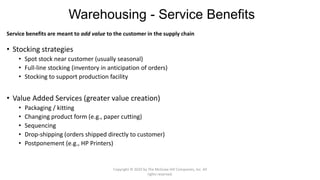
Warehousing - Service Benefits
• Stocking strategies
• Spot stock near customer (usually seasonal)
• Full-line stocking (inventory in anticipation of orders)
• Stocking to support production facility
• Value Added Services (greater value creation)
• Packaging / kitting
• Changing product form (e.g., paper cutting)
• Sequencing
• Drop-shipping (orders shipped directly to customer)
• Postponement (e.g., HP Printers)
Service benefits are meant to add value to the customer in the supply chain
Copyright © 2020 by The McGraw-Hill Companies, Inc. All
rights reserved.
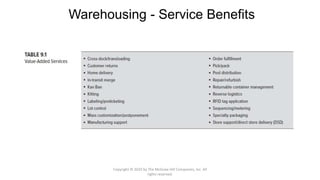
Warehousing - Service Benefits
Copyright © 2020 by The McGraw-Hill Companies, Inc. All
rights reserved.
Economic Benefits
• Consolidation and break-bulk
• Sorting
• Cross Dock
• Seasonal storage
• Reverse logistics
Copyright © 2020 by The McGraw-Hill Companies, Inc. All
rights reserved.
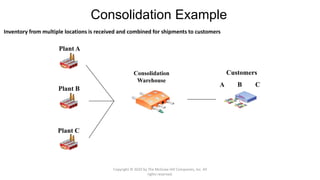
Plant A
Plant B
Plant C
Consolidation
Warehouse
Customers
A B C
Consolidation Example
Inventory from multiple locations is received and combined for shipments to customers
Copyright © 2020 by The McGraw-Hill Companies, Inc. All
rights reserved.
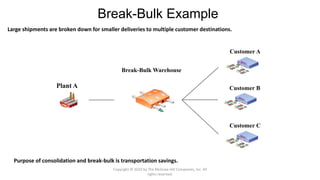
Plant A
Break-Bulk Warehouse
Break-Bulk Example
Customer A
Customer B
Customer C
Large shipments are broken down for smaller deliveries to multiple customer destinations.
Purpose of consolidation and break-bulk is transportation savings.
Copyright © 2020 by The McGraw-Hill Companies, Inc. All
rights reserved.
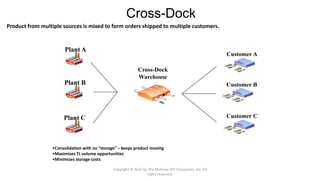
Cross-Dock
Product from multiple sources is mixed to form orders shipped to multiple customers.
Cross-Dock
Warehouse
Customer A
Customer B
Customer C
Plant A
Plant B
Plant C
•Consolidation with no “storage” – keeps product moving
•Maximizes TL volume opportunities
•Minimizes storage costs
Copyright © 2020 by The McGraw-Hill Companies, Inc. All
rights reserved.
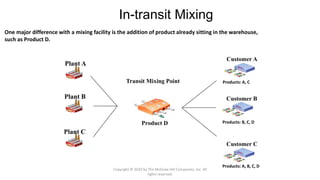
In-transit Mixing
One major difference with a mixing facility is the addition of product already sitting in the warehouse,
such as Product D.
Transit Mixing Point
Customer A
Customer B
Customer C
Plant A
Plant B
Plant C
Product D
Products: A, C
Products: B, C, D
Products: A, B, C, D
Copyright © 2020 by The McGraw-Hill Companies, Inc. All
rights reserved.
Seasonal Storage
• Accommodate either seasonal production or seasonal demand
• Examples:
• Patio / Lawn Furniture – produced year round, sold in short window
• Agricultural Products – produced in season, sold year round
Copyright © 2020 by The McGraw-Hill Companies, Inc. All
rights reserved.
Reverse Logistics Processing
• Returns Management
• Remanufacturing or Repair
• Remarketing
• Recycling
• Disposal
• Hazardous Materials & Government Regulation
• Product Recalls
Copyright © 2020 by The McGraw-Hill Companies, Inc. All
rights reserved.
Warehouse Ownership Arrangements
• Private – typically operated by the firm owning the product
• Control
• Flexibility
• Cost
• Intangibles
• Public – outsource warehousing operations on a pay for service basis
• General Merchandise
• Refrigerated
• Special Commodity
• Bonded
• Household Goods & Furniture
• Contract – operated by “niche experts” providing customized service with long-term relationships
• Done correctly combines best of both public and private
Copyright © 2020 by The McGraw-Hill Companies, Inc. All
rights reserved.
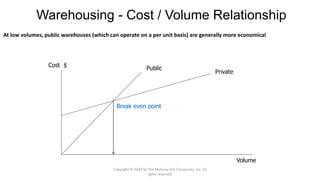
Warehousing - Cost / Volume Relationship
Cost $
Volume
Public
Private
Break even point
At low volumes, public warehouses (which can operate on a per unit basis) are generally more economical
Copyright © 2020 by The McGraw-Hill Companies, Inc. All
rights reserved.
Warehouse Decisions
• Site Selection
• Design
• Product-Mix Analysis
• Expansion
• Handling
• Layout
• Sizing
To achieve the basic benefits of a warehouse a detailed analysis considering the size, type, and shape of the facility must
be determined. Proper planning can ensure desired warehouse efficiencies
Copyright © 2020 by The McGraw-Hill Companies, Inc. All
rights reserved.
Warehousing - Impact of More Warehouses
• Improve service level due to reduction of average service time to customers
• Increase overhead and set-up costs
• Reduce transportation costs in a certain range
• Reduce outbound transportation costs
• Increase inbound transportation costs
• Increase inventory costs due to a larger safety stock
• Portfolio Effect/Square root law
Copyright © 2020 by The McGraw-Hill Companies, Inc. All
rights reserved.
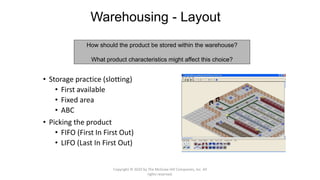
Warehousing - Layout
• Storage practice (slotting)
• First available
• Fixed area
• ABC
• Picking the product
• FIFO (First In First Out)
• LIFO (Last In First Out)
How should the product be stored within the warehouse?
What product characteristics might affect this choice?
Copyright © 2020 by The McGraw-Hill Companies, Inc. All
rights reserved.
Warehouse Operations
• Primary Warehouse Functions
• Product Handling
• Receiving
• Product Putaway
• In-Storage Product Handling
• Order Picking
• Shipping
• Product Handling Considerations
• Basic Handling Considerations
• Mechanized Systems
• Semi-automated Systems
• Automated Systems
• Special Handling Considerations
• Storage
• Active Storage
• Extended Storage
Warehouses can be extremely complex operations. Primary functions include product handling and storage. Numerous
product handling considerations exist to support a given warehouse application. Secondary functions are also of significant
importance to the success of a given warehouse operation.
• Secondary Warehouse Operations
• Accuracy & Audits
• Security
• Safety & Maintenance
• Environmental Concerns and Regulatory
Environment
Copyright © 2020 by The McGraw-Hill Companies, Inc. All
rights reserved.
Product Handling
• Product Handling:
• Receiving – the process of unloading product, responsible for ensuring SKU & quantity accuracy
• Product Putaway – Placement of product into active or secondary locations for storage
• In-Storage Product Handling – Active pick location replenishment, space consolidation
• Order Picking – Grouping of unique SKU’s and quantities to facilitate order assembly
• Shipping – loading and verification of outbound transportation equipment
Copyright © 2020 by The McGraw-Hill Companies, Inc. All
rights reserved.
Warehouse Operations
• Product Handling Considerations:
• Basic Handling Considerations – initial
foundation for evaluating handling
alternatives
• Mechanized Systems
• Lift Trucks
• Towlines
• Tractor Trailers
• Conveyors
• Carousels
• Semi-automated Systems
• Automated Guided Vehicles (AGV)
• Sortation
• Robotics
• Flow Racks
• Automated Systems
• Order Selection
• Automated Storage / Retrieval
(AR/RS)
• Special Handling Considerations
• E-Fulfillment
• Returns Processing
Copyright © 2020 by The McGraw-Hill Companies, Inc. All
rights reserved.
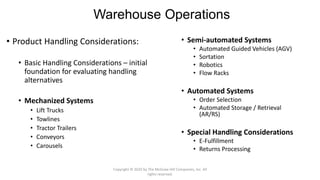
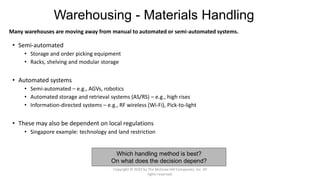
Warehousing - Materials Handling
• Semi-automated
• Storage and order picking equipment
• Racks, shelving and modular storage
• Automated systems
• Semi-automated – e.g., AGVs, robotics
• Automated storage and retrieval systems (AS/RS) – e.g., high rises
• Information-directed systems – e.g., RF wireless (Wi-Fi), Pick-to-light
• These may also be dependent on local regulations
• Singapore example: technology and land restriction
Many warehouses are moving away from manual to automated or semi-automated systems.
Which handling method is best?
On what does the decision depend?
Copyright © 2020 by The McGraw-Hill Companies, Inc. All
rights reserved.
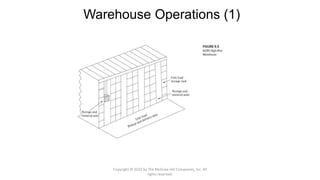
Warehouse Operations (1)
Copyright © 2020 by The McGraw-Hill Companies, Inc. All
rights reserved.
Warehouse Operations (2)
• Storage
• Active Storage – Focused on quick
movement and flexibility, emphasis
on picking and putaway
productivity
• Extended Storage – Focused on
long term storage, emphasis on
maximum space utilization
Copyright © 2020 by The McGraw-Hill Companies, Inc. All
rights reserved.
Warehouse Operations (3)
• Secondary Warehouse Operations
• Accuracy & Audits – of critical importance, maintaining an accurate account of product on hand within
the warehouse – (Physical Inventories, Cycle Count Programs)
• Security – Reducing pilferage and damage
• Safety & Maintenance – If it’s not done safely, it doesn’t matter, role preventative maintenance plays in
safety and asset protection
• Environmental Concerns and Regulatory Environment – Numerous factors at play within a warehouse
Copyright © 2020 by The McGraw-Hill Companies, Inc. All
rights reserved.
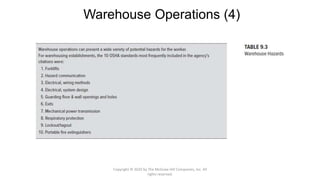
Warehouse Operations (4)
Copyright © 2020 by The McGraw-Hill Companies, Inc. All
rights reserved.
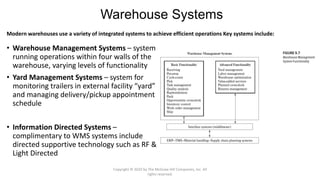
Warehouse Systems
• Warehouse Management Systems – system
running operations within four walls of the
warehouse, varying levels of functionality
• Yard Management Systems – system for
monitoring trailers in external facility “yard”
and managing delivery/pickup appointment
schedule
• Information Directed Systems –
complimentary to WMS systems include
directed supportive technology such as RF &
Light Directed
Modern warehouses use a variety of integrated systems to achieve efficient operations Key systems include:
Copyright © 2020 by The McGraw-Hill Companies, Inc. All
rights reserved.
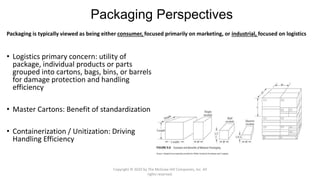
Packaging Perspectives
• Logistics primary concern: utility of
package, individual products or parts
grouped into cartons, bags, bins, or barrels
for damage protection and handling
efficiency
• Master Cartons: Benefit of standardization
• Containerization / Unitization: Driving
Handling Efficiency
Packaging is typically viewed as being either consumer, focused primarily on marketing, or industrial, focused on logistics
Copyright © 2020 by The McGraw-Hill Companies, Inc. All
rights reserved.
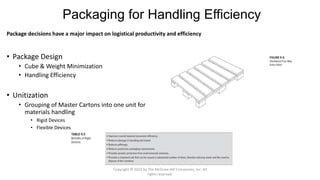
Packaging for Handling Efficiency
• Package Design
• Cube & Weight Minimization
• Handling Efficiency
• Unitization
• Grouping of Master Cartons into one unit for
materials handling
• Rigid Devices
• Flexible Devices
Package decisions have a major impact on logistical productivity and efficiency
Copyright © 2020 by The McGraw-Hill Companies, Inc. All
rights reserved.
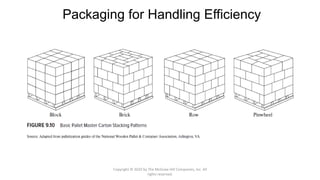
Packaging for Handling Efficiency
Copyright © 2020 by The McGraw-Hill Companies, Inc. All
rights reserved.
Packaging for Handling Efficiency
• Tie to information management systems
• human readable
• bar codes
• radio frequency identification
• For Package Handlers & Consumers
The final logistical packaging functionality is communication or information transfer
Copyright © 2020 by The McGraw-Hill Companies, Inc. All
rights reserved.
Mode: Truck
• Bouncing
• Potholes
• Second most expensive mode
• LTL: protect from mishandling and
stacking
Mode: Rail
• Switching requires secure stowage
• Side-sway
• Longer shelf life
• Heat and cold
• Third most expensive mode
Packaging Protections by Mode
Mode: Air
• Water (loaded outdoors)
• Handling damage
• Also dynamics from truck
• The most expensive mode
Mode: Ocean
• Water (rain, seawater, condensation)
• Dynamics in all directions
• Handling damage
• Longer shelf-life
• Least expensive mode
Copyright © 2020 by The McGraw-Hill Companies, Inc. All
rights reserved.
Packaging for Transportation
• Cube utilization (reduce load size)
• Weight limits
• Productivity while loading and unloading vehicle
• Intermodal containerization
Utility relates directly to transport cost:
Copyright © 2020 by The McGraw-Hill Companies, Inc. All
rights reserved.
Warehousing, Materials Handling, and Packaging
• Collectively an integrated function area impacting all areas of the supply chain
• Strategic Warehousing in the 21st Century
• Finding the right materials handling strategy
• Packaging, industrial and communication capabilities
Copyright © 2020 by The McGraw-Hill Companies, Inc. All
rights reserved.

bowersox5e_PPT_Ch09 (1).pptx

  • 1.
    Chapter Nine: Warehousing, MaterialsHandling, and Packaging Copyright © 2020 by The McGraw-Hill Companies, Inc. All rights reserved.
  • 2.
    Warehousing, Materials Handling,and Packaging • Often thought of as independent areas, please consider them collectively, as part of an integrated functional area that affects all areas of the supply chain • Warehousing – Traditionally thought of as a place to hold or store inventory • Materials Handling & Packaging – Traditionally viewed as a basic functions that collectively support the handling of, identification, and protection of product • However, in contemporary logistical systems, warehousing functionality has become strategic in nature, taking into consideration significant complexities to efficiently meet customer requirements • Similarly Materials Handling, fueled by the advent of e-commerce has become a very large and strategic investment for many firms • Packaging has continued evolve, simultaneously incorporating both commercial marketing related elements as well as traditional industrial handling considerations Copyright © 2020 by The McGraw-Hill Companies, Inc. All rights reserved.
  • 3.
    Strategic Warehousing –Why? • Reasons for Warehousing – Demand / supply / lead time uncertainty – Manufacturing economies: production smoothing – Transportation economies: volume discounts – Customer service support Copyright © 2020 by The McGraw-Hill Companies, Inc. All rights reserved.
  • 4.
    Warehouse Requirements • Warehousesexist to lower total cost or improve customer service • Warehouses specialize in supply or demand facing services • Facilities used for inbound materials are supply facing warehouses • Facilities used for customer accommodation are demand facing warehouses • Functionality and justification are different based on facilities support role • Procurement • Manufacturing • Customer accommodation Copyright © 2020 by The McGraw-Hill Companies, Inc. All rights reserved.
  • 5.
    Warehousing Fundamentals: Whatare the Benefits? • Service Benefits – operational strategy to add value within the supply chain process • Economic Benefits – operational strategy to save money by using a storage point Copyright © 2020 by The McGraw-Hill Companies, Inc. All rights reserved.
  • 6.
    Warehousing - ServiceBenefits • Stocking strategies • Spot stock near customer (usually seasonal) • Full-line stocking (inventory in anticipation of orders) • Stocking to support production facility • Value Added Services (greater value creation) • Packaging / kitting • Changing product form (e.g., paper cutting) • Sequencing • Drop-shipping (orders shipped directly to customer) • Postponement (e.g., HP Printers) Service benefits are meant to add value to the customer in the supply chain Copyright © 2020 by The McGraw-Hill Companies, Inc. All rights reserved.
  • 7.
    Warehousing - ServiceBenefits Copyright © 2020 by The McGraw-Hill Companies, Inc. All rights reserved.
  • 8.
    Economic Benefits • Consolidationand break-bulk • Sorting • Cross Dock • Seasonal storage • Reverse logistics Copyright © 2020 by The McGraw-Hill Companies, Inc. All rights reserved.
  • 9.
    Plant A Plant B PlantC Consolidation Warehouse Customers A B C Consolidation Example Inventory from multiple locations is received and combined for shipments to customers Copyright © 2020 by The McGraw-Hill Companies, Inc. All rights reserved.
  • 10.
    Plant A Break-Bulk Warehouse Break-BulkExample Customer A Customer B Customer C Large shipments are broken down for smaller deliveries to multiple customer destinations. Purpose of consolidation and break-bulk is transportation savings. Copyright © 2020 by The McGraw-Hill Companies, Inc. All rights reserved.
  • 11.
    Cross-Dock Product from multiplesources is mixed to form orders shipped to multiple customers. Cross-Dock Warehouse Customer A Customer B Customer C Plant A Plant B Plant C •Consolidation with no “storage” – keeps product moving •Maximizes TL volume opportunities •Minimizes storage costs Copyright © 2020 by The McGraw-Hill Companies, Inc. All rights reserved.
  • 12.
    In-transit Mixing One majordifference with a mixing facility is the addition of product already sitting in the warehouse, such as Product D. Transit Mixing Point Customer A Customer B Customer C Plant A Plant B Plant C Product D Products: A, C Products: B, C, D Products: A, B, C, D Copyright © 2020 by The McGraw-Hill Companies, Inc. All rights reserved.
  • 13.
    Seasonal Storage • Accommodateeither seasonal production or seasonal demand • Examples: • Patio / Lawn Furniture – produced year round, sold in short window • Agricultural Products – produced in season, sold year round Copyright © 2020 by The McGraw-Hill Companies, Inc. All rights reserved.
  • 14.
    Reverse Logistics Processing •Returns Management • Remanufacturing or Repair • Remarketing • Recycling • Disposal • Hazardous Materials & Government Regulation • Product Recalls Copyright © 2020 by The McGraw-Hill Companies, Inc. All rights reserved.
  • 15.
    Warehouse Ownership Arrangements •Private – typically operated by the firm owning the product • Control • Flexibility • Cost • Intangibles • Public – outsource warehousing operations on a pay for service basis • General Merchandise • Refrigerated • Special Commodity • Bonded • Household Goods & Furniture • Contract – operated by “niche experts” providing customized service with long-term relationships • Done correctly combines best of both public and private Copyright © 2020 by The McGraw-Hill Companies, Inc. All rights reserved.
  • 16.
    Warehousing - Cost/ Volume Relationship Cost $ Volume Public Private Break even point At low volumes, public warehouses (which can operate on a per unit basis) are generally more economical Copyright © 2020 by The McGraw-Hill Companies, Inc. All rights reserved.
  • 17.
    Warehouse Decisions • SiteSelection • Design • Product-Mix Analysis • Expansion • Handling • Layout • Sizing To achieve the basic benefits of a warehouse a detailed analysis considering the size, type, and shape of the facility must be determined. Proper planning can ensure desired warehouse efficiencies Copyright © 2020 by The McGraw-Hill Companies, Inc. All rights reserved.
  • 18.
    Warehousing - Impactof More Warehouses • Improve service level due to reduction of average service time to customers • Increase overhead and set-up costs • Reduce transportation costs in a certain range • Reduce outbound transportation costs • Increase inbound transportation costs • Increase inventory costs due to a larger safety stock • Portfolio Effect/Square root law Copyright © 2020 by The McGraw-Hill Companies, Inc. All rights reserved.
  • 19.
    Warehousing - Layout •Storage practice (slotting) • First available • Fixed area • ABC • Picking the product • FIFO (First In First Out) • LIFO (Last In First Out) How should the product be stored within the warehouse? What product characteristics might affect this choice? Copyright © 2020 by The McGraw-Hill Companies, Inc. All rights reserved.
  • 20.
    Warehouse Operations • PrimaryWarehouse Functions • Product Handling • Receiving • Product Putaway • In-Storage Product Handling • Order Picking • Shipping • Product Handling Considerations • Basic Handling Considerations • Mechanized Systems • Semi-automated Systems • Automated Systems • Special Handling Considerations • Storage • Active Storage • Extended Storage Warehouses can be extremely complex operations. Primary functions include product handling and storage. Numerous product handling considerations exist to support a given warehouse application. Secondary functions are also of significant importance to the success of a given warehouse operation. • Secondary Warehouse Operations • Accuracy & Audits • Security • Safety & Maintenance • Environmental Concerns and Regulatory Environment Copyright © 2020 by The McGraw-Hill Companies, Inc. All rights reserved.
  • 21.
    Product Handling • ProductHandling: • Receiving – the process of unloading product, responsible for ensuring SKU & quantity accuracy • Product Putaway – Placement of product into active or secondary locations for storage • In-Storage Product Handling – Active pick location replenishment, space consolidation • Order Picking – Grouping of unique SKU’s and quantities to facilitate order assembly • Shipping – loading and verification of outbound transportation equipment Copyright © 2020 by The McGraw-Hill Companies, Inc. All rights reserved.
  • 22.
    Warehouse Operations • ProductHandling Considerations: • Basic Handling Considerations – initial foundation for evaluating handling alternatives • Mechanized Systems • Lift Trucks • Towlines • Tractor Trailers • Conveyors • Carousels • Semi-automated Systems • Automated Guided Vehicles (AGV) • Sortation • Robotics • Flow Racks • Automated Systems • Order Selection • Automated Storage / Retrieval (AR/RS) • Special Handling Considerations • E-Fulfillment • Returns Processing Copyright © 2020 by The McGraw-Hill Companies, Inc. All rights reserved.
  • 23.
    Warehousing - MaterialsHandling • Semi-automated • Storage and order picking equipment • Racks, shelving and modular storage • Automated systems • Semi-automated – e.g., AGVs, robotics • Automated storage and retrieval systems (AS/RS) – e.g., high rises • Information-directed systems – e.g., RF wireless (Wi-Fi), Pick-to-light • These may also be dependent on local regulations • Singapore example: technology and land restriction Many warehouses are moving away from manual to automated or semi-automated systems. Which handling method is best? On what does the decision depend? Copyright © 2020 by The McGraw-Hill Companies, Inc. All rights reserved.
  • 24.
    Warehouse Operations (1) Copyright© 2020 by The McGraw-Hill Companies, Inc. All rights reserved.
  • 25.
    Warehouse Operations (2) •Storage • Active Storage – Focused on quick movement and flexibility, emphasis on picking and putaway productivity • Extended Storage – Focused on long term storage, emphasis on maximum space utilization Copyright © 2020 by The McGraw-Hill Companies, Inc. All rights reserved.
  • 26.
    Warehouse Operations (3) •Secondary Warehouse Operations • Accuracy & Audits – of critical importance, maintaining an accurate account of product on hand within the warehouse – (Physical Inventories, Cycle Count Programs) • Security – Reducing pilferage and damage • Safety & Maintenance – If it’s not done safely, it doesn’t matter, role preventative maintenance plays in safety and asset protection • Environmental Concerns and Regulatory Environment – Numerous factors at play within a warehouse Copyright © 2020 by The McGraw-Hill Companies, Inc. All rights reserved.
  • 27.
    Warehouse Operations (4) Copyright© 2020 by The McGraw-Hill Companies, Inc. All rights reserved.
  • 28.
    Warehouse Systems • WarehouseManagement Systems – system running operations within four walls of the warehouse, varying levels of functionality • Yard Management Systems – system for monitoring trailers in external facility “yard” and managing delivery/pickup appointment schedule • Information Directed Systems – complimentary to WMS systems include directed supportive technology such as RF & Light Directed Modern warehouses use a variety of integrated systems to achieve efficient operations Key systems include: Copyright © 2020 by The McGraw-Hill Companies, Inc. All rights reserved.
  • 29.
    Packaging Perspectives • Logisticsprimary concern: utility of package, individual products or parts grouped into cartons, bags, bins, or barrels for damage protection and handling efficiency • Master Cartons: Benefit of standardization • Containerization / Unitization: Driving Handling Efficiency Packaging is typically viewed as being either consumer, focused primarily on marketing, or industrial, focused on logistics Copyright © 2020 by The McGraw-Hill Companies, Inc. All rights reserved.
  • 30.
    Packaging for HandlingEfficiency • Package Design • Cube & Weight Minimization • Handling Efficiency • Unitization • Grouping of Master Cartons into one unit for materials handling • Rigid Devices • Flexible Devices Package decisions have a major impact on logistical productivity and efficiency Copyright © 2020 by The McGraw-Hill Companies, Inc. All rights reserved.
  • 31.
    Packaging for HandlingEfficiency Copyright © 2020 by The McGraw-Hill Companies, Inc. All rights reserved.
  • 32.
    Packaging for HandlingEfficiency • Tie to information management systems • human readable • bar codes • radio frequency identification • For Package Handlers & Consumers The final logistical packaging functionality is communication or information transfer Copyright © 2020 by The McGraw-Hill Companies, Inc. All rights reserved.
  • 33.
    Mode: Truck • Bouncing •Potholes • Second most expensive mode • LTL: protect from mishandling and stacking Mode: Rail • Switching requires secure stowage • Side-sway • Longer shelf life • Heat and cold • Third most expensive mode Packaging Protections by Mode Mode: Air • Water (loaded outdoors) • Handling damage • Also dynamics from truck • The most expensive mode Mode: Ocean • Water (rain, seawater, condensation) • Dynamics in all directions • Handling damage • Longer shelf-life • Least expensive mode Copyright © 2020 by The McGraw-Hill Companies, Inc. All rights reserved.
  • 34.
    Packaging for Transportation •Cube utilization (reduce load size) • Weight limits • Productivity while loading and unloading vehicle • Intermodal containerization Utility relates directly to transport cost: Copyright © 2020 by The McGraw-Hill Companies, Inc. All rights reserved.
  • 35.
    Warehousing, Materials Handling,and Packaging • Collectively an integrated function area impacting all areas of the supply chain • Strategic Warehousing in the 21st Century • Finding the right materials handling strategy • Packaging, industrial and communication capabilities Copyright © 2020 by The McGraw-Hill Companies, Inc. All rights reserved.