ICLASP 2014 Honolulu, June 19-22, Paper Session #4, 
Saturday, June 21, 13:30-15:00 
Positive Psycholgy: Theory, Research and Practice in Language and 
Social Psychology (thread) 
Students’ Well- 
Becoming Singing and 
Asking 
Tim Murphey 
Kanda University of International Studies 
15 Minute Workshop
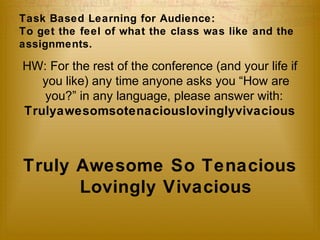
Task Based Learning for Audience: 
To get the feel of what the class was like and the 
assignments. 
HW: For the rest of the conference (and your life if 
you like) any time anyone asks you “How are 
you?” in any language, please answer with: 
Trulyawesomsotenaciouslovinglyvivacious 
Truly Awesome So Tenacious 
Lovingly Vivacious
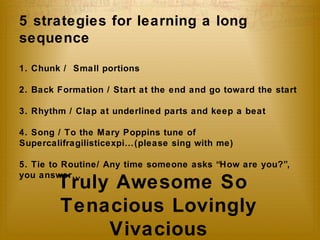
5 strategies for learning a long 
sequence 
1. Chunk / Small portions 
2. Back Formation / Start at the end and go toward the start 
3. Rhythm / Clap at underlined parts and keep a beat 
4. Song / To the Mary Poppins tune of 
Supercalifragilisticexpi…(please sing with me) 
5. Tie to Routine/ Any time someone asks “How are you?”, 
you answer… Truly Awesome So 
Tenacious Lovingly 
Vivacious
Task Based Learning for Conference Attendees 
Please Ask Someone Near You 
NOW: 
How are you? 
And sing together… 
Truly Awesome So Tenacious 
Lovingly Vivacious
Strategy #6: Teaching! Results? 
155 student-conducted musical case 
studies 
Students in CBI/CLIL course on the importance of music and song 
(TIOMAS) learned about 20 songlets (short songs with routine 
questions) and were asked to teach someone outside of class a 
song or two, and to write it up as a case study. 
My first meta-study has155 student-conducted musical case 
studies from six semester-long classes over a four-year 
period. Each class published their own booklet of case 
studies (a class publication – available online - handout). 
The second study has students from two classes (53 case studies) who 
asked someone with appreciative inquiry, “How do people help you 
have a great day and a meaningful life?” 
(Due to time limits I will restrict myself to the first study for 
this presentation.)
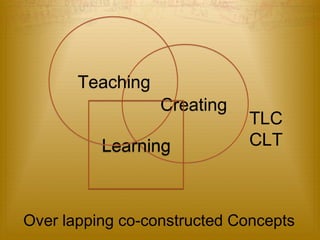
Creating 
Teaching 
Learning 
TLC 
CLT 
Over lapping co-constructed Concepts
Benefits Emerging from the Qualitative Data 
of 155 FOLK Music Therapy Case Studies 
1) High Affect Well Becoming 
2) We-Learning 
3) Social and Familial Bonding 
4) Meaning-Making 
5) Teaching-Rushes 
6) Embodied Cognition 
7) Love 2.0 & Power Posing Well Becoming 
8) Pedagogical Recommendations 
9) Learner Centeredness 
10) The Network Contagious Spread
Well-Becoming through Teaching 
Well-Becoming through Giving 
Well-Becoming as Agents of Change 
• It feels good to help people 
• It is a rush to see them learn 
• It is a rush to see them excited 
• It is a rush to sing together 
• It is a rush to see them engaged 
• It is a rush to see them teach others
Student quotes 
1) High Affect Well Becoming 
[mom] said “It is just fun! I can’t stop enjoying myself!!”. (Suzuki, 2014, 
p.18) 
The main goal of the experiment was to make my grandfather 
and myself happy. It was the most joyful homework ever I had. 
(Tokuyama, 2012, p. 29-31) 
We worked humming it for the rest of this work time and enjoyed 
it… our hard working time changed to an enjoyable working 
time. The song made us happy. She told me that she wanted 
to sing more English songs... (Sato, 2013 p. 12) 
[Mom said] "I can change my own mind by singing a song a little bit. I 
try to change my mind positively more from now. Thank you 
for your teaching! Please teach me more …” (Koge, 2012, p.11)
2) We-learning 
[My mother said] “to sing with you is 
better than to sing alone. I am 
happy when I sing songs with 
someone." We always sing the 
songs in the class with our 
partners. Therefore this activity 
should be held in the group if it is 
possible. (Shirai, 2011, p.11)
…we sang the song together…we laughed a 
lot… I'm not sure that singing together is 
a good method to learn English or not 
but it definitely makes us feel happy... 
(Tanaka 2012, p. 6) 
…I intentionally didn't ask my father to 
sing alone. I think singing together with 
someone else feels better and makes 
long verses easier to remember… I 
asked my father to join [with my sister]… 
Singing together definitely helped the 
song to get stuck in his head and 
provided a better atmosphere. Group 
singing helps with language learning! 
(Yamashita, 2013, p. 5)
3) Social and Familial Bonding 
"It was a rare opportunity that she [mother] 
learned something from me, so she 
looked very happy when I taught her the 
song. (Miyamoto, 2011, p. 6) 
…she (mother) was happy because she could talk 
to me for a long time. Recently I have not called. 
It was a good communication for us… 
(Sugahara, 2011, p.7) 
It is not too much to say that singing 
together makes living together a 
wonderfully joyful time! (Hori, 2014, p. 5)
4) Meaning-Making 
We were eating cakes in her house and talking about the last part of 
the lyric "I'll laugh, and I'll cry and I'll sing." Risa said, 
"Yuki said she likes the optimistic view. I also like it, but 
I think it's important to cry and talking negative things 
with my friends too. Sharing feelings with others always 
helps me. So I want to laugh and cry and sing with 
friends and dearest people." 
After that we cooked dinner, talking and singing not only 
this song, but also other songs. It was very fun. I 
intended to teach the song for my friend, but I learned 
another interpretation and meaning of the song from my 
friend: having negative experiences and crying may give 
us some chances to notice little happiness in our 
ordinary life. Tim said we can make meaning of the lyric 
by ourselves. I understand it's true through this project. 
(Nishina, 2013, p. 11)
4) Meaning-Making(continued) 
... it was interesting to see the differences among 
people in many ways of interpreting the songs. 
This reminds me that I create my own meaning to 
songs but my friends hear different ways so truly 
the words do not have meanings but each 
person gives them meanings. (Goto, 2013, 
p.10)
5) Teaching-Rushes 
...the most important thing is how much I could 
enjoy teaching! While I was teaching songs, I 
could enjoy it and my mother seemed to enjoy 
singing new songs. (Sekine, 2014, p. 17) 
…watching someone's skill improve was very 
exciting. (Yonaha, 2014, p. 8) 
It is an effective way to teach that mixes study 
with happy things. (Sato, 2013, p. 27) 
We laughed many times. We almost forgot that 
this was studying. (Omagari, 2013, p. 28)
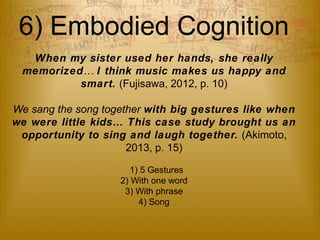
6) Embodied Cognition 
When my sister used her hands, she really 
memorized… I think music makes us happy and 
smart. (Fujisawa, 2012, p. 10) 
We sang the song together with big gestures like when 
we were little kids… This case study brought us an 
opportunity to sing and laugh together. (Akimoto, 
2013, p. 15) 
1) 5 Gestures 
2) With one word 
3) With phrase 
4) Song
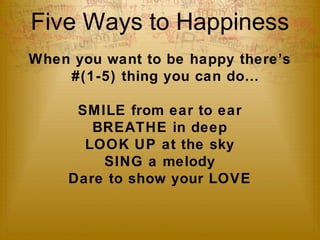
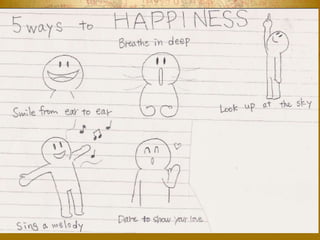
Five Ways to Happiness 
When you want to be happy there’s 
#(1-5) thing you can do… 
SMILE from ear to ear 
BREATHE in deep 
LOOK UP at the sky 
SING a melody 
Dare to show your LOVE
5waysHdraw
7) Love 2.0 & Power Posing 
She had the TOEIC test, I called her and asked “How do you 
succeed?” Surprisingly, she could answer completely and 
asked me “Are you young?” I gave advice to her to do 
power pose before the test. I think these two songs 
helped her English learning. (Kashiwagura, 2014, p. 26) 
She told me that "Thank you for choosing me as the 
learner. I'm happy I could learn this song from you. I'm 
in love!" I told her "the teacher of my class shouted 'I'm 
in love!!' too. She was surprised and laughed….Thank you for 
giving me a great time with my friend in English. 
(Matsunaga, 2013, p. 31)
I’m Young Strong and Beautiful 
I’m living an adventure 
The world’s so fascinating 
It makes me wanna cry 
I wanna cry to the world 
I wanna fly all around 
I wanna tell everybody 
I’m in love I’m in love x 3 
I wanna tell everybody I’m in love 
I’M IN LOVE!
Power Posing = increase in 
testosterone 
THE CONFIDENCE HORMONE 
Small Posing = Increase in cortisone 
The STRESS HORMONE 
Amy Cuddy – TED.com pres 
YES!
I’M IN LOVE!
8) Pedagogical Recommendations 
My advice…is to think about the student's feelings 
and change the way of teaching flexibly when 
they seemed to have troubles. (Akiyama, 2010, p. 
19) 
To teach two different types of people I should 
use different ways. This time I taught them by the 
same way. It was good for Misa but not for my mom. 
(Kyo, 2011, p. 18) 
it is important that we follow our own advice and 
be cheerful and positive. (Sugawara, 2014, p. 4) 
My advice to others who wish to teach 
affirmation songs is to choose short songs or 
make long songs into shorter ones. (Tsuchiya,
9) Learner 
centeredness! 
I passed my notebook to her to choose a song. 
After she read some lyrics and asked tunes, 
she chose the song: Are you young? My 
original plan was completely destroyed... 
(Ogasawara, 2011, p. 5) 
[Purposeful choice of song] The reason why I chose 
this song was she was writing [her] 
graduation thesis and she was worried about 
how to do it. (Kanai, 2011, p. 12) 
Teaching is always challenging, but the most
10) The Network Contagious Spread of 
Songlets in Fractal Pedagogy 
My sister taught our younger sister and [we] 
sang together. (Demise, 2010, p. 12) 
…she [mom] told me she taught the 5 ways of 
happiness at the nursery school. Children 
had fun and enjoyed it. (Ito, 2012, p. 32) 
I knew she (mom) would forget the song easily 
so I told her to be a teacher of my father. She 
was proud that she could sing an English song, so 
she was being a teacher next day… Next day, my 
mother and my father were singing "Today" 
completely. (Hoshino, 2011, p. 26
Thank you! 
The beginning 
I’M IN LOVE!!!! 
How are you?
SEND ME 
YOUR VIDEOS and PICTURES 
OF YOU & Others 
 CRYING “I’M IN LOVE” 
 IN INTERESTING PLACES 
 PUBLIC SPACES 
 Send to: 
mitsmail1@gmail.com
Class Publication Booklets 
available at 
https://sites.google.com/site/

Students' Well-Becoming Singing and Asking

  • 1.
    ICLASP 2014 Honolulu,June 19-22, Paper Session #4, Saturday, June 21, 13:30-15:00 Positive Psycholgy: Theory, Research and Practice in Language and Social Psychology (thread) Students’ Well- Becoming Singing and Asking Tim Murphey Kanda University of International Studies 15 Minute Workshop
  • 2.
    Task Based Learningfor Audience: To get the feel of what the class was like and the assignments. HW: For the rest of the conference (and your life if you like) any time anyone asks you “How are you?” in any language, please answer with: Trulyawesomsotenaciouslovinglyvivacious Truly Awesome So Tenacious Lovingly Vivacious
  • 3.
    5 strategies forlearning a long sequence 1. Chunk / Small portions 2. Back Formation / Start at the end and go toward the start 3. Rhythm / Clap at underlined parts and keep a beat 4. Song / To the Mary Poppins tune of Supercalifragilisticexpi…(please sing with me) 5. Tie to Routine/ Any time someone asks “How are you?”, you answer… Truly Awesome So Tenacious Lovingly Vivacious
  • 4.
    Task Based Learningfor Conference Attendees Please Ask Someone Near You NOW: How are you? And sing together… Truly Awesome So Tenacious Lovingly Vivacious
  • 5.
    Strategy #6: Teaching!Results? 155 student-conducted musical case studies Students in CBI/CLIL course on the importance of music and song (TIOMAS) learned about 20 songlets (short songs with routine questions) and were asked to teach someone outside of class a song or two, and to write it up as a case study. My first meta-study has155 student-conducted musical case studies from six semester-long classes over a four-year period. Each class published their own booklet of case studies (a class publication – available online - handout). The second study has students from two classes (53 case studies) who asked someone with appreciative inquiry, “How do people help you have a great day and a meaningful life?” (Due to time limits I will restrict myself to the first study for this presentation.)
  • 6.
    Creating Teaching Learning TLC CLT Over lapping co-constructed Concepts
  • 7.
    Benefits Emerging fromthe Qualitative Data of 155 FOLK Music Therapy Case Studies 1) High Affect Well Becoming 2) We-Learning 3) Social and Familial Bonding 4) Meaning-Making 5) Teaching-Rushes 6) Embodied Cognition 7) Love 2.0 & Power Posing Well Becoming 8) Pedagogical Recommendations 9) Learner Centeredness 10) The Network Contagious Spread
  • 8.
    Well-Becoming through Teaching Well-Becoming through Giving Well-Becoming as Agents of Change • It feels good to help people • It is a rush to see them learn • It is a rush to see them excited • It is a rush to sing together • It is a rush to see them engaged • It is a rush to see them teach others
  • 9.
    Student quotes 1)High Affect Well Becoming [mom] said “It is just fun! I can’t stop enjoying myself!!”. (Suzuki, 2014, p.18) The main goal of the experiment was to make my grandfather and myself happy. It was the most joyful homework ever I had. (Tokuyama, 2012, p. 29-31) We worked humming it for the rest of this work time and enjoyed it… our hard working time changed to an enjoyable working time. The song made us happy. She told me that she wanted to sing more English songs... (Sato, 2013 p. 12) [Mom said] "I can change my own mind by singing a song a little bit. I try to change my mind positively more from now. Thank you for your teaching! Please teach me more …” (Koge, 2012, p.11)
  • 10.
    2) We-learning [Mymother said] “to sing with you is better than to sing alone. I am happy when I sing songs with someone." We always sing the songs in the class with our partners. Therefore this activity should be held in the group if it is possible. (Shirai, 2011, p.11)
  • 11.
    …we sang thesong together…we laughed a lot… I'm not sure that singing together is a good method to learn English or not but it definitely makes us feel happy... (Tanaka 2012, p. 6) …I intentionally didn't ask my father to sing alone. I think singing together with someone else feels better and makes long verses easier to remember… I asked my father to join [with my sister]… Singing together definitely helped the song to get stuck in his head and provided a better atmosphere. Group singing helps with language learning! (Yamashita, 2013, p. 5)
  • 12.
    3) Social andFamilial Bonding "It was a rare opportunity that she [mother] learned something from me, so she looked very happy when I taught her the song. (Miyamoto, 2011, p. 6) …she (mother) was happy because she could talk to me for a long time. Recently I have not called. It was a good communication for us… (Sugahara, 2011, p.7) It is not too much to say that singing together makes living together a wonderfully joyful time! (Hori, 2014, p. 5)
  • 13.
    4) Meaning-Making Wewere eating cakes in her house and talking about the last part of the lyric "I'll laugh, and I'll cry and I'll sing." Risa said, "Yuki said she likes the optimistic view. I also like it, but I think it's important to cry and talking negative things with my friends too. Sharing feelings with others always helps me. So I want to laugh and cry and sing with friends and dearest people." After that we cooked dinner, talking and singing not only this song, but also other songs. It was very fun. I intended to teach the song for my friend, but I learned another interpretation and meaning of the song from my friend: having negative experiences and crying may give us some chances to notice little happiness in our ordinary life. Tim said we can make meaning of the lyric by ourselves. I understand it's true through this project. (Nishina, 2013, p. 11)
  • 14.
    4) Meaning-Making(continued) ...it was interesting to see the differences among people in many ways of interpreting the songs. This reminds me that I create my own meaning to songs but my friends hear different ways so truly the words do not have meanings but each person gives them meanings. (Goto, 2013, p.10)
  • 15.
    5) Teaching-Rushes ...themost important thing is how much I could enjoy teaching! While I was teaching songs, I could enjoy it and my mother seemed to enjoy singing new songs. (Sekine, 2014, p. 17) …watching someone's skill improve was very exciting. (Yonaha, 2014, p. 8) It is an effective way to teach that mixes study with happy things. (Sato, 2013, p. 27) We laughed many times. We almost forgot that this was studying. (Omagari, 2013, p. 28)
  • 16.
    6) Embodied Cognition When my sister used her hands, she really memorized… I think music makes us happy and smart. (Fujisawa, 2012, p. 10) We sang the song together with big gestures like when we were little kids… This case study brought us an opportunity to sing and laugh together. (Akimoto, 2013, p. 15) 1) 5 Gestures 2) With one word 3) With phrase 4) Song
  • 17.
    Five Ways toHappiness When you want to be happy there’s #(1-5) thing you can do… SMILE from ear to ear BREATHE in deep LOOK UP at the sky SING a melody Dare to show your LOVE
  • 18.
  • 19.
    7) Love 2.0& Power Posing She had the TOEIC test, I called her and asked “How do you succeed?” Surprisingly, she could answer completely and asked me “Are you young?” I gave advice to her to do power pose before the test. I think these two songs helped her English learning. (Kashiwagura, 2014, p. 26) She told me that "Thank you for choosing me as the learner. I'm happy I could learn this song from you. I'm in love!" I told her "the teacher of my class shouted 'I'm in love!!' too. She was surprised and laughed….Thank you for giving me a great time with my friend in English. (Matsunaga, 2013, p. 31)
  • 20.
    I’m Young Strongand Beautiful I’m living an adventure The world’s so fascinating It makes me wanna cry I wanna cry to the world I wanna fly all around I wanna tell everybody I’m in love I’m in love x 3 I wanna tell everybody I’m in love I’M IN LOVE!
  • 21.
    Power Posing =increase in testosterone THE CONFIDENCE HORMONE Small Posing = Increase in cortisone The STRESS HORMONE Amy Cuddy – TED.com pres YES!
  • 22.
  • 23.
    8) Pedagogical Recommendations My advice…is to think about the student's feelings and change the way of teaching flexibly when they seemed to have troubles. (Akiyama, 2010, p. 19) To teach two different types of people I should use different ways. This time I taught them by the same way. It was good for Misa but not for my mom. (Kyo, 2011, p. 18) it is important that we follow our own advice and be cheerful and positive. (Sugawara, 2014, p. 4) My advice to others who wish to teach affirmation songs is to choose short songs or make long songs into shorter ones. (Tsuchiya,
  • 24.
    9) Learner centeredness! I passed my notebook to her to choose a song. After she read some lyrics and asked tunes, she chose the song: Are you young? My original plan was completely destroyed... (Ogasawara, 2011, p. 5) [Purposeful choice of song] The reason why I chose this song was she was writing [her] graduation thesis and she was worried about how to do it. (Kanai, 2011, p. 12) Teaching is always challenging, but the most
  • 25.
    10) The NetworkContagious Spread of Songlets in Fractal Pedagogy My sister taught our younger sister and [we] sang together. (Demise, 2010, p. 12) …she [mom] told me she taught the 5 ways of happiness at the nursery school. Children had fun and enjoyed it. (Ito, 2012, p. 32) I knew she (mom) would forget the song easily so I told her to be a teacher of my father. She was proud that she could sing an English song, so she was being a teacher next day… Next day, my mother and my father were singing "Today" completely. (Hoshino, 2011, p. 26
  • 26.
    Thank you! Thebeginning I’M IN LOVE!!!! How are you?
  • 27.
    SEND ME YOURVIDEOS and PICTURES OF YOU & Others  CRYING “I’M IN LOVE”  IN INTERESTING PLACES  PUBLIC SPACES  Send to: mitsmail1@gmail.com
  • 28.
    Class Publication Booklets available at https://sites.google.com/site/

Editor's Notes

  • #2 More convincing than the data that I have would be an actual experience for you. I would like to challenge you in a task-based way to do what my students have done.