Abuse Risk Reduction Skills for Children
with Developmental Disabilities: Making
Friends and Staying Safe
Karen C. Rogers, Ph.D.
Project HEAL Trauma Program
USC University Center for Excellence in Developmental Disabilities
Children’s Hospital Los Angeles, USA
OBJECTIVES
 Briefly review abuse risk factors among children with
developmental disabilities and their caregivers
 Introduce an abuse risk reduction program, Making
Friends and Staying Safe group program
How often are persons with
developmental disabilities
abused?
 Individuals with developmental disabilities are at
increased risk for abuse as compared to the general
population (Gil, 1970; Mahoney & Carrillo, 1998; Ryan, 1994).
 80% of mentally handicapped persons living in the
community are physically and sexually abused, cheated,
and robbed (Melberg, 1984).
 Nearly a quarter of a million Californians are victims of
elder and dependent adult abuse very year (National Aging
Resource Center on Elder Abuse, 1999)
 Some estimates suggest as many as 1/3 of children in
foster care have a developmental disability (American
Academy of Pediatrics, 2002)
How often are children with
developmental disabilities
sexually abused?
 1.8 times higher risk among those with
disabilities (Crosse, Kaye & Ratnofsky, 1993).
 Girls are at greater risk for being sexually
abused than boys (Sobsey, 1994).
 39%-83% of girls and 16%-32% of boys by age 18
vs. 20-30% & 10-15% (Badgley, 1984 & Hard, 1986 in
Baladerian, 1991 vs. Finkelhor et al, 1989).
 Most children identified as victims of abuse are
simultaneously subjected to more than one
type of maltreatment (Verdugo, 1995).
Characteristics of Abuse
 Abuse often chronic and severe, with
revictimization by the same person.
 Abuse may occur over many years with multiple
perpetrators.
 In 44% of the cases the offenders had a
relationship with the victim related to the
victim’s disability.
 Children who were less obviously disabled were
at greater risk.
 However children with severe language
problems are easy targets for abuse possibly
because they can’t “tell”
RISK FACTORS FOR ABUSE IN CHILDREN
WITH DD (Sobesy, 2002)
 Factors associated with the child
 Factors associated with the
perpetrator
 Environmental/familial factors
RISK FACTORS ASSOCIATED
WITH THE CHILD
 Impaired communication
 Cognitive impairments
 Lack of body knowledge
 Limited mobility
 Social isolation, distancing
 Low self-esteem
 Increased dependence
 Reinforced to be compliant
RISK FACTORS ASSOCIATED
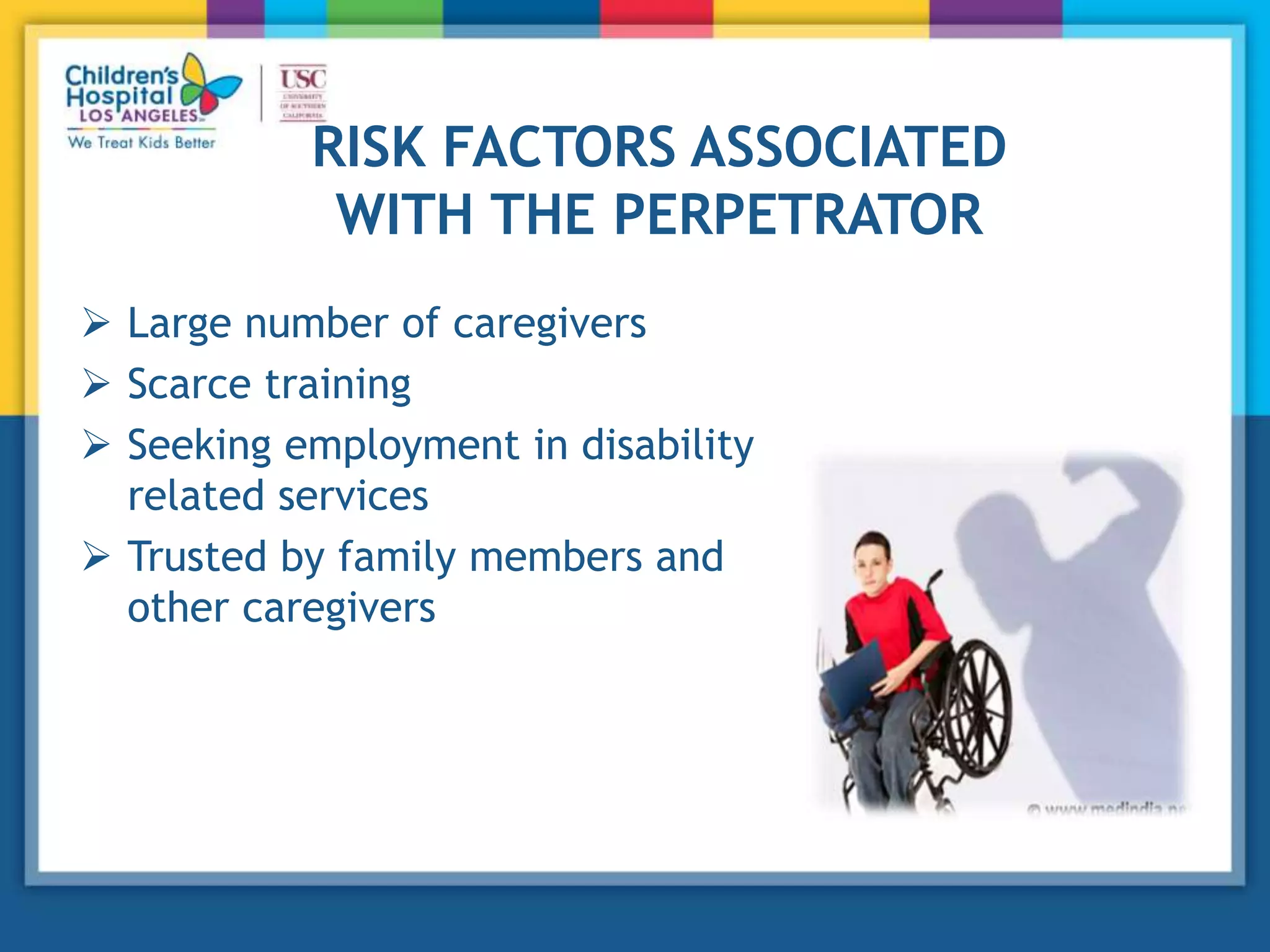
WITH THE PERPETRATOR
 Large number of caregivers
 Scarce training
 Seeking employment in disability
related services
 Trusted by family members and
other caregivers
FAMILIAL & ENVIRONMENTAL
FACTORS
 Social isolation
 Myths about people with developmental disabilities
 Increased caregiver stress
 More likely to be in out-of-home placement
 Cultural attitudes & beliefs
• “No one would abuse a person with a disability”
• “Children with a disability are safe because they are
always with trusted people”
• “People with a disability don’t understand what is
happening, so they don’t suffer the way other youth do”
• “Keeping children at home or in a sheltered group facility
will lessen the risk of abuse”
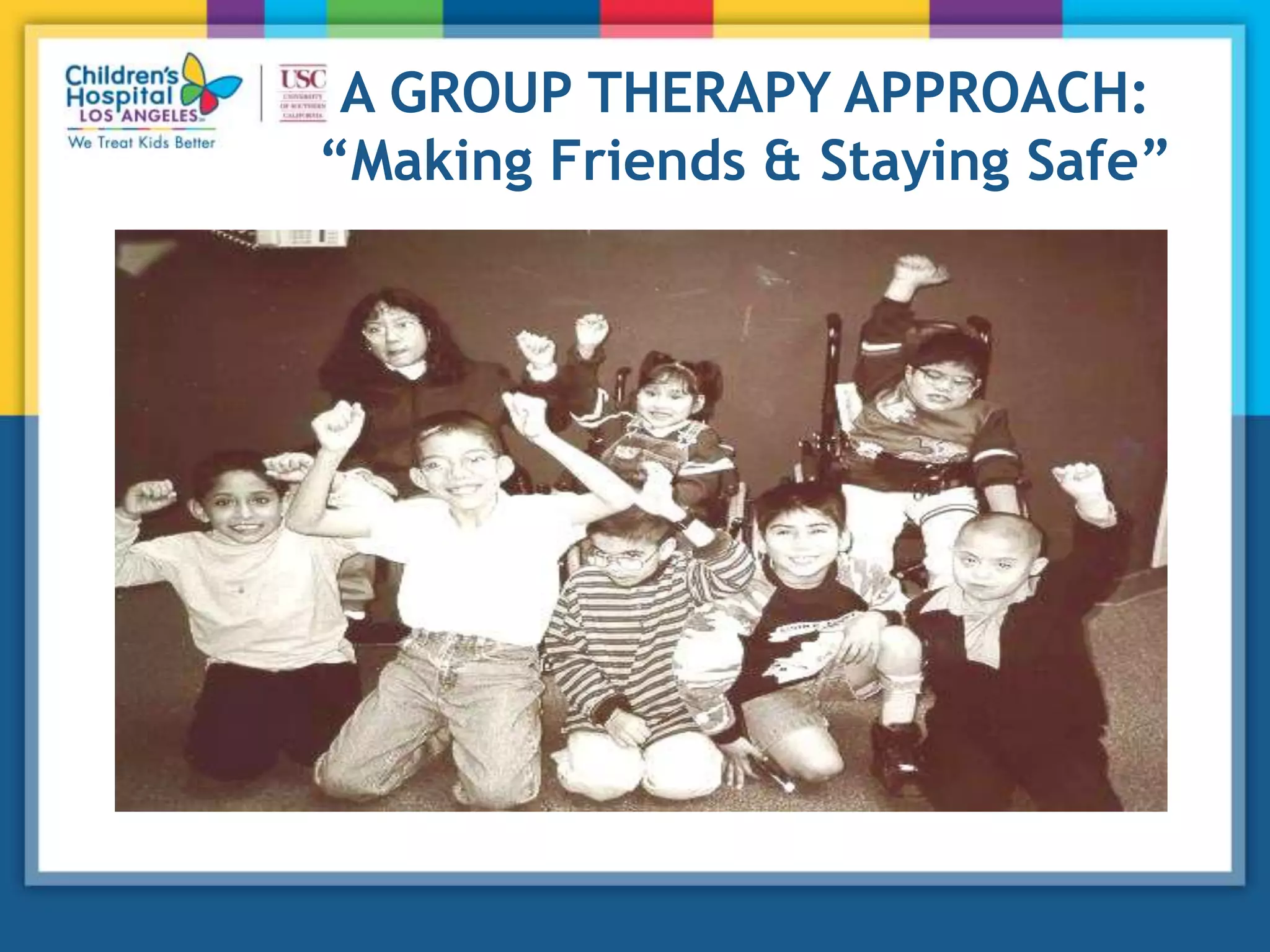
A GROUP THERAPY APPROACH:
“Making Friends & Staying Safe”
MAKING FRIENDS & STAYING SAFE
A Social Skills Development
and Abuse Prevention Group
 Housed under the Project Heal Trauma Program
 Children’s Hospital Los Angeles/University of Southern
California /University Center for Excellence in
Developmental Disabilities
 16 weeks
 60 minutes sessions
 Co-concurring children and caregiver(s)
groups
 Caregiver group offered in English or Spanish
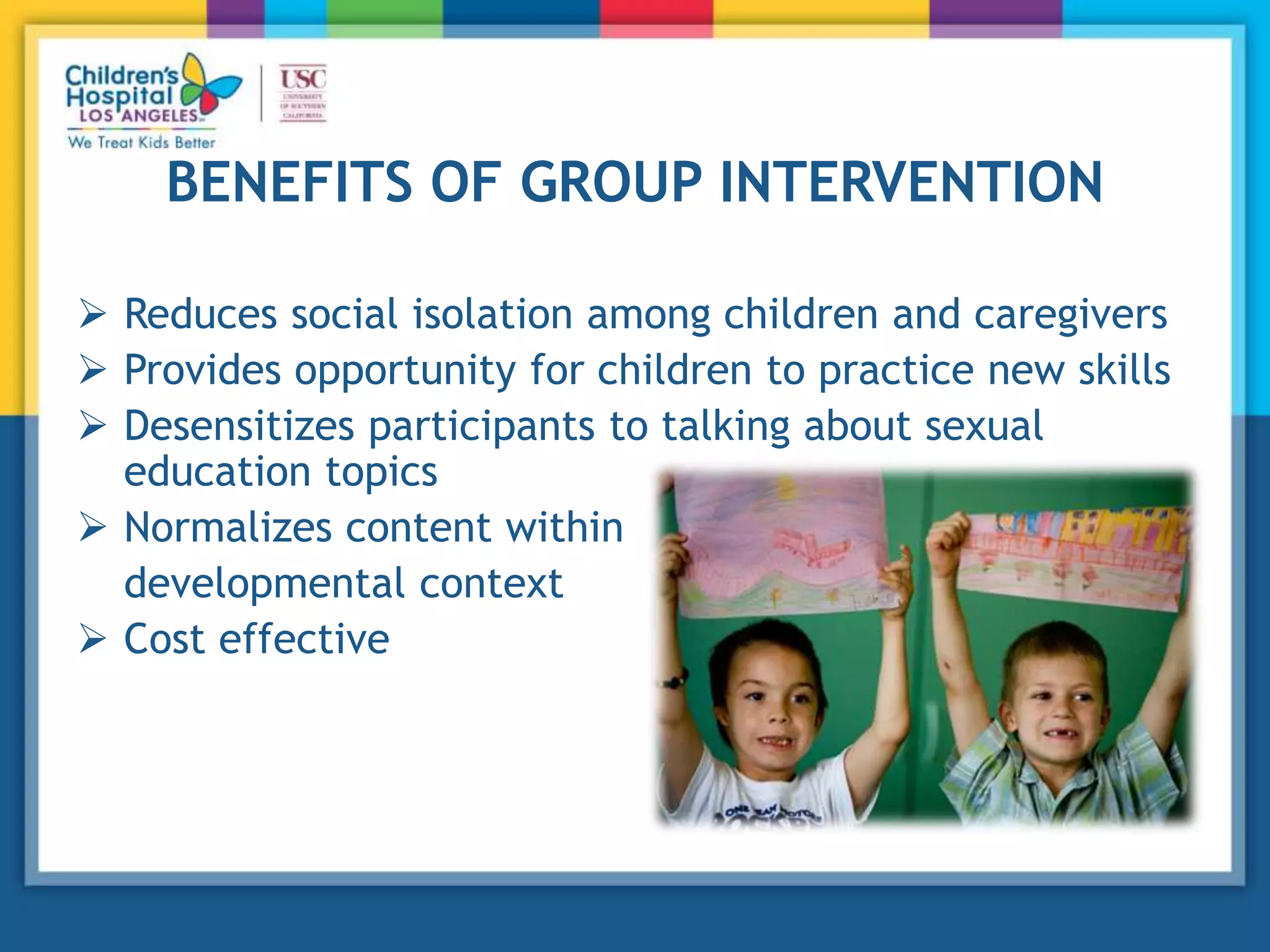
BENEFITS OF GROUP INTERVENTION
 Reduces social isolation among children and caregivers
 Provides opportunity for children to practice new skills
 Desensitizes participants to talking about sexual
education topics
 Normalizes content within
developmental context
 Cost effective
KEY GROUP ADAPTATIONS
 Shorter length of sessions
 Low client to therapist ratio (3:1)
 Visual alternatives for all verbal materials
 Directive teaching approach
 Structured format
 Use of developmentally appropriate language
 Slower pace/comprehension checks
 Repetition, Rehearsal and Reminder phrases
 Behavioral management/positive reinforcement system
MFSS STRATEGIES FOR CHILDREN
 Identification & expression of feelings
 Enhancing self-esteem & social skills
 Personal boundaries and body rights
 Sexual development/sexual education
 Abuse prevention skills
MFSS STRATEGIES FOR PARENTS
 Empathy and respect
 Education
 Peer support
 Linkage to community resources
 Skill building strategies
 Attention to personal experiences
CULTURAL CONSIDERATIONS
 Culture is an important variable in determining how
individuals see/interpret the world and make decisions
(traditions, ways of living, coping behaviors, values,
norms, and beliefs).
 Value of sexual education
 Stigma towards disability
 Beliefs regarding cause of
developmental disability
 Access to appropriate services
REFERENCES
 Batshaw, M., Pellegrino, L., & Roizen, N. (2009). Children with
Disabilities (6th ed.).Baltimore: Paul H. Brooks.
 California State Council on Developmental Disabilities.
http://www.scdd.ca.gov/Developmental_Disabilities.htm
 California Child Abuse Training and Technical Assistance Centers
(n.d.). Children with Disabilities & Sexual Abuse Fact Sheet.
Retrieved March 2012 from http://cirinc.org/catta/wp-
content/plugins/downloads-manager/upload/FactSheet.pdf
 Child Welfare Information Gateway (2009). The Risk and Prevention
of Maltreatment of Children with Disabilities. Washington, DC:U.S.
Department of Health and Human Services. Retrieved March 2012
from http://www.childwelfare.gov/pubs/prevenres
/focus/focusa.cfm
 Child Welfare Information Gateway (2009). Understanding the
Effects of Maltreatment on Brain Development. Washington,
DC:U.S. Department of Health and Human Services. Retrieved March
2012 from http://www.childwelfare.gov/pubs/issue_briefs/
braindevelopment/effects.cfm
 Comisión Nacional de los Derechos Humanos (2011). Niños, Niñas y
Adolescentes Victimas de la Violencia y del Delito. Mexico, D.F.
Retrieved November 2012 from http://www.cndh.org.mx/sites/all/
fuentes/documentos/Programas/Provictima/5%20PUBLICACIONES/2J
ORNADAS/DECIMAS_JORNADAS.pdf
 Cook, A., Blaustein, M., Spinazolla, J., van der Kolk, B. (2003)
Complex trauma in children and adolescents. White paper from the
national child traumatic stress network complex trauma task force.
Los Angeles, CA: National Center for Child Traumatic Stress.
 Cook, A., Spinazzola, J., Ford, J., Lanktree, C., et. al. (2005)
Complex trauma in children and adolescents. Psychiatric Annals,
35:5, 390-398.
 LeDoux J.E. (1993). Emotional memory systems in the brain. Behav.
Brain Res. 58:69-79.
 Secretaria de Salud (2006). Informed Nacional sobre Violencia y
Salud. Mexico,D.F. Retrieved November 2012 from
http://www.unicef.org/mexico/spanish/Informe_Nacional-
capitulo_II_y_III%281%29.pdf
 Sobsey, D. (2002). Exceptionality, education and maltreatment.
Exceptionality, 10(1), 29-46.
 Turner, H., Vanderminden, J., Finkelhor, D., Hamby, S., & Shattuck,
A.(2011). Disability and Victimization in a National Sample of Children
and Youth. Child Maltreatment, 16(4), 275-286.
 U.S. Department of Health and Human Services, Administration for
Children and Families, Administration on Children, Youth and
Families, Children’s Bureau(2011). Child Maltreatment 2010.
Retrieved March 2012 from http://www.acf.hhs.gov/programs/
cb/pubs/cm10/cm10.pdf#page=63
 World Health Organization (1999)Report of the Consultation on Child
Abuse Prevention, Social Change and Mental Health, Violence and
Injury Prevention. Retrieved October 2012 from www.who.int/mip
2001/files/2017/childabuse.pdf
 World Health Organization (2012) Early Childhood Development and
Disability: A discussion paper. Retrieved October 2012 from
http://apps.who.int/iris/bitstream/10665/75355/1/9789241504065_
eng.pdf
QUESTIONS/COMMENTS?
THANK YOU
For further information:
Karen Rogers, Ph.D.
krogers@chla.usc.edu

1515_karen rogers למאגר.ppt

  • 1.
    Abuse Risk ReductionSkills for Children with Developmental Disabilities: Making Friends and Staying Safe Karen C. Rogers, Ph.D. Project HEAL Trauma Program USC University Center for Excellence in Developmental Disabilities Children’s Hospital Los Angeles, USA
  • 2.
    OBJECTIVES  Briefly reviewabuse risk factors among children with developmental disabilities and their caregivers  Introduce an abuse risk reduction program, Making Friends and Staying Safe group program
  • 3.
    How often arepersons with developmental disabilities abused?  Individuals with developmental disabilities are at increased risk for abuse as compared to the general population (Gil, 1970; Mahoney & Carrillo, 1998; Ryan, 1994).  80% of mentally handicapped persons living in the community are physically and sexually abused, cheated, and robbed (Melberg, 1984).  Nearly a quarter of a million Californians are victims of elder and dependent adult abuse very year (National Aging Resource Center on Elder Abuse, 1999)  Some estimates suggest as many as 1/3 of children in foster care have a developmental disability (American Academy of Pediatrics, 2002)
  • 4.
    How often arechildren with developmental disabilities sexually abused?  1.8 times higher risk among those with disabilities (Crosse, Kaye & Ratnofsky, 1993).  Girls are at greater risk for being sexually abused than boys (Sobsey, 1994).  39%-83% of girls and 16%-32% of boys by age 18 vs. 20-30% & 10-15% (Badgley, 1984 & Hard, 1986 in Baladerian, 1991 vs. Finkelhor et al, 1989).  Most children identified as victims of abuse are simultaneously subjected to more than one type of maltreatment (Verdugo, 1995).
  • 5.
    Characteristics of Abuse Abuse often chronic and severe, with revictimization by the same person.  Abuse may occur over many years with multiple perpetrators.  In 44% of the cases the offenders had a relationship with the victim related to the victim’s disability.  Children who were less obviously disabled were at greater risk.  However children with severe language problems are easy targets for abuse possibly because they can’t “tell”
  • 6.
    RISK FACTORS FORABUSE IN CHILDREN WITH DD (Sobesy, 2002)  Factors associated with the child  Factors associated with the perpetrator  Environmental/familial factors
  • 7.
    RISK FACTORS ASSOCIATED WITHTHE CHILD  Impaired communication  Cognitive impairments  Lack of body knowledge  Limited mobility  Social isolation, distancing  Low self-esteem  Increased dependence  Reinforced to be compliant
  • 8.
    RISK FACTORS ASSOCIATED WITHTHE PERPETRATOR  Large number of caregivers  Scarce training  Seeking employment in disability related services  Trusted by family members and other caregivers
  • 9.
    FAMILIAL & ENVIRONMENTAL FACTORS Social isolation  Myths about people with developmental disabilities  Increased caregiver stress  More likely to be in out-of-home placement  Cultural attitudes & beliefs • “No one would abuse a person with a disability” • “Children with a disability are safe because they are always with trusted people” • “People with a disability don’t understand what is happening, so they don’t suffer the way other youth do” • “Keeping children at home or in a sheltered group facility will lessen the risk of abuse”
  • 10.
    A GROUP THERAPYAPPROACH: “Making Friends & Staying Safe”
  • 11.
    MAKING FRIENDS &STAYING SAFE A Social Skills Development and Abuse Prevention Group  Housed under the Project Heal Trauma Program  Children’s Hospital Los Angeles/University of Southern California /University Center for Excellence in Developmental Disabilities  16 weeks  60 minutes sessions  Co-concurring children and caregiver(s) groups  Caregiver group offered in English or Spanish
  • 12.
    BENEFITS OF GROUPINTERVENTION  Reduces social isolation among children and caregivers  Provides opportunity for children to practice new skills  Desensitizes participants to talking about sexual education topics  Normalizes content within developmental context  Cost effective
  • 13.
    KEY GROUP ADAPTATIONS Shorter length of sessions  Low client to therapist ratio (3:1)  Visual alternatives for all verbal materials  Directive teaching approach  Structured format  Use of developmentally appropriate language  Slower pace/comprehension checks  Repetition, Rehearsal and Reminder phrases  Behavioral management/positive reinforcement system
  • 14.
    MFSS STRATEGIES FORCHILDREN  Identification & expression of feelings  Enhancing self-esteem & social skills  Personal boundaries and body rights  Sexual development/sexual education  Abuse prevention skills
  • 15.
    MFSS STRATEGIES FORPARENTS  Empathy and respect  Education  Peer support  Linkage to community resources  Skill building strategies  Attention to personal experiences
  • 16.
    CULTURAL CONSIDERATIONS  Cultureis an important variable in determining how individuals see/interpret the world and make decisions (traditions, ways of living, coping behaviors, values, norms, and beliefs).  Value of sexual education  Stigma towards disability  Beliefs regarding cause of developmental disability  Access to appropriate services
  • 17.
    REFERENCES  Batshaw, M.,Pellegrino, L., & Roizen, N. (2009). Children with Disabilities (6th ed.).Baltimore: Paul H. Brooks.  California State Council on Developmental Disabilities. http://www.scdd.ca.gov/Developmental_Disabilities.htm  California Child Abuse Training and Technical Assistance Centers (n.d.). Children with Disabilities & Sexual Abuse Fact Sheet. Retrieved March 2012 from http://cirinc.org/catta/wp- content/plugins/downloads-manager/upload/FactSheet.pdf  Child Welfare Information Gateway (2009). The Risk and Prevention of Maltreatment of Children with Disabilities. Washington, DC:U.S. Department of Health and Human Services. Retrieved March 2012 from http://www.childwelfare.gov/pubs/prevenres /focus/focusa.cfm
  • 18.
     Child WelfareInformation Gateway (2009). Understanding the Effects of Maltreatment on Brain Development. Washington, DC:U.S. Department of Health and Human Services. Retrieved March 2012 from http://www.childwelfare.gov/pubs/issue_briefs/ braindevelopment/effects.cfm  Comisión Nacional de los Derechos Humanos (2011). Niños, Niñas y Adolescentes Victimas de la Violencia y del Delito. Mexico, D.F. Retrieved November 2012 from http://www.cndh.org.mx/sites/all/ fuentes/documentos/Programas/Provictima/5%20PUBLICACIONES/2J ORNADAS/DECIMAS_JORNADAS.pdf  Cook, A., Blaustein, M., Spinazolla, J., van der Kolk, B. (2003) Complex trauma in children and adolescents. White paper from the national child traumatic stress network complex trauma task force. Los Angeles, CA: National Center for Child Traumatic Stress.
  • 19.
     Cook, A.,Spinazzola, J., Ford, J., Lanktree, C., et. al. (2005) Complex trauma in children and adolescents. Psychiatric Annals, 35:5, 390-398.  LeDoux J.E. (1993). Emotional memory systems in the brain. Behav. Brain Res. 58:69-79.  Secretaria de Salud (2006). Informed Nacional sobre Violencia y Salud. Mexico,D.F. Retrieved November 2012 from http://www.unicef.org/mexico/spanish/Informe_Nacional- capitulo_II_y_III%281%29.pdf  Sobsey, D. (2002). Exceptionality, education and maltreatment. Exceptionality, 10(1), 29-46.  Turner, H., Vanderminden, J., Finkelhor, D., Hamby, S., & Shattuck, A.(2011). Disability and Victimization in a National Sample of Children and Youth. Child Maltreatment, 16(4), 275-286.
  • 20.
     U.S. Departmentof Health and Human Services, Administration for Children and Families, Administration on Children, Youth and Families, Children’s Bureau(2011). Child Maltreatment 2010. Retrieved March 2012 from http://www.acf.hhs.gov/programs/ cb/pubs/cm10/cm10.pdf#page=63  World Health Organization (1999)Report of the Consultation on Child Abuse Prevention, Social Change and Mental Health, Violence and Injury Prevention. Retrieved October 2012 from www.who.int/mip 2001/files/2017/childabuse.pdf  World Health Organization (2012) Early Childhood Development and Disability: A discussion paper. Retrieved October 2012 from http://apps.who.int/iris/bitstream/10665/75355/1/9789241504065_ eng.pdf
  • 21.
    QUESTIONS/COMMENTS? THANK YOU For furtherinformation: Karen Rogers, Ph.D. krogers@chla.usc.edu