Milling and Grain magazine were recently the
guests of G R Wright and Sons Ltd at their mill in
Ponders End, near the town of Enfield in North
East London. The Wright family have occupied
the site at Ponders End for over 150 years.
However, the Doomsday Book shows a mill on
the site as far back as 1087.
O
n the approach to Wright’s
mill along the Lea Valley
Road, you would be
forgiven for thinking that
the mill occupied its very
own island; a trick of the
eye that owes much to the
presence of the various
roads and the River Lea
itself, that for so many years provided the power that
established this location as an idyll for centuries of
milling.
The small conurbation of buildings on the site almost
provide a visual historical account of the evolution of
the mill, from the very old miller’s house, right up to the
brand new 12,000 square foot packaging warehouse.
Each building on the busy site represents a stage in the
growth of the company, providing visual proof of how
the Wright family have anticipated and adapted to change
successfully, throughout the duration of their occupation
of the site at Ponders End.
Milling
We started in the wheat silo where incoming grain is
received, cleaned, conditioned and blended for milling
using Bühler plant, including Bühler MYFB damping
equipment. The company uses UK grown Solstice
breadmaking wheat traceable to the point of origin under
the Red Tractor and TASCC assurance schemes.
Wrights are very well located with much of the UK’s
wheat grown in nearby East Anglia and Kent, which is
where the company sources much of its grain. In addition
Wrights also use a large proportion of Canadian grain
because of its unique quality, which works very well for
the craft and artisan bakers in the country. Having easy
access to the Tilbury docks is also has a distinct cost and
logistical advantages. The company produces a range of
flours from all UK wheat based with differing blends of
UK and Canadian up to 100 percent Canadian flour.
All wheat is tested in the company’s laboratory
following the receipt of a traceability certificate or
passport that identifies the source of the grain. The grain
is tested using Perten NIR, hagberg falling number, and
sieve tests. All bread making wheat also is tested for SDS
protein quality to ensure that everything meets Wright’s
own very high standards.
Milling takes place on two milling plants, which are
set up for the particular flour types they produce. Both
plants have been subject to many upgrades over the 150
years the company has been in operation. In 1976 B
Mill was built using all new Simon equipment – J rolls
and HA sifters but has been subject to several upgrades
most recently using Satake SRMA rollermills and SPSA
sifters that together can produce 2,000 tonnes of flour
per week.
Plant control is now in the safe hands an `Interlution`
Scada system, providing operators with live graphic
150YEARS
OF DOING
THINGS THE
WRIGHT
WAY
by Andrew Wilkinson, Milling and Grain
44 | March 2016 - Milling and Grain
F
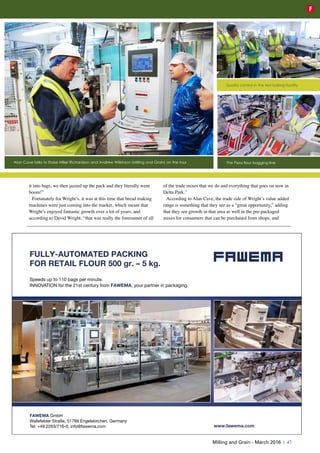
Our guide for the day - Alan Cave (top left)
Director of production
Arial image - of the complex, showing the
newly built 12,0002
ft packaging warehouse (top
right of image)
Modern and traditional -
Top right - the inside of the raw material storage
facility at Delta Park
Bottom right - The original stable block at
Ponders End - now converted as a storage and
handling warehouse
Milling and Grain - March 2016 | 45
F
visualisation and traceability.Wrights also incorporate a Bühler
de-branning system that removes the outer bran layers before
grinding which offers colour benefits to the flour.
Flour is monitored using on-line Branscan device for bran
contamination and NIR protein and moisture measurement which
will also give immediate alerts should split covers arise. Flour is
stored in holding silos ready for packing or out-loading.
Packing
The next step in the process is packing. This occurs in a recently
built 12 000 square foot warehouse using Bühler Carousel packer
capable of delivering 900 bags an hour into the fully automatic
Bühler palletiser. Much of the products are produced for craft
bakers so there is quite a lot of picking and loading using hand
scanners that link into the company’s ERP system which gives
full traceability to each customer delivery.
Bulk flour is out-loaded into tankers via fluidised bins capable
of filling 29 tonnes in just 3 minutes. Much of the bulk flour
is delivered to customers within a five mile radius of the mill
allowing for up to five deliveries each per driver enabling them to
operate very efficiently.
Throughout the process there is a great emphasis on food safety.
Flour is redressed on control sifters after milling and prior to
packing and bulk out-loading. Packing lines use state of the art
metal detection and check weigh systems that maintain data for
due diligence. A full time Food Safety and Quality Manager helps
ensure that Wrights maintain their A grade Status with BRC.
Mr Wright also sees the locality of Warburton’s bakery to their
mill as being hugely beneficial to his company. “Warburton’s are
great people to deal with and we have a good relationship with
their management.” Adding that “They’re 5th generation family
bakers and have lots of synergies especially in terms of quality”.
That said however, Wright’s traditional market is the smaller
baker such as the artisan bakers that are particularly found in
London. Wright’s use a lot of Canadian wheat, which is very
expensive compared to UK wheat, but very high quality. Mr
Wright told us that “we’re always looking to make things better
rather than cheaper and hopefully our customers like that about
us.”
“That’s not going to appeal to every flour buyer in the country,
but we are hoping that it is well received by our target audience.”
In addition, the business has a thriving pre-packing department
for flours packed in 1.5kg and 500g bags using Fawema and ICA
machinery capable of outputting at 150 bags per minute.
The company sells to Craft Bakers as wells as Large Plant
Bakers. Wholesalers take a range of chapatti, self-raising pizza
flours including the UK’s no1 pizza flour Bravo.
Wrights also produce a range of speciality bread and cake mixes
all now made in their new purpose built factory at nearby Delta
Park.
Adapting
Another large section of the Wright’s and Son’s customer
base are the so-called “Ethnic” varieties; these mixes include
chapatti flour, pizza flours. In fact, one of their brands Bravo is
now the market leader in pizza flour; which again, according to
David Wright is an example of their “very high quality” products
successfully competing “against a lot of cheaper, less quality
flours.”
Much of Wright’s Delta Park facility is occupied by storage of
their shop-ready products. However, their state of the art trade
mix products also takes up a large section of the building. These
are ready mixes for bakeries and food companies often made
bespoke for larger users.
Back in 1982, when David Wright first came into the family
business, they sold pre-packed flour into some of the retailers.
According to Mr Wright, “my father’s generation would look
at the sums and say ‘why are we doing this?’ because of the
fairly small contribution that it made to keeping the mill going.”
Adding that Wright’s “just about got to the point in the late 80s
that retailers were selling flour below the price of wheat" it was
one and a half kilos sold for 9 pence a bag.
That’s when Wright’s saw an opportunity to make ready to use
bread mixes. So, after deciding that the prepacked flour market
was “caving in on itself” and having already spent “quite a lot
of money investing in packaging machinery,” Wright’s came out
with the packs of bread mix. According to David Wright, they
then took their “flour and we mixed things with it, we then put
Pizza flour on the Bühler Carousel packer which is
capable of delivering 900 bags an hour into the
fully automatic Bühler palletiser
Raw ingredients at the Delta park facility
46 | March 2016 - Milling and Grain
F
it into bags, we then jazzed up the pack and they literally went
boom!”
Fortunately for Wright’s, it was at this time that bread making
machines were just coming into the market, which meant that
Wright’s enjoyed fantastic growth over a lot of years, and
according to David Wright, “that was really the forerunner of all
of the trade mixes that we do and everything that goes on now in
Delta Park.”
According to Alan Cave, the trade side of Wright’s value added
range is something that they see as a “great opportunity,” adding
that they see growth in that area as well in the pre-packaged
mixes for consumers that can be purchased from shops, and
FAWEMA GmbH
Wallefelder Straße, 51766 Engelskirchen, Germany
Tel: +49 2263/716-0, info@fawema.com
FULLY-AUTOMATED PACKING
FOR RETAIL FLOUR 500 gr. – 5 kg.
Speeds up to 110 bags per minute.
INNOVATION for the 21st century from FAWEMA, your partner in packaging.
www.fawema.com
1-FAWEMA MiMag 3-2016.qxp_Layout 1 18.02.16 19:39 Seite 1
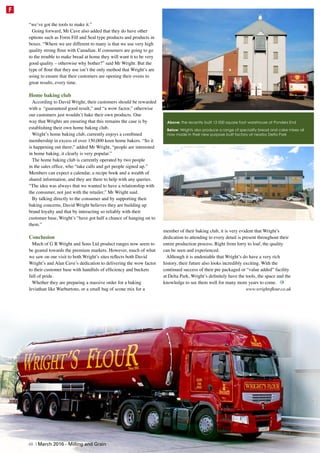
Alan Cave talks to Eloise Hillier Richardson and Andrew Wilkinson (Milling and Grain) on the tour
Quality control in the test baking facility
The Pizza flour bagging line
Milling and Grain - March 2016 | 47
F
“we’ve got the tools to make it.”
Going forward, Mr Cave also added that they do have other
options such as Form Fill and Seal type products and products in
boxes. “Where we are different to many is that we use very high
quality strong flour with Canadian. If consumers are going to go
to the trouble to make bread at home they will want it to be very
good quality – otherwise why bother?” said Mr Wright. But the
type of flour that they use isn’t the only method that Wright’s are
using to ensure that their customers are opening their ovens to
great results, every time.
Home baking club
According to David Wright, their customers should be rewarded
with a “guaranteed good result,” and “a wow factor,” otherwise
our customers just wouldn’t bake their own products. One
way that Wrights are ensuring that this remains the case is by
establishing their own home baking club.
Wright’s home baking club, currently enjoys a combined
membership in excess of over 150,000 keen home bakers. “So it
is happening out there,” added Mr Wright, “people are interested
in home baking, it clearly is very popular.”
The home baking club is currently operated by two people
in the sales office, who “take calls and get people signed up.”
Members can expect a calendar, a recipe book and a wealth of
shared information, and they are there to help with any queries.
“The idea was always that we wanted to have a relationship with
the consumer, not just with the retailer,” Mr Wright said.
By talking directly to the consumer and by supporting their
baking concerns, David Wright believes they are building up
brand loyalty and that by interacting so reliably with their
customer base, Wright’s “have got half a chance of hanging on to
them.”
Conclusion
Much of G R Wright and Sons Ltd product ranges now seem to
be geared towards the premium markets. However, much of what
we saw on our visit to both Wright’s sites reflects both David
Wright’s and Alan Cave’s dedication to delivering the wow factor
to their customer base with handfuls of efficiency and buckets
full of pride.
Whether they are preparing a massive order for a baking
leviathan like Warburtons, or a small bag of scone mix for a
member of their baking club, it is very evident that Wright’s
dedication to attending to every detail is present throughout their
entire production process. Right from lorry to loaf, the quality
can be seen and experienced.
Although it is undeniable that Wright’s do have a very rich
history, their future also looks incredibly exciting. With the
continued success of their pre packaged or “value added” facility
at Delta Park, Wright’s definitely have the tools, the space and the
knowledge to see them well for many more years to come.
www.wrightsflour.co.uk
Above: the recently built 12 000 square foot warehouse at Ponders End
Below: Wrights also produce a range of speciality bread and cake mixes all
now made in their new purpose built factory at nearby Delta Park
48 | March 2016 - Milling and Grain
F
Innovations in flour improvement
for more than 90 years.
There is scarcely a basic food in which the quality of the
raw material has such a decisive influence on processing
characteristics and the attributes of the finished product as
wheat flour. Analytical quality data provide important
indications, but it is the reaction of the dough to baking that
shows what a flour can really do. Our flour improvers build
quality into flour, strictly according to the basic principles of
flour improvement: doughs must be within the rheological
and enzymatic optimum, and the rheological and enzymatic
optimum must be properly balanced.
• Adjustment of low gluten or protein content
• Optimization of wheat mixtures etc.
• Correction of weak or excessively strong wheat varieties
• Regulation of qualities resulting in wet, weak doughs
www.muehlenchemie.cominfo@muehlenchemie.comA member of the Stern-Wywiol Gruppe

150 YEARS OF DOING THINGS THE WRIGHT WAY

  • 1.
    Milling and Grainmagazine were recently the guests of G R Wright and Sons Ltd at their mill in Ponders End, near the town of Enfield in North East London. The Wright family have occupied the site at Ponders End for over 150 years. However, the Doomsday Book shows a mill on the site as far back as 1087. O n the approach to Wright’s mill along the Lea Valley Road, you would be forgiven for thinking that the mill occupied its very own island; a trick of the eye that owes much to the presence of the various roads and the River Lea itself, that for so many years provided the power that established this location as an idyll for centuries of milling. The small conurbation of buildings on the site almost provide a visual historical account of the evolution of the mill, from the very old miller’s house, right up to the brand new 12,000 square foot packaging warehouse. Each building on the busy site represents a stage in the growth of the company, providing visual proof of how the Wright family have anticipated and adapted to change successfully, throughout the duration of their occupation of the site at Ponders End. Milling We started in the wheat silo where incoming grain is received, cleaned, conditioned and blended for milling using Bühler plant, including Bühler MYFB damping equipment. The company uses UK grown Solstice breadmaking wheat traceable to the point of origin under the Red Tractor and TASCC assurance schemes. Wrights are very well located with much of the UK’s wheat grown in nearby East Anglia and Kent, which is where the company sources much of its grain. In addition Wrights also use a large proportion of Canadian grain because of its unique quality, which works very well for the craft and artisan bakers in the country. Having easy access to the Tilbury docks is also has a distinct cost and logistical advantages. The company produces a range of flours from all UK wheat based with differing blends of UK and Canadian up to 100 percent Canadian flour. All wheat is tested in the company’s laboratory following the receipt of a traceability certificate or passport that identifies the source of the grain. The grain is tested using Perten NIR, hagberg falling number, and sieve tests. All bread making wheat also is tested for SDS protein quality to ensure that everything meets Wright’s own very high standards. Milling takes place on two milling plants, which are set up for the particular flour types they produce. Both plants have been subject to many upgrades over the 150 years the company has been in operation. In 1976 B Mill was built using all new Simon equipment – J rolls and HA sifters but has been subject to several upgrades most recently using Satake SRMA rollermills and SPSA sifters that together can produce 2,000 tonnes of flour per week. Plant control is now in the safe hands an `Interlution` Scada system, providing operators with live graphic 150YEARS OF DOING THINGS THE WRIGHT WAY by Andrew Wilkinson, Milling and Grain 44 | March 2016 - Milling and Grain F
  • 2.
    Our guide forthe day - Alan Cave (top left) Director of production Arial image - of the complex, showing the newly built 12,0002 ft packaging warehouse (top right of image) Modern and traditional - Top right - the inside of the raw material storage facility at Delta Park Bottom right - The original stable block at Ponders End - now converted as a storage and handling warehouse Milling and Grain - March 2016 | 45 F
  • 3.
    visualisation and traceability.Wrightsalso incorporate a Bühler de-branning system that removes the outer bran layers before grinding which offers colour benefits to the flour. Flour is monitored using on-line Branscan device for bran contamination and NIR protein and moisture measurement which will also give immediate alerts should split covers arise. Flour is stored in holding silos ready for packing or out-loading. Packing The next step in the process is packing. This occurs in a recently built 12 000 square foot warehouse using Bühler Carousel packer capable of delivering 900 bags an hour into the fully automatic Bühler palletiser. Much of the products are produced for craft bakers so there is quite a lot of picking and loading using hand scanners that link into the company’s ERP system which gives full traceability to each customer delivery. Bulk flour is out-loaded into tankers via fluidised bins capable of filling 29 tonnes in just 3 minutes. Much of the bulk flour is delivered to customers within a five mile radius of the mill allowing for up to five deliveries each per driver enabling them to operate very efficiently. Throughout the process there is a great emphasis on food safety. Flour is redressed on control sifters after milling and prior to packing and bulk out-loading. Packing lines use state of the art metal detection and check weigh systems that maintain data for due diligence. A full time Food Safety and Quality Manager helps ensure that Wrights maintain their A grade Status with BRC. Mr Wright also sees the locality of Warburton’s bakery to their mill as being hugely beneficial to his company. “Warburton’s are great people to deal with and we have a good relationship with their management.” Adding that “They’re 5th generation family bakers and have lots of synergies especially in terms of quality”. That said however, Wright’s traditional market is the smaller baker such as the artisan bakers that are particularly found in London. Wright’s use a lot of Canadian wheat, which is very expensive compared to UK wheat, but very high quality. Mr Wright told us that “we’re always looking to make things better rather than cheaper and hopefully our customers like that about us.” “That’s not going to appeal to every flour buyer in the country, but we are hoping that it is well received by our target audience.” In addition, the business has a thriving pre-packing department for flours packed in 1.5kg and 500g bags using Fawema and ICA machinery capable of outputting at 150 bags per minute. The company sells to Craft Bakers as wells as Large Plant Bakers. Wholesalers take a range of chapatti, self-raising pizza flours including the UK’s no1 pizza flour Bravo. Wrights also produce a range of speciality bread and cake mixes all now made in their new purpose built factory at nearby Delta Park. Adapting Another large section of the Wright’s and Son’s customer base are the so-called “Ethnic” varieties; these mixes include chapatti flour, pizza flours. In fact, one of their brands Bravo is now the market leader in pizza flour; which again, according to David Wright is an example of their “very high quality” products successfully competing “against a lot of cheaper, less quality flours.” Much of Wright’s Delta Park facility is occupied by storage of their shop-ready products. However, their state of the art trade mix products also takes up a large section of the building. These are ready mixes for bakeries and food companies often made bespoke for larger users. Back in 1982, when David Wright first came into the family business, they sold pre-packed flour into some of the retailers. According to Mr Wright, “my father’s generation would look at the sums and say ‘why are we doing this?’ because of the fairly small contribution that it made to keeping the mill going.” Adding that Wright’s “just about got to the point in the late 80s that retailers were selling flour below the price of wheat" it was one and a half kilos sold for 9 pence a bag. That’s when Wright’s saw an opportunity to make ready to use bread mixes. So, after deciding that the prepacked flour market was “caving in on itself” and having already spent “quite a lot of money investing in packaging machinery,” Wright’s came out with the packs of bread mix. According to David Wright, they then took their “flour and we mixed things with it, we then put Pizza flour on the Bühler Carousel packer which is capable of delivering 900 bags an hour into the fully automatic Bühler palletiser Raw ingredients at the Delta park facility 46 | March 2016 - Milling and Grain F
  • 4.
    it into bags,we then jazzed up the pack and they literally went boom!” Fortunately for Wright’s, it was at this time that bread making machines were just coming into the market, which meant that Wright’s enjoyed fantastic growth over a lot of years, and according to David Wright, “that was really the forerunner of all of the trade mixes that we do and everything that goes on now in Delta Park.” According to Alan Cave, the trade side of Wright’s value added range is something that they see as a “great opportunity,” adding that they see growth in that area as well in the pre-packaged mixes for consumers that can be purchased from shops, and FAWEMA GmbH Wallefelder Straße, 51766 Engelskirchen, Germany Tel: +49 2263/716-0, info@fawema.com FULLY-AUTOMATED PACKING FOR RETAIL FLOUR 500 gr. – 5 kg. Speeds up to 110 bags per minute. INNOVATION for the 21st century from FAWEMA, your partner in packaging. www.fawema.com 1-FAWEMA MiMag 3-2016.qxp_Layout 1 18.02.16 19:39 Seite 1 Alan Cave talks to Eloise Hillier Richardson and Andrew Wilkinson (Milling and Grain) on the tour Quality control in the test baking facility The Pizza flour bagging line Milling and Grain - March 2016 | 47 F
  • 5.
    “we’ve got thetools to make it.” Going forward, Mr Cave also added that they do have other options such as Form Fill and Seal type products and products in boxes. “Where we are different to many is that we use very high quality strong flour with Canadian. If consumers are going to go to the trouble to make bread at home they will want it to be very good quality – otherwise why bother?” said Mr Wright. But the type of flour that they use isn’t the only method that Wright’s are using to ensure that their customers are opening their ovens to great results, every time. Home baking club According to David Wright, their customers should be rewarded with a “guaranteed good result,” and “a wow factor,” otherwise our customers just wouldn’t bake their own products. One way that Wrights are ensuring that this remains the case is by establishing their own home baking club. Wright’s home baking club, currently enjoys a combined membership in excess of over 150,000 keen home bakers. “So it is happening out there,” added Mr Wright, “people are interested in home baking, it clearly is very popular.” The home baking club is currently operated by two people in the sales office, who “take calls and get people signed up.” Members can expect a calendar, a recipe book and a wealth of shared information, and they are there to help with any queries. “The idea was always that we wanted to have a relationship with the consumer, not just with the retailer,” Mr Wright said. By talking directly to the consumer and by supporting their baking concerns, David Wright believes they are building up brand loyalty and that by interacting so reliably with their customer base, Wright’s “have got half a chance of hanging on to them.” Conclusion Much of G R Wright and Sons Ltd product ranges now seem to be geared towards the premium markets. However, much of what we saw on our visit to both Wright’s sites reflects both David Wright’s and Alan Cave’s dedication to delivering the wow factor to their customer base with handfuls of efficiency and buckets full of pride. Whether they are preparing a massive order for a baking leviathan like Warburtons, or a small bag of scone mix for a member of their baking club, it is very evident that Wright’s dedication to attending to every detail is present throughout their entire production process. Right from lorry to loaf, the quality can be seen and experienced. Although it is undeniable that Wright’s do have a very rich history, their future also looks incredibly exciting. With the continued success of their pre packaged or “value added” facility at Delta Park, Wright’s definitely have the tools, the space and the knowledge to see them well for many more years to come. www.wrightsflour.co.uk Above: the recently built 12 000 square foot warehouse at Ponders End Below: Wrights also produce a range of speciality bread and cake mixes all now made in their new purpose built factory at nearby Delta Park 48 | March 2016 - Milling and Grain F
  • 6.
    Innovations in flourimprovement for more than 90 years. There is scarcely a basic food in which the quality of the raw material has such a decisive influence on processing characteristics and the attributes of the finished product as wheat flour. Analytical quality data provide important indications, but it is the reaction of the dough to baking that shows what a flour can really do. Our flour improvers build quality into flour, strictly according to the basic principles of flour improvement: doughs must be within the rheological and enzymatic optimum, and the rheological and enzymatic optimum must be properly balanced. • Adjustment of low gluten or protein content • Optimization of wheat mixtures etc. • Correction of weak or excessively strong wheat varieties • Regulation of qualities resulting in wet, weak doughs www.muehlenchemie.cominfo@muehlenchemie.comA member of the Stern-Wywiol Gruppe