Enumeration Types
2
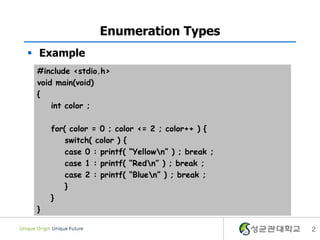
Enumeration Types
 Example
#include <stdio.h>
void main(void)
{
int color ;
for( color = 0 ; color <= 2 ; color++ ) {
switch( color ) {
case 0 : printf( “Yellown” ) ; break ;
case 1 : printf( “Redn” ) ; break ;
case 2 : printf( “Bluen” ) ; break ;
}
}
}
3
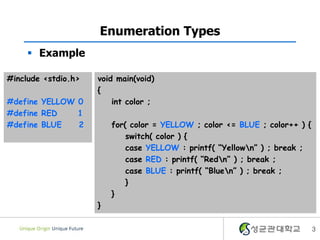
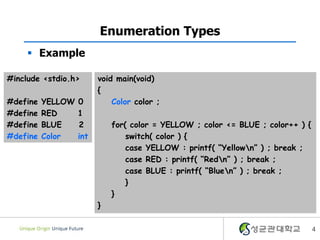
Enumeration Types
 Example
#include <stdio.h>
#define YELLOW 0
#define RED 1
#define BLUE 2
void main(void)
{
int color ;
for( color = YELLOW ; color <= BLUE ; color++ ) {
switch( color ) {
case YELLOW : printf( “Yellown” ) ; break ;
case RED : printf( “Redn” ) ; break ;
case BLUE : printf( “Bluen” ) ; break ;
}
}
}
4
Enumeration Types
 Example
#include <stdio.h>
#define YELLOW 0
#define RED 1
#define BLUE 2
#define Color int
void main(void)
{
Color color ;
for( color = YELLOW ; color <= BLUE ; color++ ) {
switch( color ) {
case YELLOW : printf( “Yellown” ) ; break ;
case RED : printf( “Redn” ) ; break ;
case BLUE : printf( “Bluen” ) ; break ;
}
}
}
5
Enumeration Types
 enumeration Types
– Variables of enum type can be used in indexing expressions
and as operands of all arithmetic and relational operators
[Ex]
enum day { sun, mon, tue, wed, thu, fri, sat };
enum day d1, d2;
d1 = fri;
tag name
By default, the first element ‘sun’ is associated with 0.
The next element, mon, is associated with 1.
…
Define variables d1, d2 as type of enum ‘day’,
Assign a value of fri to d1
6
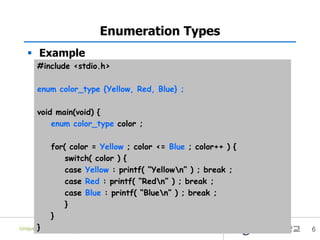
Enumeration Types
 Example
#include <stdio.h>
enum color_type {Yellow, Red, Blue} ;
void main(void) {
enum color_type color ;
for( color = Yellow ; color <= Blue ; color++ ) {
switch( color ) {
case Yellow : printf( “Yellown” ) ; break ;
case Red : printf( “Redn” ) ; break ;
case Blue : printf( “Bluen” ) ; break ;
}
}
}
7
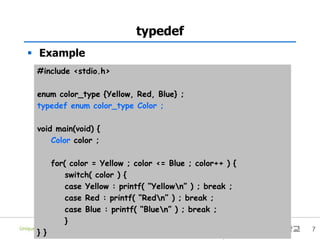
typedef
 Example
#include <stdio.h>
enum color_type {Yellow, Red, Blue} ;
typedef enum color_type Color ;
void main(void) {
Color color ;
for( color = Yellow ; color <= Blue ; color++ ) {
switch( color ) {
case Yellow : printf( “Yellown” ) ; break ;
case Red : printf( “Redn” ) ; break ;
case Blue : printf( “Bluen” ) ; break ;
}
} }
8
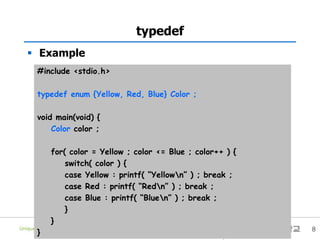
typedef
 Example
#include <stdio.h>
typedef enum {Yellow, Red, Blue} Color ;
void main(void) {
Color color ;
for( color = Yellow ; color <= Blue ; color++ ) {
switch( color ) {
case Yellow : printf( “Yellown” ) ; break ;
case Red : printf( “Redn” ) ; break ;
case Blue : printf( “Bluen” ) ; break ;
}
}
}
9
Enumeration Types
 enumeration Types
[Ex]
enum day { sun=10, mon, tue, wed=24, thu, fri, sat=36 };
[Ex]
#define sun 10
#define mon 11
#define tue 12
#define wed 13
#define thu 24
#define fri 25
#define sat 36
10
Enumeration Types
 Feature of enum type
– enum types are equivalent to integer type
[Ex]
int i;
enum { CLUBS, DIAMONDS, HEARTS, SPADES } s;
i = DIAMONDS; /* i = 1 */
s = 0; /* s = CLUBS */
s++; /* s = 1 */
i = s + 2; /* i =3 */

15 1. enumeration

  • 1.
  • 2.
    2 Enumeration Types  Example #include<stdio.h> void main(void) { int color ; for( color = 0 ; color <= 2 ; color++ ) { switch( color ) { case 0 : printf( “Yellown” ) ; break ; case 1 : printf( “Redn” ) ; break ; case 2 : printf( “Bluen” ) ; break ; } } }
  • 3.
    3 Enumeration Types  Example #include<stdio.h> #define YELLOW 0 #define RED 1 #define BLUE 2 void main(void) { int color ; for( color = YELLOW ; color <= BLUE ; color++ ) { switch( color ) { case YELLOW : printf( “Yellown” ) ; break ; case RED : printf( “Redn” ) ; break ; case BLUE : printf( “Bluen” ) ; break ; } } }
  • 4.
    4 Enumeration Types  Example #include<stdio.h> #define YELLOW 0 #define RED 1 #define BLUE 2 #define Color int void main(void) { Color color ; for( color = YELLOW ; color <= BLUE ; color++ ) { switch( color ) { case YELLOW : printf( “Yellown” ) ; break ; case RED : printf( “Redn” ) ; break ; case BLUE : printf( “Bluen” ) ; break ; } } }
  • 5.
    5 Enumeration Types  enumerationTypes – Variables of enum type can be used in indexing expressions and as operands of all arithmetic and relational operators [Ex] enum day { sun, mon, tue, wed, thu, fri, sat }; enum day d1, d2; d1 = fri; tag name By default, the first element ‘sun’ is associated with 0. The next element, mon, is associated with 1. … Define variables d1, d2 as type of enum ‘day’, Assign a value of fri to d1
  • 6.
    6 Enumeration Types  Example #include<stdio.h> enum color_type {Yellow, Red, Blue} ; void main(void) { enum color_type color ; for( color = Yellow ; color <= Blue ; color++ ) { switch( color ) { case Yellow : printf( “Yellown” ) ; break ; case Red : printf( “Redn” ) ; break ; case Blue : printf( “Bluen” ) ; break ; } } }
  • 7.
    7 typedef  Example #include <stdio.h> enumcolor_type {Yellow, Red, Blue} ; typedef enum color_type Color ; void main(void) { Color color ; for( color = Yellow ; color <= Blue ; color++ ) { switch( color ) { case Yellow : printf( “Yellown” ) ; break ; case Red : printf( “Redn” ) ; break ; case Blue : printf( “Bluen” ) ; break ; } } }
  • 8.
    8 typedef  Example #include <stdio.h> typedefenum {Yellow, Red, Blue} Color ; void main(void) { Color color ; for( color = Yellow ; color <= Blue ; color++ ) { switch( color ) { case Yellow : printf( “Yellown” ) ; break ; case Red : printf( “Redn” ) ; break ; case Blue : printf( “Bluen” ) ; break ; } } }
  • 9.
    9 Enumeration Types  enumerationTypes [Ex] enum day { sun=10, mon, tue, wed=24, thu, fri, sat=36 }; [Ex] #define sun 10 #define mon 11 #define tue 12 #define wed 13 #define thu 24 #define fri 25 #define sat 36
  • 10.
    10 Enumeration Types  Featureof enum type – enum types are equivalent to integer type [Ex] int i; enum { CLUBS, DIAMONDS, HEARTS, SPADES } s; i = DIAMONDS; /* i = 1 */ s = 0; /* s = CLUBS */ s++; /* s = 1 */ i = s + 2; /* i =3 */