OSHA Recordkeeping:  Straight Talk About Reporting and Recording Injuries, Illness and Fatalities August 18, 2010 Presented by: Edwin G. Foulke, Jr.  Howard A. Mavity
Notices The presentation you are about to review is copyrighted and no duplication, transcription, or distribution is permitted without the authors’ express written consent. While we may refer to political parties or particular individuals, this presentation is for educational purposes only and is not intended to reflect any partisan political views.
OSHA Recordkeeping Is  More Important Than Ever The new Administration believes that Employers are underreporting injuries and illnesses and discouraging employee reporting. Congressional Hearing August 2009 OSHA Recordkeeping National  Emphasis Program kick-off Acting Assistant Secretary Barab:  special focus  on employers with low rates in high hazard  industries
OSHA Recordkeeping Is  More Important Than Ever Acting Assistant Secretary Barab has stated that Fed-OSHA penalties are too low; Incident-by-Incident penalty calculations were first employed in recordkeeping cases; Examples of Citations: Pepperidge Farm (per instance) $ 289,603 James Machine Works $ 81,600 Fraser Paper $ 170,000 GM Powertrain $148,000
OSHA Recordkeeping Is More Important Than Ever Congressional Hearings and Statements by OSHA officials indicate that OSHA and Congress want to expand Injury & Illness Recordkeeping from an “establishment” basis to instead focus on corporatewide “patterns” and history. such an approach could lead to expanded OSHA  inspections and increased willful and repeat penalties; employers with multiple locations could end up in OSHA  Enhanced Enforcement (EEP or the proposed Severe  Violators Program (SVIP).
OSHA Recordkeeping Is More Important Than Ever Many employer locations continue to improperly complete OSHA 300’s and related materials. Many employers improperly record first aid incidents. Employers do not audit and correct documents. Injury and Illness records are used to measure and “drive” employer safety & health programs in a way the process was not intended. Customers may select contractors and vendors in part based on Injury and Illness records.
Recordkeeping Action Points Going Forward Audit Injury & Illness Records. Train site personnel on proper recordkeeping. Review other related recordkeeping areas, such as  accident/root cause analysis and safety programs. Develop measurements of safety & health programs  that do not rely on injury and illness rates. Revise safety incentive programs. Prepare for OSHA Recordkeeping inspections.
Overview Of The Rule Subpart A – Purpose Subpart B – Scope Subpart C – Forms and recording criteria Subpart D – Other requirements Subpart E – Reporting Subpart F - Definitions
Purpose Of The Rule To require employers to record and report work-related fatalities, injuries and illnesses Note:  Recording or reporting a work-related injury, illness, or fatality does not mean the employer or employee was at fault, an OSHA rule has been violated, or that the employee is eligible for workers’ compensation or other benefits.  OSHA injury and illness recordkeeping and Workers’ Compensation are independent of each other
Subpart B - Scope 1904.1 Partial Exemption Employers that are  partially  exempt from the recordkeeping requirements because of their size or industry must continue to comply with:  1904.39, Reporting fatalities and multiple hospitalization incidents  1904.41, Annual OSHA injury and illness survey (if specifically requested to do so by OSHA)  1904.42, BLS Annual Survey (if specifically requested to do so by BLS)
Subpart B - Scope 1904.1 Size Exemption If your company had 10 or fewer employees at all times during the last calendar year, you do not need to keep the injury and illness records unless surveyed by OSHA or BLS  The size exemption is based on the number of employees in the entire company  Include temporary employees who you supervised on a day to day basis in the count
Subpart B - Scope 1904.2 Industry Exemption All  industries in agriculture, construction, manufacturing, transportation, utilities and wholesale trade sectors  are covered  In the retail and service sectors, some industries are partially exempt  Appendix A to Subpart B lists partially exempt industries
Subpart C – Forms & Recording Criteria 1904.4 Recording criteria 1904.5 Work-relatedness 1904.6 New case 1904.7 General recording criteria 1904.8 Needlesticks and sharps 1904.9 Medical removal 1904.10 Hearing loss 1904.11 Tuberculosis 1940.29 Forms
Subpart C – Forms & Recording Criteria 9104.4 Recording Criteria Covered employers must record each injury, illness or fatality that: is work-related, and is a new case, and meets one or more of the criteria contained in sections 1904.7 through 104.11.
OSHA INJURY & ILLNESS RECORDKEEPING:  5-STEP PROCESS
Did the employee experience an injury or illness? Is the injury or illness work-related? Is the injury or illness a new case? Does the injury or illness meet the general criteria or the application to specific cases? RECORD THE INJURY OR ILLNESS YES YES YES YES
OSHA INJURY & ILLNESS RECORDKEEPING:  5-STEP PROCESS Step 1: Did the employee experience an illness  or injury? Definition [1940.46] An injury or illness is an  abnormal condition or disorder .  Injuries include cases such as, but not limited to, a cut, fracture, sprain, or amputation.  Illnesses include both acute and chronic illnesses, such as, but not limited to, a skin disease, respiratory disorder, or poisoning.
OSHA INJURY & ILLNESS RECORDKEEPING:  5-STEP PROCESS Step 2: Is the injury or illness work-related? Determination of Work-Relatedness [1940.5] Work-relatedness  is presumed for injuries and illnesses resulting from events or exposures occurring in the  work environment  unless an exception specifically applies. A case is presumed work-related if, and only if, an event or exposure in the work environment is a discernable cause of the injury or illness or of a significant aggravation to a pre-existing condition.
OSHA INJURY & ILLNESS RECORDKEEPING:  5-STEP PROCESS Step 2: Is the injury or illness work-related? Work Environment [1940.5] The  work environment  is defined as the establishment and other locations where one or more employees are working or present as a condition of employment. The work environment includes not only physical locations, but also the equipment or materials used by employees during the course of their work.
OSHA INJURY & ILLNESS RECORDKEEPING:  5-STEP PROCESS Step 2: Is the injury or illness work-related? Exceptions [1940.5] Present as a member of the general public Symptoms arising in work environment that are solely due to non-work-related events or exposure (regardless of where signs or symptoms surface, a case is work-related only if a work event or exposure is a discernable cause of the injury or illness or of a significant aggravation to a pre-existing condition. Voluntary participation in wellness program, medical, fitness or recreational
OSHA INJURY & ILLNESS RECORDKEEPING:  5-STEP PROCESS Step 2: Is the injury or illness work-related? Exceptions [1940.5] Eating, drinking or preparing food or drink for personal consumption Personal tasks outside assigned working hours Personal grooming, self-medication for non-work-related condition, or intentionally self-inflicted Motor vehicle accident in parking lot/access road during commute
OSHA INJURY & ILLNESS RECORDKEEPING:  5-STEP PROCESS Step 2: Is the injury or illness work-related? Exceptions [1940.5] Common cold or flu Mental illness, unless employee voluntarily provides a medical opinion from a physician or licensed health care professional (PLHCP) having appropriate qualifications and experience that affirms work-relatedness
OSHA INJURY & ILLNESS RECORDKEEPING:  5-STEP PROCESS Step 2: Is the injury or illness work-related? Travel Status [1940.5] An injury or illness that occurs while an employee is on travel status is work-related if it occurred while the employee was engaged in work activities in the interest of the employer Home away from home Detour for personal reasons is not work-related Not recordable if employee is out of United States and injury or illness occurs
OSHA INJURY & ILLNESS RECORDKEEPING:  5-STEP PROCESS Step 2: Is the injury or illness work-related? Work At Home [1940.5] Injury and illnesses that occur while an employee is working at home are work-related if they: Occur while the employee is performing work for pay or compensation in the home, and Are directly related to the performance of work rather than the general home environment.
OSHA INJURY & ILLNESS RECORDKEEPING:  5-STEP PROCESS Step 3: Is the injury or illness a new case? New Case [1904.6] If there is a medical opinion regarding resolution of a case, the employer must follow that opinion If an exposure triggers the recurrence, it is a new case (e.g., asthma, rashes) If signs and symptoms recur even in the absence of exposure, it is not a new case (e.g., silicosis, tuberculosis, asbestosis)
OSHA INJURY & ILLNESS RECORDKEEPING:  5-STEP PROCESS Step 4: Does the injury or illness meet the  general criteria or the application to  specific cases? General Recording Criteria [1904.7] An injury or illness is recordable if it results in one or more of the following: Death Days away from work Restricted work activity Transfer to another job
OSHA INJURY & ILLNESS RECORDKEEPING:  5-STEP PROCESS Step 4: Does the injury or illness meet the  general criteria or the application to  specific cases? General Recording Criteria [1904.7] An injury or illness is recordable if it results in one or more of the following: Medical treatment beyond first aid Loss of consciousness Significant injury or illness diagnosed by a PLHCP
OSHA INJURY & ILLNESS RECORDKEEPING:  5-STEP PROCESS Step 4: Does the injury or illness meet the  general criteria or the application to  specific cases? Days Away Cases [1904.7(b)(3)] Record if the case involves one or more days away from work Check the box for days away cases and count the number of days Do not include the day or injury/illness
OSHA INJURY & ILLNESS RECORDKEEPING:  5-STEP PROCESS Step 4: Does the injury or illness meet the  general criteria or the application to  specific cases? Days Away Cases [1904.7(b)(3)] Day counts (days away or days restricted) Count the number of calendar days the employee was unable to work (include weekend days, holidays, vacation days, etc.) Cap day count at 180 days away and/or days restricted May stop day count if employee leaves company for a reason unrelated to the injury or illness If a medical opinion exists, employer must follow that opinion
OSHA INJURY & ILLNESS RECORDKEEPING:  5-STEP PROCESS Step 4: Does the injury or illness meet the  general criteria or the application to  specific cases? Restricted Work Cases [1904.7(b)(4)] Record if the case involves  one or more days of restricted work or job transfer Check the box for restricted/transfer cases and count the number of days Do not include the day of injury/illness
OSHA INJURY & ILLNESS RECORDKEEPING:  5-STEP PROCESS Step 4: Does the injury or illness meet the  general criteria or the application to  specific cases? Restricted Work Cases [1904.7(b)(4)] Restricted work activity exists if the employee is: Unable to work the full work day he or she would otherwise have been scheduled to work; or Unable to perform one or more routine job functions An employee’s routine job functions are those activities the employee regularly performs at least once per week
OSHA INJURY & ILLNESS RECORDKEEPING:  5-STEP PROCESS Step 4: Does the injury or illness meet the  general criteria or the application to  specific cases? Restricted Work Cases [1904.7(b)(4)] A case is not recordable under 1904.7(b)(4) as a restricted work case if: The employee experiences minor musculoskeletal discomfort, A healthcare professional determines that the employee is fully able to perform all of his or her routine job functions, and The employer assigns a work restriction to that employee for the purpose of preventing a more serious condition from developing.
OSHA INJURY & ILLNESS RECORDKEEPING:  5-STEP PROCESS Step 4: Does the injury or illness meet the  general criteria or the application to  specific cases? Job Transfer [1904.7(b)(4)] Job transfer An injured or ill employee is assigned to a job other than his or her regular job for part of the day A case is recordable if the injured or ill employee performs his or her routine job duties for part of a day and is assigned  to another job for the rest of the day
OSHA INJURY & ILLNESS RECORDKEEPING:  5-STEP PROCESS Step 4: Does the injury or illness meet the  general criteria or the application to  specific cases? Medical Treatment [1904.7(b)(5)] Medical treatment is the management and care of a patient to combat disease or disorder. It does not include: Visits to a PLHCP solely for observation or counseling Diagnostic procedures First aid
OSHA INJURY & ILLNESS RECORDKEEPING:  5-STEP PROCESS Step 4: Does the injury or illness meet the  general criteria or the application to  specific cases? First Aid [1904.7(b)(5)] Using non-prescription medication at non-prescription strength Tetanus immunizations Cleaning, flushing, or soaking surface wounds
OSHA INJURY & ILLNESS RECORDKEEPING:  5-STEP PROCESS Step 4: Does the injury or illness meet the  general criteria or the application to  specific cases? First Aid [1904.7(b)(5)] Wound coverings, butterfly  bandages, Steri-Strips Hot or cold therapy Non-rigid means of support Temporary immobilization device used to transport accident victims
OSHA INJURY & ILLNESS RECORDKEEPING:  5-STEP PROCESS Step 4: Does the injury or illness meet the  general criteria or the application to  specific cases? First Aid [1904.7(b)(5)] Drilling of fingernail or toenail,  draining fluid from blister Eye patches Removing foreign bodies from eye using irrigation or cotton swab
OSHA INJURY & ILLNESS RECORDKEEPING:  5-STEP PROCESS Step 4: Does the injury or illness meet the  general criteria or the application to  specific cases? First Aid [1904.7(b)(5)] Removing splinters or foreign material from areas other than the eye by irrigation, tweezers, cotton swabs or other simple means Finger guards Massages Drinking fluids for relief of heat stress
OSHA INJURY & ILLNESS RECORDKEEPING:  5-STEP PROCESS Step 4: Does the injury or illness meet the  general criteria or the application to  specific cases? Loss of Consciousness [1904.7(b)(6)] All work-related cases involving loss of consciousness must be recorded
Significant Diagnosis of Injuries  and Illnesses Cases If work-related, always record Cancer Chronic irreversible disease Fractured bone Punctured eardrum
OSHA INJURY & ILLNESS RECORDKEEPING:  5-STEP PROCESS Step 4: Does the injury or illness meet the  general criteria or the application to  specific cases? Bloodborne Pathogens [1904.7(b)(8)] Record all work-related needlesticks and cuts from sharp objects that are contaminated with another person’s blood or other potentially infectious materials (includes human bodily fluids, tissues and organs; other materials infected with HIV or HBV such as laboratory cultures
OSHA INJURY & ILLNESS RECORDKEEPING:  5-STEP PROCESS Step 4: Does the injury or illness meet the  general criteria or the application to  specific cases? Bloodborne Pathogens [1904.8] Record splashes or other exposures to blood or other potentially infectious material if it results in diagnosis of a bloodborne disease or meets the general recording criteria
OSHA INJURY & ILLNESS RECORDKEEPING:  5-STEP PROCESS Step 4: Does the injury or illness meet the  general criteria or the application to  specific cases? Medical Removal [1904.9] If an employee is medically removed under the medical surveillance requirements of an OSHA standard, you must record the case The case is recorded as either one involving days away from work or days of restricted work activity If the case involves voluntary removal below the removal levels required by the standard, the case need not be recorded
OSHA INJURY & ILLNESS RECORDKEEPING:  5-STEP PROCESS Step 4: Does the injury or illness meet the  general criteria or the application to  specific cases? Hearing Loss [1904.10] Must record all work-related hearing loss cases where: Employee has experienced a Standard Threshold Shift (STS) 1 , and  1  An STS is defined in OSHA’s noise standard at 29 CFR 1910.95(g)(10)(i) as a change in hearing threshold, relative to the baseline audiogram, of an average of 10 dB or more at 2000, 3000, and 4000 Hz in one or both ears.
OSHA INJURY & ILLNESS RECORDKEEPING:  5-STEP PROCESS Step 4: Does the injury or illness meet the  general criteria or the application to  specific cases? Hearing Loss [1904.10] Employee’s hearing level is 25 decibels (dB) or more above audiometric zero [averaged at 2000, 3000, and 4000 hertz (Hz)] in the same ears as the STS Must compute the STS in accordance with OSHA’s noise standard, 1910/05
OSHA INJURY & ILLNESS RECORDKEEPING:  5-STEP PROCESS Step 4: Does the injury or illness meet the  general criteria or the application to  specific cases? Hearing Loss [1904.10] Compare employee’s current audiogram to the original baseline audiogram or the revised baseline audiogram allowed by 1910.95(g)(9) May adjust for aging to determine whether an STS has occurred using tables in Appendix F of 1910.95 May not adjust for aging to determine whether or not hearing level is 25 dB or more above audiometric zero
OSHA INJURY & ILLNESS RECORDKEEPING:  5-STEP PROCESS Step 4: Does the injury or illness meet the  general criteria or the application to  specific cases? Tuberculosis [1904.11] Record a case where an employee is exposed at work to someone with a known case of active tuberculosis and subsequently develops a TB infection
OSHA INJURY & ILLNESS RECORDKEEPING:  5-STEP PROCESS Step 4: Does the injury or illness meet the  general criteria or the application to  specific cases? Tuberculosis [1904.11] A case is not recordable when: The worker is  living in a household with a person who is diagnosed with active TB The Public Health Department has identified the worker as a contact of an individual with active TB A medical investigation shows the employee’s infection was caused by exposure away from work
OSHA INJURY & ILLNESS RECORDKEEPING:  5-STEP PROCESS Step 4: Does the injury or illness meet the  general criteria or the application to  specific cases? Forms [1904.29] OSHA Form 300,  Log of Work-Related Injuries and Illnesses OSHA Form 300A,  Summary of Work-Related Injuries and Illnesses OSHA Form 301,  Injury and Illness Incident Report
OSHA INJURY & ILLNESS RECORDKEEPING:  5-STEP PROCESS
OSHA INJURY & ILLNESS RECORDKEEPING:  5-STEP PROCESS Step 4: Does the injury or illness meet the  general criteria or the application to  specific cases? Forms [1904.29] Employers must enter each recordable case on the forms within 7 calendar days of receiving information that a recordable case occurred. An equivalent form has the same information, is as readable and understandable, and uses the same instructions as the OSHA form it replaces.
OSHA INJURY & ILLNESS RECORDKEEPING:  5-STEP PROCESS Step 4: Does the injury or illness meet the  general criteria or the application to  specific cases? Forms [1904.29] Forms can be kept on a computer as long as they can be produced  when they are needed (i.e., meet  the access provisions of 1904.35  and 1904.40)
OSHA INJURY & ILLNESS RECORDKEEPING:  5-STEP PROCESS Step 4: Does the injury or illness meet the  general criteria or the application to  specific cases? Privacy Protections [1904.29] Do  not enter the name of an employee on the OSHA Form 300 for “privacy  concern cases” Enter “privacy case” in the name column Keep a separate confidential list of the case numbers and employee names
OSHA INJURY & ILLNESS RECORDKEEPING:  5-STEP PROCESS Step 4: Does the injury or illness meet the  general criteria or the application to  specific cases? Privacy Protections [1904.29] Privacy concern cases are: An injury or illness to an intimate body part or reproductive system An injury or illness resulting from sexual assault Mental illness HIV infection, hepatitis, tuberculosis
OSHA INJURY & ILLNESS RECORDKEEPING:  5-STEP PROCESS Step 4: Does the injury or illness meet the  general criteria or the application to  specific cases? Privacy Protections [1904.29] Privacy concern cases are: Needlestick and sharps injuries that are contaminated with another person’s blood or other potentially infectious material Employee voluntarily requests to keep name off for other illness cases
OSHA INJURY & ILLNESS RECORDKEEPING:  5-STEP PROCESS Step 4: Does the injury or illness meet the  general criteria or the application to  specific cases? Privacy Protections [1904.29] Employer may use discretion in describing the case if employee can be identified If you give the forms to people not authorized by the rule, you must remove the names first.  Exceptions for: Auditor/consultant Workers’ compensation or other insurance Public health authority or law enforcement agency
Subpart D – Other Requirements 1904.30 Multiple business establishments 1904.31 Covered employees 1904.32 Annual summary 1904.33 Retention and updating 1904.34 Change of ownership 1904.35 Employee involvement 1904.36 Discrimination 1904.37 State plans 1904.38 Variances
Subpart D – Other Requirements 1904.30 Multiple Establishments Keep a separate OSHA Form 300 for each establishment that is expected to be in operation for more than a  year May keep one OSHA Form 300 for all short-term establishments Each employee must be linked to one establishment
Subpart D – Other Requirements 1904.30 Covered Employees Employees on payroll Employees not on payroll  who are supervised on a day-to-day basis Exclude self-employed and partners Temporary help agencies should not record the cases experienced by temp workers who are supervised by the using firm
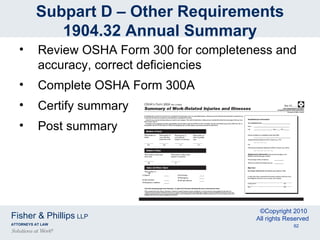
Subpart D – Other Requirements 1904.32 Annual Summary Review OSHA Form 300 for completeness and accuracy, correct deficiencies Complete OSHA Form 300A Certify summary Post summary
Subpart D – Other Requirements 1904.32 Annual Summary A company executive must certify the summary: An owner of the company An officer of the corporation The highest ranking company official working at the establishment His or her supervisor Must post for 3-month period from February 1 to April 30 of the year following the year covered by the summary
Subpart D – Other Requirements 1904.34 Retention and Updating Retain forms for 5 years following the year that they cover Update the OSHA Form 300 during that period Need not update the OSHA  Form 300A or OSHA Form 301
Subpart D – Other Requirements 1904.35 Employee Involvement You must inform each  employee of how to report an injury or illness Must set up a way for  employees to report work- related injuries and illnesses   promptly; and Must tell each employee how to report work-related injuries and illnesses to you
Subpart D – Other Requirements 1904.35 Employee Involvement Must provide limited access to injury and illness records to employees, former employees and their personal and authorized representatives Provide copy of OSHA Form 300 by end of next business day Provide copy of OSHA Form 301 to employee, former employee or  personal  representative by end of next business day Provide copies of OSHA form 301 to  authorized  representative within 7 calendar days.  Provide only “Information about the case” section of form.
Subpart D – Other Requirements 1904.37 State Plans State Plan States must have the same requirements as Federal OSHA for determining which injuries and illnesses are recordable and how they are recorded For other Part 1904 requirements, State Plan requirements may be more stringent 1952.4 has been modified to reflect these concepts
Subpart E – Reporting Information  To The Government 1904.39 Fatality and catastrophe reporting 1904.40 Access for Government representatives 1904.41 OSHA Survey 1904.42 BLS Survey
Subpart E – Reporting To The Government 1904.39 Fatality/Catastrophe Reporting Report orally within 8 hours any work-related fatality or incident involving 3 or more in-patient hospitalizations Do not need to report highway or public street motor vehicle accidents (outside of a construction zone) Do not need to report commercial airplane, train, subway or bus accidents Call area office unless closed, then call 1-800-321-OSHA (6742)
Subpart E – Reporting To The Government 1904.40 Providing Records Must provide copies to government representatives within 4 business hours Use the business hours of the establishment where the records are located
Thank You! Edwin G. Foulke, Jr. [email_address] Direct:  404.240.4273 Fax:  404.240.4249 Howard A. Mavity [email_address] Direct:  404.240.4204 Fax:  404.240.4249

1471653 1

  • 1.
    OSHA Recordkeeping: Straight Talk About Reporting and Recording Injuries, Illness and Fatalities August 18, 2010 Presented by: Edwin G. Foulke, Jr. Howard A. Mavity
  • 2.
    Notices The presentationyou are about to review is copyrighted and no duplication, transcription, or distribution is permitted without the authors’ express written consent. While we may refer to political parties or particular individuals, this presentation is for educational purposes only and is not intended to reflect any partisan political views.
  • 3.
    OSHA Recordkeeping Is More Important Than Ever The new Administration believes that Employers are underreporting injuries and illnesses and discouraging employee reporting. Congressional Hearing August 2009 OSHA Recordkeeping National Emphasis Program kick-off Acting Assistant Secretary Barab: special focus on employers with low rates in high hazard industries
  • 4.
    OSHA Recordkeeping Is More Important Than Ever Acting Assistant Secretary Barab has stated that Fed-OSHA penalties are too low; Incident-by-Incident penalty calculations were first employed in recordkeeping cases; Examples of Citations: Pepperidge Farm (per instance) $ 289,603 James Machine Works $ 81,600 Fraser Paper $ 170,000 GM Powertrain $148,000
  • 5.
    OSHA Recordkeeping IsMore Important Than Ever Congressional Hearings and Statements by OSHA officials indicate that OSHA and Congress want to expand Injury & Illness Recordkeeping from an “establishment” basis to instead focus on corporatewide “patterns” and history. such an approach could lead to expanded OSHA inspections and increased willful and repeat penalties; employers with multiple locations could end up in OSHA Enhanced Enforcement (EEP or the proposed Severe Violators Program (SVIP).
  • 6.
    OSHA Recordkeeping IsMore Important Than Ever Many employer locations continue to improperly complete OSHA 300’s and related materials. Many employers improperly record first aid incidents. Employers do not audit and correct documents. Injury and Illness records are used to measure and “drive” employer safety & health programs in a way the process was not intended. Customers may select contractors and vendors in part based on Injury and Illness records.
  • 7.
    Recordkeeping Action PointsGoing Forward Audit Injury & Illness Records. Train site personnel on proper recordkeeping. Review other related recordkeeping areas, such as accident/root cause analysis and safety programs. Develop measurements of safety & health programs that do not rely on injury and illness rates. Revise safety incentive programs. Prepare for OSHA Recordkeeping inspections.
  • 8.
    Overview Of TheRule Subpart A – Purpose Subpart B – Scope Subpart C – Forms and recording criteria Subpart D – Other requirements Subpart E – Reporting Subpart F - Definitions
  • 9.
    Purpose Of TheRule To require employers to record and report work-related fatalities, injuries and illnesses Note: Recording or reporting a work-related injury, illness, or fatality does not mean the employer or employee was at fault, an OSHA rule has been violated, or that the employee is eligible for workers’ compensation or other benefits. OSHA injury and illness recordkeeping and Workers’ Compensation are independent of each other
  • 10.
    Subpart B -Scope 1904.1 Partial Exemption Employers that are partially exempt from the recordkeeping requirements because of their size or industry must continue to comply with: 1904.39, Reporting fatalities and multiple hospitalization incidents 1904.41, Annual OSHA injury and illness survey (if specifically requested to do so by OSHA) 1904.42, BLS Annual Survey (if specifically requested to do so by BLS)
  • 11.
    Subpart B -Scope 1904.1 Size Exemption If your company had 10 or fewer employees at all times during the last calendar year, you do not need to keep the injury and illness records unless surveyed by OSHA or BLS The size exemption is based on the number of employees in the entire company Include temporary employees who you supervised on a day to day basis in the count
  • 12.
    Subpart B -Scope 1904.2 Industry Exemption All industries in agriculture, construction, manufacturing, transportation, utilities and wholesale trade sectors are covered In the retail and service sectors, some industries are partially exempt Appendix A to Subpart B lists partially exempt industries
  • 13.
    Subpart C –Forms & Recording Criteria 1904.4 Recording criteria 1904.5 Work-relatedness 1904.6 New case 1904.7 General recording criteria 1904.8 Needlesticks and sharps 1904.9 Medical removal 1904.10 Hearing loss 1904.11 Tuberculosis 1940.29 Forms
  • 14.
    Subpart C –Forms & Recording Criteria 9104.4 Recording Criteria Covered employers must record each injury, illness or fatality that: is work-related, and is a new case, and meets one or more of the criteria contained in sections 1904.7 through 104.11.
  • 15.
    OSHA INJURY &ILLNESS RECORDKEEPING: 5-STEP PROCESS
  • 16.
    Did the employeeexperience an injury or illness? Is the injury or illness work-related? Is the injury or illness a new case? Does the injury or illness meet the general criteria or the application to specific cases? RECORD THE INJURY OR ILLNESS YES YES YES YES
  • 17.
    OSHA INJURY &ILLNESS RECORDKEEPING: 5-STEP PROCESS Step 1: Did the employee experience an illness or injury? Definition [1940.46] An injury or illness is an abnormal condition or disorder . Injuries include cases such as, but not limited to, a cut, fracture, sprain, or amputation. Illnesses include both acute and chronic illnesses, such as, but not limited to, a skin disease, respiratory disorder, or poisoning.
  • 18.
    OSHA INJURY &ILLNESS RECORDKEEPING: 5-STEP PROCESS Step 2: Is the injury or illness work-related? Determination of Work-Relatedness [1940.5] Work-relatedness is presumed for injuries and illnesses resulting from events or exposures occurring in the work environment unless an exception specifically applies. A case is presumed work-related if, and only if, an event or exposure in the work environment is a discernable cause of the injury or illness or of a significant aggravation to a pre-existing condition.
  • 19.
    OSHA INJURY &ILLNESS RECORDKEEPING: 5-STEP PROCESS Step 2: Is the injury or illness work-related? Work Environment [1940.5] The work environment is defined as the establishment and other locations where one or more employees are working or present as a condition of employment. The work environment includes not only physical locations, but also the equipment or materials used by employees during the course of their work.
  • 20.
    OSHA INJURY &ILLNESS RECORDKEEPING: 5-STEP PROCESS Step 2: Is the injury or illness work-related? Exceptions [1940.5] Present as a member of the general public Symptoms arising in work environment that are solely due to non-work-related events or exposure (regardless of where signs or symptoms surface, a case is work-related only if a work event or exposure is a discernable cause of the injury or illness or of a significant aggravation to a pre-existing condition. Voluntary participation in wellness program, medical, fitness or recreational
  • 21.
    OSHA INJURY &ILLNESS RECORDKEEPING: 5-STEP PROCESS Step 2: Is the injury or illness work-related? Exceptions [1940.5] Eating, drinking or preparing food or drink for personal consumption Personal tasks outside assigned working hours Personal grooming, self-medication for non-work-related condition, or intentionally self-inflicted Motor vehicle accident in parking lot/access road during commute
  • 22.
    OSHA INJURY &ILLNESS RECORDKEEPING: 5-STEP PROCESS Step 2: Is the injury or illness work-related? Exceptions [1940.5] Common cold or flu Mental illness, unless employee voluntarily provides a medical opinion from a physician or licensed health care professional (PLHCP) having appropriate qualifications and experience that affirms work-relatedness
  • 23.
    OSHA INJURY &ILLNESS RECORDKEEPING: 5-STEP PROCESS Step 2: Is the injury or illness work-related? Travel Status [1940.5] An injury or illness that occurs while an employee is on travel status is work-related if it occurred while the employee was engaged in work activities in the interest of the employer Home away from home Detour for personal reasons is not work-related Not recordable if employee is out of United States and injury or illness occurs
  • 24.
    OSHA INJURY &ILLNESS RECORDKEEPING: 5-STEP PROCESS Step 2: Is the injury or illness work-related? Work At Home [1940.5] Injury and illnesses that occur while an employee is working at home are work-related if they: Occur while the employee is performing work for pay or compensation in the home, and Are directly related to the performance of work rather than the general home environment.
  • 25.
    OSHA INJURY &ILLNESS RECORDKEEPING: 5-STEP PROCESS Step 3: Is the injury or illness a new case? New Case [1904.6] If there is a medical opinion regarding resolution of a case, the employer must follow that opinion If an exposure triggers the recurrence, it is a new case (e.g., asthma, rashes) If signs and symptoms recur even in the absence of exposure, it is not a new case (e.g., silicosis, tuberculosis, asbestosis)
  • 26.
    OSHA INJURY &ILLNESS RECORDKEEPING: 5-STEP PROCESS Step 4: Does the injury or illness meet the general criteria or the application to specific cases? General Recording Criteria [1904.7] An injury or illness is recordable if it results in one or more of the following: Death Days away from work Restricted work activity Transfer to another job
  • 27.
    OSHA INJURY &ILLNESS RECORDKEEPING: 5-STEP PROCESS Step 4: Does the injury or illness meet the general criteria or the application to specific cases? General Recording Criteria [1904.7] An injury or illness is recordable if it results in one or more of the following: Medical treatment beyond first aid Loss of consciousness Significant injury or illness diagnosed by a PLHCP
  • 28.
    OSHA INJURY &ILLNESS RECORDKEEPING: 5-STEP PROCESS Step 4: Does the injury or illness meet the general criteria or the application to specific cases? Days Away Cases [1904.7(b)(3)] Record if the case involves one or more days away from work Check the box for days away cases and count the number of days Do not include the day or injury/illness
  • 29.
    OSHA INJURY &ILLNESS RECORDKEEPING: 5-STEP PROCESS Step 4: Does the injury or illness meet the general criteria or the application to specific cases? Days Away Cases [1904.7(b)(3)] Day counts (days away or days restricted) Count the number of calendar days the employee was unable to work (include weekend days, holidays, vacation days, etc.) Cap day count at 180 days away and/or days restricted May stop day count if employee leaves company for a reason unrelated to the injury or illness If a medical opinion exists, employer must follow that opinion
  • 30.
    OSHA INJURY &ILLNESS RECORDKEEPING: 5-STEP PROCESS Step 4: Does the injury or illness meet the general criteria or the application to specific cases? Restricted Work Cases [1904.7(b)(4)] Record if the case involves one or more days of restricted work or job transfer Check the box for restricted/transfer cases and count the number of days Do not include the day of injury/illness
  • 31.
    OSHA INJURY &ILLNESS RECORDKEEPING: 5-STEP PROCESS Step 4: Does the injury or illness meet the general criteria or the application to specific cases? Restricted Work Cases [1904.7(b)(4)] Restricted work activity exists if the employee is: Unable to work the full work day he or she would otherwise have been scheduled to work; or Unable to perform one or more routine job functions An employee’s routine job functions are those activities the employee regularly performs at least once per week
  • 32.
    OSHA INJURY &ILLNESS RECORDKEEPING: 5-STEP PROCESS Step 4: Does the injury or illness meet the general criteria or the application to specific cases? Restricted Work Cases [1904.7(b)(4)] A case is not recordable under 1904.7(b)(4) as a restricted work case if: The employee experiences minor musculoskeletal discomfort, A healthcare professional determines that the employee is fully able to perform all of his or her routine job functions, and The employer assigns a work restriction to that employee for the purpose of preventing a more serious condition from developing.
  • 33.
    OSHA INJURY &ILLNESS RECORDKEEPING: 5-STEP PROCESS Step 4: Does the injury or illness meet the general criteria or the application to specific cases? Job Transfer [1904.7(b)(4)] Job transfer An injured or ill employee is assigned to a job other than his or her regular job for part of the day A case is recordable if the injured or ill employee performs his or her routine job duties for part of a day and is assigned to another job for the rest of the day
  • 34.
    OSHA INJURY &ILLNESS RECORDKEEPING: 5-STEP PROCESS Step 4: Does the injury or illness meet the general criteria or the application to specific cases? Medical Treatment [1904.7(b)(5)] Medical treatment is the management and care of a patient to combat disease or disorder. It does not include: Visits to a PLHCP solely for observation or counseling Diagnostic procedures First aid
  • 35.
    OSHA INJURY &ILLNESS RECORDKEEPING: 5-STEP PROCESS Step 4: Does the injury or illness meet the general criteria or the application to specific cases? First Aid [1904.7(b)(5)] Using non-prescription medication at non-prescription strength Tetanus immunizations Cleaning, flushing, or soaking surface wounds
  • 36.
    OSHA INJURY &ILLNESS RECORDKEEPING: 5-STEP PROCESS Step 4: Does the injury or illness meet the general criteria or the application to specific cases? First Aid [1904.7(b)(5)] Wound coverings, butterfly bandages, Steri-Strips Hot or cold therapy Non-rigid means of support Temporary immobilization device used to transport accident victims
  • 37.
    OSHA INJURY &ILLNESS RECORDKEEPING: 5-STEP PROCESS Step 4: Does the injury or illness meet the general criteria or the application to specific cases? First Aid [1904.7(b)(5)] Drilling of fingernail or toenail, draining fluid from blister Eye patches Removing foreign bodies from eye using irrigation or cotton swab
  • 38.
    OSHA INJURY &ILLNESS RECORDKEEPING: 5-STEP PROCESS Step 4: Does the injury or illness meet the general criteria or the application to specific cases? First Aid [1904.7(b)(5)] Removing splinters or foreign material from areas other than the eye by irrigation, tweezers, cotton swabs or other simple means Finger guards Massages Drinking fluids for relief of heat stress
  • 39.
    OSHA INJURY &ILLNESS RECORDKEEPING: 5-STEP PROCESS Step 4: Does the injury or illness meet the general criteria or the application to specific cases? Loss of Consciousness [1904.7(b)(6)] All work-related cases involving loss of consciousness must be recorded
  • 40.
    Significant Diagnosis ofInjuries and Illnesses Cases If work-related, always record Cancer Chronic irreversible disease Fractured bone Punctured eardrum
  • 41.
    OSHA INJURY &ILLNESS RECORDKEEPING: 5-STEP PROCESS Step 4: Does the injury or illness meet the general criteria or the application to specific cases? Bloodborne Pathogens [1904.7(b)(8)] Record all work-related needlesticks and cuts from sharp objects that are contaminated with another person’s blood or other potentially infectious materials (includes human bodily fluids, tissues and organs; other materials infected with HIV or HBV such as laboratory cultures
  • 42.
    OSHA INJURY &ILLNESS RECORDKEEPING: 5-STEP PROCESS Step 4: Does the injury or illness meet the general criteria or the application to specific cases? Bloodborne Pathogens [1904.8] Record splashes or other exposures to blood or other potentially infectious material if it results in diagnosis of a bloodborne disease or meets the general recording criteria
  • 43.
    OSHA INJURY &ILLNESS RECORDKEEPING: 5-STEP PROCESS Step 4: Does the injury or illness meet the general criteria or the application to specific cases? Medical Removal [1904.9] If an employee is medically removed under the medical surveillance requirements of an OSHA standard, you must record the case The case is recorded as either one involving days away from work or days of restricted work activity If the case involves voluntary removal below the removal levels required by the standard, the case need not be recorded
  • 44.
    OSHA INJURY &ILLNESS RECORDKEEPING: 5-STEP PROCESS Step 4: Does the injury or illness meet the general criteria or the application to specific cases? Hearing Loss [1904.10] Must record all work-related hearing loss cases where: Employee has experienced a Standard Threshold Shift (STS) 1 , and 1 An STS is defined in OSHA’s noise standard at 29 CFR 1910.95(g)(10)(i) as a change in hearing threshold, relative to the baseline audiogram, of an average of 10 dB or more at 2000, 3000, and 4000 Hz in one or both ears.
  • 45.
    OSHA INJURY &ILLNESS RECORDKEEPING: 5-STEP PROCESS Step 4: Does the injury or illness meet the general criteria or the application to specific cases? Hearing Loss [1904.10] Employee’s hearing level is 25 decibels (dB) or more above audiometric zero [averaged at 2000, 3000, and 4000 hertz (Hz)] in the same ears as the STS Must compute the STS in accordance with OSHA’s noise standard, 1910/05
  • 46.
    OSHA INJURY &ILLNESS RECORDKEEPING: 5-STEP PROCESS Step 4: Does the injury or illness meet the general criteria or the application to specific cases? Hearing Loss [1904.10] Compare employee’s current audiogram to the original baseline audiogram or the revised baseline audiogram allowed by 1910.95(g)(9) May adjust for aging to determine whether an STS has occurred using tables in Appendix F of 1910.95 May not adjust for aging to determine whether or not hearing level is 25 dB or more above audiometric zero
  • 47.
    OSHA INJURY &ILLNESS RECORDKEEPING: 5-STEP PROCESS Step 4: Does the injury or illness meet the general criteria or the application to specific cases? Tuberculosis [1904.11] Record a case where an employee is exposed at work to someone with a known case of active tuberculosis and subsequently develops a TB infection
  • 48.
    OSHA INJURY &ILLNESS RECORDKEEPING: 5-STEP PROCESS Step 4: Does the injury or illness meet the general criteria or the application to specific cases? Tuberculosis [1904.11] A case is not recordable when: The worker is living in a household with a person who is diagnosed with active TB The Public Health Department has identified the worker as a contact of an individual with active TB A medical investigation shows the employee’s infection was caused by exposure away from work
  • 49.
    OSHA INJURY &ILLNESS RECORDKEEPING: 5-STEP PROCESS Step 4: Does the injury or illness meet the general criteria or the application to specific cases? Forms [1904.29] OSHA Form 300, Log of Work-Related Injuries and Illnesses OSHA Form 300A, Summary of Work-Related Injuries and Illnesses OSHA Form 301, Injury and Illness Incident Report
  • 50.
    OSHA INJURY &ILLNESS RECORDKEEPING: 5-STEP PROCESS
  • 51.
    OSHA INJURY &ILLNESS RECORDKEEPING: 5-STEP PROCESS
  • 52.
    OSHA INJURY &ILLNESS RECORDKEEPING: 5-STEP PROCESS
  • 53.
    OSHA INJURY &ILLNESS RECORDKEEPING: 5-STEP PROCESS Step 4: Does the injury or illness meet the general criteria or the application to specific cases? Forms [1904.29] Employers must enter each recordable case on the forms within 7 calendar days of receiving information that a recordable case occurred. An equivalent form has the same information, is as readable and understandable, and uses the same instructions as the OSHA form it replaces.
  • 54.
    OSHA INJURY &ILLNESS RECORDKEEPING: 5-STEP PROCESS Step 4: Does the injury or illness meet the general criteria or the application to specific cases? Forms [1904.29] Forms can be kept on a computer as long as they can be produced when they are needed (i.e., meet the access provisions of 1904.35 and 1904.40)
  • 55.
    OSHA INJURY &ILLNESS RECORDKEEPING: 5-STEP PROCESS Step 4: Does the injury or illness meet the general criteria or the application to specific cases? Privacy Protections [1904.29] Do not enter the name of an employee on the OSHA Form 300 for “privacy concern cases” Enter “privacy case” in the name column Keep a separate confidential list of the case numbers and employee names
  • 56.
    OSHA INJURY &ILLNESS RECORDKEEPING: 5-STEP PROCESS Step 4: Does the injury or illness meet the general criteria or the application to specific cases? Privacy Protections [1904.29] Privacy concern cases are: An injury or illness to an intimate body part or reproductive system An injury or illness resulting from sexual assault Mental illness HIV infection, hepatitis, tuberculosis
  • 57.
    OSHA INJURY &ILLNESS RECORDKEEPING: 5-STEP PROCESS Step 4: Does the injury or illness meet the general criteria or the application to specific cases? Privacy Protections [1904.29] Privacy concern cases are: Needlestick and sharps injuries that are contaminated with another person’s blood or other potentially infectious material Employee voluntarily requests to keep name off for other illness cases
  • 58.
    OSHA INJURY &ILLNESS RECORDKEEPING: 5-STEP PROCESS Step 4: Does the injury or illness meet the general criteria or the application to specific cases? Privacy Protections [1904.29] Employer may use discretion in describing the case if employee can be identified If you give the forms to people not authorized by the rule, you must remove the names first. Exceptions for: Auditor/consultant Workers’ compensation or other insurance Public health authority or law enforcement agency
  • 59.
    Subpart D –Other Requirements 1904.30 Multiple business establishments 1904.31 Covered employees 1904.32 Annual summary 1904.33 Retention and updating 1904.34 Change of ownership 1904.35 Employee involvement 1904.36 Discrimination 1904.37 State plans 1904.38 Variances
  • 60.
    Subpart D –Other Requirements 1904.30 Multiple Establishments Keep a separate OSHA Form 300 for each establishment that is expected to be in operation for more than a year May keep one OSHA Form 300 for all short-term establishments Each employee must be linked to one establishment
  • 61.
    Subpart D –Other Requirements 1904.30 Covered Employees Employees on payroll Employees not on payroll who are supervised on a day-to-day basis Exclude self-employed and partners Temporary help agencies should not record the cases experienced by temp workers who are supervised by the using firm
  • 62.
    Subpart D –Other Requirements 1904.32 Annual Summary Review OSHA Form 300 for completeness and accuracy, correct deficiencies Complete OSHA Form 300A Certify summary Post summary
  • 63.
    Subpart D –Other Requirements 1904.32 Annual Summary A company executive must certify the summary: An owner of the company An officer of the corporation The highest ranking company official working at the establishment His or her supervisor Must post for 3-month period from February 1 to April 30 of the year following the year covered by the summary
  • 64.
    Subpart D –Other Requirements 1904.34 Retention and Updating Retain forms for 5 years following the year that they cover Update the OSHA Form 300 during that period Need not update the OSHA Form 300A or OSHA Form 301
  • 65.
    Subpart D –Other Requirements 1904.35 Employee Involvement You must inform each employee of how to report an injury or illness Must set up a way for employees to report work- related injuries and illnesses promptly; and Must tell each employee how to report work-related injuries and illnesses to you
  • 66.
    Subpart D –Other Requirements 1904.35 Employee Involvement Must provide limited access to injury and illness records to employees, former employees and their personal and authorized representatives Provide copy of OSHA Form 300 by end of next business day Provide copy of OSHA Form 301 to employee, former employee or personal representative by end of next business day Provide copies of OSHA form 301 to authorized representative within 7 calendar days. Provide only “Information about the case” section of form.
  • 67.
    Subpart D –Other Requirements 1904.37 State Plans State Plan States must have the same requirements as Federal OSHA for determining which injuries and illnesses are recordable and how they are recorded For other Part 1904 requirements, State Plan requirements may be more stringent 1952.4 has been modified to reflect these concepts
  • 68.
    Subpart E –Reporting Information To The Government 1904.39 Fatality and catastrophe reporting 1904.40 Access for Government representatives 1904.41 OSHA Survey 1904.42 BLS Survey
  • 69.
    Subpart E –Reporting To The Government 1904.39 Fatality/Catastrophe Reporting Report orally within 8 hours any work-related fatality or incident involving 3 or more in-patient hospitalizations Do not need to report highway or public street motor vehicle accidents (outside of a construction zone) Do not need to report commercial airplane, train, subway or bus accidents Call area office unless closed, then call 1-800-321-OSHA (6742)
  • 70.
    Subpart E –Reporting To The Government 1904.40 Providing Records Must provide copies to government representatives within 4 business hours Use the business hours of the establishment where the records are located
  • 71.
    Thank You! EdwinG. Foulke, Jr. [email_address] Direct: 404.240.4273 Fax: 404.240.4249 Howard A. Mavity [email_address] Direct: 404.240.4204 Fax: 404.240.4249