
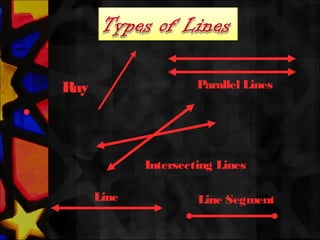


Ray
Line
Intersecting Lines
Parallel Lines
Line Segment
RAY: A part of a line, with one endpoint, that
continues without end in one direction
LINE: A straight path extending in both directions
with no endpoints
LINE SEGMENT: A part of a line that includes two
points, called endpoints, andall the points between
them
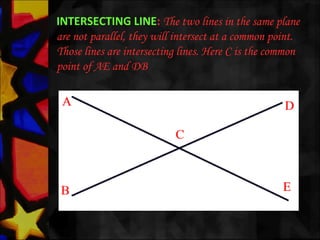
INTERSECTING LINE: The two lines in the same plane
are not parallel, they will intersect at a common point.
Those lines are intersecting lines. Here C is the common
point of AE and DB
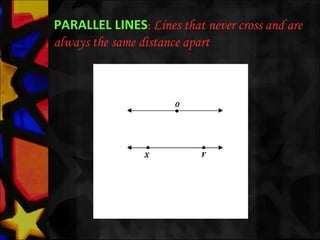
PARALLEL LINES: Lines that never cross and are
always the same distance apart
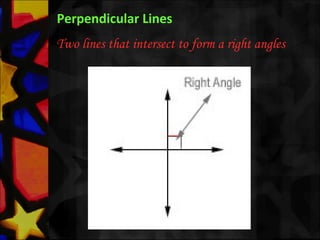
Perpendicular Lines
Two lines that intersect to form a right angles
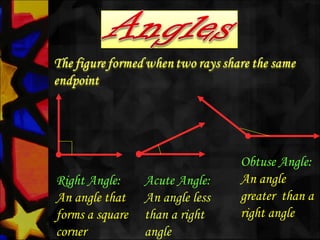
Right Angle:
An angle that
forms a square
corner
Acute Angle:
An angle less
than a right
angle
Obtuse Angle:
An angle
greater than a
right angle
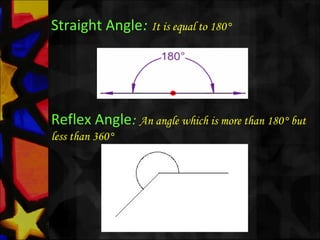
Straight Angle: It is equal to 180°
Reflex Angle: An angle which is more than 180° but
less than 360°
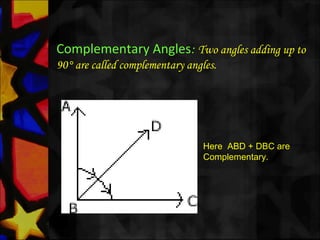
Complementary Angles: Two angles adding up to
90° are called complementary angles.
Here ABD + DBC are
Complementary.
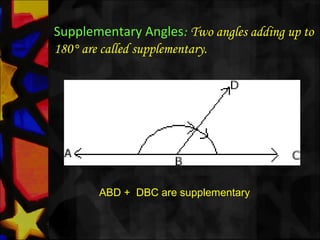
Supplementary Angles: Two angles adding up to
180° are called supplementary.
ABD + DBC are supplementary
Transversal: A Transversal is a line that
intersect two parallel lines at different points.
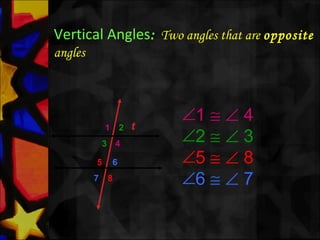
Vertical Angles: Two angles that are opposite
angles
1 2
3 4
5 6
7 8
t
∠1 ≅ ∠ 4
∠2 ≅ ∠ 3
∠5 ≅ ∠ 8
∠6 ≅ ∠ 7
Linear Pair: Two angles that form a line
(sum=180°)
1 2
3 4
5 6
7 8
t
∠5+∠6=180
∠6+∠8=180
∠8+∠7=180
∠7+∠5=180
∠1+∠2=180
∠2+∠4=180
∠4+∠3=180
∠3+∠1=180
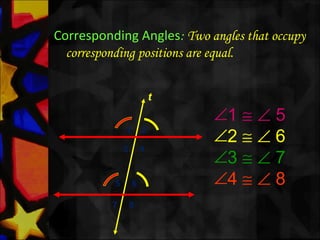
Corresponding Angles: Two angles that occupy
corresponding positions are equal.
∠1 ≅ ∠ 5
∠2 ≅ ∠ 6
∠3 ≅ ∠ 7
∠4 ≅ ∠ 8
t
1 2
3 4
5 6
7 8
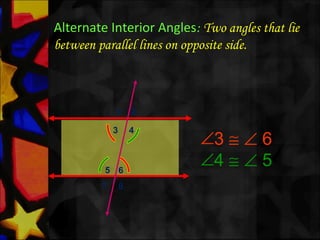
Alternate Interior Angles: Two angles that lie
between parallel lines on opposite side.
∠3 ≅ ∠ 6
∠4 ≅ ∠ 5
1 2
3 4
5 6
7 8
Co-Interior Angles: Two angles that lie between
parallel lines on the same side of the transversal
1 2
3 4
5 6
7 8
3 +∠5 = 180
4 +∠6 = 180
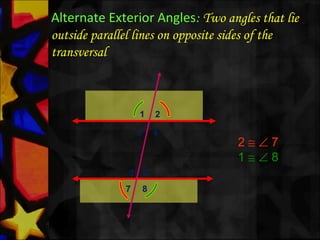
Alternate Exterior Angles: Two angles that lie
outside parallel lines on opposite sides of the
transversal
1 2
3 4
5 6
7 8
2 ≅ ∠ 7
1 ≅ ∠ 8
Angle Sum Property Of Triangle: The sum of the
angles of a triangle is 180°.
1
23
1 + 2 + 3 = 180°
Property of Exterior Angle: If a side of a triangle is
produced, then the exterior angle so formed is equal to the
sum of the two interior opposite angles.
Angle 1,2,3
are exterior
angles of
triangle
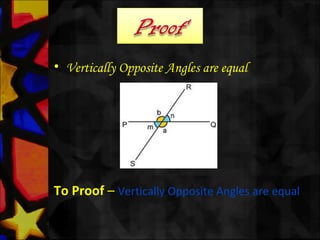
• Vertically Opposite Angles are equal
To Proof – Vertically Opposite Angles are equal
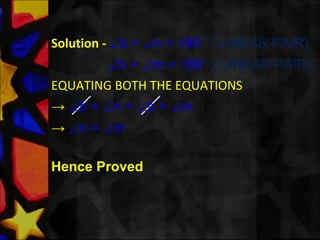
Solution - ∠b + ∠n = 180° ( LINEAR PAIR)
∠b + ∠m = 180° ( LINEAR PAIR)
EQUATING BOTH THE EQUATIONS
→ ∠b + ∠n = ∠b + ∠m
→ ∠n = ∠m
Hence Proved
• Angle Sum Property Of A Triangle is 180°
To Proof -Angle Sum Property Of a Triangle is
180°
Construction - Draw ↔m parallel to BC
Solution - ∠4 = ∠1 (Alternate Interior Angles)
∠5 = ∠2 (Alternate Interior Angles)
∠3 + ∠4 + ∠5 = 180° ( Angles on the same line are
supplementary)
Substituting the values
∠3 + ∠1 + ∠2 = 180° (Angle Sum Property)
Hence Proved
Made by:
Shaik Mallika

1436009 634742941363092500

  • 2.
  • 3.
    RAY: A partof a line, with one endpoint, that continues without end in one direction LINE: A straight path extending in both directions with no endpoints LINE SEGMENT: A part of a line that includes two points, called endpoints, andall the points between them
  • 4.
    INTERSECTING LINE: Thetwo lines in the same plane are not parallel, they will intersect at a common point. Those lines are intersecting lines. Here C is the common point of AE and DB
  • 5.
    PARALLEL LINES: Linesthat never cross and are always the same distance apart
  • 6.
    Perpendicular Lines Two linesthat intersect to form a right angles
  • 7.
    Right Angle: An anglethat forms a square corner Acute Angle: An angle less than a right angle Obtuse Angle: An angle greater than a right angle
  • 8.
    Straight Angle: Itis equal to 180° Reflex Angle: An angle which is more than 180° but less than 360°
  • 9.
    Complementary Angles: Twoangles adding up to 90° are called complementary angles. Here ABD + DBC are Complementary.
  • 10.
    Supplementary Angles: Twoangles adding up to 180° are called supplementary. ABD + DBC are supplementary
  • 11.
    Transversal: A Transversalis a line that intersect two parallel lines at different points.
  • 12.
    Vertical Angles: Twoangles that are opposite angles 1 2 3 4 5 6 7 8 t ∠1 ≅ ∠ 4 ∠2 ≅ ∠ 3 ∠5 ≅ ∠ 8 ∠6 ≅ ∠ 7
  • 13.
    Linear Pair: Twoangles that form a line (sum=180°) 1 2 3 4 5 6 7 8 t ∠5+∠6=180 ∠6+∠8=180 ∠8+∠7=180 ∠7+∠5=180 ∠1+∠2=180 ∠2+∠4=180 ∠4+∠3=180 ∠3+∠1=180
  • 14.
    Corresponding Angles: Twoangles that occupy corresponding positions are equal. ∠1 ≅ ∠ 5 ∠2 ≅ ∠ 6 ∠3 ≅ ∠ 7 ∠4 ≅ ∠ 8 t 1 2 3 4 5 6 7 8
  • 15.
    Alternate Interior Angles:Two angles that lie between parallel lines on opposite side. ∠3 ≅ ∠ 6 ∠4 ≅ ∠ 5 1 2 3 4 5 6 7 8
  • 16.
    Co-Interior Angles: Twoangles that lie between parallel lines on the same side of the transversal 1 2 3 4 5 6 7 8 3 +∠5 = 180 4 +∠6 = 180
  • 17.
    Alternate Exterior Angles:Two angles that lie outside parallel lines on opposite sides of the transversal 1 2 3 4 5 6 7 8 2 ≅ ∠ 7 1 ≅ ∠ 8
  • 18.
    Angle Sum PropertyOf Triangle: The sum of the angles of a triangle is 180°. 1 23 1 + 2 + 3 = 180°
  • 19.
    Property of ExteriorAngle: If a side of a triangle is produced, then the exterior angle so formed is equal to the sum of the two interior opposite angles. Angle 1,2,3 are exterior angles of triangle
  • 20.
    • Vertically OppositeAngles are equal To Proof – Vertically Opposite Angles are equal
  • 21.
    Solution - ∠b+ ∠n = 180° ( LINEAR PAIR) ∠b + ∠m = 180° ( LINEAR PAIR) EQUATING BOTH THE EQUATIONS → ∠b + ∠n = ∠b + ∠m → ∠n = ∠m Hence Proved
  • 22.
    • Angle SumProperty Of A Triangle is 180° To Proof -Angle Sum Property Of a Triangle is 180° Construction - Draw ↔m parallel to BC Solution - ∠4 = ∠1 (Alternate Interior Angles) ∠5 = ∠2 (Alternate Interior Angles)
  • 23.
    ∠3 + ∠4+ ∠5 = 180° ( Angles on the same line are supplementary) Substituting the values ∠3 + ∠1 + ∠2 = 180° (Angle Sum Property) Hence Proved
  • 24.