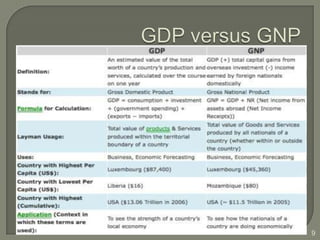
 Gross  domestic product (GDP) is
 the market value of all officially recognized
 final goods and services produced within a
 country in a given period of time.
 GDP  per capita is often considered an
 indicator of a country‘s standard of living.
 Eg: If we say GDP is up by 3% last year, it
 means economy has grown by 3%.


                                                 2
 Is   a major economic activity indicator
 Represents    business activity
 Economists rely on this data to determine
 growth or decline of economy
 Helps investors to know where to
 invest/allocate the money
 Unemployment      is an indicator of shrinking
 GDP
                                                   3
 Ifthe economy appears to be growing too
  fast and GDP has shown a pattern of
  steadily rising, policymakers might
  evaluate whether a change needs to be
  made to interest rates in order to keep
  inflation under control.


                                            4
   Product Approach
-   Market value of all final goods and services calculated
    during 1 year
   Income approach
-   Sum total of incomes of individuals living in a country
    during 1 year
   Expenditure Approach
-   All expenditure incurred by individuals during 1 year
   All the above approaches should have the same result


                                                              5
   Gross national product (GNP) is the market
    value of all the products and services produced in
    one year by labour and property supplied by the
    residents of a country.

   Basically, GNP is the total value of all final goods
    and services produced within a nation in a
    particular year, plus income earned by its citizens
    (including income of those located abroad), minus
    income of non-residents located in that country.


                                                           6
   It indicates the economic condition of the country.
   Helps compare own country’s economic condition with
    other countries
   Study of GNP guides us to make policies for
    saving,investment and consumption
   Gives information on distribution of wealth.
   Gives information about the contribution of various
    sectors of the economy eg:agriculture,industrial


                                                          7
 Throws    light on source of employment

 Tells   about rate of economic growth


                                            8
9

14.04.13 gdp and gnp

  • 2.
     Gross domestic product (GDP) is the market value of all officially recognized final goods and services produced within a country in a given period of time.  GDP per capita is often considered an indicator of a country‘s standard of living. Eg: If we say GDP is up by 3% last year, it means economy has grown by 3%. 2
  • 3.
     Is a major economic activity indicator  Represents business activity  Economists rely on this data to determine growth or decline of economy  Helps investors to know where to invest/allocate the money  Unemployment is an indicator of shrinking GDP 3
  • 4.
     Ifthe economyappears to be growing too fast and GDP has shown a pattern of steadily rising, policymakers might evaluate whether a change needs to be made to interest rates in order to keep inflation under control. 4
  • 5.
    Product Approach - Market value of all final goods and services calculated during 1 year  Income approach - Sum total of incomes of individuals living in a country during 1 year  Expenditure Approach - All expenditure incurred by individuals during 1 year  All the above approaches should have the same result 5
  • 6.
    Gross national product (GNP) is the market value of all the products and services produced in one year by labour and property supplied by the residents of a country.  Basically, GNP is the total value of all final goods and services produced within a nation in a particular year, plus income earned by its citizens (including income of those located abroad), minus income of non-residents located in that country. 6
  • 7.
    It indicates the economic condition of the country.  Helps compare own country’s economic condition with other countries  Study of GNP guides us to make policies for saving,investment and consumption  Gives information on distribution of wealth.  Gives information about the contribution of various sectors of the economy eg:agriculture,industrial 7
  • 8.
     Throws light on source of employment  Tells about rate of economic growth 8
  • 9.