National Center for Immunization & Respiratory Diseases
Rapid Diagnostic Tests for Bacterial
Meningitis Pathogens: where we are now
and what’s next.
Xin Wang
Chief, Bacterial Meningitis Laboratory
Director WHO Collaborating Center for Meningitis
MVPDB/DBD/NCIRD/CDC
Meningitis Research Foundation Conference
Nov 1-3, 2021
2
I have no conflict of interest in relation to this presentation
The findings and conclusions in this presentation are those of the authors and do
not necessarily represent the official position of the U.S. Centers for Disease
Control and Prevention (CDC).
The U.S. CDC does not endorse, recommend or make representations with
respect to the products and manufactures in this presentation
Rapid Diagnostics for Meningitis
• Meningitis is a life-threatening disease
• Rapid detection of meningitis pathogens is critical for case management, outbreak
response, and surveillance
• Poor accessibility of diagnostics remains to be addressed, especially in resource
limited countries
• insufficient funding
• limitations of existing diagnostic tests
• lack of trained staff members
• low priority
• Ineffective supply chain management
• Despite advances in diagnostic technology, an empirical antimicrobial treatment
provided, rather than a treatment based on pathogen identification
Diagnostics: a Key Component in the Global Road Map to
Defeat Meningitis by 2030
Pillar 2 Diagnosis and treatment
Achieved through improve diagnosis at all levels of heath
care, health worker training and prompt and effective case
management
• Strategic goal 6: Improve diagnosis of meningitis at all levels
of care
• Strategic goal 7: Develop and facilitate access to diagnostic
assays at all levels of care to increase confirmation of
meningitis
Defeating meningitis by 2030: a global road map (who.int)
Three Use Cases To Improve Global Meningitis Detection
Use case 1 (Epidemic/outbreak settings, Africa)
• Identification of Nm serogroup at peripheral level (health center or
district hospital) for appropriate vaccine response
Use case 2 (Epidemic and endemic settings, worldwide)
• Identification of bacterial meningitis/septicemia at peripheral level
(health clinic or hospital) to initiate antibiotic treatment for case
management
Use case 3 (Epidemic and endemic settings, worldwide)
• Identification of causative pathogens from syndromic meningitis panels
(minimum 10 pathogens) at hospital level (district/regional hospital) for
case management: stopping or changing antibiotics
https://www.who.int/emergencies/diseases/meningitis/meningitis-diagnostics-use-cases.pdf
Timelines for use case 3 development
May 2017: A call
for action: global
vision to defeat
meningitis
March 2018:
Expert group
meeting to
discuss
development of
next generation
RDTs (use cases
1-3)
2019-20: Use
case 3 TPP
finalized
2020-21: Use case
3 landscape and
Market analysis by
PATH
2021: Identification
of potential
platforms for use
case 3
2022-24:
Development and
validation of
potential RDTs
2025-28: Pilot
studies and RDT
roll-out
Partnership and collaborations to accelerate
use case 3 development
Develop and finalize
use case 3 Target
Product Profile (TPP)
Conduct landscape
analysis of meningitis
diagnostics
Use case 3
TPP
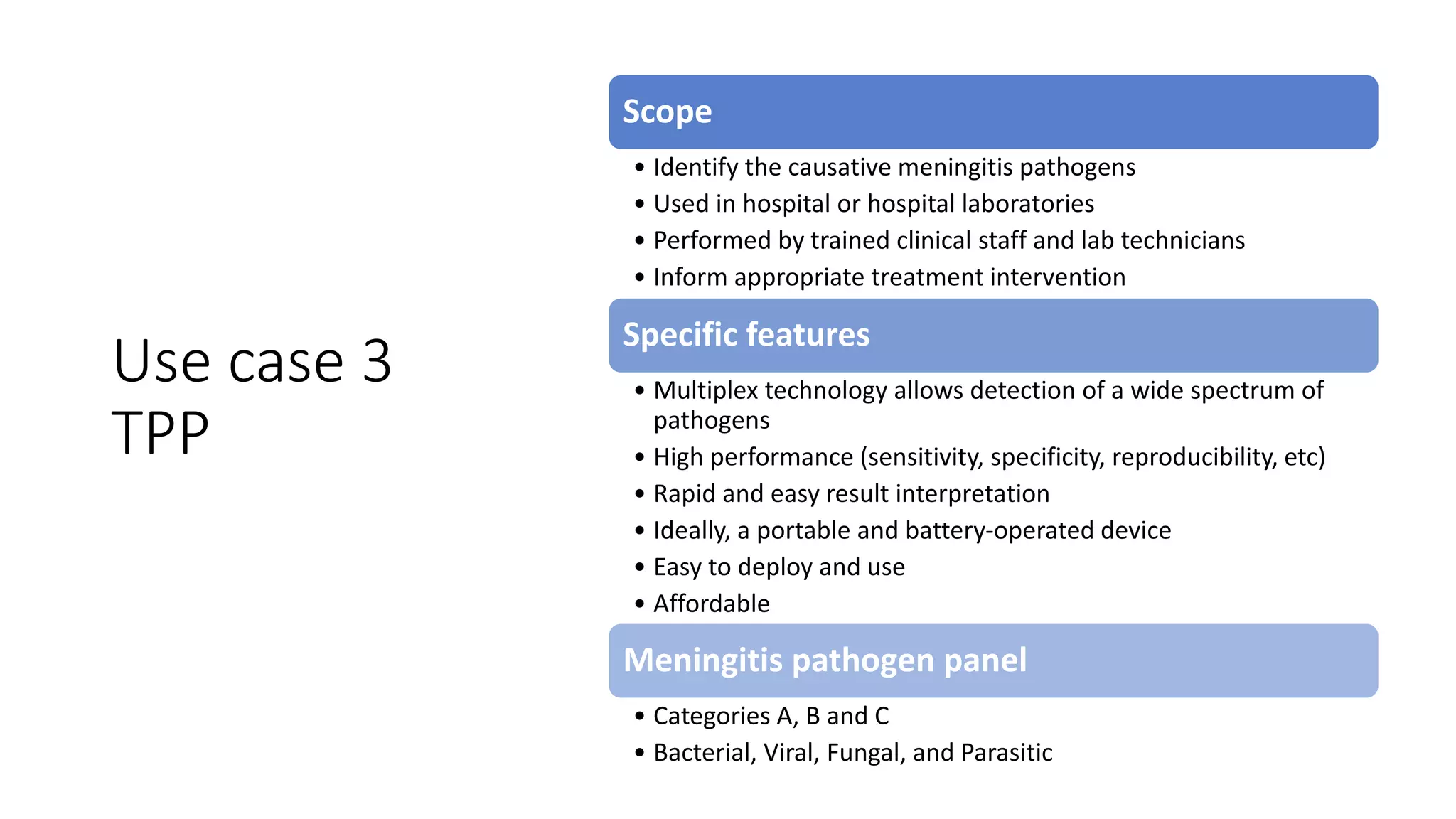
Scope
• Identify the causative meningitis pathogens
• Used in hospital or hospital laboratories
• Performed by trained clinical staff and lab technicians
• Inform appropriate treatment intervention
Specific features
• Multiplex technology allows detection of a wide spectrum of
pathogens
• High performance (sensitivity, specificity, reproducibility, etc)
• Rapid and easy result interpretation
• Ideally, a portable and battery-operated device
• Easy to deploy and use
• Affordable
Meningitis pathogen panel
• Categories A, B and C
• Bacterial, Viral, Fungal, and Parasitic
Landscape
analysis of
meningitis
diagnostics
Objectives
• Identify diagnostic gaps and obtain key stakeholders’
feedback on existing and pipeline technologies
• Review the diagnostic platforms and technologies currently
available or under development with the potential for Use
Case 3.
• Assess existing and emerging technologies, including their
quality, cost, and relevance to Use Case 3
Methods
• Stakeholder interviews
• Literature review
Major Findings
• Existing Tests/platforms
• Potential platforms
• Advanced/Emerging technologies
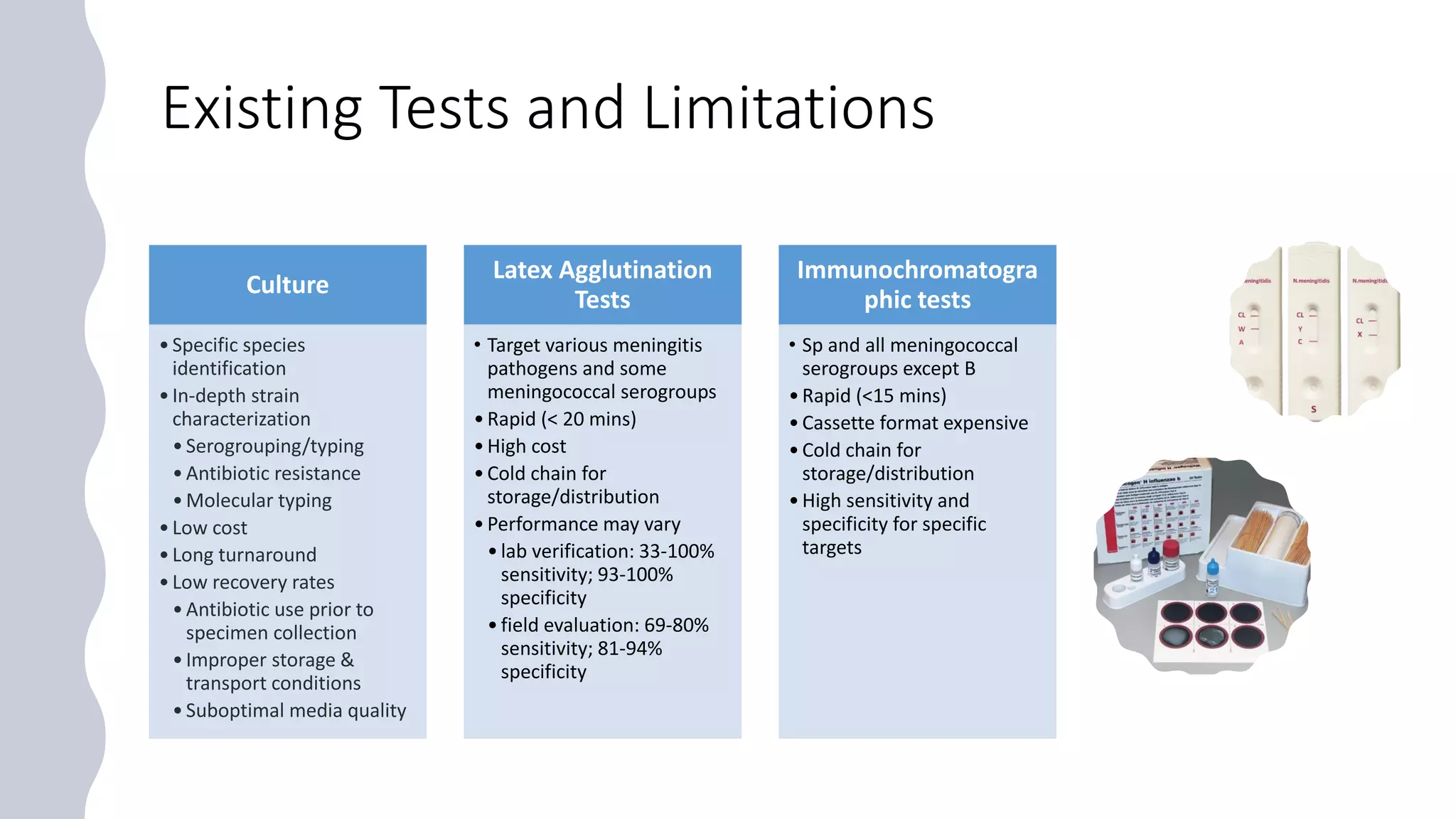
Existing Tests and Limitations
Culture
Latex Agglutination
Tests
• Target various meningitis
pathogens and some
meningococcal serogroups
•Rapid (< 20 mins)
•High cost
•Cold chain for
storage/distribution
•Performance may vary
•lab verification: 33-100%
sensitivity; 93-100%
specificity
•field evaluation: 69-80%
sensitivity; 81-94%
specificity
Immunochromatogra
phic tests
• Sp and all meningococcal
serogroups except B
•Rapid (<15 mins)
•Cassette format expensive
•Cold chain for
storage/distribution
•High sensitivity and
specificity for specific
targets
11
• High cost (expensive equipment)
• Require cold chain for key reagents
• Require technical trainings and lab infrastructure
(freezer, fridge, separate rooms etc)
• Decentralization to regional/district levels is
challenging in resource limited regions
• Quick turnaround (within several hours)
• Sensitive/specific for targets
• High throughput
• Multiple platforms available-commercial and
lab developed tests (LDTs)
• LDTs implemented in many countries with
External Quality Assurance in place
Existing Tests and Limitations: PCR-based Tests
PCR tests for meningitis pathogens
Test Platform Targets Specimen
Type
Sen/Spe Instrument/Cost Time
BioFire Film
Array
Multiplex Bacterial/viral/fugal meningitis
pathogens
CSF >90% Biofire FilmArray
Systems/High ($45K for
2.0)
~1 hr
Xpert® EV Multiplex Enteroviral meningitis pathogens CSF >95% Genexpert
system/Medium-High
($11K-64K)
<2.5 hrs
QIAstat-Dx Multiplex Bacterial/viral/fugal meningitis
pathogens including Nm/Hi capsule
types
CSF NA QIAStart-Dx
analyzer/Medium
(~$25K)
~1 hr
HG
Meningococcus/
Sp (Ireland)
LAMP Nm Serogroups (A, B, C, E, W, X, Y, and
Z)/Sp serotypes
Blood, CSF,
Swab, Direct
CSF
NA LAMP instrument/$9.7
(main or battery power)
<1 hr
Lab Developed
Tests
Direct PCR,
triplex
Bacterial meningitis pathogens and
capsule types
CSF, serum >95% ABI, AriaMx (>25K) ~ 2 hrs
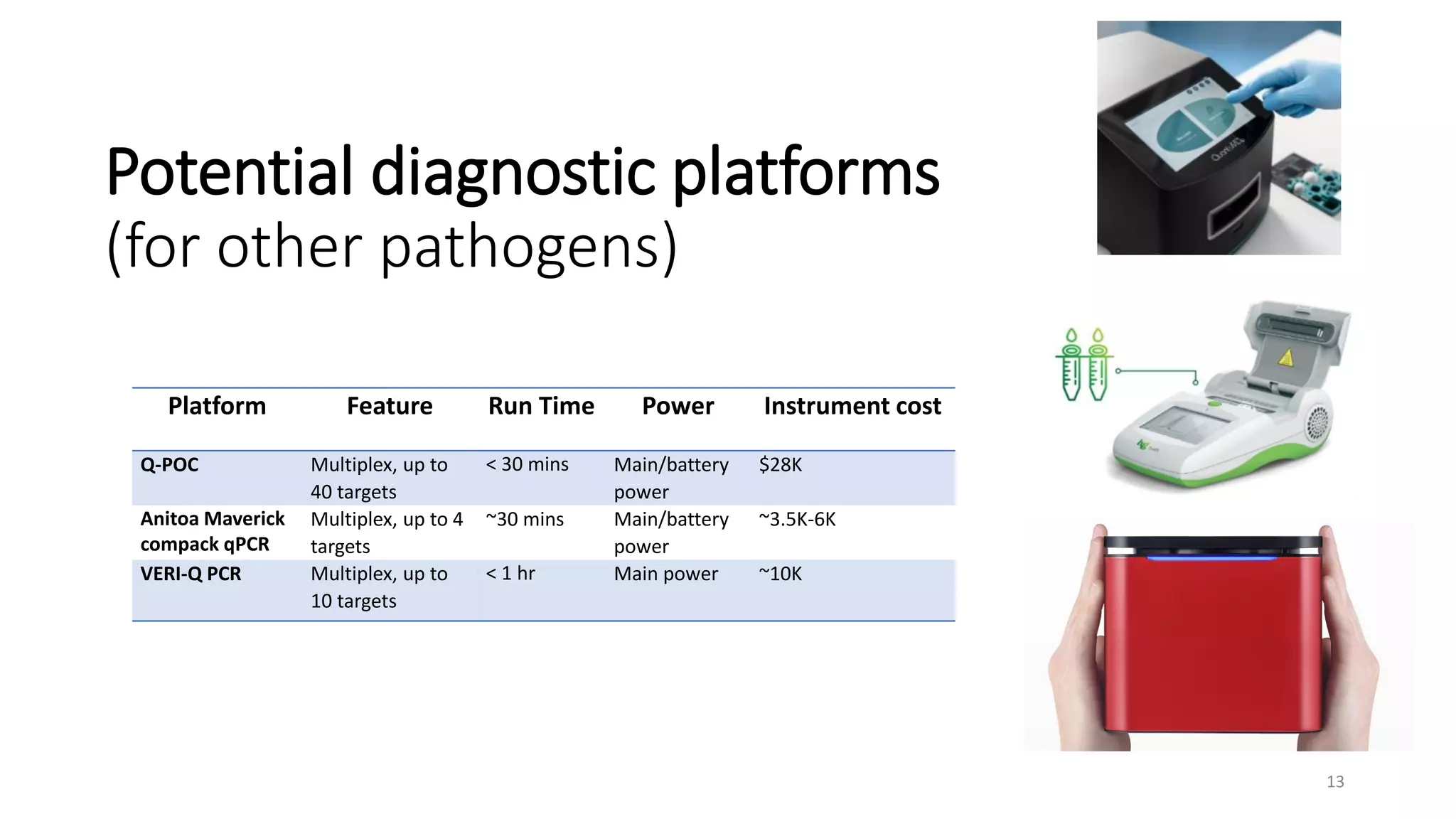
Potential diagnostic platforms
(for other pathogens)
13
Platform Feature Run Time Power Instrument cost
Q-POC Multiplex, up to
40 targets
< 30 mins Main/battery
power
$28K
Anitoa Maverick
compack qPCR
Multiplex, up to 4
targets
~30 mins Main/battery
power
~3.5K-6K
VERI-Q PCR Multiplex, up to
10 targets
< 1 hr Main power ~10K
Advanced diagnostic
platforms
• Growing interest in next generation sequencing in past
10 years
• Used for detection of various pathogens (bacterial, viral
etc)
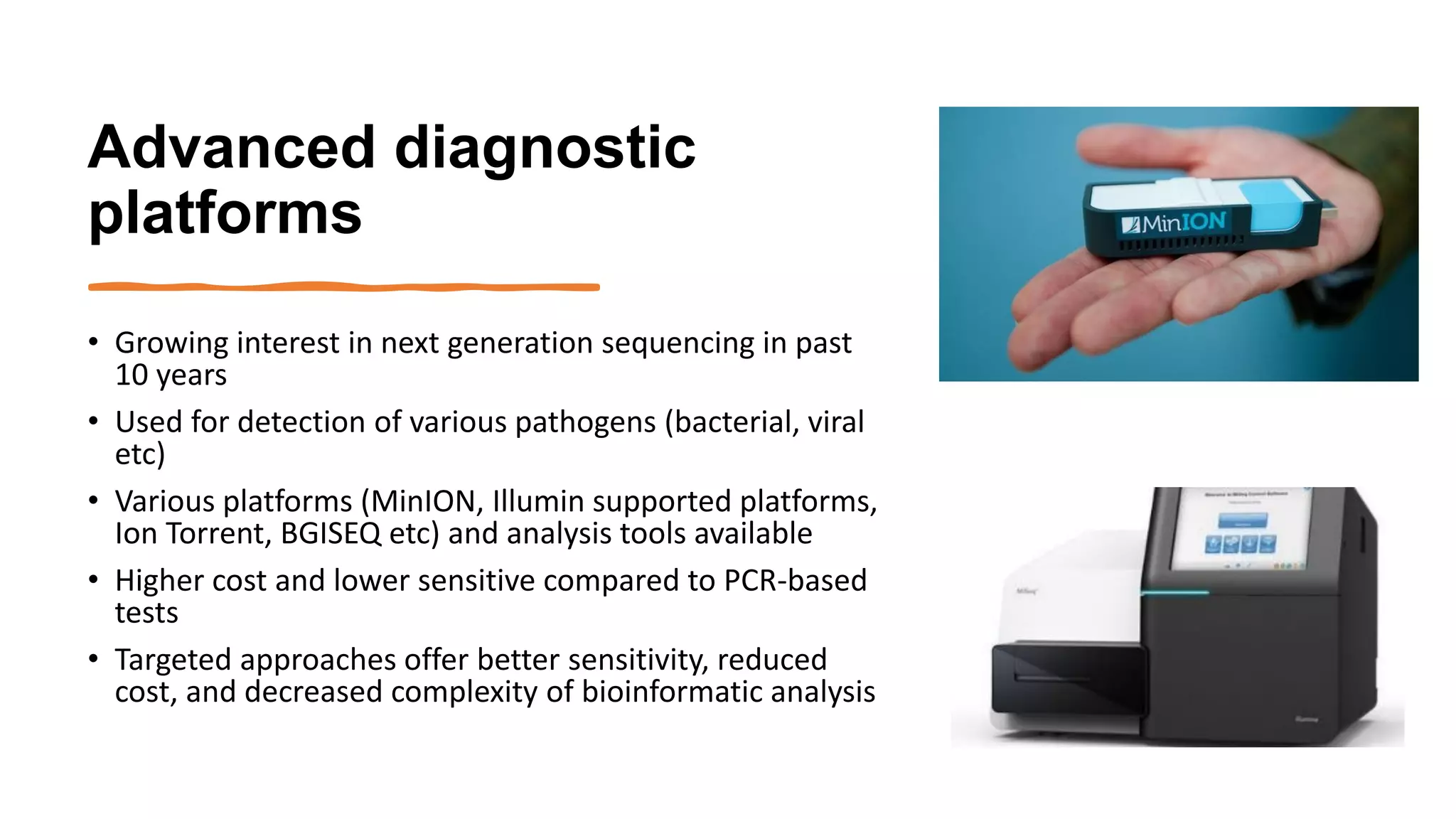
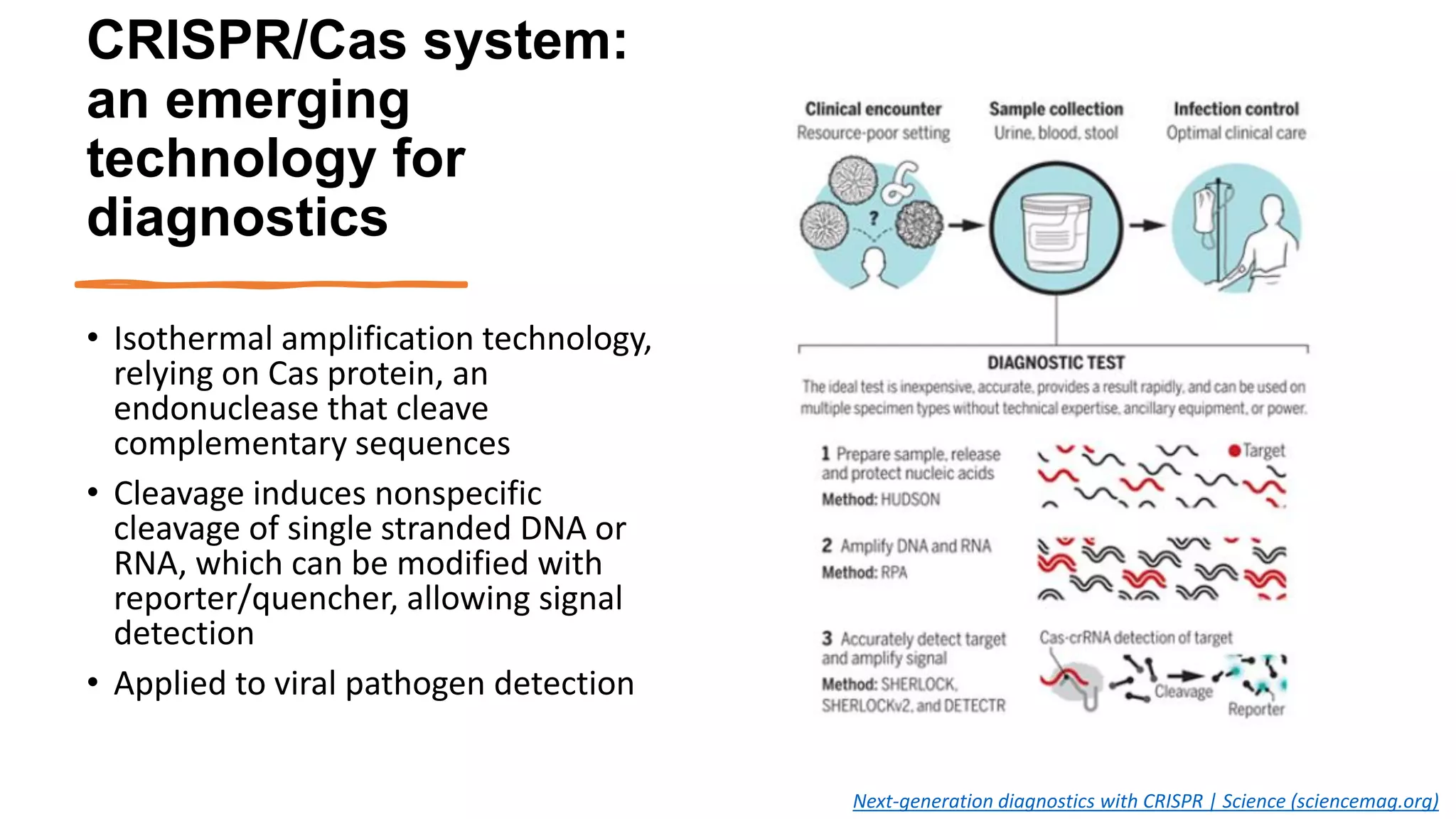
• Various platforms (MinION, Illumin supported platforms,
Ion Torrent, BGISEQ etc) and analysis tools available
• Higher cost and lower sensitive compared to PCR-based
tests
• Targeted approaches offer better sensitivity, reduced
cost, and decreased complexity of bioinformatic analysis
CRISPR/Cas system:
an emerging
technology for
diagnostics
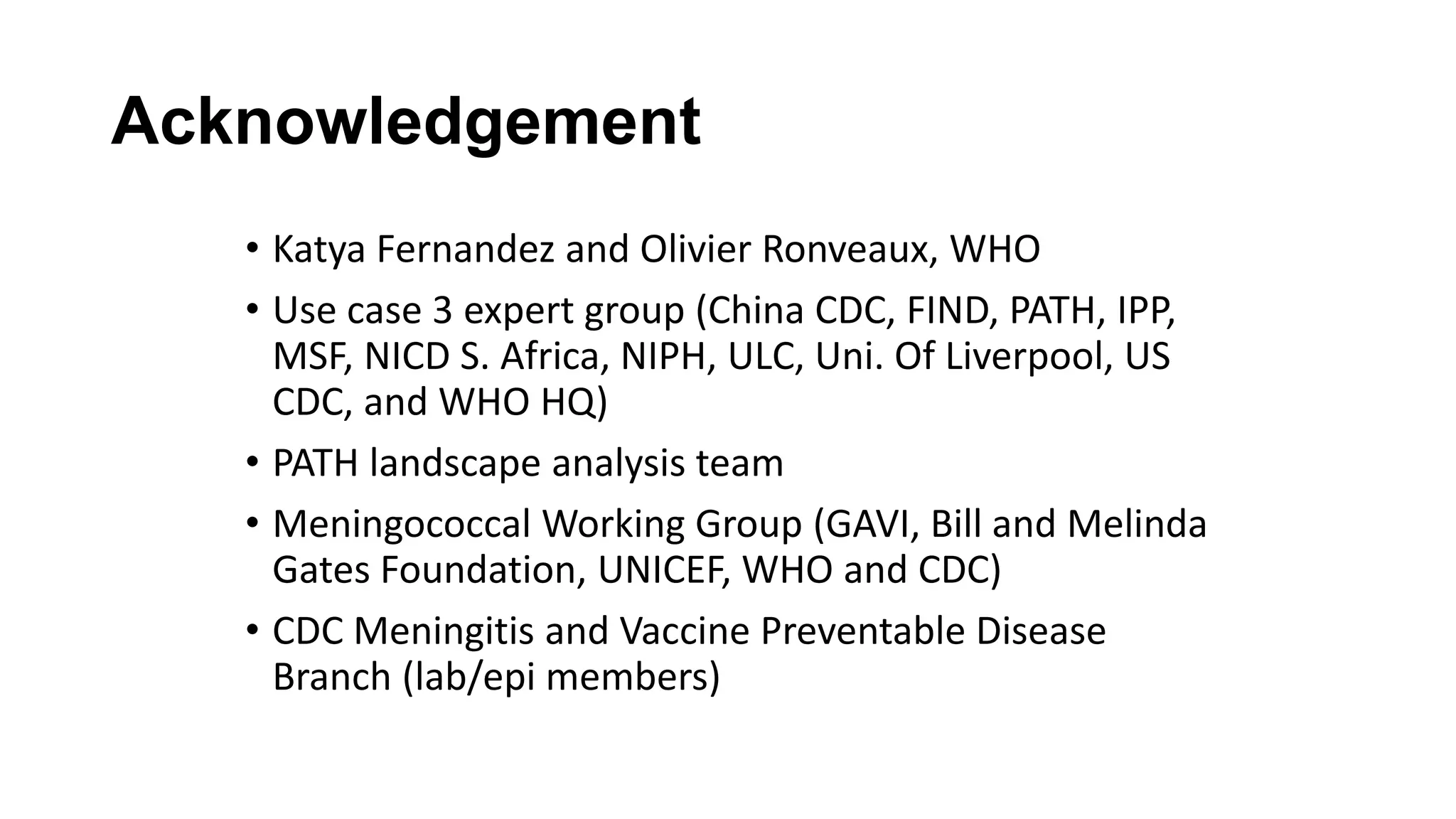
• Isothermal amplification technology,
relying on Cas protein, an
endonuclease that cleave
complementary sequences
• Cleavage induces nonspecific
cleavage of single stranded DNA or
RNA, which can be modified with
reporter/quencher, allowing signal
detection
• Applied to viral pathogen detection
Next-generation diagnostics with CRISPR | Science (sciencemag.org)
Future Diagnostics for Meningitis
Existing platforms for meningitis pathogens
• Most Category A pathogens
• High sensitivity and specificity
• Expensive
Platforms with the potential for Use Case 3
• Not developed for meningitis pathogens
• Meet many features outline in Use Case 3 TPP
• Lower cost
Advanced and emerging technologies for Use Case 3
• Sequencing or CRISPR/Cas based
• Early development for diagnostics
What’s next?
Assess various platforms-
existing/potential and
estimate market size
• Identify suitable platforms for
validation
• Develop and validate tests for
meningitis pathogens
• Estimate market size for
meningitis diagnostics
1
Pilot studies to inform
global deployment
strategies
• Evaluate RDT field performance
and lab capacity at local levels in
selected countries
• Assess LP rate, supply
chain/specimen transport
systems, and data reporting
2
Develop region/country-
specific rollout strategies
• Country’s risk level for
meningitis and prevalence of
pathogens
• Impact on surveillance, testing
algorithm, data flow etc
• Shift in the roles of laboratory at
national/subnational levels
• Procurement process/trainings
3
Conclusion
• RDTs are important for rapid meningitis detection at local
hospitals and laboratories; culture remains important for AMR
and genomic surveillance
• Strong partnership and innovations in technology and
informatics accelerate the development of next generation rapid
tests
• Deployment of new RDTs requires engagement of multi-
stakeholders and may lead to a paradigm shift in the roles of
clinical and public health laboratories
• Partner/country’s commitment and investment ensures
sustained access to RDTs
Acknowledgement
• Katya Fernandez and Olivier Ronveaux, WHO
• Use case 3 expert group (China CDC, FIND, PATH, IPP,
MSF, NICD S. Africa, NIPH, ULC, Uni. Of Liverpool, US
CDC, and WHO HQ)
• PATH landscape analysis team
• Meningococcal Working Group (GAVI, Bill and Melinda
Gates Foundation, UNICEF, WHO and CDC)
• CDC Meningitis and Vaccine Preventable Disease
Branch (lab/epi members)
Thank you for your attention

Dr Xin wang

  • 1.
    National Center forImmunization & Respiratory Diseases Rapid Diagnostic Tests for Bacterial Meningitis Pathogens: where we are now and what’s next. Xin Wang Chief, Bacterial Meningitis Laboratory Director WHO Collaborating Center for Meningitis MVPDB/DBD/NCIRD/CDC Meningitis Research Foundation Conference Nov 1-3, 2021
  • 2.
    2 I have noconflict of interest in relation to this presentation The findings and conclusions in this presentation are those of the authors and do not necessarily represent the official position of the U.S. Centers for Disease Control and Prevention (CDC). The U.S. CDC does not endorse, recommend or make representations with respect to the products and manufactures in this presentation
  • 3.
    Rapid Diagnostics forMeningitis • Meningitis is a life-threatening disease • Rapid detection of meningitis pathogens is critical for case management, outbreak response, and surveillance • Poor accessibility of diagnostics remains to be addressed, especially in resource limited countries • insufficient funding • limitations of existing diagnostic tests • lack of trained staff members • low priority • Ineffective supply chain management • Despite advances in diagnostic technology, an empirical antimicrobial treatment provided, rather than a treatment based on pathogen identification
  • 4.
    Diagnostics: a KeyComponent in the Global Road Map to Defeat Meningitis by 2030 Pillar 2 Diagnosis and treatment Achieved through improve diagnosis at all levels of heath care, health worker training and prompt and effective case management • Strategic goal 6: Improve diagnosis of meningitis at all levels of care • Strategic goal 7: Develop and facilitate access to diagnostic assays at all levels of care to increase confirmation of meningitis Defeating meningitis by 2030: a global road map (who.int)
  • 5.
    Three Use CasesTo Improve Global Meningitis Detection Use case 1 (Epidemic/outbreak settings, Africa) • Identification of Nm serogroup at peripheral level (health center or district hospital) for appropriate vaccine response Use case 2 (Epidemic and endemic settings, worldwide) • Identification of bacterial meningitis/septicemia at peripheral level (health clinic or hospital) to initiate antibiotic treatment for case management Use case 3 (Epidemic and endemic settings, worldwide) • Identification of causative pathogens from syndromic meningitis panels (minimum 10 pathogens) at hospital level (district/regional hospital) for case management: stopping or changing antibiotics https://www.who.int/emergencies/diseases/meningitis/meningitis-diagnostics-use-cases.pdf
  • 6.
    Timelines for usecase 3 development May 2017: A call for action: global vision to defeat meningitis March 2018: Expert group meeting to discuss development of next generation RDTs (use cases 1-3) 2019-20: Use case 3 TPP finalized 2020-21: Use case 3 landscape and Market analysis by PATH 2021: Identification of potential platforms for use case 3 2022-24: Development and validation of potential RDTs 2025-28: Pilot studies and RDT roll-out
  • 7.
    Partnership and collaborationsto accelerate use case 3 development Develop and finalize use case 3 Target Product Profile (TPP) Conduct landscape analysis of meningitis diagnostics
  • 8.
    Use case 3 TPP Scope •Identify the causative meningitis pathogens • Used in hospital or hospital laboratories • Performed by trained clinical staff and lab technicians • Inform appropriate treatment intervention Specific features • Multiplex technology allows detection of a wide spectrum of pathogens • High performance (sensitivity, specificity, reproducibility, etc) • Rapid and easy result interpretation • Ideally, a portable and battery-operated device • Easy to deploy and use • Affordable Meningitis pathogen panel • Categories A, B and C • Bacterial, Viral, Fungal, and Parasitic
  • 9.
    Landscape analysis of meningitis diagnostics Objectives • Identifydiagnostic gaps and obtain key stakeholders’ feedback on existing and pipeline technologies • Review the diagnostic platforms and technologies currently available or under development with the potential for Use Case 3. • Assess existing and emerging technologies, including their quality, cost, and relevance to Use Case 3 Methods • Stakeholder interviews • Literature review Major Findings • Existing Tests/platforms • Potential platforms • Advanced/Emerging technologies
  • 10.
    Existing Tests andLimitations Culture Latex Agglutination Tests • Target various meningitis pathogens and some meningococcal serogroups •Rapid (< 20 mins) •High cost •Cold chain for storage/distribution •Performance may vary •lab verification: 33-100% sensitivity; 93-100% specificity •field evaluation: 69-80% sensitivity; 81-94% specificity Immunochromatogra phic tests • Sp and all meningococcal serogroups except B •Rapid (<15 mins) •Cassette format expensive •Cold chain for storage/distribution •High sensitivity and specificity for specific targets
  • 11.
    11 • High cost(expensive equipment) • Require cold chain for key reagents • Require technical trainings and lab infrastructure (freezer, fridge, separate rooms etc) • Decentralization to regional/district levels is challenging in resource limited regions • Quick turnaround (within several hours) • Sensitive/specific for targets • High throughput • Multiple platforms available-commercial and lab developed tests (LDTs) • LDTs implemented in many countries with External Quality Assurance in place Existing Tests and Limitations: PCR-based Tests
  • 12.
    PCR tests formeningitis pathogens Test Platform Targets Specimen Type Sen/Spe Instrument/Cost Time BioFire Film Array Multiplex Bacterial/viral/fugal meningitis pathogens CSF >90% Biofire FilmArray Systems/High ($45K for 2.0) ~1 hr Xpert® EV Multiplex Enteroviral meningitis pathogens CSF >95% Genexpert system/Medium-High ($11K-64K) <2.5 hrs QIAstat-Dx Multiplex Bacterial/viral/fugal meningitis pathogens including Nm/Hi capsule types CSF NA QIAStart-Dx analyzer/Medium (~$25K) ~1 hr HG Meningococcus/ Sp (Ireland) LAMP Nm Serogroups (A, B, C, E, W, X, Y, and Z)/Sp serotypes Blood, CSF, Swab, Direct CSF NA LAMP instrument/$9.7 (main or battery power) <1 hr Lab Developed Tests Direct PCR, triplex Bacterial meningitis pathogens and capsule types CSF, serum >95% ABI, AriaMx (>25K) ~ 2 hrs
  • 13.
    Potential diagnostic platforms (forother pathogens) 13 Platform Feature Run Time Power Instrument cost Q-POC Multiplex, up to 40 targets < 30 mins Main/battery power $28K Anitoa Maverick compack qPCR Multiplex, up to 4 targets ~30 mins Main/battery power ~3.5K-6K VERI-Q PCR Multiplex, up to 10 targets < 1 hr Main power ~10K
  • 14.
    Advanced diagnostic platforms • Growinginterest in next generation sequencing in past 10 years • Used for detection of various pathogens (bacterial, viral etc) • Various platforms (MinION, Illumin supported platforms, Ion Torrent, BGISEQ etc) and analysis tools available • Higher cost and lower sensitive compared to PCR-based tests • Targeted approaches offer better sensitivity, reduced cost, and decreased complexity of bioinformatic analysis
  • 15.
    CRISPR/Cas system: an emerging technologyfor diagnostics • Isothermal amplification technology, relying on Cas protein, an endonuclease that cleave complementary sequences • Cleavage induces nonspecific cleavage of single stranded DNA or RNA, which can be modified with reporter/quencher, allowing signal detection • Applied to viral pathogen detection Next-generation diagnostics with CRISPR | Science (sciencemag.org)
  • 16.
    Future Diagnostics forMeningitis Existing platforms for meningitis pathogens • Most Category A pathogens • High sensitivity and specificity • Expensive Platforms with the potential for Use Case 3 • Not developed for meningitis pathogens • Meet many features outline in Use Case 3 TPP • Lower cost Advanced and emerging technologies for Use Case 3 • Sequencing or CRISPR/Cas based • Early development for diagnostics
  • 17.
    What’s next? Assess variousplatforms- existing/potential and estimate market size • Identify suitable platforms for validation • Develop and validate tests for meningitis pathogens • Estimate market size for meningitis diagnostics 1 Pilot studies to inform global deployment strategies • Evaluate RDT field performance and lab capacity at local levels in selected countries • Assess LP rate, supply chain/specimen transport systems, and data reporting 2 Develop region/country- specific rollout strategies • Country’s risk level for meningitis and prevalence of pathogens • Impact on surveillance, testing algorithm, data flow etc • Shift in the roles of laboratory at national/subnational levels • Procurement process/trainings 3
  • 18.
    Conclusion • RDTs areimportant for rapid meningitis detection at local hospitals and laboratories; culture remains important for AMR and genomic surveillance • Strong partnership and innovations in technology and informatics accelerate the development of next generation rapid tests • Deployment of new RDTs requires engagement of multi- stakeholders and may lead to a paradigm shift in the roles of clinical and public health laboratories • Partner/country’s commitment and investment ensures sustained access to RDTs
  • 19.
    Acknowledgement • Katya Fernandezand Olivier Ronveaux, WHO • Use case 3 expert group (China CDC, FIND, PATH, IPP, MSF, NICD S. Africa, NIPH, ULC, Uni. Of Liverpool, US CDC, and WHO HQ) • PATH landscape analysis team • Meningococcal Working Group (GAVI, Bill and Melinda Gates Foundation, UNICEF, WHO and CDC) • CDC Meningitis and Vaccine Preventable Disease Branch (lab/epi members)
  • 20.
    Thank you foryour attention