THE ROLE OF GENETICS IN PRODUCT QUALITY
AND FEED EFFICIENCY IN SWINE
Raquel Quintanilla
IRTA - Animal Breeding and Genetics Program
Torre Marimon, 08140 Caldes de Montbui, Barcelona, Spain.
raquel.quintanilla@irta.cat
IRTA Sponsor Day, Mas de Bover, May 15th-16th 2014
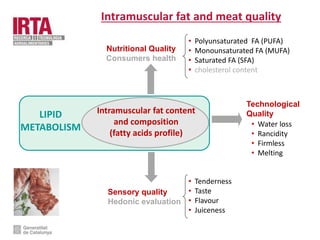
• Polyunsaturated FA (PUFA)
• Monounsaturated FA (MUFA)
• Saturated FA (SFA)
• cholesterol content
Sensory quality
Hedonic evaluation
Technological
Quality
Nutritional Quality
Consumers health
Intramuscular fat and meat quality
Intramuscular fat content
and composition
(fatty acids profile)
LIPID
METABOLISM • Water loss
• Rancidity
• Firmless
• Melting
• Tenderness
• Taste
• Flavour
• Juiceness
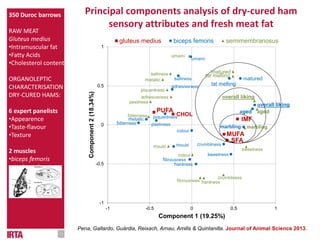
Principal components analysis of dry-cured ham
sensory attributes and fresh meat fat
Pena, Gallardo, Guàrdia, Reixach, Arnau, Amills & Quintanilla. Journal of Animal Science 2013.
350 Duroc barrows
RAW MEAT
Gluteus medius
•Intramuscular fat
•Fatty Acids
•Cholesterol content
ORGANOLEPTIC
CHARACTERISATION
DRY-CURED HAMS:
6 expert panelists
•Appearence
•Taste-flavour
•Texture
2 muscles
•biceps femoris
•semimembranosus
A
B SM
BF
Sección B
Sección A
SM
BF
IMF
CHOL
SFA
PUFA
MUFA
colour
marbling
overall liking
adhesiveness
bitterness
aged
mould
matured
sweetness
hardness
crumbliness
fibrousness
fat melting
metallic
pastiness
piquantness
saltiness
umami
colour
marbling
overall likingadhesiveness
bitterness
aged
mould
matured
sweetness
hardness
crumbliness
fibrousness
fat melting
metallic
pastiness
piquantness
saltiness
umami
-1
-0.5
0
0.5
1
-1 -0.5 0 0.5 1
Component2(18.34%)
Component 1 (19.25%)
gluteus medius biceps femoris semimembranosus
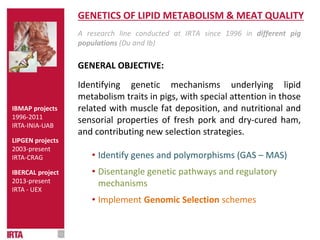
GENETICS OF LIPID METABOLISM & MEAT QUALITY
A research line conducted at IRTA since 1996 in different pig
populations (Du and Ib)
GENERAL OBJECTIVE:
Identifying genetic mechanisms underlying lipid
metabolism traits in pigs, with special attention in those
related with muscle fat deposition, and nutritional and
sensorial properties of fresh pork and dry-cured ham,
and contributing new selection strategies.
• Identify genes and polymorphisms (GAS – MAS)
• Disentangle genetic pathways and regulatory
mechanisms
• Implement Genomic Selection schemes
IBMAP projects
1996-2011
IRTA-INIA-UAB
LIPGEN projects
2003-present
IRTA-CRAG
IBERCAL project
2013-present
IRTA - UEX
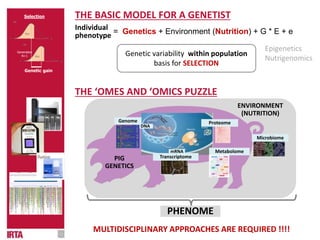
THE ‘OMES AND ‘OMICS PUZZLE
MULTIDISCIPLINARY APPROACHES ARE REQUIRED !!!!
Genome Proteome
mRNA
DNA
Transcriptome
Microbiome
Metabolome
PHENOME
ENVIRONMENT
(NUTRITION)
PIG
GENETICS
THE BASIC MODEL FOR A GENETIST
= Genetics + Environment (Nutrition) + G * E + e
Genetic gain
Generation
N+1 Genetic variability within population
basis for SELECTION
Individual
phenotype
Selection
Epigenetics
Nutrigenomics
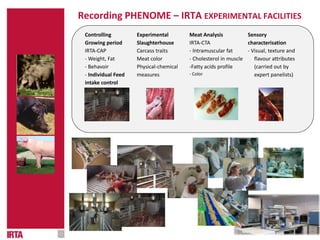
Recording PHENOME – IRTA EXPERIMENTAL FACILITIES
Controlling
Growing period
IRTA-CAP
- Weight, Fat
- Behavoir
- Individual Feed
intake control
Experimental
Slaughterhouse
Carcass traits
Meat color
Physical-chemical
measures
Meat Analysis
IRTA-CTA
- Intramuscular fat
- Cholesterol in muscle
-Fatty acids profile
- Color
Sensory
characterisation
- Visual, texture and
flavour attributes
(carried out by
expert panelists)
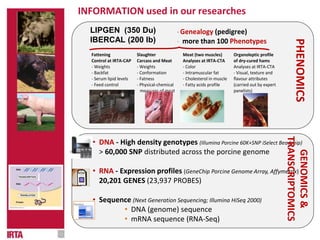
INFORMATION used in our researches
350 Duroc individuals: - Genealogy (pedigree)
- more than 100 Phenotypes
Fattening
Control at IRTA-CAP
- Weights
- Backfat
- Serum lipid levels
- Feed control
Slaughter
Carcass and Meat
- Weights
- Conformation
- Fatness
- Physical-chemical
measures of meat
Meat (two muscles)
Analyses at IRTA-CTA
- Color
- Intramuscular fat
- Cholesterol in muscle
- Fatty acids profile
Organoleptic profile
of dry-cured hams
Analyses at IRTA-CTA
- Visual, texture and
flavour attributes
(carried out by expert
panelists)
• DNA - High density genotypes (Illumina Porcine 60K+SNP iSelect Beadchip)
> 60,000 SNP distributed across the porcine genome
• RNA - Expression profiles (GeneChip Porcine Genome Array, Affymetrix)
20,201 GENES (23,937 PROBES)
• Sequence (Next Generation Sequencing; Illumina HiSeq 2000)
• DNA (genome) sequence
• mRNA sequence (RNA-Seq)
PHENOMICSGENOMICS&
TRANSCRIPTOMICS
LIPGEN (350 Du)
IBERCAL (200 Ib)
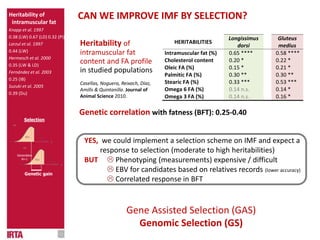
CAN WE IMPROVE IMF BY SELECTION?
HERITABILITIES
Longissimus
dorsi
Gluteus
medius
Intramuscular fat (%) 0.65 **** 0.58 ****
Cholesterol content 0.20 * 0.22 *
Oleic FA (%) 0.15 * 0.21 *
Palmitic FA (%) 0.30 ** 0.30 **
Stearic FA (%) 0.33 *** 0.53 ***
Omega 6 FA (%) 0.14 n.s. 0.14 *
Omega 3 FA (%) 0.14 n.s. 0.16 *
Heritability of
intramuscular fat
content and FA profile
in studied populations
Casellas, Noguera, Reixach, Díaz,
Amills & Quintanilla. Journal of
Animal Science 2010.
Heritability of
intramuscular fat
Knapp et al. 1997
0.38 (LW) 0.67 (LD) 0.32 (Pi)
Larzul et al. 1997
0.44 (LW)
Hermesch et al. 2000
0.35 (LW & LD)
Fernández et al. 2003
0.25 (IB)
Suzuki et al. 2005
0.39 (Du)
YES, we could implement a selection scheme on IMF and expect a
response to selection (moderate to high heritabilities)
BUT  Phenotyping (measurements) expensive / difficult
 EBV for candidates based on relatives records (lower accuracy)
 Correlated response in BFT
Genetic correlation with fatness (BFT): 0.25-0.40
Gene Assisted Selection (GAS)
Genomic Selection (GS)
Genetic gain
Generation
N+1
Selection
Varona et al. Genetical Research 2002
Ovilo et al. J. Anim. Sci. 2002
Perez-Enciso et al. Genetics. 2002
Clop et al. Mamm. Genome. 2003
Peréz-Enciso et al. J. Anim. Sci. 2005
Mercadé et al. Mamm. Genome 2005
Gallardo et al. Physiol. Genom. 2008
Quintanilla et al. J. Anim. Sci. 2011
Gallardo et al. Anim. Genet. 2011
Pena et al. J. Anim. Sci. 2013
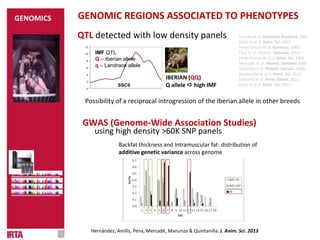
GENOMIC REGIONS ASSOCIATED TO PHENOTYPES
QTL detected with low density panels
0
2
4
6
8
10
12
SSC6
IMF QTL
Q – Iberian allele
q – Landrace allele
IBERIAN (QQ)
Q allele  high IMF
GWAS (Genome-Wide Association Studies)
using high density >60K SNP panels
Possibility of a reciprocal introgression of the Iberian allele in other breeds
Hernández, Amills, Pena, Mercadé, Manunza & Quintanilla. J. Anim. Sci. 2013
Backfat thickness and Intramuscular fat: distribution of
additive genetic variance across genome
GENOMICS
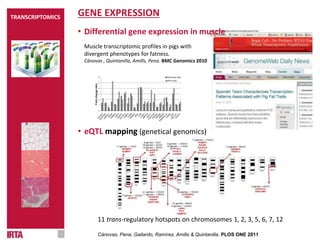
GENE EXPRESSION
• Differential gene expression in muscle
Muscle transcriptomic profiles in pigs with
divergent phenotypes for fatness.
Cánovas , Quintanilla, Amills, Pena. BMC Genomics 2010
• eQTL mapping (genetical genomics)
11 trans-regulatory hotspots on chromosomes 1, 2, 3, 5, 6, 7, 12
Cánovas, Pena, Gallardo, Ramírez, Amills & Quintanilla. PLOS ONE 2011
0
1
2
3
4
5
6
Fold-changeratio
Microarray ratio
qPCR ratio
TRANSCRIPTOMICS
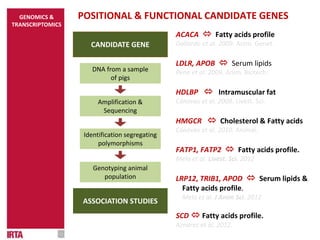
ACACA  Fatty acids profile
Gallardo et al. 2009. Anim. Genet.
LDLR, APOB  Serum lipids
Pena et al. 2009. Anim. Biotech.
HDLBP  Intramuscular fat
Cánovas et al. 2009. Livest. Sci.
HMGCR  Cholesterol & Fatty acids
Cánovas et al. 2010. Animal.
FATP1, FATP2  Fatty acids profile.
Melo et al. Livest. Sci. 2012
LRP12, TRIB1, APOD  Serum lipids &
Fatty acids profile.
Melo et al. J Anim Sci. 2012
SCD  Fatty acids profile.
Aznárez et al. 2012.
Amplification &
Sequencing
Identification segregating
polymorphisms
Genotyping animal
population
DNA from a sample
of pigs
ASSOCIATION STUDIES
CANDIDATE GENE
POSITIONAL & FUNCTIONAL CANDIDATE GENESGENOMICS &
TRANSCRIPTOMICS
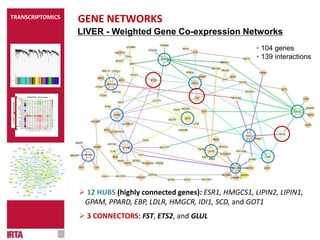
• 104 genes
• 139 interactions
GENE NETWORKS
LIVER - Weighted Gene Co-expression Networks
 12 HUBS (highly connected genes): ESR1, HMGCS1, LIPIN2, LIPIN1,
GPAM, PPARD, EBP, LDLR, HMGCR, IDI1, SCD, and GOT1
 3 CONNECTORS: FST, ETS2, and GLUL
ASSOCIATION with Phenotypes
17modulesofco-expressedgenes
TRANSCRIPTOMICS
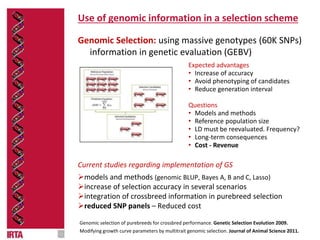
Use of genomic information in a selection scheme
Genomic Selection: using massive genotypes (60K SNPs)
information in genetic evaluation (GEBV)
Current studies regarding implementation of GS
models and methods (genomic BLUP, Bayes A, B and C, Lasso)
increase of selection accuracy in several scenarios
integration of crossbreed information in purebreed selection
reduced SNP panels – Reduced cost
Genomic selection of purebreeds for crossbred performance. Genetic Selection Evolution 2009.
Modifying growth curve parameters by multitrait genomic selection. Journal of Animal Science 2011.
Expected advantages
• Increase of accuracy
• Avoid phenotyping of candidates
• Reduce generation interval
Questions
• Models and methods
• Reference population size
• LD must be reevaluated. Frequency?
• Long-term consequences
• Cost - Revenue
• Nutrigenomics
Experiment in progress: effect of different FA diet in
gene expression and muscle fat deposition
• Gene networks
• Epistatic & co-expression networks
• Gene networks across tissues
• Key genes modulating topology
• Analysis of DNA & RNA sequence:
• New transcriptomic & genomic variants
• Metabolome and Microbiome information
IN PROGRESS & FUTURE STUDIES
towards more holistic and multidisciplinary approaches
CHALLENGE: Integral analyses of all available information
Investigating possibilities and benefits of different methods
to improve feed efficiency in sire lines of pigs and rabbits
 Alternative selection criteria (RFI, group measures, regression)
 NUTRIGENOMICS experiment:
Interaction genotype*feeding regime
 Genetics of feeding behavioral traits
 Breeding value estimation models:
• Including social interactions and/or individual
sensitivity (robustness) to environmental factors such
as sub-clinical diseases
• Including genomic information (GS)
IN PROGRESS & FUTURE STUDIES
Feed efficiency
Improving efficiency of sows taking into account the relationships
between the use of food resources, mobilization of body reserves,
robustness, reproductive function, litter homogeneity and survival.
FEED
EFFICIENCY
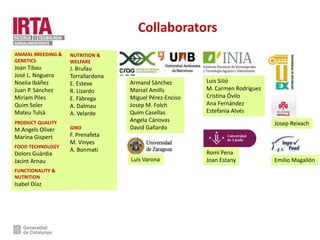
Collaborators
Armand Sánchez
Marcel Amills
Miguel Pérez-Enciso
Josep M. Folch
Quim Casellas
Angela Cánovas
David Gallardo
Luis Silió
M. Carmen Rodríguez
Cristina Óvilo
Ana Fernández
Estefania Alvés
Romi Pena
Joan EstanyLuis Varona
ANIMAL BREEDING &
GENETICS
Joan Tibau
José L. Noguera
Noelia Ibáñez
Juan P. Sánchez
Miriam Piles
Quim Soler
Mateu Tulsà
PRODUCT QUALITY
M.Angels Oliver
Marina Gispert
FOOD TECHNOLOGY
Dolors Guàrdia
Jacint Arnau
FUNCTIONALITY &
NUTRITION
Isabel Díaz
Josep Reixach
Emilio Magallón
NUTRITION &
WELFARE
J. Brufau
Torrallardona
E. Esteve
R. Lizardo
E. Fàbrega
A. Dalmau
A. Velarde
GIRO
F. Prenafeta
M. Vinyes
A. Bonmatí
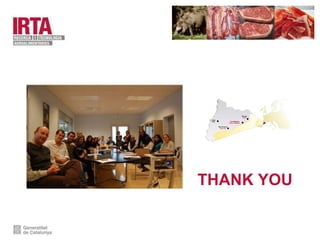
THANK YOU
Lleida
PIGs Torre Marimon
PIGS & RABBITS
Monells
PIGS
Mas de Bover
POULTRY

Sponsor Day on animal feeding: The role of genetics in Product quality and feed efficiency in swine

  • 1.
    THE ROLE OFGENETICS IN PRODUCT QUALITY AND FEED EFFICIENCY IN SWINE Raquel Quintanilla IRTA - Animal Breeding and Genetics Program Torre Marimon, 08140 Caldes de Montbui, Barcelona, Spain. raquel.quintanilla@irta.cat IRTA Sponsor Day, Mas de Bover, May 15th-16th 2014
  • 2.
    • Polyunsaturated FA(PUFA) • Monounsaturated FA (MUFA) • Saturated FA (SFA) • cholesterol content Sensory quality Hedonic evaluation Technological Quality Nutritional Quality Consumers health Intramuscular fat and meat quality Intramuscular fat content and composition (fatty acids profile) LIPID METABOLISM • Water loss • Rancidity • Firmless • Melting • Tenderness • Taste • Flavour • Juiceness
  • 3.
    Principal components analysisof dry-cured ham sensory attributes and fresh meat fat Pena, Gallardo, Guàrdia, Reixach, Arnau, Amills & Quintanilla. Journal of Animal Science 2013. 350 Duroc barrows RAW MEAT Gluteus medius •Intramuscular fat •Fatty Acids •Cholesterol content ORGANOLEPTIC CHARACTERISATION DRY-CURED HAMS: 6 expert panelists •Appearence •Taste-flavour •Texture 2 muscles •biceps femoris •semimembranosus A B SM BF Sección B Sección A SM BF IMF CHOL SFA PUFA MUFA colour marbling overall liking adhesiveness bitterness aged mould matured sweetness hardness crumbliness fibrousness fat melting metallic pastiness piquantness saltiness umami colour marbling overall likingadhesiveness bitterness aged mould matured sweetness hardness crumbliness fibrousness fat melting metallic pastiness piquantness saltiness umami -1 -0.5 0 0.5 1 -1 -0.5 0 0.5 1 Component2(18.34%) Component 1 (19.25%) gluteus medius biceps femoris semimembranosus
  • 4.
    GENETICS OF LIPIDMETABOLISM & MEAT QUALITY A research line conducted at IRTA since 1996 in different pig populations (Du and Ib) GENERAL OBJECTIVE: Identifying genetic mechanisms underlying lipid metabolism traits in pigs, with special attention in those related with muscle fat deposition, and nutritional and sensorial properties of fresh pork and dry-cured ham, and contributing new selection strategies. • Identify genes and polymorphisms (GAS – MAS) • Disentangle genetic pathways and regulatory mechanisms • Implement Genomic Selection schemes IBMAP projects 1996-2011 IRTA-INIA-UAB LIPGEN projects 2003-present IRTA-CRAG IBERCAL project 2013-present IRTA - UEX
  • 5.
    THE ‘OMES AND‘OMICS PUZZLE MULTIDISCIPLINARY APPROACHES ARE REQUIRED !!!! Genome Proteome mRNA DNA Transcriptome Microbiome Metabolome PHENOME ENVIRONMENT (NUTRITION) PIG GENETICS THE BASIC MODEL FOR A GENETIST = Genetics + Environment (Nutrition) + G * E + e Genetic gain Generation N+1 Genetic variability within population basis for SELECTION Individual phenotype Selection Epigenetics Nutrigenomics
  • 6.
    Recording PHENOME –IRTA EXPERIMENTAL FACILITIES Controlling Growing period IRTA-CAP - Weight, Fat - Behavoir - Individual Feed intake control Experimental Slaughterhouse Carcass traits Meat color Physical-chemical measures Meat Analysis IRTA-CTA - Intramuscular fat - Cholesterol in muscle -Fatty acids profile - Color Sensory characterisation - Visual, texture and flavour attributes (carried out by expert panelists)
  • 7.
    INFORMATION used inour researches 350 Duroc individuals: - Genealogy (pedigree) - more than 100 Phenotypes Fattening Control at IRTA-CAP - Weights - Backfat - Serum lipid levels - Feed control Slaughter Carcass and Meat - Weights - Conformation - Fatness - Physical-chemical measures of meat Meat (two muscles) Analyses at IRTA-CTA - Color - Intramuscular fat - Cholesterol in muscle - Fatty acids profile Organoleptic profile of dry-cured hams Analyses at IRTA-CTA - Visual, texture and flavour attributes (carried out by expert panelists) • DNA - High density genotypes (Illumina Porcine 60K+SNP iSelect Beadchip) > 60,000 SNP distributed across the porcine genome • RNA - Expression profiles (GeneChip Porcine Genome Array, Affymetrix) 20,201 GENES (23,937 PROBES) • Sequence (Next Generation Sequencing; Illumina HiSeq 2000) • DNA (genome) sequence • mRNA sequence (RNA-Seq) PHENOMICSGENOMICS& TRANSCRIPTOMICS LIPGEN (350 Du) IBERCAL (200 Ib)
  • 8.
    CAN WE IMPROVEIMF BY SELECTION? HERITABILITIES Longissimus dorsi Gluteus medius Intramuscular fat (%) 0.65 **** 0.58 **** Cholesterol content 0.20 * 0.22 * Oleic FA (%) 0.15 * 0.21 * Palmitic FA (%) 0.30 ** 0.30 ** Stearic FA (%) 0.33 *** 0.53 *** Omega 6 FA (%) 0.14 n.s. 0.14 * Omega 3 FA (%) 0.14 n.s. 0.16 * Heritability of intramuscular fat content and FA profile in studied populations Casellas, Noguera, Reixach, Díaz, Amills & Quintanilla. Journal of Animal Science 2010. Heritability of intramuscular fat Knapp et al. 1997 0.38 (LW) 0.67 (LD) 0.32 (Pi) Larzul et al. 1997 0.44 (LW) Hermesch et al. 2000 0.35 (LW & LD) Fernández et al. 2003 0.25 (IB) Suzuki et al. 2005 0.39 (Du) YES, we could implement a selection scheme on IMF and expect a response to selection (moderate to high heritabilities) BUT  Phenotyping (measurements) expensive / difficult  EBV for candidates based on relatives records (lower accuracy)  Correlated response in BFT Genetic correlation with fatness (BFT): 0.25-0.40 Gene Assisted Selection (GAS) Genomic Selection (GS) Genetic gain Generation N+1 Selection
  • 9.
    Varona et al.Genetical Research 2002 Ovilo et al. J. Anim. Sci. 2002 Perez-Enciso et al. Genetics. 2002 Clop et al. Mamm. Genome. 2003 Peréz-Enciso et al. J. Anim. Sci. 2005 Mercadé et al. Mamm. Genome 2005 Gallardo et al. Physiol. Genom. 2008 Quintanilla et al. J. Anim. Sci. 2011 Gallardo et al. Anim. Genet. 2011 Pena et al. J. Anim. Sci. 2013 GENOMIC REGIONS ASSOCIATED TO PHENOTYPES QTL detected with low density panels 0 2 4 6 8 10 12 SSC6 IMF QTL Q – Iberian allele q – Landrace allele IBERIAN (QQ) Q allele  high IMF GWAS (Genome-Wide Association Studies) using high density >60K SNP panels Possibility of a reciprocal introgression of the Iberian allele in other breeds Hernández, Amills, Pena, Mercadé, Manunza & Quintanilla. J. Anim. Sci. 2013 Backfat thickness and Intramuscular fat: distribution of additive genetic variance across genome GENOMICS
  • 10.
    GENE EXPRESSION • Differentialgene expression in muscle Muscle transcriptomic profiles in pigs with divergent phenotypes for fatness. Cánovas , Quintanilla, Amills, Pena. BMC Genomics 2010 • eQTL mapping (genetical genomics) 11 trans-regulatory hotspots on chromosomes 1, 2, 3, 5, 6, 7, 12 Cánovas, Pena, Gallardo, Ramírez, Amills & Quintanilla. PLOS ONE 2011 0 1 2 3 4 5 6 Fold-changeratio Microarray ratio qPCR ratio TRANSCRIPTOMICS
  • 11.
    ACACA  Fattyacids profile Gallardo et al. 2009. Anim. Genet. LDLR, APOB  Serum lipids Pena et al. 2009. Anim. Biotech. HDLBP  Intramuscular fat Cánovas et al. 2009. Livest. Sci. HMGCR  Cholesterol & Fatty acids Cánovas et al. 2010. Animal. FATP1, FATP2  Fatty acids profile. Melo et al. Livest. Sci. 2012 LRP12, TRIB1, APOD  Serum lipids & Fatty acids profile. Melo et al. J Anim Sci. 2012 SCD  Fatty acids profile. Aznárez et al. 2012. Amplification & Sequencing Identification segregating polymorphisms Genotyping animal population DNA from a sample of pigs ASSOCIATION STUDIES CANDIDATE GENE POSITIONAL & FUNCTIONAL CANDIDATE GENESGENOMICS & TRANSCRIPTOMICS
  • 12.
    • 104 genes •139 interactions GENE NETWORKS LIVER - Weighted Gene Co-expression Networks  12 HUBS (highly connected genes): ESR1, HMGCS1, LIPIN2, LIPIN1, GPAM, PPARD, EBP, LDLR, HMGCR, IDI1, SCD, and GOT1  3 CONNECTORS: FST, ETS2, and GLUL ASSOCIATION with Phenotypes 17modulesofco-expressedgenes TRANSCRIPTOMICS
  • 13.
    Use of genomicinformation in a selection scheme Genomic Selection: using massive genotypes (60K SNPs) information in genetic evaluation (GEBV) Current studies regarding implementation of GS models and methods (genomic BLUP, Bayes A, B and C, Lasso) increase of selection accuracy in several scenarios integration of crossbreed information in purebreed selection reduced SNP panels – Reduced cost Genomic selection of purebreeds for crossbred performance. Genetic Selection Evolution 2009. Modifying growth curve parameters by multitrait genomic selection. Journal of Animal Science 2011. Expected advantages • Increase of accuracy • Avoid phenotyping of candidates • Reduce generation interval Questions • Models and methods • Reference population size • LD must be reevaluated. Frequency? • Long-term consequences • Cost - Revenue
  • 14.
    • Nutrigenomics Experiment inprogress: effect of different FA diet in gene expression and muscle fat deposition • Gene networks • Epistatic & co-expression networks • Gene networks across tissues • Key genes modulating topology • Analysis of DNA & RNA sequence: • New transcriptomic & genomic variants • Metabolome and Microbiome information IN PROGRESS & FUTURE STUDIES towards more holistic and multidisciplinary approaches CHALLENGE: Integral analyses of all available information
  • 15.
    Investigating possibilities andbenefits of different methods to improve feed efficiency in sire lines of pigs and rabbits  Alternative selection criteria (RFI, group measures, regression)  NUTRIGENOMICS experiment: Interaction genotype*feeding regime  Genetics of feeding behavioral traits  Breeding value estimation models: • Including social interactions and/or individual sensitivity (robustness) to environmental factors such as sub-clinical diseases • Including genomic information (GS) IN PROGRESS & FUTURE STUDIES Feed efficiency Improving efficiency of sows taking into account the relationships between the use of food resources, mobilization of body reserves, robustness, reproductive function, litter homogeneity and survival. FEED EFFICIENCY
  • 16.
    Collaborators Armand Sánchez Marcel Amills MiguelPérez-Enciso Josep M. Folch Quim Casellas Angela Cánovas David Gallardo Luis Silió M. Carmen Rodríguez Cristina Óvilo Ana Fernández Estefania Alvés Romi Pena Joan EstanyLuis Varona ANIMAL BREEDING & GENETICS Joan Tibau José L. Noguera Noelia Ibáñez Juan P. Sánchez Miriam Piles Quim Soler Mateu Tulsà PRODUCT QUALITY M.Angels Oliver Marina Gispert FOOD TECHNOLOGY Dolors Guàrdia Jacint Arnau FUNCTIONALITY & NUTRITION Isabel Díaz Josep Reixach Emilio Magallón NUTRITION & WELFARE J. Brufau Torrallardona E. Esteve R. Lizardo E. Fàbrega A. Dalmau A. Velarde GIRO F. Prenafeta M. Vinyes A. Bonmatí
  • 17.
    THANK YOU Lleida PIGs TorreMarimon PIGS & RABBITS Monells PIGS Mas de Bover POULTRY