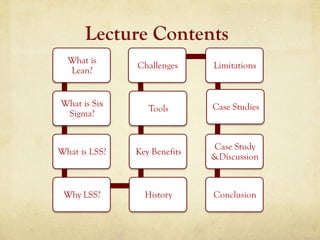
Lecture Contents
What is
Lean?
Whatis Six
Sigma?
What is LSS?
Why LSS? History
Key Benefits
Tools
Challenges Limitations
Case Studies
Case Study
&Discussion
Conclusion
3.
What is Lean
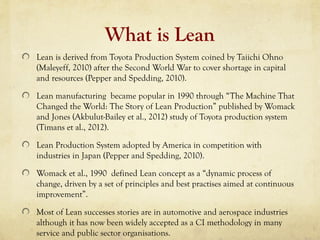
Leanis derived from Toyota Production System coined by Taiichi Ohno
(Maleyeff, 2010) after the Second World War to cover shortage in capital
and resources (Pepper and Spedding, 2010).
Lean manufacturing became popular in 1990 through “The Machine That
Changed the World: The Story of Lean Production” published by Womack
and Jones (Akbulut-Bailey et al., 2012) study of Toyota production system
(Timans et al., 2012).
Lean Production System adopted by America in competition with
industries in Japan (Pepper and Spedding, 2010).
Womack et al., 1990 defined Lean concept as a “dynamic process of
change, driven by a set of principles and best practises aimed at continuous
improvement”.
Most of Lean successes stories are in automotive and aerospace industries
although it has now been widely accepted as a CI methodology in many
service and public sector organisations.
4.
Lean Aim &Tools
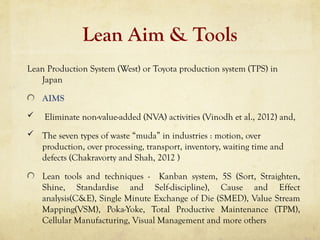
Lean Production System (West) or Toyota production system (TPS) in
Japan
AIMS
Eliminate non-value-added (NVA) activities (Vinodh et al., 2012) and,
The seven types of waste “muda” in industries : motion, over
production, over processing, transport, inventory, waiting time and
defects (Chakravorty and Shah, 2012 )
Lean tools and techniques - Kanban system, 5S (Sort, Straighten,
Shine, Standardise and Self-discipline), Cause and Effect
analysis(C&E), Single Minute Exchange of Die (SMED), Value Stream
Mapping(VSM), Poka-Yoke, Total Productive Maintenance (TPM),
Cellular Manufacturing, Visual Management and more others
5.
What is SixSigma
Six Sigma methodology was developed by an engineer Bill Smith at
Motorola research centre in the US in the early 1980s (Snee, 2010). This
was Generation I Six Sigma approach.
In 1988 Motorola won Baldrige National Quality Award (Snee, 2010).
Six Sigma became popular after the successful implementation in General
Electric in the US to lead quality improvement programme (Timans et
al., 2012). This was Generation II.
Today Six Sigma has proved to be successful in construction industry,
service sector, healthcare services, financial services (Pepper and
Spedding, 2010).
Antony (2008) has defined Six Sigma as “a well-established approach that
seeks to identify and eliminate defects, mistakes or failures in business
processes or systems by focusing on those process performance
characteristics that are of critical importance to customers”
6.
Six Sigma Aim&Tools
Six Sigma is a powerful methodology for tackling problems with
unknown solutions through data driven approach.
Reduce variation in the process (Chakravorty and Shah, 2012),
Reduce cost in manufacturing and services, demonstrate savings to the
bottom line, increase customer satisfaction (Thomas et al., 2009),
Measure defects, improve products quality, reduce defects to 3.4 parts
per million opportunities (DPMO) in an organization(Lee and Wei,
2009)
Six Sigma uses powerful analytical and statistical tools and techniques
such as Quality Function Deployment (QFD), Failure Mode and Effect
Analysis (FMEA), Statistical Process Control (SPC), Design of
Experiment (DOE), ANOVA, Measurement System Analysis (MSA),
Kano Model, etc.
7.
What is LSS
“LeanSix Sigma” combination and synergy between Lean
management and Six Sigma methodology (Vinodh et al.,
2012)
Lean Six Sigma is a business improvement methodology to
maximize shareholder value by improving quality, speed,
customer satisfaction and costs. Integrates tools and
principles from both Lean and Six Sigma (George, 2003).
A business strategy and methodology which increases
process performance resulting in enhanced customer
satisfaction and improved bottom line results” (Snee,
2010).
8.
Why LSS?
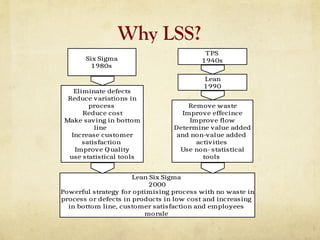
Six Sigma
1980s
Lean
1 990
Remove waste
Improve effecince
Improve flow
Determine value added
and non-value added
activities
Use non- statistical
tools
Eliminate defects
Reduce variations in
process
Reduce cost
Make saving in bottom
line
Increase customer
satisfaction
Improve Quality
use statistical tools
Lean Six Sigma
2000
Powerful strategy for optimising process with no waste in
process or defects in products in low cost and increasing
in bottom line, customer satisfaction and employees
morale
TPS
1 940s
9.
History of LSS
LeanProduction System (Toyota Production System in Japan)
and Six Sigma (within Motorola research centre in USA) have
been used for many years. However, theses approaches have
integrated in the late 1990s and early 2000s.
First integration of Lean and Six Sigma in the US by George
group in 1986 (Salah et al., 2010) The term Lean Six Sigma was
first introduced around 2000 (Timans et al., 2012).
Since then, a noticeable increase in the LSS popularity and
deployment in the industrial world especially in large
organizations in the West for instance Motorola, Honeywell,
General Electric and many others (Laureani and Antony, 2012)
and in some small and medium size manufacturing enterprise
(SMEs) (Kumar et al., 2006).
10.
Benefits of LSS
Benefitsof lean six sigma in the industrial world (both
manufacturing and service) include:
Removing non-value adding activities (waste)
Honeywell International Inc. in US, $1.2b gains in 2002 as a results of
waste reduction (William and Willie, 2003)
Reducing the incidence of defective products/transactions
Compressor air foils factory in US achieved 94% reduction in product
defect (Hardeman and Goethals, 2011)
Shortening cycle time and inventory
Nuclear aircraft carrier manufacturing in US has reduced lead time from 180
days to 40 days and overtime was eliminated (Kucner, 2009)
Automobile Accessories Manufacturing in India has over $33 000 saving per year
due to 25% reduction in process inventory (Kumar et al., 2006)
11.
Benefits of LSS
Increasecustomers satisfaction, attraction and loyalty
Worldwide Military products manufacturing company experienced
82% reduction in customer return backlog (Pickrell et al., 2005)
Reduce cost of production/services
Industrial Cleaning equipment manufacturing in US has $660,
000 reduction in production cost per year (Franchetti and Yanik,
2011)
Overcoming the limitation of each approach when implemented
in isolation (Corbett, 2011; Salah et al., 2010; Yi et al.,2012,
Antony, 2010, Antony 2011, Antony et al., 2012)
12.
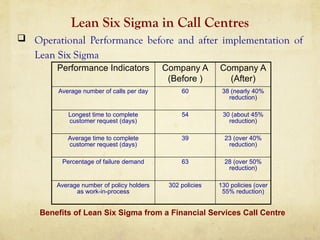
Lean Six Sigmain Call Centres
Operational Performance before and after implementation of
Lean Six Sigma
Performance Indicators Company A
(Before )
Company A
(After)
Average number of calls per day 60 38 (nearly 40%
reduction)
Longest time to complete
customer request (days)
54 30 (about 45%
reduction)
Average time to complete
customer request (days)
39 23 (over 40%
reduction)
Percentage of failure demand 63 28 (over 50%
reduction)
Average number of policy holders
as work-in-process
302 policies 130 policies (over
55% reduction)
Benefits of Lean Six Sigma from a Financial Services Call Centre
13.
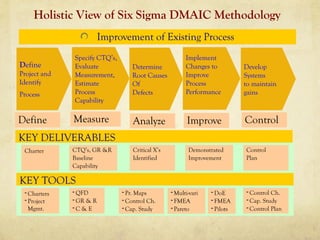
Holistic View ofSix Sigma DMAIC Methodology
Improvement of Existing Process
Define
Project and
Identify
Process
Specify CTQ’s,
Evaluate
Measurement,
Estimate
Process
Capability
Develop
Systems
to maintain
gains
Determine
Root Causes
Of
Defects
Implement
Changes to
Improve
Process
Performance
Define Measure Analyze Improve Control
KEY DELIVERABLES
CTQ’s, GR &R
Baseline
Capability
Charter Critical X’s
Identified
Demonstrated
Improvement
Control
Plan
KEY TOOLS
- QFD
- GR & R
- C & E
- Charters
- Project
Mgmt.
- Pr. Maps
- Control Ch.
- Cap. Study
- DoE
- FMEA
- Pilots
- Control Ch.
- Cap. Study
- Control Plan
- Multi-vari
- FMEA
- Pareto
14.
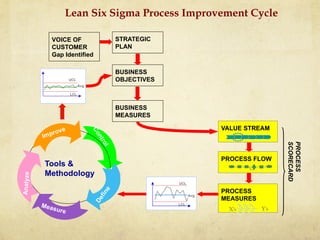
Lean Six SigmaProcess Improvement Cycle
UCL
LCL
Avg
VOICE OF
CUSTOMER
Gap Identified
STRATEGIC
PLAN
BUSINESS
OBJECTIVES
BUSINESS
MEASURES
VALUE STREAM
PROCESS FLOW
PROCESS
MEASURES
PROCESS
SCORECARD
Y's
X's
UCL
LCL
Avg
Improve
C
o
n
t
r
o
l
D
e
f
i
n
e
Measure
A
n
al
yz
e
Tools &
Methodology
15.
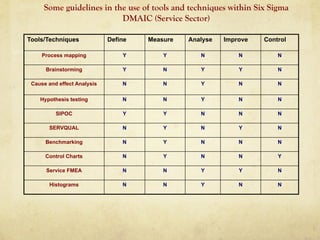
Some guidelines inthe use of tools and techniques within Six Sigma
DMAIC (Service Sector)
Tools/Techniques Define Measure Analyse Improve Control
Process mapping Y Y N N N
Brainstorming Y N Y Y N
Cause and effect Analysis N N Y N N
Hypothesis testing N N Y N N
SIPOC Y Y N N N
SERVQUAL N Y N Y N
Benchmarking N Y N N N
Control Charts N Y N N Y
Service FMEA N N Y Y N
Histograms N N Y N N
16.
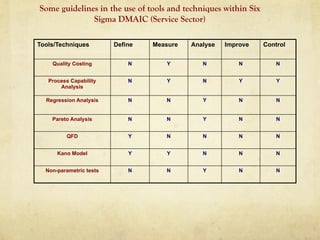
Some guidelines inthe use of tools and techniques within Six
Sigma DMAIC (Service Sector)
Tools/Techniques Define Measure Analyse Improve Control
Quality Costing N Y N N N
Process Capability
Analysis
N Y N Y Y
Regression Analysis N N Y N N
Pareto Analysis N N Y N N
QFD Y N N N N
Kano Model Y Y N N N
Non-parametric tests N N Y N N
17.
Challenges
Difficulties in teachingstatistical methods for some
of the team members (Chakravorty and Shah, 2012).
Time consuming for LSS project implementation (Richard,
2008, Antony, 2010).
Internal resistance (Timans et al., 2012).
Availability of resources such as financial resources, people
resources (Thomas et al., 2008).
Changing business priorities (Timans et al., 2012, Antony et
al., 2011)
Lack of leadership, management skills/employees skills ,
training etc. (Breyfogle, 2008 ;Timans et al., 2012, Antony et
al, 2010, Antony et al., 2008)
18.
Challenges
Poor selection ofprojects (Timans et al., 2012, Antony,
2010)
Unmanaged expectations (Thomas et al., 2008)
Employee reaction towards a new business strategy (Vinodh
et al., 2012; Kumar et al., 2006).
National regulation (Maleyeff, 2012).
Convincing the top management (Vinodh et al., 2012;
Kumar et al., 2006, Antony and Kumar 2005).
Lack of awareness about LSS benefits in business (Snee,
2010).
19.
Limitations
LSS has noglobally accepted standard for certification
(Laureani and Antony, 2012; Breyfogle, 2008)
No standard framework for LSS or its implementation
exists (Antony 2010, 2012)
There is no clear direction as to which strategy should be
selected at the early stages of a project (Kumar et al. 2006).
There is no theoretical underpinning or logical explanation
for the choice of methods and techniques (pepper, 2010,
Linderman, 2008, 2010).
20.
Limitations
The limited numberof practical implications of LSS
integration framework (Vinodh et al., 2012; Chen and
Lyu, 2009).
Lack of real innovation in LSS projects (Thomas et al.,
2008).
The absence of accurate measurements for LSS
implementation (Chakravorty and Shah, 2012).
Strong LSS curricula are needed in order to leverage
learning in organisations (Salah et al, 2010)
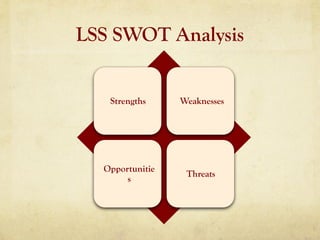
LSS SWOT Analysis
Strengths
Customer focus – the aim of LSS is to build what the customers
want as reflected by what is known as CTQ characteristics.
LSS combines the right people, right tools and the right
projects for its success
Weaknesses
High investment – a significant investment is required to train
employees as Yellow Belts, Green Belts, Black Belts and Master
Black Belts.
Time consuming
23.
LSS SWOT Analysis
Opportunities
LSS approach is applicable in all processes whether it is
manufacturing, service or transactional.
Implementation of LSS makes a highest quality producer as
the lowest cost producer.
Integration of LSS with innovation
Threats
Resistance to change
Lack of management commitment could be one of the top
reasons LSS not taking off in a big way
24.
Case Study 1
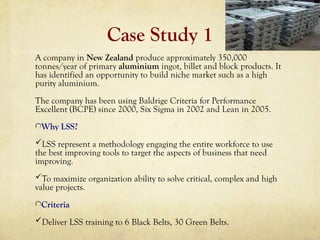
Acompany in New Zealand produce approximately 350,000
tonnes/year of primary aluminium ingot, billet and block products. It
has identified an opportunity to build niche market such as a high
purity aluminium.
The company has been using Baldrige Criteria for Performance
Excellent (BCPE) since 2000, Six Sigma in 2002 and Lean in 2005.
Why LSS?
LSS represent a methodology engaging the entire workforce to use
the best improving tools to target the aspects of business that need
improving.
To maximize organization ability to solve critical, complex and high
value projects.
Criteria
Deliver LSS training to 6 Black Belts, 30 Green Belts.
25.
Case Study 1
Keybenefits
Sales doubled between 2001 and 2007.
Annual saving $28m from Six Sigma since 2002 and Lean since
2005 up to 2007.
Won Business Excellent Award (BX).
Manager application
The company produces the highest purity aluminium in the
world
60% of memory disk and 40% of the capacitor are made of its
aluminium
Improvement in cycle time, cost control, efficiency and
effectiveness into work process design.
26.
Case Study 2
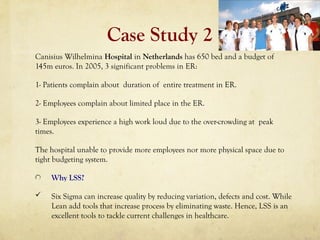
CanisiusWilhelmina Hospital in Netherlands has 650 bed and a budget of
145m euros. In 2005, 3 significant problems in ER:
1- Patients complain about duration of entire treatment in ER.
2- Employees complain about limited place in the ER.
3- Employees experience a high work loud due to the over-crowding at peak
times.
The hospital unable to provide more employees nor more physical space due to
tight budgeting system.
Why LSS?
Six Sigma can increase quality by reducing variation, defects and cost. While
Lean add tools that increase process by eliminating waste. Hence, LSS is an
excellent tools to tackle current challenges in healthcare.
27.
Case Study 2
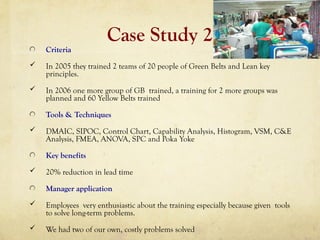
Criteria
In 2005 they trained 2 teams of 20 people of Green Belts and Lean key
principles.
In 2006 one more group of GB trained, a training for 2 more groups was
planned and 60 Yellow Belts trained
Tools & Techniques
DMAIC, SIPOC, Control Chart, Capability Analysis, Histogram, VSM, C&E
Analysis, FMEA, ANOVA, SPC and Poka Yoke
Key benefits
20% reduction in lead time
Manager application
Employees very enthusiastic about the training especially because given tools
to solve long-term problems.
We had two of our own, costly problems solved
28.
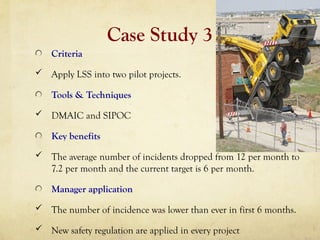
Case Study 3
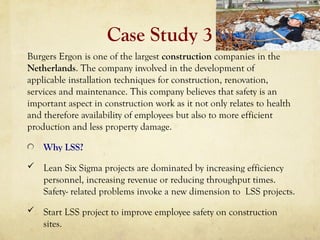
BurgersErgon is one of the largest construction companies in the
Netherlands. The company involved in the development of
applicable installation techniques for construction, renovation,
services and maintenance. This company believes that safety is an
important aspect in construction work as it not only relates to health
and therefore availability of employees but also to more efficient
production and less property damage.
Why LSS?
Lean Six Sigma projects are dominated by increasing efficiency
personnel, increasing revenue or reducing throughput times.
Safety- related problems invoke a new dimension to LSS projects.
Start LSS project to improve employee safety on construction
sites.
29.
Case Study 3
Criteria
Apply LSS into two pilot projects.
Tools & Techniques
DMAIC and SIPOC
Key benefits
The average number of incidents dropped from 12 per month to
7.2 per month and the current target is 6 per month.
Manager application
The number of incidence was lower than ever in first 6 months.
New safety regulation are applied in every project
30.
Case Study &Discussion
Insurance company in the Netherlands experienced a
long-term problem. In the Netherlands, many employees
transfer their pension provision to insurance companies.
However, if the employees change jobs, the pension right
may have to be transferred to other insurance companies.
The process of transferring pension rights, called Pension
Value Transfer (PVT) caused significant problems to the
company. There are 6 teams processing PVTs in parallel.
The throughput times are excessive (186 days) and the
amount of time to process the PVT is high (56 min/file).
31.
Go leaders
You arethe project leader and you have been asked to dedicate
a project to reduce the throughput and processing times of the
PVTs.
Your task is to positively impact customer satisfaction and
reduce the operational cost by decreasing the processing time.
How are you going to tackle this problem?
What approach would you prefer to use? And why?
What set of tools and techniques you will be utilizing for this
project?
How do you decide your team formation? Explain the roles
and responsibilities of team members?
32.
Solution
What approach wouldyou prefer to use? And why?
Lean and Six Sigma
What set of tools and techniques you will be utilizing
for this project?
DMAIC, DOE, VSM, 5S, Process Mapping, SPC
Who are the team members?
BB, GB and Champion
33.
Findings & Benefits
Findings
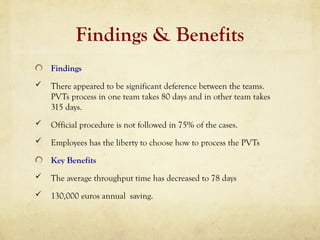
There appeared to be significant deference between the teams.
PVTs process in one team takes 80 days and in other team takes
315 days.
Official procedure is not followed in 75% of the cases.
Employees has the liberty to choose how to process the PVTs
Key Benefits
The average throughput time has decreased to 78 days
130,000 euros annual saving.
36.
LSS Training
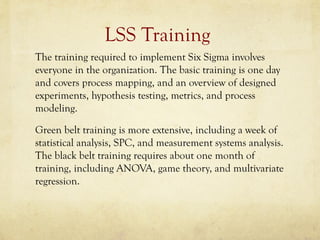
The trainingrequired to implement Six Sigma involves
everyone in the organization. The basic training is one day
and covers process mapping, and an overview of designed
experiments, hypothesis testing, metrics, and process
modeling.
Green belt training is more extensive, including a week of
statistical analysis, SPC, and measurement systems analysis.
The black belt training requires about one month of
training, including ANOVA, game theory, and multivariate
regression.
Editor's Notes
#15 For GE, Six Sigma is a way of doing business – it becomes part of GE’s culture (Philosophy)
Human aspects – Management Leadership, customer focus, project teams, culture change, etc.
Process issues – process improvement, statistical methods, disciplined approach, analysis of variation, etc.
Second definition is given by Harry and Schroder
Third definition by Minitab
#25 Corbett, L.M. (2011)’ Lean Six Sigma: the contribution to business excellence’, International Journal of Lean Six Sigma, Vol.2 No. 2, pp. 118-131.
#27 Van den Heuvel, J., Does, R.J.M.M. and Koning, H. (2006)’ Lean Six Sigma in a hospital’, Int. J. Six Sigma and Competitive Advantage, Vol. 2, No. 4, pp.377-388.
#28 Quality Quandaries: Personal Injuries: A Case Study by Joran Lokkerbol, Martin A. M. Schotman and Ronald J. M. M. Does – Quality Engineering 2012





![[Pem Zhipeng Xie] project management: lean six sigma](https://cdn.slidesharecdn.com/ss_thumbnails/pemprojectmanagement-leansixsigma-160917145103-thumbnail.jpg?width=640&height=640&fit=bounds)


