1
Combining Real and Virtual Volunteers
through Social Media
Christian Reuter · Oliver Heger · Volkmar Pipek
(christian.reuter@uni-siegen.de)
Research Field
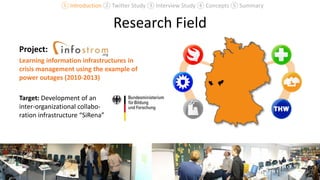
Project:
Learning information infrastructures in
crisis management using the example of
power outages (2010-2013)
Target: Development of an
inter-organizational collabo-
ration infrastructure “SiRena”
2
① Introduction ② Twitter Study ③ Interview Study ④ Concepts ⑤ Summary
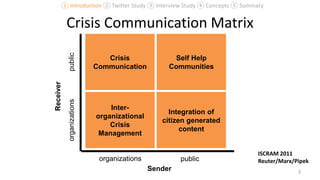
public
Sender
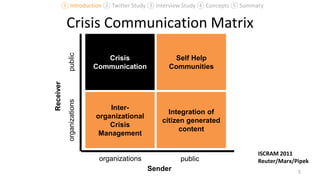
Crisis
Communication
Self Help
Communities
Integration of
citizen generated
content
organizations
publicorganizations
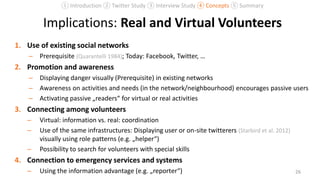
Receiver
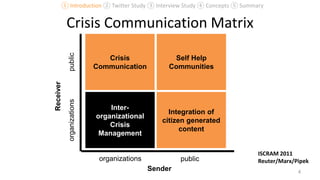
Crisis Communication Matrix
3
ISCRAM 2011
Reuter/Marx/Pipek
Inter-
organizational
Crisis
Management
① Introduction ② Twitter Study ③ Interview Study ④ Concepts ⑤ Summary
Crisis Communication Matrix
4
Inter-
organisationales
Krisen-
management
public
Sender
Crisis
Communication
Self Help
Communities
Inter-
organizational
Crisis
Management
Integration of
citizen generated
content
organizations
publicorganizations
Receiver
ISCRAM 2011
Reuter/Marx/Pipek
① Introduction ② Twitter Study ③ Interview Study ④ Concepts ⑤ Summary
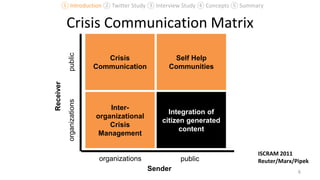
Crisis Communication Matrix
5
public
Sender
Crisis
Communication
Self Help
Communities
Inter-
organizational
Crisis
Management
Integration of
citizen generated
content
organizations
publicorganizations
Receiver
ISCRAM 2011
Reuter/Marx/Pipek
① Introduction ② Twitter Study ③ Interview Study ④ Concepts ⑤ Summary
Crisis Communication Matrix
6
public
Sender
Crisis
Communication
Self Help
Communities
Inter-
organizational
Crisis
Management
Integration of
citizen generated
content
organizations
publicorganizations
Receiver
ISCRAM 2011
Reuter/Marx/Pipek
① Introduction ② Twitter Study ③ Interview Study ④ Concepts ⑤ Summary
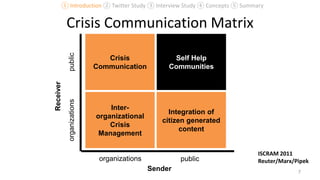
Crisis Communication Matrix
7
public
Sender
Crisis
Communication
Self Help
Communities
Inter-
organizational
Crisis
Management
Integration of
citizen generated
content
organizations
publicorganizations
Receiver
① Introduction ② Twitter Study ③ Interview Study ④ Concepts ⑤ Summary
ISCRAM 2011
Reuter/Marx/Pipek
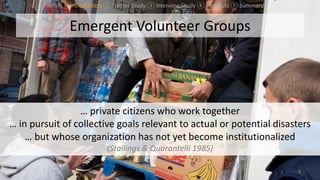
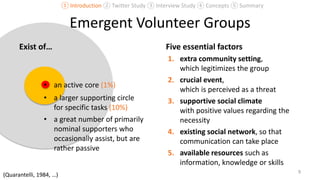
Emergent Volunteer Groups
8
… private citizens who work together
… in pursuit of collective goals relevant to actual or potential disasters
… but whose organization has not yet become institutionalized
(Stallings & Quarantelli 1985)
① Introduction ② Twitter Study ③ Interview Study ④ Concepts ⑤ Summary
Emergent Volunteer Groups
Exist of… Five essential factors
1. extra community setting,
which legitimizes the group
2. crucial event,
which is perceived as a threat
3. supportive social climate
with positive values regarding the
necessity
4. existing social network, so that
communication can take place
5. available resources such as
information, knowledge or skills
9
• an active core (1%)
• a larger supporting circle
for specific tasks (10%)
• a great number of primarily
nominal supporters who
occasionally assist, but are
rather passive
(Quarantelli, 1984, …)
① Introduction ② Twitter Study ③ Interview Study ④ Concepts ⑤ Summary
10
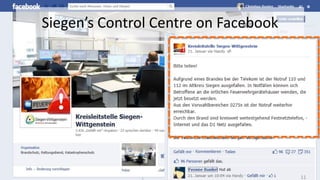
Siegen’s Control Centre on Facebook
11
11
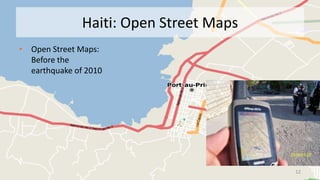
Haiti: Open Street Maps
12
• Open Street Maps:
Before the
earthquake of 2010
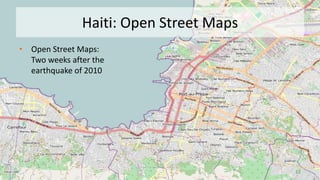
Haiti: Open Street Maps
13
• Open Street Maps:
Two weeks after the
earthquake of 2010
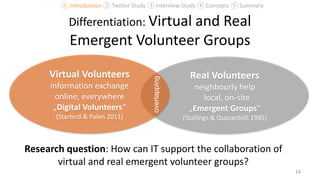
Real Volunteers
neighbourly help
local, on-site
„Emergent Groups“
(Stallings & Quarantelli 1985)
Virtual Volunteers
information exchange
online, everywhere
„Digital Volunteers“
(Starbird & Palen 2011)
Differentiation: Virtual and Real
Emergent Volunteer Groups
Research question: How can IT support the collaboration of
virtual and real emergent volunteer groups?
14
overlapping
① Introduction ② Twitter Study ③ Interview Study ④ Concepts ⑤ Summary
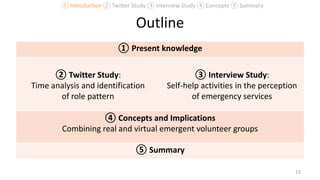
Outline
15
① Present knowledge
② Twitter Study:
Time analysis and identification
of role pattern
③ Interview Study:
Self-help activities in the perception
of emergency services
④ Concepts and Implications
Combining real and virtual emergent volunteer groups
⑤ Summary
① Introduction ② Twitter Study ③ Interview Study ④ Concepts ⑤ Summary
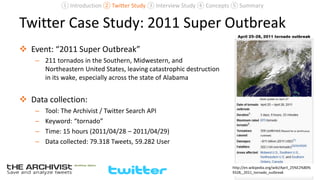
Twitter Case Study: 2011 Super Outbreak
 Event: “2011 Super Outbreak”
– 211 tornados in the Southern, Midwestern, and
Northeastern United States, leaving catastrophic destruction
in its wake, especially across the state of Alabama
 Data collection:
– Tool: The Archivist / Twitter Search API
– Keyword: “tornado”
– Time: 15 hours (2011/04/28 – 2011/04/29)
– Data collected: 79.318 Tweets, 59.282 User
16
http://en.wikipedia.org/wiki/April_25%E2%80%
9328,_2011_tornado_outbreak
① Introduction ② Twitter Study ③ Interview Study ④ Concepts ⑤ Summary
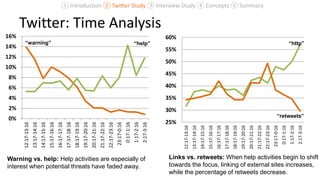
Twitter: Time Analysis
0%
2%
4%
6%
8%
10%
12%
14%
16%
12:17-13:16
13:17-14:16
14:17-15:16
15:17-16:16
16:17-17:16
17:17-18:16
18:17-19:16
19:17-20:16
20:17-21:16
21:17-22:16
22:17-23:16
23:17-0:16
0:17-1:16
1:17-2:16
2:17-3:16
Anteil "warning" Anteil "help"
25%
30%
35%
40%
45%
50%
55%
60%
12:17-13:16
13:17-14:16
14:17-15:16
15:17-16:16
16:17-17:16
17:17-18:16
18:17-19:16
19:17-20:16
20:17-21:16
21:17-22:16
22:17-23:16
23:17-0:16
0:17-1:16
1:17-2:16
2:17-3:16
Anteil "http" Anteil Retweets 17
“help”“warning” “http”
“retweets”
Links vs. retweets: When help activities begin to shift
towards the focus, linking of external sites increases,
while the percentage of retweets decrease.
Warning vs. help: Help activities are especially of
interest when potential threats have faded away.
① Introduction ② Twitter Study ③ Interview Study ④ Concepts ⑤ Summary
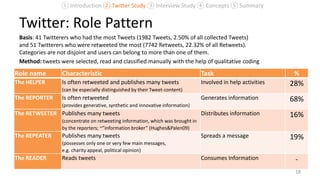
Twitter: Role Pattern
Basis: 41 Twitterers who had the most Tweets (1982 Tweets, 2.50% of all collected Tweets)
and 51 Twitterers who were retweeted the most (7742 Retweets, 22.32% of all Retweets).
Categories are not disjoint and users can belong to more than one of them.
Method: tweets were selected, read and classified manually with the help of qualitative coding
18
Role name Characteristic Task %
The HELPER Is often retweeted and publishes many tweets
(can be especially distinguished by their Tweet-content)
Involved in help activities 28%
The REPORTER Is often retweeted
(provides generative, synthetic and innovative information)
Generates information 68%
The RETWEETER Publishes many tweets
(concentrate on retweeting information, which was brought in
by the reporters; ~”information broker” (Hughes&Palen09)
Distributes information 16%
The REPEATER Publishes many tweets
(possesses only one or very few main messages,
e.g. charity appeal, political opinion)
Spreads a message 19%
The READER Reads tweets Consumes Information -
① Introduction ② Twitter Study ③ Interview Study ④ Concepts ⑤ Summary
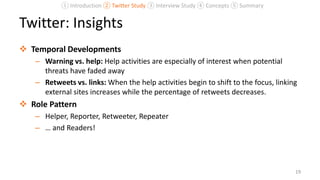
Twitter: Insights
19
 Temporal Developments
– Warning vs. help: Help activities are especially of interest when potential
threats have faded away
– Retweets vs. links: When the help activities begin to shift to the focus, linking
external sites increases while the percentage of retweets decreases.
 Role Pattern
– Helper, Reporter, Retweeter, Repeater
– … and Readers!
① Introduction ② Twitter Study ③ Interview Study ④ Concepts ⑤ Summary
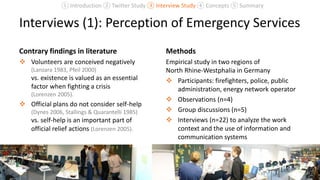
Interviews (1): Perception of Emergency Services
Contrary findings in literature
 Volunteers are conceived negatively
(Lanzara 1983, Pfeil 2000)
vs. existence is valued as an essential
factor when fighting a crisis
(Lorenzen 2005).
 Official plans do not consider self-help
(Dynes 2006, Stallings & Quarantelli 1985)
vs. self-help is an important part of
official relief actions (Lorenzen 2005).
Methods
Empirical study in two regions of
North Rhine-Westphalia in Germany
 Participants: firefighters, police, public
administration, energy network operator
 Observations (n=4)
 Group discussions (n=5)
 Interviews (n=22) to analyze the work
context and the use of information and
communication systems
20
① Introduction ② Twitter Study ③ Interview Study ④ Concepts ⑤ Summary
Interviews (2): Perception of Emergency Services
 Helpful: “Particularly during heavy rainfalls
self-help would be sometimes very helpful;
[…] Instead of calling us and writing down
that you have 2 cm water in the
basement.” (I05).
 Information: “When somebody calls us,
who has seen something […], then we
certainly ask whether […] they have a gas
tank or whatever kind of heating system
they have.” (I07)
 Legal basis: “Everything we do must have a
legal basis. […] A civil self-help group is not
a unit of the emergency service. After all,
we couldn’t utilize them, even if we wanted
to.” (I06) 21
 Appearance: “The more you are in the
countryside, the more the citizens support
each other and the less they call the
state.” (I09)
 Entitlement: „As you can see very clearly,
the entitlement has increased extremely
[...]. Since they call that the manhole cover
is located next ten centimeter.“ (I09)
 Interest: „Our interest is to sensitize the
population that self-help mechanisms
develop” (I05).
① Introduction ② Twitter Study ③ Interview Study ④ Concepts ⑤ Summary
How can IT support the
collaboration of virtual and real
emergent volunteer groups?
22
① Introduction ② Twitter Study ③ Interview Study ④ Concepts ⑤ Summary
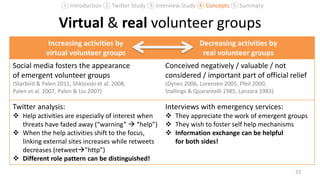
Virtual & real volunteer groups
23
Increasing activities by
virtual volunteer groups
Decreasing activities by
real volunteer groups
Social media fosters the appearance
of emergent volunteer groups
(Starbird & Palen 2011, Shklovski et al. 2008,
Palen et al. 2007, Palen & Liu 2007)
Conceived negatively / valuable / not
considered / important part of official relief
(Dynes 2006, Lorenzen 2005, Pfeil 2000,
Stallings & Quarantelli 1985, Lanzara 1983)
Twitter analysis:
 Help activities are especially of interest when
threats have faded away (“warning”  “help”)
 When the help activities shift to the focus,
linking external sites increases while retweets
decreases (retweet”http”)
 Different role pattern can be distinguished!
Interviews with emergency services:
 They appreciate the work of emergent groups
 They wish to foster self help mechanisms
 Information exchange can be helpful
for both sides!
① Introduction ② Twitter Study ③ Interview Study ④ Concepts ⑤ Summary
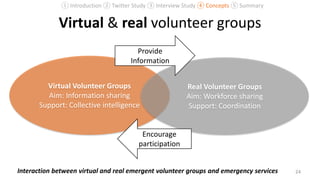
Virtual & real volunteer groups
24
Virtual Volunteer Groups
Aim: Information sharing
Support: Collective intelligence
Real Volunteer Groups
Aim: Workforce sharing
Support: Coordination
Interaction between virtual and real emergent volunteer groups and emergency services
① Introduction ② Twitter Study ③ Interview Study ④ Concepts ⑤ Summary
Provide
Information
Encourage
participation
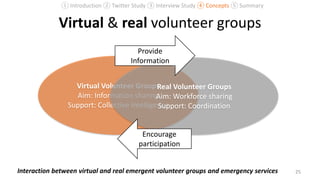
Virtual & real volunteer groups
25
① Introduction ② Twitter Study ③ Interview Study ④ Concepts ⑤ Summary
Virtual Volunteer Groups
Aim: Information sharing
Support: Collective intelligence
Real Volunteer Groups
Aim: Workforce sharing
Support: Coordination
Interaction between virtual and real emergent volunteer groups and emergency services
Provide
Information
Encourage
participation
Implications: Real and Virtual Volunteers
1. Use of existing social networks
– Prerequisite (Quarantelli 1984); Today: Facebook, Twitter, …
2. Promotion and awareness
– Displaying danger visually (Prerequisite) in existing networks
– Awareness on activities and needs (in the network/neighbourhood) encourages passive users
– Activating passive „readers“ for virtual or real activities
3. Connecting among volunteers
– Virtual: information vs. real: coordination
– Use of the same infrastructures: Displaying user or on-site twitterers (Starbird et al. 2012)
visually using role patterns (e.g. „helper“)
– Possibility to search for volunteers with special skills
4. Connection to emergency services and systems
– Using the information advantage (e.g. „reporter“) 26
① Introduction ② Twitter Study ③ Interview Study ④ Concepts ⑤ Summary
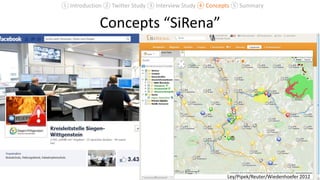
Concepts “SiRena”
27
① Introduction ② Twitter Study ③ Interview Study ④ Concepts ⑤ Summary
Ley/Pipek/Reuter/Wiedenhoefer 2012
Christian Reuter · Oliver Heger · Volkmar Pipek
University of Siegen Contact:
Institute for Information Systems christian.reuter@uni-siegen.de
CSCW and Social Media www.cscw.uni-siegen.de
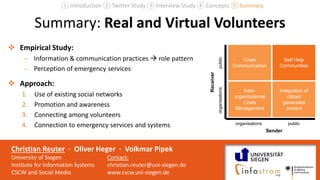
Summary: Real and Virtual Volunteers
 Empirical Study:
 Information & communication practices  role pattern
 Perception of emergency services
 Approach:
1. Use of existing social networks
2. Promotion and awareness
3. Connecting among volunteers
4. Connection to emergency services and systems public
Sender
Crisis
Communication
Self Help
Communities
Inter-
organizational
Crisis
Management
Integration of
citizen
generated
content
organisations
publicorganisations
Receiver
① Introduction ② Twitter Study ③ Interview Study ④ Concepts ⑤ Summary
Related Work
1. Stallings, R.A., Quarantelli, E.L.: Emergent Citizen Groups and Emergency
Management. Public Administration Review. 45, 93–100 (1985).
2. Quarantelli, E.L.: Emergent Citizen Groups in Disaster Preparedness and Recovery
Activities, (1984).
3. Helsloot, I., Ruitenberg, A.: Citizen Response to Disasters : a Survey of Literature and
Some Practical Implications. Journal of Contingencies and Crisis Management. 12, 98–
111 (2004).
4. Lowe, S., Fothergill, A.: A Need to Help: Emergent Volunteer Behavior after September
11th. Beyond September 11th: An Account of Post-Disaster Research. pp. 293–314.
Boulder, CO: Natural Hazards Research and Applications Information Center, University
of Colorado (2003).
5. Voorhees, W.R.: New Yorkers Respond to the World Trade Center Attack: An Anatomy
of an Emergent Volunteer Organization. Journal of Contingencies and Crisis
Management. 16, 3–13 (2008).
6. Palen, L., Liu, S.B.: Citizen communications in crisis: anticipating a future of ICT-
supported public participation. Proceedings of the Conference on Human Factors in
Computing Systems (CHI). ACM Press, San Jose, USA (2007).
7. Starbird, K., Palen, L.: Voluntweeters: Self-Organizing by Digital Volunteers in Times of
Crisis. Proceedings of the Conference on Human Factors in Computing Systems (CHI).
ACM Press, Vancouver, BC, Canada (2011).
8. Vieweg, S., Hughes, A.L., Starbird, K., Palen, L.: Microblogging During Two Natural
Hazards Events: What Twitter May Contribute to Situational Awareness. Proceedings of
the Conference on Human Factors in Computing Systems (CHI). pp. 1079–1088
(2010).
9. Qu, Y., Huang, C., Zhang, P., Zhang, J.: Microblogging after a Major Disaster in China:
A Case Study of the 2010 Yushu Earthquake. Proc. CSCW. pp. 25–34, Hangzhou,
China (2011).
10. White, C., Plotnick, L., Kushma, J., Hiltz, S.R., Turoff, M.: An online social network for
emergency management. International Journal of Emergency Management. 6, 369–382
(2009).
11. Palen, L., Vieweg, S.: The emergence of online widescale interaction in unexpected
events: assistance, alliance & retreat. Proceedings of the Conference on Computer
Supported Cooperative Work (CSCW). pp. 117–126. ACM Press (2008).
12. Hughes, A.L., Palen, L.: Twitter Adoption and Use in Mass Convergence and
Emergency Events. In: Proc. ISCRAM, Gothenburg (2009).
13. Starbird, K., Palen, L., Hughes, A.L., Vieweg, S.: Chatter on The Red: What Hazards
Thret Reveals about the Social Life of Microblogges Information. In: Proc. CSCW. pp.
241–250. ACM Press (2010).
14. Starbird, K., Palen, L.: Pass It On?: Retweeting in Mass Emergency. Proceedings of the
International ISCRAM Conference. pp. 1–10. , Seattle, USA (2010).
15. Strauss, A.: Qualitative Analysis for Social Scientists. Cambridge press (1987).
16. Dynes, R.R.: Social Capital: Dealing with Community Emergencies. Homeland Security
Affairs. 2, (2006).
17. Lanzara, G.F.: Ephemeral Organisations in Extreme Environments: emergence,
strategy, extinction. Journal of Management Studies. 20, 71–95 (1983).
18. Lorenzen, D.: Risikokommunikation bei Naturkatastrophen - Ausgewählte Ergebnisse
der Befragung im Herbst 2004. (2005).
19. Pfeil, J.: Maßnahmen des Katastrophenschutzes und Reaktionen der Bürger in
Hochwassergebieten. Deutsches Komitee für Katastrophenvorsorge e.V. (DKKV)
(2000).
20. White, C., Plotnick, L., Addams-Moring, R., Turoff, M., Hiltz, S.R.: Leveraging a Wiki to
Enhance Virtual Collaboration in the Emergency Domain. Proc. HICSS (2008).
29
① Introduction ② Twitter Study ③ Interview Study ④ Concepts ⑤ Summary
Publications2013
1. Christofzik/Reuter (2013). The Aggregation of Information Qualities in
Collaborative Software. Int. Journ. Entr. Venturing, 5(3).
2. Heger/Reuter (2013). IT-basierte Unterstützung virtueller und realer
Selbsthilfegemeinschaften in Katastrophenlagen. In Proc. WI`13.
3. Ley/Pipek/Siebigteroth/Wiedenhöfer (2013): Retrieving and Exchanging of
Information in Inter-organizational Crisis Management. In Proc. ISCRAM `13.
4. Ludwig/Reuter/Pipek (2013): What You See Is What I Want: Mobile Reporting
Practices in Emergencies. In: Proc. ECSCW `13 (accepted)
5. Reuter/Heger/Pipek (2013). Combining Real and Virtual Volunteers through
Social Media. In Proc. ISCRAM `13.
6. Reuter/Ritzkatis (2013). Unterstützung mobiler Geo-Kollaboration zur
Lageeinschätzung von Feuerwehr und Polizei. In Proc. WI`13.
7. Reuter (2013). Power Outage Communications: Survey of Needs,
Infrastructures and Concepts. In Proc. ISCRAM `13.
8. Thamm/Ludwig/Reuter (2013). Design of a Process Modell for Unmanned
Aerial Systems (UAS) in Emergencies. In Proc. ISCRAM `13.
2012
9. Christofzik/Reuter (2012). Einfluss der Qualitätsermittlung kollaborativ
erstellter Informationen auf die Gestaltung interorganisationaler
Krisenmanagementsysteme. In Proc. MKWI `12.
10. Ley/Pipek/Reuter/Wiedenhoefer (2012). Supporting Improvisation Work in
Inter-Organizational Crisis Management. In Proc. CHI `12.
11. Ley/Pipek/Reuter/Wiedenhoefer (2012). Supporting Inter-organizational Situation
Assessment in Crisis Management. In Proc. ISCRAM `12.
12. Pipek/Palen/Landgren (Eds.) (2012): Workshop summary: collaboration & crisis
informatics (CCI'2012). Workshop-Proc. CSCW `12.
13. Reuter/Heger/Pipek (2012). Social Media for Supporting Emergent Groups in Crisis
Management. In Workshop-Proc. CSCW `12.
14. Reuter/Marx/Pipek (2012). Crisis Management 2.0: Towards a Systematization of
Social Software Use in Crisis Situations. Int. Journ. ISCRAM, 4(1), 1–16.
15. Reuter/Pipek/Wiedenhoefer/Ley (2012). Dealing with Terminologies in Collaborative
Systems for Crisis Management. In Proc. ISCRAM `12.
2011
16. Reuter/Marx/Pipek (2011). Social Software as an Infrastructure for Crisis Management
– a Case Study about Current Practice and Potential Usage. In Proc. ISCRAM `11.
17. Reuter/Marx/Pipek (2011). Desaster 2.0: Einbeziehung von Bürgern in das
Krisenmanagement. In: Proc. Mensch & Computer `11.
18. Reuter/Pohl/Pipek (2011). Umgang mit Terminologien in inter- organisationaler
Krisenkooperation - eine explorative Empirie. In Proc. Mensch & Computer `11.
19. Reuter (2011). Motive und Barrieren für Social Software in Organisationen und im
Krisenmanagement. In Workshop-Proc. Mensch & Computer `11.
20. Wiedenhoefer/Reuter/Ley/Pipek (2011). Inter-Organizational Crisis Management
Infrastructures for Electrical Power Breakdowns. In Proc. ISCRAM `11.
21. Wiedenhoefer/Reuter/Ley/Pipek (2011). Entwicklung IT-basierter interorganisationaler
Krisenmanagement-Infrastrukturen für Stromausfälle. In Workshop Proc. SE `11 (acc.)
30
① Introduction ② Twitter Study ③ Interview Study ④ Concepts ⑤ Summary
Social Media: Tools
 Microblogging
 distributing information, answering requests (Starbird & Palen 2011), situation updates
(Vieweg et al. 2010), emotionally coping (Qu et al. 2011), for intensive coordination
work switch to other software (Skype, Google Wave, …) (Starbird & Palen 2011)
 Social Networks
 create collective intelligence, serve as information source and contain quality control
mechanisms (Palen & Vieweg 2008, Vieweg et al. 2008).
 Wikis
 visual interface which allows its users to publish and edit information on the Google
Map Interface (Palen et al. 2007).
 Group Modules
 Coordination and Cooperation, especially with Group modules
(Sebastian&Bui 2011, Petrescu-Prahova&Butts 2008, Majchrzak et al. 2007, Jaeger et al.
2007)
31
① Introduction ② Twitter Study ③ Interview Study ④ Concepts ⑤ Summary
Social Media: Tasks
 Information
– meta-information, such as context, validity, source, credibility, and timeliness, are of importance
(Palen et al. 2010)
– e.g. particular hashtag-syntax for tweets during crises (Starbird and Stamberger 2010)
– existence of a given structure is essential, so that the information can be managed and information
overload can be reduced (Turoff et al. 2004)
 Communication
– develop, discuss and finally vote on ideas in an iterative process (White et al. 2008b)
 Coordination
– fosters decision-making and coordination by integrating a community platform (Jäger et al. 2007)
– template-driven processing (Bui and Sebastian 2011)
32
① Introduction ② Twitter Study ③ Interview Study ④ Concepts ⑤ Summary
Further Sources
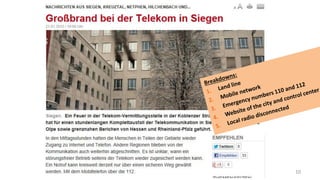
• https://www.facebook.com/KreisleitstelleSiWi?ref=ts&fref=ts
• http://www.derwesten.de/staedte/nachrichten-aus-siegen-kreuztal-netphen-hilchenbach-und-
freudenberg/grossbrand-bei-der-telekom-in-siegen-id7508134.html
33
① Introduction ② Twitter Study ③ Interview Study ④ Concepts ⑤ Summary

Combining Real and Virtual Volunteers through Social Media

  • 1.
    1 Combining Real andVirtual Volunteers through Social Media Christian Reuter · Oliver Heger · Volkmar Pipek (christian.reuter@uni-siegen.de)
  • 2.
    Research Field Project: Learning informationinfrastructures in crisis management using the example of power outages (2010-2013) Target: Development of an inter-organizational collabo- ration infrastructure “SiRena” 2 ① Introduction ② Twitter Study ③ Interview Study ④ Concepts ⑤ Summary
  • 3.
    public Sender Crisis Communication Self Help Communities Integration of citizengenerated content organizations publicorganizations Receiver Crisis Communication Matrix 3 ISCRAM 2011 Reuter/Marx/Pipek Inter- organizational Crisis Management ① Introduction ② Twitter Study ③ Interview Study ④ Concepts ⑤ Summary
  • 4.
    Crisis Communication Matrix 4 Inter- organisationales Krisen- management public Sender Crisis Communication SelfHelp Communities Inter- organizational Crisis Management Integration of citizen generated content organizations publicorganizations Receiver ISCRAM 2011 Reuter/Marx/Pipek ① Introduction ② Twitter Study ③ Interview Study ④ Concepts ⑤ Summary
  • 5.
    Crisis Communication Matrix 5 public Sender Crisis Communication SelfHelp Communities Inter- organizational Crisis Management Integration of citizen generated content organizations publicorganizations Receiver ISCRAM 2011 Reuter/Marx/Pipek ① Introduction ② Twitter Study ③ Interview Study ④ Concepts ⑤ Summary
  • 6.
    Crisis Communication Matrix 6 public Sender Crisis Communication SelfHelp Communities Inter- organizational Crisis Management Integration of citizen generated content organizations publicorganizations Receiver ISCRAM 2011 Reuter/Marx/Pipek ① Introduction ② Twitter Study ③ Interview Study ④ Concepts ⑤ Summary
  • 7.
    Crisis Communication Matrix 7 public Sender Crisis Communication SelfHelp Communities Inter- organizational Crisis Management Integration of citizen generated content organizations publicorganizations Receiver ① Introduction ② Twitter Study ③ Interview Study ④ Concepts ⑤ Summary ISCRAM 2011 Reuter/Marx/Pipek
  • 8.
    Emergent Volunteer Groups 8 …private citizens who work together … in pursuit of collective goals relevant to actual or potential disasters … but whose organization has not yet become institutionalized (Stallings & Quarantelli 1985) ① Introduction ② Twitter Study ③ Interview Study ④ Concepts ⑤ Summary
  • 9.
    Emergent Volunteer Groups Existof… Five essential factors 1. extra community setting, which legitimizes the group 2. crucial event, which is perceived as a threat 3. supportive social climate with positive values regarding the necessity 4. existing social network, so that communication can take place 5. available resources such as information, knowledge or skills 9 • an active core (1%) • a larger supporting circle for specific tasks (10%) • a great number of primarily nominal supporters who occasionally assist, but are rather passive (Quarantelli, 1984, …) ① Introduction ② Twitter Study ③ Interview Study ④ Concepts ⑤ Summary
  • 10.
  • 11.
    Siegen’s Control Centreon Facebook 11 11
  • 12.
    Haiti: Open StreetMaps 12 • Open Street Maps: Before the earthquake of 2010
  • 13.
    Haiti: Open StreetMaps 13 • Open Street Maps: Two weeks after the earthquake of 2010
  • 14.
    Real Volunteers neighbourly help local,on-site „Emergent Groups“ (Stallings & Quarantelli 1985) Virtual Volunteers information exchange online, everywhere „Digital Volunteers“ (Starbird & Palen 2011) Differentiation: Virtual and Real Emergent Volunteer Groups Research question: How can IT support the collaboration of virtual and real emergent volunteer groups? 14 overlapping ① Introduction ② Twitter Study ③ Interview Study ④ Concepts ⑤ Summary
  • 15.
    Outline 15 ① Present knowledge ②Twitter Study: Time analysis and identification of role pattern ③ Interview Study: Self-help activities in the perception of emergency services ④ Concepts and Implications Combining real and virtual emergent volunteer groups ⑤ Summary ① Introduction ② Twitter Study ③ Interview Study ④ Concepts ⑤ Summary
  • 16.
    Twitter Case Study:2011 Super Outbreak  Event: “2011 Super Outbreak” – 211 tornados in the Southern, Midwestern, and Northeastern United States, leaving catastrophic destruction in its wake, especially across the state of Alabama  Data collection: – Tool: The Archivist / Twitter Search API – Keyword: “tornado” – Time: 15 hours (2011/04/28 – 2011/04/29) – Data collected: 79.318 Tweets, 59.282 User 16 http://en.wikipedia.org/wiki/April_25%E2%80% 9328,_2011_tornado_outbreak ① Introduction ② Twitter Study ③ Interview Study ④ Concepts ⑤ Summary
  • 17.
    Twitter: Time Analysis 0% 2% 4% 6% 8% 10% 12% 14% 16% 12:17-13:16 13:17-14:16 14:17-15:16 15:17-16:16 16:17-17:16 17:17-18:16 18:17-19:16 19:17-20:16 20:17-21:16 21:17-22:16 22:17-23:16 23:17-0:16 0:17-1:16 1:17-2:16 2:17-3:16 Anteil"warning" Anteil "help" 25% 30% 35% 40% 45% 50% 55% 60% 12:17-13:16 13:17-14:16 14:17-15:16 15:17-16:16 16:17-17:16 17:17-18:16 18:17-19:16 19:17-20:16 20:17-21:16 21:17-22:16 22:17-23:16 23:17-0:16 0:17-1:16 1:17-2:16 2:17-3:16 Anteil "http" Anteil Retweets 17 “help”“warning” “http” “retweets” Links vs. retweets: When help activities begin to shift towards the focus, linking of external sites increases, while the percentage of retweets decrease. Warning vs. help: Help activities are especially of interest when potential threats have faded away. ① Introduction ② Twitter Study ③ Interview Study ④ Concepts ⑤ Summary
  • 18.
    Twitter: Role Pattern Basis:41 Twitterers who had the most Tweets (1982 Tweets, 2.50% of all collected Tweets) and 51 Twitterers who were retweeted the most (7742 Retweets, 22.32% of all Retweets). Categories are not disjoint and users can belong to more than one of them. Method: tweets were selected, read and classified manually with the help of qualitative coding 18 Role name Characteristic Task % The HELPER Is often retweeted and publishes many tweets (can be especially distinguished by their Tweet-content) Involved in help activities 28% The REPORTER Is often retweeted (provides generative, synthetic and innovative information) Generates information 68% The RETWEETER Publishes many tweets (concentrate on retweeting information, which was brought in by the reporters; ~”information broker” (Hughes&Palen09) Distributes information 16% The REPEATER Publishes many tweets (possesses only one or very few main messages, e.g. charity appeal, political opinion) Spreads a message 19% The READER Reads tweets Consumes Information - ① Introduction ② Twitter Study ③ Interview Study ④ Concepts ⑤ Summary
  • 19.
    Twitter: Insights 19  TemporalDevelopments – Warning vs. help: Help activities are especially of interest when potential threats have faded away – Retweets vs. links: When the help activities begin to shift to the focus, linking external sites increases while the percentage of retweets decreases.  Role Pattern – Helper, Reporter, Retweeter, Repeater – … and Readers! ① Introduction ② Twitter Study ③ Interview Study ④ Concepts ⑤ Summary
  • 20.
    Interviews (1): Perceptionof Emergency Services Contrary findings in literature  Volunteers are conceived negatively (Lanzara 1983, Pfeil 2000) vs. existence is valued as an essential factor when fighting a crisis (Lorenzen 2005).  Official plans do not consider self-help (Dynes 2006, Stallings & Quarantelli 1985) vs. self-help is an important part of official relief actions (Lorenzen 2005). Methods Empirical study in two regions of North Rhine-Westphalia in Germany  Participants: firefighters, police, public administration, energy network operator  Observations (n=4)  Group discussions (n=5)  Interviews (n=22) to analyze the work context and the use of information and communication systems 20 ① Introduction ② Twitter Study ③ Interview Study ④ Concepts ⑤ Summary
  • 21.
    Interviews (2): Perceptionof Emergency Services  Helpful: “Particularly during heavy rainfalls self-help would be sometimes very helpful; […] Instead of calling us and writing down that you have 2 cm water in the basement.” (I05).  Information: “When somebody calls us, who has seen something […], then we certainly ask whether […] they have a gas tank or whatever kind of heating system they have.” (I07)  Legal basis: “Everything we do must have a legal basis. […] A civil self-help group is not a unit of the emergency service. After all, we couldn’t utilize them, even if we wanted to.” (I06) 21  Appearance: “The more you are in the countryside, the more the citizens support each other and the less they call the state.” (I09)  Entitlement: „As you can see very clearly, the entitlement has increased extremely [...]. Since they call that the manhole cover is located next ten centimeter.“ (I09)  Interest: „Our interest is to sensitize the population that self-help mechanisms develop” (I05). ① Introduction ② Twitter Study ③ Interview Study ④ Concepts ⑤ Summary
  • 22.
    How can ITsupport the collaboration of virtual and real emergent volunteer groups? 22 ① Introduction ② Twitter Study ③ Interview Study ④ Concepts ⑤ Summary
  • 23.
    Virtual & realvolunteer groups 23 Increasing activities by virtual volunteer groups Decreasing activities by real volunteer groups Social media fosters the appearance of emergent volunteer groups (Starbird & Palen 2011, Shklovski et al. 2008, Palen et al. 2007, Palen & Liu 2007) Conceived negatively / valuable / not considered / important part of official relief (Dynes 2006, Lorenzen 2005, Pfeil 2000, Stallings & Quarantelli 1985, Lanzara 1983) Twitter analysis:  Help activities are especially of interest when threats have faded away (“warning”  “help”)  When the help activities shift to the focus, linking external sites increases while retweets decreases (retweet”http”)  Different role pattern can be distinguished! Interviews with emergency services:  They appreciate the work of emergent groups  They wish to foster self help mechanisms  Information exchange can be helpful for both sides! ① Introduction ② Twitter Study ③ Interview Study ④ Concepts ⑤ Summary
  • 24.
    Virtual & realvolunteer groups 24 Virtual Volunteer Groups Aim: Information sharing Support: Collective intelligence Real Volunteer Groups Aim: Workforce sharing Support: Coordination Interaction between virtual and real emergent volunteer groups and emergency services ① Introduction ② Twitter Study ③ Interview Study ④ Concepts ⑤ Summary Provide Information Encourage participation
  • 25.
    Virtual & realvolunteer groups 25 ① Introduction ② Twitter Study ③ Interview Study ④ Concepts ⑤ Summary Virtual Volunteer Groups Aim: Information sharing Support: Collective intelligence Real Volunteer Groups Aim: Workforce sharing Support: Coordination Interaction between virtual and real emergent volunteer groups and emergency services Provide Information Encourage participation
  • 26.
    Implications: Real andVirtual Volunteers 1. Use of existing social networks – Prerequisite (Quarantelli 1984); Today: Facebook, Twitter, … 2. Promotion and awareness – Displaying danger visually (Prerequisite) in existing networks – Awareness on activities and needs (in the network/neighbourhood) encourages passive users – Activating passive „readers“ for virtual or real activities 3. Connecting among volunteers – Virtual: information vs. real: coordination – Use of the same infrastructures: Displaying user or on-site twitterers (Starbird et al. 2012) visually using role patterns (e.g. „helper“) – Possibility to search for volunteers with special skills 4. Connection to emergency services and systems – Using the information advantage (e.g. „reporter“) 26 ① Introduction ② Twitter Study ③ Interview Study ④ Concepts ⑤ Summary
  • 27.
    Concepts “SiRena” 27 ① Introduction② Twitter Study ③ Interview Study ④ Concepts ⑤ Summary Ley/Pipek/Reuter/Wiedenhoefer 2012
  • 28.
    Christian Reuter ·Oliver Heger · Volkmar Pipek University of Siegen Contact: Institute for Information Systems christian.reuter@uni-siegen.de CSCW and Social Media www.cscw.uni-siegen.de Summary: Real and Virtual Volunteers  Empirical Study:  Information & communication practices  role pattern  Perception of emergency services  Approach: 1. Use of existing social networks 2. Promotion and awareness 3. Connecting among volunteers 4. Connection to emergency services and systems public Sender Crisis Communication Self Help Communities Inter- organizational Crisis Management Integration of citizen generated content organisations publicorganisations Receiver ① Introduction ② Twitter Study ③ Interview Study ④ Concepts ⑤ Summary
  • 29.
    Related Work 1. Stallings,R.A., Quarantelli, E.L.: Emergent Citizen Groups and Emergency Management. Public Administration Review. 45, 93–100 (1985). 2. Quarantelli, E.L.: Emergent Citizen Groups in Disaster Preparedness and Recovery Activities, (1984). 3. Helsloot, I., Ruitenberg, A.: Citizen Response to Disasters : a Survey of Literature and Some Practical Implications. Journal of Contingencies and Crisis Management. 12, 98– 111 (2004). 4. Lowe, S., Fothergill, A.: A Need to Help: Emergent Volunteer Behavior after September 11th. Beyond September 11th: An Account of Post-Disaster Research. pp. 293–314. Boulder, CO: Natural Hazards Research and Applications Information Center, University of Colorado (2003). 5. Voorhees, W.R.: New Yorkers Respond to the World Trade Center Attack: An Anatomy of an Emergent Volunteer Organization. Journal of Contingencies and Crisis Management. 16, 3–13 (2008). 6. Palen, L., Liu, S.B.: Citizen communications in crisis: anticipating a future of ICT- supported public participation. Proceedings of the Conference on Human Factors in Computing Systems (CHI). ACM Press, San Jose, USA (2007). 7. Starbird, K., Palen, L.: Voluntweeters: Self-Organizing by Digital Volunteers in Times of Crisis. Proceedings of the Conference on Human Factors in Computing Systems (CHI). ACM Press, Vancouver, BC, Canada (2011). 8. Vieweg, S., Hughes, A.L., Starbird, K., Palen, L.: Microblogging During Two Natural Hazards Events: What Twitter May Contribute to Situational Awareness. Proceedings of the Conference on Human Factors in Computing Systems (CHI). pp. 1079–1088 (2010). 9. Qu, Y., Huang, C., Zhang, P., Zhang, J.: Microblogging after a Major Disaster in China: A Case Study of the 2010 Yushu Earthquake. Proc. CSCW. pp. 25–34, Hangzhou, China (2011). 10. White, C., Plotnick, L., Kushma, J., Hiltz, S.R., Turoff, M.: An online social network for emergency management. International Journal of Emergency Management. 6, 369–382 (2009). 11. Palen, L., Vieweg, S.: The emergence of online widescale interaction in unexpected events: assistance, alliance & retreat. Proceedings of the Conference on Computer Supported Cooperative Work (CSCW). pp. 117–126. ACM Press (2008). 12. Hughes, A.L., Palen, L.: Twitter Adoption and Use in Mass Convergence and Emergency Events. In: Proc. ISCRAM, Gothenburg (2009). 13. Starbird, K., Palen, L., Hughes, A.L., Vieweg, S.: Chatter on The Red: What Hazards Thret Reveals about the Social Life of Microblogges Information. In: Proc. CSCW. pp. 241–250. ACM Press (2010). 14. Starbird, K., Palen, L.: Pass It On?: Retweeting in Mass Emergency. Proceedings of the International ISCRAM Conference. pp. 1–10. , Seattle, USA (2010). 15. Strauss, A.: Qualitative Analysis for Social Scientists. Cambridge press (1987). 16. Dynes, R.R.: Social Capital: Dealing with Community Emergencies. Homeland Security Affairs. 2, (2006). 17. Lanzara, G.F.: Ephemeral Organisations in Extreme Environments: emergence, strategy, extinction. Journal of Management Studies. 20, 71–95 (1983). 18. Lorenzen, D.: Risikokommunikation bei Naturkatastrophen - Ausgewählte Ergebnisse der Befragung im Herbst 2004. (2005). 19. Pfeil, J.: Maßnahmen des Katastrophenschutzes und Reaktionen der Bürger in Hochwassergebieten. Deutsches Komitee für Katastrophenvorsorge e.V. (DKKV) (2000). 20. White, C., Plotnick, L., Addams-Moring, R., Turoff, M., Hiltz, S.R.: Leveraging a Wiki to Enhance Virtual Collaboration in the Emergency Domain. Proc. HICSS (2008). 29 ① Introduction ② Twitter Study ③ Interview Study ④ Concepts ⑤ Summary
  • 30.
    Publications2013 1. Christofzik/Reuter (2013).The Aggregation of Information Qualities in Collaborative Software. Int. Journ. Entr. Venturing, 5(3). 2. Heger/Reuter (2013). IT-basierte Unterstützung virtueller und realer Selbsthilfegemeinschaften in Katastrophenlagen. In Proc. WI`13. 3. Ley/Pipek/Siebigteroth/Wiedenhöfer (2013): Retrieving and Exchanging of Information in Inter-organizational Crisis Management. In Proc. ISCRAM `13. 4. Ludwig/Reuter/Pipek (2013): What You See Is What I Want: Mobile Reporting Practices in Emergencies. In: Proc. ECSCW `13 (accepted) 5. Reuter/Heger/Pipek (2013). Combining Real and Virtual Volunteers through Social Media. In Proc. ISCRAM `13. 6. Reuter/Ritzkatis (2013). Unterstützung mobiler Geo-Kollaboration zur Lageeinschätzung von Feuerwehr und Polizei. In Proc. WI`13. 7. Reuter (2013). Power Outage Communications: Survey of Needs, Infrastructures and Concepts. In Proc. ISCRAM `13. 8. Thamm/Ludwig/Reuter (2013). Design of a Process Modell for Unmanned Aerial Systems (UAS) in Emergencies. In Proc. ISCRAM `13. 2012 9. Christofzik/Reuter (2012). Einfluss der Qualitätsermittlung kollaborativ erstellter Informationen auf die Gestaltung interorganisationaler Krisenmanagementsysteme. In Proc. MKWI `12. 10. Ley/Pipek/Reuter/Wiedenhoefer (2012). Supporting Improvisation Work in Inter-Organizational Crisis Management. In Proc. CHI `12. 11. Ley/Pipek/Reuter/Wiedenhoefer (2012). Supporting Inter-organizational Situation Assessment in Crisis Management. In Proc. ISCRAM `12. 12. Pipek/Palen/Landgren (Eds.) (2012): Workshop summary: collaboration & crisis informatics (CCI'2012). Workshop-Proc. CSCW `12. 13. Reuter/Heger/Pipek (2012). Social Media for Supporting Emergent Groups in Crisis Management. In Workshop-Proc. CSCW `12. 14. Reuter/Marx/Pipek (2012). Crisis Management 2.0: Towards a Systematization of Social Software Use in Crisis Situations. Int. Journ. ISCRAM, 4(1), 1–16. 15. Reuter/Pipek/Wiedenhoefer/Ley (2012). Dealing with Terminologies in Collaborative Systems for Crisis Management. In Proc. ISCRAM `12. 2011 16. Reuter/Marx/Pipek (2011). Social Software as an Infrastructure for Crisis Management – a Case Study about Current Practice and Potential Usage. In Proc. ISCRAM `11. 17. Reuter/Marx/Pipek (2011). Desaster 2.0: Einbeziehung von Bürgern in das Krisenmanagement. In: Proc. Mensch & Computer `11. 18. Reuter/Pohl/Pipek (2011). Umgang mit Terminologien in inter- organisationaler Krisenkooperation - eine explorative Empirie. In Proc. Mensch & Computer `11. 19. Reuter (2011). Motive und Barrieren für Social Software in Organisationen und im Krisenmanagement. In Workshop-Proc. Mensch & Computer `11. 20. Wiedenhoefer/Reuter/Ley/Pipek (2011). Inter-Organizational Crisis Management Infrastructures for Electrical Power Breakdowns. In Proc. ISCRAM `11. 21. Wiedenhoefer/Reuter/Ley/Pipek (2011). Entwicklung IT-basierter interorganisationaler Krisenmanagement-Infrastrukturen für Stromausfälle. In Workshop Proc. SE `11 (acc.) 30 ① Introduction ② Twitter Study ③ Interview Study ④ Concepts ⑤ Summary
  • 31.
    Social Media: Tools Microblogging  distributing information, answering requests (Starbird & Palen 2011), situation updates (Vieweg et al. 2010), emotionally coping (Qu et al. 2011), for intensive coordination work switch to other software (Skype, Google Wave, …) (Starbird & Palen 2011)  Social Networks  create collective intelligence, serve as information source and contain quality control mechanisms (Palen & Vieweg 2008, Vieweg et al. 2008).  Wikis  visual interface which allows its users to publish and edit information on the Google Map Interface (Palen et al. 2007).  Group Modules  Coordination and Cooperation, especially with Group modules (Sebastian&Bui 2011, Petrescu-Prahova&Butts 2008, Majchrzak et al. 2007, Jaeger et al. 2007) 31 ① Introduction ② Twitter Study ③ Interview Study ④ Concepts ⑤ Summary
  • 32.
    Social Media: Tasks Information – meta-information, such as context, validity, source, credibility, and timeliness, are of importance (Palen et al. 2010) – e.g. particular hashtag-syntax for tweets during crises (Starbird and Stamberger 2010) – existence of a given structure is essential, so that the information can be managed and information overload can be reduced (Turoff et al. 2004)  Communication – develop, discuss and finally vote on ideas in an iterative process (White et al. 2008b)  Coordination – fosters decision-making and coordination by integrating a community platform (Jäger et al. 2007) – template-driven processing (Bui and Sebastian 2011) 32 ① Introduction ② Twitter Study ③ Interview Study ④ Concepts ⑤ Summary
  • 33.
    Further Sources • https://www.facebook.com/KreisleitstelleSiWi?ref=ts&fref=ts •http://www.derwesten.de/staedte/nachrichten-aus-siegen-kreuztal-netphen-hilchenbach-und- freudenberg/grossbrand-bei-der-telekom-in-siegen-id7508134.html 33 ① Introduction ② Twitter Study ③ Interview Study ④ Concepts ⑤ Summary