No Money? No Problem:
A Scalable Approach to
Social Media Monitoring
Tamer Hadi
Director of Strategic Technology
Office of Emergency Preparedness and Response
NYC Department of Health and Mental Hygiene
@tamer_hadi
*** On behalf of the NACCHO Public Health Communications Committee ***
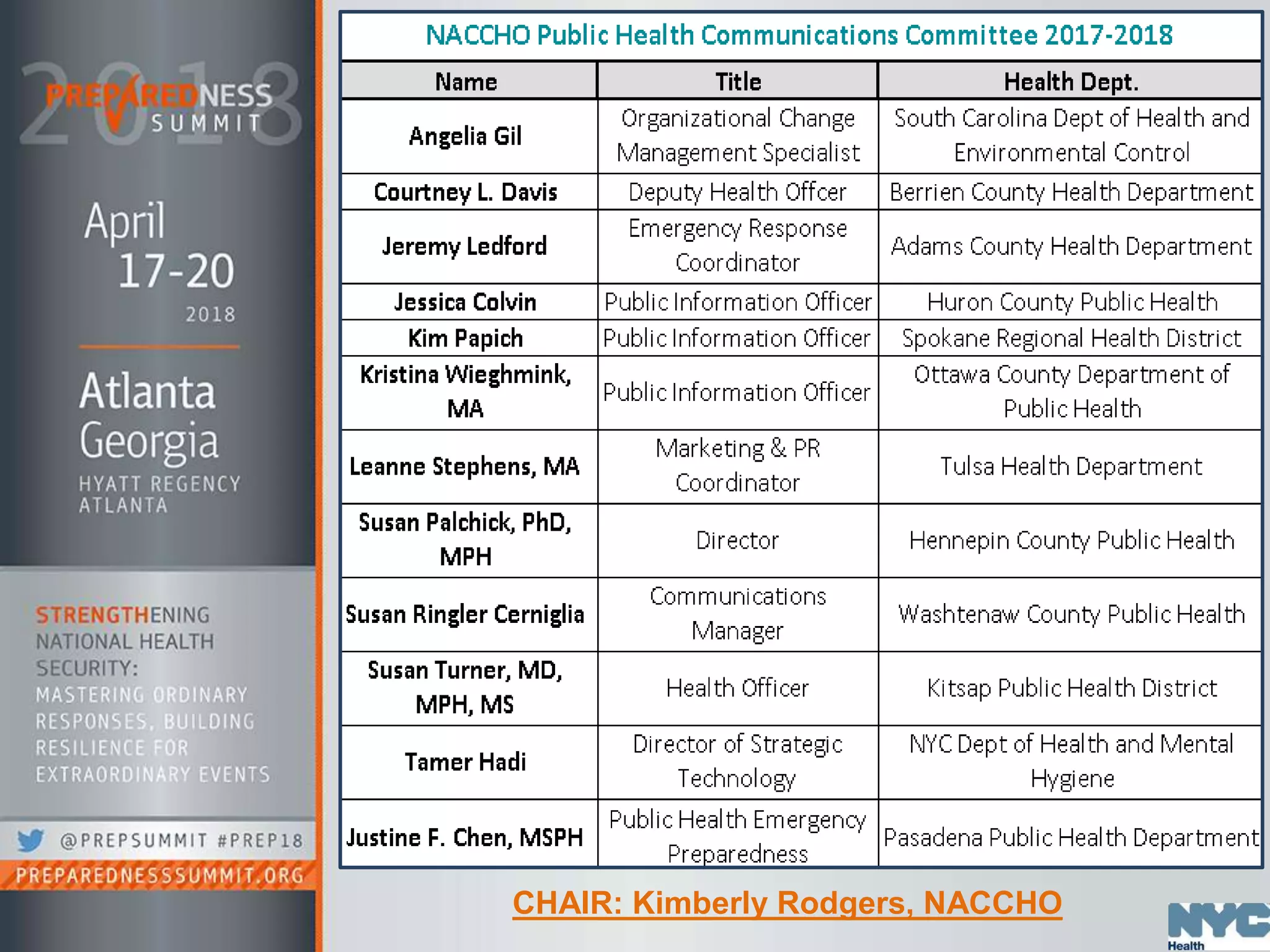
CHAIR: Kimberly Rodgers, NACCHO
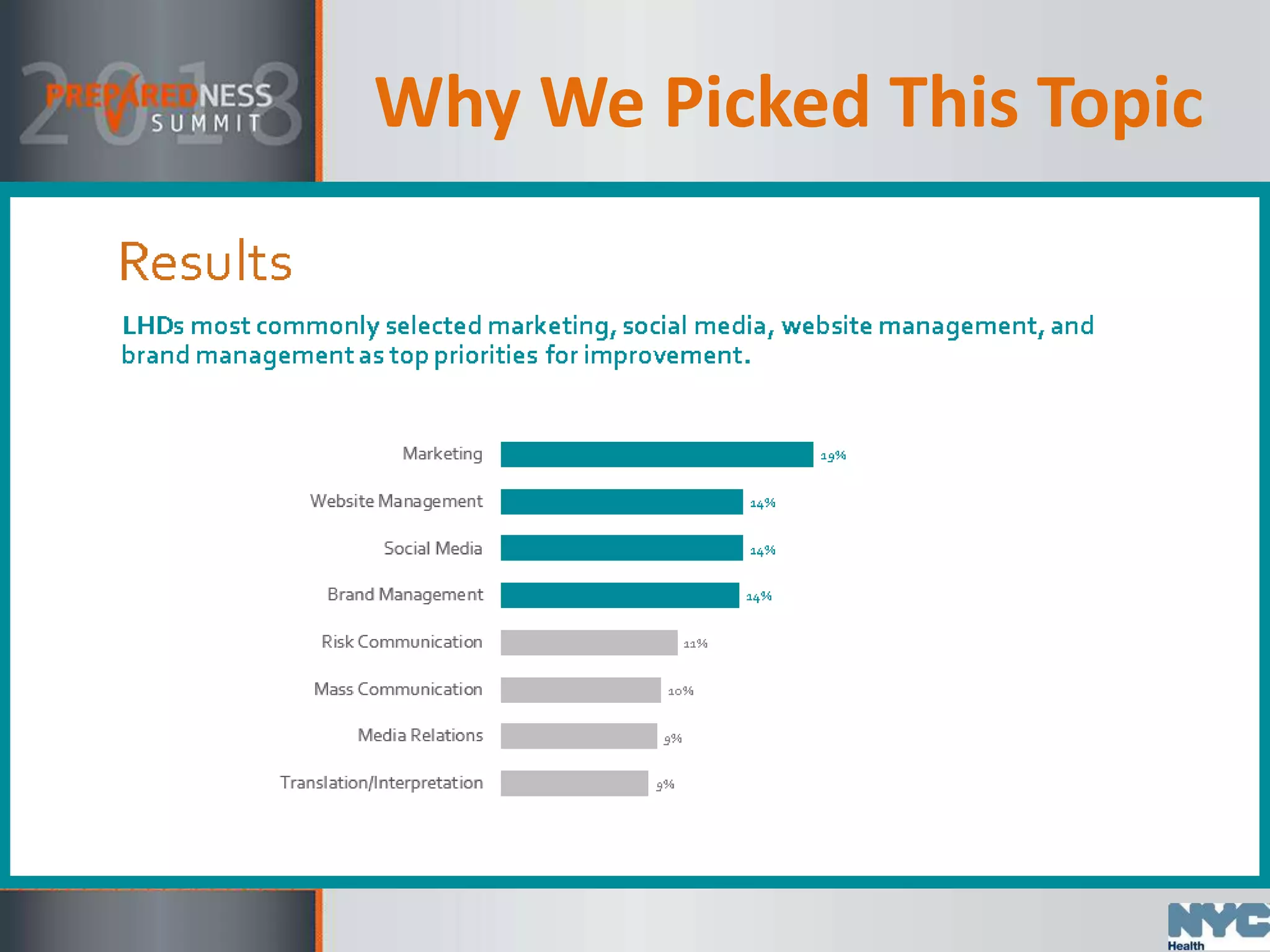
Why We Picked This Topic
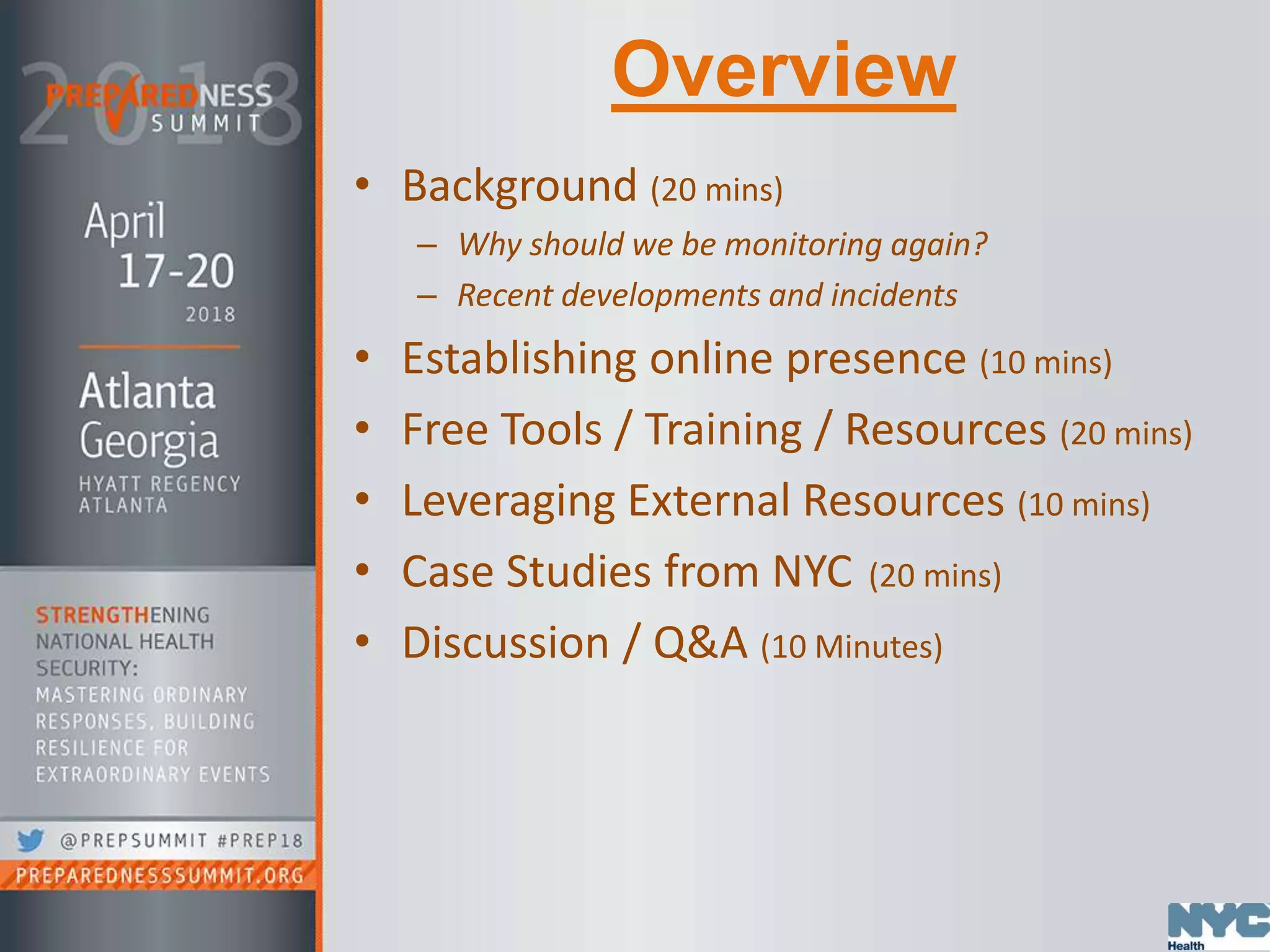
Overview
• Background (20 mins)
– Why should we be monitoring again?
– Recent developments and incidents
• Establishing online presence (10 mins)
• Free Tools / Training / Resources (20 mins)
• Leveraging External Resources (10 mins)
• Case Studies from NYC (20 mins)
• Discussion / Q&A (10 Minutes)
Learning Objectives
• Understand how routine social
media utilization can establish a
health department as a trusted
information source
• Use social media during
emergencies for situational
awareness, rumor and
misinformation control, public
messaging and leadership
decision-making.
Social Media “Listening”
During an Emergency
Why Should We Be Doing This Again?
• Real-time situational awareness
• Get a feel for public sentiment
• Instant feedback on public messaging
 Informs future message development
• Combat #FakeNews – identify and dispel
major rumors and misinformation (public
and news media)
• Monitor agency reputation
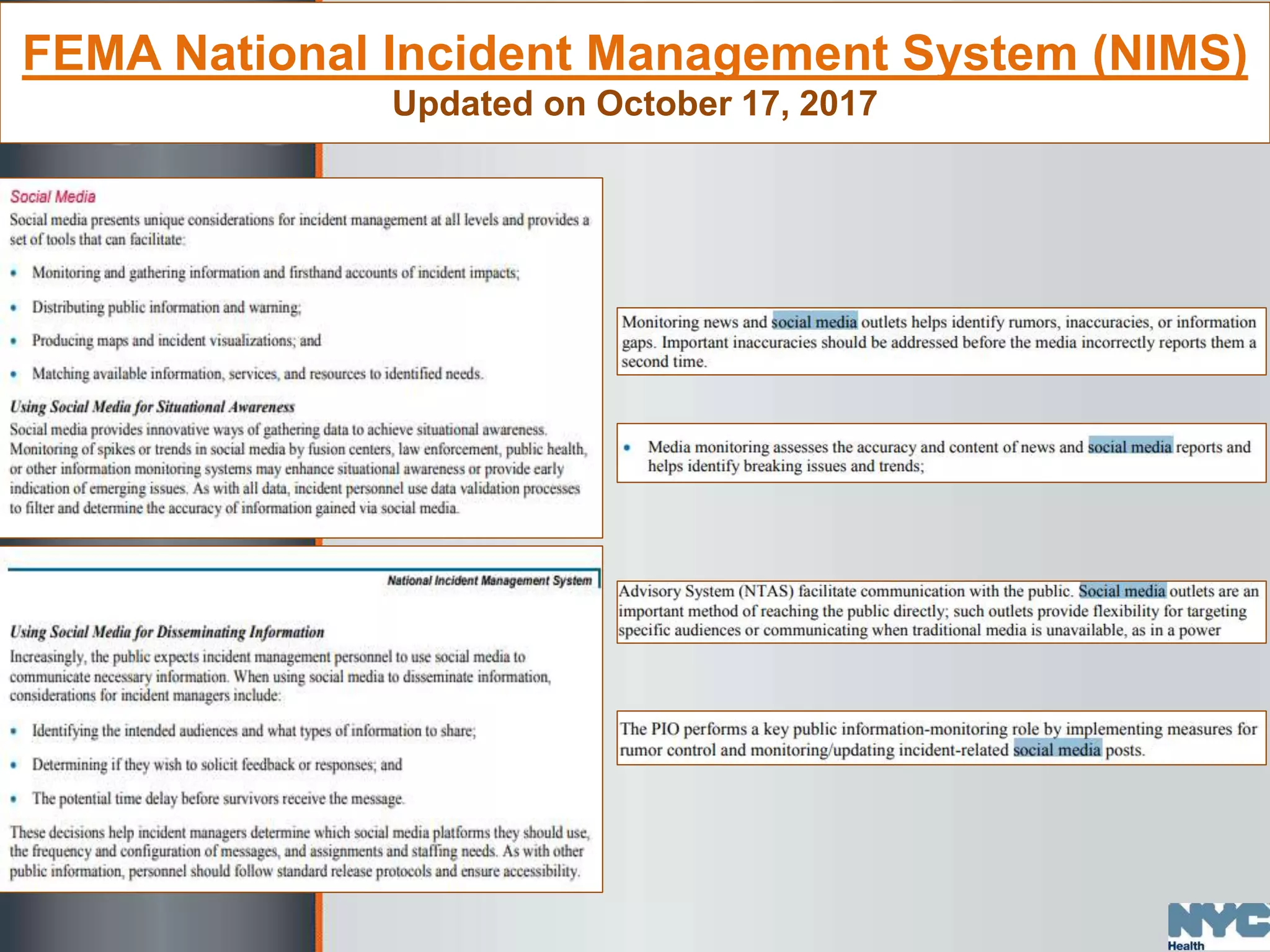
FEMA National Incident Management System (NIMS)
Updated on October 17, 2017
Establishing Online Presence
During “Blue Skies” / “Peace Time”
“The Case for the SM Coordinator”
(Jan/Feb 2018)
http://www.govtech.com/social/The-Case-for-the-Social-Media-Coordinator.html
“If you think managing social media just
involves writing a few quick Tweets and
Facebook posts every day — think again.”
“Besides ‘simply’ writing content, the social
media coordinator needs to manage citizen
comments and complaints, analyze data,
evaluate ads, train employees on the right
way to use social media, create reports,
work with video and graphics, and more.”
Build Audience and Credibility
• Audience for Public Health
Emergency Preparedness is DIVERSE!
– General Public
– Communities and Businesses
– Healthcare (Hospitals, ACFs, NHs, Pharmacies, Dialysis
Centers)
– Elected officials
– Preparedness partners
– DAFN / At-risk populations and more
• Let’s be honest: VERY FEW people go
to preparedness websites organically
5 Marketing & Promotion Strategies
1. Leverage existing agency social
media accounts
2. Use live events to drive traffic to
social media posts
3. Participate in Twitter chats
4. Participate in national campaigns
(e.g. September Preparedness Month, Hurricane Week, etc.)
5. Target niche groups with hashtags
and mentioning specific accounts **
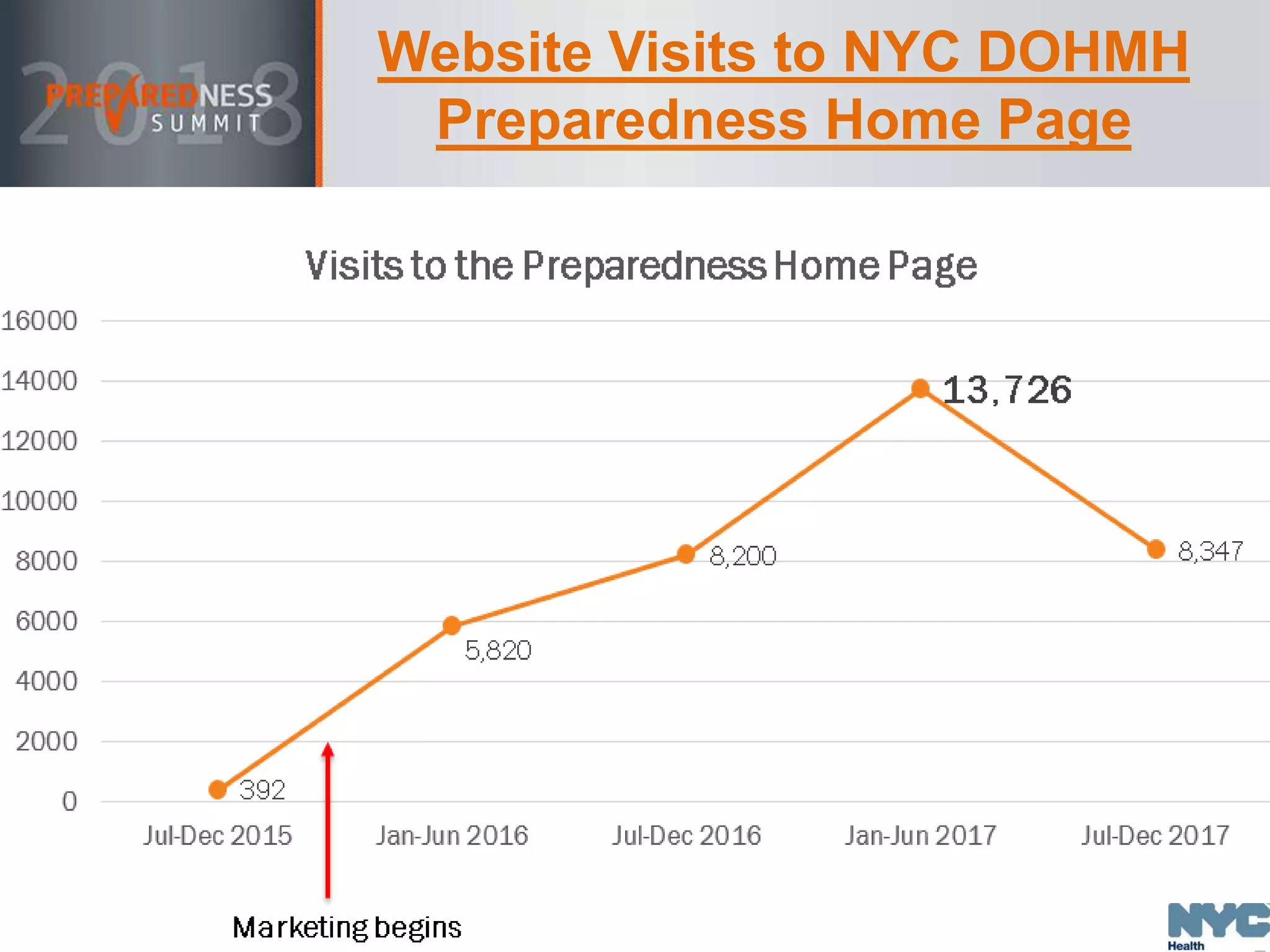
Website Visits to NYC DOHMH
Preparedness Home Page
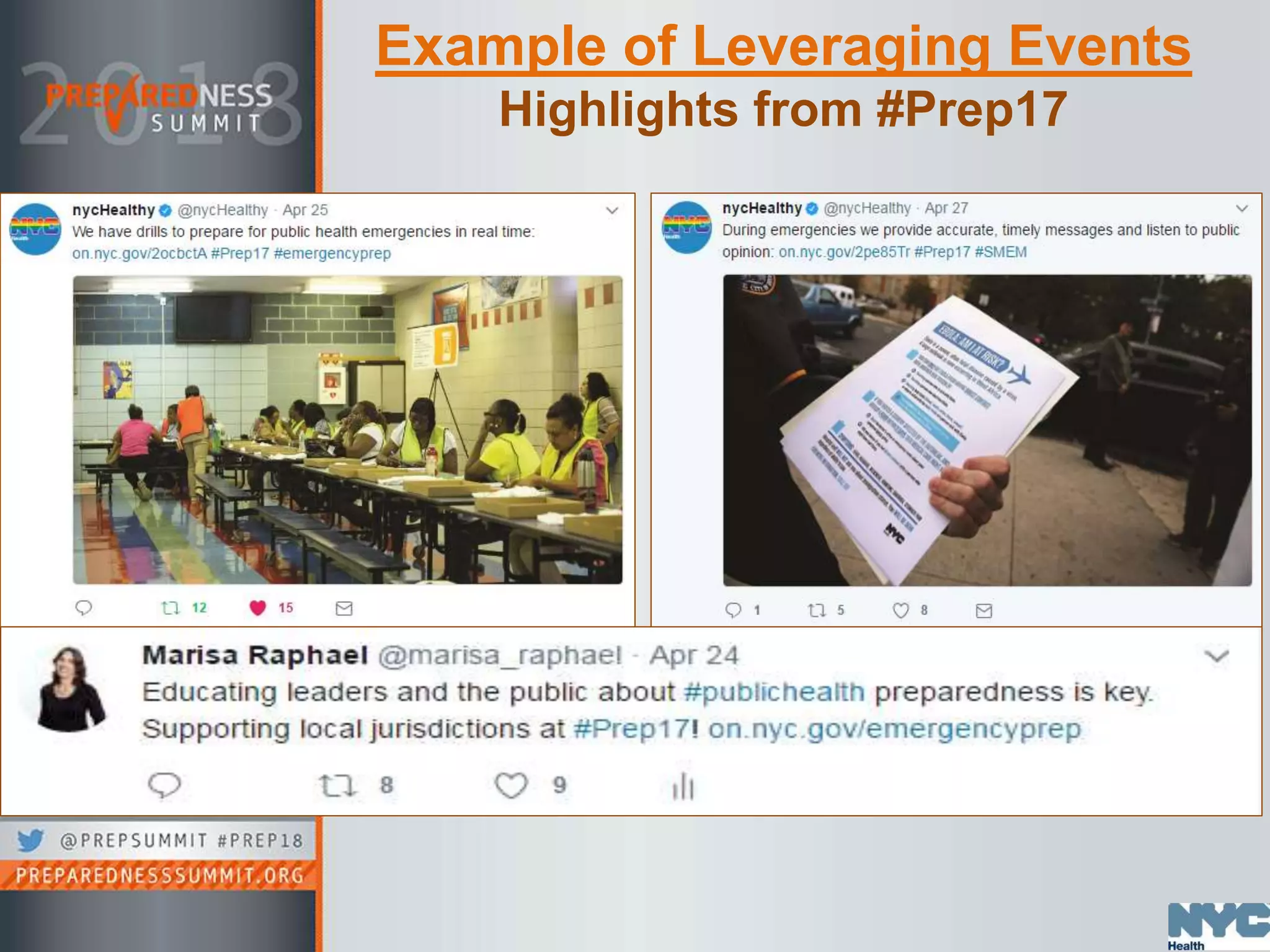
Example of Leveraging Events
Highlights from #Prep17
Input from Committee Member
“Don’t short-change the time used to
discuss building (audience) in peace-time.
Being in a flooding emergency right now, I
can tell you it was nice to have a base
following already and to be known in the
community to have active and timely
information. We have become a big
component of update distribution via
social media for the response due to the
peace-time focus.”
- NACCHO Committee Member, Michigan
Huge Disasters in Past Year
Highlighted Social Media Value
• Hurricane Harvey
• Hurricane Maria
• Hurricane Irma
• LA County Fires
• Santa Barbara Mudslides
• Ottawa County Michigan Flooding
Public Health Issues to Listen for on Social Media
Medium to Long-Term Impacts:
• Disruption of healthcare system access, including medicines
• Mental health issues including stress, depression and suicide
• Food and water access & contamination from waste/debris
• Increased risk of infectious diseases due to lack of safe water, hygiene,
and sanitation
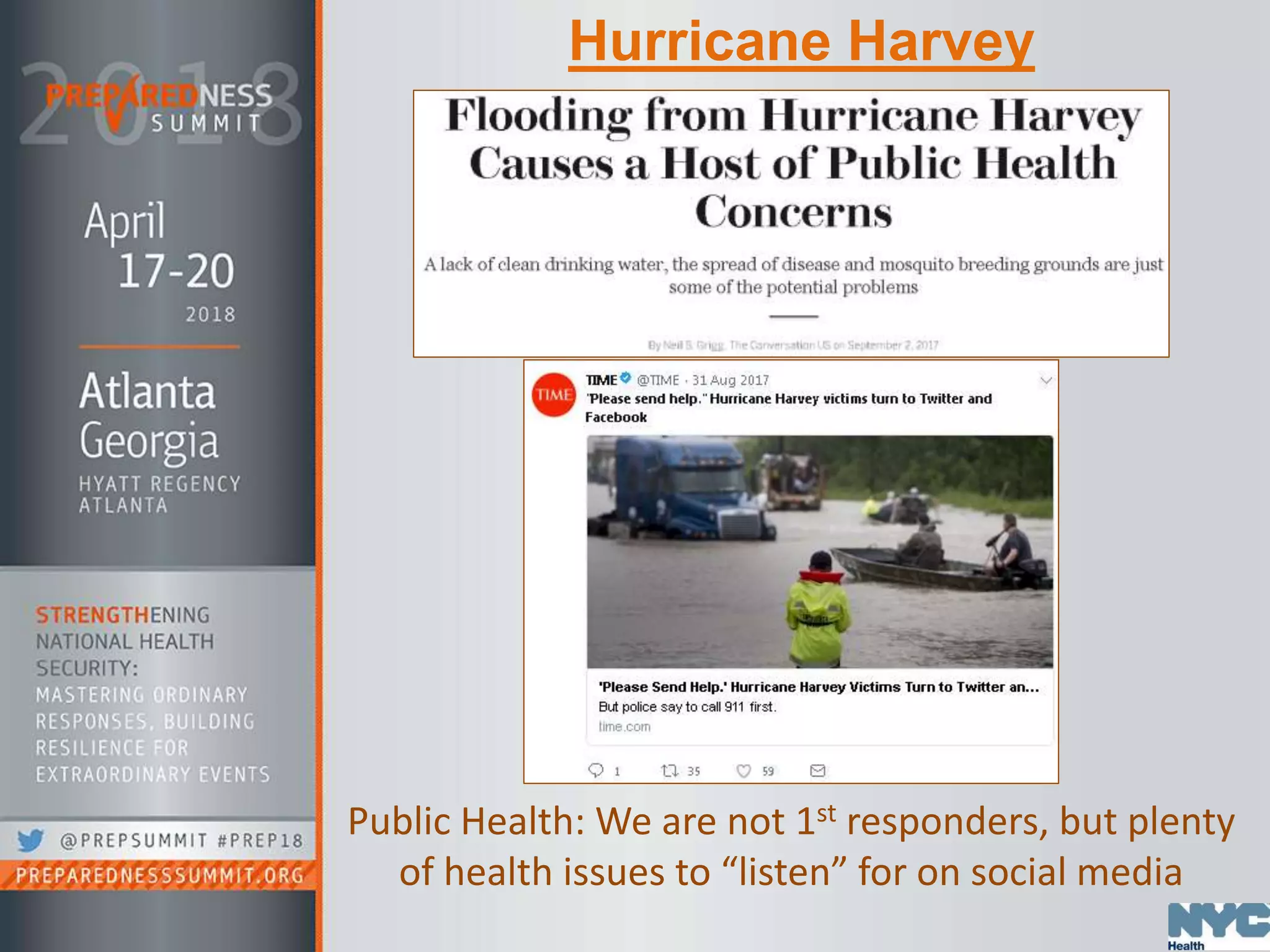
Hurricane Harvey
Public Health: We are not 1st responders, but plenty
of health issues to “listen” for on social media
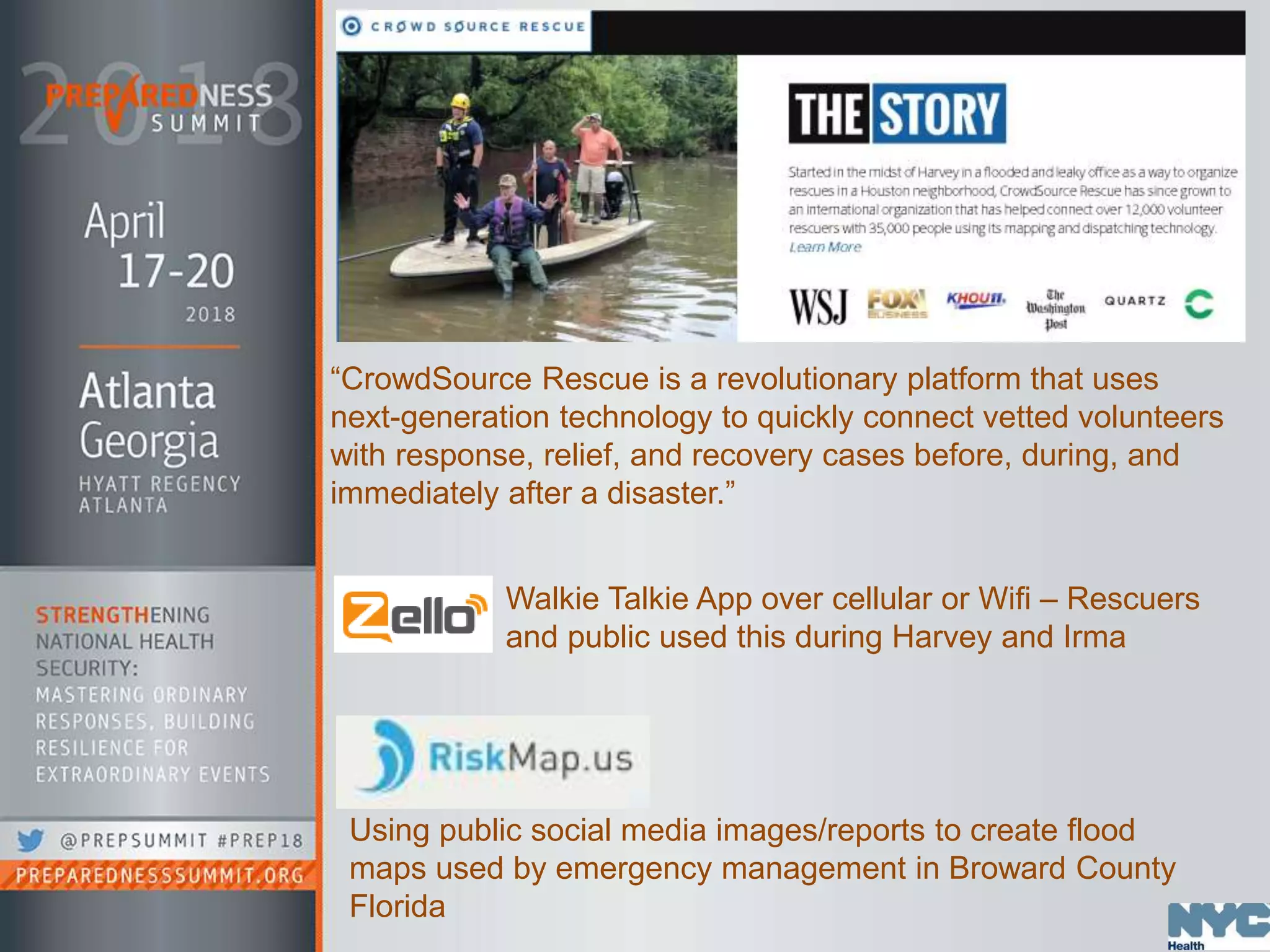
Using public social media images/reports to create flood
maps used by emergency management in Broward County
Florida
“CrowdSource Rescue is a revolutionary platform that uses
next-generation technology to quickly connect vetted volunteers
with response, relief, and recovery cases before, during, and
immediately after a disaster.”
Walkie Talkie App over cellular or Wifi – Rescuers
and public used this during Harvey and Irma
,
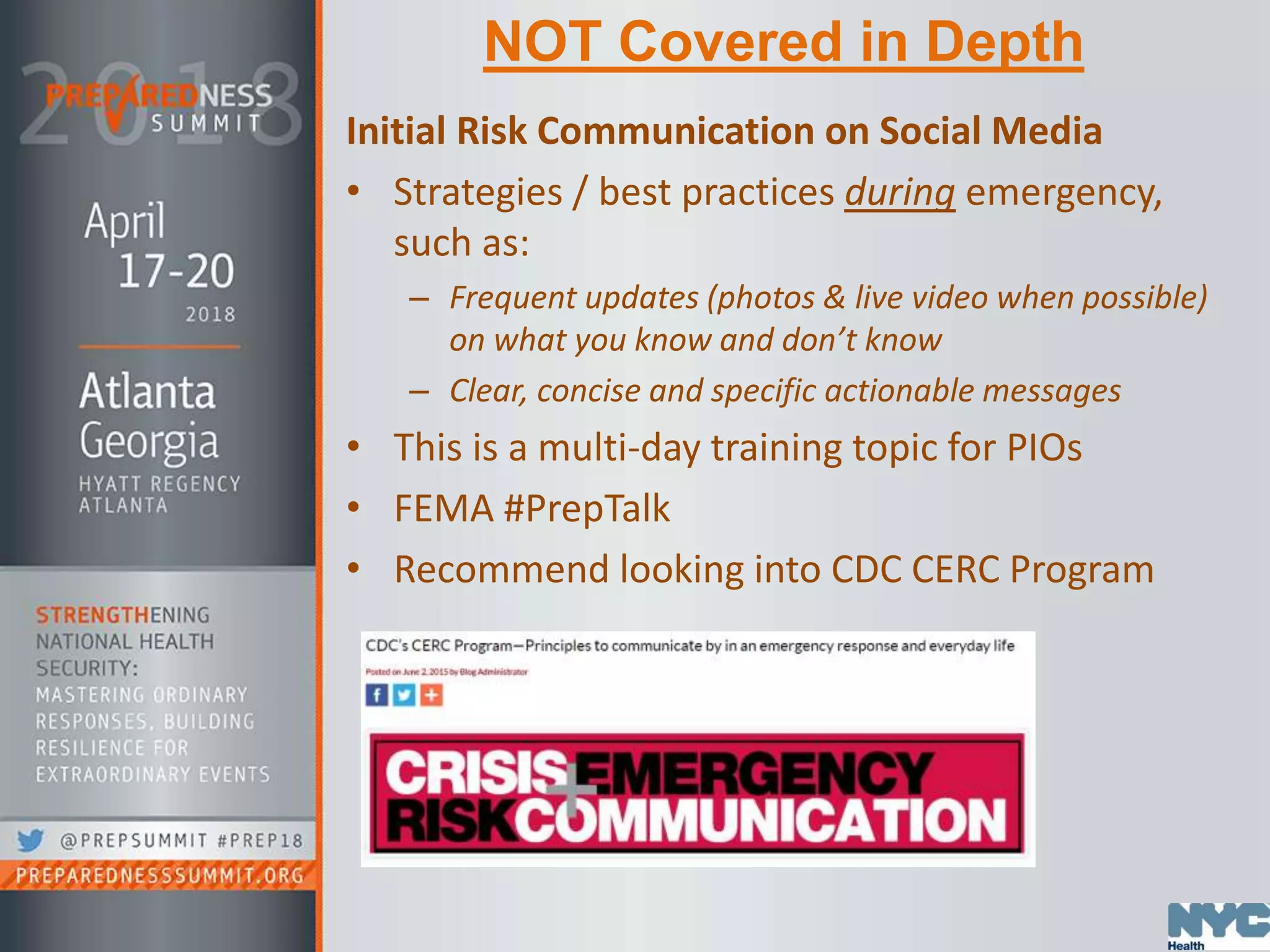
NOT Covered in Depth
Initial Risk Communication on Social Media
• Strategies / best practices during emergency,
such as:
– Frequent updates (photos & live video when possible)
on what you know and don’t know
– Clear, concise and specific actionable messages
• This is a multi-day training topic for PIOs
• FEMA #PrepTalk
• Recommend looking into CDC CERC Program
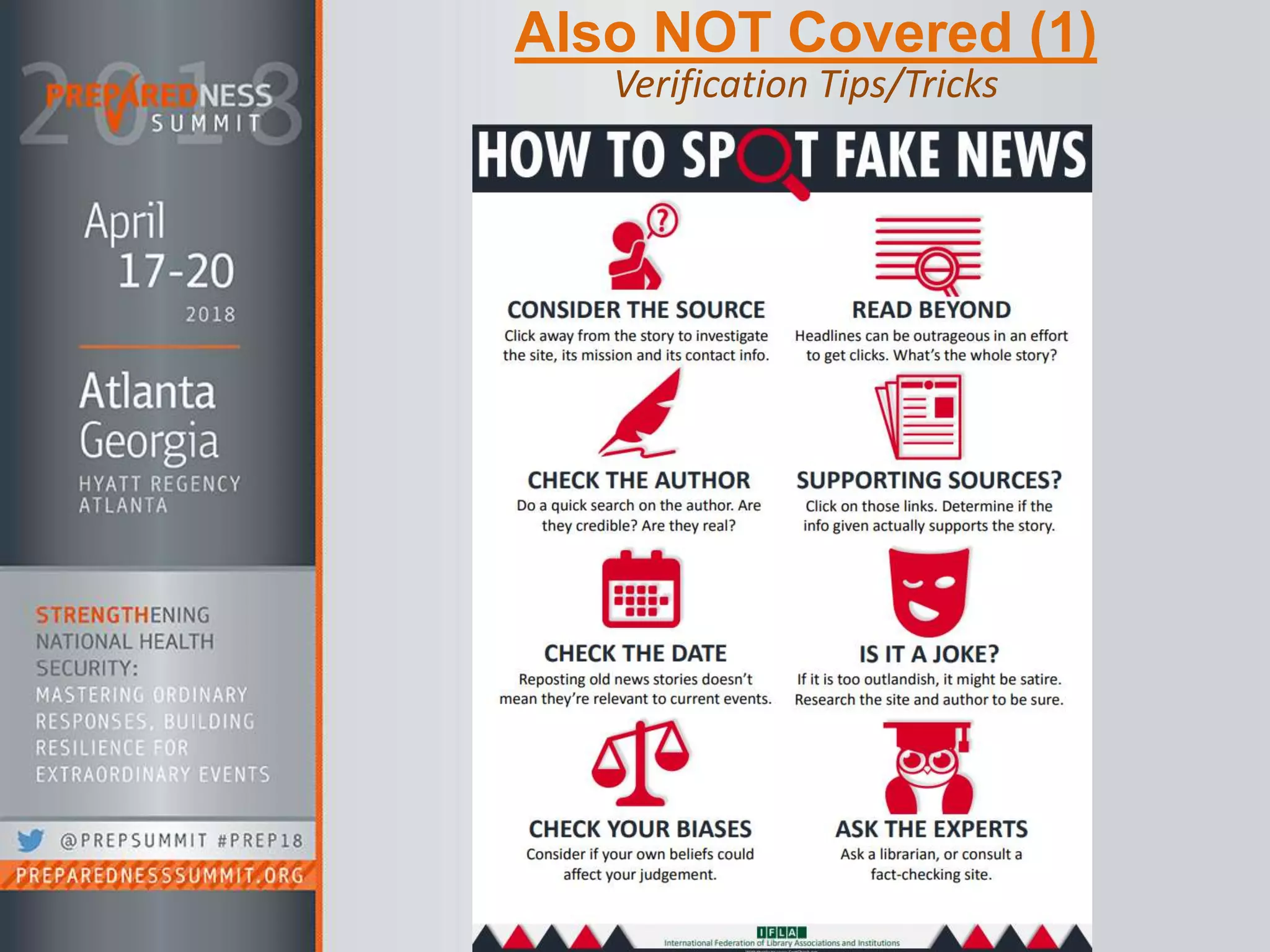
Also NOT Covered (1)
Verification Tips/Tricks
Also NOT Covered (2)
Verification Tips/Tricks
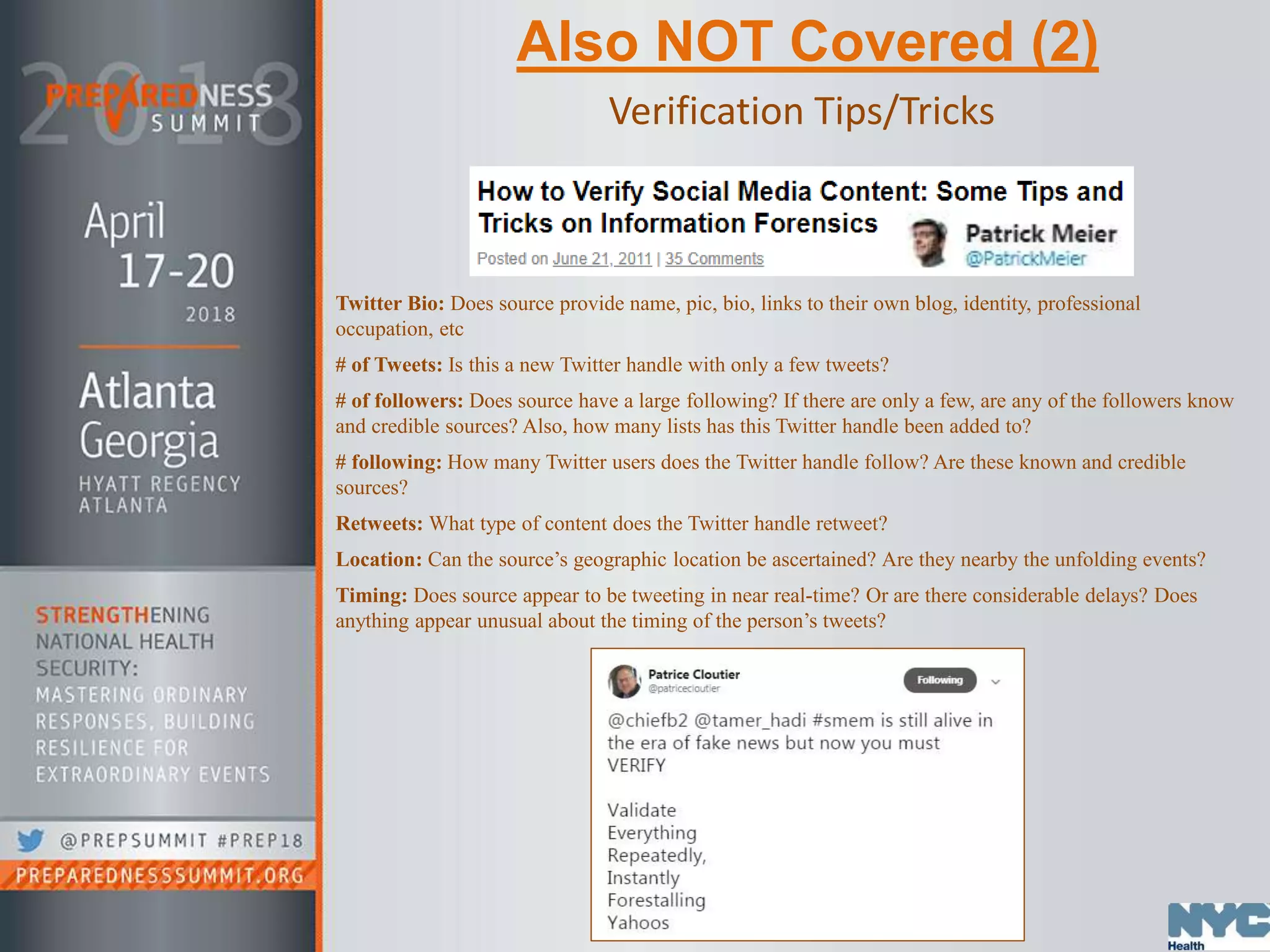
Twitter Bio: Does source provide name, pic, bio, links to their own blog, identity, professional
occupation, etc
# of Tweets: Is this a new Twitter handle with only a few tweets?
# of followers: Does source have a large following? If there are only a few, are any of the followers know
and credible sources? Also, how many lists has this Twitter handle been added to?
# following: How many Twitter users does the Twitter handle follow? Are these known and credible
sources?
Retweets: What type of content does the Twitter handle retweet?
Location: Can the source’s geographic location be ascertained? Are they nearby the unfolding events?
Timing: Does source appear to be tweeting in near real-time? Or are there considerable delays? Does
anything appear unusual about the timing of the person’s tweets?
General Monitoring Goals
(for all emergencies)
• Understanding general sentiment and
public reaction to the incident
• Capturing frequently asked questions to
inform future agency messages
• Countering misinformation and rumors
(particularly news outlets and
influencers)
• Monitoring agency discussion
– POLICY ISSUE: Handling social media interactions
during an activation (e.g., direct mentions only or do
you expand wider).
Free “Listening” Tools
• Twitter Advanced Search
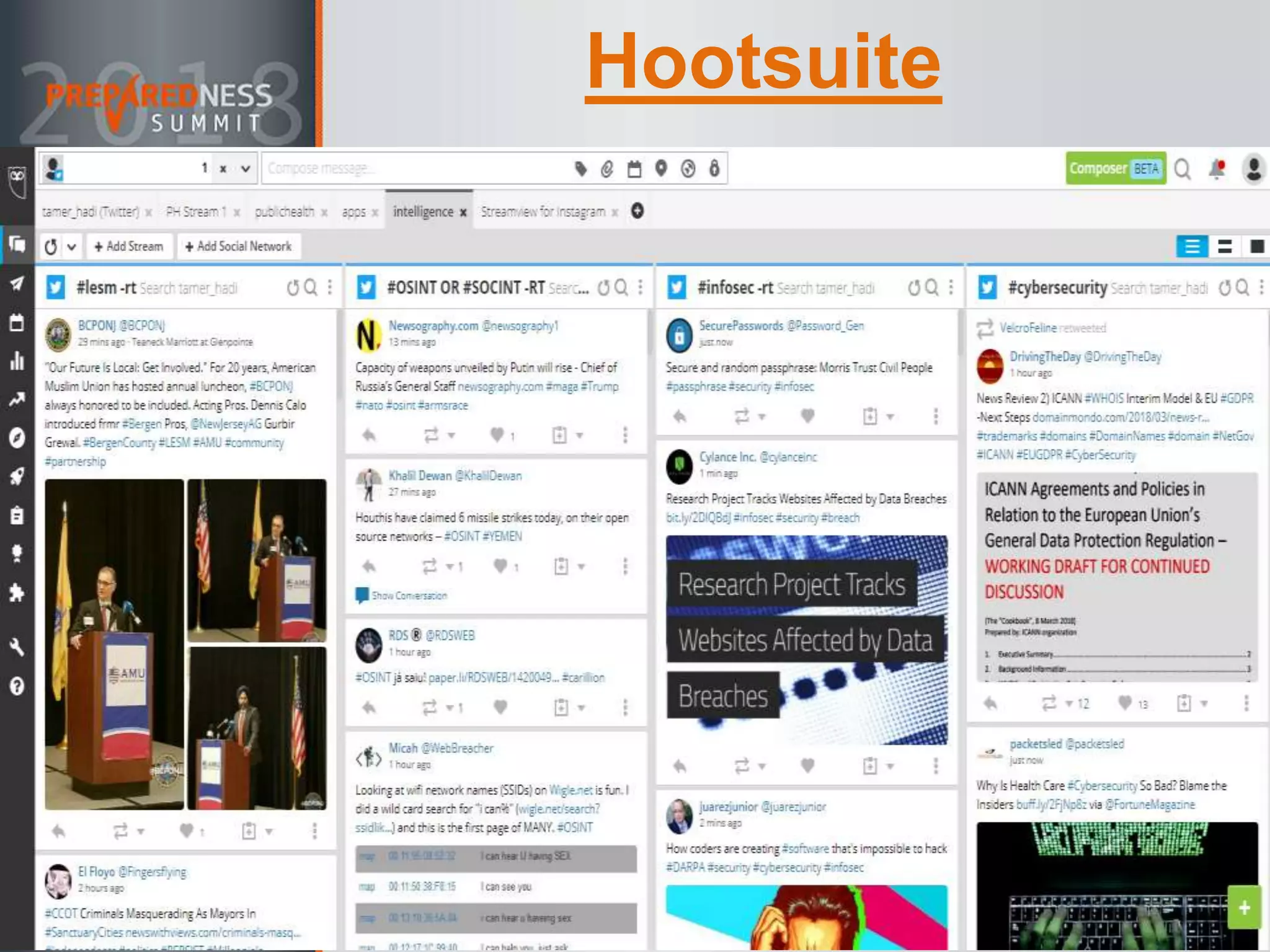
• TweetDeck and/or Hootsuite
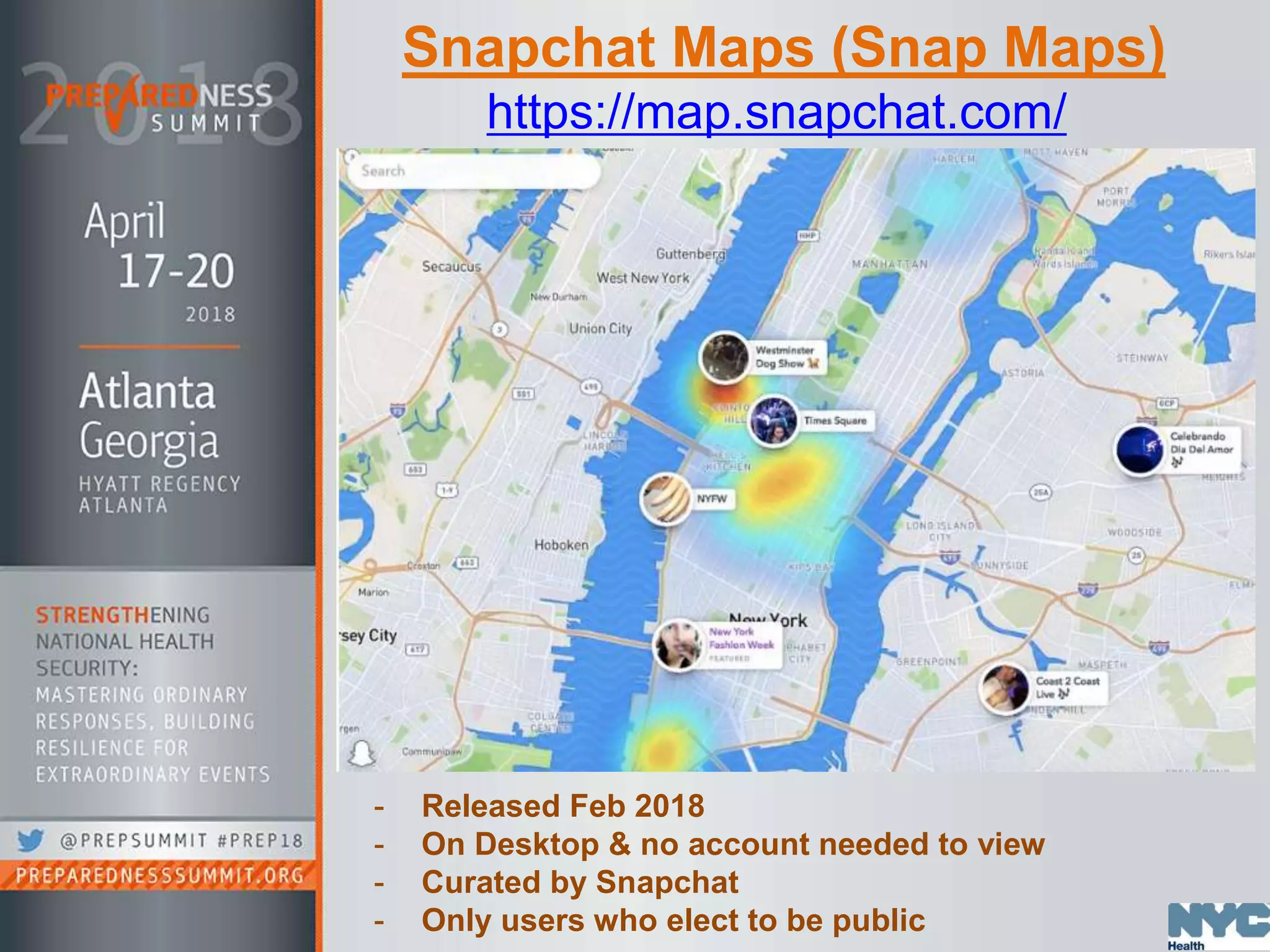
• Snapchat (Snap Maps)
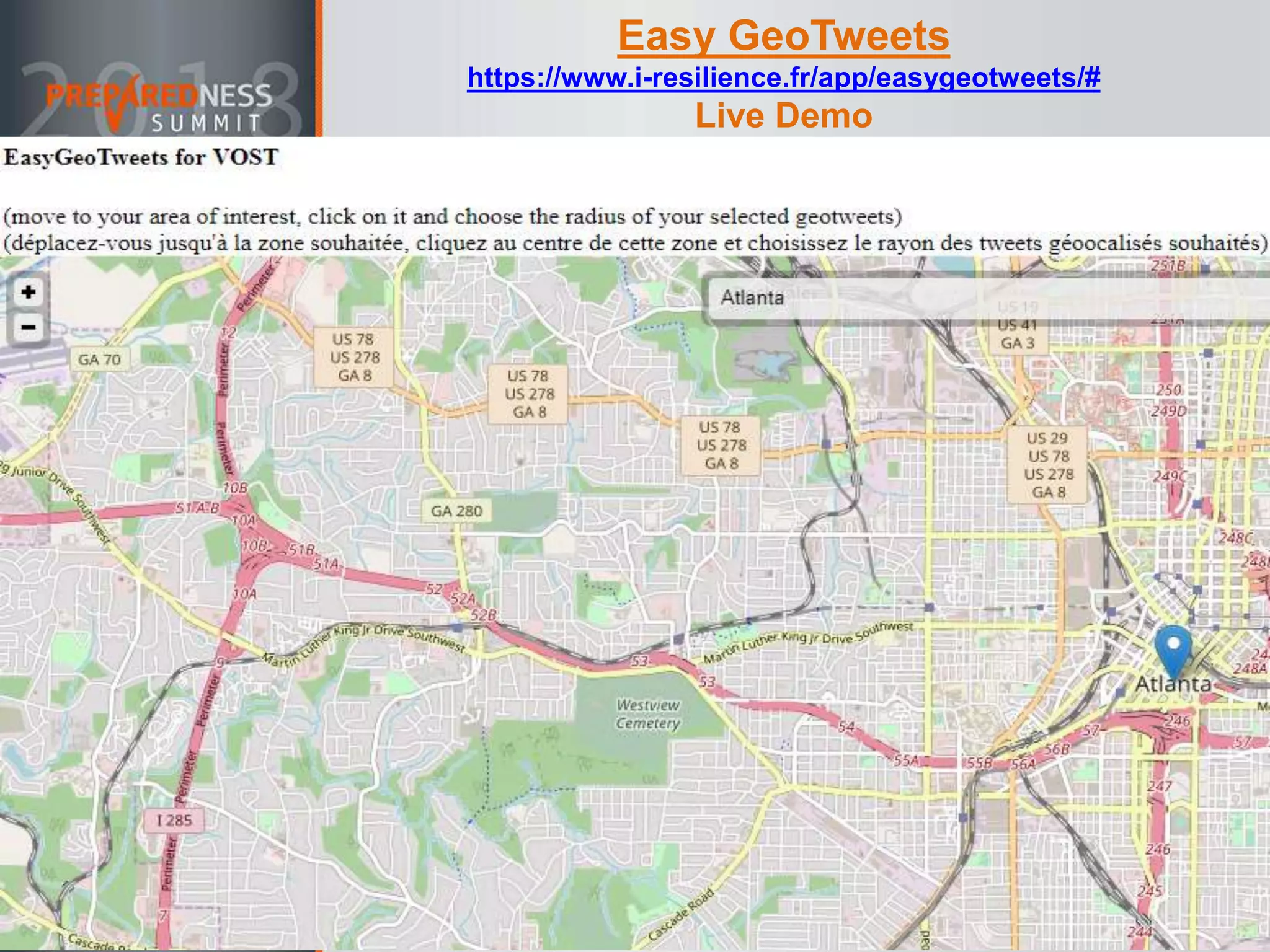
• GeoTweets
Free #SMEM Training/Resources
• National Disaster Preparedness Training Center
• NLM Disaster Library Social Media Training
• ASPR TRACIE Social Media Collection
• DHS S&T Work Group
• Drexel University Social Media Library
• Follow #SMEM and #EMGTwitter
Free Risk Communication Tools
• Facebook Live
• YouTube Live
• NextDoor (strong for geographic reach)
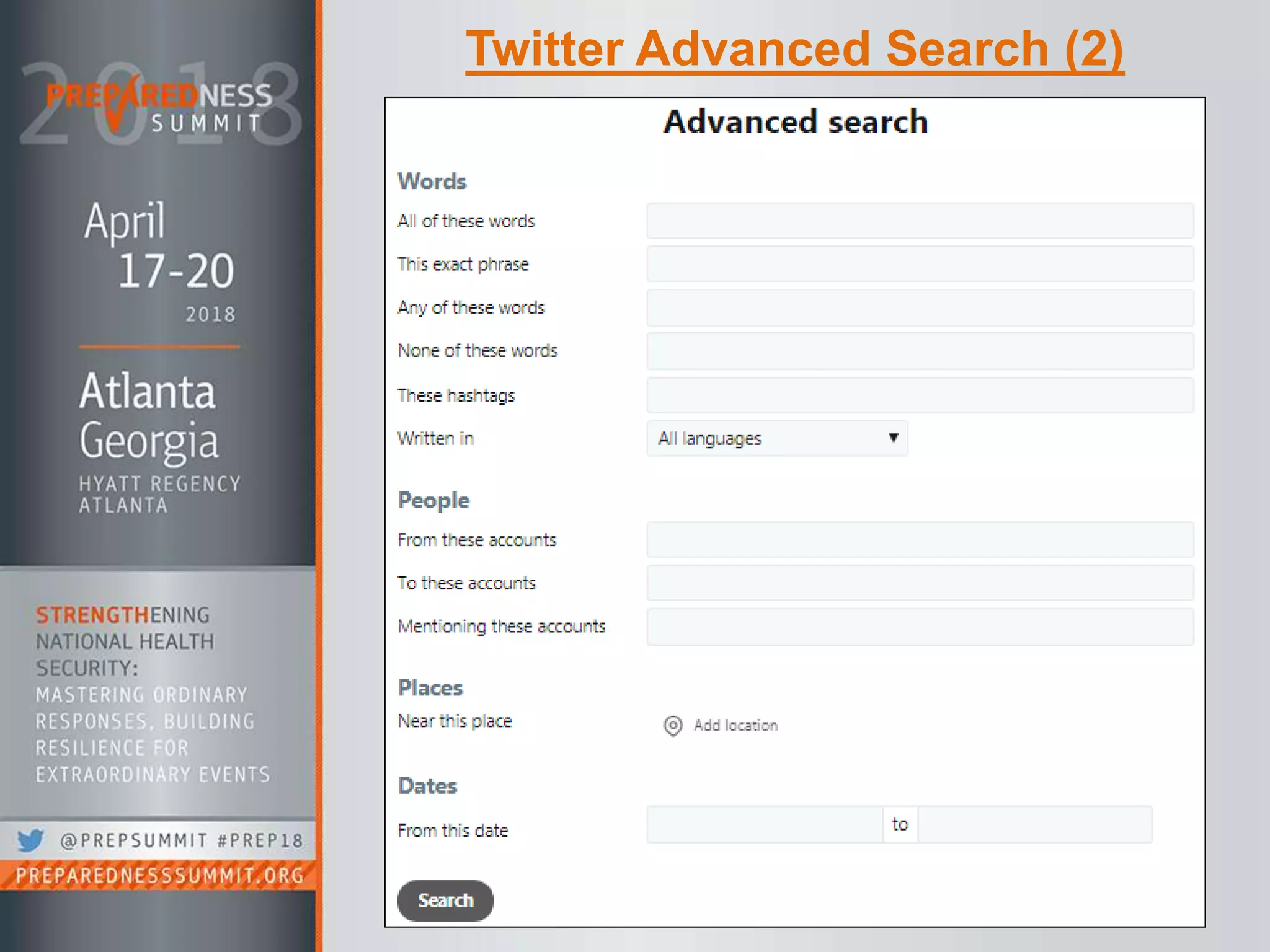
Twitter Advanced Search (1)
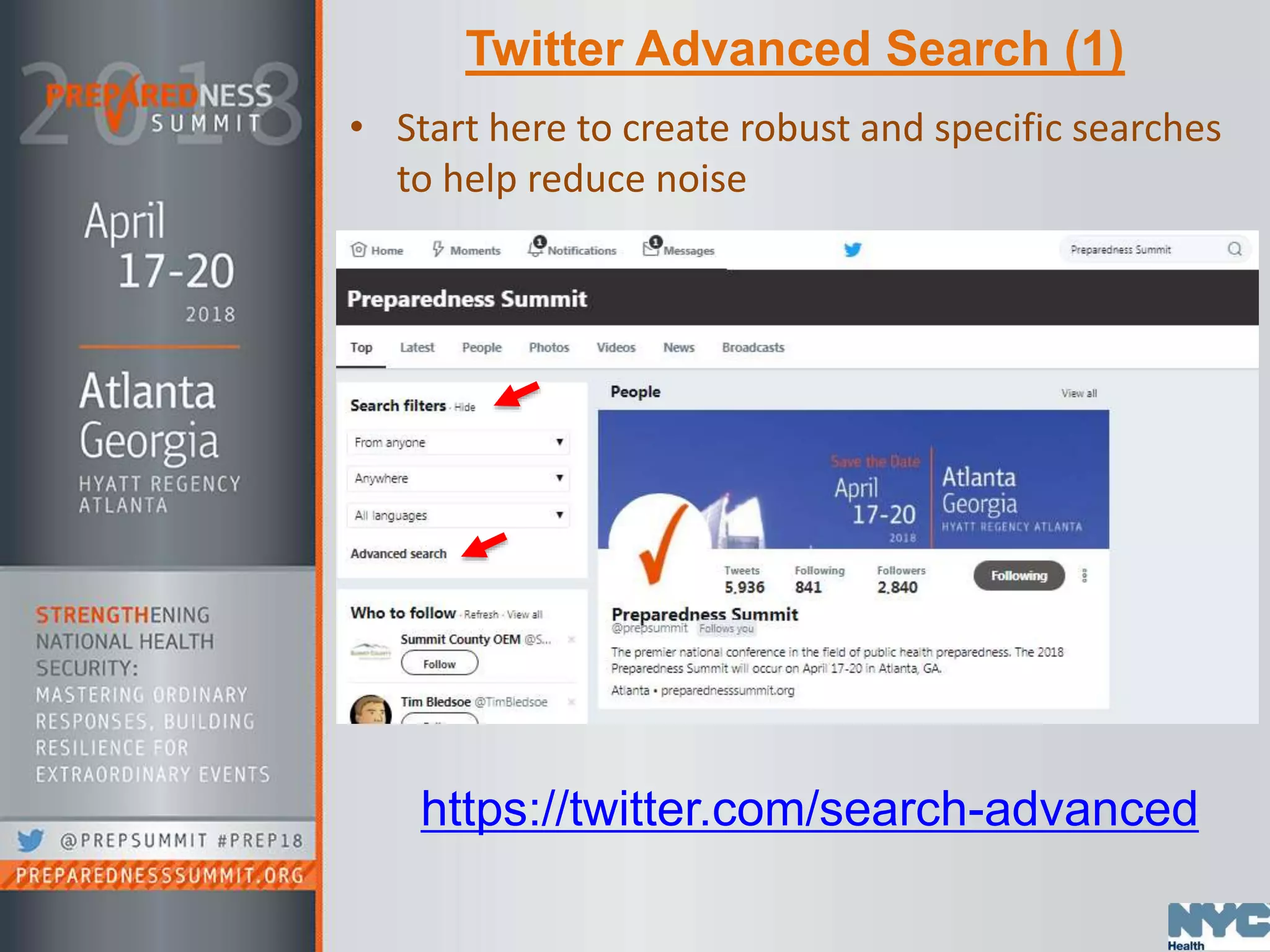
• Start here to create robust and specific searches
to help reduce noise
https://twitter.com/search-advanced
Twitter Advanced Search (2)
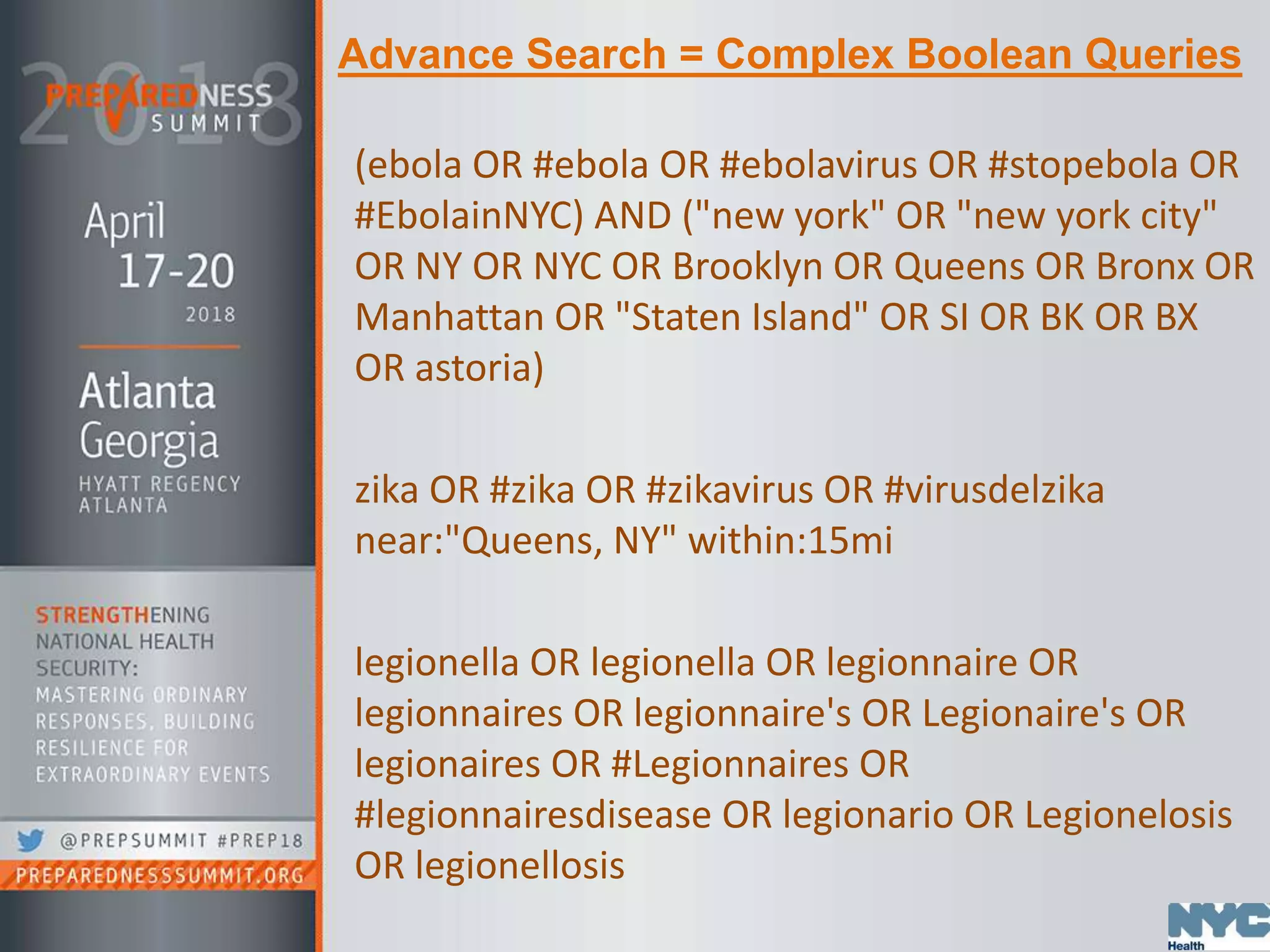
Advance Search = Complex Boolean Queries
(ebola OR #ebola OR #ebolavirus OR #stopebola OR
#EbolainNYC) AND ("new york" OR "new york city"
OR NY OR NYC OR Brooklyn OR Queens OR Bronx OR
Manhattan OR "Staten Island" OR SI OR BK OR BX
OR astoria)
zika OR #zika OR #zikavirus OR #virusdelzika
near:"Queens, NY" within:15mi
legionella OR legionella OR legionnaire OR
legionnaires OR legionnaire's OR Legionaire's OR
legionaires OR #Legionnaires OR
#legionnairesdisease OR legionario OR Legionelosis
OR legionellosis
Vs.
*** for monitoring ***
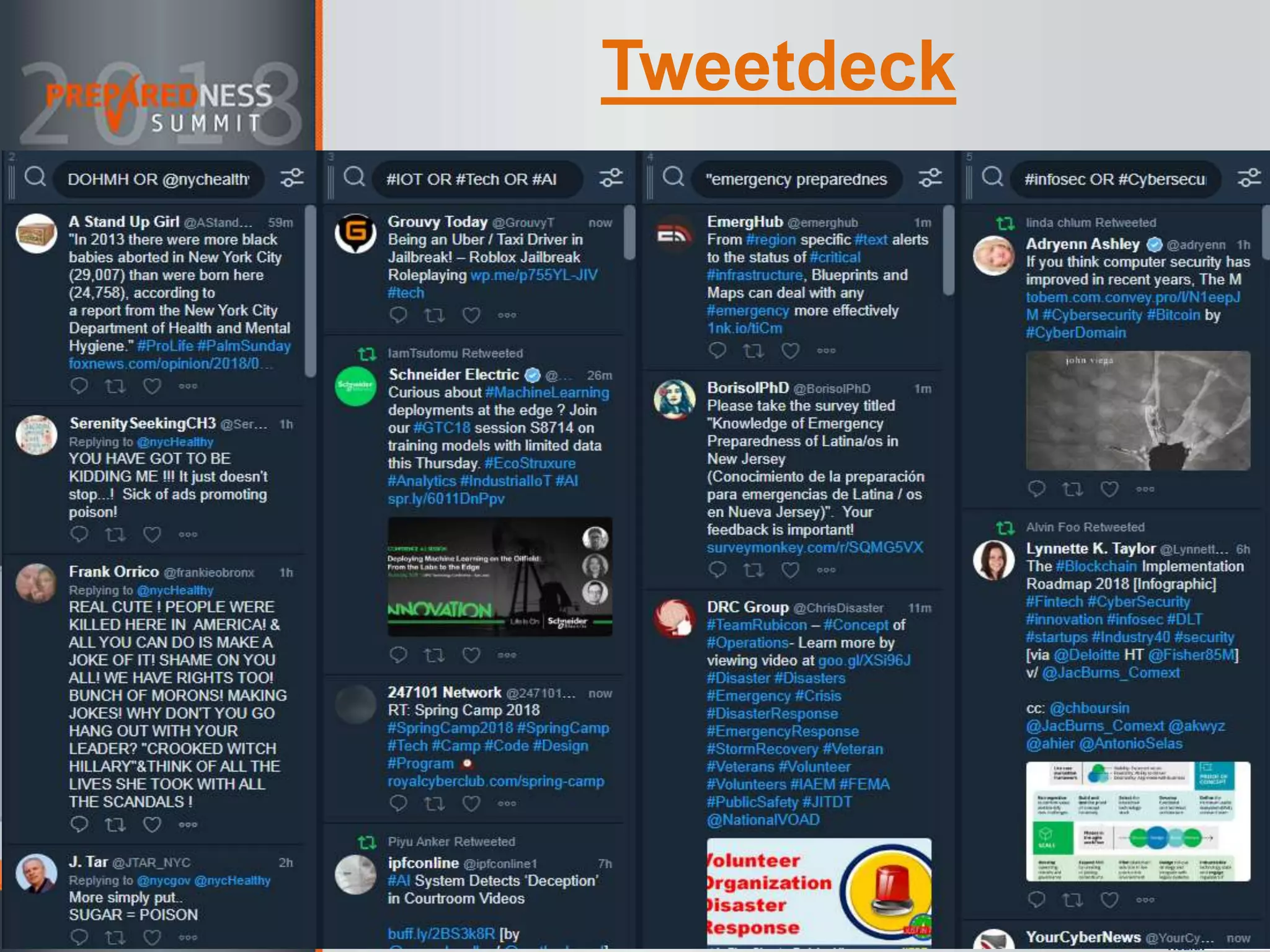
Tweetdeck
Hootsuite
Snapchat Maps (Snap Maps)
https://map.snapchat.com/
- Released Feb 2018
- On Desktop & no account needed to view
- Curated by Snapchat
- Only users who elect to be public
Easy GeoTweets
https://www.i-resilience.fr/app/easygeotweets/#
Live Demo
Visualizing Flagged Content
You can migrate
stories to
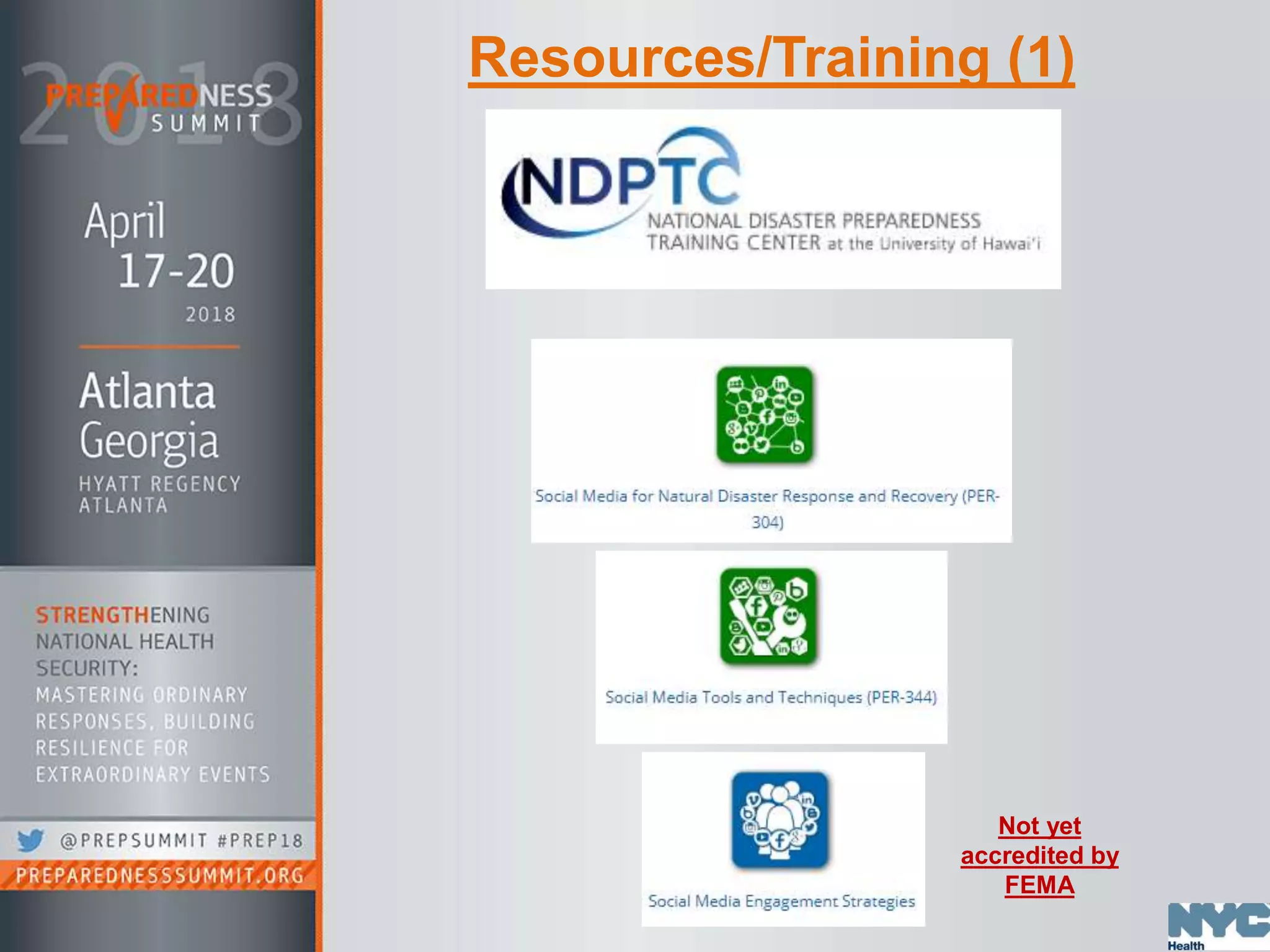
Resources/Training (1)
Not yet
accredited by
FEMA
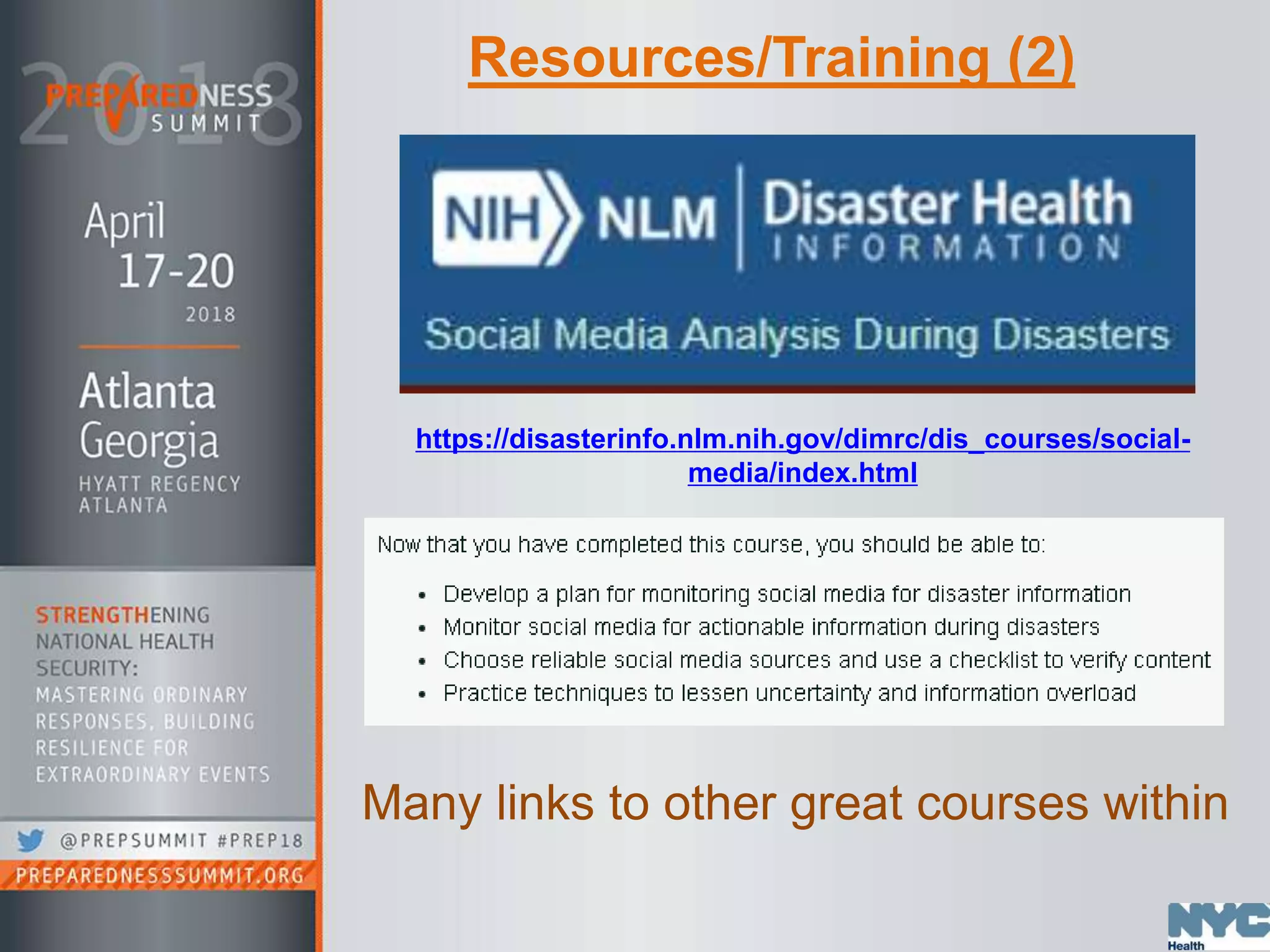
Resources/Training (2)
https://disasterinfo.nlm.nih.gov/dimrc/dis_courses/social-
media/index.html
Many links to other great courses within
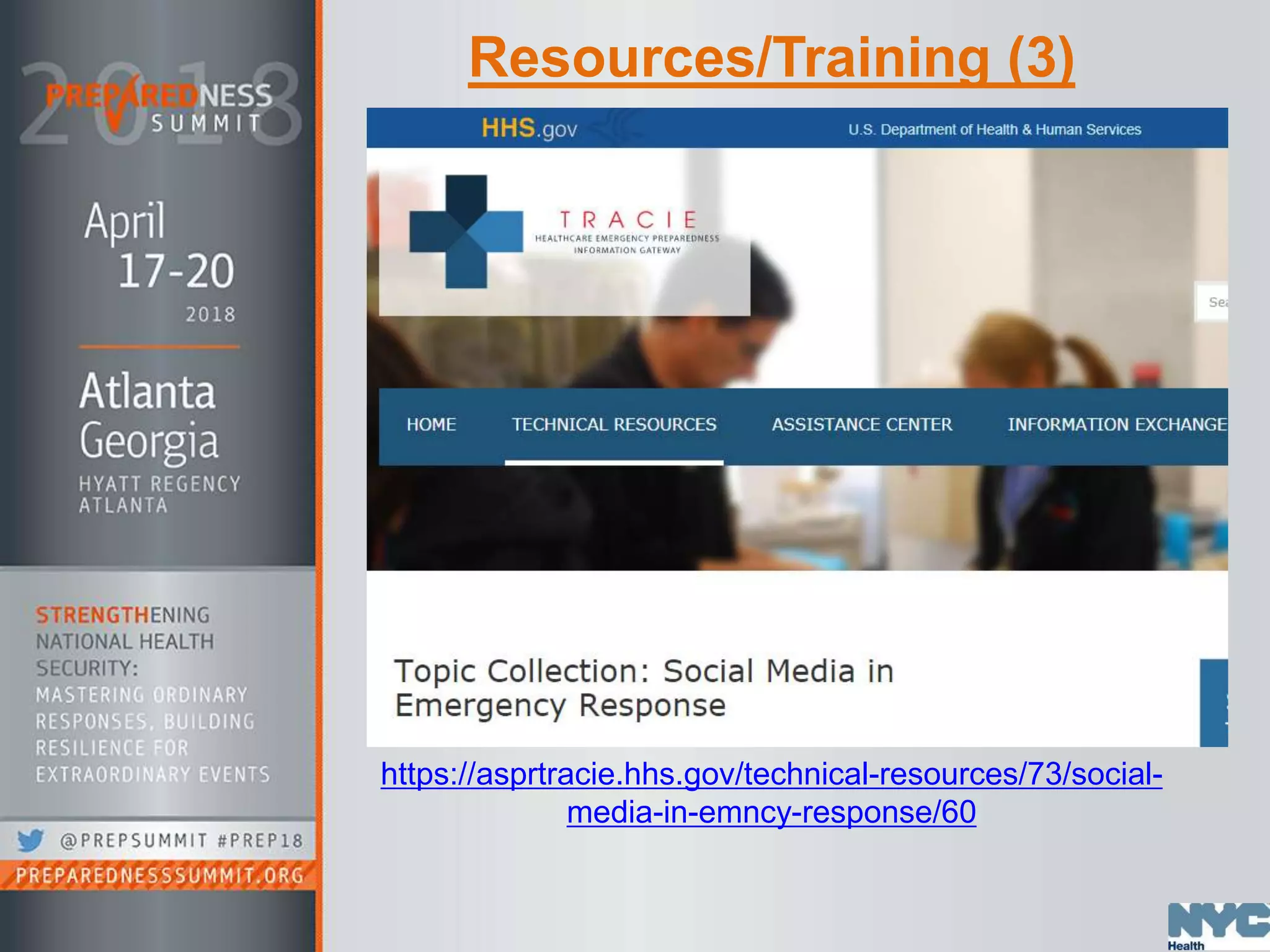
Resources/Training (3)
https://asprtracie.hhs.gov/technical-resources/73/social-
media-in-emncy-response/60
Resources/Training (4)
OLDER REPORTS
• Best Practices for Incorporating Social Media into
Exercises - March 2017
• From Concept to Reality: Operationalizing Social
Media for Preparedness, Response and Recovery –
April 2016
• Using Social Media for Enhanced Situational
Awareness and Decision Support – June 2014
• Lessons Learned: Social Media and Hurricane
Sandy – June 2013
• Community Engagement and Social Media Best
Practices – September 2012
• Next Steps: Social Media for Emergency Response –
January 2012
• Social Media Strategy – January 2012
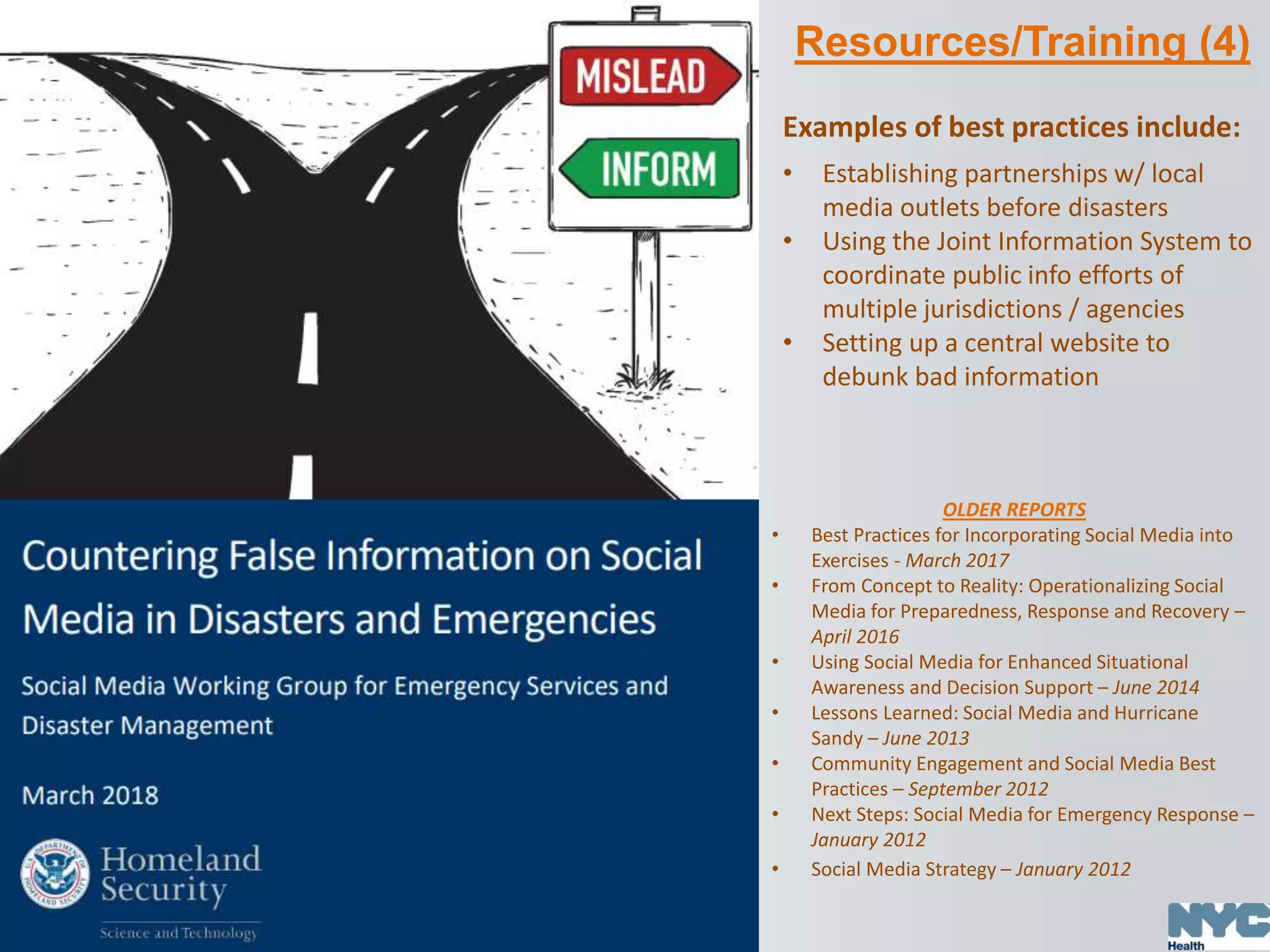
Examples of best practices include:
• Establishing partnerships w/ local
media outlets before disasters
• Using the Joint Information System to
coordinate public info efforts of
multiple jurisdictions / agencies
• Setting up a central website to
debunk bad information
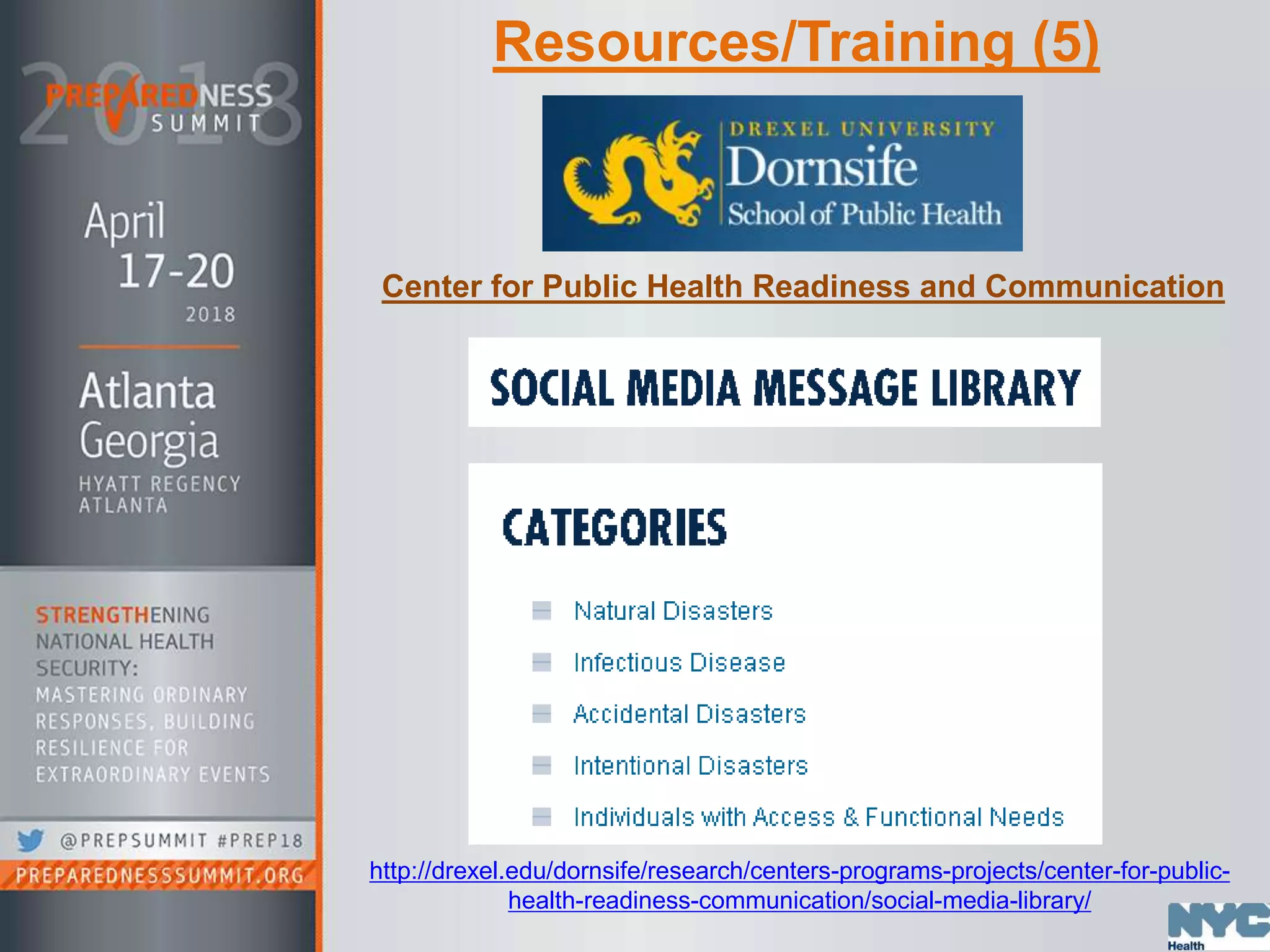
Resources/Training (5)
http://drexel.edu/dornsife/research/centers-programs-projects/center-for-public-
health-readiness-communication/social-media-library/
Center for Public Health Readiness and Communication
Leveraging External Support
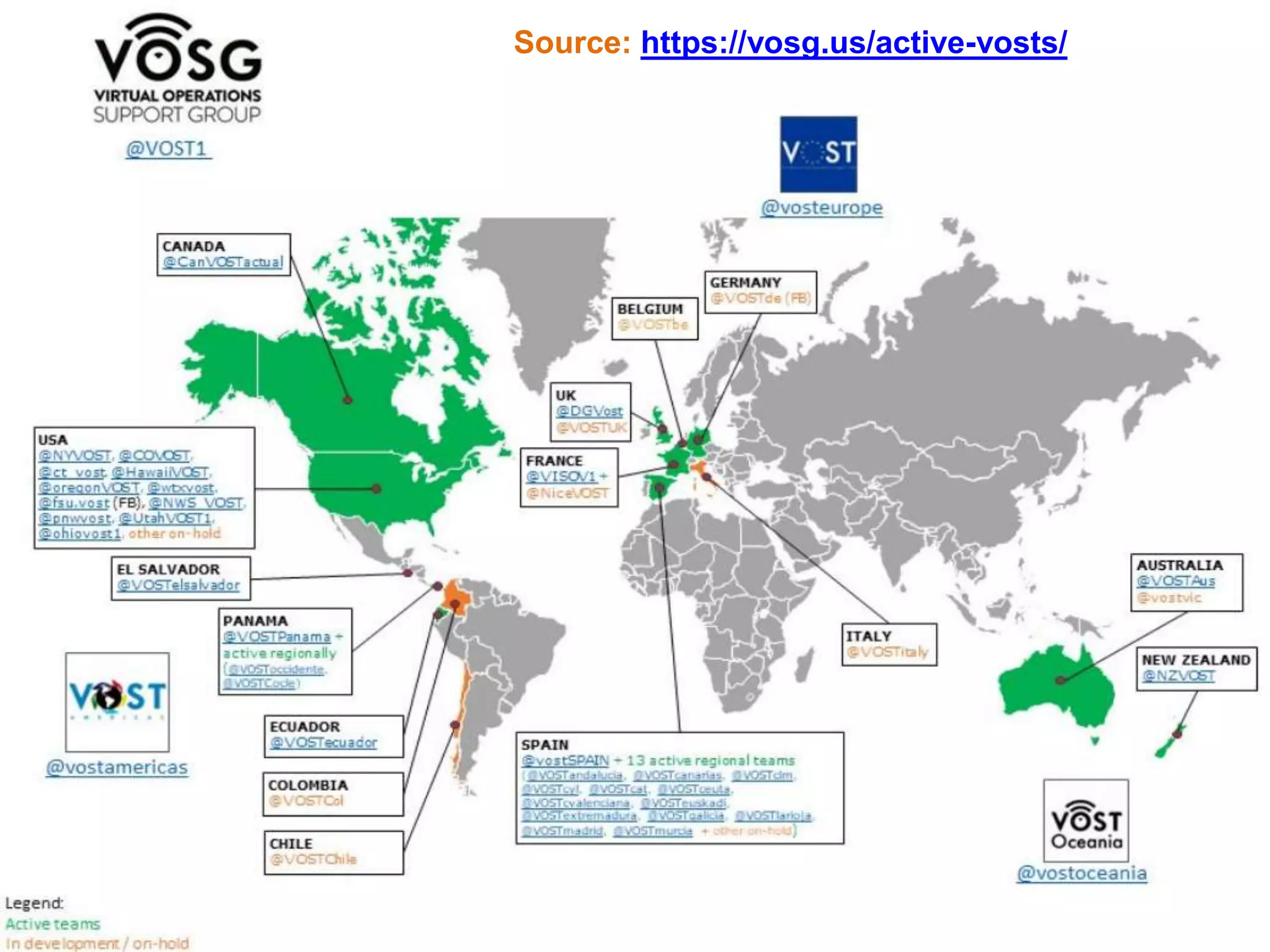
VOST = Virtual Operations Support Team
- External to agency
- Team of volunteers activated to
perform specific social media / online
functions in support of an affected
organization and/or jurisdiction
- Each VOST typically has a “Team
Leader” for any given operational
period that reports directly to the
affected organization/agency
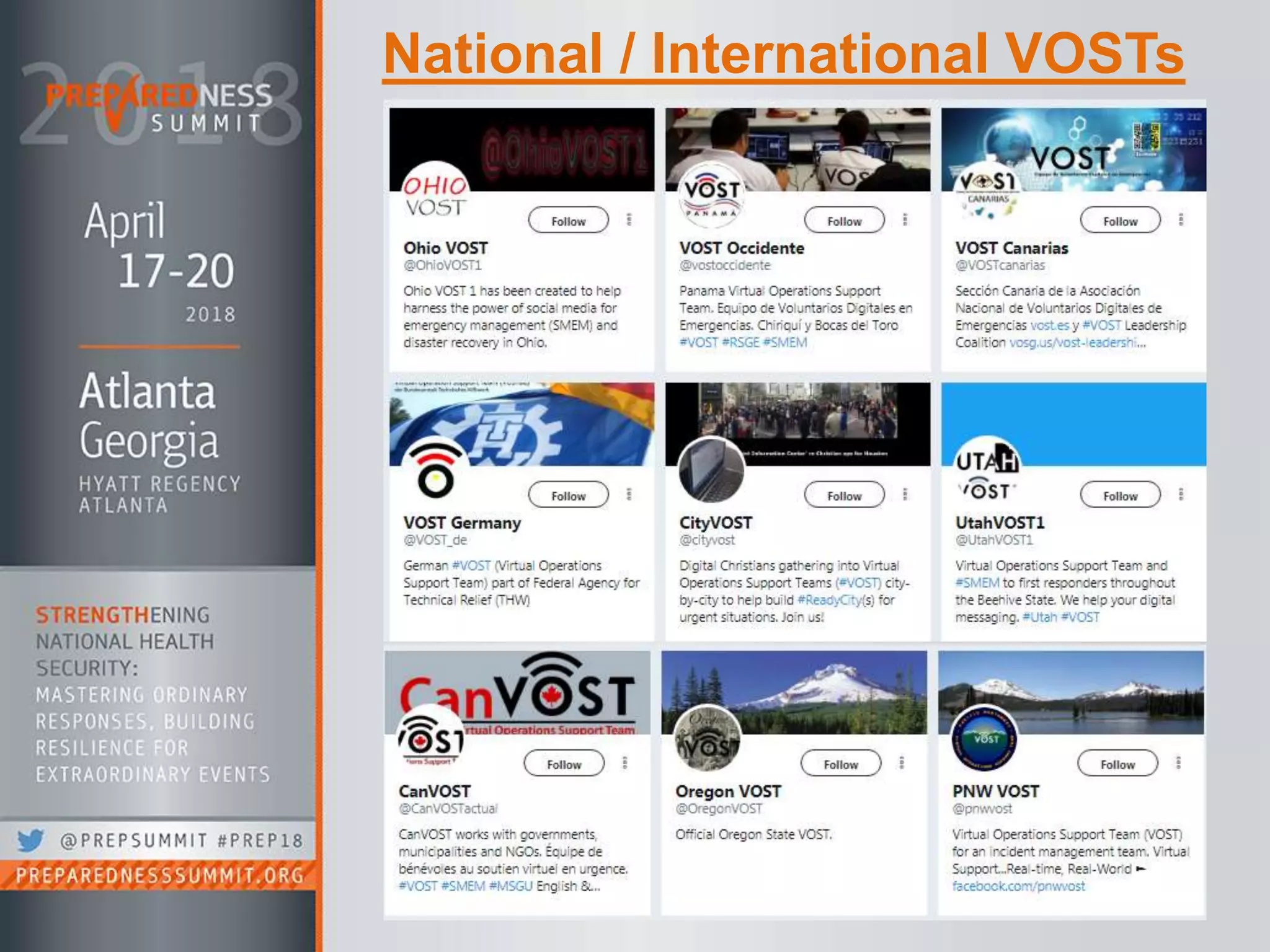
National / International VOSTs
Source: https://vosg.us/active-vosts/
NYC MRC VOST
Group of ~20 MRC volunteers trained to support
internal monitoring team
- Role 1: Official message amplifiers (English/other languages)
IMPORTANCE: Help spread factual info by posting official city
messages in English and other languages
- Role 2: Searching for incident-specific information (English
and other languages)
IMPORTANCE: Help DOHMH find relevant content and
understand how messaging is being received by the public
- Role 3: Reporting to the SMMT Lead
IMPORTANCE: Making DOHMH aware of relevant content that
can inform the response
Social Media Monitoring:
Case Studies from NYC
• Ebola in NYC
(in-depth)
• Halloween Truck
Ramming Incident 2017
(brief)
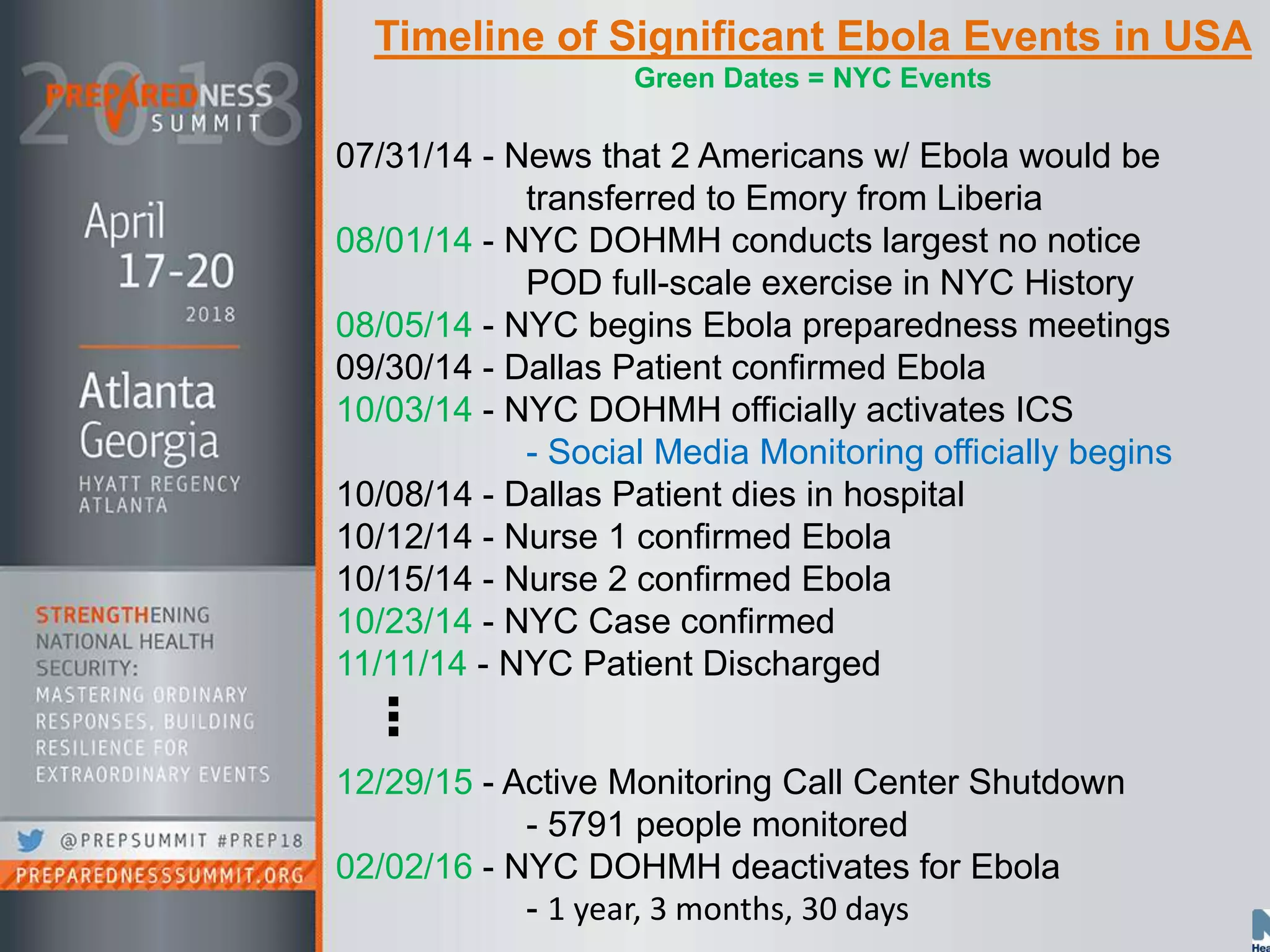
Timeline of Significant Ebola Events in USA
Green Dates = NYC Events
07/31/14 - News that 2 Americans w/ Ebola would be
transferred to Emory from Liberia
08/01/14 - NYC DOHMH conducts largest no notice
POD full-scale exercise in NYC History
08/05/14 - NYC begins Ebola preparedness meetings
09/30/14 - Dallas Patient confirmed Ebola
10/03/14 - NYC DOHMH officially activates ICS
- Social Media Monitoring officially begins
10/08/14 - Dallas Patient dies in hospital
10/12/14 - Nurse 1 confirmed Ebola
10/15/14 - Nurse 2 confirmed Ebola
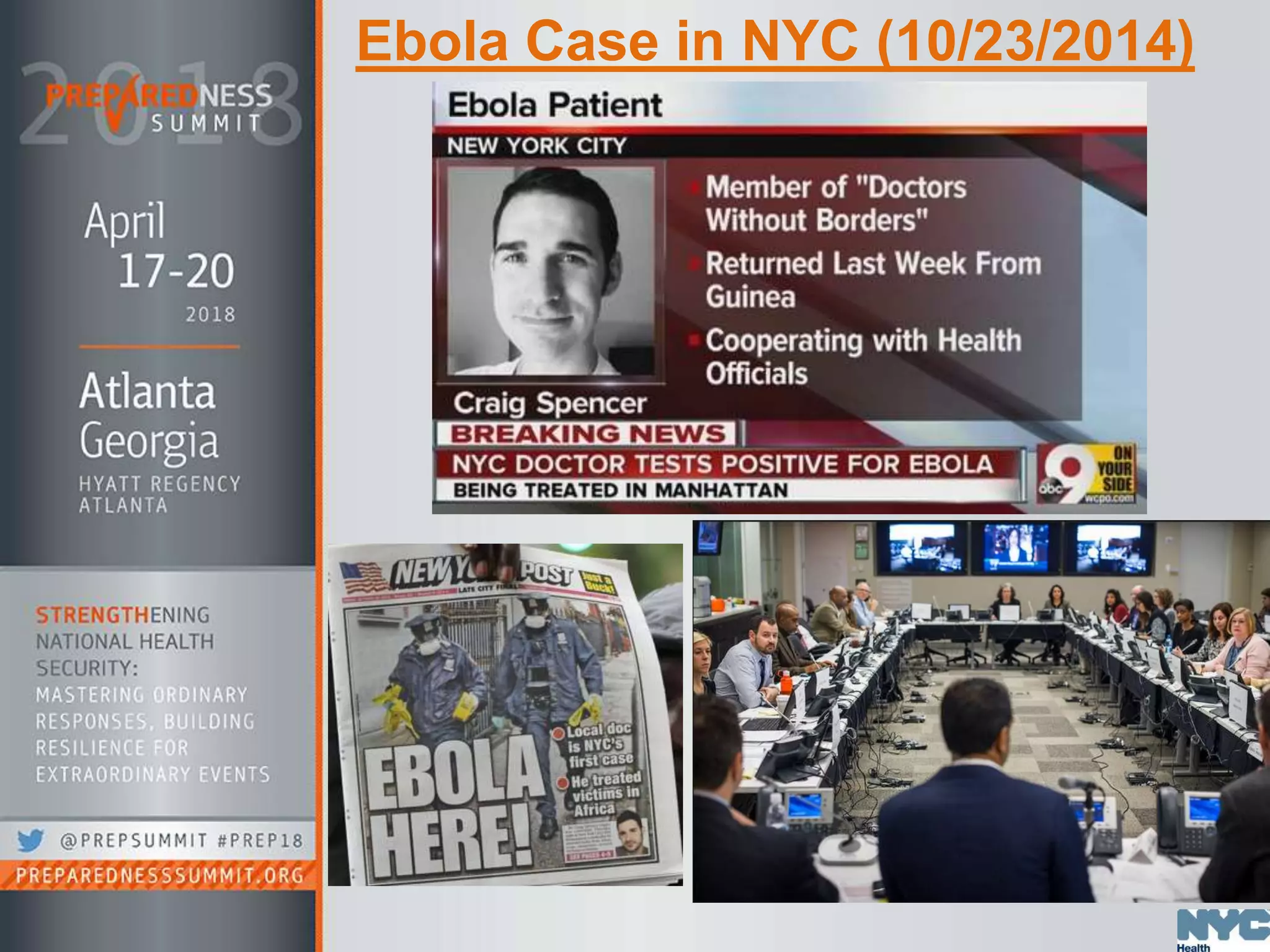
10/23/14 - NYC Case confirmed
11/11/14 - NYC Patient Discharged
12/29/15 - Active Monitoring Call Center Shutdown
- 5791 people monitored
02/02/16 - NYC DOHMH deactivates for Ebola
- 1 year, 3 months, 30 days
▪▪▪
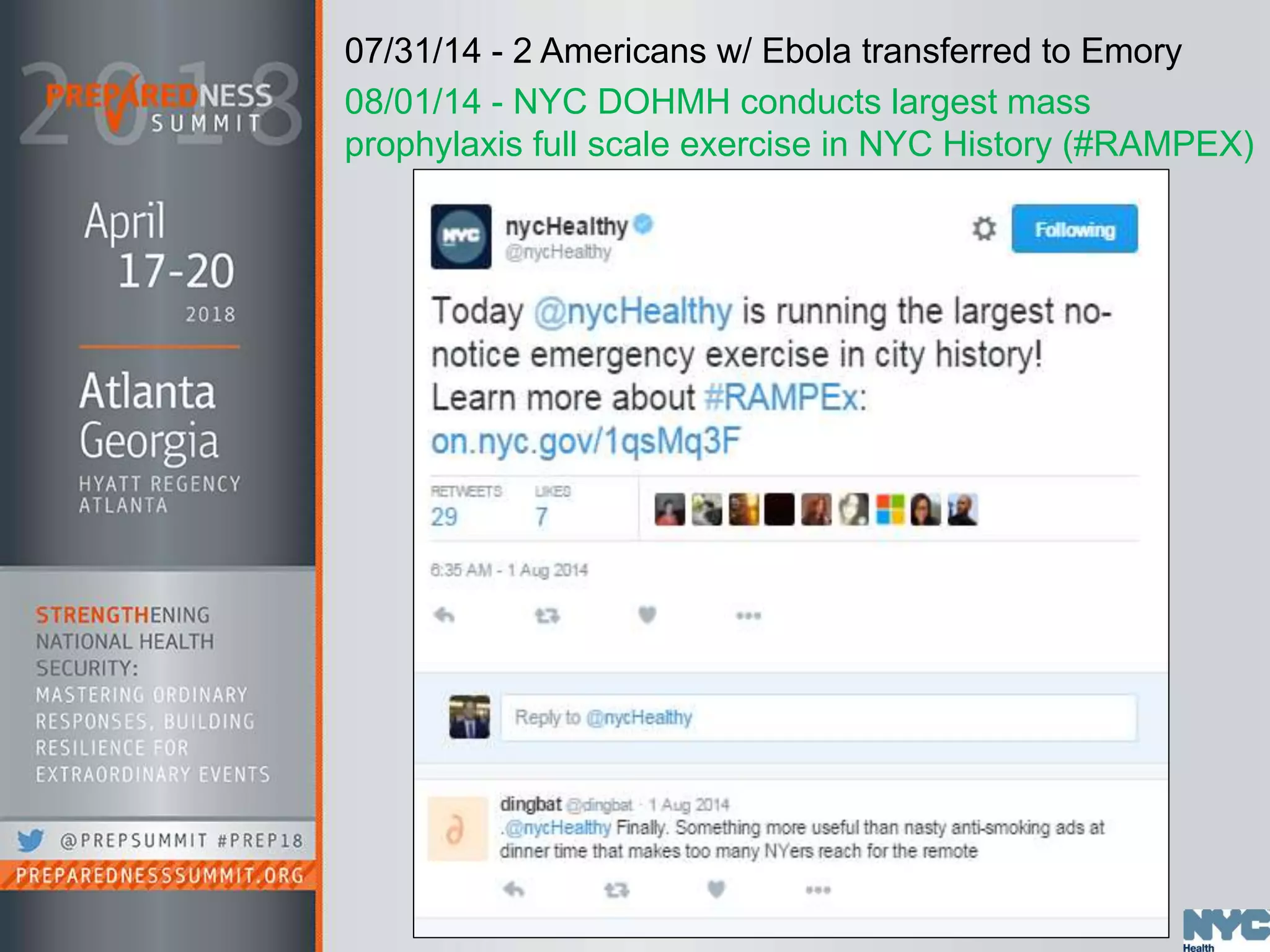
07/31/14 - 2 Americans w/ Ebola transferred to Emory
08/01/14 - NYC DOHMH conducts largest mass
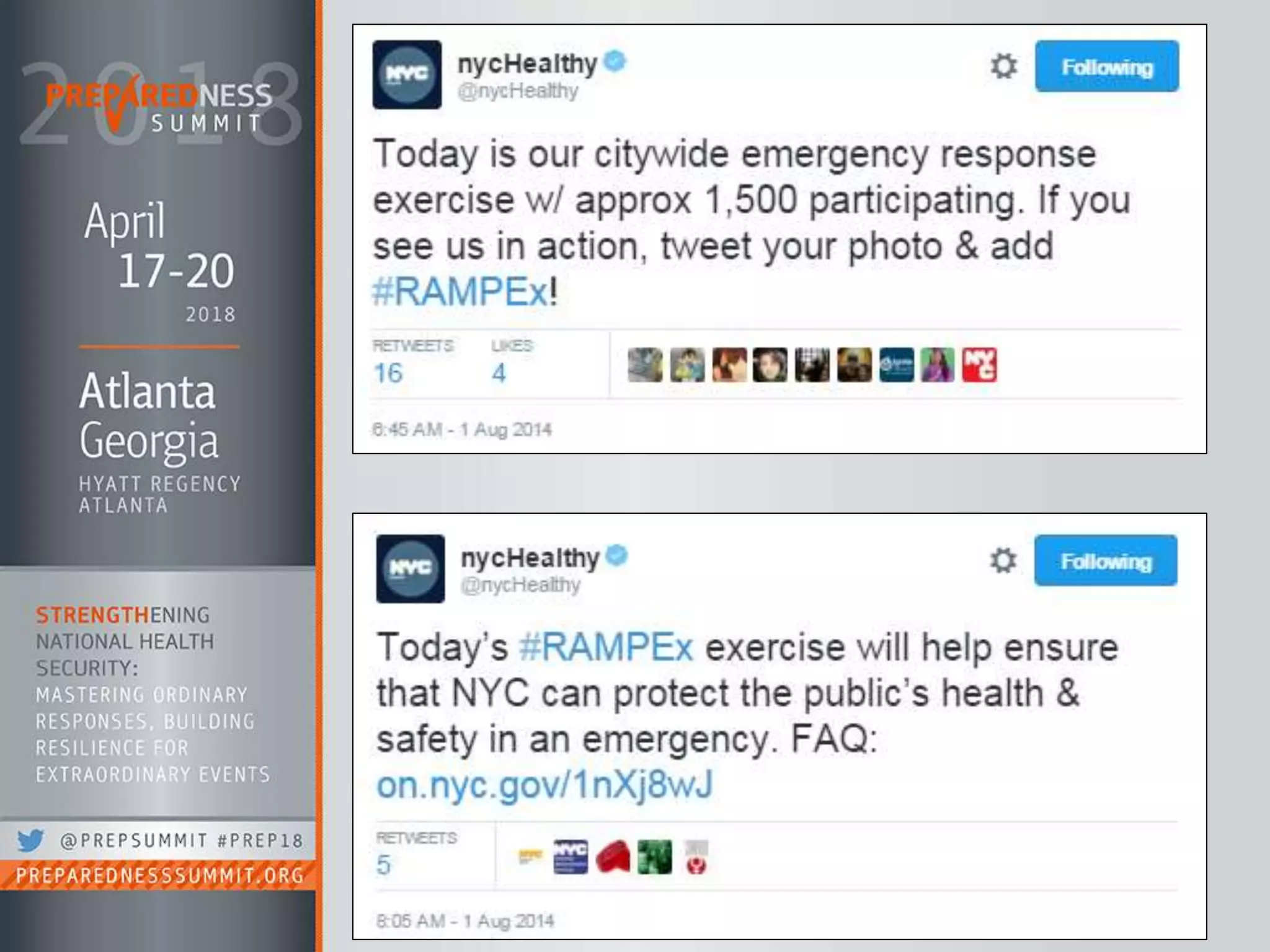
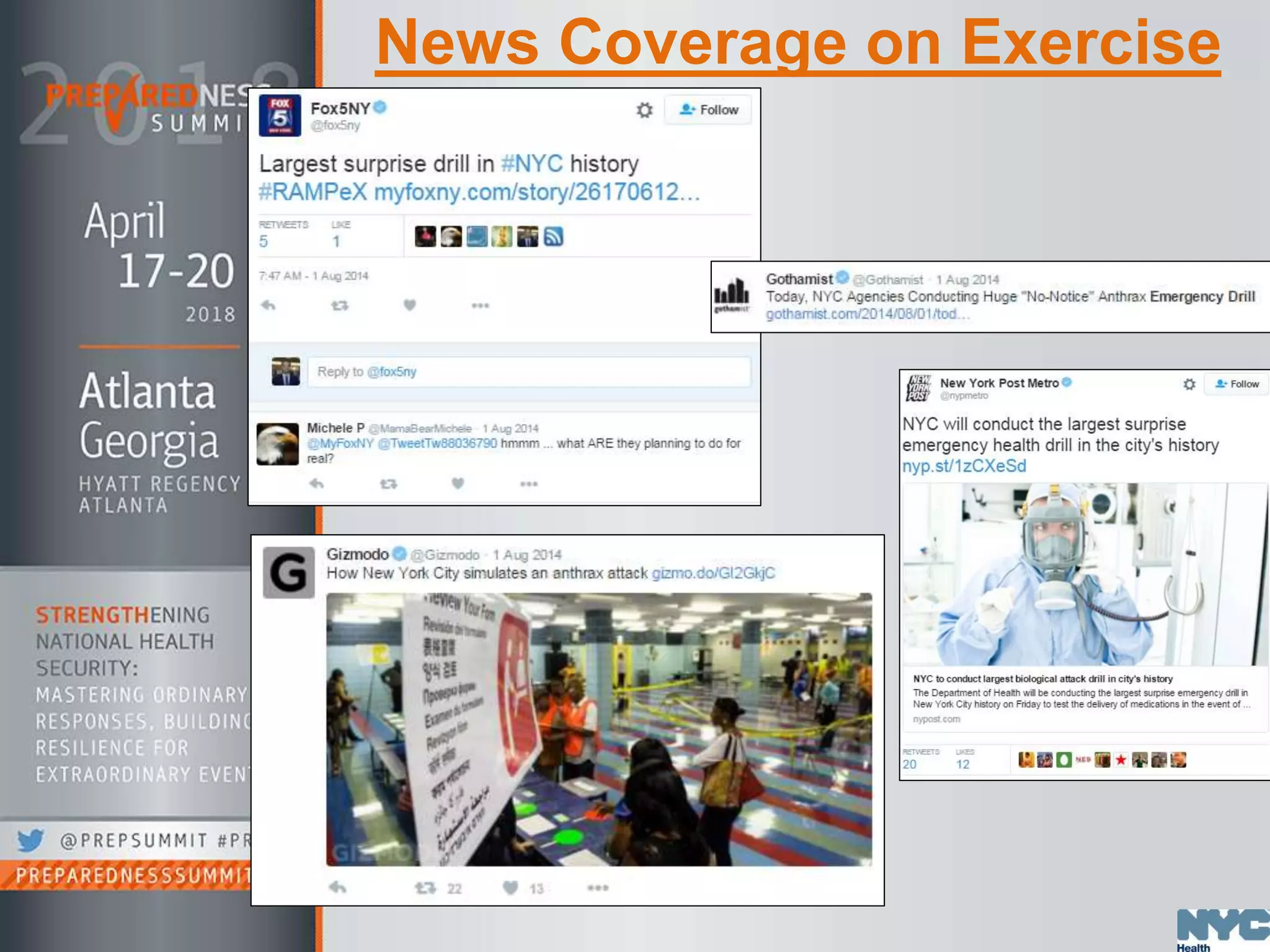
prophylaxis full scale exercise in NYC History (#RAMPEX)
News Coverage on Exercise
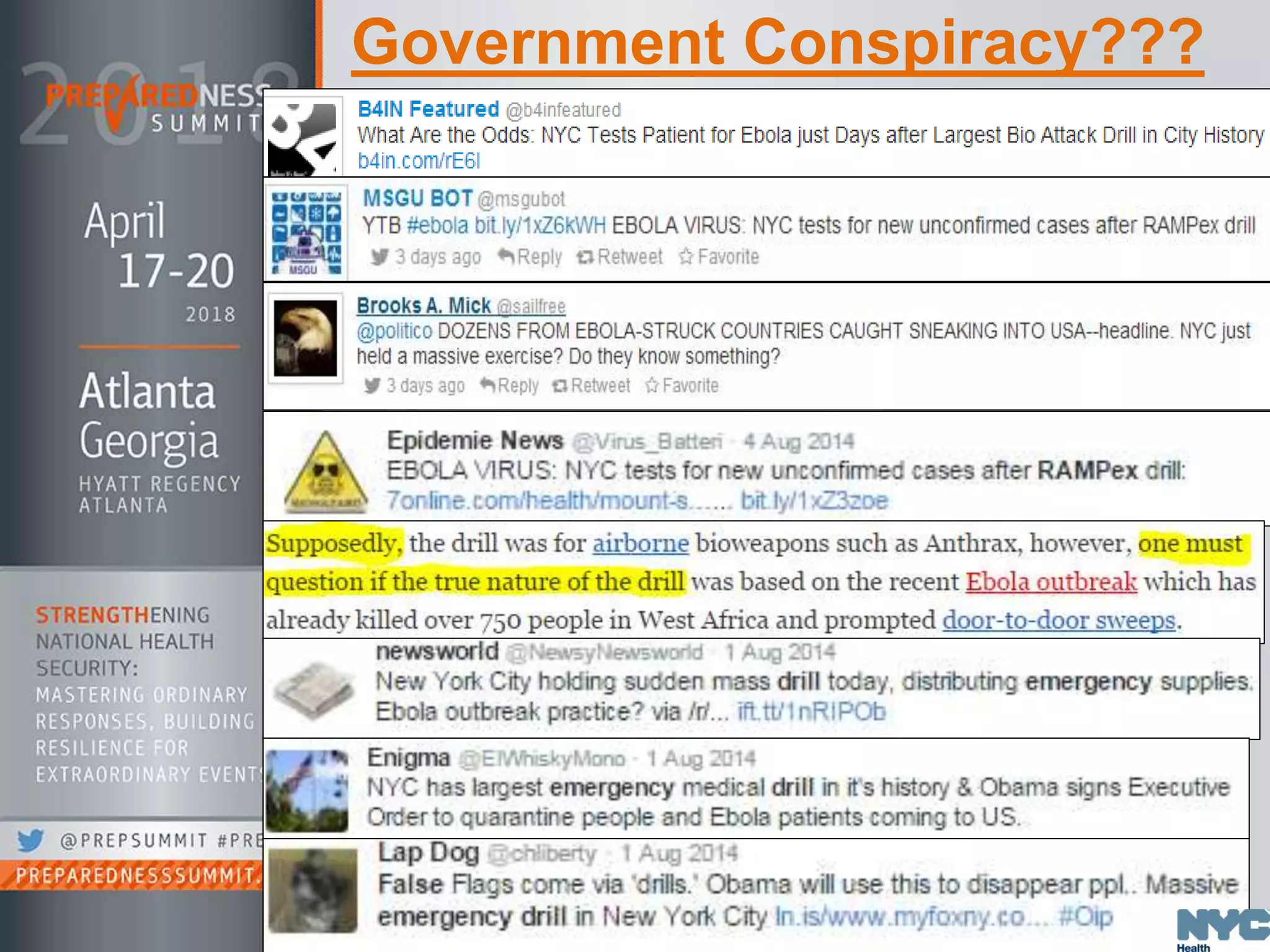
Government Conspiracy???
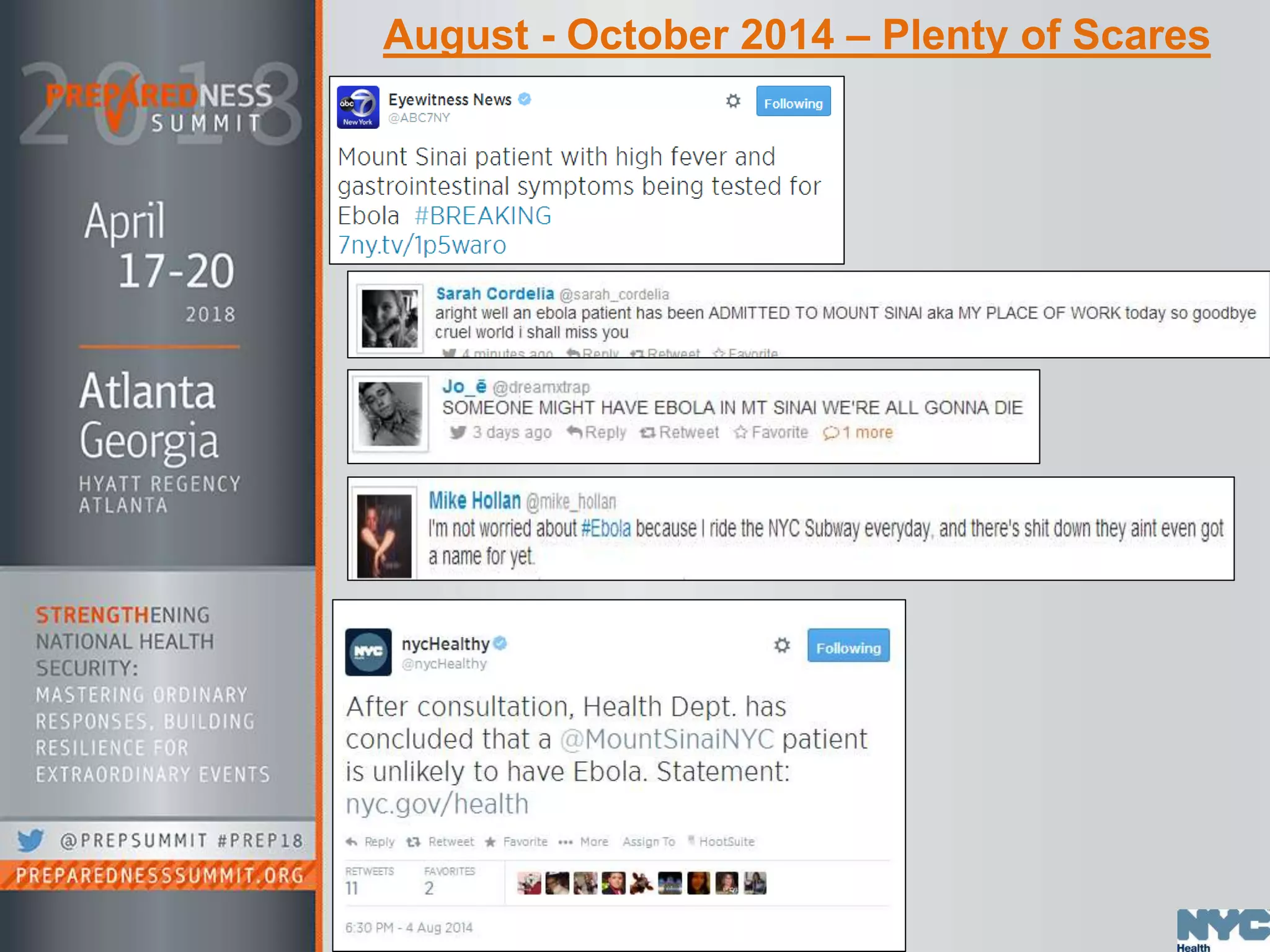
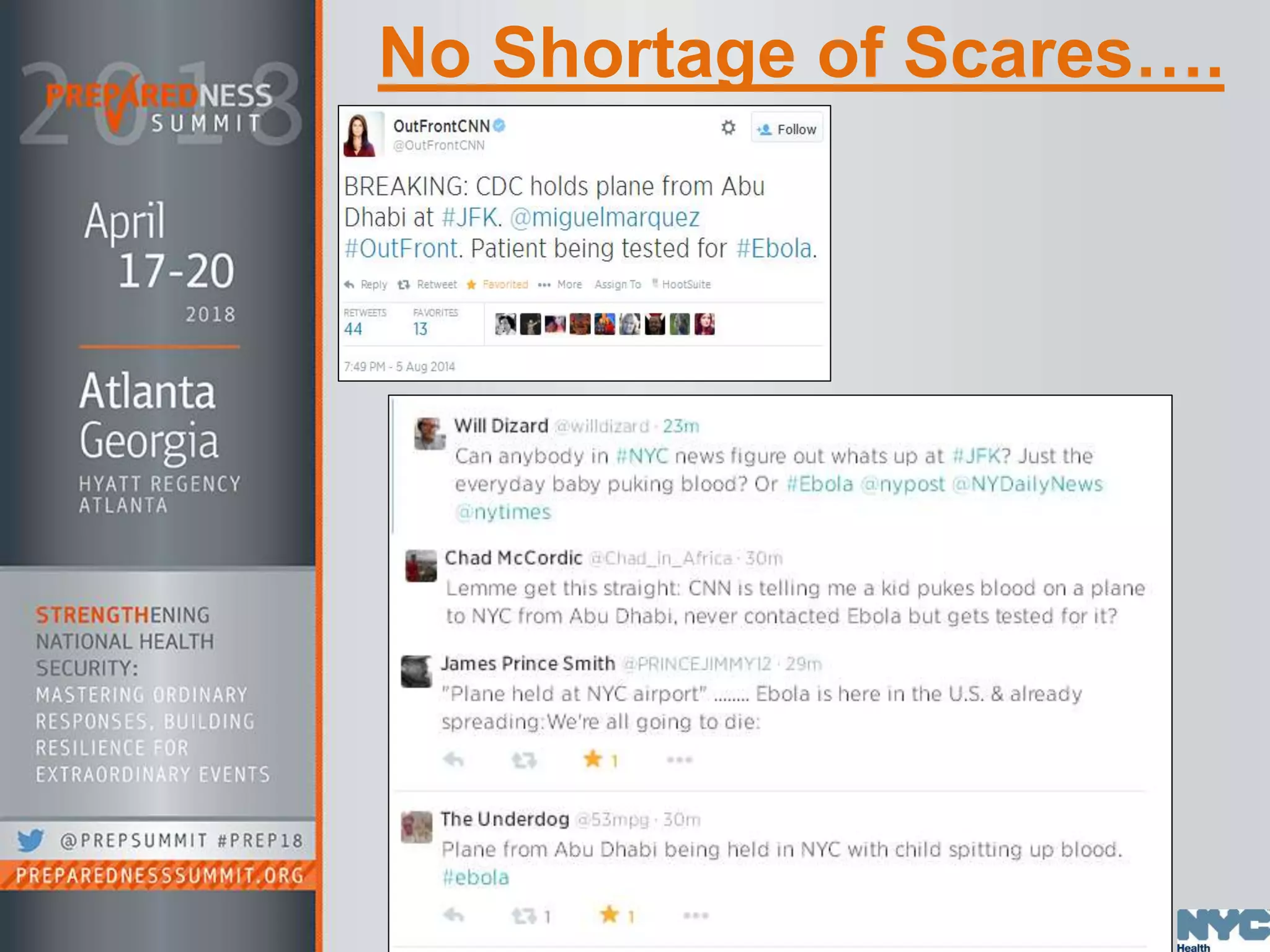
August - October 2014 – Plenty of Scares
No Shortage of Scares….
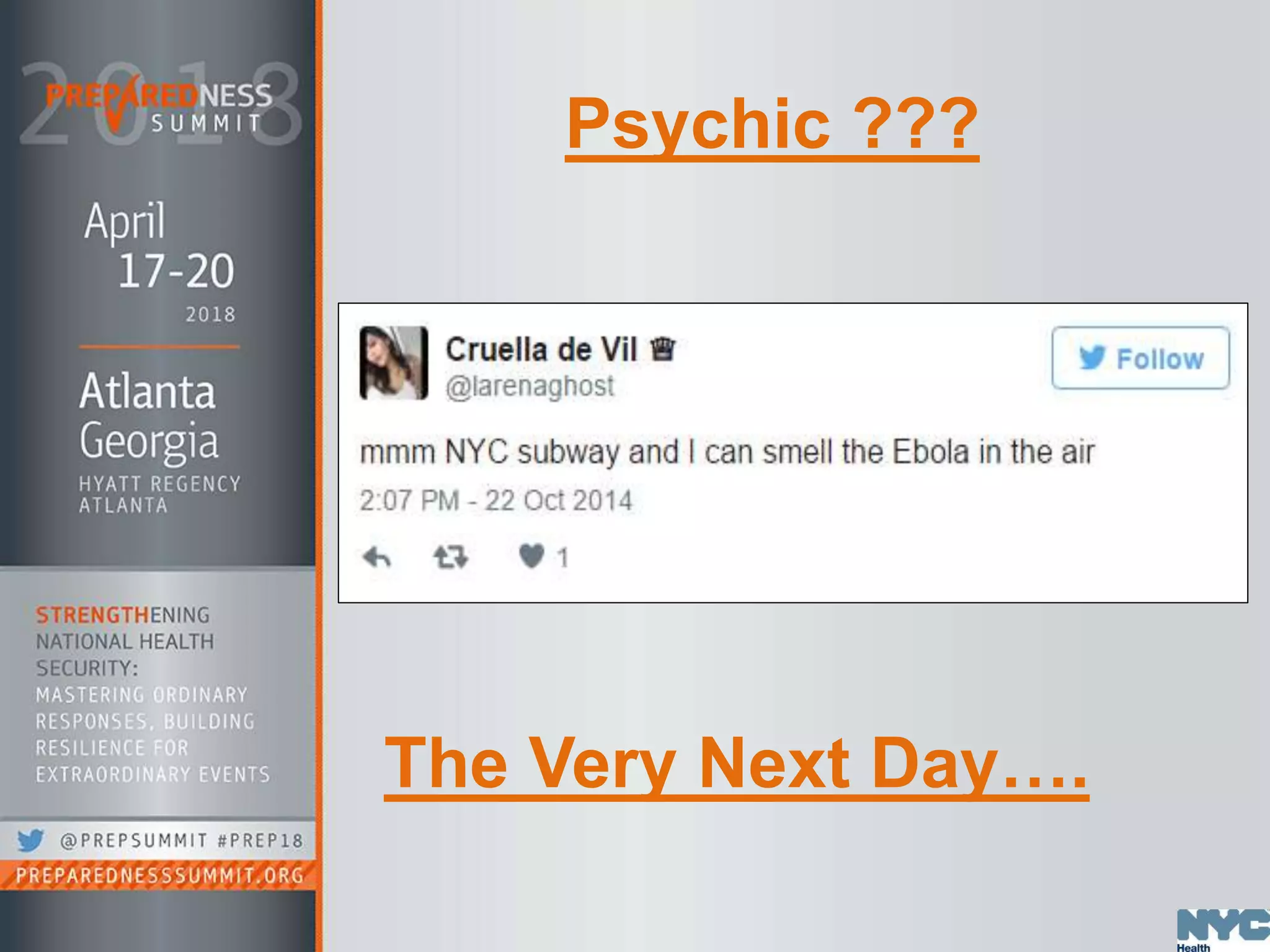
Psychic ???
The Very Next Day….
Ebola Case in NYC (10/23/2014)
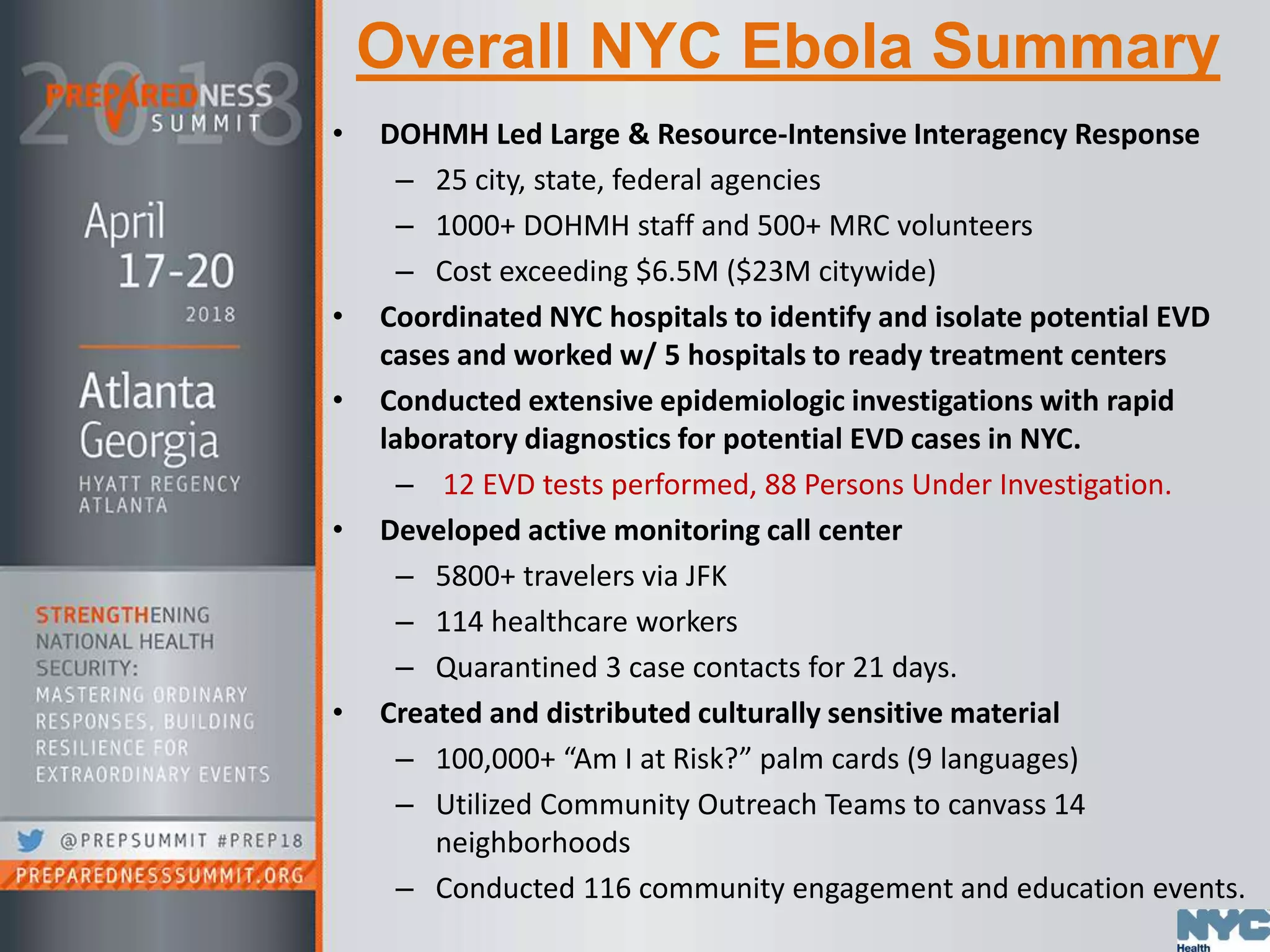
Overall NYC Ebola Summary
• DOHMH Led Large & Resource-Intensive Interagency Response
– 25 city, state, federal agencies
– 1000+ DOHMH staff and 500+ MRC volunteers
– Cost exceeding $6.5M ($23M citywide)
• Coordinated NYC hospitals to identify and isolate potential EVD
cases and worked w/ 5 hospitals to ready treatment centers
• Conducted extensive epidemiologic investigations with rapid
laboratory diagnostics for potential EVD cases in NYC.
– 12 EVD tests performed, 88 Persons Under Investigation.
• Developed active monitoring call center
– 5800+ travelers via JFK
– 114 healthcare workers
– Quarantined 3 case contacts for 21 days.
• Created and distributed culturally sensitive material
– 100,000+ “Am I at Risk?” palm cards (9 languages)
– Utilized Community Outreach Teams to canvass 14
neighborhoods
– Conducted 116 community engagement and education events.
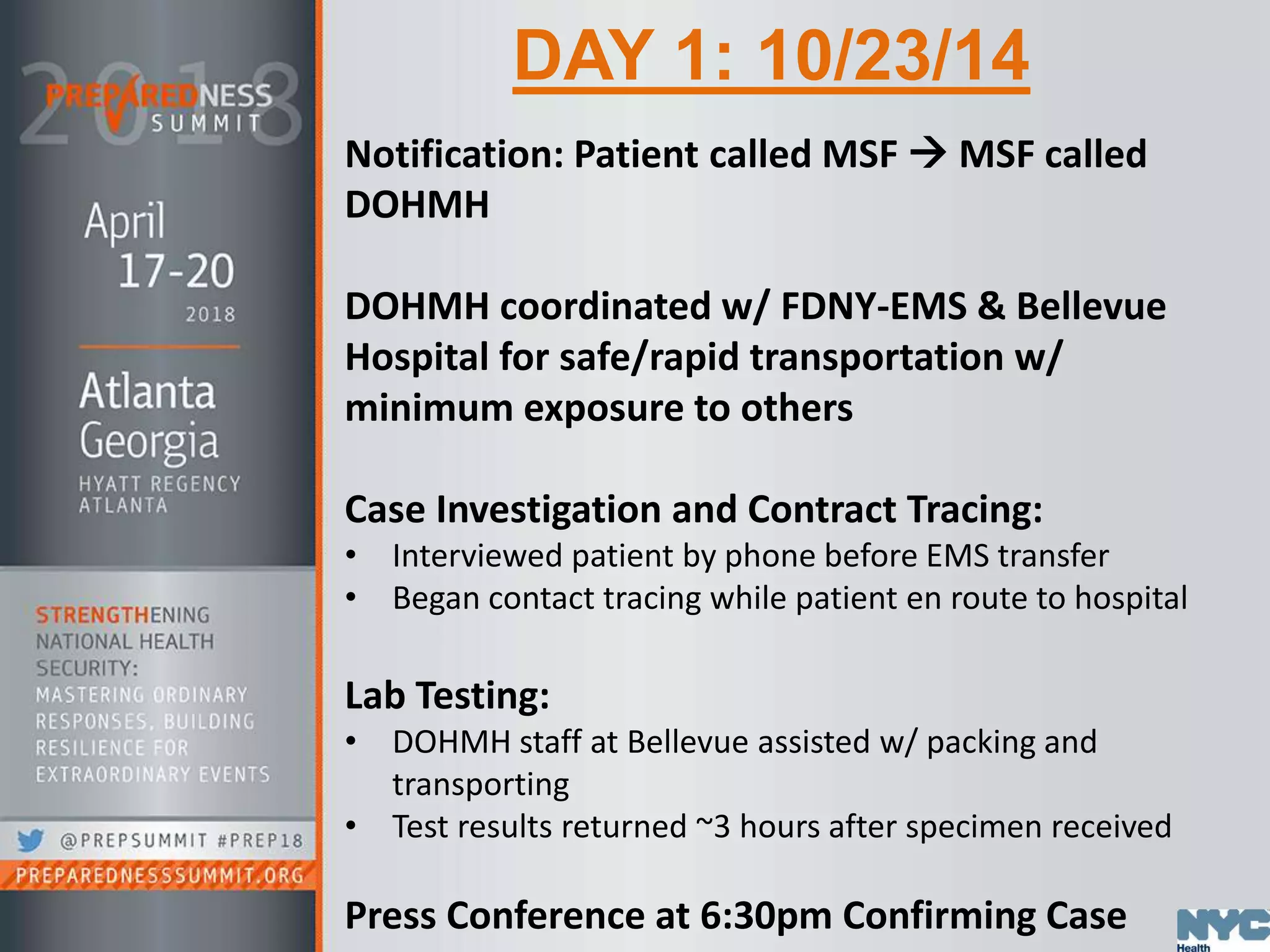
DAY 1: 10/23/14
Notification: Patient called MSF  MSF called
DOHMH
DOHMH coordinated w/ FDNY-EMS & Bellevue
Hospital for safe/rapid transportation w/
minimum exposure to others
Case Investigation and Contract Tracing:
• Interviewed patient by phone before EMS transfer
• Began contact tracing while patient en route to hospital
Lab Testing:
• DOHMH staff at Bellevue assisted w/ packing and
transporting
• Test results returned ~3 hours after specimen received
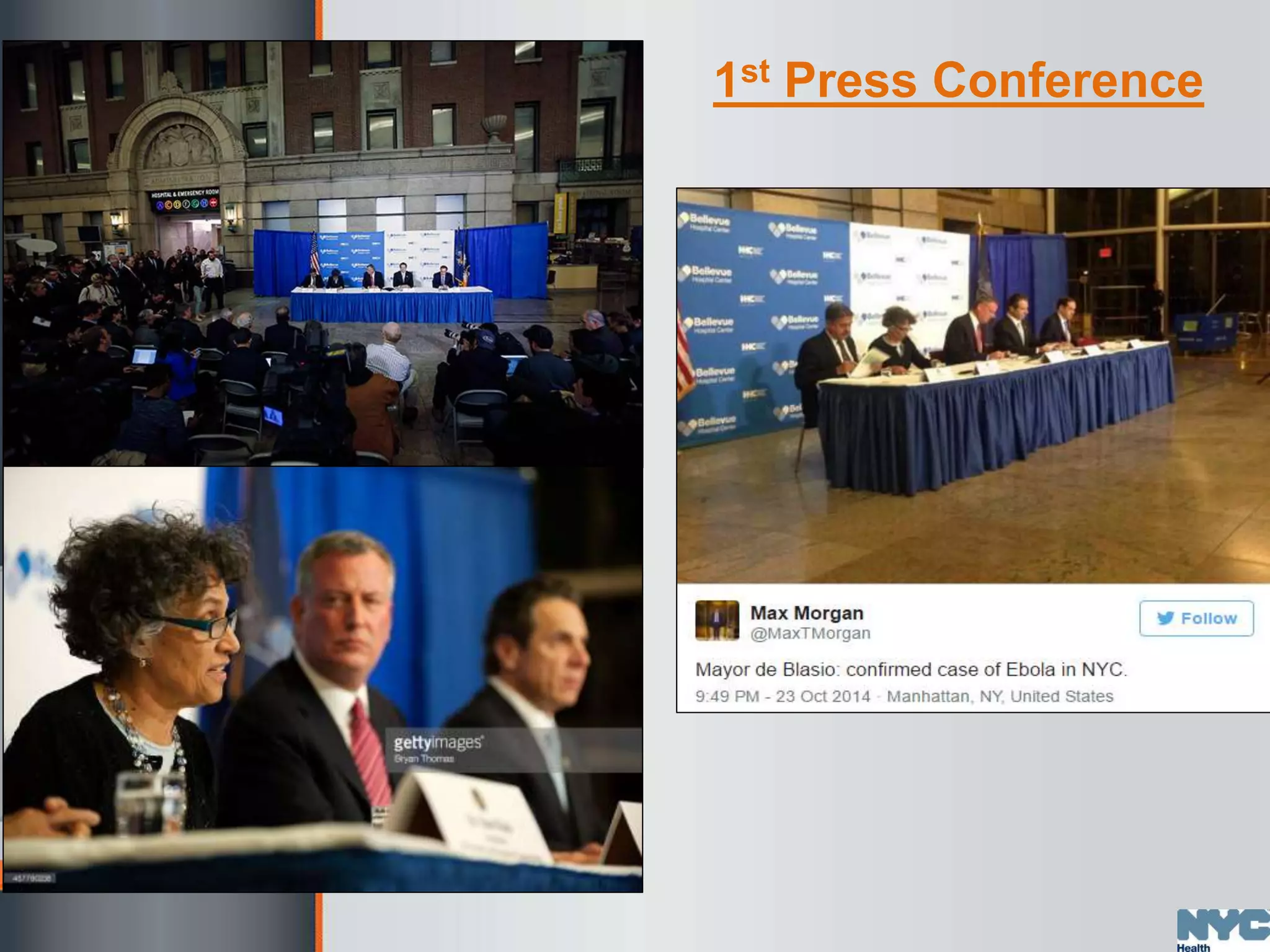
Press Conference at 6:30pm Confirming Case
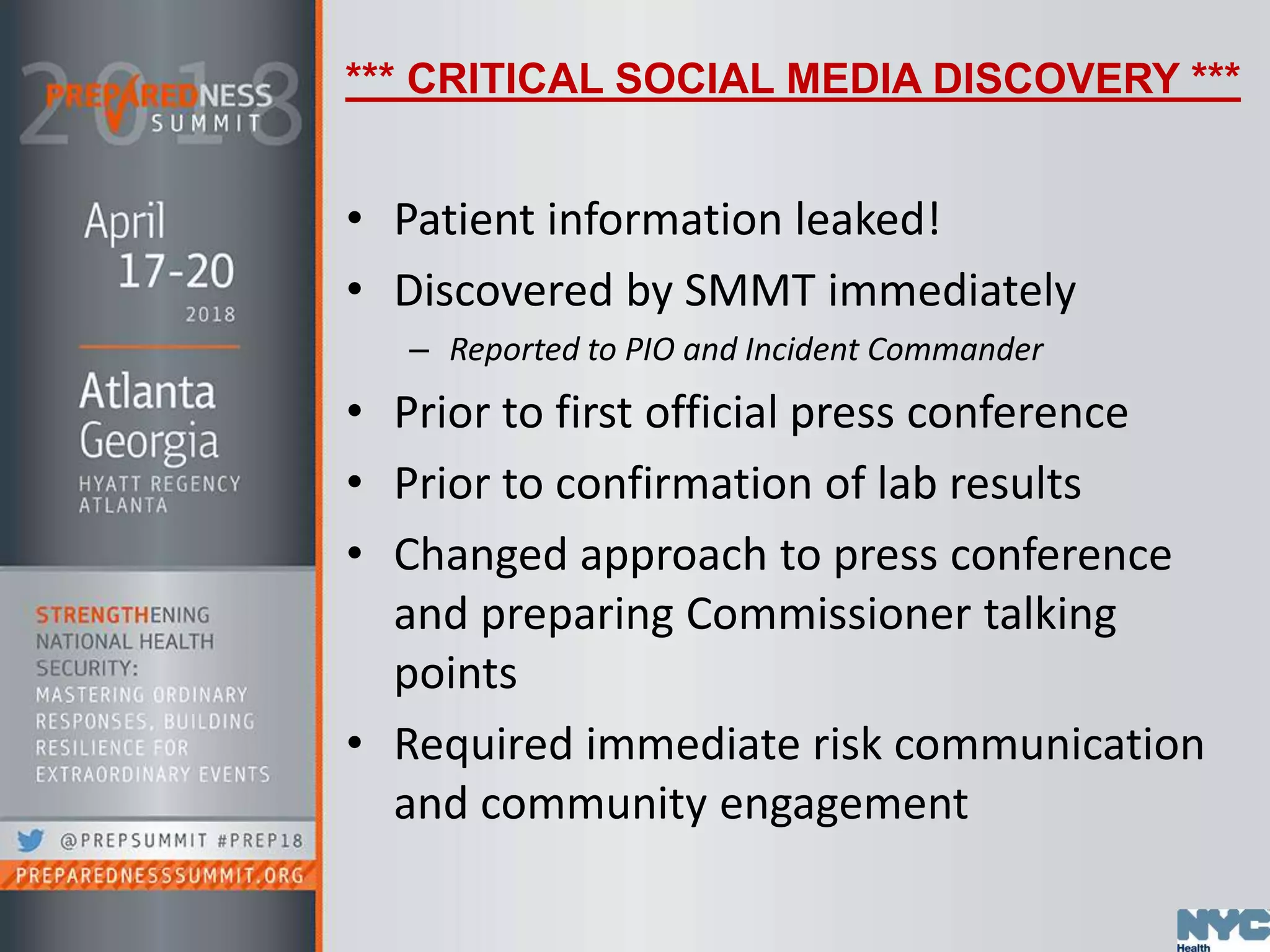
*** CRITICAL SOCIAL MEDIA DISCOVERY ***
• Patient information leaked!
• Discovered by SMMT immediately
– Reported to PIO and Incident Commander
• Prior to first official press conference
• Prior to confirmation of lab results
• Changed approach to press conference
and preparing Commissioner talking
points
• Required immediate risk communication
and community engagement
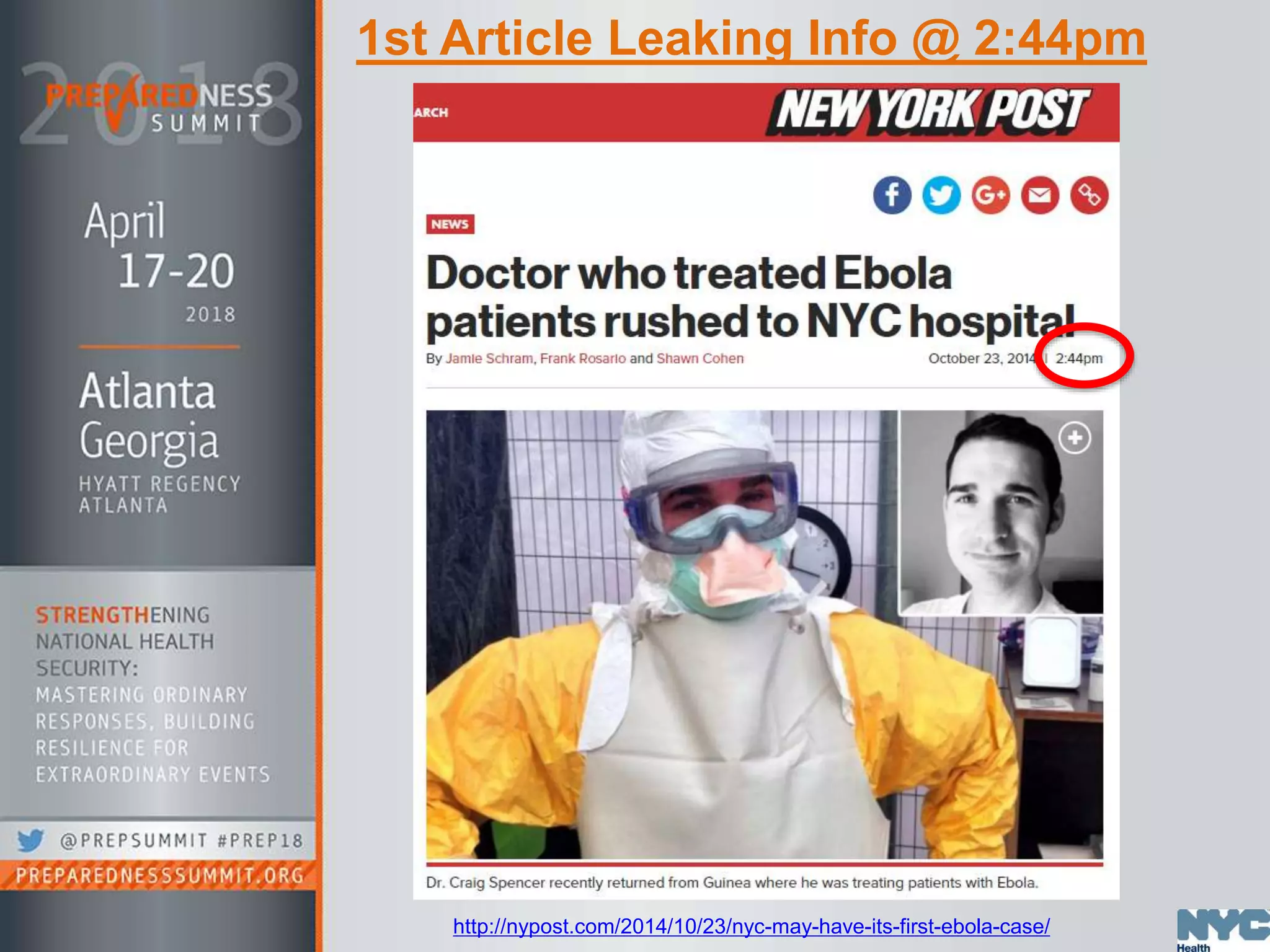
1st Article Leaking Info @ 2:44pm
http://nypost.com/2014/10/23/nyc-may-have-its-first-ebola-case/
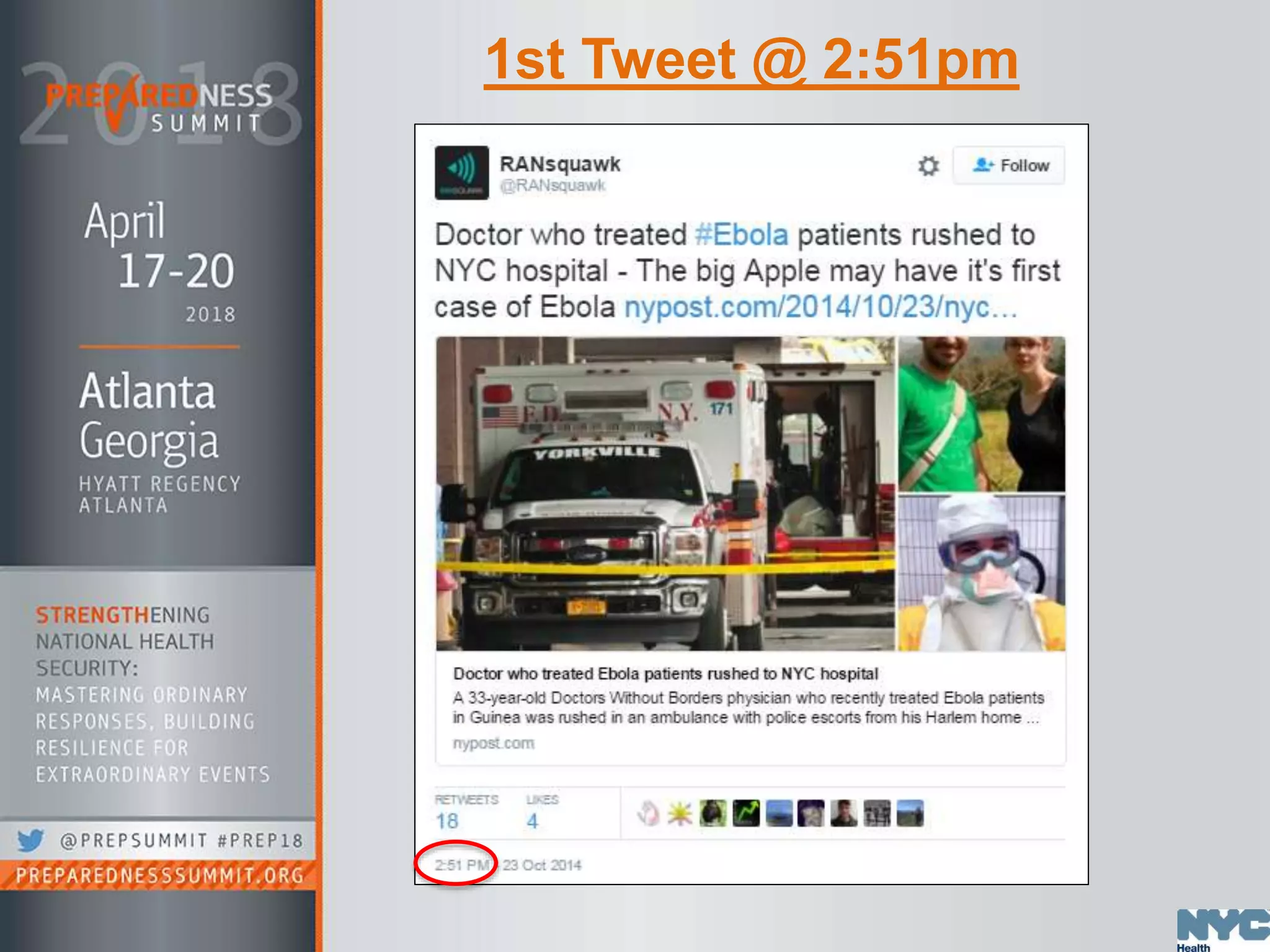
1st Tweet @ 2:51pm
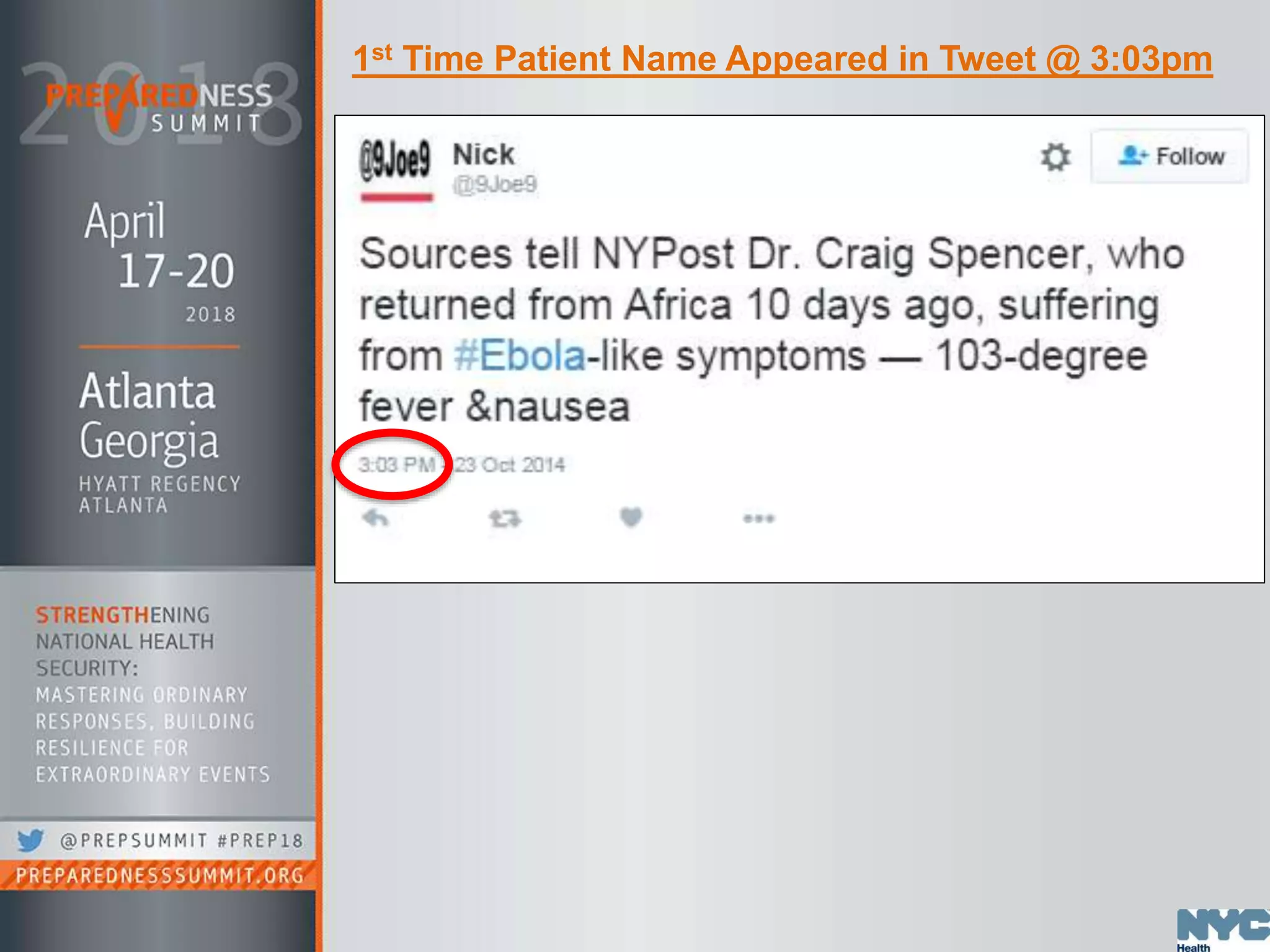
1st Time Patient Name Appeared in Tweet @ 3:03pm
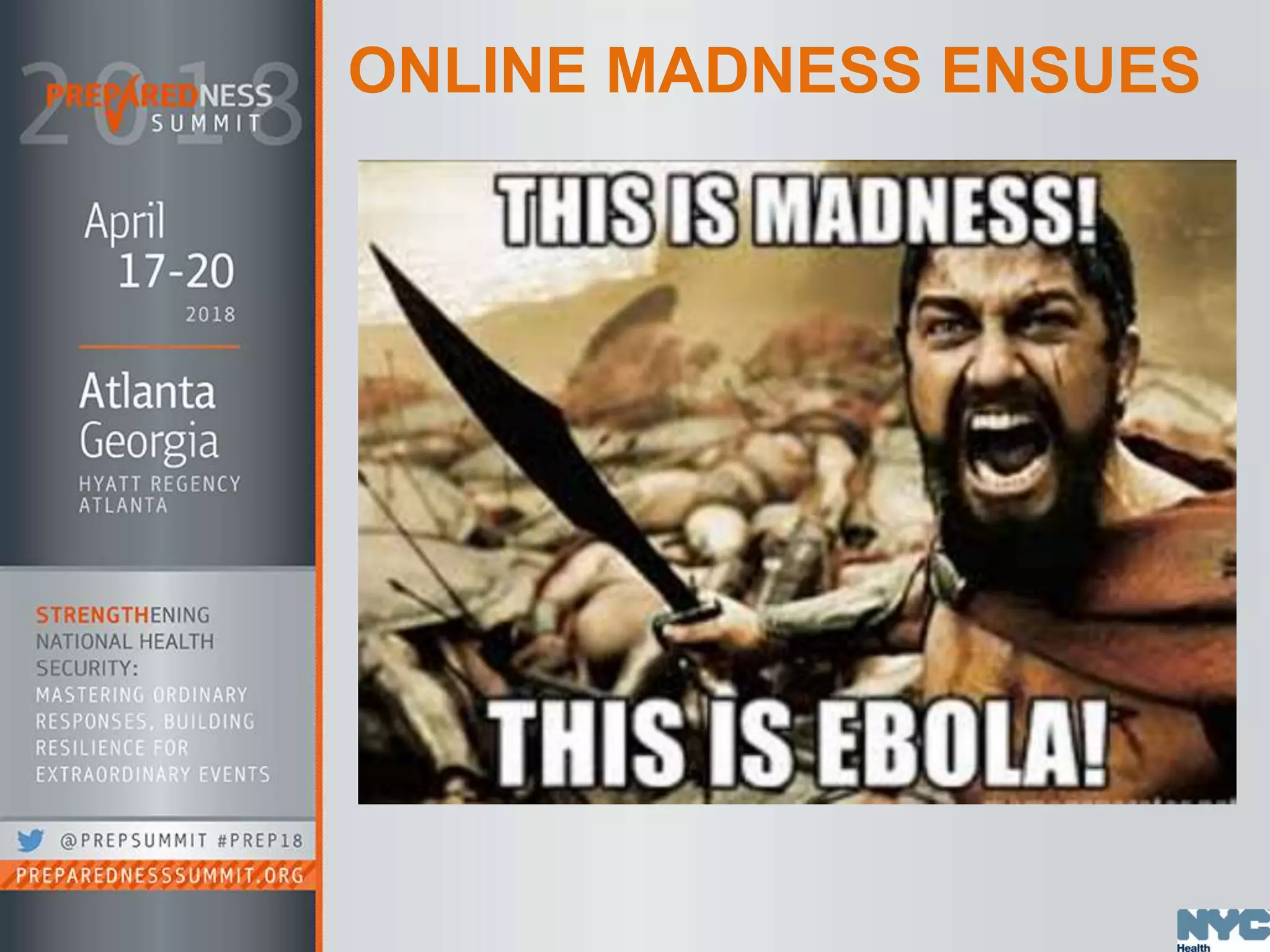
ONLINE MADNESS ENSUES
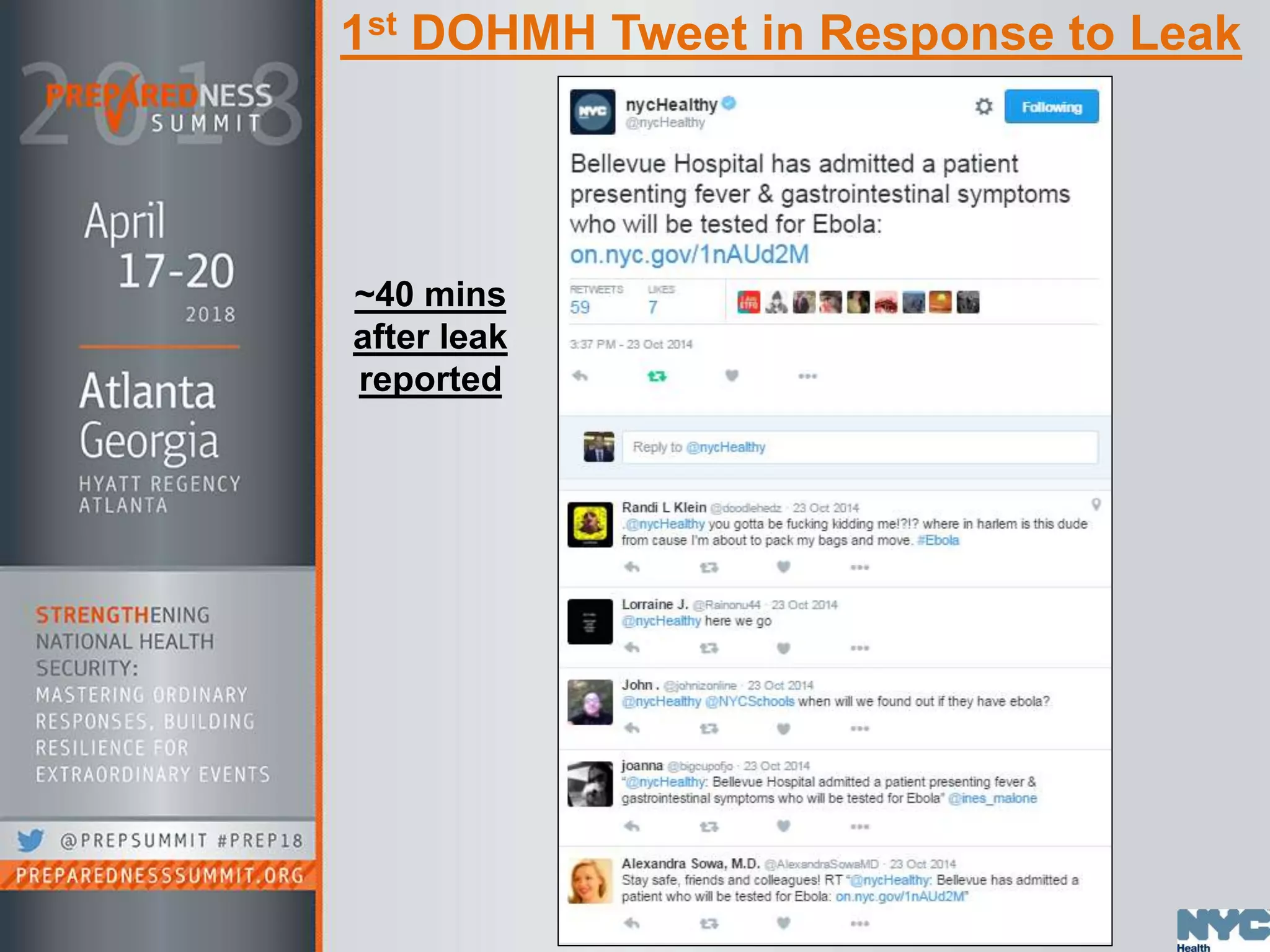
1st DOHMH Tweet in Response to Leak
~40 mins
after leak
reported
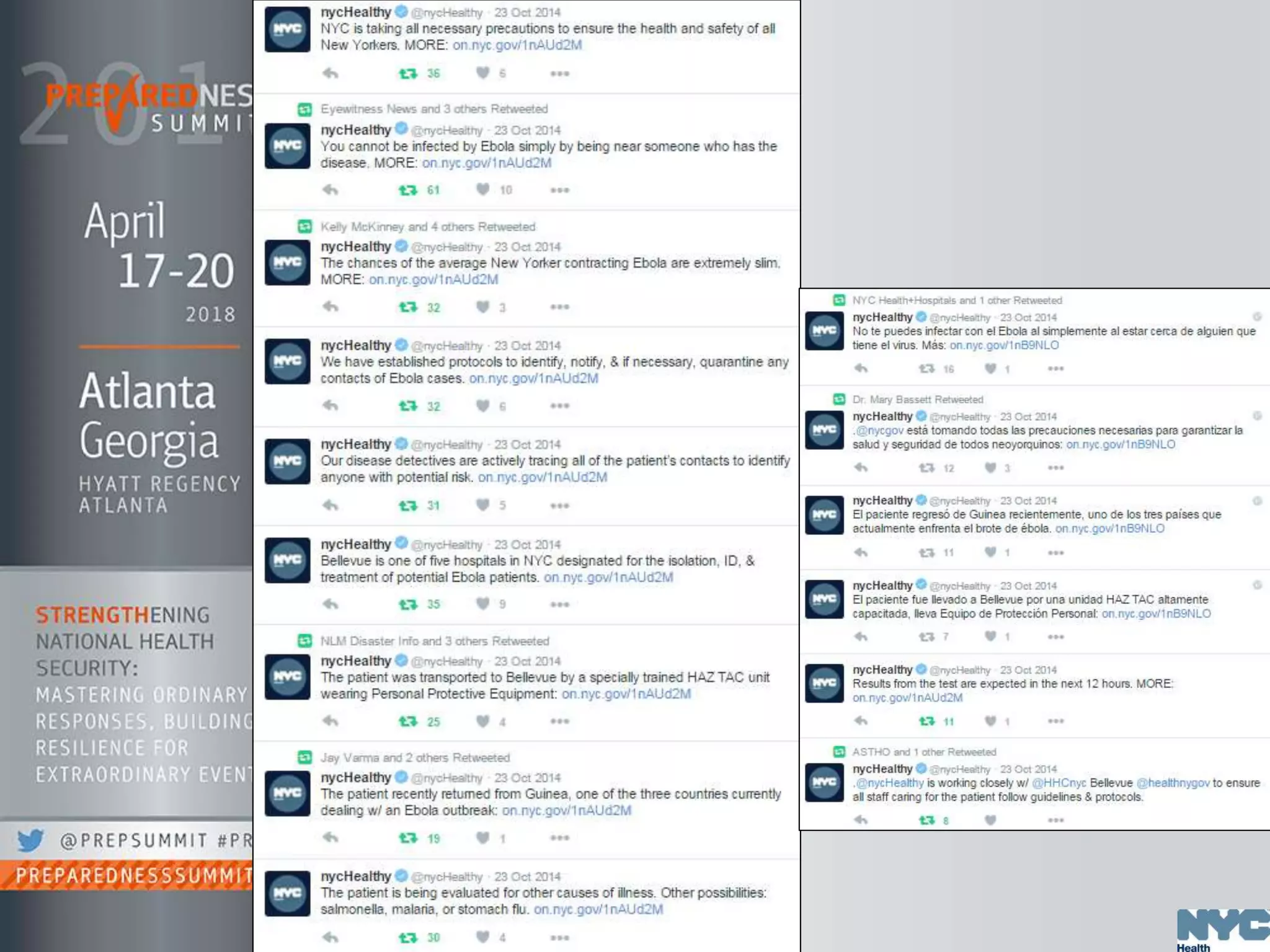
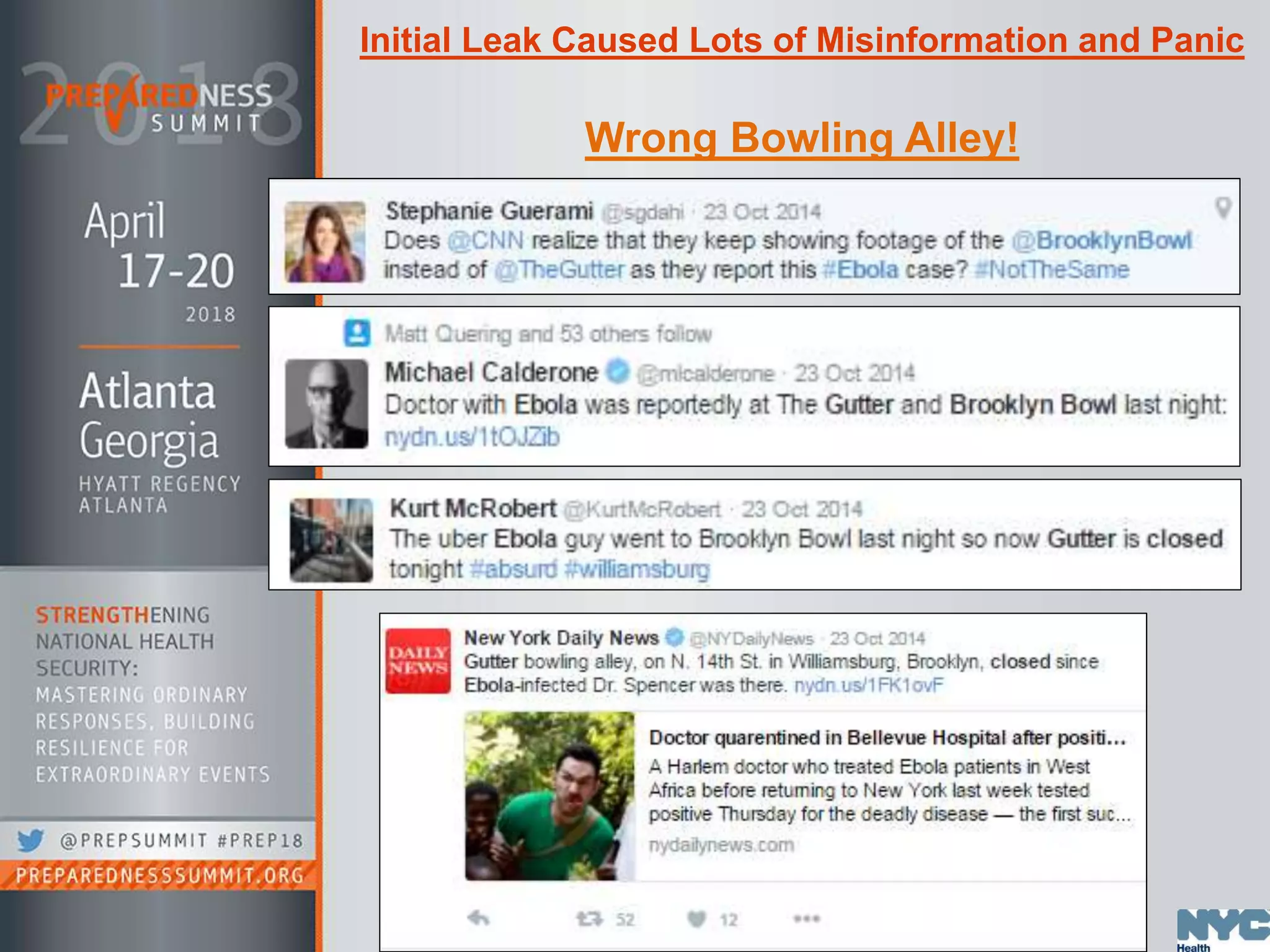
Initial Leak Caused Lots of Misinformation and Panic
Wrong Bowling Alley!
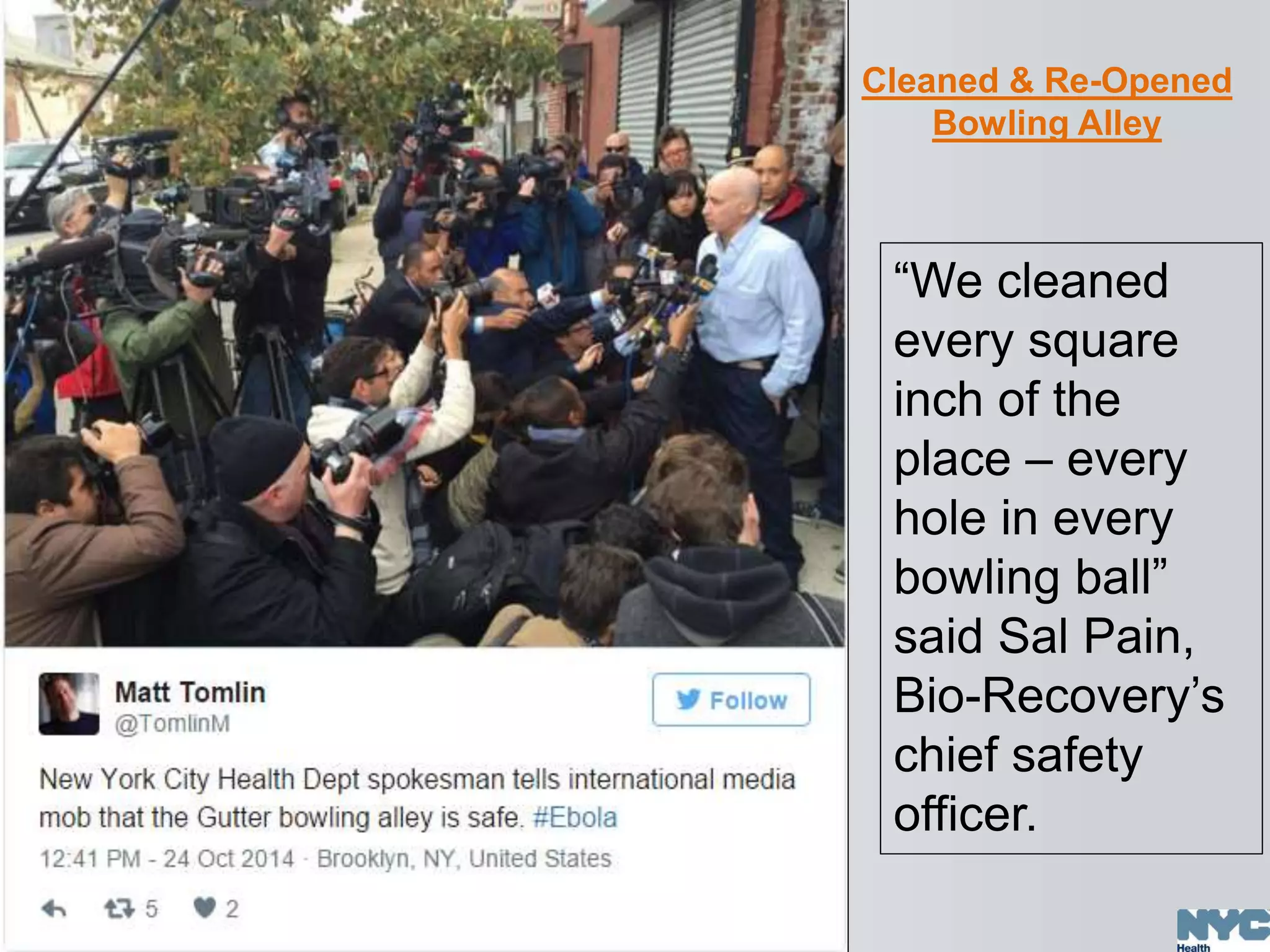
Cleaned & Re-Opened
Bowling Alley
“We cleaned
every square
inch of the
place – every
hole in every
bowling ball”
said Sal Pain,
Bio-Recovery’s
chief safety
officer.
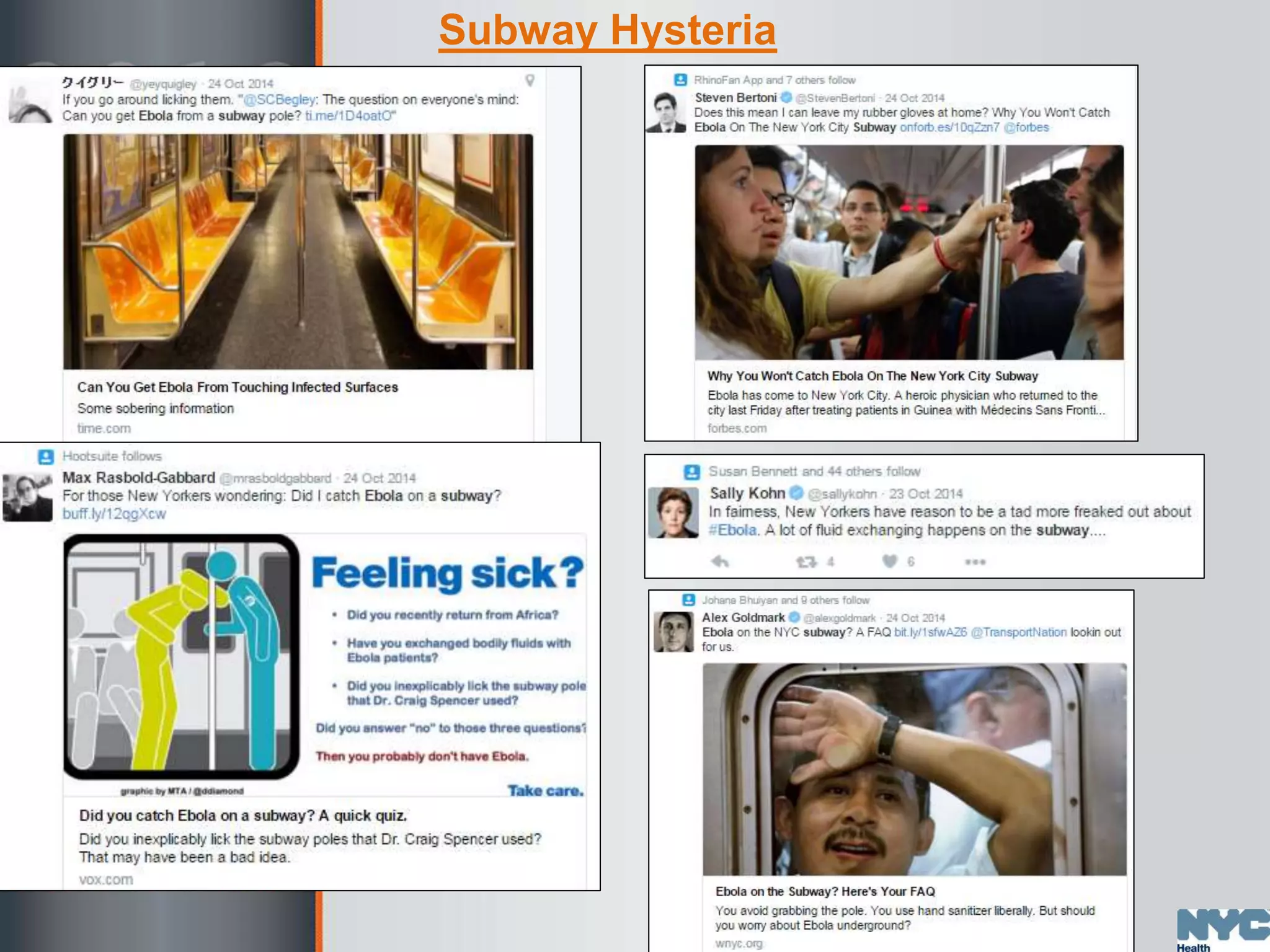
Subway Hysteria
Lots of Great Subway Advice Too!
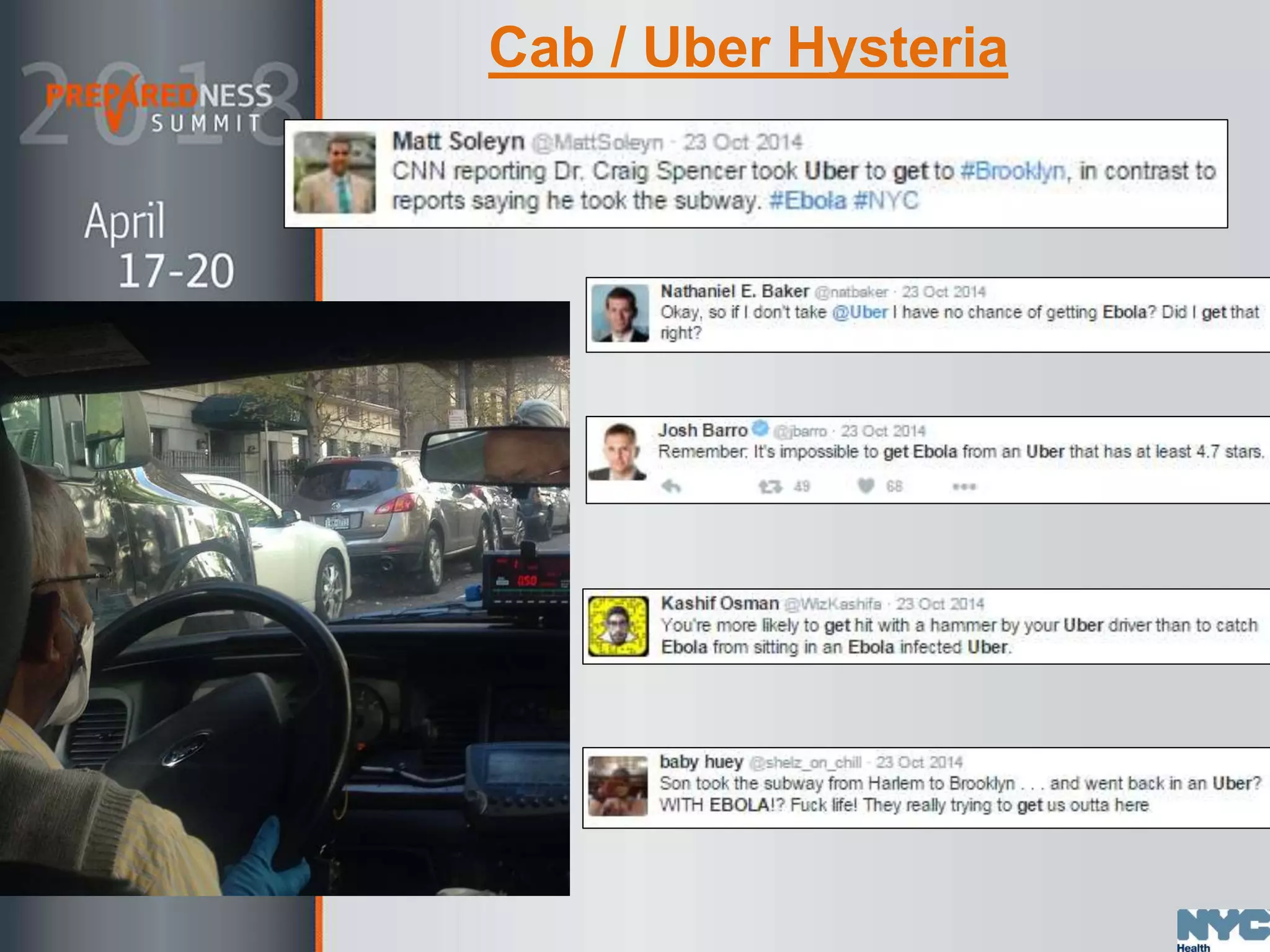
Cab / Uber Hysteria
1st Press Conference
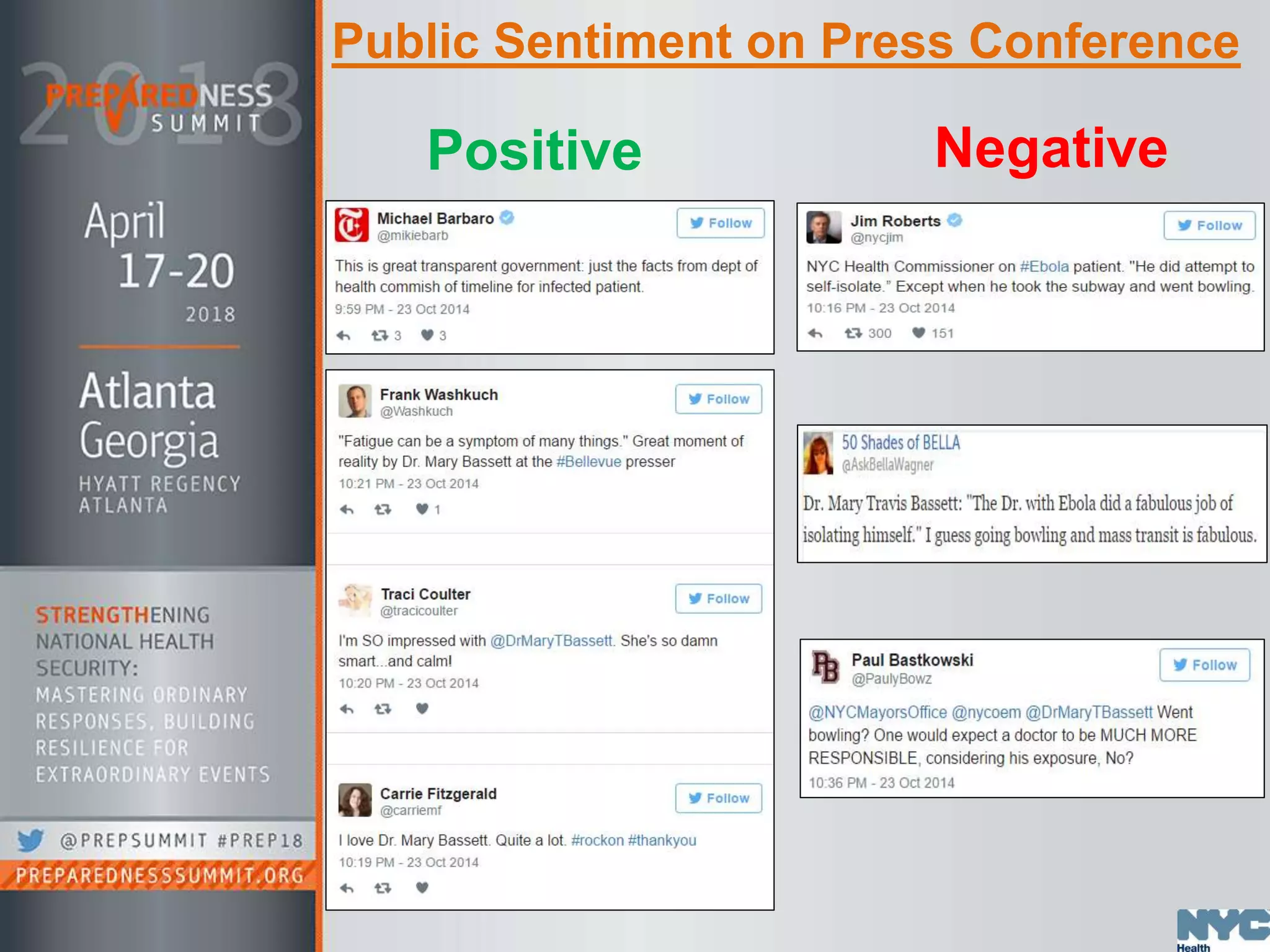
Public Sentiment on Press Conference
Positive Negative
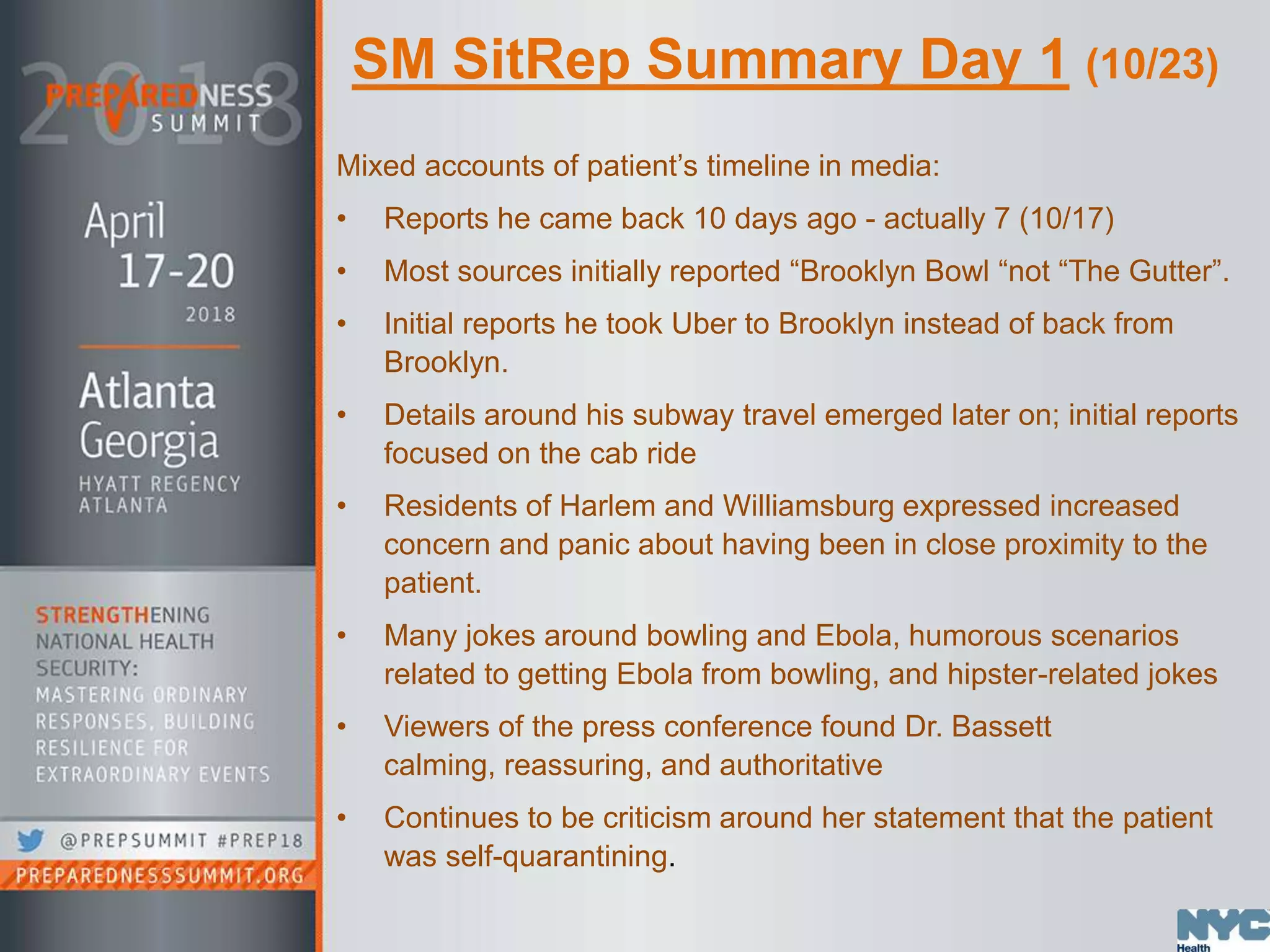
SM SitRep Summary Day 1 (10/23)
Mixed accounts of patient’s timeline in media:
• Reports he came back 10 days ago - actually 7 (10/17)
• Most sources initially reported “Brooklyn Bowl “not “The Gutter”.
• Initial reports he took Uber to Brooklyn instead of back from
Brooklyn.
• Details around his subway travel emerged later on; initial reports
focused on the cab ride
• Residents of Harlem and Williamsburg expressed increased
concern and panic about having been in close proximity to the
patient.
• Many jokes around bowling and Ebola, humorous scenarios
related to getting Ebola from bowling, and hipster-related jokes
• Viewers of the press conference found Dr. Bassett
calming, reassuring, and authoritative
• Continues to be criticism around her statement that the patient
was self-quarantining.
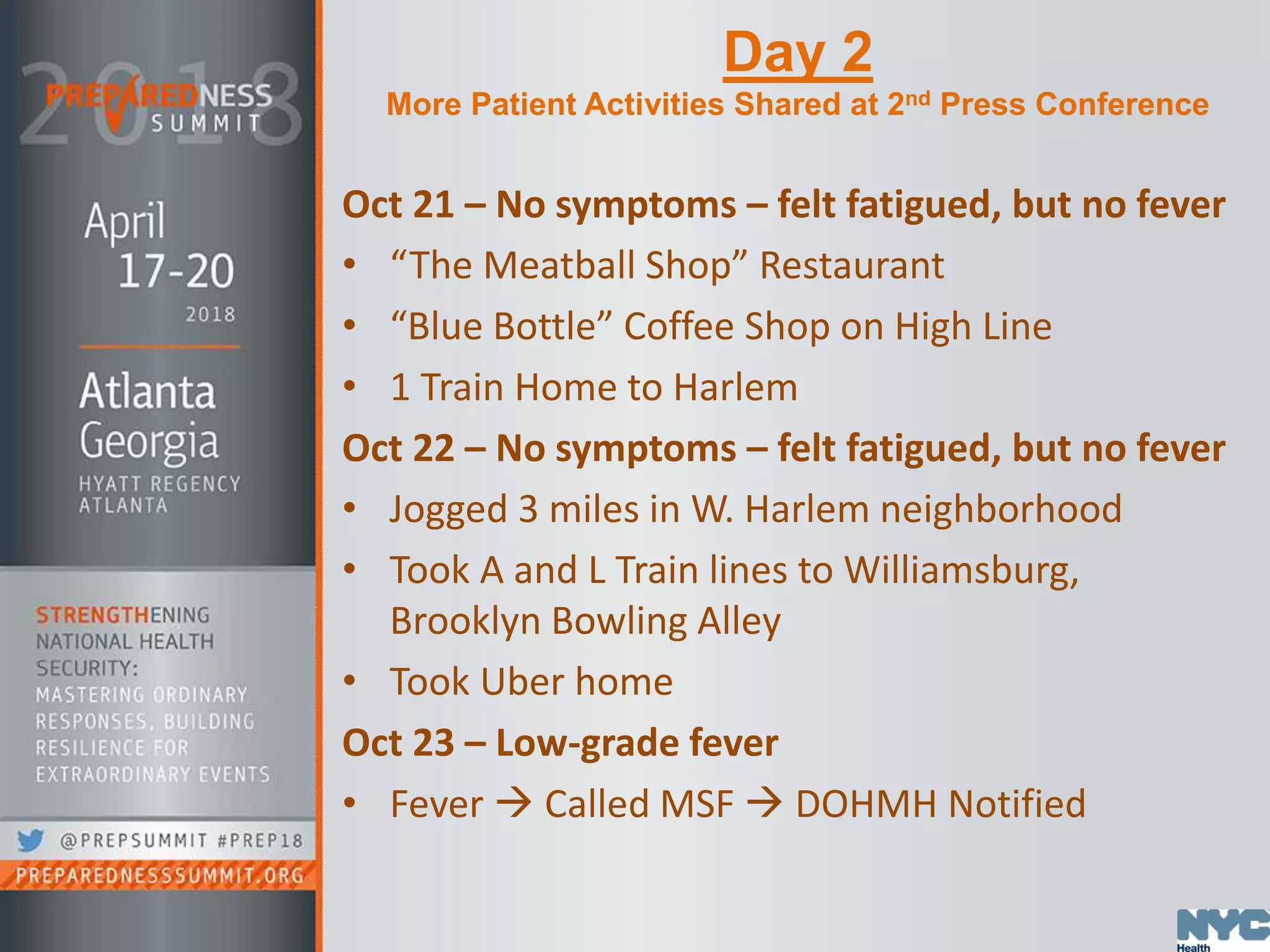
Day 2
More Patient Activities Shared at 2nd Press Conference
Oct 21 – No symptoms – felt fatigued, but no fever
• “The Meatball Shop” Restaurant
• “Blue Bottle” Coffee Shop on High Line
• 1 Train Home to Harlem
Oct 22 – No symptoms – felt fatigued, but no fever
• Jogged 3 miles in W. Harlem neighborhood
• Took A and L Train lines to Williamsburg,
Brooklyn Bowling Alley
• Took Uber home
Oct 23 – Low-grade fever
• Fever  Called MSF  DOHMH Notified
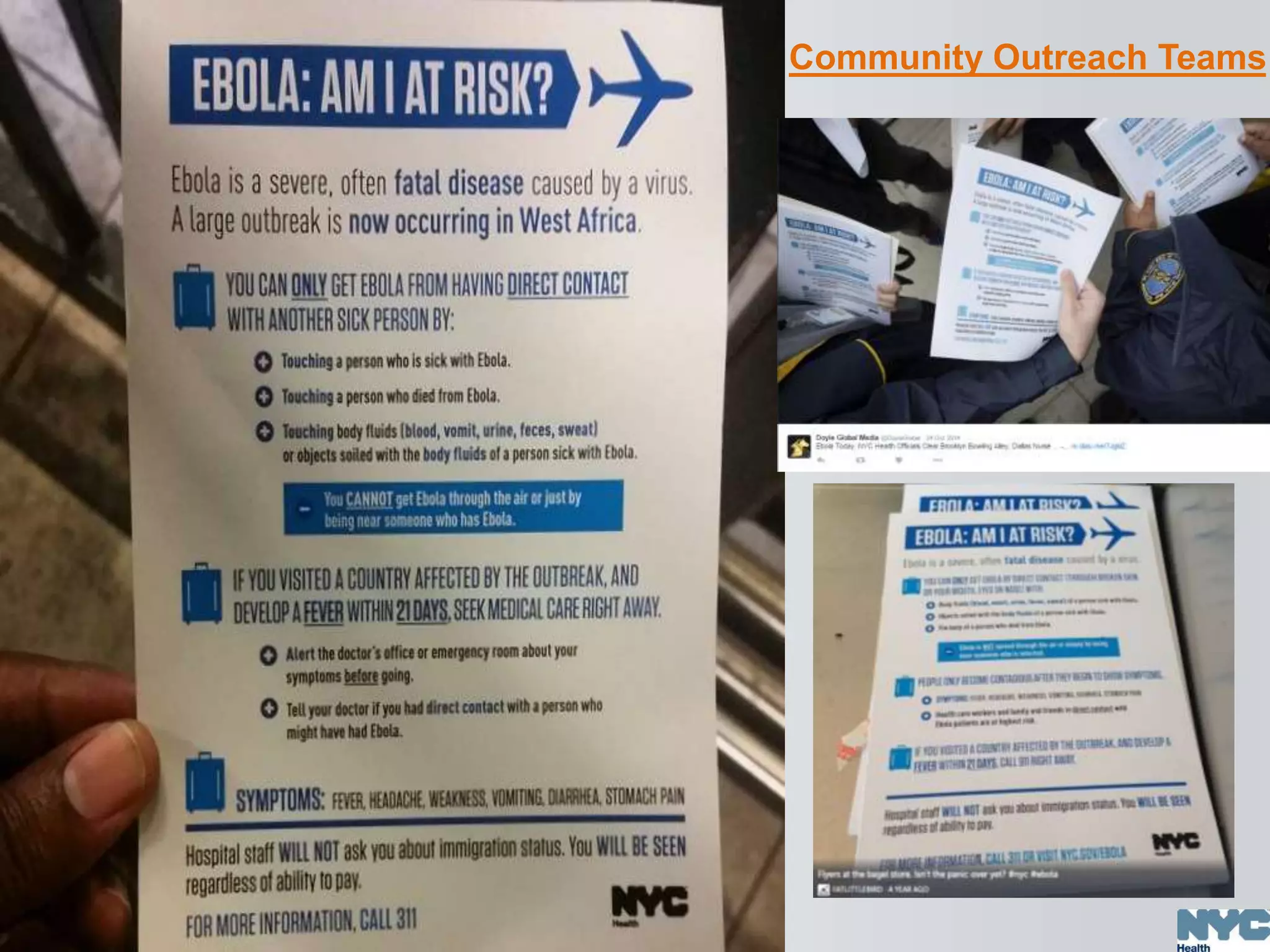
Community Outreach Teams
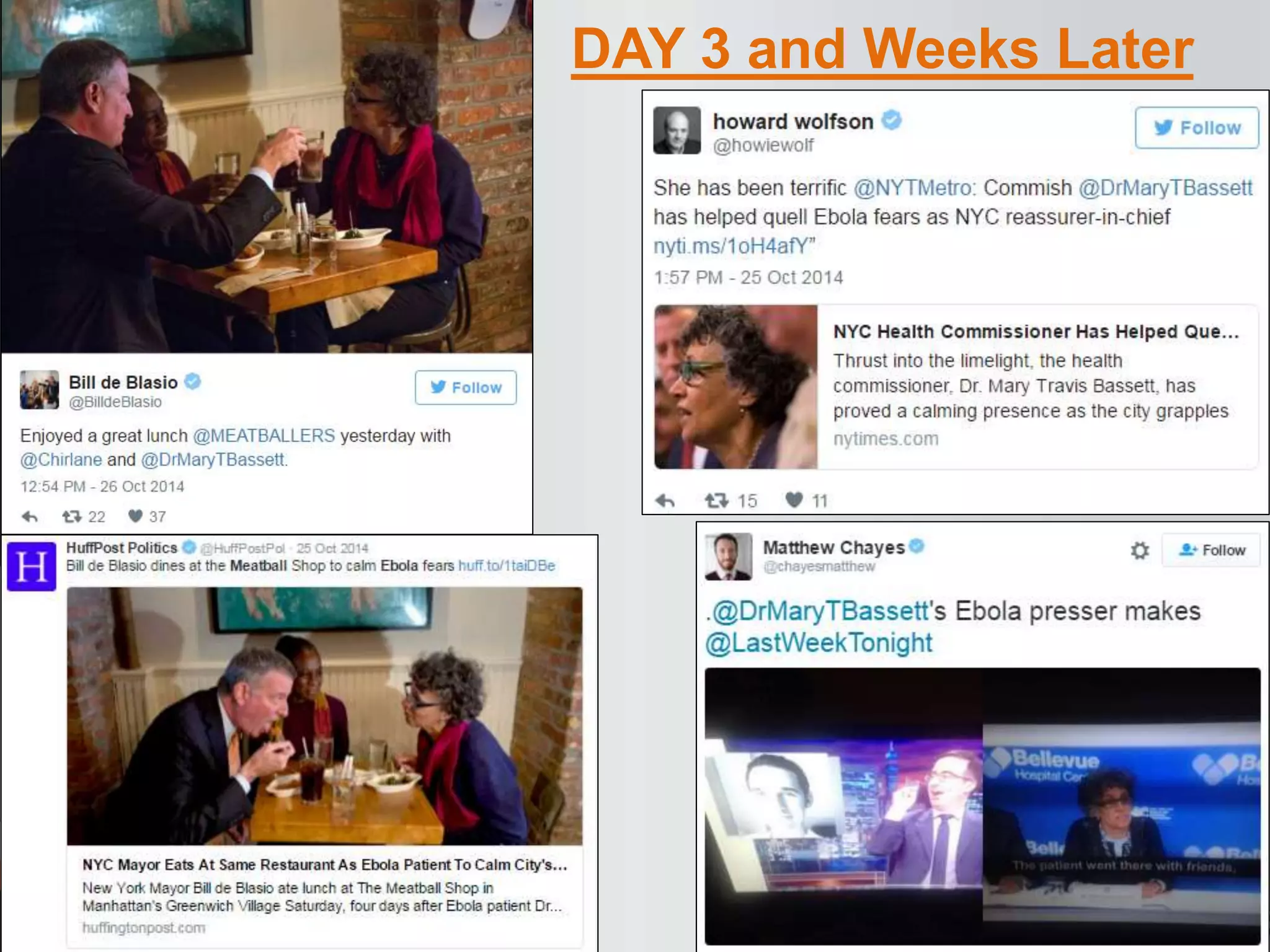
DAY 3 and Weeks Later
Last Week Tonight – John Oliver
Episode from 10/26/14
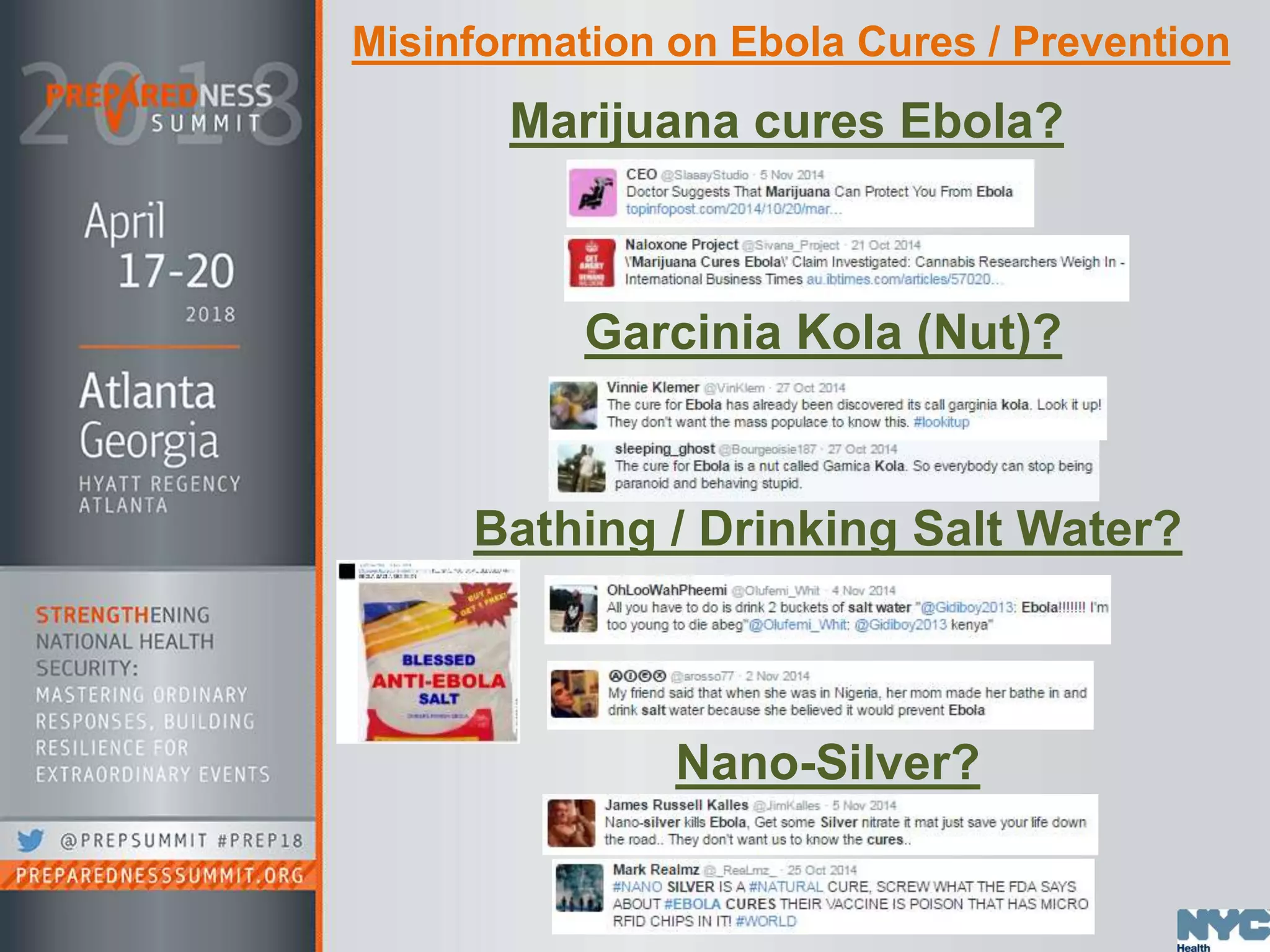
Misinformation on Ebola Cures / Prevention
Marijuana cures Ebola?
Garcinia Kola (Nut)?
Bathing / Drinking Salt Water?
Nano-Silver?
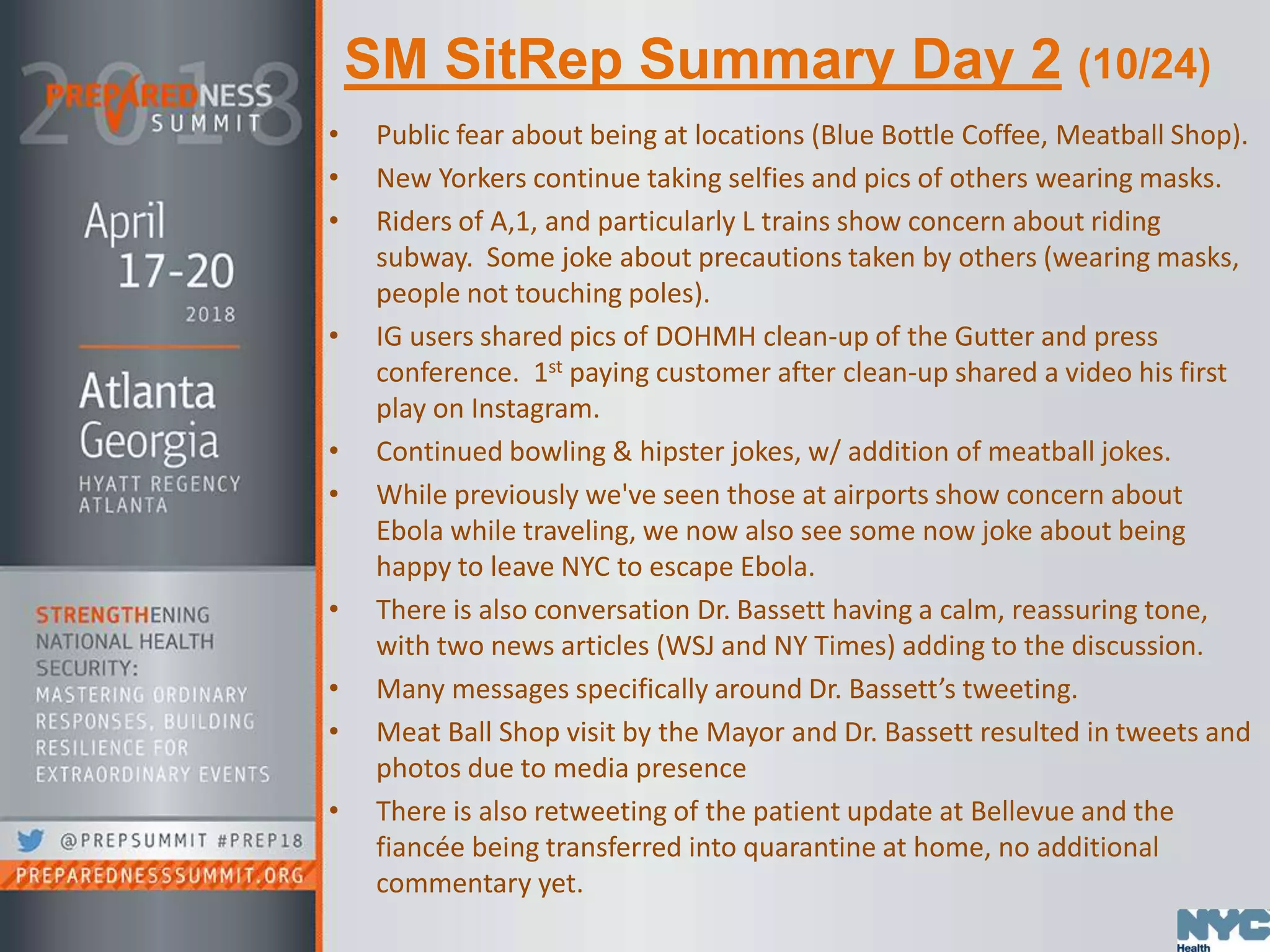
SM SitRep Summary Day 2 (10/24)
• Public fear about being at locations (Blue Bottle Coffee, Meatball Shop).
• New Yorkers continue taking selfies and pics of others wearing masks.
• Riders of A,1, and particularly L trains show concern about riding
subway. Some joke about precautions taken by others (wearing masks,
people not touching poles).
• IG users shared pics of DOHMH clean-up of the Gutter and press
conference. 1st paying customer after clean-up shared a video his first
play on Instagram.
• Continued bowling & hipster jokes, w/ addition of meatball jokes.
• While previously we've seen those at airports show concern about
Ebola while traveling, we now also see some now joke about being
happy to leave NYC to escape Ebola.
• There is also conversation Dr. Bassett having a calm, reassuring tone,
with two news articles (WSJ and NY Times) adding to the discussion.
• Many messages specifically around Dr. Bassett’s tweeting.
• Meat Ball Shop visit by the Mayor and Dr. Bassett resulted in tweets and
photos due to media presence
• There is also retweeting of the patient update at Bellevue and the
fiancée being transferred into quarantine at home, no additional
commentary yet.
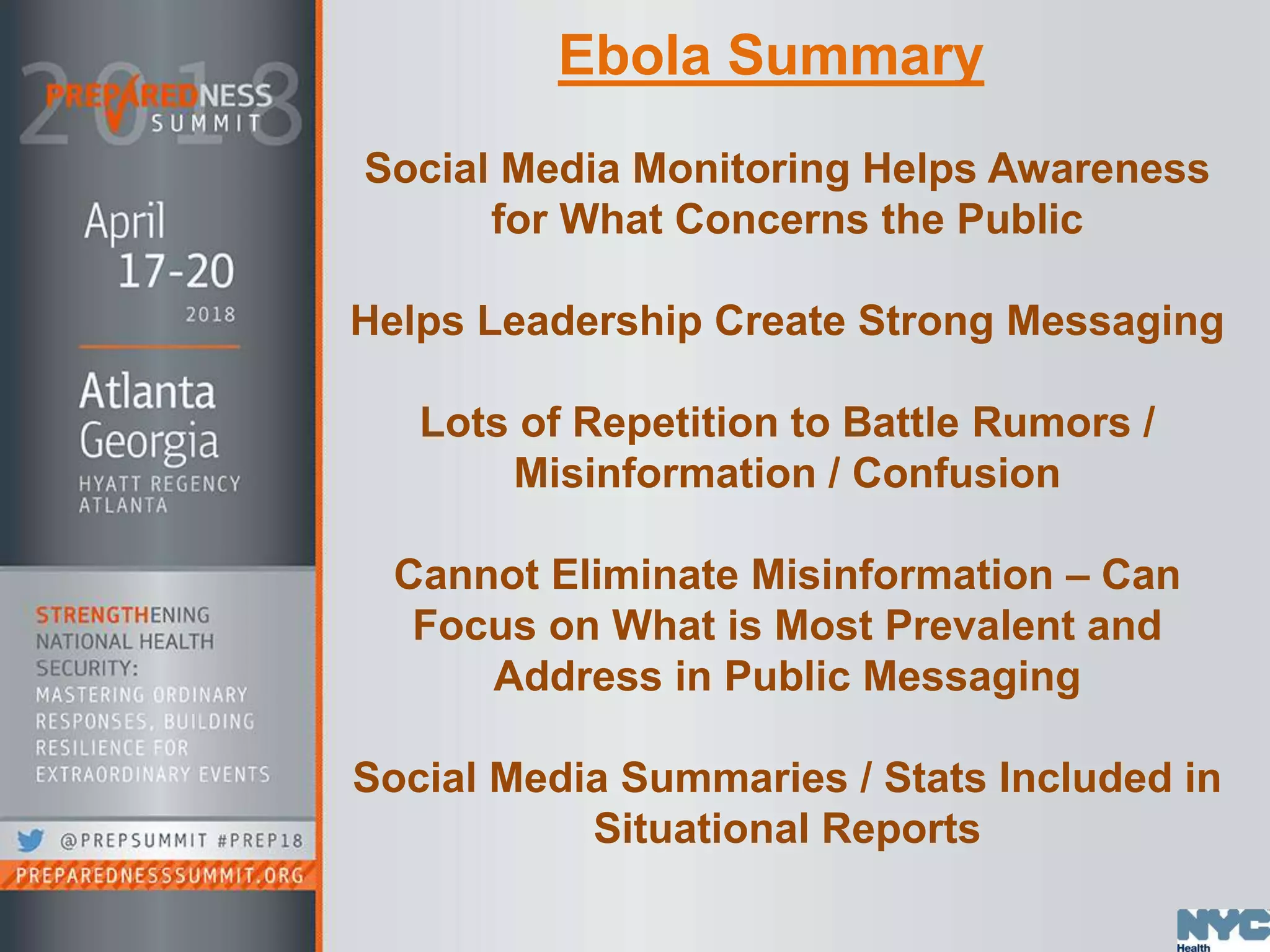
Social Media Monitoring Helps Awareness
for What Concerns the Public
Helps Leadership Create Strong Messaging
Lots of Repetition to Battle Rumors /
Misinformation / Confusion
Cannot Eliminate Misinformation – Can
Focus on What is Most Prevalent and
Address in Public Messaging
Social Media Summaries / Stats Included in
Situational Reports
Ebola Summary
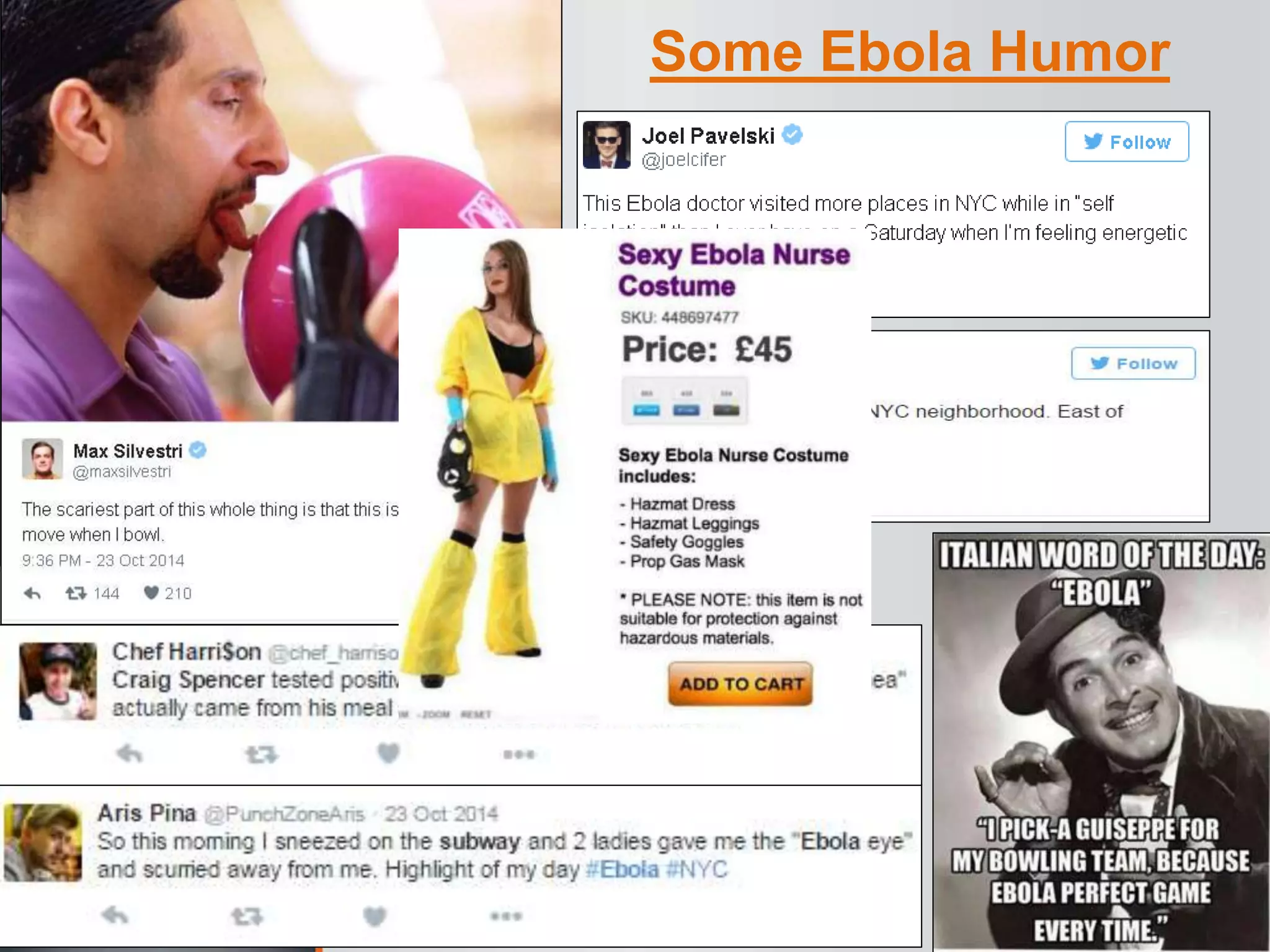
Some Ebola Humor
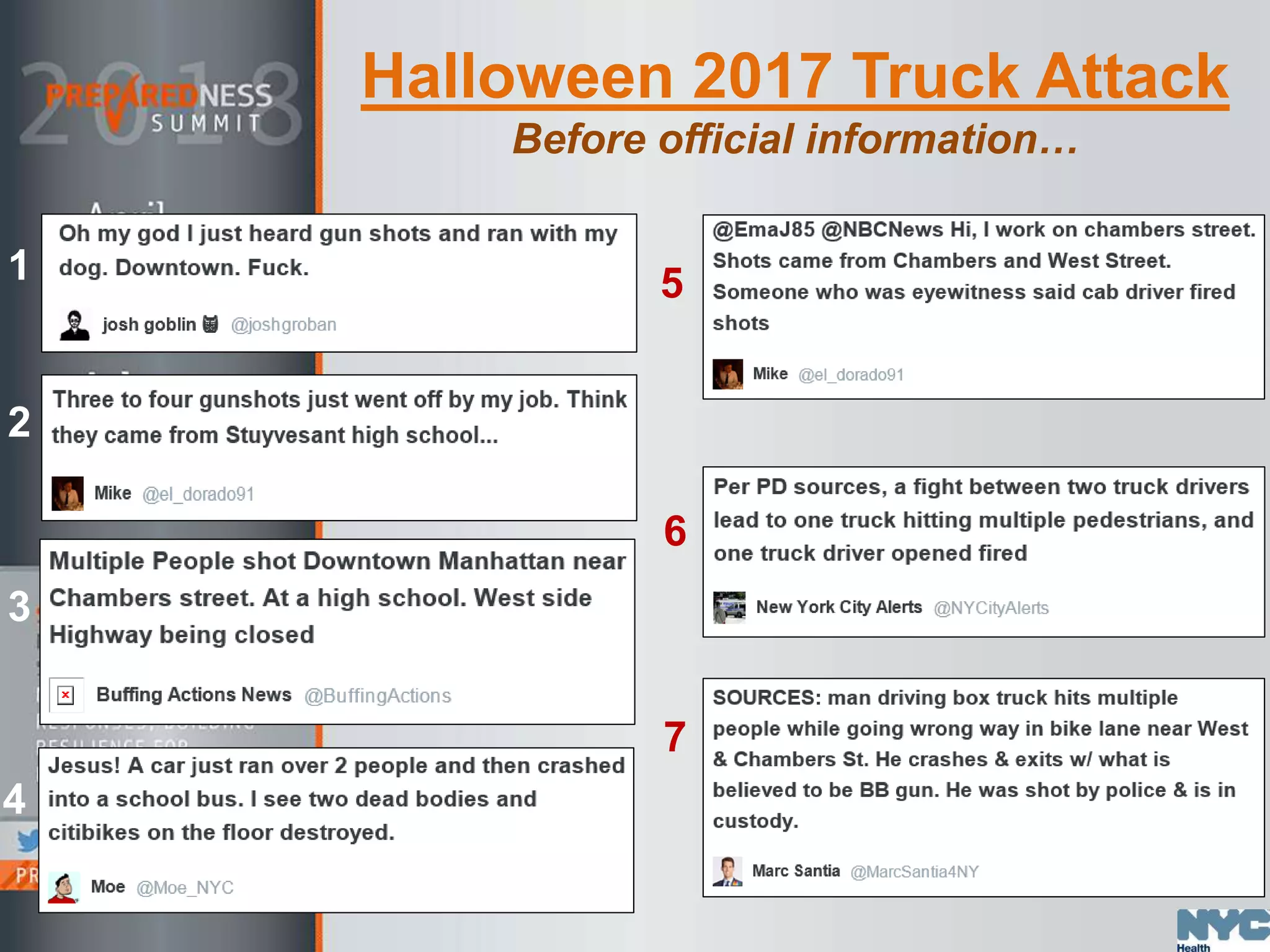
Halloween 2017 Truck Attack
Before official information…
1
2
3
4
5
6
7
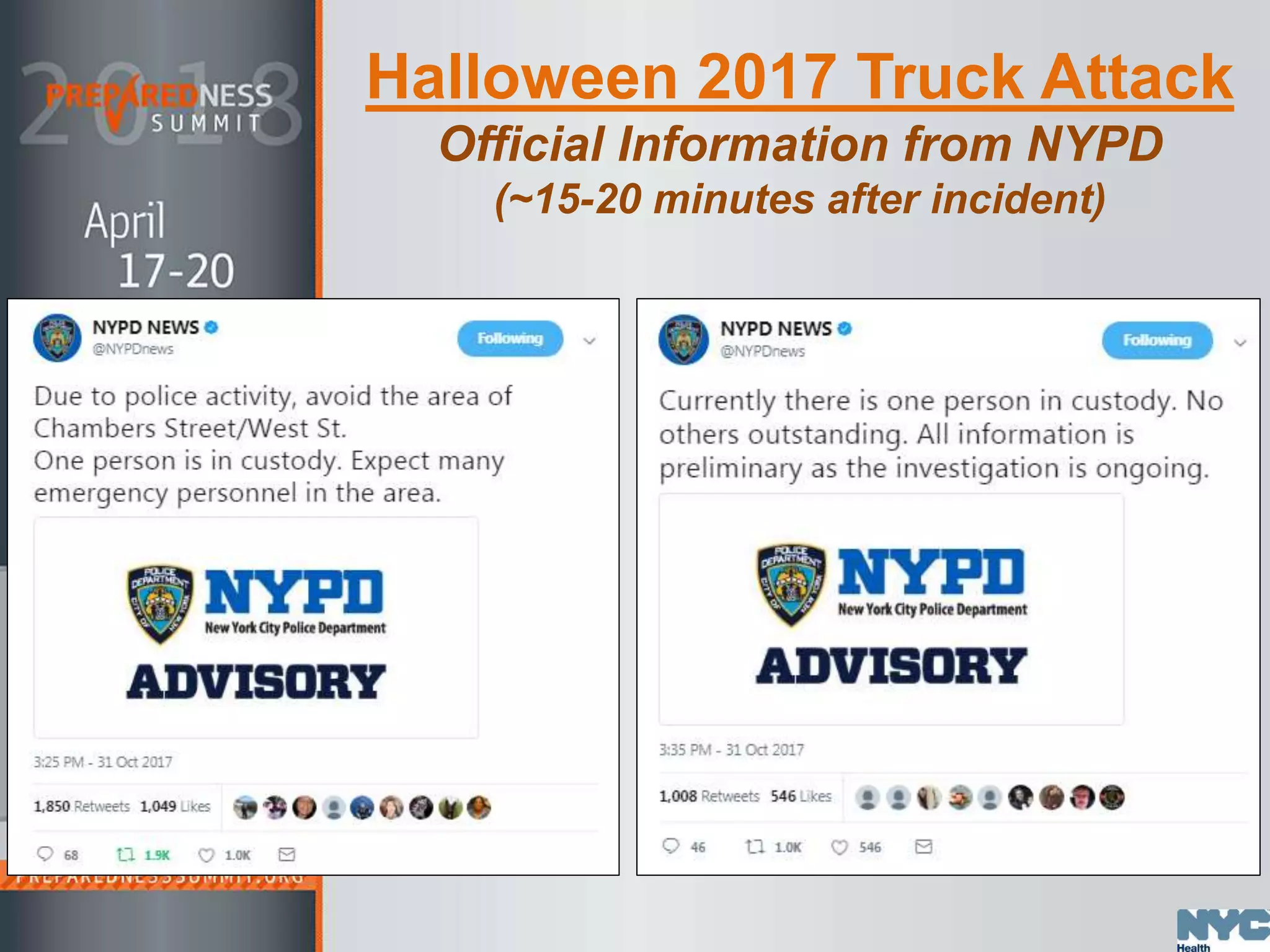
Halloween 2017 Truck Attack
Official Information from NYPD
(~15-20 minutes after incident)
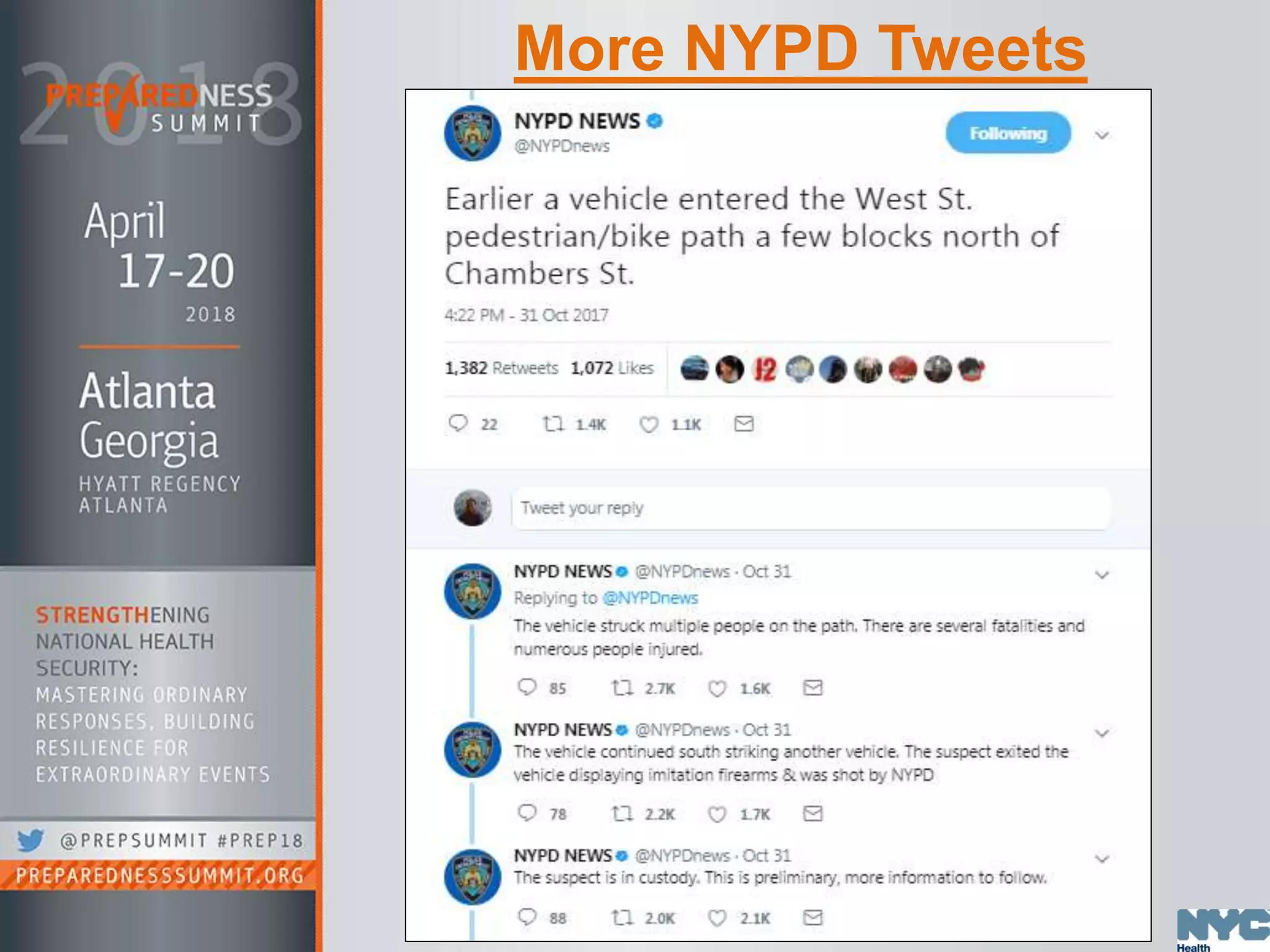
More NYPD Tweets
If you have some $$$$
Even with money and the best tools, monitoring still
requires a human touch (verification, interpretation,
reporting to leadership, detecting sarcasm, etc).
Must have staff dedicated to this function. It is just
as important as other public health operational
activities.
Combination of tools needed
Picking up on new keywords / trends
(modifying query as emergency progresses)
Preparation can be done in advance
Build a VOST relationship
Stay on top of current trends
In Summary
Contact Information
Tamer Hadi
thadi@health.nyc.gov
@tamer_hadi
http://www.linkedin.com/in/tamerhadi
Questions & Discussion

No Money, No Problem - A Scalable Approach to Social Media Monitoring

  • 1.
    No Money? NoProblem: A Scalable Approach to Social Media Monitoring Tamer Hadi Director of Strategic Technology Office of Emergency Preparedness and Response NYC Department of Health and Mental Hygiene @tamer_hadi *** On behalf of the NACCHO Public Health Communications Committee ***
  • 2.
  • 3.
    Why We PickedThis Topic
  • 4.
    Overview • Background (20mins) – Why should we be monitoring again? – Recent developments and incidents • Establishing online presence (10 mins) • Free Tools / Training / Resources (20 mins) • Leveraging External Resources (10 mins) • Case Studies from NYC (20 mins) • Discussion / Q&A (10 Minutes)
  • 5.
    Learning Objectives • Understandhow routine social media utilization can establish a health department as a trusted information source • Use social media during emergencies for situational awareness, rumor and misinformation control, public messaging and leadership decision-making.
  • 6.
    Social Media “Listening” Duringan Emergency Why Should We Be Doing This Again? • Real-time situational awareness • Get a feel for public sentiment • Instant feedback on public messaging  Informs future message development • Combat #FakeNews – identify and dispel major rumors and misinformation (public and news media) • Monitor agency reputation
  • 7.
    FEMA National IncidentManagement System (NIMS) Updated on October 17, 2017
  • 8.
    Establishing Online Presence During“Blue Skies” / “Peace Time”
  • 9.
    “The Case forthe SM Coordinator” (Jan/Feb 2018) http://www.govtech.com/social/The-Case-for-the-Social-Media-Coordinator.html “If you think managing social media just involves writing a few quick Tweets and Facebook posts every day — think again.” “Besides ‘simply’ writing content, the social media coordinator needs to manage citizen comments and complaints, analyze data, evaluate ads, train employees on the right way to use social media, create reports, work with video and graphics, and more.”
  • 10.
    Build Audience andCredibility • Audience for Public Health Emergency Preparedness is DIVERSE! – General Public – Communities and Businesses – Healthcare (Hospitals, ACFs, NHs, Pharmacies, Dialysis Centers) – Elected officials – Preparedness partners – DAFN / At-risk populations and more • Let’s be honest: VERY FEW people go to preparedness websites organically
  • 11.
    5 Marketing &Promotion Strategies 1. Leverage existing agency social media accounts 2. Use live events to drive traffic to social media posts 3. Participate in Twitter chats 4. Participate in national campaigns (e.g. September Preparedness Month, Hurricane Week, etc.) 5. Target niche groups with hashtags and mentioning specific accounts **
  • 12.
    Website Visits toNYC DOHMH Preparedness Home Page
  • 13.
    Example of LeveragingEvents Highlights from #Prep17
  • 14.
    Input from CommitteeMember “Don’t short-change the time used to discuss building (audience) in peace-time. Being in a flooding emergency right now, I can tell you it was nice to have a base following already and to be known in the community to have active and timely information. We have become a big component of update distribution via social media for the response due to the peace-time focus.” - NACCHO Committee Member, Michigan
  • 15.
    Huge Disasters inPast Year Highlighted Social Media Value • Hurricane Harvey • Hurricane Maria • Hurricane Irma • LA County Fires • Santa Barbara Mudslides • Ottawa County Michigan Flooding Public Health Issues to Listen for on Social Media Medium to Long-Term Impacts: • Disruption of healthcare system access, including medicines • Mental health issues including stress, depression and suicide • Food and water access & contamination from waste/debris • Increased risk of infectious diseases due to lack of safe water, hygiene, and sanitation
  • 16.
    Hurricane Harvey Public Health:We are not 1st responders, but plenty of health issues to “listen” for on social media
  • 17.
    Using public socialmedia images/reports to create flood maps used by emergency management in Broward County Florida “CrowdSource Rescue is a revolutionary platform that uses next-generation technology to quickly connect vetted volunteers with response, relief, and recovery cases before, during, and immediately after a disaster.” Walkie Talkie App over cellular or Wifi – Rescuers and public used this during Harvey and Irma
  • 18.
  • 19.
    NOT Covered inDepth Initial Risk Communication on Social Media • Strategies / best practices during emergency, such as: – Frequent updates (photos & live video when possible) on what you know and don’t know – Clear, concise and specific actionable messages • This is a multi-day training topic for PIOs • FEMA #PrepTalk • Recommend looking into CDC CERC Program
  • 20.
    Also NOT Covered(1) Verification Tips/Tricks
  • 21.
    Also NOT Covered(2) Verification Tips/Tricks Twitter Bio: Does source provide name, pic, bio, links to their own blog, identity, professional occupation, etc # of Tweets: Is this a new Twitter handle with only a few tweets? # of followers: Does source have a large following? If there are only a few, are any of the followers know and credible sources? Also, how many lists has this Twitter handle been added to? # following: How many Twitter users does the Twitter handle follow? Are these known and credible sources? Retweets: What type of content does the Twitter handle retweet? Location: Can the source’s geographic location be ascertained? Are they nearby the unfolding events? Timing: Does source appear to be tweeting in near real-time? Or are there considerable delays? Does anything appear unusual about the timing of the person’s tweets?
  • 22.
    General Monitoring Goals (forall emergencies) • Understanding general sentiment and public reaction to the incident • Capturing frequently asked questions to inform future agency messages • Countering misinformation and rumors (particularly news outlets and influencers) • Monitoring agency discussion – POLICY ISSUE: Handling social media interactions during an activation (e.g., direct mentions only or do you expand wider).
  • 23.
    Free “Listening” Tools •Twitter Advanced Search • TweetDeck and/or Hootsuite • Snapchat (Snap Maps) • GeoTweets Free #SMEM Training/Resources • National Disaster Preparedness Training Center • NLM Disaster Library Social Media Training • ASPR TRACIE Social Media Collection • DHS S&T Work Group • Drexel University Social Media Library • Follow #SMEM and #EMGTwitter Free Risk Communication Tools • Facebook Live • YouTube Live • NextDoor (strong for geographic reach)
  • 24.
    Twitter Advanced Search(1) • Start here to create robust and specific searches to help reduce noise https://twitter.com/search-advanced
  • 25.
  • 26.
    Advance Search =Complex Boolean Queries (ebola OR #ebola OR #ebolavirus OR #stopebola OR #EbolainNYC) AND ("new york" OR "new york city" OR NY OR NYC OR Brooklyn OR Queens OR Bronx OR Manhattan OR "Staten Island" OR SI OR BK OR BX OR astoria) zika OR #zika OR #zikavirus OR #virusdelzika near:"Queens, NY" within:15mi legionella OR legionella OR legionnaire OR legionnaires OR legionnaire's OR Legionaire's OR legionaires OR #Legionnaires OR #legionnairesdisease OR legionario OR Legionelosis OR legionellosis
  • 27.
  • 28.
  • 29.
  • 30.
    Snapchat Maps (SnapMaps) https://map.snapchat.com/ - Released Feb 2018 - On Desktop & no account needed to view - Curated by Snapchat - Only users who elect to be public
  • 31.
  • 32.
    Visualizing Flagged Content Youcan migrate stories to
  • 33.
  • 34.
  • 35.
  • 36.
    Resources/Training (4) OLDER REPORTS •Best Practices for Incorporating Social Media into Exercises - March 2017 • From Concept to Reality: Operationalizing Social Media for Preparedness, Response and Recovery – April 2016 • Using Social Media for Enhanced Situational Awareness and Decision Support – June 2014 • Lessons Learned: Social Media and Hurricane Sandy – June 2013 • Community Engagement and Social Media Best Practices – September 2012 • Next Steps: Social Media for Emergency Response – January 2012 • Social Media Strategy – January 2012 Examples of best practices include: • Establishing partnerships w/ local media outlets before disasters • Using the Joint Information System to coordinate public info efforts of multiple jurisdictions / agencies • Setting up a central website to debunk bad information
  • 37.
  • 38.
    Leveraging External Support VOST= Virtual Operations Support Team - External to agency - Team of volunteers activated to perform specific social media / online functions in support of an affected organization and/or jurisdiction - Each VOST typically has a “Team Leader” for any given operational period that reports directly to the affected organization/agency
  • 39.
  • 40.
  • 41.
    NYC MRC VOST Groupof ~20 MRC volunteers trained to support internal monitoring team - Role 1: Official message amplifiers (English/other languages) IMPORTANCE: Help spread factual info by posting official city messages in English and other languages - Role 2: Searching for incident-specific information (English and other languages) IMPORTANCE: Help DOHMH find relevant content and understand how messaging is being received by the public - Role 3: Reporting to the SMMT Lead IMPORTANCE: Making DOHMH aware of relevant content that can inform the response
  • 42.
    Social Media Monitoring: CaseStudies from NYC • Ebola in NYC (in-depth) • Halloween Truck Ramming Incident 2017 (brief)
  • 43.
    Timeline of SignificantEbola Events in USA Green Dates = NYC Events 07/31/14 - News that 2 Americans w/ Ebola would be transferred to Emory from Liberia 08/01/14 - NYC DOHMH conducts largest no notice POD full-scale exercise in NYC History 08/05/14 - NYC begins Ebola preparedness meetings 09/30/14 - Dallas Patient confirmed Ebola 10/03/14 - NYC DOHMH officially activates ICS - Social Media Monitoring officially begins 10/08/14 - Dallas Patient dies in hospital 10/12/14 - Nurse 1 confirmed Ebola 10/15/14 - Nurse 2 confirmed Ebola 10/23/14 - NYC Case confirmed 11/11/14 - NYC Patient Discharged 12/29/15 - Active Monitoring Call Center Shutdown - 5791 people monitored 02/02/16 - NYC DOHMH deactivates for Ebola - 1 year, 3 months, 30 days ▪▪▪
  • 44.
    07/31/14 - 2Americans w/ Ebola transferred to Emory 08/01/14 - NYC DOHMH conducts largest mass prophylaxis full scale exercise in NYC History (#RAMPEX)
  • 46.
  • 47.
  • 48.
    August - October2014 – Plenty of Scares
  • 49.
    No Shortage ofScares….
  • 50.
  • 51.
    Ebola Case inNYC (10/23/2014)
  • 52.
    Overall NYC EbolaSummary • DOHMH Led Large & Resource-Intensive Interagency Response – 25 city, state, federal agencies – 1000+ DOHMH staff and 500+ MRC volunteers – Cost exceeding $6.5M ($23M citywide) • Coordinated NYC hospitals to identify and isolate potential EVD cases and worked w/ 5 hospitals to ready treatment centers • Conducted extensive epidemiologic investigations with rapid laboratory diagnostics for potential EVD cases in NYC. – 12 EVD tests performed, 88 Persons Under Investigation. • Developed active monitoring call center – 5800+ travelers via JFK – 114 healthcare workers – Quarantined 3 case contacts for 21 days. • Created and distributed culturally sensitive material – 100,000+ “Am I at Risk?” palm cards (9 languages) – Utilized Community Outreach Teams to canvass 14 neighborhoods – Conducted 116 community engagement and education events.
  • 53.
    DAY 1: 10/23/14 Notification:Patient called MSF  MSF called DOHMH DOHMH coordinated w/ FDNY-EMS & Bellevue Hospital for safe/rapid transportation w/ minimum exposure to others Case Investigation and Contract Tracing: • Interviewed patient by phone before EMS transfer • Began contact tracing while patient en route to hospital Lab Testing: • DOHMH staff at Bellevue assisted w/ packing and transporting • Test results returned ~3 hours after specimen received Press Conference at 6:30pm Confirming Case
  • 54.
    *** CRITICAL SOCIALMEDIA DISCOVERY *** • Patient information leaked! • Discovered by SMMT immediately – Reported to PIO and Incident Commander • Prior to first official press conference • Prior to confirmation of lab results • Changed approach to press conference and preparing Commissioner talking points • Required immediate risk communication and community engagement
  • 55.
    1st Article LeakingInfo @ 2:44pm http://nypost.com/2014/10/23/nyc-may-have-its-first-ebola-case/
  • 56.
  • 57.
    1st Time PatientName Appeared in Tweet @ 3:03pm
  • 58.
  • 59.
    1st DOHMH Tweetin Response to Leak ~40 mins after leak reported
  • 61.
    Initial Leak CausedLots of Misinformation and Panic Wrong Bowling Alley!
  • 62.
    Cleaned & Re-Opened BowlingAlley “We cleaned every square inch of the place – every hole in every bowling ball” said Sal Pain, Bio-Recovery’s chief safety officer.
  • 63.
  • 64.
    Lots of GreatSubway Advice Too!
  • 65.
    Cab / UberHysteria
  • 66.
  • 67.
    Public Sentiment onPress Conference Positive Negative
  • 68.
    SM SitRep SummaryDay 1 (10/23) Mixed accounts of patient’s timeline in media: • Reports he came back 10 days ago - actually 7 (10/17) • Most sources initially reported “Brooklyn Bowl “not “The Gutter”. • Initial reports he took Uber to Brooklyn instead of back from Brooklyn. • Details around his subway travel emerged later on; initial reports focused on the cab ride • Residents of Harlem and Williamsburg expressed increased concern and panic about having been in close proximity to the patient. • Many jokes around bowling and Ebola, humorous scenarios related to getting Ebola from bowling, and hipster-related jokes • Viewers of the press conference found Dr. Bassett calming, reassuring, and authoritative • Continues to be criticism around her statement that the patient was self-quarantining.
  • 69.
    Day 2 More PatientActivities Shared at 2nd Press Conference Oct 21 – No symptoms – felt fatigued, but no fever • “The Meatball Shop” Restaurant • “Blue Bottle” Coffee Shop on High Line • 1 Train Home to Harlem Oct 22 – No symptoms – felt fatigued, but no fever • Jogged 3 miles in W. Harlem neighborhood • Took A and L Train lines to Williamsburg, Brooklyn Bowling Alley • Took Uber home Oct 23 – Low-grade fever • Fever  Called MSF  DOHMH Notified
  • 70.
  • 71.
    DAY 3 andWeeks Later
  • 72.
    Last Week Tonight– John Oliver Episode from 10/26/14
  • 73.
    Misinformation on EbolaCures / Prevention Marijuana cures Ebola? Garcinia Kola (Nut)? Bathing / Drinking Salt Water? Nano-Silver?
  • 74.
    SM SitRep SummaryDay 2 (10/24) • Public fear about being at locations (Blue Bottle Coffee, Meatball Shop). • New Yorkers continue taking selfies and pics of others wearing masks. • Riders of A,1, and particularly L trains show concern about riding subway. Some joke about precautions taken by others (wearing masks, people not touching poles). • IG users shared pics of DOHMH clean-up of the Gutter and press conference. 1st paying customer after clean-up shared a video his first play on Instagram. • Continued bowling & hipster jokes, w/ addition of meatball jokes. • While previously we've seen those at airports show concern about Ebola while traveling, we now also see some now joke about being happy to leave NYC to escape Ebola. • There is also conversation Dr. Bassett having a calm, reassuring tone, with two news articles (WSJ and NY Times) adding to the discussion. • Many messages specifically around Dr. Bassett’s tweeting. • Meat Ball Shop visit by the Mayor and Dr. Bassett resulted in tweets and photos due to media presence • There is also retweeting of the patient update at Bellevue and the fiancée being transferred into quarantine at home, no additional commentary yet.
  • 75.
    Social Media MonitoringHelps Awareness for What Concerns the Public Helps Leadership Create Strong Messaging Lots of Repetition to Battle Rumors / Misinformation / Confusion Cannot Eliminate Misinformation – Can Focus on What is Most Prevalent and Address in Public Messaging Social Media Summaries / Stats Included in Situational Reports Ebola Summary
  • 76.
  • 77.
    Halloween 2017 TruckAttack Before official information… 1 2 3 4 5 6 7
  • 78.
    Halloween 2017 TruckAttack Official Information from NYPD (~15-20 minutes after incident)
  • 79.
  • 80.
    If you havesome $$$$
  • 81.
    Even with moneyand the best tools, monitoring still requires a human touch (verification, interpretation, reporting to leadership, detecting sarcasm, etc). Must have staff dedicated to this function. It is just as important as other public health operational activities. Combination of tools needed Picking up on new keywords / trends (modifying query as emergency progresses) Preparation can be done in advance Build a VOST relationship Stay on top of current trends In Summary
  • 82.

Editor's Notes

  • #2 I was hesitant to pick this topic again, because I felt it was getting old, but in fact, there is still a tremendous need for this guidance as not all health departments are doing this yet. Anyone who has heard any of my social media talks in the past, you will see some recycled content, but I’ve added quite a few new things as well.
  • #7 Value of Social Media Listening (chime in that this topic is getting “old” in a sense (I presented on it in PHEP SUMMIT 2014 and 16)
  • #11 DRIVE PEOPLE TO OUR WEBSITES
  • #12 NOT SAYING SOCIAL MEDIA IS ONLY WAY TO IMPROVE/PROMOTE website -@nycHealthy twitter with over 40,000 followers -NYC DOHMH facebook page with over 22,000 followers -live event like the Preparedness Summit or APHA Annual Meetings, or even a press conference in NYC -twitter chats, mostly around preparedness, one hosted by @CDCemergency -national campaigns like #preparedness month -targeting a niche group, like pharmacists
  • #13 SEO helps too
  • #17 With 911 unavailable or overwhelmed and/or cell networks bogged down, social media was used for please of help MOLD, CHEMICALS THAT RESURFACED FROM ENVIRONMENTALLY TOXIC SITES if they are talking to you, you need to be listening HARRIS COUNTY HEALTH VERY ACTIVE – WOULD BE GREAT TO HEAR ABOUT HOW THEY HANDLED THINGS Disruption of healthcare system access, including medicines Food and water access and contamination from waste, debris, and other pollution Increased risk of infectious diseases due to lack of safe water, adequate hygiene, and sanitation Mental health issues including stress, depression and suicide
  • #20 For example, all of the components of a strong message…..
  • #21 For example, all of the components of a strong message…..
  • #22 For example, all of the components of a strong message…..
  • #26 What you want to see and DON’T WANT TO SEE
  • #28 Both multi-column streaming search TWEETDECK IS ONLY TWITTER HOOTSUITE can do multiple platforms – HUGE advantage
  • #29 Both multi-column streaming search TWEETDECK IS ONLY TWITTER HOOTSUITE can do multiple platforms – HUGE advantage
  • #33 What do you do with all this stuff you find?
  • #37 https://www.dhs.gov/publication/st-frg-countering-false-information-social-media-disasters-and-emergencies
  • #38 Not intended to be an exhaustive list but rather a starting point designed to get folks thinking about the many health-related information needs audiences are likely to have in the event of any of these disasters. Message templates are designed to be easily tailored/customized (e.g. #EventHashtag tweet is a placeholder that can be replaced and was factored in to the character count already so that the rest of the content doesn't need to be changed when inserting a hashtag) Built off existing, cleared content from subject matter experts at CDC, PA Dept of Heath, FEMA, FDA, etc. Content was reviewed by subject matter experts as well. In addition to sample messages, library includes directives/reminders throughout based off best practices Did our best to incorporate relevant images and links to additional information in order to overcome the challenges of limited characters On the site there is a link to submit feedback, including requests for additional content
  • #39 There are options when you simply cannot sustain this internally
  • #40 There are options when you simply cannot sustain this internally
  • #42 DOHMH published content in top 13 languages Other non-traditional platforms (beyond the big 3-4)
  • #53 Most interesting day of my Public Health career – was serving as Liaison Officer that day What made this most interesting is the man decided to travel all over the city the day before his fever.
  • #56 Though it was published at 2:44 the New York Post account did not tweet it out at same time
  • #65 https://www.youtube.com/watch?v=9nhsNJb-Ejc <iframe width="560" height="315" src="https://www.youtube.com/embed/9nhsNJb-EJc" frameborder="0" allow="autoplay; encrypted-media" allowfullscreen></iframe>
  • #73 https://www.youtube.com/watch?v=kppVuXppaJs