Vassilios Peristeras [email_address] From Open to Linked Government Data
Interoperability Solutions for European Public Administrations Informatics Directorate-General, Interoperability Solutions for European Public Administrations (ISA) ISA  Actions  (part of the 2010-2015 Work Programme) Common frameworks in support of interoperability (policies, strategies, specifications, methodologies, guidelines) European Interoperability Framework European Interoperability Strategy  European Interoperability Architecture National Interoperability Frameworks Observatory Access to Base Registers Semantic Interoperability Center Europe - SEMIC
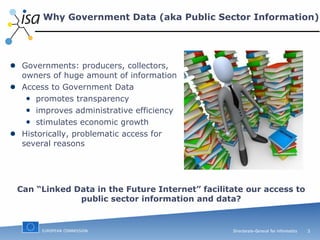
Why Government Data (aka Public Sector Information) Governments: producers, collectors, owners of huge amount of information Access to Government Data promotes transparency improves administrative efficiency  stimulates economic growth Historically, problematic access for several reasons Can “Linked Data in the Future Internet” facilitate our access to public sector information and data?
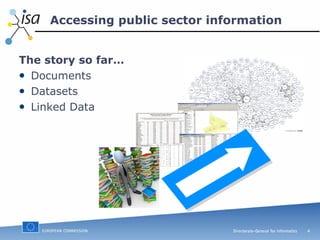
Accessing public sector information The story so far… Documents  Datasets Linked Data
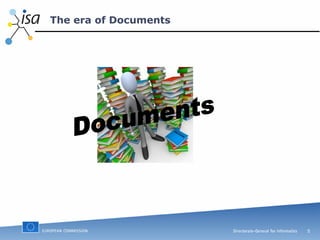
The era of Documents Documents
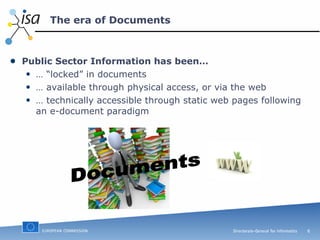
The era of Documents Public Sector Information has been… … “ locked” in documents …  available through physical access, or via the web …  technically accessible through static web pages following an e-document paradigm Documents
The era of Documents Accessibility Discoverability  Cross-referencing Handling  Costs
The era of Documents Re-use of Public Sector Information Directive : the way public sector bodies should enhance re-use of their information resources (2003/98/EC, 17/11/2003). Member States to implement the Directive into national law by 1/7/2005 In 2008, all 27 Member States notified complete transposition of the PSI Directive. 
The era of Datasets (aka Open Data) Datasets
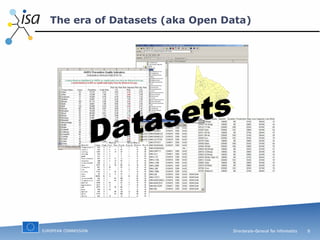
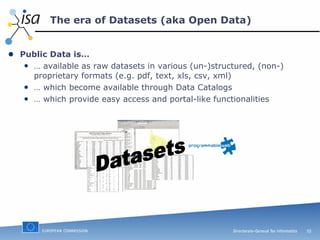
The era of Datasets (aka Open Data) Public Data is… …  available as raw datasets in various (un-)structured, (non-) proprietary formats (e.g. pdf, text, xls, csv, xml) …  which become available through Data Catalogs …  which provide easy access and portal-like functionalities Datasets
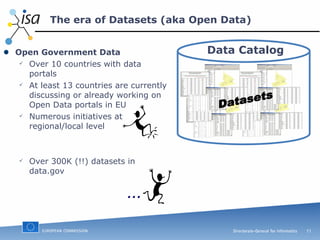
The era of Datasets (aka Open Data) Open Government Data  Over 10 countries with data portals At least 13 countries are currently discussing or already working on Open Data portals in EU Numerous initiatives at regional/local level Over 300K (!!) datasets in data.gov Data Catalog Datasets …
The era of Datasets (aka Open Data) Accessibility +++ Discoverability + Cross-referencing - Handling +++  Costs +++ Datasets Management Systems Data catalog federation
The era of linked data (?) Linked Data
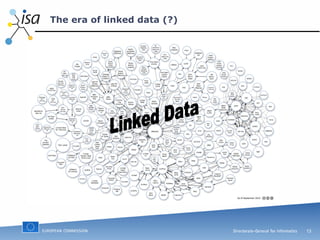
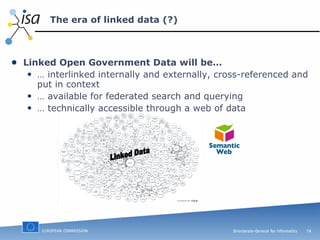
The era of linked data (?) Linked Open Government Data will be… …  interlinked internally and externally, cross-referenced and put in context …  available for federated search and querying  …  technically accessible through a web of data Linked Data
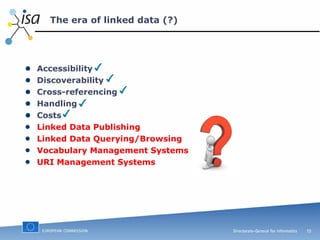
The era of linked data (?) Accessibility Discoverability  Cross-referencing Handling  Costs Linked Data Publishing Linked Data Querying/Browsing Vocabulary Management Systems URI Management Systems
European Commission actions I European Public Sector Information (PSI) Platform , to raise awareness and exchange good practices. More planned activities under CIP are foreseen. LOD2-FP7 project  to increase public access to high-value, machine-readable data sets generated by European, national/regional/local public administrations. The  Linked Open Data Around the Clock  (LATC) FP7 Support Action supports interested partners to publish and consume Linked Data.
European Commission actions II Digital Agenda Stakeholders’ Day: “ Priority   #3: Beyond raw data: public sector information, done   well ” . A discussion on what is next in Open Data Provide  Semantic Interoperability Center Europe (SEMIC)  as a possible trusted registry infrastructure for vocabulary, metadata schemas and EU URI management (semantic assets) Investigate ways of  improving access to EC information
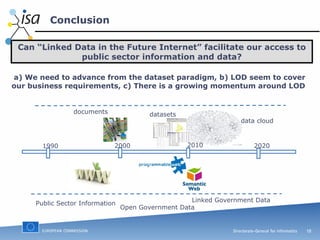
Conclusion  1990 2000 2010 2020 Public Sector Information Open Government Data Linked Government Data documents datasets data cloud Can “Linked Data in the Future Internet” facilitate our access to public sector information and data? a) We need to advance from the dataset paradigm, b) LOD seem to cover our business requirements, c) There is a growing momentum around LOD
References http://ec.europa.eu/information_society/policy/psi, PSI Directive http://www.epsiplus.net/, EPSI platform  http://lod2.eu/Welcome.html, LOD2 project  http://latc-project.eu/, LATC project  http://ec.europa.eu/information_society/digital-agenda/getinvolved/index_en.htm, Digital Agenda Stakeholders Priorities http://www.semic.eu/semic/, SEMIC platform http://linkeddata.org/, The Linking Open Data cloud diagram
Vassilios Peristeras [email_address] From Open to Linked Government Data

Vassilios Peristeras: From Open to Linked Government Data: (European Commission, ISA)

  • 1.
    Vassilios Peristeras [email_address]From Open to Linked Government Data
  • 2.
    Interoperability Solutions forEuropean Public Administrations Informatics Directorate-General, Interoperability Solutions for European Public Administrations (ISA) ISA Actions (part of the 2010-2015 Work Programme) Common frameworks in support of interoperability (policies, strategies, specifications, methodologies, guidelines) European Interoperability Framework European Interoperability Strategy European Interoperability Architecture National Interoperability Frameworks Observatory Access to Base Registers Semantic Interoperability Center Europe - SEMIC
  • 3.
    Why Government Data(aka Public Sector Information) Governments: producers, collectors, owners of huge amount of information Access to Government Data promotes transparency improves administrative efficiency stimulates economic growth Historically, problematic access for several reasons Can “Linked Data in the Future Internet” facilitate our access to public sector information and data?
  • 4.
    Accessing public sectorinformation The story so far… Documents Datasets Linked Data
  • 5.
    The era ofDocuments Documents
  • 6.
    The era ofDocuments Public Sector Information has been… … “ locked” in documents … available through physical access, or via the web … technically accessible through static web pages following an e-document paradigm Documents
  • 7.
    The era ofDocuments Accessibility Discoverability Cross-referencing Handling Costs
  • 8.
    The era ofDocuments Re-use of Public Sector Information Directive : the way public sector bodies should enhance re-use of their information resources (2003/98/EC, 17/11/2003). Member States to implement the Directive into national law by 1/7/2005 In 2008, all 27 Member States notified complete transposition of the PSI Directive. 
  • 9.
    The era ofDatasets (aka Open Data) Datasets
  • 10.
    The era ofDatasets (aka Open Data) Public Data is… … available as raw datasets in various (un-)structured, (non-) proprietary formats (e.g. pdf, text, xls, csv, xml) … which become available through Data Catalogs … which provide easy access and portal-like functionalities Datasets
  • 11.
    The era ofDatasets (aka Open Data) Open Government Data Over 10 countries with data portals At least 13 countries are currently discussing or already working on Open Data portals in EU Numerous initiatives at regional/local level Over 300K (!!) datasets in data.gov Data Catalog Datasets …
  • 12.
    The era ofDatasets (aka Open Data) Accessibility +++ Discoverability + Cross-referencing - Handling +++ Costs +++ Datasets Management Systems Data catalog federation
  • 13.
    The era oflinked data (?) Linked Data
  • 14.
    The era oflinked data (?) Linked Open Government Data will be… … interlinked internally and externally, cross-referenced and put in context … available for federated search and querying … technically accessible through a web of data Linked Data
  • 15.
    The era oflinked data (?) Accessibility Discoverability Cross-referencing Handling Costs Linked Data Publishing Linked Data Querying/Browsing Vocabulary Management Systems URI Management Systems
  • 16.
    European Commission actionsI European Public Sector Information (PSI) Platform , to raise awareness and exchange good practices. More planned activities under CIP are foreseen. LOD2-FP7 project to increase public access to high-value, machine-readable data sets generated by European, national/regional/local public administrations. The Linked Open Data Around the Clock (LATC) FP7 Support Action supports interested partners to publish and consume Linked Data.
  • 17.
    European Commission actionsII Digital Agenda Stakeholders’ Day: “ Priority #3: Beyond raw data: public sector information, done well ” . A discussion on what is next in Open Data Provide Semantic Interoperability Center Europe (SEMIC) as a possible trusted registry infrastructure for vocabulary, metadata schemas and EU URI management (semantic assets) Investigate ways of improving access to EC information
  • 18.
    Conclusion 19902000 2010 2020 Public Sector Information Open Government Data Linked Government Data documents datasets data cloud Can “Linked Data in the Future Internet” facilitate our access to public sector information and data? a) We need to advance from the dataset paradigm, b) LOD seem to cover our business requirements, c) There is a growing momentum around LOD
  • 19.
    References http://ec.europa.eu/information_society/policy/psi, PSIDirective http://www.epsiplus.net/, EPSI platform http://lod2.eu/Welcome.html, LOD2 project http://latc-project.eu/, LATC project http://ec.europa.eu/information_society/digital-agenda/getinvolved/index_en.htm, Digital Agenda Stakeholders Priorities http://www.semic.eu/semic/, SEMIC platform http://linkeddata.org/, The Linking Open Data cloud diagram
  • 20.
    Vassilios Peristeras [email_address]From Open to Linked Government Data

Editor's Notes

  • #18 Promoting Reuse of Public Sector Information Re-use of Public Sector Information Directive: the way public sector bodies should enhance re-use of their information resources (2003/98/EC, 17/11/2003). Member States to implement the Directive into national law by 1/7/2005 In 2008, all 27 Member States notified complete transposition of the PSI Directive.