12/12/21, 9:00 AM Originality Report
https://lms.seu.edu.sa/webapps/mdb-sa-
BBLEARN/originalityReport/ultra?attemptId=d81b98e5-2fa0-
4210-aa3b-af8bfd00c070&course_id=_93087_1… 1/6
11 Student paper
9 ProQuest document
3
Student paper
6
wikipedia
10
Student paper
1
5
1 The Change Management Process
Student’s Name
Course
Professor
SafeAssign Originality Report
(Current Semester - TGM)‫ي‬ ‫حال‬ ‫ال‬ ‫صل‬ ‫ف‬ ‫ال‬-521: Managing
Dynamic Environ… • Turnitin Plagiarism Checker
View Originality Report - Old Design
Submission UUID: c20e1470-9892-d9a7-754c-ff27a6c41f1f
Total Score: Medium risk
37 %
Total Number of Reports
1
Highest Match
37 %
TheChangeManagementProcess.edited )…
Average Match
37 %
Submitted on
12/12/21
08:57 AM GMT+3
Average Word Count
1,851
Highest: TheChangeManagementProcess…
Attachment 1
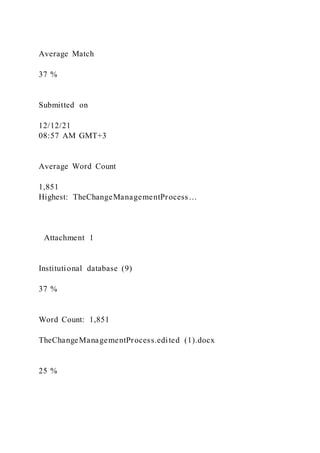
Institutional database (9)
37 %
Word Count: 1,851
TheChangeManagementProcess.edited (1).docx
25 %
Internet (3) 8 %
auaa
Global database (1) 3 %
Scholarly journals & publications (1) 1 %
Top sources (3)
Excluded sources (0)
Student paper Student paper Student paper 3
7
12
Student paper Student paper Student paper
wikipedia graceplaceofwillmar
10
8
5
2
14
1
6 4 13
https://lms.seu.edu.sa/webapps/mdb-sa-
BBLEARN/originalityReport?attemptId=d81b98e5-2fa0-4210-
aa3b-
af8bfd00c070&course_id=_93087_1&download=true&includeD
eleted=true&print=true&force=true
12/12/21, 9:00 AM Originality Report
https://lms.seu.edu.sa/webapps/mdb-sa-
BBLEARN/originalityReport/ultra?attemptId=d81b98e5-2fa0-
4210-aa3b-af8bfd00c070&course_id=_93087_1… 2/6
Date
2 Mission, vision, and industry Saudi Telecom Company is
a technology-based company that specializes in
telecommunication services, internet services, landline,
computer networks, fintech, and digital solutions. 3 Saudi
Telecom Company was founded in 1998 and currently occupies
81% of the telecommunication market in
Saudi Arabia. 4 It is the leading provider of
telecommunication-related services in the Kingdom of Saudi
Arabia and one of the biggest companies in the Middle
East. Since its establishment, the company has gradually
expanded its operation across the Middle East and beyond, with
major investments in Malaysia, Kuwait,
United Arab Emirates, and Indonesia (Al-Kahtani, 2018). In
2020, the company had total revenue of about $14.9 billion and
a net income of about $2.84 billion. The
company is currently headquartered in Riyadh, Saudi Arabia,
and has over 17,500 employees. 5 Saudi Telecom Company
services are divided into three broad
brackets: Landline network (Al-Hatif), mobile network (Al-
Jawal), and Digital Payment (Stc-Pay). Mission statement "To
enhance brand value and customer experience
through GRC excellence. Maximize shareholder value and
company valuation" 6 Vision Statement “To become a
digital and telecom leader, enabling the society
and economy to thrive, in Kingdom of Saudi Arabia and
beyond” Industry Telecommunications in Saudi Arabia have
drastically evolved since the establishment of the
Directorate of Telephone, Post, and Telegraph in 1926. King
Abdul Aziz Al-Saud first founded this directorate to control and
provide telecommunication services in the
country. Saudi Telecom Company (STC) was the first
telecommunication company to provide Fixed Line Telephone
and Mobile services in Saudi Arabia. The
Communications Commission later allowed other
telecommunication companies to enter the market to combat the
ongoing monopoly in the industry. The Saudi
Arabia telecommunication market currently has over ten
telecom companies offering different services; they include
Saudi Telecom Company, Etihad Atheeb
Telecom, KFB Holding Group, Electronica, and Alkan CIT.
According to the Communications and Information Technology
Commission (CITC), Saudi Arabia's telecom
market is worth $17 billion, making the Saudi telecom industry
the biggest in the Middle East (Bagadeem, 2021). The Saudi
Telecom industry is projected to grow by
12% by 2027 because of the industry's ongoing changes in
service delivery, technological developments, telcos' service
expansion, and competitive landscape.
Additionally, Saudi’s demographic structure has around 70% of
its population aged below 45, indicating that future demands for
ICT services will rise. Moreover, the
launch of the highly anticipated 5G network is expected to bring
new opportunities, along with investments from Saudi Arabia
and beyond. 7
the pillars of Saudi Vision 2030
Changes based upon
i. 8 Expansion into new product lines According to Mitchell
& Alfuraih (2018), Saudi vision 2030 is an imperative
framework to reduce the country’s dependence on
oil, expand its economy and develop public service sectors such
as education, infrastructure, health, tourism, and recreation.
This however can only be achieved if all
stakeholders in the country took part in contributing towards the
same. In line with Saudi Vision 2030, Saudi Telecom Company
(STC) has already started to make
changes in its operation. One of the changes that the company
has already undertaken is the establishment of new product
lines. A good example is the expansion
into fintech. In 2019, Saudi Telecom Company (STC)
announced the introduction of a wholly-owned fintech
subsidiary. The expansion provided Saudi people with a
platform where they could better manage their financial
operations and processes at a touch of an application. It also
facilitated the transformation of STC's payment
platform into an integrated digital service. ii. Technology
changes through its R&D effort. The other change that the
company has made in line with the pillars of Saudi
Vision 2030 is the creation of new technologies through its
R&D efforts. In partnership with the Saudi government and
other stakeholders, Saudi Telecom Company
(STC) has spearheaded the introduction of new telecom
technology in the country. A good example is the introduction
of Smart chip and 5G network. Saudi Telecom
Company (STC) has already deployed its 5G network
technology in more than 45 cities around the country, making it
the fastest 5G distribution company in the
Middle East. This change is fully supportive of the pillars of
Saudi Vision 2030. In 2020, the company launched the country's
largest digital operations control center,
with over 2,200 employees already deployed. The facility
includes a highly advanced system encompassing various digital
processes such as digital crises manage-
ment, simulation, and digital infrastructure. This was a
significant move aimed at developing the public service sectors
such as recreation, education, and infrastruc-
ture (Alharbi, Dowling & Bhatti, 2019).
The other change that the company has undertaken in line with
the Saudi Vision 2030 is developing stronger downstream
business. Although Saudi Telecom
Company (STC) is still actualizing this change, it is expected to
create more employment opportunities, increase the company's
contribution to the GDP, and provide
steady service-revenue streams for the company. 3
forth by Saudi Vision 2030
Additional changes that Saudi Telecom Company (STC) must
make to align with the goals and objectives set
i. Build strategic partnerships with the government and other
stakeholders in the industry Being a giant company in the Saudi
telecom market, Saudi Telecom
Company (STC has a huge role to play towards the realization
of Vision 2030. In this case, Saudi Telecom Company (STC)
needs to ally with other government agencies
such as the ministry of commerce, culture, and justice to
strategically actualize Vision 2030. It will also enhance the
partnership between private and government enti-
ties. ii. Investment opportunities Saudi Telecom Company
(STC) should aim to intensify its local and international
investments, this way, the company will be able to
create more employment opportunities, generate more income
and promote global diversification of economic programs. The
company should also consider ex-
panding its product lines. 3 Changes that Saudi Telecom
Company (STC) must make to align with the changes/needs in
the external environment i. Increase the
price of its products and services The current economic
atmosphere, together with the global pandemic, has greatly
affected companies worldwide, with Saudi
Telecom Company (STC) being one of the most affected
companies in the Middle East. Therefore, for the company to
maintain profitability, it should consider increas-
ing the price of its products and services (Amran et al., 2020).
Its close competitors, such as Mobily and America Movil, have
already raised their product prices to re-
main competitive and adapt to the current external environment.
ii. Manage its workforce based on priorities and values Like any
other business, STC's culture speaks
volumes about the company. Therefore, Saudi Telecom
Company (STC) should consider managing its employees based
on values that promote a positive culture.
Promoting a positive culture embedded in the company's core
values will significantly promote productivity and high
performance. 1
fectively carry out change
Action planning tools to ef-
i. 7 SWOT analysis One of the most effective tools for
action planning, in this case, is the SWOT analysis tool. This
particular tool will assist Saudi Telecom Company
in getting visibility on its current status, thereby helping the
company to measure and understand areas of improvement. By
understanding its strengths, Saudi
Telecom Company (STC) will be better positioned to capitalize
on its strengths when implementing the needed change. A
SWOT analysis tool would also help the com-
pany in allocating resources effectively and appropriately since
it knows areas that need work. The strengths that the company
can capitalize on include a strong
brand portfolio, strong distribution network, reliable suppliers,
and a highly-skilled workforce. Saudi Telecom Company's
weaknesses include cash flow problems, lack
of diversification in its workforce, low current ratio, and rented
property. Like strengths, these are internal aspects of the
company. By identifying its weaknesses,
Saudi Telecom Company (STC) will be better positioned to
identify areas of improvement. It will also allow the company to
rectify and control these weak points. When
it comes to opportunities, these are external factors that Saudi
Telecom Company (STC) can pursue to benefit itself.
Opportunities are exploitable tactics that will pro-
vide Saudi Telecom Company (STC) with an edge in the market,
allowing it to align its objectives towards the realization of
Saudi Vision 2030. Saudi Telecom Company
(STC) opportunities include E-commerce, technological
developments, expansion, and globalization (Thompson, 2017).
Like opportunities, strengths are external fac-
tors that negatively impact STC. Most threats are a result of
changes in the macro-environment and can have a substantial
impact on the company. STC's threats in-
clude increasing competition, regulation, and fluctuations in
interest rates. ii. Balanced Scorecard The balanced scorecard is
the other tool of action that Saudi
Telecom Company (STC) can utilize to effectively carry out
change. This is a strategic planning framework designed to
incorporate both financial and non-financial
measures. This particular tool is open-minded enough to be used
in several industries, including financial, automotive,
technology, and telecommunication. 3 The
12/12/21, 9:00 AM Originality Report
https://lms.seu.edu.sa/webapps/mdb-sa-
BBLEARN/originalityReport/ultra?attemptId=d81b98e5-2fa0-
4210-aa3b-af8bfd00c070&course_id=_93087_1… 3/6
Source Matches (25)
1 Student paper 100%
Student paper
The Change Management Process
Original source
CHANGE MANAGEMENT PROCESS
2 Student paper 63%
Student paper
Mission, vision, and industry Saudi Telecom Company is a
technology-based company
that specializes in telecommunication services, internet
services, landline, computer net-
works, fintech, and digital solutions.
Original source
Saudi Telecommunication Company is a Saudi Arabia founded
digital industry that pro-
vides telecommunication services, landline, mobile, internet
facilities and entertainment,
FinTech, and computer networks
3 Student paper 62%
Student paper
Saudi Telecom Company was founded in 1998 and currently
occupies 81% of the
telecommunication market in Saudi Arabia.
Original source
Saudi Telecom Company is a form in the Kingdom of Saudi
Arabia which was established
in 1998
4 auaa 63%
Student paper
It is the leading provider of telecommunication-related services
in the Kingdom of Saudi
Arabia and one of the biggest companies in the Middle East.
Original source
Saudi Telecom Company (STC) is the leading provider of
telecommunications services in
the Kingdom of Saudi Arabia and it is among the largest
operators in the Middle East
5 Student paper 74%
Student paper
Saudi Telecom Company services are divided into three broad
brackets:
Original source
Saudi Telecom Company services are divided in to three broad
categories which comprise
(b) Making the change process easier. Engaging and keeping all
stakeholders informed on progress makes the process easier
(Colazo, 2018). It also keeps the organi-
zation productive since change does not negatively affect the
employees. (c) Generating synergy. When an organization is
undergoing change, communication allows
the stakeholders to remain unbiased and open-minded about new
possibilities. It also allows stakeholders, especially employees,
to share important ideas that might
be useful in the process. Change can be effectively
communicated to stakeholders in an organization by using
effective communication channels that clearly commu-
nicate the change vision. These communication channels may
include holding meetings, one on one interaction, through
emails, and using presentations. The man-
agement must take serious precautions when communicating to
stakeholders since the goal is for stakeholders to support the
change; therefore, the management
should carefully select words that impress all categories of
stakeholders.
References
Alharbi, M., Dowling, P. J., & Bhatti, M. I. (2019). 9
Strategic planning practices in the telecommunications industry:
4 evidence from Saudi Arabia. Review of
International Business and Strategy. 10 Al-Kahtani, N.
(2018). 10 The impact of demographical variables on HRM
practices in Saudi Telecom Company: An empiri-
cal exploration. Management Science Letters, 8(3), 131- 138.
Amran, Y. 11 A., Amran, Y. M., Alyousef, R., &
Alabduljabbar, H. (2020). 11 Renewable and sustainable
energy production in Saudi Arabia according to Saudi Vision
2030; Current status and future prospects. Journal of Cleaner
Production, 247, 119602. Bagadeem, S.
(2021). 10 Estimating the Translog Cost Function for the
Telecommunications Sector in Saudi Arabia: The Case of Saudi
Telecom Company: An Empirical Study.
International Journal of Financial Research, 12(3), 19-30.
Colazo, J. (2018). The change in communication patterns in
teams implementing lean. 12 Mitchell, B., &
Alfuraih, A. (2018). 13 The Kingdom of Saudi Arabia: 14
Achieving the aspirations of the National Transformation
Program 2020 and Saudi vision 2030 through ed-
ucation. 12 Journal of Education and Development, 2(3),
36. Thompson, M. C. )2017). ‘Saudi vision 2030’: 2 A
viable response to youth aspirations and concerns?.
Asian Affairs, 48(2), 205-221.
importance of communication during the transition and
communicate the change to all organizational stakeholders.
Communication plays a significant role when an
organization is implementing change. Some of these roles
include: (a) Facilitating corporation. During the time of change,
cooperation is critical as it allows stakehold-
ers to objectively work together, especially in decision making.
12/12/21, 9:00 AM Originality Report
https://lms.seu.edu.sa/webapps/mdb-sa-
BBLEARN/originalityReport/ultra?attemptId=d81b98e5-2fa0-
4210-aa3b-af8bfd00c070&course_id=_93087_1… 4/6
6 wikipedia 74%
Student paper
Vision Statement “To become a digital and telecom leader,
enabling the society and econ-
omy to thrive, in Kingdom of Saudi Arabia and beyond”
Industry Telecommunications in
Saudi Arabia have drastically evolved since the establishment
of the Directorate of
Telephone, Post, and Telegraph in 1926. King Abdul Aziz Al-
Saud first founded this direc-
torate to control and provide telecommunication services in the
country. Saudi Telecom
Company (STC) was the first telecommunication company to
provide Fixed Line
Telephone and Mobile services in Saudi Arabia.
Original source
Telecommunications in Saudi Arabia have evolved early in the
Kingdom since the estab-
lishment the Directorate of Post, Telephone and Telegraph
(PTT) in 1926 The Directorate
of Post, Telephone and Telegraph (PTT) was the first
governmental entity established by
the founder King Abdul Aziz Al-Saud in 1926 to provide and
control the postal and
telecommunication services Saudi Telecom Company (STC) was
the first company in
Saudi Arabia to provide Mobile and Fixed line Telephone
service
7 Student paper 100%
Student paper
Changes based upon the pillars of Saudi Vision 2030
Original source
Changes Based Upon the Pillars of Saudi Vision 2030
8 Student paper 64%
Student paper
Expansion into new product lines According to Mitchell &
Alfuraih (2018), Saudi vision
2030 is an imperative framework to reduce the country’s
dependence on oil, expand its
economy and develop public service sectors such as education,
infrastructure, health,
tourism, and recreation.
Original source
Vision 2030 Saudi Vision 2030 is a strategic plan to minimize
Saudi Arabia's dependence
on oil, expand its economy, and improve public service sectors,
including infrastructure,
education, tourism, health, and recreation
3 Student paper 93%
Student paper
Additional changes that Saudi Telecom Company (STC) must
make to align with the goals
and objectives set forth by Saudi Vision 2030
Original source
Additional changes Saudi Telecom Company must make to
further align with the goals
and objectives set forth by Saudi Vision 2030
3 Student paper 73%
Student paper
Changes that Saudi Telecom Company (STC) must make to
align with the changes/needs
in the external environment i.
Original source
The Saudi Telecom Company also needs to come up with
changes that will align with the
needs and changes in the external environment
1 Student paper 76%
Student paper
Action planning tools to effectively carry out change
Original source
Action Planning Tools to carry out the Changes
7 Student paper 63%
Student paper
SWOT analysis One of the most effective tools for action
planning, in this case, is the
SWOT analysis tool.
Original source
One of the most important tools for planning for change is the
SWOT analysis tool, or
what is known as the “SWOT Matrix”, or the “Quadruple
Analysis Tool”
3 Student paper 66%
Student paper
The importance of communication during the transition and
communicate the change to
all organizational stakeholders.
Original source
The critical role of communication during the time of the
change and how to effectively
communicate the change to all organizational stakeholders
12/12/21, 9:00 AM Originality Report
https://lms.seu.edu.sa/webapps/mdb-sa-
BBLEARN/originalityReport/ultra?attemptId=d81b98e5-2fa0-
4210-aa3b-af8bfd00c070&course_id=_93087_1… 5/6
10 Student paper 100%
Student paper
Al-Kahtani, N.
Original source
Al-Kahtani, N
Original source
A., Amran, Y M., Alyousef, R., & Alabduljabbar, H
Student paper
A., Amran, Y. M., Alyousef, R., & Alabduljabbar, H.
100% 11 Student paper
9 ProQuest document 100%
Student paper
Strategic planning practices in the telecommunications industry:
Original source
Strategic planning practices in the telecommunications industry
4 auaa 63%
Student paper
evidence from Saudi Arabia.
Original source
com) - Saudi Arabia
10 Student paper 100%
Student paper
The impact of demographical variables on HRM practices in
Saudi Telecom Company: An
empirical exploration. Management Science Letters, 8(3), 131-
138.
Original source
The impact of demographical variables on HRM practices in
Saudi Telecom Company An
empirical exploration Management Science Letters, 8(3), 131-
138
11 Student paper 100%
Student paper
Renewable and sustainable energy production in Saudi Arabia
according to Saudi Vision
2030; Current status and future prospects. Journal of Cleaner
Production, 247, 119602.
Original source
Renewable and sustainable energy production in Saudi Arabia
according to Saudi Vision
2030 Current status and future prospects Journal of Cleaner
Production, 247, 119602
10 Student paper 100%
Student paper
Estimating the Translog Cost Function for the
Telecommunications Sector in Saudi Arabia:
The Case of Saudi Telecom Company: An Empirical Study.
International Journal of
Financial Research, 12(3), 19-30.
Original source
Estimating the Translog Cost Function for the
Telecommunications Sector in Saudi Arabia
The Case of Saudi Telecom Company An Empirical Study
International Journal of Financial
Research, 12(3), 19-30
12 Student paper 100%
Student paper
Mitchell, B., & Alfuraih, A.
Original source
Mitchell, B., & Alfuraih, A
13 graceplaceofwillmar 100%
Student paper
The Kingdom of Saudi Arabia:
Original source
Kingdom of Saudi Arabia
12/12/21, 9:00 AM Originality Report
https://lms.seu.edu.sa/webapps/mdb-sa-
BBLEARN/originalityReport/ultra?attemptId=d81b98e5-2fa0-
4210-aa3b-af8bfd00c070&course_id=_93087_1… 6/6
14 Student paper 100%
Student paper
Achieving the aspirations of the National Transformation
Program 2020 and Saudi vision
2030 through education.
Original source
achieving aspirations of the national transformation program
2020 and Saudi Vision 2030
through education
12 Student paper 100%
Student paper
Journal of Education and Development, 2(3), 36.
Original source
Journal of Education and Development, 2(3), 36
2 Student paper 100%
Student paper
A viable response to youth aspirations and concerns?. Asian
Affairs, 48(2), 205-221.
Original source
A VIABLE RESPONSE TO YOUTH ASPIRATIONS AND
CONCERNS Asian Affairs, 48(2), 205–
221
I teach college students how to succeed in their programs
by leveraging the power of academic writing, without
cheating or cutting corners.
Hey there!
I'm Chelsea.
I'm an online educator and
academic writing expert.
Thank you for downloading this free guide on
APA formatting 7th edition for STUDENT PAPERS!
Let's get started!
http://www.patreon.com/smartstudent
https://www.mysmartstudent.com/
http://www.facebook.com/groups/communitysmartstudent
https://www.youtube.com/channel/UC_bzaUN4sHvkY8O7VPtK
uLg
Page number
Paper title
Bolded
Capital Case
Author(s)
Affiliation line
Course info
Instructor
Due date
Title page
Inset page break
For full APA formatting
tutorial click here!
https://www.youtube.com/watch?v=JNXoJ6rHkFY&t=593s
Paper title No "introduction"
heading before the first
paragraph.
Title of your paper
signifies the
introduction.
Parenthetical citation,
one author
Narrative citation,
one author
Parenthetical citation,
multiple authors
Parenthetical citation,
direct quote
Parenthetical citation,
two authors
For full in-text citation
tutorial click here!
First page/
in-text citations
https://www.youtube.com/watch?v=RWZCXPoBo-k&t=708s
Main section heading
Subsection of Level 1
Subsection of Level 2
Centered
Bolded
Title Case
Flush left
Bolded
Title Case
Flush left
Bolded italic
Title Case
Indented
Bolded
Title Case
End with period
Indented
Bolded italic
Title Case
End with period
Subsection of Level 3
Subsection of Level 4
For full section heading
tutorial click here!
Section headings
Inset page break
https://www.youtube.com/watch?v=oPvvikR-zZA&t=224s
Reference List
For full reference list tutorial
click here!
Centered &
Bolded
4 elements all references
Author. (Date). Title. Source
Inset page break
https://www.youtube.com/playlist?list=PLTM3Z6z6KvXpsYVQ
AkMGasSe2E6tWboD2
Centered & bolded
DO NOT indent first line
For full ABSTRACT
tutorial click here!
ABSTRACT/
Running Head
https://www.youtube.com/watch?v=cHDmWfkCFdA&t=54s
If you're serious about mastering academic writing once and for
all,
save your seat for my FREE academic writing workshop. I'm
breaking the
ENTIRE writing process down so you know exactly what you
need to
improve your college paper writing skills - See you inside!
The exact powerful method that is helping students all over
the world do the same?
Join my FREE FACEBOOK GROUP where I dive
DEEPER into the #SmartStudentWriting strategy
Want to learn my step-by-step proven method on how I
streamlined the academic writing process?
The same powerful method that enabled me to scored 95%
and above on all my academic writing assignments? Yes,
even in my hardest classes!
WANT MORE HELP?
Join Smart Student!
Yes!
Yes!
Yes!
FREE Academic
Writing Training -Stay
smar
t
http://www.facebook.com/groups/communitysmartstudent
https://www.mysmartstudent.com/registration-page-1
Module 12: Critical Thinking
The Change Management Process (130 points)
Throughout the years, specifically since the implementation of
Saudi Vision 2030, the Kingdom of Saudi Arabia has
experienced many changes. For this assignment,
Select an organization, which you have not written about (thus
far) in MGT521, and address the following: do not write about
Aramco
1. Provide information about the organization’s mission, vision,
values, and industry.
2. Provide details about how the organization has made changes
based upon the pillars of Saudi Vision 2030.
3. Explain what additional changes the organization must make
to further align with the goals and objectives set forth by Saudi
Vision 2030.
4. Explain what changes the organization must make to align
with the needs/changes in the external environment.
5. Based upon the changes noted, as related to Saudi Vision
2030 and environmental changes, explain which tools for action
planning, explored in Table 9.3, you would utilize to effectively
carry out the change.
6. Explain the critical role of communica tion during the time of
the change and how you would effectively communicate the
change to all organizational stakeholders.
Required:
· Chapter 9 in Organizational Change: An Action-Oriented
Toolkit
· Brenkert, G. G. (2019). Mind the gap! The challenges and
limits of (global) business ethics. Journal of Business Ethics,
155(4), 917–930.
· Graaf, G., Hengeveld-Bidmon, E., Carnochan, S., Salomone,
M., & Austin, M. J. (2019). Change communication in public
sector cutback management. Public Organization Review, 19(4),
453-472. https://doi.org/10.1007/s11115-018-0408-8
· McAteer, P. (2019). With sustainability comes change. TD:
Talent Development, 73(8), 42.
Recommended:
· Chapter 9 PowerPoint slides Click for more options Module 12
Chapter 9 Presentation Slides - Alternative Formats in
Organizational Change: An Action-Oriented Toolkit
Paper should meet the following requirements:
· Be 6-7 pages in length, which does not include the title and
reference pages, which are never a part of the content mi nimum
requirements.
· Use academic writing standards and APA style guidelines.
· Support your submission with course material concepts,
principles, and theories from the textbook and at least 5
scholarly, peer-reviewed journal articles.
Formatted according to APA 7th edition a
Writing rules
· Use a standard essay format for responses to all questions
(i.e., an introduction, middle paragraphs, headline (and
conclusion).
· Make sure to include all the key points within conclusion
section, which is discussed in the assignment. Your way of
conclusion should be logical, flows from the body of the paper,
and reviews the major points.
· I would like to see more depth for the question
· Responses must be submitted as a MS Word Document only,
typed double-spaced, using a standard font (i.e. Times New
Roman) and 12 point type size.
· Plagiarism All work must be free of any form of plagiarism.
· Written answers into your own words. Do not simply cut and
paste your answers from the Internet and do not copy your
answers from the textbook.
Unit 4 Examination
Chapter 9:
Action Planning and Implementation
SATORP-Company General Use
Chapter Overview
Change leaders have a “do it” attitude. Without action, nothing
happens
Action planning involves planning the work and working the
plan. “Right” decisions = approximately right, as you gain
feedback and learn as you go
Action planning sorts out who does what, when, and how and
tracks progress to promote learning and adaptation
Tools to help you manage the process are discussed
Successful change agents effectively engage others in the
journey, develop detailed communication plans and the
transition
Deszca, Ingols & Cawsey, Organizational Change: An Action-
Oriented Toolkit, 4th ed.. © 2020 SAGE Pub.
2
SATORP-Company General Use
The Change Path Model
Implementation planning that engages and empowers others
Action planning tools
Communications planning
Managing the transition and after-action review
Deszca, Ingols & Cawsey, Organizational Change: An Action-
Oriented Toolkit, 4th ed.. © 2020 SAGE Pub.
3
SATORP-Company General Use
Awakening
Chapter 4
Acceleration
Chapter 9
Institutionalization
Chapter 10
Mobilization
Chapters 5 through 8
3 Approaches to Decision Making and
Action Taking
Thinking First
when the issue is clear and the context structured
Seeing First
when many elements have to be combined into creative
solutions, commitment is key and communication across
boundaries is essential. People need to see the whole before
becoming committed.
Doing First
when situation is novel and confusing, complicated
specifications would get in the way and a few simple rules can
help people move forward
Deszca, Ingols & Cawsey, Organizational Change: An Action-
Oriented Toolkit, 4th ed.. © 2020 SAGE Pub.
4
SATORP-Company General Use
3 Generic Change StrategiesChange
TypeCharacteristicImplementationPitfallsProgrammatic
ChangeMissions, plans, objectives Training, timelines, steering
committeesLack of focus on behavior, one solution for all,
inflexible solutionsDiscontinuous ChangeInitiated from top,
clear break, reorientationDecrees, structural change, concurrent
implementationPolitical coalitions derail change, weak controls,
stress from the loss of people Emergent ChangeAmbiguous,
incremental and challengingUse of metaphors, experimentation,
and risk takingConfusion over direction, uncertainty, and
possible slow results
Deszca, Ingols & Cawsey, Organizational Change: An Action-
Oriented Toolkit, 4th ed.. © 2020 SAGE Pub.
5
SATORP-Company General Use
Deszca, Ingols & Cawsey, Organizational Change: An Action-
Oriented Toolkit, 4th ed.. © 2020 SAGE Pub.
Working Your Plan
Mobilize commitment to change through joint diagnosis of
business problems
Develop a shared vision of how to organize and manage for
competitiveness
Foster consensus for the new vision, competence to enact it, and
cohesion to move it along
Spread revitalization to all departments without pushing it from
the top
Institutionalize revitalization through formal policies, systems,
and structures
Monitor and adjust strategies in response to problems in the
revitalization process
6
SATORP-Company General Use
Working Your Plan
Think of a change situation you are familiar with. Return to
Table 9.1 and consider whether it is a:
Programmatic change
Discontinuous change
Emergent change
How well was it handled? Was the appropriate approach or
should it have been handled differently?
Deszca, Ingols & Cawsey, Organizational Change: An Action-
Oriented Toolkit, 4th ed.. © 2020 SAGE Pub.
7
SATORP-Company General Use
Steps to Effective Change—Beer et al.’s Six Steps
Mobilize commitment through joint diagnosis
Develop a shared vision
Foster consensus for the new vision, competence to enact it, and
cohesion to move it along
Spread revitalization to all departments without pushing it from
the top
Institutionalize revitalization through formal policies, systems,
and structures
Monitor and adjust strategies as you go
Deszca, Ingols & Cawsey, Organizational Change: An Action-
Oriented Toolkit, 4th ed.. © 2020 SAGE Pub.
8
SATORP-Company General Use
Jick’s Ten Commandments
Analyze the organization and its need for change
Create a vision and a common direction
Separate from the past
Create a sense of urgency
Support a strong leader role
Line up political sponsorship
Craft an implementation plan
Develop enabling structures
Communicate, involve people, and be honest
Reinforce and institutionalize change
Deszca, Ingols & Cawsey, Organizational Change: An Action-
Oriented Toolkit, 4th ed.. © 2020 SAGE Pub.
9
SATORP-Company General Use
Kotter’s Eight-Stage Process
Establish a sense of urgency
Create a guiding coalition
Develop a vision and strategy
Empower broad-based action
Communicate the change vision
Generate short-term wins
Consolidate gains and produce more change
Anchor new approaches in the culture
Deszca, Ingols & Cawsey, Organizational Change: An Action-
Oriented Toolkit, 4th ed.. © 2020 SAGE Pub.
10
SATORP-Company General Use
Lueck’s Seven Steps for Change
Identify the leadership
Focus on results, not activities
Start change at the periphery, then let it spread to other units,
pushing it from the top
Institutionalize success through formal policies, systems, and
structures
Monitor and adjust strategies in response to problems in the
change process
Deszca, Ingols & Cawsey, Organizational Change: An Action-
Oriented Toolkit, 4th ed.. © 2020 SAGE Pub.
11
SATORP-Company General Use
“No Plan Survives First Contact”
While it is critical to plan and anticipate, planning is a means
not an end.
Don’t ignore vital emerging information just because it does not
fit with carefully conceived plans.
Contingencies and alternative ways of approaching change are
important contributors to enhanced adaptive capacity.
Deszca, Ingols & Cawsey, Organizational Change: An Action-
Oriented Toolkit, 4th ed.. © 2020 SAGE Pub.
12
SATORP-Company General Use
Action Planning Tools
To Do Lists—A checklist of things to do
Responsibility Charting—Who will do what, when, where, why,
and how
Contingency Planning—Consideration of what should be done
when things do not work as planned on critical issues. Tools to
aid with this include decision tree analyses and scenario
analyses
Flow Charting
Deszca, Ingols & Cawsey, Organizational Change: An Action-
Oriented Toolkit, 4th ed.. © 2020 SAGE Pub.
13
SATORP-Company General Use
Action Planning Tools (cont.)
Design Thinking
Surveys and Survey Feedback
Project Planning and Critical Path Methods for Scheduling
Tools that assess outcomes and stakeholders (discussed in Ch.
6), including:
Commitment Charts
The Adoption Continuum (AIDA)
Cultural Mapping
Deszca, Ingols & Cawsey, Organizational Change: An Action-
Oriented Toolkit, 4th ed.. © 2020 SAGE Pub.
14
SATORP-Company General Use
Action Planning Tools (cont.)
Leverage Analysis
Training and Development Tools
Diverse Change Approaches
Deszca, Ingols & Cawsey, Organizational Change: An Action-
Oriented Toolkit, 4th ed.. © 2020 SAGE Pub.
15
SATORP-Company General Use
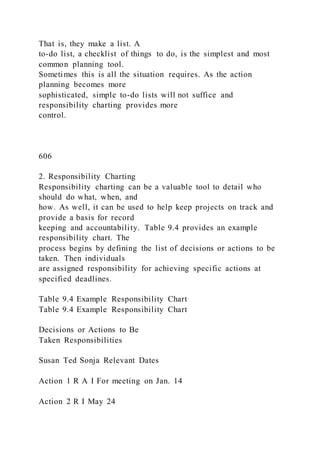
Responsibility ChartingDecisions or Actions to be
TakenResponsibilities SusanTedSonjaRelevant DatesAction
1RAIFor meeting on Jan 14Action 2RIMay 24Action
3SAADraft Plan by Feb 17
Action by July 22Etc...Coding:
R = Responsibility (not necessarily authority)
A = Approval (right to veto)
S = Support (put resources toward)
I = Inform (to be consulted before action)
Deszca, Ingols & Cawsey, Organizational Change: An Action-
Oriented Toolkit, 4th ed.. © 2020 SAGE Pub.
16
SATORP-Company General Use
Project Planning
Organizing task to allow for parallel processes to occur has
been shown to save time.
Deszca, Ingols & Cawsey, Organizational Change: An Action-
Oriented Toolkit, 4th ed.. © 2020 SAGE Pub.
17
SATORP-Company General Use
Level of Commitment to Action
Opposed to the Change
Neutral to the Change
Let It Happen (weak support)
Help It Happen
Make It Happen
LOW
HIGH
Deszca, Ingols & Cawsey, Organizational Change: An Action-
Oriented Toolkit, 4th ed.. © 2020 SAGE Pub.
18
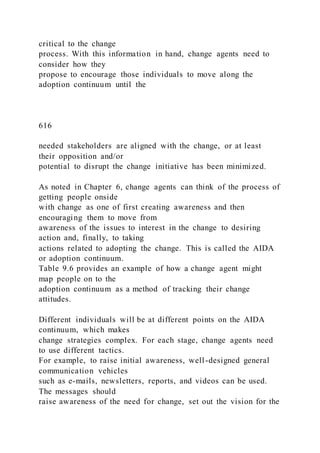
SATORP-Company General Use
Stage of Adoption
Awareness
Becoming altered to the existence of something new, such as a
product, service, or procedure
Interest
A growing inquisitiveness about the nature and benefits of the
new idea
Desire/Appraisal
Studying strengths and weaknesses of new idea and its
application to their area, followed by small-scale testing
Action/Adoption
Incorporating the new idea as part of the resources the adopter
brings to their job
Deszca, Ingols & Cawsey, Organizational Change: An Action-
Oriented Toolkit, 4th ed.. © 2020 SAGE Pub.
19
SATORP-Company General Use
19
Crossing the Adoption Chasm
Innovators
Early Adopters
Early Majority
Late Majority
Laggards
The Chasm or Tipping Point of Support That Needs to be
Crossed
Deszca, Ingols & Cawsey, Organizational Change: An Action-
Oriented Toolkit, 4th ed.. © 2020 SAGE Pub.
20
SATORP-Company General Use
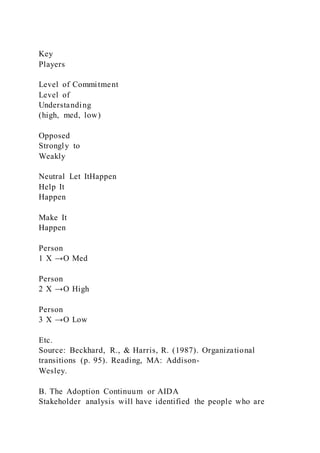
Commitment ChartKey PlayersLevel of CommitmentLevel of
Understanding (high, med, low)Opposed
Strongly to Weakly NeutralLet It HappenHelp It HappenMake It
H
Deszca, Ingols & Cawsey, Organizational Change: An Action-
Oriented Toolkit, 4th ed.. © 2020 SAGE Pub.
21
SATORP-Company General Use
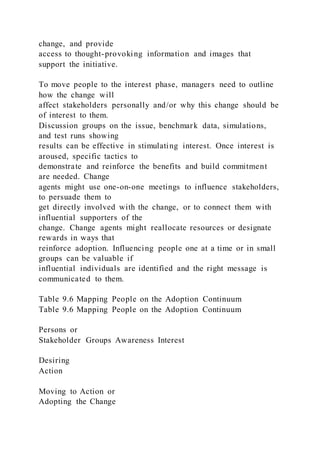
Mapping People on the Adoption CurveKey PlayersAware
InterestedDesire for ActionMoving to Action or Adopting the
Deszca, Ingols & Cawsey, Organizational Change: An Action-
Oriented Toolkit, 4th ed.. © 2020 SAGE Pub.
22
SATORP-Company General Use
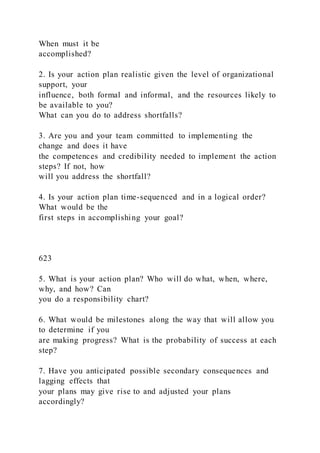
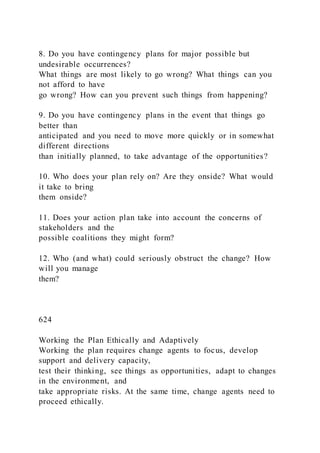
Action Planning Checklist
Is the action plan consistent with the analysis, vision, and
objectives?
Is your action plan realistic, given your influence, and the
resources likely to be available to you?
Are you and your team committed, and do have the competence
and credibility to implement the action steps? If not, how will
you address this?
Is the plan time-sequenced in logical order?
Is it clear who will do what, when, where, and how?
What are the milestones and the probability of success at each
step? Have you anticipated secondary consequences of your
actions?
Deszca, Ingols & Cawsey, Organizational Change: An Action-
Oriented Toolkit, 4th ed.. © 2020 SAGE Pub.
23
SATORP-Company General Use
Action Planning Checklist (cont.)
Have you anticipated possible secondary consequences and
lagging impacts your plans may have?
Have you developed contingencies for risk areas and for how to
proceed if things go better or differently than anticipated?
Who does your plan rely on? Are they “on-side”? If not, what
will it take to bring them “on-side”?
Does your action plan take into account the concerns of
stakeholders and possible coalitions they might form?
Who (and what) could seriously obstruct the change? How will
you manage them?
Deszca, Ingols & Cawsey, Organizational Change: An Action-
Oriented Toolkit, 4th ed.. © 2020 SAGE Pub.
24
SATORP-Company General Use
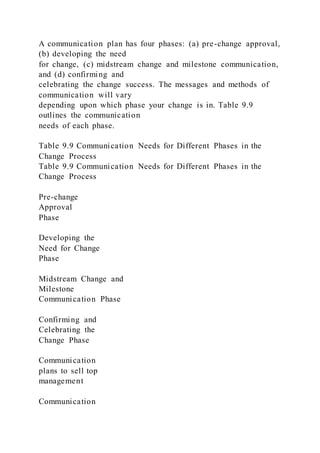
Communication Needs for Different Phases in the Change
ProcessPre-Approval PhaseDeveloping the Need for Change
PhaseMid Stream Change PhaseConfirming the Change
PhaseCommunication plans to sell top
managementCommunication plans to explain the need for
change, provide a rationale, reassure employees, and clarify the
steps in the change process. Communication plans to inform
people of progress and to obtain feedback on attitudes and
issues, to challenge any misconceptions, and to clarify new
organizational roles, structures, and systems.Communication
plans to inform employees of the success, to celebrate the
change, and to prepare the organization for the next change.
Deszca, Ingols & Cawsey, Organizational Change: An Action-
Oriented Toolkit, 4th ed.. © 2020 SAGE Pub.
25
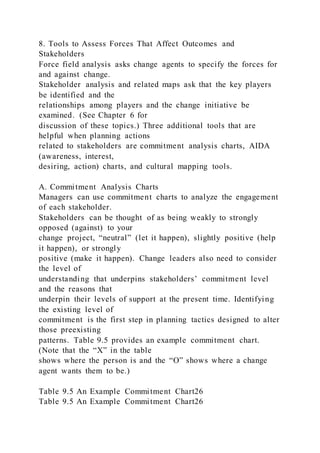
SATORP-Company General Use
Communicating for Change
Message and media redundancy are key for message retention.
Carefully consider the impact and use of social media and how
others affected may use it
Face-to-face communication is most effective
Line authority is effective in communications
The immediate supervisor is key
Opinion leaders need to be identified and used
Employees pick up and retain personally relevant information
more easily than other types of information
Deszca, Ingols & Cawsey, Organizational Change: An Action-
Oriented Toolkit, 4th ed.. © 2020 SAGE Pub.
26
SATORP-Company General Use
Influence Strategies for Change
Education and communication
Participation and involvement
Facilitation and support
Negotiation and agreement
Manipulation and co-option
Explicit and implicit coercion
Systemic adjustment
Deszca, Ingols & Cawsey, Organizational Change: An Action-
Oriented Toolkit, 4th ed.. © 2020 SAGE Pub.
27
SATORP-Company General Use
Toolkit Exercise 9.2—Action Plans for Influencing Reactions to
Change
Which of the following strategies have you seen used to
overcome resistance to action plans?
Education and communication?
Participation and involvement?
Facilitation and support?
Negotiation and agreement?
Manipulation and co-optation?
Explicit and implicit coercion?
Systemic adjustments?
What were the consequences of the methods?
Which of these methods are you most comforta ble with using?
Which do you have the skills to use?
Deszca, Ingols & Cawsey, Organizational Change: An Action-
Oriented Toolkit, 4th ed.. © 2020 SAGE Pub.
28
SATORP-Company General Use
Toolkit Exercise 9.3 (cont.)
Additional Lenses on Influence Tactics
Inspirational appeals
Consultation: seeking the participation of others
Relying on the informal system: existing norms and
relationships
Personal appeals: friendship, loyalty
Ingratiation: praise, flattery, friendliness
Rational persuasion: using data
Exchange or reciprocity
Coalition building
Using rules or legitimating tactics
Appeals to higher authorities
- Which of the above have you used? How successful were
they?
- How comfortable are you with each method?
Deszca, Ingols & Cawsey, Organizational Change: An Action-
Oriented Toolkit, 4th ed.. © 2020 SAGE Pub.
29
SATORP-Company General Use
Push and Pull Tactics
Push Tactics
Use of facts, logic, and/or pressure (e.g., use of guilt and fear)
to push people toward the change
Pull Tactics
Inspirational appeals and other influence tactics designed to
attract and pull people toward the change
Deszca, Ingols & Cawsey, Organizational Change: An Action-
Oriented Toolkit, 4th ed.. © 2020 SAGE Pub.
30
SATORP-Company General Use
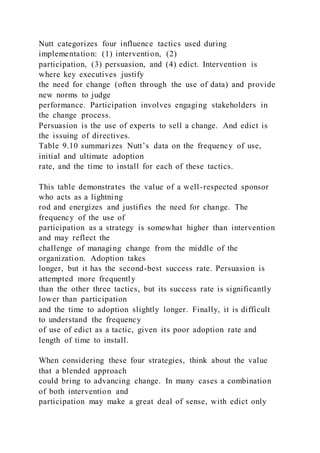
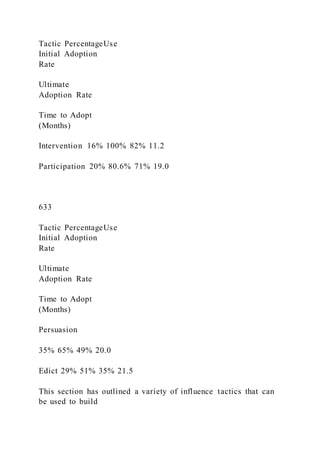
Implementation Tactics and SuccessTacticPercentage UseInitial
Adoption RateUltimate Adoption RateTime to Adopt
(months)Intervention16%100%
82%11.2Participation20817119.0Persuasion35654920.0Edict295
13521.5
Deszca, Ingols & Cawsey, Organizational Change: An Action-
Oriented Toolkit, 4th ed.. © 2020 SAGE Pub.
31
SATORP-Company General Use
A Checklist for Change: Transition Management
Transition Management: managing the implementation of the
change project
How will the organization continue to operate as it shifts from
one state to the next?
Who will answer questions about the proposed change? What
decision power will they have?
Do the people in charge of the transition have the appropriate
authority to make decisions necessary to ease the change?
Have we developed ways to reduce the anxiety created by the
change and increase the positive excitement over it?
Deszca, Ingols & Cawsey, Organizational Change: An Action-
Oriented Toolkit, 4th ed.. © 2020 SAGE Pub.
32
SATORP-Company General Use
A Checklist for Change: Transition Management (cont.)
Have we worked on developing a problem-solving climate
around the change process?
Have we thought through the need to communicate the change?
Who needs to be seen individually? Which groups need to be
seen together? What formal announcement should be made?
Have the people handling the transition thought about how they
will capture the learning from the change process and share it?
Have we thought about how we will measure and celebrate
progress and how we will bring about closure to the project and
capture the learning so it is not lost (after-action review)?
Deszca, Ingols & Cawsey, Organizational Change: An Action-
Oriented Toolkit, 4th ed.. © 2020 SAGE Pub.
33
SATORP-Company General Use
What Makes for a Good Action Plan?
It can be done!
Organized as a timed sequence of conditional moves
Responsibility charts: who does what, when, why, how?
Measures and Outcomes are specified
The plan is consistent with analysis and objectives
Deszca, Ingols & Cawsey, Organizational Change: An Action-
Oriented Toolkit, 4th ed.. © 2020 SAGE Pub.
34
SATORP-Company General Use
What Makes for a Good Action Plan? (cont.)
Resources are available: money and people
Real “buy in” is there—involvement and public commitment,
coalitions are considered
Early positives exist to help build momentum
Most importantly, you have the Vision and Goals needed to
guide you in the right direction
Deszca, Ingols & Cawsey, Organizational Change: An Action-
Oriented Toolkit, 4th ed.. © 2020 SAGE Pub.
35
SATORP-Company General Use
Summary
“Doing it” demands a good plan and a committed team who will
work that plan
Several strategies for approaching change and planning the
work are discussed. Change agents, like good coaches, adjust as
they go
Action planning tools are discussed
Effective action planning and implementation requires careful
attention to communication and transition management
Deszca, Ingols & Cawsey, Organizational Change: An Action-
Oriented Toolkit, 4th ed.. © 2020 SAGE Pub.
36
SATORP-Company General Use
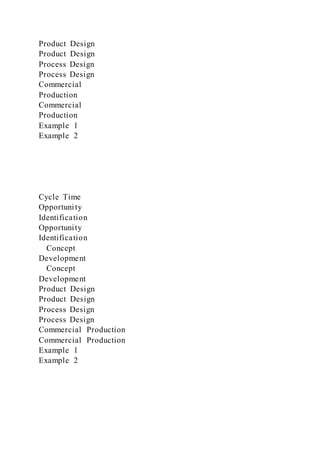
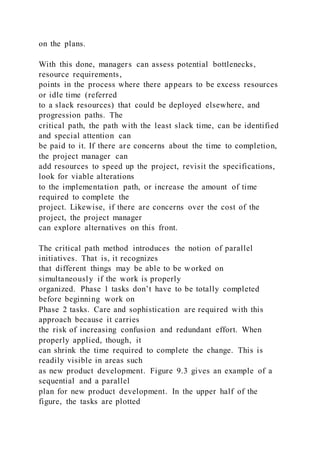
Schilling & Hill, 1998
Cycle
Time
Opportunity
Identification
Opportunity
Identification
Concept
Development
Concept
Development
Product Design
Product Design
Process Design
Process Design
Commercial
Production
Commercial
Production
Example 1
Example 2
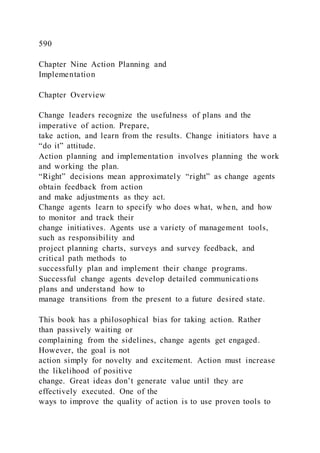
Cycle Time
Opportunity
Identification
Opportunity
Identification
Concept
Development
Concept
Development
Product Design
Product Design
Process Design
Process Design
Commercial Production
Example 1
Example 2
590
Chapter Nine Action Planning and
Implementation
Chapter Overview
Change leaders recognize the usefulness of plans and the
imperative of action. Prepare,
take action, and learn from the results. Change initiators have a
“do it” attitude.
Action planning and implementation involves planning the work
and working the plan.
“Right” decisions mean approximately “right” as change agents
obtain feedback from action
and make adjustments as they act.
Change agents learn to specify who does what, when, and how
to monitor and track their
change initiatives. Agents use a variety of management tools,
such as responsibility and
project planning charts, surveys and survey feedback, and
critical path methods to
successfully plan and implement their change programs.
Successful change agents develop detailed communications
plans and understand how to
manage transitions from the present to a future desired state.
This book has a philosophical bias for taking action. Rather
than passively waiting or
complaining from the sidelines, change agents get engaged.
However, the goal is not
action simply for novelty and excitement. Action must increase
the likelihood of positive
change. Great ideas don’t generate value until they are
effectively executed. One of the
ways to improve the quality of action is to use proven tools to
execute a change agenda.
Tools in Chapter 9 translate plans to action. If this were a
political campaign, these tools
would be steps that are deployed after the candidate has been
selected, the platform
finalized, and the election called. The chapter provides advice
on implementation tactics
and project management tools. It addresses communication and
influence tactics during
the change process. And finally, the management of transition,
or the process of keeping
the organization operating while implementing the change, is
detailed. In terms of the
model in Figure 9.1, these are the implementation issues of
“getting from here to there”—
assessing the present in terms of the future, determining the
work that needs to be done,
and implementing the change.
591
Without a “Do It” Orientation, Things Won’t
Happen
Many major change initiatives start in the C-suite. Boards of
directors and executives at
the top of organizations have access to all of the data that an
organization generates,
and from this perspective and input they can observe a myriad
of organizational
problems and envision viable solutions. Two examples of
boards who hired strong,
change agent CEOs are IBM’s board when they brought in Lou
Gerstner in 1993 and the
board of New England Medical Center, Boston (now called
Tufts Medical Center) when
they hired Ellen Zane in 2002 to lead the transformation of the
then-foundering nonprofit
hospital (see cases on the website for the story about Zane’s
turnaround of the medical
center).
Figure 9.1 The Change Path Model
Gerstner and Zane were seasoned executives when they took on
the extremely difficult
task of pushing change from the top down into the basements of
their organizations. Both
had a “do it” orientation and both were authorized by their
boards and by their titles,
jobs, and positions to lead change within their institutions.
Having the authority to act
makes certain aspects of the job of change agent easier than
working from the middle.
Gerstner, for instance, when he claimed the title of CEO,
quickly changed the reward
system for his top executives, focusing their attention on the
performance of IBM as a
592
whole, rather than just their divisions or areas. Such quick
structural change is unlikely in
a mid-level role.
In an ideal world, change leaders located in the middle of the
organization will also find
support for their projects. They need ready access to supportive
executives who provide
directional clarity, ensure their organizations are ready for
change, approve needed
resources, provide other modes of support and oversight, and
cultivate broad employee
commitment for the change. In some instances, this is not the
case. Many executives will
have little or no knowledge of the initiative or its value and
implications. If they have
heard of the idea, they may lack interest because of other
priorities and political realities;
some may have heard of it and have concerns, while others will
simply want to distance
themselves from the change in the event it doesn’t work out.
Some will fail to understand
the important role they have to play in nurturing innovation
from within the organization;
others will not see it as their role.
Organizations are complex systems, and their prospects for
successful adaptation are
advanced when they can also learn and grow from the bottom
up. This is one of the
reasons that firms such as 3M, Procter & Gamble, and Deloitte
have demonstrated such
staying power: They grow from within and from the bottom up.
Wise senior managers
know how to nurture and leverage employees’ adaptive energy.
Wise change agents know how to save short-sighted senior
managers from themselves.
If you work in an organization such as 3M, then “lucky you!” If
you do not, an early task is
to seek—and hopefully acquire—senior-level support for your
initiative. An e-mail from
the CEO or SVP announcing her support for your project will
help garner support from
other organizational members.
Innovation and Change at 3M
Front-line freedom to innovate and senior-level support have
been critical ingredients to 3M’s
success. Technical and marketing employees commit 15% of
their time to work on projects of
their own choosing, without supervision. The environment is
open and informal, input from
customers and lead users is sought, and collaboration and
inquisitiveness are valued. Social
media facilitates front-line collaboration and helps to overcome
the communication barriers that
organizational size and complexity bring. At the same time,
3M’s culture is demanding, and the
process for funding new ideas is highly structured.
The degree of management scrutiny and oversight increases as
new ideas evolve to require
significant resources. Products that are eventually successful in
the marketplace are typically
rejected several times in management’s funding process before
receiving funds, requiring
persistence from innovators. Management and employees
embrace and learn from failures
because innovation won’t happen otherwise. George Buckley,
3M’s CEO from 2005 to 2012, a
PhD in engineering, was deeply interested in innovation. He
regularly visited the labs to find out
what people were exploring, believing that “creativity comes
from freedom, not control.”1
As it had in the past, this commitment to innovation has allowed
new products and services to
percolate and develop from the ground up throughout the
years.2 Inge Thulin (2012-18) and
Michael Roman (the current CEO) have demonstrated their
commitment to sustaining this
commitment in more recent years. This spirit is captured in the
following statement of 3M’s
purpose:
“3M captures the spark of new ideas and transforms them into
thousands of ingenious products.
Our culture of creative collaboration inspires a never-ending
stream of powerful technologies that
make life better. 3M is the innovation company that never stops
inventing.”3
If senior-level support for change is unlikely to develop in the
near future, change
initiators may feel that abiding by formal organizational
protocols and waiting for official
593
support will slow progress unduly. Faced with this situation,
change agents may choose
to follow the advice of Rear Admiral Grace Hopper, a
pioneering female software
engineer in the U.S. Navy, who said, “It is easier to seek
forgiveness than permission.”4
Pfeffer and Sutton state “actions count more than elegant plans
or concepts” and that
“there is no doing without mistakes.” They ask, however, a
crucial question: “What is the
company’s response?”5 If the organization’s response to
reasoned initiatives and honest
mistakes is to scapegoat and blame, people quickly learn not to
take risks that might lead
to mistakes. Or, they learn to cover up mistakes. Either way, the
organization suffers.*
However, beliefs about likely organizational responses can also
become a convenient
excuse for inaction and the avoidance of risk taking (e.g., What
if my idea really won’t
work or what will I do if it does work?). If such beliefs are
never challenged, their stability
will produce self-fulfilling prophecies.
* This does lead to an accountability paradox. Accountability is
a needed and useful
attribute. However, there needs to be a fine balance between
holding change leaders
accountable for what they do and encouraging the risk-taking
behavior that leads to
needed learning and change.
Effective executives and managers of change are aware of the
consequences of their
actions and intuitively test their organizational assumptions by
engaging in an action–
learning–reaction cycle.6 Sayles recognized this when he wrote,
“Working leaders
instead of simply waiting for and evaluating results seek to
intervene. And the
interventions they undertake require a more intimate knowledge
of operations, and more
involvement in the work than those of traditional middle
managers.”7
For employees lower in the hierarchy, action is also key.
Instead of being discouraged by
lack of authority or reach, one must fully understand the
resources and tools they have at
their disposal. Dr. Ross Wirth, retired dean of the College of
Business, Franklin
University, reflected on his 32-year career at Citgo Petroleum
with the following wisdom:8
“Traditional thought says that nothing happens without top
management’s approval )but)
change need not be something that is ‘done to you.’ Here is
another way to think of it:
empowerment is something you grasp until you find its limits. I
tell people that they can
constantly test the limits of their empowerment, carefully
reading internal politics to see
when they are pushing up against a boundary. Too many people
think they are not
empowered, but actually they have failed to test their limits.”
The reality of much organizational life is somewhere between
an environment that
punishes those who dare to challenge the status quo and one in
which all such initiatives
are unconditionally embraced and rewarded. When the latter is
the case, disciplined
development and governance processes help organizations and
their members to sort
through those ideas, nurture their development, and bring the
most viable to life. If such
processes are absent, it can lead to the organization running off
in all directions.
Organizational members who choose not to wait on formal
permission and undertake
reasonable self-initiated change initiatives may experience some
chastisement for not
first seeking approval, particularly if the initiative runs into
difficulty. However, in many
organizations, they are also commended for showing initiative
and having a positive
impact. The organization’s culture and the personality of a boss
(e.g., managerial style
and tolerance for ambiguity) will obviously influence what
response the initiator receives,
but most managers value initiative.
What can be done to increase the likelihood that taking action
will produce desired
results? The following sections address this question by
exploring a variety of planning
594
and implementing tools. The purpose of these tools is to assist
change leaders in
designing and then managing their initiatives in ways that
increase their prospects for
success.
595
Prelude to Action: Selecting the Correct Path
Any action plan for change needs to be rooted in a sophisticated
understanding of how
the organization works and what needs to be achieved. Since
there are a variety of
action paths available, how do you decide which to take?
Mintzberg and Westley provide
guidance in this matter by setting out three generic approaches:
thinking first, seeing first,
and doing first.9
Thinking first strategy works best when the issue is clear, data
are reliable, context
is structured, thoughts can be pinned down, and discipline can
be established as in
many routine production processes. The introduction of an
initiative such as Six
Sigma is an example where management needs to think first.
Seeing first strategy works best when many elements have to be
combined into
creative solutions, commitment to those solutions is key, and
communication across
boundaries is essential. New product development is an example
of the need to see
first.
Doing first strategy works best when the situation is novel and
confusing,
complicated specifications would get in the way, and a few
simple relationship rules
can help people move forward. For example, if a manager is
testing a variety of
approaches to customer service and wants feedback about what
works best under
what conditions, then doing first is appropriate. At the macro
level, this approach
often makes sense for organizations attempting to figure out
how to deal with
disruptions to their business models—something firms are
experiencing with
increasing frequency.
As complexity and ambiguity rise, Mintzberg and Westley argue
that the preferred
approach to action shifts. Thinking first fits when the situation
is well structured, a
manager has the needed data, and there is not much confusion
about how to proceed.
As ambiguity and complexity rise, though, certainty over how
best to proceed becomes
less clear. Seeing first approaches the challenge by
experimentation, prototyping, and
pilot programs so that commitment can be gained by having
others see and experience
an initiative. Doing first is a response to even more ambiguous
situations and takes the
process of exploration further in the search for new paths
forward. As these paths begin
to emerge, the approach can then be altered to seeing first or
doing first, depending on
what is suitable for the next stage.
Nitin Nohria offers a slightly different assessment of the
generic change strategies
available.10 He identified three strategies, defined their
characteristics, explained the
typical implementation, and highlighted their risk points.
Programmatic change (similar
to Mintzberg and Westley’s thinking first change) involves the
implementation of
straightforward, well-structured solutions. It is best suited to
contexts that are clear and
well defined and where the magnitude of the change is
incremental in nature. Risks with
this approach lie in potential problems with inflexibility,
overreliance on a “one-size-fits-all”
solution, and a lack of focus on behavior.
Discontinuous change involves a major break from the past. If
the environment is
shifting dramatically and a continuation of activities based on
existing assumptions will
not work, then discontinuous, top-down change may be fitting.
Organizational
restructuring due to downsizing, rapid growth, or the
realignment of markets is an
example of this category. Risks with this approach come from
political coalitions that may
form and derail the change, a lack of sufficient resources and
control to support sustain
596
and enforce (if needed) the changes, and the loss of talented
people who become
frustrated and quit.
Emergent change )similar to Mintzberg and Westley’s doing
first change) grows out of
incremental initiatives and can create ambiguity and challenge
for staff members. An
employee-centered change initiative to modify the culture of the
organization that
emerges from customers’ and staff’s feedback would be an
example. If the organization
has a talented, knowledgeable workforce that understands the
risks and possibilities,
utilizing an emergent change approach may be appropriate.
Risks with this approach
come in the form of confusion over direction, uncertainty as to
the impact of the change,
and slow progress (see Table 9.1).
To counteract the pitfalls of programmatic or “thinking first”
change, consider using
employee engagement and feedback to connect with those on the
receiving end, learn
from their experiences, and decentralize decision making to
allow for adaptation to local
conditions. The pitfalls (including unintended consequences)
from change will be
lessened by processes that reduce ambiguity, promote feedback
and learning, and build
support by enhancing member understanding of the change and
why it was undertaken.
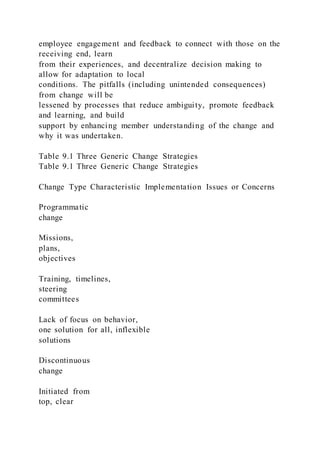
Table 9.1 Three Generic Change Strategies
Change Type Characteristic Implementation Issues or Concerns
Programmatic
change
Missions,
plans,
objectives
Training, timelines,
steering
committees
Lack of focus on behavior,
one solution for all, inflexible
solutions
Discontinuous
change
Initiated from
top, clear
break,
reorientation
Decrees, structural
change, concurrent
implementation
Political coalitions derail
change, weak controls,
stress from the loss of
people
Emergent
change
Ambiguous,
incremental,
challenging
Use of metaphors,
experimentation,
and risk-taking
Confusion over direction,
uncertainty and possible
slow results
Source: Adapted from Nohria, N., & Khurana, R. (1993, August
24). Executing change: Three generic
strategies. Harvard Business School Note. #494–039.
The issues related to emergent or “doing first” change may be
managed through the use
of field experiments, evaluation tools and task forces to provide
engagement and
feedback on an ongoing basis. These can be used to enhance
awareness of what is
going on and why, create greater clarity concerning the
implications of what is emerging
and build understanding and support for the next steps in the
change process. In
metaphorical terms, this points to a move from “ready—aim—
fire” to “ready—fire—aim—
re-fire—re-aim”† for an emergent approach to planning. In fast-
moving contexts, it is
likely that a traditional planning process will be too lengthy and
that by the time the
planning is finished, the opportunity may have been missed.
This metaphor recognizes
that significant information can be obtained from action
feedback. When a change leader
initiates action, reactions will occur that can provide insight
into how to respond and take
corrective actions.
597
† The managerial use of this metaphor is usually credited to T.
Peters and R. H.
Waterman Jr., In Search of Excellence (New York: Harper &
Row, 1982). Our
understanding is that its presence in its modified form has its
roots in missile defense. If
you are defending against incoming missiles, you don’t have
time to wait and plan a
response. You do need to fire before you aim your missile. Then
once you have things in
motion, you can re-aim your missile based on new, current
information.
A third approach to thinking about change strategies is found in
the unilateral versus
participative approaches to change. Advocates of a unilateral
approach to change
believe that if one first changes systems and structures, forcing
behavioral changes, that
action will in turn produce changes in attitudes and beliefs over
time. Those who promote
a participative approach believe the opposite. They argue that
you first need to engage
and change attitudes and gain acceptance of an initiative before
restructuring systems
and organizational structures.
Waldersee and Griffiths note that change initiatives have been
traditionally grouped into
two broad categories. Techno–structural change refers to change
that is based in
structures, systems, and technology. Behavioral–social change
is focused on altering
established social relationships. After investigating 408 change
episodes, they concluded
that the unilateral approach was perceived to be more
appropriate for techno–structural
change, while participative approaches were seen as more
appropriate when behavioral–
social changes such as cultural change were involved.11 When
Australian managers
were asked about the perceived effectiveness of these two
change approaches, they saw
unilateral methods as more effective in bringing about
successful change, regardless of
the type of change. What does all of this mean for action
planning? Waldersee and
Griffiths concluded the following:
Concrete actions taken by change managers are often superior to
the traditional
prescriptions of participation.12 Forcing change through top-
down actions such
as redeploying staff or redesigning jobs may effectively shift
employee behavior.
With the context and behavior changed, interventions targeting
attitudes may
then follow. (p. 432)
While a unilateral approach may have appeal for those who
want to ensure that things
are done, such an approach can be risky and needs to be
managed with care. When
implementation lacks sensitivity, stakeholders may feel that
their perspectives and
concerns have been ignored. This can result in fallout and
resistance that could have
been avoided, and missed opportunities for valuable input.
What conclusions can be drawn from this material on a “do it”
orientation and change
strategies? Start a change process rather than waiting to get
things perfect. Be willing to
take informed risks and learn as you go. Finally, pick your
change strategy with care and
remember to take steps to manage the risks associated with the
adopted approach.
Regardless of how difficult change appears to be, Confucius
was right—“a journey of a
thousand miles begins with a single step.”13 You need to plan
your work, work the plan
and be prepared to adapt as you go.
598
Plan the Work
If the change leader’s approach to planned change has followed
what this book
suggests, then much planning will have already been done. In
addition, Beer, Eisenstat,
and Spector14 offer a prescriptive list of “steps to effective
change.” Here are Beer et al.’s
steps:
1. Mobilize commitment to change through joint diagnosis of
business problems.
2. Develop a shared vision of how to organize and manage for
competitiveness.
3. Foster consensus for the new vision, competence to enact it,
and cohesion to move
it along.
4. Spread revitalization to all departments without pushing it
from the top.
5. Institutionalize revitalization through formal policies,
systems, and structures.
6. Monitor and adjust strategies in response to problems in the
revitalization process.
For many change situations, this checklist provides valuable
guidance in the
development of an action plan. However, assuming a “one-size-
fits-all” approach to
change is risky. For example, the above list assumes a
fundamental cooperative
orientation. That is, there is sufficient commonality of goals
that a shared vision is
possible. The list also suggests that change should evolve and
not be pushed down by
top management. However, change agents will need approaches
that allow them to face
situations in which cooperation and commonality of goals is
weak or absent and where
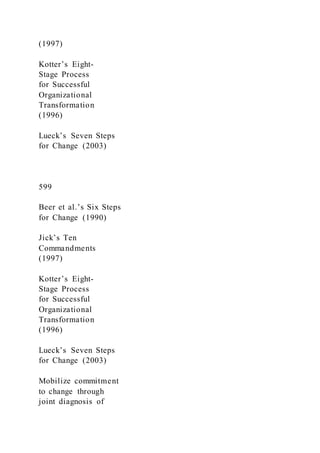
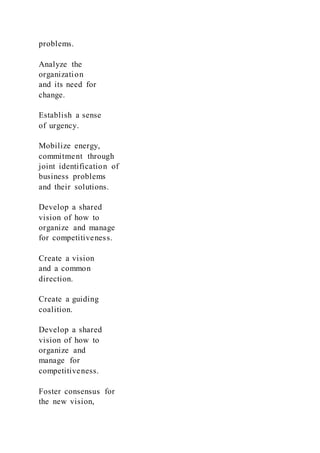
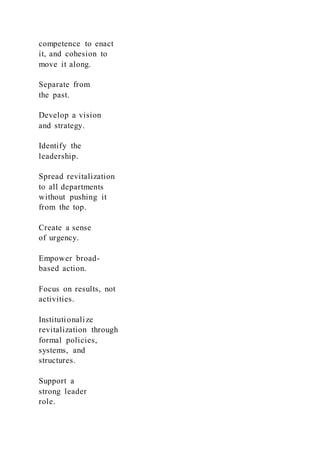
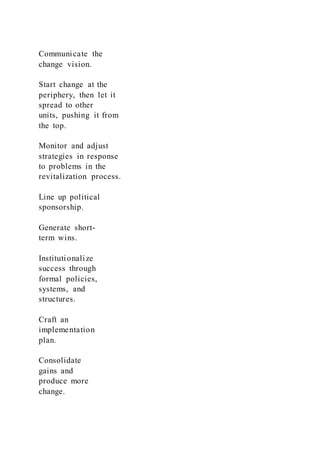
changes are being pushed from the top. Table 9.2 below
compares Beer et al.’s steps
with the prescriptions of others, which may be helpful in
thinking about planning through
multiple perspectives.15
As well, the need for contingent thinking needs to be addressed.
That is, an action plan
depends significantly upon the action-planning context. In
complex and ambiguous
situations, plans and tactics must be able to adapt as events
unfold. As such, it is useful
to remember the old saying: “No plan survives first contact.”16
In summary, while careful planning is critical, change leaders
must also recognize that
planning is a means—not an end in itself. Don’t ignore vital
emerging information just
because it does not fit with carefully conceived plans. The
abilities to think contingently,
consider alternative paths forward, and adapt are important
contributors to enhanced
adaptive capacity.17
Table 9.2 A Comparison of Four Models of Change
Beer et al.’s Six Steps
for Change (1990)
Jick’s Ten
Commandments
(1997)
Kotter’s Eight-
Stage Process
for Successful
Organizational
Transformation
(1996)
Lueck’s Seven Steps
for Change (2003)
599
Beer et al.’s Six Steps
for Change (1990)
Jick’s Ten
Commandments
(1997)
Kotter’s Eight-
Stage Process
for Successful
Organizational
Transformation
(1996)
Lueck’s Seven Steps
for Change (2003)
Mobilize commitment
to change through
joint diagnosis of
problems.
Analyze the
organization
and its need for
change.
Establish a sense
of urgency.
Mobilize energy,
commitment through
joint identification of
business problems
and their solutions.
Develop a shared
vision of how to
organize and manage
for competitiveness.
Create a vision
and a common
direction.
Create a guiding
coalition.
Develop a shared
vision of how to
organize and
manage for
competitiveness.
Foster consensus for
the new vision,
competence to enact
it, and cohesion to
move it along.
Separate from
the past.
Develop a vision
and strategy.
Identify the
leadership.
Spread revitalization
to all departments
without pushing it
from the top.
Create a sense
of urgency.
Empower broad-
based action.
Focus on results, not
activities.
Institutionalize
revitalization through
formal policies,
systems, and
structures.
Support a
strong leader
role.
Communicate the
change vision.
Start change at the
periphery, then let it
spread to other
units, pushing it from
the top.
Monitor and adjust
strategies in response
to problems in the
revitalization process.
Line up political
sponsorship.
Generate short-
term wins.
Institutionalize
success through
formal policies,
systems, and
structures.
Craft an
implementation
plan.
Consolidate
gains and
produce more
change.
Monitor and adjust
strategies in
response to
problems in the
change process.
Develop
enabling
structures.
Anchor new
approaches in
the culture.
600
Beer et al.’s Six Steps
for Change (1990)
Jick’s Ten
Commandments
(1997)
Kotter’s Eight-
Stage Process
for Successful
Organizational
Transformation
(1996)
Lueck’s Seven Steps
for Change (2003)
Communicate,
involve people,
and be honest.
Reinforce and
institutionalize
change.
Source: Based on Todnem, R. (2005). Organisational change
management: A critical review. Journal
of Change Management, 5(4), 369–381; and Beer, M., Eisenstat,
R., & Spector, B. (1990, November-
December). Why change programs don’t produce change.
Harvard Business Review, 1000, 158–166.
601
Engage Others in Action Planning
Occasionally, change planning must be undertaken under a
cloak of secrecy, such as
when a merger is in the works and the premature release of
information would
significantly affect the price and the level of competitive risk.
In general, though, the
active involvement of others and information sharing enhances
the quality of action
planning for most change strategies. Consider one of the
experiences of Barbara Waugh,
who spent 25 years as a change agent at Hewlett-Packard:
Change at HP Labs
Barbara Waugh’s campaign for change at HP Labs began when
its director asked her, “Why
does no one out there consider HP Labs to be the best industrial
research lab in the world?”
Rather than propose answers, she and the director began by
asking questions through a survey.
The inquiry generated 800 single-spaced pages of feedback
related to programs (e.g., too many
projects and too few priorities), people (e.g., poor performers
are not removed quickly enough
and researchers lack sufficient freedom to do their jobs well),
and processes (e.g., the
information infrastructure is inadequate).
The feedback, says Waugh, was “800 pages of frustrations,
dreams, and insights.” But how
could she capture and communicate what she learned? She drew
on her experience with street
theater and created a play about HP Labs. She worked passages
from the surveys into dialogue
and then recruited executives to act as staff members and junior
people to act as executives.
The troupe performed for 30 senior managers. “At the end of the
play, the managers were very
quiet,” Waugh remembers. “Then they started clapping. It was
exciting. They really got it.”18
Waugh’s approach is instructive because it illustrates the power
of presenting potentially
boring data in an engaging and compelling manner. This was
not the first time she
nurtured change in an emergent, grassroots fashion. Her
approach leveraged listening
and questioning, built networks with individuals with
complementary ideas, and when
needed, arranged for access to financial resources for worthy
endeavors.‡
‡ In planning the work, interviews, surveys, survey feedback,
and appreciative inquiry (a
rigorous commitment to active listening, feedback, mutual
development, and renewal) are
powerful action planning tools. They come from the
Organizational Development (OD)
approach to change. For more information, two good sources are
D. L. Cooperrider, D.
Whitney, and J. M. Stavros, Appreciative Inquiry Handbook:
For Leaders of Change
(Brunswick, OH: Crown, 2008); and T. G. Cummings and C. G.
Worley, Organization
Development and Change (Mason, OH: South-Western, 2009).
Underlying planning-through-engagement strategies are
assumptions regarding top-
down (unilateral) versus bottom-up (participative) methods of
change. Although
Waldersee and Griffiths’s study19 showed that unilateral
implementation methods have
much to offer, the success of a change is enhanced when people
understand what it
entails, why it is being undertaken, what the consequences of
success and failure are,
and why their help is needed and valued. All too often, techno–
structural changes have
floundered because of design problems getting tangled up with
acceptance and
implementation issues that never get sorted out.
Regardless of the change strategy preferred, the plan needs to
be examined carefully for
logic and consistency. The next section highlights a series of
questions (contained in
Table 9.6) that can help change agents enhance their
performance in this area.
602
Ensure Alignment in Your Action Planning
Change agents often understand what needs to be done but get
the sequence of
activities wrong. They might leave a meeting after a productive
discussion but fail to sort
out who is responsible for what. Sometimes critical steps in the
plan are risky and
alternative strategies need to be considered in case things do not
go as planned. At other
times, change agents may over- or underestimate the available
resources and
constraints, the time and energy required by various steps, or
their own power and
competence. Table 9.8 (later in this chapter) provides a
checklist of questions to use
when reviewing an action plan. This checklist tests the viability
of the plan and asks for a
rethinking of the connections between the analysis of the
situation and the plan itself.
Tough-minded thinking can improve the coherence and
thoughtfulness of action plans.
603
Action Planning Tools
After all is said and done, more is often said than done! – Aesop
or Lou Holz
This section explores a selection of action planning tools that
change agents find
particularly useful (see Table 9.3). Selecting the appropriate
tool is both an art and
science: An art as the story of Waugh at HP illustrated (see
above), and a science as one
analyzes data carefully and makes appropriate selections. In
addition to the tools listed
here, remember to reflect on action planning tools discussed in
other chapters such as
tools for assessing and/or handling: the need for change
(Chapter 3); gap analyses,
readiness for change and the framing of the vision for the
change (Chapter 4); formal
systems and processes (Chapter 5); the political and cultural
dimension of change,
including stakeholder and force field analyses (Chapter 6);
recipients of change (Chapter
7), your own skills and competencies as a change agent
(Chapter 8); and the use of
measurement in the advancement of change (Chapter 10).
Table 9.3 Tools for Action Planning
1. To-do list—a checklist of things to do
2. Responsibility charting—who will do what, when, where,
why, and how
3. Contingency planning—consideration of what should be done
when things do
not work as planned on critical issues
4. Flow charting—a way of diagramming the nature of the
existing process you
wish to examine and set out how you propose to change it
5. Design thinking—an approach used to engage others
collectively in creative
problem solving around what needs to change and the design of
the change itself
— a tool that can be used in conjunction with visioning
initiatives
6. Surveys, survey feedback, and appreciative inquiry—
capturing people’s
opinions and tracking their responses, observations, and insights
over time, to
assist in identifying what needs changing, nurturing engagement
and support, and
in tracking progress
7. Project planning and critical path methods —operations
research techniques for
scheduling work. These methods provide deadlines and insight
as to which
activities cannot be delayed to meet those deadlines.
8. Tools that assess forces that affect outcomes and
stakeholders—these
tools are closely related to force field and stakeholder analysis
discussed in
Chapter 6:
a. Commitment charts—an evaluation of the level of
commitment of major
players (against, neutral, let it happen, help it happen, make it
happen)
b. The adoption continuum or awareness, interest, desire,
adoption (AIDA)
analysis—examination of major players and their position on
the AIDA
604
continuum related to the proposed changes
c. Cultural mapping—an approach that provides for a more
detailed
assessment of the cultural context the change is occurring in;
particularly
useful when the goal is cultural change
9. Leverage analysis—determination of methods of influencing
major groups or
players regarding the proposed changes
10. Training and development tools—tools related to the design
and delivery of
educational initiatives that advance employee knowledge and
ability to perform
effectively, given the changes
11. Diverse change approaches—a variety of techniques and
tools that brings
about change and that continues to grow
605
1. To-Do Lists
When managers engage in action planning, they often begin by
outlining in detail the
sequence of steps they will take initially to achieve their goals.
That is, they make a list. A
to-do list, a checklist of things to do, is the simplest and most
common planning tool.
Sometimes this is all the situation requires. As the action
planning becomes more
sophisticated, simple to-do lists will not suffice and
responsibility charting provides more
control.
606
2. Responsibility Charting
Responsibility charting can be a valuable tool to detail who
should do what, when, and
how. As well, it can be used to help keep projects on track and
provide a basis for record
keeping and accountability. Table 9.4 provides an example
responsibility chart. The
process begins by defining the list of decisions or actions to be
taken. Then individuals
are assigned responsibility for achieving specific actions at
specified deadlines.
Table 9.4 Example Responsibility Chart
Decisions or Actions to Be
Taken Responsibilities
Susan Ted Sonja Relevant Dates
Action 1 R A I For meeting on Jan. 14
Action 2 R I May 24
Action 3 S A A Draft Plan by Feb. 17; actionby July 22
Etc.
Coding:
R = Responsibility (not necessarily authority)
A = Approval (right to veto)
S = Support (put resources toward)
I = Inform (to be consulted before action)
Note that if there are a large number of As on your chart,
implementation will be
difficult. Care must be taken to assign As only when
appropriate. Likewise, if there
are not enough Rs and Ss, you will need to think about changes
needed here and
how to bring them about.
Source: For a further discussion on responsibility charting, see
Beckhard, R., & Harris, R. (1987).
Organizational transitions (p. 104). Reading, MA: Addison-
Wesley.
607
3. Contingency Planning
Contingency planning is the importance of thinking through
what should be done
should events not go as planned. Two tools that aid in
contingency planning are decision
tree analysis and scenario planning.§
§ Readers are encouraged to consult standard operations
research texts for further
information on these tools.
Decision tree analysis asks change agents to consider the major
choices and the
possible consequences of those alternatives. Analysts are then
asked to plan for the
possible next actions and consider what the consequences of
those actions might be.
Such alternating action–consequence sequences can be extended
as far as reasonable.
As well, probabilities can be assigned as to the likelihood of
each consequence. For
many applications, a simple scale (very likely, likely, possible,
unlikely, or very unlikely) is
sufficient. This approach helps model the possible consequences
to change decisions
and assess the benefits and risks associated with the different
pathways (see Figure
9.2).
A second tool that helps managers with contingency planning is
scenario planning.
Here a change strategy is formed by first developing a limited
number of scenarios about
how the future may unfold and then assessing what the
implications of each of these
would be to the organization.20 Change leaders typically frame
these around an issue of
strategic and/or tactical importance. For example, if a firm
producing paper forms is
concerned about the long-term viability of its business model,
then management could
develop scenarios of what a paperless form producer would look
like. Once the scenarios
were developed, managers would ask themselves, How likely is
this scenario? What
would need to happen to make the scenario a reality? And what
contingencies might
arise that would need to be addressed? If one or more of these
future scenarios seemed
worth investing in, then management would develop its plans
accordingly. To open
people’s minds to possibilities and avoid blind spots, external
parties are often brought
into the process to offer data and insights, challenge
assumptions, and stimulate thinking
and discussion.
Figure 9.2 Example Decision Tree
608
Scenario planning is different from forecasting. Forecasting
starts in the present and uses
trend lines and probability estimates to make projections about
the future. Scenario
planning starts by painting a picture of the future and works
backward, asking what would
have to happen to make this future scenario a reality and what
could be done.21
While most uses of scenario planning are at a strategy l evel, the
principles can be
applied to frame possible visions for change and develop the
action pathways that will
increase the likelihood that the vision will be achieved. Royal
Dutch Shell22 was one of
the first users of scenario planning. The firm used it as a way to
link future uncertainties
to today’s decisions.
609
4. Flow Charting
Flow charting is a technique used to track the sequences in an
existing process
(including key decision points and who is involved in those
decisions) and to assist in the
design of the change through setting out an improved or new
approach for
implementation consideration.** Visual representations of
existing processes are typically
undertaken early in the change process when change agents are
seeking to understand
what needs to change. While the visual representation of the
future process is also
developed early in the change process, it is used in conjunction
with the vision for
change throughout the change process to help recipients better
understand what is being
undertaken and why.
** For introductory information on flowcharting, see
Lucidchart’s website:
https://www.lucidchart.com/pages/what-is-a-flowchart-tutorial;
or MindTool’s website:
https://www.mindtools.com/pages/article/newTMC_97.htm.
https://www.lucidchart.com/pages/what-is-a-flowchart-tutorial
https://www.mindtools.com/pages/article/newTMC_97.htm
610
5. Design Thinking
Design thinking has its roots in multiple areas including
architecture, new product
development and the pursuit of processes that will advance
creative thinking in the
organization. It is used with matters that have proven difficult
to effectively address in the
past and is used early in the change process. It seeks to engage
individuals collectively
in context assessment; problem finding and framing; ideation;
prototyping and pilot
testing; evaluation; and the translation of those designs into
actionable initiatives. It is an
iterative process so the cycle can be repeated and designs
refined several times until the
parties are satisfied with the proposed solution.
Design thinking seeks to address matters in a less linear and
more creative manner.
Rather than approach matters through deductive or inductive
reasoning (the traditional
approaches), it seeks to do so through abductive reasoning.
Abductive reasoning is
solution rather than problem focused and involves looking for
and exploring plausible
solutions, trialing and refining different options, and so on until
the desired path forward is
selected and committed to. The more traditional deductive
approach in organizations
typically involves situational analyses, the development of
decision criteria, the
development and assessment of three to five alternatives, and
the selection of the
recommended path forward. Because design thinking is based
on plausible solutions that
have more uncertainty attached to them, they form the basis for
the iterative exploration
of options in the search for new approaches that can effectively
address difficult
problems and challenges that have resisted resolution.23
This human-centered, collaborative approach has at its core the
interests and
perspectives of the users that one is trying to design for. Users
are engaged in the
process to make sure that their interests and concerns are
recognized and attended to.
The goal of design thinking is to identify and address problems
with creative solutions
and create new opportunities. The nature of the process
enhances the prospects for buy-
in by the recipients of change due to their involvement in the
design process.
611
6. Surveys and Survey Feedback
Change agents may find it is helpful to use surveys to capture
people’s attitudes,
opinions, and experiences at particular points in time and then
track those attitudes over
time, including their readiness for change that was discussed in
Chapter 4. Tools in this
area can provide anonymity to the respondents and make it
possible to capture the
opinions of a larger proportion of the participants than might
otherwise be possible.
Political agendas don’t disappear with the use of a survey, but
they may make it possible
for people to say things that they would not feel comfortable
stating publicly. Services
such as SurveyMonkey.com and EmployeeSurveys.com have
made the design, delivery,
and analysis easy to manage.
Surveys are used to access the opinions of internal and external
stakeholders and
assess attitudes and beliefs of relevance to the change. For
example, how do customers
view the firm’s and its competitor’s service levels,
innovativeness, and product
performance? What ideas do they have concerning new product
offerings or service
improvements? Employees can be sampled to assess the
organization’s readiness for
change, the culture or work climate, their satisfaction and
commitment levels, or what is
helping or hindering their ability to do their jobs. Sometimes
surveys are deployed to
develop options and assess opinions on their viability. Later in
the change process,
surveys may sample understanding and knowledge levels,
emerging attitudes and
issues, and levels of acceptance and satisfaction with the
change.
Some organizations go further in this area and adopt approaches
to directly and
systematically assess actual customer and employee actions in
response to change
(directly or via software monitoring tools) in order to recognize
issues and address them
in a timely manner.
The possible approaches in this area are restricted only by
imagination, people’s
willingness to respond, and legal and ethical considerations.
Privacy/anonymity
considerations, transparency (people know what you are doing
and why), and related
ethical matters need to be carefully thought through. When this
is not the case, the
repercussions and potential for reputational damage can be
serious, as seen in public
reactions to Facebook’s sharing of private user data.24
Ready-made surveys are available on virtually any topic. Some
are publicly available at
no cost, while others are proprietary and have charges attached
to their use. Costs can
vary from a few dollars per survey to thousands of dollars when
outside consultants are
used to design, administer, assess, and report the findings.
When it comes to scoring and
interpretation, some are straightforward and easy to interpret,
while others require the
assistance of a skilled practitioner. Some of these instruments
have been carefully
assessed for reliability and validity, while others have nothing
more than face validity.
The bottom line with respect to surveys is that they can prove
very helpful to change
agents but need to be approached with care. Their design,
administration, and analysis
require the assistance of someone well trained in survey
research. Even when a change
agent is sampling opinions, the ability to frame good questions
is a prerequisite to getting
useful information. The same holds true for analysis and
interpretation.††
†† For further information on survey research, see L. M. Rea
and R. A. Parker, Designing
and Conducting Survey Research (San Francisco: Jossey-Bass,
2005).
612
A powerful use of surveys is an approach called survey
feedback.25 It is an action
research method developed by organizational development (OD)
practitioners as a way
to stimulate and advance conversations concerning what is
going on in the organization,
how members are feeling, and how things could be improved.
As the name suggests, it
involves the sharing of survey results with the individuals
affected by the findings. Those
involved in the discussion will have responded to the survey.
Skilled facilitators guide work groups through the discussion of
the findings. They use this
as an opportunity to enrich their interpretation of what the data
means, and to more fully
explore the implications for action. The process is used to raise
awareness and
understanding, advance the analysis, and build support and
commitment for actions that
will benefit both the individuals and the organization.
Appreciative inquiry approaches
discussed earlier in this chapter and in Chapter 8 can be married
effectively with survey
feedback to engage and energize participants, learn from them,
and set the stage for
future actions.
613
7. Project Planning and Critical Path Methods
Project planning and critical path methods can provide valuable
assistance to change
managers as they think about what action steps to take.‡‡ These
methods have been
developed into sophisticated operations research techniques to
aid the planning of major
projects. Critical path methods ask planners to identify when
the project should be
completed and to work backward from that point, scheduling all
tasks that will require
time, effort, and resources. These are arranged in time sequence
such that tasks that
can occur simultaneously can be identified. These tasks are then
plotted on a timeline.
Sequential tasks are plotted to determine the needed time to
complete the project.
‡‡. Software packages are available in this area. A commonly
used one, Microsoft Office
Project (http://www.microsoft.com/project/en/us/default.aspx),
allows you to track steps,
resource requirements, and costs; see the impact of possible
changes; trace the source
of issues; visually communicate project information to others;
and collaborate with them
on the plans.
With this done, managers can assess potential bottlenecks,
resource requirements,
points in the process where there appears to be excess resources
or idle time (referred
to a slack resources) that could be deployed elsewhere, and
progression paths. The
critical path, the path with the least slack time, can be identified
and special attention can
be paid to it. If there are concerns about the time to completion,
the project manager can
add resources to speed up the project, revisit the specifications,
look for viable alterations
to the implementation path, or increase the amount of time
required to complete the
project. Likewise, if there are concerns over the cost of the
project, the project manager
can explore alternatives on this front.
The critical path method introduces the notion of parallel
initiatives. That is, it recognizes
that different things may be able to be worked on
simultaneously if the work is properly
organized. Phase 1 tasks don’t have to be totally completed
before beginning work on
Phase 2 tasks. Care and sophistication are required with this
approach because it carries
the risk of increasing confusion and redundant effort. When
properly applied, though, it
can shrink the time required to complete the change. This is
readily visible in areas such
as new product development. Figure 9.3 gives an example of a
sequential and a parallel
plan for new product development. In the upper half of the
figure, the tasks are plotted
sequentially. In the lower half of the figure, the tasks overlap.
Concept development
begins before opportunity identification ends and the cycle time
to completion is reduced.
In summary, change leaders involved with implementation will
find it useful to review the
advice found in the project management literature before
undertaking major changes as it
contains information related to tools and techniques that may
prove helpful.§§
§§ Colleges, universities, and organizations such as the Project
Management Institute
(http://www.pmi.org/Pages/default.aspx) offer professional
training in project
management.
Figure 9.3 Sequential Versus Partly Parallel Process in New
Product Development
http://www.microsoft.com/project/en/us/default.aspx
http://www.pmi.org/Pages/default.aspx
614
Source: Shilling, M. A., & Hill, W. L. (1998). Managing the
new product development
process: Strategic imperatives. Academy of Management
Executive, 12(3), 67–81.
615
8. Tools to Assess Forces That Affect Outcomes and
Stakeholders
Force field analysis asks change agents to specify the forces for
and against change.
Stakeholder analysis and related maps ask that the key players
be identified and the
relationships among players and the change initiative be
examined. (See Chapter 6 for
discussion of these topics.) Three additional tools that are
helpful when planning actions
related to stakeholders are commitment analysis charts, AIDA
(awareness, interest,
desiring, action) charts, and cultural mapping tools.
A. Commitment Analysis Charts
Managers can use commitment charts to analyze the engagement
of each stakeholder.
Stakeholders can be thought of as being weakly to strongly
opposed (against) to your
change project, “neutral” )let it happen), slightly positive )help
it happen), or strongly
positive (make it happen). Change leaders also need to consider
the level of
understanding that underpins stakeholders’ commitment level
and the reasons that
underpin their levels of support at the present time. Identifying
the existing level of
commitment is the first step in planning tactics designed to alter
those preexisting
patterns. Table 9.5 provides an example commitment chart.
)Note that the “X” in the table
shows where the person is and the “O” shows where a change
agent wants them to be.)
Table 9.5 An Example Commitment Chart26
Key
Players
Level of Commitment
Level of
Understanding
(high, med, low)
Opposed
Strongly to
Weakly
Neutral Let ItHappen
Help It
Happen
Make It
Happen
Person
1 X →O Med
Person
2 X →O High
Person
3 X →O Low
Etc.
Source: Beckhard, R., & Harris, R. (1987). Organizational
transitions (p. 95). Reading, MA: Addison-
Wesley.
B. The Adoption Continuum or AIDA
Stakeholder analysis will have identified the people who are
critical to the change
process. With this information in hand, change agents need to
consider how they
propose to encourage those individuals to move along the
adoption continuum until the
616
needed stakeholders are aligned with the change, or at least
their opposition and/or
potential to disrupt the change initiative has been minimized.
As noted in Chapter 6, change agents can think of the process of
getting people onside
with change as one of first creating awareness and then
encouraging them to move from
awareness of the issues to interest in the change to desiring
action and, finally, to taking
actions related to adopting the change. This is called the AIDA
or adoption continuum.
Table 9.6 provides an example of how a change agent might
map people on to the
adoption continuum as a method of tracking their change
attitudes.
Different individuals will be at different points on the AIDA
continuum, which makes
change strategies complex. For each stage, change agents need
to use different tactics.
For example, to raise initial awareness, well-designed general
communication vehicles
such as e-mails, newsletters, reports, and videos can be used.
The messages should
raise awareness of the need for change, set out the vision for the
change, and provide
access to thought-provoking information and images that
support the initiative.
To move people to the interest phase, managers need to outline
how the change will
affect stakeholders personally and/or why this change should be
of interest to them.
Discussion groups on the issue, benchmark data, simulations,
and test runs showing
results can be effective in stimulating interest. Once interest is
aroused, specific tactics to
demonstrate and reinforce the benefits and build commitment
are needed. Change
agents might use one-on-one meetings to influence stakeholders,
to persuade them to
get directly involved with the change, or to connect them with
influential supporters of the
change. Change agents might reallocate resources or designate
rewards in ways that
reinforce adoption. Influencing people one at a time or in small
groups can be valuable if
influential individuals are identified and the right message is
communicated to them.
Table 9.6 Mapping People on the Adoption Continuum
Persons or
Stakeholder Groups Awareness Interest
Desiring
Action
Moving to Action or
Adopting the Change
Person 1
Person 2
Person 3
 . . .
C. Cultural Mapping Tools
Cultural mapping tools are used to conduct deeper dives into
understanding the nature of
the cultural context, including subcultures, which influence how
and why the organization
operates as it does. These tools are also used to help set out the
desired culture and
assess what needs to change in order to bring it to fruition.
Scholars such as Schein,
Cameron and Quinn27 have provided change agents with
cultural categorization
frameworks that can be used to assist them in the above tasks.
Cultural mapping approaches seek to understand subcultures
(e.g., ones present in
marketing, production, quality control, finance, etc.) as well as
the dominant culture. It
617
seeks to understand the outcomes achieved, the knowledge and
beliefs nested in cultural
norms and artifacts, the behaviors observed and the enablers
and blockers that promote
those behaviors and outcomes. Given that change typically
involves the goal of moving
away from certain behaviors and outcomes in order to move
toward different behaviors
and outcomes, the approach shares similarities with force field
analyses. A key question
revolves around how enablers and blockers can be worked with
in order to help parties to
move away from certain cultural practices and move toward
those desired practices.
Cultural mapping tools can be used at the team level or
extended to assess
departmental, divisional or the organization level cultural
challenges and conflicts.
Practices in this area have become increasingly interdisciplinary
in nature. Their
applications have extended to areas such as the development of
products and services,
the development of marketing campaigns, urban planning and
community development,
and a full treatment on this topic is beyond the scope of this
book.28
618
9. Leverage Analysis
People’s position on the adoption continuum is influenced by
their general orientation to
change—whether they tend to be an innovator, early adopter,
early majority, late majority,
or laggard in matters related to change. One of the action
planning challenges for the
change leaders is to sort out people’s overall predisposition to
change in general and the
proposed change in particular.
Moving individuals on the adoption continuum is aided by
engaging in leverage
analysis. Leverage analysis seeks to identify those actions that
will create the greatest
change with the least effort. For example, if opinion leaders of a
key group of individuals
can be identified and persuaded to back the proposed
organizational change, the job of
the change leader is easier. Likewise, if the task is to persuade
senior management, one
needs to identify influential individuals in this group who
support the change. Identifying
high-leverage methods will depend on the quality of your
knowledge of the participants
and your analysis of the organization and its environment. For
example, one successful
change agent ensured the adoption of a new software system by
persuading the CEO to
personally call every regional manager as they were key
stakeholders in the change, and
ask for their support.29
Gladwell presents an excellent example of the notion of
leverage in his book The Tipping
Point.30 Gladwell points out how little things can have large
consequences if they occur
at the right moment and are contagious. If things catch on and
momentum builds,
eventually a tipping point is reached. This is the point where a
critical level of support is
reached, the change becomes more firmly rooted, and the rate of
acceptance
accelerates. As Burke puts it, change agents need to find the
critical few individuals that
can connect with others in ways that change the context and tip
things into a new reality.
The vision needs to be sticky (i.e., cast as a story so that it will
stay in people’s minds),
and change agents need to understand the connectors in the
organization who can get
the message out.31
Moore notes that one of the biggest challenges to reaching the
tipping point is to build
sufficient support to allow the acceptance of the change to cross
the “chasm” between
the early adopters and visionaries and the early majority.32
Once this gap has been
bridged, the rate of progress accelerates. As things accelerate,
new challenges emerge,
such as how to scale your efforts so that momentum is
maintained and enthusiasm is not
soured due to implementation failures or stalled progress.
Tipping Points and the Momentum for Change in the Obama
Election
Barack Obama’s path to the presidency was dotted with several
tipping points during the state
primaries and the federal campaign. Some were related to
specific things done by the candidate;
some related to the actions of others; and some tied to specific
situations (e.g., the
mortgage/banking crisis). His creative use of social media (e.g.,
Facebook) is particularly
noteworthy. It allowed him to reach out virally to groups of
electors and move them along the
commitment continuum at speeds not seen before. This
generated grassroots financial support
and media buzz that legitimized his candidacy very early on.
During the primaries, Representative James E. Clyburn, a
prominent uncommitted South
Carolina Democrat, felt the tipping point occurred around
midnight on Tuesday, May 6, 2008. “I
could tell the next day, when I got up to the Capitol that this
thing was going to start a slide
toward Obama. I don’t believe that there is any way that she
(Hillary Clinton) can win the
nomination.” Contentious remarks by former President Bill
Clinton created a rift with African
Americans, Obama’s 14-point North Carolina victory exceeded
expectations, and Hillary
619
Clinton’s weaker-than-expected win in the Indiana primary all
conspired to take the wind out of
her campaign while energizing Obama’s.
Superdelegates were still not committing in large numbers to
Obama in early May. Clyburn saw
this as “the long shadow of the Clintons in the Democratic Party
stretching back more than a
decade and the reservoir of goodwill.” However, he expected to
see a steady and significant
movement in the days ahead. “That’s pretty much where
everybody knows it’s going to end up.”
Representative Rahm Emanuel, the Democratic conference
chairman, went further and labeled
Obama the presumptive nominee.33
620
10. Employee Training and Development
Training and development play critical roles in any change
initiative that requires
individuals to assess and respond differently to things they are
accountable for. Changes
in reporting structures, task designs, work flow, team structures,
and the technologies
deployed will often require the acquisition of new skills,
abilities and attitudes to support
the initiative. Even supportive individuals will become
frustrated if they don’t understand
what they are being asked to do, or if they don’t have the skills
to perform the new tasks.
Well thought through and effectively delivered training
initiatives will facilitate change by
providing individuals with an opportunity to raise concerns, and
develop their
competences and confidence with the new work. Change agents
would be well advised
to explore the training and development literature when
considering which initiatives to
pursue in this area and how best to structure them.∗ ∗ ∗
∗ ∗ ∗ The following provide a good overview: Saks, A., &
Haccoun, R. (2015). Managing
performance through training and development (5th ed.).
Toronto: Nelson; Biech, E.
(Editor). (2014). ASTD handbook: The definitive reference for
training and development.
Danvers, MA: American Society for Training and Development.
621
11. Diverse Change Approaches
The variety of techniques and tools to bring about change
continues to grow. Over the
years, Darrell Rigby and Barbara Bilodeau have tracked
management’s use of different
change tools on a global basis and assessed managerial
satisfaction with them (see
Table 9.7 and Figure 9.4).34 By tracking usage patterns by
region and types of firms,
differences in the sorts of change issues seen as most needing
attention become
apparent. This generic listing of change approaches provides a
useful touch point for
change leaders when they are considering how to proceed given
the needs for change
that they have identified.
In summary, planning the work asks change leaders to translate
the change vision into
specific actions that people can take. The plan outlines targets
and dates and considers
contingencies—what might go wrong (or right), how managers
can anticipate those
things, and how they can respond. Further, it examines how
realistic the chances are for
success and how a change agent increases the probabilities for
success.
Table 9.8 provides you with a checklist of things to think about
when developing and
assessing your action plan.
Figure 9.4 Management Tool Usage Rate and Satisfaction Level
Source: Darrell Rigby and Barbara Bilodeau (2018),
“Management Tools & Trends”,
Bain & Company. Used with permission from Bain & Company,
www.bain.com
Table 9.7 Usage Patterns of Change Approaches From 1993 to
2017
Table 9.7 Usage Patterns of Change Approaches From 1993 to
2017
1993 2000 2014 2017
http://www.bain.com/
622
1993 2000 2014 2017
Mission and
Vision
Statements
(88%)
Customer
Satisfaction
(86%)
Total Quality
Management
(72%)
Competitor
Profiling (71%)
Benchmarking
(70%)
Pay-for-
Performance
(70%)
Reengineering
(67%)
Strategic
Alliances (62%)
Cycle Time
Reduction
(55%)
Self-Directed
Teams (55%)
Strategic
Planning (76%)
Mission and
Vision
Statements
(70%)
Benchmarking
(69%)
Outsourcing
(63%)
Customer
Satisfaction
(60%)
Growth
Strategies
(55%)
Strategic
Alliances (53%)
Pay-for-
Performance
(52%)
Customer
Segmentation
(51%)
Core
Competencies
(48%)
Customer
Relationship
Management
(46%)
Benchmarking
(44%)
Employee
Engagement
Surveys (44%)
Strategic
Planning (44%)
Outsourcing
(41%)
Balanced
Scorecard
(38%)
Mission and
Vision
Statements
(38%)
Supply Chain
Management
(36%)
Change
Management
Programs
(34%)
Customer
Segmentation
(30%)
Strategic
Planning (48%)
Customer
Relationship
Management
(48%)
Benchmarking
(46%)
Advanced
Analytics (42%)
Supply Chain
Management
(40%)
Customer
Satisfaction
(38%)
Change
Management
Programs
(34%)
Total Quality
Management
(34%)
Digital
Transformation
(32%)
Mission and
Vision
Statements
(32%)
Source: Bain Management Tools & Trends survey, 2017
Note: Tool rankings based on usage
Table 9.8 Action Planning Checklist
1. Given your vision statement, what is your overall objective?
When must it be
accomplished?
2. Is your action plan realistic given the level of organizational
support, your
influence, both formal and informal, and the resources likely to
be available to you?
What can you do to address shortfalls?
3. Are you and your team committed to implementing the
change and does it have
the competences and credibility needed to implement the action
steps? If not, how
will you address the shortfall?
4. Is your action plan time-sequenced and in a logical order?
What would be the
first steps in accomplishing your goal?
623
5. What is your action plan? Who will do what, when, where,
why, and how? Can
you do a responsibility chart?
6. What would be milestones along the way that will allow you
to determine if you
are making progress? What is the probability of success at each
step?
7. Have you anticipated possible secondary consequences and
lagging effects that
your plans may give rise to and adjusted your plans
accordingly?
8. Do you have contingency plans for major possible but
undesirable occurrences?
What things are most likely to go wrong? What things can you
not afford to have
go wrong? How can you prevent such things from happening?
9. Do you have contingency plans in the event that things go
better than
anticipated and you need to move more quickly or in somewhat
different directions
than initially planned, to take advantage of the opportunities?
10. Who does your plan rely on? Are they onside? What would
it take to bring
them onside?
11. Does your action plan take into account the concerns of
stakeholders and the
possible coalitions they might form?
12. Who (and what) could seriously obstruct the change? How
will you manage
them?
624
Working the Plan Ethically and Adaptively
Working the plan requires change agents to focus, develop
support and delivery capacity,
test their thinking, see things as opportunities, adapt to changes
in the environment, and
take appropriate risks. At the same time, change agents need to
proceed ethically.
Otherwise they risk destroying credibility and the trust others
have in them. Relationships
can and do recover from strong disagreements, but recovery is
less likely if people feel
they have been lied to. A permanent sense of betrayal tends to
ensue when you have
been dealt with unethically.
Working the plan recognizes the importance of being able to
roll with the punches and
learn as you go. Chris Argyris warns, “People who rarely
experience (and learn from)
failure end up not knowing how to deal with it.”35 De Bono
echoes this sentiment, saying,
“Success is an affirmation but not a learning process.”36 Post-
hoc memories of what led
to success (or failure) tend to be selective; valuable learning
will be lost if steps aren’t
taken to actively and objectively reflect on the process as you
go. There will be missteps
and failures along the way, and a key attribute of a “do it”
orientation to working the plan
is the capacity to learn and adapt the paths to change along the
way.
When working the plan, generating stakeholder and decision-
maker confidence in the
viability of the initiative is critical. However, it is also
important not to be deluded by your
own rhetoric. Russo and Shoemaker provide us with guidelines
for managing under- and
overconfidence; in particular, they differentiate the need for
confidence when one is an
implementer as opposed to a decision maker. Decision makers
need to be realistic;
implementers can afford to be somewhat overconfident if it
provides others with the
courage to change.37
625
Developing a Communication Plan
When implementing a change program, change leaders often
find that misinformation
and rumors are rampant in their organization. The reasons for
change are not clear to
employees, and the impact on employees is frequently
exaggerated, both positively and
negatively. In all organizations, the challenge is to persuade
employees to move in a
common direction. Good communication programs are essential
to minimize the effects
of rumors, to mobilize support for the change, and to sustain
enthusiasm and
commitment.38
In a study on the effectiveness of communications in
organizations, Goodman and Truss
found that only 27% of employees felt that management was in
touch with employees’
concerns, regardless of the fact that the company had a carefully
crafted communications
strategy.39 Often, much of the confusion over change can be
attributed to the different
levels of understanding held by different parties. Change agents
and senior management
may have been considering the change issues for months and
have developed a shared
understanding of the need for change and what must happen.
However, frontline staff
and middle managers may not have been focused on the matter.
Even if they have been
considering these issues, their vantage points will be quite
different from those leading
the change.
Rumors and Reality in Organizational Change
In an inbound call center of an insurance firm, employees
became convinced that the real
purpose of an organizational change initiative was to get rid of
staff. Management made public
announcements and assurances that the reorganization was
designed to align processes and
improve service levels, not reduce headcount. However, staff
turnover escalated to more than
20% before leaders convinced employees that the rumor was
false.
The purpose of the communication plan for change centers on
four major goals: (1)
to infuse the need for change throughout (in particular) the
affected portions of the
organization; (2) to enable individuals to understand the impact
that the change will have
on them; (3) to communicate any structural and job changes that
will influence how
things are done; and (4) to keep people informed about progress
along the way. As the
change unfolds, the focus of the communication plan shifts.
626
Timing and Focus of Communications
A communication plan has four phases: (a) pre-change approval,
(b) developing the need
for change, (c) midstream change and milestone communication,
and (d) confirming and
celebrating the change success. The messages and methods of
communication will vary
depending upon which phase your change is in. Table 9.9
outlines the communication
needs of each phase.
Table 9.9 Communication Needs for Different Phases in the
Change Process
Table 9.9 Communication Needs for Different Phases in the
Change Process
Pre-change
Approval
Phase
Developing the
Need for Change
Phase
Midstream Change and
Milestone
Communication Phase
Confirming and
Celebrating the
Change Phase
Communication
plans to sell top
management
Communication
plans to explain
the need for
change, provide a
rationale,
reassure
employees, clarify
the steps in the
change process,
and generating
enthusiasm and a
sense of urgency
Communication plans to
inform people of
progress, to obtain and
listen to feedback on
attitudes and issues; to
address any
misconceptions; to clarify
new organizational roles,
structures, and systems;
and to continue to
nurture enthusiasm and
support
Communication
plans to inform
employees of the
success, to
celebrate the
change, to
capture learning
from the change
process, and to
prepare the
organization for
the next changes
Source: Based on Klein, S. M. (1996). A management
communications strategy for change. Journal
of Organizational Change, 9(2).
A. Pre-change phase: Change agents need to convince top
management that the
change is needed. They will target individuals with influence
and/or authority to approve a
needed change. Dutton and her colleagues suggest that
packaging the change proposal
into smaller change steps helps success. She found that timing
was crucial in that
persistence, opportunism, and involvement of others at the right
time were positively
related to the successful selling of projects. Finally, linking the
change to the
organization’s goals, plans, and priorities was critical.40
B. Developing the need for the change phase: When creating
awareness of the need
for change, communication programs need to explain the issues
and provide a clear,
compelling rationale for the change. If a strong and credible
sense of urgency and
enthusiasm for the initiative isn’t conveyed, the initiative will
not move forward. There are
simply too many other priorities available to capture people’s
attention.41 Increasing
awareness of the need for change can also be aided by the
communication of
comparative data. For example, concrete benchmark data that
demonstrate how
competitors are moving ahead can shake up complacent
perspectives. Spector
demonstrates how sharing of competitive information can
overcome potential conflicting
views between senior management and other employees.42
The vision for the change needs to be articulated and the
specific steps of the plan that
will be undertaken need to be clarified. People need to be
reassured that they will be
627
treated fairly and with respect.43 The vision for change can be
used to underpin your
elevator pitch—that succinct message that helps others to
capture the essence of what
you have in mind and why it is worth pursuing.
Birshin and Kar use the term “sticky messages” to convey the
notion that recipients will
be more likely to remember messages if they share the
following characteristics: simple,
unexpected, concrete, credible, emotional, and tell a story.
When it comes to telling the
story, they recommend not being constrained by solely the
business rationale for the
change. In addition, they recommend the stories include why it
is important to the
individual doing the work, the working team, customers, and
society—aspects that are
likely to heighten the sense of purpose and meaning surrounding
the change.44
C. Midstream change phase and Milestone Communication
Phase: As the change
unfolds, people will want to have specific information
communicated to them about future
plans and how things will operate. If the organization is being
reorganized, employees
will want to understand how this reorganization will affect their
jobs. If new systems are
being put into place, training needs to happen in order to help
employees understand and
use the systems properly. If reporting relationships are altered,
employees need to know
who will do what in the organization. Thus, intentional
strategies are needed to
communicate this information.
In the middle phases of change, people need to understand the
progress made in the
change program. Management needs to obtain feedback
regarding the acceptance of the
changes and the attitudes of employees and others (e.g.,
customers, suppliers) affected
by the initiative. Change leaders need to understand any
misconceptions that are
developing and have the means to combat such misconceptions.
During this phase,
extensive communications on the content of the change will be
important as
management and employees begin to understand new roles,
structures, and systems.45
As the newness of the initiative wears off, sustaining interest
and enthusiasm and
remaining sensitive to the personal impact of the change
continue to be important.
Change leaders need to remain excited about the change and
communicate that
enthusiasm often. Recognizing and celebrating progress, and
milestones all help in this
regard.46 The power of small, unexpected rewards to recognize
progress should not be
underestimated, if they are offered forward with sincerity. In
addition, communication
approaches that offer individuals the opportunity to participate
in exploring ideas,
identifying paths forward, and setting targets will enhance the
sense of engagement and
commitment.
The Power of Apple Fritters: The launch of a new MBA class
requires the concerted efforts of
many people and the day following the launch coincided with
one of the days when the local
farmers’ market is open in our community and one of the
vendors sells freshly made, hot apple
fritters. I was relatively new to the MBA director’s role and by
chance, while driving into the
university, I stopped and picked up two dozen apple fritters,
plus coffee and tea for the team. The
positive impact was immediate and sustained and instantly
reinforced for me the importance of
such acts to communicate thanks (personal experience of one of
the authors).
Unrelated messages, rumors, and gossip will compete with the
messages from the
change leaders, and the frequency of the latter two rises when
the change leader’s
credibility declines, ambiguity increases, and setbacks are
encountered. Employees tend
to believe friends more than they do supervisors and tend to
turn to supervisors before
relying on the comments of senior executives and outsiders.
Change agents have a
choice: they can communicate clear, timely, and candid
messages about the nature and
impact of the change or they can let the rumors fill the void. An
effective communications
628
campaign can reduce the number of rumors by lowering
uncertainty, lessening
ambivalence and resistance to change, and increasing the
involvement and commitment
of employees.47
Change websites, electronic bulletin boards, online surveys to
sample awareness and
opinions, change blogs, and other types of social media can all
play useful roles in the
communications strategy. The earlier discussion in this chapter
of Obama’s campaign
points to the value that social media can play in raising
awareness and advancing
commitment levels. Political parties of all stripes have
recognized this and are become
increasingly sophisticated in its use. Trump’s sustained use of
Twitter to shift the
conversations dominating the media on a given day, focus news
cycles in directions more
favorable to him, and otherwise advance his presidential
prospects was readily apparent
in 2016.
Blogs, Facebook pages, Twitter, Instagram, Pinterest—the
terrain continues to evolve,
and change agents need to pay attention to how these
technologies can be used to
leverage their plans. In their global survey of the corporate
deployment of social media
tools in change initiatives, McKinsey and Company reports their
use has become
mainstream and that they are playing significant roles in the
success of change
initiatives. They are being used to communicate with and inform
staff; seek feedback;
and engage, energize, and otherwise enhance the sense of front-
line ownership in
change initiatives.48
However, when uncertainty rises on things of importance, don’t
forget the power of face-
to-face communications. Positive reactions tend to increase and
negative reactions are
lessened when people have an opportunity to hear directly from
those in authority and
ask them questions about the change and its impact.49
D. Confirming and Celebrating the Change Phase: The final
phase of a change
program needs to communicate and celebrate the success of the
program. Celebration is
an undervalued activity. Celebrations are needed along the way
to mark progress,
reinforce commitment, and reduce stress. They are certainly
warranted at the conclusion!
The final phase also marks the point at which the change
experience as a whole should
be discussed (more will be said about this in the next section on
transition management)
and unfinished tasks identified. The organization needs to be
positioned for the next
change. Change is not over—only this particular phase is.
As change agents attend to the different phases in the change
process, they need to
align the communications challenge with the communications
channel selected.50
Channel richness ranges from standard reports and general
information e-mails at one
end through to personalized letters and e-mails, telephone
conversations,
videoconferencing, and face-to-face communications at the
other end. When the
information is routine, memos and blanket e-mails can work
well. However, when things
become more complex and personally relevant to the recipient,
the richness of the
communication channel needs to increase. A change agent can
follow up with a
document that provides detailed information, but face-to-face
approaches are valuable
when matters are emotionally loaded for stakeholders or when
you want to get the
recipients’ attention.
Goodman and Truss suggest using line managers and opinion
leaders as lynchpins in
the communications strategy, but this requires that they be
properly briefed and engaged
in the change process. They also stress that change agents need
to recognize
communication as a two-way strategy.51 That is, the gathering
of information from people
down the organizational ladder is as important as delivering the
message.
629
Key Principles in Communicating for Change
Klein52 suggests six principles that should underlie a
communications strategy:
1. Message and media redundancy are key for message
retention. That is, multiple
messages using multiple media will increase the chance of
people obtaining and
retaining the message. Too often, management believes that
since the message was
sent, their work is done. It is the employee’s fault for not
getting the message! As
one author pointed out, it takes time for people to hear,
understand, and believe a
message, especially when they don’t like what they hear.53
Some change agents
believe that it takes 15 to 20 repetitions before a message gets
communicated
effectively. The value of communicating messages in multiple
ways to increase
retention and meaningfulness that was discussed in Chapter 7
and the use of
appropriate social media channels advance change initiatives
speak to this.54
2. Face-to-face communication is most effective. While the
impact of face-to-face is
highest, the cost is also higher. Face-to-face permits two-way
communication, which
increases the chance of involvement of both parties and
decreases the probability of
miscommunication. When undertaking change in a larger
organization and direct
communication is not possible, video conferencing and related
technologies can be
used to approximate face-to-face.
3. Line authority is effective in communications. Regardless of
the level of
participative involvement, most employees look to their
managers for direction and
guidance. If the CEO says it, the message packs a punch and
gets attention.
4. The immediate supervisor is key. The level of trust and
understanding between an
employee and his or her supervisor can make the supervisor a
valuable part of a
communications strategy. People expect to hear important
organizational messages
from their bosses.
5. Opinion leaders need to be identified and used. These
individuals can be critical
in persuading employees to a particular view.
6. Employees pick up and retain personally relevant information
more easily than
general information. Thus, communica tion plans should take
care to relate general
information in terms that resonate with particular employees.
The importance of communications in helping recipients deal
with change was discussed
in Chapter 7. Creating a sense of fairness, trust, and confidence
in the leadership, and
interest and enthusiasm for the initiative is important to the
success of change initiatives.
Well-executed communications strategies play an important role
here.55 However,
change leaders seldom give enough attention to this topic. They
intuitively understand
the importance of the timely communication of candid, credible
change-related
information through multiple channels, but they get busy with
other matters. As
communication shortcomings escalate, so too do downstream
implementation
difficulties.56
630
Influence Strategies
Influencing others is a key concern for change leaders when
working the plan. It involves
consideration of how they can bring various stakeholders onside
with the change. The
sooner this is addressed, the better. When implementing change,
there is a tendency to
give insufficient attention to the constructive steps needed to
foster employee support
and alleviate dysfunctional resistance. When considering your
communication plan and
use of influence strategies, think about who you are
communicating with and never
underestimate the importance of the reputation (including their
competence and
trustworthiness) of those who are the face and voice of the
change initiative.
Below are seven change strategies for influencing individuals
and groups in the
organization:57
1. Education and communication: This strategy involves using
education and
communication to help others develop an understanding of the
change initiative, what is
required of them, and why it is important. Often people need to
see the need for and the
logic of the change. Change leaders may fail to adequately
communicate their message
through the organization because they are under significant time
pressure and the
rationale “is so obvious” to them they don’t understand why
others don’t get it.
2. Participation and involvement: Getting others involved can
bring new energy and
ideas, and cause people to believe they can be part of the
change. This strategy works
best when the change agent has time and needs voluntary
compliance and active
support to bring about the change. Participation fits with many
of the norms of today’s
flattened organizations, but some managers often feel that it just
slows everything down,
compromising what needs to be done quickly.
3. Facilitation and support: Here change agents provide access
to guidance and other
forms of support to aid in adaptation to change. This strategy
works best when the issues
are related to anxiety and fear of change, or where there are
concerns over insufficient
access to needed resources.
4. Negotiation and agreement: At times, change leaders can
make explicit deals with
individuals and groups affected by the change. This strategy can
help deal with contexts
where the resistance is organized, “what’s in it for me” is
unclear, and power is at play.
The problem with this strategy is that it may lead to compliance
rather than wholehearted
support of the change.
5. Manipulation and co-optation: While managers don’t like to
admit to applying this
tactic, covert attempts to influence others are very common.
Engaging those who are
neutral or opposed to the change in discussions and engaging in
ingratiating behavior will
sometimes alter perspectives and cause resistors to change their
position on the change.
However, trust levels will drop and resistance will increase if
people believe they are
being manipulated in ways not consistent with their best
interests.
6. Explicit and implicit coercion: With this strategy, as with the
previous one, there is a
negative image associated with it. Nevertheless, managers often
have the legitimate right
and responsibility to insist that changes be done. This strategy
tends to be used when
time is of the essence, compliant actions are not forthcoming,
and change agents believe
other options have been exhausted. Change leaders need to
recognize the potential for
residual negative feelings and consider how to manage these.
631
7. Systemic or system adjustments: Open systems analysis
argues that adjustments
can be made to formal structures, systems, and processes that
reduce resistance while
advancing the desired changes. For example, if employee
resistance has coalesced in a
group of employees who are employed in a particular function,
organizational
restructuring or the reassignment of group members to other
areas may reduce
resistance markedly. However, if it is mishandled, it can
mobilize and escalate resistance
in others.
System Adjustments (i.e., closing stores and eliminating jobs) at
Walmart
Walmart has used systemic adjustments over the years as a
change tool to assist in maintaining
managerial discretion in employment practices by retaining
their non-union status. In 2005, 200
employees at the store in Jonquière, Quebec, Canada, were
attempting to negotiate the first-
ever union contract with the firm. However, after nine days of
meetings, over three months,
Walmart announced it was closing the store because of concerns
over its profitability. In 2008,
the same approach was adopted when six employees in
Gatineau, Quebec, won the right to
unionize their small operation within Walmart. Walmart
employees in Weyburn, Saskatchewan,
voted to unionize, but quickly reversed field and voted to
decertify in 2010.
The unions in both Quebec and Saskatchewan sued the employer
for unfair labor practices and
took their respective cases all the way to the Supreme Court of
Canada. After years of litigation,
the Quebec suit against Walmart’s store closure met with
limited success (some financial
restitution was ordered), but the Saskatchewan case was
unsuccessful. Currently no Walmart
operation in Canada is unionized. The only other time a
unionization drive had been close to
succeeding was in 2000. Eleven meat cutters in their
Jacksonville, Texas, store voted to join the
UFCW. Walmart responded by eliminating the meat cutting job
companywide.58
See Toolkit Exercise 9.2 to think about influence strategies
you’ve experienced.
Another way to think about influence strategies is to consider
whether they attempt to
push people in the desired direction or pull them. Push tactics
attempt to move people
toward acceptance of change through rational persuasion (the
use of facts and logic in a
non-emotional way) and/or pressure (the use of guilt or threats).
The risk with the use of
push tactics is that they can lead to resistance and
defensiveness. Recipients may
oppose the pressure simply because it is pressure and they feel a
need to defend their
positions.
Alternatively, change leaders can rely on pull tactics:
inspirational appeals and
consultation. Inspirational appeals can arouse enthusiasm based
on shared values or
ideals. Consultation (as it is used here) refers to when you seek
the participation of
others through appeals to the individuals’ self-worth and
positive self-concept. Both these
approaches are designed to pull individuals in the desired
direction.†††
††† These styles are described more fully in Chapter 8.
Falbe and Yukl examined the effectiveness of nine different
influence tactics. The most
effective strategies were two pull tactics: (1) inspirational
appeals and (2) consultation
(seeking the participation of others). When considering these,
never underestimate the
importance of the credibility of the change leader.
The strategies of intermediate effectiveness were a combination
of push and pull
strategies: (3) rationale persuasion (facts, data, logic); (4)
ingratiation (praise, flattery,
friendliness); (5) personal appeals (friendship and loyalty); and
(6) exchange tactics
(negotiation and other forms of reciprocity).
632
The three strategies that were least effective were push
strategies: (7) direct pressure,
(8) legitimating tactics (framing of the request as consistent
with policy and/or the
influencer’s authority), and )9) coalition building )creation of
subgroups or linkages with
other groups to exert pressure).59
Nutt categorizes four influence tactics used during
implementation: (1) intervention, (2)
participation, (3) persuasion, and (4) edict. Intervention is
where key executives justify
the need for change (often through the use of data) and provide
new norms to judge
performance. Participation involves engaging stakeholders in
the change process.
Persuasion is the use of experts to sell a change. And edict is
the issuing of directives.
Table 9.10 summarizes Nutt’s data on the frequency of use,
initial and ultimate adoption
rate, and the time to install for each of these tactics.
This table demonstrates the value of a well-respected sponsor
who acts as a lightning
rod and energizes and justifies the need for change. The
frequency of the use of
participation as a strategy is somewhat higher than intervention
and may reflect the
challenge of managing change from the middle of the
organization. Adoption takes
longer, but it has the second-best success rate. Persuasion is
attempted more frequently
than the other three tactics, but its success rate is significantly
lower than participation
and the time to adoption slightly longer. Finally, it is difficult
to understand the frequency
of use of edict as a tactic, given its poor adoption rate and
length of time to install.
When considering these four strategies, think about the value
that a blended approach
could bring to advancing change. In many cases a combination
of both intervention and
participation may make a great deal of sense, with edict only
used as a last-ditch strategy
with those who continue to resist.
When individuals actively resist change, it’s useful to remember
that some of them may
see themselves as committed change agents who are acting to
oppose what they believe
is a problematic initiative. Keep that perspective in mind when
considering how best to
approach and engage them. However, there comes a time in a
change initiative when the
analysis of alternatives and the assessment of paths forward
have been fully vetted and
decisions made. At this point, individuals must decide if they
are on the bus or off of it. At
such times edict (including the option of transferring or
removing such individuals) may
need to come into play, to prevent resisting individuals from
passively or actively
obstructing and even sabotaging a change initiative.
Enact edict-like approaches only after giving the matter careful
consideration. It is
tempting to strike out at others, in the face of their opposition,
and such temptations may
include undertaking a preemptive strike. However, acting on
these impulses brings
significant risks and often unanticipated consequences that can
derail the change and
ruin your reputation and relationship with others, so approach
with extreme care and
careful consideration before taking such action.
Table 9.10 Implementation Tactics and Success60
Tactic PercentageUse
Initial Adoption
Rate
Ultimate
Adoption Rate
Time to Adopt
(Months)
Intervention 16% 100% 82% 11.2
Participation 20% 80.6% 71% 19.0
633
Tactic PercentageUse
Initial Adoption
Rate
Ultimate
Adoption Rate
Time to Adopt
(Months)
Persuasion
35% 65% 49% 20.0
Edict 29% 51% 35% 21.5
This section has outlined a variety of influence tactics that can
be used to build
awareness, reduce ambivalence and resistance, and move people
to acceptance and
adoption of the initiative. In general, it is wise to move as
slowly as is practical. This
permits people to become accustomed to the idea of the change,
adopt the change
program, learn new skills, and see the positive sides. It also
permits change leaders to
adjust their processes, refine the change, improve congruence,
and learn as they go.
However, if time is of the essence or if going slowly means that
resisters will be able to
organize in ways that will make change highly unlikely, then
change leaders should plan
carefully, move quickly, and overwhelm resistance where
possible. Just remember,
though, that it is far easier to get into a war than it is to build a
lasting peace after the
fighting ends. Don’t let your impatience and commitment to
moving the change forward
get the better of your judgment concerning how best to
proceed.‡‡‡ See Toolkit Exercise
9.3 to think about push and pull tactics.
‡‡‡ These styles are described more fully in Chapter 8.
634
Transition Management
Change management is about keeping the plane flying while
you rebuild it.61
When dealing with an ongoing operation, you typically don’t
have the luxury to put
everything on hold while making a major change happen. You
can’t say, “Sorry, we aren’t
able to deliver the product we promised because we are making
improvements.” Most
organizations have many change projects underway
simultaneously. One part of the
organization may be reengineering itself. Another might be
introducing a quality program
while another part focuses on employee empowerment. All of
these must be managed
concurrently while continuing to produce products and services.
Morris and Raben argue for a transition manager (a change
agent or implementer in the
language of this book) who has resources, structures, and
plans.62 The transition
manager has the power and authority to facilitate the change
and is linked to the CEO or
other senior executive. Resources are the people, money,
training, and consulting
expertise needed to be successful. Transition structures are
outside the regular ones—
temporary structures that allow normal activities to take place
as well as change
activities. The transition plan sets out how the organization will
operate (including the
delivery of goods and services) while undertaking the change
and includes clear
benchmarks, standards, and responsibilities for the change.
Table 9.11 outlines a
checklist for transition management.
Transition management is making certain that both the change
project and the
continuing operations are successful. The change leader and the
transition manager are
responsible for making sure that both occur. The change leader
is visibly involved in
articulating both the need for change and the new vision, while
others involved in
implementing the change manage the organization’s structural
and system changes and
the individuals’ emotional and behavioral issues so that neither
is compromised to a
danger point.63 Ackerman described the application of a
transition management model at
Sun Petroleum.64 She addressed the question, “How can these
changes be put into
place without seriously straining the organization?” Her
solution was to create a transition
manager who handled the social system requirements. Ackerman
also argued for the use
of a transition team to create a transition structure that would
enable the organization to
carry on operating effectively while the major changes take
place.
Beckhard and Harris focus on the transition details in
organizational change.65 They
reinforce the importance of specifying midpoint goals and
milestones, which help
motivate the members of the organization. The longer the span
of time required for a
change initiative, the more important these midcourse goals
become. The goals need to
be far enough away to provide direction but close enough to
provide a sense of progress
and an opportunity for midcourse changes in plans.
A second component of transition management is keeping
people informed to reduce
anxiety. During major reorganizations, many employees are
assigned to new roles, new
bosses, new departments, or new tasks. Those individuals have a
right to know their new
work terms and conditions. Transition managers will put
systems in place to ensure that
answers to questions )such as “how will I, my co-workers, and
my customers be
affected?” “Who is my new boss?” “Who will I be working with
and where will I be
635
located?” or “What is my new job description?”) can be
provided in a timely manner. An
example of this need occurred in the Ontario (Canada) Ministry
of Agriculture, Food and
Rural Development. As the designer of a major change in that
organization, Bill Allen
commented that the ministry “underestimated the importance of
a well thought out
transition structure and plan. Employees of the Ministry had
hundreds of questions about
the organizational change and there was no formal structure to
handle these in a
consistent and professional manner.”66 The transition manager
needs to be authorized
and given the capacity to address such matters.
The final phase in transition management occurs in and around
the same time as the
celebrations are occurring in recognition of what has been
accomplished. Project
completion can be a bittersweet time for participants because
they may not be working
directly with one another in the future. They’ve worked hard,
developed close friendships,
and shared emotional highs and lows along the way. The
experience can be extremely
influential to their future development, and it needs to be
processed and brought to
closure in ways that do it justice.
Table 9.11 A Checklist for Change: Transition Management
The following questions can be useful when planning transition
management
systems and structures.
1. How will the organization continue to operate as it shifts
from one state to the
next?
2. Who will answer questions about the proposed change? What
decision power
will this person or team have? Will they provide information
only or will they be
able to make decisions (such as individual pay levels after the
change)?
3. Do the people in charge of the transition have the appropriate
amount of
authority to make decisions necessary to ease the change?
4. Have people developed ways to reduce the anxiety created by
the change and
increase the positive excitement over it?
5. Have people worked on developing a problem-solving climate
around the
change process?
6. Have people thought through the need to communicate the
change? Who needs
to be seen individually? Which groups need to be seen together?
What formal
announcement should be made?
7. Have the people handling the transition thought about how
they will capture
learning throughout the change process and share it?
8. Have they thought about how they will measure and celebrate
progress along
the way and how they will bring about closure to the project at
its end and capture
the learning so it is not lost (after-action review)?
One way to approach closure (in addition to the celebration) and
maximize the learning
for all is to conduct an after-action review.67 An after-action
review involves reviewing
636
the change experience as a whole and learning from what
transpired along the way.
There needs to be a candid assessment from multiple
perspectives of the change
process and the strengths and weaknesses of the various
approaches used along the
way. It asks, (a) what were the intended results, (b) what were
the actual results, (c) why
did the actual results happen, and (d) what can be done better
next time? As the
participants explore these questions, the approaches, tools,
sources of information, and
insights that have the potential to improve performance in the
future need to be identified,
and the knowledge must be codified in ways that will allow
others to access and learn
from it. This knowledge is potentially the most significant
legacy that those involved with
the change can leave for themselves and others who will follow.
Summary
“Doing it” demands a good plan and a willingness to work that
plan. To advance a “do it”
orientation, the chapter assesses several strategies for
approaching the change and planning
the work. The chapter examines various action planning tools
and considers how to handle the
communications challenges that arise during a change initiative.
Finally, transition management
is considered, because the delivery of services and products
typically needs to continue while
the change initiative is underway. See the Toolkit Exercises for
critical thinking questions for
this chapter.
Key Terms
“Do it” orientation—a willingness to engage in organizational
analysis, see what needs to be
done, and take the initiative to move the change forward:
Thinking first strategy—an approach used when the issue is
clear, data are reliable, the
context is well structured, thoughts can be pinned down, and
discipline can be established, as in
many production processes.
Seeing first strategy—an approach that works best when many
elements have to be combined
into creative solutions, commitment to those solutions is key,
and communication across
boundaries is essential, as in new product development. People
need to see the whole before
becoming committed.
Doing first strategy—an approach that works best when the
situation is novel and confusing,
complicated specifications would get in the way, and a few
simple relationship rules can help
people move forward. An example would be when a manager is
testing an approach and wants
feedback about what works.
Programmatic change—a traditional approach to planned
change; starts with mission, plans,
and objectives; sets out specific implementation steps,
responsibilities, and timelines.
Discontinuous change—an approach adopted for a major change
that represents a clear break
from the previous approach, often involving revolutionary
ideas.
Emergent change—a change that grows out of incremental
change initiatives. It often evolves
through the active involvement of internal participants. As it
emerges, it can come to challenge
existing organizational beliefs about what should be done.
Unilateral approach—top-down change. Change requirements
are specified and implemented
—required behavioral changes are spelled out, and it is
anticipated that attitude changes will
follow once people acclimatize themselves to the change.
Participative approach—bottom-up participation in the change
initiative focuses on attitudinal
changes that will support the needed behavioral changes
required by the organizational change.
Techno–structural change—includes change initiatives focused
on the formal structures,
systems, and technologies employed by the organization.
637
Behavioral–social change—includes change initiatives focused
on altering established social
relationships within the organization.
638
Action Planning Tools
To-do list is a checklist of things to do.
Responsibility charting is who will do what, when, where, why,
and how.
Contingency planning is consideration of what should be done
when things do not work as
planned on critical issues.
Decision tree analysis asks change agents to consider the major
choices and the possible
consequences of those alternatives.
Scenario planning is a change strategy formed by first
developing a limited number of
scenarios or stories about how the future may unfold and then
assessing what the implications of
each of these would be to the organization.
Surveys involve the use of structured questions to collect
information from individuals and
groups in systematic fashion.
Survey feedback is an organizational development technique
that involves participants in the
review and discussion of survey results. The goal is to actively
engage them in the interpretation
of the findings, the discussion of their implication, and the
identification of how best to proceed.
Project planning and critical path methods are operations
research techniques for scheduling
work. These methods provide deadlines and insight as to which
activities cannot be delayed to
meet those deadlines.
Force field analysis examines the forces for and against change.
Stakeholder analysis is the position of the major players and
why they behave as they do.
Commitment charts is an evaluation of the level of commitment
of major players (against,
neutral, let it happen, help it happen, make it happen).
The adoption continuum is an examination of major players and
their position on the
awareness, interest, desire, and adoption continuum related to
the proposed changes.
Leverage analysis determination of methods of influencing
major groups or players regarding
the proposed changes
Purpose of the communication plan for change: (1) to infuse the
need for change throughout
the organization; (2) to enable individuals to understand the
impact that the change will have on
them; (3) to communicate any structural and job changes that
will influence how things are done;
and (4) to keep people informed about progress along the way.
Four phases in the communications process during change are
outlined:
Pre-change phase centers on communicating need and gaining
approval for the change;
Developing the need for change phase focuses on
communicating the need for change more
broadly, reassuring recipients, clarifying steps, and generating
enthusiasm and a sense of
urgency for the change;
Midstream phase involves disseminating details of the change
and should include obtaining
and listening to feedback from employees, addressing any
misconceptions and nurturing
enthusiasm and support;
Confirming the change phase focuses on communicating about
and celebrating success,
capturing learning from the process and preparing the
organization to the next changes.
Richness of the communication channel different channels vary
in the richness of the
information they can carry. Standard reports and general-
information e-mails represent the lean
end of the continuum. Richness increases as one moves to
personalized letters and e-mails,
639
telephone conversations, video conferencing, and face-to-face
communications (the richest
channel).
Alternatives to reducing negative reactions to change and
building support developed by Kotter
and Schlesinger:
Education and communication is a strategy that helps others
develop an understanding of the
change initiative, what is required of them, and why it is
important;
Participation and involvement get others involved and can bring
new energy and ideas, and
cause people to believe they can be part of the change;
Facilitation and support is a strategy that provides access to
guidance and other forms of
support to aid in adaptation to change;
Negotiation and agreement is when change leaders can make
explicit deals with individuals
and groups affected by the change;
Manipulation and co-optation include covert attempts to
influence others;
Explicit and implicit coercion rests on change leaders’
legitimate right and responsibility to
insist that changes be done; and
Systemic adjustments are those made to formal systems and
processes that reduce resistance
while advancing the desired changes.
Push tactics attempt to move people in the desired direction
through rational persuasion (e.g.,
the use of facts and logic) and/or direct or indirect pressure
(e.g., guilt, threats).
Pull tactics attempt to draw people in the desired direction
through arousing interests and
enthusiasm through inspirational appeals, consultation, and
their active participation.
Intervention is a strategy of influence identified by Nutt, which
involves key executives justifying
the need for change and providing new norms to judge
performance.
Participation is a strategy of influence identified by Nutt, which
involves engaging stakeholders
in the change process.
Persuasion is a strategy of influence identified by Nutt, which
involves the use of experts to sell
a change.
Edict is a strategy of influence identified by Nutt, which is the
issuing of directives.
Transition management is the process of ensuring that the
organization continues to operate
effectively while undergoing change
After-action review is a final phase of the transition-
management process. It seeks to bring
closure to the experience and engage participants in a process
that will allow the learning gained
through the change process to be extracted and codified in some
manner for future use.
640
End-of-Chapter Exercises
641
Toolkit Exercise 9.1
642
Critical Thinking Questions
The URLs for the videos listed below can be found in two
places. The first spot is next to the exercise
and the second spot is on the website at
study.sagepub.com/cawsey4e.
Consider the questions that follow.
1. Terms of Engagement—3:32 minutes
https://www.youtube.com/watch?v=O5-kI67mSAE
Berrett-Koehler Publishers’s “Change Authors” series focuses
on four principles: widening
the circle of involvement, connecting people to each other and
to ideas, creating
communities for action, and embracing democracy. Terms of
Engagement: Changing the
Ways We Change Organizations is a B-K Business Book by
Richard H. Axelrod.
Explain the four principles using examples from your own
change experience.
Brainstorm how you might begin to instill one of these
principles in an organization
you are familiar with.
2. It Starts With One: Changing Individuals Changes
Organizations—26:25 minutes
https://www.youtube.com/watch?v=1klZD0nKOF4
Two professors from INSEAD (Hal Gregersen and Stewart
Black) discuss the idea that you
can’t change organizations if you don’t focus on change with
individuals first. Investigate
three barriers: the failure to see, failure to move (developing the
capacity of individuals to
do something new), and failure to finish (following through
with support until capacities are
where they need to be; need champions at the front line as well
as elsewhere in the
organization, as well as signposts that help people understand
where they are in terms of
implementing the change initiative). This includes helping
leaders to understand the
changes required within themselves.
Which barrier resonated with your experience the most?
How do you think these principles might facilitate a successful
change project?
3. Appreciative Inquiry—3:53 minutes,
https://www.bing.com/videos/search?
q=appreciative+inquiry+4%3a50+minutes&&view=detail&mid=
C831E9F54B9B6ADF7EF5
C831E9F54B9B6ADF7EF5&&FORM=VDRVRV
What is the basic idea of appreciative inquiry?
What emotions does this strategy center on?
How does an appreciative approach change process?
Please see study.sagepub.com/cawsey4e for access to videos
and a downloadable template of this
exercise.
http://study.sagepub.com/cawsey4e
https://www.youtube.com/watch?v=O5-kI67mSAE
https://www.youtube.com/watch?v=1klZD0nKOF4
https://www.bing.com/videos/search?q=appreciative+inquiry+4
%3a50+minutes&&view=detail&mid=C831E9F54B9B6ADF7EF
5C831E9F54B9B6ADF7EF5&&FORM=VDRVRV
http://study.sagepub.com/cawsey4e
643
Toolkit Exercise 9.2
644
Action Plans for Influencing Reactions to Change
1. What methods have you seen used in organizations to
influence people’s reactions to a specific
change? Think specifically about a change instance and what
was done:
a. Education and communication
b. Participation and involvement
c. Facilitation and support
d. Negotiation and agreement
e. Manipulation and co-optation
f. Explicit and implicit coercion
g. Systemic adjustments
2. What were the consequences of each of the methods used?
What worked and what did not
work? Why?
3. What personal preferences do you have regarding these
techniques? That is, which ones do
you have the skills to manage and the personality to match?
Please see study.sagepub.com/cawsey4e for a downloadable
template of this exercise.
http://study.sagepub.com/cawsey4e
645
Toolkit Exercise 9.3
646
An Additional Lens on Influence Tactics
1. Think specifically of change situations in an organization you
are familiar with. What influence
tactics did people use? Describe three situations in which three
different tactics were used.
a. Inspirational appeals
b. Consultation (seeking the participation of others)
c. Relying on the informal system (existing norms and
relationships)
d. Personal appeals (appeals to friendship and loyalty)
e. Ingratiation
f. Rational persuasion (use of facts, data, logic)
g. Exchange or reciprocity
h. Coalition building (creation of subgroups or links with other
groups to exert pressure)
i. Using organizational rules or legitimating tactics (framing of
the request as consistent with
policy and/or your authority)
j. Direct pressure
k. Appeals to higher authority and dealing directly with
decision makers
2. Which of these would you classify as pull tactics and which
would you classify as push tactics?
Push tactics attempt to move people toward change through
rational persuasion. Pull tactics
attempt to move people toward change through inspirational
appeals to shared values or ideals
that arouse enthusiasm.
3. How successful were each of the tactics? Why did they work
or not work?
4. How comfortable are you with each tactic? Which could you
use?
Please see study.sagepub.com/cawsey4e for a downloadable
template of this exercise.
http://study.sagepub.com/cawsey4e
647
Turning Around Cote Construction Company
By Cynthia Ingols, Professor of Practice
School of Business, Simmons University, Boston, MA
Gene Deszca, Professor Emeritus
Lazaridis School of Business and Economics, Wilfrid Laurier
University, Waterloo, Ontario, CA
Tupper F. Cawsey, Professor Emeritus
Wilfrid Laurier University, Waterloo, Ontario, CA
648
Introduction
When Liam Cote decided to help his cousin Felix Cote turn
around his business, he had no idea that
things were as bad as they were. Liam knew that the bank’s loan
was coming due and the company
could not pay it. However, Liam was shocked at the number of
other problematic issues there were at
Cote Construction. In his mind, the company’s business model
was straightforward: renting out
specialized heavy construction equipment, either with or
without operators, to a relatively easily
defined set of customers, that is contractors who needed such
equipment. Liam believed that the
business had solid prospects that could sustain a solid return on
investment. However, it certainly
was not doing so now. Perhaps the strategy was clear, mused
Liam, but things were a mess!
Nevertheless, three weeks earlier, Liam and Felix had signed
papers at their local bank and at their
lawyer’s office. Based on Liam’s reputation as a successful
entrepreneur and his willingness to make
a significant investment to improve liquidity, the bank agreed to
renegotiate the operating loan and
line of credit. This would provide the company with the
breathing space needed to execute a
turnaround. At their lawyer’s office Felix authorized Liam to
take on the role of CEO, while Felix
became Head of Equipment and Operations.
After they signed the various papers, Liam and Felix enjoyed
lunch together and then returned to the
workplace to set up Liam’s office. Since Liam was optimistic—
and wanted—Felix to be an active
partner with him in the areas that Felix found compelling, Liam
took the office down the hall from
Felix. While the office was slightly smaller, Liam wanted to
send a signal that Felix was still an
important partner in Cote Construction. About 4 p.m., Liam
went to look for Felix and learned that he
had left the offices an hour earlier with no word about where he
was going or if he would return for the
day. Alice Williams, the bookkeeper, said that Felix had stayed
in the office later than he usually did
and she did not expect that he would return that afternoon.
Liam found the supply room and searched for wall-sized flip
chart paper to put up on his office wall. At
the top of the paper, he wrote, “Problems at Cote Construction.”
His first entry was “Felix left the office
about 3 pm without communicating to anyone where he was
going or what he intended to do.” Liam
decided that he would give himself three weeks to diagnose
what was wrong at Cote Construction
and that he would write down every problem on the flip-chart
paper in his office. He debated with
himself about how he should manage the flip-chart papers: keep
them up for all who entered his
office to see; or, take them out each night in private as he added
to the list. Liam was still ambivalent
as he closed and locked his door at 7 p.m.
649
Background
Felix founded the company in 2003. He had grown it steadily
through the first five years, but the
Great Recession of 2008 had dramatically slowed construction
in the area and Felix’s business had
been hit hard. In fact, a key competitor went bankrupt. By 2011-
2012 the economy and area
businesses had largely recovered, and business at Cote
Construction began to boom. From 2013 to
2016 there was unprecedented growth in the area and Cote
Construction grew dramatically, too. Staff
levels more than doubled during the three years to 57
employees. Fifteen employees worked in the
office area, handling administrative, sales, and
accounting/finance functions. The remainder were in
the repair shop, in the yard, or on the road, dealing with
maintenance and delivery of equipment.
In the past year, however, sales had begun a modest decline.
Other financial indicators showed
worrying trends. Margins had gone down by almost 30%, and
cash flow was negative. For two years,
operating expenses had risen significantly. While Liam wasn’t
sure why, he thought that equipment
purchases had led to higher interest charges and that labor costs
had risen dramatically. It was as if
Felix and his fellow managers had lost their capacity to manage
the company’s business and its
cycles.
For the previous six months things had gone from difficult to
worse. The company’s bank loan was
coming due. Felix had varied his management approach from
requesting to pleading and finally to
avoiding issues at work. Because Felix was impossible to find
to make decisions or ask questions,
employees referred to him as Waldo, after the character in the
children’s book, Where’s Waldo?
When Felix turned over decision-making authority and power to
Liam, he agreed to focus on what he
knew best: the equipment and operations. He had grown up with
a love for heavy equipment, and
family members said that the only reason that he was in
business was so that he had newer and
bigger toys to play with. He had specialized knowledge about
which equipment was suitable for which
jobs and, prior to the past couple of years, had been adept at
developing relationships with customers
that generated repeat business. However, the agreement and
Liam’s arrival did not reverse Felix’s
disappearing act. To his direct reports he seemed depressed and
distant, with little appetite for
assuming a more active operational role in the business.
650
Diagnosing and articulating the problems
As Liam began to investigate the problems at Cote
Construction, he was shaken to find a culture of
permissiveness and waste. As he walked through the parts and
maintenance areas, he found parts,
tools, and equipment scattered about. Grease on the fl oor made
walking a risky proposition. Pizza
boxes, pop cans, and bottles were littered around. He thought he
smelled liquor on some employees.
He observed lateness and absenteeism were problems. No one
seemed to be doing anything about
these matters. Part of the problem was a tight labor market:
supervisors were afraid if they
reprimanded employees that they would walk.
The housekeeping within the administrative office area was
somewhat better than in other parts of the
operation, but it still left much to be desired. Some employees
smoked in work areas despite no-
smoking rules. Dishes often sat in the sink of the small kitchen
area and it was only when left-over
foods began to smell did someone in the office begin the task of
throwing away old foods.
While Liam noted problems to address on the flip-chart papers
in his office, he took immediate action
when necessary. One day, for example, Liam smelled alcohol on
the breath of an employee who
appeared to be under the influence. He fired him on the spot. On
another day Liam entered the
workspace of people with dogs and asked, “Are these employees
or pets?” The next day the
employees—but not the dogs—came to work.
After reviewing sales information, Liam also found himself
wondering about the source of orders.
Most came from brokers rather than directly from customers.
Taking into account their fee, he
determined that Cote Construction was losing money by relying
on brokers. Liam phoned one of their
customers who regularly leased their equipment through a
broker. After chatting and thanking the
customer for doing business with Cote, Liam asked the customer
why they did not place orders
directly. The customer responded, “Because you never called us
before!” Before he ended the
conversation, he had a $50,000 work order placed directly.
When Liam relayed this conversation and
its results to the sales staff, they were at first defensive. Further
conversation assured Liam that the
sales staff wanted to make money, but they seemed unsure as to
how they should change their sales
approach.
During his third week, Liam noticed that certain pieces of
equipment that had been in for repair in
week one were still inoperable. He asked, “Why?” He was told
that the maintenance supervisor was
in a dispute with the field service foreman and sales staff over
the allocation of repair and
maintenance charges, and as a result, needed repairs had not
been undertaken. The argument had
been going on for more than a month, and he was told this was
not the first time. This resulted, Liam
noted, in lost rental sales. He blew up and called an urgent
meeting of those involved. He ordered the
equipment to be repaired immediately and stated that this was
no way to resolve conflict. When Liam
went back to his office, he added “unclear lines of authority” to
his list of issues on the flip charts.
The accounting and finance area had difficulty providing the
performance data that Liam requested.
When he asked them to calculate the profit margin for each
piece of equipment, the initial response
was “Why do you want that?” After he explained his rationale
to them, they began pulling together the
information. But, employees in other departments saw the new
cost reporting requirements as more
paperwork that might get in the way of sales and servicing.
When Liam began to explore equipment repair invoices, he
noted that many expensive repairs had
been done on-site at their clients’ premises. Much of the work
looked routine but was made much
more expensive because of the location and because the
company had to negotiate with clients over
operational losses incurred while the machine was down. Liam
wondered why the equipment hadn’t
been serviced prior to leaving the shop. When he inquired, he
learned that there was no formal
preventive maintenance program in place. Back in his office
Liam added more problems to his flip
chart list:
1. No formal preventive maintenance system
2. Questionable inventory management system; missing parts in
some areas and excess inventory
in others; and a significant volume of obsolete parts that were
held in inventory
3. Missing tools and equipment, including some big-ticket
items, such as a $35,000 loader and a
$25,000 compressor
651
4. Sales relationships not actively managed; clients not phoned
in a timely manner; customer
complaints not acted upon until threats were invoked
5. Logistics, scheduling, customer delivery and pickups, and on-
site servicing of equipment not
handled well. Customers complained about downtime and their
inability to predict when tasks
would be accomplished
6. Lags between order fulfillment and client billing; slow
payment of accounts payable
7. Poor relations with suppliers of parts and equipment, due in
part to slow payment;
disagreements over terms and conditions; and lack of supplier
responsiveness to emergency
requests
In an inspection of the operations Liam found seven new tires
and rims stashed behind a building.
When he checked purchasing invoices, he learned that nine had
been bought the week before. On
further investigation, he was told that no new tires had been
counted on any equipment. Liam could
not locate the missing two tires and rims, worth more than
$2,000 each. It was a low point for Liam as
he concluded that employees might be stealing from Cote
Construction.
However, Liam thought that many members of the firm wanted
to do a good job. That was the sense
that he got as he visited departments, talked with individuals
one-on-one, and heard about their
frustrations. Still, he did have a few concerns. Some employees
resented that others seemed to
come and go as they wished. He had listened to one customer
complaint about late delivery of
equipment and learned that the person delivering the machinery
had stopped for three hours on
route. The driver’s excuse was lunch and engine problems that
had miraculously resolved
themselves. Employees’ morale was in the toilet, but turnover
had yet to become a problem.
652
How to begin the turnaround
As Liam sat in his office, he stared at the flip-chart sheets on
his walls. During his first week, he had
put up the sheets and began listing every issue or problem that
he or others identified. After three
weeks, there were now more than two dozen items. With this
substantial list, Liam thought that he
had a handle on the magnitude of the problems at Cote
Construction. What he needed to do now was
come up with a plan to address them. To begin, he had a number
of decisions to make:
What problems should he tackle first? Which were operational
and which were organizational?
What timeline should he establish?
How should he consider the people in the company? What
should he ask them? How should he
approach them to solicit their ideas for the turnaround?
How should he deal with Felix? Should he allow him to
continue as head of Equipment and
Operations? Should he sideline Felix and formally reduce his
authority at Cote Construction?
Would it, in fact, be a relief to employees to know that Felix no
longer played a role in the
company?
653
654
Chapter Ten Get and Use Data Throughout the
Change Process
Chapter Overview
Measurement and control processes play a critical role in
guiding change and
integrating the initiatives and efforts of various parties.
Though measurement is specifically included in the
institutionalization phase of the
Change Path Model, it plays an important role throughout the
change process.
Four types of management control processes are identified:
Interactive controls,
Boundary systems, Belief systems, and Diagnostic/steering
controls. Different types of
controls are needed as the change project shifts along the
Change Path from
Acceleration to Institutionalization.
The use of strategy maps as an alignment tool is explored.
Three measurement tools are presented: the Balanced Scorecard,
the risk exposure
calculator, and the DICE model: duration, integrity,
commitment, and effort.
When British Columbia implemented its carbon tax in 2008, a
key element in its
climate strategy, there was significant anxiety and commentary
in the press that it
would kill economic development in this resource-rich province
of Canada. However,
that has not been the experience. This change initiative,
designed to be revenue
neutral, has resulted in this province having the lowest personal
income tax rate in
Canada. Fossil fuel use has been reduced by 16%, while
consumption in the rest of
Canada has risen by 3%, and BC’s economy has performed
slightly better, on
average, than the rest of Canada. These results suggest that
carefully designed
programs such as this can reduce our appetite for fossil fuels
while playing a positive
role in economic growth. Challenges remain in achieving their
carbon reduction targets
but progress is being made in BC.1 THis example also shows
the importance of
measurement and the power it has to dispel commonly held,
though inaccurate,
beliefs. For British Columbia, despite the fact that the carbon
tax worked to improve
not only the economy but also sustainability in the province, it
took hard
measurements to legitimize the change.
Measurements matter. What gets measured affects the direction,
content, and
outcomes achieved by a change initiative. Measurements
influence what people pay
attention to and what they do.2 When organizational members
see particular
quantifications as legitimate, believe their actions will affect
the outcomes achieved,
and think those actions will positively affect them personally,
the motivational impact
increases. But when the legitimacy or impact of the measures is
questioned or when
people believe they can’t affect the outcomes, the measurements
are seen as
interference and can result in cynicism and alienation. Change
agents know that
measurement is important, but sometimes they need to
understand more fully how
measures can be used to help frame and guide the change.3
Figure 10.1 The Change Path Model
655
For a variety of reasons, data collection and measurement are
often given less
attention than they deserve during change initiatives. The
change is seen as complex,
requiring multidimensional measurements tools that seem too
complex and difficult to
track; measures are not viewed as focusing on what is
important; the evolution of
change initiatives makes end-point measures difficult to
quantify; or end-point
measures suggest commitment to a line in the sand that is then
difficult to modify to
match changing conditions.4 In addition, change leaders often
explain that they lack
time to assess outcomes, that they are too busy making the
change happen, and/or
that they did not get around to thinking fully about
measurement of outcomes.
The reality is that measurement and control systems
incorporated into change
initiatives can clarify expected outcomes and enhance
accountability. This leaves
some change agents feeling vulnerable. They worry that critics
will use the measures
to second-guess an initiative and even undermine both the
change and the change
agent.
In spite of these concerns, well-thought-out measurement and
control processes
provide change leaders with valuable tools. Information from
these measurement
systems enables change managers to (1) frame the need for
change and the
implications of the change vision in terms of expected
outcomes; (2) monitor the
environment; (3) make monitoring and decision criteria more
explicit and testable; (4)
help protect against biases when measures are wisely selected;
(5) help others
656
involved and/or affected by the change to better understand
what is expected of them;
(6) guide the change, gauge progress, and make midcourse
corrections; and (7) bring
the change to a successful conclusion.5 Key change leadership
skills include
identifying assessment measures, building them into the change
process, adapting
them as needed, and using them as tools to aid in decision
making, communication,
and action taking.6 At RE/MAX (described below), the
measurement system supported
a change to the employment relationship that allowed the firm
to attract and retain
superior agents.
Measurement Systems at RE/MAX
For RE/MAX, the Denver, Colorado–based real estate franchise
network, a redefinition of
customers away from industry norms was crucial. Cofounder
and chairman David Liniger
noted that the firm’s success came from the simple idea that
RE/MAX customers were the
real estate agents themselves, not the buyers and sellers of real
estate. More specifically,
RE/MAX targeted high-performing agents who represented just
20% of the entire pool of real
estate agents but accounted for approximately 80% of all sales.
RE/MAX’s focus on high-performing agents originally
consisted of changing the industry’s
traditional 50–50 fee split between broker and agent to a
franchise system in which agents
kept all commissions after payment of a management fee and
expenses. In some cases, that
shift changed retention rates of real estate agents as much as
85%. RE/MAX followed the
change in the reward system with additional services, including
national marketing
campaigns, training of agents in sales techniques by satellite,
and coordinated administrative
support.
The results have been impressive: According to CEO Liniger, in
2003, the average RE/MAX
agent earned $120,000 per year on 24 transactions versus an
industry average of $25,000
on seven transactions. “The customer comes second,” he says,
but hastens to add, “If our
emphasis is on having the best employees, we’re going to have
the best customer service.”7
The real estate sales meltdown in 2007–2008 and the subsequent
slow recovery proved very
challenging for the industry, but RE/MAX has rebounded. In
North America it was recognized
as one of the top 50 franchises for minorities in both 2012 and
2014, where it was the only
real estate firm on the list.8 It has been named the best real
estate franchiser 15 times in the
past 19 years and was ranked #10 in the Entrepreneur’s
Franchise 500 ranking in 2018. It
has been named the highest ranked real estate franchise globally
for four years in a row in
the Franchise Times Top 200 survey.
A 2018 assessment of the top brokerages in the industry found
that RE/MAX agents
averaged almost twice as many transactions when compared
with their major competitors,
resulting in an average of $4.6 million in sales, or 78% more
than that achieved by the
average of all other agents in the survey. With over 120,000
agents and 6,000 offices in more
than 100 countries and territories in 2018, it is arguably the
number one brand in its industry.9
At RE/MAX, management’s strategic realignment was anchored
in a change to the
reward system from fee-splitting the sales commission to one
based on a franchise
model. This example demonstrates that what is measured and
rewarded will have a
major impact on what outcomes are achieved. Sometimes
measures are a matter of
personal goal setting, as in the case of an athlete who links
training metrics to
performance goals and then celebrates small steps that lead to
the accomplishment of
a major milestone. In other situations, assessment grows out of
expectations and/or
requirements established by others, such as just-in-time
measurement and cost
reduction systems imposed on suppliers by automobile firms.
657
Employees’ acceptance or rejection of measurements of a
change initiative is
important. When employees’ acceptance of such measures
increase, people
experience less work stress, more job satisfaction, improved job
performance, better
work/family balance, less absenteeism, less job burnout, and
more organizational
commitment.10 Because RE/MAX’s executives structured a
win–win strategy for the
firm and for higher-performing agents, agents accepted the
firm’s measures and, in
turn, the firm attracted and retained above-average real estate
agents.11 RE/MAX
believes that the alignment of its strategy with its measurement
system, innovative
technology and sales approaches, and an ongoing commitment
to agent education
has been instrumental to its success.
This chapter looks at the role of measurement in change
management and how
assessment influences people’s behavior. Issues over the
development, use, and
impact of measures are examined. The role of measurement and
control in risk
management is discussed, as is the question of what to measure
at different stages in
the life cycle of the change. Finally, strategy maps and balanced
scorecards are
introduced to demonstrate how to address the alignment of
action with the change
vision and strategy. Throughout this chapter, the goal remains
the same: to learn how
to use measurement and control mechanisms to increase the
prospects for successful
change.
Figure 10.1 suggests that measurement and control occur at the
end of the change
process, but in fact measurement and control aspects of a
change need to begin at its
inception. Change leaders should use these analytic tools
throughout the life of the
process. They can assist in helping to define the need for
change, quantify what is
expected from a change initiative, assess progress at specified
intervals, and, at the
end of the process, evaluate the change initiative’s impact.
Measures can help change
agents in five ways:
a. clarify expectations,
b. assess progress and make mid-course corrections,
c. assess the extent to which initiatives are being internalized
and institutionalized,
d. assess what has been ultimately achieved, and
e. set the stage for future change initiatives.12
Many managerial discussions of measurement systems and
control processes focus
on how they impede progress.13 Though measurement systems
can get in the way,
well-designed and effectively deployed systems have the
potential to overcome
organizational barriers and contribute to successful change.
The following case example outlines how change agents at
Control Production
Systems (CPS) approached their deteriorating market position.
The example shows
how change agents benefited from consultation with key
participants14 and
collaboration with diverse groups15 and how they used
measurement and control
processes to frame and reinforce the needed changes.
A Case Study in the Value of Realigning Measures
Control Production Systems (CPS), a mid-sized firm that
designs, manufactures, sells, and
services customized production control systems, had noticed an
erosion of its market share
to competitors. Declining customer loyalty, greater difficulty
selling product and service
updates, and an increased reliance on price to win the business
were shrinking margins and
658
making competitive life difficult, even though product and
service offerings were innovative
and of a high quality. The firm possessed a strong, positive
culture that reflected the values of
innovation, quality, and open communications, but recent
setbacks had shaken people’s
confidence.
As a result of a town hall meeting called to discuss the
corporation’s situation, the CEO acted
on a suggestion to form a cross-functional change team to
assess the firm’s circumstances
and recommend a course of action. The team included sales
agents and customer support
staff and was led by the director of sales and service. The
director reported to the senior
management team on a monthly basis, and the team was
expected to diagnose and analyze
the problem and frame recommendations for change within two
months, which would be
followed by implementation activities. An intranet website
facilitated communications about
the change, and transparency, candor, and no reprisals were the
watchwords for the change
team’s approach. As well, the team received sufficient resources
to allow it to get on with its
task.
Prior to the change, sales agents were organized geographically
and paid on a salary-plus-
commission basis. After a sale, agents handed off responsibility
to customer support staff to
address order fulfillment and post-sales servicing. The customer
support staff was rewarded
on the basis of cost control and throughput. If customers never
contacted the firm for help,
that was considered good because no contact generated no cost
and suggested customer
satisfaction. Short calls were seen as better than long ones due
to cost implications, and
standardized responses and online help were preferred over
trouble-shooting phone calls for
the same cost reasons. The firm kept no systematic record of
customer calls and responded
to customers on a first-come, first-served basis.
Analysis by the change team showed that customers who had
minimal contact with the
customer support staff were less likely to develop a relationship
with the firm, were likely
deriving less value from their purchases, and were less likely to
be aware of product and
service innovations and applications that could benefit them. In
other words, the activities that
kept short-term costs low hurt customer loyalty and long-term
profitability. Benchmark data
concerning service models, customer satisfaction, and purchase
decisions confirmed that
CPS was falling behind key competitors.
After the diagnosis, the team concluded that there was a need to
change the way the firm
dealt with and serviced its major customers. The team
determined that the way to increase
sales and profitability was to ensure that customers saw CPS as
a trusted partner who could
find ways to enhance customers’ productivity and quality
through improvements in CPS’s
control systems.
The company realigned how it managed its relationships with
customers. The firm integrated
sales and customer support services, created sub-teams with
portfolios of customer accounts
by industry, and assigned the sub-teams to manage customers as
ongoing relationships. The
vision was a customer-focused partnership in which one-stop
shopping, customer intimacy,
service excellence, and solution finding would frame the
relationship rather than simply
selling and servicing in the traditional manner.
During the change, the change team measured employees’
understanding and commitment
to the new service model, employees’ skill acquisition, and
results of pilot projects. Further,
the team measured service failures in areas of delivery,
response time, quality, and
relationship management to identify and deal with problems
quickly if they occurred during
the transition period. The team searched for systemic problems,
developed remedies,
encouraged openness and experimentation, and avoided finger
pointing. Milestones for the
change were established and small victories along the transition
path were identified,
monitored, and celebrated.
Once the team initiated the changes, it aligned performance
measures by focusing on
customers’ satisfaction with the breadth and depth of services,
response time, customers’
referrals, repeat sales, and margins. The reward system shifted
from a commission base for
sales personnel and salary plus small bonus for customer service
staff to a salary-plus-team-
based performance incentive that included customers’
satisfaction and retention, share of the
659
customers’ business in their product and service area, and
customers’ profitability over time.
In the three years since implementation, there have been
significant improvements in all the
targeted measures, and feedback from customer service has
become an important influencer
of product refinement and development.
The case above demonstrates how measurements can support a
change initiative at
each stage of the process. At the beginning, change leaders used
measurements in
problem identification, in root cause analysis, and in the
development of awareness for
a new vision and structure. The leaders recognized the
misalignment between
measures that reinforced cost reductions in servicing clients
(first-order effects) and
the desired but unrealized long-term outcome of customer
loyalty and profitability
(second-order or lag effects). As the change leaders and team
continued to diagnose
their organization’s structure and systems, at each step data
were collected, analyzed,
and used to fine-tune plans. Employees came to trust using data
to make savvy
decisions. In the end, clients’ satisfaction with CPS’s products
and services (first-order
effects) gave rise to customer loyalty and follow -up purchases
and profitability
(second-order effects) that management had not previously
measured or really paid
attention to.
To make the question of the impact of measures and control
processes all the more
real, consider a change you are familiar with and complete
Toolkit Exercise 10.2.
660
Selecting and Deploying Measures
There is no shortage of possible measurement indicators: cycle
time, machine
efficiency, waste, sales per call, employee satisfaction, waiting
time, market share,
profitability per sale, cost of sale, and customer retention, to
name a few. If change
agents try to measure everything concurrently, they are likely to
lose focus. To focus
attention, agents need to be clear about the stage of the change
process and what
dimensions are most important to monitor at a particular stage
given the desired end
results. Here is a list of six criteria to help change leaders
determine which measures
to adopt.
661
1. Focus on Key Factors
An accurate analysis of the change challenges will mean that
change leaders will
know which factors are key and what levers will move people in
the direction of the
desired change. Measures influence what people pay attention to
and how they act,
even when they believe those actions are ill advised.16
Consider the all-too-common
practice of trade loading, the inefficient and expensive practice
of pushing excess
inventory onto distributors and retailers in order to make the
manufacturer’s numbers
look better in the short term.17 For years, staff at Gillette knew
that the practice of
trade loading was having a negative effect on pricing,
production efficiencies,
customer relationships, and profitability. Trade loading meant
unsold inventory was
hidden from Gillette’s eyes in the distribution channels and
price discounting was
eroding margins (distributors quickly learned how to time
purchases to take advantage
of such discounts). In spite of the widespread awareness that
this practice was ill
advised, it continued until new leadership realigned key
measures and practices to
support the desired changes and finally brought an end to an
unhealthy practice.18
Knowing the critical measures to develop, deploy, and monitor
at the different stages
of the change process is a complex issue. In the Gillette case,
this involved measures
that demonstrated the negative consequences of trade loading,
showed the positive
consequences of the change vision, and assessed progress with
the change and
performance in ways that aligned with the change vision and
targeted outcomes.
When considering what to focus on assessing, be cognizant of
the role bias can play
in your assessment, as noted in Chapter 3. Factors such as
confirmation bias (seeking
out supportive data), recency bias (expectation that previous
events will repeat
themselves, loss aversion (losses have a larger psychological
affect than gains),
herding )we should do it because it’s worked for others), and
outcome bias (belief that
a successful outcome means our analysis was correct) will cloud
your judgement and
potentially put you on a risky path. Take steps to buffer the
effects of such biases so
that you are able to approach the change challenge with your
eyes wide open. Daniel
Kahneman’s work on decision making provides excellent advice
concerning how to
avoid these pitfalls.19
662
2. Use Measures That Lead to Challenging but Achievable
Goals
Employees need to believe that they can achieve challenging
goals. Measurements
that note small steps to the larger goal and measures within an
individual’s control will
tap into desired motivations.
663
3. Use Measures and Controls That Are Perceived as Fair and
Appropriate
Employees’ perception of the appropriateness and fairness of
the measures and
control processes is driven as much by the process used to
develop and legitimize
them as by the outcomes they deliver.20 Even reasonable
measures may not be
acceptable if people feel the measures were forced on them.
Good processes will
reduce resistance through communication, as communication
provides opportunities
for input and feedback while building trust and support. Avoid
applying measures in
ways that punish people who take reasonable actions based on
their understanding of
the change goals and what is expected of them.
Measurement and control processes are more likely to be
accepted if the process
used in developing them is seen as reasonable and fair, even if
those measures lead
to negative outcomes for those being measured (this matter of
fair process was
discussed earlier and in more detail in Chapter 7). It is very
beneficial if individuals
who are responsible for delivering on measures see them as
relevant and fair.
Participation in the development of goals and how they will be
measured is well worth
considering because it has been shown to have the potential to
increase the level of
understanding of what the organization is attempting to do,
heighten legitimacy of the
targets, and increase commitment to them.21 Be careful when
you are assigning
incentives to the accomplishment of goals, because excessively
high rewards for
success or severe sanctions for failure can lead to dysfunctional
and unethical
behavior (e.g., game playing, falsification of data). Approach
financial incentives with
care, because, mishandled, they can impair progress and get in
the way of the positive
role the participants’ sense of autonomy, mastery, and a purpose
can play in
motivating desired actions.22
664
4. Avoid Sending Mixed Signals
Measurement systems related to change often send conflicting
signals, and it is not
unusual for change leaders to say one thing but signal another
through what they
measure and reward. For example, an organization may initiate
changes aimed at
enhancing quality and customer satisfaction but then “wink at”
the shipment of flawed
products to meet just-in-time delivery metrics and avoid
exceeding its internal scrap
and rework targets. Managers do this even though they know
that substandard
products will increase warranty work, require customers to do
rework, and put the
firm’s reputation with the customer at risk. The fundamental
problem in this example is
that measures are not aligned with goals.
Aligning measurements and avoiding mixed signals is tricky
because there are always
trade-offs. For example, employees’ acceptance of a particular
step (as measured by
survey results) and the achievement of a particular performance
milestone (e.g., going
“live” with a new customer service module) may end up
conflicting. The firm may have
succeeded in going “live” with the new module, but employees
and customers may be
unaware of or confused about the advantages associated with
the new module versus
the costs and benefits of remaining with the existing approach.
Change leaders need
to address such matters by providing advice on how these trade-
offs associated with
the change and the potentially conflicting signals generated by
different measures
should be handled. If this isn’t done, change initiatives may
flounder in the subsequent
confusion and create cynicism and game playing.
The Canadian division of a U.S. auto parts firm initiated a
change initiative in the form
of a new quality program and reinforced it with a gigantic
display board preaching,
“Quality is important because General Motors demands it!”
However, next to this sign
sat pallets of completed parts with supervisory tags that
approved shipment, overriding
quality control inspection reports that had ordered rework prior
to shipment. The firm’s
management had not addressed how to resolve conflicts between
the new quality
initiative and their just-in-time obligations. Supervisors looked
at how they were
measured and concluded that delivery trumped quality.
Employees looked at how their
supervisors reversed decisions on substandard quality and
concluded the new quality
program was a joke and a waste of money. The inability to
reconcile the handling of
the quality problems with their delivery obligations led to the
loss of the GM contract
and the closure of the plant approximately 18 months after the
display board was first
unveiled.23
Employees are aware of such conflicting messages. Confusion,
frustration, sarcasm,
and eventually alienation are the natural consequences. When
such inconsistencies
are built into a change initiative and go undetected or
unaddressed by the change
leader, cynicism about the change increases, and the change
process falters. Kerr’s
well-known paper, “On the Folly of Rewarding A, While
Hoping for B,” explores many
of the issues around measurement and the production of
unintended consequences.24
When establishing such measures, remember to keep your eye
on the end goal. If the
end goal is cooperation and collaboration, avoid rewarding “A”
(incentives for
individually oriented, competitive behavior) if you are hoping
to motivate “B”
(incentives to promote collaborate, cooperate behavior). One
common cause of such
disconnects is related to what is rewarded by the legacy systems
versus what is being
promoted by the change initiative. Make sure the actions being
nurtured through
665
challenging but achievable goals in the short term will help you
to get to your
intermediate and long-term objectives.
666
5. Ensure Accurate Data
Employees, customers, and others are likely to supply accurate
and timely data when
they trust the measurement system and believe that data will not
be used to harm
them. Excessive rewards for success, undue sanctions for
missed targets, or a very
stressful work environment can lead to flawed information from
carefully designed sets
of measures.25 These pressures create incentives for individuals
to report inaccurately
or to shade the reality of the situation. To ensure accurate and
timely data from the
measurement system, those supplying the data need to trust who
it is going to and
believe that it is their responsibility to comply fully and
honestly. Keep pressure at
reasonable levels and avoid excessive rewards for success or
excessive
consequences for not achieving targets.
667
6. Match the Precision of the Measure With the Ability to
Measure
A measurement motto might read, “Better to be approximately
right than precisely
wrong!” Change leaders need to match the measures to the
environment. If the
change is significant, clearly structured, and predictable,
leaders can devote time and
resources to developing precise, sophisticated measures.
However, if the change
environment is turbulent and ambiguous, approximate measures
are more
appropriate.26 Change agents need to make their choices based
upon (a) how quickly
they need the information, (b) how accurate the information
needs to be, and (c) how
much it will cost. Information economics point to the fact that
designing the needed
information for a change initiative inevitably involves trade-
offs among these three
components.27
The general rule of thumb is to keep the measures as simple and
understandable as
possible, and make sure that they attend to the important
elements of the change in a
balanced way. Table 10.1 looks at the nature of the change
context and considers
what types of measures will be appropriate.
Regardless of the measures chosen, change leaders need to be
seen as “walking the
talk.” When leaders treat the measures as relevant and
appropriate, employees will
see that they are serious about what they are espousing. Use
sound communication
practices when dealing with questions related to what to
measure, who to engage in
discussions about measurement and control, how to deploy the
measures, and how to
interpret and use the data effectively to manage the change.
Change leaders’
behaviors that reinforce perceptions of the fairness and
appropriateness of the
measures and instill confidence in their proper application are
very important in
legitimizing measurement as a powerful tool in the change
process.28
Table 10.1 The Change Context and the Choice of Measures
Change
Context
Choose More Precise,
Explicit, Goal-Focused
Measures
Choose More Approximate Measures,
Focus on Vision and Milestones, and
Learn as You Go
When
complexity
and ambiguity
are:
Low High
When time to
completion is: Short Long
668
Measurement Systems and Change
Management
Robert Simon, an expert in the area of managerial measurement
systems (also called
management control systems), believes that managers focus too
much on traditional
diagnostic control systems developed from management
accounting. He argues that
managers need to think about four types of control levers as
constituting the internal
control systems when considering change. That is why strategy
lies at the center of his
model, because what one attempts to do needs to consider the
influence of all four of
these levers.29
Interactive controls systems—the systems that sense
environmental changes
crucial to the organization’s strategic concerns. For example,
this would be market
intelligence data that helps firms better understand and
anticipate competitor
actions.
Boundary systems—the systems that set the limits of authority
and action and
determine acceptable and unacceptable behavior. For example,
these would be
limits to spending authority placed on managerial levels. These
focus on what is
unacceptable and identify both what is prohibited and what is
sanctioned.
Belief systems—the fundamental values and beliefs of
organizational employees
that underpin the culture and influence organizational decisions.
For example,
these are the stated organizational values that often accompany
the vision and
mission.
Diagnostic and steering controls systems—the traditional
managerial control
systems that focus on key performance variables. For example,
these would be
sales data based on changed selling efforts.
Each of these systems can help in implementing change, but
they serve different
purposes depending upon where you are in the change process.
Interactive control
systems help sensitize change leaders to environmental shifts
and strategic
uncertainties and the relevance of these on the framing of the
change initiative. This
will allow them to modify change plans in the face of
environmental factors and tend to
play the biggest role when dealing with issues related to
assessing the need for
change and vision for the change.
Understanding the organization’s boundary system means
change leaders know what
sorts of actions are appropriate and which are viewed as
inappropriate or off limits.
The firm’s rules or boundaries need be respected and place
limits on what actions are
appropriate. If it is believed that such boundaries need to be
questioned, change
leaders can discuss and debate them explicitly, but they need to
do so in an ethical
and transparent manner.
An understanding of the organization’s belief system informs
leaders about the culture
and how beliefs and values influence action. This allows change
leaders to frame
initiatives in ways that are aligned with the core beliefs and the
organizations, and the
higher-order values of individuals, and use this alignment to
help motivate desired
actions and overcome resistance to change. Data in this area
comes from direct
experience with others in the organization, employee surveys,
and a systematic
evaluation of past decisions, practices, and behaviors. As in the
case of boundary
systems, change leaders may wish to address the need to modify
those beliefs as part
of the change, but should again approach the matter in an
ethical and transparent
669
manner. Otherwise they risk being accused of misleading peopl e
and acting
inappropriately. This will destroy trust in them and the
initiative.
Finally, a well-developed diagnostic and steering control system
helps change agents
understand and track critical performance variables and
milestones, and modify their
approach to encourage desired behaviors and outcomes while
discouraging
dysfunctional ones. These are the steering controls and metrics
they use to help them
navigate their way on the change journey. As you can see, these
controls and their
related measures address the determination of the nature of the
desired change, how
it will be framed, and how progress will be monitored and
assessed along the way
(see Figure 10.2).
Table 10.2 sets out the different elements of the control system
and relates them to the
measures used at different stages of the change process. As the
change progresses
from initial planning to wrap-up and review, the control
challenges and measurement
issues also shift. The key is to align the controls and measures
to the challenges
posed at each stage of the change and prepare for the next. This
helps to ensure that
change leaders have the information and guidance they need to
assess matters, make
decisions, and manage their way forward.30
Figure 10.2 Strategy and the Four Levers of Control
Source: Simons, R. (1995, March-April). Control in the age of
empowerment.
Harvard Business Review, 85.
Table 10.2 Control Systems, Measures, and the Stage of the
Change
Table 10.2 Control Systems, Measures, and the Stage of the
Change
Controls
When
Designing and
Planning the
Change
Controls in
Beginning
Stages of the
Change Project
Controls in
Middle Stages
of the Change
Project
Controls
Toward the
End of the
Change
Project
670
Controls
When
Designing and
Planning the
Change
Controls in
Beginning
Stages of the
Change Project
Controls in
Middle Stages
of the Change
Project
Controls
Toward the
End of the
Change
Project
Interactive
Controls
(Environmental
scanning;
assessing
possible paths
and targets)
Environmental
assessment;
assess
strengths,
weaknesses,
opportunities,
and threats
(SWOT);
consider
possibilities.
Test the
viability of
existing
vision,
mission, and
strategy given
the
environmental
situation, and
assess the
need for
change.
Affirm that the
change project
is aligned with
environmental
trends.
Assess how to
align the
organization to
increase the
chances of the
change’s
success and
assess what
specifically
needs to
change.
Ongoing
monitoring.
Confirm that
environmental
assessment
continues to
support the
change.
Obtain
feedback
regarding the
success of
change
initiative
relative to the
environmental
factors.
Ongoing
environmental
scanning and
assessment
of
organizational
strengths,
weaknesses,
opportunities,
and threats
(SWOT).
671
Controls
When
Designing and
Planning the
Change
Controls in
Beginning
Stages of the
Change Project
Controls in
Middle Stages
of the Change
Project
Controls
Toward the
End of the
Change
Project
Boundary
System (What
behaviors are
not OK?)
Limit the
change
options to
those within
the boundary
conditions.
Test the limits
of what is
acceptable. If
boundary
conditions
represent
issues or
challenges
that need
discussing,
bring them
forward and
assess need
for new
boundaries.
Go/no go
guidance as to
appropriateness
of actions.
Go/no-go
guidance as to
appropriateness
of actions.
Reassess risks.
Reestablish
boundaries if
needed.
Test new
boundaries
where
appropriate.
Reevaluate
the boundary
limits.
672
Controls
When
Designing and
Planning the
Change
Controls in
Beginning
Stages of the
Change Project
Controls in
Middle Stages
of the Change
Project
Controls
Toward the
End of the
Change
Project
Belief System
(What are our
beliefs and
values? What
is our
purpose?)
Assess
congruence
between core
values of the
firm, its
mission, and
the purpose of
the change
project.
Communicate
how the
change
relates to the
core values
and mission.
Consider
implications if
change
involves
modifications
of the belief
system and
how to
facilitate the
change.
Congruence
assessment.
Appeal to
fundamental
beliefs to
overcome
resistance or
address need
for change in
those beliefs.
Congruence
assessment.
Reaffirm core
values
throughout the
change project
and/or assess
progress in the
needed
modifications to
the belief
system.
Congruence
assessment.
Reassess
and
potentially
reaffirm the
core values
and mission
based on
learning
during the
change
project.
673
Controls
When
Designing and
Planning the
Change
Controls in
Beginning
Stages of the
Change Project
Controls in
Middle Stages
of the Change
Project
Controls
Toward the
End of the
Change
Project
Diagnostic and
Steering
Controls
(Focusing
resources on
targets;
measuring
progress;
taking
corrective
action and
learning as we
go)
Assess the
impact of
existing
controls on
the change
project.
Consider what
diagnostic
systems will
need to be
developed
and/or altered
to provide
guidance for
the change.
Develop
milestones,
diagnostic
measures, and
steering
controls for the
change
initiative.
Develop tactics
to alter control
systems as
needed.
Monitor
progress on an
ongoing basis
and celebrate
the
achievement of
milestones.
Assess whether
systems and
processes are
working as they
should.
Modify
milestones and
measures as
needed.
Determine
when the
project has
been
completed.
Confirm that
new systems,
processes,
and behaviors
established
by the change
are working
appropriately.
Evaluate
project and
pursue
learning on
how to
improve the
change
process.
674
Data Used as Guides During Design and Early Stages of the
Change Project
At the beginning of a major change, mission, and vision (i.e.,
belief systems),
interactive control systems (e.g., environmental assessments),
and boundary systems
(risks to be avoided) play particularly important roles in
clarifying the overall direction,
as options and potential courses of action are explored. Data
from primary and
secondary research, exploratory discussions, internal
organizational assessments,
and initial experimentation are helpful at this stage because they
allow projects and
alternatives to be considered in a grounded manner. The
organization’s readiness for
change (discussed in Chapter 4) can be assessed and steps taken
to enhance
readiness. Information from multiple sources is used to sort out
options, assess what
should be done next, and make an initial go/no-go decision on
whether to proceed in
the development of the initiative.
In the early stages, change leaders need to have systems that
will identify who to talk
to and who will tell them what they need to hear, not what they
want to hear.
Enthusiasm and commitment on the part of change leaders are
beneficial to the
change but can create serious blind spots if not tempered by the
reality checks that
control systems can provide. As go/no-go decisions are made,
change agents need to
develop and refine the directional and steering control measures
and specify important
milestones. Project planning tools, such as the critical path
method, can play a useful
role (see Chapter 9).
675
Data Used as Guides in the Middle of the Change Project
Indicators that define the overall purpose, direction, boundary
conditions (what actions
are acceptable and unacceptable) for the change, and core
values and beliefs are still
important in clarifying and framing what change is intended.
However, diagnostic and
steering controls (e.g., budgets and variance reports, project and
activity schedules,
and tracking of content from e-mails, phone conversations, and
tracking of social
media feed, if its use and content are relevant to the change)
play an increasingly
important role in the middle of the change project. At this point,
change leaders want
to be able to track and receive timely and accurate feedback on
progress and people’s
reactions to what is going on. Change leaders need to recognize
whether the people’s
reactions are leading or lagging the desired outcomes at that
stage of the change
process. As in the example of CPS discussed earlier in this
chapter, customer
satisfaction was a lead indicator of an improved sales climate,
while repeat sales and
profitability were lag indicators of the improved situation. If
this had not been
recognized, initiatives undertaken to improve customer
satisfaction may have been
discontinued because there was no immediate improvement in
sales.
Milestones and road markers need to be developed through
project planning and goal-
and objective-setting activities. These markers can then be used
to track progress and
reinforce the initiative of others by recognizing their
achievement. For example, if a
firm were implementing a new performance management
system, the completion and
sign off on the design of the system, the completion of a
training schedule, the
achievement of needed levels of understanding and acceptance
of the system (as
assessed by measures of comprehension and satisfaction with
the system), and the
completion of the first cycle of performance reviews (with
system evaluation data from
those using the system) are possible road markers.
At important milestones, go/no-go controls once again enter the
picture, with
conscious decisions made about refinements to the change
initiative. Change leaders
need to make decisions about the appropriateness and
desirability of proceeding to
the next stage. If milestones are not being achieved, change
leaders need to consider
what sorts of actions, if any, should be undertaken or they may
need to revisit the
timeline or refine the measures used to track progress. In that
respect, change leaders
also need to consider how measures can help them think about
contingencies and
adapt to unforeseen situations.
676
Data Used as Guides Toward the End of the Change Project
As the end of a planned change approaches, diagnostic and
steering measures are
replaced by concrete outcome measures. What was
accomplished and what has been
the impact? How do the results compare with what change
agents expected at the
beginning? What can be learned from the change experience?
Change leaders need
to capture the observations and insights from those who have
been involved in the
change, as it will help them prepare for future initiatives.
Toolkit Exercise 10.3 asks you to apply Simon’s four levers of
control model to a
change initiative.
677
Other Measurement Tools
Four tools that can assist in planning, deploying, and managing
change are discussed
in the next section. These are the strategy map, the balanced
scorecard, the risk
exposure calculator, and the DICE model. They can enhance
internal consistency and
alignment and aid in assessing risk.
678
Strategy Maps
Once change leaders have framed their vision and strategy for
the change, they will
need to be able to communicate the end state and the action
paths that will get them
there. When complex changes are being pursued, change agents
may find a visual
representation of those end states and the action paths to be
useful. This can be
undertaken to help others understand what the change is
attempting to accomplish
and how actions in one area will influence outcomes in another.
Further, in can be
used to help change agents set out and test their assumptions
concerning what they
believe needs to be undertaken and aligned, in order to achieve
the desired ends.
The tool developed by Robert Kaplan and David Norton called a
strategy map can
assist change agents in this regard.31 As can be seen from
Figure 10.3, financial
outcomes are viewed as driven by customer results, and by
contributions that come
directly from internal systems and processes in the form of
efficiencies. The customer
results are viewed as coming from the performance of internal
systems and
processes, which in turn rest on the nature and quality of the
organization’s resources
(human, informational, and capital).32
Once the change vision and strategy are defined in a for-profit
organization, Kaplan
and Norton recommend starting with financial goals and
objectives of the change (the
financial perspective) and then setting out the objectives,
initiatives, and paths
needed throughout the organization to generate those outcomes.
If the vision for change is achieved, how will it look from the
perspective of the
financial results achieved?
To accomplish these financial outcomes, what initiatives have
to be undertaken
from a customer perspective to deliver on the value proposition
in ways that
generate the desired financial results? In addition, will the
change produce direct
contributions to the bottom line from the internal business
processes, in the form
of efficiency improvements?
To accomplish these customer outcomes and/or generate
contributions directly to
the financial outcomes through efficiencies, what changes must
be tackled from
an internal business process perspective?
Finally, to attain those internal process goals and objectives,
what changes must
be undertaken from a learning and growth perspective to
increase the
organization’s capacity to do what is needed with the internal
processes and
customers? The learning and growth perspective embodies
people, information,
and organizational capital (e.g., culture, intellectual property,
leadership, internal
alignment, and teamwork).
For not-for-profit organizations, many advocates for the
strategy map recommend
placing the customer perspective at the top of the model (some
have relabeled it as
the stakeholder perspective) since this is the reason for the
organization’s existence.
Some place the financial perspective parallel with the customer
or stakeholder
perspective, while others place it below learning and growth or
elsewhere. Others
have added levels or changed labels on the strategy map.33
However, the goal
remains the same: develop a coherent picture that helps people
understand how
you’ve aligned your change strategy with the organization’s
purpose so it generates
the desired outcomes. It is all about translating the change
vision into a visual
representation of the action plan that is designed to support that
change vision;
679
communicating those actions and the change vision to key
constituents so that they
will better understand the change initiative and the underlying
assumptions; testing
assumptions so that modifications can be made in a timely
manner; and implementing,
learning and refining as you go.
The assumption underlying strategy maps in for-profit
organizations is that financial
outcomes are the end goals that they are striving for and that
other objectives within
the change program should be aligned to produce and support
those desired
outcomes. If particular activities and the objectives don’t
support the changes, they
should be seriously questioned and either dropped or reduced in
importance. Each of
the change initiatives identified by the strategy map will need to
be managed as to
goals and objectives, success measures, timelines, resource
requirements, and an
action plan. These, in turn, need to be integrated with the other
change initiatives that
are embodied in the strategy map.
When properly deployed, strategy maps provide change leaders
with a powerful
organizing and communication tool.34 This visualization helps
people understand what
is being proposed and why. It clarifies why certain actions are
important and how they
contribute to other outcomes that are critical to achieving the
end goals of the change
(i.e., cause–effect relationships). It helps people focus and align
their efforts and
appropriately measure and report progress. It can assist change
leaders to identify
gaps in their logic, including missing objectives and measures.
When Mobil used
strategy maps, it helped them to identify gaps in the plans that
had been developed for
one of their business units. Objectives and metrics were missing
for dealers—a critical
component for a strategy map focused on selling more
gasoline.35
To give you a concrete example of how a strategy map can be
used to help, one is set
out in Figure 10.4. It shows the vision and mission for Control
Production Systems,
Inc. (discussed earlier in this chapter). Then it shows the
specific measures used in
each category.
Figure 10.3 Generic Strategy Map
680
Source: From Armitage, H. M., & Scholey, C. (2007). Using
strategy maps to drive
performance. CMA Management, 80(9), 24. The figure sets out
Kaplan and
Norton’s model discussed earlier in the chapter.
Figure 10.4 Strategy Map for Control Production Systems
Source: Adapted from: Simon, T. “ How Risky is Your
Company?”, Harvard
Business Review, Vol. 77, #3, 1999, 85–94.
681
The Balanced Scorecard
While the strategy map links capabilities, change strategies, and
outcomes, the
balanced scorecard integrates measures into a relatively simple
way of tracking the
critical success factors. Kaplan and Norton argue that four
categories of goals and
measurement data need to be highlighted in a balanced
scorecard: financial, a
company’s relationship with its customers, its internal business
process, and its
learning and growth. In doing so, management can achieve a
balanced, integrated,
and aligned perspective concerning what needs to be done to
produce the desired
strategic outcomes.36
Among these four indicators, some will lead while others will
lag. For example,
improvements in service levels, such as the response time to a
customer’s inquiry,
could be a lead indicator of improvements in customer
satisfaction. However, this may
not immediately translate into new sales and increased
profitability. Improvements in
such measures will often be lag indicators of improvements in
service levels because
of the length of the purchase cycle. The balanced scorecard
recognizes that not all
effects are immediate. By setting out assumptions concerning
what leads to what, it
makes it easier for the change leader to test assumptions, track
progress, and make
appropriate alternations as necessary.
Figure 10.5 Generic Balanced Scorecard for Change
Source: Adapted from Kaplan, R. S., & Norton, D. P. (1996).
Using the balanced
scorecard as a strategic management system. Harvard Business
Review, 74(1),
76.
When developing a balanced scorecard for an internal change
initiative, remember
that the relevant customers may be employees in other
departments of the
organization, rather than the external customers of the firm.
Kaplan and Norton argue
682
that the use of multiple measures ensure a more balanced
perspective on what a
successful change will require. The likelihood that multiple
measures will inadvertently
mislead change leaders about what a successful change will
require is much less than
if they rely on a single indicator. Figure 10.5 outlines a generic
balanced scorecard for
a change project. Figure 10.6 outlines the balanced scorecard
for Control Production
Systems.
Figure 10.6 Balanced Scorecard for CPS
Toolkit Exercise 10.4 asks you to construct a strategy map and
balanced scorecard
for an organization that you know and a change you have some
knowledge of.
Remember that customers can be internal or external to the
firm.
683
Risk Exposure Calculator
Robert Simon has developed a risk exposure calculator for use
in assessing the
level of risk associated with a company’s actions.37 Simon
argues that risk is related to
the rate of growth of the company, its culture, and how
information and data are
managed. The tool focuses primarily on internal rather than
external environmental
risks. Although it was designed for use on the overall
organization, it has been
modified to assess the risk exposure related to a particular
change initiative as well as
maintaining the status quo.
The first three risk drivers are grouped under change pressure.
When the change
leader is (a) under significant pressure to produce, (b) there is a
great deal of
ambiguity, or (c) employees are inexperienced in change, then
the risks associated
with the change initiative will be higher than if the pressures
being experienced were
lower for one or more of these three factors.
Change culture identifies the second set of risk drivers. If (a)
the culture pushes risk-
taking, (b) executives resist hearing bad news, or (c) there is
internal competition, then
risks will be further elevated.
The final set of risk drivers is grouped under information
management. When (a) the
change situation is complex and fast changing, (b) there are
gaps in the diagnostic
data that change measures, and (c) decision making regarding
change is
decentralized, then risks will rise once again. These nine risk
factors are cumulative in
nature. The overall level of change risk rises as the total number
of significant risk
factors rises.
If Simon’s risk calculator had been applied to AIG’s mortgage
arm prior to the
economic meltdown in 2007–2008, or Lehman Brothers by those
knowledgeable
about their internal operations, then scores indicating extreme
risk in virtually all nine
areas would have been recorded. The environments these
organizations were
operating in were complex, fast moving, and highly ambiguous.
Many senior
managers lacked knowledge and experience with the high-risk
products and services
they were responsible for: risk-taking and competition were
pushed to the extreme by
subordinates, and the bearers of concern and bad news put
themselves at risk of
being fired.
There are also dangers for the organization when risk levels get
too low. Little positive
change will occur if there is no pressure for change, l ittle
cultural support for risk
taking, and if people perceive a very stable and predictable
environment. If
perceptions of low risk are sustained for a long periods of time,
the capacity of the
organization to be flexible and adapt will tend to atrophy. When
low-risk organizational
members are then faced with change that can no longer be
ignored, their ability to
respond will be compromised.
There is no optimal risk score that fits all organizations.
Optimal risk scores vary,
depending on the nature of the environment, the upside and
downside consequences
of risk-taking, and the ability to take steps to alleviate risks.
The risk appetites of
change leaders should prudently reflect the needs and
opportunities for innovation and
change balanced by the needs for appropriate levels of caution
and oversight. Of
684
course, the organization’s resources and capabilities will also
determine the degree of
risk that is sustainable and desirable.
Change leaders can take advantage of the risk calculator by
using the information
from it to make the risks manageable during the planning and
deployment stages. For
example, ambiguity can be reduced by emphasizing the change
vision or by creating
explicit milestones. Risks related to inexperience can be
moderated by adding
experienced managers to the change team. Further, it can be
used to monitor risk
levels as the change proceeds, with steps taken along the way to
moderate levels up
or down, depending on the situation.
Toolkit Exercise 10.5 sets out a risk calculator based on
Simon’s work and allows you
to calculate a risk score indicating whether a project is in a
safety zone or not.
685
The DICE Model
A process-oriented approach to assessing and managing the
risks associated with
change projects is offered by Sirkin, Keenan, and Jackson.
Based upon empirical
data, they have developed a four-factor model for predicting the
success of a change
initiative. They refer to this as the DICE framework.38
Duration asks about how frequently the change project is
formally reviewed. If the
frequency of formal review is less than every two months, it
receives a score of 1. A
score of 2 is awarded when the frequency is from two to four
months; a 3 for a
frequency of between four and eight months; and a 4 for time
intervals in excess of
eight months. The message is that the risk of failure increases
as the time between
formal reviews rises. In other words, “out of sight, out of mind”
is a bad idea when it
comes to assessing and guiding major changes. Providing timely
guidance and
assistance requires a rigorous and systematic approach to
managing the change—
something that won’t happen with a “how’s it going → just
fine” form of cursory
assessment.
Integrity asks about the team leader’s skills and credibility, and
the skills, motivation,
and focus of members of the change team. A score of 1 is
recorded if the team leader
has the skills needed and the respect of coworkers, if the team
members have the
skills and motivation to complete the project on time, and if at
least 50% of the team
members’ time has been assigned to the initiative. If the change
team and leader are
lacking on all dimensions, a score of 4 is recorded. If the
factors lie somewhere in
between, scores of 2 or 3 are allocated.
Commitment is a two-stage measure.
The first part assesses the commitment of senior management. If
the words and
deeds of senior managers regularly reinforce the need for
change and the importance
of the initiative, a score of 1 is given. If senior managers are
fairly neutral, scores of 2
or 3 are recorded. When senior managers are perceived to be
less than supportive, a
score of 4 is applied.
Second, the employee or “local level” commitment is evaluated.
If employees are very
supportive, a score of 1 is given. If they are willing but not
overly eager, the score
shifts to 2. As reluctance builds, scores shift to 3 and 4.
Effort is the final factor in the DICE model and refers to the
level of increased effort
that employees must make to implement the change. If the
incremental effort is less
than 10%, it is given a score of 1. Incremental effort of 10% to
20% raises the score to
2. At 20% to 40%, the score moves to 3, while additional effort
in excess of 40% raises
the score to 4.
The overall DICE score is calculated in the following fashion:
The Integrity and Senior
Management Commitment scores are weighted more heavily in
the model, with each
being multiplied by 2. This is because the scores on these
factors have been found to
be more significant drivers of risk. Then the scores of all
factors are added together.
686
Overall Dice Score = Duration + (2 X Integrity of Performance)
+ (2 X Senior Management
Commitment) + Local Level Commitment + Effort
The research shows the following about scores:
7–14: high likelihood of success
15–17: worry zone
17+: extremely risky, woe zone, with higher than 19 very
unlikely to succeed
This model is useful in assessing risk and also in pointing to
concrete things that can
be done to make the risks manageable during the planning and
deployment phases.
For example, risks can be reduced by having more frequent
formal project reviews
and by the staffing of change initiatives with competent and
credible team leaders and
members. Likewise, increasing local and senior-level
commitment and allocating
sufficient time to change leaders and others working on the
initiative will also help in
reducing risks.
Toolkit Exercise 10.6 asks you to apply the DICE model to a
change you are familiar
with.
Summary
Care taken in the selection of measures and control processes
helps clarify what the change
is about and focuses energy and effort. It also saves change
agents a great deal of time later
on because it enhances the efficiency and effectiveness of the
change process, provides an
early warning system of problems, and thus leads to faster
attention to appropriate midcourse
corrections. It also forces change leaders to be honest with
themselves and others about
what will be accomplished and what it will take to bring these
things to reality. There is an old
management adage that makes a lot of sense: It is far better to
under promise and over
deliver than to overpromise and under deliver.
The careful selection and use of data can be used to enhance
ownership of the change
through how the measures are selected (i.e., who participates in
their selection) and through
ensuring that those involved receive the credit for what is
accomplished. See Toolkit
Exercise 10.1 for critical thinking questions for this chapter.
Key Terms
Measurement and control systems —developed to focus,
monitor, and manage what is
going on in the organization.
Simon’s Four Management Control Systems
Interactive control—the systems that sense environmental
changes crucial to the
organization’s strategic concerns, for example, market
intelligence that will determine
competitor actions.
Boundary systems—the systems that set the limits of authority
and action and determine
acceptable and unacceptable behavior, for example, limits to
spending authority placed on
managerial levels. These tend to focus on what is unacceptable
and identify not only what is
prohibited but also the sanction.
Belief systems—the structure of fundamental values that
underpin organizational decisions,
for example, the stated organizational values that often
accompany the vision and mission.
687
Diagnostic and steering controls—the traditional managerial
control systems that focus on
key performance variables, for example, sales data responding
to changed selling efforts.
Strategy map—the visualization of how the vision and strategy
can be systematically
brought to fruition. Strategy Maps begin by defining the vision
and strategy for change.
Financial perspective—identifies the financial outcomes that the
change will give rise to and
define the paths that will produce those outcomes.
Customer perspective—focuses on service and customer-
oriented goals to achieve
financial objectives
Internal business process perspective—focuses on operational
and process efficiencies
that help accomplish financial goals and objectives.
Learning and growth perspectives—focuses on the internal
staffing, training and
development needed to allow staff to reach objectives across the
map. This is defined as the
human capital component. It also addresses the information
capital component (the
information systems related elements) and organizational
capital components (e.g.,
structures).
Balanced scorecard—an integrated set of measures built around
the mission, vision, and
strategy. There are four measures: the financial perspective,
customer perspective, internal
business process perspective, and learning and growth
perspective. As such, they provide a
balanced perspective on what is required to enact the strategy.
Risk exposure calculator—an assessment tool developed by
Robert Simon that considers
the impact that nine specific factors, noted below, may have on
the risk levels faced by a firm.
A. Change pressure—when change leaders feel significant
pressure to produce and
accomplish the change, when there are high levels of ambiguity,
and the leaders have
little experience with change, risk is increased.
B. Change culture—when the rewards for risk taking are high,
when senior executives
resist hearing bad news, and when there is internal competition
between units, risk is
increased.
C. Information management—necessary when the situation is
complex and fast
changing, when gaps in diagnosis exist, and if decision making
is decentralized, risk is
increased.
DICE framework—a process-oriented approach to assessing and
managing the risks
associated with change projects.
A. Duration—measures how frequently the change project is
formally reviewed. As
duration increases, risk increases.
B. Integrity—of performance is a two-part measure. The first
part asks about the team
leader’s skills and credibility and the second part asks about the
skills, motivation, and
focus of members of the change team. As skills, credibility, and
motivation decrease,
risk levels increase.
C. Commitment is a two-stage measure—The first part assesses
senior management
commitment. The second part evaluates employee or “local
level” commitment. As
commitment decreases, risk levels increase.
D. Effort—measures the level of increased exertion that
employees must make to
implement the change. As the amount of incremental effort
increases beyond 10%, risk
levels increase.
688
Checklist: Creating a Balanced Scorecard
1. State the mission, vision, and strategy for the change.
2. Consider the mission, vision, and strategy of the
organization:
Is the proposed change consistent with these?
If not, what needs to be done with the change or the existing
mission, vision, and
strategy to bring them into line?
3. Complete the financial component of the scorecard by
answering the following
questions:
If you succeed with the change vision, how will it appear to the
shareholders or
those responsible for funding the change?
How will you know (objectives and metrics)?
Which are leading indicators and which are lagging indicators?
4. Complete the customer component of the scorecard by
answering the following
questions:
If you succeed with the change, how will it appear to your
customers?
How will you know (objectives and metrics)?
What are the leading and lagging indicators?
5. Complete the internal business processes component of the
scorecard by answering
the following questions:
If you succeed with the change, how will it appear in your
business processes?
How will you know (objectives and metrics)?
What are the leading and lagging indicators here?
6. Complete the learning and growth component of the
scorecard by answering the
following questions:
If you succeed with the change, how will it appear to your
employees and
demonstrate itself in their actions?
What about the information and organizational capital?
How will you and they know (objectives and metrics)?
What are the leading and lagging indicators here?
7. Seek feedback from trusted colleagues on the scorecard
you’ve developed. Does it help
them to understand the change initiative you have in mind, key
data that will indicate
progress, and what will need to be done to achieve the desired
outcomes?
689
End-of-Chapter Exercises
690
Toolkit Exercise 10.1
691
Critical Thinking Questions
The URLs for the videos listed below can be found in two
places. The first spot is next to the
exercise and the second spot is on the website at
study.sagepub.com/cawsey4e.
1. The Beauty of Data Visualization—18:17 minutes
https://www.bing.com/videos/search?
q=the+beauty+of+data+visualization&docid=608019685193287
796&mid=FA748A7
A9F54F6F67357FA748A7A9F54F6F67357&view=detail&FOR
M=VIRE
This is a TED Talk by David McCandless on the value of
visualizing data in order to
draw new meaning and insights from complex data in order to
better design, innovate,
make better decisions, and so on. Can be a useful video prior to
discussing the
development of information and metrics to help frame change,
change views, and
guide change initiatives.
Give an example of how the reframing of data might bolster the
change process in
each of the four stages.
How might the data presented in the video prompt change?
Explain.
2. Susan Colantuono: The Career Advice You Probably Didn’t
Get—13:57 minutes
https://www.youtube.com/watch?v=JFQLvbVJVMg
How do the skills Colantuono talks about matter to measuring
and implementing
change?
How should organizational leaders imbed the skills that
Colantuono talks about
into the organization in order to create continuous change?
Please see study.sagepub.com/cawsey4e for access to video and
a downloadable template of
this exercise.
http://study.sagepub.com/cawsey4e
https://www.bing.com/videos/search?q=the+beauty+of+data+vis
ualization&docid=608019685193287796&mid=FA748A7A9F54
F6F67357FA748A7A9F54F6F67357&view=detail&FORM=VIR
E
https://www.youtube.com/watch?v=JFQLvbVJVMg
http://study.sagepub.com/cawsey4e
692
Toolkit Exercise 10.2
693
Reflecting on the Impact of Measures and Control
Processes on Change
Think of a change initiative that you are familiar with.
1. What measures and control processes were employed in
tracking and guiding the change
initiative? Were they consistent with the vision and strategy of
the change? Were they
viewed as legitimate by those who would be using them?
2. How was the measurement information captured and fed back
to those who needed to use
it? Was it a user-friendly process, and did the information arrive
in a useful and timely form?
3. Did the change managers consider how the measures might
need to evolve over the life of
the change initiative? How was this evolution managed? By
whom?
4. Were steps taken to ensure that the measures used during the
change would be put to
proper use? Were there risks and potential consequences arising
from their use that would
need to be managed?
5. Were goals and milestones established to plot progress along
the way and used to make
midcourse corrections if needed? Were the smaller victories
celebrated to reinforce the
efforts of others when milestones were achieved?
6. What were the end-state measures that were developed for the
change? Were they
consistent with the vision and strategy? Were they viewed as
legitimate by those who would
be using them?
7. How was the end-state measurement information captured and
fed back to those who would
need to use it? Was it a user-friendly process?
8. Were steps taken to ensure that the measures would be put to
proper use? Were there risks
and potential consequences arising from their use that would
need to be managed?
Please see study.sagepub.com/cawsey4e for a downloadable
template of this exercise.
http://study.sagepub.com/cawsey4e
694
Toolkit Exercise 10.3
695
Application of Simon’s Four Levers of Control Model
Consider a change you are familiar with.
1. Describe the control processes and measures that were used
with the change (i.e., the
belief, interactive, boundary, and diagnostic controls). When
and how were they used, and
what was their impact?
a. During the earlier stages of the change initiative
b. During the middle stages of the change initiative
c. During the latter stages of the change initiative
2. Were there forbidden topics in the organization, such as
questions related to strategy or core
values? Were those limits appropriate and did anyone test those
limits by raising
controversial questions or concerns? Were small successes
celebrated along the way?
3. What changes could have been made with the control
processes and measures that would
have assisted in advancing the interests of the change?
Please see study.sagepub.com/cawsey4e for a downloadable
template of this exercise.
http://study.sagepub.com/cawsey4e
696
Toolkit Exercise 10.4
Aligning the Change With Systems and Building the Balanced
Scorecard for the Change
Think about a change you are familiar with.
1. State the mission, vision, and strategy for the change.
2. Consider the mission, vision, and strategy of the
organization:
Is the proposed change consistent with these?
If not, what needs to be done with the change or the existing
mission, vision, and
strategy to bring them into line?
3. Financial component of scorecard: If you succeed with the
change vision, how will it appear
to the shareholders or those responsible for funding the change?
How will you know (objectives and metrics)? Are some of these
leading indicators while
others are lagging indicators?
4. Customer component of scorecard: If you succeed with the
change, how will it appear to
your customers?
How will you know (objectives and metrics)? Are there leading
and lagging indicators
here?
5. Internal business processes component of scorecard: If you
succeed with the change, how
will it appear in your business processes?
How will you know (objectives and metrics)? Are there leading
and lagging indicators
here?
6. Learning and growth component of scorecard: If you succeed
with the change, how will it
appear to your employees and demonstrate itself in their
actions?
What about the information and organizational capital? How
will you and they know
(objectives and metrics)? Are there leading and lagging
indicators here?
7. Lay out the scorecard you’ve designed for your change and
seek feedback.
8. Show how the different components are connected to each
other by developing a strategy
map for the change in the space below.
Please see study.sagepub.com/cawsey4e for a downloadable
template of this exercise.
http://study.sagepub.com/cawsey4e
697
Toolkit Exercise 10.5
698
Using the Risk Exposure Calculator
Consider a change initiative that you know is currently being
considered for adoption and apply
the risk exposure calculator to it.
Score
Change
Pressure
Pressure to produce
Low High
1 2 3 4 5
Score:
Level of ambiguity
Low High
1 2 3 4 5
Score:
Experience with
change
High* Low
1 2 3 4 5
Score:
*Note: High and Low
anchors are reversed
for this item.
Out
of 15
___
Change
Culture
Degree to which
individuals are
rewarded for risk
taking
Low High
1 2 3 4 5
Score:
Degree to which
executives resist
hearing bad news
Low High
1 2 3 4 5
Score:
Level of internal
competition
Low High
1 2 3 4 5
Score:
Out
of 15
___
Information
Situation
Degree to which
situation is complex
and fast changing
Low High
1 2 3 4 5
Score:
Level of gaps that
exist in diagnostic
measures
Low High
1 2 3 4 5
Score:
Degree to which
change decision
making is
decentralized
Low High
1 2 3 4 5
Score:
Out
of 15
___
Total Score =
Using scoring criteria consistent with that developed by Simon:
If your score is between 9 and 20, you are in the safety zone.
Between 21 and 34, you are in the cautionary zone.
Between 35 to 45, you are in a danger zone.
1. Does the organization have an appropriate level of risk taking
given the nature of the
business it is in? Does it play it too safe, about right, or does it
take excessive risks?
2. Does the approach help you in thinking about risk and what
factors may be contributing to
the overall risk levels?
3. Do the findings help you to think about what can be done to
make the levels of risk more
manageable?
Source: Adapted from Simon, R. (1999). How risky is your
company? Harvard Business Review,
77(3), 85–94.
699
Please see study.sagepub.com/cawsey4e for a downloadable
template of this exercise.
http://study.sagepub.com/cawsey4e
700
Toolkit Exercise 10.6
701
Applying the DICE Model
Consider a change initiative that you know is currently being
considered for adoption and apply
the DICE model to it.
Duration: How frequently is the project formally reviewed?
a. Time between project reviews is less than 2 months—1 point
b. Time between project reviews is 2–4 months—2 points
c. Time between project reviews is 4–8 months—3 points
d. Time between project reviews is more than 8 months —4
points
Duration Score = _____________________________________
Integrity: How capable is the project team leader? How capable
and motivated are team
members? Do they have the sufficient time to devote to the
change?
a. Leader is respected, team is capable and motivated, and
members have sufficient time
to commit to the project—1 point
b. If leader or team is lacking on all these dimensions—4 points
c. If leader and team are partially lacking on these di mensions—
2 to 3 points
Integrity of Performance Score: (Your Initial Score × 2) =
_____________________________________
Commitment of Senior Management: How committed is senior
management to the project?
Do they regularly communicate the reasons for the initiative and
its importance? Do they
convincingly communicate the message and their commitment?
Is the commitment to the
project shared by senior management? Have they committed
sufficient resources to the
project?
a. If senior management clearly and consistently communicated
the need for change and
their support—1 point
b. If senior management appears neutral—2 to 3 points
c. If senior management is reluctant to support the change—4
points
Senior Management Commitment Score: (Your Initial Score ×
2) =
_____________________________________
Local Level Commitment: Do those employees most affected by
the change understand the
need and believe the change is needed? Are they enthusiastic
and eager to get involved or
concerned and resistant?
a. If employees are eager to be engaged in the change
initiative—1 point
b. If they are willing but not overly keen—2 points
c. If they are moderately to strongly reluctant to be engaged in
the change—3 to 4 points
Local Level Commitment Score =
_____________________________________
Effort: What incremental effort is required of employees to
implement the change? Will it be
added on to an already heavy workload? Have employees
expressed strong resistance to
additional demands on them in the past?
a. If incremental effort is less than 10%—1 point
b. If incremental effort is 10% to 20%—2 points
c. If incremental effort is 20% to 40%—3 points
d. If incremental effort is greater than 40%—4 points
Effort Score =
_____________________________________________
To calculate your overall DICE score: Add the scores from the
above:
________________________________
1. What score did the change project receive? Was it in the low -
risk category (7 to 14), the
worry zone (between 14 and 17), or the high-risk area (over
17)?
2. Do the findings help you to think about important sources of
risk to the success of the
project?
3. Do the findings help you to think about what can be done to
make the levels of risk more
manageable?
Source: Adapted from Sirkin, H. L., Keenan, P., & Jackson A.
(2005, October). The hard side of
change management. Harvard Business Review, 91(9), 108–118.
702
Please see study.sagepub.com/cawsey4e for a downloadable
template of this exercise.
http://study.sagepub.com/cawsey4e
703
Omada Health: Making the Case for Digital Health
By Erin E. Sullivan, Research Director, PhD, and Jessica L.
Alpert, Researcher
Center for Primary Care, Harvard Medical School, Boston, MA
Adrian James and Sean Duffy’s founded Omada Health )Omada)
in 2011 with the initial goal of
using digital therapeutics and behavioral health interventions
for patients with prediabetes. The
data supporting this approach was strong: in 2002, the Diabetes
Prevention Program (DPP)
randomized control study concluded that the most effective
treatment for prediabetes is prevention
and behavioral intervention. However, James and Duffy
observed a problematic gap between a
surplus of data that confirmed the efficacy of intensive
behavioral health counseling in diabetes,
and the 86 million individuals with prediabetes who have not
yet completed a DPP type program.
James and Duffy believed that Omada’s digital approach to
scaling a validated DPP program
could resolve a critical need and increase access to DPP for
patients with prediabetes.
704
Pioneering Digital Therapeutics and Digital Behavior
Change
Although digital health often refers to health apps and products,
James and Duffy were
determined to design a service to guide participants through an
interactive journey that was
integrated into their everyday lives. As James asserted,
The day that our participants see us as a health app is the day of
obsolescence. In my
smartphone I’ve got like 10 different health apps, many of
which I never click on. We’re
saturated in this world of tracking. If you go out and ask
someone, “How meaningful are
these apps to you?,” I think many would say that they are
something they’re curious
about and will try, but that they are not really baked into their
lives.
Above all, the core mission of the company was to empower
people to take ownership over their
health and to reduce their risk of disease. In keeping with this
philosophy, they named their
company, “Omada,” the Greek word for “group,” which was
reflective of their desire to bring people
together in a journey toward diabetes prevention.
Some of the access barriers associated with in-person DPP were
the time and expense required
to travel to and attend these sessions. James and Duffy sought
to mitigate these challenges and
also asked themselves how they could engage individuals in a
way that was scalable. The Omada
DPP approach was a 16-week digital behavioral intervention
that featured four core elements:
educational modules and an evidence-based curriculum; health
coaches; peer support and
networking groups; and tools and food and activity trackers,
which included a cell-chip enabled
scale that automatically transmitted daily weigh-in data to
Omada’s health coaches and data
scientists.
When individuals qualified for and joined the program, they
accessed Omada’s platform using
either its online web, or a smartphone interface. Omada’s DPP
was split into two distinct phases:
Foundations and Focus.
Foundations: For the first 16 weeks, participants participated in
the Foundations Phase. In
this stage, participants completed weekly lessons designed to
reinforce habits,
communicated with their virtual group, led by a professional,
full-time health coach.
Additionally, participants privately worked with their coach to
address individual challenges.
In this phase, there were four four-week chapters covering
nutrition and healthy eating,
physical activity, managing environmental stressors and sleep.
These chapters were aimed
at reinforcing lifelong habits.
Focus: After the Foundations Phase, participants entered the
eight-month Focus Phase,
during which they had continued access to their health coach,
initial cohort, and weekly
lessons. Participant groups were then merged into larger cohorts
so that individuals could
have access to a wider range of support and experiences.
705
Using Data to Drive Healthy Outcomes
Omada aimed to collect measures in a way that was simplistic
and effortless for participants, but
also maintained clinical integrity and monitored clinically
meaningful outcomes while doing so. The
digital scale was easy for patients to use and served as a
program integrity safeguard given that
health coaches and data scientists instantly knew whether or not
participants were weighing in.
Consequently, Omada data scientists and health coaches were
able to closely monitor any spikes
in weight and then determine if the observed weight gain was an
outlier or a sign that further
intervention and health coaching was required. The health coach
served as the “human touch”
between the data scientists and participants, helping the
scientists better understand user patterns
and the nuances of the large data set they collected.
To symbolically capture the dedication to outcomes and data,
the Omada office featured a live
map of patient weigh-ins from across the country. As of June
2017, the map amassed a
cumulative total of 18 million weigh-ins. By thoughtfully
collecting these measurements, the
company increased compliance and therefore facilitated a more
effective data collection process.
Consistent with their evidence-driven beginnings, Omada was
paid by their clients based on their
outcomes. James and Duffy believed that this outcomes-based
pricing model demonstrated their
commitment to delivering results for participants and a return
on investment for their clients,
namely self-insured employers and a small number of health
plans. As part of the program,
Omada kept clients up to date on process via real-time, de-
identified, aggregate reports.
Furthermore, Omada published outcomes data to demonstrate
program replicability. One study
indicated that after 16 weeks, Omada participants lost 4–5% of
their body weight and kept most of
the weight off years after completing the program, thereby
preventing the progression from
prediabetes to diabetes over time.
706
The Challenge in Going to Scale
In the summer of 2017, Omada was eagerly waiting for the
Center for Medicare & Medicaid
Services (CMS) to release the Medicare Physician Fee Schedule
which would include the final
rules for the Medicare Diabetes Prevention benefit. James and
Duffy were hopeful for a favorable
outcome, which would include telehealth and digital delivery of
DPP programs. If CMS added
these programs to the fee schedule, Omada planned to deliver
their program to Medicare
beneficiaries starting January 1, 2018. Ruminating on the
possibilities, Duffy added that “it was an
amazing moment because Medicare had the potential to
influence private medical policies,” which
would provoke others to say, “If Medicare is doing it, why don’t
we?” Essentially, if Medicare
started to pay for diabetes prevention, it would help catalyze
activity and growth for Omada.
In November 2017 the CMS revealed that it would reimburse for
in-person DPP programs, but that
it would not yet reimburse for telehealth and digital delivery of
DPP programs. CMS asserted the
reason was a lack of compelling evidence regarding clinical
efficacy. This was not the decision
that James and Duffy were hoping for and they had to quickly
decide how to move the company
forward.
If you were James and Duffy, what are your next steps
following CMS’s decision not to reimburse?
What are the viable options or strategies for addressing CMS’s
concerns regarding clinical
efficacy?
707
708
Chapter Eleven The Future of
Organizations and the Future of
Change
Chapter Overview
Individuals wishing to become organizational change agents
need to recognize that two main routes exist: sophisticated
technical specialists and strategic generalists with the former
often leading to the latter.
Several paradoxes in the field of organizational change are
summarized.
The chapter ends with a summary checklist of lessons in
organizational change.
Change is both normal and pervasive, and the capacity to lead
and implement organizational change, denotes a skill set all
managers need to possess. In summarizing the practical and
theoretical approaches to organizational change, it is important
to
reiterate that the change process is rarely a straight path. You
may begin the process of organizational change aiming at a
particular vision and end up at some variation of the original
goal.
Change processes require adapting, compromising, reevaluating,
and having an open mind, while at the same time remaining
committed to the vision and persevering to see the change
through.
The process contains inherent paradoxes that must be managed,
and the journey can be confusing and frustrating for both those
trying to implement changes and those whose lives are affected
by the changes. However, it also has the potential to energize
and
excite, provide focus and hope. It represents the path through
which revitalization and renewal occurs, from smaller
incremental
modifications to those larger-scale transformational changes
that
need to be undertaken from time to time.
709
Change management is not something you simply deal with,
then
can ignore. Rather, it is a continuing process of seeking to
understand what is going on and what is needed, undertaking
initiatives with others, and learning from the experiences and
outcomes achieved. The completion of one change sets the stage
for the changes that lie ahead. In essence, change is the normal
state and if an organization is not attempting to challenge the
status quo, adapt, and improve, it’s likely undergoing less
desirable forms of change—stagnation, atrophy, and decline.
Developing your capacities to lead and manage this process
increases your ability to add value and will enhance your career
prospects. The search for talented individuals who can help
make
positive things happen will only intensify in the years ahead.
The paces of change and rates of disruption are accelerating
across virtually every sector. Bricks and mortar (i.e., retail)
businesses such as Sears, Radio Shack, and Toys “R” Us
provide
vivid examples of what happens when you do not effectively
adapt. However, no one is immune. That is why firms as
successful as Unilever, IBM, GM, Walmart, McDonald’s,
Scotiabank, and Facebook are aggressively pursuing initiatives
that they hope will allow them to rapidly adapt, innovate, and
scale
successful new initiatives. They do not want to find themselves
left
behind, watching others eat their lunch. No organization—
public,
private or not-for-profit—that hopes to remain relevant and
viable
in the intermediate to long term can turn a blind eye to their
emerging challenges and opportunities. Hospitals, government
departments and agencies, school boards, universities, and
charities are all grappling with these realities.
710
Putting the Change Path Model Into
Practice
The Change Path Model has provided an organizing framework
for this book, and it is presented in its summary form in Figure
11.1. This model argues that change agents move systematically
from analyses that stimulate interest in change and awaken the
organization, through to mobilization, acceleration, and
institutionalization of the change. A summary checklist for
change
is presented at the end of this chapter.
An important modification has been made to this final
presentation
of the model. An arrow has been added that links the fourth
phase
back to the first to reflect that the enactment of one set of
changes
sets the stage for the next ones. It’s an ongoing process whose
intensity will vary, depending upon the situation, the people,
and
the magnitude of what is being undertaken. There is no question
that we need to rest and reenergize from time to time, celebrate
what we’ve accomplished, and become fully competent in
extracting the benefits the changes make possible. But then it’s
on
to the next challenges. We can’t change the past, but what w e
choose to do (or not do) now can change the future. If we
choose
to do nothing but more of the same—you get the picture!
711
Future Organizations and Their
Impact
Barkema argues that in the future all organizations will need to
be
global in orientation.1 Small- and medium-sized firms will
access
global markets through the Internet in low-cost/high-
information-
transmission ways. Others will form organizational networks,
partnering with others to complete the value chain. Some will
be
large, focused global firms with worldwide activities.
Barkema states that organizations will have autonomous,
dislocated teams. That is, organizations, large or small, will
require motivated teams to coordinate their activities across
borders and cultures. At the same time, structures will be
“digitally
enabled.” They will have the electronic systems to facilitate
coordination. Scanning systems will transmit sales data from
stores and warehouses anywhere to manufacturing facilities in
real time and will be used to determine future production levels.
Personal communications devices such as the iPhone and other
smartphones will mean that people can communicate any time,
all
the time. Such dispersed systems facilitated by almost
instantaneous communications will make it easy for competitors
to
respond to each other’s actions. The world will move fast. We
can
readily see signs of this increased speed.
Figure 11.1 The Change Path Model
712
Such changes will mean that organizations will need loose/tight
controls both within and between firms. Inside organizations,
critical strategic variables should be closely monitored and
controlled. Visions will be articulated and adhered to. At the
same
time, rapid environmental shifts will demand local responses
that
will vary by region as well as responses that are broad in their
geographic reach. What works in one country won’t necessarily
work in another. Think of the regional differences in the
formulation of branded products such as Coke and McDonald’s
and this reality becomes clear. Maharaja burgers and separate
713
vegetarian and non-vegetarian kitchens are found in
McDonald’s
restaurants in India, but not the U.S. Managers will need to
have
the autonomy and the capacity (skills, abilities, and resources)
to
effectively recognize and respond to local needs and conditions,
but they will need to do so within the boundaries that are
acceptable to the firm.
Between organizations, networks of firms will be linked to
allow for
needed information exchange. What is shared will vary from the
purely transactional to the strategic, depending on the levels of
trust and intimacy existing between firms. At the same time,
these
firms will maintain their independence on key strategic
dimensions
viewed as proprietary and/or sources of competitive advantage
critical to their long-term success.
Galbraith suggests that strategy and structure of organizations
will
continue to be closely tied.2 Organizations will come in an
enormous variety of forms and complexities. AI (artificial
intelligence systems) and robots are taking over straightforward
work that is repetitive and easily understood and these systems
will become more sophisticated and capable over time. The key
management tasks will involve innovation and the mastering of
complexity. Galbraith classifies potential strategies and
suggests
matching structures.
According to Galbraith, organizations in the 21st century will
become increasingly customer oriented and focused. In the
customer-oriented organization, organizations will have three
major organizational parts: business units, international regions,
and customer accounts. These parts will be linked with lateral
processes: teams and networks. Focused organizations will have
subunits focused on different key criteria: costs, products, or
customers.
Malone argues that tomorrow’s organizations will have the
benefits of both large and small organizations.3 Digital
technologies will enable economics of scale and knowledge
creation while preserving the freedom, creativity, motivation,
and
flexibility of small organizations. There will be a shift from
714
traditional centralized hierarchies to organizations of loose
hierarchies, democracies, and markets—like organizations.
Loose hierarchy example: Wikipedia, the free online
encyclopedia that anybody can edit and when errors occur,
others will spot and correct them
Democracy examples: W. L. Gore, where you become a
manager by finding people who want to work for you, or
Mondragon, where employees elect a board of directors to
make decisions
Market example: An Intel proposal where plant managers
propose to sell futures on what they produce and salespeople
buy futures for products they want to sell. Prices fluctuate and
will determine what products get produced at what plants and
who gets to sell the products.
The above is suggestive of how organizations will evolve in the
future. As a result of these and other trends, organizational
change and change agents will need to shift as well. Table 11.1
summarizes these potential changes. The table suggests that
change agents will need both a set of generalist capabilities
providing basic competencies as well as change skills oriented
around critical technical competencies.
Table 11.1 The Impact of Organizational Trends
on Organizational Change and Change
Agents
Table 11.1 The Impact of Organizational Trends on
Organizational Change and Change Agents
Organizational
Trends
Organizational
Change Change Agent
Globalization
—be big, or
specialized,
otherwise be
acquired,
Strategic global
perspective for
both large firms
and niche SMEs
Pattern finder
Vision developer and
framer
715
Organizational
Trends
Organizational
Change Change Agent
squeezed, or
eliminated
Virtual and
networked
organizations
Loose/tight
controls
24/7 response
requirement
Cost and
quality focus,
outsourcing
and supply
chain
rationalization
Crowd
sourcing for
capital,
innovation,
and talent
Use of big
data,
algorithms,
and artificial
intelligence
(AI) to inform
decision
making
Shorten
product life
cycles and
Knowledge of
networks and
emergent
organizational
forms
increasingly
important
Knowledge and
risk
management:
ability to use
crowd sourcing,
online
communities,
and big data to
enhance
knowledge
creation,
innovation, and
risk management
Web-enabled
communication,
change-related
blogs, fast
response
capacity with a
human face
Negotiation and
the development
and leveraging of
networks to
enhance quality,
cost leadership,
Organizational analyst
and aligner
Mobilizer, empowerment
specialist, enabler,
enactor
Disintegrator and
integrator
Corporate gadfly and
trend surfer
Generalist capacities:
facilitation, influencing,
negotiating and
visioning skills; project
management expertise
Specialist roles, related
to expertise needed for
specific change
initiatives. For example,
software system
integration, customer
relationship
management, flexible
manufacturing,
organizational
integration following
acquisition
Capacity to develop and
sustain the trust and
confidence of multiple
stakeholders
716
Organizational
Trends
Organizational
Change Change Agent
increase in
customer
expectations
Influential
online
communities
spreading
information
access
Increasing
focus on
integrated
customer
services and
knowledge
management
Rapid
technological
change
fundamentally
alters industry
structures, in
terms of both
the “what” and
the “how”
Changing
demographic,
social, and
cultural
environment
Political
changes
and/or customer
focus
Creativity,
innovation, and
rapid deployment
capacity
Increased
importance of
agility,
empowerment,
teams,
community
engagement,
and a strong
process focus
Increased
importance of AI,
robotics, new
materials, new
processes and
the internet of
things (IOT) in
the creation of
goods and
services.
717
Organizational
Trends
Organizational
Change Change Agent
realign
international
alliances and
the
competitive
environment
In summary, those involved with organizational change need to
develop
a strong strategic and global perspective;
knowledge of networks and emergent organizational forms
and how they work;
skills in risk management and knowledge management;
understanding of the impact of Web-enabled communication,
the use of social media in advancing external and internal
change, and fast response capacity;
the ability to communicate worldwide while maintaining a
human face;
perceptiveness of different cultures and norms, and how
these factors affect organizational change; and
the capacity to create, deploy, and work with empowered
teams with the right mix of skills and abilities, operating with a
focused vision. The teams’ boundaries come from the vision
and agreed-to expectations concerning performance, modes
of operation, and other predefined standards and shared
commitments. These capacities will apply to both co-located
and virtual teams.
718
Becoming an Organizational Change
Agent: Specialists and Generalists
For many change agents, their initial involvement begins when
they are asked to participate in a change initiative—often as a
member of a team—due to their particular technical skills, past
performance, and interest they have demonstrated in change
initiatives. If the change involves the deployment of new sales
support software, for example, individuals with appropriate
technical competencies concerning both the software’s
implementation and the nature of the sales process will need to
be
involved with the project.
Over time, though, the careers of change agents tend to evolve
in
two different ways: those who are technically oriented in their
change skills, and those who possess more generalist change
agent skills.
The careers of technically oriented change agents will be
characterized by projects of increasing size and complexity in
their
areas of technical expertise. For instance, if their educational
background was in computer programming, their initial
involvement could be the provision of training for corporate
users
of a system upgrade. Over time, as their expertise grows, these
change agents will find themselves taking on bigger and more
sophisticated technical change challenges. At their peak,
individuals who began their careers providing computer training
will have become respected change experts in large-scale
software system integration projects.
Technically oriented change specialists will require some
competence in more general change-management skills, such as
gap analysis, communication of vision, and interpersonal skills;
however, it will be their technical change-management expertise
that will be sought after when an initiative lies within their
domain
—be it software, merger integration, or foreign market
development. Individuals pursuing this career path will often be
found in consulting firms that specialize in their areas of
expertise.
719
The careers of more general management-oriented change
agents are characterized by a shift away from a technically
focused path, as they work to develop change-management
skills
that are appropriate for a wider variety of situations. Those who
choose to orient their development around general change-
management skills may initially start their careers in technical
and
functional change management. However, over time, these
individuals will develop increasingly sophisticated general
change-
management competencies associated with the Change Path
Model. As a result, they will find themselves undertaking
diverse
challenges of increasing complexity, from turning around a
poorly
performing division to ramping up an operation to cope with
growth, restructuring and integrating merged operations, or
tackling cultural changes needed to increase organizational
effectiveness in emerging markets.
To be successful, organizations need access to individuals with
both technical and more general change-management
competencies. At times, certain change skills will be more
important than others for obvious reasons, but the management
of
complex change initiatives benefit from having access to both
perspectives and is further aided when the change agents
involved respect this need, recognize each other’s skills and
abilities, and understand what each of them is able to contribute
to
the initiative. Figure 11.2 outlines these two broad career paths.
An additional complexity to consider in the area of change
management was noted in Chapters 1 and 8. Some change
agents orient their careers around incremental change initiatives
while others orient themselves around the management of more
disruptive changes. Once again, it is not a matter of either/or as
to
which orientation is best. At different points in time,
organizations
will need access to both of these skill sets. When change agents
with different orientations respect and value these differences in
approach and recognize what each can contribute, the interests
of
change are advanced.
720
Paradoxes in Organizational Change
The field of organizational change has a set of underlying
paradoxes that change agents struggle with. Just as quantum
physics considers an electron as both a particle and a wave,*
some aspects of organizational change have two perspectives.
Both aspects are important and neither should be rejected.
* Under certain circumstances, the electron looks like a particle
and has the characteristics of a particle (mass, solidity, etc.).
Under other circumstances, the electron seems to be a wave. It
has a frequency and other wave characteristics. This paradox is
only resolved by accepting an electron as both.
First, the management of organizations will become more
complex as the strategic focus of organizations develops a
global
perspective. Organizational change will need tools and
processes
that encourage the systematic management of a wide number of
elements (organizational systems, structures, cultures,
leadership,
technology, etc.) while maintaining the speed of change. Clearly
a
challenge will be to handle complexity without being
overwhelmed
and frozen by it. Organizational change as a field needs to
handle
the paradox of how to maintain the momentum of change
(something that may require simplification) while not
dismissing
the complexity of an organization’s environment.
Figure 11.2 Organizational Change Agents’ Skills
721
A second paradox involves an organization’s need to be
simultaneously centralized and decentralized. Organizations
must
be centralized to have singularity of strategy, yet also
decentralized so that they can remain competitive by responding
agilely to changes in the environment. Organizational change
agents need to learn how to help organizations understand this
paradox and to evolve mechanisms to handle this tension.
As organizational leaders become skilled in promoting
decentralized initiatives, they will face the challenge of
handling
multiple change initiatives simultaneously. Change agents need
to
consider which change initiatives will block or run counter to
others and which ones will support and facilitate others.
Interaction effects are not always self-apparent, and sometimes
initiatives that look like they are supportive of other activities
in the
short run may have adverse consequences over the long term.
How can change leaders help an organization institutio nalize
one
project while continuing multiple other ones, and how can they
assist in identifying and managing unintended side effects?
Organizational change involves both incremental/continuous
and
radical/discontinuous change. Depending on how rapidly the
722
environment is changing, organizations may need to engage in
both kinds of change. The challenge for change agents will be
to
develop adaptive, flexible organizations while simultaneously
engaging in radical organizational change when it is needed.
Organizational change agents need to develop insights into this
paradox.
Finally, the digital world and the rise of the knowledge worker
may
shift the territory of organizational change from a hierarchical
frame to a democratic, participative one. But the essence of
many
change projects is a new direction that, in the end, is mandated,
non-democratically, from above. Most change projects need
input
from rank-and-file employees but also need some degree of
central direction and management. The tension between
participative involvement of many and the pressure to drive
change from the top of an organization creates potential
paradoxes.†
† Organizational change will need to be prepared to use and
respond to various social media platforms that discuss openly
the
issues surrounding change initiatives. Can change leaders
accept
and deal positively with open criticism that may show up on
such
media?
Given these paradoxes, change agents must develop a positive
orientation to change that permits them to deal with inherent
contradictions.
723
Orienting Yourself to Organizational
Change
Everyone who is a member of an organization will participate in
organizational change. Change is a part of living, and
opportunities will emerge that involve you in various roles.
Sometimes your involvement will be mandated, whereas at other
times you may choose to seek it out, or your change roles may
evolve naturally over time. Sometimes you will be asked to take
on the role of change leader; become a member of a team
implementing the change; take on an advisory role; or, you may
find yourself a recipient of a change initiative. Sometimes you
will
be able to exercise choice as to what roles you play in the
change
initiative, whereas at other times this will not be the case. As
you
experience organizational change from whatever role you find
yourself in, the following advice will help you deal with it more
effectively.
1. Gain perspective and insight by recognizing the dynamism
and complexity of your organization. What connections exist
between parts and how do they work?
2. Recognize that people’s perceptions are critical. The
perception of benefits and costs determines a person’s
reaction to a change proposal.
3. Understand that your perception is only one of many. Your
view is neither right nor wrong. It is just your point of view of
how things are.
4. Gather people as you go. There are multiple ways to achieve
your change (even when you are starting as a recipient), but
the ways that bring others with you are easier and more fun.
And remember, people can’t rock the boat when they are
busy rowing.
5. Pull people toward you with a powerful change vision. Push
people through argument and rewards when you need to, but
gain support through their hearts.
6. Get active in pursuit of your vision. If you do something, you
will get responses, and you can learn from those. Not doing
724
anything cuts you off from learning.
7. Have a plan oriented around your vision. Having an explicit
plan means your thinking can be discussed and challenged.
Know that your plan won’t last and will require modification
when you start implementing it, but it will be useful in starting
a discussion and gaining commitment.
8. Do things that are positive. Actions that suck energy from
you
and the system are difficult to sustain. Growing your energy
as a change agent is important.
9. To start meaningful change, you need only a few believers.
To
continue, you need to develop momentum until a critical mass
of key participants is onside. Some will never join in, and
that’s OK, unless they attempt to sabotage or otherwise
disrupt agreed to initiatives.
10. There are many routes to your goal. Find the ones with the
least resistance that still allow you to proceed with integrity.
Summary
That’s it. It’s an evolving list and its further development is up
to you.
You’ve been reading and thinking about how to develop your
skills as
an agent of change. It’s time to deploy those ideas; see what
works
when, where, why, and how; and learn as you go. No excuses.
If you want to make things happen, you will have to learn to
live with
the frustration, excitement, uncertainty, loneliness, and personal
development that come with being a change agent. The learning
lies
in the journey, while joy, a sense of accomplishment, and
feelings of
fulfillment accompany the completion of milestones and the
realization of changes that have a positive impact on the lives of
others. See Toolkit Exercise 11.1 for critical thinking questions
on
this chapter.
And the day came when the risk it took to remain tight in a bud
was
more painful than the risk it took to blossom.
—Anaïs Nin
725
End-of-Chapter Exercises
726
Toolkit Exercise 11.1
1. Choose a recent CNN Hero: think about how they managed to
create change.
https://www.cnn.com/specials/cnn-heroes
How did the person you chose create successful change?
What inspired them to take on the change?
Imagine in 10 years you become a CNN Hero. What story
will they tell about you?
2. Look also at the We Day website. Consider the vision and
success
of Craig and Marc Kielburger in their various endeavors.
How were the Kielburgers able to create such sweeping
change at such a young age?
What challenges do you think they may have faced, and how
did they overcome them?
How are the youth involved in “We Day” working to create
change?
What is it that you want to change?
Please see study.sagepub.com/cawsey4e for a downloadable
template
of this exercise.
https://www.cnn.com/specials/cnn-heroes
http://study.sagepub.com/cawsey4e
727
Toolkit Exercise 11.2
728
Developing Your Change Plan
This toolkit exercise applies the tools from all chapters and asks
you to
develop a complete change plan for a change you want to make
happen.
As a first step, develop your statement of the need for change
and your
vision for the change.
Once the need for change and vision has been articulated, your
assignment is to begin the development of an action plan for the
change.
This will be broken into four parts:
a. The development of a sequence of action steps and the
arrangement of them into a critical path with a clearly defined
end
goal, intermediate targets, and specific first step.
b. The consideration of contingencies—what might go wrong?
How will
these things be handled?
c. A responsibility chart, that is, who will do what, where,
when, and
how?
d. A transition plan including a communications plan. How will
the
transition be managed? Who will make the innumerable
decisions
required to handle the details? Who will provide information to
those
affected? As well, how will the change be communicated to
organizational members?
729
The Action Plan
Begin the development of an action plan. What are the critical
steps that
must be accomplished? Arrange your action steps in sequence.
Can
some be done simultaneously? What activities cannot begin or
should not
start until others are completed? What timelines should you
observe?
Often it is useful to begin at the end of the project and work
backward to
now.
Who needs to become committed to the project?
Where are key players at on the adoption continuum? Are they
even
aware of the change? If aware, are they interested or have they
moved
beyond that stage to either desiring action or having already
adopted?
What will it take to move them along the continuum in the
direction of
adoption?
730
The AIDA Continuum
Key Player
Name Aware? Interested?
Desires
Action? Adopter?
What is the commitment to the adoption of those who have
reached the
adopter stage? That is, are they at the “let it happen” stage, the
“help it
happen” stage, or the “make it happen” stage?
How can the commitment levels of key stakeholders be
increased?
731
Responsibility Charting4
Actions or
Decisions
Person
#1
Person
#2
Person
#3
Person
#?
Action #1
Action #2
Decision #1
Action #3
. . . . .
Who will do what, where, when, and how? Often a
responsibility chart can
be useful to track these things.
Coding:
R = Responsibility (not necessarily authority)
A = Approval (right to veto)
S = Support (put resources toward)
I = Inform (to be consulted before action)
Note that if there are a great number of As on your chart,
implementation
will be difficult. Care must be taken to assign As only when
appropriate.
Likewise, if there are not enough Rs and Ss, you will need to
think about
changes needed here and how to bring them about.
Formulate a transition plan including a communications plan.
How will the
transition be managed? Who will make the innumerable
decisions
required to handle the details? Who will provide information to
those
affected? As well, how will the change be communicated to
organizational
members?
732
The Measurement of Change
How will you know that your goal or change project is
successfully
implemented? (At times, success will be obvious—e.g., a new
system in
place. At other times, success will be more difficult to
measure—e.g.,
attitudes toward the adoption and acceptance of a new system.)
What intermediate signals will indicate that you are making
progress?
What is the first step or sequence of steps?
Your end goal is:
You can measure it by:
Intermediate measures and milestones are:
The first step is:
733
Contingency Planning
Remember O’Brien’s Law‡? Well, it holds, and things will not
go as
planned. But you can plan for the unexpected.
‡ O’Brien’s Law states Murphy was an optimist.
What are the critical decision points? Who makes those
decisions?
What will you do if the decision or event does not go as
planned?
What plans can you make to account for these contingencies? If
you can,
draw a decision tree of the action plan and lay out the decision–
event
sequence.
Please see study.sagepub.com/cawsey4e for a downloadable
template
of this exercise.
http://study.sagepub.com/cawsey4e
734
735
Notes
736
Chapter 1
1. Ebner, D. (2018, July 11). Tim Hortons plans 1,500-store
China
expansion. The Globe and Mail, Retrieved from
https://www.theglobeandmail.com/business/article-tim-hortons-
plans-1500-store-china-expansion/.
2. Strauss, M. )2014, February 25). Tim Hortons brewing “bold”
changes. Globe Investor, Retrieved from
http://www.globeinvestor.com/servlet/WireFeedRedirect?
cf=GlobeInvestor/config&vg=BigAdVariableGenerator&date=2
014
0225&archive=rtgam&slug=escenic_17078297. Press releases
from Tim Hortons’ website, retrieved from
http://www.timhortons.com/ca/en/about/news_archives.html;
Dunkin‘ brands announces strong global growth in 2013.
Corporate press release, January 13, 2014. Retrieved from
http://investor.dunkinbrands.com/releasedetail.cfm?
ReleaseID=818737. Team, T. Examining Dunkin’ Brands
growth
strategy. (2017, June 22). Forbes. Sourced from
https://www.forbes.com/sites/greatspeculations/2017/06/22/exa
mi
ning-duncan-brands-growth-strategy/#55ddb5081c95.
3. A version of this quote can be found on p. 55 in Wheatley,
M. J.
(1994). Leadership and the new science. San Francisco: Berrett-
Koehler.
4. Miles, R. H. (1997). Leading corporate transformation. San
Francisco: Jossey-Bass.
5. Personal experience of the authors.
6. Appelbaum, S. H., Henson, D., & Knee, K. (1999).
Downsizing
failures: An examination of convergence/reorientation and
antecedents—processes—outcomes. Management Decision,
37(6), 473–490.
7. Sourced from http://www.ziglar.com/quotes/its-how-you-
handle-
it.
https://www.theglobeandmail.com/business/article-tim-hortons-
plans-1500-store-china-expansion/
http://www.globeinvestor.com/servlet/WireFeedRedirect?cf=Glo
beInvestor/config&vg=BigAdVariableGenerator&date=2014022
5&archive=rtgam&slug=escenic_17078297
http://www.timhortons.com/ca/en/about/news_archives.html;
http://investor.dunkinbrands.com/releasedetail.cfm?ReleaseID=
818737
https://www.forbes.com/sites/greatspeculations/2017/06/22/exa
mining-duncan-brands-growth-strategy/#55ddb5081c95
http://www.ziglar.com/quotes/its-how-you-handle-it
737
8. The Conference Board of Canada. (2000, November). 2000
change management conference: Increasing change capability.
See also Higgs, M., & Rowland, D. (2005). All changes great
and
small: Exploring approaches to change and its leadership.
Journal
of Change Management, 5(2), 121–151. Porter O’Grady, T.
(2015,
June).Through the looking glass: Predictive and adaptive
capacity
in a time of great change. Nursing Management, 46(6), 22.
Bloomberg, J. (2016, June 16). Change as core competency:
Transforming the role of enterprise architect. Forbes. Sour ces
from
https://www.forbes.com/sites/jasonbloomberg/2016/06/16/chang
e-
as-core-competency-transforming-the-role-of-the-enterprise-
architect/#33d23ff2164a.
9. The 100 best places to work for 2017. Fortune. Retrieved
from
http://fortune.com/best-companies/2017.
10. Pfeffer, J., & Sutton, R. )1999). Knowing “what” to do is
not
enough: Turning knowledge into action. California Management
Review, 42(1), 83–108.
11. Maynard, M. (2010, April 5). U.S. is seeking a fine of $16.4
million against Toyota. New York Times.
12. GM ignition switch recall lawsuits. (2014, April 1). About
Lawsuits.com. Retrieved from
http://www.aboutlawsuits.com/gm-
recall/; GM seeks immunity for ignition lawsuits before 2009.
(2014, April 22). Associated Press. Retrieved from
http://www.cbc.ca/news/business/gm-seeks-immunity-for-
ignition-
lawsuits-before-2009–1.2617417; Bellon, T. (January 19, 2018).
GM ignition switch lawsuit. Judge throws out $1 billion
settlement.
Reuters. Retrieved from
https://www.autoblog.com/2018/01/19/gm-ignition-switch-
lawsuit-
judge-settlement/
13. How to play chicken and lose. (2009, January 22). The
Economist.
14. Meltdown warnings ignored, analysis shows. (2008,
December 1). CBS News. Retrieved from
https://www.forbes.com/sites/jasonbloomberg/2016/06/16/c hang
e-as-core-competency-transforming-the-role-of-the-enterprise-
architect/#33d23ff2164a
http://www.aboutlawsuits.com/gm-recall/;
http://www.cbc.ca/news/business/gm-seeks-immunity-for-
ignition-lawsuits-before-2009%E2%80%931.2617417
738
http://www.cbsnews.com/news/meltdown-warnings-ignored-
analysis-shows/.
15. Demography: China’s Achilles heel. )2012, April 12). The
Economist; Germany’s demographic challenge. )2013, May 28).
The Economist; Demography, growth and inequality: Age
invaders. (2014, April 26). The Economist; Japan’s economy:
The
incredible shrinking country. (2014, May 31). The Economist;
Age
invaders. (2014, April 26). The Economist.
16. Sovereign creditworthiness could be undermined by age-
related spending trends. (2006, June 5). Standard & Poor’s.
Retrieved from http://www.standardandpoors.com.
17. Global Aging 2016: 58 Shades of Gray.(2016, April 28).
Standard and Poor’s. Retrieved from
http://www.agefiactifs.com/sites/agefiactifs.com/file/fichiers/20
16_-
_58_shades_of_grey_28_april_16.pdf.
18. Chapter 2, Aging in the U.S. and other countries, 2010 to
2050. (2014, January 30). Pew Research Center. Retrieved from
http://ww.pewglobal.org/2014/01/30/chapter-2-aging-in-the-u-s-
and-other-countries-2010-to-2050/. Half a billion Americans?
(2002, August 22). The Economist.
19. Mounting medical care spending could be harmful to the G-
20’s credit health. )2012, January 26). Standard & Poor’s.
Retrieved from
http://www.standardandpoors.com/ratings/articles/en/eu/?
articleType=HTML&assetID=1245328578642; Sovereign credit
worthiness could be undermined by age-related spending trends.
)2006, June 5). Standard & Poor’s. Retrieved from
http://www.standardandpoors.com.
20. Falling fertility. (2009, October 31). The Economist, pp.
29–32.
21. The gain before the pain: Mexico’s demographic dividend
will
be short-lived. )2012, November 24). The Economist; China’s
concern over population aging and health. (2006, June).
Population Reference Bureau. Retrieved from
http://www.prb.org/Publications/Articles/2006/ChinasConcernO
ver
http://www.cbsnews.com/news/meltdown-warnings-ignored-
analysis-shows/
http://www.standardandpoors.com/
http://www.agefiactifs.com/sites/agefiactifs.com/file/fichiers/20
16_-_58_shades_of_grey_28_april_16.pdf
http://www.standardandpoors.com/ratings/articles/en/eu/?article
Type=HTML&assetID=1245328578642;
http://www.standardandpoors.com/
http://www.prb.org/Publications/Articles/2006/ChinasConcernO
verPopulationAgingandHealth.aspx
739
PopulationAgingandHealth.aspx; Ranasinghe, D. (2013,
September 22).The aging in Asia face a new decade like no
other.
CNBC. Retrieved from http://www.cnbc.com/id/101045746.
22. The dividend delayed: Hopes that Africa’s dramatic
population
bulge may create prosperity seem to have been overdone. (2014,
March 8). The Economist. Falling fertility. (2009, October 31).
The
Economist, pp. 29–32.
23. Everyday essentials, or emerging consumer? (2018, June
300. BMO Global Asset Management. Retrieved from
http://www.bmo.com/gam/us/capaigns/emerging-consumer.
24. Supporting aging populations as demographics shift. (2011,
June 10). International Monetary Fund. Retrieved from
http://www.imf.org/external/pubs/ft/survey/so/2011/NEW06101
1A.
htm; Davis, I., &Stephenson, E. (2006). Ten trends to watch in
2006. McKinsey Quarterly; The Online Journal. Retrieved from
http://www.mckinseyquarterly.com/article_print.aspx?
12=18&L3=30&ar=1734; Drouin, J., Hediger, V., & Henke, N.
(2008, June). Health care costs: A market-based view.
McKinsey
Quarterly.
25. Revell, J. )2002). GM’s slow leak. Fortune, 146(8), 105;
Why
GM’s plan won’t work—and the ugly road ahead. (2005, May
9).
Business Week Online. Retrieved December 2010 from
http://www.businessweek.com/magazine/content/05_19/b393200
1
_mz001.htm; Maynard, M. (2008, March 7). GM to freeze
pension
plan for salaried workers. New York Times. Retrieved from
http://www.nytimes.com/2006/03/08/automobiles/08auto.html.
26. Keenam, G. (2018, May 3). GM still facing huge pension
shortfall. The Globe and Mail. Retrieved from
http://www.globeandmail.com/report-on-business-/gm-still-
faces-
hugepension-shortfall/article547942/. Number of GM
employeesbetween FY2010 and FY2017.Statistica. Retrieved
from http://www.statistia.com/statistics/239843/employees-of-
general-motors/.
27. The silver tsunami. (2010, February 4). The Economist.
http://www.prb.org/Publications/Articles/2006/ChinasConcernO
verPopulationAgingandHealth.aspx
http://www.cnbc.com/id/101045746
http://www.bmo.com/gam/us/capaigns/emerging-consumer
http://www.imf.org/external/pubs/ft/survey/so/2011/NEW06101
1A.htm;
http://www.mckinseyquar/
http://www.businessweek.com/magazine/content/05_19/b393200
1_mz001.htm;
http://www.nytimes.com/2006/03/08/automobiles/08auto.html
http://www.globeandmail.com/report-on-business-/gm-still-
faces-hugepension-shortfall/article547942/
http://www.statistia.com/statistics/239843/employees-of-
general-motors/
740
28. A billion shades of grey: An ageing economy will be a
slower
and more unequal one—unless policy starts changing now.
(2014,
April 26). The Economist.
29. Kelleher, J. B. (2013, June 21). Analysis: As boomers age,
Harley hunts for younger riders.Reuters. Retrieved from
http://www.reuters.com/article/2013/06/21/us-harley davidson-
boomers-analysis-idUSBRE95K0GU20130621; Marketing to the
old. (2002, August 8). The Economist.
30. Haserot, P.W. (2017, April 5). The cost of ignoring older
workers. Forbes. Retrieved from
http://www.forbes.com/sites/nextavenue/2017/04/05/the-cost-of-
ignoring-p;der-workers/#35d3a1d614e5. Hannon, K. (2013,
January 25). Why older workers can’t be ignored. Forbes.
Retrieved from
http://www.forbes.com/sites/kerryhannon/2013/01/25/why-
older-
workers-cant-be-ignored/.
31. Sedensky, M. (2013, September 13). Some employers see
perks in hiring older workers, AP. Retrieved from Yahoo!
News:
http://news.yahoo.com/employers-see-perks-hiring-older-
workers-
144536527—finance.html.
32. Krogstad, J.M., & Lopez, M.H. (2015, June 25). Hispanic
population reaches record 55 million but growth has cooled.
Pew
Research Center. Retrieved from http://pewresearch.org/fact-
tank/2015/06/25/u-s-hispanic-popuation-growth-surge-cools/.
Ennis, S. R., Rios-Vargs, M., & Albert, N. G. (2011, May). The
Hispanic population in 2010, 2010 census brief. United States
Census Bureau, Publication C2010BR-04; Suro, R., & Singer,
A.
(2002). Latino growth in metropolitan America. Center on
Urban &
Metropolitan Policy and The Pew Hispanic Center, The
Brookings
Institution; Saenz, R. (2010, December). Population bulletin
update: Latinos in the United States 2010. Population Reference
Bureau, Update 2010.
33. Suro, R., & Singer, A. (2002). Latino growth in
metropolitan
America (Table 4, p. 9). Center on Urban and Metropolitan
Policy
and the Pew Hispanic Center, The Brookings Institution.
http://www.reuters.com/article/2013/06/21/us-harley
http://www.forbes.com/sites/nextavenue/2017/04/05/the-cost-of-
ignoring-p;der-workers/#35d3a1d614e5
http://www.forbes.com/sites/kerryhannon/2013/01/25/why-
older-workers-cant-be-ignored/
http://news.yahoo.com/employers-see-perks-hiring-older-
workers-144536527%E2%80%94finance.html
http://pewresearch.org/fact-tank/2015/06/25/u-s-hispanic-
popuation-growth-surge-cools/
741
34. Haparanda. (2018, June 30). Panic Attack: Confusion over
immigration and crime is roiling European politics. The
Economist.
Retrieved from
https://www.economist.com/europe/2018/06/30/confusion-over-
immigration-and-crime-is-roiling-european-politics.
35. Erlanger, S. (2011, April 11). France enforces ban on full -
face
veils in public. New York Times; Seguin, R. (2014, January 21).
Quebec Liberals stake out new position on PQ’s secular charter.
Globe and Mail.
36. Sam becomes first openly gay player to the drafted. (2014,
May 10). Reuters. Retrieved from
https://ca.news.yahoo.com/sam-becomes-leagues-first-openly-
gay-player-ever-225731321—nfl.html?.tsrc=yahoo.
37. Bauder, D. (2018, September 29). More than 20 million
people
watched Kavanaugh Hearing. Associated Press. Retrieved from
https://www.yahoo.com/news/more-20-million-people-watched-
212701544.html.
38. Florida, R. (2012, June 27). Race, gender, and the creative
class. Retrieved from
http://www.citylab.com/work/2012/06/race-
gender-and-creative-class/2225/; Race, gender and careers: Why
“stuffing the pipeline” is not enough. )2012, September 7).
K[email protected] Retrieved from
http://business.time.com/2012/09/07/race-gender-and-careers-
why-stuffing-the-pipeline-is-not-enough/.
39. Almasy, S. (2014, May 20). NBA charges Donald Sterling,
schedules June 3 vote. CNN U.S. Retrieved from
http://www.cnn.com/2014/05/19/us/donald-sterling-
nba/index.html.
40. Meyersohn, N. (2018. July 27). Disneyland agrees to pay its
workers $15 an hour. CNN Money. Retrieved from
https://money.cnn.com/2018/07/27/news/companies/disneyland-
workers-pay-15-an-hour/index.html; Glatter, H. (2018, June 21).
Massachusetts Legislature Passes Bill for $15 Minimum Wage.
Boston Magazine. Retrieved from
https://www.bostonmagazine.com/news/2018/06/21/massachuset
t
s-15-minimum-wage/.
https://www.economist.com/europe/2018/06/30/confusion-over-
immigration-and-crime-is-roiling-european-politics
https://ca.news.yahoo.com/sam-becomes-leagues-first-openly-
gay-player-ever-225731321%E2%80%94nfl.html?.tsrc=yahoo
https://www.yahoo.com/news/more-20-million-people-watched-
212701544.html
http://www.citylab.com/work/2012/06/race-gender-and-creative-
class/2225/;
http://business.time.com/2012/09/07/race-gender-and-careers-
why-stuffing-the-pipeline-is-not-enough/
http://www.cnn.com/2014/05/19/us/donald-sterling-
nba/index.html
https://money.cnn.com/2018/07/27/news/companies/disneyland-
workers-pay-15-an-hour/index.html;
https://www.bostonmagazine.com/news/2018/06/21/massachuset
ts-15-minimum-wage/
742
41. Rubin, C. )2010, November 8). Labor board backs workers’
right to bad-mouth bosses online. Inc. Retrieved from
http://www.inc.com/news/articles/2010/11/NLRB-backs-
employees-right-to-gripe-about-bosses-online.html; Bacon, J.
(2013, December 5). Fast-food worker strike, protest for higher
pay. USA Today. Retrieved from
http://www.usatoday.com/story/money/business/2013/12/05/fast
-
food-strike-wages/3877023/.
42. Young, C. (2014, March 27). Food firm disgusted by
employee’s racist posting. Bradford News. Retrieved from
http://m.thetelegraphandargus.co.uk/news/11107456.Police_pro
be
_racist_Facebook_posting_after_mum_s_suicide_ at_Shipley_su
p
er market/.
43. See TD’s corporate responsibility section of their website:
http://www.td.com/corporate-
responsibility/diversity/diversity.jsp.
44. Thomas, D. A. (2004). Diversity as strategy. Harvard
Business
Review, 82(9), 98–109.
45. Mendoza, M. (2014, May 29). Google admits its work force
is
mostly white, male and must change. Associated Press via the
Globe and Mail. Retrieved from http://www.the
globeandmail.com/report-on-business/international-business/us-
business/google-says-work-force-must-diversify-as-tally-shows-
most-are-white-male/article18903708/#dashboard/follows/.
McGirt, E. (2017, February 1, 2017). Fortune. Retrieved from
http://fortune.com/google-diversity/.
46. Gabrielsson, M., & Manek Kirpalani, V. H. (2014).
Handbook
of research on born globals. Edward Elgar Pub.; Friedrich, J.,
Noam, A., & Ofek, E. (2014, May). Right up the middle: How
Israeli firms go global. Harvard Business Review.
47. Savitz, A. W., & Weber, K. (2006). The triple bottom line:
How
today’s best-run companies are achieving economic, social and
environmental success—and how you can too. San Francisco:
Jossey-Bass.
http://www.inc.com/news/articles/2010/11/NLRB-backs-
employees-right-to-gripe-about-bosses-online.html;
http://www.usatoday.com/story/money/business/2013/12/05/fast
-food-strike-wages/3877023/
http://m.thetelegraphandargus.co.uk/news/11107456.Police_pro
be_racist_Facebook_posting_after_mum_s_suicide_at_Shipley_
super
http://www.td.com/corporate-
http://www.the/
http://fortune.com/google-diversity/
743
48. Flavelle, C. (2018, October 6). Miami will be underwater
soon.
Its drinking water could go first. Bloomberg. Retrieved from
https://www.msn.com/en-ca/news/world/miami-will-be-
underwater-
soon-its-drinking-water-could-go-first/ar-BBO16VR?
ocid=spartandhp.
49. Kurucz, E., Colbert, B., & Wheeler, D. (2013).
Reconstructing
value: Leadership skills for a sustainable world. Rotman-Utp
Publishing; Rea, M. H. (2013). Kim, B-J., Nurunnabi, M., Kim,
T-
H.& Jung, S-J. (2018, 10) 2208. The influence of corporate
social
responsibility on organizational commitment: The sequential
mediating effect of meaningfulness of work and perceived
organizational support. Sustainability. Retrieved from
https://www.mdpi.com/2071-1050/10/7/2208. Review of
sustainability reporting in South Africa 2013. IRAS Integrated
Reporting and Assurance Services; Deszca, G. (2014, May 2).
Lessons from South Africa on sustainability, corporate social
responsibility, and strategy. LeadingIndicator. Retrieved from
http://www.leadingindicator.ca/article/478074/lessons-from-
south-
africa-on-sustainability-corporate-social-responsibility-and.
50. Volkswagen emissions scandal. Wikipedia. Retrieved from
https://en.wikipedia.org/wiki/Volkswagen_emissions_scandal.
51. The data deluge. (2010, February 25). The Economist;
Gantz,
J., & Reinsel, D. (2012, December). The digital universe in
2020:
Big data, bigger digital shadows, and biggest growth in the far
east. IDC IVEW. Retrieved from
http://www.emc.com/collateral/analyst-reports/idc-the-digital-
universe-in-2020.pdf.
52. Tynan, D. (2012, March 19). How to get a hot job in big
data.
InfoWorld. Retrieved from http://www.infoworld.com/t/it-
jobs/how-
get-hot-job-in-big-data-188629?page=0,0.
53. The next disrupters. (2007, September). Business 2.0.
54. Manyika, J., Chui, M., Bughin, J., Dobbs, R., Bisson, P., &
Marrs, A. (2013, May). Disruptive technologies: Advances that
will
transform life, business and the global economy. McKinsey
Global
Institute. Retrieved from
https://www.msn.com/en-ca/news/world/miami-will-be-
underwater-soon-its-drinking-water-could-go-first/ar-
BBO16VR?ocid=spartandhp
https://www.mdpi.com/2071-1050/10/7/2208
http://www.leadingindi/
https://en.wikipedia.org/wiki/Volkswagen_emissions_scandal
http://www.emc.com/collateral/analyst-reports/idc-the-digital-
universe-in-2020.pdf
http://www.infoworld.com/t/it-jobs/how-get-hot-job-in-big-
data-188629?page=0,0
744
http://www.mckinsey.com/insights/business_technology/disrupti
ve
_technologies.
55. 2016 international air travel soared to 3.7 billion
passengers, a
new record. (2012, December 18). US Global ETFs. Retrieved
from http://www.usglobaletfs.com/insights/2016-international-
air-
travel-soared-to-3-7billion-passengersa-new-record.
56. Yergin, D., & Stanislaw, J. (2002). The commanding
heights:
The battle for the world economy. New York: Touchstone, 405.
57. List of countries by number of mobile phones in use.
Retrieved
from
http://en.wikipedia.org/wiki/List_of_countries_by_number_of_
mobi
le_phones_in_use.
58. Number of smart phone users worldwide from 2014–2020.
Statista. Retrieved from
http://www.statista.com.330695/number-
of-smartphone-users-worldwide/. Lomas, N. (2014, February
13).
Gartner: Smartphones sales finally beat out dumb phone sales
globally in 2013. TC (TechCrunch). Retrieved from
http://techcrunch.com/2014/02/13/smartphones-outsell-dumb-
phones-globally/.
59. Morse, J. (2018, September 28). Facebook: 50 million
accounts “directly affected” by hack. Yahoo! News. Retrieved
from
https://ca.news.yahoo.com/facebook-50-milion-accounts-could-
172938933.html.
60. (2017, June 30). Online fraudcosts public billions but is still
not
a police priority, says watchdog. The Guardian. Retrieved from
http://the guardian.com/uk-news/2017/june/30/online-costs-
public-
billions-but-is-still-not-a-police-priority-says-watchdog.
Pagliery, J.
(2014, May 28). Half of American adults hacked this year. CNN
Money. Retrieved from
http://money.cnn.com/2014/05/28/technology/security/hack-
data-
breach/index.html?hpt=hp_t3; Ponemon Institute releases 2014
cost of data breach: Global analysis (2014, May 5). Retrieved
from http://www.ponemon.org/blog/ponemon-institute-releases-
2014-cost-of-data-breach-global-analysis; Skimming off the top.
(2014, February 15). The Economist. Retrieved from
http://www.mckinsey.com/insights/business_technology/disrupti
ve_technologies
http://www.usglobaletfs.com/insights/2016-international-air-
travel-soared-to-3-7billion-passengersa-new-record
http://en.wikipedia.org/wiki/List_of_countries_by_number_of_
mobile_phones_in_use
http://www.statista.com/
http://techcrunch.com/2014/02/13/smartphones-outsell-dumb-
phones-globally/
https://ca.news.yahoo.com/facebook-50-milion-accounts-could-
172938933.html
http://the/
http://money.cnn.com/2014/05/28/technology/security/hack-
data-breach/index.html?hpt=hp_t3;
http://www.ponemon.org/blog/ponemon-institute-releases-2014-
cost-of-data-breach-global-analysis;
745
http://www.economist.com/news/finance-and-
economics/21596547-why-america-has-such-high-rate-payment-
card-fraud-skimming-top.
61. Finkle, J. (2014, May 22). Hackers raid eBay in historic
breach, access 145 million records. Reuters. Retrieved from
http://uk.reuters.com/article/2014/05/22/uk-ebay-password-
idUKKBN0E10ZL20140522; Isadore, C. (2014, January
11).Target: Hacking hit up to 110 million
customers.CNNMoney.
Retrieved from
http://money.cnn.com/2014/01/10/news/companies/target-
hacking/index.html; Mullen, R. (2005, March 11). Security
issues
lurking beyond VOIP’s cost saving promise. Silicon Valley/San
Jose Business Journal. Retrieved from
http://www.sanjose.bizjournals.com/sanjose/stories/2005/03/14/
s
mallb3.html; Foster, P., & Moore, M. (2014, May 19). US
charges
Chinese officers with hacking and opens new front in cyber-
espionage war. The Telegraph. Retrieved from
http://www.telegraph.co.uk/news/worldnews/asia/china/1084248
4/
US-charges-Chinese-officers-with-hacking-and-opens-new-
front-
in-cyber-espionage-war.html.
62. Violino, B. (2004, July). Fortifying supply chains.
Optimize, pp.
73–75. Retrieved from
http://www.optimizemag.com/article/showArticle.jhtml?
articleID=22101759.
63. Daigle, K. (2011, October 6). India unveils $35 tablet
computer
for the rural poor. The Sydney Morning Herald. Retrieved from
http://www.smh.com.au/digital-life/digital-life-news/india-
unveils-
35-tablet-computer-for-rural-poor-20111005–11aao.html.
64. Melore,.C. (2017, November 15). Online dating the most
common way newlyweds met in 2017, survey says. CBS
Pittsburg. Retrieved from
http://pittsburgh.cbslocal.com/2017/11/15/online-dating-
newlyweds.2017/. Sleep texting is on the rise, experts suggest.
Huffington Post. Retrieved from
http://www.huffingtonpost.com/2013/02/14/sleep-texting-on-
the-
rise_n_2677739.html.
http://www.economist.com/news/finance-and-
economics/21596547-why-america-has-such-high-rate-payment-
card-fraud-skimming-top
http://uk.reuters.com/article/2014/05/22/uk-ebay-password-
idUKKBN0E10ZL20140522;
http://money.cnn.com/2014/01/10/news/companies/target-
hacking/index.html;
http://www.sanjose.bizjournals.com/sanjose/stories/2005/03/14/
smallb3.html;
http://www.telegraph.co.uk/news/worldnews/asia/china/1084248
4/US-charges-Chinese-officers-with-hacking-and-opens-new-
front-in-cyber-espionage-war.html
http://www.optimizemag.com/article/showArticle.jhtml?articleI
D=22101759
http://www.smh.com.au/digital-life/digital-life-news/india-
unveils-35-tablet-computer-for-rural-poor-
20111005%E2%80%9311aao.html
http://pittsburgh.cbslocal.com/2017/11/15/online-dating-
newlyweds.2017/
http://www.huffingtonpost.com/2013/02/14/sleep-texting-on-
the-rise_n_2677739.html
746
65. La Monica, P.R. )2018, September 28). Blackberry’s
comeback continues. CNN Tech. Retrieved from
http://money.cnn.com/2018/09/28/technology/blackberry-
earnings-
john-chen/index.html. Silcoff, S., McNish, J., & Ladurantaye, S.
(2013, September 27). How BlackBerry blew it: The inside
story.
Globe and Mail. Retrieved from
http://www.theglobeandmail.com/report-on-business/the-inside-
story-of-why-blackberry-is-
failing/article14563602/#dashboard/follows/.
66. (2016, June 15). 10 million self-driving cars will be on the
road
by 2020. Business Insider Intelligence, BI Intelligence.
Retrieved
from http://businessinsider.com/report-10-million-self-driving-
cars-
will-be-on-the-road-by-2020-2015-5-6. Markoff, J. (2014, May
27).
Google’s next phase in driverless cars: No steering wheel or
brake
pedals. New York Times. Retrieved from
http://www.nytimes.com/2014/05/28/technology/googles-next-
phase-in-driverless-cars-no-brakes-or-steering-wheel.html?
ref=technology&_r=0.
67. Others believe otherwise. Note the protests whenever the
WTO meets, for example.
68. False heaven. (1999, July 29). The Economist.
69. Farrell, D., Khanna, T., Sinha, J., & Woetzel, J. R. (2004).
China and India: The race to growth. McKinsey Quarterly,
Special
Edition, 110–119.
70. (2017) Chapter III: World trade and GDP growth in 2016
and
early 2017. World Trade Organization. Retrieved from
http://www.wto.org/english/res_e/stats_e/wts2017_e/WTO_03_e
.p
df.
71. Speed is not everything. (2013, January 2). The Economist.
Retrieved from
http://www.economist.com/blogs/theworldin2013/2013/01/fastes
t-
growing-economies-2013.
72. Transparency International Secretariat. (2002).
Transparency
international corruption perceptions index 2002. 10585 Berlin,
http://money.cnn.com/2018/09/28/technology/blackberry-
earnings-john-chen/index.html
http://www.theglobeandmail.com/report-on-business/the-inside-
story-of-why-blackberry-is-
failing/article14563602/#dashboard/follows/
http://businessinsider.com/report-10-million-self-driving-cars-
will-be-on-the-road-by-2020-2015-5-6
http://www.nytimes.com/2014/05/28/technology/googles-next-
phase-in-driverless-cars-no-brakes-or-steering-
wheel.html?ref=technology&_r=0
http://www.wto.org/english/res_e/stats_e/wts2017_e/WTO_03_e
.pdf
http://www.economist.com/blogs/theworldin2013/2013/01/fastes
t-growing-economies-2013
747
Germany: Ott-Suhr-Allee, 97–99.
73. Transparency International Secretariat. (2002). Bribe
payers’
index. 10585 Berlin, Germany: Otto-Suhr-Allee, 97–99; Wawro,
L.
(2014, March 31). Arms deals in the dark: Secret contracts in
the
defense sector. Transparency International. Retrieved from
http://blog.transparency.org/2014/03/31/arms-deals-in-the-dark-
secret-contracts-in-the-defence-sector/; Corruption perceptions
index 2013. (2013, December 3). Transparency International.
Retrieved from
http://www.transparency.org/whatwedo/pub/cpi_2013.
74. Lawrence, A. (2007, Winter). Hewlett-Packard and a
common
supplier code of conduct. Case Research Journal; Siegle, L.
(2013, October 6). How ethical are high-street clothes? The
Guardian. Retrieved from
http://www.theguardian.com/environment/2013/oct/06/ethical -
high-
street-clothes-supply-chain-bangladesh; Strauss, M. (2013,
April
25). Loblaw moves to improve safety at Bangladeshi factories.
Globe and Mail. Retrieved from
http://www.theglobeandmail.com/report-on-business/loblaw-
moves-to-improve-safety-at-bangladeshi-
factories/article11563889/#dashboard/follows/.
75. Siemens sees green tech driving economic growth. (2009,
August). Industry Week.
76. Senge, P., Smith, B., Kruschwitz, N., Laur, J., & Schley, S.
(2010). The necessary revolution: How individuals and
organizations are working together to create a sustainable
world.
New York: Crown (a division of Random House); Senge, P., &
Carstedt, G. (2001). Innovating our way to the next industrial
revolution. Sloan Management Review, 42(2), 24–38.
77. For an example of these arguments, see Wooldridge, A. A
future imperfect: Why globalization went wrong. (2017, June
30).
TEDxLondonBusinssSchool. Retrieved from
https://www.youtube.com/watch?v=agjGFwpTFaM.
78. Where have all your savings gone? (2008, December 4). The
Economist.
http://blog.transparency.org/2014/03/31/arms-deals-in-the-dark-
secret-contracts-in-the-defence-sector/;
http://www.transparency.org/whatwedo/pub/cpi_2013
http://www.theguardian.com/environment/2013/oct/06/ethical -
high-street-clothes-supply-chain-bangladesh;
http://www.theglobeandmail.com/report-on-business/loblaw-
moves-to-improve-safety-at-bangladeshi-
factories/article11563889/#dashboard/follows/
https://www.youtube.com/watch?v=agjGFwpTFaM
748
79. Personal communication with one author.
80. Amadeo, K. National debt by year, compared to GDP and
major events. (2019, April 6). The Balance. Retrieved from
https://www.thebalance.com/national-debt-by-year-compared-
to-
gdp-and-major-events-3306287.
81. When giants slow down. (2013, July 27). The Economist.
Retrieved from
http://www.economist.com/news/briefing/21582257-most-
dramatic-and-disruptive-period-emerging-market-growth-world-
has-ever-seen; The hard slog ahead. The world in 2010. (2009,
December). The Economist.
82. What is Cbina’s one belt and one road initiative? )2017,
May
15) The Economist. Retrieved from
https://www.economist.com/the-economist-
explains/2017/05/14/what-is-chinas-belt-and-road-initiative.
China
goes to Africa. (2017, July 20). The Economist. Retrieved from
https://www.economist.com/middle-east-and-
africa/2017/07/20/china-goes-to-africa. China has designs on
Europe. Here is how Europe should respond. (2018, October 4).
The Economist. Retrieved from
https://www.economist.com/leaders/2018/10/04/china-has-
designs-on-europe-here-is-how-europe-should-respond. Not so
fast. The world in 2010. (2009, December). The Economist.
83. Inman, P. (2018, October 3). World economy at risk of
another
financial crash, says IMF. The Guardian. Retrieved from
https://www.theguardian.com/business/2018/oct/03/world-
economy-at-risk-of-another-financial-crash-says-imf.
84. Stein, J. (2018, June 26). The federal debt is headed for the
highest levels since World War II, CBO says. The Washington
Post. Retrieved from
https://www.washingtonpost.com/news/wonk/wp/2018/06/26/the
-
federal-debt-is-headed-for-the-highest-levels-since-world-war-
ii-
cbo-says/?utm_term=.3d5de9641a64.
85. Are Airbnb and Uber changing the world? (2014, July 5)
The
Globe and Mail online. Retrieved from
https://www.thebalance.com/national-debt-by-year-compared-
to-gdp-and-major-events-3306287
http://www.economist.com/news/briefing/21582257-most-
dramatic-and-disruptive-period-emerging-market-growth-world-
has-ever-seen;
https://www.economist.com/the-economist-
explains/2017/05/14/what-is-chinas-belt-and-road-initiative
https://www.economist.com/middle-east-and-
africa/2017/07/20/china-goes-to-africa
https://www.economist.com/leaders/2018/10/04/china-has-
designs-on-europe-here-is-how-europe-should-respond
https://www.theguardian.com/business/2018/oct/03/world-
economy-at-risk-of-another-financial-crash-says-imf
https://www.washingtonpost.com/news/wonk/wp/2018/06/26/the
-federal-debt-is-headed-for-the-highest-levels-since-world-war-
ii-cbo-says/?utm_term=.3d5de9641a64
749
http://www.theglobeandmail.com/globe-debate/are-airbnb-and-
uber-changing-the-world/article19453855/?
utm_source=Shared+Article+Sent+to+User&utm_medium-E-
mail:+Newsletters+/+E-
Blasts+/+etc.&utm_campaign=Shared+Web+Article+Links.
86. Barkema, H. G., Baum, J. A. C., & Mannix, E. A. (2002).
Management challenges in a new time. Academy of
Management
Journal, 45(5), 916–930.
87. Abbosh, O., Savic, V. & Moore, M. (2018, January 28).
How
likely is your industry to be disrupted? Harvard Business
Review
Webinar. Retrieved from https://hbr.org/2018/01/how -likely-is-
your-industry-to-be-disrupted-this-2x2-matrix-will-tell-you.
88. Weick, K. E., & Quinn, R. E. (1999). Organizational change
and development. Annual Review of Psychology, 50, 361–386.
89. Thomas, D. (2008, September). The digital company 2013:
Freedom to collaborate. Economist Intelligence Unit, The
Economist. Retrieved from
http://graphics.eiu.com/upload/portal/Digital_company_2013_W
P2
_WEB.pdf.
90. Savyas, A. (2005, March 8). Intel points to convergence.
Computer Weekly, p. 12.
91. Lam, J. (2005, March 1). Continental sets tentative accords
for
cutting costs. Wall Street Journal (Eastern edition), p. A2.
92. Eastburn, R.W. & Sharland, A. (2017). Risk management
and
managerial mindset. Journal of Risk Finance, Vol. 18, 1, 21-47.
Aggarwal, V.A., Hart, E., & Workiewicz, H.E. (2017). Adaptive
capacity to technological change: A microfoundational
approach.
Strategic Management Journal, 38, 6, 1212-1231.
93. Jick, T., & Peiperl, M. (2003). Changing the culture at
British
Airways and British Airways Update, 1991–2000. In T. Jick &
M.
Peiperl, Managing change (pp. 26–44). New York: McGraw-Hill
Higher Education.
http://www.theglobeandmail.com/globe-debate/are-airbnb-and-
uber-changing-the-
world/article19453855/?utm_source=Shared+Article+Sent+to+U
ser&utm_medium-E-mail:+Newsletters+/+E-
Blasts+/+etc.&utm_campaign=Shared+Web+Article+Links
https://hbr.org/2018/01/how-likely-is-your-industry-to-be-
disrupted-this-2x2-matrix-will-tell-you
http://graphics.eiu.com/upload/portal/Digital_company_2013_W
P2_WEB.pdf
750
94. One strike and you’re out: British Airways. )2003, August
2).
The Economist, p. 64.
95. Flight plans: BA and Iberia take a step closer to becoming
one
of the world’s biggest airlines. )2010, April 8). The Economist
online. Retrieved from
http://www.economist.com/node/15872745;
and Maintaining altitude: BA’s cabin staff appear to be fighting
a
losing battle. (2010, March 25). The Economist; BA united
(2011,
May 12). The Economist. Retrieved from
http://www.economist.com/blogs/gulliver/2011/05/british_airwa
ys;
British Airways: One giant step for BA. (2013, July 5). The
Economist. Retrieved from
http://www.economist.com/blogs/gulliver/2013/07/british-
airways?
zid=303&ah=27090cf03414b8c5065d64ed0dad813d.
96. Kirka, D. (2017, May 30). British Airways IT debacle puts
spotlight on technological systems. Star Business Journal.
Retrieved from http://thestar.com/business/2017/05/30/shares-
in-
british-airways-parent-company-fall-after-it-failure-strands-
passengers.html. Haines, G. (2017, November 7). British
Airways
to “bring back the glory days” with more free meals, better
WiFi
and 72 new planes. The Telegraph. Retrieved from
http://www.telegraph.co.uk/travel/news/british-airways-
announces-
bold-new-vision-for-future/.
97. An interesting comparison of TQM and employee
involvement
is contained in Lawler, E. E. III. (1994). Total quality
management
and employee involvement: Are they compatible? Academy of
Management Executive, 8(1), 68–76.
98. Drawn from Morgan, G. (1994, June 28). Quantum leaps,
step
by step. Globe and Mail, B22.
99. Kirton, M. J. (1984). Adaptors and innovators —Why new
initiatives get blocked. Long Range Planning, 17(2), 137–143;
Tushman, M. L., & O’Reilly, C. A. III. )1996). Ambidextrous
organizations: Managing evolutionary and revolutionary change.
California Management Review, 38(4), 8–30.
100. Girod, S.J.G., & Whittington. R. (2015). Change escalati on
processes and complex adaptive systems: From incremental
http://www.economist.com/node/15872745;
http://www.economist.com/blogs/gulliver/2011/05/brit
http://www.economist.com/blogs/gulliver/2013/07/british-
airways?zid=303&ah=27090cf03414b8c5065d64ed0da d813d
http://thestar.com/business/2017/05/30/shares-in-british-
airways-parent-company-fall-after-it-failure-strands-
passengers.html
http://www.telegraph.co.uk/travel/news/british-airways-
announces-bold-new-vision-for-future/
751
reconfigurations to discontinuous restructuring. Organizational
Science, 26(5), 1520.
101. The life cycle of interventions is readily apparent in the
management literature. First comes the concept, accompanied or
followed closely by examples of successful implementation.
Next
are cautionary notes, examples of failure, and remedies. As the
luster fades, new approaches emerge in the literature and the
process recurs, hopefully building upon earlier learning. For
example, see Miles, R. E., & Snow, C. C. (1992). Causes of
failure
in network organizations. California Management Review,
34(4),
53–72.
102. Helyar, J. (1998, August 10). Solo flight. Wall Street
Journal.
Quoted in T. Jick, Managing change (p. 503). New York:
McGraw-
Hill Higher Education.
103. Hamel, G., & Prahalad, D. K. (1994, October). Lean, mean
and muddled. Globe and Mail Report on Business Magazine,
54–
58.
104. Voelpel, S. C., Leibold, M., & Streb, C. (n.d.). The
innovation
meme: Managing innovation replicators for organizational
fitness.
Journal of Change Management, 5(1), 57–69.
105. Hamel, G., & Prahalad, D. K. (1994, October). Lean, mean
and muddled. Globe and Mail Report on Business Magazine,
54–
58.
106. McComb, W. L. (2014, April 1). Transformation is an era,
not
an event. Harvard Business Review; White, M. (2013,
November
1). The reinvention imperative. Harvard Business Review.
107. An American revival: A Canadian manufacturer’s quest to
rebuild itself. (2014, July 7). The Globe and Mail online.
Retrieved
from http://www.theglobeandmail.com/report-on-business/an-
american-revival-a-canadian-manufacturers-quest-to-rebuild-
itself/article19476053/?
utm_source=Shared+Article+Sent+to+User&utm_medium=E-
mail:+Newsletters+/+E-
Blasts+/+etc.&utm_campaign=Shared+Web+Article+Links.
http://www.theglobeandmail.com/report-on-business/an-
american-revival-a-canadian-manufacturers-quest-to-rebuild-
itself/article19476053/?utm_source=Shared+Article+Sent+to+U
ser&utm_medium=E-mail:+Newsletters+/+E-
Blasts+/+etc.&utm_campaign=Shared+Web+Article+Links
752
108. The future of jobs: The onrushing wave. (2014, January
18).
The Economist. Retrieved from
http://www.economist.com/news/briefing/21594264-previous-
technological-innovation-has-always-delivered-more-long-run-
employment-not-less; The New “New Economy.” )2003,
September 13). The Economist, p. 62. Eastburn, R.W. &
Sharland, A. (2017). Risk management and managerial mindset.
Journal of Risk Finance, Vol. 18, 1, 21-47. Aggarwal, V.A.,
Hart,
E., & Workiewicz, H.E. (2017). Adaptive capacity to
technological
change: A microfoundational approach. Strategic Management
Journal, 38, 6, 1212–1231.
109. Aghina, W., De Smet, A., Lackey, G, Lurie, M., &
Murarka, M.
(Report, January, 2018). The five trademarks of agile
organizations. McKinsey and Company.
110. Van Yperen, N. W. (1998). Informational support, equity
and
burnout: The moderating effect of self-efficacy. Journal of
Occupational and Organizational Psychology, 71, 29–33.
111. Gordon, J. (1989, February 13). Employee alignment?
Maybe
just a brake job would do. Wall Street Journal. As reported in T.
Jick. (1993). Managing change. Homewood, IL: Irwin.
112. Pfeffer, J. (1995). Managing with power: Politics and
influence [video]. Executive Briefings. Stanford, CA: Stanford
Videos.
113. Ricc, R., & Guerci, M. (2014, March 15). Diversity
challenge:
An integrated process to bridge the “implementation gap.”
Business Horizons, 57, 235–245.
114. Oshry, B. )1990). Finding and using a manager’s power to
improve productivity. National Productivity Review, 10(1), 19–
33.
115. Russo, J. E., & Shoemaker, P. J. H. (1992). Managing
overconfidence. Sloan Management Review, 33(2), 7–18.
116. Mishra, K. E., Spreitzer, G. M., & Mishra, A. K. (1998).
Preserving employee morale during downsizing. Sloan
Management Review, 39(2), 83–95.
http://www.economist.com/news/briefing/21594264-previous-
technological-innovation-has-always-delivered-more-long-run-
employment-not-less;
753
117. Hamel, G. (2000). Leading the revolution. Boston: Harvard
Business School Press.
118. CNNHEROES. Retrieved from
https://www.cnn.com/specials/cnn-heroes.
119. Vogelgesang, G., Clapp-Smith, R., & Sland, J. (2014,
May).
The relationship between positive psychological capital and
global
mindset in the context of global leadership. Journal of
Leadership
and Organizational Studies, 21(2); Caligiuri, P., & Tarique, I.
(2012, October). Journal of World Business, 47(4), 612; Rajah,
R.,
Song, Z., & Richard, D. (2011, December). Taking stock of the
past decade of research. Leadership Quarterly, 22(6), 1107;
Shapiro, E. C. (1996). Fad surfing in the boardroom: Managing
in
the age of instant answers. Cambridge, MA: Perseus.
120. Higgs, M., & Rowland, D. (2005). All changes great and
small: Exploring approaches to change and its leadership.
Journal
of Change Management, 5(2), 121–151.
121. Zander, L., Mockaitis, A. I., & Butler, C. L. (2012,
October).
Leading global teams. Journal of World Business, 47(4), 572.
122. Holt, K., & Kyoko, S. (2012, June). Global leadership: A
developmental shift for everyone. Industrial and Organizational
Psychology: Perspectives on Science and Practice, 5(2), 196–
215; Smith, W. K., & Lewis, M. W. (2012, June). Leadership
skills
for managing paradoxes. Industrial and Organizational
Psychology: Perspectives on Science and Practice, 5(2), 227–
231.
https://www.cnn.com/specials/cnn-heroes
754
Chapter 2
1. Arnoff, M. (2009, September 14). The challenges for
McDonald’s top chef. Business Week.
2. McDonald’s corporate social responsibility and sustainability
report 2012–2013. Retrieved from
http://www.aboutmcdonalds.com/content/dam/AboutMcDonalds/
2.
0/pdfs/2012_ 2013_csr_report.pdf; Schwartz, A. (2009, July 6).
First “green” McDonald’s to offer ChargePoint EV charging
stations. Fast Company; California McDonald’s adds electric
vehicle fast charge station. (2013, April 24). QSR Web.com.
Retrieved from http://www.qsrweb.com/news/california-
mcdonalds-adds-electric-vehicle-fast-charge-station/.
3. Retrieved from
http://www.aboutmcdonalds.com/mcd/our_company/amazing_st
or
ies/food/catering_to_local_tastes.html.
4. Cullers, R. )2010, July 23). McDonald’s goes local. AdWeek.
5. Bayley, R. )April 12, 2017). How has McDonald’s been so
successful for so long. Franchise Direct. Retrieved from
http://corporate.mcdonalds.com/corpmcd/about-us/our-business-
model.html
6. Schull, D. (1999). Why good companies go bad. Harvard
Business Review, 77(4), 42–52.
7. Handy, C. (1994). The age of paradox. Boston: Harvard
Business School Press.
8. Lewin, K. (1951). Field theory in social science. New York:
Harper and Row.
9. A recent discussion of Lewin’s contribution can be found in
Rosch, E. )2002). Lewin’s field theory as situated action in
organizational change. Organization Development Journal,
20(2),
8–14.
http://www.aboutmcdonalds.com/content/dam/AboutMcDonalds/
2.0/pdfs/2012_
http://www.qsrweb.com/news/california-mcdonalds-adds-
electric-vehicle-fast-charge-station/
http://www.aboutmcdonalds.com/mcd/our_company/amazing_st
ories/food/catering_to_local_tastes.html
http://corporate.mcdonalds.com/corpmcd/about-us/our-business-
model.html
755
10. Kotter, J. P. (1996). Leading change. Boston: Harvard
Business School.
11. Kotter, J.P. (November 2012). Accelerate! Harvard Business
Review.
12. Gentile, M. C. (2010). Giving voice to values: How to speak
your mind when you know what’s right. New Haven, CT &
London:
Yale University Press. To receive the B case and the Faculty-
Only
Teaching Notes, please contact Mary Gentile at
[email protected]
13. Shapiro, M., Ingols, C., & Gentile, M. (2011). Helen
Drinan:
Giving voice to her values. Case Research Journal, 31(2).
14. Duck, J. D. (2001). The change monster: The human forces
that fuel or foil corporate transformation and change. New
York:
Crown Business.
15. Beckhard, R., & Harris, R. T. (1987). Organizational
transitions: Managing complex change. Reading, MA: Addison-
Wesley.
16. Beckhard and Harris, Organizational transitions.
17. Kotter, J. P. (1996). Leading change. Boston: Harvard
Business School Press.
18. Duck, The change monster.
756
Chapter 3
1. Seigworth, G. (n.d.). A brief history of bloodletting.
Retrieved
from
http://www.pbs.org/wnet/redgold/basics/bloodlettinghistory.htm
l.
2. Bruch, H., & Gerber, P. (2005). Strategic change decisions:
Doing the right change right. Journal of Change Management,
5(1), 99.
3. Bruch, H., & Gerber, P. (2005). Strategic change decisions:
Doing the right change right. Journal of Change Management,
5(1), 98.
4. Ho, S. (2016, January 15). In surprise move, Target exits
Canada and takes a $5.4 billion loss. Reuters Business News.
Retrieved from https://www.reuters.com/article/us-target-
canada/in-surprise-move-target-exits-canada-and-takes-5-4-
billion-loss-idUSKBN0KO1HR20150115.
5. Stacey, R. D. (2003). Strategic management of organisational
dynamics: The challenge of complexity. Englewood Cliffs, NJ:
Prentice Hall.
6. See Holling, C. S. (1987). Simplifying the complex: The
paradigms of ecological function and structure. European
Journal
of Operations Research, 30, 139–146; Hurst, D. K. (1995).
Crisis
and renewal: Meeting the challenge of organizational change.
Boston: Harvard Business Review Press.
7. Schumpeter, J. (1942). Capitalism, socialism and democracy.
New York: Harper & Row.
8. Nadler, D. A., & Tushman, M. L. (1977). A diagnostic model
for
organizational behavior. In J. R. Hackman, E. E. Lawler, & L.
W.
Porter (Eds.), Perspectives in behavior in organizations (pp. 85–
100). New York: McGraw-Hill.
9. Nadler, D. (1987). The effective management of
organizational
change. In J. W. Lorsch (Ed.), Handbook of organizational
http://www.pbs.org/wnet/redgold/basics/bloodlettinghistory.htm
l
https://www.reuters.com/article/us-target-canada/in-surprise-
move-target-exits-canada-and-takes-5-4-billion-loss-
idUSKBN0KO1HR20150115
757
behavior (pp. 358–369). Englewood Cliffs, NJ: Prentice Hall.
10. Nadler, D. A., & Tushman, M. L. (Summer, 1999). The
organization of the future: Strategic imperatives and core
competencies for the 21st century. Organizational Dynamics,
28(1), 45–60.
11. McManamy, R. (1995). Fourth quarterly cost report: South
America—Hyperinflation dying off. ENR, 235(26), 43–45.
12. Nadler, D. A., & Tushman, M. L. (1980). A model for
diagnosing organizational behavior. Organizational Dynamics,
9(12), 35–51.
13. Peters, T., & Waterman, R. H. (1982). In search of
excellence.
New York: Harper & Row.
14. Material for the Dell story was drawn from Dell’s do-over.
(2009, October 26). Business Week, 4152, 36; and from Take
two:
Michael Dell pioneered a new business model at the firm that
bears his name. Now he wants to overhaul it. (2008, May 1).
The
Economist. Retrieved February 2010 from the Dell website,
http://content.dell.com/ca/en/corp/about-dell-investor-info.aspx.
15. Edwards, C. )October 15, 2009). Dell’s extreme makeover.
Bloomberg Businessweek. Retrieved from
https://www.bloomberg.com/news/articles/2009-10-15/dells-
extreme-makeover.
16. Datamonitor. (2011, June). Computer & Peripherals Industry
Profile: Global, p. 18.
17. Madway, G. (2009, October 15). Dell CEO forecasts
“powerful”
computer hardware refresh.
18. Guglielmo, C. )2013, November 18). You won’t have
Michael
Dell to kick around anymore. Forbes, 192(7), p. 1.
19. Dell captures top position in worldwide PC monitors in the
second quarter, moves ahead of Samsung for the first time since
2007. (2013, September 19). IDC. Retrieved from
http://content.dell.com/ca/en/corp/about-dell-investor-info.aspx
https://www.bloomberg.com/news/articles/2009-10-15/dells-
extreme-makeover
758
https://web.archive.org/web/20131019112049/http://www.idc.co
m/
getdoc.jsp?containerId=pr US24322313. Gartner says worldwide
PC shipments declines 8.3% in fourth quarter of 2015 (2016,
January 12). Gartner Retrieved from
https://www.gartner.com/newsroom/id/3185224.
20. Braithwaite, T. (2015, October 13). Dell-EMC deal: why
VMware is falling. Financial Times. Retrieved from
https://www.ft.com/content/1ca62047-4ca7-35cb-9fcc-
c74b0b317fde.
21. O’Donnell, C., & Vengattil, M. )2018, July 2). Dell moves
to go
public, spurns IPO. Reuters. Retrieved from
https://www.reuters.com/article/us-dell-vmware/dell-moves-to-
go-
public-spurns-ipo-idUSKBN1JS11X.
22. Grant, R. M., Shani, R., & Krishnan, R. )1994). TQM’s
challenge to management theory and practice. Sloan
Management Review, 35(2), 25–36.
23. Gates, R. (2003, September 3). How not to reform
intelligence. Wall Street Journal, p. A16. See also Flynn, S., &
Kirkpatrick, J. J. (2005). The Department of Homeland
Security:
The way ahead after a rocky start. Written testimony before a
hearing of the Committee on Homeland Security and
Governmental Affairs, U.S. Senate, Washington, DC.
24. Milstead, D. )2014, June 27). GM’s bad news hangs over
everything but its stock. Globe and Mail; GM fires 15
executives
over deadly ignition switch. (2014, June 6). ABC News.
Retrieved
from http://www.abc.net.au/news/2014-06-06/general-motors-
fires-15-exeutives-over-deadly-ignition-scandal/5504320.
25. Sahadi, J. )2018, October 11). What GM’s Mary Bara
learned
early on: Speak up and stop saying sorry. CNN Business.
Retrieved from https://www.cnn.com/2018/10/11/success/mar y-
barra-gm/index.html.
26. Burke, W. W. (2002). Organization change: Theory and
practice (p. 191). Thousand Oaks, CA: Sage.
https://web.archive.org/web/20131019112049/http://www.idc.co
m/getdoc.jsp?containerId=prUS24322313
https://www.gartner.com/newsroom/id/3185224
https://www.ft.com/content/1ca62047-4ca7-35cb-9fcc-
c74b0b317fde
https://www.reuters.com/article/us-dell-vmware/dell-moves-to-
go-public-spurns-ipo-idUSKBN1JS11X
http://www.abc.net.au/news/2014-06-06/general-motors-fires-
15-exeutives
https://www.cnn.com/2018/10/11/success/mary-barra-
gm/index.html
759
27. Sterman, J. (2001). System dynamics modeling: Tools for
learning in a complex world. California Management Review,
43(4), 8–25.
28. Shane, D. (October 4, 2018). How the trade war could make
China even stronger. CNN Business. Retrieved from
https://www.cnn.com/2018/10/04/business/us-trade-war-impact-
china-economy/index.html.
29. Adapted from Sterman, J. (2001). System dynamics
modeling:
Tools for learning in a complex world. California Manage ment
Review, 43(4), 13.
30. Argyris, C., & Schön, D. (1996). Organizational learning II:
Theory, method and practice. Reading, MA: Addison-Wesley.
31. Senge, P. (1990). The strategy. London: Doubleday/Century
Business.
32. Adapted from Gogoi, P., & Arndt, M. (2003, March 3).
McDonald’s hamburger hell. Business Week.
33. Rao, A. R., Bergen, M. E., & Davis, S. (2000). How to fight
a
price war. Harvard Business Review, 78(2), 107–116.
34. Boosting productivity on the shop floor. (2003, September
12).
The Economist, p. 62.
35. Quinn, R. E. (1991). Beyond rational management. San
Francisco: Jossey-Bass.
36. See Quinn, R. E., et al. (1990). Becoming a master manager.
New York: Wiley.
37. Rhodes, D. (March 23, 2018). Why are so many ICOs
failing.
Coincentral. Retrieved from https://coincentral.com/why-are-so-
many-icos-failing/. Marr, B. (December 10, 2018). Is this the
end
of blockchain? Forbes. Retrieved from
https://forbes.com/sites/bernardmarr/2018/12/10/is-this-the-end-
of-blockchain/#5ab82aa83ede.
https://www.cnn.com/2018/10/04/business/us-trade-war-impact-
china-economy/index.html
https://coincentral.com/why-are-so-many-icos-failing/
https://forbes.com/sites/bernardmarr/2018/12/10/is-this-the-end-
of-blockchain/#5ab82aa83ede
760
38. For a detailed treatment of this topic, see Weick, K. (1999).
Organizational change and development. Annual Review of
Psychology; Romanelli, E., & Tushman, M. L. (1994).
Organizational transformation as punctuated equilibrium: An
empirical test. Academy of Management Journal, 34, 1141–
1166;
Gersick, C. G. G. (1991). Revolutionary change theories: A
multilevel exploration of the punctuated equilibrium. Academy
of
Management Review, 16, 10–36.
39. Strebel, L. (1994, Winter). Choosing the right change path.
California Management Review, 29–51.
40. Greiner, L. (1998, May–June). Evolution and revolution as
organizations grow. Harvard Business Review, 55–67.
41. Beckhard, R., & Harris, R. T. (1987). Organizational
transitions: Managing complex change. Reading, MA:
Addisson-
Wesley.
42. Mitleton-Kelly, E. (2003). The principles of complexity and
enabling infrastructures. In E. Mitleton-Kelly, Complex systems
and evolutionary perspectives of organisations: The application
of
Stacey’s Complexity Theory to organisations. London: London
School of Economics Complexity and Organisational Learning
Research Programme, Elsevier.
43. Stacey, R. D. (1996). Strategic management and
organizational dynamics (2nd ed.). London: Pittman.
44. Noori, H., Deszca, G., Munro, H., & McWilliams, B.
(1999).
Developing the right breakthrough product/service: An
application
of the umbrella methodology, Parts A & B. International Journal
of
Technology Management, 17, 544–579.
45. Letterman, E. (n.d.). Retrieved December 2010 from
http://thinkexist.com/quotation/luck_is_what_happens_when_pr
ep
aration_meets/11990.html.
http://thinkexist.com/quotation/luck_is_what_happens_when_pr
eparation_meets/11990.html
761
Chapter 4
1. Ten people who predicted the financial meltdown. (2008,
October 12). Times Online, Money. Retrieved May 2010 from
http://timesbusiness.typepad.com/money_weblog/2008/10/10-
people-who-p/comments/page/2/.
2. Schmitt, R. B. (2008, August 25). FBI saw threat of loan
crisis:
A top official warned of widening mortgage fraud in 2004, but
the
agency focused its resources elsewhere. Los Angeles Times.
3. The new role of risk management: Rebuilding the model.
(2009,
June 24). [email protected] Retrieved from
http://knowledge.wharton.upenn.edu/article/the-new-role-of-
risk-
management-rebuilding-the-model/; How to play chicken and
lose.
(2009, January 22). The Economist.
4. Critics say WHO overstated H1N1 threat. (2010, January 14).
China Daily Science and Health.
5. Ebola virus disease, West Africa–update. (2014, May 30).
World Health Organization. Retrieved from
http://www.who.int/csr/don/2014_05_30_ebola/en/;
WHO/MERS
update from WHO. (2014, May 14). Unifeed. Retrieved from
http://www.unmultimedia.org/tv/unifeed/2014/05/who-mers/.
6. Stoll, J. D., & Terlep, S. G. M. (2009, May 22). UAW reach
crucial cost-cutting pact—agreement to modify work rules, trim
cash obligation helps ease way for quick bankruptcy filing.
Wall
Street Journal, p. B1.
7. Lanes, W. J. III, & Logan, J. W. (2004, November). A
technique
for assessing an organization’s ability to change. IEEE
Transactions in Engineering Management, 51(4), 483.
8. Keeton, K. B., & Mengistu, B. (1992, Winter). The
perception of
organizational culture by management level: Implications for
training and development. Public Productivity & Management
Review, 16(2), 205–213.
http://timesbusiness.typepad.com/money_weblog/2008/10/10-
people-who-p/comments/page/2/
http://knowledge.wharton.upenn.edu/article/the-new-role-of-
risk-management-rebuilding-the-model/;
http://www.who.int/csr/don/2014_05_30_ebola/en/ ;
http://www.unmultime/
762
9. Darley, J. M., & Latane, B. (1968). Bystander intervention in
emergencies: Diffusion of responsibility. Journal of Personality
and
Social Psychology, 8, 377–383.
10. Senge, P. M. (1994). The fifth discipline: The art and
practice
of the learning organization. New York: Currency Doubleday.
11. Sull, D. N. (1999, July–August). Why good companies go
bad.
Harvard Business Review, 42–52; Charan, R., & Useem, J.
(2002). Why companies fail. Fortune, 145(11), 50–62;
Schreiber,
E. (2002). Why do many otherwise smart CEOs mismanage the
reputation asset of their company? Journal of Communication
Management, 6(3), 209–219.
12. Hamel, G. (2002). Leading the revolution. New York:
Penguin.
13. Kotter, J. P. (2002). The heart of change. Boston: Harvard
Business School Press.
14. Mintzberg, H., & Westley, F. (1992). Cycles of
organizational
change. Strategic Management Journal, 13, 39–59.
15. Stapenhurst, T. (2009). The benchmarking book: A how -to
guide to best practice for managers and practitioners. Oxford,
UK:
Elsevier.
16. Sull, D. N. (1999, July). Why good companies go bad.
Harvard
Business Review, 42–52.
17. Vakola, M. )2014). What’s in there for me? Individual
readiness to change and the perceived impact of organizational
change. Leadership and Organizational Development Journal,
35(3), 195–209.
18. Weisbord, M., & Janoff, S. (2005). Faster, shorter, cheaper
may be simple; it’s never easy. Journal of Applied Behavioral
Science, 41(1), 70–82.
19. Gene Deszca, personal communication.
763
20. Sirkin, H., Keenan, P., & Jackson, A. (2005, October). The
hard side of change management. Harvard Business Review, 4.
21. T. Cawsey, personal communication.
22. Collins, J. (2001). Good to great. New York: HarperCollins;
Jennings, J. (2005). Think big, act small. New York: Penguin.
23. Corner office—Tony Hsieh of Zappos.com. (2010, January
10). New York Times.
24. Collins, J., & Porras, J. I. (1994). Built to last (p. 94). New
York: HarperCollins.
25. Confidence trumps accuracy in pundit popularity. (2013,
May
28). Washington State University News. Retrieved from
https://news.wsu.edu/2013/05/28/confidence-trumps-accuracy-
in-
pundit-popularity/#.U44wT2dOWUk; Ariely, D. (2008).
Predictable
irrationality. New York: HarperCollins; Kahneman, D. (2011).
Thinking fast and slow. New York: Farrar, Strauss and Giroux.
26. Kahneman, D., Lovallo, D., & Sibony, O. (2011, June).
Before
you make the big decision. Harvard Business Review, 51–60.
27. Barsh, J., & Lavoie, J. (2014, April). Lead at your best.
McKinsey Quarterly; Anderson, D., & Ackerman Anderson, L.
(2011, Fall). Conscious change leadership: Achieving
breakthrough results. Executive Forum.
28. Anders, G. )2014, May 26). Nadella’s bid to fix Microsoft:
What
Ballmer didn’t dare. Forbes. Retrieved from
http://www.forbes.com/sites/georgeanders/2014/05/07/nadellas -
bid-to-fix-microsoft-what-ballmer-didnt-dare/; Metz, C. (2014,
April
4). Why Microsoft got it right with new CEO Satya Nadella.
Wired.
Retrieved from http://www.wired.com/2014/02/microsoft-ceo-
satya-nadella/.
29. Cited in Tunzelmann, A. V. (2007). Indian summer (p. 105).
London: Simon and Schuster.
https://news.wsu.edu/2013/05/28/confidence-trumps-accuracy-
in-pundit-popularity/#.U44wT2dOWUk;
http://www.forbes.com/sites/georgeanders/2014/05/07/nadel
http://www.wired.com/2014/02/microsoft-ceo-satya-nadella/
764
30. Beckhard, R., & Harris, R. T. (1987). Organizational
transitions: Managing complex change. Reading, MA: Addison-
Wesley.
31. Spector, B. (1993). From bogged down to fired up. In T. D.
Jick
(Ed.), Managing change: Cases and concepts (pp. 121–128).
Boston: Irwin/McGraw-Hill.
32. Wallace, E. (2009, May 5). Why Chrysler failed. Bloomberg
Businessweek. Retrieved May 2010 from
http://www.businessweek.com/lifestyle/content/may2009/bw200
90
55 _922626.htm.
33. Target launch leaves retailers wary of coming to Canada.
(2014, June 2). CBC News. Retrieved from
http://www.cbc.ca/news/business/target-launch-leaves-retailers-
wary-of-coming-to-canada-1.2662155; Lewis, K. (2003,
November
10). Kmart’s ten deadly sins. Book review in Forbes.com.
Retrieved May 2010 from
http://www.forbes.com/2003/10/10/1010kmartreview.html.
34. Wessel, M. )2011, September 7). The failure of Yahoo’s
board.
Hbr Blog Network. Retrieved from
http://blogs.hbr.org/2011/09/failure-yahoo-board/; Silcoff, S.,
McNish, J., & Ladurantaye, S. (2013, September 27). How
BlackBerry blew it: The inside story. Globe and Mail. Retrieved
from http://www.theglobeandmail.com/report-on-business/the-
inside-story-of-why-blackberry-is-
failing/article14563602/#dashboard/follows/.
35. Thornhill, S., & Amit, R. (2003). Learning from failure:
Organizational mortality and the resource-based view. Research
Paper, Statistics Canada. Retrieved May 2010 from
http://www.statcan.gc.ca/pub/ 11f0019m/11f0019m2003202-
eng.pdf.
36. Verdú, A. J., & Gómez-Gras, J. M. (2009). Measuring the
organizational responsiveness through managerial flexibility.
Journal of Organizational Change, 22(6), 668–690; Santos, V.,
&
García, T. (2007). The complexity of the organizational renewal
http://www.businessweek.com/lifestyle/content/may2009/bw200
9055
http://www.cbc.ca/news/business/target-launch-leaves-retailers-
wary-of-coming-to-canada-1.2662155;
http://www.forbes.com/2003/10/10/1010kmartreview.html
http://blogs.hbr.org/2011/09/failure-yahoo-board/;
http://www.theglobeandmail.com/report-on-business/the-inside-
story-of-why-blackberry-is-
failing/article14563602/#dashboard/follows/
http://www.statcan.gc.ca/pub/11f0019m/11f0019m2003202-
eng.pdf
765
decision: The managerial role. Leadership and Organizational
Development Journal, 28(4), 336–355.
37. Trahant, B., & Burke, W. W. (1996). Creating a change
reaction: How understanding organizational dynamics can ease
reengineering. National Productivity Review, 15(4), 37–46;
Lannes, W. J. III, & Logan, J. W. (2004). A technique for
assessing an organization’s ability to change. IEEE
Transactions
in Engineering Management, 51(4), 483.
38. Ratterty, A., & Simons, R. (2002). The influence of
attitudes to
change on adoption of an integrated IT system. Organization
Development Abstracts, Academy of Management Proceedings;
Mitchell, N., et al. Program commitment in the implementation
of
strategic change. Organization Development Abstracts,
Academy
of Management Proceedings.
39. Hyde, A., & Paterson, J. (2002). Leadership development as
a
vehicle for change during merger. Journal of Change
Management, 2(3), 266–271.
40. Nevis, E. C., DiBella, A. J., & Gould, J. M. (1995).
Understanding organizations as learning systems. Sloan
Management Review, 36(2), 73–85.
41. Armenakis, A. A., Harris, S. G., & Field, H. S. (1999).
Making
change permanent: A model for institutionalizing change
interventions. In W. Passmore & R. Woodman (Eds.), Research
in
organizational change and development (Vol. 12, pp. 289–319).
Greenwich, CT: JAI Press.
42. Holt, D. (2002). Readiness for change: The development of
a
scale. Organization Development Abstracts, Academy of
Management Proceedings.
43. Judge, W., & Douglas, T. (2009). Organizational change
capacity: The systematic development of a scale. Journal of
Organizational Change Management, 22(6), 635–649.
44. Stewart, T. A. (1994, February 7). Rate your readiness to
change. Fortune, 106–110.
766
45. Castellano, J. F., Rosenzweig, K., & Roehm, H. A. (2004,
Summer). How corporate culture impacts unethical distortion of
financial numbers. Management Accounting Quarterly;
Gellerman,
S. W. (1989, Winter). Managing ethics from the top down.
Sloan
Management Review.
46. Lazaric, N., & Raybaut, A. (2014, January). Do incentive
systems spur work motivation of inventors in high tech firms? A
group based perspective. Journal of Evolutionary Economics,
24(1), 135–157; Proenca, E. J. (2007, December). Team
dynamics and team empowerment in health care organizations.
Health Care Management Review; Bartol, K. M., & Srivastava,
A.
(2002, Summer). Encouraging knowledge sharing: The role of
organizational reward systems. Journal of Leadership and
Organizational Studies, 9(1), 64–76.
47. Klarner, P., Probst, G., & Soparnot, R. (2005).
Organizational
change capacity in the public service: The case of the World
Health Organization. Journal of Change Management, 8(1), 57–
72.
48. Willey, D. (2008, February 28). Naples battles with rubbish
mountain. BBC News. Retrieved May 2010 from
http://news.bbc.co.uk/2/hi/europe/7266755.stm; Quattrone, A.
M.
(2009, November 20). Garbage crisis and organized crime.
Naples Politics. Retrieved May 2010 from
http://naplespolitics.com/2009/11/20/garbage-crisis-and-
organized-crime/; Italy slammed by EU court over Naples
garbage. (2010, March 4). EUbusiness. Retrieved May 2010
from
http://www.eubusiness.com/news-eu/court-italy-waste.3h2/;
Harrell, E. (2011, May 9). This stinks: Italy sends troops to
handle
trash crisis. Time. Retrieved from
http://science.time.com/2011/05/09/this-stinks-italy-sends-
troops-
to-handle-trash-crisis/.
49. Mesco, M. )2013, November 25). Naples’s garbage crisis
piles
up on city outskirts. Wall Street Journal. Retrieved from
http://online.wsj.com/news/articles/SB100014240527023044656
0
4579218014071052296.
http://news.bbc.co.uk/2/hi/europe/7266755.stm;
http://naplespolitics.com/2009/11/20/garbage-crisis-and-
organized-crime/;
http://www.eubusiness.com/news-eu/court-italy-waste.3h2/;
http://science.time.com/2011/05/09/this-stinks-italy-sends-
troops-to-handle-trash-crisis/
http://online.wsj.com/news/articles/SB100014240527023044656
04579218014071052296
767
50. Havman, H. A. (1992). Between a rock and a hard place:
Organizational change and performance under conditions of
fundamental environmental transformation. Administrative
Science Quarterly, 37(1), 48–75.
51. Barnett, C. K., & Pratt, M. G. (2000). From threat-rigidity
to
flexibility: Toward a learning model of autogenic crisis in
organizations. Journal of Organizational Change Management,
13(1), 74–88.
52. Simons, T. L. (1999). Behavioral integrity as a critical
ingredient for transformational leadership. Journal of
Organizational Change Management, 12(2), 89.
53. Hosmer, L. T., & Kiewitz, C. (2005). Organiza tional justice:
A
behavioral science concept with critical implications for
business
ethics and stakeholder theory. Business Ethics Quarterly, 15(1),
67.
54. Leadership tips, New York style: Lessons from the NYC
MTA.
(2012, November 14). Forbes. Retrieved from
http://www.forbes.com/sites/johnkotter/2012/11/14/leadership-
tips-
new-york-style-lessons-from-the-nyc-mta/; Tucker, B. A., &
Russell, R. F. (2004). The influence of the transformational
leader.
Journal of Leadership and Organizational Studies, 10(4), 103–
111.
55. Lee, C. C., & Rodgers, R. A. (2009, Summer). Counselor
advocacy: Affecting systemic change in the public arena.
Journal
of Counseling and Development, 87(3), 284–287.
56. Akgun, A. E., Lynn, G. S., & Bryne, J. C. (2006, January).
Antecedents and consequences of unlearning in new product
development teams. The Journal of Product Innovation
Management, 23(1), 73–88.
57. Tucker, B. A., & Russell, R. F. (2004). The influence of the
transformational leader. Journal of Leadership and
Organizational
Studies, 10(4), 103–111.
58. Naughton, K. (2002). The perk wars. Newsweek, 140(14),
44.
http://www.forbes.com/sites/johnkotter/2012/11/14/leader
768
59. Mintzberg, H., Simons, R., & Basu, K. (2002, Fall). Beyond
selfishness. Sloan Management Review, 67–74; Collins, J.
(2001).
From good to great: Why some companies make the leap … and
others don’t. New York: HarperBusiness; De Geus, A. )1997).
The
living company. Harvard Business Review, 75(2), 51–59
60. Wall, S. J. (2005). The protean organization: Learning to
love
change. Organizational Dynamics, 34(1), 37.
61. Enderle, R. )2014, March 5). Meg Whitman’s amazing
turnaround at HP. IT Business Edge. Retrieved from
http://www.itbusinessedge.com/blogs/unfiltered-opinion/meg-
whitmans-amazing-turnaround-of-hp.html; Hough, J. (2014,
April
5). Meg Whitman’s turnaround at HP. Barron’s. Retrieved from
http://online.barrons.com/news/articles/SB50001424053111903
69
8104579473470353264720; Coyle, E. (2013, October 10). Meg
Whitman’s 6 steps to an HP turnaround. Wall St, CheatSheet.
Retrieved from http://wallstcheatsheet.com/stocks/meg-
whitmans-
6-steps-to-an-hp-turnaround.html/?a=viewall; Canada’s top 100
employers. (n.d.). Retrieved from http://www.cana
dastop100.com/national/.
62. Enderle, R. (November, 2018).The secret of HP’s success: A
new standard emerges. IT Business Edge. Retrieved from
https://www.itbusinessedge.com/blogs/unfiltered-opinion/the-
secrets-of-hps-success-a-new-standard-emerges.html. HP share
price retrieved from Yahoo Finance at
https://finance.yahoo.com/quote/HPQ.
63. Higgins, J. M., & McAllister, C. (2004). If you want
strategic
change, don’t forget to change your culture artifacts. Journal of
Change Management, 4(1), 63–73.
64. Helyar, J. (2004, October 4). Why is this man smiling?
Continental’s Gordon Bethune turned the airline around, guided
it
through 9/11, and became a great CEO. Now he’s being forced
out. How can this be? Fortune. Retrieved May 2010 from
http://faculty.msb.edu/homak/homahelpsite/webhelp/Airlines_-
_Why_s_Bethune_Smiling__Fortune_11-18-04.htm.
http://www.itbusinessedge.com/blogs/unfiltered-opinion/meg-
whitmans-amazing-turnaround-of-hp.html;
http://online.barrons.com/news/articles/SB50001424053111903
698104579473470353264720;
http://wallstcheatsheet.com/stocks/meg-whitmans-6-steps-to-an-
hp-turnaround.html/?a=viewall;
http://www.cana/
https://www.itbusinessedge.com/blogs/unfiltered-opinion/the-
secrets-of-hps-success-a-new-standard-emerges.html
https://finance.yahoo.com/quote/HPQ
http://faculty.msb.edu/homak/homahelpsite/webhelp/Airlines_-
_Why_s_Bethune_Smiling__Fortune_11-18-04.htm
769
65. Higgins, J. M., & McAllister, C. (2004). If you want
strategic
change, don’t forget to change your culture artifacts. Journal of
Change Management, 4(1), 63–73.
66. World’s most admired companies. (2009, March 16).
Fortune.
Retrieved from
http://archive.fortune.com/magazines/fortune/mostadmired/2009
/s
napshots/2065.html; World Airline Awards for 2009. (2009).
World
Airline Awards. Retrieved from
http://worldairlineawards.com/Awards_2009/AirlineYear-
2009.htm.
67. The legacy that got left on the shelf—Unilever and
emerging
markets. (2008, February). The Economist, 386(8565), 76.
68. Unilever stock performance chart. Retrieved from
http://ycharts.com/companies/UN.
69. Sull, D. N. (1999, July–August). Why good companies go
bad.
Harvard Business Review.
70. Finkelstein, S. (2003). Why smart executives fail: And what
you can learn from their mistakes. New York: Penguin.
71. Eaton, J. (2001). Management communication: The threat of
groupthink. Corporate Communications, 6(4), 183–192;
Kahneman, D., Lovallo, D., & Sibony, O. (2011, June). Before
you
make the big decision. Harvard Business Review, 51–60.
72. Whyte, G. (1989). Groupthink reconsidered. Academy of
Management Review, 14, 40–56; Neck, C. P., & Moorhead, G.
(1992). Jury deliberations in the trial of U.S. v. John DeLorean:
A
case analysis of groupthink avoidance and enhanced framework.
Human Relations, 45(10), 1077–1091.
73. Charan, R., & Useem, J. (2002, May 22). Why companies
fail.
Fortune, 50–62.
74. Cole, M. S., Harris, S. G., & Bernerth, J. B. (2006).
Exploring
the implications of vision, appropriateness, and execution of
organizational change. Leadership and Organizational
Development Journal, 27(5), 352–369.
http://archive.fortune.com/magazines/fortune/mostadmired/2009
/snapshots/2065.html;
http://worldairlineawards.com/Awards_2009/AirlineYear-
2009.htm
http://ycharts.com/companies/UN
770
75. Simons, G. F., et al. (1998). In S. Komives, J. Lucas, & T.
R.
McMahon, Exploring leadership (p. 54). San Francisco: Jossey-
Bass.
76. Thornberry, N. (1997). A view about vision. European
Management Journal, 15(1), 28–34.
77. Beach, L. R. (1993). Making the right decision (p. 50).
Englewood Cliffs, NJ: Prentice Hall.
78. Nanus, B. (1992). Visionary leadership. San Francisco:
Jossey-Bass; Kirkpatrick, S. A., & Locke, E. A. (1996). Direct
and
indirect effects of three core charismatic leadership components
on performance and attitudes. Journal of Applied Psychology,
81,
36–51.
79. Baum, I. R., Locke, E. A., & Kirkpatrick, S. A. (1998). A
longitudinal study of the relation of vision and vision
communication to venture growth in entrepreneurial firms.
Journal
of Applied Psychology, 83, 43–54.
80. Jick, T. (2003). Managing change (pp. 98–100). Boston:
Irwin.
81. Butterworth, C. (2013, November). Leading the way.
Occupational Health, 65, 11.
82. Higgins, J. M., & McAllaster, C. (2004). If you want
strategic
change, don’t forget to change your cultural artifacts. Journal of
Change Management, 4(1), 63–73.
83. Jick, T. (1993). The vision thing (A). In T. Jick, Managing
change (pp. 142–148). Homewood, IL: Irwin.
84. Langeler, G. H. (1992, March–April). The vision trap.
Harvard
Business Review, 46–55.
85. Deszca, G., & Cawsey, T. (2014). Information contained in
this
section was collected by the authors when developing the case:
Food Banks Canada and Strategic Renewal (case is reprinted in
this book). Further information on Food Banks Canada can be
771
viewed on their website: http://www.foodbankscanada.ca/Learn-
About-Hunger/About-Hunger-in-Canada.aspx.
86. Lipton, M. (1996, Summer). Demystifying the development
of
an organizational vision. Sloan Management Review, 86.
87. Lipton, M. (1996, Summer). Demystifying the development
of
an organizational vision. Sloan Management Review, 89–91.
88. Levin, I. M. (2000). Vision revisited. Journal of Applied
Behavioral Science, 36(1), 91–107.
89. Kalogeridis, C. (2005). The Ford/Firestone fiasco: Coming
to
blows. Radnor, 185(1), 22–24.
90. Healey, J. R., & Irwin, J. (2014, June 18). GM recalls 3.16
million more cars for switches. USA Today. Retrieved from
http://www.usatoday.com/story/money/cars/2014/06/16/gm-
recall-
key-switch/10629373/.
91. The National Business Hall of Fame. (1990, March 12).
Fortune, 121(6), 42.
92. Serwer, A. )2001, September 17). P&G’s covert operation.
Fortune, 144(5), 42.
93. Searcey, D. (2010, April 19). Toyota agrees to $16.4 million
fine. Wall Street Journal Digital Network, Auto Section.
Retrieved
May 2010 from
http://online.wsj.com/article/SB10001424052748704508904575
19
2873543926804.html.
94. World’s most admired companies. Fortune. Retrieved May
2010 from
http://money.cnn.com/magazines/fortune/mostadmired/2010/ind
ex
.html.
95. Goss, T., Pascale, R., & Athos, A. (1993, November–
December). The reinvention roller coaster: Risking the present
for
a powerful future. Harvard Business Review, 97–108.
http://www.foodbankscanada.ca/Learn-About-Hunger/About-
Hunger-in-Canada.aspx
http://www.usatoday.com/story/money/cars/2014/06/16/gm-
recall-key-switch/10629373/
http://online.wsj.com/article/SB10001424052748704508904575
192873543926804.html
http://money.cnn.com/magazines/fortune/mostadmired/2010/ind
ex.html
772
96. McKinnon, N. )2008). We’ve never done it this way before:
Prompting organizational change through stories. Global
Business
and Organizational Excellence, 27(2), 16–25.
97. Cranston, S., & Keller, S. (2013, January). Increasing the
“meaning quotient” of work. McKinsey Quarterly.
98. Wheatley, M. (1994). Leadership and the new sciences. San
Francisco: Berrett-Koehler.
99. Beach, L. R. (1993). Making the right decision (p. 58).
Englewood Cliffs, NJ: Prentice Hall.
100. Jørgensen, H., Owen, L., & Nues, A. (2008). Making
change
work. IBM Global Services. Retrieved May 2010 from
http://www-
935.ibm.com/services/us/gbs/bus/pdf/gbe03100-usen-03-
making-
change-work.pdf; Lockwood, N. R. (2007). Leveraging
employee
engagement for competitive advantage: HR’s strategic role.
Society for Human Resource Management Research Quarterly.
Retrieved May 2010 from http://www.improved-
experience.com/doc/02_Leveraging_Employee_Engagement_for
_
Competitive_Advantage2.pdf; Morgan, D. E., & Zeffane, R.
(2003). Employee involvement, organizational change and trust
in
management. International Journal of Human Resource
Management, 14(1), 55–75.
101. How to create a powerful vision for change. Forbes.
Retrieved from
http://www.forbes.com/sites/johnkotter/2011/06/07/how -to-
create-
a-powerful-vision-for-change/.
102. Gross, A., & Minot, J. (2008, May). Meeting recruiting and
retention challenges in India. SHRM Global Forum. Retrieved
from Scribd: http://www.scribd.com/doc/10553235/Meeting-
Recruiting-and-Retention-Challenges-in-India; Personal
communication with G. Deszca, when visiting Infosys and Tata
Consulting in March 2011.
103. Infosys to add 3,500 more employees. (2014, February 8).
The New Indian Express. Retrieved from
http://www-935.ibm.com/services/us/gbs/bus/pdf/gbe03100-
usen-03-making-change-work.pdf;
http://www.improved-
experience.com/doc/02_Leveraging_Employee_Engagement_for
_Competitive_Advantage2.pdf;
http://www.forbes.com/sites/johnkotter/2011/06/07/how -to-
create-a-powerful-vision-for-change/
http://www.scribd.com/doc/10553235/Meeting-Recruiting-and-
Retention-Challenges-in-India;
773
http://www.newindianexpress.com/cities/thiruvananthapuram/In
fos
ys-to-Add-3500-More-
Employees/2014/02/08/article2044683.ece.
104. Dr. Martin Luther King Jr.’s “I Have a Dream” Speech.
The
Martin Luther King Jr. Papers Project at Stanford University.
Retrieved May 2010 from
http://www.stanford.edu/group/King/publications/speeches/addr
es
s_at_march_on_washington.pdf.
105. Sawhill, J. C., & Harmeling, S. S. (2000, March). National
campaign to prevent teen pregnancy. Harvard Business School
Case Study, 9–300–105.
106. Stohr, G. (2012, December 8). Gay marriage gets supreme
court review for the first time. Bloomberg. Retrieved from
www.bloomberg.com/news/…/gay-marriage-gets-supreme-
court-
review; Williams, P., & McClam, E. (2013, June 26). Supreme
Court strikes down Defense of Marriage Act, paves way for gay
marriage to resume in California. NBC News. Retrieved from
http://nbcpolitics.nbcnews.com/_news/2013/06/26/19151971-
supreme-court-strikes-down-defense-of-marriage-act-paves-
way-
for-gay-marriage-to-resume-in-california?lite.
107. Schneider, G. (2005, March 31). An unlikely meeting of
the
minds. Washington Post, p. E01.
108. Retrieved May 2010 from http://www-
03.ibm.com/employment/us/diverse/index.shtml.
109. Govindarajan, V. (2010). Vijay Govindarajan’s Blog:
Strategic
innovation, industry transformation and global leadership. Tuck
School of Business at Dartmouth. Retrieved May 2010 from
http://www.vijaygovindarajan.com/2009/03/the_tata_nano_prod
uct
_or_socia.htm; Vision for Nano achieved. (2012, March 10).
NDTV. Retrieved from http://www.ndtv.com/video/player/ndtv-
special-ndtv-profit/vision-for-nano-achieved-says-ratan-
tata/225972.
110. https://en.wikipedia.org/wiki/Tata_Nano
http://www.newindianexpress.com/cities/thiruvananthapuram/In
fosys-to-Add-3500-More-
Employees/2014/02/08/article2044683.ece
http://www.stanford.edu/group/King/publications/speeches/addr
ess_at_march_on_washington.pdf
http://www.bloomberg.com/news/%E2%80%A6/gay-marriage-
gets-supreme-court-review;
http://nbcpolitics.nbcnews.com/_news/2013/06/26/19151971-
supreme-court-strikes-down-defense-of-marriage-act-paves-
way-for-gay-marriage-to-resume-in-california?lite
http://www-03.ibm.com/employment/us/diverse/index.shtml
http://www.vijaygovindarajan.com/2009/03/the_tata_nano_pr od
uct_or_socia.htm;
http://www.ndtv.com/video/player/ndtv-special-ndtv-
profit/vision-for-nano-achieved-says-ratan-tata/225972
https://en.wikipedia.org/wiki/Tata_Nano
774
111. The Millennium Development Goals Report 2013. United
Nations. Retrieved from
http://www.undp.org/content/dam/undp/library/MDG/english/m
dg-
report-2013-english.pdf.
112. Retrieved May 2010 from
http://www.savethechildren.org/programs/health/child-
survival/survive-to-5/?WT.mc_id=1109_hp_tab_s25.
113. Retrieved from
http://www.globalgiving.org/pfil/2030/projdoc.pdf.
114. Retrieved from
https://www.kickstarter.com/projects/readingrainbow/bring-
reading-rainbow-back-for-every-child-everywh.
115. Latham, G. P., & Locke, E. P. (1987). How to set goals. In
R.
W. Beatty (Ed.), The performance management sourcebook.
Amherst, MA: Human Resource Development Press.
116. Drawn from Jick, T. (1993). The vision thing (A). In T.
Jick,
Managing change. Homewood, IL: Irwin; Lipton, M. (1996,
Summer). Demystifying the development of an organizational
vision. Sloan Management Review, 83–92.
http://www.undp.org/content/dam/undp/library/MDG/english/m
dg-report-2013-english.pdf
http://www.savethechildren.org/programs/health/child-
survival/survive-to-5/?WT.mc_id=1109_hp_tab_s25
http://www.globalgiving.org/pfil/2030/projdoc.pdf
https://www.kickstarter.com/projects/readingrainbow/bring-
reading-rainbow-back-for-every-child-everywh
775
Chapter 5
1. Langton, N., Robbins, S. P., & Judge, T. A. (2010).
Organizational behaviour: Concepts, controversies, applications
(5th Canadian ed., p. 502). Toronto: Pearson Canada.
2. Daft, R. L. (2007). Organization theory and design (9th ed.,
p.
90). Cincinnati, OH: South-Western College.
3. Walmart. (2017). Annual report. Retrieved from
http://www.corporatereport.com/walmart/2017/ar/associates.php
.
4. Kaplan, M. )2018, March 1). Walmart’s ecommerce sales up
23% in fourth quarter 2017. Practical Ecomerce. Retrieved from
https://www.practicalecommerce.com/walmarts-ecommerce-
sales-
23-percent-fourth-quarter-2017.
5. Cwinn, S. (2014, September 15). The scoop on Retail Link
2.0.
LinkedIn. Retrieved from
https://www.linkedin.com/pulse/20140915154156-17222406-
the-
scoop-on-retail-link-2-0/. What is retail link for? Competitive
advantage lies in systems efficiencies. (2002). Chain Store Age,
78(8), 74.
6. Bolman, L., & Deal, T. (2013). Reframing organizations:
Artistry,
choice, and leadership (5th ed.). San Francisco: Jossey-Bass.
7. Langton, N., Robbins, S. P., & Judge, T. A. (2010).
Organizational behaviour: Concepts, controversies, applications
(5th Canadian ed., pp. 500–527). Toronto: Pearson Canada.
8. For a detailed treatment of structural design dimensions, see
Daft, R. L. (2007). Organization theory and design (9th ed.).
Cincinnati, OH: South-Western College Publishing.
9. Thompson, J. D. (1967). Organizations in action. New York:
McGraw-Hill.
10. Aragón-Correa, J. A., & Sharma, S. (2003). A contingent
resource-based view of proactive corporate environmental
strategy. Academy of Management Review, 28(1), 71–88;
Moles,
http://www.corporatereport.com/walmart/2017/ar/associates.php
https://www.practicalecommerce.com/walmarts-ecommerce-
sales-23-percent-fourth-quarter-2017
https://www.linkedin.com/pulse/20140915154156-17222406-
the-scoop-on-retail-link-2-0/
776
C., van der Gaag, A., & Fox, J. (2010). The practice of
complexity:
Review, change and service improvement in NHA department.
Journal of Health Organization and Management, 24(2), 127–
144;
Davis, J. P., Eisenhardt, K. M., & Bingham, C. B. (2009).
Optimal
structure, market dynamism, and the strategy of simple rules.
Administrative Science Quarterly, 54, 413–452.
11. Daft, R. L. (2007). Organization theory and design (9th ed.,
p.
152). Cincinnati, OH: South-Western College.
12. Martínez-León, I. M., & Martínez-García, J. A. (2011,
32.5/6).
The influence of organizational structure on organizational
learning. International Journal of Manpower, 537–566; Olden,
P.
C. (2012, October–December). Managing mechanistic and
organic structure in health care. The Health Care Manager.
13. Gawande, A.(November 12, 2018). Why doctors hate their
computers: Digitization promises to make medical care easier
and
more efficient, but are screens coming between doctors and
patients? The New Yorker. Retrieved from
https://www.newyorker.com/magazine/2018/11/12/why-doctors-
hate-their-computers.
14. Gandhi A., Magar, C., & Roberts, R. (2013, Winter).
McKinsey
on Busines Technology. Retrieved from
https://www.mckinsey.com/~/media/mckinsey/dotcom/client_ser
vic
e/bto/pdf/mobt32_02-09_masscustom_r4.ashx. Tu, Q.,
Vonderembse, M. A., Ragu-Nathan, T. S., & Ragu-Nathan, B.
(2004). Measuring modularity-based manufacturing practices
and
their impact on mass customization capability: A customer-
driven
perspective. Decision Sciences, 35(2), 147–168.
15. Salvador, F., Martin de Holan, P., & Piller, F. (2009,
Spring).
Cracking the code of mass customization. MIT Sloan
Management Review. Retrieved from http://idea-
space.eu:19001/up/e9a1c36ccd5c19227b26c2320bb9d547.pdf.
16. Galbraith, J. R. (1977). Organization design. Reading, MA:
Addison-Wesley.
https://www.newyorker.com/magazine/2018/11/12/why-doctors-
hate-their-computers
https://www.mckinsey.com/~/media/mckinsey/dotcom/client_ser
vice/bto/pdf/mobt32_02-09_masscustom_r4.ashx
http://idea-
space.eu:19001/up/e9a1c36ccd5c19227b26c2320bb9d547.pdf
777
17. Daft, R. L. (2003). Organization theory and design (6th ed.,
pp. 204–211). Cincinnati, OH: South-Western College.
18. The 9–11 Commission. (2004). 9/11 Commission report:
Final
report of the National Commission on Terrorist Attacks upon
the
United States. Washington, DC: Government Printing Office.
19. Keller, S., Meaney, M., & Pung, C. (2013, November).
Organizing for change: McKinsey global survey results.
McKinsey
and Company; Cross, R. L., Parise, S., & Weiss, L. M. (2007,
April). The role of networks in organizational change.
McKinsey
Quarterly.
20. Langton, N., Robbins, S. P., & Judge, T. A. (2010).
Organizational behaviour: Concepts, controversies, applications
(5th Canadian ed., p. 512). Toronto: Pearson Canada.
21. Goran, J.L., LaBerge, L., & Srinivansan, R. (2017, July).
Culture in a digital age, McKinsey Quarterly. Retrieved from
https://www.mckinsey.com/business-functions/digital-
mckinsey/our-insights/culture-for-a-digital-age. De Snett, A.,
Lackey, G., &Weill, M. (2017, June). Untangling your
organization’s decision-making. McKinsey Quarterly. Retrieved
from https://www.mckinsey.com/business-
functions/organization/our-insights/untangling-your-
organizations-
decision-making. How to create an agile organization (2017).
McKinsey and Co. https://www.mckinsey.com/business-
functions/organization/our-insights/how-to-create-an-agile-
organization. Beinhocker, E. (2006, April). The adaptable
organization. McKinsey Quarterly, 77-87.
22. McGregor, J. (2008, January 28). Case study: To adapt, ITT
lets go of unpopular ratings. Business Week, 4068, 46.
23. Colvin, G. (2015, October 29). Microsoft and Dell are
ditching
employee performance reviews. Fortune. Retrieved from
http://fortune.com/2015/10/29/microsoft-dell-performance-
reviews/. Zillman, C. (2016, February 1), IBM is blowing up its
annual performance review. Fortune. Retrieved from
http://fortune.com/2016/02/01/ibm-employee-performance-
reviews/.
https://www.mckinsey.com/business-functions/digital-
mckinsey/our-insights/culture-for-a-digital-age
https://www.mckinsey.com/business-functions/organization/our-
insights/untangling-your-organizations-decision-making
https://www.mckinsey.com/business-functions/organization/our-
insights/how-to-create-an-agile-organization
http://fortune.com/2015/10/29/microsoft-dell-performance-
reviews/
http://fortune.com/2016/02/01/ibm-employee-performance-
reviews/
778
24. Neilson, G., Martin, K.L., & Powers, E. (2008, June). The
secrets to successful strategy execution. Harvard Business
Review.
25. Survey: Partners in wealth. (2006, January 21). The
Economist, 378(8461), 18.
26. Farrier, T. (2013, August 29). How do the challenges with
Boeing’s 787 Dreamliner compare to the introductions of other
aircraft? Forbes. Retrieved from
http://www.forbes.com./sites/quora/2013/08/29/how -do-the-
challenges-with-boeings-787-dreamliner-compare-to-the-
introductions-of-other-aircraft/; Kingsley-Jones, M. The Boeing
787 Dreamliner. Flightglobal. Retrieved July 3, 2014, from
http://www.flightglobal.com/feature/787dreamlines/market/;
Boeing‘s partnership for success strains supplier relationships.
(2014, February 16). Leeham News and Comment. Retrieved
from http://leehamnews.com.2014/02/16/boeing-partnership-for-
success-strains-strains-supplier-relationship/; Boeing 787
Dreamliner. Wikipedia. Retrieved from
http://en.wikipedia.org/wiki/Boeing_787_Dreamliner. Updated.
27. Bhaskara, V. (2016, October 5). The Boeing 787 at five
(part
1): The Dreamliner effect. Airways. Retrieved from
https://airwaysmag.com/industry/the-boeing-787-at-five-one/.
Bhaskara, V. (2016, October 5). The Boeing 787 at five (part 2):
The Dreamliner effect. Airways. Retrieved from
https://airwaysmag.com/industry/the-boeing-787-at-five-two/.
28. Boeing and the 787: Not so dreamy. (2009, June 24). The
Economist online. Retrieved May 2010 from
http://www.economist.com/businessfinance/displaystory.cfm?
story_id=E1_TPRJQQDQ.
29. Wetzel, D. K., & Buch, K. (2009, Winter). Using a
structural
model to diagnose organizations and develop congruent
interventions. Organization Development Journal, 18(4), 9–19.
30. Outsourcing main cause for Boeing 787 Dreamliner
problems.
(2013, January 22). Consultancy.uk. Retrieved from
http://www.forbes.com./sites/quora/2013/08/29/how -do-the-
challenges-with-boeings-787-dreamliner-compare-to-the-
introductions-of-other-aircraft/;
http://www.flightglobal.com/feature/787dreamlines/market/;
http://leehamnews.com.2014/02/16/boeing-partnership-for-
success-strains-strains-supplier-relationship/;
http://en.wikipedia.org/wiki/Boeing_787_Dreamliner
https://airwaysmag.com/industry/the-boeing-787-at-five-one/
https://airwaysmag.com/industry/the-boeing-787-at-five-two/
http://www.economist.com/businessfinance/displaystory.cfm?st
ory_id=E1_TPRJQQDQ
779
https://www.consultancy.uk/news/297/outsourcing-main-cause-
for-
boeing-787-dreamliner-problems.
31. Yi, E. I., & Zhu, P. F. (2009, February 24). Faced with
budget
cuts, Harvard College Library consolidates. Harvard Crimson.
Retrieved December 2010 from
http://www.thecrimson.com/article/2009/2/24/faced-with-
budget-
cuts-harvard-college/.
32. Bolman, L., & Deal, T. (2008). Reframing organizations:
Artistry, choice, and leadership (4th ed.). San Francisco:
Jossey-
Bass.
33. Bolman, L., & Deal, T. (2008). Reframing organizations:
Artistry, choice, and leadership (4th ed., p. 73). San Francisco:
Jossey-Bass.
34. Bolman, L., & Deal, T. (2008). Reframing organizations:
Artistry, choice, and leadership (4th ed., p. 73). San Francisco:
Jossey-Bass.
35. Bolman, L., & Deal, T. (2008). Reframing organizations:
Artistry, choice, and leadership (4th ed., p. 74). San Francisco:
Jossey-Bass.
36. Wischnevsky, J., & Damanpour, F. (2009). Radical strategic
and structural change: Occurrence, antecedents and
consequences. International Journal of Technology
Management,
44(1/2), 53.
37. LifeSpring Hospitals. Wikipedia. Retrieved from
https://en.wikipedia.org/wiki/LifeSpring_Hospitals.
38. Masters, H., & Katrandjian, O. (2010, December 23).
LifeSpring Hospitals: Bringing Maternity Care to Poor Mothers
in
India. ABC News. Retrieved from
http://abcnews.go.com/Health/lifespring-hospitals-bring-
maternity-
care-to-poor-mothers-in-india/story?id=12459083; LifeSpring
Maternity Hospital website. Retrieved from
http://www.lifespring.in/; LifeSpring Hospitals. Wikipedia.
Retrieved from
http://en.wikipedia.org/wiki/LifeSpring_Hospitals;
https://www.consultancy.uk/news/297/outsourcing-main-cause-
for-boeing-787-dreamliner-problems
http://www.thecrimson.com/article/2009/2/24/faced-with-
budget-cuts-harvard-college/
https://en.wikipedia.org/wiki/LifeSpring_Hospitals
http://abcnews.go.com/Health/lifespring-hospitals-bring-
maternity-care-to-poor-mothers-in-india/story?id=12459083;
http://www.lifespring.in/;
http://en.wikipedia.org/wiki/LifeSpring_Hospitals;
780
the Acumen Funds’ website’s description of LifeSpring was
retrieved from http://acumen.org./investment/lifespring/.
39. Former ChevronTexaco executive tapped in special Labor
Day
board meeting. (2002, September 3). Retrieved May 2010 from
http://money.cnn.com/2002/09/02/news/companies/ual/index.ht
m.
40. Air Canada seeking more labour concessions from unions.
(2003, May 1). CBC News. Retrieved December 2010 from
http://www.cbc.ca/money/story/2003/05/01/aircanada_030501.ht
m
l.
41. Sackcloth and ashes: An entrenched dispute takes the shine
off a proud airline. (2010, May 20). The Economist. Retrieved
May
2010 from http://www.economist.com/node/16171321.
42. Roth, D. (2002, January 22). How to cut pay, lay off 8,000
people and still have workers who love you: It’s easy: Just
follow
the Agilent way. Fortune. Retrieved December 2010 from
http://www.danielroth.net/archive/2002/01/how_to_cut_pay_.ht
ml.
43. Agilent Technologies named 2017 company of the year by
IBO
(2018, January 16). Bioinformatics. Retrieved from
https://globenewswire.com/news-
release/2018/01/16/1290148/0/en/Agilent-Technologies-Named-
2017-Company-of-the-Year-by-IBO.html.
44. Agilent Technologies. Wikipedia. Retrieved from
https://en.wikipedia.org/wiki/Agilent_Technologies. Keysight
Technologies. Wikipedia. Retrieved from
https://en.wikipedia.org/wiki/Keysight
45. Nadler, D., Shaw, R. B., Walton, A. E., & Associates.
(1994).
Discontinuous change: Leading organizational transformation.
San Francisco: Jossey-Bass.
46. Simons, R. (1995, March–April). Control in the age of
empowerment. Harvard Business Review, 80–88; Simons, R.
(1998, May–June). How risky is your company? Harvard
Business
Review, 85–94.
http://acumen.org./investment/lifespring/
http://money.cnn.com/2002/09/02/news/companies/ual/index.ht
m
http://www.cbc.ca/money/story/2003/05/01/aircanada_030501.ht
ml
http://www.economist.com/node/16171321
http://www.danielroth.net/archive/2002/01/how_to_cut_pay_.ht
ml
https://globenewswire.com/news-
release/2018/01/16/1290148/0/en/Agilent-Technologies-Named-
2017-Company-of-the-Year-by-IBO.html
https://en.wikipedia.org/wiki/Agilent_Technologies
https://en.wikipedia.org/wiki/Keysight
781
47. Howell, J., & Higgins, C. (1990). Champions of change:
Identifying, understanding and supporting champions of
technological innovations. Organizational Dynamics, 19(1), 40–
55.
48. Tight, G. (1998). From experience: Securing sponsors and
funding for new product development projects—the human side
of
enterprise. Journal of Product Innovation Management, 15(1),
75–
81; Harrold, D. (1999). How to get control and automation
projects
approved. Control Engineering, 46(8), 34–37.
49. Harrold, D. (1999). How to get control and automation
projects
approved. Control Engineering, 46(8), 34–37.
50. Drew, S. A. W. (1996). Accelerating change: Financial
industry
experiences with BPR. International Journal of Bank Marketing,
14(6), 23–35.
51. Noori, H., Deszca, G., & Munro, H. (1997). Managing the
P/SDI process: Best-in-class principles and leading practices.
International Journal of Technology Management, 245–268.
52. Dillard, J., Hunter, J., & Burgoon, M. (1984). Sequential
request persuasive strategies: Meta-analysis of foot-in-the-door
and door-in-the-face. Human Communication Research, 10,
461–
488.
53. Babak, A.S., & Carol, G. (2017, May). Leading change
authentically: How authentic leaders influence follower
responses
to complex change. Journal of Leadership and Organizational
Studies. 157-171.
54. Gladwell, M. (2000). The tipping point: How little thi ngs
can
make a big difference. New York: Little, Brown.
55. This example is drawn from Meyerson, D. E. (2001,
October).
Radical change, the quiet way. Harvard Business Review, 94–
95.
56. Howell, J., & Higgins, C. (1990). Champions of change:
Identifying, understanding and supporting champions of
technological innovations. Organizational Dynamics, 19(1), 40–
55.
782
57. Frost, P. J., & Egri, C. P. (1990). Influence of political
action on
innovation: Part II. Leadership and Organizational Development
Journal, 11(2), 4–12.
58. Marshak, R. J. (2004). Morphing: The leading edge of
organizational change in the twenty-first century.
Organizational
Development Journal, 22(3), 8–21.
59. Abrahamson, E. (2000, July–August). Change without pain.
Harvard Business Review, 75–79.
60. Nusca, A. (2016, November 11). The man who is
transforming
Microsoft. Fortune. Retrieved from http://fortune.com/satya-
nadella-microsoft-ceo/. Bort, J. (2015, February 3). In just one
year, Satya Nadella made Microsoft so much better. Business
Insider. Retrieved from https://www.businessinsider.com/satya-
nadella-totally-changed-microsoft-2015-2. Nadella, S. (2018,
April). Microsoft’s next act. McKinsey Quarterly, Retrieved
from
https://www.mckinsey.com/industries/high-tech/our-
insights/microsofts-next-act.
61. Novel, J. (2018, July 20). Steve Ballmer says he and Bill
Gates recommended Nadella as Microsoft’s CEO, praises his
performance. CNBC. Retrieved from
https://www.cnbc.com/2018/07/19/steve-ballmer-bill-gates-
recommended-nadella-as-microsoft-ceo.html. Stoller, K. (2018,
October 10). The world’s best employers 2018: Alphabet leads
as
U.S. companies dominate list. Forbes. Retrieved from
https://www.forbes.com/sites/kristinstoller/2018/10/10/the-
worlds-
best-employers-2018-alphabet-leads-as-u-s-companies-
dominate-
list/.
62. 63% of CRM initiatives fail. (2013, July 17). Direct
Marketing
News. Retrieved from http://www.dmnews.com/63-of-crm-
initiatives-fail/article/303470/; Choy, J. (2003, March 17). The
Cold
Truth about CRM. Asia Computer Weekly.
63. Aiken, C. & S. Keller (April 2009). The irrational side of
change
management. McKinsey Quarterly.
http://fortune.com/satya-nadella-microsoft-ceo/
https://www.businessinsider.com/satya-nadella-totally-changed-
microsoft-2015-2
https://www.mckinsey.com/industries/high-tech/our-
insights/microsofts-next-act
https://www.cnbc.com/2018/07/19/steve-ballmer-bill-gates-
recommended-nadella-as-microsoft-ceo.html
https://www.forbes.com/sites/kristinstoller/2018/10/10/the-
worlds-best-employers-2018-alphabet-leads-as-u-s-companies-
dominate-list/
http://www.dmnews.com/63-of-crm-initiatives-
fail/article/303470/;
783
64. Prosci Benchmarking Report. (2002). Best practices in
change
management. Prosci 2000, 2.
65. Tsaparis. P. (2013, February 21). Why is common sense so
uncommon? Globe and Mail Report on Business. Retrieved from
http://m.theglobeandmail.com/report-on-business/careers-
leadership/why-is-common-sense-so-
uncommon/article8936634/?
service=mobile; Paul Tsaparis: Executive profile and biography.
Bloomberg Businessweek. Retrieved from
http://investing.businessweek.com/research/stocks/people/perso
n.
asp?personid=7468530&ticker=HPQ; Canadian merger
integration material drawn from Pitts, G. (2002, September 30).
Globe and Mail, p. B3. Paul Tsaparis appointed the Chair of
York’s
Board of Governors. (2018, September 25). York University.
Retrieved from http://yfile.news.yorku.ca/2018/09/25/paul -
tsaparis-mba-84-appointed-the-chair-of-york-universitys-
volunteer-board-of-governors/.
66. Waldersee, R., & Griffiths, A. (2004). Implementing
change:
Matching implementation methods and change type. Leadership
and Development Journal, 25(5), 424–434.
67. Miller, R., Casey, M., & Konchar, M. (2014, September 29).
Change your space, change your culture: How engaging
workspaces lead to transformation and growth. New Jersey:
John
Wiley and Sons.
68. Cameron, K., (2003, March). Organizational transformation
through architecture and design: A project with Frank Gehry.
Journal of Management Inquiry, 12(1), 88-92.
69. Mishra, K. E., Spreitzer, G. M., & Mishra, A. K. (1998,
Winter).
Preserving employee morale during downsizing. Sloan
Management Review, 83–95.
70. Mishra, K. E., Spreitzer, G. M., & Mishra, A. K. (1998,
Winter).
Preserving employee morale during downsizing. Sloan
Management Review, 83–95.
71. Nevis, E. C., DiBella, A. J., & Gould, J. M. (1995, Winter).
Understanding organizations as learning systems. Sloan
http://m.theglobeandmail.com/report-on-business/careers-
leadership/why-is-common-sense-so-
uncommon/article8936634/?service=mobile;
http://investing.businessweek.com/research/stocks/people/per
http://yfile.news.yorku.ca/2018/09/25/paul-tsaparis-mba-84-
appointed-the-chair-of-york-universitys-volunteer-board-of-
governors/
784
Management Review, 36(2), 73–85.
72. Beatty, R. W., & Ulrich, D. O. (1991, Summer). Re-
energizing
the mature organization. Organizational Dynamics, 16–31; Beer,
M., & Nohria, N. (2000, May–June). Cracking the code of
change.
Harvard Business Review, 133–142.
73. Bazigos. M., De Smet, A., Gagnon, C., Aronowitz, S.,
McGinty,
D., Weerda, K., Aghina, W., Lund, S. & Schaninger, B. (2016,
May). McKinsey on organization: Agility and organization
design.
McKinsey and Company. Retrieved from
https://www.mckinsey.com/~/media/mckinsey/busi ness%20funct
io
ns/organization/our%20insights/mckinsey%20on%20organizatio
n/
mckinsey%20on%20organization%20agility%20and%20organiz
ati
on%20design.ashx. Hoyte, D. S., & Greenwood, R. A. (2007).
Journey to the North Face: A guide to business transformation.
Academy of Strategic Management Journal, 6, 91–104;
Hoogervorst, J. A. P., Koopman, P. L., & van der Flier, H.
(2005).
Total quality management: The need for an employee-centred,
coherent approach. TQM Magazine, 17(1), 92–106.
74. Worley, C., & Lawler, E. (2009). Building a change
capacity at
Capital One Financial. Organizational Dynamics, 38(4), 245–
251.
75. Harris, M., Dopson, S., & Fitzpatrick, R. (2009). Strategic
drift
in international non-governmental development organizations —
putting strategy in the background of organizational change.
Public Administration and Development, 29(5), 415–428.
76. Margonelli, L. (2002, October). How IKEA designs its sexy
price tags. Business 2.0, 106.
77. Miles, R. E., & Snow, C. C. (1992, Summer). Causes of
failure
in network organizations. California Management Review,
34(4),
53–72.
78. Morgan, J. (2012). The collaborate organization: A strategic
guide to solving your internal business challenges using
emerging
social and collaborative tools. New York: McGraw -Hill.
https://www.mckinsey.com/~/media/mckinsey/business%20funct
ions/organization/our%20insights/mckinsey%20on%20organizat
ion/mckinsey%20on%20organization%20agility%20and%20orga
nization%20design.ashx
785
79. Ellard, C. (2012, November 25). Do collaborative
workspaces
work? Psychology Today. Retrieved from
http://www.psychologytoday.com/blog/mind-
wandering/201211/do-
collaborative-workspaces-work.
80. The holes is holacracy. (2014, July 5). The Economist.
Retrieved from
http://www.economist.com/news/business/21606267-latest-big-
idea-management-deserves-some-scepticism-holes-holacracy?
frsc=dg%7Ce.
81. Chesbrough, H., & Brunswicker, S. (2013, May). Managing
open innovation in large firms: Survey report—Executive
survey
on open innovation 2013. Stuttgart, Germany: Fraunhofer
Institute
for Industrial Engineering. Norskov, S., Kesting, P., & Parm. J.
(2017, Iss. 2). Deliberate change without hierarchical influence?
The case for collaborative OSS communities. International
Journal
of Organizational Analysis, 346-374.
82. Keller, S., Meaney, M., & Pung, C. (2013, November).
Organizing for change: McKinsey global survey results.
McKinsey
and Company.
83. Martínez-León, I. M., & Martínez-García, J. A. (2011,
32.5/6).
The influence of organizational structure on organizational
learning. International Journal of Manpower, 537–566.
84. Garcia-Morales, V.J., Martin-Rojas, R., & Lardon-Lopez,
M.E.
(2018, Iss.3). Influence of social media technologies on
organizational performance thorough knowledge and innovation.
Baltic Journal of Management, 345-367. Cross, R. L., Parise, S.,
& Weiss, L. M. (2007, April). The role of networks in
organizational
change. McKinsey Quarterly.
http://www.psychologytoday.com/blog/mind-
wandering/201211/do-collaborative-workspaces-work
http://www.economist.com/news/business/21606267-latest-big-
idea-management-deserves-some-scepticism-holes-
holacracy?frsc=dg%7Ce
786
Chapter 6
1. Fiegerman, S. (2016, June 15). How Yahoo derailed Tumblr
after Marissa Mayer promised “not to screw it up.”
Mashable.com.
2. Useem, J. (2002, August 12). 3M + GE = ?: Jim McNerney
thinks he can turn 3M from a good company into a great one—
with a little help from his former employer, General Electric.
Fortune. Retrieved December 2010 from
http://money.cnn.com/magazines/fortune/fortune_archive/2002/
08/
12/327038/index.htm.
3. Piderit, S. K. (2000). Rethinking resistance and recognizing
ambivalence: A multidimensional view of attitudes toward an
organizational change. Academy of Management Review, 4(25),
783–794.
4. Bolman, L. G., & Deal, T. E. (2008). Reframing
organizations:
Artistry, choice, and leadership. San Francisco: Jossey-Bass.
5. Ringer, R. C., & Boss, R. M. )2000). Hospital professionals’
use
of upward tactics. Journal of Management Issues, 12(1), 92–
108.
6. Treatment of these power-related concepts can be found in
Whetten, D. A., & Cameron, K. S. (2010). Developing
management skills (8th ed.). Englewood Cliffs, NJ: Prentice
Hall.
7. Hardy, C. (1994, Winter). Power and organizational
development: A framework for organizational change. Journal
of
General Management, 20, 20–42.
8. Bolman & Deal. Reframing organizations.
9. Lewin, K., Lippitt, R., & White, R. K. (1939). Patterns of
aggressive behavior in experimentally created “social climates.”
Journal of Social Psychology, 10, 271–299.
10. Deal, T. E., & Kennedy, A. A. (1982). Corporate cultures:
The
rites and rituals of corporate life. New York: Penguin Books;
Kotter, J. P., & Heskett, J. L. (1992). Corporate culture and
http://money.cnn.com/magazines/fortune/fortune_archive/2002/
08/12/327038/index.htm
787
performance. New York: The Free Press; Schein, E. H. (1992).
Organization culture and leadership. San Francisco: Jossey-
Bass.
11. Retrieved from
http://www.amazon.com/s/ref=nb_sb_ss_i_3_14?url=searc h-
alias%3Dstripbooks&field-
keywords=organization%20culture&sprefix=organization+c%2C
str
ipbooks%2C152.
12. Shani, A. B., Chandler, D., Coget, J.-F., & Lau, J. B.
(2009).
Behavior in organizations: An experiential approach. Boston:
McGraw-Hill Irwin.
13. Lewin, K. (1951). Field theory in social science. New York:
Harper and Row; Thomas, J. (1985). Force field analysis: A new
way to evaluate your strategy. Long Range Planning, 18(6), 54–
59.
14. Strebel, P. (1994, Winter). Choosing the right change path.
California Management Review, 29–51.
15. More pain, waiting for the gain. (2006, February 11). The
Economist, p. 58.
16. Savage, G. T., et al. (1991). Strategies for assessing and
managing organizational stakeholders. Academy of Management
Executive, 5(2), 61–75.
17. Cross, R., & Prusak, L. (2002, June). The people who make
organizations go—or stop. Harvard Business Review, 5–12.
18. Luksha, P., personal communication to T. Cawsey.
19. Floyd, S., & Wooldridge, B. (1992). Managing the strategic
consensus: The foundation of effective implementation.
Academy
of Management Executive, 6(4), 27–39.
20. Dr. Stacy Blake-Beard’s fictionalized case studies present
problems faced by leaders in real companies and offer solutions
from experts. This one is based on a composite of incidents
collected from several organizations.
http://www.amazon.com/s/ref=nb_sb_ss_i_3_14?url=search-
alias%3Dstripbooks&field-
keywords=organization%20culture&sprefix=organization+c%2C
stripbooks%2C152
788
Chapter 7
1. Howard; C., & Pierce, K. )eds.). )2014, May 28). The world’s
100 most powerful women: #70 Ellen Johnson-Sirleaf. Forbes.
Retrieved from http://www.forbes.com/power-women/; Ellen
Johnson Sirleaf. Wikipedia. Retrieved from
http://en.wikipedia.org/wiki/Ellen_Johnson_Sirleaf; Ellen
Johnson
Sirleaf—biographical. Nobel Peace Prize 2011. Nobelprize.org.
Retrieved from
http://www.nobelprize.org/nobel_prizes/peace/laureates/2011/jo
hn
son_sirleaf-bio.html.
2. Disney, A. (Producer), & Reticker, G. (Director). (2008).
Pray
the devil back to hell [Motion picture]. New York: Fork Films.
3. Frijda, N. H., & Mesquita, B. (2000). Beliefs through
emotions.
In N. H. Frijda, A. S. R. Manstead, & S. Bem (Eds.), Emotions
and
beliefs: How feelings influence thoughts (pp. 43–54). Paris:
Oxford
University Press.
4. Laumer, S., Maier, C., Adreas, E., & Weitzel, T. (2016,
March).
User personality and resistance to mandatory information
systems
in organizations: a theoretical model and empirical test of
dispositional resistance to change. Journal of Information
Technology, Vol. 31, Iss. 1, 67-82.
5. Kunze, F., Boehm, S., & Bruch, H. (2013). Age, resistance to
change, and job performance. Journal of Managerial
Psychology,
28(7/8), 741–760.
6. Dent, E. B., & Goldberg, S. G. (1999). Challenging resistance
to
change. Journal of Applied Behavioral Science, 35(1), 25–41.
7. Withey, M. J., & Cooper, W. H. (1989). Predicting exit,
voice,
loyalty, and neglect. Administrative Science Quarterly, 34, 521–
539.
8. Jacobs, B. (2018, October 7). Top-tier candidate: Cory
Booker
woos Iowa’s Democrats ahead of primaries. The Guardian.
Retrieved from https://www.theguardian.com/us-
http://www.forbes.com/power-women/;
http://en.wikipedia.org/wiki/Ellen_Johnson_Sirleaf;
http://www.nobelprize.org/nobel_prizes/peace/laureates/2011/jo
hnson_sirleaf-bio.html
https://www.theguardian.com/us-news/2018/oct/07/top-tier-
candidate-cory-booker-woos-iowas-democrats-ahead-of-
primaries
789
news/2018/oct/07/top-tier-candidate-cory-booker-woos-iowas-
democrats-ahead-of-primaries.
9. Lines, R. (2004). Influence of participation in strategic
change:
Resistance, organizational commitment and change goal
achievement. Journal of Change Management, 4(3), 193–215.
10. Nelson, J. )2013, Dec. 5). Desjardins Group’s big tent
approach. Globe and Mail.
11. Information in this example drawn from Kanter, R. M., &
Malone, A. J. (2013). Monique Leroux: Leading change at
Desjardins. Harvard Business School. Case 9-313-107; Nelson,
J.
(2012, October 5). Monique Leroux: A little bit of everything
on her
plate. Globe and Mail; Rockel, N. (2009, August 23). Monique
Leroux mentors women as Desjardins chief. Globe and Mail.
12. Yerema, R., & Leung, K. (2017, November 6). Dejardins
Group recognized as one of Canada’s top 100 employers.
Mediacorp Canada. Retrieved from https://content.eluta.ca/top-
employer-desjardins/. Desjardins is once again recognized by
mediacorp as a best employer (2015, November 9). Desjardins.
Retrieved from https://www.desjardins.com/ca/about-
us/newsroom/news-flash/2015110901.jsp.
13. Golob, L. (2018, May 17). Monique Leroux inducted into
Canadian Business Hall of Fame. Investment Executive.
Retrieved from
https://www.investmentexecutive.com/news/people/monique-
leroux-inducted-into-canadian-business-hall-of-fame/. 2013
Desjardins Group Annual Report. Retrieved from
http://www.desjardins.com/ca/about-us/investor-
relations/annual-
quarterly-reports/desjardins-group/2013-annual-
report/index.jsp.
14. Lines, R. (2004). Influence of participation in strategic
change:
Resistance, organizational commitment and change goal
achievement. Journal of Change Management, 4(3), 193–215.
15. Piderit, S. K. (2000). Rethinking resistance and recognizing
ambivalence: A multidimensional view of attitudes toward an
https://www.theguardian.com/us-news/2018/oct/07/top-tier-
candidate-cory-booker-woos-iowas-democrats-ahead-of-
primaries
https://content.eluta.ca/top-employer-desjardins/
https://www.desjardins.com/ca/about-us/newsroom/news-
flash/2015110901.jsp
https://www.investmentexecutive.com/news/people/mo nique-
leroux-inducted-into-canadian-business-hall-of-fame/
http://www.desjardins.com/ca/about-us/investor-
relations/annual-quarterly-reports/desjardins-group/2013-
annual-report/index.jsp
790
organizational change. Academy of Management Review, 25(4),
783–794.
16. Piderit, S. K. (2000). Rethinking resistance and recognizing
ambivalence: A multidimensional view of attitudes toward an
organizational change. Academy of Management Review, 25(4),
783–794.
17. Smith, K. K. (1982). Groups in conflict: Prisons in disguise.
Dubuque, IA: Kendall/Hunt; Spreitzer, G. M., & Quinn, R. E.
(1996). Empowering middle managers to be transformational
leaders. Journal of Applied Behavioral Science, 32(3), 237–261.
18. Piderit, S. K. (2000). Rethinking resistance and recogni zing
ambivalence: A multidimensional view of attitudes toward an
organizational change. Academy of Management Review, 25(4),
783–794.
19. Avery, J. B., Wernsing, T. S., & Luthans, F. (2008). Can
positive employees help positive organizational change? Impact
of
psychological capital and emotions on relevant attitudes and
behaviors. Journal of Applied Behavioral Science, 44(1), 48–70;
Tsirikas, A. N., Katsaros, K. K., & Nicolaidis, C. S. (2012).
Employee Relations, 34(2), 344–359.
20. Much of the material on ambivalence and change
management is drawn from two excellent articles: Lines, R.
(2005). The structure and function of attitudes toward
organizational change. Human Resource Development Review,
4(1), 8–32; and Piderit, S. K. (2000). Rethinking resistance and
recognizing ambivalence: A multidimensional view of attitudes
toward an organizational change. Academy of Management
Review, 25(4), 783–794.
21. Lines, R. (2004). Influence of participation in strategic
change:
Resistance, organizational commitment and change goal
achievement. Journal of Change Management, 4(3), 193–215.
22. Piderit, S. K. (2000). Rethinking resistance and recognizing
ambivalence: A multidimensional view of attitudes toward an
791
organizational change. Academy of Management Review, 25(4),
783–794.
23. Sull, D. N. (1999, July–August). Why good companies go
bad.
Harvard Business Review, 42–51.
24. Festinger, L. (1957). A theory of cognitive dissonance.
Stanford, CA: Stanford University Press.
25. Hymes, R. W. (1986). Political attitudes as social
categories: A
new look at selective memory. Journal of Personality and Social
Psychology, 51, 233–241.
26. Tormala, Z.L, & Rucker, D.D. (2015, September). How
certainty transforms persuasion. Harvard Business Review.
27. Simoes, P. M. M., & Esposito, M. (2014). Improving change
management: How communication nature influences resistance
to
change. Journal of Management Development, 33(4), 324–341.
28. Barr, P. S., Stimpert, J. L., & Huff, A. S. (1992). Cognitive
change, strategic action, and organizational renewal. Strategic
Management Journal, 13, 15–36; Floyd, S. W., & Wooldridge,
B.
(1996). The strategic middle manager. San Francisco: Jossey-
Bass.
29. Lines, R. (2004). Influence of participation in strategic
change:
Resistance, organizational commitment and change goal
achievement. Journal of Change Management, 4(3), 193–215.
30. Peus, C., Frey, D., Gerkhardt, M., Fischer, P., & Traut-
Mattausch, E. (2009). Leading and managing organizational
change initiatives. Management Review, 20(2), 158–175; Giora,
D. A., & Thomas, J. B. (1996). Identity, image, and issue
interpretation: Sensemaking during strategic change in
academia.
Administrative Science Quarterly, 41, 370–403; Labianca, G.,
Gray, B., & Brass, D. J. (2000). A grounded model of
organizational schema change during empowerment.
Organizational Science, 11(2), 235–257; Lines, R. (2004).
Influence of participation in strategic change: Resistance,
organizational commitment and change goal achievement.
792
Journal of Change Management, 4(3), 193–215; and Sagie, A.,
&
Koslowsky, M. (1994). Organizational attitudes and behaviors
as a
function of participation in strategic and tactical decisions: An
application of path–goal theory. Journal of Organizational
Behavior, 15(1), 37–47.
31. Balogun, J., & Johnson, G. (2005). From intended strategies
to unintended outcomes: The impact of change recipient
sensemaking. Organizational Studies, 26(11), 1596.
32. Cullen, K. L., Edwards, B. D., Casper, W. C., & Gue, K. R.
(2014, June). Employees’ adaptability and perceptions of
change-
related uncertainty: Implications for perceived organizational
support, job satisfaction, and performance. Journal of Business
and Psychology, 29(2), 269–280; Paula Matos, M. S., &
Esposito,
M. (2014). Improving change management: How communication
nature influences resistance to change. Journal of Management
Development, 33(4), 324–341.
33. Hackman, J. R., & Oldham, G. R. (1980). Work redesign.
Reading, MA: Addison-Wesley.
34. Gustafson, B. (2005). Plant closure “devastates”
Newfoundland community. National Fisherman, 85(10), 11–12.
35. Gustafson, B. )2005). Plant closure “devastates”
Newfoundland community. National Fisherman, 85(10), 11–12.
36. Gopinath, C., & Becker, T. E. (2000). Communication,
procedural justice, and employee attitudes: Relationships under
conditions of divestiture. Journal of Management, 26, 63–83.
37. Piderit, S. K. (2000). Rethinking resistance and recognizing
ambivalence: A multidimensional view of attitudes toward an
organizational change. Academy of Management Review, 25(4),
783–794.
38. Russell, R.S., Taylor, B.W., Castillo, I., & Vidyarthi, N.
(2014).
Operations management: Creating value along the supply chain
(Canadian Ed.). Toronto: Wiley.
793
39. Reicher, A. E., Wanous, J. P., & Austin, J. T. (1997).
Understanding and managing cynicism about organizational
change. Academy of Management Executive, 11(1), 48–60.
40. Lines, R. (2004). Influence of participation in strategic
change:
Resistance, organizational commitment and change goal
achievement. Journal of Change Management, 4(3), 193–215.
41. Peus, C., Frey, D., Gerkhardt, M., Fischer, P., & Traut-
Mattausch, E. (2009). Leading and managing organizational
change initiatives. Management Review, 20(2), 158–175.
42. Kickul, J., Lester, S. W., & Finkl, J. (2002). Promise
breaking
during organizational change: Do justice interventions make a
difference? Journal of Organizational Behavior, 23, 469–488.
43. Watson, T. J. (1982). Group ideologies and organizational
change. Journal of Management Studies, 19, 259–275.
44. Kotter, J. P. (1995). Leading change: Why transformation
efforts fail. Harvard Business Review, 73(2), 59–67.
45. Kerr, S. (1995). On the folly of rewarding A, while hoping
for B.
Academy of Management Executive, 9(1), 7–14.
46. Bareil, C. (2013, Fall). Two paradigms about resistance to
change. Organizational Development Journal, 31(3).
47. Turnley, W. H., & Feldman, D. C. (1999). The impact of
psychological contract violations on exit, voice, loyalty, and
neglect. Human Relations, 52(7), 895–922; Rousseau, D. M.
(1995). Promises in action: Psychological contracts in
organizations. Thousand Oaks, CA: Sage.
48. Matthijs Bal, P., Chiaburu, D. S., & Jansen, P. G. W.
(2010).
Psychological contract breach and work performance; Is social
exchange a buffer or an intensifier? Journal of Managerial
Psychology, 25(3), 252–273; Richard, O. C., McMillan-
Capehart,
A., Bhuian, S. N., & Taylor, E. C. (2009). Antecedents and
consequences of psychological contracts: Does organizational
794
culture really matter? Journal of Business Research, 62(8), 818–
825.
49. Deery, S. J., Iverson, R. D., & Walsh, J. T. (2006). Toward
a
better understanding of psychological contract breach: A study
of
customer service employees. Journal of Applied Psychology,
91(1), 13; Suazo, M. M., Turnley, W. H., & Mai-Dalton, R. R.
(2005). The role of perceived violation in determining
employees’
reactions to psychological contract breach. Journal of
Leadership
and Organizational Studies, 12(1), 24–36.
50. Lee, J., and Taylor, M. S. (2014, March). Dual roles in
psychological contracts: When managers take both agent and
principal roles. Human Resource Management Review, 24(1).
51. Nesterkin, D. A. (2013). Organizational change and
psychological reactance. Journal of Organizational Change
Management, 26(3), 573–594.
52. Chi-jung, F., and Chin-I, C. (2014). Unfilled expectations
and
promises, and behavioral outcomes. International Journal of
Organizational Analysis, 22(1), 61–75; Chambel, M. J. (2014).
Does the fulfillment of supervisor psychological contract make
a
difference? Attitudes of in-house and temporary agency
workers.
Leadership and Organizational Development Journal, 35(1), 20–
37.
53. Edmondson, A. C. (2003). Large-scale change at the WSSC.
Harvard Business School, 9–603–056.
54. Edmondson, A. C. (2003). Large-scale change at the WSSC.
Harvard Business School, 9–603–056. After leading the
Washington Suburban Sanitary commission, John Griffen served
as secretary of Maryland’s Department of Resources from 2007–
2013 and was named chief of staff of Maryland’s Governor
O’Malley in 2013. See John Griffin named Governor
O’Malley’s
new chief of staff (2013, April 18). Baltimore News Journal.
55. Kübler-Ross, E. (1969). On death and dying. New York:
Macmillan.
795
56. Fink, S. L. (1967). Crisis and motivation: A theoretical
model.
Archives of Physical Medicine and Rehabilitation, 48(11), 592–
597.
57. Jick, T. (2002). The recipients of change. In T. Jick & M. A.
Peiperl, Managing change: Cases and concepts (2nd ed., pp. 299
–311). New York: McGraw-Hill Higher Education.
58. Perlman, D., & Takacs, G. J. (1990). The ten stages of
change. Nursing Management, 21(4), 33–38.
59. Piderit, S. K. (2000). Rethinking resistance and recognizing
ambivalence: A multidimensional view of attitudes toward an
organizational change. Academy of Management Review, 25(4),
783–794.
60. Kotter, J. P. (2007, January). Leading change: Why
transformation efforts fail. Harvard Business Review, 96–103.
61. The Prosci ADKAR model. Retrieved from
https://www.prosci.com/adkar/adkar-model.
62. Doherty, N., Banks, J., & Vinnicombe, S. (1996). Managing
survivors: The experience of survivors in British Telecom and
the
British financial services sector. Journal of Managerial
Psychology,
11(7), 51–60.
63. Bedeian, A. G., & Armenakis, A. A. (1998, February). The
cesspool syndrome: How dreck floats to the top of declining
organizations. Academy of Management Executive, 58–67;
Mishra, K. E., Spreitzer, G. M., & Mishra, A. K. (1998).
Preserving
employee morale during downsizing. Sloan Management
Review,
39(2), 83–95.
64. For a detailed treatment of dealing with the survivor
syndrome,
see Noer, D. M. (1993). Healing the wounds. San Francisco:
Jossey-Bass.
65. Jick, T., & Peiperl, M. A. (2002). Managing change: Cases
and
concepts (2nd ed.). New York: McGraw-Hill Higher Education.
https://www.prosci.com/adkar/adkar-model
796
66. Personal conversation with the author.
67. Rogers, E. M. (1995). Diffusion of innovations (4th ed.).
New
York: Free Press.
68. Laumer, S., Maier, C., Adreas, E., & Weitzel, T. (2016,
March).
User personality and resistance to mandatory information
systems
in organizations: A theoretical model and empirical test of
dispositional resistance to change. Journal of Information
Technology, Vol. 31, Iss. 1, 67-82.
69. Deckop, J. R., Merriman, K. K., & Blau, G. (2004). Impact
of
variable risk preferences on the effectiveness of control of pay.
Journal of Occupational and Organizational Psychology, 77(1),
63
–80.
70. Oreg, S., Bayazıt, M., Vakola, M., Arciniega, L.,
Armenakis, A.,
Barkauskiene, R., … & van Dam, K. )2008). Dispositional
resistance to change: Measurement equivalence and the link to
personal values across 17 nations. Journal of Applied
Psychology,
93(4), 935–944; Steenkamp, L. P., and Wessels, P. L. (2014).
An
analysis of the tolerance for ambiguity among accounting
students. International Business and Research Journal (Online),
13(2).
71. Probst, T. M. (2003). Exploring employee outcomes of
organizational restructuring: A Solomon four-group study.
Group
and Organization Management, 28(3), 416–439.
72. Tremblay, M., & Roger, A. (2004). Career plateauing
reactions:
The moderating role of job scope, role ambiguity and
participation
among Canadian managers. International Journal of Human
Resource Management, 15(6), 996–1017.
73. Kass, S. J., Vodanovich, S. J., & Callender, A. (2001).
State-
trait boredom: Relationship to absenteeism, tenure, and job
satisfaction. Journal of Business and Psychology, 16(2), 317–
326.
74. Park, D., & Krishnan, H. A. (2003). Understanding the
stability-
change paradox: Insights for the evolutionary, adaptation, and
797
institutional perspectives. International Journal of Management,
20(3), 265–270.
75. Barnett, W. P., & Sorenson, O. (2002). The Red Queen in
organizational creation. Industrial and Corporate Change, 11(2),
289–325.
76. Kolbert, E. )2017, February 27). Why facts don’t change our
minds. New Yorker Magazine. Retrieved from
https://www.newyorker.com/magazine/2017/02/27/why-facts-
dont-
change-our-minds.
77. Kelly, P., & Amburgey, T. (1991). Organizational inertia
and
momentum: A dynamic model of strategic change. Academy of
Management Journal, 34, 591–612; Huff, J., Huff, J., &
Thomas,
H. (1992). Strategic renewal and the interaction of cumulative
stress and inertia. Strategic Management Journal, 13, 55–75.
78. Kovoor-Misra, S., & Nathan, M. (2000). Timing is
everything:
The optimal time to learn from crises. Review of Business,
21(3/4), 31–36.
79. Geller, E. S. (2002). Leadership to overcome resistance to
change: It takes more than consequence control. Journal of
Organizational Behavior Management, 22(3), 29; and Brown, J.,
&
Quarter, J. (1994). Resistance to change: The influence of social
networks on the conversion of a privately-owned unionized
business to a worker cooperative. Economic and Industrial
Democracy, 15(2), 259–283.
80. Loi, R., and Lai, J. Y. M., & Lam, L. W. (2012, June).
Working
under a committed boss: A test of the relationship between
supervisors’ and subordinates’ affective commitment.
Leadership
Quarterly, 23(3), 466–475.
81. Kane-Frieder, R. E., Hochwarter, W. A., Hampton, H. L., &
Ferris, G. R. (2014). Supervisor political support as a buffer to
subordinates’ reactions to politics perceptions: A three-sample
investigation. Career Development International, 19(1), 27–48;
Sales, M. (2002, July/August). Futures thinking by middle
managers: A neglected necessity. Systems Research and
https://www.newyorker.com/magazine/2017/02/27/why-facts-
dont-change-our-minds
798
Behavioral Science, 19(4), 367; Oshry, B. (1990). Finding and
using a manager’s power to improve productivity. National
Productivity Review, 10(1), 19–33.
82. Bettenhausen, K. L. (1991). Five years of groups research:
What we have learned and what needs to be addressed. Journal
of Management, 17(2), 345–381.
83. Johnson, L. (2008). Helping employees cope with change in
an anxious era. Harvard Management Update, 13(12), 1–5.
84. Cranston, S., & Keller, S. (2015, January). Increasing the
“meaning quotient” at work. McKinsey Quarterly. Retrieved
from
https://www.mckinsey.com/business-functions/organization/our-
insights/increasing-the-meaning-quotient-of-work. Barash, J.,
Mogelof, J., & Webb, C. (2010, October). How centered leaders
achieve extraordinary results. McKinsey Quarterly. Retrieved
from
https://www.mckinsey.com/featured-insights/leadership/how-
centered-leaders-achieve-extraordinary-results.
85. Brenneman, G. (1998). Right away and all at once: How we
saved Continental. Harvard Business Review, 76(5), 162–173.
86. Tyler, T. R., & De Cremer, D. (2005). Process-based
leadership: Fair procedures and reactions to organizational
change. Leadership Quarterly, 16(4), 529–545.
87. Sherman, W. S., & Garland, G. E. (2007). Where to bury the
survivors? Exploring possible ex post effects of resistance to
change. S. A. M. Advanced Management Journal, 72(1), 52–63.
88. Arthur, C. (2013, November 4). BlackBerry fires CEO
Thorsten
Heins as $4.7bn Fairfax rescue bid collapses. The Guardian.
Retrieved from
http://www.theguardian.com/technology/2013/nov/04/blackberr
y-
fires-ceo-thorsten-heins-fairfax-bid-collapses.
89. Pachner, J. (2018,March 31). The incredible shrinking
company. Globe and Mail Report on Business Magazine.
Retrieved from https://www.theglobeandmail.com/report-on-
https://www.mckinsey.com/business-functions/organization/our-
insights/increasing-the-meaning-quotient-of-work
https://www.mckinsey.com/featured-insights/leadership/how-
centered-leaders-achieve-extraordinary-results
http://www.theguardian.com/technology/2013/nov/04/blackberr
y-fires-ceo-thorsten-heins-fairfax-bid-collapses
https://www.theglobeandmail.com/report-on-business/rob-
magazine/has-john-chen-saved-blackberryyet/article38350881/
799
business/rob-magazine/has-john-chen-saved-
blackberryyet/article38350881/.
90. Reichers, A. E., Wanous, J. P., & Austin, J. T. (1997).
Understanding and managing cynicism about organizational
change. Academy of Management Executive, 11(1), 48–60.
91. Reichers, A. E., Wanous, J. P., & Austin, J. T. (1997).
Understanding and managing cynicism about organizational
change. Academy of Management Executive, 11(1), 50–51.
92. Munduate, L., & Bennebroek Gravenhorst, K. M. (2003).
Power dynamics and organisational change: An introduction.
Applied Psychology: An International Review, 52(1), 1–13;
Weick,
K. E., & Quinn, R. E. (1999). Organizational change and
development. Annual Review of Psychology, 50, 361–386; Peus,
C., Frey, D., Gerkhardt, M., Fischer, P., & Traut-Mattausch, E.
(2009). Leading and managing organizational change initiatives.
Management Review, 20(2), 158–175.
93. Brown, M., & Cregan, C. (2008). Organizational change
cynicism: The role of employee involvement. Human Resource
Management, 47(4), 667–686.
94. Personal communication, 2004.
95. Kramer, R. M. (2006). The great intimidators. Harvard
Business Review, 84(2), 88–96.
96. Sherman, W. S., & Garland, G. E. (2007). Where to bury the
survivors? Exploring possible ex post effects of resistance to
change. S. A. M. Advanced Management Journal, 72(1), 52–63.
97. Source unknown.
98. Stimson, W. A. (2005). A Deming inspired management
code
of ethics. Quality Progress, 38(2), 67–75; Farson, R., & Keyes,
R.
(2002). The failure-tolerant leader. Harvard Business Review,
80(8), 64; Casio, J. (2002). Scare tactics. Incentive, 176(9), 56–
62.
https://www.theglobeandmail.com/report-on-business/rob-
magazine/has-john-chen-saved-blackberryyet/article38350881/
800
99. Collins, J. C. (2001). From good to great: Why some
companies make the leap … and others don’t. New York: Harper
Business.
100. Werther, W. B., Jr. (1987). Loyalty: Cross-organizational
comparisons and patterns. Leadership and Organization
Development Journal, 8(2), 3–6.
101. Deming, W. E. (1986). Drastic changes for western
management. Madison, WI: Center for Quality and Productivity
Improvement.
102. Challagalla, G. N., & Shervgani, T. A. (1996). Dimensions
and types of supervisory control: Effects on salesperson
performance and satisfaction. Journal of Marketing, 60, 89–105.
103. Appelbaum, S. H., Bregman, M., & Moroz, P. (1998). Fear
as
a strategy: Effects and impact within the organization. Journal
of
European Industrial Training, 22(3), 113–127.
104. Usman, A., Maqadas, F., Muhammad, K.I., & Saboor, A.
(2018, Vol. 31, Iss.5). Emerging organizational parameters in
implementation of organizational change. Journal of
Organizational Change Management, 1084-1104.
105. Collins, J. C., & Porras, J. I. (1994). Built to last:
Successful
habits of visionary companies. New York: HarperCollins.
106. Kolb, D. G. (2002). Continuity, not change: The next
organizational challenge. University of Auckland Business
Review,
4(2), 1–11.
107. Balogun, J., & Johnson, G. (2005). From intended
strategies
to unintended outcomes: The impact of change recipient
sensemaking. Organizational Studies, 26(11), 1573–1601.
108. Cranston, S., and Keller, S. (2013, January). Increasing the
meaning quotient at work. McKinsey Quarterly.
109. Evans, C., Hammersley, G. O., & Robertson, M. (2001).
Assessing the role and efficacy of communication strategies in
801
times of crisis. Journal of European Industrial Training, 25(6),
297
–309; Ashkenas, R. N., DeMonaco, L. J., & Francis, S. C.
(1998).
Making the deal real: How GE Capital integrates acquisitions.
Harvard Business Review, 76(1), 165–176.
110. Difonzo, N., & Bordia, P. (1998). A tale of two
corporations:
Managing uncertainty during organizational change. Human
Resource Management, 37(3–4), 295–304.
111. Bringselius, L. (2014, Spring). Employee objections to
organizational change: A framework for addressing management
responses. Organizational Development Journal, 41-54.
112. Cunha, M.P.E., Clegg, S.R., Rego, A., & Story, J. (2013,
Vol.
13, No. 3). From the physics of change to realpolitik:
Improvisational relations of power and resistance. Journal of
Change Management. 460–476.
113. Tersine, R., Harvey, M., & Buckley, M. (1997). Shifting
organizational paradigms: Transitional management. European
Management Journal, 15(1), 45–57.
114. Schneider, B., Brief, A. P., & Guzzo, R. A. (1996).
Creating a
climate and culture for sustainable organizational change.
Organizational Dynamics, 24(4), 6–18.
115. Abrahamson, E. (2000, July–August). Change without
pain.
Harvard Business Review, 75–79. Driver, L. (2018, October
14).
How Indra Nooyi changed the face of PepsiCo. World Finance.
Retrieved from https://www.worldfinance.com/special-
reports/how-
indra-nooyi-changed-the-face-of-pepsico.
116. Burke, R. J. (2002). The ripple effect. Nursing
Management,
33(2), 41–43; Weakland, J. H. (2001). Human resources holistic
approach to healing downsizing survivors. Organizational
Development Journal, 19(2), 59–69; Mishra, K. E., Spreitzer, G.
M., & Mishra, A. K. (1998). Preserving employee morale during
downsizing. Sloan Management Review, 39(2), 83–95.
117. McCann, J., Selsky, J., & Lee, J. (2009). Building agility,
resilience and performance in turbulent environments. People
and
https://www.worldfinance.com/special-reports/how-indra-nooyi-
changed-the-face-of-pepsico
802
Strategy, 32(3), 44–51. Denning, S. (2018, April 24). How
McKinsey embraces agile as key to managing talent. Forbes.
Retrieved from
https://www.forbes.com/sites/stevedenning/2018/04/24/how -
mckinsey-embraces-agile-as-key-to-managing-
talent/#4eb7fdc9cb4c.
118. Nadler, D. A., & Tushman, M. T. (1999). The organization
of
the future: Strategic imperatives and core competencies for the
21st century. Organizational Dynamics, 28(1), 45–60.
119. Meyerson, D. E. (2001, October). Radical change, the quiet
way. Harvard Business Review, 92–100.
120. Cohen, A. R., & Bradford, D. L. (1990). Influence without
authority. New York: Wiley; Keys, B., & Case, T. (1990). How
to
become an influential manager. Academy of Management
Executive, 4, 38–49.
121. Pink, D.H. (2011). Drive: The surprising truth about what
motivates us. New York: Riverhead Books. See also Pink’s
YouTube video based on the book. Retrieved from
https://www.youtube.com/watch?
v=u6XAPnuFjJc&list=PLOs0lcCMEHfKWAfRRmVNhb0jEMBz
2i2a
_.
122. Reichers, A. E., Wanous, J. P., & Austin, J. T. (1997).
Understanding and managing cynicism about organizational
change. Academy of Management Executive, 11(1), 53.
123. Adapted from Reicher, A. E., et al. (1997). Understanding
and managing cynicism about organizational change. Academy
of
Management Executive, 11(1), 53.
https://www.forbes.com/sites/stevedenning/2018/04/24/how -
mckinsey-embraces-agile-as-key-to-managing-
talent/#4eb7fdc9cb4c
https://www.youtube.com/watch?v=u6XAPnuFjJc&list=PLOs0lc
CMEHfKWAfRRmVNhb0jEMBz2i2a_
803
Chapter 8
1. Dover, P. A. (2003). Change agents at work: Lessons from
Siemens Nixdorf. Journal of Change Management, 3(3), 243–
257.
2. Lattman, P. (2005). Rebound. Forbes, 175(6), 58.
3. Jac the Knife new chairman of BHP. Retrieved May 2010
from
http://www.smh.com.au/business/jac-the-knife-new-chairman-
of-
bhp-20090804-e8mx.html.
4. Hamel, G. (2002). Leading the revolution: How to thrive in
turbulent times by making innovation a way of life. Boston,
MA:
Harvard Business School Press.
5. Mass, J. (2000). Leading the revolution. MIT Sloan
Management Review, 42(1), 95.
6. Zaccaro, S. J., & Banks, D. (2004). Leader visioning and
adaptability: Bridging the gap between research and practice on
developing the ability to manage change. Human Resource
Management, 43(4), 367–380.
7. Huey, J. (1994). The new post-heroic leadership. Fortune,
129(4), 42. Retrieved December 2010 from
http://money.cnn.com/magazines/fortune/fortune_archive/1994/
02/
21/78995/index.htm.
8. Jick, T., & Peiperl, M. (2003). Managing change: Cases and
concepts (p. 362). New York: McGraw-Hill/Irwin.
9. Tandon, N. (2003). The young change agents. In T. Jick & M.
Peiperl, Managing change: Cases and concepts (p. 428). New
York: McGraw-Hill/Irwin.
10. Kanter, R. M. (2003). The enduring skills of change leaders.
In
T. Jick & M. Peiperl, Managing change: Cases and concepts (p.
429). New York: McGraw-Hill/Irwin.
11. Hammonds, K. (2001, November). Change agents: Michael
J.
Fox & Deborah Brooks. Fast Company, (52), 106.
http://www.smh.com.au/business/jac-the-knife-new-chairman-
of-bhp-20090804-e8mx.html
http://money.cnn.com/magazines/fortune/fortune_archive/1994/
02/21/78995/index.htm
804
12. Branson, C. M. (2009). Achieving organizational change
through values alignment. Journal of Educational
Administration,
46(3), 376–395.
13. Frank, J. N. )2004). Newman’s Own serves up a down-home
public image. PRweek, 7(5), 10.
14. Dickout, R. (1997). All I ever needed to know about change
management I learned at engineering school. McKinsey
Quarterly,
2, 114–121.
15. Dickout, R. (1997). All I ever needed to know about change
management I learned at engineering school. McKinsey
Quarterly,
2, 114–121.
16. Francis, H. (2003). Teamworking and change: Managing the
contradictions. Human Resource Management Journal, 13(3),
71–
90.
17. Chilton, S. (2004). Book review of Creating leaderful
organisations: How to bring out leadership in everyone. Journal
of
Organizational Change Management, 17(1), 110.
18. Katzenbach, J. R. (1996). Real change. McKinsey Quarterly,
1, 148–163.
19. Doyle, M. (2003). From change novice to change expert.
Personnel Review, 31(4), 465–481.
20. Appelbaum, S., Bethune, M., & Tannenbaum, R. (1999).
Downsizing and the emergence of self-managed teams.
Participation and Empowerment: An International Journal, 7(5),
109–130.
21. Kramer, R. M. (2006, February). The great intimidators.
Harvard Business Review, 88–96.
22. Collins, J. (2001). From good to great. New York:
HarperCollins.
805
23. Rubin, R., Dierdorff, E., Boomer, W., & Baldwin, T. (2009).
Do
leaders reap what they sow? Leader and employee outcomes of
leader organizational cynicism about change. Leadership
Quarterly, 20(5), 680–688.
24. McCall, M., & Lombardo, M. (1983). Off the track: Why
and
how successful executives get derailed. Greensboro, NC: Center
for Creative Leadership.
25. Higgs, M. (2009). The good, the bad and the ugly:
Leadership
and narcissism. Journal of Change Management, 9(2), 165–178.
26. Francis, H. (2003). Teamworking and change: Managing the
contradictions. Human Resource Management Journal, 13(3),
71–
90.
27. Much of this is drawn from Jick, T., & Peiperl, M. (2003).
Managing change: Cases and concepts (p. 362). New York:
McGraw-Hill/Irwin.
28. Ilies, R., Gerhardt, M. W., & Le, H. (2004). Individual
differences in leadership emergence: Integrating meta-analytic
findings and behavioral genetics estimates. International Journal
of Selection and Assessment, 12(3), 207.
29. Leban, W., & Zulauf, C. (2004). Linking emotional
intelligence
abilities and transformational leadership styles. Leadership and
Organization Development Journal, 25(7/8), 554.
30. Caldwell, R. (2003). Change leaders and change managers:
Different or complementary? Leadership & Organization
Development Journal, 24(5), 285–293.
31. Higgs, M., & Rowland, D. (2005). All changes great and
small:
Exploring approaches to change and its leadership. Journal of
Change Management, 5(2), 121–151.
32. Higgs, M., & Rowland, D. (2005). All changes great and
small:
Exploring approaches to change and its leadership. Journal of
Change Management, 5(2), 147.
806
33. Kouzes, J. M., & Posner, B. Z. (2007). The leadership
challenge (4th ed.). San Francisco: Jossey-Bass.
34. Retrieved May 2010 from
http://www.ccl.org/leadership/index.as px.
35. Criswell, C., & Martin, A. (2007). 10 trends: A study of
senior
executives’ views on the future. Center for Creative Leadership.
Retrieved December 10 from
http://www.ccl.org/leadership/pdf/research/TenTrends.pdf.
36. Duck, J. D. (2001). The change monster: The human forces
that fuel or foil corporate transformation and change. New
York:
Crown Business.
37. Bennis (1989), as reported in Komives, S., et al. (1998).
Exploring leadership (p. 109). San Francisco: Jossey-Bass.
38. Cooperrider, D. L., & Whitney, D. (1998). Collaborating for
change: Appreciative Inquiry. San Francisco: Berrett-Koehler
Communications.
39. Miller, D. (2002). Successful change leaders: What makes
them? What do they do that is different? Journal of Change
Management, 2(4), 383.
40. Zaccaro, S. J., & Banks, D. (2004). Leader visioning and
adaptability: Bridging the gap between research and practice on
developing the ability to manage change. Human Resource
Management, 43(4), 367–380.
41. Patton, J. R. (2003). Intuition in decisions. Management
Decision, 41(10), 989–996.
42. Personal communication with the authors.
43. Nadler, D., & Tushman, M. (1989). Organizational frame
bending. Academy of Management Executive, 3(3), 194–204.
44. Weick, K., & Quinn, R. (1999). Organiza tional change and
development. Annual Review of Psychology, 50, 366.
http://www.ccl.org/leadership/index.aspx
http://www.ccl.org/leadership/pdf/research/TenTrends.pdf
807
45. McAdam, R., McLean, J., & Henderson, J. (2003). The
strategic “pull” and operational “push” of total quality
management
in UK regional electricity service companies. International
Journal
of Quality & Reliability Management, 20(4/5), 436–457.
46. Kirton, M. J. (1984). Adaptors and innovators —Why new
initiatives get blocked. Long Range Planning, 17(2), 137–143;
Tushman, M. L., & O’Reilly, C. A. III. )1996). Ambidextrous
organizations: Managing evolutionary and revolutionary change.
California Management Review, 38(4), 8–30.
47. Saka, A. )2003). Internal change agents’ view of the
management of change problem. Journal of Organizational
Change Management, 16(5), 480–497.
48. Hunsaker, P. (1982, September–October). Strategies for
organizational change: The role of the inside change agent.
Personnel, 18–28.
49. Wright, C. (2009). Inside out? Organizational membership,
ambiguity and the ambivalent identity of the internal consultant.
British Journal of Management, 20(3), 309–322.
50. Personal experience of the authors.
51. Saka, A. )2003). Internal change agents’ view of the
management of change problem. Journal of Organizational
Change Management, 16(5), 489.
52. Personal experience of the authors.
53. Pitts, G. (2010, January 4). The fine art of managing
change.
Globe and Mail.
54. Jarrett, M. (2004). Tuning into the emotional drama of
change:
Extending the consultant’s bandwidth. Journal of Change
Management, 4(3), 247–258; Kilman, R. H. (1979, Spring).
Problem defining and the consulting/intervention process.
California Management Review, 26–33; Simon, A., & Kumar,
V.
(2001). Client’s view on strategic capabilities which lead to
808
management consulting success. Management Decisions,
39(5/6), 362–373.
55. Prosci Benchmarking Report. Best Practices in Change
Management. (2000).
56. Adapted from Prosci Benchmarking Report. Best Practices
in
Change Management. (2000).
57. Worren, N., et al. (1999, September). From organizational
development to change management: The emergence of a new
profession. Journal of Applied Behavioral Science, 277.
58. Worren, N. et al. (1999, September). From organizational
development to change management: The emergence of a new
profession. Journal of Applied Behavioral Science, 277, Table
2.
59. Appelbaum, S., Bethune, M., & Tannenbaum, R. (1999).
Downsizing and the emergence of self-managed teams.
Participation and Empowerment: An International Journal, 7(5),
109–130.
60. Prosci Benchmarking Report. Best Practices in Change
Management. (2000).
61. Kahn, W. A. (2004). Facilitating and undermining
organizational change: A case study. Journal of Applied
Behavioral Science, 40(1), 7–30.
62. Rooney, P. (2001, November 12). Bill Gates, chairman and
chief software architect. Microsoft. CNR.
63. Retrieved May 2010 from http://www.
newswire.ca/en/releases/archive/June2006/15/c4768. html.
64. H. Sheppard, personal communication with T. Cawsey.
65. Webber, A. M. (1999). Learning for change (an interview
with
Peter Senge). Fast Company, 24. Retrieved December 2010 from
http://www.fastcompany.com/magazine/24/senge.html.
http://www/
http://www.fastcompany.com/maga
809
66. Senge, P. M. )1996). The leader’s new work: Building
learning
organizations. In K. Starkey (Ed.), How organisations learn (pp.
288–315). London: International Thompson Business Press.
67. Gilley, A., McMillan, H., & Gilley, J. (2009).
Organizational
change and characteristics of leadership effectiveness. Journal
of
Leadership and Organizational Studies, 16(1), 38–47.
68. Banutu-Gomez, M. B., & Banutu-Gomez, S. M. T. (2007).
Leadership and organizational change in a competitive
environment. Business Renaissance Quarterly, 2(2), 69–90.
69. Wageman, R. (1997, Summer). Critical success factors for
creating superb self-managing teams. Organizational Dynamics,
49–61.
70. Johnston Smith International (2000, November 22). 2000
Change Management Conference, The Change Institute,
Toronto.
71. Gerstner, L. )2002). Who says elephants can’t dance?:
Inside
IBM’s historic turnaround. New York: HarperCollins.
72. Sheppard, P. (2003, February). Leading the Turnaround:
Lou
Gerstner of IBM. Wharton Leadership Digest, 7(5).
73. Lambert, T. (2006). Insight. MENAFN.com. Retrieved May
2010 from http://www.menafn.com/qn_print.asp?
StroyID=129531&subl=true.
74. Katzenbach, J. (1996, July/August). From middle manager
to
real change leader. Strategy and Leadership, 34.
75. Oshry, B. (1993). Converting middle powerlessness to
middle
power: A systems approach. In T. Jick, Managing change: Cases
and concepts. Homewood, IL: Irwin.
76. Howell, J., & Higgins, C. (1990, Summer). Champions of
change. Organizational Dynamics, 40–55. Retrieved May 2010
from http://www.deloitte.com/view/en_US/us/Insights/Browse-
by-
Content-Type/Case-Studies/index.htm.
http://www.menafn.com/qn_print.asp?StroyID=129531&subl=tr
ue
http://www.deloitte.com/view/en_US/us/Insights/Browse-by-
Content-Type/Case-Studies/index.htm
810
77. The sage of Quiznos: The skills of Greg Brenneman, a
corporate-turnaround specialist, are in demand. (2008, August
28). Economist. Retrieved December 2010 from
http://www.economist.com/node/12001911.
78. Shepard, H. (1975, November). Rules of thumb for change
agents. Organization Development Practitioner, 1–5; Ransdell,
E.
(1997). Rules for Radicals. Fast Company, 11, 190–191; Hamel,
G. (2000, July). How to start an insurrection. [email protected],
Harvard Business Review Press.
79. Prosci Benchmarking Report. Best Practices in Change
Management. (2000).
http://www.economist.com/node/12001911
811
Chapter 9
1. Mattioli, D., & Maher, K. (2010, March 1). At 3M,
innovation
comes in tweaks and snips. Wall Street Journal (Digital
Network).
Retrieved May 2010 from
http://online.wsj.com/article/SB10001424052748703787304575
07
5590963046162.html.
2. Swanborg, R. (2010, April 30). Social networks in the
enterprise: 3M’s innovation process. CIO. Retrieved May 2010
from
http://www.cio.com.au/article/344909/social_networks_enterpri
se_
3m_innovation_process/; From Post-its to Face-bras: How 3M
puts innovation into practice. (2010, April 1). [email protected]
Retrieved May 2010 from
http://knowledge.smu.edu.sg/article.cfm?articleid=1281.
3. Many 3-M press releases contain this phase. Retrieved from
http://investors.3m.com/news/press-release-details/2017/3M-
Reinvents-Scouring-Pad-with-New-Scotch-Brite-Dual-Purpose-
Scour-Pad-96Hex/default.aspx.
4. Retrieved May 2010 from
http://en.wikiquote.org/wiki/Grace_Hopper; or
http://www.ideafinder.com/history/inventors/hopper.htm; or
http://www.inventors.about.com/library/inventors/bl_Grace_Ho
pper
.htm.
5. Pfeffer, J., & Sutton, R. )1999). Knowing “what” to do is not
enough: Turning knowledge into action. California Management
Review, 42(1), 83–110.
6. O’Hara, S., Murphy, L., & Reeve, S. )2007). Action learning
as
leverage for strategic transformation: A case study reflection.
Strategic Change, 16(4), 177–190.
7. Sayles, L. (1993, Spring). Doing things right: A new
imperative
for middle managers. Organizational Dynamics, 10.
http://online.wsj.com/article/SB10001424052748703787304575
075590963046162.html
http://www.cio.com.au/article/344909/social_net
http://knowledge.smu.edu.sg/article.cfm?articleid=1281
http://investors.3m.com/news/press-release-details/2017/3M-
Reinvents-Scouring-Pad-with-New-Scotch-Brite-Dual-Purpose-
Scour-Pad-96Hex/default.aspx
http://en.wikiquote.org/wiki/Grace_Hopper;
http://www.ideafinder.com/history/inventors/hopper.htm;
http://www.inventors.about.com/library/inventors/bl_Grace_Ho
pper.htm
812
8. Kahan, S. (2008, October 13). Personal empowerment in
difficult times. Fast Company. Retrieved May 2010 from
http://www.fastcompany.com/blog/seth-kahan/leading-
change/personal-empowerment-difficult-times.
9. Mintzberg, H., & Westley, F. )2001). Decision making: It’s
not
what you think. Sloan Management Review, 42, 89–93.
10. Nohria, N. (1993). Executing change: Three generic
strategies. Harvard Business School Press #9–494–039.
11. Waldersee, R., & Griffiths, A. (2004). Implementing
change:
Matching implementation methods and change type. Leadership
and Organization Development Journal, 25(5), 424–434.
12. Beer, M., Eisenstat, R., & Spector, B. (1990, November–
December). Why change programs don’t produce change.
Harvard Business Review, 158–166.
13. Retrieved May 2010 from http://www.everyday-
taichi.com/confucius-saying.html.
14. Beer, M., Eisenstat, R., & Spector, B. (1990, November–
December). Why change programs don’t produce change.
Harvard Business Review, 158–166.
15. Rune, T. (2005). Organisational change management: A
critical review. Journal of Change Management, 5(4), 375.
16. Source unknown.
17. Welbourne, T. M. (2009). Extreme strategy. Leader to
Leader,
2009(2), 42–48.
18. Adapted from Mieszkowski, K. (1998). Change—Barbara
Waugh. Fast Company, 20, 146.
19. Waldersee, R., & Griffiths, A. (2004). Implementing
change:
Matching implementation methods and change type. Leadership
and Organization Development Journal, 25(5), 424–434.
http://www.fastcompany.com/blog/seth-kahan/leading-
change/personal-empowerment-difficult-times
http://www.everyday-taichi.com/confucius-saying.html
813
20. Retrieved May 2010 from
http://www.valuebasedmanagement.net/methods_scenario_plann
i
ng.html.
21. Noori, H., Munro, H., Deszca, G., & McWilliams, B.
(1999).
Developing the right breakthrough product/service: An
application
of the umbrella methodology. Parts A and B. International
Journal
of Technology Management, 17, 544–579.
22. Wylie, I. )2002, July). There is no alternative to …Fast
Company, 106–110.
23. Brown, T. (2009). Change by design. New York:
HarperCollins.
24. Hern, A. (Dec. 19, 2018). Facebook shared private user
messages with Netflix and Spotify. The Guardian. Retrieved
from
http://www.theguardian.com/technology/2018/dec/19/facebook-
user-data-private-messages-netflix-spotify-amazon-microsoft-
sony.
25. Cummings, T. G., & Worley, C. G. (2009). Organization
development and change. Mason, OH: South-Western.
26. Beckhard, R., & Harris, R. (1987). Organizational
transitions
(p. 95). Reading, MA: Addison-Wesley.
27. Schein, E. (2017). Organizational culture and leadership.
Hoboken, New Jersey: Wiley and Sons. Cameron, K.S., &
Quinn,
R. (2011). Diagnosing and changing organizational culture:
Based
on the competing values framework (3rd Ed.). San Francisco:
John Wiley and Sons.
28. Duxbury, N., Garett-Petts, W.F., & MacLennan, D. (editors)
(2015). Cultural mapping as cultural inquiry. Oxfordshire:
Routledge. Cultural mapping toolkit: A partnership between
2010
legacies now and creative city network of Canada (2010).
Retrieved from
http://www.creativecity.ca/database/files/library/cultural_mappi
ng-
toolkit.pdf.
29. Personal communication with author.
http://www.valuebasedmanagement.net/methods_scenario_plann
ing.html
http://www.theguardian.com/technology/2018/dec/19/facebook-
user-data-private-messages-netflix-spotify-amazon-microsoft-
sony
http://www.creativecity.ca/database/files/library/cultural_mappi
ng-toolkit.pdf
814
30. Gladwell, M. (2002). The tipping point. New York: First
Back
Bay.
31. Burke, W. (2002). Organization change: Theory and practice
(pp. 274–280). London: Sage.
32. Moore, G. (1999). Crossing the chasm. New York:
HarperBusiness.
33. Lui, M. )2008, May 9). Clyburn sees “tipping point” to
Obama.
New York Times. Retrieved May 2010 from
http://thecaucus.blogs.nytimes.com/2008/05/09/clyburn-sees-
tipping-point-to-obama/; Balz, D. )2008, January 8). Obama’s
tipping point. Washington Post. Retrieved May 2010 from
http://voices.washingtonpost.com/44/2008/01/obamas-tipping-
point-1.html; Stanton, J. (2009, April 20). The man behind
Obama’s online election campaign. Web 2.0 Convergence
Blogs.
Retrieved May 2010 from
http://www.digitalcommunitiesblogs.com/web_20_convergence/
20
09/04/the-man-behind-obamas-online-e.php.
34. Rigby, D., & Bilodeau, B. (2018). Management tools and
trends. Bain and Company. Retrieved from
https://www.bain.com/contentassets/f8361c5cd99e4f40bbbf83c1
7
d6a91b9/bain_brief-management_tools_and_trends.pdf.
35. Argyris, C. (1991, May–June). Teaching smart people how
to
learn. Harvard Business Review, 104.
36. De Bono, E. (1984). Tactics: The art and science of success
(p. 41). Toronto: Little, Brown.
37. Russo, J. E., & Schoemaker, P. J. H. (1992, Winter).
Managing
overconfidence. Sloan Management Review, 7–17.
38. Isern, J., & Pung, C. (2007). Harnessing energy to drive
organizational change. McKinsey Quarterly, 1, 16–19.
39. Goodman, J., & Truss, C. (2004). The medium and the
message: Communicating effectively during a major change
initiative. Journal of Change Management, 4(3), 234.
http://thecaucus.blogs.nytimes.com/2008/05/09/clyburn-sees-
tipping-point-to-obama/;
http://voices.washingtonpost.com/44/2008/01/obamas-tipping-
point-1.html;
http://www.digitalcommunitiesblogs.com/web_20_convergence/
2009/04/the-man-behind-obamas-online-e.php
https://www.bain.com/contentassets/f8361c5cd99e4f40bbbf83c1
7d6a91b9/bain_brief-management_tools_and_trends.pdf
815
40. Dutton, J., et al. (2001). Moves that matter: Issue selling
and
organizational change. Academy of Management Journal, 44(4),
716–736.
41. Kotter, J. P. (1995). Leading change: Why transformation
efforts fail. Harvard Business Review, 73(2), 59–67.
42. Spector, B. (1989, Summer). From bogged down to fired up:
Inspiring organizational change. Sloan Management Review,
29–
34.
43. Klein, S. (1996). A management communication strategy for
change. Journal of Organizational Change Management, 9(2),
37.
44. Birshin, M., & Kar, J. (July, 2012). Becoming more
strategic:
Three tips for any executive. McKinsey Quarterly.
45. Klein, S. (1996). A management communication strategy for
change. Journal of Organizational Change Management, 9(2),
37.
46. Welch, J., & Welch, S. (2007). How to really shake things
up:
Transforming a company requires total commitment and serious
stamina. Business Week, 4061(84), 84.
47. Goodman, J., & Truss, C. (2004). The medium and the
message: Communicating effectively during a major change
initiative. Journal of Change Management, 4(3), 234; Nelissen,
P.,
& van Selm, M. (2008). Surviving organizational change: How
management communication helps balance mixed feelings.
Corporate Communications, 13(3), 306–318.
48. Keller, S., Meaney, M., & Pung, C. (2013, November).
Organizing for change through social technologies: McKinsey
global survey results. McKinsey & Company.
49. Daft, D., & Lengel, R. H. (1984). Information richness: A
new
approach to managerial behavior and organizational design. In
B.
Staw & R. Cummings, Research in organizational behavior
(Vol.
6, pp. 191–233). Greenwich, CT: JAI Press.
816
50. Daft, D., & Lengel, R. H. (1984). Information richness: A
new
approach to managerial behavior and organizational design. In
B.
Staw & R. Cummings, Research in organizational behavior
(Vol.
6, pp. 191–233). Greenwich, CT: JAI Press.
51. Goodman, J., & Truss, C. (2004). The medium and the
message: Communicating effectively during a major change
initiative. Journal of Change Management, 4(3), 218.
52. Klein, S. (1996). A management communication strategy for
change. Journal of Organizational Change Management, 9(2),
34.
53. Duck, J. D. (1993, November–December). Managing
change:
The art of balancing. Harvard Business Review, 4.
54. Cranston, S., & Keller, S. (2013, January). Increasing the
meaning quotient at work. McKinsey Quarterly; Keller, S.,
Meaney,
M., & Pung, C. (2013, November). Organizing for change
through
social technologies: McKinsey global survey results. McKinsey
&
Company.
55. Peus, C., Frey, D., Gerkhardt, M., Fishcher, P., & Traut-
Mattausch, E. (2009). Leading and managing organizational
change initiatives. Management Review, 20(2), 158–175.
56. Kotter, J. P. (1995). Leading change: Why transformation
efforts fail. Harvard Business Review, 73(2), 59–67.
57. The first six highlighted points are drawn from Kotter, J., &
Schlesinger, L. (1982). Choosing strategies for change. Harvard
Business Review, 57(2), 106–114.
58. Geller, A. (2005, February 10). As union nears win, Wal -
Mart
closes store. Associated Press. Retrieved May 2010 from
http://www.commondreams.org/headlines05/0210-13.htm; Wal-
Mart shutters Quebec auto shop after union win. (2008, October
16). Montreal Gazette. Retrieved from
http://www.canada.com/finance/moneylibrary/story.html?
id=01e454a4-b613-47d6-b0fa-ead56e06ec1d; Canadian Press.
(2013, August 16). Only Walmart union in Canada votes to
decertify. Huff-Post Canada. Retrieved from
http://www.commondreams.org/headlines05/0210-13.htm;
http://www.canada.com/finance/moneylibrar y/story.html?id=01e
454a4-b613-47d6-b0fa-ead56e06ec1d;
817
http://www.huffingtonpost.ca/2013/08/16/walmart-canada-
union-
decertifies_n_3769807.html; Blackwell, R. (2014, June 22).
Supreme Court rules Walmart broke Quebec labour codes by
closing store. Global News (2014, June 27). Retrieved from
http://globalnews.ca/news/1420291/supreme-court-rules-
walmart-
broke-quebec-labour-code-by-closing-store/.
59. Falbe, C., & Yukl, G. (1992). Consequences for managers of
using single influence tactics and combinations of tactics.
Academy of Management Journal, 35(3), 638–652.
60. Source unknown.
61. Nutt, P. (1992). Managing planned change (p. 153).
Toronto:
Maxwell Macmillan Canada.
62. Morris, K. F., & Raben, C. S. (1999). The fundamentals of
change management. In D. Nadler et al., Discontinuous change
(pp. 57–58). San Francisco: Jossey-Bass.
63. Duck, J. D. (1993, November–December). Managing
change:
The art of balancing. Harvard Business Review, 9.
64. Ackerman, L. (1982, Summer). Transition management: An
in-
depth look at managing complex change. Organizational
Dynamics, 46–66.
65. Beckhard, R., & Harris, R. (1987). Organizational
transitions
(p. 95). Reading, MA: Addison-Wesley.
66. Personal correspondence with W. Allen, Ministry of
Agriculture, Food and Rural Affairs, Ontario Government.
67. For information on how to conduct an After-Action Review,
see
After-action review technical guidance. (2006). Washington,
DC:
U.S. Agency for International Development, PN-ADF-360.
Electronic version available at
http://pdf.usaid.gov/pdf_docs/PNADF360.pdf.
http://www.huffingtonpost.ca/2013/08/16/walmart-canada-
union-decertifies_
http://globalnews.ca/news/1420291/supreme-court-rules-
walmart-broke-quebec-labour-code-by-closing-store/
http://pdf.usaid.gov/pdf_docs/PNADF360.pdf
818
Chapter 10
1. Porter, E. (2016, March 1) Does a carbon tax work? Ask
British
Columbia. The New York Times, retrieved from
https://www.nytimes.com/2016/03/02/business/does-a-carbon-
tax-
work-ask-british-columbia.html. Beaty, R., Lipsey, R., & Elgie,
S.
)2014, July 9). The shocking truth about B.C.’s carbon tax: It
works. Globe and Mail. Retrieved from
http://www.theglobeandmail.com/globe-debate/the-insidious-
truth-
about-bcs-carbon-tax-it-works/article19512237/?
utm_source=Shared+Article+Sent+to+User&utm_medium=E-
mail:+Newsletters+/+E-
Blasts+/+etc.&utm_campaign=Shared+Web+Article+Links.
2. Fred, E. (2004). Transition in the workplace. Journal of
Management Development, 23(10), 962–964.
3. Ford, M. W., & Greer, B. M. (2005). The relationship
between
management control system usage and planner change
achievement: An exploratory study. Journal of Change
Management, 5(1), 29–46.
4. Ford, M. W., & Greer, B. M. (2005). The relationship
between
management control system usage and planner change
achievement: An exploratory study. Journal of Change
Management, 5(1), 29–46; Schreyogg, G., & Steinmann, H.
(1987). Strategic control: A new perspective. Academy of
Management Review, 12(1), 91–103; Preble, J. F. (1992).
Towards a comprehensive system of strategic control. Journal of
Management Studies, 29(4), 391–409.
5. Kotter, J. P., & Schlesinger, L. A. (2008). Choosing
strategies
for change. Harvard Business Review, 86(7–8), 130–139;
Lorange, P. M., Morton, S., & Goshal, S. (1986). Strategic
control.
St. Paul, MN: West; Simons, R. (1995). Control in the age of
empowerment. Harvard Business Review, 73(2), 80–88.
6. Kennerley, M., Neely, A., & Adams, C. (2003). Survival of
the
fittest: Measuring performance in a changing business
environment. Measuring Business Excellence, 7(4), 37–43.
https://www.nytimes.com/2016/03/02/business/does-a-carbon-
tax-work-ask-british-columbia.html
http://www.theglobeandmail.com/globe-debate/the-insidious-
truth-about-bcs-carbon-tax-it-
works/article19512237/?utm_source=Shared+Article+Sent+to+
User&utm_medium=E-mail:+Newsletters+/+E-
Blasts+/+etc.&utm_campaign=Shared+Web+Article+Links
819
7. Brant, J. R. (2003). Dare to be different. Chief Executive,
188,
36.
8. Bond, R., Barbarika, A., & Fan, Y. (2014, October 27). Top
50
franchises for Minorities (2014). WorldFranchising.com.
Retrieved
from http://www.worldfranchising.com/articles/top-50-
franchises-
for-minorities-2014.
9. (2018, March 29). RE/MAX outsold competitors by more
than
2:1 in Survey. RE/MAX, LLC. Retrieved from
https://www.prnewswire.com/news-releases/remax-agents-on-
average-outsold-competitors-by-more-than-21-in-survey-
300621284.html. (2018, May 15). RE/MAX tops 120,000 agents
in
its first quarter. Elite Agent epm. Retrived from
https://eliteagent.com/re-max-tops-120000-agents-in-its-first-
quarter/.
10. Szamosi, L. T., & Duxbury, L. (2002). Development of a
measure to assess organizational change. Journal of
Organizational Change Management, 15(2), 184–201.
11. Harkins, P., & Hollihan, K. (2004). Everybody wins: The
story
and lessons behind RE/MAX. New York: Wiley.
12. Miller, D. (2002). Successful change leaders: What makes
them? What do they do that is different? Journal of Change
Management, 2(4), 356–368.
13. Grasso, L. P. (2006). Barriers to lean accounting. Cost
Management, 20(2), 6–19.
14. Weber, P. S., & Weber, J. E. (2001). Changes in employee
perceptions during organizational change. Leadership and
Organizational Development Journal, 22(5/6), 291–300.
15. Nauta, A., & Sanders, K. (2001). Causes and consequences
of perceived goal differences between departments within
manufacturing organizations. Journal of Occupational and
Organizational Psychology, 74(Pt. 3), 321–342; Cooke, J. A.
(2003). Want real collaboration? Change your measures.
Logistics
Management, 42(1), 37–41.
http://www.worldfranchising.com/articles/top-50-franchises-for-
minorities-2014
https://www.prnewswire.com/news-releases/remax-agents-on-
average-outsold-competitors-by-more-than-21-in-survey-
300621284.html
https://eliteagent.com/re-max-tops-120000-agents-in-its-first-
quarter/
820
16. Denton, D. K. (2002). Learning how to keep score.
Industrial
Management, 44(2), 28–33; Anonymous. (2002). Materials
management benchmarks easy to find, but often measure wrong
things. Hospital Materials Management, 27(3), 3–4.
17. Sellers, P. (1992). The dumbest marketing ploy. Fortune,
126(7), 88–92.
18. Kanter, R. M. (2003). Leadership and the psychology of
turnarounds. Harvard Business Review, 81(6), 58–67.
19. Kahneman, P. (2011). Thinking Fast and Slow. New York:
Farrer, Straus & Giroux. Kahneman, D., Lovallo, D., & Sibony,
O.
)2011, June). Before you make that big decision… Harvard
Business Review. 51–60.
20. Kim, W. C., & Mauborgne, R. (2003). Fair process:
Management in the knowledge economy. Harvard Business
Review, 81(1), 127–139.
21. Favero, N., Meier, K., & O’Tool, L.J. )2016, April). Goals,
trust,
participation, and feedback: Linking internal management with
performance outcomes. Journal of Public Administration
Research
and Theory. Vol. 26, Iss. 2. Patterson, M., Woods, S., Carroll,
C.,
& Balain, C. (2010, October). Systematic review of the links
between human resource management practices and
performance. Health Technology Assessment, 14(51).
22. Pink, D. (2009). Drive: The surprising truth about what
motivates us. New York: Riverhead Books.
23. Cawsey, T., & Deszca, G. Personal experience.
24. Kerr, S. (1995). On the folly of rewarding A, while hoping
for B.
Academy of Management Executive, 9(1), 7–14.
25. Higgins, J. M., & Currie, D. M. )2004). It’s time to
rebalance
the scorecard. Business and Society Review, 109(3), 297–309.
26. Eisenhardt, K. M., & Sull, D. N. (2001). Strategy as simple
rules. Harvard Business Review, 79(1), 106–116.
821
27. Stiglitz, J. E. (2000). The contributions of the economics of
information to twentieth century economics. Quarterly Journal
of
Economics, 115(4), 1441–1478.
28. Lawson, E., & Price, C. (2003). The psychology of change
management. McKinsey Quarterly, Special Edition:
Organization,
2003.
29. Simons, R. (1995). Control in the age of empowerment.
Harvard Business Review, 73(2), 80–88.
30. Hoque, Z., & Chia, M. (2012). Competitive forces and the
levers of control framework in a manufacturing setting.
Qualitative
Research in Accounting and Management, 9(2), 123–145; Tero-
Seppo, T. (2005, September). The interplay of different levers
of
control: A case study of introducing a new performance
measurement system. Management Accounting Research, 16(3),
293–320.
31. Kaplan, R. S., & Norton, D. P. (2000). Having trouble with
your
strategy? Then map it. Harvard Business Review, 78(5), 167–
176.
32. Kaplan, R. S., & Norton, D. P. (2004). The strategy map:
Guide to aligning intangible assets. Strategy and Leadership,
32(5), 10–17.
33. Interesting examples of the not-for-profit application of
strategy maps in the health care sector can be found in Lee-
Ching, L.C. )2009). How strategy map works for Ontario’s
health
system. The International Journal of Public Sector Management,
22(4), 349-363.
34. Cheng, M. M., & Humphreys, K. A. (2012, May). The
differential improvement effects of the strategy map and
scorecard
perspectives on managers’ strategic judgments. The Accounting
Review, 87(3), 899–924; González, J. J. H., Calderón, M. A., &
González, J. (2012). The alignment of managers’ mental models
with the balanced scorecard strategy map. Total Quality
Management and Business Excellence, 23(5–6), 613.
822
35. Kaplan, R. S., & Norton, D. P. (2000). Having trouble with
your
strategy? Then map it. Harvard Business Review, 78(5), 167–
176.
36. Kaplan, R. S., & Norton, D. P. (1996). Using the balanced
scorecard as a strategic management system. Harvard Business
Review, 74(1), 75–85.
37. Simon, R. (1999). How risky is your company? Harvard
Business Review, 77(3), 85–94.
38. Sirkin, H. L., Keenan, P., & Jackson, A. (2005, October).
The
hard side of change management. Harvard Business Review,
91(9), 108–118.
823
Chapter 11
1. Barkema, H. G., et al. (2002). Management challenges in a
new
time. Academy of Management Journal, 45(5), 916.
2. Galbraith, J. R. (2005, August). Organizing for the future:
Designing the 21st-century organization. Strategy and structure.
The process will continue. Academy of Management Annual
Meeting, Hawaii.
3. Malone, T. (2005, August). Inventing organizations.
Academy of
Management Annual Meeting, Hawaii.
4. Refer to Beckhard, R., & Harris, R. T. (1987). Organizational
transitions: Managing complex change (p. 104). Reading, MA:
Addison-Wesley, for a further discussion on responsibility
charting.
824
825
Index
Abrahamson, E., 174, 256
Acceleration stage, 53, 54 (figure), 56–57
Acceptance of change, 170, 176–181
Accountability, 326n
Ackerman, L., 358
Action planning
adapting plans, 331
alignment, 334
checklist, 348 (table)
communication plans, 349–353, 350 (table)
engaging others, 333–334
ethical issues, 348–349
influence strategies, 354–357, 357 (table)
path selection, 327–330, 329 (table)
reviewing plans, 334
Action planning tools, 334–335 (table), 334–346
contingency planning, 336–338
design thinking, 338–339
employee training, 345–346
flow charting, 338
force field analysis, 209–212, 341–342
leverage analysis, 344–345
project planning methods, 340–341, 341 (figure)
responsibility charting, 335, 336 (table)
stakeholder analysis, 341–343
surveys, 339–340
to-do lists, 335
usage and satisfaction, 346, 346 (figure), 347 (table)
Adapting, 21–22
ADKAR model, 243
Adoption continuum, 216–217, 342–343, 343 (table)
After-action reviews, 359
Agilent, 166–167
Aging populations, 7–9
AI. See Appreciative inquiry
AIDA (adoption continuum), 342–343, 343 (table)
826
AIG, 391
Airbus, 159–160, 161
Air Canada, 165, 166
Alliance for a Healthier Generation, 38
Amazon, 81
Apple Computer, 17, 71, 78, 128, 256
Appreciative inquiry (AI), 290, 340
Argyris, C., 83–84, 348
Armenakis, A. A., 112
Athos, A., 129
Austin, J. T., 251
Awakening stage, 52, 54 (figure), 55, 103
BA. See British Airways
Balanced scorecard, 389 (figure), 389–390, 390 (figure)
Ballmer, Steve, 109
Balogun, J., 236–237
Banks, 7, 48
Barkema, H. G., 19–20, 408
Barra, Mary, 6, 82, 128–129
Bauer, Gary L., 132
Baum, J. A. C., 19–20
Beach, L. R., 125, 130
Beckhard, R., 51, 110, 358
Beckhard-Harris process model, 51
Beer, M., 330
Beer et al.’s Six Steps for Change, 330–331
Behavioral–social change, 330
Belief systems, 381, 382
Bennis, W., 289
Bethune, Gordon, 121
BHP Billiton, 280
Bilodeau, B., 346
Birshin, M., 350–351
BlackBerry, 15, 71, 251
Bloodletting, 69
Boeing, 159–162
Boies, David, 132
Bolman, L., 152–153, 162–163, 200
Booker, Cory, 231
827
Boston Children’s Hospital, 128
Boundary spanners, 214
Boundary systems, 381
BP, 12
Breakpoint change, 211
Brenneman, Greg, 121, 305
Bringselius, L., 254
British Airways (BA), 23, 165, 166
British Columbia, carbon tax, 371
Bruch, H., 69
Buch, K., 161
Buckley, George, 326
Burke, W., 344
Burton, LeVar, 134
Bush administration, 101
Caldwell, R., 287
Cameron, K. S., 343
Canadian Auto Workers (CAW), 102
Careers of change agents, 412–413, 414 (figure)
Case Western Reserve University, 300, 302
Catalysts, 295
CAW. See Canadian Auto Workers
Center for Creative Leadership, 288
Central connectors, 214
Champions, 301
See also Change initiators
Change. See Organizational change
Change agents. See Change leaders
Change culture, 391
Change Curve, 50–51
Change equation, 207
Change facilitators, 26, 27–28
Change implementers, 26–27, 28
See also Action planning
Change initiative approvals
approaches, 170–173
bypassing formal, 172–173
coalition building, 172
creeping commitment, 172
828
enhancing prospects, 168–171
formal processes, 167–172, 169 (figure)
Change initiators, 26, 28
Change leaders (agents)
advice for, 415–416
becoming, 257, 280–281, 283–284, 288–290, 304–305,
412
careers, 412–413, 414 (figure)
characteristics, 29–31, 284–288, 287 (table)
developmental stages, 290, 291 (table)
effective, 29–31, 282–284
external, 296–299
followers’ feelings about, 249–251
generalists, 413
individual power, 200, 201 (table)
integrity, 250–251, 392
internal, 295–296
organizational trends and, 411 (table), 411–412
personal concerns and perspectives, 108–110
roles, 26
rules of thumb, 305–306
specialists, 412–413
successes and failures, 279–280
transition managers, 358
types, 290–296, 293 (table)
Change management
communication, 252–253, 254
minimizing negative effects, 253–257, 255 (table)
as ongoing process, 407–408
Change management skills
acquiring, 288–289
communication, 285
future needs, 411 (table), 411–412
of generalists, 413
importance, 5, 281
leadership, 29–31
technical, 412–413
Change managers
compared to change leaders, 287, 287 (table)
project managers, 301
829
Change Path Model
application, 55–57, 408
description, 51–55
stages, 52–57, 54 (figure)
Change pressure, 391
Change project managers, 301
Change recipients
becoming stakeholders, 227–228
as change agents, 257, 304–305
coercion, 251–252, 354–355, 356–357
coping strategies, 255, 255 (table)
defined, 26, 28–29
impact of change, 206–209, 208 (table)
influence strategies, 354–357, 357 (table)
See also Reactions to change
Change strategies, 327–330, 329 (table)
Change teams, 299–304, 302 (table)
Charan, R., 123
Chen, John, 251
Cheney, Dick, 109
Chief executive officers (CEOs), 197–199, 280, 282, 324–325
Churchill, Winston, 283, 285
Citigroup, 7
Cleveland Clinic, 128
Climate change, 12
Closed-loop learning, 105
Clyburn, James E., 345
CNN, 29
Coalition building, 172
Coercion, 251–252, 354–355, 356–357
Collins, J., 108, 252, 253, 285
Commitment
charts, 342, 342 (table)
measuring, 392
profiles, 218
Communication
channels, 352
focus, 349–350
importance, 354
key principles, 353
830
plans, 349–352, 350 (table)
skills, 285
timing, 349–350
in transition management, 358
See also Social media
Communications technology, 14–15, 408–409
Competency trap, 245
Competing values model, 70, 85–87, 86 (figure)
Complacency trap, 245
Complexity theory, 70, 90–92
Confirmation bias, 245, 378
Congruence model, 69, 71–82, 73 (figure)
Consultants
external, 296–299
internal, 295–296
Continental Airlines, 121, 250
Contingency planning, 336–338
Continuous change, 21, 23–24, 174, 211, 292, 413, 414
Continuous improvement, 256
Continuous improvers, 294
Cooperrider, D. L., 290
Corruption, 16
Coworkers, 246–249
Cranston, S., 130, 249
Creeping commitment, 172
Crises
financial (2008), 7, 17–18, 23, 101, 391
need for change and, 100, 106, 116, 117
Criswell, C., 288
Critical path methods, 340–341
CRM. See Customer relationship management
Cross, R., 214
Cuban Missile Crisis, 108
Cultural mapping tools, 343–344
Culture. See Organizational culture
Customer perspective, 385–386
Customer relationship management (CRM), 176
Cynicism, 30, 50, 111, 117, 118, 251, 379
Data collection
831
accuracy, 380
in change initiatives, 373, 384–385
external data, 105–106, 112, 119
internal data, 108, 119
See also Measurement and control systems
Deal, T., 152–153, 162–163, 200
De Bono, E., 348
Decision tree analysis, 336, 337 (figure)
Dell, Michael, 78, 79, 82
Dell Computers, 77–81, 82, 87, 89–90, 155
Deming, W. E., 24, 252
Demographics
aging populations, 7–9
diversity, 10–12
Departmental power, 200–202
Department of Homeland Security, 81
Design and implementation teams, 301
Design thinking, 338–339
Desjardins Group, 231–234, 252
Developmental stages of change leaders, 290, 291 (table)
Developmental strategists, 293–294
Diagnostic and steering controls systems, 381, 382
DICE framework, 392–393
Dickout, R., 284
Discontinuous/radical changes, 21, 24, 292, 328, 413, 414
Doing first strategy, 328, 329
“Do it” orientation, 324–327
Douglas, T., 112
Doyle, M., 285
Duck, Jeanie Daniel, 50–51, 56, 289
Duck’s five-stage change curve, 50–51
Dunkin’ Donuts, 2
Early adopters, 216–217
Early majority, 216
eBay, 120, 282
Economic environment, 16, 17–19
See also Financial crisis
Edwards, Blake, 254
Effort, 392
832
Egri, C. P., 173
Eigen, Peter, 16
Eisenstat, R., 330
Emergent change, 328, 329
Emotional champions, 292–293
Emotional stages, 50–51
Employees. See Workers
Empowerment, 327
Endothermic change, 284
Environment. See External environment
Environmental issues, 12–13, 102, 132
Ethics, 16–17, 348–349
Ethiopian Airlines, 161–162
Ethnic diversity, 10
Exothermic change, 284
External change agents, 296–299
External consultants, 296–299
External environment
demographics, 7–12
drivers of change, 5–19
economic, 16, 17–19
future changes, 408–410, 413
macro changes, 19–21, 20 (table)
organizational structure aligned with, 158–159
PESTEL factors, 5–7
physical, 12–13
political, 16–17
scanning, 112
technology, 13–16, 408–409, 410, 415
External stakeholders, 106–107
Facebook, 14, 29, 408
Falbe, C., 356
FedEx, 81, 124–125, 303
Financial crisis (2008), 7, 17–18, 23, 101, 391
Financial perspective, 385
Fink, S. L., 242
Fiorina, Carly, 120
Flip-flop changes, 211–212
Flow charting, 338
833
Floyd, S., 217
Food Banks Canada, 126
Force field analysis, 209–212, 210 (figure), 212 (figure), 341–
342
Ford Motor Company, 128, 280
Formal structures and systems
advancing change with, 165–167, 252–253
centralized or decentralized, 153, 414
change acceptance and, 176–181
change implementation and, 174–176
change project approvals, 167–173
complexity, 151
defined, 150–151
design issues, 162–165
environmental alignment, 158–159
future of, 410
information-processing perspective, 155–158, 156
(figure)
mechanistic and organic typology, 154 (table), 154–155,
163–164
networks, 180
obstacles, 326
purposes, 74
restructuring, 159–162, 180, 355
strategic alignment, 158, 165
understanding, 151, 152–155
Fox, Gretchen, 204
Fox, Michael J., 283
FOX Relocation Management Corp., 204–205
Frost, P. J., 173
Future organizations, 408–412, 411 (table)
Galbraith, J. R., 155–156, 157, 159, 161, 410
Gap analysis, 51, 53, 55–56
Garriques, Ron, 78
Gates, Bill, 109, 282, 300
Gaudet, Serge, 18
Gawande, A., 155
General Electric (GE), 118, 199, 211, 282
834
General Motors (GM), 6, 9, 22, 82, 102, 128–129, 211, 379,
408
Gentile, M. C., 48, 49
Gerber, P., 69
Gerstner, Lou, 302–303, 325
Gillette, 377–378
Giving Voice to Values (GVV), 48–50
Gladden, Brian, 78
Gladwell, M., 344
GM. See General Motors
Goodman, J., 349, 352
Google, 12, 14, 29, 71, 128
Goss, T., 129
Grant, Peter, 172–173, 174
Grant, R. M., 81
Greiner, L., 88–90
Greiner’s organizational growth model, 70, 87–90, 89 (figure)
Griffiths, A., 330, 333
Groupthink, 122–123, 234
GVV. See Giving Voice to Values
H1N1 flu pandemic, 101
Hamel, G., 25, 29, 280, 306
Handy, C., 41
Handy-Dandy Vision Crafter, 127, 127 (table)
Hannon, Kerry, 9
Hardy, C., 202
Harley-Davidson, 9
Harris, R. T., 51, 110, 358
Heins, Thorsten, 251
Hewlett-Packard (Canada) Ltd., 177
Hewlett-Packard (HP), 17, 78, 120–121, 122, 282, 333
Higgins, C., 170, 172, 173
Higgs, M., 285–286, 288
Holt, D., 112
Hopper, Grace, 326
Hotel complaint example, 39–41, 44–45, 55–57
Howell, J., 170, 172, 173
HP. See Hewlett-Packard
Hunsaker, P., 295
835
IBM, 78, 133, 302–303, 325, 408
Immigration, 10
Implementation. See Action planning; Change implementers
Incremental/continuous changes, 21, 23–24, 174, 211, 292,
413, 414
Individual readiness for change, 111
Influence strategies, 354–357, 357 (table)
Informal organization, 74–75, 76, 196
See also Organizational culture; Organizational politics
Information brokers, 214
Information management, 391
See also Data collection
Information-processing view of organizations, 155–158, 156
(figure)
Information sharing and knowledge development, 301
Infosys, 131
Innovators, 216–217
Institutionalization stage, 54, 54 (figure), 57
Integrity, 250–251, 392
Intel, 21, 410
Interactive controls systems, 381
Internal business process perspective, 386
Internal consultants, 295–296
Internal stakeholders, 106–107
Intervention, 356
Intuitive adopters, 294
ITT, 158
Jackson, A., 392
Jaguar, 128
Jick, T., 23, 125, 131, 242, 244, 255, 281
Johnson, G., 236–237
Johnson & Johnson, 129
Johnson-Sirleaf, Ellen, 228
Judge, W., 112
Kahneman, D., 109, 378
Kanter, R. M., 281
Kaplan, R. S., 385, 389, 390
Kar, J., 350–351
836
Karp, David, 198
Katzenbach, J. R., 284–285, 304
Keenan, P., 392
Keller, S., 130, 249
Kennedy, John F., 108
Keysight Technologies, 167
Kidder, Rushworth, 48
King, Martin Luther, Jr., 131
Kirton, M. J., 295
Klein, S., 353
Kotter, J. P., 46–48, 56, 239, 242–243
Kotter’s eight-stage model, 46–48
Kouzes, J. M., 288
KPMG, 9
Kramer, R. M., 251–252, 285
Krishnan, R., 81
Kübler-Ross, E., 51, 241–242
Laggards, 216
Lampert, Eddie, 119
Langmack, Scott, 300
Lao Tzu, 130
Late adopters, 216
Late majority, 216
Latinos, 10
Leader, Joseph, 117
Leader-developed visions, 125
Leaders. See Change leaders
Leader-senior team-developed visions, 125
Leadership, transformational, 118
Learning
closed-loop, 105
employee training, 345–346
experiential, 288
organizational, 84, 179
Learning and growth perspective, 386
Lego, 128
Lehman Brothers, 7, 391
Leroux, Monique, 231–233, 252
Leverage analysis, 344–345
837
Lewin, K., 44
Lewin’s stage theory, 44–46
Liberia, 227–228
LifeSpring Hospitals, 164–165
Liniger, David, 373, 374
Lion Air, 162
Lipton, M., 126–127
Lombardo, M., 285
Lufthansa, 69
Macro changes, 19–21, 20 (table)
Malone, T., 410
Management support of change, 111–112, 280, 301, 325–326
Managers, challenges, 28, 28 (table)
Mannix, E. Q., 19–20
Martell, Katherine, 296–297
Martin, A., 288
Mayer, Marissa, 198
McCall, M., 285
McDonald’s, 38, 84, 408, 410
McKinsey and Company, 158, 352
McNerney, Jim, 197–199, 211
Measurement and control systems
in change initiatives, 373–377, 382–385, 383 (table)
control levers, 381–382, 382 (figure)
fairness, 378
importance, 371–373
types, 381–382
Measurement tools
balanced scorecard, 389 (figure), 389–390, 390 (figure)
DICE framework, 392–393
risk exposure calculator, 391–392
strategy maps, 385–386, 387–388 (figures)
Measures
conflicting signals, 379–380
selecting, 377–382, 380 (table)
Mechanistic organizations, 154 (table), 154–155, 163–164
Metropolitan Transit Authority (MTA), 117
Microsoft, 109, 119, 175, 282, 300
Middle powerlessness, 304
838
Miller, D., 290
Mintzberg, H., 327–328
Mistry, Cyrus, 133
Mobil, 386
Mobilization stage, 52–53, 54 (figure), 55–56
Mondragon, 410
Moore, G., 344–345
Morgan, G., 24
Morris, K. F., 358
Motorola, 92
MTA. See Metropolitan Transit Authority
Muilenburg, Dennis, 162
Nadella, Satya, 109, 119, 175
Nadler, D. A., 21, 23, 71–77
Nadler and Tushman’s Congruence Model, 69, 71–82, 73
(figure)
Nasser, Jacques, 280
National Campaign to Prevent Teen Pregnancy, 131–132
Need for change
assessing, 104–110, 105 (figure)
awareness of, 100–104, 115–119, 350, 408
change leader perspectives, 108–110
crises and, 100, 106, 116, 117
external data, 105–106, 112, 119
factors blocking recognition, 120–124
internal data, 108, 119
readiness for change and, 110–113
sense of urgency, 116–118
stakeholder perspectives, 106–108
Nehru, Jawaharlal, 110
Nesterkin, D. A., 241
Networks, 180
Nevis, E. C., 179
New England Medical Center, Boston, 325
Nohria, N., 328
Nokia, 71
Non-adopters, 216
Norton, D. P., 385, 389, 390
Nutt, P., 356
839
Obama, Barack, 285, 345, 352
OD. See Organizational Development
Olson, Ted, 132
One Equity Partners, 280
Ontario (Canada) Ministry of Agriculture, 358
Open systems perspective, 71, 106
Organic organizations, 155
Organizational analysis frameworks
competing values, 70, 85–87, 86 (figure)
complexity theory, 70, 90–92
congruence model, 69, 71–82, 73 (figure)
gap analysis, 51, 53, 55–56
open systems perspective, 71, 106
organizational growth phases, 70, 87–90, 89 (figure)
systems dynamics, 69–70, 83–85, 84 (figure)
Organizational change
challenges, 41–42, 407
defining, 2–4
failed efforts, 24–25, 119, 176, 280
future of, 408–412, 411 (table), 413–415
how and what, 39–41, 69, 70
as ongoing process, 407–408
paradoxes, 30, 413–415
roles, 25–29, 27 (table), 415–416
types, 21–24, 22 (table), 211–212
Organizational change models, 42–44
Beckhard-Harris process model, 51
Beer et al.’s Six Steps for Change, 330–331
Change Path Model, 51–57, 54 (figure), 408
comparison, 331–332 (table)
Duck’s five-stage change curve, 50–51
Giving Voice to Values, 48–50
Kotter’s eight-stage model, 46–48
Lewin’s stage theory, 44–46
Organizational culture
analysis, 204–206
artifacts, 121, 204, 205–206
clashes, 205–206
defined, 203–204
factors blocking change, 121–122
840
informal organization, 74–75, 76, 196
mapping tools, 343–344
psychological contracts, 240–241
Organizational Development (OD), 333n, 340
Organizational growth phases, 70, 87–90, 89 (figure)
Organizational politics, 199–203
Organizational readiness for change, 110–113
Organizational structures. See Formal structures and
systems
Organizational visions. See Visions
Organizations
complexity, 90–92
fit, 76–77, 80, 81, 82
in future, 408–412, 411 (table)
growth stages, 87–90
Oshry, B., 27, 304
Overhauling, 22
Participation, 356
Participative approach, 330, 333
Pascale, R., 129
Peiperl, M., 244, 255
Peripheral specialists, 214
Perlman, D., 242
Personalities, 244–245, 248 (table)
Persuasion, 356
PESTEL factors, 5–7
See also External environment
Pfeffer, J., 5, 27, 326
Phases of organizational growth model, 70, 87–90, 89 (figure)
Piderit, S. K., 235
Planning. See Action planning
Polaroid, 280
Political environment, 16–17
Ponemon Institute, 14
Porras, J. I., 108, 253
Posner, B. Z., 288
Power
dynamics, 199–203
tactics, 202–203, 203 (table)
841
Prahalad, D. K., 25
Predispositions to change, 244–245
Prince, Chuck, 7
Process helpers, 295
Procter & Gamble, 129
Programmatic change, 328–329
Project planning methods, 340–341, 341 (figure)
Prosci, 299
Prusak, L., 214
Psychological contracts, 240–241
Pull actions/tactics, 292, 293 (table), 355–356
Push actions/tactics, 292, 293 (table), 355
Quinn, R., 343
Quinn, R. E., 292
Quinn’s competing values model, 70, 85–87, 86 (figure)
Raben, C. S., 358
Radical changes. See Discontinuous/radical changes
Reactions to change
ambivalence, 233–234, 235–237
evolution, 234
feelings about change leaders and, 249–251
managing, 253–257, 255 (table)
mixed, 229–230, 235–237
negative, 237 (table), 237–240
peer influences, 246–249, 249 (table)
personality differences, 244–245, 248 (table)
positive, 228, 229, 233, 234–235
previous experiences and, 245–246, 247 (figure), 248
(table)
psychological factors, 240–241
skepticism, 215, 217, 239, 247, 250–251
stages, 241–243, 243 (table)
of supervisors, 247
survivor syndrome, 243–244
See also Resistance to change
Readiness for change
assessing, 110–113
dimensions related to, 112–113
842
questionnaire, 113, 113–115 (table)
of stakeholders, 215–218, 216 (table), 217 (table), 218
(table)
Reading Rainbow, 134
Recipients of change. See Change recipients
Re-creation, 22
Red Cross, 128
Redirecting, 22
Reflection, 289–290
Refreezing, 44, 45–46
Reichers, A. E., 251
RE/MAX, 373–374
Renegade approach, 173
Reorienting, 22
Resistance to change
change types and, 211–212
conflicts with other goals, 131
factors in, 229–231, 233, 234, 237–239
overcoming, 30, 206–209, 240, 243, 356–357
perceived, 229
See also Reactions to change
Resource linkers, 295
Responsibility charting, 335, 336 (table)
Responsibility diffusion, 102
Rigby, D., 346
Risk exposure calculator, 391–392
Risk of change, 246
Roman, Michael, 326
Rowland, D., 288
Rules of thumb for change agents, 305–306
Rumors, 349, 351
Rupert, Althea, 199
Russo, J. E., 349
Sam, Michael, 10–11
Same-sex marriage, 132
Samsung, 128
Savage, G. T., 213
Sayles, L., 326
Scenario planning, 336–338
843
Schein, E., 203–204, 343
Schön, D., 83–84
Schumpeter, J., 71
Scotiabank, 408
Sears, 119, 408
Sedentary activation, 231
Seeing first strategy, 327, 328
Self-efficacy and agency, 250, 255, 257
Seligman, Martin, 48
Senge, P., 17, 84, 240
Shani, R., 81
Shoemaker, P. J. H., 349
Siemens, 17
Sigmoid curve, 41–42, 43 (figure)
Silver, Adam, 11
Simmons University, 296–297
Simons, G. F., 124
Simons, R., 381, 391
Sirkin, H., 392
Six Steps for Change model, 330–331
Skepticism, 215, 217, 239, 247, 250–251
Social media, 11, 15, 158, 181, 252, 352
Solution
givers, 295
Spector, B., 110, 330, 350
Sponsors, 301
Stacey, R. D., 90
Stacey’s complexity theory, 70, 90–92
Stage theory of change, 44–46
Stakeholder maps, 213–214, 215 (figure)
Stakeholders
adoption continuum, 216–217, 342–343, 343 (table)
analysis, 209, 212–218, 341–343
on change continuum, 215–216
change recipients as, 227–228
commitment profiles, 218
customers, 385–386
engaging, 253, 356
feelings, 234–240, 243–244
identification, 212, 213
influence strategies, 354–357, 357 (table)
844
management, 212
need for change, 106–108
personalities, 244–245, 248 (table)
readiness for change, 215–218, 216 (table), 217 (table),
218 (table)
types, 214
understanding and commitment, 217
See also Reactions to change; Workers
Standard & Poor’s, 7
Steering teams, 301
Sterling, Donald, 11
Sterman’s systems dynamics model, 69–70, 83–85, 84
(figure)
Storytelling, 129–130, 350–351
Strategic alignment, 158, 165, 173–174
Strategic frames, 122
Strategies
for change, 327–330, 329 (table)
developing, 72–73
Strategy maps, 385–386, 387–388 (figures)
Strebel, P., 211
Stumpf, John, 48
Sull, D. N., 122
Sun Petroleum, 358
Supervisors, reactions to change, 247
Survey feedback, 340
Surveys, 339–340
Survive to 5 campaign, 133–134
Survivor syndrome, 243–244
Sutton, R., 5, 326
Systems dynamics model, 69–70, 83–85, 84 (figure)
Takacs, G. J., 242
Target, 70
Tata, Ratan, 133
Tata Group, 133
Taylor, Charles, 227
TD Bank, 11
Teams, change, 299–304, 302 (table)
Technological innovations, 13–16, 41–42, 408–409, 410, 415
845
Techno–structural change, 330, 333–334
Thinking first strategy, 327, 328–329
Thompson, J. D., 154
3M, 72, 197–199, 211, 325–326
Thulin, Inge, 326
Tim Hortons, 2
Tipping points, 344–345
To-do lists, 335
Tolerance for turbulence and ambiguity, 245
Total quality management (TQM), 81
Toyota, 6, 129
TQM. See Total quality management
Training and development, 345–346
Transformational leadership, 118
Transformational visions, 118
Transformation process, 73
Transition management, 357–359, 359 (table)
Transparency International, 16
Trump, Donald J., 352
Truss, C., 349, 352
Tsaparis, P., 177
Tumblr, 198
Tuning, 21
Tushman, M. L., 21, 23, 71–77
UAW. See United Auto Workers
Uncertainty, 155–156, 159
Unfreezing, 44–45, 100–102, 292
Unilateral approach, 329, 330, 333
Unilever, 122, 408
United Airlines, 165, 166
United Auto Workers (UAW), 102, 211
United Nations, Survive to 5 campaign, 133–134
Usage and satisfaction, 346, 346 (figure), 347 (table)
Useem, J., 123
Values
belief systems, 381, 382
competing values model, 70, 85–87, 86 (figure)
corporate, 121, 204, 205
846
Giving Voice to Values, 48–50
Verizon, 198
Visible sponsorship, 301
Visions
bottom-up, 125
boundaries, 131–132
communicating, 350
defined, 124
developing, 124–129
enacting, 129–130
example, 126
examples, 132–135
Handy-Dandy Vision Crafter, 127, 127 (table)
leader-developed, 125
leader-senior team-developed, 125
sub- and overall, 124–125, 130–131
transformational, 118
Wageman, R., 302
Wagh, Girish, 133
Waldersee, R., 330, 333
Walmart, 128, 151, 355, 408
Wanous, J. P., 251
Waugh, Barbara, 333
Weick,K. E., 292
Welch, Jack, 118, 282
Wells Fargo, 48
Westley, F., 327–328
Wetzel, D. K., 161
Wheatley, M., 130
Whitman, Meg, 120, 282
WHO. See World Health Organization
Wikipedia, 410
Wirth, Ross, 327
W. L. Gore, 410
Wooldridge, B., 217
Workers
diversity, 11–12
older, 9
roles in organizational change, 26–29, 415–416
847
supervisors, 247
training and development, 345–346
See also Change recipients; Stakeholders
World Health Organization (WHO), 101, 133
Wright, C., 295
Yahoo, 198
Yukl, G., 356
Zane, Ellen, 325
Zappos.com, 180
Ziglar, Zig, 5
848
849
About the Authors
Gene Deszca
is professor emeritus of business administration and a former
MBA director and associate director in the Lazaridis School of
Business and Economics at Wilfrid Laurier University. He
played a variety of leadership roles at Laurier, including the
development and launch of the full-time, one-year MBA
program, the executive MBA program, and the undergraduate
international business concentration. He was instrumental in
the development of the post-university professional
accreditation programs for one of Canada’s major accounting
bodies and was a member of its national board of directors
for several years.
Gene loves working with students and the excitement of the
classroom and continues to teach graduate and executive
courses, both nationally and internationally, in organizational
behavior, leading organizational change, and international
business. His consulting work follows similar themes for
clients in both the public and private sectors, with a focus on
framing and navigating organizational change and the
development and delivery of executive programs to facilitate
transition management. He is involved in two entrepreneurial
initiatives which are in the process of scaling. The first
involves software that simulates organizational disruption, for
use in executive/management education (see
changebydesign.com). The second organization focuses on
the development and deployment of bundled hardware and
software solutions (including blockchains), for use across a
wide array of internet of things (IoT) applications, from smart
factories to smart cities (see terepac.com).
Gene is the author or coauthor of over 100 journals,
conference publications/presentations, books, monographs,
cases, and technical papers. These include the books
Canadian Cases in Human Resource Management, Cases in
Organizational Behaviour, Toolkit for Organizational Change
(1st ed.) and the articles Driving Loyalty Through Time-to-
Value and Managing the New Product Development Process:
http://changebydesign.com/
http://terepac.com/
850
Best-in-Class Principles and Leading Practices. He is an
active case writer, and his current research focuses on
organizational change and the development of high-
performance enterprises.
Cynthia Ingols
is a Professor of Practice, School of Business, Simmons
University, Boston, Massachusetts. At the School of
Business, she is the director of undergraduate programs,
leads the internship program for undergraduate students, and
teaches courses in organizational change, career
management, and leadership. Cynthia works extensively in
the business school’s executive education programs where
she leads Strategic Leadership for Women, a program with a
global reach that strengthens the leadership skills and self-
confidence of its international participants. In addition, she
coaches women executives who seek interpretation of
feedback from bosses, colleagues, and subordinates and
then helps executives determine the actions that they might
take to strengthen their leadership presence and
effectiveness.
Cynthia received her doctorate from the Harvard Graduate
School of Education in organization behavior and a master’s
degree in political science from the University of Wisconsin–
Madison. She taught management communication at the
Harvard Business School (HBS), managed the 65-person
case writing and research staff at HBS, and taught qualitative
methods courses at several Boston-area universities. She
serves as an editorial member of the Case Research Journal.
She has served on corporate boards for several
organizations, including FOX RPM and Biosymposia.
Cynthia focuses her consulting work in three areas:
conducting diagnostic work to promote change in
organizations; developing and teaching interactive executive
education programs, particularly using cases and simulations;
and coaching executives to enhance their leadership capacity
and careers. Cynthia’s research and publications follow
similar lines. Her research on executive education programs
has been published in leading journals, such as Harvard
Business Review, Organizational Dynamics, and Training.
851
Her research work on creating innovative organizational
structures and change was published in the Design
Management Journal. She has published numerous articles
about careers in journals such as the Journal of Career
Development and Human Resource Development Quarterly.
She coauthored two books on career management: Take
Charge of Your Career (2005) and A Smart, Easy Guide to
Interviewing (2003). Cynthia joined the Tupper-Gene team to
publish the second and third editions of Organizational
Change: An Action-Oriented Toolkit (2012 and 2016).
Tupper F. Cawsey
was professor emeritus of business, Lazaridis School of
Business and Economics, Wilfrid Laurier University. He
served as editor, Case Research Journal, for the North
American Case Research Association. He served on several
boards of directors and was chair of Lutherwood’s board from
2003 to 2008. Tupper was recognized nationally in 2001 as
one of Canada’s top five business professors by receiving the
Leaders in Management Education award, sponsored by
PricewaterhouseCoopers and the National Post. He was also
the 1994 recipient of the David Bradford Educator Award,
presented by the Organizational Behavior Teaching Society,
and the 1990 Wilfrid Laurier University “Outstanding Teacher
Award.”
Tupper created the Case Track for the Administrative
Sciences Association of Canada, a peer review process for
cases. He is author or coauthor of over six books and
monographs including Toolkit for Organizational Change—1st
Edition, Canadian Cases in Human Resource Management,
Cases in Organizational Behaviour, and several monographs
including Control Systems in Excellent Canadian Companies
and the Career Management Guide. Tupper has over 50
refereed journal and conference publications. In 2005, he
received the Christiansen Award from the Kaufman
Foundation and the North American Case Research
Association )NACRA), and in 2007 his case “Board Games at
Lutherwood” won the Directors College Corporate
Governance Award and the Bronze Case Award at the
NACRA Conference. In 2009, his case “NuComm
852
International” won the Gold Case Award at the NACRA
Conference. Tupper passed away on August 17, 2015.
Chapter 7 • Managing Recipients of Change and Influencing
Internal StakeholdersChapter 9 • Action Planning and
ImplementationWithout a “Do It” Orientation, Things Won’t
HappenPrelude to Action: Selecting the Correct PathPlan the
WorkEngage Others in Action PlanningEnsure Alignment in
Your Action PlanningAction Planning Tools1. To-Do Lists2.
Responsibility Charting3. Contingency Planning4. Flow
Charting5. Design Thinking6. Surveys and Survey Feedback7.
Project Planning and Critical Path Methods8. Tools to Assess
Forces That Affect Outcomes and Stakeholders9. Leverage
Analysis10. Employee Training and Development11. Diverse
Change ApproachesWorking the Plan Ethically and
AdaptivelyDeveloping a Communication PlanTiming and Focus
of CommunicationsKey Principles in Communicating for
ChangeInfluence StrategiesTransition ManagementSummaryKey
TermsEnd-of-Chapter Exercises➡ Case Study: Turning Around
Cote Construction Company by Cynthia Ingols, Gene Deszca,
and Tupper F. CawseyChapter 10 • Get and Use Data
Throughout the Change ProcessSelecting and Deploying
Measures1. Focus on Key Factors2. Use Measures That Lead to
Challenging but Achievable Goals3. Use Measures and Controls
That Are Perceived as Fair and Appropriate4. Avoid Sending
Mixed Signals5. Ensure Accurate Data6. Match the Precision of
the Measure With the Ability to MeasureMeasurement Systems
and Change ManagementData Used as Guides During Design
and Early Stages of the Change ProjectData Used as Guides in
the Middle of the Change ProjectData Used as Guides Toward
the End of the Change ProjectOther Measurement ToolsStrategy
MapsThe Balanced ScorecardRisk Exposure CalculatorThe
DICE ModelSummaryKey TermsChecklist: Creating a Balanced
ScorecardEnd-of-Chapter Exercises➡ Case Study: Omada
Health: Making the Case for Digital Health by Erin E. Sullivan
and Jessica L. AlpertChapter 11 • The Future of Organizations
and the Future of ChangePutting the Change Path Model into
PracticeFuture Organizations and Their ImpactBecoming an
Organizational Change Agent: Specialists and
GeneralistsParadoxes in Organizational ChangeOrienting
Yourself to Organizational ChangeSummaryEnd-of-Chapter
ExercisesNotesIndexAbout the Authors
MY FIRST OBJECTIVE IS FOR
OUR COUNTRY TO BE A
PIONEERING AND SUCCESSFUL
GLOBAL MODEL OF
EXCELLENCE, ON ALL FRONTS,
AND I WILL WORK WITH YOU TO
ACHIEVE THAT.
KING SALMAN BIN ABDULAZIZ AL SAUD
Custodian of the Two Holy Mosques
All success stories start with a vision, and successful
visions are based on strong pillars.
The first pillar of our vision is our status as the heart of
the Arab and Islamic worlds. We recognize that Allah
the Almighty has bestowed on our lands a gift more
precious than oil. Our Kingdom is the Land of the Two
Holy Mosques, the most sacred sites on earth, and the
direction of the Kaaba (Qibla) to which more than a
billion Muslims turn at prayer.
The second pillar of our vision is our determination to
become a global investment powerhouse. Our nation
holds strong investment capabilities, which we will
harness to stimulate our economy and diversify our
revenues.
The third pillar is transforming our unique strategic
location into a global hub connecting three continents,
Asia, Europe and Africa. Our geographic position
between key global waterways, makes the Kingdom of
Saudi Arabia an epicenter of trade and the gateway to
the world.
Our country is rich in its natural resources. We are not
dependent solely on oil for our energy needs. Gold,
phosphate, uranium, and many other valuable minerals
are found beneath our lands. But our real wealth lies in
the ambition of our people and the potential of our
younger generation. They are our nation’s pride and the
architects of our future. We will never forget how, under
IT IS MY PLEASURE
TO PRESENT SAUDI
ARABIA’S VISION
FOR THE FUTURE.
IT IS AN AMBITIOUS
YET ACHIEVABLE
BLUEPRINT, WHICH
EXPRESSES OUR
LONG-TERM GOALS
AND EXPECTATIONS
AND REFLECTS OUR
COUNTRY’S
STRENGTHS AND
CAPABILITIES
FOREWORD
MOHAMMAD BIN SALMAN BIN
ABDULAZIZ AL-SAUD
Chairman of the Council of Economic
and Development Affairs
6
tougher circumstances than today, our nation was
forged by collective determination when the late King
Abdulaziz Al-Saud – may Allah bless his soul – united
the Kingdom. Our people will amaze the world again.
We are confident about the Kingdom’s future. With all
the blessings Allah has bestowed on our nation, we
cannot help but be optimistic about the decades
ahead. We ponder what lies over the horizon rather
than worrying about what could be lost.
The future of the Kingdom, my dear brothers and
sisters, is one of huge promise and great potential, God
willing. Our precious country deserves the best.
Therefore, we will expand and further develop our
talents and capacity. We will do our utmost to ensure
that Muslims from around the world can visit the Holy
Sites.
We are determined to reinforce and diversify the
capabilities of our economy, turning our key strengths
into enabling tools for a fully diversified future. As such,
we will transform Aramco from an oil producing
company into a global industrial conglomerate. We will
transform the Public Investment Fund into the world’s
largest sovereign wealth fund. We will encourage our
major corporations to expand across borders and take
their rightful place in global markets. As we continue to
give our army the best possible machinery and
equipment, we plan to manufacture half of our military
needs within the Kingdom to create more job
opportunities for citizens and keep more resources in
our country.
We will expand the variety of digital services to reduce
delays and cut tedious bureaucracy. We will immediately
adopt wide-ranging transparency and accountability
reforms and, through the body set up to measure the
performance of government agencies, hold them
accountable for any shortcomings. We will be
transparent and open about our failures as well as our
successes, and will welcome ideas on how to improve.
All this comes from the directive of the Custodian of the
Two Holy Mosques, King Salman bin Abdulaziz Al-Saud,
may Allah protect him, who ordered us to plan for a
future that fulfills your ambitions and your aspirations.
In line with his instructions, we will work tirelessly from
today to build a better tomorrow for you, your children,
and your children’s children.
Our ambition is for the long term. It goes beyond
replenishing sources of income that have weakened or
preserving what we have already achieved. We are
determined to build a thriving country in which all
citizens can fulfill their dreams, hopes and ambitions.
Therefore, we will not rest until our nation is a leader in
providing opportunities for all through education and
training, and high quality services such as employment
initiatives, health, housing, and entertainment.
We commit ourselves to providing world-class
government services which effectively and efficiently
meet the needs of our citizens. Together we will
continue building a better country, fulfilling our dream
of prosperity and unlocking the talent, potential, and
dedication of our young men and women. We will not
allow our country ever to be at the mercy of a
commodity price volatility or external markets.
We have all the means to achieve our dreams and
ambitions. There are no excuses for us to stand still or
move backwards.
Our Vision is a strong, thriving, and stable Saudi Arabia
that provides opportunity for all. Our Vision is a tolerant
country with Islam as its constitution and moderation
as its method. We will welcome qualified individuals
from all over the world and will respect those who have
come to join our journey and our success.
We intend to provide better opportunities for
partnerships with the private sector through the three
pillars: our position as the heart of the Arab and Islamic
worlds, our leading investment capabilities, and our
strategic geographical position. We will improve the
business environment, so that our economy grows and
flourishes, driving healthier employment opportunities
for citizens and long-term prosperity for all. This
promise is built on cooperation and on mutual
responsibility.
This is our “Saudi Arabia’s Vision for 2030.” We will begin
immediately delivering the overarching plans and
programs we have set out. Together, with the help of
Allah, we can strengthen the Kingdom of Saudi Arabia’s
position as a great nation in which we should all feel an
immense pride.
7
OUR VISION
8
SAUDI ARABIA
THE HEART OF THE
ARAB AND ISLAMIC
WORLDS,
THE INVESTMENT
POWERHOUSE, AND
THE HUB
CONNECTING THREE
CONTINENTS
9
10
INTRODUCTION
A VIBRANT SOCIETY
A Vibrant Society.. with Strong Roots
A Vibrant Society.. with Fulfilling Lives
A Vibrant Society.. with Strong Foundations
A THRIVING ECONOMY
A Thriving Economy.. Rewarding Opportunities
A Thriving Economy.. Investing for the Long-term
A Thriving Economy.. Open for Business
A Thriving Economy.. Leveraging its Unique Position
AN AMBITIOUS NATION
An Ambitious Nation.. Effectively Governed
An Ambitious Nation.. Responsibly Enabled
HOW TO ACHIEVE OUR VISION?
12
14
16
22
28
34
36
42
50
58
62
64
72
78
INDEX
11
THE KINGDOM OF SAUDI ARABIA IS
BLESSED WITH MANY RICH ASSETS.
OUR GEOGRAPHIC, CULTURAL,
SOCIAL, DEMOGRAPHIC AND
ECONOMIC ADVANTAGES HAVE
ENABLED US TO TAKE A LEADING
POSITION IN THE WORLD
INTRODUCTION
12
To build the best future for our country, we have based
our Vision for the Kingdom of Saudi Arabia on three
pillars that represent our unique competitive
advantages. Our status will enable us to build on our
leading role as the heart of Arab and Islamic worlds. At
the same time, we will use our investment power to
create a more diverse and sustainable economy. Finally,
we will use our strategic location to build our role as an
integral driver of international trade and to connect
three continents: Africa, Asia and Europe.
Our Vision is built around three themes: a vibrant
society, a thriving economy and an ambitious nation.
This first theme is vital to achieving the Vision and a strong
foundation for economic prosperity. We believe in the
importance of a vibrant society. Members of this society
live in accordance with the Islamic principle of
moderation, are proud of their national identity and
their ancient cultural heritage, enjoy a good life in a
beautiful environment, are protected by caring families
and are supported by an empowering social and health
care system.
In the second theme, a thriving economy provides
opportunities for all by building an education system
aligned with market needs and creating economic
opportunities for the entrepreneur, the small enterprise
as well as the large corporation. Therefore, we will
develop our investment tools to unlock our promising
economic sectors, diversify our economy and create job
opportunities. We will also grow our economy and
improve the quality of our services, by privatizing some
government services, improving the business
environment, attracting the finest talent and the best
investments globally, and leveraging our unique
strategic location in connecting three continents.
Our nation is ambitious in what we want to achieve. We
will apply efficiency and responsibility at all levels. Our
third theme is built on an effective, transparent,
accountable, enabling and high-performing
government. We will also prepare the right environment
for our citizens, private sector and non-profit sector to
take their responsibilities and take the initiative in
facing challenges and seizing opportunities.
In each of these themes, we highlighted a selection of
commitments and goals, as a reflection of our ambition
and a representation of what we aim to achieve. This
Vision will be the point of reference for our future
decisions, so that all future projects are aligned to its
content.
To clarify our next steps, we have already prepared the
ground and launched some executive programs at the
Council of Economic and Development Affairs. We will
now launch a first portfolio of crucial programs with the
aim to achieve our goals and honor our commitments.
13
A VIBRANT
SOCIETY
1
14
15
LIVING
BY ISLAMIC
VALUES
Islam and its teachings are our way of life. They are the
basis of all our laws, decisions, actions and goals.
Following Islam’s guidance on the values of hard-work,
dedication, and excellence, Prophet Mohammed, Peace
Be Upon Him, said: “That Allah loves us to master our
work”.
Therefore, the principles of Islam will be the driving
force for us to realize our Vision. The values of
moderation, tolerance, excellence, discipline, equity,
and transparency will be the bedrock of our success.
WE HAVE ENORMOUS UNTAPPED
OPPORTUNITIES AND A RICH BLEND
OF NATURAL RESOURCES, BUT OUR
REAL WEALTH LIES IN OUR PEOPLE
AND OUR SOCIETY. WE TAKE PRIDE IN
WHAT MAKES OUR NATION
EXCEPTIONAL: OUR ISLAMIC FAITH
AND OUR NATIONAL UNITY. OUR
NATION IS THE CORE OF THE ARAB
AND ISLAMIC WORLDS AND
A VIBRANT SOCIETY..
WITH STRONG ROOTS
FOCUSING OUR EFFORTS
TO SERVE UMRAH
VISITORS
Saudi Arabia has assumed a prominent place in the world
and has become synonymous with hospitality and a warm
welcome to all Muslims. As such, it has carved a special
place in the hearts of pilgrims and the faithful everywhere.
We have been given the privilege to serve the Two Holy
Mosques, the pilgrims and all visitors to the blessed holy
sites. In the last decade, the number of Umrah visitors
entering the country from abroad has tripled, reaching 8
million people. This is a noble responsibility. It requires us to
spare no effort in seeking to offer pilgrims with all they
need so we fulfil our duty to provide good hospitality to our
brothers and sisters.
In this context, we have recently begun a third expansion to
the Two Holy Mosques, as well as modernizing and
increasing the capacities of our airports. We have launched
the Makkah Metro project to complement the railroad and
train projects that will serve visitors to the Holy Mosques
16
REPRESENTS THE HEART OF ISLAM.
WE ARE CONFIDENT THAT, GOD
WILLING, WE WILL BUILD A BRIGHTER
FUTURE, ONE BASED ON THE
BEDROCK OF ISLAMIC PRINCIPLES.
WE WILL CONTINUE TO EXCEL IN
PERFORMING OUR DUTIES TOWARDS
PILGRIMS TO THE FULLEST AND
PROMOTE OUR DEEP-ROOTED
NATIONAL IDENTITY
and holy sites. We have reinforced the network of our
transport system to facilitate access and help pilgrims
perform their visits with greater ease and convenience.
At the same time, we will enrich pilgrims’ spiritual journeys
and cultural experiences while in the Kingdom. We will
establish more museums, prepare new tourist and historical
sites and cultural venues, and improve the pilgrimage
experience within the Kingdom.
TAKING PRIDE
IN OUR NATIONAL
IDENTITY
We take immense pride in the historical and cultural legacy
of our Saudi, Arab, and Islamic heritage. Our land was, and
continues to be, known for its ancient civilizations and trade
routes at the crossroads of global trade. This heritage has
given our society the cultural richness and diversity it is
known for today. We recognize the importance of preserving
this sophisticated heritage in order to promote national
unity and consolidate true Islamic and Arab values.
We will endeavor to strengthen, preserve and highlight our
national
identity so that it can guide the lives of future generations. We
will
do so by keeping true to our national values and principles, as
well
as by encouraging social development and upholding the Arabic
language. We will continue to work on the restoration of
national,
Arab, Islamic and ancient cultural sites and strive to have them
registered internationally to make them accessible to everyone
and,
in the process, create cultural events and build world-class
museums which will attract visitors from near and far. This will
create a living witness to our ancient heritage, showcasing our
prominent place in history and on the map of civilizations.
17
A VIBRANT SOCIETY..
WITH STRONG ROOTS
18
Rise in the number of pilgrims from
8 million to 30 million pilgrims
Increase number of registered
archaeological sites in UNESCO
from 4 to 8 the least
To more than double the number of Saudi
heritage sites registered with UNESCO
To increase our capacity to welcome Umrah
visitors from 8 million to 30 million every year
AMONG OUR
GOALS BY
2030
19
AMONG OUR
COMMITMENTS..
20
THE HONOR TO SERVE THE
INCREASING NUMBER OF
UMRAH VISITORS IN THE
BEST WAY POSSIBLE
We are honored to attend to pilgrims and Umrah
visitors’ needs, fulfilling a role bestowed on us by Allah.
Our expansion of the Two Holy Mosques has led to a
tripling in the number of foreign Umrah visitors over
the last decade, reaching eight million in 2015.
By increasing the capacity and by improving the quality
of the services offered to Umrah visitors, we will, by
2020, make it possible for over 15 million Muslims per
year to perform Umrah and be completely satisfied
with their pilgrimage experience.
We will achieve this by improving visa application
procedures which will smooth the visa process with the
aim of full automation. We will also further integrate
e-services into the pilgrims’ journey, which will enrich
the religious and cultural experience.
Both the public and private sectors will play a crucial
role in this project as we work to upgrade
accommodation, improve hospitality and launch new
services for pilgrims.
THE LARGEST ISLAMIC
MUSEUM
We have always taken – and will continue to take –
great pride in our heritage. Mohammad, the Last of
Prophets, Peace Be Upon Him, was from Makkah,
the birthplace of Islam. Medina is where the first
Islamic society was born.
We will build an Islamic museum in accordance with
the highest global standards, equipped with the
latest methods in collection, preservation,
presentation and documentation. It will be a major
landmark for our citizens and visitors, where they
will learn about the history of Islam, enjoy interactive
experiences and participate in cultural events.
Using modern technology, visitors to the museum
will take an immersive journey through the different
ages of Islamic civilization, as well as its science,
scholars and culture.
It will also be an international hub for erudition and
include a world-class library and research center.
21
PROMOTING
CULTURE AND
ENTERTAINMENT
We consider culture and entertainment indispensable
to our quality of life. We are well aware that the cultural
and entertainment opportunities currently available do
not reflect the rising aspirations of our citizens and
residents, nor are they in harmony with our prosperous
economy. It is why we will support the efforts of
regions, governorates, non-profit and private sectors to
organize cultural events. We intend to enhance the role
of government funds, while also attracting local and
international investors, creating partnerships with
international entertainment corporations. Land suitable
for cultural and entertainment projects will be provided
and talented writers, authors and directors will be
carefully supported. We will seek to offer a variety of
cultural venues – such as libraries, arts and museums –
as well as entertainment possibilities to suit tastes and
preferences. These projects will also contribute to our
economy and will result in the creation of many job
opportunities.
THE HAPPINESS AND FULFILLMENT
OF CITIZENS AND RESIDENTS IS
IMPORTANT TO US. THIS CAN ONLY
BE ACHIEVED THROUGH PROMOTING
PHYSICAL, PSYCHOLOGICAL AND
SOCIAL WELL-BEING. AT THE HEART
LIVING HEALTHY,
BEING
HEALTHY
A healthy and balanced lifestyle is an essential mainstay
of a high quality of life. Yet opportunities for the regular
practice of sports have often been limited. This will
change. We intend to encourage widespread and
regular participation in sports and athletic activities,
working in partnership with the private sector to
establish additional dedicated facilities and programs.
This will enable citizens and residents to engage in a
wide variety of sports and leisure pursuits. We aspire to
excel in sport and be among the leaders in selected
sports regionally and globally.
A VIBRANT SOCIETY..
WITH FULFILLING LIVES
22
DEVELOPING
OUR
CITIES
Our cities already enjoy high levels of security and
development. Despite the current turmoil in the region
and the wide expanse of our territories, our country
and citizens are safe and secure. Our cities are among
the safest in the world with annual crime rates that are
less than 0.8 per 100,000 people, far below the
international rate of 7.6. We will maintain our safety and
security by supporting ongoing efforts to fight drugs
abuse, as well as by adopting further measures to
ensure traffic safety, reduce traffic accidents and
minimize their tragic consequences.
Our cities have grown significantly in recent decades; a
growth which has been accompanied by the steady
development of their infrastructure. To ensure we can
continue to enhance the quality of life for all and meet
the needs and requirements of our citizens, we will
continue to ensure high quality services such as water,
electricity, public transport and roads are properly
provided. Open and landscaped areas will also be
developed further, to meet the recreational needs of
individuals and families.
ACHIEVING
ENVIRONMENTAL
SUSTAINABILITY
By preserving our environment and natural resources,
we fulfill our Islamic, human and moral duties.
Preservation is also our responsibility to future
generations and essential to the quality of our daily
lives. We will seek to safeguard our environment by
increasing the efficiency of waste management,
establishing comprehensive recycling projects, reducing
all types of pollution and fighting desertification. We
will also promote the optimal use of our water resources
by reducing consumption and utilizing treated and
renewable water. We will direct our efforts towards
protecting and rehabilitating our beautiful beaches,
natural reserves and islands, making them open to
everyone. We will seek the participation of the private
sector and government funds in these efforts.
OF OUR VISION IS A SOCIETY IN
WHICH ALL ENJOY A GOOD QUALITY
OF LIFE, A HEALTHY LIFESTYLE AND
AN ATTRACTIVE LIVING
ENVIRONMENT
23
A VIBRANT SOCIETY..
WITH FULFILLING LIVES
24
Naming three Saudi cities
Among the top 100 cities
In terms of quality of life*
Polarization of household spending on
culture And entertainment into the
kingdom to rise from % 2.9 to 6%
Increase percentage of sports
practitioners At least weekly from
13% to 40%
Naming three Saudi cities
Among the top 100 cities
In terms of quality of life*
To increase the ratio of individuals exercising at least
once a week from 13% of population to 40%
To increase household spending on cultural and entertainment
activities
inside the Kingdom from the current level of 2.9% to 6%
To have three Saudi cities be recognized in the top-ranked
100 cities in the world
AMONG OUR
GOALS BY
2030
25
AMONG OUR
COMMITMENTS..
26
By 2020, there will be more than 450 registered
and professionally organized amateur clubs
providing a variety of cultural activities and
enter tainment events.
“DAEM”
MEANINGFUL
ENTERTAINMENT FOR
CITIZENS
We will increase the number and variety of
cultural and enter tainment activities with the
aim of opening dedicated venues to showcase
our citizens’ myriad talents. We will also review
our regulations to simplify the establishment and
registration of amateur, social and cultural clubs.
We will launch and provide the necessar y
financial suppor t for “Daem”, a national program
to enhance the quality of cultural activities and
enter tainment. The program will create a national
network of clubs, encourage the exchange of
knowledge and international experiences and
promote better awareness of a wide range of
hobbies and leisure activities.
27
CARING FOR
OUR FAMILIES
Families are the key building block of a society,
protecting it from social breakdown across generations,
and acting as both its children’s sanctuary and the main
provider of their needs. One of the defining
characteristics of the Kingdom is its adherence to
Islamic principles and values, together with the unity
and extended family relations. Building on these key
characteristics, we will provide our families with all the
necessary support to take care of their children and
develop their talents and abilities. In particular, we
want to deepen the participation of parents in the
education process, to help them develop their children’s
characters and talents so that they can contribute fully
to society. Families will also be encouraged to adopt a
planning culture, to plan carefully for their future and
the futures of their children.
We recognize each family’s aspiration to own a home
and the important role ownership plays in strengthening
family security. Even though 47 percent of Saudi
families already own their homes, we aim to increase
this rate by five percentage points by 2020. This would
be a substantial achievement given the high increase in
the number of new entrants to the housing market. We
will meet this target by introducing a number of laws
and regulations; encouraging the private sector to
build houses; and providing funding, mortgage
solutions and ownership schemes that meet the needs
of our citizens.
OUR GOAL IS TO PROMOTE AND
REINVIGORATE SOCIAL
DEVELOPMENT IN ORDER TO BUILD A
STRONG AND PRODUCTIVE SOCIETY.
WE WILL STRENGTHEN OUR FAMILIES,
DEVELOPING OUR
CHILDREN’S CHARACTER
We intend to embed positive moral beliefs in our
children’s characters from an early age by reshaping
our academic and educational system. Schools,
working with families, will reinforce the fabric of
society by providing students with the compassion,
knowledge, and behaviors necessary for resilient and
independent characters to emerge. The focus will be
on the fundamental values of initiative, persistence
and leadership, as well as social skills, cultural
knowledge and self-awareness. We will also promote
cultural, social, volunteering and athletic activities
through empowering our educational, cultural and
entertainment institutions.
A VIBRANT SOCIETY..
WITH STRONG FOUNDATIONS
28
EMPOWERING
OUR SOCIETY
We will continue modernizing our social welfare system
to make it more efficient, empowering and just.
Subsidies for fuel, food, water and electricity will be
better utilized by redirecting them towards those in
need. We will provide our most vulnerable citizens with
tailored care and support. Together with the private
sector and non-governmental organizations, we will
offer preparation and training to those unable to find
employment so they can smoothly join the workforce
whenever possible.
CARING FOR
OUR HEALTH
Our health care system has benefited from substantive
investment in recent decades. As a result, we now
have 2.2 hospital beds for every 1,000 people, world-
class medical specialists with average life expectancy
rising from 66 years to 74 years in the past three
decades. We are determined to optimize and better
utilize the capacity of our hospitals and health care
centers, and enhance the quality of our preventive
and therapeutic health care services.
The public sector will focus on promoting preventive
care, on reducing infectious diseases and in
encouraging citizens to make use of primary care as
a first step. It will deepen collaboration and
integration between health and social care, as well as
supporting families to provide home care when
necessary for their relatives. The public sector will
focus on its planning, regulatory and supervisory
roles in health care. We intend to provide our health
care through public corporations both to enhance its
quality and to prepare for the benefits of privatization
in the longer term. We will work towards developing
private medical insurance to improve access to
medical services and reduce waiting times for
appointments with specialists and consultants. Our
doctors will be given better training to improve
treatment for chronic diseases such as heart disease,
diabetes and cancer that threaten our nation’s health.
PROVIDE THE EDUCATION THAT
BUILDS OUR CHILDREN’S
FUNDAMENTAL CHARACTERS AND
ESTABLISH EMPOWERING HEALTH
AND SOCIAL CARE SYSTEMS
29
A VIBRANT SOCIETY..
WITH STRONG FOUNDATIONS
30
Raise Social capital index from
position 26 to position 10
Increase the average of life
expectancy from 74 to 80 years
To increase the average life expectancy from 74 years to 80
years
To raise our position from 26 to 10 in the Social Capital i ndex
AMONG OUR
GOALS BY
2030
31
AMONG OUR
COMMITMENTS..
32
“IRTIQAA”
A MORE PROMINENT ROLE
FOR FAMILIES IN THE
EDUCATION OF THEIR
CHILDREN
The engagement of parents in their children’s
education is one of the main principles of success.
Our goal by 2020 is for 80 percent of parents to be
engaged in school activities and the learning
process of their children.
We will launch the “Irtiqaa” program, which will measure
how effectively schools are engaging parents in their
children’s education. We will establish parent-led boards
in schools, to open discussion forums and further
engage with parents. Teachers will receive training to
raise their awareness of the importance of
communicating with parents and equip them with
effective methods to do so successfully. We will also
collaborate with private and non-profit sectors to offer
innovative educational programs and events that can
improve this academic partnership.
CORPORATIZATION:
EFFICIENT AND HIGH
QUALITY HEALTH CARE
Our goal is to enhance the standard and quality of
health care services. Our aim is a health care sector that
promotes competition and transparency among
providers. This will enhance the capability, efficiency
and productivity of care and treatment and increase
the options available to our citizens.
To achieve this goal, we will introduce corporatization
into the sector by transferring the responsibility for
health care provision to a network of public companies
that compete both against each other and against the
private sector. This will provide our citizens with the
highest quality of health care while, at the same time,
allowing the government to focus on its legislative,
regulatory and supervisory roles. Corporatization shall
also promote and prioritize specialization in health care
services and enable citizens to choose their preferred
service provider.
33
A THRIVING
ECONOMY
2
34
35
LEARNING
FOR
WORKING
We will continue investing in education and training so
that our young men and women are equipped for the
jobs of the future. We want Saudi children, wherever
they live, to enjoy higher quality, multi-faceted
education. We will invest particularly in developing
early childhood education, refining our national
curriculum and training our teachers and educational
leaders.
We will also redouble efforts to ensure that the
outcomes of our education system are in line with
market needs. We have launched the National Labor
Gateway (TAQAT), and we plan to establish sector
councils that will precisely determine the skills and
knowledge required by each socio-economic sector. We
will also expand vocational training in order to drive
forward economic development. Our scholarship
opportunities will be steered towards prestigious
international universities and be awarded in the fields
that serve our national priorities. We will also focus on
innovation in advanced technologies and
entrepreneurship.
THE SKILLS AND COMPETENCIES OF OUR
CHILDREN ARE ONE OF THE MOST
IMPORTANT AND CHERISHED ASSETS. TO
MAKE THE MOST OF THEIR POTENTIAL,
WE WILL BUILD A CULTURE THAT
REWARDS DETERMINATION, PROVIDES
OPPORTUNITIES FOR ALL AND HELPS
EVERYONE ACQUIRE THE NECESSARY
BOOSTING OUR SMALL
BUSINESSES AND
PRODUCTIVE FAMILIES
Small and medium-sized enterprises (SMEs) are among
the most important agents of economic growth; they
create jobs, support innovation and boost exports.
SMEs in the Kingdom are not yet major contributors to
our GDP, especially when compared to advanced
economies. Therefore, we will strive to create suitable
job opportunities for our citizens by supporting SME
entrepreneurship, privatization and investments in new
industries. To help us achieve this goal, we have
established the SME Authority and we will continue
encouraging our young entrepreneurs with business-
friendly regulations, easier access to funding,
international partnerships and a greater share of
national procurement and government bids.
Our productive families now enjoy vast marketing
opportunities through social media and digital
platforms. We will facilitate access to these channels,
enable microfinance and motivate the non-profit sector
to build the capabilities of our productive families and
fund their initiatives.
A THRIVING ECONOMY..
REWARDING OPPORTUNITIES
36
PROVIDING
EQUAL
OPPORTUNITIES
Our economy will provide opportunities for everyone - men and
women, young and old - so they may contribute to the best of
their abilities. We will place a renewed emphasis on lifelong
training and we will seek to make the most of the potential of
our
workforce by encouraging a culture of high performance. These
efforts will be coordinated by the recently established Job
Creation and Anti-Unemployment Commission.
One of our most significant assets is our lively and vibrant
youth. We will
guarantee their skills are developed and properly deployed.
While many
other countries are concerned with aging populations, more than
half of
the Saudi population is below the age of 25 years. We will take
advantage
of this demographic dividend by harnessing our youth’s energy
and by
expanding entrepreneurship and enterprise opportunities.
Saudi women are yet another great asset. With over 50
percent of our university graduates being female, we will
continue to develop their talents, invest in their productive
capabilities and enable them to strengthen their future and
contribute to the development of our society and economy.
We will also enable those of our people with disabilities to
receive the education and job opportunities that will ensure
their independence and integration as effective members of
society. They will be provided with all the facilities and tools
required to put them on the path to commercial success.
ATTRACTING THE
TALENTS
WE NEED
Achieving our desired rate of economic growth will
require an environment that attracts the necessary
skills and capabilities both from within the Kingdom
and beyond our national borders. We will seek to
improve living and working conditions for non-Saudis,
by extending their ability to own real estate in certain
areas, improving the quality of life, permitting the
establishment of more private schools and adopting an
effective and simple system for issuing visas and
residence permits.
Our goal is to attract and retain the finest Saudi and
foreign minds, and provide them with all they need.
Their presence in the Kingdom will contribute to
economic development and attract additional
foreign investment.
SKILLS TO ACHIEVE THEIR PERSONAL
GOALS. TO THIS END, WE WILL
REINFORCE THE ABILITY OF OUR
ECONOMY TO GENERATE DIVERSE JOB
OPPORTUNITIES AND INSTITUTE A NEW
PARADIGM IN ATTRACTING GLOBAL
TALENTS AND QUALIFICATIONS.
37
A THRIVING ECONOMY..
REWARDING OPPORTUNITIES
38
Reducing the
unemployment rate from
12% to the World rating
7%
High input of Small and
medium facilities from
20% to 35% of GDP
Raise the percentage of
the Saudi women
employment rate from
12% to 40%
To increase SME contribution to GDP from 20% to 35%
To increase women’s participation in the workforce from 22%
to 30%
To lower the rate of unemployment from 11.6% to 7%
AMONG OUR
GOALS BY
2030
39
AMONG OUR
COMMITMENTS..
AN EDUCATION THAT
CONTRIBUTES TO
ECONOMIC GROWTH
We will close the gap between the outputs of higher
education and the requirements of the job market. We
will also help our students make careful career
decisions, while at the same time training them and
facilitating their transition between different
educational pathways. In the year 2030, we aim to
have at least five Saudi universities among the top 200
universities in international rankings. We shall help our
students achieve results above international averages
in global education indicators.
To this end, we will prepare a modern curriculum
focused on rigorous standards in literacy, numeracy,
skills and character development. We will track
progress and publish a sophisticated range of
education outcomes, showing year-on-year
improvements. We will work closely with the private
sector to ensure higher education outcomes are in line
with the requirements of job market. We will invest in
strategic partnerships with apprenticeship providers,
new skills councils from industry, and large private
companies. We will also work towards developing the
job specifications of every education field. Furthermore,
40
A BIGGER ROLE FOR SMALL
AND MEDIUM-SIZED
ENTERPRISES
Small and medium-sized enterprises (SMEs) contribute
only 20 percent of our GDP whereas, in advanced
economies, this contribution can reach up to 70 percent.
Despite the efforts made to improve the business
environment in the Kingdom, SMEs can still endure
unnecessarily slow and complex legal and administrative
procedures. They also struggle to attract the necessary
skills, capabilities and funding with financial institutions
providing no more than 5 percent of the overall funding
- a far lower percentage than the global average. We will
strive to facilitate enhanced access to funding and to
encourage our financial institutions to allocate up to 20
percent of overall funding to SMEs by 2030.
The recently established SME Authority plans to review
laws and regulations thoroughly, remove obstacles,
facilitate access to funding, and enable youth and
entrepreneurs to market their ideas and products. At the
same time, we will establish additional new business
incubators, specialized training institutions and venture
capital funds. These will aid entrepreneurs in developing
their skills and networks. We will also support SMEs in
marketing and help export their products and services,
by leveraging e-commerce and collaborating with
international stakeholders.
we will build a centralized student database tracking
students from early childhood through to K-12 and
beyond into tertiary education (higher and vocational)
in order to improve education planning, monitoring,
evaluation, and outcomes.
41
DIVERSIFYING OUR ECONOMY IS VITAL
FOR ITS SUSTAINABILITY. ALTHOUGH OIL
AND GAS ARE ESSENTIAL PILLARS OF
OUR ECONOMY, WE HAVE BEGUN
EXPANDING OUR INVESTMENTS INTO
ADDITIONAL SECTORS,
WE UNDERSTAND THAT THERE ARE
COMPLICATED CHALLENGES AHEAD BUT
WE HAVE LONG-TERM PLANS TO
OVERCOME THEM. IN THE PAST 25 YEARS,
THE SAUDI ECONOMY HAS GROWN BY
AN ANNUAL AVERAGE RATE OF MORE
THAN 4 PERCENT, CONTRIBUTING TO
THE CREATION OF MILLIONS OF NEW
A THRIVING ECONOMY..
INVESTING FOR THE LONG-TERM
MAXIMIZING
OUR INVESTMENT
CAPABILITIES
The ongoing privatization of state-owned assets, including
leading companies, property and other assets, will bring in
new and more diverse revenues for the Saudi government.
This will further enhance our financial resources and
economic stability, which will be reinvested for long-term
impact.
We will develop further the sophistication of our investment
vehicles, particularly after transferring the ownership of
Aramco to the Public Investment Fund, which will become
the largest sovereign wealth fund in the world. We will
increase the efficiency of the fund’s management and
improve its return on investment, with the aim of diversifying
our government resources and our economy.
The Public Investment Fund will not compete with the
private sector, but instead help unlock strategic sectors
requiring intensive capital inputs. This will contribute towards
developing entirely new economic sectors and establishing
durable national corporations.
42
JOBS, ALTHOUGH WE ARE ALREADY
AMONG THE 20 LARGEST ECONOMIES IN
THE WORLD, OUR AMBITIONS ARE EVEN
GREATER. WE ASPIRE TO HAVE AN EVEN
HIGHER RANKING BY 2030, DESPITE THE
HEADWINDS OF THE GLOBAL ECONOMIC
SLOWDOWN AND THE EXPECTED IMPACT
OF OUR STRUCTURAL ECONOMIC
REFORMS. THIS REQUIRES US TO INVEST
IN ALL OUR RESOURCES IN ORDER TO
DIVERSIFY THE ECONOMY, UNLEASH THE
CAPABILITIES OF OUR PROMISING
ECONOMIC SECTORS AND PRIVATIZE
SOME GOVERNMENT SERVICES
Building on the Kingdom’s leading position and historic
alliances, we plan to enter long-term partnerships with
neighboring and friendly countries for knowledge transfer
and trade.
Our Vision is to maximize our investment capabilities by
participating in large international companies and emerging
technologies from around the world. This will ensure that we
become market makers in selected sectors, as well as a leader
in competitively managing assets, funding and investment.
All of this will require the formation of an advanced financial
and capital market open to the world, allowing greater
funding opportunities and stimulating economic growth. To
this end, we will continue facilitating access to investing and
trading in the stock markets. We will smooth the process of
listing private Saudi companies and state-owned enterprises,
including Aramco. This will require deepening liquidity in our
capital markets, fortifying the role of the debt market and
paving the way for the derivatives market.
43
LAUNCHING
OUR PROMISING
SECTORS
We will support promising sectors and foster their success
so that they become new pillars of our economy. In the
manufacturing sector, we will work towards localizing
renewable energy and industrial equipment sectors. In the
tourism and leisure sectors, we will create attractions that
are of the highest international standards, improve visa
issuance procedures for visitors, and prepare and develop
our historical and heritage sites. In technology, we will
increase our investments in, and lead, the digital economy.
In mining, we will furnish incentives for and benefit from
the exploration of the Kingdom’s mineral resources.
At the same time as diversifying our economy, we will
continue to localize the oil and gas sector. As well as
creating a new city dedicated to energy, we will double our
gas production, and construct a national gas distribution
network. We will also make use of our global leadership
and expertise in oil and petrochemicals to invest in the
development of adjacent and supporting sectors.
A THRIVING ECONOMY..
INVESTING FOR THE LONG-TERM
44
PRIVATIZING
OUR GOVERNMENT
SERVICES
Although we believe strongly in the important role of the
private
sector, it currently contributes less than 40 percent of GDP. To
increase its long-term contribution to our economy, we will
open
up new investment opportunities, facilitate investment,
encourage
innovation and competition and remove all obstacles preventing
the private sector from playing a larger role in development.
We will continue to improve and reform our regulations, paving
the way for investors and the private sector to acquire and
deliver
services - such as health care and education - that are currently
provided by the public sector. We will seek to shift the
government’s role from providing services to one that focuses
on
regulating and monitoring them and we will build the capability
to monitor this transition.
We will seek to increase private sector contribution by
encouraging
investments, both local and international, in healthcare,
municipal
services, housing, finance, energy and so forth.
45
A THRIVING ECONOMY..
INVESTING FOR THE LONG-TERM
46
15
Increase the value of
assets run by the
Public investment
fund to More than 7
trillion Saudi Riyal
To increase the localization of oil and gas sectors from 40% to
75%
To increase the Public Investment Fund’s assets,
from SAR 600 billion to over 7 trillion
To move from our current position as the 19th largest
economy in the world into the top 15
AMONG OUR
GOALS BY
2030
47
AMONG OUR
COMMITMENTS..
LOCALIZED
DEFENSE INDUSTRIES
The benefits of localizing our own defense industries are not
limited to solely reducing military spending. It also stimulates
other industrial sectors such as industrial equipment,
communications and information technology, which in turn
creates more job opportunities.
Although the Kingdom is the world’s third biggest military
spender, only 2 percent of this spending is within our Kingdom.
The national defense industrial sector is limited to only seven
companies and two research centers.
Our aim is to localize over 50 percent of military equipment
spending by 2030. We have already begun developing less
complex industries such as those providing spare parts, armored
vehicles and basic ammunition. We will expand this initiative to
higher value and more complex equipment such as military
aircraft. We will build an integrated national network of
services
and supporting industries that will improve our self-sufficiency
and strengthen our defense exports, both regionally and
internationally.
Localization will be achieved through direct investments and
strategic partnerships with leading companies in this sector.
These
moves will transfer knowledge and technology, and build
national
expertise in the fields of manufacturing, maintenance, repair,
research and development. We will also train our employees and
establish more specialized and integrated industrial complexes.
48
A MINING SECTOR
CONTRIBUTING TO THE
NATIONAL ECONOMY AT
FULL POTENTIAL
We have been blessed with rich mineral resources such
as aluminum, phosphate, gold, copper, uranium and
other raw materials. Although the mining sector has
already undergone improvements to cater to the needs
of our industries, its contribution to GDP has yet to meet
expectations. As such, we are determined to ensure it
reaches SAR 97 billion by 2020, creating 90,000 job
opportunities in the process.
We are planning a number of structural reforms, which
include stimulating private sector investments by
intensifying exploration, building a comprehensive
database of the Kingdom’s resources, reviewing the
licensing procedures for extraction, investing in
infrastructure, developing funding methods and
establishing centers of excellence.
We will also form strategic international partnerships and
raise the competitiveness and productivity of our
national companies. This will boost their contribution to
the sector’s growth, as well as to the localization of
knowledge and expertise.
A RENEWABLE
ENERGY MARKET
Even though we have an impressive natural potential for
solar and wind power, and our local energy consumption
will increase three fold by 2030, we still lack a competitive
renewable energy sector at present. To build up the
sector, we have set ourselves an initial target of
generating 9.5 gigawatts of renewable energy. We will
also seek to localize a significant portion of the renewable
energy value chain in the Saudi economy, including
research and development, and manufacturing, among
other stages.
From inputs such as silica and petrochemicals, to the
extensive expertise of our leading Saudi companies in
the production of different forms of energy, we have all
the raw ingredients for success. We will put this into
practice with the forthcoming launch of the King Salman
Renewable Energy Initiative. We will review the legal and
regulatory framework that allows the private sector to
buy and invest in the renewable energy sector. To localize
the industry and produce the necessary skill-sets, we will
also encourage public-private partnerships. Finally, we
will guarantee the competitiveness of renewable energy
through the gradual liberalization of the fuels market.
49
OPENING SAUDI ARABIA FURTHER
FOR BUSINESS WILL BOOST
PRODUCTIVITY AND SMOOTH OUR
JOURNEY TO BECOME ONE OF THE
LARGEST ECONOMIES IN THE
WORLD. WE WILL IMPROVE OUR
A THRIVING ECONOMY..
OPEN FOR BUSINESS
IMPROVING
THE BUSINESS
ENVIRONMENT
We will further pursue public-private partnerships, continue
to facilitate the flow of private investment and improve our
competitiveness. We will develop the necessary capabilities
to increase the quality and reliability of our services. We will
coordinate with legislative authorities to review current
regulations with the aim of improving the business
environment and enforcing contracts.
Where it exists in strategic locations, we will also capitalize on
the government’s reserves of real estate. We will allocate
prime areas within cities for educational institutions, retail
and entertainment centers, large areas along our coasts will
be dedicated to tourist projects and appropriate lands will be
allocated for industrial projects.
We will enable banks and other financial institutions to adapt
their financial products and services to the needs of each
sector, ranging from large project capital funding to short-
term working capital for small businesses. We will also
facilitate and expedite licensing procedures based on our
national economic priorities. We will apply international legal
and commercial regulations strictly and create a business
environment conducive to long-term investment.
We will strive to facilitate the movement of people and
goods, and to simplify customs procedures at our ports.
As a result, we will create an environment attractive to both
local and foreign investors, and earn their confidence in the
resilience and potential of our national economy.
REHABILITATING
ECONOMIC
CITIES
We are aware that the economic cities of the last
decade did not realize their potential. Work has halted
in several cities, and others face challenges that
threaten their viability.
We have worked in cooperation with Aramco to
restructure Jizan Economic City. We will strive to salvage
other economic cities, especially those with comparative
advantages. To achieve this, we will work with the
companies owning those cities to revamp them and
transfer vital facilities. This effort will depend on the
readiness of these companies to work with the
government. Our aim is for these cities to contribute in
the development of the economy and to attract quality
investments as well as local and international talent, all
kept in line with our national priorities.
50
ESTABLISHING
SPECIAL
ZONES
We will create special zones in exceptional and
competitive locations. We shall take into account the
comparative advantages of the Kingdom’s different
regions, assess their feasibility for promising sectors,
and then establish special zones, such as logistic,
tourist, industrial and financial ones. Special commercial
regulations to boost investment possibilities and
diversify government revenues will be applied to these
zones.
INCREASING THE
COMPETITIVENESS OF OUR
ENERGY SECTOR
We plan to raise the efficiency of the government’s support
system and make the best use of its benefits by redirecting it
and targeting eligible citizens and economic sectors. For
example, we understand that providing subsidies with no
clear eligibility criteria is a substantial obstacle to the energy
sector’s competitiveness. Free market prices shall, in the long
term, stimulate productivity and competitiveness among
utility companies and open the door to investment and
diversification of the energy mix in the Kingdom. We will also
seek to set clear subsidy criteria based on the maturity of
economic sectors, their ability to compete locally and
internationally and their actual need for subsidies, without
endangering promising and strategic sectors.
BUSINESS ENVIRONMENT,
RESTRUCTURE OUR ECONOMIC
CITIES, CREATE SPECIAL ZONES AND
DEREGULATE THE ENERGY MARKET
TO MAKE IT MORE COMPETITIVE
51
A THRIVING ECONOMY..
OPEN FOR BUSINESS
52
10
Having the contribution
of the private sector
reach from 40% to 60%
of the total local
production
To increase foreign direct investment from 3.8% to the
international level of 5.7% of GDP
To increase the private sector’s contribution from 40% to 65%
of GDP
To rise from our current position of 25 to the top 10 countries
on the
Global Competitiveness Index
AMONG OUR
GOALS BY
2030
53
AMONG OUR
COMMITMENTS..
54
A RESTRUCTURED KING
ABDULLAH FINANCIAL
DISTRICT
In the last decade, works started at the King Abdullah
Financial District, without consideration of its economic
feasibility. The objective was to prepare the land in
order to allow the business and financial communities
to invest and build real estate. When this objective was
not reached, the government decided back then to
develop and rent the real estate. Challenges were
deepened by the development of the real estate project
in one single phase, which caused a significant increase
in construction costs and several delays in delivery. This
resulted in large oversupply of commercial space for
the years to come. Without any dramatic shift in
direction, renting the three million square meters of
built-up areas at reasonable prices, or even achieving
decent occupancy ravtes, will be very challenging.
With this in mind, we have reviewed the economic
feasibility of and designed a new fundamental strategy
for the district in order to increase the chances of
profitability and success. We will seek to transform the
district into a special zone that has competitive
regulations and procedures, with visa exemptions, and
directly connected to the King Khaled International
Airport.
We will also seek to repurpose some of the built-up
areas and change the real estate mix, increasing the
allocation for residential accommodation, services and
hospitality areas. We will seek to build and create an
integrated and attractive living and working
environment. The district will be the headquarters of
the Public Investment Fund, the largest sovereign
wealth fund, which will contribute to creating an
environment attractive to financial, investment and
other corporations.
55
AMONG OUR COMMITMENTS..
56
A FLOURISHING
RETAIL SECTOR
Over the past decade, the retail sector achieved an
annual growth rate in excess of 10 percent. It currently
employs 1.5 million workers, of which only 0.3 million
are Saudis. Traditional retail also still dominates 50
percent of the market in the Kingdom compared to 20
percent in a number of countries in the Gulf Cooperation
Council (GCC), with our retail market suffering from
limited penetration of modern trade and e-commerce.
We aim to provide job opportunities for an additional
million Saudis by 2020 in a growing retail sector that
attracts modern, local, regional, and international
brands across all regions of the country. We also aim to
increase the contribution of modern trade and
e-commerce to 80 percent of the retail sector by 2020.
This will be achieved by attracting both regional and
international retail investors and by easing restrictions
on ownership and foreign investment.
To this end, we will facilitate local and regional flow of
goods and develop necessary sectoral regulations. We
will also increase financing of small retail enterprises to
stimulate their growth and development.
A DEVELOPED DIGITAL
INFRASTRUCTURE
A sophisticated digital infrastructure is integral to
today’s advanced industrial activities. It attracts
investors and enhances the fundamental
competitiveness of the Saudi economy.
We will partner with the private sector to develop the
telecommunications and information technology
infrastructure, especially high-speed broadband,
expanding its coverage and capacity within and around
cities and improving its quality. Our specific goal is to
exceed 90 percent housing coverage in densely
populated cities and 66 percent in other urban zones.
We will also develop building standards to facilitate the
extension of broadband networks.
We will strengthen the governance of digital
transformation through a national council. Additionally,
we will improve our regulations and establish an
effective partnership with telecom operators to better
develop this critical infrastructure. We will also support
local investments in the telecommunications and
information technology sectors.
57
SAUDI ARABIA IS RIGHT AT THE
CROSSROADS OF IMPORTANT
INTERNATIONAL TRADE ROUTES,
BETWEEN THREE CONTINENTS: ASIA,
EUROPE AND AFRICA. WE WILL
THEREFORE MAXIMIZE THE BENEFITS
FROM OUR EXCEPTIONAL AND
STRATEGIC GEOGRAPHIC POSITION,
AGREE NEW STRATEGIC
PARTNERSHIPS TO GROW OUR
A THRIVING ECONOMY..
LEVERAGING ITS UNIQUE POSITION
BUILDING A UNIQUE
REGIONAL
LOGISTICAL HUB
We have already invested heavily in the construction of
ports, railways, roads and airports. To take full advantage
of these investments, we plan to work with the private
sector and enter into a new series of international
partnerships to complete, improve and link our
infrastructure internally and across borders. We will also
unlock our “hard” infrastructure with systems that can
drive higher performance, including more rigorous
governance, leaner processes and a more efficient
customs system. We will improve and implement
existing laws and regulations. Air, maritime, and other
transport operators will be encouraged to make the
most of their capacity: achieving durable links between
existing trade hubs, as well as opening new trade
routes. This will reinforce our position as a distinctive
logistical gateway to the three continents.
INTEGRATING
REGIONALLY AND
INTERNATIONALLY
With a GDP of SAR 2.4 trillion, our economy is
already the largest in the Middle East. We enjoy
close economic ties with the Gulf Cooperation
Council and other Arab countries, as well as
constructive relations with Islamic and foreign
countries. We will seek to establish new business
partnerships and facilitate a smoother flow of
goods, people and capital.
Among our top priorities is to fortify and extend our
interconnectivity and economic integration with
other Gulf Cooperation Council countries. We will
strive to complete the process of implementing the
GCC common market, unifying customs, economic
and legal policies, and constructing shared road and
railway networks.
We will seek to effectively link with other countries
in the region, through enhanced logistics services
58
and new cross-border infrastructure projects,
including land transport projects with Africa
through Egypt. Logistical and trade exchanges will
be streamlined, further cementing our pre-eminent
position as a major trade hub.
ECONOMY AND HELP SAUDI
COMPANIES TO INCREASE EXPORTS
OF THEIR PRODUCTS. WE WILL
LEVERAGE THE CLOSE PROXIMITY OF
ENERGY SOURCES AND OUR
DISTINCTIVE LOGISTICAL OFFER TO
STIMULATE A NEW PHASE OF
INDUSTRIALIZATION AND TO
CATALYZE EXPORTS AND RE-EXPORTS
SUPPORTING
OUR NATIONAL
COMPANIES
Rather than competing generically across the board,
we will concentrate on our comparative advantages,
national strengths and the areas that will assure
leadership status. Initially, our priority will be to fully
support major national companies, which have already
gained a leading market share, by promoting their
products and services regionally and globally, especially
in the fields of oil, petrochemicals, banking,
telecommunications, food, health care, and retail. We
will also seek to support Saudi companies with
promising growth opportunities so they develop into
new regional and global leaders. Finally, we will fully
support our national industries, assisting them to
market themselves abroad and to export their products.
59
A THRIVING ECONOMY..
LEVERAGING ITS UNIQUE POSITION
60
25
To raise the share of non-oil exports in non-oil GDP from 16%
to 50%
To raise our global ranking in the Logistics Performance Index
from 49 to 25 and ensure the Kingdom is a regional leader
AMONG OUR
GOALS BY
2030
61
AN AMBITIOUS
NATION
3
62
63
64
AN AMBITIOUS NATION..
EFFECTIVELY GOVERNED
THE ROLES AND REQUIREMENTS OF
GOVERNMENT HAVE GROWN
SIGNIFICANTLY SINCE THE KINGDOM
OF SAUDI ARABIA’S FOUNDING.
GOVERNMENT - ANY GOVERNMENT -
NEEDS TO EVOLVE AND IMPROVE
CONTINUOUSLY, IF ONLY TO KEEP
PACE WITH RISING EXPECTATIONS
AND NEW CHALLENGES. THIS
REQUIRES US TO MEET HIGH
STANDARDS OF TRANSPARENCY AND
ACCOUNTABILITY. WE ARE
COMMITTED TO MANAGING OUR
FINANCES EFFICIENTLY AND
EFFECTIVELY, AND TO CREATING
AGILE PUBLIC ORGANIZATIONS AND
TO TRACKING BOTH THEIR OWN
PERFORMANCE AND THAT OF THE
GOVERNMENT OVERALL
65
EMBRACING
TRANSPARENCY
PROTECTING
OUR VITAL RESOURCES
We will continue to build safe and sufficient
strategic food reserves, to better guard against
emergencies. Aquaculture will be promoted, as
will strategic partnerships with countries
blessed with natural resources such as fertile
soil and water reserves. In Saudi Arabia, the use of
water in agriculture will be prioritized for those
areas with natural and renewable water sources. We
will also continue to collaborate with consumers, food
manufacturers and distributors to reduce any
resource wastage.
WITH AGILI
AN AMBITIOUS NATION..
EFFECTIVELY GOVERNED
66
20To raise our ranking in the Government Effectiveness Index,
from 80 to 20
To increase non-oil government revenue
from SAR 163 billion to SAR 1 Trillion
To raise our ranking on the E-Government Survey Index from
our current
position of 36 to be among the top five nations
AMONG OUR
GOALS BY
2030
67
AMONG OUR
COMMITMENTS..
68
KING SALMAN PROGRAM
FOR HUMAN CAPITAL
DEVELOPMENT
We have yet to identify and put into effect the best
practices that would ensure that public sector
employees have the right skills for the future. However,
by 2020, we aim to have trained, through distance
learning, 500,000 government employees. All ministries
and government institutions will be required to adopt
best practices in human capital development. We will
continue to hire individuals according to merit and
work towards building a broad talent base, so they may
become leaders of the future.
The King Salman Program for Human Capital
Development will establish HR centers of excellence in
every government agency, and provide training. We
will work to raise the productivity of employees to the
highest levels possible, by implementing proper
performance management standards, providing
continuous training for professional development, and
sharing knowledge. We will develop targeted policies
to identify and empower future leaders, and will furnish
a stimulating environment that provides equal
opportunities and rewards for excellence.
SHARED SERVICES TO
OUR GOVERNMENT
AGENCIES
We are working towards shared services across our
government agencies. This will contribute to achieving
our goal of increasing productivity and raising the
efficiency of government spending. Shared services in
our government will also aim to increase quality, cut
costs, unify our efforts, and provide a suitable work
environment for all parties at the lowest cost.
Shared services can be applied globally and locally in
many sectors. This is our long-term goal, and we will
implement it gradually. As a first step therefore, we will
examine the status of support services in government
sectors, set the scope of work and develop
comprehensive priorities and implementation plans.
We will follow best practices in employing shared
services, with a robust set of performance indicators
that will measure quality, workflow improvement, cost
reduction and knowledge transfer.
69
AMONG OUR COMMITMENTS..
70
“QAWAM”:
INCREASING SPENDING
EFFICIENCY
We are committed to making our public spending
radically more efficient, using our resources more
effectively, and limiting waste. We will launch the
“Qawam” program as a reflection of the Qur’anic verse
that calls for moderation in spending between excess
and parsimony. Allah the Almighty says: “And those who,
when they spend, are neither extravagant nor niggardly,
but hold a medium )way) between those )extremes)”
Through this program, we will comprehensively review
financial regulations in all government agencies. The
program is intended to move away from a narrow reliance
on process auditing, and move towards a more integrated
approach with effective and efficient spending controls,
and specific and measurable goals, while sustaining
resources and assets. We will raise awareness and reward
a culture of efficient spending throughout all
administrative levels. Specialized training for employees
and other key stakeholders will be provided as required,
boosting the performance of finance departments and
internal auditing.
EFFECTIVE
E-GOVERNMENT
We have made remarkable progress in e-government.
The scope of online services has already been expanded
over the last decade to include employment programs,
online job searches, e-learning services, traffic,
passports and civil affairs, online payment services,
online issuance of commercial registers, among others.
This has improved Saudi Arabia’s ranking on several
global indicators. In the UN e-Government Index, for
instance, we ranked 36 in 2014, up from 90 in 2004.
We will expand the scope of current online services
further to include areas such as geographic information,
health care and education. Quality will be improved by
streamlining processes, and diversifying communication
channels. We will also support the wider use of online
applications in government agencies, such as cloud
applications, data sharing platforms and HR
management systems. Finally, we will strengthen the
governance of online services within the government
itself.
71
THE NATION WE ASPIRE TO BUILD WILL
NOT BE REALIZED WITHOUT A GRAND,
COLLECTIVE NATIONAL EFFORT WHERE
EVERYONE CONTRIBUTES. WE ALL HAVE
ROLES TO FULFILL, WHETHER WE ARE
WORKING IN THE PUBLIC, PRIVATE OR
AN AMBITIOUS NATION..
RESPONSIBLY ENABLED
BEING RESPONSIBLE
FOR OUR LIVES
We have already faced and overcome many
challenges and accomplished much, by the grace of
Allah and our brotherhood. We have contributed to
building our country. We have been, and still are, a
great example in assuming responsibility. Today, as
we face fresh challenges, new roles and
responsibilities are required. We should feel great
confidence in our capabilities, in our understanding
of our obligations and in our ability to achieve
excellence for our nation, our society, our families
and ourselves.
We are each personally responsible for our own
futures. As such, we will develop ourselves and will
work to become independent and active members
of society, developing new skills in the process. We
will remember our lifelong obligations to our
families. In the workplace, we will be committed
and disciplined, acquire new experience and pursue
our ambitions.
We will create the right environment to enable us to
fulfill these responsibilities. We will promote greater
financial independence by providing planning tools
such as mortgages, savings portfolios, and
retirement options. We will set up a regulatory
framework that empowers the non-profit sector.
This will all be achieved by adhering closely to
Islamic principles, Arab values and our national
traditions. As we build our own long-term future, we
will remember our duty to respect these principles,
which include supporting the vulnerable and needy,
helping our neighbors, being hospitable to guests,
respecting visitors, being courteous to expatriates,
and being conscientious of human rights.
72
NON-PROFIT SECTORS. WE WILL
THEREFORE WORK CONTINUALLY TO
ACHIEVE OUR HOPES AND FULFIL OUR
ASPIRATIONS AND RESPONSIBILITIES TO
OUR COUNTRY, OUR SOCIETY, OUR
FAMILIES, AND TO OURSELVES
BEING RESPONSIBLE
IN BUSINESS
We aspire to have businesses that contribute to
developing our society and our country, not be
geared solely towards generating profits. We expect
our companies to observe their social responsibilities
and contribute to creating a sustainable economy,
including by creating the stimulating opportunities
for young men and women that can help them build
their professional careers. We will encourage the
businesses that follow through on this commitment
to participate in our country and to address national
challenges.
BEING RESPONSIBLE
TO SOCIETY
The values of giving, compassion, cooperation and
empathy are firmly entrenched in our society. We have
already played an influential role in providing social aid
locally, regionally and globally. In the future, we will
formalize and strengthen the organization of our social
and compassionate work so that our efforts have the
maximum results and impact.
Today, we have fewer than 1,000 non-profit foundations
and associations. In order to increase the resilience and
impact of this sector, we will continue to develop
regulations necessary to empower non-profit
organizations. We will review our regulations to
encourage endowments to sustainably fund the sector
and to encourage corporations and high net worth
families to establish non-profit organizations.
Government support will be directed to the programs
with highest social impact and we will support training
workers to encourage volunteering and careers in the
non-profit sector. Enabling non-profit organizations to
attract the best talents in order to ensure best
management practices and the transfer of knowledge,
which will strengthen these institutions over the long-
term. This will ensure that the non-profit sector plays an
enhanced and more efficient role in critical sectors such
as health care, education, housing, research, and
cultural and social programs.
73
AN AMBITIOUS NATION..
RESPONSIBLY ENABLED
74
Access household savings
From 6% to 10% of
disposable income of
households
To raise the non-profit sector’s contribution to GDP from less
than 1% to 5%
To increase household savings from 6% to 10% of total
household income
To rally one million volunteers per year (compared to 11,000
now)
AMONG OUR
GOALS BY
2030
75
AMONG OUR
COMMITMENTS..
76
A MORE IMPACTFUL NON-
PROFIT SECTOR
Today, we have fewer than 1,000 non-profit and
charitable foundations and associations. They
contribute just 0.3 percent of our GDP, much less than
the global average of 6 percent. Currently, just 7 percent
of projects are focused on generating social impact or
are aligned with the long-term national priorities. By
2020, more than one third of our non-profit
organizations’ projects should have measurable and
deep social impact.
The recently published regulations on non-profit
organizations and on the General Authority for
Endowments will help the non-profit sector become
more institutionalized, formalized and more efficient.
We will accelerate this shift further by supporting
projects and programs with high social impact and by
facilitating the establishment of non-profit organizations
by high net worth families, which will promote rapid
growth of the non-profit sector. We will support this
growth by creating a supportive and cooperate
environment in which the sector’s institutions and
government agencies can collaborate.
At the same time, we will encourage the non-profit
sector to apply proper governance standards, facilitate
high quality training to staff and promote a culture of
volunteering and full-time careers in the sector.
77
HOW TO ACHIEVE
OUR VISION?
78
WE HAVE OUTLINED A
COMPREHENSIVE AND AMBITIOUS
VISION FOR SAUDI ARABIA UNTIL THE
YEAR 2030. IT IS THE FIRST STEP ON
OUR JOURNEY TOWARDS A BETTER,
BRIGHTER FUTURE FOR OUR
COUNTRY AND OUR CITIZENS. TO
ACHIEVE OUR ASPIRATIONS AND
HOPES, WE HAVE ALREADY
LAUNCHED MANY TRANSFORMATIVE
PROGRAMS THAT HAVE PAVED THE
WAY FOR THE VISION AND WILL HELP
US ACHIEVE OUR GOALS.
THESE INCLUDE, BUT ARE NOT
LIMITED TO THE FOLLOWING:
THE GOVERNMENT
RESTRUCTURING PROGRAM
Around the world, governments are organizing
themselves with agility, continuously restructuring and
aligning their systems to national priorities. We have
already started moving along this path by eliminating
supreme councils and establishing the Council of
Political and Security Affairs and the Council of
Economic and Development Affairs. These reforms have
helped to speed strategy development and decision-
making, as well as enhance performance. We will
continue this careful restructuring, comprehensively
and gradually, based on our clear priorities.
THE STRATEGIC
DIRECTIONS PROGRAM
We have approved the strategic directions determined
by our government agencies. Existing roles have been
reviewed to align with our future economic and social
needs. Decisions are based on detailed studies and
benchmarks, as well as comprehensive analysis of each
agency’s programs, plans and relevant performance
indicators.
79
80
THE FISCAL
BALANCE PROGRAM
After the Council of Economic and Development Affairs
was established, we began examining our existing
capital expenditures, their approval mechanism and
their measureable economic impact. We have formed
committees and introduced new departments tasked
with reviewing relevant regulations and taking the
necessary action on the expenditures. As a consequence,
last year, we increased our non-oil revenues by 30
percent, and we plan to continue diversifying our non-
oil revenues in the coming years, by introducing new
measures.
THE PROJECT
MANAGEMENT PROGRAM
The Kingdom’s agencies are currently undergoing a
wave of reforms and transformation. To manage this
momentum and ensure all efforts are coordinated, we
adopted an effective approach to project management
and established expert project management offices
(PMOs) in the Council of Economic and Development
Affairs and many other government agencies. We also
set up a central Delivery Unit.
THE REGULATIONS
REVIEW PROGRAM
Over the past year, we reviewed many current laws and
enacted new laws that have been years overdue. These
include the company law, the non-governmental
organizations’ law, the law concerning fees on non-
used lands, the General Authority for Endowments
(Awqaf ) law, among others. We will continue to review
all laws to ensure they are in line with the Kingdom’s
priorities.
THE PERFORMANCE
MEASUREMENT PROGRAM
We adopted the principle of performance measurement,
and made sure it is properly used in our evaluation of
all government agencies, their programs, initiatives and
executives. We established the Center for Performance
Management of Government Agencies to institutionalize
these efforts for the long-term and built performance
dashboards to promote accountability and
transparency.
81
THE PUBLIC INVESTMENT
FUND RESTRUCTURING
PROGRAM
Having worked on restructuring the fund, we are now
refining its investment capabilities and enabling the
fund to manage a broader portfolio of current and new
assets. We aim to transform it into the largest sovereign
wealth fund in the world and will announce a
comprehensive plan to achieve this goal.
THE HUMAN
CAPITAL PROGRAM
Because human capital is a crucial factor in the success
of any substantial project, we aim to launch a thorough
program for nurturing our human talent. This program
will measure, assess and analyze the efficiency of our
civil service. It will also support our government
agencies with staff, studies, consultations, and strategic
partnerships related to human capital.
TO ENSURE THE
REALIZATION OF
SAUDI ARABIA’S
VISION FOR 2030,
WE ARE
PREPARING TO
LAUNCH A GROUP
OF EXECUTIVE
PROGRAMS THAT
WILL HAVE A
SIGNIFICANT
IMPACT ON
IMPLEMENTATION.
THESE INCLUDE،
BUT ARE NOT
LIMITED TO THE
FOLLOWING:
THE SAUDI ARAMCO
STRATEGIC
TRANSFORMATION
PROGRAM
We believe that Saudi Aramco has the ability to lead
the world in other sectors besides oil, and it has
worked on a sweeping transformative program that
will position it as a leader in more than one sector.
82
THE STRATEGIC
PARTNERSHIPS PROGRAM
We are working with our economic partners around the
world to build new strategic partnerships for the
twenty-first century, in harmony with our national
Vision, so that we can be a trade hub connecting three
continents and enhance our exports.
THE PRIVATIZATION
PROGRAM
We are in the process of determining additional sectors
suitable for privatization. Our goal is to create a
comprehensive privatization program. We will make
use of international best practices, transfer knowledge
and achieve our goals in a balanced and scientific
manner.
THE NATIONAL
TRANSFORMATION
PROGRAM
In a new approach, our government agencies have
been working through numerous workshops to
examine their role in implementing the initiatives
necessary for delivering on national priorities. We are
identifying opportunities for partnering with the
private sector, as well as innovative administrative and
funding approaches. We are detailing specific initiatives
that have clear performance indicators..
THE PROGRAM FOR
STRENGTHENING
PUBLIC SECTOR
GOVERNANCE
We will work on restructuring our government agencies
continuously and with flexibility. We will eliminate
redundant roles, unify efforts, streamline procedures
and define responsibilities. We shall also enable our
agencies to deliver on their mandate, to be accountable,
to ensure business continuity and to show adaptability
in the face of new challenges. Under the Council of
Economic and Development Affairs, we will establish a
strategic management office to focus on coordinating
all government programs and ensuring their careful
alignment with the national Vision. The office will also
prevent gaps, duplication or contradiction between
agencies’ policies and programs, and ensure that all
components of the Vision are detailed in proper sectoral
strategies. We will also establish a Decision Support
Center at the Royal Court to support decision-making
through analytical and evidence-based information
and reports.
83
OUR COMMITMENT TO
ACHIEVING THE GOALS
OF THESE PIVOTAL
PROGRAMS AND OUR
COLLECTIVE
CONTRIBUTION SHALL BE
THE FIRST STEP
TOWARDS ACHIEVING
SAUDI ARABIA’S VISION
FOR 2030. WE WILL
CONTINUE TO LAUNCH
NEW PROGRAMS IN THE
UPCOMING YEARS AS
REQUIRED, AND WE WILL
CONTINUOUSLY REVIEW
AND ASSESS OUR
PERFORMANCE IN
ACHIEVING THIS VISION
MAY ALLAH BLESS US
AND GUIDE US TO THE
RIGHT PATH.
84
www.vision2030.gov.sa
Research Paper Topic and Keyword Brainstorming
Step 1:
The research paper requires you to identify a problem and
propose a response. In this context, what topic or topics interest
you?
· COVID-19
What would you like to learn about this topic/problem? What
aspects of it interest you?
· Have we benefited from COVID-19? What benefits did it
bring?
· What has COVID-19 really cost us other than population
loss?
· How to keep the outbreak in perspective because there will be
more unknown viruses in the future? Why is China taking the
epidemic so seriously, while in the US, some people still go out
without masks and end up dying?
Step 2: Brainstorm Search Terms
What are some keywords and some related terms or synonyms
which you might use to search for information?
Keywords:
The impact of COVID-19, correct perspective, the difference
between countries
Related terms:
Positive impact
Negative impact
Change in the world
Attitude
Social atmosphere
Cultural cognition
State system
National policy
Government control
1. For this assignment, based on your research and/or
brainstorming, identify causes and effects of the problem you
are writing about. List as many as you can. Then choose the one
to three most serious causes and the one to three most serious
effects of the problem.
· The shortage of semiconductor chips is the reason why car
companies and the used car market increased prices sharply
during the pandemic.
· During the pandemic, the city's economy plummeted, leading
to national inflation.
· During the pandemic, capital markets were hit hard and global
financial markets fluctuated greatly, slowing down world
economic growth.
· During the pandemic, the CPB Global Trade in Goods index
showed that the volume of global trade decreased for the first
time since the global financial crisis in 2008. It is expected that
the COVID-19 pandemic will further slow down the growth of
global trade. As a result, countries with high trade dependence
such as Germany, South Korea and Mexico face more severe
challenges.
2. Next, write a paragraph or two describing the most serious
effects of the problem. Your goal in this paragraph is to
convince your audience that this is a problem they should care
about. Use any research you have been able to find to support
your argument.
During the epidemic, due to the shortage of chips, major car
companies faced huge market problems after the inventory of
vehicles was exhausted. The second-hand car market was also
the same. The demand for vehicles was in short supply, and
there was an additional price increase. Due to different vehicles,
the additional price increase amount It ranges from 5000-10000
dollars.
According to the Wall Street Journal, President Biden convened
a chip summit focusing on solving the phenomenon of chip
shortages. This shows that the chip industry is facing severe
challenges, and it also represents that market trends have been
greatly affected. So this is one of the most concerned topics for
the public.
3. Then, write a paragraph or two describing the most important
causes of the problem. Here, you want to persuade the reader
that you have identified the factors most responsible for the
problem. Quoting your sources can help do this.
In all countries, cars are the most important means of
transportation in life. Especially in cities with imperfect public
transportation systems, the role of cars is particularly important.
In the United States, with the spread and development of the
epidemic, various industries have reduced labor and production,
especially chips. However, the most important component for
automobiles is the chip, which represents the brain of a car.
This has led to a gradual decline in the production of cars. With
the consumption of inventories of major car companies, there
are now not many good cars on the market. The subsequent
result is an additional price increase. The demand for major
popular models is in short supply, and the second-hand car
market has also been affected. Compared to before the
epidemic, buying a scooter now costs more than US$5,000.
During the epidemic when per capita income is shrinking, this
has greatly increased the burden of buying a car, which has
made life more difficult.
As far as my personal experience is concerned, I am an
international student. Cars are very important to me. They play
a significant role in daily travel, purchase of daily supplies and
outings. Under the huge burden of different exchange rates
between countries, the extra price increase in the car market
makes my life more stressful. In life, I have to bear not only the
rent, living expenses, tuition fees, but also the cost of car and
car insurance. In such a difficult situation, I balked at the
additional markup because I thought the additional $5,000 was a
large amount of money, enough to change my plans. But without
a car, my life would be difficult, my productivity would
plummet, and over the long term, I would have to pay more for
transportation, which would be a huge strain at a time of
inflation.
4. Finally, write a paragraph or two proposing a response that
addresses the causes. What can be done to lessen or eliminate
the causes of the problem, and who specifically needs to act?
I think the government and the country need to take further
actions so as to improve the people's life pressure. In terms of
chips, while strictly controlling the epidemic, special
requirements are imposed on special industries, companies that
produce chips are supported, and policies are promulgated to
encourage chip production. award. In terms of society, people
with too little income are supported and relief funds are issued
to help them tide over their difficulties.

121221, 900 AM Originality Report httpslms.seu.edu.s

  • 1.
    12/12/21, 9:00 AMOriginality Report https://lms.seu.edu.sa/webapps/mdb-sa- BBLEARN/originalityReport/ultra?attemptId=d81b98e5-2fa0- 4210-aa3b-af8bfd00c070&course_id=_93087_1… 1/6 11 Student paper 9 ProQuest document 3 Student paper 6 wikipedia 10 Student paper 1 5 1 The Change Management Process Student’s Name
  • 2.
    Course Professor SafeAssign Originality Report (CurrentSemester - TGM)‫ي‬ ‫حال‬ ‫ال‬ ‫صل‬ ‫ف‬ ‫ال‬-521: Managing Dynamic Environ… • Turnitin Plagiarism Checker View Originality Report - Old Design Submission UUID: c20e1470-9892-d9a7-754c-ff27a6c41f1f Total Score: Medium risk 37 % Total Number of Reports 1 Highest Match 37 % TheChangeManagementProcess.edited )…
  • 3.
    Average Match 37 % Submittedon 12/12/21 08:57 AM GMT+3 Average Word Count 1,851 Highest: TheChangeManagementProcess… Attachment 1 Institutional database (9) 37 % Word Count: 1,851 TheChangeManagementProcess.edited (1).docx 25 %
  • 4.
    Internet (3) 8% auaa Global database (1) 3 % Scholarly journals & publications (1) 1 % Top sources (3) Excluded sources (0) Student paper Student paper Student paper 3 7 12 Student paper Student paper Student paper Student paper Student paper Student paper
  • 5.
    wikipedia graceplaceofwillmar 10 8 5 2 14 1 6 413 https://lms.seu.edu.sa/webapps/mdb-sa- BBLEARN/originalityReport?attemptId=d81b98e5-2fa0-4210- aa3b- af8bfd00c070&course_id=_93087_1&download=true&includeD eleted=true&print=true&force=true 12/12/21, 9:00 AM Originality Report https://lms.seu.edu.sa/webapps/mdb-sa- BBLEARN/originalityReport/ultra?attemptId=d81b98e5-2fa0- 4210-aa3b-af8bfd00c070&course_id=_93087_1… 2/6
  • 6.
    Date 2 Mission, vision,and industry Saudi Telecom Company is a technology-based company that specializes in telecommunication services, internet services, landline, computer networks, fintech, and digital solutions. 3 Saudi Telecom Company was founded in 1998 and currently occupies 81% of the telecommunication market in Saudi Arabia. 4 It is the leading provider of telecommunication-related services in the Kingdom of Saudi Arabia and one of the biggest companies in the Middle East. Since its establishment, the company has gradually expanded its operation across the Middle East and beyond, with major investments in Malaysia, Kuwait, United Arab Emirates, and Indonesia (Al-Kahtani, 2018). In 2020, the company had total revenue of about $14.9 billion and a net income of about $2.84 billion. The company is currently headquartered in Riyadh, Saudi Arabia, and has over 17,500 employees. 5 Saudi Telecom Company services are divided into three broad brackets: Landline network (Al-Hatif), mobile network (Al- Jawal), and Digital Payment (Stc-Pay). Mission statement "To enhance brand value and customer experience through GRC excellence. Maximize shareholder value and company valuation" 6 Vision Statement “To become a digital and telecom leader, enabling the society and economy to thrive, in Kingdom of Saudi Arabia and
  • 7.
    beyond” Industry Telecommunicationsin Saudi Arabia have drastically evolved since the establishment of the Directorate of Telephone, Post, and Telegraph in 1926. King Abdul Aziz Al-Saud first founded this directorate to control and provide telecommunication services in the country. Saudi Telecom Company (STC) was the first telecommunication company to provide Fixed Line Telephone and Mobile services in Saudi Arabia. The Communications Commission later allowed other telecommunication companies to enter the market to combat the ongoing monopoly in the industry. The Saudi Arabia telecommunication market currently has over ten telecom companies offering different services; they include Saudi Telecom Company, Etihad Atheeb Telecom, KFB Holding Group, Electronica, and Alkan CIT. According to the Communications and Information Technology Commission (CITC), Saudi Arabia's telecom market is worth $17 billion, making the Saudi telecom industry the biggest in the Middle East (Bagadeem, 2021). The Saudi Telecom industry is projected to grow by 12% by 2027 because of the industry's ongoing changes in service delivery, technological developments, telcos' service expansion, and competitive landscape. Additionally, Saudi’s demographic structure has around 70% of its population aged below 45, indicating that future demands for ICT services will rise. Moreover, the launch of the highly anticipated 5G network is expected to bring
  • 8.
    new opportunities, alongwith investments from Saudi Arabia and beyond. 7 the pillars of Saudi Vision 2030 Changes based upon i. 8 Expansion into new product lines According to Mitchell & Alfuraih (2018), Saudi vision 2030 is an imperative framework to reduce the country’s dependence on oil, expand its economy and develop public service sectors such as education, infrastructure, health, tourism, and recreation. This however can only be achieved if all stakeholders in the country took part in contributing towards the same. In line with Saudi Vision 2030, Saudi Telecom Company (STC) has already started to make changes in its operation. One of the changes that the company has already undertaken is the establishment of new product lines. A good example is the expansion into fintech. In 2019, Saudi Telecom Company (STC) announced the introduction of a wholly-owned fintech subsidiary. The expansion provided Saudi people with a platform where they could better manage their financial operations and processes at a touch of an application. It also facilitated the transformation of STC's payment platform into an integrated digital service. ii. Technology changes through its R&D effort. The other change that the company has made in line with the pillars of Saudi
  • 9.
    Vision 2030 isthe creation of new technologies through its R&D efforts. In partnership with the Saudi government and other stakeholders, Saudi Telecom Company (STC) has spearheaded the introduction of new telecom technology in the country. A good example is the introduction of Smart chip and 5G network. Saudi Telecom Company (STC) has already deployed its 5G network technology in more than 45 cities around the country, making it the fastest 5G distribution company in the Middle East. This change is fully supportive of the pillars of Saudi Vision 2030. In 2020, the company launched the country's largest digital operations control center, with over 2,200 employees already deployed. The facility includes a highly advanced system encompassing various digital processes such as digital crises manage- ment, simulation, and digital infrastructure. This was a significant move aimed at developing the public service sectors such as recreation, education, and infrastruc- ture (Alharbi, Dowling & Bhatti, 2019). The other change that the company has undertaken in line with the Saudi Vision 2030 is developing stronger downstream business. Although Saudi Telecom Company (STC) is still actualizing this change, it is expected to create more employment opportunities, increase the company's contribution to the GDP, and provide
  • 10.
    steady service-revenue streamsfor the company. 3 forth by Saudi Vision 2030 Additional changes that Saudi Telecom Company (STC) must make to align with the goals and objectives set i. Build strategic partnerships with the government and other stakeholders in the industry Being a giant company in the Saudi telecom market, Saudi Telecom Company (STC has a huge role to play towards the realization of Vision 2030. In this case, Saudi Telecom Company (STC) needs to ally with other government agencies such as the ministry of commerce, culture, and justice to strategically actualize Vision 2030. It will also enhance the partnership between private and government enti- ties. ii. Investment opportunities Saudi Telecom Company (STC) should aim to intensify its local and international investments, this way, the company will be able to create more employment opportunities, generate more income and promote global diversification of economic programs. The company should also consider ex- panding its product lines. 3 Changes that Saudi Telecom Company (STC) must make to align with the changes/needs in the external environment i. Increase the price of its products and services The current economic atmosphere, together with the global pandemic, has greatly affected companies worldwide, with Saudi
  • 11.
    Telecom Company (STC)being one of the most affected companies in the Middle East. Therefore, for the company to maintain profitability, it should consider increas- ing the price of its products and services (Amran et al., 2020). Its close competitors, such as Mobily and America Movil, have already raised their product prices to re- main competitive and adapt to the current external environment. ii. Manage its workforce based on priorities and values Like any other business, STC's culture speaks volumes about the company. Therefore, Saudi Telecom Company (STC) should consider managing its employees based on values that promote a positive culture. Promoting a positive culture embedded in the company's core values will significantly promote productivity and high performance. 1 fectively carry out change Action planning tools to ef- i. 7 SWOT analysis One of the most effective tools for action planning, in this case, is the SWOT analysis tool. This particular tool will assist Saudi Telecom Company in getting visibility on its current status, thereby helping the company to measure and understand areas of improvement. By understanding its strengths, Saudi Telecom Company (STC) will be better positioned to capitalize on its strengths when implementing the needed change. A SWOT analysis tool would also help the com-
  • 12.
    pany in allocatingresources effectively and appropriately since it knows areas that need work. The strengths that the company can capitalize on include a strong brand portfolio, strong distribution network, reliable suppliers, and a highly-skilled workforce. Saudi Telecom Company's weaknesses include cash flow problems, lack of diversification in its workforce, low current ratio, and rented property. Like strengths, these are internal aspects of the company. By identifying its weaknesses, Saudi Telecom Company (STC) will be better positioned to identify areas of improvement. It will also allow the company to rectify and control these weak points. When it comes to opportunities, these are external factors that Saudi Telecom Company (STC) can pursue to benefit itself. Opportunities are exploitable tactics that will pro- vide Saudi Telecom Company (STC) with an edge in the market, allowing it to align its objectives towards the realization of Saudi Vision 2030. Saudi Telecom Company (STC) opportunities include E-commerce, technological developments, expansion, and globalization (Thompson, 2017). Like opportunities, strengths are external fac- tors that negatively impact STC. Most threats are a result of changes in the macro-environment and can have a substantial impact on the company. STC's threats in- clude increasing competition, regulation, and fluctuations in interest rates. ii. Balanced Scorecard The balanced scorecard is the other tool of action that Saudi
  • 13.
    Telecom Company (STC)can utilize to effectively carry out change. This is a strategic planning framework designed to incorporate both financial and non-financial measures. This particular tool is open-minded enough to be used in several industries, including financial, automotive, technology, and telecommunication. 3 The 12/12/21, 9:00 AM Originality Report https://lms.seu.edu.sa/webapps/mdb-sa- BBLEARN/originalityReport/ultra?attemptId=d81b98e5-2fa0- 4210-aa3b-af8bfd00c070&course_id=_93087_1… 3/6 Source Matches (25) 1 Student paper 100% Student paper The Change Management Process Original source CHANGE MANAGEMENT PROCESS
  • 14.
    2 Student paper63% Student paper Mission, vision, and industry Saudi Telecom Company is a technology-based company that specializes in telecommunication services, internet services, landline, computer net- works, fintech, and digital solutions. Original source Saudi Telecommunication Company is a Saudi Arabia founded digital industry that pro- vides telecommunication services, landline, mobile, internet facilities and entertainment, FinTech, and computer networks 3 Student paper 62% Student paper Saudi Telecom Company was founded in 1998 and currently occupies 81% of the telecommunication market in Saudi Arabia.
  • 15.
    Original source Saudi TelecomCompany is a form in the Kingdom of Saudi Arabia which was established in 1998 4 auaa 63% Student paper It is the leading provider of telecommunication-related services in the Kingdom of Saudi Arabia and one of the biggest companies in the Middle East. Original source Saudi Telecom Company (STC) is the leading provider of telecommunications services in the Kingdom of Saudi Arabia and it is among the largest operators in the Middle East 5 Student paper 74% Student paper
  • 16.
    Saudi Telecom Companyservices are divided into three broad brackets: Original source Saudi Telecom Company services are divided in to three broad categories which comprise (b) Making the change process easier. Engaging and keeping all stakeholders informed on progress makes the process easier (Colazo, 2018). It also keeps the organi- zation productive since change does not negatively affect the employees. (c) Generating synergy. When an organization is undergoing change, communication allows the stakeholders to remain unbiased and open-minded about new possibilities. It also allows stakeholders, especially employees, to share important ideas that might be useful in the process. Change can be effectively communicated to stakeholders in an organization by using effective communication channels that clearly commu- nicate the change vision. These communication channels may include holding meetings, one on one interaction, through emails, and using presentations. The man- agement must take serious precautions when communicating to stakeholders since the goal is for stakeholders to support the
  • 17.
    change; therefore, themanagement should carefully select words that impress all categories of stakeholders. References Alharbi, M., Dowling, P. J., & Bhatti, M. I. (2019). 9 Strategic planning practices in the telecommunications industry: 4 evidence from Saudi Arabia. Review of International Business and Strategy. 10 Al-Kahtani, N. (2018). 10 The impact of demographical variables on HRM practices in Saudi Telecom Company: An empiri- cal exploration. Management Science Letters, 8(3), 131- 138. Amran, Y. 11 A., Amran, Y. M., Alyousef, R., & Alabduljabbar, H. (2020). 11 Renewable and sustainable energy production in Saudi Arabia according to Saudi Vision 2030; Current status and future prospects. Journal of Cleaner Production, 247, 119602. Bagadeem, S. (2021). 10 Estimating the Translog Cost Function for the Telecommunications Sector in Saudi Arabia: The Case of Saudi Telecom Company: An Empirical Study. International Journal of Financial Research, 12(3), 19-30. Colazo, J. (2018). The change in communication patterns in teams implementing lean. 12 Mitchell, B., & Alfuraih, A. (2018). 13 The Kingdom of Saudi Arabia: 14 Achieving the aspirations of the National Transformation Program 2020 and Saudi vision 2030 through ed-
  • 18.
    ucation. 12 Journalof Education and Development, 2(3), 36. Thompson, M. C. )2017). ‘Saudi vision 2030’: 2 A viable response to youth aspirations and concerns?. Asian Affairs, 48(2), 205-221. importance of communication during the transition and communicate the change to all organizational stakeholders. Communication plays a significant role when an organization is implementing change. Some of these roles include: (a) Facilitating corporation. During the time of change, cooperation is critical as it allows stakehold- ers to objectively work together, especially in decision making. 12/12/21, 9:00 AM Originality Report https://lms.seu.edu.sa/webapps/mdb-sa- BBLEARN/originalityReport/ultra?attemptId=d81b98e5-2fa0- 4210-aa3b-af8bfd00c070&course_id=_93087_1… 4/6 6 wikipedia 74% Student paper Vision Statement “To become a digital and telecom leader, enabling the society and econ- omy to thrive, in Kingdom of Saudi Arabia and beyond”
  • 19.
    Industry Telecommunications in SaudiArabia have drastically evolved since the establishment of the Directorate of Telephone, Post, and Telegraph in 1926. King Abdul Aziz Al- Saud first founded this direc- torate to control and provide telecommunication services in the country. Saudi Telecom Company (STC) was the first telecommunication company to provide Fixed Line Telephone and Mobile services in Saudi Arabia. Original source Telecommunications in Saudi Arabia have evolved early in the Kingdom since the estab- lishment the Directorate of Post, Telephone and Telegraph (PTT) in 1926 The Directorate of Post, Telephone and Telegraph (PTT) was the first governmental entity established by the founder King Abdul Aziz Al-Saud in 1926 to provide and control the postal and telecommunication services Saudi Telecom Company (STC) was the first company in Saudi Arabia to provide Mobile and Fixed line Telephone service
  • 20.
    7 Student paper100% Student paper Changes based upon the pillars of Saudi Vision 2030 Original source Changes Based Upon the Pillars of Saudi Vision 2030 8 Student paper 64% Student paper Expansion into new product lines According to Mitchell & Alfuraih (2018), Saudi vision 2030 is an imperative framework to reduce the country’s dependence on oil, expand its economy and develop public service sectors such as education, infrastructure, health, tourism, and recreation. Original source Vision 2030 Saudi Vision 2030 is a strategic plan to minimize
  • 21.
    Saudi Arabia's dependence onoil, expand its economy, and improve public service sectors, including infrastructure, education, tourism, health, and recreation 3 Student paper 93% Student paper Additional changes that Saudi Telecom Company (STC) must make to align with the goals and objectives set forth by Saudi Vision 2030 Original source Additional changes Saudi Telecom Company must make to further align with the goals and objectives set forth by Saudi Vision 2030 3 Student paper 73% Student paper Changes that Saudi Telecom Company (STC) must make to align with the changes/needs
  • 22.
    in the externalenvironment i. Original source The Saudi Telecom Company also needs to come up with changes that will align with the needs and changes in the external environment 1 Student paper 76% Student paper Action planning tools to effectively carry out change Original source Action Planning Tools to carry out the Changes 7 Student paper 63% Student paper SWOT analysis One of the most effective tools for action planning, in this case, is the SWOT analysis tool.
  • 23.
    Original source One ofthe most important tools for planning for change is the SWOT analysis tool, or what is known as the “SWOT Matrix”, or the “Quadruple Analysis Tool” 3 Student paper 66% Student paper The importance of communication during the transition and communicate the change to all organizational stakeholders. Original source The critical role of communication during the time of the change and how to effectively communicate the change to all organizational stakeholders 12/12/21, 9:00 AM Originality Report https://lms.seu.edu.sa/webapps/mdb-sa- BBLEARN/originalityReport/ultra?attemptId=d81b98e5-2fa0- 4210-aa3b-af8bfd00c070&course_id=_93087_1… 5/6
  • 24.
    10 Student paper100% Student paper Al-Kahtani, N. Original source Al-Kahtani, N Original source A., Amran, Y M., Alyousef, R., & Alabduljabbar, H Student paper A., Amran, Y. M., Alyousef, R., & Alabduljabbar, H. 100% 11 Student paper 9 ProQuest document 100% Student paper Strategic planning practices in the telecommunications industry: Original source
  • 25.
    Strategic planning practicesin the telecommunications industry 4 auaa 63% Student paper evidence from Saudi Arabia. Original source com) - Saudi Arabia 10 Student paper 100% Student paper The impact of demographical variables on HRM practices in Saudi Telecom Company: An empirical exploration. Management Science Letters, 8(3), 131- 138. Original source
  • 26.
    The impact ofdemographical variables on HRM practices in Saudi Telecom Company An empirical exploration Management Science Letters, 8(3), 131- 138 11 Student paper 100% Student paper Renewable and sustainable energy production in Saudi Arabia according to Saudi Vision 2030; Current status and future prospects. Journal of Cleaner Production, 247, 119602. Original source Renewable and sustainable energy production in Saudi Arabia according to Saudi Vision 2030 Current status and future prospects Journal of Cleaner Production, 247, 119602 10 Student paper 100% Student paper Estimating the Translog Cost Function for the
  • 27.
    Telecommunications Sector inSaudi Arabia: The Case of Saudi Telecom Company: An Empirical Study. International Journal of Financial Research, 12(3), 19-30. Original source Estimating the Translog Cost Function for the Telecommunications Sector in Saudi Arabia The Case of Saudi Telecom Company An Empirical Study International Journal of Financial Research, 12(3), 19-30 12 Student paper 100% Student paper Mitchell, B., & Alfuraih, A. Original source Mitchell, B., & Alfuraih, A 13 graceplaceofwillmar 100% Student paper
  • 28.
    The Kingdom ofSaudi Arabia: Original source Kingdom of Saudi Arabia 12/12/21, 9:00 AM Originality Report https://lms.seu.edu.sa/webapps/mdb-sa- BBLEARN/originalityReport/ultra?attemptId=d81b98e5-2fa0- 4210-aa3b-af8bfd00c070&course_id=_93087_1… 6/6 14 Student paper 100% Student paper Achieving the aspirations of the National Transformation Program 2020 and Saudi vision 2030 through education. Original source achieving aspirations of the national transformation program
  • 29.
    2020 and SaudiVision 2030 through education 12 Student paper 100% Student paper Journal of Education and Development, 2(3), 36. Original source Journal of Education and Development, 2(3), 36 2 Student paper 100% Student paper A viable response to youth aspirations and concerns?. Asian Affairs, 48(2), 205-221. Original source A VIABLE RESPONSE TO YOUTH ASPIRATIONS AND CONCERNS Asian Affairs, 48(2), 205– 221
  • 30.
    I teach collegestudents how to succeed in their programs by leveraging the power of academic writing, without cheating or cutting corners. Hey there! I'm Chelsea. I'm an online educator and academic writing expert. Thank you for downloading this free guide on APA formatting 7th edition for STUDENT PAPERS! Let's get started! http://www.patreon.com/smartstudent https://www.mysmartstudent.com/ http://www.facebook.com/groups/communitysmartstudent https://www.youtube.com/channel/UC_bzaUN4sHvkY8O7VPtK uLg Page number Paper title Bolded Capital Case Author(s) Affiliation line
  • 31.
    Course info Instructor Due date Titlepage Inset page break For full APA formatting tutorial click here! https://www.youtube.com/watch?v=JNXoJ6rHkFY&t=593s Paper title No "introduction" heading before the first paragraph. Title of your paper signifies the introduction. Parenthetical citation, one author Narrative citation, one author Parenthetical citation, multiple authors Parenthetical citation, direct quote
  • 32.
    Parenthetical citation, two authors Forfull in-text citation tutorial click here! First page/ in-text citations https://www.youtube.com/watch?v=RWZCXPoBo-k&t=708s Main section heading Subsection of Level 1 Subsection of Level 2 Centered Bolded Title Case Flush left Bolded Title Case Flush left Bolded italic Title Case Indented Bolded Title Case End with period
  • 33.
    Indented Bolded italic Title Case Endwith period Subsection of Level 3 Subsection of Level 4 For full section heading tutorial click here! Section headings Inset page break https://www.youtube.com/watch?v=oPvvikR-zZA&t=224s Reference List For full reference list tutorial click here! Centered & Bolded 4 elements all references Author. (Date). Title. Source Inset page break https://www.youtube.com/playlist?list=PLTM3Z6z6KvXpsYVQ AkMGasSe2E6tWboD2
  • 34.
    Centered & bolded DONOT indent first line For full ABSTRACT tutorial click here! ABSTRACT/ Running Head https://www.youtube.com/watch?v=cHDmWfkCFdA&t=54s If you're serious about mastering academic writing once and for all, save your seat for my FREE academic writing workshop. I'm breaking the ENTIRE writing process down so you know exactly what you need to improve your college paper writing skills - See you inside! The exact powerful method that is helping students all over the world do the same? Join my FREE FACEBOOK GROUP where I dive DEEPER into the #SmartStudentWriting strategy Want to learn my step-by-step proven method on how I streamlined the academic writing process? The same powerful method that enabled me to scored 95% and above on all my academic writing assignments? Yes, even in my hardest classes! WANT MORE HELP?
  • 35.
    Join Smart Student! Yes! Yes! Yes! FREEAcademic Writing Training -Stay smar t http://www.facebook.com/groups/communitysmartstudent http://www.facebook.com/groups/communitysmartstudent https://www.mysmartstudent.com/registration-page-1 Module 12: Critical Thinking The Change Management Process (130 points) Throughout the years, specifically since the implementation of Saudi Vision 2030, the Kingdom of Saudi Arabia has experienced many changes. For this assignment, Select an organization, which you have not written about (thus far) in MGT521, and address the following: do not write about Aramco 1. Provide information about the organization’s mission, vision,
  • 36.
    values, and industry. 2.Provide details about how the organization has made changes based upon the pillars of Saudi Vision 2030. 3. Explain what additional changes the organization must make to further align with the goals and objectives set forth by Saudi Vision 2030. 4. Explain what changes the organization must make to align with the needs/changes in the external environment. 5. Based upon the changes noted, as related to Saudi Vision 2030 and environmental changes, explain which tools for action planning, explored in Table 9.3, you would utilize to effectively carry out the change. 6. Explain the critical role of communica tion during the time of the change and how you would effectively communicate the change to all organizational stakeholders. Required: · Chapter 9 in Organizational Change: An Action-Oriented Toolkit · Brenkert, G. G. (2019). Mind the gap! The challenges and limits of (global) business ethics. Journal of Business Ethics, 155(4), 917–930. · Graaf, G., Hengeveld-Bidmon, E., Carnochan, S., Salomone, M., & Austin, M. J. (2019). Change communication in public sector cutback management. Public Organization Review, 19(4),
  • 37.
    453-472. https://doi.org/10.1007/s11115-018-0408-8 · McAteer,P. (2019). With sustainability comes change. TD: Talent Development, 73(8), 42. Recommended: · Chapter 9 PowerPoint slides Click for more options Module 12 Chapter 9 Presentation Slides - Alternative Formats in Organizational Change: An Action-Oriented Toolkit Paper should meet the following requirements: · Be 6-7 pages in length, which does not include the title and reference pages, which are never a part of the content mi nimum requirements. · Use academic writing standards and APA style guidelines. · Support your submission with course material concepts, principles, and theories from the textbook and at least 5 scholarly, peer-reviewed journal articles. Formatted according to APA 7th edition a Writing rules · Use a standard essay format for responses to all questions (i.e., an introduction, middle paragraphs, headline (and conclusion). · Make sure to include all the key points within conclusion
  • 38.
    section, which isdiscussed in the assignment. Your way of conclusion should be logical, flows from the body of the paper, and reviews the major points. · I would like to see more depth for the question · Responses must be submitted as a MS Word Document only, typed double-spaced, using a standard font (i.e. Times New Roman) and 12 point type size. · Plagiarism All work must be free of any form of plagiarism. · Written answers into your own words. Do not simply cut and paste your answers from the Internet and do not copy your answers from the textbook. Unit 4 Examination Chapter 9: Action Planning and Implementation SATORP-Company General Use Chapter Overview Change leaders have a “do it” attitude. Without action, nothing
  • 39.
    happens Action planning involvesplanning the work and working the plan. “Right” decisions = approximately right, as you gain feedback and learn as you go Action planning sorts out who does what, when, and how and tracks progress to promote learning and adaptation Tools to help you manage the process are discussed Successful change agents effectively engage others in the journey, develop detailed communication plans and the transition Deszca, Ingols & Cawsey, Organizational Change: An Action- Oriented Toolkit, 4th ed.. © 2020 SAGE Pub. 2 SATORP-Company General Use The Change Path Model Implementation planning that engages and empowers others Action planning tools Communications planning Managing the transition and after-action review Deszca, Ingols & Cawsey, Organizational Change: An Action- Oriented Toolkit, 4th ed.. © 2020 SAGE Pub. 3 SATORP-Company General Use Awakening Chapter 4
  • 40.
    Acceleration Chapter 9 Institutionalization Chapter 10 Mobilization Chapters5 through 8 3 Approaches to Decision Making and Action Taking Thinking First when the issue is clear and the context structured Seeing First when many elements have to be combined into creative solutions, commitment is key and communication across boundaries is essential. People need to see the whole before becoming committed.
  • 41.
    Doing First when situationis novel and confusing, complicated specifications would get in the way and a few simple rules can help people move forward Deszca, Ingols & Cawsey, Organizational Change: An Action- Oriented Toolkit, 4th ed.. © 2020 SAGE Pub. 4 SATORP-Company General Use 3 Generic Change StrategiesChange TypeCharacteristicImplementationPitfallsProgrammatic ChangeMissions, plans, objectives Training, timelines, steering committeesLack of focus on behavior, one solution for all, inflexible solutionsDiscontinuous ChangeInitiated from top, clear break, reorientationDecrees, structural change, concurrent implementationPolitical coalitions derail change, weak controls, stress from the loss of people Emergent ChangeAmbiguous, incremental and challengingUse of metaphors, experimentation, and risk takingConfusion over direction, uncertainty, and possible slow results Deszca, Ingols & Cawsey, Organizational Change: An Action- Oriented Toolkit, 4th ed.. © 2020 SAGE Pub. 5 SATORP-Company General Use Deszca, Ingols & Cawsey, Organizational Change: An Action- Oriented Toolkit, 4th ed.. © 2020 SAGE Pub. Working Your Plan Mobilize commitment to change through joint diagnosis of business problems
  • 42.
    Develop a sharedvision of how to organize and manage for competitiveness Foster consensus for the new vision, competence to enact it, and cohesion to move it along Spread revitalization to all departments without pushing it from the top Institutionalize revitalization through formal policies, systems, and structures Monitor and adjust strategies in response to problems in the revitalization process 6 SATORP-Company General Use Working Your Plan Think of a change situation you are familiar with. Return to Table 9.1 and consider whether it is a: Programmatic change Discontinuous change Emergent change How well was it handled? Was the appropriate approach or should it have been handled differently? Deszca, Ingols & Cawsey, Organizational Change: An Action- Oriented Toolkit, 4th ed.. © 2020 SAGE Pub. 7
  • 43.
    SATORP-Company General Use Stepsto Effective Change—Beer et al.’s Six Steps Mobilize commitment through joint diagnosis Develop a shared vision Foster consensus for the new vision, competence to enact it, and cohesion to move it along Spread revitalization to all departments without pushing it from the top Institutionalize revitalization through formal policies, systems, and structures Monitor and adjust strategies as you go Deszca, Ingols & Cawsey, Organizational Change: An Action- Oriented Toolkit, 4th ed.. © 2020 SAGE Pub. 8 SATORP-Company General Use Jick’s Ten Commandments Analyze the organization and its need for change Create a vision and a common direction Separate from the past Create a sense of urgency Support a strong leader role Line up political sponsorship Craft an implementation plan Develop enabling structures Communicate, involve people, and be honest Reinforce and institutionalize change
  • 44.
    Deszca, Ingols &Cawsey, Organizational Change: An Action- Oriented Toolkit, 4th ed.. © 2020 SAGE Pub. 9 SATORP-Company General Use Kotter’s Eight-Stage Process Establish a sense of urgency Create a guiding coalition Develop a vision and strategy Empower broad-based action Communicate the change vision Generate short-term wins Consolidate gains and produce more change Anchor new approaches in the culture Deszca, Ingols & Cawsey, Organizational Change: An Action- Oriented Toolkit, 4th ed.. © 2020 SAGE Pub. 10 SATORP-Company General Use Lueck’s Seven Steps for Change Identify the leadership Focus on results, not activities Start change at the periphery, then let it spread to other units,
  • 45.
    pushing it fromthe top Institutionalize success through formal policies, systems, and structures Monitor and adjust strategies in response to problems in the change process Deszca, Ingols & Cawsey, Organizational Change: An Action- Oriented Toolkit, 4th ed.. © 2020 SAGE Pub. 11 SATORP-Company General Use “No Plan Survives First Contact” While it is critical to plan and anticipate, planning is a means not an end. Don’t ignore vital emerging information just because it does not fit with carefully conceived plans. Contingencies and alternative ways of approaching change are important contributors to enhanced adaptive capacity. Deszca, Ingols & Cawsey, Organizational Change: An Action- Oriented Toolkit, 4th ed.. © 2020 SAGE Pub. 12 SATORP-Company General Use Action Planning Tools To Do Lists—A checklist of things to do Responsibility Charting—Who will do what, when, where, why,
  • 46.
    and how Contingency Planning—Considerationof what should be done when things do not work as planned on critical issues. Tools to aid with this include decision tree analyses and scenario analyses Flow Charting Deszca, Ingols & Cawsey, Organizational Change: An Action- Oriented Toolkit, 4th ed.. © 2020 SAGE Pub. 13 SATORP-Company General Use Action Planning Tools (cont.) Design Thinking Surveys and Survey Feedback Project Planning and Critical Path Methods for Scheduling Tools that assess outcomes and stakeholders (discussed in Ch. 6), including: Commitment Charts The Adoption Continuum (AIDA) Cultural Mapping Deszca, Ingols & Cawsey, Organizational Change: An Action- Oriented Toolkit, 4th ed.. © 2020 SAGE Pub. 14 SATORP-Company General Use
  • 47.
    Action Planning Tools(cont.) Leverage Analysis Training and Development Tools Diverse Change Approaches Deszca, Ingols & Cawsey, Organizational Change: An Action- Oriented Toolkit, 4th ed.. © 2020 SAGE Pub. 15 SATORP-Company General Use Responsibility ChartingDecisions or Actions to be TakenResponsibilities SusanTedSonjaRelevant DatesAction 1RAIFor meeting on Jan 14Action 2RIMay 24Action 3SAADraft Plan by Feb 17 Action by July 22Etc...Coding: R = Responsibility (not necessarily authority) A = Approval (right to veto) S = Support (put resources toward) I = Inform (to be consulted before action) Deszca, Ingols & Cawsey, Organizational Change: An Action- Oriented Toolkit, 4th ed.. © 2020 SAGE Pub. 16 SATORP-Company General Use Project Planning
  • 48.
    Organizing task toallow for parallel processes to occur has been shown to save time. Deszca, Ingols & Cawsey, Organizational Change: An Action- Oriented Toolkit, 4th ed.. © 2020 SAGE Pub. 17 SATORP-Company General Use Level of Commitment to Action Opposed to the Change Neutral to the Change Let It Happen (weak support) Help It Happen Make It Happen LOW HIGH Deszca, Ingols & Cawsey, Organizational Change: An Action- Oriented Toolkit, 4th ed.. © 2020 SAGE Pub. 18 SATORP-Company General Use Stage of Adoption Awareness Becoming altered to the existence of something new, such as a product, service, or procedure Interest
  • 49.
    A growing inquisitivenessabout the nature and benefits of the new idea Desire/Appraisal Studying strengths and weaknesses of new idea and its application to their area, followed by small-scale testing Action/Adoption Incorporating the new idea as part of the resources the adopter brings to their job Deszca, Ingols & Cawsey, Organizational Change: An Action- Oriented Toolkit, 4th ed.. © 2020 SAGE Pub. 19 SATORP-Company General Use 19 Crossing the Adoption Chasm Innovators Early Adopters Early Majority Late Majority Laggards
  • 50.
    The Chasm orTipping Point of Support That Needs to be Crossed Deszca, Ingols & Cawsey, Organizational Change: An Action- Oriented Toolkit, 4th ed.. © 2020 SAGE Pub. 20 SATORP-Company General Use Commitment ChartKey PlayersLevel of CommitmentLevel of Understanding (high, med, low)Opposed Strongly to Weakly NeutralLet It HappenHelp It HappenMake It H Deszca, Ingols & Cawsey, Organizational Change: An Action- Oriented Toolkit, 4th ed.. © 2020 SAGE Pub. 21 SATORP-Company General Use Mapping People on the Adoption CurveKey PlayersAware InterestedDesire for ActionMoving to Action or Adopting the
  • 51.
    Deszca, Ingols &Cawsey, Organizational Change: An Action- Oriented Toolkit, 4th ed.. © 2020 SAGE Pub. 22 SATORP-Company General Use Action Planning Checklist Is the action plan consistent with the analysis, vision, and objectives? Is your action plan realistic, given your influence, and the resources likely to be available to you? Are you and your team committed, and do have the competence and credibility to implement the action steps? If not, how will you address this? Is the plan time-sequenced in logical order? Is it clear who will do what, when, where, and how? What are the milestones and the probability of success at each step? Have you anticipated secondary consequences of your actions? Deszca, Ingols & Cawsey, Organizational Change: An Action- Oriented Toolkit, 4th ed.. © 2020 SAGE Pub. 23 SATORP-Company General Use Action Planning Checklist (cont.)
  • 52.
    Have you anticipatedpossible secondary consequences and lagging impacts your plans may have? Have you developed contingencies for risk areas and for how to proceed if things go better or differently than anticipated? Who does your plan rely on? Are they “on-side”? If not, what will it take to bring them “on-side”? Does your action plan take into account the concerns of stakeholders and possible coalitions they might form? Who (and what) could seriously obstruct the change? How will you manage them? Deszca, Ingols & Cawsey, Organizational Change: An Action- Oriented Toolkit, 4th ed.. © 2020 SAGE Pub. 24 SATORP-Company General Use Communication Needs for Different Phases in the Change ProcessPre-Approval PhaseDeveloping the Need for Change PhaseMid Stream Change PhaseConfirming the Change PhaseCommunication plans to sell top managementCommunication plans to explain the need for change, provide a rationale, reassure employees, and clarify the steps in the change process. Communication plans to inform people of progress and to obtain feedback on attitudes and issues, to challenge any misconceptions, and to clarify new organizational roles, structures, and systems.Communication plans to inform employees of the success, to celebrate the change, and to prepare the organization for the next change. Deszca, Ingols & Cawsey, Organizational Change: An Action-
  • 53.
    Oriented Toolkit, 4thed.. © 2020 SAGE Pub. 25 SATORP-Company General Use Communicating for Change Message and media redundancy are key for message retention. Carefully consider the impact and use of social media and how others affected may use it Face-to-face communication is most effective Line authority is effective in communications The immediate supervisor is key Opinion leaders need to be identified and used Employees pick up and retain personally relevant information more easily than other types of information Deszca, Ingols & Cawsey, Organizational Change: An Action- Oriented Toolkit, 4th ed.. © 2020 SAGE Pub. 26 SATORP-Company General Use Influence Strategies for Change Education and communication Participation and involvement Facilitation and support
  • 54.
    Negotiation and agreement Manipulationand co-option Explicit and implicit coercion Systemic adjustment Deszca, Ingols & Cawsey, Organizational Change: An Action- Oriented Toolkit, 4th ed.. © 2020 SAGE Pub. 27 SATORP-Company General Use Toolkit Exercise 9.2—Action Plans for Influencing Reactions to Change Which of the following strategies have you seen used to overcome resistance to action plans? Education and communication? Participation and involvement? Facilitation and support? Negotiation and agreement? Manipulation and co-optation? Explicit and implicit coercion? Systemic adjustments? What were the consequences of the methods? Which of these methods are you most comforta ble with using? Which do you have the skills to use? Deszca, Ingols & Cawsey, Organizational Change: An Action- Oriented Toolkit, 4th ed.. © 2020 SAGE Pub. 28
  • 55.
    SATORP-Company General Use ToolkitExercise 9.3 (cont.) Additional Lenses on Influence Tactics Inspirational appeals Consultation: seeking the participation of others Relying on the informal system: existing norms and relationships Personal appeals: friendship, loyalty Ingratiation: praise, flattery, friendliness Rational persuasion: using data Exchange or reciprocity Coalition building Using rules or legitimating tactics Appeals to higher authorities - Which of the above have you used? How successful were they? - How comfortable are you with each method? Deszca, Ingols & Cawsey, Organizational Change: An Action- Oriented Toolkit, 4th ed.. © 2020 SAGE Pub. 29
  • 56.
    SATORP-Company General Use Pushand Pull Tactics Push Tactics Use of facts, logic, and/or pressure (e.g., use of guilt and fear) to push people toward the change Pull Tactics Inspirational appeals and other influence tactics designed to attract and pull people toward the change Deszca, Ingols & Cawsey, Organizational Change: An Action- Oriented Toolkit, 4th ed.. © 2020 SAGE Pub. 30 SATORP-Company General Use Implementation Tactics and SuccessTacticPercentage UseInitial Adoption RateUltimate Adoption RateTime to Adopt (months)Intervention16%100% 82%11.2Participation20817119.0Persuasion35654920.0Edict295 13521.5 Deszca, Ingols & Cawsey, Organizational Change: An Action- Oriented Toolkit, 4th ed.. © 2020 SAGE Pub. 31 SATORP-Company General Use A Checklist for Change: Transition Management Transition Management: managing the implementation of the change project
  • 57.
    How will theorganization continue to operate as it shifts from one state to the next? Who will answer questions about the proposed change? What decision power will they have? Do the people in charge of the transition have the appropriate authority to make decisions necessary to ease the change? Have we developed ways to reduce the anxiety created by the change and increase the positive excitement over it? Deszca, Ingols & Cawsey, Organizational Change: An Action- Oriented Toolkit, 4th ed.. © 2020 SAGE Pub. 32 SATORP-Company General Use A Checklist for Change: Transition Management (cont.) Have we worked on developing a problem-solving climate around the change process? Have we thought through the need to communicate the change? Who needs to be seen individually? Which groups need to be seen together? What formal announcement should be made? Have the people handling the transition thought about how they will capture the learning from the change process and share it? Have we thought about how we will measure and celebrate progress and how we will bring about closure to the project and capture the learning so it is not lost (after-action review)? Deszca, Ingols & Cawsey, Organizational Change: An Action-
  • 58.
    Oriented Toolkit, 4thed.. © 2020 SAGE Pub. 33 SATORP-Company General Use What Makes for a Good Action Plan? It can be done! Organized as a timed sequence of conditional moves Responsibility charts: who does what, when, why, how? Measures and Outcomes are specified The plan is consistent with analysis and objectives Deszca, Ingols & Cawsey, Organizational Change: An Action- Oriented Toolkit, 4th ed.. © 2020 SAGE Pub. 34 SATORP-Company General Use What Makes for a Good Action Plan? (cont.) Resources are available: money and people Real “buy in” is there—involvement and public commitment, coalitions are considered Early positives exist to help build momentum Most importantly, you have the Vision and Goals needed to guide you in the right direction Deszca, Ingols & Cawsey, Organizational Change: An Action-
  • 59.
    Oriented Toolkit, 4thed.. © 2020 SAGE Pub. 35 SATORP-Company General Use Summary “Doing it” demands a good plan and a committed team who will work that plan Several strategies for approaching change and planning the work are discussed. Change agents, like good coaches, adjust as they go Action planning tools are discussed Effective action planning and implementation requires careful attention to communication and transition management Deszca, Ingols & Cawsey, Organizational Change: An Action- Oriented Toolkit, 4th ed.. © 2020 SAGE Pub. 36 SATORP-Company General Use Schilling & Hill, 1998 Cycle Time Opportunity Identification Opportunity Identification Concept Development Concept Development
  • 60.
    Product Design Product Design ProcessDesign Process Design Commercial Production Commercial Production Example 1 Example 2 Cycle Time Opportunity Identification Opportunity Identification Concept Development Concept Development Product Design Product Design Process Design Process Design Commercial Production Commercial Production Example 1 Example 2
  • 61.
    590 Chapter Nine ActionPlanning and Implementation Chapter Overview Change leaders recognize the usefulness of plans and the imperative of action. Prepare, take action, and learn from the results. Change initiators have a “do it” attitude. Action planning and implementation involves planning the work and working the plan. “Right” decisions mean approximately “right” as change agents obtain feedback from action and make adjustments as they act. Change agents learn to specify who does what, when, and how to monitor and track their change initiatives. Agents use a variety of management tools, such as responsibility and project planning charts, surveys and survey feedback, and critical path methods to successfully plan and implement their change programs. Successful change agents develop detailed communications plans and understand how to manage transitions from the present to a future desired state. This book has a philosophical bias for taking action. Rather than passively waiting or complaining from the sidelines, change agents get engaged. However, the goal is not action simply for novelty and excitement. Action must increase the likelihood of positive change. Great ideas don’t generate value until they are effectively executed. One of the ways to improve the quality of action is to use proven tools to
  • 62.
    execute a changeagenda. Tools in Chapter 9 translate plans to action. If this were a political campaign, these tools would be steps that are deployed after the candidate has been selected, the platform finalized, and the election called. The chapter provides advice on implementation tactics and project management tools. It addresses communication and influence tactics during the change process. And finally, the management of transition, or the process of keeping the organization operating while implementing the change, is detailed. In terms of the model in Figure 9.1, these are the implementation issues of “getting from here to there”— assessing the present in terms of the future, determining the work that needs to be done, and implementing the change. 591 Without a “Do It” Orientation, Things Won’t Happen Many major change initiatives start in the C-suite. Boards of directors and executives at the top of organizations have access to all of the data that an organization generates, and from this perspective and input they can observe a myriad of organizational problems and envision viable solutions. Two examples of boards who hired strong, change agent CEOs are IBM’s board when they brought in Lou Gerstner in 1993 and the
  • 63.
    board of NewEngland Medical Center, Boston (now called Tufts Medical Center) when they hired Ellen Zane in 2002 to lead the transformation of the then-foundering nonprofit hospital (see cases on the website for the story about Zane’s turnaround of the medical center). Figure 9.1 The Change Path Model Gerstner and Zane were seasoned executives when they took on the extremely difficult task of pushing change from the top down into the basements of their organizations. Both had a “do it” orientation and both were authorized by their boards and by their titles, jobs, and positions to lead change within their institutions. Having the authority to act makes certain aspects of the job of change agent easier than working from the middle. Gerstner, for instance, when he claimed the title of CEO, quickly changed the reward system for his top executives, focusing their attention on the performance of IBM as a 592 whole, rather than just their divisions or areas. Such quick structural change is unlikely in a mid-level role. In an ideal world, change leaders located in the middle of the organization will also find support for their projects. They need ready access to supportive
  • 64.
    executives who provide directionalclarity, ensure their organizations are ready for change, approve needed resources, provide other modes of support and oversight, and cultivate broad employee commitment for the change. In some instances, this is not the case. Many executives will have little or no knowledge of the initiative or its value and implications. If they have heard of the idea, they may lack interest because of other priorities and political realities; some may have heard of it and have concerns, while others will simply want to distance themselves from the change in the event it doesn’t work out. Some will fail to understand the important role they have to play in nurturing innovation from within the organization; others will not see it as their role. Organizations are complex systems, and their prospects for successful adaptation are advanced when they can also learn and grow from the bottom up. This is one of the reasons that firms such as 3M, Procter & Gamble, and Deloitte have demonstrated such staying power: They grow from within and from the bottom up. Wise senior managers know how to nurture and leverage employees’ adaptive energy. Wise change agents know how to save short-sighted senior managers from themselves. If you work in an organization such as 3M, then “lucky you!” If you do not, an early task is to seek—and hopefully acquire—senior-level support for your initiative. An e-mail from the CEO or SVP announcing her support for your project will
  • 65.
    help garner supportfrom other organizational members. Innovation and Change at 3M Front-line freedom to innovate and senior-level support have been critical ingredients to 3M’s success. Technical and marketing employees commit 15% of their time to work on projects of their own choosing, without supervision. The environment is open and informal, input from customers and lead users is sought, and collaboration and inquisitiveness are valued. Social media facilitates front-line collaboration and helps to overcome the communication barriers that organizational size and complexity bring. At the same time, 3M’s culture is demanding, and the process for funding new ideas is highly structured. The degree of management scrutiny and oversight increases as new ideas evolve to require significant resources. Products that are eventually successful in the marketplace are typically rejected several times in management’s funding process before receiving funds, requiring persistence from innovators. Management and employees embrace and learn from failures because innovation won’t happen otherwise. George Buckley, 3M’s CEO from 2005 to 2012, a PhD in engineering, was deeply interested in innovation. He regularly visited the labs to find out what people were exploring, believing that “creativity comes from freedom, not control.”1 As it had in the past, this commitment to innovation has allowed new products and services to
  • 66.
    percolate and developfrom the ground up throughout the years.2 Inge Thulin (2012-18) and Michael Roman (the current CEO) have demonstrated their commitment to sustaining this commitment in more recent years. This spirit is captured in the following statement of 3M’s purpose: “3M captures the spark of new ideas and transforms them into thousands of ingenious products. Our culture of creative collaboration inspires a never-ending stream of powerful technologies that make life better. 3M is the innovation company that never stops inventing.”3 If senior-level support for change is unlikely to develop in the near future, change initiators may feel that abiding by formal organizational protocols and waiting for official 593 support will slow progress unduly. Faced with this situation, change agents may choose to follow the advice of Rear Admiral Grace Hopper, a pioneering female software engineer in the U.S. Navy, who said, “It is easier to seek forgiveness than permission.”4 Pfeffer and Sutton state “actions count more than elegant plans or concepts” and that “there is no doing without mistakes.” They ask, however, a crucial question: “What is the company’s response?”5 If the organization’s response to
  • 67.
    reasoned initiatives andhonest mistakes is to scapegoat and blame, people quickly learn not to take risks that might lead to mistakes. Or, they learn to cover up mistakes. Either way, the organization suffers.* However, beliefs about likely organizational responses can also become a convenient excuse for inaction and the avoidance of risk taking (e.g., What if my idea really won’t work or what will I do if it does work?). If such beliefs are never challenged, their stability will produce self-fulfilling prophecies. * This does lead to an accountability paradox. Accountability is a needed and useful attribute. However, there needs to be a fine balance between holding change leaders accountable for what they do and encouraging the risk-taking behavior that leads to needed learning and change. Effective executives and managers of change are aware of the consequences of their actions and intuitively test their organizational assumptions by engaging in an action– learning–reaction cycle.6 Sayles recognized this when he wrote, “Working leaders instead of simply waiting for and evaluating results seek to intervene. And the interventions they undertake require a more intimate knowledge of operations, and more involvement in the work than those of traditional middle managers.”7 For employees lower in the hierarchy, action is also key. Instead of being discouraged by
  • 68.
    lack of authorityor reach, one must fully understand the resources and tools they have at their disposal. Dr. Ross Wirth, retired dean of the College of Business, Franklin University, reflected on his 32-year career at Citgo Petroleum with the following wisdom:8 “Traditional thought says that nothing happens without top management’s approval )but) change need not be something that is ‘done to you.’ Here is another way to think of it: empowerment is something you grasp until you find its limits. I tell people that they can constantly test the limits of their empowerment, carefully reading internal politics to see when they are pushing up against a boundary. Too many people think they are not empowered, but actually they have failed to test their limits.” The reality of much organizational life is somewhere between an environment that punishes those who dare to challenge the status quo and one in which all such initiatives are unconditionally embraced and rewarded. When the latter is the case, disciplined development and governance processes help organizations and their members to sort through those ideas, nurture their development, and bring the most viable to life. If such processes are absent, it can lead to the organization running off in all directions. Organizational members who choose not to wait on formal permission and undertake reasonable self-initiated change initiatives may experience some chastisement for not first seeking approval, particularly if the initiative runs into
  • 69.
    difficulty. However, inmany organizations, they are also commended for showing initiative and having a positive impact. The organization’s culture and the personality of a boss (e.g., managerial style and tolerance for ambiguity) will obviously influence what response the initiator receives, but most managers value initiative. What can be done to increase the likelihood that taking action will produce desired results? The following sections address this question by exploring a variety of planning 594 and implementing tools. The purpose of these tools is to assist change leaders in designing and then managing their initiatives in ways that increase their prospects for success. 595 Prelude to Action: Selecting the Correct Path Any action plan for change needs to be rooted in a sophisticated understanding of how the organization works and what needs to be achieved. Since there are a variety of action paths available, how do you decide which to take? Mintzberg and Westley provide guidance in this matter by setting out three generic approaches:
  • 70.
    thinking first, seeingfirst, and doing first.9 Thinking first strategy works best when the issue is clear, data are reliable, context is structured, thoughts can be pinned down, and discipline can be established as in many routine production processes. The introduction of an initiative such as Six Sigma is an example where management needs to think first. Seeing first strategy works best when many elements have to be combined into creative solutions, commitment to those solutions is key, and communication across boundaries is essential. New product development is an example of the need to see first. Doing first strategy works best when the situation is novel and confusing, complicated specifications would get in the way, and a few simple relationship rules can help people move forward. For example, if a manager is testing a variety of approaches to customer service and wants feedback about what works best under what conditions, then doing first is appropriate. At the macro level, this approach often makes sense for organizations attempting to figure out how to deal with disruptions to their business models—something firms are experiencing with increasing frequency. As complexity and ambiguity rise, Mintzberg and Westley argue that the preferred approach to action shifts. Thinking first fits when the situation
  • 71.
    is well structured,a manager has the needed data, and there is not much confusion about how to proceed. As ambiguity and complexity rise, though, certainty over how best to proceed becomes less clear. Seeing first approaches the challenge by experimentation, prototyping, and pilot programs so that commitment can be gained by having others see and experience an initiative. Doing first is a response to even more ambiguous situations and takes the process of exploration further in the search for new paths forward. As these paths begin to emerge, the approach can then be altered to seeing first or doing first, depending on what is suitable for the next stage. Nitin Nohria offers a slightly different assessment of the generic change strategies available.10 He identified three strategies, defined their characteristics, explained the typical implementation, and highlighted their risk points. Programmatic change (similar to Mintzberg and Westley’s thinking first change) involves the implementation of straightforward, well-structured solutions. It is best suited to contexts that are clear and well defined and where the magnitude of the change is incremental in nature. Risks with this approach lie in potential problems with inflexibility, overreliance on a “one-size-fits-all” solution, and a lack of focus on behavior. Discontinuous change involves a major break from the past. If the environment is shifting dramatically and a continuation of activities based on
  • 72.
    existing assumptions will notwork, then discontinuous, top-down change may be fitting. Organizational restructuring due to downsizing, rapid growth, or the realignment of markets is an example of this category. Risks with this approach come from political coalitions that may form and derail the change, a lack of sufficient resources and control to support sustain 596 and enforce (if needed) the changes, and the loss of talented people who become frustrated and quit. Emergent change )similar to Mintzberg and Westley’s doing first change) grows out of incremental initiatives and can create ambiguity and challenge for staff members. An employee-centered change initiative to modify the culture of the organization that emerges from customers’ and staff’s feedback would be an example. If the organization has a talented, knowledgeable workforce that understands the risks and possibilities, utilizing an emergent change approach may be appropriate. Risks with this approach come in the form of confusion over direction, uncertainty as to the impact of the change, and slow progress (see Table 9.1). To counteract the pitfalls of programmatic or “thinking first” change, consider using
  • 73.
    employee engagement andfeedback to connect with those on the receiving end, learn from their experiences, and decentralize decision making to allow for adaptation to local conditions. The pitfalls (including unintended consequences) from change will be lessened by processes that reduce ambiguity, promote feedback and learning, and build support by enhancing member understanding of the change and why it was undertaken. Table 9.1 Three Generic Change Strategies Table 9.1 Three Generic Change Strategies Change Type Characteristic Implementation Issues or Concerns Programmatic change Missions, plans, objectives Training, timelines, steering committees Lack of focus on behavior, one solution for all, inflexible solutions Discontinuous change Initiated from top, clear
  • 74.
    break, reorientation Decrees, structural change, concurrent implementation Politicalcoalitions derail change, weak controls, stress from the loss of people Emergent change Ambiguous, incremental, challenging Use of metaphors, experimentation, and risk-taking Confusion over direction, uncertainty and possible slow results Source: Adapted from Nohria, N., & Khurana, R. (1993, August 24). Executing change: Three generic strategies. Harvard Business School Note. #494–039. The issues related to emergent or “doing first” change may be managed through the use of field experiments, evaluation tools and task forces to provide engagement and feedback on an ongoing basis. These can be used to enhance
  • 75.
    awareness of whatis going on and why, create greater clarity concerning the implications of what is emerging and build understanding and support for the next steps in the change process. In metaphorical terms, this points to a move from “ready—aim— fire” to “ready—fire—aim— re-fire—re-aim”† for an emergent approach to planning. In fast- moving contexts, it is likely that a traditional planning process will be too lengthy and that by the time the planning is finished, the opportunity may have been missed. This metaphor recognizes that significant information can be obtained from action feedback. When a change leader initiates action, reactions will occur that can provide insight into how to respond and take corrective actions. 597 † The managerial use of this metaphor is usually credited to T. Peters and R. H. Waterman Jr., In Search of Excellence (New York: Harper & Row, 1982). Our understanding is that its presence in its modified form has its roots in missile defense. If you are defending against incoming missiles, you don’t have time to wait and plan a response. You do need to fire before you aim your missile. Then once you have things in motion, you can re-aim your missile based on new, current information.
  • 76.
    A third approachto thinking about change strategies is found in the unilateral versus participative approaches to change. Advocates of a unilateral approach to change believe that if one first changes systems and structures, forcing behavioral changes, that action will in turn produce changes in attitudes and beliefs over time. Those who promote a participative approach believe the opposite. They argue that you first need to engage and change attitudes and gain acceptance of an initiative before restructuring systems and organizational structures. Waldersee and Griffiths note that change initiatives have been traditionally grouped into two broad categories. Techno–structural change refers to change that is based in structures, systems, and technology. Behavioral–social change is focused on altering established social relationships. After investigating 408 change episodes, they concluded that the unilateral approach was perceived to be more appropriate for techno–structural change, while participative approaches were seen as more appropriate when behavioral– social changes such as cultural change were involved.11 When Australian managers were asked about the perceived effectiveness of these two change approaches, they saw unilateral methods as more effective in bringing about successful change, regardless of the type of change. What does all of this mean for action planning? Waldersee and Griffiths concluded the following:
  • 77.
    Concrete actions takenby change managers are often superior to the traditional prescriptions of participation.12 Forcing change through top- down actions such as redeploying staff or redesigning jobs may effectively shift employee behavior. With the context and behavior changed, interventions targeting attitudes may then follow. (p. 432) While a unilateral approach may have appeal for those who want to ensure that things are done, such an approach can be risky and needs to be managed with care. When implementation lacks sensitivity, stakeholders may feel that their perspectives and concerns have been ignored. This can result in fallout and resistance that could have been avoided, and missed opportunities for valuable input. What conclusions can be drawn from this material on a “do it” orientation and change strategies? Start a change process rather than waiting to get things perfect. Be willing to take informed risks and learn as you go. Finally, pick your change strategy with care and remember to take steps to manage the risks associated with the adopted approach. Regardless of how difficult change appears to be, Confucius was right—“a journey of a thousand miles begins with a single step.”13 You need to plan your work, work the plan and be prepared to adapt as you go.
  • 78.
    598 Plan the Work Ifthe change leader’s approach to planned change has followed what this book suggests, then much planning will have already been done. In addition, Beer, Eisenstat, and Spector14 offer a prescriptive list of “steps to effective change.” Here are Beer et al.’s steps: 1. Mobilize commitment to change through joint diagnosis of business problems. 2. Develop a shared vision of how to organize and manage for competitiveness. 3. Foster consensus for the new vision, competence to enact it, and cohesion to move it along. 4. Spread revitalization to all departments without pushing it from the top. 5. Institutionalize revitalization through formal policies, systems, and structures. 6. Monitor and adjust strategies in response to problems in the revitalization process. For many change situations, this checklist provides valuable guidance in the development of an action plan. However, assuming a “one-size- fits-all” approach to change is risky. For example, the above list assumes a fundamental cooperative orientation. That is, there is sufficient commonality of goals that a shared vision is possible. The list also suggests that change should evolve and not be pushed down by
  • 79.
    top management. However,change agents will need approaches that allow them to face situations in which cooperation and commonality of goals is weak or absent and where changes are being pushed from the top. Table 9.2 below compares Beer et al.’s steps with the prescriptions of others, which may be helpful in thinking about planning through multiple perspectives.15 As well, the need for contingent thinking needs to be addressed. That is, an action plan depends significantly upon the action-planning context. In complex and ambiguous situations, plans and tactics must be able to adapt as events unfold. As such, it is useful to remember the old saying: “No plan survives first contact.”16 In summary, while careful planning is critical, change leaders must also recognize that planning is a means—not an end in itself. Don’t ignore vital emerging information just because it does not fit with carefully conceived plans. The abilities to think contingently, consider alternative paths forward, and adapt are important contributors to enhanced adaptive capacity.17 Table 9.2 A Comparison of Four Models of Change Table 9.2 A Comparison of Four Models of Change Beer et al.’s Six Steps for Change (1990) Jick’s Ten Commandments
  • 80.
    (1997) Kotter’s Eight- Stage Process forSuccessful Organizational Transformation (1996) Lueck’s Seven Steps for Change (2003) 599 Beer et al.’s Six Steps for Change (1990) Jick’s Ten Commandments (1997) Kotter’s Eight- Stage Process for Successful Organizational Transformation (1996) Lueck’s Seven Steps for Change (2003) Mobilize commitment to change through joint diagnosis of
  • 81.
    problems. Analyze the organization and itsneed for change. Establish a sense of urgency. Mobilize energy, commitment through joint identification of business problems and their solutions. Develop a shared vision of how to organize and manage for competitiveness. Create a vision and a common direction. Create a guiding coalition. Develop a shared vision of how to organize and manage for competitiveness. Foster consensus for the new vision,
  • 82.
    competence to enact it,and cohesion to move it along. Separate from the past. Develop a vision and strategy. Identify the leadership. Spread revitalization to all departments without pushing it from the top. Create a sense of urgency. Empower broad- based action. Focus on results, not activities. Institutionalize revitalization through formal policies, systems, and structures. Support a strong leader role.
  • 83.
    Communicate the change vision. Startchange at the periphery, then let it spread to other units, pushing it from the top. Monitor and adjust strategies in response to problems in the revitalization process. Line up political sponsorship. Generate short- term wins. Institutionalize success through formal policies, systems, and structures. Craft an implementation plan. Consolidate gains and produce more change.
  • 84.
    Monitor and adjust strategiesin response to problems in the change process. Develop enabling structures. Anchor new approaches in the culture. 600 Beer et al.’s Six Steps for Change (1990) Jick’s Ten Commandments (1997) Kotter’s Eight- Stage Process for Successful Organizational Transformation (1996) Lueck’s Seven Steps for Change (2003) Communicate,
  • 85.
    involve people, and behonest. Reinforce and institutionalize change. Source: Based on Todnem, R. (2005). Organisational change management: A critical review. Journal of Change Management, 5(4), 369–381; and Beer, M., Eisenstat, R., & Spector, B. (1990, November- December). Why change programs don’t produce change. Harvard Business Review, 1000, 158–166. 601 Engage Others in Action Planning Occasionally, change planning must be undertaken under a cloak of secrecy, such as when a merger is in the works and the premature release of information would significantly affect the price and the level of competitive risk. In general, though, the active involvement of others and information sharing enhances the quality of action planning for most change strategies. Consider one of the experiences of Barbara Waugh, who spent 25 years as a change agent at Hewlett-Packard: Change at HP Labs Barbara Waugh’s campaign for change at HP Labs began when its director asked her, “Why does no one out there consider HP Labs to be the best industrial
  • 86.
    research lab inthe world?” Rather than propose answers, she and the director began by asking questions through a survey. The inquiry generated 800 single-spaced pages of feedback related to programs (e.g., too many projects and too few priorities), people (e.g., poor performers are not removed quickly enough and researchers lack sufficient freedom to do their jobs well), and processes (e.g., the information infrastructure is inadequate). The feedback, says Waugh, was “800 pages of frustrations, dreams, and insights.” But how could she capture and communicate what she learned? She drew on her experience with street theater and created a play about HP Labs. She worked passages from the surveys into dialogue and then recruited executives to act as staff members and junior people to act as executives. The troupe performed for 30 senior managers. “At the end of the play, the managers were very quiet,” Waugh remembers. “Then they started clapping. It was exciting. They really got it.”18 Waugh’s approach is instructive because it illustrates the power of presenting potentially boring data in an engaging and compelling manner. This was not the first time she nurtured change in an emergent, grassroots fashion. Her approach leveraged listening and questioning, built networks with individuals with complementary ideas, and when needed, arranged for access to financial resources for worthy endeavors.‡ ‡ In planning the work, interviews, surveys, survey feedback,
  • 87.
    and appreciative inquiry(a rigorous commitment to active listening, feedback, mutual development, and renewal) are powerful action planning tools. They come from the Organizational Development (OD) approach to change. For more information, two good sources are D. L. Cooperrider, D. Whitney, and J. M. Stavros, Appreciative Inquiry Handbook: For Leaders of Change (Brunswick, OH: Crown, 2008); and T. G. Cummings and C. G. Worley, Organization Development and Change (Mason, OH: South-Western, 2009). Underlying planning-through-engagement strategies are assumptions regarding top- down (unilateral) versus bottom-up (participative) methods of change. Although Waldersee and Griffiths’s study19 showed that unilateral implementation methods have much to offer, the success of a change is enhanced when people understand what it entails, why it is being undertaken, what the consequences of success and failure are, and why their help is needed and valued. All too often, techno– structural changes have floundered because of design problems getting tangled up with acceptance and implementation issues that never get sorted out. Regardless of the change strategy preferred, the plan needs to be examined carefully for logic and consistency. The next section highlights a series of questions (contained in Table 9.6) that can help change agents enhance their performance in this area.
  • 88.
    602 Ensure Alignment inYour Action Planning Change agents often understand what needs to be done but get the sequence of activities wrong. They might leave a meeting after a productive discussion but fail to sort out who is responsible for what. Sometimes critical steps in the plan are risky and alternative strategies need to be considered in case things do not go as planned. At other times, change agents may over- or underestimate the available resources and constraints, the time and energy required by various steps, or their own power and competence. Table 9.8 (later in this chapter) provides a checklist of questions to use when reviewing an action plan. This checklist tests the viability of the plan and asks for a rethinking of the connections between the analysis of the situation and the plan itself. Tough-minded thinking can improve the coherence and thoughtfulness of action plans. 603 Action Planning Tools After all is said and done, more is often said than done! – Aesop or Lou Holz This section explores a selection of action planning tools that
  • 89.
    change agents find particularlyuseful (see Table 9.3). Selecting the appropriate tool is both an art and science: An art as the story of Waugh at HP illustrated (see above), and a science as one analyzes data carefully and makes appropriate selections. In addition to the tools listed here, remember to reflect on action planning tools discussed in other chapters such as tools for assessing and/or handling: the need for change (Chapter 3); gap analyses, readiness for change and the framing of the vision for the change (Chapter 4); formal systems and processes (Chapter 5); the political and cultural dimension of change, including stakeholder and force field analyses (Chapter 6); recipients of change (Chapter 7), your own skills and competencies as a change agent (Chapter 8); and the use of measurement in the advancement of change (Chapter 10). Table 9.3 Tools for Action Planning Table 9.3 Tools for Action Planning 1. To-do list—a checklist of things to do 2. Responsibility charting—who will do what, when, where, why, and how 3. Contingency planning—consideration of what should be done when things do not work as planned on critical issues 4. Flow charting—a way of diagramming the nature of the existing process you wish to examine and set out how you propose to change it
  • 90.
    5. Design thinking—anapproach used to engage others collectively in creative problem solving around what needs to change and the design of the change itself — a tool that can be used in conjunction with visioning initiatives 6. Surveys, survey feedback, and appreciative inquiry— capturing people’s opinions and tracking their responses, observations, and insights over time, to assist in identifying what needs changing, nurturing engagement and support, and in tracking progress 7. Project planning and critical path methods —operations research techniques for scheduling work. These methods provide deadlines and insight as to which activities cannot be delayed to meet those deadlines. 8. Tools that assess forces that affect outcomes and stakeholders—these tools are closely related to force field and stakeholder analysis discussed in Chapter 6: a. Commitment charts—an evaluation of the level of commitment of major players (against, neutral, let it happen, help it happen, make it happen) b. The adoption continuum or awareness, interest, desire, adoption (AIDA) analysis—examination of major players and their position on
  • 91.
    the AIDA 604 continuum relatedto the proposed changes c. Cultural mapping—an approach that provides for a more detailed assessment of the cultural context the change is occurring in; particularly useful when the goal is cultural change 9. Leverage analysis—determination of methods of influencing major groups or players regarding the proposed changes 10. Training and development tools—tools related to the design and delivery of educational initiatives that advance employee knowledge and ability to perform effectively, given the changes 11. Diverse change approaches—a variety of techniques and tools that brings about change and that continues to grow 605 1. To-Do Lists When managers engage in action planning, they often begin by outlining in detail the sequence of steps they will take initially to achieve their goals.
  • 92.
    That is, theymake a list. A to-do list, a checklist of things to do, is the simplest and most common planning tool. Sometimes this is all the situation requires. As the action planning becomes more sophisticated, simple to-do lists will not suffice and responsibility charting provides more control. 606 2. Responsibility Charting Responsibility charting can be a valuable tool to detail who should do what, when, and how. As well, it can be used to help keep projects on track and provide a basis for record keeping and accountability. Table 9.4 provides an example responsibility chart. The process begins by defining the list of decisions or actions to be taken. Then individuals are assigned responsibility for achieving specific actions at specified deadlines. Table 9.4 Example Responsibility Chart Table 9.4 Example Responsibility Chart Decisions or Actions to Be Taken Responsibilities Susan Ted Sonja Relevant Dates Action 1 R A I For meeting on Jan. 14 Action 2 R I May 24
  • 93.
    Action 3 SA A Draft Plan by Feb. 17; actionby July 22 Etc. Coding: R = Responsibility (not necessarily authority) A = Approval (right to veto) S = Support (put resources toward) I = Inform (to be consulted before action) Note that if there are a large number of As on your chart, implementation will be difficult. Care must be taken to assign As only when appropriate. Likewise, if there are not enough Rs and Ss, you will need to think about changes needed here and how to bring them about. Source: For a further discussion on responsibility charting, see Beckhard, R., & Harris, R. (1987). Organizational transitions (p. 104). Reading, MA: Addison- Wesley. 607 3. Contingency Planning Contingency planning is the importance of thinking through what should be done should events not go as planned. Two tools that aid in
  • 94.
    contingency planning aredecision tree analysis and scenario planning.§ § Readers are encouraged to consult standard operations research texts for further information on these tools. Decision tree analysis asks change agents to consider the major choices and the possible consequences of those alternatives. Analysts are then asked to plan for the possible next actions and consider what the consequences of those actions might be. Such alternating action–consequence sequences can be extended as far as reasonable. As well, probabilities can be assigned as to the likelihood of each consequence. For many applications, a simple scale (very likely, likely, possible, unlikely, or very unlikely) is sufficient. This approach helps model the possible consequences to change decisions and assess the benefits and risks associated with the different pathways (see Figure 9.2). A second tool that helps managers with contingency planning is scenario planning. Here a change strategy is formed by first developing a limited number of scenarios about how the future may unfold and then assessing what the implications of each of these would be to the organization.20 Change leaders typically frame these around an issue of strategic and/or tactical importance. For example, if a firm producing paper forms is concerned about the long-term viability of its business model,
  • 95.
    then management could developscenarios of what a paperless form producer would look like. Once the scenarios were developed, managers would ask themselves, How likely is this scenario? What would need to happen to make the scenario a reality? And what contingencies might arise that would need to be addressed? If one or more of these future scenarios seemed worth investing in, then management would develop its plans accordingly. To open people’s minds to possibilities and avoid blind spots, external parties are often brought into the process to offer data and insights, challenge assumptions, and stimulate thinking and discussion. Figure 9.2 Example Decision Tree 608 Scenario planning is different from forecasting. Forecasting starts in the present and uses trend lines and probability estimates to make projections about the future. Scenario planning starts by painting a picture of the future and works backward, asking what would have to happen to make this future scenario a reality and what could be done.21 While most uses of scenario planning are at a strategy l evel, the principles can be applied to frame possible visions for change and develop the action pathways that will
  • 96.
    increase the likelihoodthat the vision will be achieved. Royal Dutch Shell22 was one of the first users of scenario planning. The firm used it as a way to link future uncertainties to today’s decisions. 609 4. Flow Charting Flow charting is a technique used to track the sequences in an existing process (including key decision points and who is involved in those decisions) and to assist in the design of the change through setting out an improved or new approach for implementation consideration.** Visual representations of existing processes are typically undertaken early in the change process when change agents are seeking to understand what needs to change. While the visual representation of the future process is also developed early in the change process, it is used in conjunction with the vision for change throughout the change process to help recipients better understand what is being undertaken and why. ** For introductory information on flowcharting, see Lucidchart’s website: https://www.lucidchart.com/pages/what-is-a-flowchart-tutorial; or MindTool’s website: https://www.mindtools.com/pages/article/newTMC_97.htm. https://www.lucidchart.com/pages/what-is-a-flowchart-tutorial
  • 97.
    https://www.mindtools.com/pages/article/newTMC_97.htm 610 5. Design Thinking Designthinking has its roots in multiple areas including architecture, new product development and the pursuit of processes that will advance creative thinking in the organization. It is used with matters that have proven difficult to effectively address in the past and is used early in the change process. It seeks to engage individuals collectively in context assessment; problem finding and framing; ideation; prototyping and pilot testing; evaluation; and the translation of those designs into actionable initiatives. It is an iterative process so the cycle can be repeated and designs refined several times until the parties are satisfied with the proposed solution. Design thinking seeks to address matters in a less linear and more creative manner. Rather than approach matters through deductive or inductive reasoning (the traditional approaches), it seeks to do so through abductive reasoning. Abductive reasoning is solution rather than problem focused and involves looking for and exploring plausible solutions, trialing and refining different options, and so on until the desired path forward is selected and committed to. The more traditional deductive approach in organizations typically involves situational analyses, the development of decision criteria, the
  • 98.
    development and assessmentof three to five alternatives, and the selection of the recommended path forward. Because design thinking is based on plausible solutions that have more uncertainty attached to them, they form the basis for the iterative exploration of options in the search for new approaches that can effectively address difficult problems and challenges that have resisted resolution.23 This human-centered, collaborative approach has at its core the interests and perspectives of the users that one is trying to design for. Users are engaged in the process to make sure that their interests and concerns are recognized and attended to. The goal of design thinking is to identify and address problems with creative solutions and create new opportunities. The nature of the process enhances the prospects for buy- in by the recipients of change due to their involvement in the design process. 611 6. Surveys and Survey Feedback Change agents may find it is helpful to use surveys to capture people’s attitudes, opinions, and experiences at particular points in time and then track those attitudes over time, including their readiness for change that was discussed in Chapter 4. Tools in this area can provide anonymity to the respondents and make it possible to capture the
  • 99.
    opinions of alarger proportion of the participants than might otherwise be possible. Political agendas don’t disappear with the use of a survey, but they may make it possible for people to say things that they would not feel comfortable stating publicly. Services such as SurveyMonkey.com and EmployeeSurveys.com have made the design, delivery, and analysis easy to manage. Surveys are used to access the opinions of internal and external stakeholders and assess attitudes and beliefs of relevance to the change. For example, how do customers view the firm’s and its competitor’s service levels, innovativeness, and product performance? What ideas do they have concerning new product offerings or service improvements? Employees can be sampled to assess the organization’s readiness for change, the culture or work climate, their satisfaction and commitment levels, or what is helping or hindering their ability to do their jobs. Sometimes surveys are deployed to develop options and assess opinions on their viability. Later in the change process, surveys may sample understanding and knowledge levels, emerging attitudes and issues, and levels of acceptance and satisfaction with the change. Some organizations go further in this area and adopt approaches to directly and systematically assess actual customer and employee actions in response to change (directly or via software monitoring tools) in order to recognize
  • 100.
    issues and addressthem in a timely manner. The possible approaches in this area are restricted only by imagination, people’s willingness to respond, and legal and ethical considerations. Privacy/anonymity considerations, transparency (people know what you are doing and why), and related ethical matters need to be carefully thought through. When this is not the case, the repercussions and potential for reputational damage can be serious, as seen in public reactions to Facebook’s sharing of private user data.24 Ready-made surveys are available on virtually any topic. Some are publicly available at no cost, while others are proprietary and have charges attached to their use. Costs can vary from a few dollars per survey to thousands of dollars when outside consultants are used to design, administer, assess, and report the findings. When it comes to scoring and interpretation, some are straightforward and easy to interpret, while others require the assistance of a skilled practitioner. Some of these instruments have been carefully assessed for reliability and validity, while others have nothing more than face validity. The bottom line with respect to surveys is that they can prove very helpful to change agents but need to be approached with care. Their design, administration, and analysis require the assistance of someone well trained in survey research. Even when a change
  • 101.
    agent is samplingopinions, the ability to frame good questions is a prerequisite to getting useful information. The same holds true for analysis and interpretation.†† †† For further information on survey research, see L. M. Rea and R. A. Parker, Designing and Conducting Survey Research (San Francisco: Jossey-Bass, 2005). 612 A powerful use of surveys is an approach called survey feedback.25 It is an action research method developed by organizational development (OD) practitioners as a way to stimulate and advance conversations concerning what is going on in the organization, how members are feeling, and how things could be improved. As the name suggests, it involves the sharing of survey results with the individuals affected by the findings. Those involved in the discussion will have responded to the survey. Skilled facilitators guide work groups through the discussion of the findings. They use this as an opportunity to enrich their interpretation of what the data means, and to more fully explore the implications for action. The process is used to raise awareness and understanding, advance the analysis, and build support and commitment for actions that will benefit both the individuals and the organization. Appreciative inquiry approaches
  • 102.
    discussed earlier inthis chapter and in Chapter 8 can be married effectively with survey feedback to engage and energize participants, learn from them, and set the stage for future actions. 613 7. Project Planning and Critical Path Methods Project planning and critical path methods can provide valuable assistance to change managers as they think about what action steps to take.‡‡ These methods have been developed into sophisticated operations research techniques to aid the planning of major projects. Critical path methods ask planners to identify when the project should be completed and to work backward from that point, scheduling all tasks that will require time, effort, and resources. These are arranged in time sequence such that tasks that can occur simultaneously can be identified. These tasks are then plotted on a timeline. Sequential tasks are plotted to determine the needed time to complete the project. ‡‡. Software packages are available in this area. A commonly used one, Microsoft Office Project (http://www.microsoft.com/project/en/us/default.aspx), allows you to track steps, resource requirements, and costs; see the impact of possible changes; trace the source of issues; visually communicate project information to others; and collaborate with them
  • 103.
    on the plans. Withthis done, managers can assess potential bottlenecks, resource requirements, points in the process where there appears to be excess resources or idle time (referred to a slack resources) that could be deployed elsewhere, and progression paths. The critical path, the path with the least slack time, can be identified and special attention can be paid to it. If there are concerns about the time to completion, the project manager can add resources to speed up the project, revisit the specifications, look for viable alterations to the implementation path, or increase the amount of time required to complete the project. Likewise, if there are concerns over the cost of the project, the project manager can explore alternatives on this front. The critical path method introduces the notion of parallel initiatives. That is, it recognizes that different things may be able to be worked on simultaneously if the work is properly organized. Phase 1 tasks don’t have to be totally completed before beginning work on Phase 2 tasks. Care and sophistication are required with this approach because it carries the risk of increasing confusion and redundant effort. When properly applied, though, it can shrink the time required to complete the change. This is readily visible in areas such as new product development. Figure 9.3 gives an example of a sequential and a parallel plan for new product development. In the upper half of the figure, the tasks are plotted
  • 104.
    sequentially. In thelower half of the figure, the tasks overlap. Concept development begins before opportunity identification ends and the cycle time to completion is reduced. In summary, change leaders involved with implementation will find it useful to review the advice found in the project management literature before undertaking major changes as it contains information related to tools and techniques that may prove helpful.§§ §§ Colleges, universities, and organizations such as the Project Management Institute (http://www.pmi.org/Pages/default.aspx) offer professional training in project management. Figure 9.3 Sequential Versus Partly Parallel Process in New Product Development http://www.microsoft.com/project/en/us/default.aspx http://www.pmi.org/Pages/default.aspx 614 Source: Shilling, M. A., & Hill, W. L. (1998). Managing the new product development process: Strategic imperatives. Academy of Management Executive, 12(3), 67–81. 615
  • 105.
    8. Tools toAssess Forces That Affect Outcomes and Stakeholders Force field analysis asks change agents to specify the forces for and against change. Stakeholder analysis and related maps ask that the key players be identified and the relationships among players and the change initiative be examined. (See Chapter 6 for discussion of these topics.) Three additional tools that are helpful when planning actions related to stakeholders are commitment analysis charts, AIDA (awareness, interest, desiring, action) charts, and cultural mapping tools. A. Commitment Analysis Charts Managers can use commitment charts to analyze the engagement of each stakeholder. Stakeholders can be thought of as being weakly to strongly opposed (against) to your change project, “neutral” )let it happen), slightly positive )help it happen), or strongly positive (make it happen). Change leaders also need to consider the level of understanding that underpins stakeholders’ commitment level and the reasons that underpin their levels of support at the present time. Identifying the existing level of commitment is the first step in planning tactics designed to alter those preexisting patterns. Table 9.5 provides an example commitment chart. )Note that the “X” in the table shows where the person is and the “O” shows where a change agent wants them to be.) Table 9.5 An Example Commitment Chart26 Table 9.5 An Example Commitment Chart26
  • 106.
    Key Players Level of Commitment Levelof Understanding (high, med, low) Opposed Strongly to Weakly Neutral Let ItHappen Help It Happen Make It Happen Person 1 X →O Med Person 2 X →O High Person 3 X →O Low Etc. Source: Beckhard, R., & Harris, R. (1987). Organizational transitions (p. 95). Reading, MA: Addison- Wesley. B. The Adoption Continuum or AIDA Stakeholder analysis will have identified the people who are
  • 107.
    critical to thechange process. With this information in hand, change agents need to consider how they propose to encourage those individuals to move along the adoption continuum until the 616 needed stakeholders are aligned with the change, or at least their opposition and/or potential to disrupt the change initiative has been minimized. As noted in Chapter 6, change agents can think of the process of getting people onside with change as one of first creating awareness and then encouraging them to move from awareness of the issues to interest in the change to desiring action and, finally, to taking actions related to adopting the change. This is called the AIDA or adoption continuum. Table 9.6 provides an example of how a change agent might map people on to the adoption continuum as a method of tracking their change attitudes. Different individuals will be at different points on the AIDA continuum, which makes change strategies complex. For each stage, change agents need to use different tactics. For example, to raise initial awareness, well-designed general communication vehicles such as e-mails, newsletters, reports, and videos can be used. The messages should raise awareness of the need for change, set out the vision for the
  • 108.
    change, and provide accessto thought-provoking information and images that support the initiative. To move people to the interest phase, managers need to outline how the change will affect stakeholders personally and/or why this change should be of interest to them. Discussion groups on the issue, benchmark data, simulations, and test runs showing results can be effective in stimulating interest. Once interest is aroused, specific tactics to demonstrate and reinforce the benefits and build commitment are needed. Change agents might use one-on-one meetings to influence stakeholders, to persuade them to get directly involved with the change, or to connect them with influential supporters of the change. Change agents might reallocate resources or designate rewards in ways that reinforce adoption. Influencing people one at a time or in small groups can be valuable if influential individuals are identified and the right message is communicated to them. Table 9.6 Mapping People on the Adoption Continuum Table 9.6 Mapping People on the Adoption Continuum Persons or Stakeholder Groups Awareness Interest Desiring Action Moving to Action or Adopting the Change
  • 109.
    Person 1 Person 2 Person3  . . . C. Cultural Mapping Tools Cultural mapping tools are used to conduct deeper dives into understanding the nature of the cultural context, including subcultures, which influence how and why the organization operates as it does. These tools are also used to help set out the desired culture and assess what needs to change in order to bring it to fruition. Scholars such as Schein, Cameron and Quinn27 have provided change agents with cultural categorization frameworks that can be used to assist them in the above tasks. Cultural mapping approaches seek to understand subcultures (e.g., ones present in marketing, production, quality control, finance, etc.) as well as the dominant culture. It 617 seeks to understand the outcomes achieved, the knowledge and beliefs nested in cultural norms and artifacts, the behaviors observed and the enablers and blockers that promote those behaviors and outcomes. Given that change typically
  • 110.
    involves the goalof moving away from certain behaviors and outcomes in order to move toward different behaviors and outcomes, the approach shares similarities with force field analyses. A key question revolves around how enablers and blockers can be worked with in order to help parties to move away from certain cultural practices and move toward those desired practices. Cultural mapping tools can be used at the team level or extended to assess departmental, divisional or the organization level cultural challenges and conflicts. Practices in this area have become increasingly interdisciplinary in nature. Their applications have extended to areas such as the development of products and services, the development of marketing campaigns, urban planning and community development, and a full treatment on this topic is beyond the scope of this book.28 618 9. Leverage Analysis People’s position on the adoption continuum is influenced by their general orientation to change—whether they tend to be an innovator, early adopter, early majority, late majority, or laggard in matters related to change. One of the action planning challenges for the change leaders is to sort out people’s overall predisposition to change in general and the
  • 111.
    proposed change inparticular. Moving individuals on the adoption continuum is aided by engaging in leverage analysis. Leverage analysis seeks to identify those actions that will create the greatest change with the least effort. For example, if opinion leaders of a key group of individuals can be identified and persuaded to back the proposed organizational change, the job of the change leader is easier. Likewise, if the task is to persuade senior management, one needs to identify influential individuals in this group who support the change. Identifying high-leverage methods will depend on the quality of your knowledge of the participants and your analysis of the organization and its environment. For example, one successful change agent ensured the adoption of a new software system by persuading the CEO to personally call every regional manager as they were key stakeholders in the change, and ask for their support.29 Gladwell presents an excellent example of the notion of leverage in his book The Tipping Point.30 Gladwell points out how little things can have large consequences if they occur at the right moment and are contagious. If things catch on and momentum builds, eventually a tipping point is reached. This is the point where a critical level of support is reached, the change becomes more firmly rooted, and the rate of acceptance accelerates. As Burke puts it, change agents need to find the critical few individuals that

  • 112.
    can connect withothers in ways that change the context and tip things into a new reality. The vision needs to be sticky (i.e., cast as a story so that it will stay in people’s minds), and change agents need to understand the connectors in the organization who can get the message out.31 Moore notes that one of the biggest challenges to reaching the tipping point is to build sufficient support to allow the acceptance of the change to cross the “chasm” between the early adopters and visionaries and the early majority.32 Once this gap has been bridged, the rate of progress accelerates. As things accelerate, new challenges emerge, such as how to scale your efforts so that momentum is maintained and enthusiasm is not soured due to implementation failures or stalled progress. Tipping Points and the Momentum for Change in the Obama Election Barack Obama’s path to the presidency was dotted with several tipping points during the state primaries and the federal campaign. Some were related to specific things done by the candidate; some related to the actions of others; and some tied to specific situations (e.g., the mortgage/banking crisis). His creative use of social media (e.g., Facebook) is particularly noteworthy. It allowed him to reach out virally to groups of electors and move them along the commitment continuum at speeds not seen before. This generated grassroots financial support and media buzz that legitimized his candidacy very early on.
  • 113.
    During the primaries,Representative James E. Clyburn, a prominent uncommitted South Carolina Democrat, felt the tipping point occurred around midnight on Tuesday, May 6, 2008. “I could tell the next day, when I got up to the Capitol that this thing was going to start a slide toward Obama. I don’t believe that there is any way that she (Hillary Clinton) can win the nomination.” Contentious remarks by former President Bill Clinton created a rift with African Americans, Obama’s 14-point North Carolina victory exceeded expectations, and Hillary 619 Clinton’s weaker-than-expected win in the Indiana primary all conspired to take the wind out of her campaign while energizing Obama’s. Superdelegates were still not committing in large numbers to Obama in early May. Clyburn saw this as “the long shadow of the Clintons in the Democratic Party stretching back more than a decade and the reservoir of goodwill.” However, he expected to see a steady and significant movement in the days ahead. “That’s pretty much where everybody knows it’s going to end up.” Representative Rahm Emanuel, the Democratic conference chairman, went further and labeled Obama the presumptive nominee.33
  • 114.
    620 10. Employee Trainingand Development Training and development play critical roles in any change initiative that requires individuals to assess and respond differently to things they are accountable for. Changes in reporting structures, task designs, work flow, team structures, and the technologies deployed will often require the acquisition of new skills, abilities and attitudes to support the initiative. Even supportive individuals will become frustrated if they don’t understand what they are being asked to do, or if they don’t have the skills to perform the new tasks. Well thought through and effectively delivered training initiatives will facilitate change by providing individuals with an opportunity to raise concerns, and develop their competences and confidence with the new work. Change agents would be well advised to explore the training and development literature when considering which initiatives to pursue in this area and how best to structure them.∗ ∗ ∗ ∗ ∗ ∗ The following provide a good overview: Saks, A., & Haccoun, R. (2015). Managing performance through training and development (5th ed.). Toronto: Nelson; Biech, E. (Editor). (2014). ASTD handbook: The definitive reference for training and development. Danvers, MA: American Society for Training and Development.
  • 115.
    621 11. Diverse ChangeApproaches The variety of techniques and tools to bring about change continues to grow. Over the years, Darrell Rigby and Barbara Bilodeau have tracked management’s use of different change tools on a global basis and assessed managerial satisfaction with them (see Table 9.7 and Figure 9.4).34 By tracking usage patterns by region and types of firms, differences in the sorts of change issues seen as most needing attention become apparent. This generic listing of change approaches provides a useful touch point for change leaders when they are considering how to proceed given the needs for change that they have identified. In summary, planning the work asks change leaders to translate the change vision into specific actions that people can take. The plan outlines targets and dates and considers contingencies—what might go wrong (or right), how managers can anticipate those things, and how they can respond. Further, it examines how realistic the chances are for success and how a change agent increases the probabilities for success. Table 9.8 provides you with a checklist of things to think about when developing and assessing your action plan. Figure 9.4 Management Tool Usage Rate and Satisfaction Level
  • 116.
    Source: Darrell Rigbyand Barbara Bilodeau (2018), “Management Tools & Trends”, Bain & Company. Used with permission from Bain & Company, www.bain.com Table 9.7 Usage Patterns of Change Approaches From 1993 to 2017 Table 9.7 Usage Patterns of Change Approaches From 1993 to 2017 1993 2000 2014 2017 http://www.bain.com/ 622 1993 2000 2014 2017 Mission and Vision Statements (88%) Customer Satisfaction (86%) Total Quality Management (72%) Competitor Profiling (71%) Benchmarking (70%) Pay-for- Performance
  • 117.
    (70%) Reengineering (67%) Strategic Alliances (62%) Cycle Time Reduction (55%) Self-Directed Teams(55%) Strategic Planning (76%) Mission and Vision Statements (70%) Benchmarking (69%) Outsourcing (63%) Customer Satisfaction (60%) Growth Strategies (55%) Strategic Alliances (53%) Pay-for- Performance (52%) Customer Segmentation (51%) Core
  • 118.
    Competencies (48%) Customer Relationship Management (46%) Benchmarking (44%) Employee Engagement Surveys (44%) Strategic Planning (44%) Outsourcing (41%) Balanced Scorecard (38%) Missionand Vision Statements (38%) Supply Chain Management (36%) Change Management Programs (34%) Customer Segmentation (30%) Strategic Planning (48%)
  • 119.
    Customer Relationship Management (48%) Benchmarking (46%) Advanced Analytics (42%) Supply Chain Management (40%) Customer Satisfaction (38%) Change Management Programs (34%) TotalQuality Management (34%) Digital Transformation (32%) Mission and Vision Statements (32%) Source: Bain Management Tools & Trends survey, 2017 Note: Tool rankings based on usage Table 9.8 Action Planning Checklist Table 9.8 Action Planning Checklist 1. Given your vision statement, what is your overall objective?
  • 120.
    When must itbe accomplished? 2. Is your action plan realistic given the level of organizational support, your influence, both formal and informal, and the resources likely to be available to you? What can you do to address shortfalls? 3. Are you and your team committed to implementing the change and does it have the competences and credibility needed to implement the action steps? If not, how will you address the shortfall? 4. Is your action plan time-sequenced and in a logical order? What would be the first steps in accomplishing your goal? 623 5. What is your action plan? Who will do what, when, where, why, and how? Can you do a responsibility chart? 6. What would be milestones along the way that will allow you to determine if you are making progress? What is the probability of success at each step? 7. Have you anticipated possible secondary consequences and lagging effects that your plans may give rise to and adjusted your plans accordingly?
  • 121.
    8. Do youhave contingency plans for major possible but undesirable occurrences? What things are most likely to go wrong? What things can you not afford to have go wrong? How can you prevent such things from happening? 9. Do you have contingency plans in the event that things go better than anticipated and you need to move more quickly or in somewhat different directions than initially planned, to take advantage of the opportunities? 10. Who does your plan rely on? Are they onside? What would it take to bring them onside? 11. Does your action plan take into account the concerns of stakeholders and the possible coalitions they might form? 12. Who (and what) could seriously obstruct the change? How will you manage them? 624 Working the Plan Ethically and Adaptively Working the plan requires change agents to focus, develop support and delivery capacity, test their thinking, see things as opportunities, adapt to changes in the environment, and take appropriate risks. At the same time, change agents need to proceed ethically.
  • 122.
    Otherwise they riskdestroying credibility and the trust others have in them. Relationships can and do recover from strong disagreements, but recovery is less likely if people feel they have been lied to. A permanent sense of betrayal tends to ensue when you have been dealt with unethically. Working the plan recognizes the importance of being able to roll with the punches and learn as you go. Chris Argyris warns, “People who rarely experience (and learn from) failure end up not knowing how to deal with it.”35 De Bono echoes this sentiment, saying, “Success is an affirmation but not a learning process.”36 Post- hoc memories of what led to success (or failure) tend to be selective; valuable learning will be lost if steps aren’t taken to actively and objectively reflect on the process as you go. There will be missteps and failures along the way, and a key attribute of a “do it” orientation to working the plan is the capacity to learn and adapt the paths to change along the way. When working the plan, generating stakeholder and decision- maker confidence in the viability of the initiative is critical. However, it is also important not to be deluded by your own rhetoric. Russo and Shoemaker provide us with guidelines for managing under- and overconfidence; in particular, they differentiate the need for confidence when one is an implementer as opposed to a decision maker. Decision makers need to be realistic; implementers can afford to be somewhat overconfident if it
  • 123.
    provides others withthe courage to change.37 625 Developing a Communication Plan When implementing a change program, change leaders often find that misinformation and rumors are rampant in their organization. The reasons for change are not clear to employees, and the impact on employees is frequently exaggerated, both positively and negatively. In all organizations, the challenge is to persuade employees to move in a common direction. Good communication programs are essential to minimize the effects of rumors, to mobilize support for the change, and to sustain enthusiasm and commitment.38 In a study on the effectiveness of communications in organizations, Goodman and Truss found that only 27% of employees felt that management was in touch with employees’ concerns, regardless of the fact that the company had a carefully crafted communications strategy.39 Often, much of the confusion over change can be attributed to the different levels of understanding held by different parties. Change agents and senior management may have been considering the change issues for months and have developed a shared understanding of the need for change and what must happen. However, frontline staff
  • 124.
    and middle managersmay not have been focused on the matter. Even if they have been considering these issues, their vantage points will be quite different from those leading the change. Rumors and Reality in Organizational Change In an inbound call center of an insurance firm, employees became convinced that the real purpose of an organizational change initiative was to get rid of staff. Management made public announcements and assurances that the reorganization was designed to align processes and improve service levels, not reduce headcount. However, staff turnover escalated to more than 20% before leaders convinced employees that the rumor was false. The purpose of the communication plan for change centers on four major goals: (1) to infuse the need for change throughout (in particular) the affected portions of the organization; (2) to enable individuals to understand the impact that the change will have on them; (3) to communicate any structural and job changes that will influence how things are done; and (4) to keep people informed about progress along the way. As the change unfolds, the focus of the communication plan shifts. 626 Timing and Focus of Communications
  • 125.
    A communication planhas four phases: (a) pre-change approval, (b) developing the need for change, (c) midstream change and milestone communication, and (d) confirming and celebrating the change success. The messages and methods of communication will vary depending upon which phase your change is in. Table 9.9 outlines the communication needs of each phase. Table 9.9 Communication Needs for Different Phases in the Change Process Table 9.9 Communication Needs for Different Phases in the Change Process Pre-change Approval Phase Developing the Need for Change Phase Midstream Change and Milestone Communication Phase Confirming and Celebrating the Change Phase Communication plans to sell top management Communication
  • 126.
    plans to explain theneed for change, provide a rationale, reassure employees, clarify the steps in the change process, and generating enthusiasm and a sense of urgency Communication plans to inform people of progress, to obtain and listen to feedback on attitudes and issues; to address any misconceptions; to clarify new organizational roles, structures, and systems; and to continue to nurture enthusiasm and support Communication plans to inform employees of the success, to celebrate the change, to capture learning from the change process, and to prepare the organization for
  • 127.
    the next changes Source:Based on Klein, S. M. (1996). A management communications strategy for change. Journal of Organizational Change, 9(2). A. Pre-change phase: Change agents need to convince top management that the change is needed. They will target individuals with influence and/or authority to approve a needed change. Dutton and her colleagues suggest that packaging the change proposal into smaller change steps helps success. She found that timing was crucial in that persistence, opportunism, and involvement of others at the right time were positively related to the successful selling of projects. Finally, linking the change to the organization’s goals, plans, and priorities was critical.40 B. Developing the need for the change phase: When creating awareness of the need for change, communication programs need to explain the issues and provide a clear, compelling rationale for the change. If a strong and credible sense of urgency and enthusiasm for the initiative isn’t conveyed, the initiative will not move forward. There are simply too many other priorities available to capture people’s attention.41 Increasing awareness of the need for change can also be aided by the communication of comparative data. For example, concrete benchmark data that demonstrate how competitors are moving ahead can shake up complacent perspectives. Spector
  • 128.
    demonstrates how sharingof competitive information can overcome potential conflicting views between senior management and other employees.42 The vision for the change needs to be articulated and the specific steps of the plan that will be undertaken need to be clarified. People need to be reassured that they will be 627 treated fairly and with respect.43 The vision for change can be used to underpin your elevator pitch—that succinct message that helps others to capture the essence of what you have in mind and why it is worth pursuing. Birshin and Kar use the term “sticky messages” to convey the notion that recipients will be more likely to remember messages if they share the following characteristics: simple, unexpected, concrete, credible, emotional, and tell a story. When it comes to telling the story, they recommend not being constrained by solely the business rationale for the change. In addition, they recommend the stories include why it is important to the individual doing the work, the working team, customers, and society—aspects that are likely to heighten the sense of purpose and meaning surrounding the change.44 C. Midstream change phase and Milestone Communication Phase: As the change
  • 129.
    unfolds, people willwant to have specific information communicated to them about future plans and how things will operate. If the organization is being reorganized, employees will want to understand how this reorganization will affect their jobs. If new systems are being put into place, training needs to happen in order to help employees understand and use the systems properly. If reporting relationships are altered, employees need to know who will do what in the organization. Thus, intentional strategies are needed to communicate this information. In the middle phases of change, people need to understand the progress made in the change program. Management needs to obtain feedback regarding the acceptance of the changes and the attitudes of employees and others (e.g., customers, suppliers) affected by the initiative. Change leaders need to understand any misconceptions that are developing and have the means to combat such misconceptions. During this phase, extensive communications on the content of the change will be important as management and employees begin to understand new roles, structures, and systems.45 As the newness of the initiative wears off, sustaining interest and enthusiasm and remaining sensitive to the personal impact of the change continue to be important. Change leaders need to remain excited about the change and communicate that enthusiasm often. Recognizing and celebrating progress, and
  • 130.
    milestones all helpin this regard.46 The power of small, unexpected rewards to recognize progress should not be underestimated, if they are offered forward with sincerity. In addition, communication approaches that offer individuals the opportunity to participate in exploring ideas, identifying paths forward, and setting targets will enhance the sense of engagement and commitment. The Power of Apple Fritters: The launch of a new MBA class requires the concerted efforts of many people and the day following the launch coincided with one of the days when the local farmers’ market is open in our community and one of the vendors sells freshly made, hot apple fritters. I was relatively new to the MBA director’s role and by chance, while driving into the university, I stopped and picked up two dozen apple fritters, plus coffee and tea for the team. The positive impact was immediate and sustained and instantly reinforced for me the importance of such acts to communicate thanks (personal experience of one of the authors). Unrelated messages, rumors, and gossip will compete with the messages from the change leaders, and the frequency of the latter two rises when the change leader’s credibility declines, ambiguity increases, and setbacks are encountered. Employees tend to believe friends more than they do supervisors and tend to turn to supervisors before relying on the comments of senior executives and outsiders. Change agents have a
  • 131.
    choice: they cancommunicate clear, timely, and candid messages about the nature and impact of the change or they can let the rumors fill the void. An effective communications 628 campaign can reduce the number of rumors by lowering uncertainty, lessening ambivalence and resistance to change, and increasing the involvement and commitment of employees.47 Change websites, electronic bulletin boards, online surveys to sample awareness and opinions, change blogs, and other types of social media can all play useful roles in the communications strategy. The earlier discussion in this chapter of Obama’s campaign points to the value that social media can play in raising awareness and advancing commitment levels. Political parties of all stripes have recognized this and are become increasingly sophisticated in its use. Trump’s sustained use of Twitter to shift the conversations dominating the media on a given day, focus news cycles in directions more favorable to him, and otherwise advance his presidential prospects was readily apparent in 2016. Blogs, Facebook pages, Twitter, Instagram, Pinterest—the terrain continues to evolve, and change agents need to pay attention to how these
  • 132.
    technologies can beused to leverage their plans. In their global survey of the corporate deployment of social media tools in change initiatives, McKinsey and Company reports their use has become mainstream and that they are playing significant roles in the success of change initiatives. They are being used to communicate with and inform staff; seek feedback; and engage, energize, and otherwise enhance the sense of front- line ownership in change initiatives.48 However, when uncertainty rises on things of importance, don’t forget the power of face- to-face communications. Positive reactions tend to increase and negative reactions are lessened when people have an opportunity to hear directly from those in authority and ask them questions about the change and its impact.49 D. Confirming and Celebrating the Change Phase: The final phase of a change program needs to communicate and celebrate the success of the program. Celebration is an undervalued activity. Celebrations are needed along the way to mark progress, reinforce commitment, and reduce stress. They are certainly warranted at the conclusion! The final phase also marks the point at which the change experience as a whole should be discussed (more will be said about this in the next section on transition management) and unfinished tasks identified. The organization needs to be positioned for the next change. Change is not over—only this particular phase is.
  • 133.
    As change agentsattend to the different phases in the change process, they need to align the communications challenge with the communications channel selected.50 Channel richness ranges from standard reports and general information e-mails at one end through to personalized letters and e-mails, telephone conversations, videoconferencing, and face-to-face communications at the other end. When the information is routine, memos and blanket e-mails can work well. However, when things become more complex and personally relevant to the recipient, the richness of the communication channel needs to increase. A change agent can follow up with a document that provides detailed information, but face-to-face approaches are valuable when matters are emotionally loaded for stakeholders or when you want to get the recipients’ attention. Goodman and Truss suggest using line managers and opinion leaders as lynchpins in the communications strategy, but this requires that they be properly briefed and engaged in the change process. They also stress that change agents need to recognize communication as a two-way strategy.51 That is, the gathering of information from people down the organizational ladder is as important as delivering the message.
  • 134.
    629 Key Principles inCommunicating for Change Klein52 suggests six principles that should underlie a communications strategy: 1. Message and media redundancy are key for message retention. That is, multiple messages using multiple media will increase the chance of people obtaining and retaining the message. Too often, management believes that since the message was sent, their work is done. It is the employee’s fault for not getting the message! As one author pointed out, it takes time for people to hear, understand, and believe a message, especially when they don’t like what they hear.53 Some change agents believe that it takes 15 to 20 repetitions before a message gets communicated effectively. The value of communicating messages in multiple ways to increase retention and meaningfulness that was discussed in Chapter 7 and the use of appropriate social media channels advance change initiatives speak to this.54 2. Face-to-face communication is most effective. While the impact of face-to-face is highest, the cost is also higher. Face-to-face permits two-way communication, which increases the chance of involvement of both parties and decreases the probability of miscommunication. When undertaking change in a larger organization and direct
  • 135.
    communication is notpossible, video conferencing and related technologies can be used to approximate face-to-face. 3. Line authority is effective in communications. Regardless of the level of participative involvement, most employees look to their managers for direction and guidance. If the CEO says it, the message packs a punch and gets attention. 4. The immediate supervisor is key. The level of trust and understanding between an employee and his or her supervisor can make the supervisor a valuable part of a communications strategy. People expect to hear important organizational messages from their bosses. 5. Opinion leaders need to be identified and used. These individuals can be critical in persuading employees to a particular view. 6. Employees pick up and retain personally relevant information more easily than general information. Thus, communica tion plans should take care to relate general information in terms that resonate with particular employees. The importance of communications in helping recipients deal with change was discussed in Chapter 7. Creating a sense of fairness, trust, and confidence in the leadership, and interest and enthusiasm for the initiative is important to the success of change initiatives. Well-executed communications strategies play an important role
  • 136.
    here.55 However, change leadersseldom give enough attention to this topic. They intuitively understand the importance of the timely communication of candid, credible change-related information through multiple channels, but they get busy with other matters. As communication shortcomings escalate, so too do downstream implementation difficulties.56 630 Influence Strategies Influencing others is a key concern for change leaders when working the plan. It involves consideration of how they can bring various stakeholders onside with the change. The sooner this is addressed, the better. When implementing change, there is a tendency to give insufficient attention to the constructive steps needed to foster employee support and alleviate dysfunctional resistance. When considering your communication plan and use of influence strategies, think about who you are communicating with and never underestimate the importance of the reputation (including their competence and trustworthiness) of those who are the face and voice of the change initiative. Below are seven change strategies for influencing individuals and groups in the organization:57
  • 137.
    1. Education andcommunication: This strategy involves using education and communication to help others develop an understanding of the change initiative, what is required of them, and why it is important. Often people need to see the need for and the logic of the change. Change leaders may fail to adequately communicate their message through the organization because they are under significant time pressure and the rationale “is so obvious” to them they don’t understand why others don’t get it. 2. Participation and involvement: Getting others involved can bring new energy and ideas, and cause people to believe they can be part of the change. This strategy works best when the change agent has time and needs voluntary compliance and active support to bring about the change. Participation fits with many of the norms of today’s flattened organizations, but some managers often feel that it just slows everything down, compromising what needs to be done quickly. 3. Facilitation and support: Here change agents provide access to guidance and other forms of support to aid in adaptation to change. This strategy works best when the issues are related to anxiety and fear of change, or where there are concerns over insufficient access to needed resources. 4. Negotiation and agreement: At times, change leaders can make explicit deals with
  • 138.
    individuals and groupsaffected by the change. This strategy can help deal with contexts where the resistance is organized, “what’s in it for me” is unclear, and power is at play. The problem with this strategy is that it may lead to compliance rather than wholehearted support of the change. 5. Manipulation and co-optation: While managers don’t like to admit to applying this tactic, covert attempts to influence others are very common. Engaging those who are neutral or opposed to the change in discussions and engaging in ingratiating behavior will sometimes alter perspectives and cause resistors to change their position on the change. However, trust levels will drop and resistance will increase if people believe they are being manipulated in ways not consistent with their best interests. 6. Explicit and implicit coercion: With this strategy, as with the previous one, there is a negative image associated with it. Nevertheless, managers often have the legitimate right and responsibility to insist that changes be done. This strategy tends to be used when time is of the essence, compliant actions are not forthcoming, and change agents believe other options have been exhausted. Change leaders need to recognize the potential for residual negative feelings and consider how to manage these. 631
  • 139.
    7. Systemic orsystem adjustments: Open systems analysis argues that adjustments can be made to formal structures, systems, and processes that reduce resistance while advancing the desired changes. For example, if employee resistance has coalesced in a group of employees who are employed in a particular function, organizational restructuring or the reassignment of group members to other areas may reduce resistance markedly. However, if it is mishandled, it can mobilize and escalate resistance in others. System Adjustments (i.e., closing stores and eliminating jobs) at Walmart Walmart has used systemic adjustments over the years as a change tool to assist in maintaining managerial discretion in employment practices by retaining their non-union status. In 2005, 200 employees at the store in Jonquière, Quebec, Canada, were attempting to negotiate the first- ever union contract with the firm. However, after nine days of meetings, over three months, Walmart announced it was closing the store because of concerns over its profitability. In 2008, the same approach was adopted when six employees in Gatineau, Quebec, won the right to unionize their small operation within Walmart. Walmart employees in Weyburn, Saskatchewan, voted to unionize, but quickly reversed field and voted to decertify in 2010. The unions in both Quebec and Saskatchewan sued the employer
  • 140.
    for unfair laborpractices and took their respective cases all the way to the Supreme Court of Canada. After years of litigation, the Quebec suit against Walmart’s store closure met with limited success (some financial restitution was ordered), but the Saskatchewan case was unsuccessful. Currently no Walmart operation in Canada is unionized. The only other time a unionization drive had been close to succeeding was in 2000. Eleven meat cutters in their Jacksonville, Texas, store voted to join the UFCW. Walmart responded by eliminating the meat cutting job companywide.58 See Toolkit Exercise 9.2 to think about influence strategies you’ve experienced. Another way to think about influence strategies is to consider whether they attempt to push people in the desired direction or pull them. Push tactics attempt to move people toward acceptance of change through rational persuasion (the use of facts and logic in a non-emotional way) and/or pressure (the use of guilt or threats). The risk with the use of push tactics is that they can lead to resistance and defensiveness. Recipients may oppose the pressure simply because it is pressure and they feel a need to defend their positions. Alternatively, change leaders can rely on pull tactics: inspirational appeals and consultation. Inspirational appeals can arouse enthusiasm based on shared values or ideals. Consultation (as it is used here) refers to when you seek
  • 141.
    the participation of othersthrough appeals to the individuals’ self-worth and positive self-concept. Both these approaches are designed to pull individuals in the desired direction.††† ††† These styles are described more fully in Chapter 8. Falbe and Yukl examined the effectiveness of nine different influence tactics. The most effective strategies were two pull tactics: (1) inspirational appeals and (2) consultation (seeking the participation of others). When considering these, never underestimate the importance of the credibility of the change leader. The strategies of intermediate effectiveness were a combination of push and pull strategies: (3) rationale persuasion (facts, data, logic); (4) ingratiation (praise, flattery, friendliness); (5) personal appeals (friendship and loyalty); and (6) exchange tactics (negotiation and other forms of reciprocity). 632 The three strategies that were least effective were push strategies: (7) direct pressure, (8) legitimating tactics (framing of the request as consistent with policy and/or the influencer’s authority), and )9) coalition building )creation of subgroups or linkages with other groups to exert pressure).59
  • 142.
    Nutt categorizes fourinfluence tactics used during implementation: (1) intervention, (2) participation, (3) persuasion, and (4) edict. Intervention is where key executives justify the need for change (often through the use of data) and provide new norms to judge performance. Participation involves engaging stakeholders in the change process. Persuasion is the use of experts to sell a change. And edict is the issuing of directives. Table 9.10 summarizes Nutt’s data on the frequency of use, initial and ultimate adoption rate, and the time to install for each of these tactics. This table demonstrates the value of a well-respected sponsor who acts as a lightning rod and energizes and justifies the need for change. The frequency of the use of participation as a strategy is somewhat higher than intervention and may reflect the challenge of managing change from the middle of the organization. Adoption takes longer, but it has the second-best success rate. Persuasion is attempted more frequently than the other three tactics, but its success rate is significantly lower than participation and the time to adoption slightly longer. Finally, it is difficult to understand the frequency of use of edict as a tactic, given its poor adoption rate and length of time to install. When considering these four strategies, think about the value that a blended approach could bring to advancing change. In many cases a combination of both intervention and participation may make a great deal of sense, with edict only
  • 143.
    used as alast-ditch strategy with those who continue to resist. When individuals actively resist change, it’s useful to remember that some of them may see themselves as committed change agents who are acting to oppose what they believe is a problematic initiative. Keep that perspective in mind when considering how best to approach and engage them. However, there comes a time in a change initiative when the analysis of alternatives and the assessment of paths forward have been fully vetted and decisions made. At this point, individuals must decide if they are on the bus or off of it. At such times edict (including the option of transferring or removing such individuals) may need to come into play, to prevent resisting individuals from passively or actively obstructing and even sabotaging a change initiative. Enact edict-like approaches only after giving the matter careful consideration. It is tempting to strike out at others, in the face of their opposition, and such temptations may include undertaking a preemptive strike. However, acting on these impulses brings significant risks and often unanticipated consequences that can derail the change and ruin your reputation and relationship with others, so approach with extreme care and careful consideration before taking such action. Table 9.10 Implementation Tactics and Success60 Table 9.10 Implementation Tactics and Success60
  • 144.
    Tactic PercentageUse Initial Adoption Rate Ultimate AdoptionRate Time to Adopt (Months) Intervention 16% 100% 82% 11.2 Participation 20% 80.6% 71% 19.0 633 Tactic PercentageUse Initial Adoption Rate Ultimate Adoption Rate Time to Adopt (Months) Persuasion 35% 65% 49% 20.0 Edict 29% 51% 35% 21.5 This section has outlined a variety of influence tactics that can be used to build
  • 145.
    awareness, reduce ambivalenceand resistance, and move people to acceptance and adoption of the initiative. In general, it is wise to move as slowly as is practical. This permits people to become accustomed to the idea of the change, adopt the change program, learn new skills, and see the positive sides. It also permits change leaders to adjust their processes, refine the change, improve congruence, and learn as they go. However, if time is of the essence or if going slowly means that resisters will be able to organize in ways that will make change highly unlikely, then change leaders should plan carefully, move quickly, and overwhelm resistance where possible. Just remember, though, that it is far easier to get into a war than it is to build a lasting peace after the fighting ends. Don’t let your impatience and commitment to moving the change forward get the better of your judgment concerning how best to proceed.‡‡‡ See Toolkit Exercise 9.3 to think about push and pull tactics. ‡‡‡ These styles are described more fully in Chapter 8. 634 Transition Management Change management is about keeping the plane flying while you rebuild it.61 When dealing with an ongoing operation, you typically don’t have the luxury to put
  • 146.
    everything on holdwhile making a major change happen. You can’t say, “Sorry, we aren’t able to deliver the product we promised because we are making improvements.” Most organizations have many change projects underway simultaneously. One part of the organization may be reengineering itself. Another might be introducing a quality program while another part focuses on employee empowerment. All of these must be managed concurrently while continuing to produce products and services. Morris and Raben argue for a transition manager (a change agent or implementer in the language of this book) who has resources, structures, and plans.62 The transition manager has the power and authority to facilitate the change and is linked to the CEO or other senior executive. Resources are the people, money, training, and consulting expertise needed to be successful. Transition structures are outside the regular ones— temporary structures that allow normal activities to take place as well as change activities. The transition plan sets out how the organization will operate (including the delivery of goods and services) while undertaking the change and includes clear benchmarks, standards, and responsibilities for the change. Table 9.11 outlines a checklist for transition management. Transition management is making certain that both the change project and the continuing operations are successful. The change leader and the transition manager are
  • 147.
    responsible for makingsure that both occur. The change leader is visibly involved in articulating both the need for change and the new vision, while others involved in implementing the change manage the organization’s structural and system changes and the individuals’ emotional and behavioral issues so that neither is compromised to a danger point.63 Ackerman described the application of a transition management model at Sun Petroleum.64 She addressed the question, “How can these changes be put into place without seriously straining the organization?” Her solution was to create a transition manager who handled the social system requirements. Ackerman also argued for the use of a transition team to create a transition structure that would enable the organization to carry on operating effectively while the major changes take place. Beckhard and Harris focus on the transition details in organizational change.65 They reinforce the importance of specifying midpoint goals and milestones, which help motivate the members of the organization. The longer the span of time required for a change initiative, the more important these midcourse goals become. The goals need to be far enough away to provide direction but close enough to provide a sense of progress and an opportunity for midcourse changes in plans. A second component of transition management is keeping people informed to reduce anxiety. During major reorganizations, many employees are
  • 148.
    assigned to newroles, new bosses, new departments, or new tasks. Those individuals have a right to know their new work terms and conditions. Transition managers will put systems in place to ensure that answers to questions )such as “how will I, my co-workers, and my customers be affected?” “Who is my new boss?” “Who will I be working with and where will I be 635 located?” or “What is my new job description?”) can be provided in a timely manner. An example of this need occurred in the Ontario (Canada) Ministry of Agriculture, Food and Rural Development. As the designer of a major change in that organization, Bill Allen commented that the ministry “underestimated the importance of a well thought out transition structure and plan. Employees of the Ministry had hundreds of questions about the organizational change and there was no formal structure to handle these in a consistent and professional manner.”66 The transition manager needs to be authorized and given the capacity to address such matters. The final phase in transition management occurs in and around the same time as the celebrations are occurring in recognition of what has been accomplished. Project completion can be a bittersweet time for participants because they may not be working
  • 149.
    directly with oneanother in the future. They’ve worked hard, developed close friendships, and shared emotional highs and lows along the way. The experience can be extremely influential to their future development, and it needs to be processed and brought to closure in ways that do it justice. Table 9.11 A Checklist for Change: Transition Management Table 9.11 A Checklist for Change: Transition Management The following questions can be useful when planning transition management systems and structures. 1. How will the organization continue to operate as it shifts from one state to the next? 2. Who will answer questions about the proposed change? What decision power will this person or team have? Will they provide information only or will they be able to make decisions (such as individual pay levels after the change)? 3. Do the people in charge of the transition have the appropriate amount of authority to make decisions necessary to ease the change? 4. Have people developed ways to reduce the anxiety created by the change and increase the positive excitement over it? 5. Have people worked on developing a problem-solving climate around the
  • 150.
    change process? 6. Havepeople thought through the need to communicate the change? Who needs to be seen individually? Which groups need to be seen together? What formal announcement should be made? 7. Have the people handling the transition thought about how they will capture learning throughout the change process and share it? 8. Have they thought about how they will measure and celebrate progress along the way and how they will bring about closure to the project at its end and capture the learning so it is not lost (after-action review)? One way to approach closure (in addition to the celebration) and maximize the learning for all is to conduct an after-action review.67 An after-action review involves reviewing 636 the change experience as a whole and learning from what transpired along the way. There needs to be a candid assessment from multiple perspectives of the change process and the strengths and weaknesses of the various approaches used along the way. It asks, (a) what were the intended results, (b) what were the actual results, (c) why did the actual results happen, and (d) what can be done better
  • 151.
    next time? Asthe participants explore these questions, the approaches, tools, sources of information, and insights that have the potential to improve performance in the future need to be identified, and the knowledge must be codified in ways that will allow others to access and learn from it. This knowledge is potentially the most significant legacy that those involved with the change can leave for themselves and others who will follow. Summary “Doing it” demands a good plan and a willingness to work that plan. To advance a “do it” orientation, the chapter assesses several strategies for approaching the change and planning the work. The chapter examines various action planning tools and considers how to handle the communications challenges that arise during a change initiative. Finally, transition management is considered, because the delivery of services and products typically needs to continue while the change initiative is underway. See the Toolkit Exercises for critical thinking questions for this chapter. Key Terms “Do it” orientation—a willingness to engage in organizational analysis, see what needs to be done, and take the initiative to move the change forward: Thinking first strategy—an approach used when the issue is clear, data are reliable, the context is well structured, thoughts can be pinned down, and
  • 152.
    discipline can beestablished, as in many production processes. Seeing first strategy—an approach that works best when many elements have to be combined into creative solutions, commitment to those solutions is key, and communication across boundaries is essential, as in new product development. People need to see the whole before becoming committed. Doing first strategy—an approach that works best when the situation is novel and confusing, complicated specifications would get in the way, and a few simple relationship rules can help people move forward. An example would be when a manager is testing an approach and wants feedback about what works. Programmatic change—a traditional approach to planned change; starts with mission, plans, and objectives; sets out specific implementation steps, responsibilities, and timelines. Discontinuous change—an approach adopted for a major change that represents a clear break from the previous approach, often involving revolutionary ideas. Emergent change—a change that grows out of incremental change initiatives. It often evolves through the active involvement of internal participants. As it emerges, it can come to challenge existing organizational beliefs about what should be done. Unilateral approach—top-down change. Change requirements
  • 153.
    are specified andimplemented —required behavioral changes are spelled out, and it is anticipated that attitude changes will follow once people acclimatize themselves to the change. Participative approach—bottom-up participation in the change initiative focuses on attitudinal changes that will support the needed behavioral changes required by the organizational change. Techno–structural change—includes change initiatives focused on the formal structures, systems, and technologies employed by the organization. 637 Behavioral–social change—includes change initiatives focused on altering established social relationships within the organization. 638 Action Planning Tools To-do list is a checklist of things to do. Responsibility charting is who will do what, when, where, why, and how. Contingency planning is consideration of what should be done when things do not work as planned on critical issues.
  • 154.
    Decision tree analysisasks change agents to consider the major choices and the possible consequences of those alternatives. Scenario planning is a change strategy formed by first developing a limited number of scenarios or stories about how the future may unfold and then assessing what the implications of each of these would be to the organization. Surveys involve the use of structured questions to collect information from individuals and groups in systematic fashion. Survey feedback is an organizational development technique that involves participants in the review and discussion of survey results. The goal is to actively engage them in the interpretation of the findings, the discussion of their implication, and the identification of how best to proceed. Project planning and critical path methods are operations research techniques for scheduling work. These methods provide deadlines and insight as to which activities cannot be delayed to meet those deadlines. Force field analysis examines the forces for and against change. Stakeholder analysis is the position of the major players and why they behave as they do. Commitment charts is an evaluation of the level of commitment of major players (against, neutral, let it happen, help it happen, make it happen).
  • 155.
    The adoption continuumis an examination of major players and their position on the awareness, interest, desire, and adoption continuum related to the proposed changes. Leverage analysis determination of methods of influencing major groups or players regarding the proposed changes Purpose of the communication plan for change: (1) to infuse the need for change throughout the organization; (2) to enable individuals to understand the impact that the change will have on them; (3) to communicate any structural and job changes that will influence how things are done; and (4) to keep people informed about progress along the way. Four phases in the communications process during change are outlined: Pre-change phase centers on communicating need and gaining approval for the change; Developing the need for change phase focuses on communicating the need for change more broadly, reassuring recipients, clarifying steps, and generating enthusiasm and a sense of urgency for the change; Midstream phase involves disseminating details of the change and should include obtaining and listening to feedback from employees, addressing any misconceptions and nurturing enthusiasm and support; Confirming the change phase focuses on communicating about
  • 156.
    and celebrating success, capturinglearning from the process and preparing the organization to the next changes. Richness of the communication channel different channels vary in the richness of the information they can carry. Standard reports and general- information e-mails represent the lean end of the continuum. Richness increases as one moves to personalized letters and e-mails, 639 telephone conversations, video conferencing, and face-to-face communications (the richest channel). Alternatives to reducing negative reactions to change and building support developed by Kotter and Schlesinger: Education and communication is a strategy that helps others develop an understanding of the change initiative, what is required of them, and why it is important; Participation and involvement get others involved and can bring new energy and ideas, and cause people to believe they can be part of the change; Facilitation and support is a strategy that provides access to guidance and other forms of support to aid in adaptation to change;
  • 157.
    Negotiation and agreementis when change leaders can make explicit deals with individuals and groups affected by the change; Manipulation and co-optation include covert attempts to influence others; Explicit and implicit coercion rests on change leaders’ legitimate right and responsibility to insist that changes be done; and Systemic adjustments are those made to formal systems and processes that reduce resistance while advancing the desired changes. Push tactics attempt to move people in the desired direction through rational persuasion (e.g., the use of facts and logic) and/or direct or indirect pressure (e.g., guilt, threats). Pull tactics attempt to draw people in the desired direction through arousing interests and enthusiasm through inspirational appeals, consultation, and their active participation. Intervention is a strategy of influence identified by Nutt, which involves key executives justifying the need for change and providing new norms to judge performance. Participation is a strategy of influence identified by Nutt, which involves engaging stakeholders in the change process. Persuasion is a strategy of influence identified by Nutt, which involves the use of experts to sell
  • 158.
    a change. Edict isa strategy of influence identified by Nutt, which is the issuing of directives. Transition management is the process of ensuring that the organization continues to operate effectively while undergoing change After-action review is a final phase of the transition- management process. It seeks to bring closure to the experience and engage participants in a process that will allow the learning gained through the change process to be extracted and codified in some manner for future use. 640 End-of-Chapter Exercises 641 Toolkit Exercise 9.1 642 Critical Thinking Questions The URLs for the videos listed below can be found in two places. The first spot is next to the exercise and the second spot is on the website at
  • 159.
    study.sagepub.com/cawsey4e. Consider the questionsthat follow. 1. Terms of Engagement—3:32 minutes https://www.youtube.com/watch?v=O5-kI67mSAE Berrett-Koehler Publishers’s “Change Authors” series focuses on four principles: widening the circle of involvement, connecting people to each other and to ideas, creating communities for action, and embracing democracy. Terms of Engagement: Changing the Ways We Change Organizations is a B-K Business Book by Richard H. Axelrod. Explain the four principles using examples from your own change experience. Brainstorm how you might begin to instill one of these principles in an organization you are familiar with. 2. It Starts With One: Changing Individuals Changes Organizations—26:25 minutes https://www.youtube.com/watch?v=1klZD0nKOF4 Two professors from INSEAD (Hal Gregersen and Stewart Black) discuss the idea that you can’t change organizations if you don’t focus on change with individuals first. Investigate three barriers: the failure to see, failure to move (developing the capacity of individuals to do something new), and failure to finish (following through with support until capacities are where they need to be; need champions at the front line as well as elsewhere in the organization, as well as signposts that help people understand where they are in terms of
  • 160.
    implementing the changeinitiative). This includes helping leaders to understand the changes required within themselves. Which barrier resonated with your experience the most? How do you think these principles might facilitate a successful change project? 3. Appreciative Inquiry—3:53 minutes, https://www.bing.com/videos/search? q=appreciative+inquiry+4%3a50+minutes&&view=detail&mid= C831E9F54B9B6ADF7EF5 C831E9F54B9B6ADF7EF5&&FORM=VDRVRV What is the basic idea of appreciative inquiry? What emotions does this strategy center on? How does an appreciative approach change process? Please see study.sagepub.com/cawsey4e for access to videos and a downloadable template of this exercise. http://study.sagepub.com/cawsey4e https://www.youtube.com/watch?v=O5-kI67mSAE https://www.youtube.com/watch?v=1klZD0nKOF4 https://www.bing.com/videos/search?q=appreciative+inquiry+4 %3a50+minutes&&view=detail&mid=C831E9F54B9B6ADF7EF 5C831E9F54B9B6ADF7EF5&&FORM=VDRVRV http://study.sagepub.com/cawsey4e 643 Toolkit Exercise 9.2
  • 161.
    644 Action Plans forInfluencing Reactions to Change 1. What methods have you seen used in organizations to influence people’s reactions to a specific change? Think specifically about a change instance and what was done: a. Education and communication b. Participation and involvement c. Facilitation and support d. Negotiation and agreement e. Manipulation and co-optation f. Explicit and implicit coercion g. Systemic adjustments 2. What were the consequences of each of the methods used? What worked and what did not work? Why? 3. What personal preferences do you have regarding these techniques? That is, which ones do you have the skills to manage and the personality to match? Please see study.sagepub.com/cawsey4e for a downloadable template of this exercise. http://study.sagepub.com/cawsey4e 645 Toolkit Exercise 9.3
  • 162.
    646 An Additional Lenson Influence Tactics 1. Think specifically of change situations in an organization you are familiar with. What influence tactics did people use? Describe three situations in which three different tactics were used. a. Inspirational appeals b. Consultation (seeking the participation of others) c. Relying on the informal system (existing norms and relationships) d. Personal appeals (appeals to friendship and loyalty) e. Ingratiation f. Rational persuasion (use of facts, data, logic) g. Exchange or reciprocity h. Coalition building (creation of subgroups or links with other groups to exert pressure) i. Using organizational rules or legitimating tactics (framing of the request as consistent with policy and/or your authority) j. Direct pressure k. Appeals to higher authority and dealing directly with decision makers 2. Which of these would you classify as pull tactics and which would you classify as push tactics? Push tactics attempt to move people toward change through rational persuasion. Pull tactics attempt to move people toward change through inspirational appeals to shared values or ideals
  • 163.
    that arouse enthusiasm. 3.How successful were each of the tactics? Why did they work or not work? 4. How comfortable are you with each tactic? Which could you use? Please see study.sagepub.com/cawsey4e for a downloadable template of this exercise. http://study.sagepub.com/cawsey4e 647 Turning Around Cote Construction Company By Cynthia Ingols, Professor of Practice School of Business, Simmons University, Boston, MA Gene Deszca, Professor Emeritus Lazaridis School of Business and Economics, Wilfrid Laurier University, Waterloo, Ontario, CA Tupper F. Cawsey, Professor Emeritus Wilfrid Laurier University, Waterloo, Ontario, CA 648 Introduction When Liam Cote decided to help his cousin Felix Cote turn around his business, he had no idea that
  • 164.
    things were asbad as they were. Liam knew that the bank’s loan was coming due and the company could not pay it. However, Liam was shocked at the number of other problematic issues there were at Cote Construction. In his mind, the company’s business model was straightforward: renting out specialized heavy construction equipment, either with or without operators, to a relatively easily defined set of customers, that is contractors who needed such equipment. Liam believed that the business had solid prospects that could sustain a solid return on investment. However, it certainly was not doing so now. Perhaps the strategy was clear, mused Liam, but things were a mess! Nevertheless, three weeks earlier, Liam and Felix had signed papers at their local bank and at their lawyer’s office. Based on Liam’s reputation as a successful entrepreneur and his willingness to make a significant investment to improve liquidity, the bank agreed to renegotiate the operating loan and line of credit. This would provide the company with the breathing space needed to execute a turnaround. At their lawyer’s office Felix authorized Liam to take on the role of CEO, while Felix became Head of Equipment and Operations. After they signed the various papers, Liam and Felix enjoyed lunch together and then returned to the workplace to set up Liam’s office. Since Liam was optimistic— and wanted—Felix to be an active partner with him in the areas that Felix found compelling, Liam took the office down the hall from Felix. While the office was slightly smaller, Liam wanted to send a signal that Felix was still an important partner in Cote Construction. About 4 p.m., Liam
  • 165.
    went to lookfor Felix and learned that he had left the offices an hour earlier with no word about where he was going or if he would return for the day. Alice Williams, the bookkeeper, said that Felix had stayed in the office later than he usually did and she did not expect that he would return that afternoon. Liam found the supply room and searched for wall-sized flip chart paper to put up on his office wall. At the top of the paper, he wrote, “Problems at Cote Construction.” His first entry was “Felix left the office about 3 pm without communicating to anyone where he was going or what he intended to do.” Liam decided that he would give himself three weeks to diagnose what was wrong at Cote Construction and that he would write down every problem on the flip-chart paper in his office. He debated with himself about how he should manage the flip-chart papers: keep them up for all who entered his office to see; or, take them out each night in private as he added to the list. Liam was still ambivalent as he closed and locked his door at 7 p.m. 649 Background Felix founded the company in 2003. He had grown it steadily through the first five years, but the Great Recession of 2008 had dramatically slowed construction in the area and Felix’s business had been hit hard. In fact, a key competitor went bankrupt. By 2011- 2012 the economy and area businesses had largely recovered, and business at Cote Construction began to boom. From 2013 to
  • 166.
    2016 there wasunprecedented growth in the area and Cote Construction grew dramatically, too. Staff levels more than doubled during the three years to 57 employees. Fifteen employees worked in the office area, handling administrative, sales, and accounting/finance functions. The remainder were in the repair shop, in the yard, or on the road, dealing with maintenance and delivery of equipment. In the past year, however, sales had begun a modest decline. Other financial indicators showed worrying trends. Margins had gone down by almost 30%, and cash flow was negative. For two years, operating expenses had risen significantly. While Liam wasn’t sure why, he thought that equipment purchases had led to higher interest charges and that labor costs had risen dramatically. It was as if Felix and his fellow managers had lost their capacity to manage the company’s business and its cycles. For the previous six months things had gone from difficult to worse. The company’s bank loan was coming due. Felix had varied his management approach from requesting to pleading and finally to avoiding issues at work. Because Felix was impossible to find to make decisions or ask questions, employees referred to him as Waldo, after the character in the children’s book, Where’s Waldo? When Felix turned over decision-making authority and power to Liam, he agreed to focus on what he knew best: the equipment and operations. He had grown up with a love for heavy equipment, and family members said that the only reason that he was in business was so that he had newer and
  • 167.
    bigger toys toplay with. He had specialized knowledge about which equipment was suitable for which jobs and, prior to the past couple of years, had been adept at developing relationships with customers that generated repeat business. However, the agreement and Liam’s arrival did not reverse Felix’s disappearing act. To his direct reports he seemed depressed and distant, with little appetite for assuming a more active operational role in the business. 650 Diagnosing and articulating the problems As Liam began to investigate the problems at Cote Construction, he was shaken to find a culture of permissiveness and waste. As he walked through the parts and maintenance areas, he found parts, tools, and equipment scattered about. Grease on the fl oor made walking a risky proposition. Pizza boxes, pop cans, and bottles were littered around. He thought he smelled liquor on some employees. He observed lateness and absenteeism were problems. No one seemed to be doing anything about these matters. Part of the problem was a tight labor market: supervisors were afraid if they reprimanded employees that they would walk. The housekeeping within the administrative office area was somewhat better than in other parts of the operation, but it still left much to be desired. Some employees smoked in work areas despite no- smoking rules. Dishes often sat in the sink of the small kitchen area and it was only when left-over foods began to smell did someone in the office begin the task of
  • 168.
    throwing away oldfoods. While Liam noted problems to address on the flip-chart papers in his office, he took immediate action when necessary. One day, for example, Liam smelled alcohol on the breath of an employee who appeared to be under the influence. He fired him on the spot. On another day Liam entered the workspace of people with dogs and asked, “Are these employees or pets?” The next day the employees—but not the dogs—came to work. After reviewing sales information, Liam also found himself wondering about the source of orders. Most came from brokers rather than directly from customers. Taking into account their fee, he determined that Cote Construction was losing money by relying on brokers. Liam phoned one of their customers who regularly leased their equipment through a broker. After chatting and thanking the customer for doing business with Cote, Liam asked the customer why they did not place orders directly. The customer responded, “Because you never called us before!” Before he ended the conversation, he had a $50,000 work order placed directly. When Liam relayed this conversation and its results to the sales staff, they were at first defensive. Further conversation assured Liam that the sales staff wanted to make money, but they seemed unsure as to how they should change their sales approach. During his third week, Liam noticed that certain pieces of equipment that had been in for repair in week one were still inoperable. He asked, “Why?” He was told that the maintenance supervisor was
  • 169.
    in a disputewith the field service foreman and sales staff over the allocation of repair and maintenance charges, and as a result, needed repairs had not been undertaken. The argument had been going on for more than a month, and he was told this was not the first time. This resulted, Liam noted, in lost rental sales. He blew up and called an urgent meeting of those involved. He ordered the equipment to be repaired immediately and stated that this was no way to resolve conflict. When Liam went back to his office, he added “unclear lines of authority” to his list of issues on the flip charts. The accounting and finance area had difficulty providing the performance data that Liam requested. When he asked them to calculate the profit margin for each piece of equipment, the initial response was “Why do you want that?” After he explained his rationale to them, they began pulling together the information. But, employees in other departments saw the new cost reporting requirements as more paperwork that might get in the way of sales and servicing. When Liam began to explore equipment repair invoices, he noted that many expensive repairs had been done on-site at their clients’ premises. Much of the work looked routine but was made much more expensive because of the location and because the company had to negotiate with clients over operational losses incurred while the machine was down. Liam wondered why the equipment hadn’t been serviced prior to leaving the shop. When he inquired, he learned that there was no formal preventive maintenance program in place. Back in his office Liam added more problems to his flip chart list:
  • 170.
    1. No formalpreventive maintenance system 2. Questionable inventory management system; missing parts in some areas and excess inventory in others; and a significant volume of obsolete parts that were held in inventory 3. Missing tools and equipment, including some big-ticket items, such as a $35,000 loader and a $25,000 compressor 651 4. Sales relationships not actively managed; clients not phoned in a timely manner; customer complaints not acted upon until threats were invoked 5. Logistics, scheduling, customer delivery and pickups, and on- site servicing of equipment not handled well. Customers complained about downtime and their inability to predict when tasks would be accomplished 6. Lags between order fulfillment and client billing; slow payment of accounts payable 7. Poor relations with suppliers of parts and equipment, due in part to slow payment; disagreements over terms and conditions; and lack of supplier responsiveness to emergency requests In an inspection of the operations Liam found seven new tires
  • 171.
    and rims stashedbehind a building. When he checked purchasing invoices, he learned that nine had been bought the week before. On further investigation, he was told that no new tires had been counted on any equipment. Liam could not locate the missing two tires and rims, worth more than $2,000 each. It was a low point for Liam as he concluded that employees might be stealing from Cote Construction. However, Liam thought that many members of the firm wanted to do a good job. That was the sense that he got as he visited departments, talked with individuals one-on-one, and heard about their frustrations. Still, he did have a few concerns. Some employees resented that others seemed to come and go as they wished. He had listened to one customer complaint about late delivery of equipment and learned that the person delivering the machinery had stopped for three hours on route. The driver’s excuse was lunch and engine problems that had miraculously resolved themselves. Employees’ morale was in the toilet, but turnover had yet to become a problem. 652 How to begin the turnaround As Liam sat in his office, he stared at the flip-chart sheets on his walls. During his first week, he had put up the sheets and began listing every issue or problem that he or others identified. After three weeks, there were now more than two dozen items. With this substantial list, Liam thought that he
  • 172.
    had a handleon the magnitude of the problems at Cote Construction. What he needed to do now was come up with a plan to address them. To begin, he had a number of decisions to make: What problems should he tackle first? Which were operational and which were organizational? What timeline should he establish? How should he consider the people in the company? What should he ask them? How should he approach them to solicit their ideas for the turnaround? How should he deal with Felix? Should he allow him to continue as head of Equipment and Operations? Should he sideline Felix and formally reduce his authority at Cote Construction? Would it, in fact, be a relief to employees to know that Felix no longer played a role in the company? 653 654 Chapter Ten Get and Use Data Throughout the Change Process Chapter Overview Measurement and control processes play a critical role in guiding change and integrating the initiatives and efforts of various parties. Though measurement is specifically included in the
  • 173.
    institutionalization phase ofthe Change Path Model, it plays an important role throughout the change process. Four types of management control processes are identified: Interactive controls, Boundary systems, Belief systems, and Diagnostic/steering controls. Different types of controls are needed as the change project shifts along the Change Path from Acceleration to Institutionalization. The use of strategy maps as an alignment tool is explored. Three measurement tools are presented: the Balanced Scorecard, the risk exposure calculator, and the DICE model: duration, integrity, commitment, and effort. When British Columbia implemented its carbon tax in 2008, a key element in its climate strategy, there was significant anxiety and commentary in the press that it would kill economic development in this resource-rich province of Canada. However, that has not been the experience. This change initiative, designed to be revenue neutral, has resulted in this province having the lowest personal income tax rate in Canada. Fossil fuel use has been reduced by 16%, while consumption in the rest of Canada has risen by 3%, and BC’s economy has performed slightly better, on average, than the rest of Canada. These results suggest that carefully designed programs such as this can reduce our appetite for fossil fuels while playing a positive role in economic growth. Challenges remain in achieving their carbon reduction targets
  • 174.
    but progress isbeing made in BC.1 THis example also shows the importance of measurement and the power it has to dispel commonly held, though inaccurate, beliefs. For British Columbia, despite the fact that the carbon tax worked to improve not only the economy but also sustainability in the province, it took hard measurements to legitimize the change. Measurements matter. What gets measured affects the direction, content, and outcomes achieved by a change initiative. Measurements influence what people pay attention to and what they do.2 When organizational members see particular quantifications as legitimate, believe their actions will affect the outcomes achieved, and think those actions will positively affect them personally, the motivational impact increases. But when the legitimacy or impact of the measures is questioned or when people believe they can’t affect the outcomes, the measurements are seen as interference and can result in cynicism and alienation. Change agents know that measurement is important, but sometimes they need to understand more fully how measures can be used to help frame and guide the change.3 Figure 10.1 The Change Path Model 655
  • 175.
    For a varietyof reasons, data collection and measurement are often given less attention than they deserve during change initiatives. The change is seen as complex, requiring multidimensional measurements tools that seem too complex and difficult to track; measures are not viewed as focusing on what is important; the evolution of change initiatives makes end-point measures difficult to quantify; or end-point measures suggest commitment to a line in the sand that is then difficult to modify to match changing conditions.4 In addition, change leaders often explain that they lack time to assess outcomes, that they are too busy making the change happen, and/or that they did not get around to thinking fully about measurement of outcomes. The reality is that measurement and control systems incorporated into change initiatives can clarify expected outcomes and enhance accountability. This leaves some change agents feeling vulnerable. They worry that critics will use the measures to second-guess an initiative and even undermine both the change and the change agent. In spite of these concerns, well-thought-out measurement and control processes provide change leaders with valuable tools. Information from these measurement systems enables change managers to (1) frame the need for change and the implications of the change vision in terms of expected
  • 176.
    outcomes; (2) monitorthe environment; (3) make monitoring and decision criteria more explicit and testable; (4) help protect against biases when measures are wisely selected; (5) help others 656 involved and/or affected by the change to better understand what is expected of them; (6) guide the change, gauge progress, and make midcourse corrections; and (7) bring the change to a successful conclusion.5 Key change leadership skills include identifying assessment measures, building them into the change process, adapting them as needed, and using them as tools to aid in decision making, communication, and action taking.6 At RE/MAX (described below), the measurement system supported a change to the employment relationship that allowed the firm to attract and retain superior agents. Measurement Systems at RE/MAX For RE/MAX, the Denver, Colorado–based real estate franchise network, a redefinition of customers away from industry norms was crucial. Cofounder and chairman David Liniger noted that the firm’s success came from the simple idea that RE/MAX customers were the real estate agents themselves, not the buyers and sellers of real estate. More specifically,
  • 177.
    RE/MAX targeted high-performingagents who represented just 20% of the entire pool of real estate agents but accounted for approximately 80% of all sales. RE/MAX’s focus on high-performing agents originally consisted of changing the industry’s traditional 50–50 fee split between broker and agent to a franchise system in which agents kept all commissions after payment of a management fee and expenses. In some cases, that shift changed retention rates of real estate agents as much as 85%. RE/MAX followed the change in the reward system with additional services, including national marketing campaigns, training of agents in sales techniques by satellite, and coordinated administrative support. The results have been impressive: According to CEO Liniger, in 2003, the average RE/MAX agent earned $120,000 per year on 24 transactions versus an industry average of $25,000 on seven transactions. “The customer comes second,” he says, but hastens to add, “If our emphasis is on having the best employees, we’re going to have the best customer service.”7 The real estate sales meltdown in 2007–2008 and the subsequent slow recovery proved very challenging for the industry, but RE/MAX has rebounded. In North America it was recognized as one of the top 50 franchises for minorities in both 2012 and 2014, where it was the only real estate firm on the list.8 It has been named the best real estate franchiser 15 times in the past 19 years and was ranked #10 in the Entrepreneur’s
  • 178.
    Franchise 500 rankingin 2018. It has been named the highest ranked real estate franchise globally for four years in a row in the Franchise Times Top 200 survey. A 2018 assessment of the top brokerages in the industry found that RE/MAX agents averaged almost twice as many transactions when compared with their major competitors, resulting in an average of $4.6 million in sales, or 78% more than that achieved by the average of all other agents in the survey. With over 120,000 agents and 6,000 offices in more than 100 countries and territories in 2018, it is arguably the number one brand in its industry.9 At RE/MAX, management’s strategic realignment was anchored in a change to the reward system from fee-splitting the sales commission to one based on a franchise model. This example demonstrates that what is measured and rewarded will have a major impact on what outcomes are achieved. Sometimes measures are a matter of personal goal setting, as in the case of an athlete who links training metrics to performance goals and then celebrates small steps that lead to the accomplishment of a major milestone. In other situations, assessment grows out of expectations and/or requirements established by others, such as just-in-time measurement and cost reduction systems imposed on suppliers by automobile firms.
  • 179.
    657 Employees’ acceptance orrejection of measurements of a change initiative is important. When employees’ acceptance of such measures increase, people experience less work stress, more job satisfaction, improved job performance, better work/family balance, less absenteeism, less job burnout, and more organizational commitment.10 Because RE/MAX’s executives structured a win–win strategy for the firm and for higher-performing agents, agents accepted the firm’s measures and, in turn, the firm attracted and retained above-average real estate agents.11 RE/MAX believes that the alignment of its strategy with its measurement system, innovative technology and sales approaches, and an ongoing commitment to agent education has been instrumental to its success. This chapter looks at the role of measurement in change management and how assessment influences people’s behavior. Issues over the development, use, and impact of measures are examined. The role of measurement and control in risk management is discussed, as is the question of what to measure at different stages in the life cycle of the change. Finally, strategy maps and balanced scorecards are introduced to demonstrate how to address the alignment of action with the change vision and strategy. Throughout this chapter, the goal remains the same: to learn how
  • 180.
    to use measurementand control mechanisms to increase the prospects for successful change. Figure 10.1 suggests that measurement and control occur at the end of the change process, but in fact measurement and control aspects of a change need to begin at its inception. Change leaders should use these analytic tools throughout the life of the process. They can assist in helping to define the need for change, quantify what is expected from a change initiative, assess progress at specified intervals, and, at the end of the process, evaluate the change initiative’s impact. Measures can help change agents in five ways: a. clarify expectations, b. assess progress and make mid-course corrections, c. assess the extent to which initiatives are being internalized and institutionalized, d. assess what has been ultimately achieved, and e. set the stage for future change initiatives.12 Many managerial discussions of measurement systems and control processes focus on how they impede progress.13 Though measurement systems can get in the way, well-designed and effectively deployed systems have the potential to overcome organizational barriers and contribute to successful change. The following case example outlines how change agents at Control Production Systems (CPS) approached their deteriorating market position.
  • 181.
    The example shows howchange agents benefited from consultation with key participants14 and collaboration with diverse groups15 and how they used measurement and control processes to frame and reinforce the needed changes. A Case Study in the Value of Realigning Measures Control Production Systems (CPS), a mid-sized firm that designs, manufactures, sells, and services customized production control systems, had noticed an erosion of its market share to competitors. Declining customer loyalty, greater difficulty selling product and service updates, and an increased reliance on price to win the business were shrinking margins and 658 making competitive life difficult, even though product and service offerings were innovative and of a high quality. The firm possessed a strong, positive culture that reflected the values of innovation, quality, and open communications, but recent setbacks had shaken people’s confidence. As a result of a town hall meeting called to discuss the corporation’s situation, the CEO acted on a suggestion to form a cross-functional change team to assess the firm’s circumstances and recommend a course of action. The team included sales agents and customer support
  • 182.
    staff and wasled by the director of sales and service. The director reported to the senior management team on a monthly basis, and the team was expected to diagnose and analyze the problem and frame recommendations for change within two months, which would be followed by implementation activities. An intranet website facilitated communications about the change, and transparency, candor, and no reprisals were the watchwords for the change team’s approach. As well, the team received sufficient resources to allow it to get on with its task. Prior to the change, sales agents were organized geographically and paid on a salary-plus- commission basis. After a sale, agents handed off responsibility to customer support staff to address order fulfillment and post-sales servicing. The customer support staff was rewarded on the basis of cost control and throughput. If customers never contacted the firm for help, that was considered good because no contact generated no cost and suggested customer satisfaction. Short calls were seen as better than long ones due to cost implications, and standardized responses and online help were preferred over trouble-shooting phone calls for the same cost reasons. The firm kept no systematic record of customer calls and responded to customers on a first-come, first-served basis. Analysis by the change team showed that customers who had minimal contact with the customer support staff were less likely to develop a relationship with the firm, were likely
  • 183.
    deriving less valuefrom their purchases, and were less likely to be aware of product and service innovations and applications that could benefit them. In other words, the activities that kept short-term costs low hurt customer loyalty and long-term profitability. Benchmark data concerning service models, customer satisfaction, and purchase decisions confirmed that CPS was falling behind key competitors. After the diagnosis, the team concluded that there was a need to change the way the firm dealt with and serviced its major customers. The team determined that the way to increase sales and profitability was to ensure that customers saw CPS as a trusted partner who could find ways to enhance customers’ productivity and quality through improvements in CPS’s control systems. The company realigned how it managed its relationships with customers. The firm integrated sales and customer support services, created sub-teams with portfolios of customer accounts by industry, and assigned the sub-teams to manage customers as ongoing relationships. The vision was a customer-focused partnership in which one-stop shopping, customer intimacy, service excellence, and solution finding would frame the relationship rather than simply selling and servicing in the traditional manner. During the change, the change team measured employees’ understanding and commitment to the new service model, employees’ skill acquisition, and results of pilot projects. Further,
  • 184.
    the team measuredservice failures in areas of delivery, response time, quality, and relationship management to identify and deal with problems quickly if they occurred during the transition period. The team searched for systemic problems, developed remedies, encouraged openness and experimentation, and avoided finger pointing. Milestones for the change were established and small victories along the transition path were identified, monitored, and celebrated. Once the team initiated the changes, it aligned performance measures by focusing on customers’ satisfaction with the breadth and depth of services, response time, customers’ referrals, repeat sales, and margins. The reward system shifted from a commission base for sales personnel and salary plus small bonus for customer service staff to a salary-plus-team- based performance incentive that included customers’ satisfaction and retention, share of the 659 customers’ business in their product and service area, and customers’ profitability over time. In the three years since implementation, there have been significant improvements in all the targeted measures, and feedback from customer service has become an important influencer of product refinement and development. The case above demonstrates how measurements can support a
  • 185.
    change initiative at eachstage of the process. At the beginning, change leaders used measurements in problem identification, in root cause analysis, and in the development of awareness for a new vision and structure. The leaders recognized the misalignment between measures that reinforced cost reductions in servicing clients (first-order effects) and the desired but unrealized long-term outcome of customer loyalty and profitability (second-order or lag effects). As the change leaders and team continued to diagnose their organization’s structure and systems, at each step data were collected, analyzed, and used to fine-tune plans. Employees came to trust using data to make savvy decisions. In the end, clients’ satisfaction with CPS’s products and services (first-order effects) gave rise to customer loyalty and follow -up purchases and profitability (second-order effects) that management had not previously measured or really paid attention to. To make the question of the impact of measures and control processes all the more real, consider a change you are familiar with and complete Toolkit Exercise 10.2. 660 Selecting and Deploying Measures There is no shortage of possible measurement indicators: cycle
  • 186.
    time, machine efficiency, waste,sales per call, employee satisfaction, waiting time, market share, profitability per sale, cost of sale, and customer retention, to name a few. If change agents try to measure everything concurrently, they are likely to lose focus. To focus attention, agents need to be clear about the stage of the change process and what dimensions are most important to monitor at a particular stage given the desired end results. Here is a list of six criteria to help change leaders determine which measures to adopt. 661 1. Focus on Key Factors An accurate analysis of the change challenges will mean that change leaders will know which factors are key and what levers will move people in the direction of the desired change. Measures influence what people pay attention to and how they act, even when they believe those actions are ill advised.16 Consider the all-too-common practice of trade loading, the inefficient and expensive practice of pushing excess inventory onto distributors and retailers in order to make the manufacturer’s numbers look better in the short term.17 For years, staff at Gillette knew that the practice of trade loading was having a negative effect on pricing, production efficiencies,
  • 187.
    customer relationships, andprofitability. Trade loading meant unsold inventory was hidden from Gillette’s eyes in the distribution channels and price discounting was eroding margins (distributors quickly learned how to time purchases to take advantage of such discounts). In spite of the widespread awareness that this practice was ill advised, it continued until new leadership realigned key measures and practices to support the desired changes and finally brought an end to an unhealthy practice.18 Knowing the critical measures to develop, deploy, and monitor at the different stages of the change process is a complex issue. In the Gillette case, this involved measures that demonstrated the negative consequences of trade loading, showed the positive consequences of the change vision, and assessed progress with the change and performance in ways that aligned with the change vision and targeted outcomes. When considering what to focus on assessing, be cognizant of the role bias can play in your assessment, as noted in Chapter 3. Factors such as confirmation bias (seeking out supportive data), recency bias (expectation that previous events will repeat themselves, loss aversion (losses have a larger psychological affect than gains), herding )we should do it because it’s worked for others), and outcome bias (belief that a successful outcome means our analysis was correct) will cloud your judgement and
  • 188.
    potentially put youon a risky path. Take steps to buffer the effects of such biases so that you are able to approach the change challenge with your eyes wide open. Daniel Kahneman’s work on decision making provides excellent advice concerning how to avoid these pitfalls.19 662 2. Use Measures That Lead to Challenging but Achievable Goals Employees need to believe that they can achieve challenging goals. Measurements that note small steps to the larger goal and measures within an individual’s control will tap into desired motivations. 663 3. Use Measures and Controls That Are Perceived as Fair and Appropriate Employees’ perception of the appropriateness and fairness of the measures and control processes is driven as much by the process used to develop and legitimize them as by the outcomes they deliver.20 Even reasonable measures may not be acceptable if people feel the measures were forced on them. Good processes will reduce resistance through communication, as communication provides opportunities
  • 189.
    for input andfeedback while building trust and support. Avoid applying measures in ways that punish people who take reasonable actions based on their understanding of the change goals and what is expected of them. Measurement and control processes are more likely to be accepted if the process used in developing them is seen as reasonable and fair, even if those measures lead to negative outcomes for those being measured (this matter of fair process was discussed earlier and in more detail in Chapter 7). It is very beneficial if individuals who are responsible for delivering on measures see them as relevant and fair. Participation in the development of goals and how they will be measured is well worth considering because it has been shown to have the potential to increase the level of understanding of what the organization is attempting to do, heighten legitimacy of the targets, and increase commitment to them.21 Be careful when you are assigning incentives to the accomplishment of goals, because excessively high rewards for success or severe sanctions for failure can lead to dysfunctional and unethical behavior (e.g., game playing, falsification of data). Approach financial incentives with care, because, mishandled, they can impair progress and get in the way of the positive role the participants’ sense of autonomy, mastery, and a purpose can play in motivating desired actions.22
  • 190.
    664 4. Avoid SendingMixed Signals Measurement systems related to change often send conflicting signals, and it is not unusual for change leaders to say one thing but signal another through what they measure and reward. For example, an organization may initiate changes aimed at enhancing quality and customer satisfaction but then “wink at” the shipment of flawed products to meet just-in-time delivery metrics and avoid exceeding its internal scrap and rework targets. Managers do this even though they know that substandard products will increase warranty work, require customers to do rework, and put the firm’s reputation with the customer at risk. The fundamental problem in this example is that measures are not aligned with goals. Aligning measurements and avoiding mixed signals is tricky because there are always trade-offs. For example, employees’ acceptance of a particular step (as measured by survey results) and the achievement of a particular performance milestone (e.g., going “live” with a new customer service module) may end up conflicting. The firm may have succeeded in going “live” with the new module, but employees and customers may be unaware of or confused about the advantages associated with the new module versus
  • 191.
    the costs andbenefits of remaining with the existing approach. Change leaders need to address such matters by providing advice on how these trade- offs associated with the change and the potentially conflicting signals generated by different measures should be handled. If this isn’t done, change initiatives may flounder in the subsequent confusion and create cynicism and game playing. The Canadian division of a U.S. auto parts firm initiated a change initiative in the form of a new quality program and reinforced it with a gigantic display board preaching, “Quality is important because General Motors demands it!” However, next to this sign sat pallets of completed parts with supervisory tags that approved shipment, overriding quality control inspection reports that had ordered rework prior to shipment. The firm’s management had not addressed how to resolve conflicts between the new quality initiative and their just-in-time obligations. Supervisors looked at how they were measured and concluded that delivery trumped quality. Employees looked at how their supervisors reversed decisions on substandard quality and concluded the new quality program was a joke and a waste of money. The inability to reconcile the handling of the quality problems with their delivery obligations led to the loss of the GM contract and the closure of the plant approximately 18 months after the display board was first unveiled.23
  • 192.
    Employees are awareof such conflicting messages. Confusion, frustration, sarcasm, and eventually alienation are the natural consequences. When such inconsistencies are built into a change initiative and go undetected or unaddressed by the change leader, cynicism about the change increases, and the change process falters. Kerr’s well-known paper, “On the Folly of Rewarding A, While Hoping for B,” explores many of the issues around measurement and the production of unintended consequences.24 When establishing such measures, remember to keep your eye on the end goal. If the end goal is cooperation and collaboration, avoid rewarding “A” (incentives for individually oriented, competitive behavior) if you are hoping to motivate “B” (incentives to promote collaborate, cooperate behavior). One common cause of such disconnects is related to what is rewarded by the legacy systems versus what is being promoted by the change initiative. Make sure the actions being nurtured through 665 challenging but achievable goals in the short term will help you to get to your intermediate and long-term objectives.
  • 193.
    666 5. Ensure AccurateData Employees, customers, and others are likely to supply accurate and timely data when they trust the measurement system and believe that data will not be used to harm them. Excessive rewards for success, undue sanctions for missed targets, or a very stressful work environment can lead to flawed information from carefully designed sets of measures.25 These pressures create incentives for individuals to report inaccurately or to shade the reality of the situation. To ensure accurate and timely data from the measurement system, those supplying the data need to trust who it is going to and believe that it is their responsibility to comply fully and honestly. Keep pressure at reasonable levels and avoid excessive rewards for success or excessive consequences for not achieving targets. 667 6. Match the Precision of the Measure With the Ability to Measure A measurement motto might read, “Better to be approximately right than precisely wrong!” Change leaders need to match the measures to the environment. If the change is significant, clearly structured, and predictable, leaders can devote time and resources to developing precise, sophisticated measures.
  • 194.
    However, if thechange environment is turbulent and ambiguous, approximate measures are more appropriate.26 Change agents need to make their choices based upon (a) how quickly they need the information, (b) how accurate the information needs to be, and (c) how much it will cost. Information economics point to the fact that designing the needed information for a change initiative inevitably involves trade- offs among these three components.27 The general rule of thumb is to keep the measures as simple and understandable as possible, and make sure that they attend to the important elements of the change in a balanced way. Table 10.1 looks at the nature of the change context and considers what types of measures will be appropriate. Regardless of the measures chosen, change leaders need to be seen as “walking the talk.” When leaders treat the measures as relevant and appropriate, employees will see that they are serious about what they are espousing. Use sound communication practices when dealing with questions related to what to measure, who to engage in discussions about measurement and control, how to deploy the measures, and how to interpret and use the data effectively to manage the change. Change leaders’ behaviors that reinforce perceptions of the fairness and appropriateness of the measures and instill confidence in their proper application are
  • 195.
    very important in legitimizingmeasurement as a powerful tool in the change process.28 Table 10.1 The Change Context and the Choice of Measures Table 10.1 The Change Context and the Choice of Measures Change Context Choose More Precise, Explicit, Goal-Focused Measures Choose More Approximate Measures, Focus on Vision and Milestones, and Learn as You Go When complexity and ambiguity are: Low High When time to completion is: Short Long 668 Measurement Systems and Change Management Robert Simon, an expert in the area of managerial measurement systems (also called
  • 196.
    management control systems),believes that managers focus too much on traditional diagnostic control systems developed from management accounting. He argues that managers need to think about four types of control levers as constituting the internal control systems when considering change. That is why strategy lies at the center of his model, because what one attempts to do needs to consider the influence of all four of these levers.29 Interactive controls systems—the systems that sense environmental changes crucial to the organization’s strategic concerns. For example, this would be market intelligence data that helps firms better understand and anticipate competitor actions. Boundary systems—the systems that set the limits of authority and action and determine acceptable and unacceptable behavior. For example, these would be limits to spending authority placed on managerial levels. These focus on what is unacceptable and identify both what is prohibited and what is sanctioned. Belief systems—the fundamental values and beliefs of organizational employees that underpin the culture and influence organizational decisions. For example, these are the stated organizational values that often accompany the vision and mission. Diagnostic and steering controls systems—the traditional managerial control
  • 197.
    systems that focuson key performance variables. For example, these would be sales data based on changed selling efforts. Each of these systems can help in implementing change, but they serve different purposes depending upon where you are in the change process. Interactive control systems help sensitize change leaders to environmental shifts and strategic uncertainties and the relevance of these on the framing of the change initiative. This will allow them to modify change plans in the face of environmental factors and tend to play the biggest role when dealing with issues related to assessing the need for change and vision for the change. Understanding the organization’s boundary system means change leaders know what sorts of actions are appropriate and which are viewed as inappropriate or off limits. The firm’s rules or boundaries need be respected and place limits on what actions are appropriate. If it is believed that such boundaries need to be questioned, change leaders can discuss and debate them explicitly, but they need to do so in an ethical and transparent manner. An understanding of the organization’s belief system informs leaders about the culture and how beliefs and values influence action. This allows change leaders to frame initiatives in ways that are aligned with the core beliefs and the organizations, and the
  • 198.
    higher-order values ofindividuals, and use this alignment to help motivate desired actions and overcome resistance to change. Data in this area comes from direct experience with others in the organization, employee surveys, and a systematic evaluation of past decisions, practices, and behaviors. As in the case of boundary systems, change leaders may wish to address the need to modify those beliefs as part of the change, but should again approach the matter in an ethical and transparent 669 manner. Otherwise they risk being accused of misleading peopl e and acting inappropriately. This will destroy trust in them and the initiative. Finally, a well-developed diagnostic and steering control system helps change agents understand and track critical performance variables and milestones, and modify their approach to encourage desired behaviors and outcomes while discouraging dysfunctional ones. These are the steering controls and metrics they use to help them navigate their way on the change journey. As you can see, these controls and their related measures address the determination of the nature of the desired change, how it will be framed, and how progress will be monitored and assessed along the way
  • 199.
    (see Figure 10.2). Table10.2 sets out the different elements of the control system and relates them to the measures used at different stages of the change process. As the change progresses from initial planning to wrap-up and review, the control challenges and measurement issues also shift. The key is to align the controls and measures to the challenges posed at each stage of the change and prepare for the next. This helps to ensure that change leaders have the information and guidance they need to assess matters, make decisions, and manage their way forward.30 Figure 10.2 Strategy and the Four Levers of Control Source: Simons, R. (1995, March-April). Control in the age of empowerment. Harvard Business Review, 85. Table 10.2 Control Systems, Measures, and the Stage of the Change Table 10.2 Control Systems, Measures, and the Stage of the Change Controls When Designing and Planning the Change Controls in Beginning
  • 200.
    Stages of the ChangeProject Controls in Middle Stages of the Change Project Controls Toward the End of the Change Project 670 Controls When Designing and Planning the Change Controls in Beginning Stages of the Change Project Controls in Middle Stages of the Change Project Controls Toward the
  • 201.
    End of the Change Project Interactive Controls (Environmental scanning; assessing possiblepaths and targets) Environmental assessment; assess strengths, weaknesses, opportunities, and threats (SWOT); consider possibilities. Test the viability of existing vision, mission, and strategy given the environmental situation, and assess the need for change.
  • 202.
    Affirm that the changeproject is aligned with environmental trends. Assess how to align the organization to increase the chances of the change’s success and assess what specifically needs to change. Ongoing monitoring. Confirm that environmental assessment continues to support the change. Obtain feedback regarding the success of change initiative relative to the environmental
  • 203.
    factors. Ongoing environmental scanning and assessment of organizational strengths, weaknesses, opportunities, and threats (SWOT). 671 Controls When Designingand Planning the Change Controls in Beginning Stages of the Change Project Controls in Middle Stages of the Change Project Controls Toward the
  • 204.
    End of the Change Project Boundary System(What behaviors are not OK?) Limit the change options to those within the boundary conditions. Test the limits of what is acceptable. If boundary conditions represent issues or challenges that need discussing, bring them forward and assess need for new boundaries. Go/no go guidance as to appropriateness of actions.
  • 205.
    Go/no-go guidance as to appropriateness ofactions. Reassess risks. Reestablish boundaries if needed. Test new boundaries where appropriate. Reevaluate the boundary limits. 672 Controls When Designing and Planning the Change Controls in Beginning Stages of the Change Project
  • 206.
    Controls in Middle Stages ofthe Change Project Controls Toward the End of the Change Project Belief System (What are our beliefs and values? What is our purpose?) Assess congruence between core values of the firm, its mission, and the purpose of the change project. Communicate how the change relates to the core values and mission. Consider implications if
  • 207.
    change involves modifications of the belief systemand how to facilitate the change. Congruence assessment. Appeal to fundamental beliefs to overcome resistance or address need for change in those beliefs. Congruence assessment. Reaffirm core values throughout the change project and/or assess progress in the needed modifications to the belief system. Congruence
  • 208.
    assessment. Reassess and potentially reaffirm the core values andmission based on learning during the change project. 673 Controls When Designing and Planning the Change Controls in Beginning Stages of the Change Project Controls in Middle Stages of the Change Project Controls Toward the
  • 209.
    End of the Change Project Diagnosticand Steering Controls (Focusing resources on targets; measuring progress; taking corrective action and learning as we go) Assess the impact of existing controls on the change project. Consider what diagnostic systems will need to be developed and/or altered to provide guidance for the change. Develop
  • 210.
    milestones, diagnostic measures, and steering controls forthe change initiative. Develop tactics to alter control systems as needed. Monitor progress on an ongoing basis and celebrate the achievement of milestones. Assess whether systems and processes are working as they should. Modify milestones and measures as needed. Determine when the project has been
  • 211.
    completed. Confirm that new systems, processes, andbehaviors established by the change are working appropriately. Evaluate project and pursue learning on how to improve the change process. 674 Data Used as Guides During Design and Early Stages of the Change Project At the beginning of a major change, mission, and vision (i.e., belief systems), interactive control systems (e.g., environmental assessments), and boundary systems (risks to be avoided) play particularly important roles in clarifying the overall direction, as options and potential courses of action are explored. Data from primary and secondary research, exploratory discussions, internal organizational assessments,
  • 212.
    and initial experimentationare helpful at this stage because they allow projects and alternatives to be considered in a grounded manner. The organization’s readiness for change (discussed in Chapter 4) can be assessed and steps taken to enhance readiness. Information from multiple sources is used to sort out options, assess what should be done next, and make an initial go/no-go decision on whether to proceed in the development of the initiative. In the early stages, change leaders need to have systems that will identify who to talk to and who will tell them what they need to hear, not what they want to hear. Enthusiasm and commitment on the part of change leaders are beneficial to the change but can create serious blind spots if not tempered by the reality checks that control systems can provide. As go/no-go decisions are made, change agents need to develop and refine the directional and steering control measures and specify important milestones. Project planning tools, such as the critical path method, can play a useful role (see Chapter 9). 675 Data Used as Guides in the Middle of the Change Project Indicators that define the overall purpose, direction, boundary conditions (what actions are acceptable and unacceptable) for the change, and core
  • 213.
    values and beliefsare still important in clarifying and framing what change is intended. However, diagnostic and steering controls (e.g., budgets and variance reports, project and activity schedules, and tracking of content from e-mails, phone conversations, and tracking of social media feed, if its use and content are relevant to the change) play an increasingly important role in the middle of the change project. At this point, change leaders want to be able to track and receive timely and accurate feedback on progress and people’s reactions to what is going on. Change leaders need to recognize whether the people’s reactions are leading or lagging the desired outcomes at that stage of the change process. As in the example of CPS discussed earlier in this chapter, customer satisfaction was a lead indicator of an improved sales climate, while repeat sales and profitability were lag indicators of the improved situation. If this had not been recognized, initiatives undertaken to improve customer satisfaction may have been discontinued because there was no immediate improvement in sales. Milestones and road markers need to be developed through project planning and goal- and objective-setting activities. These markers can then be used to track progress and reinforce the initiative of others by recognizing their achievement. For example, if a firm were implementing a new performance management system, the completion and
  • 214.
    sign off onthe design of the system, the completion of a training schedule, the achievement of needed levels of understanding and acceptance of the system (as assessed by measures of comprehension and satisfaction with the system), and the completion of the first cycle of performance reviews (with system evaluation data from those using the system) are possible road markers. At important milestones, go/no-go controls once again enter the picture, with conscious decisions made about refinements to the change initiative. Change leaders need to make decisions about the appropriateness and desirability of proceeding to the next stage. If milestones are not being achieved, change leaders need to consider what sorts of actions, if any, should be undertaken or they may need to revisit the timeline or refine the measures used to track progress. In that respect, change leaders also need to consider how measures can help them think about contingencies and adapt to unforeseen situations. 676 Data Used as Guides Toward the End of the Change Project As the end of a planned change approaches, diagnostic and steering measures are replaced by concrete outcome measures. What was accomplished and what has been the impact? How do the results compare with what change
  • 215.
    agents expected atthe beginning? What can be learned from the change experience? Change leaders need to capture the observations and insights from those who have been involved in the change, as it will help them prepare for future initiatives. Toolkit Exercise 10.3 asks you to apply Simon’s four levers of control model to a change initiative. 677 Other Measurement Tools Four tools that can assist in planning, deploying, and managing change are discussed in the next section. These are the strategy map, the balanced scorecard, the risk exposure calculator, and the DICE model. They can enhance internal consistency and alignment and aid in assessing risk. 678 Strategy Maps Once change leaders have framed their vision and strategy for the change, they will need to be able to communicate the end state and the action paths that will get them there. When complex changes are being pursued, change agents may find a visual representation of those end states and the action paths to be
  • 216.
    useful. This canbe undertaken to help others understand what the change is attempting to accomplish and how actions in one area will influence outcomes in another. Further, in can be used to help change agents set out and test their assumptions concerning what they believe needs to be undertaken and aligned, in order to achieve the desired ends. The tool developed by Robert Kaplan and David Norton called a strategy map can assist change agents in this regard.31 As can be seen from Figure 10.3, financial outcomes are viewed as driven by customer results, and by contributions that come directly from internal systems and processes in the form of efficiencies. The customer results are viewed as coming from the performance of internal systems and processes, which in turn rest on the nature and quality of the organization’s resources (human, informational, and capital).32 Once the change vision and strategy are defined in a for-profit organization, Kaplan and Norton recommend starting with financial goals and objectives of the change (the financial perspective) and then setting out the objectives, initiatives, and paths needed throughout the organization to generate those outcomes. If the vision for change is achieved, how will it look from the perspective of the financial results achieved? To accomplish these financial outcomes, what initiatives have
  • 217.
    to be undertaken froma customer perspective to deliver on the value proposition in ways that generate the desired financial results? In addition, will the change produce direct contributions to the bottom line from the internal business processes, in the form of efficiency improvements? To accomplish these customer outcomes and/or generate contributions directly to the financial outcomes through efficiencies, what changes must be tackled from an internal business process perspective? Finally, to attain those internal process goals and objectives, what changes must be undertaken from a learning and growth perspective to increase the organization’s capacity to do what is needed with the internal processes and customers? The learning and growth perspective embodies people, information, and organizational capital (e.g., culture, intellectual property, leadership, internal alignment, and teamwork). For not-for-profit organizations, many advocates for the strategy map recommend placing the customer perspective at the top of the model (some have relabeled it as the stakeholder perspective) since this is the reason for the organization’s existence. Some place the financial perspective parallel with the customer or stakeholder perspective, while others place it below learning and growth or elsewhere. Others have added levels or changed labels on the strategy map.33
  • 218.
    However, the goal remainsthe same: develop a coherent picture that helps people understand how you’ve aligned your change strategy with the organization’s purpose so it generates the desired outcomes. It is all about translating the change vision into a visual representation of the action plan that is designed to support that change vision; 679 communicating those actions and the change vision to key constituents so that they will better understand the change initiative and the underlying assumptions; testing assumptions so that modifications can be made in a timely manner; and implementing, learning and refining as you go. The assumption underlying strategy maps in for-profit organizations is that financial outcomes are the end goals that they are striving for and that other objectives within the change program should be aligned to produce and support those desired outcomes. If particular activities and the objectives don’t support the changes, they should be seriously questioned and either dropped or reduced in importance. Each of the change initiatives identified by the strategy map will need to be managed as to goals and objectives, success measures, timelines, resource requirements, and an
  • 219.
    action plan. These,in turn, need to be integrated with the other change initiatives that are embodied in the strategy map. When properly deployed, strategy maps provide change leaders with a powerful organizing and communication tool.34 This visualization helps people understand what is being proposed and why. It clarifies why certain actions are important and how they contribute to other outcomes that are critical to achieving the end goals of the change (i.e., cause–effect relationships). It helps people focus and align their efforts and appropriately measure and report progress. It can assist change leaders to identify gaps in their logic, including missing objectives and measures. When Mobil used strategy maps, it helped them to identify gaps in the plans that had been developed for one of their business units. Objectives and metrics were missing for dealers—a critical component for a strategy map focused on selling more gasoline.35 To give you a concrete example of how a strategy map can be used to help, one is set out in Figure 10.4. It shows the vision and mission for Control Production Systems, Inc. (discussed earlier in this chapter). Then it shows the specific measures used in each category. Figure 10.3 Generic Strategy Map
  • 220.
    680 Source: From Armitage,H. M., & Scholey, C. (2007). Using strategy maps to drive performance. CMA Management, 80(9), 24. The figure sets out Kaplan and Norton’s model discussed earlier in the chapter. Figure 10.4 Strategy Map for Control Production Systems Source: Adapted from: Simon, T. “ How Risky is Your Company?”, Harvard Business Review, Vol. 77, #3, 1999, 85–94. 681 The Balanced Scorecard While the strategy map links capabilities, change strategies, and outcomes, the balanced scorecard integrates measures into a relatively simple way of tracking the critical success factors. Kaplan and Norton argue that four categories of goals and measurement data need to be highlighted in a balanced scorecard: financial, a company’s relationship with its customers, its internal business process, and its learning and growth. In doing so, management can achieve a balanced, integrated, and aligned perspective concerning what needs to be done to produce the desired strategic outcomes.36
  • 221.
    Among these fourindicators, some will lead while others will lag. For example, improvements in service levels, such as the response time to a customer’s inquiry, could be a lead indicator of improvements in customer satisfaction. However, this may not immediately translate into new sales and increased profitability. Improvements in such measures will often be lag indicators of improvements in service levels because of the length of the purchase cycle. The balanced scorecard recognizes that not all effects are immediate. By setting out assumptions concerning what leads to what, it makes it easier for the change leader to test assumptions, track progress, and make appropriate alternations as necessary. Figure 10.5 Generic Balanced Scorecard for Change Source: Adapted from Kaplan, R. S., & Norton, D. P. (1996). Using the balanced scorecard as a strategic management system. Harvard Business Review, 74(1), 76. When developing a balanced scorecard for an internal change initiative, remember that the relevant customers may be employees in other departments of the organization, rather than the external customers of the firm. Kaplan and Norton argue 682
  • 222.
    that the useof multiple measures ensure a more balanced perspective on what a successful change will require. The likelihood that multiple measures will inadvertently mislead change leaders about what a successful change will require is much less than if they rely on a single indicator. Figure 10.5 outlines a generic balanced scorecard for a change project. Figure 10.6 outlines the balanced scorecard for Control Production Systems. Figure 10.6 Balanced Scorecard for CPS Toolkit Exercise 10.4 asks you to construct a strategy map and balanced scorecard for an organization that you know and a change you have some knowledge of. Remember that customers can be internal or external to the firm. 683 Risk Exposure Calculator Robert Simon has developed a risk exposure calculator for use in assessing the level of risk associated with a company’s actions.37 Simon argues that risk is related to the rate of growth of the company, its culture, and how information and data are managed. The tool focuses primarily on internal rather than external environmental risks. Although it was designed for use on the overall
  • 223.
    organization, it hasbeen modified to assess the risk exposure related to a particular change initiative as well as maintaining the status quo. The first three risk drivers are grouped under change pressure. When the change leader is (a) under significant pressure to produce, (b) there is a great deal of ambiguity, or (c) employees are inexperienced in change, then the risks associated with the change initiative will be higher than if the pressures being experienced were lower for one or more of these three factors. Change culture identifies the second set of risk drivers. If (a) the culture pushes risk- taking, (b) executives resist hearing bad news, or (c) there is internal competition, then risks will be further elevated. The final set of risk drivers is grouped under information management. When (a) the change situation is complex and fast changing, (b) there are gaps in the diagnostic data that change measures, and (c) decision making regarding change is decentralized, then risks will rise once again. These nine risk factors are cumulative in nature. The overall level of change risk rises as the total number of significant risk factors rises. If Simon’s risk calculator had been applied to AIG’s mortgage arm prior to the economic meltdown in 2007–2008, or Lehman Brothers by those
  • 224.
    knowledgeable about their internaloperations, then scores indicating extreme risk in virtually all nine areas would have been recorded. The environments these organizations were operating in were complex, fast moving, and highly ambiguous. Many senior managers lacked knowledge and experience with the high-risk products and services they were responsible for: risk-taking and competition were pushed to the extreme by subordinates, and the bearers of concern and bad news put themselves at risk of being fired. There are also dangers for the organization when risk levels get too low. Little positive change will occur if there is no pressure for change, l ittle cultural support for risk taking, and if people perceive a very stable and predictable environment. If perceptions of low risk are sustained for a long periods of time, the capacity of the organization to be flexible and adapt will tend to atrophy. When low-risk organizational members are then faced with change that can no longer be ignored, their ability to respond will be compromised. There is no optimal risk score that fits all organizations. Optimal risk scores vary, depending on the nature of the environment, the upside and downside consequences of risk-taking, and the ability to take steps to alleviate risks. The risk appetites of change leaders should prudently reflect the needs and

  • 225.
    opportunities for innovationand change balanced by the needs for appropriate levels of caution and oversight. Of 684 course, the organization’s resources and capabilities will also determine the degree of risk that is sustainable and desirable. Change leaders can take advantage of the risk calculator by using the information from it to make the risks manageable during the planning and deployment stages. For example, ambiguity can be reduced by emphasizing the change vision or by creating explicit milestones. Risks related to inexperience can be moderated by adding experienced managers to the change team. Further, it can be used to monitor risk levels as the change proceeds, with steps taken along the way to moderate levels up or down, depending on the situation. Toolkit Exercise 10.5 sets out a risk calculator based on Simon’s work and allows you to calculate a risk score indicating whether a project is in a safety zone or not. 685 The DICE Model
  • 226.
    A process-oriented approachto assessing and managing the risks associated with change projects is offered by Sirkin, Keenan, and Jackson. Based upon empirical data, they have developed a four-factor model for predicting the success of a change initiative. They refer to this as the DICE framework.38 Duration asks about how frequently the change project is formally reviewed. If the frequency of formal review is less than every two months, it receives a score of 1. A score of 2 is awarded when the frequency is from two to four months; a 3 for a frequency of between four and eight months; and a 4 for time intervals in excess of eight months. The message is that the risk of failure increases as the time between formal reviews rises. In other words, “out of sight, out of mind” is a bad idea when it comes to assessing and guiding major changes. Providing timely guidance and assistance requires a rigorous and systematic approach to managing the change— something that won’t happen with a “how’s it going → just fine” form of cursory assessment. Integrity asks about the team leader’s skills and credibility, and the skills, motivation, and focus of members of the change team. A score of 1 is recorded if the team leader has the skills needed and the respect of coworkers, if the team members have the skills and motivation to complete the project on time, and if at least 50% of the team
  • 227.
    members’ time hasbeen assigned to the initiative. If the change team and leader are lacking on all dimensions, a score of 4 is recorded. If the factors lie somewhere in between, scores of 2 or 3 are allocated. Commitment is a two-stage measure. The first part assesses the commitment of senior management. If the words and deeds of senior managers regularly reinforce the need for change and the importance of the initiative, a score of 1 is given. If senior managers are fairly neutral, scores of 2 or 3 are recorded. When senior managers are perceived to be less than supportive, a score of 4 is applied. Second, the employee or “local level” commitment is evaluated. If employees are very supportive, a score of 1 is given. If they are willing but not overly eager, the score shifts to 2. As reluctance builds, scores shift to 3 and 4. Effort is the final factor in the DICE model and refers to the level of increased effort that employees must make to implement the change. If the incremental effort is less than 10%, it is given a score of 1. Incremental effort of 10% to 20% raises the score to 2. At 20% to 40%, the score moves to 3, while additional effort in excess of 40% raises the score to 4. The overall DICE score is calculated in the following fashion: The Integrity and Senior Management Commitment scores are weighted more heavily in
  • 228.
    the model, witheach being multiplied by 2. This is because the scores on these factors have been found to be more significant drivers of risk. Then the scores of all factors are added together. 686 Overall Dice Score = Duration + (2 X Integrity of Performance) + (2 X Senior Management Commitment) + Local Level Commitment + Effort The research shows the following about scores: 7–14: high likelihood of success 15–17: worry zone 17+: extremely risky, woe zone, with higher than 19 very unlikely to succeed This model is useful in assessing risk and also in pointing to concrete things that can be done to make the risks manageable during the planning and deployment phases. For example, risks can be reduced by having more frequent formal project reviews and by the staffing of change initiatives with competent and credible team leaders and members. Likewise, increasing local and senior-level commitment and allocating sufficient time to change leaders and others working on the initiative will also help in reducing risks.
  • 229.
    Toolkit Exercise 10.6asks you to apply the DICE model to a change you are familiar with. Summary Care taken in the selection of measures and control processes helps clarify what the change is about and focuses energy and effort. It also saves change agents a great deal of time later on because it enhances the efficiency and effectiveness of the change process, provides an early warning system of problems, and thus leads to faster attention to appropriate midcourse corrections. It also forces change leaders to be honest with themselves and others about what will be accomplished and what it will take to bring these things to reality. There is an old management adage that makes a lot of sense: It is far better to under promise and over deliver than to overpromise and under deliver. The careful selection and use of data can be used to enhance ownership of the change through how the measures are selected (i.e., who participates in their selection) and through ensuring that those involved receive the credit for what is accomplished. See Toolkit Exercise 10.1 for critical thinking questions for this chapter. Key Terms Measurement and control systems —developed to focus, monitor, and manage what is going on in the organization.
  • 230.
    Simon’s Four ManagementControl Systems Interactive control—the systems that sense environmental changes crucial to the organization’s strategic concerns, for example, market intelligence that will determine competitor actions. Boundary systems—the systems that set the limits of authority and action and determine acceptable and unacceptable behavior, for example, limits to spending authority placed on managerial levels. These tend to focus on what is unacceptable and identify not only what is prohibited but also the sanction. Belief systems—the structure of fundamental values that underpin organizational decisions, for example, the stated organizational values that often accompany the vision and mission. 687 Diagnostic and steering controls—the traditional managerial control systems that focus on key performance variables, for example, sales data responding to changed selling efforts. Strategy map—the visualization of how the vision and strategy can be systematically brought to fruition. Strategy Maps begin by defining the vision and strategy for change.
  • 231.
    Financial perspective—identifies thefinancial outcomes that the change will give rise to and define the paths that will produce those outcomes. Customer perspective—focuses on service and customer- oriented goals to achieve financial objectives Internal business process perspective—focuses on operational and process efficiencies that help accomplish financial goals and objectives. Learning and growth perspectives—focuses on the internal staffing, training and development needed to allow staff to reach objectives across the map. This is defined as the human capital component. It also addresses the information capital component (the information systems related elements) and organizational capital components (e.g., structures). Balanced scorecard—an integrated set of measures built around the mission, vision, and strategy. There are four measures: the financial perspective, customer perspective, internal business process perspective, and learning and growth perspective. As such, they provide a balanced perspective on what is required to enact the strategy. Risk exposure calculator—an assessment tool developed by Robert Simon that considers the impact that nine specific factors, noted below, may have on the risk levels faced by a firm. A. Change pressure—when change leaders feel significant
  • 232.
    pressure to produceand accomplish the change, when there are high levels of ambiguity, and the leaders have little experience with change, risk is increased. B. Change culture—when the rewards for risk taking are high, when senior executives resist hearing bad news, and when there is internal competition between units, risk is increased. C. Information management—necessary when the situation is complex and fast changing, when gaps in diagnosis exist, and if decision making is decentralized, risk is increased. DICE framework—a process-oriented approach to assessing and managing the risks associated with change projects. A. Duration—measures how frequently the change project is formally reviewed. As duration increases, risk increases. B. Integrity—of performance is a two-part measure. The first part asks about the team leader’s skills and credibility and the second part asks about the skills, motivation, and focus of members of the change team. As skills, credibility, and motivation decrease, risk levels increase. C. Commitment is a two-stage measure—The first part assesses senior management commitment. The second part evaluates employee or “local
  • 233.
    level” commitment. As commitmentdecreases, risk levels increase. D. Effort—measures the level of increased exertion that employees must make to implement the change. As the amount of incremental effort increases beyond 10%, risk levels increase. 688 Checklist: Creating a Balanced Scorecard 1. State the mission, vision, and strategy for the change. 2. Consider the mission, vision, and strategy of the organization: Is the proposed change consistent with these? If not, what needs to be done with the change or the existing mission, vision, and strategy to bring them into line? 3. Complete the financial component of the scorecard by answering the following questions: If you succeed with the change vision, how will it appear to the shareholders or those responsible for funding the change? How will you know (objectives and metrics)? Which are leading indicators and which are lagging indicators? 4. Complete the customer component of the scorecard by answering the following questions:
  • 234.
    If you succeedwith the change, how will it appear to your customers? How will you know (objectives and metrics)? What are the leading and lagging indicators? 5. Complete the internal business processes component of the scorecard by answering the following questions: If you succeed with the change, how will it appear in your business processes? How will you know (objectives and metrics)? What are the leading and lagging indicators here? 6. Complete the learning and growth component of the scorecard by answering the following questions: If you succeed with the change, how will it appear to your employees and demonstrate itself in their actions? What about the information and organizational capital? How will you and they know (objectives and metrics)? What are the leading and lagging indicators here? 7. Seek feedback from trusted colleagues on the scorecard you’ve developed. Does it help them to understand the change initiative you have in mind, key data that will indicate progress, and what will need to be done to achieve the desired outcomes? 689
  • 235.
    End-of-Chapter Exercises 690 Toolkit Exercise10.1 691 Critical Thinking Questions The URLs for the videos listed below can be found in two places. The first spot is next to the exercise and the second spot is on the website at study.sagepub.com/cawsey4e. 1. The Beauty of Data Visualization—18:17 minutes https://www.bing.com/videos/search? q=the+beauty+of+data+visualization&docid=608019685193287 796&mid=FA748A7 A9F54F6F67357FA748A7A9F54F6F67357&view=detail&FOR M=VIRE This is a TED Talk by David McCandless on the value of visualizing data in order to draw new meaning and insights from complex data in order to better design, innovate, make better decisions, and so on. Can be a useful video prior to discussing the development of information and metrics to help frame change, change views, and guide change initiatives. Give an example of how the reframing of data might bolster the
  • 236.
    change process in eachof the four stages. How might the data presented in the video prompt change? Explain. 2. Susan Colantuono: The Career Advice You Probably Didn’t Get—13:57 minutes https://www.youtube.com/watch?v=JFQLvbVJVMg How do the skills Colantuono talks about matter to measuring and implementing change? How should organizational leaders imbed the skills that Colantuono talks about into the organization in order to create continuous change? Please see study.sagepub.com/cawsey4e for access to video and a downloadable template of this exercise. http://study.sagepub.com/cawsey4e https://www.bing.com/videos/search?q=the+beauty+of+data+vis ualization&docid=608019685193287796&mid=FA748A7A9F54 F6F67357FA748A7A9F54F6F67357&view=detail&FORM=VIR E https://www.youtube.com/watch?v=JFQLvbVJVMg http://study.sagepub.com/cawsey4e 692 Toolkit Exercise 10.2 693
  • 237.
    Reflecting on theImpact of Measures and Control Processes on Change Think of a change initiative that you are familiar with. 1. What measures and control processes were employed in tracking and guiding the change initiative? Were they consistent with the vision and strategy of the change? Were they viewed as legitimate by those who would be using them? 2. How was the measurement information captured and fed back to those who needed to use it? Was it a user-friendly process, and did the information arrive in a useful and timely form? 3. Did the change managers consider how the measures might need to evolve over the life of the change initiative? How was this evolution managed? By whom? 4. Were steps taken to ensure that the measures used during the change would be put to proper use? Were there risks and potential consequences arising from their use that would need to be managed? 5. Were goals and milestones established to plot progress along the way and used to make midcourse corrections if needed? Were the smaller victories celebrated to reinforce the efforts of others when milestones were achieved? 6. What were the end-state measures that were developed for the change? Were they consistent with the vision and strategy? Were they viewed as
  • 238.
    legitimate by thosewho would be using them? 7. How was the end-state measurement information captured and fed back to those who would need to use it? Was it a user-friendly process? 8. Were steps taken to ensure that the measures would be put to proper use? Were there risks and potential consequences arising from their use that would need to be managed? Please see study.sagepub.com/cawsey4e for a downloadable template of this exercise. http://study.sagepub.com/cawsey4e 694 Toolkit Exercise 10.3 695 Application of Simon’s Four Levers of Control Model Consider a change you are familiar with. 1. Describe the control processes and measures that were used with the change (i.e., the belief, interactive, boundary, and diagnostic controls). When and how were they used, and what was their impact? a. During the earlier stages of the change initiative
  • 239.
    b. During themiddle stages of the change initiative c. During the latter stages of the change initiative 2. Were there forbidden topics in the organization, such as questions related to strategy or core values? Were those limits appropriate and did anyone test those limits by raising controversial questions or concerns? Were small successes celebrated along the way? 3. What changes could have been made with the control processes and measures that would have assisted in advancing the interests of the change? Please see study.sagepub.com/cawsey4e for a downloadable template of this exercise. http://study.sagepub.com/cawsey4e 696 Toolkit Exercise 10.4 Aligning the Change With Systems and Building the Balanced Scorecard for the Change Think about a change you are familiar with. 1. State the mission, vision, and strategy for the change. 2. Consider the mission, vision, and strategy of the organization: Is the proposed change consistent with these? If not, what needs to be done with the change or the existing mission, vision, and strategy to bring them into line?
  • 240.
    3. Financial componentof scorecard: If you succeed with the change vision, how will it appear to the shareholders or those responsible for funding the change? How will you know (objectives and metrics)? Are some of these leading indicators while others are lagging indicators? 4. Customer component of scorecard: If you succeed with the change, how will it appear to your customers? How will you know (objectives and metrics)? Are there leading and lagging indicators here? 5. Internal business processes component of scorecard: If you succeed with the change, how will it appear in your business processes? How will you know (objectives and metrics)? Are there leading and lagging indicators here? 6. Learning and growth component of scorecard: If you succeed with the change, how will it appear to your employees and demonstrate itself in their actions? What about the information and organizational capital? How will you and they know (objectives and metrics)? Are there leading and lagging indicators here? 7. Lay out the scorecard you’ve designed for your change and
  • 241.
    seek feedback. 8. Showhow the different components are connected to each other by developing a strategy map for the change in the space below. Please see study.sagepub.com/cawsey4e for a downloadable template of this exercise. http://study.sagepub.com/cawsey4e 697 Toolkit Exercise 10.5 698 Using the Risk Exposure Calculator Consider a change initiative that you know is currently being considered for adoption and apply the risk exposure calculator to it. Score Change Pressure Pressure to produce Low High 1 2 3 4 5
  • 242.
    Score: Level of ambiguity LowHigh 1 2 3 4 5 Score: Experience with change High* Low 1 2 3 4 5 Score: *Note: High and Low anchors are reversed for this item. Out of 15 ___ Change Culture Degree to which individuals are rewarded for risk taking Low High
  • 243.
    1 2 34 5 Score: Degree to which executives resist hearing bad news Low High 1 2 3 4 5 Score: Level of internal competition Low High 1 2 3 4 5 Score: Out of 15 ___ Information Situation Degree to which situation is complex and fast changing Low High
  • 244.
    1 2 34 5 Score: Level of gaps that exist in diagnostic measures Low High 1 2 3 4 5 Score: Degree to which change decision making is decentralized Low High 1 2 3 4 5 Score: Out of 15 ___ Total Score = Using scoring criteria consistent with that developed by Simon: If your score is between 9 and 20, you are in the safety zone. Between 21 and 34, you are in the cautionary zone.
  • 245.
    Between 35 to45, you are in a danger zone. 1. Does the organization have an appropriate level of risk taking given the nature of the business it is in? Does it play it too safe, about right, or does it take excessive risks? 2. Does the approach help you in thinking about risk and what factors may be contributing to the overall risk levels? 3. Do the findings help you to think about what can be done to make the levels of risk more manageable? Source: Adapted from Simon, R. (1999). How risky is your company? Harvard Business Review, 77(3), 85–94. 699 Please see study.sagepub.com/cawsey4e for a downloadable template of this exercise. http://study.sagepub.com/cawsey4e 700 Toolkit Exercise 10.6 701
  • 246.
    Applying the DICEModel Consider a change initiative that you know is currently being considered for adoption and apply the DICE model to it. Duration: How frequently is the project formally reviewed? a. Time between project reviews is less than 2 months—1 point b. Time between project reviews is 2–4 months—2 points c. Time between project reviews is 4–8 months—3 points d. Time between project reviews is more than 8 months —4 points Duration Score = _____________________________________ Integrity: How capable is the project team leader? How capable and motivated are team members? Do they have the sufficient time to devote to the change? a. Leader is respected, team is capable and motivated, and members have sufficient time to commit to the project—1 point b. If leader or team is lacking on all these dimensions—4 points c. If leader and team are partially lacking on these di mensions— 2 to 3 points Integrity of Performance Score: (Your Initial Score × 2) = _____________________________________ Commitment of Senior Management: How committed is senior management to the project? Do they regularly communicate the reasons for the initiative and its importance? Do they convincingly communicate the message and their commitment? Is the commitment to the
  • 247.
    project shared bysenior management? Have they committed sufficient resources to the project? a. If senior management clearly and consistently communicated the need for change and their support—1 point b. If senior management appears neutral—2 to 3 points c. If senior management is reluctant to support the change—4 points Senior Management Commitment Score: (Your Initial Score × 2) = _____________________________________ Local Level Commitment: Do those employees most affected by the change understand the need and believe the change is needed? Are they enthusiastic and eager to get involved or concerned and resistant? a. If employees are eager to be engaged in the change initiative—1 point b. If they are willing but not overly keen—2 points c. If they are moderately to strongly reluctant to be engaged in the change—3 to 4 points Local Level Commitment Score = _____________________________________ Effort: What incremental effort is required of employees to implement the change? Will it be added on to an already heavy workload? Have employees expressed strong resistance to additional demands on them in the past?
  • 248.
    a. If incrementaleffort is less than 10%—1 point b. If incremental effort is 10% to 20%—2 points c. If incremental effort is 20% to 40%—3 points d. If incremental effort is greater than 40%—4 points Effort Score = _____________________________________________ To calculate your overall DICE score: Add the scores from the above: ________________________________ 1. What score did the change project receive? Was it in the low - risk category (7 to 14), the worry zone (between 14 and 17), or the high-risk area (over 17)? 2. Do the findings help you to think about important sources of risk to the success of the project? 3. Do the findings help you to think about what can be done to make the levels of risk more manageable? Source: Adapted from Sirkin, H. L., Keenan, P., & Jackson A. (2005, October). The hard side of change management. Harvard Business Review, 91(9), 108–118. 702 Please see study.sagepub.com/cawsey4e for a downloadable template of this exercise.
  • 249.
    http://study.sagepub.com/cawsey4e 703 Omada Health: Makingthe Case for Digital Health By Erin E. Sullivan, Research Director, PhD, and Jessica L. Alpert, Researcher Center for Primary Care, Harvard Medical School, Boston, MA Adrian James and Sean Duffy’s founded Omada Health )Omada) in 2011 with the initial goal of using digital therapeutics and behavioral health interventions for patients with prediabetes. The data supporting this approach was strong: in 2002, the Diabetes Prevention Program (DPP) randomized control study concluded that the most effective treatment for prediabetes is prevention and behavioral intervention. However, James and Duffy observed a problematic gap between a surplus of data that confirmed the efficacy of intensive behavioral health counseling in diabetes, and the 86 million individuals with prediabetes who have not yet completed a DPP type program. James and Duffy believed that Omada’s digital approach to scaling a validated DPP program could resolve a critical need and increase access to DPP for patients with prediabetes. 704 Pioneering Digital Therapeutics and Digital Behavior Change
  • 250.
    Although digital healthoften refers to health apps and products, James and Duffy were determined to design a service to guide participants through an interactive journey that was integrated into their everyday lives. As James asserted, The day that our participants see us as a health app is the day of obsolescence. In my smartphone I’ve got like 10 different health apps, many of which I never click on. We’re saturated in this world of tracking. If you go out and ask someone, “How meaningful are these apps to you?,” I think many would say that they are something they’re curious about and will try, but that they are not really baked into their lives. Above all, the core mission of the company was to empower people to take ownership over their health and to reduce their risk of disease. In keeping with this philosophy, they named their company, “Omada,” the Greek word for “group,” which was reflective of their desire to bring people together in a journey toward diabetes prevention. Some of the access barriers associated with in-person DPP were the time and expense required to travel to and attend these sessions. James and Duffy sought to mitigate these challenges and also asked themselves how they could engage individuals in a way that was scalable. The Omada DPP approach was a 16-week digital behavioral intervention that featured four core elements: educational modules and an evidence-based curriculum; health coaches; peer support and networking groups; and tools and food and activity trackers,
  • 251.
    which included acell-chip enabled scale that automatically transmitted daily weigh-in data to Omada’s health coaches and data scientists. When individuals qualified for and joined the program, they accessed Omada’s platform using either its online web, or a smartphone interface. Omada’s DPP was split into two distinct phases: Foundations and Focus. Foundations: For the first 16 weeks, participants participated in the Foundations Phase. In this stage, participants completed weekly lessons designed to reinforce habits, communicated with their virtual group, led by a professional, full-time health coach. Additionally, participants privately worked with their coach to address individual challenges. In this phase, there were four four-week chapters covering nutrition and healthy eating, physical activity, managing environmental stressors and sleep. These chapters were aimed at reinforcing lifelong habits. Focus: After the Foundations Phase, participants entered the eight-month Focus Phase, during which they had continued access to their health coach, initial cohort, and weekly lessons. Participant groups were then merged into larger cohorts so that individuals could have access to a wider range of support and experiences. 705
  • 252.
    Using Data toDrive Healthy Outcomes Omada aimed to collect measures in a way that was simplistic and effortless for participants, but also maintained clinical integrity and monitored clinically meaningful outcomes while doing so. The digital scale was easy for patients to use and served as a program integrity safeguard given that health coaches and data scientists instantly knew whether or not participants were weighing in. Consequently, Omada data scientists and health coaches were able to closely monitor any spikes in weight and then determine if the observed weight gain was an outlier or a sign that further intervention and health coaching was required. The health coach served as the “human touch” between the data scientists and participants, helping the scientists better understand user patterns and the nuances of the large data set they collected. To symbolically capture the dedication to outcomes and data, the Omada office featured a live map of patient weigh-ins from across the country. As of June 2017, the map amassed a cumulative total of 18 million weigh-ins. By thoughtfully collecting these measurements, the company increased compliance and therefore facilitated a more effective data collection process. Consistent with their evidence-driven beginnings, Omada was paid by their clients based on their outcomes. James and Duffy believed that this outcomes-based pricing model demonstrated their commitment to delivering results for participants and a return on investment for their clients, namely self-insured employers and a small number of health plans. As part of the program,
  • 253.
    Omada kept clientsup to date on process via real-time, de- identified, aggregate reports. Furthermore, Omada published outcomes data to demonstrate program replicability. One study indicated that after 16 weeks, Omada participants lost 4–5% of their body weight and kept most of the weight off years after completing the program, thereby preventing the progression from prediabetes to diabetes over time. 706 The Challenge in Going to Scale In the summer of 2017, Omada was eagerly waiting for the Center for Medicare & Medicaid Services (CMS) to release the Medicare Physician Fee Schedule which would include the final rules for the Medicare Diabetes Prevention benefit. James and Duffy were hopeful for a favorable outcome, which would include telehealth and digital delivery of DPP programs. If CMS added these programs to the fee schedule, Omada planned to deliver their program to Medicare beneficiaries starting January 1, 2018. Ruminating on the possibilities, Duffy added that “it was an amazing moment because Medicare had the potential to influence private medical policies,” which would provoke others to say, “If Medicare is doing it, why don’t we?” Essentially, if Medicare started to pay for diabetes prevention, it would help catalyze activity and growth for Omada. In November 2017 the CMS revealed that it would reimburse for in-person DPP programs, but that
  • 254.
    it would notyet reimburse for telehealth and digital delivery of DPP programs. CMS asserted the reason was a lack of compelling evidence regarding clinical efficacy. This was not the decision that James and Duffy were hoping for and they had to quickly decide how to move the company forward. If you were James and Duffy, what are your next steps following CMS’s decision not to reimburse? What are the viable options or strategies for addressing CMS’s concerns regarding clinical efficacy? 707 708 Chapter Eleven The Future of Organizations and the Future of Change Chapter Overview Individuals wishing to become organizational change agents need to recognize that two main routes exist: sophisticated technical specialists and strategic generalists with the former often leading to the latter. Several paradoxes in the field of organizational change are summarized. The chapter ends with a summary checklist of lessons in organizational change.
  • 255.
    Change is bothnormal and pervasive, and the capacity to lead and implement organizational change, denotes a skill set all managers need to possess. In summarizing the practical and theoretical approaches to organizational change, it is important to reiterate that the change process is rarely a straight path. You may begin the process of organizational change aiming at a particular vision and end up at some variation of the original goal. Change processes require adapting, compromising, reevaluating, and having an open mind, while at the same time remaining committed to the vision and persevering to see the change through. The process contains inherent paradoxes that must be managed, and the journey can be confusing and frustrating for both those trying to implement changes and those whose lives are affected by the changes. However, it also has the potential to energize and excite, provide focus and hope. It represents the path through which revitalization and renewal occurs, from smaller incremental modifications to those larger-scale transformational changes that need to be undertaken from time to time. 709 Change management is not something you simply deal with, then can ignore. Rather, it is a continuing process of seeking to understand what is going on and what is needed, undertaking initiatives with others, and learning from the experiences and
  • 256.
    outcomes achieved. Thecompletion of one change sets the stage for the changes that lie ahead. In essence, change is the normal state and if an organization is not attempting to challenge the status quo, adapt, and improve, it’s likely undergoing less desirable forms of change—stagnation, atrophy, and decline. Developing your capacities to lead and manage this process increases your ability to add value and will enhance your career prospects. The search for talented individuals who can help make positive things happen will only intensify in the years ahead. The paces of change and rates of disruption are accelerating across virtually every sector. Bricks and mortar (i.e., retail) businesses such as Sears, Radio Shack, and Toys “R” Us provide vivid examples of what happens when you do not effectively adapt. However, no one is immune. That is why firms as successful as Unilever, IBM, GM, Walmart, McDonald’s, Scotiabank, and Facebook are aggressively pursuing initiatives that they hope will allow them to rapidly adapt, innovate, and scale successful new initiatives. They do not want to find themselves left behind, watching others eat their lunch. No organization— public, private or not-for-profit—that hopes to remain relevant and viable in the intermediate to long term can turn a blind eye to their emerging challenges and opportunities. Hospitals, government departments and agencies, school boards, universities, and charities are all grappling with these realities. 710
  • 257.
    Putting the ChangePath Model Into Practice The Change Path Model has provided an organizing framework for this book, and it is presented in its summary form in Figure 11.1. This model argues that change agents move systematically from analyses that stimulate interest in change and awaken the organization, through to mobilization, acceleration, and institutionalization of the change. A summary checklist for change is presented at the end of this chapter. An important modification has been made to this final presentation of the model. An arrow has been added that links the fourth phase back to the first to reflect that the enactment of one set of changes sets the stage for the next ones. It’s an ongoing process whose intensity will vary, depending upon the situation, the people, and the magnitude of what is being undertaken. There is no question that we need to rest and reenergize from time to time, celebrate what we’ve accomplished, and become fully competent in extracting the benefits the changes make possible. But then it’s on to the next challenges. We can’t change the past, but what w e choose to do (or not do) now can change the future. If we choose to do nothing but more of the same—you get the picture! 711 Future Organizations and Their Impact
  • 258.
    Barkema argues thatin the future all organizations will need to be global in orientation.1 Small- and medium-sized firms will access global markets through the Internet in low-cost/high- information- transmission ways. Others will form organizational networks, partnering with others to complete the value chain. Some will be large, focused global firms with worldwide activities. Barkema states that organizations will have autonomous, dislocated teams. That is, organizations, large or small, will require motivated teams to coordinate their activities across borders and cultures. At the same time, structures will be “digitally enabled.” They will have the electronic systems to facilitate coordination. Scanning systems will transmit sales data from stores and warehouses anywhere to manufacturing facilities in real time and will be used to determine future production levels. Personal communications devices such as the iPhone and other smartphones will mean that people can communicate any time, all the time. Such dispersed systems facilitated by almost instantaneous communications will make it easy for competitors to respond to each other’s actions. The world will move fast. We can readily see signs of this increased speed. Figure 11.1 The Change Path Model 712
  • 259.
    Such changes willmean that organizations will need loose/tight controls both within and between firms. Inside organizations, critical strategic variables should be closely monitored and controlled. Visions will be articulated and adhered to. At the same time, rapid environmental shifts will demand local responses that will vary by region as well as responses that are broad in their geographic reach. What works in one country won’t necessarily work in another. Think of the regional differences in the formulation of branded products such as Coke and McDonald’s and this reality becomes clear. Maharaja burgers and separate 713 vegetarian and non-vegetarian kitchens are found in McDonald’s restaurants in India, but not the U.S. Managers will need to have the autonomy and the capacity (skills, abilities, and resources) to effectively recognize and respond to local needs and conditions, but they will need to do so within the boundaries that are acceptable to the firm. Between organizations, networks of firms will be linked to allow for needed information exchange. What is shared will vary from the purely transactional to the strategic, depending on the levels of trust and intimacy existing between firms. At the same time, these firms will maintain their independence on key strategic dimensions viewed as proprietary and/or sources of competitive advantage
  • 260.
    critical to theirlong-term success. Galbraith suggests that strategy and structure of organizations will continue to be closely tied.2 Organizations will come in an enormous variety of forms and complexities. AI (artificial intelligence systems) and robots are taking over straightforward work that is repetitive and easily understood and these systems will become more sophisticated and capable over time. The key management tasks will involve innovation and the mastering of complexity. Galbraith classifies potential strategies and suggests matching structures. According to Galbraith, organizations in the 21st century will become increasingly customer oriented and focused. In the customer-oriented organization, organizations will have three major organizational parts: business units, international regions, and customer accounts. These parts will be linked with lateral processes: teams and networks. Focused organizations will have subunits focused on different key criteria: costs, products, or customers. Malone argues that tomorrow’s organizations will have the benefits of both large and small organizations.3 Digital technologies will enable economics of scale and knowledge creation while preserving the freedom, creativity, motivation, and flexibility of small organizations. There will be a shift from 714 traditional centralized hierarchies to organizations of loose hierarchies, democracies, and markets—like organizations.
  • 261.
    Loose hierarchy example:Wikipedia, the free online encyclopedia that anybody can edit and when errors occur, others will spot and correct them Democracy examples: W. L. Gore, where you become a manager by finding people who want to work for you, or Mondragon, where employees elect a board of directors to make decisions Market example: An Intel proposal where plant managers propose to sell futures on what they produce and salespeople buy futures for products they want to sell. Prices fluctuate and will determine what products get produced at what plants and who gets to sell the products. The above is suggestive of how organizations will evolve in the future. As a result of these and other trends, organizational change and change agents will need to shift as well. Table 11.1 summarizes these potential changes. The table suggests that change agents will need both a set of generalist capabilities providing basic competencies as well as change skills oriented around critical technical competencies. Table 11.1 The Impact of Organizational Trends on Organizational Change and Change Agents Table 11.1 The Impact of Organizational Trends on Organizational Change and Change Agents Organizational Trends Organizational Change Change Agent Globalization
  • 262.
    —be big, or specialized, otherwisebe acquired, Strategic global perspective for both large firms and niche SMEs Pattern finder Vision developer and framer 715 Organizational Trends Organizational Change Change Agent squeezed, or eliminated Virtual and networked organizations Loose/tight controls 24/7 response
  • 263.
    requirement Cost and quality focus, outsourcing andsupply chain rationalization Crowd sourcing for capital, innovation, and talent Use of big data, algorithms, and artificial intelligence (AI) to inform decision making Shorten product life cycles and Knowledge of networks and emergent organizational forms increasingly important
  • 264.
    Knowledge and risk management: ability touse crowd sourcing, online communities, and big data to enhance knowledge creation, innovation, and risk management Web-enabled communication, change-related blogs, fast response capacity with a human face Negotiation and the development and leveraging of networks to enhance quality, cost leadership, Organizational analyst and aligner Mobilizer, empowerment specialist, enabler, enactor
  • 265.
    Disintegrator and integrator Corporate gadflyand trend surfer Generalist capacities: facilitation, influencing, negotiating and visioning skills; project management expertise Specialist roles, related to expertise needed for specific change initiatives. For example, software system integration, customer relationship management, flexible manufacturing, organizational integration following acquisition Capacity to develop and sustain the trust and confidence of multiple stakeholders 716 Organizational Trends
  • 266.
    Organizational Change Change Agent increasein customer expectations Influential online communities spreading information access Increasing focus on integrated customer services and knowledge management Rapid technological change fundamentally alters industry structures, in terms of both the “what” and the “how” Changing demographic, social, and
  • 267.
    cultural environment Political changes and/or customer focus Creativity, innovation, and rapiddeployment capacity Increased importance of agility, empowerment, teams, community engagement, and a strong process focus Increased importance of AI, robotics, new materials, new processes and the internet of things (IOT) in the creation of goods and services.
  • 268.
    717 Organizational Trends Organizational Change Change Agent realign international alliancesand the competitive environment In summary, those involved with organizational change need to develop a strong strategic and global perspective; knowledge of networks and emergent organizational forms and how they work; skills in risk management and knowledge management; understanding of the impact of Web-enabled communication, the use of social media in advancing external and internal change, and fast response capacity; the ability to communicate worldwide while maintaining a human face; perceptiveness of different cultures and norms, and how these factors affect organizational change; and the capacity to create, deploy, and work with empowered teams with the right mix of skills and abilities, operating with a focused vision. The teams’ boundaries come from the vision and agreed-to expectations concerning performance, modes of operation, and other predefined standards and shared commitments. These capacities will apply to both co-located
  • 269.
    and virtual teams. 718 Becomingan Organizational Change Agent: Specialists and Generalists For many change agents, their initial involvement begins when they are asked to participate in a change initiative—often as a member of a team—due to their particular technical skills, past performance, and interest they have demonstrated in change initiatives. If the change involves the deployment of new sales support software, for example, individuals with appropriate technical competencies concerning both the software’s implementation and the nature of the sales process will need to be involved with the project. Over time, though, the careers of change agents tend to evolve in two different ways: those who are technically oriented in their change skills, and those who possess more generalist change agent skills. The careers of technically oriented change agents will be characterized by projects of increasing size and complexity in their areas of technical expertise. For instance, if their educational background was in computer programming, their initial involvement could be the provision of training for corporate users of a system upgrade. Over time, as their expertise grows, these change agents will find themselves taking on bigger and more sophisticated technical change challenges. At their peak, individuals who began their careers providing computer training
  • 270.
    will have becomerespected change experts in large-scale software system integration projects. Technically oriented change specialists will require some competence in more general change-management skills, such as gap analysis, communication of vision, and interpersonal skills; however, it will be their technical change-management expertise that will be sought after when an initiative lies within their domain —be it software, merger integration, or foreign market development. Individuals pursuing this career path will often be found in consulting firms that specialize in their areas of expertise. 719 The careers of more general management-oriented change agents are characterized by a shift away from a technically focused path, as they work to develop change-management skills that are appropriate for a wider variety of situations. Those who choose to orient their development around general change- management skills may initially start their careers in technical and functional change management. However, over time, these individuals will develop increasingly sophisticated general change- management competencies associated with the Change Path Model. As a result, they will find themselves undertaking diverse challenges of increasing complexity, from turning around a poorly performing division to ramping up an operation to cope with growth, restructuring and integrating merged operations, or
  • 271.
    tackling cultural changesneeded to increase organizational effectiveness in emerging markets. To be successful, organizations need access to individuals with both technical and more general change-management competencies. At times, certain change skills will be more important than others for obvious reasons, but the management of complex change initiatives benefit from having access to both perspectives and is further aided when the change agents involved respect this need, recognize each other’s skills and abilities, and understand what each of them is able to contribute to the initiative. Figure 11.2 outlines these two broad career paths. An additional complexity to consider in the area of change management was noted in Chapters 1 and 8. Some change agents orient their careers around incremental change initiatives while others orient themselves around the management of more disruptive changes. Once again, it is not a matter of either/or as to which orientation is best. At different points in time, organizations will need access to both of these skill sets. When change agents with different orientations respect and value these differences in approach and recognize what each can contribute, the interests of change are advanced. 720 Paradoxes in Organizational Change The field of organizational change has a set of underlying paradoxes that change agents struggle with. Just as quantum
  • 272.
    physics considers anelectron as both a particle and a wave,* some aspects of organizational change have two perspectives. Both aspects are important and neither should be rejected. * Under certain circumstances, the electron looks like a particle and has the characteristics of a particle (mass, solidity, etc.). Under other circumstances, the electron seems to be a wave. It has a frequency and other wave characteristics. This paradox is only resolved by accepting an electron as both. First, the management of organizations will become more complex as the strategic focus of organizations develops a global perspective. Organizational change will need tools and processes that encourage the systematic management of a wide number of elements (organizational systems, structures, cultures, leadership, technology, etc.) while maintaining the speed of change. Clearly a challenge will be to handle complexity without being overwhelmed and frozen by it. Organizational change as a field needs to handle the paradox of how to maintain the momentum of change (something that may require simplification) while not dismissing the complexity of an organization’s environment. Figure 11.2 Organizational Change Agents’ Skills 721 A second paradox involves an organization’s need to be
  • 273.
    simultaneously centralized anddecentralized. Organizations must be centralized to have singularity of strategy, yet also decentralized so that they can remain competitive by responding agilely to changes in the environment. Organizational change agents need to learn how to help organizations understand this paradox and to evolve mechanisms to handle this tension. As organizational leaders become skilled in promoting decentralized initiatives, they will face the challenge of handling multiple change initiatives simultaneously. Change agents need to consider which change initiatives will block or run counter to others and which ones will support and facilitate others. Interaction effects are not always self-apparent, and sometimes initiatives that look like they are supportive of other activities in the short run may have adverse consequences over the long term. How can change leaders help an organization institutio nalize one project while continuing multiple other ones, and how can they assist in identifying and managing unintended side effects? Organizational change involves both incremental/continuous and radical/discontinuous change. Depending on how rapidly the 722 environment is changing, organizations may need to engage in both kinds of change. The challenge for change agents will be to develop adaptive, flexible organizations while simultaneously

  • 274.
    engaging in radicalorganizational change when it is needed. Organizational change agents need to develop insights into this paradox. Finally, the digital world and the rise of the knowledge worker may shift the territory of organizational change from a hierarchical frame to a democratic, participative one. But the essence of many change projects is a new direction that, in the end, is mandated, non-democratically, from above. Most change projects need input from rank-and-file employees but also need some degree of central direction and management. The tension between participative involvement of many and the pressure to drive change from the top of an organization creates potential paradoxes.† † Organizational change will need to be prepared to use and respond to various social media platforms that discuss openly the issues surrounding change initiatives. Can change leaders accept and deal positively with open criticism that may show up on such media? Given these paradoxes, change agents must develop a positive orientation to change that permits them to deal with inherent contradictions. 723 Orienting Yourself to Organizational
  • 275.
    Change Everyone who isa member of an organization will participate in organizational change. Change is a part of living, and opportunities will emerge that involve you in various roles. Sometimes your involvement will be mandated, whereas at other times you may choose to seek it out, or your change roles may evolve naturally over time. Sometimes you will be asked to take on the role of change leader; become a member of a team implementing the change; take on an advisory role; or, you may find yourself a recipient of a change initiative. Sometimes you will be able to exercise choice as to what roles you play in the change initiative, whereas at other times this will not be the case. As you experience organizational change from whatever role you find yourself in, the following advice will help you deal with it more effectively. 1. Gain perspective and insight by recognizing the dynamism and complexity of your organization. What connections exist between parts and how do they work? 2. Recognize that people’s perceptions are critical. The perception of benefits and costs determines a person’s reaction to a change proposal. 3. Understand that your perception is only one of many. Your view is neither right nor wrong. It is just your point of view of how things are. 4. Gather people as you go. There are multiple ways to achieve your change (even when you are starting as a recipient), but the ways that bring others with you are easier and more fun. And remember, people can’t rock the boat when they are busy rowing.
  • 276.
    5. Pull peopletoward you with a powerful change vision. Push people through argument and rewards when you need to, but gain support through their hearts. 6. Get active in pursuit of your vision. If you do something, you will get responses, and you can learn from those. Not doing 724 anything cuts you off from learning. 7. Have a plan oriented around your vision. Having an explicit plan means your thinking can be discussed and challenged. Know that your plan won’t last and will require modification when you start implementing it, but it will be useful in starting a discussion and gaining commitment. 8. Do things that are positive. Actions that suck energy from you and the system are difficult to sustain. Growing your energy as a change agent is important. 9. To start meaningful change, you need only a few believers. To continue, you need to develop momentum until a critical mass of key participants is onside. Some will never join in, and that’s OK, unless they attempt to sabotage or otherwise disrupt agreed to initiatives. 10. There are many routes to your goal. Find the ones with the least resistance that still allow you to proceed with integrity. Summary
  • 277.
    That’s it. It’san evolving list and its further development is up to you. You’ve been reading and thinking about how to develop your skills as an agent of change. It’s time to deploy those ideas; see what works when, where, why, and how; and learn as you go. No excuses. If you want to make things happen, you will have to learn to live with the frustration, excitement, uncertainty, loneliness, and personal development that come with being a change agent. The learning lies in the journey, while joy, a sense of accomplishment, and feelings of fulfillment accompany the completion of milestones and the realization of changes that have a positive impact on the lives of others. See Toolkit Exercise 11.1 for critical thinking questions on this chapter. And the day came when the risk it took to remain tight in a bud was more painful than the risk it took to blossom. —Anaïs Nin 725 End-of-Chapter Exercises
  • 278.
    726 Toolkit Exercise 11.1 1.Choose a recent CNN Hero: think about how they managed to create change. https://www.cnn.com/specials/cnn-heroes How did the person you chose create successful change? What inspired them to take on the change? Imagine in 10 years you become a CNN Hero. What story will they tell about you? 2. Look also at the We Day website. Consider the vision and success of Craig and Marc Kielburger in their various endeavors. How were the Kielburgers able to create such sweeping change at such a young age? What challenges do you think they may have faced, and how did they overcome them? How are the youth involved in “We Day” working to create change? What is it that you want to change? Please see study.sagepub.com/cawsey4e for a downloadable template of this exercise. https://www.cnn.com/specials/cnn-heroes http://study.sagepub.com/cawsey4e 727 Toolkit Exercise 11.2
  • 279.
    728 Developing Your ChangePlan This toolkit exercise applies the tools from all chapters and asks you to develop a complete change plan for a change you want to make happen. As a first step, develop your statement of the need for change and your vision for the change. Once the need for change and vision has been articulated, your assignment is to begin the development of an action plan for the change. This will be broken into four parts: a. The development of a sequence of action steps and the arrangement of them into a critical path with a clearly defined end goal, intermediate targets, and specific first step. b. The consideration of contingencies—what might go wrong? How will these things be handled? c. A responsibility chart, that is, who will do what, where, when, and how? d. A transition plan including a communications plan. How will the transition be managed? Who will make the innumerable
  • 280.
    decisions required to handlethe details? Who will provide information to those affected? As well, how will the change be communicated to organizational members? 729 The Action Plan Begin the development of an action plan. What are the critical steps that must be accomplished? Arrange your action steps in sequence. Can some be done simultaneously? What activities cannot begin or should not start until others are completed? What timelines should you observe? Often it is useful to begin at the end of the project and work backward to now. Who needs to become committed to the project? Where are key players at on the adoption continuum? Are they even aware of the change? If aware, are they interested or have they moved beyond that stage to either desiring action or having already adopted? What will it take to move them along the continuum in the direction of adoption?
  • 281.
    730 The AIDA Continuum KeyPlayer Name Aware? Interested? Desires Action? Adopter? What is the commitment to the adoption of those who have reached the adopter stage? That is, are they at the “let it happen” stage, the “help it happen” stage, or the “make it happen” stage? How can the commitment levels of key stakeholders be increased? 731 Responsibility Charting4 Actions or Decisions Person #1 Person #2
  • 282.
    Person #3 Person #? Action #1 Action #2 Decision#1 Action #3 . . . . . Who will do what, where, when, and how? Often a responsibility chart can be useful to track these things. Coding: R = Responsibility (not necessarily authority) A = Approval (right to veto) S = Support (put resources toward) I = Inform (to be consulted before action) Note that if there are a great number of As on your chart, implementation will be difficult. Care must be taken to assign As only when appropriate. Likewise, if there are not enough Rs and Ss, you will need to think about changes needed here and how to bring them about. Formulate a transition plan including a communications plan.
  • 283.
    How will the transitionbe managed? Who will make the innumerable decisions required to handle the details? Who will provide information to those affected? As well, how will the change be communicated to organizational members? 732 The Measurement of Change How will you know that your goal or change project is successfully implemented? (At times, success will be obvious—e.g., a new system in place. At other times, success will be more difficult to measure—e.g., attitudes toward the adoption and acceptance of a new system.) What intermediate signals will indicate that you are making progress? What is the first step or sequence of steps? Your end goal is: You can measure it by: Intermediate measures and milestones are: The first step is:
  • 284.
    733 Contingency Planning Remember O’Brien’sLaw‡? Well, it holds, and things will not go as planned. But you can plan for the unexpected. ‡ O’Brien’s Law states Murphy was an optimist. What are the critical decision points? Who makes those decisions? What will you do if the decision or event does not go as planned? What plans can you make to account for these contingencies? If you can, draw a decision tree of the action plan and lay out the decision– event sequence. Please see study.sagepub.com/cawsey4e for a downloadable template of this exercise. http://study.sagepub.com/cawsey4e 734 735 Notes
  • 285.
    736 Chapter 1 1. Ebner,D. (2018, July 11). Tim Hortons plans 1,500-store China expansion. The Globe and Mail, Retrieved from https://www.theglobeandmail.com/business/article-tim-hortons- plans-1500-store-china-expansion/. 2. Strauss, M. )2014, February 25). Tim Hortons brewing “bold” changes. Globe Investor, Retrieved from http://www.globeinvestor.com/servlet/WireFeedRedirect? cf=GlobeInvestor/config&vg=BigAdVariableGenerator&date=2 014 0225&archive=rtgam&slug=escenic_17078297. Press releases from Tim Hortons’ website, retrieved from http://www.timhortons.com/ca/en/about/news_archives.html; Dunkin‘ brands announces strong global growth in 2013. Corporate press release, January 13, 2014. Retrieved from http://investor.dunkinbrands.com/releasedetail.cfm? ReleaseID=818737. Team, T. Examining Dunkin’ Brands growth strategy. (2017, June 22). Forbes. Sourced from https://www.forbes.com/sites/greatspeculations/2017/06/22/exa mi ning-duncan-brands-growth-strategy/#55ddb5081c95. 3. A version of this quote can be found on p. 55 in Wheatley, M. J. (1994). Leadership and the new science. San Francisco: Berrett- Koehler. 4. Miles, R. H. (1997). Leading corporate transformation. San Francisco: Jossey-Bass.
  • 286.
    5. Personal experienceof the authors. 6. Appelbaum, S. H., Henson, D., & Knee, K. (1999). Downsizing failures: An examination of convergence/reorientation and antecedents—processes—outcomes. Management Decision, 37(6), 473–490. 7. Sourced from http://www.ziglar.com/quotes/its-how-you- handle- it. https://www.theglobeandmail.com/business/article-tim-hortons- plans-1500-store-china-expansion/ http://www.globeinvestor.com/servlet/WireFeedRedirect?cf=Glo beInvestor/config&vg=BigAdVariableGenerator&date=2014022 5&archive=rtgam&slug=escenic_17078297 http://www.timhortons.com/ca/en/about/news_archives.html; http://investor.dunkinbrands.com/releasedetail.cfm?ReleaseID= 818737 https://www.forbes.com/sites/greatspeculations/2017/06/22/exa mining-duncan-brands-growth-strategy/#55ddb5081c95 http://www.ziglar.com/quotes/its-how-you-handle-it 737 8. The Conference Board of Canada. (2000, November). 2000 change management conference: Increasing change capability. See also Higgs, M., & Rowland, D. (2005). All changes great and small: Exploring approaches to change and its leadership. Journal of Change Management, 5(2), 121–151. Porter O’Grady, T. (2015,
  • 287.
    June).Through the lookingglass: Predictive and adaptive capacity in a time of great change. Nursing Management, 46(6), 22. Bloomberg, J. (2016, June 16). Change as core competency: Transforming the role of enterprise architect. Forbes. Sour ces from https://www.forbes.com/sites/jasonbloomberg/2016/06/16/chang e- as-core-competency-transforming-the-role-of-the-enterprise- architect/#33d23ff2164a. 9. The 100 best places to work for 2017. Fortune. Retrieved from http://fortune.com/best-companies/2017. 10. Pfeffer, J., & Sutton, R. )1999). Knowing “what” to do is not enough: Turning knowledge into action. California Management Review, 42(1), 83–108. 11. Maynard, M. (2010, April 5). U.S. is seeking a fine of $16.4 million against Toyota. New York Times. 12. GM ignition switch recall lawsuits. (2014, April 1). About Lawsuits.com. Retrieved from http://www.aboutlawsuits.com/gm- recall/; GM seeks immunity for ignition lawsuits before 2009. (2014, April 22). Associated Press. Retrieved from http://www.cbc.ca/news/business/gm-seeks-immunity-for- ignition- lawsuits-before-2009–1.2617417; Bellon, T. (January 19, 2018). GM ignition switch lawsuit. Judge throws out $1 billion settlement. Reuters. Retrieved from https://www.autoblog.com/2018/01/19/gm-ignition-switch- lawsuit-
  • 288.
    judge-settlement/ 13. How toplay chicken and lose. (2009, January 22). The Economist. 14. Meltdown warnings ignored, analysis shows. (2008, December 1). CBS News. Retrieved from https://www.forbes.com/sites/jasonbloomberg/2016/06/16/c hang e-as-core-competency-transforming-the-role-of-the-enterprise- architect/#33d23ff2164a http://www.aboutlawsuits.com/gm-recall/; http://www.cbc.ca/news/business/gm-seeks-immunity-for- ignition-lawsuits-before-2009%E2%80%931.2617417 738 http://www.cbsnews.com/news/meltdown-warnings-ignored- analysis-shows/. 15. Demography: China’s Achilles heel. )2012, April 12). The Economist; Germany’s demographic challenge. )2013, May 28). The Economist; Demography, growth and inequality: Age invaders. (2014, April 26). The Economist; Japan’s economy: The incredible shrinking country. (2014, May 31). The Economist; Age invaders. (2014, April 26). The Economist. 16. Sovereign creditworthiness could be undermined by age- related spending trends. (2006, June 5). Standard & Poor’s. Retrieved from http://www.standardandpoors.com. 17. Global Aging 2016: 58 Shades of Gray.(2016, April 28). Standard and Poor’s. Retrieved from
  • 289.
    http://www.agefiactifs.com/sites/agefiactifs.com/file/fichiers/20 16_- _58_shades_of_grey_28_april_16.pdf. 18. Chapter 2,Aging in the U.S. and other countries, 2010 to 2050. (2014, January 30). Pew Research Center. Retrieved from http://ww.pewglobal.org/2014/01/30/chapter-2-aging-in-the-u-s- and-other-countries-2010-to-2050/. Half a billion Americans? (2002, August 22). The Economist. 19. Mounting medical care spending could be harmful to the G- 20’s credit health. )2012, January 26). Standard & Poor’s. Retrieved from http://www.standardandpoors.com/ratings/articles/en/eu/? articleType=HTML&assetID=1245328578642; Sovereign credit worthiness could be undermined by age-related spending trends. )2006, June 5). Standard & Poor’s. Retrieved from http://www.standardandpoors.com. 20. Falling fertility. (2009, October 31). The Economist, pp. 29–32. 21. The gain before the pain: Mexico’s demographic dividend will be short-lived. )2012, November 24). The Economist; China’s concern over population aging and health. (2006, June). Population Reference Bureau. Retrieved from http://www.prb.org/Publications/Articles/2006/ChinasConcernO ver http://www.cbsnews.com/news/meltdown-warnings-ignored- analysis-shows/ http://www.standardandpoors.com/ http://www.agefiactifs.com/sites/agefiactifs.com/file/fichiers/20 16_-_58_shades_of_grey_28_april_16.pdf http://www.standardandpoors.com/ratings/articles/en/eu/?article
  • 290.
    Type=HTML&assetID=1245328578642; http://www.standardandpoors.com/ http://www.prb.org/Publications/Articles/2006/ChinasConcernO verPopulationAgingandHealth.aspx 739 PopulationAgingandHealth.aspx; Ranasinghe, D.(2013, September 22).The aging in Asia face a new decade like no other. CNBC. Retrieved from http://www.cnbc.com/id/101045746. 22. The dividend delayed: Hopes that Africa’s dramatic population bulge may create prosperity seem to have been overdone. (2014, March 8). The Economist. Falling fertility. (2009, October 31). The Economist, pp. 29–32. 23. Everyday essentials, or emerging consumer? (2018, June 300. BMO Global Asset Management. Retrieved from http://www.bmo.com/gam/us/capaigns/emerging-consumer. 24. Supporting aging populations as demographics shift. (2011, June 10). International Monetary Fund. Retrieved from http://www.imf.org/external/pubs/ft/survey/so/2011/NEW06101 1A. htm; Davis, I., &Stephenson, E. (2006). Ten trends to watch in 2006. McKinsey Quarterly; The Online Journal. Retrieved from http://www.mckinseyquarterly.com/article_print.aspx? 12=18&L3=30&ar=1734; Drouin, J., Hediger, V., & Henke, N. (2008, June). Health care costs: A market-based view. McKinsey Quarterly.
  • 291.
    25. Revell, J.)2002). GM’s slow leak. Fortune, 146(8), 105; Why GM’s plan won’t work—and the ugly road ahead. (2005, May 9). Business Week Online. Retrieved December 2010 from http://www.businessweek.com/magazine/content/05_19/b393200 1 _mz001.htm; Maynard, M. (2008, March 7). GM to freeze pension plan for salaried workers. New York Times. Retrieved from http://www.nytimes.com/2006/03/08/automobiles/08auto.html. 26. Keenam, G. (2018, May 3). GM still facing huge pension shortfall. The Globe and Mail. Retrieved from http://www.globeandmail.com/report-on-business-/gm-still- faces- hugepension-shortfall/article547942/. Number of GM employeesbetween FY2010 and FY2017.Statistica. Retrieved from http://www.statistia.com/statistics/239843/employees-of- general-motors/. 27. The silver tsunami. (2010, February 4). The Economist. http://www.prb.org/Publications/Articles/2006/ChinasConcernO verPopulationAgingandHealth.aspx http://www.cnbc.com/id/101045746 http://www.bmo.com/gam/us/capaigns/emerging-consumer http://www.imf.org/external/pubs/ft/survey/so/2011/NEW06101 1A.htm; http://www.mckinseyquar/ http://www.businessweek.com/magazine/content/05_19/b393200 1_mz001.htm; http://www.nytimes.com/2006/03/08/automobiles/08auto.html http://www.globeandmail.com/report-on-business-/gm-still- faces-hugepension-shortfall/article547942/ http://www.statistia.com/statistics/239843/employees-of-
  • 292.
    general-motors/ 740 28. A billionshades of grey: An ageing economy will be a slower and more unequal one—unless policy starts changing now. (2014, April 26). The Economist. 29. Kelleher, J. B. (2013, June 21). Analysis: As boomers age, Harley hunts for younger riders.Reuters. Retrieved from http://www.reuters.com/article/2013/06/21/us-harley davidson- boomers-analysis-idUSBRE95K0GU20130621; Marketing to the old. (2002, August 8). The Economist. 30. Haserot, P.W. (2017, April 5). The cost of ignoring older workers. Forbes. Retrieved from http://www.forbes.com/sites/nextavenue/2017/04/05/the-cost-of- ignoring-p;der-workers/#35d3a1d614e5. Hannon, K. (2013, January 25). Why older workers can’t be ignored. Forbes. Retrieved from http://www.forbes.com/sites/kerryhannon/2013/01/25/why- older- workers-cant-be-ignored/. 31. Sedensky, M. (2013, September 13). Some employers see perks in hiring older workers, AP. Retrieved from Yahoo! News: http://news.yahoo.com/employers-see-perks-hiring-older- workers- 144536527—finance.html. 32. Krogstad, J.M., & Lopez, M.H. (2015, June 25). Hispanic population reaches record 55 million but growth has cooled.
  • 293.
    Pew Research Center. Retrievedfrom http://pewresearch.org/fact- tank/2015/06/25/u-s-hispanic-popuation-growth-surge-cools/. Ennis, S. R., Rios-Vargs, M., & Albert, N. G. (2011, May). The Hispanic population in 2010, 2010 census brief. United States Census Bureau, Publication C2010BR-04; Suro, R., & Singer, A. (2002). Latino growth in metropolitan America. Center on Urban & Metropolitan Policy and The Pew Hispanic Center, The Brookings Institution; Saenz, R. (2010, December). Population bulletin update: Latinos in the United States 2010. Population Reference Bureau, Update 2010. 33. Suro, R., & Singer, A. (2002). Latino growth in metropolitan America (Table 4, p. 9). Center on Urban and Metropolitan Policy and the Pew Hispanic Center, The Brookings Institution. http://www.reuters.com/article/2013/06/21/us-harley http://www.forbes.com/sites/nextavenue/2017/04/05/the-cost-of- ignoring-p;der-workers/#35d3a1d614e5 http://www.forbes.com/sites/kerryhannon/2013/01/25/why- older-workers-cant-be-ignored/ http://news.yahoo.com/employers-see-perks-hiring-older- workers-144536527%E2%80%94finance.html http://pewresearch.org/fact-tank/2015/06/25/u-s-hispanic- popuation-growth-surge-cools/ 741 34. Haparanda. (2018, June 30). Panic Attack: Confusion over immigration and crime is roiling European politics. The
  • 294.
    Economist. Retrieved from https://www.economist.com/europe/2018/06/30/confusion-over- immigration-and-crime-is-roiling-european-politics. 35. Erlanger,S. (2011, April 11). France enforces ban on full - face veils in public. New York Times; Seguin, R. (2014, January 21). Quebec Liberals stake out new position on PQ’s secular charter. Globe and Mail. 36. Sam becomes first openly gay player to the drafted. (2014, May 10). Reuters. Retrieved from https://ca.news.yahoo.com/sam-becomes-leagues-first-openly- gay-player-ever-225731321—nfl.html?.tsrc=yahoo. 37. Bauder, D. (2018, September 29). More than 20 million people watched Kavanaugh Hearing. Associated Press. Retrieved from https://www.yahoo.com/news/more-20-million-people-watched- 212701544.html. 38. Florida, R. (2012, June 27). Race, gender, and the creative class. Retrieved from http://www.citylab.com/work/2012/06/race- gender-and-creative-class/2225/; Race, gender and careers: Why “stuffing the pipeline” is not enough. )2012, September 7). K[email protected] Retrieved from http://business.time.com/2012/09/07/race-gender-and-careers- why-stuffing-the-pipeline-is-not-enough/. 39. Almasy, S. (2014, May 20). NBA charges Donald Sterling, schedules June 3 vote. CNN U.S. Retrieved from http://www.cnn.com/2014/05/19/us/donald-sterling- nba/index.html.
  • 295.
    40. Meyersohn, N.(2018. July 27). Disneyland agrees to pay its workers $15 an hour. CNN Money. Retrieved from https://money.cnn.com/2018/07/27/news/companies/disneyland- workers-pay-15-an-hour/index.html; Glatter, H. (2018, June 21). Massachusetts Legislature Passes Bill for $15 Minimum Wage. Boston Magazine. Retrieved from https://www.bostonmagazine.com/news/2018/06/21/massachuset t s-15-minimum-wage/. https://www.economist.com/europe/2018/06/30/confusion-over- immigration-and-crime-is-roiling-european-politics https://ca.news.yahoo.com/sam-becomes-leagues-first-openly- gay-player-ever-225731321%E2%80%94nfl.html?.tsrc=yahoo https://www.yahoo.com/news/more-20-million-people-watched- 212701544.html http://www.citylab.com/work/2012/06/race-gender-and-creative- class/2225/; http://business.time.com/2012/09/07/race-gender-and-careers- why-stuffing-the-pipeline-is-not-enough/ http://www.cnn.com/2014/05/19/us/donald-sterling- nba/index.html https://money.cnn.com/2018/07/27/news/companies/disneyland- workers-pay-15-an-hour/index.html; https://www.bostonmagazine.com/news/2018/06/21/massachuset ts-15-minimum-wage/ 742 41. Rubin, C. )2010, November 8). Labor board backs workers’ right to bad-mouth bosses online. Inc. Retrieved from http://www.inc.com/news/articles/2010/11/NLRB-backs- employees-right-to-gripe-about-bosses-online.html; Bacon, J. (2013, December 5). Fast-food worker strike, protest for higher pay. USA Today. Retrieved from
  • 296.
    http://www.usatoday.com/story/money/business/2013/12/05/fast - food-strike-wages/3877023/. 42. Young, C.(2014, March 27). Food firm disgusted by employee’s racist posting. Bradford News. Retrieved from http://m.thetelegraphandargus.co.uk/news/11107456.Police_pro be _racist_Facebook_posting_after_mum_s_suicide_ at_Shipley_su p er market/. 43. See TD’s corporate responsibility section of their website: http://www.td.com/corporate- responsibility/diversity/diversity.jsp. 44. Thomas, D. A. (2004). Diversity as strategy. Harvard Business Review, 82(9), 98–109. 45. Mendoza, M. (2014, May 29). Google admits its work force is mostly white, male and must change. Associated Press via the Globe and Mail. Retrieved from http://www.the globeandmail.com/report-on-business/international-business/us- business/google-says-work-force-must-diversify-as-tally-shows- most-are-white-male/article18903708/#dashboard/follows/. McGirt, E. (2017, February 1, 2017). Fortune. Retrieved from http://fortune.com/google-diversity/. 46. Gabrielsson, M., & Manek Kirpalani, V. H. (2014). Handbook of research on born globals. Edward Elgar Pub.; Friedrich, J., Noam, A., & Ofek, E. (2014, May). Right up the middle: How Israeli firms go global. Harvard Business Review.
  • 297.
    47. Savitz, A.W., & Weber, K. (2006). The triple bottom line: How today’s best-run companies are achieving economic, social and environmental success—and how you can too. San Francisco: Jossey-Bass. http://www.inc.com/news/articles/2010/11/NLRB-backs- employees-right-to-gripe-about-bosses-online.html; http://www.usatoday.com/story/money/business/2013/12/05/fast -food-strike-wages/3877023/ http://m.thetelegraphandargus.co.uk/news/11107456.Police_pro be_racist_Facebook_posting_after_mum_s_suicide_at_Shipley_ super http://www.td.com/corporate- http://www.the/ http://fortune.com/google-diversity/ 743 48. Flavelle, C. (2018, October 6). Miami will be underwater soon. Its drinking water could go first. Bloomberg. Retrieved from https://www.msn.com/en-ca/news/world/miami-will-be- underwater- soon-its-drinking-water-could-go-first/ar-BBO16VR? ocid=spartandhp. 49. Kurucz, E., Colbert, B., & Wheeler, D. (2013). Reconstructing value: Leadership skills for a sustainable world. Rotman-Utp Publishing; Rea, M. H. (2013). Kim, B-J., Nurunnabi, M., Kim, T- H.& Jung, S-J. (2018, 10) 2208. The influence of corporate social responsibility on organizational commitment: The sequential
  • 298.
    mediating effect ofmeaningfulness of work and perceived organizational support. Sustainability. Retrieved from https://www.mdpi.com/2071-1050/10/7/2208. Review of sustainability reporting in South Africa 2013. IRAS Integrated Reporting and Assurance Services; Deszca, G. (2014, May 2). Lessons from South Africa on sustainability, corporate social responsibility, and strategy. LeadingIndicator. Retrieved from http://www.leadingindicator.ca/article/478074/lessons-from- south- africa-on-sustainability-corporate-social-responsibility-and. 50. Volkswagen emissions scandal. Wikipedia. Retrieved from https://en.wikipedia.org/wiki/Volkswagen_emissions_scandal. 51. The data deluge. (2010, February 25). The Economist; Gantz, J., & Reinsel, D. (2012, December). The digital universe in 2020: Big data, bigger digital shadows, and biggest growth in the far east. IDC IVEW. Retrieved from http://www.emc.com/collateral/analyst-reports/idc-the-digital- universe-in-2020.pdf. 52. Tynan, D. (2012, March 19). How to get a hot job in big data. InfoWorld. Retrieved from http://www.infoworld.com/t/it- jobs/how- get-hot-job-in-big-data-188629?page=0,0. 53. The next disrupters. (2007, September). Business 2.0. 54. Manyika, J., Chui, M., Bughin, J., Dobbs, R., Bisson, P., & Marrs, A. (2013, May). Disruptive technologies: Advances that will transform life, business and the global economy. McKinsey Global
  • 299.
    Institute. Retrieved from https://www.msn.com/en-ca/news/world/miami-will-be- underwater-soon-its-drinking-water-could-go-first/ar- BBO16VR?ocid=spartandhp https://www.mdpi.com/2071-1050/10/7/2208 http://www.leadingindi/ https://en.wikipedia.org/wiki/Volkswagen_emissions_scandal http://www.emc.com/collateral/analyst-reports/idc-the-digital- universe-in-2020.pdf http://www.infoworld.com/t/it-jobs/how-get-hot-job-in-big- data-188629?page=0,0 744 http://www.mckinsey.com/insights/business_technology/disrupti ve _technologies. 55.2016 international air travel soared to 3.7 billion passengers, a new record. (2012, December 18). US Global ETFs. Retrieved from http://www.usglobaletfs.com/insights/2016-international- air- travel-soared-to-3-7billion-passengersa-new-record. 56. Yergin, D., & Stanislaw, J. (2002). The commanding heights: The battle for the world economy. New York: Touchstone, 405. 57. List of countries by number of mobile phones in use. Retrieved from http://en.wikipedia.org/wiki/List_of_countries_by_number_of_ mobi
  • 300.
    le_phones_in_use. 58. Number ofsmart phone users worldwide from 2014–2020. Statista. Retrieved from http://www.statista.com.330695/number- of-smartphone-users-worldwide/. Lomas, N. (2014, February 13). Gartner: Smartphones sales finally beat out dumb phone sales globally in 2013. TC (TechCrunch). Retrieved from http://techcrunch.com/2014/02/13/smartphones-outsell-dumb- phones-globally/. 59. Morse, J. (2018, September 28). Facebook: 50 million accounts “directly affected” by hack. Yahoo! News. Retrieved from https://ca.news.yahoo.com/facebook-50-milion-accounts-could- 172938933.html. 60. (2017, June 30). Online fraudcosts public billions but is still not a police priority, says watchdog. The Guardian. Retrieved from http://the guardian.com/uk-news/2017/june/30/online-costs- public- billions-but-is-still-not-a-police-priority-says-watchdog. Pagliery, J. (2014, May 28). Half of American adults hacked this year. CNN Money. Retrieved from http://money.cnn.com/2014/05/28/technology/security/hack- data- breach/index.html?hpt=hp_t3; Ponemon Institute releases 2014 cost of data breach: Global analysis (2014, May 5). Retrieved from http://www.ponemon.org/blog/ponemon-institute-releases- 2014-cost-of-data-breach-global-analysis; Skimming off the top. (2014, February 15). The Economist. Retrieved from http://www.mckinsey.com/insights/business_technology/disrupti
  • 301.
    ve_technologies http://www.usglobaletfs.com/insights/2016-international-air- travel-soared-to-3-7billion-passengersa-new-record http://en.wikipedia.org/wiki/List_of_countries_by_number_of_ mobile_phones_in_use http://www.statista.com/ http://techcrunch.com/2014/02/13/smartphones-outsell-dumb- phones-globally/ https://ca.news.yahoo.com/facebook-50-milion-accounts-could- 172938933.html http://the/ http://money.cnn.com/2014/05/28/technology/security/hack- data-breach/index.html?hpt=hp_t3; http://www.ponemon.org/blog/ponemon-institute-releases-2014- cost-of-data-breach-global-analysis; 745 http://www.economist.com/news/finance-and- economics/21596547-why-america-has-such-high-rate-payment- card-fraud-skimming-top. 61. Finkle, J.(2014, May 22). Hackers raid eBay in historic breach, access 145 million records. Reuters. Retrieved from http://uk.reuters.com/article/2014/05/22/uk-ebay-password- idUKKBN0E10ZL20140522; Isadore, C. (2014, January 11).Target: Hacking hit up to 110 million customers.CNNMoney. Retrieved from http://money.cnn.com/2014/01/10/news/companies/target- hacking/index.html; Mullen, R. (2005, March 11). Security issues lurking beyond VOIP’s cost saving promise. Silicon Valley/San Jose Business Journal. Retrieved from http://www.sanjose.bizjournals.com/sanjose/stories/2005/03/14/
  • 302.
    s mallb3.html; Foster, P.,& Moore, M. (2014, May 19). US charges Chinese officers with hacking and opens new front in cyber- espionage war. The Telegraph. Retrieved from http://www.telegraph.co.uk/news/worldnews/asia/china/1084248 4/ US-charges-Chinese-officers-with-hacking-and-opens-new- front- in-cyber-espionage-war.html. 62. Violino, B. (2004, July). Fortifying supply chains. Optimize, pp. 73–75. Retrieved from http://www.optimizemag.com/article/showArticle.jhtml? articleID=22101759. 63. Daigle, K. (2011, October 6). India unveils $35 tablet computer for the rural poor. The Sydney Morning Herald. Retrieved from http://www.smh.com.au/digital-life/digital-life-news/india- unveils- 35-tablet-computer-for-rural-poor-20111005–11aao.html. 64. Melore,.C. (2017, November 15). Online dating the most common way newlyweds met in 2017, survey says. CBS Pittsburg. Retrieved from http://pittsburgh.cbslocal.com/2017/11/15/online-dating- newlyweds.2017/. Sleep texting is on the rise, experts suggest. Huffington Post. Retrieved from http://www.huffingtonpost.com/2013/02/14/sleep-texting-on- the- rise_n_2677739.html. http://www.economist.com/news/finance-and- economics/21596547-why-america-has-such-high-rate-payment-
  • 303.
    card-fraud-skimming-top http://uk.reuters.com/article/2014/05/22/uk-ebay-password- idUKKBN0E10ZL20140522; http://money.cnn.com/2014/01/10/news/companies/target- hacking/index.html; http://www.sanjose.bizjournals.com/sanjose/stories/2005/03/14/ smallb3.html; http://www.telegraph.co.uk/news/worldnews/asia/china/1084248 4/US-charges-Chinese-officers-with-hacking-and-opens-new- front-in-cyber-espionage-war.html http://www.optimizemag.com/article/showArticle.jhtml?articleI D=22101759 http://www.smh.com.au/digital-life/digital-life-news/india- unveils-35-tablet-computer-for-rural-poor- 20111005%E2%80%9311aao.html http://pittsburgh.cbslocal.com/2017/11/15/online-dating- newlyweds.2017/ http://www.huffingtonpost.com/2013/02/14/sleep-texting-on- the-rise_n_2677739.html 746 65. La Monica,P.R. )2018, September 28). Blackberry’s comeback continues. CNN Tech. Retrieved from http://money.cnn.com/2018/09/28/technology/blackberry- earnings- john-chen/index.html. Silcoff, S., McNish, J., & Ladurantaye, S. (2013, September 27). How BlackBerry blew it: The inside story. Globe and Mail. Retrieved from http://www.theglobeandmail.com/report-on-business/the-inside- story-of-why-blackberry-is- failing/article14563602/#dashboard/follows/. 66. (2016, June 15). 10 million self-driving cars will be on the
  • 304.
    road by 2020. BusinessInsider Intelligence, BI Intelligence. Retrieved from http://businessinsider.com/report-10-million-self-driving- cars- will-be-on-the-road-by-2020-2015-5-6. Markoff, J. (2014, May 27). Google’s next phase in driverless cars: No steering wheel or brake pedals. New York Times. Retrieved from http://www.nytimes.com/2014/05/28/technology/googles-next- phase-in-driverless-cars-no-brakes-or-steering-wheel.html? ref=technology&_r=0. 67. Others believe otherwise. Note the protests whenever the WTO meets, for example. 68. False heaven. (1999, July 29). The Economist. 69. Farrell, D., Khanna, T., Sinha, J., & Woetzel, J. R. (2004). China and India: The race to growth. McKinsey Quarterly, Special Edition, 110–119. 70. (2017) Chapter III: World trade and GDP growth in 2016 and early 2017. World Trade Organization. Retrieved from http://www.wto.org/english/res_e/stats_e/wts2017_e/WTO_03_e .p df. 71. Speed is not everything. (2013, January 2). The Economist. Retrieved from http://www.economist.com/blogs/theworldin2013/2013/01/fastes t- growing-economies-2013.
  • 305.
    72. Transparency InternationalSecretariat. (2002). Transparency international corruption perceptions index 2002. 10585 Berlin, http://money.cnn.com/2018/09/28/technology/blackberry- earnings-john-chen/index.html http://www.theglobeandmail.com/report-on-business/the-inside- story-of-why-blackberry-is- failing/article14563602/#dashboard/follows/ http://businessinsider.com/report-10-million-self-driving-cars- will-be-on-the-road-by-2020-2015-5-6 http://www.nytimes.com/2014/05/28/technology/googles-next- phase-in-driverless-cars-no-brakes-or-steering- wheel.html?ref=technology&_r=0 http://www.wto.org/english/res_e/stats_e/wts2017_e/WTO_03_e .pdf http://www.economist.com/blogs/theworldin2013/2013/01/fastes t-growing-economies-2013 747 Germany: Ott-Suhr-Allee, 97–99. 73. Transparency International Secretariat. (2002). Bribe payers’ index. 10585 Berlin, Germany: Otto-Suhr-Allee, 97–99; Wawro, L. (2014, March 31). Arms deals in the dark: Secret contracts in the defense sector. Transparency International. Retrieved from http://blog.transparency.org/2014/03/31/arms-deals-in-the-dark- secret-contracts-in-the-defence-sector/; Corruption perceptions index 2013. (2013, December 3). Transparency International. Retrieved from
  • 306.
    http://www.transparency.org/whatwedo/pub/cpi_2013. 74. Lawrence, A.(2007, Winter). Hewlett-Packard and a common supplier code of conduct. Case Research Journal; Siegle, L. (2013, October 6). How ethical are high-street clothes? The Guardian. Retrieved from http://www.theguardian.com/environment/2013/oct/06/ethical - high- street-clothes-supply-chain-bangladesh; Strauss, M. (2013, April 25). Loblaw moves to improve safety at Bangladeshi factories. Globe and Mail. Retrieved from http://www.theglobeandmail.com/report-on-business/loblaw- moves-to-improve-safety-at-bangladeshi- factories/article11563889/#dashboard/follows/. 75. Siemens sees green tech driving economic growth. (2009, August). Industry Week. 76. Senge, P., Smith, B., Kruschwitz, N., Laur, J., & Schley, S. (2010). The necessary revolution: How individuals and organizations are working together to create a sustainable world. New York: Crown (a division of Random House); Senge, P., & Carstedt, G. (2001). Innovating our way to the next industrial revolution. Sloan Management Review, 42(2), 24–38. 77. For an example of these arguments, see Wooldridge, A. A future imperfect: Why globalization went wrong. (2017, June 30). TEDxLondonBusinssSchool. Retrieved from https://www.youtube.com/watch?v=agjGFwpTFaM. 78. Where have all your savings gone? (2008, December 4). The Economist.
  • 307.
    http://blog.transparency.org/2014/03/31/arms-deals-in-the-dark- secret-contracts-in-the-defence-sector/; http://www.transparency.org/whatwedo/pub/cpi_2013 http://www.theguardian.com/environment/2013/oct/06/ethical - high-street-clothes-supply-chain-bangladesh; http://www.theglobeandmail.com/report-on-business/loblaw- moves-to-improve-safety-at-bangladeshi- factories/article11563889/#dashboard/follows/ https://www.youtube.com/watch?v=agjGFwpTFaM 748 79. Personalcommunication with one author. 80. Amadeo, K. National debt by year, compared to GDP and major events. (2019, April 6). The Balance. Retrieved from https://www.thebalance.com/national-debt-by-year-compared- to- gdp-and-major-events-3306287. 81. When giants slow down. (2013, July 27). The Economist. Retrieved from http://www.economist.com/news/briefing/21582257-most- dramatic-and-disruptive-period-emerging-market-growth-world- has-ever-seen; The hard slog ahead. The world in 2010. (2009, December). The Economist. 82. What is Cbina’s one belt and one road initiative? )2017, May 15) The Economist. Retrieved from https://www.economist.com/the-economist- explains/2017/05/14/what-is-chinas-belt-and-road-initiative. China goes to Africa. (2017, July 20). The Economist. Retrieved from
  • 308.
    https://www.economist.com/middle-east-and- africa/2017/07/20/china-goes-to-africa. China hasdesigns on Europe. Here is how Europe should respond. (2018, October 4). The Economist. Retrieved from https://www.economist.com/leaders/2018/10/04/china-has- designs-on-europe-here-is-how-europe-should-respond. Not so fast. The world in 2010. (2009, December). The Economist. 83. Inman, P. (2018, October 3). World economy at risk of another financial crash, says IMF. The Guardian. Retrieved from https://www.theguardian.com/business/2018/oct/03/world- economy-at-risk-of-another-financial-crash-says-imf. 84. Stein, J. (2018, June 26). The federal debt is headed for the highest levels since World War II, CBO says. The Washington Post. Retrieved from https://www.washingtonpost.com/news/wonk/wp/2018/06/26/the - federal-debt-is-headed-for-the-highest-levels-since-world-war- ii- cbo-says/?utm_term=.3d5de9641a64. 85. Are Airbnb and Uber changing the world? (2014, July 5) The Globe and Mail online. Retrieved from https://www.thebalance.com/national-debt-by-year-compared- to-gdp-and-major-events-3306287 http://www.economist.com/news/briefing/21582257-most- dramatic-and-disruptive-period-emerging-market-growth-world- has-ever-seen; https://www.economist.com/the-economist- explains/2017/05/14/what-is-chinas-belt-and-road-initiative https://www.economist.com/middle-east-and- africa/2017/07/20/china-goes-to-africa
  • 309.
    https://www.economist.com/leaders/2018/10/04/china-has- designs-on-europe-here-is-how-europe-should-respond https://www.theguardian.com/business/2018/oct/03/world- economy-at-risk-of-another-financial-crash-says-imf https://www.washingtonpost.com/news/wonk/wp/2018/06/26/the -federal-debt-is-headed-for-the-highest-levels-since-world-war- ii-cbo-says/?utm_term=.3d5de9641a64 749 http://www.theglobeandmail.com/globe-debate/are-airbnb-and- uber-changing-the-world/article19453855/? utm_source=Shared+Article+Sent+to+User&utm_medium-E- mail:+Newsletters+/+E- Blasts+/+etc.&utm_campaign=Shared+Web+Article+Links. 86. Barkema, H.G., Baum, J. A. C., & Mannix, E. A. (2002). Management challenges in a new time. Academy of Management Journal, 45(5), 916–930. 87. Abbosh, O., Savic, V. & Moore, M. (2018, January 28). How likely is your industry to be disrupted? Harvard Business Review Webinar. Retrieved from https://hbr.org/2018/01/how -likely-is- your-industry-to-be-disrupted-this-2x2-matrix-will-tell-you. 88. Weick, K. E., & Quinn, R. E. (1999). Organizational change and development. Annual Review of Psychology, 50, 361–386. 89. Thomas, D. (2008, September). The digital company 2013: Freedom to collaborate. Economist Intelligence Unit, The Economist. Retrieved from http://graphics.eiu.com/upload/portal/Digital_company_2013_W
  • 310.
    P2 _WEB.pdf. 90. Savyas, A.(2005, March 8). Intel points to convergence. Computer Weekly, p. 12. 91. Lam, J. (2005, March 1). Continental sets tentative accords for cutting costs. Wall Street Journal (Eastern edition), p. A2. 92. Eastburn, R.W. & Sharland, A. (2017). Risk management and managerial mindset. Journal of Risk Finance, Vol. 18, 1, 21-47. Aggarwal, V.A., Hart, E., & Workiewicz, H.E. (2017). Adaptive capacity to technological change: A microfoundational approach. Strategic Management Journal, 38, 6, 1212-1231. 93. Jick, T., & Peiperl, M. (2003). Changing the culture at British Airways and British Airways Update, 1991–2000. In T. Jick & M. Peiperl, Managing change (pp. 26–44). New York: McGraw-Hill Higher Education. http://www.theglobeandmail.com/globe-debate/are-airbnb-and- uber-changing-the- world/article19453855/?utm_source=Shared+Article+Sent+to+U ser&utm_medium-E-mail:+Newsletters+/+E- Blasts+/+etc.&utm_campaign=Shared+Web+Article+Links https://hbr.org/2018/01/how-likely-is-your-industry-to-be- disrupted-this-2x2-matrix-will-tell-you http://graphics.eiu.com/upload/portal/Digital_company_2013_W P2_WEB.pdf
  • 311.
    750 94. One strikeand you’re out: British Airways. )2003, August 2). The Economist, p. 64. 95. Flight plans: BA and Iberia take a step closer to becoming one of the world’s biggest airlines. )2010, April 8). The Economist online. Retrieved from http://www.economist.com/node/15872745; and Maintaining altitude: BA’s cabin staff appear to be fighting a losing battle. (2010, March 25). The Economist; BA united (2011, May 12). The Economist. Retrieved from http://www.economist.com/blogs/gulliver/2011/05/british_airwa ys; British Airways: One giant step for BA. (2013, July 5). The Economist. Retrieved from http://www.economist.com/blogs/gulliver/2013/07/british- airways? zid=303&ah=27090cf03414b8c5065d64ed0dad813d. 96. Kirka, D. (2017, May 30). British Airways IT debacle puts spotlight on technological systems. Star Business Journal. Retrieved from http://thestar.com/business/2017/05/30/shares- in- british-airways-parent-company-fall-after-it-failure-strands- passengers.html. Haines, G. (2017, November 7). British Airways to “bring back the glory days” with more free meals, better WiFi and 72 new planes. The Telegraph. Retrieved from http://www.telegraph.co.uk/travel/news/british-airways- announces-
  • 312.
    bold-new-vision-for-future/. 97. An interestingcomparison of TQM and employee involvement is contained in Lawler, E. E. III. (1994). Total quality management and employee involvement: Are they compatible? Academy of Management Executive, 8(1), 68–76. 98. Drawn from Morgan, G. (1994, June 28). Quantum leaps, step by step. Globe and Mail, B22. 99. Kirton, M. J. (1984). Adaptors and innovators —Why new initiatives get blocked. Long Range Planning, 17(2), 137–143; Tushman, M. L., & O’Reilly, C. A. III. )1996). Ambidextrous organizations: Managing evolutionary and revolutionary change. California Management Review, 38(4), 8–30. 100. Girod, S.J.G., & Whittington. R. (2015). Change escalati on processes and complex adaptive systems: From incremental http://www.economist.com/node/15872745; http://www.economist.com/blogs/gulliver/2011/05/brit http://www.economist.com/blogs/gulliver/2013/07/british- airways?zid=303&ah=27090cf03414b8c5065d64ed0da d813d http://thestar.com/business/2017/05/30/shares-in-british- airways-parent-company-fall-after-it-failure-strands- passengers.html http://www.telegraph.co.uk/travel/news/british-airways- announces-bold-new-vision-for-future/ 751 reconfigurations to discontinuous restructuring. Organizational
  • 313.
    Science, 26(5), 1520. 101.The life cycle of interventions is readily apparent in the management literature. First comes the concept, accompanied or followed closely by examples of successful implementation. Next are cautionary notes, examples of failure, and remedies. As the luster fades, new approaches emerge in the literature and the process recurs, hopefully building upon earlier learning. For example, see Miles, R. E., & Snow, C. C. (1992). Causes of failure in network organizations. California Management Review, 34(4), 53–72. 102. Helyar, J. (1998, August 10). Solo flight. Wall Street Journal. Quoted in T. Jick, Managing change (p. 503). New York: McGraw- Hill Higher Education. 103. Hamel, G., & Prahalad, D. K. (1994, October). Lean, mean and muddled. Globe and Mail Report on Business Magazine, 54– 58. 104. Voelpel, S. C., Leibold, M., & Streb, C. (n.d.). The innovation meme: Managing innovation replicators for organizational fitness. Journal of Change Management, 5(1), 57–69. 105. Hamel, G., & Prahalad, D. K. (1994, October). Lean, mean and muddled. Globe and Mail Report on Business Magazine, 54– 58.
  • 314.
    106. McComb, W.L. (2014, April 1). Transformation is an era, not an event. Harvard Business Review; White, M. (2013, November 1). The reinvention imperative. Harvard Business Review. 107. An American revival: A Canadian manufacturer’s quest to rebuild itself. (2014, July 7). The Globe and Mail online. Retrieved from http://www.theglobeandmail.com/report-on-business/an- american-revival-a-canadian-manufacturers-quest-to-rebuild- itself/article19476053/? utm_source=Shared+Article+Sent+to+User&utm_medium=E- mail:+Newsletters+/+E- Blasts+/+etc.&utm_campaign=Shared+Web+Article+Links. http://www.theglobeandmail.com/report-on-business/an- american-revival-a-canadian-manufacturers-quest-to-rebuild- itself/article19476053/?utm_source=Shared+Article+Sent+to+U ser&utm_medium=E-mail:+Newsletters+/+E- Blasts+/+etc.&utm_campaign=Shared+Web+Article+Links 752 108. The future of jobs: The onrushing wave. (2014, January 18). The Economist. Retrieved from http://www.economist.com/news/briefing/21594264-previous- technological-innovation-has-always-delivered-more-long-run- employment-not-less; The New “New Economy.” )2003, September 13). The Economist, p. 62. Eastburn, R.W. & Sharland, A. (2017). Risk management and managerial mindset. Journal of Risk Finance, Vol. 18, 1, 21-47. Aggarwal, V.A., Hart,
  • 315.
    E., & Workiewicz,H.E. (2017). Adaptive capacity to technological change: A microfoundational approach. Strategic Management Journal, 38, 6, 1212–1231. 109. Aghina, W., De Smet, A., Lackey, G, Lurie, M., & Murarka, M. (Report, January, 2018). The five trademarks of agile organizations. McKinsey and Company. 110. Van Yperen, N. W. (1998). Informational support, equity and burnout: The moderating effect of self-efficacy. Journal of Occupational and Organizational Psychology, 71, 29–33. 111. Gordon, J. (1989, February 13). Employee alignment? Maybe just a brake job would do. Wall Street Journal. As reported in T. Jick. (1993). Managing change. Homewood, IL: Irwin. 112. Pfeffer, J. (1995). Managing with power: Politics and influence [video]. Executive Briefings. Stanford, CA: Stanford Videos. 113. Ricc, R., & Guerci, M. (2014, March 15). Diversity challenge: An integrated process to bridge the “implementation gap.” Business Horizons, 57, 235–245. 114. Oshry, B. )1990). Finding and using a manager’s power to improve productivity. National Productivity Review, 10(1), 19– 33. 115. Russo, J. E., & Shoemaker, P. J. H. (1992). Managing overconfidence. Sloan Management Review, 33(2), 7–18.
  • 316.
    116. Mishra, K.E., Spreitzer, G. M., & Mishra, A. K. (1998). Preserving employee morale during downsizing. Sloan Management Review, 39(2), 83–95. http://www.economist.com/news/briefing/21594264-previous- technological-innovation-has-always-delivered-more-long-run- employment-not-less; 753 117. Hamel, G. (2000). Leading the revolution. Boston: Harvard Business School Press. 118. CNNHEROES. Retrieved from https://www.cnn.com/specials/cnn-heroes. 119. Vogelgesang, G., Clapp-Smith, R., & Sland, J. (2014, May). The relationship between positive psychological capital and global mindset in the context of global leadership. Journal of Leadership and Organizational Studies, 21(2); Caligiuri, P., & Tarique, I. (2012, October). Journal of World Business, 47(4), 612; Rajah, R., Song, Z., & Richard, D. (2011, December). Taking stock of the past decade of research. Leadership Quarterly, 22(6), 1107; Shapiro, E. C. (1996). Fad surfing in the boardroom: Managing in the age of instant answers. Cambridge, MA: Perseus. 120. Higgs, M., & Rowland, D. (2005). All changes great and small: Exploring approaches to change and its leadership. Journal of Change Management, 5(2), 121–151.
  • 317.
    121. Zander, L.,Mockaitis, A. I., & Butler, C. L. (2012, October). Leading global teams. Journal of World Business, 47(4), 572. 122. Holt, K., & Kyoko, S. (2012, June). Global leadership: A developmental shift for everyone. Industrial and Organizational Psychology: Perspectives on Science and Practice, 5(2), 196– 215; Smith, W. K., & Lewis, M. W. (2012, June). Leadership skills for managing paradoxes. Industrial and Organizational Psychology: Perspectives on Science and Practice, 5(2), 227– 231. https://www.cnn.com/specials/cnn-heroes 754 Chapter 2 1. Arnoff, M. (2009, September 14). The challenges for McDonald’s top chef. Business Week. 2. McDonald’s corporate social responsibility and sustainability report 2012–2013. Retrieved from http://www.aboutmcdonalds.com/content/dam/AboutMcDonalds/ 2. 0/pdfs/2012_ 2013_csr_report.pdf; Schwartz, A. (2009, July 6). First “green” McDonald’s to offer ChargePoint EV charging stations. Fast Company; California McDonald’s adds electric vehicle fast charge station. (2013, April 24). QSR Web.com. Retrieved from http://www.qsrweb.com/news/california- mcdonalds-adds-electric-vehicle-fast-charge-station/. 3. Retrieved from http://www.aboutmcdonalds.com/mcd/our_company/amazing_st
  • 318.
    or ies/food/catering_to_local_tastes.html. 4. Cullers, R.)2010, July 23). McDonald’s goes local. AdWeek. 5. Bayley, R. )April 12, 2017). How has McDonald’s been so successful for so long. Franchise Direct. Retrieved from http://corporate.mcdonalds.com/corpmcd/about-us/our-business- model.html 6. Schull, D. (1999). Why good companies go bad. Harvard Business Review, 77(4), 42–52. 7. Handy, C. (1994). The age of paradox. Boston: Harvard Business School Press. 8. Lewin, K. (1951). Field theory in social science. New York: Harper and Row. 9. A recent discussion of Lewin’s contribution can be found in Rosch, E. )2002). Lewin’s field theory as situated action in organizational change. Organization Development Journal, 20(2), 8–14. http://www.aboutmcdonalds.com/content/dam/AboutMcDonalds/ 2.0/pdfs/2012_ http://www.qsrweb.com/news/california-mcdonalds-adds- electric-vehicle-fast-charge-station/ http://www.aboutmcdonalds.com/mcd/our_company/amazing_st ories/food/catering_to_local_tastes.html http://corporate.mcdonalds.com/corpmcd/about-us/our-business- model.html 755
  • 319.
    10. Kotter, J.P. (1996). Leading change. Boston: Harvard Business School. 11. Kotter, J.P. (November 2012). Accelerate! Harvard Business Review. 12. Gentile, M. C. (2010). Giving voice to values: How to speak your mind when you know what’s right. New Haven, CT & London: Yale University Press. To receive the B case and the Faculty- Only Teaching Notes, please contact Mary Gentile at [email protected] 13. Shapiro, M., Ingols, C., & Gentile, M. (2011). Helen Drinan: Giving voice to her values. Case Research Journal, 31(2). 14. Duck, J. D. (2001). The change monster: The human forces that fuel or foil corporate transformation and change. New York: Crown Business. 15. Beckhard, R., & Harris, R. T. (1987). Organizational transitions: Managing complex change. Reading, MA: Addison- Wesley. 16. Beckhard and Harris, Organizational transitions. 17. Kotter, J. P. (1996). Leading change. Boston: Harvard Business School Press. 18. Duck, The change monster.
  • 320.
    756 Chapter 3 1. Seigworth,G. (n.d.). A brief history of bloodletting. Retrieved from http://www.pbs.org/wnet/redgold/basics/bloodlettinghistory.htm l. 2. Bruch, H., & Gerber, P. (2005). Strategic change decisions: Doing the right change right. Journal of Change Management, 5(1), 99. 3. Bruch, H., & Gerber, P. (2005). Strategic change decisions: Doing the right change right. Journal of Change Management, 5(1), 98. 4. Ho, S. (2016, January 15). In surprise move, Target exits Canada and takes a $5.4 billion loss. Reuters Business News. Retrieved from https://www.reuters.com/article/us-target- canada/in-surprise-move-target-exits-canada-and-takes-5-4- billion-loss-idUSKBN0KO1HR20150115. 5. Stacey, R. D. (2003). Strategic management of organisational dynamics: The challenge of complexity. Englewood Cliffs, NJ: Prentice Hall. 6. See Holling, C. S. (1987). Simplifying the complex: The paradigms of ecological function and structure. European Journal of Operations Research, 30, 139–146; Hurst, D. K. (1995). Crisis and renewal: Meeting the challenge of organizational change. Boston: Harvard Business Review Press. 7. Schumpeter, J. (1942). Capitalism, socialism and democracy.
  • 321.
    New York: Harper& Row. 8. Nadler, D. A., & Tushman, M. L. (1977). A diagnostic model for organizational behavior. In J. R. Hackman, E. E. Lawler, & L. W. Porter (Eds.), Perspectives in behavior in organizations (pp. 85– 100). New York: McGraw-Hill. 9. Nadler, D. (1987). The effective management of organizational change. In J. W. Lorsch (Ed.), Handbook of organizational http://www.pbs.org/wnet/redgold/basics/bloodlettinghistory.htm l https://www.reuters.com/article/us-target-canada/in-surprise- move-target-exits-canada-and-takes-5-4-billion-loss- idUSKBN0KO1HR20150115 757 behavior (pp. 358–369). Englewood Cliffs, NJ: Prentice Hall. 10. Nadler, D. A., & Tushman, M. L. (Summer, 1999). The organization of the future: Strategic imperatives and core competencies for the 21st century. Organizational Dynamics, 28(1), 45–60. 11. McManamy, R. (1995). Fourth quarterly cost report: South America—Hyperinflation dying off. ENR, 235(26), 43–45. 12. Nadler, D. A., & Tushman, M. L. (1980). A model for diagnosing organizational behavior. Organizational Dynamics, 9(12), 35–51.
  • 322.
    13. Peters, T.,& Waterman, R. H. (1982). In search of excellence. New York: Harper & Row. 14. Material for the Dell story was drawn from Dell’s do-over. (2009, October 26). Business Week, 4152, 36; and from Take two: Michael Dell pioneered a new business model at the firm that bears his name. Now he wants to overhaul it. (2008, May 1). The Economist. Retrieved February 2010 from the Dell website, http://content.dell.com/ca/en/corp/about-dell-investor-info.aspx. 15. Edwards, C. )October 15, 2009). Dell’s extreme makeover. Bloomberg Businessweek. Retrieved from https://www.bloomberg.com/news/articles/2009-10-15/dells- extreme-makeover. 16. Datamonitor. (2011, June). Computer & Peripherals Industry Profile: Global, p. 18. 17. Madway, G. (2009, October 15). Dell CEO forecasts “powerful” computer hardware refresh. 18. Guglielmo, C. )2013, November 18). You won’t have Michael Dell to kick around anymore. Forbes, 192(7), p. 1. 19. Dell captures top position in worldwide PC monitors in the second quarter, moves ahead of Samsung for the first time since 2007. (2013, September 19). IDC. Retrieved from http://content.dell.com/ca/en/corp/about-dell-investor-info.aspx https://www.bloomberg.com/news/articles/2009-10-15/dells- extreme-makeover
  • 323.
    758 https://web.archive.org/web/20131019112049/http://www.idc.co m/ getdoc.jsp?containerId=pr US24322313. Gartnersays worldwide PC shipments declines 8.3% in fourth quarter of 2015 (2016, January 12). Gartner Retrieved from https://www.gartner.com/newsroom/id/3185224. 20. Braithwaite, T. (2015, October 13). Dell-EMC deal: why VMware is falling. Financial Times. Retrieved from https://www.ft.com/content/1ca62047-4ca7-35cb-9fcc- c74b0b317fde. 21. O’Donnell, C., & Vengattil, M. )2018, July 2). Dell moves to go public, spurns IPO. Reuters. Retrieved from https://www.reuters.com/article/us-dell-vmware/dell-moves-to- go- public-spurns-ipo-idUSKBN1JS11X. 22. Grant, R. M., Shani, R., & Krishnan, R. )1994). TQM’s challenge to management theory and practice. Sloan Management Review, 35(2), 25–36. 23. Gates, R. (2003, September 3). How not to reform intelligence. Wall Street Journal, p. A16. See also Flynn, S., & Kirkpatrick, J. J. (2005). The Department of Homeland Security: The way ahead after a rocky start. Written testimony before a hearing of the Committee on Homeland Security and Governmental Affairs, U.S. Senate, Washington, DC. 24. Milstead, D. )2014, June 27). GM’s bad news hangs over
  • 324.
    everything but itsstock. Globe and Mail; GM fires 15 executives over deadly ignition switch. (2014, June 6). ABC News. Retrieved from http://www.abc.net.au/news/2014-06-06/general-motors- fires-15-exeutives-over-deadly-ignition-scandal/5504320. 25. Sahadi, J. )2018, October 11). What GM’s Mary Bara learned early on: Speak up and stop saying sorry. CNN Business. Retrieved from https://www.cnn.com/2018/10/11/success/mar y- barra-gm/index.html. 26. Burke, W. W. (2002). Organization change: Theory and practice (p. 191). Thousand Oaks, CA: Sage. https://web.archive.org/web/20131019112049/http://www.idc.co m/getdoc.jsp?containerId=prUS24322313 https://www.gartner.com/newsroom/id/3185224 https://www.ft.com/content/1ca62047-4ca7-35cb-9fcc- c74b0b317fde https://www.reuters.com/article/us-dell-vmware/dell-moves-to- go-public-spurns-ipo-idUSKBN1JS11X http://www.abc.net.au/news/2014-06-06/general-motors-fires- 15-exeutives https://www.cnn.com/2018/10/11/success/mary-barra- gm/index.html 759 27. Sterman, J. (2001). System dynamics modeling: Tools for learning in a complex world. California Management Review, 43(4), 8–25. 28. Shane, D. (October 4, 2018). How the trade war could make
  • 325.
    China even stronger.CNN Business. Retrieved from https://www.cnn.com/2018/10/04/business/us-trade-war-impact- china-economy/index.html. 29. Adapted from Sterman, J. (2001). System dynamics modeling: Tools for learning in a complex world. California Manage ment Review, 43(4), 13. 30. Argyris, C., & Schön, D. (1996). Organizational learning II: Theory, method and practice. Reading, MA: Addison-Wesley. 31. Senge, P. (1990). The strategy. London: Doubleday/Century Business. 32. Adapted from Gogoi, P., & Arndt, M. (2003, March 3). McDonald’s hamburger hell. Business Week. 33. Rao, A. R., Bergen, M. E., & Davis, S. (2000). How to fight a price war. Harvard Business Review, 78(2), 107–116. 34. Boosting productivity on the shop floor. (2003, September 12). The Economist, p. 62. 35. Quinn, R. E. (1991). Beyond rational management. San Francisco: Jossey-Bass. 36. See Quinn, R. E., et al. (1990). Becoming a master manager. New York: Wiley. 37. Rhodes, D. (March 23, 2018). Why are so many ICOs failing. Coincentral. Retrieved from https://coincentral.com/why-are-so- many-icos-failing/. Marr, B. (December 10, 2018). Is this the
  • 326.
    end of blockchain? Forbes.Retrieved from https://forbes.com/sites/bernardmarr/2018/12/10/is-this-the-end- of-blockchain/#5ab82aa83ede. https://www.cnn.com/2018/10/04/business/us-trade-war-impact- china-economy/index.html https://coincentral.com/why-are-so-many-icos-failing/ https://forbes.com/sites/bernardmarr/2018/12/10/is-this-the-end- of-blockchain/#5ab82aa83ede 760 38. For a detailed treatment of this topic, see Weick, K. (1999). Organizational change and development. Annual Review of Psychology; Romanelli, E., & Tushman, M. L. (1994). Organizational transformation as punctuated equilibrium: An empirical test. Academy of Management Journal, 34, 1141– 1166; Gersick, C. G. G. (1991). Revolutionary change theories: A multilevel exploration of the punctuated equilibrium. Academy of Management Review, 16, 10–36. 39. Strebel, L. (1994, Winter). Choosing the right change path. California Management Review, 29–51. 40. Greiner, L. (1998, May–June). Evolution and revolution as organizations grow. Harvard Business Review, 55–67. 41. Beckhard, R., & Harris, R. T. (1987). Organizational transitions: Managing complex change. Reading, MA: Addisson- Wesley.
  • 327.
    42. Mitleton-Kelly, E.(2003). The principles of complexity and enabling infrastructures. In E. Mitleton-Kelly, Complex systems and evolutionary perspectives of organisations: The application of Stacey’s Complexity Theory to organisations. London: London School of Economics Complexity and Organisational Learning Research Programme, Elsevier. 43. Stacey, R. D. (1996). Strategic management and organizational dynamics (2nd ed.). London: Pittman. 44. Noori, H., Deszca, G., Munro, H., & McWilliams, B. (1999). Developing the right breakthrough product/service: An application of the umbrella methodology, Parts A & B. International Journal of Technology Management, 17, 544–579. 45. Letterman, E. (n.d.). Retrieved December 2010 from http://thinkexist.com/quotation/luck_is_what_happens_when_pr ep aration_meets/11990.html. http://thinkexist.com/quotation/luck_is_what_happens_when_pr eparation_meets/11990.html 761 Chapter 4 1. Ten people who predicted the financial meltdown. (2008, October 12). Times Online, Money. Retrieved May 2010 from http://timesbusiness.typepad.com/money_weblog/2008/10/10- people-who-p/comments/page/2/.
  • 328.
    2. Schmitt, R.B. (2008, August 25). FBI saw threat of loan crisis: A top official warned of widening mortgage fraud in 2004, but the agency focused its resources elsewhere. Los Angeles Times. 3. The new role of risk management: Rebuilding the model. (2009, June 24). [email protected] Retrieved from http://knowledge.wharton.upenn.edu/article/the-new-role-of- risk- management-rebuilding-the-model/; How to play chicken and lose. (2009, January 22). The Economist. 4. Critics say WHO overstated H1N1 threat. (2010, January 14). China Daily Science and Health. 5. Ebola virus disease, West Africa–update. (2014, May 30). World Health Organization. Retrieved from http://www.who.int/csr/don/2014_05_30_ebola/en/; WHO/MERS update from WHO. (2014, May 14). Unifeed. Retrieved from http://www.unmultimedia.org/tv/unifeed/2014/05/who-mers/. 6. Stoll, J. D., & Terlep, S. G. M. (2009, May 22). UAW reach crucial cost-cutting pact—agreement to modify work rules, trim cash obligation helps ease way for quick bankruptcy filing. Wall Street Journal, p. B1. 7. Lanes, W. J. III, & Logan, J. W. (2004, November). A technique for assessing an organization’s ability to change. IEEE Transactions in Engineering Management, 51(4), 483.
  • 329.
    8. Keeton, K.B., & Mengistu, B. (1992, Winter). The perception of organizational culture by management level: Implications for training and development. Public Productivity & Management Review, 16(2), 205–213. http://timesbusiness.typepad.com/money_weblog/2008/10/10- people-who-p/comments/page/2/ http://knowledge.wharton.upenn.edu/article/the-new-role-of- risk-management-rebuilding-the-model/; http://www.who.int/csr/don/2014_05_30_ebola/en/ ; http://www.unmultime/ 762 9. Darley, J. M., & Latane, B. (1968). Bystander intervention in emergencies: Diffusion of responsibility. Journal of Personality and Social Psychology, 8, 377–383. 10. Senge, P. M. (1994). The fifth discipline: The art and practice of the learning organization. New York: Currency Doubleday. 11. Sull, D. N. (1999, July–August). Why good companies go bad. Harvard Business Review, 42–52; Charan, R., & Useem, J. (2002). Why companies fail. Fortune, 145(11), 50–62; Schreiber, E. (2002). Why do many otherwise smart CEOs mismanage the reputation asset of their company? Journal of Communication Management, 6(3), 209–219. 12. Hamel, G. (2002). Leading the revolution. New York: Penguin.
  • 330.
    13. Kotter, J.P. (2002). The heart of change. Boston: Harvard Business School Press. 14. Mintzberg, H., & Westley, F. (1992). Cycles of organizational change. Strategic Management Journal, 13, 39–59. 15. Stapenhurst, T. (2009). The benchmarking book: A how -to guide to best practice for managers and practitioners. Oxford, UK: Elsevier. 16. Sull, D. N. (1999, July). Why good companies go bad. Harvard Business Review, 42–52. 17. Vakola, M. )2014). What’s in there for me? Individual readiness to change and the perceived impact of organizational change. Leadership and Organizational Development Journal, 35(3), 195–209. 18. Weisbord, M., & Janoff, S. (2005). Faster, shorter, cheaper may be simple; it’s never easy. Journal of Applied Behavioral Science, 41(1), 70–82. 19. Gene Deszca, personal communication. 763 20. Sirkin, H., Keenan, P., & Jackson, A. (2005, October). The hard side of change management. Harvard Business Review, 4. 21. T. Cawsey, personal communication.
  • 331.
    22. Collins, J.(2001). Good to great. New York: HarperCollins; Jennings, J. (2005). Think big, act small. New York: Penguin. 23. Corner office—Tony Hsieh of Zappos.com. (2010, January 10). New York Times. 24. Collins, J., & Porras, J. I. (1994). Built to last (p. 94). New York: HarperCollins. 25. Confidence trumps accuracy in pundit popularity. (2013, May 28). Washington State University News. Retrieved from https://news.wsu.edu/2013/05/28/confidence-trumps-accuracy- in- pundit-popularity/#.U44wT2dOWUk; Ariely, D. (2008). Predictable irrationality. New York: HarperCollins; Kahneman, D. (2011). Thinking fast and slow. New York: Farrar, Strauss and Giroux. 26. Kahneman, D., Lovallo, D., & Sibony, O. (2011, June). Before you make the big decision. Harvard Business Review, 51–60. 27. Barsh, J., & Lavoie, J. (2014, April). Lead at your best. McKinsey Quarterly; Anderson, D., & Ackerman Anderson, L. (2011, Fall). Conscious change leadership: Achieving breakthrough results. Executive Forum. 28. Anders, G. )2014, May 26). Nadella’s bid to fix Microsoft: What Ballmer didn’t dare. Forbes. Retrieved from http://www.forbes.com/sites/georgeanders/2014/05/07/nadellas - bid-to-fix-microsoft-what-ballmer-didnt-dare/; Metz, C. (2014, April 4). Why Microsoft got it right with new CEO Satya Nadella.
  • 332.
    Wired. Retrieved from http://www.wired.com/2014/02/microsoft-ceo- satya-nadella/. 29.Cited in Tunzelmann, A. V. (2007). Indian summer (p. 105). London: Simon and Schuster. https://news.wsu.edu/2013/05/28/confidence-trumps-accuracy- in-pundit-popularity/#.U44wT2dOWUk; http://www.forbes.com/sites/georgeanders/2014/05/07/nadel http://www.wired.com/2014/02/microsoft-ceo-satya-nadella/ 764 30. Beckhard, R., & Harris, R. T. (1987). Organizational transitions: Managing complex change. Reading, MA: Addison- Wesley. 31. Spector, B. (1993). From bogged down to fired up. In T. D. Jick (Ed.), Managing change: Cases and concepts (pp. 121–128). Boston: Irwin/McGraw-Hill. 32. Wallace, E. (2009, May 5). Why Chrysler failed. Bloomberg Businessweek. Retrieved May 2010 from http://www.businessweek.com/lifestyle/content/may2009/bw200 90 55 _922626.htm. 33. Target launch leaves retailers wary of coming to Canada. (2014, June 2). CBC News. Retrieved from http://www.cbc.ca/news/business/target-launch-leaves-retailers- wary-of-coming-to-canada-1.2662155; Lewis, K. (2003, November 10). Kmart’s ten deadly sins. Book review in Forbes.com.
  • 333.
    Retrieved May 2010from http://www.forbes.com/2003/10/10/1010kmartreview.html. 34. Wessel, M. )2011, September 7). The failure of Yahoo’s board. Hbr Blog Network. Retrieved from http://blogs.hbr.org/2011/09/failure-yahoo-board/; Silcoff, S., McNish, J., & Ladurantaye, S. (2013, September 27). How BlackBerry blew it: The inside story. Globe and Mail. Retrieved from http://www.theglobeandmail.com/report-on-business/the- inside-story-of-why-blackberry-is- failing/article14563602/#dashboard/follows/. 35. Thornhill, S., & Amit, R. (2003). Learning from failure: Organizational mortality and the resource-based view. Research Paper, Statistics Canada. Retrieved May 2010 from http://www.statcan.gc.ca/pub/ 11f0019m/11f0019m2003202- eng.pdf. 36. Verdú, A. J., & Gómez-Gras, J. M. (2009). Measuring the organizational responsiveness through managerial flexibility. Journal of Organizational Change, 22(6), 668–690; Santos, V., & García, T. (2007). The complexity of the organizational renewal http://www.businessweek.com/lifestyle/content/may2009/bw200 9055 http://www.cbc.ca/news/business/target-launch-leaves-retailers- wary-of-coming-to-canada-1.2662155; http://www.forbes.com/2003/10/10/1010kmartreview.html http://blogs.hbr.org/2011/09/failure-yahoo-board/; http://www.theglobeandmail.com/report-on-business/the-inside- story-of-why-blackberry-is- failing/article14563602/#dashboard/follows/ http://www.statcan.gc.ca/pub/11f0019m/11f0019m2003202- eng.pdf
  • 334.
    765 decision: The managerialrole. Leadership and Organizational Development Journal, 28(4), 336–355. 37. Trahant, B., & Burke, W. W. (1996). Creating a change reaction: How understanding organizational dynamics can ease reengineering. National Productivity Review, 15(4), 37–46; Lannes, W. J. III, & Logan, J. W. (2004). A technique for assessing an organization’s ability to change. IEEE Transactions in Engineering Management, 51(4), 483. 38. Ratterty, A., & Simons, R. (2002). The influence of attitudes to change on adoption of an integrated IT system. Organization Development Abstracts, Academy of Management Proceedings; Mitchell, N., et al. Program commitment in the implementation of strategic change. Organization Development Abstracts, Academy of Management Proceedings. 39. Hyde, A., & Paterson, J. (2002). Leadership development as a vehicle for change during merger. Journal of Change Management, 2(3), 266–271. 40. Nevis, E. C., DiBella, A. J., & Gould, J. M. (1995). Understanding organizations as learning systems. Sloan Management Review, 36(2), 73–85. 41. Armenakis, A. A., Harris, S. G., & Field, H. S. (1999). Making
  • 335.
    change permanent: Amodel for institutionalizing change interventions. In W. Passmore & R. Woodman (Eds.), Research in organizational change and development (Vol. 12, pp. 289–319). Greenwich, CT: JAI Press. 42. Holt, D. (2002). Readiness for change: The development of a scale. Organization Development Abstracts, Academy of Management Proceedings. 43. Judge, W., & Douglas, T. (2009). Organizational change capacity: The systematic development of a scale. Journal of Organizational Change Management, 22(6), 635–649. 44. Stewart, T. A. (1994, February 7). Rate your readiness to change. Fortune, 106–110. 766 45. Castellano, J. F., Rosenzweig, K., & Roehm, H. A. (2004, Summer). How corporate culture impacts unethical distortion of financial numbers. Management Accounting Quarterly; Gellerman, S. W. (1989, Winter). Managing ethics from the top down. Sloan Management Review. 46. Lazaric, N., & Raybaut, A. (2014, January). Do incentive systems spur work motivation of inventors in high tech firms? A group based perspective. Journal of Evolutionary Economics, 24(1), 135–157; Proenca, E. J. (2007, December). Team dynamics and team empowerment in health care organizations. Health Care Management Review; Bartol, K. M., & Srivastava,
  • 336.
    A. (2002, Summer). Encouragingknowledge sharing: The role of organizational reward systems. Journal of Leadership and Organizational Studies, 9(1), 64–76. 47. Klarner, P., Probst, G., & Soparnot, R. (2005). Organizational change capacity in the public service: The case of the World Health Organization. Journal of Change Management, 8(1), 57– 72. 48. Willey, D. (2008, February 28). Naples battles with rubbish mountain. BBC News. Retrieved May 2010 from http://news.bbc.co.uk/2/hi/europe/7266755.stm; Quattrone, A. M. (2009, November 20). Garbage crisis and organized crime. Naples Politics. Retrieved May 2010 from http://naplespolitics.com/2009/11/20/garbage-crisis-and- organized-crime/; Italy slammed by EU court over Naples garbage. (2010, March 4). EUbusiness. Retrieved May 2010 from http://www.eubusiness.com/news-eu/court-italy-waste.3h2/; Harrell, E. (2011, May 9). This stinks: Italy sends troops to handle trash crisis. Time. Retrieved from http://science.time.com/2011/05/09/this-stinks-italy-sends- troops- to-handle-trash-crisis/. 49. Mesco, M. )2013, November 25). Naples’s garbage crisis piles up on city outskirts. Wall Street Journal. Retrieved from http://online.wsj.com/news/articles/SB100014240527023044656 0 4579218014071052296.
  • 337.
    http://news.bbc.co.uk/2/hi/europe/7266755.stm; http://naplespolitics.com/2009/11/20/garbage-crisis-and- organized-crime/; http://www.eubusiness.com/news-eu/court-italy-waste.3h2/; http://science.time.com/2011/05/09/this-stinks-italy-sends- troops-to-handle-trash-crisis/ http://online.wsj.com/news/articles/SB100014240527023044656 04579218014071052296 767 50. Havman, H.A. (1992). Between a rock and a hard place: Organizational change and performance under conditions of fundamental environmental transformation. Administrative Science Quarterly, 37(1), 48–75. 51. Barnett, C. K., & Pratt, M. G. (2000). From threat-rigidity to flexibility: Toward a learning model of autogenic crisis in organizations. Journal of Organizational Change Management, 13(1), 74–88. 52. Simons, T. L. (1999). Behavioral integrity as a critical ingredient for transformational leadership. Journal of Organizational Change Management, 12(2), 89. 53. Hosmer, L. T., & Kiewitz, C. (2005). Organiza tional justice: A behavioral science concept with critical implications for business ethics and stakeholder theory. Business Ethics Quarterly, 15(1), 67. 54. Leadership tips, New York style: Lessons from the NYC MTA.
  • 338.
    (2012, November 14).Forbes. Retrieved from http://www.forbes.com/sites/johnkotter/2012/11/14/leadership- tips- new-york-style-lessons-from-the-nyc-mta/; Tucker, B. A., & Russell, R. F. (2004). The influence of the transformational leader. Journal of Leadership and Organizational Studies, 10(4), 103– 111. 55. Lee, C. C., & Rodgers, R. A. (2009, Summer). Counselor advocacy: Affecting systemic change in the public arena. Journal of Counseling and Development, 87(3), 284–287. 56. Akgun, A. E., Lynn, G. S., & Bryne, J. C. (2006, January). Antecedents and consequences of unlearning in new product development teams. The Journal of Product Innovation Management, 23(1), 73–88. 57. Tucker, B. A., & Russell, R. F. (2004). The influence of the transformational leader. Journal of Leadership and Organizational Studies, 10(4), 103–111. 58. Naughton, K. (2002). The perk wars. Newsweek, 140(14), 44. http://www.forbes.com/sites/johnkotter/2012/11/14/leader 768 59. Mintzberg, H., Simons, R., & Basu, K. (2002, Fall). Beyond selfishness. Sloan Management Review, 67–74; Collins, J. (2001). From good to great: Why some companies make the leap … and
  • 339.
    others don’t. NewYork: HarperBusiness; De Geus, A. )1997). The living company. Harvard Business Review, 75(2), 51–59 60. Wall, S. J. (2005). The protean organization: Learning to love change. Organizational Dynamics, 34(1), 37. 61. Enderle, R. )2014, March 5). Meg Whitman’s amazing turnaround at HP. IT Business Edge. Retrieved from http://www.itbusinessedge.com/blogs/unfiltered-opinion/meg- whitmans-amazing-turnaround-of-hp.html; Hough, J. (2014, April 5). Meg Whitman’s turnaround at HP. Barron’s. Retrieved from http://online.barrons.com/news/articles/SB50001424053111903 69 8104579473470353264720; Coyle, E. (2013, October 10). Meg Whitman’s 6 steps to an HP turnaround. Wall St, CheatSheet. Retrieved from http://wallstcheatsheet.com/stocks/meg- whitmans- 6-steps-to-an-hp-turnaround.html/?a=viewall; Canada’s top 100 employers. (n.d.). Retrieved from http://www.cana dastop100.com/national/. 62. Enderle, R. (November, 2018).The secret of HP’s success: A new standard emerges. IT Business Edge. Retrieved from https://www.itbusinessedge.com/blogs/unfiltered-opinion/the- secrets-of-hps-success-a-new-standard-emerges.html. HP share price retrieved from Yahoo Finance at https://finance.yahoo.com/quote/HPQ. 63. Higgins, J. M., & McAllister, C. (2004). If you want strategic change, don’t forget to change your culture artifacts. Journal of Change Management, 4(1), 63–73.
  • 340.
    64. Helyar, J.(2004, October 4). Why is this man smiling? Continental’s Gordon Bethune turned the airline around, guided it through 9/11, and became a great CEO. Now he’s being forced out. How can this be? Fortune. Retrieved May 2010 from http://faculty.msb.edu/homak/homahelpsite/webhelp/Airlines_- _Why_s_Bethune_Smiling__Fortune_11-18-04.htm. http://www.itbusinessedge.com/blogs/unfiltered-opinion/meg- whitmans-amazing-turnaround-of-hp.html; http://online.barrons.com/news/articles/SB50001424053111903 698104579473470353264720; http://wallstcheatsheet.com/stocks/meg-whitmans-6-steps-to-an- hp-turnaround.html/?a=viewall; http://www.cana/ https://www.itbusinessedge.com/blogs/unfiltered-opinion/the- secrets-of-hps-success-a-new-standard-emerges.html https://finance.yahoo.com/quote/HPQ http://faculty.msb.edu/homak/homahelpsite/webhelp/Airlines_- _Why_s_Bethune_Smiling__Fortune_11-18-04.htm 769 65. Higgins, J. M., & McAllister, C. (2004). If you want strategic change, don’t forget to change your culture artifacts. Journal of Change Management, 4(1), 63–73. 66. World’s most admired companies. (2009, March 16). Fortune. Retrieved from http://archive.fortune.com/magazines/fortune/mostadmired/2009 /s napshots/2065.html; World Airline Awards for 2009. (2009). World
  • 341.
    Airline Awards. Retrievedfrom http://worldairlineawards.com/Awards_2009/AirlineYear- 2009.htm. 67. The legacy that got left on the shelf—Unilever and emerging markets. (2008, February). The Economist, 386(8565), 76. 68. Unilever stock performance chart. Retrieved from http://ycharts.com/companies/UN. 69. Sull, D. N. (1999, July–August). Why good companies go bad. Harvard Business Review. 70. Finkelstein, S. (2003). Why smart executives fail: And what you can learn from their mistakes. New York: Penguin. 71. Eaton, J. (2001). Management communication: The threat of groupthink. Corporate Communications, 6(4), 183–192; Kahneman, D., Lovallo, D., & Sibony, O. (2011, June). Before you make the big decision. Harvard Business Review, 51–60. 72. Whyte, G. (1989). Groupthink reconsidered. Academy of Management Review, 14, 40–56; Neck, C. P., & Moorhead, G. (1992). Jury deliberations in the trial of U.S. v. John DeLorean: A case analysis of groupthink avoidance and enhanced framework. Human Relations, 45(10), 1077–1091. 73. Charan, R., & Useem, J. (2002, May 22). Why companies fail. Fortune, 50–62. 74. Cole, M. S., Harris, S. G., & Bernerth, J. B. (2006).
  • 342.
    Exploring the implications ofvision, appropriateness, and execution of organizational change. Leadership and Organizational Development Journal, 27(5), 352–369. http://archive.fortune.com/magazines/fortune/mostadmired/2009 /snapshots/2065.html; http://worldairlineawards.com/Awards_2009/AirlineYear- 2009.htm http://ycharts.com/companies/UN 770 75. Simons, G. F., et al. (1998). In S. Komives, J. Lucas, & T. R. McMahon, Exploring leadership (p. 54). San Francisco: Jossey- Bass. 76. Thornberry, N. (1997). A view about vision. European Management Journal, 15(1), 28–34. 77. Beach, L. R. (1993). Making the right decision (p. 50). Englewood Cliffs, NJ: Prentice Hall. 78. Nanus, B. (1992). Visionary leadership. San Francisco: Jossey-Bass; Kirkpatrick, S. A., & Locke, E. A. (1996). Direct and indirect effects of three core charismatic leadership components on performance and attitudes. Journal of Applied Psychology, 81, 36–51. 79. Baum, I. R., Locke, E. A., & Kirkpatrick, S. A. (1998). A longitudinal study of the relation of vision and vision communication to venture growth in entrepreneurial firms.
  • 343.
    Journal of Applied Psychology,83, 43–54. 80. Jick, T. (2003). Managing change (pp. 98–100). Boston: Irwin. 81. Butterworth, C. (2013, November). Leading the way. Occupational Health, 65, 11. 82. Higgins, J. M., & McAllaster, C. (2004). If you want strategic change, don’t forget to change your cultural artifacts. Journal of Change Management, 4(1), 63–73. 83. Jick, T. (1993). The vision thing (A). In T. Jick, Managing change (pp. 142–148). Homewood, IL: Irwin. 84. Langeler, G. H. (1992, March–April). The vision trap. Harvard Business Review, 46–55. 85. Deszca, G., & Cawsey, T. (2014). Information contained in this section was collected by the authors when developing the case: Food Banks Canada and Strategic Renewal (case is reprinted in this book). Further information on Food Banks Canada can be 771 viewed on their website: http://www.foodbankscanada.ca/Learn- About-Hunger/About-Hunger-in-Canada.aspx. 86. Lipton, M. (1996, Summer). Demystifying the development of
  • 344.
    an organizational vision.Sloan Management Review, 86. 87. Lipton, M. (1996, Summer). Demystifying the development of an organizational vision. Sloan Management Review, 89–91. 88. Levin, I. M. (2000). Vision revisited. Journal of Applied Behavioral Science, 36(1), 91–107. 89. Kalogeridis, C. (2005). The Ford/Firestone fiasco: Coming to blows. Radnor, 185(1), 22–24. 90. Healey, J. R., & Irwin, J. (2014, June 18). GM recalls 3.16 million more cars for switches. USA Today. Retrieved from http://www.usatoday.com/story/money/cars/2014/06/16/gm- recall- key-switch/10629373/. 91. The National Business Hall of Fame. (1990, March 12). Fortune, 121(6), 42. 92. Serwer, A. )2001, September 17). P&G’s covert operation. Fortune, 144(5), 42. 93. Searcey, D. (2010, April 19). Toyota agrees to $16.4 million fine. Wall Street Journal Digital Network, Auto Section. Retrieved May 2010 from http://online.wsj.com/article/SB10001424052748704508904575 19 2873543926804.html. 94. World’s most admired companies. Fortune. Retrieved May 2010 from http://money.cnn.com/magazines/fortune/mostadmired/2010/ind
  • 345.
    ex .html. 95. Goss, T.,Pascale, R., & Athos, A. (1993, November– December). The reinvention roller coaster: Risking the present for a powerful future. Harvard Business Review, 97–108. http://www.foodbankscanada.ca/Learn-About-Hunger/About- Hunger-in-Canada.aspx http://www.usatoday.com/story/money/cars/2014/06/16/gm- recall-key-switch/10629373/ http://online.wsj.com/article/SB10001424052748704508904575 192873543926804.html http://money.cnn.com/magazines/fortune/mostadmired/2010/ind ex.html 772 96. McKinnon, N. )2008). We’ve never done it this way before: Prompting organizational change through stories. Global Business and Organizational Excellence, 27(2), 16–25. 97. Cranston, S., & Keller, S. (2013, January). Increasing the “meaning quotient” of work. McKinsey Quarterly. 98. Wheatley, M. (1994). Leadership and the new sciences. San Francisco: Berrett-Koehler. 99. Beach, L. R. (1993). Making the right decision (p. 58). Englewood Cliffs, NJ: Prentice Hall. 100. Jørgensen, H., Owen, L., & Nues, A. (2008). Making change
  • 346.
    work. IBM GlobalServices. Retrieved May 2010 from http://www- 935.ibm.com/services/us/gbs/bus/pdf/gbe03100-usen-03- making- change-work.pdf; Lockwood, N. R. (2007). Leveraging employee engagement for competitive advantage: HR’s strategic role. Society for Human Resource Management Research Quarterly. Retrieved May 2010 from http://www.improved- experience.com/doc/02_Leveraging_Employee_Engagement_for _ Competitive_Advantage2.pdf; Morgan, D. E., & Zeffane, R. (2003). Employee involvement, organizational change and trust in management. International Journal of Human Resource Management, 14(1), 55–75. 101. How to create a powerful vision for change. Forbes. Retrieved from http://www.forbes.com/sites/johnkotter/2011/06/07/how -to- create- a-powerful-vision-for-change/. 102. Gross, A., & Minot, J. (2008, May). Meeting recruiting and retention challenges in India. SHRM Global Forum. Retrieved from Scribd: http://www.scribd.com/doc/10553235/Meeting- Recruiting-and-Retention-Challenges-in-India; Personal communication with G. Deszca, when visiting Infosys and Tata Consulting in March 2011. 103. Infosys to add 3,500 more employees. (2014, February 8). The New Indian Express. Retrieved from http://www-935.ibm.com/services/us/gbs/bus/pdf/gbe03100- usen-03-making-change-work.pdf; http://www.improved-
  • 347.
    experience.com/doc/02_Leveraging_Employee_Engagement_for _Competitive_Advantage2.pdf; http://www.forbes.com/sites/johnkotter/2011/06/07/how -to- create-a-powerful-vision-for-change/ http://www.scribd.com/doc/10553235/Meeting-Recruiting-and- Retention-Challenges-in-India; 773 http://www.newindianexpress.com/cities/thiruvananthapuram/In fos ys-to-Add-3500-More- Employees/2014/02/08/article2044683.ece. 104. Dr.Martin Luther King Jr.’s “I Have a Dream” Speech. The Martin Luther King Jr. Papers Project at Stanford University. Retrieved May 2010 from http://www.stanford.edu/group/King/publications/speeches/addr es s_at_march_on_washington.pdf. 105. Sawhill, J. C., & Harmeling, S. S. (2000, March). National campaign to prevent teen pregnancy. Harvard Business School Case Study, 9–300–105. 106. Stohr, G. (2012, December 8). Gay marriage gets supreme court review for the first time. Bloomberg. Retrieved from www.bloomberg.com/news/…/gay-marriage-gets-supreme- court- review; Williams, P., & McClam, E. (2013, June 26). Supreme Court strikes down Defense of Marriage Act, paves way for gay marriage to resume in California. NBC News. Retrieved from http://nbcpolitics.nbcnews.com/_news/2013/06/26/19151971- supreme-court-strikes-down-defense-of-marriage-act-paves-
  • 348.
    way- for-gay-marriage-to-resume-in-california?lite. 107. Schneider, G.(2005, March 31). An unlikely meeting of the minds. Washington Post, p. E01. 108. Retrieved May 2010 from http://www- 03.ibm.com/employment/us/diverse/index.shtml. 109. Govindarajan, V. (2010). Vijay Govindarajan’s Blog: Strategic innovation, industry transformation and global leadership. Tuck School of Business at Dartmouth. Retrieved May 2010 from http://www.vijaygovindarajan.com/2009/03/the_tata_nano_prod uct _or_socia.htm; Vision for Nano achieved. (2012, March 10). NDTV. Retrieved from http://www.ndtv.com/video/player/ndtv- special-ndtv-profit/vision-for-nano-achieved-says-ratan- tata/225972. 110. https://en.wikipedia.org/wiki/Tata_Nano http://www.newindianexpress.com/cities/thiruvananthapuram/In fosys-to-Add-3500-More- Employees/2014/02/08/article2044683.ece http://www.stanford.edu/group/King/publications/speeches/addr ess_at_march_on_washington.pdf http://www.bloomberg.com/news/%E2%80%A6/gay-marriage- gets-supreme-court-review; http://nbcpolitics.nbcnews.com/_news/2013/06/26/19151971- supreme-court-strikes-down-defense-of-marriage-act-paves- way-for-gay-marriage-to-resume-in-california?lite http://www-03.ibm.com/employment/us/diverse/index.shtml http://www.vijaygovindarajan.com/2009/03/the_tata_nano_pr od uct_or_socia.htm;
  • 349.
    http://www.ndtv.com/video/player/ndtv-special-ndtv- profit/vision-for-nano-achieved-says-ratan-tata/225972 https://en.wikipedia.org/wiki/Tata_Nano 774 111. The MillenniumDevelopment Goals Report 2013. United Nations. Retrieved from http://www.undp.org/content/dam/undp/library/MDG/english/m dg- report-2013-english.pdf. 112. Retrieved May 2010 from http://www.savethechildren.org/programs/health/child- survival/survive-to-5/?WT.mc_id=1109_hp_tab_s25. 113. Retrieved from http://www.globalgiving.org/pfil/2030/projdoc.pdf. 114. Retrieved from https://www.kickstarter.com/projects/readingrainbow/bring- reading-rainbow-back-for-every-child-everywh. 115. Latham, G. P., & Locke, E. P. (1987). How to set goals. In R. W. Beatty (Ed.), The performance management sourcebook. Amherst, MA: Human Resource Development Press. 116. Drawn from Jick, T. (1993). The vision thing (A). In T. Jick, Managing change. Homewood, IL: Irwin; Lipton, M. (1996, Summer). Demystifying the development of an organizational vision. Sloan Management Review, 83–92. http://www.undp.org/content/dam/undp/library/MDG/english/m
  • 350.
    dg-report-2013-english.pdf http://www.savethechildren.org/programs/health/child- survival/survive-to-5/?WT.mc_id=1109_hp_tab_s25 http://www.globalgiving.org/pfil/2030/projdoc.pdf https://www.kickstarter.com/projects/readingrainbow/bring- reading-rainbow-back-for-every-child-everywh 775 Chapter 5 1. Langton,N., Robbins, S. P., & Judge, T. A. (2010). Organizational behaviour: Concepts, controversies, applications (5th Canadian ed., p. 502). Toronto: Pearson Canada. 2. Daft, R. L. (2007). Organization theory and design (9th ed., p. 90). Cincinnati, OH: South-Western College. 3. Walmart. (2017). Annual report. Retrieved from http://www.corporatereport.com/walmart/2017/ar/associates.php . 4. Kaplan, M. )2018, March 1). Walmart’s ecommerce sales up 23% in fourth quarter 2017. Practical Ecomerce. Retrieved from https://www.practicalecommerce.com/walmarts-ecommerce- sales- 23-percent-fourth-quarter-2017. 5. Cwinn, S. (2014, September 15). The scoop on Retail Link 2.0. LinkedIn. Retrieved from https://www.linkedin.com/pulse/20140915154156-17222406- the- scoop-on-retail-link-2-0/. What is retail link for? Competitive advantage lies in systems efficiencies. (2002). Chain Store Age,
  • 351.
    78(8), 74. 6. Bolman,L., & Deal, T. (2013). Reframing organizations: Artistry, choice, and leadership (5th ed.). San Francisco: Jossey-Bass. 7. Langton, N., Robbins, S. P., & Judge, T. A. (2010). Organizational behaviour: Concepts, controversies, applications (5th Canadian ed., pp. 500–527). Toronto: Pearson Canada. 8. For a detailed treatment of structural design dimensions, see Daft, R. L. (2007). Organization theory and design (9th ed.). Cincinnati, OH: South-Western College Publishing. 9. Thompson, J. D. (1967). Organizations in action. New York: McGraw-Hill. 10. Aragón-Correa, J. A., & Sharma, S. (2003). A contingent resource-based view of proactive corporate environmental strategy. Academy of Management Review, 28(1), 71–88; Moles, http://www.corporatereport.com/walmart/2017/ar/associates.php https://www.practicalecommerce.com/walmarts-ecommerce- sales-23-percent-fourth-quarter-2017 https://www.linkedin.com/pulse/20140915154156-17222406- the-scoop-on-retail-link-2-0/ 776 C., van der Gaag, A., & Fox, J. (2010). The practice of complexity: Review, change and service improvement in NHA department. Journal of Health Organization and Management, 24(2), 127– 144;
  • 352.
    Davis, J. P.,Eisenhardt, K. M., & Bingham, C. B. (2009). Optimal structure, market dynamism, and the strategy of simple rules. Administrative Science Quarterly, 54, 413–452. 11. Daft, R. L. (2007). Organization theory and design (9th ed., p. 152). Cincinnati, OH: South-Western College. 12. Martínez-León, I. M., & Martínez-García, J. A. (2011, 32.5/6). The influence of organizational structure on organizational learning. International Journal of Manpower, 537–566; Olden, P. C. (2012, October–December). Managing mechanistic and organic structure in health care. The Health Care Manager. 13. Gawande, A.(November 12, 2018). Why doctors hate their computers: Digitization promises to make medical care easier and more efficient, but are screens coming between doctors and patients? The New Yorker. Retrieved from https://www.newyorker.com/magazine/2018/11/12/why-doctors- hate-their-computers. 14. Gandhi A., Magar, C., & Roberts, R. (2013, Winter). McKinsey on Busines Technology. Retrieved from https://www.mckinsey.com/~/media/mckinsey/dotcom/client_ser vic e/bto/pdf/mobt32_02-09_masscustom_r4.ashx. Tu, Q., Vonderembse, M. A., Ragu-Nathan, T. S., & Ragu-Nathan, B. (2004). Measuring modularity-based manufacturing practices and their impact on mass customization capability: A customer- driven
  • 353.
    perspective. Decision Sciences,35(2), 147–168. 15. Salvador, F., Martin de Holan, P., & Piller, F. (2009, Spring). Cracking the code of mass customization. MIT Sloan Management Review. Retrieved from http://idea- space.eu:19001/up/e9a1c36ccd5c19227b26c2320bb9d547.pdf. 16. Galbraith, J. R. (1977). Organization design. Reading, MA: Addison-Wesley. https://www.newyorker.com/magazine/2018/11/12/why-doctors- hate-their-computers https://www.mckinsey.com/~/media/mckinsey/dotcom/client_ser vice/bto/pdf/mobt32_02-09_masscustom_r4.ashx http://idea- space.eu:19001/up/e9a1c36ccd5c19227b26c2320bb9d547.pdf 777 17. Daft, R. L. (2003). Organization theory and design (6th ed., pp. 204–211). Cincinnati, OH: South-Western College. 18. The 9–11 Commission. (2004). 9/11 Commission report: Final report of the National Commission on Terrorist Attacks upon the United States. Washington, DC: Government Printing Office. 19. Keller, S., Meaney, M., & Pung, C. (2013, November). Organizing for change: McKinsey global survey results. McKinsey and Company; Cross, R. L., Parise, S., & Weiss, L. M. (2007, April). The role of networks in organizational change. McKinsey
  • 354.
    Quarterly. 20. Langton, N.,Robbins, S. P., & Judge, T. A. (2010). Organizational behaviour: Concepts, controversies, applications (5th Canadian ed., p. 512). Toronto: Pearson Canada. 21. Goran, J.L., LaBerge, L., & Srinivansan, R. (2017, July). Culture in a digital age, McKinsey Quarterly. Retrieved from https://www.mckinsey.com/business-functions/digital- mckinsey/our-insights/culture-for-a-digital-age. De Snett, A., Lackey, G., &Weill, M. (2017, June). Untangling your organization’s decision-making. McKinsey Quarterly. Retrieved from https://www.mckinsey.com/business- functions/organization/our-insights/untangling-your- organizations- decision-making. How to create an agile organization (2017). McKinsey and Co. https://www.mckinsey.com/business- functions/organization/our-insights/how-to-create-an-agile- organization. Beinhocker, E. (2006, April). The adaptable organization. McKinsey Quarterly, 77-87. 22. McGregor, J. (2008, January 28). Case study: To adapt, ITT lets go of unpopular ratings. Business Week, 4068, 46. 23. Colvin, G. (2015, October 29). Microsoft and Dell are ditching employee performance reviews. Fortune. Retrieved from http://fortune.com/2015/10/29/microsoft-dell-performance- reviews/. Zillman, C. (2016, February 1), IBM is blowing up its annual performance review. Fortune. Retrieved from http://fortune.com/2016/02/01/ibm-employee-performance- reviews/. https://www.mckinsey.com/business-functions/digital- mckinsey/our-insights/culture-for-a-digital-age https://www.mckinsey.com/business-functions/organization/our-
  • 355.
    insights/untangling-your-organizations-decision-making https://www.mckinsey.com/business-functions/organization/our- insights/how-to-create-an-agile-organization http://fortune.com/2015/10/29/microsoft-dell-performance- reviews/ http://fortune.com/2016/02/01/ibm-employee-performance- reviews/ 778 24. Neilson, G.,Martin, K.L., & Powers, E. (2008, June). The secrets to successful strategy execution. Harvard Business Review. 25. Survey: Partners in wealth. (2006, January 21). The Economist, 378(8461), 18. 26. Farrier, T. (2013, August 29). How do the challenges with Boeing’s 787 Dreamliner compare to the introductions of other aircraft? Forbes. Retrieved from http://www.forbes.com./sites/quora/2013/08/29/how -do-the- challenges-with-boeings-787-dreamliner-compare-to-the- introductions-of-other-aircraft/; Kingsley-Jones, M. The Boeing 787 Dreamliner. Flightglobal. Retrieved July 3, 2014, from http://www.flightglobal.com/feature/787dreamlines/market/; Boeing‘s partnership for success strains supplier relationships. (2014, February 16). Leeham News and Comment. Retrieved from http://leehamnews.com.2014/02/16/boeing-partnership-for- success-strains-strains-supplier-relationship/; Boeing 787 Dreamliner. Wikipedia. Retrieved from http://en.wikipedia.org/wiki/Boeing_787_Dreamliner. Updated. 27. Bhaskara, V. (2016, October 5). The Boeing 787 at five (part 1): The Dreamliner effect. Airways. Retrieved from
  • 356.
    https://airwaysmag.com/industry/the-boeing-787-at-five-one/. Bhaskara, V. (2016,October 5). The Boeing 787 at five (part 2): The Dreamliner effect. Airways. Retrieved from https://airwaysmag.com/industry/the-boeing-787-at-five-two/. 28. Boeing and the 787: Not so dreamy. (2009, June 24). The Economist online. Retrieved May 2010 from http://www.economist.com/businessfinance/displaystory.cfm? story_id=E1_TPRJQQDQ. 29. Wetzel, D. K., & Buch, K. (2009, Winter). Using a structural model to diagnose organizations and develop congruent interventions. Organization Development Journal, 18(4), 9–19. 30. Outsourcing main cause for Boeing 787 Dreamliner problems. (2013, January 22). Consultancy.uk. Retrieved from http://www.forbes.com./sites/quora/2013/08/29/how -do-the- challenges-with-boeings-787-dreamliner-compare-to-the- introductions-of-other-aircraft/; http://www.flightglobal.com/feature/787dreamlines/market/; http://leehamnews.com.2014/02/16/boeing-partnership-for- success-strains-strains-supplier-relationship/; http://en.wikipedia.org/wiki/Boeing_787_Dreamliner https://airwaysmag.com/industry/the-boeing-787-at-five-one/ https://airwaysmag.com/industry/the-boeing-787-at-five-two/ http://www.economist.com/businessfinance/displaystory.cfm?st ory_id=E1_TPRJQQDQ 779 https://www.consultancy.uk/news/297/outsourcing-main-cause- for-
  • 357.
    boeing-787-dreamliner-problems. 31. Yi, E.I., & Zhu, P. F. (2009, February 24). Faced with budget cuts, Harvard College Library consolidates. Harvard Crimson. Retrieved December 2010 from http://www.thecrimson.com/article/2009/2/24/faced-with- budget- cuts-harvard-college/. 32. Bolman, L., & Deal, T. (2008). Reframing organizations: Artistry, choice, and leadership (4th ed.). San Francisco: Jossey- Bass. 33. Bolman, L., & Deal, T. (2008). Reframing organizations: Artistry, choice, and leadership (4th ed., p. 73). San Francisco: Jossey-Bass. 34. Bolman, L., & Deal, T. (2008). Reframing organizations: Artistry, choice, and leadership (4th ed., p. 73). San Francisco: Jossey-Bass. 35. Bolman, L., & Deal, T. (2008). Reframing organizations: Artistry, choice, and leadership (4th ed., p. 74). San Francisco: Jossey-Bass. 36. Wischnevsky, J., & Damanpour, F. (2009). Radical strategic and structural change: Occurrence, antecedents and consequences. International Journal of Technology Management, 44(1/2), 53. 37. LifeSpring Hospitals. Wikipedia. Retrieved from https://en.wikipedia.org/wiki/LifeSpring_Hospitals.
  • 358.
    38. Masters, H.,& Katrandjian, O. (2010, December 23). LifeSpring Hospitals: Bringing Maternity Care to Poor Mothers in India. ABC News. Retrieved from http://abcnews.go.com/Health/lifespring-hospitals-bring- maternity- care-to-poor-mothers-in-india/story?id=12459083; LifeSpring Maternity Hospital website. Retrieved from http://www.lifespring.in/; LifeSpring Hospitals. Wikipedia. Retrieved from http://en.wikipedia.org/wiki/LifeSpring_Hospitals; https://www.consultancy.uk/news/297/outsourcing-main-cause- for-boeing-787-dreamliner-problems http://www.thecrimson.com/article/2009/2/24/faced-with- budget-cuts-harvard-college/ https://en.wikipedia.org/wiki/LifeSpring_Hospitals http://abcnews.go.com/Health/lifespring-hospitals-bring- maternity-care-to-poor-mothers-in-india/story?id=12459083; http://www.lifespring.in/; http://en.wikipedia.org/wiki/LifeSpring_Hospitals; 780 the Acumen Funds’ website’s description of LifeSpring was retrieved from http://acumen.org./investment/lifespring/. 39. Former ChevronTexaco executive tapped in special Labor Day board meeting. (2002, September 3). Retrieved May 2010 from http://money.cnn.com/2002/09/02/news/companies/ual/index.ht m. 40. Air Canada seeking more labour concessions from unions. (2003, May 1). CBC News. Retrieved December 2010 from
  • 359.
    http://www.cbc.ca/money/story/2003/05/01/aircanada_030501.ht m l. 41. Sackcloth andashes: An entrenched dispute takes the shine off a proud airline. (2010, May 20). The Economist. Retrieved May 2010 from http://www.economist.com/node/16171321. 42. Roth, D. (2002, January 22). How to cut pay, lay off 8,000 people and still have workers who love you: It’s easy: Just follow the Agilent way. Fortune. Retrieved December 2010 from http://www.danielroth.net/archive/2002/01/how_to_cut_pay_.ht ml. 43. Agilent Technologies named 2017 company of the year by IBO (2018, January 16). Bioinformatics. Retrieved from https://globenewswire.com/news- release/2018/01/16/1290148/0/en/Agilent-Technologies-Named- 2017-Company-of-the-Year-by-IBO.html. 44. Agilent Technologies. Wikipedia. Retrieved from https://en.wikipedia.org/wiki/Agilent_Technologies. Keysight Technologies. Wikipedia. Retrieved from https://en.wikipedia.org/wiki/Keysight 45. Nadler, D., Shaw, R. B., Walton, A. E., & Associates. (1994). Discontinuous change: Leading organizational transformation. San Francisco: Jossey-Bass. 46. Simons, R. (1995, March–April). Control in the age of empowerment. Harvard Business Review, 80–88; Simons, R. (1998, May–June). How risky is your company? Harvard
  • 360.
    Business Review, 85–94. http://acumen.org./investment/lifespring/ http://money.cnn.com/2002/09/02/news/companies/ual/index.ht m http://www.cbc.ca/money/story/2003/05/01/aircanada_030501.ht ml http://www.economist.com/node/16171321 http://www.danielroth.net/archive/2002/01/how_to_cut_pay_.ht ml https://globenewswire.com/news- release/2018/01/16/1290148/0/en/Agilent-Technologies-Named- 2017-Company-of-the-Year-by-IBO.html https://en.wikipedia.org/wiki/Agilent_Technologies https://en.wikipedia.org/wiki/Keysight 781 47. Howell,J., & Higgins, C. (1990). Champions of change: Identifying, understanding and supporting champions of technological innovations. Organizational Dynamics, 19(1), 40– 55. 48. Tight, G. (1998). From experience: Securing sponsors and funding for new product development projects—the human side of enterprise. Journal of Product Innovation Management, 15(1), 75– 81; Harrold, D. (1999). How to get control and automation projects approved. Control Engineering, 46(8), 34–37. 49. Harrold, D. (1999). How to get control and automation projects
  • 361.
    approved. Control Engineering,46(8), 34–37. 50. Drew, S. A. W. (1996). Accelerating change: Financial industry experiences with BPR. International Journal of Bank Marketing, 14(6), 23–35. 51. Noori, H., Deszca, G., & Munro, H. (1997). Managing the P/SDI process: Best-in-class principles and leading practices. International Journal of Technology Management, 245–268. 52. Dillard, J., Hunter, J., & Burgoon, M. (1984). Sequential request persuasive strategies: Meta-analysis of foot-in-the-door and door-in-the-face. Human Communication Research, 10, 461– 488. 53. Babak, A.S., & Carol, G. (2017, May). Leading change authentically: How authentic leaders influence follower responses to complex change. Journal of Leadership and Organizational Studies. 157-171. 54. Gladwell, M. (2000). The tipping point: How little thi ngs can make a big difference. New York: Little, Brown. 55. This example is drawn from Meyerson, D. E. (2001, October). Radical change, the quiet way. Harvard Business Review, 94– 95. 56. Howell, J., & Higgins, C. (1990). Champions of change: Identifying, understanding and supporting champions of technological innovations. Organizational Dynamics, 19(1), 40– 55.
  • 362.
    782 57. Frost, P.J., & Egri, C. P. (1990). Influence of political action on innovation: Part II. Leadership and Organizational Development Journal, 11(2), 4–12. 58. Marshak, R. J. (2004). Morphing: The leading edge of organizational change in the twenty-first century. Organizational Development Journal, 22(3), 8–21. 59. Abrahamson, E. (2000, July–August). Change without pain. Harvard Business Review, 75–79. 60. Nusca, A. (2016, November 11). The man who is transforming Microsoft. Fortune. Retrieved from http://fortune.com/satya- nadella-microsoft-ceo/. Bort, J. (2015, February 3). In just one year, Satya Nadella made Microsoft so much better. Business Insider. Retrieved from https://www.businessinsider.com/satya- nadella-totally-changed-microsoft-2015-2. Nadella, S. (2018, April). Microsoft’s next act. McKinsey Quarterly, Retrieved from https://www.mckinsey.com/industries/high-tech/our- insights/microsofts-next-act. 61. Novel, J. (2018, July 20). Steve Ballmer says he and Bill Gates recommended Nadella as Microsoft’s CEO, praises his performance. CNBC. Retrieved from https://www.cnbc.com/2018/07/19/steve-ballmer-bill-gates- recommended-nadella-as-microsoft-ceo.html. Stoller, K. (2018, October 10). The world’s best employers 2018: Alphabet leads
  • 363.
    as U.S. companies dominatelist. Forbes. Retrieved from https://www.forbes.com/sites/kristinstoller/2018/10/10/the- worlds- best-employers-2018-alphabet-leads-as-u-s-companies- dominate- list/. 62. 63% of CRM initiatives fail. (2013, July 17). Direct Marketing News. Retrieved from http://www.dmnews.com/63-of-crm- initiatives-fail/article/303470/; Choy, J. (2003, March 17). The Cold Truth about CRM. Asia Computer Weekly. 63. Aiken, C. & S. Keller (April 2009). The irrational side of change management. McKinsey Quarterly. http://fortune.com/satya-nadella-microsoft-ceo/ https://www.businessinsider.com/satya-nadella-totally-changed- microsoft-2015-2 https://www.mckinsey.com/industries/high-tech/our- insights/microsofts-next-act https://www.cnbc.com/2018/07/19/steve-ballmer-bill-gates- recommended-nadella-as-microsoft-ceo.html https://www.forbes.com/sites/kristinstoller/2018/10/10/the- worlds-best-employers-2018-alphabet-leads-as-u-s-companies- dominate-list/ http://www.dmnews.com/63-of-crm-initiatives- fail/article/303470/; 783 64. Prosci Benchmarking Report. (2002). Best practices in
  • 364.
    change management. Prosci 2000,2. 65. Tsaparis. P. (2013, February 21). Why is common sense so uncommon? Globe and Mail Report on Business. Retrieved from http://m.theglobeandmail.com/report-on-business/careers- leadership/why-is-common-sense-so- uncommon/article8936634/? service=mobile; Paul Tsaparis: Executive profile and biography. Bloomberg Businessweek. Retrieved from http://investing.businessweek.com/research/stocks/people/perso n. asp?personid=7468530&ticker=HPQ; Canadian merger integration material drawn from Pitts, G. (2002, September 30). Globe and Mail, p. B3. Paul Tsaparis appointed the Chair of York’s Board of Governors. (2018, September 25). York University. Retrieved from http://yfile.news.yorku.ca/2018/09/25/paul - tsaparis-mba-84-appointed-the-chair-of-york-universitys- volunteer-board-of-governors/. 66. Waldersee, R., & Griffiths, A. (2004). Implementing change: Matching implementation methods and change type. Leadership and Development Journal, 25(5), 424–434. 67. Miller, R., Casey, M., & Konchar, M. (2014, September 29). Change your space, change your culture: How engaging workspaces lead to transformation and growth. New Jersey: John Wiley and Sons. 68. Cameron, K., (2003, March). Organizational transformation through architecture and design: A project with Frank Gehry. Journal of Management Inquiry, 12(1), 88-92.
  • 365.
    69. Mishra, K.E., Spreitzer, G. M., & Mishra, A. K. (1998, Winter). Preserving employee morale during downsizing. Sloan Management Review, 83–95. 70. Mishra, K. E., Spreitzer, G. M., & Mishra, A. K. (1998, Winter). Preserving employee morale during downsizing. Sloan Management Review, 83–95. 71. Nevis, E. C., DiBella, A. J., & Gould, J. M. (1995, Winter). Understanding organizations as learning systems. Sloan http://m.theglobeandmail.com/report-on-business/careers- leadership/why-is-common-sense-so- uncommon/article8936634/?service=mobile; http://investing.businessweek.com/research/stocks/people/per http://yfile.news.yorku.ca/2018/09/25/paul-tsaparis-mba-84- appointed-the-chair-of-york-universitys-volunteer-board-of- governors/ 784 Management Review, 36(2), 73–85. 72. Beatty, R. W., & Ulrich, D. O. (1991, Summer). Re- energizing the mature organization. Organizational Dynamics, 16–31; Beer, M., & Nohria, N. (2000, May–June). Cracking the code of change. Harvard Business Review, 133–142. 73. Bazigos. M., De Smet, A., Gagnon, C., Aronowitz, S., McGinty, D., Weerda, K., Aghina, W., Lund, S. & Schaninger, B. (2016,
  • 366.
    May). McKinsey onorganization: Agility and organization design. McKinsey and Company. Retrieved from https://www.mckinsey.com/~/media/mckinsey/busi ness%20funct io ns/organization/our%20insights/mckinsey%20on%20organizatio n/ mckinsey%20on%20organization%20agility%20and%20organiz ati on%20design.ashx. Hoyte, D. S., & Greenwood, R. A. (2007). Journey to the North Face: A guide to business transformation. Academy of Strategic Management Journal, 6, 91–104; Hoogervorst, J. A. P., Koopman, P. L., & van der Flier, H. (2005). Total quality management: The need for an employee-centred, coherent approach. TQM Magazine, 17(1), 92–106. 74. Worley, C., & Lawler, E. (2009). Building a change capacity at Capital One Financial. Organizational Dynamics, 38(4), 245– 251. 75. Harris, M., Dopson, S., & Fitzpatrick, R. (2009). Strategic drift in international non-governmental development organizations — putting strategy in the background of organizational change. Public Administration and Development, 29(5), 415–428. 76. Margonelli, L. (2002, October). How IKEA designs its sexy price tags. Business 2.0, 106. 77. Miles, R. E., & Snow, C. C. (1992, Summer). Causes of failure in network organizations. California Management Review, 34(4), 53–72.
  • 367.
    78. Morgan, J.(2012). The collaborate organization: A strategic guide to solving your internal business challenges using emerging social and collaborative tools. New York: McGraw -Hill. https://www.mckinsey.com/~/media/mckinsey/business%20funct ions/organization/our%20insights/mckinsey%20on%20organizat ion/mckinsey%20on%20organization%20agility%20and%20orga nization%20design.ashx 785 79. Ellard, C. (2012, November 25). Do collaborative workspaces work? Psychology Today. Retrieved from http://www.psychologytoday.com/blog/mind- wandering/201211/do- collaborative-workspaces-work. 80. The holes is holacracy. (2014, July 5). The Economist. Retrieved from http://www.economist.com/news/business/21606267-latest-big- idea-management-deserves-some-scepticism-holes-holacracy? frsc=dg%7Ce. 81. Chesbrough, H., & Brunswicker, S. (2013, May). Managing open innovation in large firms: Survey report—Executive survey on open innovation 2013. Stuttgart, Germany: Fraunhofer Institute for Industrial Engineering. Norskov, S., Kesting, P., & Parm. J. (2017, Iss. 2). Deliberate change without hierarchical influence? The case for collaborative OSS communities. International Journal
  • 368.
    of Organizational Analysis,346-374. 82. Keller, S., Meaney, M., & Pung, C. (2013, November). Organizing for change: McKinsey global survey results. McKinsey and Company. 83. Martínez-León, I. M., & Martínez-García, J. A. (2011, 32.5/6). The influence of organizational structure on organizational learning. International Journal of Manpower, 537–566. 84. Garcia-Morales, V.J., Martin-Rojas, R., & Lardon-Lopez, M.E. (2018, Iss.3). Influence of social media technologies on organizational performance thorough knowledge and innovation. Baltic Journal of Management, 345-367. Cross, R. L., Parise, S., & Weiss, L. M. (2007, April). The role of networks in organizational change. McKinsey Quarterly. http://www.psychologytoday.com/blog/mind- wandering/201211/do-collaborative-workspaces-work http://www.economist.com/news/business/21606267-latest-big- idea-management-deserves-some-scepticism-holes- holacracy?frsc=dg%7Ce 786 Chapter 6 1. Fiegerman, S. (2016, June 15). How Yahoo derailed Tumblr after Marissa Mayer promised “not to screw it up.” Mashable.com. 2. Useem, J. (2002, August 12). 3M + GE = ?: Jim McNerney
  • 369.
    thinks he canturn 3M from a good company into a great one— with a little help from his former employer, General Electric. Fortune. Retrieved December 2010 from http://money.cnn.com/magazines/fortune/fortune_archive/2002/ 08/ 12/327038/index.htm. 3. Piderit, S. K. (2000). Rethinking resistance and recognizing ambivalence: A multidimensional view of attitudes toward an organizational change. Academy of Management Review, 4(25), 783–794. 4. Bolman, L. G., & Deal, T. E. (2008). Reframing organizations: Artistry, choice, and leadership. San Francisco: Jossey-Bass. 5. Ringer, R. C., & Boss, R. M. )2000). Hospital professionals’ use of upward tactics. Journal of Management Issues, 12(1), 92– 108. 6. Treatment of these power-related concepts can be found in Whetten, D. A., & Cameron, K. S. (2010). Developing management skills (8th ed.). Englewood Cliffs, NJ: Prentice Hall. 7. Hardy, C. (1994, Winter). Power and organizational development: A framework for organizational change. Journal of General Management, 20, 20–42. 8. Bolman & Deal. Reframing organizations. 9. Lewin, K., Lippitt, R., & White, R. K. (1939). Patterns of aggressive behavior in experimentally created “social climates.” Journal of Social Psychology, 10, 271–299.
  • 370.
    10. Deal, T.E., & Kennedy, A. A. (1982). Corporate cultures: The rites and rituals of corporate life. New York: Penguin Books; Kotter, J. P., & Heskett, J. L. (1992). Corporate culture and http://money.cnn.com/magazines/fortune/fortune_archive/2002/ 08/12/327038/index.htm 787 performance. New York: The Free Press; Schein, E. H. (1992). Organization culture and leadership. San Francisco: Jossey- Bass. 11. Retrieved from http://www.amazon.com/s/ref=nb_sb_ss_i_3_14?url=searc h- alias%3Dstripbooks&field- keywords=organization%20culture&sprefix=organization+c%2C str ipbooks%2C152. 12. Shani, A. B., Chandler, D., Coget, J.-F., & Lau, J. B. (2009). Behavior in organizations: An experiential approach. Boston: McGraw-Hill Irwin. 13. Lewin, K. (1951). Field theory in social science. New York: Harper and Row; Thomas, J. (1985). Force field analysis: A new way to evaluate your strategy. Long Range Planning, 18(6), 54– 59. 14. Strebel, P. (1994, Winter). Choosing the right change path. California Management Review, 29–51.
  • 371.
    15. More pain,waiting for the gain. (2006, February 11). The Economist, p. 58. 16. Savage, G. T., et al. (1991). Strategies for assessing and managing organizational stakeholders. Academy of Management Executive, 5(2), 61–75. 17. Cross, R., & Prusak, L. (2002, June). The people who make organizations go—or stop. Harvard Business Review, 5–12. 18. Luksha, P., personal communication to T. Cawsey. 19. Floyd, S., & Wooldridge, B. (1992). Managing the strategic consensus: The foundation of effective implementation. Academy of Management Executive, 6(4), 27–39. 20. Dr. Stacy Blake-Beard’s fictionalized case studies present problems faced by leaders in real companies and offer solutions from experts. This one is based on a composite of incidents collected from several organizations. http://www.amazon.com/s/ref=nb_sb_ss_i_3_14?url=search- alias%3Dstripbooks&field- keywords=organization%20culture&sprefix=organization+c%2C stripbooks%2C152 788 Chapter 7 1. Howard; C., & Pierce, K. )eds.). )2014, May 28). The world’s 100 most powerful women: #70 Ellen Johnson-Sirleaf. Forbes. Retrieved from http://www.forbes.com/power-women/; Ellen Johnson Sirleaf. Wikipedia. Retrieved from http://en.wikipedia.org/wiki/Ellen_Johnson_Sirleaf; Ellen
  • 372.
    Johnson Sirleaf—biographical. Nobel PeacePrize 2011. Nobelprize.org. Retrieved from http://www.nobelprize.org/nobel_prizes/peace/laureates/2011/jo hn son_sirleaf-bio.html. 2. Disney, A. (Producer), & Reticker, G. (Director). (2008). Pray the devil back to hell [Motion picture]. New York: Fork Films. 3. Frijda, N. H., & Mesquita, B. (2000). Beliefs through emotions. In N. H. Frijda, A. S. R. Manstead, & S. Bem (Eds.), Emotions and beliefs: How feelings influence thoughts (pp. 43–54). Paris: Oxford University Press. 4. Laumer, S., Maier, C., Adreas, E., & Weitzel, T. (2016, March). User personality and resistance to mandatory information systems in organizations: a theoretical model and empirical test of dispositional resistance to change. Journal of Information Technology, Vol. 31, Iss. 1, 67-82. 5. Kunze, F., Boehm, S., & Bruch, H. (2013). Age, resistance to change, and job performance. Journal of Managerial Psychology, 28(7/8), 741–760. 6. Dent, E. B., & Goldberg, S. G. (1999). Challenging resistance to change. Journal of Applied Behavioral Science, 35(1), 25–41.
  • 373.
    7. Withey, M.J., & Cooper, W. H. (1989). Predicting exit, voice, loyalty, and neglect. Administrative Science Quarterly, 34, 521– 539. 8. Jacobs, B. (2018, October 7). Top-tier candidate: Cory Booker woos Iowa’s Democrats ahead of primaries. The Guardian. Retrieved from https://www.theguardian.com/us- http://www.forbes.com/power-women/; http://en.wikipedia.org/wiki/Ellen_Johnson_Sirleaf; http://www.nobelprize.org/nobel_prizes/peace/laureates/2011/jo hnson_sirleaf-bio.html https://www.theguardian.com/us-news/2018/oct/07/top-tier- candidate-cory-booker-woos-iowas-democrats-ahead-of- primaries 789 news/2018/oct/07/top-tier-candidate-cory-booker-woos-iowas- democrats-ahead-of-primaries. 9. Lines, R. (2004). Influence of participation in strategic change: Resistance, organizational commitment and change goal achievement. Journal of Change Management, 4(3), 193–215. 10. Nelson, J. )2013, Dec. 5). Desjardins Group’s big tent approach. Globe and Mail. 11. Information in this example drawn from Kanter, R. M., & Malone, A. J. (2013). Monique Leroux: Leading change at Desjardins. Harvard Business School. Case 9-313-107; Nelson, J.
  • 374.
    (2012, October 5).Monique Leroux: A little bit of everything on her plate. Globe and Mail; Rockel, N. (2009, August 23). Monique Leroux mentors women as Desjardins chief. Globe and Mail. 12. Yerema, R., & Leung, K. (2017, November 6). Dejardins Group recognized as one of Canada’s top 100 employers. Mediacorp Canada. Retrieved from https://content.eluta.ca/top- employer-desjardins/. Desjardins is once again recognized by mediacorp as a best employer (2015, November 9). Desjardins. Retrieved from https://www.desjardins.com/ca/about- us/newsroom/news-flash/2015110901.jsp. 13. Golob, L. (2018, May 17). Monique Leroux inducted into Canadian Business Hall of Fame. Investment Executive. Retrieved from https://www.investmentexecutive.com/news/people/monique- leroux-inducted-into-canadian-business-hall-of-fame/. 2013 Desjardins Group Annual Report. Retrieved from http://www.desjardins.com/ca/about-us/investor- relations/annual- quarterly-reports/desjardins-group/2013-annual- report/index.jsp. 14. Lines, R. (2004). Influence of participation in strategic change: Resistance, organizational commitment and change goal achievement. Journal of Change Management, 4(3), 193–215. 15. Piderit, S. K. (2000). Rethinking resistance and recognizing ambivalence: A multidimensional view of attitudes toward an https://www.theguardian.com/us-news/2018/oct/07/top-tier- candidate-cory-booker-woos-iowas-democrats-ahead-of- primaries https://content.eluta.ca/top-employer-desjardins/
  • 375.
    https://www.desjardins.com/ca/about-us/newsroom/news- flash/2015110901.jsp https://www.investmentexecutive.com/news/people/mo nique- leroux-inducted-into-canadian-business-hall-of-fame/ http://www.desjardins.com/ca/about-us/investor- relations/annual-quarterly-reports/desjardins-group/2013- annual-report/index.jsp 790 organizational change.Academy of Management Review, 25(4), 783–794. 16. Piderit, S. K. (2000). Rethinking resistance and recognizing ambivalence: A multidimensional view of attitudes toward an organizational change. Academy of Management Review, 25(4), 783–794. 17. Smith, K. K. (1982). Groups in conflict: Prisons in disguise. Dubuque, IA: Kendall/Hunt; Spreitzer, G. M., & Quinn, R. E. (1996). Empowering middle managers to be transformational leaders. Journal of Applied Behavioral Science, 32(3), 237–261. 18. Piderit, S. K. (2000). Rethinking resistance and recogni zing ambivalence: A multidimensional view of attitudes toward an organizational change. Academy of Management Review, 25(4), 783–794. 19. Avery, J. B., Wernsing, T. S., & Luthans, F. (2008). Can positive employees help positive organizational change? Impact of psychological capital and emotions on relevant attitudes and behaviors. Journal of Applied Behavioral Science, 44(1), 48–70; Tsirikas, A. N., Katsaros, K. K., & Nicolaidis, C. S. (2012). Employee Relations, 34(2), 344–359.
  • 376.
    20. Much ofthe material on ambivalence and change management is drawn from two excellent articles: Lines, R. (2005). The structure and function of attitudes toward organizational change. Human Resource Development Review, 4(1), 8–32; and Piderit, S. K. (2000). Rethinking resistance and recognizing ambivalence: A multidimensional view of attitudes toward an organizational change. Academy of Management Review, 25(4), 783–794. 21. Lines, R. (2004). Influence of participation in strategic change: Resistance, organizational commitment and change goal achievement. Journal of Change Management, 4(3), 193–215. 22. Piderit, S. K. (2000). Rethinking resistance and recognizing ambivalence: A multidimensional view of attitudes toward an 791 organizational change. Academy of Management Review, 25(4), 783–794. 23. Sull, D. N. (1999, July–August). Why good companies go bad. Harvard Business Review, 42–51. 24. Festinger, L. (1957). A theory of cognitive dissonance. Stanford, CA: Stanford University Press. 25. Hymes, R. W. (1986). Political attitudes as social categories: A new look at selective memory. Journal of Personality and Social Psychology, 51, 233–241.
  • 377.
    26. Tormala, Z.L,& Rucker, D.D. (2015, September). How certainty transforms persuasion. Harvard Business Review. 27. Simoes, P. M. M., & Esposito, M. (2014). Improving change management: How communication nature influences resistance to change. Journal of Management Development, 33(4), 324–341. 28. Barr, P. S., Stimpert, J. L., & Huff, A. S. (1992). Cognitive change, strategic action, and organizational renewal. Strategic Management Journal, 13, 15–36; Floyd, S. W., & Wooldridge, B. (1996). The strategic middle manager. San Francisco: Jossey- Bass. 29. Lines, R. (2004). Influence of participation in strategic change: Resistance, organizational commitment and change goal achievement. Journal of Change Management, 4(3), 193–215. 30. Peus, C., Frey, D., Gerkhardt, M., Fischer, P., & Traut- Mattausch, E. (2009). Leading and managing organizational change initiatives. Management Review, 20(2), 158–175; Giora, D. A., & Thomas, J. B. (1996). Identity, image, and issue interpretation: Sensemaking during strategic change in academia. Administrative Science Quarterly, 41, 370–403; Labianca, G., Gray, B., & Brass, D. J. (2000). A grounded model of organizational schema change during empowerment. Organizational Science, 11(2), 235–257; Lines, R. (2004). Influence of participation in strategic change: Resistance, organizational commitment and change goal achievement.
  • 378.
    792 Journal of ChangeManagement, 4(3), 193–215; and Sagie, A., & Koslowsky, M. (1994). Organizational attitudes and behaviors as a function of participation in strategic and tactical decisions: An application of path–goal theory. Journal of Organizational Behavior, 15(1), 37–47. 31. Balogun, J., & Johnson, G. (2005). From intended strategies to unintended outcomes: The impact of change recipient sensemaking. Organizational Studies, 26(11), 1596. 32. Cullen, K. L., Edwards, B. D., Casper, W. C., & Gue, K. R. (2014, June). Employees’ adaptability and perceptions of change- related uncertainty: Implications for perceived organizational support, job satisfaction, and performance. Journal of Business and Psychology, 29(2), 269–280; Paula Matos, M. S., & Esposito, M. (2014). Improving change management: How communication nature influences resistance to change. Journal of Management Development, 33(4), 324–341. 33. Hackman, J. R., & Oldham, G. R. (1980). Work redesign. Reading, MA: Addison-Wesley. 34. Gustafson, B. (2005). Plant closure “devastates” Newfoundland community. National Fisherman, 85(10), 11–12. 35. Gustafson, B. )2005). Plant closure “devastates” Newfoundland community. National Fisherman, 85(10), 11–12. 36. Gopinath, C., & Becker, T. E. (2000). Communication, procedural justice, and employee attitudes: Relationships under
  • 379.
    conditions of divestiture.Journal of Management, 26, 63–83. 37. Piderit, S. K. (2000). Rethinking resistance and recognizing ambivalence: A multidimensional view of attitudes toward an organizational change. Academy of Management Review, 25(4), 783–794. 38. Russell, R.S., Taylor, B.W., Castillo, I., & Vidyarthi, N. (2014). Operations management: Creating value along the supply chain (Canadian Ed.). Toronto: Wiley. 793 39. Reicher, A. E., Wanous, J. P., & Austin, J. T. (1997). Understanding and managing cynicism about organizational change. Academy of Management Executive, 11(1), 48–60. 40. Lines, R. (2004). Influence of participation in strategic change: Resistance, organizational commitment and change goal achievement. Journal of Change Management, 4(3), 193–215. 41. Peus, C., Frey, D., Gerkhardt, M., Fischer, P., & Traut- Mattausch, E. (2009). Leading and managing organizational change initiatives. Management Review, 20(2), 158–175. 42. Kickul, J., Lester, S. W., & Finkl, J. (2002). Promise breaking during organizational change: Do justice interventions make a difference? Journal of Organizational Behavior, 23, 469–488. 43. Watson, T. J. (1982). Group ideologies and organizational change. Journal of Management Studies, 19, 259–275.
  • 380.
    44. Kotter, J.P. (1995). Leading change: Why transformation efforts fail. Harvard Business Review, 73(2), 59–67. 45. Kerr, S. (1995). On the folly of rewarding A, while hoping for B. Academy of Management Executive, 9(1), 7–14. 46. Bareil, C. (2013, Fall). Two paradigms about resistance to change. Organizational Development Journal, 31(3). 47. Turnley, W. H., & Feldman, D. C. (1999). The impact of psychological contract violations on exit, voice, loyalty, and neglect. Human Relations, 52(7), 895–922; Rousseau, D. M. (1995). Promises in action: Psychological contracts in organizations. Thousand Oaks, CA: Sage. 48. Matthijs Bal, P., Chiaburu, D. S., & Jansen, P. G. W. (2010). Psychological contract breach and work performance; Is social exchange a buffer or an intensifier? Journal of Managerial Psychology, 25(3), 252–273; Richard, O. C., McMillan- Capehart, A., Bhuian, S. N., & Taylor, E. C. (2009). Antecedents and consequences of psychological contracts: Does organizational 794 culture really matter? Journal of Business Research, 62(8), 818– 825. 49. Deery, S. J., Iverson, R. D., & Walsh, J. T. (2006). Toward a better understanding of psychological contract breach: A study
  • 381.
    of customer service employees.Journal of Applied Psychology, 91(1), 13; Suazo, M. M., Turnley, W. H., & Mai-Dalton, R. R. (2005). The role of perceived violation in determining employees’ reactions to psychological contract breach. Journal of Leadership and Organizational Studies, 12(1), 24–36. 50. Lee, J., and Taylor, M. S. (2014, March). Dual roles in psychological contracts: When managers take both agent and principal roles. Human Resource Management Review, 24(1). 51. Nesterkin, D. A. (2013). Organizational change and psychological reactance. Journal of Organizational Change Management, 26(3), 573–594. 52. Chi-jung, F., and Chin-I, C. (2014). Unfilled expectations and promises, and behavioral outcomes. International Journal of Organizational Analysis, 22(1), 61–75; Chambel, M. J. (2014). Does the fulfillment of supervisor psychological contract make a difference? Attitudes of in-house and temporary agency workers. Leadership and Organizational Development Journal, 35(1), 20– 37. 53. Edmondson, A. C. (2003). Large-scale change at the WSSC. Harvard Business School, 9–603–056. 54. Edmondson, A. C. (2003). Large-scale change at the WSSC. Harvard Business School, 9–603–056. After leading the Washington Suburban Sanitary commission, John Griffen served as secretary of Maryland’s Department of Resources from 2007– 2013 and was named chief of staff of Maryland’s Governor
  • 382.
    O’Malley in 2013.See John Griffin named Governor O’Malley’s new chief of staff (2013, April 18). Baltimore News Journal. 55. Kübler-Ross, E. (1969). On death and dying. New York: Macmillan. 795 56. Fink, S. L. (1967). Crisis and motivation: A theoretical model. Archives of Physical Medicine and Rehabilitation, 48(11), 592– 597. 57. Jick, T. (2002). The recipients of change. In T. Jick & M. A. Peiperl, Managing change: Cases and concepts (2nd ed., pp. 299 –311). New York: McGraw-Hill Higher Education. 58. Perlman, D., & Takacs, G. J. (1990). The ten stages of change. Nursing Management, 21(4), 33–38. 59. Piderit, S. K. (2000). Rethinking resistance and recognizing ambivalence: A multidimensional view of attitudes toward an organizational change. Academy of Management Review, 25(4), 783–794. 60. Kotter, J. P. (2007, January). Leading change: Why transformation efforts fail. Harvard Business Review, 96–103. 61. The Prosci ADKAR model. Retrieved from https://www.prosci.com/adkar/adkar-model. 62. Doherty, N., Banks, J., & Vinnicombe, S. (1996). Managing survivors: The experience of survivors in British Telecom and
  • 383.
    the British financial servicessector. Journal of Managerial Psychology, 11(7), 51–60. 63. Bedeian, A. G., & Armenakis, A. A. (1998, February). The cesspool syndrome: How dreck floats to the top of declining organizations. Academy of Management Executive, 58–67; Mishra, K. E., Spreitzer, G. M., & Mishra, A. K. (1998). Preserving employee morale during downsizing. Sloan Management Review, 39(2), 83–95. 64. For a detailed treatment of dealing with the survivor syndrome, see Noer, D. M. (1993). Healing the wounds. San Francisco: Jossey-Bass. 65. Jick, T., & Peiperl, M. A. (2002). Managing change: Cases and concepts (2nd ed.). New York: McGraw-Hill Higher Education. https://www.prosci.com/adkar/adkar-model 796 66. Personal conversation with the author. 67. Rogers, E. M. (1995). Diffusion of innovations (4th ed.). New York: Free Press. 68. Laumer, S., Maier, C., Adreas, E., & Weitzel, T. (2016, March).
  • 384.
    User personality andresistance to mandatory information systems in organizations: A theoretical model and empirical test of dispositional resistance to change. Journal of Information Technology, Vol. 31, Iss. 1, 67-82. 69. Deckop, J. R., Merriman, K. K., & Blau, G. (2004). Impact of variable risk preferences on the effectiveness of control of pay. Journal of Occupational and Organizational Psychology, 77(1), 63 –80. 70. Oreg, S., Bayazıt, M., Vakola, M., Arciniega, L., Armenakis, A., Barkauskiene, R., … & van Dam, K. )2008). Dispositional resistance to change: Measurement equivalence and the link to personal values across 17 nations. Journal of Applied Psychology, 93(4), 935–944; Steenkamp, L. P., and Wessels, P. L. (2014). An analysis of the tolerance for ambiguity among accounting students. International Business and Research Journal (Online), 13(2). 71. Probst, T. M. (2003). Exploring employee outcomes of organizational restructuring: A Solomon four-group study. Group and Organization Management, 28(3), 416–439. 72. Tremblay, M., & Roger, A. (2004). Career plateauing reactions: The moderating role of job scope, role ambiguity and participation among Canadian managers. International Journal of Human Resource Management, 15(6), 996–1017.
  • 385.
    73. Kass, S.J., Vodanovich, S. J., & Callender, A. (2001). State- trait boredom: Relationship to absenteeism, tenure, and job satisfaction. Journal of Business and Psychology, 16(2), 317– 326. 74. Park, D., & Krishnan, H. A. (2003). Understanding the stability- change paradox: Insights for the evolutionary, adaptation, and 797 institutional perspectives. International Journal of Management, 20(3), 265–270. 75. Barnett, W. P., & Sorenson, O. (2002). The Red Queen in organizational creation. Industrial and Corporate Change, 11(2), 289–325. 76. Kolbert, E. )2017, February 27). Why facts don’t change our minds. New Yorker Magazine. Retrieved from https://www.newyorker.com/magazine/2017/02/27/why-facts- dont- change-our-minds. 77. Kelly, P., & Amburgey, T. (1991). Organizational inertia and momentum: A dynamic model of strategic change. Academy of Management Journal, 34, 591–612; Huff, J., Huff, J., & Thomas, H. (1992). Strategic renewal and the interaction of cumulative stress and inertia. Strategic Management Journal, 13, 55–75.
  • 386.
    78. Kovoor-Misra, S.,& Nathan, M. (2000). Timing is everything: The optimal time to learn from crises. Review of Business, 21(3/4), 31–36. 79. Geller, E. S. (2002). Leadership to overcome resistance to change: It takes more than consequence control. Journal of Organizational Behavior Management, 22(3), 29; and Brown, J., & Quarter, J. (1994). Resistance to change: The influence of social networks on the conversion of a privately-owned unionized business to a worker cooperative. Economic and Industrial Democracy, 15(2), 259–283. 80. Loi, R., and Lai, J. Y. M., & Lam, L. W. (2012, June). Working under a committed boss: A test of the relationship between supervisors’ and subordinates’ affective commitment. Leadership Quarterly, 23(3), 466–475. 81. Kane-Frieder, R. E., Hochwarter, W. A., Hampton, H. L., & Ferris, G. R. (2014). Supervisor political support as a buffer to subordinates’ reactions to politics perceptions: A three-sample investigation. Career Development International, 19(1), 27–48; Sales, M. (2002, July/August). Futures thinking by middle managers: A neglected necessity. Systems Research and https://www.newyorker.com/magazine/2017/02/27/why-facts- dont-change-our-minds 798 Behavioral Science, 19(4), 367; Oshry, B. (1990). Finding and using a manager’s power to improve productivity. National
  • 387.
    Productivity Review, 10(1),19–33. 82. Bettenhausen, K. L. (1991). Five years of groups research: What we have learned and what needs to be addressed. Journal of Management, 17(2), 345–381. 83. Johnson, L. (2008). Helping employees cope with change in an anxious era. Harvard Management Update, 13(12), 1–5. 84. Cranston, S., & Keller, S. (2015, January). Increasing the “meaning quotient” at work. McKinsey Quarterly. Retrieved from https://www.mckinsey.com/business-functions/organization/our- insights/increasing-the-meaning-quotient-of-work. Barash, J., Mogelof, J., & Webb, C. (2010, October). How centered leaders achieve extraordinary results. McKinsey Quarterly. Retrieved from https://www.mckinsey.com/featured-insights/leadership/how- centered-leaders-achieve-extraordinary-results. 85. Brenneman, G. (1998). Right away and all at once: How we saved Continental. Harvard Business Review, 76(5), 162–173. 86. Tyler, T. R., & De Cremer, D. (2005). Process-based leadership: Fair procedures and reactions to organizational change. Leadership Quarterly, 16(4), 529–545. 87. Sherman, W. S., & Garland, G. E. (2007). Where to bury the survivors? Exploring possible ex post effects of resistance to change. S. A. M. Advanced Management Journal, 72(1), 52–63. 88. Arthur, C. (2013, November 4). BlackBerry fires CEO Thorsten Heins as $4.7bn Fairfax rescue bid collapses. The Guardian. Retrieved from http://www.theguardian.com/technology/2013/nov/04/blackberr
  • 388.
    y- fires-ceo-thorsten-heins-fairfax-bid-collapses. 89. Pachner, J.(2018,March 31). The incredible shrinking company. Globe and Mail Report on Business Magazine. Retrieved from https://www.theglobeandmail.com/report-on- https://www.mckinsey.com/business-functions/organization/our- insights/increasing-the-meaning-quotient-of-work https://www.mckinsey.com/featured-insights/leadership/how- centered-leaders-achieve-extraordinary-results http://www.theguardian.com/technology/2013/nov/04/blackberr y-fires-ceo-thorsten-heins-fairfax-bid-collapses https://www.theglobeandmail.com/report-on-business/rob- magazine/has-john-chen-saved-blackberryyet/article38350881/ 799 business/rob-magazine/has-john-chen-saved- blackberryyet/article38350881/. 90. Reichers, A. E., Wanous, J. P., & Austin, J. T. (1997). Understanding and managing cynicism about organizational change. Academy of Management Executive, 11(1), 48–60. 91. Reichers, A. E., Wanous, J. P., & Austin, J. T. (1997). Understanding and managing cynicism about organizational change. Academy of Management Executive, 11(1), 50–51. 92. Munduate, L., & Bennebroek Gravenhorst, K. M. (2003). Power dynamics and organisational change: An introduction. Applied Psychology: An International Review, 52(1), 1–13; Weick, K. E., & Quinn, R. E. (1999). Organizational change and development. Annual Review of Psychology, 50, 361–386; Peus,
  • 389.
    C., Frey, D.,Gerkhardt, M., Fischer, P., & Traut-Mattausch, E. (2009). Leading and managing organizational change initiatives. Management Review, 20(2), 158–175. 93. Brown, M., & Cregan, C. (2008). Organizational change cynicism: The role of employee involvement. Human Resource Management, 47(4), 667–686. 94. Personal communication, 2004. 95. Kramer, R. M. (2006). The great intimidators. Harvard Business Review, 84(2), 88–96. 96. Sherman, W. S., & Garland, G. E. (2007). Where to bury the survivors? Exploring possible ex post effects of resistance to change. S. A. M. Advanced Management Journal, 72(1), 52–63. 97. Source unknown. 98. Stimson, W. A. (2005). A Deming inspired management code of ethics. Quality Progress, 38(2), 67–75; Farson, R., & Keyes, R. (2002). The failure-tolerant leader. Harvard Business Review, 80(8), 64; Casio, J. (2002). Scare tactics. Incentive, 176(9), 56– 62. https://www.theglobeandmail.com/report-on-business/rob- magazine/has-john-chen-saved-blackberryyet/article38350881/ 800 99. Collins, J. C. (2001). From good to great: Why some companies make the leap … and others don’t. New York: Harper Business.
  • 390.
    100. Werther, W.B., Jr. (1987). Loyalty: Cross-organizational comparisons and patterns. Leadership and Organization Development Journal, 8(2), 3–6. 101. Deming, W. E. (1986). Drastic changes for western management. Madison, WI: Center for Quality and Productivity Improvement. 102. Challagalla, G. N., & Shervgani, T. A. (1996). Dimensions and types of supervisory control: Effects on salesperson performance and satisfaction. Journal of Marketing, 60, 89–105. 103. Appelbaum, S. H., Bregman, M., & Moroz, P. (1998). Fear as a strategy: Effects and impact within the organization. Journal of European Industrial Training, 22(3), 113–127. 104. Usman, A., Maqadas, F., Muhammad, K.I., & Saboor, A. (2018, Vol. 31, Iss.5). Emerging organizational parameters in implementation of organizational change. Journal of Organizational Change Management, 1084-1104. 105. Collins, J. C., & Porras, J. I. (1994). Built to last: Successful habits of visionary companies. New York: HarperCollins. 106. Kolb, D. G. (2002). Continuity, not change: The next organizational challenge. University of Auckland Business Review, 4(2), 1–11. 107. Balogun, J., & Johnson, G. (2005). From intended strategies to unintended outcomes: The impact of change recipient
  • 391.
    sensemaking. Organizational Studies,26(11), 1573–1601. 108. Cranston, S., and Keller, S. (2013, January). Increasing the meaning quotient at work. McKinsey Quarterly. 109. Evans, C., Hammersley, G. O., & Robertson, M. (2001). Assessing the role and efficacy of communication strategies in 801 times of crisis. Journal of European Industrial Training, 25(6), 297 –309; Ashkenas, R. N., DeMonaco, L. J., & Francis, S. C. (1998). Making the deal real: How GE Capital integrates acquisitions. Harvard Business Review, 76(1), 165–176. 110. Difonzo, N., & Bordia, P. (1998). A tale of two corporations: Managing uncertainty during organizational change. Human Resource Management, 37(3–4), 295–304. 111. Bringselius, L. (2014, Spring). Employee objections to organizational change: A framework for addressing management responses. Organizational Development Journal, 41-54. 112. Cunha, M.P.E., Clegg, S.R., Rego, A., & Story, J. (2013, Vol. 13, No. 3). From the physics of change to realpolitik: Improvisational relations of power and resistance. Journal of Change Management. 460–476. 113. Tersine, R., Harvey, M., & Buckley, M. (1997). Shifting organizational paradigms: Transitional management. European
  • 392.
    Management Journal, 15(1),45–57. 114. Schneider, B., Brief, A. P., & Guzzo, R. A. (1996). Creating a climate and culture for sustainable organizational change. Organizational Dynamics, 24(4), 6–18. 115. Abrahamson, E. (2000, July–August). Change without pain. Harvard Business Review, 75–79. Driver, L. (2018, October 14). How Indra Nooyi changed the face of PepsiCo. World Finance. Retrieved from https://www.worldfinance.com/special- reports/how- indra-nooyi-changed-the-face-of-pepsico. 116. Burke, R. J. (2002). The ripple effect. Nursing Management, 33(2), 41–43; Weakland, J. H. (2001). Human resources holistic approach to healing downsizing survivors. Organizational Development Journal, 19(2), 59–69; Mishra, K. E., Spreitzer, G. M., & Mishra, A. K. (1998). Preserving employee morale during downsizing. Sloan Management Review, 39(2), 83–95. 117. McCann, J., Selsky, J., & Lee, J. (2009). Building agility, resilience and performance in turbulent environments. People and https://www.worldfinance.com/special-reports/how-indra-nooyi- changed-the-face-of-pepsico 802 Strategy, 32(3), 44–51. Denning, S. (2018, April 24). How McKinsey embraces agile as key to managing talent. Forbes.
  • 393.
    Retrieved from https://www.forbes.com/sites/stevedenning/2018/04/24/how - mckinsey-embraces-agile-as-key-to-managing- talent/#4eb7fdc9cb4c. 118.Nadler, D. A., & Tushman, M. T. (1999). The organization of the future: Strategic imperatives and core competencies for the 21st century. Organizational Dynamics, 28(1), 45–60. 119. Meyerson, D. E. (2001, October). Radical change, the quiet way. Harvard Business Review, 92–100. 120. Cohen, A. R., & Bradford, D. L. (1990). Influence without authority. New York: Wiley; Keys, B., & Case, T. (1990). How to become an influential manager. Academy of Management Executive, 4, 38–49. 121. Pink, D.H. (2011). Drive: The surprising truth about what motivates us. New York: Riverhead Books. See also Pink’s YouTube video based on the book. Retrieved from https://www.youtube.com/watch? v=u6XAPnuFjJc&list=PLOs0lcCMEHfKWAfRRmVNhb0jEMBz 2i2a _. 122. Reichers, A. E., Wanous, J. P., & Austin, J. T. (1997). Understanding and managing cynicism about organizational change. Academy of Management Executive, 11(1), 53. 123. Adapted from Reicher, A. E., et al. (1997). Understanding and managing cynicism about organizational change. Academy of Management Executive, 11(1), 53.
  • 394.
    https://www.forbes.com/sites/stevedenning/2018/04/24/how - mckinsey-embraces-agile-as-key-to-managing- talent/#4eb7fdc9cb4c https://www.youtube.com/watch?v=u6XAPnuFjJc&list=PLOs0lc CMEHfKWAfRRmVNhb0jEMBz2i2a_ 803 Chapter 8 1.Dover, P. A. (2003). Change agents at work: Lessons from Siemens Nixdorf. Journal of Change Management, 3(3), 243– 257. 2. Lattman, P. (2005). Rebound. Forbes, 175(6), 58. 3. Jac the Knife new chairman of BHP. Retrieved May 2010 from http://www.smh.com.au/business/jac-the-knife-new-chairman- of- bhp-20090804-e8mx.html. 4. Hamel, G. (2002). Leading the revolution: How to thrive in turbulent times by making innovation a way of life. Boston, MA: Harvard Business School Press. 5. Mass, J. (2000). Leading the revolution. MIT Sloan Management Review, 42(1), 95. 6. Zaccaro, S. J., & Banks, D. (2004). Leader visioning and adaptability: Bridging the gap between research and practice on developing the ability to manage change. Human Resource Management, 43(4), 367–380. 7. Huey, J. (1994). The new post-heroic leadership. Fortune,
  • 395.
    129(4), 42. RetrievedDecember 2010 from http://money.cnn.com/magazines/fortune/fortune_archive/1994/ 02/ 21/78995/index.htm. 8. Jick, T., & Peiperl, M. (2003). Managing change: Cases and concepts (p. 362). New York: McGraw-Hill/Irwin. 9. Tandon, N. (2003). The young change agents. In T. Jick & M. Peiperl, Managing change: Cases and concepts (p. 428). New York: McGraw-Hill/Irwin. 10. Kanter, R. M. (2003). The enduring skills of change leaders. In T. Jick & M. Peiperl, Managing change: Cases and concepts (p. 429). New York: McGraw-Hill/Irwin. 11. Hammonds, K. (2001, November). Change agents: Michael J. Fox & Deborah Brooks. Fast Company, (52), 106. http://www.smh.com.au/business/jac-the-knife-new-chairman- of-bhp-20090804-e8mx.html http://money.cnn.com/magazines/fortune/fortune_archive/1994/ 02/21/78995/index.htm 804 12. Branson, C. M. (2009). Achieving organizational change through values alignment. Journal of Educational Administration, 46(3), 376–395. 13. Frank, J. N. )2004). Newman’s Own serves up a down-home public image. PRweek, 7(5), 10.
  • 396.
    14. Dickout, R.(1997). All I ever needed to know about change management I learned at engineering school. McKinsey Quarterly, 2, 114–121. 15. Dickout, R. (1997). All I ever needed to know about change management I learned at engineering school. McKinsey Quarterly, 2, 114–121. 16. Francis, H. (2003). Teamworking and change: Managing the contradictions. Human Resource Management Journal, 13(3), 71– 90. 17. Chilton, S. (2004). Book review of Creating leaderful organisations: How to bring out leadership in everyone. Journal of Organizational Change Management, 17(1), 110. 18. Katzenbach, J. R. (1996). Real change. McKinsey Quarterly, 1, 148–163. 19. Doyle, M. (2003). From change novice to change expert. Personnel Review, 31(4), 465–481. 20. Appelbaum, S., Bethune, M., & Tannenbaum, R. (1999). Downsizing and the emergence of self-managed teams. Participation and Empowerment: An International Journal, 7(5), 109–130. 21. Kramer, R. M. (2006, February). The great intimidators. Harvard Business Review, 88–96. 22. Collins, J. (2001). From good to great. New York:
  • 397.
    HarperCollins. 805 23. Rubin, R.,Dierdorff, E., Boomer, W., & Baldwin, T. (2009). Do leaders reap what they sow? Leader and employee outcomes of leader organizational cynicism about change. Leadership Quarterly, 20(5), 680–688. 24. McCall, M., & Lombardo, M. (1983). Off the track: Why and how successful executives get derailed. Greensboro, NC: Center for Creative Leadership. 25. Higgs, M. (2009). The good, the bad and the ugly: Leadership and narcissism. Journal of Change Management, 9(2), 165–178. 26. Francis, H. (2003). Teamworking and change: Managing the contradictions. Human Resource Management Journal, 13(3), 71– 90. 27. Much of this is drawn from Jick, T., & Peiperl, M. (2003). Managing change: Cases and concepts (p. 362). New York: McGraw-Hill/Irwin. 28. Ilies, R., Gerhardt, M. W., & Le, H. (2004). Individual differences in leadership emergence: Integrating meta-analytic findings and behavioral genetics estimates. International Journal of Selection and Assessment, 12(3), 207. 29. Leban, W., & Zulauf, C. (2004). Linking emotional
  • 398.
    intelligence abilities and transformationalleadership styles. Leadership and Organization Development Journal, 25(7/8), 554. 30. Caldwell, R. (2003). Change leaders and change managers: Different or complementary? Leadership & Organization Development Journal, 24(5), 285–293. 31. Higgs, M., & Rowland, D. (2005). All changes great and small: Exploring approaches to change and its leadership. Journal of Change Management, 5(2), 121–151. 32. Higgs, M., & Rowland, D. (2005). All changes great and small: Exploring approaches to change and its leadership. Journal of Change Management, 5(2), 147. 806 33. Kouzes, J. M., & Posner, B. Z. (2007). The leadership challenge (4th ed.). San Francisco: Jossey-Bass. 34. Retrieved May 2010 from http://www.ccl.org/leadership/index.as px. 35. Criswell, C., & Martin, A. (2007). 10 trends: A study of senior executives’ views on the future. Center for Creative Leadership. Retrieved December 10 from http://www.ccl.org/leadership/pdf/research/TenTrends.pdf. 36. Duck, J. D. (2001). The change monster: The human forces that fuel or foil corporate transformation and change. New
  • 399.
    York: Crown Business. 37. Bennis(1989), as reported in Komives, S., et al. (1998). Exploring leadership (p. 109). San Francisco: Jossey-Bass. 38. Cooperrider, D. L., & Whitney, D. (1998). Collaborating for change: Appreciative Inquiry. San Francisco: Berrett-Koehler Communications. 39. Miller, D. (2002). Successful change leaders: What makes them? What do they do that is different? Journal of Change Management, 2(4), 383. 40. Zaccaro, S. J., & Banks, D. (2004). Leader visioning and adaptability: Bridging the gap between research and practice on developing the ability to manage change. Human Resource Management, 43(4), 367–380. 41. Patton, J. R. (2003). Intuition in decisions. Management Decision, 41(10), 989–996. 42. Personal communication with the authors. 43. Nadler, D., & Tushman, M. (1989). Organizational frame bending. Academy of Management Executive, 3(3), 194–204. 44. Weick, K., & Quinn, R. (1999). Organiza tional change and development. Annual Review of Psychology, 50, 366. http://www.ccl.org/leadership/index.aspx http://www.ccl.org/leadership/pdf/research/TenTrends.pdf 807
  • 400.
    45. McAdam, R.,McLean, J., & Henderson, J. (2003). The strategic “pull” and operational “push” of total quality management in UK regional electricity service companies. International Journal of Quality & Reliability Management, 20(4/5), 436–457. 46. Kirton, M. J. (1984). Adaptors and innovators —Why new initiatives get blocked. Long Range Planning, 17(2), 137–143; Tushman, M. L., & O’Reilly, C. A. III. )1996). Ambidextrous organizations: Managing evolutionary and revolutionary change. California Management Review, 38(4), 8–30. 47. Saka, A. )2003). Internal change agents’ view of the management of change problem. Journal of Organizational Change Management, 16(5), 480–497. 48. Hunsaker, P. (1982, September–October). Strategies for organizational change: The role of the inside change agent. Personnel, 18–28. 49. Wright, C. (2009). Inside out? Organizational membership, ambiguity and the ambivalent identity of the internal consultant. British Journal of Management, 20(3), 309–322. 50. Personal experience of the authors. 51. Saka, A. )2003). Internal change agents’ view of the management of change problem. Journal of Organizational Change Management, 16(5), 489. 52. Personal experience of the authors. 53. Pitts, G. (2010, January 4). The fine art of managing change. Globe and Mail.
  • 401.
    54. Jarrett, M.(2004). Tuning into the emotional drama of change: Extending the consultant’s bandwidth. Journal of Change Management, 4(3), 247–258; Kilman, R. H. (1979, Spring). Problem defining and the consulting/intervention process. California Management Review, 26–33; Simon, A., & Kumar, V. (2001). Client’s view on strategic capabilities which lead to 808 management consulting success. Management Decisions, 39(5/6), 362–373. 55. Prosci Benchmarking Report. Best Practices in Change Management. (2000). 56. Adapted from Prosci Benchmarking Report. Best Practices in Change Management. (2000). 57. Worren, N., et al. (1999, September). From organizational development to change management: The emergence of a new profession. Journal of Applied Behavioral Science, 277. 58. Worren, N. et al. (1999, September). From organizational development to change management: The emergence of a new profession. Journal of Applied Behavioral Science, 277, Table 2. 59. Appelbaum, S., Bethune, M., & Tannenbaum, R. (1999). Downsizing and the emergence of self-managed teams. Participation and Empowerment: An International Journal, 7(5),
  • 402.
    109–130. 60. Prosci BenchmarkingReport. Best Practices in Change Management. (2000). 61. Kahn, W. A. (2004). Facilitating and undermining organizational change: A case study. Journal of Applied Behavioral Science, 40(1), 7–30. 62. Rooney, P. (2001, November 12). Bill Gates, chairman and chief software architect. Microsoft. CNR. 63. Retrieved May 2010 from http://www. newswire.ca/en/releases/archive/June2006/15/c4768. html. 64. H. Sheppard, personal communication with T. Cawsey. 65. Webber, A. M. (1999). Learning for change (an interview with Peter Senge). Fast Company, 24. Retrieved December 2010 from http://www.fastcompany.com/magazine/24/senge.html. http://www/ http://www.fastcompany.com/maga 809 66. Senge, P. M. )1996). The leader’s new work: Building learning organizations. In K. Starkey (Ed.), How organisations learn (pp. 288–315). London: International Thompson Business Press. 67. Gilley, A., McMillan, H., & Gilley, J. (2009). Organizational change and characteristics of leadership effectiveness. Journal
  • 403.
    of Leadership and OrganizationalStudies, 16(1), 38–47. 68. Banutu-Gomez, M. B., & Banutu-Gomez, S. M. T. (2007). Leadership and organizational change in a competitive environment. Business Renaissance Quarterly, 2(2), 69–90. 69. Wageman, R. (1997, Summer). Critical success factors for creating superb self-managing teams. Organizational Dynamics, 49–61. 70. Johnston Smith International (2000, November 22). 2000 Change Management Conference, The Change Institute, Toronto. 71. Gerstner, L. )2002). Who says elephants can’t dance?: Inside IBM’s historic turnaround. New York: HarperCollins. 72. Sheppard, P. (2003, February). Leading the Turnaround: Lou Gerstner of IBM. Wharton Leadership Digest, 7(5). 73. Lambert, T. (2006). Insight. MENAFN.com. Retrieved May 2010 from http://www.menafn.com/qn_print.asp? StroyID=129531&subl=true. 74. Katzenbach, J. (1996, July/August). From middle manager to real change leader. Strategy and Leadership, 34. 75. Oshry, B. (1993). Converting middle powerlessness to middle power: A systems approach. In T. Jick, Managing change: Cases and concepts. Homewood, IL: Irwin.

  • 404.
    76. Howell, J.,& Higgins, C. (1990, Summer). Champions of change. Organizational Dynamics, 40–55. Retrieved May 2010 from http://www.deloitte.com/view/en_US/us/Insights/Browse- by- Content-Type/Case-Studies/index.htm. http://www.menafn.com/qn_print.asp?StroyID=129531&subl=tr ue http://www.deloitte.com/view/en_US/us/Insights/Browse-by- Content-Type/Case-Studies/index.htm 810 77. The sage of Quiznos: The skills of Greg Brenneman, a corporate-turnaround specialist, are in demand. (2008, August 28). Economist. Retrieved December 2010 from http://www.economist.com/node/12001911. 78. Shepard, H. (1975, November). Rules of thumb for change agents. Organization Development Practitioner, 1–5; Ransdell, E. (1997). Rules for Radicals. Fast Company, 11, 190–191; Hamel, G. (2000, July). How to start an insurrection. [email protected], Harvard Business Review Press. 79. Prosci Benchmarking Report. Best Practices in Change Management. (2000). http://www.economist.com/node/12001911 811 Chapter 9 1. Mattioli, D., & Maher, K. (2010, March 1). At 3M,
  • 405.
    innovation comes in tweaksand snips. Wall Street Journal (Digital Network). Retrieved May 2010 from http://online.wsj.com/article/SB10001424052748703787304575 07 5590963046162.html. 2. Swanborg, R. (2010, April 30). Social networks in the enterprise: 3M’s innovation process. CIO. Retrieved May 2010 from http://www.cio.com.au/article/344909/social_networks_enterpri se_ 3m_innovation_process/; From Post-its to Face-bras: How 3M puts innovation into practice. (2010, April 1). [email protected] Retrieved May 2010 from http://knowledge.smu.edu.sg/article.cfm?articleid=1281. 3. Many 3-M press releases contain this phase. Retrieved from http://investors.3m.com/news/press-release-details/2017/3M- Reinvents-Scouring-Pad-with-New-Scotch-Brite-Dual-Purpose- Scour-Pad-96Hex/default.aspx. 4. Retrieved May 2010 from http://en.wikiquote.org/wiki/Grace_Hopper; or http://www.ideafinder.com/history/inventors/hopper.htm; or http://www.inventors.about.com/library/inventors/bl_Grace_Ho pper .htm. 5. Pfeffer, J., & Sutton, R. )1999). Knowing “what” to do is not enough: Turning knowledge into action. California Management Review, 42(1), 83–110. 6. O’Hara, S., Murphy, L., & Reeve, S. )2007). Action learning as
  • 406.
    leverage for strategictransformation: A case study reflection. Strategic Change, 16(4), 177–190. 7. Sayles, L. (1993, Spring). Doing things right: A new imperative for middle managers. Organizational Dynamics, 10. http://online.wsj.com/article/SB10001424052748703787304575 075590963046162.html http://www.cio.com.au/article/344909/social_net http://knowledge.smu.edu.sg/article.cfm?articleid=1281 http://investors.3m.com/news/press-release-details/2017/3M- Reinvents-Scouring-Pad-with-New-Scotch-Brite-Dual-Purpose- Scour-Pad-96Hex/default.aspx http://en.wikiquote.org/wiki/Grace_Hopper; http://www.ideafinder.com/history/inventors/hopper.htm; http://www.inventors.about.com/library/inventors/bl_Grace_Ho pper.htm 812 8. Kahan, S. (2008, October 13). Personal empowerment in difficult times. Fast Company. Retrieved May 2010 from http://www.fastcompany.com/blog/seth-kahan/leading- change/personal-empowerment-difficult-times. 9. Mintzberg, H., & Westley, F. )2001). Decision making: It’s not what you think. Sloan Management Review, 42, 89–93. 10. Nohria, N. (1993). Executing change: Three generic strategies. Harvard Business School Press #9–494–039. 11. Waldersee, R., & Griffiths, A. (2004). Implementing change:
  • 407.
    Matching implementation methodsand change type. Leadership and Organization Development Journal, 25(5), 424–434. 12. Beer, M., Eisenstat, R., & Spector, B. (1990, November– December). Why change programs don’t produce change. Harvard Business Review, 158–166. 13. Retrieved May 2010 from http://www.everyday- taichi.com/confucius-saying.html. 14. Beer, M., Eisenstat, R., & Spector, B. (1990, November– December). Why change programs don’t produce change. Harvard Business Review, 158–166. 15. Rune, T. (2005). Organisational change management: A critical review. Journal of Change Management, 5(4), 375. 16. Source unknown. 17. Welbourne, T. M. (2009). Extreme strategy. Leader to Leader, 2009(2), 42–48. 18. Adapted from Mieszkowski, K. (1998). Change—Barbara Waugh. Fast Company, 20, 146. 19. Waldersee, R., & Griffiths, A. (2004). Implementing change: Matching implementation methods and change type. Leadership and Organization Development Journal, 25(5), 424–434. http://www.fastcompany.com/blog/seth-kahan/leading- change/personal-empowerment-difficult-times http://www.everyday-taichi.com/confucius-saying.html
  • 408.
    813 20. Retrieved May2010 from http://www.valuebasedmanagement.net/methods_scenario_plann i ng.html. 21. Noori, H., Munro, H., Deszca, G., & McWilliams, B. (1999). Developing the right breakthrough product/service: An application of the umbrella methodology. Parts A and B. International Journal of Technology Management, 17, 544–579. 22. Wylie, I. )2002, July). There is no alternative to …Fast Company, 106–110. 23. Brown, T. (2009). Change by design. New York: HarperCollins. 24. Hern, A. (Dec. 19, 2018). Facebook shared private user messages with Netflix and Spotify. The Guardian. Retrieved from http://www.theguardian.com/technology/2018/dec/19/facebook- user-data-private-messages-netflix-spotify-amazon-microsoft- sony. 25. Cummings, T. G., & Worley, C. G. (2009). Organization development and change. Mason, OH: South-Western. 26. Beckhard, R., & Harris, R. (1987). Organizational transitions (p. 95). Reading, MA: Addison-Wesley. 27. Schein, E. (2017). Organizational culture and leadership.
  • 409.
    Hoboken, New Jersey:Wiley and Sons. Cameron, K.S., & Quinn, R. (2011). Diagnosing and changing organizational culture: Based on the competing values framework (3rd Ed.). San Francisco: John Wiley and Sons. 28. Duxbury, N., Garett-Petts, W.F., & MacLennan, D. (editors) (2015). Cultural mapping as cultural inquiry. Oxfordshire: Routledge. Cultural mapping toolkit: A partnership between 2010 legacies now and creative city network of Canada (2010). Retrieved from http://www.creativecity.ca/database/files/library/cultural_mappi ng- toolkit.pdf. 29. Personal communication with author. http://www.valuebasedmanagement.net/methods_scenario_plann ing.html http://www.theguardian.com/technology/2018/dec/19/facebook- user-data-private-messages-netflix-spotify-amazon-microsoft- sony http://www.creativecity.ca/database/files/library/cultural_mappi ng-toolkit.pdf 814 30. Gladwell, M. (2002). The tipping point. New York: First Back Bay. 31. Burke, W. (2002). Organization change: Theory and practice (pp. 274–280). London: Sage.
  • 410.
    32. Moore, G.(1999). Crossing the chasm. New York: HarperBusiness. 33. Lui, M. )2008, May 9). Clyburn sees “tipping point” to Obama. New York Times. Retrieved May 2010 from http://thecaucus.blogs.nytimes.com/2008/05/09/clyburn-sees- tipping-point-to-obama/; Balz, D. )2008, January 8). Obama’s tipping point. Washington Post. Retrieved May 2010 from http://voices.washingtonpost.com/44/2008/01/obamas-tipping- point-1.html; Stanton, J. (2009, April 20). The man behind Obama’s online election campaign. Web 2.0 Convergence Blogs. Retrieved May 2010 from http://www.digitalcommunitiesblogs.com/web_20_convergence/ 20 09/04/the-man-behind-obamas-online-e.php. 34. Rigby, D., & Bilodeau, B. (2018). Management tools and trends. Bain and Company. Retrieved from https://www.bain.com/contentassets/f8361c5cd99e4f40bbbf83c1 7 d6a91b9/bain_brief-management_tools_and_trends.pdf. 35. Argyris, C. (1991, May–June). Teaching smart people how to learn. Harvard Business Review, 104. 36. De Bono, E. (1984). Tactics: The art and science of success (p. 41). Toronto: Little, Brown. 37. Russo, J. E., & Schoemaker, P. J. H. (1992, Winter). Managing overconfidence. Sloan Management Review, 7–17.
  • 411.
    38. Isern, J.,& Pung, C. (2007). Harnessing energy to drive organizational change. McKinsey Quarterly, 1, 16–19. 39. Goodman, J., & Truss, C. (2004). The medium and the message: Communicating effectively during a major change initiative. Journal of Change Management, 4(3), 234. http://thecaucus.blogs.nytimes.com/2008/05/09/clyburn-sees- tipping-point-to-obama/; http://voices.washingtonpost.com/44/2008/01/obamas-tipping- point-1.html; http://www.digitalcommunitiesblogs.com/web_20_convergence/ 2009/04/the-man-behind-obamas-online-e.php https://www.bain.com/contentassets/f8361c5cd99e4f40bbbf83c1 7d6a91b9/bain_brief-management_tools_and_trends.pdf 815 40. Dutton, J., et al. (2001). Moves that matter: Issue selling and organizational change. Academy of Management Journal, 44(4), 716–736. 41. Kotter, J. P. (1995). Leading change: Why transformation efforts fail. Harvard Business Review, 73(2), 59–67. 42. Spector, B. (1989, Summer). From bogged down to fired up: Inspiring organizational change. Sloan Management Review, 29– 34. 43. Klein, S. (1996). A management communication strategy for change. Journal of Organizational Change Management, 9(2), 37.
  • 412.
    44. Birshin, M.,& Kar, J. (July, 2012). Becoming more strategic: Three tips for any executive. McKinsey Quarterly. 45. Klein, S. (1996). A management communication strategy for change. Journal of Organizational Change Management, 9(2), 37. 46. Welch, J., & Welch, S. (2007). How to really shake things up: Transforming a company requires total commitment and serious stamina. Business Week, 4061(84), 84. 47. Goodman, J., & Truss, C. (2004). The medium and the message: Communicating effectively during a major change initiative. Journal of Change Management, 4(3), 234; Nelissen, P., & van Selm, M. (2008). Surviving organizational change: How management communication helps balance mixed feelings. Corporate Communications, 13(3), 306–318. 48. Keller, S., Meaney, M., & Pung, C. (2013, November). Organizing for change through social technologies: McKinsey global survey results. McKinsey & Company. 49. Daft, D., & Lengel, R. H. (1984). Information richness: A new approach to managerial behavior and organizational design. In B. Staw & R. Cummings, Research in organizational behavior (Vol. 6, pp. 191–233). Greenwich, CT: JAI Press. 816
  • 413.
    50. Daft, D.,& Lengel, R. H. (1984). Information richness: A new approach to managerial behavior and organizational design. In B. Staw & R. Cummings, Research in organizational behavior (Vol. 6, pp. 191–233). Greenwich, CT: JAI Press. 51. Goodman, J., & Truss, C. (2004). The medium and the message: Communicating effectively during a major change initiative. Journal of Change Management, 4(3), 218. 52. Klein, S. (1996). A management communication strategy for change. Journal of Organizational Change Management, 9(2), 34. 53. Duck, J. D. (1993, November–December). Managing change: The art of balancing. Harvard Business Review, 4. 54. Cranston, S., & Keller, S. (2013, January). Increasing the meaning quotient at work. McKinsey Quarterly; Keller, S., Meaney, M., & Pung, C. (2013, November). Organizing for change through social technologies: McKinsey global survey results. McKinsey & Company. 55. Peus, C., Frey, D., Gerkhardt, M., Fishcher, P., & Traut- Mattausch, E. (2009). Leading and managing organizational change initiatives. Management Review, 20(2), 158–175. 56. Kotter, J. P. (1995). Leading change: Why transformation efforts fail. Harvard Business Review, 73(2), 59–67.
  • 414.
    57. The firstsix highlighted points are drawn from Kotter, J., & Schlesinger, L. (1982). Choosing strategies for change. Harvard Business Review, 57(2), 106–114. 58. Geller, A. (2005, February 10). As union nears win, Wal - Mart closes store. Associated Press. Retrieved May 2010 from http://www.commondreams.org/headlines05/0210-13.htm; Wal- Mart shutters Quebec auto shop after union win. (2008, October 16). Montreal Gazette. Retrieved from http://www.canada.com/finance/moneylibrary/story.html? id=01e454a4-b613-47d6-b0fa-ead56e06ec1d; Canadian Press. (2013, August 16). Only Walmart union in Canada votes to decertify. Huff-Post Canada. Retrieved from http://www.commondreams.org/headlines05/0210-13.htm; http://www.canada.com/finance/moneylibrar y/story.html?id=01e 454a4-b613-47d6-b0fa-ead56e06ec1d; 817 http://www.huffingtonpost.ca/2013/08/16/walmart-canada- union- decertifies_n_3769807.html; Blackwell, R. (2014, June 22). Supreme Court rules Walmart broke Quebec labour codes by closing store. Global News (2014, June 27). Retrieved from http://globalnews.ca/news/1420291/supreme-court-rules- walmart- broke-quebec-labour-code-by-closing-store/. 59. Falbe, C., & Yukl, G. (1992). Consequences for managers of using single influence tactics and combinations of tactics. Academy of Management Journal, 35(3), 638–652.
  • 415.
    60. Source unknown. 61.Nutt, P. (1992). Managing planned change (p. 153). Toronto: Maxwell Macmillan Canada. 62. Morris, K. F., & Raben, C. S. (1999). The fundamentals of change management. In D. Nadler et al., Discontinuous change (pp. 57–58). San Francisco: Jossey-Bass. 63. Duck, J. D. (1993, November–December). Managing change: The art of balancing. Harvard Business Review, 9. 64. Ackerman, L. (1982, Summer). Transition management: An in- depth look at managing complex change. Organizational Dynamics, 46–66. 65. Beckhard, R., & Harris, R. (1987). Organizational transitions (p. 95). Reading, MA: Addison-Wesley. 66. Personal correspondence with W. Allen, Ministry of Agriculture, Food and Rural Affairs, Ontario Government. 67. For information on how to conduct an After-Action Review, see After-action review technical guidance. (2006). Washington, DC: U.S. Agency for International Development, PN-ADF-360. Electronic version available at http://pdf.usaid.gov/pdf_docs/PNADF360.pdf. http://www.huffingtonpost.ca/2013/08/16/walmart-canada- union-decertifies_
  • 416.
    http://globalnews.ca/news/1420291/supreme-court-rules- walmart-broke-quebec-labour-code-by-closing-store/ http://pdf.usaid.gov/pdf_docs/PNADF360.pdf 818 Chapter 10 1. Porter,E. (2016, March 1) Does a carbon tax work? Ask British Columbia. The New York Times, retrieved from https://www.nytimes.com/2016/03/02/business/does-a-carbon- tax- work-ask-british-columbia.html. Beaty, R., Lipsey, R., & Elgie, S. )2014, July 9). The shocking truth about B.C.’s carbon tax: It works. Globe and Mail. Retrieved from http://www.theglobeandmail.com/globe-debate/the-insidious- truth- about-bcs-carbon-tax-it-works/article19512237/? utm_source=Shared+Article+Sent+to+User&utm_medium=E- mail:+Newsletters+/+E- Blasts+/+etc.&utm_campaign=Shared+Web+Article+Links. 2. Fred, E. (2004). Transition in the workplace. Journal of Management Development, 23(10), 962–964. 3. Ford, M. W., & Greer, B. M. (2005). The relationship between management control system usage and planner change achievement: An exploratory study. Journal of Change Management, 5(1), 29–46. 4. Ford, M. W., & Greer, B. M. (2005). The relationship between management control system usage and planner change
  • 417.
    achievement: An exploratorystudy. Journal of Change Management, 5(1), 29–46; Schreyogg, G., & Steinmann, H. (1987). Strategic control: A new perspective. Academy of Management Review, 12(1), 91–103; Preble, J. F. (1992). Towards a comprehensive system of strategic control. Journal of Management Studies, 29(4), 391–409. 5. Kotter, J. P., & Schlesinger, L. A. (2008). Choosing strategies for change. Harvard Business Review, 86(7–8), 130–139; Lorange, P. M., Morton, S., & Goshal, S. (1986). Strategic control. St. Paul, MN: West; Simons, R. (1995). Control in the age of empowerment. Harvard Business Review, 73(2), 80–88. 6. Kennerley, M., Neely, A., & Adams, C. (2003). Survival of the fittest: Measuring performance in a changing business environment. Measuring Business Excellence, 7(4), 37–43. https://www.nytimes.com/2016/03/02/business/does-a-carbon- tax-work-ask-british-columbia.html http://www.theglobeandmail.com/globe-debate/the-insidious- truth-about-bcs-carbon-tax-it- works/article19512237/?utm_source=Shared+Article+Sent+to+ User&utm_medium=E-mail:+Newsletters+/+E- Blasts+/+etc.&utm_campaign=Shared+Web+Article+Links 819 7. Brant, J. R. (2003). Dare to be different. Chief Executive, 188, 36. 8. Bond, R., Barbarika, A., & Fan, Y. (2014, October 27). Top

  • 418.
    50 franchises for Minorities(2014). WorldFranchising.com. Retrieved from http://www.worldfranchising.com/articles/top-50- franchises- for-minorities-2014. 9. (2018, March 29). RE/MAX outsold competitors by more than 2:1 in Survey. RE/MAX, LLC. Retrieved from https://www.prnewswire.com/news-releases/remax-agents-on- average-outsold-competitors-by-more-than-21-in-survey- 300621284.html. (2018, May 15). RE/MAX tops 120,000 agents in its first quarter. Elite Agent epm. Retrived from https://eliteagent.com/re-max-tops-120000-agents-in-its-first- quarter/. 10. Szamosi, L. T., & Duxbury, L. (2002). Development of a measure to assess organizational change. Journal of Organizational Change Management, 15(2), 184–201. 11. Harkins, P., & Hollihan, K. (2004). Everybody wins: The story and lessons behind RE/MAX. New York: Wiley. 12. Miller, D. (2002). Successful change leaders: What makes them? What do they do that is different? Journal of Change Management, 2(4), 356–368. 13. Grasso, L. P. (2006). Barriers to lean accounting. Cost Management, 20(2), 6–19. 14. Weber, P. S., & Weber, J. E. (2001). Changes in employee perceptions during organizational change. Leadership and Organizational Development Journal, 22(5/6), 291–300.
  • 419.
    15. Nauta, A.,& Sanders, K. (2001). Causes and consequences of perceived goal differences between departments within manufacturing organizations. Journal of Occupational and Organizational Psychology, 74(Pt. 3), 321–342; Cooke, J. A. (2003). Want real collaboration? Change your measures. Logistics Management, 42(1), 37–41. http://www.worldfranchising.com/articles/top-50-franchises-for- minorities-2014 https://www.prnewswire.com/news-releases/remax-agents-on- average-outsold-competitors-by-more-than-21-in-survey- 300621284.html https://eliteagent.com/re-max-tops-120000-agents-in-its-first- quarter/ 820 16. Denton, D. K. (2002). Learning how to keep score. Industrial Management, 44(2), 28–33; Anonymous. (2002). Materials management benchmarks easy to find, but often measure wrong things. Hospital Materials Management, 27(3), 3–4. 17. Sellers, P. (1992). The dumbest marketing ploy. Fortune, 126(7), 88–92. 18. Kanter, R. M. (2003). Leadership and the psychology of turnarounds. Harvard Business Review, 81(6), 58–67. 19. Kahneman, P. (2011). Thinking Fast and Slow. New York: Farrer, Straus & Giroux. Kahneman, D., Lovallo, D., & Sibony, O. )2011, June). Before you make that big decision… Harvard
  • 420.
    Business Review. 51–60. 20.Kim, W. C., & Mauborgne, R. (2003). Fair process: Management in the knowledge economy. Harvard Business Review, 81(1), 127–139. 21. Favero, N., Meier, K., & O’Tool, L.J. )2016, April). Goals, trust, participation, and feedback: Linking internal management with performance outcomes. Journal of Public Administration Research and Theory. Vol. 26, Iss. 2. Patterson, M., Woods, S., Carroll, C., & Balain, C. (2010, October). Systematic review of the links between human resource management practices and performance. Health Technology Assessment, 14(51). 22. Pink, D. (2009). Drive: The surprising truth about what motivates us. New York: Riverhead Books. 23. Cawsey, T., & Deszca, G. Personal experience. 24. Kerr, S. (1995). On the folly of rewarding A, while hoping for B. Academy of Management Executive, 9(1), 7–14. 25. Higgins, J. M., & Currie, D. M. )2004). It’s time to rebalance the scorecard. Business and Society Review, 109(3), 297–309. 26. Eisenhardt, K. M., & Sull, D. N. (2001). Strategy as simple rules. Harvard Business Review, 79(1), 106–116. 821
  • 421.
    27. Stiglitz, J.E. (2000). The contributions of the economics of information to twentieth century economics. Quarterly Journal of Economics, 115(4), 1441–1478. 28. Lawson, E., & Price, C. (2003). The psychology of change management. McKinsey Quarterly, Special Edition: Organization, 2003. 29. Simons, R. (1995). Control in the age of empowerment. Harvard Business Review, 73(2), 80–88. 30. Hoque, Z., & Chia, M. (2012). Competitive forces and the levers of control framework in a manufacturing setting. Qualitative Research in Accounting and Management, 9(2), 123–145; Tero- Seppo, T. (2005, September). The interplay of different levers of control: A case study of introducing a new performance measurement system. Management Accounting Research, 16(3), 293–320. 31. Kaplan, R. S., & Norton, D. P. (2000). Having trouble with your strategy? Then map it. Harvard Business Review, 78(5), 167– 176. 32. Kaplan, R. S., & Norton, D. P. (2004). The strategy map: Guide to aligning intangible assets. Strategy and Leadership, 32(5), 10–17. 33. Interesting examples of the not-for-profit application of strategy maps in the health care sector can be found in Lee- Ching, L.C. )2009). How strategy map works for Ontario’s
  • 422.
    health system. The InternationalJournal of Public Sector Management, 22(4), 349-363. 34. Cheng, M. M., & Humphreys, K. A. (2012, May). The differential improvement effects of the strategy map and scorecard perspectives on managers’ strategic judgments. The Accounting Review, 87(3), 899–924; González, J. J. H., Calderón, M. A., & González, J. (2012). The alignment of managers’ mental models with the balanced scorecard strategy map. Total Quality Management and Business Excellence, 23(5–6), 613. 822 35. Kaplan, R. S., & Norton, D. P. (2000). Having trouble with your strategy? Then map it. Harvard Business Review, 78(5), 167– 176. 36. Kaplan, R. S., & Norton, D. P. (1996). Using the balanced scorecard as a strategic management system. Harvard Business Review, 74(1), 75–85. 37. Simon, R. (1999). How risky is your company? Harvard Business Review, 77(3), 85–94. 38. Sirkin, H. L., Keenan, P., & Jackson, A. (2005, October). The hard side of change management. Harvard Business Review, 91(9), 108–118.
  • 423.
    823 Chapter 11 1. Barkema,H. G., et al. (2002). Management challenges in a new time. Academy of Management Journal, 45(5), 916. 2. Galbraith, J. R. (2005, August). Organizing for the future: Designing the 21st-century organization. Strategy and structure. The process will continue. Academy of Management Annual Meeting, Hawaii. 3. Malone, T. (2005, August). Inventing organizations. Academy of Management Annual Meeting, Hawaii. 4. Refer to Beckhard, R., & Harris, R. T. (1987). Organizational transitions: Managing complex change (p. 104). Reading, MA: Addison-Wesley, for a further discussion on responsibility charting. 824 825 Index Abrahamson, E., 174, 256 Acceleration stage, 53, 54 (figure), 56–57 Acceptance of change, 170, 176–181 Accountability, 326n Ackerman, L., 358
  • 424.
    Action planning adapting plans,331 alignment, 334 checklist, 348 (table) communication plans, 349–353, 350 (table) engaging others, 333–334 ethical issues, 348–349 influence strategies, 354–357, 357 (table) path selection, 327–330, 329 (table) reviewing plans, 334 Action planning tools, 334–335 (table), 334–346 contingency planning, 336–338 design thinking, 338–339 employee training, 345–346 flow charting, 338 force field analysis, 209–212, 341–342 leverage analysis, 344–345 project planning methods, 340–341, 341 (figure) responsibility charting, 335, 336 (table) stakeholder analysis, 341–343 surveys, 339–340 to-do lists, 335 usage and satisfaction, 346, 346 (figure), 347 (table) Adapting, 21–22 ADKAR model, 243 Adoption continuum, 216–217, 342–343, 343 (table) After-action reviews, 359 Agilent, 166–167 Aging populations, 7–9 AI. See Appreciative inquiry AIDA (adoption continuum), 342–343, 343 (table)
  • 425.
    826 AIG, 391 Airbus, 159–160,161 Air Canada, 165, 166 Alliance for a Healthier Generation, 38 Amazon, 81 Apple Computer, 17, 71, 78, 128, 256 Appreciative inquiry (AI), 290, 340 Argyris, C., 83–84, 348 Armenakis, A. A., 112 Athos, A., 129 Austin, J. T., 251 Awakening stage, 52, 54 (figure), 55, 103 BA. See British Airways Balanced scorecard, 389 (figure), 389–390, 390 (figure) Ballmer, Steve, 109 Balogun, J., 236–237 Banks, 7, 48 Barkema, H. G., 19–20, 408 Barra, Mary, 6, 82, 128–129 Bauer, Gary L., 132 Baum, J. A. C., 19–20 Beach, L. R., 125, 130 Beckhard, R., 51, 110, 358 Beckhard-Harris process model, 51 Beer, M., 330 Beer et al.’s Six Steps for Change, 330–331 Behavioral–social change, 330 Belief systems, 381, 382 Bennis, W., 289 Bethune, Gordon, 121 BHP Billiton, 280 Bilodeau, B., 346
  • 426.
    Birshin, M., 350–351 BlackBerry,15, 71, 251 Bloodletting, 69 Boeing, 159–162 Boies, David, 132 Bolman, L., 152–153, 162–163, 200 Booker, Cory, 231 827 Boston Children’s Hospital, 128 Boundary spanners, 214 Boundary systems, 381 BP, 12 Breakpoint change, 211 Brenneman, Greg, 121, 305 Bringselius, L., 254 British Airways (BA), 23, 165, 166 British Columbia, carbon tax, 371 Bruch, H., 69 Buch, K., 161 Buckley, George, 326 Burke, W., 344 Burton, LeVar, 134 Bush administration, 101 Caldwell, R., 287 Cameron, K. S., 343 Canadian Auto Workers (CAW), 102 Careers of change agents, 412–413, 414 (figure) Case Western Reserve University, 300, 302 Catalysts, 295 CAW. See Canadian Auto Workers Center for Creative Leadership, 288
  • 427.
    Central connectors, 214 Champions,301 See also Change initiators Change. See Organizational change Change agents. See Change leaders Change culture, 391 Change Curve, 50–51 Change equation, 207 Change facilitators, 26, 27–28 Change implementers, 26–27, 28 See also Action planning Change initiative approvals approaches, 170–173 bypassing formal, 172–173 coalition building, 172 creeping commitment, 172 828 enhancing prospects, 168–171 formal processes, 167–172, 169 (figure) Change initiators, 26, 28 Change leaders (agents) advice for, 415–416 becoming, 257, 280–281, 283–284, 288–290, 304–305, 412 careers, 412–413, 414 (figure) characteristics, 29–31, 284–288, 287 (table) developmental stages, 290, 291 (table)
  • 428.
    effective, 29–31, 282–284 external,296–299 followers’ feelings about, 249–251 generalists, 413 individual power, 200, 201 (table) integrity, 250–251, 392 internal, 295–296 organizational trends and, 411 (table), 411–412 personal concerns and perspectives, 108–110 roles, 26 rules of thumb, 305–306 specialists, 412–413 successes and failures, 279–280 transition managers, 358 types, 290–296, 293 (table) Change management communication, 252–253, 254 minimizing negative effects, 253–257, 255 (table) as ongoing process, 407–408 Change management skills acquiring, 288–289 communication, 285 future needs, 411 (table), 411–412 of generalists, 413 importance, 5, 281 leadership, 29–31 technical, 412–413 Change managers compared to change leaders, 287, 287 (table) project managers, 301
  • 429.
    829 Change Path Model application,55–57, 408 description, 51–55 stages, 52–57, 54 (figure) Change pressure, 391 Change project managers, 301 Change recipients becoming stakeholders, 227–228 as change agents, 257, 304–305 coercion, 251–252, 354–355, 356–357 coping strategies, 255, 255 (table) defined, 26, 28–29 impact of change, 206–209, 208 (table) influence strategies, 354–357, 357 (table) See also Reactions to change Change strategies, 327–330, 329 (table) Change teams, 299–304, 302 (table) Charan, R., 123 Chen, John, 251 Cheney, Dick, 109 Chief executive officers (CEOs), 197–199, 280, 282, 324–325 Churchill, Winston, 283, 285 Citigroup, 7 Cleveland Clinic, 128 Climate change, 12 Closed-loop learning, 105 Clyburn, James E., 345 CNN, 29 Coalition building, 172 Coercion, 251–252, 354–355, 356–357 Collins, J., 108, 252, 253, 285
  • 430.
    Commitment charts, 342, 342(table) measuring, 392 profiles, 218 Communication channels, 352 focus, 349–350 importance, 354 key principles, 353 830 plans, 349–352, 350 (table) skills, 285 timing, 349–350 in transition management, 358 See also Social media Communications technology, 14–15, 408–409 Competency trap, 245 Competing values model, 70, 85–87, 86 (figure) Complacency trap, 245 Complexity theory, 70, 90–92 Confirmation bias, 245, 378 Congruence model, 69, 71–82, 73 (figure) Consultants external, 296–299 internal, 295–296 Continental Airlines, 121, 250 Contingency planning, 336–338
  • 431.
    Continuous change, 21,23–24, 174, 211, 292, 413, 414 Continuous improvement, 256 Continuous improvers, 294 Cooperrider, D. L., 290 Corruption, 16 Coworkers, 246–249 Cranston, S., 130, 249 Creeping commitment, 172 Crises financial (2008), 7, 17–18, 23, 101, 391 need for change and, 100, 106, 116, 117 Criswell, C., 288 Critical path methods, 340–341 CRM. See Customer relationship management Cross, R., 214 Cuban Missile Crisis, 108 Cultural mapping tools, 343–344 Culture. See Organizational culture Customer perspective, 385–386 Customer relationship management (CRM), 176 Cynicism, 30, 50, 111, 117, 118, 251, 379 Data collection 831 accuracy, 380 in change initiatives, 373, 384–385 external data, 105–106, 112, 119 internal data, 108, 119 See also Measurement and control systems
  • 432.
    Deal, T., 152–153,162–163, 200 De Bono, E., 348 Decision tree analysis, 336, 337 (figure) Dell, Michael, 78, 79, 82 Dell Computers, 77–81, 82, 87, 89–90, 155 Deming, W. E., 24, 252 Demographics aging populations, 7–9 diversity, 10–12 Departmental power, 200–202 Department of Homeland Security, 81 Design and implementation teams, 301 Design thinking, 338–339 Desjardins Group, 231–234, 252 Developmental stages of change leaders, 290, 291 (table) Developmental strategists, 293–294 Diagnostic and steering controls systems, 381, 382 DICE framework, 392–393 Dickout, R., 284 Discontinuous/radical changes, 21, 24, 292, 328, 413, 414 Doing first strategy, 328, 329 “Do it” orientation, 324–327 Douglas, T., 112 Doyle, M., 285 Duck, Jeanie Daniel, 50–51, 56, 289 Duck’s five-stage change curve, 50–51 Dunkin’ Donuts, 2 Early adopters, 216–217 Early majority, 216 eBay, 120, 282 Economic environment, 16, 17–19 See also Financial crisis
  • 433.
    Edwards, Blake, 254 Effort,392 832 Egri, C. P., 173 Eigen, Peter, 16 Eisenstat, R., 330 Emergent change, 328, 329 Emotional champions, 292–293 Emotional stages, 50–51 Employees. See Workers Empowerment, 327 Endothermic change, 284 Environment. See External environment Environmental issues, 12–13, 102, 132 Ethics, 16–17, 348–349 Ethiopian Airlines, 161–162 Ethnic diversity, 10 Exothermic change, 284 External change agents, 296–299 External consultants, 296–299 External environment demographics, 7–12 drivers of change, 5–19 economic, 16, 17–19 future changes, 408–410, 413 macro changes, 19–21, 20 (table) organizational structure aligned with, 158–159 PESTEL factors, 5–7 physical, 12–13 political, 16–17 scanning, 112
  • 434.
    technology, 13–16, 408–409,410, 415 External stakeholders, 106–107 Facebook, 14, 29, 408 Falbe, C., 356 FedEx, 81, 124–125, 303 Financial crisis (2008), 7, 17–18, 23, 101, 391 Financial perspective, 385 Fink, S. L., 242 Fiorina, Carly, 120 Flip-flop changes, 211–212 Flow charting, 338 833 Floyd, S., 217 Food Banks Canada, 126 Force field analysis, 209–212, 210 (figure), 212 (figure), 341– 342 Ford Motor Company, 128, 280 Formal structures and systems advancing change with, 165–167, 252–253 centralized or decentralized, 153, 414 change acceptance and, 176–181 change implementation and, 174–176 change project approvals, 167–173 complexity, 151 defined, 150–151 design issues, 162–165 environmental alignment, 158–159 future of, 410 information-processing perspective, 155–158, 156
  • 435.
    (figure) mechanistic and organictypology, 154 (table), 154–155, 163–164 networks, 180 obstacles, 326 purposes, 74 restructuring, 159–162, 180, 355 strategic alignment, 158, 165 understanding, 151, 152–155 Fox, Gretchen, 204 Fox, Michael J., 283 FOX Relocation Management Corp., 204–205 Frost, P. J., 173 Future organizations, 408–412, 411 (table) Galbraith, J. R., 155–156, 157, 159, 161, 410 Gap analysis, 51, 53, 55–56 Garriques, Ron, 78 Gates, Bill, 109, 282, 300 Gaudet, Serge, 18 Gawande, A., 155 General Electric (GE), 118, 199, 211, 282 834 General Motors (GM), 6, 9, 22, 82, 102, 128–129, 211, 379, 408 Gentile, M. C., 48, 49 Gerber, P., 69 Gerstner, Lou, 302–303, 325 Gillette, 377–378 Giving Voice to Values (GVV), 48–50 Gladden, Brian, 78
  • 436.
    Gladwell, M., 344 GM.See General Motors Goodman, J., 349, 352 Google, 12, 14, 29, 71, 128 Goss, T., 129 Grant, Peter, 172–173, 174 Grant, R. M., 81 Greiner, L., 88–90 Greiner’s organizational growth model, 70, 87–90, 89 (figure) Griffiths, A., 330, 333 Groupthink, 122–123, 234 GVV. See Giving Voice to Values H1N1 flu pandemic, 101 Hamel, G., 25, 29, 280, 306 Handy, C., 41 Handy-Dandy Vision Crafter, 127, 127 (table) Hannon, Kerry, 9 Hardy, C., 202 Harley-Davidson, 9 Harris, R. T., 51, 110, 358 Heins, Thorsten, 251 Hewlett-Packard (Canada) Ltd., 177 Hewlett-Packard (HP), 17, 78, 120–121, 122, 282, 333 Higgins, C., 170, 172, 173 Higgs, M., 285–286, 288 Holt, D., 112 Hopper, Grace, 326 Hotel complaint example, 39–41, 44–45, 55–57 Howell, J., 170, 172, 173 HP. See Hewlett-Packard Hunsaker, P., 295 835
  • 437.
    IBM, 78, 133,302–303, 325, 408 Immigration, 10 Implementation. See Action planning; Change implementers Incremental/continuous changes, 21, 23–24, 174, 211, 292, 413, 414 Individual readiness for change, 111 Influence strategies, 354–357, 357 (table) Informal organization, 74–75, 76, 196 See also Organizational culture; Organizational politics Information brokers, 214 Information management, 391 See also Data collection Information-processing view of organizations, 155–158, 156 (figure) Information sharing and knowledge development, 301 Infosys, 131 Innovators, 216–217 Institutionalization stage, 54, 54 (figure), 57 Integrity, 250–251, 392 Intel, 21, 410 Interactive controls systems, 381 Internal business process perspective, 386 Internal consultants, 295–296 Internal stakeholders, 106–107 Intervention, 356 Intuitive adopters, 294 ITT, 158 Jackson, A., 392 Jaguar, 128 Jick, T., 23, 125, 131, 242, 244, 255, 281 Johnson, G., 236–237 Johnson & Johnson, 129
  • 438.
    Johnson-Sirleaf, Ellen, 228 Judge,W., 112 Kahneman, D., 109, 378 Kanter, R. M., 281 Kaplan, R. S., 385, 389, 390 Kar, J., 350–351 836 Karp, David, 198 Katzenbach, J. R., 284–285, 304 Keenan, P., 392 Keller, S., 130, 249 Kennedy, John F., 108 Keysight Technologies, 167 Kidder, Rushworth, 48 King, Martin Luther, Jr., 131 Kirton, M. J., 295 Klein, S., 353 Kotter, J. P., 46–48, 56, 239, 242–243 Kotter’s eight-stage model, 46–48 Kouzes, J. M., 288 KPMG, 9 Kramer, R. M., 251–252, 285 Krishnan, R., 81 Kübler-Ross, E., 51, 241–242 Laggards, 216 Lampert, Eddie, 119 Langmack, Scott, 300 Lao Tzu, 130 Late adopters, 216 Late majority, 216
  • 439.
    Latinos, 10 Leader, Joseph,117 Leader-developed visions, 125 Leaders. See Change leaders Leader-senior team-developed visions, 125 Leadership, transformational, 118 Learning closed-loop, 105 employee training, 345–346 experiential, 288 organizational, 84, 179 Learning and growth perspective, 386 Lego, 128 Lehman Brothers, 7, 391 Leroux, Monique, 231–233, 252 Leverage analysis, 344–345 837 Lewin, K., 44 Lewin’s stage theory, 44–46 Liberia, 227–228 LifeSpring Hospitals, 164–165 Liniger, David, 373, 374 Lion Air, 162 Lipton, M., 126–127 Lombardo, M., 285 Lufthansa, 69 Macro changes, 19–21, 20 (table) Malone, T., 410 Management support of change, 111–112, 280, 301, 325–326
  • 440.
    Managers, challenges, 28,28 (table) Mannix, E. Q., 19–20 Martell, Katherine, 296–297 Martin, A., 288 Mayer, Marissa, 198 McCall, M., 285 McDonald’s, 38, 84, 408, 410 McKinsey and Company, 158, 352 McNerney, Jim, 197–199, 211 Measurement and control systems in change initiatives, 373–377, 382–385, 383 (table) control levers, 381–382, 382 (figure) fairness, 378 importance, 371–373 types, 381–382 Measurement tools balanced scorecard, 389 (figure), 389–390, 390 (figure) DICE framework, 392–393 risk exposure calculator, 391–392 strategy maps, 385–386, 387–388 (figures) Measures conflicting signals, 379–380 selecting, 377–382, 380 (table) Mechanistic organizations, 154 (table), 154–155, 163–164 Metropolitan Transit Authority (MTA), 117 Microsoft, 109, 119, 175, 282, 300 Middle powerlessness, 304 838
  • 441.
    Miller, D., 290 Mintzberg,H., 327–328 Mistry, Cyrus, 133 Mobil, 386 Mobilization stage, 52–53, 54 (figure), 55–56 Mondragon, 410 Moore, G., 344–345 Morgan, G., 24 Morris, K. F., 358 Motorola, 92 MTA. See Metropolitan Transit Authority Muilenburg, Dennis, 162 Nadella, Satya, 109, 119, 175 Nadler, D. A., 21, 23, 71–77 Nadler and Tushman’s Congruence Model, 69, 71–82, 73 (figure) Nasser, Jacques, 280 National Campaign to Prevent Teen Pregnancy, 131–132 Need for change assessing, 104–110, 105 (figure) awareness of, 100–104, 115–119, 350, 408 change leader perspectives, 108–110 crises and, 100, 106, 116, 117 external data, 105–106, 112, 119 factors blocking recognition, 120–124 internal data, 108, 119 readiness for change and, 110–113 sense of urgency, 116–118 stakeholder perspectives, 106–108 Nehru, Jawaharlal, 110 Nesterkin, D. A., 241 Networks, 180 Nevis, E. C., 179
  • 442.
    New England MedicalCenter, Boston, 325 Nohria, N., 328 Nokia, 71 Non-adopters, 216 Norton, D. P., 385, 389, 390 Nutt, P., 356 839 Obama, Barack, 285, 345, 352 OD. See Organizational Development Olson, Ted, 132 One Equity Partners, 280 Ontario (Canada) Ministry of Agriculture, 358 Open systems perspective, 71, 106 Organic organizations, 155 Organizational analysis frameworks competing values, 70, 85–87, 86 (figure) complexity theory, 70, 90–92 congruence model, 69, 71–82, 73 (figure) gap analysis, 51, 53, 55–56 open systems perspective, 71, 106 organizational growth phases, 70, 87–90, 89 (figure) systems dynamics, 69–70, 83–85, 84 (figure) Organizational change challenges, 41–42, 407 defining, 2–4 failed efforts, 24–25, 119, 176, 280 future of, 408–412, 411 (table), 413–415 how and what, 39–41, 69, 70 as ongoing process, 407–408 paradoxes, 30, 413–415
  • 443.
    roles, 25–29, 27(table), 415–416 types, 21–24, 22 (table), 211–212 Organizational change models, 42–44 Beckhard-Harris process model, 51 Beer et al.’s Six Steps for Change, 330–331 Change Path Model, 51–57, 54 (figure), 408 comparison, 331–332 (table) Duck’s five-stage change curve, 50–51 Giving Voice to Values, 48–50 Kotter’s eight-stage model, 46–48 Lewin’s stage theory, 44–46 Organizational culture analysis, 204–206 artifacts, 121, 204, 205–206 clashes, 205–206 defined, 203–204 factors blocking change, 121–122 840 informal organization, 74–75, 76, 196 mapping tools, 343–344 psychological contracts, 240–241 Organizational Development (OD), 333n, 340 Organizational growth phases, 70, 87–90, 89 (figure) Organizational politics, 199–203 Organizational readiness for change, 110–113 Organizational structures. See Formal structures and systems Organizational visions. See Visions Organizations
  • 444.
    complexity, 90–92 fit, 76–77,80, 81, 82 in future, 408–412, 411 (table) growth stages, 87–90 Oshry, B., 27, 304 Overhauling, 22 Participation, 356 Participative approach, 330, 333 Pascale, R., 129 Peiperl, M., 244, 255 Peripheral specialists, 214 Perlman, D., 242 Personalities, 244–245, 248 (table) Persuasion, 356 PESTEL factors, 5–7 See also External environment Pfeffer, J., 5, 27, 326 Phases of organizational growth model, 70, 87–90, 89 (figure) Piderit, S. K., 235 Planning. See Action planning Polaroid, 280 Political environment, 16–17 Ponemon Institute, 14 Porras, J. I., 108, 253 Posner, B. Z., 288 Power dynamics, 199–203 tactics, 202–203, 203 (table)
  • 445.
    841 Prahalad, D. K.,25 Predispositions to change, 244–245 Prince, Chuck, 7 Process helpers, 295 Procter & Gamble, 129 Programmatic change, 328–329 Project planning methods, 340–341, 341 (figure) Prosci, 299 Prusak, L., 214 Psychological contracts, 240–241 Pull actions/tactics, 292, 293 (table), 355–356 Push actions/tactics, 292, 293 (table), 355 Quinn, R., 343 Quinn, R. E., 292 Quinn’s competing values model, 70, 85–87, 86 (figure) Raben, C. S., 358 Radical changes. See Discontinuous/radical changes Reactions to change ambivalence, 233–234, 235–237 evolution, 234 feelings about change leaders and, 249–251 managing, 253–257, 255 (table) mixed, 229–230, 235–237 negative, 237 (table), 237–240 peer influences, 246–249, 249 (table) personality differences, 244–245, 248 (table) positive, 228, 229, 233, 234–235 previous experiences and, 245–246, 247 (figure), 248 (table) psychological factors, 240–241 skepticism, 215, 217, 239, 247, 250–251
  • 446.
    stages, 241–243, 243(table) of supervisors, 247 survivor syndrome, 243–244 See also Resistance to change Readiness for change assessing, 110–113 dimensions related to, 112–113 842 questionnaire, 113, 113–115 (table) of stakeholders, 215–218, 216 (table), 217 (table), 218 (table) Reading Rainbow, 134 Recipients of change. See Change recipients Re-creation, 22 Red Cross, 128 Redirecting, 22 Reflection, 289–290 Refreezing, 44, 45–46 Reichers, A. E., 251 RE/MAX, 373–374 Renegade approach, 173 Reorienting, 22 Resistance to change change types and, 211–212 conflicts with other goals, 131 factors in, 229–231, 233, 234, 237–239 overcoming, 30, 206–209, 240, 243, 356–357 perceived, 229 See also Reactions to change
  • 447.
    Resource linkers, 295 Responsibilitycharting, 335, 336 (table) Responsibility diffusion, 102 Rigby, D., 346 Risk exposure calculator, 391–392 Risk of change, 246 Roman, Michael, 326 Rowland, D., 288 Rules of thumb for change agents, 305–306 Rumors, 349, 351 Rupert, Althea, 199 Russo, J. E., 349 Sam, Michael, 10–11 Same-sex marriage, 132 Samsung, 128 Savage, G. T., 213 Sayles, L., 326 Scenario planning, 336–338 843 Schein, E., 203–204, 343 Schön, D., 83–84 Schumpeter, J., 71 Scotiabank, 408 Sears, 119, 408 Sedentary activation, 231 Seeing first strategy, 327, 328 Self-efficacy and agency, 250, 255, 257 Seligman, Martin, 48 Senge, P., 17, 84, 240 Shani, R., 81
  • 448.
    Shoemaker, P. J.H., 349 Siemens, 17 Sigmoid curve, 41–42, 43 (figure) Silver, Adam, 11 Simmons University, 296–297 Simons, G. F., 124 Simons, R., 381, 391 Sirkin, H., 392 Six Steps for Change model, 330–331 Skepticism, 215, 217, 239, 247, 250–251 Social media, 11, 15, 158, 181, 252, 352 Solution givers, 295 Spector, B., 110, 330, 350 Sponsors, 301 Stacey, R. D., 90 Stacey’s complexity theory, 70, 90–92 Stage theory of change, 44–46 Stakeholder maps, 213–214, 215 (figure) Stakeholders adoption continuum, 216–217, 342–343, 343 (table) analysis, 209, 212–218, 341–343 on change continuum, 215–216 change recipients as, 227–228
  • 449.
    commitment profiles, 218 customers,385–386 engaging, 253, 356 feelings, 234–240, 243–244 identification, 212, 213 influence strategies, 354–357, 357 (table) 844 management, 212 need for change, 106–108 personalities, 244–245, 248 (table) readiness for change, 215–218, 216 (table), 217 (table), 218 (table) types, 214 understanding and commitment, 217 See also Reactions to change; Workers Standard & Poor’s, 7 Steering teams, 301 Sterling, Donald, 11 Sterman’s systems dynamics model, 69–70, 83–85, 84 (figure)
  • 450.
    Storytelling, 129–130, 350–351 Strategicalignment, 158, 165, 173–174 Strategic frames, 122 Strategies for change, 327–330, 329 (table) developing, 72–73 Strategy maps, 385–386, 387–388 (figures) Strebel, P., 211 Stumpf, John, 48 Sull, D. N., 122 Sun Petroleum, 358 Supervisors, reactions to change, 247 Survey feedback, 340 Surveys, 339–340 Survive to 5 campaign, 133–134 Survivor syndrome, 243–244 Sutton, R., 5, 326 Systems dynamics model, 69–70, 83–85, 84 (figure) Takacs, G. J., 242 Target, 70 Tata, Ratan, 133 Tata Group, 133
  • 451.
    Taylor, Charles, 227 TDBank, 11 Teams, change, 299–304, 302 (table) Technological innovations, 13–16, 41–42, 408–409, 410, 415 845 Techno–structural change, 330, 333–334 Thinking first strategy, 327, 328–329 Thompson, J. D., 154 3M, 72, 197–199, 211, 325–326 Thulin, Inge, 326 Tim Hortons, 2 Tipping points, 344–345 To-do lists, 335 Tolerance for turbulence and ambiguity, 245 Total quality management (TQM), 81 Toyota, 6, 129 TQM. See Total quality management Training and development, 345–346 Transformational leadership, 118 Transformational visions, 118 Transformation process, 73
  • 452.
    Transition management, 357–359,359 (table) Transparency International, 16 Trump, Donald J., 352 Truss, C., 349, 352 Tsaparis, P., 177 Tumblr, 198 Tuning, 21 Tushman, M. L., 21, 23, 71–77 UAW. See United Auto Workers Uncertainty, 155–156, 159 Unfreezing, 44–45, 100–102, 292 Unilateral approach, 329, 330, 333 Unilever, 122, 408 United Airlines, 165, 166 United Auto Workers (UAW), 102, 211 United Nations, Survive to 5 campaign, 133–134 Usage and satisfaction, 346, 346 (figure), 347 (table) Useem, J., 123 Values belief systems, 381, 382 competing values model, 70, 85–87, 86 (figure) corporate, 121, 204, 205
  • 453.
    846 Giving Voice toValues, 48–50 Verizon, 198 Visible sponsorship, 301 Visions bottom-up, 125 boundaries, 131–132 communicating, 350 defined, 124 developing, 124–129 enacting, 129–130 example, 126 examples, 132–135 Handy-Dandy Vision Crafter, 127, 127 (table) leader-developed, 125 leader-senior team-developed, 125 sub- and overall, 124–125, 130–131 transformational, 118 Wageman, R., 302 Wagh, Girish, 133
  • 454.
    Waldersee, R., 330,333 Walmart, 128, 151, 355, 408 Wanous, J. P., 251 Waugh, Barbara, 333 Weick,K. E., 292 Welch, Jack, 118, 282 Wells Fargo, 48 Westley, F., 327–328 Wetzel, D. K., 161 Wheatley, M., 130 Whitman, Meg, 120, 282 WHO. See World Health Organization Wikipedia, 410 Wirth, Ross, 327 W. L. Gore, 410 Wooldridge, B., 217 Workers diversity, 11–12 older, 9 roles in organizational change, 26–29, 415–416 847
  • 455.
    supervisors, 247 training anddevelopment, 345–346 See also Change recipients; Stakeholders World Health Organization (WHO), 101, 133 Wright, C., 295 Yahoo, 198 Yukl, G., 356 Zane, Ellen, 325 Zappos.com, 180 Ziglar, Zig, 5 848 849 About the Authors
  • 456.
    Gene Deszca is professoremeritus of business administration and a former MBA director and associate director in the Lazaridis School of Business and Economics at Wilfrid Laurier University. He played a variety of leadership roles at Laurier, including the development and launch of the full-time, one-year MBA program, the executive MBA program, and the undergraduate international business concentration. He was instrumental in the development of the post-university professional accreditation programs for one of Canada’s major accounting bodies and was a member of its national board of directors for several years. Gene loves working with students and the excitement of the classroom and continues to teach graduate and executive courses, both nationally and internationally, in organizational behavior, leading organizational change, and international business. His consulting work follows similar themes for clients in both the public and private sectors, with a focus on framing and navigating organizational change and the development and delivery of executive programs to facilitate transition management. He is involved in two entrepreneurial initiatives which are in the process of scaling. The first involves software that simulates organizational disruption, for use in executive/management education (see

  • 457.
    changebydesign.com). The secondorganization focuses on the development and deployment of bundled hardware and software solutions (including blockchains), for use across a wide array of internet of things (IoT) applications, from smart factories to smart cities (see terepac.com). Gene is the author or coauthor of over 100 journals, conference publications/presentations, books, monographs, cases, and technical papers. These include the books Canadian Cases in Human Resource Management, Cases in Organizational Behaviour, Toolkit for Organizational Change (1st ed.) and the articles Driving Loyalty Through Time-to- Value and Managing the New Product Development Process: http://changebydesign.com/ http://terepac.com/ 850 Best-in-Class Principles and Leading Practices. He is an active case writer, and his current research focuses on organizational change and the development of high- performance enterprises.
  • 458.
    Cynthia Ingols is aProfessor of Practice, School of Business, Simmons University, Boston, Massachusetts. At the School of Business, she is the director of undergraduate programs, leads the internship program for undergraduate students, and teaches courses in organizational change, career management, and leadership. Cynthia works extensively in the business school’s executive education programs where she leads Strategic Leadership for Women, a program with a global reach that strengthens the leadership skills and self- confidence of its international participants. In addition, she coaches women executives who seek interpretation of feedback from bosses, colleagues, and subordinates and then helps executives determine the actions that they might take to strengthen their leadership presence and effectiveness. Cynthia received her doctorate from the Harvard Graduate School of Education in organization behavior and a master’s degree in political science from the University of Wisconsin– Madison. She taught management communication at the Harvard Business School (HBS), managed the 65-person case writing and research staff at HBS, and taught qualitative methods courses at several Boston-area universities. She serves as an editorial member of the Case Research Journal.
  • 459.
    She has servedon corporate boards for several organizations, including FOX RPM and Biosymposia. Cynthia focuses her consulting work in three areas: conducting diagnostic work to promote change in organizations; developing and teaching interactive executive education programs, particularly using cases and simulations; and coaching executives to enhance their leadership capacity and careers. Cynthia’s research and publications follow similar lines. Her research on executive education programs has been published in leading journals, such as Harvard Business Review, Organizational Dynamics, and Training. 851 Her research work on creating innovative organizational structures and change was published in the Design Management Journal. She has published numerous articles about careers in journals such as the Journal of Career Development and Human Resource Development Quarterly. She coauthored two books on career management: Take Charge of Your Career (2005) and A Smart, Easy Guide to Interviewing (2003). Cynthia joined the Tupper-Gene team to
  • 460.
    publish the secondand third editions of Organizational Change: An Action-Oriented Toolkit (2012 and 2016). Tupper F. Cawsey was professor emeritus of business, Lazaridis School of Business and Economics, Wilfrid Laurier University. He served as editor, Case Research Journal, for the North American Case Research Association. He served on several boards of directors and was chair of Lutherwood’s board from 2003 to 2008. Tupper was recognized nationally in 2001 as one of Canada’s top five business professors by receiving the Leaders in Management Education award, sponsored by PricewaterhouseCoopers and the National Post. He was also the 1994 recipient of the David Bradford Educator Award, presented by the Organizational Behavior Teaching Society, and the 1990 Wilfrid Laurier University “Outstanding Teacher Award.” Tupper created the Case Track for the Administrative Sciences Association of Canada, a peer review process for cases. He is author or coauthor of over six books and monographs including Toolkit for Organizational Change—1st Edition, Canadian Cases in Human Resource Management, Cases in Organizational Behaviour, and several monographs including Control Systems in Excellent Canadian Companies
  • 461.
    and the CareerManagement Guide. Tupper has over 50 refereed journal and conference publications. In 2005, he received the Christiansen Award from the Kaufman Foundation and the North American Case Research Association )NACRA), and in 2007 his case “Board Games at Lutherwood” won the Directors College Corporate Governance Award and the Bronze Case Award at the NACRA Conference. In 2009, his case “NuComm 852 International” won the Gold Case Award at the NACRA Conference. Tupper passed away on August 17, 2015. Chapter 7 • Managing Recipients of Change and Influencing Internal StakeholdersChapter 9 • Action Planning and ImplementationWithout a “Do It” Orientation, Things Won’t HappenPrelude to Action: Selecting the Correct PathPlan the WorkEngage Others in Action PlanningEnsure Alignment in Your Action PlanningAction Planning Tools1. To-Do Lists2. Responsibility Charting3. Contingency Planning4. Flow Charting5. Design Thinking6. Surveys and Survey Feedback7. Project Planning and Critical Path Methods8. Tools to Assess Forces That Affect Outcomes and Stakeholders9. Leverage
  • 462.
    Analysis10. Employee Trainingand Development11. Diverse Change ApproachesWorking the Plan Ethically and AdaptivelyDeveloping a Communication PlanTiming and Focus of CommunicationsKey Principles in Communicating for ChangeInfluence StrategiesTransition ManagementSummaryKey TermsEnd-of-Chapter Exercises➡ Case Study: Turning Around Cote Construction Company by Cynthia Ingols, Gene Deszca, and Tupper F. CawseyChapter 10 • Get and Use Data Throughout the Change ProcessSelecting and Deploying Measures1. Focus on Key Factors2. Use Measures That Lead to Challenging but Achievable Goals3. Use Measures and Controls That Are Perceived as Fair and Appropriate4. Avoid Sending Mixed Signals5. Ensure Accurate Data6. Match the Precision of the Measure With the Ability to MeasureMeasurement Systems and Change ManagementData Used as Guides During Design and Early Stages of the Change ProjectData Used as Guides in the Middle of the Change ProjectData Used as Guides Toward the End of the Change ProjectOther Measurement ToolsStrategy MapsThe Balanced ScorecardRisk Exposure CalculatorThe DICE ModelSummaryKey TermsChecklist: Creating a Balanced ScorecardEnd-of-Chapter Exercises➡ Case Study: Omada Health: Making the Case for Digital Health by Erin E. Sullivan and Jessica L. AlpertChapter 11 • The Future of Organizations and the Future of ChangePutting the Change Path Model into PracticeFuture Organizations and Their ImpactBecoming an
  • 463.
    Organizational Change Agent:Specialists and GeneralistsParadoxes in Organizational ChangeOrienting Yourself to Organizational ChangeSummaryEnd-of-Chapter ExercisesNotesIndexAbout the Authors MY FIRST OBJECTIVE IS FOR OUR COUNTRY TO BE A PIONEERING AND SUCCESSFUL GLOBAL MODEL OF EXCELLENCE, ON ALL FRONTS, AND I WILL WORK WITH YOU TO ACHIEVE THAT. KING SALMAN BIN ABDULAZIZ AL SAUD Custodian of the Two Holy Mosques
  • 464.
    All success storiesstart with a vision, and successful visions are based on strong pillars. The first pillar of our vision is our status as the heart of the Arab and Islamic worlds. We recognize that Allah the Almighty has bestowed on our lands a gift more precious than oil. Our Kingdom is the Land of the Two Holy Mosques, the most sacred sites on earth, and the direction of the Kaaba (Qibla) to which more than a billion Muslims turn at prayer. The second pillar of our vision is our determination to become a global investment powerhouse. Our nation holds strong investment capabilities, which we will harness to stimulate our economy and diversify our revenues. The third pillar is transforming our unique strategic location into a global hub connecting three continents, Asia, Europe and Africa. Our geographic position between key global waterways, makes the Kingdom of Saudi Arabia an epicenter of trade and the gateway to the world. Our country is rich in its natural resources. We are not dependent solely on oil for our energy needs. Gold, phosphate, uranium, and many other valuable minerals are found beneath our lands. But our real wealth lies in
  • 465.
    the ambition ofour people and the potential of our younger generation. They are our nation’s pride and the architects of our future. We will never forget how, under IT IS MY PLEASURE TO PRESENT SAUDI ARABIA’S VISION FOR THE FUTURE. IT IS AN AMBITIOUS YET ACHIEVABLE BLUEPRINT, WHICH EXPRESSES OUR LONG-TERM GOALS AND EXPECTATIONS AND REFLECTS OUR COUNTRY’S STRENGTHS AND CAPABILITIES FOREWORD MOHAMMAD BIN SALMAN BIN ABDULAZIZ AL-SAUD Chairman of the Council of Economic and Development Affairs
  • 466.
    6 tougher circumstances thantoday, our nation was forged by collective determination when the late King Abdulaziz Al-Saud – may Allah bless his soul – united the Kingdom. Our people will amaze the world again. We are confident about the Kingdom’s future. With all the blessings Allah has bestowed on our nation, we cannot help but be optimistic about the decades ahead. We ponder what lies over the horizon rather than worrying about what could be lost. The future of the Kingdom, my dear brothers and sisters, is one of huge promise and great potential, God willing. Our precious country deserves the best. Therefore, we will expand and further develop our talents and capacity. We will do our utmost to ensure that Muslims from around the world can visit the Holy Sites. We are determined to reinforce and diversify the capabilities of our economy, turning our key strengths into enabling tools for a fully diversified future. As such, we will transform Aramco from an oil producing
  • 467.
    company into aglobal industrial conglomerate. We will transform the Public Investment Fund into the world’s largest sovereign wealth fund. We will encourage our major corporations to expand across borders and take their rightful place in global markets. As we continue to give our army the best possible machinery and equipment, we plan to manufacture half of our military needs within the Kingdom to create more job opportunities for citizens and keep more resources in our country. We will expand the variety of digital services to reduce delays and cut tedious bureaucracy. We will immediately adopt wide-ranging transparency and accountability reforms and, through the body set up to measure the performance of government agencies, hold them accountable for any shortcomings. We will be transparent and open about our failures as well as our successes, and will welcome ideas on how to improve. All this comes from the directive of the Custodian of the Two Holy Mosques, King Salman bin Abdulaziz Al-Saud, may Allah protect him, who ordered us to plan for a future that fulfills your ambitions and your aspirations. In line with his instructions, we will work tirelessly from today to build a better tomorrow for you, your children, and your children’s children.
  • 468.
    Our ambition isfor the long term. It goes beyond replenishing sources of income that have weakened or preserving what we have already achieved. We are determined to build a thriving country in which all citizens can fulfill their dreams, hopes and ambitions. Therefore, we will not rest until our nation is a leader in providing opportunities for all through education and training, and high quality services such as employment initiatives, health, housing, and entertainment. We commit ourselves to providing world-class government services which effectively and efficiently meet the needs of our citizens. Together we will continue building a better country, fulfilling our dream of prosperity and unlocking the talent, potential, and dedication of our young men and women. We will not allow our country ever to be at the mercy of a commodity price volatility or external markets. We have all the means to achieve our dreams and ambitions. There are no excuses for us to stand still or move backwards. Our Vision is a strong, thriving, and stable Saudi Arabia that provides opportunity for all. Our Vision is a tolerant country with Islam as its constitution and moderation as its method. We will welcome qualified individuals
  • 469.
    from all overthe world and will respect those who have come to join our journey and our success. We intend to provide better opportunities for partnerships with the private sector through the three pillars: our position as the heart of the Arab and Islamic worlds, our leading investment capabilities, and our strategic geographical position. We will improve the business environment, so that our economy grows and flourishes, driving healthier employment opportunities for citizens and long-term prosperity for all. This promise is built on cooperation and on mutual responsibility. This is our “Saudi Arabia’s Vision for 2030.” We will begin immediately delivering the overarching plans and programs we have set out. Together, with the help of Allah, we can strengthen the Kingdom of Saudi Arabia’s position as a great nation in which we should all feel an immense pride. 7 OUR VISION
  • 470.
    8 SAUDI ARABIA THE HEARTOF THE ARAB AND ISLAMIC WORLDS, THE INVESTMENT POWERHOUSE, AND THE HUB CONNECTING THREE CONTINENTS 9 10 INTRODUCTION
  • 471.
    A VIBRANT SOCIETY AVibrant Society.. with Strong Roots A Vibrant Society.. with Fulfilling Lives A Vibrant Society.. with Strong Foundations A THRIVING ECONOMY A Thriving Economy.. Rewarding Opportunities A Thriving Economy.. Investing for the Long-term A Thriving Economy.. Open for Business A Thriving Economy.. Leveraging its Unique Position AN AMBITIOUS NATION An Ambitious Nation.. Effectively Governed An Ambitious Nation.. Responsibly Enabled HOW TO ACHIEVE OUR VISION?
  • 472.
  • 473.
    THE KINGDOM OFSAUDI ARABIA IS BLESSED WITH MANY RICH ASSETS. OUR GEOGRAPHIC, CULTURAL, SOCIAL, DEMOGRAPHIC AND ECONOMIC ADVANTAGES HAVE ENABLED US TO TAKE A LEADING POSITION IN THE WORLD INTRODUCTION 12 To build the best future for our country, we have based our Vision for the Kingdom of Saudi Arabia on three pillars that represent our unique competitive advantages. Our status will enable us to build on our leading role as the heart of Arab and Islamic worlds. At the same time, we will use our investment power to create a more diverse and sustainable economy. Finally, we will use our strategic location to build our role as an integral driver of international trade and to connect three continents: Africa, Asia and Europe.
  • 474.
    Our Vision isbuilt around three themes: a vibrant society, a thriving economy and an ambitious nation. This first theme is vital to achieving the Vision and a strong foundation for economic prosperity. We believe in the importance of a vibrant society. Members of this society live in accordance with the Islamic principle of moderation, are proud of their national identity and their ancient cultural heritage, enjoy a good life in a beautiful environment, are protected by caring families and are supported by an empowering social and health care system. In the second theme, a thriving economy provides opportunities for all by building an education system aligned with market needs and creating economic opportunities for the entrepreneur, the small enterprise as well as the large corporation. Therefore, we will develop our investment tools to unlock our promising economic sectors, diversify our economy and create job opportunities. We will also grow our economy and improve the quality of our services, by privatizing some government services, improving the business environment, attracting the finest talent and the best investments globally, and leveraging our unique strategic location in connecting three continents.
  • 475.
    Our nation isambitious in what we want to achieve. We will apply efficiency and responsibility at all levels. Our third theme is built on an effective, transparent, accountable, enabling and high-performing government. We will also prepare the right environment for our citizens, private sector and non-profit sector to take their responsibilities and take the initiative in facing challenges and seizing opportunities. In each of these themes, we highlighted a selection of commitments and goals, as a reflection of our ambition and a representation of what we aim to achieve. This Vision will be the point of reference for our future decisions, so that all future projects are aligned to its content. To clarify our next steps, we have already prepared the ground and launched some executive programs at the Council of Economic and Development Affairs. We will now launch a first portfolio of crucial programs with the aim to achieve our goals and honor our commitments. 13 A VIBRANT
  • 476.
    SOCIETY 1 14 15 LIVING BY ISLAMIC VALUES Islam andits teachings are our way of life. They are the basis of all our laws, decisions, actions and goals. Following Islam’s guidance on the values of hard-work, dedication, and excellence, Prophet Mohammed, Peace Be Upon Him, said: “That Allah loves us to master our work”. Therefore, the principles of Islam will be the driving force for us to realize our Vision. The values of moderation, tolerance, excellence, discipline, equity, and transparency will be the bedrock of our success.
  • 477.
    WE HAVE ENORMOUSUNTAPPED OPPORTUNITIES AND A RICH BLEND OF NATURAL RESOURCES, BUT OUR REAL WEALTH LIES IN OUR PEOPLE AND OUR SOCIETY. WE TAKE PRIDE IN WHAT MAKES OUR NATION EXCEPTIONAL: OUR ISLAMIC FAITH AND OUR NATIONAL UNITY. OUR NATION IS THE CORE OF THE ARAB AND ISLAMIC WORLDS AND A VIBRANT SOCIETY.. WITH STRONG ROOTS FOCUSING OUR EFFORTS TO SERVE UMRAH VISITORS Saudi Arabia has assumed a prominent place in the world and has become synonymous with hospitality and a warm welcome to all Muslims. As such, it has carved a special place in the hearts of pilgrims and the faithful everywhere. We have been given the privilege to serve the Two Holy Mosques, the pilgrims and all visitors to the blessed holy
  • 478.
    sites. In thelast decade, the number of Umrah visitors entering the country from abroad has tripled, reaching 8 million people. This is a noble responsibility. It requires us to spare no effort in seeking to offer pilgrims with all they need so we fulfil our duty to provide good hospitality to our brothers and sisters. In this context, we have recently begun a third expansion to the Two Holy Mosques, as well as modernizing and increasing the capacities of our airports. We have launched the Makkah Metro project to complement the railroad and train projects that will serve visitors to the Holy Mosques 16 REPRESENTS THE HEART OF ISLAM. WE ARE CONFIDENT THAT, GOD WILLING, WE WILL BUILD A BRIGHTER FUTURE, ONE BASED ON THE BEDROCK OF ISLAMIC PRINCIPLES. WE WILL CONTINUE TO EXCEL IN PERFORMING OUR DUTIES TOWARDS PILGRIMS TO THE FULLEST AND PROMOTE OUR DEEP-ROOTED
  • 479.
    NATIONAL IDENTITY and holysites. We have reinforced the network of our transport system to facilitate access and help pilgrims perform their visits with greater ease and convenience. At the same time, we will enrich pilgrims’ spiritual journeys and cultural experiences while in the Kingdom. We will establish more museums, prepare new tourist and historical sites and cultural venues, and improve the pilgrimage experience within the Kingdom. TAKING PRIDE IN OUR NATIONAL IDENTITY We take immense pride in the historical and cultural legacy of our Saudi, Arab, and Islamic heritage. Our land was, and continues to be, known for its ancient civilizations and trade routes at the crossroads of global trade. This heritage has given our society the cultural richness and diversity it is known for today. We recognize the importance of preserving this sophisticated heritage in order to promote national unity and consolidate true Islamic and Arab values. We will endeavor to strengthen, preserve and highlight our national
  • 480.
    identity so thatit can guide the lives of future generations. We will do so by keeping true to our national values and principles, as well as by encouraging social development and upholding the Arabic language. We will continue to work on the restoration of national, Arab, Islamic and ancient cultural sites and strive to have them registered internationally to make them accessible to everyone and, in the process, create cultural events and build world-class museums which will attract visitors from near and far. This will create a living witness to our ancient heritage, showcasing our prominent place in history and on the map of civilizations. 17 A VIBRANT SOCIETY.. WITH STRONG ROOTS 18
  • 481.
    Rise in thenumber of pilgrims from 8 million to 30 million pilgrims Increase number of registered archaeological sites in UNESCO from 4 to 8 the least To more than double the number of Saudi heritage sites registered with UNESCO To increase our capacity to welcome Umrah visitors from 8 million to 30 million every year AMONG OUR GOALS BY 2030 19 AMONG OUR COMMITMENTS..
  • 482.
    20 THE HONOR TOSERVE THE INCREASING NUMBER OF UMRAH VISITORS IN THE BEST WAY POSSIBLE We are honored to attend to pilgrims and Umrah visitors’ needs, fulfilling a role bestowed on us by Allah. Our expansion of the Two Holy Mosques has led to a tripling in the number of foreign Umrah visitors over the last decade, reaching eight million in 2015. By increasing the capacity and by improving the quality of the services offered to Umrah visitors, we will, by 2020, make it possible for over 15 million Muslims per year to perform Umrah and be completely satisfied with their pilgrimage experience. We will achieve this by improving visa application procedures which will smooth the visa process with the aim of full automation. We will also further integrate e-services into the pilgrims’ journey, which will enrich the religious and cultural experience.
  • 483.
    Both the publicand private sectors will play a crucial role in this project as we work to upgrade accommodation, improve hospitality and launch new services for pilgrims. THE LARGEST ISLAMIC MUSEUM We have always taken – and will continue to take – great pride in our heritage. Mohammad, the Last of Prophets, Peace Be Upon Him, was from Makkah, the birthplace of Islam. Medina is where the first Islamic society was born. We will build an Islamic museum in accordance with the highest global standards, equipped with the latest methods in collection, preservation, presentation and documentation. It will be a major landmark for our citizens and visitors, where they will learn about the history of Islam, enjoy interactive experiences and participate in cultural events. Using modern technology, visitors to the museum will take an immersive journey through the different ages of Islamic civilization, as well as its science, scholars and culture. It will also be an international hub for erudition and
  • 484.
    include a world-classlibrary and research center. 21 PROMOTING CULTURE AND ENTERTAINMENT We consider culture and entertainment indispensable to our quality of life. We are well aware that the cultural and entertainment opportunities currently available do not reflect the rising aspirations of our citizens and residents, nor are they in harmony with our prosperous economy. It is why we will support the efforts of regions, governorates, non-profit and private sectors to organize cultural events. We intend to enhance the role of government funds, while also attracting local and international investors, creating partnerships with international entertainment corporations. Land suitable for cultural and entertainment projects will be provided and talented writers, authors and directors will be carefully supported. We will seek to offer a variety of cultural venues – such as libraries, arts and museums –
  • 485.
    as well asentertainment possibilities to suit tastes and preferences. These projects will also contribute to our economy and will result in the creation of many job opportunities. THE HAPPINESS AND FULFILLMENT OF CITIZENS AND RESIDENTS IS IMPORTANT TO US. THIS CAN ONLY BE ACHIEVED THROUGH PROMOTING PHYSICAL, PSYCHOLOGICAL AND SOCIAL WELL-BEING. AT THE HEART LIVING HEALTHY, BEING HEALTHY A healthy and balanced lifestyle is an essential mainstay of a high quality of life. Yet opportunities for the regular practice of sports have often been limited. This will change. We intend to encourage widespread and regular participation in sports and athletic activities, working in partnership with the private sector to establish additional dedicated facilities and programs. This will enable citizens and residents to engage in a wide variety of sports and leisure pursuits. We aspire to
  • 486.
    excel in sportand be among the leaders in selected sports regionally and globally. A VIBRANT SOCIETY.. WITH FULFILLING LIVES 22 DEVELOPING OUR CITIES Our cities already enjoy high levels of security and development. Despite the current turmoil in the region and the wide expanse of our territories, our country and citizens are safe and secure. Our cities are among the safest in the world with annual crime rates that are less than 0.8 per 100,000 people, far below the international rate of 7.6. We will maintain our safety and security by supporting ongoing efforts to fight drugs abuse, as well as by adopting further measures to ensure traffic safety, reduce traffic accidents and minimize their tragic consequences.
  • 487.
    Our cities havegrown significantly in recent decades; a growth which has been accompanied by the steady development of their infrastructure. To ensure we can continue to enhance the quality of life for all and meet the needs and requirements of our citizens, we will continue to ensure high quality services such as water, electricity, public transport and roads are properly provided. Open and landscaped areas will also be developed further, to meet the recreational needs of individuals and families. ACHIEVING ENVIRONMENTAL SUSTAINABILITY By preserving our environment and natural resources, we fulfill our Islamic, human and moral duties. Preservation is also our responsibility to future generations and essential to the quality of our daily lives. We will seek to safeguard our environment by increasing the efficiency of waste management, establishing comprehensive recycling projects, reducing all types of pollution and fighting desertification. We will also promote the optimal use of our water resources by reducing consumption and utilizing treated and
  • 488.
    renewable water. Wewill direct our efforts towards protecting and rehabilitating our beautiful beaches, natural reserves and islands, making them open to everyone. We will seek the participation of the private sector and government funds in these efforts. OF OUR VISION IS A SOCIETY IN WHICH ALL ENJOY A GOOD QUALITY OF LIFE, A HEALTHY LIFESTYLE AND AN ATTRACTIVE LIVING ENVIRONMENT 23 A VIBRANT SOCIETY.. WITH FULFILLING LIVES 24 Naming three Saudi cities Among the top 100 cities
  • 489.
    In terms ofquality of life* Polarization of household spending on culture And entertainment into the kingdom to rise from % 2.9 to 6% Increase percentage of sports practitioners At least weekly from 13% to 40% Naming three Saudi cities Among the top 100 cities In terms of quality of life* To increase the ratio of individuals exercising at least once a week from 13% of population to 40% To increase household spending on cultural and entertainment activities inside the Kingdom from the current level of 2.9% to 6% To have three Saudi cities be recognized in the top-ranked 100 cities in the world AMONG OUR
  • 490.
    GOALS BY 2030 25 AMONG OUR COMMITMENTS.. 26 By2020, there will be more than 450 registered and professionally organized amateur clubs providing a variety of cultural activities and enter tainment events. “DAEM” MEANINGFUL ENTERTAINMENT FOR CITIZENS
  • 491.
    We will increasethe number and variety of cultural and enter tainment activities with the aim of opening dedicated venues to showcase our citizens’ myriad talents. We will also review our regulations to simplify the establishment and registration of amateur, social and cultural clubs. We will launch and provide the necessar y financial suppor t for “Daem”, a national program to enhance the quality of cultural activities and enter tainment. The program will create a national network of clubs, encourage the exchange of knowledge and international experiences and promote better awareness of a wide range of hobbies and leisure activities. 27 CARING FOR OUR FAMILIES Families are the key building block of a society, protecting it from social breakdown across generations, and acting as both its children’s sanctuary and the main
  • 492.
    provider of theirneeds. One of the defining characteristics of the Kingdom is its adherence to Islamic principles and values, together with the unity and extended family relations. Building on these key characteristics, we will provide our families with all the necessary support to take care of their children and develop their talents and abilities. In particular, we want to deepen the participation of parents in the education process, to help them develop their children’s characters and talents so that they can contribute fully to society. Families will also be encouraged to adopt a planning culture, to plan carefully for their future and the futures of their children. We recognize each family’s aspiration to own a home and the important role ownership plays in strengthening family security. Even though 47 percent of Saudi families already own their homes, we aim to increase this rate by five percentage points by 2020. This would be a substantial achievement given the high increase in the number of new entrants to the housing market. We will meet this target by introducing a number of laws and regulations; encouraging the private sector to build houses; and providing funding, mortgage solutions and ownership schemes that meet the needs of our citizens.
  • 493.
    OUR GOAL ISTO PROMOTE AND REINVIGORATE SOCIAL DEVELOPMENT IN ORDER TO BUILD A STRONG AND PRODUCTIVE SOCIETY. WE WILL STRENGTHEN OUR FAMILIES, DEVELOPING OUR CHILDREN’S CHARACTER We intend to embed positive moral beliefs in our children’s characters from an early age by reshaping our academic and educational system. Schools, working with families, will reinforce the fabric of society by providing students with the compassion, knowledge, and behaviors necessary for resilient and independent characters to emerge. The focus will be on the fundamental values of initiative, persistence and leadership, as well as social skills, cultural knowledge and self-awareness. We will also promote cultural, social, volunteering and athletic activities through empowering our educational, cultural and entertainment institutions. A VIBRANT SOCIETY..
  • 494.
    WITH STRONG FOUNDATIONS 28 EMPOWERING OURSOCIETY We will continue modernizing our social welfare system to make it more efficient, empowering and just. Subsidies for fuel, food, water and electricity will be better utilized by redirecting them towards those in need. We will provide our most vulnerable citizens with tailored care and support. Together with the private sector and non-governmental organizations, we will offer preparation and training to those unable to find employment so they can smoothly join the workforce whenever possible. CARING FOR OUR HEALTH Our health care system has benefited from substantive investment in recent decades. As a result, we now
  • 495.
    have 2.2 hospitalbeds for every 1,000 people, world- class medical specialists with average life expectancy rising from 66 years to 74 years in the past three decades. We are determined to optimize and better utilize the capacity of our hospitals and health care centers, and enhance the quality of our preventive and therapeutic health care services. The public sector will focus on promoting preventive care, on reducing infectious diseases and in encouraging citizens to make use of primary care as a first step. It will deepen collaboration and integration between health and social care, as well as supporting families to provide home care when necessary for their relatives. The public sector will focus on its planning, regulatory and supervisory roles in health care. We intend to provide our health care through public corporations both to enhance its quality and to prepare for the benefits of privatization in the longer term. We will work towards developing private medical insurance to improve access to medical services and reduce waiting times for appointments with specialists and consultants. Our doctors will be given better training to improve treatment for chronic diseases such as heart disease, diabetes and cancer that threaten our nation’s health.
  • 496.
    PROVIDE THE EDUCATIONTHAT BUILDS OUR CHILDREN’S FUNDAMENTAL CHARACTERS AND ESTABLISH EMPOWERING HEALTH AND SOCIAL CARE SYSTEMS 29 A VIBRANT SOCIETY.. WITH STRONG FOUNDATIONS 30 Raise Social capital index from position 26 to position 10 Increase the average of life expectancy from 74 to 80 years To increase the average life expectancy from 74 years to 80
  • 497.
    years To raise ourposition from 26 to 10 in the Social Capital i ndex AMONG OUR GOALS BY 2030 31 AMONG OUR COMMITMENTS.. 32 “IRTIQAA” A MORE PROMINENT ROLE FOR FAMILIES IN THE EDUCATION OF THEIR CHILDREN
  • 498.
    The engagement ofparents in their children’s education is one of the main principles of success. Our goal by 2020 is for 80 percent of parents to be engaged in school activities and the learning process of their children. We will launch the “Irtiqaa” program, which will measure how effectively schools are engaging parents in their children’s education. We will establish parent-led boards in schools, to open discussion forums and further engage with parents. Teachers will receive training to raise their awareness of the importance of communicating with parents and equip them with effective methods to do so successfully. We will also collaborate with private and non-profit sectors to offer innovative educational programs and events that can improve this academic partnership. CORPORATIZATION: EFFICIENT AND HIGH QUALITY HEALTH CARE Our goal is to enhance the standard and quality of health care services. Our aim is a health care sector that promotes competition and transparency among
  • 499.
    providers. This willenhance the capability, efficiency and productivity of care and treatment and increase the options available to our citizens. To achieve this goal, we will introduce corporatization into the sector by transferring the responsibility for health care provision to a network of public companies that compete both against each other and against the private sector. This will provide our citizens with the highest quality of health care while, at the same time, allowing the government to focus on its legislative, regulatory and supervisory roles. Corporatization shall also promote and prioritize specialization in health care services and enable citizens to choose their preferred service provider. 33 A THRIVING ECONOMY 2 34
  • 500.
    35 LEARNING FOR WORKING We will continueinvesting in education and training so that our young men and women are equipped for the jobs of the future. We want Saudi children, wherever they live, to enjoy higher quality, multi-faceted education. We will invest particularly in developing early childhood education, refining our national curriculum and training our teachers and educational leaders. We will also redouble efforts to ensure that the outcomes of our education system are in line with market needs. We have launched the National Labor Gateway (TAQAT), and we plan to establish sector councils that will precisely determine the skills and knowledge required by each socio-economic sector. We will also expand vocational training in order to drive
  • 501.
    forward economic development.Our scholarship opportunities will be steered towards prestigious international universities and be awarded in the fields that serve our national priorities. We will also focus on innovation in advanced technologies and entrepreneurship. THE SKILLS AND COMPETENCIES OF OUR CHILDREN ARE ONE OF THE MOST IMPORTANT AND CHERISHED ASSETS. TO MAKE THE MOST OF THEIR POTENTIAL, WE WILL BUILD A CULTURE THAT REWARDS DETERMINATION, PROVIDES OPPORTUNITIES FOR ALL AND HELPS EVERYONE ACQUIRE THE NECESSARY BOOSTING OUR SMALL BUSINESSES AND PRODUCTIVE FAMILIES Small and medium-sized enterprises (SMEs) are among the most important agents of economic growth; they create jobs, support innovation and boost exports. SMEs in the Kingdom are not yet major contributors to our GDP, especially when compared to advanced
  • 502.
    economies. Therefore, wewill strive to create suitable job opportunities for our citizens by supporting SME entrepreneurship, privatization and investments in new industries. To help us achieve this goal, we have established the SME Authority and we will continue encouraging our young entrepreneurs with business- friendly regulations, easier access to funding, international partnerships and a greater share of national procurement and government bids. Our productive families now enjoy vast marketing opportunities through social media and digital platforms. We will facilitate access to these channels, enable microfinance and motivate the non-profit sector to build the capabilities of our productive families and fund their initiatives. A THRIVING ECONOMY.. REWARDING OPPORTUNITIES 36 PROVIDING EQUAL
  • 503.
    OPPORTUNITIES Our economy willprovide opportunities for everyone - men and women, young and old - so they may contribute to the best of their abilities. We will place a renewed emphasis on lifelong training and we will seek to make the most of the potential of our workforce by encouraging a culture of high performance. These efforts will be coordinated by the recently established Job Creation and Anti-Unemployment Commission. One of our most significant assets is our lively and vibrant youth. We will guarantee their skills are developed and properly deployed. While many other countries are concerned with aging populations, more than half of the Saudi population is below the age of 25 years. We will take advantage of this demographic dividend by harnessing our youth’s energy and by expanding entrepreneurship and enterprise opportunities. Saudi women are yet another great asset. With over 50 percent of our university graduates being female, we will continue to develop their talents, invest in their productive capabilities and enable them to strengthen their future and
  • 504.
    contribute to thedevelopment of our society and economy. We will also enable those of our people with disabilities to receive the education and job opportunities that will ensure their independence and integration as effective members of society. They will be provided with all the facilities and tools required to put them on the path to commercial success. ATTRACTING THE TALENTS WE NEED Achieving our desired rate of economic growth will require an environment that attracts the necessary skills and capabilities both from within the Kingdom and beyond our national borders. We will seek to improve living and working conditions for non-Saudis, by extending their ability to own real estate in certain areas, improving the quality of life, permitting the establishment of more private schools and adopting an effective and simple system for issuing visas and residence permits. Our goal is to attract and retain the finest Saudi and foreign minds, and provide them with all they need. Their presence in the Kingdom will contribute to economic development and attract additional
  • 505.
    foreign investment. SKILLS TOACHIEVE THEIR PERSONAL GOALS. TO THIS END, WE WILL REINFORCE THE ABILITY OF OUR ECONOMY TO GENERATE DIVERSE JOB OPPORTUNITIES AND INSTITUTE A NEW PARADIGM IN ATTRACTING GLOBAL TALENTS AND QUALIFICATIONS. 37 A THRIVING ECONOMY.. REWARDING OPPORTUNITIES 38 Reducing the unemployment rate from 12% to the World rating 7%
  • 506.
    High input ofSmall and medium facilities from 20% to 35% of GDP Raise the percentage of the Saudi women employment rate from 12% to 40% To increase SME contribution to GDP from 20% to 35% To increase women’s participation in the workforce from 22% to 30% To lower the rate of unemployment from 11.6% to 7% AMONG OUR GOALS BY 2030 39
  • 507.
    AMONG OUR COMMITMENTS.. AN EDUCATIONTHAT CONTRIBUTES TO ECONOMIC GROWTH We will close the gap between the outputs of higher education and the requirements of the job market. We will also help our students make careful career decisions, while at the same time training them and facilitating their transition between different educational pathways. In the year 2030, we aim to have at least five Saudi universities among the top 200 universities in international rankings. We shall help our students achieve results above international averages in global education indicators. To this end, we will prepare a modern curriculum focused on rigorous standards in literacy, numeracy, skills and character development. We will track progress and publish a sophisticated range of education outcomes, showing year-on-year improvements. We will work closely with the private
  • 508.
    sector to ensurehigher education outcomes are in line with the requirements of job market. We will invest in strategic partnerships with apprenticeship providers, new skills councils from industry, and large private companies. We will also work towards developing the job specifications of every education field. Furthermore, 40 A BIGGER ROLE FOR SMALL AND MEDIUM-SIZED ENTERPRISES Small and medium-sized enterprises (SMEs) contribute only 20 percent of our GDP whereas, in advanced economies, this contribution can reach up to 70 percent. Despite the efforts made to improve the business environment in the Kingdom, SMEs can still endure unnecessarily slow and complex legal and administrative procedures. They also struggle to attract the necessary skills, capabilities and funding with financial institutions providing no more than 5 percent of the overall funding - a far lower percentage than the global average. We will
  • 509.
    strive to facilitateenhanced access to funding and to encourage our financial institutions to allocate up to 20 percent of overall funding to SMEs by 2030. The recently established SME Authority plans to review laws and regulations thoroughly, remove obstacles, facilitate access to funding, and enable youth and entrepreneurs to market their ideas and products. At the same time, we will establish additional new business incubators, specialized training institutions and venture capital funds. These will aid entrepreneurs in developing their skills and networks. We will also support SMEs in marketing and help export their products and services, by leveraging e-commerce and collaborating with international stakeholders. we will build a centralized student database tracking students from early childhood through to K-12 and beyond into tertiary education (higher and vocational) in order to improve education planning, monitoring, evaluation, and outcomes. 41
  • 510.
    DIVERSIFYING OUR ECONOMYIS VITAL FOR ITS SUSTAINABILITY. ALTHOUGH OIL AND GAS ARE ESSENTIAL PILLARS OF OUR ECONOMY, WE HAVE BEGUN EXPANDING OUR INVESTMENTS INTO ADDITIONAL SECTORS, WE UNDERSTAND THAT THERE ARE COMPLICATED CHALLENGES AHEAD BUT WE HAVE LONG-TERM PLANS TO OVERCOME THEM. IN THE PAST 25 YEARS, THE SAUDI ECONOMY HAS GROWN BY AN ANNUAL AVERAGE RATE OF MORE THAN 4 PERCENT, CONTRIBUTING TO THE CREATION OF MILLIONS OF NEW A THRIVING ECONOMY.. INVESTING FOR THE LONG-TERM MAXIMIZING OUR INVESTMENT CAPABILITIES The ongoing privatization of state-owned assets, including leading companies, property and other assets, will bring in new and more diverse revenues for the Saudi government.
  • 511.
    This will furtherenhance our financial resources and economic stability, which will be reinvested for long-term impact. We will develop further the sophistication of our investment vehicles, particularly after transferring the ownership of Aramco to the Public Investment Fund, which will become the largest sovereign wealth fund in the world. We will increase the efficiency of the fund’s management and improve its return on investment, with the aim of diversifying our government resources and our economy. The Public Investment Fund will not compete with the private sector, but instead help unlock strategic sectors requiring intensive capital inputs. This will contribute towards developing entirely new economic sectors and establishing durable national corporations. 42 JOBS, ALTHOUGH WE ARE ALREADY AMONG THE 20 LARGEST ECONOMIES IN THE WORLD, OUR AMBITIONS ARE EVEN GREATER. WE ASPIRE TO HAVE AN EVEN
  • 512.
    HIGHER RANKING BY2030, DESPITE THE HEADWINDS OF THE GLOBAL ECONOMIC SLOWDOWN AND THE EXPECTED IMPACT OF OUR STRUCTURAL ECONOMIC REFORMS. THIS REQUIRES US TO INVEST IN ALL OUR RESOURCES IN ORDER TO DIVERSIFY THE ECONOMY, UNLEASH THE CAPABILITIES OF OUR PROMISING ECONOMIC SECTORS AND PRIVATIZE SOME GOVERNMENT SERVICES Building on the Kingdom’s leading position and historic alliances, we plan to enter long-term partnerships with neighboring and friendly countries for knowledge transfer and trade. Our Vision is to maximize our investment capabilities by participating in large international companies and emerging technologies from around the world. This will ensure that we become market makers in selected sectors, as well as a leader in competitively managing assets, funding and investment. All of this will require the formation of an advanced financial and capital market open to the world, allowing greater funding opportunities and stimulating economic growth. To this end, we will continue facilitating access to investing and
  • 513.
    trading in thestock markets. We will smooth the process of listing private Saudi companies and state-owned enterprises, including Aramco. This will require deepening liquidity in our capital markets, fortifying the role of the debt market and paving the way for the derivatives market. 43 LAUNCHING OUR PROMISING SECTORS We will support promising sectors and foster their success so that they become new pillars of our economy. In the manufacturing sector, we will work towards localizing renewable energy and industrial equipment sectors. In the tourism and leisure sectors, we will create attractions that are of the highest international standards, improve visa issuance procedures for visitors, and prepare and develop our historical and heritage sites. In technology, we will increase our investments in, and lead, the digital economy. In mining, we will furnish incentives for and benefit from
  • 514.
    the exploration ofthe Kingdom’s mineral resources. At the same time as diversifying our economy, we will continue to localize the oil and gas sector. As well as creating a new city dedicated to energy, we will double our gas production, and construct a national gas distribution network. We will also make use of our global leadership and expertise in oil and petrochemicals to invest in the development of adjacent and supporting sectors. A THRIVING ECONOMY.. INVESTING FOR THE LONG-TERM 44 PRIVATIZING OUR GOVERNMENT SERVICES Although we believe strongly in the important role of the private sector, it currently contributes less than 40 percent of GDP. To increase its long-term contribution to our economy, we will open
  • 515.
    up new investmentopportunities, facilitate investment, encourage innovation and competition and remove all obstacles preventing the private sector from playing a larger role in development. We will continue to improve and reform our regulations, paving the way for investors and the private sector to acquire and deliver services - such as health care and education - that are currently provided by the public sector. We will seek to shift the government’s role from providing services to one that focuses on regulating and monitoring them and we will build the capability to monitor this transition. We will seek to increase private sector contribution by encouraging investments, both local and international, in healthcare, municipal services, housing, finance, energy and so forth. 45 A THRIVING ECONOMY..
  • 516.
    INVESTING FOR THELONG-TERM 46 15 Increase the value of assets run by the Public investment fund to More than 7 trillion Saudi Riyal To increase the localization of oil and gas sectors from 40% to 75% To increase the Public Investment Fund’s assets, from SAR 600 billion to over 7 trillion To move from our current position as the 19th largest economy in the world into the top 15 AMONG OUR GOALS BY
  • 517.
    2030 47 AMONG OUR COMMITMENTS.. LOCALIZED DEFENSE INDUSTRIES Thebenefits of localizing our own defense industries are not limited to solely reducing military spending. It also stimulates other industrial sectors such as industrial equipment, communications and information technology, which in turn creates more job opportunities. Although the Kingdom is the world’s third biggest military spender, only 2 percent of this spending is within our Kingdom. The national defense industrial sector is limited to only seven companies and two research centers. Our aim is to localize over 50 percent of military equipment spending by 2030. We have already begun developing less complex industries such as those providing spare parts, armored
  • 518.
    vehicles and basicammunition. We will expand this initiative to higher value and more complex equipment such as military aircraft. We will build an integrated national network of services and supporting industries that will improve our self-sufficiency and strengthen our defense exports, both regionally and internationally. Localization will be achieved through direct investments and strategic partnerships with leading companies in this sector. These moves will transfer knowledge and technology, and build national expertise in the fields of manufacturing, maintenance, repair, research and development. We will also train our employees and establish more specialized and integrated industrial complexes. 48 A MINING SECTOR CONTRIBUTING TO THE NATIONAL ECONOMY AT FULL POTENTIAL
  • 519.
    We have beenblessed with rich mineral resources such as aluminum, phosphate, gold, copper, uranium and other raw materials. Although the mining sector has already undergone improvements to cater to the needs of our industries, its contribution to GDP has yet to meet expectations. As such, we are determined to ensure it reaches SAR 97 billion by 2020, creating 90,000 job opportunities in the process. We are planning a number of structural reforms, which include stimulating private sector investments by intensifying exploration, building a comprehensive database of the Kingdom’s resources, reviewing the licensing procedures for extraction, investing in infrastructure, developing funding methods and establishing centers of excellence. We will also form strategic international partnerships and raise the competitiveness and productivity of our national companies. This will boost their contribution to the sector’s growth, as well as to the localization of knowledge and expertise. A RENEWABLE ENERGY MARKET Even though we have an impressive natural potential for
  • 520.
    solar and windpower, and our local energy consumption will increase three fold by 2030, we still lack a competitive renewable energy sector at present. To build up the sector, we have set ourselves an initial target of generating 9.5 gigawatts of renewable energy. We will also seek to localize a significant portion of the renewable energy value chain in the Saudi economy, including research and development, and manufacturing, among other stages. From inputs such as silica and petrochemicals, to the extensive expertise of our leading Saudi companies in the production of different forms of energy, we have all the raw ingredients for success. We will put this into practice with the forthcoming launch of the King Salman Renewable Energy Initiative. We will review the legal and regulatory framework that allows the private sector to buy and invest in the renewable energy sector. To localize the industry and produce the necessary skill-sets, we will also encourage public-private partnerships. Finally, we will guarantee the competitiveness of renewable energy through the gradual liberalization of the fuels market. 49
  • 521.
    OPENING SAUDI ARABIAFURTHER FOR BUSINESS WILL BOOST PRODUCTIVITY AND SMOOTH OUR JOURNEY TO BECOME ONE OF THE LARGEST ECONOMIES IN THE WORLD. WE WILL IMPROVE OUR A THRIVING ECONOMY.. OPEN FOR BUSINESS IMPROVING THE BUSINESS ENVIRONMENT We will further pursue public-private partnerships, continue to facilitate the flow of private investment and improve our competitiveness. We will develop the necessary capabilities to increase the quality and reliability of our services. We will coordinate with legislative authorities to review current regulations with the aim of improving the business environment and enforcing contracts. Where it exists in strategic locations, we will also capitalize on the government’s reserves of real estate. We will allocate prime areas within cities for educational institutions, retail
  • 522.
    and entertainment centers,large areas along our coasts will be dedicated to tourist projects and appropriate lands will be allocated for industrial projects. We will enable banks and other financial institutions to adapt their financial products and services to the needs of each sector, ranging from large project capital funding to short- term working capital for small businesses. We will also facilitate and expedite licensing procedures based on our national economic priorities. We will apply international legal and commercial regulations strictly and create a business environment conducive to long-term investment. We will strive to facilitate the movement of people and goods, and to simplify customs procedures at our ports. As a result, we will create an environment attractive to both local and foreign investors, and earn their confidence in the resilience and potential of our national economy. REHABILITATING ECONOMIC CITIES We are aware that the economic cities of the last decade did not realize their potential. Work has halted in several cities, and others face challenges that threaten their viability.
  • 523.
    We have workedin cooperation with Aramco to restructure Jizan Economic City. We will strive to salvage other economic cities, especially those with comparative advantages. To achieve this, we will work with the companies owning those cities to revamp them and transfer vital facilities. This effort will depend on the readiness of these companies to work with the government. Our aim is for these cities to contribute in the development of the economy and to attract quality investments as well as local and international talent, all kept in line with our national priorities. 50 ESTABLISHING SPECIAL ZONES We will create special zones in exceptional and competitive locations. We shall take into account the comparative advantages of the Kingdom’s different regions, assess their feasibility for promising sectors, and then establish special zones, such as logistic,
  • 524.
    tourist, industrial andfinancial ones. Special commercial regulations to boost investment possibilities and diversify government revenues will be applied to these zones. INCREASING THE COMPETITIVENESS OF OUR ENERGY SECTOR We plan to raise the efficiency of the government’s support system and make the best use of its benefits by redirecting it and targeting eligible citizens and economic sectors. For example, we understand that providing subsidies with no clear eligibility criteria is a substantial obstacle to the energy sector’s competitiveness. Free market prices shall, in the long term, stimulate productivity and competitiveness among utility companies and open the door to investment and diversification of the energy mix in the Kingdom. We will also seek to set clear subsidy criteria based on the maturity of economic sectors, their ability to compete locally and internationally and their actual need for subsidies, without endangering promising and strategic sectors. BUSINESS ENVIRONMENT, RESTRUCTURE OUR ECONOMIC
  • 525.
    CITIES, CREATE SPECIALZONES AND DEREGULATE THE ENERGY MARKET TO MAKE IT MORE COMPETITIVE 51 A THRIVING ECONOMY.. OPEN FOR BUSINESS 52 10 Having the contribution of the private sector reach from 40% to 60% of the total local production To increase foreign direct investment from 3.8% to the international level of 5.7% of GDP
  • 526.
    To increase theprivate sector’s contribution from 40% to 65% of GDP To rise from our current position of 25 to the top 10 countries on the Global Competitiveness Index AMONG OUR GOALS BY 2030 53 AMONG OUR COMMITMENTS.. 54 A RESTRUCTURED KING
  • 527.
    ABDULLAH FINANCIAL DISTRICT In thelast decade, works started at the King Abdullah Financial District, without consideration of its economic feasibility. The objective was to prepare the land in order to allow the business and financial communities to invest and build real estate. When this objective was not reached, the government decided back then to develop and rent the real estate. Challenges were deepened by the development of the real estate project in one single phase, which caused a significant increase in construction costs and several delays in delivery. This resulted in large oversupply of commercial space for the years to come. Without any dramatic shift in direction, renting the three million square meters of built-up areas at reasonable prices, or even achieving decent occupancy ravtes, will be very challenging. With this in mind, we have reviewed the economic feasibility of and designed a new fundamental strategy for the district in order to increase the chances of profitability and success. We will seek to transform the district into a special zone that has competitive regulations and procedures, with visa exemptions, and directly connected to the King Khaled International
  • 528.
    Airport. We will alsoseek to repurpose some of the built-up areas and change the real estate mix, increasing the allocation for residential accommodation, services and hospitality areas. We will seek to build and create an integrated and attractive living and working environment. The district will be the headquarters of the Public Investment Fund, the largest sovereign wealth fund, which will contribute to creating an environment attractive to financial, investment and other corporations. 55 AMONG OUR COMMITMENTS.. 56 A FLOURISHING RETAIL SECTOR
  • 529.
    Over the pastdecade, the retail sector achieved an annual growth rate in excess of 10 percent. It currently employs 1.5 million workers, of which only 0.3 million are Saudis. Traditional retail also still dominates 50 percent of the market in the Kingdom compared to 20 percent in a number of countries in the Gulf Cooperation Council (GCC), with our retail market suffering from limited penetration of modern trade and e-commerce. We aim to provide job opportunities for an additional million Saudis by 2020 in a growing retail sector that attracts modern, local, regional, and international brands across all regions of the country. We also aim to increase the contribution of modern trade and e-commerce to 80 percent of the retail sector by 2020. This will be achieved by attracting both regional and international retail investors and by easing restrictions on ownership and foreign investment. To this end, we will facilitate local and regional flow of goods and develop necessary sectoral regulations. We will also increase financing of small retail enterprises to stimulate their growth and development. A DEVELOPED DIGITAL INFRASTRUCTURE
  • 530.
    A sophisticated digitalinfrastructure is integral to today’s advanced industrial activities. It attracts investors and enhances the fundamental competitiveness of the Saudi economy. We will partner with the private sector to develop the telecommunications and information technology infrastructure, especially high-speed broadband, expanding its coverage and capacity within and around cities and improving its quality. Our specific goal is to exceed 90 percent housing coverage in densely populated cities and 66 percent in other urban zones. We will also develop building standards to facilitate the extension of broadband networks. We will strengthen the governance of digital transformation through a national council. Additionally, we will improve our regulations and establish an effective partnership with telecom operators to better develop this critical infrastructure. We will also support local investments in the telecommunications and information technology sectors. 57
  • 531.
    SAUDI ARABIA ISRIGHT AT THE CROSSROADS OF IMPORTANT INTERNATIONAL TRADE ROUTES, BETWEEN THREE CONTINENTS: ASIA, EUROPE AND AFRICA. WE WILL THEREFORE MAXIMIZE THE BENEFITS FROM OUR EXCEPTIONAL AND STRATEGIC GEOGRAPHIC POSITION, AGREE NEW STRATEGIC PARTNERSHIPS TO GROW OUR A THRIVING ECONOMY.. LEVERAGING ITS UNIQUE POSITION BUILDING A UNIQUE REGIONAL LOGISTICAL HUB We have already invested heavily in the construction of ports, railways, roads and airports. To take full advantage of these investments, we plan to work with the private sector and enter into a new series of international partnerships to complete, improve and link our infrastructure internally and across borders. We will also
  • 532.
    unlock our “hard”infrastructure with systems that can drive higher performance, including more rigorous governance, leaner processes and a more efficient customs system. We will improve and implement existing laws and regulations. Air, maritime, and other transport operators will be encouraged to make the most of their capacity: achieving durable links between existing trade hubs, as well as opening new trade routes. This will reinforce our position as a distinctive logistical gateway to the three continents. INTEGRATING REGIONALLY AND INTERNATIONALLY With a GDP of SAR 2.4 trillion, our economy is already the largest in the Middle East. We enjoy close economic ties with the Gulf Cooperation Council and other Arab countries, as well as constructive relations with Islamic and foreign countries. We will seek to establish new business partnerships and facilitate a smoother flow of goods, people and capital. Among our top priorities is to fortify and extend our interconnectivity and economic integration with
  • 533.
    other Gulf CooperationCouncil countries. We will strive to complete the process of implementing the GCC common market, unifying customs, economic and legal policies, and constructing shared road and railway networks. We will seek to effectively link with other countries in the region, through enhanced logistics services 58 and new cross-border infrastructure projects, including land transport projects with Africa through Egypt. Logistical and trade exchanges will be streamlined, further cementing our pre-eminent position as a major trade hub. ECONOMY AND HELP SAUDI COMPANIES TO INCREASE EXPORTS OF THEIR PRODUCTS. WE WILL LEVERAGE THE CLOSE PROXIMITY OF ENERGY SOURCES AND OUR DISTINCTIVE LOGISTICAL OFFER TO STIMULATE A NEW PHASE OF
  • 534.
    INDUSTRIALIZATION AND TO CATALYZEEXPORTS AND RE-EXPORTS SUPPORTING OUR NATIONAL COMPANIES Rather than competing generically across the board, we will concentrate on our comparative advantages, national strengths and the areas that will assure leadership status. Initially, our priority will be to fully support major national companies, which have already gained a leading market share, by promoting their products and services regionally and globally, especially in the fields of oil, petrochemicals, banking, telecommunications, food, health care, and retail. We will also seek to support Saudi companies with promising growth opportunities so they develop into new regional and global leaders. Finally, we will fully support our national industries, assisting them to market themselves abroad and to export their products. 59
  • 535.
    A THRIVING ECONOMY.. LEVERAGINGITS UNIQUE POSITION 60 25 To raise the share of non-oil exports in non-oil GDP from 16% to 50% To raise our global ranking in the Logistics Performance Index from 49 to 25 and ensure the Kingdom is a regional leader AMONG OUR GOALS BY 2030 61
  • 536.
    AN AMBITIOUS NATION 3 62 63 64 AN AMBITIOUSNATION.. EFFECTIVELY GOVERNED THE ROLES AND REQUIREMENTS OF GOVERNMENT HAVE GROWN SIGNIFICANTLY SINCE THE KINGDOM OF SAUDI ARABIA’S FOUNDING. GOVERNMENT - ANY GOVERNMENT - NEEDS TO EVOLVE AND IMPROVE CONTINUOUSLY, IF ONLY TO KEEP PACE WITH RISING EXPECTATIONS
  • 537.
    AND NEW CHALLENGES.THIS REQUIRES US TO MEET HIGH STANDARDS OF TRANSPARENCY AND ACCOUNTABILITY. WE ARE COMMITTED TO MANAGING OUR FINANCES EFFICIENTLY AND EFFECTIVELY, AND TO CREATING AGILE PUBLIC ORGANIZATIONS AND TO TRACKING BOTH THEIR OWN PERFORMANCE AND THAT OF THE GOVERNMENT OVERALL 65 EMBRACING TRANSPARENCY PROTECTING OUR VITAL RESOURCES We will continue to build safe and sufficient strategic food reserves, to better guard against
  • 538.
    emergencies. Aquaculture willbe promoted, as will strategic partnerships with countries blessed with natural resources such as fertile soil and water reserves. In Saudi Arabia, the use of water in agriculture will be prioritized for those areas with natural and renewable water sources. We will also continue to collaborate with consumers, food manufacturers and distributors to reduce any resource wastage. WITH AGILI AN AMBITIOUS NATION.. EFFECTIVELY GOVERNED 66 20To raise our ranking in the Government Effectiveness Index, from 80 to 20 To increase non-oil government revenue
  • 539.
    from SAR 163billion to SAR 1 Trillion To raise our ranking on the E-Government Survey Index from our current position of 36 to be among the top five nations AMONG OUR GOALS BY 2030 67 AMONG OUR COMMITMENTS.. 68 KING SALMAN PROGRAM FOR HUMAN CAPITAL DEVELOPMENT
  • 540.
    We have yetto identify and put into effect the best practices that would ensure that public sector employees have the right skills for the future. However, by 2020, we aim to have trained, through distance learning, 500,000 government employees. All ministries and government institutions will be required to adopt best practices in human capital development. We will continue to hire individuals according to merit and work towards building a broad talent base, so they may become leaders of the future. The King Salman Program for Human Capital Development will establish HR centers of excellence in every government agency, and provide training. We will work to raise the productivity of employees to the highest levels possible, by implementing proper performance management standards, providing continuous training for professional development, and sharing knowledge. We will develop targeted policies to identify and empower future leaders, and will furnish a stimulating environment that provides equal opportunities and rewards for excellence. SHARED SERVICES TO OUR GOVERNMENT
  • 541.
    AGENCIES We are workingtowards shared services across our government agencies. This will contribute to achieving our goal of increasing productivity and raising the efficiency of government spending. Shared services in our government will also aim to increase quality, cut costs, unify our efforts, and provide a suitable work environment for all parties at the lowest cost. Shared services can be applied globally and locally in many sectors. This is our long-term goal, and we will implement it gradually. As a first step therefore, we will examine the status of support services in government sectors, set the scope of work and develop comprehensive priorities and implementation plans. We will follow best practices in employing shared services, with a robust set of performance indicators that will measure quality, workflow improvement, cost reduction and knowledge transfer. 69 AMONG OUR COMMITMENTS..
  • 542.
    70 “QAWAM”: INCREASING SPENDING EFFICIENCY We arecommitted to making our public spending radically more efficient, using our resources more effectively, and limiting waste. We will launch the “Qawam” program as a reflection of the Qur’anic verse that calls for moderation in spending between excess and parsimony. Allah the Almighty says: “And those who, when they spend, are neither extravagant nor niggardly, but hold a medium )way) between those )extremes)” Through this program, we will comprehensively review financial regulations in all government agencies. The program is intended to move away from a narrow reliance on process auditing, and move towards a more integrated approach with effective and efficient spending controls, and specific and measurable goals, while sustaining resources and assets. We will raise awareness and reward a culture of efficient spending throughout all
  • 543.
    administrative levels. Specializedtraining for employees and other key stakeholders will be provided as required, boosting the performance of finance departments and internal auditing. EFFECTIVE E-GOVERNMENT We have made remarkable progress in e-government. The scope of online services has already been expanded over the last decade to include employment programs, online job searches, e-learning services, traffic, passports and civil affairs, online payment services, online issuance of commercial registers, among others. This has improved Saudi Arabia’s ranking on several global indicators. In the UN e-Government Index, for instance, we ranked 36 in 2014, up from 90 in 2004. We will expand the scope of current online services further to include areas such as geographic information, health care and education. Quality will be improved by streamlining processes, and diversifying communication channels. We will also support the wider use of online applications in government agencies, such as cloud applications, data sharing platforms and HR management systems. Finally, we will strengthen the
  • 544.
    governance of onlineservices within the government itself. 71 THE NATION WE ASPIRE TO BUILD WILL NOT BE REALIZED WITHOUT A GRAND, COLLECTIVE NATIONAL EFFORT WHERE EVERYONE CONTRIBUTES. WE ALL HAVE ROLES TO FULFILL, WHETHER WE ARE WORKING IN THE PUBLIC, PRIVATE OR AN AMBITIOUS NATION.. RESPONSIBLY ENABLED BEING RESPONSIBLE FOR OUR LIVES We have already faced and overcome many challenges and accomplished much, by the grace of Allah and our brotherhood. We have contributed to building our country. We have been, and still are, a great example in assuming responsibility. Today, as
  • 545.
    we face freshchallenges, new roles and responsibilities are required. We should feel great confidence in our capabilities, in our understanding of our obligations and in our ability to achieve excellence for our nation, our society, our families and ourselves. We are each personally responsible for our own futures. As such, we will develop ourselves and will work to become independent and active members of society, developing new skills in the process. We will remember our lifelong obligations to our families. In the workplace, we will be committed and disciplined, acquire new experience and pursue our ambitions. We will create the right environment to enable us to fulfill these responsibilities. We will promote greater financial independence by providing planning tools such as mortgages, savings portfolios, and retirement options. We will set up a regulatory framework that empowers the non-profit sector. This will all be achieved by adhering closely to Islamic principles, Arab values and our national traditions. As we build our own long-term future, we will remember our duty to respect these principles,
  • 546.
    which include supportingthe vulnerable and needy, helping our neighbors, being hospitable to guests, respecting visitors, being courteous to expatriates, and being conscientious of human rights. 72 NON-PROFIT SECTORS. WE WILL THEREFORE WORK CONTINUALLY TO ACHIEVE OUR HOPES AND FULFIL OUR ASPIRATIONS AND RESPONSIBILITIES TO OUR COUNTRY, OUR SOCIETY, OUR FAMILIES, AND TO OURSELVES BEING RESPONSIBLE IN BUSINESS We aspire to have businesses that contribute to developing our society and our country, not be geared solely towards generating profits. We expect our companies to observe their social responsibilities and contribute to creating a sustainable economy, including by creating the stimulating opportunities
  • 547.
    for young menand women that can help them build their professional careers. We will encourage the businesses that follow through on this commitment to participate in our country and to address national challenges. BEING RESPONSIBLE TO SOCIETY The values of giving, compassion, cooperation and empathy are firmly entrenched in our society. We have already played an influential role in providing social aid locally, regionally and globally. In the future, we will formalize and strengthen the organization of our social and compassionate work so that our efforts have the maximum results and impact. Today, we have fewer than 1,000 non-profit foundations and associations. In order to increase the resilience and impact of this sector, we will continue to develop regulations necessary to empower non-profit organizations. We will review our regulations to encourage endowments to sustainably fund the sector and to encourage corporations and high net worth families to establish non-profit organizations. Government support will be directed to the programs
  • 548.
    with highest socialimpact and we will support training workers to encourage volunteering and careers in the non-profit sector. Enabling non-profit organizations to attract the best talents in order to ensure best management practices and the transfer of knowledge, which will strengthen these institutions over the long- term. This will ensure that the non-profit sector plays an enhanced and more efficient role in critical sectors such as health care, education, housing, research, and cultural and social programs. 73 AN AMBITIOUS NATION.. RESPONSIBLY ENABLED 74 Access household savings From 6% to 10% of disposable income of
  • 549.
    households To raise thenon-profit sector’s contribution to GDP from less than 1% to 5% To increase household savings from 6% to 10% of total household income To rally one million volunteers per year (compared to 11,000 now) AMONG OUR GOALS BY 2030 75 AMONG OUR COMMITMENTS.. 76
  • 550.
    A MORE IMPACTFULNON- PROFIT SECTOR Today, we have fewer than 1,000 non-profit and charitable foundations and associations. They contribute just 0.3 percent of our GDP, much less than the global average of 6 percent. Currently, just 7 percent of projects are focused on generating social impact or are aligned with the long-term national priorities. By 2020, more than one third of our non-profit organizations’ projects should have measurable and deep social impact. The recently published regulations on non-profit organizations and on the General Authority for Endowments will help the non-profit sector become more institutionalized, formalized and more efficient. We will accelerate this shift further by supporting projects and programs with high social impact and by facilitating the establishment of non-profit organizations by high net worth families, which will promote rapid growth of the non-profit sector. We will support this growth by creating a supportive and cooperate environment in which the sector’s institutions and
  • 551.
    government agencies cancollaborate. At the same time, we will encourage the non-profit sector to apply proper governance standards, facilitate high quality training to staff and promote a culture of volunteering and full-time careers in the sector. 77 HOW TO ACHIEVE OUR VISION? 78 WE HAVE OUTLINED A COMPREHENSIVE AND AMBITIOUS VISION FOR SAUDI ARABIA UNTIL THE YEAR 2030. IT IS THE FIRST STEP ON OUR JOURNEY TOWARDS A BETTER, BRIGHTER FUTURE FOR OUR COUNTRY AND OUR CITIZENS. TO
  • 552.
    ACHIEVE OUR ASPIRATIONSAND HOPES, WE HAVE ALREADY LAUNCHED MANY TRANSFORMATIVE PROGRAMS THAT HAVE PAVED THE WAY FOR THE VISION AND WILL HELP US ACHIEVE OUR GOALS. THESE INCLUDE, BUT ARE NOT LIMITED TO THE FOLLOWING: THE GOVERNMENT RESTRUCTURING PROGRAM Around the world, governments are organizing themselves with agility, continuously restructuring and aligning their systems to national priorities. We have already started moving along this path by eliminating supreme councils and establishing the Council of Political and Security Affairs and the Council of Economic and Development Affairs. These reforms have helped to speed strategy development and decision- making, as well as enhance performance. We will continue this careful restructuring, comprehensively and gradually, based on our clear priorities. THE STRATEGIC
  • 553.
    DIRECTIONS PROGRAM We haveapproved the strategic directions determined by our government agencies. Existing roles have been reviewed to align with our future economic and social needs. Decisions are based on detailed studies and benchmarks, as well as comprehensive analysis of each agency’s programs, plans and relevant performance indicators. 79 80 THE FISCAL BALANCE PROGRAM After the Council of Economic and Development Affairs was established, we began examining our existing capital expenditures, their approval mechanism and their measureable economic impact. We have formed
  • 554.
    committees and introducednew departments tasked with reviewing relevant regulations and taking the necessary action on the expenditures. As a consequence, last year, we increased our non-oil revenues by 30 percent, and we plan to continue diversifying our non- oil revenues in the coming years, by introducing new measures. THE PROJECT MANAGEMENT PROGRAM The Kingdom’s agencies are currently undergoing a wave of reforms and transformation. To manage this momentum and ensure all efforts are coordinated, we adopted an effective approach to project management and established expert project management offices (PMOs) in the Council of Economic and Development Affairs and many other government agencies. We also set up a central Delivery Unit. THE REGULATIONS REVIEW PROGRAM Over the past year, we reviewed many current laws and enacted new laws that have been years overdue. These
  • 555.
    include the companylaw, the non-governmental organizations’ law, the law concerning fees on non- used lands, the General Authority for Endowments (Awqaf ) law, among others. We will continue to review all laws to ensure they are in line with the Kingdom’s priorities. THE PERFORMANCE MEASUREMENT PROGRAM We adopted the principle of performance measurement, and made sure it is properly used in our evaluation of all government agencies, their programs, initiatives and executives. We established the Center for Performance Management of Government Agencies to institutionalize these efforts for the long-term and built performance dashboards to promote accountability and transparency. 81 THE PUBLIC INVESTMENT FUND RESTRUCTURING
  • 556.
    PROGRAM Having worked onrestructuring the fund, we are now refining its investment capabilities and enabling the fund to manage a broader portfolio of current and new assets. We aim to transform it into the largest sovereign wealth fund in the world and will announce a comprehensive plan to achieve this goal. THE HUMAN CAPITAL PROGRAM Because human capital is a crucial factor in the success of any substantial project, we aim to launch a thorough program for nurturing our human talent. This program will measure, assess and analyze the efficiency of our civil service. It will also support our government agencies with staff, studies, consultations, and strategic partnerships related to human capital. TO ENSURE THE REALIZATION OF SAUDI ARABIA’S VISION FOR 2030, WE ARE
  • 557.
    PREPARING TO LAUNCH AGROUP OF EXECUTIVE PROGRAMS THAT WILL HAVE A SIGNIFICANT IMPACT ON IMPLEMENTATION. THESE INCLUDE، BUT ARE NOT LIMITED TO THE FOLLOWING: THE SAUDI ARAMCO STRATEGIC TRANSFORMATION PROGRAM We believe that Saudi Aramco has the ability to lead the world in other sectors besides oil, and it has worked on a sweeping transformative program that will position it as a leader in more than one sector. 82
  • 558.
    THE STRATEGIC PARTNERSHIPS PROGRAM Weare working with our economic partners around the world to build new strategic partnerships for the twenty-first century, in harmony with our national Vision, so that we can be a trade hub connecting three continents and enhance our exports. THE PRIVATIZATION PROGRAM We are in the process of determining additional sectors suitable for privatization. Our goal is to create a comprehensive privatization program. We will make use of international best practices, transfer knowledge and achieve our goals in a balanced and scientific manner. THE NATIONAL TRANSFORMATION PROGRAM
  • 559.
    In a newapproach, our government agencies have been working through numerous workshops to examine their role in implementing the initiatives necessary for delivering on national priorities. We are identifying opportunities for partnering with the private sector, as well as innovative administrative and funding approaches. We are detailing specific initiatives that have clear performance indicators.. THE PROGRAM FOR STRENGTHENING PUBLIC SECTOR GOVERNANCE We will work on restructuring our government agencies continuously and with flexibility. We will eliminate redundant roles, unify efforts, streamline procedures and define responsibilities. We shall also enable our agencies to deliver on their mandate, to be accountable, to ensure business continuity and to show adaptability in the face of new challenges. Under the Council of Economic and Development Affairs, we will establish a strategic management office to focus on coordinating all government programs and ensuring their careful alignment with the national Vision. The office will also
  • 560.
    prevent gaps, duplicationor contradiction between agencies’ policies and programs, and ensure that all components of the Vision are detailed in proper sectoral strategies. We will also establish a Decision Support Center at the Royal Court to support decision-making through analytical and evidence-based information and reports. 83 OUR COMMITMENT TO ACHIEVING THE GOALS OF THESE PIVOTAL PROGRAMS AND OUR COLLECTIVE CONTRIBUTION SHALL BE THE FIRST STEP TOWARDS ACHIEVING SAUDI ARABIA’S VISION FOR 2030. WE WILL CONTINUE TO LAUNCH NEW PROGRAMS IN THE UPCOMING YEARS AS
  • 561.
    REQUIRED, AND WEWILL CONTINUOUSLY REVIEW AND ASSESS OUR PERFORMANCE IN ACHIEVING THIS VISION MAY ALLAH BLESS US AND GUIDE US TO THE RIGHT PATH. 84 www.vision2030.gov.sa Research Paper Topic and Keyword Brainstorming Step 1: The research paper requires you to identify a problem and
  • 562.
    propose a response.In this context, what topic or topics interest you? · COVID-19 What would you like to learn about this topic/problem? What aspects of it interest you? · Have we benefited from COVID-19? What benefits did it bring? · What has COVID-19 really cost us other than population loss? · How to keep the outbreak in perspective because there will be more unknown viruses in the future? Why is China taking the epidemic so seriously, while in the US, some people still go out without masks and end up dying? Step 2: Brainstorm Search Terms What are some keywords and some related terms or synonyms which you might use to search for information? Keywords: The impact of COVID-19, correct perspective, the difference
  • 563.
    between countries Related terms: Positiveimpact Negative impact Change in the world Attitude Social atmosphere Cultural cognition State system National policy Government control 1. For this assignment, based on your research and/or brainstorming, identify causes and effects of the problem you are writing about. List as many as you can. Then choose the one to three most serious causes and the one to three most serious effects of the problem. · The shortage of semiconductor chips is the reason why car companies and the used car market increased prices sharply during the pandemic. · During the pandemic, the city's economy plummeted, leading to national inflation.
  • 564.
    · During thepandemic, capital markets were hit hard and global financial markets fluctuated greatly, slowing down world economic growth. · During the pandemic, the CPB Global Trade in Goods index showed that the volume of global trade decreased for the first time since the global financial crisis in 2008. It is expected that the COVID-19 pandemic will further slow down the growth of global trade. As a result, countries with high trade dependence such as Germany, South Korea and Mexico face more severe challenges. 2. Next, write a paragraph or two describing the most serious effects of the problem. Your goal in this paragraph is to convince your audience that this is a problem they should care about. Use any research you have been able to find to support your argument. During the epidemic, due to the shortage of chips, major car companies faced huge market problems after the inventory of vehicles was exhausted. The second-hand car market was also the same. The demand for vehicles was in short supply, and there was an additional price increase. Due to different vehicles, the additional price increase amount It ranges from 5000-10000 dollars. According to the Wall Street Journal, President Biden convened
  • 565.
    a chip summitfocusing on solving the phenomenon of chip shortages. This shows that the chip industry is facing severe challenges, and it also represents that market trends have been greatly affected. So this is one of the most concerned topics for the public. 3. Then, write a paragraph or two describing the most important causes of the problem. Here, you want to persuade the reader that you have identified the factors most responsible for the problem. Quoting your sources can help do this. In all countries, cars are the most important means of transportation in life. Especially in cities with imperfect public transportation systems, the role of cars is particularly important. In the United States, with the spread and development of the epidemic, various industries have reduced labor and production, especially chips. However, the most important component for automobiles is the chip, which represents the brain of a car. This has led to a gradual decline in the production of cars. With the consumption of inventories of major car companies, there are now not many good cars on the market. The subsequent result is an additional price increase. The demand for major popular models is in short supply, and the second-hand car market has also been affected. Compared to before the epidemic, buying a scooter now costs more than US$5,000. During the epidemic when per capita income is shrinking, this
  • 566.
    has greatly increasedthe burden of buying a car, which has made life more difficult. As far as my personal experience is concerned, I am an international student. Cars are very important to me. They play a significant role in daily travel, purchase of daily supplies and outings. Under the huge burden of different exchange rates between countries, the extra price increase in the car market makes my life more stressful. In life, I have to bear not only the rent, living expenses, tuition fees, but also the cost of car and car insurance. In such a difficult situation, I balked at the additional markup because I thought the additional $5,000 was a large amount of money, enough to change my plans. But without a car, my life would be difficult, my productivity would plummet, and over the long term, I would have to pay more for transportation, which would be a huge strain at a time of inflation. 4. Finally, write a paragraph or two proposing a response that addresses the causes. What can be done to lessen or eliminate the causes of the problem, and who specifically needs to act? I think the government and the country need to take further actions so as to improve the people's life pressure. In terms of chips, while strictly controlling the epidemic, special requirements are imposed on special industries, companies that produce chips are supported, and policies are promulgated to
  • 567.
    encourage chip production.award. In terms of society, people with too little income are supported and relief funds are issued to help them tide over their difficulties.