GEEN 1202 – Prof. M. Rivera 
Information based on The Effective Reader by D. J. Henry
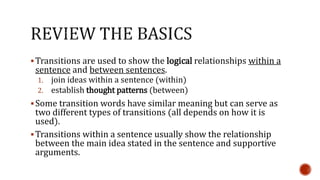
Transitions are used to show the logical relationships within a 
sentence and between sentences. 
1. join ideas within a sentence (within) 
2. establish thought patterns (between) 
Some transition words have similar meaning but can serve as 
two different types of transitions (all depends on how it is 
used). 
Transitions within a sentence usually show the relationship 
between the main idea stated in the sentence and supportive 
arguments.
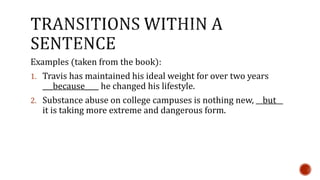
Examples (taken from the book): 
1. Travis has maintained his ideal weight for over two years 
___because____ he changed his lifestyle. 
2. Substance abuse on college campuses is nothing new, __but__ 
it is taking more extreme and dangerous form.
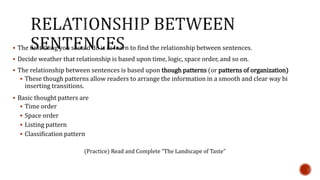
 The first thing you should do is to learn to find the relationship between sentences. 
 Decide weather that relationship is based upon time, logic, space order, and so on. 
 The relationship between sentences is based upon though patterns (or patterns of organization) 
 These though patterns allow readers to arrange the information in a smooth and clear way bi 
inserting transitions. 
 Basic thought patters are 
 Time order 
 Space order 
 Listing pattern 
 Classification pattern 
(Practice) Read and Complete “The Landscape of Taste”
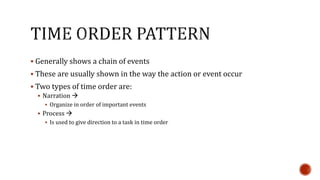
 Generally shows a chain of events 
 These are usually shown in the way the action or event occur 
 Two types of time order are: 
 Narration  
 Organize in order of important events 
 Process  
 Is used to give direction to a task in time order
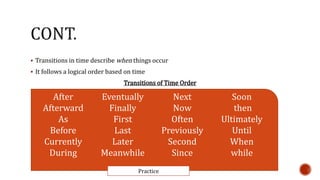
 Transitions in time describe when things occur 
 It follows a logical order based on time 
Transitions of Time Order 
After 
Afterward 
As 
Before 
Currently 
During 
Eventually 
Finally 
First 
Last 
Later 
Meanwhile 
Next 
Now 
Often 
Previously 
Second 
Since 
Soon 
then 
Ultimately 
Until 
When 
while 
Practice
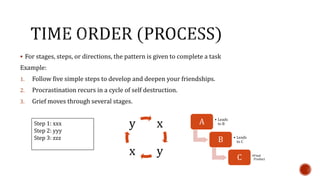
 For stages, steps, or directions, the pattern is given to complete a task 
Example: 
1. Follow five simple steps to develop and deepen your friendships. 
2. Procrastination recurs in a cycle of self destruction. 
3. Grief moves through several stages. 
Step 1: xxx 
Step 2: yyy 
Step 3: zzz 
y x 
A • Leads 
x y 
to B 
B • Leads 
to C 
C •Final 
Product
(Take a look at the transitions stated in the book) 
Practice
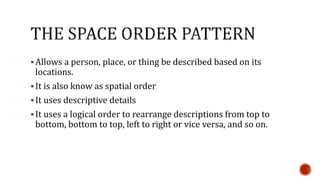
 Allows a person, place, or thing be described based on its 
locations. 
 It is also know as spatial order 
 It uses descriptive details 
 It uses a logical order to rearrange descriptions from top to 
bottom, bottom to top, left to right or vice versa, and so on.
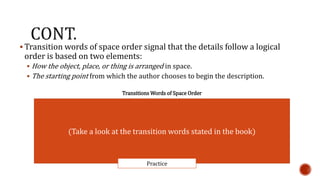
 Transition words of space order signal that the details follow a logical 
order is based on two elements: 
 How the object, place, or thing is arranged in space. 
 The starting point from which the author chooses to begin the description. 
Transitions Words of Space Order 
(Take a look at the transition words stated in the book) 
Practice
 Listing patterns are established by the author. 
 Changing them does not change the meaning. 
 Are used to list a series or reasons, details, or points. 
 These transitions can classify based on a specific order, or characteristics 
Check out transitions words presented in the book 
Practice
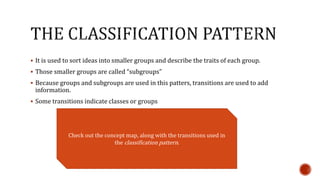
 It is used to sort ideas into smaller groups and describe the traits of each group. 
 Those smaller groups are called “subgroups” 
 Because groups and subgroups are used in this patters, transitions are used to add 
information. 
 Some transitions indicate classes or groups 
Check out the concept map, along with the transitions used in 
the classification pattern.
 These authors often use transitions to make the relationship 
between ideas clear and easy to understand. 
They often use more than one type of transition 
 Be aware and look for the author's primary thought pattern.

1202. transitions & thought patterns

  • 1.
    GEEN 1202 –Prof. M. Rivera Information based on The Effective Reader by D. J. Henry
  • 2.
    Transitions are usedto show the logical relationships within a sentence and between sentences. 1. join ideas within a sentence (within) 2. establish thought patterns (between) Some transition words have similar meaning but can serve as two different types of transitions (all depends on how it is used). Transitions within a sentence usually show the relationship between the main idea stated in the sentence and supportive arguments.
  • 3.
    Examples (taken fromthe book): 1. Travis has maintained his ideal weight for over two years ___because____ he changed his lifestyle. 2. Substance abuse on college campuses is nothing new, __but__ it is taking more extreme and dangerous form.
  • 4.
     The firstthing you should do is to learn to find the relationship between sentences.  Decide weather that relationship is based upon time, logic, space order, and so on.  The relationship between sentences is based upon though patterns (or patterns of organization)  These though patterns allow readers to arrange the information in a smooth and clear way bi inserting transitions.  Basic thought patters are  Time order  Space order  Listing pattern  Classification pattern (Practice) Read and Complete “The Landscape of Taste”
  • 5.
     Generally showsa chain of events  These are usually shown in the way the action or event occur  Two types of time order are:  Narration   Organize in order of important events  Process   Is used to give direction to a task in time order
  • 6.
     Transitions intime describe when things occur  It follows a logical order based on time Transitions of Time Order After Afterward As Before Currently During Eventually Finally First Last Later Meanwhile Next Now Often Previously Second Since Soon then Ultimately Until When while Practice
  • 7.
     For stages,steps, or directions, the pattern is given to complete a task Example: 1. Follow five simple steps to develop and deepen your friendships. 2. Procrastination recurs in a cycle of self destruction. 3. Grief moves through several stages. Step 1: xxx Step 2: yyy Step 3: zzz y x A • Leads x y to B B • Leads to C C •Final Product
  • 8.
    (Take a lookat the transitions stated in the book) Practice
  • 9.
     Allows aperson, place, or thing be described based on its locations.  It is also know as spatial order  It uses descriptive details  It uses a logical order to rearrange descriptions from top to bottom, bottom to top, left to right or vice versa, and so on.
  • 10.
     Transition wordsof space order signal that the details follow a logical order is based on two elements:  How the object, place, or thing is arranged in space.  The starting point from which the author chooses to begin the description. Transitions Words of Space Order (Take a look at the transition words stated in the book) Practice
  • 11.
     Listing patternsare established by the author.  Changing them does not change the meaning.  Are used to list a series or reasons, details, or points.  These transitions can classify based on a specific order, or characteristics Check out transitions words presented in the book Practice
  • 12.
     It isused to sort ideas into smaller groups and describe the traits of each group.  Those smaller groups are called “subgroups”  Because groups and subgroups are used in this patters, transitions are used to add information.  Some transitions indicate classes or groups Check out the concept map, along with the transitions used in the classification pattern.
  • 13.
     These authorsoften use transitions to make the relationship between ideas clear and easy to understand. They often use more than one type of transition  Be aware and look for the author's primary thought pattern.